EP0623601A1 - N-(3-Fluorobenzyl)heterocyclic derivatives and their use as pesticides - Google Patents
N-(3-Fluorobenzyl)heterocyclic derivatives and their use as pesticides Download PDFInfo
- Publication number
- EP0623601A1 EP0623601A1 EP94201160A EP94201160A EP0623601A1 EP 0623601 A1 EP0623601 A1 EP 0623601A1 EP 94201160 A EP94201160 A EP 94201160A EP 94201160 A EP94201160 A EP 94201160A EP 0623601 A1 EP0623601 A1 EP 0623601A1
- Authority
- EP
- European Patent Office
- Prior art keywords
- compound
- general formula
- group
- fluoro
- fluorobenzyl
- Prior art date
- Legal status (The legal status is an assumption and is not a legal conclusion. Google has not performed a legal analysis and makes no representation as to the accuracy of the status listed.)
- Withdrawn
Links
- 239000000575 pesticide Substances 0.000 title claims description 4
- 150000001875 compounds Chemical class 0.000 claims abstract description 76
- 125000006284 3-fluorobenzyl group Chemical group [H]C1=C([H])C(=C([H])C(F)=C1[H])C([H])([H])* 0.000 claims abstract description 16
- 125000000217 alkyl group Chemical group 0.000 claims abstract description 15
- 125000004435 hydrogen atom Chemical group [H]* 0.000 claims abstract description 12
- 230000000361 pesticidal effect Effects 0.000 claims abstract description 12
- 125000004430 oxygen atom Chemical group O* 0.000 claims abstract description 3
- 238000002360 preparation method Methods 0.000 claims description 32
- 238000000034 method Methods 0.000 claims description 29
- 239000000203 mixture Substances 0.000 claims description 26
- 238000006243 chemical reaction Methods 0.000 claims description 18
- 125000001424 substituent group Chemical group 0.000 claims description 9
- 125000005843 halogen group Chemical group 0.000 claims description 7
- NXGHEDHQXXXTTP-UHFFFAOYSA-N 1,1-bis(methylsulfanyl)-2-nitroethene Chemical group CSC(SC)=C[N+]([O-])=O NXGHEDHQXXXTTP-UHFFFAOYSA-N 0.000 claims description 6
- 150000003839 salts Chemical class 0.000 claims description 6
- IDCPFAYURAQKDZ-UHFFFAOYSA-N 1-nitroguanidine Chemical compound NC(=N)N[N+]([O-])=O IDCPFAYURAQKDZ-UHFFFAOYSA-N 0.000 claims description 5
- 125000003282 alkyl amino group Chemical group 0.000 claims description 5
- 241000607479 Yersinia pestis Species 0.000 claims description 4
- 125000002496 methyl group Chemical group [H]C([H])([H])* 0.000 claims description 4
- 125000001664 diethylamino group Chemical group [H]C([H])([H])C([H])([H])N(*)C([H])([H])C([H])([H])[H] 0.000 claims description 2
- 125000002147 dimethylamino group Chemical group [H]C([H])([H])N(*)C([H])([H])[H] 0.000 claims description 2
- 239000007787 solid Substances 0.000 description 30
- 239000000047 product Substances 0.000 description 25
- XLYOFNOQVPJJNP-UHFFFAOYSA-N water Substances O XLYOFNOQVPJJNP-UHFFFAOYSA-N 0.000 description 25
- -1 hydroxy, amino Chemical group 0.000 description 24
- 238000012360 testing method Methods 0.000 description 24
- YMWUJEATGCHHMB-UHFFFAOYSA-N Dichloromethane Chemical compound ClCCl YMWUJEATGCHHMB-UHFFFAOYSA-N 0.000 description 21
- 239000000243 solution Substances 0.000 description 18
- CSNNHWWHGAXBCP-UHFFFAOYSA-L Magnesium sulfate Chemical compound [Mg+2].[O-][S+2]([O-])([O-])[O-] CSNNHWWHGAXBCP-UHFFFAOYSA-L 0.000 description 14
- 235000021186 dishes Nutrition 0.000 description 14
- CSCPPACGZOOCGX-UHFFFAOYSA-N Acetone Chemical compound CC(C)=O CSCPPACGZOOCGX-UHFFFAOYSA-N 0.000 description 12
- WEVYAHXRMPXWCK-UHFFFAOYSA-N Acetonitrile Chemical compound CC#N WEVYAHXRMPXWCK-UHFFFAOYSA-N 0.000 description 12
- RTZKZFJDLAIYFH-UHFFFAOYSA-N Diethyl ether Chemical compound CCOCC RTZKZFJDLAIYFH-UHFFFAOYSA-N 0.000 description 12
- 239000012085 test solution Substances 0.000 description 12
- ZMXDDKWLCZADIW-UHFFFAOYSA-N N,N-Dimethylformamide Chemical compound CN(C)C=O ZMXDDKWLCZADIW-UHFFFAOYSA-N 0.000 description 11
- 241000196324 Embryophyta Species 0.000 description 10
- 238000004458 analytical method Methods 0.000 description 10
- 125000001797 benzyl group Chemical group [H]C1=C([H])C([H])=C(C([H])=C1[H])C([H])([H])* 0.000 description 10
- 235000013601 eggs Nutrition 0.000 description 10
- FYSNRJHAOHDILO-UHFFFAOYSA-N thionyl chloride Chemical compound ClS(Cl)=O FYSNRJHAOHDILO-UHFFFAOYSA-N 0.000 description 10
- WVDDGKGOMKODPV-UHFFFAOYSA-N Benzyl alcohol Chemical compound OCC1=CC=CC=C1 WVDDGKGOMKODPV-UHFFFAOYSA-N 0.000 description 9
- XEKOWRVHYACXOJ-UHFFFAOYSA-N Ethyl acetate Chemical compound CCOC(C)=O XEKOWRVHYACXOJ-UHFFFAOYSA-N 0.000 description 9
- 241000256250 Spodoptera littoralis Species 0.000 description 9
- 239000004480 active ingredient Substances 0.000 description 9
- 239000011541 reaction mixture Substances 0.000 description 9
- 238000010992 reflux Methods 0.000 description 9
- 241001124076 Aphididae Species 0.000 description 8
- HEDRZPFGACZZDS-UHFFFAOYSA-N Chloroform Chemical compound ClC(Cl)Cl HEDRZPFGACZZDS-UHFFFAOYSA-N 0.000 description 8
- LFQSCWFLJHTTHZ-UHFFFAOYSA-N Ethanol Chemical compound CCO LFQSCWFLJHTTHZ-UHFFFAOYSA-N 0.000 description 8
- KFZMGEQAYNKOFK-UHFFFAOYSA-N Isopropanol Chemical compound CC(C)O KFZMGEQAYNKOFK-UHFFFAOYSA-N 0.000 description 8
- 239000003921 oil Substances 0.000 description 8
- XFNJVJPLKCPIBV-UHFFFAOYSA-N trimethylenediamine Chemical compound NCCCN XFNJVJPLKCPIBV-UHFFFAOYSA-N 0.000 description 8
- 229910052943 magnesium sulfate Inorganic materials 0.000 description 7
- 235000019341 magnesium sulphate Nutrition 0.000 description 7
- 239000002904 solvent Substances 0.000 description 7
- 241000894007 species Species 0.000 description 7
- 239000004094 surface-active agent Substances 0.000 description 7
- IAYPIBMASNFSPL-UHFFFAOYSA-N Ethylene oxide Chemical compound C1CO1 IAYPIBMASNFSPL-UHFFFAOYSA-N 0.000 description 6
- PIICEJLVQHRZGT-UHFFFAOYSA-N Ethylenediamine Chemical compound NCCN PIICEJLVQHRZGT-UHFFFAOYSA-N 0.000 description 6
- 230000000052 comparative effect Effects 0.000 description 6
- 238000010561 standard procedure Methods 0.000 description 6
- GOBRRFQNYBGHAU-UHFFFAOYSA-N 2-(nitromethylidene)-1,3-diazinane Chemical class [O-][N+](=O)C=C1NCCCN1 GOBRRFQNYBGHAU-UHFFFAOYSA-N 0.000 description 5
- 241000171293 Megoura viciae Species 0.000 description 5
- 235000019445 benzyl alcohol Nutrition 0.000 description 5
- 238000001914 filtration Methods 0.000 description 5
- 230000000749 insecticidal effect Effects 0.000 description 5
- 239000007788 liquid Substances 0.000 description 5
- 238000000746 purification Methods 0.000 description 5
- 238000005507 spraying Methods 0.000 description 5
- OHXNZFJZRFHBLX-UHFFFAOYSA-N 2-(nitromethylidene)imidazolidine Chemical compound [O-][N+](=O)C=C1NCCN1 OHXNZFJZRFHBLX-UHFFFAOYSA-N 0.000 description 4
- 241000253994 Acyrthosiphon pisum Species 0.000 description 4
- 241001608567 Phaedon cochleariae Species 0.000 description 4
- 244000046052 Phaseolus vulgaris Species 0.000 description 4
- GOOHAUXETOMSMM-UHFFFAOYSA-N Propylene oxide Chemical compound CC1CO1 GOOHAUXETOMSMM-UHFFFAOYSA-N 0.000 description 4
- 241000018137 Trialeurodes vaporariorum Species 0.000 description 4
- 239000000654 additive Substances 0.000 description 4
- 239000000969 carrier Substances 0.000 description 4
- 229910052801 chlorine Inorganic materials 0.000 description 4
- 239000007859 condensation product Substances 0.000 description 4
- 239000002270 dispersing agent Substances 0.000 description 4
- 230000000694 effects Effects 0.000 description 4
- 239000008187 granular material Substances 0.000 description 4
- 125000001997 phenyl group Chemical group [H]C1=C([H])C([H])=C(*)C([H])=C1[H] 0.000 description 4
- BWHMMNNQKKPAPP-UHFFFAOYSA-L potassium carbonate Chemical compound [K+].[K+].[O-]C([O-])=O BWHMMNNQKKPAPP-UHFFFAOYSA-L 0.000 description 4
- HPALAKNZSZLMCH-UHFFFAOYSA-M sodium;chloride;hydrate Chemical class O.[Na+].[Cl-] HPALAKNZSZLMCH-UHFFFAOYSA-M 0.000 description 4
- 239000003381 stabilizer Substances 0.000 description 4
- 238000003756 stirring Methods 0.000 description 4
- IDEZECZCLMOIJN-ONEGZZNKSA-N (2e)-2-(nitromethylidene)-1,3-thiazolidine Chemical compound [O-][N+](=O)\C=C1/NCCS1 IDEZECZCLMOIJN-ONEGZZNKSA-N 0.000 description 3
- ILWFNKLXPUKLEP-UHFFFAOYSA-N 1-chloro-4-(chloromethyl)-2-fluorobenzene Chemical compound FC1=CC(CCl)=CC=C1Cl ILWFNKLXPUKLEP-UHFFFAOYSA-N 0.000 description 3
- ZWEHNKRNPOVVGH-UHFFFAOYSA-N 2-Butanone Chemical compound CCC(C)=O ZWEHNKRNPOVVGH-UHFFFAOYSA-N 0.000 description 3
- 241000256118 Aedes aegypti Species 0.000 description 3
- IJGRMHOSHXDMSA-UHFFFAOYSA-N Atomic nitrogen Chemical compound N#N IJGRMHOSHXDMSA-UHFFFAOYSA-N 0.000 description 3
- UHOVQNZJYSORNB-UHFFFAOYSA-N Benzene Chemical compound C1=CC=CC=C1 UHOVQNZJYSORNB-UHFFFAOYSA-N 0.000 description 3
- 241000255925 Diptera Species 0.000 description 3
- PXGOKWXKJXAPGV-UHFFFAOYSA-N Fluorine Chemical compound FF PXGOKWXKJXAPGV-UHFFFAOYSA-N 0.000 description 3
- PEDCQBHIVMGVHV-UHFFFAOYSA-N Glycerine Chemical compound OCC(O)CO PEDCQBHIVMGVHV-UHFFFAOYSA-N 0.000 description 3
- 241000258937 Hemiptera Species 0.000 description 3
- 206010061217 Infestation Diseases 0.000 description 3
- OKKJLVBELUTLKV-UHFFFAOYSA-N Methanol Chemical compound OC OKKJLVBELUTLKV-UHFFFAOYSA-N 0.000 description 3
- 241000257159 Musca domestica Species 0.000 description 3
- KEAYESYHFKHZAL-UHFFFAOYSA-N Sodium Chemical compound [Na] KEAYESYHFKHZAL-UHFFFAOYSA-N 0.000 description 3
- HEMHJVSKTPXQMS-UHFFFAOYSA-M Sodium hydroxide Chemical compound [OH-].[Na+] HEMHJVSKTPXQMS-UHFFFAOYSA-M 0.000 description 3
- YXFVVABEGXRONW-UHFFFAOYSA-N Toluene Chemical compound CC1=CC=CC=C1 YXFVVABEGXRONW-UHFFFAOYSA-N 0.000 description 3
- 125000003545 alkoxy group Chemical group 0.000 description 3
- 235000012211 aluminium silicate Nutrition 0.000 description 3
- 229910000323 aluminium silicate Inorganic materials 0.000 description 3
- 125000004432 carbon atom Chemical group C* 0.000 description 3
- 239000000460 chlorine Substances 0.000 description 3
- 125000004093 cyano group Chemical group *C#N 0.000 description 3
- 239000002027 dichloromethane extract Substances 0.000 description 3
- 235000005911 diet Nutrition 0.000 description 3
- 230000037213 diet Effects 0.000 description 3
- 239000000839 emulsion Substances 0.000 description 3
- 229910052731 fluorine Inorganic materials 0.000 description 3
- 239000011737 fluorine Substances 0.000 description 3
- 239000011521 glass Substances 0.000 description 3
- MTNDZQHUAFNZQY-UHFFFAOYSA-N imidazoline Chemical compound C1CN=CN1 MTNDZQHUAFNZQY-UHFFFAOYSA-N 0.000 description 3
- 239000002917 insecticide Substances 0.000 description 3
- 229960004592 isopropanol Drugs 0.000 description 3
- 239000012299 nitrogen atmosphere Substances 0.000 description 3
- 239000000843 powder Substances 0.000 description 3
- 229910052708 sodium Inorganic materials 0.000 description 3
- 239000011734 sodium Substances 0.000 description 3
- 239000007921 spray Substances 0.000 description 3
- 230000001988 toxicity Effects 0.000 description 3
- 231100000419 toxicity Toxicity 0.000 description 3
- HHWYYUUOGAUCKX-UHFFFAOYSA-N (3-fluoro-4-methoxyphenyl)methanol Chemical compound COC1=CC=C(CO)C=C1F HHWYYUUOGAUCKX-UHFFFAOYSA-N 0.000 description 2
- OTPDWCMLUKMQNO-UHFFFAOYSA-N 1,2,3,4-tetrahydropyrimidine Chemical compound C1NCC=CN1 OTPDWCMLUKMQNO-UHFFFAOYSA-N 0.000 description 2
- WXDBEMYJCVDEDE-UHFFFAOYSA-N 1-[(4-chloro-3-fluorophenyl)methyl]-2-(nitromethylidene)-1,3-diazinane Chemical compound [O-][N+](=O)C=C1NCCCN1CC1=CC=C(Cl)C(F)=C1 WXDBEMYJCVDEDE-UHFFFAOYSA-N 0.000 description 2
- TVSGEZXHUKKNHM-UHFFFAOYSA-N 1-[(4-chloro-3-fluorophenyl)methyl]-2-(nitromethylidene)imidazolidine Chemical compound [O-][N+](=O)C=C1NCCN1CC1=CC=C(Cl)C(F)=C1 TVSGEZXHUKKNHM-UHFFFAOYSA-N 0.000 description 2
- IANQTJSKSUMEQM-UHFFFAOYSA-N 1-benzofuran Chemical compound C1=CC=C2OC=CC2=C1 IANQTJSKSUMEQM-UHFFFAOYSA-N 0.000 description 2
- BTBFCBQZFMQBNT-UHFFFAOYSA-N 3,4-difluorobenzonitrile Chemical compound FC1=CC=C(C#N)C=C1F BTBFCBQZFMQBNT-UHFFFAOYSA-N 0.000 description 2
- OKBDMQMQRYBAPN-UHFFFAOYSA-N 3-[(4-chloro-3-fluorophenyl)methyl]-2-(nitromethylidene)-1,3-thiazolidine Chemical compound [O-][N+](=O)C=C1SCCN1CC1=CC=C(Cl)C(F)=C1 OKBDMQMQRYBAPN-UHFFFAOYSA-N 0.000 description 2
- HYNNNQDQEORWEU-UHFFFAOYSA-N 3-fluoro-4-methoxybenzoic acid Chemical compound COC1=CC=C(C(O)=O)C=C1F HYNNNQDQEORWEU-UHFFFAOYSA-N 0.000 description 2
- FEEOVAOEPGQDTJ-UHFFFAOYSA-N 3-fluoro-4-methoxybenzonitrile Chemical compound COC1=CC=C(C#N)C=C1F FEEOVAOEPGQDTJ-UHFFFAOYSA-N 0.000 description 2
- DDAXEANMRGIVDY-UHFFFAOYSA-N 4-(chloromethyl)-2-fluoro-1-methoxybenzene Chemical compound COC1=CC=C(CCl)C=C1F DDAXEANMRGIVDY-UHFFFAOYSA-N 0.000 description 2
- ZEHDDWXQBDGZCY-UHFFFAOYSA-N 4-(chloromethyl)-2-fluoro-n,n-dimethylaniline;hydrochloride Chemical compound Cl.CN(C)C1=CC=C(CCl)C=C1F ZEHDDWXQBDGZCY-UHFFFAOYSA-N 0.000 description 2
- ALMADAASYUEHSC-UHFFFAOYSA-N 4-(dimethylamino)-3-fluorobenzoic acid Chemical compound CN(C)C1=CC=C(C(O)=O)C=C1F ALMADAASYUEHSC-UHFFFAOYSA-N 0.000 description 2
- UOHZUGYMWIKXBN-UHFFFAOYSA-N 4-(dimethylamino)-3-fluorobenzonitrile Chemical compound CN(C)C1=CC=C(C#N)C=C1F UOHZUGYMWIKXBN-UHFFFAOYSA-N 0.000 description 2
- QTBSBXVTEAMEQO-UHFFFAOYSA-N Acetic acid Chemical compound CC(O)=O QTBSBXVTEAMEQO-UHFFFAOYSA-N 0.000 description 2
- 235000010149 Brassica rapa subsp chinensis Nutrition 0.000 description 2
- 235000000536 Brassica rapa subsp pekinensis Nutrition 0.000 description 2
- 241000499436 Brassica rapa subsp. pekinensis Species 0.000 description 2
- WKBOTKDWSSQWDR-UHFFFAOYSA-N Bromine atom Chemical compound [Br] WKBOTKDWSSQWDR-UHFFFAOYSA-N 0.000 description 2
- OYPRJOBELJOOCE-UHFFFAOYSA-N Calcium Chemical compound [Ca] OYPRJOBELJOOCE-UHFFFAOYSA-N 0.000 description 2
- VTYYLEPIZMXCLO-UHFFFAOYSA-L Calcium carbonate Chemical compound [Ca+2].[O-]C([O-])=O VTYYLEPIZMXCLO-UHFFFAOYSA-L 0.000 description 2
- CURLTUGMZLYLDI-UHFFFAOYSA-N Carbon dioxide Chemical compound O=C=O CURLTUGMZLYLDI-UHFFFAOYSA-N 0.000 description 2
- ZAMOUSCENKQFHK-UHFFFAOYSA-N Chlorine atom Chemical compound [Cl] ZAMOUSCENKQFHK-UHFFFAOYSA-N 0.000 description 2
- ROSDSFDQCJNGOL-UHFFFAOYSA-N Dimethylamine Chemical compound CNC ROSDSFDQCJNGOL-UHFFFAOYSA-N 0.000 description 2
- 241000086608 Empoasca vitis Species 0.000 description 2
- DGAQECJNVWCQMB-PUAWFVPOSA-M Ilexoside XXIX Chemical compound C[C@@H]1CC[C@@]2(CC[C@@]3(C(=CC[C@H]4[C@]3(CC[C@@H]5[C@@]4(CC[C@@H](C5(C)C)OS(=O)(=O)[O-])C)C)[C@@H]2[C@]1(C)O)C)C(=O)O[C@H]6[C@@H]([C@H]([C@@H]([C@H](O6)CO)O)O)O.[Na+] DGAQECJNVWCQMB-PUAWFVPOSA-M 0.000 description 2
- 241000358422 Nephotettix cincticeps Species 0.000 description 2
- 240000007594 Oryza sativa Species 0.000 description 2
- 235000007164 Oryza sativa Nutrition 0.000 description 2
- 241000219843 Pisum Species 0.000 description 2
- UIIMBOGNXHQVGW-UHFFFAOYSA-M Sodium bicarbonate Chemical compound [Na+].OC([O-])=O UIIMBOGNXHQVGW-UHFFFAOYSA-M 0.000 description 2
- PPBRXRYQALVLMV-UHFFFAOYSA-N Styrene Chemical compound C=CC1=CC=CC=C1 PPBRXRYQALVLMV-UHFFFAOYSA-N 0.000 description 2
- QAOWNCQODCNURD-UHFFFAOYSA-N Sulfuric acid Chemical compound OS(O)(=O)=O QAOWNCQODCNURD-UHFFFAOYSA-N 0.000 description 2
- 241001454293 Tetranychus urticae Species 0.000 description 2
- 240000006677 Vicia faba Species 0.000 description 2
- 230000000895 acaricidal effect Effects 0.000 description 2
- 239000011149 active material Substances 0.000 description 2
- 229910000102 alkali metal hydride Inorganic materials 0.000 description 2
- 150000008046 alkali metal hydrides Chemical class 0.000 description 2
- 229910052784 alkaline earth metal Inorganic materials 0.000 description 2
- 238000003556 assay Methods 0.000 description 2
- 150000001558 benzoic acid derivatives Chemical class 0.000 description 2
- 239000011575 calcium Substances 0.000 description 2
- 229910052791 calcium Inorganic materials 0.000 description 2
- OSGAYBCDTDRGGQ-UHFFFAOYSA-L calcium sulfate Chemical compound [Ca+2].[O-]S([O-])(=O)=O OSGAYBCDTDRGGQ-UHFFFAOYSA-L 0.000 description 2
- 239000003795 chemical substances by application Substances 0.000 description 2
- 125000001309 chloro group Chemical group Cl* 0.000 description 2
- 239000012141 concentrate Substances 0.000 description 2
- 229920001577 copolymer Polymers 0.000 description 2
- 230000007797 corrosion Effects 0.000 description 2
- 238000005260 corrosion Methods 0.000 description 2
- JHIVVAPYMSGYDF-UHFFFAOYSA-N cyclohexanone Chemical compound O=C1CCCCC1 JHIVVAPYMSGYDF-UHFFFAOYSA-N 0.000 description 2
- 125000004663 dialkyl amino group Chemical group 0.000 description 2
- 235000014113 dietary fatty acids Nutrition 0.000 description 2
- 238000010790 dilution Methods 0.000 description 2
- 239000012895 dilution Substances 0.000 description 2
- 238000001035 drying Methods 0.000 description 2
- 239000004495 emulsifiable concentrate Substances 0.000 description 2
- 239000003995 emulsifying agent Substances 0.000 description 2
- 239000000194 fatty acid Substances 0.000 description 2
- 229930195729 fatty acid Natural products 0.000 description 2
- 239000000706 filtrate Substances 0.000 description 2
- 230000009969 flowable effect Effects 0.000 description 2
- 238000007654 immersion Methods 0.000 description 2
- 239000003112 inhibitor Substances 0.000 description 2
- 238000013101 initial test Methods 0.000 description 2
- 239000012280 lithium aluminium hydride Substances 0.000 description 2
- 239000000463 material Substances 0.000 description 2
- 235000013336 milk Nutrition 0.000 description 2
- 239000008267 milk Substances 0.000 description 2
- 210000004080 milk Anatomy 0.000 description 2
- UPLCAOZVJYTIOA-UHFFFAOYSA-N n-[1-[(3-fluoro-4-methoxyphenyl)methyl]-3-methylimidazolidin-2-ylidene]nitramide Chemical compound C1=C(F)C(OC)=CC=C1CN1C(=N[N+]([O-])=O)N(C)CC1 UPLCAOZVJYTIOA-UHFFFAOYSA-N 0.000 description 2
- 239000003880 polar aprotic solvent Substances 0.000 description 2
- 229920000642 polymer Polymers 0.000 description 2
- 229910000027 potassium carbonate Inorganic materials 0.000 description 2
- 239000002244 precipitate Substances 0.000 description 2
- 125000002924 primary amino group Chemical group [H]N([H])* 0.000 description 2
- 235000009566 rice Nutrition 0.000 description 2
- 229910000033 sodium borohydride Inorganic materials 0.000 description 2
- 239000012279 sodium borohydride Substances 0.000 description 2
- 239000012312 sodium hydride Substances 0.000 description 2
- 229910000104 sodium hydride Inorganic materials 0.000 description 2
- 159000000000 sodium salts Chemical class 0.000 description 2
- 239000000725 suspension Substances 0.000 description 2
- 239000004546 suspension concentrate Substances 0.000 description 2
- 230000009885 systemic effect Effects 0.000 description 2
- VZGDMQKNWNREIO-UHFFFAOYSA-N tetrachloromethane Chemical compound ClC(Cl)(Cl)Cl VZGDMQKNWNREIO-UHFFFAOYSA-N 0.000 description 2
- GPRLSGONYQIRFK-MNYXATJNSA-N triton Chemical compound [3H+] GPRLSGONYQIRFK-MNYXATJNSA-N 0.000 description 2
- 239000004563 wettable powder Substances 0.000 description 2
- 239000000080 wetting agent Substances 0.000 description 2
- DPWKYYLECGPXAV-DHZHZOJOSA-N (2e)-1-[(2-chlorophenyl)methyl]-2-(nitromethylidene)imidazolidine Chemical compound [O-][N+](=O)\C=C1/NCCN1CC1=CC=CC=C1Cl DPWKYYLECGPXAV-DHZHZOJOSA-N 0.000 description 1
- JNYAEWCLZODPBN-JGWLITMVSA-N (2r,3r,4s)-2-[(1r)-1,2-dihydroxyethyl]oxolane-3,4-diol Chemical compound OC[C@@H](O)[C@H]1OC[C@H](O)[C@H]1O JNYAEWCLZODPBN-JGWLITMVSA-N 0.000 description 1
- UOCLXMDMGBRAIB-UHFFFAOYSA-N 1,1,1-trichloroethane Chemical compound CC(Cl)(Cl)Cl UOCLXMDMGBRAIB-UHFFFAOYSA-N 0.000 description 1
- STEBXRGVPXQEAO-UHFFFAOYSA-N 1-[(3,4-dichlorophenyl)methyl]-2-(nitromethylidene)imidazolidine Chemical compound [O-][N+](=O)C=C1NCCN1CC1=CC=C(Cl)C(Cl)=C1 STEBXRGVPXQEAO-UHFFFAOYSA-N 0.000 description 1
- HHVGWZQEKXOVSV-UHFFFAOYSA-N 1-[(4-bromophenyl)methyl]-2-(nitromethylidene)-1,3-diazinane Chemical compound [O-][N+](=O)C=C1NCCCN1CC1=CC=C(Br)C=C1 HHVGWZQEKXOVSV-UHFFFAOYSA-N 0.000 description 1
- JSKNYYPDFMSSAI-UHFFFAOYSA-N 1-[(4-chlorophenyl)methyl]-2-(nitromethylidene)-1,3-diazinane Chemical compound [O-][N+](=O)C=C1NCCCN1CC1=CC=C(Cl)C=C1 JSKNYYPDFMSSAI-UHFFFAOYSA-N 0.000 description 1
- KATOGIJHEDYLRI-UHFFFAOYSA-N 1-[(4-chlorophenyl)methyl]-2-(nitromethylidene)imidazolidine Chemical compound [O-][N+](=O)C=C1NCCN1CC1=CC=C(Cl)C=C1 KATOGIJHEDYLRI-UHFFFAOYSA-N 0.000 description 1
- RRZILELJHZQMMY-UHFFFAOYSA-N 1-[(4-fluorophenyl)methyl]-2-(nitromethylidene)-1,3-diazinane Chemical compound [O-][N+](=O)C=C1NCCCN1CC1=CC=C(F)C=C1 RRZILELJHZQMMY-UHFFFAOYSA-N 0.000 description 1
- UUDALGCVGMFEBZ-UHFFFAOYSA-N 1-[(4-fluorophenyl)methyl]-2-(nitromethylidene)imidazolidine Chemical compound [O-][N+](=O)C=C1NCCN1CC1=CC=C(F)C=C1 UUDALGCVGMFEBZ-UHFFFAOYSA-N 0.000 description 1
- CHGVURYXFUAFNB-UHFFFAOYSA-N 1-benzyl-2-(nitromethylidene)-1,3-diazinane Chemical compound [O-][N+](=O)C=C1NCCCN1CC1=CC=CC=C1 CHGVURYXFUAFNB-UHFFFAOYSA-N 0.000 description 1
- AMSZBACOVUMMSU-UHFFFAOYSA-N 1-benzyl-2-(nitromethylidene)imidazolidine Chemical compound [O-][N+](=O)C=C1NCCN1CC1=CC=CC=C1 AMSZBACOVUMMSU-UHFFFAOYSA-N 0.000 description 1
- GKPHNZYMLJPYJJ-UHFFFAOYSA-N 2,3-difluorobenzonitrile Chemical class FC1=CC=CC(C#N)=C1F GKPHNZYMLJPYJJ-UHFFFAOYSA-N 0.000 description 1
- IOHPVZBSOKLVMN-UHFFFAOYSA-N 2-(2-phenylethyl)benzoic acid Chemical compound OC(=O)C1=CC=CC=C1CCC1=CC=CC=C1 IOHPVZBSOKLVMN-UHFFFAOYSA-N 0.000 description 1
- OGMADIBCHLQMIP-UHFFFAOYSA-N 2-aminoethanethiol;hydron;chloride Chemical compound Cl.NCCS OGMADIBCHLQMIP-UHFFFAOYSA-N 0.000 description 1
- ZVZQKNVMDKSGGF-UHFFFAOYSA-N 2-ethylsulfanylethoxy-dimethoxy-sulfanylidene-$l^{5}-phosphane Chemical compound CCSCCOP(=S)(OC)OC ZVZQKNVMDKSGGF-UHFFFAOYSA-N 0.000 description 1
- DGXRGGUNBXNJRI-UHFFFAOYSA-N 2-methyl-4-octylphenol Chemical compound CCCCCCCCC1=CC=C(O)C(C)=C1 DGXRGGUNBXNJRI-UHFFFAOYSA-N 0.000 description 1
- SKSULXNNXIVQDX-UHFFFAOYSA-N 3-[[2-(nitromethylidene)-1,3-diazinan-1-yl]methyl]benzonitrile Chemical class [O-][N+](=O)C=C1NCCCN1CC1=CC=CC(C#N)=C1 SKSULXNNXIVQDX-UHFFFAOYSA-N 0.000 description 1
- ZMRXZFAELZYEMJ-UHFFFAOYSA-N 3-[[2-(nitromethylidene)imidazolidin-1-yl]methyl]benzonitrile Chemical compound [O-][N+](=O)C=C1NCCN1CC1=CC=CC(C#N)=C1 ZMRXZFAELZYEMJ-UHFFFAOYSA-N 0.000 description 1
- 125000006279 3-bromobenzyl group Chemical group [H]C1=C([H])C(=C([H])C(Br)=C1[H])C([H])([H])* 0.000 description 1
- 125000003852 3-chlorobenzyl group Chemical group [H]C1=C([H])C(=C([H])C(Cl)=C1[H])C([H])([H])* 0.000 description 1
- MXNBDFWNYRNIBH-UHFFFAOYSA-N 3-fluorobenzoic acid Chemical class OC(=O)C1=CC=CC(F)=C1 MXNBDFWNYRNIBH-UHFFFAOYSA-N 0.000 description 1
- QPIBHIXKUQKNFP-UHFFFAOYSA-N 4-chloro-3-fluorobenzoic acid Chemical compound OC(=O)C1=CC=C(Cl)C(F)=C1 QPIBHIXKUQKNFP-UHFFFAOYSA-N 0.000 description 1
- NTDQQZYCCIDJRK-UHFFFAOYSA-N 4-octylphenol Chemical compound CCCCCCCCC1=CC=C(O)C=C1 NTDQQZYCCIDJRK-UHFFFAOYSA-N 0.000 description 1
- ZCYVEMRRCGMTRW-UHFFFAOYSA-N 7553-56-2 Chemical group [I] ZCYVEMRRCGMTRW-UHFFFAOYSA-N 0.000 description 1
- 241000238876 Acari Species 0.000 description 1
- OKTJSMMVPCPJKN-UHFFFAOYSA-N Carbon Chemical compound [C] OKTJSMMVPCPJKN-UHFFFAOYSA-N 0.000 description 1
- KZBUYRJDOAKODT-UHFFFAOYSA-N Chlorine Chemical compound ClCl KZBUYRJDOAKODT-UHFFFAOYSA-N 0.000 description 1
- 241001498622 Cixius wagneri Species 0.000 description 1
- 241000254173 Coleoptera Species 0.000 description 1
- 229920000742 Cotton Polymers 0.000 description 1
- 241000238631 Hexapoda Species 0.000 description 1
- VEXZGXHMUGYJMC-UHFFFAOYSA-N Hydrochloric acid Chemical compound Cl VEXZGXHMUGYJMC-UHFFFAOYSA-N 0.000 description 1
- 241000748095 Hymenopappus filifolius Species 0.000 description 1
- 241000255777 Lepidoptera Species 0.000 description 1
- FYYHWMGAXLPEAU-UHFFFAOYSA-N Magnesium Chemical compound [Mg] FYYHWMGAXLPEAU-UHFFFAOYSA-N 0.000 description 1
- NTIZESTWPVYFNL-UHFFFAOYSA-N Methyl isobutyl ketone Chemical compound CC(C)CC(C)=O NTIZESTWPVYFNL-UHFFFAOYSA-N 0.000 description 1
- UIHCLUNTQKBZGK-UHFFFAOYSA-N Methyl isobutyl ketone Natural products CCC(C)C(C)=O UIHCLUNTQKBZGK-UHFFFAOYSA-N 0.000 description 1
- 241000237852 Mollusca Species 0.000 description 1
- 241000257226 Muscidae Species 0.000 description 1
- 241001556089 Nilaparvata lugens Species 0.000 description 1
- CTQNGGLPUBDAKN-UHFFFAOYSA-N O-Xylene Chemical compound CC1=CC=CC=C1C CTQNGGLPUBDAKN-UHFFFAOYSA-N 0.000 description 1
- 241000118205 Ovicides Species 0.000 description 1
- CYTYCFOTNPOANT-UHFFFAOYSA-N Perchloroethylene Chemical group ClC(Cl)=C(Cl)Cl CYTYCFOTNPOANT-UHFFFAOYSA-N 0.000 description 1
- 229920005439 Perspex® Polymers 0.000 description 1
- 235000010627 Phaseolus vulgaris Nutrition 0.000 description 1
- 229920001213 Polysorbate 20 Polymers 0.000 description 1
- DBMJMQXJHONAFJ-UHFFFAOYSA-M Sodium laurylsulphate Chemical compound [Na+].CCCCCCCCCCCCOS([O-])(=O)=O DBMJMQXJHONAFJ-UHFFFAOYSA-M 0.000 description 1
- 239000004141 Sodium laurylsulphate Substances 0.000 description 1
- 229920002125 Sokalan® Polymers 0.000 description 1
- CZMRCDWAGMRECN-UGDNZRGBSA-N Sucrose Chemical compound O[C@H]1[C@H](O)[C@@H](CO)O[C@@]1(CO)O[C@@H]1[C@H](O)[C@@H](O)[C@H](O)[C@@H](CO)O1 CZMRCDWAGMRECN-UGDNZRGBSA-N 0.000 description 1
- 229930006000 Sucrose Natural products 0.000 description 1
- NINIDFKCEFEMDL-UHFFFAOYSA-N Sulfur Chemical compound [S] NINIDFKCEFEMDL-UHFFFAOYSA-N 0.000 description 1
- 239000005864 Sulphur Substances 0.000 description 1
- 235000010749 Vicia faba Nutrition 0.000 description 1
- 235000002098 Vicia faba var. major Nutrition 0.000 description 1
- 229960000583 acetic acid Drugs 0.000 description 1
- 239000002253 acid Substances 0.000 description 1
- 150000007513 acids Chemical class 0.000 description 1
- 239000000443 aerosol Substances 0.000 description 1
- 238000005054 agglomeration Methods 0.000 description 1
- 230000002776 aggregation Effects 0.000 description 1
- 150000001298 alcohols Chemical class 0.000 description 1
- 239000003513 alkali Substances 0.000 description 1
- 150000003973 alkyl amines Chemical class 0.000 description 1
- 125000005157 alkyl carboxy group Chemical group 0.000 description 1
- 125000004644 alkyl sulfinyl group Chemical group 0.000 description 1
- 125000004390 alkyl sulfonyl group Chemical group 0.000 description 1
- 125000004414 alkyl thio group Chemical group 0.000 description 1
- 150000001408 amides Chemical class 0.000 description 1
- 125000003277 amino group Chemical group 0.000 description 1
- BFNBIHQBYMNNAN-UHFFFAOYSA-N ammonium sulfate Chemical compound N.N.OS(O)(=O)=O BFNBIHQBYMNNAN-UHFFFAOYSA-N 0.000 description 1
- 229910052921 ammonium sulfate Inorganic materials 0.000 description 1
- 239000001166 ammonium sulphate Substances 0.000 description 1
- 235000011130 ammonium sulphate Nutrition 0.000 description 1
- 125000003118 aryl group Chemical group 0.000 description 1
- 239000010426 asphalt Substances 0.000 description 1
- 239000012298 atmosphere Substances 0.000 description 1
- 239000002585 base Substances 0.000 description 1
- 150000008359 benzonitriles Chemical class 0.000 description 1
- 150000003938 benzyl alcohols Chemical class 0.000 description 1
- 239000011230 binding agent Substances 0.000 description 1
- 238000004166 bioassay Methods 0.000 description 1
- 230000003115 biocidal effect Effects 0.000 description 1
- 239000003139 biocide Substances 0.000 description 1
- 238000009395 breeding Methods 0.000 description 1
- 230000001488 breeding effect Effects 0.000 description 1
- 239000012267 brine Substances 0.000 description 1
- GDTBXPJZTBHREO-UHFFFAOYSA-N bromine Substances BrBr GDTBXPJZTBHREO-UHFFFAOYSA-N 0.000 description 1
- 229910052794 bromium Inorganic materials 0.000 description 1
- 125000001246 bromo group Chemical group Br* 0.000 description 1
- 235000021329 brown rice Nutrition 0.000 description 1
- 229910000019 calcium carbonate Inorganic materials 0.000 description 1
- 239000001175 calcium sulphate Substances 0.000 description 1
- 235000011132 calcium sulphate Nutrition 0.000 description 1
- YYRMJZQKEFZXMX-UHFFFAOYSA-N calcium;phosphoric acid Chemical class [Ca+2].OP(O)(O)=O.OP(O)(O)=O YYRMJZQKEFZXMX-UHFFFAOYSA-N 0.000 description 1
- 229910052799 carbon Inorganic materials 0.000 description 1
- 239000001569 carbon dioxide Substances 0.000 description 1
- 229910002092 carbon dioxide Inorganic materials 0.000 description 1
- 125000003178 carboxy group Chemical group [H]OC(*)=O 0.000 description 1
- 239000004359 castor oil Substances 0.000 description 1
- 235000019438 castor oil Nutrition 0.000 description 1
- 150000008280 chlorinated hydrocarbons Chemical class 0.000 description 1
- 239000000084 colloidal system Substances 0.000 description 1
- 239000006184 cosolvent Substances 0.000 description 1
- 238000002425 crystallisation Methods 0.000 description 1
- 238000011161 development Methods 0.000 description 1
- 230000018109 developmental process Effects 0.000 description 1
- 125000004982 dihaloalkyl group Chemical group 0.000 description 1
- 238000007865 diluting Methods 0.000 description 1
- 229910001873 dinitrogen Inorganic materials 0.000 description 1
- 239000006185 dispersion Substances 0.000 description 1
- 238000004090 dissolution Methods 0.000 description 1
- YRIUSKIDOIARQF-UHFFFAOYSA-N dodecyl benzenesulfonate Chemical compound CCCCCCCCCCCCOS(=O)(=O)C1=CC=CC=C1 YRIUSKIDOIARQF-UHFFFAOYSA-N 0.000 description 1
- 239000000428 dust Substances 0.000 description 1
- 150000002170 ethers Chemical class 0.000 description 1
- 125000001495 ethyl group Chemical group [H]C([H])([H])C([H])([H])* 0.000 description 1
- 238000001704 evaporation Methods 0.000 description 1
- 230000008020 evaporation Effects 0.000 description 1
- 239000000284 extract Substances 0.000 description 1
- 150000004665 fatty acids Chemical class 0.000 description 1
- 150000002191 fatty alcohols Chemical class 0.000 description 1
- 239000010946 fine silver Substances 0.000 description 1
- 238000009472 formulation Methods 0.000 description 1
- 230000000855 fungicidal effect Effects 0.000 description 1
- 230000035784 germination Effects 0.000 description 1
- 239000012362 glacial acetic acid Substances 0.000 description 1
- ZEMPKEQAKRGZGQ-XOQCFJPHSA-N glycerol triricinoleate Natural products CCCCCC[C@@H](O)CC=CCCCCCCCC(=O)OC[C@@H](COC(=O)CCCCCCCC=CC[C@@H](O)CCCCCC)OC(=O)CCCCCCCC=CC[C@H](O)CCCCCC ZEMPKEQAKRGZGQ-XOQCFJPHSA-N 0.000 description 1
- 150000002334 glycols Chemical class 0.000 description 1
- 125000004438 haloalkoxy group Chemical group 0.000 description 1
- 125000001188 haloalkyl group Chemical group 0.000 description 1
- 229910052736 halogen Inorganic materials 0.000 description 1
- 230000002140 halogenating effect Effects 0.000 description 1
- 150000002367 halogens Chemical class 0.000 description 1
- 238000010438 heat treatment Methods 0.000 description 1
- 230000002363 herbicidal effect Effects 0.000 description 1
- 150000004678 hydrides Chemical class 0.000 description 1
- 229930195733 hydrocarbon Natural products 0.000 description 1
- 150000002430 hydrocarbons Chemical class 0.000 description 1
- 230000007062 hydrolysis Effects 0.000 description 1
- 238000006460 hydrolysis reaction Methods 0.000 description 1
- 125000002887 hydroxy group Chemical group [H]O* 0.000 description 1
- 238000005470 impregnation Methods 0.000 description 1
- 239000004615 ingredient Substances 0.000 description 1
- 239000003350 kerosene Substances 0.000 description 1
- 150000002576 ketones Chemical class 0.000 description 1
- 230000001418 larval effect Effects 0.000 description 1
- 229920005610 lignin Polymers 0.000 description 1
- 239000011777 magnesium Substances 0.000 description 1
- 229910052749 magnesium Inorganic materials 0.000 description 1
- 239000000391 magnesium silicate Substances 0.000 description 1
- 235000012243 magnesium silicates Nutrition 0.000 description 1
- 239000008268 mayonnaise Substances 0.000 description 1
- 235000010746 mayonnaise Nutrition 0.000 description 1
- OPXLLQIJSORQAM-UHFFFAOYSA-N mebendazole Chemical compound C=1C=C2NC(NC(=O)OC)=NC2=CC=1C(=O)C1=CC=CC=C1 OPXLLQIJSORQAM-UHFFFAOYSA-N 0.000 description 1
- 125000004170 methylsulfonyl group Chemical group [H]C([H])([H])S(*)(=O)=O 0.000 description 1
- 229910052618 mica group Inorganic materials 0.000 description 1
- 239000002480 mineral oil Substances 0.000 description 1
- 238000012986 modification Methods 0.000 description 1
- 230000004048 modification Effects 0.000 description 1
- 239000003607 modifier Substances 0.000 description 1
- 230000002013 molluscicidal effect Effects 0.000 description 1
- 125000006682 monohaloalkyl group Chemical group 0.000 description 1
- NXRHFYJBTNSXCL-UHFFFAOYSA-N n-[1-[(3-cyanophenyl)methyl]-4,5-dihydroimidazol-2-yl]nitramide Chemical compound [O-][N+](=O)N=C1NCCN1CC1=CC=CC(C#N)=C1 NXRHFYJBTNSXCL-UHFFFAOYSA-N 0.000 description 1
- 239000000025 natural resin Substances 0.000 description 1
- 125000000449 nitro group Chemical group [O-][N+](*)=O 0.000 description 1
- 229910052757 nitrogen Inorganic materials 0.000 description 1
- 235000008935 nutritious Nutrition 0.000 description 1
- 239000012053 oil suspension Substances 0.000 description 1
- 231100000194 ovacidal Toxicity 0.000 description 1
- 230000003151 ovacidal effect Effects 0.000 description 1
- 230000020477 pH reduction Effects 0.000 description 1
- LCCNCVORNKJIRZ-UHFFFAOYSA-N parathion Chemical compound CCOP(=S)(OCC)OC1=CC=C([N+]([O-])=O)C=C1 LCCNCVORNKJIRZ-UHFFFAOYSA-N 0.000 description 1
- 230000035515 penetration Effects 0.000 description 1
- WXZMFSXDPGVJKK-UHFFFAOYSA-N pentaerythritol Chemical compound OCC(CO)(CO)CO WXZMFSXDPGVJKK-UHFFFAOYSA-N 0.000 description 1
- 230000002688 persistence Effects 0.000 description 1
- 239000003208 petroleum Substances 0.000 description 1
- 239000004926 polymethyl methacrylate Substances 0.000 description 1
- 239000000256 polyoxyethylene sorbitan monolaurate Substances 0.000 description 1
- 235000010486 polyoxyethylene sorbitan monolaurate Nutrition 0.000 description 1
- 229920000915 polyvinyl chloride Polymers 0.000 description 1
- 239000004800 polyvinyl chloride Substances 0.000 description 1
- 230000001376 precipitating effect Effects 0.000 description 1
- 230000000750 progressive effect Effects 0.000 description 1
- AOHJOMMDDJHIJH-UHFFFAOYSA-N propylenediamine Chemical compound CC(N)CN AOHJOMMDDJHIJH-UHFFFAOYSA-N 0.000 description 1
- 230000001681 protective effect Effects 0.000 description 1
- 238000001953 recrystallisation Methods 0.000 description 1
- 239000011347 resin Substances 0.000 description 1
- 229920005989 resin Polymers 0.000 description 1
- 239000011369 resultant mixture Substances 0.000 description 1
- 230000000717 retained effect Effects 0.000 description 1
- 239000004576 sand Substances 0.000 description 1
- 238000004062 sedimentation Methods 0.000 description 1
- 150000004760 silicates Chemical class 0.000 description 1
- LIVNPJMFVYWSIS-UHFFFAOYSA-N silicon monoxide Chemical class [Si-]#[O+] LIVNPJMFVYWSIS-UHFFFAOYSA-N 0.000 description 1
- 229910052814 silicon oxide Inorganic materials 0.000 description 1
- 229910000030 sodium bicarbonate Inorganic materials 0.000 description 1
- 235000017557 sodium bicarbonate Nutrition 0.000 description 1
- 235000019333 sodium laurylsulphate Nutrition 0.000 description 1
- 239000002689 soil Substances 0.000 description 1
- 238000003860 storage Methods 0.000 description 1
- 239000005720 sucrose Substances 0.000 description 1
- 125000000475 sulfinyl group Chemical group [*:2]S([*:1])=O 0.000 description 1
- 125000001273 sulfonato group Chemical group [O-]S(*)(=O)=O 0.000 description 1
- BDHFUVZGWQCTTF-UHFFFAOYSA-N sulfonic acid Chemical class OS(=O)=O BDHFUVZGWQCTTF-UHFFFAOYSA-N 0.000 description 1
- 150000003467 sulfuric acid derivatives Chemical class 0.000 description 1
- 239000001117 sulphuric acid Substances 0.000 description 1
- 235000011149 sulphuric acid Nutrition 0.000 description 1
- 239000002426 superphosphate Substances 0.000 description 1
- 239000000375 suspending agent Substances 0.000 description 1
- 229920003002 synthetic resin Polymers 0.000 description 1
- 239000000057 synthetic resin Substances 0.000 description 1
- 235000012222 talc Nutrition 0.000 description 1
- 238000010998 test method Methods 0.000 description 1
- 239000013008 thixotropic agent Substances 0.000 description 1
- 125000002088 tosyl group Chemical group [H]C1=C([H])C(=C([H])C([H])=C1C([H])([H])[H])S(*)(=O)=O 0.000 description 1
- 125000004954 trialkylamino group Chemical group 0.000 description 1
- 125000004385 trihaloalkyl group Chemical group 0.000 description 1
- 235000019354 vermiculite Nutrition 0.000 description 1
- 239000001993 wax Substances 0.000 description 1
- 239000008096 xylene Substances 0.000 description 1
Classifications
-
- C—CHEMISTRY; METALLURGY
- C07—ORGANIC CHEMISTRY
- C07D—HETEROCYCLIC COMPOUNDS
- C07D239/00—Heterocyclic compounds containing 1,3-diazine or hydrogenated 1,3-diazine rings
- C07D239/02—Heterocyclic compounds containing 1,3-diazine or hydrogenated 1,3-diazine rings not condensed with other rings
- C07D239/06—Heterocyclic compounds containing 1,3-diazine or hydrogenated 1,3-diazine rings not condensed with other rings having one double bond between ring members or between a ring member and a non-ring member
-
- A—HUMAN NECESSITIES
- A01—AGRICULTURE; FORESTRY; ANIMAL HUSBANDRY; HUNTING; TRAPPING; FISHING
- A01N—PRESERVATION OF BODIES OF HUMANS OR ANIMALS OR PLANTS OR PARTS THEREOF; BIOCIDES, e.g. AS DISINFECTANTS, AS PESTICIDES OR AS HERBICIDES; PEST REPELLANTS OR ATTRACTANTS; PLANT GROWTH REGULATORS
- A01N43/00—Biocides, pest repellants or attractants, or plant growth regulators containing heterocyclic compounds
- A01N43/48—Biocides, pest repellants or attractants, or plant growth regulators containing heterocyclic compounds having rings with two nitrogen atoms as the only ring hetero atoms
- A01N43/50—1,3-Diazoles; Hydrogenated 1,3-diazoles
-
- A—HUMAN NECESSITIES
- A01—AGRICULTURE; FORESTRY; ANIMAL HUSBANDRY; HUNTING; TRAPPING; FISHING
- A01N—PRESERVATION OF BODIES OF HUMANS OR ANIMALS OR PLANTS OR PARTS THEREOF; BIOCIDES, e.g. AS DISINFECTANTS, AS PESTICIDES OR AS HERBICIDES; PEST REPELLANTS OR ATTRACTANTS; PLANT GROWTH REGULATORS
- A01N43/00—Biocides, pest repellants or attractants, or plant growth regulators containing heterocyclic compounds
- A01N43/48—Biocides, pest repellants or attractants, or plant growth regulators containing heterocyclic compounds having rings with two nitrogen atoms as the only ring hetero atoms
- A01N43/54—1,3-Diazines; Hydrogenated 1,3-diazines
-
- A—HUMAN NECESSITIES
- A01—AGRICULTURE; FORESTRY; ANIMAL HUSBANDRY; HUNTING; TRAPPING; FISHING
- A01N—PRESERVATION OF BODIES OF HUMANS OR ANIMALS OR PLANTS OR PARTS THEREOF; BIOCIDES, e.g. AS DISINFECTANTS, AS PESTICIDES OR AS HERBICIDES; PEST REPELLANTS OR ATTRACTANTS; PLANT GROWTH REGULATORS
- A01N43/00—Biocides, pest repellants or attractants, or plant growth regulators containing heterocyclic compounds
- A01N43/72—Biocides, pest repellants or attractants, or plant growth regulators containing heterocyclic compounds having rings with nitrogen atoms and oxygen or sulfur atoms as ring hetero atoms
- A01N43/74—Biocides, pest repellants or attractants, or plant growth regulators containing heterocyclic compounds having rings with nitrogen atoms and oxygen or sulfur atoms as ring hetero atoms five-membered rings with one nitrogen atom and either one oxygen atom or one sulfur atom in positions 1,3
- A01N43/78—1,3-Thiazoles; Hydrogenated 1,3-thiazoles
-
- A—HUMAN NECESSITIES
- A01—AGRICULTURE; FORESTRY; ANIMAL HUSBANDRY; HUNTING; TRAPPING; FISHING
- A01N—PRESERVATION OF BODIES OF HUMANS OR ANIMALS OR PLANTS OR PARTS THEREOF; BIOCIDES, e.g. AS DISINFECTANTS, AS PESTICIDES OR AS HERBICIDES; PEST REPELLANTS OR ATTRACTANTS; PLANT GROWTH REGULATORS
- A01N51/00—Biocides, pest repellants or attractants, or plant growth regulators containing organic compounds having the sequences of atoms O—N—S, X—O—S, N—N—S, O—N—N or O-halogen, regardless of the number of bonds each atom has and with no atom of these sequences forming part of a heterocyclic ring
-
- C—CHEMISTRY; METALLURGY
- C07—ORGANIC CHEMISTRY
- C07D—HETEROCYCLIC COMPOUNDS
- C07D207/00—Heterocyclic compounds containing five-membered rings not condensed with other rings, with one nitrogen atom as the only ring hetero atom
- C07D207/02—Heterocyclic compounds containing five-membered rings not condensed with other rings, with one nitrogen atom as the only ring hetero atom with only hydrogen or carbon atoms directly attached to the ring nitrogen atom
- C07D207/18—Heterocyclic compounds containing five-membered rings not condensed with other rings, with one nitrogen atom as the only ring hetero atom with only hydrogen or carbon atoms directly attached to the ring nitrogen atom having one double bond between ring members or between a ring member and a non-ring member
- C07D207/20—Heterocyclic compounds containing five-membered rings not condensed with other rings, with one nitrogen atom as the only ring hetero atom with only hydrogen or carbon atoms directly attached to the ring nitrogen atom having one double bond between ring members or between a ring member and a non-ring member with only hydrogen atoms, hydrocarbon or substituted hydrocarbon radicals, directly attached to ring carbon atoms
-
- C—CHEMISTRY; METALLURGY
- C07—ORGANIC CHEMISTRY
- C07D—HETEROCYCLIC COMPOUNDS
- C07D207/00—Heterocyclic compounds containing five-membered rings not condensed with other rings, with one nitrogen atom as the only ring hetero atom
- C07D207/02—Heterocyclic compounds containing five-membered rings not condensed with other rings, with one nitrogen atom as the only ring hetero atom with only hydrogen or carbon atoms directly attached to the ring nitrogen atom
- C07D207/18—Heterocyclic compounds containing five-membered rings not condensed with other rings, with one nitrogen atom as the only ring hetero atom with only hydrogen or carbon atoms directly attached to the ring nitrogen atom having one double bond between ring members or between a ring member and a non-ring member
- C07D207/22—Heterocyclic compounds containing five-membered rings not condensed with other rings, with one nitrogen atom as the only ring hetero atom with only hydrogen or carbon atoms directly attached to the ring nitrogen atom having one double bond between ring members or between a ring member and a non-ring member with hetero atoms or with carbon atoms having three bonds to hetero atoms with at the most one bond to halogen, e.g. ester or nitrile radicals, directly attached to ring carbon atoms
-
- C—CHEMISTRY; METALLURGY
- C07—ORGANIC CHEMISTRY
- C07D—HETEROCYCLIC COMPOUNDS
- C07D233/00—Heterocyclic compounds containing 1,3-diazole or hydrogenated 1,3-diazole rings, not condensed with other rings
- C07D233/04—Heterocyclic compounds containing 1,3-diazole or hydrogenated 1,3-diazole rings, not condensed with other rings having one double bond between ring members or between a ring member and a non-ring member
- C07D233/20—Heterocyclic compounds containing 1,3-diazole or hydrogenated 1,3-diazole rings, not condensed with other rings having one double bond between ring members or between a ring member and a non-ring member with substituted hydrocarbon radicals, directly attached to ring carbon atoms
-
- C—CHEMISTRY; METALLURGY
- C07—ORGANIC CHEMISTRY
- C07D—HETEROCYCLIC COMPOUNDS
- C07D233/00—Heterocyclic compounds containing 1,3-diazole or hydrogenated 1,3-diazole rings, not condensed with other rings
- C07D233/04—Heterocyclic compounds containing 1,3-diazole or hydrogenated 1,3-diazole rings, not condensed with other rings having one double bond between ring members or between a ring member and a non-ring member
- C07D233/28—Heterocyclic compounds containing 1,3-diazole or hydrogenated 1,3-diazole rings, not condensed with other rings having one double bond between ring members or between a ring member and a non-ring member with hetero atoms or with carbon atoms having three bonds to hetero atoms with at the most one bond to halogen, e.g. ester or nitrile radicals, directly attached to ring carbon atoms
- C07D233/44—Nitrogen atoms not forming part of a nitro radical
- C07D233/52—Nitrogen atoms not forming part of a nitro radical with hetero atoms directly attached to said nitrogen atoms
-
- C—CHEMISTRY; METALLURGY
- C07—ORGANIC CHEMISTRY
- C07D—HETEROCYCLIC COMPOUNDS
- C07D239/00—Heterocyclic compounds containing 1,3-diazine or hydrogenated 1,3-diazine rings
- C07D239/02—Heterocyclic compounds containing 1,3-diazine or hydrogenated 1,3-diazine rings not condensed with other rings
- C07D239/06—Heterocyclic compounds containing 1,3-diazine or hydrogenated 1,3-diazine rings not condensed with other rings having one double bond between ring members or between a ring member and a non-ring member
- C07D239/08—Heterocyclic compounds containing 1,3-diazine or hydrogenated 1,3-diazine rings not condensed with other rings having one double bond between ring members or between a ring member and a non-ring member with hetero atoms directly attached in position 2
- C07D239/12—Nitrogen atoms not forming part of a nitro radical
- C07D239/18—Nitrogen atoms not forming part of a nitro radical with hetero atoms attached to said nitrogen atoms, except nitro radicals, e.g. hydrazine radicals
-
- C—CHEMISTRY; METALLURGY
- C07—ORGANIC CHEMISTRY
- C07D—HETEROCYCLIC COMPOUNDS
- C07D277/00—Heterocyclic compounds containing 1,3-thiazole or hydrogenated 1,3-thiazole rings
- C07D277/02—Heterocyclic compounds containing 1,3-thiazole or hydrogenated 1,3-thiazole rings not condensed with other rings
- C07D277/08—Heterocyclic compounds containing 1,3-thiazole or hydrogenated 1,3-thiazole rings not condensed with other rings having one double bond between ring members or between a ring member and a non-ring member
- C07D277/10—Heterocyclic compounds containing 1,3-thiazole or hydrogenated 1,3-thiazole rings not condensed with other rings having one double bond between ring members or between a ring member and a non-ring member with only hydrogen atoms, hydrocarbon or substituted hydrocarbon radicals, directly attached to ring carbon atoms
-
- C—CHEMISTRY; METALLURGY
- C07—ORGANIC CHEMISTRY
- C07D—HETEROCYCLIC COMPOUNDS
- C07D277/00—Heterocyclic compounds containing 1,3-thiazole or hydrogenated 1,3-thiazole rings
- C07D277/02—Heterocyclic compounds containing 1,3-thiazole or hydrogenated 1,3-thiazole rings not condensed with other rings
- C07D277/08—Heterocyclic compounds containing 1,3-thiazole or hydrogenated 1,3-thiazole rings not condensed with other rings having one double bond between ring members or between a ring member and a non-ring member
- C07D277/12—Heterocyclic compounds containing 1,3-thiazole or hydrogenated 1,3-thiazole rings not condensed with other rings having one double bond between ring members or between a ring member and a non-ring member with hetero atoms or with carbon atoms having three bonds to hetero atoms with at the most one bond to halogen, e.g. ester or nitrile radicals, directly attached to ring carbon atoms
- C07D277/18—Nitrogen atoms
Definitions
- This invention relates to certain N-benzyl heterocyclic compounds, to processes for their preparation and to their uses as biocides, for example, as pesticides.
- JP 63287764 discloses 1-(3-cyanobenzyl)-2-(nitromethylene)imidazoline, 1-(3-cyanobenzyl)-2-(nitro-imino)imidazoline and 1-(3-cyanobenzyl)-2-(nitromethylene)tetrahydropyrimidine compounds. It is stated that the compounds are useful as insecticides, effective against Coleoptera, Lepidoptera, Hemiptera and Diptera.
- DE OS 27 32 660 discloses certain insecticidal 2-(nitromethylene)imidazolidine compounds. Specific examples disclosed include 1-(4-chlorobenzyl)-2-(nitromethylene)imidazolidine, 1-(3,4-dichlorobenzyl)-2(nitromethylene)imidazolidine, 1-(2-chlorobenzyl)-2-(nitromethylene)imidazolidine and 1-(4-fluorobenzyl)-2-(nitromethylene)imidazolidine.
- European Patent Publication No. 136 636 discloses 2-(nitromethylene)tetrahydropyrimidine derivatives which are stated to be insecticidal. Specfic examples disclosed include 1-(4-chlorobenzyl)-2-(nitromethylene)tetrahydropyrimidine, 1-(4-bromobenzyl)-2-(nitromethylene)tetrahydropyrimidine and 1-(4-fluorobenzyl)-2-(nitromethylene)tetrahydropyrimidine.
- This invention is based upon the discovery of interesting pesticidal activity of certain N-(3-fluorobenzyl)heterocyclic compounds.
- an alkyl group may be linear or branched and suitably contains up to 10, preferably up to 6, and most preferably up to 4, carbon atoms, preferred examples being methyl and ethyl.
- substituent groups when any groups are designated as being optionally substituted, the substituent groups which are optionally present may be any of those customarily employed in the development of pesticidal compounds, and/or the modification of such compounds to influence their structure/activity, persistence, penetration or other property.
- substituents may include halogen, specially fluorine, chlorine or bromine atoms, and phenyl, alkoxy, hydroxy, cyano and (alkyl)amino groups.
- optional substituents may include halogen atoms, for example fluorine, chlorine, bromine and iodine atoms, and nitro, cyano, alkoxy, hydroxy, amino, (alkyl)amino, alkyl, alkylthio and haloalkyl (especially CF3) groups.
- n 1 or 2.
- R1, R2, R3 and R4 may independently represent a hydrogen atom or a methyl group. Preferably, at least three of R1, R2, R3 and R4 represent a hydrogen atom. More preferably, each of R1, R2, R3 and R4 represent a hydrogen atom.
- X represents a group >NR7 or >S(O) p . More preferably, X represents a group >NR7. Where X represents a group >NR7, preferably R7 represents a hydrogen atom. Where X represents a group >S(O) p , preferably p is 0.
- optional substituents may be slected from halogen atoms or alkyl, amino, alkylamino (which term includes mono-, di- and tri-alkylamino), cycloamino, alkoxy, haloalkoxy, alkylsulphyl, alkylsulphinyl, alkylsulphonyl, carboxy, alkylcarboxy, monohaloalkyl, dihaloalkyl, trihaloalkyl, nitro, phenoxy and cyano groups.
- the 3-fluorobenzyl group may be unsubstituted. Preferably, it is substituted and, preferably, optional substituents of said 3-fluorobenzyl group are selected from halogen atoms, or alkyl or alkylamino groups.
- Preferred halogen atoms are fluorine and chlorine atoms, with a chlorine atom being more preferred.
- a preferred alkyl group is a methyl group.
- a preferred alkylamino group is a dialkylamino group, with dimethylamino and diethylamino being especially preferred.
- the most preferred substituent of said 3-fluorobenzyl group is a dialkylamino group.
- the 3-fluorobenzyl group may be substituted at each position of its benzene ring.
- at least two positions, more preferably three positions, on said benzene ring are unsubstitued - that is, are hydrogen atoms.
- said 3-fluorobenzyl group is substituted at the 4-position.
- said optionally substituted 3-fluorobenzyl group represents an unsubstituted 3-fluorobenzyl group, a (3-fluoro-4-chloro)benzyl group, a (3-fluoro-4-methyl)benzyl group, a (3-fluoro-4-methoxy)benzyl group, a (3-fluoro-4-dimethylamino)benzyl group or a (3-fluoro-4-diethylamino)benzyl group.
- said optionally substituted 3-fluorobenzyl group represents a (3-fluoro-4-dimethylamino)benzyl group.
- L1 preferably represents a halogen atom or a mesyl or tosyl group.
- L1 represents a halogen atom, with a chlorine or bromine atom being especially preferred.
- Reaction (a) is preferably carried out in the presence of an alkali metal hydride, for example, sodium hydride.
- an alkali metal hydride for example, sodium hydride.
- a compound of general formula II is dissolved in a solvent, preferably in a polar aprotic solvent, for example, in dimethylformamide, with stirring and under an inert, for example, a nitrogen atmosphere and said alkali metal hydride is then added.
- the compound of general formula AL1 may then be added with stirring and allowed to react at ambient temperature over a period of over 10 hours.
- the desired product may then be isolated using standard techniques.
- Compounds of general formula II for use in reaction (a) may be prepared by reacting a compound of general formula HX-CR1R2-(CR3R4) n -NH2 (IV) or a salt thereof, n, R1, R2, R3, R4 being as defined above, with 1,1-bis(methylthio)-2-nitroethylene or with nitroguanidine.
- the reaction is preferably carried out in water or an alcohol solvent, for example ethanol, under reflux.
- p is preferably 0 in said compound of general formula IV and the reaction may use a salt of said compound of general formula IV, for example a hydrochloride thereof.
- Compounds of general formula AL1 for use in reaction (a) are, in many cases, commercially available. Where not commercially available, they may be readily prepared from appropriate 3-fluorobenzoic acid derivatives by reaction of the benzoic acid derivative with a halogenating agent, for example, thionyl chloride, under reflux. The product of the reaction may then be added to sodium borohydride in water and the reaction allowed to proceed with stirring at ambient temperature. The product may then be isolated by standard techniques, and is a benzyl alcohol. This can be converted to the benzyl halide as described below.
- a halogenating agent for example, thionyl chloride
- An alternative process for the preparation of compounds of general formual AL1, for use particularly, although not exclusively, for compounds wherein an optional substituent of group A is an alkylamino group involves reacting, for example, the appropriate 3-fluoro-alkylamino benzyl alcohol with thionyl chlroide at ambient temperature.
- Benzyl alcohols are readily prepared from benzoic acid derivatives by reaction in the presence of a hydride, for example, lithium aluminium hydride.
- the desired benzoic acid derivatives may be prepared from the appropriate benzonitrile compounds.
- 3-Fluoro-alkylaminobenzonitrile compounds may be prepared from the appropriate difluorobenzonitrile compound by heating the latter compound in a polar aprotic solvent, for example, dimethylformamide, with potassium carbonate. Alkylamine may then be added to the reaction mixture and the desired product isolated by standard techniques.
- the appropriate difluorobenzonitrile compounds are either commercially available or may be prepared using standard procedures.
- Reaction (b) is preferably carried out under reflux in the presence of a solvent, for example, an alcohol. After the reaction the desired product may be isolated by standard techniques.
- a solvent for example, an alcohol.
- Compounds of general formula III for use in reaction (b) may be prepared by reacting a compound of general formula IV as described above with a compound of general formula AL1 or a salt thereof, where n, R1, R2, R3, R4 and L1 are as defined above.
- said compound of general formua IV in a solvent, for example, acetonitrile, is preferably cooled to less than ambient temperature prior to the addition of the compound of general formula AL1.
- Compounds of general formula IV and AL1 may be prepared as described above.
- the compounds of the general formula I exhibit pesticidal, for example insecticidal and/or molluscicidal activity. Accordingly the invention also provides a pesticidal composition comprising a compound of the general formula I together with a carrier. The invention further provides a method of combating pests at a locus which comprises applying to the locus a pesticidal compound or composition according to the invention.
- the locus may be an agricultural or horicultural locus, for example, plants subject to attack, seeds of such plants or the medium in which such plants are growing or are to be grown.
- a locus as described above may suitably be treated with a compound I at an application rate in the range of 0.005-4 kg/ha, preferably 0.01-1 kg/ha.
- the compounds of the general formula I may be of particular interest in combating caterpillars.
- the compounds also exhibit activity against aphids, rice prests, whitefly, soil insects and molluscs.
- the compound 1-[(3-fluoro-4-dimethylamino)benzyl]-2-(nitromethylene)imidazoline shows particularly interesting activity.
- a carrier in a composition according to the invention is any material with which the active ingredient is formulated to facilitate application to the locus to be treated, or to facilitate storage, transport or handling.
- a carrier may be a solid or a liquid, including a material which is normally gaseous but which has been compressed to form a liquid, any any of the carriers normally used in formulating biocidal compositions may be used.
- compositions according to the invention contain 0.5 to 95% by weight of active ingredient.
- Suitable solid carriers include natural and synthetic clays and silicates, for example natural silicas such as diatomaceous earths; magnesium silicates, for example talcs; magnesium aluminium silicates, for example attapulgites and vermiculites; aluminium silicates, for example kaolinites, montomorillonites and micas; calcium carbonate; calcium sulphate; ammonium sulphate; synthetic hydrated silicon oxides and synthetic calcium or aluminium silicates; elements, for example carbon and sulphur; natural and synthetic resins, for example coumarone resins, polyvinyl chloride, and styrene polymers and copolymers; solid polychlorophenols; bitumen; waxes; and solid fertilisers, for example superphosphates.
- natural and synthetic clays and silicates for example natural silicas such as diatomaceous earths; magnesium silicates, for example talcs; magnesium aluminium silicates, for example attapulgites and vermiculites; aluminiu
- Suitable liquid carriers include water; alcohols, for example isopropanol and glycols; ketones, for example acetone, methyl ethyl ketone, methyl isobutyl ketone and cyclohexanone; ethers; aromatic or araliphatic hydrocarbons, for example benzene, toluene and xylene; petroleum fractions, for example kerosine and light mineral oils; chlorinated hydrocarbons, for example carbon tetrachloride, perchloroethylene and trichloroethane. Mixtures of different liquids are often suitable.
- compositions are often formulated and transported in a concentrated form which is subsequently diluted by the user before application.
- a carrier which is a surface-active agent facilitates this process of dilution.
- at least one carrier in a composition according to the invention is a surface-active agent.
- the composition may contain at least two carriers, at least one of which is a surface-active agent.
- a surface-active agent may be an emulsifying agent, a dispersing agent or a wetting agent; it may be nonionic or ionic.
- suitable surface-active agents include the sodium or calcium slats of polyacrylic acids and lignin sulphonic acids; the condensation products of fatty acids or aliphatic amines or amides containing at least 12 carbon atoms in the molecule with ethylene oxide and/or propylene oxide; fatty acid esters of glycerol, sorbitan, sucrose or pentaerythritol; condensates of these with ethylene oxide and/or propylene oxide; condensation products of fatty alcohol or alkyl phenols, for example p -octylphenol or p -octylcresol, with ethylene oxide and/or propylene oxide; sulphates or sulphonates of these condensation products; alkali or alkaline earth metal salts, preferably sodium salts, of sulphuric
- compositions of the invention may for example be formulated as wettable powders, dusts, granules, solutions, emulsifiable concentrates, emulsions, suspension concentrates and aerosols.
- Wettable powders usually contain 25, 50 or 75% w of active ingredient and usually contain in addition to solid inert carrier, 3-10% w of a dispersing agent and, where necessary, 0-10% w of stabiliser(s) and/or other additives such as penetrants or stickers.
- Dusts are usually formulated as a dust concentrate having a similar composition to that of a wettable powder but without a dispersant, and are diluted in the field with further solid carrier to give a composition usually containing 0.5-10% w of active ingredient.
- Granules are usually prepared to have a size between 10 and 100 BS mesh (1.676 - 0.152 mm), and may be manufactured by agglomeration or impregnation techniques. Generally, granules will contain 0.5-75% w active ingredient and 0-10% w of additives such as stabilisers, surfactants, slow release modifiers and binding agents. The so-called “dry flowable powders" consist of relatively small granules having a relatively higher concentration of active ingredient.
- Emulsifiable concentrates usually contain, in addition to a solvent and, when necessary, co-solvent, 10-50% w/v active ingredient, 2-20% w/v emulsifiers and 0-20% w/v of other additives such as stabilisers, penetrants and corrosion inhibitors.
- Suspension concentrates are usually compounded so as to obtain a stable, non-sedimenting flowable product and usually contain 10-75% w active ingredient, 0.5-15% w of dispersing agents, 0.1-10% w of suspending agents such as protective colloids and thixotropic agents, 0-10% w of other additives such as defoamers, corrosion inhibitors, stabilisers, penetrants and stickers, and water or an organic liquid in which the active ingredient is substantially insoluble; certain organic solids or inorganic salts may be present dissolved in the formulation to assist in preventing sedimentation or as anitfreeze agents for water.
- Aqueous dispersions and emulsions for example compositions obtained by diluting a wettable powder or a concentrate according to the invention with water, also lie within the scope of the inventoin.
- the said emulsions may be of the water-in-oil or of the oil-in-water type, and may have a thick "mayonnaise"-like consistency.
- the inveniton further extends to the use of a compound of general formula I as a pesticide.
- composition of the invention may also contain other ingredients, for example other compounds possessing herbicidal, insecticidal or fungicidal properties.
- the combined dichloromethane extracts were washed with water (100 ml), saturated brine (100 ml), dried over solid magnesium sulphate and evaporated down to an oil (8.2 g). This oil was dissolved in chloroform (50 ml), treated with thionyl chloride (4.5 ml) and heated at reflux for 3 hours. The reaction mixture was evaporated to dryness under reduced pressure and the residue was extracted from water (200 ml) using dichloromethane (3 x 70 ml). The combined dichloromethane extracts were washed (water: 100 ml; brine: 100 ml) dried over magnesium sulphate and evaported to a pale yellow solid (8.03 g). This was the required product and used without further purification.
- Ethane-1,2-diamine (1.3 ml) in acetonitrile (100 ml) was cooled to 5°C in an ice-bath. (3-Fluoro-4-dimethylamino)benzyl chloride hydrochloride prepared in Example 4.
- (iv) (1.41 g) in acetonitrile (25 ml) was added dropwise over 1 hour. The mixture was allowed to attain ambient temperature (20°C) and stirred for 2 hours. The reaction mixture was filtered to remove a white precipitate. The filtrate was evaporated under reduced pressure to leave the required product which was obtained as an oil (1.19 g) and used with no further purification.
- N1-(3-fluoro-4-methoxy)benzylpropane-1,2-diamine prepared in Example 6(v) and nitroguanidine in water were heated at reflux for 1.5 hours.
- the reaction mixture was allowed to cool to ambient temperature (20°C) and partitioned between water and chloroform (1:1).
- the chloroform layer was washed with water, then saturated brine, dried over solid magnesium sulphate and evaporated to dryness under reduced pressure.
- the residue was crystallized from ethyl acetate and the required product obtained as a cream-coloured solid. m.p.
- Pesticidal activity of compounds of the invention was assessed against various of the following pests:- Spodoptera littoralis (Egyptian cotton leafworm) Aedes aegypti (yellow fever mosquito) Musca domestica (housefly) Acyrthosiphon pisum (pea aphid) Megoura viciae (vetch aphid) Phaedon cochleariae (mustard beetle) Trialeurodes vaporariorum (greenhouse whitefly) Nephotettix cincticeps (green leaf hopper) Nilaparvata lugens (brown rice plant hopper) The test methods employed for each species appear below.
- test compound solutions or suspensions of test compound were made up over a range of concentrations in water (initially 0.1%w) containing 10%w acetone and 0.025%w "TRITON X-100" (trade mark) surface active agent (the condensation product of ethylene oxide with an alkyl phenol). These solutions were sprayed at a rate equivalent to 340 litres per hectare (3.4 x 10 ⁇ 5m3/m2) onto Petri dishes containing either test species per se or diet onto which test species were subsequently introduced, as indicated. In some assays leaf discs infested with test species were sprayed whilst other assays involved the spraying of plants which were infested subsequently with test species after the spray solution had dried.
- Test solutions were sprayed as indicated above onto Petri dishes containing a nutritious diet for Egyptian cotton leafworm larvae. When the spray deposit had dried, each dish was infested with ten 2nd instar larvae. Mortality assessments were made 1 day (Sl-D-1d) and 7 days (Sl-D-7d) after spraying.
- Test solutions were sprayed as described above onto Petri dishes containing 9cm discs of Chinese cabbage leaves on filter papers. After drying, each dish was infested with ten 2nd instar larvae. Mortality assessments were made 24 hours after infestation.
- Test solutions were sprayed as described above onto Petri dishes containg filter papers on which were approximately 50 24 hour old eggs. After 6 days the numbers of hatched and unhatched eggs were counted and percentage mortality calculated.
- Test solutions were made up to 0.5 ppm of test compound (and progressive half-dilutions) in water containing 0.04%w "TRITON X-100" (trade mark); acetone was initially present to aid solution, but was allowed to evaporate off before introduction of larvae.
- Tests were carried out on young adult pea aphids. Whole pea plants 6 days after germination were placed on filter papers in Petri dishes. Ten aphids were transferred to each pea plant and left for 30 minutes to allow the aphids to settle and start to feed. The dishes were then sprayed with the test solutions as described above and lids were placed on the Petri dishes. Mortality was assessed after 24 hours.
- Tests were carried out on adult-Vetch aphids. Pairs of broad bean leaves on filter paper in Petri dishes were sprayed side by side with uncounted quantities of aphids in small gauze-covered containers. After passing through the spray ten aphids were tipped onto the leaves and lids were placed on the Petri dishes. Mortality was assessed after 24 hours.
- Test solutions were sprayed as described above onto Petri dishes containing 9cm discs of Chinese cabbage leaves on filter papers. After drying, each dish was infested with ten adult mustard beetles (up to 1 week old). Mortality assessments were made 24 hours after infestation.
- French bean plants Phaseolus vulgaris
- T. vaporariorum also on French bean plants, which were then disturbed to ensure resettlement on the introduced plants.
- eggs were deposited and kept at 27°C, with 14 hours photoperiod. All adult whiteflies were then carefully removed, leaving egg samples of a known age. After eight days the majority of eggs had hatched.
- Leaf discs containing the newly hatched nymphs were then cut from the leaves and transferred to moist filter paper. The discs were examined under a low-powered microscope to determine the exact number of 1st instar nymphs per disc and to remove any unhatched eggs. On average, 70-100 nymphs were found per disc.
- the discs were transferred into Petri dishes and sprayed with test solutions as described above. After 6 days percentage mortalities were assessed.
- Tests wee carried out on young adult female green leaf hoppers. Plant pots, each containing five rice seedlings 10 to 15 cm tall arranged across the centre of the pot, were sprayed with test solutions as described above (but initial test concentration 0.05% of test compound). Spraying was on both sides of the plants with the post horizontal. One hour after spraying, each pot was filled to the brim with fine silver sand, an open-ended glass jar was placed over each pot and each pot was infested with ten hoppers. A paper tissue was placed over the open end of each glass jar to retain the hoppers. The pots were irrigated from underneath, maintained at a temperature of 27°C ⁇ 2°C and subjected to white fluorescent light under a regime of 18 hours light followed by 6 hours darkness. Mortality assessments were made 48 hours after infestation.
- Tests were carried out on young apterous adults of the vetch aphid Megoura viciae and 3rd instar larvae of leaf fed Spodoptera littoralis .
- test solution comprised the test compound dissolved in aqueous acetone (5%) containing Tween 20 (Trade Mark) (0.05%) as a wetting agent.
- Tween 20 Trade Mark
- Metasystox (Trade mark) applied over the range 0.0001% - 0.00001%.
- Acaricidal activity of the compounds of the invention was assessed, employing eggs of the glasshouse red spider mite, Tetranychus urticae (T.u.), less than 24 hours old, by the following procedure.
- each leaf disc was infested with 10 female adult mites. On the day of the test, the adults were removed, leaving the eggs laid overnight on the discs. The leaf discs were then sprayed with solutions of test compound made up as in Example 53 above, at a rate equivalent to 340 litres per hectare (3.4 x 10 ⁇ 5 m3/m2).
- Toxicity Index (TI) was calculated as described above.
Landscapes
- Chemical & Material Sciences (AREA)
- Organic Chemistry (AREA)
- Life Sciences & Earth Sciences (AREA)
- Agronomy & Crop Science (AREA)
- Pest Control & Pesticides (AREA)
- Plant Pathology (AREA)
- Health & Medical Sciences (AREA)
- Engineering & Computer Science (AREA)
- Dentistry (AREA)
- General Health & Medical Sciences (AREA)
- Wood Science & Technology (AREA)
- Zoology (AREA)
- Environmental Sciences (AREA)
- Agricultural Chemicals And Associated Chemicals (AREA)
Abstract
Compound of general formula:
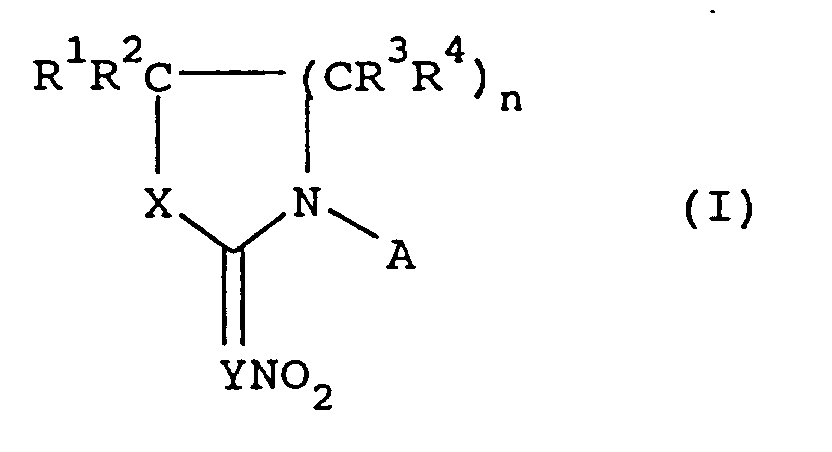
in which n is 1, 2 or 3; R¹, R², R³ and R⁴ independently represent a hydrogen atom or an alkyl group; X represents and oxygen atom or a group >CR⁵R⁶, >NR⁷, >NCOR⁸ or >S(O)p, where R⁵, R⁶, R⁷ and R⁸ independently represent a hydrogen atom or an alkyl group and p is 0, 1 or 2; A represents an optionally substituted 3-fluorobenzyl group; and Y represents a group =CH or =N- are disclosed. The compounds are pesticidal.
in which n is 1, 2 or 3; R¹, R², R³ and R⁴ independently represent a hydrogen atom or an alkyl group; X represents and oxygen atom or a group >CR⁵R⁶, >NR⁷, >NCOR⁸ or >S(O)p, where R⁵, R⁶, R⁷ and R⁸ independently represent a hydrogen atom or an alkyl group and p is 0, 1 or 2; A represents an optionally substituted 3-fluorobenzyl group; and Y represents a group =CH or =N- are disclosed. The compounds are pesticidal.
Description
- This invention relates to certain N-benzyl heterocyclic compounds, to processes for their preparation and to their uses as biocides, for example, as pesticides.
- N-benzyl heterocyclic compounds have been relatively widely investigated in the past. For example, JP 63287764 (Nihon Tokushu Noyaku) discloses 1-(3-cyanobenzyl)-2-(nitromethylene)imidazoline, 1-(3-cyanobenzyl)-2-(nitro-imino)imidazoline and 1-(3-cyanobenzyl)-2-(nitromethylene)tetrahydropyrimidine compounds. It is stated that the compounds are useful as insecticides, effective against Coleoptera, Lepidoptera, Hemiptera and Diptera.
- DE OS 25 14 402 A1 (Hoechst) discloses certain 2-(nitromethylene)imidazolidine and 2-(nitromethylene)hexahydropyrimidine compounds which are stated to be insecticidal. The document specifically discloses 1-benzyl-2-(nitromethylene)imidazoline and 1-benzyl-2-(nitromethylene)hexahydropyrimidine.
- DE OS 27 32 660 (Hoechst) discloses certain insecticidal 2-(nitromethylene)imidazolidine compounds. Specific examples disclosed include 1-(4-chlorobenzyl)-2-(nitromethylene)imidazolidine, 1-(3,4-dichlorobenzyl)-2(nitromethylene)imidazolidine, 1-(2-chlorobenzyl)-2-(nitromethylene)imidazolidine and 1-(4-fluorobenzyl)-2-(nitromethylene)imidazolidine.
- European Patent Publication No. 136 636 (Nihon Tokushu Noyaku Seizo) discloses 2-(nitromethylene)tetrahydropyrimidine derivatives which are stated to be insecticidal. Specfic examples disclosed include 1-(4-chlorobenzyl)-2-(nitromethylene)tetrahydropyrimidine, 1-(4-bromobenzyl)-2-(nitromethylene)tetrahydropyrimidine and 1-(4-fluorobenzyl)-2-(nitromethylene)tetrahydropyrimidine.
- This invention is based upon the discovery of interesting pesticidal activity of certain N-(3-fluorobenzyl)heterocyclic compounds.
- According to a first aspect of the present invention, there is provided a compound of general formula:

in which n is 1, 2 or 3; R¹, R², R³ and R⁴ independently represent a hydrogen atom or an alkyl group; X represents an oxygen atom or a group >CR⁵R⁶, >NR⁷, >NCOR⁸ or >S(O)p, where R⁵, R⁶, R⁷ and R⁸ independently represent a hydrogen atom or an alkyl group and p is 0, 1 or 2; A represents an optionally substituted 3-fluorobenzyl group; and Y represents a group =CH- or =N-. - It has been found that the presence of a 3-fluorobenzyl group tends to lead to increased pesticidal activity of compounds of general formula I in comparison to similar compounds wherein A represents, for example, a 3-chlorobenzyl, a 3-bromobenzyl or an unsubstituted benzyl group.
- Unless otherwise specified in this specification, an alkyl group may be linear or branched and suitably contains up to 10, preferably up to 6, and most preferably up to 4, carbon atoms, preferred examples being methyl and ethyl.
- Unless otherwise stated in this specification, when any groups are designated as being optionally substituted, the substituent groups which are optionally present may be any of those customarily employed in the development of pesticidal compounds, and/or the modification of such compounds to influence their structure/activity, persistence, penetration or other property. In relation to an alkyl group, specific examples of such substituents may include halogen, specially fluorine, chlorine or bromine atoms, and phenyl, alkoxy, hydroxy, cyano and (alkyl)amino groups. In relation to a phenyl moiety, optional substituents may include halogen atoms, for example fluorine, chlorine, bromine and iodine atoms, and nitro, cyano, alkoxy, hydroxy, amino, (alkyl)amino, alkyl, alkylthio and haloalkyl (especially CF₃) groups.
- Preferably, n is 1 or 2.
- R¹, R², R³ and R⁴ may independently represent a hydrogen atom or a methyl group. Preferably, at least three of R¹, R², R³ and R⁴ represent a hydrogen atom. More preferably, each of R¹, R², R³ and R⁴ represent a hydrogen atom.
- Preferably, X represents a group >NR⁷ or >S(O)p. More preferably, X represents a group >NR⁷. Where X represents a group >NR⁷, preferably R⁷ represents a hydrogen atom. Where X represents a group >S(O)p, preferably p is 0.
- In an optionally substituted 3-fluorobenzyl group, optional substituents may be slected from halogen atoms or alkyl, amino, alkylamino (which term includes mono-, di- and tri-alkylamino), cycloamino, alkoxy, haloalkoxy, alkylsulphyl, alkylsulphinyl, alkylsulphonyl, carboxy, alkylcarboxy, monohaloalkyl, dihaloalkyl, trihaloalkyl, nitro, phenoxy and cyano groups.
- The 3-fluorobenzyl group may be unsubstituted. Preferably, it is substituted and, preferably, optional substituents of said 3-fluorobenzyl group are selected from halogen atoms, or alkyl or alkylamino groups. Preferred halogen atoms are fluorine and chlorine atoms, with a chlorine atom being more preferred. A preferred alkyl group is a methyl group. A preferred alkylamino group is a dialkylamino group, with dimethylamino and diethylamino being especially preferred.
- The most preferred substituent of said 3-fluorobenzyl group is a dialkylamino group.
- The 3-fluorobenzyl group may be substituted at each position of its benzene ring. Preferably, at least two positions, more preferably three positions, on said benzene ring are unsubstitued - that is, are hydrogen atoms. Preferably, said 3-fluorobenzyl group is substituted at the 4-position.
- Preferably, said optionally substituted 3-fluorobenzyl group represents an unsubstituted 3-fluorobenzyl group, a (3-fluoro-4-chloro)benzyl group, a (3-fluoro-4-methyl)benzyl group, a (3-fluoro-4-methoxy)benzyl group, a (3-fluoro-4-dimethylamino)benzyl group or a (3-fluoro-4-diethylamino)benzyl group. Most preferably, said optionally substituted 3-fluorobenzyl group represents a (3-fluoro-4-dimethylamino)benzyl group.
- According to a second aspect of the present invention, there is provided a process for the preparation of a compound of general formula I, the process comprising:
- (a) reacting a compound of general formula

- (b) reacting a compound of general formula
HX-CR¹R²-(CR³R⁴)n-NH-A (III)
with 1,1-bis(methylthio)-2-nitroethylene or with nitroguanidine, where n, R¹, R², R³, R⁴, X and A are as defined above, and optionally derivatising the product of the reaction in order to prepare a compound of general formula I. - L¹ preferably represents a halogen atom or a mesyl or tosyl group. Preferably L¹ represents a halogen atom, with a chlorine or bromine atom being especially preferred.
- Reaction (a) is preferably carried out in the presence of an alkali metal hydride, for example, sodium hydride. Suitably, a compound of general formula II is dissolved in a solvent, preferably in a polar aprotic solvent, for example, in dimethylformamide, with stirring and under an inert, for example, a nitrogen atmosphere and said alkali metal hydride is then added. The compound of general formula AL¹ may then be added with stirring and allowed to react at ambient temperature over a period of over 10 hours. The desired product may then be isolated using standard techniques.
- Compounds of general formula II for use in reaction (a) may be prepared by reacting a compound of general formula
HX-CR¹R²-(CR³R⁴)n-NH₂ (IV)
or a salt thereof, n, R¹, R², R³, R⁴ being as defined above, with 1,1-bis(methylthio)-2-nitroethylene or with nitroguanidine. The reaction is preferably carried out in water or an alcohol solvent, for example ethanol, under reflux. - Where X represents a group -S(O)p, p is preferably 0 in said compound of general formula IV and the reaction may use a salt of said compound of general formula IV, for example a hydrochloride thereof.
- Compounds of general formula IV are either known or may be made by standard procedures. 1,1-Bis(methylthio)-2-nitroethylene and nitroguanidine are commercially available.
- Compounds of general formula AL¹ for use in reaction (a) are, in many cases, commercially available. Where not commercially available, they may be readily prepared from appropriate 3-fluorobenzoic acid derivatives by reaction of the benzoic acid derivative with a halogenating agent, for example, thionyl chloride, under reflux. The product of the reaction may then be added to sodium borohydride in water and the reaction allowed to proceed with stirring at ambient temperature. The product may then be isolated by standard techniques, and is a benzyl alcohol. This can be converted to the benzyl halide as described below.
- An alternative process for the preparation of compounds of general formual AL¹, for use particularly, although not exclusively, for compounds wherein an optional substituent of group A is an alkylamino group involves reacting, for example, the appropriate 3-fluoro-alkylamino benzyl alcohol with thionyl chlroide at ambient temperature. Benzyl alcohols are readily prepared from benzoic acid derivatives by reaction in the presence of a hydride, for example, lithium aluminium hydride. The desired benzoic acid derivatives may be prepared from the appropriate benzonitrile compounds. 3-Fluoro-alkylaminobenzonitrile compounds may be prepared from the appropriate difluorobenzonitrile compound by heating the latter compound in a polar aprotic solvent, for example, dimethylformamide, with potassium carbonate. Alkylamine may then be added to the reaction mixture and the desired product isolated by standard techniques. The appropriate difluorobenzonitrile compounds are either commercially available or may be prepared using standard procedures.
- Compounds of general formula II where X represents a group >NCOR⁸ as defined above may also be prepared from other compounds of general formula II where X represents >NH, by a process as described in U.K. Patent Application Number GB 2 190 674 A (Shell).
- Reaction (b) is preferably carried out under reflux in the presence of a solvent, for example, an alcohol. After the reaction the desired product may be isolated by standard techniques.
- Compounds of general formula III for use in reaction (b) may be prepared by reacting a compound of general formula IV as described above with a compound of general formula AL¹ or a salt thereof, where n, R¹, R², R³, R⁴ and L¹ are as defined above. In the process, said compound of general formua IV, in a solvent, for example, acetonitrile, is preferably cooled to less than ambient temperature prior to the addition of the compound of general formula AL¹. Compounds of general formula IV and AL¹ may be prepared as described above.
- The compounds of the general formula I exhibit pesticidal, for example insecticidal and/or molluscicidal activity. Accordingly the invention also provides a pesticidal composition comprising a compound of the general formula I together with a carrier. The invention further provides a method of combating pests at a locus which comprises applying to the locus a pesticidal compound or composition according to the invention.
- In the method of the invention, the locus may be an agricultural or horicultural locus, for example, plants subject to attack, seeds of such plants or the medium in which such plants are growing or are to be grown. A locus as described above may suitably be treated with a compound I at an application rate in the range of 0.005-4 kg/ha, preferably 0.01-1 kg/ha. The compounds of the general formula I may be of particular interest in combating caterpillars. The compounds also exhibit activity against aphids, rice prests, whitefly, soil insects and molluscs. The compound 1-[(3-fluoro-4-dimethylamino)benzyl]-2-(nitromethylene)imidazoline shows particularly interesting activity.
- A carrier in a composition according to the invention is any material with which the active ingredient is formulated to facilitate application to the locus to be treated, or to facilitate storage, transport or handling. A carrier may be a solid or a liquid, including a material which is normally gaseous but which has been compressed to form a liquid, any any of the carriers normally used in formulating biocidal compositions may be used. Preferably compositions according to the invention contain 0.5 to 95% by weight of active ingredient.
- Suitable solid carriers include natural and synthetic clays and silicates, for example natural silicas such as diatomaceous earths; magnesium silicates, for example talcs; magnesium aluminium silicates, for example attapulgites and vermiculites; aluminium silicates, for example kaolinites, montomorillonites and micas; calcium carbonate; calcium sulphate; ammonium sulphate; synthetic hydrated silicon oxides and synthetic calcium or aluminium silicates; elements, for example carbon and sulphur; natural and synthetic resins, for example coumarone resins, polyvinyl chloride, and styrene polymers and copolymers; solid polychlorophenols; bitumen; waxes; and solid fertilisers, for example superphosphates.
- Suitable liquid carriers include water; alcohols, for example isopropanol and glycols; ketones, for example acetone, methyl ethyl ketone, methyl isobutyl ketone and cyclohexanone; ethers; aromatic or araliphatic hydrocarbons, for example benzene, toluene and xylene; petroleum fractions, for example kerosine and light mineral oils; chlorinated hydrocarbons, for example carbon tetrachloride, perchloroethylene and trichloroethane. Mixtures of different liquids are often suitable.
- Compositions are often formulated and transported in a concentrated form which is subsequently diluted by the user before application. The presence of small amounts of a carrier which is a surface-active agent facilitates this process of dilution. Thus, preferably at least one carrier in a composition according to the invention is a surface-active agent. For example the composition may contain at least two carriers, at least one of which is a surface-active agent.
- A surface-active agent may be an emulsifying agent, a dispersing agent or a wetting agent; it may be nonionic or ionic. Examples of suitable surface-active agents include the sodium or calcium slats of polyacrylic acids and lignin sulphonic acids; the condensation products of fatty acids or aliphatic amines or amides containing at least 12 carbon atoms in the molecule with ethylene oxide and/or propylene oxide; fatty acid esters of glycerol, sorbitan, sucrose or pentaerythritol; condensates of these with ethylene oxide and/or propylene oxide; condensation products of fatty alcohol or alkyl phenols, for example p-octylphenol or p-octylcresol, with ethylene oxide and/or propylene oxide; sulphates or sulphonates of these condensation products; alkali or alkaline earth metal salts, preferably sodium salts, of sulphuric or sulphonic acid esters containing at least 10 carbon atoms in the molecule, for example sodium lauryl sulphate, sodium secondary alkyl sulphates, sodium salts of sulphonated castor oil, and sodium alkylaryl sulphonates such as dodecylbenzene sulphonate; and polymers of ethylene oxide and copolymers of ethylene oxide and propylene oxide.
- The compositions of the invention may for example be formulated as wettable powders, dusts, granules, solutions, emulsifiable concentrates, emulsions, suspension concentrates and aerosols. Wettable powders usually contain 25, 50 or 75% w of active ingredient and usually contain in addition to solid inert carrier, 3-10% w of a dispersing agent and, where necessary, 0-10% w of stabiliser(s) and/or other additives such as penetrants or stickers. Dusts are usually formulated as a dust concentrate having a similar composition to that of a wettable powder but without a dispersant, and are diluted in the field with further solid carrier to give a composition usually containing 0.5-10% w of active ingredient. Granules are usually prepared to have a size between 10 and 100 BS mesh (1.676 - 0.152 mm), and may be manufactured by agglomeration or impregnation techniques. Generally, granules will contain 0.5-75% w active ingredient and 0-10% w of additives such as stabilisers, surfactants, slow release modifiers and binding agents. The so-called "dry flowable powders" consist of relatively small granules having a relatively higher concentration of active ingredient. Emulsifiable concentrates usually contain, in addition to a solvent and, when necessary, co-solvent, 10-50% w/v active ingredient, 2-20% w/v emulsifiers and 0-20% w/v of other additives such as stabilisers, penetrants and corrosion inhibitors. Suspension concentrates are usually compounded so as to obtain a stable, non-sedimenting flowable product and usually contain 10-75% w active ingredient, 0.5-15% w of dispersing agents, 0.1-10% w of suspending agents such as protective colloids and thixotropic agents, 0-10% w of other additives such as defoamers, corrosion inhibitors, stabilisers, penetrants and stickers, and water or an organic liquid in which the active ingredient is substantially insoluble; certain organic solids or inorganic salts may be present dissolved in the formulation to assist in preventing sedimentation or as anitfreeze agents for water.
- Aqueous dispersions and emulsions, for example compositions obtained by diluting a wettable powder or a concentrate according to the invention with water, also lie within the scope of the inventoin. The said emulsions may be of the water-in-oil or of the oil-in-water type, and may have a thick "mayonnaise"-like consistency.
- The inveniton further extends to the use of a compound of general formula I as a pesticide.
- The composition of the invention may also contain other ingredients, for example other compounds possessing herbicidal, insecticidal or fungicidal properties.
- The invention will now be described further with reference to the following Examples.
- 1,1-Bis(methylthio)-2-nitroethylene (ex. Aldrich Chemical Co.) (49.5 g) and ethane-1,2-diamine (25 ml) were heated at reflux in ethanol (250 ml) for 4 hours. The mixture was allowed to cool to 20°C. The product crystallised out and was collected by filtration.
mpt = 168 - 169°C. - 3-Fluoro-4-chlorobenzoic acid (ex. Yarsley Fluorochemicals Ltd) (10.5 g) and thionylchloride (40 ml) were heated at reflux for 3 hours. Excess thionyl chloride was evaporated off under reduced pressure to leave a crystalline solid. The crystalline solid was added to sodium borohydride (9.0 g) in water (50 ml) and the mixture was stirred at 20°C for 18 hours. The reaction mixture was poured into water (200 ml) and extracted with dichloromethane (3 x 70 ml). The combined dichloromethane extracts were washed with water (100 ml), saturated brine (100 ml), dried over solid magnesium sulphate and evaporated down to an oil (8.2 g). This oil was dissolved in chloroform (50 ml), treated with thionyl chloride (4.5 ml) and heated at reflux for 3 hours. The reaction mixture was evaporated to dryness under reduced pressure and the residue was extracted from water (200 ml) using dichloromethane (3 x 70 ml). The combined dichloromethane extracts were washed (water: 100 ml; brine: 100 ml) dried over magnesium sulphate and evaported to a pale yellow solid (8.03 g). This was the required product and used without further purification.
- 2-(Nitromethylene)imidazoline (2.6 g) prepared in 1(i) was dissolved in dry dimethylformamide (50 ml) at 0° C. Sodium hydride (1.0 g of a 50% oil suspension) was added and the mixture was stirred, under a nitrogen atmosphere, for 30 minutes. 3-Fluoro-4-chlorobenzyl chloride (4.0 g) prepared in 1.(ii) was added and the mixture was stirred and allowed to attain ambient temperature (20°C) over 18 hours. The mixture was poured into water (200 ml) and extracted with dichloromethane (3 x 70 ml). The combined dichloromethane extracts were washed with saturated brine (100 ml), dried over solid magnesium sulphate, filtered and evaporated to dryness under reduced pressure. The solid residue was recrystallised from ethyl acetate to give a white solid (1.14 g).
C H N Analysis: Theory: 48.6 4.1 15.5 Found: 48.6 4.1 15.3 - By using propane-1,3-diamine (25 ml) instead of ethane-1,2-diamine in the procedure of Example 1(i) above, 2-(nitromethylene)tetrahydropyrimidine (38.8 g) was prepared.
mpt = 207-208°CC H N Analysis: Theory: 42.0 6.3 29.4 Found: 42.0 6.3 29.6 - 2-(Nitromethylene)tetrahydropyrimidine (2.86 g) prepared in Example 2(i) and 3-fluoro-4-chlorobenzyl chloride (4.0 g) prepared in Example 1(ii) were reacted following the procedure of Example 1(iii) to produce, on recrystallisation from isopropylalcohol, the desired product as a white solid (0.82 g).
C H N Analysis: Theory: 50.4 4.6 14.7 Found: 50.7 4.6 14.5 - By using 2-aminoethanethiol hydrochloride (12 g) and the procedure of Example 1(i) above, 2-(nitromethylene)thiazolidine (11.6 g) was obtained as a pale yellow solid.
- Starting with 2-(nitromethylene)thiazolidine (1.5 g) prepared in Example 3(i) and using the procedure described in Example 1(iii), the desired product (0.45 g) was obtained as a pale yellow solid by crystallisation from ethyl acetate.
C H N Analysis: Theory: 45.8 3.5 9.7 Found: 46.2 3.4 9.8 - 3,4-Difluorobenzonitrile (ex. Aldrich Chemical Co.; 10 g), and potassium carbonate (9.93 g) in DMF (50 ml) were heated at 60°C. Gaseous dimethylamine was bubbled through the reaction mixture for 20 minutes. The mixture was then allowed to cool to 20°C and diluted with water (100 ml). The resultant mixture was extracted with diethyl ether (3 x 100 ml). The diethyl ether extracts were washed with water (100 ml), dried over magnesium sulphate and evaporated to a white solid (11.73 g).
m.p. = 35°CC H N Analysis: Theory: 65.8 5.5 17.1 Found: 65.0 5.5 16.8 - 3-Fluoro-4-dimethylamino benzonitrile (14.3 g) prepared in Example 4(i) in water (80 ml) and concentrated sulphuric acid (80 ml) were heated at 110°C for 18 hours. The solution was then cooled to 20°C and neutralised with solid sodium hydrogen carbonate. Acidification with glacial acetic acid lead to a white solid precipitating. This was collected by filtration, dissolved in dichloromethane and the resultant solution was dried over magnesium sulphate. The dichloromethane solution was then filtered and evaporated to give the product as a beige-coloured solid (11.5 g).
m.p. = 172°C - To an ice-cooled suspension of lithium aluminium hydride (2.38 g) in diethyl ether (100 ml), stirred under an atmosphere of nitrogen, was added portionwise, 3-fluoro-4-dimethylamino benzoic acid (11.50 g) prepared in Example 4(ii). The reaction temperature was kept below 10°C throughout the addition. After stirring for 1 hour, water (2.38 ml) was added, followed by a 10% sodium hydroxide solution (2.38 ml, aqueous) and further water (7.1 ml). A solid formed which was removed by filtration and the diethyl ether solution was evaporated to give the required product as a yellow oil (10.5 g).
C H N Analysis: Theory: 63.9 7.2 8.3 Found: 63.8 7.5 7.9 - To a solution of 3-fluoro-4-dimethylamino benzyl alcohol (2.0 g) prepared in Example 4(iii) in chloroform (50 ml) was added thionyl chloride (1 ml). An exothermic reaction occurred and when the reaction mixture had cooled down to ambient temperature it was further heated at reflux for half-an-hour. The solvent was evaporated to leave the product as orange needles, (2.62 g).
C H N Analysis: Theory: 48.2 5.4 6.2 Found: 48.1 5.6 6.1 - Ethane-1,2-diamine (1.3 ml) in acetonitrile (100 ml) was cooled to 5°C in an ice-bath. (3-Fluoro-4-dimethylamino)benzyl chloride hydrochloride prepared in Example 4. (iv) (1.41 g) in acetonitrile (25 ml) was added dropwise over 1 hour. The mixture was allowed to attain ambient temperature (20°C) and stirred for 2 hours. The reaction mixture was filtered to remove a white precipitate. The filtrate was evaporated under reduced pressure to leave the required product which was obtained as an oil (1.19 g) and used with no further purification.
- N-[(3-fluoro-4-dimethylamino)benzyl]ethane-1,2-diamine (1.1 g) and 1,1-bis(methylthio)-2-nitroethylene (0.86 g) in isopropyl alcohol (30 ml) were heated at reflux for 12 hours. The reaction mixture was allowed to cool to ambient temperature and a yellow solid precipitated. The solid was collected by filtration, dissolved in dichloromethane, washed with water and the dichloromethane solution was then dried over anhydrous magnesium sulphate and filtered. The solution was evaporated to dryness to afford the product as a cream-coloured solid (0.33 g).
m.p. = 124°CC H N Analysis: Theory: 55.7 6.1 20.0 Found: 56.1 6.1 20.2 - By using propane-1,3-diamine instead of ethane-1,2-diamine in the procedure of Example 4(v), the required product was obtained as an oil and used without further purification.
- By using N-[(3-fluoro-4-dimethylamino)benzyl]propane-1,3-diamine (1.2 g) prepared in Example 5(i) in the procedure described in Example 4(vi), the required product was obtained as a cream-coloured solid (0.51 g).
m.p. = 149°CC H N Analysis: Theory: 57.1 6.5 19.0 Found: 56.8 6.5 19.0 - Sodium metal (1.0 g) was added to methanol (50 ml) and the mixture was stirred under nitrogen gas, until complete dissolution had occurred. The solution was cooled in an ice-bath and 3,4-difluorobenzonitrile (5.0 g) was added and kept cool for 2 hours. The solvent was then removed by evaporation to leave a white solid. This was the required product and was used in Example 6. (ii), without further purification.
- The product was obtained by the hydrolysis of 3-fluoro-4-methoxybenzonitrile, using the procedure described in Example 4. (ii).
m.p. = 213°C - The required product was obtained as a yellow oil, by reduction of 3-fluoro-4-methoxybenzoic acid prepared in Example 6.(ii) using the procedure of Example 4.(iii).
- The required product was prepared by the procedure described in Example 4.(iv), starting from 3-fluoro-4-methoxybenzyl alcohol prepared in Example 6.(iii).
- To an ice cold solution of 1,2-diaminopropane (3.65 ml) in acetonitrile (50 ml) was added 3-fluoro-4-methoxybenzyl chloride (2.45 g) prepared in Example 6(iv). The reaction mixture was stirred under a nitrogen atmosphere and allowed to attain ambient temperature over 18 hours. A white solid precipitate was removed by filtration. The filtrate was evaporated down to an oil (3.0 g) which was the required product and used with no further purification.
- N¹-(3-fluoro-4-methoxy)benzylpropane-1,2-diamine prepared in Example 6(v) and nitroguanidine in water were heated at reflux for 1.5 hours. The reaction mixture was allowed to cool to ambient temperature (20°C) and partitioned between water and chloroform (1:1). The chloroform layer was washed with water, then saturated brine, dried over solid magnesium sulphate and evaporated to dryness under reduced pressure. The residue was crystallized from ethyl acetate and the required product obtained as a cream-coloured solid.
m.p. = 105°CC H N Analysis: Theory: 46.1 4.2 19.5 Found: 45.7 4.5 17.8
Further compounds numbered as Examples 7 to 52 in Table 1 were prepared according to procedures analogous to those described above. Comparative Examples, disclosed in other documents, which have been made and tested by the Applicant are noted in Table 2. Referring to Table 2, Comparative Example Number C1 is disclosed in JP 6328776, Comparative Example Number C2 is disclosed in DE OS 25 14 402 A1, Comparative Example Numbers C3 to C6 are disclosed in DE OS 27 32 660 and Comparative Example Numbers C7 to C9 are disclosed in EP 0 136 636. Comparative Example Numbers C10 to C23, made and tested by the Applicant, are noted in Table 3.


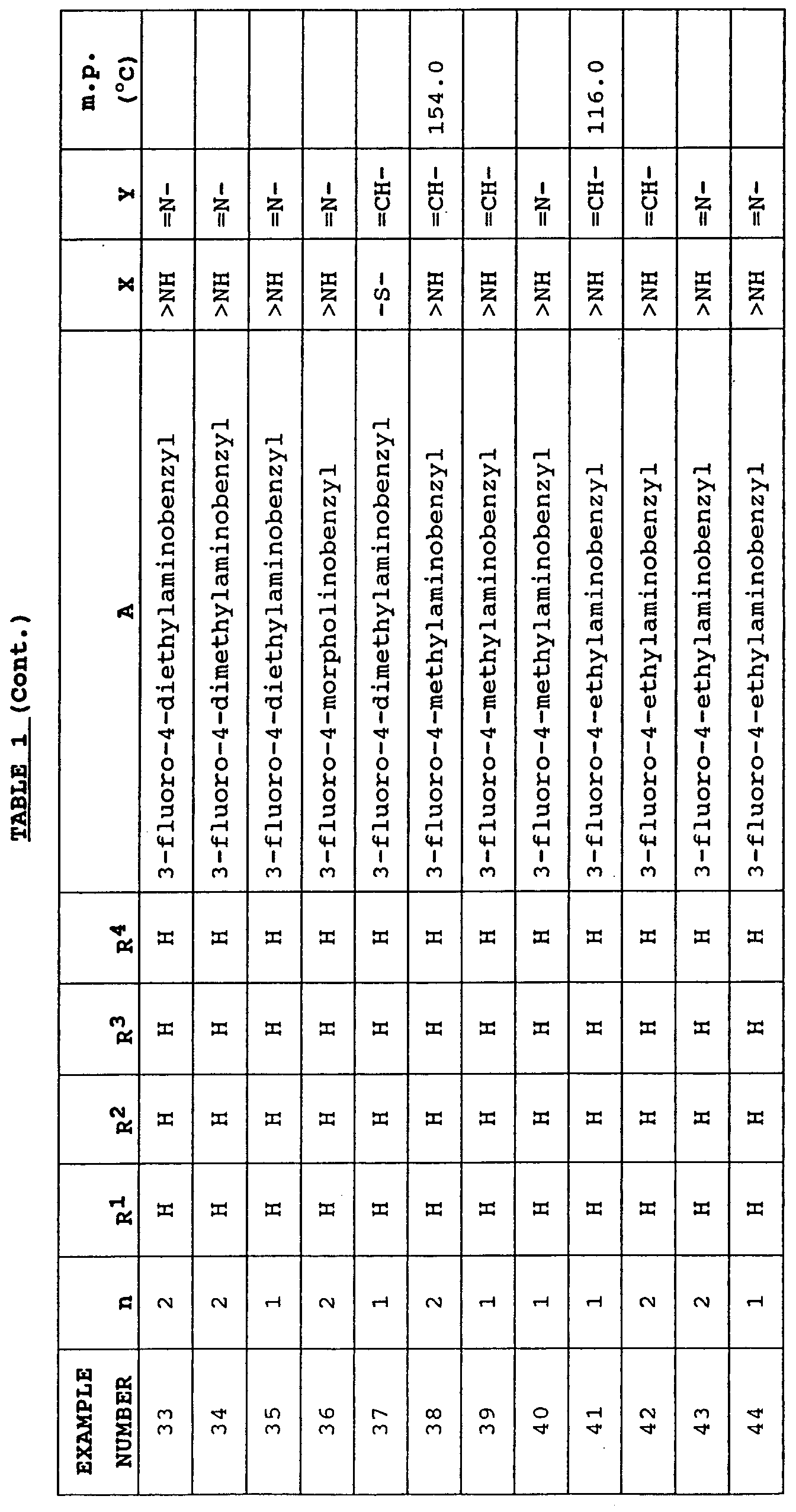


- Pesticidal activity of compounds of the invention was assessed against various of the following pests:-
Spodoptera littoralis (Egyptian cotton leafworm)
Aedes aegypti (yellow fever mosquito)
Musca domestica (housefly)
Acyrthosiphon pisum (pea aphid)
Megoura viciae (vetch aphid)
Phaedon cochleariae (mustard beetle)
Trialeurodes vaporariorum (greenhouse whitefly)
Nephotettix cincticeps (green leaf hopper)
Nilaparvata lugens (brown rice plant hopper)
The test methods employed for each species appear below. In each test, unless otherwise stated, solutions or suspensions of test compound were made up over a range of concentrations in water (initially 0.1%w) containing 10%w acetone and 0.025%w "TRITON X-100" (trade mark) surface active agent (the condensation product of ethylene oxide with an alkyl phenol). These solutions were sprayed at a rate equivalent to 340 litres per hectare (3.4 x 10⁻⁵m³/m²) onto Petri dishes containing either test species per se or diet onto which test species were subsequently introduced, as indicated. In some assays leaf discs infested with test species were sprayed whilst other assays involved the spraying of plants which were infested subsequently with test species after the spray solution had dried. The tests were all conducted under normal insectary conditions (23°C ± 2°C, fluctuating humidity and light). Mortality assessments were made as indicated below, in terms of percentage mortality figures. In each test a LC₅₀ (the dosage of active material required to kill half of the test species) for the compound was calculated from the mortality figures and compared with the corresponding LC₅₀ for a standard insecticide, ethyl parathion, in the same test. The results are expressed as toxicity indices thus:
- Test solutions were sprayed as indicated above onto Petri dishes containing a nutritious diet for Egyptian cotton leafworm larvae. When the spray deposit had dried, each dish was infested with ten 2nd instar larvae. Mortality assessments were made 1 day (Sl-D-1d) and 7 days (Sl-D-7d) after spraying.
- Test solutions were sprayed as described above onto Petri dishes containing 9cm discs of Chinese cabbage leaves on filter papers. After drying, each dish was infested with ten 2nd instar larvae. Mortality assessments were made 24 hours after infestation.
- Test solutions were sprayed as described above onto Petri dishes containg filter papers on which were approximately 50 24 hour old eggs. After 6 days the numbers of hatched and unhatched eggs were counted and percentage mortality calculated.
- Early 4th instar larvae were used. Test solutions were made up to 0.5 ppm of test compound (and progressive half-dilutions) in water containing 0.04%w "TRITON X-100" (trade mark); acetone was initially present to aid solution, but was allowed to evaporate off before introduction of larvae.
- Ten early 4th instar larvae were placed in 100 ml of test solution held at 28°C, and after 48 hours, larval mortality was recorded (Aa-2d). The final mortality was assessed by counting the number of emerged adult mosquitoes after one weed (Aa-7d).
- Batches of ten 2 to 3 day old milk-fed adult female houseflies, anaesthetised using carbon dioxide, were placed on filter papers inside Petri dishes. The dishes were sprayed with the test solutions as described above. The flies were retained in the Petri dishes and were fed with a dilute milk solution which was dripped down the side of the Petri dish and absorbed by the filter paper. Mortality was assessed after 24 hours.
- Tests were carried out on young adult pea aphids. Whole pea plants 6 days after germination were placed on filter papers in Petri dishes. Ten aphids were transferred to each pea plant and left for 30 minutes to allow the aphids to settle and start to feed. The dishes were then sprayed with the test solutions as described above and lids were placed on the Petri dishes. Mortality was assessed after 24 hours.
- Tests were carried out on adult-Vetch aphids. Pairs of broad bean leaves on filter paper in Petri dishes were sprayed side by side with uncounted quantities of aphids in small gauze-covered containers. After passing through the spray ten aphids were tipped onto the leaves and lids were placed on the Petri dishes. Mortality was assessed after 24 hours.
- Test solutions were sprayed as described above onto Petri dishes containing 9cm discs of Chinese cabbage leaves on filter papers. After drying, each dish was infested with ten adult mustard beetles (up to 1 week old). Mortality assessments were made 24 hours after infestation.
- French bean plants (Phaseolus vulgaris) with two fully expanded leaves were placed in a breeding culture of T. vaporariorum, also on French bean plants, which were then disturbed to ensure resettlement on the introduced plants. During the subsequent 24 hour period, eggs were deposited and kept at 27°C, with 14 hours photoperiod. All adult whiteflies were then carefully removed, leaving egg samples of a known age. After eight days the majority of eggs had hatched. Leaf discs containing the newly hatched nymphs were then cut from the leaves and transferred to moist filter paper. The discs were examined under a low-powered microscope to determine the exact number of 1st instar nymphs per disc and to remove any unhatched eggs. On average, 70-100 nymphs were found per disc.
- The discs were transferred into Petri dishes and sprayed with test solutions as described above. After 6 days percentage mortalities were assessed.
- Tests wee carried out on young adult female green leaf hoppers. Plant pots, each containing five rice seedlings 10 to 15 cm tall arranged across the centre of the pot, were sprayed with test solutions as described above (but initial test concentration 0.05% of test compound). Spraying was on both sides of the plants with the post horizontal. One hour after spraying, each pot was filled to the brim with fine silver sand, an open-ended glass jar was placed over each pot and each pot was infested with ten hoppers. A paper tissue was placed over the open end of each glass jar to retain the hoppers. The pots were irrigated from underneath, maintained at a temperature of 27°C ± 2°C and subjected to white fluorescent light under a regime of 18 hours light followed by 6 hours darkness. Mortality assessments were made 48 hours after infestation.
- Tests were carried out on young apterous adults of the vetch aphid Megoura viciae and 3rd instar larvae of leaf fed Spodoptera littoralis.
- The test solution comprised the test compound dissolved in aqueous acetone (5%) containing Tween 20 (Trade Mark) (0.05%) as a wetting agent. The standard for the tests was Metasystox (Trade mark) applied over the range 0.0001% - 0.00001%.
- Broad bean plants with three fully expanded leaf pairs were selected. The second leaf pair from the base of the stem on each plant was trimmed with scissors to produce a 4 cm cut edge on each side and a 2 cm cut end. The prepared leaves were promptly immersed in 10 ml of test solution contained in a small glass beaker, which was then covered with a layer of Parafilm (Trade Mark). The beaker was held on a support stand next to, and at the same height as, the cut leaf. After 48 hours immersion, the treated leaves were cut from the rest of the plant. New growth leaves which expanded after treatment were used for the following bioassay.
- Small perspex ring cages of internal diameter 20 mm containing 10 aphids were held onto the underside of one leaf from the leaf pair by means of spring clips. Mortality assessments of the aphids were made after 24 hours. The other leaf of the pair was then cut off and placed in a 9 cm diameter petri-dish containing ten Spodoptera littoralis larvae. Mortality assessments were made after 24 hours.
- The results are shown in Table 4 using the grading system shown below, where % concentration refers to the solution used for the leaf immersion.
Grade Range (% concentration) 0 no activity at 0.1% 1 0.1 > LC50 > 0.03 2 0.03 > LC50 > 0.01 3 0.01 > LC50 > 0.03 4 0.003 > LC50 > 0.001 5 0.001 > LC50 > 0.0003 6 0.0003 > LC50 > 0.0001 7 0.0001 > LC50 > 0.00003 8 0.00003 > LC50 > 0.00001 - Acaricidal activity of the compounds of the invention was assessed, employing eggs of the glasshouse red spider mite, Tetranychus urticae (T.u.), less than 24 hours old, by the following procedure.
- 2cm diameter leaf discs cut from the leaves of French bean plants were placed on filter paper, kept moist by a cotton wool wick dipped into water.
- On the day before spraying, each leaf disc was infested with 10 female adult mites. On the day of the test, the adults were removed, leaving the eggs laid overnight on the discs. The leaf discs were then sprayed with solutions of test compound made up as in Example 53 above, at a rate equivalent to 340 litres per hectare (3.4 x 10⁻⁵ m³/m²).
- Throughout the test, the eggs were held under normal insectary conditions (23°C ± 2°C),fluctuating humidity and 16 hours days length). After 7-10 days, the numbers of hatched nymphs and unhatched eggs were assessed and the percentage mortality calculated. The LC₅₀ (the dosage of active material required to kill half of the test species) for the compound was calculated from the mortality figure and compared with the corresponding LC₅₀ for a standard insecticide, chlorfenson, in the same test. The result is expressed as toxicity index thus:

Table 4 provides the results for the tests of Examples 53 and 54. The method of expression of the results for Example 53(xi) is described in the write-up for that Example. For the other Examples grades A, B and C indicate mortalities of 70-100%, 40-69% and 0-39%, respectively, at the initial test concentration of 0.1% (1000 ppm). - For most compounds which scored a grade A at 0.1% (1000 ppm), the Toxicity Index (TI) was calculated as described above.
- In Table 4, the TI values are reported as follows:
TI < 10 = X
TI 10-100 = XX
TI > 100 = XXX
"-" means no data available.


Claims (13)
- A compound of general formula:

- A compound as claimed in claim 1, wherein n is 1 or 2.
- A compound as claimed in any preceding claim, wherein each of R¹, R², R³ and R⁴ represents a hydrogen atom or a methyl group.
- A compound as claimed in any preceding claim, wherein X represents a group >NR⁷.
- A compound as claimed in any preceding claim, wherein optional substituents of said 3-fluorobenzyl group are selected from halogen atoms, or alkyl or alkylamino groups.
- A compound as claimed in any preceding claim, wherein an optional substituent of said 3-fluorobenzyl group is a dimethylamino or diethylamino group.
- A compound as claimed in any preceding claim, wherein said 3-fluorobenzyl group is substituted at the 4-position.
- A process for the preparation of a compound of general formaul I, the process comprising:(a) reacting a compound of general formula
 (b) reacting a compound of general formula
HX-CR¹R²-(CR³R⁴)n-NH-A (III)
with 1,1-bis(methylthio)-2-nitroethylene or with nitroguanidine where n, R¹, R², R³, R⁴, X and A are as defined in any of claims 1 to 7, and optionally derivatising the product of the reaction in order to prepare a compound of general formula I. - A compound of general formula I as defined in any of claims 1 to 7, when prepared by a process as defined in claim 8.
- A pesticidal composition comprising a compound of general formula I as claimed in any of claims 1 to 7 or 9 together with a carrier.
- A method of combating pests at a locus which comprises applying to the locus a pesticidal compound as claimed in any of claims 1 to 7 or 9 or a composition as claimed in claim 10.
- Use of a compound of general formula I as defined in any of claims 1 to 7 or 9 as a pesticide.
- A compound of general formula I, a process for the preparation of a compound of general formula I, a compound of general formula I prepared by the process, a pesticidal composition including a compound of general formula I, a method of combatting pests and the use of a compound of general formula I, each being substantially as hereinbefore described, with reference to the examples.
Priority Applications (1)
| Application Number | Priority Date | Filing Date | Title |
|---|---|---|---|
| EP94201160A EP0623601A1 (en) | 1993-04-30 | 1994-04-27 | N-(3-Fluorobenzyl)heterocyclic derivatives and their use as pesticides |
Applications Claiming Priority (3)
| Application Number | Priority Date | Filing Date | Title |
|---|---|---|---|
| EP93303424 | 1993-04-30 | ||
| EP93303424 | 1993-04-30 | ||
| EP94201160A EP0623601A1 (en) | 1993-04-30 | 1994-04-27 | N-(3-Fluorobenzyl)heterocyclic derivatives and their use as pesticides |
Publications (1)
| Publication Number | Publication Date |
|---|---|
| EP0623601A1 true EP0623601A1 (en) | 1994-11-09 |
Family
ID=26134289
Family Applications (1)
| Application Number | Title | Priority Date | Filing Date |
|---|---|---|---|
| EP94201160A Withdrawn EP0623601A1 (en) | 1993-04-30 | 1994-04-27 | N-(3-Fluorobenzyl)heterocyclic derivatives and their use as pesticides |
Country Status (1)
| Country | Link |
|---|---|
| EP (1) | EP0623601A1 (en) |
Cited By (2)
| Publication number | Priority date | Publication date | Assignee | Title |
|---|---|---|---|---|
| US6232309B1 (en) | 1989-03-09 | 2001-05-15 | Nihon Bayer Agrochem K.K. | Insecticidal heterocyclic compounds |
| US6344453B1 (en) | 1989-03-09 | 2002-02-05 | Kozo Shiokawa | Insecticidal heterocyclic compounds |
Citations (4)
| Publication number | Priority date | Publication date | Assignee | Title |
|---|---|---|---|---|
| GB1508880A (en) * | 1974-12-18 | 1978-04-26 | Synthelabo | 2-methoxy-benzamide derivatives |
| DE2732660A1 (en) * | 1975-04-02 | 1979-02-01 | Hoechst Ag | Insecticide 1-substd. benzyl-2-nitro:methylene-imidazolidine derivs. - prepd. e.g. by reacting an n-benzyl-ethylene:di:amine with a 1,1-di:halo-2-nitro-ethylene |
| EP0136636A2 (en) * | 1983-10-06 | 1985-04-10 | Nihon Tokushu Noyaku Seizo K.K. | Nitromethylene-tetrahydropyrimidine derivatives, process for their preparation and insecticidal, miticidal, tickicidal, and nematicidal means |
| EP0199974A2 (en) * | 1985-04-02 | 1986-11-05 | Nihon Tokushu Noyaku Seizo K.K. | Nitromethylene-tetrahydropyrimidine |
-
1994
- 1994-04-27 EP EP94201160A patent/EP0623601A1/en not_active Withdrawn
Patent Citations (4)
| Publication number | Priority date | Publication date | Assignee | Title |
|---|---|---|---|---|
| GB1508880A (en) * | 1974-12-18 | 1978-04-26 | Synthelabo | 2-methoxy-benzamide derivatives |
| DE2732660A1 (en) * | 1975-04-02 | 1979-02-01 | Hoechst Ag | Insecticide 1-substd. benzyl-2-nitro:methylene-imidazolidine derivs. - prepd. e.g. by reacting an n-benzyl-ethylene:di:amine with a 1,1-di:halo-2-nitro-ethylene |
| EP0136636A2 (en) * | 1983-10-06 | 1985-04-10 | Nihon Tokushu Noyaku Seizo K.K. | Nitromethylene-tetrahydropyrimidine derivatives, process for their preparation and insecticidal, miticidal, tickicidal, and nematicidal means |
| EP0199974A2 (en) * | 1985-04-02 | 1986-11-05 | Nihon Tokushu Noyaku Seizo K.K. | Nitromethylene-tetrahydropyrimidine |
Cited By (2)
| Publication number | Priority date | Publication date | Assignee | Title |
|---|---|---|---|---|
| US6232309B1 (en) | 1989-03-09 | 2001-05-15 | Nihon Bayer Agrochem K.K. | Insecticidal heterocyclic compounds |
| US6344453B1 (en) | 1989-03-09 | 2002-02-05 | Kozo Shiokawa | Insecticidal heterocyclic compounds |
Similar Documents
| Publication | Publication Date | Title |
|---|---|---|
| EP0369526B1 (en) | Nitromethylene compounds, their preparation and their use as pesticides | |
| EP0650482B1 (en) | Pesticidal pyrimidine compounds | |
| GB1578852A (en) | Methods of treating plants and crops with propynylamine derivatives and pesticidal preparations suitable therefor | |
| US4623658A (en) | Pesticidal benzoylurea compounds | |
| EP0623282A1 (en) | Pesticidal methods and compounds | |
| US5360906A (en) | Pesticidal compounds | |
| US5225423A (en) | Butenone compounds, their preparation and their use as pesticides | |
| US4311838A (en) | Tetrahydro-2-nitrimino-2H-1,3-thiazine | |
| EP0623601A1 (en) | N-(3-Fluorobenzyl)heterocyclic derivatives and their use as pesticides | |
| US4212868A (en) | Certain fungicidal pyridinecarbaldehyde phenylhydrazones | |
| US4045575A (en) | Thioamide pesticides | |
| US4038403A (en) | Benzotriazole ovicides and larvicides | |
| CA2122178A1 (en) | Biocidal compounds | |
| EP0652215A1 (en) | Methylene-substituted heterocyclic compounds | |
| US4504488A (en) | Pesticidal vinyl-tin compounds | |
| US5420125A (en) | Nitromethylene compounds | |
| EP0469686A1 (en) | Pesticidal heterocyclic compounds | |
| EP0605059A1 (en) | Nitromethylene compounds and their use as pesticides | |
| US4745113A (en) | Pesticidal benzoylurea compounds, compositions and use | |
| US4504489A (en) | Use of certain vinyl-tin compounds as insecticides | |
| US4096275A (en) | Thioamide pesticides | |
| US5155135A (en) | Benzamide compounds, their preparation and their use as pesticides | |
| HU193670B (en) | Insecticides containing derivatives of 2-/nitro-methilene/-/1,3-tiasin/ and process for production those | |
| GB2263640A (en) | Method of combating aphids | |
| US4503222A (en) | Pesticidal nitromethane derivatives |
Legal Events
| Date | Code | Title | Description |
|---|---|---|---|
| PUAI | Public reference made under article 153(3) epc to a published international application that has entered the european phase |
Free format text: ORIGINAL CODE: 0009012 |
|
| AK | Designated contracting states |
Kind code of ref document: A1 Designated state(s): AT BE CH DE DK ES FR GB GR IE IT LI LU MC NL PT SE |
|
| 17P | Request for examination filed |
Effective date: 19950307 |
|
| STAA | Information on the status of an ep patent application or granted ep patent |
Free format text: STATUS: THE APPLICATION IS DEEMED TO BE WITHDRAWN |
|
| 18D | Application deemed to be withdrawn |
Effective date: 19961101 |