EP0622398B1 - Method for continuous preparation of heat-vulcanizing silicone rubber compounds - Google Patents
Method for continuous preparation of heat-vulcanizing silicone rubber compounds Download PDFInfo
- Publication number
- EP0622398B1 EP0622398B1 EP94106614A EP94106614A EP0622398B1 EP 0622398 B1 EP0622398 B1 EP 0622398B1 EP 94106614 A EP94106614 A EP 94106614A EP 94106614 A EP94106614 A EP 94106614A EP 0622398 B1 EP0622398 B1 EP 0622398B1
- Authority
- EP
- European Patent Office
- Prior art keywords
- silicone rubber
- rotating twin
- compounding extruder
- continuous compounding
- screw continuous
- Prior art date
- Legal status (The legal status is an assumption and is not a legal conclusion. Google has not performed a legal analysis and makes no representation as to the accuracy of the status listed.)
- Expired - Lifetime
Links
Images
Classifications
-
- C—CHEMISTRY; METALLURGY
- C08—ORGANIC MACROMOLECULAR COMPOUNDS; THEIR PREPARATION OR CHEMICAL WORKING-UP; COMPOSITIONS BASED THEREON
- C08J—WORKING-UP; GENERAL PROCESSES OF COMPOUNDING; AFTER-TREATMENT NOT COVERED BY SUBCLASSES C08B, C08C, C08F, C08G or C08H
- C08J3/00—Processes of treating or compounding macromolecular substances
- C08J3/20—Compounding polymers with additives, e.g. colouring
- C08J3/201—Pre-melted polymers
-
- B—PERFORMING OPERATIONS; TRANSPORTING
- B29—WORKING OF PLASTICS; WORKING OF SUBSTANCES IN A PLASTIC STATE IN GENERAL
- B29B—PREPARATION OR PRETREATMENT OF THE MATERIAL TO BE SHAPED; MAKING GRANULES OR PREFORMS; RECOVERY OF PLASTICS OR OTHER CONSTITUENTS OF WASTE MATERIAL CONTAINING PLASTICS
- B29B7/00—Mixing; Kneading
- B29B7/002—Methods
- B29B7/007—Methods for continuous mixing
-
- B—PERFORMING OPERATIONS; TRANSPORTING
- B29—WORKING OF PLASTICS; WORKING OF SUBSTANCES IN A PLASTIC STATE IN GENERAL
- B29B—PREPARATION OR PRETREATMENT OF THE MATERIAL TO BE SHAPED; MAKING GRANULES OR PREFORMS; RECOVERY OF PLASTICS OR OTHER CONSTITUENTS OF WASTE MATERIAL CONTAINING PLASTICS
- B29B7/00—Mixing; Kneading
- B29B7/30—Mixing; Kneading continuous, with mechanical mixing or kneading devices
- B29B7/34—Mixing; Kneading continuous, with mechanical mixing or kneading devices with movable mixing or kneading devices
- B29B7/38—Mixing; Kneading continuous, with mechanical mixing or kneading devices with movable mixing or kneading devices rotary
- B29B7/46—Mixing; Kneading continuous, with mechanical mixing or kneading devices with movable mixing or kneading devices rotary with more than one shaft
- B29B7/48—Mixing; Kneading continuous, with mechanical mixing or kneading devices with movable mixing or kneading devices rotary with more than one shaft with intermeshing devices, e.g. screws
- B29B7/487—Mixing; Kneading continuous, with mechanical mixing or kneading devices with movable mixing or kneading devices rotary with more than one shaft with intermeshing devices, e.g. screws with consecutive casings or screws, e.g. for feeding, discharging, mixing
-
- B—PERFORMING OPERATIONS; TRANSPORTING
- B29—WORKING OF PLASTICS; WORKING OF SUBSTANCES IN A PLASTIC STATE IN GENERAL
- B29B—PREPARATION OR PRETREATMENT OF THE MATERIAL TO BE SHAPED; MAKING GRANULES OR PREFORMS; RECOVERY OF PLASTICS OR OTHER CONSTITUENTS OF WASTE MATERIAL CONTAINING PLASTICS
- B29B7/00—Mixing; Kneading
- B29B7/30—Mixing; Kneading continuous, with mechanical mixing or kneading devices
- B29B7/58—Component parts, details or accessories; Auxiliary operations
- B29B7/60—Component parts, details or accessories; Auxiliary operations for feeding, e.g. end guides for the incoming material
- B29B7/603—Component parts, details or accessories; Auxiliary operations for feeding, e.g. end guides for the incoming material in measured doses, e.g. proportioning of several materials
-
- B—PERFORMING OPERATIONS; TRANSPORTING
- B29—WORKING OF PLASTICS; WORKING OF SUBSTANCES IN A PLASTIC STATE IN GENERAL
- B29B—PREPARATION OR PRETREATMENT OF THE MATERIAL TO BE SHAPED; MAKING GRANULES OR PREFORMS; RECOVERY OF PLASTICS OR OTHER CONSTITUENTS OF WASTE MATERIAL CONTAINING PLASTICS
- B29B7/00—Mixing; Kneading
- B29B7/74—Mixing; Kneading using other mixers or combinations of mixers, e.g. of dissimilar mixers ; Plant
- B29B7/7466—Combinations of similar mixers
-
- B—PERFORMING OPERATIONS; TRANSPORTING
- B29—WORKING OF PLASTICS; WORKING OF SUBSTANCES IN A PLASTIC STATE IN GENERAL
- B29B—PREPARATION OR PRETREATMENT OF THE MATERIAL TO BE SHAPED; MAKING GRANULES OR PREFORMS; RECOVERY OF PLASTICS OR OTHER CONSTITUENTS OF WASTE MATERIAL CONTAINING PLASTICS
- B29B7/00—Mixing; Kneading
- B29B7/74—Mixing; Kneading using other mixers or combinations of mixers, e.g. of dissimilar mixers ; Plant
- B29B7/7476—Systems, i.e. flow charts or diagrams; Plants
- B29B7/7495—Systems, i.e. flow charts or diagrams; Plants for mixing rubber
-
- B—PERFORMING OPERATIONS; TRANSPORTING
- B29—WORKING OF PLASTICS; WORKING OF SUBSTANCES IN A PLASTIC STATE IN GENERAL
- B29B—PREPARATION OR PRETREATMENT OF THE MATERIAL TO BE SHAPED; MAKING GRANULES OR PREFORMS; RECOVERY OF PLASTICS OR OTHER CONSTITUENTS OF WASTE MATERIAL CONTAINING PLASTICS
- B29B7/00—Mixing; Kneading
- B29B7/80—Component parts, details or accessories; Auxiliary operations
- B29B7/88—Adding charges, i.e. additives
-
- B—PERFORMING OPERATIONS; TRANSPORTING
- B29—WORKING OF PLASTICS; WORKING OF SUBSTANCES IN A PLASTIC STATE IN GENERAL
- B29C—SHAPING OR JOINING OF PLASTICS; SHAPING OF MATERIAL IN A PLASTIC STATE, NOT OTHERWISE PROVIDED FOR; AFTER-TREATMENT OF THE SHAPED PRODUCTS, e.g. REPAIRING
- B29C48/00—Extrusion moulding, i.e. expressing the moulding material through a die or nozzle which imparts the desired form; Apparatus therefor
- B29C48/25—Component parts, details or accessories; Auxiliary operations
- B29C48/285—Feeding the extrusion material to the extruder
- B29C48/297—Feeding the extrusion material to the extruder at several locations, e.g. using several hoppers or using a separate additive feeding
-
- B—PERFORMING OPERATIONS; TRANSPORTING
- B29—WORKING OF PLASTICS; WORKING OF SUBSTANCES IN A PLASTIC STATE IN GENERAL
- B29C—SHAPING OR JOINING OF PLASTICS; SHAPING OF MATERIAL IN A PLASTIC STATE, NOT OTHERWISE PROVIDED FOR; AFTER-TREATMENT OF THE SHAPED PRODUCTS, e.g. REPAIRING
- B29C48/00—Extrusion moulding, i.e. expressing the moulding material through a die or nozzle which imparts the desired form; Apparatus therefor
- B29C48/25—Component parts, details or accessories; Auxiliary operations
- B29C48/36—Means for plasticising or homogenising the moulding material or forcing it through the nozzle or die
- B29C48/375—Plasticisers, homogenisers or feeders comprising two or more stages
- B29C48/385—Plasticisers, homogenisers or feeders comprising two or more stages using two or more serially arranged screws in separate barrels
-
- B—PERFORMING OPERATIONS; TRANSPORTING
- B29—WORKING OF PLASTICS; WORKING OF SUBSTANCES IN A PLASTIC STATE IN GENERAL
- B29C—SHAPING OR JOINING OF PLASTICS; SHAPING OF MATERIAL IN A PLASTIC STATE, NOT OTHERWISE PROVIDED FOR; AFTER-TREATMENT OF THE SHAPED PRODUCTS, e.g. REPAIRING
- B29C48/00—Extrusion moulding, i.e. expressing the moulding material through a die or nozzle which imparts the desired form; Apparatus therefor
- B29C48/25—Component parts, details or accessories; Auxiliary operations
- B29C48/36—Means for plasticising or homogenising the moulding material or forcing it through the nozzle or die
- B29C48/395—Means for plasticising or homogenising the moulding material or forcing it through the nozzle or die using screws surrounded by a cooperating barrel, e.g. single screw extruders
- B29C48/40—Means for plasticising or homogenising the moulding material or forcing it through the nozzle or die using screws surrounded by a cooperating barrel, e.g. single screw extruders using two or more parallel screws or at least two parallel non-intermeshing screws, e.g. twin screw extruders
-
- B—PERFORMING OPERATIONS; TRANSPORTING
- B29—WORKING OF PLASTICS; WORKING OF SUBSTANCES IN A PLASTIC STATE IN GENERAL
- B29C—SHAPING OR JOINING OF PLASTICS; SHAPING OF MATERIAL IN A PLASTIC STATE, NOT OTHERWISE PROVIDED FOR; AFTER-TREATMENT OF THE SHAPED PRODUCTS, e.g. REPAIRING
- B29C48/00—Extrusion moulding, i.e. expressing the moulding material through a die or nozzle which imparts the desired form; Apparatus therefor
- B29C48/25—Component parts, details or accessories; Auxiliary operations
- B29C48/36—Means for plasticising or homogenising the moulding material or forcing it through the nozzle or die
- B29C48/395—Means for plasticising or homogenising the moulding material or forcing it through the nozzle or die using screws surrounded by a cooperating barrel, e.g. single screw extruders
- B29C48/40—Means for plasticising or homogenising the moulding material or forcing it through the nozzle or die using screws surrounded by a cooperating barrel, e.g. single screw extruders using two or more parallel screws or at least two parallel non-intermeshing screws, e.g. twin screw extruders
- B29C48/405—Intermeshing co-rotating screws
-
- B—PERFORMING OPERATIONS; TRANSPORTING
- B29—WORKING OF PLASTICS; WORKING OF SUBSTANCES IN A PLASTIC STATE IN GENERAL
- B29C—SHAPING OR JOINING OF PLASTICS; SHAPING OF MATERIAL IN A PLASTIC STATE, NOT OTHERWISE PROVIDED FOR; AFTER-TREATMENT OF THE SHAPED PRODUCTS, e.g. REPAIRING
- B29C48/00—Extrusion moulding, i.e. expressing the moulding material through a die or nozzle which imparts the desired form; Apparatus therefor
- B29C48/25—Component parts, details or accessories; Auxiliary operations
- B29C48/36—Means for plasticising or homogenising the moulding material or forcing it through the nozzle or die
- B29C48/395—Means for plasticising or homogenising the moulding material or forcing it through the nozzle or die using screws surrounded by a cooperating barrel, e.g. single screw extruders
- B29C48/40—Means for plasticising or homogenising the moulding material or forcing it through the nozzle or die using screws surrounded by a cooperating barrel, e.g. single screw extruders using two or more parallel screws or at least two parallel non-intermeshing screws, e.g. twin screw extruders
- B29C48/41—Intermeshing counter-rotating screws
-
- B—PERFORMING OPERATIONS; TRANSPORTING
- B29—WORKING OF PLASTICS; WORKING OF SUBSTANCES IN A PLASTIC STATE IN GENERAL
- B29C—SHAPING OR JOINING OF PLASTICS; SHAPING OF MATERIAL IN A PLASTIC STATE, NOT OTHERWISE PROVIDED FOR; AFTER-TREATMENT OF THE SHAPED PRODUCTS, e.g. REPAIRING
- B29C48/00—Extrusion moulding, i.e. expressing the moulding material through a die or nozzle which imparts the desired form; Apparatus therefor
- B29C48/25—Component parts, details or accessories; Auxiliary operations
- B29C48/78—Thermal treatment of the extrusion moulding material or of preformed parts or layers, e.g. by heating or cooling
- B29C48/80—Thermal treatment of the extrusion moulding material or of preformed parts or layers, e.g. by heating or cooling at the plasticising zone, e.g. by heating cylinders
- B29C48/802—Heating
-
- C—CHEMISTRY; METALLURGY
- C08—ORGANIC MACROMOLECULAR COMPOUNDS; THEIR PREPARATION OR CHEMICAL WORKING-UP; COMPOSITIONS BASED THEREON
- C08L—COMPOSITIONS OF MACROMOLECULAR COMPOUNDS
- C08L83/00—Compositions of macromolecular compounds obtained by reactions forming in the main chain of the macromolecule a linkage containing silicon with or without sulfur, nitrogen, oxygen or carbon only; Compositions of derivatives of such polymers
- C08L83/04—Polysiloxanes
-
- B—PERFORMING OPERATIONS; TRANSPORTING
- B01—PHYSICAL OR CHEMICAL PROCESSES OR APPARATUS IN GENERAL
- B01F—MIXING, e.g. DISSOLVING, EMULSIFYING OR DISPERSING
- B01F33/00—Other mixers; Mixing plants; Combinations of mixers
- B01F33/80—Mixing plants; Combinations of mixers
- B01F33/81—Combinations of similar mixers, e.g. with rotary stirring devices in two or more receptacles
-
- B—PERFORMING OPERATIONS; TRANSPORTING
- B29—WORKING OF PLASTICS; WORKING OF SUBSTANCES IN A PLASTIC STATE IN GENERAL
- B29K—INDEXING SCHEME ASSOCIATED WITH SUBCLASSES B29B, B29C OR B29D, RELATING TO MOULDING MATERIALS OR TO MATERIALS FOR MOULDS, REINFORCEMENTS, FILLERS OR PREFORMED PARTS, e.g. INSERTS
- B29K2083/00—Use of polymers having silicon, with or without sulfur, nitrogen, oxygen, or carbon only, in the main chain, as moulding material
-
- B—PERFORMING OPERATIONS; TRANSPORTING
- B29—WORKING OF PLASTICS; WORKING OF SUBSTANCES IN A PLASTIC STATE IN GENERAL
- B29K—INDEXING SCHEME ASSOCIATED WITH SUBCLASSES B29B, B29C OR B29D, RELATING TO MOULDING MATERIALS OR TO MATERIALS FOR MOULDS, REINFORCEMENTS, FILLERS OR PREFORMED PARTS, e.g. INSERTS
- B29K2105/00—Condition, form or state of moulded material or of the material to be shaped
- B29K2105/06—Condition, form or state of moulded material or of the material to be shaped containing reinforcements, fillers or inserts
- B29K2105/16—Fillers
-
- C—CHEMISTRY; METALLURGY
- C08—ORGANIC MACROMOLECULAR COMPOUNDS; THEIR PREPARATION OR CHEMICAL WORKING-UP; COMPOSITIONS BASED THEREON
- C08G—MACROMOLECULAR COMPOUNDS OBTAINED OTHERWISE THAN BY REACTIONS ONLY INVOLVING UNSATURATED CARBON-TO-CARBON BONDS
- C08G77/00—Macromolecular compounds obtained by reactions forming a linkage containing silicon with or without sulfur, nitrogen, oxygen or carbon in the main chain of the macromolecule
- C08G77/04—Polysiloxanes
- C08G77/14—Polysiloxanes containing silicon bound to oxygen-containing groups
- C08G77/16—Polysiloxanes containing silicon bound to oxygen-containing groups to hydroxy groups
-
- C—CHEMISTRY; METALLURGY
- C08—ORGANIC MACROMOLECULAR COMPOUNDS; THEIR PREPARATION OR CHEMICAL WORKING-UP; COMPOSITIONS BASED THEREON
- C08G—MACROMOLECULAR COMPOUNDS OBTAINED OTHERWISE THAN BY REACTIONS ONLY INVOLVING UNSATURATED CARBON-TO-CARBON BONDS
- C08G77/00—Macromolecular compounds obtained by reactions forming a linkage containing silicon with or without sulfur, nitrogen, oxygen or carbon in the main chain of the macromolecule
- C08G77/42—Block-or graft-polymers containing polysiloxane sequences
- C08G77/44—Block-or graft-polymers containing polysiloxane sequences containing only polysiloxane sequences
-
- C—CHEMISTRY; METALLURGY
- C08—ORGANIC MACROMOLECULAR COMPOUNDS; THEIR PREPARATION OR CHEMICAL WORKING-UP; COMPOSITIONS BASED THEREON
- C08G—MACROMOLECULAR COMPOUNDS OBTAINED OTHERWISE THAN BY REACTIONS ONLY INVOLVING UNSATURATED CARBON-TO-CARBON BONDS
- C08G77/00—Macromolecular compounds obtained by reactions forming a linkage containing silicon with or without sulfur, nitrogen, oxygen or carbon in the main chain of the macromolecule
- C08G77/70—Siloxanes defined by use of the MDTQ nomenclature
-
- C—CHEMISTRY; METALLURGY
- C08—ORGANIC MACROMOLECULAR COMPOUNDS; THEIR PREPARATION OR CHEMICAL WORKING-UP; COMPOSITIONS BASED THEREON
- C08J—WORKING-UP; GENERAL PROCESSES OF COMPOUNDING; AFTER-TREATMENT NOT COVERED BY SUBCLASSES C08B, C08C, C08F, C08G or C08H
- C08J2383/00—Characterised by the use of macromolecular compounds obtained by reactions forming in the main chain of the macromolecule a linkage containing silicon with or without sulfur, nitrogen, oxygen, or carbon only; Derivatives of such polymers
- C08J2383/04—Polysiloxanes
Definitions
- the present invention relates to a continuous method for the preparation of heat-vulcanizing silicone rubber compounds.
- Heat-vulcanizing silicone rubber compounds comprised of polydiorganosiloxane gum, inorganic filler, and an optional processing aid are known as base compounds for the fabrication of silicone rubber moldings.
- Such heat-vulcanizing silicone rubber compounds are generally supplied by silicone producers to silicone rubber molding operations, where they are first blended with curing agent, typically an organoperoxide, and then molded or formed into silicone rubber moldings.
- These heat-vulcanizing silicone rubber compounds have been prepared by the introduction of their constituent components into a large mixer equipped with two mixing blades (kneader mixer), followed by mixing while heating.
- Japanese Application [Kokai] 2-102007 proposes a method for the continuous preparation of silicone rubber compounds in which the constituent components of a heat-vulcanizing silicone rubber compound are converted into a particulate mixture and this particulate mixture is then fed to a twin-screw continuous compounding extruder.
- This method requires the execution of a complicated step in which the polydiorganosiloxane gum, inorganic filler, and processing aid are temporarily converted into said particulate mixture through the use of a means such as a high-speed mixer, etc. Thus, this method cannot be viewed as having an intrinsically excellent productivity.
- EP-A 0 258 159 discloses a method for preparation of heat-vulcanizing silicone rubber compounds wherein a twin-screw extruder is used in a first step. The material which has passed through the double twin-screw extruder is then transferred into a second apparatus where pressure is applied.
- This second apparatus can be a single-screw extruder or a gear pump.
- the inventors achieved the present invention as a result of extensive research directed at solving the problems described above.
- the present invention takes as its object the introduction of a method for the continuous production of a time-stable heat-vulcanizing silicone rubber compound with excellent roll workability.
- the present invention relates to a method for the continuous preparation of heat-vulcanizing silicone rubber compounds, the method comprising:
- the component (A) polydiorganosiloxane gum used in the process of the present invention comprises a polydiorganosiloxane having a high degree of polymerization (DP), and at ambient temperature, having the consistency of raw rubber or gum.
- DP degree of polymerization
- the polydiorganosiloxane gum comprises those already known in the concerned art.
- the polydiorganosiloxane gum is an essentially linear polymer that is described by the following general formula R 1 (R 2 SiO) n SiR 2 R 1 , wherein each R is independently selected from a group consisting of substituted and unsubstituted monovalent hydrocarbon groups, with vinyl comprising 0 to 1.0% of said hydrocarbon groups; R 1 is a monovalent group selected from a group consisting of methyl, vinyl, phenyl, and hydroxyl; and n is a number with a value in a range of about 1,000 to 10,000.
- non-vinyl R groups examples include alkyl groups, e.g., methyl, ethyl, propyl, butyl, hexyl, and octyl; cycloalkyl groups, e.g., cyclohexyl; aralkyl groups, e.g., 2-phenylethyl and 2-phenylpropyl; aryl groups, e.g., phenyl and tolyl; alkenyl groups, e.g., allyl and cyclohexenyl; and substituted hydrocarbon groups, e.g., chloromethyl and 3,3,3-trifluoropropyl.
- alkyl groups e.g., methyl, ethyl, propyl, butyl, hexyl, and octyl
- cycloalkyl groups e.g., cyclohexyl
- aralkyl groups e.g.,
- R groups are methyl, from a consideration of heat resistance.
- R 1 is vinyl.
- R 1 is not vinyl, at least 2 vinyl groups must be present among the R groups in each molecule.
- the viscosity of component (A) is preferably at least 1 x 10 6 centipoise at 25°C.
- the reinforcing filler comprising the component (B) used in the process of the present invention may be any reinforcing filler heretofore used for silicone rubbers.
- Such reinforcing fillers are exemplified by reinforcing silicas whose surface area exceeds 50 m 2 /g, such as dry-method silicas and wet-method silicas, and by hydrophobicized silicas afforded by treating the aforesaid silica surfaces with an organosilicon compound such as polyorganosiloxane, organoalkoxysilane, organochlorosilane, and hexaorganodisilazane.
- Component (B) is to be added in a quantity in a range of about 5 to 100 weight parts per 100 weight parts component (A), preferably in a range of about 10 to 100 weight parts per 100 weight parts component (A).
- the processing aid comprising component (C) of the process of the present invention is a component that is used on an optional basis in order to improve the dispersibility of the reinforcing filler comprising component (B), and to regulate the plasticity of the final silicone rubber compound.
- This processing aid comprises those processing aids heretofore known for use with silicone rubber compositions. Examples of this processing aid include dimethyldimethoxysilane, diphenylsilanediol, low-DP silanol-terminated dimethylpolysiloxane, low-DP silanol-terminated methylphenylpolysiloxane.
- Component (C) is added in a quantity up to about 30 weight parts per 100 weight parts component (A), and is preferably in a range of about 1 to 20 weight parts per 100 weight parts component (A).
- the heat-vulcanizing silicone rubber compound of the present invention is comprised of specific quantities of components (A), (B), and (C), as described above.
- various additives which are well-known in the concerned art may also be added to the heat-vulcanizing silicone rubber compound, insofar as the object of the present invention is not impaired.
- the following types of additives may be added: heat-resistance improvers selected from the oxides, hydroxides, and fatty acid salts of various metals; flame retardants, e.g., platinum compounds and zinc carbonate; silicone rubber discoloration inhibitors, e.g., polymethylhydrogensiloxanes; internal mold-release agents, e.g., silicone oils and metal soaps and colorants.
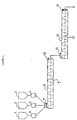
- FIG. 1 is a schematic representation of one embodiment of the present method.
- Storage Tank 1 represents the storage tank for the component (A) polydiorganosiloxane
- Storage Tank 2 represents the storage tank for the component (B) reinforcing filler
- Storage Tank 3 represents the storage tank for the component (C) processing aid.
- Pump 4 represents the polydiorganosiloxane feed pump
- Pump 5 represents the reinforcing filler feed pump
- Pump 6 represents the processing aid feed pump.
- the components (A) through (C) are fed through Feed Opening 7 into Co-Rotating Twin-Screw Continuous Compounding Extruder 8 , which includes Screw 9 .
- the mixed components (A) through (C) are discharged out of the Co-Rotating Twin Screw Continuous Compounding Extruder through Discharge Orifice 10 , forming an extrudate.
- the extrudate leaving Discharge Orifice 10 is fed through Feed Opening 11 into Counter-Rotating Twin-Screw Continuous Compounding Extruder 12 , which includes Screw 13 , to form the silicone rubber compound.
- the silicone rubber compound is then discharged from the Counter-Rotating Twin-Screw Continuous Compounding Extruder through Discharge Orifice 14 .
- No specific restriction applies to the sequence of addition of components (A), (B),and (C), and any other optional components, in the execution of the process of the present invention, but the following process is generally useful.
- the aforesaid components (A), (B), and (C) are continuously fed to a co-rotating twin-screw continuous compounding extruder, where they are continuously mixed and discharged.
- components (A), (B), and (C) are continuously supplied from storage tanks 1 , 2 , and 3 , respectively, through the action of feed pumps 4 , 5 , and 6 , respectively, into a co-rotating twin-screw continuous compounding extruder 8 , where they are continuously mixed and discharged through discharge orifice 10 .
- This co-rotating twin-screw continuous compounding extruder contains two parallel, rotating screws within its barrel that synchronously rotate in the same direction.
- the co-rotating twin-screw continuous compounding extruder useful in the present process has a screw rpm capacity of zero (at medium stop) to 1,000 rpm.
- the length/diameter (L/D) ratio for the extruder screw is not specifically restricted, but is preferably in a range of about 25 to 50 based on a consideration of such factors as the mixing efficiency for the compound. Parameters such as the screw construction and screw configuration may be selected as appropriate from commercial products; however, double-flighted and triple-flighted screws are preferred.
- twin-screw continuous compounding extruders are exemplified by the WP mixers from Werner, Pfleiderer GmbH, Stuttgart, FRG, the TEM mixers from Toshiba Kikai Tokyo, Japan, and the PCM mixers from Ikegai Tekkou, Tokyo, Japan. This mixing is conducted at temperatures in a range of about 200°C to 300°C.
- the extrudate is then continuously introduced into a counter-rotating twin-screw continuous compounding extruder 12 through the feed opening 11 on said counter-rotating twin-screw continuous compounding extruder.
- the discharge orifice 10 of the co-rotating twin-screw continuous compounding extruder and the feed opening 11 of the counter-rotating twin-screw continuous compounding extruder are preferably connected under seal.
- the counter-rotating twin-screw continuous compounding extruder useful in this process contains two parallel, rotating screws within its barrel that rotate in different directions.
- This extruder can consist of a design in which the rotating screws of a co-rotating twin-screw continuous compounding extruder as used in the aforementioned first process are made to rotate in different directions.
- a useful L/D ratio of this extruder is in a range of about 5 to 15, and a useful screw rpm capacity of the extruder is in a range of about zero (at machine stop) to 15 rpm.
- the flowrate of the silicone rubber compound discharging from the counter-rotating twin-screw continuous compounding extruder of the present invention is preferably 1/5 to 1/15 of the flowrate of the silicone rubber extrudate discharging from the co-rotating twin-screw continuous compounding extruder.
- the hot silicone rubber compound that is continuously discharged from the counter-rotating twin-screw continuous compounding extruder can be cooled by various methods. For example, it may be cooled using a two-roll mill, single-screw extruder, belt conveyor, and so forth.
- the silicone rubber compound obtained as described above can be converted into silicone rubber by heating after the addition of a curing agent in the form of organoperoxide or a platinum compound plus an organohydrogensiloxane compound, for example, polymethylhydrogensiloxane.
- the plasticity was measured according to the method in JIS K 6300.
- the silicone rubber compound exiting discharge orifice 14 was cooled to room temperature to yield silicone rubber compound (B). The plasticity, plasticization recovery, and roll workability were measured on both silicone rubber extrudate (A) and silicone rubber compound (B).
- a silicone rubber compound (C) was prepared under the same conditions as above, but in this case using a temperature of 330°C in the co-rotating twin-screw continuous compounding extruder.
- a silicone rubber compound (D) was prepared under the same conditions as above, but in this case using a temperature of 180°C in the co-rotating twin-screw continuous compounding extruder.
- a silicone rubber compound (E) was prepared under the same conditions as above, but in this case with the flowrate for the counter-rotating twin-screw continuous compounding extruder 1/20 of the flowrate of the co-rotating twin-screw continuous compounding extruder.
- the plasticity, plasticization recovery, and roll workability were measured on these silicone rubber compounds, and these results are reported in Table 1.
- present invention comparison examples silicone rubber extrudate/compound B
- Silicone rubber compositions were also prepared by the addition with mixing to homogeneity on a two-roll mill of 0.5 parts 2,5-dimethyl-2,5-di(tert-butylperoxy)hexane to 100 parts of each of the silicone rubber extrudate (A) and silicone rubber compounds (B) through (E) prepared as above.
- the physical properties of these silicone rubber sheets were measured in accordance with JIS K 6301, "Physical Testing Methods for Vulcanized Rubbers", and these measurement results are reported in Table 2.
- silicone rubber compound exiting discharge orifice 14 was cooled to room temperature to yield silicone rubber compound (G).
- the plasticity, plasticization recovery, and roll workability were measured on both silicone rubber extrudate (F) and silicone rubber compound (G), and these results are reported in Table 3.
- comparison example present invention silicone rubber extrudate/compound G F plasticity (mm x 100) 260 290 plasticization recovery (seconds) 20 60 roll workability excellent poor
- Silicone rubber compositions were also prepared by the addition with mixing to homogeneity on a two-roll mill of 0.5 parts 2,5-dimethyl-2,5-di(tert-butylperoxy)hexane to 100 parts of each of the silicone rubber extrudate (F) and compound (G) prepared as above.
- the physical properties of these silicone rubber sheets were measured in accordance with JIS K 6301, "Physical Testing Methods for Vulcanized Rubbers", and these measurement results are reported in Table 4.
- the preparative method in accordance with the present invention is characterized by the ability to continuously and rapidly prepare a silicone rubber compound that exhibits an excellent roll workability and extremely small time-dependent changes.
Landscapes
- Mechanical Engineering (AREA)
- Engineering & Computer Science (AREA)
- Chemical & Material Sciences (AREA)
- Polymers & Plastics (AREA)
- Chemical Kinetics & Catalysis (AREA)
- Medicinal Chemistry (AREA)
- Health & Medical Sciences (AREA)
- Organic Chemistry (AREA)
- Physics & Mathematics (AREA)
- Thermal Sciences (AREA)
- Processes Of Treating Macromolecular Substances (AREA)
- Compositions Of Macromolecular Compounds (AREA)
- Processing And Handling Of Plastics And Other Materials For Molding In General (AREA)
Description
the flowrate of the silicone rubber compound discharging from the counter-rotating twin-screw continuous compounding extruder is in a range of 1/5 to 1/15 of the flowrate of the extrudate discharging from the co-rotating twin-screw continuous compounding extruder; and
| present invention | comparison examples | ||||
| silicone rubber extrudate/compound | B | A | C | D | E |
| plasticity (mm x 100) | 240 | 300 | 190 | 290 | 210 |
| plasticization recovery (seconds) | 20 | 70 | 20 | 50 | 20 |
| roll workability | excellent | poor | poor | poor | poor |
| Physical Properties of the Cured Rubbers | |||||
| present invention | comparison examples | ||||
| silicone rubber extrudate/compound | B | A | C | D | E |
| hardness | 50 | 51 | 51 | 52 | 50 |
| tensile strength (kgf/cm2) MPa | (90) 8,8 | (90) 8,8 | (80) 7,8 | (85) 8,3 | (80) 7,8 |
| elongation, % | 350 | 340 | 325 | 340 | 310 |
| tear strength (kgf/cm) N/cm | (21) 206 | (20) 196 | (19) 193 | (20) 196 | (18) 176 |
| comparison example | present invention | |
| silicone rubber extrudate/compound | G | F |
| plasticity (mm x 100) | 260 | 290 |
| plasticization recovery (seconds) | 20 | 60 |
| roll workability | excellent | poor |
| comparison | present invention | example |
| silicone rubber composition | G | F |
| hardness | 50 | 55 |
| tensile strength (kgf/cm2) MPa | (110) 10,8 | (100) 9,8 |
| elongation% | 500 | 350 |
| tear strength (kgf/cm) N/cm | (13) 127 | (11) 108 |
Claims (4)
- A method for the continuous preparation of a heat-vulcanizing silicone rubber compound,
comprising:characterized by(1) feeding continuously to a co-rotating twin-screw continuous compounding extruder(A) 100 weight parts of a polydiorganosiloxane gum,(B) 5 to 100 weight parts of a reinforcing filler, and(C) up to 30 weight parts of a processing aid;(2) mixing continuously the components (A), (B), and (C) in the extruder at a temperature range of 200°C to 300°C; and(3) discharging the mixed components, forming an extrudate;(4) feeding the extrudate continuously to a counter-rotating twin-screw continuous compounding extruder;(5) heat-treating the extrudate continuously in the counter-rotating twin-screw continuous compounding extruder at a temperature in a range of 150°C to 300°C, forming a silicone rubber compound; and
wherein the flowrate of the silicone rubber compound discharging from the counter-rotating twin-screw continuous compounding extruder is in a range of 1/5 to 1/15 of the flowrate of the extrudate discharging from the co-rotating twin-screw continuous compounding extruder; and(6) discharging the silicone rubber compound. - A method according to claim 1, wherein component (A) is a dimethylvinylsiloxy-endblocked dimethylsiloxane-methylvinylsiloxane gum.
- A method according to claim 1, wherein component (C) is selected from dimethyldimethoxysilane, diphenylsilanediol, low-degree of polymerization silanol-terminated dimethylpolysiloxane, and low-degree of polymerization silanol-terminated methylphenylpolysiloxane.
- A method according to claim 1, wherein component (B) is a reinforcing silica having a surface area greater than 50m2/g, and the quantity of component (B) is in a range of 10 to 100 weight parts of (B) per 100 weight parts of component (A).
Applications Claiming Priority (2)
| Application Number | Priority Date | Filing Date | Title |
|---|---|---|---|
| JP12350093A JP3245258B2 (en) | 1993-04-27 | 1993-04-27 | Continuous production method of heat-curable silicone rubber compound |
| JP123500/93 | 1993-04-27 |
Publications (2)
| Publication Number | Publication Date |
|---|---|
| EP0622398A1 EP0622398A1 (en) | 1994-11-02 |
| EP0622398B1 true EP0622398B1 (en) | 1998-05-27 |
Family
ID=14862163
Family Applications (1)
| Application Number | Title | Priority Date | Filing Date |
|---|---|---|---|
| EP94106614A Expired - Lifetime EP0622398B1 (en) | 1993-04-27 | 1994-04-27 | Method for continuous preparation of heat-vulcanizing silicone rubber compounds |
Country Status (4)
| Country | Link |
|---|---|
| US (1) | US5409978A (en) |
| EP (1) | EP0622398B1 (en) |
| JP (1) | JP3245258B2 (en) |
| DE (1) | DE69410525T2 (en) |
Families Citing this family (28)
| Publication number | Priority date | Publication date | Assignee | Title |
|---|---|---|---|---|
| JPH10130504A (en) * | 1996-10-29 | 1998-05-19 | Toray Dow Corning Silicone Co Ltd | Silicone rubber composition |
| JP3739544B2 (en) * | 1997-09-11 | 2006-01-25 | 東レ・ダウコーニング株式会社 | Continuous production method of silicone rubber composition |
| US6313212B1 (en) | 1997-09-25 | 2001-11-06 | Pirelli Coordinamento Pneumatici S.P.A. | Continuous process for producing semi-finished rubber products with a silica reinforcing filler, for tyres, and tyres thus produced |
| JPH11116693A (en) * | 1997-10-17 | 1999-04-27 | Dow Corning Toray Silicone Co Ltd | Continuous production method of silicone rubber base |
| US6264865B1 (en) | 1998-11-30 | 2001-07-24 | Dow Corning Toray Silicone Company, Ltd. | Silicone rubber base compound for electrical wire coating, silicone composition for electrical wire coating, and process for the production of silicone rubber coated electrical wire |
| US6548574B1 (en) * | 1999-12-21 | 2003-04-15 | General Electric Company | Heat-vulcanizable silicone compositions from premix |
| EP1110696A3 (en) * | 1999-12-21 | 2001-11-21 | General Electric Company | Continuous process to prepare silicone compositions |
| US6388001B1 (en) * | 1999-12-21 | 2002-05-14 | General Electric Company | Compounding filled silicone compositions |
| US6391234B1 (en) * | 1999-12-21 | 2002-05-21 | General Electric Company | Compounding filled silicone compositions |
| US6414054B1 (en) | 1999-12-21 | 2002-07-02 | General Electric Company | Continuous preparation of heat-vulcanizable silicone compositions |
| US6474971B1 (en) | 2000-08-23 | 2002-11-05 | General Electric Company | Compounding heat cured rubber compositions |
| US6511217B1 (en) * | 2000-11-03 | 2003-01-28 | General Electric Company | Method and system to compound silicone compositions |
| US6444154B1 (en) * | 2000-12-20 | 2002-09-03 | General Electric Company | Continuous preparation of a liquid silicone rubber composition |
| JP4155718B2 (en) * | 2001-02-16 | 2008-09-24 | 東レ・ダウコーニング株式会社 | Continuous production method and continuous production apparatus for liquid silicone rubber base |
| DE10162076B4 (en) * | 2001-12-07 | 2009-03-05 | Kraussmaffei Berstorff Gmbh | Multiple-extruder configuration |
| DE10313941A1 (en) * | 2003-03-27 | 2004-10-14 | Wacker-Chemie Gmbh | Process for the continuous production of highly viscous silicone masses |
| JP4704987B2 (en) * | 2006-09-11 | 2011-06-22 | 信越化学工業株式会社 | Silicone rubber composition for extrusion molding |
| WO2013128463A1 (en) * | 2012-02-28 | 2013-09-06 | Steer Engineering Private Limited | An extruder mixing element |
| CN103419346A (en) * | 2013-08-01 | 2013-12-04 | 广东信翼新材料股份有限公司 | Continuous production process and production equipment for heat-conducting silica gel |
| CN103600432A (en) * | 2013-11-22 | 2014-02-26 | 芜湖集拓橡胶技术有限公司 | Auxiliary feeding device of internal mixer |
| JP5659288B1 (en) * | 2013-12-26 | 2015-01-28 | 東芝機械株式会社 | Method for producing transparent resin composition containing polycarbonate resin and acrylic resin |
| CN104890164A (en) * | 2015-05-12 | 2015-09-09 | 无锡世强休闲用品有限公司 | Production line of chloroprene rubber closed-cell foaming material |
| CN111032301A (en) * | 2017-08-31 | 2020-04-17 | 埃克森美孚化学专利公司 | Method for preparing thermoplastic vulcanizate (TPV) |
| CN109092188A (en) * | 2018-09-10 | 2018-12-28 | 佛山市金银河智能装备股份有限公司 | A kind of gross rubber production system and production method |
| CN109318409B (en) * | 2018-10-12 | 2021-04-13 | 温州卡派鞋业有限公司 | Segmented vulcanized silica gel extrusion device for rotary mixing and working method thereof |
| US12134672B2 (en) * | 2021-02-03 | 2024-11-05 | Ka Shui Plastic Technology Co. Ltd. | Bacteria repellant polymer composites |
| EP4349556A1 (en) * | 2022-10-07 | 2024-04-10 | Coperion GmbH | Processing plant and method for processing a polymer filler composition, in particular a polyvinyl chloride filler composition |
| CN120588458A (en) * | 2025-05-15 | 2025-09-05 | 北京化工大学 | Rubber extrusion method, rubber extrusion device and rubber |
Family Cites Families (6)
| Publication number | Priority date | Publication date | Assignee | Title |
|---|---|---|---|---|
| JPS6140327A (en) * | 1984-07-31 | 1986-02-26 | Toray Silicone Co Ltd | Production liquid silicone rubber base |
| FR2602710B1 (en) * | 1986-08-12 | 1989-02-24 | Rhone Poulenc Chimie | PROCESS FOR THE CONTINUOUS PREPARATION OF MASTER BLENDS FOR HOT VULCANIZABLE SILICONE ELASTOMERS |
| JPH0662782B2 (en) * | 1987-08-28 | 1994-08-17 | 信越化学工業株式会社 | Method for producing silicone rubber compound |
| US5198171A (en) * | 1988-10-11 | 1993-03-30 | Toshiba Silicone Co., Ltd. | Process for continuously producing heat-vulcanizable silicone rubber compound |
| JPH082532B2 (en) * | 1988-10-11 | 1996-01-17 | 東芝シリコーン株式会社 | Method for continuously producing heat-vulcanizable silicone rubber compound |
| FR2663340B1 (en) * | 1990-06-13 | 1994-04-08 | Rhone Poulenc Chimie | PROCESS FOR PREPARING MASSAGE IN DOUBLE-SCREW EXTRUDER FOR RTV SIH / SIVI COMPOSITIONS. |
-
1993
- 1993-04-27 JP JP12350093A patent/JP3245258B2/en not_active Expired - Lifetime
-
1994
- 1994-04-27 DE DE69410525T patent/DE69410525T2/en not_active Expired - Lifetime
- 1994-04-27 EP EP94106614A patent/EP0622398B1/en not_active Expired - Lifetime
- 1994-04-28 US US08/234,212 patent/US5409978A/en not_active Expired - Lifetime
Also Published As
| Publication number | Publication date |
|---|---|
| DE69410525T2 (en) | 1998-10-15 |
| JPH06313046A (en) | 1994-11-08 |
| US5409978A (en) | 1995-04-25 |
| JP3245258B2 (en) | 2002-01-07 |
| EP0622398A1 (en) | 1994-11-02 |
| DE69410525D1 (en) | 1998-07-02 |
Similar Documents
| Publication | Publication Date | Title |
|---|---|---|
| US5409978A (en) | Method for the continuous preparation of heat-vulcanizing silicone rubber compounds | |
| EP1792944B1 (en) | Continuous preparation of a liquid silicone rubber composition | |
| US5198171A (en) | Process for continuously producing heat-vulcanizable silicone rubber compound | |
| JP4903934B2 (en) | Method for blending filled silicone composition | |
| JP2008247034A (en) | Compounding method and system for silicone composition | |
| US4649005A (en) | Method for producing a liquid silicone rubber base | |
| JPS6121123B2 (en) | ||
| JPH11116693A (en) | Continuous production method of silicone rubber base | |
| KR930003375B1 (en) | Continuous production of hot cure type silicon rubber compound | |
| KR100798378B1 (en) | Continuous production method of high viscosity crosslinkable silicone composition | |
| JP3475740B2 (en) | Method for producing heat-curable silicone rubber compound | |
| US6017996A (en) | Method for the continuous manufacturing of silicone rubber composition | |
| KR101232697B1 (en) | Continuous process for the production of parent compositions for improved-stability silicone compositions | |
| US4696970A (en) | Method for producing a silicone polymer-filler mixture | |
| MXPA00012961A (en) | Continuous process to prepare silicone compositions. | |
| JP3987132B2 (en) | Method for extrusion molding of silicone rubber moldings | |
| EP1113038B1 (en) | Process for preparing heat-vulcanizable silicone compositions | |
| US6001917A (en) | Method for preparing heat-curable silicone rubber compounds | |
| JP2001139814A (en) | Silicone rubber composition and method for producing the same | |
| JPH1135827A (en) | Silicone rubber composition for extrusion molding and molding method thereof |
Legal Events
| Date | Code | Title | Description |
|---|---|---|---|
| PUAI | Public reference made under article 153(3) epc to a published international application that has entered the european phase |
Free format text: ORIGINAL CODE: 0009012 |
|
| AK | Designated contracting states |
Kind code of ref document: A1 Designated state(s): DE FR GB |
|
| 17P | Request for examination filed |
Effective date: 19950105 |
|
| 17Q | First examination report despatched |
Effective date: 19950314 |
|
| GRAG | Despatch of communication of intention to grant |
Free format text: ORIGINAL CODE: EPIDOS AGRA |
|
| GRAG | Despatch of communication of intention to grant |
Free format text: ORIGINAL CODE: EPIDOS AGRA |
|
| GRAH | Despatch of communication of intention to grant a patent |
Free format text: ORIGINAL CODE: EPIDOS IGRA |
|
| GRAH | Despatch of communication of intention to grant a patent |
Free format text: ORIGINAL CODE: EPIDOS IGRA |
|
| GRAA | (expected) grant |
Free format text: ORIGINAL CODE: 0009210 |
|
| AK | Designated contracting states |
Kind code of ref document: B1 Designated state(s): DE FR GB |
|
| REF | Corresponds to: |
Ref document number: 69410525 Country of ref document: DE Date of ref document: 19980702 |
|
| ET | Fr: translation filed | ||
| PLBI | Opposition filed |
Free format text: ORIGINAL CODE: 0009260 |
|
| 26 | Opposition filed |
Opponent name: WACKER-CHEMIE GMBH Effective date: 19990211 |
|
| PLBF | Reply of patent proprietor to notice(s) of opposition |
Free format text: ORIGINAL CODE: EPIDOS OBSO |
|
| PLBF | Reply of patent proprietor to notice(s) of opposition |
Free format text: ORIGINAL CODE: EPIDOS OBSO |
|
| PLBO | Opposition rejected |
Free format text: ORIGINAL CODE: EPIDOS REJO |
|
| PLBN | Opposition rejected |
Free format text: ORIGINAL CODE: 0009273 |
|
| STAA | Information on the status of an ep patent application or granted ep patent |
Free format text: STATUS: OPPOSITION REJECTED |
|
| 27O | Opposition rejected |
Effective date: 20000129 |
|
| REG | Reference to a national code |
Ref country code: GB Ref legal event code: IF02 |
|
| PGFP | Annual fee paid to national office [announced via postgrant information from national office to epo] |
Ref country code: GB Payment date: 20130424 Year of fee payment: 20 Ref country code: DE Payment date: 20130508 Year of fee payment: 20 |
|
| PGFP | Annual fee paid to national office [announced via postgrant information from national office to epo] |
Ref country code: FR Payment date: 20130625 Year of fee payment: 20 |
|
| REG | Reference to a national code |
Ref country code: DE Ref legal event code: R071 Ref document number: 69410525 Country of ref document: DE |
|
| REG | Reference to a national code |
Ref country code: GB Ref legal event code: PE20 Expiry date: 20140426 |
|
| PG25 | Lapsed in a contracting state [announced via postgrant information from national office to epo] |
Ref country code: GB Free format text: LAPSE BECAUSE OF EXPIRATION OF PROTECTION Effective date: 20140426 |
|
| PG25 | Lapsed in a contracting state [announced via postgrant information from national office to epo] |
Ref country code: DE Free format text: LAPSE BECAUSE OF EXPIRATION OF PROTECTION Effective date: 20140429 |