EP0622366B1 - Condensed quinolyl-dihydropyridines, process for their preparation and their use in medicine for the treatment of heart-circulatory illnesses - Google Patents
Condensed quinolyl-dihydropyridines, process for their preparation and their use in medicine for the treatment of heart-circulatory illnesses Download PDFInfo
- Publication number
- EP0622366B1 EP0622366B1 EP94105778A EP94105778A EP0622366B1 EP 0622366 B1 EP0622366 B1 EP 0622366B1 EP 94105778 A EP94105778 A EP 94105778A EP 94105778 A EP94105778 A EP 94105778A EP 0622366 B1 EP0622366 B1 EP 0622366B1
- Authority
- EP
- European Patent Office
- Prior art keywords
- carbon atoms
- chain
- straight
- optionally substituted
- oder
- Prior art date
- Legal status (The legal status is an assumption and is not a legal conclusion. Google has not performed a legal analysis and makes no representation as to the accuracy of the status listed.)
- Expired - Lifetime
Links
- 0 C*C(*)=Cc1c(cc(*)cn2)c2ccc1 Chemical compound C*C(*)=Cc1c(cc(*)cn2)c2ccc1 0.000 description 2
- FMZUWFBDSUDRLJ-UHFFFAOYSA-N CC(N)/N=C(/C)\O Chemical compound CC(N)/N=C(/C)\O FMZUWFBDSUDRLJ-UHFFFAOYSA-N 0.000 description 1
Classifications
-
- C—CHEMISTRY; METALLURGY
- C07—ORGANIC CHEMISTRY
- C07D—HETEROCYCLIC COMPOUNDS
- C07D401/00—Heterocyclic compounds containing two or more hetero rings, having nitrogen atoms as the only ring hetero atoms, at least one ring being a six-membered ring with only one nitrogen atom
- C07D401/02—Heterocyclic compounds containing two or more hetero rings, having nitrogen atoms as the only ring hetero atoms, at least one ring being a six-membered ring with only one nitrogen atom containing two hetero rings
- C07D401/04—Heterocyclic compounds containing two or more hetero rings, having nitrogen atoms as the only ring hetero atoms, at least one ring being a six-membered ring with only one nitrogen atom containing two hetero rings directly linked by a ring-member-to-ring-member bond
-
- A—HUMAN NECESSITIES
- A61—MEDICAL OR VETERINARY SCIENCE; HYGIENE
- A61P—SPECIFIC THERAPEUTIC ACTIVITY OF CHEMICAL COMPOUNDS OR MEDICINAL PREPARATIONS
- A61P9/00—Drugs for disorders of the cardiovascular system
-
- A—HUMAN NECESSITIES
- A61—MEDICAL OR VETERINARY SCIENCE; HYGIENE
- A61P—SPECIFIC THERAPEUTIC ACTIVITY OF CHEMICAL COMPOUNDS OR MEDICINAL PREPARATIONS
- A61P9/00—Drugs for disorders of the cardiovascular system
- A61P9/04—Inotropic agents, i.e. stimulants of cardiac contraction; Drugs for heart failure
-
- C—CHEMISTRY; METALLURGY
- C07—ORGANIC CHEMISTRY
- C07D—HETEROCYCLIC COMPOUNDS
- C07D495/00—Heterocyclic compounds containing in the condensed system at least one hetero ring having sulfur atoms as the only ring hetero atoms
- C07D495/02—Heterocyclic compounds containing in the condensed system at least one hetero ring having sulfur atoms as the only ring hetero atoms in which the condensed system contains two hetero rings
- C07D495/04—Ortho-condensed systems
Definitions
- the invention relates to new condensed 4-quinolyl-dihydropyridines, processes for their preparation and their use in medicaments, in particular in agents for the treatment of cardiovascular diseases.
- 1,4-dihydropyridines have vasodilatory properties and can be used as coronary agents and antihypertensives. It is also known that 1,4-dihydropyridines inhibit the contractile force of smooth and cardiac muscles and can be used to treat coronary and vascular diseases.
- 1,4-dihydropyridines inhibit the contractile force of smooth and cardiac muscles and can be used to treat coronary and vascular diseases.
- EP-A-452 712 in which the tetrahydrofuropyridines are described.
- EP-A-157 324 describes tetrahydrothienopyridines with the same effect.
- the dihydropyridines according to the invention differ from these in that a -CH 2 group is present in the fused-on five-membered ring instead of the -O or -S group.
- Physiologically acceptable salts can be salts of the compounds according to the invention with inorganic or organic acids.
- Salts with inorganic acids such as, for example, hydrochloric acid, hydrobromic acid, phosphoric acid or sulfuric acid, or salts with organic carboxylic or sulfonic acids such as, for example, acetic acid, maleic acid, fumaric acid, malic acid, citric acid, tartaric acid, lactic acid, benzoic acid, or methanesulfonic acid, ethanesulfonic acid, phenylsulfonic acid, toluene sulfonic acid, are preferred or naphthalenedisulfonic acid.
- the compounds according to the invention exist in stereoisomeric forms which either behave like images and mirror images (enantiomers) or do not behave like images and mirror images (diastereomers).
- the invention relates to both the antipodes and the racemic forms as well as the diastereomer mixtures.
- the racemic forms, like the diastereomers, can be separated into the stereoisomerically uniform constituents in a known manner (cf. E.L. Eliel, Stereochemistry of Carbon Compounds, McGraw Hill, 1962).
- solvents which do not change under the reaction conditions are suitable as solvents.
- solvents preferably include alcohols such as methanol, ethanol, propanol or isopropanol, or ethers such as diethyl ether, dioxane, tetrahydrofuran, glycol dimethyl ether, or diethylene glycol dimethyl ether, acetonitrile, or amides such as hexamethylphosphoric acid triamide or dimethylformamide, or acetic acid or halogenated hydrocarbons such as methylene chloride or tetrachloride Toluene. It is also possible to use mixtures of the solvents mentioned. Depending on the respective process variant [A] and [B], methanol, isopropanol, ethanol and n-propanol, acetonitrile or tetrahydrofuran are preferred.
- reaction temperatures can be varied over a wide range. Generally one works between + 10 ° C and + 150 ° C, preferably between + 20 ° C and + 100 ° C. Especially at the boiling point of the respective solvent.
- the reaction can be carried out at normal pressure, but also at elevated or reduced pressure (e.g. 0.5 to 3 bar). Generally one works at normal pressure.
- Suitable as chiral ester residues are all esters of enantiomerically pure alcohols, such as, for example, 2-butanol, 1-phenylethanol, lactic acid, lactic acid esters, mandelic acid, mandelic acid esters, 2-amino alcohols, sugar derivatives, hydroxyamino acid derivatives and many other enantiomerically pure alcohols.
- Some of the compounds of the general formula (II) are known and can be prepared by customary methods, for example by oxidizing the corresponding alkyl or hydroxyalkyl quinolines or reducing the corresponding carboxyquinolines.
- 4-amino-3-hydroxyphthalide which is obtained by conventional hydrogenation of the literature-known 4-nitro-3-hydroxyphthalide in the presence of a catalyst, preferably with palladium / barium sulfate, with compounds of the general formula R 3 -CH 2 -CHO , some of which are known, are converted into compounds of the general formula (II) via the corresponding carboxylic acids.
- the compounds according to the invention show an unforeseeable, valuable spectrum of pharmacological activity. They affect the contraction power of the heart and the tone of the smooth muscles. They can therefore be used in medicines to influence the pathologically changed blood pressure, as coronary therapeutic agents and for the treatment of heart failure. They can also be used to treat irregular heartbeats, to lower blood sugar, to reduce swelling of the mucous membranes and to influence the salt and fluid balance.
- the cardiac and vascular effects were found on the isolated perfused heart of the guinea pig.
- the hearts of 250 to 350 g guinea pigs are used for this.
- the animals are killed with one blow to the head, the thorax is opened, and a metal cannula is inserted into the freed-up aorta.
- the heart is separated from the chest with the lungs and connected to the perfusion apparatus via an aortic cannula while the perfusion is ongoing.
- the lungs are separated at the roots of the lungs.
- a Krebs-Henseleit solution (118.5 mmol / l NaCl, 4.75 mmol / l KCl, 1.19 mmol / l KH 2 PO 4 , 1.19 mmol / l MgSO 4 , 25 mmol / l serves as the perfusion medium NaHCO 3 , 0.013 mmol / l Na 2 EDTA), the CaCl 2 content of which is 1.2 mmol / l. 10 mmol / l glucose are added as the energy-supplying substrate.
- the solution is filtered particle-free before perfusion.
- the solution is gassed with carbogen (95% O 2 , 5% CO 2 ) to maintain the pH 7.4.
- the hearts are perfused with constant flow (10 ml / min) at 32 ° C using a roller squeeze pump.
- a liquid-filled latex balloon which is connected to a pressure sensor via a liquid column, is inserted through the left atrium into the left ventricle, and the isovolumetric contractions are recorded on a high-speed recorder.
- the perfusion pressure is registered by means of a pressure sensor, which is connected to the perfusion system in front of the heart. Under these conditions, a decrease in perfusion pressure indicates coronary dilation, an increase or decrease in the left ventricular contraction amplitude a decrease or an increase in cardiac contractility.
- the compounds according to the invention are perfused in suitable dilutions into the perfusion system shortly before the isolated heart.
- the new active compounds can be converted in a known manner into the customary formulations, such as tablets, dragées, pills, granules, aerosols, syrups, emulsions, suspensions and solutions, using inert, non-toxic, pharmaceutically suitable excipients or solvents.
- the therapeutically active compound should in each case be present in a concentration of about 0.5 to 90% by weight of the total mixture, ie in amounts which are sufficient to achieve the dosage range indicated.
- the formulations are prepared, for example, by stretching the active ingredients with solvents and / or carriers, optionally using emulsifiers and / or dispersants, e.g. in the case of the use of water as a diluent, organic solvents can optionally be used as auxiliary solvents.
- the application is carried out in the usual way, preferably orally or parenterally, in particular perlingually or intravenously.
Landscapes
- Chemical & Material Sciences (AREA)
- Organic Chemistry (AREA)
- Health & Medical Sciences (AREA)
- Engineering & Computer Science (AREA)
- Bioinformatics & Cheminformatics (AREA)
- Cardiology (AREA)
- Medicinal Chemistry (AREA)
- General Health & Medical Sciences (AREA)
- Chemical Kinetics & Catalysis (AREA)
- General Chemical & Material Sciences (AREA)
- Veterinary Medicine (AREA)
- Nuclear Medicine, Radiotherapy & Molecular Imaging (AREA)
- Pharmacology & Pharmacy (AREA)
- Life Sciences & Earth Sciences (AREA)
- Animal Behavior & Ethology (AREA)
- Heart & Thoracic Surgery (AREA)
- Public Health (AREA)
- Hospice & Palliative Care (AREA)
- Pharmaceuticals Containing Other Organic And Inorganic Compounds (AREA)
- Plural Heterocyclic Compounds (AREA)
- Heterocyclic Carbon Compounds Containing A Hetero Ring Having Oxygen Or Sulfur (AREA)
- Saccharide Compounds (AREA)
- Pyridine Compounds (AREA)
Abstract
Description
Die Erfindung betrifft neue kondensierte 4-Chinolyl-dihydropyridine, Verfahren zu ihrer Herstellung und ihre Verwendung in Arzneimitteln, insbesondere in Mitteln zur Behandlung von Herzkreislauferkrankungen.The invention relates to new condensed 4-quinolyl-dihydropyridines, processes for their preparation and their use in medicaments, in particular in agents for the treatment of cardiovascular diseases.
Es ist bereits bekannt, daß 1,4-Dihydropyridine gefäßerweiternde Eigenschaften besitzen und als Coronarmittel und Antihypertensiva verwendet werden können. Weiterhin ist bekannt, daß 1,4-Dihydropyridine eine Hemmung der Kontraktionskraft von glatten und cardialen Muskeln bewirken und zur Behandlung von Coronar- und Gefäßerkrankungen eingesetzt werden können.
Auch für einige 4-Chinolyl-dihydropyridine ist bereits ihre positiv inotrope Wirkung bekannt, vergl. EP-A-452 712, in der die Tetrahydrofuropyridine beschrieben werden. In EP-A-157 324 werden Tetrahydrothienopyridine mit gleicher Wirkung beschrieben. Die erfindungegemäßen Dihydropyridine unterscheiden sich von diesen durch das Vorhandensein einer -CH2-Gruppe im ankondensierten Fünfring anstelle der -O- bzw. -S-Gruppe.It is already known that 1,4-dihydropyridines have vasodilatory properties and can be used as coronary agents and antihypertensives. It is also known that 1,4-dihydropyridines inhibit the contractile force of smooth and cardiac muscles and can be used to treat coronary and vascular diseases.
For some 4-quinolyl-dihydropyridines, their positive inotropic effect is already known, see EP-A-452 712, in which the tetrahydrofuropyridines are described. EP-A-157 324 describes tetrahydrothienopyridines with the same effect. The dihydropyridines according to the invention differ from these in that a -CH 2 group is present in the fused-on five-membered ring instead of the -O or -S group.
Bei Kenntnis des Standes der Technik war es nicht vorhersehbar, daß die erfindungsgemäßen Verbindungen eine kontraktionskraftverstärkende, am Herzmuskel positiv inotrope Wirkung mit weitgehend gefäßneutralem Verhalten besitzen.With knowledge of the prior art, it was not foreseeable that the compounds according to the invention have a contraction-strengthening, positive inotropic effect on the heart muscle with largely vascular-neutral behavior.
Die vorliegende Anmeldung betrifft kondensierte 4-Chinolyl-dihydropyridine der allgemeinen Formel (I)

- A
- für die -CH2-Gruppe steht,
- R1
- für Wasserstoff, Amino, Cyano, Formyl, Trifluormethyl oder für geradkettiges oder verzweigtes Alkyl mit bis zu 8 Kohlenstoffatomen steht, das gegebenenfalls durch Hydroxy oder durch eine Gruppe der Formel -NR6R7, -O-CO-R8, -O-(CH2)a-OR8' oder -O-(CH2)b'-NR9R10 substituiert ist,
worin
R6, R7, R9 und R10 gleich oder verschieden sind und Wasserstoff, Phenyl oder geradkettiges oder verzweigtes Alkyl mit bis zu 6 Kohlenstoffatomen bedeuten,
R8 und R8' gleich oder verschieden sind und geradkettiges oder verzweigtes Alkyl mit bis zu 6 Kohlenstoffatomen bedeuten, und
a und b gleich oder verschieden sind und eine Zahl 2, 3, 4 oder 5 bedeuten, - R2
- für eine Gruppe der Formel -CO-NR11R12 oder -CO-D-R13 steht,
- R11 und R12
- gleich oder verschieden sind und Wasserstoff, einen geradkettigen, verzweigten, cyclischen, gesättigten oder ungesättigten Kohlenwasserstoffrest mit bis zu 8 Kohlenstoffatomen bedeuten, der gegebenenfalls durch Halogen, Hydroxy, Cyano oder durch Aryl, Aryloxy, Arylthio mit jeweils 6 bis 10 Kohlenstoffatomen oder durch einen 5- bis 7-gliedrigen, gesättigen oder ungesättigten Heterocyclus mit bis zu 3 Heteroatomen aus der Reihe S, N oder O substituiert ist, wobei die Cyclen ihrerseits durch Halogen, Cyano oder durch geradkettiges oder verzweigtes Alkyl, Alkoxy, Alkylthio, Alkoxycarbonyl, Halogenalkyl, Halogenalkoxy oder Halogenalkylthio mit jeweils bis zu 4 Kohlenstoffatomen substituiert sein können, oder Aryl mit 6 bis 10 Kohlenstoffatomen oder einen 5- bis 7-gliedrigen, gesättigten oder ungesättigten Heterocyclus mit bis zu 3 Heteroatomen aus der Reihe S, N oder O bedeuten, die gegebenenfalls bis zu 2-fach gleich oder verschieden durch Halogen, Cyano oder durch geradkettiges oder verzweigtes Alkyl, Alkoxy, Alkylthio, Alkoxycarbonyl, Halogenalkyl, Halogenalkoxy oder Halogenalkylthio mit jeweils bis zu 4 Kohlenstoffatomen substituiert sind,
- R11 und R12
- gemeinsam unter Einbezug des Stickstoffatoms einen 3- bis 8-gliedrigen, gesättigen oder ungesättigten Heterocyclus bilden, der gegebenenfalls durch ein Sauerstoffatom oder durch einen Rest der Formel S(O)d' -CO- oder -NR15 unterbrochen ist,
worin
d eine Zahl 0, 1 oder 2 bedeutet,
R15 Wasserstoff oder Aryl mit 6 bis 10 Kohlenstoffatomen bedeutet, das gegebenenfalls bis zu 2-fach gleich oder verschieden durch Halogen, Cyano oder durch geradkettiges oder verzweigtes Alkyl, Alkoxy, Alkylthio, Alkoxycarbonyl mit jeweils bis zu 8 Kohlenstoffatomen oder durch Halogenalkyl, Halogenalkoxy oder Halogenalkylthio mit jeweils bis zu 4 Kohlenstoffatomen substituiert ist, oder einen cyclischen, gesättigten oder ungesättigten, geradkettigen oder verzweigten Kohlenwasserstoffrest mit bis zu 8 Kohlenstoffatomen bedeutet, der gegebenenfalls durch Hydroxy, Halogen oder durch Aryl mit 6 bis 10 Kohlenstoffatomen oder einen 5- bis 7-gliedrigen, gesättigten oder ungesättigten Heterocyclus mit bis zu 3 Heteroatomen aus der Reihe S, N oder O substituiert ist, wobei die Cyclen ihrerseits bis zu 2-fach gleich oder verschieden durch Halogen, Cyano oder durch geradkettiges oder verzweigtes Alkyl, Alkoxy, Alkylthio, Alkoxycarbonyl, Halogenalkyl, Halogenalkoxy oder Halogenalkylthio mit jeweils bis zu 4 Kohlenstoffatomen substituiert sein können, und der Heterocyclus gegebenenfalls durch geradkettiges oder verzweigtes Alkoxy oder Alkylthio mit jeweils bis zu 4 Kohlenstoffatomen, Halogen, Aryl mit 6 bis 10 Kohlenstoffatomen, einen 5- bis 7-gliedrigen, gesättigten oder ungesättigten Heterocyclus mit bis zu 3 Heteroatomen aus der Reihe S, N oder O oder durch geradkettiges oder verzweigtes Alkyl mit bis zu 4 Kohlenstoffatomen substituiert ist, das seinerseits durch Aryl mit 6 bis 10 Kohlenstoffatomen substituiert sein kann, - D
- eine direkte Bindung oder ein Sauerstoffatom bedeutet,
- R13
- Wasserstoff oder Aryl mit 6 bis 10 Kohlenstoffatomen oder einen 5- bis 7-gliedrigen, gesättigten oder ungesättigten Heterocyclus mit bis zu 3 Heteroatomen aus der Reihe S, N oder O bedeutet, wobei die Cyclen gegebenenfalls bis zu 3-fach gleich oder verschieden durch Halogen, Cyano oder durch geradkettiges oder verzweigtes Alkyl, Alkoxy, Alkylthio, Alkoxycarbonyl, Halogenalkyl, Halogenalkoxy oder Halogenalkylthio mit jeweils bis zu 4 Kohlenstoffatomen substituiert sind, oder
einen cyclischen, geradkettigen oder verzweigten, gesättigten oder ungesättigten Kohlenwasserstoffrest mit bis zu 10 Kohlenstoffatomen bedeutet, der gegebenenfalls bis zu 3-fach gleich oder verschieden durch Sauerstoff oder durch -CO-, -CO-NH-, -O-CO-, -CO-O-, -NH-CO-, -SO2-NH-, -NH-SO2-, -S(O)e-oder -NR16 unterbrochen ist,
worin
e die oben angegebene Bedeutung von d hat und mit dieser gleich oder verschieden ist,
R16 die oben angegebene Bedeutung von R15 hat und mit dieser gleich oder verschieden ist,

worin
f und g gleich oder verschieden sind und eine Zahl 1 oder 2 bedeuten,
und wobei die Aryl- und Hetero-Cyclen ihrerseits durch Halogen, Cyano oder durch geradkettiges oder verzweigtes Alkyl, Alkoxy, Alkylthio, Alkoxycarbonyl, Halogenalkyl, Halogenalkoxy oder Halogenalkylthio mit jeweils bis zu 4 Kohlenstoffatomen substituiert sein können,
und der Kohlenwasserstoffrest gegebenenfalls bis zu 3-fach gleich oder verschieden durch Cycloalkyl mit 3 bis 8 Kohlenstoffatomen, Halogen, Nitro, Cyano, Hydroxy, -O-NO2, geradkettiges oder verzweigtes Alkylthio, Alkoxy oder Acyloxy mit jeweils bis zu 8 Kohlenstoffatomen oder durch Aryl, Aryloxy oder Arylthio mit jeweils 6 bis 10 Kohlenstoffatomen oder durch einen 5- bis 7-gliedrigen, gesättigten oder ungesättigen Heterocyclus mit bis zu 3 Heteroatomen aus der Reihe S, N oder O substituiert ist, wobei die Cyclen ihrerseits bis zu 3-fach gleich oder verschieden durch Halogen, Cyano oder durch geradkettiges oder verzweigtes Alkyl, Alkoxy, Alkylthio, Alkoxycarbonyl, Halogenalkyl, Halogenalkoxy oder Halogenalkylthio mit jeweils bis zu 4 Kohlenstoffatomen substituiert sein können, oder
der Kohlenwasserstoffrest durch eine Gruppe der Formel -CO2-R17, -CONR18R19 oder -NR20R21 substituiert sein kann,
worin
- R17
- die oben angegebene Bedeutung von R15 hat und mit dieser gleich oder verschieden ist
- R18, R19, R20 und R21
- die oben angegebene Bedeutung von R11 und R12 haben und mit diesen gleich oder verschieden sind,
- R3
- für Aryl mit 6 bis 10 Kohlenstoffatomen steht, das gegebenenfalls bis zu 2-fach gleich oder verschieden durch Halogen, Nitro, Cyano, Trifluormethyl, Trifluormethoxy, Trifluormethylthio, geradkettlges oder verzweigtes Alkyl, Alkoxy oder Alkoxycarbonyl mit jeweils bis zu 8 Kohlenstoffatomen oder Carboxy substituiert ist, oder für Thienyl oder Pyridyl steht, die gegebenenfalls durch Halogen substituiert sind
- A
- represents the -CH 2 group,
- R 1
- represents hydrogen, amino, cyano, formyl, trifluoromethyl or straight-chain or branched alkyl having up to 8 carbon atoms, which may be by hydroxyl or by a group of the formula -NR 6 R 7 , -O-CO-R 8 , -O- (CH 2 ) a -OR 8 ' or -O- (CH 2 ) b' -NR 9 R 10 is substituted,
wherein
R 6 , R 7 , R 9 and R 10 are identical or different and denote hydrogen, phenyl or straight-chain or branched alkyl having up to 6 carbon atoms,
R 8 and R 8 'are identical or different and denote straight-chain or branched alkyl having up to 6 carbon atoms, and
a and b are the same or different and represent a number 2, 3, 4 or 5, - R 2
- represents a group of the formula -CO-NR 11 R 12 or -CO-DR 13 ,
- R 11 and R 12
- are identical or different and denote hydrogen, a straight-chain, branched, cyclic, saturated or unsaturated hydrocarbon radical having up to 8 carbon atoms, which may optionally be halogen, hydroxy, cyano or aryl, aryloxy, arylthio each having 6 to 10 carbon atoms or by a 5 - Substituted to 7-membered, saturated or unsaturated heterocycle with up to 3 heteroatoms from the series S, N or O, the cycles in turn by halogen, cyano or by straight-chain or branched alkyl, alkoxy, alkylthio, alkoxycarbonyl, haloalkyl, haloalkoxy or halogenoalkylthio, each with up to 4 carbon atoms, or aryl with 6 to 10 carbon atoms or a 5- to 7-membered, saturated or unsaturated heterocycle with up to 3 heteroatoms from the series S, N or O, which may be up to 2 times the same or different by halogen, cyano or by straight-chain ode r branched alkyl, alkoxy, alkylthio, alkoxycarbonyl, haloalkyl, haloalkoxy or haloalkylthio each having up to 4 carbon atoms,
- R 11 and R 12
- together with the nitrogen atom form a 3- to 8-membered, saturated or unsaturated heterocycle which is optionally interrupted by an oxygen atom or by a radical of the formula S (O) d ' -CO- or -NR 15 ,
wherein
d represents a number 0, 1 or 2,
R 15 is hydrogen or aryl having 6 to 10 carbon atoms, optionally up to 2 times the same or different by halogen, cyano or by straight-chain or branched alkyl, alkoxy, alkylthio, alkoxycarbonyl each having up to 8 carbon atoms or by haloalkyl, haloalkoxy or Haloalkylthio is substituted with up to 4 carbon atoms in each case, or denotes a cyclic, saturated or unsaturated, straight-chain or branched hydrocarbon radical with up to 8 carbon atoms, which is optionally substituted by hydroxy, halogen or aryl having 6 to 10 carbon atoms or a 5- to 7- membered, saturated or unsaturated heterocycle is substituted with up to 3 heteroatoms from the series S, N or O, the cycles themselves being up to 2 times identical or different by halogen, cyano or by straight-chain or branched alkyl, alkoxy, alkylthio, alkoxycarbonyl , Haloalkyl, haloalkoxy or haloalkylthio with j up to 4 carbon atoms can be substituted, and the heterocycle optionally by straight-chain or branched alkoxy or alkylthio each having up to 4 carbon atoms, halogen, aryl having 6 to 10 carbon atoms, a 5- to 7-membered, saturated or unsaturated heterocycle with to is substituted to 3 heteroatoms from the series S, N or O or by straight-chain or branched alkyl having up to 4 carbon atoms, which in turn can be substituted by aryl having 6 to 10 carbon atoms, - D
- means a direct bond or an oxygen atom,
- R 13
- Is hydrogen or aryl with 6 to 10 carbon atoms or a 5- to 7-membered, saturated or unsaturated heterocycle with up to 3 heteroatoms from the series S, N or O, the cycles optionally up to 3 times the same or different by halogen , Cyano or are substituted by straight-chain or branched alkyl, alkoxy, alkylthio, alkoxycarbonyl, haloalkyl, haloalkoxy or haloalkylthio each having up to 4 carbon atoms, or
is a cyclic, straight-chain or branched, saturated or unsaturated hydrocarbon radical having up to 10 carbon atoms, which may be up to 3 times the same or different by oxygen or by -CO-, -CO-NH-, -O-CO-, -CO -O-, -NH-CO-, -SO 2 -NH-, -NH-SO 2 -, -S (O) e -or -NR 16 is interrupted,
wherein
e has the meaning of d given above and is the same or different with it,
R 16 has the meaning of R 15 given above and is the same or different with it,
wherein
f and g are the same or different and represent a number 1 or 2,
and the aryl and heterocycles in turn can be substituted by halogen, cyano or by straight-chain or branched alkyl, alkoxy, alkylthio, alkoxycarbonyl, haloalkyl, haloalkoxy or haloalkylthio each having up to 4 carbon atoms,
and the hydrocarbon radical optionally up to 3 times the same or different by cycloalkyl having 3 to 8 carbon atoms, halogen, nitro, cyano, hydroxy, -O-NO 2 , straight-chain or branched alkylthio, alkoxy or acyloxy each having up to 8 carbon atoms or by Aryl, aryloxy or arylthio each having 6 to 10 carbon atoms or by a 5- to 7-membered, saturated or unsaturated heterocycle with up to 3 heteroatoms from the series S, N or O is substituted, the cycles in turn up to 3 times the same or different can be substituted by halogen, cyano or by straight-chain or branched alkyl, alkoxy, alkylthio, alkoxycarbonyl, haloalkyl, haloalkoxy or haloalkylthio, each having up to 4 carbon atoms, or
the hydrocarbon radical can be substituted by a group of the formula -CO 2 -R 17 , -CONR 18 R 19 or -NR 20 R 21 ,
wherein
- R 17
- has the meaning of R 15 given above and is the same or different with this
- R 18 , R 19 , R 20 and R 21
- have the meaning of R 11 and R 12 given above and are identical or different with these,
- R 3
- represents aryl having 6 to 10 carbon atoms, which is optionally substituted up to 2 times identically or differently by halogen, nitro, cyano, trifluoromethyl, trifluoromethoxy, trifluoromethylthio, straight-chain or branched alkyl, alkoxy or alkoxycarbonyl each having up to 8 carbon atoms or carboxy , or represents thienyl or pyridyl, which are optionally substituted by halogen
Physiologisch unbedenkliche Salze können Salze der erfindungsgemäßen Verbindungen mit anorganischen oder organischen Säuren sein. Bevorzugt werden Salze mit anorganischen Säuren wie beispielsweise Salzsäure, Bromwasserstoffsäure, Phosphorsäure oder Schwefelsäure, oder Salze mit organischen Carbon- oder Sulfonsäuren wie beispielsweise Essigsäure, Maleinsäure, Fumarsäure, Äpfelsäure, Zitronensäure, Weinsäure, Milchsäure, Benzoesäure, oder Methansulfonsäure, Ethansulfonsäure, Phenylsulfonsäure, Toluolsulfonsäure oder Naphthalindisulfonsäure.Physiologically acceptable salts can be salts of the compounds according to the invention with inorganic or organic acids. Salts with inorganic acids such as, for example, hydrochloric acid, hydrobromic acid, phosphoric acid or sulfuric acid, or salts with organic carboxylic or sulfonic acids such as, for example, acetic acid, maleic acid, fumaric acid, malic acid, citric acid, tartaric acid, lactic acid, benzoic acid, or methanesulfonic acid, ethanesulfonic acid, phenylsulfonic acid, toluene sulfonic acid, are preferred or naphthalenedisulfonic acid.
Die erfindungsgemäßen Verbindungen existieren in stereoisomeren Formen, die sich entweder wie Bild und Spiegelbild (Enantiomere), oder die sich nicht wie Bild und Spiegelbild (Diastereomere) verhalten. Die Erfindung betrifft sowohl die Antipoden als auch die Racemformen sowie die Diastereomerengemische. Die Racemformen lassen sich ebenso wie die Diastereomeren in bekannter Weise in die stereoisomer einheitlichen Bestandteile trennen (vgl. E.L. Eliel, Stereochemistry of Carbon Compounds, McGraw Hill, 1962).The compounds according to the invention exist in stereoisomeric forms which either behave like images and mirror images (enantiomers) or do not behave like images and mirror images (diastereomers). The invention relates to both the antipodes and the racemic forms as well as the diastereomer mixtures. The racemic forms, like the diastereomers, can be separated into the stereoisomerically uniform constituents in a known manner (cf. E.L. Eliel, Stereochemistry of Carbon Compounds, McGraw Hill, 1962).
Bevorzugt sind Verbindungen der allgemeinen Formel (I),
in welcher
- A
- für die CH2-Gruppe steht,
- R1
- für Wasserstoff, Amino, Cyano, Formyl, Trifluormethyl oder für geradkettiges oder verzweigtes Alkyl mit bis zu 6 Kohlenstoffatomen steht, das gegebenenfalls durch Hydroxy oder durch eine Gruppe der Formel -NR6R7, -O-CO-R8, -O-(CH2)a-OR8' oder -O-(CH2)b, -NR9R10 substituiert ist,
worin
R6, R7, R9 und R10 gleich oder verschieden sind und Wasserstoff oder geradkettiges oder verzweigtes Alkyl mit bis zu 4 Kohlenstoffatomen bedeuten,
R8 und R8' gleich oder verschieden sind und geradkettiges oder verzweigtes Alkyl mit bis zu 4 Kohlenstoffatomen bedeuten, und
a und b gleich oder verschieden sind und eine Zahl 2, 3 oder 4 bedeuten, - R2
- für eine Gruppe der Formel -CO-NR11R12 oder -CO-D-R13 steht,
worin
R11 und R12 gleich oder verschieden sind und Wasserstoff, einen geradkettigen, verzweigten, cyclischen, gesättigten oder ungesättigten Kohlenwasserstoffrest mit bis zu 6 Kohlenstoffatomen bedeuten, der gegebenenfalls durch Fluor, Chlor, Hydroxy, Cyano oder durch Phenyl, Phenyloxy, Phenylthio oder Pyridyl substituiert ist, wobei die Cyclen ihrerseits durch Fluor, Chlor oder durch Alkyl, Alkoxy, Alkoxycarbonyl mit jeweils bis zu 2 Kohlenstoffatomen, Trifluormethyl oder Trifluormethoxy substituiert sein können, oder Phenyl oder Pyridyl bedeuten, die gegebenenfalls durch Fluor, Chlor oder durch geradkettiges oder verzweigtes Alkyl, Alkoxy, Alkylthio, Alkoxycarbonyl mit jeweils bis zu 4 Kohlenstoffatomen, Trifluormethyl oder Trifluormethoxy substituiert sind,
- R11 und R12
- gemeinsam unter Einbezug des Stickstoffatoms einen 5- bis 7-gliedrigen, gesättigen oder ungesättigten Heterocyclus bilden, der gegebenenfalls durch ein Sauerstoffatom oder durch einen Rest der Formel S(O)d, -CO- oder -NR5 unterbrochen ist,
worin
d eine Zahl 0, 1 oder 2 bedeutet,
R15 Wasserstoff oder Phenyl bedeutet, das gegebenenfalls durch Fluor, Chlor, durch geradkettiges oder verzweigtes Alkyl oder Alkoxy mit jeweils bis zu 4 Kohlenstoffatomen, Trifluormethyl oder Trifluormethoxy substituiert ist, oder einen cyclischen, gesättigten oder ungesättigten, geradkettigen oder verzweigten Kohlenwasserstoffrest mit bis zu 4 Kohlenstoffatomen bedeutet, der gegebenenfalls durch Fluor, Chlor, Phenyl oder einen 5- bis 7-gliedrigen, gesättigten oder ungesättigten Heterocyclus mit bis zu 2 Heteroatomen aus der Reihe O, S, N substituiert ist, die ihrerseits durch Fluor, Chlor, geradkettiges oder verzweigtes Alkyl oder Alkoxy mit jeweils bis zu 4 Kohlenstoffatomen, Trifluormethyl oder Trifluormethoxy substituiert sein können, - D
- eine direkte Bindung oder ein Sauerstoffatom bedeutet,
- R13
- Wasserstoff, Phenyl oder Pyridyl bedeutet, die gegebenenfalls durch Fluor, Chlor oder durch geradkettiges oder verzweigtes Alkyl, Alkoxy, Alkylthio, Alkoxycarbonyl mit jeweils bis zu 4 Kohlenstoffatomen, Trifluormethyl oder Trifluormethoxy substituiert sind, oder einen cyclischen, geradkettigen oder verzweigten, gesättigten oder ungesättigten Kohlenwasserstoffrest mit bis zu 8 Kohlenstoffatomen bedeutet, der gegebenenfalls bis zu 2-fach gleich oder verschieden durch Sauerstoff oder durch -CO-, -CO-NH-, -O-CO-, -CO-O-, -NH-CO-, -SO2-NH-, -NH-SO2-, -S(O)e- oder -NR16 unterbrochen ist,
worin
e die oben angegebene Bedeutung von d hat und mit dieser gleich oder verschieden ist,
R16 die oben angegebene Bedeutung von R15 hat und mit dieser gleich oder verschieden ist,

worin
f und g gleich oder verschieden sind und eine Zahl 1 oder 2 bedeuten,
und der Kohlenwasserstoffrest gegebenenfalls bis zu 2-fach gleich oder verschieden durch Cyclopropyl, Cyclobutyl, Cyclopentyl, Cyclohexyl, Fluor, Chlor, Nitro, Cyano, Hydroxy, -O-NO2, geradkettiges oder verzweigtes Alkylthio, Alkoxy oder Acyloxy mit jeweils bis zu 4 Kohlenstoffatomen oder durch Phenyl, Phenoxy, Phenylthio oder Pyridyl substituiert ist, die ihrerseits bis zu 2-fach gleich oder verschieden durch Fluor, Chlor, Cyano oder durch geradkettiges oder verzweigtes Alkyl, Alkoxy, Alkylthio, Alkoxycarbonyl mit jeweils mit bis zu 4 Kohlenstoffatomen, Trifluormethyl oder Trifluormethoxy substituiert sein können,
oder der Kohlenwasserstoffrest durch eine Gruppe der Formel -CO2-R17, -CONR18R19 oder -NR20R21 substituiert sein kann,
worin
- R17
- die oben angegebene Bedeutung von R15 hat und mit dieser gleich oder verschieden ist
- R18, R19, R20 und R21
- die oben angegebene Bedeutung von R11 und R12 haben und mit diesen gleich oder verschieden sind,
- R3
- für Phenyl steht, das gegebenenfalls durch Fluor, Chlor, Nitro, Cyano, Trifluormethyl oder durch geradkettiges oder verzweigtes Alkyl oder Alkoxy mit jeweils bis zu 6 Kohlenstoffatomen oder Hydroxy substituiert ist, oder
für Thienyl oder Pyridyl steht, die gegebenenfalls durch Fluor, Chlor, Brom substituiert sind,
in which
- A
- represents the CH 2 group,
- R 1
- represents hydrogen, amino, cyano, formyl, trifluoromethyl or straight-chain or branched alkyl having up to 6 carbon atoms, which may be by hydroxyl or by a group of the formula -NR 6 R 7 , -O-CO-R 8 , -O- (CH 2 ) a -OR 8 ' or -O- (CH 2 ) b , -NR 9 R 10 is substituted,
wherein
R 6 , R 7 , R 9 and R 10 are identical or different and denote hydrogen or straight-chain or branched alkyl having up to 4 carbon atoms,
R 8 and R 8 'are identical or different and represent straight-chain or branched alkyl having up to 4 carbon atoms, and
a and b are the same or different and represent a number 2, 3 or 4, - R 2
- represents a group of the formula -CO-NR 11 R 12 or -CO-DR 13 ,
wherein
R 11 and R 12 are the same or different and are hydrogen, a straight-chain, branched, cyclic, saturated or unsaturated hydrocarbon radical having up to 6 carbon atoms, which is optionally substituted by fluorine, chlorine, hydroxy, cyano or by phenyl, phenyloxy, phenylthio or pyridyl where the cycles are themselves fluorine, chlorine or alkyl, alkoxy, Alkoxycarbonyl each having up to 2 carbon atoms, trifluoromethyl or trifluoromethoxy may be substituted, or phenyl or pyridyl, which are optionally substituted by fluorine, chlorine or by straight-chain or branched alkyl, alkoxy, alkylthio, alkoxycarbonyl each having up to 4 carbon atoms, trifluoromethyl or trifluoromethoxy are,
- R 11 and R 12
- together with the nitrogen atom form a 5- to 7-membered, saturated or unsaturated heterocycle which is optionally interrupted by an oxygen atom or by a radical of the formula S (O) d , -CO- or -NR 5 ,
wherein
d represents a number 0, 1 or 2,
R 15 is hydrogen or phenyl, which is optionally substituted by fluorine, chlorine, by straight-chain or branched alkyl or alkoxy each having up to 4 carbon atoms, trifluoromethyl or trifluoromethoxy, or a cyclic, saturated or unsaturated, straight-chain or branched hydrocarbon radical having up to 4 Carbon atoms, which is optionally substituted by fluorine, chlorine, phenyl or a 5- to 7-membered, saturated or unsaturated heterocycle with up to 2 heteroatoms from the series O, S, N, which in turn by fluorine, chlorine, straight-chain or branched Alkyl or alkoxy, each having up to 4 carbon atoms, trifluoromethyl or trifluoromethoxy, can be substituted, - D
- means a direct bond or an oxygen atom,
- R 13
- Means hydrogen, phenyl or pyridyl, which are optionally substituted by fluorine, chlorine or by straight-chain or branched alkyl, alkoxy, alkylthio, alkoxycarbonyl each having up to 4 carbon atoms, trifluoromethyl or trifluoromethoxy, or a cyclic, straight-chain or branched, saturated or unsaturated hydrocarbon radical with up to 8 carbon atoms, which may be up to 2 times identical or different by oxygen or by -CO-, -CO-NH-, -O-CO-, -CO-O-, -NH-CO-, - SO 2 -NH-, -NH-SO 2 -, -S (O) e - or -NR 16 is interrupted,
wherein
e has the meaning of d given above and is the same or different with it,
R 16 has the meaning of R 15 given above and is the same or different with it,
wherein
f and g are the same or different and represent a number 1 or 2,
and the hydrocarbon radical optionally up to 2 times the same or different by cyclopropyl, cyclobutyl, cyclopentyl, cyclohexyl, fluorine, chlorine, nitro, cyano, hydroxy, -O-NO 2 , straight-chain or branched alkylthio, alkoxy or acyloxy, each with up to 4 Carbon atoms or substituted by phenyl, phenoxy, phenylthio or pyridyl, which in turn is up to 2 times the same or different by fluorine, chlorine, cyano or by straight-chain or branched alkyl, alkoxy, alkylthio, alkoxycarbonyl, each with up to 4 carbon atoms, trifluoromethyl or trifluoromethoxy can be substituted,
or the hydrocarbon radical can be substituted by a group of the formula -CO 2 -R 17 , -CONR 18 R 19 or -NR 20 R 21 ,
wherein
- R 17
- has the meaning of R 15 given above and is the same or different with this
- R 18 , R 19 , R 20 and R 21
- have the meaning of R 11 and R 12 given above and are identical or different with these,
- R 3
- represents phenyl which is optionally substituted by fluorine, chlorine, nitro, cyano, trifluoromethyl or by straight-chain or branched alkyl or alkoxy each having up to 6 carbon atoms or hydroxy, or
represents thienyl or pyridyl, which are optionally substituted by fluorine, chlorine, bromine,
Besonders bevorzugt sind Verbindungen der allgemeinen Formel (I),
in welcher
- A
- für die -CH2-Gruppe steht,
- R1
- für Wasserstoff, Amino, Cyano, Formyl, Trifluormethyl oder für geradkettiges oder verzweigtes Alkyl mit bis zu 3 Kohlenstoffatomen steht, das gegebenenfalls durch Hydroxy oder durch eine Gruppe der Formel -NR6R7, -O-CO-R8, -O-(CH2)a-OR8' oder -O-(CH2)b'-NR9R10 substituiert ist,
worin
R6, R7, R9 und R10 gleich oder verschieden sind und Wasserstoff, Methyl oder Ethyl bedeuten,
R8 und R8' gleich oder verschieden sind und Methyl oder Ethyl bedeuten, und
a und b gleich oder verschieden sind und eine Zahl 2 oder 3 bedeuten, - R2
- für eine Gruppe der Formel -CO-NR11R12 oder -CO-D-R13 steht,
worin
R11 und R12 gleich oder verschieden sind und Wasserstoff, einen geradkettigen, verzweigten, cyclischen, gesättigten oder ungesättigten Kohlenwasserstoffrest mit bis zu 6 Kohlenstoffatomen bedeuten, der gegebenenfalls durch Fluor, Chlor, Phenyl oder Pyridyl substituiert ist, oder
Phenyl oder Pyridyl bedeuten, die gegebenenfalls durch Fluor, Chlor, Methyl oder Methoxy substituiert sind,
- R11 und R12
- gemeinsam unter Einbezug des Stickstoffatoms einen 5- bis 6-gliedrigen, ungesättigten Heterocyclus bilden, der gegebenenfalls durch Sauerstoff oder Schwefel oder den Rest NR15 unterbrochen ist,
worin
R15 Wasserstoff oder Phenyl bedeutet, das gegebenenfalls durch Fluor, Chlor, Methyl, Methoxy oder Trifluormethyl substituiert ist, oder
einen cyclischen, gesättigten oder ungesättigten, geradkettigen oder verzweigten Kohlenwasserstoffrest mit bis zu 4 Kohlenstoffatomen bedeutet, der gegebenenfalls durch Phenyl oder Pyridyl substituiert ist, - D
- eine direkte Bindung oder ein Sauerstoffatom bedeutet,
- R13
- Wasserstoff oder Phenyl bedeutet, das gegebenenfalls durch Fluor, Chlor, Methyl, Methoxy oder Trifluormethyl substituiert ist, oder
einen cyclischen, geradkettigen oder verzweigten, gesättigten oder ungesättigten Kohlenwasserstoffrest mit bis zu 6 Kohlenstoffatomen bedeutet, der gegebenenfalls durch Sauerstoff oder Schwefel oder durch -CO-, -CO-NH-, -O-CO-, -CO-O-, -NH-CO-, -SO2-NH-, -NH-SO2- oder -NR16 unterbrochen ist,
worin
R16 die oben angegebene Bedeutung von R15 hat und mit dieser gleich oder verschieden ist,

worin
f und g gleich oder verschieden sind und eine Zahl 1 oder 2 bedeuten,
und der Kohlenwasserstoffrest gegebenenfalls durch Cyclopropyl, Cyclobutyl, Cyclopentyl, Cyclohexyl, Fluor, Chlor, Nitro, Hydroxy, geradkettiges oder verzweigtes Alkylthio oder Alkoxy mit jeweils bis zu 5 Kohlenstoffatomen oder durch Phenyl, Phenoxy, Phenylthio oder Pyridyl substituiert ist, die ihrerseits durch Fluor, Chlor, Methyl, Methoxy, Methylthio substituiert sein können, oder
durch eine Gruppe der Formel -CO2-R17, -CONR18R19 oder -NR20R21 substituiert sein kann,
worin
- R17
- die oben angegebene Bedeutung von R15 hat und mit dieser gleich oder verschieden ist
- R18, R19, R20 und R21
- die oben angegebene Bedeutung von R11 und R12 haben und mit diesen gleich oder verschieden sind,
- R3
- für Phenyl steht, das gegebenenfalls durch Fluor, Chlor, Nitro, Trifluormethyl oder durch geradkettiges oder verzweigtes Alkyl oder Alkoxy mit jeweils bis zu 4 Kohlenstoffatomen substituiert ist, oder für
Thienyl steht,das gegebenenfalls durch Fluor oder Chlor substituiert ist,
in which
- A
- represents the -CH 2 group,
- R 1
- represents hydrogen, amino, cyano, formyl, trifluoromethyl or straight-chain or branched alkyl having up to 3 carbon atoms, which may be by hydroxyl or by a group of the formula -NR 6 R 7 , -O-CO-R 8 , -O- (CH 2 ) a -OR 8 ' or -O- (CH 2 ) b' -NR 9 R 10 is substituted,
wherein
R 6 , R 7 , R 9 and R 10 are identical or different and are hydrogen, methyl or ethyl,
R 8 and R 8 'are identical or different and are methyl or ethyl, and
a and b are the same or different and represent a number 2 or 3, - R 2
- represents a group of the formula -CO-NR 11 R 12 or -CO-DR 13 ,
wherein
R 11 and R 12 are the same or different and are hydrogen, a straight-chain, branched, cyclic, saturated or unsaturated hydrocarbon radical having up to 6 carbon atoms, which is optionally substituted by fluorine, chlorine, phenyl or pyridyl, or
Are phenyl or pyridyl, which are optionally substituted by fluorine, chlorine, methyl or methoxy,
- R 11 and R 12
- together form a 5- to 6-membered, unsaturated heterocycle, including the nitrogen atom, which is optionally interrupted by oxygen or sulfur or the radical NR 15 ,
wherein
R 15 denotes hydrogen or phenyl, which is optionally substituted by fluorine, chlorine, methyl, methoxy or trifluoromethyl, or
represents a cyclic, saturated or unsaturated, straight-chain or branched hydrocarbon radical having up to 4 carbon atoms, which is optionally substituted by phenyl or pyridyl, - D
- means a direct bond or an oxygen atom,
- R 13
- Is hydrogen or phenyl, which is optionally substituted by fluorine, chlorine, methyl, methoxy or trifluoromethyl, or
is a cyclic, straight-chain or branched, saturated or unsaturated hydrocarbon radical having up to 6 carbon atoms, optionally by oxygen or sulfur or by -CO-, -CO-NH-, -O-CO-, -CO-O-, -NH -CO-, -SO 2 -NH-, -NH-SO 2 - or -NR 16 is interrupted,
wherein
R 16 has the meaning of R 15 given above and is the same or different with it,
wherein
f and g are the same or different and represent a number 1 or 2,
and the hydrocarbon radical is optionally substituted by cyclopropyl, cyclobutyl, cyclopentyl, cyclohexyl, fluorine, chlorine, nitro, hydroxy, straight-chain or branched alkylthio or alkoxy each having up to 5 carbon atoms or by phenyl, phenoxy, phenylthio or pyridyl, which in turn is substituted by fluorine, Chlorine, methyl, methoxy, methylthio can be substituted, or
can be substituted by a group of the formula -CO 2 -R 17 , -CONR 18 R 19 or -NR 20 R 21 ,
wherein
- R 17
- has the meaning of R 15 given above and is the same or different with this
- R 18 , R 19 , R 20 and R 21
- have the meaning of R 11 and R 12 given above and are identical or different with these,
- R 3
- represents phenyl which is optionally substituted by fluorine, chlorine, nitro, trifluoromethyl or by straight-chain or branched alkyl or alkoxy each having up to 4 carbon atoms, or
Thienyl, which is optionally substituted by fluorine or chlorine,
Ganz besonders bevorzugt sind Verbindungen der allgemeinen Formel (I),
in welcher
- A
- für die CH2-Gruppe steht,
- R1
- für Wasserstoff, Amino oder Methyl steht,
- R2
- für eine Gruppe der Formel -CO-NR11R12 oder -CO-D-R13 steht,
worin
R11 und R12 gleich oder verschieden sind und Wasserstoff oder einen geradkettigen, verzweigten oder cyclischen Alkylrest mit bis zu 6 Kohlenstoffatomen bedeuten,
D ein Sauerstoffatom bedeutet,
R13 Wasserstoff oder geradkettiges oder verzweigtes Alkyl mit bis zu 6 Kohlenstoffatomen bedeutet, das gegebenenfalls durch Cyclopropyl, Cyclobutyl, Cyclopentyl, Cyclohexyl, geradkettiges oder verzweigtes Alkoxy oder Alkylthio mit jeweils bis zu 4 Kohlenstoffatomen, Fluor, Phenyl, Phenoxy oder durch NR20R21 substituiert ist,
worin
R20 und R21 jeweils für Wasserstoff, Alkyl mit bis zu 4 C-Atomen, das gegebenenfalls durch Phenyl substituiert ist, oder für Phenyl steht, und
R3 für Phenyl steht, das gegebenenfalls durch Fluor, Chlor, Methyl oder Methoxy substituiert ist,
in which
- A
- represents the CH 2 group,
- R 1
- represents hydrogen, amino or methyl,
- R 2
- represents a group of the formula -CO-NR 11 R 12 or -CO-DR 13 ,
wherein
R 11 and R 12 are the same or different and are hydrogen or a straight-chain, branched or cyclic alkyl radical having up to 6 carbon atoms,
D represents an oxygen atom,
R 13 is hydrogen or straight-chain or branched alkyl having up to 6 carbon atoms, optionally by cyclopropyl, cyclobutyl, cyclopentyl, cyclohexyl, straight-chain or branched alkoxy or alkylthio each having up to 4 carbon atoms, fluorine, phenyl, phenoxy or by NR 20 R 21 is substituted,
wherein
R 20 and R 21 each represent hydrogen, alkyl having up to 4 carbon atoms, which is optionally substituted by phenyl, or phenyl, and
R 3 represents phenyl which is optionally substituted by fluorine, chlorine, methyl or methoxy,
Außerdem wurde ein Verfahren zur Herstellung der erfindungsgemäßen Verbindungen der allgemeinen Formel (I) gefunden, dadurch gekennzeichnet,
daß man
- [A] Verbindungen der allgemeinen Formel (II)
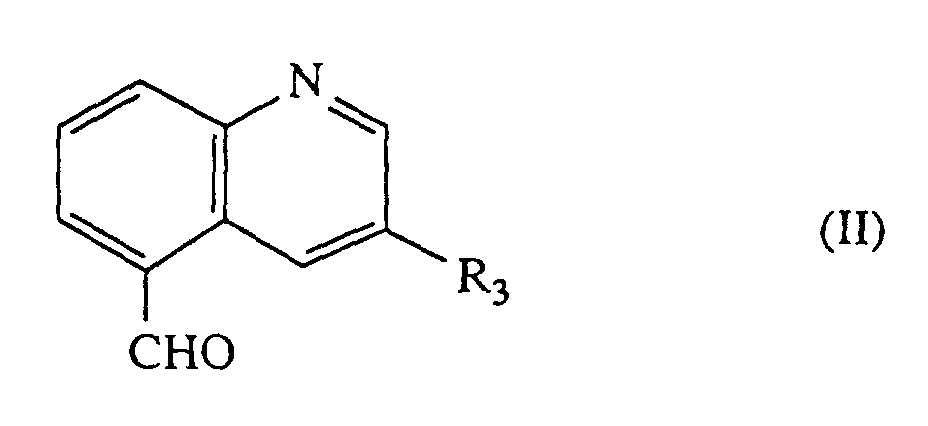
- R3
- die oben angegebene Bedeutung hat,
L-CO-CH2-R2 (III)
in welcher- R2
- die oben angegebene Bedeutung hat
- L
- die oben angegebene Bedeutung von R1 hat, wobei im Fall der Hydroxy- und/oder Aminofunktionen, diese gegebenenfalls in geschützter Form vorliegen,

R2, R3 und L die oben angegebene Bedeutung haben
umsetzt, anschließend mit der Verbindung der Formel (V)

R2, R3 und L die oben angegebene Bedeutung haben,
in inerten Lösemitteln umsetzt,
und im Fall der Verbindungen der allgemeinen Formel (VI) in einem letzten Schritt, in Anwesenheit eines Hilfsmittels, Wasser abscheidet,
oder - [B] Verbindungen der allgemeinen Formel (II) direkt mit der Verbindung der Formel (V) und Verbindungen der allgemeinen Formel (VII)

L und R2 die oben angegebene Bedeutung haben, umsetzt.
that he
- [A] compounds of the general formula (II)
- R 3
- has the meaning given above,
L-CO-CH 2 -R 2 (III)
in which- R 2
- has the meaning given above
- L
- has the meaning of R 1 given above, where in the case of the hydroxyl and / or amino functions, these are optionally in protected form,
R 2 , R 3 and L have the meaning given above
reacted, then with the compound of formula (V)
R 2 , R 3 and L have the meaning given above,
reacted in inert solvents,
and in the case of the compounds of the general formula (VI), in a last step, in the presence of an auxiliary, separates water,
or - [B] Compounds of the general formula (II) directly with the compound of the formula (V) and compounds of the general formula (VII)
L and R 2 have the meaning given above.
Die erfindungsgemäßen Verfahren können durch folgende Formelschema beispielhaft erläutert werden:

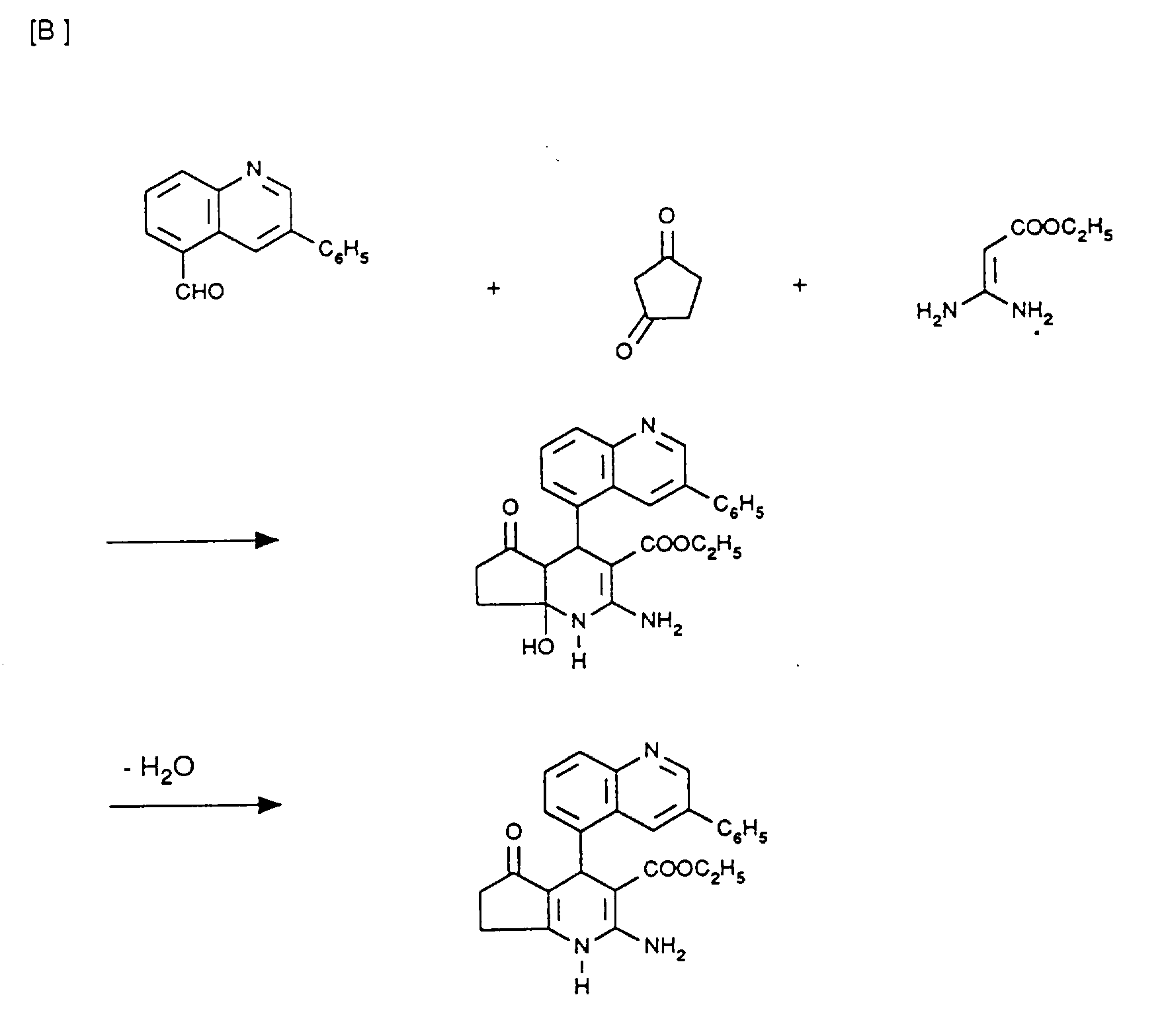
Als Lösemittel eignen sich hierbei alle inerten organischen Lösemittel, die sich unter den Reaktionsbedingungen nicht verändern. Hierzu gehören bevorzugt Alkohole wie Methanol, Ethanol, Propanol oder Isopropanol, oder Ether wie Diethylether, Dioxan, Tetrahydrofuran, Glykoldimethylether, oder Diethylenglykoldimethylether, Acetonitril, oder Amide wie Hexamethylphosphorsäuretriamid oder Dimethylformamid, oder Essigsäure oder halogenierte Kohlenwasserstoffe wie Methylenchlorid, Tetrachlorkohlenstoff oder Kohlenwasserstoffe wie Benzol oder Toluol. Ebenso ist es möglich, Gemische der genannten Lösemittel zu verwenden. Bevorzugt sind in Abhängigkeit von der jeweiligen Verfahrensvariante [A] und [B] Methanol, Isopropanol, Ethanol und n-Propanol, Acetonitril oder Tetrahydrofuran.All inert organic solvents which do not change under the reaction conditions are suitable as solvents. These preferably include alcohols such as methanol, ethanol, propanol or isopropanol, or ethers such as diethyl ether, dioxane, tetrahydrofuran, glycol dimethyl ether, or diethylene glycol dimethyl ether, acetonitrile, or amides such as hexamethylphosphoric acid triamide or dimethylformamide, or acetic acid or halogenated hydrocarbons such as methylene chloride or tetrachloride Toluene. It is also possible to use mixtures of the solvents mentioned. Depending on the respective process variant [A] and [B], methanol, isopropanol, ethanol and n-propanol, acetonitrile or tetrahydrofuran are preferred.
Die Reaktionstemperaturen können in einem größeren Bereich variiert werden. Im allgemeinen arbeitet man zwischen +10°C und +150°C, vorzugsweise zwischen +20°C und +100°C. Insbesondere bei der Siedetemperatur des jeweiligen Lösemittels.The reaction temperatures can be varied over a wide range. Generally one works between + 10 ° C and + 150 ° C, preferably between + 20 ° C and + 100 ° C. Especially at the boiling point of the respective solvent.
Die Umsetzung kann bei Normaldruck, aber auch bei erhöhtem oder erniedrigtem Druck (z.B. 0,5 bis 3 bar) durchgeführt werden. Im allgemeinen arbeitet man bei Normaldruck.The reaction can be carried out at normal pressure, but also at elevated or reduced pressure (e.g. 0.5 to 3 bar). Generally one works at normal pressure.
Geeignet als chirale Esterreste sind alle Ester enantiomerenreiner Alkohole wie beispielsweise 2-Butanol, 1-Phenylethanol, Milchsäure, Milchsäureester, Mandelsäure, Mandelsäureester, 2-Aminoalkohole, Zuckerderivate, Hydroxyaminosäurederivate und viele andere enantiomerenreine Alkohole mehr.Suitable as chiral ester residues are all esters of enantiomerically pure alcohols, such as, for example, 2-butanol, 1-phenylethanol, lactic acid, lactic acid esters, mandelic acid, mandelic acid esters, 2-amino alcohols, sugar derivatives, hydroxyamino acid derivatives and many other enantiomerically pure alcohols.
Die Trennung der Diastereomeren erfolgt im allgemeinen entweder durch fraktionierte Kristallisation, durch Säulenchromatographie oder durch Craig-Verteilung. Welches das optimale Verfahren ist, muß von Fall zu Fall entschieden werden, manchmal ist es auch zweckmäßig, Kombinationen der einzelnen Verfahren zu benutzen. Besonders geeignet ist die Trennung durch Kristallisation oder Craig-Verteilung bzw. eine Kombination beider Verfahren.The diastereomers are generally separated either by fractional crystallization, by column chromatography or by Craig distribution. Which method is the best one has to be decided on a case by case basis, sometimes it is also advisable to use combinations of the individual methods. Separation by crystallization or Craig distribution or a combination of both processes is particularly suitable.
Die Verbindungen der allgemeinen Formel (II) sind teilweise bekannt und können nach üblichen Methoden hergestellt werden, indem man z.B. die entsprechenden Alkyl- oder Hydroxyalkyl-chinoline oxidiert oder die entsprechenden Carboxychinoline reduziert.Some of the compounds of the general formula (II) are known and can be prepared by customary methods, for example by oxidizing the corresponding alkyl or hydroxyalkyl quinolines or reducing the corresponding carboxyquinolines.
Alternativ kann auch 4-Amino-3-hydroxyphthalid, das durch übliche Hydrierung des literaturbekannten 4-Nitro-3-hydroxyphthalid in Anwesenheit eines Katalysators, bevorzugt mit Palladium/Bariumsulfat, erhalten wird, mit Verbindungen der allgemeinen Formel R3-CH2-CHO, die teilweise bekannt sind, zu Verbindungen der allgemeinen Formel (II) über die entsprechenden Carbonsäuren umgesetzt werden.Alternatively, 4-amino-3-hydroxyphthalide, which is obtained by conventional hydrogenation of the literature-known 4-nitro-3-hydroxyphthalide in the presence of a catalyst, preferably with palladium / barium sulfate, with compounds of the general formula R 3 -CH 2 -CHO , some of which are known, are converted into compounds of the general formula (II) via the corresponding carboxylic acids.
Die Verbindungen der allgemeinen Formel (III), (IV), (V), (VI) und (VII) sind bekannt oder können nach üblichen Methoden hergestellt werden.The compounds of the general formula (III), (IV), (V), (VI) and (VII) are known or can be prepared by customary methods.
Die vorstehenden Herstellungsverfahren sind lediglich zur Verdeutlichung angegeben. Die Herstellung der Verbindungen der Formel (I) sind nicht auf diese Verfahren beschränkt, sondern jede Modifikation dieser Verfahren ist in gleicher Weise für die Herstellung der erfindungsgemäßen Verbindungen anwendbar.The above manufacturing processes are given for illustration only. The preparation of the compounds of the formula (I) are not restricted to these processes, but any modification of these processes can be used in the same way for the preparation of the compounds according to the invention.
Die erfindungsgemäßen Verbindungen zeigen ein nicht vorhersehbares, wertvolles pharmakologisches Wirkspektrum. Sie beeinflussen die Kontraktionskraft des Herzens und den Tonus der glatten Muskulatur.
Sie können deshalb in Arzneimitteln zur Beeinflussung des pathologisch veränderten Blutdrucks, als Koronartherapeutika und zur Behandlung der Herzinsuffizienz eingesetzt werden. Darüber hinaus können sie zur Behandlung von Herzrhythmusstörungen, zur Senkung des Blutzuckers, zur Abschwellung von Schleimhäuten und zur Beeinflussung des Salz- und Flüssigkeitshaushaltes verwendet werden.The compounds according to the invention show an unforeseeable, valuable spectrum of pharmacological activity. They affect the contraction power of the heart and the tone of the smooth muscles.
They can therefore be used in medicines to influence the pathologically changed blood pressure, as coronary therapeutic agents and for the treatment of heart failure. They can also be used to treat irregular heartbeats, to lower blood sugar, to reduce swelling of the mucous membranes and to influence the salt and fluid balance.
Die Herz- und Gefäßwirkungen wurden am isoliert perfundierten Herzen des Meerschweinchens gefunden. Dazu werden die Herzen von 250 bis 350 g schweren Meerschweinchen verwendet. Die Tiere werden mit einem Schlag auf den Kopf getötet, der Thorax geöffnet, und in die freipräparierte Aorta eine Metallkanüle eingebunden. Das Herz wird mit den Lungen aus dem Thorax herausgetrennt und über eine Aortenkanüle an die Perfusionsapparatur bei laufender Perfusion angeschlossen. Die Lungen werden an den Lungenwurzeln abgetrennt. Als Perfusionsmedium dient eine Krebs-Henseleit-Lösung (118,5 mmol/l NaCl, 4,75 mmol/l KCl, 1,19 mmol/l KH2PO4, 1,19 mmol/l MgSO4, 25 mmol/l NaHCO3, 0,013 mmol/l Na2EDTA), deren CaCl2-Gehalt 1,2 mmol/l beträgt. Als energielieferndes Substrat werden 10 mmol/l Glucose zugesetzt. vor der Perfusion wird die Lösung partikelfrei filtriert. Die Lösung wird mit Carbogen (95% O2, 5% CO2) zur Aufrechterhaltung des pH-Wertes 7,4 begast. Die Herzen werden mit konstantem Fluß (10 ml/min) bei 32°C mittels einer Rollenquetschpumpe perfundiert.The cardiac and vascular effects were found on the isolated perfused heart of the guinea pig. The hearts of 250 to 350 g guinea pigs are used for this. The animals are killed with one blow to the head, the thorax is opened, and a metal cannula is inserted into the freed-up aorta. The heart is separated from the chest with the lungs and connected to the perfusion apparatus via an aortic cannula while the perfusion is ongoing. The lungs are separated at the roots of the lungs. A Krebs-Henseleit solution (118.5 mmol / l NaCl, 4.75 mmol / l KCl, 1.19 mmol / l KH 2 PO 4 , 1.19 mmol / l MgSO 4 , 25 mmol / l serves as the perfusion medium NaHCO 3 , 0.013 mmol / l Na 2 EDTA), the CaCl 2 content of which is 1.2 mmol / l. 10 mmol / l glucose are added as the energy-supplying substrate. The solution is filtered particle-free before perfusion. The solution is gassed with carbogen (95% O 2 , 5% CO 2 ) to maintain the pH 7.4. The hearts are perfused with constant flow (10 ml / min) at 32 ° C using a roller squeeze pump.
Zur Messung der Herzfunktion wird ein flüssigkeitsgefüllter Latexballon, der über eine Flüssigkeitssäule mit einem Druckaufnehmer verbunden ist, durch den linken Vorhof in den linken Ventrikel eingeführt, und die isovolumetrischen Kontraktionen auf einem Schnellschreiber registriert. Der Perfusionsdruck wird mittels eines Druckaufnehmers, der vor dem Herzen mit dem Perfusionssystem in Verbindung steht, registiert. Unter diesen Bedingungen zeigt eine Senkung des Perfusionsdrucks eine Koronardilatation, eine Zu- bzw. Abnahme der linksventrikulären Kontraktionsamplitude eine Senkung bzw. einen Anstieg der Herzkontraktilität an. Die erfindungsgemäßen Verbindungen werden in geeigneten Verdünnungen in das Perfusionssystem kurz vor dem isolierten Herzen perfundiert.To measure cardiac function, a liquid-filled latex balloon, which is connected to a pressure sensor via a liquid column, is inserted through the left atrium into the left ventricle, and the isovolumetric contractions are recorded on a high-speed recorder. The perfusion pressure is registered by means of a pressure sensor, which is connected to the perfusion system in front of the heart. Under these conditions, a decrease in perfusion pressure indicates coronary dilation, an increase or decrease in the left ventricular contraction amplitude a decrease or an increase in cardiac contractility. The compounds according to the invention are perfused in suitable dilutions into the perfusion system shortly before the isolated heart.
Die neuen Wirkstoffe können in bekannter Weise in die üblichen Formulierungen überführt werden, wie Tabletten, Dragees, Pillen, Granulate, Aerosole, Sirupe, Emulsionen, Suspensionen und Lösungen, unter Verwendung inerter, nicht toxischer, pharmazeutisch geeigneter Trägerstoffe oder Lösungsmittel. Hierbei soll die therapeutisch wirksame Verbindung jeweils in einer Konzentration von etwa 0,5 bis 90-Gew.-% der Gesamtmischung vorhanden sein, d.h. in Mengen, die ausreichend sind, um den angegebenen Dosierungsspielraum zu erreichen.The new active compounds can be converted in a known manner into the customary formulations, such as tablets, dragées, pills, granules, aerosols, syrups, emulsions, suspensions and solutions, using inert, non-toxic, pharmaceutically suitable excipients or solvents. The therapeutically active compound should in each case be present in a concentration of about 0.5 to 90% by weight of the total mixture, ie in amounts which are sufficient to achieve the dosage range indicated.
Die Formulierungen werden beispielsweise hergestellt durch Verstrecken der Wirkstoffe mit Lösungsmitteln und/oder Trägerstoffen, gegebenenfalls unter Verwendung von Emulgiermitteln und/oder Dispergiermitteln, wobei z.B. im Fall der Benutzung von Wasser als Verdünnungsmittel gegebenenfalls organische Lösungsmittel als Hilfslösungsmittel verwendet werden können.The formulations are prepared, for example, by stretching the active ingredients with solvents and / or carriers, optionally using emulsifiers and / or dispersants, e.g. in the case of the use of water as a diluent, organic solvents can optionally be used as auxiliary solvents.
Die Applikation erfolgt in üblicher Weise, vorzugsweise oral oder parenteral, insbesondere perlingual oder intravenös.The application is carried out in the usual way, preferably orally or parenterally, in particular perlingually or intravenously.
Im allgemeinen hat es sich als vorteilhaft erwiesen, bei intravenöser Applikation Mengen von etwa 0,001 bis 1 mg/kg, vorzugsweise etwa 0,01 bis 0,5 mg/kg Körpergewicht zur Erzielung wirksamer Ergebnisse zu verabreichen, und bei oraler Applikation beträgt die Dosierung etwa 0,01 bis 20 mg/kg, vorzugsweise 0,1 bis 10 mg/kg Körpergewicht.In general, it has proven to be advantageous to administer amounts of approximately 0.001 to 1 mg / kg, preferably approximately 0.01 to 0.5 mg / kg of body weight in the case of intravenous administration in order to achieve effective results, and the dosage is approximately in the case of oral administration 0.01 to 20 mg / kg, preferably 0.1 to 10 mg / kg body weight.
Trotzdem kann es gegebenenfalls erforderlich sein, von den genannten Mengen abzuweichen, und zwar in Abhängigkeit vom Körpergewicht bzw. der Art des Applikationsweges, vom individuellen Verhalten gegenüber dem Medikament, der Art von dessen Formulierung und dem Zeitpunkt bzw. Intervall, zu welchen die Verabreichung erfolgt. So kann es in einigen Fällen ausreichend sein, mit weniger als der vorgenannten Mindestmenge auszukommen, während in anderen Fällen die genannte obere Grenze überschritten werden muß. Im Falle der Applikation größerer Mengen kann es empfehlenswert sein, diese in mehreren Einzelgaben über den Tag zu verteilen.Nevertheless, it may be necessary to deviate from the amounts mentioned, depending on the body weight or the type of application route, on the individual behavior towards the medication, the type of its formulation and the time or interval at which the administration takes place . In some cases it may be sufficient to make do with less than the aforementioned minimum quantity, while in other cases the above upper limit must be exceeded. In the case of application of larger quantities, it may be advisable to distribute them in several individual doses over the day.

6,99 g (30 mmol) 3-Phenylchinolin-5-carbaldehyd werden in 90 ml Isopropanol mit 2,94 g (30 mmol) Cyclopentan-1,3-dion, 2,46 g (30 mmol) Natriumacetat und 5,4 g (30 mmol) Amidinoessigsäureisopropylester-hydrochlorid versetzt und 7 Stunden zum Rückfluß erhitzt. Das ausgefallene Produkt wird abgesaugt, mit Isopropanol und Wasser gewaschen und getrocknet. Man erhält 4.05 g farblose Kristalle vom Schmelzpunkt 208-209°C.6.99 g (30 mmol) of 3-phenylquinoline-5-carbaldehyde are dissolved in 90 ml of isopropanol with 2.94 g (30 mmol) of cyclopentane-1,3-dione, 2.46 g (30 mmol) of sodium acetate and 5.4 g (30 mmol) of isopropyl amidinoacetate hydrochloride are added and the mixture is heated under reflux for 7 hours. The precipitated product is filtered off, washed with isopropanol and water and dried. 4.05 g of colorless crystals with a melting point of 208-209 ° C. are obtained.

2,67 g (10 mmol) 3-(4-Chlorphenyl)-chinolin-5-carbaldehyd werden in 15 ml Isopropanol und 3,2 ml Essigsäure mit 0,98 g (10 mmol) Cyclopentandion und 1,43 g (10 mmol) 3-Aminocrotonsäureisopropylester 24 Stunden zum Rückfluß gekocht. Es wird abgekühlt und eingeengt. Es wird in Dichlormethan aufgenommen, mit Wasser, Natriumhydrogencarbonatlösung und wieder Wasser gewaschen, getrocknet und eingeengt. Nach Umkristallisation aus Essigester erhält man 1,4 g farblose Kristalle vom Schmelzpunkt 265-266°C.2.67 g (10 mmol) of 3- (4-chlorophenyl) -quinoline-5-carbaldehyde are dissolved in 15 ml of isopropanol and 3.2 ml of acetic acid with 0.98 g (10 mmol) of cyclopentanedione and 1.43 g (10 mmol ) Isopropyl 3-aminocrotonic acid is boiled under reflux for 24 hours. It is cooled and concentrated. It is taken up in dichloromethane, washed with water, sodium hydrogen carbonate solution and again water, dried and concentrated. After recrystallization from ethyl acetate, 1.4 g of colorless crystals with a melting point of 265-266 ° C.

2 g der Verbindung aus Beispiel I in 30 ml DMF werden mit 2 ml Trimethylsilylimidazol versetzt und unter Argon-Atmosphäre langsam auf 90°C erwärmt. Nach 2 Stunden wird mit weiteren 2 ml Trimethylsilylimidazol versetzt und 2 Stunden nachgerührt. Es wird abgekühlt, auf Wasser gegossen, 2 mal mit Essigester extrahiert, die vereinten Essigesterphasen werden mit Wasser gewaschen, getrocknet und eingeengt. Das erhaltene Rohprodukt wird über eine Kieselgelsäule mit Toluol/Aceton-Gemischen gereinigt. Die sauberen Fraktionen werden vereint und eingeengt. Der erhaltene Rückstand wird mit Acetonitril kristallisiert, abgesaugt und mit Acetonitril gewaschen. Man erhält 560 mg einer farblosen Substanz vom Schmelzpunkt 187-189°C.2 g of the compound from Example I in 30 ml of DMF are mixed with 2 ml of trimethylsilylimidazole and slowly warmed to 90 ° C. under an argon atmosphere. After 2 hours, a further 2 ml of trimethylsilylimidazole are added and the mixture is stirred for 2 hours. It is cooled, poured onto water, extracted twice with ethyl acetate, the combined ethyl acetate phases are washed with water, dried and concentrated. The crude product obtained is purified on a silica gel column using toluene / acetone mixtures. The clean fractions are combined and concentrated. The residue obtained is crystallized with acetonitrile, suction filtered and washed with acetonitrile. 560 mg of a colorless substance with a melting point of 187-189 ° C. are obtained.
In Analogie zur Vorschrift der Beispiele 1 und 2 werden die in Tabelle 1 aufgeführten Verbindungen hergestellt:

Claims (9)
- 4-Quinolyl-dihydropyridines of the general formula (I)
 A represents the CH2 group,R1 represents hydrogen, amino, cyano, formyl or trifluoromethyl, or represents straight-chain or branched alkyl having up to 8 carbon atoms, which is optionally substituted by hydroxyl or by a group of the formula -NR6R7, -O-CO-R8, -O-(CH2)a-OR8' or -O-(CH2)b, -NR9R10,
in whichR6, R7, R9 and R10 are identical or different and denote hydrogen, phenyl or straight-chain or branched alkyl having up to 6 carbon atoms,R8 and R8' are identical or different and denote straight-chain or branched alkyl having up to 6 carbon atoms,and
a and b are identical or different and denote a number 2, 3, 4 or 5,R2 represents a group of the formula -CO-NR11R12 or -CO-D-R13,
in whichR11 and R12 are identical or different and denote hydrogen, a straight-chain, branched, cyclic, saturated or unsaturated hydrocarbon radical having up to 8 carbon atoms, which is optionally substituted by halogen, hydroxyl or cyano, or by aryl, aryloxy or arylthio having in each case 6 to 10 carbon atoms, or by a 5- to 7-membered, saturated or unsaturated heterocycle having up to 3 heteroatoms selected from the group comprising S, N or 0, where the cycles, for their part, can be substituted by halogen or cyano, or by straight-chain or branched alkyl, alkoxy, alkylthio, alkoxycarbonyl, halogenoalkyl, halogenoalkoxy or halogenoalkylthio having in each case up to 4 carbon atoms, or aryl having 6 to 10 carbon atoms or a 5- to 7-membered, saturated or unsaturated heterocycle having up to 3 heteroatoms selected from the group comprising S, N or O, which are optionally substituted identically or differently up to 2 times by halogen or cyano, or by straight-chain or branched alkyl, alkoxy, alkylthio, alkoxycarbonyl, halogenoalkyl, halogenoalkoxy or halogenoalkylthio having in each case up to 4 carbon atoms,orR11 and R12, together and with the inclusion of the nitrogen atom, form a 3- to 8-membered, saturated or unsaturated heterocycle, which is optionally interrupted by an oxygen atom or by a radical of the formula S(O)d, -CO- or -NR15,
in whichd denotes a number 0, 1 or 2,R15 denotes hydrogen or aryl having 6 to 10 carbon atoms, which is optionally substituted identically or differently up to 2 times by halogen or cyano, or by straight-chain or branched alkyl, alkoxy, alkylthio or alkoxycarbonyl having in each case up to 8 carbon atoms, or by halogenoalkyl, halogenoalkoxy or halogenoalkylthio having in each case up to 4 carbon atoms, orand the heterocycle is optionally substituted by straight-chain or branched alkoxy or alkylthio having in each case up to 4 carbon atoms, by halogen, by aryl having 6 to 10 carbon atoms, by a 5- to 7-membered, saturated or unsaturated heterocycle having up to 3 heteroatoms selected from the group comprising S, N or O, or by straight-chain or branched alkyl having up to 4 carbon atoms which, for its part, can be substituted by aryl having 6 to 10 carbon atoms,
denotes a cyclic, saturated or unsaturated, straight-chain or branched hydrocarbon radical having up to 8 carbon atoms, which is optionally substituted by hydroxyl or halogen, or by aryl having 6 to 10 carbon atoms, or by a 5- to 7-membered, saturated or unsaturated heterocycle having up to 3 heteroatoms selected from the group comprising S, N or 0, where the cycles, for their part, can be substituted identically or differently up to 2 times by halogen or cyano, or by straight-chain or branched alkyl, alkoxy, alkylthio, alkoxycarbonyl, halogenoalkyl, halogenoalkoxy or halogenoalkylthio having in each case up to 4 carbon atoms,D denotes a direct linkage or an oxygen atom,R13 denotes hydrogen or aryl having 6 to 10 carbon atoms or a 5- to 7-membered, saturated or unsaturated heterocycle having up to 3 heteroatoms selected from the group comprising S, N or 0, where the cycles are optionally substituted identically or differently up to 3 times by halogen or cyano, or by straight-chain or branched alkyl, alkoxy, alkylthio, alkoxycarbonyl, halogenoalkyl, halogenoalkoxy or halogenoalkylthio having in each case up to 4 carbon atoms, oror the carbon radical is optionally interrupted identically or differently up to 3 times by arylidene having 6 to 10 carbon atoms or by heterocyclic residues of the formulae
denotes a cyclic, straight-chain or branched, saturated or unsaturated hydrocarbon radical having up to 10 carbon atoms, which is optionally interrupted identically or differently up to 3 times by oxygen or by -CO-, -CO-NH-, -O-CO-, -CO-O-, -NH-CO-, -SO2-NH-, -NH-SO2-, -S(O)e- or -NR16,
in whiche has the abovementioned meaning of d and is identical to or different from the latter,R16 has the abovementioned meaning of R15 and is identical to or different from the latter,
f and g are identical or different and denote a number 1 or 2,
and where the aryl and hetero cycles, for their part, can be substituted by halogen or cyano, or by straight-chain or branched alkyl, alkoxy, alkylthio, alkoxycarbonyl, halogenoalkyl, halogenoalkoxy or halogenoalkylthio having in each case up to 4 carbon atoms,
and the hydrocarbon radical is optionally substituted identically or differently up to 3 times by cycloalkyl having 3 to 8 carbon atoms, by halogen, nitro, cyano, hydroxyl or -O-NO2, or by straight-chain or branched alkylthio, alkoxy or acyloxy having in each case up to 8 carbon atoms, or by aryl, aryloxy or arylthio having in each case 6 to 10 carbon atoms, or by a 5- to 7-membered, saturated or unsaturated heterocycle having up to 3 heteroatoms selected from the group comprising S, N or O, where the cycles, for their part, can be substituted identically or differently up to 3 times by halogen or cyano, or by straight-chain or branched alkyl, alkoxy, alkylthio, alkoxycarbonyl, halogenoalkyl, halogenoalkoxy or halogenoalkylthio having in each case up to 4 carbon atoms, or
the hydrocarbon radical can be substituted by a group of the formula -CO2-R17, -CONR18R19 or -NR20R21,
in whichR17 has the abovementioned meaning of R15 and is identical to or different from the latterandR18, R19, R20 and R21 have the abovementioned meaning of R11 and R12 and are identical to or different from these latter,andR3 represents aryl having 6 to 10 carbon atoms, which is optionally substituted identically or differently up to 2 times by halogen, nitro, cyano, trifluoromethyl, trifluoromethoxy or trifluoromethylthio, or by straight-chain or branched alkyl, alkoxy or alkoxycarbonyl having in each case up to 8 carbon atoms, or by carboxyl,and salts thereof.
or represents thienyl or pyridyl which are optionally substituted by halogen - Compounds of the general formula (I) according to Claim 1, in whichA represents the CH2 group,R1 represents hydrogen, amino, cyano, formyl or trifluoromethyl, or represents straight-chain or branched alkyl having up to 6 carbon atoms, which is optionally substituted by hydroxyl or by a group of the formula -NR6R7, -O-CO-R8, -O-(CH2)a-OR8' or -O- (CH2)b,-NR9R10,
in whichR6, R7, R9 and R10 are identical or different and denote hydrogen or straight-chain or branched alkyl having up to 4 carbon atoms,R8 and R8' are identical or different and denote straight-chain or branched alkyl having up to 4 carbon atoms,and
a and b are identical or different and denote a number 2, 3 or 4,R2 represents a group of the formula -CO-NR11R12 or -CO-D-R13,or the hydrocarbon radical is optionally interrupted by phenylidene or by heterocyclic residues of the formulae
in whichR11 and R12 are identical or different and denote hydrogen, a straight-chain, branched, cyclic, saturated or unsaturated hydrocarbon radical having up to 6 carbon atoms, which is optionally substituted by fluorine, chlorine, hydroxyl or cyano, or by phenyl, phenyloxy, phenylthio or pyridyl, where the cycles, for their part, can be substituted by fluorine or chlorine, or by alkyl, alkoxy or alkoxycarbonyl having in each case up to 2 carbon atoms, or by trifluoromethyl or trifluoromethoxy, or denote phenyl or pyridyl, which are optionally substituted by fluorine or chlorine, or by straight-chain or branched alkyl, alkoxy, alkylthio or alkoxycarbonyl having in each case up to 4 carbon atoms, or by trifluoromethyl or trifluoromethoxy,orR11 and R12, together and with the inclusion of the nitrogen atom, form a 5- to 7-membered, saturated or unsaturated heterocycle, which is optionally interrupted by an oxygen atom or by a radical of the formula S(O)d, -CO- or -NR15,
in whichd denotes a number 0, 1 or 2,R15 denotes hydrogen or phenyl, which is optionally substituted by fluorine or chlorine, or by straight-chain or branched alkyl or alkoxy having in each case up to 4 carbon atoms, or by trifluoromethyl or trifluoromethoxy, or denotes a cyclic, saturated or unsaturated, straight-chain or branched hydrocarbon radical having up to 4 carbon atoms, which is optionally substituted by fluorine or chlorine, or by phenyl or a 5- to 7-membered, saturated or unsaturated heterocycle having up to 2 heteroatoms selected from the group comprising 0, S and N, which, for their part, can be substituted by fluorine or chlorine, or by straight-chain or branched alkyl or alkoxy having in each case up to 4 carbon atoms, or by trifluoromethyl or trifluoromethoxy,D denotes a direct linkage or an oxygen atom,R13 denotes hydrogen or phenyl or pyridyl, which are optionally substituted by fluorine or chlorine, or by straight-chain or branched alkyl, alkoxy, alkylthio or alkoxycarbonyl having in each case up to 4 carbon atoms, or by trifluoromethyl or trifluoromethoxy, or denotes a cyclic, straight-chain or branched, saturated or unsaturated hydrocarbon radical having up to 8 carbon atoms, which is optionally interrupted identically or differently up to 2 times by oxygen or by -CO-, -CO-NH-, -O-CO-, -CO-O-, -NH-CO-, -SO2-NH-, -NH-SO2-, -S(O)e- or -NR16,
in whiche has the abovementioned meaning of d and is identical to or different from the latter,R16 has the abovementioned meaning of R15 and is identical to or different from the latter,
f and g are identical or different and denote a number 1 or 2,
and the hydrocarbon radical is optionally substituted identically or differently up to 2 times by cyclopropyl, cyclobutyl, cyclopentyl, cyclohexyl, fluorine, chlorine, nitro, cyano, hydroxyl or -O-NO2, or by straight-chain or branched alkylthio, alkoxy or acyloxy having in each case up to 4 carbon atoms, or by phenyl, phenoxy, phenylthio or pyridyl, which, for their part, can be substituted identically or differently up to 2 times by fluorine, chlorine or cyano, or by straight-chain or branched alkyl, alkoxy, alkylthio or alkoxycarbonyl having in each case up to 4 carbon atoms, or by trifluoromethyl or trifluoromethoxy,
or the hydrocarbon radical can be substituted by a group of the formula -CO2-R17, -CONR18R19 or -NR20R21, in whichR17 has the abovementioned meaning of R15 and is identical to or different from the latterandR18, R19, R20 and R21 have the abovementioned meaning of R11 and R12 and are identical to or different from these latter,andR3 represents phenyl, which is optionally substituted by fluorine, chlorine, nitro, cyano or trifluoromethyl, or by straight-chain or branched alkyl or alkoxy having in each case up to 6 carbon atoms, or by hydroxyl, orand salts thereof.
represents thienyl or pyridyl, which are optionally substituted by fluorine, chlorine or bromine, - Compounds of the general formula (I) according to Claim 1, in whichA represents the CH2 group,R1 represents hydrogen, amino, cyano, formyl or trifluoromethyl, or represents straight-chain or branched alkyl having up to 3 carbon atoms, which is optionally substituted by hydroxyl or by a group of the formula -NR6R7, -O-CO-R8, -O-(CH2)a-OR8' or -O-(CH2)b,-NR9R10,
in whichR6, R7, R9 and R10 are identical or different and denote hydrogen, methyl or ethyl,R8 and R8' are identical or different and denote methyl or ethyl,and a and b are identical or different and denote a number 2 or 3,R2 represents a group of the formula -CO-NR11R12 or -CO-D-R13,
in whichR11 and R12 are identical or different and denote hydrogen, a straight-chain, branched, cyclic, saturated or unsaturated hydrocarbon radical having up to 6 carbon atoms, which is optionally substituted by fluorine, chlorine, phenyl or pyridyl, or denote phenyl or pyridyl, which are optionally substituted by fluorine, chlorine, methyl or methoxy,orR11 and R12, together and with the inclusion of the nitrogen atom, form a 5- to 6-membered, unsaturated heterocycle, which is optionally interrupted by oxygen or sulphur or the radical NR15,in whichR15 denotes hydrogen or phenyl, which is optionally substituted by fluorine, chlorine, methyl, methoxy or trifluoromethyl, or denotes a cyclic, saturated or unsaturated, straight-chain or branched hydrocarbon radical having up to 4 carbon atoms, which is optionally substituted by phenyl or pyridyl,D denotes a direct linkage or an oxygen atom,R13 denotes hydrogen or phenyl, which is optionally substituted by fluorine, chlorine, methyl, methoxy or trifluoromethyl, or denotes a cyclic, straight-chain or branched saturated or unsaturated hydrocarbon radical having up to 6 carbon atoms, which is optionally interrupted by oxygen or sulphur or by -CO-, -CO-NH-, -O-CO-, -CO-O-, -NH-CO-, -SO2-NH-, -NH-SO2- or -NR16,or the hydrocarbon radical is optionally interrupted by phenylidene or by heterocyclic residues of the formulae
in whichR16 has the abovementioned meaning of R15 and is identical to or different from the latter,
f and g are identical or different and denote a number 1 or 2,
and the hydrocarbon radical is optionally substituted by cyclopropyl, cyclobutyl, cyclopentyl, cyclohexyl, fluorine, chlorine, nitro or hydroxyl, or by straight-chain or branched alkylthio or alkoxy having in each case up to 5 carbon atoms, or by phenyl, phenoxy, phenylthio or pyridyl, which, for their part, can be substituted by fluorine, chlorine, methyl, methoxy or methylthio, or can be substituted by a group of the formula -CO2-R17, -CONR18R19 or -NR20R21,
in whichR17 has the abovementioned meaning of R15 and is identical to or different from the latterandR18, R19, R20 and R21 have the abovementioned meaning of R11 and R12 and are identical to or different from these latter,andR3 represents phenyl, which is optionally substituted by fluorine, chlorine, nitro or trifluoromethyl, or by straight-chain or branched alkyl or alkoxy having in each case up to 4 carbon atoms, or representsand salts thereof.
thienyl, which is optionally substituted by fluorine or chlorine, - Compounds of the general formula (I) according to Claim 1, in whichA represents the CH2 group,R1 represents hydrogen, amino or methyl,R2 represents a group of the formula -CO-NR11R12 or -CO-D-R13,
in whichR11 and R12 are identical or different and denote hydrogen or a straight-chain, branched or cyclic alkyl radical having up to 6 carbon atoms,D denotes an oxygen atom,R13 denotes hydrogen or straight-chain or branched alkyl having up to 6 carbon atoms, which is optionally substituted by cyclopropyl, cyclobutyl, cyclopentyl or cyclohexyl, or by straight-chain or branched alkoxy or alkylthio having in each case up to 4 carbon atoms, or by fluorine, phenyl, phenoxy or NR20R21,
in whichR20 and R21 in each case represent hydrogen, or alkyl having up to 4 carbon atoms, which is optionally substituted by phenyl, or phenyl, andR3 represents phenyl, which is optionally substituted by fluorine, chlorine, methyl or methoxy,and salts thereof. - Process for preparing compounds of the general formula (I)
 [A] compounds of the general formula (II)
 R3 has the abovementioned meaning,are initially reacted with acyl compounds of the general formula (III)
L-CO-CH2-R2 (III)
in whichR2 has the abovementioned meaningandL has the abovementioned meaning of R1, where, in the case of the hydroxyl and/or amino functions, these functions are optionally present in protected form,optionally with the isolation of the ylidene compounds of the general formula (IV) R2, R3 and L have the abovementioned meaningand subsequently reacted with the compound of the formula (V)
 [B] compounds of the general formula (II) are reacted directly with the compound of the formula (V) and compounds of the general formula (VII)
- Compounds of the general formula (I) according to Claim 1 for use in the treatment of angiocardiopathies.
- Medicaments containing at least one compound of the general formula (I) according to Claim 1.
- Process for preparing medicaments, characterized in that at least one compound of the general formula (I) according to Claim 1, optionally together with customary auxiliary and carrier substances, is converted into a suitable form for administration.
- Use of compounds of the general formula (I) according to Claim 1 in medicaments having a positive inotropic effect.
Applications Claiming Priority (2)
| Application Number | Priority Date | Filing Date | Title |
|---|---|---|---|
| DE4313690A DE4313690A1 (en) | 1993-04-27 | 1993-04-27 | Condensed quinolyl dihydropyridines, process for their preparation and their use in medicinal products |
| DE4313690 | 1993-04-27 |
Publications (2)
| Publication Number | Publication Date |
|---|---|
| EP0622366A1 EP0622366A1 (en) | 1994-11-02 |
| EP0622366B1 true EP0622366B1 (en) | 1996-12-04 |
Family
ID=6486449
Family Applications (1)
| Application Number | Title | Priority Date | Filing Date |
|---|---|---|---|
| EP94105778A Expired - Lifetime EP0622366B1 (en) | 1993-04-27 | 1994-04-14 | Condensed quinolyl-dihydropyridines, process for their preparation and their use in medicine for the treatment of heart-circulatory illnesses |
Country Status (20)
| Country | Link |
|---|---|
| US (1) | US5436342A (en) |
| EP (1) | EP0622366B1 (en) |
| JP (1) | JPH06321939A (en) |
| CN (1) | CN1098721A (en) |
| AT (1) | ATE145903T1 (en) |
| AU (1) | AU5922594A (en) |
| CA (1) | CA2121980A1 (en) |
| CZ (1) | CZ99494A3 (en) |
| DE (2) | DE4313690A1 (en) |
| DK (1) | DK0622366T3 (en) |
| ES (1) | ES2096368T3 (en) |
| FI (1) | FI941911L (en) |
| GR (1) | GR3022026T3 (en) |
| HU (1) | HUT70488A (en) |
| IL (1) | IL109417A0 (en) |
| MX (1) | MX9403032A (en) |
| NO (1) | NO941514L (en) |
| NZ (1) | NZ260383A (en) |
| SK (1) | SK48094A3 (en) |
| ZA (1) | ZA942883B (en) |
Families Citing this family (11)
| Publication number | Priority date | Publication date | Assignee | Title |
|---|---|---|---|---|
| US6268369B1 (en) | 1994-11-16 | 2001-07-31 | Synaptic Pharmaceutical Corporation | 5-(heterocyclic alkyl)-6-aryl-dihydropyrimidines |
| EE9700209A (en) * | 1994-11-16 | 1998-04-15 | Synaptic Pharmaceutical Corporation | Dihydropyrimidines and their use |
| US6228861B1 (en) | 1995-11-16 | 2001-05-08 | Synaptic Pharmaceutical Corporation | Dihydropyrimidines and uses thereof |
| US6245773B1 (en) | 1996-05-16 | 2001-06-12 | Synaptic Pharmaceutical Corporation | 5-(heterocyclic alkyl)-6-aryl-dihydropyrimidines |
| US6172066B1 (en) | 1996-05-16 | 2001-01-09 | Synaptic Pharmaceutical Corporation | Dihydropyrimidines and uses thereof |
| US6680323B2 (en) | 1998-12-23 | 2004-01-20 | Synaptic Pharmaceutical Corporation | Dihydropyrimidines and uses thereof |
| US6274585B1 (en) | 1998-12-23 | 2001-08-14 | Synaptic Pharmaceutical Corporation | Dihydropyrimidines and uses thereof |
| US6518279B2 (en) | 1999-03-04 | 2003-02-11 | Abbott Laboratories | Cyclopentanone dihydropyridine compounds useful as potassium channel openers |
| US6720324B2 (en) | 2000-07-05 | 2004-04-13 | Synaptic Pharmaceutical Corporation | Selective melanin concentrating hormone-1 (MCH1) receptor antagonists and uses thereof |
| EP1663227A2 (en) * | 2003-09-10 | 2006-06-07 | Synta Pharmaceuticals Corporation | Dihydropyridine compounds for treating or preventing metabolic disorders |
| EP2398790B1 (en) | 2009-02-18 | 2013-07-03 | Bayer Intellectual Property GmbH | Bi- and tricyclic indazole-substituted 1,4-dihydropyridine derivatives and uses thereof |
Family Cites Families (5)
| Publication number | Priority date | Publication date | Assignee | Title |
|---|---|---|---|---|
| GB1552911A (en) * | 1975-07-02 | 1979-09-19 | Fujisawa Pharmaceutical Co | 1,4 dihydropyridine derivatives and the preparation thereof |
| DE2752820A1 (en) * | 1977-11-26 | 1979-05-31 | Bayer Ag | NEW NITRO-SUBSTITUTED 1,4-DIHYDROPYRIDINE, THE METHOD FOR THEIR MANUFACTURING AND THEIR USE AS A MEDICINAL PRODUCT |
| DE3412947A1 (en) * | 1984-04-06 | 1985-10-17 | Bayer Ag, 5090 Leverkusen | TETRAHYDOTHIENOPYRIDINE, METHOD FOR THE PRODUCTION THEREOF AND THEIR USE AS A MEDICINAL PRODUCT |
| US5204472A (en) * | 1990-04-06 | 1993-04-20 | Bayer Aktiengesellschaft | Quinoline and isoquinoline intermediates |
| DE4011105A1 (en) * | 1990-04-06 | 1991-10-10 | Bayer Ag | NEW 4-CHINOLYL-DIHYDROPYRIDINES, PROCESS FOR THEIR PREPARATION AND THEIR USE IN MEDICAMENTS |
-
1993
- 1993-04-27 DE DE4313690A patent/DE4313690A1/en not_active Withdrawn
-
1994
- 1994-03-31 AU AU59225/94A patent/AU5922594A/en not_active Abandoned
- 1994-04-14 AT AT94105778T patent/ATE145903T1/en not_active IP Right Cessation
- 1994-04-14 ES ES94105778T patent/ES2096368T3/en not_active Expired - Lifetime
- 1994-04-14 EP EP94105778A patent/EP0622366B1/en not_active Expired - Lifetime
- 1994-04-14 DE DE59401179T patent/DE59401179D1/en not_active Expired - Fee Related
- 1994-04-14 DK DK94105778.8T patent/DK0622366T3/en active
- 1994-04-20 US US08/231,010 patent/US5436342A/en not_active Expired - Fee Related
- 1994-04-22 NZ NZ260383A patent/NZ260383A/en unknown
- 1994-04-22 CA CA002121980A patent/CA2121980A1/en not_active Abandoned
- 1994-04-23 CN CN94104622A patent/CN1098721A/en active Pending
- 1994-04-25 IL IL10941794A patent/IL109417A0/en unknown
- 1994-04-25 FI FI941911A patent/FI941911L/en unknown
- 1994-04-26 NO NO941514A patent/NO941514L/en unknown
- 1994-04-26 SK SK480-94A patent/SK48094A3/en unknown
- 1994-04-26 JP JP6109110A patent/JPH06321939A/en active Pending
- 1994-04-26 ZA ZA942883A patent/ZA942883B/en unknown
- 1994-04-26 MX MX9403032A patent/MX9403032A/en unknown
- 1994-04-26 CZ CZ94994A patent/CZ99494A3/en unknown
- 1994-04-26 HU HU9401193A patent/HUT70488A/en unknown
-
1996
- 1996-12-13 GR GR960403447T patent/GR3022026T3/en unknown
Also Published As
| Publication number | Publication date |
|---|---|
| FI941911A7 (en) | 1994-10-28 |
| US5436342A (en) | 1995-07-25 |
| FI941911A0 (en) | 1994-04-25 |
| HUT70488A (en) | 1995-10-30 |
| GR3022026T3 (en) | 1997-03-31 |
| NZ260383A (en) | 1996-02-27 |
| EP0622366A1 (en) | 1994-11-02 |
| DE4313690A1 (en) | 1994-11-03 |
| ZA942883B (en) | 1995-01-16 |
| AU5922594A (en) | 1994-11-03 |
| CN1098721A (en) | 1995-02-15 |
| NO941514D0 (en) | 1994-04-26 |
| CA2121980A1 (en) | 1994-10-28 |
| JPH06321939A (en) | 1994-11-22 |
| HU9401193D0 (en) | 1994-07-28 |
| MX9403032A (en) | 1995-01-31 |
| ATE145903T1 (en) | 1996-12-15 |
| SK48094A3 (en) | 1994-12-07 |
| ES2096368T3 (en) | 1997-03-01 |
| DK0622366T3 (en) | 1997-05-12 |
| FI941911L (en) | 1994-10-28 |
| DE59401179D1 (en) | 1997-01-16 |
| IL109417A0 (en) | 1994-07-31 |
| CZ99494A3 (en) | 1995-01-18 |
| NO941514L (en) | 1994-10-28 |
Similar Documents
| Publication | Publication Date | Title |
|---|---|---|
| EP0622366B1 (en) | Condensed quinolyl-dihydropyridines, process for their preparation and their use in medicine for the treatment of heart-circulatory illnesses | |
| EP0630895A1 (en) | 4-Bicyclic substituted dihydropyridines, process for their preparation and their use in medicaments | |
| EP0452712B1 (en) | 4-Quinolyl-dihydropyridines, process for their prepatation and their use in medicaments | |
| EP0450420B1 (en) | Dihydropyridines substituted by heterocycles, process for their preparation and their use in medicaments | |
| EP0622369A2 (en) | 2-Amino-4-quinoline-dihydropyridine, process for preparation and use thereof | |
| EP0515940B1 (en) | New 2-amino-5-cyano-1,4-dihydropyridines, process for their preparation and use in pharmaceutical compositions | |
| EP0627427A1 (en) | 3-Quinolyl substituted dihydropyridines, process for their preparation and their use in drugs | |
| EP0705830A1 (en) | 2,3-Cyclic condensed 1,4-dihydropyridines, process for their preparation and their use as K-channel modulators | |
| EP0179386B1 (en) | 1,4-dihydropyridine hydroxyamines, process for their preparation and their use as pharmaceutical agents | |
| EP0538690B1 (en) | Arylquinoline substituted 1,4-dihydropyridine dicarboxylic derivatives, process for their preparation and their use as drugs | |
| EP0214437B1 (en) | Preparation of 1,4-dihydropyridine derivatives using novel intermediates | |
| EP0158956A2 (en) | 4-(Nitrophenyl)-tetrahydropyridines, process for their preparation and their application as pharmaceutical compounds | |
| EP0622364A2 (en) | 2,6-Disubstituted-4-quinolyl-dihydropyridines | |
| DE3833892A1 (en) | BASIC 4-ARYL-DHP AMIDES, METHOD FOR THE PRODUCTION THEREOF AND THEIR USE IN MEDICINAL PRODUCTS | |
| EP0555657A1 (en) | 4-Cinnolinyl- and 4-naphthyridinyl-dihydropyridines, process for their preparation and their use in drugs | |
| EP0595166B1 (en) | 4-Heterocycle substituted dihydropyridines | |
| EP0518105A1 (en) | 3-Formyl-1,4-dihydropyridines, process for their preparation and their pharmaceutical use | |
| EP0622368A1 (en) | Quinolyl-dihydropyridine esters for treatment of cardio-circulatory diseases | |
| EP0622365A1 (en) | 2-Amino-4-heteroaryl-1,4-dihydropyridines, method for their preparation and their use in drugs | |
| AT368495B (en) | METHOD FOR PRODUCING NEW NITRO-SUBSTITUTED 1,4-DIHYDROPYRIDINES | |
| DE3528601A1 (en) | Hydropyrans, process for preparation and use thereof | |
| AT368494B (en) | METHOD FOR PRODUCING NEW NITRO-SUBSTITUTED 1,4-DIHYDROPYRIDINES | |
| AT368493B (en) | METHOD FOR PRODUCING NEW NITRO-SUBSTITUTED 1,4-DIHYDROPYRIDINES | |
| DE3501855A1 (en) | 5-ARYL-DIHYDROPYRIDINE, METHOD FOR THE PRODUCTION THEREOF AND THEIR USE IN MEDICINAL PRODUCTS | |
| EP0622363A2 (en) | 2-amino-5-cyano-4-quinolyldihydropyridine esters, process for their preparation and their use in medicine for the treatment of heart-circulatory illnesses |
Legal Events
| Date | Code | Title | Description |
|---|---|---|---|
| PUAI | Public reference made under article 153(3) epc to a published international application that has entered the european phase |
Free format text: ORIGINAL CODE: 0009012 |
|
| AK | Designated contracting states |
Kind code of ref document: A1 Designated state(s): AT BE CH DE DK ES FR GB GR IE IT LI LU MC NL PT SE |
|
| RAX | Requested extension states of the european patent have changed |
Free format text: SI PAYMENT 940517 |
|
| 17P | Request for examination filed |
Effective date: 19950421 |
|
| 17Q | First examination report despatched |
Effective date: 19950808 |
|
| GRAG | Despatch of communication of intention to grant |
Free format text: ORIGINAL CODE: EPIDOS AGRA |
|
| GRAH | Despatch of communication of intention to grant a patent |
Free format text: ORIGINAL CODE: EPIDOS IGRA |
|
| GRAH | Despatch of communication of intention to grant a patent |
Free format text: ORIGINAL CODE: EPIDOS IGRA |
|
| GRAA | (expected) grant |
Free format text: ORIGINAL CODE: 0009210 |
|
| AK | Designated contracting states |
Kind code of ref document: B1 Designated state(s): AT BE CH DE DK ES FR GB GR IE IT LI LU MC NL PT SE |
|
| AX | Request for extension of the european patent |
Free format text: SI PAYMENT 940517 |
|
| REF | Corresponds to: |
Ref document number: 145903 Country of ref document: AT Date of ref document: 19961215 Kind code of ref document: T |
|
| REG | Reference to a national code |
Ref country code: CH Ref legal event code: NV Representative=s name: E. BLUM & CO. PATENTANWAELTE |
|
| REF | Corresponds to: |
Ref document number: 59401179 Country of ref document: DE Date of ref document: 19970116 |
|
| GBT | Gb: translation of ep patent filed (gb section 77(6)(a)/1977) |
Effective date: 19961227 |
|
| ITF | It: translation for a ep patent filed | ||
| REG | Reference to a national code |
Ref country code: IE Ref legal event code: FG4D Free format text: 70863 |
|
| ET | Fr: translation filed | ||
| REG | Reference to a national code |
Ref country code: GR Ref legal event code: FG4A Free format text: 3022026 |
|
| REG | Reference to a national code |
Ref country code: ES Ref legal event code: FG2A Ref document number: 2096368 Country of ref document: ES Kind code of ref document: T3 |
|
| REG | Reference to a national code |
Ref country code: DK Ref legal event code: T3 |
|
| PLBE | No opposition filed within time limit |
Free format text: ORIGINAL CODE: 0009261 |
|
| STAA | Information on the status of an ep patent application or granted ep patent |
Free format text: STATUS: NO OPPOSITION FILED WITHIN TIME LIMIT |
|
| 26N | No opposition filed | ||
| PGFP | Annual fee paid to national office [announced via postgrant information from national office to epo] |
Ref country code: DE Payment date: 19980316 Year of fee payment: 5 |
|
| PGFP | Annual fee paid to national office [announced via postgrant information from national office to epo] |
Ref country code: GR Payment date: 19980320 Year of fee payment: 5 Ref country code: FR Payment date: 19980320 Year of fee payment: 5 |
|
| PGFP | Annual fee paid to national office [announced via postgrant information from national office to epo] |
Ref country code: SE Payment date: 19980324 Year of fee payment: 5 |
|
| PGFP | Annual fee paid to national office [announced via postgrant information from national office to epo] |
Ref country code: PT Payment date: 19980327 Year of fee payment: 5 |
|
| PGFP | Annual fee paid to national office [announced via postgrant information from national office to epo] |
Ref country code: GB Payment date: 19980406 Year of fee payment: 5 |
|
| PGFP | Annual fee paid to national office [announced via postgrant information from national office to epo] |
Ref country code: IE Payment date: 19980408 Year of fee payment: 5 |
|
| PGFP | Annual fee paid to national office [announced via postgrant information from national office to epo] |
Ref country code: CH Payment date: 19980415 Year of fee payment: 5 |
|
| PGFP | Annual fee paid to national office [announced via postgrant information from national office to epo] |
Ref country code: AT Payment date: 19980420 Year of fee payment: 5 |
|
| PGFP | Annual fee paid to national office [announced via postgrant information from national office to epo] |
Ref country code: DK Payment date: 19980424 Year of fee payment: 5 |
|
| PGFP | Annual fee paid to national office [announced via postgrant information from national office to epo] |
Ref country code: ES Payment date: 19980428 Year of fee payment: 5 |
|
| PGFP | Annual fee paid to national office [announced via postgrant information from national office to epo] |
Ref country code: BE Payment date: 19980429 Year of fee payment: 5 |
|
| PGFP | Annual fee paid to national office [announced via postgrant information from national office to epo] |
Ref country code: NL Payment date: 19980430 Year of fee payment: 5 Ref country code: MC Payment date: 19980430 Year of fee payment: 5 |
|
| PGFP | Annual fee paid to national office [announced via postgrant information from national office to epo] |
Ref country code: LU Payment date: 19980504 Year of fee payment: 5 |
|
| PG25 | Lapsed in a contracting state [announced via postgrant information from national office to epo] |
Ref country code: LU Free format text: LAPSE BECAUSE OF NON-PAYMENT OF DUE FEES Effective date: 19990414 Ref country code: IE Free format text: LAPSE BECAUSE OF NON-PAYMENT OF DUE FEES Effective date: 19990414 Ref country code: GB Free format text: LAPSE BECAUSE OF NON-PAYMENT OF DUE FEES Effective date: 19990414 Ref country code: AT Free format text: LAPSE BECAUSE OF NON-PAYMENT OF DUE FEES Effective date: 19990414 |
|
| PG25 | Lapsed in a contracting state [announced via postgrant information from national office to epo] |
Ref country code: SE Free format text: LAPSE BECAUSE OF NON-PAYMENT OF DUE FEES Effective date: 19990415 Ref country code: ES Free format text: LAPSE BECAUSE OF NON-PAYMENT OF DUE FEES Effective date: 19990415 |
|
| PG25 | Lapsed in a contracting state [announced via postgrant information from national office to epo] |
Ref country code: LI Free format text: LAPSE BECAUSE OF NON-PAYMENT OF DUE FEES Effective date: 19990430 Ref country code: GR Free format text: LAPSE BECAUSE OF NON-PAYMENT OF DUE FEES Effective date: 19990430 Ref country code: DK Free format text: LAPSE BECAUSE OF NON-PAYMENT OF DUE FEES Effective date: 19990430 Ref country code: CH Free format text: LAPSE BECAUSE OF NON-PAYMENT OF DUE FEES Effective date: 19990430 Ref country code: BE Free format text: LAPSE BECAUSE OF NON-PAYMENT OF DUE FEES Effective date: 19990430 |
|
| BERE | Be: lapsed |
Owner name: BAYER A.G. Effective date: 19990430 |
|
| PG25 | Lapsed in a contracting state [announced via postgrant information from national office to epo] |
Ref country code: PT Free format text: LAPSE BECAUSE OF NON-PAYMENT OF DUE FEES Effective date: 19991031 Ref country code: MC Free format text: LAPSE BECAUSE OF NON-PAYMENT OF DUE FEES Effective date: 19991031 |
|
| PG25 | Lapsed in a contracting state [announced via postgrant information from national office to epo] |
Ref country code: NL Free format text: LAPSE BECAUSE OF NON-PAYMENT OF DUE FEES Effective date: 19991101 |
|
| GBPC | Gb: european patent ceased through non-payment of renewal fee |
Effective date: 19990414 |
|
| REG | Reference to a national code |
Ref country code: CH Ref legal event code: PL |
|
| PG25 | Lapsed in a contracting state [announced via postgrant information from national office to epo] |
Ref country code: FR Free format text: LAPSE BECAUSE OF NON-PAYMENT OF DUE FEES Effective date: 19991231 |
|
| NLV4 | Nl: lapsed or anulled due to non-payment of the annual fee |
Effective date: 19991101 |
|
| EUG | Se: european patent has lapsed |
Ref document number: 94105778.8 |
|
| REG | Reference to a national code |
Ref country code: FR Ref legal event code: ST |
|
| PG25 | Lapsed in a contracting state [announced via postgrant information from national office to epo] |
Ref country code: DE Free format text: LAPSE BECAUSE OF NON-PAYMENT OF DUE FEES Effective date: 20000201 |
|
| REG | Reference to a national code |
Ref country code: IE Ref legal event code: MM4A |
|
| REG | Reference to a national code |
Ref country code: PT Ref legal event code: MM4A Free format text: LAPSE DUE TO NON-PAYMENT OF FEES Effective date: 19991031 |
|
| REG | Reference to a national code |
Ref country code: DK Ref legal event code: EBP |
|
| REG | Reference to a national code |
Ref country code: ES Ref legal event code: FD2A Effective date: 20010503 |
|
| PG25 | Lapsed in a contracting state [announced via postgrant information from national office to epo] |
Ref country code: IT Free format text: LAPSE BECAUSE OF NON-PAYMENT OF DUE FEES;WARNING: LAPSES OF ITALIAN PATENTS WITH EFFECTIVE DATE BEFORE 2007 MAY HAVE OCCURRED AT ANY TIME BEFORE 2007. THE CORRECT EFFECTIVE DATE MAY BE DIFFERENT FROM THE ONE RECORDED. Effective date: 20050414 |