EP0621195A2 - Easy-open container end - Google Patents
Easy-open container end Download PDFInfo
- Publication number
- EP0621195A2 EP0621195A2 EP94105919A EP94105919A EP0621195A2 EP 0621195 A2 EP0621195 A2 EP 0621195A2 EP 94105919 A EP94105919 A EP 94105919A EP 94105919 A EP94105919 A EP 94105919A EP 0621195 A2 EP0621195 A2 EP 0621195A2
- Authority
- EP
- European Patent Office
- Prior art keywords
- score line
- vent
- tear panel
- rivet
- region
- Prior art date
- Legal status (The legal status is an assumption and is not a legal conclusion. Google has not performed a legal analysis and makes no representation as to the accuracy of the status listed.)
- Granted
Links
- 239000011324 bead Substances 0.000 claims abstract description 51
- 229910052751 metal Inorganic materials 0.000 claims abstract description 40
- 239000002184 metal Substances 0.000 claims abstract description 40
- 238000013022 venting Methods 0.000 claims abstract description 23
- 238000000926 separation method Methods 0.000 claims abstract description 17
- 230000006835 compression Effects 0.000 claims abstract description 10
- 238000007906 compression Methods 0.000 claims abstract description 10
- 238000000034 method Methods 0.000 claims description 7
- 150000002739 metals Chemical class 0.000 abstract description 2
- 230000000979 retarding effect Effects 0.000 abstract description 2
- 238000010276 construction Methods 0.000 description 3
- 230000015572 biosynthetic process Effects 0.000 description 2
- 235000014171 carbonated beverage Nutrition 0.000 description 2
- 239000000463 material Substances 0.000 description 2
- 229910052782 aluminium Inorganic materials 0.000 description 1
- XAGFODPZIPBFFR-UHFFFAOYSA-N aluminium Chemical compound [Al] XAGFODPZIPBFFR-UHFFFAOYSA-N 0.000 description 1
- 235000013361 beverage Nutrition 0.000 description 1
- 238000006243 chemical reaction Methods 0.000 description 1
- 230000003247 decreasing effect Effects 0.000 description 1
- 230000000881 depressing effect Effects 0.000 description 1
- 230000000694 effects Effects 0.000 description 1
- 239000007788 liquid Substances 0.000 description 1
- 239000007769 metal material Substances 0.000 description 1
- 230000002250 progressing effect Effects 0.000 description 1
- 230000000630 rising effect Effects 0.000 description 1
Images

Classifications
-
- B—PERFORMING OPERATIONS; TRANSPORTING
- B65—CONVEYING; PACKING; STORING; HANDLING THIN OR FILAMENTARY MATERIAL
- B65D—CONTAINERS FOR STORAGE OR TRANSPORT OF ARTICLES OR MATERIALS, e.g. BAGS, BARRELS, BOTTLES, BOXES, CANS, CARTONS, CRATES, DRUMS, JARS, TANKS, HOPPERS, FORWARDING CONTAINERS; ACCESSORIES, CLOSURES, OR FITTINGS THEREFOR; PACKAGING ELEMENTS; PACKAGES
- B65D17/00—Rigid or semi-rigid containers specially constructed to be opened by cutting or piercing, or by tearing of frangible members or portions
- B65D17/28—Rigid or semi-rigid containers specially constructed to be opened by cutting or piercing, or by tearing of frangible members or portions at lines or points of weakness
- B65D17/401—Rigid or semi-rigid containers specially constructed to be opened by cutting or piercing, or by tearing of frangible members or portions at lines or points of weakness characterised by having the line of weakness provided in an end wall
- B65D17/4012—Rigid or semi-rigid containers specially constructed to be opened by cutting or piercing, or by tearing of frangible members or portions at lines or points of weakness characterised by having the line of weakness provided in an end wall for opening partially by means of a tearing tab
-
- B—PERFORMING OPERATIONS; TRANSPORTING
- B65—CONVEYING; PACKING; STORING; HANDLING THIN OR FILAMENTARY MATERIAL
- B65D—CONTAINERS FOR STORAGE OR TRANSPORT OF ARTICLES OR MATERIALS, e.g. BAGS, BARRELS, BOTTLES, BOXES, CANS, CARTONS, CRATES, DRUMS, JARS, TANKS, HOPPERS, FORWARDING CONTAINERS; ACCESSORIES, CLOSURES, OR FITTINGS THEREFOR; PACKAGING ELEMENTS; PACKAGES
- B65D2517/00—Containers specially constructed to be opened by cutting, piercing or tearing of wall portions, e.g. preserving cans or tins
- B65D2517/0001—Details
- B65D2517/0002—Location of opening
- B65D2517/0007—Location of opening in a separate cover
-
- B—PERFORMING OPERATIONS; TRANSPORTING
- B65—CONVEYING; PACKING; STORING; HANDLING THIN OR FILAMENTARY MATERIAL
- B65D—CONTAINERS FOR STORAGE OR TRANSPORT OF ARTICLES OR MATERIALS, e.g. BAGS, BARRELS, BOTTLES, BOXES, CANS, CARTONS, CRATES, DRUMS, JARS, TANKS, HOPPERS, FORWARDING CONTAINERS; ACCESSORIES, CLOSURES, OR FITTINGS THEREFOR; PACKAGING ELEMENTS; PACKAGES
- B65D2517/00—Containers specially constructed to be opened by cutting, piercing or tearing of wall portions, e.g. preserving cans or tins
- B65D2517/0001—Details
- B65D2517/001—Action for opening container
- B65D2517/0014—Action for opening container pivot tab and push-down tear panel
-
- B—PERFORMING OPERATIONS; TRANSPORTING
- B65—CONVEYING; PACKING; STORING; HANDLING THIN OR FILAMENTARY MATERIAL
- B65D—CONTAINERS FOR STORAGE OR TRANSPORT OF ARTICLES OR MATERIALS, e.g. BAGS, BARRELS, BOTTLES, BOXES, CANS, CARTONS, CRATES, DRUMS, JARS, TANKS, HOPPERS, FORWARDING CONTAINERS; ACCESSORIES, CLOSURES, OR FITTINGS THEREFOR; PACKAGING ELEMENTS; PACKAGES
- B65D2517/00—Containers specially constructed to be opened by cutting, piercing or tearing of wall portions, e.g. preserving cans or tins
- B65D2517/0001—Details
- B65D2517/0091—Means for venting upon initial opening
- B65D2517/0092—Means for venting upon initial opening formed as a partial score line located close to the tab connection
-
- Y—GENERAL TAGGING OF NEW TECHNOLOGICAL DEVELOPMENTS; GENERAL TAGGING OF CROSS-SECTIONAL TECHNOLOGIES SPANNING OVER SEVERAL SECTIONS OF THE IPC; TECHNICAL SUBJECTS COVERED BY FORMER USPC CROSS-REFERENCE ART COLLECTIONS [XRACs] AND DIGESTS
- Y10—TECHNICAL SUBJECTS COVERED BY FORMER USPC
- Y10S—TECHNICAL SUBJECTS COVERED BY FORMER USPC CROSS-REFERENCE ART COLLECTIONS [XRACs] AND DIGESTS
- Y10S220/00—Receptacles
- Y10S220/906—Beverage can, i.e. beer, soda
Definitions
- This invention relates to easy-open ends for containers, and particularly for beverage cans and the like which are internally pressurized. Specifically, the invention relates to an improved construction for venting or releasing the pressure internal of the container during the initial operation of the easy-open mechanism of the end, particularly such a construction which is applicable to ends made of thinner metal material.
- the mechanism of venting in an easy-open container end is per se known, for example as described in U.S. Patents 4,015,744 of 5 April 1977 and 4,030,631 of 21 June 1977 which are assigned to the assignee of this application.
- the easy-open mechanism includes an end panel which is attached to the container, a tear panel defined in the end panel by a score line, an operating tab including a nose which extends partially over the tear panel, and an integral rivet connecting the tab to the end panel and defining a pivot point for tab operation.
- initial lifting of the tab produces an upward force on the rivet and a downward force on an edge of the tear panel, preferably adjacent a beginning point of the tear panel score line.
- This score stop provides an increase in tear resistance along the score line.
- the vent region is defined by the upper hook on one side of the tab, and the score stop on the opposite side. If the function of the score stop is not included, the releasing high pressure from the can may under some circumstances force rapid continuing separation along the score line, and literally blow the tear panel off the end with considerable force.
- a so-called “dimple down" bead has been formed in tear panels by simply depressing a section of the tear panel, usually near the vent region of the tear panel score line, inwardly of the end. Normally no coining is performed on this prior art bead, the metal is simply displaced to define the bead, which is intended to add strength to the tear panel during opening, and which also may function when compressed during scoring to insure good integrity in the rivet area.
- the present invention places a portion of the metal of the tear panel, in the region where a score stop otherwise would be located, under compression by forming a short coined depression or bead in the tear panel, preferably in the public side, close to the score line at least at the end of the vent region opposite from the inner hook, which is located at the radially inward end of the tear panel score line.
- a short coined depression or bead in the tear panel, preferably in the public side, close to the score line at least at the end of the vent region opposite from the inner hook, which is located at the radially inward end of the tear panel score line.
- the score stop (or arrestor stop) may be made considerably less deep leaving adequate residual metal along score line 15, or the score stop can be entirely eliminated in some cases, thereby making it possible to achieve consistent and proper venting in ends made of thinner metals, e.g. in the order of 0.009--0.008 inch, and to provide an easily opened end.
- the primary object of this invention is to provide such a coined vent bead in an easy-open container end; to provide a method of baking an end having such a feature; and thereby to provide additional economy in the construction of easy-opening ends by allowing use of thinner gage metal while retaining the integrity of the venting action which is needed in cans of carbonated beverages, in particular.
- the end panel of an easy-open container end is shown at 10 and includes an integral tear panel (or pouring panel) 12 defined by a score line 15 which runs from an inner hook or end 16 across a vent region (later described) and thence in a loop around the edge of the tear panel to an outer hook 17. Between the inner and outer ends or hooks of score line 15 there remains an integral connecting region 20 which will function as a hinge and retainer of the tear panel when it is opened.
- An inner bead 22 is formed around tear panel 12, and outer beads 24 are formed in end panel 10 along the side of score line 15.
- An integral rivet 25 connects the rivet island 26 of an operating tab 27 (shown in phantom, Fig. 2) to end panel 10, at a location adjacent the inner end or hook 16 of score line 15.
- the nose 28 of the tab extends across score line 15 and partially over tear panel 15, being contoured to the shape of the upper part of inner bead 22 as shown.
- the opposite end 30 of tab 27 extends over end panel 10, terminating at a depression 32 in the end panel which facilitates lifting of tab 27 to initiate opening operation.
- tear panel 12 is pushed inward of the container, hinging around the region 20 as the material now proceeds to separate along score line 15. This separation stops at the inner end or hook 16, but proceeds around the periphery of the tear panel to outer end or hook 17(see Fig. 1). The tear panel 12 is effectively folded into the can through the opening defined by tear panel score line 15.
- an arrestor or score stop is either not employed, or is made with considerably less than normal depth, to leave adequate residual metal along score line 15 due to the use of thinner end metal, e.g. 0.009--0.008 inch thick.
- a coined vent bead 40 is formed in tear panel 12, generally parallel to score line 15, at and inward from the curve 36 in the score line, as seen in Figs. 1 and 2.
- the vent bead is formed on the public side of the tear panel.
- Fig. 3 shows, in enlarged detail, the shape of the vent bead 40
- Fig. 4 shows (also enlarged) a cross-section of the portion of a punch 45 and die 46 (not fully closed) which produce the vent bead.
- This configuration is conveniently added to the punch and die at the first form station in a set of end conversion tools.
- the location of the first form station in a typical progression is shown in Fig. 20 of U.S. Patent No. 5,119,664, specifically at Fig. 20D.
- vent bead is coined, as at 48 in Fig. 5, not merely formed by displacing the metal, so the coining action compresses and moves the metal along the vent bead close to score line 15.
- This coined bead creates compression in the metal of the tear panel 12, just inward of score line 15, along the portion of the score line generally parallel to vent bead 40.
- Fig. 8 shows a modified form of coined vent bead, which has an over-all appearance similar to the previous "dimple-down" configuration mentioned in the Background discussion. Similar reference numerals with the suffix "A" are used.
- the coined vent bead 40A is of straight configuration, and is not contoured to the closely adjacent tear panel score line 15A. Instead, the coined vent bead 40A extends generally parallel to the score line 15A, and one end of the vent bead is located closely adjacent to the curve 36A in score line 15A where it is desired to define the other end of the vent region, opposite from the inner hook 16A.
- Fig. 9 shows the portion of a punch 45A and die 46A which forms and coins this modified vent bead, and the coined area of this bead is indicated at 48A. It is also possible to use a simple flat anvil surface, in place of the cavity in die 46A, to cooperate with punch 45A and achieve the desired result.
Landscapes
- Engineering & Computer Science (AREA)
- Mechanical Engineering (AREA)
- Containers Opened By Tearing Frangible Portions (AREA)
- Cartons (AREA)
- Packages (AREA)
- Closures For Containers (AREA)
Abstract
Description
- This invention relates to easy-open ends for containers, and particularly for beverage cans and the like which are internally pressurized. Specifically, the invention relates to an improved construction for venting or releasing the pressure internal of the container during the initial operation of the easy-open mechanism of the end, particularly such a construction which is applicable to ends made of thinner metal material.
- The mechanism of venting in an easy-open container end is per se known, for example as described in U.S. Patents 4,015,744 of 5 April 1977 and 4,030,631 of 21 June 1977 which are assigned to the assignee of this application. The easy-open mechanism includes an end panel which is attached to the container, a tear panel defined in the end panel by a score line, an operating tab including a nose which extends partially over the tear panel, and an integral rivet connecting the tab to the end panel and defining a pivot point for tab operation. Basically, initial lifting of the tab produces an upward force on the rivet and a downward force on an edge of the tear panel, preferably adjacent a beginning point of the tear panel score line. This in turn causes an initial opening of the tear panel beneath the nose of the tab, a limited expansion of that opening along a vent region, and then further lifting motion of the tab causes the tear panel to separate progressively along its score line, leaving a small integral connection between the end panel and tear panel, about which the tear panel is rotated inward of the container to form an opening through which container contents can be removed.
- Particularly in canned carbonated beverages there is substantial internal pressure, e.g. in the order of 100 psi., in the small space between the top of the liquid contents and the product side of the can end. This pressure must vent quickly through a small vent opening in the vent region during the initial opening motion. At present it is customary to define this small vent opening with a hook formation at the radially inner end of the score line and a score stop (also called a check stop or arrestor stop) in the region where the tear panel score line proceeds outward of the end. The score stop is in the form of a shallower (less deep) segment of the score line, of relatively short length, such as described for example in US Patent No. 4,503,989 issued 12 March 1985. This score stop provides an increase in tear resistance along the score line. Thus, the vent region is defined by the upper hook on one side of the tab, and the score stop on the opposite side. If the function of the score stop is not included, the releasing high pressure from the can may under some circumstances force rapid continuing separation along the score line, and literally blow the tear panel off the end with considerable force.
- There has been a continuing effort (induced by desired economies in metal usage) to use thinner metal for can ends. Until recently, end stock (principally aluminum) was in the order of 0.011 inch or greater in thickness. Presently, ends are being made with metal in the order of 0.009--0.008 inch in thickness. As thinner metal is employed in making can ends, the effectiveness of the score stop has decreased. There simply is not sufficient metal in the thicker stop portion of the score line to resist effectively the continuing score line separation immediately following venting. Therefore, a need exists for another way to retard the score line separation for the initial venting or "pop" when opening of the end commences.
- Related to the venting provisions, a so-called "dimple down" bead has been formed in tear panels by simply depressing a section of the tear panel, usually near the vent region of the tear panel score line, inwardly of the end. Normally no coining is performed on this prior art bead, the metal is simply displaced to define the bead, which is intended to add strength to the tear panel during opening, and which also may function when compressed during scoring to insure good integrity in the rivet area.
- The present invention places a portion of the metal of the tear panel, in the region where a score stop otherwise would be located, under compression by forming a short coined depression or bead in the tear panel, preferably in the public side, close to the score line at least at the end of the vent region opposite from the inner hook, which is located at the radially inward end of the tear panel score line. During the venting action, as the rivet is lifted by the initial tab motion, separation proceeds along the score line, beneath the nose of the tab. The metal adjacent and in this coined depression tends to move partially underneath the metal on the opposite side of the score line from the coined vent bead. This action provides sufficient disruption or retarding of the score line separation, during venting, to confine such separation to the vent region until internal pressure is vented. Further separation of the tear panel can proceed under control of continued raising tab motion and resulting opening force.
- By providing such a coined vent bead, the score stop (or arrestor stop) may be made considerably less deep leaving adequate residual metal along
score line 15, or the score stop can be entirely eliminated in some cases, thereby making it possible to achieve consistent and proper venting in ends made of thinner metals, e.g. in the order of 0.009--0.008 inch, and to provide an easily opened end. - The primary object of this invention, therefore, is to provide such a coined vent bead in an easy-open container end; to provide a method of baking an end having such a feature; and thereby to provide additional economy in the construction of easy-opening ends by allowing use of thinner gage metal while retaining the integrity of the venting action which is needed in cans of carbonated beverages, in particular.
- Other objects and advantages of the invention will be apparent from the following description, the accompanying drawings and the appended claims.
-
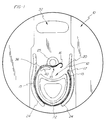
- Fig. 1 is a top or public side plan view of an easy open container end incorporating the invention, with the tab shown in phantom lines;
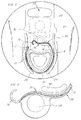
- Fig. 2 is a bottom or product side plan view of an easy open container end as shown in Fig. 1;
- Fig. 3 is an enlarged bottom view of the venting region adjacent the inner end of the tear panel score line and the rivet;
- Fig. 4 is an enlarged view of portions of a coining punch and die which form the coined region in the tear panel adjacent the rivet, on the opposite side of the rivet from the score line inner end hook;
- Fig. 5 is an enlargement of the center portion of Fig. 4, showing the coined region of the vent bead and its relationship to the adjacent tear panel score line;
- Fig. 6 is an enlarged segmental cross-section of the region of the coined vent bead and adjacent score line, prior to venting;
- Fig. 7 is a view similar to Fig. 6 showing the score line ruptured in the vent region;
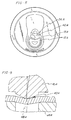
- Fig. 8 is a view similar to Fig. 2, showing a modified form of the coined vent bead adjacent to the venting region of the tear panel score line; and
- Fig. 9 is an enlarged view showing the formation and coining of the modified embodiment of Fig. 8.
-
- Referring to Fig. 1, the end panel of an easy-open container end is shown at 10 and includes an integral tear panel (or pouring panel) 12 defined by a
score line 15 which runs from an inner hook orend 16 across a vent region (later described) and thence in a loop around the edge of the tear panel to anouter hook 17. Between the inner and outer ends or hooks ofscore line 15 there remains an integral connectingregion 20 which will function as a hinge and retainer of the tear panel when it is opened. Aninner bead 22 is formed aroundtear panel 12, andouter beads 24 are formed inend panel 10 along the side ofscore line 15. - An
integral rivet 25 connects therivet island 26 of an operating tab 27 (shown in phantom, Fig. 2) toend panel 10, at a location adjacent the inner end orhook 16 ofscore line 15. The nose 28 of the tab extends acrossscore line 15 and partially overtear panel 15, being contoured to the shape of the upper part ofinner bead 22 as shown. Theopposite end 30 oftab 27 extends overend panel 10, terminating at adepression 32 in the end panel which facilitates lifting oftab 27 to initiate opening operation. - When the tab is lifted, nose 28 engages
tear panel 12 adjacentinner bead 22 and continued movement of the tab lifts rivet 25 to breakscore line 15 in the vent region 35 (mentioned above) beneath the tab nose, resulting in venting of the container and release of internal pressure. This operation, as is known, produces the original "pop" or separation of thescore line 15 in the center ofvent region 35, forward ofrivet island 26 and progressing outward therefrom, and allows venting of pressure from within the container. The pulling force viarivet 25 acts in the same direction as the pressure force exerted internally against the underside of the end. The limits of the opening invent region 35 are defined byinner hook 16 and thecurve 36 inscore line 15 from whence the score line proceeds in a loop abouttear panel 12. - After the initial venting, the lifting motion of
tab 27 proceeds,tear panel 12 is pushed inward of the container, hinging around theregion 20 as the material now proceeds to separate alongscore line 15. This separation stops at the inner end or hook 16, but proceeds around the periphery of the tear panel to outer end or hook 17(see Fig. 1). Thetear panel 12 is effectively folded into the can through the opening defined by tearpanel score line 15. - Returning to the venting function, according to the invention an arrestor or score stop is either not employed, or is made with considerably less than normal depth, to leave adequate residual metal along
score line 15 due to the use of thinner end metal, e.g. 0.009--0.008 inch thick. In addition, a coinedvent bead 40 is formed intear panel 12, generally parallel to scoreline 15, at and inward from thecurve 36 in the score line, as seen in Figs. 1 and 2. Preferably, the vent bead is formed on the public side of the tear panel. Fig. 3 shows, in enlarged detail, the shape of thevent bead 40, and Fig. 4 shows (also enlarged) a cross-section of the portion of apunch 45 and die 46 (not fully closed) which produce the vent bead. - This configuration is conveniently added to the punch and die at the first form station in a set of end conversion tools. The location of the first form station in a typical progression is shown in Fig. 20 of U.S. Patent No. 5,119,664, specifically at Fig. 20D.
- It is emphasized that the vent bead is coined, as at 48 in Fig. 5, not merely formed by displacing the metal, so the coining action compresses and moves the metal along the vent bead close to score
line 15. This coined bead creates compression in the metal of thetear panel 12, just inward ofscore line 15, along the portion of the score line generally parallel to ventbead 40. Whentab 27 is initially raised and the venting or "pop" occurs, this region oftear panel 12 will remain below the lifting or rising edge of the end material around therivet island 26 and alongvent region 35, since the initial tab movement pulls up onrivet 25 while pressing againsttear panel 12. - It has been observed that the edge of
tear panel 12, particularly adjacent the coined vent bead, effectively will move under the edge of the metal on the other side of the just ruptured score line 15 (see Fig. 7). It appears that the compression of the metal in the coined vent bead is somewhat released at this time, and causes this overlapping of the metal remaining along the ruptured score line with the adjacent freed edge oftear panel 12. High pressure from within the can will tend to act in the same opening direction of this vent region by contributing to the raising of the rivet island, but the same pressure exerted against the tear panel will only tend to urge the edge of the tear panel vent area toward the underside of the raised vent island and adjacent metal of the end, and "blow-off" of the tear panel will be avoided. Furthermore, this action interferes with progression of separation alongscore line 15, and limits the length of the vent region along the score line to approximately the same length as occurs in an end of thicker metal where an arrestor or score stop is added to the tear panel score line. - Fig. 8 shows a modified form of coined vent bead, which has an over-all appearance similar to the previous "dimple-down" configuration mentioned in the Background discussion. Similar reference numerals with the suffix "A" are used. Here the coined
vent bead 40A is of straight configuration, and is not contoured to the closely adjacent tearpanel score line 15A. Instead, the coinedvent bead 40A extends generally parallel to thescore line 15A, and one end of the vent bead is located closely adjacent to the curve 36A inscore line 15A where it is desired to define the other end of the vent region, opposite from the inner hook 16A. - Fig. 9 shows the portion of a punch 45A and die 46A which forms and coins this modified vent bead, and the coined area of this bead is indicated at 48A. It is also possible to use a simple flat anvil surface, in place of the cavity in
die 46A, to cooperate with punch 45A and achieve the desired result. - While the method herein described, and the forms of apparatus for carrying this method into effect, constitute preferred embodiments of this invention, it is to be understood that the invention is not limited to this precise method and forms of apparatus, and that changes may be made in either without departing from the scope of the invention, which is defined in the appended claims.
Claims (12)
- In an easy-open end for a container, said end having a tear panel defined by a score line surrounding the portion of the periphery of said panel to be separated from the remainder of the end to form an opening for egress of the contents of the container, an operating tab, and an integral rivet attaching said tab to said end adjacent said score line and on the opposite side of said score line from said tear panel, said score line including a vent region in the vicinity of said rivet constructed and arranged to open initially at said vent region in response to lifting of said rivet by said tab; the improvement comprising
a coined vent bead formed in said tear panel to one side of said rivet and at the edge of said score line, thereby creating compression in the metal of said vent bead adjacent said score line. - The improvement in an easy-open end as defined in claim 1, wherein said vent bead is contoured to the shape of said opposite aide of said vent region to form a coined region of compressed metal along a substantial extent of said score line.
- The improvement in an easy-open end as defined in claim 1, wherein said vent bead is substantially linear and one end thereof is located closely adjacent to said score line where it is desired to arrest the separation of said tear panel during the initial venting action of opening the end.
- An easy-open end for a container, said end having
a tear panel defined by a score line surrounding the portion of the periphery of said panel to be separated from the remainder of the end to form an opening for egress of the contents of the container,
an operating tab,
an integral rivet attaching said tab to said end adjacent said score line and on the opposite side of said score line from said tear panel,
said score line including a vent region in the vicinity of said rivet constructed and arranged to open initially at said vent region in response to lifting of said rivet by said tab
a coined vent bead formed in the public side of said tear panel to one side of said rivet and at the edge of said score line creating compression in the metal of said vent bead adjacent said score line, whereby upon initial rupture of said score line during venting a portion of the freed edge of said tear panel along said score line is caused to locate beneath the product side of the metal of the end on the opposite side of the ruptured score line. - In an easy-open end for a container adapted to contain pressurized contents, said end having a tear panel defined by a score line surrounding the portion of the periphery of said panel to be separated from the remainder of the end to form an opening for egress of the contents of the container, an operating tab, and an integral rivet attaching said tab to said end adjacent said score line and on the opposite side of said score line from said tear panel, said score line including a vent region in the vicinity of said rivet constructed and arranged to open initially at said vent region in response to lifting of said rivet by said tab;
the method of defining the length of the vent region comprising
forming a coined bead in the tear panel to one side of the rivet and at the edge of the score line and thereby creating compression in the metal of the vent bead adjacent the score line. - The method defined in claim 5, further comprising
upon initial separation of the score line along the vent region, causing a portion of an edge of the tear panel to locate under the metal of the end on the opposite side of the vent region from the tear panel. - In an easy-open end for a container, said end having a tear panel defined by a score line surrounding a portion of the periphery of said tear panel, said score line defining a region where said tear panel is to be separated from the remainder of the end to form an opening through said end, an operating tab, and an integral rivet attaching said tab to said end adjacent said score line and on the opposite side of said score line from said tear panel, said score line including a vent region in the vicinity of said rivet constructed and arranged to open initially at said vent region in response to lifting of said rivet by said tab; the improvement comprising
a vent bead formed in said tear panel to one side of said rivet and at the edge of said score line and having a length extending along at least a part of said vent region, said vent bead being coined along its length thereby creating compression in the metal of said vent bead adjacent said score line which, upon fracturing of said vent region, will cause an edge of said tear panel to move temporarily under the end on the opposite side of the fractured score line. - An easy-open end as defined in claim 7, wherein said vent bead is contoured to the shape of said score line at said vent region to provide a coined region of compressed metal along a substantial extent of said score line.
- An easy-open end as defined in claim 7, wherein said vent bead is substantially linear and one end thereof is located closely adjacent to said vent region of said score line.
- An easy-open end for a container, said end having
a tear panel defined by a score line surrounding the portion of the periphery of said panel to be separated from the remainder of the end to form an opening in the end,
an operating tab,
an integral rivet attaching said tab to said end adjacent said score line and on the opposite side of said score line from said tear panel,
said score line including a vent region in the vicinity of said rivet constructed and arranged to open initially at said vent region in response to lifting of said rivet by said tab,
an elongated vent bead formed in the public side of said tear panel to one side of said rivet and with its length at the edge of said score line along said vent region, said vent bead being coined along its length creating compression in the metal of said vent bead adjacent said vent region, whereby upon initial rupture of said score line during venting a portion of said tear panel along said vent region is caused to locate beneath the product side of the metal of the end on the opposite side of the ruptured score line before the score line is fully ruptured and said tear panel is opened. - In an easy-open end for a container adapted to contain pressurized contents, said end having a tear panel defined by a score line surrounding the portion of the periphery of said panel to be separated from the remainder of the end to form an egress opening therein, an operating tab, and an integral rivet attaching said tab to said end adjacent said score line and on the opposite side of said score line from said tear panel, said score line including a vent region in the vicinity of said rivet constructed and arranged to rupture and open initially at said vent region in response to lifting of said rivet by said tab;
the method of defining the length of the vent region comprising
forming an elongated vent bead in the tear panel to one side of the rivet and along the edge of the vent region of the score line and thereby creating compression in the metal of the vent bead adjacent and along said vent region of the score line. - The easy-open end as defined in claim 11, further comprising
upon initial separation of the score line along the vent region, causing a portion of an edge of the tear panel to locate under the metal of the end on the opposite side of the vent region from the tear panel.
Applications Claiming Priority (2)
| Application Number | Priority Date | Filing Date | Title |
|---|---|---|---|
| US50837 | 1993-04-21 | ||
| US08/050,837 US5375729A (en) | 1993-04-21 | 1993-04-21 | Easy-open container end |
Publications (3)
| Publication Number | Publication Date |
|---|---|
| EP0621195A2 true EP0621195A2 (en) | 1994-10-26 |
| EP0621195A3 EP0621195A3 (en) | 1995-04-26 |
| EP0621195B1 EP0621195B1 (en) | 1998-09-16 |
Family
ID=21967767
Family Applications (1)
| Application Number | Title | Priority Date | Filing Date |
|---|---|---|---|
| EP94105919A Expired - Lifetime EP0621195B1 (en) | 1993-04-21 | 1994-04-16 | Easy-open container end |
Country Status (9)
| Country | Link |
|---|---|
| US (3) | US5375729A (en) |
| EP (1) | EP0621195B1 (en) |
| JP (1) | JP3578797B2 (en) |
| AT (1) | ATE171134T1 (en) |
| AU (1) | AU6051394A (en) |
| CA (1) | CA2121205A1 (en) |
| DE (1) | DE69413286T2 (en) |
| TW (1) | TW271425B (en) |
| ZA (1) | ZA942546B (en) |
Cited By (5)
| Publication number | Priority date | Publication date | Assignee | Title |
|---|---|---|---|---|
| WO1999001351A3 (en) * | 1997-07-03 | 1999-06-10 | American National Can Co | End closure with improved openability |
| WO2003053800A1 (en) * | 2001-12-19 | 2003-07-03 | Rexam Beverage Can Company | Can end for a container |
| EP1353852A4 (en) * | 2000-12-27 | 2005-08-31 | Rexam Beverage Can Co | Can end for a container |
| ES2525589A1 (en) * | 2014-05-28 | 2014-12-26 | Saturnino CASTILLO OÑATE | Double opening system for beverage cans by means of a single operation of its ring (Machine-translation by Google Translate, not legally binding) |
| EP2969799A4 (en) * | 2013-03-15 | 2016-12-07 | Ball Corp | End closure with tab guidance features |
Families Citing this family (62)
| Publication number | Priority date | Publication date | Assignee | Title |
|---|---|---|---|---|
| DE69034064T2 (en) | 1989-10-05 | 2004-03-04 | Canon K.K. | Process for heat fixation and use of heat fixable toner |
| US5375729A (en) * | 1993-04-21 | 1994-12-27 | Dayton Reliable Tool & Mfg. Co. | Easy-open container end |
| BR9504036A (en) * | 1994-09-15 | 1996-09-24 | Reynolds Metals Co | Can end containing fixed handle with rim over the breaking section allowing broad contact with the handle to increase the length of the spline line break |
| US5738237A (en) * | 1995-06-07 | 1998-04-14 | Aluminum Company Of America | Easy open container end, method of manufacture, and tooling |
| US6050440A (en) * | 1996-01-05 | 2000-04-18 | Aluminum Company Of America | Easy open container end, method of manufacture, and tooling |
| US5715964A (en) | 1996-02-23 | 1998-02-10 | American National Can Company | Can end with emboss and deboss score panel stiffening beads |
| US5647499A (en) * | 1996-03-19 | 1997-07-15 | Piazza; John | Beverage can assembly with straw retention means |
| US6234336B1 (en) * | 1996-11-01 | 2001-05-22 | Metal Container Corporation | Stay-on-tab container closure having tear panel with no contour features on the upper surface |
| WO1998022356A1 (en) * | 1996-11-20 | 1998-05-28 | Coors Brewing Company | Can end having score groove with thickened residual area |
| US5931331A (en) * | 1997-02-27 | 1999-08-03 | Crown Cork & Seal Technologies Corporation | Easy-open mechanism for can end |
| USD424438S (en) * | 1997-11-26 | 2000-05-09 | American National Can Company | Can end |
| USD411107S (en) * | 1997-11-26 | 1999-06-15 | American National Can Company | Can end |
| USD415425S (en) | 1997-11-26 | 1999-10-19 | American National Can Company | Can end |
| USD415026S (en) * | 1997-11-26 | 1999-10-12 | American National Can Company | Can end |
| US6079583A (en) * | 1998-03-16 | 2000-06-27 | Ball Corporation | Vented container end apparatus and method |
| USD418414S (en) * | 1998-06-08 | 2000-01-04 | Cheng Jizu J | Container bottom |
| US5988416A (en) * | 1998-07-10 | 1999-11-23 | Crown Cork & Seal Technologies Corporation | Footed container and base therefor |
| US6296471B1 (en) | 1998-08-26 | 2001-10-02 | Crown Cork & Seal Technologies Corporation | Mold used to form a footed container and base therefor |
| WO2000021846A1 (en) * | 1998-10-08 | 2000-04-20 | Schmalbach-Lubeca Ag | Temporary burst stoppage in a sheet metal top |
| US6129230A (en) * | 1998-12-18 | 2000-10-10 | American National Can Company | End closure with improved non-detachable opening panel |
| US6161717A (en) * | 1999-02-05 | 2000-12-19 | American National Can Company | End closure with reverse bead on opening panel |
| US6164480A (en) | 1999-03-30 | 2000-12-26 | Crown Cork & Seal Technologies Corporation | Can lid with stay-on-tab |
| US6375029B2 (en) | 1999-04-19 | 2002-04-23 | Alcoa Inc. | Easy-open misting container |
| US6761281B2 (en) | 2002-11-26 | 2004-07-13 | Rexam Beverage Can Company | Modified score for smooth openability |
| NO317125B1 (en) * | 2003-04-10 | 2004-08-16 | Erik Gillebo | Drinking spout for a beverage can |
| US7975884B2 (en) * | 2006-07-12 | 2011-07-12 | Alcoa Inc. | Vent tube for liquid container |
| US8122747B2 (en) * | 2008-06-03 | 2012-02-28 | Stolle Machinery Company, Llc | Can end scoring method, and tooling assembly and conversion press therefor |
| US20100266732A1 (en) * | 2009-04-20 | 2010-10-21 | Fres-Co System Usa, Inc. | Microwavable self-venting package |
| US8939308B2 (en) | 2009-09-04 | 2015-01-27 | Crown Packaging Technology, Inc. | Full aperture beverage end |
| US8397935B2 (en) | 2009-09-10 | 2013-03-19 | Arthur Joseph Emanuele, III | Vent opening mechanism |
| US8678221B2 (en) | 2010-04-28 | 2014-03-25 | Crown Packaging Technology, Inc. | Beverage container lid with mouth opening and separate push in vent |
| USD641622S1 (en) | 2010-06-10 | 2011-07-19 | Crown Packaging Technology, Inc. | Full aperture open beverage can |
| USD647400S1 (en) | 2010-06-10 | 2011-10-25 | Crown Packaging Technology, Inc. | Full aperture open beverage can |
| USD649049S1 (en) | 2010-06-10 | 2011-11-22 | Crown Packaging Technology, Inc. | Full aperture open beverage can |
| US10017295B2 (en) | 2010-08-06 | 2018-07-10 | Ball Corporation | Container end closure with optional secondary vent opening |
| US8567158B2 (en) | 2010-08-06 | 2013-10-29 | Ball Corporation | Container end closure with optional secondary vent opening |
| USD641623S1 (en) | 2010-08-23 | 2011-07-19 | Crown Packaging Technology, Inc. | Full longitudinally oriented oval aperture can |
| USD643718S1 (en) | 2010-08-23 | 2011-08-23 | Crown Packaging Technology, Inc. | Full offset-circular aperture can |
| USD669781S1 (en) | 2010-08-23 | 2012-10-30 | Crown Packaging Technology, Inc. | Full transversely oriented oval aperture can |
| US8783495B2 (en) * | 2011-02-14 | 2014-07-22 | Rexam Beverage Can Company | Can end |
| JP5698046B2 (en) * | 2011-03-24 | 2015-04-08 | 昭和アルミニウム缶株式会社 | Can lid and beverage can |
| USD691039S1 (en) | 2011-10-27 | 2013-10-08 | Ball Corporation | Vented container end closure |
| RU2598999C2 (en) | 2011-11-04 | 2016-10-10 | Болл Корпорейшн | Vented metallic container end closure |
| US9650172B2 (en) | 2012-04-25 | 2017-05-16 | Showa Aluminum Can Corporation | Can lid and drink can |
| EP2844573B1 (en) * | 2012-05-04 | 2017-08-23 | Ball Corporation | Metallic end closure with tear panel having improved rigidity |
| USD715144S1 (en) | 2012-11-13 | 2014-10-14 | Ball Corporation | Vented container end closure |
| USD715647S1 (en) | 2012-11-28 | 2014-10-21 | Ball Corporation | Vented end closure |
| US9181007B2 (en) | 2013-03-12 | 2015-11-10 | Rexam Beverage Can Company | Beverage can end with vent port |
| US9403628B2 (en) | 2013-03-14 | 2016-08-02 | Crown Packaging Technology, Inc. | Vented beverage can and can end |
| USD731887S1 (en) | 2013-03-14 | 2015-06-16 | Crown Packaging Technology, Inc. | Vented beverage can end |
| US10246229B2 (en) | 2013-03-14 | 2019-04-02 | Crown Packaging Technology, Inc. | Vented beverage can and can end |
| US9694935B2 (en) | 2013-03-15 | 2017-07-04 | Ball Corporation | End closure with a ring pull actuated secondary vent |
| US9033175B2 (en) * | 2013-03-15 | 2015-05-19 | Ball Corporation | End closure with double anti-missile score |
| US9714114B2 (en) | 2013-11-08 | 2017-07-25 | Crown Packaging Technology, Inc. | Full aperture can end |
| US10632520B2 (en) | 2014-03-07 | 2020-04-28 | Ball Corporation | End closure with large opening ring pull tab |
| WO2015134913A1 (en) | 2014-03-07 | 2015-09-11 | Ball Corporation | End closure with large opening ring pull tab |
| JP5913437B2 (en) * | 2014-05-28 | 2016-04-27 | 昭和アルミニウム缶株式会社 | Can lid and beverage can |
| US9884701B2 (en) * | 2014-06-23 | 2018-02-06 | Rexam Beverage Can Company | Ecology can end with pressure equalization port |
| EP3174807A4 (en) | 2014-07-30 | 2018-03-21 | Ball Corporation | Vented container end closure |
| BR112017002689A2 (en) | 2014-08-11 | 2017-12-05 | Ball Corp | pull handle for collecting and dispensing juice to a beverage container |
| WO2016029035A1 (en) * | 2014-08-20 | 2016-02-25 | Ball Corporation | Container end closure with an integral fluid channel |
| US12497210B2 (en) * | 2023-03-27 | 2025-12-16 | Ram Solutions Llc | End cap with score line for controlled flap opening and method therefor |
Family Cites Families (15)
| Publication number | Priority date | Publication date | Assignee | Title |
|---|---|---|---|---|
| US3870001A (en) * | 1970-12-31 | 1975-03-11 | Fraze Ermal C | Can end with inseparable tear strip |
| US4084721A (en) * | 1972-03-02 | 1978-04-18 | The Continental Group, Inc. | Container with attached closure |
| US3997076A (en) * | 1974-05-02 | 1976-12-14 | Aluminum Company Of America | Tabless container opening device |
| US4030631A (en) * | 1975-08-27 | 1977-06-21 | Ermal C. Fraze | Easy-open ecology end |
| US4015744A (en) * | 1975-10-28 | 1977-04-05 | Ermal C. Fraze | Easy-open ecology end |
| US4024981A (en) * | 1976-07-01 | 1977-05-24 | Ermal C. Fraze | Easy-open ecology end |
| BE884123Q (en) * | 1978-11-29 | 1981-01-05 | Continental Group | NOTCH TOOLS AND ANVIL |
| US4320850A (en) * | 1980-10-24 | 1982-03-23 | The Continental Group, Inc. | Easy opening end unit with tapered score |
| US4503989A (en) * | 1984-02-01 | 1985-03-12 | Ermal C. Fraze | Can end with retained tear strip |
| TR24070A (en) * | 1987-10-15 | 1991-02-28 | Bekaert Sa Nv | REINFORCED SERIES FOR RUBBER TIRES. |
| US4901880A (en) * | 1989-01-09 | 1990-02-20 | Adolf Coors Company | Score line groove for container end members |
| US5064087A (en) * | 1990-11-21 | 1991-11-12 | Koch Systems Incorporated | Self-opening can lid with improved contour of score |
| US5129541A (en) * | 1991-06-04 | 1992-07-14 | Buhrke Industries, Inc. | Easy open ecology end for cans |
| EP0564725B1 (en) * | 1992-04-07 | 1998-07-01 | Toyo Seikan Kaisha, Ltd. | Anti-impact easily openable can lid and method of making the same |
| US5375729A (en) * | 1993-04-21 | 1994-12-27 | Dayton Reliable Tool & Mfg. Co. | Easy-open container end |
-
1993
- 1993-04-21 US US08/050,837 patent/US5375729A/en not_active Expired - Lifetime
-
1994
- 1994-04-13 CA CA002121205A patent/CA2121205A1/en not_active Abandoned
- 1994-04-13 ZA ZA942546A patent/ZA942546B/en unknown
- 1994-04-15 TW TW083103346A patent/TW271425B/zh active
- 1994-04-16 EP EP94105919A patent/EP0621195B1/en not_active Expired - Lifetime
- 1994-04-16 DE DE69413286T patent/DE69413286T2/en not_active Expired - Lifetime
- 1994-04-16 AT AT94105919T patent/ATE171134T1/en not_active IP Right Cessation
- 1994-04-19 AU AU60513/94A patent/AU6051394A/en not_active Abandoned
- 1994-04-21 JP JP08338294A patent/JP3578797B2/en not_active Expired - Lifetime
-
1996
- 1996-02-22 US US08/603,887 patent/US5692636A/en not_active Expired - Lifetime
-
1997
- 1997-08-29 US US08/921,273 patent/US5860553A/en not_active Expired - Lifetime
Cited By (12)
| Publication number | Priority date | Publication date | Assignee | Title |
|---|---|---|---|---|
| WO1999001351A3 (en) * | 1997-07-03 | 1999-06-10 | American National Can Co | End closure with improved openability |
| EP1306310A3 (en) * | 1997-07-03 | 2003-05-07 | Rexam Beverage Can Company | End closure with improved openability |
| EP1318077A1 (en) * | 1997-07-03 | 2003-06-11 | Rexam Beverage Can Company | End closure with improved openability |
| EP1353852A4 (en) * | 2000-12-27 | 2005-08-31 | Rexam Beverage Can Co | Can end for a container |
| EP1857370A2 (en) | 2000-12-27 | 2007-11-21 | Rexam Beverage Can Company | Can End for a Container |
| EP1857196A3 (en) * | 2000-12-27 | 2007-11-28 | Rexam Beverage Can Company | Can end for a container |
| EP1857370A3 (en) * | 2000-12-27 | 2008-05-14 | Rexam Beverage Can Company | Can End for a Container |
| WO2003053800A1 (en) * | 2001-12-19 | 2003-07-03 | Rexam Beverage Can Company | Can end for a container |
| US6715629B2 (en) | 2001-12-19 | 2004-04-06 | Rexam Beverage Can Company | Can end for a container |
| CN1326751C (en) * | 2001-12-19 | 2007-07-18 | 雷克萨姆饮料罐公司 | Can end for a container |
| EP2969799A4 (en) * | 2013-03-15 | 2016-12-07 | Ball Corp | End closure with tab guidance features |
| ES2525589A1 (en) * | 2014-05-28 | 2014-12-26 | Saturnino CASTILLO OÑATE | Double opening system for beverage cans by means of a single operation of its ring (Machine-translation by Google Translate, not legally binding) |
Also Published As
| Publication number | Publication date |
|---|---|
| ATE171134T1 (en) | 1998-10-15 |
| ZA942546B (en) | 1996-05-13 |
| EP0621195A3 (en) | 1995-04-26 |
| TW271425B (en) | 1996-03-01 |
| EP0621195B1 (en) | 1998-09-16 |
| JP3578797B2 (en) | 2004-10-20 |
| CA2121205A1 (en) | 1994-10-22 |
| DE69413286D1 (en) | 1998-10-22 |
| JPH06321238A (en) | 1994-11-22 |
| US5692636A (en) | 1997-12-02 |
| DE69413286T2 (en) | 1999-05-06 |
| US5375729A (en) | 1994-12-27 |
| US5860553A (en) | 1999-01-19 |
| AU6051394A (en) | 1994-10-27 |
Similar Documents
| Publication | Publication Date | Title |
|---|---|---|
| US5375729A (en) | Easy-open container end | |
| CA1331354C (en) | Easy open can end and method of manufacture thereof | |
| CN1326751C (en) | Can end for a container | |
| US6761281B2 (en) | Modified score for smooth openability | |
| US4503989A (en) | Can end with retained tear strip | |
| EP1318077B1 (en) | End closure with improved openability | |
| US7000797B2 (en) | Can end for a container | |
| US4994009A (en) | Easy open can end method of manufacture | |
| US6050440A (en) | Easy open container end, method of manufacture, and tooling | |
| EP2861502B1 (en) | Reliable opening beverage can end | |
| JPH08268429A (en) | Easy-open can lid and method for opening the lid | |
| US5934498A (en) | Convenience easy opening end with large removal panel | |
| EP1165384B1 (en) | End closure with improved non-detachable opening panel | |
| US5875911A (en) | Easy open container end with method of manufacture, and tooling | |
| US3450300A (en) | Easy-open structure for containers | |
| US3915334A (en) | Rivet panel (bellow) for easy-o end unit rivet structure | |
| US3422983A (en) | Tab-opening can | |
| US3664543A (en) | Easy-open tear strip reinforcing means |
Legal Events
| Date | Code | Title | Description |
|---|---|---|---|
| PUAI | Public reference made under article 153(3) epc to a published international application that has entered the european phase |
Free format text: ORIGINAL CODE: 0009012 |
|
| AK | Designated contracting states |
Kind code of ref document: A2 Designated state(s): AT BE CH DE DK ES FR GB GR IE IT LI LU MC NL PT SE |
|
| PUAL | Search report despatched |
Free format text: ORIGINAL CODE: 0009013 |
|
| AK | Designated contracting states |
Kind code of ref document: A3 Designated state(s): AT BE CH DE DK ES FR GB GR IE IT LI LU MC NL PT SE |
|
| 17P | Request for examination filed |
Effective date: 19951009 |
|
| 17Q | First examination report despatched |
Effective date: 19970110 |
|
| GRAG | Despatch of communication of intention to grant |
Free format text: ORIGINAL CODE: EPIDOS AGRA |
|
| GRAH | Despatch of communication of intention to grant a patent |
Free format text: ORIGINAL CODE: EPIDOS IGRA |
|
| GRAH | Despatch of communication of intention to grant a patent |
Free format text: ORIGINAL CODE: EPIDOS IGRA |
|
| GRAA | (expected) grant |
Free format text: ORIGINAL CODE: 0009210 |
|
| AK | Designated contracting states |
Kind code of ref document: B1 Designated state(s): AT BE CH DE DK ES FR GB GR IE IT LI LU MC NL PT SE |
|
| PG25 | Lapsed in a contracting state [announced via postgrant information from national office to epo] |
Ref country code: NL Free format text: LAPSE BECAUSE OF FAILURE TO SUBMIT A TRANSLATION OF THE DESCRIPTION OR TO PAY THE FEE WITHIN THE PRESCRIBED TIME-LIMIT Effective date: 19980916 Ref country code: LI Free format text: LAPSE BECAUSE OF FAILURE TO SUBMIT A TRANSLATION OF THE DESCRIPTION OR TO PAY THE FEE WITHIN THE PRESCRIBED TIME-LIMIT Effective date: 19980916 Ref country code: IT Free format text: LAPSE BECAUSE OF FAILURE TO SUBMIT A TRANSLATION OF THE DESCRIPTION OR TO PAY THE FEE WITHIN THE PRESCRIBED TIME-LIMIT;WARNING: LAPSES OF ITALIAN PATENTS WITH EFFECTIVE DATE BEFORE 2007 MAY HAVE OCCURRED AT ANY TIME BEFORE 2007. THE CORRECT EFFECTIVE DATE MAY BE DIFFERENT FROM THE ONE RECORDED. Effective date: 19980916 Ref country code: GR Free format text: LAPSE BECAUSE OF NON-PAYMENT OF DUE FEES Effective date: 19980916 Ref country code: ES Free format text: THE PATENT HAS BEEN ANNULLED BY A DECISION OF A NATIONAL AUTHORITY Effective date: 19980916 Ref country code: CH Free format text: LAPSE BECAUSE OF FAILURE TO SUBMIT A TRANSLATION OF THE DESCRIPTION OR TO PAY THE FEE WITHIN THE PRESCRIBED TIME-LIMIT Effective date: 19980916 Ref country code: BE Free format text: LAPSE BECAUSE OF FAILURE TO SUBMIT A TRANSLATION OF THE DESCRIPTION OR TO PAY THE FEE WITHIN THE PRESCRIBED TIME-LIMIT Effective date: 19980916 Ref country code: AT Free format text: LAPSE BECAUSE OF FAILURE TO SUBMIT A TRANSLATION OF THE DESCRIPTION OR TO PAY THE FEE WITHIN THE PRESCRIBED TIME-LIMIT Effective date: 19980916 |
|
| REF | Corresponds to: |
Ref document number: 171134 Country of ref document: AT Date of ref document: 19981015 Kind code of ref document: T |
|
| REG | Reference to a national code |
Ref country code: CH Ref legal event code: EP |
|
| REF | Corresponds to: |
Ref document number: 69413286 Country of ref document: DE Date of ref document: 19981022 |
|
| REG | Reference to a national code |
Ref country code: IE Ref legal event code: FG4D |
|
| ET | Fr: translation filed | ||
| PG25 | Lapsed in a contracting state [announced via postgrant information from national office to epo] |
Ref country code: SE Free format text: LAPSE BECAUSE OF FAILURE TO SUBMIT A TRANSLATION OF THE DESCRIPTION OR TO PAY THE FEE WITHIN THE PRESCRIBED TIME-LIMIT Effective date: 19981216 Ref country code: DK Free format text: LAPSE BECAUSE OF FAILURE TO SUBMIT A TRANSLATION OF THE DESCRIPTION OR TO PAY THE FEE WITHIN THE PRESCRIBED TIME-LIMIT Effective date: 19981216 |
|
| PG25 | Lapsed in a contracting state [announced via postgrant information from national office to epo] |
Ref country code: PT Free format text: LAPSE BECAUSE OF FAILURE TO SUBMIT A TRANSLATION OF THE DESCRIPTION OR TO PAY THE FEE WITHIN THE PRESCRIBED TIME-LIMIT Effective date: 19981218 |
|
| NLV1 | Nl: lapsed or annulled due to failure to fulfill the requirements of art. 29p and 29m of the patents act | ||
| REG | Reference to a national code |
Ref country code: CH Ref legal event code: PL |
|
| PG25 | Lapsed in a contracting state [announced via postgrant information from national office to epo] |
Ref country code: LU Free format text: LAPSE BECAUSE OF NON-PAYMENT OF DUE FEES Effective date: 19990416 Ref country code: IE Free format text: LAPSE BECAUSE OF NON-PAYMENT OF DUE FEES Effective date: 19990416 |
|
| PLBE | No opposition filed within time limit |
Free format text: ORIGINAL CODE: 0009261 |
|
| STAA | Information on the status of an ep patent application or granted ep patent |
Free format text: STATUS: NO OPPOSITION FILED WITHIN TIME LIMIT |
|
| 26N | No opposition filed | ||
| PG25 | Lapsed in a contracting state [announced via postgrant information from national office to epo] |
Ref country code: MC Free format text: LAPSE BECAUSE OF NON-PAYMENT OF DUE FEES Effective date: 19991031 |
|
| REG | Reference to a national code |
Ref country code: IE Ref legal event code: MM4A |
|
| REG | Reference to a national code |
Ref country code: GB Ref legal event code: IF02 |
|
| REG | Reference to a national code |
Ref country code: FR Ref legal event code: CD |
|
| PGFP | Annual fee paid to national office [announced via postgrant information from national office to epo] |
Ref country code: GB Payment date: 20130326 Year of fee payment: 20 |
|
| PGFP | Annual fee paid to national office [announced via postgrant information from national office to epo] |
Ref country code: DE Payment date: 20130430 Year of fee payment: 20 |
|
| PGFP | Annual fee paid to national office [announced via postgrant information from national office to epo] |
Ref country code: FR Payment date: 20130417 Year of fee payment: 20 |
|
| REG | Reference to a national code |
Ref country code: DE Ref legal event code: R071 Ref document number: 69413286 Country of ref document: DE |
|
| REG | Reference to a national code |
Ref country code: GB Ref legal event code: PE20 Expiry date: 20140415 |
|
| PG25 | Lapsed in a contracting state [announced via postgrant information from national office to epo] |
Ref country code: GB Free format text: LAPSE BECAUSE OF EXPIRATION OF PROTECTION Effective date: 20140415 |
|
| PG25 | Lapsed in a contracting state [announced via postgrant information from national office to epo] |
Ref country code: DE Free format text: LAPSE BECAUSE OF EXPIRATION OF PROTECTION Effective date: 20140417 |