EP0618706B1 - Statistical gain using ATM signalling - Google Patents
Statistical gain using ATM signalling Download PDFInfo
- Publication number
- EP0618706B1 EP0618706B1 EP94301738A EP94301738A EP0618706B1 EP 0618706 B1 EP0618706 B1 EP 0618706B1 EP 94301738 A EP94301738 A EP 94301738A EP 94301738 A EP94301738 A EP 94301738A EP 0618706 B1 EP0618706 B1 EP 0618706B1
- Authority
- EP
- European Patent Office
- Prior art keywords
- cells
- channels
- map
- atm
- transfer mode
- Prior art date
- Legal status (The legal status is an assumption and is not a legal conclusion. Google has not performed a legal analysis and makes no representation as to the accuracy of the status listed.)
- Expired - Lifetime
Links
- 230000011664 signaling Effects 0.000 title description 5
- 238000012546 transfer Methods 0.000 claims description 15
- 238000000034 method Methods 0.000 claims description 14
- 230000001360 synchronised effect Effects 0.000 claims description 10
- 230000006978 adaptation Effects 0.000 claims description 5
- 230000005540 biological transmission Effects 0.000 description 2
- 230000006835 compression Effects 0.000 description 2
- 238000007906 compression Methods 0.000 description 2
- 238000013459 approach Methods 0.000 description 1
- 238000004891 communication Methods 0.000 description 1
- 238000012790 confirmation Methods 0.000 description 1
- 125000004122 cyclic group Chemical group 0.000 description 1
- 230000000694 effects Effects 0.000 description 1
- 238000002474 experimental method Methods 0.000 description 1
- 238000013507 mapping Methods 0.000 description 1
- 239000003550 marker Substances 0.000 description 1
- 230000000630 rising effect Effects 0.000 description 1
Images
Classifications
-
- H—ELECTRICITY
- H04—ELECTRIC COMMUNICATION TECHNIQUE
- H04Q—SELECTING
- H04Q11/00—Selecting arrangements for multiplex systems
- H04Q11/04—Selecting arrangements for multiplex systems for time-division multiplexing
- H04Q11/0428—Integrated services digital network, i.e. systems for transmission of different types of digitised signals, e.g. speech, data, telecentral, television signals
- H04Q11/0478—Provisions for broadband connections
-
- H—ELECTRICITY
- H04—ELECTRIC COMMUNICATION TECHNIQUE
- H04L—TRANSMISSION OF DIGITAL INFORMATION, e.g. TELEGRAPHIC COMMUNICATION
- H04L12/00—Data switching networks
- H04L12/54—Store-and-forward switching systems
- H04L12/56—Packet switching systems
- H04L12/5601—Transfer mode dependent, e.g. ATM
- H04L2012/5629—Admission control
- H04L2012/563—Signalling, e.g. protocols, reference model
-
- H—ELECTRICITY
- H04—ELECTRIC COMMUNICATION TECHNIQUE
- H04L—TRANSMISSION OF DIGITAL INFORMATION, e.g. TELEGRAPHIC COMMUNICATION
- H04L12/00—Data switching networks
- H04L12/54—Store-and-forward switching systems
- H04L12/56—Packet switching systems
- H04L12/5601—Transfer mode dependent, e.g. ATM
- H04L2012/5638—Services, e.g. multimedia, GOS, QOS
- H04L2012/5646—Cell characteristics, e.g. loss, delay, jitter, sequence integrity
- H04L2012/5652—Cell construction, e.g. including header, packetisation, depacketisation, assembly, reassembly
-
- H—ELECTRICITY
- H04—ELECTRIC COMMUNICATION TECHNIQUE
- H04L—TRANSMISSION OF DIGITAL INFORMATION, e.g. TELEGRAPHIC COMMUNICATION
- H04L12/00—Data switching networks
- H04L12/54—Store-and-forward switching systems
- H04L12/56—Packet switching systems
- H04L12/5601—Transfer mode dependent, e.g. ATM
- H04L2012/5638—Services, e.g. multimedia, GOS, QOS
- H04L2012/5646—Cell characteristics, e.g. loss, delay, jitter, sequence integrity
- H04L2012/5652—Cell construction, e.g. including header, packetisation, depacketisation, assembly, reassembly
- H04L2012/5653—Cell construction, e.g. including header, packetisation, depacketisation, assembly, reassembly using the ATM adaptation layer [AAL]
- H04L2012/5654—Cell construction, e.g. including header, packetisation, depacketisation, assembly, reassembly using the ATM adaptation layer [AAL] using the AAL1
-
- H—ELECTRICITY
- H04—ELECTRIC COMMUNICATION TECHNIQUE
- H04L—TRANSMISSION OF DIGITAL INFORMATION, e.g. TELEGRAPHIC COMMUNICATION
- H04L12/00—Data switching networks
- H04L12/54—Store-and-forward switching systems
- H04L12/56—Packet switching systems
- H04L12/5601—Transfer mode dependent, e.g. ATM
- H04L2012/5638—Services, e.g. multimedia, GOS, QOS
- H04L2012/5665—Interaction of ATM with other protocols
Definitions
- a way is described by which a telecommunications system cross-connect can be enhanced to provide statistical gain on telephony and other constant bit-rate traffic over high cost international links.
- ATM Asynchronous Transfer Mode
- ATM adaptation layer 1 A detailed description of the definition of ATM adaptation layer 1 is given in ITU-T recommendation I-363 dated March 1993, see section 2.
- An example of ATM 2Mbit/s interworking is given in Electronics and Communication Engineering Journal, volume 4 number 6, dated 1 st December 1992, pages 385-393, Potts M: "Exploitation of an ATM Testbed for Broadband Experiments and Applications" - see section 6.
- DSS1 Digital Signalling System 1
- PCM Pulse Code Modulation
- STM Synchronous Transfer Mode
- ATM Asynchronous Transfer Mode
- AAL ATM Adaption Layer
- a method of providing statistical gain where synchronous transfer mode (STM) traffic is carried as cells on an asynchronous transfer mode (ATM) bearer, the cells having a bit-stream based ATM adaptation layer (AAL) format characterised by including a map indicating a repeating pattern on a channel or channels, the channels where the pattern is the same as that already carried on that channel not being transmitted in the cells.
- STM synchronous transfer mode
- ATM asynchronous transfer mode
- ATM adaptation layer AAL
- a method of providing statistical gain where synchronous transfer mode (STM) traffic is carried as cells on an asynchronous transfer mode (ATM) bearer, the cells having a bit-stream based ATM adaptation layer (AAL) format characterised by including a map indicating channels not having an audio content, such channels not being transmitted in the cells.
- STM synchronous transfer mode
- ATM asynchronous transfer mode
- AAL ATM adaptation layer
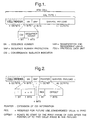
- the AAL Type 1 format is currently as shown in Figure 1.
- the Sequence Count is a binary counter that free-runs over the duration of the connection.
- the whole of the Sequence Numebr (SN) field is protected by the Sequence Number Protection (SNP).
- SNP Sequence Number Protection
- the use of the Convergence Sublayer Indicator (CSI) bit depends on the sequence count. When the sequence count is odd, the CSI bit is used to carry a four-bit value over eight cells of data which is used for a Synchronous Residual Time Stamp. When the sequence count is even, the CSI bit indicates the presence of a further octet or octets of AAL Type 1. Figure 2 shows how this is achieved.
- PCM Pulse Code Modulation
- the number of octets required is defined by the nature of the connection being carried and is predetermined at connection setup.
- the busy-map refers to all the data following the frame pointed to by the Offset Pointer. Data before this point will still be controlled by the previous busy-map.
- the busy-map will not be present and the receiver will assume the previous busy-map remains in force.
- the sender can stop sending the busy-map after a number of repeated identical busy-maps, at his discretion. It may well be wise to send even this identical busy-map from time to time to increase reliability. If the whole link becomes idle, the data flow could cease altogether after a number of repeated all idle frames, though a slow confirmation should be sent at a low data rate for confidence checks.
- the Map Size is the length of the busy-map in octets.
- the Map Size allows the size of the data stream to be changed without affecting the existing traffic.
- the Cyclic Redundancy Check (CRC4) protects the pointer and the whole of busy bit map.
- channels could be checked for audio content and so channels could be omitted on that basis.
- care would need to be exercised to avoid accidental corruption of data channels in this case.
- Figure 4 shows graphically the load on a channel that is carrying a 2M PCM.
- the thin, straight line is the load using the standard AAL 1, while the thick line is the load using the invention.
- the graph shows the effect of sending a minimum of five channels to maintain a minimum bandwidth.
- the invention can be extended to Data Channel Compression for modem data and lower rate ISDN data including transcoding. Further, operation of a larger number of 2M streams would maintain a low delay.
- Figure 5 is shown a sequence of four cells where timeslots are distributed amongst the cells in accordance with the present invention.
Landscapes
- Engineering & Computer Science (AREA)
- Computer Networks & Wireless Communication (AREA)
- Data Exchanges In Wide-Area Networks (AREA)
- Use Of Switch Circuits For Exchanges And Methods Of Control Of Multiplex Exchanges (AREA)
- Time-Division Multiplex Systems (AREA)
Description
- A way is described by which a telecommunications system cross-connect can be enhanced to provide statistical gain on telephony and other constant bit-rate traffic over high cost international links.
- An interest has been expressed in the use of Asynchronous Transfer Mode (ATM) as a means to obtain statistical gain in an existing network, particularly on the high-cost international links.
- The concern is with savings for the transmission of Synchronous traffic, not ATM services, so the problem must be addressed in the way the Synchronous Transfer Mode (STM) service is mapped onto the ATM bearer.
- A detailed description of the definition of
ATM adaptation layer 1 is given in ITU-T recommendation I-363 dated March 1993, see section 2. An example of ATM 2Mbit/s interworking is given in Electronics and Communication Engineering Journal,volume 4number 6, dated 1st December 1992, pages 385-393, Potts M: "Exploitation of an ATM Testbed for Broadband Experiments and Applications" - seesection 6. - It has been suggested that the frame mapping from a 2M connection on to the ATM cell stream could be adjusted to leave out idle channels, by examining the signalling channel to determine which channels are in use.
- This suggestion does not work as, while a Digital Signalling System 1 (DSS1) system does use channel 16 of the Pulse Code Modulation (PCM) structure for signalling. the same assumption does not apply to Signalling System 7 (SS7) that may even be running on a different transmission bearer, DSS1 and SS7 being CCITT (now renamed ITU-T) standards.
- According to the present invention there is provided a method of providing statistical gain where Synchronous Transfer Mode (STM) traffic is carried as cells on an Asynchronous Transfer Mode (ATM) bearer the cells having a bit-stream based ATM Adaption Layer (AAL) format including a map indicating any STM idle channels, the idle channels not being transmitted in the cells.
- According to the present invention there is provided a method of providing statistical gain where synchronous transfer mode (STM) traffic is carried as cells on an asynchronous transfer mode (ATM) bearer, the cells having a bit-stream based ATM adaptation layer (AAL) format characterised by including a map indicating a repeating pattern on a channel or channels, the channels where the pattern is the same as that already carried on that channel not being transmitted in the cells.
- According the present invention there is provided a method of providing statistical gain where synchronous transfer mode (STM) traffic is carried as cells on an asynchronous transfer mode (ATM) bearer, the cells having a bit-stream based ATM adaptation layer (AAL) format characterised by including a map indicating channels not having an audio content, such channels not being transmitted in the cells.
- The present invention will now be described, by way of example, with reference to the accompanying drawings, in which:-
- Figure 1 is a diagrammatic representation of an Asynchronous Transfer Mode (ATM) cell using the basic ATM Adaption Layer Type 1 (AAL1) format;
- Figure 2 is a diagrammatic representation of a cell similar to that in Figure 1, but showing the use of further AAL1 octets;
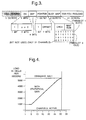
- Figure 3 is a diagrammatic representation showing the introduction of a busy-map into the AAL1 format;
- Figure 4 shows graphically the performance resulting from the use of the present invention; and
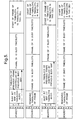
- Figure 5 a typical example of the distribution of timeslots within a series of cells.
-
- It is possible to identify idle channels from the data bytes they contain. There is a defined idle pattern. Therefore it would be possible to omit these channels from the pattern passed to the ATM network. To do this it is necessary to include some information in-band to identify which channels are present at any one time. There are a number of ways to do this.
- (i) Busy-Map field per 2M bit/s frame. A 4-octet field can be included at the front of each 2M frame. This will have a 1 bit marker for each of the 32 timeslots of the bearer. If the bit is set, this indicates that the corresponding channel is present in this frame. The length of the frame can be calculated by adding the busy bits together, and the bytes can then be sorted out again based on the busy pattern.This method incurs an overhead of 4 octets per frame. There is a saving whenever there are less than 26 timeslots in use, but more than these make it less efficient.
- (ii) Busy-Map field per cell. Alternatively the busy bits per cell could be included, which would reduce the overhead quite a lot. The busy bits will apply to all the frames that start after the beginning of the cell, not to the one already being processed. This has the advantage of being easy to locate in the receiver, and having far less overhead than per frame. Changes cannot be applied in every frame, but this is not a big loss.
- (iii) Busy-Map as an extension of ATM Adaption Layer (AAL)
Type 1. It is also possible, and probably the best option of the lot, to use the existingAAL Type 1 format for structured data, using the extension mechanism to carry the Busy Map. This would involve an overhead of 4 octets (for a 32 channel PCM) only when required to change the configuration. This method is explained below. -
- The
AAL Type 1 format is currently as shown in Figure 1. - The Sequence Count is a binary counter that free-runs over the duration of the connection. The whole of the Sequence Numebr (SN) field is protected by the Sequence Number Protection (SNP). The use of the Convergence Sublayer Indicator (CSI) bit depends on the sequence count. When the sequence count is odd, the CSI bit is used to carry a four-bit value over eight cells of data which is used for a Synchronous Residual Time Stamp. When the sequence count is even, the CSI bit indicates the presence of a further octet or octets of
AAL Type 1. Figure 2 shows how this is achieved. - The data to be transferred, Pulse Code Modulation (PCM) frames, is structed and synchronous. The first bit within the Pointer octet is a Reserved Bit, which is set to 1 in this case.
- Referring now to Figure 3, the existence of a Reserved Bit set to 1 indicates the presence of a number of further octets, which octets indicate the busy state of the PCM channels.
- The number of octets required is defined by the nature of the connection being carried and is predetermined at connection setup.
- For this example, the case of a 32 channel PCM structure, such as European Telecommunications Standards Institute (ETSI) Standard E1, where 31 channels are available for user data is considered. This corresponds to Integrated Services Digital Network (ISDN) (Narrowband).
- The busy-map refers to all the data following the frame pointed to by the Offset Pointer. Data before this point will still be controlled by the previous busy-map.
- If the Reserved Bit is zero, then the busy-map will not be present and the receiver will assume the previous busy-map remains in force. The sender can stop sending the busy-map after a number of repeated identical busy-maps, at his discretion. It may well be wise to send even this identical busy-map from time to time to increase reliability. If the whole link becomes idle, the data flow could cease altogether after a number of repeated all idle frames, though a slow confirmation should be sent at a low data rate for confidence checks.
- The Map Size is the length of the busy-map in octets. The Map Size allows the size of the data stream to be changed without affecting the existing traffic. The Cyclic Redundancy Check (CRC4) protects the pointer and the whole of busy bit map.
- The presence of a '1' in the busy-map indicator a busy timeslot and a '0' an idle timeslot. The timeslots increase from right to left in the top row, then through succeeding rows. The left-hand bottom bit in the table will not be used as there are only 31 data channels.
- A similar approach could be used to encode the "repeat" state of a channel, the map in this case referring not to idle channels but to instances where the pattern is the same as that already carried on that channel.
- Similarly, channels could be checked for audio content and so channels could be omitted on that basis. However, care would need to be exercised to avoid accidental corruption of data channels in this case.
- To see far enough ahead to build the busy map, it would be necessary to have a look-ahead of two cells of outgoing information. This will involve some delay while the cells are stored before compression. The size of the delay will depend on the number of 2M frames that can be fitted in, which in turn depends on the number of busy channels. It will probably be desirable to send some idle information channels when very few channels are in use to prevent the bandwidth dropping too low and hence the delay rising to unacceptable levels. The actual implementation of this will depend on user requirements.
- If a cell containing the busy-map is lost, the following cell will probably have to be discarded. The damage will extend from the lost cell through to the frame beginning after the next busy-map.
- Figure 4 shows graphically the load on a channel that is carrying a 2M PCM. The thin, straight line is the load using the
standard AAL 1, while the thick line is the load using the invention. The graph shows the effect of sending a minimum of five channels to maintain a minimum bandwidth. - The invention can be extended to Data Channel Compression for modem data and lower rate ISDN data including transcoding. Further, operation of a larger number of 2M streams would maintain a low delay.
In Figure 5 is shown a sequence of four cells where timeslots are distributed amongst the cells in accordance with the present invention. - There are initially 19 busy timeslots, followed by 17 busy timeslots. In each case where a new sequence of busy timeslots occurs at the beginning of the cell there is a busy bit map preceded by a point (PTR). This points to the beginning of the frame in the cell where the new group of timeslots starts as indicated by the arrow extending from PTR.
Claims (9)
- A method of providing statistical gain where Synchronous Transfer Mode (STM) traffic is carried as cells on an Asynchronous Transfer Mode (ATM) bearer the cells having a bit-stream based ATM Adaption Layer (AAL) format characterised by including a map indicating any STM idle channels, the idle channels not being transmitted in the cells.
- A method as claimed in Claim 1, wherein the map also indicates a repeating pattem on a channel or channels, the channels where the pattern is the same as that already carried on that channel not being transmitted in the cells.
- A method as claimed in any preceding claim, wherein the map also indicates channels not having an audio content, such channels not being transmitted in the cells.
- A method as claimed in any preceding claim, wherein a predetermined minimum number of channels is transmitted, including idle channels as necessary.
- A method of providing statistical gain where synchronous transfer mode (STM) traffic is carried as cells on an asynchronous transfer mode (ATM) bearer, the cells having a bit-stream based ATM adaptation layer (AAL) format characterised by including a map indicating a repeating pattern on a channel or channels, the channels where the pattern is the same as that already carried on that channel not being transmitted in the cells.
- A method of providing statistical gain where synchronous transfer mode (STM) traffic is carried as cells on an asynchronous transfer mode (ATM) bearer, the cells having a bit-stream based ATM adaptation layer (AAL) format characterised by including a map indicating channels not having an audio content, such channels not being transmitted in the cells.
- A method as claimed in any preceding claim, wherein the AAL format is AAL Type 1 for structural data and the map is carried using the extension mechanism thereof.
- A method as claimed in any preceding claim wherein when the contents of the map remain constant from one cell to the succeeding cell or over a series of succeeding cells, the map is omitted from at least one of the succeeding cells.
- A method as claimed in Claim 7 or any appendant thereto, wherein the presence of a map is indicated by the setting of the pointer reserved bit.
Applications Claiming Priority (2)
| Application Number | Priority Date | Filing Date | Title |
|---|---|---|---|
| GB9306367 | 1993-03-26 | ||
| GB939306367A GB9306367D0 (en) | 1993-03-26 | 1993-03-26 | Statistical gain using atm signalling |
Publications (3)
| Publication Number | Publication Date |
|---|---|
| EP0618706A2 EP0618706A2 (en) | 1994-10-05 |
| EP0618706A3 EP0618706A3 (en) | 1997-10-29 |
| EP0618706B1 true EP0618706B1 (en) | 1999-06-02 |
Family
ID=10732838
Family Applications (1)
| Application Number | Title | Priority Date | Filing Date |
|---|---|---|---|
| EP94301738A Expired - Lifetime EP0618706B1 (en) | 1993-03-26 | 1994-03-11 | Statistical gain using ATM signalling |
Country Status (6)
| Country | Link |
|---|---|
| US (1) | US5790552A (en) |
| EP (1) | EP0618706B1 (en) |
| JP (1) | JP3396852B2 (en) |
| DE (1) | DE69418763T2 (en) |
| ES (1) | ES2132337T3 (en) |
| GB (2) | GB9306367D0 (en) |
Families Citing this family (14)
| Publication number | Priority date | Publication date | Assignee | Title |
|---|---|---|---|---|
| GB2297881B (en) * | 1995-02-09 | 1999-02-17 | Northern Telecom Ltd | Communications system |
| US6529512B1 (en) * | 1997-07-15 | 2003-03-04 | International Business Machines Corporation | Statistical method of data compression and decompression |
| US6324174B2 (en) * | 1997-12-31 | 2001-11-27 | At&T Corporation | Telecommunications network architecture for transporting fax, voice and data via an ATM switch including a STM to ATM terminal adapter |
| US6697353B2 (en) | 1997-12-31 | 2004-02-24 | At&T Corp. | Voice-over-ATM switch architecture allowing congestion-dependent transport of silence cells |
| GB2343582B (en) * | 1998-11-06 | 2000-10-11 | Marconi Comm Ltd | Telecommunications system |
| TR199900855A2 (en) * | 1999-04-16 | 2000-11-21 | Netaş Northern Electric Telecommunication A.Ş. | A new ATM alignment layer that provides a transition between PCM and ATM type: 1 integrated circuit. |
| DE10007602A1 (en) | 2000-02-18 | 2001-08-30 | Siemens Ag | Method for transmitting packet data information in a radio communication system |
| GB2379284A (en) * | 2001-09-01 | 2003-03-05 | Zarlink Semiconductor Ltd | Multiple level photolithography |
| GB2379796A (en) * | 2001-09-14 | 2003-03-19 | Zarlink Semiconductor Ltd | A method of forming a low resistance contact |
| GB2381407B (en) * | 2001-10-24 | 2004-06-30 | Zarlink Semiconductor Ltd | Dynamic buffering in packet systems |
| GB2381693B (en) * | 2001-11-01 | 2004-07-14 | Zarlink Semiconductor Ltd | Automatic masking of interrupts |
| WO2004110000A1 (en) * | 2003-06-05 | 2004-12-16 | Telefonaktiebolaget Lm Ericsson (Publ) | Bandwidth reduction within packet switched networks by not sending idle timeslots |
| GB0522987D0 (en) | 2005-11-10 | 2005-12-21 | Cambridge Broadband Ltd | Communication system |
| WO2007054695A1 (en) * | 2005-11-10 | 2007-05-18 | Cambridge Broadband Networks Limited | Communication system and method |
Family Cites Families (3)
| Publication number | Priority date | Publication date | Assignee | Title |
|---|---|---|---|---|
| JPH0498943A (en) * | 1990-08-17 | 1992-03-31 | Hitachi Ltd | Transmission method and circuit for virtual container employing asynchronous transfer mode |
| GB2270820A (en) * | 1992-09-16 | 1994-03-23 | Plessey Telecomm | STM/ATM network interfacing |
| US5345445A (en) * | 1992-11-06 | 1994-09-06 | At&T Bell Laboratories | Establishing telecommunications calls in a broadband network |
-
1993
- 1993-03-26 GB GB939306367A patent/GB9306367D0/en active Pending
-
1994
- 1994-03-10 GB GB9404643A patent/GB2276518B/en not_active Expired - Lifetime
- 1994-03-11 DE DE69418763T patent/DE69418763T2/en not_active Expired - Lifetime
- 1994-03-11 ES ES94301738T patent/ES2132337T3/en not_active Expired - Lifetime
- 1994-03-11 EP EP94301738A patent/EP0618706B1/en not_active Expired - Lifetime
- 1994-03-24 JP JP07815494A patent/JP3396852B2/en not_active Expired - Fee Related
-
1995
- 1995-03-27 US US08/410,928 patent/US5790552A/en not_active Expired - Lifetime
Also Published As
| Publication number | Publication date |
|---|---|
| GB9404643D0 (en) | 1994-04-27 |
| GB9306367D0 (en) | 1993-05-19 |
| JP3396852B2 (en) | 2003-04-14 |
| ES2132337T3 (en) | 1999-08-16 |
| GB2276518A (en) | 1994-09-28 |
| US5790552A (en) | 1998-08-04 |
| EP0618706A3 (en) | 1997-10-29 |
| JPH077514A (en) | 1995-01-10 |
| GB2276518B (en) | 1997-04-09 |
| DE69418763D1 (en) | 1999-07-08 |
| EP0618706A2 (en) | 1994-10-05 |
| DE69418763T2 (en) | 1999-11-11 |
Similar Documents
| Publication | Publication Date | Title |
|---|---|---|
| EP0690653B1 (en) | Asynchronous transfer mode (ATM) transport of voice-band signals | |
| US5936967A (en) | Multi-channel broadband adaptation processing | |
| US6075798A (en) | Extended header for use in ATM adaptation layer type 2 packets | |
| CN1166246C (en) | A system for variable bandwidth asynchronous transfer mode network access supporting wired and wireless communications | |
| US6266343B1 (en) | Telecommunications system | |
| US5481544A (en) | Multi-channel broadband adaptation processing | |
| US6434151B1 (en) | Communications system and method | |
| US6052371A (en) | System and method for the communication of operation and maintenance, administration and provisioning information over an asynchronous transfer mode network | |
| US5790552A (en) | Statistical gain using ATM signalling | |
| EP1004218B1 (en) | Method for transmitting data across atm networks of different types | |
| US6345056B1 (en) | Method and apparatus for transmitting compressed packetized voice over ATM | |
| US6456629B1 (en) | Interworking function | |
| US7342927B1 (en) | Systems and methods for transferring various data types across an ATM network | |
| US6714560B1 (en) | SS7 signalling transport over ATM | |
| WO2005022837A1 (en) | Inverse multiplexer with tdm bonding | |
| EP0781008A1 (en) | Method and system for combining connections over ATM network | |
| Bentall et al. | ATM and Internet Protocol | |
| US7039042B1 (en) | Method for data transmission via a packet-oriented communications network | |
| WO2001047199A1 (en) | Method and apparatus for transparent transmission between a tdm network and a packet or cell based network | |
| KR100195068B1 (en) | AAL1 Processing Unit at User-Network Interface of Broadband Telecommunication Networks | |
| KR100310865B1 (en) | Apparatus and method for interworking pstn and atm network to accommodate telephone service in atm | |
| CA2270100A1 (en) | Method for connecting communication systems via a packet-oriented data transmission link | |
| EP0967821A2 (en) | Silence detection and suppression in voice trunking applications over an ATM network | |
| EP0735794A2 (en) | Method for transporting voice-band signals on asynchronous transfer mode (ATM) networks | |
| CA2338293A1 (en) | Method for switching data received via a packet-oriented data transmission link |
Legal Events
| Date | Code | Title | Description |
|---|---|---|---|
| PUAI | Public reference made under article 153(3) epc to a published international application that has entered the european phase |
Free format text: ORIGINAL CODE: 0009012 |
|
| AK | Designated contracting states |
Kind code of ref document: A2 Designated state(s): DE ES FR IT SE |
|
| 17P | Request for examination filed |
Effective date: 19950321 |
|
| PUAL | Search report despatched |
Free format text: ORIGINAL CODE: 0009013 |
|
| AK | Designated contracting states |
Kind code of ref document: A3 Designated state(s): DE ES FR IT SE |
|
| 17Q | First examination report despatched |
Effective date: 19980211 |
|
| GRAG | Despatch of communication of intention to grant |
Free format text: ORIGINAL CODE: EPIDOS AGRA |
|
| GRAG | Despatch of communication of intention to grant |
Free format text: ORIGINAL CODE: EPIDOS AGRA |
|
| GRAH | Despatch of communication of intention to grant a patent |
Free format text: ORIGINAL CODE: EPIDOS IGRA |
|
| GRAA | (expected) grant |
Free format text: ORIGINAL CODE: 0009210 |
|
| RAP1 | Party data changed (applicant data changed or rights of an application transferred) |
Owner name: MARCONI COMMUNICATIONS LIMITED |
|
| AK | Designated contracting states |
Kind code of ref document: B1 Designated state(s): DE ES FR IT SE |
|
| PG25 | Lapsed in a contracting state [announced via postgrant information from national office to epo] |
Ref country code: SE Free format text: THE PATENT HAS BEEN ANNULLED BY A DECISION OF A NATIONAL AUTHORITY Effective date: 19990602 |
|
| REF | Corresponds to: |
Ref document number: 69418763 Country of ref document: DE Date of ref document: 19990708 |
|
| ET | Fr: translation filed | ||
| REG | Reference to a national code |
Ref country code: ES Ref legal event code: FG2A Ref document number: 2132337 Country of ref document: ES Kind code of ref document: T3 |
|
| PLBE | No opposition filed within time limit |
Free format text: ORIGINAL CODE: 0009261 |
|
| STAA | Information on the status of an ep patent application or granted ep patent |
Free format text: STATUS: NO OPPOSITION FILED WITHIN TIME LIMIT |
|
| 26N | No opposition filed | ||
| PGFP | Annual fee paid to national office [announced via postgrant information from national office to epo] |
Ref country code: ES Payment date: 20020315 Year of fee payment: 9 |
|
| PG25 | Lapsed in a contracting state [announced via postgrant information from national office to epo] |
Ref country code: ES Free format text: LAPSE BECAUSE OF NON-PAYMENT OF DUE FEES Effective date: 20030312 |
|
| REG | Reference to a national code |
Ref country code: FR Ref legal event code: TP |
|
| REG | Reference to a national code |
Ref country code: ES Ref legal event code: FD2A Effective date: 20030312 |
|
| REG | Reference to a national code |
Ref country code: FR Ref legal event code: TP |
|
| PGFP | Annual fee paid to national office [announced via postgrant information from national office to epo] |
Ref country code: IT Payment date: 20080329 Year of fee payment: 15 |
|
| PG25 | Lapsed in a contracting state [announced via postgrant information from national office to epo] |
Ref country code: IT Free format text: LAPSE BECAUSE OF NON-PAYMENT OF DUE FEES Effective date: 20090311 |
|
| PGFP | Annual fee paid to national office [announced via postgrant information from national office to epo] |
Ref country code: FR Payment date: 20130405 Year of fee payment: 20 Ref country code: DE Payment date: 20130327 Year of fee payment: 20 |
|
| REG | Reference to a national code |
Ref country code: DE Ref legal event code: R071 Ref document number: 69418763 Country of ref document: DE |
|
| PG25 | Lapsed in a contracting state [announced via postgrant information from national office to epo] |
Ref country code: DE Free format text: LAPSE BECAUSE OF EXPIRATION OF PROTECTION Effective date: 20140312 |