EP0618226B1 - Inhibitors of herpes viral ribonculeotide reductase - Google Patents
Inhibitors of herpes viral ribonculeotide reductase Download PDFInfo
- Publication number
- EP0618226B1 EP0618226B1 EP94102680A EP94102680A EP0618226B1 EP 0618226 B1 EP0618226 B1 EP 0618226B1 EP 94102680 A EP94102680 A EP 94102680A EP 94102680 A EP94102680 A EP 94102680A EP 0618226 B1 EP0618226 B1 EP 0618226B1
- Authority
- EP
- European Patent Office
- Prior art keywords
- peptide
- acceptable salt
- therapeutically acceptable
- amino
- herpes
- Prior art date
- Legal status (The legal status is an assumption and is not a legal conclusion. Google has not performed a legal analysis and makes no representation as to the accuracy of the status listed.)
- Expired - Lifetime
Links
Classifications
-
- C—CHEMISTRY; METALLURGY
- C07—ORGANIC CHEMISTRY
- C07K—PEPTIDES
- C07K5/00—Peptides containing up to four amino acids in a fully defined sequence; Derivatives thereof
- C07K5/04—Peptides containing up to four amino acids in a fully defined sequence; Derivatives thereof containing only normal peptide links
- C07K5/10—Tetrapeptides
-
- C—CHEMISTRY; METALLURGY
- C07—ORGANIC CHEMISTRY
- C07K—PEPTIDES
- C07K5/00—Peptides containing up to four amino acids in a fully defined sequence; Derivatives thereof
- C07K5/04—Peptides containing up to four amino acids in a fully defined sequence; Derivatives thereof containing only normal peptide links
- C07K5/10—Tetrapeptides
- C07K5/1002—Tetrapeptides with the first amino acid being neutral
- C07K5/1005—Tetrapeptides with the first amino acid being neutral and aliphatic
- C07K5/101—Tetrapeptides with the first amino acid being neutral and aliphatic the side chain containing 2 to 4 carbon atoms, e.g. Val, Ile, Leu
-
- A—HUMAN NECESSITIES
- A61—MEDICAL OR VETERINARY SCIENCE; HYGIENE
- A61K—PREPARATIONS FOR MEDICAL, DENTAL OR TOILETRY PURPOSES
- A61K38/00—Medicinal preparations containing peptides
- A61K38/16—Peptides having more than 20 amino acids; Gastrins; Somatostatins; Melanotropins; Derivatives thereof
- A61K38/55—Protease inhibitors
-
- A—HUMAN NECESSITIES
- A61—MEDICAL OR VETERINARY SCIENCE; HYGIENE
- A61P—SPECIFIC THERAPEUTIC ACTIVITY OF CHEMICAL COMPOUNDS OR MEDICINAL PREPARATIONS
- A61P31/00—Antiinfectives, i.e. antibiotics, antiseptics, chemotherapeutics
- A61P31/12—Antivirals
-
- A—HUMAN NECESSITIES
- A61—MEDICAL OR VETERINARY SCIENCE; HYGIENE
- A61P—SPECIFIC THERAPEUTIC ACTIVITY OF CHEMICAL COMPOUNDS OR MEDICINAL PREPARATIONS
- A61P31/00—Antiinfectives, i.e. antibiotics, antiseptics, chemotherapeutics
- A61P31/12—Antivirals
- A61P31/20—Antivirals for DNA viruses
- A61P31/22—Antivirals for DNA viruses for herpes viruses
-
- C—CHEMISTRY; METALLURGY
- C07—ORGANIC CHEMISTRY
- C07K—PEPTIDES
- C07K14/00—Peptides having more than 20 amino acids; Gastrins; Somatostatins; Melanotropins; Derivatives thereof
- C07K14/005—Peptides having more than 20 amino acids; Gastrins; Somatostatins; Melanotropins; Derivatives thereof from viruses
-
- C—CHEMISTRY; METALLURGY
- C07—ORGANIC CHEMISTRY
- C07K—PEPTIDES
- C07K7/00—Peptides having 5 to 20 amino acids in a fully defined sequence; Derivatives thereof
- C07K7/04—Linear peptides containing only normal peptide links
- C07K7/06—Linear peptides containing only normal peptide links having 5 to 11 amino acids
-
- A—HUMAN NECESSITIES
- A61—MEDICAL OR VETERINARY SCIENCE; HYGIENE
- A61K—PREPARATIONS FOR MEDICAL, DENTAL OR TOILETRY PURPOSES
- A61K38/00—Medicinal preparations containing peptides
-
- C—CHEMISTRY; METALLURGY
- C12—BIOCHEMISTRY; BEER; SPIRITS; WINE; VINEGAR; MICROBIOLOGY; ENZYMOLOGY; MUTATION OR GENETIC ENGINEERING
- C12N—MICROORGANISMS OR ENZYMES; COMPOSITIONS THEREOF; PROPAGATING, PRESERVING, OR MAINTAINING MICROORGANISMS; MUTATION OR GENETIC ENGINEERING; CULTURE MEDIA
- C12N2710/00—MICROORGANISMS OR ENZYMES; COMPOSITIONS THEREOF; PROPAGATING, PRESERVING, OR MAINTAINING MICROORGANISMS; MUTATION OR GENETIC ENGINEERING; CULTURE MEDIA dsDNA viruses
- C12N2710/00011—Details
- C12N2710/16011—Herpesviridae
- C12N2710/16611—Simplexvirus, e.g. human herpesvirus 1, 2
- C12N2710/16622—New viral proteins or individual genes, new structural or functional aspects of known viral proteins or genes
Definitions
- This invention relates to peptide derivatives having antiviral properties and to means for using the derivatives to treat viral infections. More specifically, the invention relates to peptide derivatives (hereinafter called "peptides") exhibiting activity against herpes viruses, to pharmaceutical compositions comprising the peptides, to methods of using the peptides to inhibit in vitro the replication of herpes virus and to the use of said compounds for the preparation of a medicament for the treatment of herpes infections.
- peptides peptide derivatives having antiviral properties and to means for using the derivatives to treat viral infections. More specifically, the invention relates to peptide derivatives (hereinafter called "peptides”) exhibiting activity against herpes viruses, to pharmaceutical compositions comprising the peptides, to methods of using the peptides to inhibit in vitro the replication of herpes virus and to the use of said compounds for the preparation of a medicament for the treatment of herpes infections.
- Herpes viruses inflict a wide range of diseases against humans and animals. For instance; herpes simplex viruses, types 1 and 2 (HSV-1 and HSV-2), are responsible for cold sores and genital lesions, respectively; varicella zoster virus (VZV) causes chicken pox and shingles; and the Epstein-Barr virus (EBV) causes infectious mononucleosis.
- HSV-1 and HSV-2 herpes simplex viruses
- VZV varicella zoster virus
- EBV Epstein-Barr virus
- nucleoside analogs Over the past two decades, a class of compounds known as the purine and pyrimidine nucleoside analogs has received the most attention by investigators in the search for new therapeutic agents for treatment of herpes virus infections. As a result, several nucleoside analogs have been developed as antiviral agents. The most successful to date is acyclovir which is the agent of choice for treating genital herpes simplex infections.
- the present application discloses a group of peptide derivatives having activity against herpes viruses.
- the selective action of these peptides against herpes viruses combined with a wide margin of safety, renders the peptides as desirable agents for combating herpes infections.
- the subject peptides of the previous reports can be distinguished from the peptides of the present application by characteristic structural and biological differences.
- the peptides of this invention are represented by formula 1 (PhCH 2 ) 2 CH(CO)-(N-Me)-Val-Tbg-Asp(pyrrolidino)-Asp(cyPn)-E ( 1 ) wherein E is ⁇ -MeLeucinol, ⁇ -MeLeu-OH, NHCH 2 C(CH 3 ) 3 , or NH-(R)-CH(C 2 H 5 )C(CH 3 ) 3 or a therapeutically acceptable salt thereof.
- composition comprising an anti-herpes virally effective amount of a peptide of formula 1, or a therapeutically acceptable salt thereof, and a pharmaceutically or veterinarily acceptable carrier.
- a cosmetic composition comprising a peptide of formula 1, or a therapeutically acceptable salt thereof, and a physiologically acceptable carrier suitable for topical application.
- An important aspect of the invention involves the use of an anti-herpes virally effective amount of the peptide of formula 1, or a therapeutically acceptable salt thereof for the preparation of a medicament for treating a herpes viral infection in a mammal.
- Another important aspect involves an in vitro method of inhibiting the replication of herpes virus by contacting the virus with a herpes viral ribonucleotide reductase inhibiting amount of the peptide of formula 1, or a therapeutically acceptable salt thereof.
- Still another aspect involves the use of an effective amount of a combination of the peptide of formula 1, or a therapeutically acceptable salt thereof, and an antiviral nucleoside analog for the preparation of a medicament for treating herpes viral infections in a mammal.
- a pharmaceutical composition comprising the combination is also within the scope of this invention.
- residue with reference to an amino acid or amino acid derivative means a radical derived from the corresponding ⁇ -amino acid by eliminating the hydroxyl of the carboxy group and one hydrogen of the ⁇ -amino group.
- Val, Ile, Asp, and Leu represent the residues of L-valine, L-isoleucine, L-aspartic acid and L-leucine, respectively.
- the asymmetric carbon atoms residing in the principal linear axis (i.e. the backbone) of the peptides of formula 1, exclusive of the terminal group E, have an S configuration.
- Tbg represents the amino acid residue of (S)-2-amino-3,3-dimethylbutanoic acid.
- ⁇ MeLeu represents the amino acid residue of (S)-2-amino-4,4-dimethylpentanoic acid.
- ⁇ MeLeucinol represents (S)-2-amino-4,4-dimethylpentanol with one hydrogen removed from the ⁇ -amino group.
- pharmaceutically acceptable carrier or “veterinarily acceptable carrier” as use herein means a non-toxic, generally inert vehicle for the active ingredient which does not adversely affect the ingredient.
- physiologically acceptable carrier means an acceptable cosmetic vehicle of one or more non-toxic excipients which do not react with or reduce the effectiveness of the active ingredient contained therein.
- vehicle as used herein means a physiologically acceptable vehicle for administering drug substances to domestic animals comprising one or more non-toxic pharmaceutically acceptable excipients which do not react with the drug substance or reduce its effectiveness.
- an effective amount means a predetermined antiviral amount of the antiviral agent, i.e. an amount of the agent sufficient to be effective against the viral organisms in vivo.
- Coupled agent means an agent capable of effecting the dehydrative coupling of an amino acid or peptide free carboxy group with a free amino group of another amino acid or peptide to form an amide bond between the reactants. Similarly, such agents can effect the coupling of an acid and an alcohol to form corresponding esters. The agents promote or facilitate the dehydrative coupling by activating the carboxy group. Descriptions of such coupling agents and activated groups are included in general text books of peptide chemistry; for instance, E. Schröder and K.L. Lübke, "The Peptides", Vol. 1, Academic Press, New York, N.Y., 1965, pp 2-128, and K.D.
- the peptides of formula 1 can be prepared by processes which incorporate therein methods commonly used in peptide synthesis such as the classical solution coupling of amino acid residues and/or peptide fragments. Such methods are described, for example, by E. Schröder and K. Lübke, cited above, in the textbook series, "The Peptides: Analysis, Synthesis, Biology", E. Gross et al., Eds., Academic Press, New York, N.Y., 1979-1987, Volumes 1 to 8, and by J.M. Stewart and J.D. Young in “Solid Phase Peptide Synthesis", 2nd ed., Pierce Chem. Co., Rockford, IL, USA, 1984.
- a common feature of the aforementioned processes for the peptides is the protection of the reactive side chain groups of the various amino acid residues or derived amino acid residues (or, if required, non-peptidic fragments of the peptide) with suitable protective groups which will prevent a chemical reaction from occurring at that site until the protective group is ultimately removed. Also common is the protection of an ⁇ -amino group on an amino acid or a fragment while that entity reacts at the carboxy group, followed by the selective removal of the ⁇ -amino protective group to allow subsequent reaction to take place at that location.
- Another common feature is the initial protection of the C-terminal carboxyl of the amino acid residue or peptide fragment, if present, which is to become the C-terminal function of the peptide, with a suitable protective group which will prevent a chemical reaction from occurring at that site until the protective group is removed after the desired sequence of the peptide has been assembled.
- a peptide of formula 1 can be prepared by the stepwise coupling, in the order of the sequence of the peptide, of the appropriate amino acid or derived amino acid residues, and non-peptidic fragments of the peptide (such as the key intermediates), which if required are suitably protected, and eliminating all protecting groups, if present, at the completion of the stepwise coupling to obtain the peptide of formula 1. More specific processes are illustrated in the examples hereinafter.
- the lower alkanoic acids disubstituted with phenyl or a monosubstituted phenyl, required for the elaboration of the N-terminus of the present peptides are known or can be prepared by known methods; for example, see L.L. Chang et al., Bioorganic & Medicinal Chemistry Letters 2 , 1207 (1992). Dibenzylacetic acid has been described by M.R. Dolique, Ann. Chim. (Paris), 15 (10), 425 (1931) and by F. Krollpfeiffer and A. Rosenberg, Chem. Ber., 69 , 465 (1936).
- the peptide of formula 1 of this invention can be obtained in the form of a therapeutically acceptable salt.
- examples of such salts of the base are those with organic acids, e.g. acetic, lactic, succinic, methanesulfonic or p-toluenesulfonic acid, as well as polymeric acids such as tannic acid or carboxymethyl cellulose, and also salts with inorganic acids such as hydrohalic acids, e.g. hydrochloric acid, or sulfuric acid, or phosphoric acid.
- a particular acid addition salt is converted into another acid addition salt, such as a non-toxic, pharmaceutically acceptable salt, by treatment with the appropriate ion exchange resin in the manner described by R.A. Boissonnas et al., Helv. Chim. Acta 43 , 1849 (1960).
- examples of such salts of the carboxy group are those with the sodium, potassium or calcium cations, or with organic bases, for example, triethylamine or N-methylmorpholine.
- the antiviral activity of the peptides of formula 1 can be demonstrated by biochemical, microbiological and biological procedures showing the inhibitory effect of the compounds on the replication of herpes simplex viruses, types 1 and 2 (HSV-1 and HSV-2), and other herpes viruses, for example, varicella zoster virus (VZV) and Epstein-Barr virus (EBV).
- herpes simplex viruses types 1 and 2 (HSV-1 and HSV-2)
- other herpes viruses for example, varicella zoster virus (VZV) and Epstein-Barr virus (EBV).
- the inhibitory effect on herpes ribonucleotide reductase is noted for exemplary peptides of formula 1.
- a method for demonstrating the inhibitory effect of the peptides of formula 1 on viral replication is the cell culture technique; see, for example, R. Déziel and Y. Guindon, Canadian patent application 2,033,488, published July 1, 1992.
- the therapeutic effect of the peptides can be demonstrated in laboratory animals, for instance, by using an assay based on the murine model of herpes simplex virus-induced ocular disease for antiviral drug testing, described by C.R. Brandt et al., J. Virol. Meth 36 , 209 (1992).
- a peptide of this invention When a peptide of this invention, or one of its therapeutically acceptable salts, is employed as an antiviral agent, it is administered topically or systemically to warm-blooded animals, e.g. humans, pigs or horses, in a vehicle comprising one or more pharmaceutically acceptable carriers, the proportion of which is determined by the solubility and chemical nature of the peptide, chosen route of administration and standard biological practice.
- the peptide can be formulated in pharmaceutically accepted vehicles containing 0.1 to 5 percent, preferably 0.5 to 2 percent, of the active agent.
- Such formulations can be in the form of a solution, cream or lotion.
- the peptide of formula 1 is administered by either intravenous, subcutaneous or intramuscular injection, in compositions with pharmaceutically acceptable vehicles or carriers.
- pharmaceutically acceptable vehicles or carriers for administration by injection, it is preferred to use the peptide in solution in a sterile aqueous vehicle which may also contain other solutes such as buffers or preservatives as well as sufficient quantities of pharmaceutically acceptable salts or of glucose to make the solution isotonic.
- Suitable vehicles or carriers for the above noted formulations are described in standard pharmaceutical texts, e.g. in "Remington's Pharmaceutical Sciences", 18th ed, Mack Publishing Company, Easton, Penn., 1990.
- the dosage of the peptide will vary with the form of administration and the particular active agent chosen. Furthermore, it will vary with the particular host under treatment. Generally, treatment is initiated with small increments until the optimum effect under the circumstances is reached. In general, the peptide is most desirably administered at a concentration level that will generally afford antivirally effective results without causing any harmful or deleterious side effects.
- the peptide is administered cutaneously in a suitable topical formulation to the infected area of the body e.g. the skin or part of the oral or genital cavity, in an amount sufficient to cover the infected area.
- the treatment should be repeated, for example, every four to six hours until lesions heal.
- the peptide of formula 1 is administered at a dosage of 10 ⁇ g to 500 ⁇ g per kilogram of body weight per day, although the aforementioned variations will occur. However, a dosage level that is in the range of from about 10 ⁇ g to 200 ⁇ g per kilogram of body weight per day is most desirably employed in order to achieve effective results.
- Another aspect of this invention comprises a cosmetic composition
- a cosmetic composition comprising a herpes viral prophylactic amount of the peptide of formula 1, or a therapeutically acceptable salt thereof, together with a physiologically acceptable cosmetic carrier. Additional components, for example, skin softeners, may be included in the formulation.
- the cosmetic formulation of this invention is used prophylactically to prevent the outbreak of herpetic lesions of the skin.
- the formulation can be applied nightly to susceptible areas of the skin.
- the cosmetic composition contains less of the peptide than corresponding pharmaceutical compositions for topical application.
- a preferred range of the amount of the peptide in the cosmetic composition is 0.01 to 0.2 percent by weight.
- antiviral medications or agents include the antiviral nucleosides, for example, acyclovir, and antiviral surface active agents or antiviral interferons such as those disclosed by S.S. Asculai and F. Rapp in U.S. patent 4,507,281, March 26, 1985.
- a pharmaceutical composition for treating herpes infections in a mammal comprising a pharmaceutically or veterinarily acceptable carrier, and an effective amount of the combination of an antiviral nucleoside analog or a therapeutically acceptable salt thereof, and a ribonucleotide reductase inhibiting peptide of formula 1 or a therapeutically acceptable salt thereof.
- the treatment comprises administering, e.g., topically, to the mammal an anti-herpes virally effective amount of a combination of a compound of formula 1 or a therapeutically acceptable salt thereof, and an antiviral nucleoside analog or a therapeutically acceptable salt thereof.
- the antiviral nucleoside analog employed in the combination is one which is enzymatically convertible ( in vivo ) to a viral DNA polymerase inhibitor of, and/or an alternative substrate for, a herpes DNA polymerase.
- the antiviral nucleoside analog can be selected from known nucleoside analogs.
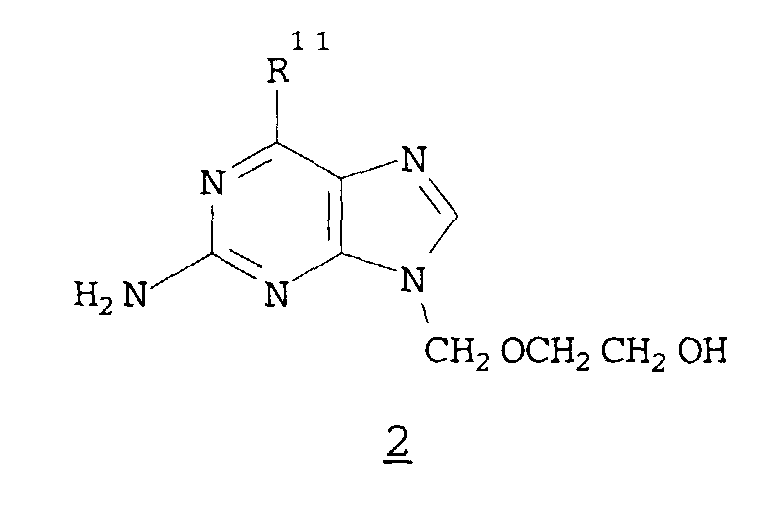
- Preferred nucleoside analogs of the invention include acyclovir and its analogs; for example, the compounds of formula 2 wherein R 11 is hydrogen, hydroxy or amino, or a therapeutically acceptable salt thereof. (Formula 2 wherein R 11 is hydroxy represents acyclovir.)
- antiviral nucleoside analogs for use according to the present invention include vidarabine, idoxuridine, trifluridine, ganciclovir, edoxudine, brovavir, fiacitabine, penciclovir, famciclovir and rociclovar.
- the term "synergistic effect" when used in relation to the antiviral or antiherpes activity of the above defined combination of the nucleoside analog and peptide of formula 1 means an antiviral or antiherpes effect which is greater than the predictive additive effect of the two individual components of the combination.
- the combination is administered to warm blooded animals, e.g. humans, pigs or horses, in a vehicle comprising one or more pharmaceutically acceptable carriers, the proportion of which is determined by the solubility and chemical nature of the nucleoside analog and the peptide of formula 1, chosen route of administration, standard biological practice, and by the relative amounts of the two active ingredients to provide a synergistic antiviral effect.
- the combination is administered topically.
- the two active agents i.e. the antiviral nucleoside analog and the peptide of formula 1, or their therapeutically acceptable salts
- Such formulation can contain 0.01 to 1.0 percent by weight of the nucleoside analog, or a therapeutically acceptable salt thereof, and about 0.05 to 1 percent by weight of the peptide of formula 1, or a therapeutically acceptable salt thereof.
- the two active agents are present in the pharmaceutical composition in amounts to provide a synergistic antiherpes effect.
- the first reactant i.e. a free amine (or its hydrochloride salt)
- a free amine or its hydrochloride salt
- CH 2 Cl 2 or acetonitrile is cooled to 4°.
- four equivalents of N-methylmorpholine is added to the stirred solution.
- one equivalent of the second reactant i.e. a free carboxylic acid, and 1.05 equivalent of the coupling agent are added.
- HSV-1 Herpes Simplex Virus
- HSV-1 ribonucleotide reductase (partially purified) was obtained from quiescent BHK-21/C13 cells infected with strain F HSV-1 virus at 10 plaque forming units/cell as described by E.A. Cohen et al., J. Gen. Virol., 66 , 733 (1985).
- the assay described by P. Gaudreau et al., J. Biol. Chem., 262 , 12413 (1987), is used to evaluate the capability of the compounds of this invention to inhibit HSV-1 ribonucleotide reductase activity. Results are expresed as the concentration of the compound producing 50% of the maximal inhibition (IC 50 ) of enzyme activity. The number of units of the enzyme preparation used in each assay was constant, based on the specific activity of the enzyme preparation. The results are relative to the activity obtained in control experiments without the test compound and represent the mean of four assays that varied less than 10% with each other.
- HSV-2 Herpes Simplex Virus
- BHK-21/C13 cells (ATCC CCL 10) are incubated for two days in 150 cm 2 T-flasks (1.5 x 10 6 cells/flask) with alpha-MEM medium (Gibco Canada Inc., Burlington, Ontario, Canada) supplemented with 8% ( v/v ) fetal bovine serum (FBS, Gibco Canada Inc.).
- the cells are trypsinized and then transferred to fresh media in a 24 well plate to give 2.5 x 10 5 cells in 750 ⁇ L of media per well.
- the cells are incubated at 37° for a period of 6 h to allow them to adhere to the plate.
- the cells are washed once with 500 ⁇ L of alpha-MEM supplemented with 0.5% ( v/v ) FBS and then incubated with 750 ⁇ L of the same media (low serum) for 3 days. After this period of serum starvation, the low serum medium is removed and the cells are incubated in 500 ⁇ L of BBMT for 2 to 3 hours.
- the HSV-2 used was strain HG-52, see Y. Langelier and G. Buttin, J. Gen. Virol 57 , 21 (1981); the virus was stored at -80°.
- the media is removed and the cells are washed with BBMT (3 X 250 ⁇ L).
- the cells in each well are incubated with or without (control) appropriate concentrations of the test agent dissolved in 200 ⁇ L of BBMT medium. After 29 h of incubation at 37°, the infected cells are harvested by first freezing the plate at -80°, followed by thawing. The cells in each well are scraped off the surface of the well with the help of the melting ice fragments.
- the cell suspensions are collected and each well is rinsed with 150 ⁇ L of BBMT medium.
- the viral sample (suspension plus washing) is sonicated gently for 4 min at 4°. Cell debris are removed by centrifugation (1000 times gravity for 10 minutes at 4°). The supernatant is collected and stored at -80° until determination of viral titer.
- Viral titration was performed by a modification of the colorimetric assay method of M. Langlois et al., Journal of Biological Standardization 14 , 201 (1986), and which is described in detail by R. Déziel and Y. Guindon, supra .
- the percentage of virus growth inhibition can be determined for the various concentrations of the test agent, and the concentration of the test agent (i.e. the peptide of formula 1) effecting a 50% inhibition of virus replication, i.e. the EC 50 , can be calculated.
Landscapes
- Chemical & Material Sciences (AREA)
- Health & Medical Sciences (AREA)
- Life Sciences & Earth Sciences (AREA)
- Organic Chemistry (AREA)
- Medicinal Chemistry (AREA)
- General Health & Medical Sciences (AREA)
- Proteomics, Peptides & Aminoacids (AREA)
- Molecular Biology (AREA)
- Biochemistry (AREA)
- Virology (AREA)
- Biophysics (AREA)
- Genetics & Genomics (AREA)
- Animal Behavior & Ethology (AREA)
- Gastroenterology & Hepatology (AREA)
- Pharmacology & Pharmacy (AREA)
- Public Health (AREA)
- Veterinary Medicine (AREA)
- Engineering & Computer Science (AREA)
- Nuclear Medicine, Radiotherapy & Molecular Imaging (AREA)
- General Chemical & Material Sciences (AREA)
- Oncology (AREA)
- Chemical Kinetics & Catalysis (AREA)
- Communicable Diseases (AREA)
- Bioinformatics & Cheminformatics (AREA)
- Biotechnology (AREA)
- Epidemiology (AREA)
- Immunology (AREA)
- Medicines That Contain Protein Lipid Enzymes And Other Medicines (AREA)
- Pharmaceuticals Containing Other Organic And Inorganic Compounds (AREA)
- Peptides Or Proteins (AREA)
Abstract
Description
- This invention relates to peptide derivatives having antiviral properties and to means for using the derivatives to treat viral infections. More specifically, the invention relates to peptide derivatives (hereinafter called "peptides") exhibiting activity against herpes viruses, to pharmaceutical compositions comprising the peptides, to methods of using the peptides to inhibit in vitro the replication of herpes virus and to the use of said compounds for the preparation of a medicament for the treatment of herpes infections.
- Herpes viruses inflict a wide range of diseases against humans and animals. For instance; herpes simplex viruses, types 1 and 2 (HSV-1 and HSV-2), are responsible for cold sores and genital lesions, respectively; varicella zoster virus (VZV) causes chicken pox and shingles; and the Epstein-Barr virus (EBV) causes infectious mononucleosis.
- Over the past two decades, a class of compounds known as the purine and pyrimidine nucleoside analogs has received the most attention by investigators in the search for new therapeutic agents for treatment of herpes virus infections. As a result, several nucleoside analogs have been developed as antiviral agents. The most successful to date is acyclovir which is the agent of choice for treating genital herpes simplex infections.
- Nevertheless, in spite of some significant advances, the need for effective, safe therapeutic agents for treating herpes viral infections continues to exist. For a review of current therapeutic agents in this area, see M.C. Nahata, "Antiviral Drugs: Pharmacokinetics, Adverse Effects and Therapeutic Use", J. Pharm. Technol., 3, 100 (1987).
- The present application discloses a group of peptide derivatives having activity against herpes viruses. The selective action of these peptides against herpes viruses, combined with a wide margin of safety, renders the peptides as desirable agents for combating herpes infections.
- The following references disclose peptides or peptide derivatives which have been associated with antiherpes activity:
- B.M. Dutia et al., Nature, 321, 439 (1986),
- E.A. Cohen et al., Nature, 321, 441 (1986),
- J.H. Subak-Sharpe et al., UK patent application 2185024, published July 8, 1987,
- P. Gaudreau et al., J. Biol. Chem., 262, 12413 (1987),
- E.A. Cohen et al., US patent 4,795,740, January 3, 1989,
- R. Freidinger et al., US patent 4,814,432, March 21, 1989,
- V.M. Garskey et al., US patent 4,837,304, June 6, 1989,
- R. Colonno et al., US patent 4,845,195, July 4, 1989,
- P. Gaudreau et al., J. Med. Chem., 33, 723 (1990),
- J. Adams et al., European patent application 408,973, published January 23, 1991,
- P.L. Beaulieu et al., European patent application 411,332, published February 6, 1991,
- J. Adams et al., European patent application 411,333, published February 6, 1991,
- J. Adams et al., European patent application 411,334, published February 6, 1991,
- R.L. Tolman et al., European patent application 412, 595, published February 13, 1991,
- W.T. Ashton et al., European patent application 438,873, published July 31, 1991,
- P.L. Beaulieu et al., European patent application 461,546, published December 18, 1991,
- P. Gaudreau et al., J. Med. Chem., 35, 346 (1992),
- R. Déziel and Y. Guindon, Canadian patent application 2,033,448, published July 1, 1992, and
- L.L. Chang et al., Biorganic & Medicinal Chemistry Letters, 2, 1207 (1992).
-
- The subject peptides of the previous reports can be distinguished from the peptides of the present application by characteristic structural and biological differences.
- Abbreviations and symbols used hereinafter are defined in the "Details of the Invention" section of this application.
- The peptides of this invention are represented by formula 1
(PhCH2)2CH(CO)-(N-Me)-Val-Tbg-Asp(pyrrolidino)-Asp(cyPn)-E ( 1 ) wherein E is γ-MeLeucinol, γ-MeLeu-OH, NHCH2C(CH3)3, or NH-(R)-CH(C2H5)C(CH3)3 or a therapeutically acceptable salt thereof. - Included within the scope of this invention is a pharmaceutical composition comprising an anti-herpes virally effective amount of a peptide of formula 1, or a therapeutically acceptable salt thereof, and a pharmaceutically or veterinarily acceptable carrier.
- Also included within the scope of this invention is a cosmetic composition comprising a peptide of formula 1, or a therapeutically acceptable salt thereof, and a physiologically acceptable carrier suitable for topical application.
- An important aspect of the invention involves the use of an anti-herpes virally effective amount of the peptide of formula 1, or a therapeutically acceptable salt thereof for the preparation of a medicament for treating a herpes viral infection in a mammal.
- Another important aspect involves an in vitro method of inhibiting the replication of herpes virus by contacting the virus with a herpes viral ribonucleotide reductase inhibiting amount of the peptide of formula 1, or a therapeutically acceptable salt thereof.
- Still another aspect involves the use of an effective amount of a combination of the peptide of formula 1, or a therapeutically acceptable salt thereof, and an antiviral nucleoside analog for the preparation of a medicament for treating herpes viral infections in a mammal. A pharmaceutical composition comprising the combination is also within the scope of this invention.
- Processes for preparing the peptides of formula 1 are described hereinafter.
- The term "residue" with reference to an amino acid or amino acid derivative means a radical derived from the corresponding α-amino acid by eliminating the hydroxyl of the carboxy group and one hydrogen of the α-amino group.
- In general, the abbreviations used herein for designating the amino acids and the protective groups are based on recommendations of the IUPAC-IUB Commision of Biochemical Nomenclature, see European Journal of Biochemistry 138, 9 (1984). For instance, Val, Ile, Asp, and Leu represent the residues of L-valine, L-isoleucine, L-aspartic acid and L-leucine, respectively.
- The asymmetric carbon atoms residing in the principal linear axis (i.e. the backbone) of the peptides of formula 1, exclusive of the terminal group E, have an S configuration.
- The symbol "Tbg" represents the amino acid residue of (S)-2-amino-3,3-dimethylbutanoic acid. The symbol "γMeLeu" represents the amino acid residue of (S)-2-amino-4,4-dimethylpentanoic acid. The symbol "γMeLeucinol" represents (S)-2-amino-4,4-dimethylpentanol with one hydrogen removed from the α-amino group.
- Other symbols used herein are: (N-Me)Val for the residue of (S)-3-methyl-2-(methylamino)-butanoic acid; and Asp(cyPn) for the residue of (S)-α-amino-1-carboxycyclopentaneacetic acid.
- The term "pharmaceutically acceptable carrier" or "veterinarily acceptable carrier" as use herein means a non-toxic, generally inert vehicle for the active ingredient which does not adversely affect the ingredient.
- The term "physiologically acceptable carrier" as used herein means an acceptable cosmetic vehicle of one or more non-toxic excipients which do not react with or reduce the effectiveness of the active ingredient contained therein.
- The term "veterinarily acceptable carrier" as used herein means a physiologically acceptable vehicle for administering drug substances to domestic animals comprising one or more non-toxic pharmaceutically acceptable excipients which do not react with the drug substance or reduce its effectiveness.
- The term "effective amount" means a predetermined antiviral amount of the antiviral agent, i.e. an amount of the agent sufficient to be effective against the viral organisms in vivo.
- The term "coupling agent" as used herein means an agent capable of effecting the dehydrative coupling of an amino acid or peptide free carboxy group with a free amino group of another amino acid or peptide to form an amide bond between the reactants. Similarly, such agents can effect the coupling of an acid and an alcohol to form corresponding esters. The agents promote or facilitate the dehydrative coupling by activating the carboxy group. Descriptions of such coupling agents and activated groups are included in general text books of peptide chemistry; for instance, E. Schröder and K.L. Lübke, "The Peptides", Vol. 1, Academic Press, New York, N.Y., 1965, pp 2-128, and K.D. Kopple, "Peptides and Amino acids", W.A. Benjamin, Inc., New York, N.Y., 1966, pp 33-51. Examples of coupling agents are diphenylphosphoryl azide, 1,1'-carbonyldiimidazole, dicyclohexylcarbodiimide, N-hydroxysuccinimide, or 1-hydroxybenzotriazole in the presence of dicyclo-hexylcarbodiimide. A very practical and useful coupling agent is (benzotriazol-1-yloxy)tris-(dimethylamino)phosphonium hexafluorophosphate, described by B. Castro et al., Tetrahedron Letters, 1219 (1975), see also D. Hudson, J. Org. Chem., 53, 617 (1988), either by itself or in the presence of 1-hydroxybenzotriazole. Still another very practical and useful coupling agent is the commercially available 2-(1H-benzotriazol-1-yl)-N, N, N', N'-tetramethyluronium tetrafluoroborate.
- The peptides of formula 1 can be prepared by processes which incorporate therein methods commonly used in peptide synthesis such as the classical solution coupling of amino acid residues and/or peptide fragments. Such methods are described, for example, by E. Schröder and K. Lübke, cited above, in the textbook series, "The Peptides: Analysis, Synthesis, Biology", E. Gross et al., Eds., Academic Press, New York, N.Y., 1979-1987, Volumes 1 to 8, and by J.M. Stewart and J.D. Young in "Solid Phase Peptide Synthesis", 2nd ed., Pierce Chem. Co., Rockford, IL, USA, 1984.
- A common feature of the aforementioned processes for the peptides is the protection of the reactive side chain groups of the various amino acid residues or derived amino acid residues (or, if required, non-peptidic fragments of the peptide) with suitable protective groups which will prevent a chemical reaction from occurring at that site until the protective group is ultimately removed. Also common is the protection of an α-amino group on an amino acid or a fragment while that entity reacts at the carboxy group, followed by the selective removal of the α-amino protective group to allow subsequent reaction to take place at that location. Another common feature is the initial protection of the C-terminal carboxyl of the amino acid residue or peptide fragment, if present, which is to become the C-terminal function of the peptide, with a suitable protective group which will prevent a chemical reaction from occurring at that site until the protective group is removed after the desired sequence of the peptide has been assembled.
- In general, therefore, a peptide of formula 1 can be prepared by the stepwise coupling, in the order of the sequence of the peptide, of the appropriate amino acid or derived amino acid residues, and non-peptidic fragments of the peptide (such as the key intermediates), which if required are suitably protected, and eliminating all protecting groups, if present, at the completion of the stepwise coupling to obtain the peptide of formula 1. More specific processes are illustrated in the examples hereinafter.
- Most of the intermediates and processes for preparing same have been described by J. Adams et al., European patent application 411 332, published February 6, 1991, J. Adams et al., European patent application 411,334, published February 6, 1991 and by R. Déziel and Y. Guindon, Canadian patent application 2,033,448, published July 1, 1992.
- The lower alkanoic acids disubstituted with phenyl or a monosubstituted phenyl, required for the elaboration of the N-terminus of the present peptides are known or can be prepared by known methods; for example, see L.L. Chang et al., Bioorganic & Medicinal Chemistry Letters 2, 1207 (1992). Dibenzylacetic acid has been described by M.R. Dolique, Ann. Chim. (Paris), 15 (10), 425 (1931) and by F. Krollpfeiffer and A. Rosenberg, Chem. Ber., 69, 465 (1936).
- The peptide of formula 1 of this invention can be obtained in the form of a therapeutically acceptable salt. In the instance where a particular peptide has a residue which functions as a base, examples of such salts of the base are those with organic acids, e.g. acetic, lactic, succinic, methanesulfonic or p-toluenesulfonic acid, as well as polymeric acids such as tannic acid or carboxymethyl cellulose, and also salts with inorganic acids such as hydrohalic acids, e.g. hydrochloric acid, or sulfuric acid, or phosphoric acid. If desired, a particular acid addition salt is converted into another acid addition salt, such as a non-toxic, pharmaceutically acceptable salt, by treatment with the appropriate ion exchange resin in the manner described by R.A. Boissonnas et al., Helv. Chim. Acta 43, 1849 (1960).
- In the instance where a particular peptide has one or more free carboxy groups, examples of such salts of the carboxy group are those with the sodium, potassium or calcium cations, or with organic bases, for example, triethylamine or N-methylmorpholine.
- The antiviral activity of the peptides of formula 1 can be demonstrated by biochemical, microbiological and biological procedures showing the inhibitory effect of the compounds on the replication of herpes simplex viruses, types 1 and 2 (HSV-1 and HSV-2), and other herpes viruses, for example, varicella zoster virus (VZV) and Epstein-Barr virus (EBV).
- In the examples hereinafter, the inhibitory effect on herpes ribonucleotide reductase is noted for exemplary peptides of formula 1. Noteworthy, in the connection with this specific inhibition of herpes ribonucleotide reductase, is the relatively minimal effect or absence of such an effect of the peptides on cellular ribonucleotide reductase activity required for normal cell replication.
- A method for demonstrating the inhibitory effect of the peptides of formula 1 on viral replication is the cell culture technique; see, for example, R. Déziel and Y. Guindon, Canadian patent application 2,033,488, published July 1, 1992.
- The therapeutic effect of the peptides can be demonstrated in laboratory animals, for instance, by using an assay based on the murine model of herpes simplex virus-induced ocular disease for antiviral drug testing, described by C.R. Brandt et al., J. Virol. Meth 36, 209 (1992).
- When a peptide of this invention, or one of its therapeutically acceptable salts, is employed as an antiviral agent, it is administered topically or systemically to warm-blooded animals, e.g. humans, pigs or horses, in a vehicle comprising one or more pharmaceutically acceptable carriers, the proportion of which is determined by the solubility and chemical nature of the peptide, chosen route of administration and standard biological practice. For topical administration, the peptide can be formulated in pharmaceutically accepted vehicles containing 0.1 to 5 percent, preferably 0.5 to 2 percent, of the active agent. Such formulations can be in the form of a solution, cream or lotion.
- For systemic administration, the peptide of formula 1 is administered by either intravenous, subcutaneous or intramuscular injection, in compositions with pharmaceutically acceptable vehicles or carriers. For administration by injection, it is preferred to use the peptide in solution in a sterile aqueous vehicle which may also contain other solutes such as buffers or preservatives as well as sufficient quantities of pharmaceutically acceptable salts or of glucose to make the solution isotonic.
- Suitable vehicles or carriers for the above noted formulations are described in standard pharmaceutical texts, e.g. in "Remington's Pharmaceutical Sciences", 18th ed, Mack Publishing Company, Easton, Penn., 1990.
- The dosage of the peptide will vary with the form of administration and the particular active agent chosen. Furthermore, it will vary with the particular host under treatment. Generally, treatment is initiated with small increments until the optimum effect under the circumstances is reached. In general, the peptide is most desirably administered at a concentration level that will generally afford antivirally effective results without causing any harmful or deleterious side effects.
- With reference to topical application, the peptide is administered cutaneously in a suitable topical formulation to the infected area of the body e.g. the skin or part of the oral or genital cavity, in an amount sufficient to cover the infected area. The treatment should be repeated, for example, every four to six hours until lesions heal.
- With reference to systemic administration, the peptide of formula 1 is administered at a dosage of 10 µg to 500 µg per kilogram of body weight per day, although the aforementioned variations will occur. However, a dosage level that is in the range of from about 10 µg to 200 µg per kilogram of body weight per day is most desirably employed in order to achieve effective results.
- Another aspect of this invention comprises a cosmetic composition comprising a herpes viral prophylactic amount of the peptide of formula 1, or a therapeutically acceptable salt thereof, together with a physiologically acceptable cosmetic carrier. Additional components, for example, skin softeners, may be included in the formulation. The cosmetic formulation of this invention is used prophylactically to prevent the outbreak of herpetic lesions of the skin. The formulation can be applied nightly to susceptible areas of the skin. Generally, the cosmetic composition contains less of the peptide than corresponding pharmaceutical compositions for topical application. A preferred range of the amount of the peptide in the cosmetic composition is 0.01 to 0.2 percent by weight.
- Although the formulation disclosed hereinabove are indicated to be effective and relatively safe medications for treating herpes viral infections, the possible concurrent administration of these formulations with other antiviral medications or agents to obtain beneficial results is not excluded. Such other antiviral medications or agents include the antiviral nucleosides, for example, acyclovir, and antiviral surface active agents or antiviral interferons such as those disclosed by S.S. Asculai and F. Rapp in U.S. patent 4,507,281, March 26, 1985.
- More specifically with respect to treating herpes viral infections by concurrent administration, it has been found that the antiherpes activity of an antiviral nucleoside analogs can be enhanced synergistically, without the concomitant enhancement of toxic effects, by combining the same with a peptide of formula 1. Accordingly, there is provided herewith a pharmaceutical composition for treating herpes infections in a mammal comprising a pharmaceutically or veterinarily acceptable carrier, and an effective amount of the combination of an antiviral nucleoside analog or a therapeutically acceptable salt thereof, and a ribonucleotide reductase inhibiting peptide of formula 1 or a therapeutically acceptable salt thereof.
- Also provided herein is the use of said components for the preparation of a pharmaceutical composition for treating herpes viral infections in a mammal. The treatment comprises administering, e.g., topically, to the mammal an anti-herpes virally effective amount of a combination of a compound of formula 1 or a therapeutically acceptable salt thereof, and an antiviral nucleoside analog or a therapeutically acceptable salt thereof.
- The antiviral nucleoside analog employed in the combination is one which is enzymatically convertible (in vivo) to a viral DNA polymerase inhibitor of, and/or an alternative substrate for, a herpes DNA polymerase. The antiviral nucleoside analog can be selected from known nucleoside analogs. Preferred nucleoside analogs of the invention include acyclovir and its analogs; for example, the compounds of formula 2wherein R11 is hydrogen, hydroxy or amino, or a therapeutically acceptable salt thereof. (Formula 2 wherein R11 is hydroxy represents acyclovir.)
- Other preferred antiviral nucleoside analogs for use according to the present invention include vidarabine, idoxuridine, trifluridine, ganciclovir, edoxudine, brovavir, fiacitabine, penciclovir, famciclovir and rociclovar.
- The term "synergistic effect" when used in relation to the antiviral or antiherpes activity of the above defined combination of the nucleoside analog and peptide of formula 1 means an antiviral or antiherpes effect which is greater than the predictive additive effect of the two individual components of the combination.
- When utilizing the combination of this invention for treating herpes infections, the combination is administered to warm blooded animals, e.g. humans, pigs or horses, in a vehicle comprising one or more pharmaceutically acceptable carriers, the proportion of which is determined by the solubility and chemical nature of the nucleoside analog and the peptide of formula 1, chosen route of administration, standard biological practice, and by the relative amounts of the two active ingredients to provide a synergistic antiviral effect. Preferably, the combination is administered topically. For example, the two active agents (i.e. the antiviral nucleoside analog and the peptide of formula 1, or their therapeutically acceptable salts) can be formulated in the form of solutions, emulsions, creams, or lotions in pharmaceutically acceptable vehicles. Such formulation can contain 0.01 to 1.0 percent by weight of the nucleoside analog, or a therapeutically acceptable salt thereof, and about 0.05 to 1 percent by weight of the peptide of formula 1, or a therapeutically acceptable salt thereof.
- In any event, the two active agents are present in the pharmaceutical composition in amounts to provide a synergistic antiherpes effect.
- The following examples illustrate further this invention. Temperatures are given in degrees Celsius. Solution percentages or ratios express a volume to volume relationship, unless stated other wise. Nuclear magnetic resonance spectra were recorded on a Bruker 200 or 400 MHz spectrometer, (a 400 MHz spectrum being noted in the preamble); the chemical shifts (δ) are reported in parts per million. Abbreviations used in the examples include Boc: tert-butyloxycarbonyl; Bzl: benzyl; EtOH: ethanol; EtOAc: ethyl acetate; Et2O: diethyl ether; HPLC: high performance liquid chromatography; MeOH: methanol; THF: tetrahydrofuran.
- {See also R. Knorr et al., Tetrahedron Letters, 30, 1927 (1989).}
- The first reactant, i.e. a free amine (or its hydrochloride salt), is dissolved in CH2Cl2 or acetonitrile and the solution is cooled to 4°. Under a nitrogen atmosphere, four equivalents of N-methylmorpholine is added to the stirred solution. After 20 min., one equivalent of the second reactant, i.e. a free carboxylic acid, and 1.05 equivalent of the coupling agent are added. (Practical and efficient coupling reagents for this purpose are (benzotriazol-1-yloxy)tris-(dimethylamino)phosphonium hexafluorophosphate or preferably 2-(1H-benzotriazol-1-yl)-N,N,N',N'-tetramethyluronium tetrafluoroborate. The reaction is monitored by TLC. After completion of the reaction, the CH2Cl2 (or acetonitrile) is evaporated under reduced pressure. The residue is dissolved in EtOAc. The solution is washed successively with 1N aqueous citric acid, 10% aqueous Na2CO3 and brine. The organic phase is dried (MgSO4), filtered and concentrated to dryness under reduced pressure. The residue is purified on silica gel (SiO2) according to Still's flash chromatography technique {W.C. Still et al., J. Org. Chem., 43, 2923 (1978)}.
-
- (a) (S)-α-Azido-1-{(phenylmethoxy)carbonyl}-cyclopentaneacetic acid: This compound was prepared from 2-oxospiro[4.4]nonane-1,3-dione, described by M.N. Aboul-Enein et al., Pharm. Acta Helv., 55, 50 (1980), according to the asymmetric azidation method utilizing the Evan's auxiliary, see D.A. Evans et al., J. Amer. Chem. Soc., 112, 4011 (1990). More explicitly, a 1.6 M hexane solution of butyllithium (469 ml, 750 mmol) was added dropwise under an argon atmosphere to a solution of the chiral auxiliary, 4(S)-(1-methylethyl)-2-oxazolidinone, {96.8 g, 750 mmol, described by L. N. Pridgen and J. Prol., J. Org. Chem., 54, 3231 (1989)} in dry THF at -40°. The mixture was stirred at -40° for 30 min and then cooled to -78°. 2-Oxospiro[4.4]nonane-1,3-dione was added dropwise to the cooled mixture. The mixture then was stirred at 0° for 1 h. Thereafter, a 20% (w/v) aqueous solution of citric acid (600 mL) was added to the mixture. The organic phase was separated and the aqueous phase was extracted with EtOAc. The combined organic phases were washed with brine, dried (MgSO4) and concentrated under reduced pressure to give 3-{2-(1-carboxy-cyclopentyl)-1-oxoethyl)}-4(S)-(1-methylethyl)-2-oxazolidinone as a pink solid (300 g). The latter solid (ca 750 mmol) was dissolved in acetonitrile (1 L). Benzyl bromide (128.3 g, 89.2 mL, 750 mmol) and 1,8-diazabicyclo[5.4.0]undec-7-ene (114 g, 112 mL, 750 mmol) were added to the solution. The mixture was stirred under argon for 16 h. The volatiles were removed under reduced pressure. The residue was dissolved in H2O/EtOAc. The organic phase was separated, washed with a 10% (w/v) aqueous solution of citric acid, brine, dried (MgSO4) and concentrated to dryness under reduced pressure to give an oil. Crystallization of the oil from hexane/EtOAc gave the corresponding benzyl ester as a white solid (204 g, 73%).A solution of the latter compound (70 g, 187 mmol) in dry THF (200 mL) was cooled to -78°. A 0.66 M THF solution of potassium 1,1,1,3,3,3-hexamethyldisilazane (286 mL, 189 mmol) containing 6% (w/v) cumene was added over a period of 15 min to the cooled solution. The mixture was stirred at -78° for 45 min. A solution of 2,4,6-triisopropylbenzenesulfonyl azide (67 g, 216 mmol) in dry THF (100 mL) was added in one portion to the cold mixture, followed two minutes later by the addition of glacial acetic acid (50 mL, 860 mmol). The mixture was warmed and stirred at 35-45° for 1 h. The volatiles were removed under reduced pressure. The yellow residue was triturated with hexane/EtOH (4:1, 1.7 L). The resulting white solid was collected on a filter. The filtrate was mixed with SiO2 (230-240 mesh). Volatiles were removed under reduced pressure and the residual solid was dried at 35° under reduced pressure to remove cumene. The residual solid then was placed on a column of SiO2. Elution of residual solid and SiO2 with hexane-EtOAc, 9:1 and concentration of the eluent gave 3-{{2(S)-azido-1-oxo-2-{1-{(phenylmethoxy)-carbonyl}cyclopentyl}-ethyl}-4(S)-(1-methylethyl)-2-oxazolidinone (66 g, 86%).A solution of the latter compound (13.42 g, 32.4 mmol) in THF/H2O (3:1, 608 mL) was cooled to 0°. Hydrogen peroxide/H2O (3:7, 16.3 mL, 518 mmol of H2O2) was added to the cooled solution; followed by the addition of LiOH.H2O (2.86 g, 68.2 mmol). The mixture was stirred at 0° for 45 min and then quenched with a 10% (w/v) aqueous solution of sodium sulfite (400 mL). After NaHCO3 (1.93 g) had been added, the mixture was concentrated under reduced pressure. The chiral auxiliary was recovered by continuous extraction (aqueous NaHCO3/chloroform) for 20 h. Thereafter, the aqueous phase was cooled to 0° rendered acidic by the addition of concentrated HCl and then extracted with EtOAc. The extract was washed with brine, dried (MgSO4) and concentrated under reduced pressure to give the desired compound as a white solid (8.2 g, 84%). The 1H NMR (CDCl3) of the compound showed: δ 1.6-1.8 (m, 5H), 1.95-2.05 (m, 2H), 2.20-2.30 (m, 1H), 4.55 (s,1H), 5.12 (s,2H) and 7.4 (m,5H).The compound is used in section (c) of this example.
- (b) NH2-(S)-CH{CH2C(CH3)3}CH2OBzl: H-γMeLeu-OH was reduced with LiBH4/Me3SiCl according to the method of A. Giannis and K. Sandhoff, Angew. Chem. Int. Ed. Engl., 28, 218 (1989) to give the aminoalcohol NH2-(S)-CH{CH2C(CH3)3}CH2OH. A mixture of the latter compound (812 mg, 6.2 mmol), triethylamine (659 mg, 6.51 mmol) and di-tert-butyl dicarbonate (1.42 g, 6.51 mmol) in dry THF (15 mL) was stirred under a nitrogen atmosphere at 4° for 15 min and then at room temperature for 4 h. The THF was evaporated under reduced pressure. The residue was dissolved in EtOAc. The solution was washed with 10% aqueous citric acid, 5% aqueous NaHCO3 and brine. The organic phase was dried (MgSO4) and concentrated to dryness under reduced pressure. The residue was purified by flash chromatography (SiO2, eluent: hexane-EtOAc, 2:1) to give Boc-NH-(S)-CH{CH2C(CH3)3}CH2OH (1.23 g, 86%). Tetrabutylammonium bisulfate (106 mg) and 50% aqueous NaOH (3 mL) were added successively to a solution of Boc-NH-(S)-CH{CH2C(CH3)3}CH2OH (1.23 g, 5.35 mmol) in benzyl chloride (13 mL). The resulting mixture was stirred at 35-40° for 90 min, diluted with EtOAc, and washed with H2O and brine. The organic phase was dried (MgSO4) and volatiles were removed under reduced pressure. The residue was dissolved in hexane. The solution was poured onto a column of SiO2. The column was eluted with hexane to remove benzyl chloride, and then with hexane-EtOAc (2:1) to give Boc-NH-(S)-CH{CH2C(CH3)3}CH2OBzl. The 1H NMR (CDCl3) of the latter compound showed δ 0.95 (s,9H), 1.42 (s, 9H), 1.30-1.55 (m, 2H), 3.42 (d, J = 4 Hz, 2H), 3.88 (broad, 1H), 4.54 (m, 3H), 7.23-7.4 (m, 5H). The latter compound (1.28 g, 3.99 mmol) was dissolved in 6 N HCl/dioxane (10 mL). The solution was stirred under a nitrogen atmosphere at 4° for 45 min. Evaporation of the solvent gave the hydrogen chloride salt of the desired compound (1.05 g). The compound is used without further purification in the next section of this example.
- (c) The title compound of this example: By following the coupling procedure of example 1 and using the hydrogen chloride salt of NH2-(S)-CH{CH2C(CH)3}CH2OBzl of the preceding section as the first reactant and (S)-α-azido-1-{(phenylmethoxy)carbonyl}cyclopentaneacetic acid of section (a) of this example as the second reactant, N-{(S)-1-benzyloxymethyl-3,3-dimethylbutyl}-(S)-α-azido-1-{(phenylmethoxy)carbonyl}-cyclopentaneacetamide was obtained. Reduction of the latter compound with tin(II) chloride in MeOH according to the method of N. Maiti et al., Tetrahedron Letters, 27, 1423 (1986) gave the title compound of this example. The 1H NMR (CDCl3) of the compound showed δ 0.98 (s, 9H), 1.22-2.25 (m, 12H), 3.4 (d, J = 4 Hz, 2H), 3.64 (s, 1H), 4.18 (broad m, 1H), 4.52 (s, 2H), 5.12 (s, 2H), 7.18 (d, J = 7 Hz, 1H), 7.22-7.38 (broad m, 10H).
-
-
- a) Preparation of the Intermediate Boc-(N-Me)-Val-Tbg-Asp(pyrrolidino)-Asp(cyPn)(Bzl)-NH-(S)-CH{CH2C(CH3)3}CH2OBzl: By following the coupling procedure of example 1, the title compound of example 2 (the first reactant) was coupled with Boc-Asp(pyrrolidino)-OH (the second reactant), described by P.L. Beaulieu et al., European patent application 461,546, published December 18, 1991, to give Boc-Asp(pyrrolidino)-Asp(cyPn)-NH-(S)-CH{CH2C(CH3)3}CH2OBzl. In turn, the latter compound was deprotected (6 N HCl/dioxane, 45 min, 4°) and coupled under similar conditions with Boc-Tbg-OH to give Boc-Tbg-Asp(pyrrolidino)-Asp(cyPn)-NH-(S)-CH(CH2C(OH3)3}CH2OBzl. Subsequent removal of the Boc protecting group (6 N HCl/dioxane, 4°, 45 min) of the latter compound provided the corresponding free N-terminal amino derivative in the form of its corresponding hydrochloric acid addition salt. Thereafter, the latter amino derivative was coupled under similar conditions with Boc-(N-Me)-Val-OH to give the desired intermediate.
- b) Preparation of the title compound: The product of preceding section (a) was converted into its corresponding free N-terminal amino derivative in 6 N HCl/dioxane (4°, 45 min). The hydrochloric acid addition salt of the amino derivative (447 mg, 0.490 mmol) was dissolved in CH2Cl2 (1.5 mL). Under an atmosphere of nitrogen, N-methylmorpholine (200 µL, 1.83 mmol) and dibenzylacetyl chloride (269 mg, 1.04 mmol) was added to the solution. The mixture was stirred at room temperature for 7 h. Thereafter, the volatiles were evaporated under reduced pressure. The residue was dissolved in EtOAc. The solution was washed successively with aqueous 1 N HCl, a saturated aqueous solution of NaHCO3 and brine, dried (MgSO4) and concentrated under reduced pressure. The residue was dissolved in EtOH (5 mL). The solution was stirred (magnetically) under hydrogen (1 atmosphere) in the presence of 10% (w/w) Pd(OH)2/C (100 mg) for 22 h. The catalyst was collected on a filter and the filtrate was concentrated to dryness. The residue was purified by HPLC on a C-18 reversed-phase column using a gradient of acetonitrile and H2O, each of the solvents containing 0.06% trifluoroacetic acid, to give the title compound as a white solid (220 mg); 1H NMR(DMSO - d6, 400 MHz, note that this compound exists as a 4:1 mixture of rotamers in DMSO) δ 0-16 (d, J = 6.5Hz, 0.6H), 0.22 (d, J = 6.5Hz, 2.4H), 0.71 (d, J = 6.5Hz, 2.4H), 0.75 (d, J = 6.5Hz, 0.6H), 0.80 (s, 1.8H), 0.82 (s, 7.2H), 0.87 (s, 9H), 1.40-1.55 (m, 7H), 1.65-2.00 (m, 8H), 2.52-3.90 (m, 13H), 2.70 (s, 2.4H), 2.89 (s, 0.6H), 4.21 (d, J = 9.5Hz, 0.8H), 4.34 (d, J = 9.5Hz, 0.2H), 4.43 (d, J = 11Hz, overlap with signal from minor rotomer, 1H), 4.65-4.73 (m, 1H), 4.82 (d, J = 10Hz, overlap with signal from minor rotomer, 1H), 7.04-7.40 (m, 10.8H), 7.57 (d, J = 8.5Hz, 1H), 8.01 (d, J = 10Hz, overlap with signal from minor rotomer, 1H), 8.25 (d, J = 9.5Hz, 0.2H), 8.30 (d, J = 7.5Hz, 0.8H), 8.51 (d, J = 7.5Hz, 0.2H); FAB mass spectrum m/z: 939 (M + Na)+.
-
-
- (a) NH2-(R)-CH(C2H5)C(CH3)3: To a cooled solution (0°) of 4,4-dimethyl-3-pentanone (106 g, 0.928 mol), triethylamine (513 mL, 3.68 mol), and (R)-α-methylbenzylamine (114 g, 0.940 mol) in dry benzene (1 L), a solution of TiCl4 (50.5 mL, 0.459 mol) in benzene (200 mL) was added at a rate that kept the temperature of the mixture below 10°. Thereafter, the mixture was stirred mechanically for 3 h at 40°, cooled to room temperature and filtered through diatomaceous earth. The diatomaceous earth was washed with Et2O. The combined filtrate and wash was concentrated. The residue was dissolved in dry MeOH (2 L). The solution was cooled to 0° and NaBH4 (20 g, 0.53 mol) was added portionwise while maintaining the temperature of the mixture below 5°. Approximately 2 mL of 10% aqueous HCl was added and the MeOH was evaporated. The residue was dissolved in Et2O. The solution was washed with brine, dried (MgSO4) and evaporated to dryness to give a reddish oil (a 18:1 mixture of diastereoisomers as indicated by NMR). The oil was purified by flash chromatography (SiO2, eluent: EtOAc/hexane, 7:93) to afford N-(1(R)-phenylethyl)-1(R)-ethyl-2,2-dimethylpropylamine as a liquid (110 g, 54%). This material was dissolved in hexane (1.5 L). 6 N HCl in dioxane (90 mL) was added to the solution over a period of 15 min. The resulting white solid was collected on a filter and then washed with hexane to provide N-(1(R)-phenylethyl)-1(R)-ethyl-2,2-dimethylpropyl hydrochloride (125 g, 97%). 1H NMR(CDCl3) δ 0.55 (t, J = 7.5 Hz, 3H), 1.14 (s, 9H), 1.54-1.95 (m, 2H), 2.23 (d, J = 6.5 Hz, 3H), 2.36-2.44 (m, 1H), 4.31-4.49 (m, 1H), 7.30-7.48 (m, 3H), 7.74-7.79 (m, 2H). A solution of the latter compound (41.5 g) in MeOH (120 mL) was mixed with 10% (w/w) Pd/C (4.0 g) and the mixture was shaken under 50 psi of hydrogen on a Parr hydrogenator at room temperature for 48 h. The mixture was filtered and the filtrate was concentrated to give the desired NH2-(R)-CH(C2H5)C-(CH3)3 in the form of its hydrochloric acid addition salt, as a white solid (25 g, 100%). 1H NMR(CDCl3) δ 1.10 (s, 9H), 1.22 (t, J = 7 Hz, 2H), 1.58-1.90 (m, 2H), 2.70-2.85 (m, 1H), 8.10-8.40 (broad s, 3H).
-
- HSV-1 ribonucleotide reductase (partially purified) was obtained from quiescent BHK-21/C13 cells infected with strain F HSV-1 virus at 10 plaque forming units/cell as described by E.A. Cohen et al., J. Gen. Virol., 66, 733 (1985).
- The assay described by P. Gaudreau et al., J. Biol. Chem., 262, 12413 (1987), is used to evaluate the capability of the compounds of this invention to inhibit HSV-1 ribonucleotide reductase activity. Results are expresed as the concentration of the compound producing 50% of the maximal inhibition (IC50) of enzyme activity. The number of units of the enzyme preparation used in each assay was constant, based on the specific activity of the enzyme preparation. The results are relative to the activity obtained in control experiments without the test compound and represent the mean of four assays that varied less than 10% with each other.
- When (PhCH2)2CHC(O)-(N-Me)-Val-Tbg-Asp (pyrrolidino)-Asp(cyPn)-γMeLeucinol of example 3 was evaluated according to the preceding assay, the concentration of the compound causing a 50% reduction of the HSV-1 ribonucleotide reductase activity, i.e the IC50, was found to be 0.17 µM.
- BHK-21/C13 cells (ATCC CCL 10) are incubated for two days in 150 cm2 T-flasks (1.5 x 10⁶ cells/flask) with alpha-MEM medium (Gibco Canada Inc., Burlington, Ontario, Canada) supplemented with 8% (v/v) fetal bovine serum (FBS, Gibco Canada Inc.). The cells are trypsinized and then transferred to fresh media in a 24 well plate to give 2.5 x 10⁵ cells in 750 µL of media per well. The cells are incubated at 37° for a period of 6 h to allow them to adhere to the plate. Thereafter, the cells are washed once with 500 µL of alpha-MEM supplemented with 0.5% (v/v) FBS and then incubated with 750 µL of the same media (low serum) for 3 days. After this period of serum starvation, the low serum medium is removed and the cells are incubated in 500 µL of BBMT for 2 to 3 hours. {BBMT medium is described by P. Brazeau et al., Proc. Natl. Acad. Sci. USA, 79, 7909 (1982).} Thereafter, the cells are infected with HSV-2 (multiplicity of infection = 0.02 PFU/cell) in 100 µL of BBMT medium. (Note: The HSV-2 used was strain HG-52, see Y. Langelier and G. Buttin, J. Gen. Virol 57, 21 (1981); the virus was stored at -80°.) Following 1 h of virus adsorption at 37°, the media is removed and the cells are washed with BBMT (3 X 250 µL). The cells in each well are incubated with or without (control) appropriate concentrations of the test agent dissolved in 200 µL of BBMT medium. After 29 h of incubation at 37°, the infected cells are harvested by first freezing the plate at -80°, followed by thawing. The cells in each well are scraped off the surface of the well with the help of the melting ice fragments. After complete thawing, the cell suspensions are collected and each well is rinsed with 150 µL of BBMT medium. The viral sample (suspension plus washing) is sonicated gently for 4 min at 4°. Cell debris are removed by centrifugation (1000 times gravity for 10 minutes at 4°). The supernatant is collected and stored at -80° until determination of viral titer.
- Viral titration was performed by a modification of the colorimetric assay method of M. Langlois et al., Journal of Biological Standardization 14, 201 (1986), and which is described in detail by R. Déziel and Y. Guindon, supra.
- Accordingly, the percentage of virus growth inhibition can be determined for the various concentrations of the test agent, and the concentration of the test agent (i.e. the peptide of formula 1) effecting a 50% inhibition of virus replication, i.e. the EC50, can be calculated.
- When (PhCH2)2CHC(O)-(N-Me)-Val-Tbg-Asp(pyrrolidino)-Asp(cyPn)-γMeLeucinol of example 3 was evaluated according to the cell culture assay of this example, the concentration of the compound effecting a 50% inhibition of HSV-2 virus replication, i.e. the EC50, was found to be 3 µM.
- Other specific examples of compounds of the present invention are as follows:
- (PhCH2)2CHC(O)-(N-Me)-Val-Tbg-Asp(pyrrolidino)-Asp(cyPn)-γMeLeu-OH, having FAB mass spectrum m/z: 932 (M + H)+ and an EC50 of 6 µM in the cell culture assay of example 6;
- (PhCH2)2CHC(O)-(N-Me)-Val-Tbg-Asp(pyrrolidino)-Asp(cyPn)-NHCH2C(CN3)3, having FAB mass spectrum m/z: 873 (M + H)+ and an EC50 of 1.6 µM in the cell culture assay of example 6; and
- (PhCH2)2CHC(O)-(N-Me)-Val-Tbg-Asp(pyrrolidino)-Asp(cyPn)-NH-(R)-CH(C2H5)C(CH3)3, having FAB mass spectrum m/z: 902 (M + H)+ and an EC50 of < 2 µM in the cell culture assay of example 6.
-
Claims (13)
- A peptide of formula 1
(PhCH2)2CHC(O)-(N-Me)-Val-Tbg-Asp(pyrrolidino)-Asp(cyPn)-E, wherein E is γ-MeLeucinol, yMeLeu-OH, NHCH2C(CH3)3,
or NH-(R)-CH(C2H5)C(CH3)3 or a therapeutically acceptable salt thereof. - A pharmaceutical composition comprising an
anti-herpes virally effective amount of a peptide
as defined in claim 1, or a therapeutically
acceptable salt thereof, and a pharmaceutically or veterinarily acceptable carrier. - A cosmetic composition comprising a peptide
as defined in claim 1, or a therapeutically
acceptable salt thereof, and a physiologically acceptable carrier suitable for topical
application. - The use of an anti-herpes virally effective amount of a peptide of formula 1, or a therapeutically acceptable salt thereof for the preparation of a medicament for treating a herpes viral infection in a mammal.
- An in vitro method of inhibiting the replication of herpes virus by contacting the virus with a herpes viral ribonucleotide reductase inhibiting amount of a peptide of formula 1, or a therapeutically acceptable salt thereof.
- A pharmaceutical composition comprising a pharmaceutically or veterinarily acceptable carrier, and an effective amount of the combination of an antiviral nucleoside analog or a therapeutically acceptable salt thereof, and a ribonucleotide reductase inhibiting peptide as defined in claim 1, or a therapeutically acceptable salt thereof.
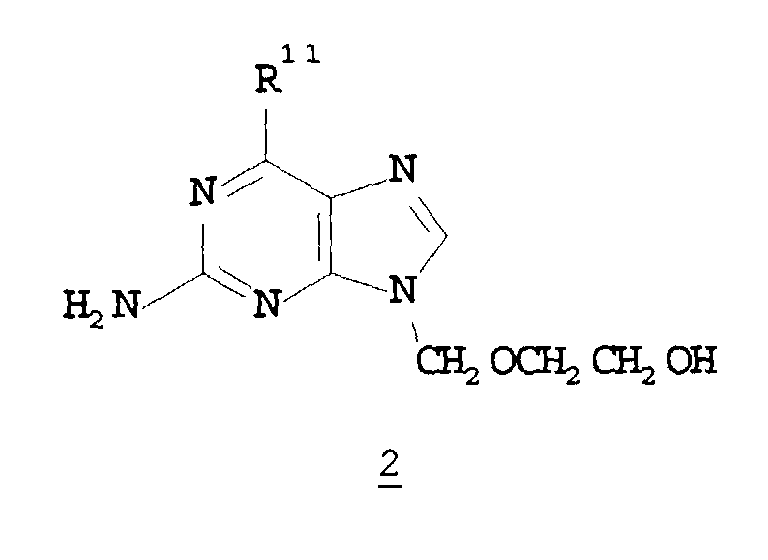
- A pharmaceutical composition of claim 6 wherein the nucleoside analog is a compound of formula 2wherein R11 is hydrogen, hydroxy or amino, or a therapeutically acceptable salt thereof.
- A pharmaceutical composition of claim 6 wherein the antiviral nucleoside analog is selected from the group of vidarabine, idoxuridine, trifluridine, ganciclovir, edoxudine, brovavir, fiacitabine, penciclovir, famciclovir and rociclovir.
- The use of an effective amount of a combination of an antiviral nucleoside analog, or a therapeutically acceptable salt thereof, and a ribonucleotide reductase inhibiting peptide of formula 1, or a therapeutically acceptable salt thereof for the preparation of a medicament for treating herpes viral infections in a mammal.
- The use of claim 9 for the preparation of a medicament for topical administration.
- The use of claim 9 wherein the antiviral nucleoside analog is selected from the group of acyclovir, 6-deoxyacylovir, 2,6-diamino-9-{(2-hydroxyethoxy)methyl)purine, vidarabine, idoxuridine, trifluridine, ganciclovir, edoxudine, brovavir, fiacitabine, penciclovir, famciclovir and rociclovir.
- The use of an effective amount of the pharmaceutical composition of claim 2 wherein the peptide of the composition is (PhCH2)2CHC(O)-(N-Me)-Val-Tbg-Asp(pyrrolidino)-Asp(cyPn)-γ-MeLeucinol for the preparation of a medicamant for treating herpes simplex virus type 1, or type 2, infections in a mammal.
- A process for preparing a peptide as defined
in claim 1, or a therapeutically acceptable salt thereof, comprising:a) stepwise coupling, in the order of the sequence of the peptide, of the amino acid or derived amino acid residues, and non-peptidic fragments of the peptide, in whichi) reactive side chain groups of the residue or fragments are protected with suitable protective groups to prevent chemical reactions from occurring at that site until the protective group is ultimately removed after the completion of the stepwise coupling;ii) an α-amino group of a coupling reactant is protected by an α-amino protective group while the free carboxy group of that reactant couples with the free α-amino group of the second reactant; the α-amino protective group being one which can be selectively removed to allow the subsequent coupling step to take place at that α-amino group; andiii) the C-terminal carboxyl of the amino acid residue of the amino acid residue or peptide fragment, which is to become the C-terminal function of the protected peptide, if present, is protected with a suitable protective group which will prevent chemical reaction occurring at that site until after the desired amino acid sequence for the peptide has been assembled; andb) at the completion of the coupling, eliminating any protecting groups and, if required, effecting standard transformations to obtain the peptide of claim 1; and if desired, converting the peptide into a therapeutically acceptable salt.
Applications Claiming Priority (2)
| Application Number | Priority Date | Filing Date | Title |
|---|---|---|---|
| US2554093A | 1993-03-03 | 1993-03-03 | |
| US25540 | 1993-03-03 |
Publications (2)
| Publication Number | Publication Date |
|---|---|
| EP0618226A1 EP0618226A1 (en) | 1994-10-05 |
| EP0618226B1 true EP0618226B1 (en) | 2000-11-29 |
Family
ID=21826675
Family Applications (1)
| Application Number | Title | Priority Date | Filing Date |
|---|---|---|---|
| EP94102680A Expired - Lifetime EP0618226B1 (en) | 1993-03-03 | 1994-02-23 | Inhibitors of herpes viral ribonculeotide reductase |
Country Status (27)
| Country | Link |
|---|---|
| US (1) | US5476841A (en) |
| EP (1) | EP0618226B1 (en) |
| JP (1) | JPH08507760A (en) |
| KR (1) | KR960701090A (en) |
| CN (1) | CN1118601A (en) |
| AT (1) | ATE197802T1 (en) |
| AU (1) | AU683450B2 (en) |
| BG (1) | BG99889A (en) |
| BR (1) | BR9406346A (en) |
| CA (1) | CA2157196C (en) |
| CZ (1) | CZ224295A3 (en) |
| DE (1) | DE69426337T2 (en) |
| DK (1) | DK0618226T3 (en) |
| ES (1) | ES2152269T3 (en) |
| FI (1) | FI954048A7 (en) |
| GR (1) | GR3035295T3 (en) |
| HU (1) | HUT72894A (en) |
| IL (1) | IL108818A0 (en) |
| LV (1) | LV11037B (en) |
| NO (1) | NO953437D0 (en) |
| NZ (1) | NZ262073A (en) |
| PL (1) | PL310447A1 (en) |
| PT (1) | PT618226E (en) |
| SG (1) | SG65553A1 (en) |
| SK (1) | SK106095A3 (en) |
| WO (1) | WO1994020528A1 (en) |
| ZA (1) | ZA941449B (en) |
Families Citing this family (7)
| Publication number | Priority date | Publication date | Assignee | Title |
|---|---|---|---|---|
| US5846941A (en) * | 1992-03-12 | 1998-12-08 | Boehringer Ingelheim (Canada) Ltd. | Isosteric antiherpes peptide derivatives II |
| US5830864A (en) * | 1992-03-12 | 1998-11-03 | Boehringer Ingelheim (Canada), Ltd. | Antiherpes peptide derivatives having a ureido n-terminus |
| CA2152541C (en) * | 1995-06-23 | 1998-12-15 | Boehringer Ingelheim (Canada) Ltd./ Boehringer Ingelheim (Canada) Ltee | Herpes ribonucleotide reductase inhibitors |
| US5948935A (en) * | 1997-01-23 | 1999-09-07 | Boehringer Ingelheim (Canada) Ltd. | Process and intermediates for (s)-α-amino-1-carboxycyclopentaneacetic acid |
| AU2005247319B2 (en) * | 2004-04-28 | 2011-12-01 | Molecules For Health, Inc. | Methods for treating or preventing restenosis and other vascular proliferative disorders |
| EP2030615A3 (en) * | 2007-08-13 | 2009-12-02 | ELFORD, Howard L. | Ribonucleotide reductase inhibitors for use in the treatment or prevention of neuroinflammatory or autoimmune diseases |
| EP4454650A4 (en) * | 2021-12-22 | 2025-10-22 | Cj Cheiljedang Corp | ANTIVIRAL COMPOSITION CONTAINING NUCLEOSIDE ANALOGUES DERIVED FROM NUCLEIC ACID AND PHARMACEUTICALLY ACCEPTABLE SALT THEREOF |
Family Cites Families (3)
| Publication number | Priority date | Publication date | Assignee | Title |
|---|---|---|---|---|
| EP0411334B1 (en) * | 1989-07-07 | 1995-02-22 | Bio-Mega/Boehringer Ingelheim Research Inc. | Antiherpes pentapeptide derivatives having a substituted aspartic acid side chain |
| JPH03181498A (en) * | 1989-12-07 | 1991-08-07 | Merck & Co Inc | Peptide antiviral agent |
| CA2033448C (en) * | 1990-12-31 | 1996-11-26 | Boehringer Ingelheim (Canada) Ltd./ Boehringer Ingelheim (Canada) Ltee | Antiherpes compositions and method of use |
-
1994
- 1994-02-23 SG SG1996002214A patent/SG65553A1/en unknown
- 1994-02-23 PT PT94102680T patent/PT618226E/en unknown
- 1994-02-23 ES ES94102680T patent/ES2152269T3/en not_active Expired - Lifetime
- 1994-02-23 DK DK94102680T patent/DK0618226T3/en active
- 1994-02-23 DE DE69426337T patent/DE69426337T2/en not_active Expired - Fee Related
- 1994-02-23 AT AT94102680T patent/ATE197802T1/en not_active IP Right Cessation
- 1994-02-23 EP EP94102680A patent/EP0618226B1/en not_active Expired - Lifetime
- 1994-02-28 PL PL94310447A patent/PL310447A1/en unknown
- 1994-02-28 WO PCT/CA1994/000106 patent/WO1994020528A1/en not_active Ceased
- 1994-02-28 CZ CZ952242A patent/CZ224295A3/en unknown
- 1994-02-28 CN CN94191343A patent/CN1118601A/en active Pending
- 1994-02-28 KR KR1019950703705A patent/KR960701090A/en not_active Withdrawn
- 1994-02-28 FI FI954048A patent/FI954048A7/en not_active Application Discontinuation
- 1994-02-28 US US08/203,086 patent/US5476841A/en not_active Expired - Fee Related
- 1994-02-28 CA CA002157196A patent/CA2157196C/en not_active Expired - Fee Related
- 1994-02-28 AU AU61516/94A patent/AU683450B2/en not_active Expired - Fee Related
- 1994-02-28 JP JP6519411A patent/JPH08507760A/en not_active Ceased
- 1994-02-28 BR BR9406346A patent/BR9406346A/en not_active Application Discontinuation
- 1994-02-28 HU HU9502570A patent/HUT72894A/en unknown
- 1994-02-28 NZ NZ262073A patent/NZ262073A/en unknown
- 1994-02-28 SK SK1060-95A patent/SK106095A3/en unknown
- 1994-03-02 ZA ZA941449A patent/ZA941449B/en unknown
- 1994-03-02 IL IL10881894A patent/IL108818A0/en unknown
-
1995
- 1995-08-28 BG BG99889A patent/BG99889A/en unknown
- 1995-09-01 NO NO953437A patent/NO953437D0/en unknown
- 1995-09-01 LV LVP-95-268A patent/LV11037B/en unknown
-
2001
- 2001-01-24 GR GR20010400109T patent/GR3035295T3/en not_active IP Right Cessation
Non-Patent Citations (3)
| Title |
|---|
| DATABASE PHARMAPROJECTS PJB PUBLICATIONS LTD; 1999, RICHMOND, SURREY, CD V2.1 * |
| FLEEGER: "USAN and the USP dictionary of drug names", U.S.PHARMACOPEIAL CONVENTION, ROCKVILLE, P.560 * |
| WINKLER E.A., ANTIVIRAL RESEARCH, vol. 14, 1990, ELSEVIER, pages 61 - 74 * |
Also Published As
| Publication number | Publication date |
|---|---|
| AU6151694A (en) | 1994-09-26 |
| FI954048L (en) | 1995-08-29 |
| KR960701090A (en) | 1996-02-24 |
| US5476841A (en) | 1995-12-19 |
| IL108818A0 (en) | 1994-06-24 |
| LV11037B (en) | 1996-06-20 |
| ES2152269T3 (en) | 2001-02-01 |
| PT618226E (en) | 2001-03-30 |
| CZ224295A3 (en) | 1996-02-14 |
| ATE197802T1 (en) | 2000-12-15 |
| HU9502570D0 (en) | 1995-11-28 |
| DE69426337T2 (en) | 2001-05-31 |
| BR9406346A (en) | 1996-02-21 |
| EP0618226A1 (en) | 1994-10-05 |
| AU683450B2 (en) | 1997-11-13 |
| JPH08507760A (en) | 1996-08-20 |
| BG99889A (en) | 1996-02-28 |
| FI954048A0 (en) | 1995-08-29 |
| ZA941449B (en) | 1994-10-14 |
| CN1118601A (en) | 1996-03-13 |
| CA2157196C (en) | 2000-06-13 |
| NO953437L (en) | 1995-09-01 |
| SK106095A3 (en) | 1996-02-07 |
| CA2157196A1 (en) | 1994-09-15 |
| GR3035295T3 (en) | 2001-04-30 |
| FI954048A7 (en) | 1995-08-29 |
| PL310447A1 (en) | 1995-12-11 |
| WO1994020528A1 (en) | 1994-09-15 |
| NZ262073A (en) | 1997-07-27 |
| HUT72894A (en) | 1996-06-28 |
| NO953437D0 (en) | 1995-09-01 |
| DK0618226T3 (en) | 2000-12-27 |
| SG65553A1 (en) | 1999-06-22 |
| LV11037A (en) | 1996-02-20 |
| DE69426337D1 (en) | 2001-01-04 |
Similar Documents
| Publication | Publication Date | Title |
|---|---|---|
| US5484771A (en) | Antiherpes peptide derivatives having a 1,4-dioxo-C, N-terminus | |
| EP0493767B1 (en) | Synergistic combination for treating herpes infections | |
| AU683450B2 (en) | Inhibitors of herpes viral ribonucleotide reductase | |
| EP0560267B1 (en) | Isosteric antiherpes peptide derivatives | |
| EP0493770A2 (en) | Antiherpes compositions | |
| AU683465B2 (en) | Method of combating acyclovir-resistant herpes simplex viral infections | |
| EP0560274B1 (en) | Antiherpes peptide derivatives having a ureido N-terminus | |
| US5574015A (en) | Isosteric antiherpes peptide derivatives | |
| US5830864A (en) | Antiherpes peptide derivatives having a ureido n-terminus | |
| AU671825C (en) | Isosteric antiherpes peptide derivatives | |
| EP0800512B1 (en) | Antiherpes peptidomimetic compounds | |
| EP0837845B1 (en) | Herpes ribonucleotide reductase inhibitors | |
| MXPA97010147A (en) | Inhibitors of the ribonucleotido-reductasa deher |
Legal Events
| Date | Code | Title | Description |
|---|---|---|---|
| PUAI | Public reference made under article 153(3) epc to a published international application that has entered the european phase |
Free format text: ORIGINAL CODE: 0009012 |
|
| 17P | Request for examination filed |
Effective date: 19940603 |
|
| AK | Designated contracting states |
Kind code of ref document: A1 Designated state(s): AT BE CH DE DK ES FR GB GR IE IT LI LU MC NL PT SE |
|
| 17Q | First examination report despatched |
Effective date: 19960514 |
|
| RAP1 | Party data changed (applicant data changed or rights of an application transferred) |
Owner name: BOEHRINGER INGELHEIM (CANADA) LTD. |
|
| GRAG | Despatch of communication of intention to grant |
Free format text: ORIGINAL CODE: EPIDOS AGRA |
|
| RIC1 | Information provided on ipc code assigned before grant |
Free format text: 7C 07K 5/103 A, 7C 07K 7/06 B, 7A 61K 38/07 B, 7A 61K 38/08 B |
|
| 17Q | First examination report despatched |
Effective date: 19960514 |
|
| RIC1 | Information provided on ipc code assigned before grant |
Free format text: 7C 07K 5/103 A, 7C 07K 7/06 B, 7A 61K 38/07 B, 7A 61K 38/08 B, 7A 61K 7/48 B, 7A 61P 31/22 B |
|
| GRAG | Despatch of communication of intention to grant |
Free format text: ORIGINAL CODE: EPIDOS AGRA |
|
| GRAH | Despatch of communication of intention to grant a patent |
Free format text: ORIGINAL CODE: EPIDOS IGRA |
|
| GRAH | Despatch of communication of intention to grant a patent |
Free format text: ORIGINAL CODE: EPIDOS IGRA |
|
| GRAA | (expected) grant |
Free format text: ORIGINAL CODE: 0009210 |
|
| AK | Designated contracting states |
Kind code of ref document: B1 Designated state(s): AT BE CH DE DK ES FR GB GR IE IT LI LU MC NL PT SE |
|
| REF | Corresponds to: |
Ref document number: 197802 Country of ref document: AT Date of ref document: 20001215 Kind code of ref document: T |
|
| REG | Reference to a national code |
Ref country code: CH Ref legal event code: EP |
|
| REG | Reference to a national code |
Ref country code: DK Ref legal event code: T3 |
|
| REF | Corresponds to: |
Ref document number: 69426337 Country of ref document: DE Date of ref document: 20010104 |
|
| REG | Reference to a national code |
Ref country code: IE Ref legal event code: FG4D |
|
| REG | Reference to a national code |
Ref country code: CH Ref legal event code: NV Representative=s name: SCHMAUDER & PARTNER AG PATENTANWALTSBUERO |
|
| REG | Reference to a national code |
Ref country code: ES Ref legal event code: FG2A Ref document number: 2152269 Country of ref document: ES Kind code of ref document: T3 |
|
| REG | Reference to a national code |
Ref country code: IE Ref legal event code: FG4D |
|
| ITF | It: translation for a ep patent filed | ||
| ET | Fr: translation filed | ||
| REG | Reference to a national code |
Ref country code: PT Ref legal event code: SC4A Free format text: AVAILABILITY OF NATIONAL TRANSLATION Effective date: 20001130 |
|
| PLBE | No opposition filed within time limit |
Free format text: ORIGINAL CODE: 0009261 |
|
| STAA | Information on the status of an ep patent application or granted ep patent |
Free format text: STATUS: NO OPPOSITION FILED WITHIN TIME LIMIT |
|
| 26N | No opposition filed | ||
| REG | Reference to a national code |
Ref country code: GB Ref legal event code: IF02 |
|
| PGFP | Annual fee paid to national office [announced via postgrant information from national office to epo] |
Ref country code: GB Payment date: 20020115 Year of fee payment: 9 |
|
| PGFP | Annual fee paid to national office [announced via postgrant information from national office to epo] |
Ref country code: CH Payment date: 20020117 Year of fee payment: 9 Ref country code: MC Payment date: 20020117 Year of fee payment: 9 |
|
| PGFP | Annual fee paid to national office [announced via postgrant information from national office to epo] |
Ref country code: IE Payment date: 20020121 Year of fee payment: 9 |
|
| PGFP | Annual fee paid to national office [announced via postgrant information from national office to epo] |
Ref country code: PT Payment date: 20020123 Year of fee payment: 9 |
|
| PGFP | Annual fee paid to national office [announced via postgrant information from national office to epo] |
Ref country code: LU Payment date: 20020128 Year of fee payment: 9 |
|
| PGFP | Annual fee paid to national office [announced via postgrant information from national office to epo] |
Ref country code: NL Payment date: 20020129 Year of fee payment: 9 Ref country code: AT Payment date: 20020129 Year of fee payment: 9 |
|
| PGFP | Annual fee paid to national office [announced via postgrant information from national office to epo] |
Ref country code: GR Payment date: 20020131 Year of fee payment: 9 |
|
| PGFP | Annual fee paid to national office [announced via postgrant information from national office to epo] |
Ref country code: SE Payment date: 20020204 Year of fee payment: 9 Ref country code: DK Payment date: 20020204 Year of fee payment: 9 |
|
| PGFP | Annual fee paid to national office [announced via postgrant information from national office to epo] |
Ref country code: DE Payment date: 20020207 Year of fee payment: 9 Ref country code: FR Payment date: 20020207 Year of fee payment: 9 |
|
| PGFP | Annual fee paid to national office [announced via postgrant information from national office to epo] |
Ref country code: ES Payment date: 20020214 Year of fee payment: 9 |
|
| PGFP | Annual fee paid to national office [announced via postgrant information from national office to epo] |
Ref country code: BE Payment date: 20020227 Year of fee payment: 9 |
|
| PG25 | Lapsed in a contracting state [announced via postgrant information from national office to epo] |
Ref country code: LU Free format text: LAPSE BECAUSE OF NON-PAYMENT OF DUE FEES Effective date: 20030223 Ref country code: GB Free format text: LAPSE BECAUSE OF NON-PAYMENT OF DUE FEES Effective date: 20030223 Ref country code: AT Free format text: LAPSE BECAUSE OF NON-PAYMENT OF DUE FEES Effective date: 20030223 |
|
| PG25 | Lapsed in a contracting state [announced via postgrant information from national office to epo] |
Ref country code: SE Free format text: LAPSE BECAUSE OF NON-PAYMENT OF DUE FEES Effective date: 20030224 Ref country code: IE Free format text: LAPSE BECAUSE OF NON-PAYMENT OF DUE FEES Effective date: 20030224 Ref country code: ES Free format text: LAPSE BECAUSE OF NON-PAYMENT OF DUE FEES Effective date: 20030224 |
|
| PG25 | Lapsed in a contracting state [announced via postgrant information from national office to epo] |
Ref country code: MC Free format text: LAPSE BECAUSE OF NON-PAYMENT OF DUE FEES Effective date: 20030228 Ref country code: LI Free format text: LAPSE BECAUSE OF NON-PAYMENT OF DUE FEES Effective date: 20030228 Ref country code: DK Free format text: LAPSE BECAUSE OF NON-PAYMENT OF DUE FEES Effective date: 20030228 Ref country code: CH Free format text: LAPSE BECAUSE OF NON-PAYMENT OF DUE FEES Effective date: 20030228 Ref country code: BE Free format text: LAPSE BECAUSE OF NON-PAYMENT OF DUE FEES Effective date: 20030228 |
|
| PG25 | Lapsed in a contracting state [announced via postgrant information from national office to epo] |
Ref country code: PT Free format text: LAPSE BECAUSE OF NON-PAYMENT OF DUE FEES Effective date: 20030831 |
|
| PG25 | Lapsed in a contracting state [announced via postgrant information from national office to epo] |
Ref country code: NL Free format text: LAPSE BECAUSE OF NON-PAYMENT OF DUE FEES Effective date: 20030901 |
|
| PG25 | Lapsed in a contracting state [announced via postgrant information from national office to epo] |
Ref country code: DE Free format text: LAPSE BECAUSE OF NON-PAYMENT OF DUE FEES Effective date: 20030902 |
|
| PG25 | Lapsed in a contracting state [announced via postgrant information from national office to epo] |
Ref country code: GR Free format text: LAPSE BECAUSE OF NON-PAYMENT OF DUE FEES Effective date: 20030904 |
|
| REG | Reference to a national code |
Ref country code: DK Ref legal event code: EBP |
|
| EUG | Se: european patent has lapsed | ||
| GBPC | Gb: european patent ceased through non-payment of renewal fee | ||
| REG | Reference to a national code |
Ref country code: CH Ref legal event code: PL |
|
| PG25 | Lapsed in a contracting state [announced via postgrant information from national office to epo] |
Ref country code: FR Free format text: LAPSE BECAUSE OF NON-PAYMENT OF DUE FEES Effective date: 20031031 |
|
| NLV4 | Nl: lapsed or anulled due to non-payment of the annual fee |
Effective date: 20030901 |
|
| REG | Reference to a national code |
Ref country code: FR Ref legal event code: ST |
|
| REG | Reference to a national code |
Ref country code: IE Ref legal event code: MM4A |
|
| REG | Reference to a national code |
Ref country code: ES Ref legal event code: FD2A Effective date: 20030224 |
|
| PG25 | Lapsed in a contracting state [announced via postgrant information from national office to epo] |
Ref country code: IT Free format text: LAPSE BECAUSE OF NON-PAYMENT OF DUE FEES Effective date: 20050223 |