EP0617711B1 - A halogen-free acrylic urethane sheet material - Google Patents
A halogen-free acrylic urethane sheet material Download PDFInfo
- Publication number
- EP0617711B1 EP0617711B1 EP92925103A EP92925103A EP0617711B1 EP 0617711 B1 EP0617711 B1 EP 0617711B1 EP 92925103 A EP92925103 A EP 92925103A EP 92925103 A EP92925103 A EP 92925103A EP 0617711 B1 EP0617711 B1 EP 0617711B1
- Authority
- EP
- European Patent Office
- Prior art keywords
- sheet material
- layer
- component
- halogen
- acrylic urethane
- Prior art date
- Legal status (The legal status is an assumption and is not a legal conclusion. Google has not performed a legal analysis and makes no representation as to the accuracy of the status listed.)
- Expired - Lifetime
Links
- 239000000463 material Substances 0.000 title claims abstract description 129
- NIXOWILDQLNWCW-UHFFFAOYSA-N acrylic acid group Chemical group C(C=C)(=O)O NIXOWILDQLNWCW-UHFFFAOYSA-N 0.000 title claims abstract description 44
- JOYRKODLDBILNP-UHFFFAOYSA-N Ethyl urethane Chemical compound CCOC(N)=O JOYRKODLDBILNP-UHFFFAOYSA-N 0.000 title claims abstract description 41
- 238000000034 method Methods 0.000 claims abstract description 56
- 229920000642 polymer Polymers 0.000 claims abstract description 22
- 238000007639 printing Methods 0.000 claims abstract description 21
- 230000005855 radiation Effects 0.000 claims abstract description 18
- 125000004432 carbon atom Chemical group C* 0.000 claims abstract description 15
- 239000000178 monomer Substances 0.000 claims abstract description 14
- SMZOUWXMTYCWNB-UHFFFAOYSA-N 2-(2-methoxy-5-methylphenyl)ethanamine Chemical compound COC1=CC=C(C)C=C1CCN SMZOUWXMTYCWNB-UHFFFAOYSA-N 0.000 claims abstract description 13
- CERQOIWHTDAKMF-UHFFFAOYSA-N Methacrylic acid Chemical compound CC(=C)C(O)=O CERQOIWHTDAKMF-UHFFFAOYSA-N 0.000 claims abstract description 12
- 239000012948 isocyanate Substances 0.000 claims abstract description 11
- 150000002513 isocyanates Chemical class 0.000 claims abstract description 11
- 150000002009 diols Chemical class 0.000 claims abstract description 10
- DNIAPMSPPWPWGF-GSVOUGTGSA-N (R)-(-)-Propylene glycol Chemical compound C[C@@H](O)CO DNIAPMSPPWPWGF-GSVOUGTGSA-N 0.000 claims abstract description 8
- 229920001577 copolymer Polymers 0.000 claims abstract description 8
- 150000002148 esters Chemical class 0.000 claims abstract description 8
- PUPZLCDOIYMWBV-UHFFFAOYSA-N (+/-)-1,3-Butanediol Chemical compound CC(O)CCO PUPZLCDOIYMWBV-UHFFFAOYSA-N 0.000 claims abstract description 6
- WHNWPMSKXPGLAX-UHFFFAOYSA-N N-Vinyl-2-pyrrolidone Chemical compound C=CN1CCCC1=O WHNWPMSKXPGLAX-UHFFFAOYSA-N 0.000 claims abstract description 6
- 229920003232 aliphatic polyester Polymers 0.000 claims abstract description 6
- 229920002554 vinyl polymer Polymers 0.000 claims abstract description 3
- 239000010410 layer Substances 0.000 claims description 169
- 239000000203 mixture Substances 0.000 claims description 48
- 239000000853 adhesive Substances 0.000 claims description 27
- 230000001070 adhesive effect Effects 0.000 claims description 24
- 239000004820 Pressure-sensitive adhesive Substances 0.000 claims description 18
- 238000000576 coating method Methods 0.000 claims description 18
- 239000011248 coating agent Substances 0.000 claims description 16
- 230000001681 protective effect Effects 0.000 claims description 15
- 239000003795 chemical substances by application Substances 0.000 claims description 14
- 238000001035 drying Methods 0.000 claims description 13
- 239000002356 single layer Substances 0.000 claims description 13
- 238000005266 casting Methods 0.000 claims description 12
- 239000003086 colorant Substances 0.000 claims description 11
- 238000004519 manufacturing process Methods 0.000 claims description 11
- 230000008569 process Effects 0.000 claims description 11
- 239000000126 substance Substances 0.000 claims description 11
- 239000002562 thickening agent Substances 0.000 claims description 10
- 230000037452 priming Effects 0.000 claims description 7
- RRAMGCGOFNQTLD-UHFFFAOYSA-N hexamethylene diisocyanate Chemical compound O=C=NCCCCCCN=C=O RRAMGCGOFNQTLD-UHFFFAOYSA-N 0.000 claims description 6
- 229940008841 1,6-hexamethylene diisocyanate Drugs 0.000 claims description 5
- 238000003851 corona treatment Methods 0.000 claims description 3
- WHIVNJATOVLWBW-SNAWJCMRSA-N methylethyl ketone oxime Chemical compound CC\C(C)=N\O WHIVNJATOVLWBW-SNAWJCMRSA-N 0.000 claims description 3
- 238000002156 mixing Methods 0.000 claims description 3
- 238000005507 spraying Methods 0.000 claims description 3
- 239000000539 dimer Substances 0.000 claims description 2
- 238000010030 laminating Methods 0.000 claims description 2
- 238000000053 physical method Methods 0.000 claims description 2
- 238000001029 thermal curing Methods 0.000 claims description 2
- 125000003011 styrenyl group Chemical group [H]\C(*)=C(/[H])C1=C([H])C([H])=C([H])C([H])=C1[H] 0.000 claims 1
- 229920005862 polyol Polymers 0.000 description 15
- -1 polysiloxane Polymers 0.000 description 15
- 239000012790 adhesive layer Substances 0.000 description 14
- 239000000049 pigment Substances 0.000 description 13
- GWEVSGVZZGPLCZ-UHFFFAOYSA-N Titan oxide Chemical compound O=[Ti]=O GWEVSGVZZGPLCZ-UHFFFAOYSA-N 0.000 description 12
- 238000001723 curing Methods 0.000 description 10
- 239000002904 solvent Substances 0.000 description 10
- YXFVVABEGXRONW-UHFFFAOYSA-N Toluene Chemical compound CC1=CC=CC=C1 YXFVVABEGXRONW-UHFFFAOYSA-N 0.000 description 9
- 238000005299 abrasion Methods 0.000 description 9
- 239000004014 plasticizer Substances 0.000 description 8
- 229920000915 polyvinyl chloride Polymers 0.000 description 8
- 239000004800 polyvinyl chloride Substances 0.000 description 8
- 238000007650 screen-printing Methods 0.000 description 8
- PPBRXRYQALVLMV-UHFFFAOYSA-N Styrene Chemical compound C=CC1=CC=CC=C1 PPBRXRYQALVLMV-UHFFFAOYSA-N 0.000 description 7
- 239000003054 catalyst Substances 0.000 description 7
- 229920006255 plastic film Polymers 0.000 description 7
- 239000002985 plastic film Substances 0.000 description 7
- 229920000728 polyester Polymers 0.000 description 7
- 150000003077 polyols Chemical class 0.000 description 7
- 238000012360 testing method Methods 0.000 description 7
- OZAIFHULBGXAKX-UHFFFAOYSA-N 2-(2-cyanopropan-2-yldiazenyl)-2-methylpropanenitrile Chemical compound N#CC(C)(C)N=NC(C)(C)C#N OZAIFHULBGXAKX-UHFFFAOYSA-N 0.000 description 6
- 238000010330 laser marking Methods 0.000 description 6
- 238000002360 preparation method Methods 0.000 description 6
- NIXOWILDQLNWCW-UHFFFAOYSA-M Acrylate Chemical compound [O-]C(=O)C=C NIXOWILDQLNWCW-UHFFFAOYSA-M 0.000 description 5
- OKTJSMMVPCPJKN-UHFFFAOYSA-N Carbon Chemical compound [C] OKTJSMMVPCPJKN-UHFFFAOYSA-N 0.000 description 5
- 150000001875 compounds Chemical class 0.000 description 5
- 239000000975 dye Substances 0.000 description 5
- 239000000976 ink Substances 0.000 description 5
- 239000004814 polyurethane Substances 0.000 description 5
- 229920002635 polyurethane Polymers 0.000 description 5
- XFXPMWWXUTWYJX-UHFFFAOYSA-N Cyanide Chemical compound N#[C-] XFXPMWWXUTWYJX-UHFFFAOYSA-N 0.000 description 4
- VVQNEPGJFQJSBK-UHFFFAOYSA-N Methyl methacrylate Chemical compound COC(=O)C(C)=C VVQNEPGJFQJSBK-UHFFFAOYSA-N 0.000 description 4
- 229920012485 Plasticized Polyvinyl chloride Polymers 0.000 description 4
- BQCADISMDOOEFD-UHFFFAOYSA-N Silver Chemical compound [Ag] BQCADISMDOOEFD-UHFFFAOYSA-N 0.000 description 4
- UKLDJPRMSDWDSL-UHFFFAOYSA-L [dibutyl(dodecanoyloxy)stannyl] dodecanoate Chemical compound CCCCCCCCCCCC(=O)O[Sn](CCCC)(CCCC)OC(=O)CCCCCCCCCCC UKLDJPRMSDWDSL-UHFFFAOYSA-L 0.000 description 4
- 229910052782 aluminium Inorganic materials 0.000 description 4
- XAGFODPZIPBFFR-UHFFFAOYSA-N aluminium Chemical compound [Al] XAGFODPZIPBFFR-UHFFFAOYSA-N 0.000 description 4
- 239000006229 carbon black Substances 0.000 description 4
- 238000006243 chemical reaction Methods 0.000 description 4
- 239000002131 composite material Substances 0.000 description 4
- 239000012975 dibutyltin dilaurate Substances 0.000 description 4
- 239000000945 filler Substances 0.000 description 4
- 230000009477 glass transition Effects 0.000 description 4
- 150000002527 isonitriles Chemical group 0.000 description 4
- 239000003960 organic solvent Substances 0.000 description 4
- 239000002245 particle Substances 0.000 description 4
- 229920000058 polyacrylate Polymers 0.000 description 4
- 229920001296 polysiloxane Polymers 0.000 description 4
- 229910052709 silver Inorganic materials 0.000 description 4
- 239000004332 silver Substances 0.000 description 4
- ZWEHNKRNPOVVGH-UHFFFAOYSA-N 2-Butanone Chemical compound CCC(C)=O ZWEHNKRNPOVVGH-UHFFFAOYSA-N 0.000 description 3
- VHSHLMUCYSAUQU-UHFFFAOYSA-N 2-hydroxypropyl methacrylate Chemical compound CC(O)COC(=O)C(C)=C VHSHLMUCYSAUQU-UHFFFAOYSA-N 0.000 description 3
- DXPPIEDUBFUSEZ-UHFFFAOYSA-N 6-methylheptyl prop-2-enoate Chemical compound CC(C)CCCCCOC(=O)C=C DXPPIEDUBFUSEZ-UHFFFAOYSA-N 0.000 description 3
- LYCAIKOWRPUZTN-UHFFFAOYSA-N Ethylene glycol Chemical compound OCCO LYCAIKOWRPUZTN-UHFFFAOYSA-N 0.000 description 3
- PEDCQBHIVMGVHV-UHFFFAOYSA-N Glycerine Chemical compound OCC(O)CO PEDCQBHIVMGVHV-UHFFFAOYSA-N 0.000 description 3
- 239000004721 Polyphenylene oxide Substances 0.000 description 3
- DNIAPMSPPWPWGF-UHFFFAOYSA-N Propylene glycol Chemical compound CC(O)CO DNIAPMSPPWPWGF-UHFFFAOYSA-N 0.000 description 3
- VYPSYNLAJGMNEJ-UHFFFAOYSA-N Silicium dioxide Chemical compound O=[Si]=O VYPSYNLAJGMNEJ-UHFFFAOYSA-N 0.000 description 3
- 239000002253 acid Substances 0.000 description 3
- 125000001931 aliphatic group Chemical group 0.000 description 3
- 230000008901 benefit Effects 0.000 description 3
- 239000002981 blocking agent Substances 0.000 description 3
- 238000004040 coloring Methods 0.000 description 3
- 239000003431 cross linking reagent Substances 0.000 description 3
- 238000011156 evaluation Methods 0.000 description 3
- 239000007789 gas Substances 0.000 description 3
- 239000001023 inorganic pigment Substances 0.000 description 3
- 239000004922 lacquer Substances 0.000 description 3
- 239000000123 paper Substances 0.000 description 3
- 229920000570 polyether Polymers 0.000 description 3
- 238000006116 polymerization reaction Methods 0.000 description 3
- 229920000098 polyolefin Polymers 0.000 description 3
- 229920005989 resin Polymers 0.000 description 3
- 239000011347 resin Substances 0.000 description 3
- 238000010345 tape casting Methods 0.000 description 3
- 239000004408 titanium dioxide Substances 0.000 description 3
- 238000009834 vaporization Methods 0.000 description 3
- 230000008016 vaporization Effects 0.000 description 3
- IAXXETNIOYFMLW-UHFFFAOYSA-N (4,7,7-trimethyl-3-bicyclo[2.2.1]heptanyl) 2-methylprop-2-enoate Chemical compound C1CC2(C)C(OC(=O)C(=C)C)CC1C2(C)C IAXXETNIOYFMLW-UHFFFAOYSA-N 0.000 description 2
- AXFVIWBTKYFOCY-UHFFFAOYSA-N 1-n,1-n,3-n,3-n-tetramethylbutane-1,3-diamine Chemical compound CN(C)C(C)CCN(C)C AXFVIWBTKYFOCY-UHFFFAOYSA-N 0.000 description 2
- OMIGHNLMNHATMP-UHFFFAOYSA-N 2-hydroxyethyl prop-2-enoate Chemical compound OCCOC(=O)C=C OMIGHNLMNHATMP-UHFFFAOYSA-N 0.000 description 2
- RUMACXVDVNRZJZ-UHFFFAOYSA-N 2-methylpropyl 2-methylprop-2-enoate Chemical compound CC(C)COC(=O)C(C)=C RUMACXVDVNRZJZ-UHFFFAOYSA-N 0.000 description 2
- QZPSOSOOLFHYRR-UHFFFAOYSA-N 3-hydroxypropyl prop-2-enoate Chemical compound OCCCOC(=O)C=C QZPSOSOOLFHYRR-UHFFFAOYSA-N 0.000 description 2
- 229910002012 Aerosil® Inorganic materials 0.000 description 2
- IJGRMHOSHXDMSA-UHFFFAOYSA-N Atomic nitrogen Chemical compound N#N IJGRMHOSHXDMSA-UHFFFAOYSA-N 0.000 description 2
- SOGAXMICEFXMKE-UHFFFAOYSA-N Butylmethacrylate Chemical compound CCCCOC(=O)C(C)=C SOGAXMICEFXMKE-UHFFFAOYSA-N 0.000 description 2
- VTYYLEPIZMXCLO-UHFFFAOYSA-L Calcium carbonate Chemical compound [Ca+2].[O-]C([O-])=O VTYYLEPIZMXCLO-UHFFFAOYSA-L 0.000 description 2
- LFQSCWFLJHTTHZ-UHFFFAOYSA-N Ethanol Chemical compound CCO LFQSCWFLJHTTHZ-UHFFFAOYSA-N 0.000 description 2
- BAPJBEWLBFYGME-UHFFFAOYSA-N Methyl acrylate Chemical compound COC(=O)C=C BAPJBEWLBFYGME-UHFFFAOYSA-N 0.000 description 2
- 239000004952 Polyamide Substances 0.000 description 2
- 239000004698 Polyethylene Substances 0.000 description 2
- 239000004793 Polystyrene Substances 0.000 description 2
- WYURNTSHIVDZCO-UHFFFAOYSA-N Tetrahydrofuran Chemical compound C1CCOC1 WYURNTSHIVDZCO-UHFFFAOYSA-N 0.000 description 2
- RTAQQCXQSZGOHL-UHFFFAOYSA-N Titanium Chemical compound [Ti] RTAQQCXQSZGOHL-UHFFFAOYSA-N 0.000 description 2
- 150000008065 acid anhydrides Chemical class 0.000 description 2
- WNLRTRBMVRJNCN-UHFFFAOYSA-N adipic acid Chemical compound OC(=O)CCCCC(O)=O WNLRTRBMVRJNCN-UHFFFAOYSA-N 0.000 description 2
- 150000001298 alcohols Chemical class 0.000 description 2
- 125000000217 alkyl group Chemical group 0.000 description 2
- CQEYYJKEWSMYFG-UHFFFAOYSA-N butyl acrylate Chemical compound CCCCOC(=O)C=C CQEYYJKEWSMYFG-UHFFFAOYSA-N 0.000 description 2
- 239000006227 byproduct Substances 0.000 description 2
- 238000012512 characterization method Methods 0.000 description 2
- 238000010276 construction Methods 0.000 description 2
- 230000006378 damage Effects 0.000 description 2
- 230000007547 defect Effects 0.000 description 2
- LSXWFXONGKSEMY-UHFFFAOYSA-N di-tert-butyl peroxide Chemical compound CC(C)(C)OOC(C)(C)C LSXWFXONGKSEMY-UHFFFAOYSA-N 0.000 description 2
- 125000005442 diisocyanate group Chemical group 0.000 description 2
- 238000009826 distribution Methods 0.000 description 2
- 229920001971 elastomer Polymers 0.000 description 2
- 239000000839 emulsion Substances 0.000 description 2
- SUPCQIBBMFXVTL-UHFFFAOYSA-N ethyl 2-methylprop-2-enoate Chemical compound CCOC(=O)C(C)=C SUPCQIBBMFXVTL-UHFFFAOYSA-N 0.000 description 2
- 238000001125 extrusion Methods 0.000 description 2
- 229910021485 fumed silica Inorganic materials 0.000 description 2
- 229910052736 halogen Inorganic materials 0.000 description 2
- 150000002367 halogens Chemical class 0.000 description 2
- 238000010438 heat treatment Methods 0.000 description 2
- 230000002209 hydrophobic effect Effects 0.000 description 2
- 239000003999 initiator Substances 0.000 description 2
- 125000005395 methacrylic acid group Chemical class 0.000 description 2
- 238000013508 migration Methods 0.000 description 2
- 230000005012 migration Effects 0.000 description 2
- 125000000962 organic group Chemical group 0.000 description 2
- 239000012860 organic pigment Substances 0.000 description 2
- 229920003023 plastic Polymers 0.000 description 2
- 239000004033 plastic Substances 0.000 description 2
- 229920002647 polyamide Polymers 0.000 description 2
- 229920005906 polyester polyol Polymers 0.000 description 2
- 229920000573 polyethylene Polymers 0.000 description 2
- 239000005056 polyisocyanate Substances 0.000 description 2
- 229920001228 polyisocyanate Polymers 0.000 description 2
- 239000002685 polymerization catalyst Substances 0.000 description 2
- 239000003505 polymerization initiator Substances 0.000 description 2
- 229920002223 polystyrene Polymers 0.000 description 2
- 239000000047 product Substances 0.000 description 2
- 238000003847 radiation curing Methods 0.000 description 2
- 239000005060 rubber Substances 0.000 description 2
- CXMXRPHRNRROMY-UHFFFAOYSA-N sebacic acid Chemical compound OC(=O)CCCCCCCCC(O)=O CXMXRPHRNRROMY-UHFFFAOYSA-N 0.000 description 2
- 238000001228 spectrum Methods 0.000 description 2
- 150000003440 styrenes Chemical class 0.000 description 2
- 229920003002 synthetic resin Polymers 0.000 description 2
- 239000000057 synthetic resin Substances 0.000 description 2
- DJKGDNKYTKCJKD-BPOCMEKLSA-N (1s,4r,5s,6r)-1,2,3,4,7,7-hexachlorobicyclo[2.2.1]hept-2-ene-5,6-dicarboxylic acid Chemical compound ClC1=C(Cl)[C@]2(Cl)[C@H](C(=O)O)[C@H](C(O)=O)[C@@]1(Cl)C2(Cl)Cl DJKGDNKYTKCJKD-BPOCMEKLSA-N 0.000 description 1
- UOCLXMDMGBRAIB-UHFFFAOYSA-N 1,1,1-trichloroethane Chemical compound CC(Cl)(Cl)Cl UOCLXMDMGBRAIB-UHFFFAOYSA-N 0.000 description 1
- ZMARGGQEAJXRFP-UHFFFAOYSA-N 1-hydroxypropan-2-yl 2-methylprop-2-enoate Chemical compound OCC(C)OC(=O)C(C)=C ZMARGGQEAJXRFP-UHFFFAOYSA-N 0.000 description 1
- UXYMHGCNVRUGNO-UHFFFAOYSA-N 1-hydroxypropan-2-yl prop-2-enoate Chemical compound OCC(C)OC(=O)C=C UXYMHGCNVRUGNO-UHFFFAOYSA-N 0.000 description 1
- KGIQLJGQHJOITE-UHFFFAOYSA-N 1-isocyano-4-[(4-isocyanocyclohexyl)methyl]cyclohexane Chemical compound C1CC([N+]#[C-])CCC1CC1CCC([N+]#[C-])CC1 KGIQLJGQHJOITE-UHFFFAOYSA-N 0.000 description 1
- RTBFRGCFXZNCOE-UHFFFAOYSA-N 1-methylsulfonylpiperidin-4-one Chemical compound CS(=O)(=O)N1CCC(=O)CC1 RTBFRGCFXZNCOE-UHFFFAOYSA-N 0.000 description 1
- VOBUAPTXJKMNCT-UHFFFAOYSA-N 1-prop-2-enoyloxyhexyl prop-2-enoate Chemical compound CCCCCC(OC(=O)C=C)OC(=O)C=C VOBUAPTXJKMNCT-UHFFFAOYSA-N 0.000 description 1
- HBKBEZURJSNABK-MWJPAGEPSA-N 2,3-dihydroxypropyl (1r,4ar,4br,10ar)-1,4a-dimethyl-7-propan-2-yl-2,3,4,4b,5,6,10,10a-octahydrophenanthrene-1-carboxylate Chemical compound C([C@@H]12)CC(C(C)C)=CC1=CC[C@@H]1[C@]2(C)CCC[C@@]1(C)C(=O)OCC(O)CO HBKBEZURJSNABK-MWJPAGEPSA-N 0.000 description 1
- GOXQRTZXKQZDDN-UHFFFAOYSA-N 2-Ethylhexyl acrylate Chemical compound CCCCC(CC)COC(=O)C=C GOXQRTZXKQZDDN-UHFFFAOYSA-N 0.000 description 1
- WDQMWEYDKDCEHT-UHFFFAOYSA-N 2-ethylhexyl 2-methylprop-2-enoate Chemical compound CCCCC(CC)COC(=O)C(C)=C WDQMWEYDKDCEHT-UHFFFAOYSA-N 0.000 description 1
- IEVADDDOVGMCSI-UHFFFAOYSA-N 2-hydroxybutyl 2-methylprop-2-enoate Chemical compound CCC(O)COC(=O)C(C)=C IEVADDDOVGMCSI-UHFFFAOYSA-N 0.000 description 1
- NJRHMGPRPPEGQL-UHFFFAOYSA-N 2-hydroxybutyl prop-2-enoate Chemical compound CCC(O)COC(=O)C=C NJRHMGPRPPEGQL-UHFFFAOYSA-N 0.000 description 1
- GWZMWHWAWHPNHN-UHFFFAOYSA-N 2-hydroxypropyl prop-2-enoate Chemical compound CC(O)COC(=O)C=C GWZMWHWAWHPNHN-UHFFFAOYSA-N 0.000 description 1
- CFVWNXQPGQOHRJ-UHFFFAOYSA-N 2-methylpropyl prop-2-enoate Chemical compound CC(C)COC(=O)C=C CFVWNXQPGQOHRJ-UHFFFAOYSA-N 0.000 description 1
- VDHWOHDSOHPGPC-UHFFFAOYSA-N 3,3-dihydroxyoxepan-2-one Chemical compound OC1(O)CCCCOC1=O VDHWOHDSOHPGPC-UHFFFAOYSA-N 0.000 description 1
- JFEXPVDGVLNUSC-UHFFFAOYSA-N 3-(3-aminophenyl)sulfanylaniline Chemical compound NC1=CC=CC(SC=2C=C(N)C=CC=2)=C1 JFEXPVDGVLNUSC-UHFFFAOYSA-N 0.000 description 1
- GNSFRPWPOGYVLO-UHFFFAOYSA-N 3-hydroxypropyl 2-methylprop-2-enoate Chemical compound CC(=C)C(=O)OCCCO GNSFRPWPOGYVLO-UHFFFAOYSA-N 0.000 description 1
- NDWUBGAGUCISDV-UHFFFAOYSA-N 4-hydroxybutyl prop-2-enoate Chemical compound OCCCCOC(=O)C=C NDWUBGAGUCISDV-UHFFFAOYSA-N 0.000 description 1
- CQMIJLIXKMKFQW-UHFFFAOYSA-N 4-phenylbenzene-1,2,3,5-tetracarboxylic acid Chemical compound OC(=O)C1=C(C(O)=O)C(C(=O)O)=CC(C(O)=O)=C1C1=CC=CC=C1 CQMIJLIXKMKFQW-UHFFFAOYSA-N 0.000 description 1
- RSWGJHLUYNHPMX-UHFFFAOYSA-N Abietic-Saeure Natural products C12CCC(C(C)C)=CC2=CCC2C1(C)CCCC2(C)C(O)=O RSWGJHLUYNHPMX-UHFFFAOYSA-N 0.000 description 1
- 229920002126 Acrylic acid copolymer Polymers 0.000 description 1
- 239000004925 Acrylic resin Substances 0.000 description 1
- 229920000178 Acrylic resin Polymers 0.000 description 1
- 239000005995 Aluminium silicate Substances 0.000 description 1
- DKPFZGUDAPQIHT-UHFFFAOYSA-N Butyl acetate Natural products CCCCOC(C)=O DKPFZGUDAPQIHT-UHFFFAOYSA-N 0.000 description 1
- 239000004971 Cross linker Substances 0.000 description 1
- YXHKONLOYHBTNS-UHFFFAOYSA-N Diazomethane Chemical compound C=[N+]=[N-] YXHKONLOYHBTNS-UHFFFAOYSA-N 0.000 description 1
- JIGUQPWFLRLWPJ-UHFFFAOYSA-N Ethyl acrylate Chemical compound CCOC(=O)C=C JIGUQPWFLRLWPJ-UHFFFAOYSA-N 0.000 description 1
- 235000010469 Glycine max Nutrition 0.000 description 1
- 244000068988 Glycine max Species 0.000 description 1
- 239000005057 Hexamethylene diisocyanate Substances 0.000 description 1
- WOBHKFSMXKNTIM-UHFFFAOYSA-N Hydroxyethyl methacrylate Chemical compound CC(=C)C(=O)OCCO WOBHKFSMXKNTIM-UHFFFAOYSA-N 0.000 description 1
- 239000005058 Isophorone diisocyanate Substances 0.000 description 1
- CERQOIWHTDAKMF-UHFFFAOYSA-M Methacrylate Chemical compound CC(=C)C([O-])=O CERQOIWHTDAKMF-UHFFFAOYSA-M 0.000 description 1
- CBENFWSGALASAD-UHFFFAOYSA-N Ozone Chemical compound [O-][O+]=O CBENFWSGALASAD-UHFFFAOYSA-N 0.000 description 1
- 239000005062 Polybutadiene Substances 0.000 description 1
- 239000004743 Polypropylene Substances 0.000 description 1
- KHPCPRHQVVSZAH-HUOMCSJISA-N Rosin Natural products O(C/C=C/c1ccccc1)[C@H]1[C@H](O)[C@@H](O)[C@@H](O)[C@@H](CO)O1 KHPCPRHQVVSZAH-HUOMCSJISA-N 0.000 description 1
- BLRPTPMANUNPDV-UHFFFAOYSA-N Silane Chemical compound [SiH4] BLRPTPMANUNPDV-UHFFFAOYSA-N 0.000 description 1
- 229910000831 Steel Inorganic materials 0.000 description 1
- 101710137710 Thioesterase 1/protease 1/lysophospholipase L1 Proteins 0.000 description 1
- ATJFFYVFTNAWJD-UHFFFAOYSA-N Tin Chemical class [Sn] ATJFFYVFTNAWJD-UHFFFAOYSA-N 0.000 description 1
- 238000003848 UV Light-Curing Methods 0.000 description 1
- RVTLUDOREOUENW-UHFFFAOYSA-N [O--].[O--].[SiH4].[Ti+4] Chemical compound [O--].[O--].[SiH4].[Ti+4] RVTLUDOREOUENW-UHFFFAOYSA-N 0.000 description 1
- 125000005396 acrylic acid ester group Chemical group 0.000 description 1
- 239000000654 additive Substances 0.000 description 1
- 239000002313 adhesive film Substances 0.000 description 1
- 235000011037 adipic acid Nutrition 0.000 description 1
- 239000001361 adipic acid Substances 0.000 description 1
- 230000032683 aging Effects 0.000 description 1
- 239000003513 alkali Substances 0.000 description 1
- 229920000180 alkyd Polymers 0.000 description 1
- 125000005250 alkyl acrylate group Chemical group 0.000 description 1
- 150000003973 alkyl amines Chemical class 0.000 description 1
- XYLMUPLGERFSHI-UHFFFAOYSA-N alpha-Methylstyrene Chemical compound CC(=C)C1=CC=CC=C1 XYLMUPLGERFSHI-UHFFFAOYSA-N 0.000 description 1
- 235000012211 aluminium silicate Nutrition 0.000 description 1
- JFCQEDHGNNZCLN-UHFFFAOYSA-N anhydrous glutaric acid Natural products OC(=O)CCCC(O)=O JFCQEDHGNNZCLN-UHFFFAOYSA-N 0.000 description 1
- 239000003963 antioxidant agent Substances 0.000 description 1
- 125000003118 aryl group Chemical group 0.000 description 1
- 150000001541 aziridines Chemical class 0.000 description 1
- 239000002585 base Substances 0.000 description 1
- 230000015572 biosynthetic process Effects 0.000 description 1
- OHJMTUPIZMNBFR-UHFFFAOYSA-N biuret Chemical compound NC(=O)NC(N)=O OHJMTUPIZMNBFR-UHFFFAOYSA-N 0.000 description 1
- 229940043232 butyl acetate Drugs 0.000 description 1
- 229910000019 calcium carbonate Inorganic materials 0.000 description 1
- 229910052799 carbon Inorganic materials 0.000 description 1
- 150000001735 carboxylic acids Chemical class 0.000 description 1
- 229920002678 cellulose Polymers 0.000 description 1
- 239000012986 chain transfer agent Substances 0.000 description 1
- 230000008859 change Effects 0.000 description 1
- 239000007795 chemical reaction product Substances 0.000 description 1
- 231100000481 chemical toxicant Toxicity 0.000 description 1
- VDQQXEISLMTGAB-UHFFFAOYSA-N chloramine T Chemical compound [Na+].CC1=CC=C(S(=O)(=O)[N-]Cl)C=C1 VDQQXEISLMTGAB-UHFFFAOYSA-N 0.000 description 1
- 238000004587 chromatography analysis Methods 0.000 description 1
- 239000008199 coating composition Substances 0.000 description 1
- 238000009833 condensation Methods 0.000 description 1
- 230000005494 condensation Effects 0.000 description 1
- 238000010924 continuous production Methods 0.000 description 1
- 238000007796 conventional method Methods 0.000 description 1
- 239000012084 conversion product Substances 0.000 description 1
- 238000004132 cross linking Methods 0.000 description 1
- 238000005520 cutting process Methods 0.000 description 1
- VEIOBOXBGYWJIT-UHFFFAOYSA-N cyclohexane;methanol Chemical compound OC.OC.C1CCCCC1 VEIOBOXBGYWJIT-UHFFFAOYSA-N 0.000 description 1
- OIWOHHBRDFKZNC-UHFFFAOYSA-N cyclohexyl 2-methylprop-2-enoate Chemical compound CC(=C)C(=O)OC1CCCCC1 OIWOHHBRDFKZNC-UHFFFAOYSA-N 0.000 description 1
- KBLWLMPSVYBVDK-UHFFFAOYSA-N cyclohexyl prop-2-enoate Chemical compound C=CC(=O)OC1CCCCC1 KBLWLMPSVYBVDK-UHFFFAOYSA-N 0.000 description 1
- 239000012973 diazabicyclooctane Substances 0.000 description 1
- 238000002845 discoloration Methods 0.000 description 1
- 239000006185 dispersion Substances 0.000 description 1
- 239000002355 dual-layer Substances 0.000 description 1
- 230000000694 effects Effects 0.000 description 1
- 238000001227 electron beam curing Methods 0.000 description 1
- 238000010894 electron beam technology Methods 0.000 description 1
- 230000007613 environmental effect Effects 0.000 description 1
- 230000006353 environmental stress Effects 0.000 description 1
- 125000004185 ester group Chemical group 0.000 description 1
- 230000032050 esterification Effects 0.000 description 1
- 238000005886 esterification reaction Methods 0.000 description 1
- 238000001704 evaporation Methods 0.000 description 1
- 230000008020 evaporation Effects 0.000 description 1
- 229920002313 fluoropolymer Polymers 0.000 description 1
- 239000004811 fluoropolymer Substances 0.000 description 1
- 238000010528 free radical solution polymerization reaction Methods 0.000 description 1
- 239000003502 gasoline Substances 0.000 description 1
- 238000005227 gel permeation chromatography Methods 0.000 description 1
- 239000003365 glass fiber Substances 0.000 description 1
- 150000002334 glycols Chemical class 0.000 description 1
- 239000010439 graphite Substances 0.000 description 1
- 229910002804 graphite Inorganic materials 0.000 description 1
- 125000005843 halogen group Chemical group 0.000 description 1
- 230000036541 health Effects 0.000 description 1
- FUZZWVXGSFPDMH-UHFFFAOYSA-N hexanoic acid Chemical compound CCCCCC(O)=O FUZZWVXGSFPDMH-UHFFFAOYSA-N 0.000 description 1
- LNCPIMCVTKXXOY-UHFFFAOYSA-N hexyl 2-methylprop-2-enoate Chemical compound CCCCCCOC(=O)C(C)=C LNCPIMCVTKXXOY-UHFFFAOYSA-N 0.000 description 1
- LNMQRPPRQDGUDR-UHFFFAOYSA-N hexyl prop-2-enoate Chemical compound CCCCCCOC(=O)C=C LNMQRPPRQDGUDR-UHFFFAOYSA-N 0.000 description 1
- 238000004128 high performance liquid chromatography Methods 0.000 description 1
- 238000007757 hot melt coating Methods 0.000 description 1
- 238000010348 incorporation Methods 0.000 description 1
- 239000004615 ingredient Substances 0.000 description 1
- 239000011256 inorganic filler Substances 0.000 description 1
- 229910003475 inorganic filler Inorganic materials 0.000 description 1
- 230000001788 irregular Effects 0.000 description 1
- ZFSLODLOARCGLH-UHFFFAOYSA-N isocyanuric acid Chemical compound OC1=NC(O)=NC(O)=N1 ZFSLODLOARCGLH-UHFFFAOYSA-N 0.000 description 1
- NIMLQBUJDJZYEJ-UHFFFAOYSA-N isophorone diisocyanate Chemical compound CC1(C)CC(N=C=O)CC(C)(CN=C=O)C1 NIMLQBUJDJZYEJ-UHFFFAOYSA-N 0.000 description 1
- NLYAJNPCOHFWQQ-UHFFFAOYSA-N kaolin Chemical compound O.O.O=[Al]O[Si](=O)O[Si](=O)O[Al]=O NLYAJNPCOHFWQQ-UHFFFAOYSA-N 0.000 description 1
- 239000002655 kraft paper Substances 0.000 description 1
- 238000003475 lamination Methods 0.000 description 1
- 238000007648 laser printing Methods 0.000 description 1
- 239000007788 liquid Substances 0.000 description 1
- 238000005259 measurement Methods 0.000 description 1
- 150000002734 metacrylic acid derivatives Chemical class 0.000 description 1
- 229910052751 metal Inorganic materials 0.000 description 1
- 239000002184 metal Substances 0.000 description 1
- 239000010445 mica Substances 0.000 description 1
- 229910052618 mica group Inorganic materials 0.000 description 1
- 239000012764 mineral filler Substances 0.000 description 1
- UBVVMIGCFGLFOZ-UHFFFAOYSA-N n-(3-methylpentan-2-ylidene)hydroxylamine Chemical compound CCC(C)C(C)=NO UBVVMIGCFGLFOZ-UHFFFAOYSA-N 0.000 description 1
- WHIVNJATOVLWBW-UHFFFAOYSA-N n-butan-2-ylidenehydroxylamine Chemical compound CCC(C)=NO WHIVNJATOVLWBW-UHFFFAOYSA-N 0.000 description 1
- 229920003052 natural elastomer Polymers 0.000 description 1
- 229920001194 natural rubber Polymers 0.000 description 1
- SLCVBVWXLSEKPL-UHFFFAOYSA-N neopentyl glycol Chemical compound OCC(C)(C)CO SLCVBVWXLSEKPL-UHFFFAOYSA-N 0.000 description 1
- 229910052757 nitrogen Inorganic materials 0.000 description 1
- 230000001473 noxious effect Effects 0.000 description 1
- XZZXKVYTWCYOQX-UHFFFAOYSA-J octanoate;tin(4+) Chemical compound [Sn+4].CCCCCCCC([O-])=O.CCCCCCCC([O-])=O.CCCCCCCC([O-])=O.CCCCCCCC([O-])=O XZZXKVYTWCYOQX-UHFFFAOYSA-J 0.000 description 1
- 238000007645 offset printing Methods 0.000 description 1
- 150000007524 organic acids Chemical class 0.000 description 1
- 235000005985 organic acids Nutrition 0.000 description 1
- 150000001451 organic peroxides Chemical class 0.000 description 1
- 150000002923 oximes Chemical class 0.000 description 1
- WXZMFSXDPGVJKK-UHFFFAOYSA-N pentaerythritol Chemical class OCC(CO)(CO)CO WXZMFSXDPGVJKK-UHFFFAOYSA-N 0.000 description 1
- PNJWIWWMYCMZRO-UHFFFAOYSA-N pent‐4‐en‐2‐one Natural products CC(=O)CC=C PNJWIWWMYCMZRO-UHFFFAOYSA-N 0.000 description 1
- 230000000704 physical effect Effects 0.000 description 1
- 229920002857 polybutadiene Polymers 0.000 description 1
- 229920006289 polycarbonate film Polymers 0.000 description 1
- 229920006267 polyester film Polymers 0.000 description 1
- 229920001195 polyisoprene Polymers 0.000 description 1
- 229920005594 polymer fiber Polymers 0.000 description 1
- 230000000379 polymerizing effect Effects 0.000 description 1
- 229920001155 polypropylene Polymers 0.000 description 1
- 229920006264 polyurethane film Polymers 0.000 description 1
- 239000000843 powder Substances 0.000 description 1
- 238000001556 precipitation Methods 0.000 description 1
- 230000002028 premature Effects 0.000 description 1
- 238000012545 processing Methods 0.000 description 1
- BOQSSGDQNWEFSX-UHFFFAOYSA-N propan-2-yl 2-methylprop-2-enoate Chemical compound CC(C)OC(=O)C(C)=C BOQSSGDQNWEFSX-UHFFFAOYSA-N 0.000 description 1
- LYBIZMNPXTXVMV-UHFFFAOYSA-N propan-2-yl prop-2-enoate Chemical compound CC(C)OC(=O)C=C LYBIZMNPXTXVMV-UHFFFAOYSA-N 0.000 description 1
- NHARPDSAXCBDDR-UHFFFAOYSA-N propyl 2-methylprop-2-enoate Chemical compound CCCOC(=O)C(C)=C NHARPDSAXCBDDR-UHFFFAOYSA-N 0.000 description 1
- PNXMTCDJUBJHQJ-UHFFFAOYSA-N propyl prop-2-enoate Chemical compound CCCOC(=O)C=C PNXMTCDJUBJHQJ-UHFFFAOYSA-N 0.000 description 1
- 238000010926 purge Methods 0.000 description 1
- 150000003254 radicals Chemical class 0.000 description 1
- 239000011541 reaction mixture Substances 0.000 description 1
- 230000003578 releasing effect Effects 0.000 description 1
- 238000005096 rolling process Methods 0.000 description 1
- 238000000926 separation method Methods 0.000 description 1
- 229910000077 silane Inorganic materials 0.000 description 1
- 229920005573 silicon-containing polymer Polymers 0.000 description 1
- 239000007787 solid Substances 0.000 description 1
- 239000007858 starting material Substances 0.000 description 1
- 239000010959 steel Substances 0.000 description 1
- 238000003756 stirring Methods 0.000 description 1
- 238000004381 surface treatment Methods 0.000 description 1
- 239000004094 surface-active agent Substances 0.000 description 1
- 229920003051 synthetic elastomer Polymers 0.000 description 1
- 239000005061 synthetic rubber Substances 0.000 description 1
- YLQBMQCUIZJEEH-UHFFFAOYSA-N tetrahydrofuran Natural products C=1C=COC=1 YLQBMQCUIZJEEH-UHFFFAOYSA-N 0.000 description 1
- 238000012719 thermal polymerization Methods 0.000 description 1
- 239000012974 tin catalyst Substances 0.000 description 1
- 239000003440 toxic substance Substances 0.000 description 1
- KHPCPRHQVVSZAH-UHFFFAOYSA-N trans-cinnamyl beta-D-glucopyranoside Natural products OC1C(O)C(O)C(CO)OC1OCC=CC1=CC=CC=C1 KHPCPRHQVVSZAH-UHFFFAOYSA-N 0.000 description 1
- IMNIMPAHZVJRPE-UHFFFAOYSA-N triethylenediamine Chemical compound C1CN2CCN1CC2 IMNIMPAHZVJRPE-UHFFFAOYSA-N 0.000 description 1
- 239000013638 trimer Substances 0.000 description 1
- 238000009281 ultraviolet germicidal irradiation Methods 0.000 description 1
- 125000002348 vinylic group Chemical group 0.000 description 1
- 238000011179 visual inspection Methods 0.000 description 1
- XLYOFNOQVPJJNP-UHFFFAOYSA-N water Substances O XLYOFNOQVPJJNP-UHFFFAOYSA-N 0.000 description 1
- 239000001993 wax Substances 0.000 description 1
- 238000005303 weighing Methods 0.000 description 1
- 239000012463 white pigment Substances 0.000 description 1
Images
Classifications
-
- C—CHEMISTRY; METALLURGY
- C08—ORGANIC MACROMOLECULAR COMPOUNDS; THEIR PREPARATION OR CHEMICAL WORKING-UP; COMPOSITIONS BASED THEREON
- C08G—MACROMOLECULAR COMPOUNDS OBTAINED OTHERWISE THAN BY REACTIONS ONLY INVOLVING UNSATURATED CARBON-TO-CARBON BONDS
- C08G18/00—Polymeric products of isocyanates or isothiocyanates
- C08G18/06—Polymeric products of isocyanates or isothiocyanates with compounds having active hydrogen
- C08G18/28—Polymeric products of isocyanates or isothiocyanates with compounds having active hydrogen characterised by the compounds used containing active hydrogen
- C08G18/40—High-molecular-weight compounds
- C08G18/4009—Two or more macromolecular compounds not provided for in one single group of groups C08G18/42 - C08G18/64
- C08G18/4063—Mixtures of compounds of group C08G18/62 with other macromolecular compounds
-
- C—CHEMISTRY; METALLURGY
- C08—ORGANIC MACROMOLECULAR COMPOUNDS; THEIR PREPARATION OR CHEMICAL WORKING-UP; COMPOSITIONS BASED THEREON
- C08G—MACROMOLECULAR COMPOUNDS OBTAINED OTHERWISE THAN BY REACTIONS ONLY INVOLVING UNSATURATED CARBON-TO-CARBON BONDS
- C08G18/00—Polymeric products of isocyanates or isothiocyanates
- C08G18/06—Polymeric products of isocyanates or isothiocyanates with compounds having active hydrogen
- C08G18/70—Polymeric products of isocyanates or isothiocyanates with compounds having active hydrogen characterised by the isocyanates or isothiocyanates used
- C08G18/72—Polyisocyanates or polyisothiocyanates
- C08G18/80—Masked polyisocyanates
- C08G18/8061—Masked polyisocyanates masked with compounds having only one group containing active hydrogen
- C08G18/807—Masked polyisocyanates masked with compounds having only one group containing active hydrogen with nitrogen containing compounds
- C08G18/8077—Oximes
-
- C—CHEMISTRY; METALLURGY
- C09—DYES; PAINTS; POLISHES; NATURAL RESINS; ADHESIVES; COMPOSITIONS NOT OTHERWISE PROVIDED FOR; APPLICATIONS OF MATERIALS NOT OTHERWISE PROVIDED FOR
- C09J—ADHESIVES; NON-MECHANICAL ASPECTS OF ADHESIVE PROCESSES IN GENERAL; ADHESIVE PROCESSES NOT PROVIDED FOR ELSEWHERE; USE OF MATERIALS AS ADHESIVES
- C09J7/00—Adhesives in the form of films or foils
- C09J7/20—Adhesives in the form of films or foils characterised by their carriers
- C09J7/22—Plastics; Metallised plastics
- C09J7/25—Plastics; Metallised plastics based on macromolecular compounds obtained otherwise than by reactions involving only carbon-to-carbon unsaturated bonds
-
- C—CHEMISTRY; METALLURGY
- C09—DYES; PAINTS; POLISHES; NATURAL RESINS; ADHESIVES; COMPOSITIONS NOT OTHERWISE PROVIDED FOR; APPLICATIONS OF MATERIALS NOT OTHERWISE PROVIDED FOR
- C09J—ADHESIVES; NON-MECHANICAL ASPECTS OF ADHESIVE PROCESSES IN GENERAL; ADHESIVE PROCESSES NOT PROVIDED FOR ELSEWHERE; USE OF MATERIALS AS ADHESIVES
- C09J7/00—Adhesives in the form of films or foils
- C09J7/20—Adhesives in the form of films or foils characterised by their carriers
- C09J7/29—Laminated material
-
- G—PHYSICS
- G09—EDUCATION; CRYPTOGRAPHY; DISPLAY; ADVERTISING; SEALS
- G09F—DISPLAYING; ADVERTISING; SIGNS; LABELS OR NAME-PLATES; SEALS
- G09F3/00—Labels, tag tickets, or similar identification or indication means; Seals; Postage or like stamps
- G09F3/08—Fastening or securing by means not forming part of the material of the label itself
- G09F3/10—Fastening or securing by means not forming part of the material of the label itself by an adhesive layer
-
- C—CHEMISTRY; METALLURGY
- C09—DYES; PAINTS; POLISHES; NATURAL RESINS; ADHESIVES; COMPOSITIONS NOT OTHERWISE PROVIDED FOR; APPLICATIONS OF MATERIALS NOT OTHERWISE PROVIDED FOR
- C09J—ADHESIVES; NON-MECHANICAL ASPECTS OF ADHESIVE PROCESSES IN GENERAL; ADHESIVE PROCESSES NOT PROVIDED FOR ELSEWHERE; USE OF MATERIALS AS ADHESIVES
- C09J2203/00—Applications of adhesives in processes or use of adhesives in the form of films or foils
- C09J2203/334—Applications of adhesives in processes or use of adhesives in the form of films or foils as a label
-
- C—CHEMISTRY; METALLURGY
- C09—DYES; PAINTS; POLISHES; NATURAL RESINS; ADHESIVES; COMPOSITIONS NOT OTHERWISE PROVIDED FOR; APPLICATIONS OF MATERIALS NOT OTHERWISE PROVIDED FOR
- C09J—ADHESIVES; NON-MECHANICAL ASPECTS OF ADHESIVE PROCESSES IN GENERAL; ADHESIVE PROCESSES NOT PROVIDED FOR ELSEWHERE; USE OF MATERIALS AS ADHESIVES
- C09J2301/00—Additional features of adhesives in the form of films or foils
- C09J2301/10—Additional features of adhesives in the form of films or foils characterized by the structural features of the adhesive tape or sheet
- C09J2301/16—Additional features of adhesives in the form of films or foils characterized by the structural features of the adhesive tape or sheet by the structure of the carrier layer
- C09J2301/162—Additional features of adhesives in the form of films or foils characterized by the structural features of the adhesive tape or sheet by the structure of the carrier layer the carrier being a laminate constituted by plastic layers only
-
- C—CHEMISTRY; METALLURGY
- C09—DYES; PAINTS; POLISHES; NATURAL RESINS; ADHESIVES; COMPOSITIONS NOT OTHERWISE PROVIDED FOR; APPLICATIONS OF MATERIALS NOT OTHERWISE PROVIDED FOR
- C09J—ADHESIVES; NON-MECHANICAL ASPECTS OF ADHESIVE PROCESSES IN GENERAL; ADHESIVE PROCESSES NOT PROVIDED FOR ELSEWHERE; USE OF MATERIALS AS ADHESIVES
- C09J2475/00—Presence of polyurethane
- C09J2475/006—Presence of polyurethane in the substrate
-
- G—PHYSICS
- G09—EDUCATION; CRYPTOGRAPHY; DISPLAY; ADVERTISING; SEALS
- G09F—DISPLAYING; ADVERTISING; SIGNS; LABELS OR NAME-PLATES; SEALS
- G09F3/00—Labels, tag tickets, or similar identification or indication means; Seals; Postage or like stamps
- G09F3/02—Forms or constructions
- G09F2003/0201—Label sheets intended to be introduced in a printer, e.g. laser printer
-
- G—PHYSICS
- G09—EDUCATION; CRYPTOGRAPHY; DISPLAY; ADVERTISING; SEALS
- G09F—DISPLAYING; ADVERTISING; SIGNS; LABELS OR NAME-PLATES; SEALS
- G09F3/00—Labels, tag tickets, or similar identification or indication means; Seals; Postage or like stamps
- G09F3/02—Forms or constructions
- G09F2003/0225—Carrier web
-
- G—PHYSICS
- G09—EDUCATION; CRYPTOGRAPHY; DISPLAY; ADVERTISING; SEALS
- G09F—DISPLAYING; ADVERTISING; SIGNS; LABELS OR NAME-PLATES; SEALS
- G09F3/00—Labels, tag tickets, or similar identification or indication means; Seals; Postage or like stamps
- G09F3/02—Forms or constructions
- G09F2003/0225—Carrier web
- G09F2003/0226—Carrier sheet
-
- G—PHYSICS
- G09—EDUCATION; CRYPTOGRAPHY; DISPLAY; ADVERTISING; SEALS
- G09F—DISPLAYING; ADVERTISING; SIGNS; LABELS OR NAME-PLATES; SEALS
- G09F3/00—Labels, tag tickets, or similar identification or indication means; Seals; Postage or like stamps
- G09F3/02—Forms or constructions
- G09F2003/023—Adhesive
-
- G—PHYSICS
- G09—EDUCATION; CRYPTOGRAPHY; DISPLAY; ADVERTISING; SEALS
- G09F—DISPLAYING; ADVERTISING; SIGNS; LABELS OR NAME-PLATES; SEALS
- G09F3/00—Labels, tag tickets, or similar identification or indication means; Seals; Postage or like stamps
- G09F3/02—Forms or constructions
- G09F2003/023—Adhesive
- G09F2003/0241—Repositionable or pressure sensitive adhesive
-
- G—PHYSICS
- G09—EDUCATION; CRYPTOGRAPHY; DISPLAY; ADVERTISING; SEALS
- G09F—DISPLAYING; ADVERTISING; SIGNS; LABELS OR NAME-PLATES; SEALS
- G09F3/00—Labels, tag tickets, or similar identification or indication means; Seals; Postage or like stamps
- G09F3/02—Forms or constructions
- G09F2003/0257—Multilayer
Definitions
- the invention is related to a halogen-free acrylic urethane sheet material which is markable with conventional as well as radiation methods. Furthermore, the invention is related to a process for preparing this halogen-free acrylic urethane sheet material as well as single or multilayer halogen-free acrylic urethane sheet materials and label stocks.
- Polymeric films such as plasticized polyvinyl chloride have been used for many years as backings for adhesive labels, tapes and decorative sheets. Polymeric films have had wide acceptance for such applications because, among other things, they are inexpensive and weather resistant and can be colored easily with pigments and dyes. In addition, plasticized polyvinyl chloride has had particularly wide acceptance because its properties can be modified over a wide range by incorporation of plasticizers.
- halogen-containing materials in general have been recognized as producing undesirable by-products when burned.
- the gases given off are corrosive, present a health risk and have been implicated in destruction of the atmospheric ozone layer.
- plasticized polyvinyl chloride has an additional drawback when used as a backing for adhesive coated sheet material or tapes. Problems are often encountered with migration of the plasticizer into the adhesive coating. The adhesive properties are altered or destroyed as the plasticizer migrates from the polyvinyl chloride into the adhesive coating. Plasticizers are also known to evaporate with time or at elevated temperatures, thereby producing an unacceptably brittle film.
- the plastic film which is used for the label stock comprises a polymer of an addition-polymerizable urethane oligomer.
- the urethane oligomer is based on oligomeric alcohols which can include polyester polyols, polyether polyols, polyacrylate polyols, polyolefin polyols and polysiloxane polyols.
- the oligomeric alcohols must have a glass transition temperature (Tg) of below 23°C.
- Tg glass transition temperature
- the polymerizable urethane oligomer is preferably mixed with a multifunctional acrylate cross-linking agent and cured by photopolymerization induced by UV-radiation.
- Grunzinger discloses in US 4,808,471 a top coat of a retroreflective sheeting which is made of a mixture of hydroxy-functional acrylic polyols and a curing agent which is an aliphatic polyfunctional isocyanate such as the biuret of 1,6-hexamethylene diisocyanate.
- the retroreflective sheeting may have a dual-layer top coat, the outer layer being relatively hard to provide good resistance to solvents, abrasion and weathering, and the inner layer being softer to make the sheeting more conformable.
- Preferred starting materials for the hydroxy-functional acrylic polyol are esters of methacrylic acid, an acrylic acid ester having at least 4 carbon atoms in its ester group and a hydroxy-functional acrylate or methacrylate. These should be selected in such a manner that the polyol has a glass transition temperature Tg of from -20°C to 30°C.
- the outer layer consists of a polymer with a Tg of 0°C to 30°C whereas the inner layer shows a Tg of -20°C to 0°C.
- the German utility model G 81 30 861 discloses a multilayer label consisting of two layers of lacquer. These layers of lacquer consist of e. g. polyurethane crosslinked by radiation.
- a preferred lacquer consists of a mixture of hexanediol bisacrylate and a commercially available polyurethane acrylate which is composed of a long-chain polyester diol, an aliphatic diisocyanate and terminal acrylic moieties. The mixture is cured by an electron beam.
- Laser markable labels of this kind are obtainable under the trade name TESA 6930 (Company Beiersdorf).
- the backing of these labels requires radiation curing which is a costly and critical process. By this process the possibility of adjusting mechanical properties is limited. Consequently the labels show little flexibility and do not conform to irregular surfaces.
- laser-markable adhesive labels of the company W.H. Brady Company, Milwaukee, USA. These labels are predominately made of biaxially orientated polyesters. These labels shrink when exposed to high temperature and are not tamper-proof. These adhesive labels consist of a top layer and a bottom layer, both of which have been dyed in different colors.
- Nagafushi in US 4,772,512, discloses a composite film for bar code labels comprising first and second heat resisting non-water-absorbing synthetic resin films.
- bar codes can be reproduced by means of a high speed dry process electro-static copier.
- first and second heat resisting, non-water-absorbing synthetic resin films in the composite film polyester films, polyimido films, polycarbonate films, cellulose ester films and polyamide films are used. This reference is silent with respect to a halogen-free acrylic urethane sheet material being radiation markable.
- PVC-containing plastic film sheet materials of the prior art are disadvantageous because they contain plasticizers. If this materials are used for self-adhesive labels, plasticizers move into the adhesive layer and destroy the adhesive properties of the adhesive layer. This may result in a destruction of the adhesive layer and the label falls off. On the other hand, the loss of plasticizers in the PVC layer leads to altered mechanical properties of the PVC layer. Thus, this layer may become brittle and disintegrated.
- the PVC containing labels can also be marked either by radiation marking methods or by conventional printing methods, e. g. by ink. Furthermore, these plastic film sheet materials often do not have the necessary mechanical properties such as handlability or diecuttability or do not show sufficient heat-resistance, weathering stability or solvent resistance.
- halogen-free labels of the prior art show the above mentioned drawbacks, e. g. little flexibility restricting their use.
- a further drawback of the radiation curable label is the costly establishing of special equipment for the electron beam or UV curing.
- halogen-free sheet materials for various purposes e. g. markable halogen-free sheet materials, multilayer markable sheet materials or label stocks which are markable by conventional printing methods as well as radiation marking methods.
- Another object of the invention is to provide halogen-free sheet materials as mentioned before, which show excellent mechanical properties and resistance to severe environmental stress like heat, solvents or weathering. These halogen-free sheet materials must still have the same application spectrum as the PVC containing plastic film sheet like color matching, cutting properties, adjustability of softness but also should avoid their drawbacks. Especially the sheet materials must have environmental compatibility and migration of plasticizer into the pressure sensitive adhesive must not occur.
- Yet another object of the invention is to provide a sheet material for manufacturing die-cuttable label stocks as well as decorative sheet materials.
- Still another object of the invention is to provide a process for manufacturing sheet materials which does not require high temperature or high energy radiation curing.
- the sheet materials should be manufacturable in a continuous process.
- the sheet material of the invention is a halogen-free acrylic urethane sheet comprising a polymer comprising components A, B and C wherein
- the sub-component (i) consists of a monoester of acrylic or methacrylic acid and an aliphatic diol having 2 to 4 carbon atoms.
- Sub-component (ii) consists preferably of an ester of acrylic or methacrylic acid and an aliphatic alcohol having 1 to 4 carbon atoms.
- Suitable monoesters of acrylic or methacrylic acids and aliphatic diols forming sub-component (i) of component A of the polymer of the invention are 2-hydroxyethyl acrylate, 2-hydroxy-1-methylethyl acrylate, 2-hydroxypropyl acrylate, 3-hydroxypropyl acrylate, 2-hydroxybutyl acrylate, 4-hydroxybutyl acrylate, 2-hydroxyethyl methacrylate, 2-hydroxy-1-methylethyl methacrylate, 2-hydroxypropyl methacrylate, 3-hydroxypropyl acrylate, 2-hydroxybutyl methacrylate and the like.
- the monoesters of acrylic or methacrylic acid and aliphatic diols forming sub-component (i) of component A are present in amounts of 5 to 50% by weight and subcomponent (ii) 50 to 95% by weight of the total amounts of monomers (i) and (ii) used for the copolymer of component A.
- esters of acrylic or methacrylic acids and the aliphatic alcohol having 1 to 8 carbon atoms are methyl acrylate, ethyl acrylate, propyl acrylate, isopropyl acrylate, butyl acrylate, isobutyl acrylate, hexyl acrylate, 2-ethylhexylacrylate, cyclohexyl acrylate, methyl methacrylate, ethyl methacrylate, propyl methacrylate, isopropyl methacrylate, butyl methacrylate, isobutyl methacrylate, hexyl methacrylate, 2-ethylhexyl methacrylate, cyclohexyl methacrylate and the like.
- halogen-free vinylaromatic monomers to the alkylacrylates or methacrylates of the foregoing paragraph.
- Preferred is styrene or low alkyl substituted styrene such as ⁇ -methylstyrene.
- the aromatic system of the styrene can be substituted by low alkyl substituents which can be in o, p, m, position to the vinylic moiety.
- vinylaromatic monomers as mentioned N-vinylpyrrolidone and N-vinylcaprolactame may be used for substituting the monomers of subcomponent (ii).
- the vinylaromatic monomers can replace the monomer of sub-component (ii) up to 70% by weight based on the amount of sub-component (ii) present at maximum.
- the ester of acrylic acid or methacrylic acid and an aliphatic alcohol having 1 to 8 carbon atoms can be substitued by styrene derivatives, N-vinylpyrrolidone or N-vinylcaprolactame or combinations thereof up to 70% by weight.
- Tg glass transition temperature
- composition consisting of component A, B and C becomes too soft to be used for manufacturing the sheet material of the invention. If the Tg is higher than 100°C the composition of A, B and C becomes too brittle.
- Component A comprising the sub-components (i) and (ii) is present in amounts of from 15 to 80% by weight of total amount of the polymer comprising components A, B and C, preferably in amounts of from 30 to 60% by weight.
- the weight-average molecular weight of component A consisting essentially of the subcomponents (i) and (ii) is preferably in the range of 1,000 to 500,000 measured by gel permeation chromatographic (GPC).
- Component B of the composition of the invention comprises an aliphatic polyester diol branched or non-branched with a weight-average molecular weight less than 20,000.
- the polyester diol of the component B of the composition of the invention can generally be formed by the esterification of a polyol with a polycarboxylic acid or an acid anhydride.
- the aliphatic polyester diol conventionally employed in making the polyester diols include alkylene glycols, such as ethylene glycol, propylene glycol, butylene glycol and neopentyl glycol and other glycols such as cyclohexane dimethanol, caprolactonediol reaction products and similar type compounds.
- Suitable carboxylic acids used in the reaction with the above-described polyols include adipic acid, sebacic acid, glutaric acid, chlorendic acid.
- the weight-average molecular weight of the aliphatic polyesterdiol is preferably less than 10,000.
- the preferred polyesterdiol component B of the present invention is poly-epsilon-caprolactonediol having a weight-average molecular weight of 500 to 10,000.
- Component B is present in the polymer comprising the components A, B and C of the invention in amounts of from 5 to 50% by weight, preferably 15 to 30% by weight based on total amount of the polymer comprising the components A, B and C.
- Component C comprises a polyfunctional isocyanide.
- Preferred isocyanates are aliphatic diisocyanates with an alkyl bridge between the isocyanide groups of 4 to 8 carbon atoms. These alkyl moieties may be branched or unbranched. Particularly preferred is 1,6-hexamethylenediisocyanate.
- blocked polyfunctional isocyanates are suitable.
- the isocyanide moiety is transformed with suitable blocking agents into another moiety which can be regarded as a latent isocyanide group.
- Suitable blocking agents are those materials that unblock, for example, at elevated temperatures, thus generating again the isocyanide group.
- Suitable blocking agents are for example low aliphatic alcohols and oximes such as methylethylacetoneoxim or lactames such as caprolactame.
- Suitable blocked polyfunctional isocyanates include monomeric polyisocyanates, such as 4,4'-methylene bis-cyclohexyl isocyanide and isophorone diisocyanate.
- a particularly preferred blocked polyisocyanate is the methylethylketoxime blocked isocyanurate of hexamethylene diisocyanate. Also dimers or trimers of the diisocyanate are suitable. Also biurets of the isocyanates can be used.
- a preferred blocked polyfunctional isocyanide according to the invention is an adduct of 1,6-hexamethylene diisocyanate and 2-butanone oxime.
- Component C is present in amounts of from 15 to 50% by weight preferably 20 to 45% by weight based on total amount of polymer composed of the component A, B and C.
- Coloring agents such as inorganic or organic pigments and/or dyes can be used in the composition of the invention for coloring the sheet material of the invention.
- carbon black paste is suitable as it is sold under the trade name Tack 1 (Degussa, Frankfurt, Germany).
- Tack 1 As a white colored pigment, titanium dioxide in silane modified form can be used (Kronos CL 310, Kronos Titan, Leverkusen, Germany).
- aluminum particles of 5 ⁇ m length in a solvent (STAPA-Off-Set 3000, Eckhart-Werke, Hundth, Germany) can be used.
- Other coloring pigments are C.I. pigment red 178/71155 (Paliogen rot L3910 HD, BASF, Ludwigehafen, Germany), C.I. pigment yellow 110 (Irgazin gelb 3RLT-N, Ciba-Geigy, Marienberg, Germany) as well as C.I. pigment blue 1511, Heliogen blau K6911D, BASF, Ludwigshafen, Germany).
- the coloring agents (component D) are present in amounts of from 0.5 phr (parts per hundred resin) up to 100 phr based on total amount of the polymer composed of the components A, B and C.
- levelling agents may be added to the composition of the present invention.
- the levelling agents support the formation of a uniform and smooth surface without surface defects.
- Suitable levelling agents are generally organo silicones and fluorochemicals.
- polyether modified methylpolysiloxane commercially available under the tradename Baysilon OL17, Bayer Leverkusen
- the levelling agent can be present in amounts of from 0.1 to 1.0 parts per hundred based on hundred parts polymer composition comprising A, B and C.
- thickeners may also be added to the composition of the present invention.
- suitable thickeners according to the invention is hydrophobic fumed silica such as Aerosil® R974 (Degussa, Frankfurt, Germany).
- the thickeners F can be present in amounts of from 1 to 10 phr based on hundred parts polymer composition comprising A, B and C.
- catalysts (component G) there may be used those which in general promote urethane chemistry such as tin salts of organic acids. Preferred are dibutyltin dilaurate and tin octanoate.
- the tin catalysts may also be used with alkyl amines as cocatalysts.
- Useful cocatalysts include tetramethylbutanediamine (TMBDA) and 1,4-diaza[2.2.2]bicylooctane (DABCO) (Kunststoff Handbuch, Vol. 7, Polyurethane, Second Edition 1983, Karl Hanser Verlag (München, Wien)).
- fillers may be added e. g. mica, calcium carbonate kaolin.
- the halogen-free acrylic urethane sheet material of the invention can be prepared by the following process.
- the acrylic polyol used in the present composition can be prepared by conventional free radical initiated polymerization processes in which monomers are blended with solvent, polymerization catalyst and, optionally, a chain transfer agent. The mixture is heated to 60 to 100°C for 4 to 8 hours.
- Suitable polymerization initiators include organic peroxides such as di-t-butyl peroxide and azo catalysts such as 2,2'-azobisisobutyronitrile.
- component A can also take place as an emulsion.
- the monomers, along with a suitable polymerization initiator, are dispersed in water using surfactants.
- the thermal polymerization is conducted by heating the emulsion until the polymerization is substantially complete.
- the resulting polymer A is then separated from the aqueous polymerization medium by precipitation or stripping techniques.
- the resulting polymer A can then be dissolved in organic solvent, producing a polymer solution similar in overall composition to that obtained in the organic solution polymerization described previously.
- Component A is then mixed with component B as well as optional components such as coloring agents like pigments or dyes (component D), levelling agents (component E) and thickeners (component F).
- component D coloring agents like pigments or dyes
- component E levelling agents
- thickeners component F
- the cross-linking agent (component C) and optionally catalyst (component G) are preferably added to the mixture of A and B directly before the coating operations so that premature cross-linking reaction does not occur.
- the sheet of the current invention is cast from organic solvent onto a removable support.
- removable support means an intermediate carrier.
- the removable support must have release properties and can be used also for surface modifying of the sheet which is cast onto the removable support.
- the releasing properties are essential for easy and complete removing of the sheets of the invention.
- the removable support should not be removed before the films arranged on the support are self-supporting during further processing.
- a support with a rough surface is chosen, preferably Stripkote BOR Supermatte from S. D. Warren Company of Bornhem, Belgium.
- composition for manufacturing the sheets of the invention are arranged on the removable support by screen-printing or knife coating depending on the desired thickeners of the layer.
- the sheet material of the invention is a sheet-shaped thin plastic film material and comprises the composition of the invention.
- the sheet material can be marked with conventional printing methods or radiation methods or combinations thereof. If radiation methods are used, a laser-marking method is preferred.
- a non-pigmented, clear monolayer sheet material can be prepared as described above by casting the composition of the invention onto the removable support for example with a knife-coater. This monolayer film is dried at elevated temperatures (80 to 100°C) for several minutes and then at higher temperature, preferably 80 to 200°C for some minutes in order to cure the mixture completely. This film is printable with conventional methods and also laser-markable. It is also possible to prepare a single pigmented layer which can be printed by conventional means and/or marked using a laser beam and the like.
- halogen-free acrylic urethane sheet material of the invention is used as a laser-markable sheet material no primer or special treatment is necessary for the surface to be printed.
- priming of the surface is preferred to promote adhesion of the inks to the upper surface to be printed.
- the priming may be performed by physical or chemical methods. As a physical method, corona discharge treatment is preferred.
- the chemical priming is a preferred method when the halogen-free acrylic urethane sheet material of the invention is provided with an adhesive on the side opposite to the one which will be marked.
- a chemical primer is preferably a diluted solution of an acrylate polymer or diluted adhesive.
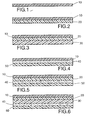
- Figure 1 shows schematically the halogen-free acrylic urethane sheet material of the invention as a single sheet 10 embodiment.
- Figure 2 shows a bilayer structure of the halogen-free acrylic urethane sheet material of the invention.
- the contrasting layers 10 and 20 are firmly bonded to each other.
- Figure 3 shows schematically a three layer structure of the halogen-free acrylic urethane sheet material of the invention.
- the third layer 30 is preferably thicker than layers 10 and 20 which can be of the same or slightly different thickness.
- the layer 20 is firmly bonded to layers 10 and 30.
- Figure 4 shows another preferred embodiment of the sheet material of the invention as described in Figure 1.
- a layer 40 of a pressure-sensitive adhesive or heat-activatable adhesive On one side of layer 10 there is arranged a layer 40 of a pressure-sensitive adhesive or heat-activatable adhesive.
- a protective sheet 50 covers the surface of the adhesive layer 40 opposite to the surface which is bonded to layer 30.
- Figure 5 shows schematically an arrangement of the adhesive layer 40 and the protective sheet 50 with the bilayer structure of Figure 2.
- Figure 6 shows schematically an arrangement of the adhesive layer 40 and the protective sheet 50 with the three layer structure of the sheet material of the invention as disclosed in Figure 3.
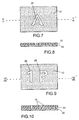
- Figure 7 shows an image which has been created by radiation marking of a bilayer sheet material as disclosed in Figure 2.
- the layer 10 is black-colored and the layer 20 is of white color.
- Figure 8 shows a cross-sectional view of the sheet material of Figure 7 along the line I --- I'.
- the first black layer is removed until the layer 20 (white) is reached or also some part of layer 20 might be removed, thus creating a readable character.
- Figure 9 shows a two-color image which has been created by radiation marking of a 3-layer sheet material as disclosed in Figure 3.
- the layer 10 is of black color
- layer 20 is of white color
- layer 30 is of grey color.
- the letter “P” is created by partially removing black layer 10, thus letter “P” appears in white color.
- the numeral “1” is created by partially removing black layer 10 and white layer 20, thus the color of layer 30 appears in grey color and renders the respective character readable in a different contrast or color to the letter "P" being white in color.
- Figure 10 shows schematically a cross-sectional view along the line II --- II' of Figure 9.
- Figure 10 discloses the partially removed portion of layer 10 creating the letter "P” and the removing of layers 10 and 20 forming the numeral "1".
- the halogen-free acrylic urethane sheet consists of a single-layer sheet material 10 as shown in Figure 1.
- the sheet material 10 can be marked by radiation methods or by conventional printing methods.
- the layer can be burned away partially by radiation methods in order to create an image.
- the image itself can be rendered more easily visible by printing ink on the surface of the halogen-free acrylic urethane sheet material 10.
- the sheet material 10 is printed with ink and afterwards the image is constructed by radiation methods removing the layer in specific areas and thus creating an image.
- the sheet material is 20 to 200 ⁇ m in thickness.
- a multilayer sheet material can be used for radiation marking or printing ( Figures 2 to 6).
- the preferred method for forming the multilayer sheet is by casting of successive layers from organic solution. Each layer is partially dried before casting of the next layer to promote adhesion between the layers of the multilayer sheet material.
- Casting from organic solution can be performed in a variety of ways.
- the solution may be laid down by means of screen-printing, spraying or more traditional coating methods such as knife coating. Combination of coating methods for organic solution may be used as well to form the multilayer sheet material.
- the multilayer sheet of the invention can be prepared by a process wherein the individual layers are produced as films by coating or printing or by mono- or multilayer casting or by laminating prefabricated sheet materials of the invention or combinations of the process measures and priming the printable surface with corona discharged treatment if the sheet material is prepared for use in conventional printing methods.
- the multilayer sheet material can be produced by spray-coating and/or screen-print-coating of the removable support with a thin reactive layer of a composition comprising the components A, B and C according the invention followed by drying for a short time to partially cure the first layer 1 of said mixture, coating onto the first layer 1 a second layer 2 of a mixture having a different color than the first layer, optionally repeating the previous step for producing a third layer 3, drying the layers to finally cure them, removing the multilayer sheet material from the support, providing one side of the multilayer sheet with a pressure-sensitive adhesive material onto a side which has been treated with a primer and applying a protective sheet 5 onto the pressure-sensitive adhesive layer 4.
- Multiple layers may also be coextruded. Combination of extrusion and lamination may also be used to produce a three-layer multilayer sheet, for example.
- the multilayer sheet material it comprises two layers ( Figure 2).
- the two layers 10, 20 comprise the same ingredients as the single layer as described above.
- the two layers 10, 20 differ in color.
- the contrast between the first layer 10 and second layer 20 of the bilayer sheet material is due to that the layers 10, 20 are different in color or opacity.
- the appropriate coloring agents such as pigments, dyes, fillers or metal powders, graphite, polymer fibers, glass fibers, waxes, mineral fillers, organic or inorganic hollow particle fillers in different mixtures are previously admixed with the respective materials that are intended to form the layers 10, 20 of the multilayer sheet materials.
- a black first layer 10 may be produced by adding carbon black to the polymer of the composition for manufacturing the layer.
- the second layer 20 may be dyed with a white pigment such as an inorganic pigment, for example titanium dioxide.
- the first layer 10 is white and is located on a colored second layer 20 or that the first layer 10 is colored and located on a black undersurface. Also preferred is a combination of a white thin first layer 10 and a second layer 20 dyed black. However, what is particularly preferred is a black thin first layer 10 on a white second layer 20 or silver metallic first thin layer 10 on a black second layer 20 or a black thin first layer 10 on a dyed second layer 20, for example red or yellow.
- the layer 10 is 2 to 25 ⁇ m, preferably 5 to 20 ⁇ m in thickness and the layer 20 is 30 to 100 ⁇ m, preferably 50 to 70 ⁇ m in thickness.
- This bilayer sheet material as a representative example of the multilayer sheet material of the invention can also be marked by conventional printing methods as well as radiation methods or combinations thereof. It is advantageous to use such multilayer sheet materials as laser-markable labels because they have excellent mechanical properties, temperature resistance and weathering stability. Moreover, if these labels are marked with a laser beam no corrosive gases may come off the polymeric material because no halogen containing polymers are used.
- a further preferred embodiment of the present invention is a multilayer halogen-free acrylic urethane sheet material consisting of three layers (figure 3).
- This sheet material of the invention consists preferably of two relatively thin layers 10, 20 on top of a thicker layer 30.
- This construction can be used for laser-marking application where it is desirable to have an image in two colors.
- the two-color image is created by a two-step laser-marking process.
- the laser beam is first focused at a shallow depth relative to the upper surface of the film resulting in vaporization of the top layer 10.
- the image appears in the color of the second layer 20 and contrasts with the color of the top layer 10.
- the beam is then focused at a deeper point relative to the surface of the film resulting in vaporization of both the top layer 10 and the underlying layer 20.
- the image appears in the color of the bottom layer or base layer 30 which contrasts as well with the color of the top layer 10.
- the three-layer film can be produced by the following method.
- a thin layer 10 of the coating composition of the present invention is coated onto a removable support.
- the layer is partially dried.
- a second thin layer 20 is then coated over the first thin layer 10 and partially dried as well.
- a third thicker layer 30 is coated over the second layer 20.
- the three layer composite is then dried and cured completely.
- the thickness of layer 10 is 2 to 25 ⁇ m, preferably 5 to 20 ⁇ m, layer 20 is 2 to 25 ⁇ m, preferably 5 to 20 ⁇ m and of layer 30 is 30 to 100 ⁇ m, preferably 50 to 70 ⁇ m.
- the manufacturing of a three-layer sheet material of the invention is carried out by screenprinting a first thin layer 10 followed by drying and partial curing and then screen-printing a second thin layer 20 followed again by drying and partial curing and finally casting a third thicker layer 30 with a knife-coater followed by drying and complete curing of the multilayer film.
- the curing is preferably effected for a period of 0.5 to 10 minutes and preferably of 2 minutes, at a temperature from 150°C to 220°C.
- Drying and partial curing of the thin layer(s) is preferably carried out at a temperature of from 120°C to 220°C and particularly preferred of from 120°C to 150°C for a period from 1 to 5 minutes.
- the film, thus prepared, may be stripped from the removable support at this point.
- the two layer halogen-free acrylic urethane sheet material of the invention is preferably prepared in a similar way as described above, however, by omitting the step regarding the layer 20.
- heating results in highly cross-linked layers which are solvent-resistant, heat-resistant, abrasion-resistant and non-weathering.
- the layers are intimately bonded to each other in the coating step before the curing reaction is completed.
- the multilayer sheet material is provided with an adhesive layer 40 (figures 4 to 6).
- pressure sensitive adhesives or heat-activatable adhesives may consist of polyacrylates, polyesters, polyolefins, polyamides, polyurethanes, silicone polymers, polybutadiene and copolymers, polyisoprenes and copolymers, natural and synthetic rubber as well as hydrogenated derivatives thereof with or without resins, fillers and cross-linking agents.
- Polyacrylates have also proven to be useful, particularly those which have been modified for use on a variety of surfaces having very different surface energies, such as steel/polyethylene.
- the pressure-sensitive adhesives which are particularly preferred are tackified isooctylacrylate and acrylic acid copolymers.
- the copolymers are preferably employed in amounts ranging from 50 to 70% and preferably in an amount of about 60% by weight.
- tackifying resin there is preferably used Foral 85 (company Hercules), a hydrogenated rosin or its glycerol or pentaerythritol esters in amounts of preferably 30 to 50% and particularly preferred of about 40% by weight.
- antioxidants in amounts of about 1% and crosslinkers such as for example aziridine compounds.
- acrylate based pressure-sensitive adhesive materials such as copolymers of isooctylacrylate and acrylic acid like those disclosed in US 2,884,126 (Re: 24,906).
- the adhesive layer 40 has a thickness of 10 to 100 ⁇ m, preferably 20 to 60 ⁇ m.
- the adhesive layer 40 can be protected by a protective sheet 50 ( Figures 4 to 6).
- the protective sheet 50 preferably is adhesive-repellant and more specifically consists of a paper or film which has been coated or modified with compounds of low surface energy relative to the above-identified adhesive. This purpose is served, preferably, by organo silicone compounds, fluoropolymers, polyurethanes and polyolefins.
- This protective sheet 50 consists of paper coated with adhesive repellant materials as mentioned above or a polymeric sheet produced from polyethylene, polypropylene, PVC, polyesters with or without the addition of adhesive-repellant compounds.
- the protective sheet 50 has a thickness of 25 to 250 ⁇ m, preferably 80 to 120 ⁇ m.
- the sheet material has an adhesive layer 40 and optionally a protective sheet 50 forming a label stock.
- the label stock may be cut to form labels or may be left intact to be used as a larger self-adhesive decorative sheet.
- the label stock of the present invention may also be formed by several methods.
- multilayer sheet material intended for use as a laser-markable label stock it is preferred that the upper layer 10 which is removed partially by the laser is thin to reduce the amount of material which must be burned away by the laser.
- This thin layer 10 must also be of relatively constant thickness so that the laser may be adjusted in its depth to burn through the layer consistently and completely and without excess expenditure of energy.
- the layers of the multilayer sheet material may be prepared individually by casting from organic solution or by extrusion techniques. The layers are then laminated together to form a multilayer sheet material.
- the halogen-free acrylic urethane sheet material of the invention can be prepared by copolymerizing the sub-components (i) and (ii) of component A according to the invention in solution mixing the component A in solution with components B and C of the invention, optionally adding coloring agents, thickeners or leveling agents, casting the mixture on a removable support followed by thermal curing and priming one or both surfaces.
- the sheet material should be treated to promote adhesion between the sheet material and the pressure sensitive adhesive layer.
- This treatment can be by application of a chemical primer or more preferably by corona discharge treatment.
- One method of forming the label stock of the present invention consists of applying the pressure sensitive adhesive layer directly onto the treated sheet material. This may be by casting from organic solution or aqueous dispersion or by such techniques as hot melt coating.
- a protective sheet may be added to cover the pressure sensitive adhesive layer until exposure of the adhesive is desired.
- a second method of forming the label stock of the present invention consists of applying the pressure sensitive adhesive layer directly to the protective sheet.
- the adhesive layer with protective sheet combination is then laminated to the sheet material, thus forming the same construction as produced by the direct application of adhesive to the sheet material described previously.
- the sheet material according to the invention preferably, has an elongation at break of from 5 to 100% and, thus, is highly flexible and die-cuttable. Another advantage of the sheet material according to the invention consists in that it does not require any treatment by irradiation.
- the sheet material according to the invention may be employed with a transporting device for laser-marking as proposed in the German patent application P 40 27 938 which is preferably used in a laser marking equipment.
- the sheet materials according to the invention preferably the multilayer sheet materials may be used as laser-markable adhesive labels, especially for a product characterization by means of bar codes. They are also suitable for the production of informatory signs or sign boards of any type.
- the advantages of the sheet material according to the invention result in that the plastic film sheet material can be produced by screen-printing procedures and thermally cured to produce smooth uniform sheets free of defects.
- the sheet material is markable with conventional printing methods, e. g. screen-, flexographic, off-set-printing or other ink-printing methods, toner-printing, xerographic-, laser-printing, thermotransfer as well as needle-printing.
- Multilayer sheets are advantageous because the sheets comprise layers which are chemically bonded to each other. The individual layers are safely prevented from slipping relatively to each other and from separating. Furthermore, it is possible to provide a wide spectrum of color combinations.
- the components of the plastics employed do not contain any toxic chemicals and upon marking with a laser beam preferably a Nd-YAG laser (1.064 nm) do not release any corrosive vapors.
- the properties of the film can be determined within definite ranges especially with respect to the excellent heat-resistance, solvent-resistance and abrasion-resistance.
- Table 2A shows the weight-average molecular weight M w the number-molecular weight M n as well as the ratio M w /M n .
- Instrumentation consisting of a series of Perkin Elmer components was used for all determinations.
- a model 400 pump was used in conjunction with an ISS 100 Automatic sampler and an LC 25 differential refractive index detector. Temperature control for the columns was provided by a Spark Holland HPLC column thermostat. Three PL gel mixed bed columns with a particle size of 10 ⁇ m and a length of 30 cm were held at 40°C. The solvent used to perform the measurement was stabilized tetrahydrofuran at a flow rate of 1 ml/min. The sample to be tested was injected as a 0.2% solution. All samples were treated with diazomethane prior to chromatography.
- the number-average molecular weight (M n and weight average molecular weight (M w ) are well known mathematical descriptions of the molecular weight of a polymer sample.
- the polydispersity, abbreviated "P”, is a measure of the distribution of molecular weight and is defined as M w /M n .
- the solution of acrylate polyol (component A) as prepared above was mixed with a 50% by weight solution of aliphatic polyester diol (component B) in toluene.
- Optional components such as coloring agents (component D) and thickener (component F) were added, if present.
- the resulting mixture was rendered homogeneous by mixing on a ball mill for eight hours at room temperature.
- blocked isocyanate (component C) was added as well as dibutyltindilaurate catalyst (component G) and the optional levelling agent (component E).
- Table 2B shows the weight-average molecular weight M w the number-average molecular weight M n as well as the ratio of M w /M n .
- the films of the current invention were cast from organic solvent onto a removable support either by screen-printing or knife-coating, depending on the thickness and precision of the layer to be formed.
- the removable support was a kraft paper coated with a synthetic acrylic resin.
- the support was obtained as Stripkote BOR, Supermatte from S. D. Warren Co. of Bornem, Belgium.
- a coating mixture with the composition described in table 3 was coated onto the removable support with a knife-coater at a wet thickness of 100 ⁇ m.
- Levelling agent was added to each of the compositions used in a single-layer film. The coating was dried at 80 to 100°C for two minutes and then at 195°C for 2.5 minutes using a forced-air oven.
- the thickness of the Monolayer was 50 ⁇ m.
- Amount of levelling agent was 0.08 phr.
- Amount of catalyst dibutyltindilaurate was 0.2 phr.
- This procedure is used to make a single layer of clear film to be used ultimately as a clear protective adhesive film which is printable by traditional means. It can also be used to prepare a single pigmented layer which is printable by conventional means.
- a coating mixture described under "first layer” in table 4 was coated onto the removable support using a flat bed screen printer with a 120 mesh screen to a wet thickness of 15 to 17 ⁇ m.
- the coating was dried at 80 to 100°C for one minute and partially cured at 195°C for about 90 seconds.
- the dry layer is about 10 ⁇ m in thickness.
- a second thicker layer corresponding to the composition under "second layer” in table 4 was coated on top of the thin partially cured layer with a knife-coater in a wet thickness of 120 ⁇ m and then dried and cured under the conditions given above for monolayer film having a thickness of about 60 ⁇ m.
- the two layers having a total thickness of about 70 ⁇ m are rendered recognizably different from each other by the presence or absence of pigments.
- the two layer sheets described are useful for laser-marking.
- Multilayer films were prepared by screen-printing a first thin layer, followed by drying and partial curing, and then screen-printing a second thin layer, followed again by drying and partial curing, and finally casting a third thicker layer with a knife-coater, followed by drying and complete curing of the multilayer film.
- Compositions of the multilayer films are shown in table 5. Each layer was rendered recognizably different from other layers by the presence or absence of various coloring pigments.
- the levelling agent (component E) was present only in the third layer in an amount of 0.08 phr.
- the thickener (component F) was present in first and second layer in an amount of 1.5 phr.
- the catalyst (component G) was present in each layer in an amount of 0.2 phr.
- the single-layer or multilayer polyurethane films prepared above were corona treated to improve anchorage of the pressure-sensitive adhesive to the film.
- An organic solution of an acrylate pressure-sensitive adhesive was prepared by polymerizing a mixture of isooctyl acrylate and acrylic acid in a ratio of 94 to 6 by weight in organic solvent using azobisisobutyronitrile thermal initiator. The resulting adhesive was coated onto a siliconized paper and dried to a final thickness of 25 ⁇ m, thus forming a transferable adhesive layer.
- the transferable adhesive layer was laminated to one side of the single layer film or to the thicker second layer of the bilayer film, or to the third thicker layer of the multilayer film, thus forming a label stock.
- test samples for Heat Resistance, Chemical Resistance and Weathering Resistance Tests 100 mm x 25 mm samples of label stock were adhered to aluminum panels by rolling over the label twice with a 2 kg rubber-coated roller. The samples were aged 24 hours at room temperature before testing.
- the chemical resistance, abrasion resistance, weathering resistance and heat-resistance of the test samples were determined as follows:
- the resistance to chemicals was tested by immersing the samples into the respective test liquids for a period of 10 seconds, followed by drying for 20 seconds; this procedure was repeated five times.
- Tested was the resistance of the recording material to toluene, gasoline, ethanol, trichloroethane and methyl ethyl ketone. Furthermore, the behavior of the material in dilute alkali and dilute acid solutions was examined.
- the evaluation symbols have the following meanings:
- the heat resistance and solvent resistance of the recording material may be improved by the addition of inorganic fillers, which, however, is at the expense of the resilience property.
- the weathering property was tested by means of quick-weathering apparatus QUV of the Company Q-Panel (Cleveland, Ohio, USA).
- the daily cycle included 15 hours of UV irradiation and 9 hours of moist condensation at 40°C.
- the evaluation after a total of 1,500 hours of testing was based on the following standard:
- the abrasion was tested by a method similar to that of DIN 53754. In DIN 53754 the samples are evaluated by weighing to determine the amount of material lost by abrasion. Test results provided below were determined by visual inspection of the abraded surface. The abrasion from the first layer was visually evaluated by the following standard:
- a sample of 5 x 10 cm was applied on aluminum panel using a 2 kg rubber-coated roller as described above and cut with a razor blade, two lines in a distance of 5 cm cross direction and 3 cm between the cross lines in length direction.
- the sample was heat stressed at 130°C for 15 minutes. The shrinkage was measured by microscope and crackforming was determined visually.
Landscapes
- Chemical & Material Sciences (AREA)
- Organic Chemistry (AREA)
- Chemical Kinetics & Catalysis (AREA)
- Health & Medical Sciences (AREA)
- Medicinal Chemistry (AREA)
- Polymers & Plastics (AREA)
- Physics & Mathematics (AREA)
- General Physics & Mathematics (AREA)
- Engineering & Computer Science (AREA)
- Theoretical Computer Science (AREA)
- Laminated Bodies (AREA)
- Manufacture Of Macromolecular Shaped Articles (AREA)
- Adhesive Tapes (AREA)
- Polyurethanes Or Polyureas (AREA)
Abstract
Description
- The invention is related to a halogen-free acrylic urethane sheet material which is markable with conventional as well as radiation methods. Furthermore, the invention is related to a process for preparing this halogen-free acrylic urethane sheet material as well as single or multilayer halogen-free acrylic urethane sheet materials and label stocks.
- Polymeric films such as plasticized polyvinyl chloride have been used for many years as backings for adhesive labels, tapes and decorative sheets. Polymeric films have had wide acceptance for such applications because, among other things, they are inexpensive and weather resistant and can be colored easily with pigments and dyes. In addition, plasticized polyvinyl chloride has had particularly wide acceptance because its properties can be modified over a wide range by incorporation of plasticizers.
- Recently, however, halogen-containing materials in general have been recognized as producing undesirable by-products when burned. The gases given off are corrosive, present a health risk and have been implicated in destruction of the atmospheric ozone layer.
- Specifically, plasticized polyvinyl chloride has an additional drawback when used as a backing for adhesive coated sheet material or tapes. Problems are often encountered with migration of the plasticizer into the adhesive coating. The adhesive properties are altered or destroyed as the plasticizer migrates from the polyvinyl chloride into the adhesive coating. Plasticizers are also known to evaporate with time or at elevated temperatures, thereby producing an unacceptably brittle film.
- Thus, there exists a need for a polymeric backing which has the physical properties and advantages of plasticized polyvinyl chloride, but does not contain halogen atoms or other moieties which produce noxious by-products upon incineration and which are even more resistant to the effects of aging, chemicals, high temperatures and natural weathering.
- US 4,271,223, Lambert, discloses a plastic film label stock to which ordinary printing inks adhere strongly without any surface treatment of the plastic backing so that the printing on the labels is highly resistant to abrasion. The plastic film which is used for the label stock comprises a polymer of an addition-polymerizable urethane oligomer. The urethane oligomer is based on oligomeric alcohols which can include polyester polyols, polyether polyols, polyacrylate polyols, polyolefin polyols and polysiloxane polyols. The oligomeric alcohols must have a glass transition temperature (Tg) of below 23°C. The polymerizable urethane oligomer is preferably mixed with a multifunctional acrylate cross-linking agent and cured by photopolymerization induced by UV-radiation.
- Grunzinger discloses in US 4,808,471 a top coat of a retroreflective sheeting which is made of a mixture of hydroxy-functional acrylic polyols and a curing agent which is an aliphatic polyfunctional isocyanate such as the biuret of 1,6-hexamethylene diisocyanate. The retroreflective sheeting may have a dual-layer top coat, the outer layer being relatively hard to provide good resistance to solvents, abrasion and weathering, and the inner layer being softer to make the sheeting more conformable. Preferred starting materials for the hydroxy-functional acrylic polyol are esters of methacrylic acid, an acrylic acid ester having at least 4 carbon atoms in its ester group and a hydroxy-functional acrylate or methacrylate. These should be selected in such a manner that the polyol has a glass transition temperature Tg of from -20°C to 30°C. The outer layer consists of a polymer with a Tg of 0°C to 30°C whereas the inner layer shows a Tg of -20°C to 0°C.
- Various self-adhesive markable materials in the form of self-adhesive sheets or films have been known, which may be marked, for example, by means of a laser beam. Such markable materials are predominately used in the commercial sector. Laser-markable adhesive labels containing PVC are mostly used, for example in 3M Scotchcal 100 Laser Script. The top layer is partially removed by means of the laser beam and then the bottom layer of a different color is exposed to form an image. Upon this type of marking corrosive gases may be formed, inter alia due to the vaporization of the top layer.
- The German utility model G 81 30 861 discloses a multilayer label consisting of two layers of lacquer. These layers of lacquer consist of e. g. polyurethane crosslinked by radiation. A preferred lacquer consists of a mixture of hexanediol bisacrylate and a commercially available polyurethane acrylate which is composed of a long-chain polyester diol, an aliphatic diisocyanate and terminal acrylic moieties. The mixture is cured by an electron beam.
- Laser markable labels of this kind are obtainable under the trade name TESA 6930 (Company Beiersdorf). The backing of these labels requires radiation curing which is a costly and critical process. By this process the possibility of adjusting mechanical properties is limited. Consequently the labels show little flexibility and do not conform to irregular surfaces.
- Also commercially available are laser-markable adhesive labels of the company W.H. Brady Company, Milwaukee, USA. These labels are predominately made of biaxially orientated polyesters. These labels shrink when exposed to high temperature and are not tamper-proof. These adhesive labels consist of a top layer and a bottom layer, both of which have been dyed in different colors.
- In Chemical Abstracts 113 (18), 153979c (JP-A-90 120042) there have been described heat-resistant self-adhesive (pressure-sensitive) films which are used as laser-markable labels. To this end 3,3'4,4'-biphenyltetracarboxylic acid anhydride 3,3'-thiodianiline polyamino acid is mixed with carbon black, dried and treated at 180°C for 60 minutes and then at 250°C for six hours. one surface of the resulting layer was coated with a titanium dioxide containing a solution of said compound and the layer was also treated at an elevated temperature. The reverse surface of the layer was provided with a silicone-based pressure-sensitive adhesive. Upon the evaporation of this polymer in a laser beam there may also occur corrosive conversion products such as SO2
- Nagafushi, in US 4,772,512, discloses a composite film for bar code labels comprising first and second heat resisting non-water-absorbing synthetic resin films. On the first film of the composite film, bar codes can be reproduced by means of a high speed dry process electro-static copier. As the first and second heat resisting, non-water-absorbing synthetic resin films in the composite film polyester films, polyimido films, polycarbonate films, cellulose ester films and polyamide films are used. This reference is silent with respect to a halogen-free acrylic urethane sheet material being radiation markable.
- The most commonly used PVC-containing plastic film sheet materials of the prior art are disadvantageous because they contain plasticizers. If this materials are used for self-adhesive labels, plasticizers move into the adhesive layer and destroy the adhesive properties of the adhesive layer. This may result in a destruction of the adhesive layer and the label falls off. On the other hand, the loss of plasticizers in the PVC layer leads to altered mechanical properties of the PVC layer. Thus, this layer may become brittle and disintegrated. The PVC containing labels can also be marked either by radiation marking methods or by conventional printing methods, e. g. by ink. Furthermore, these plastic film sheet materials often do not have the necessary mechanical properties such as handlability or diecuttability or do not show sufficient heat-resistance, weathering stability or solvent resistance.
- The halogen-free labels of the prior art show the above mentioned drawbacks, e. g. little flexibility restricting their use. A further drawback of the radiation curable label is the costly establishing of special equipment for the electron beam or UV curing.
- It is an object of the present invention to provide halogen-free sheet materials for various purposes e. g. markable halogen-free sheet materials, multilayer markable sheet materials or label stocks which are markable by conventional printing methods as well as radiation marking methods. Another object of the invention is to provide halogen-free sheet materials as mentioned before, which show excellent mechanical properties and resistance to severe environmental stress like heat, solvents or weathering. These halogen-free sheet materials must still have the same application spectrum as the PVC containing plastic film sheet like color matching, cutting properties, adjustability of softness but also should avoid their drawbacks. Especially the sheet materials must have environmental compatibility and migration of plasticizer into the pressure sensitive adhesive must not occur. Yet another object of the invention is to provide a sheet material for manufacturing die-cuttable label stocks as well as decorative sheet materials.
- Still another object of the invention is to provide a process for manufacturing sheet materials which does not require high temperature or high energy radiation curing. In particular the sheet materials should be manufacturable in a continuous process.
- The sheet material of the invention is a halogen-free acrylic urethane sheet comprising a polymer comprising components A, B and C wherein
- component A comprises a copolymer of
- (i) a monoester of acrylic or methacrylic acid and an aliphatic diol having 2 to 8 carbon atoms and
- (ii) an ester of acrylic or methacrylic acid and an aliphatic alcohol having 1 to 8 carbon atoms, and optionally a vinyl aromatic monomer as well as, optionally, N-vinylpyrrolidone or N-vinylcaprolactame, said component A having a Tg of 30°C to 100°C,
- component B comprising an aliphatic polyester diol with a weight-average molecular weight less than 20,000 and
- component C comprising a polyfunctional isocyanide or blocked polyfunctional isocyanide.
- Preferably, the sub-component (i) consists of a monoester of acrylic or methacrylic acid and an aliphatic diol having 2 to 4 carbon atoms. Sub-component (ii) consists preferably of an ester of acrylic or methacrylic acid and an aliphatic alcohol having 1 to 4 carbon atoms.
- Examples of suitable monoesters of acrylic or methacrylic acids and aliphatic diols forming sub-component (i) of component A of the polymer of the invention are 2-hydroxyethyl acrylate, 2-hydroxy-1-methylethyl acrylate, 2-hydroxypropyl acrylate, 3-hydroxypropyl acrylate, 2-hydroxybutyl acrylate, 4-hydroxybutyl acrylate, 2-hydroxyethyl methacrylate, 2-hydroxy-1-methylethyl methacrylate, 2-hydroxypropyl methacrylate, 3-hydroxypropyl acrylate, 2-hydroxybutyl methacrylate and the like.
- Typically, the monoesters of acrylic or methacrylic acid and aliphatic diols forming sub-component (i) of component A are present in amounts of 5 to 50% by weight and subcomponent (ii) 50 to 95% by weight of the total amounts of monomers (i) and (ii) used for the copolymer of component A.
- Examples of suitable esters of acrylic or methacrylic acids and the aliphatic alcohol having 1 to 8 carbon atoms are methyl acrylate, ethyl acrylate, propyl acrylate, isopropyl acrylate, butyl acrylate, isobutyl acrylate, hexyl acrylate, 2-ethylhexylacrylate, cyclohexyl acrylate, methyl methacrylate, ethyl methacrylate, propyl methacrylate, isopropyl methacrylate, butyl methacrylate, isobutyl methacrylate, hexyl methacrylate, 2-ethylhexyl methacrylate, cyclohexyl methacrylate and the like.
- According to the invention it is also possible to add halogen-free vinylaromatic monomers to the alkylacrylates or methacrylates of the foregoing paragraph. Preferred is styrene or low alkyl substituted styrene such as α-methylstyrene. The aromatic system of the styrene can be substituted by low alkyl substituents which can be in o, p, m, position to the vinylic moiety. Besides the vinylaromatic monomers as mentioned N-vinylpyrrolidone and N-vinylcaprolactame may be used for substituting the monomers of subcomponent (ii). The vinylaromatic monomers can replace the monomer of sub-component (ii) up to 70% by weight based on the amount of sub-component (ii) present at maximum. The ester of acrylic acid or methacrylic acid and an aliphatic alcohol having 1 to 8 carbon atoms can be substitued by styrene derivatives, N-vinylpyrrolidone or N-vinylcaprolactame or combinations thereof up to 70% by weight.
- According to the invention it is necessary to provide a glass transition temperature (Tg) for component A of 30°C to 100°C. If the Tg of component A is lower than 30°C the entire
- composition consisting of component A, B and C becomes too soft to be used for manufacturing the sheet material of the invention. If the Tg is higher than 100°C the composition of A, B and C becomes too brittle. Component A comprising the sub-components (i) and (ii) is present in amounts of from 15 to 80% by weight of total amount of the polymer comprising components A, B and C, preferably in amounts of from 30 to 60% by weight.
- The weight-average molecular weight of component A consisting essentially of the subcomponents (i) and (ii) is preferably in the range of 1,000 to 500,000 measured by gel permeation chromatographic (GPC).
- Component B of the composition of the invention comprises an aliphatic polyester diol branched or non-branched with a weight-average molecular weight less than 20,000. The polyester diol of the component B of the composition of the invention can generally be formed by the esterification of a polyol with a polycarboxylic acid or an acid anhydride. The aliphatic polyester diol conventionally employed in making the polyester diols include alkylene glycols, such as ethylene glycol, propylene glycol, butylene glycol and neopentyl glycol and other glycols such as cyclohexane dimethanol, caprolactonediol reaction products and similar type compounds.
- Suitable carboxylic acids used in the reaction with the above-described polyols include adipic acid, sebacic acid, glutaric acid, chlorendic acid. The weight-average molecular weight of the aliphatic polyesterdiol is preferably less than 10,000. The preferred polyesterdiol component B of the present invention is poly-epsilon-caprolactonediol having a weight-average molecular weight of 500 to 10,000. Component B is present in the polymer comprising the components A, B and C of the invention in amounts of from 5 to 50% by weight, preferably 15 to 30% by weight based on total amount of the polymer comprising the components A, B and C.
- Component C comprises a polyfunctional isocyanide. Preferred isocyanates are aliphatic diisocyanates with an alkyl bridge between the isocyanide groups of 4 to 8 carbon atoms. These alkyl moieties may be branched or unbranched. Particularly preferred is 1,6-hexamethylenediisocyanate.
- Also blocked polyfunctional isocyanates are suitable. The isocyanide moiety is transformed with suitable blocking agents into another moiety which can be regarded as a latent isocyanide group. Suitable blocking agents are those materials that unblock, for example, at elevated temperatures, thus generating again the isocyanide group. Suitable blocking agents are for example low aliphatic alcohols and oximes such as methylethylacetoneoxim or lactames such as caprolactame. Suitable blocked polyfunctional isocyanates include monomeric polyisocyanates, such as 4,4'-methylene bis-cyclohexyl isocyanide and isophorone diisocyanate. A particularly preferred blocked polyisocyanate is the methylethylketoxime blocked isocyanurate of hexamethylene diisocyanate. Also dimers or trimers of the diisocyanate are suitable. Also biurets of the isocyanates can be used. A preferred blocked polyfunctional isocyanide according to the invention is an adduct of 1,6-hexamethylene diisocyanate and 2-butanone oxime.
- Component C is present in amounts of from 15 to 50% by weight preferably 20 to 45% by weight based on total amount of polymer composed of the component A, B and C.
- Coloring agents (component D) such as inorganic or organic pigments and/or dyes can be used in the composition of the invention for coloring the sheet material of the invention. For generating a black color, carbon black paste is suitable as it is sold under the trade name Tack 1 (Degussa, Frankfurt, Germany). As a white colored pigment, titanium dioxide in silane modified form can be used (Kronos CL 310, Kronos Titan, Leverkusen, Germany). Also aluminum particles of 5 µm length in a solvent (STAPA-Off-Set 3000, Eckhart-Werke, Fürth, Germany) can be used. Other coloring pigments are C.I. pigment red 178/71155 (Paliogen rot L3910 HD, BASF, Ludwigehafen, Germany), C.I. pigment yellow 110 (Irgazin gelb 3RLT-N, Ciba-Geigy, Marienberg, Germany) as well as C.I. pigment blue 1511, Heliogen blau K6911D, BASF, Ludwigshafen, Germany).
- The coloring agents (component D) are present in amounts of from 0.5 phr (parts per hundred resin) up to 100 phr based on total amount of the polymer composed of the components A, B and C.
- Optionally, levelling agents (component E) may be added to the composition of the present invention. The levelling agents support the formation of a uniform and smooth surface without surface defects. Suitable levelling agents are generally organo silicones and fluorochemicals. For example, polyether modified methylpolysiloxane (commercially available under the tradename Baysilon OL17, Bayer Leverkusen) can be used as levelling agent. Particularly preferred is the commercially available product 3M Fluorad® FC 430. The levelling agent can be present in amounts of from 0.1 to 1.0 parts per hundred based on hundred parts polymer composition comprising A, B and C.
- Optionally thickeners (component F) may also be added to the composition of the present invention. An example for suitable thickeners according to the invention is hydrophobic fumed silica such as Aerosil® R974 (Degussa, Frankfurt, Germany). The thickeners F can be present in amounts of from 1 to 10 phr based on hundred parts polymer composition comprising A, B and C.
- As catalysts (component G) according to the invention there may be used those which in general promote urethane chemistry such as tin salts of organic acids. Preferred are dibutyltin dilaurate and tin octanoate. The tin catalysts may also be used with alkyl amines as cocatalysts. Useful cocatalysts include tetramethylbutanediamine (TMBDA) and 1,4-diaza[2.2.2]bicylooctane (DABCO) (Kunststoff Handbuch, Vol. 7, Polyurethane, Second Edition 1983, Karl Hanser Verlag (München, Wien)).
- The skilled person understands that for adjusting characteristic properties of the halogen-free acrylic urethane sheet material of the invention and for economic reasons fillers may be added e. g. mica, calcium carbonate kaolin.
- The halogen-free acrylic urethane sheet material of the invention can be prepared by the following process.
- The acrylic polyol used in the present composition can be prepared by conventional free radical initiated polymerization processes in which monomers are blended with solvent, polymerization catalyst and, optionally, a chain transfer agent. The mixture is heated to 60 to 100°C for 4 to 8 hours.
- 0.1 to 5 percent by weight based on the weight of monomers of a polymerization catalyst initiator is used to prepare the acrylic polyols. Suitable polymerization initiators include organic peroxides such as di-t-butyl peroxide and azo catalysts such as 2,2'-azobisisobutyronitrile.
- Alternatively, the preparation of component A can also take place as an emulsion. The monomers, along with a suitable polymerization initiator, are dispersed in water using surfactants. The thermal polymerization is conducted by heating the emulsion until the polymerization is substantially complete. The resulting polymer A is then separated from the aqueous polymerization medium by precipitation or stripping techniques. The resulting polymer A can then be dissolved in organic solvent, producing a polymer solution similar in overall composition to that obtained in the organic solution polymerization described previously.
- Component A is then mixed with component B as well as optional components such as coloring agents like pigments or dyes (component D), levelling agents (component E) and thickeners (component F). The cross-linking agent (component C) and optionally catalyst (component G) are preferably added to the mixture of A and B directly before the coating operations so that premature cross-linking reaction does not occur.
- The sheet of the current invention is cast from organic solvent onto a removable support. The term removable support means an intermediate carrier. The removable support must have release properties and can be used also for surface modifying of the sheet which is cast onto the removable support. The releasing properties are essential for easy and complete removing of the sheets of the invention. The removable support should not be removed before the films arranged on the support are self-supporting during further processing. In order to impart a matt surface to the thin layer to be applied onto the removable support, a support with a rough surface is chosen, preferably Stripkote BOR Supermatte from S. D. Warren Company of Bornhem, Belgium.
- Preferably the composition for manufacturing the sheets of the invention are arranged on the removable support by screen-printing or knife coating depending on the desired thickeners of the layer.
- The sheet material of the invention is a sheet-shaped thin plastic film material and comprises the composition of the invention. The sheet material can be marked with conventional printing methods or radiation methods or combinations thereof. If radiation methods are used, a laser-marking method is preferred. A non-pigmented, clear monolayer sheet material can be prepared as described above by casting the composition of the invention onto the removable support for example with a knife-coater. This monolayer film is dried at elevated temperatures (80 to 100°C) for several minutes and then at higher temperature, preferably 80 to 200°C for some minutes in order to cure the mixture completely. This film is printable with conventional methods and also laser-markable. It is also possible to prepare a single pigmented layer which can be printed by conventional means and/or marked using a laser beam and the like.
- If the halogen-free acrylic urethane sheet material of the invention is used as a laser-markable sheet material no primer or special treatment is necessary for the surface to be printed. However, if the label is intended for conventional printing methods, priming of the surface is preferred to promote adhesion of the inks to the upper surface to be printed. The priming may be performed by physical or chemical methods. As a physical method, corona discharge treatment is preferred. The chemical priming is a preferred method when the halogen-free acrylic urethane sheet material of the invention is provided with an adhesive on the side opposite to the one which will be marked. A chemical primer is preferably a diluted solution of an acrylate polymer or diluted adhesive.
- Figure 1 shows schematically the halogen-free acrylic urethane sheet material of the invention as a
single sheet 10 embodiment. - Figure 2 shows a bilayer structure of the halogen-free acrylic urethane sheet material of the invention. The contrasting layers 10 and 20 are firmly bonded to each other.
- Figure 3 shows schematically a three layer structure of the halogen-free acrylic urethane sheet material of the invention. The
third layer 30 is preferably thicker thanlayers layer 20 is firmly bonded tolayers - Figure 4 shows another preferred embodiment of the sheet material of the invention as described in Figure 1. On one side of
layer 10 there is arranged alayer 40 of a pressure-sensitive adhesive or heat-activatable adhesive. Preferably aprotective sheet 50 covers the surface of theadhesive layer 40 opposite to the surface which is bonded tolayer 30. - Figure 5 shows schematically an arrangement of the
adhesive layer 40 and theprotective sheet 50 with the bilayer structure of Figure 2. - Figure 6 shows schematically an arrangement of the
adhesive layer 40 and theprotective sheet 50 with the three layer structure of the sheet material of the invention as disclosed in Figure 3. - Figure 7 shows an image which has been created by radiation marking of a bilayer sheet material as disclosed in Figure 2. The
layer 10 is black-colored and thelayer 20 is of white color. - Figure 8 shows a cross-sectional view of the sheet material of Figure 7 along the line I --- I'. The first black layer is removed until the layer 20 (white) is reached or also some part of
layer 20 might be removed, thus creating a readable character. - Figure 9 shows a two-color image which has been created by radiation marking of a 3-layer sheet material as disclosed in Figure 3. The
layer 10 is of black color,layer 20 is of white color andlayer 30 is of grey color. - The letter "P" is created by partially removing
black layer 10, thus letter "P" appears in white color. The numeral "1" is created by partially removingblack layer 10 andwhite layer 20, thus the color oflayer 30 appears in grey color and renders the respective character readable in a different contrast or color to the letter "P" being white in color. - Figure 10 shows schematically a cross-sectional view along the line II --- II' of Figure 9. Figure 10 discloses the partially removed portion of
layer 10 creating the letter "P" and the removing oflayers - In a preferred embodiment of the invention the halogen-free acrylic urethane sheet consists of a single-
layer sheet material 10 as shown in Figure 1. Thesheet material 10 can be marked by radiation methods or by conventional printing methods. The layer can be burned away partially by radiation methods in order to create an image. The image itself can be rendered more easily visible by printing ink on the surface of the halogen-free acrylicurethane sheet material 10. However, it is also possible that thesheet material 10 is printed with ink and afterwards the image is constructed by radiation methods removing the layer in specific areas and thus creating an image. Preferably the sheet material is 20 to 200 µm in thickness. - In a further preferred embodiment of the invention a multilayer sheet material can be used for radiation marking or printing (Figures 2 to 6).
- The preferred method for forming the multilayer sheet is by casting of successive layers from organic solution. Each layer is partially dried before casting of the next layer to promote adhesion between the layers of the multilayer sheet material. Casting from organic solution can be performed in a variety of ways. The solution may be laid down by means of screen-printing, spraying or more traditional coating methods such as knife coating. Combination of coating methods for organic solution may be used as well to form the multilayer sheet material.
- The multilayer sheet of the invention can be prepared by a process wherein the individual layers are produced as films by coating or printing or by mono- or multilayer casting or by laminating prefabricated sheet materials of the invention or combinations of the process measures and priming the printable surface with corona discharged treatment if the sheet material is prepared for use in conventional printing methods. Further, the multilayer sheet material can be produced by spray-coating and/or screen-print-coating of the removable support with a thin reactive layer of a composition comprising the components A, B and C according the invention followed by drying for a short time to partially cure the first layer 1 of said mixture, coating onto the first layer 1 a second layer 2 of a mixture having a different color than the first layer, optionally repeating the previous step for producing a third layer 3, drying the layers to finally cure them, removing the multilayer sheet material from the support, providing one side of the multilayer sheet with a pressure-sensitive adhesive material onto a side which has been treated with a primer and applying a protective sheet 5 onto the pressure-sensitive adhesive layer 4.
- Multiple layers may also be coextruded. Combination of extrusion and lamination may also be used to produce a three-layer multilayer sheet, for example.
- In a preferred embodiment of the multilayer sheet material it comprises two layers (Figure 2). The two
layers layers first layer 10 andsecond layer 20 of the bilayer sheet material is due to that thelayers - For producing
such layers layers - different coloration may be effected by adding organic and/or inorganic pigments as well as dyes. Thus, for example a black
first layer 10 may be produced by adding carbon black to the polymer of the composition for manufacturing the layer. To provide a high contrast thesecond layer 20 may be dyed with a white pigment such as an inorganic pigment, for example titanium dioxide. When the black first layer is partially removed by the laser beam treatment, the white layer (second layer 20) is exposed so that an image appears. - It is preferred that the
first layer 10 is white and is located on a coloredsecond layer 20 or that thefirst layer 10 is colored and located on a black undersurface. Also preferred is a combination of a white thinfirst layer 10 and asecond layer 20 dyed black. However, what is particularly preferred is a black thinfirst layer 10 on a whitesecond layer 20 or silver metallic firstthin layer 10 on a blacksecond layer 20 or a black thinfirst layer 10 on a dyedsecond layer 20, for example red or yellow. Thelayer 10 is 2 to 25 µm, preferably 5 to 20 µm in thickness and thelayer 20 is 30 to 100 µm, preferably 50 to 70 µm in thickness. - This bilayer sheet material as a representative example of the multilayer sheet material of the invention can also be marked by conventional printing methods as well as radiation methods or combinations thereof. It is advantageous to use such multilayer sheet materials as laser-markable labels because they have excellent mechanical properties, temperature resistance and weathering stability. Moreover, if these labels are marked with a laser beam no corrosive gases may come off the polymeric material because no halogen containing polymers are used.
- A further preferred embodiment of the present invention is a multilayer halogen-free acrylic urethane sheet material consisting of three layers (figure 3).
- This sheet material of the invention consists preferably of two relatively
thin layers thicker layer 30. This construction can be used for laser-marking application where it is desirable to have an image in two colors. The two-color image is created by a two-step laser-marking process. - The laser beam is first focused at a shallow depth relative to the upper surface of the film resulting in vaporization of the
top layer 10. The image appears in the color of thesecond layer 20 and contrasts with the color of thetop layer 10. The beam is then focused at a deeper point relative to the surface of the film resulting in vaporization of both thetop layer 10 and theunderlying layer 20. The image appears in the color of the bottom layer orbase layer 30 which contrasts as well with the color of thetop layer 10. - The three-layer film can be produced by the following method. A
thin layer 10 of the coating composition of the present invention is coated onto a removable support. The layer is partially dried. A secondthin layer 20 is then coated over the firstthin layer 10 and partially dried as well. Then a thirdthicker layer 30 is coated over thesecond layer 20. The three layer composite is then dried and cured completely. - Preferably, the thickness of
layer 10 is 2 to 25 µm, preferably 5 to 20 µm,layer 20 is 2 to 25 µm, preferably 5 to 20 µm and oflayer 30 is 30 to 100 µm, preferably 50 to 70 µm. - For example, the manufacturing of a three-layer sheet material of the invention is carried out by screenprinting a first
thin layer 10 followed by drying and partial curing and then screen-printing a secondthin layer 20 followed again by drying and partial curing and finally casting a thirdthicker layer 30 with a knife-coater followed by drying and complete curing of the multilayer film. The curing is preferably effected for a period of 0.5 to 10 minutes and preferably of 2 minutes, at a temperature from 150°C to 220°C. Drying and partial curing of the thin layer(s) is preferably carried out at a temperature of from 120°C to 220°C and particularly preferred of from 120°C to 150°C for a period from 1 to 5 minutes. The film, thus prepared, may be stripped from the removable support at this point. - The two layer halogen-free acrylic urethane sheet material of the invention is preferably prepared in a similar way as described above, however, by omitting the step regarding the
layer 20. - For the layers of the sheet material of the invention, heating results in highly cross-linked layers which are solvent-resistant, heat-resistant, abrasion-resistant and non-weathering. The layers are intimately bonded to each other in the coating step before the curing reaction is completed.
- In a preferred embodiment of the invention the multilayer sheet material is provided with an adhesive layer 40 (figures 4 to 6).
- For making the
adhesive layer 40, it is preferred to use pressure sensitive adhesives or heat-activatable adhesives. These may consist of polyacrylates, polyesters, polyolefins, polyamides, polyurethanes, silicone polymers, polybutadiene and copolymers, polyisoprenes and copolymers, natural and synthetic rubber as well as hydrogenated derivatives thereof with or without resins, fillers and cross-linking agents. Polyacrylates have also proven to be useful, particularly those which have been modified for use on a variety of surfaces having very different surface energies, such as steel/polyethylene. - Also for this kind of labels the pressure-sensitive adhesives which are particularly preferred are tackified isooctylacrylate and acrylic acid copolymers. The copolymers are preferably employed in amounts ranging from 50 to 70% and preferably in an amount of about 60% by weight. As the tackifying resin there is preferably used Foral 85 (company Hercules), a hydrogenated rosin or its glycerol or pentaerythritol esters in amounts of preferably 30 to 50% and particularly preferred of about 40% by weight. In the mixture of adhesive there are added usually antioxidants in amounts of about 1% and crosslinkers such as for example aziridine compounds.
- Particularly preferred are acrylate based pressure-sensitive adhesive materials such as copolymers of isooctylacrylate and acrylic acid like those disclosed in US 2,884,126 (Re: 24,906). The
adhesive layer 40 has a thickness of 10 to 100 µm, preferably 20 to 60µm. - The
adhesive layer 40 can be protected by a protective sheet 50 (Figures 4 to 6). - The
protective sheet 50 preferably is adhesive-repellant and more specifically consists of a paper or film which has been coated or modified with compounds of low surface energy relative to the above-identified adhesive. This purpose is served, preferably, by organo silicone compounds, fluoropolymers, polyurethanes and polyolefins. Thisprotective sheet 50 consists of paper coated with adhesive repellant materials as mentioned above or a polymeric sheet produced from polyethylene, polypropylene, PVC, polyesters with or without the addition of adhesive-repellant compounds. Preferably, theprotective sheet 50 has a thickness of 25 to 250 µm, preferably 80 to 120 µm. - In a preferred embodiment of the invention the sheet material has an
adhesive layer 40 and optionally aprotective sheet 50 forming a label stock. The label stock may be cut to form labels or may be left intact to be used as a larger self-adhesive decorative sheet. - The label stock of the present invention may also be formed by several methods. In multilayer sheet material intended for use as a laser-markable label stock, it is preferred that the
upper layer 10 which is removed partially by the laser is thin to reduce the amount of material which must be burned away by the laser. Thisthin layer 10 must also be of relatively constant thickness so that the laser may be adjusted in its depth to burn through the layer consistently and completely and without excess expenditure of energy. The layers of the multilayer sheet material may be prepared individually by casting from organic solution or by extrusion techniques. The layers are then laminated together to form a multilayer sheet material. - The halogen-free acrylic urethane sheet material of the invention can be prepared by copolymerizing the sub-components (i) and (ii) of component A according to the invention in solution mixing the component A in solution with components B and C of the invention, optionally adding coloring agents, thickeners or leveling agents, casting the mixture on a removable support followed by thermal curing and priming one or both surfaces.
- However, the sheet material should be treated to promote adhesion between the sheet material and the pressure sensitive adhesive layer. This treatment can be by application of a chemical primer or more preferably by corona discharge treatment. One method of forming the label stock of the present invention consists of applying the pressure sensitive adhesive layer directly onto the treated sheet material. This may be by casting from organic solution or aqueous dispersion or by such techniques as hot melt coating. Optionally, a protective sheet may be added to cover the pressure sensitive adhesive layer until exposure of the adhesive is desired.
- A second method of forming the label stock of the present invention consists of applying the pressure sensitive adhesive layer directly to the protective sheet. The adhesive layer with protective sheet combination is then laminated to the sheet material, thus forming the same construction as produced by the direct application of adhesive to the sheet material described previously.
- The sheet material according to the invention, preferably, has an elongation at break of from 5 to 100% and, thus, is highly flexible and die-cuttable. Another advantage of the sheet material according to the invention consists in that it does not require any treatment by irradiation.
- In an especially advantageous manner the sheet material according to the invention may be employed with a transporting device for laser-marking as proposed in the German
patent application P 40 27 938 which is preferably used in a laser marking equipment. The sheet materials according to the invention, preferably the multilayer sheet materials may be used as laser-markable adhesive labels, especially for a product characterization by means of bar codes. They are also suitable for the production of informatory signs or sign boards of any type. - The advantages of the sheet material according to the invention result in that the plastic film sheet material can be produced by screen-printing procedures and thermally cured to produce smooth uniform sheets free of defects. The sheet material is markable with conventional printing methods, e. g. screen-, flexographic, off-set-printing or other ink-printing methods, toner-printing, xerographic-, laser-printing, thermotransfer as well as needle-printing. Multilayer sheets are advantageous because the sheets comprise layers which are chemically bonded to each other. The individual layers are safely prevented from slipping relatively to each other and from separating. Furthermore, it is possible to provide a wide spectrum of color combinations. More particularly it is advantageous that the components of the plastics employed do not contain any toxic chemicals and upon marking with a laser beam preferably a Nd-YAG laser (1.064 nm) do not release any corrosive vapors. Furthermore, the properties of the film can be determined within definite ranges especially with respect to the excellent heat-resistance, solvent-resistance and abrasion-resistance.
- The invention is further illustrated by the following nonlimiting examples.
- 50 parts toluene and 50 parts butylacetate were charged to a reaction vessel equipped with a nitrogen purge, stirrer, thermometer and addition funnel. 2.5 parts di-t-butyl peroxide was added to the solvents at 60°C. 100 parts monomer mixture, of the composition described in table 1, was mixed with 2.5 parts azobisisobutyronitrile. The monomer mixture was added to the contents of the vessel with stirring in three equal portions: one portion initially, one portion after 1 hour and one portion after 2 hours. After the exotherm was complete, the reaction mixture was stirred at 60°C for 8 hours. Final solids content was 49 to 51 weight-%.
-
TABLE 1 Component A Acrylate Polyol sub-component (i) sub-component (ii) No. 2-HEMA HPMA MMA EMA BA IBMA Styrene Tg A1 16 - 55.0 17 - 12 - 82 A2 40 - 22.5 - - - 37.5 78 A3 20 - 50.0 - 30 - - 30 A4 - 20 50.0 - - - 30.0 94 MMA = methyl methacrylate; EMA = ethyl methacrylate; BA = butyl acrylate; 2-HEMA = 2-hydroxyethyl acrylate; HPMA = hydroxypropyl methacrylate; IBMA = isobutyl methacrylate; Tg = glass transition temperature. - Table 2A shows the weight-average molecular weight Mw the number-molecular weight Mn as well as the ratio Mw/Mn.
-
TABLE 2A No. Mw Mn Mw/Mn A1 20.101 10.213 1.97 A2 167.539 53.421 3.14 A3 196.963 60.623 3.25 - Molecular weight characterization of acrylic polyol component A and polyester diol component B has been by conventional gel permeation chromatography (GPC).
- Instrumentation consisting of a series of Perkin Elmer components was used for all determinations. A model 400 pump was used in conjunction with an ISS 100 Automatic sampler and an LC 25 differential refractive index detector. Temperature control for the columns was provided by a Spark Holland HPLC column thermostat. Three PL gel mixed bed columns with a particle size of 10 µm and a length of 30 cm were held at 40°C. The solvent used to perform the measurement was stabilized tetrahydrofuran at a flow rate of 1 ml/min. The sample to be tested was injected as a 0.2% solution. All samples were treated with diazomethane prior to chromatography.
- Data was collected using a PL Separation Sciences GPC Data Station. Calibration for molecular weight was performed using a series of ten narrow distribution polystyrene standards ranging in molecular weight from 1,200 to 2,950,000. All molecular weights are polystyrene equivalent molecular weights.
- The number-average molecular weight (Mn and weight average molecular weight (Mw) are well known mathematical descriptions of the molecular weight of a polymer sample. The polydispersity, abbreviated "P", is a measure of the distribution of molecular weight and is defined as Mw/Mn. Each of the foregoing is a well known term used by the skilled person.
- The solution of acrylate polyol (component A) as prepared above was mixed with a 50% by weight solution of aliphatic polyester diol (component B) in toluene. Optional components such as coloring agents (component D) and thickener (component F) were added, if present. The resulting mixture was rendered homogeneous by mixing on a ball mill for eight hours at room temperature.
- Directly preceding the coating, blocked isocyanate (component C) was added as well as dibutyltindilaurate catalyst (component G) and the optional levelling agent (component E).
- A list of the components B - E is given below.
-
- B1:
- Epsilon-caprolactonediol, available under the trade-name TONE™ 230 (Union Carbide, USA)
- B2:
- Epsilon-caprolactonediol, available under the trade name TONE™ 260 (Union Carbide, USA)
- Table 2B shows the weight-average molecular weight Mw the number-average molecular weight Mn as well as the ratio of Mw/Mn.
-
No. Mw Mn Mw/Mn B1 3.614 2.727 1.33 B2 8.266 5.311 1.56 - B3:
- slightly branched polyester polyol, available under the trade name Desmophen® 670 (Bayer Leverkusen, Germany)
- B4:
- linear polyesterdiol, available under the trade name oxyester Z 1326 (Hüls AG, Germany)
-
- C:
- adduct of 1,6-hexamethylene diisocyanate and 2-butanone oxime available under the trade name Desmodur BL 3175 (Bayer Leverkusen, Germany)
-
- D1:
- carbon black paste in soya alkyd resin available under the trade name Tack 1 (Degussa, Germany)
- D2:
- titanium dioxide silane modified available under the trade name Kronos CL 310 (Kronos Titan, Germany)
- D3:
- aluminum particles in solvent, 5 µm available under the trade name STAPA-Off-Set 3000 (Eckhart-Werke, Germany)
- D4:
- C.I. Pigment red 178/71155 available under the trade name Paliogenrot L3910 HO (BASF, Germany)
- D5:
- C.I. Pigment yellow 110 available under the tradename Irgazingelb 3RLT-N (Ciba-Geigy, Germany)
- D6:
- C.I. Pigment blue 1511 available under the trade name Heliogen-Blau K6911D (BASF, Germany)
-
- E:
- polyether modified methylpolysiloxane (levelling agent) available under the trade name Baysilon OL17 (Bayer Leverkusen, Germany)
- F:
- Hydrophobic fumed silica (thickener) available under the trade name Aerosil R 974 (Degussa, Germany)
- G:
- dibutyltindilaurate (catalyst) (Aldrich)
- The films of the current invention were cast from organic solvent onto a removable support either by screen-printing or knife-coating, depending on the thickness and precision of the layer to be formed.
- The removable support was a kraft paper coated with a synthetic acrylic resin. The support was obtained as Stripkote BOR, Supermatte from S. D. Warren Co. of Bornem, Belgium.
- A coating mixture with the composition described in table 3 was coated onto the removable support with a knife-coater at a wet thickness of 100 µm. Levelling agent was added to each of the compositions used in a single-layer film. The coating was dried at 80 to 100°C for two minutes and then at 195°C for 2.5 minutes using a forced-air oven.
-
TABLE 3 Monolayer film Ex. No. A-Type wt.% B-Type wt.% C wt.% Comp. Dphr color 1 A1 59 B1 15 C 26 D2 30.0 white 2 A1 63 B2 13 C 24 D2 30.0 white 3 A1 49 B2 29 C 22 D2 30.0 white 4 A1 47 B2 30 C 23 D2 30.0 white 5 A1 49 B2 29 C 22 - - transp. 6 A1 49 B2 29 C 22 D6 4.0 blue D2 10.0 white 7 A2 32 B1 24 C 44 D2 30.0 white 8 A2 32 B1 24 C 44 - - transp. 9 A3 54 B1 16 C 30 D2 30.0 white 10 A3 54 B1 16 C 30 D1 7.5 black 11 A4 54 B1 16 C 30 D3 2.0 silver 12 A4 54 B1 16 C 30 D6 4.0 blue D2 10.0 white 13 A1 31 B3 34 C 35 D2 30.0 white 14 A1 30 B4 37 C 33 D2 30.0 white
Amount of levelling agent was 0.08 phr.
Amount of catalyst dibutyltindilaurate was 0.2 phr. - This procedure is used to make a single layer of clear film to be used ultimately as a clear protective adhesive film which is printable by traditional means. It can also be used to prepare a single pigmented layer which is printable by conventional means.
- A coating mixture described under "first layer" in table 4 was coated onto the removable support using a flat bed screen printer with a 120 mesh screen to a wet thickness of 15 to 17 µm. The coating was dried at 80 to 100°C for one minute and partially cured at 195°C for about 90 seconds. The dry layer is about 10 µm in thickness.
- A second thicker layer corresponding to the composition under "second layer" in table 4 was coated on top of the thin partially cured layer with a knife-coater in a wet thickness of 120 µm and then dried and cured under the conditions given above for monolayer film having a thickness of about 60 µm.
- The two layers having a total thickness of about 70 µm are rendered recognizably different from each other by the presence or absence of pigments. The two layer sheets described are useful for laser-marking.
-
TABLE 4 Two layer film Ex. No. Layer Thickness A-Type wt.% B-Type wt.% C. wt.% D-Type phr color 15 first 11 A2 37.0 B2 22.0 C 41.0 D1 17.0 black second 60 A2 37.0 B2 22.0 C 41.0 D2 30.0 white 16 first 12 A1 54.0 B2 23.5 C 22.5 D1 17.0 black second 40 A1 54.0 B2 23.5 C 22.5 D2 30.0 white 17 first 13 A2 29.5 B1 28.0 C 42.5 D1 17.0 black second 50 A2 29.5 B1 28.0 C 42.5 D2 30.0 white 18 first 12 A1 54.0 B2 23.5 C 22.5 D3 8.0 silver second 48 A1 54.0 B2 23.5 C 22.5 D1 7.5 black 19 first 12 A1 56.0 B1 17.0 C 27.0 D3 8.0 silver second 48 A1 56.0 B1 17.0 C 27.0 D1 7.5 black 20 first 10 A1 58.7 B2 18.3 C 23.0 D2 80.0 white second 50 A1 58.7 B2 18.3 C 23.0 D1 7.5 black 21 first 11 A1 58.7 B2 18.3 C 23.0 D1 17.0 black second 51 A1 58.7 B2 18.3 C 23.0 D4 6.0 red D2 7.5 white 22 first 13 A1 58.7 B2 18.3 C 23.0 D5 6.0 yellow D2 7.5 white second 49 A1 58.7 B2 18.3 C 23.0 D1 7.5 black 23 first 12 A1 58.7 B2 18.3 C 23.0 D6 4.0 blue second 48 A1 58.7 B2 18.3 C 23.0 D2 30.0 white 24 first 12 A1 58.7 B2 18.3 C 23.0 D2 80.0 white second 50 A1 58.7 B2 18.3 C 23.0 D6 2.0 blue 25 first 12 A1 31.0 B3 34.0 C 35.0 D1 17.0 black second 60 A1 31.0 B3 34.0 C 35.0 D2 30.0 white - Multilayer films were prepared by screen-printing a first thin layer, followed by drying and partial curing, and then screen-printing a second thin layer, followed again by drying and partial curing, and finally casting a third thicker layer with a knife-coater, followed by drying and complete curing of the multilayer film. Compositions of the multilayer films are shown in table 5. Each layer was rendered recognizably different from other layers by the presence or absence of various coloring pigments.
-
TABLE 5 Ex. No. Layer Thickness A-Type wt.% B-Type wt.% C. wt.% D-Type phr color 26 first 12 A1 58.7 B2 18.3 C 23.0 D2 80.0 white second 10 A1 58.7 B2 18.3 C 23.0 D1 17.0 black third 50 A1 58.7 B2 18.3 C 23.0 D4 5.0 red D2 7.5 white 27 first 10 A1 58.7 B2 18.3 C 23.0 D4 7.5 red D2 7.5 white second 10 A1 58.7 B2 18.3 C 23.0 D6 3.0 blue third 49 A1 58.7 B2 18.3 C 23.0 D2 7.5 white - The levelling agent (component E) was present only in the third layer in an amount of 0.08 phr.
- The thickener (component F) was present in first and second layer in an amount of 1.5 phr.
- The catalyst (component G) was present in each layer in an amount of 0.2 phr.
- The single-layer or multilayer polyurethane films prepared above were corona treated to improve anchorage of the pressure-sensitive adhesive to the film.
- An organic solution of an acrylate pressure-sensitive adhesive was prepared by polymerizing a mixture of isooctyl acrylate and acrylic acid in a ratio of 94 to 6 by weight in organic solvent using azobisisobutyronitrile thermal initiator. The resulting adhesive was coated onto a siliconized paper and dried to a final thickness of 25 µm, thus forming a transferable adhesive layer.
- The transferable adhesive layer was laminated to one side of the single layer film or to the thicker second layer of the bilayer film, or to the third thicker layer of the multilayer film, thus forming a label stock.
- The mechanical properties, tensile strength at break, elongation at break and secant modulus were determined in accordance with (the German standard of), DIN 53455.
- Preparation of test samples for Heat Resistance, Chemical Resistance and Weathering Resistance Tests:
100 mm x 25 mm samples of label stock were adhered to aluminum panels by rolling over the label twice with a 2 kg rubber-coated roller. The samples were aged 24 hours at room temperature before testing. - The chemical resistance, abrasion resistance, weathering resistance and heat-resistance of the test samples were determined as follows:
- The samples of 100 mm x 25 mm in size in the adhered conditions were exposed to heat at a temperature of 200°C for a period of one hour in a forced-air oven. Each sample was evaluated with respect to shrinkage, adhesion and color changes. The evaluation symbols given in Table 6 have the following meanings:
- ○ =
- acceptable;
- + =
- good;
- ++ =
- very good.
- The resistance to chemicals was tested by immersing the samples into the respective test liquids for a period of 10 seconds, followed by drying for 20 seconds; this procedure was repeated five times.
- Tested was the resistance of the recording material to toluene, gasoline, ethanol, trichloroethane and methyl ethyl ketone. Furthermore, the behavior of the material in dilute alkali and dilute acid solutions was examined. The evaluation symbols have the following meanings:
- ○ =
- acceptable;
- + =
- good;
- ++ =
- very good.
- The heat resistance and solvent resistance of the recording material may be improved by the addition of inorganic fillers, which, however, is at the expense of the resilience property.
- The weathering property was tested by means of quick-weathering apparatus QUV of the Company Q-Panel (Cleveland, Ohio, USA). The daily cycle included 15 hours of UV irradiation and 9 hours of moist condensation at 40°C. The evaluation after a total of 1,500 hours of testing (altogether) was based on the following standard:
- ○ =
- acceptable (slight yellowish discoloration);
- + =
- good (for example, a matt surface);
- ++ =
- very good (no change).
- The abrasion was tested by a method similar to that of DIN 53754. In DIN 53754 the samples are evaluated by weighing to determine the amount of material lost by abrasion. Test results provided below were determined by visual inspection of the abraded surface. The abrasion from the first layer was visually evaluated by the following standard:
- + =
- good (distinctly visible tracks on the surface);
- ++ =
- very good (some matt tracks on the surface).
- A sample of 5 x 10 cm was applied on aluminum panel using a 2 kg rubber-coated roller as described above and cut with a razor blade, two lines in a distance of 5 cm cross direction and 3 cm between the cross lines in length direction. The sample was heat stressed at 130°C for 15 minutes. The shrinkage was measured by microscope and crackforming was determined visually.
- ○ =
- slight cracks, shrinkage ≤ 1,0%
- + =
- no cracks, shrinkage ≤ 0,5%
- ++ =
- no cracks, shrinkage ≤ 0,1%
| Mechanical properties and durability of the sheet material | ||||||||
| Ex. No. | Tensile strength N/mm2 | Elongation at break % | Secant modulus N/mm2 | Rating | ||||
| Resistance | Heat shrinkage | |||||||
| Chem. | Abrasion | Weather | Heat | |||||
| 1 | 47.6 | 3.9 | 1400 | ++ | + | ++ | ++ | ++ |
| 2 | 45.0 | 3.0 | 2000 | ++ | + | ++ | ++ | ++ |
| 3 | 18.7 | 51.0 | 250 | O | ++ | ++ | + | ++ |
| 4 | 18.0 | 110.0 | 200 | O | ++ | ++ | + | ++ |
| 5 | 18.4 | 69.3 | 328 | O | ++ | ++ | + | ++ |
| 6 | 14.1 | 65.5 | 160 | O | ++ | ++ | + | ++ |
| 7 | 34.95 | 6.8 | 850 | + | ++ | + | + | O |
| 8 | 28.3 | 5.0 | 680 | + | ++ | O | + | O |
| 9 | 21.0 | 8.6 | 400 | O | ++ | + | ++ | O |
| 10 | 23.0 | 9.0 | 420 | O | ++ | ++ | ++ | O |
| 11 | 41.0 | 4.4 | 980 | ++ | + | + | ++ | + |
| 12 | 40.0 | 5.0 | 950 | ++ | + | + | ++ | + |
| 13 | 39.0 | 11.2 | 840 | + | + | + | + | O |
| 14 | 12.0 | 76.0 | 40 | O | ++ | O | O | + |
| 15 | 18.0 | 17.0 | 1800 | + | + | + | + | O |
| 16 | 34.0 | 35.0 | 3100 | ++ | ++ | ++ | ++ | ++ |
| 17 | 29.0 | 5.5 | 700 | + | ++ | + | + | O |
| 18 | 22.0 | 42.0 | 1800 | + | ++ | ++ | + | ++ |
| 19 | 38.0 | 5.5 | 3300 | ++ | ++ | ++ | ++ | ++ |
| 20 | 26.0 | 23.0 | 2300 | + | + | ++ | ++ | ++ |
| 21 | 28.0 | 25.0 | 2500 | ++ | ++ | ++ | ++ | ++ |
| 22 | 27.0 | 24.0 | 2300 | ++ | ++ | + | + | ++ |
| 23 | 30.0 | 18.0 | 3000 | ++ | ++ | ++ | ++ | ++ |
| 24 | 27.5 | 20.0 | 2200 | ++ | ++ | ++ | ++ | ++ |
| 25 | 40.0 | 10.0 | 400 | + | + | ++ | ++ | + |
| 26 | 31.0 | 17.0 | 2800 | ++ | ++ | ++ | ++ | ++ |
| 27 | 30.0 | 19.0 | 2500 | ++ | ++ | ++ | ++ | ++ |
Claims (25)
- A halogen-free acrylic urethane sheet material (10) comprising a polymer comprising components A, B and C whereincomponent A comprises a copolymer of(i) a monoester of acrylic or methacrylic acid and an aliphatic diol having 2 to 8 carbon atoms and(ii) an ester of acrylic or methacrylic acid and an aliphatic alcohol having 1 to 8 carbon atoms except monoesters (i), and optionally a vinyl aromatic monomer as well as optionally N-vinylpyrrolidone or N-vinylcaprolactame,said component A having a Tg of 30°C to 100°C,component B comprising an aliphatic polyester diol with an weight-average molecular weight less than 20,000 andcomponent C comprising a polyfunctional isocyanate or blocked polyfunctional isocyanate.
- The halogen-free acrylic urethane sheet material of claim 1 wherein the aliphatic diol of subcomponent (i)has 2 to 4 carbon atoms and the aliphatic alcohol of sub-component (ii) has 1 to 4 carbon atoms.
- The halogen-free acrylic urethane sheet material of claim 1 and/or 2 wherein the ester of acrylic acid or methacrylic acid and an aliphatic alcohol having to 8 carbon atoms is substituted by styrene derivatives, N-vinylpyrrolidone or N-vinylcaprolactame or combinations thereof up to 70 % by weight.
- The halogen-free acrylic urethane sheet material of any one of the claims 1 to 3 wherein additionally are present coloring agents, thickeners and/or levelling agents.
- The halogen-free acrylic urethane sheet material of any one of the claims 1 to 4 wherein component A is present in amounts of from 15 to 80 percent by weight based on total amount of components A, B and C,component B is present in amounts of from 5 to 50% by weight based on total amount of components A, B and C,component C is present in amounts of from 15 to 50% by weight based on total amount of components A, B and C.
- The halogen-free acrylic urethane sheet material of claim 5 wherein component A is present in amounts of from 30 to 60% by weight based on total amount of components A, B and C,component B is present in amounts of from 15 to 30% by weight based on total amount of components A, B and C,and component C is present in amounts of from 20 to 45% by weight based on total amount of components A, B and C.
- The halogen-free acrylic urethane sheet material of any one of the claims 1 to 6 wherein component B is a poly-epsilon-caprolactone-diol with a weight-average molecular weight of 500 to 10,000.
- The halogen-free acrylic urethane sheet material of any of the claims 1 to 7 wherein component C is an adduct of 1,6-hexamethylene diisocyanate and 2-butanone oxime or a dimer of the polyfunctional isocyanate.
- The halogen-free acrylic urethane sheet material of any one of claims 1 to 8 which is markable by conventional printing methods and/or by radiation methods.
- The halogen-free acrylic urethane sheet material of any one of claims 1 to 9 wherein the sheet material is laser-markable.
- A multilayer halogen-free acrylic urethane sheet material having at least one layer provided with coloring agents each layer comprising a polymer composition of components A, B and C as defined in any one of the claims 1 to 8.
- The multilayer halogen-free acrylic urethane sheet material of claim 11 which is markable by conventional printing methods and/or by radiation methods.
- The multilayer halogen-free acrylic urethane sheet material according to claims 11 and/or 12 wherein the multilayer sheet material is laser-markable.
- A label stock comprising a single layer or multilayer halogen-free acrylic urethane sheet material according to any one of the claims 1 to 13 provided with a heat activatable adhesive or a pressure sensitive adhesive.
- The label stock according to claim 14 having a protective sheet on its exposed adhesive surface.
- Process for preparing a halogen-free acrylic urethane sheet material according to claim 1by copolymerizing the subcomponents (i) and (ii) of component A as defined in claim 1 in solutionmixing the component A in solution with components B and C as defined in claim 1,optionally adding the components of claim 4,casting the mixture on a removable support followed by thermal curing and priming one or both surfaces.
- A process for preparing the multilayer sheet material of claim 11 wherein the individual layers are produced as films by coating or printing or by mono- or multilayer casting or by laminating prefabricated sheet materials of claim 1 or combinations of the process measures and priming the printable surface with corona discharge treatment if the sheet material is prepared for use in conventional printing methods.
- A process for preparing a label stock according to the method of claim 17 followed by arranging a layer of a pressure sensitive adhesive or heat-activatable adhesive on one side of the sheet material.
- A process of claim 18 wherein the side on which the pressure-sensitive or heat activatable adhesive is arranged said side has been primed by chemical or physical methods.
- A process for producing the multilayer sheet material of claim 11 by spray-coating and/or screen-print coating of a removable support with a thin reactive layer of a composition comprising the components A, B and C as defined in any one of claims 1 to 8,followed by drying for a short time to partially cure the first layer (1) of said mixture,coating onto the first layer (1) a second layer (2) of a mixture having a different color than the first layer,optionally repeating the previous step for producing a third layer (3),drying the layers to finally cure them,removing the multilayer sheet material from the support,providing one side of the multilayer sheet with a pressure-sensitive adhesive material onto a side which has been treated with a primerand applying a protective sheet (5) onto the pressure-sensitive adhesive layer (4).
- A process according to any one of the Claims 16 to 20 wherein the removable support has a rough surface structure for providing a matte surface structure of the first layer (1).
- A method of using a composition comprising components A, B and C as defined in any one of the claims 1 to 8 for producing the halogen-free acrylic urethane sheet material of claim 1.
- A method of using a composition comprising components A, B and C as defined in any one of the claims 1 to 8 for producing a multilayer sheet material of claim 11.
- A method of using a composition comprising components A, B and C as defined in any one of claims 1 to 8 for preparing a label stock according to claims 14 and/or 15.
- A method of using a composition comprising components A, B and C as defined in any one of the claims 1 to 8 for producing a markable halogen-free acrylic urethane sheet material according to claims 1, 11 and 14.
Applications Claiming Priority (3)
| Application Number | Priority Date | Filing Date | Title |
|---|---|---|---|
| DE4141914 | 1991-12-18 | ||
| DE4141914A DE4141914A1 (en) | 1991-12-18 | 1991-12-18 | HALOGEN-FREE ACRYLURETHANE FILM MATERIAL |
| PCT/US1992/009573 WO1993012155A1 (en) | 1991-12-18 | 1992-11-06 | A halogen-free acrylic urethane sheet material |
Publications (2)
| Publication Number | Publication Date |
|---|---|
| EP0617711A1 EP0617711A1 (en) | 1994-10-05 |
| EP0617711B1 true EP0617711B1 (en) | 1997-01-29 |
Family
ID=6447450
Family Applications (1)
| Application Number | Title | Priority Date | Filing Date |
|---|---|---|---|
| EP92925103A Expired - Lifetime EP0617711B1 (en) | 1991-12-18 | 1992-11-06 | A halogen-free acrylic urethane sheet material |
Country Status (4)
| Country | Link |
|---|---|
| EP (1) | EP0617711B1 (en) |
| JP (1) | JP3200065B2 (en) |
| DE (2) | DE4141914A1 (en) |
| WO (1) | WO1993012155A1 (en) |
Cited By (1)
| Publication number | Priority date | Publication date | Assignee | Title |
|---|---|---|---|---|
| EP2199357A1 (en) | 2008-12-22 | 2010-06-23 | 3M Innovative Properties Company | Layered Material Containing Polyvinyl Butyral |
Families Citing this family (11)
| Publication number | Priority date | Publication date | Assignee | Title |
|---|---|---|---|---|
| EP0645747A3 (en) * | 1993-09-27 | 1997-01-08 | Gerecke & Lauer Gmbh Fa | Laser writable label. |
| JP3655424B2 (en) * | 1997-04-09 | 2005-06-02 | ミネソタ マイニング アンド マニュファクチャリング カンパニー | Application film |
| US5886071A (en) * | 1997-08-26 | 1999-03-23 | National Starch And Chemical Investment Holding Corporation | Stable high performance one part acrylic adhesive system |
| FR2799684B1 (en) * | 1999-10-13 | 2001-12-28 | Alphaplast Soc | METHOD FOR MANUFACTURING FIREPROOF ENVELOPE LABELING LABELS AND LABELS THUS OBTAINED |
| JP2001290426A (en) * | 2000-04-04 | 2001-10-19 | Sekisui Chem Co Ltd | Marking film |
| JP4540801B2 (en) * | 2000-05-24 | 2010-09-08 | リンテック株式会社 | Marking film |
| US6824849B2 (en) | 2000-08-07 | 2004-11-30 | 3M Innovative Properties Company | Laser-cuttable multi-layer sheet material |
| EP1179577A1 (en) * | 2000-08-07 | 2002-02-13 | 3M Innovative Properties Company | A laser-cuttable multi-layer sheet material |
| DE10142638A1 (en) | 2001-08-31 | 2003-05-08 | Tesa Ag | Process for producing a laser-inscribable film |
| EP2818488B1 (en) * | 2013-06-24 | 2021-10-13 | 3M Innovative Properties Company | Paint Replacement Film with polymer layer containing polyurethane |
| CN110511692B (en) * | 2017-06-05 | 2021-12-10 | 3M创新有限公司 | Laser markable object with customized watermark and preparation method thereof |
Citations (2)
| Publication number | Priority date | Publication date | Assignee | Title |
|---|---|---|---|---|
| US3700643A (en) * | 1970-09-02 | 1972-10-24 | Union Carbide Corp | Radiation-curable acrylate-capped polycaprolactone compositions |
| US4808471A (en) * | 1985-03-01 | 1989-02-28 | Minnesota Mining And Manufacturing Company | Flat transparent top coat for retroreflective sheeting |
Family Cites Families (2)
| Publication number | Priority date | Publication date | Assignee | Title |
|---|---|---|---|---|
| US4271223A (en) * | 1978-11-02 | 1981-06-02 | Minnesota Mining And Manufacturing Company | Plastic film label stock |
| DE3915981A1 (en) * | 1989-05-17 | 1990-11-29 | Basf Ag | Radiation-cured polyurethane-acrylate]-based contact adhesive - contg. vinyl monomer and reaction prod. of di:isocyanate, poly:ol, diol. unsatd. hydroxy cpd. and cyclic ether with hydroxy or amino gp. |
-
1991
- 1991-12-18 DE DE4141914A patent/DE4141914A1/en not_active Ceased
-
1992
- 1992-11-06 WO PCT/US1992/009573 patent/WO1993012155A1/en not_active Ceased
- 1992-11-06 JP JP51089793A patent/JP3200065B2/en not_active Expired - Fee Related
- 1992-11-06 EP EP92925103A patent/EP0617711B1/en not_active Expired - Lifetime
- 1992-11-06 DE DE69217251T patent/DE69217251T2/en not_active Expired - Lifetime
Patent Citations (2)
| Publication number | Priority date | Publication date | Assignee | Title |
|---|---|---|---|---|
| US3700643A (en) * | 1970-09-02 | 1972-10-24 | Union Carbide Corp | Radiation-curable acrylate-capped polycaprolactone compositions |
| US4808471A (en) * | 1985-03-01 | 1989-02-28 | Minnesota Mining And Manufacturing Company | Flat transparent top coat for retroreflective sheeting |
Non-Patent Citations (1)
| Title |
|---|
| Chemical Abstracts 113 (18), 1990, 153 979c & JP-A-02 120 042 * |
Cited By (1)
| Publication number | Priority date | Publication date | Assignee | Title |
|---|---|---|---|---|
| EP2199357A1 (en) | 2008-12-22 | 2010-06-23 | 3M Innovative Properties Company | Layered Material Containing Polyvinyl Butyral |
Also Published As
| Publication number | Publication date |
|---|---|
| WO1993012155A1 (en) | 1993-06-24 |
| DE4141914A1 (en) | 1993-06-24 |
| DE69217251D1 (en) | 1997-03-13 |
| EP0617711A1 (en) | 1994-10-05 |
| JP3200065B2 (en) | 2001-08-20 |
| DE69217251T2 (en) | 1997-08-21 |
| JPH07502291A (en) | 1995-03-09 |
Similar Documents
| Publication | Publication Date | Title |
|---|---|---|
| US5688573A (en) | Halogen-free acrylic urethane sheet material | |
| EP1322719B1 (en) | A laser-cuttable multi-layer sheet material | |
| DE69805535T2 (en) | PROTECTIVE LAYERS AND COATINGS | |
| US6054208A (en) | Film forming mixtures, image bearing films and image bearing retroreflective sheeting | |
| US5514441A (en) | Retroreflective sheeting with improved topcoat | |
| US20100119962A1 (en) | (meth)acrylic film, and marking film and receptor sheet using the same | |
| US6824849B2 (en) | Laser-cuttable multi-layer sheet material | |
| US20190203070A1 (en) | Paint replacement film with polymer layer containing polyurethane | |
| WO1993012155A1 (en) | A halogen-free acrylic urethane sheet material | |
| KR20090055643A (en) | Marking Adhesive Sheet | |
| US6485825B1 (en) | Pressure-sensitive adhesive tape or sheet and process for producing the same | |
| EP1387874B1 (en) | Adhesive composition and adhesive article | |
| JP5085904B2 (en) | Decorative film | |
| US20250257247A1 (en) | Decorative film | |
| US4554214A (en) | Casting coating | |
| US6998439B2 (en) | Resin composition, sheet obtained therefrom, process for producing sheet, and formed object | |
| JP7131919B2 (en) | LASER MARKER LABEL AND LASER MARKER LABEL MANUFACTURING METHOD | |
| JPH071683A (en) | Laminated resin film | |
| JP7088632B2 (en) | Label and its manufacturing method | |
| KR20220112191A (en) | Sticker for nail and method of preparing the same | |
| JP3811015B2 (en) | Paint, production method thereof, coating film, production method thereof, and pressure-sensitive adhesive sheet | |
| JP4256119B2 (en) | Light-shielding application film, UV curable adhesive film, and application method using the film | |
| TW202242050A (en) | Pressure-sensitive adhesive sheet changeable in color | |
| CN121708820A (en) | Laminated film for label | |
| TW202120640A (en) | Pressure-sensitive adhesive sheet and method for producing member with pressure-sensitive adhesive sheet |
Legal Events
| Date | Code | Title | Description |
|---|---|---|---|
| PUAI | Public reference made under article 153(3) epc to a published international application that has entered the european phase |
Free format text: ORIGINAL CODE: 0009012 |
|
| 17P | Request for examination filed |
Effective date: 19940609 |
|
| AK | Designated contracting states |
Kind code of ref document: A1 Designated state(s): CH DE FR GB IT LI |
|
| 17Q | First examination report despatched |
Effective date: 19951110 |
|
| GRAG | Despatch of communication of intention to grant |
Free format text: ORIGINAL CODE: EPIDOS AGRA |
|
| GRAH | Despatch of communication of intention to grant a patent |
Free format text: ORIGINAL CODE: EPIDOS IGRA |
|
| GRAH | Despatch of communication of intention to grant a patent |
Free format text: ORIGINAL CODE: EPIDOS IGRA |
|
| GRAA | (expected) grant |
Free format text: ORIGINAL CODE: 0009210 |
|
| AK | Designated contracting states |
Kind code of ref document: B1 Designated state(s): CH DE FR GB IT LI |
|
| REG | Reference to a national code |
Ref country code: CH Ref legal event code: EP |
|
| REG | Reference to a national code |
Ref country code: CH Ref legal event code: NV Representative=s name: E. BLUM & CO. PATENTANWAELTE |
|
| REF | Corresponds to: |
Ref document number: 69217251 Country of ref document: DE Date of ref document: 19970313 |
|
| ITF | It: translation for a ep patent filed | ||
| ET | Fr: translation filed | ||
| PLBE | No opposition filed within time limit |
Free format text: ORIGINAL CODE: 0009261 |
|
| STAA | Information on the status of an ep patent application or granted ep patent |
Free format text: STATUS: NO OPPOSITION FILED WITHIN TIME LIMIT |
|
| 26N | No opposition filed | ||
| PGFP | Annual fee paid to national office [announced via postgrant information from national office to epo] |
Ref country code: FR Payment date: 19981020 Year of fee payment: 7 |
|
| PGFP | Annual fee paid to national office [announced via postgrant information from national office to epo] |
Ref country code: GB Payment date: 19981021 Year of fee payment: 7 |
|
| PGFP | Annual fee paid to national office [announced via postgrant information from national office to epo] |
Ref country code: CH Payment date: 19981027 Year of fee payment: 7 |
|
| PG25 | Lapsed in a contracting state [announced via postgrant information from national office to epo] |
Ref country code: GB Free format text: LAPSE BECAUSE OF NON-PAYMENT OF DUE FEES Effective date: 19991106 |
|
| PG25 | Lapsed in a contracting state [announced via postgrant information from national office to epo] |
Ref country code: LI Free format text: LAPSE BECAUSE OF NON-PAYMENT OF DUE FEES Effective date: 19991130 Ref country code: CH Free format text: LAPSE BECAUSE OF NON-PAYMENT OF DUE FEES Effective date: 19991130 |
|
| GBPC | Gb: european patent ceased through non-payment of renewal fee |
Effective date: 19991106 |
|
| REG | Reference to a national code |
Ref country code: CH Ref legal event code: PL |
|
| PG25 | Lapsed in a contracting state [announced via postgrant information from national office to epo] |
Ref country code: FR Free format text: LAPSE BECAUSE OF NON-PAYMENT OF DUE FEES Effective date: 20000731 |
|
| REG | Reference to a national code |
Ref country code: FR Ref legal event code: ST |
|
| PG25 | Lapsed in a contracting state [announced via postgrant information from national office to epo] |
Ref country code: IT Free format text: LAPSE BECAUSE OF NON-PAYMENT OF DUE FEES;WARNING: LAPSES OF ITALIAN PATENTS WITH EFFECTIVE DATE BEFORE 2007 MAY HAVE OCCURRED AT ANY TIME BEFORE 2007. THE CORRECT EFFECTIVE DATE MAY BE DIFFERENT FROM THE ONE RECORDED. Effective date: 20051106 |
|
| PGFP | Annual fee paid to national office [announced via postgrant information from national office to epo] |
Ref country code: DE Payment date: 20101104 Year of fee payment: 19 |
|
| REG | Reference to a national code |
Ref country code: DE Ref legal event code: R071 Ref document number: 69217251 Country of ref document: DE |
|
| REG | Reference to a national code |
Ref country code: DE Ref legal event code: R071 Ref document number: 69217251 Country of ref document: DE |