EP0614526B1 - Verfahren zur voraussage der zementeigenschaften - Google Patents
Verfahren zur voraussage der zementeigenschaften Download PDFInfo
- Publication number
- EP0614526B1 EP0614526B1 EP92923943A EP92923943A EP0614526B1 EP 0614526 B1 EP0614526 B1 EP 0614526B1 EP 92923943 A EP92923943 A EP 92923943A EP 92923943 A EP92923943 A EP 92923943A EP 0614526 B1 EP0614526 B1 EP 0614526B1
- Authority
- EP
- European Patent Office
- Prior art keywords
- cement
- values
- properties
- neural network
- data
- Prior art date
- Legal status (The legal status is an assumption and is not a legal conclusion. Google has not performed a legal analysis and makes no representation as to the accuracy of the status listed.)
- Expired - Lifetime
Links
Images


Classifications
-
- G—PHYSICS
- G01—MEASURING; TESTING
- G01N—INVESTIGATING OR ANALYSING MATERIALS BY DETERMINING THEIR CHEMICAL OR PHYSICAL PROPERTIES
- G01N33/00—Investigating or analysing materials by specific methods not covered by groups G01N1/00 - G01N31/00
- G01N33/38—Concrete; Lime; Mortar; Gypsum; Bricks; Ceramics; Glass
- G01N33/383—Concrete or cement
-
- E—FIXED CONSTRUCTIONS
- E21—EARTH OR ROCK DRILLING; MINING
- E21B—EARTH OR ROCK DRILLING; OBTAINING OIL, GAS, WATER, SOLUBLE OR MELTABLE MATERIALS OR A SLURRY OF MINERALS FROM WELLS
- E21B33/00—Sealing or packing boreholes or wells
- E21B33/10—Sealing or packing boreholes or wells in the borehole
- E21B33/13—Methods or devices for cementing, for plugging holes, crevices or the like
Definitions
- the present invention relates to a method for predicting properties of cement.
- the method provides a method of predicting the thickening time of a cement slurry although it is by no means restricted to this use.
- cement In oilwell drilling, cement is used to secure a lining or casing inside a drilled hole.
- the casing is usually a steel tube and cement slurry is pumped between the casing and the borehole wall and allowed to set, so securing the casing in place.
- Casing is cemented into a borehole for various reasons. The casing prevents any enlargening of the hole by contact with the drill string or erosion by drilling mud and cuttings. This is particularly important where the borehole encounters soft underground formations.
- the cement also provides a seal between underground formations so that, for example, water at one level is not contaminated by oil flowing from another level via the borehole. Cement also seals the drilled wall of the borehole which can prevent gas entering the well while it is being drilled which can cause blow-out.
- casing is run into the borehole and cement is pumped from the surface through the casing such that it fills the annulus between the outer surface of the casing and the borehole wall from the bottom up.
- cement is pumped from the surface through the casing such that it fills the annulus between the outer surface of the casing and the borehole wall from the bottom up.
- the time after mixing a cement slurry at which pumping is no longer possible because the cement has started to set is known as the thickening time and the composition of the slurry is selected according to the required thickening time.
- the measurement is performed by first mixing a cement slurry, in accordance with a defined procedure and specified solid to water ratio, prior to placing a required quantity of the slurry in a suitably calibrated consistometer.
- the subsequent consistometry measurement involves raising the temperature and pressure of the cement to specified values at specified rates while a consistency measurement is being made. After reaching the specified conditions, the temperature and pressure are stabilised and the consistency of the cement is measured continuously. The time at which the cement reaches a specified consistency is the thickening time. Thickening times can be measured in accordance with one of 20 different schedules. Each schedule has a specified heating rate leading to a specified final temperature and pressure.
- GB 2111 193 A describes a method for assessing the quality of cement clinker comprising illuminating the clinker with an infra-red source and maintaining the reflected light.
- the reflectance colour is affected by the free CaO content which determines the quality of the clinker.
- the invention comprises obtaining the infrared spectrum of the cement or cement slurry and correlating this information with a time developing property such as thickening time to provide the appropriate model which is consulted when an unknown cement is tested.
- the infrared spectra can be analysed by the neural network arrangement specified above or any suitable multivariate statistical method.
- the method comprises measuring and determining the other properties and inputting values corresponding to said properties to a neural network device configured to output a value representative of the desired property, the neural network device being a) configured to utilise each of said values as input values, b) provided with at least one hidden layer of at least one node, and c) trained with a dataset comprising series of values of said properties and a value corresponding to the desired property when measured for a slurry having the measured properties.
- the thickening time of a cement is dependent on a number of properties including the mineral composition of neat cement, the amounts and relative proportions of additives and the thickening time schedule.
- the complex interrelationships are difficult to define and have so far defied comprehensive mathematical description.
- One embodiment of the present invention proposes using computer-based artificial neural networks as the framework for predicting thickening times from measurable properties of cement.
- the basic unit of an artificial neural network is the neuron or node.
- this comprises a processing element which combines a set of numerical inputs to produce a single numerical output.
- the neuron generates an output signal in response to the input signals it receives, the strength of which is usually the sum of all the input signals transfonned by a mathematical expression called a "transfer function".
- FIG. 1 shows a schematic of a simple neuron system.
- Each neuron in layer 1 is ascribed a number y i which is to be thought of as its output value.
- the ith neuron makes a contribution to the input for neuron j which is equal to the value of y i multiplied by a weighting factor W ij .
- the summation of the individual contributions from all neurons in the ith layer is called the activation of neuron j.
- the activation X j is calculated from: where ⁇ j , is an empirical coefficient called the bias of neuron j.
- the weighted sum is the most common activation function but others are sometimes used. Occasionally input signals are multiplied rather than summed.
- Networks are composed of layers of neurons where the outputs from neurons in one layer constitute the inputs to neurons in the next layers. Layers between the input and output layers are called hidden layers.
- the structure forms a complex interrelated network which accepts numerical signals from input variables and transmits these signals through the network such that the outputs are a modified representation of the combined inputs as in Figure 2.
- the general objective is to select a network architecture and a set of weights obtaining by training such that, for given input data, the outputs from the final layer match the values of selected dependent variables or target values with an acceptable tolerance.
- MLP multilayer perceptron
- the technique for optimising the weights in a MLP is an iterative technique called back propagation (Rumelhart D E and McClelland J L, eds. "Parallel Distribution Processing: Explorations in the Microstructure of Cognition", 1986, Volume 1, Foundations, MIT Press).
- the technique which is a variation on the method of steepest descent (Press W H, Flannery B P, Teukolsky S A , and W T Vetterling, "Numerical Recipes: The Art of Scientific Computing", 1986, Chapter 10, Cambridge University Press), minimizes the difference between the predicted output and the true output.
- the procedure for optimising the fitting parameters is called training.
- the prediction of the target variables for an independent dataset, on which the network has not been trained, is called generalisation.
- the data in the input layer and the target values represent determinable or measurable properties of the cement.
- the input values need not have well established physical relationships with the target variables.
- an index number representing a class of cement may be used as an alternative to detailed measurements on the properties of the cement.
- an artificial neural network is configured to predict cement thickening times using a primary dataset for training and a commercially available neural network software package such as Neural Works Professional II/Plus (NeuralWare, Inc. Penn Center West, Pittsburg, PA 15276, USA).
- the primary training dataset includes data on 130 oilfield cements covering classes A, B, C, G and H.
- the measured data for each cement is shown in Table 2 and includes the following:
- the input data is characterised by 16 input variables.
- the data includes no cements known to cause problems in oilfield cementing applications.
- Figure 3 shows the thickening time for 90 cements selected randomly from the primary dataset.
- the abscissa is the order in which the data was selected. Many of the cements show a thickening time of around 100 minutes although there is a spread of data.
- the band of measurements in the middle of the plot is for a set of cements which showed little variance in composition, surface area or thickening time.
- the data at very high thickening times are for a range of cements retarded with sodium chloride.
- the variation in the mineral compositions and the sulphate contents, for the entire dataset, were within the bounds normally encountered for oil-well cements.
- Figure 4 shows the predicted and measured thickening times for the calibration data calculated using a network with six nodes in the hidden layer.
- the mean residual error on the validation is ⁇ 16%. Over 80% of the data is predicted with an error of less than 20% and around 50% of the data predicted with an accuracy of better than 5%.
- the minimum number of input variables required to predict thickening times of a cement slurry composition with a mean error of less than 17% is 9. These are the 4 basic cement minerals, solid to water/ratio, Blaine surface area, sodium chloride concentration, calcium chloride concentration, and any one from bottom hole pressure, well depth or bottom hole temperature.
- the methods herein describe the prediction of a single performance property of oil-well cements from measurable variables including cement composition. It has been proposed that cement composition can be predicted reliably from spectroscopic infrared measurements on the dry cement powder. It is therefore proposed that the composition of the cements may be replaced by specified spectroscopic features of the cement. These features may be digitised interferograms, absorbance measurements at specified frequencies or other parameters designed to compactly represent spectral measurements.
- the thickening time of cements may be influenced by non-chemical properties of cement particles including particle size distribution, crystallographic defects in cement grains and compositional variations between cement grains. These features and others have subtle effects on the infrared spectra of powders and the spectra therefore contain useful information which may be correlated to thickening times with optimised neural networks along the lines proposed above.
- the time developing property of the slurry is predicted by analysis of infrared data and, optionally, other data.
- the Fourier transform infrared (FTIR) spectrum of a sample is obtained.
- This sample can either be the neat cement powder or a cement slurry analysed a relatively short time after mixing. It has been found that the FTIR spectrum of a cement can be used to predict thickening time by using either a statistical analysis of the data compared to a calibration model or by using an artificial neural network similar to that described above. While predictions can be made from first the FTIR spectrum (typically as 2000 absorbance measurements), it has been found useful to include other data to improve the prediction as will be seen in the following example.
- FTIR Fourier transform infrared
- the principle involves determining correlations between the selected performance data and the measured properties, in this case thickening time.
- C is matrix of target variables of dimension n ⁇ m , where m is the number of target variables for each of the n samples.
- the matrix R of dimension p ⁇ xm, contains values for p measurements on n samples.
- the matrix P is a regression coefficient matrix of dimensions p ⁇ m representing the proportionality between C and R .
- the matrix P may be determined by one of several common regression techniques.
- PCA Principal Component Analysis
- the decomposition of R into two other matrices is called singular value decomposition, eigenvector projection, factor analysis or principal component analysis depending on the scaling of R .
- the process of generating the two unique matrices involves an iterative scheme described elsewhere (W Dillon and M Goldstein, 1984, Multivariate Analysis, Chapter 1, Wiley and Sons, New York).
- the matrix T contains the coordinates of the data in a p dimensional space and the elements of T are called the factor scores or principal components.
- the matrix B is called the rotation matrix and the elements of B are factor loadings.
- the columns of T and the rows of B are corthogonal. Theory shows that B is a matrix of eigenvectors of the covariance matrix; it is symmetric and its own transpose.
- the matrix Q which has subsumed the rotation matrix and the original coefficient matrix, is itself treated as a set of fitting coefficients which correlate the principal components to the composition matrix.
- a feature of above data reduction technique is that the reduced data matrix T ⁇ , being a representation of the full dataset, can be used as independent input data for other statistical modelling procedures, including artificial neural network methods.
- a key issue being the selection of the appropriate number of principal components.
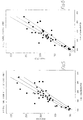
- Figure 5 shows the cement thickening times, for a number of selected test cements, predicted using a previously calibrated neural network.
- Input data for the model are the FTIR spectra only reduced to 30 principal components. This number being determined as that which resulted in the lowest error in the prediction of thickening times for cements in an independent validation dataset.
- the corresponding results using the full dataset are shown in Figure 6.
- the measured thickening time is plotted against that predicted by the model as a test of the accuracy.
Landscapes
- Life Sciences & Earth Sciences (AREA)
- Engineering & Computer Science (AREA)
- Physics & Mathematics (AREA)
- Mining & Mineral Resources (AREA)
- Health & Medical Sciences (AREA)
- Chemical & Material Sciences (AREA)
- Geology (AREA)
- General Health & Medical Sciences (AREA)
- Environmental & Geological Engineering (AREA)
- Biochemistry (AREA)
- Medicinal Chemistry (AREA)
- General Physics & Mathematics (AREA)
- Immunology (AREA)
- Pathology (AREA)
- Analytical Chemistry (AREA)
- Fluid Mechanics (AREA)
- Food Science & Technology (AREA)
- Ceramic Engineering (AREA)
- General Life Sciences & Earth Sciences (AREA)
- Geochemistry & Mineralogy (AREA)
- Management, Administration, Business Operations System, And Electronic Commerce (AREA)
- Curing Cements, Concrete, And Artificial Stone (AREA)
- Analysing Materials By The Use Of Radiation (AREA)
Claims (5)
- Verfahren zum Vorhersagen einer sich zeitlich entwickelnden Eigenschaft einer Zementaufschlämmung, umfassend das Gewinnen des Infrarotspektrums des Zements oder der Zementaufschlämmung und Gewinnen einer Vorhersage der sich zeitlich entwickelnden Eigenschaft durch Anwenden von das Spektrum repräsentierenden Werten auf ein Modell, gebildet durch Bestimmen von Spektren für eine Serie von Zementzusammensetzungen und Korrelieren derselben mit gemessenen Werten der sich zeitlich entwikkelnden Eigenschaft für die Zusammensetzungen in der Serie.
- Verfahren nach Anspruch 1, bei dem die sich zeitlich entwikkelnde Eigenschaft die Verdickungszeit der Aufschlämmung ist.
- Verfahren nach Anspruch 1 oder 2, umfassend das Eingeben von das Infrarotspektrum repräsentierenden Werten in ein künstliches neuronales Netzwerk, das für das Ausgeben eines für die vorhergesagte Verdikkungszeit repräsentativen Wertes konfiguriert ist, welches künstliche neuronale Netzwerka) konfiguriert ist, um jeden der das Infrarotspektrum repräsentierenden Werte als Eingangswerte zu verwenden,b) mit mindestens einer verborgenen Schicht von mindestens einem Knoten versehen ist,c) mit einem Datensatz trainiert ist, der Serien von Spektrumwerten und Werten der gemessenen Verdickungszeit umfaßt.
- Verfahren nach einem der Ansprüche 1-3, umfassend das Gewinnen des Fourier-transformierten Infrarotspektrums.
- Verfahren nach Anspruch 3, bei dem das künstliche neuronale Netzwerk konfiguriert ist, eine oder zwei verborgene Schichten mit jeweils 1-12 Knoten aufzuweisen.
Applications Claiming Priority (3)
| Application Number | Priority Date | Filing Date | Title |
|---|---|---|---|
| GB9125426 | 1991-11-29 | ||
| GB9125426A GB2261955A (en) | 1991-11-29 | 1991-11-29 | Method for predicting thickening times of cement slurries |
| PCT/GB1992/002216 WO1993011423A1 (en) | 1991-11-29 | 1992-11-30 | Method for predicting cement properties |
Publications (2)
| Publication Number | Publication Date |
|---|---|
| EP0614526A1 EP0614526A1 (de) | 1994-09-14 |
| EP0614526B1 true EP0614526B1 (de) | 1997-10-08 |
Family
ID=10705450
Family Applications (1)
| Application Number | Title | Priority Date | Filing Date |
|---|---|---|---|
| EP92923943A Expired - Lifetime EP0614526B1 (de) | 1991-11-29 | 1992-11-30 | Verfahren zur voraussage der zementeigenschaften |
Country Status (5)
| Country | Link |
|---|---|
| US (1) | US6009419A (de) |
| EP (1) | EP0614526B1 (de) |
| GB (1) | GB2261955A (de) |
| NO (1) | NO941989L (de) |
| WO (1) | WO1993011423A1 (de) |
Cited By (1)
| Publication number | Priority date | Publication date | Assignee | Title |
|---|---|---|---|---|
| DE102019108779A1 (de) * | 2019-04-03 | 2020-10-08 | Peri Gmbh | Automatische Vorhersage der Verwendbarkeit von Beton für mindestens einen Verwendungszweck auf einer Baustelle |
Families Citing this family (31)
| Publication number | Priority date | Publication date | Assignee | Title |
|---|---|---|---|---|
| IL114494A0 (en) * | 1995-07-06 | 1995-11-27 | Te Eni Moshe | System and method for controlling concrete production |
| US7149590B2 (en) | 1996-05-06 | 2006-12-12 | Pavilion Technologies, Inc. | Kiln control and upset recovery using a model predictive control in series with forward chaining |
| US8311673B2 (en) * | 1996-05-06 | 2012-11-13 | Rockwell Automation Technologies, Inc. | Method and apparatus for minimizing error in dynamic and steady-state processes for prediction, control, and optimization |
| US7610108B2 (en) * | 1996-05-06 | 2009-10-27 | Rockwell Automation Technologies, Inc. | Method and apparatus for attenuating error in dynamic and steady-state processes for prediction, control, and optimization |
| DE19726023A1 (de) * | 1997-06-19 | 1998-12-24 | Univ Dresden Tech | Verfahren zur qualitativen und quantitativen infrarotspektroskopischen Bestimmung mineralischer Baustoffe |
| EP1269181A4 (de) * | 2000-01-31 | 2006-05-10 | Grace W R & Co | Assay-verfahren für hydratierbare zementartige zusammensetzungen |
| US6484568B1 (en) * | 2001-03-22 | 2002-11-26 | Halliburton Energy Services, Inc. | Apparatus and method for foaming fluids and for testing foamed fluids |
| TWI231481B (en) * | 2004-03-11 | 2005-04-21 | Quanta Comp Inc | Electronic apparatus |
| EP1797478A4 (de) * | 2004-10-04 | 2009-07-15 | Univ South Carolina | Multivariate optische berechnung thermaler selektivität |
| US7784544B2 (en) * | 2006-01-24 | 2010-08-31 | Schlumberger Technology Corporation | Method of treating a subterranean formation using a rheology model for fluid optimization |
| US7496414B2 (en) * | 2006-09-13 | 2009-02-24 | Rockwell Automation Technologies, Inc. | Dynamic controller utilizing a hybrid model |
| NZ550317A (en) * | 2007-01-04 | 2008-10-31 | Carter Holt Harvey Pulp & Pape | In production accessment of fibre cement properties by multivariate analysis of near infra-red spectra |
| EP2740780A1 (de) * | 2012-12-07 | 2014-06-11 | Services Pétroliers Schlumberger | Zementmischzusammensetzungen |
| CN103105485A (zh) * | 2013-01-28 | 2013-05-15 | 河海大学 | 硬化普通水泥净浆热膨胀系数多尺度预测方法 |
| WO2016075639A1 (pt) * | 2014-11-11 | 2016-05-19 | Universidade Federal De Minas Gerais - Ufmg | Equipamento, processo de determinacao do tempo de foto-ativacao para a fotopolimerizacao de cimentos de restauracoes odontologicas indiretas e usos |
| WO2017155542A1 (en) * | 2016-03-11 | 2017-09-14 | Halliburton Energy Services, Inc. | Downhole cement evaluation using an artificial neural network |
| MX2021005060A (es) | 2018-11-02 | 2021-06-15 | Gcp Applied Tech Inc | Produccion de cemento. |
| WO2020204956A1 (en) * | 2019-04-05 | 2020-10-08 | Halliburton Energy Services, Inc. | Method for designing for induction time using supplementary cementitious materials |
| AU2019439428B2 (en) * | 2019-04-05 | 2025-06-05 | Halliburton Energy Services, Inc. | Selecting supplemental cementitious materials for specific performance characteristic |
| US11709121B2 (en) * | 2019-11-18 | 2023-07-25 | Spraying Systems Co. | Machine learning-based particle-laden flow field characterization |
| CN111701697A (zh) * | 2020-05-26 | 2020-09-25 | 上海万澄环保科技有限公司 | 一种水泥原料磨系统及其自动寻优控制方法 |
| CN111832101B (zh) * | 2020-06-18 | 2023-07-07 | 湖北博华自动化系统工程有限公司 | 一种水泥强度预测模型的构建方法及水泥强度预测方法 |
| US11584695B2 (en) * | 2020-07-08 | 2023-02-21 | Halliburton Energy Services, Inc. | Work method to design for thickening time by tailoring additives |
| US11390567B2 (en) * | 2020-07-08 | 2022-07-19 | Halliburton Energy Services, Inc. | Tailoring for temperature sensitivity of thickening time of cement slurry |
| US11629103B2 (en) * | 2020-07-08 | 2023-04-18 | Halliburton Energy Services, Inc. | Method to design for thickening time using cementitious blend composition |
| US11555139B2 (en) * | 2020-07-08 | 2023-01-17 | Halliburton Energy Services, Inc. | Real time tailoring of cement slurry for downhole thickening time |
| KR102668336B1 (ko) * | 2021-05-31 | 2024-05-23 | 주식회사 채움아이티 | 인공지능을 이용한 레미콘 슬럼프 자동 균일 제어 장치 및 방법 |
| CN114169567A (zh) * | 2021-10-28 | 2022-03-11 | 北京金隅水泥节能科技有限公司 | 一种水泥熟料性能预测方法 |
| US20230185979A1 (en) * | 2021-12-14 | 2023-06-15 | Halliburton Energy Services, Inc. | System to Correlate Suitable Slurry Designs with Petrophysical While-Drilling Measurements in Real Time |
| US12595715B2 (en) * | 2021-12-22 | 2026-04-07 | Halliburton Energy Services, Inc. | Cementing lab data validation based on machine learning |
| US20250218552A1 (en) * | 2023-12-29 | 2025-07-03 | Halliburton Energy Services, Inc. | Method to Predict Rheology Parameters Using Consistency of a Cement Slurry |
Family Cites Families (11)
| Publication number | Priority date | Publication date | Assignee | Title |
|---|---|---|---|---|
| US3615223A (en) * | 1969-06-06 | 1971-10-26 | Borg Warner | Cement retarder determination |
| US3747702A (en) * | 1970-05-25 | 1973-07-24 | Schlumberger Technology Corp | Cement evaluation logging utilizing reflection coefficients |
| US4382290A (en) * | 1977-07-11 | 1983-05-03 | Schlumberger Technology Corporation | Apparatus for acoustically investigating a borehole |
| US4259868A (en) * | 1979-10-01 | 1981-04-07 | Halliburton Company | Method and apparatus for nondestructive testing of cement |
| GB2111193B (en) * | 1981-11-27 | 1985-08-21 | Blue Circle Ind Ltd | Method and apparatus for assessing the quality of cement clinker |
| US4648264A (en) * | 1985-07-19 | 1987-03-10 | Halliburton Company | Multi-function apparatus for testing a sample of material |
| GB8817348D0 (en) * | 1988-07-21 | 1988-08-24 | Imperial College | Gas/liquid flow measurement |
| JPH0690152B2 (ja) * | 1988-08-16 | 1994-11-14 | 戸田建設株式会社 | コンクリート硬化度判定方法 |
| US4979124A (en) * | 1988-10-05 | 1990-12-18 | Cornell Research Foundation | Adaptive, neural-based signal processor |
| CN1038698A (zh) * | 1989-01-06 | 1990-01-10 | 北京联合大学自动化工程学院 | 水泥凝结时间自动测定仪 |
| IL117443A (en) * | 1996-03-11 | 2000-06-29 | Numalog Ltd | NMR concrete analysis |
-
1991
- 1991-11-29 GB GB9125426A patent/GB2261955A/en not_active Withdrawn
-
1992
- 1992-11-30 US US08/897,400 patent/US6009419A/en not_active Expired - Lifetime
- 1992-11-30 WO PCT/GB1992/002216 patent/WO1993011423A1/en not_active Ceased
- 1992-11-30 EP EP92923943A patent/EP0614526B1/de not_active Expired - Lifetime
-
1994
- 1994-05-27 NO NO941989A patent/NO941989L/no not_active Application Discontinuation
Cited By (2)
| Publication number | Priority date | Publication date | Assignee | Title |
|---|---|---|---|---|
| DE102019108779A1 (de) * | 2019-04-03 | 2020-10-08 | Peri Gmbh | Automatische Vorhersage der Verwendbarkeit von Beton für mindestens einen Verwendungszweck auf einer Baustelle |
| EP3948714A1 (de) * | 2019-04-03 | 2022-02-09 | Peri AG | Automatische vorhersage der verwendbarkeit von beton für mindestens einen verwendungszweck auf einer baustelle |
Also Published As
| Publication number | Publication date |
|---|---|
| US6009419A (en) | 1999-12-28 |
| WO1993011423A1 (en) | 1993-06-10 |
| NO941989L (no) | 1994-07-28 |
| GB2261955A (en) | 1993-06-02 |
| NO941989D0 (no) | 1994-05-27 |
| GB9125426D0 (en) | 1992-01-29 |
| EP0614526A1 (de) | 1994-09-14 |
Similar Documents
| Publication | Publication Date | Title |
|---|---|---|
| EP0614526B1 (de) | Verfahren zur voraussage der zementeigenschaften | |
| Elkatatny | Real-time prediction of rheological parameters of KCL water-based drilling fluid using artificial neural networks | |
| Alsaba et al. | Updated criterion to select particle size distribution of lost circulation materials for an effective fracture sealing | |
| Manouchehrian et al. | Application of artificial neural networks and multivariate statistics to estimate UCS using textural characteristics | |
| Fleckenstein et al. | Burst-induced stresses in cemented wellbores | |
| Jahanbakhshi et al. | Real-time prediction of rate of penetration during drilling operation in oil and gas wells | |
| Yιlmaz et al. | Application of artificial neural networks to optimum bit selection | |
| US11441415B2 (en) | Managing wellbore cement compositions based on material characteristics | |
| US5475220A (en) | Method to determine the phase composition of cement | |
| Elsharkwy et al. | Comparing classical and neural regression techniques in modeling crude oil viscosity | |
| Gokceoglu et al. | Estimating the uniaxial compressive strength of some clay‐bearing rocks selected from Turkey by nonlinear multivariable regression and rule‐based fuzzy models | |
| Malkawi et al. | Enhancing of uniaxial compressive strength of travertine rock prediction through machine learning and multivariate analysis | |
| WO2020018069A1 (en) | Optical sensor adaptive calibration | |
| Gąsior et al. | Estimating thermal conductivity from core and well log data | |
| Gowida et al. | Synthetic well-log generation: New approach to predict formation bulk density while drilling using neural networks and fuzzy logic | |
| Ibrahim et al. | Estimation of tensile and uniaxial compressive strength of carbonate rocks from well-logging data: artificial intelligence approach | |
| Cheng et al. | Surrogate modeling and global sensitivity analysis for the simultaneous growth of multiple hydraulic fractures | |
| Zhao et al. | A quantitative fracability evaluation method and its application to deep shale gas development in Sichuan Basin, China | |
| Ott et al. | Simple method predicts downhole shaped-charge gun performance | |
| CN118673676A (zh) | 一种基于综合概率法的页岩储层裂缝测井识别方法 | |
| Ouadi et al. | Comparative Analysis Between Different Artificial Intelligence Based Models Optimized with Genetic Algorithms for the Prediction of Oilfield Cement Compressive Strength | |
| Akbari et al. | Study of the effect of rock type and treatment parameter on acid fracture conductivity using an intelligent model | |
| WO2024210965A1 (en) | Borehole holdup prediction using machine learning and pulsed neutron logging tool data | |
| Fletcher et al. | Prediction of thickening times of oil field cements using artificial neural networks and fourier transform infrared spectroscopy | |
| Moradi et al. | Depositional and diagenetic features of carbonate reservoirs determined from image logs and their impact on oil production |
Legal Events
| Date | Code | Title | Description |
|---|---|---|---|
| PUAI | Public reference made under article 153(3) epc to a published international application that has entered the european phase |
Free format text: ORIGINAL CODE: 0009012 |
|
| 17P | Request for examination filed |
Effective date: 19940520 |
|
| AK | Designated contracting states |
Kind code of ref document: A1 Designated state(s): FR GB |
|
| 17Q | First examination report despatched |
Effective date: 19960610 |
|
| GRAG | Despatch of communication of intention to grant |
Free format text: ORIGINAL CODE: EPIDOS AGRA |
|
| GRAH | Despatch of communication of intention to grant a patent |
Free format text: ORIGINAL CODE: EPIDOS IGRA |
|
| GRAH | Despatch of communication of intention to grant a patent |
Free format text: ORIGINAL CODE: EPIDOS IGRA |
|
| GRAA | (expected) grant |
Free format text: ORIGINAL CODE: 0009210 |
|
| AK | Designated contracting states |
Kind code of ref document: B1 Designated state(s): FR GB |
|
| ET | Fr: translation filed | ||
| PLBE | No opposition filed within time limit |
Free format text: ORIGINAL CODE: 0009261 |
|
| STAA | Information on the status of an ep patent application or granted ep patent |
Free format text: STATUS: NO OPPOSITION FILED WITHIN TIME LIMIT |
|
| 26N | No opposition filed | ||
| REG | Reference to a national code |
Ref country code: GB Ref legal event code: IF02 |
|
| PGFP | Annual fee paid to national office [announced via postgrant information from national office to epo] |
Ref country code: FR Payment date: 20041109 Year of fee payment: 13 |
|
| PGFP | Annual fee paid to national office [announced via postgrant information from national office to epo] |
Ref country code: GB Payment date: 20041124 Year of fee payment: 13 |
|
| PG25 | Lapsed in a contracting state [announced via postgrant information from national office to epo] |
Ref country code: GB Free format text: LAPSE BECAUSE OF NON-PAYMENT OF DUE FEES Effective date: 20051130 |
|
| GBPC | Gb: european patent ceased through non-payment of renewal fee |
Effective date: 20051130 |
|
| PG25 | Lapsed in a contracting state [announced via postgrant information from national office to epo] |
Ref country code: FR Free format text: LAPSE BECAUSE OF NON-PAYMENT OF DUE FEES Effective date: 20060731 |
|
| REG | Reference to a national code |
Ref country code: FR Ref legal event code: ST Effective date: 20060731 |