EP0609437A1 - Novel sphingoglycolipid and use thereof - Google Patents
Novel sphingoglycolipid and use thereof Download PDFInfo
- Publication number
- EP0609437A1 EP0609437A1 EP92909489A EP92909489A EP0609437A1 EP 0609437 A1 EP0609437 A1 EP 0609437A1 EP 92909489 A EP92909489 A EP 92909489A EP 92909489 A EP92909489 A EP 92909489A EP 0609437 A1 EP0609437 A1 EP 0609437A1
- Authority
- EP
- European Patent Office
- Prior art keywords
- integer
- denotes
- galactopyranosyloxy
- compound
- glycosphingolipid
- Prior art date
- Legal status (The legal status is an assumption and is not a legal conclusion. Google has not performed a legal analysis and makes no representation as to the accuracy of the status listed.)
- Granted
Links
- 0 C*C(C(C(CO[C@](C(C1)O)OC(CO)C1(CO)O)N*C*(C)C*)O)O Chemical compound C*C(C(C(CO[C@](C(C1)O)OC(CO)C1(CO)O)N*C*(C)C*)O)O 0.000 description 12
Images


Classifications
-
- C—CHEMISTRY; METALLURGY
- C07—ORGANIC CHEMISTRY
- C07H—SUGARS; DERIVATIVES THEREOF; NUCLEOSIDES; NUCLEOTIDES; NUCLEIC ACIDS
- C07H15/00—Compounds containing hydrocarbon or substituted hydrocarbon radicals directly attached to hetero atoms of saccharide radicals
- C07H15/02—Acyclic radicals, not substituted by cyclic structures
- C07H15/04—Acyclic radicals, not substituted by cyclic structures attached to an oxygen atom of the saccharide radical
- C07H15/10—Acyclic radicals, not substituted by cyclic structures attached to an oxygen atom of the saccharide radical containing unsaturated carbon-to-carbon bonds
-
- A—HUMAN NECESSITIES
- A61—MEDICAL OR VETERINARY SCIENCE; HYGIENE
- A61P—SPECIFIC THERAPEUTIC ACTIVITY OF CHEMICAL COMPOUNDS OR MEDICINAL PREPARATIONS
- A61P35/00—Antineoplastic agents
-
- A—HUMAN NECESSITIES
- A61—MEDICAL OR VETERINARY SCIENCE; HYGIENE
- A61P—SPECIFIC THERAPEUTIC ACTIVITY OF CHEMICAL COMPOUNDS OR MEDICINAL PREPARATIONS
- A61P37/00—Drugs for immunological or allergic disorders
- A61P37/02—Immunomodulators
- A61P37/04—Immunostimulants
-
- C—CHEMISTRY; METALLURGY
- C12—BIOCHEMISTRY; BEER; SPIRITS; WINE; VINEGAR; MICROBIOLOGY; ENZYMOLOGY; MUTATION OR GENETIC ENGINEERING
- C12P—FERMENTATION OR ENZYME-USING PROCESSES TO SYNTHESISE A DESIRED CHEMICAL COMPOUND OR COMPOSITION OR TO SEPARATE OPTICAL ISOMERS FROM A RACEMIC MIXTURE
- C12P19/00—Preparation of compounds containing saccharide radicals
- C12P19/44—Preparation of O-glycosides, e.g. glucosides
Definitions
- the present invention relates to novel glycosphingolipids having effective antitumor activity and immuno-stimulating activity, to a process for producing them and to the use thereof.
- galactosylceramides derived from marine sponges are described in Japanese Patent Laid-Open Publication No. 57594/1986 and Pure & Applied Chemistry, 58 (3), 387-394 (1980). All of these galactosylceramides are, however, ⁇ -galactosylceramides, the antitumor activity of which have not been reported.
- the object of the present invention is to realize the aforementioned desires.
- the present inventors have extracted specific ⁇ -galactosylceramides from a marine sponge Agelas mauritianus and found that the compounds exhibit antitumor activity and immuno-stimulating activity.
- the present inventors have further created the method for synthesizing the related compounds and found that these related compounds also have the similar activities.
- the present invention have been achieved on the basis of these informations.
- the present invention also relates to a process for preparing the compounds represented by the formula (I) and specified below. That is, the process for preparing the glycosphingolipid represented by the formula (I) according to the present invention comprises collecting the marine sponge Agelas mauritianus , subjecting it to an extraction operation with an organic solvent and isolating from the extract the glycosphingolipids represented by the formula (I) and specified below:
- the compound of the present invention represented by the formula (A) i.e. formulae (I) and (XXI)
- the present invention further relates to the use of the compounds represented by the formula (A) (formulae (I) and (XXI)). That is, the antitumor agent and the immuno stimulator according to the present invention each contains one or more glycosphingolipids represented by the formula (A) (formulae (I) and (XXI)) as effective ingredients or contain the effective amount thereof and a pharmaceutically acceptable carrier or diluent.
- the present invention relates to the therapeutic method comprising administering the effective amounts of one or more of the aforementioned compounds to patients who need inhibiting the proliferation of tumor or activating immunity.
- glycosphingolipids according to the present invention are represented by the formula (A) (i.e. formulae (I) and (XXI)), and R1 in the formula (I) is preferably represented by the following (a)-(e):
- R1 in the formula (XXI) preferably represents -CH2(CH2) Y CH3, wherein Y denotes preferably an integer of 11-15, particularly 12-14.
- a compound of the present invention which has the configurations at 2- and 3-positions as shown in the following formula (II) is particularly preferred.
- glycosphingolipid represented by the formula (IV) hereinafter wherein X denotes an integer of 8-22 and Y denotes an integer of 9-13 is the most preferred from the standpoint of easy availability of the raw material.
- the glycosphingolipids such as the compounds 22, 32, 33 and 34 can be obtained by extraction from some sponges with an organic solvent.
- the process for obtaining the compounds from marine sponges comprises A: a step for collecting the sponges, B: an extraction step for contacting the sponges with at least one appropriate organic solvent in order to obtain a crude extract containing the compound of the present invention, and C: a step for isolating the compound of the present invention from the crude extract obtained in the step B.
- This step is one for collecting marine sponges.
- a preferred example of a species of marine sponges is Aqelas mauritianus , which can be collected from the sea of Kumeshima in Okinawa Prefecture of Japan.
- This step is one for extracting the compound of the present invention as a crude extract from the sponge with at least one appropriate organic solvent or water.
- an organic solvent is preferable as the extracting solvent. It is sufficient that an appropriate organic solvent for extraction is a solvent which can extract the compound of the present invention from the sponge.
- Preferred examples of the solvent are esters such as ethyl acetate and butyl acetate and so on; alcohols such as methanol, ethanol and isopropyl alcohol and so on; aliphatic hydrocarbons such as heptane, hexane and isooctane and so on; ketones such as acetone and methyl ethyl ketone and so on; aromatic compounds such as benzene and toluene and so on; ethers such as diethyl ether and t-butyl methyl ether and so on; and substituted lower aliphatic hydrocarbon compounds such as methylene chloride, chloroform and 1,2-dichloroethane and so on.
- these solvents can be used respectively alone or in combination of the two or more thereof.
- organic solvents mentioned above more preferable examples are ethanol, acetone, ethyl acetate and the like, and the preferred examples of combination of a plurality of the solvents are methanol and chloroform, methanol and methylene chloride, acetone and toluene and the like.
- a marine sponge is applied as it is or after the preliminary treatments such as homogenization and lyophilization, and the extraction operation is carried out preferably with stirring at a temperature of 0-80°C, preferably around room temperature for an extraction period of 1-72 hours, preferably 12-36 hours. If necessary, the aforementioned extraction operation can be repeated at desired times.
- This step is one for isolating the compound of the present invention from the crude extract which is obtained in the step B and contains the compound of the present invention.
- the examples include fractionating method with use of the difference of solubilities (for example, by the combination of water and methanol), distributing method (involving the countercurrent distribution method; for example, by the combination of ethylacetate and water) with use of the difference of distribution rates, and the like.
- the aforementioned crude extract can be treated by these fractionation methods to recover the objective fraction, and thus the aforementioned four compounds of the present invention can be obtained as the crude products.
- the combination of the aforementioned fractionation methods with the isolating methods as described below may be carried out at desired times.
- the purified product of the compound of the present invention can also be obtained by subjecting the crude extract obtained in the step B to an appropriate operation of an isolating method at necessary times.
- the examples of such isolating methods are the methods for eluting the objective product by chromatography such as adsorption chromatography, distribution chromatography, thin layer chromatography, high performance liquid chromatography or gel filtration and the like.
- a concrete example of chromatography is the column chromatography in which a stationary phase such as silica gel, ODS, TOYOPEARL HW-40 (TOSO, Japan) or Sephadex LH-20 (Pharmacia) is employed, and as a mobile phase an organic solvent as described above in the paragraph of the step B or water is used alone or in combination of the two or more thereof.
- eluent mentioned are methanol, chloroform and the like as the single eluent, and methanol and chloroform, methanol and water and the like as the mixture.
- the glycosphingolipids represented by the formula (A) can be derived from a variety of the chemical modifications of sphingosine, they can be also prepared by the overall synthesis with the chemical synthetic means which is a combination of a variety of general chemical reactions required for the synthesis of the glycosphingolipids.
- the route of the overall synthesis is not the only one, and the glycosphingolipid can be prepared via an alternative route from a different starting material. It can be also synthesized, for example, by applying the method described in Agricultural and Biological Chemistry, 54 (3), 663, 1990 which is an example of the chemical synthetic means.
- the compounds represented by the formulae (III), (V) and (XIX) can be synthesized also via the following steps (cf. Figs. 1a and 1b).
- An aldehyde as a raw material has one or two asymmetric centers.
- An amino acid or a sugar can also be employed as the asymmetric sources. While a benzyl group is employed as the protective group of a hydroxyl group in this example, any appropriate groups such as an isopropylidene group may be also employed.
- the reaction with a carboxylic acid is a condensation reaction in the presence of an appropriate condensation agent.
- Suitable condensation agent used herein are dicyclohexylcarbodiimide (DCC), 2-ethoxy-1-ethoxycarbonyl-1,2-dihydroquinoline (EEDQ), 1-ethyl-3-(3-dimethylaminopropyl)-carbodiimide (WSC), chlorocarbonates, onium salts and the like.
- an organic base such as triethylamine, pyridine, N-methylmorpholine, dimethylaniline, 4-dimethylaminopyridine, N-methylpiperidine or N-methylpyrrolidine is added. Any inert solvents which do not participate in the reaction may be used as the solvent.
- reaction with an acid chloride satisfactorily proceeds generally in the presence of a solvent.
- the reaction is generally conducted with use of an appropriate solvent, the reaction which proceeds slowly can be progressed rapidly in the absence of the solvent. Any inert solvents which do not participate in the reaction may be used as the solvent. If the reaction proceeds slowly, it may be progressed rapidly by the addition of an organic solvent such as triethylamine, pyridine, N-methylmorpholine, dimethylaniline or 4-dimethylaminopyridine.
- the reaction with an acid anhydride is preferably conducted in the presence of an appropriate base.
- an appropriate base As the base herein used, triethylamine, pyridine or the like is usually used as the solvent concurrently.
- any of the reactions described above may be used, but a method for obtaining preferentially an ⁇ -galactoside such as the one described in Chemistry Letters, 431-432, 1981 is preferred. If the ⁇ -isomer is not obtained alone, its separation from the ⁇ -isomer is carried out. When such a separation is difficult, the ⁇ -isomer and the ⁇ -isomer can be separated by introducing the hydroxyl group into an acyl derivative (e.g. an acetyl derivative).
- an acyl derivative e.g. an acetyl derivative
- the isomers are individually subjected to the subsequent amidation.
- a variety of the methods as described in the route A can be employed in this step.
- glycosylation and deprotection can be conducted in the similar way to the route A to obtain the objective product.
- sphingosine As an example of the synthesis introduced by a variety of chemical modifications of sphingosine, the compounds represented by the formulae (IV), (VI), (XVI) and (XX) in which the long chain base portion has 18 carbon atoms can be also synthesized via the following process (see Fig. 3). In Fig. 3, the same abbreviations as described above are used. While sphingosine can be obtained by the extraction from natural materials, it is commercially available from Sigma Chemical Company or Funakoshi Corporation, Japan. It can be also synthesized by a variety of synthetic methods as described in Pharmacia, 27 , 1164, 1991 or Journal of the Chemical Society Perkin Transaction 1, 2279, 1991.
- the isomers having steric configurations different from those of the natural materials can be also synthesized by applying the method described in Helvetica Chimica Acta, 40 , 1145, 1957 or Journal of the Chemical Society, Chemical Communications, 820, 1991. In the latter reference, many examples of the synthesis are reported. In this route, the double bond can be left also after the glycosylation. That is, if catalytic reduction is employed, a compound having no double bond is obtained, and if metallic sodium is reacted in liquid ammonia, a compound retaining a double bond is produced. Thus, it is possible to prepare the products suitable for the purpose.
- the compounds represented by the formulae (VII), (IX), (XI), (XIII) and (XVII) among the compounds represented by the formula (A) in which the long chain base has a hydroxyl group at C-4 can also be synthesized via the following process (see Figs. 4a-4c). In Fig. 4, the same abbreviations as described above are used.
- the starting aldehyde can be obtained alone as any isomers by selecting appropriately the asymmetric source of a raw material.
- the isomers are separately subjected to the subsequent Wittig reaction.
- the terminal of the Wittig's salts can be easily formed into the iso type, the anteiso type or the straight chain type.
- the Wittig reaction with such unstable ylid give a compound having a cis-double bond as main product, which is however contaminated by the trans-isomer.
- the double bonds in the mixture are however reduced to a single bond during the step of the catalytic reduction, and thus the mixture will cause no problem as it is.
- the product is reduced to an amino derivative, which is amidated in the subsequent step to give a ceramide.
- the intermediate ceramide having protective groups is also obtained by protecting a commercially available Cerebrine E (Alfred Bader Chemicals or K&K Laboratories Inc.) as the raw material with any appropriate protective group. Furthermore, in order to discriminate the hydroxyl group to which the sugar is bonded, protection and selective deprotection followed by glycosylation and deprotection can be conducted to obtain the objective product (see Figs. 4b-4c).
- the compounds of the present invention represented by the formula (A) have the following physiological activities, that is, an antitumor activity and an immuno-stimulating activity and can be used as an antitumor agent and an immunostimulator.
- the compounds of the present invention exhibited antitumor activities against the B16 mouse melanoma cells inoculated s.c. in mouse as shown in Experimental Example 2 below.
- the compounds of the present invention exhibited the stimulating effect on mixed lymphocyte culture reaction (MLR) in the test of mouse MLR as described in Experimental Example 3 below.
- MLR mixed lymphocyte culture reaction
- the compound of the present invention has the antitumor activity and the immunostimulating activity and can be employed as an antitumor agent and an immunostimulator.
- the compounds of the present invention exhibit such an immuno-stimulating activity as described above, they are also employed as an immunostimulator against disorders other than cancer such as various infectious diseases, acquired immunodeficiency syndrome or the like. These uses have been described as the general in Medicalview Co., Ltd., Illustrative Clinic, "Cancer” series No. 19, GAN TO MENEKI, 45-50, 1987 and RINSHO KAGAKU, 23 (10), 1299-1305, 1987.
- the compounds of the present invention as an antitumor agent and the immunostimulator can be administered via any appropriate dosage route in drug form determined by the dosage route adopted.
- the drug it takes generally a form which is diluted and molded with a pharmaceutically acceptable additive (carrier or diluent).
- a pharmaceutically acceptable additive carrier or diluent.
- the compounds of the present invention can be administered orally or parenterally to human or mammal.
- the compound of the present invention can be administered by dissolving, suspending or emulsifying it in an appropriate solvent for injection (e.g. distilled water for injection) and injecting it intravenously, intramuscularly or subcutaneously.
- an appropriate additive e.g.
- any compounds which are usually used for this purpose such as starch, lactose, crystalline cellulose, hydroxypropylcellulose (HPC), calcium carboxymethylcellulose (CMC-Ca), magnesium stearate and the like) and forming the mixture into powder, tablet, granule, capsule, troche, dry syrup or the like.
- the dose of the compound of the present invention is determined to ensure that the dose administered continuously or intermittently will not exceed a certain amount in consideration of the results in test animals and the individual conditions of a patient.
- a specific dose naturally varies depending on the dosage procedure, the conditions of a patient or a subject animal such as age, body weight, sex, sensitivity, feed, dosage period, drugs used in combination, seriousness of the patient or the disease, and the appropriate dose and dosage times under the certain conditions must be determined by the test for determining the appropriate dose by a medical specialist based on the above-described indices.
- the minimal dose required for developing the activity of the compound of the present invention is generally in the range of ca. 0.0001 mg - 100 mg per 1 kg of the body weight of a host.
- the sponge Aqelas mauritianus collected from the sea of Kumeshima in Okinawa Prefecture of Japan was subjected to homogenization and lyophilization to give a product (1,077.6 g). It was extracted with methanol-chloroform (1:1) as the first solvent to give an extract, which was then concentrated under reduced pressure to give a residue (178.53 g). The residue was distributed between ethyl acetate as the first distribution solvent and water. The upper ethyl acetate layer was dried over sodium sulfate anhydrous, and the lower aqueous layer was extracted with 1-butanol.
- the compounds 32, 33, 22 and 34 have the following spectral data:
- the compound 29 leaving a double bond unreacted therein can be synthesized by the use of a fatty acid having a double bond as a starting material and by the deprotection at the final step with liquid ammonia and metallic sodium.
- the compound A1 can be synthesized in accordance with the method described in Synthesis, 961-963, 1984.
- a specific synthetic route with use of a sphingosine can be illustrated by the following scheme. While the reaction route scheme is illustrated specifically with reference to the aforementioned compounds 1 and 5, the compounds (2-4, 6-8, 14) according to the present invention can also be synthesized by applying this method. Furthermore, the compounds 15 and 35 having a double bond can be synthesized by conducting the deprotection with use of liquid ammonia and metallic sodium.
- the compounds other than those described above (1-14) were synthesized by using appropriate carboxylic acids or combining Wittig's salts having alkyl groups of a variety of lengths in accordance with the synthetic methods of the compounds (9, 7, 5, 1) (synthetic routes A-C).
- the compounds 15, 35 and 29 had double bonds unreduced by conducting the reduction at the final stage with liquid ammonia and metallic sodium. Examples of the synthesis of these compounds are illustrated below.
- the compound 2 was obtained by reacting the sphingosine C1 with p-nitrophenyl docosanoate in place of p-nitrophenyl tetracosanoate in the synthesis of the compound 1 and conducting synthesis by applying the route C.
- the compound 2 was obtained by reacting the amine B4 with p-nitrophenyl docosanoate in place of p-nitrophenyl octanoate in the synthesis of the compound 7 and conducting synthesis by applying the route B.
- the compound 3 was obtained by reacting the sphingosine C1 with p-nitrophenyl icosanoate in place of p-nitrophenyl tetracosanoate in the synthesis of the compound 1 and conducting synthesis by applying the route C.
- the compound 3 was obtained by reacting the amine B4 with p-nitrophenyl icosanoate in place of p-nitrophenyl octanoate in the synthesis of the compound 7 and conducting further synthesis by applying the route B.
- the compound 4 was obtained by reacting the sphingosine C1 with p-nitrophenyl stearate in place of p-nitrophenyl tetracosanoate in the synthesis of the compound 1 and conducting further synthesis by applying the route C.
- the compound 4 was obtained by reacting the amine B4 with p-nitrophenyl stearate in place of p-nitrophenyl octanoate in the synthesis of the compound 7 and conducting further synthesis by applying the route B.
- the compound 6 was obtained by reacting the sphingosine C1 with p-nitrophenyl decanoate in place of p-nitrophenyl tetracosanoate in the synthesis of the compound 1 and conducting further synthesis by applying the route C.
- the compound 6 was obtained by reacting the amine B4 with p-nitrophenyl decanoate in place of p-nitrophenyl octanoate in the synthesis of the compound 7 and conducting further synthesis by applying the route B.
- the compound 8 was obtained by reacting the sphingosine C1 with acetic anhydride in place of p-nitrophenyl tetracosanoate in the synthesis of the compound 1 and conducting further synthesis by applying the route C.
- the compound 8 was obtained by reacting the amine B4 with acetic anhydride in place of p-nitrophenyl octanoate in the synthesis of the compound 7 and conducting further synthesis by applying the route B.
- the compound 14 was obtained by reacting the sphingosine C1 with p-nitrophenyl (R)-2-acetoxytetracosanoate in place of p-nitrophenyl tetracosanoate in the synthesis of the compound 1 and further conducting the synthesis by applying the route C.
- the compound 14 was obtained by reacting the amine B4 with p-nitrophenyl (R)-2-acetoxytetracosanoate in place of p-nitrophenyl octanoate in the synthesis of the compound 7 and conducting further synthesis by applying the route B.
- the compound 15 was obtained by reacting the sphingosine C1 with p-nitrophenyl stearate in place of p-nitrophenyl tetracosanoate in the synthesis of the compound 1 and further conducting the synthesis by applying the route C.
- the compound 15 as the deprotected derivative was obtained by conducting the deprotection in the final step by wetting the raw material with a small amount of tetrahydrofuran and adding thereto liquid ammonia and next metallic sodium.
- the synthesis was conducted by reacting the sphingosine C1 with p-nitrophenyl myristate in place of p-nitrophenyl tetracosanoate in the synthesis of the compound 1 and further by applying the route C.
- the compound 29 as the deprotected derivative was obtained by conducting the deprotection in the final step by wetting the raw material with a small amount of tetrahydrofuran and then adding thereto liquid ammonia and metallic sodium.
- IR (cm ⁇ 1, KBr) 3320, 2920, 2855, 1640, 1545, 1470, 1345, 1150.
- the specific method for synthesizing a compound having a hydroxyl group at C-4 of the long chain base in formula (A) can be illustrated by the following reaction route scheme.
- the reaction route scheme specifically illustrates the method with reference to the compound 22, the compounds according to the present invention including 16-34 except for 22 and 29 can also be synthesized by applying the method (synthesis of the compound 22 (Figs. 10a-10c)).
- the compound D1 can be synthesized by applying the method described in Agricultural and Biological Chemistry, 54 (3), 663-667, 1990.
- the compounds (16-21, 23-28, 30-33) were synthesized by using various carboxylic acids or combining a variety of Wittig's salts by applying the method for synthesizing the compound 22 (reaction route D). Synthetic examples of these compounds are herein illustrated.
- Cerebrin E As the alternative methods for synthesizing the compounds 25, 26 and 27, Cerebrin E was employed. Cerebrin E which is a tetraol and commercially available from Alfred Baker Chemicals or K&K Laboratories, Inc. was used in place of the triol D10 in the synthesis of the compound 22. Synthesis was further conducted by applying the route D to obtain the compounds 25, 26 and 27. These compounds were separated by high performance liquid chromatography (D-ODS-5, manufactured by K.K. YMC, eluent: 100% methanol, 45°C).
- D-ODS-5 high performance liquid chromatography
- mice 6 female BDF1 mice (6 weeks old) purchased from Japan SLC Inc.
- B16 mouse melanoma cells (1 ⁇ 106 cells/mouse) were inoculated subcutaneously in the rear region of mice, and the sample prepared in a concentration of 0.1 mg/kg was administered intravenously at a dose of 0.2 ml/20g/mouse after 1, 5 and 9 days from inoculation (the day of inoculation being set as 0 day).
- the volume of the tumor at the hypodermis of the rear region [ (longer diameter ⁇ shorter diameter ⁇ height)/2 ] was measured on 8, 12, 16 and 20 days after inoculation, and the tumor growth inhibition rate (TGIR) of each sample was determined.
- Table 1 shows the maximum TGIR during the test period of 20 days. In this connection, respective test runs were divided by broken lines.
- B16 melanoma cells which had been prepared in a concentration of 1 ⁇ 105 cells/ml and the compounds 1-35 which had been prepared in various concentrations were added to a 96 well flat-bottomed microplate in an amount of 100 ⁇ l/well and 10 ⁇ l/well, respectively.
- 3H-TdR was added in a dose of 0.5 ⁇ Ci/well.
- the cells were harvested, and the uptake of 3H-TdR was measured. None of the compounds even in the final concentration of 10 ⁇ g/ml influenced the proliferation of the cells.
- the compound 5 was once administered intravenously in doses of 0.1, 1.0 and 10 mg/kg to the groups of 6 male Crj:CD rats (5 weeks old), and the toxicity tests were conducted for 7 days after the administration of the compound 5.
- the LD50 value of the compound is believed to be at least 10 mg/kg.
Landscapes
- Health & Medical Sciences (AREA)
- Chemical & Material Sciences (AREA)
- Organic Chemistry (AREA)
- Life Sciences & Earth Sciences (AREA)
- Engineering & Computer Science (AREA)
- General Health & Medical Sciences (AREA)
- Immunology (AREA)
- Chemical Kinetics & Catalysis (AREA)
- General Chemical & Material Sciences (AREA)
- Biotechnology (AREA)
- Genetics & Genomics (AREA)
- Nuclear Medicine, Radiotherapy & Molecular Imaging (AREA)
- Animal Behavior & Ethology (AREA)
- Medicinal Chemistry (AREA)
- Public Health (AREA)
- Veterinary Medicine (AREA)
- Bioinformatics & Cheminformatics (AREA)
- Pharmacology & Pharmacy (AREA)
- Wood Science & Technology (AREA)
- Zoology (AREA)
- Biochemistry (AREA)
- Microbiology (AREA)
- Crystallography & Structural Chemistry (AREA)
- Molecular Biology (AREA)
- General Engineering & Computer Science (AREA)
- Pharmaceuticals Containing Other Organic And Inorganic Compounds (AREA)
- Saccharide Compounds (AREA)
- Medicines Containing Material From Animals Or Micro-Organisms (AREA)
- Acyclic And Carbocyclic Compounds In Medicinal Compositions (AREA)
- Medicines That Contain Protein Lipid Enzymes And Other Medicines (AREA)
- Medicines Containing Plant Substances (AREA)
- Peptides Or Proteins (AREA)
- Preparation Of Compounds By Using Micro-Organisms (AREA)
- External Artificial Organs (AREA)
- Nitrogen Condensed Heterocyclic Rings (AREA)
Abstract
Description
- The present invention relates to novel glycosphingolipids having effective antitumor activity and immuno-stimulating activity, to a process for producing them and to the use thereof.
- In respect to α-galactosylceramide, a study on a mass analysis has been reported in Analytical Chemistry, 59, 1652 (1987), in which the structure of α-galactosylceramide is described. The compound corresponding to the α-galactosylceramide has been isolated from a cestode by B.N. Singh and reported in Molecular and Biochemical Parasitology, 26, 99 (1987). However, the stereo chemical configuration of the sugar is not described in the study, and thus the α-galactosyl structure is not confirmed. In other reports, only two α-galactosylceramides has been extracted and isolated from the marine sponge Agelas mauritianus by the present inventors (Japanese Patent Application Nos. 303314/1990 and 244385/1991).
- On the other hand, it is only those described in Japanese Patent Laid-Open Publication No. 93562/1989 other than the invention according to the present inventors as far as we know that antitumor activity is found for galactosylceramides. Moreover, all of the galactosylceramides in which antitumor activity is shown in Examples of the above cited specification are β-galactosylceramides, and the dose is as high as 0.5-2 mg per mouse. Furthermore, there is no example in which a galactosylceramide has been used in practice as an antitumor agent or an immuno stimulator.
- The galactosylceramides derived from marine sponges are described in Japanese Patent Laid-Open Publication No. 57594/1986 and Pure & Applied Chemistry, 58(3), 387-394 (1980). All of these galactosylceramides are, however, β-galactosylceramides, the antitumor activity of which have not been reported.
- In general, the physiological activities of chemical substances depend largely on their chemical structures, and it is always desired to obtain novel compounds having antitumor activity and immuno-stimulating activity.
- The object of the present invention is to realize the aforementioned desires.
- The present inventors have extracted specific α-galactosylceramides from a marine sponge Agelas mauritianus and found that the compounds exhibit antitumor activity and immuno-stimulating activity. The present inventors have further created the method for synthesizing the related compounds and found that these related compounds also have the similar activities. The present invention have been achieved on the basis of these informations.
- That is, the novel glycosphingolipids according to the present invention are represented by the following formula (A):

wherein
R represents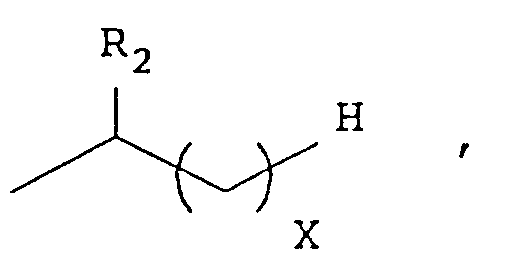
where R₂ represents H or OH and X denotes an integer of 0-26, or -(CH₂)₇CH=CH(CH₂)₇CH₃ and
R₁ represents any one of the substituents defined by the following (a)-(e): - (a) -CH₂(CH₂)YCH₃,
- (b) -CH(OH)(CH₂)YCH₃,
- (c) -CH(OH)(CH₂)YCH(CH₃)₂,
- (d) -CH=CH(CH₂)YCH₃, and
- (e) -CH(OH)(CH₂)YCH(CH₃)CH₂CH₃,
- In the aforementioned formula (A),
(1) the compound in which R represents
is represented by the formula (I):
and (2) the compound in which R represents -(CH₂)₇CH=CH(CH₂)₇CH₃ is represented by the formula (XXI):
- The present invention also relates to a process for preparing the compounds represented by the formula (I) and specified below. That is, the process for preparing the glycosphingolipid represented by the formula (I) according to the present invention comprises collecting the marine sponge Agelas mauritianus, subjecting it to an extraction operation with an organic solvent and isolating from the extract the glycosphingolipids represented by the formula (I) and specified below:
- (1) (2S,3S,4R)-1-(α-D-galactopyranosyloxy)-2-[(R)-2-hydroxytetracosanoylamino]-3,4-heptadecanediol,
- (2) (2S,3S,4R)-1-(α-D-galactopyranosyloxy)-2-[(R)-2-hydroxytetracosanoylamino]-3,4-hexadecanediol,
- (3) (2S,3S,4R)-1-(α-D-galactopyranosyloxy)-2-[(R)-2-hydroxytricosanoylamino]-16-methyl-3,4-heptadecanediol, and
- (4) (2S,3S,4R)-1-(α-D-galactopyranosyloxy)-2-[(R)-2-hydroxypentacosanoylamino]-16-methyl-3,4-octadecanediol.
- The compound of the present invention represented by the formula (A) (i.e. formulae (I) and (XXI)) can be also synthesized chemically according to the process schemes or reaction route schemes described below.
- The present invention further relates to the use of the compounds represented by the formula (A) (formulae (I) and (XXI)). That is, the antitumor agent and the immuno stimulator according to the present invention each contains one or more glycosphingolipids represented by the formula (A) (formulae (I) and (XXI)) as effective ingredients or contain the effective amount thereof and a pharmaceutically acceptable carrier or diluent.
- Furthermore, the present invention relates to the therapeutic method comprising administering the effective amounts of one or more of the aforementioned compounds to patients who need inhibiting the proliferation of tumor or activating immunity.
-
- Fig. 1 (a and b) shows the reaction route scheme (synthetic route A) for synthesizing the compounds represented by the formula (A) from an aldehyde compound as a starting material;
- Fig. 2 also shows the reaction route scheme (synthetic route B) which is a route for synthesizing the compounds represented by the formula (A) from an aldehyde compound as a starting material as well as Fig. 1 and has less steps than the reaction route A;
- Fig. 3 shows the reaction route scheme (synthetic route C) for deriving the compounds represented by the formula (A) by applying a variety of chemical modifications to the sphingosine;
- Fig. 4(a-c) shows the reaction route scheme (synthetic route D) for synthesizing a derivative of the compound represented by the formula (A) from an aldehyde compound as a starting material, which has a hydroxyl group at the C-4 of the long chain base;
- Fig. 5(a and b) shows the reaction route scheme which illustrates a preferred method for synthesizing the compound 9 ((2S,3R)-1-(α-D-galactopyranosyloxy)-2-tetracosanoylamino-3-tetradecanol);
- Fig. 6 shows the reaction route scheme which illustrates a preferred method for synthesizing the compound 7 ((2S,3R)-1-(α-D-galactopyranosyloxy)-2-octanoylamino-3-octadecanol);
- Fig. 7 shows the reaction route scheme which illustrates a preferred method for synthesizing the compound 5 ((2S,3R)-1-(α-D-galactopyranosyloxy)-2-tetradecanoylamino-3-octadecanol);
- Fig. 8 shows the reaction route scheme which illustrates a preferred method for synthesizing the compound 1 ((2S,3R)-1-(α-D-galactopyranosyloxy)-2-tetracosanoylamino-3-octadecanol);
- Fig. 9 shows the reaction route scheme which illustrates another preferred method for synthesizing the
compound 5; and - Fig. 10(a-c) shows the reaction route scheme which illustrates a preferred method for synthesizing the compound 22 ((2S,3S,4R)-1-(α-D-galactopyranosyloxy)-2-[(R)-2-hydroxyltetracosanoylamino]-3,4-heptadecanediol).
- The glycosphingolipids according to the present invention, as described above, are represented by the formula (A) (i.e. formulae (I) and (XXI)), and R₁ in the formula (I) is preferably represented by the following (a)-(e):
- (a) -CH₂(CH₂)YCH₃,
wherein, when R₂ represents H, it is preferable that X denote an integer of 0-24 and Y denote an integer of 7-15; when R₂ represents OH, it is preferable that X denote an integer of 20-24 and Y denote an integer of 11-15; when R₂ represents H, it is particularly preferable that X denote an integer of 8-22 and Y denote an integer of 9-13; and when R₂ represents OH, it is particularly preferable that X denote an integer of 21-23 and Y denote an integer of 12-14; - (b) -CH(OH)(CH₂)YCH₃,
wherein, when R₂ represents H, it is preferable that X denote an integer of 18-26 and Y denote an integer of 5-15; when R₂ represents OH, it is preferable that X denote an integer of 18-26 and Y denote an integer of 5-17; further when R₂ represents H, it is particularly preferable that X denote an integer of 21-25 and Y denote an integer of 6-14; and when R₂ represents OH, it is particularly preferable that X denote an integer of 21-25 and Y denote an integer of 6-16; - (c) -CH(OH)(CH₂)YCH(CH₃)₂,
wherein when R₂ represents H, it is preferable that X denote an integer of 20-24 and Y denote an integer of 9-13; when R₂ represents OH, it is preferable that X denote an integer of 18-24 and Y denote an integer of 9-13; further when R₂ represents H, it is particularly preferable that X denote an integer of 21-23 and Y denote an integer of 10-12; and when R₂ represents OH, it is particularly preferable that X denote an integer of 20-23 and Y denote an integer of 10-12; - (d) -CH=CH(CH₂)YCH₃,
wherein R₂ represents H and it is preferable that X denote an integer of 10-18 and Y denote an integer of 10-14; and it is particularly preferable that X denote an integer of 11-17 and Y denote an integer of 11-13; and - (e) -CH(OH)(CH₂)YCH(CH₃)CH₂CH₃,
wherein R₂ represents OH and it is preferable that X denote an integer of 21-25 and Y denote an integer of 9-13; and it is particularly preferable that X denote an integer of 22-24 and Y denote an integer of 10-12. - On the other hand, R₁ in the formula (XXI) preferably represents -CH₂(CH₂)YCH₃, wherein Y denotes preferably an integer of 11-15, particularly 12-14.
- A compound of the present invention which has the configurations at 2- and 3-positions as shown in the following formula (II) is particularly preferred.
- Furthermore, when the synthetic route described below is used, the glycosphingolipid represented by the formula (IV) hereinafter wherein X denotes an integer of 8-22 and Y denotes an integer of 9-13 is the most preferred from the standpoint of easy availability of the raw material.
- The more concrete form and the preferred form of the compound of the present invention represented by the formula (A) (formulae (I) and (XXI)) can be defined by the following definitions (1)-(4):
- (1) the glycosphingolipids of the formula (I) represented by the formula (II):

- (a) -CH₂(CH₂)YCH₃,
wherein, when R₂ represents H, X denotes an integer of 0-24 and Y denotes an integer of 7-15; and when R₂ represents OH, X denotes an integer of 20-24 and Y denotes an integer of 11-15; - (b) -CH(OH)(CH₂)YCH₃,
wherein, when R₂ represents H, X denotes an integer of 18-26 and Y denotes an integer of 5-15; and when R₂ represents OH, X denotes an integer of 18-26 and Y denotes an integer of 5-17; - (c) -CH(OH)(CH₂)YCH(CH₃)₂,
wherein, when R₂ represents H, X denotes an integer of 20-24 and Y denotes an integer of 9-13; and when R₂ represents OH, X denotes an integer of 18-24 and Y denotes an integer of 9-13; - (d) -CH=CH(CH₂)YCH₃,
wherein R₂ represents H, X denotes an integer of 10-18 and Y denotes an integer of 10-14; and - (e) -CH(OH)(CH₂)YCH(CH₃)CH₂CH₃,
wherein R₂ represents OH, X denotes an integer of 21-25 and Y denotes an integer of 9-13;
- (a) -CH₂(CH₂)YCH₃,
- (2) the glycosphingolipids of the formula (I) represented by the formula (III):

- (3) the glycosphingolipids described in the above (2), wherein more preferably X denotes an integer of 8-22 and Y denotes an integer of 9-13;
- (4) the glycosphingolipids described in the above (2) which is more preferably represented by the formula (IV):

- (5) the glycosphingolipids described in the above (4), wherein most preferably X denotes an integer of 8-22 and Y denotes an integer of 9-13;
- (6) the glycosphingolipids of the formula (I) represented by the formula (V):

- (7) the glycosphingolipids described in the above (6), wherein more preferably X denotes an integer of 21-23 and Y denotes an integer of 12-14;
- (8) the glycosphingolipids described in the above (6), represented more preferably by the formula (VI):

- (9) the glycosphingolipids described in the above (8), wherein most preferably X denotes an integer of 21-23 and Y denotes an integer of 12-14;
- (10) the glycosphingolipids of the formula (I) represented by the formula (VII):

- (11) the glycosphingolipids described in the above (10), wherein more preferably X denotes an integer of 21-25 and Y denotes an integer of 6-14;
- (12) the glycosphingolipids described in the above (10) which is represented more preferably by the formula (VIII):

- (13) the glycosphingolipids described in the above (12), wherein most preferably X denotes an integer of 21-25 and Y denotes an integer of 6-14;
- (14) the glycosphingolipids of the formula (I) represented by the formula (IX):

- (15) the glycosphingolipids described in the above (14), wherein more preferably X denotes an integer of 21-25 and Y denotes an integer of 6-16;
- (16) the glycosphingolipids described in the above (14) represented more preferably by the formula (X):
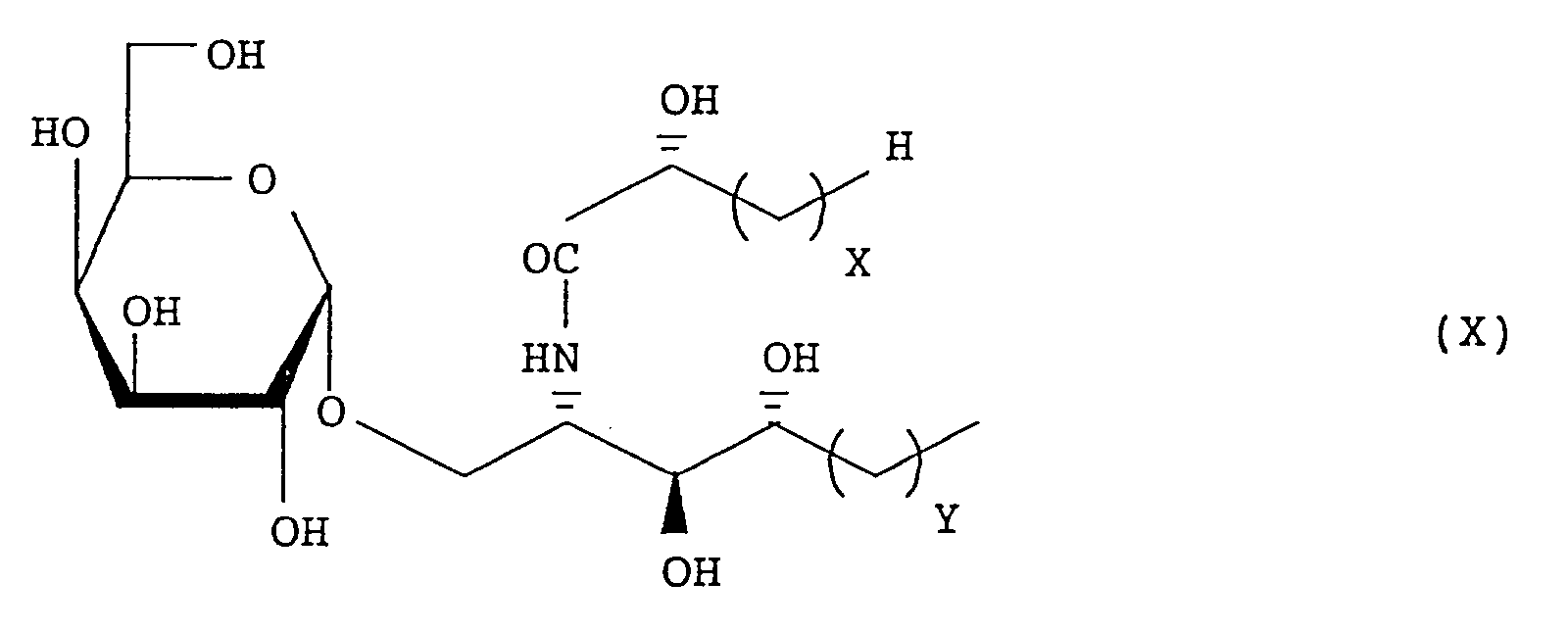
- (17) the glycosphingolipids described in the above (14) represented more preferably by the formula (X'):

- (18) the glycosphingolipids described in the above (16), wherein most preferably X denotes an integer of 21-25 and Y denotes an integer of 6-16;
- (19) the glycosphingolipids described in the above (17), wherein most preferably X denotes an integer of 21-23 and Y denotes an integer of 11-13;
- (20) the glycosphingolipids of the formula (I) represented by the formula (XI):

- (21) the glycosphingolipids described in the above (20), wherein more preferably X denotes an integer of 21-23 and Y denotes an integer of 10-12;
- (22) the glycosphingolipids described in the above (20) more preferably represented by the formula (XII):

- (23) the glycosphingolipids described in the above (22), wherein more preferably X denotes an integer of 21-23 and Y denotes an integer of 10-12;
- (24) the glycosphingolipids of the formula (I) represented by the formula (XIII):

- (25) the glycosphingolipids described in the above (24), wherein more preferably X denotes an integer of 20-23 and Y denotes an integer of 10-12;
- (26) the glycosphingolipids described in the above (24), more preferably represented by the formula (XIV):

- (27) the glycosphingolipids described in the above (24), more preferably represented by the formula (XIV'):

- (28) the glycosphingolipids described in the above (26), wherein most preferably X denotes an integer of 20-22 and Y denotes an integer of 10-12;
- (29) the glycosphingolipids described in the above (27), wherein most preferably X denotes an integer of 21-23 and Y denotes an integer of 10-12;
- (30) the glycosphingolipids of the formula (I) represented by the formula (XV):

- (31) the glycosphingolipids described in the above (30), wherein more preferably X denotes an integer of 11-17 and Y denotes an integer of 11-13;
- (32) the glycosphingolipids described in the above (30) more preferably represented by the formula (XVI):

- (33) the glycosphingolipids described in the above (32), wherein most preferably X denotes an integer of 11-17 and Y denotes an integer of 11-13;
- (34) the glycosphingolipids of the formula (I) represented by the formula (XVII):

- (35) the glycosphingolipids described in the above (34), wherein more preferably X denotes an integer of 22-24 and Y denotes an integer of 10-12;
- (36) the glycosphingolipids described in the above (34) more preferably represented by the formula (XVIII):

- (37) the glycosphingolipids described in the above (36), wherein most preferably X denotes an integer of 22-24 and Y denotes an integer of 10-12;
- (38) the glycosphingolipids of the formula (XXI) represented by the formula (XIX):
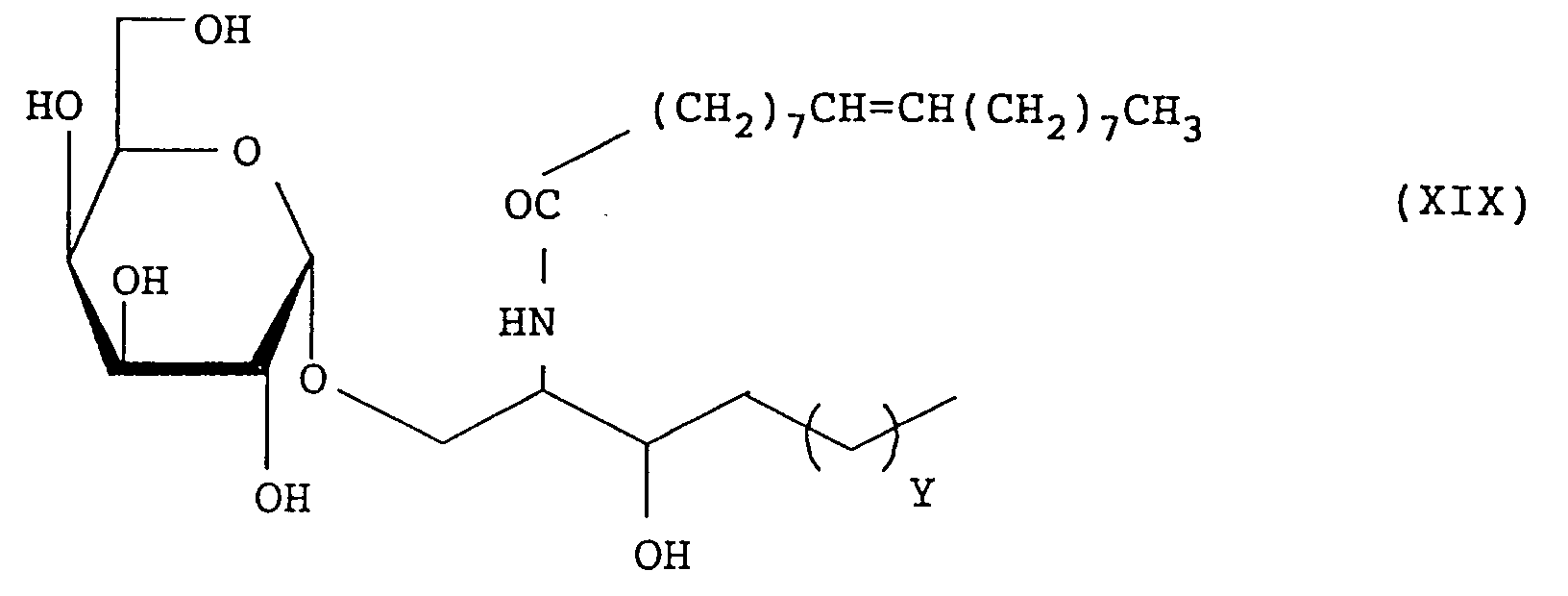
- (39) the glycosphingolipids described in the above (38), wherein more preferably Y denotes an integer of 12-14;
- (40) the glycosphingolipid described in the above (38) more preferably represented by the formula (XX):
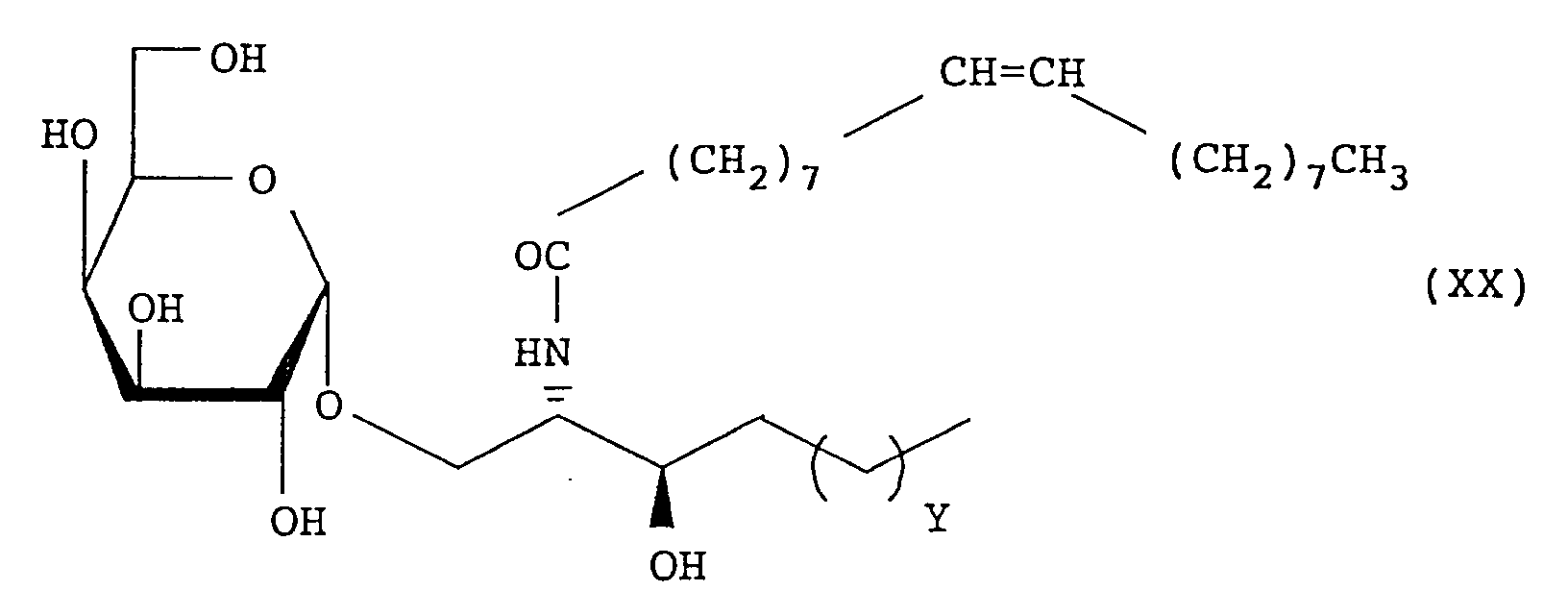
- (41) the glycosphingolipids described in the above (40), wherein most preferably Y denotes an integer of 12-14.
- Concrete preferred examples of compounds included in the present invention represented by the formula (A) (formulae (I) and (XXI)) are shown below. In respective formulae, X and Y are defined as above.
- (1) The compounds represented by the following formulae (IV) and (VI)

(2S,3R)-1-(α-D-galactopyranosyloxy)-2-tetracosanoylamino-3-octadecanol,
Compound 2:
(2S,3R)-2-docosanoylamino-1-(α-D-galactopyranosyloxy)-3-octadecanol,
Compound 3:
(2S,3R)-1-(α-D-galactopyranosyloxy)-2-icosanoylamino-3-octadecanol,
Compound 4:
(2S,3R)-1-(α-D-galactopyranosyloxy)-2-octadecanoylamino-3-octadecanol,
Compound 5:
(2S,3R)-1-(α-D-galactopyranosyloxy)-2-tetradecanoylamino-3-octadecanol,
Compound 6:
(2S,3R)-2-decanoylamino-1-(α-D-galactopyranosyloxy)-3-octadecanol,
Compound 7:
(2S,3R)-1-(α-D-galactopyranosyloxy)-2-octanoylamino-3-octadecanol,
Compound 8:
(2S,3R)-2-acetamino-1-(α-D-galactopyranosyloxy)-3-octadecanol,
Compound 9:
(2S,3R)-1-(α-D-galactopyranosyloxy)-2-tetracosanoylamino-3-tetradecanol,
Compound 10:
(2S,3R)-1-(α-D-galactopyranosyloxy)-2-tetradecanoylamino-3-hexadecanol,
Compound 11:
(2R,3S)-1-(α-D-galactopyranosyloxy)-2-tetradecanoylamino-3-hexadecanol,
Compound 12:
(2S,3S)-1-(α-D-galactopyranosyloxy)-2-tetradecanoylamino-3-hexadecanol,
Compound 13:
(2R,3R)-1-(α-D-galactopyranosyloxy)-2-tetradecanoylamino-3-hexadecanol,
Compound 14:
(2S,3R)-1-(α-D-galactopyranosyloxy)-2-[(R)-2-hydroxytetracosanoylamino]-3-octadecanol.
Among these compounds, the compounds 1-10 and 14 are preferred in consideration of the configuration at 2- and 3-positions. - (2) The compounds represented by the following formula (XVI)

(2S,3R,4E)-1-(α-D-galactopyranosyloxy)-2-octadecanoylamino-4-octadecen-3-ol,
Compound 35:
(2S,3R,4E)-1-(α-D-galactopyranosyloxy)-2-tetradecanoylamino-4-octadecen-3-ol. - (3) The compounds represented by the following formula (VIII)

(2S,3S,4R)-1-(α-D-galactopyranosyloxy)-2-tetracosanoylamino-3,4-octadecanediol,
Compound 17:
(2S,3S,4R)-1-(α-D-galactopyranosyloxy)-2-tetracosanoylamino-3,4-heptadecanediol,
Compound 18:
(2S,3S,4R)-1-(α-D-galactopyranosyloxy)-2-tetracosanoylamino-3,4-pentadecanediol,
Compound 19:
(2S,3S,4R)-1-(α-D-galactopyranosyloxy)-2-tetracosanoylamino-3,4-undecanediol,
Compound 20:
(2S,3S,4R)-1-(α-D-galactopyranosyloxy)-2-hexacosanoylamino-3,4-heptadecanediol. - (4) The compounds represented by the following formulae (X) and (X')

(2S,3S,4R)-1-(α-D-galactopyranosyloxy)-2-[(R)-2-hydroxytetracosanoylamino]-3,4-octadecanediol,
Compound 22:
(2S,3S,4R)-1-(α-D-galactopyranosyloxy)-2-[(R)-2-hydroxytetracosanoylamino]-3,4-heptadecanediol,
Compound 23:
(2S,3S,4R)-1-(α-D-galactopyranosyloxy)-2-[(R)-2-hydroxytetracosanoylamino]-3,4-pentadecanediol,
Compound 24:
(2S,3S,4R)-1-(α-D-galactopyranosyloxy)-2-[(R)-2-hydroxytetracosanoylamino]-3,4-undecanediol,
Compound 25:
(2S,3S,4R)-1-(α-D-galactopyranosyloxy)-2-[(R)-2-hydroxyhexacosanoylamino]-3,4-octadecanediol,
Compound 26:
(2S,3S,4R)-1-(α-D-galactopyranosyloxy)-2-[(R)-2-hydroxyhexacosanoylamino]-3,4-nonadecanediol,
Compound 27:
(2S,3S,4R)-1-(α-D-galactopyranosyloxy)-2-[(R)-2-hydroxyhexacosanoylamino]-3,4-icosanediol,
Compound 28:
(2S,3S,4R)-1-(α-D-galactopyranosyloxy)-2-[(S)-2-hydroxytetracosanoylamino]-3,4-heptadecanediol,
Compound 32:
(2S,3S,4R)-1-(α-D-galactopyranosyloxy)-2-[(R)-2-hydroxytetracosanoylamino]-3,4-hexadecanediol. - (4) The compounds represented by the following formulae (XII), (XIV) and (XIV')
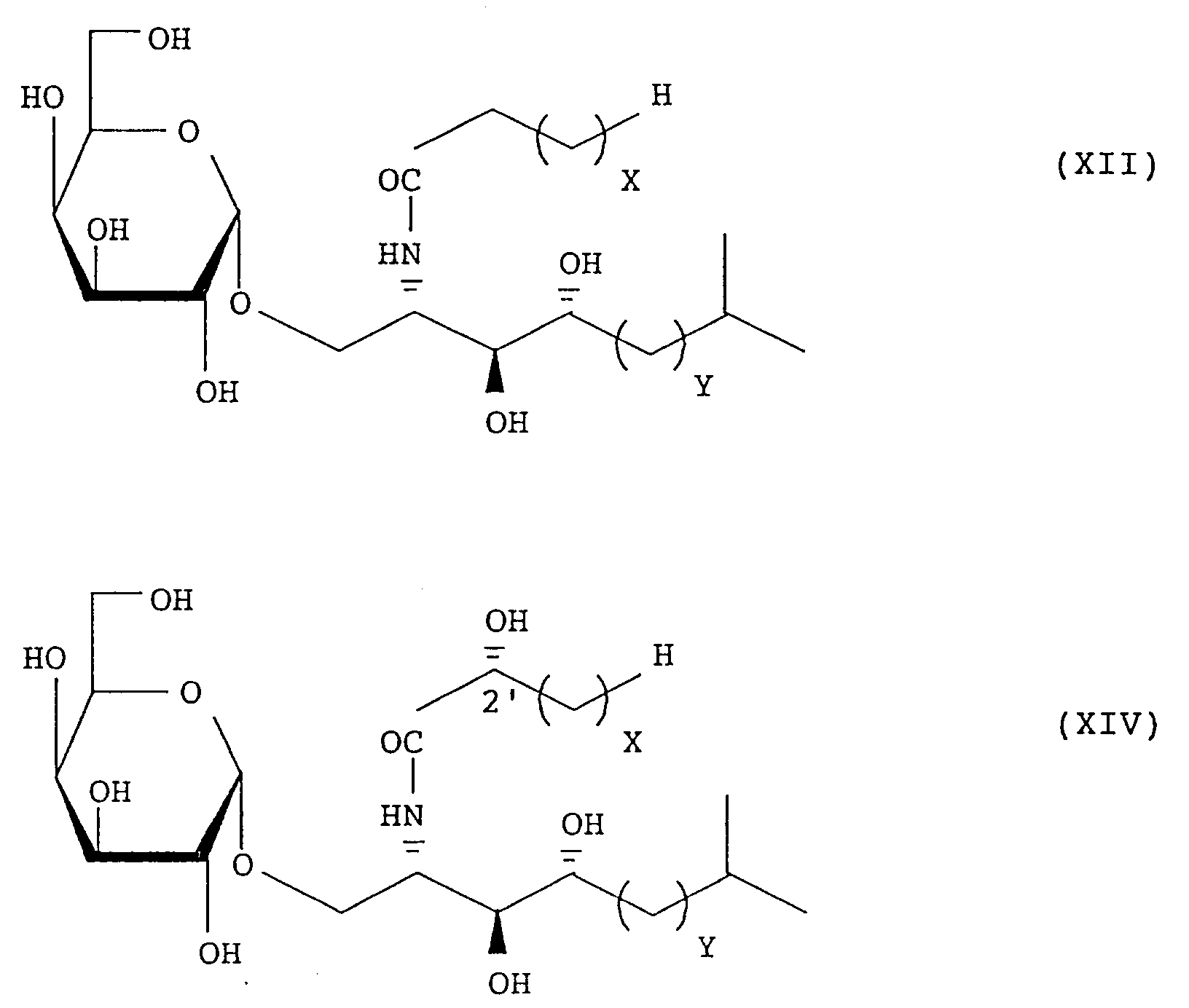

(2S,3S,4R)-1-(α-D-galactopyranosyloxy)-2-[(S)-2-hydroxytetracosanoylamino]-16-methyl-3,4-heptadecanediol,
Compound 31:
(2S,3S,4R)-1-(α-D-galactopyranosyloxy)-16-methyl-2-tetracosanoylamino-3,4-heptadecanediol,
Compound 33:
(2S,3S,4R)-1-(α-D-galactopyranosyloxy)-2-[(R)-2-hydroxytricosanoylamino]-16-methyl-3,4-heptadecanediol. - (5) The compound represented by the following formula (XVIII)

(2S,3S,4R)-1-(α-D-galactopyranosyloxy)2-[(R)-2-hydroxypentacosanoylamino]-16-methyl-3,4-octadecanediol. - (6) The compound represented by the following formula (XIX)

(2S,3R)-1-(α-D-galactopyranosyloxy)-2-oleoylamino-3-octadecanol. - Among the compounds represented by the formula (I), the glycosphingolipids such as the
compounds - Fundamentally the process for obtaining the compounds from marine sponges comprises A: a step for collecting the sponges, B: an extraction step for contacting the sponges with at least one appropriate organic solvent in order to obtain a crude extract containing the compound of the present invention, and C: a step for isolating the compound of the present invention from the crude extract obtained in the step B.
- This step is one for collecting marine sponges. A preferred example of a species of marine sponges is Aqelas mauritianus, which can be collected from the sea of Kumeshima in Okinawa Prefecture of Japan.
-
- This step is one for extracting the compound of the present invention as a crude extract from the sponge with at least one appropriate organic solvent or water.
- An organic solvent is preferable as the extracting solvent. It is sufficient that an appropriate organic solvent for extraction is a solvent which can extract the compound of the present invention from the sponge. Preferred examples of the solvent are esters such as ethyl acetate and butyl acetate and so on; alcohols such as methanol, ethanol and isopropyl alcohol and so on; aliphatic hydrocarbons such as heptane, hexane and isooctane and so on; ketones such as acetone and methyl ethyl ketone and so on; aromatic compounds such as benzene and toluene and so on; ethers such as diethyl ether and t-butyl methyl ether and so on; and substituted lower aliphatic hydrocarbon compounds such as methylene chloride, chloroform and 1,2-dichloroethane and so on. In the present invention, these solvents can be used respectively alone or in combination of the two or more thereof.
- Among the organic solvents mentioned above, more preferable examples are ethanol, acetone, ethyl acetate and the like, and the preferred examples of combination of a plurality of the solvents are methanol and chloroform, methanol and methylene chloride, acetone and toluene and the like.
- As the method for extraction, well-known methods in relation to the extraction of physiologically active substances, particularly a glycosphingolipid, from a living material such as an animal or a plant or a microorganism, for example, the methods described in Liebigs Annalen der Chemie, 51, (1990); Tetrahedron, 45 (12), 3897, (1989); or Zeitschrift fuer Naturforschung Teil B, 42 (11), 1476, (1987) can be applied. These extraction methods can be used respectively alone or in combination of the two or more thereof.
- Specifically, for example, a marine sponge is applied as it is or after the preliminary treatments such as homogenization and lyophilization, and the extraction operation is carried out preferably with stirring at a temperature of 0-80°C, preferably around room temperature for an extraction period of 1-72 hours, preferably 12-36 hours. If necessary, the aforementioned extraction operation can be repeated at desired times.
- This step is one for isolating the compound of the present invention from the crude extract which is obtained in the step B and contains the compound of the present invention.
- As the isolating method, well-known methods in relation to the fractionation and isolation of a physiologically active substances, particularly a glycosphingolipids, from a variety of living materials as described above can be used. The general descriptions concerning such a method are given for example in Liebigs Annalen der Chemie, 51, (1990).
- More specifically, as the fractionation method, the examples include fractionating method with use of the difference of solubilities (for example, by the combination of water and methanol), distributing method (involving the countercurrent distribution method; for example, by the combination of ethylacetate and water) with use of the difference of distribution rates, and the like. The aforementioned crude extract can be treated by these fractionation methods to recover the objective fraction, and thus the aforementioned four compounds of the present invention can be obtained as the crude products.
- In order to further purify the resulting crude products of the compounds of the present invention, the combination of the aforementioned fractionation methods with the isolating methods as described below may be carried out at desired times. If necessary, the purified product of the compound of the present invention can also be obtained by subjecting the crude extract obtained in the step B to an appropriate operation of an isolating method at necessary times.
- The examples of such isolating methods are the methods for eluting the objective product by chromatography such as adsorption chromatography, distribution chromatography, thin layer chromatography, high performance liquid chromatography or gel filtration and the like. A concrete example of chromatography is the column chromatography in which a stationary phase such as silica gel, ODS, TOYOPEARL HW-40 (TOSO, Japan) or Sephadex LH-20 (Pharmacia) is employed, and as a mobile phase an organic solvent as described above in the paragraph of the step B or water is used alone or in combination of the two or more thereof. As the preferable concrete examples of the eluent, mentioned are methanol, chloroform and the like as the single eluent, and methanol and chloroform, methanol and water and the like as the mixture.
- While the compounds according to the present invention, that is, the glycosphingolipids represented by the formula (A) (formulae (I) and (XXI)) can be derived from a variety of the chemical modifications of sphingosine, they can be also prepared by the overall synthesis with the chemical synthetic means which is a combination of a variety of general chemical reactions required for the synthesis of the glycosphingolipids. The route of the overall synthesis is not the only one, and the glycosphingolipid can be prepared via an alternative route from a different starting material. It can be also synthesized, for example, by applying the method described in Agricultural and Biological Chemistry, 54 (3), 663, 1990 which is an example of the chemical synthetic means. It can be also synthesized, for example, by applying the method described in Liebigs Annalen der Chemie, 663, 1988 which is an example of using a variety of sugars as the starting materials. Although a protective group is removed after a sugar is bonded to a ceramide in these synthetic methods, it is also possible to use the method for synthesizing a cerebroside in which a sugar is first bonded to a long chain base and an amino group is then introduced to form an amide, as described in Liebigs Annalen der Chemie, 663, 1988.
- As an example of the synthesis as described above, the compounds represented by the formulae (III), (V) and (XIX) can be synthesized also via the following steps (cf. Figs. 1a and 1b).
- In Fig. 1, the following abbreviations are used:
- Bn:
- benzyl,
- R₄:
- a hydroxyl group or a formyloxy group,
- Ms:
- methanesulfonyl,
- R₅:
- a hydrogen atom or an acyloxy group,
- Tr:
- triphenylmethyl, and
- Bz:
- benzoyl.
- An aldehyde as a raw material has one or two asymmetric centers. An amino acid or a sugar can also be employed as the asymmetric sources. While a benzyl group is employed as the protective group of a hydroxyl group in this example, any appropriate groups such as an isopropylidene group may be also employed.
- In this route scheme, particularly many reaction methods are known for the amidation. An acid chloride or an acid anhydride can also be employed in place of a carboxylic acid.
- The reaction with a carboxylic acid is a condensation reaction in the presence of an appropriate condensation agent. Suitable condensation agent used herein are dicyclohexylcarbodiimide (DCC), 2-ethoxy-1-ethoxycarbonyl-1,2-dihydroquinoline (EEDQ), 1-ethyl-3-(3-dimethylaminopropyl)-carbodiimide (WSC), chlorocarbonates, onium salts and the like. In order to progress the reaction rapidly, an organic base such as triethylamine, pyridine, N-methylmorpholine, dimethylaniline, 4-dimethylaminopyridine, N-methylpiperidine or N-methylpyrrolidine is added. Any inert solvents which do not participate in the reaction may be used as the solvent.
- The reaction with an acid chloride satisfactorily proceeds generally in the presence of a solvent. Although the reaction is generally conducted with use of an appropriate solvent, the reaction which proceeds slowly can be progressed rapidly in the absence of the solvent. Any inert solvents which do not participate in the reaction may be used as the solvent. If the reaction proceeds slowly, it may be progressed rapidly by the addition of an organic solvent such as triethylamine, pyridine, N-methylmorpholine, dimethylaniline or 4-dimethylaminopyridine.
- The reaction with an acid anhydride is preferably conducted in the presence of an appropriate base. As the base herein used, triethylamine, pyridine or the like is usually used as the solvent concurrently.
- Many methods of reaction for glycosylation are also known as described in the following references: (1) YUKI GOSEI KAGAKU, 38 (5), 473, 1980; (2) YUKI GOSEI KAGAKU, 41 (8), 701, 1983; (3) Pure and Applied Chemistry, 61 (7), 1257, 1989; (4) Pharmacia, 27 (1), 50, 1991.
- Any of the reactions described above may be used, but a method for obtaining preferentially an α-galactoside such as the one described in Chemistry Letters, 431-432, 1981 is preferred. If the α-isomer is not obtained alone, its separation from the β-isomer is carried out. When such a separation is difficult, the α-isomer and the β-isomer can be separated by introducing the hydroxyl group into an acyl derivative (e.g. an acetyl derivative).
-
- It is also possible to show the following reaction route scheme as a shorter process starting from the same raw material as in the synthetic route A. The compounds represented by the formulae (III), (V) and (XIX) can be synthesized also by this method (see Fig. 2). In Fig. 2, the same abbreviations as described above are used. This route is characterized in that the steps are successfully reduced by performing simultaneously the reduction of the aside group, the removal of the benzyl group and the reduction of the double bond. The four isomers of the 2-amino-1,3-alkanediol which are intermediates obtained by the reduction can be obtained alone, respectively, by selecting the asymmetric sources of the aldehyde as the starting material depending on the purposes. The isomers are individually subjected to the subsequent amidation. A variety of the methods as described in the route A can be employed in this step. Subsequently, glycosylation and deprotection can be conducted in the similar way to the route A to obtain the objective product.
- As an example of the synthesis introduced by a variety of chemical modifications of sphingosine, the compounds represented by the formulae (IV), (VI), (XVI) and (XX) in which the long chain base portion has 18 carbon atoms can be also synthesized via the following process (see Fig. 3). In Fig. 3, the same abbreviations as described above are used. While sphingosine can be obtained by the extraction from natural materials, it is commercially available from Sigma Chemical Company or Funakoshi Corporation, Japan. It can be also synthesized by a variety of synthetic methods as described in Pharmacia, 27, 1164, 1991 or Journal of the Chemical
Society Perkin Transaction 1, 2279, 1991. The isomers having steric configurations different from those of the natural materials can be also synthesized by applying the method described in Helvetica Chimica Acta, 40, 1145, 1957 or Journal of the Chemical Society, Chemical Communications, 820, 1991. In the latter reference, many examples of the synthesis are reported. In this route, the double bond can be left also after the glycosylation. That is, if catalytic reduction is employed, a compound having no double bond is obtained, and if metallic sodium is reacted in liquid ammonia, a compound retaining a double bond is produced. Thus, it is possible to prepare the products suitable for the purpose. - Furthermore, the compounds represented by the formulae (VII), (IX), (XI), (XIII) and (XVII) among the compounds represented by the formula (A) in which the long chain base has a hydroxyl group at C-4 can also be synthesized via the following process (see Figs. 4a-4c). In Fig. 4, the same abbreviations as described above are used.
- The starting aldehyde can be obtained alone as any isomers by selecting appropriately the asymmetric source of a raw material. The isomers are separately subjected to the subsequent Wittig reaction. The terminal of the Wittig's salts can be easily formed into the iso type, the anteiso type or the straight chain type. Generally, the Wittig reaction with such unstable ylid give a compound having a cis-double bond as main product, which is however contaminated by the trans-isomer. The double bonds in the mixture are however reduced to a single bond during the step of the catalytic reduction, and thus the mixture will cause no problem as it is. By subsequent mesylation and azide inversion, the product is reduced to an amino derivative, which is amidated in the subsequent step to give a ceramide. The intermediate ceramide having protective groups is also obtained by protecting a commercially available Cerebrine E (Alfred Bader Chemicals or K&K Laboratories Inc.) as the raw material with any appropriate protective group. Furthermore, in order to discriminate the hydroxyl group to which the sugar is bonded, protection and selective deprotection followed by glycosylation and deprotection can be conducted to obtain the objective product (see Figs. 4b-4c).
- The compounds of the present invention represented by the formula (A) (formulae (I) and (XXI)) have the following physiological activities, that is, an antitumor activity and an immuno-stimulating activity and can be used as an antitumor agent and an immunostimulator.
- The compounds of the present invention exhibited antitumor activities against the B16 mouse melanoma cells inoculated s.c. in mouse as shown in Experimental Example 2 below.
- The compounds of the present invention exhibited the stimulating effect on mixed lymphocyte culture reaction (MLR) in the test of mouse MLR as described in Experimental Example 3 below.
- As described above, the compound of the present invention has the antitumor activity and the immunostimulating activity and can be employed as an antitumor agent and an immunostimulator.
- While the compounds of the present invention may be employed alone, these compounds may be used also in combination with the chemotherapy or the radiotherapy. Their uses have been reviewed in Pharmaceutical Society of Japan, Pharmacia Review, No. 23, Chemistry for Controlling Cancer, Second Series, 105-113, 1987; Medicalview Co., Ltd., Illustrative Clinic, "Cancer" series No. 19, GAN TO MENEKI, 159-169, 1987; IGAKU NO AYUMI, 150 (14), 1018-1021, 1989.
- Since the compounds of the present invention exhibit such an immuno-stimulating activity as described above, they are also employed as an immunostimulator against disorders other than cancer such as various infectious diseases, acquired immunodeficiency syndrome or the like. These uses have been described as the general in Medicalview Co., Ltd., Illustrative Clinic, "Cancer" series No. 19, GAN TO MENEKI, 45-50, 1987 and RINSHO KAGAKU, 23 (10), 1299-1305, 1987.
- The compounds of the present invention as an antitumor agent and the immunostimulator can be administered via any appropriate dosage route in drug form determined by the dosage route adopted. As the drug, it takes generally a form which is diluted and molded with a pharmaceutically acceptable additive (carrier or diluent). When the compounds of the present invention are used as antitumor agent or immunostimulator, they can be administered orally or parenterally to human or mammal. For example, the compound of the present invention can be administered by dissolving, suspending or emulsifying it in an appropriate solvent for injection (e.g. distilled water for injection) and injecting it intravenously, intramuscularly or subcutaneously. The compound of the present invention can be administered orally by adding an appropriate additive (e.g. any compounds which are usually used for this purpose such as starch, lactose, crystalline cellulose, hydroxypropylcellulose (HPC), calcium carboxymethylcellulose (CMC-Ca), magnesium stearate and the like) and forming the mixture into powder, tablet, granule, capsule, troche, dry syrup or the like.
- The dose of the compound of the present invention is determined to ensure that the dose administered continuously or intermittently will not exceed a certain amount in consideration of the results in test animals and the individual conditions of a patient. A specific dose naturally varies depending on the dosage procedure, the conditions of a patient or a subject animal such as age, body weight, sex, sensitivity, feed, dosage period, drugs used in combination, seriousness of the patient or the disease, and the appropriate dose and dosage times under the certain conditions must be determined by the test for determining the appropriate dose by a medical specialist based on the above-described indices. In this connection, the minimal dose required for developing the activity of the compound of the present invention is generally in the range of ca. 0.0001 mg - 100 mg per 1 kg of the body weight of a host.
- The present will now be described in detail with reference to Experimental Examples, but it should not be construed that the invention be limited to these Experimental Examples.
- The sponge Aqelas mauritianus collected from the sea of Kumeshima in Okinawa Prefecture of Japan was subjected to homogenization and lyophilization to give a product (1,077.6 g). It was extracted with methanol-chloroform (1:1) as the first solvent to give an extract, which was then concentrated under reduced pressure to give a residue (178.53 g). The residue was distributed between ethyl acetate as the first distribution solvent and water. The upper ethyl acetate layer was dried over sodium sulfate anhydrous, and the lower aqueous layer was extracted with 1-butanol. The ethyl acetate soluble fractions and the 1-butanol soluble fractions containing the
compounds - The
compounds - [α]²⁸D = +61.6° (1-PrOH, c = 1.0)
MS: negative FABMS 816.
IR: (cm⁻¹, KBr)
3400, 2950, 2870, 1645, 1535, 1475, 1080.
mp: 193.5 - 195.0°C
NMR:
¹H (500 MHz, C₅D₅N; 27°C)
δ (ppm)
8.49 (1H, d, J=9.2 Hz), 7.53 (1H, bs), 7.04 (1H, bs), 6.71 (1H, d, J = 6.7 Hz), 6.68 (1H, bs), 6.52 (1H, bs), 6.32 (1H, bs), 6.09 (1H, d, J=6.1 Hz), 5.58 (1H, d, J=3.7 Hz), 5.26 (1H, m), 4.62 (2H, m), 4.57 (1H, m), 4.52 (1H, bs), 4.48 (2H, m) , 4.37 (1H, m), 4.34 (2H, m), 4.32 (1H, m), 4.26 (1H, m), 2.28 (1H, m), 2.18 (1H, m), 1.98 (1H, m), 1.87 (2H, m), 1.73 (1H, m), 1.66 (2H, m), 1.10-1.46 (56H, m), 0.85 (6H, t, J = 7.3 Hz).
¹³C (125 MHz, C₅D₅N; 27°C)
δ (ppm)
175.0 (s), 101.2 (d), 76.5 (d), 73.0 (d), 72.4 (d), 72.3 (d), 71.6 (d), 70.9 (d), 70.1 (d), 68.1 (t), 62.6 (t), 50.4 (d), 35.5 (t), 34.4 (t), 32.1 (t), 30.3 (t), 30.1 (t), 30.0 (t), 29.9 (t), 29.5 (t), 26.4 (t), 25.8 (t), 22.9 (t), 14.2 (q). - [α]²⁸D = +65.4° (1-PrOH, c = 1.0)
MS: negative FABMS 830.
IR: (cm⁻¹, KBr)
3400, 2950, 2870, 1645, 1535, 1475, 1080.
mp: 203.0 - 205.0°C
NMR:
¹H (500 MHz, C₅D₅N; 27°C)
δ (ppm)
8.49 (1H, d, J=9.2 Hz), 7.53 (1H, bs), 7.04 (1H, bs), 6.71 (1H, d, J=6.7 Hz), 6.68 (1H, bs), 6.52 (1H, bs), 6.32 (1H, bs), 6.09 (1H, d, J = 6.1 Hz), 5.58 (1H, d, J=3.7 Hz), 5.26 (1H, m), 4.62 (2H, m), 4.57 (1H, m), 4.51 (1H, bs), 4.48 (2H, m), 4.36 (1H, m), 4.33 (3H, m), 4.25 (1H, m), 2.29 (1H, m), 2.18 (1H, m), 1.99 (1H, m), 1.88 (2H, m), 1.73 (1H, m), 1.66 (2H, m), 1.46 (2H, m), 1.10-1.42 (53H, m), 0.84 (9H, m).
¹³C (125 MHz, C₅D₅N; 27°C)
δ (ppm)
175.0 (s), 101.2 (d), 76.5 (d), 73.1 (d), 72.4 (d), 72.4 (d), 71.6 (d), 70.9 (d), 70.2 (d), 68.2 (t), 62.6 (t), 50.6 (d), 39.2 (t), 35.5 (t), 34.4 (t), 32.1 (t), 30.3 (t), 30.1 (t), 30.0 (t), 29.8 (t), 29.7 (t), 29.5 (t), 28.2 (d), 27.8 (t), 27.4 (t), 26.4 (t), 25.8 (t), 23.0 (t), 22.8 (q), 14.2 (q). - [α]²⁸D = +69.2° (1-PrOH, c = 1.0)
MS: negative FABMS 830.
IR: (cm⁻¹, KBr)
3400, 2950, 2870, 1645, 1535, 1475, 1080.
mp: 201.0 - 203.5°C
NMR:
¹H (500 MHz, C₅D₅N; 27°C)
δ (ppm)
8.48 (1H, d, J=9.2 Hz), 7.53 (1H, bs), 7.03 (1H, bs), 6.71 (1H, d, J=6.7 Hz), 6.67 (1H, bs), 6.53 (1H, bs), 6.32 (1H, bs), 6.09 (1H, bs), 5.59 (1H, d, J=3.7 Hz), 5.27 (1H, m), 4.63 (2H, m), 4.58 (1H, m), 4.52 (1H, bs), 4.47 (2H, m), 4.38 (1H, m), 4.32 (3H, m), 4.26 (1H, m), 2.27 (1H, m), 2.18 (1H, m), 1.98 (1H, m), 1.88 (2H, m), 1.73 (1H, m), 1.65 (2H, m), 1.10-1.46 (58H, m), 0.85 (6H, t, J=7.3 Hz).
¹³C (125 MHz, C₅D₅N; 27°C)
δ (ppm)
175.0 (s), 101.2 (d), 76.5 (d), 73.0 (d), 72.4 (d), 72.3 (d), 71.6 (d), 70.9 (d), 70.2 (d), 68.3 (t), 62.6 (t), 50.4 (d), 35.5 (t), 34.4 (t), 32.1 (t), 30.3 (t), 30.1 (t), 29.9 (t), 29.6 (t), 29.5 (t), 26.4 (t), 25.9 (t), 22.9 (t), 14.2 (q). - [α]²⁸D = +59.4° (1-PrOH, c = 1.0)
MS: negative FABMS 872.
IR: (cm⁻¹, KBr)
3400, 2950, 2870, 1645, 1535, 1475, 1080.
mp: 215.5 - 218.0°C
NMR:
¹H (500 MHz, C₅D₅N; 27°C)
δ (ppm)
8.50 (1H, d, J=9.2 Hz), 7.53 (1H, bs), 7.02 (1H, bs), 6.71 (1H, d, J=6.7 Hz), 6.66 (1H, bs), 6.52 (1H, bs), 6.31 (1H, bs), 6.09 (1H, d, J=3.9 Hz), 5.59 (1H, d, J=3.7 Hz), 5.27 (1H, m), 4.62 (2H, m), 4.58 (1H, m), 4.52 (1H, bs), 4.47 (2H, m), 4.38 (1H, m), 4.33 (3H, m), 4.26 (1H, m), 2.28 (1H, m), 2.18 (1H, m), 1.99 (1H, m), 1.87 (2H, m), 1.73 (1H, m), 1.66 (2H, m), 1.10-1.42 (61H, m), 0.85 (9H, m).
¹³C (125 MHz, C₅D₅N; 27°C)
δ (ppm)
175.0 (s), 101.2 (d), 76.5 (d), 73.0 (d), 72.4 (d), 72.3 (d), 71.6 (d), 70.9 (d), 70.1 (d), 68.2 (t), 62.6 (t), 50.5 (d), 36.8 (t), 35.5 (t), 34.5 (d), 34.4 (t), 32.0 (t), 30.3 (t), 30.3 (t), 30.1 (t), 30.0 (t), 29.8 (t), 29.7 (t), 29.5 (t), 27.3 (t), 26.4 (t), 25.8 (t), 22.9 (t), 19.3 (q), 14.2 (q), 11.5 (q). - The methods for synthesizing the compounds of the present invention and the physico-chemical properties thereof are shown below (see reaction route schemes 1-10).
- While this scheme is shown specifically with reference to the
aforementioned compound 9, the compounds 1-8 and 10-14 according to the present invention can also be synthesized by applying this method (see Figs. 5a and 5b). - In the above scheme, the following abbreviations are used.
- DMAP:
- 4-dimethylaminopyridine,
- TsOH:
- p-toluenesulfonic acid,
- MS-4A:
- Molecular Sieves-4A (dehydrating agent).
- The other abbreviations have the same meanings as in the previous route schemes.
- Furthermore, the compound 29 leaving a double bond unreacted therein can be synthesized by the use of a fatty acid having a double bond as a starting material and by the deprotection at the final step with liquid ammonia and metallic sodium.
- The compound A1 can be synthesized in accordance with the method described in Synthesis, 961-963, 1984.
- To a solution of the compound A1 (2.89 g) in 2-methyl-2-propanol (25 ml) was added a 5% aqueous sulfuric acid solution (25 ml), and the mixture was stirred at 45°C for 15 hours. After being neutralized with powdery sodium hydrogen carbonate under ice-cooling, the reaction mixture was concentrated. The residue, to which water (30 ml) was added, was extracted with ethyl acetate (three times), and the organic layer was concentrated. Purification on a silica gel column (Wako Gel C-200, 100 g) using hexane-acetone (2:1) as an eluent afforded a diol in an amount of 2.28 g (yield: 88.5%).
MS: FDMS 330. - The mixture of the diol (2.25 g) with ethanol (50 ml), water (12 ml) and sodium metaperiodate (2.33 g) was stirred at room temperature for 10 hours. Precipitates were removed by filtration, and the filtrate was concentrated. The residue was diluted with chloroform and washed with brine. The organic layer was concentrated to give an aldehyde (compound A2) in an amount of 1.31 g. The aldehyde was directly used for the next reaction without purification.
- To decanetriphenylphosphonium bromide (8.0 g) was added tetrahydrofuran (20 ml) under an argon atmosphere. After adding a 2.8 N solution of n-butyllithium in hexane (6.2 ml) to the mixture at -10°C, stirring was continued for 30 minutes. After the addition of the aldehyde (compound A2, 1.31 g) dissolved in tetrahydrofuran (5 ml), the mixture was allowed to warm to room temperature and stirred for 15 hours and concentrated. The reaction mixture was diluted with brine, and extracted twice with ethyl acetate. The organic layer was washed with brine and concentrated. Purification of the residue on a silica gel column (Wako Gel C-200, 100 g) by eluting with hexane-ethyl acetate (5:1) gave the alcohol (compound A3) in an amount of 1.47 g (yield, 51.0%).
Data of the compound A3
MS: FDMS 426.
NMR: ¹H (500 MHz, CDCl₃; 27°C)
δ (ppm)
7.25-7.35 (10H, m), 5.69-5.79 [1H, (5.75, dt, J=7.3, 11.0 Hz), (5.72, dt, J=6.7, 15.2 Hz)], 5.31-5.38 [1H, (5.36, bt, J=8.5 Hz), (5.33, bt, J=9.8 Hz)], 4.34-4.62 [2H, (4.61 & 4.35, ABq, J=11.6 Hz), (4.56 & 4.50, ABq, J=12.2 Hz), (4.55 & 4.52, ABq, J=11.6 Hz)], 4.28 (0.7H, dd, J=6.7, 9.7 Hz), 3.85 (0.3H, bt, J=7.9 Hz), 3.74-3.78 (1H, m), 3.56-3.60 [1H (3.59, dd, J=3.1, 9.8 Hz), (3.58, overlapped)], 3.47 (1H, dd, J=5.5, 9.8 Hz), 1.96-2.11 (1H, m), 1.25-1.57 (14H, m), 0.88 (3H, t, J=6.7 Hz). - The alcohol (compound A3, 0.83 g) was dissolved in tetrahydrofuran (10 ml). 10% Palladium on charcoal (1.0 g) was added, and the reaction vessel was purged with hydrogen. After the mixture was stirred at room temperature for 12 hours, it was filtered through celite and the filtrate was concentrated. Purification on a silica gel column (Wayo Gel C-200, 30 g) eluting with hexane-ethyl acetate (5:1) afforded a reduction product (compound A4) in an amount of 0.81 g (yield, 97.1%).
Data of the compound A4
MS: FDMS 428.
NMR: ¹H (500 MHz, CDCl₃; 27°C)
δ (ppm)
7.25-7.46 (10H, m), 4.50 & 4.62 (2H, ABq, J=11.0 Hz), 4.54 (2H, s), 3.79-3.83 (1H, m), 3.48-3.56 (3H, m), 2.42 (1H, d, J=6.1 Hz), 1.26-2.04 (20H, m), 0.88 (3H, t, J=7.3 Hz). - After adding methanesulfonyl chloride (0.29 ml) to the reduction product (compound A4, 0.80 g) in pyridine (15 ml), the mixture was stirred at room temperature for 16 hours. The reaction mixture was concentrated and distilled azeotropically with toluene. The residue dissolved in diethyl ether was washed with brine and concentrated. Purification on a silica gel column (Wako Gel C-200, 30 g) eluting with hexane-acetone (6:1) afforded a mesylated product (compound A5) in an amount of 0.87 g (yield, 91.9%).
Data of the compound A5
MS: FDMS 504.
NMR: ¹H (500 MHz, CDCl₃; 27°C)
δ (ppm)
7.27-7.38 (10H, m), 4.81-4.84 (1H, m), 4.59 (2H, s), 4.55 & 4.50 (2H, ABq, J=11.6 Hz), 3.75 (1H, dd, J=3.1, 11.0 Hz), 3.71 (1H, dd, J=6.7, 11.0 Hz), 3.67 (1H, dt, J=4.3, 8.5 Hz), 2.99 (3H, s), 1.24-1.64 (20H, m), 0.08 (3H, t, J=7.3 Hz). - To the mesylated product (compound A5, 0.86 g) were added dimethylformamide (10 ml) and sodium azide (885 mg), and the mixture was stirred at 120°C for 15 hours. The reaction mixture was diluted with brine, extracted with ethyl acetate (three times), and then concentrated. Purification on a silica gel column (Wako Gel C-200, 30 g) eluting with hexane-ethyl acetate (40:1) afforded an azide (compound A6) in an amount of 0.73 g (yield, 94.3%).
Data of the compound A6
MS: FDMS 453.
NMR: ¹H (500 MHz, CDCl₃; 27°C)
δ (ppm)
7.27-7.44 (10H, m), 4.54 & 4.58 (2H, ABq, J=12.2 Hz), 4.52 & 4.57 (2H, ABq, J=11.0 Hz), 3.68-3.70 (2H, m), 3.63 (1H, dd, J=8.5, 11.0 Hz), 3.53 (1H, dt, J=4.3, 8.6 Hz), 1.25-1.64 (20H, m), 0.88 (3H, t, J=6.7 Hz). - To the azide (compound A6, 0.72 g) were added tetrahydrofuran (7 ml) and 10% palladium on charcoal (70 mg), and the mixture was stirred at room temperature after the reaction vessel was purged with hydrogen. The reaction mixture was filtered through celite, and the filtrate was concentrated. Purification on a silica gel column (Wako Gel C-200, 15 g) eluting with hexane-acetone (6:1) afforded an amine (compound A7) in an amount of 0.62 g (yield, 91.5%).
Data of the compound A7
MS: FDMS 427.
NMR: ¹H (500 MHz, CDCl₃; 27°C)
δ (ppm)
7.27-7.36 (10H, m), 4.51 & 4.54 (2H, ABq, J=11.6 Hz), 4.52 (2H, s), 3.58 (1H, dd, J=3.7, 9.2 Hz), 3.41-3.45 (2H, m), 3.20 (1H, dt, J=4.3, 7.3 Hz), 1.26-1.63 (20H, m), 0.88 (3H, t, J=6.7 Hz). - To the amine (compound A7, 0.61 g) were added methylene chloride (20 ml), 2-chloro-1-methylpyridinium iodide (483 mg) and n-tributylamine (0.45 ml). Tetracosanic acid (597 mg) was further added, and the mixture was heated under reflux for 2 hours. The reaction mixture was cooled to room temperature, washed sequentially with 5% aqueous sodium thiosulfate solution, 5% aqueous sodium hydrogen carbonate solution and brine, and then concentrated. Purification on silica gel column (Wako Gel C-200, 20 g) eluting with hexane-acetone (20:1) afforded an amide (compound A8) in an amount of 0.56 g (yield, 51.2%).
Data of the compound A8
MS: FDMS 777.
NMR: ¹H (500 MHz, CDCl₃; 27°C)
δ (ppm)
7.28-7.35 (10H, m), 5.66 (1H, d, J=9.2 Hz), 4.45 & 4.58 (2H, ABq, J=11.6 Hz), 4.48 (2H, s), 4.25-4.30 (1H, m), 3.73 (1H, dd, J=4.9, 9.8 Hz), 3.57 (1H, dt, J=5.5, 6.7 Hz), 3.52 (1H, dd, J=4.3, 9.8 Hz), 2.08 (2H, dt, J=3.1, 10.4 Hz), 1.26-1.58 (64H, m), 0.88 (6H, t, J=6.7 Hz). -
- To the amide (compound A8, 0.55 g) were added tetrahydrofuran (15 ml) and palladium black (55 mg). The reaction vessel was purged with hydrogen, and the mixture was stirred at room temperature for 16 hours. The reaction mixture was filtered through celite, and the filtrate was concentrated. Purification on a silica gel column (Wako Gel C-200, 20 g) eluting with chloroformmethanol (20:1) afforded a diol (compound A9) in an amount of 302 mg (yield, 71.6%).
Data of the compound A9
MS: FDMS 597.
NMR: ¹H (500 MHz, C₅D₅N; 27°C)
δ (ppm)
8.34 (1H, d, J=7.9 Hz), 4.62-4.67 (1H, m), 4.46 (1H, dd, J=4.9, 11.0 Hz), 4.30 (1H, dd, J=5.8, 11.6 Hz), 4.25-4.32 (1H, m), 2.48 (2H, dt, J=2.4, 7.3 Hz), 1.23-1.97 (62H, m), 0.88 (6H, t, J=6.7 Hz). - To the diol (compound A9, 70 mg) were added pyridine (5 ml), triphenylmethyl chloride (261 mg) and 4-dimethylaminopyridine (5 mg), and the mixture was stirred at 60°C for 2 hours. The reaction mixture was diluted with chloroform, washed with brine and concentrated. Purification on a silica gel column (Wako Gel C-200, 10 g) eluting with chloroform-acetone (100:1) afforded a tritylated derivative (compound A10) in an amount of 90.2 mg (yield, 91.6%).
Data of the compound A10
MS: FDMS 837.
NMR: ¹H (500 MHz, CDCl₃; 27°C)
δ (ppm)
7.25-7.47 (15H, m), 6.28 (1H, d, J=7.9 Hz), 3.93-3.96 (1H, m), 3.58-3.61 (1H, m), 3.52 (1H, dd, J=3.1, 9.8 Hz), 3.26 (1H, dd, J=3.7, 9.8 Hz), 2.95 (1H, d, J=9.2 Hz), 2.24 (2H, t, J=7.3 Hz), 1.25-1.70 (62H, m), 0.88 (6H, t, J=7.3 Hz). -
- To the trityl derivative (compound A10, 87 mg) in pyridine (3.0 ml) were added benzoyl chloride (24 µℓ) and 4-dimethylaminopyridine (3 mg), and the mixture was stirred for 4 hours. After the mixture to which ice-water had been added was stirred for 30 minutes, it was diluted with chloroform, washed with water and concentrated. Purification on a silica gel column (Wako Gel C-200, 10 g) eluting with hexane-ethyl acetate (10:1) afforded a benzoyl derivative (compound A11) in an amount of 83.4 mg (yield, 85.3%).
Data of the compound A11
MS: FDMS 941.
NMR: ¹H (500 MHz, CDCl₃; 27°C)
δ (ppm)
7.16-7.93 (20H, m), 5.74 (1H, d, J=9.2 Hz), 5.34-5.37 (1H, m), 4.39-4.48 (1H, m), 3.40 (1H, dd, J=3.7, 9.8 Hz), 3.19 (1H, dd, J=3.7, 9.8 Hz), 2.09 (2H, dt, J=2.5, 9.8 Hz), 1.25-1.74 (64H, m), 0.88 & 0.87 (each 3H, t, J=7.3 Hz). - To the benzoyl derivative (compound A11, 80 mg) were added methylene chloride (1.0 ml) and methanol (0.5 ml). p-Toluenesulfonic acid monohydrate (20 mg) was added, and the mixture was stirred at room temperature for 2 hours. The reaction mixture was diluted with ethyl acetate, washed with a 5% aqueous sodium hydrogen carbonate and brine, and then concentrated. Purification on a silica gel column (Wako Gel C-200, 5 g) eluting with hexaneethyl acetate (2:1) afforded an alcohol (compound A12) in an amount of 58 mg (yield, 93.6%).
Data of the compound A12
MS: FDMS 701.
NMR: ¹H (500 MHz, CDCl₃; 27°C)
δ (ppm)
7.46-8.06 (5H, m), 6.25 (1H, d, J=8.5 Hz), 5.06-5.09 (1H, m), 4.15-4.19 (1H, m), 3.58-3.68 (2H, m), 2.23 (2H, t, J=6.7 Hz), 1.22-1.77 (62H, m), 0.88 & 0.87 (each 3H, t, J=7.3 Hz). - A solution of the alcohol (compound A12, 58 mg) in tetrahydrofuran (3.0 ml) was stirred with stannous chloride (37 mg), silver perchlorate (41 mg) and
Molecular Sieves 4A powder (300 mg). After stirring for 30 minutes, the mixture was cooled to -10°C, and a solution of benzyl galactosyl fluoride (compound A13, 68 mg) in tetrahydrofuran (1.5 ml) was added. The mixture was allowed to warm gradually to room temperature, stirred for 2 hours and filtered through celite. The filtrate was concentrated. Purification on a silica gel column (Wako Gel C-200, 5 g) eluting with hexane-ethyl acetate (5:1) afforded an α-galactoside (compound A14) in an amount of 62.6 mg (yield, 61.8%).
Data of the compound A14
MS: FDMS 1224.
NMR: ¹H (500 MHz, CDCl₃; 27°C)
δ (ppm)
8.02 (2H, d, J=7.3 Hz), 7.56 (1H, t, J=7.9 Hz), 7.43 (2H, t, J=7.9 Hz), 7.23-7.39 (20H, m), 6.58 (1H, d, J=9.2 Hz), 5.30 (1H, dt, J=3.7, 7.9 Hz), 4.90 & 4.55 (2H, ABq, J=11.6 Hz), 4.77 & 4.69 (2H, ABq, J=11.6 Hz), 4.75 (1H, d, J=3.7 Hz), 4.73 & 4.65 (2H, ABq, J=12.2 Hz), 4.47 & 4.38 (2H, ABq, J=12.2 Hz), 4.30-4.34 (1H, m), 4.10-4.12 (1H, m), 4.01 (1H, dd, J=3.7, 9.8 Hz), 3.97 (1H, dd, J=3.7, 12.2 Hz), 3.84-3.93 (2H, m), 3.57 (1H, dd, J=3.1, 12.2 Hz), 3.52 (1H, dd, J=7.3, 9.2 Hz), 3.29 (1H, dd, J=4.3, 9.8 Hz), 1.98-2.09 (2H, m), 1.18-1.68 (62H, m), 0.88 (3H, t, J=6.7 Hz), 0.86 (3H, t, J=7.3 Hz). - To the α-galactoside (compound A14, 56 mg) were added tetrahydrofuran (4.0 ml) and palladium black (15 mg), and the mixture was stirred at room temperature for 16 hours after the reaction vessel was purged with hydrogen. The reaction mixture was filtered through celite, concentrated and purified on a silica gel column (Wako Gel C-200, 2 g) eluting with chloroform-methanol (20:1) to give a tetraol (compound A15) in an amount of 37.4 mg (yield, 94.7%).
Data of the compound A15
MS: FDMS 863.
NMR: ¹H (500 MHz, CDCl₃; 27°C)
δ (ppm)
8.04 (2H, d, J=7.9 Hz), 7.62 (1H, t, J=7.9 Hz), 7.48 (2H, t, J=7.3 Hz), 6.16 (1H, d, J=9.2 Hz), 5.21-5.24 (1H, m), 4.81 (1H, d, J=2.4 Hz), 4.45-4.46 (1H, m), 4.08 (1H, bs), 3.91-3.94 (1H, m), 3.87 (1H, dd, J=2.4, 10.4 Hz), 3.75-3.85 (4H, m), 3.57 (1H, dd, J=5.5, 11.6 Hz), 2.22 (2H, dt, J=1.8, 7.3 Hz), 1.22-1.79 (62H, m), 0.88 (3H, t, J=7.3 Hz), 0.87 (3H, t, J=6.7 Hz). - To the tetraol (compound A15, 36.0 mg) were added methanol (3 ml) and a 1N methanolic sodium methoxide solution (0.3 ml), and the mixture was stirred for 2 hours. The mixture was neutralized with resins (Dowex 50W, X8; manufactured by The Dow Chemical Company), and then filtered. The solids removed was washed sufficiently with chloroform-methanol (1:1), and the extract was combined with the filtrate, and then concentrated. Purification on a silica gel column (Wako Gel C-200, 2 g) eluting with chloroform-methanol (10:1) afforded the
compound 9 in an amount of 29.7 mg (yield, 94.0%).
Data of thecompound 9
[α]²³D = +49.0° (pyridine, c = 1.31)
MS: FDMS 759.
IR: (cm⁻¹, KBr)
3200, 2870, 2800, 1630, 1530, 1450, 1080.
mp: 151-155°C
NMR:
¹H (500 MHz, C₅D₅N; 27°C)
δ (ppm)
8.49 (1H, d, J=8.6 Hz), 6.11-6.52 (5H, m), 5.45 (1H, d, J=3.7 Hz), 4.73 (1H, m), 4.65 (1H, dd, J=3.8, 10.4 Hz), 4.53-4.57 (2H, m), 4.43-4.49 (4H, m), 4.36 (1H, dd, J=5.5, 10.4 Hz), 4.27 (1H, m), 2.47 (2H, t, J=6.7 Hz), 1.83-1.91 (4H, m), 1.23-1.56 (58H, m), 0.88 (6H, t, J=7.3 Hz).
¹³C (125 MHz, C₅D₅N; 27°C)
δ (ppm)
173.4 (s), 102.1 (d), 73.1 (d), 71.9 (d), 71.7 (d), 71.0 (d), 70.5 (d), 69.7 (t), 62.7 (t), 54.9 (d), 36.8 (t), 35.1 (t), 32.1 (t), 30.2 (t), 30.1 (t), 30.0 (t), 29.9 (t), 29.8 (t), 29.7 (t), 29.6 (t), 26.6 (t), 26.4 (t), 22.9 (t), 14.3 (q). - While this reaction route scheme specifically illustrates the synthetic routes of the
aforementioned compounds - Abbreviations in the aforementioned scheme are the same as those in the previously described scheme.
- To tetradecanetriphenylphosphonium bromide (213.7 g) was added tetrahydrofuran (630 ml), and the reaction vessel was purged with argon. A 2.3N solution of n-butyl lithium in hexane (173 ml) was added at -30°C, and the mixture was stirred for 3.5 hours. A (2R,3R)-aldehyde (compound A2, 31.73 g) dissolved in tetrahydrofuran (630 ml) was added dropwise, and the mixture was stirred for 2 hours, and then concentrated. The residue was diluted with ethyl acetate, washed with water and brine, and then concentrated. Purification on a silica gel column (Wako Gel C-200, 850 g) eluting with hexane-ethyl acetate (9:1) afforded an alcohol (compound B1) in an amount of 36.31 g (yield, 79.0%).
Data of the compound B1
MS: FDMS 481.
NMR: ¹H (500 MHz, CDCl₃; 27°C)
δ (ppm)
7.26-7.46 (10H, m), 5.69-5.78 (1H, m), 5.31-5.38 (1H, m), 4.34-4.63 (5H, m), 4.28 (0.7H, dd, J=6.7, 9.2 Hz), 3.85 (0.3H, t, J=7.3 Hz), 3.75-3.78 (1H, m), 3.56-3.60 (1H, m), 3.47 (1H, dd, J=5.5, 10.4 Hz), 1.98-2.11 (2H, m), 1.26-1.34 (22H, m), 0.88 (3H, t, J=6.7 Hz). - To a solution of the alcohol (compound B1, 5.03 g) in pyridine (50 ml) was added methanesulfonyl chloride (1.62 ml), and the mixture was stirred at room temperature for 16 hours. The mixture was concentrated and a residual acid chloride was distilled azeotropically together with toluene. The residue was diluted with diethyl ether, washed with brine, and then concentrated. Purification on a silica gel column (Wako Gel C-200, 200 g) eluting with hexane-acetone (10:1) afforded a mesyl derivative (compound B2) in an amount of 5.20 g (yield, 88.9%).
Data of the compound B2
MS: FDMS 558.
NMR:
¹H (500 MHz, CDCl₃; 27°C)
δ (ppm)
7.23-7.35 (10H, m), 5.77-5.83 (1H, m), 5.26-5.35 (1H, m), 4.71-4.77 (1H, m), 4.33-4.62 (5H, m), 4.06 (0.3H, t, J=8.1 Hz), 3.74 (0.7H, dd, J=3.1, 11.0 Hz), 3.65-3.70 (1H, m), 2.964 (0.9H, s), 2.956 (2.1H, s), 1.99-2.17 (2H, m), 1.26-1.37 (22H, m), 0.88 (3H, t, J=6.8 Hz). -
- To the mesyl derivative (compound B2, 1.52 g) were added dimethylformamide (20 ml) and sodium azide (1.42 g). After stirring at 120°C for 12 hours, the mixture was diluted with brine, extracted with ethyl acetate (three times), and then concentrated. Purification on a silica gel column (Wako Gel C-200, 50 g) eluting with hexane-ethyl acetate (40:1) afforded an azide derivative (compound B3) in an amount of 1.07 g (yield, 77.7%).
Data of the compound B3
IR: (cm⁻¹, KBr)
2870, 2810, 2050, 1490, 1440.
NMR: ¹H (500 MHz, CDCl₃; 27°C)
δ (ppm)
7.25-7.35 (10H, m), 5.69-5.82 (1H, m), 5.35-5.43 (1H, m), 4.30-4.74 (4H, m), 3.89 (0.3H, dd, J=5.5, 8.5 Hz), 3.55-3.70 (3.7H, m), 1.97-2.10 (2H, m), 1.25-1.36 (22H, m), 0.88 (3H, t, J=6.8 Hz). - To a solution of the azide (compound B3, 0.45 g) in tetrahydrofuran (10 ml) were added a 10% methanolic hydrochloric acid solution (2 ml) and palladium black (0.25 g). After the reaction vessel was purged with hydrogen, the mixture was stirred at room temperature for 12 hours, and then filtered through celite. The filtrate was concentrated to give a white powdery amine (compound B4, 301 mg). Tetrahydrofuran (10 ml), p-nitrophenyl octanoate (260 mg) and triethylamine (0.15 ml) were added to the amine, the mixture was stirred at 60°C for 12 hours. The reaction mixture was concentrated to give a syrup. Purification of the syrup on a silica gel column (Wako Gel C-200, 50 g) eluting with chloroform-methanol (20:1) afforded an amide derivative (compound B5) in an amount of 166 mg (yield based on the compound B3, 43.6%). Data of the compound B5
MS: FDMS 429.
NMR: ¹H (500 MHz, C₅D₅N; 27°C)
δ (ppm)
8.37 (1H, d, J=7.9 Hz), 4.63-4.69 (1H, m), 4.44-4.49 (1H, m), 4.25-4.35 (2H, m), 2.46 (2H, dt, J=3.1, 7.9 Hz), 1.78-1.95 (4H, m), 1.16-1.59 (34H, m), 0.87 & 0.82 (each 3H, t, J=6.7 Hz). - To a solution of the amide (compound B5, 48 mg) in tetrahydrofuran (1.0 ml) were added stannous chloride (75 mg), silver perchlorate (82 mg) and
powdery Molecular Sieves 4A (200 mg), and the mixture was stirred for 30 minutes. The mixture was cooled to -10°C, and a solution of benzylgalactosyl fluoride (compound A13, 67 mg) in tetrahydrofuran (2.0 ml) was added thereto. The mixture was allowed to warm gradually to room temperature, stirred for 2 hours, and then filtered through celite. The solids removed were washed with a small amount of acetone and combined with the filtrate, and then concentrated. Purification on a silica gel column (Wako Gel C-200, 5 g) eluting with hexane-ethyl acetate (3:1) afforded a crude α-galactoside (compound B6), which was subjected to the subsequent reaction. - To a solution of the α-galactoside (compound B6, 47 mg) in ethyl acetate (1.5 ml) was added palladium black (15 mg). After the reaction vessel was purged with hydrogen, the mixture was stirred at room temperature for 16 hours. The mixture was filtered through celite, and the filtrate was concentrated. Purification on a silica gel column (Wako Gel C-200, 2 g) eluting with chloroformmethanol (10:1) afforded the
compound 7 in an amount of 25.1 mg (yield based on the compound B5, 37.9%).
Data of thecompound 7
[α]²³D = +58.2° (pyridine, c = 0.56)
MS: FDMS 591.
IR: (cm⁻¹, KBr)
3300, 2870, 2810, 1640, 1535, 1460, 1060.
mp: 155-157°C
NMR:
1H (500 MHz, C₅D₅N; 27°C)
δ (ppm)
8.49 (1H, d, J=8.6 Hz), 6.52 (2H, m), 6.42 (1H, m), 6.33 (1H, bs), 6.12 (1H, bd, J=6.7 Hz), 5.46 (1H, d, J=3.7 Hz), 4.73 (1H, m), 4.65 (1H, m), 4.53-4.57 (2H, m), 4.40-4.49 (5H, m), 4.36 (1H, dd, J=5.5, 10.4 Hz), 4.27 (1H, m), 2.45 (2H, dt, J=5.5, 7.9 Hz), 1.80-1.92 (4H, m), 1.18-1.58 (34H, m), 0.87 & 0.81 (each 3H, t, J=6.7 Hz).
¹³C (125 MHz, C₅D₅N; 27°C)
δ (ppm)
173.4 (s), 102.2 (d), 73.1 (d), 72.0 (d), 71.7 (d), 71.0 (d), 70.8 (d), 70.5 (d), 69.7 (t), 62.7 (t), 54.9 (d), 36.8 (t), 35.1 (t), 32.1 (t), 31.9 (t), 30.2 (t), 30.1 (t), 30.0 (t), 29.9 (t), 29.64 (t), 29.61 (t), 29.4 (t), 26.6 (t), 26.4 (t) , 22.93 (t), 22.86 (t), 14.3 (q), 14.2 (q). - Abbreviations in the aforementioned scheme are the same as those in the previously described scheme.
- To a solution of the azide (compound B3, 3.9 g) in ethyl acetate (50 ml) was added 10% palladium on charcoal (1.2 g). After the reaction vessel was purged with hydrogen, the mixture was stirred at room temperature for 16 hours. The catalyst was filtered off, and the filtrate was concentrated and purified on a silica gel column (Wako Gel C-200, 300 g, hexane-acetone (6:1)) to give an amine (compound B7) in an amount of 3.22 g (yield, 86.7%).
MS: FDMS 480.
NMR: ¹H (500 MHz, CDCl₃; 27°C)
δ (ppm)
7.24-7.35 (10H, m), 5.79 (0.7H, dt, J=7.3, 11.6 Hz), 5.71 (0.3 H, dt, J=6.7, 15.3 Hz), 5.34-5.41 (1H, m), 4.30-4.58 (4H, m), 4.17 (0.7H, dd, J=6.7, 9.8 Hz), 3.72 (0.3H, dd, J=6.7, 8.5 Hz), 3.42-3.66 (2H, m), 3.06-3.10 (1H, m), 2.01-2.14 (2H, m), 1.26-1.50 (22H, m), 0.88 (3H, t, J=6.7 Hz). - To a solution of the amine (compound B7, 2.22 g) in methylene chloride (50 ml), 2-chloro-1-methylpyridinium iodide (1.88 g) were added n-tributylamine (1.75 ml) and myristic acid (1.47 g), and the mixture was heated under reflux and stirred for 2 hours. The reaction mixture was washed sequentially with a 5% aqueous sodium thiosulfate solution and brine, and then concentrated. Purification on a silica gel column (Wako Gel C-200, 100 g) eluting with chloroform-acetone (200:1) afforded an amide (compound B8) in an amount of 2.41 g (yield, 75.6%).
MS: FDMS 691.
NMR: ¹H (500 MHz, CDCl₃; 27°C)
δ (ppm)
7.26-7.32 (10H, m), 5.64-5.73 (2H, m), 5.33-5.41 (1H, m), 4.19-4.59 (6H, m), 3.79-3.89 (1H, m), 3.51-3.58 (1H, m), 1.98-2.13 (2H, m), 1.26-1.58 (46H, m), 0.88 (6H, t, J=6.7 Hz). - To the amide (compound B8, 3.50 g) were added 1-propanol (15 ml), tetrahydrofuran (15 ml), 10% palladium on charcoal (1.2 g) and formic acid (3.0 ml). The mixture was stirred at 45°C for 16 hours under the nitrogen atmosphere. The catalyst was removed by filtration, and the filtrate was concentrated. Crystallization of the residue from chloroform-acetone afforded a ceramide (compound B9) in an amount of 2.08 g (yield, 80.4%).
[α]²⁴D = +3.5° (pyridine, c = 1.87)
MS: FDMS 513.
mp: 104-105°C
NMR: ¹H (500 MHz, C₅D₅N; 27°C)
δ (ppm)
8.35 (1H, d, J=9.2 Hz), 6.36 (1H, t, J=4.9 Hz), 6.24 (1H, d, J=6.1 Hz), 4.62-4.67 (1H, m), 4.46 (1H, dt, J=4.9, 11.0 Hz), 4.25-4.33 (2H, m), 2.47 (2H, dt, J=1.8, 7.3 Hz), 1.25-1.95 (50H, m), 0.88 (6H, t, J=6.7 Hz). - To a solution of the ceramide (compound B9, 1.0 g) in tetrahydrofuran (30 ml) were added stannous chloride (1.29 g), silver perchlorate (1.41 g) and
powdery Molecular Sieves 4A (1.5 g), and the mixture was stirred for 30 minutes. The mixture was cooled to -10°C, and a solution of benzylgalactosyl fluoride (compound A13, 1.11 g) in tetrahydrofuran (10 ml) was added. The resulting mixture was allowed to warm gradually to room temperature, stirred for 2 hours, and then filtered through celite. The solids removed were washed with a small amount of acetone, and the extract was combined with the filtrate, and then concentrated and purified on a silica gel column (Wako Gel C-200, 150 g, hexane-ethyl acetate (3:1)) to give an α-galactoside (compound B10) in an amount of 646 mg (yield, 32.0%).
MS: FDMS 1035.
NMR: ¹H (500 MHz, CDCl₃; 27°C)
δ (ppm)
7.23-7.37 (20H, m), 6.49 (1H, d, J=7.9 Hz), 4.92 (1H, d, J=11.3 Hz), 4.84 (1H, d, J=12.2 Hz), 4.73-4.78 (3H, m), 4.67 (1H, d, J=11.6 Hz), 4.46 (1H, d, J=11.6 Hz), 4.37 (1H, d, J=11.6 Hz), 4.03 (1H, dd, J=3.7, 9.8 Hz), 3.96 (1H, bs), 3.83-3.92 (4H, m), 3.70 (1H, dd, J=3.1, 10.4 Hz), 3.47-3.58 (3H, m), 3.40 (1H, d, J=9.8 Hz), 2.12 (2H, dt, J=1.8, 7.9 Hz), 1.25-1.61 (51H, m), 0.88 (6H, t, J=6.7 Hz). - To a solution of the galactoside (compound B10, 1.59 g) in tetrahydrofuran (30 ml) was added palladium black (290 mg). After the reaction vessel was purged with hydrogen, the mixture was stirred at room temperature for 16 hours. The catalyst was removed by filtration, and the filtrate was concentrated. Purification on a silica gel column (Wako Gel C-200, 100 g) eluting with chloroform-methanol (5:1) afforded the
compound 5 in an amount of 984 mg (yield, 95.0 %).
Data of thecompound 5
[α]²⁴D = +57.8° (pyridine, c = 1.69)
MS: FDMS 674.
IR: (cm⁻¹, KBr)
3400, 3270, 2920, 2850, 1640, 1550, 1465, 1135, 1075, 1045.
mp: 159.0-161.0°C
NMR: ¹H (500 MHz, C₅D₅N; 27°C)
δ (ppm)
8.52 (1H, d, J=8.6 Hz), 6.51 (1H, m), 6.44 (1H, m), 6.33 (1H, m), 6.15 (1H, m), 5.45 (1H, d, J=3.7 Hz), 4.73 (1H, m), 4.65 (1H, m), 4.40-4.58 (6H, m), 4.36 (1H, dd, J=5.5, 10.0 Hz), 4.28 (1H, m), 2.48 (2H, t, J=7.0 Hz), 1.80-1.95 (4H, m), 1.57 (1H, m), 1.18-1.43 (49H, m), 0.88 (6H, t, J=6.7 Hz).
¹³C (125 MHz, C₅D₅N; 27°C)
δ (ppm)
173.4 (s), 102.2 (d), 73.1 (d), 71.9 (d), 71.7 (d), 71.0 (d), 70.5 (d), 69.7 (t), 62.7 (t), 54.9 (d), 36.8 (t), 35.1 (t), 32.1 (t), 30.2 (t), 30.1 (t), 30.02 (t), 29.97 (t), 29.91 (t), 29.87 (t), 29.8 (t), 29.7 (t), 29.6 (t), 26.6 (t), 26.4 (t), 22.9 (t), 14.3 (q). - A specific synthetic route with use of a sphingosine can be illustrated by the following scheme. While the reaction route scheme is illustrated specifically with reference to the
aforementioned compounds -
- Abbreviations in the aforementioned scheme are the same as those in the previously described schemes.
- To a solution of sphingosine (25 mg) in tetrahydrofuran (1 ml) were added p-nitrophenyl tetracosanate (81.8 mg) and 4-dimethylaminopyridine (2.5 mg), and the mixture was stirred at 40°C for 12 hours and directly concentrated. Purification on a silica gel column (Wako Gel C-200, 10 g) eluting with chloroformmethanol (4:1) afforded an amide (compound C2) in an amount of 23.2 mg (yield, 42.7%).
Data of the compound C2
[α]²³D = -11.3° (pyridine, c = 1.03)
MS: FDMS 651.
IR: (cm⁻¹, KBr)
3280, 2910, 2840, 1635, 1540, 1465.
mp: 87.5-89.5°C
NMR: ¹H (500 MHz, CDCl₃+CD₃OD (ldrop); 27°C)
δ (ppm)
5.76 (1H, dt, J=6.7, 15.3 Hz), 5.49 (1H, dd, J=6.7, 15.3 Hz), 4.24 (1H, bs), 3.82-3.91 (2H, m), 3.67 (1H, m), 2.21 (2H, t, J=7.6 Hz), 1.9-2.1 (2H, m), 1.62 (2H, m), 1.2-1.4 (62H, m), 0.88 (6H, t, J=6.7 Hz). - To a solution of the amide (compound C2, 33.8 mg) in tetrahydrofuran (1.5 ml) were added stannous chloride (33 mg), silver perchlorate (36 mg) and powdered
Molecular Sieves 4A (140 mg), and the mixture was stirred for 30 minutes. The mixture was next cooled to -10°C, a solution of benzylgalactosyl fluoride (compound A13, 28 mg) in tetrahydrofuran (0.5 ml) was added to it. The resulting mixture was allowed to gradually warm to room temperature. After being stirred for 3 hours, the mixture was diluted with acetone, filtered through celite, and the filtrate was concentrated. Purification on a silica gel column (Wako Gel C-200, 10 g) eluting with hexane-ethyl acetate (3:1) afforded an α-galactoside (compound C3) in an amount of 19.7 mg (yield, 32.4%).
Data of the compound C3
[α]²³D = +25.1° (CNCl₃, c = 0.47)
MS: FDMS 1173.
IR: (cm⁻¹, KBr)
3210, 2920, 2850, 1640, 1590, 1545, 1495, 1465, 1450, 1335, 1290, 1110.
mp: 63.0-64.5°C
NMR: ¹H (500 MHz, CDCl₃; 27°C)
δ (ppm)
7.23-7.37 (20H, m), 6.40 (1H, d, J=7.9 Hz), 5.65 (1H, m), 5.42 (1H, dd, J=6.1, 15.3 Hz), 4.91, 4.85, 4.70, 4.55, 4.47 & 4.38 (each 1H, d, J=11.6 Hz), 4.75 (2H, s), 4.12 (1H, m), 3.95-4.06 (3H, m), 3.79-3.92 (3H, m), 3.4-3.71 (3H, m), 2.12 (2H, dt, J=3.4, 7.6 Hz), 1.90-2.01 (3H, m), 1.1-1.6 (63H, m), 0.88 (6H, t, J=6.7 Hz). - To a solution of the α-galactoside (compound C3, 9.7 mg) in tetrahydrofuran (1.0 ml) was added a 5% palladium on barium sulfate (5 mg). After the reaction vessel was purged with hydrogen, the mixture was stirred at room temperature for 16 hours, and then filtered through celite. The filtrate was concentrated and purified on a silica gel column (Wako Gel C-200, 10 g, chloroformmethanol (10:1)) to give the
compound 1 in an amount of 3.0 mg (yield, 44.5 mg).
Data of thecompound 1
[α]²³D = +50.0° (pyridine, c = 0.26)
MS: FDMS 814.
IR: (cm⁻¹, KBr)
3260, 2910, 2850, 1645, 1545, 1470, 1350, 1125, 1065.
mp: 184.5-186.5°C
NMR: ¹H (500 MHz, C₅D₅N; 27°C)
δ (ppm)
8.52 (1H, d, J=8.6 Hz), 5.46 (1H, d, J=3.7 Hz), 4.74 (1H, m), 4.66 (1H, dd, J=3.6, 9.8 Hz), 4.54-4.60 (2H, m), 4.40-4.52 (4H, m), 4.37 (1H, dd, J=5.5, 10.4 Hz), 4.29 (1H, m), 2.48 (2H, t, J=7.3 Hz), 1.8-2.0 (4H, m), 1.58 (1H, m), 1.20-1.45 (65H, m), 0.881 & 0.877 (each 3H, t, J=7.3 Hz).
¹³C (125 MHz, C₅D₅N; 27°C)
δ (ppm)
173.4 (s), 102.2 (d), 73.1 (d), 71.9 (d), 71.7 (d), 71.0 (d), 70.5 (d), 69.7 (t), 62.7 (t), 54.9 (d), 36.8 (t), 35.1 (t), 32.1 (t), 30.2 (t), 30.1 (t), 30.0 (t), 29.9 (t), 29.83 (t), 29.76 (t), 29.6 (t), 26.6 (t), 26.4 (t), 22.9 (t), 14.3 (q). - Abbreviations in the aforementioned scheme are the same as those in the previously described schemes.
- To a solution of sphingosine (75 mg) in tetrahydrofuran (1.5 ml) were added p-nitrophenyl myristate (175 mg) and 4-dimethylaminopyridine (7.6 mg) and the mixture was stirred at 46°C for 12 hours. The reaction mixture was concentrated directly and purified on a silica gel column (Wako Gel C-200, 10 g, hexaneacetone (3:1)) to give an amide (compound C4) in an amount of 112.6 mg (yield, 88.3%).
Data of the compound C4 [α]²³D = -11.4° (pyridine, c = 0.58)
MS: FDMS 510.
IR: (cm⁻¹, KBr)
3300, 2910, 2850, 1640, 1620, 1550, 1470, 1380, 1265, 1240, 1040.
mp: 96.5-98.0°C
NMR: ¹H (500 MHz, C₅D₅N; 27°C)
δ (ppm)
8.33 (1H, d, J=8.5 Hz), 6.7 (1H, m), 6.05 (1H, dd, J=6.4, 15.9 Hz), 5.96 (1H, dt, J=6.4, 15.9 Hz), 4.85 (1H, t, J=6.7 Hz), 4.75 (1H, m), 4.47 (1H, dd, J=4.9, 11.0 Hz), 4.30 (1H, dd, J=4.0, 10.7 Hz), 2.47 (2H, t, J=7.6 Hz), 2.10 (2H, m), 1.85 (2H, m), 1.39 (4H, m), 1.20-1.33 (38H, m), 0.88 (6H, t, J=6.7 Hz).
¹³C (125 MHz, C₅D₅N; 27°C)
δ (ppm)
173.5 (s), 132.4 (d), 132.3 (d), 73.3 (d), 62.2 (t), 56.9 (d), 36.9 (t), 32.7 (t), 32.1 (t), 29.99 (t), 29.96 (t), 29.93 (t), 29.87 (t), 29.8 (t), 29.7 (t), 29.61 (t), 29.55 (d), 26.4 (t), 22.9 (t), 14.3 (q). - To a solution of the amide (compound C4, 106.8 mg) in tetrahydrofuran (4.5 ml) was added a powdered
Molecular Sieves 4A (400 mg), and the mixture was stirred for 10 minutes. Stannous chloride (133 mg) and silver perchlorate (146 mg) were added, and the mixture was further stirred for 30 minutes. The reaction mixture was cooled to -10°C, and a solution of benzylgalactosyl fluoride (compound A13, 113 mg) in tetrahydrofuran (1.5 ml) was added thereto. After 30 minutes, it was allowed to warm to room temperature, stirred for 30 minutes, and then diluted with chloroform-methanol (1:1), filtered through celite, and the filtrate was concentrated. Purification of the residue on a silica gel column (Wako Gel C-200, 15 g) eluting with hexane-ethyl acetate (5:2) afforded an α-galactoside (compound C5) in an amount of 76.0 mg (yield, 35.2%).
Data of the compound C5
[α]²⁴D = +32.7° (CHCl₃, c = 2.26)
MS: FDMS 1033.
IR: (cm⁻¹, KBr)
3320, 2920, 2850, 1640, 1615, 1545, 1465, 1450, 1350, 1105, 1045.
mp: 66.0-68.0°C
NMR: ¹H (500 MHz, CDCl₃; 27°C)
δ (ppm)
7.25-7.37 (20H, m), 6.40 (1H, d, J=7.9 Hz), 5.66 (1H, dt, J=7.9, 15.3 Hz), 5.42 (1H, dd, J=5.5, 15.3 Hz), 4.91, 4.85, 4.70, 4.55, 4.47 & 4.38 (each 1H, d, J=11.6 Hz), 4.752 (2H, s), 4.747 (1H, d, J=4.9 Hz), 4.13 (1H, m), 4.03 (1H, dd, J=3.7, 10.4 Hz), 3.95-4.01 (2H, m), 3.79-3.89 (4H, m), 3.69 (1H, dd, J=3.7, 10.3 Hz), 3.45-3.55 (2H, m), 2.12 (2H, dt, J=3.7, 7.9 Hz), 1.99 (2H, m), 1.58 (2H, m), 1.2-1.4 (42H, m), 0.88 (6H, t, J=7.0 Hz).
¹³C (125 MHz, CDCl₃; 27°C)
δ (ppm)
173.3 (s), 138.5 (s), 138.4 (s), 138.0 (s), 137.6 (s), 133.0 (d), 129.2 (d), 128.44 (d), 128.41 (d), 128.3 (d), 128.13 (d), 128.10 (d), 127.90 (d), 127.86 (d), 127.6 (d), 127.4 (d), 126.1 (d), 99.1 (d), 79.2 (d), 75.9 (d), 74.8 (t), 74.4 (d), 74.2 (t), 74.0 (d), 73.6 (t), 72.7 (t), 69.8 (d), 69.0 (t), 68.7 (t), 52.8 (d), 36.7 (t), 32.3 (t), 31.9 (t), 29.68 (t), 29.65 (t), 29.5 (t), 29.41 (t), 29.36 (t), 29.32 (t), 29.26 (t), 25.8 (t), 22.7 (t), 14.1 (q). - To a solution of the galactoside (compound C5, 7.3 mg) in tetrahydrofuran (2.0 ml) was added palladium black (1.5 mg). After the reaction vessel was purged with hydrogen, the mixture was stirred at room temperature for 16 hours, and then filtered through celite. The filtrate was concentrated. Purification on a silica gel column (Wako Gel C-200, 2 g) eluting with chloroform-methanol (8:1) afforded the
compound 5 in an amount of 4.4 mg (yield, 90.9%). - Data of the
compound 5 was the same as those described above. - The compounds other than those described above (1-14) were synthesized by using appropriate carboxylic acids or combining Wittig's salts having alkyl groups of a variety of lengths in accordance with the synthetic methods of the compounds (9, 7, 5, 1) (synthetic routes A-C). The compounds 15, 35 and 29 had double bonds unreduced by conducting the reduction at the final stage with liquid ammonia and metallic sodium. Examples of the synthesis of these compounds are illustrated below.
- The
compound 2 was obtained by reacting the sphingosine C1 with p-nitrophenyl docosanoate in place of p-nitrophenyl tetracosanoate in the synthesis of thecompound 1 and conducting synthesis by applying the route C. - As an alternative method, the
compound 2 was obtained by reacting the amine B4 with p-nitrophenyl docosanoate in place of p-nitrophenyl octanoate in the synthesis of thecompound 7 and conducting synthesis by applying the route B.
[Data]
[α]²⁵D = +50.7° (pyridine, c = 0.82)
MS: FDMS 787.
IR: (cm⁻¹, KBr)
3390, 3220, 2870, 2810, 1635, 1535, 1455, 1080, 1055.
mp: 147. 0-149.5°C
NMR: ¹H (500 MHz, C₅D₅N; 27°C)
δ (ppm)
8.53 (1H, d, J=8.6 Hz), 5.46 (1H, d, J=3.1 Hz), 4.74 (1H, m), 4.66 (1H, m), 4.4-4.6 (6H, m), 4.37 (1H, dd, J=5.8, 10.1 Hz), 4.29 (1H, m), 2.48 (2H, t, J=7.3 Hz), 1.80-1.97 (4H, m), 1.58 (1H, m), 1.20-1.45 (61H, m), 0.880 & 0.876 (each 3H, t, J=7.3 Hz).
¹³C (125 MHz, C₅D₅N; 27°C)
δ (ppm)
173.4 (s), 102.2 (d), 73.1 (d), 72.0 (d), 71.7 (d), 71.0 (d), 70.6 (d), 69.7 (t), 62.7 (t), 54.9 (d), 36.8 (t), 35.1 (t), 32.1 (t), 30.2 (t), 30.1 (t), 30.0 (t), 29.95 (t), 29.92 (t), 29.83 (t), 29.76 (t), 29.62 (t), 29.61 (t), 26.6 (t), 26.4 (t), 22.9 (t), 14.3 (q). - The compound 3 was obtained by reacting the sphingosine C1 with p-nitrophenyl icosanoate in place of p-nitrophenyl tetracosanoate in the synthesis of the
compound 1 and conducting synthesis by applying the route C. - As an alternative method, the compound 3 was obtained by reacting the amine B4 with p-nitrophenyl icosanoate in place of p-nitrophenyl octanoate in the synthesis of the
compound 7 and conducting further synthesis by applying the route B.
[Data]
[α]²⁵D = +47.3° (pyridine, c = 1.76)
MS: FDMS 759.
IR: (cm⁻¹, KBr)
3390, 3220, 2880, 2810, 1635, 1530, 1455, 1080, 1055.
mp: 151.5-153.0°C
NMR: ¹H (500 MHz, C₅D₅N; 27°C)
δ (ppm)
8.52 (1H, d, J=8.6 Hz), 5.46 (1H, d, J=4.3 Hz), 4.73 (1H, m), 4.66 (1H, dd, J=4.5, 10.1 Hz), 4.4-4.6 (6H, m), 4.37 (1H, dd, J=5.5, 10.4 Hz), 4.29 (1H, m), 2.48 (2H, t, J=7.3 Hz), 1.80-1.97 (4H, m), 1.58 (1H, m), 1.20-1.42 (57H, m), 0.879 & 0.876 (each 3H, t, J=7.3 Hz).
¹³C (125 MHz, C₅D₅N; 27°C)
δ (ppm)
173.4 (s), 102.1 (d), 73.1 (d), 71.9 (d), 71.6 (d), 71.0 (d), 70.5 (d), 69.7 (t), 62.7 (t), 54.9 (d), 36.8 (t), 35.1 (t), 32.1 (t), 30.2 (t), 30.1 (t), 30.0 (t), 29.9 (t), 29.8 (t), 29.7 (t), 29.6 (t), 26.6 (t), 26.4 (t), 22.9 (t), 14.3 (q). - The compound 4 was obtained by reacting the sphingosine C1 with p-nitrophenyl stearate in place of p-nitrophenyl tetracosanoate in the synthesis of the
compound 1 and conducting further synthesis by applying the route C. - As an alternative method, the compound 4 was obtained by reacting the amine B4 with p-nitrophenyl stearate in place of p-nitrophenyl octanoate in the synthesis of the
compound 7 and conducting further synthesis by applying the route B.
[Data]
[α]²⁵D = +55.5° (pyridine, c = 0.84)
MS: FDMS 731.
IR: (cm⁻¹, KBr)
3230, 2940, 2830, 1640, 1540, 1465, 1345, 1120, 1090, 1060.
mp: 157.5-159.5°C
NMR: ¹H (500 MHz, C₅D₅N; 27°C)
δ (ppm)
8.52 (1H, d, J=8.6 Hz), 5.46 (1H, d, J=3,7 Hz), 4.73 (1H, m), 4.66 (1H, dd, J=3.7, 9.8 Hz), 4.57 (1H, d, J=2.5 Hz), 4.55 (1H, t, J=6.1 Hz), 4.40-4.51 (4H, m), 4.37 (1H, dd, J=5.8, 10.7 Hz), 4.29 (1H, m), 2.48 (2H, t, J=7.3 Hz), 1.80-1.96 (4H, m), 1.59 (1H, m), 1.2-1.44 (53H, m), 0.88 (6H, t, J=6.7 Hz).
¹³C (125 MHz, C₅D₅N; 27°C)
δ (ppm)
173.4 (s), 102.1 (d), 73.1 (d), 71.9 (d), 71.7 (d), 71.0 (d), 70.5 (d), 69.7 (t), 62.7 (t), 54.9 (d), 36.8 (t), 35.1 (t), 32.1 (t), 30.2 (t), 30.1 (t), 30.0 (t), 29.9 (t), 29.8 (t), 29.7 (t), 29.6 (t), 26.6 (t), 26.4 (t), 22.9 (t), 22.8 (t), 14.3 (q). - The compound 6 was obtained by reacting the sphingosine C1 with p-nitrophenyl decanoate in place of p-nitrophenyl tetracosanoate in the synthesis of the
compound 1 and conducting further synthesis by applying the route C. - As an alternative method, the compound 6 was obtained by reacting the amine B4 with p-nitrophenyl decanoate in place of p-nitrophenyl octanoate in the synthesis of the
compound 7 and conducting further synthesis by applying the route B.
[Data]
[α]²⁵D = +54.8° (pyridine, c = 0.93)
MS: FDMS 619.
IR: (cm⁻¹, KBr)
3245, 2900, 2840, 1635, 1540, 1460, 1345, 1120, 1090, 1060.
mp: 151.0-154.0°C
NMR: ¹H (500 MHz, C₅D₅N; 27°C)
δ (ppm)
8.52 (1H, d, J=9.2 Hz), 6.14 (1H, m), 5.45 (1H, d, J=3.7 Hz), 4.74 (1H, m), 4.65 (1H, dd, J=4.0, 10.1 Hz), 4.57 (1H, d, J=3.4 Hz), 4.54 (1H, t, J=5.8 Hz), 4.40-4.50 (4H, m), 4.36 (1H, dd, J=5.5, 11.0 Hz), 4.28 (1H, m), 2.47 (2H, dt, J=1.5, 7.6 Hz), 1.80-1.95 (4H, m), 1.57 (1H, m), 1.15-1.40 (37H, m), 0.87 & 0.85 (each 3H, t, J=6.7 Hz).
¹³C (125 MHz, C₅D₅N; 27°C)
δ (ppm)
173.4 (s), 102.1 (d), 73.1 (d), 71.9 (d), 71.6 (d), 71.0 (d), 70.5 (d), 69.7 (t), 62.7 (t), 54.9 (d), 36.8 (t), 35.1 (t), 32.12 (t), 32.05 (t), 30.2 (t), 30.1 (t), 30.0 (t), 29.9 (t), 29.8 (t), 29.7 (t), 29.61 (t), 29.55 (t), 26.6 (t), 26.4 (t), 22.93 (t), 22.90 (t), 14.3 (q). - The compound 8 was obtained by reacting the sphingosine C1 with acetic anhydride in place of p-nitrophenyl tetracosanoate in the synthesis of the
compound 1 and conducting further synthesis by applying the route C. - As an alternative method, the compound 8 was obtained by reacting the amine B4 with acetic anhydride in place of p-nitrophenyl octanoate in the synthesis of the
compound 7 and conducting further synthesis by applying the route B.
[Data]
[α]²⁵D = +74.3° (pyridine, c = 1.36)
MS: FDMS 507.
IR: (cm⁻¹, KBr)
3230, 2890, 2830, 1630, 1540, 1465, 1370, 1140.
mp: 171.0-172.0°C
NMR: ¹H (500 MHz, C₅D₅N; 27°C)
δ (ppm)
8.63 (1H, d, J=8.6 Hz), 6.1 (2H, m), 5.43 (1H, d, J=3.7 Hz), 4.70 (1H, m), 4.64 (1H, dd, J=4.0, 10.1 Hz), 4.55 (1H, d, J=2.4 Hz), 4.52 (1H, t, J=6.1 Hz), 4.46 (1H, dd, J=3.7, 10.4 Hz), 4.38-4.44 (3H, m), 4.31 (1H, dd, J=6.1, 10.4 Hz), 4.26 (1H, m), 2.13 (3H, s), 1.77-1.90 (3H, m), 1.55 (1H, m), 1.20-1.40 (24H, m), 0.87 (3H, t, J=7.0 Hz).
¹³C (125 MHz, C₅D₅N; 27°C)
δ (ppm)
170.3 (s), 102.0 (d), 73.0 (d), 71.9 (d), 71.6 (d), 70.9 (d), 70.5 (d), 69.4 (t), 62.6 (t), 55.0 (d), 35.0 (t), 32.1 (t), 30.1 (t), 30.04 (t), 29.97 (t), 29.9 (t), 29.6 (t), 26.6 (t), 23.3 (q), 22.9 (t), 14.3 (q). - In the synthesis of the
compound 7, the aldehyde A2 was reacted with dodecanetriphenylphosphonium bromide in place of tetradecanetriphenylphosphonium bromide. Next, the amine obtained in the reduction was reacted with p-nitrophenyl myristate in place of p-nitrophenyl octanoate, and synthesis was further conducted by applying the route B to give thecompound 10.
[Data]
[α]²⁴D = +74.3° (pyridine, c = 0.35)
MS: FDMS 646.
IR: (cm⁻¹, KBr)
3250, 2900, 2830, 1640, 1540, 1460, 1120, 1085, 1060.
mp: 153.5-156.0°C
NMR: ¹H (500 MHz, C₅D₅N; 27°C)
δ (ppm)
8.52 (1H, d, J=8.6 Hz), 6.1 (1H, m), 5.47 (1H, d, J=3.7 Hz), 4.75 (1H, m), 4.67 (1H, dd, J=3.7, 9.8 Hz), 4.34-4.60 (7H, m), 4.29 (1H, m), 2.48 (2H, dt, J=1.2, 7.3 Hz), 1.80-1.95 (4H, m), 1.58 (1H, m), 1.20-1.42 (41H, m), 0.87 (6H, t, J=6.8 Hz).
¹³C (125 MHz, C₅D₅N; 27°C)
δ (ppm)
173,4 (s), 102.1 (d), 73.1 (d), 72.0 (d), 71.7 (d), 71.0 (d), 70.6 (d), 69.7 (t), 62.7 (t), 54.9 (d), 36.8 (t), 35.1 (t), 32.1 (t) , 30.2 (t), 30.1 (t), 30.00 (t), 29.97 (t), 29.9 (t), 29.8 (t), 29.7 (t), 29.6 (t), 26.6 (t), 26.4 (t), 22.9 (t), 14.3 (q). - In the synthesis of the
compound 10, the (2S,3S)-aldehyde was used in place of the aldehyde A2, and the synthesis was conducted by applying the route B to give thecompound 11.
[Data]
[α]²⁴D = +62.0° (pyridine, c = 0.50)
MS: FDMS 646.
IR: (cm⁻¹, KBr)
3290, 2910, 2840, 1640, 1615, 1540, 1465, 1140, 1050.
mp: 145.0-147.0°C
NMR: ¹H (500 MHz, C₅D₅N; 27°C)
δ (ppm)
8.40 (1H, d, J=8.5 Hz), 6.28 (1H, m), 5.47 (1H, d, J=3.7 Hz), 4.66-4.76 (3H, m), 4.10-4.62 (7H, m), 2.48 (2H, dt, J=1.8, 7.3 Hz), 1.80-2.00 (3H, m), 1.70 (1H, m), 1.57 (1H, m), 1.20-1.42 (41H, m), 0.88 (6H, t, J=6.7 Hz). - In the synthesis of the
compound 10, the (2S,3R)-aldehyde was used in place of the aldehyde A2, and the synthesis was conducted by applying the route B to give thecompound 12.
[Data]
[α]²³D = +52.5° (pyridine, c = 0.75)
MS: FDMS 646.
IR: (cm⁻¹, KBr)
3480, 3240, 2910, 2840, 1630, 1560, 1460, 1070, 1005.
mp: 148.5-152.5°C
NMR: ¹H (500 MHz, C₅D₅N; 27°C)
δ (ppm)
8.10 (1H, d, J=8.6 Hz), 5.46 (1H, d, J=3.7 Hz), 4.79 (1H, m), 4.66 (1H, dd, J=3.7, 9.8 Hz), 4.34-4.56 (7H, m), 4.12 (1H, t, J=6.1 Hz), 4.07 (1H, dd, J=6.1, 9.8 Hz), 2.49 (2H, t, J=6.5 Hz), 1.75-1.92 (3H, m), 1.69 (1H, m), 1.55 (1H, m), 1.20-1.42 (41H, m), 0.88 (6H, t, J=6.7 Hz).
¹³C (125 MHz, C₅D₅N; 27°C)
δ (ppm)
173.6 (s), 101.4 (d), 73.0 (d), 71.8 (d), 71.1 (d), 70.6 (d), 70.4 (d), 69.8 (t), 62.8 (t), 53.1 (d), 36.8 (t), 35.3 (t), 32.1 (t), 30.2 (t), 30.0 (t), 29.93 (t), 29.89 (t), 29.8 (t), 29.7 (t), 29.6 (t), 26.6 (t), 26.5 (t), 22.9 (t), 14.3 (q). - In the synthesis of the
compound 10, the (2R,3S)-aldehyde was used in place of the aldehyde A2, and the synthesis was conducted by applying the route B to give thecompound 13.
[Data]
[α]²⁴D = +80.7° (pyridine, c = 0.27)
MS: FDMS 646.
IR: (cm⁻¹, KBr)
3300, 2900, 2820, 1635, 1520, 1460, 1065, 1005. mp: 149.0-150.5°C
NMR: ¹H (500 MHz, C₅D₅N; 27°C)
δ (ppm)
8.04 (1H, d, J=8.6 Hz), 6.4 (1H, m), 5.49 (1H, d, J=3.7 Hz), 4.80 (1H, m), 4.68 (1H, dd, J=3.7, 9.8 Hz), 4.65 (1H, bd, J=2.4 Hz), 4.36-4.58 (6H, m), 4.16 (1H, dd, J=6.7, 10.4 Hz), 2.50 (2H, t, J=7.3 Hz), 1.75-1.92 (3H, m), 1.69 (1H, m), 1.53 (1H, m), 1.20-1.42 (41H, m), 0.88 (6H, t, J=7.0 Hz). - The compound 14 was obtained by reacting the sphingosine C1 with p-nitrophenyl (R)-2-acetoxytetracosanoate in place of p-nitrophenyl tetracosanoate in the synthesis of the
compound 1 and further conducting the synthesis by applying the route C. - As an alternative method, the compound 14 was obtained by reacting the amine B4 with p-nitrophenyl (R)-2-acetoxytetracosanoate in place of p-nitrophenyl octanoate in the synthesis of the
compound 7 and conducting further synthesis by applying the route B.
[Data]
MS: FDMS 831.
NMR: ¹H (500 MHz, C₅D₅N; 27°C)
δ (ppm)
8.45 (1H, d, J=9.2 Hz), 5.44 (1H, d, J=3.7 Hz), 4.71 (1H, m), 4.64 (2H, m), 4.53 (3H, m), 4.40 (3H, m), 4.25 (1H, m), 2.22 (1H, m), 2.09 (1H, m), 1.70-1.95 (4H, m), 1.54 (1H, m), 1.2-1.45 (63H, m), 0.884 & 0.876 (each 3H, t, J=6.7 Hz).
¹³C (125 MHz, C₅D₅N; 27°C)
δ (ppm)
175.1 (s), 101.9 (d), 73.2 (d), 72.4 (d), 71.7 (d), 71.0 (d), 70.5 (d), 69.4 (t), 62.7 (t), 54.1 (d), 35.6 (t), 35.2 (t), 32.1 (t), 30.3 (t), 30.04 (t), 29.97 (t), 29.9 (t), 29.64 (t), 29.61 (t), 26.5 (t), 25.8 (t), 22.9 (t), 14.3 (q). - The compound 15 was obtained by reacting the sphingosine C1 with p-nitrophenyl stearate in place of p-nitrophenyl tetracosanoate in the synthesis of the
compound 1 and further conducting the synthesis by applying the route C. The compound 15 as the deprotected derivative was obtained by conducting the deprotection in the final step by wetting the raw material with a small amount of tetrahydrofuran and adding thereto liquid ammonia and next metallic sodium.
[Data]
[α]²⁵D = +41.4° (pyridine, c = 0.14)
MS: FDMS 729.
IR: (cm⁻¹, KBr)
3230, 2880, 2810, 1630, 1535, 1460, 1375, 1065, 1040.
mp: 169.0-172.0°C
NMR: ¹H (500 MHz, C₅D₅N; 27°C)
δ (ppm)
8.50 (1H, d, J=8.6 Hz), 6.01 (2H, bs), 5.47 (1H, d, J=3.7 Hz), 4.86 (2H, m), 4.67 (1H, dd, J=4.0, 10.1 Hz), 4.59 (1H, d, J=2.4 Hz), 4.54 (1H, t, J=5.8 Hz), 4.40-4.50 (5H, m), 4.37 (1H, m), 2.46 (2H, dt, J=3.1, 7.6 Hz), 2.09 (2H, bs), 1.84 (2H, m), 1.15-1.45 (50H, m), 0.88 (6H, t, J=6.4 Hz). - The synthesis was conducted by reacting the amine A7 with oleic acid in place of tetracosanoic acid in the synthesis of the
compound 9 and further continuing the synthesis by applying the route C. The compound 29 as the deprotected derivative was obtained by conducting the deprotection in the final step by wetting the raw material with a small amount of tetrahydrofuran and then adding thereto liquid ammonia and metallic sodium.
[Data]
[α]²⁴D = +46.6° (pyridine, c = 0.17)
MS: FDMS 728.
IR: (cm⁻¹, KBr)
3400, 2900, 2820, 1640, 1540, 1460, 1060.
mp: 134-136°C
NMR: ¹H (500 MHz, C₅D₅N; 27°C)
δ (ppm)
8.52 (1H, d, J=8.6 Hz), 6.54 (1H, bs), 6.45 (1H, bs), 6.35 (1H, bs), 6.15 (1H, bs), 5.44 (3H, m), 4.73 (1H, m), 4.66 (1H, dd, J=3.7, 9.8 Hz), 4.33-4.58 (7H, m), 4.27 (1H, m), 2.45 (2H, m), 2.06 (3H, m), 1.75-1.92 (2H, m), 1.55 (1H, m), 1.14-1.42 (48H, m), 0.84 (6H, m).
¹³C (125 MHz, C₅D₅N; 27°C)
δ (ppm)
173.3 (s), 130.1 (d), 130.1 (d), 102.0 (d), 73.0 (d), 71.8 (d), 71.6 (d), 70.9 (d), 70.4 (d), 69.6 (t), 62.6 (t), 54.9 (d), 36.7 (t), 35.0 (t), 32.0 (t), 32.0 (t), 30.1 (t), 30.0 (t), 29.9 (t), 29.8 (t), 29.7 (t), 29.6 (t), 29.6 (t), 29.5 (t), 29.5 (t), 29.4 (t), 27.4 (t), 26.5 (t), 26.3 (t), 22.9 (t), 14.2 (q). - The synthesis was conducted by reacting the sphingosine C1 with p-nitrophenyl myristate in place of p-nitrophenyl tetracosanoate in the synthesis of the
compound 1 and further by applying the route C. The compound 29 as the deprotected derivative was obtained by conducting the deprotection in the final step by wetting the raw material with a small amount of tetrahydrofuran and then adding thereto liquid ammonia and metallic sodium.
[Data]
[α]²⁴D = +48.9° (pyridine, c = 0.45)
MS: FDMS 673.
IR: (cm⁻¹, KBr)
3320, 2920, 2855, 1640, 1545, 1470, 1345, 1150.
mp: 158.0-160.0°C
NMR: ¹H (500 MHz, C₅D₅N; 27°C)
δ (ppm)
8.46 (1H, d, J=7.3 Hz), 6.59 (1H, m), 6.41 (1H, m), 6.33 (1H, m), 6.00 (2H, bs), 5.46 (1H, d, J=3.7 Hz), 4.85 (2H, m), 4.65 (1H, dd, J=3.7, 9.8 Hz), 4.58 (1H, m), 4.53 (1H, t, J=6.1 Hz), 4.40-4.50 (4H, m), 4.35 (1H, dd, J=5.2, 10.1 Hz), 2.45 (2H, dt, J=3.1, 7.3 Hz), 2.08 (2H, m), 1.84 (2H, m), 1.37 (4H, m), 1.20-1.32 (38H, m), 0.88 (6H, t, J=6.7 Hz).
¹³C (125 MHz, C₅D₅N; 27°C)
δ (ppm)
173.5 (s), 132.4 (d), 132.0 (d), 102.1 (d), 73.0 (d), 71.7 (d), 70.9 (d), 70.6 (d), 69.4 (t), 62.7 (t), 55.1 (d), 36.8 (t), 32.7 (t), 32.1 (t), 30.01 (t), 29.99 (t), 29.96 (t), 29.63 (t), 29.87 (t), 29.83 (t), 29.76 (t), 29.73 (t), 29.6 (t), 26.4 (t), 22.9 (t), 14.3 (q). - The specific method for synthesizing a compound having a hydroxyl group at C-4 of the long chain base in formula (A) can be illustrated by the following reaction route scheme. Although the reaction route scheme specifically illustrates the method with reference to the
compound 22, the compounds according to the present invention including 16-34 except for 22 and 29 can also be synthesized by applying the method (synthesis of the compound 22 (Figs. 10a-10c)). - In the aforementioned scheme, the following abbreviations are used:
- EEDQ:
- 2-ethoxy-1-ethoxycarbonyl-1,2-dihydroquinoline.
- The other abbreviations are the same as those in the previous reaction schemes.
- The compound D1 can be synthesized by applying the method described in Agricultural and Biological Chemistry, 54 (3), 663-667, 1990.
- To the Wittig's salt (compound D2, 32.07 g) was added tetrahydrofuran (40 ml), and the reaction vessel was purged with argon. A 2N solution of n-butyl lithium in hexane (30 ml) was added, and the mixture was stirred for 15 minutes. A solution of the aldehyde (compound D1, 13.18 g) in tetrahydrofuran (20 ml) was dropwise added to the mixture, which was then allowed to warm to room temperature and stirred for 15 hours. To the reaction mixture were added methanol (3 ml) followed by 20% aqueous methanol (300 ml), and the mixture was extracted thrice with n-hexane. The extracts were washed with brine and concentrated. Purification on a silica gel column (Wako Gel C-200, 400 g) eluting with hexane-ethyl acetate (9:1) afforded an alcohol (compound D3) in an amount of 9.31 g (yield, 51.9%).
Data of the compound D3
[α]²⁴D = -38.2° (CHCl₃, c = 1.0)
MS: FDMS 573, 301.
NMR: ¹H (500 MHz, CDCl₃; 27°C)
δ (ppm)
7.20-7.35 (15H, m), 5.72 (1H, m), 5.46 (1H, bt, J=9.2 Hz), 4.68 (1H, d, J=11.2 Hz), 4.60 (1H, d, J=11.7 Hz), 4.47-4.52 (3H, m), 4.44 (1H, dd, J=5.5, 9.8 Hz), 4.33 (1H, d, J=11.7 Hz), 4.08 (1H, m), 3.56 (1H, dd, J=2.4, 5.5 Hz), 3.51 (2H, d, J=6.1 Hz), 3.01 (1H, d, J=5.5 Hz), 1.85-2.01 (2H, m), 1.17-1.36 (18H, m), 0.08 (3H, t, J=6.7 Hz). - To a solution of the alcohol (compound D3, 9.31 g) in tetrahydrofuran (30 ml) was added 10% palladium on charcoal (0.53 g). After the reaction vessel was purged with hydrogen, and the mixture was stirred at room temperature for 15 hours, and then filtered through celite. The filtrate was concentrated to give a reduced product (compound D4) in an amount of 9.34 g (yield, quantitatively).
Data of the compound D4
[α]²⁴D = -35.1° (CHCl₃, c = 0.5)
MS: FDMS 575.
NMR: ¹H (500 MHz, CDCl₃; 27°C)
δ (ppm)
7.22-7.34 (15H, m), 4.69 (1H, d, J=11.6 Hz), 4.65 (1H, d, J=11.6 Hz), 4.55 (1H, d, J=11.0 Hz), 4.52 (1H, d, J=11.6 Hz), 4.50 (1H, d, J=11.0 Hz), 4.48 (1H, d, J=12.2 Hz), 4.04 (1H, m), 3.68 (1H, m), 3.61 (1H, m), 3.54 (2H, m), 3.17 (1H, d, J=4.9 Hz), 1.85 (3H, m), 1.65 (2H, m), 1.56 (1H, m), 1.41 (1H, m), 1.16-1.35 (17H, m), 0.88 (3H, t, J=7.3 Hz). - To a solution of the reduced product (compound D4, 9.34 g) in pyridine (70 ml) was added methanesulfonyl chloride (2.5 ml), and the mixture was stirred at room temperature for 2 hours, and then concentrated. After the residual acid chloride was distilled azeotropically with toluene, the residue was taken into diethyl ether and washed with brine. The organic layer was concentrated and purified on a silica gel column (Wako Gel C-200, 500 g, hexane-ethyl acetate (9:1)) to give a mesyl derivative (compound D5) in an amount of 9.74 g (yield, 91.8%).
Data of the compound D5
[α]²⁴D = +6.5° (CHCl₃, c = 1.0)
MS: FDMS 653.
NMR: ¹H (500 MHz, CDCl₃; 27°C)
δ (ppm)
7.25-7.38 (15H, m), 4.91 (1H, dt, J=3.9, 5.6 Hz), 4.76 (1H, d, J=11.2 Hz), 4.62 (1H, d, J=11.2 Hz), 4.58 (1H, d, J=11.5 Hz), 4.55 (1H, d, J=11.7 Hz), 4.48 (1H, d, J=11.2 Hz), 4.48 (1H, d, J=11.7 Hz), 3.89 (1H, t, J=4.9 Hz), 3.67-3.76 (2H, m), 3.61 (1H, m), 2.91 (3H, s), 1.72 (1H, m), 1.54 (1H, m), 1.41 (1H, m), 1.16-1.35 (21H, m), 0.88 (3H, t, J=7.3 Hz). - To the solution of the mesyl derivative (compound D5, 9.74 g) in dimethylformamide (100 ml) was added sodium azide (9.70 g), and the mixture was stirred at 120°C for 16 hours, then concentrated, taken into ethyl acetate and washed with water and brine. The organic layer was concentrated and purified on a silica gel column (Wako Gel C-200, 200 g, hexane-ethyl acetate (98:2)) to give an azide derivative (compound D6) in an amount of 6.75 g (yield, 75.4%).
Data of the compound D6
[α]²⁴D = +8.2° (CHCl₃, c = 1.0)
MS: FDMS 600, 573, 450.
NMR: ¹H (500 MHz, CDCl₃; 27°C)
δ (ppm)
7.25-7.40 (15H, m), 4.69 (1H, d, J=11.2 Hz), 4.60 (1H, d, J=11.2 Hz), 4.55 (1H, d, J=11.2 Hz), 4.48-4.53 (3H, m), 3.75-3.81 (2H, m), 3.65-3.72 (2H, m), 3.60 (1H, dt, J=3.7, 7.3 Hz), 1.66 (1H, m), 1.56 (1H, m), 1.41 (1H, m), 1.19-1.36 (21H, m), 0.88 (3H, t, J=6.7 Hz). - To the solution of the azide derivative (compound D6, 605.5 mg) in tetrahydrofuran (6 ml) was added 10% palladium on charcoal (60 mg). After the reaction vessel was purged with hydrogen, the mixture was stirred at room temperature for 15 hours, filtered through celite, and the filtrate was concentrated and purified on a silica gel column (Wako Gel C-200, 30 g, hexane-ethyl acetate (7:3)) to give an amine (compound D7) in an amount of 459.9 mg (yield, 79.4%).
Data of the compound D7
[α]²⁴D = -7.0° (CHCl₃, c = 0.5)
MS: FDMS 574.
NMR: ¹H (500 MHz, CDCl₃; 27°C)
δ (ppm)
7.23-7.36 (15H, m), 4.74 (1H, d, J=11.2 Hz), 4.63 (1H, d, J=11.5 Hz), 4.53 (1H, d, J=11.5 Hz), 4.52 (1H, d, J=11.5 Hz), 4.49 (2H, d, J=1.8 Hz), 3.71 (2H, m), 3.57 (1H, dd, J=3.7, 6.7 Hz), 3.49 (1H, m), 3.16 (1H, m), 1.82 (1H, m), 1.69 (1H, m), 1.58 (1H, m), 1.49 (1H, m), 1.20-1.35 (20H, bs), 0.88 (3H, t, J=7.3 Hz). - (R)-2-Acetoxytetracosanoic acid (compound D8) is obtained, for example, by reacting (R)-2-α-hydroxytetracosanoic acid which is synthesized by applying the method described in Agricultural and Biological Chemistry, 54 (12), 3337-3338, 1990 with acetic anhydride in pyridine.
Data of the compound D8
[α]²⁰D = +8.5° (CHCl₃, c = 1.0) - The amine (compound D7, 153.3 mg) and (R)-2-acetoxytetracosanoic acid (compound D8, 113.8 mg) were dissolved in tetrahydrofuran (4 ml), and 2-ethoxy-1-ethoxycarbonyl-1,2-dihydroquinoline (EEDQ, 99.0 mg) was added to the solution. The mixture was stirred at room temperature for 60 hours, and then concentrated and purified on a silica gel column (Wako Gel C-200, 10 g, hexane-ethyl acetate (9:1)) to give a benzylceramide (compound D9) in an amount of 205.6 mg (yield, 78.3%).
Data of the compound D9
[α]²³D = +2.1° (CHCl₃, c = 0.6)
MS: FDMS 983.
NMR: ¹H (500 MHz, CDCl₃; 27°C)
δ (ppm)
7.22-7.36 (15H, m), 6.50 (1H, d, J=9.2 Hz), 5.05 (1H, dd, J=4.9, 7.3 Hz), 4.82 (1H, d, J=11.6 Hz), 4.62 (1H, d, J=11.6 Hz), 4.55 (1H, d, J=11.6 Hz), 4.52 (1H, d, J=11.6 Hz), 4.42 (2H, s), 4.23 (1H, m), 3.84 (2H, m), 3.51 (1H, m), 3.48 (1H, dd, J=3.7, 9.8 Hz), 1.98 (3H, s), 1.60-1.82 (2H, m), 1.50 (1H, m), 1.20-1.35 (63H, m), 0.88 (6H, t, J=7.3 Hz). - To the solution of the benzylceramide (compound D9, 317.7 mg) in tetrahydrofuran-n-propanol (1:1) (6 ml) were added 10% palladium on charcoal (167.4 mg) and formic acid (0.6 ml). After the reaction vessel was purged with hydrogen, the mixture was stirred at 40°C for 5 hours. The reaction mixture was diluted with chloroform (10 ml), filtered through celite, and the filtrate was concentrated. Purification on a silica gel column (Wako Gel C-200, 15 g) eluting with chloroform-methanol (98:2) afforded a ceramide (compound D10) in an amount of 191.6 mg (yield, 83.2%).
Data of the compound D10
[α]²³D = +6.0° (CHCl₃, c = 0.1)
MS: FDMS 713.
NMR: ¹H (500 MHz, C₅D₅N; 27°C)
δ (ppm)
8.63 (1H, d, J=8.5 Hz), 6.56 (2H, m), 6.13 (1H, bd, J=5.7 Hz), 5.54 (1H, dd, J=5.5, 7.3 Hz), 5.07 (1H, m), 4.47 (1H, m), 4.43 (1H, m), 4.38 (1H, m), 4.28 (1H, m), 2.20 (1H, m), 2.07 (2H, m), 2.04 (3H, s), 1.90 (2H, m), 1.68 (1H, m), 1.15-1.60 (60H, m), 0.85 (6H, t, J=6.7 Hz). - To the solution of the ceramide (compound D10, 99.7 mg) in pyridine (3 ml) were added triphenylmethyl chloride (390.3 mg) and 4-dimethylaminopyridine (5.0 mg), and the mixture was stirred at 60°C for 3 hours. After dilution with chloroform (30 ml), the mixture was washed with brine and concentrated. Purification on a silica gel column (Wako Gel C-200, 5 g) eluting with chloroform afforded a trityl derivative (compound D11) in an amount of 111.7 mg (yield, 83.6%).
Data of the compound D11
[α]²³D = -13.3° (CHCl₃, c = 0.1)
NMR: ¹H (500 MHz, CDCl₃; 27°C)
δ (ppm)
7.21-7.40 (15H, m), 6.89 (1H, d, J=8.6 Hz), 5.21 (1H, dd, J=5.1, 6.6 Hz), 4.27 (1H, m), 3.60 (1H, m), 3.43 (1H, dd, J=3.2, 7.1 Hz), 3.36 (1H, dd, J=4.2, 7.1 Hz), 3.34 (1H, m), 3.01 (1H, m), 2.08 (1H, m), 2.05 (3H, s), 1.85 (1H, m), 1.75 (1H, m), 1.68 (1H, m), 1.10-1.50 (62H, m), 0.88 (6H, t, J=7.3 Hz). - To the solution of the trityl derivative (compound D11, 166.5 mg) in pyridine (3 ml) were added benzoyl chloride (0.18 ml) and 4-dimethylaminopyridine (5.0 mg). After stirring at room temperature for 36 hours, the mixture was diluted with brine, extracted with chloroform and concentrated. Purification on a silica gel column (Wako Gel C-200, 15 g) eluting with hexane-ethyl acetate (95:5) afforded a benzoyl derivative (compound D12) in an amount of 193.9 mg (yield, 95.6%).
Data of the compound D12
[α]²³D = +7.3° (CHCl₃, c = 0.5)
MS: FDMS 1162, 920.
NMR: ¹H (500 MHz, CDCl₃; 27°C)
δ (ppm)
7.04-8.16 (25H, m), 5.91 (1H, dd, J=2.4, 9.0 Hz), 5.45 (1H, dt, J=2.9, 9.8 Hz), 5.37 (1H, t, J=7.3 Hz), 4.68 (1H, m), 3.34 (1H, dd, J=3.7, 9.8 Hz), 3.26 (1H, dd, J=2.9, 9.8 Hz), 2.02 (3H, s), 1.12-2.02 (66H, m), 0.87 (6H, m). - To the solution of benzoyl derivative (compound D12, 193.9 mg) in a solution of methylene chloride-methanol (2:1) (3 ml) was added p-toluenesulfonic acid monohydrate (63.4 mg). After being stirred at room temperature for 1.5 hours, the mixture was concentrated. The residue was dissolved in ethyl acetate and washed with aqueous sodium hydrogen carbonate and brine, and then concentrated. Purification on a silica gel column (Wako Gel C-200, 15 g) eluting with hexane-ethyl acetate (8:2) afforded an alcohol (compound D13) in an amount of 113.1 mg (yield, 73.7%).
Data of the compound D13
[α]²³D = +27.3° (CHCl₃, c = 0.1)
MS: FDMS 921.
NMR: ¹H (500 MHz, CDCl₃; 27°C)
δ (ppm)
8.06 (2H, d, J=7.3 Hz), 7.96 (2H, d, J=7.3 Hz), 7.64 (1H, t, J=7.3 Hz), 7.54 (1H, t, J=7.6 Hz), 7.50 (2H, t, J=7.9 Hz), 7.39 (2H, t, J=7.9 Hz), 7.06 (1H, d, J=9.2 Hz), 5.48 (1H, dd, J=2.4, 9.1 Hz), 5.38 (1H, dt, J=3.1, 9.8 Hz), 5.19 (1H, t, J=6.1 Hz), 4.37 (1H, m), 3.57-3.68 (2H, m), 2.20 (3H, s), 2.02 (2H, m), 1.92 (2H, m), 1.16-1.50 (62H, m), 0.88 (6H, m). - To the solution of the alcohol (compound D13, 113.1 mg) in tetrahydrofuran (2 ml) were added stannous chloride (54.8 mg), silver perchlorate (59.9 mg) and powdered
Molecular Sieves 4A (500 mg), and the mixture was stirred at room temperature for 30 minutes. After the mixture was cooled to -10°C, a solution of benzylgalactosyl fluoride (compound A13, 313.4 mg) in tetrahydrofuran (2 ml) was added. The resulting mixture was allowed to warm to room temperature, stirred for 2 hours, and then diluted with acetone, filtered through celite. The filtrate was evaporated under reduced pressure, and the residue was suspended in ethyl acetate, washed with brine and concentrated. Purification on a silica gel column (Wako Gel C-200, 10 g) eluting with hexane-ethyl acetate (19:1) afforded an α-galactoside (compound D14) in an amount of 148.0 mg (yield, 83.5%).
Data of the compound D14
[α]²³D = +21.0° (CHCl₃, c = 0.1)
MS: FDMS 1443.
NMR: ¹H (500 MHz, CDCl₃; 27°C)
δ (ppm)
8.03 (2H, d, J=7.9 Hz), 7.90 (2H, d, J=7.9 Hz), 7.73 (1H, d, J=8.3 Hz), 7.59 (1H, t, J=6.4 Hz), 7.50 (1H, t, J=6.4 Hz), 7.45 (2H, t, J=7.6 Hz), 7.15-7.40 (22H, m), 5.78 (1H, dd, J=2.6, 9.8 Hz), 5.40 (1H, m), 5.10 (1H, dd, J=5.2, 7.6 Hz), 4.88 (1H, d, J=11.3 Hz), 4.53-4.76 (7H, m), 4.48 (1H, d, J=11.8 Hz), 4.40 (1H, d, J=11.8 Hz), 4.09 (1H, t, J=7.2 Hz), 3.99 (1H, dd, J=3.3, 10.4 Hz), 3.93 (1H, m), 3.90 (1H, m), 3.82 (1H, dd, J=2.4, 9.8 Hz), 3.59 (1H, dd, J=2.3, 12.1 Hz), 3.53 (1H, dd, J=6.4, 8.9 Hz), 3.45 (1H, dd, J=6.7, 9.2 Hz), 2.44 (1H, bs), 2.02 (3H, s), 1.89 (3H, m), 1.40 (2H, m), 1.10-1.35 (61H, m), 0.88 (6H, m). - To the solution of the α-galactoside (compound D14, 147.1 mg) in ethyl acetate (3 ml) was added palladium black (15 mg). After the reaction vessel was purged with hydrogen, the mixture was stirred at room temperature for 4 hours, filtered through celite, and the filtrate was concentrated to give a tetraol (compound D15) in an amount of 106.6 mg (yield, 96.6%).
Data of the compound D15
[α]²³D = +26.0° (CHCl₃, c = 0.1)
MS: FDMS 1083, 921.
NMR: ¹H (500 MHz, CDCl₃; 27°C)
δ (ppm)
7.99 (2H, d, J=7.9 Hz), 7.90 (2H, d, J=7.9 Hz), 7.75 (1H, d, J=8.3 Hz), 7.60 (1H, t, J=6.4 Hz), 7.53 (1H, t, J=6.4 Hz), 7.48 (2H, t, J=7.6 Hz), 7.38 (2H, t, J=7.6 Hz), 5.78 (1H, dd, J=2.4, 9.8 Hz), 5.26 (1H, m), 5.07 (1H, t, J=6.7 Hz), 4.70 (1H, d, J=3.7 Hz), 4.57 (1H, m), 3.98 (1H, bs), 3.90 (1H, m), 3.80-3.90 (3H, m), 3.78 (1H, m), 3.70 (1H, m), 3.65 (1H, bd, J=10.4 Hz), 3.46 (2H, m), 3.13 (1H, bs), 2.78 (1H, m), 2.18 (3H, s), 1.81-1.95 (4H, m), 1.41 (2H, m), 1.16-1.35 (60H, m), 0.88 (6H, m). - To the solution of the tetraol (compound D15, 105.5 mg) in methanol (5 ml) was added slowly a 1N methanolic sodium methoxide solution (2 ml), and the mixture was stirred at room temperature for 30 minutes. A cation exchange resin (Dowex 50W, X8, manufactured by The Dow Chemical Company) was added to neutralize the mixture, and the resulting mixture was filtered. The solids removed were washed sufficiently with a chloroformmethanol (1:1) solution. The extract was combined with the filtrate, and concentrated. Purification on a silica gel column (Wako Gel C-200, 5 g) eluting with chloroformmethanol-water (90:10:1) afforded a cerebroside (compound 22) in an amount of 66.7 mg (yield, 82.2%).
Data of thecompound 22 - The various data of the
compound 22 accorded with those of the product obtained from the natural material (Example 1-A). - The compounds (16-21, 23-28, 30-33) were synthesized by using various carboxylic acids or combining a variety of Wittig's salts by applying the method for synthesizing the compound 22 (reaction route D). Synthetic examples of these compounds are herein illustrated.
- The aldehyde D1 was reacted with tridecanetriphenyl-phosphonium bromide in place of the Wittig's salt in the synthesis of the
compound 22. Synthesis was further conducted by applying the route D. The amine obtained by reducing an azide group was reacted with tetracosanoic acid in place of (R)-2-acetoxytetracosanoic acid D8, and the synthetic process was followed by applying the route D to obtain the compound 16.
[Data]
[α]²⁴D = +28.2° (pyridine, c = 0.27)
MS: FDMS 831.
IR: (cm⁻¹, KBr)
3350, 2920, 2850, 1640, 1540, 1465.
mp: 146-147°C
NMR: ¹H (500 MHz, C₅D₅N; 27°C)
δ (ppm)
8.45 (1H, d, J=8.5 Hz), 5.55 (1H, d, J=3.7 Hz), 5.24 (1H, m), 4.64 (2H, m), 4.52 (1H, m), 4.48 (1H, m), 4.38 (4H, m), 4.28 (2H, bs), 2.41 (2H, t, J=6.3 Hz), 2.24 (1H, m), 1.88 (2H, m), 1.78 (2H, m), 1.64 (1H, m), 1.10-1.45 (62H, m), 0.85 (6H, t, J=6.7 Hz).
¹³C (125 MHz, C₅D₅N; 27°C)
δ (ppm)
173.2 (s), 101.5 (d), 76.7 (d), 73.0 (d), 72.5 (d), 71.6 (d), 71.0 (d), 70.3 (d), 68.7 (t), 62.7 (t), 51.5 (d), 36.8 (t), 34.3 (t), 32.1 (t), 30.4 (t), 30.1 (t), 30.0 (t), 29.9 (t), 29.9 (t), 29.8 (t), 29.7 (t), 29.6 (t), 26.5 (t), 26.4 (t), 22.9 (t), 14.3 (q). - The amine obtained by reducing an azide group by applying the route D in the synthesis of the
compound 22 was reacted with tetracosanoic acid in place of (R)-2-acetoxytetracosanoic acid D8, and the synthetic process was followed by applying the route D to obtain the compound 17.
[Data]
[α]²³D = +42.4° (pyridine, c = 0.8)
MS: FDMS 817.
IR: (cm⁻¹, KBr)
3400, 2950, 2870, 1645, 1535, 1475, 1080.
mp: 166-168°C
NMR: ¹H (500 MHz, C₅D₅N; 27°C)
δ (ppm)
8.43 (1H, d, J=8.6 Hz), 5.55 (1H, d, J=3.7 Hz), 5.23 (1H, m), 4.64 (1H, dd, J=5.5, 10.4 Hz), 4.62 (1H, dd, J=4.3, 10.4 Hz), 4.52 (1H, m), 4.49 (1H, bt, J=6.1 Hz), 4.33-4.42 (4H, m), 4.30 (2H, m), 2.42 (2H, dd, J=6.7, 7.3 Hz), 2.26 (1H, m), 1.86 (2H, m), 1.78 (2H, m), 1.65 (1H, m), 1.16-1.46 (60H, m), 0.85 (6H, t, J=6.7 Hz).
¹³C (125 MHz, C₅D₅N; 27°C)
δ (ppm)
173.2 (s), 101.5 (d), 76.7 (d), 73.0 (d), 72.4 (d), 71.5 (d), 70.9 (d), 70.2 (d), 68.6 (t), 62.6 (t), 51.4 (d), 36.7 (t), 34.3 (t), 32.1 (t), 30.3 (t), 30.1 (t), 30.0 (t) , 29.9 (t), 29.8 (t), 29.8 (t), 29.7 (t), 29.7 (t), 29.5 (t), 26.4 (t), 26.3 (t), 22.9 (t), 14.2 (q). - The aldehyde D1 was reacted with decanetriphenyl-phosphonium bromide in place of the Wittig's salt D2 in the synthesis of the
compound 22. The subsequent synthetic process was followed by applying the route D. The amine obtained by reducing the azide group was reacted with tetracosanoic acid in place of (R)-2-acetoxytetracosanoic acid D8, and the subsequent steps were followed by applying the route D to obtain the compound 18.
[Data]
[α]²⁴D = +30.0° (pyridine, c = 0.2)
MS: FDMS 789.
IR: (cm⁻¹, KBr)
3350, 2920, 2840, 1640, 1540, 1465.
mp: 154-155°C
NMR: ¹H (500 MHz, C₅D₅N; 27°C)
δ (ppm)
8.45 (1H, d, J=8.5 Hz), 5.55 (1H, d, J=3.7 Hz), 5.24 (1H, m), 4.64 (2H, m), 4.53 (1H, m), 4.49 (1H, m), 4.39 (4H, m), 4.30 (2H, bs), 2.42 (2H, t, J=6.7 Hz), 2.25 (1H, m), 1.88 (2H, m), 1.78 (2H, m), 1.64 (1H, m), 1.15-1.45 (56H, m), 0.85 & 0.84 (each 3H, t, J=7.3 Hz).
¹³C (125 MHz, C₅D₅N; 27°C)
δ (ppm)
173.3 (s), 101.5 (d), 76.7 (d), 73.0 (d), 72.5 (d), 71.6 (d), 71.0 (d), 70.3 (d), 68.7 (t), 62.7 (t), 51.5 (d), 36.8 (t), 34.3 (t), 32.1 (t), 30.3 (t), 29.6-30.1, 26.5 (t), 26.4 (t), 22.9 (t), 14.3 (q). - The aldehyde D1 was reacted with hexanetriphenylphosphonium bromide in place of the Wittig's salt D2 in the synthesis of the
compound 22. The subsequent synthetic process was followed by applying the route D. The amine obtained by reducing the azide group was reacted with tetracosanoic acid in place of (R)-2-acetoxytetracosanoic acid D8, and the subsequent steps were followed by applying the route D to obtain the compound 19.
[Data]
MS: FDMS 732.
NMR: ¹H (500 MHz, C₅D₅N; 27°C)
δ (ppm)
8.45 (1H, d, J=8.6 Hz), 6.97 (1H, bs), 6.62 (1H, bs), 6.52 (1H, m), 6.43 (1H, bs), 6.29 (1H, d, J=3.7 Hz), 6.06 (1H, bs), 5.58 (1H, d, J=3.7 Hz), 5.26 (1H, m), 4.66-4.68 (2H, m), 4.55 (1H, bs), 4.51 (1H, m), 4.38-4.42 (4H, m), 4.30 (1H, bs), 2.44 (2H, t, J=7.3 Hz), 1.80-1.88 (4H, m), 1.19-1.59 (50H, m), 0.88 & 0.81 (each 3H, t, J=6.7 Hz). - Synthesis was conducted by applying the route D in the synthesis of the
compound 22. The amine obtained by reducing the azide group was reacted with hexacosanoic acid in place of (R)-2-acetoxytetracosanoic acid D8, and the subsequent steps were followed by applying the route D to obtain the compound 20.
[Data]
[α]²⁵D = +37.7° (pyridine, c = 0.97)
MS: FDMS 845.
IR: (cm⁻¹, KBr)
3380, 2920, 2840, 1635, 1545, 1465, 1065.
mp: 156-158°C
NMR: ¹H (500 MHz, C₅D₅N; 27°C)
δ (ppm)
8.46 (1H, d, J=8.6 Hz), 6.42 (1H, m), 6.09 (1H, m), 5.57 (1H, d, J=3.7 Hz), 5.26 (1H, m), 4.66 (2H, m), 4.55 (1H, m), 4.51 (1H, t, J=5.8 Hz), 4.41 (4H, m), 4.32 (2H, m), 2.44 (2H, t, J=7.0 Hz), 2.28 (1H, m), 1.90 (2H, m), 1.81 (2H, m), 1.68 (1H, m), 1.15-1.45 (64H, m), 0.88 (6H, t, J=6.7 Hz).
¹³C (125 MHz, C₅D₅N; 27°C)
δ (ppm)
173.2 (s), 101.5 (d), 76.7 (d), 73.0 (d), 72.5 (d), 71.6 (d), 71.0 (d), 70.3 (d), 68.7 (t), 62.7 (t), 51.5 (d), 36.8 (t), 34.4 (t), 32.1 (t), 30.4 (t), 30.1 (t), 30.03 (t), 29.99 (t), 29.93 (t), 29.87 (t), 29.81 (t), 29.76 (t), 29.6 (t), 26.5 (t), 26.4 (t), 22.9 (t), 14.3 (q). - The aldehyde D1 was reacted with decanetriphenylphosphonium bromide in place of the Wittig's salt D1 in the synthesis of the
compound 22. The subsequent synthetic process was followed by applying the route D to obtain the compound 21.
[Data]
MS: FDMS 847.
IR: (cm⁻¹, KBr)
3400, 2950, 2870, 1645, 1535, 1475, 1080.
NMR: ¹H (500 MHz, C₅D₅N; 27°C)
δ (ppm)
8.50 (1H, d, J=9.2 Hz), 5.59 (1H, d, J=3.7 Hz), 5.27 (1H, m), 4.64 (2H, m), 4.58 (1H, m), 4.53 (1H, m), 4.48 (2H, m), 4.30-4.42 (4H, m), 4.27 (1H, m), 2.29 (1H, m), 2.18 (1H, m), 1.98 (1H, m), 1.87 (2H, m), 1.74 (1H, m), 1.67 (2H, m), 1.15-1.46 (60H, m), 0.84 (6H, t, J=6.7 Hz).
¹³C (125 MHz, C₅D₅N; 27°C)
δ (ppm)
174.9 (s), 101.2 (d), 76.5 (d), 73.0 (d), 72.4 (d), 72.3 (d), 71.6 (d), 70.9 (d), 70.1 (d), 68.1 (t), 62.6 (t), 50.4 (d), 35.5 (t), 34.4 (t), 32.1 (t), 30.3 (t), 30.1 (t), 30.0 (t), 29.9 (t), 29.5 (t), 26.4 (t), 25.8 (t), 22.9 (t), 14.2 (q). - The aldehyde D1 was reacted with decanetriphenylphosphonium bromide in place of the Wittig's salt D2 in the synthesis of the
compound 22. The subsequent synthetic process was followed by applying the route D to obtain the compound 23.
[Data]
[α]²⁴D = +59.2° (pyridine, c = 0.1)
MS: FDMS 805.
IR: (cm⁻¹, KBr)
3400, 2950, 2870, 1645, 1535, 1475, 1080.
mp: 193-194°C
NMR: ¹H (500 MHz, C₅D₅N; 27°C)
δ (ppm)
8.50 (1H, d, J=9.2 Hz), 5.59 (1H, d, J=3.7 Hz), 5.28 (1H, m), 4.64 (2H, m), 4.58 (1H, m), 4.53 (1H, m), 4.48 (2H, m), 4.30-4.42 (4H, m), 4.27 (1H, m), 2.29 (1H, m), 2.18 (1H, m), 1.98 (1H, m), 1.87 (2H, m), 1.74 (1H, m), 1.66 (2H, m), 1.15-1.46 (54H, m), 0.84 (6H, t, J=6.7 Hz).
¹³C (125 MHz, C₅D₅N; 27°C)
δ (ppm)
174.9 (s), 101.2 (d), 76.5 (d), 73.0 (d), 72.4 (d), 72.3 (d), 71.6 (d), 70.9 (d), 70.1 (d), 68.1 (t), 62.6 (t), 50.4 (d), 35.5 (t), 34.4 (t), 32.1 (t), 30.3 (t), 30.1 (t), 30.0 (t), 29.9 (t), 29.5 (t), 26.4 (t), 25.8 (t), 22.9 (t), 14.2 (q). - The aldehyde D1 was reacted with hexanetriphenylphosphonium bromide in place of the Wittig's salt D2 in the synthesis of the
compound 22. The subsequent synthetic process was followed by applying the route D to obtain the compound 24.
[Data]
[α]²³D = +67.1° (pyridine, c = 1.32)
MS: FDMS 749.
IR: (cm⁻¹, KBr)
3300, 2870, 2800, 1630, 1605, 1515, 1455, 1060.
mp: 145-147°C
NMR: ¹H (500 MHz, C₅D₅N; 27°C)
δ (ppm)
8.50 (1H, d, J=9.2 Hz), 6.70 (2H, bd, J=6.1 Hz), 6.53 (1H, bs), 6.31 (1H, bs), 6.08 (1H, bs), 5.61 (1H, d, J=3.7 Hz), 5.29 (1H, m), 4.64-4.67 (2H, m), 4.59 (1H, m), 4.54 (1H, m), 4.47-4.51 (2H, m), 4.32-4.43 (4H, m), 4.26 (1H, m), 1.64-2.27 (4H, m), 1.20-1.40 (50H, m), 0.87 & 0.82 (each 3H, t, J=6.7 Hz).
¹³C (125 MHz, C₅D₅N; 27°C)
δ (ppm)
175.0 (s), 101.2 (d), 76.5 (d), 73.0 (d), 72.4 (d), 72.3 (d), 71.6 (d), 70.9 (d), 70.1 (d), 68.1 (t), 62.6 (t), 50.4 (d), 35.5 (t), 34.4 (t), 32.0 (t), 30.2 (t), 29.9 (t), 29.8 (t), 29.7 (t), 29.5 (t), 26.3 (t), 25.8 (t), 22.9 (t), 22.8 (t), 14.21 (q), 14.18 (q). - The aldehyde D1 was reacted with tridecanetriphenylphosphonium bromide in place of the Wittig's salt D2 in the synthesis of the
compound 22. The subsequent synthetic process was followed by applying the route D, and the amine obtained by reducing the azide group was reacted with (R)-2-acetoxyhexacosanoic acid in place of (R)-2-acetoxytetracosanoic acid D8 with the subsequent synthetic process by applying the route D to give the compound 25.
[Data]
[α]²³D = +45.2° (pyridine, c = 1.0)
MS: FDMS 875.
IR: (cm⁻¹, KBr)
3400, 2950, 2870, 1645, 1535, 1475, 1080.
mp: 198-199°C
NMR: ¹H (500 MHz, C₅D₅N; 27°C)
δ (ppm)
8.49 (1H, d, J=9.2 Hz), 7.53 (1H, bs), 7.02 (1H, bs), 6.70 (1H, d, J=6.1 Hz), 6.65 (1H, bs), 6.53 (1H, bs), 6.30 (1H, bs), 6.08 (1H, d, J=5.5 Hz), 5.57 (1H, d, J=3.7 Hz), 5.26 (1H, m), 4.62 (2H, dd, J=4.9, 10.4 Hz), 4.58 (1H, m), 4.51 (1H, bs), 4.46 (2H, m), 4.28-4.41 (4H, m), 4.26 (1H, m), 2.27 (1H, m), 2.17 (1H, m), 1.98 (1H, m), 1.87 (2H, m), 1.74 (1H, m), 1.66 (2H, m), 1.16-1.46 (64H, m), 0.85 (6H, t, J=6.1 Hz).
¹³C (125 MHz, C₅D₅N; 27°C)
δ (ppm)
175.0 (s), 101.2 (d), 76.5 (d), 73.0 (d), 72.4 (d), 72.3 (d), 71.6 (d), 70.9 (d), 70.1 (d), 68.2 (t), 62.6 (t), 50.5 (d), 35.5 (t), 34.4 (t), 32.1 (t), 30.3 (t), 30.1 (t), 29.9 (t), 29.9 (t), 29.6 (t), 26.4 (t), 25.8 (t), 22.9 (t), 14.2 (q). - The aldehyde D1 was reacted with tetradecanetriphenylphosphonium bromide in place of the Wittig's salt D2 in the synthesis of the
compound 22. The subsequent synthetic process was followed by applying the route D, and the amine obtained by reducing the azide group was reacted with (R)-2-acetoxyhexacosanoic acid in place of (R)-2-acetoxytetracosanoic acid D8 with the subsequent synthetic process by applying the route D to give the compound 26.
[Data]
[α]²³D = +46.5° (pyridine, c = 0.7)
MS: FDMS 889.
IR: (cm⁻¹, KBr)
3400, 2950, 2870, 1645, 1535, 1475, 1080.
mp: 205-206°C
NMR: ¹H (500 MHz, C₅D₅N; 27°C)
δ (ppm)
8.50 (1H, d, J=9.2 Hz), 7.56 (1H, bs), 7.04 (1H, bs), 6.71 (1H, d, J=6.7 Hz), 6.66 (1H, bs), 6.54 (1H, bs), 6.32 (1H, bs), 6.10 (1H, d, J=5.5 Hz), 5.58 (1H, d, J=3.7 Hz), 5.27 (1H, m), 4.63 (2H, m), 4.58 (1H, m), 4.52 (1H, bs), 4.47 (2H, m), 4.28-4.41 (4H, m), 4.27 (1H, m), 2.27 (1H, m), 2.18 (1H, m), 1.99 (1H, m), 1.88 (2H, m), 1.74 (1H, m), 1.66 (2H, m), 1.16-1.46 (66H, m), 0.85 (6H, t, J=6.7 Hz).
¹³C (125 MHz, C₅D₅N; 27°C)
δ (ppm)
175.0 (s), 101.2 (d), 76.5 (d), 73.0 (d), 72.4 (d), 72.3 (d), 71.6 (d), 70.9 (d), 70.1 (d), 68.1 (t), 62.6 (t), 50.4 (d), 35.5 (t), 34.4 (t), 32.1 (t), 30.3 (t), 30.1 (t), 29.9 (t), 29.9 (t), 29.5 (t), 26.4 (t), 25.8 (t), 22.9 (t), 14.2 (q). - The aldehyde D1 was reacted with heptadecanetriphenylphosphonium bromide in place of the Wittig's salt D2 in the synthesis of the
compound 22. The subsequent synthetic process was followed by applying the route D, and the amine obtained by reducing the azide group was reacted with (R)-2-acetoxyhexacosanoic acid in place of (R)-2-acetoxytetracosanoic acid D8 with the subsequent synthetic process by applying the route D to give the compound 27.
[Data]
[α]²³D = +46.0° (pyridine, c = 0.8)
MS: FDMS 903.
IR: (cm⁻¹, KBr)
3400, 2950, 2870, 1645, 1535, 1475, 1080. mp: 200-201°C
NMR: ¹H (500 MHz, C₅D₅N; 27°C)
δ (ppm)
8.49 (1H, d, J=9.2 Hz), 7.54 (1H, bs), 7.02 (1H, bs), 6.69 (1H, d, J=6.7 Hz), 6.66 (1H, bs), 6.53 (1H, bs), 6.30 (1H, bs), 6.08 (1H, d, J=4.9 Hz), 5.57 (1H, d, J=3.7 Hz), 5.25 (1H, m), 4.62 (2H, dd, J=4.9, 10.4 Hz), 4.57 (1H, m), 4.51 (1H, bs), 4.46 (2H, m), 4.28-4.40 (4H, m), 4.26 (1H, m), 2.26 (1H, m), 2.17 (1H, m), 1.98 (1H, m), 1.87 (2H, m), 1.73 (1H, m), 1.65 (2H, m), 1.16-1.46 (68H, m), 0.86 (6H, t, J=6.7 Hz).
¹³C (125 MHz, C₅D₅N; 27°C)
δ (ppm)
175.0 (s), 101.2 (d), 76.4 (d), 73.0 (d), 72.4 (d), 72.3 (d), 71.5 (d), 70.9 (d), 70.1 (d), 68.1 (t), 62.6 (t), 50.5 (d), 35.5 (t), 34.3 (t), 32.1 (t), 30.3 (t), 30.1 (t), 29.9 (t), 29.6 (t), 26.4 (t), 25.8 (t), 22.9 (t), 14.2 (q). - As the alternative methods for synthesizing the compounds 25, 26 and 27, Cerebrin E was employed. Cerebrin E which is a tetraol and commercially available from Alfred Baker Chemicals or K&K Laboratories, Inc. was used in place of the triol D10 in the synthesis of the
compound 22. Synthesis was further conducted by applying the route D to obtain the compounds 25, 26 and 27. These compounds were separated by high performance liquid chromatography (D-ODS-5, manufactured by K.K. YMC, eluent: 100% methanol, 45°C). - In the synthesis of the
compound 22, the route D was followed. The amine obtained by reducing the azide group was reacted with (S)-2-acetoxytetracosanoic acid in place of (R)-2-acetoxytetracosanoic acid D8 with the subsequent synthetic process by applying the route D to give the compound 28.
[Data]
[α]²³D = +36.8° (pyridine, c = 2.0)
MS: FDMS 833.
IR: (cm⁻¹, KBr)
3400, 2950, 2870, 1645, 1535, 1475, 1080.
mp: 174-176°C
NMR: ¹H (500 MHz, C₅D₅N; 27°C)
δ (ppm)
8.55 (1H, d, J=8.5 Hz), 5.61 (1H, d, J=4.3 Hz), 5.26 (1H, m), 4.68 (1H, dd, J=5.5, 10.4 Hz), 4.63 (1H, dd, J=3.7, 9.8 Hz), 4.56 (2H, bs), 4.49 (1H, t, J=5.5 Hz), 4.46 (1H, dd, J=3.7, 9.8 Hz), 4.38 (2H, m), 4.34 (1H, dd, J=4.3, 11.0 Hz), 4.31 (1H, bd, J=8.6 Hz), 4.20 (1H, dd, J=3.7, 7.9 Hz), 2.26 (1H, m), 2.19 (1H, m), 1.99 (1H, m), 1.84 (2H, m), 1.74 (1H, m), 1.58-1.70 (2H, m), 1.16-1.46 (58H, m), 0.85 (6H, t, J=6.7 Hz).
¹³C (125 MHz, C₅D₅N; 27°C)
δ (ppm)
175.0 (s), 101.2 (d), 76.7 (d), 73.0 (d), 72.5 (d), 72.4 (d), 71.6 (d), 70.9 (d), 70.1 (d), 68.0 (t), 62.6 (t), 50.5 (d), 35.6 (t), 34.6 (t), 32.1 (t), 30.3 (t), 30.1 (t), 29.9 (t), 29.9 (t), 29.6 (t), 26.3 (t), 25.8 (t), 22.9 (t), 14.2 (q). - The aldehyde D1 was reacted with 11-methyl-9-dodecenetriphenylphosphonium bromide in place of the Wittig's salt D2 in the synthesis of the
compound 22. The subsequent synthetic process was followed by applying the route D, and the amine obtained by reducing the azide group was reacted with (S)-2-acetoxyhexacosanoic acid in place of (R)-2-acetoxytetracosanoic acid D8 with the subsequent synthetic process by applying the route D to give the compound 30.
[Data]
[α]²⁵D = +46.2° (pyridine, c = 1.0)
MS: FDMS 847.
IR: (cm⁻¹, KBr)
3400, 3250, 2870, 2810, 1640, 1525, 1455, 1355, 1320, 1275, 1145, 1060.
mp: 169.0-171.0°C
NMR: ¹H (500 MHz, C₅D₅N; 27°C)
δ (ppm)
8.57 (1H, d, J=9.2 Hz), 6.64 (2H, m), 6.45 (1H, m), 6.30 (1H, m), 6.11 (2H, m), 5.65 (1H, d, J=3.7 Hz), 5.29 (2H, m), 4.65-4.75 (2H, m), 4.59 (2H, m), 4.51 (2H, m), 4.30-4.45 (4H, m), 4.22 (1H, m), 2.30 (1H, m), 2.21 (1H, m), 2.02 (1H, m), 1.6-2.0 (5H, m), 1.49 (1H, m), 1.15-1.35 (56H, m), 0.89 (3H, t, J=6.1 Hz), 0.87 (6H, d, J=6.1 Hz).
¹³C (125 MHz, C₅D₅N; 27°C)
δ (ppm)
175.0 (s), 101.3 (d), 76.7 (d), 73.0 (d), 72.4 (d), 72.3 (d), 71.6 (d), 70.9 (d), 70.1 (d), 68.0 (t), 62.6 (t), 50.6 (d), 39.2 (t), 35.6 (t), 34.6 (t), 32.1 (t), 30.3 (t), 30.2 (t), 30.1 (t), 30.0 (t), 29.9 (t), 29.6 (t), 28.1 (d), 27.7 (t), 26.3 (t), 25.8 (t), 22.9 (t), 22.7 (q), 14.2 (q). - The aldehyde D1 was reacted with 11-methyl-9-dodecenetriphenylphosphonium bromide in place of the Wittig's salt D2 in the synthesis of the
compound 22. The subsequent synthetic process was followed by applying the route D, and the amine obtained by reducing the azide group was reacted with tetracosanoic acid in place of (R)-2-acetoxytetracosanoic acid D8 with the subsequent synthetic process by applying the route D to give the compound 31.
[Data]
[α]²⁵D = +43.6° (pyridine, c = 0.44)
MS: FDMS 831.
IR: (cm⁻¹, KBr)
3300, 2880, 2810, 1630, 1535, 1455, 1055.
mp: 197.0-198.5°C
NMR: ¹H (500 MHz, C₅D₅N; 27°C)
δ (ppm)
8.44 (1H, d, J=8.6 Hz), 5.57 (1H, d, J=3.7 Hz), 5.25 (1H, m), 4.63-4.70 (2H, m), 4.54 (1H, d, J=3.1 Hz), 4.50 (1H, t, J=6.1 Hz), 4.35-4.45 (4H, m), 4.31 (2H, m), 2.44 (2H, t, J=7.3 Hz), 2.28 (1H, m), 1.90 (2H, m), 1.81 (2H, m), 1.68 (1H, m), 1.49 (1H, m), 1.2-1.45 (56H, m), 1.15 (2H, m), 0.88 (3H, t, J=6.7 Hz), 0.87 (6H, d, J=6.7 Hz).
¹³C (125 MHz, C₅D₅N; 27°C)
δ (ppm)
173.2 (s), 101.5 (d), 76.7 (d), 73.0 (d), 72.5 (d), 71.6 (d), 71.0 (d), 70.3 (d), 68.7 (t), 62.7 (t), 51.4 (d), 39.3 (t), 36.8 (t), 34.4 (t), 32.1 (t), 30.4 (t), 30.23 (t), 30.15 (t), 30.03 (t), 30.00 (t), 29.91 (t), 29.87 (t), 29.81 (t), 29.75 (t), 29.6 (d), 28.2 (d), 27.7 (t), 26.5 (t), 26.4 (t), 22.9 (t), 22.8 (q), 14.3 (q). - Anti-tumor activity against B16 mouse melanoma inoculated subcutaneously.
- Experiment was carried out with the groups of 6 female BDF₁ mice (6 weeks old) purchased from Japan SLC Inc., B16 mouse melanoma cells (1 × 10⁶ cells/mouse) were inoculated subcutaneously in the rear region of mice, and the sample prepared in a concentration of 0.1 mg/kg was administered intravenously at a dose of 0.2 ml/20g/mouse after 1, 5 and 9 days from inoculation (the day of inoculation being set as 0 day). The volume of the tumor at the hypodermis of the rear region [


wherein C represents a tumor volume of the control group and T represents a tumor volume of the group to which the sample was administered. - Table 1 shows the maximum TGIR during the test period of 20 days. In this connection, respective test runs were divided by broken lines.

- As shown in Table 1, all of the compounds inhibited the growth of tumor.
- Experiment was carried out with the spleen cells of C57BL/6 mouse which had been treated with mitomycin C (50 µg/ml, 30 min) as the stimulator and with the pancreatic cells of BALB/c mouse as the responder. These pancreatic cells were suspended to a concentration of 2 × 10⁶ cells/ml with a culture medium of 10% FCS RPMI 1640, respectively. These cells (50 µl/well) and a sample (10 µl/well) were plated in a 96 well round-bottomed plate and cultured for 42 hours* under the condition of 37°C and 5% CO₂. ³H-thymidine (³H-TdR) was added in a dose of 0.5 µCi/well. After 8 hours, the cells were harvested and subjected to the measurement of the uptake of ³H-TdR by a liquid scintillation counter.


*The samples of thecompounds 32, 33 and 34 were cultured for 4 days. - As shown in Table 2, all of these samples exhibited lymphocyte mixed culture reaction stimulating activities.
- B16 melanoma cells which had been prepared in a concentration of 1 × 10⁵ cells/ml and the compounds 1-35 which had been prepared in various concentrations were added to a 96 well flat-bottomed microplate in an amount of 100 µl/well and 10 µl/well, respectively. After culturing under the condition of 37°C and 5% CO₂ for 42 hours, ³H-TdR was added in a dose of 0.5 µCi/well. After further 8 hours, the cells were harvested, and the uptake of ³H-TdR was measured. None of the compounds even in the final concentration of 10 µg/ml influenced the proliferation of the cells.
- The
compound 5 was once administered intravenously in doses of 0.1, 1.0 and 10 mg/kg to the groups of 6 male Crj:CD rats (5 weeks old), and the toxicity tests were conducted for 7 days after the administration of thecompound 5. - As a result, even the dose of 10 mg/kg was not lethal to the animals, and no abnormality was observed on the autopsy, so that the LD₅₀ value of the compound is believed to be at least 10 mg/kg.
Claims (61)
- A glycosphingolipid represented by the formula (A):

R represents
R₁ represents any one of the substituents defined by the following (a)-(e):(a) -CH₂(CH₂)YCH₃,(b) -CH(OH)(CH₂)YCH₃,(c) -CH(OH)(CH₂)YCH(CH₃)₂,(d) -CH=CH(CH₂)YCH₃, and(e) -CH(OH)(CH₂)YCH(CH₃)CH₂CH₃,wherein Y denotes an integer of 5-17. - A glycosphingolipid according to claim 1, which is represented by the formula (I):

R₁ represents any one of the substituents defined by (a)-(e) below and R₂ represents H or OH (X is defined in the following (a)-(e)):(a) -CH₂(CH₂)YCH₃,
wherein when R₂ represents H, X denotes an integer of 0-24 and Y denotes an integer of 7-15; when R₂ represents OH, X denotes an integer of 20-24 and Y denotes an integer of 11-15;(b) -CH(OH)(CH₂)YCH₃,
wherein when R₂ represents H, X denotes an integer of 18-26 and Y denotes an integer of 5-15; when R₂ represents OH, X denotes an integer of 18-26 and Y denotes an integer of 5-17;(c) -CH(OH)(CH₂)YCH(CH₃)₂,
wherein when R₂ represents H, X denotes an integer of 20-24 and Y denotes an integer of 9-13; when R₂ represents OH, X denotes an integer of 18-24 and Y denotes an integer of 9-13;(d) -CH=CH(CH₂)YCH₃,
wherein R₂ represents H, X denotes an integer of 10-18 and Y denotes an integer of 10-14; and(e) -CH(OH)(CH₂)YCH(CH₃)CH₂CH₃,
wherein R₂ represents OH, X denotes an integer of 21-25 and Y denotes an integer of 9-13. - A glycosphingolipid according to claim 2, which is represented by the formula (II):

R₁ represents any one of the substituents defined by (a)-(e) below and R₂ represents H or OH (X is defined in the following (a)-(e));(a) -CH₂(CH₂)YCH₃,
wherein when R₂ represents H, X denotes an integer of 0-24 and Y denotes an integer of 7-15; when R₂ represents OH, X denotes an integer of 20-24 and Y denotes an integer of 11-15;(b) -CH(OH)(CH₂)YCH₃,
wherein when R₂ represents H, X denotes an integer of 18-26 and Y denotes an integer of 5-15; when R₂ represents OH, X denotes an integer of 18-26 and Y denotes an integer of 5-17;(c) -CH(OH)(CH₂)YCH(CH₃)₂,
wherein when R₂ represents H, X denotes an integer of 20-24 and Y denotes an integer of 9-13; when R₂ represents OH, X denotes an integer of 18-24 and Y denotes an integer of 9-13;(d) -CH=CH(CH₂)YCH₃,
wherein R₂ represents H, X denotes an integer of 10-18 and Y denotes an integer of 10-14; and(e) -CH(OH)(CH₂)YCH(CH₃)CH₂CH₃,
wherein R₂ represents OH, X denotes an integer of 21-25 and Y denotes an integer of 9-13. - A glycosphingolipid according to claim 2, which is represented by the formula (III):
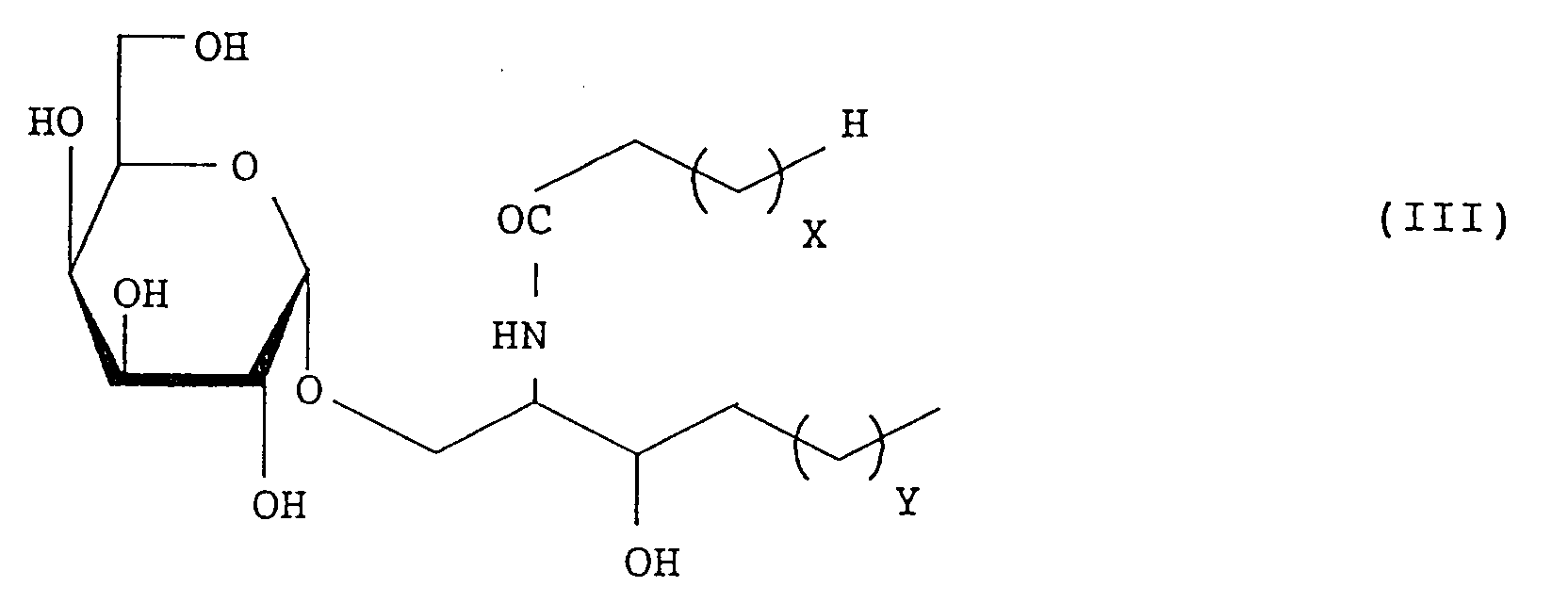
- A glycosphingolipid according to claim 4, wherein X denotes an integer of 8-22 and Y denotes an integer of 9-13.
- A glycosphingolipid according to claim 4, which is represented by the formula (IV):

- A glycosphingolipid according to claim 6, wherein X denotes an integer of 8-22 and Y denotes an integer of 9-13.
- A glycosphingolipid according to claim 2, which is represented by the formula (V):

- A glycosphingolipid according to claim 8, wherein X denotes an integer of 21-23 and Y denotes an integer of 12-14.
- A glycosphingolipid according to claim 8, which is represented by the formula (VI):

- A glycosphingolipid according to claim 10, wherein X denotes an integer of 21-23 and Y denotes an integer of 12-14.
- A glycosphingolipid according to claim 2, which is represented by the formula (VII):

- A glycosphingolipid according to claim 12, wherein X denotes an integer of 21-25 arid Y denotes an integer of 6-14.
- A glycosphingolipid according to claim 12, which is represented by the formula (VIII):

- A glycosphingolipid according to claim 14, wherein X denotes an integer of 21-25 and Y denotes an integer of 6-14.
- A glycosphingolipid according to claim 2, which is represented by the formula (IX):

- A glycosphingolipid according to claim 16, wherein X denotes an integer of 21-25 and Y denotes an integer of 6-16.
- A glycosphingolipid according to claim 16, which is represented by the formula (X):

- A glycosphingolipid according to claim 16, which is represented by the formula (X'):

- A glycosphingolipid according to claim 18, wherein X denotes an integer of 21-25 and Y denotes an integer of 6-16.
- A glycosphingolipid according to claim 19, wherein X denotes an integer of 21-23 and Y denotes an integer of 11-13.
- A glycosphingolipid according to claim 2, which is represented by the formula (XI):

- A glycosphingolipid according to claim 22, wherein X denotes an integer of 21-23 and Y denotes an integer of 10-12.
- A glycosphingolipid according to claim 22, which is represented by the formula (XII):

- A glycosphingolipid according to claim 24, wherein X denotes an integer of 21-23 and Y denotes an integer of 10-12.
- A glycosphingolipid according to claim 2, which is represented by the formula (XIII):

- A glycosphingolipid according to claim 26, wherein X denotes an integer of 20-23 and Y denotes an integer of 10-12.
- A glycosphingolipid according to claim 26, which is represented by the formula (XIV):

- A glycosphingolipid according to claim 26, which is represented by the formula (XIV'):

- A glycosphingolipid according to claim 28, wherein X denotes an integer of 20-22 and Y denotes an integer of 10-12.
- A glycosphingolipid according to claim 29, wherein X denotes an integer of 21-23 and Y denotes an integer of 10-12.
- A glycosphingolipid according to claim 2, which is represented by the formula (XV):

- A glycosphingolipid according to claim 32, wherein X denotes an integer of 11-17 and Y denotes an integer of 11-13.
- A glycosphingolipid according to claim 32, which is represented by the formula (XVI):

- A glycosphingolipid according to claim 34, wherein X denotes an integer of 11-17 and Y denotes an integer of 11-13.
- A glycosphingolipid according to claim 2, which is represented by the formula (XVII):
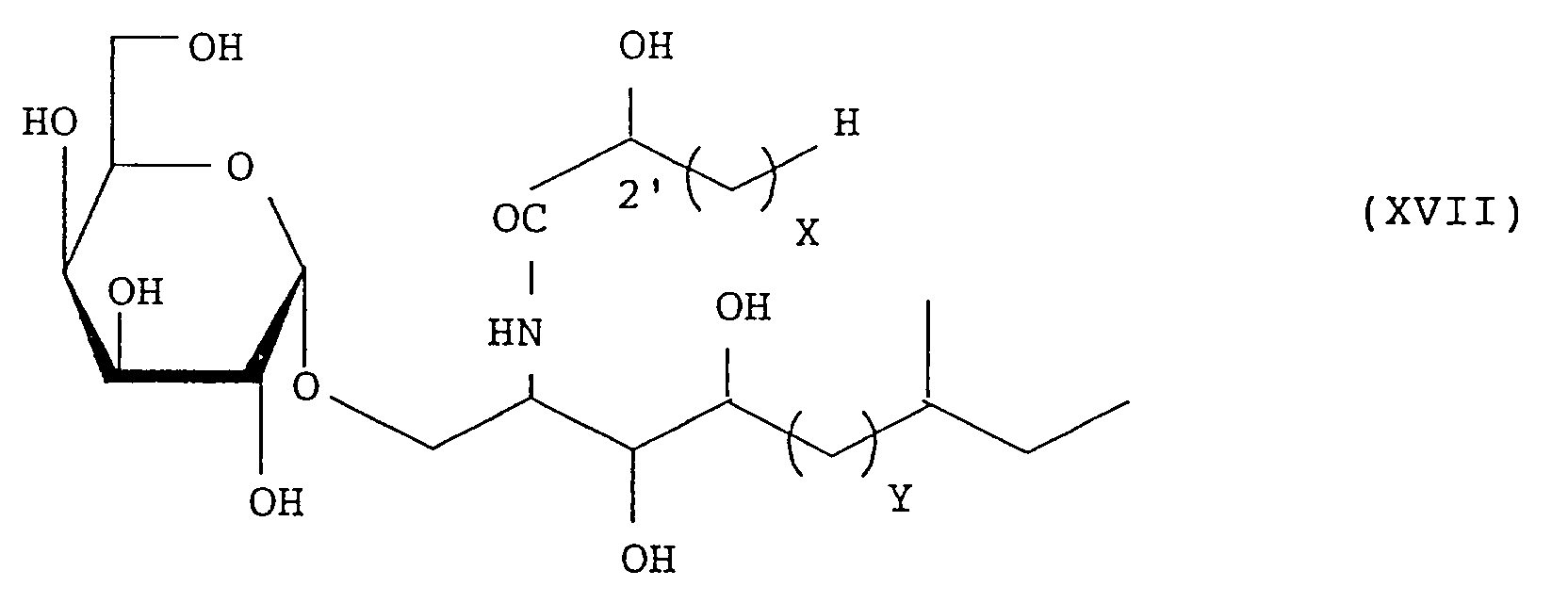
- A glycosphingolipid according to claim 36, wherein X denotes an integer of 22-24 and Y denotes an integer of 10-12.
- A glycosphingolipid according to claim 36, which is represented by the formula (XVIII):

- A glycosphingolipid according to claim 38, wherein X denotes an integer of 22-24 and Y denotes an integer of 10-12.
- A glycosphingolipid according to claim 1, which is represented by the formula (XIX):
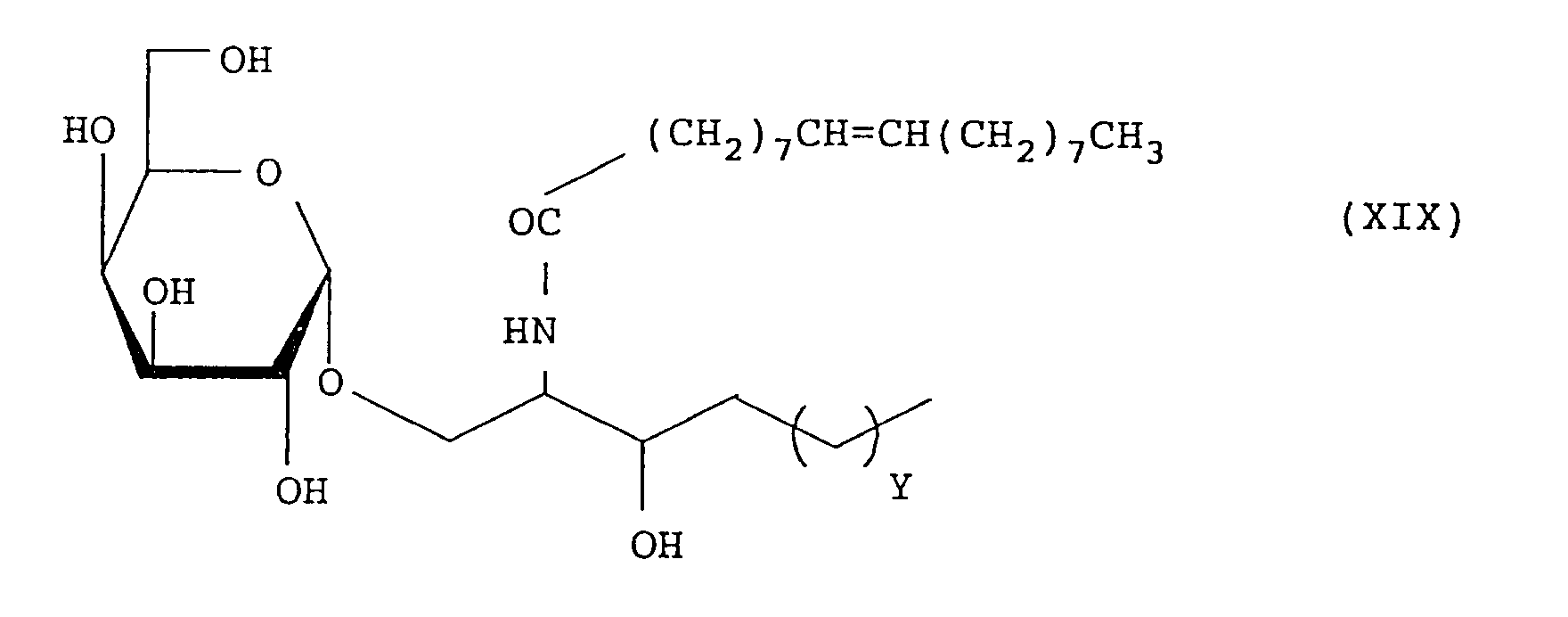
- A glycosphingolipid according to claim 40, wherein Y denotes an integer of 12-14.
- A glycosphingolipid according to claim 40, which is represented by the formula (XX):

- A glycosphingolipid according to claim 42, wherein Y denotes an integer of 12-14.
- A glycosphingolipid according to claim 1, which is selected from the group consisting of the following compounds:(1) (2S,3R)-1-(α-D-galactopyranosyloxy)-2-tetracosanoylamino-3-octadecanol,(2) (2S,3R)-2-docosanoylamino-1-(α-D-galactopyranosyloxy)-3-octadecanol,(3) (2S,3R)-1-(α-D-galactopyranosyloxy)-2-icosanoylamino-3-octadecanol,(4) (2S,3R)-1-(α-D-galactopyranosyloxy)-2-octadecanoylamino-3-octadecanol,(5) (2S,3R)-1-(α-D-galactopyranosyloxy)-2-tetradecanoylamino-3-octadecanol,(6) (2S,3R)-2-decanoylamino-1-(α-D-galactopyranosyloxy)-3-octadecanol,(7) (2S,3R)-1-(α-D-galactopyranosyloxy)-2-octanoylamino-3-octadecanol,(8) (2S,3R)-2-acetamino-1-(α-D-galactopyranosyloxy)-3-octadecanol,(9) (2S,3R)-1-(α-D-galactopyranosyloxy)-2-tetracosanoylamino-3-tetradecanol,(10) (2S,3R)-1-(α-D-galactopyranosyloxy)-2-tetradecanoylamino-3-hexadecanol,(11) (2R,3S)-1-(α-D-galactopyranosyloxy)-2-tetradecanoylamino-3-hexadecanol,(12) (2S,3S)-1-(α-D-galactopyranosyloxy)-2-tetradecanoylamino-3-hexadecanol,(13) (2R,3R)-1-(α-D-galactopyranosyloxy)-2-tetradecanoylamino-3-hexadecanol,(14) (2S,3R)-1-(α-D-galactopyranosyloxy)-2-[(R)-2-hydroxytetracosanoylamino]-3-octadecanol,(15) (2S,3R,4E)-1-(α-D-galactopyranosyloxy)-2-octadecanoylamino-4-octadecen-3-ol,(16) (2S,3R,4E)-1-(α-D-galactopyranosyloxy)-2-tetradecanoylamino-4-octadecen-3-ol,(17) (2S,3S,4R)-1-(α-D-galactopyranosyloxy)-2 tetracosanoylamino-3,4-octadecanediol,(18) (2S,3S,4R)-1-(α-D-galactopyranosyloxy)-2-tetracosanoylamino-3,4-heptadecanediol,(19) (2S,3S,4R)-1-(α-D-galactopyranosyloxy)-2-tetracosanoylamino-3,4-pentadecanediol,(20) (2S,3S,4R)-1-(α-D-galactopyranosyloxy)-2-tetracosanoylainino-3,4-undecanediol,(21) (2S,3S,4R)-1-(α-D-galactopyranosyloxy)-2-hexacosanoylamino-3,4-heptadecanediol,(22) (2S,3S,4R)-1-(α-D-galactopyranosyloxy)-2-[(R)-2-hydroxytetracosanoylamino]-3,4-octadecanediol,(23) (2S,3S,4R)-1-(α-D-galactopyranosyloxy)-2-[(R)-2-hydroxytetracosanoylamino]-3,4-heptadecanediol,(24) (2S,3S,4R)-1-(α-D-galactopyranosyloxy)-2-[(R)-2-hydroxytetracosanoylamino]-3,4-pentadecanediol,(25) (2S,3S,4R)-1-(α-D-galactopyranosyloxy)-2-[(R)-2-hydroxytetracosanoylamino]-3,4-undecanediol,(26) (2S,3S,4R)-1-(α-D-galactopyranosyloxy)-2-[(R)-2-hydroxyhexacosanoylamino]-3,4-octadecanediol,(27) (2S,3S,4R)-1-(α-D-galactopyranosyloxy)-2-[(R)-2-hydroxyhexacosanoylamino]-3,4-nonadecanediol,(28) (2S,3S,4R)-1-(α-D-galactopyranosyloxy)-2-[(R)-2-hydroxyhexacosanoylamino]-3,4-icosanediol,(29) (2S,3S,4R)-1-(α-D-galactopyranosyloxy)-2-[(S)-2-hydroxytetracosanoylamino]-3,4-heptadecanediol,(30) (2S,3S,4R)-1-(α-D-galactopyranosyloxy)-2-[(R)-2-hydroxytetracosanoylamino]-3,4-hexadecanediol,(31) (2S,3S,4R)-1-(α-D-galactopyranosyloxy)-2-[(S)-2-hydroxytetracosanoylamino]-16-methyl-3,4-heptadecanediol,(32) (2S,3S,4R)-1-(α-D-galactopyranosyloxy)-16-methyl-2-tetracosanoylamino-3,4-heptadecanediol,(33) (2S,3S,4R)-1-(α-D-galactopyranosyloxy)-2-[(R)-2-hydroxytricosanoylamino]-16-methyl-3,4-heptadecanediol,(34) (2S,3S,4R)-1-(α-D-galactopyranosyloxy)-2-[(R)-2-hydroxypentacosanoylamino]-16-methyl-3,4-octadecanediol, and(35) (2S,3R)-1-(α-D-galactopyranosyloxy)-2-oleoylamino-3-octadecanol.
- A glycosphingolipid according to claim 44, which is selected from the group consisting of the following compounds:(1) (2S,3R)-1-(α-D-galactopyranosyloxy)-2-tetracosanoylamino-3-octadecanol,(2) (2S,3R)-2-docosanoylamino-1-(α-D-galactopyranosyloxy)-3-octadecanol,(3) (2S,3R)-1-(α-D-galactopyranosyloxy)-2-icosanoylamino-3-octadecanol,(4) (2S,3R)-1-(α-D-galactopyranosyloxy)-2-octadecanoylamino-3-octadecanol,(5) (2S,3R)-1-(α-D-galactopyranosyloxy)-2-tetradecanoylamino-3-octadecanol,(6) (2S,3R)-2-decanoylamino-1-(α-D-galactopyranosyloxy)-3-octadecanol,(7) (2S,3R)-1-(α-D-galactopyranosyloxy)-2-octanoylamino-3-octadecanol,(8) (2S,3R)-2-acetamino-1-(α-D-galactopyranosyloxy)-3-octadecanol,(9) (2S,3R)-1-(α-D-galactopyranosyloxy)-2-tetracosanoylamino-3-tetradecanol, and(10) (2S,3R)-1-(α-D-galactopyranosyloxy)-2-tetradecanoylamino-3-hexadecanol.
- A glycosphingolipid according to claim 45, which is selected from the group consisting of the following compounds:(1) (2S,3R)-1-(α-D-galactopyranosyloxy)-2-tetracosanoylamino-3-octadecanol,(2) (2S,3R)-2-docosanoylamino-1-(α-D-galactopyranosyloxy)-3-octadecanol,(3) (2S,3R)-1-(α-D-galactopyranosyloxy)-2-icosanoylamino-3-octadecanol,(4) (2S,3R)-1-(α-D-galactopyranosyloxy)-2-octadecanoylamino-3-octadecanol,(5) (2S,3R)-1-(α-D-galactopyranosyloxy)-2-tetradecanoylamino-3-octadecanol,(6) (2S,3R)-2-decanoylamino-1-(α-D-galactopyranosyloxy)-3-octadecanol,(7) (2S,3R)-1-(α-D-galactopyranosyloxy)-2-tetracosanoylamino-3-tetradecanol, and(8) (2S,3R)-1-(α-D-galactopyranosyloxy)-2-tetradecanoylamino-3-hexadecanol.
- A glycosphingolipid according to claim 46, which is selected from the group consisting of the following compounds:(1) (2S,3R)-1-(α-D-galactopyranosyloxy)-2-octadecanoylamino-3-octadecanol,(2) (2S,3R)-1-(α-D-galactopyranosyloxy)-2-tetradecanoylamino-3-octadecanol, and(3) (2S,3R)-1-(α-D-galactopyranosyloxy)-2-tetradecanoylamino-3-hexadecanol.
- A glycosphingolipid according to claim 44, which is (2S,3R)-1-(α-D-galactopyranosyloxy)-2-[(R)-2-hydroxytetracosanoylamino]-3-octadecanol.
- A glycosphingolipid according to claim 44, which is selected from the group consisting of the following compounds:(1) (2S,3R,4E)-1-(α-D-galactopyranosyloxy)-2-octadecanoylamino-4-octadecen-3-ol, and(2) (2S,3R,4E)-1-(α-D-galactopyranosyloxy)-2-tetradecanoylamino-4-octadecen-3-ol.
- A glycosphingolipid according to claim 44, which is selected from the group consisting of the following compounds:(1) (2S,3S,4R)-1-(α-D-galactopyranosyloxy)-2-tetracosanoylamino-3,4-octadecanediol,(2) (2S,3S,4R)-1-(α-D-galactopyranosyloxy)-2-tetracosanoylamino-3,4-heptadecanediol,(3) (2S,3S,4R)-1-(α-D-galactopyranosyloxy)-2-tetracosanoylamino-3,4-pentadecanediol,(4) (2S,3S,4R)-1-(α-D-galactopyranosyloxy)-2-tetracosanoylamino-3,4-undecanediol, and(5) (2S,3S,4R)-1-(α-D-galactopyranosyloxy)-2-hexacosanoylamino-3,4-heptadecanediol.
- A glycosphingolipid according to claim 44, which is selected from the group consisting of the following compounds:(1) (2S,3S,4R)-1-(α-D-galactopyranosyloxy)-2-[(R)-2-hydroxytetracosanoylamino]-3,4-octadecanediol,(2) (2S,3S,4R)-1-(α-D-galactopyranosyloxy)-2-[(R)-2-hydroxytetracosanoylamino]-3,4-heptadecanediol,(3) (2S,3S,4R)-1-(α-D-galactopyranosyloxy)-2-[(R)-2-hydroxytetracosanoylamino]-3,4-pentadecanediol,(4) (2S,3S,4R)-1-(α-D-galactopyranosyloxy)-2-[(R)-2-hydroxytetracosanoylamino]-3,4-undecanediol,(5) (2S,3S,4R)-1-(α-D-galactopyranosyloxy)-2-[(R)-2-hydroxyhexacosanoylamino]-3,4-octadecanediol,(6) (2S,3S,4R)-1-(α-D-galactopyranosyloxy)-2-[(R)-2-hydroxyhexacosanoylamino]-3,4-nonadecanediol,(7) (2S,3S,4R)-1-(α-D-galactopyranosyloxy)-2-[(R)-2-hydroxyhexacosanoylamino]-3,4-icosanediol,(8) (2S,3S,4R)-1-(α-D-galactopyranosyloxy)-2-[(S)-2-hydroxytetracosanoylamino]-3,4-heptadecanediol, and(9) (2S,3S,4R)-1-(α-D-galactopyranosyloxy)-2-[(R)-2-hydroxytetracosanoylamino]-3,4-hexadecanediol.
- A glycosphingolipid according to claim 44, which is selected from the group consisting of the following compounds:(1) (2S,3S,4R)-1-(α-D-galactopyranosyloxy)-2-[(S)-2-hydroxytetracosanoylamino]-16-methyl-3,4-heptadecanediol,(2) (2S,3S,4R)-1-(α-D-galactopyranosyloxy)-16-methyl-2-tetracosanoylamino-3,4-heptadecanediol, and(3) (2S,3S,4R)-1-(α-D-galactopyranosyloxy)-2-[(R)-2-hydroxytricosanoylamino]-16-methyl-3,4-heptadecanediol.
- A glycosphingolipid according to claim 44, which is (2S,3S,4R)-1-(α-D-galactopyranosyloxy)-2-[(R)-2-hydroxypentacosanoylamino]-16-methyl-3,4-octadecanediol.
- A glycosphingolipid according to claim 44, which is (2S,3R)-1-(α-D-galactopyranosyloxy)-2-oleoylamino-3-octandecanol.
- A process for a glycosphingolipid comprising collecting the marine sponge Agelas mauritianus, subjecting it to an extraction operation with an organic solvent and isolating from the extract at least one of the following glycosphingolipids represented by the formula (I) according to claim 2:(1) (2S,3S,4R)-1-(α-D-galactopyranosyloxy)-2-[(R)-2-hydroxytetracosanoylamino]-3,4-heptadecanediol,(2) (2S,3S,4R)-1-(α-D-galactopyranosyloxy)-2-[(R)-2-hydroxytetracosanoylamino]-3,4-hexadecanediol,(3) (2S,3S,4R)-1-(α-D-galactopyranosyloxy)-2-[(R)-2-hydroxytricosanoylamino]-16-methyl-3,4-heptadecanediol, and(4) (2S,3S,4R)-1-(α-D-galactopyranosyloxy)-2-[(R)-2-hydroxypentacosanoylamino]-16-methyl-3,4-octadecanediol.
- An antitumor agent comprising one or more of the compounds according to claim 1 as effective ingredients.
- An immunostimulator comprising one or more of the compounds according to claim 1 as effective ingredients.
- An antitumor agent comprising the effective amount of one or more of the compounds according to claim 1 and a carrier or diluent.
- An immunostimulator comprising the effective amount of one or more of the compounds according to claim 1 and a carrier or diluent.
- A process for inhibiting tumor comprising administering the effective amount of one or more of the compounds according to claim 1 to a patient who needs the inhibition of the tumor.
- A process for activating immunity comprising administering the effective amount of one or more of the compounds according to claim 1 to a patient who needs the activation of immunity.
Applications Claiming Priority (4)
| Application Number | Priority Date | Filing Date | Title |
|---|---|---|---|
| JP24438491 | 1991-08-29 | ||
| JP244384/91 | 1991-08-29 | ||
| JP3244384A JPH0559081A (en) | 1991-08-29 | 1991-08-29 | Novel glycosphingolipids, their production and use |
| PCT/JP1992/000561 WO1993005055A1 (en) | 1991-08-29 | 1992-04-28 | Novel sphingoglycolipid and use thereof |
Publications (3)
| Publication Number | Publication Date |
|---|---|
| EP0609437A1 true EP0609437A1 (en) | 1994-08-10 |
| EP0609437A4 EP0609437A4 (en) | 1994-08-24 |
| EP0609437B1 EP0609437B1 (en) | 1999-07-07 |
Family
ID=17117885
Family Applications (1)
| Application Number | Title | Priority Date | Filing Date |
|---|---|---|---|
| EP92909489A Expired - Lifetime EP0609437B1 (en) | 1991-08-29 | 1992-04-28 | Novel sphingoglycolipid and use thereof |
Country Status (18)
| Country | Link |
|---|---|
| EP (1) | EP0609437B1 (en) |
| JP (2) | JPH0559081A (en) |
| KR (1) | KR100220793B1 (en) |
| AT (1) | ATE181922T1 (en) |
| AU (1) | AU665536B2 (en) |
| CA (1) | CA2116442C (en) |
| DE (1) | DE69229557T2 (en) |
| DK (1) | DK0609437T3 (en) |
| ES (1) | ES2134213T3 (en) |
| FI (1) | FI105189B (en) |
| GR (1) | GR3030723T3 (en) |
| HU (1) | HU223839B1 (en) |
| NO (1) | NO180338C (en) |
| PT (1) | PT100736B (en) |
| SG (1) | SG44031A1 (en) |
| TW (1) | TW197446B (en) |
| WO (1) | WO1993005055A1 (en) |
| ZA (1) | ZA923239B (en) |
Cited By (10)
| Publication number | Priority date | Publication date | Assignee | Title |
|---|---|---|---|---|
| EP0694558A4 (en) * | 1993-04-15 | 1996-08-21 | Kirin Brewery | NEW SPHINGOGLYCOLIPID AND ITS USE |
| EP0650732A4 (en) * | 1992-07-16 | 1998-04-01 | Kirin Brewery | NEW MEDICAL COMPOSITION. |
| US5849716A (en) * | 1992-10-22 | 1998-12-15 | Kirin Beer Kabushiki Kaisha | Sphingoglycolipids, their preparation, and therapeutic methods of use |
| US5936076A (en) * | 1991-08-29 | 1999-08-10 | Kirin Beer Kabushiki Kaisha | αgalactosylceramide derivatives |
| WO2003016326A1 (en) * | 2001-08-16 | 2003-02-27 | Daiichi Suntory Pharma Co., Ltd. | Novel glycolipid and remedial agent for autoimmune disease containing the same as active ingredient |
| EP0957161A4 (en) * | 1996-12-27 | 2004-04-21 | Kirin Brewery | METHOD FOR ACTIVATING HUMAN ANTIGEN PRESENTING CELLS, ACTIVATED HUMAN ANTIGEN PRESENTING CELLS, AND USE THEREOF |
| CN101165047B (en) * | 2003-02-14 | 2010-10-20 | 国立精神神经中心主席代表的日本国 | Glycolipid derivatives and production methods thereof, and synthetic intermediates and production methods thereof |
| WO2014053482A1 (en) | 2012-10-03 | 2014-04-10 | INSERM (Institut National de la Santé et de la Recherche Médicale) | Methods and pharmaceutical compositions for the prophylactic treatment of bacterial superinfections post-influenza with invariant nkt cell agonists |
| EP2881400A4 (en) * | 2012-08-03 | 2016-02-24 | Riken | HYDROXYLATED KRN7000 ANALOGUE AND USE THEREOF |
| WO2017207040A1 (en) | 2016-06-01 | 2017-12-07 | Vib Vzw | ANTI-CANCER THERAPY USING A LEPTIN ANTAGONIST AND AN iNKT-CELL ACTIVATOR |
Families Citing this family (21)
| Publication number | Priority date | Publication date | Assignee | Title |
|---|---|---|---|---|
| TW575420B (en) * | 1997-09-22 | 2004-02-11 | Kirin Brewery | Composition for enhancing cellular immunogenicity comprising alpha-glycosylceramides |
| JP4787445B2 (en) * | 2000-01-14 | 2011-10-05 | 株式会社明治 | Antigen-specific IgE antibody production inhibitor |
| JP2002030093A (en) * | 2000-03-13 | 2002-01-29 | Nof Corp | Purification method of glycosylceramide |
| AU2003266530A1 (en) * | 2002-09-20 | 2004-04-08 | Kirin Beer Kabushiki Kaisha | HEPATITIS C VIRUS INHIBITOR COMPRISING Alpha-GLYCOSYLCERAMIDE AS THE ACTIVE INGREDIENT |
| JP4585172B2 (en) * | 2003-01-31 | 2010-11-24 | 森永乳業株式会社 | Bone formation promoter |
| JP4753089B2 (en) * | 2004-12-20 | 2011-08-17 | 株式会社岡安商店 | Composition having action of promoting degradation of body fat, and food or food compound containing the same |
| JP2007070311A (en) * | 2005-09-09 | 2007-03-22 | Gunma Univ | Infectious disease preventive agent and infectious disease therapeutic agent comprising α-galactosylceramide |
| EP1776963A1 (en) | 2005-10-19 | 2007-04-25 | Gbf-Gesellschaft Für Biotechnologische Forschung Mbh | Hexosylceramides as adjuvants and their uses in pharmaceutical compositions |
| WO2008047174A1 (en) * | 2006-10-18 | 2008-04-24 | Centre National De La Recherche Scientifique | Alpha-galactosylceramide analogs, their methods of manufacture, intermediate compounds useful in these methods, and pharmaceutical compositions containing them |
| KR100868959B1 (en) * | 2006-12-30 | 2008-11-17 | 재단법인서울대학교산학협력재단 | Alpha-galactosyl ceramide derivatives, pharmaceutically acceptable salts thereof, preparation methods thereof, and immunosuppressive pharmaceutical compositions containing the same as active ingredients |
| EP2117583B1 (en) | 2007-02-21 | 2013-05-22 | Vib Vzw | Combination therapy using TNF and alpha-galactosyl ceramide |
| JP4995172B2 (en) * | 2008-10-10 | 2012-08-08 | 壽製薬株式会社 | Glycolipid derivative, method for producing the same, and pharmaceutical comprising the same |
| AU2010213568B2 (en) | 2009-02-16 | 2014-11-20 | Cerenis Therapeutics Holding Sa | Apolipoprotein A-I Mimics |
| JP5025692B2 (en) * | 2009-07-06 | 2012-09-12 | 壽製薬株式会社 | Method for producing glycolipid derivative |
| JP5095683B2 (en) * | 2009-07-06 | 2012-12-12 | 壽製薬株式会社 | Novel glycolipid derivatives and preparations containing the same as active ingredients |
| JP2010254718A (en) * | 2010-08-13 | 2010-11-11 | Morinaga Milk Ind Co Ltd | Bone formation promoter |
| CN106167483B (en) | 2010-10-18 | 2019-02-15 | 塞伦尼斯医疗控股有限公司 | It can be used for compound, composition and the method for cholesterol mobilization |
| EP2647384B1 (en) | 2010-12-02 | 2018-05-23 | Riken | IMMUNOTHERAPY USING ALLO-NKT CELLS, CELLS FOR IMMUNOTHERAPY IN WHICH alpha CHAIN OF T-CELL RECEPTOR (TCR) GENE HAS BEEN REARRANGED TO UNIFORM V alpha-J alpha , AND BANKING OF NKT CELLS DERIVED FROM SAID CELLS |
| JP6599233B2 (en) | 2012-11-21 | 2019-10-30 | アンセルム(アンスティチュート・ナシオナル・ドゥ・ラ・サンテ・エ・ドゥ・ラ・ルシェルシュ・メディカル) | Methods for determining the risk of acute graft-versus-host disease |
| KR102328367B1 (en) * | 2019-11-05 | 2021-11-18 | 한국해양과학기술원 | Composition for Enhancing Radiation Sensitivity comprising Ageloxime D |
| EP4257140A4 (en) | 2020-12-04 | 2024-11-06 | Regimmune Corporation | Cd1d-ligand-compound-containing liposome preparation having improved pharmacokinetics |
Family Cites Families (4)
| Publication number | Priority date | Publication date | Assignee | Title |
|---|---|---|---|---|
| JPS6157594A (en) * | 1984-08-30 | 1986-03-24 | Suntory Ltd | Galactosphingolipid and its production |
| JP2588729B2 (en) * | 1987-10-05 | 1997-03-12 | 塩野義製薬株式会社 | Sphingosine derivative |
| DE3840044A1 (en) * | 1988-11-27 | 1990-06-07 | Behringwerke Ag | GLYCOSPHINGOLIPIDS WITH A COUPLABLE GROUP IN THE SPHINGOID PART, THEIR PRODUCTION AND USE |
| JP3068910B2 (en) * | 1990-11-08 | 2000-07-24 | 麒麟麦酒株式会社 | New glycosphingolipids, their production and use |
-
1991
- 1991-08-29 JP JP3244384A patent/JPH0559081A/en active Pending
-
1992
- 1992-04-28 DK DK92909489T patent/DK0609437T3/en active
- 1992-04-28 ES ES92909489T patent/ES2134213T3/en not_active Expired - Lifetime
- 1992-04-28 DE DE69229557T patent/DE69229557T2/en not_active Expired - Lifetime
- 1992-04-28 KR KR1019940700662A patent/KR100220793B1/en not_active Expired - Fee Related
- 1992-04-28 EP EP92909489A patent/EP0609437B1/en not_active Expired - Lifetime
- 1992-04-28 WO PCT/JP1992/000561 patent/WO1993005055A1/en not_active Ceased
- 1992-04-28 AT AT92909489T patent/ATE181922T1/en active
- 1992-04-28 AU AU16664/92A patent/AU665536B2/en not_active Expired
- 1992-04-28 HU HU9400596A patent/HU223839B1/en active IP Right Grant
- 1992-04-28 JP JP4508706A patent/JP2774194B2/en not_active Expired - Lifetime
- 1992-04-28 SG SG1996009529A patent/SG44031A1/en unknown
- 1992-04-28 CA CA002116442A patent/CA2116442C/en not_active Expired - Lifetime
- 1992-05-05 ZA ZA923239A patent/ZA923239B/en unknown
- 1992-05-06 TW TW081103536A patent/TW197446B/zh not_active IP Right Cessation
- 1992-07-28 PT PT100736A patent/PT100736B/en not_active IP Right Cessation
-
1994
- 1994-02-22 NO NO940598A patent/NO180338C/en not_active IP Right Cessation
- 1994-02-23 FI FI940851A patent/FI105189B/en not_active IP Right Cessation
-
1999
- 1999-07-08 GR GR990400800T patent/GR3030723T3/en unknown
Cited By (17)
| Publication number | Priority date | Publication date | Assignee | Title |
|---|---|---|---|---|
| US5936076A (en) * | 1991-08-29 | 1999-08-10 | Kirin Beer Kabushiki Kaisha | αgalactosylceramide derivatives |
| EP0650732A4 (en) * | 1992-07-16 | 1998-04-01 | Kirin Brewery | NEW MEDICAL COMPOSITION. |
| US6017892A (en) * | 1992-07-16 | 2000-01-25 | Kiran Beer Kabushiki Kaisha | Method for accelerating marrow cell proliferation |
| US6071884A (en) * | 1992-07-16 | 2000-06-06 | Kirin Beer Kabushiki Kaisha | Pharmaceutical compositions and therapeutic methods |
| US5849716A (en) * | 1992-10-22 | 1998-12-15 | Kirin Beer Kabushiki Kaisha | Sphingoglycolipids, their preparation, and therapeutic methods of use |
| EP0694558A4 (en) * | 1993-04-15 | 1996-08-21 | Kirin Brewery | NEW SPHINGOGLYCOLIPID AND ITS USE |
| US5780441A (en) * | 1993-04-15 | 1998-07-14 | Kirin Beer Kabushiki Kaisha | Sphingoglycolipid compounds and therapeutic uses thereof |
| EP0957161A4 (en) * | 1996-12-27 | 2004-04-21 | Kirin Brewery | METHOD FOR ACTIVATING HUMAN ANTIGEN PRESENTING CELLS, ACTIVATED HUMAN ANTIGEN PRESENTING CELLS, AND USE THEREOF |
| WO2003016326A1 (en) * | 2001-08-16 | 2003-02-27 | Daiichi Suntory Pharma Co., Ltd. | Novel glycolipid and remedial agent for autoimmune disease containing the same as active ingredient |
| US8367623B2 (en) | 2001-08-16 | 2013-02-05 | Japan As Represented By President Of National Center Of Neurology And Psychiatry | Glycolipid and medicine for autoimmune disease containing the same as active ingredient |
| CN101165047B (en) * | 2003-02-14 | 2010-10-20 | 国立精神神经中心主席代表的日本国 | Glycolipid derivatives and production methods thereof, and synthetic intermediates and production methods thereof |
| EP2343306A1 (en) * | 2003-02-14 | 2011-07-13 | Japan as represented by President of National Center of Neurology and Psychiatry Ministry of Health | Glycolipid derivatives, process for production of the same, intermediates for synthesis thereof, and process for production of the intermediates |
| US8034908B2 (en) | 2003-02-14 | 2011-10-11 | Japan As Represented By President Of National Center Of Neurology And Psychiatry | Glycolipids and synthetic method thereof as well as their synthetic intermediates, and synthetic method thereof |
| EP2881400A4 (en) * | 2012-08-03 | 2016-02-24 | Riken | HYDROXYLATED KRN7000 ANALOGUE AND USE THEREOF |
| US9464105B2 (en) | 2012-08-03 | 2016-10-11 | Riken | Hydroxylated KRN7000 analogue and use thereof |
| WO2014053482A1 (en) | 2012-10-03 | 2014-04-10 | INSERM (Institut National de la Santé et de la Recherche Médicale) | Methods and pharmaceutical compositions for the prophylactic treatment of bacterial superinfections post-influenza with invariant nkt cell agonists |
| WO2017207040A1 (en) | 2016-06-01 | 2017-12-07 | Vib Vzw | ANTI-CANCER THERAPY USING A LEPTIN ANTAGONIST AND AN iNKT-CELL ACTIVATOR |
Also Published As
| Publication number | Publication date |
|---|---|
| GR3030723T3 (en) | 1999-11-30 |
| DE69229557D1 (en) | 1999-08-12 |
| AU1666492A (en) | 1993-04-05 |
| HU223839B1 (en) | 2005-02-28 |
| NO180338B (en) | 1996-12-23 |
| PT100736A (en) | 1993-09-30 |
| TW197446B (en) | 1993-01-01 |
| SG44031A1 (en) | 1997-11-14 |
| FI940851A7 (en) | 1994-02-23 |
| KR100220793B1 (en) | 1999-10-01 |
| WO1993005055A1 (en) | 1993-03-18 |
| NO940598D0 (en) | 1994-02-22 |
| AU665536B2 (en) | 1996-01-11 |
| CA2116442A1 (en) | 1993-03-18 |
| HU9400596D0 (en) | 1994-05-30 |
| EP0609437A4 (en) | 1994-08-24 |
| NO940598L (en) | 1994-04-27 |
| DK0609437T3 (en) | 2000-01-31 |
| HK1009967A1 (en) | 1999-09-17 |
| FI940851A0 (en) | 1994-02-23 |
| JP2774194B2 (en) | 1998-07-09 |
| FI105189B (en) | 2000-06-30 |
| ZA923239B (en) | 1993-05-05 |
| DE69229557T2 (en) | 1999-11-25 |
| EP0609437B1 (en) | 1999-07-07 |
| NO180338C (en) | 1997-04-02 |
| ATE181922T1 (en) | 1999-07-15 |
| JPH0559081A (en) | 1993-03-09 |
| CA2116442C (en) | 2000-09-05 |
| PT100736B (en) | 1999-04-30 |
| ES2134213T3 (en) | 1999-10-01 |
| HUT70435A (en) | 1995-10-30 |
Similar Documents
| Publication | Publication Date | Title |
|---|---|---|
| EP0609437B1 (en) | Novel sphingoglycolipid and use thereof | |
| US5936076A (en) | αgalactosylceramide derivatives | |
| EP0650732B1 (en) | Novel medicinal composition | |
| EP0666268B1 (en) | Novel sphingoglycolipid and use thereof | |
| EP2661440B1 (en) | Method for the preparation of glycosphingolipids | |
| EP0694558B1 (en) | Novel sphingoglycolipid and use thereof | |
| JPWO1993005055A1 (en) | Novel glycosphingolipids and uses thereof | |
| JPWO1994002168A1 (en) | Novel Pharmaceutical Composition | |
| JPWO1994009020A1 (en) | Novel glycosphingolipids and uses thereof | |
| EP1437358B1 (en) | Novel glycolipid and remedial agent for autoimmune disease containing the same as active ingredient | |
| JPWO1994024142A1 (en) | Novel glycosphingolipids and uses thereof | |
| RU2369612C2 (en) | New hem-difluoridated compounds, methods of their producing and their application | |
| JP3068910B2 (en) | New glycosphingolipids, their production and use | |
| HK1009967B (en) | Novel sphingoglycolipid and use thereof | |
| CN114805454B (en) | α-galactosylceramide compound and its preparation method and use | |
| HK1009937B (en) | Novel medicinal composition | |
| HK1009968B (en) | Novel sphingoglycolipid and use thereof | |
| HUT74449A (en) | Medicinal compositions contg. alpha-galactosyl-ceramides |
Legal Events
| Date | Code | Title | Description |
|---|---|---|---|
| PUAI | Public reference made under article 153(3) epc to a published international application that has entered the european phase |
Free format text: ORIGINAL CODE: 0009012 |
|
| 17P | Request for examination filed |
Effective date: 19940228 |
|
| AK | Designated contracting states |
Kind code of ref document: A1 Designated state(s): AT BE CH DE DK ES FR GB GR IT LI LU MC NL SE |
|
| A4 | Supplementary search report drawn up and despatched | ||
| AK | Designated contracting states |
Kind code of ref document: A4 Designated state(s): AT BE CH DE DK ES FR GB GR IT LI LU MC NL SE |
|
| RIN1 | Information on inventor provided before grant (corrected) |
Inventor name: NATORI, TAKENORI KIRIN BEER KABUSHIKI KAISHA Inventor name: MORITA, MASAHIRO KIRIN BEER KABUSHIKI KAISHA Inventor name: SAKAI, TERUYUKI KIRIN BEER KABUSHIKI KAISHA Inventor name: KOEZUKA, YASUHIKO KIRIN BEER KABUSHIKI KAISHA Inventor name: AKIMOTO, KOJI C/O KIRIN BEER K.K. Inventor name: HIGA, TATSUO |
|
| 17Q | First examination report despatched |
Effective date: 19961213 |
|
| GRAG | Despatch of communication of intention to grant |
Free format text: ORIGINAL CODE: EPIDOS AGRA |
|
| RAP1 | Party data changed (applicant data changed or rights of an application transferred) |
Owner name: KIRIN BEER KABUSHIKI KAISHA |
|
| GRAG | Despatch of communication of intention to grant |
Free format text: ORIGINAL CODE: EPIDOS AGRA |
|
| GRAG | Despatch of communication of intention to grant |
Free format text: ORIGINAL CODE: EPIDOS AGRA |
|
| GRAH | Despatch of communication of intention to grant a patent |
Free format text: ORIGINAL CODE: EPIDOS IGRA |
|
| GRAG | Despatch of communication of intention to grant |
Free format text: ORIGINAL CODE: EPIDOS AGRA |
|
| GRAH | Despatch of communication of intention to grant a patent |
Free format text: ORIGINAL CODE: EPIDOS IGRA |
|
| GRAH | Despatch of communication of intention to grant a patent |
Free format text: ORIGINAL CODE: EPIDOS IGRA |
|
| GRAA | (expected) grant |
Free format text: ORIGINAL CODE: 0009210 |
|
| AK | Designated contracting states |
Kind code of ref document: B1 Designated state(s): AT BE CH DE DK ES FR GB GR IT LI LU MC NL SE |
|
| REF | Corresponds to: |
Ref document number: 181922 Country of ref document: AT Date of ref document: 19990715 Kind code of ref document: T |
|
| REG | Reference to a national code |
Ref country code: CH Ref legal event code: NV Representative=s name: PATENTANWALTSBUERO FELDMANN AG Ref country code: CH Ref legal event code: EP |
|
| REF | Corresponds to: |
Ref document number: 69229557 Country of ref document: DE Date of ref document: 19990812 |
|
| ET | Fr: translation filed | ||
| REG | Reference to a national code |
Ref country code: ES Ref legal event code: FG2A Ref document number: 2134213 Country of ref document: ES Kind code of ref document: T3 |
|
| ITF | It: translation for a ep patent filed | ||
| REG | Reference to a national code |
Ref country code: DK Ref legal event code: T3 |
|
| PLBE | No opposition filed within time limit |
Free format text: ORIGINAL CODE: 0009261 |
|
| 26N | No opposition filed | ||
| REG | Reference to a national code |
Ref country code: GB Ref legal event code: IF02 |
|
| REG | Reference to a national code |
Ref country code: CH Ref legal event code: PFA Owner name: KIRIN BEER KABUSHIKI KAISHA Free format text: KIRIN BEER KABUSHIKI KAISHA#10-1, SHINKAWA 2-CHOME, CHUO-KU#TOKYO-TO (JP) -TRANSFER TO- KIRIN BEER KABUSHIKI KAISHA#10-1, SHINKAWA 2-CHOME, CHUO-KU#TOKYO-TO (JP) |
|
| REG | Reference to a national code |
Ref country code: CH Ref legal event code: PFA Owner name: KIRIN HOLDINGS KABUSHIKI KAISHA Free format text: KIRIN BEER KABUSHIKI KAISHA#10-1, SHINKAWA 2-CHOME, CHUO-KU#TOKYO-TO (JP) -TRANSFER TO- KIRIN HOLDINGS KABUSHIKI KAISHA#10-1, SHINKAWA 2-CHOME, CHUO-KU#TOKYO (JP) |
|
| REG | Reference to a national code |
Ref country code: CH Ref legal event code: PUE Owner name: KIRIN PHARMA KABUSHIKI KAISHA Free format text: KIRIN HOLDINGS KABUSHIKI KAISHA#10-1, SHINKAWA 2-CHOME, CHUO-KU#TOKYO (JP) -TRANSFER TO- KIRIN PHARMA KABUSHIKI KAISHA#26-1, JINGUMAE 6-CHOME SHIBUYA-KU#TOKYO-TO (JP) |
|
| NLS | Nl: assignments of ep-patents |
Owner name: KIRIN PHARMA KABUSHIKI KAISHA Effective date: 20080212 |
|
| NLT1 | Nl: modifications of names registered in virtue of documents presented to the patent office pursuant to art. 16 a, paragraph 1 |
Owner name: KIRIN HOLDINGS KABUSHIKI KAISHA |
|
| REG | Reference to a national code |
Ref country code: GB Ref legal event code: 732E |
|
| REG | Reference to a national code |
Ref country code: FR Ref legal event code: TP Ref country code: FR Ref legal event code: CD |
|
| REG | Reference to a national code |
Ref country code: GB Ref legal event code: 732E Free format text: REGISTERED BETWEEN 20090409 AND 20090415 |
|
| REG | Reference to a national code |
Ref country code: CH Ref legal event code: PFA Owner name: KYOWA HAKKO KIRIN CO., LTD. Free format text: KIRIN PHARMA KABUSHIKI KAISHA#26-1, JINGUMAE 6-CHOME SHIBUYA-KU#TOKYO-TO (JP) -TRANSFER TO- KYOWA HAKKO KIRIN CO., LTD.#1-6-1, OHTEMACHI CHIYODA-KU#TOKYO 100-8185 (JP) |
|
| NLS | Nl: assignments of ep-patents |
Owner name: KYOWA HAKKO KIRIN CO., LTD. Effective date: 20090827 |
|
| REG | Reference to a national code |
Ref country code: FR Ref legal event code: TP |
|
| PGFP | Annual fee paid to national office [announced via postgrant information from national office to epo] |
Ref country code: MC Payment date: 20110309 Year of fee payment: 20 |
|
| PGFP | Annual fee paid to national office [announced via postgrant information from national office to epo] |
Ref country code: LU Payment date: 20110429 Year of fee payment: 20 |
|
| PGFP | Annual fee paid to national office [announced via postgrant information from national office to epo] |
Ref country code: SE Payment date: 20110418 Year of fee payment: 20 Ref country code: GR Payment date: 20110407 Year of fee payment: 20 Ref country code: BE Payment date: 20110311 Year of fee payment: 20 Ref country code: DE Payment date: 20110418 Year of fee payment: 20 Ref country code: FR Payment date: 20110502 Year of fee payment: 20 Ref country code: ES Payment date: 20110418 Year of fee payment: 20 |
|
| PGFP | Annual fee paid to national office [announced via postgrant information from national office to epo] |
Ref country code: AT Payment date: 20110310 Year of fee payment: 20 Ref country code: GB Payment date: 20110427 Year of fee payment: 20 Ref country code: DK Payment date: 20110407 Year of fee payment: 20 Ref country code: NL Payment date: 20110428 Year of fee payment: 20 |
|
| PGFP | Annual fee paid to national office [announced via postgrant information from national office to epo] |
Ref country code: IT Payment date: 20110422 Year of fee payment: 20 |
|
| PGFP | Annual fee paid to national office [announced via postgrant information from national office to epo] |
Ref country code: CH Payment date: 20110726 Year of fee payment: 20 |
|
| REG | Reference to a national code |
Ref country code: DE Ref legal event code: R071 Ref document number: 69229557 Country of ref document: DE |
|
| REG | Reference to a national code |
Ref country code: DE Ref legal event code: R071 Ref document number: 69229557 Country of ref document: DE |
|
| BE20 | Be: patent expired |
Owner name: KYOWA HAKKO KIRIN CO. LTD. Effective date: 20120428 |
|
| REG | Reference to a national code |
Ref country code: CH Ref legal event code: PL |
|
| REG | Reference to a national code |
Ref country code: NL Ref legal event code: V4 Effective date: 20120428 |
|
| REG | Reference to a national code |
Ref country code: DK Ref legal event code: EUP |
|
| REG | Reference to a national code |
Ref country code: GB Ref legal event code: PE20 Expiry date: 20120427 |
|
| REG | Reference to a national code |
Ref country code: GR Ref legal event code: MA Ref document number: 990400800 Country of ref document: GR Effective date: 20120429 |
|
| REG | Reference to a national code |
Ref country code: SE Ref legal event code: EUG |
|
| PG25 | Lapsed in a contracting state [announced via postgrant information from national office to epo] |
Ref country code: DE Free format text: LAPSE BECAUSE OF EXPIRATION OF PROTECTION Effective date: 20120429 |
|
| PG25 | Lapsed in a contracting state [announced via postgrant information from national office to epo] |
Ref country code: GB Free format text: LAPSE BECAUSE OF EXPIRATION OF PROTECTION Effective date: 20120427 |
|
| REG | Reference to a national code |
Ref country code: AT Ref legal event code: MK07 Ref document number: 181922 Country of ref document: AT Kind code of ref document: T Effective date: 20120428 |
|
| REG | Reference to a national code |
Ref country code: ES Ref legal event code: FD2A Effective date: 20140827 |
|
| PG25 | Lapsed in a contracting state [announced via postgrant information from national office to epo] |
Ref country code: ES Free format text: LAPSE BECAUSE OF EXPIRATION OF PROTECTION Effective date: 20120429 |