EP0607459B1 - Use of a solid material as a stationary phase for chromatography - Google Patents
Use of a solid material as a stationary phase for chromatography Download PDFInfo
- Publication number
- EP0607459B1 EP0607459B1 EP94906728A EP94906728A EP0607459B1 EP 0607459 B1 EP0607459 B1 EP 0607459B1 EP 94906728 A EP94906728 A EP 94906728A EP 94906728 A EP94906728 A EP 94906728A EP 0607459 B1 EP0607459 B1 EP 0607459B1
- Authority
- EP
- European Patent Office
- Prior art keywords
- metaphosphate
- pyrophosphate
- chromatography
- column
- stationary phase
- Prior art date
- Legal status (The legal status is an assumption and is not a legal conclusion. Google has not performed a legal analysis and makes no representation as to the accuracy of the status listed.)
- Expired - Lifetime
Links
- 230000005526 G1 to G0 transition Effects 0.000 title claims abstract description 47
- 239000011343 solid material Substances 0.000 title claims abstract description 10
- 238000004587 chromatography analysis Methods 0.000 title claims description 51
- 239000000463 material Substances 0.000 claims abstract description 70
- 125000005341 metaphosphate group Chemical group 0.000 claims description 79
- 235000011180 diphosphates Nutrition 0.000 claims description 62
- XPPKVPWEQAFLFU-UHFFFAOYSA-J diphosphate(4-) Chemical compound [O-]P([O-])(=O)OP([O-])([O-])=O XPPKVPWEQAFLFU-UHFFFAOYSA-J 0.000 claims description 60
- 229910052751 metal Inorganic materials 0.000 claims description 37
- 239000002184 metal Substances 0.000 claims description 36
- 239000011777 magnesium Substances 0.000 claims description 13
- 239000011575 calcium Substances 0.000 claims description 11
- FYYHWMGAXLPEAU-UHFFFAOYSA-N Magnesium Chemical compound [Mg] FYYHWMGAXLPEAU-UHFFFAOYSA-N 0.000 claims description 10
- 229910052749 magnesium Inorganic materials 0.000 claims description 10
- 150000002739 metals Chemical class 0.000 claims description 10
- OYPRJOBELJOOCE-UHFFFAOYSA-N Calcium Chemical compound [Ca] OYPRJOBELJOOCE-UHFFFAOYSA-N 0.000 claims description 8
- 229910052791 calcium Inorganic materials 0.000 claims description 8
- 239000011521 glass Substances 0.000 claims description 8
- XEEYBQQBJWHFJM-UHFFFAOYSA-N Iron Chemical compound [Fe] XEEYBQQBJWHFJM-UHFFFAOYSA-N 0.000 claims description 6
- MCMNRKCIXSYSNV-UHFFFAOYSA-N Zirconium dioxide Chemical compound O=[Zr]=O MCMNRKCIXSYSNV-UHFFFAOYSA-N 0.000 claims description 6
- 229910052784 alkaline earth metal Inorganic materials 0.000 claims description 6
- 150000001342 alkaline earth metals Chemical class 0.000 claims description 6
- 229910052726 zirconium Inorganic materials 0.000 claims description 6
- HCHKCACWOHOZIP-UHFFFAOYSA-N Zinc Chemical compound [Zn] HCHKCACWOHOZIP-UHFFFAOYSA-N 0.000 claims description 4
- QCWXUUIWCKQGHC-UHFFFAOYSA-N Zirconium Chemical compound [Zr] QCWXUUIWCKQGHC-UHFFFAOYSA-N 0.000 claims description 4
- 229910052725 zinc Inorganic materials 0.000 claims description 4
- 239000011701 zinc Substances 0.000 claims description 4
- RYGMFSIKBFXOCR-UHFFFAOYSA-N Copper Chemical compound [Cu] RYGMFSIKBFXOCR-UHFFFAOYSA-N 0.000 claims description 3
- 229910052782 aluminium Inorganic materials 0.000 claims description 3
- XAGFODPZIPBFFR-UHFFFAOYSA-N aluminium Chemical compound [Al] XAGFODPZIPBFFR-UHFFFAOYSA-N 0.000 claims description 3
- 229910052802 copper Inorganic materials 0.000 claims description 3
- 239000010949 copper Substances 0.000 claims description 3
- 229910052742 iron Inorganic materials 0.000 claims description 3
- WPBNNNQJVZRUHP-UHFFFAOYSA-L manganese(2+);methyl n-[[2-(methoxycarbonylcarbamothioylamino)phenyl]carbamothioyl]carbamate;n-[2-(sulfidocarbothioylamino)ethyl]carbamodithioate Chemical compound [Mn+2].[S-]C(=S)NCCNC([S-])=S.COC(=O)NC(=S)NC1=CC=CC=C1NC(=S)NC(=O)OC WPBNNNQJVZRUHP-UHFFFAOYSA-L 0.000 claims description 3
- VPKAOUKDMHJLAY-UHFFFAOYSA-J tetrasilver;phosphonato phosphate Chemical compound [Ag+].[Ag+].[Ag+].[Ag+].[O-]P([O-])(=O)OP([O-])([O-])=O VPKAOUKDMHJLAY-UHFFFAOYSA-J 0.000 claims description 3
- 229910052783 alkali metal Inorganic materials 0.000 claims description 2
- 150000001340 alkali metals Chemical group 0.000 claims description 2
- 239000000919 ceramic Substances 0.000 claims description 2
- 229920000642 polymer Polymers 0.000 claims description 2
- 239000011347 resin Substances 0.000 claims description 2
- 229920005989 resin Polymers 0.000 claims description 2
- 229910052712 strontium Inorganic materials 0.000 claims 1
- CIOAGBVUUVVLOB-UHFFFAOYSA-N strontium atom Chemical compound [Sr] CIOAGBVUUVVLOB-UHFFFAOYSA-N 0.000 claims 1
- 150000003839 salts Chemical class 0.000 abstract 1
- 229940048084 pyrophosphate Drugs 0.000 description 58
- 239000007787 solid Substances 0.000 description 32
- 108010071390 Serum Albumin Proteins 0.000 description 30
- 102000007562 Serum Albumin Human genes 0.000 description 30
- 239000002245 particle Substances 0.000 description 28
- 230000000717 retained effect Effects 0.000 description 27
- 108010074605 gamma-Globulins Proteins 0.000 description 26
- NBIIXXVUZAFLBC-UHFFFAOYSA-N Phosphoric acid Chemical compound OP(O)(O)=O NBIIXXVUZAFLBC-UHFFFAOYSA-N 0.000 description 24
- 229910019142 PO4 Inorganic materials 0.000 description 21
- 239000010452 phosphate Substances 0.000 description 21
- 239000000843 powder Substances 0.000 description 21
- 239000012876 carrier material Substances 0.000 description 20
- NBIIXXVUZAFLBC-UHFFFAOYSA-K phosphate Chemical compound [O-]P([O-])([O-])=O NBIIXXVUZAFLBC-UHFFFAOYSA-K 0.000 description 17
- 239000000523 sample Substances 0.000 description 17
- 238000010438 heat treatment Methods 0.000 description 16
- 239000000203 mixture Substances 0.000 description 16
- 239000002002 slurry Substances 0.000 description 16
- OKKJLVBELUTLKV-UHFFFAOYSA-N Methanol Chemical compound OC OKKJLVBELUTLKV-UHFFFAOYSA-N 0.000 description 15
- 238000000926 separation method Methods 0.000 description 15
- 239000000243 solution Substances 0.000 description 15
- 239000000499 gel Substances 0.000 description 14
- 235000018102 proteins Nutrition 0.000 description 14
- 102000004169 proteins and genes Human genes 0.000 description 14
- 108090000623 proteins and genes Proteins 0.000 description 14
- 102000004338 Transferrin Human genes 0.000 description 13
- 238000002441 X-ray diffraction Methods 0.000 description 13
- 239000013078 crystal Substances 0.000 description 13
- 239000012581 transferrin Substances 0.000 description 13
- 102100030497 Cytochrome c Human genes 0.000 description 12
- 108010075031 Cytochromes c Proteins 0.000 description 12
- 102100033468 Lysozyme C Human genes 0.000 description 12
- 108010014251 Muramidase Proteins 0.000 description 12
- 108010062010 N-Acetylmuramoyl-L-alanine Amidase Proteins 0.000 description 12
- 229910000147 aluminium phosphate Inorganic materials 0.000 description 12
- 229960000274 lysozyme Drugs 0.000 description 12
- 235000010335 lysozyme Nutrition 0.000 description 12
- 239000004325 lysozyme Substances 0.000 description 12
- 239000000047 product Substances 0.000 description 12
- 101710158100 Casein kinase II subunit beta Proteins 0.000 description 11
- 102100027992 Casein kinase II subunit beta Human genes 0.000 description 11
- 101000766307 Gallus gallus Ovotransferrin Proteins 0.000 description 11
- 230000000052 comparative effect Effects 0.000 description 10
- 238000010828 elution Methods 0.000 description 10
- 238000000034 method Methods 0.000 description 10
- 238000000576 coating method Methods 0.000 description 9
- 239000000126 substance Substances 0.000 description 9
- BYMLIQQRJREDAR-UHFFFAOYSA-K 15806-62-9 Chemical compound [Al+3].[Al+3].[Al+3].[Al+3].[O-]P(=O)=O.[O-]P(=O)=O.[O-]P(=O)=O BYMLIQQRJREDAR-UHFFFAOYSA-K 0.000 description 8
- 101800000263 Acidic protein Proteins 0.000 description 8
- XZTWHWHGBBCSMX-UHFFFAOYSA-J dimagnesium;phosphonato phosphate Chemical compound [Mg+2].[Mg+2].[O-]P([O-])(=O)OP([O-])([O-])=O XZTWHWHGBBCSMX-UHFFFAOYSA-J 0.000 description 8
- 230000000694 effects Effects 0.000 description 8
- 239000010410 layer Substances 0.000 description 8
- 238000012856 packing Methods 0.000 description 8
- 101710093543 Probable non-specific lipid-transfer protein Proteins 0.000 description 7
- 229960005069 calcium Drugs 0.000 description 7
- JUNWLZAGQLJVLR-UHFFFAOYSA-J calcium diphosphate Chemical compound [Ca+2].[Ca+2].[O-]P([O-])(=O)OP([O-])([O-])=O JUNWLZAGQLJVLR-UHFFFAOYSA-J 0.000 description 7
- 230000003993 interaction Effects 0.000 description 7
- -1 metaphosphate ion Chemical class 0.000 description 7
- 102000007982 Phosphoproteins Human genes 0.000 description 6
- 108010089430 Phosphoproteins Proteins 0.000 description 6
- OAICVXFJPJFONN-UHFFFAOYSA-N Phosphorus Chemical compound [P] OAICVXFJPJFONN-UHFFFAOYSA-N 0.000 description 6
- 229910052588 hydroxylapatite Inorganic materials 0.000 description 6
- 239000011572 manganese Substances 0.000 description 6
- RHJYKEDKMHDZBL-UHFFFAOYSA-L metaphosphoric acid (hpo3), magnesium salt Chemical compound [Mg+2].[O-]P(=O)=O.[O-]P(=O)=O RHJYKEDKMHDZBL-UHFFFAOYSA-L 0.000 description 6
- XYJRXVWERLGGKC-UHFFFAOYSA-D pentacalcium;hydroxide;triphosphate Chemical compound [OH-].[Ca+2].[Ca+2].[Ca+2].[Ca+2].[Ca+2].[O-]P([O-])([O-])=O.[O-]P([O-])([O-])=O.[O-]P([O-])([O-])=O XYJRXVWERLGGKC-UHFFFAOYSA-D 0.000 description 6
- 239000008363 phosphate buffer Substances 0.000 description 6
- 229910052698 phosphorus Inorganic materials 0.000 description 6
- 239000011574 phosphorus Substances 0.000 description 6
- 238000002360 preparation method Methods 0.000 description 6
- 230000008901 benefit Effects 0.000 description 5
- 229940043256 calcium pyrophosphate Drugs 0.000 description 5
- 239000011248 coating agent Substances 0.000 description 5
- 235000019821 dicalcium diphosphate Nutrition 0.000 description 5
- 239000010419 fine particle Substances 0.000 description 5
- 238000011068 loading method Methods 0.000 description 5
- 102000039446 nucleic acids Human genes 0.000 description 5
- 108020004707 nucleic acids Proteins 0.000 description 5
- 150000007523 nucleic acids Chemical class 0.000 description 5
- 239000011236 particulate material Substances 0.000 description 5
- 238000000746 purification Methods 0.000 description 5
- XLYOFNOQVPJJNP-UHFFFAOYSA-N water Substances O XLYOFNOQVPJJNP-UHFFFAOYSA-N 0.000 description 5
- PXHVJJICTQNCMI-UHFFFAOYSA-N Nickel Chemical compound [Ni] PXHVJJICTQNCMI-UHFFFAOYSA-N 0.000 description 4
- GRYLNZFGIOXLOG-UHFFFAOYSA-N Nitric acid Chemical compound O[N+]([O-])=O GRYLNZFGIOXLOG-UHFFFAOYSA-N 0.000 description 4
- GWEVSGVZZGPLCZ-UHFFFAOYSA-N Titan oxide Chemical compound O=[Ti]=O GWEVSGVZZGPLCZ-UHFFFAOYSA-N 0.000 description 4
- ZCCIPPOKBCJFDN-UHFFFAOYSA-N calcium nitrate Chemical compound [Ca+2].[O-][N+]([O-])=O.[O-][N+]([O-])=O ZCCIPPOKBCJFDN-UHFFFAOYSA-N 0.000 description 4
- 235000019700 dicalcium phosphate Nutrition 0.000 description 4
- 238000001035 drying Methods 0.000 description 4
- 239000003480 eluent Substances 0.000 description 4
- 239000007788 liquid Substances 0.000 description 4
- 229910017604 nitric acid Inorganic materials 0.000 description 4
- DTEMQJHXKZCSMQ-UHFFFAOYSA-J phosphonato phosphate;zirconium(4+) Chemical compound [Zr+4].[O-]P([O-])(=O)OP([O-])([O-])=O DTEMQJHXKZCSMQ-UHFFFAOYSA-J 0.000 description 4
- 239000012064 sodium phosphate buffer Substances 0.000 description 4
- 229910001220 stainless steel Inorganic materials 0.000 description 4
- 239000010935 stainless steel Substances 0.000 description 4
- OGIDPMRJRNCKJF-UHFFFAOYSA-N titanium oxide Inorganic materials [Ti]=O OGIDPMRJRNCKJF-UHFFFAOYSA-N 0.000 description 4
- ZKHQWZAMYRWXGA-KQYNXXCUSA-N Adenosine triphosphate Chemical compound C1=NC=2C(N)=NC=NC=2N1[C@@H]1O[C@H](COP(O)(=O)OP(O)(=O)OP(O)(O)=O)[C@@H](O)[C@H]1O ZKHQWZAMYRWXGA-KQYNXXCUSA-N 0.000 description 3
- ZKHQWZAMYRWXGA-UHFFFAOYSA-N Adenosine triphosphate Natural products C1=NC=2C(N)=NC=NC=2N1C1OC(COP(O)(=O)OP(O)(=O)OP(O)(O)=O)C(O)C1O ZKHQWZAMYRWXGA-UHFFFAOYSA-N 0.000 description 3
- 102000011632 Caseins Human genes 0.000 description 3
- 108010076119 Caseins Proteins 0.000 description 3
- VYPSYNLAJGMNEJ-UHFFFAOYSA-N Silicium dioxide Chemical compound O=[Si]=O VYPSYNLAJGMNEJ-UHFFFAOYSA-N 0.000 description 3
- UDMBCSSLTHHNCD-KQYNXXCUSA-N adenosine 5'-monophosphate Chemical compound C1=NC=2C(N)=NC=NC=2N1[C@@H]1O[C@H](COP(O)(O)=O)[C@@H](O)[C@H]1O UDMBCSSLTHHNCD-KQYNXXCUSA-N 0.000 description 3
- 229950006790 adenosine phosphate Drugs 0.000 description 3
- 229960001456 adenosine triphosphate Drugs 0.000 description 3
- 239000000872 buffer Substances 0.000 description 3
- 239000001506 calcium phosphate Substances 0.000 description 3
- 229910000389 calcium phosphate Inorganic materials 0.000 description 3
- 229960001714 calcium phosphate Drugs 0.000 description 3
- 235000011010 calcium phosphates Nutrition 0.000 description 3
- 239000011247 coating layer Substances 0.000 description 3
- 238000004440 column chromatography Methods 0.000 description 3
- 230000003750 conditioning effect Effects 0.000 description 3
- 230000002708 enhancing effect Effects 0.000 description 3
- 230000014759 maintenance of location Effects 0.000 description 3
- 229910052748 manganese Inorganic materials 0.000 description 3
- 229910052759 nickel Inorganic materials 0.000 description 3
- 239000002244 precipitate Substances 0.000 description 3
- 238000000197 pyrolysis Methods 0.000 description 3
- 239000012047 saturated solution Substances 0.000 description 3
- 239000007921 spray Substances 0.000 description 3
- 238000001694 spray drying Methods 0.000 description 3
- QORWJWZARLRLPR-UHFFFAOYSA-H tricalcium bis(phosphate) Chemical compound [Ca+2].[Ca+2].[Ca+2].[O-]P([O-])([O-])=O.[O-]P([O-])([O-])=O QORWJWZARLRLPR-UHFFFAOYSA-H 0.000 description 3
- GIXFALHDORQSOQ-UHFFFAOYSA-J 2,4,6,8-tetraoxido-1,3,5,7,2$l^{5},4$l^{5},6$l^{5},8$l^{5}-tetraoxatetraphosphocane 2,4,6,8-tetraoxide Chemical compound [O-]P1(=O)OP([O-])(=O)OP([O-])(=O)OP([O-])(=O)O1 GIXFALHDORQSOQ-UHFFFAOYSA-J 0.000 description 2
- CSCPPACGZOOCGX-UHFFFAOYSA-N Acetone Chemical compound CC(C)=O CSCPPACGZOOCGX-UHFFFAOYSA-N 0.000 description 2
- 102000009027 Albumins Human genes 0.000 description 2
- 108010088751 Albumins Proteins 0.000 description 2
- 238000002965 ELISA Methods 0.000 description 2
- 102000006395 Globulins Human genes 0.000 description 2
- 108010044091 Globulins Proteins 0.000 description 2
- TWRXJAOTZQYOKJ-UHFFFAOYSA-L Magnesium chloride Chemical compound [Mg+2].[Cl-].[Cl-] TWRXJAOTZQYOKJ-UHFFFAOYSA-L 0.000 description 2
- PWHULOQIROXLJO-UHFFFAOYSA-N Manganese Chemical compound [Mn] PWHULOQIROXLJO-UHFFFAOYSA-N 0.000 description 2
- 108010058846 Ovalbumin Proteins 0.000 description 2
- 108090000526 Papain Proteins 0.000 description 2
- 102000057297 Pepsin A Human genes 0.000 description 2
- 108090000284 Pepsin A Proteins 0.000 description 2
- 239000004365 Protease Substances 0.000 description 2
- 108090000901 Transferrin Proteins 0.000 description 2
- XLOMVQKBTHCTTD-UHFFFAOYSA-N Zinc monoxide Chemical compound [Zn]=O XLOMVQKBTHCTTD-UHFFFAOYSA-N 0.000 description 2
- 230000002378 acidificating effect Effects 0.000 description 2
- 239000003463 adsorbent Substances 0.000 description 2
- 230000002411 adverse Effects 0.000 description 2
- 108010027597 alpha-chymotrypsin Proteins 0.000 description 2
- WNROFYMDJYEPJX-UHFFFAOYSA-K aluminium hydroxide Chemical compound [OH-].[OH-].[OH-].[Al+3] WNROFYMDJYEPJX-UHFFFAOYSA-K 0.000 description 2
- DHAHRLDIUIPTCJ-UHFFFAOYSA-K aluminium metaphosphate Chemical compound [Al+3].[O-]P(=O)=O.[O-]P(=O)=O.[O-]P(=O)=O DHAHRLDIUIPTCJ-UHFFFAOYSA-K 0.000 description 2
- 229910052586 apatite Inorganic materials 0.000 description 2
- 239000007864 aqueous solution Substances 0.000 description 2
- 210000004369 blood Anatomy 0.000 description 2
- 239000008280 blood Substances 0.000 description 2
- FUFJGUQYACFECW-UHFFFAOYSA-L calcium hydrogenphosphate Chemical compound [Ca+2].OP([O-])([O-])=O FUFJGUQYACFECW-UHFFFAOYSA-L 0.000 description 2
- XAAHAAMILDNBPS-UHFFFAOYSA-L calcium hydrogenphosphate dihydrate Chemical compound O.O.[Ca+2].OP([O-])([O-])=O XAAHAAMILDNBPS-UHFFFAOYSA-L 0.000 description 2
- ROPDWRCJTIRLTR-UHFFFAOYSA-L calcium metaphosphate Chemical compound [Ca+2].[O-]P(=O)=O.[O-]P(=O)=O ROPDWRCJTIRLTR-UHFFFAOYSA-L 0.000 description 2
- 238000013480 data collection Methods 0.000 description 2
- 102000013361 fetuin Human genes 0.000 description 2
- 108060002885 fetuin Proteins 0.000 description 2
- 238000010304 firing Methods 0.000 description 2
- 230000036571 hydration Effects 0.000 description 2
- 238000006703 hydration reaction Methods 0.000 description 2
- HXDWQERFIGIBNG-UHFFFAOYSA-L magnesium dihydrogen phosphate trihydrate Chemical compound O.O.O.[Mg++].OP(O)([O-])=O.OP(O)([O-])=O HXDWQERFIGIBNG-UHFFFAOYSA-L 0.000 description 2
- GVALZJMUIHGIMD-UHFFFAOYSA-H magnesium phosphate Chemical compound [Mg+2].[Mg+2].[Mg+2].[O-]P([O-])([O-])=O.[O-]P([O-])([O-])=O GVALZJMUIHGIMD-UHFFFAOYSA-H 0.000 description 2
- 239000004137 magnesium phosphate Substances 0.000 description 2
- 229910000157 magnesium phosphate Inorganic materials 0.000 description 2
- 229960002261 magnesium phosphate Drugs 0.000 description 2
- 235000010994 magnesium phosphates Nutrition 0.000 description 2
- OKIWLDVQGKRUNR-UHFFFAOYSA-L magnesium;hydrogen phosphate;trihydrate Chemical compound O.O.O.[Mg+2].OP([O-])([O-])=O OKIWLDVQGKRUNR-UHFFFAOYSA-L 0.000 description 2
- 238000005259 measurement Methods 0.000 description 2
- 150000002736 metal compounds Chemical class 0.000 description 2
- 229910021645 metal ion Inorganic materials 0.000 description 2
- 239000011259 mixed solution Substances 0.000 description 2
- 230000007935 neutral effect Effects 0.000 description 2
- UJVRJBAUJYZFIX-UHFFFAOYSA-N nitric acid;oxozirconium Chemical compound [Zr]=O.O[N+]([O-])=O.O[N+]([O-])=O UJVRJBAUJYZFIX-UHFFFAOYSA-N 0.000 description 2
- 229940092253 ovalbumin Drugs 0.000 description 2
- 235000019834 papain Nutrition 0.000 description 2
- 229940055729 papain Drugs 0.000 description 2
- VSIIXMUUUJUKCM-UHFFFAOYSA-D pentacalcium;fluoride;triphosphate Chemical compound [F-].[Ca+2].[Ca+2].[Ca+2].[Ca+2].[Ca+2].[O-]P([O-])([O-])=O.[O-]P([O-])([O-])=O.[O-]P([O-])([O-])=O VSIIXMUUUJUKCM-UHFFFAOYSA-D 0.000 description 2
- 229940111202 pepsin Drugs 0.000 description 2
- 239000012071 phase Substances 0.000 description 2
- 230000008569 process Effects 0.000 description 2
- FQENQNTWSFEDLI-UHFFFAOYSA-J sodium diphosphate Chemical compound [Na+].[Na+].[Na+].[Na+].[O-]P([O-])(=O)OP([O-])([O-])=O FQENQNTWSFEDLI-UHFFFAOYSA-J 0.000 description 2
- 229940048086 sodium pyrophosphate Drugs 0.000 description 2
- 239000012265 solid product Substances 0.000 description 2
- 238000003756 stirring Methods 0.000 description 2
- 239000002344 surface layer Substances 0.000 description 2
- 230000008961 swelling Effects 0.000 description 2
- 235000019818 tetrasodium diphosphate Nutrition 0.000 description 2
- 239000001577 tetrasodium phosphonato phosphate Substances 0.000 description 2
- 235000021249 α-casein Nutrition 0.000 description 2
- VHUUQVKOLVNVRT-UHFFFAOYSA-N Ammonium hydroxide Chemical compound [NH4+].[OH-] VHUUQVKOLVNVRT-UHFFFAOYSA-N 0.000 description 1
- 239000004254 Ammonium phosphate Substances 0.000 description 1
- 102000004506 Blood Proteins Human genes 0.000 description 1
- 108010017384 Blood Proteins Proteins 0.000 description 1
- UXVMQQNJUSDDNG-UHFFFAOYSA-L Calcium chloride Chemical compound [Cl-].[Cl-].[Ca+2] UXVMQQNJUSDDNG-UHFFFAOYSA-L 0.000 description 1
- 108010038061 Chymotrypsinogen Proteins 0.000 description 1
- KRKNYBCHXYNGOX-UHFFFAOYSA-K Citrate Chemical compound [O-]C(=O)CC(O)(CC([O-])=O)C([O-])=O KRKNYBCHXYNGOX-UHFFFAOYSA-K 0.000 description 1
- 102000004190 Enzymes Human genes 0.000 description 1
- 108090000790 Enzymes Proteins 0.000 description 1
- 102000004407 Lactalbumin Human genes 0.000 description 1
- 108090000942 Lactalbumin Proteins 0.000 description 1
- 102100030856 Myoglobin Human genes 0.000 description 1
- 108010062374 Myoglobin Proteins 0.000 description 1
- RXBZESRVJGXGFU-UHFFFAOYSA-L O.[Mn++].OP(O)([O-])=O.OP(O)([O-])=O Chemical compound O.[Mn++].OP(O)([O-])=O.OP(O)([O-])=O RXBZESRVJGXGFU-UHFFFAOYSA-L 0.000 description 1
- NBIIXXVUZAFLBC-UHFFFAOYSA-L Phosphate ion(2-) Chemical compound OP([O-])([O-])=O NBIIXXVUZAFLBC-UHFFFAOYSA-L 0.000 description 1
- 229920000388 Polyphosphate Polymers 0.000 description 1
- 229920005654 Sephadex Polymers 0.000 description 1
- 239000012507 Sephadex™ Substances 0.000 description 1
- ATJFFYVFTNAWJD-UHFFFAOYSA-N Tin Chemical compound [Sn] ATJFFYVFTNAWJD-UHFFFAOYSA-N 0.000 description 1
- 108010046334 Urease Proteins 0.000 description 1
- 229910006254 ZrP2O7 Inorganic materials 0.000 description 1
- UBYFFBZTJYKVKP-UHFFFAOYSA-J [Mn+4].[O-]P([O-])(=O)OP([O-])([O-])=O Chemical compound [Mn+4].[O-]P([O-])(=O)OP([O-])([O-])=O UBYFFBZTJYKVKP-UHFFFAOYSA-J 0.000 description 1
- QGZKDVFQNNGYKY-UHFFFAOYSA-N ammonia Natural products N QGZKDVFQNNGYKY-UHFFFAOYSA-N 0.000 description 1
- CKMXBZGNNVIXHC-UHFFFAOYSA-L ammonium magnesium phosphate hexahydrate Chemical compound [NH4+].O.O.O.O.O.O.[Mg+2].[O-]P([O-])([O-])=O CKMXBZGNNVIXHC-UHFFFAOYSA-L 0.000 description 1
- 229910000148 ammonium phosphate Inorganic materials 0.000 description 1
- 235000019289 ammonium phosphates Nutrition 0.000 description 1
- RBFQJDQYXXHULB-UHFFFAOYSA-N arsane Chemical class [AsH3] RBFQJDQYXXHULB-UHFFFAOYSA-N 0.000 description 1
- 229910052785 arsenic Inorganic materials 0.000 description 1
- RQNWIZPPADIBDY-UHFFFAOYSA-N arsenic atom Chemical compound [As] RQNWIZPPADIBDY-UHFFFAOYSA-N 0.000 description 1
- 229920001222 biopolymer Polymers 0.000 description 1
- 230000015572 biosynthetic process Effects 0.000 description 1
- 239000006227 byproduct Substances 0.000 description 1
- VSGNNIFQASZAOI-UHFFFAOYSA-L calcium acetate Chemical compound [Ca+2].CC([O-])=O.CC([O-])=O VSGNNIFQASZAOI-UHFFFAOYSA-L 0.000 description 1
- 239000001639 calcium acetate Substances 0.000 description 1
- 235000011092 calcium acetate Nutrition 0.000 description 1
- 229960005147 calcium acetate Drugs 0.000 description 1
- 235000019815 calcium dihydrogen diphosphate Nutrition 0.000 description 1
- ZBZJARSYCHAEND-UHFFFAOYSA-L calcium;dihydrogen phosphate;hydrate Chemical compound O.[Ca+2].OP(O)([O-])=O.OP(O)([O-])=O ZBZJARSYCHAEND-UHFFFAOYSA-L 0.000 description 1
- VEJCUEBBRSCJRP-UHFFFAOYSA-L calcium;hydron;phosphonato phosphate Chemical compound [Ca+2].OP(O)(=O)OP([O-])([O-])=O VEJCUEBBRSCJRP-UHFFFAOYSA-L 0.000 description 1
- 150000001720 carbohydrates Chemical class 0.000 description 1
- 239000005018 casein Substances 0.000 description 1
- BECPQYXYKAMYBN-UHFFFAOYSA-N casein, tech. Chemical compound NCCCCC(C(O)=O)N=C(O)C(CC(O)=O)N=C(O)C(CCC(O)=N)N=C(O)C(CC(C)C)N=C(O)C(CCC(O)=O)N=C(O)C(CC(O)=O)N=C(O)C(CCC(O)=O)N=C(O)C(C(C)O)N=C(O)C(CCC(O)=N)N=C(O)C(CCC(O)=N)N=C(O)C(CCC(O)=N)N=C(O)C(CCC(O)=O)N=C(O)C(CCC(O)=O)N=C(O)C(COP(O)(O)=O)N=C(O)C(CCC(O)=N)N=C(O)C(N)CC1=CC=CC=C1 BECPQYXYKAMYBN-UHFFFAOYSA-N 0.000 description 1
- 235000021240 caseins Nutrition 0.000 description 1
- 238000005341 cation exchange Methods 0.000 description 1
- 230000008859 change Effects 0.000 description 1
- 238000006243 chemical reaction Methods 0.000 description 1
- 238000001246 colloidal dispersion Methods 0.000 description 1
- 230000006835 compression Effects 0.000 description 1
- 238000007906 compression Methods 0.000 description 1
- 239000000356 contaminant Substances 0.000 description 1
- 125000004122 cyclic group Chemical group 0.000 description 1
- 239000008367 deionised water Substances 0.000 description 1
- 229910021641 deionized water Inorganic materials 0.000 description 1
- 238000004925 denaturation Methods 0.000 description 1
- 230000036425 denaturation Effects 0.000 description 1
- 238000011161 development Methods 0.000 description 1
- MNNHAPBLZZVQHP-UHFFFAOYSA-N diammonium hydrogen phosphate Chemical compound [NH4+].[NH4+].OP([O-])([O-])=O MNNHAPBLZZVQHP-UHFFFAOYSA-N 0.000 description 1
- 229910000393 dicalcium diphosphate Inorganic materials 0.000 description 1
- FGIVMLPFMGJMSV-UHFFFAOYSA-J dicalcium phosphonato phosphate tetrahydrate Chemical compound O.O.O.O.[Ca++].[Ca++].[O-]P([O-])(=O)OP([O-])([O-])=O FGIVMLPFMGJMSV-UHFFFAOYSA-J 0.000 description 1
- OLSDWRNWUGHKSY-UHFFFAOYSA-J dicalcium;phosphonato phosphate;dihydrate Chemical compound O.O.[Ca+2].[Ca+2].[O-]P([O-])(=O)OP([O-])([O-])=O OLSDWRNWUGHKSY-UHFFFAOYSA-J 0.000 description 1
- NBIIXXVUZAFLBC-UHFFFAOYSA-M dihydrogenphosphate Chemical compound OP(O)([O-])=O NBIIXXVUZAFLBC-UHFFFAOYSA-M 0.000 description 1
- MHJAJDCZWVHCPF-UHFFFAOYSA-L dimagnesium phosphate Chemical compound [Mg+2].OP([O-])([O-])=O MHJAJDCZWVHCPF-UHFFFAOYSA-L 0.000 description 1
- 229910000395 dimagnesium phosphate Inorganic materials 0.000 description 1
- 239000001177 diphosphate Substances 0.000 description 1
- FOBPTJZYDGNHLR-UHFFFAOYSA-N diphosphorus Chemical compound P#P FOBPTJZYDGNHLR-UHFFFAOYSA-N 0.000 description 1
- 201000010099 disease Diseases 0.000 description 1
- 208000037265 diseases, disorders, signs and symptoms Diseases 0.000 description 1
- QGKBPWOLFJRLKE-UHFFFAOYSA-J distrontium;phosphonato phosphate Chemical compound [Sr+2].[Sr+2].[O-]P([O-])(=O)OP([O-])([O-])=O QGKBPWOLFJRLKE-UHFFFAOYSA-J 0.000 description 1
- 238000010894 electron beam technology Methods 0.000 description 1
- 229940088598 enzyme Drugs 0.000 description 1
- 238000011156 evaluation Methods 0.000 description 1
- 230000002349 favourable effect Effects 0.000 description 1
- 239000000835 fiber Substances 0.000 description 1
- 238000001914 filtration Methods 0.000 description 1
- 239000012530 fluid Substances 0.000 description 1
- 238000005194 fractionation Methods 0.000 description 1
- 238000002523 gelfiltration Methods 0.000 description 1
- XLYOFNOQVPJJNP-ZSJDYOACSA-N heavy water Substances [2H]O[2H] XLYOFNOQVPJJNP-ZSJDYOACSA-N 0.000 description 1
- 238000004128 high performance liquid chromatography Methods 0.000 description 1
- BHEPBYXIRTUNPN-UHFFFAOYSA-N hydridophosphorus(.) (triplet) Chemical compound [PH] BHEPBYXIRTUNPN-UHFFFAOYSA-N 0.000 description 1
- 230000004941 influx Effects 0.000 description 1
- 229910052816 inorganic phosphate Inorganic materials 0.000 description 1
- 238000005342 ion exchange Methods 0.000 description 1
- 229910001629 magnesium chloride Inorganic materials 0.000 description 1
- 229940071125 manganese acetate Drugs 0.000 description 1
- 239000011656 manganese carbonate Substances 0.000 description 1
- 229940093474 manganese carbonate Drugs 0.000 description 1
- 235000006748 manganese carbonate Nutrition 0.000 description 1
- UOGMEBQRZBEZQT-UHFFFAOYSA-L manganese(2+);diacetate Chemical compound [Mn+2].CC([O-])=O.CC([O-])=O UOGMEBQRZBEZQT-UHFFFAOYSA-L 0.000 description 1
- 229910000016 manganese(II) carbonate Inorganic materials 0.000 description 1
- XMWCXZJXESXBBY-UHFFFAOYSA-L manganese(ii) carbonate Chemical compound [Mn+2].[O-]C([O-])=O XMWCXZJXESXBBY-UHFFFAOYSA-L 0.000 description 1
- 238000004519 manufacturing process Methods 0.000 description 1
- 239000012567 medical material Substances 0.000 description 1
- 239000012528 membrane Substances 0.000 description 1
- 229910001463 metal phosphate Inorganic materials 0.000 description 1
- 238000000386 microscopy Methods 0.000 description 1
- 229910000008 nickel(II) carbonate Inorganic materials 0.000 description 1
- ZULUUIKRFGGGTL-UHFFFAOYSA-L nickel(ii) carbonate Chemical compound [Ni+2].[O-]C([O-])=O ZULUUIKRFGGGTL-UHFFFAOYSA-L 0.000 description 1
- 229920000620 organic polymer Polymers 0.000 description 1
- 238000007254 oxidation reaction Methods 0.000 description 1
- RVTZCBVAJQQJTK-UHFFFAOYSA-N oxygen(2-);zirconium(4+) Chemical compound [O-2].[O-2].[Zr+4] RVTZCBVAJQQJTK-UHFFFAOYSA-N 0.000 description 1
- 238000010951 particle size reduction Methods 0.000 description 1
- 230000000704 physical effect Effects 0.000 description 1
- 239000001205 polyphosphate Substances 0.000 description 1
- 235000011176 polyphosphates Nutrition 0.000 description 1
- 239000008057 potassium phosphate buffer Substances 0.000 description 1
- 238000000634 powder X-ray diffraction Methods 0.000 description 1
- 238000011403 purification operation Methods 0.000 description 1
- 230000009467 reduction Effects 0.000 description 1
- 238000004366 reverse phase liquid chromatography Methods 0.000 description 1
- 238000010079 rubber tapping Methods 0.000 description 1
- 239000012488 sample solution Substances 0.000 description 1
- 239000004576 sand Substances 0.000 description 1
- 239000000741 silica gel Substances 0.000 description 1
- 229910002027 silica gel Inorganic materials 0.000 description 1
- 239000007790 solid phase Substances 0.000 description 1
- 239000002904 solvent Substances 0.000 description 1
- 239000007858 starting material Substances 0.000 description 1
- HKSVWJWYDJQNEV-UHFFFAOYSA-L strontium;hydron;phosphate Chemical compound [Sr+2].OP([O-])([O-])=O HKSVWJWYDJQNEV-UHFFFAOYSA-L 0.000 description 1
- 239000000758 substrate Substances 0.000 description 1
- 238000003786 synthesis reaction Methods 0.000 description 1
- 238000004809 thin layer chromatography Methods 0.000 description 1
- BDZBKCUKTQZUTL-UHFFFAOYSA-N triethyl phosphite Chemical compound CCOP(OCC)OCC BDZBKCUKTQZUTL-UHFFFAOYSA-N 0.000 description 1
- 239000011787 zinc oxide Substances 0.000 description 1
- 229910001928 zirconium oxide Inorganic materials 0.000 description 1
- ACHFBMLQCUMVKK-UHFFFAOYSA-N zirconium(4+) tetraphosphite Chemical compound [Zr+4].[Zr+4].[Zr+4].[O-]P([O-])[O-].[O-]P([O-])[O-].[O-]P([O-])[O-].[O-]P([O-])[O-] ACHFBMLQCUMVKK-UHFFFAOYSA-N 0.000 description 1
- 235000021241 α-lactalbumin Nutrition 0.000 description 1
Images

Classifications
-
- B—PERFORMING OPERATIONS; TRANSPORTING
- B01—PHYSICAL OR CHEMICAL PROCESSES OR APPARATUS IN GENERAL
- B01J—CHEMICAL OR PHYSICAL PROCESSES, e.g. CATALYSIS OR COLLOID CHEMISTRY; THEIR RELEVANT APPARATUS
- B01J20/00—Solid sorbent compositions or filter aid compositions; Sorbents for chromatography; Processes for preparing, regenerating or reactivating thereof
- B01J20/02—Solid sorbent compositions or filter aid compositions; Sorbents for chromatography; Processes for preparing, regenerating or reactivating thereof comprising inorganic material
- B01J20/0203—Solid sorbent compositions or filter aid compositions; Sorbents for chromatography; Processes for preparing, regenerating or reactivating thereof comprising inorganic material comprising compounds of metals not provided for in B01J20/04
- B01J20/0211—Compounds of Ti, Zr, Hf
-
- B—PERFORMING OPERATIONS; TRANSPORTING
- B01—PHYSICAL OR CHEMICAL PROCESSES OR APPARATUS IN GENERAL
- B01J—CHEMICAL OR PHYSICAL PROCESSES, e.g. CATALYSIS OR COLLOID CHEMISTRY; THEIR RELEVANT APPARATUS
- B01J20/00—Solid sorbent compositions or filter aid compositions; Sorbents for chromatography; Processes for preparing, regenerating or reactivating thereof
- B01J20/02—Solid sorbent compositions or filter aid compositions; Sorbents for chromatography; Processes for preparing, regenerating or reactivating thereof comprising inorganic material
- B01J20/0203—Solid sorbent compositions or filter aid compositions; Sorbents for chromatography; Processes for preparing, regenerating or reactivating thereof comprising inorganic material comprising compounds of metals not provided for in B01J20/04
- B01J20/0225—Compounds of Fe, Ru, Os, Co, Rh, Ir, Ni, Pd, Pt
- B01J20/0229—Compounds of Fe
-
- B—PERFORMING OPERATIONS; TRANSPORTING
- B01—PHYSICAL OR CHEMICAL PROCESSES OR APPARATUS IN GENERAL
- B01J—CHEMICAL OR PHYSICAL PROCESSES, e.g. CATALYSIS OR COLLOID CHEMISTRY; THEIR RELEVANT APPARATUS
- B01J20/00—Solid sorbent compositions or filter aid compositions; Sorbents for chromatography; Processes for preparing, regenerating or reactivating thereof
- B01J20/02—Solid sorbent compositions or filter aid compositions; Sorbents for chromatography; Processes for preparing, regenerating or reactivating thereof comprising inorganic material
- B01J20/0203—Solid sorbent compositions or filter aid compositions; Sorbents for chromatography; Processes for preparing, regenerating or reactivating thereof comprising inorganic material comprising compounds of metals not provided for in B01J20/04
- B01J20/0233—Compounds of Cu, Ag, Au
- B01J20/0237—Compounds of Cu
-
- B—PERFORMING OPERATIONS; TRANSPORTING
- B01—PHYSICAL OR CHEMICAL PROCESSES OR APPARATUS IN GENERAL
- B01J—CHEMICAL OR PHYSICAL PROCESSES, e.g. CATALYSIS OR COLLOID CHEMISTRY; THEIR RELEVANT APPARATUS
- B01J20/00—Solid sorbent compositions or filter aid compositions; Sorbents for chromatography; Processes for preparing, regenerating or reactivating thereof
- B01J20/02—Solid sorbent compositions or filter aid compositions; Sorbents for chromatography; Processes for preparing, regenerating or reactivating thereof comprising inorganic material
- B01J20/0203—Solid sorbent compositions or filter aid compositions; Sorbents for chromatography; Processes for preparing, regenerating or reactivating thereof comprising inorganic material comprising compounds of metals not provided for in B01J20/04
- B01J20/024—Compounds of Zn, Cd, Hg
- B01J20/0244—Compounds of Zn
-
- B—PERFORMING OPERATIONS; TRANSPORTING
- B01—PHYSICAL OR CHEMICAL PROCESSES OR APPARATUS IN GENERAL
- B01J—CHEMICAL OR PHYSICAL PROCESSES, e.g. CATALYSIS OR COLLOID CHEMISTRY; THEIR RELEVANT APPARATUS
- B01J20/00—Solid sorbent compositions or filter aid compositions; Sorbents for chromatography; Processes for preparing, regenerating or reactivating thereof
- B01J20/02—Solid sorbent compositions or filter aid compositions; Sorbents for chromatography; Processes for preparing, regenerating or reactivating thereof comprising inorganic material
- B01J20/0203—Solid sorbent compositions or filter aid compositions; Sorbents for chromatography; Processes for preparing, regenerating or reactivating thereof comprising inorganic material comprising compounds of metals not provided for in B01J20/04
- B01J20/0248—Compounds of B, Al, Ga, In, Tl
-
- B—PERFORMING OPERATIONS; TRANSPORTING
- B01—PHYSICAL OR CHEMICAL PROCESSES OR APPARATUS IN GENERAL
- B01J—CHEMICAL OR PHYSICAL PROCESSES, e.g. CATALYSIS OR COLLOID CHEMISTRY; THEIR RELEVANT APPARATUS
- B01J20/00—Solid sorbent compositions or filter aid compositions; Sorbents for chromatography; Processes for preparing, regenerating or reactivating thereof
- B01J20/02—Solid sorbent compositions or filter aid compositions; Sorbents for chromatography; Processes for preparing, regenerating or reactivating thereof comprising inorganic material
- B01J20/0203—Solid sorbent compositions or filter aid compositions; Sorbents for chromatography; Processes for preparing, regenerating or reactivating thereof comprising inorganic material comprising compounds of metals not provided for in B01J20/04
- B01J20/0274—Solid sorbent compositions or filter aid compositions; Sorbents for chromatography; Processes for preparing, regenerating or reactivating thereof comprising inorganic material comprising compounds of metals not provided for in B01J20/04 characterised by the type of anion
- B01J20/0292—Phosphates of compounds other than those provided for in B01J20/048
-
- B—PERFORMING OPERATIONS; TRANSPORTING
- B01—PHYSICAL OR CHEMICAL PROCESSES OR APPARATUS IN GENERAL
- B01J—CHEMICAL OR PHYSICAL PROCESSES, e.g. CATALYSIS OR COLLOID CHEMISTRY; THEIR RELEVANT APPARATUS
- B01J20/00—Solid sorbent compositions or filter aid compositions; Sorbents for chromatography; Processes for preparing, regenerating or reactivating thereof
- B01J20/02—Solid sorbent compositions or filter aid compositions; Sorbents for chromatography; Processes for preparing, regenerating or reactivating thereof comprising inorganic material
- B01J20/04—Solid sorbent compositions or filter aid compositions; Sorbents for chromatography; Processes for preparing, regenerating or reactivating thereof comprising inorganic material comprising compounds of alkali metals, alkaline earth metals or magnesium
- B01J20/048—Solid sorbent compositions or filter aid compositions; Sorbents for chromatography; Processes for preparing, regenerating or reactivating thereof comprising inorganic material comprising compounds of alkali metals, alkaline earth metals or magnesium containing phosphorus, e.g. phosphates, apatites, hydroxyapatites
-
- B—PERFORMING OPERATIONS; TRANSPORTING
- B01—PHYSICAL OR CHEMICAL PROCESSES OR APPARATUS IN GENERAL
- B01J—CHEMICAL OR PHYSICAL PROCESSES, e.g. CATALYSIS OR COLLOID CHEMISTRY; THEIR RELEVANT APPARATUS
- B01J20/00—Solid sorbent compositions or filter aid compositions; Sorbents for chromatography; Processes for preparing, regenerating or reactivating thereof
- B01J20/281—Sorbents specially adapted for preparative, analytical or investigative chromatography
- B01J20/286—Phases chemically bonded to a substrate, e.g. to silica or to polymers
-
- B—PERFORMING OPERATIONS; TRANSPORTING
- B01—PHYSICAL OR CHEMICAL PROCESSES OR APPARATUS IN GENERAL
- B01J—CHEMICAL OR PHYSICAL PROCESSES, e.g. CATALYSIS OR COLLOID CHEMISTRY; THEIR RELEVANT APPARATUS
- B01J20/00—Solid sorbent compositions or filter aid compositions; Sorbents for chromatography; Processes for preparing, regenerating or reactivating thereof
- B01J20/30—Processes for preparing, regenerating, or reactivating
- B01J20/32—Impregnating or coating ; Solid sorbent compositions obtained from processes involving impregnating or coating
- B01J20/3202—Impregnating or coating ; Solid sorbent compositions obtained from processes involving impregnating or coating characterised by the carrier, support or substrate used for impregnation or coating
- B01J20/3204—Inorganic carriers, supports or substrates
-
- B—PERFORMING OPERATIONS; TRANSPORTING
- B01—PHYSICAL OR CHEMICAL PROCESSES OR APPARATUS IN GENERAL
- B01J—CHEMICAL OR PHYSICAL PROCESSES, e.g. CATALYSIS OR COLLOID CHEMISTRY; THEIR RELEVANT APPARATUS
- B01J20/00—Solid sorbent compositions or filter aid compositions; Sorbents for chromatography; Processes for preparing, regenerating or reactivating thereof
- B01J20/30—Processes for preparing, regenerating, or reactivating
- B01J20/32—Impregnating or coating ; Solid sorbent compositions obtained from processes involving impregnating or coating
- B01J20/3231—Impregnating or coating ; Solid sorbent compositions obtained from processes involving impregnating or coating characterised by the coating or impregnating layer
- B01J20/3234—Inorganic material layers
- B01J20/3236—Inorganic material layers containing metal, other than zeolites, e.g. oxides, hydroxides, sulphides or salts
Definitions
- the material for the use of the present invention is characterized by comprising a solid material the surface of which is coated with metal pyrophosphate and/or metal metaphosphate uncoated or polymer coated ZrO 2 spherules modified with alkali metal pyrophosphates or metaphosphates and inorganic support materials onto which silver pyrophosphate (Ag 4 P 2 O 7 ) is deposited are excluded as stationary phase materials from the use according to the present invention.
- the present inventors have also found that the interacting force between pyrophosphate or metaphosphate and biomolecules vary with such differences in crystal structure as described above. By means of combining, while taking advantage of such variation, different kinds of pyrophosphate and/or metaphosphate having different crystal states or structures, various aspects of performance can be adjusted.
- a zirconium pyrophosphate-based noncrystalline solid obtained by reacting zirconium oxynitrate with phosphoric acid to give a precipitate, drying the precipitate and subjecting the dried precipitate to heat treatment at 800°C can be stably used, even when repeatedly employed, as a stationary phase material for chromatography.
- the coating method and the state of coatings are not limited in any particular way, whether the binding between the pyrophosphate and the solid carrier is chemical or physical in nature, so long as the pyrophosphate covering the surface of the solid carrier material functions as stationary phase for chromatography.
- the surface of a solid carrier material may be filmwise coated with pyrophosphate to form a layer of a given thickness, or fine particles of pyrophosphate may be bound onto the surface of a solid carrier material by laying the latter with the former.
- These layers and bound fine particles may take a variety of states, ranging from dense and pore-free to porous, and any such state may be chosen, depending upon the purpose of the chromatography.
- pyrophosphate such as magnesium pyrophosphate
- metaphosphate including not only magnesium metaphosphate but also aluminum metaphosphate and calcium metaphosphate show poor retaining ability for a number of phosphoproteins such as phosvitin and casein.
Landscapes
- Chemical & Material Sciences (AREA)
- Analytical Chemistry (AREA)
- Organic Chemistry (AREA)
- Chemical Kinetics & Catalysis (AREA)
- Inorganic Chemistry (AREA)
- Solid-Sorbent Or Filter-Aiding Compositions (AREA)
- Treatment Of Liquids With Adsorbents In General (AREA)
Abstract
Description
- The present invention relates to a stationary phase material for chromatography.
- Stationary phase materials for chromatography have conventionally been prepared from silica gel, chemically modified silica gel, organic polymer etc. Hydroxyapatite in particular has recently been used as adsorbent for biochromatography, due to its excellent biocompatibility as well as to its outstanding capability of separating and purifying biopolymers, such as proteins or nucleic acids, under mild conditions. In the field of biotechnology, chromatography has now been recognized to be useful, and in fact has been increasingly utilized, as means for separating and purifying substances of use from biomolecules containing different contaminants. Existing stationary phase materials for chromatography, however, are not perfect enough to satisfy all the properties required for means for separating and purifying specific substances from biomolecules containing complex component substances. For example, where biomolecules containing monoclonal antibodies are handled, in which proteins such as albumin and transferrin are normally present together, it is not easy to carry out their separation in simple operations using conventional means. In such cases where separation and purification of biomolecules cannot easily be made due to cumbersomeness involved in separation and purification operations, the development of novel stationary phase materials for chromatography has been keenly desired, which materials make it possible to perform mass separation and purification simply, rapidly and hence at a low cost.
- The object of the present invention is, in view of the state of the art as described above, to provide a stationary phase material for chromatography having suitable properties for the separation and purification of particular substances from biomolecules such as proteins, enzymes, nucleic acids and saccharides.
- It has previously been reported to utilize a pyrophosphate gel for chromatography [G. C. Schito and A. Pesce, Giornale di Microbiologia, 13, 31-43 (1965)]. The magnesium pyrophosphate gel used therein, however, has the following disadvantages. Thus, there occur, with the lapse of time after preparation of the gel, changes in its physical properties, e.g. a decrease in particle size due to a change in the state of hydration. For example, the lapse of several weeks will result in particle size reduction to such an extent that the particles will pass through the sintered glass filter of the chromatographic column, which necessitates the use of the gel immediately after its preparation. In addition, when directly packed into a column, such a gel will give rise to high resistance upon elution with buffers and therefore is needed to be used in admixture with Sephadex (Pharmacia; a packing material for gel filtration). Thus, due to the problems with respect to physicochemical stability as a material for chromatography, the means of using such a gel has not been widely put to industrial application in practice.
- EP-A-0 331 283 teaches the possibility of improving the suitability of ZrO2 spherules for chromatography by treatment with aqueous inorganic phosphate solutions.
- US-A-4,609,484 discloses chromatograph supports, in particular for cation exchange applications with the general formula M(HAO4)2-X(HAO3)X · nH2O, n being a tetravalent metal and A being phosphorous or arsenic. With respect to one specific zirconium phosphite, the document further teaches the possibility of an oxidation reaction in air to form ZrP2O7.
- US-A-4,874,520 discloses a stationary phase material, chemically modified by a sequence of steps comprising the reaction with specific organotitanate optionally carrying alkylpyrophosphatoligands
- US-A-4,933,159 relates to a process for removing trialkyl arsines from fluids, using a solid solvent material comprising at least one filter component, e.g. silverpyrophosphate (Ag4P2O7) which is deposited on an inorganic support material.
- Analyst, July 1992, vol. 117, pages 1133 to 1136 discloses the synthesis of tin (IV), vanadopyrophosphate, a heteropolyacidic ion exchange material suitable as stationary phase for HPLC.
- In accordance with the present invention, there is provided a stationary phase material for use in chromatography which meets the object as described above.
- The material for the use of the present invention is characterized by comprising a solid material the surface of which is coated with metal pyrophosphate and/or metal metaphosphate uncoated or polymer coated ZrO2 spherules modified with alkali metal pyrophosphates or metaphosphates and inorganic support materials onto which silver pyrophosphate (Ag4P2O7) is deposited are excluded as stationary phase materials from the use according to the present invention.
- In the following will now be described the present invention in detail.
- As solid carrier materials for use as the substrate of the stationary phase material for chromatography according to the present invention, there may be used a wide variety of materials such as glass, ceramics, metals and resins. Where such solid carrier materials are to be used, the surface thereof will be coated with metal pyrophosphate or metal metaphosphate. Alternatively, metal pyrophosphate or metal metaphosphate as such may be used as the solid phase carrier material. In this case, the surface of the stationary phase material consists of such phosphate as a matter of course since the whole of the stationary phase material is composed of that phosphate. Accordingly, the stationary phase material for chromatography according to the present invention may take, roughly, the following two forms:
- 1) Stationary phase material wherein a solid material consisting of a material different from pyrophosphate or metaphosphate is used and its surface is coated with pyrophosphate and/or metaphosphate;
- 2) Stationary phase material consisting entirely of pyrophosphate or metaphosphate.
-
- The metal pyrophosphate or metal metaphosphate to be used in the present invention may be in the form of a solid composed of crystallites grown to such an extent that diffraction peaks can be observed by X-ray diffraction analysis (i.e. crystalline solid) or in the form of a solid composed of fine crystallites such that no apparent diffraction peaks can be observed by X-ray diffraction analysis (i.e. noncrystalline solid). Thus, the size of crystallites constituting such phosphate is by no means limited in any way. Such phosphate is to be understood to mean any solid metal phosphate capable of forming a physicochemically stable coating layer. Accordingly, physicochemically unstable pyrophosphate or metaphosphate gels do not fall within the meaning of the stationary phase material phosphate in accordance with the present invention.
- As the metal component of the pyrophosphate which constitutes the surface coating of the stationary phase material for chromatography according to the present invention, there may be used a metal selected from a variety of metals including alkaline earth metals, iron family metals, magnesium, manganese, copper, zinc and zirconium. In particular, the use of calcium or magnesium is extremely preferred due to its excellent performance as stationary phase material for chromatography on biomolecules. The metal component in the phosphate may be present in combination of two or more of the metallic elements described above. Thus, for example, there may be used without any inconvenience phosphate materials having CaMgP2O7, Ca1.5Sr0.5P2O7 or the like composition as well as those materials the composition of which is such that the component metal content is derogated, in respect of charge or number of atoms, from that in phosphate materials having the stoichiometric composition, e.g. Ca1.5Mg0.4P2O7 or Ca2.05P2O7, if only diffraction peaks of pyrophosphate are observed by X-ray diffraction analysis or if, even where biproduct peaks are observed by X-ray diffraction analysis in addition to the peaks of the main product pyrophosphate, the phosphate is substantially pyrophosphate. Accordingly, pyrophosphate having a nonstoichiometric composition also should be understood to fall within the term "pyrophosphate" as used herein.
- The combination of metal components may be varied with respect to the kind and/or proportion of the components, so that the interaction of the phosphate with the biomolecule(s) to be applied to chromatography may be suitably adjusted.
- In the present invention, where the pyrophosphate or metaphosphate is crystalline, it is understood to mean hydrated or nonhydrated pyrophosphate or metaphosphate which is a solid in the crystal state of single crystal or polycrystal, the crystallites of the solid having being grown to a size such that the substance identification can be made on the basis of diffraction peaks from X-ray diffraction analysis, or to a larger size than such a size. With regard to the crystal structure of such phosphate, there exist varied pyrophosphate and metaphosphate having many different crystal structures. In the case of calcium pyrophosphate, for example, four and three different kinds of crystal structure exist for the hydrated and the nonhydrated calcium pyrophosphate, respectively. The present inventors have also found that the interacting force between pyrophosphate or metaphosphate and biomolecules vary with such differences in crystal structure as described above. By means of combining, while taking advantage of such variation, different kinds of pyrophosphate and/or metaphosphate having different crystal states or structures, various aspects of performance can be adjusted.
- In the case of pyrophosphate or metaphosphate gels, extremely fine particles of such phosphate in colloidal dispersion aggregate together to form a three-dimensional framework with many spaces therein, and liquid is incorporated into the very fine capillaries between the particles as well as into the very small spaces in the framework to form a solid-liquid gel, so that swelling and shrinkage take place due to the influx and efflux of the liquid in these capillaries or spaces. In contrast to these phosphate gels, the crystalline pyrophosphate and metaphosphate are stable, both physically and chemically, causing no swelling or shrinkage upon drying. Accordingly, they have the advantageous properties that they can easily be stored in the atmosphere for a long period without changes with time, and also that they, being a crystalline solid, possess high mechanical strength such that possible troubles upon their packing into a column, such as an increase in back pressure due to compression, can be avoided.
- Even in the case of noncrystalline pyrophosphate and metaphosphate, such phosphate in which the particles are firmly bound together to give high mechanical strength can stably be used as a stationary phase material in the same manner as in the case of the above mentioned crystalline phosphate. Thus, for example, a zirconium pyrophosphate-based noncrystalline solid obtained by reacting zirconium oxynitrate with phosphoric acid to give a precipitate, drying the precipitate and subjecting the dried precipitate to heat treatment at 800°C can be stably used, even when repeatedly employed, as a stationary phase material for chromatography.
- In coating the surface of solid materials with the above mentioned pyrophosphate, the coating method and the state of coatings are not limited in any particular way, whether the binding between the pyrophosphate and the solid carrier is chemical or physical in nature, so long as the pyrophosphate covering the surface of the solid carrier material functions as stationary phase for chromatography. Thus, for example, the surface of a solid carrier material may be filmwise coated with pyrophosphate to form a layer of a given thickness, or fine particles of pyrophosphate may be bound onto the surface of a solid carrier material by laying the latter with the former. These layers and bound fine particles may take a variety of states, ranging from dense and pore-free to porous, and any such state may be chosen, depending upon the purpose of the chromatography. Thus, for example, where the carrier used is physicochemically so stable under the operating conditions for the chromatography as to cause no adverse interaction with the buffer or sample, or where the pyrophosphate as such is used as the solid carrier, it is not necessarily required to coat the surface of the solid carrier material densely with a pyrophosphate layer. It is effective for enhancing the sample-loading capacity that the surface of the solid carrier is made porous with pyrophosphate particles coarsely bound in such a manner as not to cause any inconvenience to chromatography, because the specific surface area of the pyrophosphate becomes larger.
- Stationary phase materials consisting entirely of pyrophosphate may be used. For their preparation, for example, the hydrogen phosphate or ammonium phosphate of such as alkaline earth metal, magnesium or manganese or the like may be subjected to pyrolysis to give crystalline nonhydrated pyrophosphate, or an aqueous solution of calcium acetate and an aqueous solution of calcium dihydrogen diphosphate may be mixed together and then allowed to stand to give calcium pyrophosphate tetrahydrate. In either case, there is obtained a stationary phase material consisting of pyrophosphate in which the solid carrier material and the coating layer are integrated together. It is also possible to prepare a stationary phase material in which the state of the pyrophosphate constituting the carrier portion is different from that of the pyrophosphate constituting the surface layer, in order to render even higher the mechanical strength of the pyrophosphate used as the stationary phase material and also in order to enhance sample-loading capacity. For this purpose, the solid carrier material pyrophosphate having previously been formed into spheres in a known manner such as by spray drying is sufficiently fired at an elevated temperature to produce particles of high mechanical strength, the surface of which is then coarsely coated with and bound to separately prepared fine pyrophosphate particles of different sizes. For preparing a stationary phase material in which a material other than pyrophosphate is used as the solid carrier material with its surface coated with pyrophosphate, any of a variety of methods may be employed. Thus, for example, in one such method, a slurry of pyrophosphate is sprayed onto the surface of a carrier material and then dried by heating. In another such method, a carrier material is dipped in a solution or slurry of phosphoric acid and a metal compound and, after separation of the solution or slurry and subsequent drying, is heated to form a coating of the pyrophosphate on its surface.
- Reference is now made to the above described metaphosphate.
- What is meant by the term metaphosphate is not necessarily standardized. Metaphosphate has been classified in accordance with the component metal/phosphorus ratio based on the number of atoms (atomic ratio), or with whether the molecular is chain or ring structure. Therefore what is meant by the term metaphosphate used by researchers in papers published to date in scientific journals is not necessarily the same. The term metaphosphate is used herein to mean any condensed phosphate, whether the molecular is chain or ring structure, that is composed of metal ion M (charge number : m) and metaphosphate ion (PO3- ) in a M to P atomic ratio (M/P) of l/m. Thus, for example, where M is a monovalent metal, the concept of the phosphate as used in the present invention includes, not to speak of cyclic structures designated strictly as (MPO3)n (n=3, 4, 5 etc.), long chain structures which have hitherto been customarily designated, aside from academic arguments, by the approximate formula (MPO3)n. (Although the latter structures, being chains, should be polyphosphate of Mn+2PnO3n+1, they have been interpreted to be representable approximately by Mn+2PnO3n+1≒MnPnO3n=(MPO3)n because of the n being extremely large.) In another example, aluminum tetrametaphosphate is represented, in ASTM data collection or scientific papers, by Al4(P4O12)3 or customarily by Al(PO3)3. Any materials comprised essentially of metaphosphate ion (PO3- ), irrespective of how they are represented, are understood to be included in the concept of the metaphosphate as used in the present invention.
- As the metal component of the above mentioned metaphosphate, there may be used a metal selected from a variety of metals including magnesium, alkaline earth metals, manganese, iron family metals, copper, zinc, aluminum and zirconium. In particular, the use of aluminum, calcium or magnesium is extremely preferred due to its excellent performance as a stationary phase material for chromatography on biomolecules. The component metal in the metaphosphate may be present in combination of two or more of the component metals described above. The combination of component metals may be varied with respect to the kind and/or proportion of the components so that the interaction of the metaphosphate with the biomolecule(s) to be subjected to chromatography may be suitably adjusted.
- The metaphosphate to be used in accordance with the present invention may be in any of the noncrystalline, glassy and crystalline states. In particular, the crystalline metaphosphate is more preferably used as a stationary phase material for chromatography because it has lower citrate solubility than the noncrystalline or glassy metaphosphate and hence higher chemical durability in liquids.
- The metal ion/metaphosphate ion (PO3 -) ratio in the metaphosphate mentioned above may not necessarily be stoichiometric. Furthermore, the metaphosphate need not be a material consisting solely of metaphosphate and may be a material which owes its function as stationary phase for chromatography substantially to the presence of metaphosphate therein and which is able to exist stably in the eluent used. Thus, it is to be understood that the "metaphosphate" as used in the present invention also includes metaphosphate having a composition slightly departing from the stoichiometric composition as well as metaphosphate contaminated with minor amounts of substances other than metaphosphate.
- As is the case for example with aluminum tetrametaphosphate or calcium metaphosphate, the crystal structure of metaphosphate shows polymorphism, that is to say, there exist various kind of metaphosphate having different crystal structures. The present inventors have also found that the interacting force between the metaphosphate and the biomolecule(s) vary with differences in crystal structure. By means of combining, while taking advantage of such variation, different kinds of metaphosphate having different crystal states or structures, various aspects of performance as stationary phase material can be adjusted.
- As for the molecular structure of metaphosphate, it may be chain or ring depending upon the manufacturing conditions used. Thus, for example, magnesium metaphosphate may occur in the form by [Mg(PO3)2]n, i.e. magnesium metaphosphate having a long-chain structure, or Mg2P4O12, i.e. magnesium tetrametaphosphate having a ring structure, depending upon the kind of the starting material, the preparation conditions, etc. It is to be understood that metaphosphate with any of these molecular structures is included in the "metaphosphate" as used in the present invention.
- In coating the surface of solid materials with the above mentioned metaphosphate, the coating method and the state of coatings are not limited in any particular way, whether the binding between the metaphosphate and the solid carrier is chemical or physical in nature, so long as the metaphosphate covering the surface of the solid carrier material functions as stationary phase for chromatography. Thus, for example, the surface of a solid carrier material may be filmwise coated with metaphosphate to form a layer of a given thickness, or fine particles of metaphosphate may be bound onto the surface of a solid carrier material by laying the latter with the former. These layers and bound fine particles may take a variety of states, ranging from dense and pore-free to porous, and any such state may be chosen, depending upon the purpose of the chromatography. Thus, for example, where the carrier used is physicochemically so stable under the operating conditions for the chromatography as to cause no adverse interaction with the buffer or sample, or where the metaphosphate as such is used as the solid carrier, it is not necessarily required to coat the surface of the solid carrier material densely with metaphosphate layer. It is effective for enhancing the sample-loading capacity that the surface of the solid carrier is made porous with metaphosphate particles coarsely bound in such a manner as not to cause any inconvenience to chromatography, because the specific surface area of the metaphosphate becomes larger.
- Stationary phase materials consisting solely of metaphosphate may be used. For their preparation, various known methods may be used. Thus, for example, a mixture of aluminum hydroxide and phosphoric acid is evaporated to dryness and then subjected to pyrolysis, or the dihydrogen phosphate of such a metal as an alkaline earth metal, magnesium and nickel is subjected to pyrolysis. There is thus obtained a stationary phase material consisting of metaphosphate in which the solid carrier material and the coating layer are integrated together. It is also possible to prepare a stationary phase material in which the state of the metaphosphate constituting the carrier portion is different from that of the metaphosphate constituting the surface layer, in order to render even higher the mechanical strength of the metaphosphate used as the stationary phase material and also in order to enhance sample-loading capacity. Thus, for this purpose, metaphosphate having previously been formed into spheres in a known manner such as by spray drying is sufficiently fired at an elevated temperature to produce particles of high mechanical strength, the surface of which is then coarsely coated with and bound to separately prepared fine metaphosphate particles of different sizes. For preparing a stationary phase material in which a material other than metaphosphate is used as the solid carrier material with its surface coated with metaphosphate, any of a variety of methods may be used. Thus, for example, in one such method, a slurry of metaphosphate is sprayed onto the surface of a carrier material and then dried by heating. In another such method, a carrier material in dipped in a solution or slurry of phosphoric acid and a metal compound and, after separation of the solution or slurry and subsequent drying, is heated to form a coating of the metaphosphate on its surface.
- The stationary phase material used in chromatography according to the present invention is not limited in any particular way with respect to its shape and size, and any shape of any size such as particles, fibers and membranes may be designed that will fit best the particular purpose of use. For use as an adsorbent for column chromatography or thin layer chromatography, any particulate material may be used, and in particular for use as a packing material for column chromatography the material is preferably spherical. To prepare such stationary phase materials, those which are porous and which have large specific surface areas as well as high loading capacity for proteins, nucleic acids etc. may be prepared by any known process such as spray drying and spray pyrolyzing, using a slurry of the above described pyrophosphate or metaphosphate or a slurry in which such a component as will be converted upon heating into such pyrophosphate or metaphosphate is incorporated.
- The hydration state and crystal structure of pyrophosphate or metaphosphate may be altered by changing variously heat treatment conditions such as heating temperatures and times. By taking advantage of this, it is possible to prepare pyrophosphate or metaphosphate with controlled ability to interact with biomolecules such as proteins and nucleic acids. Thus, for example, if it is to be applied to acidic proteins, which are in principle weak in interaction with pyrophosphate or metaphosphate, the pyrophosphate or metaphosphate may be adjusted, with respect to its ability to interact with them, by changing heat treatment conditions in its preparation, in such a manner that the proteins will be retained, albeit extremely weakly, or will not be retained at all thereon.
- The pyrophosphate or metaphosphate in the stationary phase material for chromatography used in the present invention is excellent in physicochemical stability and easy to handle, and allows adsorbed biomolecules such as proteins and nucleic acids easily to be eluted under mild conditions, i.e. by gradient elution of phosphate anion concentration in normally neutral phosphate buffer, so that there occurs little denaturation in the sample applied thereto, a possible problem associated with the elution by reverse phase chromatography. As will be described below in detail in illustrative examples, phosphoproteins have been found to show too strong an interaction with hydroxyapatite but a moderate interaction with pyrophosphate or metaphosphate. The pyrophosphate or metaphosphate in the stationary phase material for the use according to the present invention shows an ability of fractionating different proteins into the group of acidic proteins and that of basic proteins. Accordingly, the stationary phase material for use in the present invention exhibits a number of excellent properties in chromatography. Albumin and globulin are the two major serum proteins in the blood. The proportion of globulin present varies markedly in different diseases, and such variation is a subject of evaluation which is important both physiologically and medically. The stationary phase material for the use according to the present invention shows excellent performance in the separation of such serum albumin and γ-globulin and hence is extremely useful as a medical material for blood purification.
- When a pyrophosphate column is used to effect chromatography on acidic proteins which tend to be poorly retained, it often happens that the proteins fail to be retained to give no reproducible elution behavior unless the column conditioning time is taken sufficiently long. In contrast, chromatography using a metaphosphate column has the advantage that the column conditioning can be carried out rapidly. Thus, for example, on an aluminum metaphosphate column, chromatography can be reproducibly made even when the time for column conditioning is as short as 30 minutes or less. This leads for example to a shortened period of time required for performing chromatography as well as to a decrease in the amount of eluent used, which is quite favorable for enhancing productivity and attempting cost reduction. As is the case with pyrophosphate, metaphosphate has the advantage that the separation and purification therewith can be made under mild conditions using an eluent of approximately neutral pH. It also permits chromatography, if necessary, to be carried out using a strongly acidic or a strongly alkaline eluent. Thus, for example, when chromatography was repeatedly performed at pH 4 on a magnesium metaphosphate column, it was stable without causing any variation in retention time. Further, while very few kinds of pyrophosphate, such as magnesium pyrophosphate, show the property of poorly retaining particular phosphoproteins, quite a few kinds of metaphosphate including not only magnesium metaphosphate but also aluminum metaphosphate and calcium metaphosphate show poor retaining ability for a number of phosphoproteins such as phosvitin and casein.
- The present invention will now be illustrated below by way of illustrative examples of the present invention and comparative examples. It is to be understood that the present invention be by no means limited to these examples.
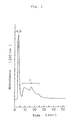
- A slurry prepared by dispersing finely powdered magnesium ammonium phosphate hexahydrate in a mixed solution of water and methanol was subjected to spray pyrolyzing at 1,000°C to afford spherical magnesium pyrophosphate having a particle size of 4-10 microns. The spherical magnesium pyrophosphate was packed into a stainless steel tube (8 x 100mm) and a mixed sample of serum albumin, transferrin and γ-globulin was subjected to chromatography thereon at a flow rate of 1 ml/min by a linear gradient in which the phosphate anion concentration in sodium phosphate buffer, pH 6.8, was changed over a 60 minutes from 10 mM to 300 mM. The back pressure at the time of measurement was a suitable pressure of as low as 4 kg/cm2. The chromatogram thus obtained is shown in Fig. 1. As is apparent from Fig. 1, only the γ-globulin was retained in the column and the serum albumin and transferrin flowed through it without being retained therein. It was thus possible easily to separate the γ-globulin from the mixed sample.
- Using the enzyme-linked immunosorbent assay (ELISA), each of the thus separated fractions was assayed for activity with the result that only the serum albumin activity and transferrin activity were detected in the flow-through fractions and only the γ-globulin activity in the fractions retained in the column. Further, antibody activity was also detected concurrently with the γ-globulin activity, which demonstrated that antibody activity was retained after the separation operations on the column.
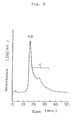
- A commercially available spherical hydroxyapatite packing material was packed into a column in the same manner as in Example 1 and chromatography was carried out thereon in the same manner as in Example 1. The results are shown in Fig. 2. In the chromatogram were observed overlapping peakes of the three different components, i.e. serum albumin, transferrin and γ-globulin, in the sample applied to the hydroxyapatite.
- In accordance with the procedure as described in G. C. Schito and A. Pesce, Giornale di Microbiologia, 13, 31-43 (1965), a sodium pyrophosphate solution was gradually added to a stirred magnesium chloride solution to prepare a milky gel of magnesium pyrophosphate. The gel was then centrifuged (at 2000 rpm for 5 minutes) and washed with deionized water. It was then dispersed in sodium phosphate buffer, pH 6.8, to prepare a slurry, and an attempt was made to pack the slurry into a column having the same standard as for the column used in Example 1. The slurry passed though the outlet filter of the column at the initial phase of packing and then gradually caused clogging in the filter until the packing pressure increased to an extraordinary point. It was after all not possible to prepare a column using the gel as a packing material. The gel was found to be in an amorphous state as a result of X-ray diffraction analysis.
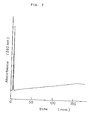
- 0.5 mg of phosphoprotein phosvitin was injected into the same magnesium pyrophosphate column as prepared in Example 1 and the elution behavior was examined with a linear gradient of 1 mM to 1.5 M (Fig. 3). The results are shown in Fig. 3. With potassium phosphate buffer the phosvitin was successfully eluted at an extremely low concentration of 10 mM or less.
- Using the same hydroxyapatite column as used in Comparative Example 1, chromatography was carried out under the same conditions as in Example 2 to determine the molar concentration at which the phosvitin was eluted. The results are shown in Fig. 4. As is apparent from Fig. 4, the phosvitin did not elute even when the phosphate anion concentration in the phosphate buffer was increased to as high as 1.5 M.
- Calcium hydrogen phosphate dihydrate was pyrolyzed at 1,250°C and 600°C to prepare α- and γ-type calcium pyrophosphate powder, respectively. Each powder was ground and classified to a uniform particle size of 5-15 microns and then packed into a stainless steel tube. Two kinds of protein, i.e. serum albumin and transferrin, were chromatographed thereon under the same measurement conditions as in Example 1. As a result, with the α-type calcium phosphate column, the two proteins flowed through it without being retained therein, while with the γ-type calcium phosphate column, both of them were retained in the column and eluted with phosphate buffer at a concentration of as low as about 20 mM.
- Magnesium hydrogen phosphate trihydrate was pyrolyzed at 900°C to prepare magnesium pyrophosphate powder. The powder was used to pack a column in the same manner as in Example 1. As acidic protein samples having an isoelectric point of 5.0 or less were used urease, serum albumin, ovalbumin, α-lactalbumin, fetuin and pepsin, and as basic protein samples having isoelectric points of 7.0 or more were used myoglobin, α-chymotrypsin, papain, α-chymotrypsinogen, cytochrome c and lysozyme. These samples were subjected to chromatography on the column. As a result, all the acidic protein samples tested flowed through the column without being retained therein, while all the basic protein samples were retained in the column The fractionation of proteins into the group of acidic ones and that of basic ones was thus successfully effected.
- Calcium hydrogen phosphate and magnesium hydrogen phosphate were dissolved in dilute nitric acid so that the calcium/magnesium atomic ratio became 1:1, and the solution was dried up at 150°C and then pyrolyzed at 850°C to prepare pyrophosphate with the two component metals, calcium and magnesium. The X-ray diffraction data obtained with this pyrophosphate coincided with the X-ray diffraction data for CaMgP2O7 filed in the ASTM data collection (X-ray Powder Diffraction File No. 24-135). The thus obtained powder was packed into a column, and lysozyme and cytochrome c were chromatographed thereon in the same manner as in Example 1. As a result, the properties of this column were found to be intermediate between those of calcium phosphate and magnesium phosphate columns, and the elution behavior thereof to be closer to that of magnesium phosphate columns.
- α-Type strontium pyrophosphate powder obtained by pyrolyzing strontium hydrogen phosphate at 1,000°C was packed into a column, and adenosine 5'-phosphate (AMP) and adenosine 5'-triphosphate (ATP) were chromatographed thereon. The AMP was found to flow through the column without being retained therein and the ATP to be weakly retained in the column.
- An aqueous manganese acetate solution and phosphoric acid were mixed together so that the manganese/phosphorus atomic ratio became 1:1. The mixture was dried up at 150-180°C with stirring and the solid product was pyrolyzed at 800°C for 4 hours. The resultant powder was confirmed by X-ray diffraction analysis to be manganese pyrophosphate. A column was packed with the powder in the same manner as in Example 1, and a mixed sample of serum albumin, lysozyme and cytochrome c was chromatographed thereon. As a result, they were found to be completely separated at the retention times of 9, 19 and 35 minutes, respectively, in the chromatogram obtained.
- Porous titanium oxide particles having a particle size of about 100 microns were dipped in a saturated solution of magnesium hydrogen phosphate trihydrate in dilute nitric acid, and the solids were filtered off, dried and fired at 700°C. This dipping-filtering-drying-firing step cycle was repeated six times and the thus obtained product was fired at 900°C to afford a material composed of the titanium oxide on the surface of which a magnesium pyrophosphate layer was formed. The resultant particulate material was packed into a glass tube having an internal diameter of 25 mm and a length of 100 mm, and separation of serum albumin, transferrin and γ-globulin was attempted with the result that an excellent resolution was shown as in Example 1.
- An aqueous calcium chloride solution and an aqueous sodium pyrophosphate solution were mixed together so that the calcium/phosphorus atomic ratio became 1:1, and the mixture was allowed to stand for a whole day to form calcium diphosphate dihydrate (Ca2P2O7·2H2O) crystals, which were then filtered off. The thus prepared material was packed into a column in the same manner as in Example 1, and a mixed sample of serum albumin, lysozyme and cytochrome c was chromatographed thereon. As a result the serum albumin flowed through the column without being retained therein, while the lysozyme and cytochrome c were retained therein.
- Triethyl phosphite was added to a methanol solution of calcium nitrate so that the calcium/phosphorus atomic ratio was 1:1, whereafter aqueous ammonia was added thereto to prepare a solution having a pH of 6.5 - 7. Commercially available spherical apatite of the same type as described in Comparative Example 1 was dipped immediately thereafter in this solution, dried at 150°C and pyrolyzed at 800°C. This dipping-filtering-drying-pyrolyzing operation cycle was repeated three times and the thus obtained particulate material was dipped in a saturated solution of calcium hydrogen phosphate in dilute nitric acid, filtered off, dried and then pyrolyzed at 1,000°C. The resultant particulate material was confirmed both by X-ray diffraction analysis and by scanning electron beam microscopy to be composed of apatite particles the surface of which was coated with calcium pyrophosphate. This particulate material was packed into a column in the same manner as described in Example 1 and chromatography was carried out in the same manner as described in Example 1. As in Example 1, serum albumin and transferrin flowed through the column without being retained therein and γ-globulin was retained in the column.
- A methanol solution of calcium nitrate was mixed with phosphoric acid so that the calcium/phosphorus ratio became 1.05:1, and the mixture was spray-pyrolyzed at 1,000°C to obtain powder of spherical material. This powdery material was found by X-ray diffraction analysis to be composed mainly of calcium pyrophosphate. Some other extremely small peaks were also observed but their intensity was too weak to identify the corresponding by-products. This powdery material was packed into a column in the same manner as in Example 1 and chromatography was carried out in the same manner as in Example 1. As a result, serum albumin and transferrin flowed through the column without being retained therein, while γ-globulin was retained in the column.
- Phosphoric acid was added to an aqueous zirconium oxynitrate solution so that the zirconium/phosphorus atomic ratio became 1:2 and the mixture was stirred to prepare a slurry. The slurry was washed with water and then with methanol and dried at 150°C. It was then heated at 5°C/min in the atmosphere for heat treatment at 800°C for 6 hours. The product was determined by X-ray diffraction analysis to be noncrystalline. This noncrystalline powder was packed into a column in the same manner as in Example 1 and separation of serum albumin and γ-globulin was attempted with the result that only the γ-globulin was retained in the column and hence separated from the serum albumin. Furthermore, column chromatography was performed with a mixed sample of serum albumin, lysozyme and cytochrome c in the same manner as in Example 7 to give a chromatogram which indicated a complete separation as in Example 7.
- The dried product from the slurry prepared in Example 12 was heated at 5°C/min in the atmosphere to 1,000°C, at which heat treatment was carried out for 6 hours. The resultant powder was determined by X-ray diffraction analysis to be crystalline powder of single phase zirconium pyrophosphate. This crystalline zirconium pyrophosphate powder was packed into a column in the same manner as in Example 12, and the same chromatography as in Example 12 was performed. The separation properties for the respective proteins were the same as the results in Example 12 where noncrystalline zirconium pyrophosphate was used, although there was only a slight difference in the concentrations at which the elution took place.
- A slurry prepared by dispersing fine magnesium dihydrogen phosphate trihydrate powder in a mixed solution of water and methanol was subjected to spray pyrolyzing at 800°C and further to heat treatment at 500°C for 4 hours to afford spherical magnesium metaphosphate. This product was then classified and only particles having a particle size in the range of 5-15 microns were packed into a stainless steel tube (8 x 100 mm). A mixed sample of serum albumin and γ-globulin was subjected to chromatography thereon at a flow rate of 1 ml/min by a linear gradient in which the phosphate anion concentration in sodium phosphate buffer, pH 6.8, was changed over a 60 minutes from 1 mM to 300 mM. As a result, only the γ-globulin was retained in the column and the serum albumin flowed through it without being retained therein. It was thus possible easily to separate the γ-globulin from the mixed sample.
- A commercially available spherical hydroxyapatite packing material was packed into a column in the same manner as in Example 14 and chromatography was carried out thereon in the same manner as in Example 14. Both serum albumin and γ-globulin were retained and the elution peaks of the respective samples overlapped each other, meaning no complete separation.
- Calcium dihydrogen phosphate monohydrate was pyrolyzed at 800°C for 4 hours and the thus produced mass was ground in a ball mill and then subjected to heat treatment again at 800°C for 4 hours to afford β-calcium metaphosphate powder. This powder was packed into a column in the same manner as in Example 14, the phosphoproteins phosvitin and α-casein were processed for elution under the same chromatographic conditions as in Example 14. Both of them were found to elute at extremely low phosphate buffer concentrations of 10 mM or less.
- Calcium hydrogen phosphate dihydrate was pyrolyzed at 1,250°C to afford α-calcium pyrophosphate powder. The particles were packed into a column in the same manner as in Example 15 and chromatography was carried out thereon in the same manner as in Example 15. Phosvitin did not elute with phosphate buffer even at a concentration of as high as 800 mM and α-casein required 317 mM phosphate buffer for its elution.
- Porous titanium oxide particles having a particle size of about 200 microns were dipped in a saturated solution of magnesium dihydrogen phosphate trihydrate in dilute nitric acid, removed therefrom by filtration, dried and fired at 600°C. This dipping-filtering-drying-firing sequence was repeated six times and then fired at 800°C to form a magnesium metaphosphate layer on the surface of the titanium oxide. The thus prepared particles were packed into a glass tube having an internal diameter of 25 mm and a length of 100 mm, and a mixed sample solution of serum albumin and γ-globulin was loaded thereonto. Only the γ-globulin was retained in the glass column and it was successfully separated from the serum albumin.
- Aluminum hydroxide and phosphoric acid were mixed together at a molar ratio of 1:3 and the mixture was heated with stirring on a sand bath to solidify the same. The resultant solid product was subjected to heat treatment at 450°C to afford B-type aluminum tetrametaphosphate. This product was classified and only particles having a particle size of 5-15 microns were packed into a stainless steel tube and a mixed sample of phosvitin, lysozyme and cytochrome c was subjected to chromatography in the same manner as in Example 14. As a result, the basic proteins, i.e. lysozyme and cytochrome c, were retained in the column, the lysozyme eluting at 123mM and the cytochrome c at 211 and 229 mM. The phosphoprotein phosvitin eluted at a concentration of as low as 10 mM or less.
- In order to obtain aluminum tetrametaphosphate showing different retention performance from that of B-type aluminum tetrametaphosphate, the aluminum tetrametaphosphate obtained in Example 17 was further subjected to heat treatment at 800°C for 4 hours to afford A-type aluminum tetrametaphosphate. This particulate stationary phase material was packed into a column in the same manner as in Example 17, and a mixed sample of serum albumin, lysozyme and cytochrome c was chromatographed thereon. The stationary phase material had less ability to retain proteins than B-type aluminum tetrametaphosphate, so that the serum albumin flowed through the column without being retained therein, the lysozyme eluting at 83 mM and the cytochrome c at 155 and 165 mM.
- Nickel carbonate was mixed with phosphoric acid used in 7% excess of the theoretical, and the mixture was dried up and then subjected to heat treatment at 450°C for 2 hours. The thus obtained product was coarsely ground and then caused to react under heating at 800°C for 4 hours to afford crystalline nickel metaphosphate powder. This powder was classified and particles having a particle size in the range of 150-300 microns were packed into a glass tube of 25 mm in internal diameter and 100 mm in length while tapping the tube to prepare a nickel metaphosphate column. The acidic proteins serum albumin, ovalbumin, fetuin and pepsin and the basic proteins α-chymotrypsin, papain, lysozyme and cytochrome c were dissolved in 1 mM sodium phosphate buffer to prepare a mixed sample. The sample was loaded onto the column for chromatography in a stepwise mode, whereby acidic proteins were successfully separated from the basic proteins.
- Zirconium oxide was mixed with diphosphorus pentaoxide used in 5% excess of the theoretical, and the mixture was caused to react at 430°C for 2 days to afford a product composed mainly of zirconium metaphosphate. This product was ground and particles having a particle size in the range of 150-300 microns were packed into a glass tube in the same manner as in Example 19 to prepare a zirconium metaphosphate column. With this column, acidic proteins were successfully separated from basic proteins as in Example 19.
- Manganese carbonate was mixed with phosphoric acid used in 7% excess of the theoretical and the mixture was allowed to stand on a water bath at 80°C to crystallize manganese dihydrogen phosphate monohydrate. The product was washed with acetone to remove excess phosphoric acid and then heated at 700°C for 4 hours to afford manganese metaphosphate powder. When the powder was packed into a column and serum albumin and γ-globulin chromatographed thereon as in Example 14, the γ-globulin could easily be separated.
- Zinc oxide was mixed with phosphoric acid used in 1% excess of the theoretical, and the mixture was caused to react under heating at 600°C for 4 hours to afford a product composed mainly of zinc tetrametaphosphate. When the product was packed into a column and serum albumin and γ-globulin chromatographed thereon as in Example 14, the γ-globulin could easily be separated as in Example 21.
- Fig. 1 shows the chromatogram obtained in Example 1 of a mixed sample of serum albumin, transferrin and γ-globulin, wherein the reference signs a, b and c represent the peaks of the serum albumin, transferrin and γ-globulin, respectively.
- Fig. 2 shows the chromatogram obtained in Comparative Example 1 of a mixed sample of serum albumin, transferrin and γ-globulin, wherein the reference signs a, b and c represent the peaks of the serum albumin, transferrin and γ-globulin, respectively.
- Fig. 3 shows the chromatogram of phosvitin obtained in Example 2.
- Fig. 4 shows the chromatogram of phosvitin obtained in Comparative Example 3.
Claims (5)
- Use of a solid material as a stationary phase for chromatography, wherein the surface of the solid material is coated with metal pyrophosphate and/or metal metaphosphate wherein one or more metal component(s) is (are) present, except uncoated or polymer coated ZrO2 spherules modified with alkali metal pyrophosphates or metaphosphates, and except an inorganic support material onto which silver pyrophosphate (Ag4P2O7) is deposited.
- The use according to claim 1, wherein the solid material is selected from glass, ceramics, metals and resins.
- The use according to claim 1, wherein the solid material consists of metal pyrophosphate or metal metaphosphate.
- The use according to any one of claims 1 to 3, wherein the metal is selected from alkaline earth metals, iron family metals, manganese, copper, zinc, aluminum and zirconium.
- The use according to claim 4, wherein the alkaline earth metal is magnesium, calcium or strontium.
Applications Claiming Priority (4)
| Application Number | Priority Date | Filing Date | Title |
|---|---|---|---|
| JP25181992 | 1992-08-07 | ||
| JP251819/92 | 1992-08-07 | ||
| JP25181992 | 1992-08-07 | ||
| PCT/JP1993/001109 WO1994003801A1 (en) | 1992-08-07 | 1993-08-06 | Material of chromatographic stationary phase |
Publications (3)
| Publication Number | Publication Date |
|---|---|
| EP0607459A1 EP0607459A1 (en) | 1994-07-27 |
| EP0607459A4 EP0607459A4 (en) | 1995-02-22 |
| EP0607459B1 true EP0607459B1 (en) | 2002-03-20 |
Family
ID=17228394
Family Applications (1)
| Application Number | Title | Priority Date | Filing Date |
|---|---|---|---|
| EP94906728A Expired - Lifetime EP0607459B1 (en) | 1992-08-07 | 1993-08-06 | Use of a solid material as a stationary phase for chromatography |
Country Status (3)
| Country | Link |
|---|---|
| EP (1) | EP0607459B1 (en) |
| DE (2) | DE607459T1 (en) |
| WO (1) | WO1994003801A1 (en) |
Family Cites Families (8)
| Publication number | Priority date | Publication date | Assignee | Title |
|---|---|---|---|---|
| JPH0781997B2 (en) * | 1986-07-05 | 1995-09-06 | 旭光学工業株式会社 | Spherical packing material for liquid chromatography |
| IT1200018B (en) * | 1983-08-01 | 1989-01-05 | Anic Spa | INORGANIC CATIONIC EXCHANGERS AND PROCEDURE FOR THEIR PREPARATION |
| JPS60143762A (en) * | 1983-10-03 | 1985-07-30 | Mitsui Toatsu Chem Inc | Hydroxy apatite for chromatography |
| US4874520A (en) * | 1986-04-23 | 1989-10-17 | Battelle Development Corporation | Chromatographic process |
| JPH01500147A (en) * | 1986-04-23 | 1989-01-19 | バッテル・ディベロプメント・コーポレーション | Chromatographic equipment and methods |
| EP0331283B1 (en) * | 1988-02-03 | 1993-04-28 | The Regents Of The University Of Minnesota | High stability porous zirconium oxide spherules |
| JP2575170B2 (en) * | 1988-03-16 | 1997-01-22 | 株式会社トクヤマ | Method for producing spherical hydroxyapatite |
| US4933159A (en) * | 1989-11-02 | 1990-06-12 | Phillips Petroleum Company | Sorption of trialkyl arsines |
-
1993
- 1993-08-06 DE DE0607459T patent/DE607459T1/en active Pending
- 1993-08-06 DE DE69331729T patent/DE69331729T2/en not_active Expired - Fee Related
- 1993-08-06 EP EP94906728A patent/EP0607459B1/en not_active Expired - Lifetime
- 1993-08-06 WO PCT/JP1993/001109 patent/WO1994003801A1/en not_active Ceased
Also Published As
| Publication number | Publication date |
|---|---|
| DE69331729D1 (en) | 2002-04-25 |
| WO1994003801A1 (en) | 1994-02-17 |
| DE69331729T2 (en) | 2002-11-21 |
| EP0607459A1 (en) | 1994-07-27 |
| EP0607459A4 (en) | 1995-02-22 |
| DE607459T1 (en) | 1995-04-20 |
Similar Documents
| Publication | Publication Date | Title |
|---|---|---|
| EP0172730B1 (en) | Metal oxide stabilized chromatography packings | |
| KR890000985B1 (en) | Purification of Immunoglobulin G | |
| JP4974297B2 (en) | Methods and compositions for the detection and isolation of phosphorylated molecules using hydrated metal oxides | |
| Rainer et al. | Analysis of protein phosphorylation by monolithic extraction columns based on poly (divinylbenzene) containing embedded titanium dioxide and zirconium dioxide nano‐powders | |
| EP0179039B1 (en) | Polymer coated metal surfaces | |
| EP1690867B1 (en) | Phosphorylcholine group-containing compound and surface modifying agent composed of such compound | |
| EP0331283B1 (en) | High stability porous zirconium oxide spherules | |
| US20090101581A1 (en) | Immobilized titanium ion affinity chromatography material and its preparation and application | |
| US6846410B2 (en) | High stability porous metal oxide spherules used for one-step antibody purifications | |
| US5112952A (en) | Composition and method for isolation and purification of Immunoglobulin M | |
| US5728463A (en) | Stationary phase material for chromatography | |
| EP0295808A2 (en) | Liquid chromatography packing materials and method for making and using same | |
| GB2221466A (en) | Biologically reactive particles with biological, therapeutic and chromatographic applications | |
| EP0607459A1 (en) | Material of chromatographic stationary phase | |
| CA1317272C (en) | Packing for liquid chromatography | |
| US7407812B2 (en) | Method and kit for the isolation of phosphorylated peptides | |
| JP2902274B2 (en) | Separation and purification of chromatographic stationary phase materials and biologically relevant polymer samples | |
| EP0320849B1 (en) | Apatite packing for liquid chromatography and process for producing the same | |
| US3959249A (en) | Method for isolating transferrines from biological materials | |
| JP3216436B2 (en) | Basic protein adsorbent | |
| JPS63157973A (en) | Liquid chromatography | |
| US20100133161A1 (en) | Metal-Coated Superficially Porous Supports as a Medium for HPLC of Phosphorus-Containing Materials | |
| KR910003119B1 (en) | Fillers and Columns for Liquid Chromatography | |
| JPH1060000A (en) | Purification of antibody | |
| JPH04204053A (en) | Separation agent for chromatography |
Legal Events
| Date | Code | Title | Description |
|---|---|---|---|
| PUAI | Public reference made under article 153(3) epc to a published international application that has entered the european phase |
Free format text: ORIGINAL CODE: 0009012 |
|
| 17P | Request for examination filed |
Effective date: 19940519 |
|
| AK | Designated contracting states |
Kind code of ref document: A1 Designated state(s): DE FR GB NL |
|
| EL | Fr: translation of claims filed | ||
| TCNL | Nl: translation of patent claims filed | ||
| A4 | Supplementary search report drawn up and despatched | ||
| AK | Designated contracting states |
Kind code of ref document: A4 Designated state(s): DE FR GB NL |
|
| DET | De: translation of patent claims | ||
| 17Q | First examination report despatched |
Effective date: 19970417 |
|
| RTI1 | Title (correction) |
Free format text: USE OF A MATERIAL OF CHROMATOGRAPHIC STATIONARY PHASE |
|
| RTI1 | Title (correction) |
Free format text: USE OF A MATERIAL OF CHROMATOGRAPHIC STATIONARY PHASE |
|
| GRAG | Despatch of communication of intention to grant |
Free format text: ORIGINAL CODE: EPIDOS AGRA |
|
| GRAG | Despatch of communication of intention to grant |
Free format text: ORIGINAL CODE: EPIDOS AGRA |
|
| GRAG | Despatch of communication of intention to grant |
Free format text: ORIGINAL CODE: EPIDOS AGRA |
|
| GRAH | Despatch of communication of intention to grant a patent |
Free format text: ORIGINAL CODE: EPIDOS IGRA |
|
| RTI1 | Title (correction) |
Free format text: USE OF A SOLID MATERIAL AS A STATIONARY PHASE FOR CHROMATOGRAPHY |
|
| REG | Reference to a national code |
Ref country code: GB Ref legal event code: IF02 |
|
| GRAH | Despatch of communication of intention to grant a patent |
Free format text: ORIGINAL CODE: EPIDOS IGRA |
|
| GRAA | (expected) grant |
Free format text: ORIGINAL CODE: 0009210 |
|
| AK | Designated contracting states |
Kind code of ref document: B1 Designated state(s): DE FR GB NL |
|
| REF | Corresponds to: |
Ref document number: 69331729 Country of ref document: DE Date of ref document: 20020425 |
|
| PLBE | No opposition filed within time limit |
Free format text: ORIGINAL CODE: 0009261 |
|
| STAA | Information on the status of an ep patent application or granted ep patent |
Free format text: STATUS: NO OPPOSITION FILED WITHIN TIME LIMIT |
|
| 26N | No opposition filed |
Effective date: 20021223 |
|
| PGFP | Annual fee paid to national office [announced via postgrant information from national office to epo] |
Ref country code: GB Payment date: 20030728 Year of fee payment: 11 |
|
| PGFP | Annual fee paid to national office [announced via postgrant information from national office to epo] |
Ref country code: NL Payment date: 20030818 Year of fee payment: 11 |
|
| PGFP | Annual fee paid to national office [announced via postgrant information from national office to epo] |
Ref country code: FR Payment date: 20030819 Year of fee payment: 11 |
|
| PGFP | Annual fee paid to national office [announced via postgrant information from national office to epo] |
Ref country code: DE Payment date: 20030901 Year of fee payment: 11 |
|
| PG25 | Lapsed in a contracting state [announced via postgrant information from national office to epo] |
Ref country code: GB Free format text: LAPSE BECAUSE OF NON-PAYMENT OF DUE FEES Effective date: 20040806 |
|
| PG25 | Lapsed in a contracting state [announced via postgrant information from national office to epo] |
Ref country code: NL Free format text: LAPSE BECAUSE OF NON-PAYMENT OF DUE FEES Effective date: 20050301 Ref country code: DE Free format text: LAPSE BECAUSE OF NON-PAYMENT OF DUE FEES Effective date: 20050301 |
|
| GBPC | Gb: european patent ceased through non-payment of renewal fee |
Effective date: 20040806 |
|
| PG25 | Lapsed in a contracting state [announced via postgrant information from national office to epo] |
Ref country code: FR Free format text: LAPSE BECAUSE OF NON-PAYMENT OF DUE FEES Effective date: 20050429 |
|
| NLV4 | Nl: lapsed or anulled due to non-payment of the annual fee |
Effective date: 20050301 |
|
| REG | Reference to a national code |
Ref country code: FR Ref legal event code: ST |