EP0607452B1 - Uses of a rustproof steel sheet excellent in various characteristics including corrosion resistance - Google Patents
Uses of a rustproof steel sheet excellent in various characteristics including corrosion resistance Download PDFInfo
- Publication number
- EP0607452B1 EP0607452B1 EP93914985A EP93914985A EP0607452B1 EP 0607452 B1 EP0607452 B1 EP 0607452B1 EP 93914985 A EP93914985 A EP 93914985A EP 93914985 A EP93914985 A EP 93914985A EP 0607452 B1 EP0607452 B1 EP 0607452B1
- Authority
- EP
- European Patent Office
- Prior art keywords
- phase
- corrosion
- steel sheet
- crystal system
- alloy
- Prior art date
- Legal status (The legal status is an assumption and is not a legal conclusion. Google has not performed a legal analysis and makes no representation as to the accuracy of the status listed.)
- Expired - Lifetime
Links
- 238000005260 corrosion Methods 0.000 title claims abstract description 141
- 230000007797 corrosion Effects 0.000 title claims abstract description 141
- 229910000831 Steel Inorganic materials 0.000 title abstract description 79
- 239000010959 steel Substances 0.000 title abstract description 79
- XLYOFNOQVPJJNP-UHFFFAOYSA-N water Substances O XLYOFNOQVPJJNP-UHFFFAOYSA-N 0.000 claims abstract description 25
- 238000007747 plating Methods 0.000 claims description 112
- 238000000576 coating method Methods 0.000 claims description 108
- 229910000599 Cr alloy Inorganic materials 0.000 claims description 96
- 239000011248 coating agent Substances 0.000 claims description 92
- 229910045601 alloy Inorganic materials 0.000 claims description 70
- 239000000956 alloy Substances 0.000 claims description 70
- 239000013078 crystal Substances 0.000 claims description 69
- 238000004070 electrodeposition Methods 0.000 claims description 50
- 239000010935 stainless steel Substances 0.000 claims description 29
- 239000002537 cosmetic Substances 0.000 claims description 22
- 229910052804 chromium Inorganic materials 0.000 claims description 20
- 229910052725 zinc Inorganic materials 0.000 claims description 18
- 239000011651 chromium Substances 0.000 description 169
- 239000011701 zinc Substances 0.000 description 60
- 238000004519 manufacturing process Methods 0.000 description 50
- 238000000034 method Methods 0.000 description 27
- 229910002056 binary alloy Inorganic materials 0.000 description 25
- 238000012360 testing method Methods 0.000 description 25
- 238000002441 X-ray diffraction Methods 0.000 description 24
- 230000000052 comparative effect Effects 0.000 description 20
- 229910007567 Zn-Ni Inorganic materials 0.000 description 13
- 229910007614 Zn—Ni Inorganic materials 0.000 description 13
- 238000010586 diagram Methods 0.000 description 12
- 238000005868 electrolysis reaction Methods 0.000 description 12
- 239000006104 solid solution Substances 0.000 description 12
- 230000008901 benefit Effects 0.000 description 10
- 239000010960 cold rolled steel Substances 0.000 description 10
- 238000011156 evaluation Methods 0.000 description 9
- 229910000765 intermetallic Inorganic materials 0.000 description 9
- 239000000758 substrate Substances 0.000 description 9
- 230000008859 change Effects 0.000 description 8
- 238000006243 chemical reaction Methods 0.000 description 8
- 230000015572 biosynthetic process Effects 0.000 description 7
- 230000004044 response Effects 0.000 description 7
- 239000000126 substance Substances 0.000 description 7
- PMZURENOXWZQFD-UHFFFAOYSA-L Sodium Sulfate Chemical compound [Na+].[Na+].[O-]S([O-])(=O)=O PMZURENOXWZQFD-UHFFFAOYSA-L 0.000 description 6
- QAOWNCQODCNURD-UHFFFAOYSA-L Sulfate Chemical compound [O-]S([O-])(=O)=O QAOWNCQODCNURD-UHFFFAOYSA-L 0.000 description 6
- 208000033897 Systemic primary carnitine deficiency Diseases 0.000 description 6
- KGBXLFKZBHKPEV-UHFFFAOYSA-N boric acid Chemical compound OB(O)O KGBXLFKZBHKPEV-UHFFFAOYSA-N 0.000 description 6
- 239000004327 boric acid Substances 0.000 description 6
- 125000002091 cationic group Chemical group 0.000 description 6
- 239000003795 chemical substances by application Substances 0.000 description 6
- GRWVQDDAKZFPFI-UHFFFAOYSA-H chromium(III) sulfate Chemical compound [Cr+3].[Cr+3].[O-]S([O-])(=O)=O.[O-]S([O-])(=O)=O.[O-]S([O-])(=O)=O GRWVQDDAKZFPFI-UHFFFAOYSA-H 0.000 description 6
- 238000011109 contamination Methods 0.000 description 6
- 238000009713 electroplating Methods 0.000 description 6
- JEIPFZHSYJVQDO-UHFFFAOYSA-N iron(III) oxide Inorganic materials O=[Fe]O[Fe]=O JEIPFZHSYJVQDO-UHFFFAOYSA-N 0.000 description 6
- 239000007788 liquid Substances 0.000 description 6
- 150000007524 organic acids Chemical class 0.000 description 6
- 235000005985 organic acids Nutrition 0.000 description 6
- 239000006174 pH buffer Substances 0.000 description 6
- 238000010587 phase diagram Methods 0.000 description 6
- 229910052938 sodium sulfate Inorganic materials 0.000 description 6
- 235000011152 sodium sulphate Nutrition 0.000 description 6
- 239000004094 surface-active agent Substances 0.000 description 6
- 208000016505 systemic primary carnitine deficiency disease Diseases 0.000 description 6
- LRXTYHSAJDENHV-UHFFFAOYSA-H zinc phosphate Chemical compound [Zn+2].[Zn+2].[Zn+2].[O-]P([O-])([O-])=O.[O-]P([O-])([O-])=O LRXTYHSAJDENHV-UHFFFAOYSA-H 0.000 description 6
- 229910000165 zinc phosphate Inorganic materials 0.000 description 6
- NWONKYPBYAMBJT-UHFFFAOYSA-L zinc sulfate Chemical compound [Zn+2].[O-]S([O-])(=O)=O NWONKYPBYAMBJT-UHFFFAOYSA-L 0.000 description 6
- 229910000368 zinc sulfate Inorganic materials 0.000 description 6
- 229960001763 zinc sulfate Drugs 0.000 description 6
- 238000005275 alloying Methods 0.000 description 5
- 125000004122 cyclic group Chemical group 0.000 description 5
- 230000001627 detrimental effect Effects 0.000 description 5
- 239000000203 mixture Substances 0.000 description 5
- 230000006866 deterioration Effects 0.000 description 4
- 230000000694 effects Effects 0.000 description 4
- 238000005259 measurement Methods 0.000 description 3
- 150000003839 salts Chemical class 0.000 description 3
- 239000007921 spray Substances 0.000 description 3
- 238000013459 approach Methods 0.000 description 2
- 239000005441 aurora Substances 0.000 description 2
- 230000001419 dependent effect Effects 0.000 description 2
- 238000011161 development Methods 0.000 description 2
- 230000006872 improvement Effects 0.000 description 2
- 230000000007 visual effect Effects 0.000 description 2
- 229910000640 Fe alloy Inorganic materials 0.000 description 1
- 229910001335 Galvanized steel Inorganic materials 0.000 description 1
- 239000002390 adhesive tape Substances 0.000 description 1
- QVGXLLKOCUKJST-UHFFFAOYSA-N atomic oxygen Chemical compound [O] QVGXLLKOCUKJST-UHFFFAOYSA-N 0.000 description 1
- 238000009826 distribution Methods 0.000 description 1
- 238000001035 drying Methods 0.000 description 1
- 239000008397 galvanized steel Substances 0.000 description 1
- 230000002401 inhibitory effect Effects 0.000 description 1
- 230000013011 mating Effects 0.000 description 1
- 229910052760 oxygen Inorganic materials 0.000 description 1
- 239000001301 oxygen Substances 0.000 description 1
- 239000003973 paint Substances 0.000 description 1
- 230000003334 potential effect Effects 0.000 description 1
- 230000003405 preventing effect Effects 0.000 description 1
- 238000004080 punching Methods 0.000 description 1
- 230000000087 stabilizing effect Effects 0.000 description 1
Images


Classifications
-
- C—CHEMISTRY; METALLURGY
- C25—ELECTROLYTIC OR ELECTROPHORETIC PROCESSES; APPARATUS THEREFOR
- C25D—PROCESSES FOR THE ELECTROLYTIC OR ELECTROPHORETIC PRODUCTION OF COATINGS; ELECTROFORMING; APPARATUS THEREFOR
- C25D3/00—Electroplating: Baths therefor
- C25D3/02—Electroplating: Baths therefor from solutions
- C25D3/56—Electroplating: Baths therefor from solutions of alloys
- C25D3/565—Electroplating: Baths therefor from solutions of alloys containing more than 50% by weight of zinc
-
- Y—GENERAL TAGGING OF NEW TECHNOLOGICAL DEVELOPMENTS; GENERAL TAGGING OF CROSS-SECTIONAL TECHNOLOGIES SPANNING OVER SEVERAL SECTIONS OF THE IPC; TECHNICAL SUBJECTS COVERED BY FORMER USPC CROSS-REFERENCE ART COLLECTIONS [XRACs] AND DIGESTS
- Y10—TECHNICAL SUBJECTS COVERED BY FORMER USPC
- Y10S—TECHNICAL SUBJECTS COVERED BY FORMER USPC CROSS-REFERENCE ART COLLECTIONS [XRACs] AND DIGESTS
- Y10S428/00—Stock material or miscellaneous articles
- Y10S428/922—Static electricity metal bleed-off metallic stock
- Y10S428/9335—Product by special process
- Y10S428/934—Electrical process
- Y10S428/935—Electroplating
-
- Y—GENERAL TAGGING OF NEW TECHNOLOGICAL DEVELOPMENTS; GENERAL TAGGING OF CROSS-SECTIONAL TECHNOLOGIES SPANNING OVER SEVERAL SECTIONS OF THE IPC; TECHNICAL SUBJECTS COVERED BY FORMER USPC CROSS-REFERENCE ART COLLECTIONS [XRACs] AND DIGESTS
- Y10—TECHNICAL SUBJECTS COVERED BY FORMER USPC
- Y10T—TECHNICAL SUBJECTS COVERED BY FORMER US CLASSIFICATION
- Y10T428/00—Stock material or miscellaneous articles
- Y10T428/12—All metal or with adjacent metals
- Y10T428/12493—Composite; i.e., plural, adjacent, spatially distinct metal components [e.g., layers, joint, etc.]
- Y10T428/12771—Transition metal-base component
- Y10T428/12785—Group IIB metal-base component
- Y10T428/12792—Zn-base component
- Y10T428/12799—Next to Fe-base component [e.g., galvanized]
Definitions
- the invention of the subject application relates to the use corrosion resistant steel sheets that satisfy the various properties required of the corrosion resistant steel sheets, etc., which include not only high corrosion resistance but also either one of high resistance to cosmetic corrosion, good formability, high chipping resistance, high corrosion resistance in the as-formed state, strong water resistant secondary adherence of coating and high perforation corrosion resistance.
- Automotive corrosion resistant steel sheets commercially used today include electrogalvanized steel sheets, steel sheets with electroplated Zn-Ni alloys, steel sheets with electroplated Zn-Fe alloys, hot-dip galvannealed steel sheets and various other types, all of which are Zn base plated steel sheets. These make use of the self-sacrificial corrosion preventing action of Zn for steels.
- the most straightforward way to improve corrosion resistance is by increasing the coating weight of plating (hereunder referred to as "coating weight”) but the increase in coating weight is accompanied by deterioration in formability, weldability and other quality factors.
- a salt spray test was conducted in accordance with JIS Z 2371 and the number of days to 2% red rust development was checked. The results are shown in Fig. 1. Motorcar bodies are normally formed before use, so the test specimens were those which had been subjected to 17% stretch.
- values of coating weight are sometimes indicated with the symbol for unit of its measure (g/m 2 ) being omitted. For example, a coating weight of 30 g/m 2 may be indicated as coating weight 30.
- EG 30 designates a commercial electrogalvanized steel sheet with coating weight 30
- GA 60 is a commercial hot-dip galvannealed steel sheet with coating weight 60
- Zn-Ni 30 designates a commercial Zn-Ni alloy plated steel sheet with coating weight 30 and 13% Ni content.
- the coating weight of the plating was 20 g/m 2 .
- the corrosion resistance of the Zn-Cr alloy plated steel sheet in the bare state improves almost linearly with the increase in the percent Cr content of the alloy. It can also be seen that even with coating weight 20, the samples have better corrosion resistance in the bare state than EG 30 and GA 60 of higher coating weight if Cr/(Cr+Zn) is 2 wt% or more. Thus, the Zn-Cr alloy plated steel sheet exhibits better corrosion resistance in the bare state and this would be because in a corrosive environment, the surface oxide film of Cr suppresses the dissolved oxygen reducing reaction by a marked degree to reduce the corrosion current density, or retard the corrosion rate.
- the experimental result under consideration is that of a test assuming corrosion that occurs principally in a site such as where the inner surface of an automotive body is electrodeposited with so small coatings that the surface is partially left in the bare state.
- corrosion resistance of various surface treated steel sheets it is largely dependent on the nature of corrosive environment and the ranking in corrosion resistance can vary as a result of the change in the environment.
- the sophistication of car models has become an industrial trend, there is a growing rigor in the demand for the corrosion resistance against rust that will develop on the exterior surfaces of automotive bodies.
- the corrosion resistance of the Zn-Cr alloy plated steel sheet improves linearly with the increase in the percent Cr content in the corrosive environment on the inner surface of an automotive body.
- the resistance against rusting on the exterior surface of an automotive body will not necessarily improve in response to the increase in the percent Cr content but may occasionally deteriorate in response to the increase in the percent Cr content.
- the Zn-Cr alloy plated steel sheet has had the problem that compared to other Zn base plated steel sheets, its corrosion resistance in the bare state is good but the resistance against rusting on the exterior surface of an automotive body (cosmetic corrosion) is poor.
- the first object of the present invention is to provide an advantage use of a corrosion resistant steel sheet that is improved not only in corrosion resistance but also in resistance against cosmetic corrosion.
- the result of the test assuming corrosion that occurs in the case of use on the exterior surface of an automotive body is shown in Fig. 2. Since the exterior surface of an automotive body is usually provided with coatings, corrosion starts at the damaged site of the coating due to such factors as the throwing of pebbles by the wheel of an automobile. Corrosion resistance tests on motorcar bodies can most reliably be performed with actual car models. However, on account of the longevity of time that passes before the result of evaluation becomes available and due to the cost problem, the methods commonly employed include the exposure to atmospheric air of coated test specimens that in which specified scribes have been made, and the use of a cyclic corrosion tester that creates artificially an accelerated corrosion environment by the appropriate combination of salt spray with drying and humidifying cycles.
- pure Zn in the figure is a galvanized steel sheet that was prepared by an electrogalvanization technique in the usual manner (which is hereunder designated as “EG”).
- GA refers to a commercial hot-dip galvannealed steel sheet.
- Zn-13 wt% Ni refers to a commercial Zn-Ni alloy plated steel sheet with 13 wt% Ni content (which is hereunder designated as “Zn-Ni”).
- Zn-13 wt% Cr refers to a Zn-Cr alloy plated steel sheet with 13 wt% Cr content (which is hereunder referred to as "Zn-Cr”).
- the coating weight also presents a significant effect and, hence, the Zn-Cr alloy plated steel sample with coating weight 10 is superior to EG with coating weight 20 but inferior to EG or Zn-Ni alloy plated steel sample with coating weight 30.
- the Zn-Cr alloyed plated steel requires 30 g/m 2 .
- any plating species provides better corrosion resistance as the coating weight increases and the change is particularly marked when the coating weight is in the range from 10 to 30 g/m 2 .
- the formability deteriorates sharply in response to the increase in coating weight and, hence, it has suffered from the problem of low practical feasibility due to poor formability in spite of its high corrosion resistance.
- the second object of the present invention is to provide an advantage use of a corrosion resistant steel sheet that is improved not only in corrosion resistance but also in formability.
- the corrosion resistance of the Zn-Cr allov plated steel sheet improves linearly in response to the increase in the percent Cr content.
- the resistance to chipping does not improve necessarily in response to the increase in the percent Cr content; to the contrary, the chipping resistance tends to deteriorate in response to the increasing percent Cr content.
- the Zn-Cr alloy plated steel sheet has had the problem that compared to other Zn base plated steel sheets, its corrosion resistance in the bare state is good but the chipping resistance is poor.
- the third object of the present invention is to provide an advantage use of a corrosion resistant steel sheet that is improved in chipping resistance.
- the fourth object of the present invention is to provide a corrosion resistant steel sheet that is improved not only in corrosion resistance before forming but also in corrosion resistance after forming.
- the fifth object of the present invention is to provide an advantage use of a corrosion resistant steel sheet that is improved not only in corrosion resistance but also in water resistant secondary adherence of coating.
- the foregoing experimental results relate to corrosion resistance in the bare state.
- the chemical conversion treatment is followed by cationic electrodeposition coating and, on the exterior surfaces of car bodies, intermediate and top coatings are applied to produce a total of three coats; however, the inner surfaces are generally used with the electrodeposited coat alone.
- a certain type of corrosion may occasionally become a problem in that corrosion as it started from areas of low throwing power in electrodeposition coating, such as those around mating surfaces including hem-flange of door, progress under the coating to eventually result in perforation. If this problem is a real concern, the corrosion resistance of the plating layer perse is not sufficient and a total corrosion inhibiting schedule is required taking into account the combination with the coatings.
- the corrosion resistance of the Zn-Cr alloy plated steel sheet in the bare state improves linearly with the increase in the percent Cr content; however, after electrodeposition coating, perforation corrosion tends to progress as a function of the increase in the percent Cr content.
- the Zn-Cr alloy plated steel sheet which has better corrosion resistance in the bare state than other Zn base plated steel sheets has suffered from the problem of lower resistance to perforation.
- the sixth object of the present invention is to provide a corrosion resistant steel sheet that has improved perforation corrosion resistance.
- Fig. 1 is a diagram showing the relationship between the corrosion resistance of a Zn-Cr alloy plated steel sheet in the bare state and the alloy composition.
- Fig. 2 is a diagram showing the relationship between maximum blister width of coatings from the scribe on various kinds of surface treated steel sheets and the coating weight of the platings.
- Fig. 3 is a flow diagram of a cyclic corrosion test.
- Fig. 4 is a diagram showing the result of a test conducted on the Zn-Cr alloy plated steel sheet to evaluate its water resistant secondary adherence of coating.
- Fig. 5 is a set of diagrams illustrating the phase structures of an electrodeposited Zn-Cr alloy: (1) ⁇ x, (2) ⁇ x, and (3) ⁇ x.
- Fig. 6 is a set of diagrams showing tine formula-dependent changes (1) - (3) in phase structure of electrodeposited Zn-Cr binary alloys that were produced under conditions 1 - 3, as well as the phase structure at thermal equilibrium state (4).
- Fig. 7 is a diagram showing the relationship between the resistance of the Zn-Cr alloy plated steel sheet to cosmetic corrosion of an automotive body and the alloy composition.
- Fig. 8 is a diagram depicting the effect of phase structure on the relationship between the formability (LDR) of the Zn-Cr alloy plated steel sheet and the coating weight of the platings.
- Fig. 9 is a diagram showing the relationship between the chipping resistance of the Zn-Cr alloy plated steel sheet and the percent Cr contents.
- Fig. 10 is a pair of diagrams showing how the percent content of Cr in the plating layer of the Zn-Cr alloy plated steel sheet is related to its corrosion resistance in the form of a bare flat plate, as well its corrosion resistance after forming by hot drawing, with 10(a) referring to the case of plated steel sheets substantially having the ⁇ x and ⁇ x phases and 10(b) showing comparative samples having other phase combinations.
- Fig. 11 is a diagram showing the results of a test conducted on Zn-Cr alloy plated steel sheets to evaluate their water resistant secondary adherence of coating.
- Fig. 12 is a diagram showing the relationship between the perforation corrosion resistance of Zn-Cr alloy plated steel sheets and the alloy composition.
- the present invention discloses the use of corrosion resistant steel sheets that are treated with Zn-Cr alloy plating and it is characterized by the finding that among Zn-Cr alloy platings, those which are composed of phases of ⁇ x, ⁇ x and ⁇ x, taken either singly or in combination of two or more of these phases, exhibit not only high corrosion resistance but also good performance in the various other characteristics that are described below.
- the present invention embraces six aspects. For better understanding, the inventions of such six aspects are summarized collectively in the following table and the respective aspects will be discussed individually.
- alloys that are generally formed by electrodeposition will not always produce a thermodynamically stable phase but a non-equilibrium phase may in some cases be produced. It should further be mentioned that various phases will develop depending on manufacturing conditions such as the formula of a plating bath, conditions for electrolysis. Hence, given the same alloy formula, different phase structures may in some cases occur.
- the present inventors have the opinion that there is correlation between the resistance to cosmetic corrosion of a car body and the phase structure. Hence the inventors contemplated that plating layers having improved resistance to cosmetic corrosion would be produced by specifying the phase structures using effectively the characteristic features of the electrodeposition method.
- the amount expressed by Cr/(Cr + Zn) in wt% shall be designated as the percent Cr content.
- the present inventors produced Zn-Cr alloy plated steel sheets under various conditions and examined the relationship between their resistance to cosmetic corrosion of a car body and the alloy composition. To their surprise, it became clear that the resistance to cosmetic corrosion of the Zn-Cr alloy plated steel sheet that was substantially solely composed of the ⁇ x phase was outstandingly superior to that of Zn-Cr alloy plated steel sheets containing the ⁇ x or ⁇ x phase.
- the range of percent Cr content for producing the Zn-Cr alloy plating that is substantially solely composed of the ⁇ x phase defies generalized definition since it varies with the manufacturing process but it is desirably 1 - 15 wt%. This is because below 1 wt% only insufficient corrosion resistance results whereas above 15 wt%, the ⁇ x or ⁇ x phase will develop, thus making it difficult to form a plating layer that is substantially solely composed of the ⁇ x phase.
- the coating weight of the plating is desirably 10 - 40 g/m 2 because below 10 g/m 2 , only insufficient corrosion resistance results whereas above 40 g/m 2 , there is no cost merit.
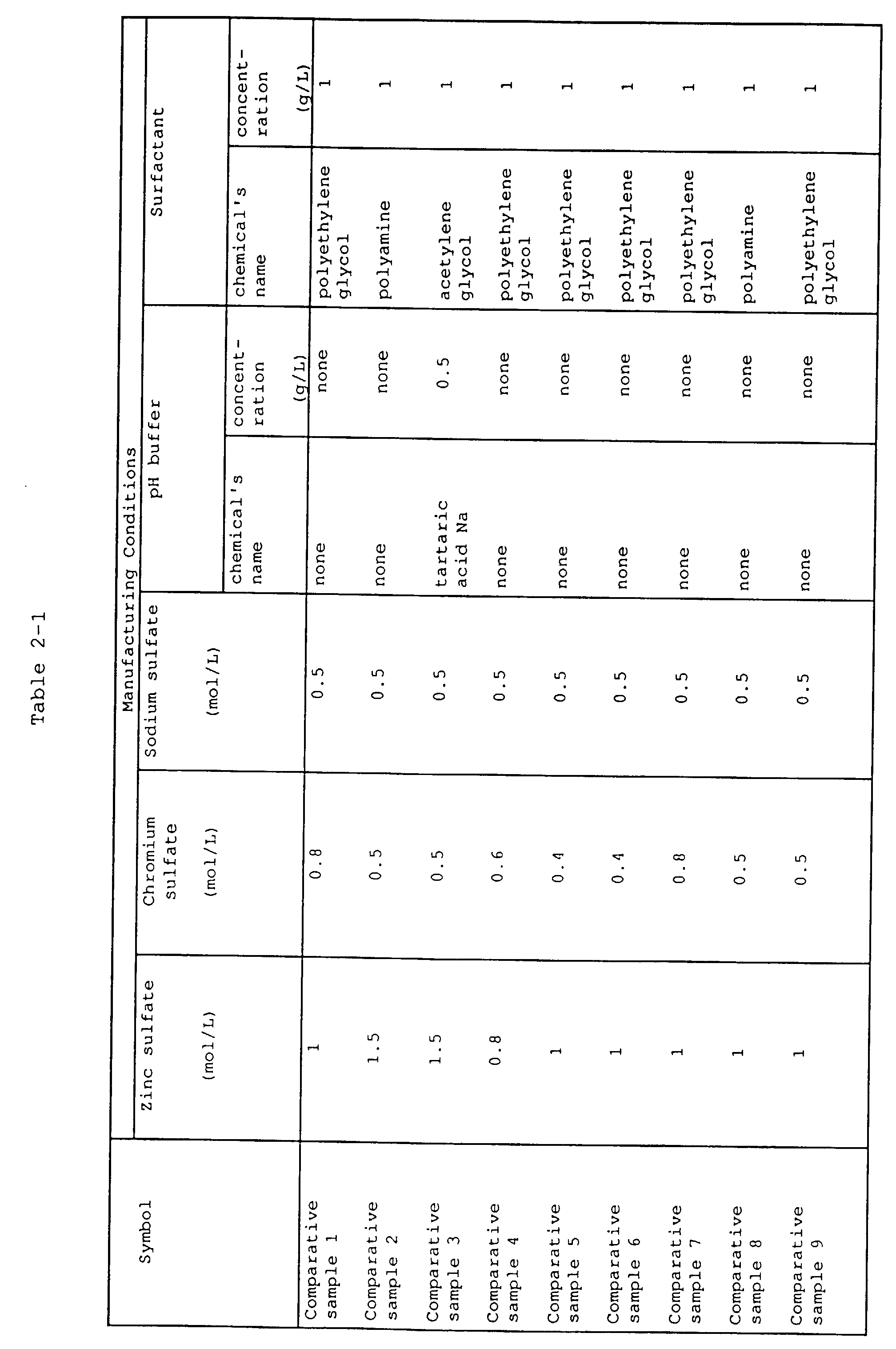
- the manufacturing conditions for obtaining the Zn-Cr alloy plating of the present invention may be exemplified, but in no way limited, by electrodeposition from a sulfate bath which contains zinc sulfate and chromium sulfate as primary agents, sodium sulfate as an electroconductive aid, boric acid or various other organic acids as pH buffers, as well as various surfactants.
- Table 1 lists the manufacturing conditions for inventive samples and comparative samples, the coating weight of the plating, percent Cr content and the phase structure.
- SPCD cold rolled steel sheet
- a sheet thickness of 0.7 mm was used as substrate, which was degreased and pickled in the usual manner, followed by plating to prepare samples.
- Each sample of the invention was substantially solely composed of the ⁇ x phase whereas the comparative samples obviously contained the ⁇ x or ⁇ x phase. It should, however, be noted that those samples which contained up to about 1% of the ⁇ x phase and/or the ⁇ x phase were considered to be substantially solely composed of the ⁇ x phase.
- resistance to cosmetic corrosion of a car body was evaluated.
- the evaluation of resistance to cosmetic corrosion of a car body was conducted by the following procedure: a test specimen of 150 mm x 70 mm was subjected to the chemical conversion treatment with zinc phosphate in the same manner as it was effected on ordinary automotive cold rolled steel sheets; thereafter, three-coat application was performed consisting of cationic electrodeposition coating (to give a film thickness of 20 ⁇ m), intermediate coating (40 ⁇ m) and top coating (40 ⁇ m); the sample was scribed to the substrate with a cutter knife and the sample was exposed to a corrosive environment for one month using a cyclic corrosion tester (for the test cycles, see Fig. 3); subsequently, the blister width of coatings from the scribe was measured.
- Fig. 7 The results of these measurements are shown in Fig. 7.
- the Zn-Cr alloy plated steel sheets that satisfied the conditions of the present invention had resistance to cosmetic corrosion of a car body that was better than that of EG 30 (EG with coating weight of 30 g/m 2 ) and Zn-Ni 30 (Zn-Ni alloy plated steel sheet with coating weight of 30 g/m 2 ) and which was comparable to that of GA 30 (GA with coating weight of 60 g/m 2 ).
- comparative sample 1 which was solely composed of the ⁇ phase was not satisfactory in corrosion resistance since it did not contain Cr.
- Comparative samples 2 and so forth were of such a phase structure that they substantially contained the ⁇ x phase and/or the ⁇ x phase and, hence, their resistance to cosmetic corrosion deteriorated in response to the increase in the percent Cr content.
- the present invention provides an use of an automotive corrosion resistant steel sheet having improved resistance to cosmetic corrosion of a car body.
- alloys that are generally formed by electrodeposition will not always produce a thermodynamically stable phase but a non-equilibrium phase may in some cases be produced. It should further be mentioned that various phases will develop depending on manufacturing conditions such as the formula of a plating bath, conditions for electrolysis. Hence, given the same alloy formula, different phase structures may in some cases occur.
- the present inventors have the opinion that there is correlation between the press formability and the phase structure. Hence, the inventors contemplated that plating layers having improved formability would be produced by specifying the phase structures using effectively the characteristic features of the electrodeposition method.
- the present inventors investigated in detail the phase structures of Zn-Cr alloys that were produced by the electrodeposition method.
- the amount expressed by Cr/(Cr + Zn) in wt% shall be designated as the percent Cr content.
- the present inventors produced Zn-Cr alloy plated steel sheets under various conditions and examined the relationship between their formability and the coating weight of the plating. To their surprise, it became clear that the formability of the Zn-Cr alloy plated steel sheet that was substantially solely composed of the ⁇ x phase was outstandingly superior to that of Zn-Cr alloy plated steel sheets containing the ⁇ x or ⁇ x phase.
- the range of percent Cr content for producing the Zn-Cr alloy plating that is substantially solely composed of the ⁇ x phase defies generalized definition since it varies with the manufacturing process but it is desirably 5 - 30 wt%. This is because below 5 wt%, the ⁇ x phase will not develop whereas above 30 wt%, the adhesion of the plating layer per se will deteriorate, which is detrimental to the effectiveness of the present invention.
- the coating weight of the plating is desirably 10 - 40 g/m 2 , only insufficient corrosion results whereas above 40 g/m 2 , the formability will deteriorate. Desirably, satisfactory corrosion resistance and formability are assured in the range from 20 to 30 g/m 2 .
- the manufacturing conditions for obtaining the Zn-Cr alloy plating of the present invention may be exemplified, but in no way limited, by electrodeposition from a sulfate bath which contains zinc sulfate and chromium sulfate as primary agents, sodium sulfate as an electroconductive aid, boric acid or various other organic acids as pH buffers, as well as various surfactants.
- Table 2 lists the manufacturing conditions for inventive samples and comparative samples, the coating weight of the plating, percent Cr content and the phase structure.
- SPCD cold rolled steel sheet
- a sheet thickness of 0.7 mm was used as substrate, which was degreased and pickled in the usual manner, followed by plating to prepare samples.
- Each of the invention was substantially solely composed of the ⁇ x phase whereas the comparative samples obviously contained the ⁇ x or ⁇ x phase. It should, however, be noted that those samples which contained up to about 1% of the ⁇ x phase and/or the ⁇ x phase were considered to be substantially solely composed of the ⁇ x phase.
- formability was evaluated.
- LDR limiting draw ratio
- Fig. 8 The results of these measurements are shown in Fig. 8. As one can see from Fig. 8, the formability of the comparative samples deteriorated sharply with the increasing coating weight. As already mentioned, in order to insure that Zn-Cr alloy plated steel sheets have comparable corrosion resistance to GA 60 which is domestically used today in the largest quantities, a coating weight of at least about 30 g/m 2 is necessary. However, one can see that with coating weights of 30 g/m 2 or more, the formability of the comparative samples was inferior, rather than superior, to GA 60.
- the phase structure of the plating layer was controlled in such a way that it was substantially solely composed of the ⁇ x phase, less deterioration in formability occurred even with the coating weight at 30 g/m 2 .
- the press formability of existing corrosion resistant steel sheets is the best with the Zn-Ni alloy plated steel sheet, somewhat inferior with EG and that GA with the higher coating weight is even less satisfactory in formability, one may well conclude that the Zn-Cr alloy plated steel sheet of the present invention has reasonably good formability in the region of coating weights that insure good corrosion resistance.
- the present invention provides the use of a corrosion resistant steel sheet that insures satisfactory corrosion resistance and which yet exhibits excellent formability.
- alloys that are generally formed by electrodeposition will not always produce a thermodynamically stable phase but a non-equilibrium phase can in some cases be produced. It should further be mentioned that various phases will develop depending on manufacturing conditions such as the formula of a plating bath, conditions for electrolysis. Hence, given the same alloy formula, different phase structures could in some cases occur.
- the present inventors have the opinion that there is correlation between the resistance to chipping and the phase structure. Hence, the inventors contemplated that plating layers having improved resistance to chipping would be produced by specifying the phase structures using effectively the characteristic features of the electrodeposition method.
- the present inventors investigated in detail the phase structures of Zn-Cr alloys that were produced by the electrodeposition method.
- the amount expressed by Cr/(Cr + Zn) in wt% shall be designated as the percent Cr content.
- the present inventors produced Zn-Cr alloy plated steel sheets under various conditions and examined the relationship between their resistance to chipping and the alloy composition.
- chipping resistance of the Zn-Cr alloy plated steel sheet that was substantially composed of the ⁇ x and ⁇ x phases was outstandingly superior to that of Zn-Cr alloy plated steel sheets containing otherwise combined phases (including the case of single phases).
- the expression composed "substantially of two or more phases” means the case where two or more phases are substantially present in whatever proportions or modes of distribution.
- the range of percent Cr content for producing the Zn-Cr alloy plating that is substantially composed of the ⁇ x and ⁇ x phases defies generalized definition since it varies with the manufacturing process but it is desirably 5 - 30 wt%. This is because below 5 wt%, only insufficient corrosion resistance results whereas above 30 wt%, the adhesion of the plating layer per se will deteriorate, which is detrimental to the effectiveness of the present invention.
- the coating weight of the plating is desirably 10 - 40 g/m 2 because below coating weight of 10 g/m 2 , only insufficient corrosion resistance results whereas above coating weight of 40 g/m 2 , there is no cost merit.
- the manufacturing conditions for obtaining the Zn-Cr alloy plating of the present invention may be exemplified, but in no way limited, by electrodeposition from a sulfate bath which contains zinc sulfate and chromium sulfate as primary agents, sodium sulfate as an electroconductive aid, boric acid or various other organic acids as pH buffers, as well as various surfactants.
- Table 3 lists the manufacturing conditions for inventive samples and comparative samples, the coating weight of the plating, percent Cr content and the phase structure.
- SPCD cold rolled steel sheet
- a sheet thickness of 0.7 mm was used as substrate, which was degreased and pickled in the usual manner, followed by plating to prepare samples.
- Each inventive sample was substantially composed of the ⁇ x and ⁇ x phases whereas the comparative samples comprised combinations of other phases. It should, however, be noted that those samples which contained up to about 1% of the ⁇ x phase were considered to be substantially composed of the ⁇ x and ⁇ x phases.
- resistance to chipping was evaluated.
- a test specimen of 150 mm x 70 mm was subjected to the chemical conversion treatment with zinc phosphate in the same manner as it was effected on ordinary automotive cold rolled steel sheets; thereafter, three-coat application was performed consisting of cationic electrodeposition coating (PTV-80 of Nippon Paint Co., Ltd.), intermediate coating (TP37 of Kansai Paint Co., Ltd.) and top coating (TM13RC of Kansai Paint Co., Ltd.); a gravelometer in compliance with SAE J 400 was used to have road surfacing gravels (specified in JIS A 5001) blown against the test specimen; thereafter, an adhesive tape was applied over the blown surface and quickly pulled off; the state of peeling of the coatings was evaluated by the following criteria.
- Fig. 9 shows that the chipping resistance of the Zn-Cr alloy plated steel sheets that satisfied the conditions of the present invention was improved to levels almost comparable to that of commercial EG 30.
- the present invention provides the use of a corrosion resistant steel sheet having improved resistance to chipping.
- alloys that are generally formed by electrodeposition will not always produce a thermodynomically stable phase but a non-equilibrium phase can in some cases be produced.
- various phases could develop depending on manufacturing conditions such as the formula of a plating bath, conditions for electrolysis. Hence, given the same alloy formula, different phase structures could in some cases occur.
- the present inventors have the opinion that there is correlation between the corrosion resistance in the as-formed state and the phase structure. Hence, the inventors contemplated that plating layers having improved corrosion resistance in the as-formed state would be produced by specifying the phase structures using effectively the characteristic features of the electrodeposition method.
- the present inventors investigated in detail the phase structures of Zn-Cr alloys that were produced by the electrodeposition method.
- the amount expressed by Cr/(Cr + Zn) in wt% shall be designated as the percent Cr content.
- the percent Cr content was increased gradually, namely, by forming a solid solution of Cr in the ⁇ phase, the crystal, which remained in the same system, extended in the direction of a axis but contracted in the direction of c axis; this observation was obtained from the changes in the spacing of lattice planes on the basis of the X-ray diffraction data.
- the present inventors produced Zn-Cr alloy plated steel sheets under various conditions and examined the relationship between their corrosion resistance in the as-formed state and the percent Cr content. It became clear that the corrosion resistance in the as formed state of the Zn-Cr alloy plated steel sheet that was substantially composed of the ⁇ x and ⁇ x phases had good characteristics in that it deteriorated less than before the forming was done.
- the range of percent Cr content for producing the Zn-Cr alloy plating that is substantially composed of the ⁇ x and ⁇ x phases defies generalized definition since it varies with the manufacturing process but it is desirably 5 - 30 wt%. This is because below 5 wt%, the ⁇ x phase will not develop whereas above 30 wt%, the adhesion of the plating layer before coatings are applied will deteriorate, which is detrimental to the effectiveness of the present invention.
- the coating weight of the plating is desirably 10 - 40 g/m 2 because below 10 g/m 2 , only insufficient corrosion resistance results whereas above 40 g/m 2 , there is no cost merit.
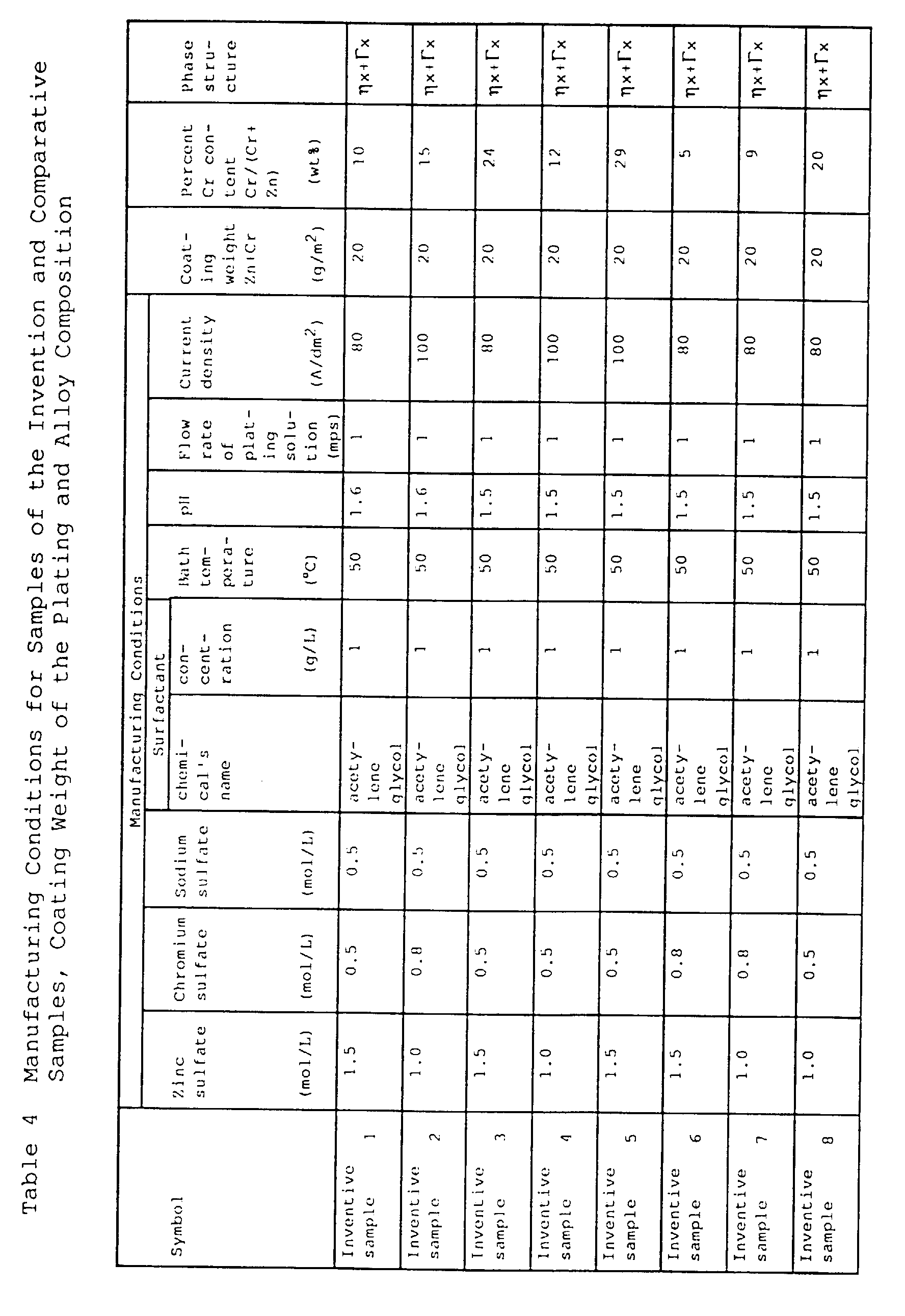
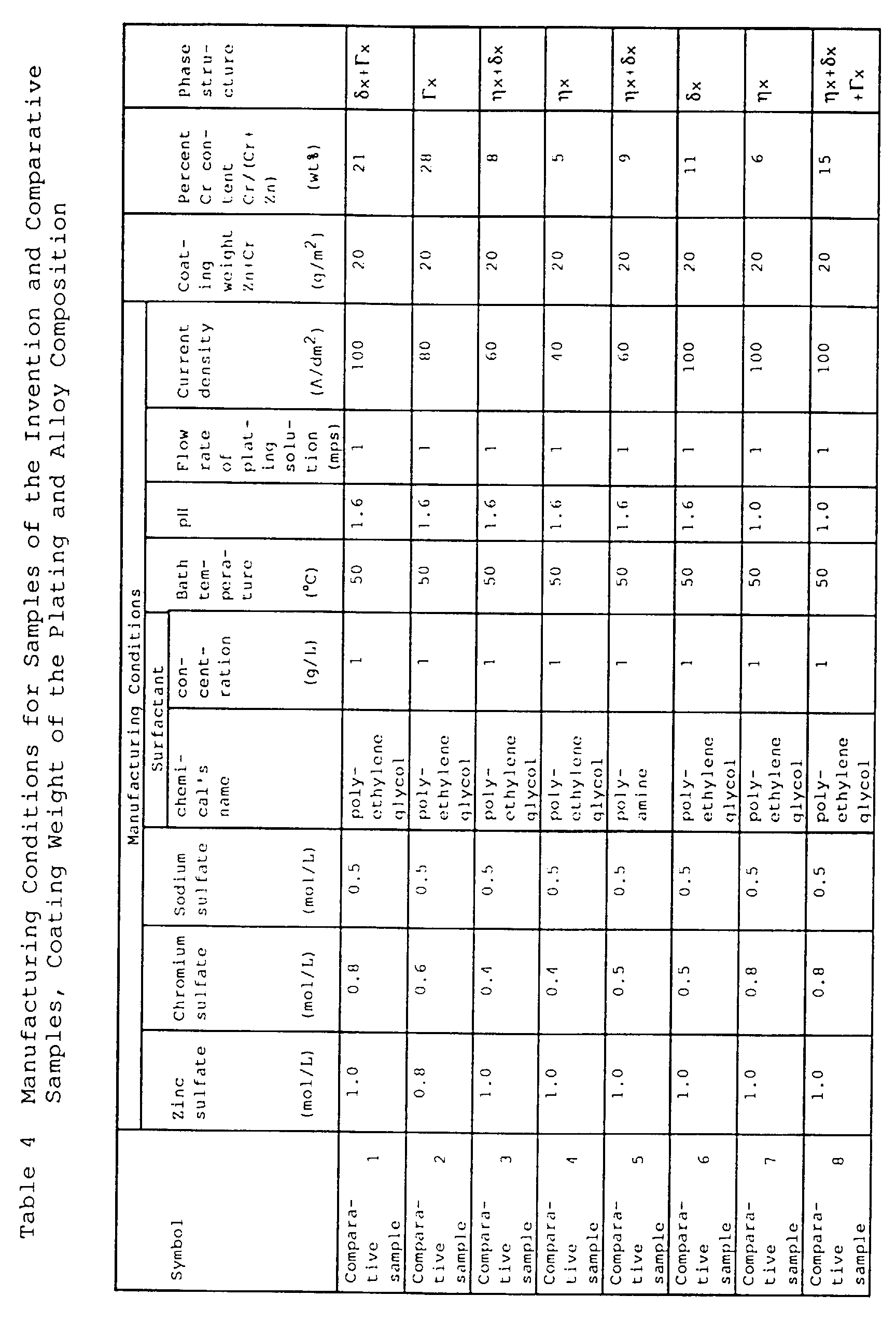
- the manufacturing conditions for obtaining the Zn-Cr alloy plating of the present invention may be exemplified, but in no way limited, by electrodeposition from a sulfate bath which contains zinc sulfate and chromium sulfate as primary agents, sodium sulfate as an electroconductive aid, boric acid or various other organic acids as pH buffers, as well as various surfactants.
- Other conditions such as the pH of the bath, its temperature, the liquid flow rate and the current density for electrolysis are selected as appropriate for producing a desired phase structure. Since all of these conditions are influential on the phase structure, the alloy plating that is substantially composed of ⁇ x and ⁇ x phases alone is obtained only in the case where those conditions are combined in an appropriate way.
- Table 4 lists the manufacturing conditions for inventive samples and comparative samples, the coating weight of the plating, percent Cr content and the phase structure.
- SPCD cold rolled steel sheet
- a sheet thickness of 0.7 mm was used as substrate, which was degreased and pickled in the usual manner, followed by plating to prepare samples.
- Each sample of the invention was substantially composed of the ⁇ x and ⁇ x phases whereas the comparative samples comprised combinations of other phases. It should, however, be noted that those samples which contained up to about 1% of the ⁇ x phase were considered to be substantially composed of the ⁇ x and ⁇ x phases.
- Table 4 lists the corrosion resistance of flat plate in the bare state, as well as their corrosion resistance after forming by hat drawing were evaluated.
- Fig. 10(a) shows the number of test cycles for evaluating the corrosion resistance of conventional Zn base plates in the bare state after forming by hat drawing.
- inventive Zn-Cr alloy plated samples shown in Fig. 10(a) which were substantially composed of the ⁇ x and ⁇ x phases experienced less deterioration, and this demonstrates their superior corrosion resistance in the as-formed state.
- the present invention provides the use of a corrosion resistant steel sheet in automobiles and the like which is improved not only in corrosion resistance before forming but also in corrosion resistance after forming.
- alloys that are generally formed by electrodeposition will not always produce a thermodynomically stable phase but a non-equilibrium phase can in some cases be produced.
- various phases could develop depending on manufacturing conditions such as the formula of a plating bath, conditions for electrolysis. Hence, given the same alloy formula, different phase structures could in some cases occur.
- the present inventors have the opinion that there is correlation between the water resistant secondary adherence of coating and the phase structure. Hence, the inventors contemplated that plating layers having improved water resistant secondary adherence of coating would be produced by specifying the phase structures using effectively the characteristic features of the electrodeposition method.
- the present inventors investigated in detail the phase structures of Zn-Cr alloys that were produced by the electrodeposition method.
- the amount expressed by Cr/(Cr + Zn) in wt% shall be designated as the percent Cr content.
- the percent Cr content was increased gradually, namely, by forming a solid solution of Cr in the ⁇ phase, the crystal, which remained in the same system, extended in the direction of a axis but contracted in the direction of c axis; this observation was obtained from the changes in the spacing of lattice planes on the basis of the X-ray diffraction data.
- the present inventors produced Zn-Cr alloy plated steel sheets under various conditions and examined their water resistant secondary adherence of coating and the percent Cr content. It became clear that the water resistant secondary adherence of coating of the Zn-Cr alloy plated steel sheet that was substantially composed of the ⁇ x and ⁇ x phases was outstandingly superior to that of Zn-Cr alloy plated steel sheets containing otherwise combined phases (including the case of single phases).
- the range of percent Cr content for producing the Zn-Cr alloy plating that is substantially composed of the ⁇ x and ⁇ x phases defies generalized definition since it varies with the manufacturing process but it is desirably 5 - 30 wt%. This is because below 5 wt%, the ⁇ x phase will not develop whereas above 30 wt%, the adhesion of the plating layer before coatings are applied will deteriorate, which is detrimental to the effectiveness of the present invention.
- the coating weight of the plating is desirably 10- 4 0 g/m 2 because below 10 g/m 2 , only insufficient corrosion resistance results whereas above 40 g/m 2 , there is no cost merit.
- the manufacturing conditions for obtaining the Zn-Cr alloy plating of the present invention may be exemplified, but in no way limited, by electrodeposition from a sulfate bath which contains zinc sulfate and chromium sulfate as primary agents, sodium sulfate as an electroconductive aid, boric acid or various other organic acids as pH buffers, as well as various surfactants.
- Other conditions such as the pH of the bath, its temperature, the liquid flow rate and the current density for electrolysis are selected as appropriate for producing a desired phase structure. Since all of these conditions are influential on the phase structure, the alloy plating that is substantially composed of ⁇ x and ⁇ x phases alone is obtained only in the case where those conditions are combined in an appropriate way.
- Table 5 lists the manufacturing conditions for inventive samples and comparative samples, the coating weight of the plating, percent Cr content and the phase structure.
- SPCD cold rolled steel sheet
- a sheet thickness of 0.7 mm was used as substrate, which was degreased and pickled in the usual manner, followed by plating to prepare samples.
- Each sample of the invention was substantially composed of the ⁇ x and ⁇ x phases whereas the comparative samples comprised combinations of other phases. It should, however, be noted that those samples which contained up to about 1% of the ⁇ x phase were considered to be substantially composed of the ⁇ x and ⁇ x phases.
- water resistant secondary adherence of coating was evaluated.
- the present invention provides the use of a corrosion resistant steel sheet in automobiles and the like which is improved not only in corrosion resistance but also in water resistant secondary adherence of coating.
- alloys that are generally formed by electrodeposition will not always produce a thermodynamically stable phase but a non-equilibrium phase can in some cases be produced.
- various phases could develop depending on manufacturing conditions such as the formula of a plating bath, conditions for electrolysis. Hence, given the same alloy formula, different phase structures could in some cases occur.
- the present inventors have the opinion that there is correlation between the perforation corrosion resistance and the phase structure. Hence, the inventors contemplated that plating layers having improved perforation corrosion resistance would be produced by specifying the phase structures using effectively the characteristic features of the electrodeposition method.
- the present inventors investigated in detail the phase structures of Zn-Cr alloys that were produced by the electrodeposition method.
- the amount expressed by Cr/(Cr + Zn) in wt% shall be designated as the percent Cr content.
- the percent Cr content was increased gradually, namely, by forming a solid solution of Cr in the ⁇ phase, the crystal, which remained in the same system, extended in the direction of a axis but contracted in the direction of c axis; this observation was obtained from the changes in the spacing of lattice planes on the basis of the X-ray diffraction data.
- the present inventors produced Zn-Cr alloy plated steel sheets under various conditions and examined the relationship between their perforation corrosion resistance and the percent Cr content. It became clear that the perforation corrosion resistance of the Zn-Cr alloy plated steel sheet that was substantially composed of the ⁇ x, ⁇ x and ⁇ x phases was outstandingly superior to that Zn-Cr alloy plated steel sheets composed of single phases or the combinations of two phases.
- the range of percent Cr content for producing the Zn-Cr alloy plating that is substantially composed of the ⁇ x, ⁇ x and ⁇ x phases defies generalized definition since it varies with the manufacturing process but it is desirably 5 - 30 wt%. This is because below 5 wt% , the ⁇ x or ⁇ x phase will not develop whereas above 30 wt%, the adhesion of the plating layer before coatings are applied will deteriorate, which is detrimental to the effectiveness of the present invention.
- the coating weight of the plating is desirably 10 - 40 g/m 2 because below 10 g/m 2 , only insufficient corrosion resistance results whereas above 40 g/m 2 , there is no cost merit.
- the manufacturing conditions for obtaining the Zn-Cr alloy plating of the present invention may be exemplified, but in no way limited, by electrodeposition from a sulfate bath which contains zinc sulfate and chromium sulfate as primary agents, sodium sulfate as an electroconductive aid, boric acid or various other organic acids as pH buffers, as well as various surfactants.
- Other conditions such as the pH of the bath, its temperature, the liquid flow rate and the current density for electrolysis are selected as appropriate for producing a desired phase structure. Since all of these conditions are influential on the phase structure, the alloy plating that is substantially composed of ⁇ x, ⁇ x and ⁇ x phases alone is obtained only in the case where those conditions are combined in an appropriate way.
- Table 6 lists the manufacturing conditions for inventive samples and comparative samples, the coating weight of the plating, percent Cr content and the phase structure.
- SPCD cold rolled steel sheet
- a sheet thickness of 0.7 mm was used as substrate, which was degreased and pickled in the usual manner, followed by plating to prepare samples.
- Each sample of the invention was substantially composed of the ⁇ x, ⁇ x and ⁇ x phases whereas the comparative samples comprised single phases or combinations of two phases. Using the samples listed in Table 6, perforation corrosion resistance was evaluated.
- perforation corrosion resistance was conducted by the following procedure: a test specimen of 150 mm x 70 mm was subjected to the chemical conversion treatment with zinc phosphate in the same manner as it was effected on ordinary automotive cold rolled steel sheets; thereafter, cationic electrodeposition coating (POWER TOP U-100 of Nippon Paint Co., Ltd.; 20 ⁇ m) was applied and the sample was scribed to the substrate with a cutter knife; the specimen was then exposed for one month to a corrosive environment (for the test cycles used, see Fig. 3) using cyclic corrosion test; thereafter, the maximum sheet thickness loss around the scribe was measured.
- a test specimen of 150 mm x 70 mm was subjected to the chemical conversion treatment with zinc phosphate in the same manner as it was effected on ordinary automotive cold rolled steel sheets; thereafter, cationic electrodeposition coating (POWER TOP U-100 of Nippon Paint Co., Ltd.; 20 ⁇ m) was applied and the sample was scribed to the substrate with a cutter knife; the specimen was then
- the present invention provides a corrosion resistant steel sheet for use on automobiles and the like that has improved perforation corrosion resistance.
Landscapes
- Chemical & Material Sciences (AREA)
- Engineering & Computer Science (AREA)
- Chemical Kinetics & Catalysis (AREA)
- Electrochemistry (AREA)
- Materials Engineering (AREA)
- Metallurgy (AREA)
- Organic Chemistry (AREA)
- Electroplating Methods And Accessories (AREA)
- Heat Treatment Of Steel (AREA)
- Coating With Molten Metal (AREA)
- Chemical Treatment Of Metals (AREA)
Abstract
Description
| Aspect | Claim | Zn-Cr alloy Phase | Characteristics |
| First | 1 | ηx | Resistance to |
| Second | |||
| 2 | | Formability | |
| Third | |||
| 3 | ηx + δx | | |
| Fourth | |||
| 4 | ηx + Γx | Corrosion resistance in the as-formed | |
| Fifth | |||
| 5 | δx + Γx | Water resistant secondary adherence of | |
| Sixth | |||
| 6 | ηx + δx + Γx | Perforation corrosion resistance |




- o ○
- no peeling (4)
- O
- slight peeling (3)
- Δ
- moderate peeling (2)
- ×
- extensive peeling (1)



Claims (6)
- Use of a corrosion resistant steel sheet having high resistance to corrosion and cosmetic corrosion that is treated with a Zn-Cr alloy plating which is an alloy consisting of Zn and Cr as formed by electrodeposition and which is substantially solely composed of a phase having a ηx phase, wherein the crystal system is hexagonal and the lattice constants are a = 2.66-2.74 Å and c = 4.61 - 4.95 Å for producing automotive parts with high resistance against rusting on the exterior surface and resistance to cosmetic corrosion.
- Use of a corrosion resistant steel sheet having high corrosion resistance and formability that is treated with a Zn-Cr alloy plating which is an alloy consisting of Zn and Cr as formed by electrodeposition and which is substantially solely composed of a phase having a Γx phase, wherein the crystal system is cubic and a lattice constant is a = 3.00 - 3.06 Å for producing automotive with improved formability.
- Use of a corrosion resistant steel sheet having high resistance to corrosion and chipping that is treated with a Zn-Cr alloy plating which is an alloy consisting of Zn and Cr as formed by electrodeposition and which is substantially composed of a phase having a ηx phase, wherein the crystal system is hexagonal and lattice constants are a = 2.66 - 2.74 Å and c = 4.61 - 4.95 Å, as well as a phase having a δx phase, wherein the crystal system is hexagonal and lattice constants are a = 2.72-2.78 Å and c = 4.43 - 4.60 Å for producing automotive parts with high resistance against chipping.
- Use of a corrosion resistant steel sheet having high corrosion resistance both before and after forming that is treated with a Zn-Cr alloy plating which is an alloy consisting of Zn and Cr as formed by electrodeposition and which is substantially composed of a phase having a δx phase wherein the crystal system is hexagonal and lattice constants are a = 2.66 - 2.74 Å and c = 4.61-4.95 Å, as well as a phase having a Γx phase, wherein the crystal system is cubic and a lattice constant is a = 3-00 - 3.06 Å for producing automotive parts with high resistance against corrosion in the as-formed state.
- Use of a corrosion resistant steel sheet having high corrosion resistance and water resistant secondary adherence of coating that is treated with a Zn-Cr alloy plating which is an alloy consisting of Zn and Cr as formed by electrodeposition and which is substantially composed of a phase having a δx phase, wherein the crystal system is hexagonal and lattice constants are a = 2.72 - 2.78 Å and c = 4.43 - 4.60 Å, as well as a phase having a Γx phase wherein the crystal system is cubic and that a lattice constant is a = 3.00 - 3.06 Å for producing automotive parts with strong water resistant secondary adherence.
- Use of a corrosion resistant steel sheet having high resistances to corrosion and perforation corrosion that is treated with a Zn-Cr alloy plating which is an alloy consisting of Zn and Cr as formed by electrodeposition and which is substantially composed of a phase having a ηx phase wherein the crystal system is hexagonal and that lattice constants are a = 2.66 - 2.74 Å and c = 4.61 - 4.95 Å, and a phase having a δx phase, wherein the crystal system is hexagonal and lattice constants are a = 2.72 - 2.78 Å and c = 4.43 - 4.60 Å, as well as a phase having a Γx phase wherein the crystal system is cubic and a lattice constant is a = 3.00 - 3.06 Å for producing automotive parts with high resistance against perforation.
Applications Claiming Priority (13)
| Application Number | Priority Date | Filing Date | Title |
|---|---|---|---|
| JP18413392A JPH0625887A (en) | 1992-07-10 | 1992-07-10 | Anti-corrosion steel plate with excellent corrosion resistance and formability |
| JP18413492A JPH0625889A (en) | 1992-07-10 | 1992-07-10 | Rust preventive steel sheet excellent in external rust resistance as well as in corrosion resistance |
| JP184134/92 | 1992-07-10 | ||
| JP184133/92 | 1992-07-10 | ||
| JP300913/92 | 1992-11-11 | ||
| JP300915/92 | 1992-11-11 | ||
| JP30091392A JPH06146061A (en) | 1992-11-11 | 1992-11-11 | Corrosion preventive steel plate having excellent corrosion resistance after working |
| JP30091492A JPH06146062A (en) | 1992-11-11 | 1992-11-11 | Corrosion preventive steel plate having excellent corrosion resistance and hot water secondary adhesion |
| JP30091592A JPH06146063A (en) | 1992-11-11 | 1992-11-11 | Corrosion preventive steel plate having excellent pitting resistance |
| JP300914/92 | 1992-11-11 | ||
| JP2105093A JPH06235084A (en) | 1993-02-09 | 1993-02-09 | Anti-rust steel plate with excellent chipping resistance |
| JP21050/93 | 1993-02-09 | ||
| PCT/JP1993/000956 WO1994001602A1 (en) | 1992-07-10 | 1993-07-09 | Rustproof steel sheet excellent in various characteristics including corrosion resistance |
Publications (3)
| Publication Number | Publication Date |
|---|---|
| EP0607452A1 EP0607452A1 (en) | 1994-07-27 |
| EP0607452A4 EP0607452A4 (en) | 1995-01-11 |
| EP0607452B1 true EP0607452B1 (en) | 1998-09-16 |
Family
ID=27548952
Family Applications (1)
| Application Number | Title | Priority Date | Filing Date |
|---|---|---|---|
| EP93914985A Expired - Lifetime EP0607452B1 (en) | 1992-07-10 | 1993-07-09 | Uses of a rustproof steel sheet excellent in various characteristics including corrosion resistance |
Country Status (7)
| Country | Link |
|---|---|
| US (1) | US5510196A (en) |
| EP (1) | EP0607452B1 (en) |
| AU (1) | AU671843B2 (en) |
| CA (1) | CA2118714A1 (en) |
| DE (1) | DE69321097D1 (en) |
| ES (1) | ES2125338T3 (en) |
| WO (1) | WO1994001602A1 (en) |
Cited By (2)
| Publication number | Priority date | Publication date | Assignee | Title |
|---|---|---|---|---|
| DE102009045076A1 (en) * | 2009-09-28 | 2011-04-07 | Voestalpine Stahl Gmbh | Anti-corrosion layer for the production of a steel component, comprises predominantly zinc for steel materials, and a crystalline structure that is permeable to hydrogen, where the anti-corrosion layer is applied by hot-dip-galvanization |
| DE102009045074A1 (en) * | 2009-09-28 | 2011-04-07 | Voestalpine Stahl Gmbh | Anti-corrosion layer for the production of a steel component, comprises predominantly zinc for steel materials, and a crystalline structure that is permeable to hydrogen, where the anti-corrosion layer is applied by hot-dip-galvanization |
Families Citing this family (5)
| Publication number | Priority date | Publication date | Assignee | Title |
|---|---|---|---|---|
| RU2151827C1 (en) * | 1998-02-03 | 2000-06-27 | Волгоградская государственная архитектурно-строительная академия | Electrolyte for deposition of corrosion-resistant coats with chromium-zinc alloy |
| FR2800098B1 (en) * | 1999-10-26 | 2002-03-01 | Lorraine Laminage | STEEL SHEET HAVING A COATING COMPRISING A MAIN LAYER OF ZINC-CHRONE ALLOY, THE PREVIOUS PHASE OF WHICH HAS A DELTA AND / OR DZETA STRUCTURE |
| DE102006035660B4 (en) * | 2006-07-31 | 2009-08-20 | Voestalpine Stahl Gmbh | Corrosion protection layer with improved properties and process for its preparation |
| WO2011036306A2 (en) * | 2009-09-28 | 2011-03-31 | Voestalpine Stahl Gmbh | Corrosion protection based on a zinc-alloy |
| FR3127956B1 (en) * | 2021-10-07 | 2024-05-31 | Vallourec Oil & Gas France | Threaded end of a tubular component provided with a coating comprising a zinc-chromium alloy |
Family Cites Families (9)
| Publication number | Priority date | Publication date | Assignee | Title |
|---|---|---|---|---|
| JPS5617438B2 (en) * | 1972-02-12 | 1981-04-22 | ||
| JPH0635673B2 (en) * | 1987-08-26 | 1994-05-11 | 新日本製鐵株式会社 | Method for producing zinc-chromium electroplated steel sheet excellent in surface quality and corrosion resistance |
| EP0285931B1 (en) * | 1987-03-31 | 1993-08-04 | Nippon Steel Corporation | Corrosion resistant plated steel strip and method for producing same |
| JPH0699836B2 (en) * | 1988-01-26 | 1994-12-07 | 新日本製鐵株式会社 | Zinc-chromium alloy electroplated steel sheet |
| US5188905A (en) * | 1988-05-17 | 1993-02-23 | Nippon Steel Corporation | Coated steel sheets |
| JPH0331495A (en) * | 1989-06-27 | 1991-02-12 | Kobe Steel Ltd | Surface-treated metallic material having highly corrosion resistance |
| JPH0832341B2 (en) * | 1989-08-31 | 1996-03-29 | 株式会社小松製作所 | Control device for press brake |
| JPH03120393A (en) * | 1989-10-02 | 1991-05-22 | Kobe Steel Ltd | Production of zn-cr electroplated steel sheet |
| JPH059779A (en) * | 1991-03-14 | 1993-01-19 | Sumitomo Metal Ind Ltd | Method for producing zinc-chromium alloy electroplated steel sheet |
-
1993
- 1993-07-09 ES ES93914985T patent/ES2125338T3/en not_active Expired - Lifetime
- 1993-07-09 AU AU45143/93A patent/AU671843B2/en not_active Ceased
- 1993-07-09 DE DE69321097T patent/DE69321097D1/en not_active Expired - Lifetime
- 1993-07-09 EP EP93914985A patent/EP0607452B1/en not_active Expired - Lifetime
- 1993-07-09 CA CA002118714A patent/CA2118714A1/en not_active Abandoned
- 1993-07-09 US US08/204,298 patent/US5510196A/en not_active Expired - Fee Related
- 1993-07-09 WO PCT/JP1993/000956 patent/WO1994001602A1/en not_active Ceased
Cited By (3)
| Publication number | Priority date | Publication date | Assignee | Title |
|---|---|---|---|---|
| DE102009045076A1 (en) * | 2009-09-28 | 2011-04-07 | Voestalpine Stahl Gmbh | Anti-corrosion layer for the production of a steel component, comprises predominantly zinc for steel materials, and a crystalline structure that is permeable to hydrogen, where the anti-corrosion layer is applied by hot-dip-galvanization |
| DE102009045074A1 (en) * | 2009-09-28 | 2011-04-07 | Voestalpine Stahl Gmbh | Anti-corrosion layer for the production of a steel component, comprises predominantly zinc for steel materials, and a crystalline structure that is permeable to hydrogen, where the anti-corrosion layer is applied by hot-dip-galvanization |
| DE102009045076A9 (en) * | 2009-09-28 | 2011-07-21 | Voestalpine Stahl Gmbh | Corrosion protection based on zinc alloy |
Also Published As
| Publication number | Publication date |
|---|---|
| WO1994001602A1 (en) | 1994-01-20 |
| AU4514393A (en) | 1994-01-31 |
| EP0607452A4 (en) | 1995-01-11 |
| EP0607452A1 (en) | 1994-07-27 |
| AU671843B2 (en) | 1996-09-12 |
| US5510196A (en) | 1996-04-23 |
| ES2125338T3 (en) | 1999-03-01 |
| DE69321097D1 (en) | 1998-10-22 |
| CA2118714A1 (en) | 1994-01-20 |
Similar Documents
| Publication | Publication Date | Title |
|---|---|---|
| EP0182964A1 (en) | High corrosion resistance composite plated steel strip and method for making | |
| DE3901659C1 (en) | ||
| US5510196A (en) | Corrosion resistant steel sheets improved in corrosion resistance and other characteristics | |
| EP0245828B1 (en) | Surface treated steel material particularly electroplated steel sheet | |
| JP3895900B2 (en) | High corrosion resistance composite electroplated steel sheet and method for producing the same | |
| JPS6343479B2 (en) | ||
| US5273643A (en) | Method of producing zinc-chromium alloy plated steel sheet with excellent plating adhesiveness | |
| US4490438A (en) | Steel sheet with multilayer electroplating and method of producing same | |
| JP2707478B2 (en) | High corrosion resistant multi-layer electroplated steel sheet | |
| Johnson et al. | Corrosion Resistance and Paintability of Zinc and Zinc-Alloy Coatings for Automotive Sheet | |
| JP2712924B2 (en) | Zinc-nickel-chromium alloy electroplated steel sheet with excellent corrosion resistance, plating adhesion, chemical conversion treatment and coating film adhesion | |
| KR920010776B1 (en) | High corrosion resistant steel sheets with two layer being of alloy metal and process for making | |
| JP2707477B2 (en) | High corrosion resistant multi-layer electroplated steel sheet | |
| JP3357467B2 (en) | Hot-dip galvanized steel excellent in corrosion resistance and wear resistance and method for producing the same | |
| JPS6240398A (en) | Double-plated steel sheet having high corrosion resistance | |
| JPS61194195A (en) | Highly-corrosion resistant two-layer plated steel plate | |
| JP2636589B2 (en) | Zinc-nickel-chromium alloy electroplated steel sheet with excellent corrosion resistance, plating adhesion and chemical conversion treatment | |
| JPH02228461A (en) | Alloying-treated hot-dip coated steel sheet and its production | |
| JPH06146063A (en) | Corrosion preventive steel plate having excellent pitting resistance | |
| JPH0625887A (en) | Anti-corrosion steel plate with excellent corrosion resistance and formability | |
| JP3149761B2 (en) | Manufacturing method of galvanized steel sheet with excellent white rust resistance | |
| KR920010777B1 (en) | Double layer alloy plated steel sheet and manufacturing method | |
| JPS63176490A (en) | Surface treated steel sheet having superior corrosion resistance and suitability to phosphating | |
| JPH06235084A (en) | Anti-rust steel plate with excellent chipping resistance | |
| JPH02153058A (en) | Alloying hot dip galvanized steel sheet |
Legal Events
| Date | Code | Title | Description |
|---|---|---|---|
| PUAI | Public reference made under article 153(3) epc to a published international application that has entered the european phase |
Free format text: ORIGINAL CODE: 0009012 |
|
| AK | Designated contracting states |
Kind code of ref document: A1 Designated state(s): BE DE ES FR GB IT NL |
|
| A4 | Supplementary search report drawn up and despatched | ||
| AK | Designated contracting states |
Kind code of ref document: A4 Designated state(s): BE DE ES FR GB IT NL |
|
| 17P | Request for examination filed |
Effective date: 19940520 |
|
| 17Q | First examination report despatched |
Effective date: 19951218 |
|
| GRAG | Despatch of communication of intention to grant |
Free format text: ORIGINAL CODE: EPIDOS AGRA |
|
| GRAG | Despatch of communication of intention to grant |
Free format text: ORIGINAL CODE: EPIDOS AGRA |
|
| GRAG | Despatch of communication of intention to grant |
Free format text: ORIGINAL CODE: EPIDOS AGRA |
|
| GRAH | Despatch of communication of intention to grant a patent |
Free format text: ORIGINAL CODE: EPIDOS IGRA |
|
| GRAH | Despatch of communication of intention to grant a patent |
Free format text: ORIGINAL CODE: EPIDOS IGRA |
|
| GRAA | (expected) grant |
Free format text: ORIGINAL CODE: 0009210 |
|
| AK | Designated contracting states |
Kind code of ref document: B1 Designated state(s): BE DE ES FR GB IT NL |
|
| PG25 | Lapsed in a contracting state [announced via postgrant information from national office to epo] |
Ref country code: NL Free format text: LAPSE BECAUSE OF FAILURE TO SUBMIT A TRANSLATION OF THE DESCRIPTION OR TO PAY THE FEE WITHIN THE PRESCRIBED TIME-LIMIT Effective date: 19980916 Ref country code: IT Free format text: LAPSE BECAUSE OF FAILURE TO SUBMIT A TRANSLATION OF THE DESCRIPTION OR TO PAY THE FEE WITHIN THE PRE;WARNING: LAPSES OF ITALIAN PATENTS WITH EFFECTIVE DATE BEFORE 2007 MAY HAVE OCCURRED AT ANY TIME BEFORE 2007. THE CORRECT EFFECTIVE DATE MAY BE DIFFERENT FROM THE ONE RECORDED.SCRIBED TIME-LIMIT Effective date: 19980916 Ref country code: BE Free format text: LAPSE BECAUSE OF FAILURE TO SUBMIT A TRANSLATION OF THE DESCRIPTION OR TO PAY THE FEE WITHIN THE PRESCRIBED TIME-LIMIT Effective date: 19980916 |
|
| REF | Corresponds to: |
Ref document number: 69321097 Country of ref document: DE Date of ref document: 19981022 |
|
| PG25 | Lapsed in a contracting state [announced via postgrant information from national office to epo] |
Ref country code: DE Free format text: LAPSE BECAUSE OF FAILURE TO SUBMIT A TRANSLATION OF THE DESCRIPTION OR TO PAY THE FEE WITHIN THE PRESCRIBED TIME-LIMIT Effective date: 19981217 |
|
| ET | Fr: translation filed | ||
| NLV1 | Nl: lapsed or annulled due to failure to fulfill the requirements of art. 29p and 29m of the patents act | ||
| REG | Reference to a national code |
Ref country code: ES Ref legal event code: FG2A Ref document number: 2125338 Country of ref document: ES Kind code of ref document: T3 |
|
| K2C3 | Correction of patent specification (complete document) published |
Effective date: 19980916 |
|
| PLBE | No opposition filed within time limit |
Free format text: ORIGINAL CODE: 0009261 |
|
| STAA | Information on the status of an ep patent application or granted ep patent |
Free format text: STATUS: NO OPPOSITION FILED WITHIN TIME LIMIT |
|
| 26N | No opposition filed | ||
| REG | Reference to a national code |
Ref country code: GB Ref legal event code: IF02 |
|
| PGFP | Annual fee paid to national office [announced via postgrant information from national office to epo] |
Ref country code: GB Payment date: 20040707 Year of fee payment: 12 |
|
| PGFP | Annual fee paid to national office [announced via postgrant information from national office to epo] |
Ref country code: FR Payment date: 20040708 Year of fee payment: 12 |
|
| PGFP | Annual fee paid to national office [announced via postgrant information from national office to epo] |
Ref country code: ES Payment date: 20040719 Year of fee payment: 12 |
|
| PG25 | Lapsed in a contracting state [announced via postgrant information from national office to epo] |
Ref country code: GB Free format text: LAPSE BECAUSE OF NON-PAYMENT OF DUE FEES Effective date: 20050709 |
|
| PG25 | Lapsed in a contracting state [announced via postgrant information from national office to epo] |
Ref country code: ES Free format text: LAPSE BECAUSE OF NON-PAYMENT OF DUE FEES Effective date: 20050711 |
|
| GBPC | Gb: european patent ceased through non-payment of renewal fee |
Effective date: 20050709 |
|
| PG25 | Lapsed in a contracting state [announced via postgrant information from national office to epo] |
Ref country code: FR Free format text: LAPSE BECAUSE OF NON-PAYMENT OF DUE FEES Effective date: 20060331 |
|
| REG | Reference to a national code |
Ref country code: FR Ref legal event code: ST Effective date: 20060331 |
|
| REG | Reference to a national code |
Ref country code: ES Ref legal event code: FD2A Effective date: 20050711 |