EP0604676B1 - Water-soluble copolymers of vinylacetate and maleamic acids. Use as fluidizers or high-range water-reducers for aqueous suspensions - Google Patents
Water-soluble copolymers of vinylacetate and maleamic acids. Use as fluidizers or high-range water-reducers for aqueous suspensions Download PDFInfo
- Publication number
- EP0604676B1 EP0604676B1 EP92122027A EP92122027A EP0604676B1 EP 0604676 B1 EP0604676 B1 EP 0604676B1 EP 92122027 A EP92122027 A EP 92122027A EP 92122027 A EP92122027 A EP 92122027A EP 0604676 B1 EP0604676 B1 EP 0604676B1
- Authority
- EP
- European Patent Office
- Prior art keywords
- cement
- water
- concrete
- solution
- aqueous suspension
- Prior art date
- Legal status (The legal status is an assumption and is not a legal conclusion. Google has not performed a legal analysis and makes no representation as to the accuracy of the status listed.)
- Expired - Lifetime
Links
- 229920001577 copolymer Polymers 0.000 title claims abstract description 30
- XTXRWKRVRITETP-UHFFFAOYSA-N Vinyl acetate Chemical compound CC(=O)OC=C XTXRWKRVRITETP-UHFFFAOYSA-N 0.000 title claims abstract description 28
- 239000007900 aqueous suspension Substances 0.000 title claims description 11
- 229940117958 vinyl acetate Drugs 0.000 title abstract description 27
- 239000003638 chemical reducing agent Substances 0.000 title description 19
- 239000002253 acid Substances 0.000 title description 5
- 150000007513 acids Chemical class 0.000 title description 4
- 239000007787 solid Substances 0.000 claims abstract description 21
- -1 aromatic sulfonic acids Chemical class 0.000 claims abstract description 20
- 125000003277 amino group Chemical group 0.000 claims abstract description 3
- 229920005684 linear copolymer Polymers 0.000 claims abstract 2
- 239000000243 solution Substances 0.000 claims description 46
- 239000004568 cement Substances 0.000 claims description 30
- 239000002270 dispersing agent Substances 0.000 claims description 16
- WSFSSNUMVMOOMR-UHFFFAOYSA-N formaldehyde Substances O=C WSFSSNUMVMOOMR-UHFFFAOYSA-N 0.000 claims description 12
- 239000000654 additive Substances 0.000 claims description 10
- 239000007864 aqueous solution Substances 0.000 claims description 7
- YNAVUWVOSKDBBP-UHFFFAOYSA-N Morpholine Chemical group C1COCCN1 YNAVUWVOSKDBBP-UHFFFAOYSA-N 0.000 claims description 6
- 239000011398 Portland cement Substances 0.000 claims description 6
- VYPSYNLAJGMNEJ-UHFFFAOYSA-N Silicium dioxide Chemical compound O=[Si]=O VYPSYNLAJGMNEJ-UHFFFAOYSA-N 0.000 claims description 6
- OSGAYBCDTDRGGQ-UHFFFAOYSA-L calcium sulfate Chemical compound [Ca+2].[O-]S([O-])(=O)=O OSGAYBCDTDRGGQ-UHFFFAOYSA-L 0.000 claims description 6
- 239000004576 sand Substances 0.000 claims description 6
- 229910052783 alkali metal Inorganic materials 0.000 claims description 5
- 125000004435 hydrogen atom Chemical class [H]* 0.000 claims description 5
- 239000000843 powder Substances 0.000 claims description 5
- 229910052784 alkaline earth metal Inorganic materials 0.000 claims description 4
- 239000011230 binding agent Substances 0.000 claims description 4
- 239000010881 fly ash Substances 0.000 claims description 4
- 239000004575 stone Substances 0.000 claims description 4
- 229910021645 metal ion Inorganic materials 0.000 claims description 3
- GAWIXWVDTYZWAW-UHFFFAOYSA-N C[CH]O Chemical group C[CH]O GAWIXWVDTYZWAW-UHFFFAOYSA-N 0.000 claims description 2
- 229920001732 Lignosulfonate Polymers 0.000 claims description 2
- PNEYBMLMFCGWSK-UHFFFAOYSA-N aluminium oxide Inorganic materials [O-2].[O-2].[O-2].[Al+3].[Al+3] PNEYBMLMFCGWSK-UHFFFAOYSA-N 0.000 claims description 2
- QGZKDVFQNNGYKY-UHFFFAOYSA-O ammonium group Chemical group [NH4+] QGZKDVFQNNGYKY-UHFFFAOYSA-O 0.000 claims description 2
- 229940095564 anhydrous calcium sulfate Drugs 0.000 claims description 2
- 125000003118 aryl group Chemical group 0.000 claims description 2
- 239000011400 blast furnace cement Substances 0.000 claims description 2
- ZOMBKNNSYQHRCA-UHFFFAOYSA-J calcium sulfate hemihydrate Chemical compound O.[Ca+2].[Ca+2].[O-]S([O-])(=O)=O.[O-]S([O-])(=O)=O ZOMBKNNSYQHRCA-UHFFFAOYSA-J 0.000 claims description 2
- 239000006229 carbon black Substances 0.000 claims description 2
- 239000011521 glass Substances 0.000 claims description 2
- 229910052739 hydrogen Inorganic materials 0.000 claims description 2
- 239000001257 hydrogen Substances 0.000 claims description 2
- 239000012784 inorganic fiber Substances 0.000 claims description 2
- 229910052757 nitrogen Inorganic materials 0.000 claims description 2
- 125000004433 nitrogen atom Chemical group N* 0.000 claims description 2
- 150000003009 phosphonic acids Chemical class 0.000 claims description 2
- 239000000049 pigment Substances 0.000 claims description 2
- 229910021487 silica fume Inorganic materials 0.000 claims description 2
- 150000004760 silicates Chemical class 0.000 claims description 2
- 125000001273 sulfonato group Chemical group [O-]S(*)(=O)=O 0.000 claims description 2
- 125000000542 sulfonic acid group Chemical group 0.000 claims description 2
- 239000010455 vermiculite Substances 0.000 claims description 2
- 229910052902 vermiculite Inorganic materials 0.000 claims description 2
- 235000019354 vermiculite Nutrition 0.000 claims description 2
- 150000001732 carboxylic acid derivatives Chemical class 0.000 claims 1
- 239000000835 fiber Substances 0.000 claims 1
- 125000004356 hydroxy functional group Chemical group O* 0.000 claims 1
- BDHFUVZGWQCTTF-UHFFFAOYSA-M sulfonate Chemical compound [O-]S(=O)=O BDHFUVZGWQCTTF-UHFFFAOYSA-M 0.000 claims 1
- XLYOFNOQVPJJNP-UHFFFAOYSA-N water Substances O XLYOFNOQVPJJNP-UHFFFAOYSA-N 0.000 abstract description 48
- FPYJFEHAWHCUMM-UHFFFAOYSA-N maleic anhydride Chemical compound O=C1OC(=O)C=C1 FPYJFEHAWHCUMM-UHFFFAOYSA-N 0.000 abstract description 10
- 239000000725 suspension Substances 0.000 abstract description 4
- 150000001412 amines Chemical class 0.000 abstract description 2
- 150000001414 amino alcohols Chemical class 0.000 abstract description 2
- 150000001413 amino acids Chemical class 0.000 abstract 1
- HEMHJVSKTPXQMS-UHFFFAOYSA-M Sodium hydroxide Chemical compound [OH-].[Na+] HEMHJVSKTPXQMS-UHFFFAOYSA-M 0.000 description 54
- 239000004567 concrete Substances 0.000 description 46
- 229920000642 polymer Polymers 0.000 description 28
- 229940083608 sodium hydroxide Drugs 0.000 description 18
- 235000011121 sodium hydroxide Nutrition 0.000 description 18
- 238000012360 testing method Methods 0.000 description 18
- 239000000203 mixture Substances 0.000 description 15
- 238000003756 stirring Methods 0.000 description 12
- 230000000694 effects Effects 0.000 description 11
- 239000010440 gypsum Substances 0.000 description 10
- 229910052602 gypsum Inorganic materials 0.000 description 10
- 239000000178 monomer Substances 0.000 description 10
- XWGJFPHUCFXLBL-UHFFFAOYSA-M rongalite Chemical compound [Na+].OCS([O-])=O XWGJFPHUCFXLBL-UHFFFAOYSA-M 0.000 description 9
- 159000000000 sodium salts Chemical class 0.000 description 9
- MHAJPDPJQMAIIY-UHFFFAOYSA-N Hydrogen peroxide Chemical compound OO MHAJPDPJQMAIIY-UHFFFAOYSA-N 0.000 description 8
- 238000001816 cooling Methods 0.000 description 8
- 238000002156 mixing Methods 0.000 description 8
- OFOBLEOULBTSOW-UHFFFAOYSA-N Propanedioic acid Natural products OC(=O)CC(O)=O OFOBLEOULBTSOW-UHFFFAOYSA-N 0.000 description 7
- VZCYOOQTPOCHFL-UPHRSURJSA-N maleic acid Chemical compound OC(=O)\C=C/C(O)=O VZCYOOQTPOCHFL-UPHRSURJSA-N 0.000 description 7
- 239000011976 maleic acid Substances 0.000 description 7
- VZCYOOQTPOCHFL-UHFFFAOYSA-N trans-butenedioic acid Natural products OC(=O)C=CC(O)=O VZCYOOQTPOCHFL-UHFFFAOYSA-N 0.000 description 7
- DHMQDGOQFOQNFH-UHFFFAOYSA-N Glycine Chemical compound NCC(O)=O DHMQDGOQFOQNFH-UHFFFAOYSA-N 0.000 description 6
- 239000004566 building material Substances 0.000 description 6
- 238000006243 chemical reaction Methods 0.000 description 6
- 239000004570 mortar (masonry) Substances 0.000 description 6
- 238000007127 saponification reaction Methods 0.000 description 6
- IMROMDMJAWUWLK-UHFFFAOYSA-N Ethenol Chemical compound OC=C IMROMDMJAWUWLK-UHFFFAOYSA-N 0.000 description 5
- 238000007334 copolymerization reaction Methods 0.000 description 5
- 239000008367 deionised water Substances 0.000 description 5
- 229910021641 deionized water Inorganic materials 0.000 description 5
- SURQXAFEQWPFPV-UHFFFAOYSA-L iron(2+) sulfate heptahydrate Chemical compound O.O.O.O.O.O.O.[Fe+2].[O-]S([O-])(=O)=O SURQXAFEQWPFPV-UHFFFAOYSA-L 0.000 description 5
- FSQQTNAZHBEJLS-UPHRSURJSA-N maleamic acid Chemical compound NC(=O)\C=C/C(O)=O FSQQTNAZHBEJLS-UPHRSURJSA-N 0.000 description 5
- 238000004519 manufacturing process Methods 0.000 description 5
- 239000000463 material Substances 0.000 description 5
- 150000003839 salts Chemical class 0.000 description 5
- HVBSAKJJOYLTQU-UHFFFAOYSA-N 4-aminobenzenesulfonic acid Chemical compound NC1=CC=C(S(O)(=O)=O)C=C1 HVBSAKJJOYLTQU-UHFFFAOYSA-N 0.000 description 4
- 238000001632 acidimetric titration Methods 0.000 description 4
- 239000011083 cement mortar Substances 0.000 description 4
- 239000003795 chemical substances by application Substances 0.000 description 4
- 239000004035 construction material Substances 0.000 description 4
- 229960002163 hydrogen peroxide Drugs 0.000 description 4
- BDAGIHXWWSANSR-UHFFFAOYSA-N methanoic acid Natural products OC=O BDAGIHXWWSANSR-UHFFFAOYSA-N 0.000 description 4
- 238000006116 polymerization reaction Methods 0.000 description 4
- HRZFUMHJMZEROT-UHFFFAOYSA-L sodium disulfite Chemical compound [Na+].[Na+].[O-]S(=O)S([O-])(=O)=O HRZFUMHJMZEROT-UHFFFAOYSA-L 0.000 description 4
- 229940001584 sodium metabisulfite Drugs 0.000 description 4
- 235000010262 sodium metabisulphite Nutrition 0.000 description 4
- IIACRCGMVDHOTQ-UHFFFAOYSA-N sulfamic acid Chemical compound NS(O)(=O)=O IIACRCGMVDHOTQ-UHFFFAOYSA-N 0.000 description 4
- QAOWNCQODCNURD-UHFFFAOYSA-N sulfuric acid Substances OS(O)(=O)=O QAOWNCQODCNURD-UHFFFAOYSA-N 0.000 description 4
- JLGLQAWTXXGVEM-UHFFFAOYSA-N triethylene glycol monomethyl ether Chemical compound COCCOCCOCCO JLGLQAWTXXGVEM-UHFFFAOYSA-N 0.000 description 4
- 0 *C=C[*+]N=C1C=CC(*)=CC1 Chemical compound *C=C[*+]N=C1C=CC(*)=CC1 0.000 description 3
- 239000004471 Glycine Substances 0.000 description 3
- XEEYBQQBJWHFJM-UHFFFAOYSA-N Iron Chemical group [Fe] XEEYBQQBJWHFJM-UHFFFAOYSA-N 0.000 description 3
- 238000013019 agitation Methods 0.000 description 3
- HQABUPZFAYXKJW-UHFFFAOYSA-N butan-1-amine Chemical compound CCCCN HQABUPZFAYXKJW-UHFFFAOYSA-N 0.000 description 3
- 238000010276 construction Methods 0.000 description 3
- 230000001419 dependent effect Effects 0.000 description 3
- 238000011161 development Methods 0.000 description 3
- 239000011396 hydraulic cement Substances 0.000 description 3
- 239000011505 plaster Substances 0.000 description 3
- 239000004014 plasticizer Substances 0.000 description 3
- 239000000047 product Substances 0.000 description 3
- 150000003254 radicals Chemical class 0.000 description 3
- SQAINHDHICKHLX-UHFFFAOYSA-N 1-naphthaldehyde Chemical class C1=CC=C2C(C=O)=CC=CC2=C1 SQAINHDHICKHLX-UHFFFAOYSA-N 0.000 description 2
- OSWFIVFLDKOXQC-UHFFFAOYSA-N 4-(3-methoxyphenyl)aniline Chemical compound COC1=CC=CC(C=2C=CC(N)=CC=2)=C1 OSWFIVFLDKOXQC-UHFFFAOYSA-N 0.000 description 2
- FCTFTKXWJQFGLI-UHFFFAOYSA-N 4-morpholin-4-yl-4-oxobut-2-enoic acid Chemical compound OC(=O)C=CC(=O)N1CCOCC1 FCTFTKXWJQFGLI-UHFFFAOYSA-N 0.000 description 2
- QTBSBXVTEAMEQO-UHFFFAOYSA-N Acetic acid Chemical group CC(O)=O QTBSBXVTEAMEQO-UHFFFAOYSA-N 0.000 description 2
- CPLXHLVBOLITMK-UHFFFAOYSA-N Magnesium oxide Chemical compound [Mg]=O CPLXHLVBOLITMK-UHFFFAOYSA-N 0.000 description 2
- WHNWPMSKXPGLAX-UHFFFAOYSA-N N-Vinyl-2-pyrrolidone Chemical compound C=CN1CCCC1=O WHNWPMSKXPGLAX-UHFFFAOYSA-N 0.000 description 2
- 230000000996 additive effect Effects 0.000 description 2
- RWZYAGGXGHYGMB-UHFFFAOYSA-N anthranilic acid Chemical compound NC1=CC=CC=C1C(O)=O RWZYAGGXGHYGMB-UHFFFAOYSA-N 0.000 description 2
- PASHVRUKOFIRIK-UHFFFAOYSA-L calcium sulfate dihydrate Chemical compound O.O.[Ca+2].[O-]S([O-])(=O)=O PASHVRUKOFIRIK-UHFFFAOYSA-L 0.000 description 2
- 239000003054 catalyst Substances 0.000 description 2
- 239000007795 chemical reaction product Substances 0.000 description 2
- 238000009826 distribution Methods 0.000 description 2
- 239000011790 ferrous sulphate Substances 0.000 description 2
- 235000003891 ferrous sulphate Nutrition 0.000 description 2
- 239000000945 filler Substances 0.000 description 2
- IVJISJACKSSFGE-UHFFFAOYSA-N formaldehyde;1,3,5-triazine-2,4,6-triamine Chemical class O=C.NC1=NC(N)=NC(N)=N1 IVJISJACKSSFGE-UHFFFAOYSA-N 0.000 description 2
- 235000019253 formic acid Nutrition 0.000 description 2
- 229910000359 iron(II) sulfate Inorganic materials 0.000 description 2
- 230000005923 long-lasting effect Effects 0.000 description 2
- WSFSSNUMVMOOMR-NJFSPNSNSA-N methanone Chemical compound O=[14CH2] WSFSSNUMVMOOMR-NJFSPNSNSA-N 0.000 description 2
- 238000000034 method Methods 0.000 description 2
- 229920003023 plastic Polymers 0.000 description 2
- 239000004033 plastic Substances 0.000 description 2
- 125000002924 primary amino group Chemical group [H]N([H])* 0.000 description 2
- WGYKZJWCGVVSQN-UHFFFAOYSA-N propylamine Chemical compound CCCN WGYKZJWCGVVSQN-UHFFFAOYSA-N 0.000 description 2
- 230000009257 reactivity Effects 0.000 description 2
- 239000000126 substance Substances 0.000 description 2
- 229950000244 sulfanilic acid Drugs 0.000 description 2
- 229920003169 water-soluble polymer Polymers 0.000 description 2
- RUFPHBVGCFYCNW-UHFFFAOYSA-N 1-naphthylamine Chemical compound C1=CC=C2C(N)=CC=CC2=C1 RUFPHBVGCFYCNW-UHFFFAOYSA-N 0.000 description 1
- WVJHONXZLYKXFP-UHFFFAOYSA-N 2-amino-6-methylbenzenesulfonic acid Chemical compound CC1=CC=CC(N)=C1S(O)(=O)=O WVJHONXZLYKXFP-UHFFFAOYSA-N 0.000 description 1
- BHPQYMZQTOCNFJ-UHFFFAOYSA-N Calcium cation Chemical compound [Ca+2] BHPQYMZQTOCNFJ-UHFFFAOYSA-N 0.000 description 1
- KXDHJXZQYSOELW-UHFFFAOYSA-N Carbamic acid Chemical class NC(O)=O KXDHJXZQYSOELW-UHFFFAOYSA-N 0.000 description 1
- WHUUTDBJXJRKMK-UHFFFAOYSA-N Glutamic acid Natural products OC(=O)C(N)CCC(O)=O WHUUTDBJXJRKMK-UHFFFAOYSA-N 0.000 description 1
- DGAQECJNVWCQMB-PUAWFVPOSA-M Ilexoside XXIX Chemical compound C[C@@H]1CC[C@@]2(CC[C@@]3(C(=CC[C@H]4[C@]3(CC[C@@H]5[C@@]4(CC[C@@H](C5(C)C)OS(=O)(=O)[O-])C)C)[C@@H]2[C@]1(C)O)C)C(=O)O[C@H]6[C@@H]([C@H]([C@@H]([C@H](O6)CO)O)O)O.[Na+] DGAQECJNVWCQMB-PUAWFVPOSA-M 0.000 description 1
- ONIBWKKTOPOVIA-BYPYZUCNSA-N L-Proline Chemical compound OC(=O)[C@@H]1CCCN1 ONIBWKKTOPOVIA-BYPYZUCNSA-N 0.000 description 1
- QNAYBMKLOCPYGJ-REOHCLBHSA-N L-alanine Chemical compound C[C@H](N)C(O)=O QNAYBMKLOCPYGJ-REOHCLBHSA-N 0.000 description 1
- WHUUTDBJXJRKMK-VKHMYHEASA-N L-glutamic acid Chemical compound OC(=O)[C@@H](N)CCC(O)=O WHUUTDBJXJRKMK-VKHMYHEASA-N 0.000 description 1
- UFWIBTONFRDIAS-UHFFFAOYSA-N Naphthalene Chemical class C1=CC=CC2=CC=CC=C21 UFWIBTONFRDIAS-UHFFFAOYSA-N 0.000 description 1
- 229920003171 Poly (ethylene oxide) Polymers 0.000 description 1
- ONIBWKKTOPOVIA-UHFFFAOYSA-N Proline Natural products OC(=O)C1CCCN1 ONIBWKKTOPOVIA-UHFFFAOYSA-N 0.000 description 1
- 238000005299 abrasion Methods 0.000 description 1
- 239000010441 alabaster Substances 0.000 description 1
- 235000004279 alanine Nutrition 0.000 description 1
- 229910001420 alkaline earth metal ion Inorganic materials 0.000 description 1
- 150000001408 amides Chemical class 0.000 description 1
- 238000004458 analytical method Methods 0.000 description 1
- 239000012736 aqueous medium Substances 0.000 description 1
- 239000002585 base Substances 0.000 description 1
- 229910001424 calcium ion Inorganic materials 0.000 description 1
- 159000000007 calcium salts Chemical class 0.000 description 1
- 229940095672 calcium sulfate Drugs 0.000 description 1
- 239000004927 clay Substances 0.000 description 1
- 230000000052 comparative effect Effects 0.000 description 1
- 239000008139 complexing agent Substances 0.000 description 1
- 150000001875 compounds Chemical class 0.000 description 1
- 230000006835 compression Effects 0.000 description 1
- 238000007906 compression Methods 0.000 description 1
- 239000008032 concrete plasticizer Substances 0.000 description 1
- 230000007423 decrease Effects 0.000 description 1
- 230000001934 delay Effects 0.000 description 1
- MSJMDZAOKORVFC-UAIGNFCESA-L disodium maleate Chemical compound [Na+].[Na+].[O-]C(=O)\C=C/C([O-])=O MSJMDZAOKORVFC-UAIGNFCESA-L 0.000 description 1
- 238000002270 exclusion chromatography Methods 0.000 description 1
- 238000002474 experimental method Methods 0.000 description 1
- 239000012530 fluid Substances 0.000 description 1
- 125000000524 functional group Chemical group 0.000 description 1
- 235000013922 glutamic acid Nutrition 0.000 description 1
- 239000004220 glutamic acid Substances 0.000 description 1
- 239000011507 gypsum plaster Substances 0.000 description 1
- 238000004128 high performance liquid chromatography Methods 0.000 description 1
- 150000002431 hydrogen Chemical class 0.000 description 1
- 125000002887 hydroxy group Chemical group [H]O* 0.000 description 1
- 125000002768 hydroxyalkyl group Chemical group 0.000 description 1
- 239000003999 initiator Substances 0.000 description 1
- 229910052500 inorganic mineral Inorganic materials 0.000 description 1
- 150000002500 ions Chemical class 0.000 description 1
- 229910052742 iron Inorganic materials 0.000 description 1
- 239000007788 liquid Substances 0.000 description 1
- 239000000395 magnesium oxide Substances 0.000 description 1
- 150000002688 maleic acid derivatives Chemical class 0.000 description 1
- 150000007974 melamines Chemical class 0.000 description 1
- 235000010755 mineral Nutrition 0.000 description 1
- 239000011707 mineral Substances 0.000 description 1
- 239000002245 particle Substances 0.000 description 1
- 150000002978 peroxides Chemical class 0.000 description 1
- 229920001467 poly(styrenesulfonates) Polymers 0.000 description 1
- 239000002685 polymerization catalyst Substances 0.000 description 1
- 230000000379 polymerizing effect Effects 0.000 description 1
- 229920002689 polyvinyl acetate Polymers 0.000 description 1
- 229920002451 polyvinyl alcohol Polymers 0.000 description 1
- 235000019422 polyvinyl alcohol Nutrition 0.000 description 1
- 229910052573 porcelain Inorganic materials 0.000 description 1
- 238000002360 preparation method Methods 0.000 description 1
- 238000012545 processing Methods 0.000 description 1
- 235000013930 proline Nutrition 0.000 description 1
- 239000011541 reaction mixture Substances 0.000 description 1
- 230000002787 reinforcement Effects 0.000 description 1
- 239000003340 retarding agent Substances 0.000 description 1
- 239000011435 rock Substances 0.000 description 1
- 229940082569 selenite Drugs 0.000 description 1
- MCAHWIHFGHIESP-UHFFFAOYSA-L selenite(2-) Chemical compound [O-][Se]([O-])=O MCAHWIHFGHIESP-UHFFFAOYSA-L 0.000 description 1
- 229910052708 sodium Inorganic materials 0.000 description 1
- 239000011734 sodium Substances 0.000 description 1
- PFUVRDFDKPNGAV-UHFFFAOYSA-N sodium peroxide Chemical compound [Na+].[Na+].[O-][O-] PFUVRDFDKPNGAV-UHFFFAOYSA-N 0.000 description 1
- KSVSZLXDULFGDQ-UHFFFAOYSA-M sodium;4-aminobenzenesulfonate Chemical compound [Na+].NC1=CC=C(S([O-])(=O)=O)C=C1 KSVSZLXDULFGDQ-UHFFFAOYSA-M 0.000 description 1
- 238000007711 solidification Methods 0.000 description 1
- 230000008023 solidification Effects 0.000 description 1
- 230000000153 supplemental effect Effects 0.000 description 1
- 239000012209 synthetic fiber Substances 0.000 description 1
- 229920002994 synthetic fiber Polymers 0.000 description 1
- 239000000454 talc Substances 0.000 description 1
- 229910052623 talc Inorganic materials 0.000 description 1
- 235000012222 talc Nutrition 0.000 description 1
- 230000036962 time dependent Effects 0.000 description 1
- 231100000331 toxic Toxicity 0.000 description 1
- 230000002588 toxic effect Effects 0.000 description 1
- 238000012546 transfer Methods 0.000 description 1
- STCOOQWBFONSKY-UHFFFAOYSA-N tributyl phosphate Chemical compound CCCCOP(=O)(OCCCC)OCCCC STCOOQWBFONSKY-UHFFFAOYSA-N 0.000 description 1
- 229940093635 tributyl phosphate Drugs 0.000 description 1
- 125000000391 vinyl group Chemical group [H]C([*])=C([H])[H] 0.000 description 1
- 229920002554 vinyl polymer Polymers 0.000 description 1
Classifications
-
- C—CHEMISTRY; METALLURGY
- C04—CEMENTS; CONCRETE; ARTIFICIAL STONE; CERAMICS; REFRACTORIES
- C04B—LIME, MAGNESIA; SLAG; CEMENTS; COMPOSITIONS THEREOF, e.g. MORTARS, CONCRETE OR LIKE BUILDING MATERIALS; ARTIFICIAL STONE; CERAMICS; REFRACTORIES; TREATMENT OF NATURAL STONE
- C04B24/00—Use of organic materials as active ingredients for mortars, concrete or artificial stone, e.g. plasticisers
- C04B24/24—Macromolecular compounds
- C04B24/26—Macromolecular compounds obtained by reactions only involving carbon-to-carbon unsaturated bonds
- C04B24/2623—Polyvinylalcohols; Polyvinylacetates
-
- C—CHEMISTRY; METALLURGY
- C04—CEMENTS; CONCRETE; ARTIFICIAL STONE; CERAMICS; REFRACTORIES
- C04B—LIME, MAGNESIA; SLAG; CEMENTS; COMPOSITIONS THEREOF, e.g. MORTARS, CONCRETE OR LIKE BUILDING MATERIALS; ARTIFICIAL STONE; CERAMICS; REFRACTORIES; TREATMENT OF NATURAL STONE
- C04B24/00—Use of organic materials as active ingredients for mortars, concrete or artificial stone, e.g. plasticisers
- C04B24/24—Macromolecular compounds
- C04B24/26—Macromolecular compounds obtained by reactions only involving carbon-to-carbon unsaturated bonds
- C04B24/2652—Nitrogen containing polymers, e.g. polyacrylamides, polyacrylonitriles
-
- C—CHEMISTRY; METALLURGY
- C08—ORGANIC MACROMOLECULAR COMPOUNDS; THEIR PREPARATION OR CHEMICAL WORKING-UP; COMPOSITIONS BASED THEREON
- C08F—MACROMOLECULAR COMPOUNDS OBTAINED BY REACTIONS ONLY INVOLVING CARBON-TO-CARBON UNSATURATED BONDS
- C08F222/00—Copolymers of compounds having one or more unsaturated aliphatic radicals, each having only one carbon-to-carbon double bond, and at least one being terminated by a carboxyl radical and containing at least one other carboxyl radical in the molecule; Salts, anhydrides, esters, amides, imides, or nitriles thereof
- C08F222/36—Amides or imides
- C08F222/38—Amides
-
- C—CHEMISTRY; METALLURGY
- C04—CEMENTS; CONCRETE; ARTIFICIAL STONE; CERAMICS; REFRACTORIES
- C04B—LIME, MAGNESIA; SLAG; CEMENTS; COMPOSITIONS THEREOF, e.g. MORTARS, CONCRETE OR LIKE BUILDING MATERIALS; ARTIFICIAL STONE; CERAMICS; REFRACTORIES; TREATMENT OF NATURAL STONE
- C04B2103/00—Function or property of ingredients for mortars, concrete or artificial stone
- C04B2103/30—Water reducers, plasticisers, air-entrainers, flow improvers
- C04B2103/32—Superplasticisers
-
- C—CHEMISTRY; METALLURGY
- C04—CEMENTS; CONCRETE; ARTIFICIAL STONE; CERAMICS; REFRACTORIES
- C04B—LIME, MAGNESIA; SLAG; CEMENTS; COMPOSITIONS THEREOF, e.g. MORTARS, CONCRETE OR LIKE BUILDING MATERIALS; ARTIFICIAL STONE; CERAMICS; REFRACTORIES; TREATMENT OF NATURAL STONE
- C04B2103/00—Function or property of ingredients for mortars, concrete or artificial stone
- C04B2103/40—Surface-active agents, dispersants
- C04B2103/408—Dispersants
-
- Y—GENERAL TAGGING OF NEW TECHNOLOGICAL DEVELOPMENTS; GENERAL TAGGING OF CROSS-SECTIONAL TECHNOLOGIES SPANNING OVER SEVERAL SECTIONS OF THE IPC; TECHNICAL SUBJECTS COVERED BY FORMER USPC CROSS-REFERENCE ART COLLECTIONS [XRACs] AND DIGESTS
- Y10—TECHNICAL SUBJECTS COVERED BY FORMER USPC
- Y10S—TECHNICAL SUBJECTS COVERED BY FORMER USPC CROSS-REFERENCE ART COLLECTIONS [XRACs] AND DIGESTS
- Y10S516/00—Colloid systems and wetting agents; subcombinations thereof; processes of
- Y10S516/01—Wetting, emulsifying, dispersing, or stabilizing agents
- Y10S516/07—Organic amine, amide, or n-base containing
Definitions
- the invention relates to novel water soluble polymers, represented by formula (1), which are prepared by polymerizing vinylacetate and maleamic acid or its N-substituted derivatives in presence of a radical producing initiator, and to novel watersoluble polymers (2) being the hydrolysis-products thereof which are obtained by saponification of the acetate group.
- Said N-substituted maleamic acids are the reaction products of maleic anhydride with amines, aminocarboxylic acids, aminogroups - containing aromatic sulfonic acids and amino alcohols at a molar ratio of 1:1.
- the invention also relates to the use of said polymers as dispersants and fluidizers for aqueous suspensions.
- Dispersants have been commonly used as powerful waterreducers and fluidizers for high solids suspensions, and building or construction materials such as cement and cement mortar.
- Freshly prepared concrete for example, is generally considered to be a mixture containing cement, mixing water and the aggregates sand and gravel of distinct particle size distribution.
- a cement mortar contains no coarse aggregates, but often has a higher cement content.
- concrete After mixing, concrete passes several stages of development; i.e., from freshly prepared concrete to solid concrete. These stages may be partly influenced by particular additives.
- Concrete additives are added to freshly prepared concrete and freshly prepared mortar and generally dissolved in the mixing water, in order to influence the workability and final characteristics thereof.
- the characteristics of the concrete will have to be defined by the engineer.
- the most important characteristic with freshly prepared concrete are the workability, the inner cohesion and its consistency. In the case of solid concrete, the tensile and compressive strengths, resistance to frost, resistance to dew salt, waterproofness, resistance to abrasion and chemical durability are important.
- the water cement ratio: w W/C; is obtained from the quantitative ratio of water (W) to cement (C) in freshly mixed concrete. With increasing water content the water cement ratio rises, and with increasing cement content it becomes smaller. A low water cement ratio affords better characteristics of the solid concrete and solid mortar.
- fluidizers also frequently referred to as super plasticizers or high range water reducers
- fluidizers also frequently referred to as super plasticizers or high range water reducers
- Polycondensates such as the sodium or calcium salts of sulfonated naphthalene formaldehyde condensates described in U.S. Patent No. 3,537,869, or salts of sulfonated melamine formaldehyde condensates such as those described in DE-PS 1 671 017, have been used as superplasticizers in order to improve the workability and the time dependent flow behaviour of cement mortars and concrete.
- These water reducing agents can improve the flowability of such mixtures, but this flowability may not be maintained according to normal practice for a sufficiently long period of time. As a result, additional amounts of water reducing agents have to be added at certain intervals.
- Gypsum is the generic name for the mineral (hydrous calcium sulfate, CaSO 4 .2H 2 O) variously known as selenite, satin spar, alabaster, rock gypsum, gypsite, etc., and is commonly used to make a form of plaster.
- gypsum sheet materials e.g., gypsum board which is a gypsum plaster board covered with paper
- sheet products are normally fabricated on a high speed machine that automatically spreads a foamy plaster core between sheets of tough surface papers, and cuts the resultant board to proper dimensions.
- water reducing agents have been added to plaster solutions to ease processing. These agents have commonly been formaldehyde containing water reducers.
- Formaldehyde is toxic (e.g., by inhalation) and its handling and containment constitutes a tremendous practical problem during the production of gypsum materials. For example, formaldehyde is released in the air when gypsum board is dried.
- 3,554,287 shows an unexpected contrary effect on the flowability and causes thixotropy and early stiffening if admixed to fresh concrete samples.
- Similar copolymers of N-alkyl-substituted maleamic acids and vinylacetate exhibit a high surface tension which is increasing with growing chain length of the N-alkyl side groups.
- copolymers which contain C 1 - C 4 - alkyl sidegroups can be used as dispersants for cement pastes and concrete to improve flowability and workability but with the disadvantage of an appreciable loss of final compressive strengths of the hardened building material.
- the ability to use smaller dosages can help avoid significant problems such as retardation of development strength in building or construction materials.
- the principal subject of the invention relates to a powerful fluidizer and water reducer for aqueous suspensions of solid matter, preferentially used in the building industry.
- the inventive additive is a water soluble copolymer built up of two types of alternating structural units, represented by formula (3) and by formula (4): wherein R 1 represent hydrogen, R 2 a C 1 - to C 4 - alkyl residue which may preferably include hydrophilic groups such as alkali metal carboxylate or alkaline earth metal carboxylate groups, an aromatic, aliphalic or cycloaliphalic residue which preferably include sulfonic acid groups or alkali metal sulfonate or alkali earth metal sulfonate groups, a hydroxyalkyl group, preferably a hydroxyethyl or hydroxypropyl group, or R 1 and R 2 may together with the nitrogen atom to which they are bound, form a morpholine ring;
- copolymers of the invention are useful as dispersing agents. They may be used as dispersing agents in aqueous suspensions of, for example, clay, anhydrous calcium sulfate and/or calcium sulfate hemihydrate and/or calcium sulfate dihydrate, porcelain muds, chalk, talcum, carbon black, stone powders, pigments, silicates and hydraulic binders.
- the copolymers are useful as fluidizers or superplasticizers and high range water reducers for water containing building or construction materials, containing inorganic hydraulic binders such as Portland cement, high alumina cement, blast furnace cement, puzzolane cement, fly ash cement or white cement or magnesia cement, and additives such as sand, gravel, stone powder, fly ash, silica fume, vermiculite, expanded glass, expanded clays, chamotte, light weight additives and inorganic fibers and synthetic fibers.
- the materials can also contain at least one component selected from the group of air entraining agents, concrete plasticizers, super plasticizers for concrete, mortar plasticizers, setting accelerating agents and setting retarding agents.
- additives are e.g.
- the invention can provide such high and surprisingly long lasting effects on flowablity, that they may be used effectively in low concentrations thereby avoiding the retardation effects in setting.
- copolymers of the invention have a distinct affinity for metal ions, especially alkaline earth metal ions (e.g., calcium ions).
- the copolymers of the invention may also be used as complexing agents for those ions.
- the dispersants or fluidizers of the invention are used in powder form or in aqueous solution.
- the aqueous solution contains the copolymer in an amount ranging from 0.01 to 60% by weight, preferably from 0.01 10-40% by weight.
- copolymers of vinyl acetate and maleamic acids form strictly alternating chains and may have wide-ranging weight average molecular weights, in the range of 1'000 to 200'000, more preferably from 10'000 to 100'000.
- Examples of monomers which can provide structure units represented by Formula (4) include half amides of maleic acid, prepared by the reaction of maleic anhydride with glycine, glutamic acid, alanine, proline, anthranilic acid or by the reaction of maleic anhydride with sulfanilic acid, amino-toluene sulfonic acid, naphthylaminemonosulfonic acid or naphthylamine disulfonic acid and the halfamides obtained by the reaction of maleic anhydrid with N-propylamine, N-butylamine, morpholine or amino alkanoles.
- maleamic monomers are represented by the formulas as shown below: Following the polymer nomenclature, the inventive copolymers, represented by Formula 1 and 2 can be denoted by
- Preferred inventive copolymers are represented by the following formulas:
- the inventive polymers are prepared by a peroxide-catalyzed radical chain-copolymerization of vinylacetate (17) with maleamic acid salt or an N-substituted derivative thereof.
- Maleamic monomers, represented by the general Formula 20 are prepared by reaction of maleic anhydride (18) with a preferably hydrophilic, amino compound (19) in aqueous solution at moderate pH values:
- Vinyl acetate is a monomer of low reactivity toward addition to growing chains in peroxide-catalyzed copolymerization with a second vinylmonomer. Thus, the addition of vinylacetate retards the polymerisation of most other vinyl monomers.
- olefinic compounds which alone do not homopolymerize readily, such as maleic acid and maleamic acids.
- the copolymerization is preferably carried out in an aqueous solution containing about 50 mole percent of the salt of a maleamic acid and about 50 mole percent of vinylacetate in the presence of at least one polymerization catalyst combined with a reducing agent to form a redox catalyst system.
- the reducing agents may be ferrous sulfate, sodium hydroxymethane sulfinate and alkalimetal sulfites and metabisulfites.
- the free radical producing catalyst is preferably selected from at least one peroxycompound like hydrogene peroxide or sodium peroxide.
- the reaction is preferably carried out at a pH ranging from 4,0 to about 7,5 at a temperature of 5 to 120°C, preferably 10 - 75°C.
- the mixture should be stirred for at least 1 hour at a temperature maintained in the range of 20 - 50°C by cooling until no peroxide may be detected. It should then be neutralized by the addition of a base.
- the copolymerization process is characterized by a high yield, a low concentration of residual monomers and a surprisingly high polymerization rate.
- Absolute molecular weights of the inventive polymers have not been determined. However, apparent average molecular weights and molecular weight distributions as calculated relative to poly(ethyleneoxide) and poly(styrene sulfonate) standards have been determined using seize-exclusion chromatography.
- the polymerization was carried out for 1 hour whereby the temperature was maintained at 30 - 33°C.
- the reaction product was then cooled to 20°C and neutralized by adding 10 g of sodium metabisulfite and 12 g of 50% sodium hydroxide.
- a clear yellow solution of pH 6,5 was obtained having a viscosity of 35 mPa.s and 30% solid matter content.
- the vinylacetate to maleamic acid ratio in the polymers was 1:1 and the weight average molecular weight was about 17'000.
- Polyvinylalcoholes are prepared from polyvinylacetates by replacement of acetate groups by hydroxyl groups.
- solution (E-1) of example 1 there was added with agitation 10 g of 50% sodium hydroxide.
- the mixture was then heated to 80°C and stirred for 10 hours.
- a 95% degree of saponification was determined by acidimetric titration. After cooling to 20°C the solution was neutralized by the careful addition of concentrated sulfuric acid.
- a polymer of the following properties was obtained:
- a solution of sodium sulfanilate was prepared by adding with vigorous agitation 122,5 g (0.707 mol) of sulfanilic acid to a mixture of 56,7 g 50% sodium hydroxide and 0.017 g tribulylphophate in 444 g water. The reaction mixture was then cooled to 28°C and 72,75 g (0.742 mol) of maleic anhydride and 64 g (0.80 mol) of 50% sodium hydroxide are added simultaneously under stirring and cooling in such a way that the pH value was kept within a range of 5,5 to 6,5 and the temperature maintained in the range of 30 to 40°C.
- a solution of 61,6 g (0,707 mol) of morpholine in 340 g of water was adjusted to a pH-range of 7,5-8,0 by adding dropwise 90% formic acid.
- 72,75 (0,742 mol) of maleic anhydride and 64 g (0.80 mol) of 50% sodium hydroxide were then added simultaneously under stirring and cooling with ice in such a way that the pH value was kept within a range of 5,5 to 6,5 and the temperature maintained in the range of 30-35°C.
- stirring was continued for another 15 minutes at 30°C and the pH was adjusted to 6,6 - 6,8 by adding 50% sodium hydroxide.
- a solution of 52,6 g (0.72 mol) of n-butylamine and 0,02 g tributylphosphate in 319 g of deionized water was adjusted to pH of 8 - 8,5 by adding dropwise 90% formic acid.
- 72,75 g (0.742 mol) of maleic anhydride and 64 g (0.80 mol) of 50% sodium hydroxide was then added simultaneously under vigorous agitation and ice-cooling in such a way that the pH value was kept within a range of 5,5 - 6,5 and the temperature maintained in the range of 30 - 35°C.
- stirring was continued for another 15 minutes at 30°C and the pH was adjusted to 6,6 - 6,8 by adding 50% sodium hydroxide.
- reaction solution was then cooled to 20°C and neutralized by adding 10 g of sodium metabisulfite and 12 g of 50% sodium hydroxide. A clear, slightly yellow solution of 30% solids content and a viscosity (Brookfield) of 225 mPa.s was obtained. The weight average - molecular weight was found to be 22'000.
- the original solution (E-7) as described above was used for comparison tests in examples 13 and 14.
- MELMENT F-10 a commercially available dispersing agent for hydraulic cement masses, which is a sodium salt of sulfonated melamine-formaldehyde polycondensate, of an average weight-molecular weight of about 10'000 was used as reference polymer solution (R-3).
- LOMAR-D a commercially available dispersing agent for hydraulic cement masses which is a sodium salt of a sulfonated naphthalene-formaldehyde polycondensate of weight-average molecular weight 4'000, was obtained as reference polymer solution (R-4)
- a rotational viscosimetric determination was used to test the dispersing effect of the copolymers.
- a Brabender viscocorder, Type No. 8018 was used.
- the solid matter to be dispersed (Portland cement) was weighed in a Hobart mixer (vessel volume about 4 litres). Under stirring, a dilute aqueous solution of the additive to be tested was added. Simultaneously, a stop watch was started.
- results of this test were quite unexpected in that the polymers according to the invention provided a superior dispersing effect.
- results of Table 1 demonstrate that in order to get the same fluidity (a low shear resistance in the range of 1.77 to 2.16 N/cm (180 to 220 g.cm)), it was necessary to use the double dosage of reference polymers (0,4%) compared to inventive dispersants.
- Table 1 Dispersing effect of various polymers in Portland cement pastes Mixt. No. Polymer solution Dosage % solid matter Shear resistance ([Lg.cm]) [N/cm] after 10' after 15' 1 without - (520) 5.10 (530) 5.20 (220) 2.16 2 E-1 0.2 (200) 1.96 (280) 2.75 0.1 (260) 2.55 (230) 2.26 3 E-2 0.2 (210) 2.06 (280) 2.75 0.1 (280) 2.75 (190) 1.86 4 E-3 0.2 (190) 1.86 (250) 2.45 0.1 (250) 2.45 (220) 2.16 5 E-4 0.2 (205) 2.01 (280) 2.75 0.1 (260) 2.55 (220) 2.16 6 E-5 0.2 (210) 2.06 (270) 2.65 0.1 (270) 2.65 (250) 2.45 7 E-7 0.2 (250) 2.45 (350) 3.45 0.1 (350) 3.43 8 R-1 0.4 (190) 1.86 (190) 1.86 0.2 (295) 2.89 (300) 2.94
- the consistency of freshly prepared concrete or freshly prepared mortar i.e., the mobility or viscosity of the freshly prepared mixture, is the most important characteristic of workability.
- a flow table spread is used in industry.
- the "slump test" (setting value) according to ASTM C143 is also used.
- the flow table spread was determined by putting concrete into an iron form on a two-part table (70 x 70 cm). By removing the form, a concrete body having a truncated cone shape is prepared. Then, the area of the table is lifted on one side for 4 cm, and allowed to fall. This procedure is carried out 15 times, and the concrete spreads. The average diameter of the formed cake corresponds to the flow table spread.
- slump test For the slump test, three layers of concrete are put into a mold having a shape of a truncated cone and having certain dimensions, and compressed with 25 pushes of an iron bar. At the top, the concrete is stripped off evenly. Then, the form is vertically removed. The concrete body will sink in by itself. The slump is measured by determining the vertical difference between the top of the mold and the displaced original center of the top surface of the test sample.
- the freshly prepared concrete may be divided into consistency ranges:
- Fluidizers are used when specific construction applications are necessary.
- Flow concrete is used when high inserting rates (e.g., from 50 to 100 m 3 /hour) are required, or when the form and reinforcement of a construction part do not allow a compression of the concrete by vibration due to some technical reason.
- Concretes having K2 and K3 consistencies may be prepared from a concrete of K1 consistency by adding fluidizers, when increased mechanical strength at an equal remaining workability shall be obtained.
- the effect is also dependent on the chemical structure of the polymer, which is the basis of the fluidizer.
- Composition of the Concrete Mixtures Components Amount Netstal filler (chalk filler) 1.5 kg Rhine sand Epple up to 1.2 mm 9.5 kg Rhine sand Epple 1.2 to 4 mm 8.0 kg Rhine sand Epple 4 to 8 mm 4.5 kg Mine gravel* 8 to 16 mm 11.5 kg Mine gravel* 16 to 32 mm 15.0 kg Portland cement 7.5 kg Mixing water Variable, depending on the water cement ratio. Fluidizer Variable, dissolved in the mixing water. * washed and dried
- the cement and the aggregates were premixed for 15 seconds in a 50 litre forced circulation mixer for concrete. Then the mixing water or the fluidizer, distributed in the mixing water, was added slowly under stirring over 15 to 20 seconds. Then the mixture was stirred in a wet state for an additional 60 seconds. A part of the mixture was then immediately filled into the mold for determination of the flow table spread and the slump.
- test bodies having edge lengths of 12 x 12 cm were prepared, and the compressive strength was measured after 1, 7 and 28 days in accordance with DIN 1048, Part 1.
- the determination of initial setting was carried out in accordance with ASTM C403.
Landscapes
- Chemical & Material Sciences (AREA)
- Engineering & Computer Science (AREA)
- Ceramic Engineering (AREA)
- Chemical Kinetics & Catalysis (AREA)
- Organic Chemistry (AREA)
- Materials Engineering (AREA)
- Structural Engineering (AREA)
- Medicinal Chemistry (AREA)
- Health & Medical Sciences (AREA)
- Polymers & Plastics (AREA)
- Addition Polymer Or Copolymer, Post-Treatments, Or Chemical Modifications (AREA)
- Compositions Of Macromolecular Compounds (AREA)
- Adhesives Or Adhesive Processes (AREA)
- Processes Of Treating Macromolecular Substances (AREA)
- Curing Cements, Concrete, And Artificial Stone (AREA)
- Emulsifying, Dispersing, Foam-Producing Or Wetting Agents (AREA)
Abstract
Description
- The invention relates to novel water soluble polymers, represented by formula (1), which are prepared by polymerizing vinylacetate and maleamic acid or its N-substituted derivatives in presence of a radical producing initiator,


- Said N-substituted maleamic acids are the reaction products of maleic anhydride with amines, aminocarboxylic acids, aminogroups - containing aromatic sulfonic acids and amino alcohols at a molar ratio of 1:1.
- The invention also relates to the use of said polymers as dispersants and fluidizers for aqueous suspensions.
- Dispersants have been commonly used as powerful waterreducers and fluidizers for high solids suspensions, and building or construction materials such as cement and cement mortar. Freshly prepared concrete, for example, is generally considered to be a mixture containing cement, mixing water and the aggregates sand and gravel of distinct particle size distribution. In contrast to concrete, a cement mortar contains no coarse aggregates, but often has a higher cement content.
- After mixing, concrete passes several stages of development; i.e., from freshly prepared concrete to solid concrete. These stages may be partly influenced by particular additives.
- Concrete additives are added to freshly prepared concrete and freshly prepared mortar and generally dissolved in the mixing water, in order to influence the workability and final characteristics thereof. Depending on the purpose of a building or construction part, as well as any other specific requirements, the characteristics of the concrete will have to be defined by the engineer. The most important characteristic with freshly prepared concrete are the workability, the inner cohesion and its consistency. In the case of solid concrete, the tensile and compressive strengths, resistance to frost, resistance to dew salt, waterproofness, resistance to abrasion and chemical durability are important.
- All these characteristics are dependent on the water cement ration. The water cement ratio:

- On the other hand, a higher water cement ratio provides better workability of freshly prepared concrete. The transfer of freshly prepared concrete from a concrete mixer into the (concrete) form, and the subsequent solidification in the (concrete) form requires a considerable consumption of work and control of work. Therefore, considerable differences in cost may arise depending on the workability of a particular batch.
- In order to reduce expenditure on work and cost, concrete mixtures have been made more liquid by adding more mixing water (which increases the water cement ratio). Unfortunately, this has always resulted in reduced strength for the hardened concrete. In recent years so-called fluidizers (also frequently referred to as super plasticizers or high range water reducers) have been increasingly used which allow for an improvement in the consistency of a concrete mixture at a constant water cement ratio.
- Polycondensates such as the sodium or calcium salts of sulfonated naphthalene formaldehyde condensates described in U.S. Patent No. 3,537,869, or salts of sulfonated melamine formaldehyde condensates such as those described in DE-PS 1 671 017, have been used as superplasticizers in order to improve the workability and the time dependent flow behaviour of cement mortars and concrete. These water reducing agents can improve the flowability of such mixtures, but this flowability may not be maintained according to normal practice for a sufficiently long period of time. As a result, additional amounts of water reducing agents have to be added at certain intervals.
- Particularly in the transportation of ready mixed concrete, where long ways and delays are inevitable, supplemental dosages of superplasticizers are necessary. However, it is known from experience that only two additional dosages can be used with success and that more dosages are less effective or even may cause retardation of the development of strength.
- Water reducing agents have also been used in the production of gypsum building materials such as gypsum board. Gypsum is the generic name for the mineral (hydrous calcium sulfate, CaSO4.2H2O) variously known as selenite, satin spar, alabaster, rock gypsum, gypsite, etc., and is commonly used to make a form of plaster.
- In the production of gypsum sheet materials (e.g., gypsum board which is a gypsum plaster board covered with paper), sheet products are normally fabricated on a high speed machine that automatically spreads a foamy plaster core between sheets of tough surface papers, and cuts the resultant board to proper dimensions. In the past, water reducing agents have been added to plaster solutions to ease processing. These agents have commonly been formaldehyde containing water reducers.
- Formaldehyde, unfortunately, is toxic (e.g., by inhalation) and its handling and containment constitutes a tremendous practical problem during the production of gypsum materials. For example, formaldehyde is released in the air when gypsum board is dried.
- In order to avoid formaldehyde, other polymer types may be applied, which are synthesized e.g. by radicalic polymerization of ethylenic groups - containing hydrophilic monomers. It is generally known that maleic acid derivatives thereof may be radically copolymerized with an olefinic group containing monomer. Many of these products may be used as water-soluble polymeric dispersing agents. For example, U.S. Patent No. 3,116,264 describes a copolymer of maleic acid and N-vinylpyrrolidinone and its use as a fluidizer, e.g. for hydraulic cement compositions, which, as compared to sulfonated naphthalene-formaldehyde - and melamine formaldehyde-polycondensates, imparts equal flowability and an even better workability. A similar effect is displayed by a copolymer of maleic acid with vinylacetate instead of N-vinylpyrrolidinone as a comonomer, which is described in Japan Patent No. 11'282 (1963). On the other hand, a copolymer of maleamic acid (maleic acid halfamide) and vinylacetate which is claimed in U.S. Patent No. 3,554,287 shows an unexpected contrary effect on the flowability and causes thixotropy and early stiffening if admixed to fresh concrete samples. Similar copolymers of N-alkyl-substituted maleamic acids and vinylacetate exhibit a high surface tension which is increasing with growing chain length of the N-alkyl side groups. We have inventively found that copolymers which contain C1 - C4 - alkyl sidegroups can be used as dispersants for cement pastes and concrete to improve flowability and workability but with the disadvantage of an appreciable loss of final compressive strengths of the hardened building material.
- In contrast to the copolymers mentioned above, the surface tension of aqueous media containing an inventive copolymer having a hydrophilic functional group on the side chain is considerably lower. For that reason it was very surprising that the inventive copolymers impart an outstanding high flowability and an unexpected long lasting workability to concrete and that no appreciable retardation of initial setting and early strengths was observed.
- Accordingly, it is a general object of the present invention to provide new water-soluble copolymers. It is also an object to provide new superfluidizers as well as high range water reducing agents useful in building or construction materials such as concretes and mortars, and other contexts such as in the manufacture of gypsum board materials.
- It is a further object of the invention to provide a water reducing agent which can be used in smaller dosages than conventional water reducing agents. The ability to use smaller dosages can help avoid significant problems such as retardation of development strength in building or construction materials.
- It is even a further object of the invention to provide a water reducing agent which can give longer workability times than conventional water reducing agents. This can alleviate common problems with handling, and the problems associated with the common practice of adding additional water reducing agents such as additional labour and its associated cost, as well as the cost of the additional agents themselves. From a safety standpoint, it is also an object ot the invention to provide a water-reducing agent which can be effectively used in the production of gypsum based materials yet does not contain formaldehyde.
- Thus, the principal subject of the invention relates to a powerful fluidizer and water reducer for aqueous suspensions of solid matter, preferentially used in the building industry.
- The inventive additive is a water soluble copolymer built up of two types of alternating structural units, represented by formula (3) and by formula (4):
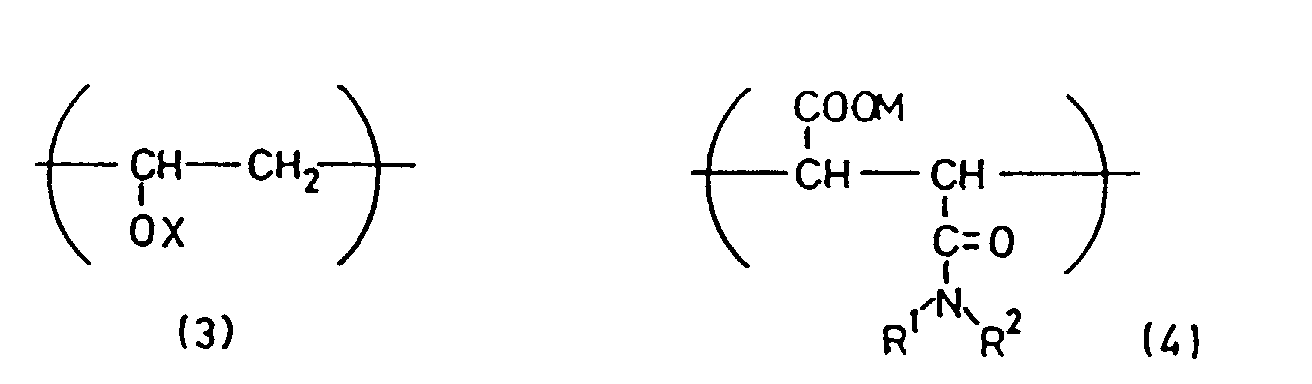
- M represents a hydrogen atom, a monovalent or divalent metal ion or a substituted or unsubstituted ammonium group.
- X in formula (3) represents a hydrogen atom or the group - CO CH3.
- As noted above the copolymers of the invention are useful as dispersing agents. They may be used as dispersing agents in aqueous suspensions of, for example, clay, anhydrous calcium sulfate and/or calcium sulfate hemihydrate and/or calcium sulfate dihydrate, porcelain muds, chalk, talcum, carbon black, stone powders, pigments, silicates and hydraulic binders.
- Also, the copolymers are useful as fluidizers or superplasticizers and high range water reducers for water containing building or construction materials, containing inorganic hydraulic binders such as Portland cement, high alumina cement, blast furnace cement, puzzolane cement, fly ash cement or white cement or magnesia cement, and additives such as sand, gravel, stone powder, fly ash, silica fume, vermiculite, expanded glass, expanded clays, chamotte, light weight additives and inorganic fibers and synthetic fibers. Optionally, the materials can also contain at least one component selected from the group of air entraining agents, concrete plasticizers, super plasticizers for concrete, mortar plasticizers, setting accelerating agents and setting retarding agents. Such additives are e.g. additives based on ligno sulfonates, sulfonated melamine - aldehyde polycondensates, sulfonated naphthaline - formaldehyde polycondensates, phosphonic acids and derivatives thereof. In this context, the invention can provide such high and surprisingly long lasting effects on flowablity, that they may be used effectively in low concentrations thereby avoiding the retardation effects in setting.
- It was also quite surprisingly found that some of the copolymers of the invention have a distinct affinity for metal ions, especially alkaline earth metal ions (e.g., calcium ions). Thus, the copolymers of the invention may also be used as complexing agents for those ions.
- In a preferred embodiment, the dispersants or fluidizers of the invention are used in powder form or in aqueous solution. In this embodiment the aqueous solution contains the copolymer in an amount ranging from 0.01 to 60% by weight, preferably from 0.01 10-40% by weight.
- In the inventive copolymers of vinyl acetate and maleamic acids form strictly alternating chains and may have wide-ranging weight average molecular weights, in the range of 1'000 to 200'000, more preferably from 10'000 to 100'000.
- Examples of monomers which can provide structure units represented by Formula (4) include half amides of maleic acid, prepared by the reaction of maleic anhydride with glycine, glutamic acid, alanine, proline, anthranilic acid or by the reaction of maleic anhydride with sulfanilic acid, amino-toluene sulfonic acid, naphthylaminemonosulfonic acid or naphthylamine disulfonic acid and the halfamides obtained by the reaction of maleic anhydrid with
N-propylamine, N-butylamine, morpholine or amino alkanoles. - Preferred examples of maleamic monomers are represented by the formulas as shown below:


- poly [(N-subst.- maleamic acid)-co-(vinylacetate)] and salts and
- poly [(N-subst.- maleamic acid)-co-(vinylalcohol)] and salts
- Preferred inventive copolymers are represented by the following formulas:


- The inventive polymers are prepared by a peroxide-catalyzed radical chain-copolymerization of vinylacetate (17)


- Vinyl acetate is a monomer of low reactivity toward addition to growing chains in peroxide-catalyzed copolymerization with a second vinylmonomer. Thus, the addition of vinylacetate retards the polymerisation of most other vinyl monomers.
- On the other hand, vinyl acetate copolymerizes readily with certain olefinic compounds which alone do not homopolymerize readily, such as maleic acid and maleamic acids. To growing copolymer chains having vinyl acetate at the growing end, almost all other monomers add more readily than vinyl acetate monomers itself. This low reactivity of vinylacetate is responsible for the alternating sequence of the structural units in the copolymer.
- The copolymerization is preferably carried out in an aqueous solution containing about 50 mole percent of the salt of a maleamic acid and about 50 mole percent of vinylacetate in the presence of at least one polymerization catalyst combined with a reducing agent to form a redox catalyst system. The reducing agents may be ferrous sulfate, sodium hydroxymethane sulfinate and alkalimetal sulfites and metabisulfites.
- The free radical producing catalyst is preferably selected from at least one peroxycompound like hydrogene peroxide or sodium peroxide. The reaction is preferably carried out at a pH ranging from 4,0 to about 7,5 at a temperature of 5 to 120°C, preferably 10 - 75°C.
- In general, the mixture should be stirred for at least 1 hour at a temperature maintained in the range of 20 - 50°C by cooling until no peroxide may be detected. It should then be neutralized by the addition of a base.
- The copolymerization process is characterized by a high yield, a low concentration of residual monomers and a surprisingly high polymerization rate.
- Absolute molecular weights of the inventive polymers have not been determined. However, apparent average molecular weights and molecular weight distributions as calculated relative to poly(ethyleneoxide) and poly(styrene sulfonate) standards have been determined using seize-exclusion chromatography.
- The following examples illustrate in more detail the preparation of the inventive polymers and their use as additives in cementitious compositions.
- Poly {[4-(carboxymethyl)amino-4-oxo-2-butenoic acid]-co-[vinylacetate]} sodium salt

A clear yellow solution of pH 6,5 was obtained having a viscosity of 35 mPa.s and 30% solid matter content. The vinylacetate to maleamic acid ratio in the polymers was 1:1 and the weight average molecular weight was about 17'000.
The original solution (E-1), as described above, was used for comparison tests in examples 13 and 14. - Poly {[4-(carboxymethyl) amino - 4 - oxo - 2 - butenoic acid] - co - [vinylalcohol]} sodium salt

- Polyvinylalcoholes are prepared from polyvinylacetates by replacement of acetate groups by hydroxyl groups.
Thus, to 100 g of solution (E-1) of example 1 there was added with agitation 10 g of 50% sodium hydroxide. The mixture was then heated to 80°C and stirred for 10 hours. A 95% degree of saponification was determined by acidimetric titration. After cooling to 20°C the solution was neutralized by the careful addition of concentrated sulfuric acid.
A polymer of the following properties was obtained: -
pH: 7.2 Viscosity (20°C) mPa.s (Brookfield) Polymer content 25% Mw 15'000 - The original solution (E-2), as described above, was used for comparison tests in examples 13 and 14.
- Poly {[4-(4-sulphophenyl)amino amino - 4 - oxo - 2 - butenoic acid] - co - [vinylacetate]} sodium salt

- A solution of sodium sulfanilate was prepared by adding with vigorous agitation 122,5 g (0.707 mol) of sulfanilic acid to a mixture of 56,7 g 50% sodium hydroxide and 0.017 g tribulylphophate in 444 g water.
The reaction mixture was then cooled to 28°C and 72,75 g (0.742 mol) of maleic anhydride and 64 g (0.80 mol) of 50% sodium hydroxide are added simultaneously under stirring and cooling in such a way that the pH value was kept within a range of 5,5 to 6,5 and the temperature maintained in the range of 30 to 40°C. After the addition was finished, the solution was stirred for another 15 minutes at 30°C and the pH was adjusted to 6.6 to 6.8 by adding a few drops of 50% sodium hydroxide. Then, 150 g of deionized water, 5 g of triethyleneglycol-monomethylether, 8 g of amidosulfonic acid, 0,1 g of ferrous sulfate heptahydrate and 16,8 g of 33% hydrogenperoxide was added. After testing the pH to be in the range of 4.8 - 5.2, 58 g (0.674 mol) of vinylacetate was added with vigorous stirring and then dropwise addition of 8,4 g Rongalit C (sodium hydroxymethane sulfinate) in 20 g of water was immediately started. The addition was finished after 1 hour and the temperature maintained at 30 - 33°C. After cooling to 20°C the solution was neutralized by adding 12 g 50% sodium hydroxide and 10 g of sodium metabisulfite.
A clear brown 30%-solution of pH 6.5 was obtained, having a viscosity of 45 mPa.s which corresponds to an average weight of about 27'000. The polymer content was determined by HPLC analyses to be 28% (93,5% of solids content).
The original solution (E-3), as described above, was used for comparison tests in examples 13 and 14. - Poly {[4-(4-sulfophenyl) amino - 4 - oxo- 2 - butenoic acid] - co - [vinylalcohol]} sodium salt

- To 100 g of solution (E-3) of example 3 there was added 10 g fo 50% sodium hydroxide and the resulting solution then heated to 80°C and stirred for 12 hours. A 96% degree of saponification was determined by acidimetric titration. The solution was then cooled down to 20°C and neutralized by slowly adding concentrated sulfuric acid.
A polymer solution of the following properties was obtained -
pH = 7.0 Viscosity 61 mPa.s (Brookfield) Solids content = 25% Mw = 25600 - The original solution (E-4), as described above, was used for comparison tests in examples 13 and 14.
- Poly [(4 - morpholino - 4 - oxo - 2 - butenoic acid) - co- (vinylacetate)] sodium salt

- A solution of 61,6 g (0,707 mol) of morpholine in 340 g of water was adjusted to a pH-range of 7,5-8,0 by adding dropwise 90% formic acid. 72,75 (0,742 mol) of maleic anhydride and 64 g (0.80 mol) of 50% sodium hydroxide were then added simultaneously under stirring and cooling with ice in such a way that the pH value was kept within a range of 5,5 to 6,5 and the temperature maintained in the range of 30-35°C. After the addition was finished stirring was continued for another 15 minutes at 30°C and the pH was adjusted to 6,6 - 6,8 by adding 50% sodium hydroxide. Then, 150 g of deionized water, 5 g of triethyleneglycol monomethylether, 8 g of amidosulfonic acid, 0,1 g of ferrous sulfate heptyhydrate and 16,8 g of 33% hydrogenperoxide was added. After testing the pH to be in the range of 4,8 - 5,2, 58 g (0.674 mol) of vinylacetate was added with vigorous stirring and then dropwise addition of a solution of 8,4 g of Rongalit C (sodiumhydroxymethane sulfinate) in 20 g water was immediately started. The addition was finished after 1 hour whereby the temperature was maintained in the range of 30 - 33°C. After cooling to 20°C the solution was neutralized by adding 10 g of sodium metabisulfite and 12 g of 50% sodium hydroxide.
- A clear, slightly yellow solution of 30% solids content was obtained. The viscosity of the solution was 30 mPa.s and the weight average molecular weight was found to be 19'000.
- The original solution (E-5), as described above, was used for comparison tests in examples 13 and 14.
- Poly [(4 - morpholino - 4 - oxo - 2 - butenoic acid)co-- (vinylalcohol)] sodium salt

- To 100 g of solution (E-5) there was added 10 g of 50% sodium hydroxide. The resulting solution was then heated to 80°C and stirred for 10 hours. A 93% degree of saponification was determined by acidimetric titration. The solution was then cooled down to 20°C and neutralized by adding carefully and dropwise concentrated sulfuric acid.
- A nearly colourless polymer solution of 25% solids content and viscosity of 51 mPa.s (Brookfield) was obtained. Mw = 18'000.
- Poly [{4 - butylamino - 4 - oxo - 2 - butenoic acid)co-- (vinylacetate)] sodium salt

- A solution of 52,6 g (0.72 mol) of n-butylamine and 0,02 g tributylphosphate in 319 g of deionized water was adjusted to pH of 8 - 8,5 by adding dropwise 90% formic acid. 72,75 g (0.742 mol) of maleic anhydride and 64 g (0.80 mol) of 50% sodium hydroxide was then added simultaneously under vigorous agitation and ice-cooling in such a way that the pH value was kept within a range of 5,5 - 6,5 and the temperature maintained in the range of 30 - 35°C.
After the addition was finished, stirring was continued for another 15 minutes at 30°C and the pH was adjusted to 6,6 - 6,8 by adding 50% sodium hydroxide. Then, 150 g of deionized water, 5 g of triethyleneglycol monomethylether, 8 g of amidosulfonic acid, 0,1 g of ferrous sulfate heptahydrate and 16,8 g of 33% hydrogen peroxide was added. After testing the pH to be in the range of 4.8 to 5.2, 60.26 g (0.70 mol) of vinylacetate was added with vigorous stirring and then, dropwise addition of a solution of 8,4 g of Rongalit C (sodium hydroxymethane sulfinate) in 20 g water was immediately started. The polymerization was carried out for 1 hour keeping the temperature in the range of 30 - 35°C.
The reaction solution was then cooled to 20°C and neutralized by adding 10 g of sodium metabisulfite and 12 g of 50% sodium hydroxide.
A clear, slightly yellow solution of 30% solids content and a viscosity (Brookfield) of 225 mPa.s was obtained. The weight average - molecular weight was found to be 22'000.
The original solution (E-7) as described above was used for comparison tests in examples 13 and 14. - Poly [{4 - butylamino - 4 - oxo - 2 - butenoic acid) co- (vinylalcohol)] sodium salt

- To 100 g of solution (E-7) there was added 10 g of 50% sodium hydroxide. The resulting solution was then heated to 80°C and stirred for 10 hours. A 96% degree of saponification was determined by acidimetric titration.
The solution was cooled down to 20°C and neutralized by the careful and dropwise addition of concentrated sulfuric acid.
A slighlty yellow polymer solution of 25% solids content and a viscosity of 255 mPa.s was obtained. Mw = 20'500. - A reference copolymer (R-1), Poly [(maleic acid) - co - (vinylacetate)] sodium salt, denoted by Formula (21):

- A reference copolymer solution (R-2), of Poly [(maleic acid) - co - (vinylalcohol)] sodium salt, represented by Formula (22):

- "MELMENT F-10",
a commercially available dispersing agent for hydraulic cement masses, which is a sodium salt of sulfonated melamine-formaldehyde polycondensate, of an average weight-molecular weight of about 10'000 was used as reference polymer solution (R-3). - "LOMAR-D",
a commercially available dispersing agent for hydraulic cement masses which is a sodium salt of a sulfonated naphthalene-formaldehyde polycondensate of weight-average molecular weight 4'000, was obtained as reference polymer solution (R-4) - This example was conducted to demonstate the improved dispersing effect of the inventive polymers on cement pastes. The polymer solutions E-1 to E-7 were tested in different dosages. Reference polymers R-1, R-3 and R-4 were also tested and compared in this context.
- According to this example, a rotational viscosimetric determination was used to test the dispersing effect of the copolymers. A Brabender viscocorder, Type No. 8018 was used.
- The solid matter to be dispersed (Portland cement) was weighed in a Hobart mixer (vessel volume about 4 litres). Under stirring, a dilute aqueous solution of the additive to be tested was added. Simultaneously, a stop watch was started.
- At 10 to 15 minutes after the addition of the solution, the moment of rotation, which is directly proportional to the viscosity of the suspension, was observed from the rotation viscosimeter. The flow effect of a dispersing agent improves as the shear resistance decreases, measured as the moment of rotation, which is exerted by the suspension on the measuring paddle.
-
Test conditions: Cement Portland cement 35 F Water cement value: % by weight of solid polymer, referred to cement Shear head: cement paddle Rotation rate: 120 rpm - The results of this test were quite unexpected in that the polymers according to the invention provided a superior dispersing effect. For example, the results of Table 1 demonstrate that in order to get the same fluidity (a low shear resistance in the range of 1.77 to 2.16 N/cm (180 to 220 g.cm)), it was necessary to use the double dosage of reference polymers (0,4%) compared to inventive dispersants.
-
Table 1: Dispersing effect of various polymers in Portland cement pastes Mixt. No. Polymer solution Dosage % solid matter Shear resistance ([Lg.cm]) [N/cm] after 10' after 15' 1 without - (520) 5.10 (530) 5.20 (220) 2.16 2 E-1 0.2 (200) 1.96 (280) 2.75 0.1 (260) 2.55 (230) 2.26 3 E-2 0.2 (210) 2.06 (280) 2.75 0.1 (280) 2.75 (190) 1.86 4 E-3 0.2 (190) 1.86 (250) 2.45 0.1 (250) 2.45 (220) 2.16 5 E-4 0.2 (205) 2.01 (280) 2.75 0.1 (260) 2.55 (220) 2.16 6 E-5 0.2 (210) 2.06 (270) 2.65 0.1 (270) 2.65 (250) 2.45 7 E-7 0.2 (250) 2.45 (350) 3.45 0.1 (350) 3.43 8 R-1 0.4 (190) 1.86 (190) 1.86 0.2 (295) 2.89 (300) 2.94 0.1 (385) 3.78 (390) 3.83 9 R-3 0.4 (210) 2.06 (190) 1.86 0.2 (290) 2.84 (295) 2.89 0.1 (350) 3.43 (340) 3.34 10 R-4 0.4 (210) 2.06 (210) 2.06 0.2 (250) 2.45 (250) 2.45 0.1 (370) 3.63 (380) 3.73 - This example demonstrates the improved fluidizing effect of the polymers of the invention. The polymers prepared according to Examples 1 - 7 were tested as fluidizers and water reducers in cement mortar and concrete. Those comparative polymers described in Examples 9 - 12 were also tested and compared in this context.
- The consistency of freshly prepared concrete or freshly prepared mortar, i.e., the mobility or viscosity of the freshly prepared mixture, is the most important characteristic of workability. For measuring the consistency of concrete and mortar, a flow table spread is used in industry. Sometimes the "slump test" (setting value) according to ASTM C143 is also used.
- For purposes of this experiment the flow table spread was determined by putting concrete into an iron form on a two-part table (70 x 70 cm). By removing the form, a concrete body having a truncated cone shape is prepared. Then, the area of the table is lifted on one side for 4 cm, and allowed to fall. This procedure is carried out 15 times, and the concrete spreads. The average diameter of the formed cake corresponds to the flow table spread.
- For the slump test, three layers of concrete are put into a mold having a shape of a truncated cone and having certain dimensions, and compressed with 25 pushes of an iron bar. At the top, the concrete is stripped off evenly. Then, the form is vertically removed. The concrete body will sink in by itself. The slump is measured by determining the vertical difference between the top of the mold and the displaced original center of the top surface of the test sample.
- In order to compare the obtained test results and to bring them into a relation with the consistency, the freshly prepared concrete may be divided into consistency ranges:
-
Consistency Ranges of Freshly Prepared Concrete Denotation Flow Table Spread (cm) Slump (cm) K1 rigid <30 <1 K2 semi-plastic 30 to 40 1 to 9 K3 plastic 41 to 50 10 to 15 K4 fluid > 51 > 16 - Fluidizers are used when specific construction applications are necessary. Flow concrete is used when high inserting rates (e.g., from 50 to 100 m3/hour) are required, or when the form and reinforcement of a construction part do not allow a compression of the concrete by vibration due to some technical reason. Concretes having K2 and K3 consistencies may be prepared from a concrete of K1 consistency by adding fluidizers, when increased mechanical strength at an equal remaining workability shall be obtained.
- For certain freshly prepared concretes, the effect is dependent on the dosage. Usually, from 0.2 to 1.5% solid matter quantities (in dissolved form), referred to the weight of cement, are added.
- To a high degree, the effect is also dependent on the chemical structure of the polymer, which is the basis of the fluidizer.
- In order to demonstrate the increased effectiveness of the fluidizers of the invention, the flow behaviour of concrete mixtures containing the fluidizers described in Examples 1-7 was measured in accordance with DIN 1048, Part 1, and ASTM C143. As a comparison, those polymers described in Examples 9 - 12 were also examined.
-
Composition of the Concrete Mixtures Components Amount Netstal filler (chalk filler) 1.5 kg Rhine sand Epple up to 1.2 mm 9.5 kg Rhine sand Epple 1.2 to 4 mm 8.0 kg Rhine sand Epple 4 to 8 mm 4.5 kg Mine gravel* 8 to 16 mm 11.5 kg Mine gravel* 16 to 32 mm 15.0 kg Portland cement 7.5 kg Mixing water Variable, depending on the water cement ratio. Fluidizer Variable, dissolved in the mixing water. * washed and dried - The cement and the aggregates were premixed for 15 seconds in a 50 litre forced circulation mixer for concrete. Then the mixing water or the fluidizer, distributed in the mixing water, was added slowly under stirring over 15 to 20 seconds. Then the mixture was stirred in a wet state for an additional 60 seconds. A part of the mixture was then immediately filled into the mold for determination of the flow table spread and the slump.
- Immediately after measuring the flow table spread, test bodies having edge lengths of 12 x 12 cm were prepared, and the compressive strength was measured after 1, 7 and 28 days in accordance with DIN 1048, Part 1. The determination of initial setting was carried out in accordance with ASTM C403.


Claims (10)
- A dispersing agent or fluidizer for aqueous suspensions, said dispersant or fluidizer being a watersoluble linear copolymer of vinyl acetate with an N-substituted maleamic acid in a molar ratio of 1:1, represented by Formula (A)
 X represents a hydrogen atom or the group - CO CH3M represents a hydrogen atom, a monovalent or divalent metal ion, a substituted or unsubstituted ammonium group.
 - A dispersing agent according to claim 1, said dispersant being a copolymer having a weight average molecular weight in the range of 1'000 - 200'000.
- An aqueous solution of the copolymer set forth in claim 1 or 2.
- The aqueous solution according to claim 3, said solution containing the copolymer in an amount ranging from 0.01 to 60% by weight.
- An aqueous suspension, containing the dispersing agent set forth in claim 1 or 2 in an amount in the range from 0,01 to 10%.
- An aqueous suspension according to claim 5, wherein the solid matter comprises at least one member selected from the group of clays, procelain muds, chalk, talkum, carbon black, stone powders, pigments, silicates and hydraulic binders.
- An aqueous suspension according to claim 5 or 6 wherein the solid matter comprises a hydraulic binder selected from at least one of Portland cement, high alumina cement, blast furnace cement, puzzolane cement, fly ash cement or white cement.
- An aqueous suspension, according to anyone of claims 5 to 7, further comprising at least one of the group of sand, gravel, stone powder, fly ash, silica fume, vermiculite, expanded glass, expanded clays, chamotte, inorganic fibers and synthetic organic fibers.
- An aqueous suspension according to anyone of claims 5 to 8 wherein the solid matter comprises anhydrous calcium sulfate and/or calcium sulfate hemihydrate and/or calcium sulfate dihydrate.
- An aqueous suspension according to anyone of claims 5 to 9, further comprising at least one of the following additives based on ligno sulfonates, sulfonated melamine-aldehyde polycondensates, sulfonated naphthaline-formaldehyde polycondensates, phosphonic acids and derivatives thereof.
Priority Applications (10)
| Application Number | Priority Date | Filing Date | Title |
|---|---|---|---|
| DK92122027.3T DK0604676T3 (en) | 1992-12-28 | 1992-12-28 | Water-soluble copolymers of vinyl acetate and maleamic acids, their use as fluidizing agents or "high range" water reducing agents for aqueous suspensions |
| EP92122027A EP0604676B1 (en) | 1992-12-28 | 1992-12-28 | Water-soluble copolymers of vinylacetate and maleamic acids. Use as fluidizers or high-range water-reducers for aqueous suspensions |
| ES92122027T ES2056042T3 (en) | 1992-12-28 | 1992-12-28 | WATER SOLUBLE COPOLYMERS OF VINYL ACETATE AND MALEAMIC ACIDS. USE AS WIDE FLUIDIZERS OR REDUCERS OF WIDE INTERVAL FOR AQUEOUS SUSPENSIONS. |
| DE69217071T DE69217071T2 (en) | 1992-12-28 | 1992-12-28 | Water soluble vinyl acetate / maleic acid half amide copolymers and their use as plasticizers or water reducing agents for aqueous dispersions |
| DE0604676T DE604676T1 (en) | 1992-12-28 | 1992-12-28 | Water soluble vinyl acetate / maleic acid half amide copolymers and their use as plasticizers or water reducing agents for aqueous dispersions. |
| AT92122027T ATE148135T1 (en) | 1992-12-28 | 1992-12-28 | WATER-SOLUBLE VINYL ACETATE/MALEIC ACID HALF-AMIDE COPOLYMERS AND THEIR USE AS LIQUIDANTS OR WATER-REDUCING AGENTS FOR AQUEOUS DISPERSIONS |
| US08/174,057 US5633310A (en) | 1992-12-28 | 1993-12-28 | Water-soluble copolymers of vinylacetate and maleamic acids and use as fluidizers high-range water-reducers for aqueous suspensions |
| JP5338203A JPH06256055A (en) | 1992-12-28 | 1993-12-28 | Dispersing agent or fluidizer of aqueous suspension |
| GR940300059T GR940300059T1 (en) | 1992-12-28 | 1994-09-30 | Water-soluble copolymers of vinylacetate and maleamic acids. Use as fluidizers or high-range water-reducers for aqueous suspensions. |
| GR970400499T GR3022825T3 (en) | 1992-12-28 | 1997-03-17 | Water-soluble copolymers of vinylacetate and maleamic acids. Use as fluidizers or high-range water-reducers for aqueous suspensions. |
Applications Claiming Priority (1)
| Application Number | Priority Date | Filing Date | Title |
|---|---|---|---|
| EP92122027A EP0604676B1 (en) | 1992-12-28 | 1992-12-28 | Water-soluble copolymers of vinylacetate and maleamic acids. Use as fluidizers or high-range water-reducers for aqueous suspensions |
Publications (2)
| Publication Number | Publication Date |
|---|---|
| EP0604676A1 EP0604676A1 (en) | 1994-07-06 |
| EP0604676B1 true EP0604676B1 (en) | 1997-01-22 |
Family
ID=8210332
Family Applications (1)
| Application Number | Title | Priority Date | Filing Date |
|---|---|---|---|
| EP92122027A Expired - Lifetime EP0604676B1 (en) | 1992-12-28 | 1992-12-28 | Water-soluble copolymers of vinylacetate and maleamic acids. Use as fluidizers or high-range water-reducers for aqueous suspensions |
Country Status (8)
| Country | Link |
|---|---|
| US (1) | US5633310A (en) |
| EP (1) | EP0604676B1 (en) |
| JP (1) | JPH06256055A (en) |
| AT (1) | ATE148135T1 (en) |
| DE (2) | DE69217071T2 (en) |
| DK (1) | DK0604676T3 (en) |
| ES (1) | ES2056042T3 (en) |
| GR (2) | GR940300059T1 (en) |
Cited By (1)
| Publication number | Priority date | Publication date | Assignee | Title |
|---|---|---|---|---|
| US11358863B2 (en) | 2017-11-27 | 2022-06-14 | Brandeis University | Method and composition of humidity-controlled generation of chlorine dioxide in polymers and superabsorbent hydrogels |
Families Citing this family (20)
| Publication number | Priority date | Publication date | Assignee | Title |
|---|---|---|---|---|
| NO314995B1 (en) * | 1996-11-29 | 2003-06-23 | Sika Ag | Lignin sulfonate concrete additive |
| EP1044175B1 (en) | 1998-08-14 | 2002-11-20 | Mbt Holding Ag | High pozzolan cement mixtures |
| DE69912804T2 (en) | 1998-08-14 | 2004-08-12 | Construction Research & Technology Gmbh | CEMENT BLEND FOR DRY CASTING |
| US6369118B1 (en) * | 1998-09-09 | 2002-04-09 | University Of Pittsburgh | Biocompatible emulsifier |
| US6310143B1 (en) * | 1998-12-16 | 2001-10-30 | Mbt Holding Ag | Derivatized polycarboxylate dispersants |
| US6409824B1 (en) | 2000-04-25 | 2002-06-25 | United States Gypsum Company | Gypsum compositions with enhanced resistance to permanent deformation |
| FR2815342B1 (en) | 2000-10-13 | 2003-08-01 | Francais Ciments | CEMENTITIOUS COMPOSITION, ITS USE FOR THE PRODUCTION OF A SELF-LEVELING LIQUID SCREW AND A SCREEN THUS OBTAINED |
| US6893496B1 (en) | 2002-12-16 | 2005-05-17 | Universal White Cement Company, Inc. | Cement compositions and admixtures therefore |
| BRPI0700947A (en) * | 2007-03-12 | 2008-10-28 | Renner Sayerlack S A | composition and process for obtaining extrusion paste and profile coating |
| ES2359347T3 (en) | 2007-10-29 | 2011-05-20 | Sika Technology Ag | DISPERSING AGENTS FOR SYSTEMS THAT FRAGUATE BY HYDRAULIC MEDIA. |
| ATE496875T1 (en) | 2007-10-29 | 2011-02-15 | Sika Technology Ag | DISPERSANT FOR HYDRAULIC SETTING SYSTEMS |
| US10427978B2 (en) * | 2008-04-22 | 2019-10-01 | United States Gypsum Company | Coated building panels and articles containing calcium sulfate hemihydrate |
| BR112013032825A2 (en) | 2011-08-30 | 2017-01-31 | Sika Tech Ag | intermediate range water reducers (mrwr) for concretes |
| EP2565172A1 (en) | 2011-08-30 | 2013-03-06 | Sika Technology AG | Mid-range water reducers (MRWR) for concretes |
| CN106749959A (en) * | 2016-11-11 | 2017-05-31 | 中建商品混凝土眉山新材料有限公司 | A kind of Early-strength polycarboxylate superplasticizer and preparation method thereof |
| US11453613B2 (en) | 2017-11-07 | 2022-09-27 | United States Gypsum Company | Joint compounds, activators and methods for setting a joint compound and preventing seed setting |
| WO2020257322A1 (en) * | 2019-06-17 | 2020-12-24 | The Regents Of The University Of Colorado, A Body Corporate | Methods and compositions for inhibiting freeze-thaw damage in concrete and cement paste |
| CN110615646B (en) * | 2019-10-22 | 2021-04-27 | 河北航博建筑材料有限公司 | High-strength light slurry and preparation method thereof |
| CN112708074B (en) * | 2020-12-29 | 2022-05-17 | 科之杰新材料集团浙江有限公司 | Polycarboxylate superplasticizer and preparation method thereof |
| TW202604984A (en) * | 2024-06-05 | 2026-02-01 | 日商可樂麗股份有限公司 | Method for producing modified polyvinyl alcohol |
Family Cites Families (11)
| Publication number | Priority date | Publication date | Assignee | Title |
|---|---|---|---|---|
| BE630548A (en) * | 1961-06-16 | |||
| US3554287A (en) * | 1966-11-07 | 1971-01-12 | Dow Chemical Co | Gelable composition, resulting gelled polymer composition and use thereof |
| US3672941A (en) * | 1968-07-31 | 1972-06-27 | Denki Kagaku Kogyo Kk | Process for preparing a pigment coated paper |
| US3795648A (en) * | 1971-04-27 | 1974-03-05 | Kendall & Co | Surfactant-free ampholytic polymeric latices |
| US3737333A (en) * | 1971-07-21 | 1973-06-05 | Engelhard Min & Chem | Method for processing kaolin clay |
| DE2228515B1 (en) * | 1972-06-12 | 1974-02-14 | Röhm GmbH, 6100 Darmstadt | METHOD FOR PRODUCING POLYACRYLATE DISPERSIONS |
| US3956244A (en) * | 1973-10-26 | 1976-05-11 | N L Industries, Inc. | Crosslinked vinyl acetate-maleic anhydride heteropolymers and derivatives prepared from them |
| DE3838093A1 (en) * | 1988-11-10 | 1990-05-17 | Basf Ag | USE OF COPOLYMERISES AS ADDITION TO LIQUID DETERGENTS |
| ATE109805T1 (en) * | 1989-05-17 | 1994-08-15 | Sika Ag | WATER-SOLUBLE COPOLYMERS, A PROCESS FOR THEIR MANUFACTURE AND THEIR USE AS FLIPPING AGENT IN SOLID SUSPENSIONS. |
| DE4040959C1 (en) * | 1990-12-20 | 1992-03-12 | Wacker-Chemie Gmbh, 8000 Muenchen, De | |
| US5164433A (en) * | 1991-04-17 | 1992-11-17 | Rheox, Inc. | Rheological agents and thickeners |
-
1992
- 1992-12-28 DK DK92122027.3T patent/DK0604676T3/en active
- 1992-12-28 EP EP92122027A patent/EP0604676B1/en not_active Expired - Lifetime
- 1992-12-28 DE DE69217071T patent/DE69217071T2/en not_active Expired - Fee Related
- 1992-12-28 DE DE0604676T patent/DE604676T1/en active Pending
- 1992-12-28 ES ES92122027T patent/ES2056042T3/en not_active Expired - Lifetime
- 1992-12-28 AT AT92122027T patent/ATE148135T1/en not_active IP Right Cessation
-
1993
- 1993-12-28 JP JP5338203A patent/JPH06256055A/en active Pending
- 1993-12-28 US US08/174,057 patent/US5633310A/en not_active Expired - Fee Related
-
1994
- 1994-09-30 GR GR940300059T patent/GR940300059T1/en unknown
-
1997
- 1997-03-17 GR GR970400499T patent/GR3022825T3/en unknown
Cited By (1)
| Publication number | Priority date | Publication date | Assignee | Title |
|---|---|---|---|---|
| US11358863B2 (en) | 2017-11-27 | 2022-06-14 | Brandeis University | Method and composition of humidity-controlled generation of chlorine dioxide in polymers and superabsorbent hydrogels |
Also Published As
| Publication number | Publication date |
|---|---|
| DE604676T1 (en) | 1995-03-16 |
| GR3022825T3 (en) | 1997-06-30 |
| ES2056042T3 (en) | 1997-04-01 |
| DK0604676T3 (en) | 1997-07-28 |
| GR940300059T1 (en) | 1994-09-30 |
| EP0604676A1 (en) | 1994-07-06 |
| ATE148135T1 (en) | 1997-02-15 |
| US5633310A (en) | 1997-05-27 |
| DE69217071T2 (en) | 1997-05-07 |
| JPH06256055A (en) | 1994-09-13 |
| DE69217071D1 (en) | 1997-03-06 |
| ES2056042T1 (en) | 1994-10-01 |
Similar Documents
| Publication | Publication Date | Title |
|---|---|---|
| US5633310A (en) | Water-soluble copolymers of vinylacetate and maleamic acids and use as fluidizers high-range water-reducers for aqueous suspensions | |
| US5100984A (en) | Water-soluble copolymers, a process for their preparation and their use as fluidizers in suspensions of solid matter | |
| JP4484259B2 (en) | Copolymers based on unsaturated dicarboxylic acid derivatives and oxyalkylene glycol-alkenyl ethers, processes for their preparation and their use | |
| US5798425A (en) | Co-polymers based on oxyalkyleneglycol alkenyl ethers and unsaturated dicarboxylic acid derivatives | |
| US5919300A (en) | Dispersing agent for high-flow or self-compacting concrete | |
| JP3411538B2 (en) | Copolymers based on unsaturated monocarboxylic or dicarboxylic acid derivatives and oxyalkylene glycol-alkenyl ether groups, process for their preparation and their use | |
| US5583183A (en) | Cement and cement composition having improved rheological properties | |
| US6548589B2 (en) | Cement dispersing polymers for high flow, high strength and selfcompacting concrete | |
| US6187887B1 (en) | Water-soluble or water-swellable copolymers containing sulfonic groups and methods of preparation | |
| US4962173A (en) | Cement dispersion agents comprising water soluble vinyl copolymer | |
| US6752866B2 (en) | Method for improving the mechanical strength of cement matrices, and cement matrices produced thereby | |
| US6043329A (en) | Acrylic copolymers | |
| US5290869A (en) | Cement dispersion agents | |
| US20020007019A1 (en) | Cement admixture for improved slump life | |
| US20070161724A1 (en) | Copolymers based on unsaturated mono-or dicarboxylic acid derivatives and oxyalkyleneglycol-alkenyl ethers, method for the production and use thereof | |
| EP0303747B1 (en) | Acrylic polymer and cement composition containing it | |
| KR20050027079A (en) | Superplasticizer for concrete and self-leveling compounds | |
| US20060172916A1 (en) | Use of a polymer dispersant as a fluidising agent for hydraulic binder compositions and preparation thereof | |
| US4870120A (en) | Cement dispersant | |
| CA1325311C (en) | Cement admixture | |
| AU2014255949A1 (en) | Use of comb polymers for controlling the rheology of mineral binder compositions | |
| EP0845444A1 (en) | Improved ligninsulfonate concrete admixtures | |
| US5137945A (en) | Cement with sulfoalkyacrylate polymers | |
| EP0244095B1 (en) | Cement plasticiser compositions based on polymerisable carboxylic acids and cementiferous compositions containing them | |
| AU2004318290A1 (en) | Cement dispersant and concrete composition containing the dispersant |
Legal Events
| Date | Code | Title | Description |
|---|---|---|---|
| PUAI | Public reference made under article 153(3) epc to a published international application that has entered the european phase |
Free format text: ORIGINAL CODE: 0009012 |
|
| AK | Designated contracting states |
Kind code of ref document: A1 Designated state(s): AT BE CH DE DK ES FR GB GR IE IT LI LU MC NL PT SE |
|
| ITCL | It: translation for ep claims filed |
Representative=s name: CALVANI SALVI VERONELLI |
|
| 17P | Request for examination filed |
Effective date: 19940617 |
|
| EL | Fr: translation of claims filed | ||
| TCAT | At: translation of patent claims filed | ||
| REG | Reference to a national code |
Ref country code: ES Ref legal event code: BA2A Ref document number: 2056042 Country of ref document: ES Kind code of ref document: T1 |
|
| TCNL | Nl: translation of patent claims filed | ||
| DET | De: translation of patent claims | ||
| 17Q | First examination report despatched |
Effective date: 19950710 |
|
| GRAG | Despatch of communication of intention to grant |
Free format text: ORIGINAL CODE: EPIDOS AGRA |
|
| GRAH | Despatch of communication of intention to grant a patent |
Free format text: ORIGINAL CODE: EPIDOS IGRA |
|
| GRAH | Despatch of communication of intention to grant a patent |
Free format text: ORIGINAL CODE: EPIDOS IGRA |
|
| GRAA | (expected) grant |
Free format text: ORIGINAL CODE: 0009210 |
|
| AK | Designated contracting states |
Kind code of ref document: B1 Designated state(s): AT BE CH DE DK ES FR GB GR IE IT LI LU NL PT SE |
|
| REF | Corresponds to: |
Ref document number: 148135 Country of ref document: AT Date of ref document: 19970215 Kind code of ref document: T |
|
| REG | Reference to a national code |
Ref country code: CH Ref legal event code: EP Ref country code: CH Ref legal event code: NV Representative=s name: E. BLUM & CO. PATENTANWAELTE |
|
| ET | Fr: translation filed | ||
| REF | Corresponds to: |
Ref document number: 69217071 Country of ref document: DE Date of ref document: 19970306 |
|
| REG | Reference to a national code |
Ref country code: IE Ref legal event code: FG4D Free format text: 71729 |
|
| ITF | It: translation for a ep patent filed | ||
| REG | Reference to a national code |
Ref country code: ES Ref legal event code: FG2A Ref document number: 2056042 Country of ref document: ES Kind code of ref document: T3 |
|
| REG | Reference to a national code |
Ref country code: GR Ref legal event code: FG4A Free format text: 3022825 |
|
| REG | Reference to a national code |
Ref country code: PT Ref legal event code: SC4A Free format text: AVAILABILITY OF NATIONAL TRANSLATION Effective date: 19970311 |
|
| REG | Reference to a national code |
Ref country code: DK Ref legal event code: T3 |
|
| PLBE | No opposition filed within time limit |
Free format text: ORIGINAL CODE: 0009261 |
|
| STAA | Information on the status of an ep patent application or granted ep patent |
Free format text: STATUS: NO OPPOSITION FILED WITHIN TIME LIMIT |
|
| 26N | No opposition filed | ||
| REG | Reference to a national code |
Ref country code: ES Ref legal event code: GC2A Effective date: 20000315 |
|
| REG | Reference to a national code |
Ref country code: GB Ref legal event code: IF02 |
|
| REG | Reference to a national code |
Ref country code: CH Ref legal event code: PFA Owner name: SIKA SCHWEIZ AG Free format text: SIKA AG, VORM. KASPAR WINKLER & CO.#TUEFFENWIES 16-22#CH-8048 ZUERICH (CH) -TRANSFER TO- SIKA SCHWEIZ AG#TUEFFENWIES 16-22#8064 ZUERICH (CH) Ref country code: CH Ref legal event code: NV Representative=s name: SIKA TECHNOLOGY AG |
|
| PGFP | Annual fee paid to national office [announced via postgrant information from national office to epo] |
Ref country code: NL Payment date: 20031203 Year of fee payment: 12 Ref country code: AT Payment date: 20031203 Year of fee payment: 12 |
|
| PGFP | Annual fee paid to national office [announced via postgrant information from national office to epo] |
Ref country code: PT Payment date: 20031209 Year of fee payment: 12 |
|
| PGFP | Annual fee paid to national office [announced via postgrant information from national office to epo] |
Ref country code: SE Payment date: 20031219 Year of fee payment: 12 |
|
| PGFP | Annual fee paid to national office [announced via postgrant information from national office to epo] |
Ref country code: DK Payment date: 20031222 Year of fee payment: 12 |
|
| PGFP | Annual fee paid to national office [announced via postgrant information from national office to epo] |
Ref country code: IE Payment date: 20031223 Year of fee payment: 12 |
|
| PGFP | Annual fee paid to national office [announced via postgrant information from national office to epo] |
Ref country code: GB Payment date: 20031224 Year of fee payment: 12 |
|
| PGFP | Annual fee paid to national office [announced via postgrant information from national office to epo] |
Ref country code: GR Payment date: 20031229 Year of fee payment: 12 |
|
| PGFP | Annual fee paid to national office [announced via postgrant information from national office to epo] |
Ref country code: LU Payment date: 20031231 Year of fee payment: 12 |
|
| PGFP | Annual fee paid to national office [announced via postgrant information from national office to epo] |
Ref country code: BE Payment date: 20040128 Year of fee payment: 12 |
|
| PGFP | Annual fee paid to national office [announced via postgrant information from national office to epo] |
Ref country code: CH Payment date: 20040318 Year of fee payment: 12 |
|
| PG25 | Lapsed in a contracting state [announced via postgrant information from national office to epo] |
Ref country code: LU Free format text: LAPSE BECAUSE OF NON-PAYMENT OF DUE FEES Effective date: 20041228 Ref country code: GB Free format text: LAPSE BECAUSE OF NON-PAYMENT OF DUE FEES Effective date: 20041228 Ref country code: AT Free format text: LAPSE BECAUSE OF NON-PAYMENT OF DUE FEES Effective date: 20041228 Ref country code: IE Free format text: LAPSE BECAUSE OF NON-PAYMENT OF DUE FEES Effective date: 20041228 |
|
| PG25 | Lapsed in a contracting state [announced via postgrant information from national office to epo] |
Ref country code: SE Free format text: LAPSE BECAUSE OF NON-PAYMENT OF DUE FEES Effective date: 20041229 |
|
| PG25 | Lapsed in a contracting state [announced via postgrant information from national office to epo] |
Ref country code: CH Free format text: LAPSE BECAUSE OF NON-PAYMENT OF DUE FEES Effective date: 20041231 Ref country code: BE Free format text: LAPSE BECAUSE OF NON-PAYMENT OF DUE FEES Effective date: 20041231 Ref country code: LI Free format text: LAPSE BECAUSE OF NON-PAYMENT OF DUE FEES Effective date: 20041231 |
|
| PG25 | Lapsed in a contracting state [announced via postgrant information from national office to epo] |
Ref country code: DK Free format text: LAPSE BECAUSE OF NON-PAYMENT OF DUE FEES Effective date: 20050103 |
|
| PG25 | Lapsed in a contracting state [announced via postgrant information from national office to epo] |
Ref country code: PT Free format text: LAPSE BECAUSE OF NON-PAYMENT OF DUE FEES Effective date: 20050628 |
|
| BERE | Be: lapsed |
Owner name: SIKA A.G. VORM. KASPAR *WINKLER & CO. Effective date: 20041231 |
|
| PG25 | Lapsed in a contracting state [announced via postgrant information from national office to epo] |
Ref country code: NL Free format text: LAPSE BECAUSE OF NON-PAYMENT OF DUE FEES Effective date: 20050701 |
|
| PG25 | Lapsed in a contracting state [announced via postgrant information from national office to epo] |
Ref country code: GR Free format text: LAPSE BECAUSE OF NON-PAYMENT OF DUE FEES Effective date: 20050704 |
|
| REG | Reference to a national code |
Ref country code: DK Ref legal event code: EBP |
|
| EUG | Se: european patent has lapsed | ||
| REG | Reference to a national code |
Ref country code: CH Ref legal event code: PL |
|
| GBPC | Gb: european patent ceased through non-payment of renewal fee |
Effective date: 20041228 |
|
| REG | Reference to a national code |
Ref country code: PT Ref legal event code: MM4A Effective date: 20050628 |
|
| NLV4 | Nl: lapsed or anulled due to non-payment of the annual fee |
Effective date: 20050701 |
|
| REG | Reference to a national code |
Ref country code: IE Ref legal event code: MM4A |
|
| PG25 | Lapsed in a contracting state [announced via postgrant information from national office to epo] |
Ref country code: IT Free format text: LAPSE BECAUSE OF NON-PAYMENT OF DUE FEES Effective date: 20051228 |
|
| BERE | Be: lapsed |
Owner name: SIKA A.G. VORM. KASPAR *WINKLER & CO. Effective date: 20041231 |
|
| PGFP | Annual fee paid to national office [announced via postgrant information from national office to epo] |
Ref country code: DE Payment date: 20090202 Year of fee payment: 17 |
|
| PGFP | Annual fee paid to national office [announced via postgrant information from national office to epo] |
Ref country code: FR Payment date: 20081217 Year of fee payment: 17 |
|
| REG | Reference to a national code |
Ref country code: FR Ref legal event code: ST Effective date: 20100831 |
|
| PG25 | Lapsed in a contracting state [announced via postgrant information from national office to epo] |
Ref country code: FR Free format text: LAPSE BECAUSE OF NON-PAYMENT OF DUE FEES Effective date: 20091231 |
|
| PG25 | Lapsed in a contracting state [announced via postgrant information from national office to epo] |
Ref country code: DE Free format text: LAPSE BECAUSE OF NON-PAYMENT OF DUE FEES Effective date: 20100701 |
|
| PGFP | Annual fee paid to national office [announced via postgrant information from national office to epo] |
Ref country code: ES Payment date: 20111226 Year of fee payment: 20 |
|
| REG | Reference to a national code |
Ref country code: ES Ref legal event code: FD2A Effective date: 20140827 |
|
| PG25 | Lapsed in a contracting state [announced via postgrant information from national office to epo] |
Ref country code: ES Free format text: LAPSE BECAUSE OF EXPIRATION OF PROTECTION Effective date: 20121229 |