EP0601418B1 - Fluorinated carbonic esters from phosphono and phosphino carboxylic acids and their use - Google Patents
Fluorinated carbonic esters from phosphono and phosphino carboxylic acids and their use Download PDFInfo
- Publication number
- EP0601418B1 EP0601418B1 EP93119099A EP93119099A EP0601418B1 EP 0601418 B1 EP0601418 B1 EP 0601418B1 EP 93119099 A EP93119099 A EP 93119099A EP 93119099 A EP93119099 A EP 93119099A EP 0601418 B1 EP0601418 B1 EP 0601418B1
- Authority
- EP
- European Patent Office
- Prior art keywords
- carbon atoms
- radical
- branched
- straight
- acids
- Prior art date
- Legal status (The legal status is an assumption and is not a legal conclusion. Google has not performed a legal analysis and makes no representation as to the accuracy of the status listed.)
- Expired - Lifetime
Links
- MEUIIHOXOWVKNP-UHFFFAOYSA-N phosphanylformic acid Chemical class OC(P)=O MEUIIHOXOWVKNP-UHFFFAOYSA-N 0.000 title claims description 20
- 125000001476 phosphono group Chemical group [H]OP(*)(=O)O[H] 0.000 title description 2
- 150000002148 esters Chemical class 0.000 title 1
- 125000004432 carbon atom Chemical group C* 0.000 claims description 20
- 125000003709 fluoroalkyl group Chemical group 0.000 claims description 15
- ZJAOAACCNHFJAH-UHFFFAOYSA-N phosphonoformic acid Chemical class OC(=O)P(O)(O)=O ZJAOAACCNHFJAH-UHFFFAOYSA-N 0.000 claims description 9
- 150000003839 salts Chemical class 0.000 claims description 7
- 239000004094 surface-active agent Substances 0.000 claims description 6
- 230000015572 biosynthetic process Effects 0.000 claims description 5
- 150000001768 cations Chemical class 0.000 claims description 4
- 229910052731 fluorine Inorganic materials 0.000 claims description 4
- 229910052739 hydrogen Inorganic materials 0.000 claims description 4
- 239000002184 metal Substances 0.000 claims description 4
- 229910052751 metal Inorganic materials 0.000 claims description 4
- 238000000034 method Methods 0.000 claims description 4
- 229910052727 yttrium Inorganic materials 0.000 claims description 4
- 239000004721 Polyphenylene oxide Substances 0.000 claims description 3
- 125000001153 fluoro group Chemical group F* 0.000 claims description 3
- 125000002496 methyl group Chemical group [H]C([H])([H])* 0.000 claims description 3
- 229920000570 polyether Polymers 0.000 claims description 3
- 238000003786 synthesis reaction Methods 0.000 claims description 3
- 125000000008 (C1-C10) alkyl group Chemical group 0.000 claims description 2
- QGZKDVFQNNGYKY-UHFFFAOYSA-O Ammonium Chemical compound [NH4+] QGZKDVFQNNGYKY-UHFFFAOYSA-O 0.000 claims description 2
- CIUQDSCDWFSTQR-UHFFFAOYSA-N [C]1=CC=CC=C1 Chemical compound [C]1=CC=CC=C1 CIUQDSCDWFSTQR-UHFFFAOYSA-N 0.000 claims description 2
- 150000001298 alcohols Chemical class 0.000 claims description 2
- 125000003277 amino group Chemical group 0.000 claims description 2
- 125000003118 aryl group Chemical group 0.000 claims description 2
- 125000001495 ethyl group Chemical group [H]C([H])([H])C([H])([H])* 0.000 claims description 2
- GPRLSGONYQIRFK-UHFFFAOYSA-N hydron Chemical compound [H+] GPRLSGONYQIRFK-UHFFFAOYSA-N 0.000 claims description 2
- 125000002887 hydroxy group Chemical group [H]O* 0.000 claims description 2
- TUJKJAMUKRIRHC-UHFFFAOYSA-N hydroxyl Chemical compound [OH] TUJKJAMUKRIRHC-UHFFFAOYSA-N 0.000 claims description 2
- 150000001733 carboxylic acid esters Chemical class 0.000 claims 7
- 238000002360 preparation method Methods 0.000 claims 1
- 150000001875 compounds Chemical class 0.000 description 16
- -1 perfluoro groups Chemical group 0.000 description 15
- 125000003178 carboxy group Chemical group [H]OC(*)=O 0.000 description 12
- 125000003262 carboxylic acid ester group Chemical class [H]C([H])([*:2])OC(=O)C([H])([H])[*:1] 0.000 description 11
- 238000010992 reflux Methods 0.000 description 10
- XLYOFNOQVPJJNP-UHFFFAOYSA-N water Substances O XLYOFNOQVPJJNP-UHFFFAOYSA-N 0.000 description 10
- 239000000243 solution Substances 0.000 description 8
- QAOWNCQODCNURD-UHFFFAOYSA-N sulfuric acid Substances OS(O)(=O)=O QAOWNCQODCNURD-UHFFFAOYSA-N 0.000 description 6
- 239000007864 aqueous solution Substances 0.000 description 5
- 238000004519 manufacturing process Methods 0.000 description 5
- 238000007747 plating Methods 0.000 description 5
- 239000011541 reaction mixture Substances 0.000 description 5
- 239000002904 solvent Substances 0.000 description 5
- 238000009736 wetting Methods 0.000 description 5
- NLBSQHGCGGFVJW-UHFFFAOYSA-N 2-carboxyethylphosphonic acid Chemical compound OC(=O)CCP(O)(O)=O NLBSQHGCGGFVJW-UHFFFAOYSA-N 0.000 description 4
- NTIZESTWPVYFNL-UHFFFAOYSA-N Methyl isobutyl ketone Chemical compound CC(C)CC(C)=O NTIZESTWPVYFNL-UHFFFAOYSA-N 0.000 description 4
- UIHCLUNTQKBZGK-UHFFFAOYSA-N Methyl isobutyl ketone Natural products CCC(C)C(C)=O UIHCLUNTQKBZGK-UHFFFAOYSA-N 0.000 description 4
- PXHVJJICTQNCMI-UHFFFAOYSA-N Nickel Chemical compound [Ni] PXHVJJICTQNCMI-UHFFFAOYSA-N 0.000 description 4
- YSMRWXYRXBRSND-UHFFFAOYSA-N TOTP Chemical compound CC1=CC=CC=C1OP(=O)(OC=1C(=CC=CC=1)C)OC1=CC=CC=C1C YSMRWXYRXBRSND-UHFFFAOYSA-N 0.000 description 4
- 239000003795 chemical substances by application Substances 0.000 description 4
- 230000000694 effects Effects 0.000 description 4
- 125000000896 monocarboxylic acid group Chemical group 0.000 description 4
- 239000003973 paint Substances 0.000 description 4
- PLGACQRCZCVKGK-UHFFFAOYSA-N 1,1,2,2,3,3,4,4,5,5,6,6,7,7,8,8,8-heptadecafluoro-n-(2-hydroxyethyl)-n-methyloctane-1-sulfonamide Chemical compound OCCN(C)S(=O)(=O)C(F)(F)C(F)(F)C(F)(F)C(F)(F)C(F)(F)C(F)(F)C(F)(F)C(F)(F)F PLGACQRCZCVKGK-UHFFFAOYSA-N 0.000 description 3
- 230000008020 evaporation Effects 0.000 description 3
- 238000001704 evaporation Methods 0.000 description 3
- 238000009472 formulation Methods 0.000 description 3
- 239000000203 mixture Substances 0.000 description 3
- 239000000126 substance Substances 0.000 description 3
- DSRUAYIFDCHEEV-UHFFFAOYSA-N 1,1,2,2,3,3,4,4,4-nonafluoro-n-(2-hydroxyethyl)-n-methylbutane-1-sulfonamide Chemical compound OCCN(C)S(=O)(=O)C(F)(F)C(F)(F)C(F)(F)C(F)(F)F DSRUAYIFDCHEEV-UHFFFAOYSA-N 0.000 description 2
- KMDMOMDSEVTJTI-UHFFFAOYSA-N 2-phosphonobutanedioic acid Chemical compound OC(=O)CC(C(O)=O)P(O)(O)=O KMDMOMDSEVTJTI-UHFFFAOYSA-N 0.000 description 2
- RYGMFSIKBFXOCR-UHFFFAOYSA-N Copper Chemical compound [Cu] RYGMFSIKBFXOCR-UHFFFAOYSA-N 0.000 description 2
- 239000000654 additive Substances 0.000 description 2
- 238000007743 anodising Methods 0.000 description 2
- 230000004888 barrier function Effects 0.000 description 2
- MVPPADPHJFYWMZ-UHFFFAOYSA-N chlorobenzene Chemical compound ClC1=CC=CC=C1 MVPPADPHJFYWMZ-UHFFFAOYSA-N 0.000 description 2
- 238000004140 cleaning Methods 0.000 description 2
- 239000012459 cleaning agent Substances 0.000 description 2
- 229910052802 copper Inorganic materials 0.000 description 2
- 239000010949 copper Substances 0.000 description 2
- 230000007797 corrosion Effects 0.000 description 2
- 238000005260 corrosion Methods 0.000 description 2
- 238000005238 degreasing Methods 0.000 description 2
- 238000005553 drilling Methods 0.000 description 2
- 239000011521 glass Substances 0.000 description 2
- 230000002209 hydrophobic effect Effects 0.000 description 2
- 239000007788 liquid Substances 0.000 description 2
- 239000000314 lubricant Substances 0.000 description 2
- 229910052759 nickel Inorganic materials 0.000 description 2
- 125000005010 perfluoroalkyl group Chemical group 0.000 description 2
- 239000004033 plastic Substances 0.000 description 2
- 229920003023 plastic Polymers 0.000 description 2
- 239000011814 protection agent Substances 0.000 description 2
- 239000007921 spray Substances 0.000 description 2
- 239000000080 wetting agent Substances 0.000 description 2
- 0 CC*NCC* Chemical compound CC*NCC* 0.000 description 1
- VYZAMTAEIAYCRO-UHFFFAOYSA-N Chromium Chemical compound [Cr] VYZAMTAEIAYCRO-UHFFFAOYSA-N 0.000 description 1
- YCKRFDGAMUMZLT-UHFFFAOYSA-N Fluorine atom Chemical compound [F] YCKRFDGAMUMZLT-UHFFFAOYSA-N 0.000 description 1
- 239000004480 active ingredient Substances 0.000 description 1
- 239000003633 blood substitute Substances 0.000 description 1
- 239000004566 building material Substances 0.000 description 1
- 238000000576 coating method Methods 0.000 description 1
- 239000010730 cutting oil Substances 0.000 description 1
- 230000007547 defect Effects 0.000 description 1
- 239000003599 detergent Substances 0.000 description 1
- 238000007598 dipping method Methods 0.000 description 1
- 238000004851 dishwashing Methods 0.000 description 1
- 239000012153 distilled water Substances 0.000 description 1
- 238000009826 distribution Methods 0.000 description 1
- 238000009713 electroplating Methods 0.000 description 1
- 230000001804 emulsifying effect Effects 0.000 description 1
- 239000000839 emulsion Substances 0.000 description 1
- 238000005516 engineering process Methods 0.000 description 1
- 230000007613 environmental effect Effects 0.000 description 1
- 238000005886 esterification reaction Methods 0.000 description 1
- 238000005530 etching Methods 0.000 description 1
- 239000000835 fiber Substances 0.000 description 1
- 239000000945 filler Substances 0.000 description 1
- 239000007888 film coating Substances 0.000 description 1
- 238000009501 film coating Methods 0.000 description 1
- 239000003063 flame retardant Substances 0.000 description 1
- 238000003682 fluorination reaction Methods 0.000 description 1
- 239000011737 fluorine Substances 0.000 description 1
- 239000010720 hydraulic oil Substances 0.000 description 1
- 239000003112 inhibitor Substances 0.000 description 1
- 229910052500 inorganic mineral Inorganic materials 0.000 description 1
- 238000009413 insulation Methods 0.000 description 1
- JEIPFZHSYJVQDO-UHFFFAOYSA-N iron(III) oxide Inorganic materials O=[Fe]O[Fe]=O JEIPFZHSYJVQDO-UHFFFAOYSA-N 0.000 description 1
- 239000010985 leather Substances 0.000 description 1
- 239000004973 liquid crystal related substance Substances 0.000 description 1
- 150000002739 metals Chemical class 0.000 description 1
- 239000011707 mineral Substances 0.000 description 1
- 239000006082 mold release agent Substances 0.000 description 1
- 239000003921 oil Substances 0.000 description 1
- 238000006384 oligomerization reaction Methods 0.000 description 1
- 210000000056 organ Anatomy 0.000 description 1
- 239000000123 paper Substances 0.000 description 1
- 238000002161 passivation Methods 0.000 description 1
- 230000035515 penetration Effects 0.000 description 1
- 238000005554 pickling Methods 0.000 description 1
- 239000000049 pigment Substances 0.000 description 1
- 238000006116 polymerization reaction Methods 0.000 description 1
- 230000001737 promoting effect Effects 0.000 description 1
- 150000003254 radicals Chemical class 0.000 description 1
- 239000002453 shampoo Substances 0.000 description 1
- 239000007787 solid Substances 0.000 description 1
- 238000003892 spreading Methods 0.000 description 1
- 239000007858 starting material Substances 0.000 description 1
- 150000003460 sulfonic acids Chemical class 0.000 description 1
- BFKJFAAPBSQJPD-UHFFFAOYSA-N tetrafluoroethene Chemical group FC(F)=C(F)F BFKJFAAPBSQJPD-UHFFFAOYSA-N 0.000 description 1
- 239000004753 textile Substances 0.000 description 1
- 239000002966 varnish Substances 0.000 description 1
- 238000009423 ventilation Methods 0.000 description 1
- 239000001993 wax Substances 0.000 description 1
Classifications
-
- C—CHEMISTRY; METALLURGY
- C11—ANIMAL OR VEGETABLE OILS, FATS, FATTY SUBSTANCES OR WAXES; FATTY ACIDS THEREFROM; DETERGENTS; CANDLES
- C11D—DETERGENT COMPOSITIONS; USE OF SINGLE SUBSTANCES AS DETERGENTS; SOAP OR SOAP-MAKING; RESIN SOAPS; RECOVERY OF GLYCEROL
- C11D1/00—Detergent compositions based essentially on surface-active compounds; Use of these compounds as a detergent
- C11D1/02—Anionic compounds
- C11D1/34—Derivatives of acids of phosphorus
- C11D1/342—Phosphonates; Phosphinates or phosphonites
-
- C—CHEMISTRY; METALLURGY
- C07—ORGANIC CHEMISTRY
- C07F—ACYCLIC, CARBOCYCLIC OR HETEROCYCLIC COMPOUNDS CONTAINING ELEMENTS OTHER THAN CARBON, HYDROGEN, HALOGEN, OXYGEN, NITROGEN, SULFUR, SELENIUM OR TELLURIUM
- C07F9/00—Compounds containing elements of Groups 5 or 15 of the Periodic Table
- C07F9/02—Phosphorus compounds
- C07F9/28—Phosphorus compounds with one or more P—C bonds
- C07F9/30—Phosphinic acids [R2P(=O)(OH)]; Thiophosphinic acids ; [R2P(=X1)(X2H) (X1, X2 are each independently O, S or Se)]
- C07F9/301—Acyclic saturated acids which can have further substituents on alkyl
-
- C—CHEMISTRY; METALLURGY
- C07—ORGANIC CHEMISTRY
- C07F—ACYCLIC, CARBOCYCLIC OR HETEROCYCLIC COMPOUNDS CONTAINING ELEMENTS OTHER THAN CARBON, HYDROGEN, HALOGEN, OXYGEN, NITROGEN, SULFUR, SELENIUM OR TELLURIUM
- C07F9/00—Compounds containing elements of Groups 5 or 15 of the Periodic Table
- C07F9/02—Phosphorus compounds
- C07F9/28—Phosphorus compounds with one or more P—C bonds
- C07F9/38—Phosphonic acids [RP(=O)(OH)2]; Thiophosphonic acids ; [RP(=X1)(X2H)2(X1, X2 are each independently O, S or Se)]
- C07F9/3804—Phosphonic acids [RP(=O)(OH)2]; Thiophosphonic acids ; [RP(=X1)(X2H)2(X1, X2 are each independently O, S or Se)] not used, see subgroups
- C07F9/3808—Acyclic saturated acids which can have further substituents on alkyl
-
- C—CHEMISTRY; METALLURGY
- C09—DYES; PAINTS; POLISHES; NATURAL RESINS; ADHESIVES; COMPOSITIONS NOT OTHERWISE PROVIDED FOR; APPLICATIONS OF MATERIALS NOT OTHERWISE PROVIDED FOR
- C09K—MATERIALS FOR MISCELLANEOUS APPLICATIONS, NOT PROVIDED FOR ELSEWHERE
- C09K23/00—Use of substances as emulsifying, wetting, dispersing, or foam-producing agents
- C09K23/14—Derivatives of phosphoric acid
-
- C—CHEMISTRY; METALLURGY
- C11—ANIMAL OR VEGETABLE OILS, FATS, FATTY SUBSTANCES OR WAXES; FATTY ACIDS THEREFROM; DETERGENTS; CANDLES
- C11D—DETERGENT COMPOSITIONS; USE OF SINGLE SUBSTANCES AS DETERGENTS; SOAP OR SOAP-MAKING; RESIN SOAPS; RECOVERY OF GLYCEROL
- C11D1/00—Detergent compositions based essentially on surface-active compounds; Use of these compounds as a detergent
- C11D1/004—Surface-active compounds containing F
- C11D1/006—Surface-active compounds containing fluorine and phosphorus
-
- C—CHEMISTRY; METALLURGY
- C25—ELECTROLYTIC OR ELECTROPHORETIC PROCESSES; APPARATUS THEREFOR
- C25D—PROCESSES FOR THE ELECTROLYTIC OR ELECTROPHORETIC PRODUCTION OF COATINGS; ELECTROFORMING; APPARATUS THEREFOR
- C25D3/00—Electroplating: Baths therefor
- C25D3/02—Electroplating: Baths therefor from solutions
Definitions
- the present invention relates to fluorinated carboxylic acid esters of phosphono- or phosphinocarboxylic acids and their use as surfactants.
- the task was to modify organ groups containing fluorine groups To provide surfactants that act as surfactants Active ingredients can be used and their Manufacturing is easy and inexpensive.
- This Object was achieved by the fluorinated according to the invention Carboxylic acid esters of phosphono- and phosphinocarboxylic acids solved.
- Carboxylic acid esters of phosphono or phosphinocarboxylic acids containing fluoroalkyl groups are preferably those in which R F is a branched or linear fluoroalkyl radical having 3 to 10 carbon atoms.
- R H represents an alkyl radical with one or two carbon atoms.
- Carboxylic acid esters containing fluoroalkyl groups are particularly preferred of phosphono- or phosphinocarboxylic acids, where n is one or two.
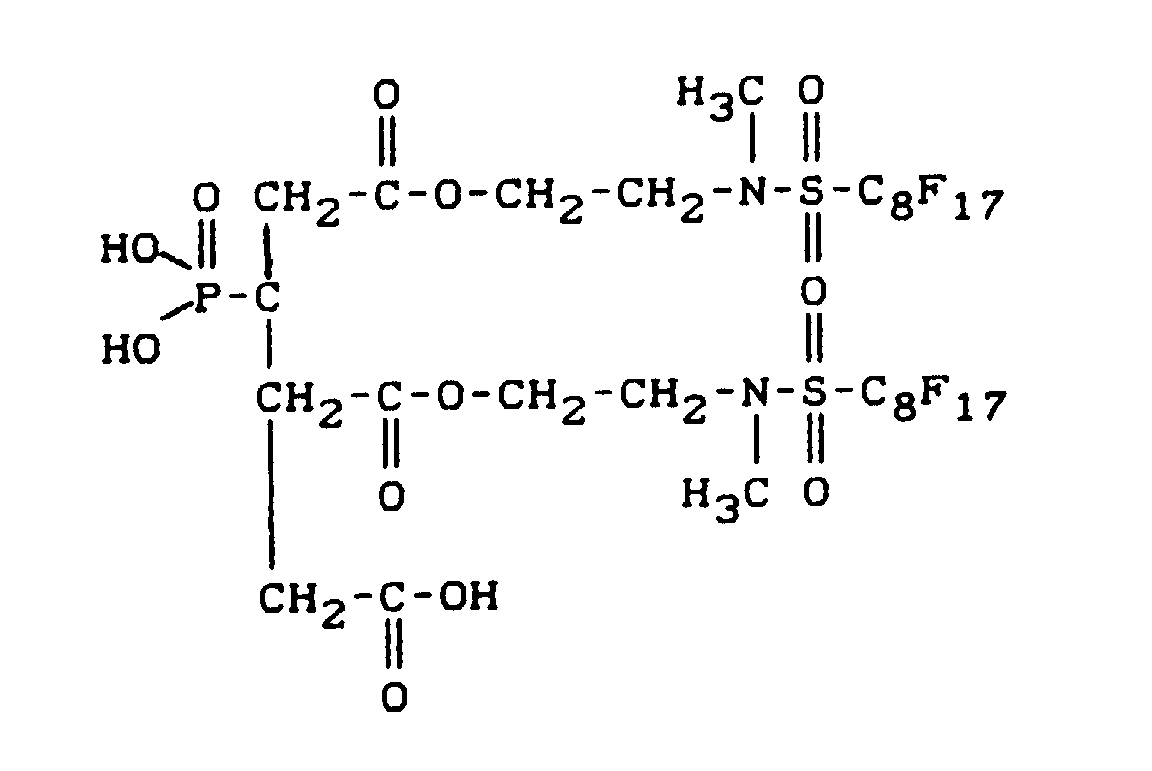
- fluoroalkyl group-containing carboxylic acid esters of phosphonocarboxylic acids have, for example, the following structure:
- the radicals listed below are particularly preferred:
- Another object of the invention is the use the carboxylic acid esters containing fluoroalkyl groups according to the invention of phosphono- or phosphinocarboxylic acids as surfactants.
- fluoroalkyl group-containing carboxylic acid esters of Phosphono- or phosphinocarboxylic acids act as highly effective surfactants, which makes them suitable for following fields of application can be used:
- the compounds of the invention can be used as such or in formulations as anti-fog or tarnish protection (e.g. for glasses, metals or plastics) be used.
- the compounds of the invention can be used as such or in formulations as corrosion inhibitors or Corrosion protection coatings (e.g. in polymerization reactions, for fillers, fibers, salts or magnetic Solids, in paints or blood substitutes) will.
- corrosion inhibitors or Corrosion protection coatings e.g. in polymerization reactions, for fillers, fibers, salts or magnetic Solids, in paints or blood substitutes
- liquids according to the invention are suitable for preventing liquids Connections also as additives to fire extinguishing agents.
- the compounds according to the invention can be used as mold release agents be used.
- connections an improvement of the course, Wetting and adhesion properties. They also prevent by promoting ventilation, the formation of surface defects (such as crater formation or edge alignment). Furthermore, their addition will result in a better distribution of the pigments.
- the is particularly advantageous non-foam-stabilizing effect of the invention Compounds in formulations in the manufacture of water-borne paints.
- the tendency of the compounds according to the invention to be hydrophobic and to form oleophobic barriers use in building protection agents (e.g. for insulation against environmental influences) possible.
- the compounds according to the invention can be used as flow or Lubricants (e.g. in mineral ores or salts) Magnetic tapes or in building materials).
- the compounds of the invention are suitable as Lubricants, cutting oil additives or hydraulic oils.
- the compounds according to the invention can be used as drilling aids (e.g. increased performance in oil drilling) will.
- the compounds according to the invention can be used in photo chemicals or in film production the compounds according to the invention (e.g. as wetting agents or antistatic) can be used.
- connections e.g. as wetting and leveling agents are used will.
- the compounds according to the invention can be used as flame retardants (e.g. in plastics).
- the compounds according to the invention are also used possible as liquid crystals.
- the solvent is then distilled off at 116 ° C. and the product obtained at 50 ° C and 50 mbar dried.
- the yield of the desired fluorine group Carboxylic acid ester of 3-phosphonopropanoic acid is 238.6 g (corresponding to 96.8% of theory).
- the Surface tension of a 0.1% aqueous solution is 28.1 mN / m, that of a corresponding 1% solution 20.4 mN / m (measured with a ring tensiometer from Lauda).
- the solvent is then distilled off at 116 ° C. and the product obtained at 50 ° C and 50 mbar dried.
- the yield of the desired fluorine group Carboxylic acid ester of 3-phosphonopropanoic acid is 342.2 g (corresponding to 98.8% of theory).
- the Surface tension of a 0.1% aqueous solution is 31 mN / m (measured with a ring tensiometer of Lauda).
Landscapes
- Chemical & Material Sciences (AREA)
- Organic Chemistry (AREA)
- Life Sciences & Earth Sciences (AREA)
- Engineering & Computer Science (AREA)
- Biochemistry (AREA)
- Molecular Biology (AREA)
- General Health & Medical Sciences (AREA)
- Health & Medical Sciences (AREA)
- Chemical Kinetics & Catalysis (AREA)
- Oil, Petroleum & Natural Gas (AREA)
- Wood Science & Technology (AREA)
- Materials Engineering (AREA)
- Emulsifying, Dispersing, Foam-Producing Or Wetting Agents (AREA)
Description
Die vorliegende Erfindung betrifft fluorierte Carbonsäureester von Phosphono- oder Phosphinocarbonsäuren sowie deren Verwendung als grenzflächenaktive Mittel.The present invention relates to fluorinated carboxylic acid esters of phosphono- or phosphinocarboxylic acids and their use as surfactants.
Perfluoralkylgruppenhaltige Verbindungen finden aufgrund ihrer hohen Grenzflächenaktivität vielfältige Verwendung als Fluortensid in der Technik. Typische Anwendungen sind der Einsatz als Netz-, Emulgier- und Verlaufsmittel bei Filmbeschichtung, in Lacken oder in Spül- und Reinigungsmitteln (vgl. "Ullmann, Enzyklopädie der technischen Chemie, 4. Auflage 1982, Band 22, S. 500"), Weitere Einsatzgebiete sind im Bereich der Oberflächen- oder Galvanotechnik z.B. zur Lösung von Benetzungsproblemen, Verminderung von Ausschlepp- und Verdampfungsverlusten sowie zur Verbesserung des Oberflächenfinishes (vgl. "J.N.Meußdoerffer und H. Niederprum, Chemikerzeitung 104 (1980) 45-52"). Due to their high interfacial activity, compounds containing perfluoroalkyl groups are widely used as fluorosurfactants in industry. Typical applications are the use as wetting, emulsifying and leveling agents in film coating, in paints or in dishwashing detergents and cleaning agents (cf. "Ullmann, Encyclopedia of Industrial Chemistry, 4th edition 1982, volume 22, p. 500"), others Areas of application are in the field of surface or electroplating technology, for example to solve wetting problems, reduce drag-out and evaporation losses and to improve the surface finish (cf. "JNMeussdoerffer and H. Niederprum, Chemikerzeitung 104 (1980) 45-52").
Beispiele für solche Fluortenside sind Salze von Perfluorcarbon-
oder Sulfonsäuren und polyethersubstituierte
Perfluoralkylverbindungen (vgl. "H.G. Klein,
J.N. Meußdoerffer und H. Niederprum, Metalloberfläche
29 (1975) 559-567"). Wege zu deren Synthese sind in
"J.N. Meußdoerffer und H. Niederprum, Chemikerzeitung
104 (1980) 45-52" beschrieben. Die perfluorierten
Ausgangsverbindungen der oben genannten Fluortenside
sind technisch auf drei unterschiedlichen Synthesewegen
zugänglich:
Da die genannten Methoden zur Herstellung der perfluorierten Ausgangsverbindungen technisch sehr aufwendig sind, resultieren hohe Kosten bei der Herstellung der gewünschten perfluorgruppenhaltigen chemischen Verbindungen.Since the methods mentioned for the production of the perfluorinated Output connections technically very complex are, result in high costs in the production of desired chemical compounds containing perfluoro groups.
Aufgabe war es, fluorgruppenhaltige organmodifizierte Tenside zur Verfügung zu stellen, die als grenzflächenaktive Wirkstoffe eingesetzt werden können und deren Herstellung einfach und kostengünstig möglich ist. Diese Aufgabe wurde durch die erfindungsgemäßen fluorierten Carbonsäureester von Phosphono- und Phosphinocarbonsäuren gelöst. The task was to modify organ groups containing fluorine groups To provide surfactants that act as surfactants Active ingredients can be used and their Manufacturing is easy and inexpensive. This Object was achieved by the fluorinated according to the invention Carboxylic acid esters of phosphono- and phosphinocarboxylic acids solved.
Gegenstand der Erfindung sind fluoralkylgruppenhaltige
Carbonsäureester von Phosphono- oder Phosphinocarbonsäuren
der allgemeinen Formel (I)

- R1
- eine Hydroxylgruppe, eine Methylgruppe, eine Ethylgruppe oder ein Phenylrest ist,
- RF
- ein verzweigter oder linearer Fluoralkylrest mit 1 bis 18 Kohlenstoffatomen ist oder ein fluorierter, verzweigter oder linearer Mono- oder Polyether mit 1-18 Kohlenstoffatomen ist,
- RH
- ein verzweigter oder linearer Alkylrest mit 1 bis 10 Kohlenstoffatomen ist,
- Y
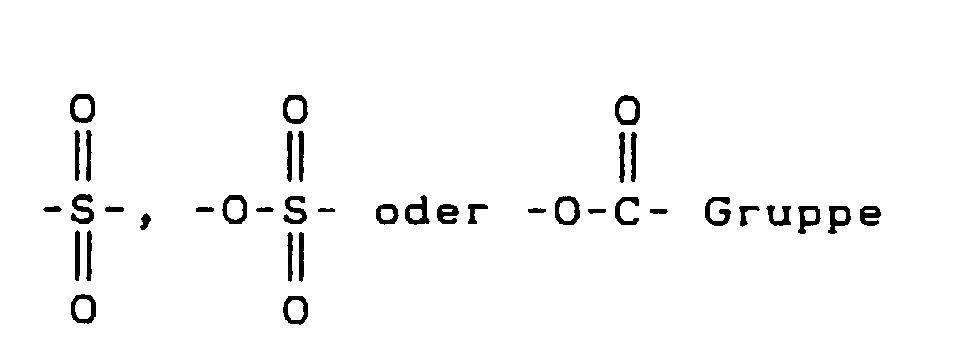
- eine C=O,
darstellt,
- Z
-
- für einen linearen oder verzweigten Alkylenrest mit 1 bis 20 Kohlenstoffatomen
oder- für einen durch Aminogruppen, die ihrerseits durch C1- bis C10-Alkylgruppen oder Arylgruppen substituiert sein können, unterbrochenen linearen oder verzweigten Alkylenrest mit 1 bis 20 Kohlenstoffatomen
oder- für einen durch eine oder mehrere Gruppen der Struktur -COR2 substituierten, linearen oder verzweigten Alkylenrest mit 1 bis 20 Kohlenstoffatomen
oder- für einen durch eine oder mehrere Gruppen der Struktur -PO2HR1 substituierten, linearen oder verzweigten Alkylenrest mit 1 bis 20 Kohlenstoffatomen steht, wobei R1 dieselbe Bedeutung wie oben hat,
- für einen linearen oder verzweigten Alkylenrest mit 1 bis 20 Kohlenstoffatomen
- m
- 0 oder 1 sein kann,
- n
- eine ganze Zahl von 0 bis 6 darstellt und
- R2
- für einen Hydroxylrest oder
einen Rest der Strukturoder für einen linearen oder verzweigten Alkoxyrest mit 1 bis 20 Kohlenstoffatomen steht, wobei n, m, RH, RF und Y die gleiche Bedeutung wie oben haben,
- R 1
- is a hydroxyl group, a methyl group, an ethyl group or a phenyl radical,
- R F
- is a branched or linear fluoroalkyl radical with 1 to 18 carbon atoms or is a fluorinated, branched or linear mono- or polyether with 1-18 carbon atoms,
- R H
- is a branched or linear alkyl radical with 1 to 10 carbon atoms,
- Y
- a C = O, represents
- Z.
-
- for a linear or branched alkylene radical having 1 to 20 carbon atoms
or- for a linear or branched alkylene radical having 1 to 20 carbon atoms which is interrupted by amino groups, which in turn can be substituted by C 1 -C 10 -alkyl groups or aryl groups
or- for a linear or branched alkylene radical having 1 to 20 carbon atoms substituted by one or more groups of the structure -COR 2
or- represents a linear or branched alkylene radical having 1 to 20 carbon atoms substituted by one or more groups of the structure -PO 2 HR 1 , where R 1 has the same meaning as above,
- for a linear or branched alkylene radical having 1 to 20 carbon atoms
- m
- Can be 0 or 1
- n
- represents an integer from 0 to 6 and
- R 2
- for a hydroxyl radical or
a rest of the structureor represents a linear or branched alkoxy radical having 1 to 20 carbon atoms, where n, m, R H , R F and Y have the same meaning as above,
Fluoralkylgruppenhaltige Carbonsäureester von Phosphonooder Phosphinocarbonsäuren sind vorzugsweise solche, bei denen RF ein verzweigter oder linearer Fluoralkylrest mit 3 bis 10 Kohlenstoffatomen ist.Carboxylic acid esters of phosphono or phosphinocarboxylic acids containing fluoroalkyl groups are preferably those in which R F is a branched or linear fluoroalkyl radical having 3 to 10 carbon atoms.
Bevorzugt sind fluoralkylgruppenhaltige Carbonsäureester von Phosphono- oder Phosphinocarbonsäuren, bei denen RH für einen Alkylrest mit einem oder zwei Kohlenstoffatomen steht.Preferred are fluoroalkyl group-containing carboxylic acid esters of phosphono- or phosphinocarboxylic acids, in which R H represents an alkyl radical with one or two carbon atoms.
Besonders bevorzugt sind fluoralkylgruppenhaltige Carbonsäureester von Phosphono- oder Phosphinocarbonsäuren, bei denen n eins oder zwei ist.Carboxylic acid esters containing fluoroalkyl groups are particularly preferred of phosphono- or phosphinocarboxylic acids, where n is one or two.
Fluoralkylgruppenhaltige Carbonsäureester von Phosphonooder Phosphinocarbonsäuren, in denen m eins ist, sind besonders bevorzugt.Fluoroalkyl group-containing carboxylic acid esters from Phosphonooder Phosphinocarboxylic acids in which m is one particularly preferred.
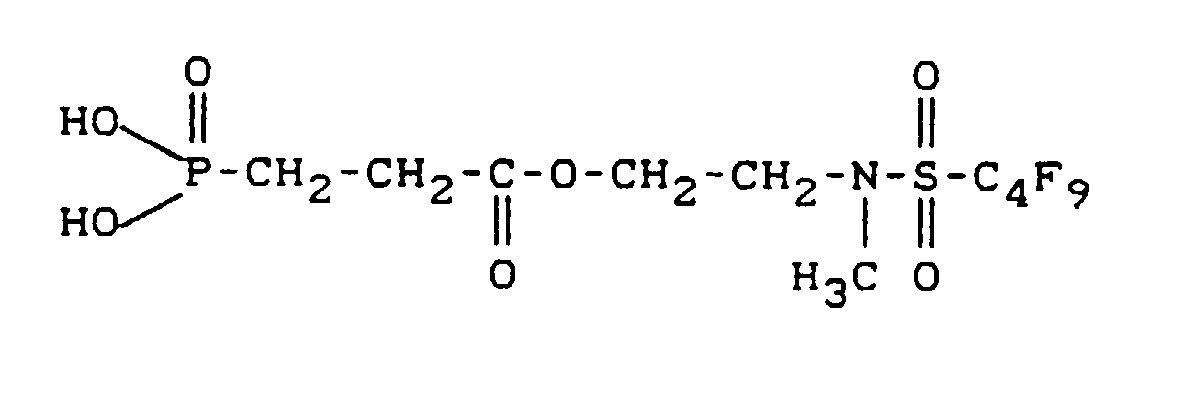
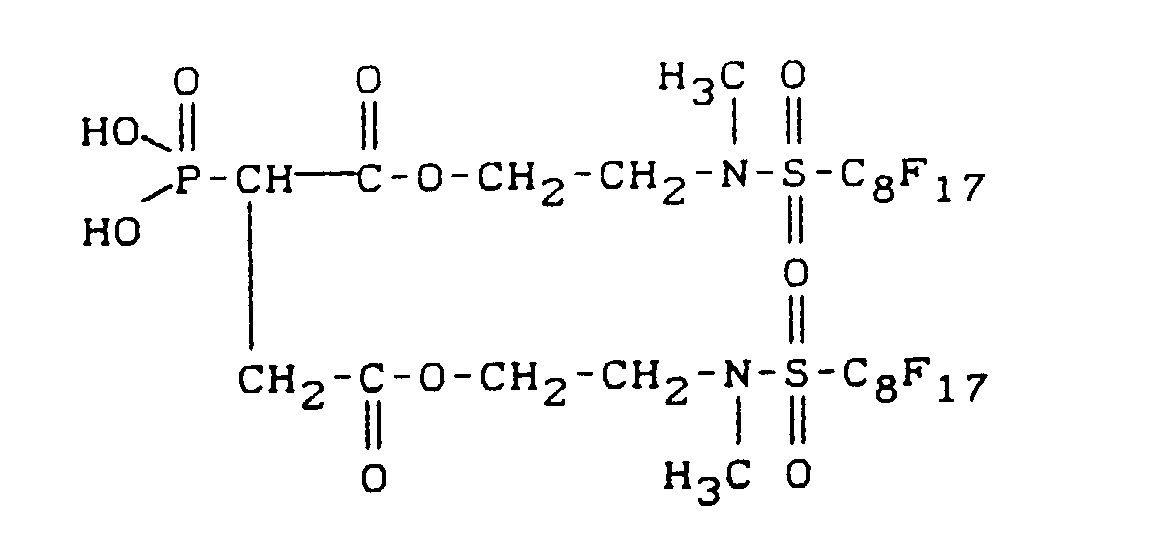
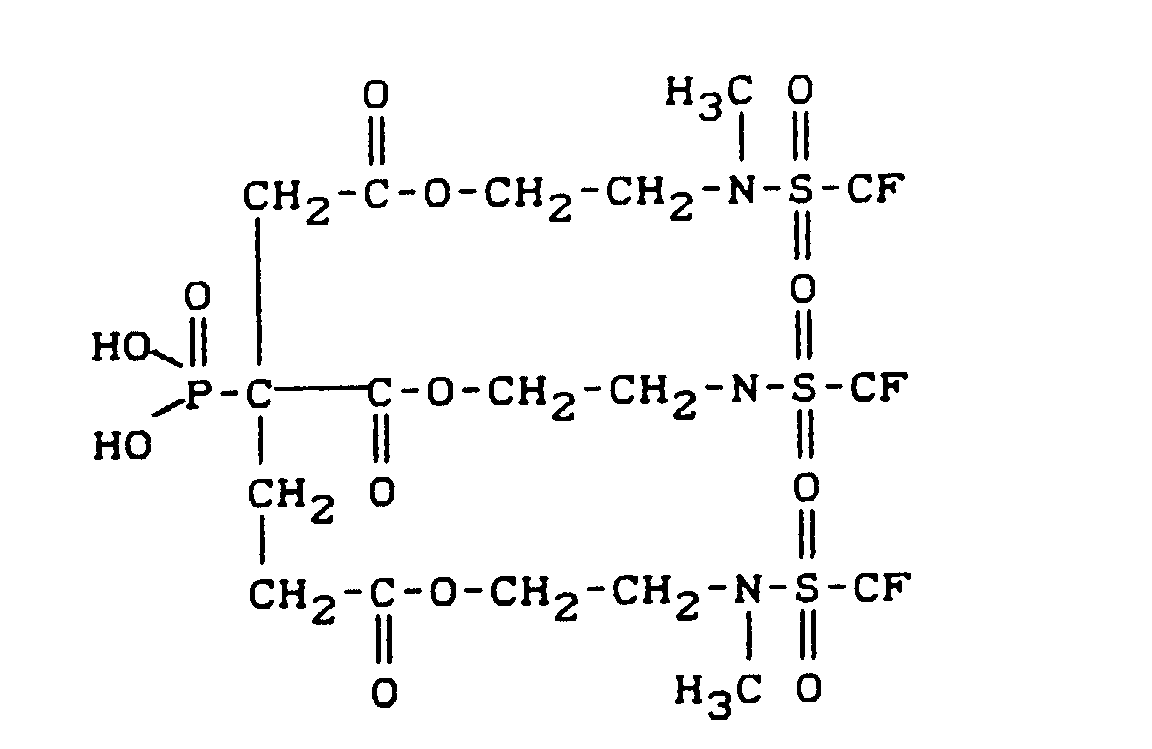
Besonders bevorzugte fluoralkylgruppenhaltige Carbonsäureester
von Phosphonocarbonsäuren weisen beispielsweise
folgende Struktur auf:
-CH2-, -CH(CH3)-, -CH2-CH2-, -CH2-CH(CH3)-, -CH(CH3)-CH2-, -CH2-CH2-CH2-, -CH(COOH)-CH2-, -CH2-CH(CH2-COOH)-, -CH(CH2-CH2-COOH)-CH2-, -CH[-CH(COOH)(PO3H2)]-, -CH(OH)-, -C(CH2-COOH)(CH2-CH2-COOH)-, -C(CH2-COOH)(CH2-CH2-PO3H2)-, -C(CH2-COOH)(-CH(COOH)-CH2-COOH)-, -CH(CH2-CH2-COOH)-, -CH(CH2-CH2-PO3H2)-, -C(CH2-CH2-COOH)2-, -C(CH2-CH2-COOH)(CH2-CH2-PO3H2)-, -C(CH2-CH2-PO3H2)2-, -C(CH2-COOH)(CH2-CH2-CN)-, -CH(CH2-CH2-CN)-, -C(CH2-CH2-CN)2-, -C(CH2-CH2-CN)(CH2-CH2-PO3H2)-, -C(OH)(CH3)-CH2-, -C(OH)(CH3)-CH2-, -C(OH)(CH3)-CH(COOH)-CH2-, -CH2-N(CH2-PO3H2)-CH2-, -CH2-N(CH2-COOH)-CH2-, -CH2-NH-CH2-, -CH2-NH-CH(CH3)-, -CH2-N(CH2-PO3H2) (CH(CH3))-,-CH 2 -, -CH (CH 3 ) -, -CH 2 -CH 2 -, -CH 2 -CH (CH 3 ) -, -CH (CH 3 ) -CH 2 -, -CH 2 -CH 2 - CH 2 -, -CH (COOH) -CH 2 -, -CH 2 -CH (CH 2 -COOH) -, -CH (CH 2 -CH 2 -COOH) -CH 2 -, -CH [-CH (COOH ) (PO 3 H 2 )] -, -CH (OH) -, -C (CH 2 -COOH) (CH 2 -CH 2 -COOH) -, -C (CH 2 -COOH) (CH 2 -CH 2 -PO 3 H 2 ) -, -C (CH 2 -COOH) (- CH (COOH) -CH 2 -COOH) -, -CH (CH 2 -CH 2 -COOH) -, -CH (CH 2 -CH 2 -PO 3 H 2 ) -, -C (CH 2 -CH 2 -COOH) 2 -, -C (CH 2 -CH 2 -COOH) (CH 2 -CH 2 -PO 3 H 2 ) -, -C (CH 2 -CH 2 -PO 3 H 2 ) 2 -, -C (CH 2 -COOH) (CH 2 -CH 2 -CN) -, -CH (CH 2 -CH 2 -CN) -, -C ( CH 2 -CH 2 -CN) 2 -, -C (CH 2 -CH 2 -CN) (CH 2 -CH 2 -PO 3 H 2 ) -, -C (OH) (CH 3 ) -CH 2 -, -C (OH) (CH 3 ) -CH 2 -, -C (OH) (CH 3 ) -CH (COOH) -CH 2 -, -CH 2 -N (CH 2 -PO 3 H 2 ) -CH 2 -, -CH 2 -N (CH 2 -COOH) -CH 2 -, -CH 2 -NH-CH 2 -, -CH 2 -NH-CH (CH 3 ) -, -CH 2 -N (CH 2 - PO 3 H 2 ) (CH (CH 3 )) -,
Die erfindungsgemäßen fluorgruppenhaltigen Carbonsäureester
von Phosphono- oder Phosphinocarbonsäuren lassen
sich z.B. durch einstufige Synthese in einer Veresterungsreaktion
der entsprechenden Phosphono- oder Phosphinocarbonsäuren
oder deren Salzen mit fluorgruppenhaltigen
Alkoholen darstellen:
→ R1(HO)P(O)-Z-COO-(CH2)n-[N(RH)]m-Ym-RF + (HO)xA,
- RF, RH, Y, Z, m und n
- dieselbe Bedeutung wie oben haben,
- A
- ein Wasserstoffkation, ein Ammoniumkation oder ein ein- oder mehrwertiges Metallkation ist,
- x
- eine ganze Zahl ist, die der Ladung des Kation A entspricht.
→ R 1 (HO) P (O) -Z-COO- (CH 2 ) n - [N (R H )] m -Y m -R F + (HO) x A,
- R F , R H , Y, Z, m and n
- have the same meaning as above,
- A
- is a hydrogen cation, an ammonium cation or a mono- or polyvalent metal cation,
- x
- is an integer that corresponds to the charge of the cation A.
Ein weiterer Gegenstand der Erfindung ist die Verwendung der erfindungsgemäßen fluoralkylgruppenhaltigen Carbonsäureester von Phosphono- oder Phosphinocarbonsäuren als grenzflächenaktive Mittel.Another object of the invention is the use the carboxylic acid esters containing fluoroalkyl groups according to the invention of phosphono- or phosphinocarboxylic acids as surfactants.
Aufgrund der hohen Grenzflächenaktivität der erfindungsgemäßen fluoralkylgruppenhaltigen Carbonsäureester von Phosphono- oder Phosphinocarbonsäuren wirken diese als hochwirksame Tenside, wodurch sie beispielsweise in folgenden Anwendungsgebieten eingesetzt werden können:Because of the high interfacial activity of the invention fluoroalkyl group-containing carboxylic acid esters of Phosphono- or phosphinocarboxylic acids act as highly effective surfactants, which makes them suitable for following fields of application can be used:
In elektrolytischen Prozessen (z.B. bei der galvanischen Verchromung, Verkupferung und Vernickelung, beim Anodisieren und bei der elektrolytischen Entfettung) können die erfindungsgemäßen Verbindungen zur Sprühnebelunterdrückung und zur Verhinderung von Austragsverlusten zugesetzt werden.In electrolytic processes (e.g. galvanic Chrome plating, copper plating and nickel plating when anodizing and with electrolytic degreasing) the compounds according to the invention for suppressing spray and added to prevent discharge losses will.
In nicht elektrolytischen Badprozessen (z.B. bei der chemischen Verkupferung oder Vernickelung, bei der chemischen Entfettung oder Entrostung, beim Ätzen oder Gravieren, beim Glanztauchen, beim Beizen, Brünieren oder Passivieren, beim Eloxieren oder beim Entmetallisieren) können die erfindungsgemäßen Verbindungen als Sprühnebelunterdrücker und Reinigungshilfsmittel zugesetzt werden.In non-electrolytic bath processes (e.g. in the chemical copper plating or nickel plating where chemical degreasing or rust removal, during etching or Engraving, when dipping, pickling, bluing or passivation, when anodizing or when demetallizing) can the compounds of the invention as Spray suppressors and cleaning aids added will.
In Reinigungs- und Pflegemitteln (wie z.B. in Glas-, Herd-, Auto-, Gebäude-, Fassaden- oder Metalloberflächenreinigungsmitteln, in Fleckentfernern, in Shampoos, in Polituren für Möbel, Autos usw., in Selbstglanzemulsionen oder in Wachsen) können die erfindungsgemäßen Verbindungen als Verlaufs-, Spreit- und Netzmittel sowie zur Unterstützung der Eigenschaften, die die Wiederanschmutzung verhindern, zugesetzt werden.In cleaning and care products (e.g. in glass, Stove, car, building, facade or metal surface cleaning agents, in stain removers, in shampoos, in polishes for furniture, cars, etc., in self-gloss emulsions or in waxes) can the invention Connections as flow, spreading and wetting agents as well to support the properties of the re-pollution prevent being added.
Die erfindungsgemäßen Verbindungen können als solche oder in Formulierungen als Antibeschlagmittel oder Anlaufschutz (z.B. für Gläser, Metalle oder Kunststoffe) eingesetzt werden.The compounds of the invention can be used as such or in formulations as anti-fog or tarnish protection (e.g. for glasses, metals or plastics) be used.
Die erfindungsgemäßen Verbindungen können als solche oder in Formulierungen als Korrosionsinhibitoren oder Korrosionsschutzüberzüge (z.B. in Polymerisationsreaktionen, für Füllstoffe, Fasern, Salze oder magnetische Feststoffe, in Lacken oder Blutersatzstoffen) eingesetzt werden.The compounds of the invention can be used as such or in formulations as corrosion inhibitors or Corrosion protection coatings (e.g. in polymerization reactions, for fillers, fibers, salts or magnetic Solids, in paints or blood substitutes) will.
Aufgrund ihrer Neigung, gasdichte Sperrschichten auszubilden und damit das Verdampfen oder Verdunsten von Flüssigkeiten zu verhindern, eignen sich die erfindungsgemäßen Verbindungen auch als Zusätze zu Feuerlöschmitteln.Because of their tendency to form gas-tight barrier layers and thus the evaporation or evaporation of The liquids according to the invention are suitable for preventing liquids Connections also as additives to fire extinguishing agents.
Die erfindungsgemäßen Verbindungen können als Formtrennmittel eingesetzt werden.The compounds according to the invention can be used as mold release agents be used.
In Farben und Lacken bewirkt ein Zusatz der erfindungsgemäßen Verbindungen eine Verbesserung der Verlaufs-, Netz- und Haftungseigenschaften. Außerdem verhindern sie durch Förderung der Entlüftung die Bildung von Oberflächendefekten (wie z.B. Kraterbildung oder Kantenflucht). Ferner wird durch ihren Zusatz eine bessere Verteilung der Pigmente erreicht. Von besonderem Vorteil ist die nicht schaumstabilisierende Wirkung der erfindungsgemäßen Verbindungen in Rezepturen bei der Herstellung von wasserverdünnbaren Lacken.In paints and varnishes, an addition of the invention Connections an improvement of the course, Wetting and adhesion properties. They also prevent by promoting ventilation, the formation of surface defects (such as crater formation or edge alignment). Furthermore, their addition will result in a better distribution of the pigments. The is particularly advantageous non-foam-stabilizing effect of the invention Compounds in formulations in the manufacture of water-borne paints.
Die Neigung der erfindungsgemäßen Verbindungen, hydrophobe und oleophobe Sperrschichten auszubilden, macht einen Einsatz in Bautenschutzmitteln (z.B. zur Isolierung gegen Umwelteinflüsse) möglich.The tendency of the compounds according to the invention to be hydrophobic and to form oleophobic barriers use in building protection agents (e.g. for insulation against environmental influences) possible.
Die erfindungsgemäßen Verbindungen können als Fließoder Gleitmittel (z.B. in Mineralerzen oder -salzen, auf Magnetbändern oder in Baustoffen) eingesetzt werden.The compounds according to the invention can be used as flow or Lubricants (e.g. in mineral ores or salts) Magnetic tapes or in building materials).
Die erfindungsgemäßen Verbindungen eignen sich als Schmiermittel, Schneidölzusätze oder Hydrauliköle.The compounds of the invention are suitable as Lubricants, cutting oil additives or hydraulic oils.
Die erfindungsgemäßen Verbindungen können als Bohrhilfsmittel (z.B. Leistungssteigerung bei Ölbohrungen) eingesetzt werden.The compounds according to the invention can be used as drilling aids (e.g. increased performance in oil drilling) will.
In Fotochemikalien oder bei der Filmherstellung können die erfindungsgemäßen Verbindungen (z.B. als Netzmittel oder Antistatikum) eingesetzt werden.Can be used in photo chemicals or in film production the compounds according to the invention (e.g. as wetting agents or antistatic) can be used.
In Pflanzenschutzmitteln können die erfindungsgemäßen Verbindungen (z.B. als Netz- und Verlaufsmittel) eingesetzt werden.In crop protection agents, the invention Connections (e.g. as wetting and leveling agents) are used will.
Ein Zusatz der erfindungsgemäßen Verbindungen zu Ausrüstungsmitteln für Textilien, Leder oder Papier kann beispielsweise die Benetzung oder das Eindringen des Ausrüstungsmittels fördern, zu einer Entschäumung führen oder dessen Hydrophob-/Oleophobwirkung unterstützen.An addition of the compounds according to the invention to finishing agents for textiles, leather or paper for example the wetting or penetration of the Promote equipment, lead to defoaming or support its hydrophobic / oleophobic effect.
Die erfindungsgemäßen Verbindungen können als Flammschutzmittel (z.B. in Kunststoffen) eingesetzt werden.The compounds according to the invention can be used as flame retardants (e.g. in plastics).
Außerdem ist ein Einsatz der erfindungsgemäßen Verbindungen als Flüssigkristalle möglich.The compounds according to the invention are also used possible as liquid crystals.
Die Erfindung soll anhand folgender Beispiele näher erläutert werden. The invention is illustrated by the following examples will.
In einer Dreihalskolben-Rührapparatur mit Wasserabscheider werden 0,5 Mol (178,5 g) N-(2-Hydroxyethyl)-N-methyl-perfluorbutylsulfonamid in 150 ml 4-Methylpentan-2-on gelöst und mit 0,5 ml konzentrierter Schwefelsäure versetzt. Diese Lösung wird bis zum Rückfluß erhitzt (116°C). Anschließend versetzt man unter Rückfluß langsam 0,5 Mol (77 g) 3-Phosphonopropansäure. Die Temperatur wird solange am Rückfluß (100°C) gehalten, bis die komplette Menge Wasser (0,5 Mol) aus dem Reaktionsgemisch abdestilliert ist, und die Temperatur wieder auf 116°C steigt.In a three-necked flask with water separator 0.5 mol (178.5 g) of N- (2-hydroxyethyl) -N-methyl-perfluorobutylsulfonamide in 150 ml of 4-methylpentan-2-one dissolved and with 0.5 ml of concentrated sulfuric acid transferred. This solution is made to reflux heated (116 ° C). Then it is refluxed slowly 0.5 mole (77 g) 3-phosphonopropanoic acid. The Temperature is kept at reflux (100 ° C) until the complete amount of water (0.5 mol) from the reaction mixture is distilled off, and the temperature again rises to 116 ° C.
Anschließend wird das Lösungsmittel bei 116°C abdestilliert, und das erhaltene Produkt bei 50°C und 50 mbar getrocknet. Die Ausbeute des gewünschten fluorgruppenhaltigen Carbonsäureesters von 3-Phosphonopropansäure beträgt 238,6 g (entsprechend 96,8 % der Theorie). Die Oberflächenspannung einer 0,1 %igen wäßrigen Lösung beträgt 28,1 mN/m, die einer entsprechenden 1 %igen Lösung 20,4 mN/m (gemessen mit einem Ringtensiometer der Fa. Lauda).The solvent is then distilled off at 116 ° C. and the product obtained at 50 ° C and 50 mbar dried. The yield of the desired fluorine group Carboxylic acid ester of 3-phosphonopropanoic acid is 238.6 g (corresponding to 96.8% of theory). The Surface tension of a 0.1% aqueous solution is 28.1 mN / m, that of a corresponding 1% solution 20.4 mN / m (measured with a ring tensiometer from Lauda).
In einer Dreihalskolben-Rührapparatur mit Wasserabscheider werden 0,5 Mol (278,5 g) N-(2-Hydroxyethyl)-N-methyl-perfluoroctylsulfonamid in 150 ml 4-Methylpentan-2-on gelöst und mit 0,5 ml konzentrierter Schwefelsäure versetzt. Diese Lösung wird bis zum Rückfluß erhitzt (116°C). Anschließend versetzt man unter Rückfluß langsam 0,5 Mol (77 g) 3-Phosphonopropansäure. Die Temperatur wird solange am Rückfluß (100°C) gehalten, bis die komplette Menge Wasser (0,5 Mol) aus dem Reaktionsgemisch abdestilliert ist, und die Temperatur wieder auf 116°C steigt.In a three-necked flask with water separator 0.5 mol (278.5 g) of N- (2-hydroxyethyl) -N-methyl-perfluorooctylsulfonamide in 150 ml of 4-methylpentan-2-one dissolved and with 0.5 ml of concentrated sulfuric acid transferred. This solution is made to reflux heated (116 ° C). Then it is refluxed slowly 0.5 mole (77 g) 3-phosphonopropanoic acid. The Temperature is kept at reflux (100 ° C) until the complete amount of water (0.5 mol) from the reaction mixture is distilled off, and the temperature again rises to 116 ° C.
Anschließend wird das Lösungsmittel bei 116°C abdestilliert, und das erhaltene Produkt bei 50°C und 50 mbar getrocknet. Die Ausbeute des gewünschten fluorgruppenhaltigen Carbonsäureesters von 3-Phosphonopropansäure beträgt 342,2 g (entsprechend 98,8 % der Theorie). Die Oberflächenspannung einer 0,1 %igen wäßrigen Lösung beträgt 31 mN/m (gemessen mit einem Ringtensiometer der Fa. Lauda).The solvent is then distilled off at 116 ° C. and the product obtained at 50 ° C and 50 mbar dried. The yield of the desired fluorine group Carboxylic acid ester of 3-phosphonopropanoic acid is 342.2 g (corresponding to 98.8% of theory). The Surface tension of a 0.1% aqueous solution is 31 mN / m (measured with a ring tensiometer of Lauda).
In einer Dreihalskolben-Rührapparatur mit Wasserabscheider werden 0,4 Mol (222,8 g) N-(2-Hydroxyethyl)-N-methyl-perfluoroctyl-sulfonamid in 150 ml 4-Methylpentan-2-on gelöst und mit 0,5 ml konzentrierter Schwefelsäure versetzt. Diese Lösung wird bis zum Rückfluß erhitzt (116°C). Anschließend versetzt man unter Rückfluß langsam mit 0,2 Mol (39,6 g) Phosphonoethan-1,2-dicarbonsäure. Die Temperatur wird solange am Rückfluß (100°C) gehalten, bis die komplette Menge Wasser (0,4 Mol) aus dem Reaktionsgemisch abdestilliert ist, und die Temperatur wieder auf 116°C steigt. In a three-necked flask with water separator 0.4 mole (222.8 g) of N- (2-hydroxyethyl) -N-methyl-perfluorooctyl-sulfonamide in 150 ml of 4-methylpentan-2-one dissolved and concentrated with 0.5 ml Sulfuric acid added. This solution will last until Reflux heated (116 ° C). Then you move under reflux slowly with 0.2 mol (39.6 g) phosphonoethane-1,2-dicarboxylic acid. The temperature is on as long as Reflux (100 ° C) held until the complete amount Water (0.4 mol) was distilled off from the reaction mixture and the temperature rises to 116 ° C again.
Anschließend wird das Lösungsmittel bei 116°C abdestilliert und das erhaltene Produkt bei 50°C und 50 mbar getrocknet. Die Ausbeute des gewünschten fluorgruppenhaltigen Carbonsäureesters von Phosphonoethan-1,2-dicarbonsäure beträgt 247 g (entsprechend 96,8 % der Theorie). Die Oberflächenspannung einer 0,1%igen wäßrigen Lösung beträgt 34,5 mN/m, die einer entsprechenden 1%igen Lösung 28,4 mN/m (gemessen mit einem Ringtensiometer der Fa. Lauda).The solvent is then distilled off at 116 ° C. and the product obtained at 50 ° C and 50 mbar dried. The yield of the desired fluorine group Carboxylic acid ester of phosphonoethane-1,2-dicarboxylic acid is 247 g (corresponding to 96.8% of the Theory). The surface tension of a 0.1% aqueous Solution is 34.5 mN / m, that of a corresponding one 1% solution 28.4 mN / m (measured with a ring tensiometer from Lauda).
In einer Dreihalskolben-Rührapparatur mit Wasserabscheider werden 3,0 Mol (1071 g) N-(2-Hydroxyethyl)-N-methyl-perfluorbutylsulfonamid in 850 ml Chlorbenzol gelöst und mit 3 ml konzentrierter Schwefelsäure versetzt. Diese Lösung wird auf 120°C erhitzt. Anschließend versetzt man langsam mit 1,0 Mol (54,0 g) 2-Phosphonobutan-1,2,4-tricarbonsaure. Nach erfolgter Zugabe wird solange am Rückfluß gehalten, bis die komplette Menge Wasser (0,6 Mol) aus dem Reaktionsgemisch abdestilliert ist.In a three-necked flask with water separator 3.0 moles (1071 g) of N- (2-hydroxyethyl) -N-methyl-perfluorobutylsulfonamide in 850 ml chlorobenzene dissolved and mixed with 3 ml of concentrated sulfuric acid. This solution is heated to 120 ° C. Subsequently 1.0 mol (54.0 g) of 2-phosphonobutane-1,2,4-tricarboxylic acid are slowly added. After the addition is complete kept at reflux until the entire amount Distilled water (0.6 mol) from the reaction mixture is.
Anschließend wird das Lösungsmittel bei 70°C und 70 mbar abdestilliert und das erhaltene Produkt vollständig getrocknet. Die Ausbeute des gewünschten fluorgruppenhaltigen Carbonsäureesters von 2-Phosphonobutan-1,2,4-tricarbonsäure beträgt 1281 g (entsprechend 99,5 % der Theorie). Die Oberflächenspannung einer 0,1%igen wäßrigen Lösung beträgt 22,4 mN/m (gemessen mit einem Ringtensiometer der Fa. Lauda). The solvent is then at 70 ° C and 70 mbar distilled off and the product obtained completely dried. The yield of the desired fluorine group Carboxylic acid ester of 2-phosphonobutane-1,2,4-tricarboxylic acid is 1281 g (corresponding to 99.5% of the Theory). The surface tension of a 0.1% aqueous Solution is 22.4 mN / m (measured with a Ring tensiometer from Lauda).
In einer Dreihalskolben-Rührapparatur mit Wasserabscheider werden 0,4 Mol (222,8 g) N-(2-Hydroxyethyl)-N-methyl-perfluoroctyl-sulfonamid in 150 ml 4-Methylpentan-2-on gelöst und mit 0,5 ml konzentrierter Schwefelsäure versetzt. Diese Lösung wird bis zum Rückfluß erhitzt (116°C). Anschließend versetzt man unter Rückfluß langsam mit 0,2 Mol (54 g) 2-Phosphonobutan-1,2,4-tricarbonsäure. Die Temperatur wird solange am Rückfluß (100°C) gehalten, bis die komplette Menge Wasser (0,4 Mol) aus dem Reaktionsgemisch abdestilliert ist, und die Temperatur wieder auf 116°C steigt.In a three-necked flask with water separator 0.4 mole (222.8 g) of N- (2-hydroxyethyl) -N-methyl-perfluorooctyl-sulfonamide in 150 ml of 4-methylpentan-2-one dissolved and with 0.5 ml of concentrated sulfuric acid transferred. This solution is made to reflux heated (116 ° C). Then it is refluxed slowly with 0.2 mol (54 g) 2-phosphonobutane-1,2,4-tricarboxylic acid. The temperature will continue to reflux (100 ° C) kept until the complete amount of water (0.4 mol) is distilled off from the reaction mixture, and the temperature rises again to 116 ° C.
Anschließend wird das Lösungsmittel bei 116°C abdestilliert und das erhaltene Produkt bei 50°C und 50 mbar getrocknet. Die Ausbeute des gewünschten fluorgruppenhaltigen Carbonsäureesters von 2-Phosphonobutan-1,2,4-tricarbonsäure beträgt 268 g (entsprechend 99,4 % der Theorie). Die Oberflächenspannung einer 0,1%igen wäßrigen Lösung beträgt 28,2 mN/m, die einer entsprechenden 1%igen Lösung 27,6 mN/m (gemessen mit einem Ringtensiometer der Fa. Lauda).The solvent is then distilled off at 116 ° C. and the product obtained at 50 ° C and 50 mbar dried. The yield of the desired fluorine group Carboxylic acid ester of 2-phosphonobutane-1,2,4-tricarboxylic acid is 268 g (corresponding to 99.4% of the Theory). The surface tension of a 0.1% aqueous Solution is 28.2 mN / m, that of a corresponding one 1% solution 27.6 mN / m (measured with a ring tensiometer from Lauda).
Claims (7)
- Fluoroalkyl group-containing carboxylic acid esters of phosphonocarboxylic acids or phosphinocarboxylic acids of the general formula (I)wherein

- R1
- is a hydroxyl group, a methyl group, an ethyl group or a phenyl radical,
- RF
- is a branched or straight-chain fluoroalkyl radical having from 1 to 18 carbon atoms or a fluorinated, branched or straight-chain monoether or polyether having from 1 to 18 carbon atoms,
- RH
- is a branched or straight-chain alkyl radical having from 1 to 10 carbon atoms,
- Y
- denotes a C=O,
group,

- Z
- stands for a straight or branched-chain alkylene
radical having from 1 to 20 carbon atoms, or
- a straight or branched-chain alkylene radical having from 1 to 20 carbon atoms interrupted by amino groups which may themselves be substituted by C1- to C10- alkyl groups or aryl groups, or
- a straight or branched-chain alkylene radical having from 1 to 20 carbon atoms, which is substituted by one or more groups of the structure -COR2, or
- a straight or branched-chain alkylene radical having from 1 to 20 carbon atoms, which is substituted by one or more groups of the structure -PO3HR1, wherein R1 has the same meaning as above,
- m
- can be 0 or 1,
- n
- denotes an integer from 0 to 6, and
- R2
- stands for a hydroxyl radical or
a radical of the structureor a straight or branched-chain alkoxy radical having from 1 to 20 carbon atoms, wherein n, m, RH, RF and Y have the same meanings as above,
- Fluoroalkyl group-containing carboxylic acid esters of phosphonocarboxylic acids or phosphinocarboxylic acids according to Claim 1, characterised in that RF is a branched or straight-chain fluoroalkyl radical having from 3 to 10 carbon atoms.
- Fluoroalkyl group-containing carboxylic acid esters of phosphonocarboxylic acids or phosphinocarboxylic acids according to Claim 1, characterised in that RH stands for an alkyl radical having one or two carbon atoms.
- Fluoroalkyl group-containing carboxylic acid esters of phosphonocarboxylic acids or phosphinocarboxylic acids according to Claim 1, characterised in that n is one or two.
- Fluoroalkyl group-containing carboxylic acid esters of phosphonocarboxylic acids or phosphinocarboxylic acids according to Claim 1, characterised in that m is one.
- Process for the preparation of the fluoroalkyl group-containing carboxylic acid esters of phosphonocarboxylic acids or phosphinocarboxylic acids according to Claims 1 to 5, characterised in that in a single-stage synthesis the corresponding phosphonocarboxylic acids or phosphinocarboxylic acids of the formula (II) or salts thereof
 wherein A is a hydrogen cation, an ammonium cation or a mono- or polyvalent metal cation and X is an integer which corresponds to the charge of the cation A,wherein R1 and Z have the same meanings as above, are esterified with the corresponding fluoro group-containing alcohols of the formula (III)
 wherein n, m, RH, Y and RF have the same meaning as above.
 - Use of the fluoroalkyl group-containing carboxylic acid esters of phosphonocarboxylic acids or phosphinocarboxylic acids according to Claims 1 to 5 as surface-active agents.
Applications Claiming Priority (2)
| Application Number | Priority Date | Filing Date | Title |
|---|---|---|---|
| DE4241478A DE4241478A1 (en) | 1992-12-09 | 1992-12-09 | Fluorinated carboxylic acid esters of phosphono- and phosphinocarboxylic acids and their use |
| DE4241478 | 1992-12-09 |
Publications (2)
| Publication Number | Publication Date |
|---|---|
| EP0601418A1 EP0601418A1 (en) | 1994-06-15 |
| EP0601418B1 true EP0601418B1 (en) | 1998-04-29 |
Family
ID=6474791
Family Applications (1)
| Application Number | Title | Priority Date | Filing Date |
|---|---|---|---|
| EP93119099A Expired - Lifetime EP0601418B1 (en) | 1992-12-09 | 1993-11-26 | Fluorinated carbonic esters from phosphono and phosphino carboxylic acids and their use |
Country Status (9)
| Country | Link |
|---|---|
| US (1) | US5342986A (en) |
| EP (1) | EP0601418B1 (en) |
| JP (1) | JP3310434B2 (en) |
| KR (1) | KR100291397B1 (en) |
| CN (1) | CN1041093C (en) |
| CA (1) | CA2110727A1 (en) |
| DE (2) | DE4241478A1 (en) |
| ES (1) | ES2114997T3 (en) |
| TW (1) | TW242143B (en) |
Families Citing this family (12)
| Publication number | Priority date | Publication date | Assignee | Title |
|---|---|---|---|---|
| US7160850B2 (en) * | 2004-12-30 | 2007-01-09 | 3M Innovative Properties Company | Compositions of monomeric surfactants |
| US7776983B2 (en) * | 2004-12-30 | 2010-08-17 | 3M Innovative Properties Company | Fluorochemical polymeric surfactants |
| US7495118B2 (en) * | 2004-12-30 | 2009-02-24 | 3M Innovative Properties Company | Compositions containing C4-swallow tail silanes |
| US7547732B2 (en) * | 2005-08-30 | 2009-06-16 | 3M Innovative Properties Company | Compositions of fluorochemical surfactants |
| US7164041B1 (en) | 2005-11-17 | 2007-01-16 | 3M Innovative Properties Company | Fluorinated Gemini surfactants |
| US7629298B2 (en) * | 2006-02-21 | 2009-12-08 | 3M Innovative Properties Company | Sandstone having a modified wettability and a method for modifying the surface energy of sandstone |
| DE102006025847A1 (en) * | 2006-06-02 | 2007-12-06 | Merck Patent Gmbh | Use of phosphinic acid in electroplating |
| US7569715B2 (en) * | 2006-07-05 | 2009-08-04 | 3M Innovative Properties Company | Compositions containing silanes |
| DE102007029837A1 (en) * | 2007-06-28 | 2009-01-02 | Siemens Ag | Additive, useful e.g. in a cleaning or care-product, which is in the form of a compound formed as linear molecule having a molecular chain and an anchoring group, which binds to a metallic surface and forms a monomolecular layer |
| EP2588516B1 (en) | 2010-06-30 | 2020-06-24 | 3M Innovative Properties Company | (meth)acryloyl pressure-sensitive foam adhesives |
| US10626268B2 (en) | 2012-04-13 | 2020-04-21 | 3M Innovative Properties Company | Pressure sensitive adhesive foams and articles therefrom |
| CN116063207B (en) * | 2022-12-22 | 2024-10-29 | 浙江大学 | Amphiphilic lipids containing N-oxide tertiary amine groups, liposome drug delivery systems and applications |
Family Cites Families (7)
| Publication number | Priority date | Publication date | Assignee | Title |
|---|---|---|---|---|
| DE2424243A1 (en) * | 1974-05-18 | 1975-11-27 | Bayer Ag | PERFLUORALKANE SULFONAMIDOALKANE PHOSPHONIC ACID OR - PHOSPHIC ACID DERIVATIVES |
| DE2439281A1 (en) | 1974-08-16 | 1976-02-26 | Henkel & Cie Gmbh | Trifluoromethyl phosphono-butyric acid and derivs - for use as flame retardants,lubricant additives, hydrophobing agents, etc. |
| US4293441A (en) * | 1979-03-12 | 1981-10-06 | Minnesota Mining And Manufacturing Company | Corrosion inhibiting heat transfer liquid |
| US4602092A (en) * | 1983-09-19 | 1986-07-22 | E. R. Squibb & Sons, Inc. | Method for making phosphinic acid intermediates |
| DE3663666D1 (en) * | 1985-03-28 | 1989-07-06 | Hoechst Ag | Functional derivatives of phosphorus containing acetic acids, process for their preparation and herbicidal and plant growth regulator composition containing them |
| US4740608A (en) * | 1985-10-09 | 1988-04-26 | Monsanto Company | (Phosphonomethyl)trifluoromethyl sulfonates |
| DE3605800A1 (en) * | 1986-02-22 | 1987-08-27 | Bayer Ag | 2-PHOSPHONOBUTAN-1,2,4-TRICARBONIC ACID DERIVATIVES AS EMULSIFIERS |
-
1992
- 1992-12-09 DE DE4241478A patent/DE4241478A1/en not_active Withdrawn
-
1993
- 1993-11-10 TW TW082109406A patent/TW242143B/zh active
- 1993-11-24 US US08/157,820 patent/US5342986A/en not_active Expired - Fee Related
- 1993-11-26 EP EP93119099A patent/EP0601418B1/en not_active Expired - Lifetime
- 1993-11-26 ES ES93119099T patent/ES2114997T3/en not_active Expired - Lifetime
- 1993-11-26 DE DE59308469T patent/DE59308469D1/en not_active Expired - Fee Related
- 1993-12-06 CA CA002110727A patent/CA2110727A1/en not_active Abandoned
- 1993-12-08 KR KR1019930026817A patent/KR100291397B1/en not_active Expired - Fee Related
- 1993-12-08 JP JP34019993A patent/JP3310434B2/en not_active Expired - Fee Related
- 1993-12-09 CN CN93120454A patent/CN1041093C/en not_active Expired - Fee Related
Also Published As
| Publication number | Publication date |
|---|---|
| TW242143B (en) | 1995-03-01 |
| JP3310434B2 (en) | 2002-08-05 |
| CA2110727A1 (en) | 1994-06-10 |
| KR100291397B1 (en) | 2001-11-22 |
| KR940014422A (en) | 1994-07-18 |
| DE4241478A1 (en) | 1994-06-16 |
| CN1096030A (en) | 1994-12-07 |
| CN1041093C (en) | 1998-12-09 |
| DE59308469D1 (en) | 1998-06-04 |
| JPH06234780A (en) | 1994-08-23 |
| US5342986A (en) | 1994-08-30 |
| ES2114997T3 (en) | 1998-06-16 |
| EP0601418A1 (en) | 1994-06-15 |
Similar Documents
| Publication | Publication Date | Title |
|---|---|---|
| EP0571832B1 (en) | Imides and their salts and their use as surface active agents | |
| EP0601418B1 (en) | Fluorinated carbonic esters from phosphono and phosphino carboxylic acids and their use | |
| DE69216707T2 (en) | Perfluoroalkyl halides and derivatives | |
| CA1102804A (en) | Perfluoroalkylthioethyl ether derivatives | |
| US4239915A (en) | Perfluoroalkyl carboxylic acids | |
| DE102009030846A1 (en) | fluorosurfactants | |
| DE1242626B (en) | Process for the production of surface-active, substituted amide derivatives of long-chain, perfluorinated or monochloroperfluorinated carboxylic acids | |
| WO2010003567A2 (en) | Fluorosurfactants | |
| DE2753095C2 (en) | ||
| DE68908066T2 (en) | Fluorochemical, surface-active compounds and process for their preparation. | |
| WO2011082770A2 (en) | Fluorinated tensides | |
| DE2852593A1 (en) | FLUORINATED NON-IONIC SURFACTANTS | |
| DE2758013C3 (en) | Use of fluorinated synergists, possibly in combination with magnesium salts, to lower the surface tension of aqueous solutions of fluorinated ensides | |
| EP0600294B1 (en) | Polyether substituted imide compounds and their use | |
| US5587513A (en) | Polyether-substituted imide compounds and their use | |
| DE2110767B2 (en) | PERFLUORALKYL-PHOSPHORUS COMPOUNDS | |
| DE2523402A1 (en) | POLYOXAPOLYFLUOROALKANE SULFONATES AND METHOD FOR PREPARATION | |
| EP1861347B1 (en) | Novel amphiphile acetals | |
| AT233024B (en) | Process for the preparation of new organophosphorus compounds | |
| DE2808754A1 (en) | PROCESS FOR THE PREPARATION OF DERIVATIVES OF STRAIGHT CHAIN PERFLUORIZED OLEFINS | |
| WO1997009304A1 (en) | Anionic amphiphilic compounds with several hydrophilic and hydrophobic groups derived from acetylene | |
| DD249384A3 (en) | METHOD FOR PRODUCING FLUORAROMATIC NON-ATIONOGENIC BORDER-ACTIVE SUBSTANCES |
Legal Events
| Date | Code | Title | Description |
|---|---|---|---|
| PUAI | Public reference made under article 153(3) epc to a published international application that has entered the european phase |
Free format text: ORIGINAL CODE: 0009012 |
|
| AK | Designated contracting states |
Kind code of ref document: A1 Designated state(s): BE CH DE ES FR GB IT LI NL |
|
| 17P | Request for examination filed |
Effective date: 19940627 |
|
| GRAG | Despatch of communication of intention to grant |
Free format text: ORIGINAL CODE: EPIDOS AGRA |
|
| GRAG | Despatch of communication of intention to grant |
Free format text: ORIGINAL CODE: EPIDOS AGRA |
|
| GRAH | Despatch of communication of intention to grant a patent |
Free format text: ORIGINAL CODE: EPIDOS IGRA |
|
| 17Q | First examination report despatched |
Effective date: 19971001 |
|
| GRAH | Despatch of communication of intention to grant a patent |
Free format text: ORIGINAL CODE: EPIDOS IGRA |
|
| GRAA | (expected) grant |
Free format text: ORIGINAL CODE: 0009210 |
|
| AK | Designated contracting states |
Kind code of ref document: B1 Designated state(s): BE CH DE ES FR GB IT LI NL |
|
| REG | Reference to a national code |
Ref country code: CH Ref legal event code: EP |
|
| REF | Corresponds to: |
Ref document number: 59308469 Country of ref document: DE Date of ref document: 19980604 |
|
| ITF | It: translation for a ep patent filed | ||
| REG | Reference to a national code |
Ref country code: ES Ref legal event code: FG2A Ref document number: 2114997 Country of ref document: ES Kind code of ref document: T3 |
|
| ET | Fr: translation filed | ||
| GBT | Gb: translation of ep patent filed (gb section 77(6)(a)/1977) |
Effective date: 19980731 |
|
| PLBE | No opposition filed within time limit |
Free format text: ORIGINAL CODE: 0009261 |
|
| STAA | Information on the status of an ep patent application or granted ep patent |
Free format text: STATUS: NO OPPOSITION FILED WITHIN TIME LIMIT |
|
| 26N | No opposition filed | ||
| REG | Reference to a national code |
Ref country code: GB Ref legal event code: IF02 |
|
| PGFP | Annual fee paid to national office [announced via postgrant information from national office to epo] |
Ref country code: DE Payment date: 20021015 Year of fee payment: 10 |
|
| PGFP | Annual fee paid to national office [announced via postgrant information from national office to epo] |
Ref country code: NL Payment date: 20021031 Year of fee payment: 10 |
|
| PGFP | Annual fee paid to national office [announced via postgrant information from national office to epo] |
Ref country code: ES Payment date: 20021113 Year of fee payment: 10 |
|
| PGFP | Annual fee paid to national office [announced via postgrant information from national office to epo] |
Ref country code: FR Payment date: 20021115 Year of fee payment: 10 |
|
| PGFP | Annual fee paid to national office [announced via postgrant information from national office to epo] |
Ref country code: CH Payment date: 20021127 Year of fee payment: 10 Ref country code: BE Payment date: 20021127 Year of fee payment: 10 |
|
| PG25 | Lapsed in a contracting state [announced via postgrant information from national office to epo] |
Ref country code: ES Free format text: LAPSE BECAUSE OF NON-PAYMENT OF DUE FEES Effective date: 20031127 |
|
| PG25 | Lapsed in a contracting state [announced via postgrant information from national office to epo] |
Ref country code: LI Free format text: LAPSE BECAUSE OF NON-PAYMENT OF DUE FEES Effective date: 20031130 Ref country code: CH Free format text: LAPSE BECAUSE OF NON-PAYMENT OF DUE FEES Effective date: 20031130 Ref country code: BE Free format text: LAPSE BECAUSE OF NON-PAYMENT OF DUE FEES Effective date: 20031130 |
|
| PGFP | Annual fee paid to national office [announced via postgrant information from national office to epo] |
Ref country code: GB Payment date: 20031224 Year of fee payment: 11 |
|
| BERE | Be: lapsed |
Owner name: *BAYER A.G. Effective date: 20031130 |
|
| PG25 | Lapsed in a contracting state [announced via postgrant information from national office to epo] |
Ref country code: NL Free format text: LAPSE BECAUSE OF NON-PAYMENT OF DUE FEES Effective date: 20040601 |
|
| PG25 | Lapsed in a contracting state [announced via postgrant information from national office to epo] |
Ref country code: DE Free format text: LAPSE BECAUSE OF NON-PAYMENT OF DUE FEES Effective date: 20040602 |
|
| REG | Reference to a national code |
Ref country code: CH Ref legal event code: PL |
|
| PG25 | Lapsed in a contracting state [announced via postgrant information from national office to epo] |
Ref country code: FR Free format text: LAPSE BECAUSE OF NON-PAYMENT OF DUE FEES Effective date: 20040730 |
|
| NLV4 | Nl: lapsed or anulled due to non-payment of the annual fee |
Effective date: 20040601 |
|
| REG | Reference to a national code |
Ref country code: FR Ref legal event code: ST |
|
| PG25 | Lapsed in a contracting state [announced via postgrant information from national office to epo] |
Ref country code: GB Free format text: LAPSE BECAUSE OF NON-PAYMENT OF DUE FEES Effective date: 20041126 |
|
| REG | Reference to a national code |
Ref country code: ES Ref legal event code: FD2A Effective date: 20031127 |
|
| GBPC | Gb: european patent ceased through non-payment of renewal fee |
Effective date: 20041126 |
|
| PG25 | Lapsed in a contracting state [announced via postgrant information from national office to epo] |
Ref country code: IT Free format text: LAPSE BECAUSE OF NON-PAYMENT OF DUE FEES;WARNING: LAPSES OF ITALIAN PATENTS WITH EFFECTIVE DATE BEFORE 2007 MAY HAVE OCCURRED AT ANY TIME BEFORE 2007. THE CORRECT EFFECTIVE DATE MAY BE DIFFERENT FROM THE ONE RECORDED. Effective date: 20051126 |