EP0601186A1 - Production method for metal cadmium powder - Google Patents
Production method for metal cadmium powder Download PDFInfo
- Publication number
- EP0601186A1 EP0601186A1 EP92922994A EP92922994A EP0601186A1 EP 0601186 A1 EP0601186 A1 EP 0601186A1 EP 92922994 A EP92922994 A EP 92922994A EP 92922994 A EP92922994 A EP 92922994A EP 0601186 A1 EP0601186 A1 EP 0601186A1
- Authority
- EP
- European Patent Office
- Prior art keywords
- cadmium
- inert gas
- evaporator
- powder
- metallic
- Prior art date
- Legal status (The legal status is an assumption and is not a legal conclusion. Google has not performed a legal analysis and makes no representation as to the accuracy of the status listed.)
- Withdrawn
Links
Images


Classifications
-
- H—ELECTRICITY
- H01—ELECTRIC ELEMENTS
- H01M—PROCESSES OR MEANS, e.g. BATTERIES, FOR THE DIRECT CONVERSION OF CHEMICAL ENERGY INTO ELECTRICAL ENERGY
- H01M4/00—Electrodes
- H01M4/02—Electrodes composed of, or comprising, active material
- H01M4/36—Selection of substances as active materials, active masses, active liquids
- H01M4/38—Selection of substances as active materials, active masses, active liquids of elements or alloys
-
- B—PERFORMING OPERATIONS; TRANSPORTING
- B22—CASTING; POWDER METALLURGY
- B22F—WORKING METALLIC POWDER; MANUFACTURE OF ARTICLES FROM METALLIC POWDER; MAKING METALLIC POWDER; APPARATUS OR DEVICES SPECIALLY ADAPTED FOR METALLIC POWDER
- B22F9/00—Making metallic powder or suspensions thereof
- B22F9/02—Making metallic powder or suspensions thereof using physical processes
- B22F9/12—Making metallic powder or suspensions thereof using physical processes starting from gaseous material
-
- Y—GENERAL TAGGING OF NEW TECHNOLOGICAL DEVELOPMENTS; GENERAL TAGGING OF CROSS-SECTIONAL TECHNOLOGIES SPANNING OVER SEVERAL SECTIONS OF THE IPC; TECHNICAL SUBJECTS COVERED BY FORMER USPC CROSS-REFERENCE ART COLLECTIONS [XRACs] AND DIGESTS
- Y02—TECHNOLOGIES OR APPLICATIONS FOR MITIGATION OR ADAPTATION AGAINST CLIMATE CHANGE
- Y02E—REDUCTION OF GREENHOUSE GAS [GHG] EMISSIONS, RELATED TO ENERGY GENERATION, TRANSMISSION OR DISTRIBUTION
- Y02E60/00—Enabling technologies; Technologies with a potential or indirect contribution to GHG emissions mitigation
- Y02E60/10—Energy storage using batteries
Definitions
- the present invention relates to a process for preparing a high-activity metallic cadmium powder useful as the active material of a nickel-cadmium battery.
- Cadmium oxide and cadmium hydroxide prepared through neutralization and formation treatment of cadmium nitrate have heretofore been predominantly used as the starting material of the negative active material of nickel-cadmium batteries.
- the cadmium oxide or cadmium hydroxide after being fixed through coating or impregnation therewith of a substrate, is usually reduced into metallic cadmium through partial charge thereof to an extent of about 30 to 40% of the capacitance of a negative electrode prior to the construction of the battery.
- Examples of such metallic cadmium powders include one prepared by the atomization of molten cadmium with a high-pressure gas or liquid; one prepared by the evaporation and condensation method wherein molten cadmium is heated above the boiling point thereof and then condensed in an oxygen-free cooler; one prepared by the so-called evaporation-in-gas method wherein metallic cadmium heated above the boiling point thereof in a high-frequency induction furnace, a plasma furnace, a resistance furnace or the like is evaporated in an evaporator evacuated and then fed with argon gas, xenon gas, nitrogen gas, etc., alone or in combination, to adjust the internal pressure of the evaporator to a negative pressure of a few to hundreds of Torr, and is then stuck to the wall of the evaporator, a cooling plate or the like to be collected in the form of a metallic cadmium powder; one prepared by the electrolysis method; one prepared by the substitutive precipitation method; and one prepared through mechanical pulverization.
- Each of the metallic cadmium powders respectively prepared by the foregoing methods is very fine but still to large in particle size to act as the active material of the battery, and hence is low in the utilization factor of the active material to make it difficult to put it into practical use.
- a metallic cadmium powder to be used as the negative active material generally has the utilization factor of the active material affected by the shape and size of the particles thereof. More specifically, a metallic cadmium powder having an uneven surface provides a more excellent result as regards the utilization factor thereof as the active material than one having a wide and configurationally simple smooth surface.
- the resultant metallic cadmium powder is as large as a few to about 10 ⁇ m in particle diameter, and is in the form of nearly spherical particles each with a smooth surface resulting from the surface tension thereof in a molten state.
- a spherical or tetragonal metallic cadmium powder has a small surface area because of the smooth surface thereof, and hence is low in electrical activity to entail the problem of a low utilization factor in discharge.
- the diameter of the particle In order to increase the surface area of such a spherical particle, the diameter of the particle must be made as small as possible. According to the conventional evaporation and condensation method, however, cadmium is evaporated from molten metallic cadmium sufficiently heated and then formed into particles in a state of vigorous evaporation of cadmium wherein evaporated particles repeatedly collide and fuse with each other to form droplets by the action of the surface tension thereof. In such a stage, it is considerably difficult to control the particle diameter to be below a submicron level. Accordingly, the specific surface area of the particle is at best 0.2 to 0.6 m2/g or smaller, and the utilization factor thereof as the active material is as low as about 20 to 40% to render the particles useless as the active material of the battery from the practical point of view.
- metallic cadmium powders respectively prepared according to other methods are obtained in very low yields to pose problems such as the utter industrial inapplicability of the methods, the high cost of the powders, and hence the difficulty of use thereof in the economic aspect despite the satisfactory utilization factors thereof as the active materials.
- An object of the present invention is to attain improvements in the foregoing problems to thereby provide a process for preparing a metallic cadmium powder having a high activity as the active material of a nickel-cadmium battery, which process is sufficiently of practical industrial use.
- the above-mentioned object of the present invention can be accomplished by introducing an inert gas into an evaporator above a specific amount of flow and in a specific direction, or by maintaining a specific relationship between the temperature of molten cadmium in an evaporator and the amount of an inert gas flow introduced into the evaporator.
- the process of the present invention for preparing a metallic cadmium powder for use in a nickel-cadmium battery comprises heat-melting metallic cadmium in an evaporator, introducing an inert gas into the evaporator to discharge cadmium vapor along with the inert gas into a cooler, and collecting the resulting metallic cadmium powder, and the process condition is regulated such that at least one of the following conditions (1) and (2) can be satisfied:
- Fig. 1 is a schematic diagram of an apparatus for use in carrying out the process for preparing a metallic cadmium powder according to the present invention.
- the apparatus of Fig. 1 consists of an inert gas heater 1, a heater 2, an evaporator 3, a cooler 4, powder collectors 5 and 6, a gas-circulating pump 7, and a gas conduit 8.
- molten cadmium in this step is not particularly restricted, it must be of course equal to at least the melting point (321°C) of cadmium in order to melt the ingot of the metallic cadmium, and is preferably in the range of 330 to 900°C, still preferably 500 to 800°C, from the necessity for controlling the amount of cadmium being evaporated within a given range.
- an inert gas such as nitrogen gas with the inert gas heater 1 before the introduction of the inert gas into the evaporator 3.
- the inert gas include nitrogen gas, argon gas, and carbon dioxide.
- the inert gas may be passed through the evaporator 3 either only once or repeatedly in circulation as illustrated in Fig. 1. Using the inert gas in such a way aims at preventing unnecessary cadmium oxide from being yielded through an easy reaction of cadmium vapor with a small amount of oxygen.
- the amount of the inert gas flow introduced into the evaporator be set at at least 30 Nl/g of cadmium vapor.
- this amount is lower than 30 Nl/g of cadmium vapor, the resulting cadmium powder cannot have a high utilization factor as the active material.
- the amount (g) of cadmium vapor is one calculated based on the ratio of the saturated vapor pressure of cadmium at a set temperature of molten cadmium to the vapor pressure of cadmium at the boiling point thereof at a pressure of 1 atm while using as the standard the amount of a cadmium powder obtained at the boiling point of cadmium at a pressure of 1 atm.
- the amount of an inert gas flow is considerably below the range specified in the present invention.
- the amount of an inert gas flow is set in the range of 0.1 to 20 Nl/g of cadmium vapor. With attention paid to this amount, it has been found out in the present invention that a cadmium powder obtained at an increased amount of an inert gas flow is composed of uneven and irregular particles, or at least six-sided polygonal particles, thus having a high utilization factor in discharge.
- the direction of introducing the inert gas into the evaporator 3 be set against the surface of the molten cadmium so that the flow path of the inert gas introduced into the evaporator 3 is most adjacent to the surface of the molten cadmium. This is believed to be because metallic cadmium particles formed from evaporated cadmium collide and coalesce with each other to increase in size and turn spherical where the direction of introducing the inert gas into the evaporator is upward against a space above the bath of molten cadmium.
- the temperature of molten cadmium in the evaporator and the amount of the inert gas flow introduced into the evaporator be adjusted to fall within a specific area in order to prevent metallic cadmium particles formed from evaporated cadmium from colliding and coalescing with each other to increase in size and turn spherical.
- the adjustment of the temperature of the molten cadmium serves to control the amount of cadmium vapor evolved to prevent the metallic cadmium particles from colliding and coalescing with each other, while the adjustment of the amount of the inert gas flow serves to prevent the metallic cadmium particles from colliding and coalescing with each other due to the residence thereof in the evaporator 3.
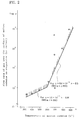
- the relationship between the temperature of molten cadmium and the amount of the inert gas flow be set so as to fall in the area illustrated in Fig. 2 and represented by the following formulae: log y ⁇ 8.8 ⁇ 10 ⁇ 3x - 5.3 (600 ⁇ x ⁇ 900), and log y ⁇ 1.8 ⁇ 10 ⁇ 3x - 0.96 (330 ⁇ x ⁇ 600), wherein x is the temperature (°C) of the molten cadmium, and y is the flow rate (cm/sec) of the inert gas over the surface of the molten cadmium.
- a metallic cadmium powder prepared under the conditions falling in the above-mentioned area has a very high utilization factor as the active material.
- the cadmium vapor is guided to the cooler 4 communicating with the evaporator 3 to cool the cadmium vapor into powdery particles, which are then collected in the powder collectors 5 and 6. Since the metallic cadmium powder is easy of oxidation as mentioned hereinbefore, it is necessary to fill the cooler 4 and the powder collectors 5 and 6 with an atmosphere of the inert gas.
- the inert gas heated with the inert gas heater 1 be circulated through the evaporator 3, the cooler 4, the powder collectors 5 and 6, and the gas conduit 9 by means of the gas-circulating pump 8 as illustrated in Fig. 1.
- Fig. 1 is a schematic diagram of the apparatus for use in carrying out the process for preparing a metallic cadmium powder according to the present invention.
- Fig. 2 is a graph showing the relationship between the temperature (°C) of molten cadmium and the flow rate (cm/sec: on a logarithmic scale) of an inert gas over the surface of the molten cadmium.
- Fig. 3 is a microscopic photograph ( ⁇ 6,000) showing the shape of the particles of a metallic cadmium powder obtained in Example 9.
- Fig. 4 is a microscopic photograph ( ⁇ 2,000) showing the shape of the particles of a metallic cadmium powder obtained in Example 11.
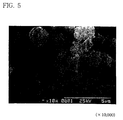
- Fig. 5 is a microscopic photograph ( ⁇ 10,000) showing the shape of the particles of a metallic cadmium powder obtained in Example 13.
- the evaporator 3 of the apparatus illustrated in Fig. 1 was charged with 10 kg of an ingot of metallic cadmium, which was then heat melted.
- the whole system had been preliminarily filled with nitrogen gas to deprive the system or unnecessary oxygen.
- the temperature of the molten cadmium in the evaporator 3 was elevated to 700°C. Immediately the pump 7 was started up to initiate the circulation of the nitrogen gas.
- the flow rate of the nitrogen gas circulated with the pump 7 was adjusted.
- the amount of the nitrogen gas flow introduced into the evaporator 3 was set at 50 Nl/g of cadmium vapor, while the direction of introducing the nitrogen gas into the evaporator 3 was set against the surface of the molten cadmium. Further, the flow rate of the nitrogen gas over the surface of the molten cadmium in the evaporator 3 was set at 30 cm/sec. It is to be noted that after the start-up of the apparatus, samples were taken out of the powder collectors 5 and 6 to observe the external shapes of the particles of the samples under a scanning electron microscope.
- the resulting microscopic photograph (magnification: ⁇ 6,000) of the metallic cadmium powder was examined to find out that the metallic cadmium powder thus obtained was composed of irregular polygonal particles.
- the utilization factor of this metallic cadmium powder as the active material of the battery was determined. The determination was conducted by coating a nickel substrate (2 ⁇ 3 cm) with 1 g of the metallic cadmium powder, combining the coated substrate with a preliminarily prepared nickel positive electrode in a 27% solution of potassium hydroxide having a liquid temperature of 20°C to form a battery, and discharging electricity from the battery at a constant current of 180 mA. The result is shown in Table 1.
- utilization factor [quantity of electricity (mAh) actually taken out of 1 g of metallic cadmium powder/theoretical quantity of electricity (477 mAh) per g of cadmium] ⁇ 100(%).
- Example 2 Substantially the same procedure as that of Example 1 was repeated to obtain a metallic cadmium powder except that the temperature of the molten cadmium in the evaporator, the amount of nitrogen gas flow over the surface of the molten cadmium, the direction of introducing the nitrogen gas into the evaporator, and the flow rate of the nitrogen gas over the surface of the molten cadmium were set as listed in Table 1.
- the utilization factor of the obtained metallic cadmium powder as the active material of the battery was determined according to the same procedure as that of Example 1. The results are given in Table 1.
- metallic cadmium powders obtained in Examples 2 to 8 were composed of uneven particles, or at least six-sided polygonal particles. while metallic cadmium powders obtained in Comparative Examples 1 and 2 were composed of spherical particles.
- the evaporator 3 of the apparatus illustrated in Fig. 1 was charged with 10 kg of an ingot of metallic cadmium, which was then heat melted under the same conditions as those of Example 1.
- the flow rate of the nitrogen gas circulated with the pump 7 was adjusted.
- the amount of the nitrogen gas flow introduced into the evaporator 3 was set such that the flow rate of the nitrogen gas over the surface of the molten cadmium in the evaporator 3 was 50 cm/sec (1.699 on a logarithmic scale).
- Fig. 3 The resulting microscopic photograph (magnification: ⁇ 6,000) of the metallic cadmium powder is shown in Fig. 3. As is apparent from Fig. 3, it can be understood that the metallic cadmium powder thus obtained was composed of irregular polygonal particles.
- the utilization factor of the obtained metallic cadmium powder as the active material of the battery was determined according to the same procedure as that of Example 1. The results are given in Table 2.
- Example 9 Substantially the same procedure as that of Example 9 was repeated to obtain a metallic cadmium powder except that the temperature of molten cadmium in the evaporator and the amount of the nitrogen gas flow over the surface of the molten cadmium in the evaporator were set as listed in Table 2.
- the utilization factor of the obtained metallic cadmium powder as the active material of the battery was determined according to the same procedure as that of Example 1. The results are given in Table 2.
- a metallic cadmium powder obtained according to the present invention is composed of uneven and irregular particles, or at least six-sided polygonal particles, so that the surface area thereof is several times as large as those of conventional metallic cadmium powders and the electrical activity thereof is therefore so high as to heighten the utilization factor of the metallic cadmium powder as the active material in discharge.
- Such a high electrical activity cannot be secured in the case of the conventional spherical cadmium particles having smooth surfaces.
- the high activity of the metallic cadmium powder obtained according to the present invention results from the presence of many reactive sites on the surfaces of the particles of the metallic cadmium powder, the use of which therefore materializes a high-performance battery to a great industrial advantage.
Landscapes
- Chemical & Material Sciences (AREA)
- Chemical Kinetics & Catalysis (AREA)
- Electrochemistry (AREA)
- General Chemical & Material Sciences (AREA)
- Battery Electrode And Active Subsutance (AREA)
- Manufacture Of Metal Powder And Suspensions Thereof (AREA)
Abstract
Description
- The present invention relates to a process for preparing a high-activity metallic cadmium powder useful as the active material of a nickel-cadmium battery.
- Cadmium oxide and cadmium hydroxide prepared through neutralization and formation treatment of cadmium nitrate have heretofore been predominantly used as the starting material of the negative active material of nickel-cadmium batteries.
- The cadmium oxide or cadmium hydroxide, after being fixed through coating or impregnation therewith of a substrate, is usually reduced into metallic cadmium through partial charge thereof to an extent of about 30 to 40% of the capacitance of a negative electrode prior to the construction of the battery.
- Since, however, such reduction of the cadmium oxide or cadmium hydroxide into metallic cadmium through partial charge of the former involves drawbacks in the operation thereof, such as a necessity for taking a series of complicated and troublesome steps of electrolysis, washing with water, drying, etc., there has been proposed preliminary addition of a metallic cadmium powder as part of the starting material of the negative active material with a view to obviating such drawbacks.
- From necessity under such circumstances, there has been proposed the use of various metallic cadmium powders prepared as the negative active materials by respective known methods.
- Examples of such metallic cadmium powders include one prepared by the atomization of molten cadmium with a high-pressure gas or liquid; one prepared by the evaporation and condensation method wherein molten cadmium is heated above the boiling point thereof and then condensed in an oxygen-free cooler; one prepared by the so-called evaporation-in-gas method wherein metallic cadmium heated above the boiling point thereof in a high-frequency induction furnace, a plasma furnace, a resistance furnace or the like is evaporated in an evaporator evacuated and then fed with argon gas, xenon gas, nitrogen gas, etc., alone or in combination, to adjust the internal pressure of the evaporator to a negative pressure of a few to hundreds of Torr, and is then stuck to the wall of the evaporator, a cooling plate or the like to be collected in the form of a metallic cadmium powder; one prepared by the electrolysis method; one prepared by the substitutive precipitation method; and one prepared through mechanical pulverization.
- Each of the metallic cadmium powders respectively prepared by the foregoing methods is very fine but still to large in particle size to act as the active material of the battery, and hence is low in the utilization factor of the active material to make it difficult to put it into practical use. It is well known that a metallic cadmium powder to be used as the negative active material generally has the utilization factor of the active material affected by the shape and size of the particles thereof. More specifically, a metallic cadmium powder having an uneven surface provides a more excellent result as regards the utilization factor thereof as the active material than one having a wide and configurationally simple smooth surface.
- According to the above-mentioned evaporation and condensation method well known as one of the conventional methods of preparing a metal powder, the resultant metallic cadmium powder is as large as a few to about 10 µm in particle diameter, and is in the form of nearly spherical particles each with a smooth surface resulting from the surface tension thereof in a molten state. Such a spherical or tetragonal metallic cadmium powder has a small surface area because of the smooth surface thereof, and hence is low in electrical activity to entail the problem of a low utilization factor in discharge.
- In order to increase the surface area of such a spherical particle, the diameter of the particle must be made as small as possible. According to the conventional evaporation and condensation method, however, cadmium is evaporated from molten metallic cadmium sufficiently heated and then formed into particles in a state of vigorous evaporation of cadmium wherein evaporated particles repeatedly collide and fuse with each other to form droplets by the action of the surface tension thereof. In such a stage, it is considerably difficult to control the particle diameter to be below a submicron level. Accordingly, the specific surface area of the particle is at best 0.2 to 0.6 m²/g or smaller, and the utilization factor thereof as the active material is as low as about 20 to 40% to render the particles useless as the active material of the battery from the practical point of view.
- Further, metallic cadmium powders respectively prepared according to other methods, though as very fine as submicron or smaller particles, are obtained in very low yields to pose problems such as the utter industrial inapplicability of the methods, the high cost of the powders, and hence the difficulty of use thereof in the economic aspect despite the satisfactory utilization factors thereof as the active materials.
- An object of the present invention is to attain improvements in the foregoing problems to thereby provide a process for preparing a metallic cadmium powder having a high activity as the active material of a nickel-cadmium battery, which process is sufficiently of practical industrial use.
- The above-mentioned object of the present invention can be accomplished by introducing an inert gas into an evaporator above a specific amount of flow and in a specific direction, or by maintaining a specific relationship between the temperature of molten cadmium in an evaporator and the amount of an inert gas flow introduced into the evaporator.
- More specifically, the process of the present invention for preparing a metallic cadmium powder for use in a nickel-cadmium battery comprises heat-melting metallic cadmium in an evaporator, introducing an inert gas into the evaporator to discharge cadmium vapor along with the inert gas into a cooler, and collecting the resulting metallic cadmium powder, and the process condition is regulated such that at least one of the following conditions (1) and (2) can be satisfied:
- (1) the amount of the inert gas flow introduced into the evaporator is at least 30 Nl/g of cadmium vapor while the direction of introducing the inert gas into the evaporator is set against the surface of the molten cadmium, and
- (2) the temperature of the molten cadmium in the evaporator and the amount of the inert gas flow introduced into the evaporator are set such that the relationship represented by the following formulae can be satisfied:

and

wherein x is the temperature (°C) of the molten cadmium, and y is the flow rate (cm/sec) of the inert gas over the surface of the molten cadmium. - The present invention will now be specifically described with reference to the accompanying drawings.
- Fig. 1 is a schematic diagram of an apparatus for use in carrying out the process for preparing a metallic cadmium powder according to the present invention. The apparatus of Fig. 1 consists of an
inert gas heater 1, aheater 2, anevaporator 3, acooler 4,powder collectors pump 7, and agas conduit 8. - In Fig. 1, an ingot of metallic cadmium is placed in the
evaporator 3, wherein cadmium is heat melted and then evaporated with theheater 2. Although the temperature of molten cadmium in this step is not particularly restricted, it must be of course equal to at least the melting point (321°C) of cadmium in order to melt the ingot of the metallic cadmium, and is preferably in the range of 330 to 900°C, still preferably 500 to 800°C, from the necessity for controlling the amount of cadmium being evaporated within a given range. - On the other hand, it is preferable to preliminarily heat an inert gas such as nitrogen gas with the
inert gas heater 1 before the introduction of the inert gas into theevaporator 3. Examples of the inert gas include nitrogen gas, argon gas, and carbon dioxide. The inert gas may be passed through theevaporator 3 either only once or repeatedly in circulation as illustrated in Fig. 1. Using the inert gas in such a way aims at preventing unnecessary cadmium oxide from being yielded through an easy reaction of cadmium vapor with a small amount of oxygen. - In the present invention, it is desirable that the amount of the inert gas flow introduced into the evaporator be set at at least 30 Nl/g of cadmium vapor. When this amount is lower than 30 Nl/g of cadmium vapor, the resulting cadmium powder cannot have a high utilization factor as the active material. Herein, the amount (g) of cadmium vapor is one calculated based on the ratio of the saturated vapor pressure of cadmium at a set temperature of molten cadmium to the vapor pressure of cadmium at the boiling point thereof at a pressure of 1 atm while using as the standard the amount of a cadmium powder obtained at the boiling point of cadmium at a pressure of 1 atm.
- In the conventional methods of preparing a metallic cadmium powder, the amount of an inert gas flow is considerably below the range specified in the present invention. In the method disclosed in Japanese Patent Laid-Open Gazette No. Hei 3-153803 (153803/1991), for example, the amount of an inert gas flow is set in the range of 0.1 to 20 Nl/g of cadmium vapor. With attention paid to this amount, it has been found out in the present invention that a cadmium powder obtained at an increased amount of an inert gas flow is composed of uneven and irregular particles, or at least six-sided polygonal particles, thus having a high utilization factor in discharge.
- In the present invention, it is desirable that the direction of introducing the inert gas into the
evaporator 3 be set against the surface of the molten cadmium so that the flow path of the inert gas introduced into theevaporator 3 is most adjacent to the surface of the molten cadmium. This is believed to be because metallic cadmium particles formed from evaporated cadmium collide and coalesce with each other to increase in size and turn spherical where the direction of introducing the inert gas into the evaporator is upward against a space above the bath of molten cadmium. - In the present invention, it is also desirable that the temperature of molten cadmium in the evaporator and the amount of the inert gas flow introduced into the evaporator be adjusted to fall within a specific area in order to prevent metallic cadmium particles formed from evaporated cadmium from colliding and coalescing with each other to increase in size and turn spherical. Specifically, the adjustment of the temperature of the molten cadmium serves to control the amount of cadmium vapor evolved to prevent the metallic cadmium particles from colliding and coalescing with each other, while the adjustment of the amount of the inert gas flow serves to prevent the metallic cadmium particles from colliding and coalescing with each other due to the residence thereof in the
evaporator 3. Accordingly, where the extent of evaporation of cadmium vapor is high enough to raise a fear of mutual collision and coalescence of metallic cadmium particles, an increase in the flow rate of the inert gas and/or a fall in the temperature of molten cadmium will suffice. - It is desirable that the relationship between the temperature of molten cadmium and the amount of the inert gas flow be set so as to fall in the area illustrated in Fig. 2 and represented by the following formulae:

and

wherein x is the temperature (°C) of the molten cadmium, and y is the flow rate (cm/sec) of the inert gas over the surface of the molten cadmium. - A metallic cadmium powder prepared under the conditions falling in the above-mentioned area has a very high utilization factor as the active material.
- Thus, according to the present invention, it is desirable to determine the conditions of preparation of a metallic cadmium powder, including the temperature of the molten cadmium and the flow rate of the inert gas adjusted as described above, while making reference to the results of observing the shape of the resultant metallic cadmium particles under a scanning electron microscope.
- Subsequently, the cadmium vapor is guided to the
cooler 4 communicating with theevaporator 3 to cool the cadmium vapor into powdery particles, which are then collected in thepowder collectors cooler 4 and thepowder collectors - Accordingly, it is desirable that the inert gas heated with the
inert gas heater 1 be circulated through theevaporator 3, thecooler 4, thepowder collectors pump 8 as illustrated in Fig. 1. - Fig. 1 is a schematic diagram of the apparatus for use in carrying out the process for preparing a metallic cadmium powder according to the present invention.
- Fig. 2 is a graph showing the relationship between the temperature (°C) of molten cadmium and the flow rate (cm/sec: on a logarithmic scale) of an inert gas over the surface of the molten cadmium.
- Fig. 3 is a microscopic photograph (× 6,000) showing the shape of the particles of a metallic cadmium powder obtained in Example 9.
- Fig. 4 is a microscopic photograph (× 2,000) showing the shape of the particles of a metallic cadmium powder obtained in Example 11.
- Fig. 5 is a microscopic photograph (× 10,000) showing the shape of the particles of a metallic cadmium powder obtained in Example 13.
- The following Examples will specifically illustrate the present invention.
- The
evaporator 3 of the apparatus illustrated in Fig. 1 was charged with 10 kg of an ingot of metallic cadmium, which was then heat melted. The whole system had been preliminarily filled with nitrogen gas to deprive the system or unnecessary oxygen. - The temperature of the molten cadmium in the
evaporator 3 was elevated to 700°C. Immediately thepump 7 was started up to initiate the circulation of the nitrogen gas. - When the temperature of the molten cadmium in the
evaporator 3 became substantially constant, the flow rate of the nitrogen gas circulated with thepump 7 was adjusted. The amount of the nitrogen gas flow introduced into theevaporator 3 was set at 50 Nl/g of cadmium vapor, while the direction of introducing the nitrogen gas into theevaporator 3 was set against the surface of the molten cadmium. Further, the flow rate of the nitrogen gas over the surface of the molten cadmium in theevaporator 3 was set at 30 cm/sec. It is to be noted that after the start-up of the apparatus, samples were taken out of thepowder collectors - The resulting microscopic photograph (magnification: × 6,000) of the metallic cadmium powder was examined to find out that the metallic cadmium powder thus obtained was composed of irregular polygonal particles.
- The utilization factor of this metallic cadmium powder as the active material of the battery was determined. The determination was conducted by coating a nickel substrate (2 × 3 cm) with 1 g of the metallic cadmium powder, combining the coated substrate with a preliminarily prepared nickel positive electrode in a 27% solution of potassium hydroxide having a liquid temperature of 20°C to form a battery, and discharging electricity from the battery at a constant current of 180 mA. The result is shown in Table 1.
- The utilization factor as mentioned herein is a value calculated according to the following equation:


- Substantially the same procedure as that of Example 1 was repeated to obtain a metallic cadmium powder except that the temperature of the molten cadmium in the evaporator, the amount of nitrogen gas flow over the surface of the molten cadmium, the direction of introducing the nitrogen gas into the evaporator, and the flow rate of the nitrogen gas over the surface of the molten cadmium were set as listed in Table 1.
- The utilization factor of the obtained metallic cadmium powder as the active material of the battery was determined according to the same procedure as that of Example 1. The results are given in Table 1.
- According to the observation of the external shape of the particles under a scanning electron microscope, metallic cadmium powders obtained in Examples 2 to 8 were composed of uneven particles, or at least six-sided polygonal particles. while metallic cadmium powders obtained in Comparative Examples 1 and 2 were composed of spherical particles.

- As is apparent from Table 1, it can be understood that the metallic cadmium powders obtained in Examples 1 to 8 while adjusting the amount of the inert gas flow in the specific range and setting the direction of introduction of the inert gas against the surface of the molten cadmium had a notably high utilization factor as compared with the metallic cadmium powders obtained in Comparative Examples 1 and 2 under the conditions departing from those mentioned above in connection with Examples 1 to 8.
- The
evaporator 3 of the apparatus illustrated in Fig. 1 was charged with 10 kg of an ingot of metallic cadmium, which was then heat melted under the same conditions as those of Example 1. - When the temperature of the molten cadmium in the
evaporator 3 became substantially constant, the flow rate of the nitrogen gas circulated with thepump 7 was adjusted. The amount of the nitrogen gas flow introduced into theevaporator 3 was set such that the flow rate of the nitrogen gas over the surface of the molten cadmium in theevaporator 3 was 50 cm/sec (1.699 on a logarithmic scale). After the start-up of the apparatus, samples were taken out of thepowder collectors - The resulting microscopic photograph (magnification: × 6,000) of the metallic cadmium powder is shown in Fig. 3. As is apparent from Fig. 3, it can be understood that the metallic cadmium powder thus obtained was composed of irregular polygonal particles.
- The utilization factor of the obtained metallic cadmium powder as the active material of the battery was determined according to the same procedure as that of Example 1. The results are given in Table 2.
- Substantially the same procedure as that of Example 9 was repeated to obtain a metallic cadmium powder except that the temperature of molten cadmium in the evaporator and the amount of the nitrogen gas flow over the surface of the molten cadmium in the evaporator were set as listed in Table 2.
- The utilization factor of the obtained metallic cadmium powder as the active material of the battery was determined according to the same procedure as that of Example 1. The results are given in Table 2.
- The external shapes of the particles of the metallic cadmium powders obtained in Examples 11 and 14 were observed under a scanning electron microscope in the same manner as that of Example 1. The resulting microscopic photographs are shown in Figs. 4 and 5, respectively.
Table 2 Ex. and Comp. Ex. Temp. of molten cadmium (°C) Flow rate of nitrogen gas over surface of melt Utilization factor (%) y (cm/sec) log y Ex. 9 700 50 1.699 65 Ex. 10 700 500 2.699 65 Ex. 11 330 0.43 -0.367 65 Ex. 12 400 0.50 -0.301 65 Ex. 13 500 0.70 -0.155 65 Ex. 14 620 2.0 0.301 65 Ex. 15 700 10 1.0 65 Ex. 16 800 100 2.0 65 Ex. 17 900 1000 3.0 65 Comp. Ex. 3 700 1.0 0 35 Comp. Ex. 4 700 0 - 30 - As is apparent from Table 2, it can be understood that the metallic cadmium powders obtained in Examples 9 to 17 while setting the temperature of the molten cadmium and the flow rate of the inert gas in the specific areas had a notably high utilization factor as compared with the metallic cadmium powders obtained in Comparative Examples 3 and 4 under the conditions departing from those mentioned above in connection with Examples 9 to 17.
- A metallic cadmium powder obtained according to the present invention is composed of uneven and irregular particles, or at least six-sided polygonal particles, so that the surface area thereof is several times as large as those of conventional metallic cadmium powders and the electrical activity thereof is therefore so high as to heighten the utilization factor of the metallic cadmium powder as the active material in discharge. Such a high electrical activity cannot be secured in the case of the conventional spherical cadmium particles having smooth surfaces. The high activity of the metallic cadmium powder obtained according to the present invention results from the presence of many reactive sites on the surfaces of the particles of the metallic cadmium powder, the use of which therefore materializes a high-performance battery to a great industrial advantage.
Claims (3)
- A process for preparing a metallic cadmium powder for use in a nickel-cadmium battery, comprising the steps of:
heat melting metallic cadmium in an evaporator;
introducing an inert gas into said evaporator at an amount of flow of at least 30 Nl/g of cadmium vapor and in a direction set against the surface of the molten cadmium;
discharging cadmium vapor along with said inert gas into a cooler; and
collecting the resulting metallic cadmium powder. - A process for preparing metallic cadmium powder for use in a nickel-cadmium battery, comprising the steps of:
heat melting metallic cadmium in an evaporator;
introducing an inert gas into said evaporator while the temperature of molten cadmium and the amount of said inert gas flow are set such that the following formulae can be satisfied:


wherein x is the temperature (°C) of said molten cadmium, and y is the flow rate (cm/sec) of said inert gas over the surface of said molten cadmium.
discharging cadmium vapor along with said inert gas into a condensation cooler; and
collecting the resulting metallic cadmium powder. - A metallic cadmium powder for use in a nickel-cadmium battery, which is composed of uneven and irregular particles, or at least six-sided polygonal particles.
Applications Claiming Priority (3)
| Application Number | Priority Date | Filing Date | Title |
|---|---|---|---|
| JP161885/92 | 1992-05-29 | ||
| JP4161885A JP2896727B2 (en) | 1992-05-29 | 1992-05-29 | Method for producing metal cadmium powder |
| PCT/JP1992/001447 WO1993024262A1 (en) | 1992-05-29 | 1992-11-06 | Production method for metal cadmium powder |
Publications (2)
| Publication Number | Publication Date |
|---|---|
| EP0601186A1 true EP0601186A1 (en) | 1994-06-15 |
| EP0601186A4 EP0601186A4 (en) | 1998-02-25 |
Family
ID=15743843
Family Applications (1)
| Application Number | Title | Priority Date | Filing Date |
|---|---|---|---|
| EP92922994A Withdrawn EP0601186A4 (en) | 1992-05-29 | 1992-11-06 | Production method for metal cadmium powder. |
Country Status (4)
| Country | Link |
|---|---|
| US (1) | US5505761A (en) |
| EP (1) | EP0601186A4 (en) |
| JP (1) | JP2896727B2 (en) |
| WO (1) | WO1993024262A1 (en) |
Families Citing this family (2)
| Publication number | Priority date | Publication date | Assignee | Title |
|---|---|---|---|---|
| US8790440B2 (en) * | 2010-11-08 | 2014-07-29 | Raytheon Company | Forming spherical semiconductive nanoparticles |
| CN115415532B (en) * | 2022-09-05 | 2023-07-28 | 先导薄膜材料(广东)有限公司 | Cadmium powder and preparation method thereof |
Family Cites Families (7)
| Publication number | Priority date | Publication date | Assignee | Title |
|---|---|---|---|---|
| US3165396A (en) * | 1961-01-09 | 1965-01-12 | Nat Res Corp | Deflection of metal vapor away from the vertical in a thermal evaporation process |
| US3890159A (en) * | 1972-12-04 | 1975-06-17 | Gen Electric | Method of forming a high surface area metallic cadmium powder and an electrode therefrom |
| US4414303A (en) * | 1980-08-28 | 1983-11-08 | Motorola, Inc. | Cadmium negative electrode |
| JPS61284507A (en) * | 1985-06-11 | 1986-12-15 | Mitsui Mining & Smelting Co Ltd | Production of cadmium powder for nickel-cadmium battery |
| JPH03153803A (en) * | 1989-11-11 | 1991-07-01 | Dowa Mining Co Ltd | Manufacture of high purity cadmium fine powder |
| JP2896719B2 (en) * | 1990-09-07 | 1999-05-31 | 三井金属鉱業株式会社 | Method for producing metal cadmium powder |
| JPH057860A (en) * | 1991-07-01 | 1993-01-19 | Mitsui Mining & Smelting Co Ltd | How to dispose of waste battery packs |
-
1992
- 1992-05-29 JP JP4161885A patent/JP2896727B2/en not_active Expired - Fee Related
- 1992-11-06 US US08/185,849 patent/US5505761A/en not_active Expired - Fee Related
- 1992-11-06 WO PCT/JP1992/001447 patent/WO1993024262A1/en not_active Ceased
- 1992-11-06 EP EP92922994A patent/EP0601186A4/en not_active Withdrawn
Also Published As
| Publication number | Publication date |
|---|---|
| EP0601186A4 (en) | 1998-02-25 |
| JPH05331507A (en) | 1993-12-14 |
| JP2896727B2 (en) | 1999-05-31 |
| US5505761A (en) | 1996-04-09 |
| WO1993024262A1 (en) | 1993-12-09 |
Similar Documents
| Publication | Publication Date | Title |
|---|---|---|
| EP1236682B1 (en) | Silicon oxide powder and its manufacture | |
| JP4215911B2 (en) | Niobium powder agglomerates | |
| JP7607586B2 (en) | Lithium lanthanum zirconium oxide (LLZO) powder | |
| US6749966B2 (en) | Metal vanadium oxide particles | |
| US6225007B1 (en) | Medal vanadium oxide particles | |
| EP1249047B1 (en) | Electrodes including particles of specific sizes | |
| US6780350B1 (en) | Metal-carbon composite powders, methods for producing powders and devices fabricated from same | |
| US9030799B2 (en) | Processes for preparing valve metal powders, powders prepared thereby and uses therefor | |
| US20020192137A1 (en) | Phosphate powder compositions and methods for forming particles with complex anions | |
| CH661919A5 (en) | METHOD AND DEVICE FOR PRODUCING SILICON FROM SILICIUM TETRAFLUORIDE. | |
| US5069868A (en) | Method for producing thermoelectric elements | |
| CN112820872B (en) | Ternary positive electrode material, preparation method thereof and lithium ion battery | |
| US4188268A (en) | Process for an electrode for a lead battery | |
| RU2089350C1 (en) | Method of production of tantalum powder | |
| JP2002536286A (en) | Metal vanadium oxide particles | |
| EP0601186A1 (en) | Production method for metal cadmium powder | |
| KR101913221B1 (en) | Fabrication Method of Lithium Complex Oxide | |
| EP0537502A1 (en) | Metal- and metal alloy powder comprising microcrystalline, spherical and dense particles and process and installation for preparing same | |
| JP2896719B2 (en) | Method for producing metal cadmium powder | |
| JP2688452B2 (en) | Method for producing tantalum powder with high surface area and low metal impurities | |
| EP0721919A1 (en) | Method for making copper (I) oxide powders by aerosol decomposition | |
| CN120767396B (en) | A sulfide solid electrolyte, its preparation method, battery and application | |
| JPH0193403A (en) | Production of ceramic-based superconducting material and apparatus therefor | |
| JPH0610076A (en) | Production of amorphous tial powder |
Legal Events
| Date | Code | Title | Description |
|---|---|---|---|
| PUAI | Public reference made under article 153(3) epc to a published international application that has entered the european phase |
Free format text: ORIGINAL CODE: 0009012 |
|
| 17P | Request for examination filed |
Effective date: 19940228 |
|
| AK | Designated contracting states |
Kind code of ref document: A1 Designated state(s): DE FR GB |
|
| RIN1 | Information on inventor provided before grant (corrected) |
Inventor name: TANAKA, JUNICHIROU Inventor name: SASAKI, MASAMOTO Inventor name: HATA, YOSHIMI Inventor name: ONOUE, MASAHARU Inventor name: SUMIDA, MORIMASA Inventor name: SENZAKI, HIROHISA |
|
| A4 | Supplementary search report drawn up and despatched |
Effective date: 19980112 |
|
| AK | Designated contracting states |
Kind code of ref document: A4 Designated state(s): DE FR GB |
|
| 17Q | First examination report despatched |
Effective date: 19980505 |
|
| STAA | Information on the status of an ep patent application or granted ep patent |
Free format text: STATUS: THE APPLICATION IS DEEMED TO BE WITHDRAWN |
|
| 18D | Application deemed to be withdrawn |
Effective date: 19990508 |