EP0599717B1 - Agrégat de cristallites d'oxyde cérique, procédé d'obtention et son utilisation pour réduire les résidus de combustion - Google Patents
Agrégat de cristallites d'oxyde cérique, procédé d'obtention et son utilisation pour réduire les résidus de combustion Download PDFInfo
- Publication number
- EP0599717B1 EP0599717B1 EP93402828A EP93402828A EP0599717B1 EP 0599717 B1 EP0599717 B1 EP 0599717B1 EP 93402828 A EP93402828 A EP 93402828A EP 93402828 A EP93402828 A EP 93402828A EP 0599717 B1 EP0599717 B1 EP 0599717B1
- Authority
- EP
- European Patent Office
- Prior art keywords
- nanometres
- cerium
- soot
- oxide
- fuel
- Prior art date
- Legal status (The legal status is an assumption and is not a legal conclusion. Google has not performed a legal analysis and makes no representation as to the accuracy of the status listed.)
- Expired - Lifetime
Links
Classifications
-
- B—PERFORMING OPERATIONS; TRANSPORTING
- B82—NANOTECHNOLOGY
- B82Y—SPECIFIC USES OR APPLICATIONS OF NANOSTRUCTURES; MEASUREMENT OR ANALYSIS OF NANOSTRUCTURES; MANUFACTURE OR TREATMENT OF NANOSTRUCTURES
- B82Y30/00—Nanotechnology for materials or surface science, e.g. nanocomposites
-
- B—PERFORMING OPERATIONS; TRANSPORTING
- B01—PHYSICAL OR CHEMICAL PROCESSES OR APPARATUS IN GENERAL
- B01J—CHEMICAL OR PHYSICAL PROCESSES, e.g. CATALYSIS OR COLLOID CHEMISTRY; THEIR RELEVANT APPARATUS
- B01J23/00—Catalysts comprising metals or metal oxides or hydroxides, not provided for in group B01J21/00
- B01J23/10—Catalysts comprising metals or metal oxides or hydroxides, not provided for in group B01J21/00 of rare earths
-
- B—PERFORMING OPERATIONS; TRANSPORTING
- B01—PHYSICAL OR CHEMICAL PROCESSES OR APPARATUS IN GENERAL
- B01J—CHEMICAL OR PHYSICAL PROCESSES, e.g. CATALYSIS OR COLLOID CHEMISTRY; THEIR RELEVANT APPARATUS
- B01J35/00—Catalysts, in general, characterised by their form or physical properties
- B01J35/70—Catalysts, in general, characterised by their form or physical properties characterised by their crystalline properties, e.g. semi-crystalline
- B01J35/77—Compounds characterised by their crystallite size
-
- C—CHEMISTRY; METALLURGY
- C01—INORGANIC CHEMISTRY
- C01F—COMPOUNDS OF THE METALS BERYLLIUM, MAGNESIUM, ALUMINIUM, CALCIUM, STRONTIUM, BARIUM, RADIUM, THORIUM, OR OF THE RARE-EARTH METALS
- C01F17/00—Compounds of rare earth metals
- C01F17/20—Compounds containing only rare earth metals as the metal element
- C01F17/206—Compounds containing only rare earth metals as the metal element oxide or hydroxide being the only anion
- C01F17/224—Oxides or hydroxides of lanthanides
- C01F17/235—Cerium oxides or hydroxides
-
- C—CHEMISTRY; METALLURGY
- C10—PETROLEUM, GAS OR COKE INDUSTRIES; TECHNICAL GASES CONTAINING CARBON MONOXIDE; FUELS; LUBRICANTS; PEAT
- C10L—FUELS NOT OTHERWISE PROVIDED FOR; NATURAL GAS; SYNTHETIC NATURAL GAS OBTAINED BY PROCESSES NOT COVERED BY SUBCLASSES C10G OR C10K; LIQUIFIED PETROLEUM GAS; USE OF ADDITIVES TO FUELS OR FIRES; FIRE-LIGHTERS
- C10L1/00—Liquid carbonaceous fuels
- C10L1/10—Liquid carbonaceous fuels containing additives
-
- C—CHEMISTRY; METALLURGY
- C10—PETROLEUM, GAS OR COKE INDUSTRIES; TECHNICAL GASES CONTAINING CARBON MONOXIDE; FUELS; LUBRICANTS; PEAT
- C10L—FUELS NOT OTHERWISE PROVIDED FOR; NATURAL GAS; SYNTHETIC NATURAL GAS OBTAINED BY PROCESSES NOT COVERED BY SUBCLASSES C10G OR C10K; LIQUIFIED PETROLEUM GAS; USE OF ADDITIVES TO FUELS OR FIRES; FIRE-LIGHTERS
- C10L1/00—Liquid carbonaceous fuels
- C10L1/10—Liquid carbonaceous fuels containing additives
- C10L1/12—Inorganic compounds
- C10L1/1233—Inorganic compounds oxygen containing compounds, e.g. oxides, hydroxides, acids and salts thereof
-
- C—CHEMISTRY; METALLURGY
- C10—PETROLEUM, GAS OR COKE INDUSTRIES; TECHNICAL GASES CONTAINING CARBON MONOXIDE; FUELS; LUBRICANTS; PEAT
- C10L—FUELS NOT OTHERWISE PROVIDED FOR; NATURAL GAS; SYNTHETIC NATURAL GAS OBTAINED BY PROCESSES NOT COVERED BY SUBCLASSES C10G OR C10K; LIQUIFIED PETROLEUM GAS; USE OF ADDITIVES TO FUELS OR FIRES; FIRE-LIGHTERS
- C10L10/00—Use of additives to fuels or fires for particular purposes
- C10L10/06—Use of additives to fuels or fires for particular purposes for facilitating soot removal
-
- C—CHEMISTRY; METALLURGY
- C01—INORGANIC CHEMISTRY
- C01P—INDEXING SCHEME RELATING TO STRUCTURAL AND PHYSICAL ASPECTS OF SOLID INORGANIC COMPOUNDS
- C01P2002/00—Crystal-structural characteristics
- C01P2002/60—Compounds characterised by their crystallite size
-
- C—CHEMISTRY; METALLURGY
- C01—INORGANIC CHEMISTRY
- C01P—INDEXING SCHEME RELATING TO STRUCTURAL AND PHYSICAL ASPECTS OF SOLID INORGANIC COMPOUNDS
- C01P2004/00—Particle morphology
- C01P2004/10—Particle morphology extending in one dimension, e.g. needle-like
-
- C—CHEMISTRY; METALLURGY
- C01—INORGANIC CHEMISTRY
- C01P—INDEXING SCHEME RELATING TO STRUCTURAL AND PHYSICAL ASPECTS OF SOLID INORGANIC COMPOUNDS
- C01P2004/00—Particle morphology
- C01P2004/50—Agglomerated particles
-
- C—CHEMISTRY; METALLURGY
- C01—INORGANIC CHEMISTRY
- C01P—INDEXING SCHEME RELATING TO STRUCTURAL AND PHYSICAL ASPECTS OF SOLID INORGANIC COMPOUNDS
- C01P2004/00—Particle morphology
- C01P2004/60—Particles characterised by their size
- C01P2004/62—Submicrometer sized, i.e. from 0.1-1 micrometer
-
- C—CHEMISTRY; METALLURGY
- C01—INORGANIC CHEMISTRY
- C01P—INDEXING SCHEME RELATING TO STRUCTURAL AND PHYSICAL ASPECTS OF SOLID INORGANIC COMPOUNDS
- C01P2004/00—Particle morphology
- C01P2004/60—Particles characterised by their size
- C01P2004/64—Nanometer sized, i.e. from 1-100 nanometer
-
- C—CHEMISTRY; METALLURGY
- C10—PETROLEUM, GAS OR COKE INDUSTRIES; TECHNICAL GASES CONTAINING CARBON MONOXIDE; FUELS; LUBRICANTS; PEAT
- C10L—FUELS NOT OTHERWISE PROVIDED FOR; NATURAL GAS; SYNTHETIC NATURAL GAS OBTAINED BY PROCESSES NOT COVERED BY SUBCLASSES C10G OR C10K; LIQUIFIED PETROLEUM GAS; USE OF ADDITIVES TO FUELS OR FIRES; FIRE-LIGHTERS
- C10L1/00—Liquid carbonaceous fuels
- C10L1/10—Liquid carbonaceous fuels containing additives
- C10L1/14—Organic compounds
- C10L1/16—Hydrocarbons
- C10L1/1616—Hydrocarbons fractions, e.g. lubricants, solvents, naphta, bitumen, tars, terpentine
-
- C—CHEMISTRY; METALLURGY
- C10—PETROLEUM, GAS OR COKE INDUSTRIES; TECHNICAL GASES CONTAINING CARBON MONOXIDE; FUELS; LUBRICANTS; PEAT
- C10L—FUELS NOT OTHERWISE PROVIDED FOR; NATURAL GAS; SYNTHETIC NATURAL GAS OBTAINED BY PROCESSES NOT COVERED BY SUBCLASSES C10G OR C10K; LIQUIFIED PETROLEUM GAS; USE OF ADDITIVES TO FUELS OR FIRES; FIRE-LIGHTERS
- C10L1/00—Liquid carbonaceous fuels
- C10L1/10—Liquid carbonaceous fuels containing additives
- C10L1/14—Organic compounds
- C10L1/18—Organic compounds containing oxygen
- C10L1/188—Carboxylic acids; metal salts thereof
- C10L1/1881—Carboxylic acids; metal salts thereof carboxylic group attached to an aliphatic carbon atom
-
- F—MECHANICAL ENGINEERING; LIGHTING; HEATING; WEAPONS; BLASTING
- F02—COMBUSTION ENGINES; HOT-GAS OR COMBUSTION-PRODUCT ENGINE PLANTS
- F02B—INTERNAL-COMBUSTION PISTON ENGINES; COMBUSTION ENGINES IN GENERAL
- F02B3/00—Engines characterised by air compression and subsequent fuel addition
- F02B3/06—Engines characterised by air compression and subsequent fuel addition with compression ignition
Definitions
- the subject of the present invention is aggregates of oxide crystallites ceric. It relates more particularly to oxide crystallite systems ceric able to catalyze an advanced combustion of hydrocarbon fuels especially heavy (fuel oil, diesel).
- It also relates to a process for obtaining said aggregates and their use to reduce the emission of combustion residues.
- one of the aims of the present invention is to provide an aggregate which allows it to act as a catalyst for self-ignition of the soot formed during the combustion of carbonaceous fuels.
- Another object of the present invention is to provide an aggregate which allows lower the auto-ignition temperature of the soot mentioned above.
- Another object of the present invention is to provide an aggregate of the above type which reduces the amount of soot formed during combustion said fuels when introduced into the combustion chamber.
- Another object of the present invention is to provide an aggregate which, introduced into the combustion chambers, does not increase the emission of nitrogen oxide and carbon monoxide.
- Another object of the present invention is to provide a method of manufacturing and or of introducing said aggregates into the combustion chamber in the vicinity soot.
- Another object of the present invention is to provide an application method of said aggregates.
- these aggregates are topologically the closest possible soot, this is why it is desirable to introduce in the room combustion or manufacture in situ said aggregates so that these aggregates can form simultaneously serve as seeds for soot.
- cerium in the form of aggregates specified above with a content of at least 10 ppm compared to carbonaceous fuel, preferably 20 ppm more advantageously 50 ppm.
- the cerium oxide thus formed has a particle size such that the d 80 is at most equal to 10,000 ⁇ (1,000 nanometers), preferably to 5,000 ⁇ (500 nanometers).
- the d 20 is greater than 200 ⁇ (20 nanometers) and preferably 500 ⁇ (50 nanometers).
- Another object of the present invention is to form soot containing above aggregates whose self-ignition temperature is lowered by compared to that without aggregates.
- soot having a particle size such that the grain has a d 20 equal to at least 100 ⁇ and that the d 80 is at most equal to 1000 ⁇ and which contain at least 0.01%, advantageously at least 0.1%, preferably at least 0.5% aggregate according to the present invention.
- soot grains form clusters whose d 50 is between 2000 and 5000 ⁇ .
- the soot thus formed has a total cerium content of between 1 and 5% by weight, preferably 1.5 to 2.5%.
- the aggregate of crystallites is formed during the combustion of fuel, or fuel, this the latter being added with at least one cerium compound, preferably tetravalent as a solution or a soil.
- cerium compound is chosen from cerium compounds IV, it also has the advantage of being accessible at high levels concentration which reduces the size of the tank, which was mentioned in the introduction. Thus it is possible to obtain a concentration which can reach 15% in cerium frequently 20%, even 30%.
- tetravalent compounds Another advantage of tetravalent compounds is the superior stability to that of trivalent.
- the preferred crystallite aggregates are those obtained in situ by combustion of a fuel, or fuel, (containing or not containing additives, like diesel) containing at least one cerium IV compound (in the form of sol or solution) such as for example those described in the patent application European registered in the name of the plaintiff under N ° 83 401 152.0 or under U.S. Patent No. 4,299 20.
- the concentration of cerium in the fuel, and in particular diesel, is advantageously between 10 and 200 ppm, preferably between 50 and 150 ppm.
- Another object of the present invention is to provide a method which allows to reduce the formation of soot when burning hydrocarbon products including diesel.
- Another object of the present invention is to find a method which lowers the auto-ignition temperature of soot.
- Diffraction results from the interaction of radiation with matter.
- an electromagnetic wave hits an atom, its electrons undergo vibrations of the same frequency as the incident wave.
- Absorption and re-emission atoms in a periodic lattice constitute the diffraction of x-rays.
- Bragg's diffraction law which results from optical conditions and particular crystallographic, gives the maxima of the diffracted intensity.
- Three aspects of such a maximum interest the analyst the position of the peak, its intensity and its width.
- the third point makes it possible to determine certain characteristics of the grain size.
- the peaks obtained should be from Dirac.
- such profiles are not obtained, due to the influence of the apparatus and the morphology of the crystals. Indeed, the divergence and dispersion in wavelength of the incident X-ray beam, the absorption and the surface state of the sample, the width of the analysis slit, etc., are all factors d said instrumental enlargement.
- the size and deformation of the crystals cause a widening of the so-called intrinsic profiles. The smaller the crystals, the greater the contribution to the widening of the peak.
- enlargement is an increasing function of the deformation
- the experimental profile is therefore the convolution of the instrumental profile and the intrinsic profile.
- the measurement was carried out on 4.4L diesel engines fitted to Mercedes 240 D, the settings being made according to the manufacturer's specifications.
- the vehicles are fitted with a manual gearbox.
- the dynamometric chassis simulates an inertia of 1300 kilos with a power absorption unit made by the company SCHENCK type W130.
- the exhaust gases are cooled, then pass through a particle trap and finally, through a dilution tunnel onto which is sampled the exhaust before being returned to the atmosphere.
- the sampling of the particles is carried out on sampling filters covered with teflon and produced by the company PALLFLEX PRODUCTS CORP. type 47mm TX 40 H120-WW the temperature being adjusted so as not to exceed 52 ° C.
- the particle trap is a Corning EX 47.5.66 "x 6.00" trap fitted with 3M interam III in a metal box. It is placed before the dilution tunnel, a tunnel from which it is possible to remove the particles that have escaped the filter and collected cold.
- Particulate matter emissions were determined and assessed according to the directives 91/441 / EEC.
Landscapes
- Chemical & Material Sciences (AREA)
- Engineering & Computer Science (AREA)
- Organic Chemistry (AREA)
- Oil, Petroleum & Natural Gas (AREA)
- Chemical Kinetics & Catalysis (AREA)
- Materials Engineering (AREA)
- Nanotechnology (AREA)
- Inorganic Chemistry (AREA)
- General Chemical & Material Sciences (AREA)
- Combustion & Propulsion (AREA)
- Physics & Mathematics (AREA)
- Composite Materials (AREA)
- Condensed Matter Physics & Semiconductors (AREA)
- General Physics & Mathematics (AREA)
- Crystallography & Structural Chemistry (AREA)
- Life Sciences & Earth Sciences (AREA)
- Geology (AREA)
- Catalysts (AREA)
- Compounds Of Alkaline-Earth Elements, Aluminum Or Rare-Earth Metals (AREA)
- Production Of Liquid Hydrocarbon Mixture For Refining Petroleum (AREA)
- Solid Fuels And Fuel-Associated Substances (AREA)
- Processing Of Solid Wastes (AREA)
- Exhaust Gas After Treatment (AREA)
- Treating Waste Gases (AREA)
- Heat Treatment Of Water, Waste Water Or Sewage (AREA)
- Processes For Solid Components From Exhaust (AREA)
- Liquid Carbonaceous Fuels (AREA)
- Exhaust Gas Treatment By Means Of Catalyst (AREA)
- Cephalosporin Compounds (AREA)
Description
En effet, la divergence et la dispersion en longueur d'onde du faisceau incident de rayons X, l'absorption et l'état de surface de l'échantillon, la largeur de la fente d'analyse, etc, sont autant de facteurs d'élargissement dit instrumental.
En outre, la taille et la déformation des cristaux provoquent un élargissement des profils dit intrinsèque. Plus les cristaux sont petits, plus la contribution à l'élargissement du pic est importante. Par contre, I'élargissement est une fonction croissante de la déformation
Le profil expérimental est donc la convolution du profil instrumental et du profil intrinsèque.
- La largeur à mi-hauteur, FWMH, et/ou la largeur intégrale, b, du pic (largeur d'un rectangle de même hauteur et de même aire que le pic considéré).
- Les coefficients de Fourier du pic.
L'extraction du profil F à partir des profils H et G est alors réalisée manuellement à partir des valeurs des largeurs à mi-hauteur, précédemment déterminées à l'aide d'un logiciel de traitement de spectres.
Pour effectuer la déconvolution, on utilise la formule de GAUSS :

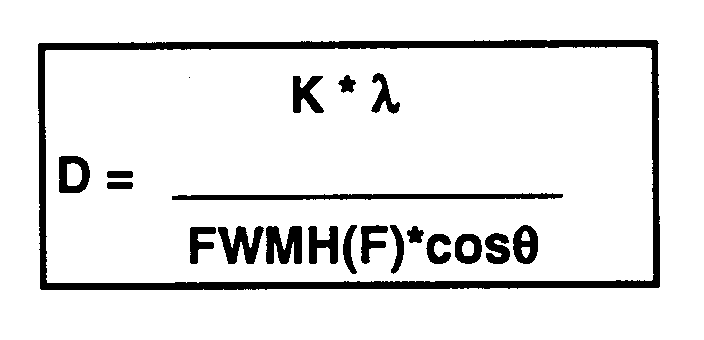
- constante de Sherrer K = 0.90
- longueur d'onde utilisée λ = 1.542 angström
Le chassis dynamométrique.simule une inertie de 1300 kilos avec une unité d'absortion de puissance faite par la société SCHENCK type W130.
Les gaz d'échapemement sont refroidis, puis passent au travers d'un piège à particules et enfin, au travers d'un tunnel de dilution sur lequel est greffé un échantillonage de I'échapement avant d'être renvoyé dans l'atmosphère.
L'échantillonage des particules est réalisé sur des filtres d'échantillonage recouverts de téflon et réalisés par la société PALLFLEX PRODUCTS CORP. type 47mm T X 40 H120-WW la température étant réglée de manière à ne pas excéder 52°C.
Le piège à particules est un piège Corning EX 47,5.66" x 6,00" équipé avec 3M interam III dans une boíte métallique. il est placé avant le tunnel de dilution, tunnel sur le quel il est possible de prélever les particule ayant échappé au filtre et recueillie à froid.
Le piège est situé de telle façon que la température maximum enregistrée à l'intérieur du piège pendant la phase d'accumulation des suies, soit inférieure à 230°C.
Pour déterminer la température de régénération le véhicule est mené à une vitesse constante (90 KM/H) en 4ième, à la charge maximum du moteur.
Compte tenu de la spécifité du système d'échappement, la température des gaz d'échapement à l'entrée du piège croít doucement, la perte de charge au travers du piège et la température sont enregistré en fonction du temps.
Pendant cette phase de régénération (en raison de l'état stationaire du moteur) les gaz d'échapement alimentant le piège, présentent une température en augmentation mais une débit massique constant et une teneur en oxygène constante.
la masse de particules accumulées dans le piège pendant la mesure demeure négligeable.
L'augmentation de température et du débit volumique induit une augmentation la perte de charge au travers du piège, jusqu'à ce que la température de régénération soit atteinte.
Pour les augmentations de température ultérieures, la perte de charge reste constante, puis chute. Cela est du à la réduction de la masse des particules accumulées dans le piège. Le piège est nettoyé !
| synthese | tailles des suies | taille des agregats en nm | largeur du pic (h,k,l) =(1,1,1) | tailles des cristallites | largeur du pic (h,k,l) =(2,0,0) | tailles des cristallites | Température d'autoinflammation | observation |
| sol organique de diamètre hydrodynamique 10 nm (sol oléique | d50 = 40 | d50 = 15 | 606 | 138 | 0,572 | 138 Ä | 486 | g |
| d20 =.15 | d20 = 5 | |||||||
| d80 = 60 | d80=200 | |||||||
| blanc | d50 = 40 | , | - | 570 | g | |||
| d20 =.20 | ||||||||
| d80 = 60 |
| synthese | tailles des suies | taille des agregats en nm | largeur du pic (h,k,l) =(1,1,1) | tailles des cristallites | largeur du pic (h,k,l) =(2,0,0) | tailles des cristallites | Température d'autoinflammation | observation |
| sol organique de diamètre hydrodynamique 10 nm (sol oléique) | d50 = 30 | 230 | 175 | 495 | ||||
| d20 =.15 | 490 | |||||||
| d80 = 50 | 502 | |||||||
| 493 | ||||||||
| sol organique de diamètre hydrodynamique 100 nm (sol oléique) | d50 = 30 | > 300 Ä | 519 | Hors de l'invention (comparatif) | ||||
| d20 =.15 | (515+505+538)/3 | |||||||
| d80 = 50 | ||||||||
| sels de cériumIV | d50 = 30 | 220 | 180 | (472+490+490) | ||||
| d20 =.15 | ||||||||
| d80 = 50 | 484 | |||||||
| blanc | d50 = 40 | - | - | 561 = (561+558+565)/3 | ||||
| d20 =.20 | ||||||||
| d80 = 80 |
| agent d'imprégnation des, suies | Taille de cristallite | Taille de grain | T inf | T max |
| sol aqueux | 3 à 4 nm | 3 à 4 nm | 355° C | 375 |
| sol organique sol organique de diamètre hydrodynamique 10 nm (sol oléique) | 3 à 5 nm | 3 à 5 nm | 365 | 392 |
| sol plus grossier sol organique de diamètre hydrodynamique 100 nm (sol oléique) | 11nm | 11nm | 375 | 390 |
| sol grossier | - | 30 à 40 | 400 | 430 |
| opaline | >50nm | 800nm | 494 | 572 |
| blanc | 500 | 580 |
Claims (10)
- Oxyde cérique caractérisé par le fait qu'il est sous forme d'agrégats de cristallites d'oxyde cérique, agrégats dont la plus grande dimension est comprise entre 50 Ä (5 nanomètres) et 10.000 Ä (1.000 nanomètres) de préférence entre 100 Ä (10 nanomètres) et 5.000 Ä (500 nanomètres), par le fait que la taille des cristallites mesurée pour le plan (1,1,1) par la technique de Debye et Scherrer est comprise entre 50 et 250 Ä (5 à 25 nanomètres) de préférence de 100 à 200 Ä (10 à 20 nanomètres) et par le fait que le dit oxyde cérique présent une granulométrie telle que son d80 soit au plus égal à 10.000 Ä, avantageusement à 5000 Ä.
- Oxyde selon la revendication 1, caractérisé par le fait que le dit oxyde cérique présent une granulométrie telle que son d20 soit supérieur à 200 Ä, avantageusement à 500 Ä.
- Oxyde selon les revendications 1 et 2, caractérisé par le fait que l'agrégat de cristallites est formé lors de la combustion du carburant, ce dernier étant additionné d'au moins un composé de cérium.
- Oxyde selon les revendications 1 à 3, caractérisé par le fait que ledit composé du cérium est choisi parmi les composés de cérium IV.
- Oxyde selon la revendication 4, caractérisé par le fait que ledit composé du cérium IV est choisi parmi les sols
- Oxyde selon les revendications 3 à 5, caractérisé par le fait que ledit carburant contenant au moins un composé du cérium IV est choisi parmi les sols obtenus par dilution, de préférence extemporanée, dans un combustible, ou carburant, d'un sol concentré.
- Suies ayant une granulométrie telle que le le grain présente un d20 égal à au moins 200 Ä et que le d80 soit au plus égal à 1000 Ä caractérisé par le fait que elles contiennent au moins 0,01 %, avantageusement au moins 0,1 %, de préférence au moins 0,5 % d'oxyde selon la revendication 1
- Suies selon la revendication 7, caractérisé par le fait que présente une teneur en cérium total au mois égale à 1 % en poids.
- Suies selon les revendications 7 et 8, caractérisé par le fait que les grains de su es forment des amas dont le d50 est compris entre 2000 et 5000 Ä.
- Procédé de combustion d'un carburant hydrocarboné , caractérisé par le fait que l'on introduit dans la chambre de combustion, ou que l'on forme in situ, des oxydes selon la revendication 1.
Applications Claiming Priority (2)
| Application Number | Priority Date | Filing Date | Title |
|---|---|---|---|
| FR9214158A FR2698346B1 (fr) | 1992-11-25 | 1992-11-25 | Agrégat de cristallites d'oxyde cérique, procédé d'obtention et son utilisation pour réduire les résidus de combustion. |
| FR9214158 | 1992-11-25 |
Publications (2)
| Publication Number | Publication Date |
|---|---|
| EP0599717A1 EP0599717A1 (fr) | 1994-06-01 |
| EP0599717B1 true EP0599717B1 (fr) | 1999-05-12 |
Family
ID=9435884
Family Applications (1)
| Application Number | Title | Priority Date | Filing Date |
|---|---|---|---|
| EP93402828A Expired - Lifetime EP0599717B1 (fr) | 1992-11-25 | 1993-11-22 | Agrégat de cristallites d'oxyde cérique, procédé d'obtention et son utilisation pour réduire les résidus de combustion |
Country Status (15)
| Country | Link |
|---|---|
| US (1) | US6093223A (fr) |
| EP (1) | EP0599717B1 (fr) |
| JP (1) | JP2858624B2 (fr) |
| KR (1) | KR970009568B1 (fr) |
| CN (1) | CN1042442C (fr) |
| AT (1) | ATE179960T1 (fr) |
| AU (1) | AU672834B2 (fr) |
| BR (1) | BR9304813A (fr) |
| CA (1) | CA2109887C (fr) |
| DE (1) | DE69324890T2 (fr) |
| ES (1) | ES2133371T3 (fr) |
| FR (1) | FR2698346B1 (fr) |
| GR (1) | GR3030800T3 (fr) |
| HU (1) | HU215207B (fr) |
| MX (1) | MX9307312A (fr) |
Families Citing this family (28)
| Publication number | Priority date | Publication date | Assignee | Title |
|---|---|---|---|---|
| FR2714695B1 (fr) * | 1993-12-31 | 1996-03-22 | Rhone Poulenc Chimie | Procédé pour maintenir propre les circuits d'un moteur turbocompressé et pour réduire les rejets carbonés d'un tel moteur. |
| FR2726199A1 (fr) * | 1994-10-28 | 1996-05-03 | Rhone Poulenc Chimie | Sol organique d'oxyde tetravalent et son utilisation comme additif de composes hydrocarbones |
| ES2145879T3 (es) * | 1994-02-18 | 2000-07-16 | Rhodia Chimie Sa | Sol organico de oxido tetravalente y su utilizacion como aditivo de componentes hidrocarbonados. |
| FR2716388B1 (fr) * | 1994-02-18 | 1996-08-02 | Rhone Poulenc Chimie | Sol organique de composé cérique et son procédé de synthèse. |
| US6210451B1 (en) | 1995-02-21 | 2001-04-03 | Rhone-Poulenc Chimie | Colloidal organic sols comprising tetravalent metal oxide/organic acid complexes |
| FR2731009B1 (fr) * | 1995-02-24 | 1997-04-04 | Rhone Poulenc Chimie | Procede de protection des moteurs a combustion interne et application de compose a base de cerium a la protection des moteurs contre l'usure et l'oxydation |
| JP2746861B2 (ja) * | 1995-11-20 | 1998-05-06 | 三井金属鉱業株式会社 | 酸化セリウム超微粒子の製造方法 |
| FR2780096B1 (fr) | 1998-06-22 | 2000-09-08 | Rhodia Chimie Sa | Procede de traitement par combustion des particules carbonees dans un circuit d'echappement d'un moteur a combustion interne |
| CN1253538C (zh) * | 2000-06-29 | 2006-04-26 | 纽弗特克有限公司 | 燃料添加剂 |
| AU2007203092B2 (en) * | 2000-06-29 | 2010-02-11 | Neuftec Limited | A fuel additive |
| CA2451141A1 (fr) | 2001-06-20 | 2003-10-16 | Nanophase Technologies Corporation | Dispersion non aqueuse d'oxydes metalliques nanocristallins |
| GB0126663D0 (en) * | 2001-11-06 | 2002-01-02 | Oxonica Ltd | Cerium oxide nanoparticles |
| SE527527C2 (sv) * | 2003-04-02 | 2006-04-04 | Volvo Lastvagnar Ab | Motordrivet fordon med avgasrening |
| EP1512736B2 (fr) | 2003-09-05 | 2025-12-17 | Infineum International Limited | Compositions d'additifs stabilisées pour carburants diesel |
| US7419516B1 (en) | 2004-05-14 | 2008-09-02 | Research Foundation Of The University Of Central Florida, Inc. | Use of oxide nanoparticles in soot reduction |
| FR2898886B1 (fr) * | 2006-03-27 | 2008-12-12 | Conversion De L Uranium En Met | Tetrafluorure de cerium, ses procedes de synthese et ses utilisations |
| JPWO2007126030A1 (ja) * | 2006-04-27 | 2009-09-10 | 旭硝子株式会社 | 酸化物結晶微粒子及び該微粒子を含む研磨用スラリー |
| US8883865B2 (en) | 2006-09-05 | 2014-11-11 | Cerion Technology, Inc. | Cerium-containing nanoparticles |
| WO2008030810A2 (fr) | 2006-09-05 | 2008-03-13 | Cerion Technologies, Inc. | Agent lubrifiant céramique haute température |
| US10435639B2 (en) | 2006-09-05 | 2019-10-08 | Cerion, Llc | Fuel additive containing lattice engineered cerium dioxide nanoparticles |
| US8741821B2 (en) * | 2007-01-03 | 2014-06-03 | Afton Chemical Corporation | Nanoparticle additives and lubricant formulations containing the nanoparticle additives |
| JP5474311B2 (ja) * | 2007-04-17 | 2014-04-16 | イビデン株式会社 | 触媒担持ハニカムおよびその製造方法 |
| US8679344B2 (en) * | 2008-12-17 | 2014-03-25 | Cerion Technology, Inc. | Process for solvent shifting a nanoparticle dispersion |
| CN104363750B (zh) * | 2012-01-27 | 2017-07-21 | N/C探索有限责任公司 | 用于促进土壤微生物和内燃的排放物产生的植物生长的碳纳米管的制造方法 |
| PL398335A1 (pl) * | 2012-03-07 | 2013-09-16 | Idea Spólka Z Ograniczona Odpowiedzialnoscia | Sposób wytwarzania uszlachetnionego paliwa do silników wysokopreznych oraz uszlachetnione paliwo do silników wysokopreznych |
| WO2015058037A1 (fr) | 2013-10-17 | 2015-04-23 | Cerion, Llc | Nanoparticules de cérium stabilisées à l'acide malique |
| FR3025116B1 (fr) | 2014-08-29 | 2018-04-13 | Psa Automobiles Sa. | Filtre a particules catalyse |
| CN110871065A (zh) * | 2018-09-04 | 2020-03-10 | 天津大学 | 一种水热还原制备氧化铈催化剂的方法及其应用 |
Family Cites Families (14)
| Publication number | Priority date | Publication date | Assignee | Title |
|---|---|---|---|---|
| US4065544A (en) * | 1970-05-11 | 1977-12-27 | Union Carbide Corporation | Finely divided metal oxides and sintered objects therefrom |
| US4036605A (en) * | 1971-09-01 | 1977-07-19 | Gulf Research & Development Company | Chelates of cerium (IV), their preparation and gasoline containing said chelates |
| US4264335A (en) * | 1978-11-03 | 1981-04-28 | Gulf Research & Development Company | Suppressing the octane requirement increase of an automobile engine |
| US4599201A (en) * | 1982-04-12 | 1986-07-08 | Rhone-Poulenc, Inc. | Process for preparing ceric carboxylates |
| FR2559754A1 (fr) * | 1984-02-20 | 1985-08-23 | Rhone Poulenc Spec Chim | Oxyde cerique a nouvelles caracteristiques morphologiques et son procede d'obtention |
| US4568357A (en) * | 1984-12-24 | 1986-02-04 | General Motors Corporation | Diesel fuel comprising cerium and manganese additives for improved trap regenerability |
| US4621593A (en) * | 1984-12-24 | 1986-11-11 | Ford Motor Company | Automotive dispensing apparatus for fuel additive |
| US4670020A (en) * | 1984-12-24 | 1987-06-02 | Ford Motor Company | Carbon ignition temperature depressing agent and method of regenerating an automotive particulate trap utilizing said agent |
| DE3772685D1 (de) * | 1986-09-19 | 1991-10-10 | Rhone Poulenc Chimie | Verwendung von gemischen aus seltenen erden, um kraftstoffe fuer dieselmotoren zu stabilisieren. |
| FR2617153B1 (fr) * | 1987-06-26 | 1991-04-05 | Rhone Poulenc Chimie | Procede d'obtention d'un oxyde cerique et oxyde cerique a nouvelles caracteristiques morphologiques |
| AT391873B (de) * | 1988-10-03 | 1990-12-10 | Lang Chem Tech Prod | Waessrige katalysatorloesung sowie brennstoffe |
| EP0467742A1 (fr) * | 1990-07-16 | 1992-01-22 | Rhone-Poulenc Chimie | Procédé de synthèse de dérivés fluorés |
| US5064803A (en) * | 1990-08-31 | 1991-11-12 | Allied-Signal Inc. | Preparation of three-way catalysts with highly dispersed ceria |
| US5449387A (en) * | 1992-06-17 | 1995-09-12 | Rhone-Poulenc Chemicals Limited | Cerium (IV) catalyst compounds and promoting combustion of hydrocarbon fuels therewith |
-
1992
- 1992-11-25 FR FR9214158A patent/FR2698346B1/fr not_active Expired - Lifetime
-
1993
- 1993-11-22 ES ES93402828T patent/ES2133371T3/es not_active Expired - Lifetime
- 1993-11-22 DE DE69324890T patent/DE69324890T2/de not_active Expired - Lifetime
- 1993-11-22 AT AT93402828T patent/ATE179960T1/de active
- 1993-11-22 EP EP93402828A patent/EP0599717B1/fr not_active Expired - Lifetime
- 1993-11-23 MX MX9307312A patent/MX9307312A/es unknown
- 1993-11-24 CA CA002109887A patent/CA2109887C/fr not_active Expired - Fee Related
- 1993-11-24 BR BR9304813A patent/BR9304813A/pt not_active IP Right Cessation
- 1993-11-24 HU HU9303335A patent/HU215207B/hu not_active IP Right Cessation
- 1993-11-24 AU AU51917/93A patent/AU672834B2/en not_active Ceased
- 1993-11-25 JP JP5317473A patent/JP2858624B2/ja not_active Expired - Fee Related
- 1993-11-25 KR KR1019930025289A patent/KR970009568B1/ko not_active Expired - Fee Related
- 1993-11-25 CN CN93121422A patent/CN1042442C/zh not_active Expired - Lifetime
-
1996
- 1996-11-04 US US08/741,792 patent/US6093223A/en not_active Expired - Lifetime
-
1999
- 1999-07-20 GR GR990401888T patent/GR3030800T3/el unknown
Also Published As
| Publication number | Publication date |
|---|---|
| BR9304813A (pt) | 1994-05-31 |
| JPH06340418A (ja) | 1994-12-13 |
| US6093223A (en) | 2000-07-25 |
| ATE179960T1 (de) | 1999-05-15 |
| HUT69749A (en) | 1995-09-28 |
| FR2698346A1 (fr) | 1994-05-27 |
| CN1042442C (zh) | 1999-03-10 |
| AU672834B2 (en) | 1996-10-17 |
| ES2133371T3 (es) | 1999-09-16 |
| KR970009568B1 (ko) | 1997-06-14 |
| DE69324890D1 (de) | 1999-06-17 |
| FR2698346B1 (fr) | 1995-01-27 |
| EP0599717A1 (fr) | 1994-06-01 |
| DE69324890T2 (de) | 1999-11-18 |
| CA2109887A1 (fr) | 1994-05-26 |
| HU215207B (hu) | 1998-10-28 |
| GR3030800T3 (en) | 1999-11-30 |
| JP2858624B2 (ja) | 1999-02-17 |
| CN1091768A (zh) | 1994-09-07 |
| HU9303335D0 (en) | 1994-03-28 |
| MX9307312A (es) | 1994-05-31 |
| AU5191793A (en) | 1994-06-16 |
| CA2109887C (fr) | 1999-11-23 |
| KR940011056A (ko) | 1994-06-20 |
Similar Documents
| Publication | Publication Date | Title |
|---|---|---|
| CA2109887C (fr) | Agregat de cristallites d'oxyde cerique, procede d'obtention et son utilisation pour reduire les residus de combustion | |
| CA2235716C (fr) | Sol organique comportant au moins un compose oxygene de terre(s) rare(s), procede de synthese dudit sol et utilisation dudit sol pour la catalyse | |
| EP2655574B1 (fr) | Utilisation de dispersions de particules de fer comme additif de carburant | |
| Esangbedo et al. | Characteristics of diesel engine soot that lead to excessive oil thickening | |
| EP3348626B1 (fr) | Utilisation d'une composition d'additif carburant à base d'une dispersion de particules de fer et d'un détergent | |
| EP2134452B1 (fr) | Procede de fonctionnement d'un moteur diesel en vue de faciliter la regeneration d'un filtre a particules sur la ligne d'echappement | |
| Barrientos et al. | Impact of ester structures on the soot characteristics and soot oxidative reactivity of biodiesel | |
| CA2821629C (fr) | Additif carburant a base d'une dispersion de particules de fer et d'un detergent polyester ammonium | |
| FR2969653A1 (fr) | Dispersion organique de particules a base de fer sous forme cristallisee | |
| WO1995018198A1 (fr) | Un procede de filtration et de combustion de matieres carbonees issues de moteur a combustion interne | |
| EP1677905B1 (fr) | Utilisation d'une dispersion colloidale organique de cerium et d'un element choisi parmi le rhodium et le palladium comme adjuvant de gazoles pour moteurs a combustion interne | |
| FR2720405A1 (fr) | Procédé pour réduire l'émission de suies d'un moteur à combustion interne, composés du lanthane et leur usage pour réduire la pollution. | |
| Ma et al. | EFFECTS OF A DIESEL OXIDATION CATALYST ON DIESEL SOOT CHARACTERISTICS | |
| FR2943927A1 (fr) | Filtre a particules pour moteur a combustion interne | |
| EP0661377A1 (fr) | Procédé pour empêcher les dépôts carbonés dans le circuit d'échappement d'un moteur turbocompressé | |
| FR2985316A1 (fr) | Procede pour le diagnostic externe du dysfonctionnement d'un dispositif d'additivation d'un additif dans un carburant pour un vehicule | |
| FR2726199A1 (fr) | Sol organique d'oxyde tetravalent et son utilisation comme additif de composes hydrocarbones |
Legal Events
| Date | Code | Title | Description |
|---|---|---|---|
| PUAI | Public reference made under article 153(3) epc to a published international application that has entered the european phase |
Free format text: ORIGINAL CODE: 0009012 |
|
| 17P | Request for examination filed |
Effective date: 19931125 |
|
| AK | Designated contracting states |
Kind code of ref document: A1 Designated state(s): AT BE CH DE DK ES FR GB GR IE IT LI LU NL PT SE |
|
| 17Q | First examination report despatched |
Effective date: 19960206 |
|
| GRAG | Despatch of communication of intention to grant |
Free format text: ORIGINAL CODE: EPIDOS AGRA |
|
| RAP1 | Party data changed (applicant data changed or rights of an application transferred) |
Owner name: RHODIA CHIMIE |
|
| GRAG | Despatch of communication of intention to grant |
Free format text: ORIGINAL CODE: EPIDOS AGRA |
|
| GRAH | Despatch of communication of intention to grant a patent |
Free format text: ORIGINAL CODE: EPIDOS IGRA |
|
| GRAH | Despatch of communication of intention to grant a patent |
Free format text: ORIGINAL CODE: EPIDOS IGRA |
|
| GRAA | (expected) grant |
Free format text: ORIGINAL CODE: 0009210 |
|
| AK | Designated contracting states |
Kind code of ref document: B1 Designated state(s): AT BE CH DE DK ES FR GB GR IE IT LI LU NL PT SE |
|
| REF | Corresponds to: |
Ref document number: 179960 Country of ref document: AT Date of ref document: 19990515 Kind code of ref document: T |
|
| REG | Reference to a national code |
Ref country code: CH Ref legal event code: EP |
|
| REG | Reference to a national code |
Ref country code: IE Ref legal event code: FG4D Free format text: FRENCH |
|
| REF | Corresponds to: |
Ref document number: 69324890 Country of ref document: DE Date of ref document: 19990617 |
|
| PG25 | Lapsed in a contracting state [announced via postgrant information from national office to epo] |
Ref country code: PT Free format text: LAPSE BECAUSE OF FAILURE TO SUBMIT A TRANSLATION OF THE DESCRIPTION OR TO PAY THE FEE WITHIN THE PRESCRIBED TIME-LIMIT Effective date: 19990812 Ref country code: DK Free format text: LAPSE BECAUSE OF FAILURE TO SUBMIT A TRANSLATION OF THE DESCRIPTION OR TO PAY THE FEE WITHIN THE PRESCRIBED TIME-LIMIT Effective date: 19990812 |
|
| GBT | Gb: translation of ep patent filed (gb section 77(6)(a)/1977) |
Effective date: 19990730 |
|
| REG | Reference to a national code |
Ref country code: ES Ref legal event code: FG2A Ref document number: 2133371 Country of ref document: ES Kind code of ref document: T3 |
|
| PG25 | Lapsed in a contracting state [announced via postgrant information from national office to epo] |
Ref country code: LU Free format text: LAPSE BECAUSE OF NON-PAYMENT OF DUE FEES Effective date: 19991122 Ref country code: IE Free format text: LAPSE BECAUSE OF NON-PAYMENT OF DUE FEES Effective date: 19991122 |
|
| PG25 | Lapsed in a contracting state [announced via postgrant information from national office to epo] |
Ref country code: LI Free format text: LAPSE BECAUSE OF NON-PAYMENT OF DUE FEES Effective date: 19991130 Ref country code: CH Free format text: LAPSE BECAUSE OF NON-PAYMENT OF DUE FEES Effective date: 19991130 |
|
| PGFP | Annual fee paid to national office [announced via postgrant information from national office to epo] |
Ref country code: NL Payment date: 19991130 Year of fee payment: 7 |
|
| PLBE | No opposition filed within time limit |
Free format text: ORIGINAL CODE: 0009261 |
|
| STAA | Information on the status of an ep patent application or granted ep patent |
Free format text: STATUS: NO OPPOSITION FILED WITHIN TIME LIMIT |
|
| 26N | No opposition filed | ||
| REG | Reference to a national code |
Ref country code: CH Ref legal event code: PL |
|
| REG | Reference to a national code |
Ref country code: IE Ref legal event code: MM4A |
|
| PG25 | Lapsed in a contracting state [announced via postgrant information from national office to epo] |
Ref country code: NL Free format text: LAPSE BECAUSE OF NON-PAYMENT OF DUE FEES Effective date: 20010601 |
|
| NLV4 | Nl: lapsed or anulled due to non-payment of the annual fee |
Effective date: 20010601 |
|
| REG | Reference to a national code |
Ref country code: GB Ref legal event code: IF02 |
|
| PGFP | Annual fee paid to national office [announced via postgrant information from national office to epo] |
Ref country code: GR Payment date: 20101014 Year of fee payment: 18 |
|
| PGFP | Annual fee paid to national office [announced via postgrant information from national office to epo] |
Ref country code: FR Payment date: 20121130 Year of fee payment: 20 Ref country code: DE Payment date: 20121114 Year of fee payment: 20 |
|
| PGFP | Annual fee paid to national office [announced via postgrant information from national office to epo] |
Ref country code: GB Payment date: 20121121 Year of fee payment: 20 Ref country code: BE Payment date: 20121113 Year of fee payment: 20 Ref country code: ES Payment date: 20121016 Year of fee payment: 20 Ref country code: IT Payment date: 20121116 Year of fee payment: 20 Ref country code: SE Payment date: 20121113 Year of fee payment: 20 |
|
| PGFP | Annual fee paid to national office [announced via postgrant information from national office to epo] |
Ref country code: AT Payment date: 20121029 Year of fee payment: 20 |
|
| PG25 | Lapsed in a contracting state [announced via postgrant information from national office to epo] |
Ref country code: GR Free format text: LAPSE BECAUSE OF NON-PAYMENT OF DUE FEES Effective date: 20130604 |
|
| REG | Reference to a national code |
Ref country code: GR Ref legal event code: ML Ref document number: 990401888 Country of ref document: GR Effective date: 20130604 |
|
| REG | Reference to a national code |
Ref country code: DE Ref legal event code: R071 Ref document number: 69324890 Country of ref document: DE |
|
| REG | Reference to a national code |
Ref country code: DE Ref legal event code: R071 Ref document number: 69324890 Country of ref document: DE |
|
| BE20 | Be: patent expired |
Owner name: *RHODIA CHIMIE Effective date: 20131122 |
|
| REG | Reference to a national code |
Ref country code: GB Ref legal event code: PE20 Expiry date: 20131121 |
|
| REG | Reference to a national code |
Ref country code: SE Ref legal event code: EUG |
|
| REG | Reference to a national code |
Ref country code: AT Ref legal event code: MK07 Ref document number: 179960 Country of ref document: AT Kind code of ref document: T Effective date: 20131122 |
|
| PG25 | Lapsed in a contracting state [announced via postgrant information from national office to epo] |
Ref country code: GB Free format text: LAPSE BECAUSE OF EXPIRATION OF PROTECTION Effective date: 20131121 Ref country code: DE Free format text: LAPSE BECAUSE OF EXPIRATION OF PROTECTION Effective date: 20131123 |
|
| REG | Reference to a national code |
Ref country code: ES Ref legal event code: FD2A Effective date: 20140925 |
|
| PG25 | Lapsed in a contracting state [announced via postgrant information from national office to epo] |
Ref country code: ES Free format text: LAPSE BECAUSE OF EXPIRATION OF PROTECTION Effective date: 20131123 |