EP0595302A1 - Automated guided vehicle movable in all directions - Google Patents
Automated guided vehicle movable in all directions Download PDFInfo
- Publication number
- EP0595302A1 EP0595302A1 EP93117423A EP93117423A EP0595302A1 EP 0595302 A1 EP0595302 A1 EP 0595302A1 EP 93117423 A EP93117423 A EP 93117423A EP 93117423 A EP93117423 A EP 93117423A EP 0595302 A1 EP0595302 A1 EP 0595302A1
- Authority
- EP
- European Patent Office
- Prior art keywords
- automated guided
- guided vehicle
- steering
- slip ring
- shaft
- Prior art date
- Legal status (The legal status is an assumption and is not a legal conclusion. Google has not performed a legal analysis and makes no representation as to the accuracy of the status listed.)
- Granted
Links
Images




Classifications
-
- B—PERFORMING OPERATIONS; TRANSPORTING
- B60—VEHICLES IN GENERAL
- B60L—PROPULSION OF ELECTRICALLY-PROPELLED VEHICLES; SUPPLYING ELECTRIC POWER FOR AUXILIARY EQUIPMENT OF ELECTRICALLY-PROPELLED VEHICLES; ELECTRODYNAMIC BRAKE SYSTEMS FOR VEHICLES IN GENERAL; MAGNETIC SUSPENSION OR LEVITATION FOR VEHICLES; MONITORING OPERATING VARIABLES OF ELECTRICALLY-PROPELLED VEHICLES; ELECTRIC SAFETY DEVICES FOR ELECTRICALLY-PROPELLED VEHICLES
- B60L1/00—Supplying electric power to auxiliary equipment of vehicles
- B60L1/003—Supplying electric power to auxiliary equipment of vehicles to auxiliary motors, e.g. for pumps, compressors
-
- B—PERFORMING OPERATIONS; TRANSPORTING
- B60—VEHICLES IN GENERAL
- B60K—ARRANGEMENT OR MOUNTING OF PROPULSION UNITS OR OF TRANSMISSIONS IN VEHICLES; ARRANGEMENT OR MOUNTING OF PLURAL DIVERSE PRIME-MOVERS IN VEHICLES; AUXILIARY DRIVES FOR VEHICLES; INSTRUMENTATION OR DASHBOARDS FOR VEHICLES; ARRANGEMENTS IN CONNECTION WITH COOLING, AIR INTAKE, GAS EXHAUST OR FUEL SUPPLY OF PROPULSION UNITS IN VEHICLES
- B60K7/00—Disposition of motor in, or adjacent to, traction wheel
- B60K7/0007—Disposition of motor in, or adjacent to, traction wheel the motor being electric
-
- B—PERFORMING OPERATIONS; TRANSPORTING
- B60—VEHICLES IN GENERAL
- B60L—PROPULSION OF ELECTRICALLY-PROPELLED VEHICLES; SUPPLYING ELECTRIC POWER FOR AUXILIARY EQUIPMENT OF ELECTRICALLY-PROPELLED VEHICLES; ELECTRODYNAMIC BRAKE SYSTEMS FOR VEHICLES IN GENERAL; MAGNETIC SUSPENSION OR LEVITATION FOR VEHICLES; MONITORING OPERATING VARIABLES OF ELECTRICALLY-PROPELLED VEHICLES; ELECTRIC SAFETY DEVICES FOR ELECTRICALLY-PROPELLED VEHICLES
- B60L50/00—Electric propulsion with power supplied within the vehicle
- B60L50/50—Electric propulsion with power supplied within the vehicle using propulsion power supplied by batteries or fuel cells
-
- B—PERFORMING OPERATIONS; TRANSPORTING
- B62—LAND VEHICLES FOR TRAVELLING OTHERWISE THAN ON RAILS
- B62D—MOTOR VEHICLES; TRAILERS
- B62D1/00—Steering controls, i.e. means for initiating a change of direction of the vehicle
- B62D1/24—Steering controls, i.e. means for initiating a change of direction of the vehicle not vehicle-mounted
- B62D1/28—Steering controls, i.e. means for initiating a change of direction of the vehicle not vehicle-mounted non-mechanical, e.g. following a line or other known markers
-
- B—PERFORMING OPERATIONS; TRANSPORTING
- B62—LAND VEHICLES FOR TRAVELLING OTHERWISE THAN ON RAILS
- B62D—MOTOR VEHICLES; TRAILERS
- B62D7/00—Steering linkage; Stub axles or their mountings
- B62D7/02—Steering linkage; Stub axles or their mountings for pivoted bogies
- B62D7/026—Steering linkage; Stub axles or their mountings for pivoted bogies characterised by comprising more than one bogie, e.g. situated in more than one plane transversal to the longitudinal centre line of the vehicle
-
- H—ELECTRICITY
- H02—GENERATION; CONVERSION OR DISTRIBUTION OF ELECTRIC POWER
- H02J—ELECTRIC POWER NETWORKS; CIRCUIT ARRANGEMENTS OR SYSTEMS FOR SUPPLYING OR DISTRIBUTING ELECTRIC POWER; SYSTEMS FOR STORING ELECTRIC ENERGY
- H02J4/00—Circuit arrangements for mains or distribution networks not specified as AC or DC; Circuit arrangements for mains or distribution networks combining AC and DC sections or sub-networks
- H02J4/20—Networks integrating separated AC and DC power sections
- H02J4/25—Networks integrating separated AC and DC power sections for transfer of electric power between AC and DC networks, e.g. for supplying the DC section within a load from an AC mains system
-
- B—PERFORMING OPERATIONS; TRANSPORTING
- B60—VEHICLES IN GENERAL
- B60K—ARRANGEMENT OR MOUNTING OF PROPULSION UNITS OR OF TRANSMISSIONS IN VEHICLES; ARRANGEMENT OR MOUNTING OF PLURAL DIVERSE PRIME-MOVERS IN VEHICLES; AUXILIARY DRIVES FOR VEHICLES; INSTRUMENTATION OR DASHBOARDS FOR VEHICLES; ARRANGEMENTS IN CONNECTION WITH COOLING, AIR INTAKE, GAS EXHAUST OR FUEL SUPPLY OF PROPULSION UNITS IN VEHICLES
- B60K17/00—Arrangement or mounting of transmissions in vehicles
- B60K17/34—Arrangement or mounting of transmissions in vehicles for driving both front and rear wheels, e.g. four wheel drive vehicles
- B60K17/356—Arrangement or mounting of transmissions in vehicles for driving both front and rear wheels, e.g. four wheel drive vehicles having fluid or electric motor, for driving one or more wheels
-
- B—PERFORMING OPERATIONS; TRANSPORTING
- B60—VEHICLES IN GENERAL
- B60K—ARRANGEMENT OR MOUNTING OF PROPULSION UNITS OR OF TRANSMISSIONS IN VEHICLES; ARRANGEMENT OR MOUNTING OF PLURAL DIVERSE PRIME-MOVERS IN VEHICLES; AUXILIARY DRIVES FOR VEHICLES; INSTRUMENTATION OR DASHBOARDS FOR VEHICLES; ARRANGEMENTS IN CONNECTION WITH COOLING, AIR INTAKE, GAS EXHAUST OR FUEL SUPPLY OF PROPULSION UNITS IN VEHICLES
- B60K17/00—Arrangement or mounting of transmissions in vehicles
- B60K17/34—Arrangement or mounting of transmissions in vehicles for driving both front and rear wheels, e.g. four wheel drive vehicles
- B60K17/358—Arrangement or mounting of transmissions in vehicles for driving both front and rear wheels, e.g. four wheel drive vehicles all driven wheels being steerable
-
- B—PERFORMING OPERATIONS; TRANSPORTING
- B60—VEHICLES IN GENERAL
- B60K—ARRANGEMENT OR MOUNTING OF PROPULSION UNITS OR OF TRANSMISSIONS IN VEHICLES; ARRANGEMENT OR MOUNTING OF PLURAL DIVERSE PRIME-MOVERS IN VEHICLES; AUXILIARY DRIVES FOR VEHICLES; INSTRUMENTATION OR DASHBOARDS FOR VEHICLES; ARRANGEMENTS IN CONNECTION WITH COOLING, AIR INTAKE, GAS EXHAUST OR FUEL SUPPLY OF PROPULSION UNITS IN VEHICLES
- B60K7/00—Disposition of motor in, or adjacent to, traction wheel
- B60K2007/0046—Disposition of motor in, or adjacent to, traction wheel the motor moving together with the vehicle body, i.e. moving independently from the wheel axle
-
- B—PERFORMING OPERATIONS; TRANSPORTING
- B60—VEHICLES IN GENERAL
- B60K—ARRANGEMENT OR MOUNTING OF PROPULSION UNITS OR OF TRANSMISSIONS IN VEHICLES; ARRANGEMENT OR MOUNTING OF PLURAL DIVERSE PRIME-MOVERS IN VEHICLES; AUXILIARY DRIVES FOR VEHICLES; INSTRUMENTATION OR DASHBOARDS FOR VEHICLES; ARRANGEMENTS IN CONNECTION WITH COOLING, AIR INTAKE, GAS EXHAUST OR FUEL SUPPLY OF PROPULSION UNITS IN VEHICLES
- B60K7/00—Disposition of motor in, or adjacent to, traction wheel
- B60K2007/0092—Disposition of motor in, or adjacent to, traction wheel the motor axle being coaxial to the wheel axle
Definitions
- This invention relates to a carrying vehicle which is movable in all directions, comprising: vehicle wheels, and driving wheels with drive mechanisms for driving the vehicle wheels, in which each of the driving wheels are controlled with a steering mechanism so that its moving direction is controlled with the vehicle body maintained unchanged in posture.
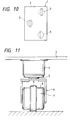
- a carrying vehicle movable in all directions (such as an automated guided vehicle on which an article handling robot is mounted), as shown in FIG. 10, has a vehicle body 1; and three driving/steering units 3 arranged on the lower surface of the floor (bottom plate) 2 of the vehicle body 1.
- Each of the driving/steering units 3, as shown in FIG. 11, comprises: a steering mechanism 4 secured to the floor 2; and a drive wheel mechanism 6 coupled to the lower end of the steering shaft 5 of the steering mechanism 4.
- a driving wheel (or driving tire) 9 is fitted on the outer rotor 8 of a drive motor 7 of outer rotor type.
- a battery On the vehicle body 1 are installed a battery, a power source unit such as a power converter for controlling the supply of power from the battery to the steering motor of the steering mechanism 4 and to the above-described drive motor, and a driving/steering control device for receiving feedback signals from the steering motor and the drive motor to control, for instance, the power converter.
- a power source unit such as a power converter for controlling the supply of power from the battery to the steering motor of the steering mechanism 4 and to the above-described drive motor
- a driving/steering control device for receiving feedback signals from the steering motor and the drive motor to control, for instance, the power converter.
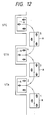
- FIG. 12 shows one example of a passageway along which the automated guided vehicle A moves.
- reference characters STA, STB and STC designate article handling stations in the yard.
- the automated guided vehicle A When it is required for the automated guided vehicle A to approach any one of the article handling stations and stop there, its movement is limited by other devices (not shown) to some extent; that is, the automated guided vehicle A is forced to approach the station from a drive route while moving sideward which is spaced a certain distance from the line of the stations.
- the automated guided vehicle A moves to the stations STA, STB and STC in the stated order; that is, it moves to positions 1, 2, 3, 4 and 5 in the stated order.
- the conventional automated guided vehicle is provided with a stopper or other suitable control means to prevent the angle of relative rotation of the vehicle from becoming more than 360°.
- a rest swing operation (in other words, a rest steering operation) is carried out; that is, only the steering shaft is turned 180°.
- the rest swing operation raises the following problems: First of all, the rest swing operation takes a relatively long time. Furthermore, in the rest swing operation, the grounding surface of the driving tire is rubbed against the surface of the yard, so that the driving tire is worn; that is, it is lowered in durability. In addition, when the automated guided vehicle is used in the clean room, the particle produced by the rubbing of the tire cannot be disregarded.
- an object of this invention is to eliminate the above-described difficulties accompanying a conventional automated guided vehicle movable in all directions. More specifically, an object of the invention is to provide an automated guided vehicle movable in all directions in which the cables will never be broken due to twisted, and it is unnecessary to perform the above-described rest swing operation.
- an automated guided vehicle movable in all directions which comprises vehicle wheels, and drive wheel mechanisms with drive mechanisms for driving the vehicle wheels, in which each of the drive wheel mechanisms is controlled with a steering mechanism so that the direction of movement of the automated guided vehicle is controlled with the vehicle body maintained unchanged in posture; transmission of electric power between an electric power source unit on a vehicle body and the drive mechanism and/or steering mechanism, and transmission of signals between a control unit on the vehicle body and the drive mechanism and/or steering mechanism are carried out through a signal/power transmitting and receiving means which comprises: a stationary electrode member provided on a member which is stationary with respect to the vehicle body; and a rotary electrode member provided on a steering shaft of the steering mechanism in such a manner that the rotary electrode member is rotatable with respect to the stationary electrode member.
- the steering mechanism is provided in parallel with the drive mechanism, and is adapted to drive, through a transmitting device, a steering shaft extended from the drive mechanism.
- the steering mechanism is provided in series with the drive mechanism, directly driving the drive mechanism.
- the signal/power transmitting and receiving means is a slip ring device
- the stationary electrode member has slip rings which are provided on a hollow steering shaft of the steering shaft of the steering mechanism
- the rotary electrode member has brushes which are elastically in slide contact with the slip rings.
- the signal/power transmitting and receiving means is of mercury switch type in which mercury is provided between stationary and rotary electrodes.
- the signal/power transmitting and receiving means has a rotary transformer, and the transmission and reception of signals are controlled by the rotary transformer, and the transmission and reception of electric power are performed through brush or mercury means.
- the steering mechanism has a steering motor of inner rotor type, the rotary shaft of which is a hollow steering shaft, a hollow slip ring shaft is coupled to one end of the steering shaft in such a manner that the hollow slip ring shaft is coaxial with the steering shaft, the slip ring shaft having holes in the wall thereof for receiving cables, and the slip rings are provided on the outer cylindrical surface of the slip ring shaft.
- the steering shaft has a prolongation, which serves as the hollow slip ring shaft.
- the steering mechanism has a steering motor of outer rotor type, the rotor of which serves as a steering shaft, a hollow slip ring shaft is arranged in the steering shaft in such a manner that the hollow slip ring shaft is coaxial with the steering shaft, the hollow slip ring shaft having holes in the wall thereof for receiving electric wires, and the slip rings are provided on the outer cylindrical surface of the slip ring shaft.
- the steering mechanism has a steering motor of outer rotor type, the rotor of which serves as a steering shaft, and a slip ring shaft is extended from an end lid of the rotor into the rotor in such a manner that the slip ring shaft is coaxial with a hollow stationary shaft of the steering motor.
- the steering mechanism has a steering motor of outer rotor type, the rotor of which serves as a steering shaft, and a slip ring shaft is arranged outside the rotor in such a manner that the slip ring shaft is coaxial with the rotor.
- the cable connected to the drive wheel mechanism is extended through the inside of the steering shaft and connected to the rotary electrode member which is rotated together with the steering shaft, and the cable connected to the steering mechanism is also extended through the inside of the steering shaft and connected to the rotary electrode member.
- the rotary electrode member is rotatable with respect to the stationary electrode member which is provided on the member which is on the stationary side of the vehicle body.
- FIG. 1 An automated guided vehicle movable in all directions, which constitutes a first embodiment of this invention, will be described with reference mainly to FIG. 1.
- reference numeral 10 designates a steering mechanism; 11, the casing of the steering mechanism. 10; 30, a drive wheel mechanism; 31, a bracket of the drive wheel mechanism 30; 50, a slip ring device; and 51, the casing of the slip ring device 50.
- the casing 11 of the steering mechanism 10 is in the form of a cylinder with the ends closed with upper and lower end lids 11U and 11D.
- the casing 11 is secured to the floor 2 of the vehicle body with the upper end cover 11U fastened to the lower surface of the floor 2 with bolts or the like.
- the casing 11 supports a hollow steering shaft 12 with the aid of bearings 13 and 14 in such a manner that the shaft 12 is held vertical.
- the bracket 31 of the drive wheel mechanism 30 has right and left side walls 31R which are coupled through a bracket coupling plate to each other.
- the lower end portion of the steering shaft 12, which is extended downwardly through the lower end lid 11D, is fitted in a recess 32 which is formed in the bracket coupling board of the bracket 31 of the drive wheel mechanism 30.
- the lower end portion of the steering shaft 12, is coupled to the coupling board with bolts or the like; that is, the coupling board is supported by the lower end portion of the steering shaft 12 which is extended through the lower end lid 11D.
- the upper end portion thus protruded is joined to the lower end portion of the hollow slip ring shaft 52 of the slip ring device 50.
- a protective ring 80 is fitted in the hole 2A of the floor 2, and secured to the upper end lid 11U of the casing 11 of the steering mechanism 10, in such a manner that it surrounds the joint of the steering shaft 12 and the slip ring shaft 52.
- the casing 51 of the slip ring device 50 supports the slip ring shaft 52 through bearings 53 and 54 and is secured on the protective ring 80.
- the rotor 15 of a steering motor M1, the magnetic pole rotor 16 of a rotation sensor S1 such as an encoder, and the movable friction board 17 of a steering electromagnetic brake B1 are mounted on the steering shaft 12 of the steering mechanism 10.
- the stator 18 of the steering motor M1, the pickup element (pickup coil) 19 of the rotation sensor 20, and the stationary friction board and exciting section 20 of the steering electromagnetic brake B1 are secured to the casing 11.
- reference numeral 21 designates a power cable connected to the steering motor M1; 22, a signal line connected to the rotation sensor S1; and 23, a power cable connected to the steering electromagnetic brake B1 (the cables and the line are assembled into one unit 61D).
- the power cable 21, the signal line 22, and the power cable 23 are extended outside through wire holes 11a, 11b and 11c formed in the side wall of the casing 11, respectively, and are then bundled outside the casing 11, and extended into the vehicle body through a wire hole 2B formed in the floor (bottom board) 2 of the automated guided vehicle.
- the power cable 21 of the steering motor M1, and the power cable 22 of the steering electromagnetic brake B1 are connected to a motor power source unit and a brake power source unit, respectively, and the signal line of the rotation sensor S1 is connected to a control unit.
- the drive wheel mechanism 30 incorporates a drive motor M2.
- the drive motor M2 is of outer rotor type, and its motor shaft (being an axle) is supported by the brackets 31R and 31L at both ends.
- the outer rotor 35 is supported through bearings 33A and 33B on the motor shaft 33.
- a driving tire 9 is fixedly put on the outer rotor 35.
- the motor shaft 33 is in the form of a hollow tube.
- the stator 37 of the motor M2, the pickup element 38 of a rotation sensor S2 such as an encoder, and the stationary friction board and exciting section 39 of a drive wheel electromagnetic brake B2 are mounted on the hollow motor shift 33.
- reference numeral 43 designates a power cable connected to the drive motor M2; 44, a signal line connected to the rotation sensor S2; and 45, a power cable connected to the drive wheel electromagnetic brake B2 (the assembly of those lines 43, 44 and 45 being designated by 61C).
- the power cable 43, the signal line 44, and the power cable 45 are extended into the hollow motor shaft 33 respectively through wire boles 33a, 33b and 34c formed in the cylindrical wall of the motor shaft 33, and are then extended outside through the left end of the motor shaft 33 and a hole 31a formed in the left side wall 31L of the casing 31.
- Those lines 43, 44 and 45 thus extended are further extended through a hole 31b formed in the left side wall 31L and then through a hole 31A, which is communicated with the recess 32, into the steering shaft 12 and the slip ring shaft 52.
- a disk-type slip ring 55 (FIG. 3) and ring-type slip rings 56 (or 56a through 56e) (FIG. 2), which form a rotary electrode section, are mounted on the slip ring shaft 52.
- Terminal sections 59 and 60 (which form a stationary electrode section) are provided on the inner surface of the housing 51.
- the terminal section 59 has electrically conducive brushes 57 (or 57a, 57b and 57c) which are elastically brought in slide contact with conductors 55a, 55b and 55c of the disk-type slip ring 55, respectively.
- the terminal section 60 has electrically conductive brushes 58 (or 58a through 58e), which are elastically brought into slide contact with the ring-type slip rings 56 (56a through 56e), respectively.
- the stationary electrode section, the brushes, and the rotary electrode section form signal/power transmitting and receiving means.
- the power cable 43 of the drive motor M2, and the power cable 45 of the drive wheel electromagnetic brake B2 are extended outside the slip ring shaft 52 through wire holes 52a through 52e formed in the cylindrical wall of the slip ring shaft 52, and then connected to the respective ring-type slip rings 56a through 56e.
- the signal line 44 of the rotation sensor S2 is extended outside the slip ring shaft 52 through a wire hole 52f formed in the cylindrical wall of the slip ring shaft 52, and then connected to the disk-type slip ring 55.
- a power cable connected to the motor power source unit, and a power cable connected to the brake power source unit are extended into the casing 51 through a wire hole 51a formed in the casing 51, and then extended through a wire hole 60a formed in the terminal section 60 and connected to the respective terminal in the terminal section 60.
- a signal line 61B connected to the aforementioned control unit is extended into the casing 51 through the wire hole 51a, and connected to the respective terminal 59.
- the drive wheel mechanism 30, the steering shaft 12, and the rotary electrode section turns as one unit, and the cable 61C of the drive wheel mechanism 30 is extended through the inside of the steering shaft 12 and connected to the rotary electrode section. Hence, those cables will never be twisted.
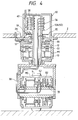
- FIG. 4 shows a second embodiment of the invention.
- the second embodiment is different from the first embodiment only in the following points:
- the steering shaft 12 and the slip ring shaft 52 of the first embodiment are formed into one unit. That is, the steering shaft 12 has a prolongation 12A, which is protruded into the casing 51, so that the prolongation 12A is employed as the slip ring 52.
- the second embodiment dispenses with the bearings 53 and 54 of the protective ring 80 of the first embodiment shown in FIG. 1.
- FIG. 5 shows a third embodiment of the invention.
- the steering motor M1 is of outer rotor type, and its rotor 111 is employed as the steering shaft. That is, the rotor 111 has a prolongation 111A which serves as the above-described casing 51.
- the upper open end of the rotor 111 is put on the outer cylindrical surface of an annular protrusion 112 through a bearing 75 which is extended from a mounting member 111U (which is one of the end lids of the motor M1) which is secured to the lower surface of the floor 2; whereas the lower open end of the rotor 111 is put on the outer cylindrical surface of another mounting member 111D (which is the other end lid of the motor M1) through a bearing 76.
- the shaft (or hollow stationary shaft) 120 of the steering motor M1 is integral with the slip ring shaft 52. That is, those shafts 120 and 52 provided as one unit are supported by the end lids 111U and 111D.
- a steering electromagnetic brake B1 is set inside a bracket 82 which is secured to the lower end of the rotor 111.
- a bracket 31 is coupled through the bracket 82 and a coupling board 83 to the rotor 111.
- the bracket 82 has a protrusion 82A extended downwardly, which is engaged with a recess 83A formed in the coupling board 83.
- the coupling board 83 has a wire hole 83a.
- the stationary friction board and exciting section 20 of the steering electromagnetic brake B1 is provided on the end lid 111D, and the movable friction board 17 is secured to the bracket 82.
- the power cable 43 of a drive motor M2, the signal line of a rotation sensor S2, and the power cable 45 of a drive wheel electromagnetic brake B2 are extended through a wire hole 43 formed in the side wall of the bracket 31 and through a wire hole 83a formed in the coupling board 83.
- the power cable 43 of the drive motor M2, and the power cable 45 of the drive wheel electromagnetic brake B2 are extended through a wire hole 111a formed in the cylindrical wall of the rotor 111 into the rotor 111, and connected to the respective terminals in the terminal section 60; while the signal line 44 of the rotation sensor S2 is extended through a wire hole 111b formed in the cylindrical wall of the rotor 111, and connected to the respective terminal in the terminal section 59.
- the power cables from the power source units, and the signal line from the control unit are connected to the ring section and the disk section.
- the power cable 23 of the steering electromagnetic brake B1 is extended through a wire hole 120b in the shaft 120 and through the inside of the slip ring shaft S2.
- the signal line 22 of the rotation sensor S1 is extended through a wire passageway 111c formed in the end lid 111D, and through the inside of the shaft 120 into the inside of the slip ring shaft 52.
- FIG. 6 shows a fourth embodiment of the invention.
- its steering motor M1 is of outer rotor type.
- the fourth embodiment is different from the third embodiment in that a slip ring shaft 52 and terminal sections 59 and 60 are provided in the hollow shaft 130 of the steering motor M1 in such a manner that they are coaxial with the hollow shaft 130, and the slip ring shaft 52 is put on a shaft member 140 which is extended vertically from the lower end lid 11D of the rotor 111.
- the upper end of the hollow shaft 130 is closed with an end lid 131U, and has a flange 130A which is secured to the rear surface of the floor 2 with bolts or the like.
- the shaft member 140 has a hole 140A which is opened downwardly.
- the movable friction board 1 of a steering electromagnetic brake B1 is mounted on the upper end portion of the shaft member 140, and the stationary friction board and exciting section 20 of the brake B1 is fixedly secured to the aforementioned end lid 131U.
- reference characters 131a and 131b designate wire holes formed in the end lid 131U.
- the lower end lid 111D of the rotor 111 has a protrusion 111A which is fitted in a recess 83A formed in a coupling board 83, and a wire hole 111a.
- FIG. 7 shows a fifth embodiment of the invention.
- its steering motor M1 is of outer rotor type.
- the fifth embodiment is substantially different from the third and fourth embodiments in that a hollow slip ring shaft 52 is provided outside the rotor 150 of the motor in such a manner that the shaft 52 is coaxial with the steering motor M1, and a stationary frame 160 surrounds the slip ring shaft 52 with a space G therebetween.
- the stationary frame 160 has an internal annular member 160A with an upper flange 160B.
- the upper flange 160B is secured to the floor 2 with bolts or the like.
- Wire holes 160a and 160b are formed in the side wall of the stationary frame 160.
- the inside of the rotor 150 is divided by a partition wall 151 into a motor chamber A and a brake chamber B.
- the upper end portion of the rotor 150 is fitted in the internal annular member 160A of the stationary frame 160 through a bearing 75, and the lower end portion is fitted in the lower end portion of the stationary frame 160 through a bearing 76.
- the lower end of the rotor 150 is closed with an end lid 151D.
- the end lid 151D has a protrusion 152D, which is engaged with a recess 83A formed in a coupling board 83.
- the shaft 170 of the steering motor M1 is hollow, and has a flange 170A at the upper end which closes the upper end of the rotor 150.
- the lower end portion of the shaft 170 is supported through a bearing 54 by the aforementioned partition wall 151.
- FIG. 8 shows a sixth embodiment of the invention.
- a steering mechanism 10 is provided in parallel with a drive wheel mechanism 30, and secured through a speed reducing unit 200 to the lower surface of the floor 2.
- the speed reducing unit 200 has a drive shaft 201 protruded above the floor 2, on which a toothed pulley 202 is fixedly mounted.
- the drive wheel mechanism 30 is mounted on the floor 2 through a mounting member 190, a bearing 191, and a mounting member 192.
- a steering shaft 120 having a prolongation 120A is mounted vertical on the mounting member 190.
- the mounting member 190 is in the form of a short tube.
- the lower end portion of the mounting member 190 is fitted in a recess 83A formed in a coupling board 83, and secured to the coupling board 83 with bolts or the like.
- the mounting member 192 comprises an upper member 192A which is in the form of a short tube with a flange; and a lower member 192B which is also in the form of a short tube.
- the mounting member 192 is engaged a hole 2A formed in the floor 2.
- the mounting member 190 is fitted in the mounting member 192 through the bearing 191.
- the prolongation 120A of the steering shaft 120 is extended into the casing 51 of a slip ring device; that is, it serves as a slip ring shaft.
- a toothed pulley 203 is fixedly mounted on the end portion of the slip ring shaft which end portion is located outside the casing 51.
- a toothed belt is laid over the toothed pulley 203 and the above-described toothed pulley 202.
- reference numeral 300 designates a slip ring supporting frame.
- transmission and reception of electric power and signals for the vehicle body, the steering mechanism, and the drive mechanism are carried out through the slip ring device 50.
- they may be performed by using different means as shown in FIG. 9.
- FIG. 9 shows a seventh embodiment of the invention.
- reference character DR designates a driver (or power source unit).
- the driver DR provides controlled driving electric power, which is applied through a slip ring device SLip forming a signal/power transmitting and receiving device B (encircled by the broken line in FIG. 9) to the motors in the motor drive mechanism and the steering mechanism.
- the output of the sensor such as the above-described rotation sensor S1 is modulated by a converter device A, and applied through a rotary transformer RTr forming the signal/power transmitting and receiving device B to a converter device C, where it is demodulated.
- the output of the converter device C is applied to the driver DR.
- transmission and reception of the signals are carried out through the rotary transformer, and transmission and reception of the driving electric power are performed through the slip ring device; however, the invention is not limited thereto or thereby. That is, a mercury switch may be employed for transmission and reception of the driving electric power.
- the cable connected to the drive wheel mechanism is extended through the inside of the steering shaft and connected to the rotary electrode section which is rotated together with the steering shaft, and the cable connected to the steering mechanism is also extended through the inside of the steering shaft and connected to the rotary electrode section.
- the rotary electrode section is rotatable with respect to the stationary electrode section which is provided on the member which is on the stationary side of the vehicle body.
- the automated guided vehicle of the invention unlike the conventional one, it is unnecessary to use the stoppers, and it is unnecessary to perform the rest swing operation. That is, the automated guided vehicle according to the invention is free from the difficulty that particle is produced during the rest swing operation. Therefore, the automated guided vehicle can be effectively used in a clean room.
Landscapes
- Engineering & Computer Science (AREA)
- Transportation (AREA)
- Mechanical Engineering (AREA)
- Chemical & Material Sciences (AREA)
- Combustion & Propulsion (AREA)
- Power Engineering (AREA)
- Life Sciences & Earth Sciences (AREA)
- Sustainable Development (AREA)
- Sustainable Energy (AREA)
- Power Steering Mechanism (AREA)
- Arrangement Or Mounting Of Propulsion Units For Vehicles (AREA)
- Arrangement And Driving Of Transmission Devices (AREA)
- Control Of Position, Course, Altitude, Or Attitude Of Moving Bodies (AREA)
- Arrangements For Transmission Of Measured Signals (AREA)
Abstract
Description
- This invention relates to a carrying vehicle which is movable in all directions, comprising: vehicle wheels, and driving wheels with drive mechanisms for driving the vehicle wheels, in which each of the driving wheels are controlled with a steering mechanism so that its moving direction is controlled with the vehicle body maintained unchanged in posture.
- A carrying vehicle movable in all directions (such as an automated guided vehicle on which an article handling robot is mounted), as shown in FIG. 10, has a
vehicle body 1; and three driving/steering units 3 arranged on the lower surface of the floor (bottom plate) 2 of thevehicle body 1. Each of the driving/steering units 3, as shown in FIG. 11, comprises: asteering mechanism 4 secured to thefloor 2; and adrive wheel mechanism 6 coupled to the lower end of thesteering shaft 5 of thesteering mechanism 4. A driving wheel (or driving tire) 9 is fitted on theouter rotor 8 of adrive motor 7 of outer rotor type. On thevehicle body 1 are installed a battery, a power source unit such as a power converter for controlling the supply of power from the battery to the steering motor of thesteering mechanism 4 and to the above-described drive motor, and a driving/steering control device for receiving feedback signals from the steering motor and the drive motor to control, for instance, the power converter. - FIG. 12 shows one example of a passageway along which the automated guided vehicle A moves. In FIG. 12, reference characters STA, STB and STC designate article handling stations in the yard.
- When it is required for the automated guided vehicle A to approach any one of the article handling stations and stop there, its movement is limited by other devices (not shown) to some extent; that is, the automated guided vehicle A is forced to approach the station from a drive route while moving sideward which is spaced a certain distance from the line of the stations.
- It is assumed that the automated guided vehicle A moves to the stations STA, STB and STC in the stated order; that is, it moves to
positions - In order to overcome this difficulty, the conventional automated guided vehicle is provided with a stopper or other suitable control means to prevent the angle of relative rotation of the vehicle from becoming more than 360°.
- That is, when, in the case of FIG. 12, the vehicle is stopped at the
position - However, the rest swing operation raises the following problems: First of all, the rest swing operation takes a relatively long time. Furthermore, in the rest swing operation, the grounding surface of the driving tire is rubbed against the surface of the yard, so that the driving tire is worn; that is, it is lowered in durability. In addition, when the automated guided vehicle is used in the clean room, the particle produced by the rubbing of the tire cannot be disregarded.
- Accordingly, an object of this invention is to eliminate the above-described difficulties accompanying a conventional automated guided vehicle movable in all directions. More specifically, an object of the invention is to provide an automated guided vehicle movable in all directions in which the cables will never be broken due to twisted, and it is unnecessary to perform the above-described rest swing operation.
- The foregoing object of this invention has been achieved by the provision of an automated guided vehicle movable in all directions which comprises vehicle wheels, and drive wheel mechanisms with drive mechanisms for driving the vehicle wheels, in which each of the drive wheel mechanisms is controlled with a steering mechanism so that the direction of movement of the automated guided vehicle is controlled with the vehicle body maintained unchanged in posture;
transmission of electric power between an electric power source unit on a vehicle body and the drive mechanism and/or steering mechanism, and transmission of signals between a control unit on the vehicle body and the drive mechanism and/or steering mechanism are carried out through a signal/power transmitting and receiving means which comprises:
a stationary electrode member provided on a member which is stationary with respect to the vehicle body; and
a rotary electrode member provided on a steering shaft of the steering mechanism in such a manner that the rotary electrode member is rotatable with respect to the stationary electrode member. - In the automated guided vehicle of the present invention, the steering mechanism is provided in parallel with the drive mechanism, and is adapted to drive, through a transmitting device, a steering shaft extended from the drive mechanism.
- In the automated guided vehicle of the present invention, the steering mechanism is provided in series with the drive mechanism, directly driving the drive mechanism.
- In the automated guided vehicle of the present invention, the signal/power transmitting and receiving means is a slip ring device, the stationary electrode member has slip rings which are provided on a hollow steering shaft of the steering shaft of the steering mechanism, and the rotary electrode member has brushes which are elastically in slide contact with the slip rings.
- In the automated guided vehicle of the present invention, the signal/power transmitting and receiving means is of mercury switch type in which mercury is provided between stationary and rotary electrodes.
- In the automated guided vehicle of the present invention, the signal/power transmitting and receiving means has a rotary transformer, and the transmission and reception of signals are controlled by the rotary transformer, and the transmission and reception of electric power are performed through brush or mercury means.
- In the automated guided vehicle movable in all directions of the present invention, the steering mechanism has a steering motor of inner rotor type, the rotary shaft of which is a hollow steering shaft, a hollow slip ring shaft is coupled to one end of the steering shaft in such a manner that the hollow slip ring shaft is coaxial with the steering shaft, the slip ring shaft having holes in the wall thereof for receiving cables, and the slip rings are provided on the outer cylindrical surface of the slip ring shaft.
- In the automated guided vehicle of the present invention, the steering shaft has a prolongation, which serves as the hollow slip ring shaft.
- In the automated guided vehicle of the present invention, the steering mechanism has a steering motor of outer rotor type, the rotor of which serves as a steering shaft, a hollow slip ring shaft is arranged in the steering shaft in such a manner that the hollow slip ring shaft is coaxial with the steering shaft, the hollow slip ring shaft having holes in the wall thereof for receiving electric wires, and the slip rings are provided on the outer cylindrical surface of the slip ring shaft.
- In the automated guided vehicle of the present invention, the steering mechanism has a steering motor of outer rotor type, the rotor of which serves as a steering shaft, and a slip ring shaft is extended from an end lid of the rotor into the rotor in such a manner that the slip ring shaft is coaxial with a hollow stationary shaft of the steering motor.
- In the automated guided vehicle of the present invention, the steering mechanism has a steering motor of outer rotor type, the rotor of which serves as a steering shaft, and a slip ring shaft is arranged outside the rotor in such a manner that the slip ring shaft is coaxial with the rotor.
- In the automated guided vehicle movable in all directions according to the invention, the cable connected to the drive wheel mechanism is extended through the inside of the steering shaft and connected to the rotary electrode member which is rotated together with the steering shaft, and the cable connected to the steering mechanism is also extended through the inside of the steering shaft and connected to the rotary electrode member. The rotary electrode member is rotatable with respect to the stationary electrode member which is provided on the member which is on the stationary side of the vehicle body. Hence, when the drive wheel rotates with respect to the vehicle body, those cables are also turned together with the drive wheel. That is, even when it turns more than 360°, the cables will never be twisted.
-
- FIG. 1 is a vertical sectional view outlining the arrangement of a first embodiment of this invention;
- FIG. 2 is an explanatory diagram showing essential components of a clip ring device in the first embodiment of the invention;
- FIG. 3 is an explanatory diagram showing other essential components of the slip ring device in the first embodiment;
- FIG. 4 is a vertical sectional view outlining the arrangement of a second embodiment of the invention;
- FIG. 5 is a vertical sectional view outlining the arrangement of a third embodiment of the invention;
- FIG. 6. is a vertical sectional view outlining the arrangement of a fourth embodiment of the invention;
- FIG. 7 is a vertical sectional view outlining the arrangement of a fifth embodiment of the invention;
- FIG. 8 is a vertical sectional view outlining the arrangement of a sixth embodiment of the invention;
- FIG. 9 is a vertical sectional view outlining the arrangement of a seventh embodiment of the invention;
- FIG. 10 is an explanatory diagram showing the arrangement of a driving/steering unit in an automated guided vehicle movable in all directions;
- FIG. 11 is a side view of a driving/steering unit in FIG. 7; and
- FIG. 12 is an explanatory diagram showing an example of a way along which a conventional automated guided vehicle movable in all direction moves, for a description of difficulties accompanying the conventional automated guided vehicle.
- An automated guided vehicle movable in all directions, which constitutes a first embodiment of this invention, will be described with reference mainly to FIG. 1.
- In FIG. 1,
reference numeral 10 designates a steering mechanism; 11, the casing of the steering mechanism. 10; 30, a drive wheel mechanism; 31, a bracket of thedrive wheel mechanism 30; 50, a slip ring device; and 51, the casing of theslip ring device 50. - The
casing 11 of thesteering mechanism 10 is in the form of a cylinder with the ends closed with upper andlower end lids 11U and 11D. Thecasing 11 is secured to thefloor 2 of the vehicle body with theupper end cover 11U fastened to the lower surface of thefloor 2 with bolts or the like. Thecasing 11 supports ahollow steering shaft 12 with the aid ofbearings 13 and 14 in such a manner that theshaft 12 is held vertical. - The
bracket 31 of thedrive wheel mechanism 30 has right andleft side walls 31R which are coupled through a bracket coupling plate to each other. The lower end portion of thesteering shaft 12, which is extended downwardly through the lower end lid 11D, is fitted in arecess 32 which is formed in the bracket coupling board of thebracket 31 of thedrive wheel mechanism 30. The lower end portion of thesteering shaft 12, is coupled to the coupling board with bolts or the like; that is, the coupling board is supported by the lower end portion of thesteering shaft 12 which is extended through the lower end lid 11D. - The upper end portion of the
steering shaft 12, which is extended through theupper end lid 11U, is protruded into ahole 2A formed in thefloor 2 of the vehicle body. The upper end portion thus protruded is joined to the lower end portion of the hollowslip ring shaft 52 of theslip ring device 50. Aprotective ring 80 is fitted in thehole 2A of thefloor 2, and secured to theupper end lid 11U of thecasing 11 of thesteering mechanism 10, in such a manner that it surrounds the joint of the steeringshaft 12 and theslip ring shaft 52. Thecasing 51 of theslip ring device 50 supports theslip ring shaft 52 throughbearings protective ring 80. - The
rotor 15 of a steering motor M1, themagnetic pole rotor 16 of a rotation sensor S1 such as an encoder, and themovable friction board 17 of a steering electromagnetic brake B1 are mounted on the steeringshaft 12 of thesteering mechanism 10. Thestator 18 of the steering motor M1, the pickup element (pickup coil) 19 of therotation sensor 20, and the stationary friction board andexciting section 20 of the steering electromagnetic brake B1 are secured to thecasing 11. Further in FIG. 1,reference numeral 21 designates a power cable connected to the steering motor M1; 22, a signal line connected to the rotation sensor S1; and 23, a power cable connected to the steering electromagnetic brake B1 (the cables and the line are assembled into oneunit 61D). Thepower cable 21, thesignal line 22, and thepower cable 23 are extended outside throughwire holes casing 11, respectively, and are then bundled outside thecasing 11, and extended into the vehicle body through awire hole 2B formed in the floor (bottom board) 2 of the automated guided vehicle. Under this condition, thepower cable 21 of the steering motor M1, and thepower cable 22 of the steering electromagnetic brake B1 are connected to a motor power source unit and a brake power source unit, respectively, and the signal line of the rotation sensor S1 is connected to a control unit. - The
drive wheel mechanism 30 incorporates a drive motor M2. The drive motor M2 is of outer rotor type, and its motor shaft (being an axle) is supported by thebrackets outer rotor 35 is supported throughbearings motor shaft 33. A drivingtire 9 is fixedly put on theouter rotor 35. Themotor shaft 33 is in the form of a hollow tube. Thestator 37 of the motor M2, thepickup element 38 of a rotation sensor S2 such as an encoder, and the stationary friction board andexciting section 39 of a drive wheel electromagnetic brake B2 are mounted on thehollow motor shift 33. On the other hand, therotor 40 of the motor M2, therotor 41 of the rotation sensor S2, and themovable board 42 of the drive wheel electromagnetic brake B2 are provided on theouter rotor 35. In FIG. 1,reference numeral 43 designates a power cable connected to the drive motor M2; 44, a signal line connected to the rotation sensor S2; and 45, a power cable connected to the drive wheel electromagnetic brake B2 (the assembly of thoselines power cable 43, thesignal line 44, and thepower cable 45 are extended into thehollow motor shaft 33 respectively throughwire boles motor shaft 33, and are then extended outside through the left end of themotor shaft 33 and ahole 31a formed in theleft side wall 31L of thecasing 31. Thoselines hole 31b formed in theleft side wall 31L and then through ahole 31A, which is communicated with therecess 32, into the steeringshaft 12 and theslip ring shaft 52. - A disk-type slip ring 55 (FIG. 3) and ring-type slip rings 56 (or 56a through 56e) (FIG. 2), which form a rotary electrode section, are mounted on the
slip ring shaft 52.Terminal sections 59 and 60 (which form a stationary electrode section) are provided on the inner surface of thehousing 51. Theterminal section 59 has electrically conducive brushes 57 (or 57a, 57b and 57c) which are elastically brought in slide contact withconductors type slip ring 55, respectively. Theterminal section 60 has electrically conductive brushes 58 (or 58a through 58e), which are elastically brought into slide contact with the ring-type slip rings 56 (56a through 56e), respectively. The stationary electrode section, the brushes, and the rotary electrode section form signal/power transmitting and receiving means. - The
power cable 43 of the drive motor M2, and thepower cable 45 of the drive wheel electromagnetic brake B2 are extended outside theslip ring shaft 52 throughwire holes 52a through 52e formed in the cylindrical wall of theslip ring shaft 52, and then connected to the respective ring-type slip rings 56a through 56e. Thesignal line 44 of the rotation sensor S2 is extended outside theslip ring shaft 52 through awire hole 52f formed in the cylindrical wall of theslip ring shaft 52, and then connected to the disk-type slip ring 55. A power cable connected to the motor power source unit, and a power cable connected to the brake power source unit (those cables being designated by 61A) are extended into thecasing 51 through awire hole 51a formed in thecasing 51, and then extended through awire hole 60a formed in theterminal section 60 and connected to the respective terminal in theterminal section 60. Asignal line 61B connected to the aforementioned control unit is extended into thecasing 51 through thewire hole 51a, and connected to therespective terminal 59. - In the above-described first embodiment, the
drive wheel mechanism 30, the steeringshaft 12, and the rotary electrode section turns as one unit, and thecable 61C of thedrive wheel mechanism 30 is extended through the inside of the steeringshaft 12 and connected to the rotary electrode section. Hence, those cables will never be twisted. - FIG. 4 shows a second embodiment of the invention. The second embodiment is different from the first embodiment only in the following points: The steering
shaft 12 and theslip ring shaft 52 of the first embodiment are formed into one unit. That is, the steeringshaft 12 has aprolongation 12A, which is protruded into thecasing 51, so that theprolongation 12A is employed as theslip ring 52. The second embodiment dispenses with thebearings protective ring 80 of the first embodiment shown in FIG. 1. - FIG. 5 shows a third embodiment of the invention. In the third embodiment, the steering motor M1 is of outer rotor type, and its
rotor 111 is employed as the steering shaft. That is, therotor 111 has aprolongation 111A which serves as the above-describedcasing 51. The upper open end of therotor 111 is put on the outer cylindrical surface of anannular protrusion 112 through abearing 75 which is extended from a mountingmember 111U (which is one of the end lids of the motor M1) which is secured to the lower surface of thefloor 2; whereas the lower open end of therotor 111 is put on the outer cylindrical surface of another mountingmember 111D (which is the other end lid of the motor M1) through abearing 76. The shaft (or hollow stationary shaft) 120 of the steering motor M1 is integral with theslip ring shaft 52. That is, thoseshafts end lids bracket 82 which is secured to the lower end of therotor 111. Abracket 31 is coupled through thebracket 82 and acoupling board 83 to therotor 111. Thebracket 82 has aprotrusion 82A extended downwardly, which is engaged with arecess 83A formed in thecoupling board 83. Thecoupling board 83 has awire hole 83a. The stationary friction board andexciting section 20 of the steering electromagnetic brake B1 is provided on theend lid 111D, and themovable friction board 17 is secured to thebracket 82. - In the third embodiment, the
power cable 43 of a drive motor M2, the signal line of a rotation sensor S2, and thepower cable 45 of a drive wheel electromagnetic brake B2 (the assembly of thoselines wire hole 43 formed in the side wall of thebracket 31 and through awire hole 83a formed in thecoupling board 83. Furthermore, thepower cable 43 of the drive motor M2, and thepower cable 45 of the drive wheel electromagnetic brake B2 are extended through awire hole 111a formed in the cylindrical wall of therotor 111 into therotor 111, and connected to the respective terminals in theterminal section 60; while thesignal line 44 of the rotation sensor S2 is extended through a wire hole 111b formed in the cylindrical wall of therotor 111, and connected to the respective terminal in theterminal section 59. On the other hand, the power cables from the power source units, and the signal line from the control unit are connected to the ring section and the disk section. Thepower cable 23 of the steering electromagnetic brake B1 is extended through awire hole 120b in theshaft 120 and through the inside of the slip ring shaft S2. Thesignal line 22 of the rotation sensor S1 is extended through awire passageway 111c formed in theend lid 111D, and through the inside of theshaft 120 into the inside of theslip ring shaft 52. - FIG. 6 shows a fourth embodiment of the invention. In the fourth embodiment, similarly as in the case of the third embodiment shown in FIG. 5, its steering motor M1 is of outer rotor type. However, the fourth embodiment is different from the third embodiment in that a
slip ring shaft 52 andterminal sections hollow shaft 130 of the steering motor M1 in such a manner that they are coaxial with thehollow shaft 130, and theslip ring shaft 52 is put on ashaft member 140 which is extended vertically from the lower end lid 11D of therotor 111. The upper end of thehollow shaft 130 is closed with anend lid 131U, and has aflange 130A which is secured to the rear surface of thefloor 2 with bolts or the like. Theshaft member 140 has ahole 140A which is opened downwardly. Themovable friction board 1 of a steering electromagnetic brake B1 is mounted on the upper end portion of theshaft member 140, and the stationary friction board andexciting section 20 of the brake B1 is fixedly secured to theaforementioned end lid 131U. In FIG. 6,reference characters end lid 131U. Thelower end lid 111D of therotor 111 has aprotrusion 111A which is fitted in arecess 83A formed in acoupling board 83, and awire hole 111a. - FIG. 7 shows a fifth embodiment of the invention. In the sixth embodiment, similarly as in the case of the above-described third and fourth embodiments (FIGS. 5 and 6), its steering motor M1 is of outer rotor type. However, the fifth embodiment is substantially different from the third and fourth embodiments in that a hollow
slip ring shaft 52 is provided outside therotor 150 of the motor in such a manner that theshaft 52 is coaxial with the steering motor M1, and astationary frame 160 surrounds theslip ring shaft 52 with a space G therebetween. - The
stationary frame 160 has an internalannular member 160A with anupper flange 160B. Theupper flange 160B is secured to thefloor 2 with bolts or the like.Wire holes stationary frame 160. - The inside of the
rotor 150 is divided by apartition wall 151 into a motor chamber A and a brake chamber B. The upper end portion of therotor 150 is fitted in the internalannular member 160A of thestationary frame 160 through abearing 75, and the lower end portion is fitted in the lower end portion of thestationary frame 160 through abearing 76. The lower end of therotor 150 is closed with anend lid 151D. Theend lid 151D has a protrusion 152D, which is engaged with arecess 83A formed in acoupling board 83. Theshaft 170 of the steering motor M1 is hollow, and has aflange 170A at the upper end which closes the upper end of therotor 150. The lower end portion of theshaft 170 is supported through abearing 54 by theaforementioned partition wall 151. - FIG. 8 shows a sixth embodiment of the invention. In the sixth embodiment, a
steering mechanism 10 is provided in parallel with adrive wheel mechanism 30, and secured through aspeed reducing unit 200 to the lower surface of thefloor 2. Thespeed reducing unit 200 has adrive shaft 201 protruded above thefloor 2, on which atoothed pulley 202 is fixedly mounted. - The
drive wheel mechanism 30 is mounted on thefloor 2 through a mountingmember 190, abearing 191, and a mountingmember 192. A steeringshaft 120 having aprolongation 120A is mounted vertical on the mountingmember 190. The mountingmember 190 is in the form of a short tube. The lower end portion of the mountingmember 190 is fitted in arecess 83A formed in acoupling board 83, and secured to thecoupling board 83 with bolts or the like. The mountingmember 192 comprises anupper member 192A which is in the form of a short tube with a flange; and alower member 192B which is also in the form of a short tube. The mountingmember 192 is engaged ahole 2A formed in thefloor 2. The mountingmember 190 is fitted in the mountingmember 192 through thebearing 191. Theprolongation 120A of thesteering shaft 120 is extended into thecasing 51 of a slip ring device; that is, it serves as a slip ring shaft. Atoothed pulley 203 is fixedly mounted on the end portion of the slip ring shaft which end portion is located outside thecasing 51. A toothed belt is laid over thetoothed pulley 203 and the above-describedtoothed pulley 202. In FIG. 8,reference numeral 300 designates a slip ring supporting frame. - In the above-described embodiment, transmission and reception of electric power and signals for the vehicle body, the steering mechanism, and the drive mechanism are carried out through the
slip ring device 50. However, they may be performed by using different means as shown in FIG. 9. - FIG. 9 shows a seventh embodiment of the invention. In FIG. 9, reference character DR designates a driver (or power source unit). The driver DR provides controlled driving electric power, which is applied through a slip ring device SLip forming a signal/power transmitting and receiving device B (encircled by the broken line in FIG. 9) to the motors in the motor drive mechanism and the steering mechanism. The output of the sensor such as the above-described rotation sensor S1 is modulated by a converter device A, and applied through a rotary transformer RTr forming the signal/power transmitting and receiving device B to a converter device C, where it is demodulated. The output of the converter device C is applied to the driver DR.
- In the seventh embodiment shown in FIG. 9, transmission and reception of the signals are carried out through the rotary transformer, and transmission and reception of the driving electric power are performed through the slip ring device; however, the invention is not limited thereto or thereby. That is, a mercury switch may be employed for transmission and reception of the driving electric power.
- In the automated guided vehicle movable in all directions according to the invention, the cable connected to the drive wheel mechanism is extended through the inside of the steering shaft and connected to the rotary electrode section which is rotated together with the steering shaft, and the cable connected to the steering mechanism is also extended through the inside of the steering shaft and connected to the rotary electrode section. The rotary electrode section is rotatable with respect to the stationary electrode section which is provided on the member which is on the stationary side of the vehicle body. Hence, when the drive wheel rotates with respect to the vehicle body, those cables are also turned together with the drive wheel. That is, even when it turns more than 360°, the cables will never be broken being twisted. Thus, in the case of the automated guided vehicle of the invention, unlike the conventional one, it is unnecessary to use the stoppers, and it is unnecessary to perform the rest swing operation. That is, the automated guided vehicle according to the invention is free from the difficulty that particle is produced during the rest swing operation. Therefore, the automated guided vehicle can be effectively used in a clean room.
Claims (10)
- An automated guided vehicle movable in all directions comprising:
drive wheel means for driving drive mechanisms for driving vehicle wheels;
steering means for controlling the drive wheel means to control a direction of movement of the automated guided vehicle without changing a posture of the automated guided vehicle; and
signal/power transmitting and receiving means for transmitting an electric power between an electric power source unit provided on a body of the automated guided vehicle and at least one of the drive mechanisms and the steering means and for transmitting a signal between a control unit provided on the body of the automated guided vehicle and at least one of the drive mechanisms and the steering means, through a stationary electrode member provided on a member which is stationary with respect to the body of the automated guided vehicle and a rotary electrode member provided on a member which is rotatable with respect to the stationary electrode member, the stationary electrode member and the rotary electrode member being included into the signal/power transmitting and receiving means. - An automated guided vehicle as claimed in claim 1, wherein the steering means includes:
a steering shaft and a rotor coupled with the drive mechanisms, the rotor being positioned outwardly the hollow steering shaft. - An automated guided vehicle as claimed in claim 2, wherein the signal/power transmitting and receiving means includes a slip ring device having:
a slip ring, corresponding to the rotary electrode member, provided to the hollow steering shaft; and
a brush, corresponding to the stationary electrode member, elastically in slide contact with the slip ring. - An automated guided vehicle as claimed in claim 2, wherein the signal/power transmitting and receiving means includes a slip ring device having:
slip ring, corresponding to the stationary electrode member, provided to the hollow steering shaft; and
brushes, corresponding to the rotary electrode member, elastically in slide contact with the slip ring. - An automated guided vehicle as claimed in claim 3, wherein the steering means includes:
a motor disposed between the hollow steering shaft and the rotor, the motor having a rotary shaft of the motor on which the slip ring is coaxially mounted, the rotary shaft of the motor corresponding to the hollow steering shaft,
wherein the hollow steering shaft includes a hole for receiving cables of the electric power source unit and the control unit therein. - An automated guided vehicle as claimed in claim 4, wherein
a motor disposed between the hollow steering shaft and the rotor, the motor having a rotary shaft of the motor to which the slip ring is coaxially mounted, the rotary shaft of the motor corresponding to the rotor,
wherein the rotor includes a hole for receiving cables of the electric power source unit and the control unit. - An automated guided vehicle as claimed in claim 3, wherein the slip ring is mounted on an outer periphery of the rotor, and the blush is mounted on a frame positioned outwardly the rotor.
- An automated guided vehicle as claimed in claim 1, wherein the steering means is positioned parallel to the drive wheel means to drive the drive wheel means through a transmitting device.
- An automated guided vehicle as claimed in claim 3, wherein the signal/power transmitting and receiving means includes a rotary transformer performs a transmission of the signals, and the brush performs a transmission of the electric power.
- An automated guided vehicle as claimed in claim 4, wherein the signal/power transmitting and receiving means includes a rotary transformer performs a transmission of the signals, and the brush performs a transmission of the electric power.
Applications Claiming Priority (2)
| Application Number | Priority Date | Filing Date | Title |
|---|---|---|---|
| JP29014592A JP3437199B2 (en) | 1992-10-28 | 1992-10-28 | Automatic guided vehicle for clean room |
| JP290145/92 | 1992-10-28 |
Publications (2)
| Publication Number | Publication Date |
|---|---|
| EP0595302A1 true EP0595302A1 (en) | 1994-05-04 |
| EP0595302B1 EP0595302B1 (en) | 1997-03-05 |
Family
ID=17752365
Family Applications (1)
| Application Number | Title | Priority Date | Filing Date |
|---|---|---|---|
| EP93117423A Expired - Lifetime EP0595302B1 (en) | 1992-10-28 | 1993-10-27 | Automated guided vehicle movable in all directions |
Country Status (7)
| Country | Link |
|---|---|
| US (1) | US5450320A (en) |
| EP (1) | EP0595302B1 (en) |
| JP (1) | JP3437199B2 (en) |
| KR (1) | KR100336405B1 (en) |
| DE (1) | DE69308467T2 (en) |
| MY (1) | MY114762A (en) |
| TW (1) | TW308137U (en) |
Cited By (6)
| Publication number | Priority date | Publication date | Assignee | Title |
|---|---|---|---|---|
| WO2006060854A1 (en) * | 2004-12-07 | 2006-06-15 | Ronald Lewis Lambert | Robotic land transporter |
| WO2020201984A1 (en) * | 2019-03-29 | 2020-10-08 | Protean Electric Limited | A drive arrangement for a vehicle |
| WO2020259833A1 (en) * | 2019-06-26 | 2020-12-30 | Abb Schweiz Ag | Drive unit for automated guided vehicle and automated guided vehicle comprising a plurality of drive units |
| WO2020259830A1 (en) * | 2019-06-26 | 2020-12-30 | Abb Schweiz Ag | Method of braking automated guided vehicle, and automated guided vehicle |
| CN113994186A (en) * | 2019-06-26 | 2022-01-28 | Abb瑞士股份有限公司 | Method of calibrating the position of a wheel in an automated guided vehicle and automated guided vehicle |
| US20220379660A1 (en) * | 2021-05-26 | 2022-12-01 | Hyundai Motor Company | 360-degree rotatable wheel apparatus and multi wheel drive mobility using the same |
Families Citing this family (26)
| Publication number | Priority date | Publication date | Assignee | Title |
|---|---|---|---|---|
| JP3549421B2 (en) * | 1998-12-24 | 2004-08-04 | Tcm株式会社 | Industrial vehicle having a turning wheel device |
| JP3633413B2 (en) * | 2000-01-06 | 2005-03-30 | ナイルス株式会社 | Rotating connector device |
| US8210791B2 (en) * | 2004-05-03 | 2012-07-03 | Jervis B. Webb Company | Automatic transport loading system and method |
| US8192137B2 (en) | 2004-05-03 | 2012-06-05 | Jervis B. Webb Company | Automatic transport loading system and method |
| US7980808B2 (en) * | 2004-05-03 | 2011-07-19 | Jervis B. Webb Company | Automatic transport loading system and method |
| BRPI0511407A (en) * | 2004-05-03 | 2008-01-22 | Webb Int Co Jerwis B | automatic transport loading system using the cross reference method |
| US8075243B2 (en) | 2004-05-03 | 2011-12-13 | Jervis B. Webb Company | Automatic transport loading system and method |
| US20060276958A1 (en) * | 2005-06-02 | 2006-12-07 | Jervis B. Webb Company | Inertial navigational guidance system for a driverless vehicle utilizing laser obstacle sensors |
| DE102005058942A1 (en) * | 2005-12-09 | 2007-07-12 | Zf Friedrichshafen Ag | Drive for industrial trucks |
| US7617890B2 (en) * | 2006-05-08 | 2009-11-17 | Deere & Company | Steering mechanism for self-propelled mower |
| US7418328B2 (en) * | 2006-05-08 | 2008-08-26 | Deere & Company | Steering logic for self-propelled mower |
| JP2008001273A (en) * | 2006-06-23 | 2008-01-10 | National Agriculture & Food Research Organization | Steering device for traveling cart |
| DE102007035010A1 (en) | 2007-07-26 | 2009-01-29 | Jungheinrich Ag | Steering unit for wheel of industrial truck, has roller bearing of pivot plate arranged within steering gear i.e. multi-stage spur gear, or steering gear provided partially within roller bearing, and coaxial pin connected with center plate |
| US20090128139A1 (en) * | 2007-11-20 | 2009-05-21 | Drenth Joseph B | Magnet position locator |
| JP5305810B2 (en) * | 2008-09-26 | 2013-10-02 | 愛知機械テクノシステム株式会社 | Automated guided vehicle |
| US20110141771A1 (en) * | 2010-12-07 | 2011-06-16 | Karl Kyrberg | Electric power system including power converter and rotary transformer and method of assembling same |
| US10059349B2 (en) | 2016-04-29 | 2018-08-28 | Sujay A. Phadke | Ropeway vehicles |
| US10144436B2 (en) | 2016-04-29 | 2018-12-04 | Sujay A. Phadke | Ropeway vehicle transportation network |
| JP7380461B2 (en) * | 2020-07-13 | 2023-11-15 | 住友電装株式会社 | Undercarriage wiring module and wiring structure of undercarriage wiring module |
| JP7380460B2 (en) * | 2020-07-13 | 2023-11-15 | 住友電装株式会社 | Undercarriage wiring module and wiring structure of undercarriage wiring module |
| JP7834426B2 (en) * | 2020-07-13 | 2026-03-24 | 住友電装株式会社 | Wiring module for undercarriage and wiring structure for undercarriage wiring module |
| JP7456315B2 (en) * | 2020-07-13 | 2024-03-27 | 住友電装株式会社 | Wheel side equipment and undercarriage wiring equipment |
| JP7487591B2 (en) | 2020-07-13 | 2024-05-21 | 住友電装株式会社 | Wiring member arrangement structure |
| KR20230098457A (en) * | 2021-12-24 | 2023-07-04 | 현대자동차주식회사 | Module for driving and mobility including the same |
| KR102747839B1 (en) * | 2022-03-10 | 2024-12-31 | 에이치엘만도 주식회사 | Method for controlling autonomous mobile charging robot, device of controlling autonomous mobile charging robot computer program for performing method therefor and computer readable storage medium storing same |
| AT528059A1 (en) * | 2024-03-13 | 2025-09-15 | MTA GmbH | Fully integrated, compact and endlessly rotating drive unit for safe driving of driverless omnidirectional transport vehicles |
Citations (7)
| Publication number | Priority date | Publication date | Assignee | Title |
|---|---|---|---|---|
| US3370668A (en) * | 1965-02-03 | 1968-02-27 | Lausing Bagnall Ltd | Motor driven trucks |
| FR1522417A (en) * | 1967-03-14 | 1968-04-26 | Comp Generale Electricite | Modular construction vehicles |
| DE7701751U1 (en) * | 1977-01-21 | 1978-06-08 | Siemens Ag, 1000 Berlin Und 8000 Muenchen | THREE-WHEELED SMALL VEHICLE |
| EP0087138A1 (en) * | 1982-02-19 | 1983-08-31 | Hitachi, Ltd. | Power supply system for automotive parts having a rotary component |
| WO1987001667A1 (en) * | 1985-09-12 | 1987-03-26 | Caterpillar Industrial Inc. | Sensor mounting arrangement |
| EP0490673A1 (en) * | 1990-12-13 | 1992-06-17 | Raymond Corporation | Material handling vehicle steering system |
| US5127485A (en) * | 1988-06-29 | 1992-07-07 | Aisin Aw Co., Ltd. | Electric motorized wheel with integral motorized cooling oil pump |
Family Cites Families (5)
| Publication number | Priority date | Publication date | Assignee | Title |
|---|---|---|---|---|
| US4547636A (en) * | 1982-07-28 | 1985-10-15 | Kabushiki Kaisha Tokai-Rika-Denki-Seisakusho | Slidable contact assembly |
| US4530056A (en) * | 1982-10-28 | 1985-07-16 | Modular Automation Corp. | Automated guided vehicle system |
| CH667929A5 (en) * | 1984-08-10 | 1988-11-15 | Jd Technologie Ag | DRIVE AND STEERING CONTROL DEVICE FOR DRIVERLESS TRANSPORT UNITS. |
| US5170352A (en) * | 1990-05-07 | 1992-12-08 | Fmc Corporation | Multi-purpose autonomous vehicle with path plotting |
| US5281901A (en) * | 1990-12-03 | 1994-01-25 | Eaton-Kenway, Inc. | Downward compatible AGV system and methods |
-
1992
- 1992-10-28 JP JP29014592A patent/JP3437199B2/en not_active Expired - Fee Related
-
1993
- 1993-10-04 TW TW085212833U patent/TW308137U/en unknown
- 1993-10-14 KR KR1019930021252A patent/KR100336405B1/en not_active Expired - Fee Related
- 1993-10-27 DE DE69308467T patent/DE69308467T2/en not_active Expired - Fee Related
- 1993-10-27 MY MYPI93002221A patent/MY114762A/en unknown
- 1993-10-27 EP EP93117423A patent/EP0595302B1/en not_active Expired - Lifetime
- 1993-10-28 US US08/142,087 patent/US5450320A/en not_active Expired - Lifetime
Patent Citations (7)
| Publication number | Priority date | Publication date | Assignee | Title |
|---|---|---|---|---|
| US3370668A (en) * | 1965-02-03 | 1968-02-27 | Lausing Bagnall Ltd | Motor driven trucks |
| FR1522417A (en) * | 1967-03-14 | 1968-04-26 | Comp Generale Electricite | Modular construction vehicles |
| DE7701751U1 (en) * | 1977-01-21 | 1978-06-08 | Siemens Ag, 1000 Berlin Und 8000 Muenchen | THREE-WHEELED SMALL VEHICLE |
| EP0087138A1 (en) * | 1982-02-19 | 1983-08-31 | Hitachi, Ltd. | Power supply system for automotive parts having a rotary component |
| WO1987001667A1 (en) * | 1985-09-12 | 1987-03-26 | Caterpillar Industrial Inc. | Sensor mounting arrangement |
| US5127485A (en) * | 1988-06-29 | 1992-07-07 | Aisin Aw Co., Ltd. | Electric motorized wheel with integral motorized cooling oil pump |
| EP0490673A1 (en) * | 1990-12-13 | 1992-06-17 | Raymond Corporation | Material handling vehicle steering system |
Cited By (14)
| Publication number | Priority date | Publication date | Assignee | Title |
|---|---|---|---|---|
| WO2006060854A1 (en) * | 2004-12-07 | 2006-06-15 | Ronald Lewis Lambert | Robotic land transporter |
| US11865922B2 (en) | 2019-03-29 | 2024-01-09 | Protean Electric Limited | Drive arrangement for a vehicle |
| EP3947108A1 (en) * | 2019-03-29 | 2022-02-09 | Protean Electric Limited | A drive arrangement for a vehicle |
| WO2020201984A1 (en) * | 2019-03-29 | 2020-10-08 | Protean Electric Limited | A drive arrangement for a vehicle |
| EP3947108B1 (en) * | 2019-03-29 | 2026-04-08 | Protean Electric Limited | A drive arrangement for a vehicle |
| WO2020259833A1 (en) * | 2019-06-26 | 2020-12-30 | Abb Schweiz Ag | Drive unit for automated guided vehicle and automated guided vehicle comprising a plurality of drive units |
| WO2020259830A1 (en) * | 2019-06-26 | 2020-12-30 | Abb Schweiz Ag | Method of braking automated guided vehicle, and automated guided vehicle |
| CN113994186A (en) * | 2019-06-26 | 2022-01-28 | Abb瑞士股份有限公司 | Method of calibrating the position of a wheel in an automated guided vehicle and automated guided vehicle |
| CN113993769A (en) * | 2019-06-26 | 2022-01-28 | Abb瑞士股份有限公司 | Method for braking an autonomous guided vehicle and autonomous guided vehicle |
| CN113993769B (en) * | 2019-06-26 | 2023-11-21 | Abb瑞士股份有限公司 | Methods for braking autonomously guided vehicles and autonomously guided vehicles |
| CN113994186B (en) * | 2019-06-26 | 2024-08-23 | Abb瑞士股份有限公司 | Method for calibrating the position of a wheel in an automatic guided vehicle and automatic guided vehicle |
| US12594988B2 (en) | 2019-06-26 | 2026-04-07 | Abb Schweiz Ag | Method of braking automated guided vehicle, and automated guided vehicle |
| US20220379660A1 (en) * | 2021-05-26 | 2022-12-01 | Hyundai Motor Company | 360-degree rotatable wheel apparatus and multi wheel drive mobility using the same |
| US12202348B2 (en) * | 2021-05-26 | 2025-01-21 | Hyundai Motor Company | 360-degree rotatable wheel apparatus and multi wheel drive mobility using the same |
Also Published As
| Publication number | Publication date |
|---|---|
| MY114762A (en) | 2003-01-31 |
| JPH06135253A (en) | 1994-05-17 |
| JP3437199B2 (en) | 2003-08-18 |
| KR100336405B1 (en) | 2002-09-17 |
| TW308137U (en) | 1997-06-11 |
| DE69308467T2 (en) | 1997-06-12 |
| KR940008948A (en) | 1994-05-16 |
| EP0595302B1 (en) | 1997-03-05 |
| US5450320A (en) | 1995-09-12 |
| DE69308467D1 (en) | 1997-04-10 |
Similar Documents
| Publication | Publication Date | Title |
|---|---|---|
| EP0595302B1 (en) | Automated guided vehicle movable in all directions | |
| US6781337B2 (en) | Multi-joint type industrial robot | |
| US5581136A (en) | Auxiliary magnetic motor (AMM) | |
| EP0295306B1 (en) | First arm structure of horizontally articulated robot | |
| US20010052735A1 (en) | Rotary electric machine having coaxial output hollow shaft with reduction gear and slip ring | |
| KR102279737B1 (en) | Driving apparatus for amnidirectional mobile robot | |
| US20190277079A1 (en) | Drive device for a window lift, having a bearing element for fixing a stator in a housing | |
| EP0794104A3 (en) | Electric motor vehicle | |
| JP2001126836A (en) | Rotating connector | |
| KR20120130704A (en) | Rotation detector and motor | |
| WO2007099818A1 (en) | Torque sensor | |
| US4904936A (en) | Automotive wheel speed sensor including ferromagnetic flux carrying cup closing an opening in the wheel bearing housing | |
| WO2021187143A1 (en) | Motor assembly | |
| CN115066827A (en) | Electric machine | |
| JP2014058251A (en) | Electric caster | |
| GB2282014A (en) | Cable connector | |
| US20060028090A1 (en) | Motor | |
| US4935652A (en) | Optical pulse generator for an electric-motor drive arrangement | |
| JP5294765B2 (en) | Electric actuator | |
| KR20230091275A (en) | In-wheel motor and wheel unit | |
| JP7077977B2 (en) | How to disconnect the charger, charging system and charging terminal | |
| JP4099032B2 (en) | motor | |
| CA2029322A1 (en) | Apparatus and method for passing a continuous conduit through a rotatable member | |
| US20040131483A1 (en) | Hydraulic torque motor with cable feedthroughs as well as a crane with such a torque motor | |
| JP2575537B2 (en) | Robot cable guide device |
Legal Events
| Date | Code | Title | Description |
|---|---|---|---|
| PUAI | Public reference made under article 153(3) epc to a published international application that has entered the european phase |
Free format text: ORIGINAL CODE: 0009012 |
|
| AK | Designated contracting states |
Kind code of ref document: A1 Designated state(s): DE FR GB |
|
| 17P | Request for examination filed |
Effective date: 19940714 |
|
| 17Q | First examination report despatched |
Effective date: 19960102 |
|
| GRAG | Despatch of communication of intention to grant |
Free format text: ORIGINAL CODE: EPIDOS AGRA |
|
| GRAH | Despatch of communication of intention to grant a patent |
Free format text: ORIGINAL CODE: EPIDOS IGRA |
|
| GRAH | Despatch of communication of intention to grant a patent |
Free format text: ORIGINAL CODE: EPIDOS IGRA |
|
| GRAA | (expected) grant |
Free format text: ORIGINAL CODE: 0009210 |
|
| AK | Designated contracting states |
Kind code of ref document: B1 Designated state(s): DE FR GB |
|
| REF | Corresponds to: |
Ref document number: 69308467 Country of ref document: DE Date of ref document: 19970410 |
|
| ET | Fr: translation filed | ||
| PLBE | No opposition filed within time limit |
Free format text: ORIGINAL CODE: 0009261 |
|
| STAA | Information on the status of an ep patent application or granted ep patent |
Free format text: STATUS: NO OPPOSITION FILED WITHIN TIME LIMIT |
|
| 26N | No opposition filed | ||
| REG | Reference to a national code |
Ref country code: GB Ref legal event code: IF02 |
|
| PGFP | Annual fee paid to national office [announced via postgrant information from national office to epo] |
Ref country code: DE Payment date: 20061019 Year of fee payment: 14 |
|
| PGFP | Annual fee paid to national office [announced via postgrant information from national office to epo] |
Ref country code: GB Payment date: 20061025 Year of fee payment: 14 |
|
| GBPC | Gb: european patent ceased through non-payment of renewal fee |
Effective date: 20071027 |
|
| PG25 | Lapsed in a contracting state [announced via postgrant information from national office to epo] |
Ref country code: DE Free format text: LAPSE BECAUSE OF NON-PAYMENT OF DUE FEES Effective date: 20080501 |
|
| REG | Reference to a national code |
Ref country code: FR Ref legal event code: ST Effective date: 20080630 |
|
| PGFP | Annual fee paid to national office [announced via postgrant information from national office to epo] |
Ref country code: FR Payment date: 20061010 Year of fee payment: 14 |
|
| PG25 | Lapsed in a contracting state [announced via postgrant information from national office to epo] |
Ref country code: GB Free format text: LAPSE BECAUSE OF NON-PAYMENT OF DUE FEES Effective date: 20071027 |
|
| PG25 | Lapsed in a contracting state [announced via postgrant information from national office to epo] |
Ref country code: FR Free format text: LAPSE BECAUSE OF NON-PAYMENT OF DUE FEES Effective date: 20071031 |