EP0582644B1 - Process for preparing mixed oxides - Google Patents
Process for preparing mixed oxides Download PDFInfo
- Publication number
- EP0582644B1 EP0582644B1 EP92910977A EP92910977A EP0582644B1 EP 0582644 B1 EP0582644 B1 EP 0582644B1 EP 92910977 A EP92910977 A EP 92910977A EP 92910977 A EP92910977 A EP 92910977A EP 0582644 B1 EP0582644 B1 EP 0582644B1
- Authority
- EP
- European Patent Office
- Prior art keywords
- boehmite
- alumina
- mullite
- compound
- sol
- Prior art date
- Legal status (The legal status is an assumption and is not a legal conclusion. Google has not performed a legal analysis and makes no representation as to the accuracy of the status listed.)
- Expired - Lifetime
Links
- 238000004519 manufacturing process Methods 0.000 title claims description 8
- 238000000034 method Methods 0.000 claims abstract description 69
- PNEYBMLMFCGWSK-UHFFFAOYSA-N aluminium oxide Inorganic materials [O-2].[O-2].[O-2].[Al+3].[Al+3] PNEYBMLMFCGWSK-UHFFFAOYSA-N 0.000 claims abstract description 29
- 239000000203 mixture Substances 0.000 claims abstract description 19
- 150000001875 compounds Chemical class 0.000 claims abstract description 18
- 239000012530 fluid Substances 0.000 claims abstract description 16
- 229910052751 metal Inorganic materials 0.000 claims abstract description 5
- 239000002184 metal Substances 0.000 claims abstract description 5
- ZOXJGFHDIHLPTG-UHFFFAOYSA-N Boron Chemical compound [B] ZOXJGFHDIHLPTG-UHFFFAOYSA-N 0.000 claims abstract description 4
- XUIMIQQOPSSXEZ-UHFFFAOYSA-N Silicon Chemical compound [Si] XUIMIQQOPSSXEZ-UHFFFAOYSA-N 0.000 claims abstract description 4
- 150000001450 anions Chemical class 0.000 claims abstract description 4
- 229910052785 arsenic Inorganic materials 0.000 claims abstract description 4
- RQNWIZPPADIBDY-UHFFFAOYSA-N arsenic atom Chemical compound [As] RQNWIZPPADIBDY-UHFFFAOYSA-N 0.000 claims abstract description 4
- QVGXLLKOCUKJST-UHFFFAOYSA-N atomic oxygen Chemical compound [O] QVGXLLKOCUKJST-UHFFFAOYSA-N 0.000 claims abstract description 4
- 229910052796 boron Inorganic materials 0.000 claims abstract description 4
- 229910052760 oxygen Inorganic materials 0.000 claims abstract description 4
- 239000001301 oxygen Substances 0.000 claims abstract description 4
- 229910052710 silicon Inorganic materials 0.000 claims abstract description 4
- 239000010703 silicon Substances 0.000 claims abstract description 4
- 229910052714 tellurium Inorganic materials 0.000 claims abstract description 4
- PORWMNRCUJJQNO-UHFFFAOYSA-N tellurium atom Chemical compound [Te] PORWMNRCUJJQNO-UHFFFAOYSA-N 0.000 claims abstract description 4
- 150000002739 metals Chemical class 0.000 claims abstract description 3
- VYPSYNLAJGMNEJ-UHFFFAOYSA-N Silicium dioxide Chemical compound O=[Si]=O VYPSYNLAJGMNEJ-UHFFFAOYSA-N 0.000 claims description 51
- VXAUWWUXCIMFIM-UHFFFAOYSA-M aluminum;oxygen(2-);hydroxide Chemical compound [OH-].[O-2].[Al+3] VXAUWWUXCIMFIM-UHFFFAOYSA-M 0.000 claims description 28
- 239000000377 silicon dioxide Substances 0.000 claims description 22
- 239000002609 medium Substances 0.000 claims description 15
- 229910052593 corundum Inorganic materials 0.000 claims description 12
- 235000012239 silicon dioxide Nutrition 0.000 claims description 12
- 229910001845 yogo sapphire Inorganic materials 0.000 claims description 12
- 238000000227 grinding Methods 0.000 claims description 9
- 229910052681 coesite Inorganic materials 0.000 claims description 8
- 229910052906 cristobalite Inorganic materials 0.000 claims description 8
- 229910052682 stishovite Inorganic materials 0.000 claims description 8
- 229910052905 tridymite Inorganic materials 0.000 claims description 8
- 239000012736 aqueous medium Substances 0.000 claims description 7
- 238000001246 colloidal dispersion Methods 0.000 claims description 2
- 239000011872 intimate mixture Substances 0.000 claims description 2
- 150000003839 salts Chemical class 0.000 claims description 2
- 239000002245 particle Substances 0.000 abstract description 30
- 239000007788 liquid Substances 0.000 abstract 1
- KZHJGOXRZJKJNY-UHFFFAOYSA-N dioxosilane;oxo(oxoalumanyloxy)alumane Chemical compound O=[Si]=O.O=[Si]=O.O=[Al]O[Al]=O.O=[Al]O[Al]=O.O=[Al]O[Al]=O KZHJGOXRZJKJNY-UHFFFAOYSA-N 0.000 description 42
- 229910052863 mullite Inorganic materials 0.000 description 42
- FAHBNUUHRFUEAI-UHFFFAOYSA-M hydroxidooxidoaluminium Chemical compound O[Al]=O FAHBNUUHRFUEAI-UHFFFAOYSA-M 0.000 description 29
- 229910001593 boehmite Inorganic materials 0.000 description 28
- 239000000843 powder Substances 0.000 description 24
- 239000013078 crystal Substances 0.000 description 23
- 238000001354 calcination Methods 0.000 description 10
- 239000000047 product Substances 0.000 description 9
- YIXJRHPUWRPCBB-UHFFFAOYSA-N magnesium nitrate Chemical compound [Mg+2].[O-][N+]([O-])=O.[O-][N+]([O-])=O YIXJRHPUWRPCBB-UHFFFAOYSA-N 0.000 description 8
- 239000007858 starting material Substances 0.000 description 7
- 239000007921 spray Substances 0.000 description 6
- GRYLNZFGIOXLOG-UHFFFAOYSA-N Nitric acid Chemical compound O[N+]([O-])=O GRYLNZFGIOXLOG-UHFFFAOYSA-N 0.000 description 5
- 229910052782 aluminium Inorganic materials 0.000 description 5
- -1 aluminum alkoxides Chemical class 0.000 description 5
- 239000007795 chemical reaction product Substances 0.000 description 5
- 238000010304 firing Methods 0.000 description 5
- 239000000463 material Substances 0.000 description 5
- 229910017604 nitric acid Inorganic materials 0.000 description 5
- XLYOFNOQVPJJNP-UHFFFAOYSA-N water Chemical compound O XLYOFNOQVPJJNP-UHFFFAOYSA-N 0.000 description 5
- CPLXHLVBOLITMK-UHFFFAOYSA-N Magnesium oxide Chemical compound [Mg]=O CPLXHLVBOLITMK-UHFFFAOYSA-N 0.000 description 4
- 238000005054 agglomeration Methods 0.000 description 4
- 239000000919 ceramic Substances 0.000 description 4
- 238000001035 drying Methods 0.000 description 4
- 238000002360 preparation method Methods 0.000 description 4
- QTBSBXVTEAMEQO-UHFFFAOYSA-N Acetic acid Chemical compound CC(O)=O QTBSBXVTEAMEQO-UHFFFAOYSA-N 0.000 description 3
- 238000002441 X-ray diffraction Methods 0.000 description 3
- 230000002776 aggregation Effects 0.000 description 3
- 229910003455 mixed metal oxide Inorganic materials 0.000 description 3
- TWNQGVIAIRXVLR-UHFFFAOYSA-N oxo(oxoalumanyloxy)alumane Chemical compound O=[Al]O[Al]=O TWNQGVIAIRXVLR-UHFFFAOYSA-N 0.000 description 3
- 239000002002 slurry Substances 0.000 description 3
- IJGRMHOSHXDMSA-UHFFFAOYSA-N Atomic nitrogen Chemical compound N#N IJGRMHOSHXDMSA-UHFFFAOYSA-N 0.000 description 2
- VEXZGXHMUGYJMC-UHFFFAOYSA-N Hydrochloric acid Chemical compound Cl VEXZGXHMUGYJMC-UHFFFAOYSA-N 0.000 description 2
- GWEVSGVZZGPLCZ-UHFFFAOYSA-N Titan oxide Chemical compound O=[Ti]=O GWEVSGVZZGPLCZ-UHFFFAOYSA-N 0.000 description 2
- 239000002253 acid Substances 0.000 description 2
- 229910021486 amorphous silicon dioxide Inorganic materials 0.000 description 2
- 239000008119 colloidal silica Substances 0.000 description 2
- 238000011109 contamination Methods 0.000 description 2
- 239000008367 deionised water Substances 0.000 description 2
- 229910021641 deionized water Inorganic materials 0.000 description 2
- 238000005516 engineering process Methods 0.000 description 2
- 239000012467 final product Substances 0.000 description 2
- 230000007062 hydrolysis Effects 0.000 description 2
- 238000006460 hydrolysis reaction Methods 0.000 description 2
- 238000010902 jet-milling Methods 0.000 description 2
- 239000000395 magnesium oxide Substances 0.000 description 2
- 238000002156 mixing Methods 0.000 description 2
- RMAQACBXLXPBSY-UHFFFAOYSA-N silicic acid Chemical compound O[Si](O)(O)O RMAQACBXLXPBSY-UHFFFAOYSA-N 0.000 description 2
- 239000012265 solid product Substances 0.000 description 2
- 239000006104 solid solution Substances 0.000 description 2
- 229910002651 NO3 Inorganic materials 0.000 description 1
- NHNBFGGVMKEFGY-UHFFFAOYSA-N Nitrate Chemical compound [O-][N+]([O-])=O NHNBFGGVMKEFGY-UHFFFAOYSA-N 0.000 description 1
- QAOWNCQODCNURD-UHFFFAOYSA-L Sulfate Chemical compound [O-]S([O-])(=O)=O QAOWNCQODCNURD-UHFFFAOYSA-L 0.000 description 1
- YKTSYUJCYHOUJP-UHFFFAOYSA-N [O--].[Al+3].[Al+3].[O-][Si]([O-])([O-])[O-] Chemical compound [O--].[Al+3].[Al+3].[O-][Si]([O-])([O-])[O-] YKTSYUJCYHOUJP-UHFFFAOYSA-N 0.000 description 1
- 150000007513 acids Chemical class 0.000 description 1
- 238000007605 air drying Methods 0.000 description 1
- XAGFODPZIPBFFR-UHFFFAOYSA-N aluminium Chemical compound [Al] XAGFODPZIPBFFR-UHFFFAOYSA-N 0.000 description 1
- 150000001449 anionic compounds Chemical class 0.000 description 1
- 239000003945 anionic surfactant Substances 0.000 description 1
- 238000000498 ball milling Methods 0.000 description 1
- YZYDPPZYDIRSJT-UHFFFAOYSA-K boron phosphate Chemical compound [B+3].[O-]P([O-])([O-])=O YZYDPPZYDIRSJT-UHFFFAOYSA-K 0.000 description 1
- 229910000149 boron phosphate Inorganic materials 0.000 description 1
- 239000006229 carbon black Substances 0.000 description 1
- 238000006243 chemical reaction Methods 0.000 description 1
- 238000000975 co-precipitation Methods 0.000 description 1
- 230000000052 comparative effect Effects 0.000 description 1
- 229910052878 cordierite Inorganic materials 0.000 description 1
- 230000007423 decrease Effects 0.000 description 1
- 230000018044 dehydration Effects 0.000 description 1
- 238000006297 dehydration reaction Methods 0.000 description 1
- 238000009792 diffusion process Methods 0.000 description 1
- JSKIRARMQDRGJZ-UHFFFAOYSA-N dimagnesium dioxido-bis[(1-oxido-3-oxo-2,4,6,8,9-pentaoxa-1,3-disila-5,7-dialuminabicyclo[3.3.1]nonan-7-yl)oxy]silane Chemical compound [Mg++].[Mg++].[O-][Si]([O-])(O[Al]1O[Al]2O[Si](=O)O[Si]([O-])(O1)O2)O[Al]1O[Al]2O[Si](=O)O[Si]([O-])(O1)O2 JSKIRARMQDRGJZ-UHFFFAOYSA-N 0.000 description 1
- 239000002270 dispersing agent Substances 0.000 description 1
- 239000006185 dispersion Substances 0.000 description 1
- 238000001914 filtration Methods 0.000 description 1
- 238000010438 heat treatment Methods 0.000 description 1
- 239000008240 homogeneous mixture Substances 0.000 description 1
- XLYOFNOQVPJJNP-UHFFFAOYSA-M hydroxide Chemical compound [OH-] XLYOFNOQVPJJNP-UHFFFAOYSA-M 0.000 description 1
- 239000012535 impurity Substances 0.000 description 1
- 229910001412 inorganic anion Inorganic materials 0.000 description 1
- 239000002198 insoluble material Substances 0.000 description 1
- 238000003801 milling Methods 0.000 description 1
- 229910052757 nitrogen Inorganic materials 0.000 description 1
- 238000000643 oven drying Methods 0.000 description 1
- RVTZCBVAJQQJTK-UHFFFAOYSA-N oxygen(2-);zirconium(4+) Chemical compound [O-2].[O-2].[Zr+4] RVTZCBVAJQQJTK-UHFFFAOYSA-N 0.000 description 1
- 239000012071 phase Substances 0.000 description 1
- 239000011505 plaster Substances 0.000 description 1
- 229910021426 porous silicon Inorganic materials 0.000 description 1
- 230000009257 reactivity Effects 0.000 description 1
- 230000035939 shock Effects 0.000 description 1
- 229910052814 silicon oxide Inorganic materials 0.000 description 1
- 238000005245 sintering Methods 0.000 description 1
- 238000007569 slipcasting Methods 0.000 description 1
- 238000003980 solgel method Methods 0.000 description 1
- 239000007787 solid Substances 0.000 description 1
- 239000000243 solution Substances 0.000 description 1
- 238000001179 sorption measurement Methods 0.000 description 1
- 229910052596 spinel Inorganic materials 0.000 description 1
- 239000011029 spinel Substances 0.000 description 1
- 238000001694 spray drying Methods 0.000 description 1
- 238000003756 stirring Methods 0.000 description 1
- 239000000126 substance Substances 0.000 description 1
- 239000000725 suspension Substances 0.000 description 1
- 239000004408 titanium dioxide Substances 0.000 description 1
- 239000012808 vapor phase Substances 0.000 description 1
- 229910001928 zirconium oxide Inorganic materials 0.000 description 1
Images
Classifications
-
- C—CHEMISTRY; METALLURGY
- C04—CEMENTS; CONCRETE; ARTIFICIAL STONE; CERAMICS; REFRACTORIES
- C04B—LIME, MAGNESIA; SLAG; CEMENTS; COMPOSITIONS THEREOF, e.g. MORTARS, CONCRETE OR LIKE BUILDING MATERIALS; ARTIFICIAL STONE; CERAMICS; REFRACTORIES; TREATMENT OF NATURAL STONE
- C04B35/00—Shaped ceramic products characterised by their composition; Ceramics compositions; Processing powders of inorganic compounds preparatory to the manufacturing of ceramic products
- C04B35/622—Forming processes; Processing powders of inorganic compounds preparatory to the manufacturing of ceramic products
- C04B35/624—Sol-gel processing
-
- C—CHEMISTRY; METALLURGY
- C01—INORGANIC CHEMISTRY
- C01B—NON-METALLIC ELEMENTS; COMPOUNDS THEREOF; METALLOIDS OR COMPOUNDS THEREOF NOT COVERED BY SUBCLASS C01C
- C01B13/00—Oxygen; Ozone; Oxides or hydroxides in general
- C01B13/14—Methods for preparing oxides or hydroxides in general
- C01B13/32—Methods for preparing oxides or hydroxides in general by oxidation or hydrolysis of elements or compounds in the liquid or solid state or in non-aqueous solution, e.g. sol-gel process
-
- C—CHEMISTRY; METALLURGY
- C01—INORGANIC CHEMISTRY
- C01B—NON-METALLIC ELEMENTS; COMPOUNDS THEREOF; METALLOIDS OR COMPOUNDS THEREOF NOT COVERED BY SUBCLASS C01C
- C01B33/00—Silicon; Compounds thereof
- C01B33/20—Silicates
- C01B33/26—Aluminium-containing silicates, i.e. silico-aluminates
-
- C—CHEMISTRY; METALLURGY
- C01—INORGANIC CHEMISTRY
- C01F—COMPOUNDS OF THE METALS BERYLLIUM, MAGNESIUM, ALUMINIUM, CALCIUM, STRONTIUM, BARIUM, RADIUM, THORIUM, OR OF THE RARE-EARTH METALS
- C01F7/00—Compounds of aluminium
- C01F7/02—Aluminium oxide; Aluminium hydroxide; Aluminates
- C01F7/16—Preparation of alkaline-earth metal aluminates or magnesium aluminates; Aluminium oxide or hydroxide therefrom
- C01F7/162—Magnesium aluminates
-
- C—CHEMISTRY; METALLURGY
- C01—INORGANIC CHEMISTRY
- C01P—INDEXING SCHEME RELATING TO STRUCTURAL AND PHYSICAL ASPECTS OF SOLID INORGANIC COMPOUNDS
- C01P2004/00—Particle morphology
- C01P2004/60—Particles characterised by their size
- C01P2004/62—Submicrometer sized, i.e. from 0.1-1 micrometer
-
- C—CHEMISTRY; METALLURGY
- C01—INORGANIC CHEMISTRY
- C01P—INDEXING SCHEME RELATING TO STRUCTURAL AND PHYSICAL ASPECTS OF SOLID INORGANIC COMPOUNDS
- C01P2004/00—Particle morphology
- C01P2004/80—Particles consisting of a mixture of two or more inorganic phases
- C01P2004/82—Particles consisting of a mixture of two or more inorganic phases two phases having the same anion, e.g. both oxidic phases
-
- C—CHEMISTRY; METALLURGY
- C01—INORGANIC CHEMISTRY
- C01P—INDEXING SCHEME RELATING TO STRUCTURAL AND PHYSICAL ASPECTS OF SOLID INORGANIC COMPOUNDS
- C01P2006/00—Physical properties of inorganic compounds
- C01P2006/12—Surface area
Definitions
- the present invention relates to a process for preparing particulate, mixed oxides using an boehmite alumina as one of the starting materials. More particularly, the present invention relates to an improved process for producing mullite.
- Mullite is also resistant to thermal shock making it useful in critical applications.
- desired properties e.g. low sintering temperature
- synthetic mullite where the homogeneity and microstructure of the mullite can be controlled. Specifically, it is desirable to produce mullite having sub-micrometer particle size.
- Synthetic mullites are currently produced by a variety of methods including co-precipitation, sol-gel, vapor phase reaction, and thermal diffusion.
- sol-gel technique is currently the most widely practiced method.
- a colloidally dispersed boehmite sol is combined with a dispersed colloidal silica sol to obtain an intimate mixture.
- the mixture is then dried, milled to reduce particle size, fired to convert the amorphous mixture to mullite, and then milled again to reduce the particle size of the finished powder.
- the boehmite sol employed in the prior art methods consists of small size boehmite crystals referred to as "pseudoboehmite".
- DE-A-3,618,576 discloses the production of ultrafine mullite powder of high purity, the method including mixing boehmite and amorphous silica in a molar ratio of 1.5, condensing the product, drying and grinding using a ball mill oder attrition mill while paying attention to contamination and calcinining at 1300 to 1450°C to obtain a mullite powder.
- Another object of the present invention is to provide an improved process for preparing a mixed oxide containing an alumina species employing a sol-gel technique.
- Yet another object of the present invention is to provide an improved process for preparing mullite.
- the process of the present invention permits the preparation of a mixed oxide powder, e.g. mullite, containing an alumina species in which the average particle size of the powder is less than about 1 ⁇ m.
- a mixture is formed of a fluid medium, a boehmite alumina having a specified surface area (specified average crystal size) and a compound having the formula M x A y wherein M is selected from the group consisting of metals, boron, silicon, arsenic and tellurium, A is selected from the group consisting of oxygen and anions, x is from 1 to 4 and y is a value satisfying the formula depending on the valence of M.
- the mixture is treated in a suitable fashion to obtain a uniform sol of the boehmite, alumina, the fluid medium and the compound.
- the fluid medium is removed to provide a product which is dehydrated, e.g. calcined, and then de-agglomerated to produce a powder of the mixed metal oxide.
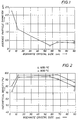
- Figure 1 is a graph showing the relationship between the average crystal size of the boehmite alumina used as a starting material and the average particle size of a mullite produced according to the process of the present invention.
- Figure 2 is a graph showing the relationship between percent theoretical density of a cermic body prepared from mullite produced according to the process of the present invention versus the average crystal size of a boehmite alumina used as a starting product.
- the process of the present invention is based on the finding that by using a boehmite alumina wherein the surface area of the alumina falls into a desired range, it is possible to produce mixed oxides containing an alumina species (Al 2 O 3 ), e.g. mullite, which have desired small particle size, i.e. less than 1 ⁇ m, are easy to de-agglomerate or grind and can be formed into products having a fired density 90% or greater of theoretical density.
- Al 2 O 3 alumina species
- mullite e.g. mullite
- the process of the present invention employs a mixture of a boehmite alumina, a fluid medium, e.g. an aqueous medium, and at least one additional compound or material.
- the boehmite alumina which is used in the process of the present invention can include, pseudoboehmite and boehmite, whether obtained from natural or synthetic sources.
- the boehmite may be either of the water-dispersible type such as disclosed in U.S. Patent No. 4,676,928, or of the acid-dispersible type such as disclosed in U.S. Patent No. 4,746,503.
- boehmite is commonly obtained synthetically by the hydrolysis of aluminum alkoxides in the well known fashion.
- Typical methods for preparing such aluminum alkoxides are shown, for example, in U.S. Patent No. 4,242,271.
- the aluminum alkoxide can be hydrolyzed, in the well known manner, such as by the process taught in U.S. Patent No. 4,202,870.
- boehmite aluminas obtained from the hydrolysis of aluminum alkoxides derived from Ziegler Chemistry in the well known manner.
- the boehmite alumina can also be derived from other sources.
- the boehmite alumina employed in the process of the present invention will have a surface area of from 4 to 150 m 2 /g which corresponds to an average crystal size of from 500 to 8 nm (5000-80 ⁇ ) (020 plane as measured by X-ray diffraction), respectively.
- a boehmite alumina having a surface area of from 150 to 21 m 2 /g (average crystal size of from 8 to 90 nm (80-900 ⁇ ), respectively).
- the process of the present invention is directed to forming mixed oxides containing an alumina species.
- the amount of the boehmite alumina employed in the process will depend upon the desired end product, i.e. the mixed oxide.
- the molar ratio of Al 2 O 3 /SiO 2 be 1.5 (71.8% Al 2 O 3 , 39.2% SiO 2 ) or more, it being recognized that a solid solution with aluminum oxide is formed when the molar ratio of Al 2 O 3 /SiO 2 is in the range of from 1.50 to 2.87.
- the amount of boehmite alumina initially used would be adjusted accordingly.
- the amount of boehmite alumina employed in the process will vary to achieve the desired composition. It will thus be appreciated that the mixed oxide can be tailored according to the process of the present invention by varying the amount of the boehmite alumina versus the other compound(s) employed in making the mixed oxide.
- the process of the present invention employs a compound (MA Compound(s)) having the formula M x A y wherein M is a metal, as that term is commonly understood, silicon, boron, arsenic or tellurium, A is oxygen or an anion, generally an inorganic anion, such as hydroxide, nitrate, and sulfate, x has a value of from 1 to 4 and y has a value which satisfies the formula depending on the valence of M.
- MA Compounds falling within the above general formula include silicon oxide, silicon dioxide, titanium dioxide, zirconium oxide, boron phosphate, and magnesium nitrate.
- the MA Compound can be a generally water-insoluble material, i.e. silicon dioxide, a watersoluble salt, i.e. magnesium nitrate, or a mixture of such.
- a silicon dioxide having a high reactivity e.g. a colloidial silicon dioxide or at least a dispersion of finely divided silicon dioxide particles.
- the silicon dioxide is an amorphous silicon dioxide, ideally a colloidial silicon dioxide consisting of porous silicon dioxide particles with a large surface area.
- the finely divided silicon dioxide particles can include white carbon black obtained by a wet method as well as silicon dioxide obtained from the vapor by a dry method.
- the amount of the MA Compound which is used in the process of the present invention will vary depending upon the desired end product, i.e. the mixed oxide.
- the mixed oxide may be desirable to form a mixed oxide which is substantially all alumina but which has a minor amount, e.g. less than 1 %, of one or more other oxides of one or more of the elements mentioned above, the other oxide(s) serving to tailor the crystal structure of the resulting alumina for some particular purpose.
- the fluid medium employed in the process of the present invention can be aqueous or non-aqueous, it being understood that in most cases it will be an aqueous medium. It is also contemplated that, in forming the sol, the process of the present invention can be carried out under supercritical conditions.
- the fluid medium e.g. aqueous medium
- the aqueous medium will generally have a pH ranging from 2 to 4. Acids such as nitric acid, hydrochloric acid, and acetic acid can be used to adjust the mixture of the boehmite alumina, the MA Compound and the fluid medium to the desired pH. Other dispersing agents can also be employed.
- a mixture of the alumina, the MA compound and the fluid medium is formed.
- the mixture is then treated in a suitable fashion to obtain a uniform sol.
- sol is intended to include a gel, a colloidal dispersion, or the like in which the components are generally homogeneously dispersed.
- the uniform sol can be formed by agitating, i.e. in a stirred vessel, sonically, or in numerous other methods known by those skilled in the art, to achieve a uniform, homogenous mixture of the type contemplated herein.
- conditions such as temperature and pressure can vary widely.
- the sol in the preparation of mullite according to the process of the present invention, can be formed at room temperature or at higher temperatures if desired. It will be appreciated that temperature and pressure conditions will be selected based upon the nature of the MA Compound, the particular boehmite alumina, the desired end product, the kind of fluid medium used and other such parameters.
- the fluid medium can be removed from the sol to obtain a substantially solid product by numerous methods such as filtering, and centrifuging.
- the fluid medium can be removed by drying the sol such as spray drying, and oven drying.
- the solid product is dehydrated, e.g. calcined or fired.
- the temperature employed will depend upon the end product (mixed oxide) sought.
- the calcining temperature can range from a temperature of from 500 to 1200°C.
- the dehydration or calcining is conducted at a temperature below 1200°C, preferably from 500 to 1200°C, most preferably from 500 to 900°C.
- the mullite can be calcined at temperatures less than 1200°C and thereby achieve a looser agglomerate which can be more easily ground to the desired, sub-micrometer particle size.
- Calcining time parameters such as temperature can vary widely depending upon the type of mixed oxide being produced. In general calcining time ranging from 1 minute to 4 hours can be used. Calcining can be conducted in conventional calcining equipment well known to those skilled in the art.
- the dehydrating or calcining of the product produces clusters of weakly agglomerated mixed oxide particles.
- agglomerates into the desired powder having an average particle size of about 1 ⁇ m or less, it is only necessary to subject the agglomerate to a relatively mild mechanical grinding technique such as milling under conditions which do not result in a wearing away of the components of the grinding apparatus to the extent that any significant amount of impurities from such components are introduced into the mixed oxide powder.
- intensive mechanical grinding e.g.
- any de-agglomeration process which relies primarily on impingement of the agglomerate and/or particles thereof with one another to obtain the desired submicrometer size can be considered mild grinding, as that term is used herein, as distinguished from grinding which relies primarily on the agglomerates and/or particles thereof being reduced in size by virtue of being literally crushed between components of the grinding equipment.
- a boehmite alumina sold under the name CATAPAL® by Vista Chemical Company was dispersed in deionized water by the addition of nitric acid and stirring.
- the average crystal size of the boehmite used was determined by X-ray diffraction to be approximately 3,5nm (35 ⁇ ) (020 reflection) (surface area ⁇ 260 m 2 /g measured by BET nitrogen adsorption).
- the pH of the boehmite sol was maintained in the range of from 3 to 4.
- To this was added a quantity of colloidally dispersed silica sold as LUDOX AS-40® by E.I. DuPont de Nemours & Company which had also been adjusted to a pH of from 3 to 4 by the addition of nitrid acid.
- the quantities of the boehmite and silica sols employed was such as to obtain the desired mullite composition of approximately 72% Al 2 O 3 and 28% SiO 2 , by weight.
- the mixture was thoroughly agitated to obtain a uniform sol which was then dried in an oven.
- the dried material was ground in a blender to produce a coarse powder which was then dehydrated by heating (firing) in a furnace at 1000°C for I hour.
- the resulting coarse powder was then milled in an Alpine Jet mill to produce the final product.
- the particle size of the resulting mullite, as determined using a Sedigraph 5000 ET, was 2.26 ⁇ m.
- Example 1 The procedure of Example 1 was followed with the exception that the average crystal size of the boehmite employed was determined by X-ray diffraction to be approximately 56 mm (560 ⁇ ) (020 reflection) (surface area ⁇ 34 m 2 /g). The resulting average particle size of the final product was determined by a Sedigraph 5000 ET to be 0.19 ⁇ m.
- CATAPAL® boehmite alumina sol (crystal size 89 nm (890 ⁇ ) on the 020 reflection) (surface area ⁇ 33 m 2 /g) containing approximately 30% Al 2 O 3 was placed in 1136 l (300 gallon) agitated vessel.
- the pH of the boehmite sol was adjusted to and maintained in a range of from 3 to 4 by the addition of nitric acid.
- the mixture was agitated to obtain a uniform sol which became viscous and required the addition of more water to maintain fluidity.
- alumina/silica sol was spray dried in a commercial spray dryer to obtain a dried material. A portion of the spray dried powder was dehydrated (calcined) at 1000°C for 1 hour and then milled as described above in Example 1. The average particle size of the resulting mixed oxide (mullite) powder was determined to be 0.42 ⁇ m.
- Example 1 The procedure of Example 1 was followed with the exception that the boehmite employed had an average crystal size of 12 nm (120 ⁇ ) (020 reflection) (surface area ⁇ 110 m 2 /g). The average particle size of the milled mullite was found to be 1.18 ⁇ m.
- Example 1 The procedure of Example 1 was followed with the exception that the boehmite used had an average crystal size of 66,4 nm (664 ⁇ ) (020 reflection) (surface area ⁇ 39 m 2 /g). The average particle size of the milled mullite was found to be 0.38 ⁇ m.
- Example 3 A portion of the spray dried powder obtained by the procedure of Example 3 was redispersed in water to form a viscous sol. The sol was then placed in an oven and allowed to dry overnight. The resulting dried material was coarse ground in a blender, fired at 1000°C for 1 hour and milled as described above in Example 1. The resulting average particle size of the mullite was found to be 0.34 ⁇ m.
- the milled powders from each of Examples 1-6 were tested for sinterability by preparing specimens via slip casting.
- the technique used was to prepare a slip by placing about 50% by weight of the milled mullite powder in deionized water, adding DARVAN C® (anionic surfactant marketed by R.T. Vanderbilt Co. Inc.) as a dispersing aid and sonically agitating the suspension for 1 minute.
- the resulting slip was then cast on a plaster block. After air drying, the sample was oven dried at 100°C overnight. Sets of samples were then fired at 1450°C for 1 hour and at 1650° for 1 hour.
- the Table below shows the results of Examples 1-7.
- Figure 1 shows the relationship between average particle size of the mullite powder as a function of the average crystal size (surface area) of the boehmite used as a starting material.
- Figure 2 shows the fired densities of the slips made from the experimental powders as a function of the average crystal size (surface area) of the boehmite used as a starting material.
- the mullite powders which were prepared using larger average crystal size, i.e. lower surface area, boehmite have smaller average particle size.
- the average crystal size of the boehmite is about 8 nm (80 ⁇ ) or greater, particularly from 8 to 150 nm (80-1500 ⁇ ) (020 reflection), the average particle size of the mullite is about 1 ⁇ m or less.
- the optimum average crystal size of the staring boehmite should be from 8 to 90 nm (80-900 ⁇ ) to obtain maximum fired density.
- An alumina slurry containing about 10% Al 2 O 3 , and comprised of boehmite crystals having an average crystal size of about 47 nm (470 ⁇ ) and a surface area of about 33 m 2 /g was placed in an agitated vessel.
- Magnesium nitrate was dissolved in water and added to the agitated alumina slurry in sufficient quantity to produce a composition containing the equivalent of about 340 ppm MgO on a 100% Al 2 O 3 basis.
- the magnesium nitrate solution Upon addition of the magnesium nitrate solution, the slurry viscosity increased and a small amount of nitric acid was added to reduce viscosity of the mixture.
- the pH of the mixture was 4 to 5.
- the mixture was then spray dried to form a powder.
- the spray dried powder was calcined at 1250°C for one hour and then milled in a jet mill to produce a product having an average particle size of less than about 1 ⁇ m.
Landscapes
- Chemical & Material Sciences (AREA)
- Organic Chemistry (AREA)
- Engineering & Computer Science (AREA)
- Inorganic Chemistry (AREA)
- Manufacturing & Machinery (AREA)
- Ceramic Engineering (AREA)
- Materials Engineering (AREA)
- Structural Engineering (AREA)
- Dispersion Chemistry (AREA)
- Life Sciences & Earth Sciences (AREA)
- Geology (AREA)
- Compositions Of Oxide Ceramics (AREA)
- Silicates, Zeolites, And Molecular Sieves (AREA)
Abstract
Description
- The present invention relates to a process for preparing particulate, mixed oxides using an boehmite alumina as one of the starting materials. More particularly, the present invention relates to an improved process for producing mullite.
- Mixed metal oxides are finding increasing use in the manufacture of precision ceramic parts for high tech ceramics, solid state electronics and other high technology fields. The starting materials for such end products are generally sub-micrometer, de-agglomerated mixed metal oxide powders, e.g. mullite. Mullite is an aluminum silicate having the formula 3Al2O3 • 2SiO2(Al2O3/SiO2 = 1.5) that forms a solid solution with aluminum oxide when the molar ratio of Al2O3/SiO2 is in a range of from 1.50 to 2.87 (Ceramic International, 9 (4), 107-113 (1983) by J.A. Pash). Mullite is recognized as a useful material in ceramic applications where high temperature stability is required. Mullite is also resistant to thermal shock making it useful in critical applications. To obtain the desired properties, e.g. low sintering temperature, it has been found necessary to utilize synthetic mullite where the homogeneity and microstructure of the mullite can be controlled. Specifically, it is desirable to produce mullite having sub-micrometer particle size.
- Synthetic mullites are currently produced by a variety of methods including co-precipitation, sol-gel, vapor phase reaction, and thermal diffusion. Of the above mentioned, the sol-gel technique is currently the most widely practiced method. In the sol-gel method, a colloidally dispersed boehmite sol is combined with a dispersed colloidal silica sol to obtain an intimate mixture. The mixture is then dried, milled to reduce particle size, fired to convert the amorphous mixture to mullite, and then milled again to reduce the particle size of the finished powder. Generally speaking, the boehmite sol employed in the prior art methods consists of small size boehmite crystals referred to as "pseudoboehmite".
- Techniques for producing mullite by sol-gel techniques are disclosed for example in German patent DE-A-3,618,576 and Japanese Kokai No. SHO 63-144111 (1988). DE-A-3,618,576 discloses the production of ultrafine mullite powder of high purity, the method including mixing boehmite and amorphous silica in a molar ratio of 1.5, condensing the product, drying and grinding using a ball mill oder attrition mill while paying attention to contamination and calcinining at 1300 to 1450°C to obtain a mullite powder. In a very similar process for producing high purity mullite powder disclosed in Japanese Kokai SHO 63-144111 (1988) a boehmite sol and a amorphous silicon dioxide dispersion are mixed at a molar ratio of 1.5 or above, the gel is formed and then dried to recover the product which is then pulverized finely without contamination and calcined to form mullite powder. Additionally, in U.S. patent No. 4,679,928 there is disclosed a method of forming a water-dispersible boehmite colloidal sol. In "J. Am. Ceram. Soc." 72 (3), 377-382 (1989), it is disclosed that mullitization will not occur at calcining temperatures of less than 1200°C. This article states expressly that mullitization occurs at about 1250°C concluding that calcining should be conducted at temperatures within the range of from 1250 to 1700°C, preferably 1400 to 1500°C. At page 382 it is stated that the mullitization occurs at around 1250°C or above and mullite is the only cristalline phase when calcined at temperatures above 1350°C. With increasing calcination temperature the lattice parameter a0 of mullite decreases and then increases in the temperatur range of from 1250 to 1700°C.
- It is therefore an object of the present invention to provide an improved process for producing a mixed oxide containing an alumina species.
- Another object of the present invention is to provide an improved process for preparing a mixed oxide containing an alumina species employing a sol-gel technique.
- Yet another object of the present invention is to provide an improved process for preparing mullite.
- The above and other objects of the present invention will become apparent from the drawings, the description given herein and the appended claims.
- The process of the present invention permits the preparation of a mixed oxide powder, e.g. mullite, containing an alumina species in which the average particle size of the powder is less than about 1 µm. In the process, a mixture is formed of a fluid medium, a boehmite alumina having a specified surface area (specified average crystal size) and a compound having the formula MxAy wherein M is selected from the group consisting of metals, boron, silicon, arsenic and tellurium, A is selected from the group consisting of oxygen and anions, x is from 1 to 4 and y is a value satisfying the formula depending on the valence of M. The mixture is treated in a suitable fashion to obtain a uniform sol of the boehmite, alumina, the fluid medium and the compound. The fluid medium is removed to provide a product which is dehydrated, e.g. calcined, and then de-agglomerated to produce a powder of the mixed metal oxide.
- Figure 1 is a graph showing the relationship between the average crystal size of the boehmite alumina used as a starting material and the average particle size of a mullite produced according to the process of the present invention.
- Figure 2 is a graph showing the relationship between percent theoretical density of a cermic body prepared from mullite produced according to the process of the present invention versus the average crystal size of a boehmite alumina used as a starting product.
- The process of the present invention is based on the finding that by using a boehmite alumina wherein the surface area of the alumina falls into a desired range, it is possible to produce mixed oxides containing an alumina species (Al2O3), e.g. mullite, which have desired small particle size, i.e. less than 1 µm, are easy to de-agglomerate or grind and can be formed into products having a fired
density 90% or greater of theoretical density. The process provides an improvement in current sol-gel technology for making mixed oxides such as mullite. - The process of the present invention employs a mixture of a boehmite alumina, a fluid medium, e.g. an aqueous medium, and at least one additional compound or material. The boehmite alumina which is used in the process of the present invention can include, pseudoboehmite and boehmite, whether obtained from natural or synthetic sources. The boehmite may be either of the water-dispersible type such as disclosed in U.S. Patent No. 4,676,928, or of the acid-dispersible type such as disclosed in U.S. Patent No. 4,746,503. As is well known, boehmite is commonly obtained synthetically by the hydrolysis of aluminum alkoxides in the well known fashion. Typical methods for preparing such aluminum alkoxides are shown, for example, in U.S. Patent No. 4,242,271. The aluminum alkoxide can be hydrolyzed, in the well known manner, such as by the process taught in U.S. Patent No. 4,202,870. Especially preferred are boehmite aluminas obtained from the hydrolysis of aluminum alkoxides derived from Ziegler Chemistry in the well known manner. However, it will be recognized that the boehmite alumina can also be derived from other sources.
- The boehmite alumina employed in the process of the present invention will have a surface area of from 4 to 150 m2/g which corresponds to an average crystal size of from 500 to 8 nm (5000-80 Å) (020 plane as measured by X-ray diffraction), respectively. In particular, and when producing mullite by the process of the present invention, it has been found particularly desirable to employ a boehmite alumina (boehmite) having a surface area of from 150 to 21 m2/g (average crystal size of from 8 to 90 nm (80-900 Å), respectively). Slip cast articles of mullite prepared according to the process of the present invention and in which the boehmite alumina used is a boehmite having an average crystal size of from 8 to 90 nm (80-900 Å) achieve greater than 90 percent of theoretical density on firing.
- As noted above, the process of the present invention is directed to forming mixed oxides containing an alumina species. Accordingly, the amount of the boehmite alumina employed in the process will depend upon the desired end product, i.e. the mixed oxide. For example, in the case of producing mullite according to the process of the present invention, it is desired that the molar ratio of Al2O3/SiO2 be 1.5 (71.8% Al2O3, 39.2% SiO2) or more, it being recognized that a solid solution with aluminum oxide is formed when the molar ratio of Al2O3/SiO2 is in the range of from 1.50 to 2.87. Thus, the amount of boehmite alumina initially used would be adjusted accordingly. In the case of other mixed oxides, e.g. spinel (magnesia/aluminum oxide), aluminum titanates, cordierite, etc. the amount of boehmite alumina employed in the process will vary to achieve the desired composition. It will thus be appreciated that the mixed oxide can be tailored according to the process of the present invention by varying the amount of the boehmite alumina versus the other compound(s) employed in making the mixed oxide.
- In addition to the boehmite alumina, the process of the present invention employs a compound (MA Compound(s)) having the formula MxAy wherein M is a metal, as that term is commonly understood, silicon, boron, arsenic or tellurium, A is oxygen or an anion, generally an inorganic anion, such as hydroxide, nitrate, and sulfate, x has a value of from 1 to 4 and y has a value which satisfies the formula depending on the valence of M. Non-limiting examples of MA Compounds falling within the above general formula include silicon oxide, silicon dioxide, titanium dioxide, zirconium oxide, boron phosphate, and magnesium nitrate. Thus, the MA Compound can be a generally water-insoluble material, i.e. silicon dioxide, a watersoluble salt, i.e. magnesium nitrate, or a mixture of such.
- In cases where mullite is prepared in accordance with the process of the present invention, it is preferable to use a silicon dioxide having a high reactivity, e.g. a colloidial silicon dioxide or at least a dispersion of finely divided silicon dioxide particles. Preferably the silicon dioxide is an amorphous silicon dioxide, ideally a colloidial silicon dioxide consisting of porous silicon dioxide particles with a large surface area. The finely divided silicon dioxide particles can include white carbon black obtained by a wet method as well as silicon dioxide obtained from the vapor by a dry method.
- As in the case of the boehmite alumina, it will be understood that the amount of the MA Compound which is used in the process of the present invention will vary depending upon the desired end product, i.e. the mixed oxide. For example, it may be desirable to form a mixed oxide which is substantially all alumina but which has a minor amount, e.g. less than 1 %, of one or more other oxides of one or more of the elements mentioned above, the other oxide(s) serving to tailor the crystal structure of the resulting alumina for some particular purpose.
- The fluid medium employed in the process of the present invention can be aqueous or non-aqueous, it being understood that in most cases it will be an aqueous medium. It is also contemplated that, in forming the sol, the process of the present invention can be carried out under supercritical conditions. Although generally speaking, in the process of the present invention, the fluid medium, e.g. aqueous medium, will have a pH of below about 7, e.g. from 2 to 5, under certain circumstances it is possible that the pH may be above 7. In the particular case of preparing mullite according to the process of the present invention, the aqueous medium will generally have a pH ranging from 2 to 4. Acids such as nitric acid, hydrochloric acid, and acetic acid can be used to adjust the mixture of the boehmite alumina, the MA Compound and the fluid medium to the desired pH. Other dispersing agents can also be employed.
- In carrying out the process of the present invention, a mixture of the alumina, the MA compound and the fluid medium is formed. The mixture is then treated in a suitable fashion to obtain a uniform sol. The term "sol", as used herein, is intended to include a gel, a colloidal dispersion, or the like in which the components are generally homogeneously dispersed. The uniform sol can be formed by agitating, i.e. in a stirred vessel, sonically, or in numerous other methods known by those skilled in the art, to achieve a uniform, homogenous mixture of the type contemplated herein.
- In obtaining the sols, conditions such as temperature and pressure can vary widely. For example, in the preparation of mullite according to the process of the present invention, the sol can be formed at room temperature or at higher temperatures if desired. It will be appreciated that temperature and pressure conditions will be selected based upon the nature of the MA Compound, the particular boehmite alumina, the desired end product, the kind of fluid medium used and other such parameters.
- The fluid medium can be removed from the sol to obtain a substantially solid product by numerous methods such as filtering, and centrifuging. Alternatively, the fluid medium can be removed by drying the sol such as spray drying, and oven drying.
- Once the fluid medium, e.g. aqueous medium, has been removed from the sol, the solid product is dehydrated, e.g. calcined or fired. In dehydrating the product, the temperature employed will depend upon the end product (mixed oxide) sought. Thus, the calcining temperature can range from a temperature of from 500 to 1200°C. In the preparation of mullite according to the process of the present invention, it has been found that a looser agglomeration can be obtained if the dehydration or calcining is conducted at a temperature below 1200°C, preferably from 500 to 1200°C, most preferably from 500 to 900°C. Indeed, it is a feature of the present invention that the mullite can be calcined at temperatures less than 1200°C and thereby achieve a looser agglomerate which can be more easily ground to the desired, sub-micrometer particle size. Calcining time parameters such as temperature can vary widely depending upon the type of mixed oxide being produced. In general calcining time ranging from 1 minute to 4 hours can be used. Calcining can be conducted in conventional calcining equipment well known to those skilled in the art.
- The dehydrating or calcining of the product produces clusters of weakly agglomerated mixed oxide particles. To convert the agglomerates into the desired powder having an average particle size of about 1 µm or less, it is only necessary to subject the agglomerate to a relatively mild mechanical grinding technique such as milling under conditions which do not result in a wearing away of the components of the grinding apparatus to the extent that any significant amount of impurities from such components are introduced into the mixed oxide powder. For example, intensive mechanical grinding, e.g. ball milling, is unnecessary to reduce the clusters of the mixed oxide to the suitable sub-micrometer particle size because the agglomerations produced are relatively loosely bound and the particle size of the mixed oxides making up the agglomerations are such that a relatively mild grinding technique such as jet milling (air impact) can be employed. In general, it can be stated that any de-agglomeration process which relies primarily on impingement of the agglomerate and/or particles thereof with one another to obtain the desired submicrometer size can be considered mild grinding, as that term is used herein, as distinguished from grinding which relies primarily on the agglomerates and/or particles thereof being reduced in size by virtue of being literally crushed between components of the grinding equipment.
- To more fully illustrate the present invention, the following examples are presented:
- A boehmite alumina sold under the name CATAPAL® by Vista Chemical Company was dispersed in deionized water by the addition of nitric acid and stirring. The average crystal size of the boehmite used was determined by X-ray diffraction to be approximately 3,5nm (35Å) (020 reflection) (surface area ∼ 260 m2/g measured by BET nitrogen adsorption). The pH of the boehmite sol was maintained in the range of from 3 to 4. To this was added a quantity of colloidally dispersed silica sold as LUDOX AS-40® by E.I. DuPont de Nemours & Company which had also been adjusted to a pH of from 3 to 4 by the addition of nitrid acid. The quantities of the boehmite and silica sols employed was such as to obtain the desired mullite composition of approximately 72% Al2O3 and 28% SiO2, by weight. The mixture was thoroughly agitated to obtain a uniform sol which was then dried in an oven. The dried material was ground in a blender to produce a coarse powder which was then dehydrated by heating (firing) in a furnace at 1000°C for I hour. The resulting coarse powder was then milled in an Alpine Jet mill to produce the final product. The particle size of the resulting mullite, as determined using a Sedigraph 5000 ET, was 2.26 µm.
- The procedure of Example 1 was followed with the exception that the average crystal size of the boehmite employed was determined by X-ray diffraction to be approximately 56 mm (560 Å) (020 reflection) (surface area ∼ 34 m2/g). The resulting average particle size of the final product was determined by a Sedigraph 5000 ET to be 0.19 µm.
- CATAPAL® boehmite alumina sol (crystal size 89 nm (890 Å) on the 020 reflection) (surface area ∼ 33 m2/g) containing approximately 30% Al2O3 was placed in 1136 l (300 gallon) agitated vessel. The pH of the boehmite sol was adjusted to and maintained in a range of from 3 to 4 by the addition of nitric acid. To this was added an appropriate amount of LUDOX AS-40® colloidal silica, the pH of which was adjusted to the range of from 3 to 4 via the addition of nitric acid. The mixture was agitated to obtain a uniform sol which became viscous and required the addition of more water to maintain fluidity. Mixing was continued to ensure a uniform alumina/silica sol. The alumina/silica sol was spray dried in a commercial spray dryer to obtain a dried material. A portion of the spray dried powder was dehydrated (calcined) at 1000°C for 1 hour and then milled as described above in Example 1. The average particle size of the resulting mixed oxide (mullite) powder was determined to be 0.42 µm.
- The procedure of Example 1 was followed with the exception that the boehmite employed had an average crystal size of 12 nm (120 Å) (020 reflection) (surface area ∼ 110 m2/g). The average particle size of the milled mullite was found to be 1.18 µm.
- The procedure of Example 1 was followed with the exception that the boehmite used had an average crystal size of 66,4 nm (664 Å) (020 reflection) (surface area ∼ 39 m2/g). The average particle size of the milled mullite was found to be 0.38 µm.
- A portion of the spray dried powder obtained by the procedure of Example 3 was redispersed in water to form a viscous sol. The sol was then placed in an oven and allowed to dry overnight. The resulting dried material was coarse ground in a blender, fired at 1000°C for 1 hour and milled as described above in Example 1. The resulting average particle size of the mullite was found to be 0.34 µm.
- The milled powders from each of Examples 1-6 were tested for sinterability by preparing specimens via slip casting. The technique used was to prepare a slip by placing about 50% by weight of the milled mullite powder in deionized water, adding DARVAN C® (anionic surfactant marketed by R.T. Vanderbilt Co. Inc.) as a dispersing aid and sonically agitating the suspension for 1 minute. The resulting slip was then cast on a plaster block. After air drying, the sample was oven dried at 100°C overnight. Sets of samples were then fired at 1450°C for 1 hour and at 1650° for 1 hour. The Table below shows the results of Examples 1-7. The data is also displayed in Figure 1 which shows the relationship between average particle size of the mullite powder as a function of the average crystal size (surface area) of the boehmite used as a starting material. Figure 2 shows the fired densities of the slips made from the experimental powders as a function of the average crystal size (surface area) of the boehmite used as a starting material.
EXAMPLE NO. BOEHMITE 020 CRYSTAL SIZE FIRING TEMP. (°C) AVERAGE PARTICLE SIZE (µm) 1650° C FIRED DENSITY (%) 1450° C FIRED DENSITY (%) nm (Å) 1 3,5 (35) 1000 2.26 80.5 71.9 2 56,0 (560) 1000 0.19 97.1 94.6 3 89,0 (890) 1000 0.42 85.2 72.8 4 12,0 (120) 1000 1.18 97.4 94.0 5 66,4 (664) 1000 0.38 97.8 91.2 6 89,0 (890) 1000 0.34 86.2 79.6 - With particular reference to Fig. 2, and as applied to mullite produced according to the process of the present invention, it can be seen that for powders prepared by firing at temperatures of 1000°C, the optimum average crystal size of the staring boehmite should be from 8 to 90 nm (80-900 Å) to obtain maximum fired density.
- A comparison of the results from Examples 3 and 6 demonstrates that there is no appreciable difference in the mixed oxide product whether made by flash drying (Example 3) or slow drying (Example 6).
- An alumina slurry containing about 10% Al2O3, and comprised of boehmite crystals having an average crystal size of about 47 nm (470 Å) and a surface area of about 33 m2/g was placed in an agitated vessel. Magnesium nitrate was dissolved in water and added to the agitated alumina slurry in sufficient quantity to produce a composition containing the equivalent of about 340 ppm MgO on a 100% Al2O3 basis. Upon addition of the magnesium nitrate solution, the slurry viscosity increased and a small amount of nitric acid was added to reduce viscosity of the mixture. The pH of the mixture was 4 to 5. The mixture was then spray dried to form a powder. The spray dried powder was calcined at 1250°C for one hour and then milled in a jet mill to produce a product having an average particle size of less than about 1 µm.
- It can thus be seen that using the process of the present invention, it is possible to produced mixed oxides of small, i.e. submicrometer, particle size by using as a starting material, a boehmite alumina which has a particle size which has an average crystal size in the range of from 8 to 150 nm (80-1500 Å). With particular reference to the production of mullite by the process of the present invention, it can be seen that if the average crystal size of the boehmite used as a starting material is from 8 to 90 nm (80-900 Å), it is possible to obtain cast parts having fired densities which exceed 90% of the theoretical density.
Claims (13)
- A process for preparing a mixed oxide containing an alumina species, comprising:forming an intimate mixture of a fluid medium, a boehmite alumina having a specific surface area from 4 to 150 m2/g and a compound having the formula MxAy wherein M is selected from the group consisting of metals, silicon, boron, arsenic and tellurium, A is selected from the group consisting of oxygen and anions, x is from 1 to 4 and y has a value satisfying said formula depending on the valence of M;treating said mixture to form a uniform sol;removing said fluid medium and recovering a product containing said boehmite alumina and said compound;dehydrating said product at a temperature less than about 1200°C; andde-agglomerating said product to form a powdered mixed oxide.
- The process of claim 1 wherein said dehydrating temperature is from 500°C to 1200°C.
- The process of claim 1 or 2 wherein said dehydrating temperature is from 500°C to 900°C.
- The process of any of claims 1 to 3 wherein said product is de-agglomerated using a relatively mild grinding technique.
- The process of any of claims 1 to 4 wherein said fluid medium comprises an aqueous medium.
- The process of claim 5 wherein said aqueous medium has a pH from 2 to 5.
- The process of claim 5 oder 6 wherein said compound is introduced as an aqueous soluble metal salt.
- The process of any of claims 1 to 7 wherein said compound is introduced as a colloidal dispersion.
- The process of any of claims 1 to 8 wherein said compound comprises silicon dioxide.
- The process of claim 9 wherein said silicon dioxide is amorphous.
- The process of claim 9 or 10 wherein the molar ratio of Al2O3 to SiO2 is 1.5 to 2.87.
- The process of any of claim 9 to 11 wherein the molar ratio of Al2O3 to SiO2 is about 1.5.
- The process of any of Claims 1 to 12 wherein the specific surface area of said boehmite alumina is from 21 to 150 m2/g.
Applications Claiming Priority (3)
| Application Number | Priority Date | Filing Date | Title |
|---|---|---|---|
| US07/692,002 US5316752A (en) | 1991-04-26 | 1991-04-26 | Process for preparing mixed oxides |
| PCT/US1992/003482 WO1992019570A1 (en) | 1991-04-26 | 1992-04-24 | Process for preparing mixed oxides |
| US692002 | 1996-08-02 |
Publications (3)
| Publication Number | Publication Date |
|---|---|
| EP0582644A1 EP0582644A1 (en) | 1994-02-16 |
| EP0582644A4 EP0582644A4 (en) | 1994-07-13 |
| EP0582644B1 true EP0582644B1 (en) | 1996-10-30 |
Family
ID=24778880
Family Applications (1)
| Application Number | Title | Priority Date | Filing Date |
|---|---|---|---|
| EP92910977A Expired - Lifetime EP0582644B1 (en) | 1991-04-26 | 1992-04-24 | Process for preparing mixed oxides |
Country Status (5)
| Country | Link |
|---|---|
| US (1) | US5316752A (en) |
| EP (1) | EP0582644B1 (en) |
| AU (1) | AU1782692A (en) |
| DE (1) | DE69214946T2 (en) |
| WO (1) | WO1992019570A1 (en) |
Families Citing this family (3)
| Publication number | Priority date | Publication date | Assignee | Title |
|---|---|---|---|---|
| US6136476A (en) * | 1999-01-29 | 2000-10-24 | Hydro-Quebec Corporation | Methods for making lithium vanadium oxide electrode materials |
| JP3096814B1 (en) * | 1999-11-08 | 2000-10-10 | 勉 福田 | Method for producing aluminum titanate sintered body |
| CN115010504B (en) * | 2022-05-11 | 2022-12-30 | 郑州大学 | Method for preparing high-strength bauxite-based mullite homogeneous material by two-step method |
Family Cites Families (5)
| Publication number | Priority date | Publication date | Assignee | Title |
|---|---|---|---|---|
| JPS61281013A (en) * | 1985-06-05 | 1986-12-11 | Chichibu Cement Co Ltd | Production of mullite powder of high purity |
| US4676928A (en) * | 1986-01-30 | 1987-06-30 | Vista Chemical Company | Process for producing water dispersible alumina |
| JPS63144111A (en) * | 1986-12-04 | 1988-06-16 | Chichibu Cement Co Ltd | Production of ultrafine powder of mullite having composition of stoichiometric amount |
| JPH0692266B2 (en) * | 1989-08-30 | 1994-11-16 | 秩父セメント株式会社 | Method for producing mullite-cordierite composite ceramics |
| US5030592A (en) * | 1989-10-26 | 1991-07-09 | The United States Of America As Represented By The Secretary Of The Air Force | Highly dense cordierite and method of manufacturing same |
-
1991
- 1991-04-26 US US07/692,002 patent/US5316752A/en not_active Expired - Lifetime
-
1992
- 1992-04-24 WO PCT/US1992/003482 patent/WO1992019570A1/en not_active Ceased
- 1992-04-24 EP EP92910977A patent/EP0582644B1/en not_active Expired - Lifetime
- 1992-04-24 DE DE69214946T patent/DE69214946T2/en not_active Expired - Lifetime
- 1992-04-24 AU AU17826/92A patent/AU1782692A/en not_active Abandoned
Also Published As
| Publication number | Publication date |
|---|---|
| AU1782692A (en) | 1992-12-21 |
| EP0582644A4 (en) | 1994-07-13 |
| WO1992019570A1 (en) | 1992-11-12 |
| DE69214946D1 (en) | 1996-12-05 |
| DE69214946T2 (en) | 1997-02-27 |
| US5316752A (en) | 1994-05-31 |
| EP0582644A1 (en) | 1994-02-16 |
Similar Documents
| Publication | Publication Date | Title |
|---|---|---|
| US4769351A (en) | Hydrothermal process for preparing zirconia-alumina base ultra-fine powders of high purity | |
| EP0384603B1 (en) | Process for the production of magnesium oxide | |
| EP0200487B1 (en) | Process for durable sol-gel produced alumina-based ceramic abrasive grain and abrasive products | |
| US4657754A (en) | Aluminum oxide powders and process | |
| US4810680A (en) | Preparation of high purity, homogeneous zirconia mixtures | |
| US4880757A (en) | Chemical preparation of zirconium-aluminum-magnesium oxide composites | |
| US4929433A (en) | Method for the preparation of sinterable nitrides | |
| US5284809A (en) | Method for the preparation of α-aluminum oxide powder | |
| US4835124A (en) | Alumina ceramic product from colloidal alumina | |
| KR101202625B1 (en) | METHOD FOR PRODUCING a-ALUMINA PARTICULATE | |
| AU609280B2 (en) | Process for preparing submicronic powders of zirconium oxide stabilized with yttrium oxide | |
| JPH03170332A (en) | Zirconium dioxide powder, its manufacture and use as well as sintered product | |
| US5316752A (en) | Process for preparing mixed oxides | |
| KR20060049582A (en) | Method for producing α-alumina powder | |
| VASYLKIV et al. | Synthesis and sintering of zirconia nano-powder by non-isothermal decomposition from hydroxide | |
| EP2030950A1 (en) | Particulate alumina composition and process for production thereof | |
| Mani et al. | Sol-spray technique for fine-grained ceria particles | |
| JPH0339967B2 (en) | ||
| Li et al. | The effects of preparation method on the characteristics of alumina-zirconia powders | |
| US5009878A (en) | Zirconium dioxide powder, processes for its preparation and its use for the production of sintered articles | |
| JPS61281013A (en) | Production of mullite powder of high purity | |
| JPH07101723A (en) | Method for producing α-alumina powder | |
| KR100481057B1 (en) | Method for preparing alumina-zirconia composite | |
| KR0146983B1 (en) | Process for preparing zirconia using microwave | |
| Wang et al. | Crystallization in seeded zirconia precipitates |
Legal Events
| Date | Code | Title | Description |
|---|---|---|---|
| PUAI | Public reference made under article 153(3) epc to a published international application that has entered the european phase |
Free format text: ORIGINAL CODE: 0009012 |
|
| 17P | Request for examination filed |
Effective date: 19931119 |
|
| AK | Designated contracting states |
Kind code of ref document: A1 Designated state(s): DE FR |
|
| A4 | Supplementary search report drawn up and despatched | ||
| AK | Designated contracting states |
Kind code of ref document: A4 Designated state(s): DE FR |
|
| 17Q | First examination report despatched |
Effective date: 19950206 |
|
| GRAG | Despatch of communication of intention to grant |
Free format text: ORIGINAL CODE: EPIDOS AGRA |
|
| GRAH | Despatch of communication of intention to grant a patent |
Free format text: ORIGINAL CODE: EPIDOS IGRA |
|
| GRAH | Despatch of communication of intention to grant a patent |
Free format text: ORIGINAL CODE: EPIDOS IGRA |
|
| RAP1 | Party data changed (applicant data changed or rights of an application transferred) |
Owner name: CONDEA VISTA COMPANY |
|
| GRAA | (expected) grant |
Free format text: ORIGINAL CODE: 0009210 |
|
| AK | Designated contracting states |
Kind code of ref document: B1 Designated state(s): DE FR |
|
| REF | Corresponds to: |
Ref document number: 69214946 Country of ref document: DE Date of ref document: 19961205 |
|
| ET | Fr: translation filed | ||
| PLBE | No opposition filed within time limit |
Free format text: ORIGINAL CODE: 0009261 |
|
| STAA | Information on the status of an ep patent application or granted ep patent |
Free format text: STATUS: NO OPPOSITION FILED WITHIN TIME LIMIT |
|
| 26N | No opposition filed | ||
| PGFP | Annual fee paid to national office [announced via postgrant information from national office to epo] |
Ref country code: FR Payment date: 20030418 Year of fee payment: 12 |
|
| PG25 | Lapsed in a contracting state [announced via postgrant information from national office to epo] |
Ref country code: FR Free format text: LAPSE BECAUSE OF NON-PAYMENT OF DUE FEES Effective date: 20041231 |
|
| REG | Reference to a national code |
Ref country code: FR Ref legal event code: ST |
|
| PGFP | Annual fee paid to national office [announced via postgrant information from national office to epo] |
Ref country code: DE Payment date: 20110427 Year of fee payment: 20 |
|
| REG | Reference to a national code |
Ref country code: DE Ref legal event code: R071 Ref document number: 69214946 Country of ref document: DE |
|
| REG | Reference to a national code |
Ref country code: DE Ref legal event code: R071 Ref document number: 69214946 Country of ref document: DE |
|
| PG25 | Lapsed in a contracting state [announced via postgrant information from national office to epo] |
Ref country code: DE Free format text: LAPSE BECAUSE OF EXPIRATION OF PROTECTION Effective date: 20120425 |