EP0580692B1 - Autoinducer - Google Patents
Autoinducer Download PDFInfo
- Publication number
- EP0580692B1 EP0580692B1 EP92908821A EP92908821A EP0580692B1 EP 0580692 B1 EP0580692 B1 EP 0580692B1 EP 92908821 A EP92908821 A EP 92908821A EP 92908821 A EP92908821 A EP 92908821A EP 0580692 B1 EP0580692 B1 EP 0580692B1
- Authority
- EP
- European Patent Office
- Prior art keywords
- autoinducer
- gene expression
- compound
- bacterium
- lux
- Prior art date
- Legal status (The legal status is an assumption and is not a legal conclusion. Google has not performed a legal analysis and makes no representation as to the accuracy of the status listed.)
- Expired - Lifetime
Links
- 0 C*C(C(*)N*)=* Chemical compound C*C(C(*)N*)=* 0.000 description 1
Images


Classifications
-
- C—CHEMISTRY; METALLURGY
- C07—ORGANIC CHEMISTRY
- C07D—HETEROCYCLIC COMPOUNDS
- C07D307/00—Heterocyclic compounds containing five-membered rings having one oxygen atom as the only ring hetero atom
- C07D307/02—Heterocyclic compounds containing five-membered rings having one oxygen atom as the only ring hetero atom not condensed with other rings
- C07D307/26—Heterocyclic compounds containing five-membered rings having one oxygen atom as the only ring hetero atom not condensed with other rings having one double bond between ring members or between a ring member and a non-ring member
- C07D307/30—Heterocyclic compounds containing five-membered rings having one oxygen atom as the only ring hetero atom not condensed with other rings having one double bond between ring members or between a ring member and a non-ring member with hetero atoms or with carbon atoms having three bonds to hetero atoms with at the most one bond to halogen, e.g. ester or nitrile radicals, directly attached to ring carbon atoms
- C07D307/32—Oxygen atoms
- C07D307/33—Oxygen atoms in position 2, the oxygen atom being in its keto or unsubstituted enol form
-
- C—CHEMISTRY; METALLURGY
- C12—BIOCHEMISTRY; BEER; SPIRITS; WINE; VINEGAR; MICROBIOLOGY; ENZYMOLOGY; MUTATION OR GENETIC ENGINEERING
- C12N—MICROORGANISMS OR ENZYMES; COMPOSITIONS THEREOF; PROPAGATING, PRESERVING, OR MAINTAINING MICROORGANISMS; MUTATION OR GENETIC ENGINEERING; CULTURE MEDIA
- C12N1/00—Microorganisms; Compositions thereof; Processes of propagating, maintaining or preserving microorganisms or compositions thereof; Processes of preparing or isolating a composition containing a microorganism; Culture media therefor
- C12N1/38—Chemical stimulation of growth or activity by addition of chemical compounds which are not essential growth factors; Stimulation of growth by removal of a chemical compound
-
- C—CHEMISTRY; METALLURGY
- C12—BIOCHEMISTRY; BEER; SPIRITS; WINE; VINEGAR; MICROBIOLOGY; ENZYMOLOGY; MUTATION OR GENETIC ENGINEERING
- C12N—MICROORGANISMS OR ENZYMES; COMPOSITIONS THEREOF; PROPAGATING, PRESERVING, OR MAINTAINING MICROORGANISMS; MUTATION OR GENETIC ENGINEERING; CULTURE MEDIA
- C12N15/00—Mutation or genetic engineering; DNA or RNA concerning genetic engineering, vectors, e.g. plasmids, or their isolation, preparation or purification; Use of hosts therefor
- C12N15/09—Recombinant DNA-technology
- C12N15/63—Introduction of foreign genetic material using vectors; Vectors; Use of hosts therefor; Regulation of expression
- C12N15/67—General methods for enhancing the expression
-
- C—CHEMISTRY; METALLURGY
- C12—BIOCHEMISTRY; BEER; SPIRITS; WINE; VINEGAR; MICROBIOLOGY; ENZYMOLOGY; MUTATION OR GENETIC ENGINEERING
- C12Q—MEASURING OR TESTING PROCESSES INVOLVING ENZYMES, NUCLEIC ACIDS OR MICROORGANISMS; COMPOSITIONS OR TEST PAPERS THEREFOR; PROCESSES OF PREPARING SUCH COMPOSITIONS; CONDITION-RESPONSIVE CONTROL IN MICROBIOLOGICAL OR ENZYMOLOGICAL PROCESSES
- C12Q1/00—Measuring or testing processes involving enzymes, nucleic acids or microorganisms; Compositions therefor; Processes of preparing such compositions
- C12Q1/02—Measuring or testing processes involving enzymes, nucleic acids or microorganisms; Compositions therefor; Processes of preparing such compositions involving viable microorganisms
- C12Q1/04—Determining presence or kind of microorganism; Use of selective media for testing antibiotics or bacteriocides; Compositions containing a chemical indicator therefor
Definitions
- An autoinducer is a chemical molecule, often quite a small one, which is produced by a microorganism during metabolism and which then acts to increase the expression of genes of the microorganism.
- N-( ⁇ -ketocaproyl) homoserine lactone [3-oxo-N-(tetrahydro-2-oxo-3-furanyl) hexanamide (formula 2) has long been recognised as an autoinducer regulating expression of lux genes and hence the bioluminescent phenotype in the marine microorganism, Vibrio fischeri (Eberhard et al. , 1981). Although characterised as a bacterial pheromone (Eberhard, 1972), it has been identified only in the one species of bioluminescent bacteria and any broader role in signalling, such as communicating nutritional viability to other bacteria (Eberhard et al ., 1981) has previously had no foundation in scientific evidence.
- N-( ⁇ -ketocaproyl) homoserine lactone (formula 2) may be directly involved in gene regulation of microorganisms other than Vibrio fischeri and the closely related Vibrio logei .
- a study of other bacteria, including nonluminous species, for their ability to provide autoinducer for the related Vibrio harveyi lux system (N- ⁇ -hydroxybutyryl homoserine lactone) (formula 3) failed to identify any terrestrial sources for complementation (Greenberg et al ., 1979).
- the invention provides use of a compound having the formula 1 to control autoinducer responsive gene expression in bacteria other than V. fischeri, V. logei and V.harveyi and P.phosphoreum, wherein formula 1 is where n is 2 or 3 Y is O, S or NH X is O, S or NH R is C 1 - C 12 alkyl or acyl which may be substituted, and wherein the gene expression is not controlled by a bioluminescent specific lux R gene.
- n is 2, so that the ring is five-membered.
- Y and X are preferably O as in the compounds of formulae 2 and 3.
- R is C2 to C6 acyl.
- R carries a keto or hydroxy group in the ⁇ position.
- the invention provides, as new compounds, optically active isomers of the compounds of formula 1 as defined above.
- optically active isomers are L-isomers, since these have proved more active than their corresponding D-isomers at increasing gene expression.
- the D-isomers may be useful to inhibit gene expression.
- microorganisms Use is made of these compounds to control gene expression in microorganisms.
- the control exercised may be to decrease, but is more usually to increase, gene expression.
- the microorganisms concerned include bacteria, both Gram negative and Gram positive. It is at the basis of the invention that a wide variety of microorganisms have some gene whose expression is affected in some way by at least one compound within the family.
- This control technique often involves the use of microorganisms that are not themselves capable of producing an autoinducer within the family of compounds, but which are capable, in the presence of exogenous autoinducer, of expressing a gene, generally in an easily detectable manner. Two examples of such microorganisms, which are discussed in more detail below, are:
- the invention provides a method of testing for the presence, in a sample, of a first bacterium which when incubated under known conditions generates N-( ⁇ -ketocaproyl) homoserine lactone or an analogue thereof which method comprises incubating the sample under the said known conditions in the presence of a second bacterium which is known to be capable of undergoing enhanced gene expression when in the presence of the said lactone or analogue thereof and detecting the gene expression by the second bacterium, the detection of the gene expression by the second bacterium being indicative of the presence of the first bacterium in the sample.
- bioluminescent phenotype derived from E.coli [pSB237] depend upon the time of exposure of the bacterial culture to inducer. As shown in Example 4 below, at concentrations above 10 ng/ml of culture, induction of bioluminescence takes less than 10 minutes. At lower concentrations induction is progressively slower, but concentrations of as low as 80 pg/ml can be distinguished from a zero concentration control after some 20 hours of incubation.
- Such a test may be for bacteria generally, or for specific bacteria known to produce autoinducer under particular conditions.
- Pseudomonas aeruginosa produces autoinducer (formula 2) only under defined growth conditions (see Example 4), specifically the use of limiting or minimal growth media supplemented with Fe(III).
- Listeria monocytogenes produces a lactone or analogue only after exposure to low temperature.
- P.aeruginosa is a bacterium that must be stipulated as absent in 100 ml of H 2 O to be used for the preparation of pharmaceutical products, particularly injectables. There is therefore a considerable need to develop a rapid assay system for this specific bacterium.
- Existing rapid assays such as DNA probes or antibody probes cannot discriminate between live and dead cells, an unacceptable limitation only avoidable by testing after microbial growth.
- Novel processes such as the construction of genetically engineered bacteriophage specific for P.aeruginosa and containing the lux AB genes are a possibility but cost of development is high.
- P.aeruginosa produces a substance capable of complementing inducer in a lux R/AB construct provides the basis of a rapid test.
- a concept assay for P.aeruginosa may be as follows. Water is filtered to collect any bacteria and the filter overlayed with a gel (agar, agarose or gelatin) containing E.coli [pSB237].
- the inducer produced by live P.aeruginosa cells is limited in diffusion and rapidly reaches a concentration sufficient to activate bioluminescence in the surrounding E.coli cells. In effect light 'plaques' appear and can be detected and counted.
- the ability to control the optimal media conditions for production of complementing activity allows for considerable specificity of the assay.
- a compound according to formula 1 can be added to a microorganism culture in order to cause expression of a particular gene that would not otherwise be expressed.
- the compound may be used to induce antibiotic production.
- growth media for microorganisms e.g. bacteria can be prepared containing an autoinducer - at an effective concentration which would lead to a stimulation or promotion of the metabolism, growth and/or recovery of the organisms. (These phenomena are herein referred to collectively as growth.). This may include all the organisms present or, in some cases, it may enhance a selected group of organisms in a sample in preference to the others.
- the first autoinducer molecule to be purified and structurally identified was that produced by Vibrio fischeri , and was found to be N-( ⁇ -ketocaproyl)homoserine lactone (Eberhard et al ., 1981). It was speculated that as this molecule combines homoserine lactone, an intermediate in amino acid metabolism and ⁇ -ketocaproic acid, a relative of fatty acid metabolism intermediates, that it could be a signal of nutritional viability communicated to other bacteria perhaps to induce a chemotactic response, hence the autoinducer became considered a bacterial pheromone (Eberhard, 1972) with a role in population sensing.
- lux I gene which lies upstream of lux C in V.fischeri codes for a 22 kD polypeptide believed to be responsible for production of autoinducer, apparently from cytoplasmic precursors (Engebrecht et al ., 1983) although exactly what these precursors are is not clear. There is no evidence that any systematic search for genes analogous to lux I in other luminous bacteria has been attempted.
- Kaplan and Greenberg identified a positive regulatory element in V.fischeri which was required along with autoinducer to activate transcription of the structural genes for bioluminescence (lux CDABE) and for autoinducer synthesis (lux I product).
- This regulatory protein was found to be a 28 kD polypeptide coded for by lux R, a gene which lies upstream of lux I but which is transcribed in the opposite direction to the other lux genes.
- the lux R product was shown to be a DNA-binding protein, although under the conditions used the binding was not lux DNA-specific. The reason suggested for this was incorrect renaturation of the protein during purification, an explanation further supported by problems of reproducibility when trying to demonstrate binding of autoinducer.
- lux R Mutational analysis of lux R has indicated that one region, near the centre of the lux R polypeptide, constitutes an autoinducer binding domain, while a region towards the carboxy terminus of the polypeptide constitutes a lux operator DNA binding/recognition domain (Slock et al ., 1990). The position of the autoinducer binding site has subsequently been localised between amino acid residues 79-127 of the V.fischeri lux R protein (Shadel et al ., 1990). This could, therefore represent a highly conserved region within lux R homologs.
- V.harveyi a region unlinked to the lux structural genes has been identified as a locus controlling bioluminescence in V.harveyi , which, unlike V.fischeri , does not possess lux regulatory genes as part of an integral operon required for bioluminescence (Martin et al ., 1989). Nevertheless, there is a region upstream of lux C in V.harveyi that contains a strong inducable promoter, which is cell density regulated and glucose repressible (Miyamoto et al ., 1990).
- the unlinked regulatory locus from V.harveyi (named lux R) has been cloned and sequenced (Showalter et al., 1990), and the results indicate a structural relationship to some DNA binding proteins (i.e. the DNA-binding domain of Cro-like proteins). There is, however, no sequence similarity to the lux R gene of V.fischeri . Furthermore, the cloned ' lux R' from V.harveyi is unresponsive to exogenously supplied autoinducer and does not direct the synthesis of an autoinducer activity. The cloning of this regulatory locus into E.coli together with lux CDABE does not reconstruct a lux regulatory system reflective of V.harveyi . It has been suggested, therefore, that a further missing function may be identified by the cloning of additional V.harveyi DNA into E.coli which already contains lux RCDABE on another replicon.
- Example 1 describes a bioassay in which a mutant strain of Erwinia carotovora is used to detect autoinducer, or bacteria which generate autoinducer.
- the detectable phenotype in this case is carbapenem production.
- Example 2 describes the isolation of N-( ⁇ -ketocaproyl) homoserine lactone from the culture supernatant of an Erwinia carotovora strain. This is of interest as a demonstration that a non-bioluminescent non-marine bacterium produces the autoinducer that controls the lux operon of Vibrio fischeri .
- Example 3 describes the preparation of numerous mutants of the E.carotovora strain which lack the ability to make carbapenem antibiotics. The example demonstrates that in some of these mutants the antibiotic production capability can be restored by addition of exogenous autoinducer.
- Example 4 describes a different bioassay for autoinducer, based on the genetic construct pSB237.
- a bioassay uses bioluminescence to test for the presence of autoinducer, or microorganisms that make it. Using the assay, many bacteria are identified as producers of the autoinducer.
- Example 5 describes the preparation and characterisation of N-( ⁇ -ketocaproyl) homoserine lactone and analogues, both in the racemic form and as D- and L- isomers.
- Example 6 describes a bioassay, along the lines of Example 1, to detect the analogues described in Example 5.
- Example 7 describes a method for the enumeration of Pseudomonas aeruginosa using E.coli [pSB237] as an indicator strain.
- Example 8 shows induction of carbapenem production by the L- and D-isomers of autoinducer.
- Example 9 describes an experiment to demonstrate the action of autoinducer in enhancing the rate of growth of bacteria.
- Example 10 demonstrates activity of various analogues in inducing luminescence.
- Example 11 demonstrates early induction of carbapenem production by autoinducer in E.carotovora .
- Example 12 shows the effect of autoinducer on the recovery of injured microorganisms.
- E.carotovora was maintained on nutrient agar slopes.
- a loopfull of the culture was inoculated into seed stage medium (consisting of neutralised soya peptone 1% w/v and sucrose 0.1% w/v) and incubated at 26°C on a rotary shaker for 24 hours. 1 ml was added to each of four Erlenmeyer flasks, each containing 500 ml production (ECP) medium.
- seed stage medium consisting of neutralised soya peptone 1% w/v and sucrose 0.1% w/v
- Cultures were incubated on a rotary shaker at 26'C, 220 rpm for 16 hours. Cultures were clarified by centrifugation (10,000 rpm, 10 minutes), supernatant taken and extracted twice with 400 ml ethyl acetate (distilled over potassium carbonate). The ethyl acetate layer was taken, 30 ml of distilled water added and ethyl acetate removed by rotary evaporation at 35°C.
- the aqueous solution thus obtained was passed twice through a column which contained hydrophobic resin (Styrene-divinylbenzene copolymer CHP3C, Mitsubishi Ltd.).
- the column was eluted with distilled water (60 ml), then 30% v/v methanol in water (60 ml), then 70% v/v methanol in water (60 ml). Fractions were monitored throughout for biological activity using the Complementation Bioassay.
- the autoinducer eluted at ca 17.5 minutes.
- pSB 237 a V.fischeri autoinducer sensor controlling a bioluminescent phenotype in E.coli
- This vector has a unique Eco R1 site proximal to lux A which facilitates the insertion of promoterless elements.
- a lux R lux promoter region of the V.fischeri lux operon was obtained by PCR using the following primers designed to incorporate terminal Eco R1 sites and to have homology to sequences previously identified by Engebrecht and Silverman (1987). Recognition sequences for Eco R1 are underlined.
- PCR fragment obtained by use of the above primers was digested with Eco R1 and inserted into the unique Eco R1 site of pSB226.
- Recombinant clones were selected on the basis of a bioluminescent phenotype dependent upon the presence of dodecanal vapour and synthetic V.fischeri autoinducer.
- One such recombinant was designated pSB237.
- E.coli pSB237
- pSB237 E.coli
- This phenotype is used as a basis of a test for synthetic autoinducer or for other bacteria that may produce autoinducer.
- the bioassay method is based on E.coli [pSB237], described above. Overnight LB cultures (Maniatis et al ., 1982) of E.coli [pSB237] are used to initiate exponential cultures by appropriate dilution into fresh LB media. 100 ⁇ l of exponential cultures are placed into microtitre wells within a microtitre tray format. 100 ⁇ l of cell free culture supernatant or appropriately diluted N-( ⁇ -ketocaproyl) homoserine lactone is added individually to wells so that the potential to induce bioluminescence from E.coli [pSB237] can be assessed.
- Microtitre trays are incubated at 30°C prior to bioluminescence determination which must be preceded by the addition to each well of 5 ⁇ l of a 1% dodecanal solution in ethanol.
- the limits for detection of autoinducer using a bioluminescent phenotype derived from E.coli [pSB237] depend upon the time of exposure of the bacterial culture to inducer. At concentrations above 10 ng/ml of culture, induction of bioluminescence is rapid (less than 10 min). At lower concentrations induction is progressively slower but concentrations as low as 80 pg/ml can be distinguished from a zero concentration control after some 20 h of incubation ( Figure 2). This establishes the bioluminescent assay as a highly sensitive and simple monitor of inducer.
- P.aeruginosa produces complementing activity (confirmed as autoinducer) only under defined growth conditions.
- rich media such as LB or Brain Heart Infusion Broth the degree of complementing activity is low.
- Fe(III) the degree of complementing activity is low.
- the supernatant of such a P.aeruginosa culture could be estimated to contain some 10 ng/ml of autoinducer.
- the media dependency of complementation activity strongly suggests that production is regulated and that under favourable conditions production levels may equate to those previously reported in marine bacteria (Eberhard, 1981; 1 ⁇ g/ml).
- S. marcescens is capable of providing a similar level of complementing activity for E.coli [pSB237] as P.aeruginosa . the major difference is that in this instance there is no media variability with very high complementations achieved from BHI supernatants. This would suggest constitutive expression of autoinducer, a feature previously described for V.fischeri (Eberhard et al ., 1981).
- Table 2 and the accompanying Figure 3 list microorganisms that provide complementation for activation of bioluminescence with E.coli [pSB237].
- activity can take between 0.5 and 6 hours to become measurable above background controls.
- these long incubation periods reflect low levels of inducer in the microbial cultures. It is particularly interesting to note that almost none of the cultures provided any complementing activity in rich media but that the limiting CCY media was particularly productive.
- a 1 Aeromonas hydrophila A 2 Citrobacter freundii 6071 B 1 CONTROL B 2 Citrobacter freundii 9756 C 1 Bacillus cereus C 2 Citrobacter koseri 10849 D 1 Bacillus coagulans D 2 Bacillus coagulans E 1 Bacillus megaterium E 2 Bacillus cereus 866 F 1 Bacillus megaterium KM F 2 Bacillus licheniformis G 1 Bacillus subtilis G 2 Bacillus macerans H 1 Brochothrix thermosphacta H 2 Bacillus megaterium 9885 A 3 Bacillus pumilis A 4 Alcaligenes faecalis B 3 Bacillus subtilis 2129 B 4 Klebsiella aerogenes C 3 Bacillus subtilis var niger C 4 Listeria grayli D 3 Bacillus globigii D 4 Listeria monocytogenes 4859 E 3 Escherichia coli 86 E 4 Listeria monocytogenes
- Triethylamine (1 mmol) was added to a stirred solution of homoserine lactone hydrochloride (the L- or D- isomer or a racemic mixture) (1 mmol) in water (2 ml) followed by the addition of ethylene glycol ketal of 3-oxoalkanoic acid (1 mmol) and 1-ethyl-3-(3-dimethylaminopropyl)carbodiimide hydrochloride (1 mmol). The mixture was stirred for 20 h and then rotary evaporated to dryness at about 35°C.
- Compound 16 is derived from homocysteine lactone instead of homoserine lactone.
- Triethylamine (1 mmol) was added to a stirred solution of homoserine lactone hydrochloride (the L- or D-isomer or a racemic mixture) (1 mmol) in water (2 ml) followed either by the addition of acid anhydride (3 mmol) (compounds 5, 6 and 7) or acid (1.5 mmol) and 1-ethyl-3-(3-dimethylaminopropyl)carbodiimide hydrochloride (1.5 mmol) (compounds 8 and 9) . The mixture was stirred at room temperature overnight and then evaporated in vacuo to dryness.
- homoserine lactone hydrochloride the L- or D-isomer or a racemic mixture
- N -(3-Oxoalkanoyl)-L-homoserine lactone (0.2 mmol) was dissolved in methanol (5 ml) and the solution made acidic (pH 3-4) with 2 M HCl-methanol.
- Sodium cyanoborohydride (0.5 mmol) was added in one lot with stirring and the reaction mixture maintained at pH 3-4 by the occasional addition of 2 M HCl-methanol.
- solvent was removed in vacuo and ethyl acetate extracts (3 x 5 ml) of the residue were combined, dried (MgSO 4 ) and evaporated to yield the title hydroxy derivatives.
- the products were purified by preparative layer chromatography on silica plates in CHCl 3 -MeOH (9:1) and repurified by HPLC. The latter also resolved and separated the diastereoisomers in the case of compounds 10 and 11.
- Autoinducer and its analogues prepared by these methods were more than 90% pure and were further purified with reverse phase HPLC using a 1 x 25 cm S50DS2 semi-prep column eluting isocratically with 15-20% MeOH-H 2 O mixture and monitoring at 210 nm.
- the products were freeze-dried and stored below 0°C.
- Erwinia mutant PNP22 was inoculated around the rims of 3 mm wells cut into agar plates seeded with E.coli ESS. Solutions of a range of concentrations of each analogue of Example 5 were prepared in distilled water, filter sterilised and 50 ⁇ l added to each well. Plates were incubated at 26°C overnight and the resulting inhibition zone diameters measured (mm).
- Figure 4 is a graph of inhibition zone diameter (which denotes induction of carbapenem antibiotic production) against concentration of various compounds. The dose response curves are shown for compounds 1, 14, 3, 11, 12, 9, 10 and 6. The remaining compounds in the series showed little or no activity in this assay, apart from the D isomer which shows about 10% activity (data not shown).
- pSB237 confers an autoinducer-dependent bioluminescent phenotype on E.coli (upon addition of exogenous aldehyde) and can therefore detect the production of autoinducer from P. aeruginosa .
- the experiment requires an over-night culture of P. aeruginosa which is subjected to 10 fold serial dilutions such that approximately 2, 20 and 200 colonies are filtered onto a nitrocellulose membrane.
- a culture of mutant PNP22 was grown overnight in ECP medium and a 2% inoculum (v/v) added to 100 ml of fresh ECP medium. This was incubated on a rotary shaker (rpm 220) at 26°C for 6 hours (until OD > 2.0).
- Bacteria were harvested by centrifugation at 10000 rpm for 10 mins. The supernatant was extracted with a solution of 4% Aliquat 336 (Aldrich) in distilled dichloromethane. Samples were analysed by HPLC using a reverse phase, semi-preparative column.
- Synthetically produced autoregulator was added at a range of concentrations from 0 to 75 ⁇ g/ml and a dose-response curve constructed.
- the threshold for induction of carbapenem production is approximately 0.5 ⁇ g/ml.
- the optimum concentration is 1.0 ⁇ g/ml. Above this concentration, biosynthesis of carbapenem appears to be inhibited.
- the measurement of microorganism metabolism can be monitored by several methods one of which is known as impedance monitoring. It has been shown that when bacteria grow in culture media the end products of metabolism are generally more highly charged than the original growth substrates. The resulting changes in impedance can be monitored and "growth" or metabolism curves constructed. The curves obtained by growth in different substrates can be compared for the growth quality of the substrates. The curves can also be used to determine the number of bacteria in a given sample, estimate the sensitivity of microorganisms to inhibitory substances such as antibiotics and also determine the utilisation of growth substances.
- Easter & Gibson media (Lab M, lab 137) was used throughout with 5 g per litre tri-methyl amine N-oxide added before autoclaving. Sodium biselenite was omitted and the medium was prepared according to the manufacturer's instructions.
- the inducer (a synthetic preparation of N-( ⁇ -ketocaproyl) homoserine lactone) solution was prepared in sterile water and added to the Malthus tubes to give varying final concentrations up to 80 ng/ml.
- Erwinia carotovora ATCC 39048 was grown as in Example 2, except that 1 ml of overnight seed culture was inoculated into 50 ml ECP with and without autoinducer at a final concentration of 5 ⁇ g/ml. The cultures were incubated at 26°C on a shaking incubator at 240 rpm. 100 ⁇ l samples of supernatant were taken and injected onto a Spherisorb S50DS2 HPLC column eluted with 100 mM KH 2 PO 4 at 2 ml/min. The carbapenem peak eluted at approximately 7.8 minutes and was determined by absorbance at 254 nM. Inclusion of autoinducer switched on carbapenem production (3-6 hr) several hours earlier than control cultures (5-8 hr).
- MRD Maximum Recovery Diluent
- LA Luria Agar
- Autoinducer stock DL-N-(3-oxohexanoyl)-L-homoserine lactone 10 mg/ml in ethyl-acetate.
- Autoinducer solution 4 ⁇ g/ml was prepared by mixing 4 ⁇ l stock with 10 ml Maximum Recovery diluent.
- the 10 -4 dilution was used in the further work as working suspension.
- 100 ⁇ l working suspension was serially diluted as described in 1000 ⁇ l volumes, and 100 ⁇ l of the resulting dilutions 10 -1 , 10 -2 and 10 -3 were surface plated in duplicate on each of the following media:
- Results are given as colony forming units recovered per ml working solution.
- Table 4 shows culture densities on the different agars after 48 hours incubation.
- Table 5 shows culture densities on Luria Agar with and without Autoinducer after 24 and 48 hours incubation.
Landscapes
- Chemical & Material Sciences (AREA)
- Organic Chemistry (AREA)
- Health & Medical Sciences (AREA)
- Life Sciences & Earth Sciences (AREA)
- Engineering & Computer Science (AREA)
- Genetics & Genomics (AREA)
- Zoology (AREA)
- Wood Science & Technology (AREA)
- Bioinformatics & Cheminformatics (AREA)
- Biotechnology (AREA)
- General Engineering & Computer Science (AREA)
- Biochemistry (AREA)
- General Health & Medical Sciences (AREA)
- Microbiology (AREA)
- Biomedical Technology (AREA)
- Molecular Biology (AREA)
- Proteomics, Peptides & Aminoacids (AREA)
- Biophysics (AREA)
- Physics & Mathematics (AREA)
- Plant Pathology (AREA)
- Virology (AREA)
- Analytical Chemistry (AREA)
- Immunology (AREA)
- General Chemical & Material Sciences (AREA)
- Medicinal Chemistry (AREA)
- Tropical Medicine & Parasitology (AREA)
- Toxicology (AREA)
- Measuring Or Testing Involving Enzymes Or Micro-Organisms (AREA)
- Preparation Of Compounds By Using Micro-Organisms (AREA)
- Indole Compounds (AREA)
- Liquid Developers In Electrophotography (AREA)
- Control Of Eletrric Generators (AREA)
- Micro-Organisms Or Cultivation Processes Thereof (AREA)
- Medicines Containing Antibodies Or Antigens For Use As Internal Diagnostic Agents (AREA)
- Pharmaceuticals Containing Other Organic And Inorganic Compounds (AREA)
Abstract
Description
- An autoinducer is a chemical molecule, often quite a small one, which is produced by a microorganism during metabolism and which then acts to increase the expression of genes of the microorganism.
- N-(β-ketocaproyl) homoserine lactone [3-oxo-N-(tetrahydro-2-oxo-3-furanyl) hexanamide (formula 2) has long been recognised as an autoinducer regulating expression of lux genes and hence the bioluminescent phenotype in the marine microorganism, Vibrio fischeri (Eberhard et al., 1981). Although characterised as a bacterial pheromone (Eberhard, 1972), it has been identified only in the one species of bioluminescent bacteria and any broader role in signalling, such as communicating nutritional viability to other bacteria (Eberhard et al., 1981) has previously had no foundation in scientific evidence. It has been observed that the autoinducer of Vibrio fischeri is similar in structure to A-factor (formula 4), a regulatory molecule which is produced by Streptomyces griseus (Silverman et al., 1989; Meighen, 1991) and which causes a self-induction of sporulation and streptomycin synthesis. Intellectually, this has been assimilated by several workers as suggestive of a broader role for such molecules. To establish precisely the current level of understanding, we quote from two recent reviewers:
- "Perhaps this chemical relationship is an indication that mechanisms used by bacteria to sense their environments have a common origin and that there is a large class of signalling molecules or 'bacterial hormones' similar in structure and mode of action." (Silverman et al., 1989).
- "The possibility that the lux autoinducers are part of a larger class of signalling molecules (allomones, pheromones or hormones) used to sense the local nutritional or chemical environment has been suggested." (Meighen, 1991).
- While these two statements establish the possibility of a large class of signalling molecules, it must be re-emphasised that there is no basis in experimentation for confirming the above hypothesis and certainly no indication that N-(β-ketocaproyl) homoserine lactone (formula 2) may be directly involved in gene regulation of microorganisms other than Vibrio fischeri and the closely related Vibrio logei. In addition, a study of other bacteria, including nonluminous species, for their ability to provide autoinducer for the related Vibrio harveyi lux system (N-β-hydroxybutyryl homoserine lactone) (formula 3) failed to identify any terrestrial sources for complementation (Greenberg et al., 1979).
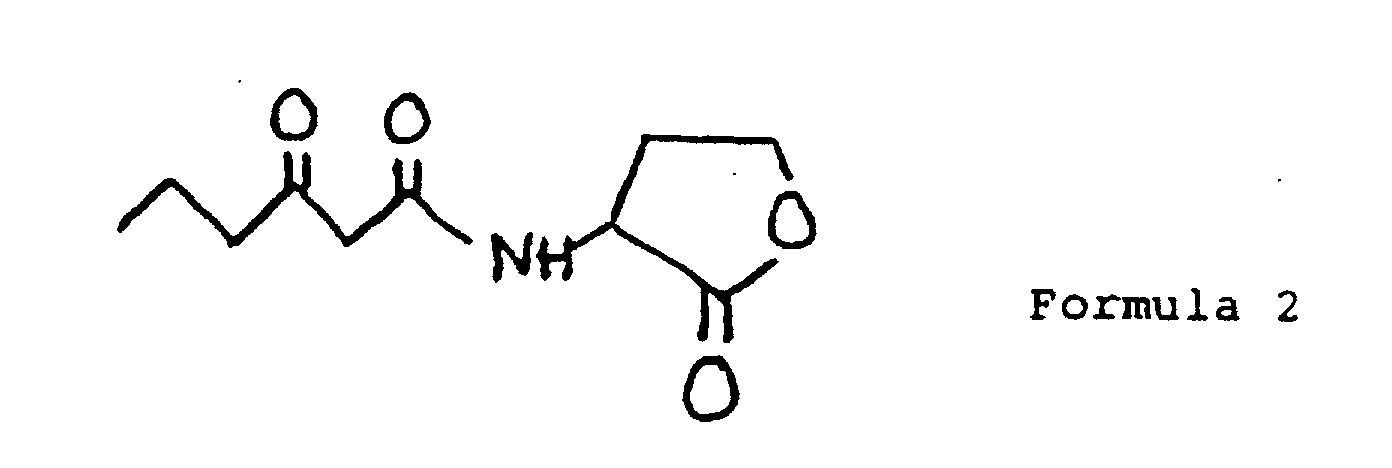
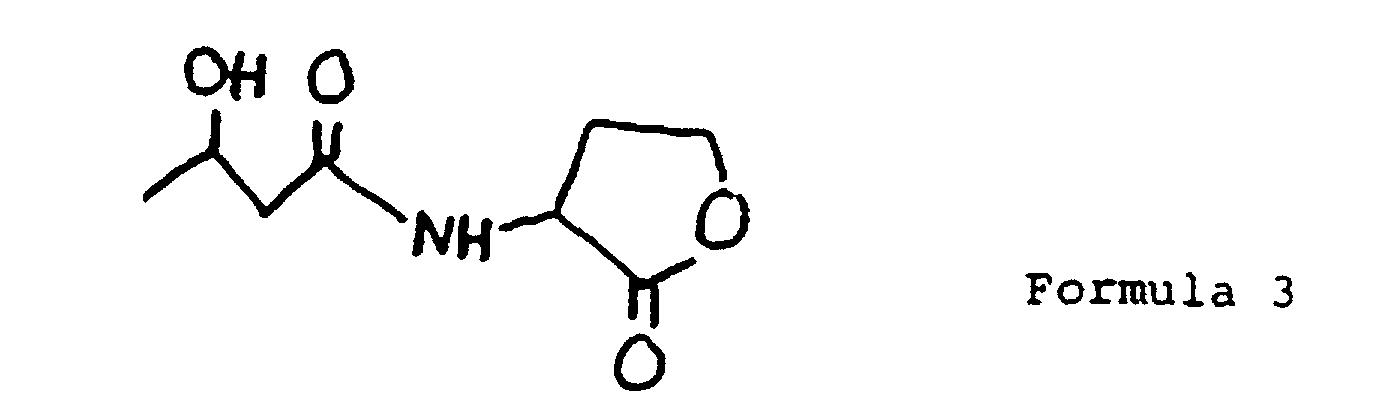
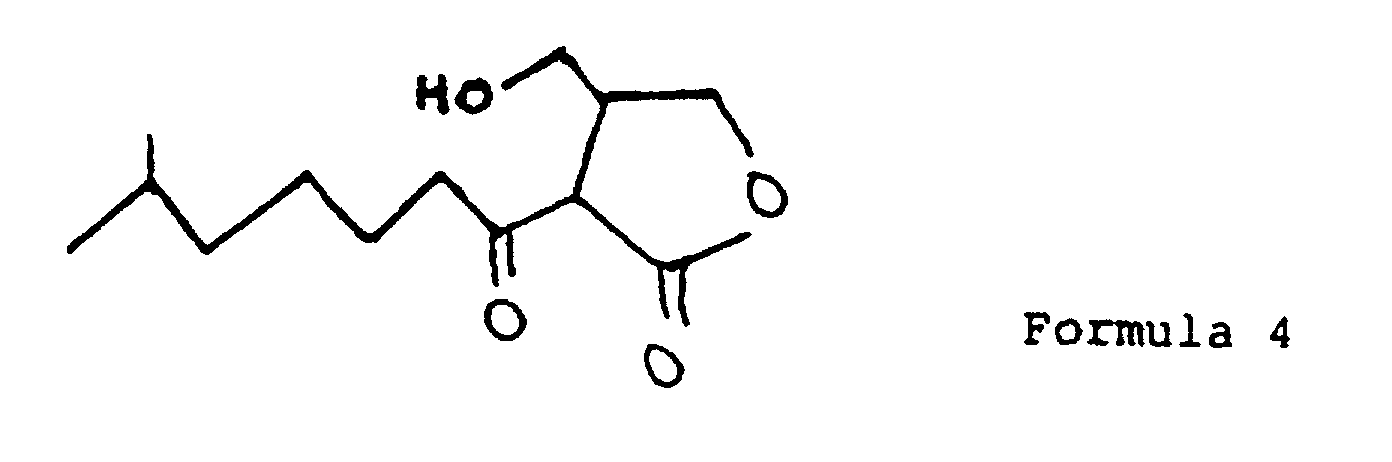
- In a research programme directed at the study of carbapenem synthesis in prokaryotes, we have recently discovered that the compound of
formula 2 regulates the expression of carbapenem synthesis in Erwinia. It appears that there is a family of compounds, including those offormulae formulae - We have synthesised various members of this family of compounds, including optically active isomers thereof. This invention includes as new compounds those members of the family that have not been previously described. The invention also includes use of the compounds of the family to control gene expression in microorganisms. Some of the practical implications of this use are discussed below.
- Thus in one aspect the invention provides use of a compound having the
formula 1 to control autoinducer responsive gene expression in bacteria other than V. fischeri, V. logei and V.harveyi and P.phosphoreum, whereinformula 1 iswhere n is 2 or 3
Y is O, S or NH
X is O, S or NH
R is C1 - C12 alkyl or acyl which may be substituted, and wherein the gene expression is not controlled by a bioluminescent specific luxR gene. - Preferably n is 2, so that the ring is five-membered. Although it is not necessary for Y and X to be the same, both are preferably O as in the compounds of
formulae - In another aspect, the invention provides, as new compounds, optically active isomers of the compounds of
formula 1 as defined above. Preferably the optically active isomers are L-isomers, since these have proved more active than their corresponding D-isomers at increasing gene expression. The D-isomers may be useful to inhibit gene expression. - Use is made of these compounds to control gene expression in microorganisms. The control exercised may be to decrease, but is more usually to increase, gene expression. The microorganisms concerned include bacteria, both Gram negative and Gram positive. It is at the basis of the invention that a wide variety of microorganisms have some gene whose expression is affected in some way by at least one compound within the family. This control technique often involves the use of microorganisms that are not themselves capable of producing an autoinducer within the family of compounds, but which are capable, in the presence of exogenous autoinducer, of expressing a gene, generally in an easily detectable manner. Two examples of such microorganisms, which are discussed in more detail below, are:
- A genetic construct pSB237. This has the capacity to express
a bioluminescent phenotype in E.coli, but only in the presence of added
inducer, preferably the compound of
formula 2. - A mutant strain B10002/mu22, made by mutation of Erwinia
carotovora ATCC3948. Unlike its parent, the mutant 22 is capable of
synthesising carbapenem antibiotic only in the presence of added inducer,
such as the compound of
formula 2. - In one example of such technique, the invention provides a method of testing for the presence, in a sample, of a first bacterium which when incubated under known conditions generates N-(β-ketocaproyl) homoserine lactone or an analogue thereof which method comprises incubating the sample under the said known conditions in the presence of a second bacterium which is known to be capable of undergoing enhanced gene expression when in the presence of the said lactone or analogue thereof and detecting the gene expression by the second bacterium, the detection of the gene expression by the second bacterium being indicative of the presence of the first bacterium in the sample. The limits of detection using a bioluminescent phenotype derived from E.coli [pSB237] depend upon the time of exposure of the bacterial culture to inducer. As shown in Example 4 below, at concentrations above 10 ng/ml of culture, induction of bioluminescence takes less than 10 minutes. At lower concentrations induction is progressively slower, but concentrations of as low as 80 pg/ml can be distinguished from a zero concentration control after some 20 hours of incubation.
- Such a test may be for bacteria generally, or for specific bacteria known to produce autoinducer under particular conditions. For example, Pseudomonas aeruginosa produces autoinducer (formula 2) only under defined growth conditions (see Example 4), specifically the use of limiting or minimal growth media supplemented with Fe(III). Similarly, there is preliminary evidence that Listeria monocytogenes produces a lactone or analogue only after exposure to low temperature. These characteristics of particular bacteria provide the basis of specific tests for those bacteria in a mixture of microorganisms.
- P.aeruginosa is a bacterium that must be stipulated as absent in 100 ml of H2O to be used for the preparation of pharmaceutical products, particularly injectables. There is therefore a considerable need to develop a rapid assay system for this specific bacterium. Existing rapid assays such as DNA probes or antibody probes cannot discriminate between live and dead cells, an unacceptable limitation only avoidable by testing after microbial growth. Novel processes such as the construction of genetically engineered bacteriophage specific for P.aeruginosa and containing the luxAB genes are a possibility but cost of development is high.
- The fact that P.aeruginosa produces a substance capable of complementing inducer in a luxR/AB construct provides the basis of a rapid test.
- It has been demonstrated that the normal density dependent expression of the entire lux operon in E.coli can be suppressed. In liquid growth a lux operon construct would not emit high levels of light until the culture density approached the end of exponential growth. If, however, such cells are immobilised in a low concentration gel the bacteria will light up very rapidly. It is presumed that this is a consequence of limiting the diffusion of the autoinducer.
- A concept assay for P.aeruginosa may be as follows. Water is filtered to collect any bacteria and the filter overlayed with a gel (agar, agarose or gelatin) containing E.coli[pSB237]. The inducer produced by live P.aeruginosa cells is limited in diffusion and rapidly reaches a concentration sufficient to activate bioluminescence in the surrounding E.coli cells. In effect light 'plaques' appear and can be detected and counted. The ability to control the optimal media conditions for production of complementing activity allows for considerable specificity of the assay.
- In yet another example of the technique, a compound according to
formula 1 can be added to a microorganism culture in order to cause expression of a particular gene that would not otherwise be expressed. For example, the compound may be used to induce antibiotic production. - In yet another example, growth media for microorganisms e.g. bacteria can be prepared containing an autoinducer - at an effective concentration which would lead to a stimulation or promotion of the metabolism, growth and/or recovery of the organisms. (These phenomena are herein referred to collectively as growth.). This may include all the organisms present or, in some cases, it may enhance a selected group of organisms in a sample in preference to the others.
- A lot of work has been done on the regulation of the lux operon of Vibrio fischeri, in which the autoinducer of
formula 2 plays a crucial role. Reference is directed to Figure 1 of the accompanying drawings. The following paragraphs describe the current state of knowledge regarding the role of autoinducer in the control of the lux operon and should be read in conjunction with Figure 1. - The phenomenon of autoinduction was first described by Nealson et al. (1970), based on observations that Vibrio harvevi and Vibrio fischeri produce light only at high cell densities, and that these bacteria produce a substance which will induce bioluminescence in cultures of low cell density. It was postulated that a substance termed 'autoinducer' accumulates in the growth media and induces the synthesis of the components of the bioluminescence system (when its concentration reaches 1-2 molecules per bacterial cell). Therefore, it is not cell density per se which influences bioluminescence, but the accumulation of the autoinducer molecule. The first autoinducer molecule to be purified and structurally identified was that produced by Vibrio fischeri, and was found to be N-(β-ketocaproyl)homoserine lactone (Eberhard et al., 1981). It was speculated that as this molecule combines homoserine lactone, an intermediate in amino acid metabolism and β-ketocaproic acid, a relative of fatty acid metabolism intermediates, that it could be a signal of nutritional viability communicated to other bacteria perhaps to induce a chemotactic response, hence the autoinducer became considered a bacterial pheromone (Eberhard, 1972) with a role in population sensing.
- The luxI gene which lies upstream of luxC in V.fischeri codes for a 22 kD polypeptide believed to be responsible for production of autoinducer, apparently from cytoplasmic precursors (Engebrecht et al., 1983) although exactly what these precursors are is not clear. There is no evidence that any systematic search for genes analogous to luxI in other luminous bacteria has been attempted.
- In 1987 Kaplan and Greenberg identified a positive regulatory element in V.fischeri which was required along with autoinducer to activate transcription of the structural genes for bioluminescence (luxCDABE) and for autoinducer synthesis (luxI product). This regulatory protein was found to be a 28 kD polypeptide coded for by luxR, a gene which lies upstream of luxI but which is transcribed in the opposite direction to the other lux genes. The luxR product was shown to be a DNA-binding protein, although under the conditions used the binding was not lux DNA-specific. The reason suggested for this was incorrect renaturation of the protein during purification, an explanation further supported by problems of reproducibility when trying to demonstrate binding of autoinducer. Mutational analysis of luxR has indicated that one region, near the centre of the luxR polypeptide, constitutes an autoinducer binding domain, while a region towards the carboxy terminus of the polypeptide constitutes a lux operator DNA binding/recognition domain (Slock et al., 1990). The position of the autoinducer binding site has subsequently been localised between amino acid residues 79-127 of the V.fischeri luxR protein (Shadel et al., 1990). This could, therefore represent a highly conserved region within luxR homologs.
- More recently, a region unlinked to the lux structural genes has been identified as a locus controlling bioluminescence in V.harveyi, which, unlike V.fischeri, does not possess lux regulatory genes as part of an integral operon required for bioluminescence (Martin et al., 1989). Nevertheless, there is a region upstream of luxC in V.harveyi that contains a strong inducable promoter, which is cell density regulated and glucose repressible (Miyamoto et al., 1990). The unlinked regulatory locus from V.harveyi (named luxR) has been cloned and sequenced (Showalter et al., 1990), and the results indicate a structural relationship to some DNA binding proteins (i.e. the DNA-binding domain of Cro-like proteins). There is, however, no sequence similarity to the luxR gene of V.fischeri. Furthermore, the cloned 'luxR' from V.harveyi is unresponsive to exogenously supplied autoinducer and does not direct the synthesis of an autoinducer activity. The cloning of this regulatory locus into E.coli together with luxCDABE does not reconstruct a lux regulatory system reflective of V.harveyi. It has been suggested, therefore, that a further missing function may be identified by the cloning of additional V.harveyi DNA into E.coli which already contains luxRCDABE on another replicon.
-
- 1. There is low basal expression of luxI, the product of which makes autoinducer from cytosolic substrates.
- 2. cAMP/CRP activates the luxR promoter and luxR protein is produced.
- 3. LuxR protein interacts with autoinducer to form a complex (R/AI).
- 4. R/AI complex binds to lux operator region between luxR and luxI (perhaps displacing LexA or after LexA is cleaved due to SOS response).
- 5. Binding of R/AI promotes transcription of right operon (luxICDABE by σ32 (htpR protein).
-
- Although this invention is based on results rather than theory, the inventors currently believe that the compounds of
formula 1 form a bacterial pheromone family which have a primary role in controlling various functions in bacteria and other microorganisms. These freely soluble and diffusable low molecular weight molecules may act as sensors of inter-microbial communication. As density sensors they may control initiation of maintenance gene expression (Sigma 32). Sensing isolation they may prevent expression of conjugative gene systems, and again sensing density, they may trigger the initial Sigma factor change in bacilli that precedes the sigma cascade during sporulation. - The following examples illustrate various aspects of the invention.
- Example 1 describes a bioassay in which a mutant strain of Erwinia carotovora is used to detect autoinducer, or bacteria which generate autoinducer. The detectable phenotype in this case is carbapenem production.
- Example 2 describes the isolation of N-(β-ketocaproyl) homoserine lactone from the culture supernatant of an Erwinia carotovora strain. This is of interest as a demonstration that a non-bioluminescent non-marine bacterium produces the autoinducer that controls the lux operon of Vibrio fischeri.
- Example 3 describes the preparation of numerous mutants of the E.carotovora strain which lack the ability to make carbapenem antibiotics. The example demonstrates that in some of these mutants the antibiotic production capability can be restored by addition of exogenous autoinducer.
- Example 4 describes a different bioassay for autoinducer, based on the genetic construct pSB237. A bioassay uses bioluminescence to test for the presence of autoinducer, or microorganisms that make it. Using the assay, many bacteria are identified as producers of the autoinducer.
- Example 5 describes the preparation and characterisation of N-(β-ketocaproyl) homoserine lactone and analogues, both in the racemic form and as D- and L- isomers.
- Example 6 describes a bioassay, along the lines of Example 1, to detect the analogues described in Example 5.
- Example 7 describes a method for the enumeration of Pseudomonas aeruginosa using E.coli[pSB237] as an indicator strain.
- Example 8 shows induction of carbapenem production by the L- and D-isomers of autoinducer.
- Example 9 describes an experiment to demonstrate the action of autoinducer in enhancing the rate of growth of bacteria.
- Example 10 demonstrates activity of various analogues in inducing luminescence.
- Example 11 demonstrates early induction of carbapenem production by autoinducer in E.carotovora.
- Example 12 shows the effect of autoinducer on the recovery of injured microorganisms.
-
- 1. The bioassay method is based around an autoinducer non-producing, EMS generated mutant strain of Erwinia carotovora: B10 002/mu22, henceforth called by the abbreviated name: mutant 22 (whose preparation is described in Example 3). The biosynthesis of carbapenem antibiotic is induced by the autoinducer compound. Mutant 22 is blocked at some point in the biosynthesis of autoinducer. Thus, addition of a sample containing the autoinducer compound will complement this genetic lesion, allowing the biosynthesis of antibiotic observed in the strain from which the mutant is derived.
- 2. Samples of up to 50 µl in volume are added to wells of approximately 10 mm in diameter, cut in Oxoid DST agar plates seeded with an E.coli carbapenem super-sensitive strain (E.coli ESS). DST agar is made up as directed. After autoclaving, the DST agar is cooled to 45°C, then 3.0 ml per litre of DST agar of a culture of E.coli ESS added. The latter is grown up overnight in Oxoid brain heart infusion broth at 37°C.
- 3. An inoculum of Mutant 22 is placed around the rim of the wells containing the samples to be analysed for autoinducer. Positive and negative controls are included consisting of: i) antibiotic-producing strain (Erwinia carotovora ATCC 39048); ii) mutant 22 with synthetic autoinducer; iii) mutant 22 without any sample added; iv) and each sample tested for antibacterial activity in the absence of mutant 22 to test for presence of antibiotics or residual solvents.
- 4. The plates are inoculated overnight at 26°C. If the autoinducer is present in a sample placed in a well with mutant 22, the antibiotic produced gives a clearing on the plate.
-
- E.carotovora was maintained on nutrient agar slopes. A loopfull of the culture was inoculated into seed stage medium (consisting of neutralised
soya peptone 1% w/v and sucrose 0.1% w/v) and incubated at 26°C on a rotary shaker for 24 hours. 1 ml was added to each of four Erlenmeyer flasks, each containing 500 ml production (ECP) medium. This consisted of:L-Glutamic acid 0.2% w/v Ammonium sulphate 0.1% w/v di-Potassium hydrogen orthophosphate 0.37% w/v Potassium di-hydrogen orthophosphate 0.62% w/v Sodium Chloride 0.02% w/v Casamino acids (Difco) 0.2% w/v Glucose 0.4% w/v Ferrous sulphate heptahydrate 0.001% w/v Magnesium sulphate heptahydrate 0.01% w/v - Cultures were incubated on a rotary shaker at 26'C, 220 rpm for 16 hours. Cultures were clarified by centrifugation (10,000 rpm, 10 minutes), supernatant taken and extracted twice with 400 ml ethyl acetate (distilled over potassium carbonate). The ethyl acetate layer was taken, 30 ml of distilled water added and ethyl acetate removed by rotary evaporation at 35°C.
- The aqueous solution thus obtained was passed twice through a column which contained hydrophobic resin (Styrene-divinylbenzene copolymer CHP3C, Mitsubishi Ltd.). The column was eluted with distilled water (60 ml), then 30% v/v methanol in water (60 ml), then 70% v/v methanol in water (60 ml). Fractions were monitored throughout for biological activity using the Complementation Bioassay.
- The 70% fraction (which contained all detectable biological activity) was taken and concentrated to a volume of 3 ml by rotary evaporation at 35°C. Further substantial purification was achieved by HPLC, set up as follows:
Column Semi-preparative, Reverse phase (S50DS2, Hi-Chrom Ltd.) Mobile Phase 15% v/v methanol in water Flow Rate 2 ml/min Monitoring wavelength 210 nm Injection volume 0.5 ml - The autoinducer eluted at ca 17.5 minutes.
- Fractions were pooled, methanol removed by rotary evaporation at 35°C, aqueous solution freeze dried to yield 1 mg 99+% pure N-(β-ketocaproyl) homoserine lactone as a lyophilised white powder.
-
- 1. Erwinia carotovora ATCC 39048 is grown in LB medium (Maniatis et al., 1982) containing 10 µg/ml kanamycin, 50 µg/ml tetracycline in a rotary shaker at 26°C overnight. OD600 is measured to ensure culture has reached stationary phase (OD600 ≥ 2.0).
- 2. Inoculate 1.0 ml of above culture into 50 ml of fresh complex medium. Place on rotary shaker at 26°C. Grow to OD600 ≈ 0.7.
- 3. Centrifuge 1.0 ml of culture in a sterile microfuge tube at 12 K rpm for 2 minutes at room temperature. Resuspend cells in 1.0 ml of sterile SPC buffer (SPC buffer: 0.15 M NaCl, 10.8 mM NaH2PO4, 9.0 mM citric acid (pH 7.0)). Cells were pelleted as above, supernatant discarded and cells resuspended in 1.0 ml of sterile SPC buffer.
- 4. 25 µl of ethyl methane sulphonate (EMS) is added to 1.0 ml of cells suspended in SPC buffer, to give a 2.5% solution of EMS. Cells are then incubated with EMS without shaking for 1 hour at room temperature.
- 5. Centrifuge cells in a microfuge at 12 k rpm for 2 mins. Remove supernatant and resuspend cells in 1.0 ml of sterile 5% sodium thiosulphate (pH 7.0). Wash the cells with 1.0 ml of sterile SPC buffer twice to remove any traces of sodium thiosulphate.
- 6. Resuspend cells in 1.0 ml LB medium. Place in 26'C incubator without shaking for 1 hour.
- 7. Dilutions of cells are made in sterile water and 100µl volumes spread on nutrient agar plates containing 10 µg/ml kanamycin, 50 µg/ml tetracycline. Plates are incubated at 26°C for 48 hours.
- 8. Colonies were picked-off the above plates using sterile toothpicks and an inoculum placed on DST agar plates seeded with E.coli ESS strain (Oxoid DST agar made up as directed. After autoclaving, agar is cooled to 45°C and 3.0 ml of an overnight culture of E.coli ESS strain in Oxoid brain heart infusion broth added to 1 litre of DST). Plates are incubated at 26°C for 24 hours. When carbapenem antibiotic is produced by the Erwinia colony a clearing is observed. Non-producers of carbapenem antibiotic are selected. Amongst those are autoinducer non-producing mutant colonies (about 20% of the total showing a phenotype of antibiotic non-production).
- 9. Autoinducer non-producing mutant strains have been identified by complementation analysis using whole cells, filter sterilised culture supernatants and HPLC analysis of culture supernatants.
-
-
- 1. Using Oxoid DST agar seeded with E.coli super-sensitive strain (ESS), it can be shown that some mutants derived from Erwinia carotovora ATCC 39048 are no longer able to synthesise carbapenem antibiotic. Amongst these are mutants unable to synthesise autoinducer which is a requirement for carbapenem biosynthesis. Due to the diffusable nature of the autoinducer molecule a mutant defective in the biosynthesis of the compound will be complemented by strains with mutations in the carbapenem biosynthetic pathway or regulatory autoinducer binding proteins, which will have the functional autoinducer biosynthetic machinery.
- 2. Complementation is observed by mixing whole cells of mutant strain B10 002/mutant 22 (subsequently called mutant 22) with other mutants such as mutant strain B11 001/mutant 26 (subsequently called mutant 26).
- 3. Mutants are mixed together on DST agar seeded with E.coli ESS. When mixed, production of antibiotic and concomitant clear zone on the plate are observed. Separate inoculums of each mutant do not produce any antibiotic.
- 4. The same effect can be observed when feeding filter-sterilised supernatant from a culture of one mutant to a mutant of a separate complementation group. A 50 µl sample is placed in a well cut in a DST agar plate seeded with E.coli ESS, with the chosen mutant inoculated around the rim of the well. The plate is incubated at 26°C for 24 hours, after which time clear zones produced by the presence of antibiotic will be visible.
- 5. Feeding the supernatant from a mutant such as mutant 26 to mutant 22 induces antibiotic production in the latter. No induction of carbapenem is observed when filter-sterilised supernatant from mutant 22 is incubated with mutant 26 on bioassay plates.
-
- The following Table lists the mutant strains prepared.
Compilation of Erwinia carotovora strains with antibiotic non-producing phenotypes COMPLEMENTATION GROUP 1 COMPLEMENTATION GROUP 2strain number mutagen used strain number mutagen used A05 002 8 NTG B03 001 4 EMS A05 003 9 NTG B10 002 22 EMS A05 005 10 NTG B10 003 23 EMS A05 020 11 NTG A05 026 12 NTG A06 001 13 NTG A07 005 14 NTG A07 037 15 NTG A08 003 16 NTG A08 004 17 NTG A08 017 18 NTG A08 020 19 NTG A08 022 20 NTG B10 001 21 EMS B10 004 24 EMS B10 005 25 EMS B11 001 26 EMS COMPLEMENTATION GROUP 1COMPLEMENTATION GROUP 2Total number of mutants produced 17 3 - An E.coli vector pSB226 containing a promoterless copy of the luxA and luxB genes from V.harveyi has been previously described (Hill et al., 1991)
- This vector has a unique EcoR1 site proximal to luxA which facilitates the insertion of promoterless elements. A luxR lux promoter region of the V.fischeri lux operon was obtained by PCR using the following primers designed to incorporate terminal EcoR1 sites and to have homology to sequences previously identified by Engebrecht and Silverman (1987).
 Recognition sequences for EcoR1 are underlined.
- The PCR fragment obtained by use of the above primers was digested with EcoR1 and inserted into the unique EcoR1 site of pSB226. Recombinant clones were selected on the basis of a bioluminescent phenotype dependent upon the presence of dodecanal vapour and synthetic V.fischeri autoinducer. One such recombinant was designated pSB237.
- This example uses E.coli [pSB237], a bacterium in which, as noted above, bioluminescence is expressed only in the presence of exogenous N-(β-ketocaproyl) homoserine lactone (or analogue). This phenotype is used as a basis of a test for synthetic autoinducer or for other bacteria that may produce autoinducer.
- The bioassay method is based on E.coli [pSB237], described above. Overnight LB cultures (Maniatis et al., 1982) of E.coli [pSB237] are used to initiate exponential cultures by appropriate dilution into fresh LB media. 100 µl of exponential cultures are placed into microtitre wells within a microtitre tray format. 100 µl of cell free culture supernatant or appropriately diluted N-(β-ketocaproyl) homoserine lactone is added individually to wells so that the potential to induce bioluminescence from E.coli [pSB237] can be assessed. Microtitre trays are incubated at 30°C prior to bioluminescence determination which must be preceded by the addition to each well of 5 µl of a 1% dodecanal solution in ethanol. The limits for detection of autoinducer using a bioluminescent phenotype derived from E.coli [pSB237] depend upon the time of exposure of the bacterial culture to inducer. At concentrations above 10 ng/ml of culture, induction of bioluminescence is rapid (less than 10 min). At lower concentrations induction is progressively slower but concentrations as low as 80 pg/ml can be distinguished from a zero concentration control after some 20 h of incubation (Figure 2). This establishes the bioluminescent assay as a highly sensitive and simple monitor of inducer.
- P.aeruginosa produces complementing activity (confirmed as autoinducer) only under defined growth conditions. In rich media such as LB or Brain Heart Infusion Broth the degree of complementing activity is low. In limiting or minimal growth media and particularly when supplemented with 1 mg/ml Fe(III), the production of complementing activity is very considerable. By comparison with standard concentrations of autoinducer (L-isomer), the supernatant of such a P.aeruginosa culture could be estimated to contain some 10 ng/ml of autoinducer. The media dependency of complementation activity strongly suggests that production is regulated and that under favourable conditions production levels may equate to those previously reported in marine bacteria (Eberhard, 1981; 1 µg/ml).
- S. marcescens is capable of providing a similar level of complementing activity for E.coli[pSB237] as P.aeruginosa. the major difference is that in this instance there is no media variability with very high complementations achieved from BHI supernatants. This would suggest constitutive expression of autoinducer, a feature previously described for V.fischeri (Eberhard et al., 1981).
- Both of these bacteria produce complementing activity in a limiting growth medium (CCY; Stewart et al., 1981). The activity detailed by the bioluminescent assay indicates a lower level of inducer formation or, alternatively, production of an inducer analogue with lower activity for the luciferase luxR product. Nevertheless, the rate of appearance of activity would reflect inducer levels of greater than 1 ng/ml for a homologous compound.
- Table 2 and the accompanying Figure 3 list microorganisms that provide complementation for activation of bioluminescence with E.coli[pSB237]. Typically, activity can take between 0.5 and 6 hours to become measurable above background controls. Given the dependence upon time for detection of low levels of autoinducer, it is possible that these long incubation periods reflect low levels of inducer in the microbial cultures. It is particularly interesting to note that almost none of the cultures provided any complementing activity in rich media but that the limiting CCY media was particularly productive.
- It is possible that the production of inducer analogues of low intrinsic activity with E.coli [pSB237] could be an alternative explanation of the above but equally these results could reflect the detection of basal levels of autoinducer production. These could, after appropriate physiological trigger events, be switched to high production for gene control functions.
- Other tests have shown positive results (i.e. production of autoinducer) also by the following microorganisms: Hafnia alvei, Serratia liquefaciens, Enterobacter agglomerans, and Rahnella aquatilis.
A1 Aeromonas hydrophila A2 Citrobacter freundii 6071 B1 CONTROL B2 Citrobacter freundii 9756 C1 Bacillus cereus C2 Citrobacter koseri 10849 D1 Bacillus coagulans D2 Bacillus coagulans E1 Bacillus megaterium E2 Bacillus cereus 866 F1 Bacillus megaterium KM F2 Bacillus licheniformis G1 Bacillus subtilis G2 Bacillus macerans H1 Brochothrix thermosphacta H2 Bacillus megaterium 9885 A3 Bacillus pumilis A4 Alcaligenes faecalis B3 Bacillus subtilis 2129 B4 Klebsiella aerogenes C3 Bacillus subtilis var niger C4 Listeria grayli D3 Bacillus globigii D4 Listeria monocytogenes 4859 E3 Escherichia coli 86 E4 Listeria monocytogenes 23074 F3 Enterobacter aerogenes F4 Listeria monocytogenes 5348 G3 Enterobacter cloacae G4 Micrococcus luteus H3 Erwinia herbicola H4 CONTROL A5 Proteus mirabilis A6 Pseudomonas putida JT1 B5 Proteus vulgaris B6 Salmonella arizonae C5 CONTROL C6 Salmonella infantis D5 Pseudomonas aeruginosa PA01 (KILLED) D6 Salmonella montevideo E5 Pseudomonas fluorescens E6 Salmonella typhimurium LT2 F5 Pseudomonas putidas F6 Serratia marcescens (KILLED) G5 Pseudomonas putida 340 G6 Streptococcus faecalis H5 Pseudomonas putida IC4A H6 Streptococcus pyogenes A7 Streptococcus mutans B7 CONTROL C7 CONTROL D7 Staphylococcus aureus E7 Vibrio cholerae non 01 F7 Escherichia coli K12 G 7 5 ng autoinducer (KILLED) H7 ----- - Triethylamine (1 mmol) was added to a stirred solution of homoserine lactone hydrochloride (the L- or D- isomer or a racemic mixture) (1 mmol) in water (2 ml) followed by the addition of ethylene glycol ketal of 3-oxoalkanoic acid (1 mmol) and 1-ethyl-3-(3-dimethylaminopropyl)carbodiimide hydrochloride (1 mmol). The mixture was stirred for 20 h and then rotary evaporated to dryness at about 35°C. The light orange residue was extracted with warm ethyl acetate (5 x 5 ml) and the extracts pooled and washed successively with water (1 x 3 ml), 5% sodium bicarbonate solution (1 x 3 ml), 1 M potassium hydrogen sulphate solution (1 x 3 ml) and finally brine (1 x 5 ml). Drying (MgSO4) and evaporation of solvent in vacuo gave the ethylene glycol ketal of 3-oxoalkanoylated homoserine lactones (40-50%).
- Perchloric acid (60%, 0.25 ml) was added to an ice-cooled solution of the alkanoylated lactone (0.5 mmol) in dichloromethane (15 ml). The mixture was stirred at 0°C for 0.5 h and then at room temperature for 1.5 h. The solvent was removed in vacuo and the residue redissolved in ethyl acetate (20 ml). The solution was washed with cold water (2 x 5 ml) and brine (1 x 5 ml), dried (MgSO4) and rotary evaporated to obtain the desired N-(3-oxoalkanoyl)homoserine lactones (55-60%).
- Compound 16 is derived from homocysteine lactone instead of homoserine lactone.
- Triethylamine (1 mmol) was added to a stirred solution of homoserine lactone hydrochloride (the L- or D-isomer or a racemic mixture) (1 mmol) in water (2 ml) followed either by the addition of acid anhydride (3 mmol) (
compounds - N-(3-Oxoalkanoyl)-L-homoserine lactone (0.2 mmol) was dissolved in methanol (5 ml) and the solution made acidic (pH 3-4) with 2 M HCl-methanol. Sodium cyanoborohydride (0.5 mmol) was added in one lot with stirring and the reaction mixture maintained at pH 3-4 by the occasional addition of 2 M HCl-methanol. After 2 h, solvent was removed in vacuo and ethyl acetate extracts (3 x 5 ml) of the residue were combined, dried (MgSO4) and evaporated to yield the title hydroxy derivatives. The products were purified by preparative layer chromatography on silica plates in CHCl3-MeOH (9:1) and repurified by HPLC. The latter also resolved and separated the diastereoisomers in the case of
compounds - Autoinducer and its analogues prepared by these methods were more than 90% pure and were further purified with reverse phase HPLC using a 1 x 25 cm S50DS2 semi-prep column eluting isocratically with 15-20% MeOH-H2O mixture and monitoring at 210 nm. The products were freeze-dried and stored below 0°C.
- All the compounds (see Table 3) were characterised by i.r., mass spectra (EI) and high field n.m.r. as follows.
- νmax (KBr) 3295 (NH), 1780 (ring C=O), 1710 ketone C=O), 1650 (amide C=O), 1550, 1170 cm-1.
m/z (EI) (%) 213.0989 (47, M+, C10H15NO4 requires m/z 213.1001), 185 (13), 170 (8), 155 (7), 143 (33), 128 (8), 113 (19), 102 (56), 101 (35), 71 (82), 57 (100).
δH (CDCl3) (400 MHz) 0.9 (3H, t, CH3), 1.64 (2H, sextet, CH3.CH 2), 2.22 (1H, dddd, 4α-H), 2.51 (2H, t, CH2.CO), 2.77 (1H, ddd, 4β-H0, 3.47 (2H, s, CO.CH2.CO), 4.28 (1H, ddd, 5α-H), 4.48 (1H, dd, 5β-H), 4.59 (1H, ddd, 3-H), 7.65 (1H, bs, NH).
δ13C (CDCl3) 13.58 (CH3), 16.91 (CH2), 29.94 (CH2), 45.85 (CH2), 28.13 (CH2), 49.12 (CH), 65.94 (CH2), 166.38 (CO.NH), 174.83 (ring C=O), 206.54 (C=O). - νmax (KBr) 3280 (NH), 1780 (ring C=O), 1710 (ketone C=O), 1645 (amide C=O), 1550, 1170 cm-1.
m/z (EI) (%) 199.0845 (25, M+, C9H13NO4 requires m/z 199.0845), 170 (9), 154 (7), 141 (6), 125 (7), 102 (34), 101 (34), 57 (100), 43 (36).
δH (CDCl3) (400 MHz) 1.09 (3H, t, CH3), 2.23 (1H, dddd, 4α-H), 2.57 (2H, q, CH3.CH 2), 2.77 (1H, ddd, 4β-H), 3.48 (2H, s, CO.CH2.CO), 4.28 (1H, ddd, 5α-H), 4.48 (1H, dd, 5β-H), 4.58 (1H, ddd, 3-H), 7.60 (1H, bs, NH). - νmax (KBr) 3280 (NH), 1780 (ring C=O), 1710 (ketone C=O), 1640 (amide C=O), 1550, 1170 cm-1.
m/z (EI) (%) 185.0701 (3, M+, C8H11NO4 requires m/z 185.0687), 140 (4), 127 (7), 102 (4), 101 (21), 57 (72), 43 (100).
δH (CDCl3) (400 MHz) 2.23 (1H, dddd, 4α-H), 2.28 (3H, s, CH3), 2.77 (1H, ddd, 4β-H), 3.50 (2H, s, CO.Ch2.CO), 4.28 (1H, ddd, 5α-H), 4.48 (1H, dd, 5β-H), 4.59 (1H, ddd, 3-H), 7.60 (1H, bs, NH). - νmax (KBr) 3310 (NH), 1775 (ring C=O), 1640 (amide C=O), 1545, 1175 cm-1.
m/z (EI) (%) 171.0922 (12, M+, C8H13NO3 requires m/z 171.0896), 153 (4), 143 (65), 128 (5), 125 (5), 102 (10), 101 (10), 71 (57), 57 (65), 43 (100).
δH (CDCl3) (400 MHz) 0.96 (3H, t, CH3), 1.68 (2H, sextet, CH3.CH2), 2.19 (1H, dddd, 4α-H), 2.24 (2H, t, CH2.CO), 2.82 (1H, ddd, 4β-H), 4.29 (1H, ddd, 5α-H), 4.47 (1H, dd, 5β-H), 4.59 (1H, ddd, 3-H), 6.26 (1H, bs, NH). - νmax (KBr) 3300 (NH), 1785 (ring C=O), 1640 (amide C=O), 1535, 1185 cm-1.
m/z (EI) (%) 143.0546 (6, M+, C6H9NO3 requires 143.0582), 125 (5), 116 (2), 101 (3), 98 (11), 57 (93), 43 (100).
δH (CDCl3) (400 MHz) 2.06 (3H, s, CH3), 2.19 (1H, dddd, 4α-H), 2.78 (1H, ddd, 4β-H), 4.29 (1H, ddd, 5α-H), 4.47 (1H, dd, 5β-H), 4.62 (1H, ddd, 3-H), 6.57 (1H, bs, NH). - νmax (KBr) 3310 (NH), 1780 (ring C=O), 1675 (amide C=O), 1635 (C=C), 1555, 1175 cm-1.
m/z (EI) (%) 197.1088 (11, M+, C10H15NO3 requires m/z 197.1052), 154 (9), 97 (100), 85 (3).
δH (CDCl3) (400 MHz) 0.94 (3H, t, CH3), 1.48 (2H, sextet, CH3.CH 2), 2.17 (3H, m. 4α-H and CH 2.CH=CH), 2.86 (1H, m, 4β-H), 4.31 (1H, ddd, 5α-H), 4.48 (1H, dd, 5β-H), 4.63 (1H, ddd, 3-H), 5.83 (1H, dt, CH=CH.CO), 6.11 (1H, d, NH), 6.90 (1H, dt, CH=CH.CO). - νmax (KBr) 3315 (NH), 1775 (ring C=O), 1645 (amide C=O), 1550, 1175 cm-1.
m/z (EI) (%) 199.1256 (5, M+, C10H17NO3 requires m/z 199.1208), 170 (5), 156 (8), 143 (100), 85 (10).
δH (CDCl3) (90 MHz) 0.87 (3H, t, CH3), 1.0-1.40 (4H, m, CH3.CH 2.CH 2), 1.40-1.85 (2H, m, CH2.CH2.CO), 1.85-2.45 (3H, m, CH 2.CO and 4α-H), 2.45-2.90 (1H, m, 4β-H), 4.0-4.75 (3H, m, 5-H2 and 3-H), 6.43 (1H, d, NH). - m/z (EI) (%) 197.0995 (9, M+-H2O, C10H15NO3 requires m/z 197.1052), 172.0629 (52, M+-C3H7, C7H10NO4 requires m/z 172.0610), 154 (4), 143 (31), 102 (100).
δH (CDCl3) (400 MHz) 0.94 (3H, t, CH3), 1.44 (2H, m, CH3.CH 2), 1.55 (2H, m, CH 2.CH.OH), 2.18 (1H, dddd, 4α-H), 2.35 (1H, dd, CH αHβ.CO), 2.44 (1H, dd, CHα H β.CO), 2.83 (1H, dddd, 4β-H), 3.07 (1H, br s, OH), 4.04 (1H, dddd, CHOH), 4.28 (1H, ddd, 5α-H), 4.48 (1H, ddd, 5β-H), 4.57 (1H, ddd, 3-H), 6.55 (1H, br s, NH). Compound 11 {N-[(R)-3-hydroxyhexanoyl]-L-homoserine lactone}
m/z (EI) (%) 197.1066 (11, M+-H2O, C10H15NO3 requires m/z 197.1052), 172.0612 (53, M+-C3H7, C7H10NO4 requires m/z 172.0610), 143 (27), 102 (100).
δH (CDCl3) (400 MHz) 0.94 (3H, t, CH3), 1.43 (2H, m, CH3.CH 2), 1.55 (2H, m, CH 2.CH.OH), 2.19 (1H, dddd, 4α-H), 2.33 (1H, dd, CH αHβCO), 2.46 (1H, dd, CHα H β.CO), 2.83 (1H, dddd, 4β-H), 4.05 (1H, dddd, CH.OH), 4.30 (1H, ddd, 5α-H), 4.48 (1H, ddd, 5β-H), 4.55 (1H, ddd, 3-H), 6.50 (1H, br s, NH). - m/z (EI) (%) 201.0939 (2, M+, C9H15-NO4 requires m/z 201.1001), 183.0931 (8, M+-H2O, C9H13NO2 requires m/z 183.0895), 172.0677 (24, M+-C2H5, C7H10NO4 requires m/z 172.0610), 143 (28), 102 (44), 101 (32), 57 (100).
δH (CDCl3) (90 MHz) 0.93 (3H, t, CH3), 1.50 (2H, quintet, CH3.CH 2), 2.15 (1H, m, 4α-H), 2.33 (2H, d, CH2.CO), 2.60 (1H, m, 4β-H), 2.70 (1H, br s, D2O exchangeable, OH), 4.0-4.80 (3H, m, 5-H2 and 3-H), 6.90 (1H, br s, D2O exchangeable, NH). - m/z (EI) (%) 187.0820 (2, M+, C8H13NO4 requires m/z 187.0844), 172.0614 (11, M+-CH3, C7H10NO4 requires m/z 172.0610), 169.0761 (6, M+-H2O, C8H11NO3 requires m/z 169.0739), 143 (34), 102 (46), 101 (18), 57 (100).
δH (D2O) (90 MHz) 1.20 (3H, d, CH3), 2.20 (1H, m, 4α-H), 2.40 (2H, d, CH 2.CO), 2.57 (1H, m, 4α-H), 4.0-4.70 (4H, m, 5-H2, 3-H and CH.OH). - m/z (EI) (%) 247.0824 (24, M+, C13H13NO4 requires m/z 247.0844), 147 (12), 105 (100), 77 (37).
δH (CDCl3/DMSO-d6) (90 MHz) 2.20-2.80 (2H, m, 4-H2), 3.94 (2H, s, CO.CH 2.CO), 4.10-4.80 (3H, m, 5-H2 and 3-H), 7.30-7.70 (3H, m, ArH), 7.95 (2H, dd, ArH), 8.56 (1H, d, NH).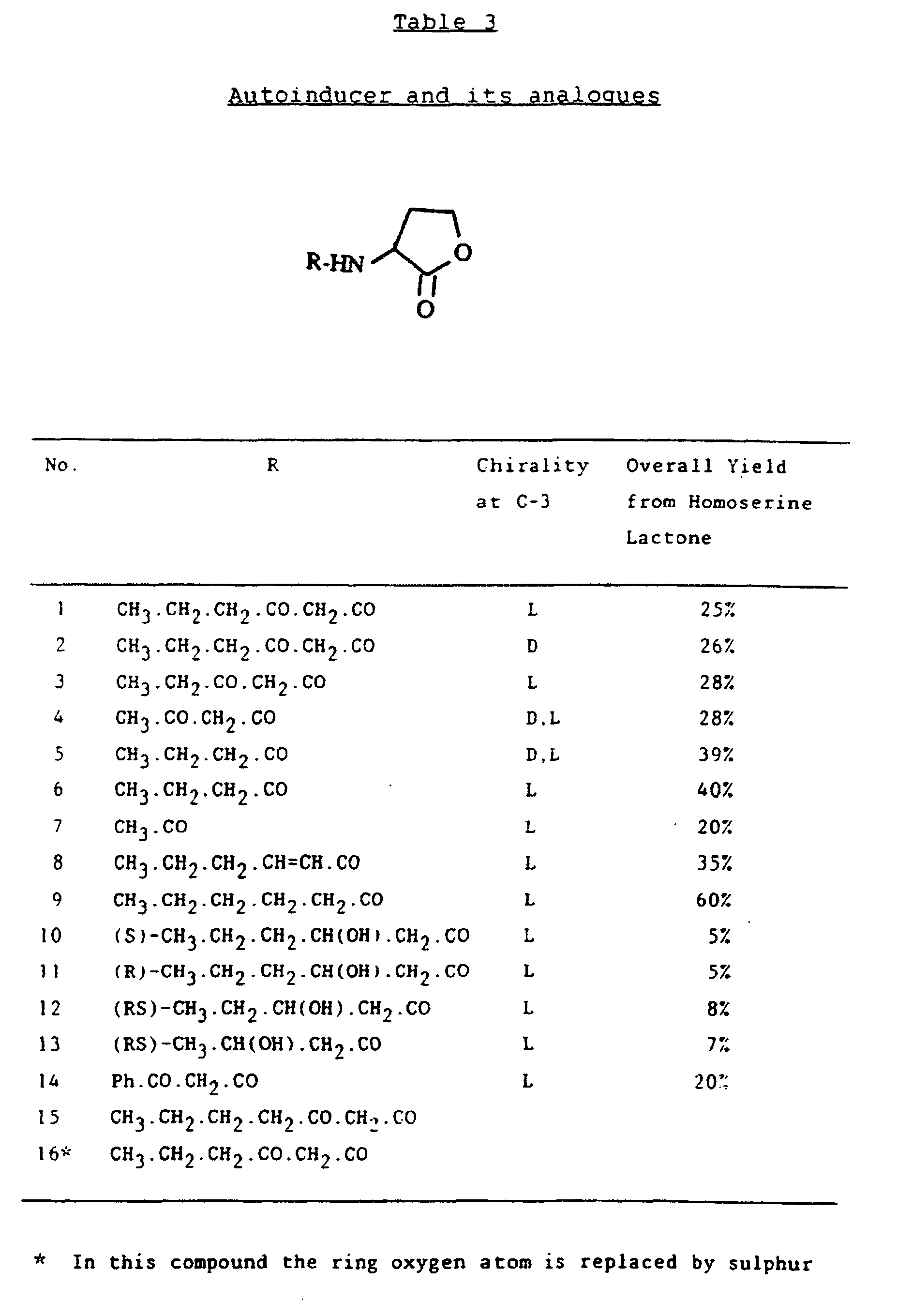
- Erwinia mutant PNP22 was inoculated around the rims of 3 mm wells cut into agar plates seeded with E.coli ESS. Solutions of a range of concentrations of each analogue of Example 5 were prepared in distilled water, filter sterilised and 50 µl added to each well. Plates were incubated at 26°C overnight and the resulting inhibition zone diameters measured (mm). Figure 4 is a graph of inhibition zone diameter (which denotes induction of carbapenem antibiotic production) against concentration of various compounds. The dose response curves are shown for
compounds - A method for the enumeration of Pseudomonas aeruginosa was investigated using E.coli[pSB237] (Figure 5) as an indicator. pSB237 confers an autoinducer-dependent bioluminescent phenotype on E.coli (upon addition of exogenous aldehyde) and can therefore detect the production of autoinducer from P. aeruginosa. The experiment requires an over-night culture of P. aeruginosa which is subjected to 10 fold serial dilutions such that approximately 2, 20 and 200 colonies are filtered onto a nitrocellulose membrane. We have found the use of membranes to be preferable to pour plate methods because the membranes provides an aerobic environment for the Pseudomonas to grow. The membranes are placed onto a lawn of E. coli[pSB237]. The inducer from P. aeruginosa diffuses through the membrane and triggers bioluminescence in localised areas of the E. coli[pSB237] lawn equivalent in size to the Pseudomonas colony. The number of light areas exactly correlate with the number of Pseudomonas colonies. In a mixed culture only those bacterial colonies which produce autoinducer will provide light in the E. coli[pSB237] lawn and this can, therefore, provide a very clear discrimination between what may otherwise be closely related bacteria.
-
- 1. Overnight cultures of P. aeruginosa PAO1 and E. coli[pSB237] were grown in Luria Broth.
- 2. A 10 fold dilution series of the overnight Pseudomonas culture was prepared using Luria Broth and samples plated onto Luria Broth Agar to obtain colony counts.
- 3. 0.5 ml of the overnight E. coli[pSB237] was added to 4 ml of molten (45°C) Luria Broth Agar and spread onto a Luria Broth Agar plate.
- 4. 1 ml of the Pseudomonas dilution series -8, -7 and -6 (in duplicate) were individually filtered onto a Gelman 0.45 µm nitrocellulose membrane. These were subsequently individually placed onto E. coli[pSB2237] agar lawns as prepared in (3) above.
- 5. Plates were incubated at 30°C for several
hours and viewed with the
Hamamatsu Argus 100Vim 3 camera after exposure to nonanal vapour. -
- A culture of mutant PNP22 was grown overnight in ECP medium and a 2% inoculum (v/v) added to 100 ml of fresh ECP medium. This was incubated on a rotary shaker (rpm 220) at 26°C for 6 hours (until OD > 2.0).
- Bacteria were harvested by centrifugation at 10000 rpm for 10 mins. The supernatant was extracted with a solution of 4% Aliquat 336 (Aldrich) in distilled dichloromethane. Samples were analysed by HPLC using a reverse phase, semi-preparative column.
- Synthetically produced autoregulator was added at a range of concentrations from 0 to 75 µg/ml and a dose-response curve constructed. The threshold for induction of carbapenem production is approximately 0.5 µg/ml. The optimum concentration is 1.0 µg/ml. Above this concentration, biosynthesis of carbapenem appears to be inhibited.
- The experiment was repeated using the D-isomer in place of the L-isomer (i.e.
compound 2 from Example 5 in place of compound 1). In this case the threshold for induction of carbapenem production was about 2 µg/ml and the optimum concentration was 30 µg/ml. - The measurement of microorganism metabolism can be monitored by several methods one of which is known as impedance monitoring. It has been shown that when bacteria grow in culture media the end products of metabolism are generally more highly charged than the original growth substrates. The resulting changes in impedance can be monitored and "growth" or metabolism curves constructed. The curves obtained by growth in different substrates can be compared for the growth quality of the substrates. The curves can also be used to determine the number of bacteria in a given sample, estimate the sensitivity of microorganisms to inhibitory substances such as antibiotics and also determine the utilisation of growth substances.
- Experiments were performed to examine the effects of autoinducer in culture media on the curves obtained using a Malthus AT growth analyser.
- Serial tenfold dilution of a 4 hour culture in nutrient broth (Lab M, lab 14) of Serratia marcescens were prepared in sterile 0.9% saline. 0.02 ml of 10-4 or 10-5 dilution were added to 6 tubes of media as detailed below. The tubes were mixed and then attached to the Malthus system.
- Easter & Gibson media (Lab M, lab 137) was used throughout with 5 g per litre tri-methyl amine N-oxide added before autoclaving. Sodium biselenite was omitted and the medium was prepared according to the manufacturer's instructions. The inducer (a synthetic preparation of N-(β-ketocaproyl) homoserine lactone) solution was prepared in sterile water and added to the Malthus tubes to give varying final concentrations up to 80 ng/ml.
- 8 of 9 sets of experiments showed an increase of maximum output of between 300 - 500 microsiemens at concentrations of between 5 and 20 ng/ml autoinducer (as compared to the output at zero autoinducer). These results clearly demonstrate that increased bacterial growth was obtained in the presence of inducer.
- Autoinducer and various analogues described in Table 3 were tested for their ability to induce luminescence in E.coli[pSB237] in the assay described in Example 4.
Compound Light Levels 1 +++ 3 ++ 12 ++ 6 + 8 + - In another experiment, tenfold dilutions of autoinducer and various analogues were tested for their ability to induce luminescence in E. coli[psB237]. The following results were obtained, expressed as light levels as above:-
Dilution Compound 1 15 16 -2 ++++ +++ ++++ -3 ++++ +++ ++++ -4 +++ ++++ ++++ -5 + ++++ + -6 - ++++ - - Erwinia carotovora ATCC 39048 was grown as in Example 2, except that 1 ml of overnight seed culture was inoculated into 50 ml ECP with and without autoinducer at a final concentration of 5 µg/ml. The cultures were incubated at 26°C on a shaking incubator at 240 rpm. 100 µl samples of supernatant were taken and injected onto a Spherisorb S50DS2 HPLC column eluted with 100 mM KH2PO4 at 2 ml/min. The carbapenem peak eluted at approximately 7.8 minutes and was determined by absorbance at 254 nM. Inclusion of autoinducer switched on carbapenem production (3-6 hr) several hours earlier than control cultures (5-8 hr).
- To test the effect of Autoinducer on recovery on selective and non-selective agar of Serratia marcescens bacteria with freezing induced injuries.
- Overnight culture of Serratia marcescens grown in Luria Broth, static at 37°C.
- Maximum Recovery Diluent (MRD) (Oxoid CM733, Lot No. 203 40764) made up according to manufacturers instructions.
- Plates of Luria Agar (LA).
- Plates of Violet Red Bile Glucose Agar (VRBGA) (Oxoid CM485, Lot No. 138 40768) made up according to manufacturers instructions.
- Autoinducer stock: DL-N-(3-oxohexanoyl)-L-
homoserine lactone 10 mg/ml in ethyl-acetate. - Plates with 20 ng Autoinducer/ml agar were prepared in the following way:
-
Autoinducer solution 4 µg/ml was prepared by mixing 4µl stock with 10 ml Maximum Recovery diluent. - Pre-poured, dried agar plates were weighted to nearest 2g, and 5 µl Autoinducer solution/g agar was dispensed and spread on the surface using a sterile, disposable L-shaped spreader. Plates were then stored overnight at 4°C in the dark before drying prior to use.
- Control plates without Autoinducer were prepared in a similar fashion substituting sterile Maximum Recover Diluent for Autoinducer solution.
- The overnight culture was diluted in 10-fold serial dilutions to 10-4 in sterile Bijou's by mixing
500 µl culture + 4500 µl MRD (= 10-1),
500µl 10-1 + 4500 µl MRD (= 10-2)
500µl 10-3 dilution + 4500 µl MRD (= 10-4). - The 10-4 dilution was used in the further work as working suspension.
- 100 µl working suspension was serially diluted as described in 1000µl volumes, and 100 µl of the resulting
dilutions - Luria Agar (LA)
- Luria Agar + 20 ng Autoinducer (LA + I)
- Violet Red Bile Glucose Agar (VRBGA)
- Violet Red Bile Glucose Agar + 20 ng Autoinducer (VRGBA + I)
-
- The remaining 4900 µl of working suspension was transferred to a freezer and stored at -21°C. After 210 minutes this was thawed in a waterbath at 31.5°C for 15 minutes, and duplicates of 100 µl of the thawed working solution and a 10-1 dilution in MRD of the thawed working solution were plated on the 4 agars as described.
- Plates were counted after incubation at 22'C for 24 and 48 hrs.
- Results are given as colony forming units recovered per ml working solution. Table 4 shows culture densities on the different agars after 48 hours incubation.
- Table 5 shows culture densities on Luria Agar with and without Autoinducer after 24 and 48 hours incubation.
- There is no difference between recovery of un-injured cells on complex and selective media with and without autoinducer.
- There is no difference between recovery of injured cells on complex medium (Luria Agar) with and without inducer after 48 hours, but there is a trend towards quicker growth/recovery (higher number of colonies after 24 hours) on Luria Agar with Autoinducer compared to the same medium without Autoinducer.
- There is a significant increase in recovery of injured cells on selective medium (VRGBA) with inducer compared to VRGBA without inducer.
- Recovery without inducer:
- Recovery with inducer:
- Recovery on LA after 24 hrs:
- The higher recovery of injured organisms on the selective agar with Autoinducer indicates an improvement in tolerance to selective agents (Bile salts and Crystal Violet) and/or improved repair of injured organisms.
- The higher number of colonies found after 24 hours on Luria Agar with Autoinducer compared to controls without Autoinducer implies quicker recovery/growth in the presence of Autoinducer.
Culture densities on 4 different agars after 48 hours at 22°C Culture density 48 hrs incubation (x103) LA VRGBA LA + I VRBGA + I Control 27 28 29 30 Frozen 11 2.8 11 5.1 Culture densities on Luria Agar with and without Autoinducer after 24 and 48 hours incubation at 22°C Culture density (x103) LA 24 hrs LA 48 hrs LA + I 24 hrs LA + I 48 hrs Control 26 27 29 29 Frozen 6.9 11 8.5 11 - Eberhard, A. (1972). Inhibition and activation of bacterial luciferase synthesis. J. Bact. 109(3): 1101-5
- Eberhard, A., Burlingame, A. L., Kenyon, G. L. Nealson, K. H. & Oppenheimer, N. J. (1981). Structural identification of autoinducer of Photobacterium fischeri luciferase. Biochem. 20(9): 2444-2449.
- Engebrecht, J. & Silverman, M. (1987). Nucleotide sequence of the regulatory locus controlling expression of bacterial genes for bioluminescence. Nuc. Acids Res. 15(24): 10455-10467.
- Engrebrecht, J., Nealson, K. & Silverman, M. (1983). Bacterial bioluminescence: Isolation and genetic analysis of functions from Vibrio fischeri. Cell 32: 773-781.
- Greenberg, E. P., Hastings, J. W. & Ulitzur, S. (1979). Induction of luciferase synthesis in Beneckea harveyi by other marine bacteria. Arch. Microbiol. 120, 87-91.
- Hill, P. J., Swift, S. & Stewart, G. S. A. B. (1991). PCR based gene engineering of the Vibrio harveyi lux operon and the Escherichia coli trp operon provides for biochemically functional native and fused gene products. Mol. & Gen. Genet. in press.
- Kaplan, H. B. and Greenberg, E. P. (1987). Overproduction and purification of the luxR gene product: Transcriptional activator of the Vibrio fischeri luminescence system. Proc. Natl. Acad. Sci. USA 84: 6639-6643.
- Maniatis, T., Fritsch, E. F. and Sambrook, J. (1982). Molecular Cloning; A Laboratory Manual p440. New York, Cold Spring Harbor.
- Martin, M., Showalter, R. & Silverman, M. (1989). Identification of a locus controlling expression of luminescence genes in Vibrio harveyi. J. Bact. 171(5): 2406-2414.
Meighen, E. A. (1991). Molecular biology of bacterial bioluminescence. Microbiol. Rev. 55, 123-142. - Miyamoto C. M., Meighen, E. A. & Graham, A. F. (1990). Trancriptional regulation of lux genes transferred into Vibrio harveyi. J. Bact. 172(4): 2046-2054.
- Nealson, K. H., Platt, T. & Hastings, J. W. (1970). Cellular control of the synthesis and activity of the bacterial luminescent system. J. Bact. 104(1): 313-322.
- Shadel, G. S., Young, R. & Baldwin, T. O. (1990). Use of regulated cell lysis in a lethal genetic selection in Escherichia coli: Identification of the autoinducer-binding region of the luxR protein from Vibrio fischeri ATCC7744. J. Bact. 172(7): 3980-3987.
- Showalter, R. E., Martin, M. O. & SIlverman, M. R. (1990). Cloning and nucleotide sequence of luxR, a regulatory gene controlling bioluminescence in Vibrio harveyi. J. Bact. 172(6): 2946-2954.
- Silverman, M., Martin, M. & Engebrecht, J. (1989). Regulation of luminescence in marine bacteria. In: Genetics of Bacterial Diversity (Hopwood, D. A. & Chater, K. F. eds)., pp 71-86. Academic Press, London.
- Slock, J., VanReit, D., Kolibachuk, D. & Greenberg, E. P. (1990). Critical regions of the Vibrio fischeri LuxR protein defined by mutational analysis. J. Bact. 172(7): 3974-3979.
- Stewart, G. S. A. B, Johnstone, K., Hagelberg, E & Ellar, D. J. (1981). Commitment of bacterial spores to germinate: a measure of the trigger reaction. Biochem. J. 198, 101-106.
| Results | ||
| Dilution | No. of Light Areas | No. of colonies |
| -6 | Too many to count | Too many to count |
| -7 | 170/168 | 158/182 |
| -8 | 23/22 | 21/22 |
Claims (18)
- Use of a compound having the formula 1 to control autoinducer responsive gene expression in bacteria other than V. fischeri, V. logei, V.harveyi and P.phosphoreum, wherein formula 1 iswhere n is 2 or 3
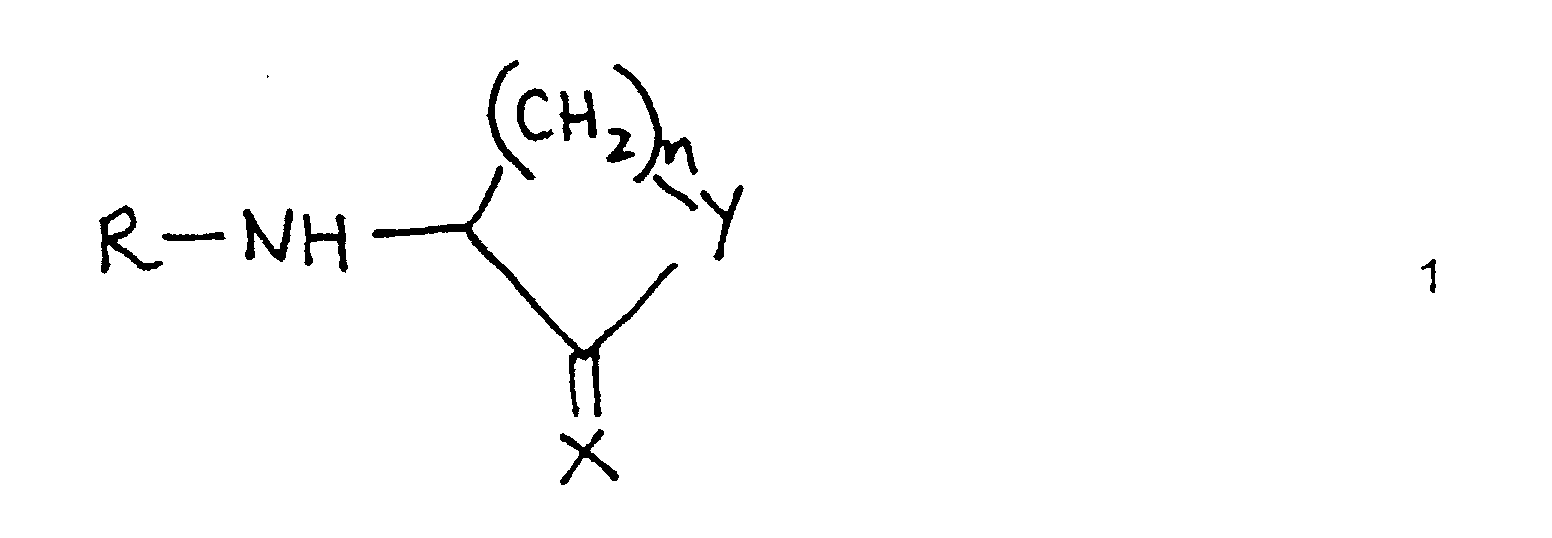
Y is O, S or NH
X is O, S or NH
R is C1 - C12 alkyl or acyl which may be substituted, and wherein the gene expression is not controlled by a bioluminescent specific luxR gene. - Use as claimed in Claim 1, wherein, Y is 0, X is 0, n is 2 and R is acyl.
- Use as claimed in Claim 1 or Claim 2, wherein R carries a keto or hydroxy group.
- Use as claimed in Claim 3, wherein R carries a keto group in the beta-position.
- Use as claimed in Claim 4, wherein the compound is N-(β-ketocaproyl) homoserine lactone.
- Use as claimed in any one of Claims 1 to 5, wherein the gene expression causes bioluminescence.
- Use as claimed in any one of Claims 1 to 5, wherein the gene expression causes production of antibiotic.
- Use as claimed in any one of claims 1 to 5, wherein the compound is included in a bacterial growth medium which promotes bacterial growth.
- An optically active isomer, in substantially pure form, of a compound having formula 1 as defined in any one of claims 1 to 5.
- An optically active compound as claimed in claim 9, wherein the isomer is the L-isomer.
- An optically active compound as claimed in claim 9, wherein the isomer is the D-isomer.
- A method of testing for the presence, in a sample, of a first bacterium which when incubated under known conditions generates N-(β-ketocaproyl) homoserine lactone or an analogue thereof which method comprises incubating the sample under the said known conditions in the presence of a second bacterium which is known to be capable of undergoing enhanced gene expression when in the presence of the said lactone or analogue thereof and detecting the gene expression by the second bacterium, the detection of the gene expression by the second bacterium being indicative of the presence of the first bacterium in the sample.
- A method as claimed in claim 12, wherein the first bacterium is selected from Pseudomonas aeruginosa, Serratia marcescens, Proteus mirabilis, Citrobacter freundii and Enterobacter spp.
- A method as claimed in claim 12 or claim 13, wherein a fluid sample possibly containing the first bacterium is filtered, and a nutrient medium containing the second bacterium is laid on the filter and incubated.
- A method as claimed in any one of claims 12 to 14, wherein the gene expression causes bioluminescence.
- A method as claimed in any one of claims 12 to 15, wherein gene expression causes production of antibiotic.
- A growth medium for bacteria other than V.fischeri, V.logei and V.harveyi, which bacteria are not subject to gene expression controlled by a bioluminescent specific luxR gene, wherein the medium contains an added compound which is an optically active isomer in substantially pure form of a compound having the formula 1 as defined in any one of claims 1 to 5, at a concentration effective to stimulate or promote the metabolism, growth and/or recovery of the microorganisms.
- The use of a growth medium for bacteria other than V.fischeri, V.logei and V.harveyi, which bacteria are not subject to gene expression controlled by a bioluminescent specific luxR gene, wherein the medium contains an added compound having formula 1 as defined in any one of claims 1 to 5, at a concentration effective to stimulate or promote the metabolism, growth and/or recovery of the microorganisms.
Applications Claiming Priority (3)
| Application Number | Priority Date | Filing Date | Title |
|---|---|---|---|
| GB919108307A GB9108307D0 (en) | 1991-04-18 | 1991-04-18 | Autoinducer |
| GB9108307 | 1991-04-18 | ||
| PCT/GB1992/000713 WO1992018614A1 (en) | 1991-04-18 | 1992-04-16 | Autoinducer |
Publications (2)
| Publication Number | Publication Date |
|---|---|
| EP0580692A1 EP0580692A1 (en) | 1994-02-02 |
| EP0580692B1 true EP0580692B1 (en) | 2003-08-13 |
Family
ID=10693505
Family Applications (1)
| Application Number | Title | Priority Date | Filing Date |
|---|---|---|---|
| EP92908821A Expired - Lifetime EP0580692B1 (en) | 1991-04-18 | 1992-04-16 | Autoinducer |
Country Status (10)
| Country | Link |
|---|---|
| US (1) | US5593827A (en) |
| EP (1) | EP0580692B1 (en) |
| JP (1) | JPH06506588A (en) |
| AT (1) | ATE247162T1 (en) |
| CA (1) | CA2105395A1 (en) |
| DE (1) | DE69233160T2 (en) |
| DK (1) | DK0580692T3 (en) |
| ES (1) | ES2203610T3 (en) |
| GB (1) | GB9108307D0 (en) |
| WO (1) | WO1992018614A1 (en) |
Families Citing this family (41)
| Publication number | Priority date | Publication date | Assignee | Title |
|---|---|---|---|---|
| AU7077894A (en) * | 1993-07-02 | 1995-01-24 | University Of Nottingham, The | Immunosuppressant and antiallergic compounds, e.g. n-(3-oxohexanoyl) homoserine lactone |
| US6936447B1 (en) | 2000-04-03 | 2005-08-30 | University Of Iowa Research Foundation | Autoinducer molecule |
| US5591872A (en) * | 1993-08-09 | 1997-01-07 | The University Of Iowa Research Foundation | Autoinducer molecule |
| US5759798A (en) * | 1995-12-08 | 1998-06-02 | Woods Hole Oceanographic Institution | Assays, test kits and bacteria for detection of autoinducers |
| DE69836218T2 (en) * | 1997-06-18 | 2007-09-06 | Montana State University - Bozeman | HOMOSERINLACTONS FOR REGULATING BIOFILMS AND METHODS OF USE |
| US6455031B1 (en) | 1997-06-18 | 2002-09-24 | David G Davies | Methods and compositions for controlling biofilm development |
| GB9725599D0 (en) * | 1997-12-04 | 1998-02-04 | Univ Nottingham | Control of biofilm formation |
| US6395282B1 (en) | 1998-04-16 | 2002-05-28 | University Of Rochester | Immunogenic conjugates of Gram-negative bacterial autoinducer molecules |
| US6756404B2 (en) * | 1998-06-18 | 2004-06-29 | The Research & Development Institute, Inc. | Autoinducer compounds |
| US6337347B1 (en) * | 1998-06-18 | 2002-01-08 | The Research & Development Institute, Inc. | Autoinducer compounds |
| JP2003526327A (en) * | 1998-12-02 | 2003-09-09 | プリンストン ユニバーシティー | Compositions and methods for modulating bacterial disease development |
| US6720415B2 (en) | 1998-12-02 | 2004-04-13 | Princeton University | Compositions and methods for regulating bacterial pathogenesis |
| US7326542B2 (en) * | 1998-12-02 | 2008-02-05 | Princeton University | Compositions and methods for regulating bacterial pathogenesis |
| EP1507010B1 (en) * | 1999-07-01 | 2009-08-12 | Calgene LLC | Control of the gene expression in eukaryotic cells |
| DK1190079T3 (en) | 1999-07-01 | 2006-10-09 | Calgene Llc | Regulation of gene expression in eukaryotic cells |
| AU7343800A (en) | 1999-09-03 | 2001-04-10 | Quorum Sciences, Inc. | Quorum sensing signaling in bacteria |
| GB9924195D0 (en) * | 1999-10-13 | 1999-12-15 | Univ Nottingham | N-Acyl homoserine lactones for the treatment of cardiac tachyarrhythmias Ischaemic heart disease or congestive heart failure |
| GB0007588D0 (en) * | 2000-03-30 | 2000-05-17 | Univ Nottingham | N-Acyl homoserine lactones |
| WO2001085773A2 (en) * | 2000-05-10 | 2001-11-15 | Princeton University | Luxo-sigma54 interactions and methods of use |
| JP2003532698A (en) * | 2000-05-10 | 2003-11-05 | プリンストン ユニバーシティ | Compounds and methods for regulating bacterial growth and pathogenesis |
| US6703513B1 (en) | 2000-06-02 | 2004-03-09 | K-Quay Enterprises Llc | Production and use of derivatized homoserine lactones |
| AU2001286976A1 (en) * | 2000-08-31 | 2002-03-13 | East Carolina University | Novel autoinducer molecules and uses therefor |
| US7651699B2 (en) | 2001-01-08 | 2010-01-26 | Pathway Intermediates Limited | Autoinducer compounds and their uses |
| JP2005506953A (en) * | 2001-05-21 | 2005-03-10 | クオレックス・ファーマシューティカルズ・インコーポレーテッド | How to regulate bacteria |
| GB0122026D0 (en) * | 2001-09-12 | 2001-10-31 | Univ Nottingham | Insulitis |
| DE10219031A1 (en) * | 2002-04-29 | 2003-11-20 | Bayer Ag | Detecting biologically active compounds, useful for detecting toxins and in drug screening, based on their effect on luminescent bacteria |
| EP1359226B1 (en) | 2002-04-29 | 2006-11-22 | Bayer Innovation GmbH | Method and device for detection of biologically active substances |
| GB2418427A (en) | 2004-09-02 | 2006-03-29 | Univ Cambridge Tech | Ligands for G-protein coupled receptors |
| JP5133067B2 (en) | 2005-02-04 | 2013-01-30 | ウイスコンシン アラムナイ リサーチ ファウンデーシヨン | Compounds and methods for altering communication and toxicity in quorum sensing bacteria |
| GB0512238D0 (en) * | 2005-06-15 | 2005-07-27 | Univ Cambridge Tech | Anti-inflammatory agents |
| GB0610042D0 (en) | 2006-05-22 | 2006-06-28 | Univ Nottingham | Substituted n-acyl homoserine lactones |
| US7910622B2 (en) | 2007-03-19 | 2011-03-22 | Wisconsin Alumni Research Foundation | Modulation of bacterial quorum sensing with synthetic ligands |
| US7662967B2 (en) * | 2007-08-02 | 2010-02-16 | Cambridge Enterprise Limited | Anti-inflammatory compounds and compositions |
| GB2452696B (en) * | 2007-08-02 | 2009-09-23 | Cambridge Entpr Ltd | 3-(2',2'-dimethylpropanoylamino)-tetrahydropyridin-2-one and its use in pharmaceutical compositions |
| WO2009036081A1 (en) * | 2007-09-10 | 2009-03-19 | University Of Kentucky Research Foundation | Systems and methods for diagnosis and monitoring of bacteria-related conditions |
| EP2447221A4 (en) * | 2009-06-22 | 2013-01-02 | Sumitomo Heavy Industries | Method for treating wastewater containing ammonia nitrogen |
| US8624063B2 (en) | 2009-06-30 | 2014-01-07 | Wisconsin Alumni Research Foundation | Non-lactone carbocyclic and heterocyclic antagonists and agonists of bacterial quorum sensing |
| US9073884B2 (en) | 2010-06-04 | 2015-07-07 | The Regents Of The University Of California | Anti-inflammatory and quorum sensing inhibition compounds and methods of making and using them |
| JP5579523B2 (en) * | 2010-07-23 | 2014-08-27 | 国立大学法人 東京大学 | Medicine for wound treatment |
| CN106146378B (en) * | 2015-03-23 | 2018-09-18 | 兰州大学 | A kind of acylated homoserine lactone class compound and its environmentally friendly application |
| US10526278B2 (en) | 2017-10-19 | 2020-01-07 | Wisconsin Alumni Research Foundation | Inhibitors of quorum sensing receptor LasR |
Family Cites Families (2)
| Publication number | Priority date | Publication date | Assignee | Title |
|---|---|---|---|---|
| US4861709A (en) * | 1985-05-31 | 1989-08-29 | Technicon Research A.G. | Detection and/or identification of microorganisms in a test sample using bioluminescence or other exogenous genetically-introduced marker |
| US5196318A (en) * | 1990-06-26 | 1993-03-23 | The Texas A&M University System | Precisely regulated expression of deleterious genes |
-
1991
- 1991-04-18 GB GB919108307A patent/GB9108307D0/en active Pending
-
1992
- 1992-04-16 US US08/137,036 patent/US5593827A/en not_active Expired - Lifetime
- 1992-04-16 DK DK92908821T patent/DK0580692T3/en active
- 1992-04-16 JP JP4508046A patent/JPH06506588A/en active Pending
- 1992-04-16 CA CA002105395A patent/CA2105395A1/en not_active Abandoned
- 1992-04-16 EP EP92908821A patent/EP0580692B1/en not_active Expired - Lifetime
- 1992-04-16 AT AT92908821T patent/ATE247162T1/en not_active IP Right Cessation
- 1992-04-16 DE DE69233160T patent/DE69233160T2/en not_active Expired - Fee Related
- 1992-04-16 WO PCT/GB1992/000713 patent/WO1992018614A1/en not_active Ceased
- 1992-04-16 ES ES92908821T patent/ES2203610T3/en not_active Expired - Lifetime
Also Published As
| Publication number | Publication date |
|---|---|
| ES2203610T3 (en) | 2004-04-16 |
| GB9108307D0 (en) | 1991-06-05 |
| CA2105395A1 (en) | 1992-10-19 |
| DE69233160D1 (en) | 2003-09-18 |
| ATE247162T1 (en) | 2003-08-15 |
| WO1992018614A1 (en) | 1992-10-29 |
| DK0580692T3 (en) | 2003-12-08 |
| DE69233160T2 (en) | 2004-06-09 |
| EP0580692A1 (en) | 1994-02-02 |
| US5593827A (en) | 1997-01-14 |
| JPH06506588A (en) | 1994-07-28 |
Similar Documents
| Publication | Publication Date | Title |
|---|---|---|
| US5593827A (en) | Autoinducer | |
| Tang et al. | Characterization of LuxI/LuxR and their regulation involved in biofilm formation and stress resistance in fish spoilers Pseudomonas fluorescens | |
| Brelles-Marino et al. | Detection, purification and characterisation of quorum-sensing signal molecules in plant-associated bacteria | |
| Romero et al. | Quorum quenching activity in Anabaena sp. PCC 7120: identification of AiiC, a novel AHL-acylase | |
| Leisinger et al. | Secondary metabolites of the fluorescent pseudomonads | |
| US20040033549A1 (en) | Quorum sensing signaling in bacteria | |
| de Bruijn et al. | Regulation of cyclic lipopeptide biosynthesis in Pseudomonas fluorescens by the ClpP protease | |
| Ankenbauer et al. | Mapping of mutations in Pseudomonas aeruginosa defective in pyoverdin production | |
| Mahler et al. | Effects of carbon sources on extracellular lipase production and lip A transcription in Acinetobacter calcoaceticus | |
| Gao et al. | Effects of AiiA-mediated quorum quenching in Sinorhizobium meliloti on quorum-sensing signals, proteome patterns, and symbiotic interactions | |
| Feklistova et al. | Obtaining Pseudomonas aurantiaca strains capable of overproduction of phenazine antibiotics | |
| US5573910A (en) | Detection of conversion to mucoidy in Pseudomonas aeruginosa infecting cystic fibrosis patients involving the algu gene | |
| Zhou et al. | AHL-deficient mutants of Burkholderia ambifaria BC-F have decreased antifungal activity | |
| Brown et al. | Regulation of enzymes involved in the conversion of tryptophan to nicotinamide adenine dinucleotide in a colorless strain of Xanthomonas pruni | |
| EP3119799B1 (en) | Antimicrobial compounds | |
| Ahn et al. | Pseudomonas putida 06909 genes expressed during colonization on mycelial surfaces and phenotypic characterization of mutants | |
| CN101580814B (en) | Screening model and application of gram negative bacterium resistant medicament using SecA power pump as target spot | |
| US6083691A (en) | Detection of conversion to mucoidy in Pseudomonas aeruginosa infecting cystic fibrosis patients | |
| Fahnestock et al. | Control of the receptor for galactose taxis in Salmonella typhimurium | |
| Swift et al. | Quorum sensing: bacterial cell-cell signalling from bioluminescence to pathogenicity | |
| Dong et al. | Production and properties of an inhibitor of the Pseudomonas autoinducer by Pseudomonas aeruginosa | |
| WO2002022138A1 (en) | Antibacterial agents and methods of identification | |
| JP5925122B2 (en) | Novel peptidase substrate | |
| De Vizio | Investigation of quorum sensing process in Bacillus licheniformis | |
| Caiazza | A molecular and genetic analysis of the requirement of SadB for modulating surface-associated behaviors in Pseudomonas aeruginosa PA14 |
Legal Events
| Date | Code | Title | Description |
|---|---|---|---|
| PUAI | Public reference made under article 153(3) epc to a published international application that has entered the european phase |
Free format text: ORIGINAL CODE: 0009012 |
|
| 17P | Request for examination filed |
Effective date: 19930911 |
|
| AK | Designated contracting states |
Kind code of ref document: A1 Designated state(s): AT BE CH DE DK ES FR GB GR IT LI LU MC NL SE |
|
| 17Q | First examination report despatched |
Effective date: 19980605 |
|
| GRAH | Despatch of communication of intention to grant a patent |
Free format text: ORIGINAL CODE: EPIDOS IGRA |
|
| GRAH | Despatch of communication of intention to grant a patent |
Free format text: ORIGINAL CODE: EPIDOS IGRA |
|
| GRAA | (expected) grant |
Free format text: ORIGINAL CODE: 0009210 |
|
| RIN1 | Information on inventor provided before grant (corrected) |
Inventor name: BAINTON, NIGEL JOHN Inventor name: REES, CATHERINE ELIZABETH DUNN Inventor name: HILL, PHILIP JOHN Inventor name: WINSON, MICHAEL KENNETH Inventor name: STEAD, PAUL Inventor name: CHHABRA, SIRI RAM Inventor name: STEWART, GORDON SIDNEY ANDERSON BIRNIE Inventor name: WILLIAMS, PAUL Inventor name: BYCROFT, BARRIE WALSHAM |
|
| AK | Designated contracting states |
Designated state(s): AT BE CH DE DK ES FR GB GR IT LI LU MC NL SE |
|
| REG | Reference to a national code |
Ref country code: GB Ref legal event code: FG4D |
|
| REG | Reference to a national code |
Ref country code: CH Ref legal event code: EP |
|
| REF | Corresponds to: |
Ref document number: 69233160 Country of ref document: DE Date of ref document: 20030918 Kind code of ref document: P |
|
| REG | Reference to a national code |
Ref country code: CH Ref legal event code: NV Representative=s name: INTERPAT LAW AG |
|
| REG | Reference to a national code |
Ref country code: SE Ref legal event code: TRGR |
|
| REG | Reference to a national code |
Ref country code: DK Ref legal event code: T3 |
|
| REG | Reference to a national code |
Ref country code: GR Ref legal event code: EP Ref document number: 20030404538 Country of ref document: GR |
|
| PG25 | Lapsed in a contracting state [announced via postgrant information from national office to epo] |
Ref country code: LU Free format text: LAPSE BECAUSE OF NON-PAYMENT OF DUE FEES Effective date: 20040416 Ref country code: AT Free format text: LAPSE BECAUSE OF NON-PAYMENT OF DUE FEES Effective date: 20040416 |
|
| REG | Reference to a national code |
Ref country code: ES Ref legal event code: FG2A Ref document number: 2203610 Country of ref document: ES Kind code of ref document: T3 |
|
| PG25 | Lapsed in a contracting state [announced via postgrant information from national office to epo] |
Ref country code: ES Free format text: LAPSE BECAUSE OF NON-PAYMENT OF DUE FEES Effective date: 20040417 |
|
| PGFP | Annual fee paid to national office [announced via postgrant information from national office to epo] |
Ref country code: NL Payment date: 20040429 Year of fee payment: 13 Ref country code: FR Payment date: 20040429 Year of fee payment: 13 Ref country code: DE Payment date: 20040429 Year of fee payment: 13 |
|
| PG25 | Lapsed in a contracting state [announced via postgrant information from national office to epo] |
Ref country code: MC Free format text: LAPSE BECAUSE OF NON-PAYMENT OF DUE FEES Effective date: 20040430 Ref country code: LI Free format text: LAPSE BECAUSE OF NON-PAYMENT OF DUE FEES Effective date: 20040430 Ref country code: DK Free format text: LAPSE BECAUSE OF NON-PAYMENT OF DUE FEES Effective date: 20040430 Ref country code: CH Free format text: LAPSE BECAUSE OF NON-PAYMENT OF DUE FEES Effective date: 20040430 |
|
| PGFP | Annual fee paid to national office [announced via postgrant information from national office to epo] |
Ref country code: SE Payment date: 20040430 Year of fee payment: 13 |
|
| PGFP | Annual fee paid to national office [announced via postgrant information from national office to epo] |
Ref country code: BE Payment date: 20040503 Year of fee payment: 13 |
|
| PGFP | Annual fee paid to national office [announced via postgrant information from national office to epo] |
Ref country code: GB Payment date: 20040505 Year of fee payment: 13 |
|
| ET | Fr: translation filed | ||
| PLBE | No opposition filed within time limit |
Free format text: ORIGINAL CODE: 0009261 |
|
| 26N | No opposition filed |
Effective date: 20040514 |
|
| PG25 | Lapsed in a contracting state [announced via postgrant information from national office to epo] |
Ref country code: GR Free format text: LAPSE BECAUSE OF NON-PAYMENT OF DUE FEES Effective date: 20041103 |
|
| REG | Reference to a national code |
Ref country code: CH Ref legal event code: PL |
|
| PG25 | Lapsed in a contracting state [announced via postgrant information from national office to epo] |
Ref country code: IT Free format text: LAPSE BECAUSE OF NON-PAYMENT OF DUE FEES Effective date: 20050416 Ref country code: GB Free format text: LAPSE BECAUSE OF NON-PAYMENT OF DUE FEES Effective date: 20050416 |
|
| PG25 | Lapsed in a contracting state [announced via postgrant information from national office to epo] |
Ref country code: SE Free format text: LAPSE BECAUSE OF NON-PAYMENT OF DUE FEES Effective date: 20050417 |
|
| PG25 | Lapsed in a contracting state [announced via postgrant information from national office to epo] |
Ref country code: BE Free format text: LAPSE BECAUSE OF NON-PAYMENT OF DUE FEES Effective date: 20050430 |
|
| REG | Reference to a national code |
Ref country code: ES Ref legal event code: FD2A Effective date: 20040417 |
|
| BERE | Be: lapsed |
Owner name: THE *UNIVERSITY OF NOTTINGHAM Effective date: 20050430 |
|
| PG25 | Lapsed in a contracting state [announced via postgrant information from national office to epo] |
Ref country code: NL Free format text: LAPSE BECAUSE OF NON-PAYMENT OF DUE FEES Effective date: 20051101 Ref country code: DE Free format text: LAPSE BECAUSE OF NON-PAYMENT OF DUE FEES Effective date: 20051101 |
|
| EUG | Se: european patent has lapsed | ||
| GBPC | Gb: european patent ceased through non-payment of renewal fee |
Effective date: 20050416 |
|
| PG25 | Lapsed in a contracting state [announced via postgrant information from national office to epo] |
Ref country code: FR Free format text: LAPSE BECAUSE OF NON-PAYMENT OF DUE FEES Effective date: 20051230 |
|
| NLV4 | Nl: lapsed or anulled due to non-payment of the annual fee |
Effective date: 20051101 |
|
| REG | Reference to a national code |
Ref country code: FR Ref legal event code: ST Effective date: 20051230 |
|
| BERE | Be: lapsed |
Owner name: THE *UNIVERSITY OF NOTTINGHAM Effective date: 20050430 |