EP0579223B1 - Carboxylic acid derivatives having 5 alpha-reductase inhibitory activity - Google Patents
Carboxylic acid derivatives having 5 alpha-reductase inhibitory activity Download PDFInfo
- Publication number
- EP0579223B1 EP0579223B1 EP93111367A EP93111367A EP0579223B1 EP 0579223 B1 EP0579223 B1 EP 0579223B1 EP 93111367 A EP93111367 A EP 93111367A EP 93111367 A EP93111367 A EP 93111367A EP 0579223 B1 EP0579223 B1 EP 0579223B1
- Authority
- EP
- European Patent Office
- Prior art keywords
- group
- general formula
- compound
- atom
- hydrogen atom
- Prior art date
- Legal status (The legal status is an assumption and is not a legal conclusion. Google has not performed a legal analysis and makes no representation as to the accuracy of the status listed.)
- Expired - Lifetime
Links
- 150000001732 carboxylic acid derivatives Chemical class 0.000 title claims abstract description 17
- 108010066551 Cholestenone 5 alpha-Reductase Proteins 0.000 title description 6
- 230000002401 inhibitory effect Effects 0.000 title description 3
- 201000010099 disease Diseases 0.000 claims abstract description 12
- 208000037265 diseases, disorders, signs and symptoms Diseases 0.000 claims abstract description 12
- 239000003098 androgen Substances 0.000 claims abstract description 11
- 230000001419 dependent effect Effects 0.000 claims abstract description 10
- 208000002874 Acne Vulgaris Diseases 0.000 claims abstract description 6
- 201000004384 Alopecia Diseases 0.000 claims abstract description 6
- 206010004446 Benign prostatic hyperplasia Diseases 0.000 claims abstract description 6
- 206010020112 Hirsutism Diseases 0.000 claims abstract description 6
- 208000004403 Prostatic Hyperplasia Diseases 0.000 claims abstract description 6
- 206010039792 Seborrhoea Diseases 0.000 claims abstract description 6
- 206010000496 acne Diseases 0.000 claims abstract description 6
- 231100000360 alopecia Toxicity 0.000 claims abstract description 6
- 208000008742 seborrheic dermatitis Diseases 0.000 claims abstract description 6
- 150000001875 compounds Chemical class 0.000 claims description 185
- 238000002360 preparation method Methods 0.000 claims description 74
- 125000004435 hydrogen atom Chemical group [H]* 0.000 claims description 47
- 125000004169 (C1-C6) alkyl group Chemical group 0.000 claims description 45
- YMWUJEATGCHHMB-UHFFFAOYSA-N Dichloromethane Chemical compound ClCCl YMWUJEATGCHHMB-UHFFFAOYSA-N 0.000 claims description 45
- WYURNTSHIVDZCO-UHFFFAOYSA-N Tetrahydrofuran Chemical compound C1CCOC1 WYURNTSHIVDZCO-UHFFFAOYSA-N 0.000 claims description 35
- 239000000203 mixture Substances 0.000 claims description 28
- 125000006376 (C3-C10) cycloalkyl group Chemical group 0.000 claims description 24
- RTZKZFJDLAIYFH-UHFFFAOYSA-N Diethyl ether Chemical compound CCOCC RTZKZFJDLAIYFH-UHFFFAOYSA-N 0.000 claims description 22
- 125000001424 substituent group Chemical group 0.000 claims description 18
- 125000000217 alkyl group Chemical group 0.000 claims description 17
- 125000006552 (C3-C8) cycloalkyl group Chemical group 0.000 claims description 14
- 125000005073 adamantyl group Chemical group C12(CC3CC(CC(C1)C3)C2)* 0.000 claims description 14
- 125000004432 carbon atom Chemical group C* 0.000 claims description 14
- RAHZWNYVWXNFOC-UHFFFAOYSA-N sulfur dioxide Inorganic materials O=S=O RAHZWNYVWXNFOC-UHFFFAOYSA-N 0.000 claims description 14
- YLQBMQCUIZJEEH-UHFFFAOYSA-N tetrahydrofuran Natural products C=1C=COC=1 YLQBMQCUIZJEEH-UHFFFAOYSA-N 0.000 claims description 14
- 229910052757 nitrogen Inorganic materials 0.000 claims description 13
- 150000003839 salts Chemical class 0.000 claims description 13
- 125000002373 5 membered heterocyclic group Chemical group 0.000 claims description 12
- 125000004070 6 membered heterocyclic group Chemical group 0.000 claims description 12
- 125000005842 heteroatom Chemical group 0.000 claims description 12
- 125000004433 nitrogen atom Chemical group N* 0.000 claims description 12
- 125000004430 oxygen atom Chemical group O* 0.000 claims description 12
- 239000002904 solvent Substances 0.000 claims description 12
- 229910052717 sulfur Inorganic materials 0.000 claims description 12
- 125000004434 sulfur atom Chemical group 0.000 claims description 12
- 125000003545 alkoxy group Chemical group 0.000 claims description 11
- 238000004519 manufacturing process Methods 0.000 claims description 11
- 125000002947 alkylene group Chemical group 0.000 claims description 10
- 125000005843 halogen group Chemical group 0.000 claims description 9
- XYFCBTPGUUZFHI-UHFFFAOYSA-N Phosphine Chemical compound P XYFCBTPGUUZFHI-UHFFFAOYSA-N 0.000 claims description 8
- 125000000596 cyclohexenyl group Chemical group C1(=CCCCC1)* 0.000 claims description 8
- 125000001997 phenyl group Chemical group [H]C1=C([H])C([H])=C(*)C([H])=C1[H] 0.000 claims description 8
- 229910052727 yttrium Inorganic materials 0.000 claims description 8
- 125000003161 (C1-C6) alkylene group Chemical group 0.000 claims description 7
- UGFAIRIUMAVXCW-UHFFFAOYSA-N Carbon monoxide Chemical compound [O+]#[C-] UGFAIRIUMAVXCW-UHFFFAOYSA-N 0.000 claims description 7
- 229910002091 carbon monoxide Inorganic materials 0.000 claims description 7
- 150000007530 organic bases Chemical class 0.000 claims description 7
- ORTQZVOHEJQUHG-UHFFFAOYSA-L copper(II) chloride Chemical compound Cl[Cu]Cl ORTQZVOHEJQUHG-UHFFFAOYSA-L 0.000 claims description 6
- 125000000623 heterocyclic group Chemical group 0.000 claims description 6
- 238000006460 hydrolysis reaction Methods 0.000 claims description 6
- LPXPTNMVRIOKMN-UHFFFAOYSA-M sodium nitrite Chemical compound [Na+].[O-]N=O LPXPTNMVRIOKMN-UHFFFAOYSA-M 0.000 claims description 6
- 125000006527 (C1-C5) alkyl group Chemical group 0.000 claims description 5
- 150000001558 benzoic acid derivatives Chemical class 0.000 claims description 5
- 229910052799 carbon Inorganic materials 0.000 claims description 5
- 239000003513 alkali Substances 0.000 claims description 4
- 150000003862 amino acid derivatives Chemical class 0.000 claims description 4
- MGNZXYYWBUKAII-UHFFFAOYSA-N cyclohexa-1,3-diene Chemical group C1CC=CC=C1 MGNZXYYWBUKAII-UHFFFAOYSA-N 0.000 claims description 4
- 150000002148 esters Chemical class 0.000 claims description 4
- MUJIDPITZJWBSW-UHFFFAOYSA-N palladium(2+) Chemical compound [Pd+2] MUJIDPITZJWBSW-UHFFFAOYSA-N 0.000 claims description 4
- 229910000073 phosphorus hydride Inorganic materials 0.000 claims description 4
- AZFNGPAYDKGCRB-XCPIVNJJSA-M [(1s,2s)-2-amino-1,2-diphenylethyl]-(4-methylphenyl)sulfonylazanide;chlororuthenium(1+);1-methyl-4-propan-2-ylbenzene Chemical compound [Ru+]Cl.CC(C)C1=CC=C(C)C=C1.C1=CC(C)=CC=C1S(=O)(=O)[N-][C@@H](C=1C=CC=CC=1)[C@@H](N)C1=CC=CC=C1 AZFNGPAYDKGCRB-XCPIVNJJSA-M 0.000 claims description 3
- 150000001412 amines Chemical class 0.000 claims description 3
- 229960003280 cupric chloride Drugs 0.000 claims description 3
- 239000012954 diazonium Substances 0.000 claims description 3
- 150000001989 diazonium salts Chemical class 0.000 claims description 3
- 239000003814 drug Substances 0.000 claims description 3
- 229910052739 hydrogen Inorganic materials 0.000 claims description 3
- 239000001257 hydrogen Substances 0.000 claims description 3
- 239000004304 potassium nitrite Substances 0.000 claims description 3
- 235000010289 potassium nitrite Nutrition 0.000 claims description 3
- 235000010288 sodium nitrite Nutrition 0.000 claims description 3
- YBBRCQOCSYXUOC-UHFFFAOYSA-N sulfuryl dichloride Chemical class ClS(Cl)(=O)=O YBBRCQOCSYXUOC-UHFFFAOYSA-N 0.000 claims description 3
- 125000001889 triflyl group Chemical group FC(F)(F)S(*)(=O)=O 0.000 claims description 3
- 125000002252 acyl group Chemical group 0.000 claims description 2
- 239000008194 pharmaceutical composition Substances 0.000 claims description 2
- 229940126585 therapeutic drug Drugs 0.000 claims 6
- 125000002490 anilino group Chemical class [H]N(*)C1=C([H])C([H])=C([H])C([H])=C1[H] 0.000 claims 2
- 239000003937 drug carrier Substances 0.000 claims 2
- 230000003301 hydrolyzing effect Effects 0.000 claims 2
- 125000004429 atom Chemical group 0.000 claims 1
- 125000000753 cycloalkyl group Chemical group 0.000 claims 1
- 239000004615 ingredient Substances 0.000 claims 1
- HEDRZPFGACZZDS-MICDWDOJSA-N Trichloro(2H)methane Chemical compound [2H]C(Cl)(Cl)Cl HEDRZPFGACZZDS-MICDWDOJSA-N 0.000 description 169
- 238000005160 1H NMR spectroscopy Methods 0.000 description 85
- 238000006243 chemical reaction Methods 0.000 description 63
- OKKJLVBELUTLKV-UHFFFAOYSA-N Methanol Chemical compound OC OKKJLVBELUTLKV-UHFFFAOYSA-N 0.000 description 54
- XEKOWRVHYACXOJ-UHFFFAOYSA-N Ethyl acetate Chemical compound CCOC(C)=O XEKOWRVHYACXOJ-UHFFFAOYSA-N 0.000 description 39
- ZMANZCXQSJIPKH-UHFFFAOYSA-N Triethylamine Chemical compound CCN(CC)CC ZMANZCXQSJIPKH-UHFFFAOYSA-N 0.000 description 36
- 125000000043 benzamido group Chemical group [H]N([*])C(=O)C1=C([H])C([H])=C([H])C([H])=C1[H] 0.000 description 25
- -1 steroid compounds Chemical class 0.000 description 21
- 239000000243 solution Substances 0.000 description 20
- XLYOFNOQVPJJNP-UHFFFAOYSA-N water Substances O XLYOFNOQVPJJNP-UHFFFAOYSA-N 0.000 description 19
- HEDRZPFGACZZDS-UHFFFAOYSA-N Chloroform Chemical compound ClC(Cl)Cl HEDRZPFGACZZDS-UHFFFAOYSA-N 0.000 description 18
- 239000000047 product Substances 0.000 description 18
- VLKZOEOYAKHREP-UHFFFAOYSA-N n-Hexane Chemical compound CCCCCC VLKZOEOYAKHREP-UHFFFAOYSA-N 0.000 description 15
- 239000011541 reaction mixture Substances 0.000 description 14
- KWYUFKZDYYNOTN-UHFFFAOYSA-M Potassium hydroxide Chemical compound [OH-].[K+] KWYUFKZDYYNOTN-UHFFFAOYSA-M 0.000 description 13
- VYPSYNLAJGMNEJ-UHFFFAOYSA-N Silicium dioxide Chemical compound O=[Si]=O VYPSYNLAJGMNEJ-UHFFFAOYSA-N 0.000 description 13
- 239000012044 organic layer Substances 0.000 description 13
- 239000005711 Benzoic acid Substances 0.000 description 12
- WPYMKLBDIGXBTP-UHFFFAOYSA-N Benzoic acid Natural products OC(=O)C1=CC=CC=C1 WPYMKLBDIGXBTP-UHFFFAOYSA-N 0.000 description 12
- 235000010233 benzoic acid Nutrition 0.000 description 12
- WXBLLCUINBKULX-UHFFFAOYSA-N benzoic acid Chemical compound OC(=O)C1=CC=CC=C1.OC(=O)C1=CC=CC=C1 WXBLLCUINBKULX-UHFFFAOYSA-N 0.000 description 12
- 125000002496 methyl group Chemical group [H]C([H])([H])* 0.000 description 12
- 125000000484 butyl group Chemical group [H]C([*])([H])C([H])([H])C([H])([H])C([H])([H])[H] 0.000 description 11
- 239000011369 resultant mixture Substances 0.000 description 11
- JUJWROOIHBZHMG-UHFFFAOYSA-N Pyridine Chemical compound C1=CC=NC=C1 JUJWROOIHBZHMG-UHFFFAOYSA-N 0.000 description 10
- MUMGGOZAMZWBJJ-DYKIIFRCSA-N Testostosterone Chemical compound O=C1CC[C@]2(C)[C@H]3CC[C@](C)([C@H](CC4)O)[C@@H]4[C@@H]3CCC2=C1 MUMGGOZAMZWBJJ-DYKIIFRCSA-N 0.000 description 10
- 125000004051 hexyl group Chemical group [H]C([H])([H])C([H])([H])C([H])([H])C([H])([H])C([H])([H])C([H])([H])* 0.000 description 10
- 239000000741 silica gel Substances 0.000 description 10
- 229910002027 silica gel Inorganic materials 0.000 description 10
- UHOVQNZJYSORNB-UHFFFAOYSA-N Benzene Chemical compound C1=CC=CC=C1 UHOVQNZJYSORNB-UHFFFAOYSA-N 0.000 description 9
- KXKVLQRXCPHEJC-UHFFFAOYSA-N methyl acetate Chemical compound COC(C)=O KXKVLQRXCPHEJC-UHFFFAOYSA-N 0.000 description 8
- FYSNRJHAOHDILO-UHFFFAOYSA-N thionyl chloride Chemical compound ClS(Cl)=O FYSNRJHAOHDILO-UHFFFAOYSA-N 0.000 description 8
- QTBSBXVTEAMEQO-UHFFFAOYSA-N Acetic acid Chemical compound CC(O)=O QTBSBXVTEAMEQO-UHFFFAOYSA-N 0.000 description 7
- 125000001559 cyclopropyl group Chemical group [H]C1([H])C([H])([H])C1([H])* 0.000 description 7
- VEXZGXHMUGYJMC-UHFFFAOYSA-N hydrochloric acid Substances Cl VEXZGXHMUGYJMC-UHFFFAOYSA-N 0.000 description 7
- 239000002585 base Substances 0.000 description 6
- 239000003795 chemical substances by application Substances 0.000 description 6
- 125000000113 cyclohexyl group Chemical group [H]C1([H])C([H])([H])C([H])([H])C([H])(*)C([H])([H])C1([H])[H] 0.000 description 6
- 230000000694 effects Effects 0.000 description 6
- BWHMMNNQKKPAPP-UHFFFAOYSA-L potassium carbonate Chemical compound [K+].[K+].[O-]C([O-])=O BWHMMNNQKKPAPP-UHFFFAOYSA-L 0.000 description 6
- 150000003431 steroids Chemical class 0.000 description 6
- RIOQSEWOXXDEQQ-UHFFFAOYSA-N triphenylphosphine Chemical compound C1=CC=CC=C1P(C=1C=CC=CC=1)C1=CC=CC=C1 RIOQSEWOXXDEQQ-UHFFFAOYSA-N 0.000 description 6
- 0 *C[C@](C1(CCC(*)CC1)S)I**I Chemical compound *C[C@](C1(CCC(*)CC1)S)I**I 0.000 description 5
- ZMXDDKWLCZADIW-UHFFFAOYSA-N N,N-Dimethylformamide Chemical compound CN(C)C=O ZMXDDKWLCZADIW-UHFFFAOYSA-N 0.000 description 5
- 239000002253 acid Substances 0.000 description 5
- 230000002378 acidificating effect Effects 0.000 description 5
- 239000000284 extract Substances 0.000 description 5
- UMJSCPRVCHMLSP-UHFFFAOYSA-N pyridine Natural products COC1=CC=CN=C1 UMJSCPRVCHMLSP-UHFFFAOYSA-N 0.000 description 5
- 229960003604 testosterone Drugs 0.000 description 5
- CXWGKAYMVASWDQ-UHFFFAOYSA-N 1,2-dithiane Chemical group C1CCSSC1 CXWGKAYMVASWDQ-UHFFFAOYSA-N 0.000 description 4
- IYMQZQWJIPRCMI-UHFFFAOYSA-N 3-(dicyclopropylmethoxy)benzoic acid Chemical compound OC(=O)C1=CC=CC(OC(C2CC2)C2CC2)=C1 IYMQZQWJIPRCMI-UHFFFAOYSA-N 0.000 description 4
- VMXFFTYAYKCHBC-UHFFFAOYSA-N 3-cycloheptyloxybenzoic acid Chemical compound OC(=O)C1=CC=CC(OC2CCCCCC2)=C1 VMXFFTYAYKCHBC-UHFFFAOYSA-N 0.000 description 4
- NXTDJHZGHOFSQG-UHFFFAOYSA-N 3-phenoxybenzoic acid Chemical compound OC(=O)C1=CC=CC(OC=2C=CC=CC=2)=C1 NXTDJHZGHOFSQG-UHFFFAOYSA-N 0.000 description 4
- 239000002677 5-alpha reductase inhibitor Substances 0.000 description 4
- QPLDLSVMHZLSFG-UHFFFAOYSA-N Copper oxide Chemical compound [Cu]=O QPLDLSVMHZLSFG-UHFFFAOYSA-N 0.000 description 4
- 238000002474 experimental method Methods 0.000 description 4
- 125000002636 imidazolinyl group Chemical group 0.000 description 4
- HQKMJHAJHXVSDF-UHFFFAOYSA-L magnesium stearate Chemical compound [Mg+2].CCCCCCCCCCCCCCCCCC([O-])=O.CCCCCCCCCCCCCCCCCC([O-])=O HQKMJHAJHXVSDF-UHFFFAOYSA-L 0.000 description 4
- 125000003386 piperidinyl group Chemical group 0.000 description 4
- 238000012360 testing method Methods 0.000 description 4
- BRNULMACUQOKMR-UHFFFAOYSA-N thiomorpholine Chemical group C1CSCCN1 BRNULMACUQOKMR-UHFFFAOYSA-N 0.000 description 4
- 210000001519 tissue Anatomy 0.000 description 4
- PKRSYEPBQPFNRB-UHFFFAOYSA-N 2-phenoxybenzoic acid Chemical compound OC(=O)C1=CC=CC=C1OC1=CC=CC=C1 PKRSYEPBQPFNRB-UHFFFAOYSA-N 0.000 description 3
- CBMYJHIOYJEBSB-YSZCXEEOSA-N 5alpha-androstane-3beta,17beta-diol Chemical compound C1[C@@H](O)CC[C@]2(C)[C@H]3CC[C@](C)([C@H](CC4)O)[C@@H]4[C@@H]3CC[C@H]21 CBMYJHIOYJEBSB-YSZCXEEOSA-N 0.000 description 3
- CSCPPACGZOOCGX-UHFFFAOYSA-N Acetone Chemical compound CC(C)=O CSCPPACGZOOCGX-UHFFFAOYSA-N 0.000 description 3
- IAZDPXIOMUYVGZ-UHFFFAOYSA-N Dimethylsulphoxide Chemical compound CS(C)=O IAZDPXIOMUYVGZ-UHFFFAOYSA-N 0.000 description 3
- LYCAIKOWRPUZTN-UHFFFAOYSA-N Ethylene glycol Chemical compound OCCO LYCAIKOWRPUZTN-UHFFFAOYSA-N 0.000 description 3
- UIIMBOGNXHQVGW-UHFFFAOYSA-M Sodium bicarbonate Chemical compound [Na+].OC([O-])=O UIIMBOGNXHQVGW-UHFFFAOYSA-M 0.000 description 3
- HEMHJVSKTPXQMS-UHFFFAOYSA-M Sodium hydroxide Chemical compound [OH-].[Na+] HEMHJVSKTPXQMS-UHFFFAOYSA-M 0.000 description 3
- YXFVVABEGXRONW-UHFFFAOYSA-N Toluene Chemical compound CC1=CC=CC=C1 YXFVVABEGXRONW-UHFFFAOYSA-N 0.000 description 3
- 150000003863 ammonium salts Chemical class 0.000 description 3
- WORJEOGGNQDSOE-UHFFFAOYSA-N chloroform;methanol Chemical compound OC.ClC(Cl)Cl WORJEOGGNQDSOE-UHFFFAOYSA-N 0.000 description 3
- 238000001816 cooling Methods 0.000 description 3
- 125000000640 cyclooctyl group Chemical group [H]C1([H])C([H])([H])C([H])([H])C([H])([H])C([H])(*)C([H])([H])C([H])([H])C1([H])[H] 0.000 description 3
- 238000009472 formulation Methods 0.000 description 3
- 229940088597 hormone Drugs 0.000 description 3
- 239000005556 hormone Substances 0.000 description 3
- 230000007062 hydrolysis Effects 0.000 description 3
- 239000003112 inhibitor Substances 0.000 description 3
- 125000001449 isopropyl group Chemical group [H]C([H])([H])C([H])(*)C([H])([H])[H] 0.000 description 3
- YJVFFLUZDVXJQI-UHFFFAOYSA-L palladium(ii) acetate Chemical compound [Pd+2].CC([O-])=O.CC([O-])=O YJVFFLUZDVXJQI-UHFFFAOYSA-L 0.000 description 3
- 229910000027 potassium carbonate Inorganic materials 0.000 description 3
- 210000002307 prostate Anatomy 0.000 description 3
- 239000000725 suspension Substances 0.000 description 3
- XRJBDRVQDJGXRM-UHFFFAOYSA-N 3,5-bis(4-propan-2-ylphenoxy)benzoic acid Chemical compound C1=CC(C(C)C)=CC=C1OC1=CC(OC=2C=CC(=CC=2)C(C)C)=CC(C(O)=O)=C1 XRJBDRVQDJGXRM-UHFFFAOYSA-N 0.000 description 2
- MXUZFLXNVIKGDM-UHFFFAOYSA-N 3-(2,4-dimethylphenoxy)benzoic acid Chemical compound CC1=CC(C)=CC=C1OC1=CC=CC(C(O)=O)=C1 MXUZFLXNVIKGDM-UHFFFAOYSA-N 0.000 description 2
- MLKUVCUNHLVLTL-UHFFFAOYSA-N 3-(2-propan-2-ylphenoxy)benzoic acid Chemical compound CC(C)C1=CC=CC=C1OC1=CC=CC(C(O)=O)=C1 MLKUVCUNHLVLTL-UHFFFAOYSA-N 0.000 description 2
- FUYIJCPDPXMOHB-UHFFFAOYSA-N 3-(3-propan-2-ylphenoxy)benzoic acid Chemical compound CC(C)C1=CC=CC(OC=2C=C(C=CC=2)C(O)=O)=C1 FUYIJCPDPXMOHB-UHFFFAOYSA-N 0.000 description 2
- WYPJFFMOIBTSCX-UHFFFAOYSA-N 3-(4-cyclohexylphenoxy)benzoic acid Chemical compound OC(=O)C1=CC=CC(OC=2C=CC(=CC=2)C2CCCCC2)=C1 WYPJFFMOIBTSCX-UHFFFAOYSA-N 0.000 description 2
- JDFNHFHOMMSCEZ-UHFFFAOYSA-N 3-(4-methylphenoxy)benzoic acid Chemical compound C1=CC(C)=CC=C1OC1=CC=CC(C(O)=O)=C1 JDFNHFHOMMSCEZ-UHFFFAOYSA-N 0.000 description 2
- QGKQGLRNTMHNNW-UHFFFAOYSA-N 3-(4-propan-2-ylphenoxy)benzoic acid Chemical compound C1=CC(C(C)C)=CC=C1OC1=CC=CC(C(O)=O)=C1 QGKQGLRNTMHNNW-UHFFFAOYSA-N 0.000 description 2
- ROGLGNABCCLHDI-UHFFFAOYSA-N 3-(4-tert-butylphenoxy)benzoic acid Chemical compound C1=CC(C(C)(C)C)=CC=C1OC1=CC=CC(C(O)=O)=C1 ROGLGNABCCLHDI-UHFFFAOYSA-N 0.000 description 2
- UADQOWCZARNZMN-UHFFFAOYSA-N 3-(cycloheptylmethyl)benzoic acid Chemical compound OC(=O)C1=CC=CC(CC2CCCCCC2)=C1 UADQOWCZARNZMN-UHFFFAOYSA-N 0.000 description 2
- MADPVDZVXQCDMH-UHFFFAOYSA-N 3-(cyclohexylmethoxy)benzoic acid Chemical compound OC(=O)C1=CC=CC(OCC2CCCCC2)=C1 MADPVDZVXQCDMH-UHFFFAOYSA-N 0.000 description 2
- WRYKDDCEGQYEHE-UHFFFAOYSA-N 3-(cyclohexylmethyl)benzoic acid Chemical compound OC(=O)C1=CC=CC(CC2CCCCC2)=C1 WRYKDDCEGQYEHE-UHFFFAOYSA-N 0.000 description 2
- JHGGAZKEPWTJBZ-UHFFFAOYSA-N 3-(dicyclohexylmethoxy)benzoic acid Chemical compound OC(=O)C1=CC=CC(OC(C2CCCCC2)C2CCCCC2)=C1 JHGGAZKEPWTJBZ-UHFFFAOYSA-N 0.000 description 2
- BEYFQVRJKGILQY-UHFFFAOYSA-N 3-bromo-5-(4-propan-2-ylphenoxy)benzoic acid Chemical compound C1=CC(C(C)C)=CC=C1OC1=CC(Br)=CC(C(O)=O)=C1 BEYFQVRJKGILQY-UHFFFAOYSA-N 0.000 description 2
- JTTYFVDHMGZWRW-UHFFFAOYSA-N 3-cycloheptyloxy-4-methoxybenzoic acid Chemical compound COC1=CC=C(C(O)=O)C=C1OC1CCCCCC1 JTTYFVDHMGZWRW-UHFFFAOYSA-N 0.000 description 2
- UDBZHKYXDROURI-UHFFFAOYSA-N 3-cycloheptyloxybenzenesulfonyl chloride Chemical compound ClS(=O)(=O)C1=CC=CC(OC2CCCCCC2)=C1 UDBZHKYXDROURI-UHFFFAOYSA-N 0.000 description 2
- WZKRZBVNPRZUNT-UHFFFAOYSA-N 3-cyclooctyloxybenzoic acid Chemical compound OC(=O)C1=CC=CC(OC2CCCCCCC2)=C1 WZKRZBVNPRZUNT-UHFFFAOYSA-N 0.000 description 2
- IJFXRHURBJZNAO-UHFFFAOYSA-N 3-hydroxybenzoic acid Chemical compound OC(=O)C1=CC=CC(O)=C1 IJFXRHURBJZNAO-UHFFFAOYSA-N 0.000 description 2
- CISXCTKEQYOZAM-UHFFFAOYSA-N 3-phenylmethoxybenzoic acid Chemical compound OC(=O)C1=CC=CC(OCC=2C=CC=CC=2)=C1 CISXCTKEQYOZAM-UHFFFAOYSA-N 0.000 description 2
- YQUQWHNMBPIWGK-UHFFFAOYSA-N 4-isopropylphenol Chemical compound CC(C)C1=CC=C(O)C=C1 YQUQWHNMBPIWGK-UHFFFAOYSA-N 0.000 description 2
- RYAQFHLUEMJOMF-UHFFFAOYSA-N 4-phenoxybenzoic acid Chemical compound C1=CC(C(=O)O)=CC=C1OC1=CC=CC=C1 RYAQFHLUEMJOMF-UHFFFAOYSA-N 0.000 description 2
- YYROPELSRYBVMQ-UHFFFAOYSA-N 4-toluenesulfonyl chloride Chemical compound CC1=CC=C(S(Cl)(=O)=O)C=C1 YYROPELSRYBVMQ-UHFFFAOYSA-N 0.000 description 2
- ZRKQOVXGDIZYDS-UHFFFAOYSA-N 5-hydroxy-2,3-dihydroinden-1-one Chemical compound OC1=CC=C2C(=O)CCC2=C1 ZRKQOVXGDIZYDS-UHFFFAOYSA-N 0.000 description 2
- FNSQPQKPPGALFA-UHFFFAOYSA-N 6-hydroxy-3,4-dihydro-2h-naphthalen-1-one Chemical compound O=C1CCCC2=CC(O)=CC=C21 FNSQPQKPPGALFA-UHFFFAOYSA-N 0.000 description 2
- NLXLAEXVIDQMFP-UHFFFAOYSA-N Ammonia chloride Chemical compound [NH4+].[Cl-] NLXLAEXVIDQMFP-UHFFFAOYSA-N 0.000 description 2
- USFZMSVCRYTOJT-UHFFFAOYSA-N Ammonium acetate Chemical compound N.CC(O)=O USFZMSVCRYTOJT-UHFFFAOYSA-N 0.000 description 2
- 239000005695 Ammonium acetate Substances 0.000 description 2
- PAYRUJLWNCNPSJ-UHFFFAOYSA-N Aniline Chemical compound NC1=CC=CC=C1 PAYRUJLWNCNPSJ-UHFFFAOYSA-N 0.000 description 2
- IJGRMHOSHXDMSA-UHFFFAOYSA-N Atomic nitrogen Chemical compound N#N IJGRMHOSHXDMSA-UHFFFAOYSA-N 0.000 description 2
- IAZDPXIOMUYVGZ-WFGJKAKNSA-N Dimethyl sulfoxide Chemical compound [2H]C([2H])([2H])S(=O)C([2H])([2H])[2H] IAZDPXIOMUYVGZ-WFGJKAKNSA-N 0.000 description 2
- KBPUBCVJHFXPOC-UHFFFAOYSA-N Ethyl 3,4-dihydroxybenzoate Natural products CCOC(=O)C1=CC=C(O)C(O)=C1 KBPUBCVJHFXPOC-UHFFFAOYSA-N 0.000 description 2
- QUSNBJAOOMFDIB-UHFFFAOYSA-N Ethylamine Chemical compound CCN QUSNBJAOOMFDIB-UHFFFAOYSA-N 0.000 description 2
- PEDCQBHIVMGVHV-UHFFFAOYSA-N Glycerine Chemical compound OCC(O)CO PEDCQBHIVMGVHV-UHFFFAOYSA-N 0.000 description 2
- CSNNHWWHGAXBCP-UHFFFAOYSA-L Magnesium sulfate Chemical compound [Mg+2].[O-][S+2]([O-])([O-])[O-] CSNNHWWHGAXBCP-UHFFFAOYSA-L 0.000 description 2
- BAVYZALUXZFZLV-UHFFFAOYSA-N Methylamine Chemical compound NC BAVYZALUXZFZLV-UHFFFAOYSA-N 0.000 description 2
- YNAVUWVOSKDBBP-UHFFFAOYSA-N Morpholine Chemical compound C1COCCN1 YNAVUWVOSKDBBP-UHFFFAOYSA-N 0.000 description 2
- JGFZNNIVVJXRND-UHFFFAOYSA-N N,N-Diisopropylethylamine (DIPEA) Chemical compound CCN(C(C)C)C(C)C JGFZNNIVVJXRND-UHFFFAOYSA-N 0.000 description 2
- NQRYJNQNLNOLGT-UHFFFAOYSA-N Piperidine Chemical compound C1CCNCC1 NQRYJNQNLNOLGT-UHFFFAOYSA-N 0.000 description 2
- 206010060862 Prostate cancer Diseases 0.000 description 2
- KEAYESYHFKHZAL-UHFFFAOYSA-N Sodium Chemical compound [Na] KEAYESYHFKHZAL-UHFFFAOYSA-N 0.000 description 2
- 235000010489 acacia gum Nutrition 0.000 description 2
- 239000001785 acacia senegal l. willd gum Substances 0.000 description 2
- 125000002777 acetyl group Chemical group [H]C([H])([H])C(*)=O 0.000 description 2
- 235000019257 ammonium acetate Nutrition 0.000 description 2
- 229940043376 ammonium acetate Drugs 0.000 description 2
- 150000001448 anilines Chemical class 0.000 description 2
- 239000011230 binding agent Substances 0.000 description 2
- 239000003086 colorant Substances 0.000 description 2
- 239000013078 crystal Substances 0.000 description 2
- 229960004643 cupric oxide Drugs 0.000 description 2
- 125000004494 ethyl ester group Chemical group 0.000 description 2
- 150000002576 ketones Chemical class 0.000 description 2
- 239000000314 lubricant Substances 0.000 description 2
- 235000019359 magnesium stearate Nutrition 0.000 description 2
- 238000000034 method Methods 0.000 description 2
- 230000003287 optical effect Effects 0.000 description 2
- 210000000056 organ Anatomy 0.000 description 2
- CTSLXHKWHWQRSH-UHFFFAOYSA-N oxalyl chloride Chemical compound ClC(=O)C(Cl)=O CTSLXHKWHWQRSH-UHFFFAOYSA-N 0.000 description 2
- 239000000546 pharmaceutical excipient Substances 0.000 description 2
- 125000000951 phenoxy group Chemical group [H]C1=C([H])C([H])=C(O*)C([H])=C1[H] 0.000 description 2
- XHXFXVLFKHQFAL-UHFFFAOYSA-N phosphoryl trichloride Chemical compound ClP(Cl)(Cl)=O XHXFXVLFKHQFAL-UHFFFAOYSA-N 0.000 description 2
- VDVJGIYXDVPQLP-UHFFFAOYSA-N piperonylic acid Chemical compound OC(=O)C1=CC=C2OCOC2=C1 VDVJGIYXDVPQLP-UHFFFAOYSA-N 0.000 description 2
- 239000000843 powder Substances 0.000 description 2
- 238000006268 reductive amination reaction Methods 0.000 description 2
- 230000002829 reductive effect Effects 0.000 description 2
- BEOOHQFXGBMRKU-UHFFFAOYSA-N sodium cyanoborohydride Chemical compound [Na+].[B-]C#N BEOOHQFXGBMRKU-UHFFFAOYSA-N 0.000 description 2
- 239000012312 sodium hydride Substances 0.000 description 2
- 229910000104 sodium hydride Inorganic materials 0.000 description 2
- HPALAKNZSZLMCH-UHFFFAOYSA-M sodium;chloride;hydrate Chemical class O.[Na+].[Cl-] HPALAKNZSZLMCH-UHFFFAOYSA-M 0.000 description 2
- 208000024891 symptom Diseases 0.000 description 2
- 239000006188 syrup Substances 0.000 description 2
- 235000020357 syrup Nutrition 0.000 description 2
- 239000000454 talc Substances 0.000 description 2
- 229910052623 talc Inorganic materials 0.000 description 2
- ITMCEJHCFYSIIV-UHFFFAOYSA-N triflic acid Chemical compound OS(=O)(=O)C(F)(F)F ITMCEJHCFYSIIV-UHFFFAOYSA-N 0.000 description 2
- 125000003258 trimethylene group Chemical group [H]C([H])([*:2])C([H])([H])C([H])([H])[*:1] 0.000 description 2
- RYHBNJHYFVUHQT-UHFFFAOYSA-N 1,4-Dioxane Chemical compound C1COCCO1 RYHBNJHYFVUHQT-UHFFFAOYSA-N 0.000 description 1
- IXPNQXFRVYWDDI-UHFFFAOYSA-N 1-methyl-2,4-dioxo-1,3-diazinane-5-carboximidamide Chemical compound CN1CC(C(N)=N)C(=O)NC1=O IXPNQXFRVYWDDI-UHFFFAOYSA-N 0.000 description 1
- NVKAWKQGWWIWPM-ABEVXSGRSA-N 17-β-hydroxy-5-α-Androstan-3-one Chemical compound C1C(=O)CC[C@]2(C)[C@H]3CC[C@](C)([C@H](CC4)O)[C@@H]4[C@@H]3CC[C@H]21 NVKAWKQGWWIWPM-ABEVXSGRSA-N 0.000 description 1
- VOXZDWNPVJITMN-ZBRFXRBCSA-N 17β-estradiol Chemical compound OC1=CC=C2[C@H]3CC[C@](C)([C@H](CC4)O)[C@@H]4[C@@H]3CCC2=C1 VOXZDWNPVJITMN-ZBRFXRBCSA-N 0.000 description 1
- JWZQJTGQFHIRFQ-UHFFFAOYSA-N 2,3-dihydro-1,4-benzodioxine-6-carboxylic acid Chemical compound O1CCOC2=CC(C(=O)O)=CC=C21 JWZQJTGQFHIRFQ-UHFFFAOYSA-N 0.000 description 1
- IOHPVZBSOKLVMN-UHFFFAOYSA-N 2-(2-phenylethyl)benzoic acid Chemical compound OC(=O)C1=CC=CC=C1CCC1=CC=CC=C1 IOHPVZBSOKLVMN-UHFFFAOYSA-N 0.000 description 1
- APFWWFLTHWSHQP-UHFFFAOYSA-N 2-benzamido-2-phenoxybutanoic acid Chemical class C=1C=CC=CC=1OC(C(O)=O)(CC)NC(=O)C1=CC=CC=C1 APFWWFLTHWSHQP-UHFFFAOYSA-N 0.000 description 1
- SFTFNJZWZHASAQ-UHFFFAOYSA-N 3,5-dibromobenzoic acid Chemical compound OC(=O)C1=CC(Br)=CC(Br)=C1 SFTFNJZWZHASAQ-UHFFFAOYSA-N 0.000 description 1
- LSPUZJSYRGGAIR-UHFFFAOYSA-N 3-(4-methylcyclohexyl)oxybenzoic acid Chemical compound C1CC(C)CCC1OC1=CC=CC(C(O)=O)=C1 LSPUZJSYRGGAIR-UHFFFAOYSA-N 0.000 description 1
- OHHWEBFWEZQJAZ-UHFFFAOYSA-N 3-(4-propan-2-ylcyclohexyl)oxybenzoic acid Chemical compound C1CC(C(C)C)CCC1OC1=CC=CC(C(O)=O)=C1 OHHWEBFWEZQJAZ-UHFFFAOYSA-N 0.000 description 1
- LZLRLAYVCUNAEX-UHFFFAOYSA-N 3-(morpholin-4-ium-4-ylmethyl)benzoate Chemical compound OC(=O)C1=CC=CC(CN2CCOCC2)=C1 LZLRLAYVCUNAEX-UHFFFAOYSA-N 0.000 description 1
- UIXWGRXBYZGOQK-UHFFFAOYSA-N 3-(piperidin-1-ylmethyl)benzoic acid Chemical compound OC(=O)C1=CC=CC(CN2CCCCC2)=C1 UIXWGRXBYZGOQK-UHFFFAOYSA-N 0.000 description 1
- UHDNUPHSDMOGCR-UHFFFAOYSA-N 3-Formylbenzoic acid Chemical compound OC(=O)C1=CC=CC(C=O)=C1 UHDNUPHSDMOGCR-UHFFFAOYSA-N 0.000 description 1
- KYEGGYWCSIDQFF-UHFFFAOYSA-N 3-[4-(methylcarbamoyl)phenoxy]benzoic acid Chemical compound C1=CC(C(=O)NC)=CC=C1OC1=CC=CC(C(O)=O)=C1 KYEGGYWCSIDQFF-UHFFFAOYSA-N 0.000 description 1
- CHVXVIOSGQVIBA-UHFFFAOYSA-N 3-benzhydryloxybenzoic acid Chemical compound OC(=O)C1=CC=CC(OC(C=2C=CC=CC=2)C=2C=CC=CC=2)=C1 CHVXVIOSGQVIBA-UHFFFAOYSA-N 0.000 description 1
- STXAVEHFKAXGOX-UHFFFAOYSA-N 3-bromobenzonitrile Chemical compound BrC1=CC=CC(C#N)=C1 STXAVEHFKAXGOX-UHFFFAOYSA-N 0.000 description 1
- CUYXENBTFOOTML-UHFFFAOYSA-N 3-cycloheptyloxy-2-methylbenzoic acid Chemical compound C1=CC=C(C(O)=O)C(C)=C1OC1CCCCCC1 CUYXENBTFOOTML-UHFFFAOYSA-N 0.000 description 1
- PVOGGRINISMDHM-UHFFFAOYSA-N 3-cycloheptyloxy-4-propan-2-yloxybenzoic acid Chemical compound CC(C)OC1=CC=C(C(O)=O)C=C1OC1CCCCCC1 PVOGGRINISMDHM-UHFFFAOYSA-N 0.000 description 1
- SEYKRNISPOBNMJ-UHFFFAOYSA-N 3-cyclohexyloxybenzoic acid Chemical compound OC(=O)C1=CC=CC(OC2CCCCC2)=C1 SEYKRNISPOBNMJ-UHFFFAOYSA-N 0.000 description 1
- GFTZDGGMZKVKKN-UHFFFAOYSA-N 3-cyclopentyloxybenzoic acid Chemical compound OC(=O)C1=CC=CC(OC2CCCC2)=C1 GFTZDGGMZKVKKN-UHFFFAOYSA-N 0.000 description 1
- BFOFAAIXUYWRDF-UHFFFAOYSA-N 3-heptan-4-yloxybenzoic acid Chemical compound CCCC(CCC)OC1=CC=CC(C(O)=O)=C1 BFOFAAIXUYWRDF-UHFFFAOYSA-N 0.000 description 1
- 108010029908 3-oxo-5-alpha-steroid 4-dehydrogenase Proteins 0.000 description 1
- 102000001779 3-oxo-5-alpha-steroid 4-dehydrogenase Human genes 0.000 description 1
- 150000000520 4-azasteroids Chemical class 0.000 description 1
- BFMOWTJPNZPGSX-UHFFFAOYSA-N 4-cycloheptyl-3-propan-2-ylbenzoic acid Chemical compound CC(C)C1=CC(C(O)=O)=CC=C1C1CCCCCC1 BFMOWTJPNZPGSX-UHFFFAOYSA-N 0.000 description 1
- QHPQWRBYOIRBIT-UHFFFAOYSA-N 4-tert-butylphenol Chemical compound CC(C)(C)C1=CC=C(O)C=C1 QHPQWRBYOIRBIT-UHFFFAOYSA-N 0.000 description 1
- KSEZYZSBKCPEKP-UHFFFAOYSA-N 5,5,8,8-tetramethyl-6,7-dihydronaphthalene-2-carboxylic acid Chemical compound OC(=O)C1=CC=C2C(C)(C)CCC(C)(C)C2=C1 KSEZYZSBKCPEKP-UHFFFAOYSA-N 0.000 description 1
- FYDHABLPXYRKHG-UHFFFAOYSA-N 5-[(3-phenoxybenzoyl)amino]-5,6,7,8-tetrahydronaphthalene-2-carboxylic acid Chemical compound C1CCC2=CC(C(=O)O)=CC=C2C1NC(=O)C(C=1)=CC=CC=1OC1=CC=CC=C1 FYDHABLPXYRKHG-UHFFFAOYSA-N 0.000 description 1
- STUBDJFJYXIAOG-UHFFFAOYSA-N 6-(trifluoromethylsulfonyl)-1,2,3,4-tetrahydronaphthalen-1-amine Chemical compound FC(F)(F)S(=O)(=O)C1=CC=C2C(N)CCCC2=C1 STUBDJFJYXIAOG-UHFFFAOYSA-N 0.000 description 1
- ZCYVEMRRCGMTRW-UHFFFAOYSA-N 7553-56-2 Chemical group [I] ZCYVEMRRCGMTRW-UHFFFAOYSA-N 0.000 description 1
- WKBOTKDWSSQWDR-UHFFFAOYSA-N Bromine atom Chemical group [Br] WKBOTKDWSSQWDR-UHFFFAOYSA-N 0.000 description 1
- OKTJSMMVPCPJKN-UHFFFAOYSA-N Carbon Chemical compound [C] OKTJSMMVPCPJKN-UHFFFAOYSA-N 0.000 description 1
- 229920002134 Carboxymethyl cellulose Polymers 0.000 description 1
- GSNUFIFRDBKVIE-UHFFFAOYSA-N DMF Natural products CC1=CC=C(C)O1 GSNUFIFRDBKVIE-UHFFFAOYSA-N 0.000 description 1
- QOSSAOTZNIDXMA-UHFFFAOYSA-N Dicylcohexylcarbodiimide Chemical compound C1CCCCC1N=C=NC1CCCCC1 QOSSAOTZNIDXMA-UHFFFAOYSA-N 0.000 description 1
- 108090000790 Enzymes Proteins 0.000 description 1
- 102000004190 Enzymes Human genes 0.000 description 1
- LFQSCWFLJHTTHZ-UHFFFAOYSA-N Ethanol Chemical compound CCO LFQSCWFLJHTTHZ-UHFFFAOYSA-N 0.000 description 1
- 239000001856 Ethyl cellulose Substances 0.000 description 1
- ZZSNKZQZMQGXPY-UHFFFAOYSA-N Ethyl cellulose Chemical compound CCOCC1OC(OC)C(OCC)C(OCC)C1OC1C(O)C(O)C(OC)C(CO)O1 ZZSNKZQZMQGXPY-UHFFFAOYSA-N 0.000 description 1
- DGAQECJNVWCQMB-PUAWFVPOSA-M Ilexoside XXIX Chemical compound C[C@@H]1CC[C@@]2(CC[C@@]3(C(=CC[C@H]4[C@]3(CC[C@@H]5[C@@]4(CC[C@@H](C5(C)C)OS(=O)(=O)[O-])C)C)[C@@H]2[C@]1(C)O)C)C(=O)O[C@H]6[C@@H]([C@H]([C@@H]([C@H](O6)CO)O)O)O.[Na+] DGAQECJNVWCQMB-PUAWFVPOSA-M 0.000 description 1
- GUBGYTABKSRVRQ-QKKXKWKRSA-N Lactose Natural products OC[C@H]1O[C@@H](O[C@H]2[C@H](O)[C@@H](O)C(O)O[C@@H]2CO)[C@H](O)[C@@H](O)[C@H]1O GUBGYTABKSRVRQ-QKKXKWKRSA-N 0.000 description 1
- FYYHWMGAXLPEAU-UHFFFAOYSA-N Magnesium Chemical compound [Mg] FYYHWMGAXLPEAU-UHFFFAOYSA-N 0.000 description 1
- ACFIXJIJDZMPPO-NNYOXOHSSA-N NADPH Chemical compound C1=CCC(C(=O)N)=CN1[C@H]1[C@H](O)[C@H](O)[C@@H](COP(O)(=O)OP(O)(=O)OC[C@@H]2[C@H]([C@@H](OP(O)(O)=O)[C@@H](O2)N2C3=NC=NC(N)=C3N=C2)O)O1 ACFIXJIJDZMPPO-NNYOXOHSSA-N 0.000 description 1
- 239000002202 Polyethylene glycol Substances 0.000 description 1
- 239000004372 Polyvinyl alcohol Substances 0.000 description 1
- 208000000236 Prostatic Neoplasms Diseases 0.000 description 1
- RWRDLPDLKQPQOW-UHFFFAOYSA-N Pyrrolidine Chemical compound C1CCNC1 RWRDLPDLKQPQOW-UHFFFAOYSA-N 0.000 description 1
- 229920001800 Shellac Polymers 0.000 description 1
- 229920002472 Starch Polymers 0.000 description 1
- CZMRCDWAGMRECN-UGDNZRGBSA-N Sucrose Chemical compound O[C@H]1[C@H](O)[C@@H](CO)O[C@@]1(CO)O[C@@H]1[C@H](O)[C@@H](O)[C@H](O)[C@@H](CO)O1 CZMRCDWAGMRECN-UGDNZRGBSA-N 0.000 description 1
- 244000299461 Theobroma cacao Species 0.000 description 1
- 235000005764 Theobroma cacao ssp. cacao Nutrition 0.000 description 1
- 235000005767 Theobroma cacao ssp. sphaerocarpum Nutrition 0.000 description 1
- 238000009825 accumulation Methods 0.000 description 1
- 150000008044 alkali metal hydroxides Chemical class 0.000 description 1
- 125000005250 alkyl acrylate group Chemical group 0.000 description 1
- 159000000013 aluminium salts Chemical class 0.000 description 1
- 229910000329 aluminium sulfate Inorganic materials 0.000 description 1
- 235000019270 ammonium chloride Nutrition 0.000 description 1
- 230000001548 androgenic effect Effects 0.000 description 1
- AEMFNILZOJDQLW-QAGGRKNESA-N androst-4-ene-3,17-dione Chemical compound O=C1CC[C@]2(C)[C@H]3CC[C@](C)(C(CC4)=O)[C@@H]4[C@@H]3CCC2=C1 AEMFNILZOJDQLW-QAGGRKNESA-N 0.000 description 1
- 229960003473 androstanolone Drugs 0.000 description 1
- 229960005471 androstenedione Drugs 0.000 description 1
- AEMFNILZOJDQLW-UHFFFAOYSA-N androstenedione Natural products O=C1CCC2(C)C3CCC(C)(C(CC4)=O)C4C3CCC2=C1 AEMFNILZOJDQLW-UHFFFAOYSA-N 0.000 description 1
- 239000003242 anti bacterial agent Substances 0.000 description 1
- 229940088710 antibiotic agent Drugs 0.000 description 1
- 239000012298 atmosphere Substances 0.000 description 1
- 230000015572 biosynthetic process Effects 0.000 description 1
- 230000037396 body weight Effects 0.000 description 1
- KDPAWGWELVVRCH-UHFFFAOYSA-N bromoacetic acid Chemical compound OC(=O)CBr KDPAWGWELVVRCH-UHFFFAOYSA-N 0.000 description 1
- 239000000872 buffer Substances 0.000 description 1
- 235000001046 cacaotero Nutrition 0.000 description 1
- 239000002775 capsule Substances 0.000 description 1
- PFKFTWBEEFSNDU-UHFFFAOYSA-N carbonyldiimidazole Chemical compound C1=CN=CN1C(=O)N1C=CN=C1 PFKFTWBEEFSNDU-UHFFFAOYSA-N 0.000 description 1
- 239000001768 carboxy methyl cellulose Substances 0.000 description 1
- 235000010948 carboxy methyl cellulose Nutrition 0.000 description 1
- 239000008112 carboxymethyl-cellulose Substances 0.000 description 1
- 239000001913 cellulose Substances 0.000 description 1
- 229920002678 cellulose Polymers 0.000 description 1
- 235000010980 cellulose Nutrition 0.000 description 1
- 239000003638 chemical reducing agent Substances 0.000 description 1
- 229910052801 chlorine Inorganic materials 0.000 description 1
- 125000001309 chloro group Chemical group Cl* 0.000 description 1
- 239000007859 condensation product Substances 0.000 description 1
- 239000012050 conventional carrier Substances 0.000 description 1
- 239000012043 crude product Substances 0.000 description 1
- 125000001511 cyclopentyl group Chemical group [H]C1([H])C([H])([H])C([H])([H])C([H])(*)C1([H])[H] 0.000 description 1
- 238000011161 development Methods 0.000 description 1
- DEFUSPNGFCCTEU-UHFFFAOYSA-N dicyclohexylmethanol Chemical compound C1CCCCC1C(O)C1CCCCC1 DEFUSPNGFCCTEU-UHFFFAOYSA-N 0.000 description 1
- FAMRKDQNMBBFBR-BQYQJAHWSA-N diethyl azodicarboxylate Substances CCOC(=O)\N=N\C(=O)OCC FAMRKDQNMBBFBR-BQYQJAHWSA-N 0.000 description 1
- HPNMFZURTQLUMO-UHFFFAOYSA-N diethylamine Chemical compound CCNCC HPNMFZURTQLUMO-UHFFFAOYSA-N 0.000 description 1
- 230000004069 differentiation Effects 0.000 description 1
- 229960005309 estradiol Drugs 0.000 description 1
- 229930182833 estradiol Natural products 0.000 description 1
- ZKQFHRVKCYFVCN-UHFFFAOYSA-N ethoxyethane;hexane Chemical compound CCOCC.CCCCCC ZKQFHRVKCYFVCN-UHFFFAOYSA-N 0.000 description 1
- SBZAZNMFLHNDGX-UHFFFAOYSA-N ethyl 3-hydroxy-4-propan-2-yloxybenzoate Chemical compound CCOC(=O)C1=CC=C(OC(C)C)C(O)=C1 SBZAZNMFLHNDGX-UHFFFAOYSA-N 0.000 description 1
- BTKUBPAROCOBAA-UHFFFAOYSA-N ethyl 4-hydroxy-3-propan-2-yloxybenzoate Chemical compound CCOC(=O)C1=CC=C(O)C(OC(C)C)=C1 BTKUBPAROCOBAA-UHFFFAOYSA-N 0.000 description 1
- OAYLNYINCPYISS-UHFFFAOYSA-N ethyl acetate;hexane Chemical compound CCCCCC.CCOC(C)=O OAYLNYINCPYISS-UHFFFAOYSA-N 0.000 description 1
- 235000019325 ethyl cellulose Nutrition 0.000 description 1
- 229920001249 ethyl cellulose Polymers 0.000 description 1
- 125000001495 ethyl group Chemical group [H]C([H])([H])C([H])([H])* 0.000 description 1
- FAMRKDQNMBBFBR-UHFFFAOYSA-N ethyl n-ethoxycarbonyliminocarbamate Chemical compound CCOC(=O)N=NC(=O)OCC FAMRKDQNMBBFBR-UHFFFAOYSA-N 0.000 description 1
- 125000000816 ethylene group Chemical group [H]C([H])([*:1])C([H])([H])[*:2] 0.000 description 1
- 239000000706 filtrate Substances 0.000 description 1
- 229910052731 fluorine Inorganic materials 0.000 description 1
- 125000001153 fluoro group Chemical group F* 0.000 description 1
- 235000011187 glycerol Nutrition 0.000 description 1
- 239000008187 granular material Substances 0.000 description 1
- 229910052736 halogen Inorganic materials 0.000 description 1
- 150000002367 halogens Chemical class 0.000 description 1
- 238000010438 heat treatment Methods 0.000 description 1
- 125000004836 hexamethylene group Chemical group [H]C([H])([*:2])C([H])([H])C([H])([H])C([H])([H])C([H])([H])C([H])([H])[*:1] 0.000 description 1
- 230000001939 inductive effect Effects 0.000 description 1
- 239000012442 inert solvent Substances 0.000 description 1
- 238000002347 injection Methods 0.000 description 1
- 239000007924 injection Substances 0.000 description 1
- 150000007529 inorganic bases Chemical class 0.000 description 1
- 238000010255 intramuscular injection Methods 0.000 description 1
- 238000010253 intravenous injection Methods 0.000 description 1
- 229910052740 iodine Inorganic materials 0.000 description 1
- PNDPGZBMCMUPRI-UHFFFAOYSA-N iodine Chemical compound II PNDPGZBMCMUPRI-UHFFFAOYSA-N 0.000 description 1
- INQOMBQAUSQDDS-UHFFFAOYSA-N iodomethane Chemical compound IC INQOMBQAUSQDDS-UHFFFAOYSA-N 0.000 description 1
- 239000007951 isotonicity adjuster Substances 0.000 description 1
- 125000000468 ketone group Chemical group 0.000 description 1
- 239000008101 lactose Substances 0.000 description 1
- 239000007788 liquid Substances 0.000 description 1
- 239000012669 liquid formulation Substances 0.000 description 1
- 239000003589 local anesthetic agent Substances 0.000 description 1
- 239000011777 magnesium Substances 0.000 description 1
- 229910052749 magnesium Inorganic materials 0.000 description 1
- 229910052943 magnesium sulfate Inorganic materials 0.000 description 1
- 235000019341 magnesium sulphate Nutrition 0.000 description 1
- GFTXWCQFWLOXAT-UHFFFAOYSA-M magnesium;cyclohexane;bromide Chemical compound [Mg+2].[Br-].C1CC[CH-]CC1 GFTXWCQFWLOXAT-UHFFFAOYSA-M 0.000 description 1
- 238000012423 maintenance Methods 0.000 description 1
- 239000000463 material Substances 0.000 description 1
- 230000002503 metabolic effect Effects 0.000 description 1
- 229910052751 metal Inorganic materials 0.000 description 1
- 239000002184 metal Substances 0.000 description 1
- 125000000956 methoxy group Chemical group [H]C([H])([H])O* 0.000 description 1
- JJJSFAGPWHEUBT-UHFFFAOYSA-N methyl 2-(4-hydroxy-3-methoxyphenyl)acetate Chemical compound COC(=O)CC1=CC=C(O)C(OC)=C1 JJJSFAGPWHEUBT-UHFFFAOYSA-N 0.000 description 1
- 229920000609 methyl cellulose Polymers 0.000 description 1
- 150000004702 methyl esters Chemical class 0.000 description 1
- 239000001923 methylcellulose Substances 0.000 description 1
- 235000010981 methylcellulose Nutrition 0.000 description 1
- 125000001570 methylene group Chemical group [H]C([H])([*:1])[*:2] 0.000 description 1
- 244000005700 microbiome Species 0.000 description 1
- 125000001421 myristyl group Chemical group [H]C([*])([H])C([H])([H])C([H])([H])C([H])([H])C([H])([H])C([H])([H])C([H])([H])C([H])([H])C([H])([H])C([H])([H])C([H])([H])C([H])([H])C([H])([H])C([H])([H])[H] 0.000 description 1
- 229930027945 nicotinamide-adenine dinucleotide Natural products 0.000 description 1
- 231100000252 nontoxic Toxicity 0.000 description 1
- 230000003000 nontoxic effect Effects 0.000 description 1
- 125000001400 nonyl group Chemical group [H]C([*])([H])C([H])([H])C([H])([H])C([H])([H])C([H])([H])C([H])([H])C([H])([H])C([H])([H])C([H])([H])[H] 0.000 description 1
- 125000006611 nonyloxy group Chemical group 0.000 description 1
- 239000003002 pH adjusting agent Substances 0.000 description 1
- NXJCBFBQEVOTOW-UHFFFAOYSA-L palladium(2+);dihydroxide Chemical compound O[Pd]O NXJCBFBQEVOTOW-UHFFFAOYSA-L 0.000 description 1
- 125000004817 pentamethylene group Chemical group [H]C([H])([*:2])C([H])([H])C([H])([H])C([H])([H])C([H])([H])[*:1] 0.000 description 1
- 125000004115 pentoxy group Chemical group [*]OC([H])([H])C([H])([H])C([H])([H])C(C([H])([H])[H])([H])[H] 0.000 description 1
- 125000001147 pentyl group Chemical group C(CCCC)* 0.000 description 1
- 230000000144 pharmacologic effect Effects 0.000 description 1
- 239000008363 phosphate buffer Substances 0.000 description 1
- 229920001223 polyethylene glycol Polymers 0.000 description 1
- 229920002451 polyvinyl alcohol Polymers 0.000 description 1
- 229920001289 polyvinyl ether Polymers 0.000 description 1
- XAEFZNCEHLXOMS-UHFFFAOYSA-M potassium benzoate Chemical compound [K+].[O-]C(=O)C1=CC=CC=C1 XAEFZNCEHLXOMS-UHFFFAOYSA-M 0.000 description 1
- CHKVPAROMQMJNQ-UHFFFAOYSA-M potassium bisulfate Chemical class [K+].OS([O-])(=O)=O CHKVPAROMQMJNQ-UHFFFAOYSA-M 0.000 description 1
- XUWVIABDWDTJRZ-UHFFFAOYSA-N propan-2-ylazanide Chemical compound CC(C)[NH-] XUWVIABDWDTJRZ-UHFFFAOYSA-N 0.000 description 1
- 125000001436 propyl group Chemical group [H]C([*])([H])C([H])([H])C([H])([H])[H] 0.000 description 1
- 230000002285 radioactive effect Effects 0.000 description 1
- 238000006722 reduction reaction Methods 0.000 description 1
- 229920006395 saturated elastomer Polymers 0.000 description 1
- 238000007790 scraping Methods 0.000 description 1
- 210000001732 sebaceous gland Anatomy 0.000 description 1
- 239000004208 shellac Substances 0.000 description 1
- ZLGIYFNHBLSMPS-ATJNOEHPSA-N shellac Chemical compound OCCCCCC(O)C(O)CCCCCCCC(O)=O.C1C23[C@H](C(O)=O)CCC2[C@](C)(CO)[C@@H]1C(C(O)=O)=C[C@@H]3O ZLGIYFNHBLSMPS-ATJNOEHPSA-N 0.000 description 1
- 235000013874 shellac Nutrition 0.000 description 1
- 229940113147 shellac Drugs 0.000 description 1
- 239000000377 silicon dioxide Substances 0.000 description 1
- 239000011734 sodium Substances 0.000 description 1
- 229910052708 sodium Inorganic materials 0.000 description 1
- 235000010413 sodium alginate Nutrition 0.000 description 1
- 239000000661 sodium alginate Substances 0.000 description 1
- 229940005550 sodium alginate Drugs 0.000 description 1
- 235000017557 sodium bicarbonate Nutrition 0.000 description 1
- 229910000030 sodium bicarbonate Inorganic materials 0.000 description 1
- 159000000000 sodium salts Chemical class 0.000 description 1
- 239000007787 solid Substances 0.000 description 1
- 239000003381 stabilizer Substances 0.000 description 1
- 239000008107 starch Substances 0.000 description 1
- 235000019698 starch Nutrition 0.000 description 1
- 239000007858 starting material Substances 0.000 description 1
- 238000010254 subcutaneous injection Methods 0.000 description 1
- 239000000758 substrate Substances 0.000 description 1
- 239000000829 suppository Substances 0.000 description 1
- 239000003826 tablet Substances 0.000 description 1
- 235000012222 talc Nutrition 0.000 description 1
- 150000003512 tertiary amines Chemical class 0.000 description 1
- 125000000383 tetramethylene group Chemical group [H]C([H])([*:1])C([H])([H])C([H])([H])C([H])([H])[*:2] 0.000 description 1
- 229940124597 therapeutic agent Drugs 0.000 description 1
- 230000001225 therapeutic effect Effects 0.000 description 1
- DNHDRUMZDHWHKG-UHFFFAOYSA-N wieland–miescher ketone Chemical compound C1CC(=O)C=C2CCCC(=O)C21C DNHDRUMZDHWHKG-UHFFFAOYSA-N 0.000 description 1
Classifications
-
- C—CHEMISTRY; METALLURGY
- C07—ORGANIC CHEMISTRY
- C07D—HETEROCYCLIC COMPOUNDS
- C07D295/00—Heterocyclic compounds containing polymethylene-imine rings with at least five ring members, 3-azabicyclo [3.2.2] nonane, piperazine, morpholine or thiomorpholine rings, having only hydrogen atoms directly attached to the ring carbon atoms
- C07D295/04—Heterocyclic compounds containing polymethylene-imine rings with at least five ring members, 3-azabicyclo [3.2.2] nonane, piperazine, morpholine or thiomorpholine rings, having only hydrogen atoms directly attached to the ring carbon atoms with substituted hydrocarbon radicals attached to ring nitrogen atoms
- C07D295/14—Heterocyclic compounds containing polymethylene-imine rings with at least five ring members, 3-azabicyclo [3.2.2] nonane, piperazine, morpholine or thiomorpholine rings, having only hydrogen atoms directly attached to the ring carbon atoms with substituted hydrocarbon radicals attached to ring nitrogen atoms substituted by carbon atoms having three bonds to hetero atoms with at the most one bond to halogen, e.g. ester or nitrile radicals
- C07D295/155—Heterocyclic compounds containing polymethylene-imine rings with at least five ring members, 3-azabicyclo [3.2.2] nonane, piperazine, morpholine or thiomorpholine rings, having only hydrogen atoms directly attached to the ring carbon atoms with substituted hydrocarbon radicals attached to ring nitrogen atoms substituted by carbon atoms having three bonds to hetero atoms with at the most one bond to halogen, e.g. ester or nitrile radicals with the ring nitrogen atoms and the carbon atoms with three bonds to hetero atoms separated by carbocyclic rings or by carbon chains interrupted by carbocyclic rings
-
- A—HUMAN NECESSITIES
- A61—MEDICAL OR VETERINARY SCIENCE; HYGIENE
- A61P—SPECIFIC THERAPEUTIC ACTIVITY OF CHEMICAL COMPOUNDS OR MEDICINAL PREPARATIONS
- A61P13/00—Drugs for disorders of the urinary system
- A61P13/02—Drugs for disorders of the urinary system of urine or of the urinary tract, e.g. urine acidifiers
-
- A—HUMAN NECESSITIES
- A61—MEDICAL OR VETERINARY SCIENCE; HYGIENE
- A61P—SPECIFIC THERAPEUTIC ACTIVITY OF CHEMICAL COMPOUNDS OR MEDICINAL PREPARATIONS
- A61P15/00—Drugs for genital or sexual disorders; Contraceptives
-
- A—HUMAN NECESSITIES
- A61—MEDICAL OR VETERINARY SCIENCE; HYGIENE
- A61P—SPECIFIC THERAPEUTIC ACTIVITY OF CHEMICAL COMPOUNDS OR MEDICINAL PREPARATIONS
- A61P17/00—Drugs for dermatological disorders
-
- A—HUMAN NECESSITIES
- A61—MEDICAL OR VETERINARY SCIENCE; HYGIENE
- A61P—SPECIFIC THERAPEUTIC ACTIVITY OF CHEMICAL COMPOUNDS OR MEDICINAL PREPARATIONS
- A61P31/00—Antiinfectives, i.e. antibiotics, antiseptics, chemotherapeutics
-
- A—HUMAN NECESSITIES
- A61—MEDICAL OR VETERINARY SCIENCE; HYGIENE
- A61P—SPECIFIC THERAPEUTIC ACTIVITY OF CHEMICAL COMPOUNDS OR MEDICINAL PREPARATIONS
- A61P35/00—Antineoplastic agents
-
- C—CHEMISTRY; METALLURGY
- C07—ORGANIC CHEMISTRY
- C07C—ACYCLIC OR CARBOCYCLIC COMPOUNDS
- C07C233/00—Carboxylic acid amides
- C07C233/64—Carboxylic acid amides having carbon atoms of carboxamide groups bound to carbon atoms of six-membered aromatic rings
- C07C233/81—Carboxylic acid amides having carbon atoms of carboxamide groups bound to carbon atoms of six-membered aromatic rings having the nitrogen atom of at least one of the carboxamide groups bound to a carbon atom of a hydrocarbon radical substituted by carboxyl groups
-
- C—CHEMISTRY; METALLURGY
- C07—ORGANIC CHEMISTRY
- C07C—ACYCLIC OR CARBOCYCLIC COMPOUNDS
- C07C235/00—Carboxylic acid amides, the carbon skeleton of the acid part being further substituted by oxygen atoms
- C07C235/42—Carboxylic acid amides, the carbon skeleton of the acid part being further substituted by oxygen atoms having carbon atoms of carboxamide groups bound to carbon atoms of six-membered aromatic rings and singly-bound oxygen atoms bound to the same carbon skeleton
- C07C235/44—Carboxylic acid amides, the carbon skeleton of the acid part being further substituted by oxygen atoms having carbon atoms of carboxamide groups bound to carbon atoms of six-membered aromatic rings and singly-bound oxygen atoms bound to the same carbon skeleton with carbon atoms of carboxamide groups and singly-bound oxygen atoms bound to carbon atoms of the same non-condensed six-membered aromatic ring
- C07C235/54—Carboxylic acid amides, the carbon skeleton of the acid part being further substituted by oxygen atoms having carbon atoms of carboxamide groups bound to carbon atoms of six-membered aromatic rings and singly-bound oxygen atoms bound to the same carbon skeleton with carbon atoms of carboxamide groups and singly-bound oxygen atoms bound to carbon atoms of the same non-condensed six-membered aromatic ring having the nitrogen atom of at least one of the carboxamide groups bound to a carbon atom of a ring other than a six-membered aromatic ring
-
- C—CHEMISTRY; METALLURGY
- C07—ORGANIC CHEMISTRY
- C07C—ACYCLIC OR CARBOCYCLIC COMPOUNDS
- C07C235/00—Carboxylic acid amides, the carbon skeleton of the acid part being further substituted by oxygen atoms
- C07C235/42—Carboxylic acid amides, the carbon skeleton of the acid part being further substituted by oxygen atoms having carbon atoms of carboxamide groups bound to carbon atoms of six-membered aromatic rings and singly-bound oxygen atoms bound to the same carbon skeleton
- C07C235/44—Carboxylic acid amides, the carbon skeleton of the acid part being further substituted by oxygen atoms having carbon atoms of carboxamide groups bound to carbon atoms of six-membered aromatic rings and singly-bound oxygen atoms bound to the same carbon skeleton with carbon atoms of carboxamide groups and singly-bound oxygen atoms bound to carbon atoms of the same non-condensed six-membered aromatic ring
- C07C235/58—Carboxylic acid amides, the carbon skeleton of the acid part being further substituted by oxygen atoms having carbon atoms of carboxamide groups bound to carbon atoms of six-membered aromatic rings and singly-bound oxygen atoms bound to the same carbon skeleton with carbon atoms of carboxamide groups and singly-bound oxygen atoms bound to carbon atoms of the same non-condensed six-membered aromatic ring with carbon atoms of carboxamide groups and singly-bound oxygen atoms, bound in ortho-position to carbon atoms of the same non-condensed six-membered aromatic ring
- C07C235/62—Carboxylic acid amides, the carbon skeleton of the acid part being further substituted by oxygen atoms having carbon atoms of carboxamide groups bound to carbon atoms of six-membered aromatic rings and singly-bound oxygen atoms bound to the same carbon skeleton with carbon atoms of carboxamide groups and singly-bound oxygen atoms bound to carbon atoms of the same non-condensed six-membered aromatic ring with carbon atoms of carboxamide groups and singly-bound oxygen atoms, bound in ortho-position to carbon atoms of the same non-condensed six-membered aromatic ring having the nitrogen atom of at least one of the carboxamide groups bound to a carbon atom of a ring other than a six-membered aromatic ring
-
- C—CHEMISTRY; METALLURGY
- C07—ORGANIC CHEMISTRY
- C07D—HETEROCYCLIC COMPOUNDS
- C07D211/00—Heterocyclic compounds containing hydrogenated pyridine rings, not condensed with other rings
- C07D211/04—Heterocyclic compounds containing hydrogenated pyridine rings, not condensed with other rings with only hydrogen or carbon atoms directly attached to the ring nitrogen atom
- C07D211/06—Heterocyclic compounds containing hydrogenated pyridine rings, not condensed with other rings with only hydrogen or carbon atoms directly attached to the ring nitrogen atom having no double bonds between ring members or between ring members and non-ring members
- C07D211/36—Heterocyclic compounds containing hydrogenated pyridine rings, not condensed with other rings with only hydrogen or carbon atoms directly attached to the ring nitrogen atom having no double bonds between ring members or between ring members and non-ring members with hetero atoms or with carbon atoms having three bonds to hetero atoms with at the most one bond to halogen, e.g. ester or nitrile radicals, directly attached to ring carbon atoms
- C07D211/40—Oxygen atoms
- C07D211/44—Oxygen atoms attached in position 4
- C07D211/46—Oxygen atoms attached in position 4 having a hydrogen atom as the second substituent in position 4
-
- C—CHEMISTRY; METALLURGY
- C07—ORGANIC CHEMISTRY
- C07D—HETEROCYCLIC COMPOUNDS
- C07D309/00—Heterocyclic compounds containing six-membered rings having one oxygen atom as the only ring hetero atom, not condensed with other rings
- C07D309/02—Heterocyclic compounds containing six-membered rings having one oxygen atom as the only ring hetero atom, not condensed with other rings having no double bonds between ring members or between ring members and non-ring members
- C07D309/08—Heterocyclic compounds containing six-membered rings having one oxygen atom as the only ring hetero atom, not condensed with other rings having no double bonds between ring members or between ring members and non-ring members with hetero atoms or with carbon atoms having three bonds to hetero atoms with at the most one bond to halogen, e.g. ester or nitrile radicals, directly attached to ring carbon atoms
- C07D309/10—Oxygen atoms
- C07D309/12—Oxygen atoms only hydrogen atoms and one oxygen atom directly attached to ring carbon atoms, e.g. tetrahydropyranyl ethers
-
- C—CHEMISTRY; METALLURGY
- C07—ORGANIC CHEMISTRY
- C07C—ACYCLIC OR CARBOCYCLIC COMPOUNDS
- C07C2601/00—Systems containing only non-condensed rings
- C07C2601/02—Systems containing only non-condensed rings with a three-membered ring
-
- C—CHEMISTRY; METALLURGY
- C07—ORGANIC CHEMISTRY
- C07C—ACYCLIC OR CARBOCYCLIC COMPOUNDS
- C07C2601/00—Systems containing only non-condensed rings
- C07C2601/04—Systems containing only non-condensed rings with a four-membered ring
-
- C—CHEMISTRY; METALLURGY
- C07—ORGANIC CHEMISTRY
- C07C—ACYCLIC OR CARBOCYCLIC COMPOUNDS
- C07C2601/00—Systems containing only non-condensed rings
- C07C2601/06—Systems containing only non-condensed rings with a five-membered ring
- C07C2601/08—Systems containing only non-condensed rings with a five-membered ring the ring being saturated
-
- C—CHEMISTRY; METALLURGY
- C07—ORGANIC CHEMISTRY
- C07C—ACYCLIC OR CARBOCYCLIC COMPOUNDS
- C07C2601/00—Systems containing only non-condensed rings
- C07C2601/12—Systems containing only non-condensed rings with a six-membered ring
- C07C2601/14—The ring being saturated
-
- C—CHEMISTRY; METALLURGY
- C07—ORGANIC CHEMISTRY
- C07C—ACYCLIC OR CARBOCYCLIC COMPOUNDS
- C07C2601/00—Systems containing only non-condensed rings
- C07C2601/18—Systems containing only non-condensed rings with a ring being at least seven-membered
-
- C—CHEMISTRY; METALLURGY
- C07—ORGANIC CHEMISTRY
- C07C—ACYCLIC OR CARBOCYCLIC COMPOUNDS
- C07C2602/00—Systems containing two condensed rings
- C07C2602/02—Systems containing two condensed rings the rings having only two atoms in common
- C07C2602/04—One of the condensed rings being a six-membered aromatic ring
- C07C2602/08—One of the condensed rings being a six-membered aromatic ring the other ring being five-membered, e.g. indane
-
- C—CHEMISTRY; METALLURGY
- C07—ORGANIC CHEMISTRY
- C07C—ACYCLIC OR CARBOCYCLIC COMPOUNDS
- C07C2602/00—Systems containing two condensed rings
- C07C2602/02—Systems containing two condensed rings the rings having only two atoms in common
- C07C2602/04—One of the condensed rings being a six-membered aromatic ring
- C07C2602/10—One of the condensed rings being a six-membered aromatic ring the other ring being six-membered, e.g. tetraline
-
- C—CHEMISTRY; METALLURGY
- C07—ORGANIC CHEMISTRY
- C07C—ACYCLIC OR CARBOCYCLIC COMPOUNDS
- C07C2602/00—Systems containing two condensed rings
- C07C2602/02—Systems containing two condensed rings the rings having only two atoms in common
- C07C2602/14—All rings being cycloaliphatic
- C07C2602/24—All rings being cycloaliphatic the ring system containing nine carbon atoms, e.g. perhydroindane
-
- C—CHEMISTRY; METALLURGY
- C07—ORGANIC CHEMISTRY
- C07C—ACYCLIC OR CARBOCYCLIC COMPOUNDS
- C07C2602/00—Systems containing two condensed rings
- C07C2602/02—Systems containing two condensed rings the rings having only two atoms in common
- C07C2602/14—All rings being cycloaliphatic
- C07C2602/26—All rings being cycloaliphatic the ring system containing ten carbon atoms
Definitions
- the present invention relates to novel carboxylic acid derivatives. More particularly, this invention relates to novel carboxylic acid derivatives having 5 ⁇ -reductase inhibitory activity useful for treating benign prostatic hyperplasia, acne, seborrhea, female hirsutism, prostatic carcinoma, male alopecia, or the like, caused by excessive production of dihydrotestosterone (hereinafter referred to as "DHT").
- DHT dihydrotestosterone
- Androgen dependent diseases which represent unfavorable physiological symptoms such as benign prostatic hyperplasia, acne, seborrhea, female hirsutism, male alopecia, or the like are caused by excessive accumulation of androgenic hormones in metabolic system.
- DHT DHT is essential for differentiation, development and maintenance of prostatic tissue. It has also been well known that the active androgen of male target organs such as prostate sebaceous gland, hair-root is DHT.
- DHT is produced from testosterone by the action of a testosterone 5 ⁇ -hydrogenating enzyme, "5 ⁇ -reductase", in above target organs. Therefore, testosterone is a kind of pro-hormone in androgen-depending tissues such as prostate gland, and 5 ⁇ -reductase plays an important role for the biosynthesis of DHT.
- the 5 ⁇ -reductase inhibitors listed above are classified in two groups, namely steroid derivatives and non-steroid derivatives.
- the steroid derivatives have a problem of inducing side effects although they exhibit excellent pharmacological activities.
- non-steroid derivative having sufficient activity has not been discovered yet.
- R 1 , R 2 , R 3 and R 4 each independently represent hydrogen atom, halogen atom, adamantyl group, optionally substituted C 1 - C 14 alkyl group, optionally substituted C 3 - C 10 cycloalkyl group, optionally substituted C 1 - C 14 alkoxy group, optionally substituted heterocyclic group, - OR 6 (R 6 represents hydrogen atom, adamantyl group, optionally substituted C 3 - C 10 cycloalkyl group or optionally substituted heterocyclic group), or a group of the formula: wherein R 7 and R 8 each independently represent hydrogen atom, C 1 - C 6 alkyl group, C 3 - C 8 cycloalkyl group, - CONR 9 R 10 (R 9 and R 10 each independently represent hydrogen atom or C 1 - C 6 alkyl group) or, when R 7 and R 8 are adjacent, they may form C 1 - C 6 alkylene group, and m represents 0 or 1, or, the adjacent
- the present invention relates to the carboxylic acid derivatives of the following general formula (I): wherein R 1 , R 2 , R 3 and R 4 each independently represent hydrogen atom, halogen atom (iodine atom, fluorine atom, chlorine atom, bromine atom), adamantyl group, C 1 - C 14 alkyl group (methyl group, pentyl group, nonyl group, tetradecyl group, etc.) optionally having one or more substituents selected from 5 or 6 membered heterocyclic ring containing 1 or 2 hetero atoms selected from oxygen atom, sulfur atom and nitrogen atom, such as tetrahydrofuran ring, imidazoline ring, piperidine ring, dithian ring, thiomorpholine ring, etc., C 3 - C 10 cycloalkyl group (cyclopropyl group, cyclohexyl group, cyclodecyl group, etc.) and adamanty
- R 1 , R 2 , R 3 and R 4 each independently represent hydrogen atom; halogen atom; C 1 - C 14 alkyl group optionally having one or more substituents selected from 5 or 6 membered heterocyclic group containing 1 or 2 hetero atoms selected from oxygen atom, sulfur atom and nitrogen atom, and C 3 - C 10 cycloalkyl group; C 1 - C 14 alkoxy group optionally having one or more C 3 - C 10 cycloalkyl group; -OR 6 [R 6 represents C 3 - C 10 cycloalkyl group optionally having one or more C 1 - C 6 alkyl group; or 5 or 6 membered heterocyclic group containing 1 or 2 hetero atoms selected from oxygen atom, sulfur atom and nitrogen atom, and optionally having one or more C 1 - C 6 alkyl groups] or a group of the formula: wherein R 7 and R 8 each independently represent hydrogen atom; halogen atom; C 1 - C 14 alkyl group optional
- R 1 , R 2 , R 3 and R 4 each independently represent hydrogen atom; halogen atom; C 1 - C 14 alkyl group optionally having one or more C 3 - C 10 cycloalkyl groups; C 1 - C 14 alkoxy group optionally having one or more C 3 - C 10 cycloalkyl group; or -OR 6 (R 6 represents C 3 - C 10 cycloalkyl group optionally having one or more C 1 - C 6 alkyl group); R 5 represents C 1 - C 6 alkyl group, X represents -CONR 13 - (R 13 represents hydrogen or C 1 - C 6 alkyl group); Y represents a single bond; A ring represents cyclo-hexene ring; the dotted line represents a single bond, and n represents 1 or 2.
- R 1 , R 2 , R 3 and R 4 each independently represent hydrogen atom or C 1 - C 14 alkoxy group;
- R 5 represents C 1 - C 6 alkyl group;
- X represents -CONR 13 - (R 13 represents hydrogen atom);
- Y represents a single bond;
- a ring represents a cyclohexene ring; the dotted line represents a double bond; and
- n represents 2.
- the compounds of the general formula (I) above may contain an asymmetric carbon atom, and racemic mixture and optical isomers are included in the present invention.
- Me means a methyl group
- Et means an ethyl group
- Pr means a propyl group
- iPr means an isopropyl group
- Bu means a butyl group
- Ac means an acetyl group.
- the compounds of the general formula (I) can form a salt with a base.
- the base may be selected from those which can form a salt with the compound of the general formula (I).
- the salts are metal salts (e.g. sodium salt, magnesium, aluminium salt, etc.), ammonium salt, and amine salts (e.g. methylamine, ethylamine, diethylamine, triethylamine, pyrolidine, piperidine, morpholine, pyridine, aniline, etc.).
- the compounds of the general formula (I) can be prepared, for example, in the manner as shown in the following synthetic route.
- R 1 , R 2 , R 3 , R 4 , R 5 , n, Y and A have the same significance as defined in the general formula (I) above, and R 14 represents an alkyl group having 1 to 5 carbon atoms.
- the benzoic acid derivatives of the general formula (III) is allowed to condense with amino acid derivatives of the general formula (IV) in an appropriate solvent such as methylene chloride, chloroform, tetrahydrofuran, benzene or the like, or without solvent, in the presence or absence of a condensing agent and an organic base, or in the presence of a condensing agent without base.
- the condensing agent includes inorganic condensing agents such as phosphorus oxychloride, thionyl chloride or the like and organic condensing agents such as dicyclohexylcarbodi-imide, carbodiimidazole, oxalyl chloride, tosyl chloride or the like.
- the condensed product is subjected to hydrolysis with an alkali to give the objective compound (Ia).
- the hydrolysis is carried out in a mixture of water and methanol containing an alkali metal hydroxide such as sodium hydroxide or the like, or in a mixture of water, methanol and tetrahydrofuran.
- the compound of the general formula (I) in which Y is a single bond can be prepared, for example, by condensing the compound of the general formula (III) with the amine derivative of the general formula (V) below using the method mentioned above, to give the compound of the general formula (VI) below, and this compound is allowed to react with carbon monoxide in the presence of an organic base, phosphine and palladium (II) in an alkanol (ROH) solvent or in a mixture of alkanol (ROH) of 1 -5 carbon atoms with tetrahydrofuran, ether, methylene chloride or the like, to give alkoxycarbonyl compound of the general formula (VII) below, which is then subjected to hydrolysis with an alkali to give the objective compound. (The alkali-hydrolysis is carried out as described above.)
- R 1 , R 2 , R 3 , R 4 , R 5 , n and A have the same significance as defined above, R represents an alkyl group of 1 to 5 alkyl group, and Tf represents trifluoro-methanesulfonyl group.
- R 1 , R 2 , R 3 and R 4 have the same significance as defined above.
- the aniline derivative of the general formula (IX) above is allowed to react with sodium nitrite or potassium nitrite in an appropriate solvent such as aqueous acetic acid, diluted hydrochloric acid or the like, to give a diazonium salt, which is allowed to react with cupric chloride and sulfur dioxide to give the sulfonyl chloride derivative of the general formula (X) above.
- an appropriate solvent such as aqueous acetic acid, diluted hydrochloric acid or the like
- the compound of the general formula (XI) below can be prepared by reacting the compound of the general formula (X) with the compound of the general formula (IV) above in the presence or absence of an organic base such as triethylamine, pyridine or the like, in a halogen type solvent such as methylene chloride or the like and subjecting the resultant product to alkali-hydrolysis according to the method as described above.
- an organic base such as triethylamine, pyridine or the like
- a halogen type solvent such as methylene chloride or the like
- R 1 , R 2 , R 3 , R 4 , R 5 , n, Y and A have the same significance as defined in the general formula (I).
- the starting 8a-methyl-3,4,8,8a-tetrahydro-1,6(2H,7H)-naphthalenedione and 7a-methyl-7,7a-tetrahydro-1,5(6H)-indadione are known compounds, and their optical activity is also known. Furthermore, the starting 6-hydrotetralone and 5-hydroxyindanone are known compounds.
- the starting compounds are treated at temperature from -40°C to room temperature in the presence of 1 mol equivalent of anhydrous trifluoromethanesulfonic acid and tertiary amine such as triethylamine, pyridine or the like, in an inert solvent such as methylene chloride, tetrahydrofuran or the like (Step a), and the resultant product is allowed to react with carbon monoxide or the like in the presence of an organic base, phosphine and palladium (II) in a mixture of alcohol (1 - 5 carbon atoms) with tetrahydrofuran or ether to give an alkoxy compound (Step b).
- anhydrous trifluoromethanesulfonic acid and tertiary amine such as triethylamine, pyridine or the like
- an inert solvent such as methylene chloride, tetrahydrofuran or the like
- This product is treated with a reducing agent such as sodium cyanoborohydride or the like in the presence of ammonium salt such as ammonium acetate, ammonium chloride or the like, in an alkanol solvent (1 - 5 carbon atoms) or in a mixture of alkanol (1 - 5 carbon atoms) with tetrahydrofuran or ether for subjecting only the ketone group to reductive amination (Step c).
- a reducing agent such as sodium cyanoborohydride or the like
- ammonium salt such as ammonium acetate, ammonium chloride or the like
- R 5 , X, n and A have the same significance as defined in the general formula (I), and R represents an alkyl group having 1 - 5 carbon atoms.
- 6-hydroxytetralone or 5-hydroxyindanone is allowed to react with ⁇ -haloacetic acid ester in the presence of a base such as sodium hydride, triethylamine or the like in a solvent such as methylene chloride, tetrahydrofuran, DMF or the like, and the resultant product is subjected to reductive animation to give the product.
- a base such as sodium hydride, triethylamine or the like
- a solvent such as methylene chloride, tetrahydrofuran, DMF or the like
- benzoic acid derivative of the formula (III) and aniline derivative of the formula (IX) are commercially available or can be prepared in a conventional manner from commercially available materials.
- the compounds of the present invention When used as medicaments, they can be formulated together with one or more of conventional carriers suitable for desired administering route.
- formulations such as tablets, capsules, granules, powders, solutions or the like are prepared for oral route.
- the excipients are lactose, starch, talc, magnesium stearate, crystalline cellulose, methyl cellulose, carboxymethyl cellulose, glycerin, sodium alginate, arabic gum and the like.
- binders are polyvinyl alcohol, polyvinyl ether, ethyl cellulose, arabic gum, shellac, refined sugar and the like.
- lubricants are magnesium stearate, talc, and the like. Additionally, coloring agents and disintegrators may be used. Further, tablets may be coated in a conventional manner. Liquid formulations include aqueous or oily suspensions, solutions, syrups, elixils and the like, and can be prepared in a conventional manner. Injections may be prepared by adding pH adjusting agents, buffers, stabilizers, isotonic agents, topical anesthetics, or the like to the compound of the present invention.
- Subcutaneous, intramuscular or intravenous injections may be prepared in a conventional manner.
- oily bases such as cacao oil, polyethylene glycol, Witepsol (Trademark of Dynamite Novel Company) or the like may be used.
- Appropriate dosage of the formulation thus obtained varies depending upon symptoms, body weight, age or the like of particular patients.
- appropriate daily dose to adult is in the range from about 0.01 to 2000 mg, and the daily dose is preferably administered in multiple doses of 1 - 4 times a day.
- Appropriate salts of the compound (I) may be prepared using a non-toxic base.
- Such appropriate salts include those formed with inorganic bases (e.g. sodium slat, potassium salt, etc.), those formed with organic bases (e.g. triethylamine, etc.), and ammonium salts.
- This product (0.537 mg, 1.09 mmol) was added to a mixture of palladium acetate (123 mg, 0.55 mmol), triphenyl phosphine (286 mg, 1.1 mmol), triethylamine (19.4 ml), methanol (50 ml) and tetrahydrofuran (50 ml), and the resultant mixture was reacted in an atmosphere of carbon monoxide for 24 hours.
- the reaction mixture was poured into water and extracted with ethyl acetate. The extract was concentrated, and the residue was hydrolyzed in the same manner as in Example 7 to give the titled compound (88 mg, yield 21%).
- the reaction mixture was distributed between ethyl acetate and water, and the organic layer was washed with saturated brine and concentrated.
- the residue was dissolved in methanol (5 ml), mixed with 2 N aqueous KOH (1 ml) and refluxed under heating for 1 hour.
- the reaction mixture was acidified with 2 N hydrochloric acid, extracted with chloroform, dried and concentrated.
- the resulting residue was chromatographed on a silica gel column, eluting with chloroform-methanol to give the titled compound (60 mg, yield 32%).
- This product was dissolved in a mixture of methanol (630 ml) and tetrahydrofuran (630 ml), mixed with palladium acetate (1.14 g, 5.08 mmol), trifphenyl phosphine (2.6 g, 10.1 mmol) and triethylamine (315 ml). Carbon monoxide was bubbled into the solution at room temperature for 50 hours. Then, the reaction mixture was diluted with hexane, poured into chilled water and extracted with ethyl acetate to give light yellow syrup (33 g).
- Human steroid 5 ⁇ -reductase inhibiting effect was examined on the compounds of the present invention using human prostatic tissue.
- the reaction tube contained 50nM (1 ⁇ ,2 ⁇ - 3 H(N))tetstosterone (2.04 TBq/mmol, New England Nuclear, MA), a predetermined amount of an inhibitor, 0.5 mg of NADPH and 0.5 ml of prostatic suspension in a total final volume of 1 ml.
- DMSO solutions containing various amount of the inhibitor were employed.
- reaction solution was incubated at 37°C for 10 minutes and ethyl acetate (2 ml) chilled with ice was added for stopping the reaction.
- the organic layer was transferred to another test tube and evaporated to dryness under nitrogen.
- Each 50 ⁇ g of non radioactive testosterone, DHT, estradiol, androstenedione and androstandiol was added to the residue, and the wall of each test tube was washed with ethyl acetate (0.1 ml).
- the content of the tube was evaporated again and the residue was dissolved in chloroform (50 ⁇ l) and then applied to Whatman LK60DF silica plates (Whatman, NJ), developing in chloroform:methanol (50:1).
- the bands of the substrates and products were identified by fluorescence (254 nm) and iodine, and the relevant silica gel was collected by scraping, mixed with toluene based liquid sincilator, and the radioactivity was counted.
- the radioactivities of DHT and androstandiol were combined for the calculation of 5 ⁇ -reductase activity.
- the conversion rate from testosterone to DHT and androstandiol was 35%-45% in the control group which only the solvent was added in place of inhibitors.
- the radioactivity for the control group was postulated as 100%.
- IC 50 were calculated from the data obtained from the above experiments. Table 5 shows the test results. Table-5 Experiment No. IC 50 ( ⁇ M) Experiment No. IC 50 ( ⁇ l) 1 3.3 23 0.30 2 0.83 31 0.41 4 0.81 35 0.16 5 0.46 37 0.30 7 0.21 39 0.39 9 0.52 42 0.77 11 0.25 43 0.23 13 0.66 45 0.61 14 0.44 46 0.30 15 4.21 47 0.16 17 0.18 48 0.065 20 0.27 51 0.91 22 0.52 54 0.16
- Table 5 shows that the compounds of the present invention and salts thereof are useful as 5 ⁇ -reductase inhibitors. Accordingly, they would be useful as therapeutic agents to diseases such as benign prostatic hyperplasia, acne, seborrhea, female hirsutism, prostatic cancer, male alopecia or the like, in which the reduction of DHT activity is expected to be effective for therapeutic treatment thereof.
Landscapes
- Chemical & Material Sciences (AREA)
- Organic Chemistry (AREA)
- Health & Medical Sciences (AREA)
- Animal Behavior & Ethology (AREA)
- Public Health (AREA)
- Veterinary Medicine (AREA)
- Chemical Kinetics & Catalysis (AREA)
- General Chemical & Material Sciences (AREA)
- Medicinal Chemistry (AREA)
- Nuclear Medicine, Radiotherapy & Molecular Imaging (AREA)
- Pharmacology & Pharmacy (AREA)
- Life Sciences & Earth Sciences (AREA)
- General Health & Medical Sciences (AREA)
- Engineering & Computer Science (AREA)
- Bioinformatics & Cheminformatics (AREA)
- Urology & Nephrology (AREA)
- Endocrinology (AREA)
- Reproductive Health (AREA)
- Dermatology (AREA)
- Communicable Diseases (AREA)
- Oncology (AREA)
- Pharmaceuticals Containing Other Organic And Inorganic Compounds (AREA)
- Acyclic And Carbocyclic Compounds In Medicinal Compositions (AREA)
- Organic Low-Molecular-Weight Compounds And Preparation Thereof (AREA)
Abstract
Description
- The present invention relates to novel carboxylic acid derivatives. More particularly, this invention relates to novel carboxylic acid derivatives having 5α-reductase inhibitory activity useful for treating benign prostatic hyperplasia, acne, seborrhea, female hirsutism, prostatic carcinoma, male alopecia, or the like, caused by excessive production of dihydrotestosterone (hereinafter referred to as "DHT").
- Androgen dependent diseases which represent unfavorable physiological symptoms such as benign prostatic hyperplasia, acne, seborrhea, female hirsutism, male alopecia, or the like are caused by excessive accumulation of androgenic hormones in metabolic system.
- It has long been known that DHT is essential for differentiation, development and maintenance of prostatic tissue. It has also been well known that the active androgen of male target organs such as prostate sebaceous gland, hair-root is DHT.
- DHT is produced from testosterone by the action of a testosterone 5α-hydrogenating enzyme, "5α-reductase", in above target organs. Therefore, testosterone is a kind of pro-hormone in androgen-depending tissues such as prostate gland, and 5α-reductase plays an important role for the biosynthesis of DHT.
- Importance of DHT concentration has recently been recognized in diseases which appear to be caused by an excess of male hormone, and a lot of 5α-reductase inhibitors have been reported, which include steroid derivatives such as 4-aza-steroid derivatives [JMC, 27, 1690 (1984)], 3-carboxylic acid steroid derivatives [Bioorganic chem, 17, 372 (1989)], JMC, 33, 937 (1990)], 3-phosphonic acid steroid derivatives [Japanese Patent Publication Kokai Hei 2-212499; Hei 2-225496], 3-sulfonic acid steroid derivatives [Japanese Patent Publication Kokai Hei 2-225494], 3-nitrosteroid derivatives [Japanese Patent Publication Kokai Hei 3-118325], non-steroid agents such as benzoylaminophenoxybutanoic acid derivatives [Japanese Patent Publication Kokai Hei 1-156950; Hei 1-139558], WS-9659 A and B originating from microorganisms [The Journal of Antibiotics, 1230, 1235, 1989], and the like.
- The 5α-reductase inhibitors listed above are classified in two groups, namely steroid derivatives and non-steroid derivatives. The steroid derivatives have a problem of inducing side effects although they exhibit excellent pharmacological activities. On the other hand, non-steroid derivative having sufficient activity has not been discovered yet.
- As the result of extensive study for providing non-steroid compounds having high activity as 5α-reductase inhibitors, the present inventors have found that specific carboxylic acid derivatives have an excellent activity. The present invention has been completed on the basis of such finding.
- Thus, the present invention provides carboxylic acid derivatives of the following general formula (I):

- Wherein R1, R2, R3 and R4 each independently represent hydrogen atom, halogen atom, adamantyl group, optionally substituted C1 - C14 alkyl group, optionally substituted C3 - C10 cycloalkyl group, optionally substituted C1 - C14 alkoxy group, optionally substituted heterocyclic group, - OR6 (R6 represents hydrogen atom, adamantyl group, optionally substituted C3 - C10 cycloalkyl group or optionally substituted heterocyclic group), or a group of the formula:


- R5 represents hydrogen atom or C1 - C5 alkyl group,
- X represents -CONR13- or -SO2NR13- (R13 represents hydrogen atom or C1 - C6 alkyl group),
- Y represents a single bond, -OCH2- or -CH=CH-,
- A ring may form benzene ring, cyclohexene ring or cyclohexadiene ring,
- the dotted line represents a single bond or double bond, and
- n represents 1 or 2, with the proviso that when the carbon atom to which R5 is attached has a double bond, then R5 is not present, or pharmaceutically acceptable salts thereof.
- The present invention will be explained in detail below.
- The present invention relates to the carboxylic acid derivatives of the following general formula (I):
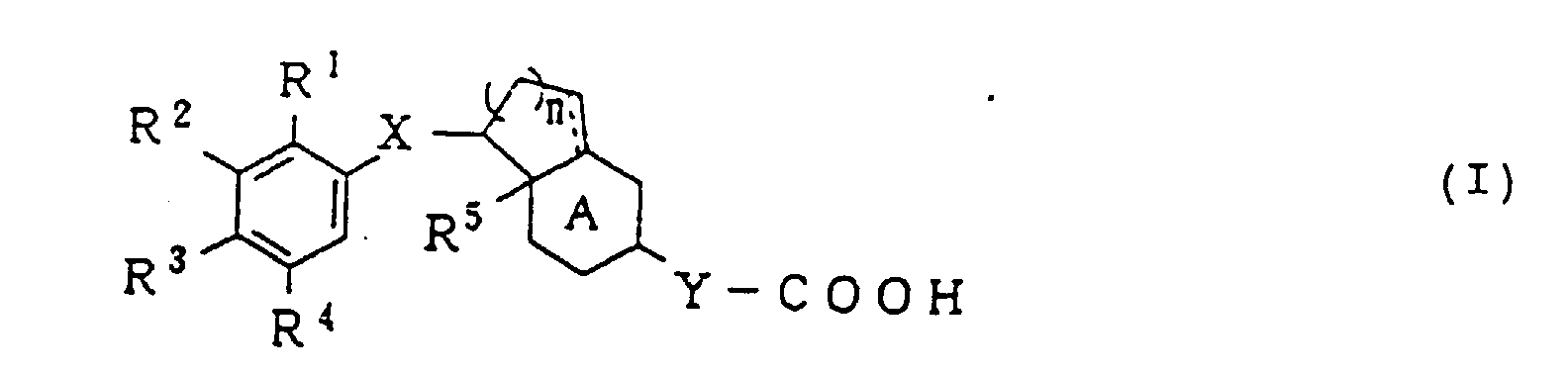


- R5 represents hydrogen atom or C1 - C6 alkyl group (methyl group, butyl group, hexyl group, etc.), X represents -CONR13- or -SO2NR13- [R13 represents hydrogen atom or C1 - C6 alkyl group (methyl group, butyl group, hexyl group, etc.)];
- Y represents a single bond, -OCH2- or -CH=CH-;
- A ring may form a benzene ring or cyclohexadiene ring;
- the dotted line represents a single bond or double bond; and
- n represents 1 or 2, with the proviso that, when the carbon to which R5 is attached has a double bond, then R5 is not present, or pharmaceutically acceptable salts thereof.
- Of the compounds of the present invention, preferable is a compound of the formula (I) in which R1, R2, R3 and R4 each independently represent hydrogen atom; halogen atom; C1 - C14 alkyl group optionally having one or more substituents selected from 5 or 6 membered heterocyclic group containing 1 or 2 hetero atoms selected from oxygen atom, sulfur atom and nitrogen atom, and C3 - C10 cycloalkyl group; C1 - C14 alkoxy group optionally having one or more C3 - C10 cycloalkyl group; -OR6 [R6 represents C3 - C10 cycloalkyl group optionally having one or more C1 - C6 alkyl group; or 5 or 6 membered heterocyclic group containing 1 or 2 hetero atoms selected from oxygen atom, sulfur atom and nitrogen atom, and optionally having one or more C1 - C6 alkyl groups] or a group of the formula:

- Particularly preferable is a compound of the formula (I) in which R1, R2, R3 and R4 each independently represent hydrogen atom; halogen atom; C1 - C14 alkyl group optionally having one or more C3 - C10 cycloalkyl groups; C1 - C14 alkoxy group optionally having one or more C3 - C10 cycloalkyl group; or -OR6 (R6 represents C3 - C10 cycloalkyl group optionally having one or more C1 - C6 alkyl group); R5 represents C1 - C6 alkyl group, X represents -CONR13- (R13 represents hydrogen or C1 - C6 alkyl group); Y represents a single bond; A ring represents cyclo-hexene ring; the dotted line represents a single bond, and n represents 1 or 2.
- Most preferable is a compound of the formula (I) in which R1, R2, R3 and R4 each independently represent hydrogen atom or C1 - C14 alkoxy group; R5 represents C1 - C6 alkyl group; X represents -CONR13- (R13 represents hydrogen atom); Y represents a single bond; A ring represents a cyclohexene ring; the dotted line represents a double bond; and n represents 2.
- The compounds of the general formula (I) above may contain an asymmetric carbon atom, and racemic mixture and optical isomers are included in the present invention.
- The compounds of the present invention are illustrated in Tables 1 - 4 below.


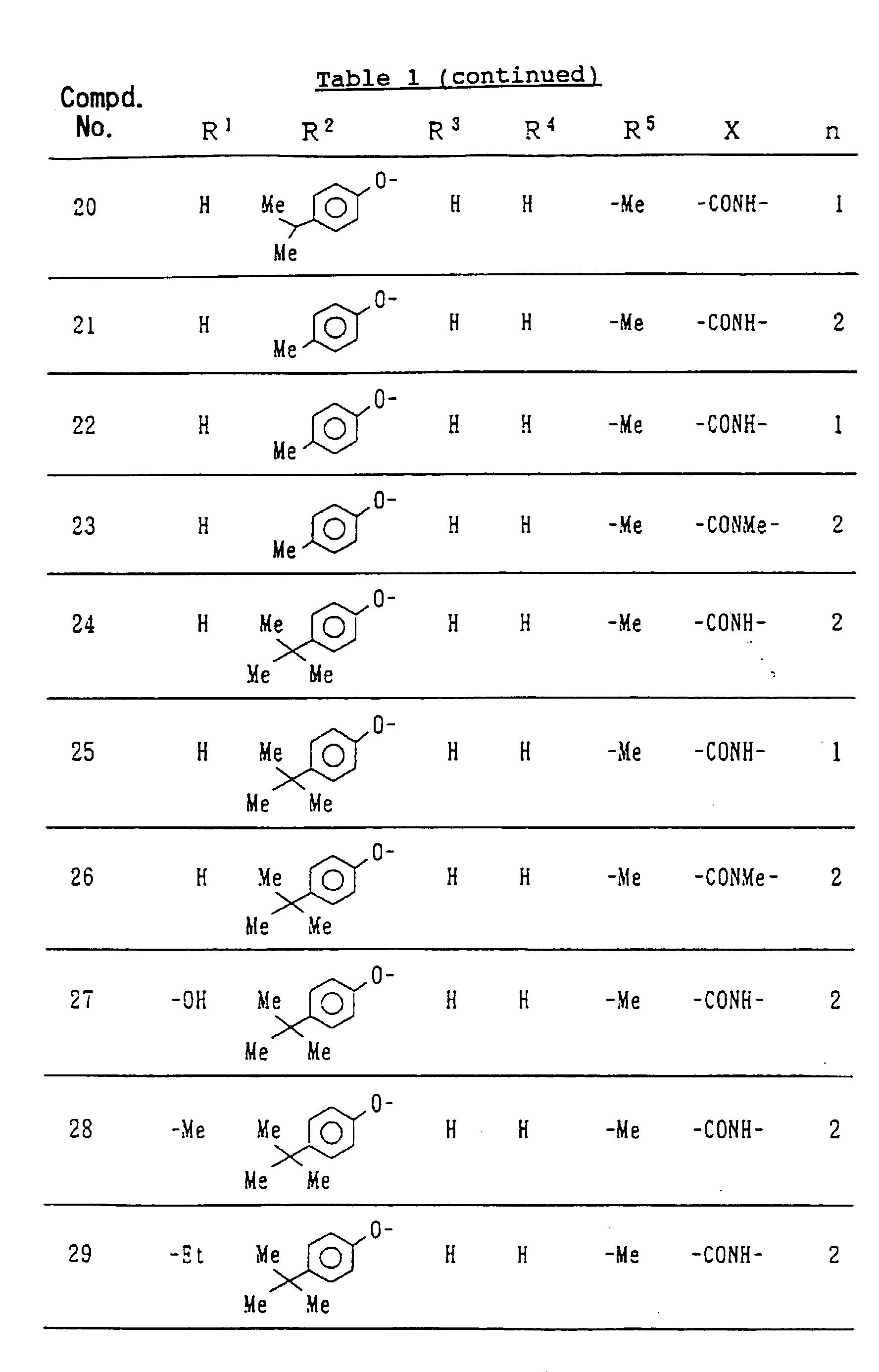


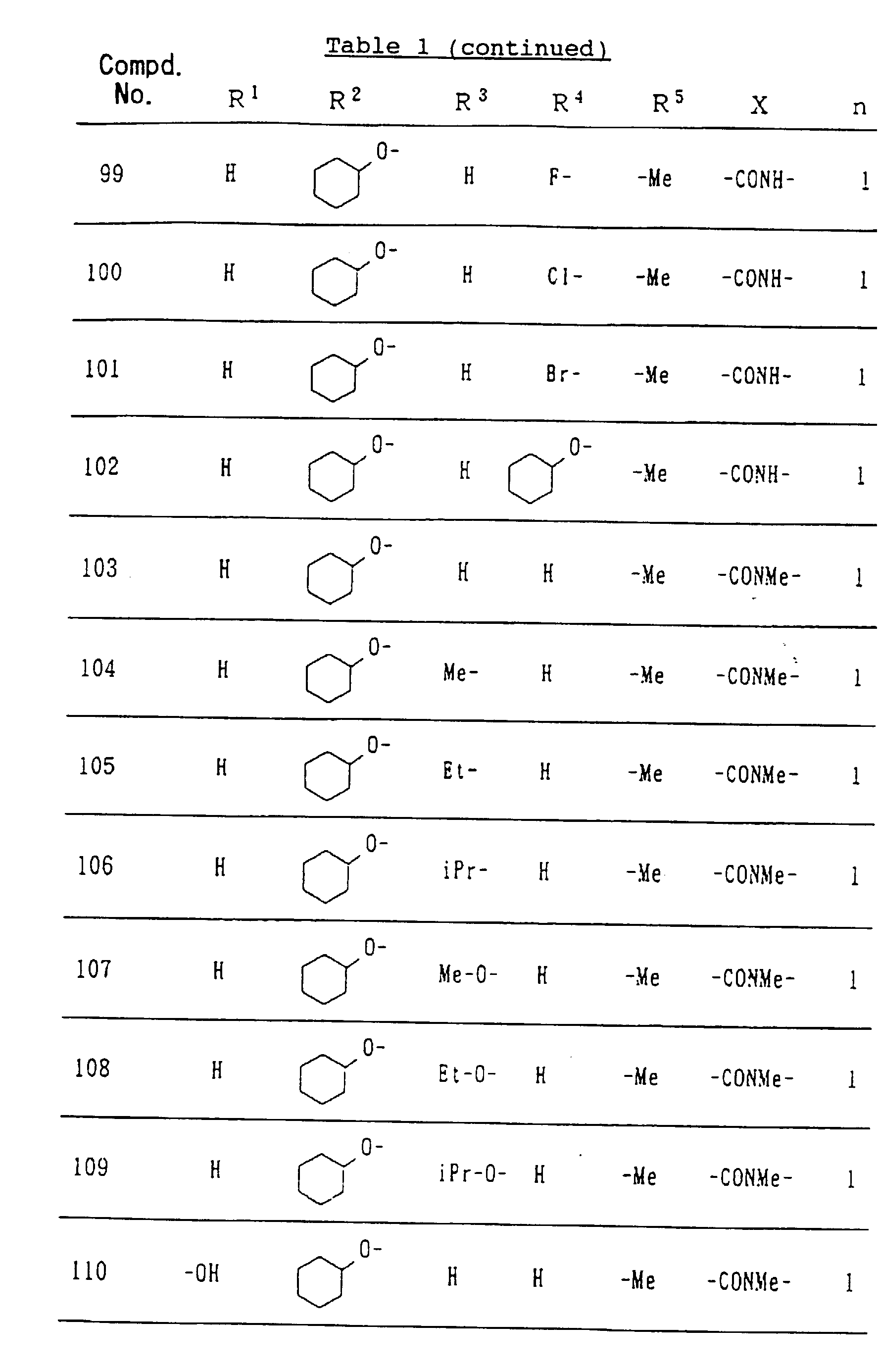


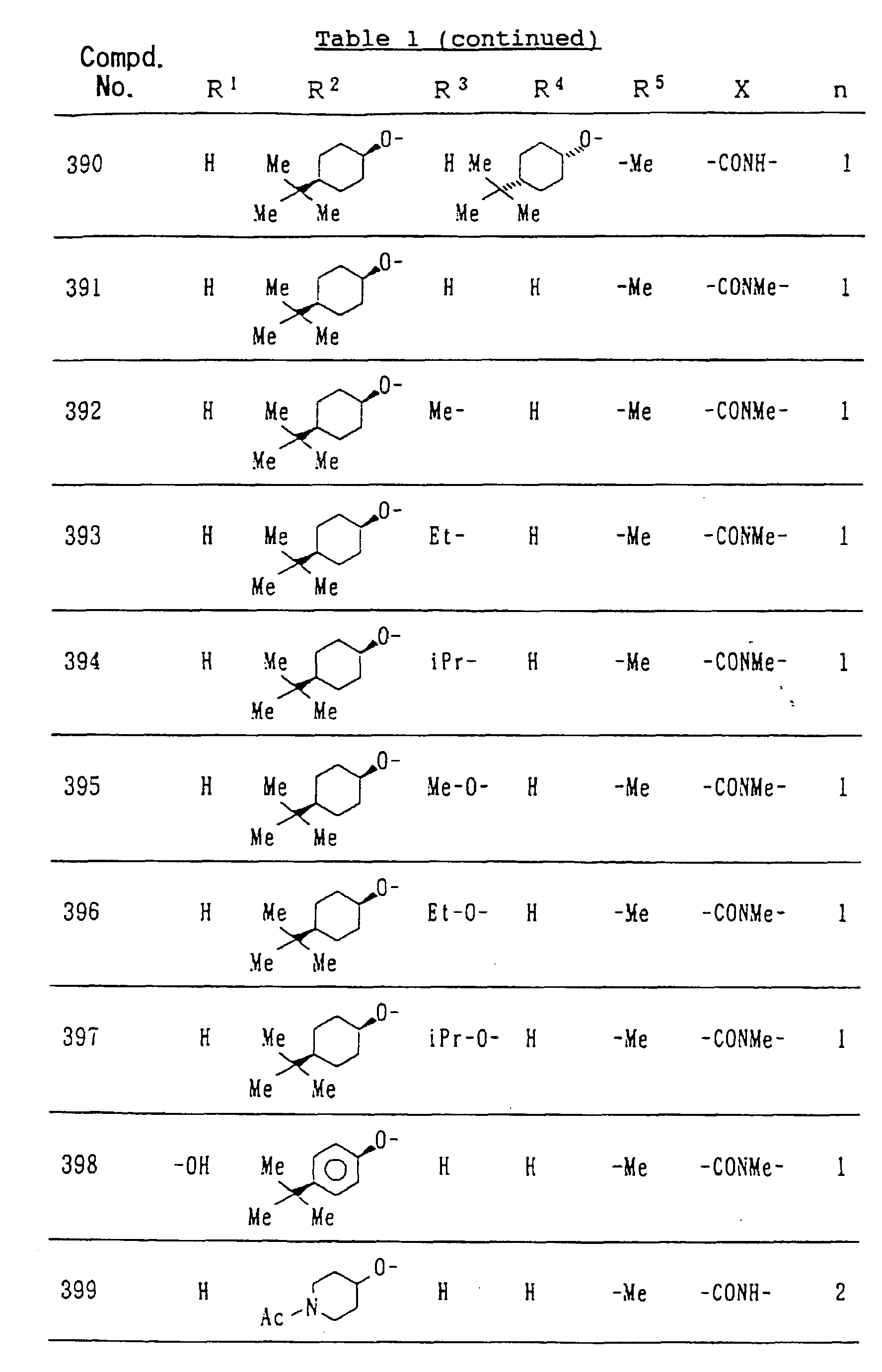


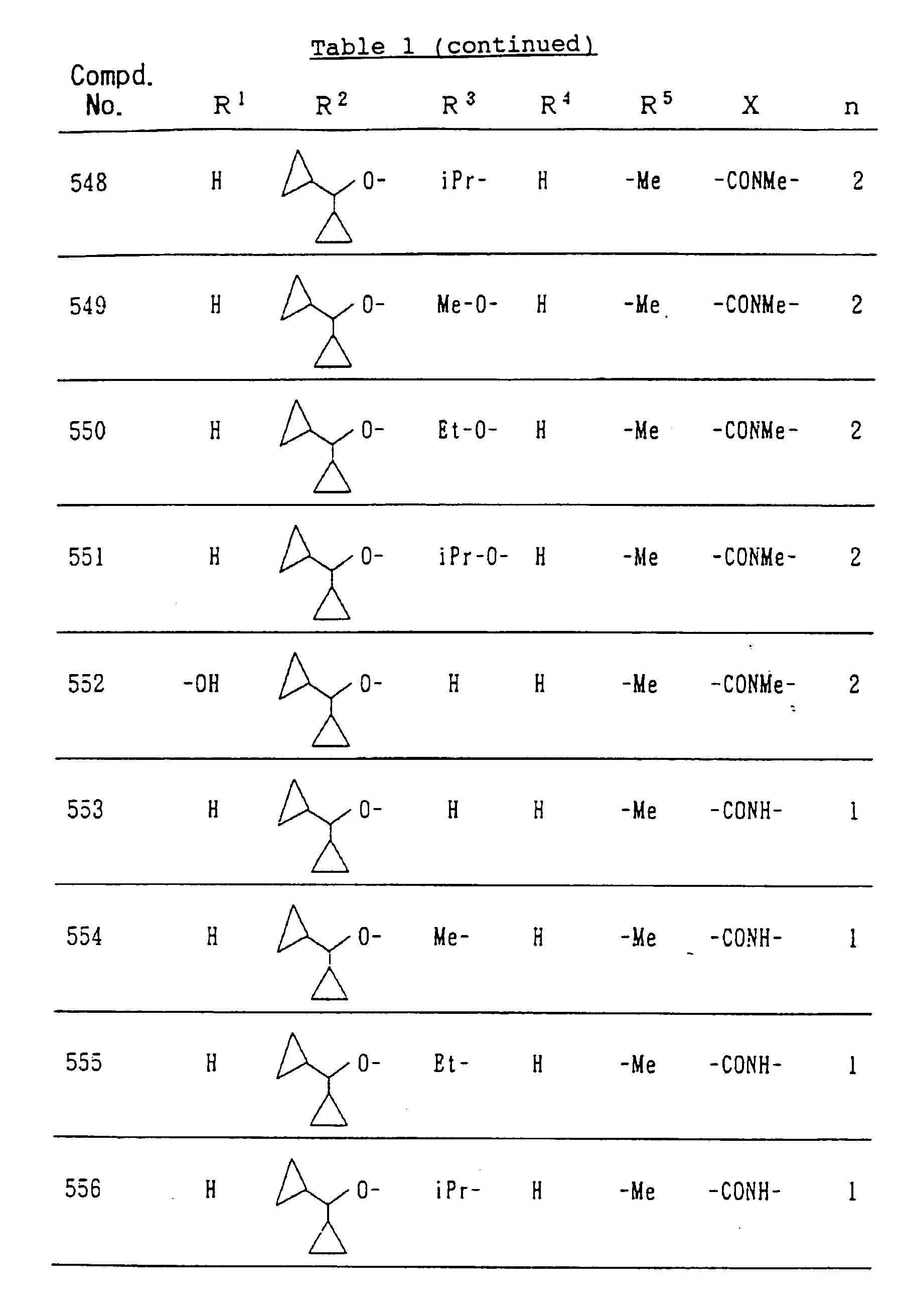


- In Tables 1 - 4, Me means a methyl group, Et means an ethyl group, Pr means a propyl group, iPr means an isopropyl group, Bu means a butyl group, and Ac means an acetyl group.
- The compounds of the general formula (I) can form a salt with a base. The base may be selected from those which can form a salt with the compound of the general formula (I). Examples of the salts are metal salts (e.g. sodium salt, magnesium, aluminium salt, etc.), ammonium salt, and amine salts (e.g. methylamine, ethylamine, diethylamine, triethylamine, pyrolidine, piperidine, morpholine, pyridine, aniline, etc.).
- The compounds of the general formula (I) can be prepared, for example, in the manner as shown in the following synthetic route.
- (1) Of the compounds of the general formula (I), the compounds wherein X is -CONR13- are prepared as follows:

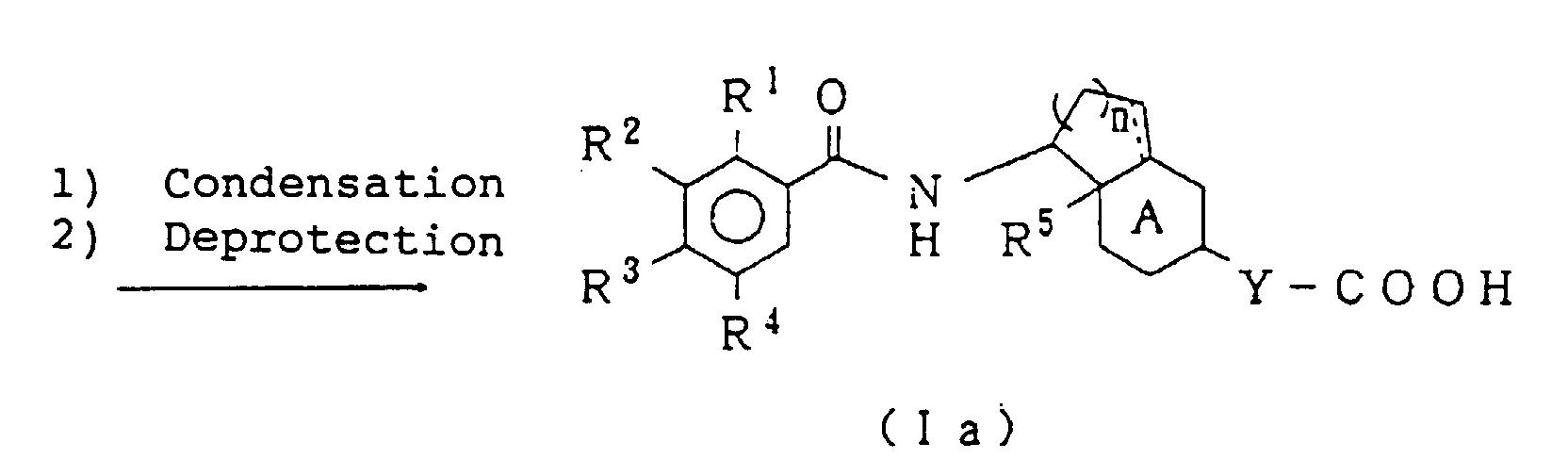
- In the above formulae, R1, R2, R3, R4, R5, n, Y and A have the same significance as defined in the general formula (I) above, and R14 represents an alkyl group having 1 to 5 carbon atoms.
- For example, the benzoic acid derivatives of the general formula (III) is allowed to condense with amino acid derivatives of the general formula (IV) in an appropriate solvent such as methylene chloride, chloroform, tetrahydrofuran, benzene or the like, or without solvent, in the presence or absence of a condensing agent and an organic base, or in the presence of a condensing agent without base. The condensing agent includes inorganic condensing agents such as phosphorus oxychloride, thionyl chloride or the like and organic condensing agents such as dicyclohexylcarbodi-imide, carbodiimidazole, oxalyl chloride, tosyl chloride or the like. The condensed product is subjected to hydrolysis with an alkali to give the objective compound (Ia). The hydrolysis is carried out in a mixture of water and methanol containing an alkali metal hydroxide such as sodium hydroxide or the like, or in a mixture of water, methanol and tetrahydrofuran.
- The compound of the general formula (I) in which Y is a single bond can be prepared, for example, by condensing the compound of the general formula (III) with the amine derivative of the general formula (V) below using the method mentioned above, to give the compound of the general formula (VI) below, and this compound is allowed to react with carbon monoxide in the presence of an organic base, phosphine and palladium (II) in an alkanol (ROH) solvent or in a mixture of alkanol (ROH) of 1 -5 carbon atoms with tetrahydrofuran, ether, methylene chloride or the like, to give alkoxycarbonyl compound of the general formula (VII) below, which is then subjected to hydrolysis with an alkali to give the objective compound. (The alkali-hydrolysis is carried out as described above.)

- In the above formulae, R1, R2, R3, R4, R5, n and A have the same significance as defined above, R represents an alkyl group of 1 to 5 alkyl group, and Tf represents trifluoro-methanesulfonyl group.
- (2) Production of the compound of the general formula (I) in which X is -SO2NR13-

- In the above formulae, R1, R2, R3 and R4 have the same significance as defined above.
- For example, the aniline derivative of the general formula (IX) above is allowed to react with sodium nitrite or potassium nitrite in an appropriate solvent such as aqueous acetic acid, diluted hydrochloric acid or the like, to give a diazonium salt, which is allowed to react with cupric chloride and sulfur dioxide to give the sulfonyl chloride derivative of the general formula (X) above.
- The compound of the general formula (XI) below can be prepared by reacting the compound of the general formula (X) with the compound of the general formula (IV) above in the presence or absence of an organic base such as triethylamine, pyridine or the like, in a halogen type solvent such as methylene chloride or the like and subjecting the resultant product to alkali-hydrolysis according to the method as described above.

- In the above formulae (XI), R1, R2, R3, R4, R5, n, Y and A have the same significance as defined in the general formula (I).
- (3) Production of amino acid derivatives of the general formula (IV):
- i) Production of compounds of the general formula (IV) in which Y is a single bond or -CH=CH-:
- The starting 8a-methyl-3,4,8,8a-tetrahydro-1,6(2H,7H)-naphthalenedione and 7a-methyl-7,7a-tetrahydro-1,5(6H)-indadione are known compounds, and their optical activity is also known. Furthermore, the starting 6-hydrotetralone and 5-hydroxyindanone are known compounds.
- The starting compounds are treated at temperature from -40°C to room temperature in the presence of 1 mol equivalent of anhydrous trifluoromethanesulfonic acid and tertiary amine such as triethylamine, pyridine or the like, in an inert solvent such as methylene chloride, tetrahydrofuran or the like (Step a), and the resultant product is allowed to react with carbon monoxide or the like in the presence of an organic base, phosphine and palladium (II) in a mixture of alcohol (1 - 5 carbon atoms) with tetrahydrofuran or ether to give an alkoxy compound (Step b). This product is treated with a reducing agent such as sodium cyanoborohydride or the like in the presence of ammonium salt such as ammonium acetate, ammonium chloride or the like, in an alkanol solvent (1 - 5 carbon atoms) or in a mixture of alkanol (1 - 5 carbon atoms) with tetrahydrofuran or ether for subjecting only the ketone group to reductive amination (Step c).
- The compound wherein Y is -CH=CH- can be prepared by using an alkyl acrylate or the like in place of carbon monoxide in Step b.


- In the above formulae, R5, X, n and A have the same significance as defined in the general formula (I), and R represents an alkyl group having 1 - 5 carbon atoms.
- ii) Production of the compound of the general formula (IV) in which Y is -OCH2-:
- For example, 6-hydroxytetralone or 5-hydroxyindanone is allowed to react with α-haloacetic acid ester in the presence of a base such as sodium hydride, triethylamine or the like in a solvent such as methylene chloride, tetrahydrofuran, DMF or the like, and the resultant product is subjected to reductive animation to give the product.
- The benzoic acid derivative of the formula (III) and aniline derivative of the formula (IX) are commercially available or can be prepared in a conventional manner from commercially available materials.
- When the compounds of the present invention are used as medicaments, they can be formulated together with one or more of conventional carriers suitable for desired administering route. For example, formulations such as tablets, capsules, granules, powders, solutions or the like are prepared for oral route. Excipients, binders, lubricants, coloring agents, disintegrators, or the like, which are usually employed for the preparation of pharmaceutical formulations, can be used for preparing solid formulations for oral route. Examples of the excipients are lactose, starch, talc, magnesium stearate, crystalline cellulose, methyl cellulose, carboxymethyl cellulose, glycerin, sodium alginate, arabic gum and the like. Examples of the binders are polyvinyl alcohol, polyvinyl ether, ethyl cellulose, arabic gum, shellac, refined sugar and the like. Examples of the lubricants are magnesium stearate, talc, and the like. Additionally, coloring agents and disintegrators may be used. Further, tablets may be coated in a conventional manner. Liquid formulations include aqueous or oily suspensions, solutions, syrups, elixils and the like, and can be prepared in a conventional manner. Injections may be prepared by adding pH adjusting agents, buffers, stabilizers, isotonic agents, topical anesthetics, or the like to the compound of the present invention. Subcutaneous, intramuscular or intravenous injections may be prepared in a conventional manner. For preparing suppositories, oily bases such as cacao oil, polyethylene glycol, Witepsol (Trademark of Dynamite Novel Company) or the like may be used.
- Appropriate dosage of the formulation thus obtained varies depending upon symptoms, body weight, age or the like of particular patients. In general, appropriate daily dose to adult is in the range from about 0.01 to 2000 mg, and the daily dose is preferably administered in multiple doses of 1 - 4 times a day.
- Appropriate salts of the compound (I) may be prepared using a non-toxic base. Such appropriate salts include those formed with inorganic bases (e.g. sodium slat, potassium salt, etc.), those formed with organic bases (e.g. triethylamine, etc.), and ammonium salts.
- The present invention will be explained in more detail below by examples and reference examples. The examples are representative only and should not be construed as limiting in any respect.
- Preparation of 5-(4'-phenoxybenzoylamino)-10-methyl-Δ1(2),8(9)-octalin-2-carboxylic acid (Compound No. 1 in Table 1):
- To a solution of 4-phenoxybenzoic acid (410 mg, 1.91 mmol) in methylene chloride (4.0 ml) was added thionyl chloride (0.8 ml), and the resultant mixture was refluxed for 1 hour. The mixture was concentrated, and the residue was dissolved in methylene chloride (4.0 ml) and the resulting solution was dropwise added to a solution of 5-amino-10-methyl-Δ1(2),8(9)-octalin-2-carboxylic acid methyl ester (420 mg, 1.92 mmol), triethylamine (0.84 ml) and methylene chloride (4.2 ml) under ice cooling. The mixture was stirred at room temperature for 30 minutes, poured into chilled water (50 ml) and extracted with ethyl acetate. The organic extract was concentrated to dryness, and the residue was dissolved in 10% methanolic water (23 ml), mixed with potassium hydroxide (1.09 g, 16.5 mmol) and refluxed for 4 hours. The product was extracted with acidic chloroform, dried over magnesium sulfate and concentrated. The resulting residue was chromatographed on a silica gel column, eluting with chloroform-methanol to give the titled compound (464 mg, yield 60%) as white crystals.
- m.p.96-101°C
- 1H-NMR(CDCl3, 250MHz)δppm=7.73(d, 2H, 8.7Hz), 7.36(t-like, 2H, 7.4Hz), 7.1-7.2(m, 2H), 6.9-7.1(m, 4H), 5.96(br-d, 1H, 8.7Hz), 5.90(br-s, 1H), 4.10-4.25(m, 1H), 4.10-4.25(m, 1H), 2.10-2.60(m, 4H), 1.75-1.95(m, 3H), 1.40-1.55(m, 1H), 1.01(s, 1H)
- IR(KBr):ν(cm-1)=3296, 2938, 1674, 1634, 1588, 1543, 1489, 1244, 1169.
- Preparation of 5-(3'-phenoxybenzoylamino)-10-methyl-Δ1(2),8(9)-octalin-2-carboxylic acid (Compound No. 10 in Table 1):
- The reaction was effected with 3-phenoxybenzoic acid (542 mg, 2.53 mmol) in the same manner as in Example 1 to give the titled compound (412 mg, yield 40%).
- m.p.181-186°C
- 1H-NMR(CDCl3, 250MHz)δ(ppm)=7.33-7.49(m, 5H), 7.10-7.20 (m, 5H), 5.98(d, 1H, J=9.7Hz), 5.91(t, 1H, J=3.7Hz), 4.13-4.26(m, 1H), 2.14-2.59(m, 3H), 1.82-1.92(m, 4H), 1.40-1.53(m, 1H), 1.02(s, 3H)
- IR(KBr):ν(cm-1)=3285, 3069, 9240, 1672, 1634, 1580, 1555, 1483, 1427, 1306, 1275, 1233.
- Preparation of 5-(2'-phenoxybenzoylamino)-10-methyl-Δ1(2),8(9)-octalin-2-carboxylic acid (Compound No. 12 in Table 1):
- The reaction was effected with 2-phenoxybenzoic acid (488 mg, 2.28 mmol) as in the same manner as in Example 1 to give the titled compound (330 mg, yield 36%).
- m.p.75-77°C
- 1H-NMR(CDCl3, 250MHz)δ=8.23(dd, 1H, 1.8Hz, 7.9Hz), 7.73(br-d, 1H, 8.0Hz), 7.3-7.42(m, 3H), 7.1-7.3(m, 3H), 7.00(d, 2H, 7.9Hz), 6.87(d, 1H, 8.2Hz), 5.85(br-s, 1H), 4.1-4.2(m, 1H), 2.2-2.5(m, 3H), 2.0-2.2(m, 1H), 1.8-1.9(m, 1H), 1.6-1.8(m, 2H), 1.2-1.4(m, 1H), 0.84(s, 3H)
- IR(KBr):ν(cm-1)=3403, 3069, 2932, 1640, 1601, 1534, 1478, 1449, 1223, 753.
- Preparation of 5-[3'-(p-isopropylphenoxy)benzoylamino]-10-methyl-Δ1(2),8(9)-octalin-2-carboxylic acid (Compound No. 16 in Table 1):
- The reaction was effected with 3-(p-isopropylphenoxy)benzoic acid (177 mg, 0.74 mmol) in the same manner as in Example 1 to give the titled compound (253 mg, yield 77%). m.p.146-149°C
- 1H-NMR(CDCl3, 250MHz)δ=7.3-7.45(m, 3H), 7.15-7.23(m, 3H), 7.10(dd, 1.4Hz, 8.0Hz), 6.90-6.96(m, 2H), 5.98(br-d, 1H, 8.7Hz), 5.90(br-s, 1H), 4.1-4.2(m, 1H), 2.80-2.95(m, 1H), 2.10-2.60(m, 4H)1.70-1.95(m, 3H), 1.35-1.50(m, 1H), 1.22, 1.25(each s, each 3H), 0.99(s, 3H)
- IR(KBr):ν(cm-1)=3312, 2959, 2930, 2870, 1674, 1636, 1582, 1541, 1507, 1480, 1429, 1306, 1279, 1236.
- Preparation of 5-[3'-(m-isopropylphenoxy)benzoylamino]-10-methyl-Δ1(2),8(9)-octalin-2-carboxylic acid (Compound No. 17 in Table 1):
- The reaction was effected with 3-(m-isopropylphenoxy)benzoic acid (704 mg, 2.75 mmol) in the same manner as in Example 1 to give the titled compound (612 mg, yield 50%).
- m.p.83-86°C
- 1H-NMR(CDCl3, 250MHz)δ=7.3-7.47(m, 3H), 7.25(dd, 1H, 7.9Hz, 7.8Hz), 7.17(br-s, 1H), 7.10(ddd, 1.3Hz, 2.2Hz, 7.9Hz), 7.00(br-d, 1H, 7.8Hz), 6.90(dd, 1H, 2.1Hz, 1.8Hz), 6.79(ddd, 1H, 0.8Hz, 2.2Hz, 7.9Hz), 5.95(d, 1H, 9.7Hz), 5.90(dd, 1H, 3.8Hz, 3.7Hz), 4.11-4.23 (m, 1H), 2.87(dq, 1H, each 6.9Hz), 2.52(dd, 1H, 4.7Hz, 19Hz), 2.10- 2.47(m, 3H), 1.76-1.90(m, 3H), 1.37-1.49(m, 1H), 1.22(d, 6H, 6.9Hz), 1.02(s, 3H)
- IR(KBr):ν(cm-1)=3285, 3071, 2961, 2870, 2822, 1672, 1634, 1576, 1555, 1481, 1427, 1308, 1273, 1244.
- Preparation of 5-[3'-(o-isopropylphenoxy)benzoylamino]-10-methyl-Δ1(2),8(9)-octalin-2-carboxylic acid (Compound No. 18 in Table 1):
- The reaction was effected with 3-(o-isopropylphenoxy)benzoic acid (347 mg, 1.44 mmol) in the same manner as in Example 1 to give the titled compound (344 mg, yield 54%).
- m.p.192-194°C
- 1H-NMR(CDCl3, 250MHz)δ=7.3-7.4(m, 4H), 7.1-7.2(m, 2H), 6.98(dd-like, 1H, 1.4Hz, 8.0Hz), 6.80-6.90(m, 1H), 5.98(br-d, 1H, 8.7Hz), 5.90(br-s, 1H), 4.1-4.25(m, 1H), 3.1-3.3(m, 1H), 2.1-2.6 (m, 4H), 1.7-1.9(m, 3H), 1.3-1.5(m, 1H), 1.21, 1.19(each s, each 3H), 0.99(s, 3H)
- IR(KBr):ν(cm-1)=3291, 3071, 2961, 2870, 2824, 2629, 1674, 1634, 1578, 1555, 1483, 1451, 1429, 1306, 1275, 1235, 1184.
- Preparation of 5-[3'-(p-tolyloxy)benzoylamino]-10-methyl-Δ1(2), 8(9)-octalin-2-carboxylic acid (Compound No. 21 in Table 1):
- To a mixture of 3-(p-tolyloxy)benzoic acid (414 mg, 1.81 mmol), 5-amino-10-methyl-Δ1(2),8(9)-octalin-2-carboxylic acid methyl ester (401 mg, 1.81 mmol), triethylamine (1.26 mg, 9.05 mmol) and methylene chloride (4.1 ml) was added thionyl chloride (396 µl, 5.43 mmol) with ice cooling. The resultant mixture was stirred at room temperature for 30 minutes, poured into chilled water (50 ml), and extracted with ethyl acetate. The organic extract was concentrated, and the residue was dissolved in a mixture of 10% methanol (12 ml) and THF (3.7 ml), mixed with potassium hydroxide (566 mg, 8.57 mmol) and refluxed for 3 hours. The product was extracted with acidic chloroform, and the organic layer was dried and concentrated. The resultant residue was chromatographed on a silica gel column, eluting with chloroform-methanol to give the titled compound (263 mg, yield 35%).
- m.p.168-172°C
- 1H-NMR(CDCl3, 250MHz)δ=7.3-7.4(m, 3H), 7.0-7.2(m, 4H), 6.90 (d, 2H, 8.5Hz), 6.00(d, 1H, 9.6Hz), 5.89(br-s, 1H), 4.1-4.2(m, 1H), 2.1-2.6(m, 4H), 2.32(s, 3H), 1.7-1.9(m, 3H), 1.40(ddd, 1H, 5.7Hz, 5.7Hz, 13Hz), 0.99(s, 3H)
- IR(KBr):ν(cm-1)=3283, 2940, 1672, 1634, 1580, 1559, 1507, 1481, 1427, 1306, 1275, 1238, 1209, 1186.
- Preparation of 5-[3'-(p-t-butylphenoxy)benzoylamino]-10-methy-Δ1(2),8(9)-octalin-2-carboxylic acid (Compound No. 24 in Table 1):
- The reaction was effected with 3-(p-t-butylphenoxy)benzoic acid (435 mg, 1.61 mmol) in the same manner as in Example 7 to give the titled compound (282 mg, yield 38%).
- m.p.233-238°C
- 1H-NMR(CDCl3, 250MHz)δ=7.3-7.45(m, 5H), 7.16(d, 1H, 1.5Hz), 7.52(dd-like, 1H, 1Hz, 1.5Hz, 8.0Hz), 6.94(d, 2H, 8.9Hz), 5.96 (br-d, 1H, 8.7Hz), 5.86(br-s, 1H), 4.05-4.20(m, 1H), 2.10-2.60(m, 4H), 1.75-1.95(m, 3H), 1.40-1.55(m, 1H), 1.30(s, 9H), 0.99(s, 3H)
- IR(KBr):ν(cm-1)=3266, 2965, 2870, 1680, 1634, 1613, 1580, 1543, 1508, 1480, 1426, 1306, 1279, 1236.
- Preparation of 5-{3''-[p-(2'-methylpropyl]phenoxy)benzoylamino}-10-methyl-Δ1(2),8(9)-octalin-2-carboxylic acid (Compound No. 30 in Table 1):
- The reaction was effected with 3-p-(2'-methylpropyl)phenoxybenzoic acid (246 mg, 0.91 mmol) in the same manner as in Example 7 to give the titled compound (290 mg, yield 69%).
- m.p.142-148°C
- 1H-NMR(CDCl3, 250MHz)δ=7.3-7.45(m, 3H), 7.18(s-like, 1H), 7.06-7.13(m, 3H), 6.92(d, 2H, 11.3Hz), 5.95(d, 1H, 9.7Hz), 5.90 (br-s, 1H), 4.10-4.22(m, 1H), 4.52(dd, 1H, 4.1Hz, 18.3Hz), 2.44(d, 2H, 7.2Hz), 2.15-4.60(m, 3H), 1.75-1.95(m, 4H), 1.42(ddd, 1H, 5.7Hz, 5.7Hz, and 13Hz), 0.99(s, 3H), 0.89(d, 6H, 6.5Hz)
- IR(KBr):ν(cm-1)=3289, 2959, 2870, 1672, 1638, 1609, 1584, 1545, 1505, 1481, 1431, 1308, 1279, 1235.
- Preparation of 5-[3'-(p-cyclopentylphenoxy)benzoylamino]-10-methyl-Δ1(2),8(9)-octalin-2-carboxylic acid (Compound No. 33 in Table 1):
- The reaction was effected with 3-(p-cyclopenthylphenoxy)benzoic acid (488 mg, 1.73 mmol) in the same manner as in Example 7 to give the titled compound (240 mg, yield 30%).
- m.p.229-231°C
- 1H-NMR(CDCl3, 250MHz)δ=7.3-7.4(m, 3H), 7.15-7.25(m, 3H), 7.09(ddd, 1H, 1.4Hz, 0, 8Hz, 9.2Hz), 6.93(d, 2H, 8.5Hz), 5.96(d, 1H, 9.6Hz), 5.89(br-s, 1H), 4.05-4.20(m, 1H), 2.85-3.05(m, 1H), 1.95-2.30(m, 6H), 1.30-1.90(m, 10H), 0.99(s, 3H)
- IR(KBr):ν(cm-1)=3337, 2944, 2868, 1676, 1638, 1613, 1578, 1543, 1505, 1483, 1426, 1323, 1304, 1275, 1236.
- Preparation of 5-[3'-(p-cyclohexylphenoxy)benzoylamino]-10-methyl-Δ1(2),8(9)-octalin-2-carboxylic acid (Compound No. 36 in Table 1):
- The reaction was effected with 3-(p-cyclohexylphenoxy)benzoic acid (415 mg, 1.40 mmol) in the same manner as in Example 7 to give the titled compound (263 mg, yield 33%).
- m.p.124-125°C
- 1H-NMR(CDCl3, 250MHz)δ=7.3-7.45(m, 3H), 7.1-7.2(m, 3H), 7.10(ddd, 1H, 1.3Hz, 2.4Hz, 7.9Hz), 6.92(d, 2H, 8.5Hz), 5.97(br-d, 1H, 9.5Hz), 5.89(br-s, 1H), 4.10-4.25(m, 1H), 2.10-2.60(m, 5H), 1.65-1.95(m, 8H), 1.10-1.50(m, 6H), 0.99(s, 3H)
- IR(KBr):ν(cm-1)=3443, 2926, 2851, 1676, 1636, 1580, 1541, 1507, 1480, 1429, 1306, 1273, 1238.
- Preparation of 5-[3'-(p-N-methylaminocarbonylphenoxy)benzoylamino]-10-methyl-Δ1(2),8(9)-octalin-2-carboxylic acid (Compound No. 38 in Table 1):
- The reaction was effected with 3-(p-N-methyl-amino-carbonylphenoxy)benzoic acid (448 mg, 1.19 mmol) in the same manner as in Example 7 to give the titled compound (35 mg, yield 6.4%).
- m.p.123-127°C
- 1H-NMR(CDCl3, 250MHz)δ=7.72(d, 2H, 8.6Hz), 7.35-7.55(m, 3H), 7.10-7.20(m, 2H), 6.97(d, 2H, 8.6Hz), 6.30(br-d-like), 6.10(br-d, 1H, 9.5Hz), 5.87(br-s, 1H), 2.96, 2.98(each s, total 3H), 2.1-2.6 (m, 4H), 1.6-1.9(m, 3H), 1.3-1.5(m, 1H), 0.99(s, 3H)
- IR(KBr):ν(cm-1)=3337, 3069, 2936, 1684, 1636, 1578, 1543, 1501, 1316, 1240, 1177.
- Preparation of 5-[3'-(2, 4-dimethylphenoxy)benzoylamino]-10-methyl-Δ1(2),8(9)-octalin-2-carboxylic acid (Compound No. 42 in Table 1):
- The reaction was effected with 3-(2',4'-dimethylphenoxy) benzoic acid (271 mg, 1.12 mmol) in the same manner as in Example 7 to give the titled compound (135 mg, yield 28%).
- m.p.137-142°C
- 1H-NMR(CDCl3, 250MHz)δ=7.3-7.45(m, 3H), 7.18(d, 1H, 2.0Hz), 7.09(ddd, 1H, 1.2Hz, 2.2Hz, 9.0Hz), 6.76(d, 1H, 0.6Hz), 6.62(d, 2H, 0.6Hz), 5.97(br-d, 1H, 9.6Hz), 5.89(dd, 1H, each 3.7Hz), 4.10-4.25 (m, 1H), 2.1-2.6(m, 4H), 2.27(s, 6H), 2.7-2.95(m, 3H), 1.43(ddd, 1H, 5.7Hz, 5.7Hz and 13Hz), 0.99(s, 3H)
- IR(KBr):ν(cm-1)=3290, 2938, 1676, 1636, 1578, 1541, 1476, 1456, 1296, 1275, 1225, 1142.
- Preparation of 5-[3'-(5",6",7",8"-tetrahydro-2"-naphtoxy)benzoylamino]-10-methyl-Δ1(2),8(9)-octalin-2-carboxylic acid (Compound No. 45 in Table 1):
- The reaction was effected with 3-(5',6',7',8'-tetrahydro-2'-naphtoxy)benzoic acid (324 mg, 1.21 mmol) in the same manner as in Example 7 to give the titled compound (131 mg, yield 24%).
- m.p.141-151°C
- 1H-NMR(CDCl3, 250MHz)δ=7.30-7.50(m, 3H), 7.20(br-s, 1H), 7.11(ddd, 1H, 1.5Hz, 2.5Hz, 7.8Hz), 7.04(d, 1H, 8.1Hz), 6.70-6.80 (m, 2H), 5.97(d, 1H, 9.7Hz), 5.92(br-s, 1H), 4.12-4.25(m, 1H), 2.7- 2.8(m, 4H), 2.54(dd, 1H, 4.7Hz, 18.1Hz), 2.2-2.5(m, 3H), 1.70-2.0 (m, 7H), 1.45(ddd, 1H, 5.2Hz, 5.2Hz and 12.5Hz), 1.02(s, 3H)
- IR(KBr):ν(cm-1)=3287, 2934, 2859, 2633, 1674, 1636, 1580, 1557, 1497, 1481, 1427, 1306, 1275, 1248, 1188, 1146.
- Preparation of 5-(3'-benzyloxy-benzoylamino)-10-methyl-Δ1(2),8(9)-octalin-2-carboxylic acid (Compound No. 46 in Table 1):
- The reaction was effected with 3-benzyloxybenzoic acid (516 mg, 2.26 mmol) in the same manner as in Example 1 to give the titled compound (325 mg, yield 34.5%).
- m.p.175-177°C
- 1H-NMR(CDCl3, 250MHz)δ=7.30-7.47(m, 8H), 7.21(s, 1H), 7.13 (dd, 1H, 2.5Hz, 8.0Hz), 5.99(d, 1H, J=9.7Hz), 5.92(t, 1H, J=3.7Hz), 5.13(s, 2H), 4.16-4.26(m, 1H), 2.31-2.60(m, 4H), 1.80-1.92(m, 3H), 1.47(dt, 1H, J=5.5Hz, 12.8Hz)
- IR(KBr):ν(cm-1)=3291, 3065, 3036, 2942, 2910, 2870, 1680, 1640, 1611, 1580, 1549, 1483, 1454, 1426, 1304, 1285, 1235.
- Preparation of 5-(3'-diphenylmethyloxybenzoylamino)-10-methyl-Δ1(2),8(9)-octalin-2-carboxylic acid (Compound No. 50 in Table 1):
- The reaction was effected with 3-diphenylmethyloxybenzoic acid (498 mg, 1.64 mmol) in the same manner as in Example 1 to give the titled compound (204 mg, yield 25%).
- m.p.89-91°C
- 1H-NMR(CDCl3, 250MHz)δ=7.1-7.5(m, 14H), 7.0-7.1(m, 1H), 6.25(s, 1H), 5.8-5.9(m, 2H), 4.0-4.2(m, 1H), 2.1-2.6(m, 4H), 2.7-2.9(m, 3H), 1.35-1.5(m, 1H), 0.96(s, 3H)
- IR(KBr):ν(cm-1)=3308, 3063, 3030, 2934, 1684, 1634, 1580, 1524, 1483, 1454, 1429, 1273, 1233, 1186, 1020, 748, 700.
- Preparation of 5-(3'-cyclopentyloxybenzoylamino)-10-methyl-Δ1(2),8(9)-octalin-2-carboxylic acid (Compound No. 51 in Table 1):
- The reaction was effected with 3-cyclopentyloxybenzoic acid (413 mg, 2.0 mmol) in the same manner as in Example 1 to give the titled compound (230 mg, yield 29%).
- m.p.175-176°C
- 1H-NMR(CDCl3, 250MHz)δ=7.26-7.36(m, 3H), 7.21(s, 1H), 7.02(dd, 1H, J=2.5Hz, 8.0Hz), 6.01(d, 1H, J=9.7Hz), 5.92(t, 1H, J=3.7Hz), 4.80-4.88(m, 1H), 4.16-4.26(m, 1H), 2.22-2.59(m, 3H), 1.56-2.00(m, 12H), 1.46(dt, 1H, J=5.5Hz, 12.8Hz), 1.03(s, 3H)
- R(KBr):ν(cm-1)=3291, 2936, 2870, 1680, 1636, 1589, 1555, 1485, 1426, 1319, 1275, 1242.
- Preparation of 5-(3'-cyclohexyloxybenzoylamino)-10-methyl-Δ1(2),8(9)-octalin-2-carboxylic acid (Compound No. 63 in Table 1):
- The reaction was effected with 3-cyclohexyloxybenzoic acid (530 mg, 2.41 mmol) in the same manner as in Example 1 to give the titled compound (292 mg, yield 29.0%).
- m.p.192-194 °C
- 1H-NMR(CDCl3, 250MHz)δ=7.21-7.37(m, 4H), 7.04(dd, 1H, 2.5Hz, 8.0Hz), 6.01(d, 1H, J=9.3Hz), 5.92(t, 1H, J=3.7Hz), 4.15-4.38 (m, 2H), 2.21-2.59(m, 4H), 1.76-2.05(m, 7H), 1.29-1.64(m, 7H), 1.03(s, 3H)
- IR(KBr):ν(cm-1)=3312, 2936, 2865, 1672, 1636, 1609, 1576, 1539, 1481, 1429, 1304, 1287, 1236, 1051.
- Preparation of 5-(3'-cycloheptyloxybenzoylamino)-10-methy-Δ1(2),8(9)-octalin-2-carboxylic acid (Compound No. 111 in Table 1):
- The reaction was effected with 3-cycloheptyloxybenzoic acid (2.17 mg, 9.26 mmol) in the same manner as in Example 7 to give the titled compound (2.8 mg, yield 71%).
- m.p.224-226 °C
- 1H-NMR(CDCl3, 250MHz)δ=7.1-7.4(m, 4H), 6.98-7.02(m, 1H), 6.01(br-d, 1H, 9.7Hz), 5.92(t-like 1H, J≒1.0Hz), 4.20-4.35(m, 1H), 4.1-4.3(m, 1H), 2.1-2.6(m, 4H), 2.0-2.1(m, 2H), 1.3-1.9(m, 8H), 1.03(s, 3H)
- IR(KBr):ν(cm-1)=3304, 2932, 2863, 1674, 1638, 1609, 1576, 1545, 1483, 1456, 1427, 1323, 1306, 1277, 1236, 1188, 1022, 750.
- Preparation of 5-(3'-cyclooctyloxybenzoylamino)-10-methyl-Δ1(2),8(9)-octalin-2-carboxylic acid (Compound No. 159 in Table 1):
- The reaction was effected with 3-cyclooctyloxybenzoic acid (268 mg, 1.08 mmol) in the same manner as in Example 7 to give the titled compound (358 mg, yield 76%).
- m.p.214-218°C
- 1H-NMR(CDCl3, 250MHz)δ=7.2-7.35(m, 3H), 7.17(d, 1H, 1.4Hz), 7.00(dd, 1H, 2.4Hz, 8.0Hz), 5.98(d, 1H, 10Hz), 5.90(t, 1H, 3.6Hz), 4.4-4.5(m, 1H), 4.18(ddd, 1H, 5.2Hz, 10Hz and 10Hz), 2.53(dd, 1H, 5.6Hz, 19Hz), 2.1-2.4(m, 3H), 1.4-2.0(m, 18H), 1.01(s, 3H)
- IR(KBr):ν(cm-1)=3299, 2928, 1676, 1638, 1609, 1576, 1549, 1478,
1424, 1323, 1287. - Preparation of 5-[3'-(4-methylcyclohexyloxy)benzoylamino]-10-methyl-Δ1(2),8(9)-octalin-2-carboxylic acid (Compound No. 207 in Table 1):
- The reaction was effected with 3-(4-methylcyclohexyloxy) benzoic acid (423 mg, 1.81 mmol) in the same manner as in Example 1 to give the titled compound (375 mg, yield 49.0%).
- m.p.194-199°C
- 1H-NMR(CDCl3, 250MHz)δ=7.21-7.40(m, 4H), 7.06(dd, 1H, J=2.5Hz, 8.0Hz), 5.92(t, 1H, J=3.7Hz), 5.51(d, 1H, J=9.7Hz), 4.14-4.61(m, 2H), 2.23-2.60(m, 3H), 1.34-2.07(m, 14H), 1.03 (s, 3H), 0.94(d, 3H, J=5.0Hz)
- IR(KBr):ν(cm-1)=3293, 2932, 2870, 2633, 1674, 1637, 1578, 1545, 1481, 1427, 1277, 1236, 1124, 1036.
- Preparation of 5-[3-(4-isopropylcyclohexyloxy)benzoylamino]-10-methyl-Δ1(2),8(9)-octalin-2-carboxylic acid (Compound No. 255 in Table 1):
- The reaction was effected with 3-(4-isopropylcyclohexyloxy)benzoic acid (474 mg, 1.81 mmol) in the same manner as in Example 1 to give the titled compound (185 mg, yield 23%).
- m.p.128-129°C
- 1H-NMR(CDCl3, 250MHz)δ=7.20-7.40(m, 4H), 7.10(s-like, 1H), 6.95-7.05(m, 1H), 5.99(br-d, 1H, 9.8Hz), 5.86(t-like, 1H, J≒1Hz), 4.1-4.3(m, 2H), 2.1-2.6(m, 6H), 1.8-2.0(m, 5H), 1.1-1.6(m, 7H), 1.02(s, 3H), 0.88(s, 6H)
- IR(KBr):ν(cm-1)=3324, 2938, 2868, 2627, 1678, 1636, 1580, 1535, 1483, 1431, 1275, 1238, 1132, 1080, 1040, 1003.
- Preparation of 5-[3-(4-trans-t-butylcyclohexyloxy)benzoylamino]-10-methyl-Δ1(2),8(9)-octalin-2-carboxylic acid (Compound No. 303 in Table 1):
- The reaction was effected with 3-(4-trans-t-butylcyclo-hexyloxy)benzoic acid (237 mg, 0.86 mmol) in the same manner as in Example 1 to give the titled compound (154 mg, yield 38.5%).
- m.p.129-134°C
- 1H-NMR(CDCl3, 250MHz)δ=7.21-7.39(m, 4H), 7.04(ddd, 1H, J=2.5Hz, 2.5Hz, 8.0Hz), 6.03(d, 1H, 9.7Hz), 5.92(t, 1H, J=3.7Hz), 4.14-4.29(m, 1H), 2.15-2.61(m, 6H), 1.82-1.96(m, 5H), 1.31-1.54 (m, 3H), 1.09-1.18(m, 3H), 1.03(s, 3H), 0.88(s, 9H)
- IR(KBr):ν(cm-1)=3439, 2946, 2866, 1678, 1638, 1582, 1528, 1481, 1275, 1236, 1049, 1030.
- Preparation of 5-[3'-(4''-cis-t-butylcyclohexyloxy)benzoylamino]-10-methyl-Δ1(2),8(9)-octalin-2-carboxylic acid (Compound No. 351 in Table 1):
- The reaction was effected with 3-(4-cis-t-butylcyclohexyloxy)benzoic acid (320 mg, 1.16 mmol) in the same manner as in Example 1 to give the titled compound (102 mg, yield 52.6%).
- m.p.137-139°C
- 1H-NMR(CDCl3, 250MHz)δ=7.21-7.37(m, 4H), 7.06(ddd, 1H, J=2.5Hz, 2.5Hz, 8Hz), 5.92(t, 1H, J=3.7Hz), 4.61(br s, 1H), 4.16-4.27 (m, 1H), 2.06-2.62(m, 7Hz), 1.81-1.96(m, 3H), 1.39-1.62(m, 7H), 1.03(s, 3H), 0.88(s, 9H)
- IR(KBr):ν(cm-1)=3319, 2943, 2868, 1676, 1636, 1582, 1530, 1481, 1429, 1306, 1273, 1236, 1182, 1007.
- Preparation of 5-[3'-(N-acetyl-3''-piperidinyloxy)benzoylamino]-10-methyl-Δ1(2),8(9)-octalin-2-carboxylic acid (Compound No. 299 in Table 1):
- The reaction was effected with 3-(N-acetyl-3'-piperidinyloxy)benzoic acid (203 mg, 0.77 mmol) in the same manner as in Example 7 to give the titled compound (303 mg, yield 87%).
- m.p.68-72°C
- 1H-NMR(CDCl3, 250MHz)δ=7.40(d-like, 1H), 7.35(d, 1H, 7.9Hz), 7.25-7.29(m, 1H), 7.19(d, 1H, 1.5Hz), 7.06(ddd, 1H, 1.6Hz, 0.8Hz, 7.1Hz), 6.02(br-d, 1H, 9.7Hz), 5.93(t, 1H, 3.7Hz), 4.61-4.67 (m, 1H), 4.14-4.23(m, 1H), 3.3-3.9(m, 4H), 2.1-2.6(m, 4H), 2.13 (s, 1H), 1.7-2.0(m, 3H), 1.4-1.6(m, 1H), 1.04(s, 3H)
- IR(KBr):ν(cm-1)=3384, 2934, 1698, 1632, 1580, 1539, 1483, 1454, 1364, 1318, 1233, 1034.
- Preparation of 5-[3'-(N-methyl-3''-piperidinyloxy)benzoylamino]-10-methyl-Δ1(2),8(9)-octalin-2-carboxylic acid (Compound No. 401 in Table 1):
- The reaction was effected with 3-(N-methyl-3'-piperidinyloxy)benzoic acid (168 mg, 0.62 mmol) in the same manner as in Example 7 to give the titled compound (70 mg, yield 26%).
- m.p.63-65°C
- 1H-NMR(CDCl3, 250MHz)δ=7.35-7.45(m, 3H), 7.11(d, 1H, 1.9Hz), 7.08(ddd, 1H, 2.7Hz, 2.5Hz, 6.5Hz), 6.84(br-d, 1H, 9.6Hz), 5.88 (br-s, 1H), 4.75(br-s, 1H), 4.1-4.3(m, 1H), 3.2-3.4(m, 4H), 2.82 (s, 3H), 1.8-2.6(m, 11H), 1.4-1.6(m, 1H), 1.04(s, 3H)
- IR(KBr):ν(cm-1)=3420, 2938, 2722, 1692, 1640, 1582, 1537, 1481, 1235, 1040, 754, 691.
- Preparation of 5-[3'-(3''-tetrahydropyranyl)oxybenzoylamino]-10-methyl-Δ1(2),8(9)-octalin-2-carboxylic acid (Compound No. 403 in Table 1):
- The reaction was effected with 3-(3'-tetrahydropyranyl) oxybenzoic acid (313 mg, 1.41 mmol) in the same manner as in Example 7 to give the titled compound (229 mg, yield 39%).
- m.p.83-85°C
- 1H-NMR(CDCl3, 250MHz)δ=7.39(d, 1H, 1.4Hz), 7.34(d, 1H, 7.8Hz), 7.20(s-like, 1H), 7.06(ddd, 1H, 1.3Hz, 1.1Hz, 8.2Hz), 6.03(d, 1H, 9.6Hz), 5.92(s-like, 1H), 4.5-4.7(m, 1H), 4.1-4.3(m, 1H), 3.9-4.1 (m, 2H), 3.5-3.7(m, 2H), 1.7-2.6(m, 11H), 1.3-1.5(m, 1H), 1.03(s, 3H)
- IR(KBr):ν(cm-1)=3422, 2934, 1688, 1636, 1580, 1539, 1483, 1431, 1304, 1233, 1186.
- Preparation of 5-[3'-(4''-heptyloxy)phenoxybenzoylamino]-10-methyl-Δ1(2),8(9)-octalin-2-carboxylic acid (Compound No. 423 in Table 1):
- The reaction was effected with 3-(4'-heptyloxy)phenoxybenzoic acid (296 mg, 1.26 mmol) in the same manner as in Example 7 to give the titled compound (297 mg, yield 56%).
- m.p.153-156°C
- 1H-NMR(CDCl3, 250MHz)δ=7.1-7.3(m, 4H), 7.00(dd, 1H, 1.4Hz, 8.0Hz), 5.98(d, 1H, 10Hz), 5.90(t, 1H, 3.4Hz), 4.31(t, lH, 5.7Hz), 4.18(ddd, 1H, 5.2Hz, 10Hz and 10Hz), 2.53(dd, 1H, 5.6Hz, 18.7Hz), 2.1-2.5(m, 3H), 1.3-2.0(m, 12H), 1.01(s, 3H), 0.90(t, 6H, 7.2Hz)
- IR(KBr):ν(cm-1)=3297, 2959, 2872, 1684, 1636, 1580, 1541, 1305, 1277, 1235.
- Preparation of 5-[3'-(2",4"-dimethyl-3"-pentyloxy)benzoylamino]-10-methyl-Δ1(2),8(9)-octalin-2-carboxylic acid (Compound No. 481 in Table 1):
- The reaction was effected with 3-(2',4'-dimethyl-3'-pentyloxy)benzoic acid (235 mg, 0.99 mmol) in the same manner as in Example 7 to give the titled compound (203 mg, yield 51%).
- m.p.190-192°C
- 1H-NMR(CDCl3, 250MHz)δ=7.10-7.40(m, 4H), 7.04(dd, lH, 2.7Hz, 8.1Hz), 5.97(d, lH, 9.6Hz), 5.90(dd, 1H, each 3.7Hz), 4.10-4.15(m, 1H), 3.96(t, lH, 5.8Hz), 2.1-2.6(m, 4H), 1.3-2.1(m, 6H), 1.01, 0.96, 0.93, 0.90(each s, each 3H), 0.92(s, 6H)
- IR(KBr):ν(cm-1)=3347, 2965, 1682, 1638, 1578, 1541, 1508, 1474, 1458, 1426, 1285, 1236, 1123.
- Preparation of 5-(3'-dicyclopropylmethoxybenzoylamino)-10-methyl-Δ1(2),8(9)-octalin-2-carboxylic acid (Compound No. 529 in Table 1):
- The reaction was effected with 3-dicyclopropylmethoxybenzoic acid (307 mg, 1.32 mmol) in the same manner as in Example 7 to give the titled compound (203 mg, yield 36%).
- m.p.129-132°C
- 1H-NMR(CDCl3, 250MHz)δ=7.23-7.40(m, 3H), 7.18(br-s, 1H), 7.03(ddd, 1H, 1.5Hz, 6.0Hz, 7.4Hz), 5.98(d, 1H, 9.65Hz), 5.90 (br-s, 1H), 4.12-4.23(m, 1H), 3.53(t, 1H, 7.0Hz), 2.52(dd, 1H, 5.2Hz, 18Hz), 2.1-2.5(m, 3H), 1.7-1.95(m, 3H), 1.44(ddd, 1H, 5.5Hz, 5.5Hz and 13.1Hz), 1.0-1.2(m, 2H), 1.01(s, 3H), 0.6-0.8(m, 4H), 0.4-0.6(m, 4H)
- IR(KBr):ν(cm-1)=3341, 3081, 3009, 2938, 1672, 1634, 1580, 1545, 1485, 1429, 1304, 1233, 1211, 1003, 982.
- Preparation of 5-(3'-cyclohexylmethoxybenzoylamino)-10-methyl-Δ1(2),8(9)-octalin-2-carboxylic acid (Compound No. 424 in Table 1):
- The reaction was effected with 3-cyclohexylmethoxybenzoic acid (472 mg, 2.01 mmol) in the same manner as in Example 7 to give the titled compound (406 mg, yield 48%).
- m.p.159-161°C
- 1H-NMR(CDCl3, 250MHz)δ=7.1-7.4(m, 4H), 7.01(dd, 1H, 1.3Hz, 7.0Hz), 5.99(d, 1H, 9.7Hz), 5.90(dd, 1H, each 3.9Hz), 4.1-4.3(m, 1H), 3.78(d, 2H, 6.1Hz), 2.1-2.6(m, 4H), 1.6-1.95(m, 9H), 1.45(ddd, 5.5Hz, 12.7Hz and 12.7Hz), 0.90-1.30(m, 5H), 1.01(s, 3H)
- IR(KBr):ν(cm-1)=3275, 2930, 2853, 1680, 1636, 1611, 1582, 1543, 1449, 1429, 1319, 1277, 1240, 1038.
- Preparation of 5-(3'-dicyclohexylmethoxybenzoylamino)-10-methyl-Δ1(2),8(9)-octalin-2-carboxylic acid (Compound No. 442 in Table 1):
- The reaction was effected with 3-dicyclohexylmethoxybenzoic acid (293 mg, 0.93 mmol) in the same manner as in Example 7 to give the titled compound (257 mg, yield 54%).
- m.p.142-146°C
- 1H-NMR(CDCl3, 250MHz)δ=7.1-7.35(m, 4H), 7.03(dd, 1H, 1.8Hz, 8.0Hz), 5.98(d, 1H, 9.7Hz), 5.90(dd, 1H, each 3.6Hz), 4.1-4.3(m, 1H), 3.99(t, 1H, 5.8Hz), 2.1-2.6(m, 4H), 1.5-1.95(m, 15H), 1.4-1.5 (m, 1H), 1.0-1.3(m, 10H), 1.02(s, 3H)
- IR(KBr):ν(cm-1)=3447, 2928, 2853, 1682, 1636, 1580, 1541, 1522, 1481, 1456, 1316, 1277, 1235.
- Preparation of 5-[3'-(1''-morpholinomethyl)benzoylamino]-10-methyl-Δ1(2),8(9)-octalin-2-carboxylic acid (Compound No. 577 in Table 1):
- The reaction was effected with 3-(1-morpholinomethyl)benzoic acid (500 mg, 2.26 mmol) in the same manner as in Example 1 to give the titled compound (327 mg, yield 35.1%).
- m.p. (amorphous)
- 1H-NMR(CDCl3, 250MHz)δ=7.76(s, 1H), 7.64(d, 1H, J=7.5Hz), 7.50(d, 1H, J=7.5Hz), 7.40(t, 1H, J=7.5Hz), 7.10(d, 1H, J=1.9Hz), 5.87(t, 1H, J=3.5Hz), 3.91-4.25(m, 5H), 3.70(s, 2H, 2.85-3.17 (m, 4H), 2.16-2.54(m, 4H), 1.81-1.92(m, 3H), 1.36-1.51(m, 1H), 1.12(s, 3H)
- IR(KBr):ν(cm-1)=3395, 2935, 1687, 1642, 1539, 1454, 1304, 1263, 1213, 1127, 1078.
- Preparation of 5-[3'-(1''-piperidinomethyl)benzoylamino]-10-methyl-Δ1(2),8(9)-octalin-2-carboxylic acid (Compound No. 578 in Table 1):
- The reaction was effected with 3-(1-piperidinomethyl)benzoic acid (338 mg, 1.54 mmol) in the same manner as in Example 1 to give the titled compound (328 mg, yield 52.2%).
- m.p. (amorphous)
- 1H-NMR(CDCl3, 250MHz)δ=8.54(s, 1H), 7.96(t, 1H, J=1.8Hz), 7.39, 7.51(m, 3H), 7.11(d, 1H, J=1.9Hz), 5.82(t, 1H, J=3.5Hz), 4.00-4.28(m, 3H), 2.84-3.22(m, 4H), 1.76-2.53(m, 9H), 1.54-1.71 (m, 2H), 1.35-1.50(m, 1H), 1.12(s, 3H)
- IR(KBr):ν(cm-1)=3422, 2942, 1644, 1541, 1454, 1316, 1213, 1046.
- Preparation of 5-(3'-cyclohexylmethylbenzoylamino)-10-methyl-Δ1(2),8(9)-octalin-2-carboxylic acid (Compound No. 579 in Table 1):
- The reaction was effected with 3-cyclohexylmethylbenzoic acid (352 mg, 1.61 mmol) in the same manner as in Example 7 to give the titled compound (296 mg, yield 63%).
- m.p.182-183°C
- 1H-NMR(CDCl3, 250MHz)δ=7.45-7.60(m, 2H), 7.15-7.40(m, 3H), 5.98(d, 1H, 12.2Hz), 5.90(br-s, 1H), 4.1-4.3(m, 1H), 2.52(d, 2H, 6.9Hz), 2.1-2.6(m, 4H), 1.35-2.00(m, 10H), 0.8-1.3(m, 5H), 1.02(s, 3H)
- IR(KBr):ν(cm-1)=3277, 2924, 2851, 1674, 1634, 1541, 1451, 1426, 1306, 1275.
- Preparation of 5-(3'-cycloheptylmethylbenzoylamino)-10-methyl-Δ1(2),8(9)-octalin-2-carboxylic acid (Compound No. 581 in Table 1):
- The reaction was effected with 3-cycloheptylmethyl benzoic acid (50.8 mg, 0.219 mmol) in the same manner as in Example 7 to give the titled compound (45.5mg, yield 49%).
- m.p.171-173°C
- 1H-NMR(CDCl3, 250MHz)δ=7.59(br-s, 1H), 7.52(ddd, 1H, 1.2Hz, 1.2Hz and 8.0Hz), 7.1-7.4(m, 3H), 5.98(d, 1H, 8.9Hz), 5.92(br-s, 1H), 2.57(d, 2H, 7.2Hz), 2.1-2.6(m, 4H), 1.1-1.95(m, 17H), 1.02(s, 3H)
- IR(KBr):ν(cm-1)=3293, 2922, 2853, 1684, 1636, 1541, 1458, 1275, 1088.
- Preparation of 5-[3-bromo-5-(p-isopropylphenoxy) benzoylamino]-10-methyl-Δ1(2),8(9)-octalin-2-carboxylic acid (Compound No. 596 in Table 1):
- The reaction was effected with 3-bromo-5-(p-isopropylphenoxy)benzoic acid (498 mg, 1.49 mmol) in the same manner as in Example 1 to give the titled compound (520 mg, yield 67%).
- m.p.62-65°C
- 1H-NMR(CDCl3, 250MHz)δ=7.51(dd, 1H, each 1.4Hz), 7.31(dd, 1H, each 1.4Hz), 7.15-7.25(m, 4H), 6.95(d, 2H, 8.6Hz), 5.85-5.95(m, 2H), 4.05-4.20(m, 1H), 2.84-2.97(m, 1H), 2.1-2.6(m, 4H), 2.75-2.90 (m, 3H), 1.35-2.50(m, 1H), 1.23, 1.26(each s, each 3H)
- IR(KBr):ν(cm-1)=3308, 3079, 2961, 1682, 1638, 1570, 1541, 1426, 1305, 1277, 1238, 1206, 1171, 858.
- Preparation of 5-[3',5'-di(p-isopropylphenoxy)benzoylamino]-10-methyl-Δ1(2),8(9)-octalin-2-carboxylic acid (Compound No. 597 in Table 1):
- The reaction was effected with 3,5-di(p-isopropylphenoxy)benzoic acid (478 mg, 1.22 mmol) in the same manner as in Example 1 to give the titled compound (340 mg, yield 48%).
- m.p.158-159°C
- 1H-NMR(CDCl3, 250MHz)δ=7.10-7.20(m, 5H), 7.02(d, 2H, 2.2Hz), 6.94(d, 4H, 8.6Hz), 6.71(dd, 1H, each 2.2Hz), 5.82-5.90(m, 2H), 4.02 -4.20(m, 1H), 2.80-2.95(m, 2H), 2.10-2.60(m, 4H), 2.70-2.90(m, 3H), 1.30-1.50(m, 3H), 1.30-1.50(m, 1H), 1.21, 1.24(each s, each 3H), 0.95(s, 3H)
- IR(KBr):ν(cm-1)=3291, 2963, 2936, 2872, 1682, 1640, 1609, 1588, 1555, 1505, 1435, 1327, 1283, 1217, 1173, 1123, 1005, 835.
- Preparation of 5-(3'-cycloheptyloxy-4'-methoxybenzoylamino)-10-methyl-Δ1(2),8(9)-octalin-2-carboxylic acid (Compound No. 139 in Table 1):
- The reaction was effected with 3-cycloheptyloxy-4-methoxybenzoic acid (319 mg, 1.21 mmol) in the same manner as in Example 7 to give the titled compound (278 mg, yield 50%).
- m.p.127-129°C
- 1H-NMR(CDCl3, 250MHz)δ=7.38(d, 1H, 2.0Hz), 7.17-7.21(m, 2H), 6.85(d, 1H, 8.5Hz), 5.89-5.95(m, 2H), 4.39-4.50(m, 1H), 4.11-4.23 (m, 1H), 3.87(s, 3H), 2.52(dd, 1H, 5.0Hz, 18.1Hz), 2.01-2.48(m, 5H), 1.35-1.95(m, 14H), 1.01(s, 3H)
- IR(KBr):ν(cm-1)=3447, 3291, 2932, 2861, 1680, 1634, 1507, 1269.
- Preparation of 5-(3',4'-methylenedioxybenzoylamino)-10-methyl-Δ1(2),8(9)-octalin-2-carboxylic acid (Compound No. 491 in Table 1):
- The reaction was effected with piperonylic acid (217 mg, 1.31 mmol) in the same manner as in Example 7 to give the titled compound (293 mg, yield 61%).
- m.p.(amorphous)
- 1H-NMR(CDCl3, 250MHz)δ=7.20-7.30(m, 2H), 7.18(d, 1H, 1.7Hz), 6.82(d, 1H, 7.4Hz), 6.01(s, 2H), 5.91-5.95(m, 2H), 4.10-4.21(m, 1H), 4.52(dd, 1H, 4.1Hz, 18Hz), 2.1-2.5(m, 3H), 1.75-1.95(m, 3H), 1.42(ddd, 1H, 5.5Hz, 12.7Hz and 12.7Hz), 1,00(s, 3H)
- IR(KBr):ν(cm-1)=3314, 2934, 1699, 1636, 1541, 1505, 1487, 1439, 1259, 1209, 1182, 1038.
- Preparation of 5-(3',4'-ethylenedioxybenzoylamino)-10-methyl-Δ1(2),8(9)-octalin-2-carboxylic acid (Compound No. 493 in Table 1):
- The reaction was effected with 3,4-ethylenedioxybenzoic acid (214 mg, 1.19 mmol) in the same manner as in Example 7 to give the titled compound (188 mg, yield 43%).
- m.p.(amorphous)
- 1H-NMR(CDCl3, 250MHz)δ=7.27-7.30(m, 2H), 7.17(br-s, 1H), 6.89(d, 1H, 8.3Hz), 5.84-5.90(m, 2H), 4.27(s, 4H), 4.08-4.25 (m, 1H), 2.51(dd, 1H, 4.5Hz, 18.4Hz), 2.10-2.47(m, 3H), 1.75-1.90 (m, 3H), 1.42(ddd, 1H, 5.7Hz, 5.7Hz, 13.1Hz), 1.00(s, 3H)
- IR(KBr):ν(cm-1)=3341, 2936, 1684, 1634, 1615, 1582, 1541, 1501, 1316, 1289, 1260, 1067.
- Preparation of 5-(3',4'-cyclohexylidenedioxybenzoylamino)-10-methyl-Δ1(2),8(9)-octalin-2-carboxylic acid (Compound No. 495 in Table 1):
- The reaction was effected with 3,4-cyclohexylidenedioxybenzoic acid (303 mg, 1.29 mmol) in the same manner as in Example 7 to give the titled compound (250 mg, yield 46%).
- m.p.104-105°C
- 1H-NMR(CDCl3, 250MHz)δ=7.24(dd, 1H, 1.8Hz, 8.1Hz), 7.14-7.18 (m, 2H), 6.73(d, 1H, 8.1Hz), 5.8-5.95(m, 2H), 4.15(ddd, 1H, 4.9Hz, 10Hz and 10Hz), 2.51(dd, 1H, 5.3Hz, 19Hz), 2.15-2.45(m, 3H), 1.82-1.95 (m, 7H), 1.35-1.60(m, 5H), 0.99(s, 3H)
- IR(KBr):ν(cm-1)=3301, 2940, 1866, 1674, 1636, 1559, 1541, 1491, 1437, 1360, 1306, 1283, 1258.
- Preparation of 5-(3',5'-di-t-butylbenzoylamino)-10-methyl-Δ1(2),8(9)-octalin-2-carboxylic acid (Compound No. 503 in Table 1):
- The reaction was effected with 3,5-di-t-butylbenzoic acid (243 mg, 1.04 mmol) in the same manner as in Example 7 to give the titled compound (143 mg, yield 32%).
- m.p.99-101°C
- 1H-NMR(CDCl3, 250MHz)δ=7.55-7.57(m, 3H), 7.18(br-s, 1H), 5.90-5.96(m, 2H), 4.16-4.30(m, 1H), 2.53(dd, 1H, 5.0Hz, 19Hz), 2.10-2.50(m, 3H), 1.70-1.90(m, 3H), 1.46(ddd, 1H, 5.7Hz, 5.7Hz, 13Hz), 1.34(s, 18H), 1.02(s, 3H)
- IR(KBr):ν(cm-1)=3293, 2961, 1682, 1634, 1595, 1539, 1474, 1458, 1424, 1364, 1265, 1213, 706.
- Preparation of 5-(5',6',7',8'-tetrahydro-5',5',8',8'-tetramethylnaphthalene-2'-carbonylamino)-10-methyl-Δ1(2),8(9)-octalin-2-carboxylic acid (Compound No. 509 in Table 1):
- The reaction was effected with 5,6,7,8-tetrahydro-5,5, 8,8-tetramethylnaphthalene-2-carboxylic acid (207 mg, 0.89 mmol) in the same manner as in Example 7 to give the titled compound (232 mg, yield 62%).
- m.p.109-110°C
- 1H-NMR(CDCl3, 250MHz)δ=7.80(d, 1H, 1.8Hz), 7.41(dd, 1H, 1.9Hz, 8.2Hz), 7.33(d, 1H, 8.2Hz), 7.17(d, 1H, 1.5Hz), 5.95(d, 1H, 9.7Hz), 5.90(dd, 1H, each 3.7Hz), 4.10-4.25(m, 1H), 2.10-2.60(m, 4H), 1.78 -1.95(m, 3H), 1.68(s, 4H), 1.44(ddd, 1H, 5.5Hz, 12.7Hz and 12.7Hz), 1.29, 1.30(each s, each 3H), 1.27(s, 6H), 1.01(s, 3H)
- IR(KBr):ν(cm-1)=3310, 2961, 1684, 1634, 1559, 1539, 1267.
- Preparation of (5R,10R)-5-(3'-cycloheptyloxybenzoylamino)-10-methyl-Δ1(2),8(9)-octalin-2-carboxylic acid (Compound No. 111 in Table 1):
- The reaction was effected with 3-cycloheptyloxybenzoic acid (359 mg, 1.53 mmol) and (5R,10R)-5-amino-10-methyl-Δ1(2),8(9)-octalin-2-carboxylic acid methyl ester (339 mg, 1.53 mmol) in the same manner as in Example 7 to give the titled compound (370 mg, yield 57%).
- [α]D 26=+135°(c=0.50, MeOH)
- m.p.133-135°C
- 1H-NMR(CDCl3, 250MHz)δ=7.1-7.4(m, 4H), 6.98-7.02(m, 1H), 6.01(br-d, 1H, 9.7Hz), 5.92(t-like, 1H, J≒1.0Hz), 4.20-4.35(m, 1H), 4.1-4.3(m, 1H), 2.1-2.6(m, 4H), 2.0-2.1(m, 2H), 1.3-1.9(m, 8H), 1.03(s, 3H).
- Preparation of (5S,10S)-5-(3'-cycloheptyloxybenzoylamino)-10-methyl-Δ1(2),8(9)-octalin-2-carboxylic acid (Compound No. 111 in Table 1):
- The reaction was effected with 3-cycloheptyloxybenzoic acid (280 mg, 1.19 mmol) and (5S,10S)-5-amino-10-methyl-Δ1(2),8(9)-octalin-2-carboxylic acid methyl ester (264 mg, 1.19 mmol) in the same manner as in Example 7 to give the titled compound (271 mg, yield 54%).
- [α]D 26=-128°(c=0.50, MeOH)
- 1H-NMR(CDCl3, 250MHz)δ=7.1-7.4(m, 4H, 6.98-7.02(m, 1H), 6.01(br-d, 1H, 9.7Hz), 5.92(t-like, 1H, J≒1.0Hz), 4.20-4.35 (m, 1H), 4.1-4.3(m, 1H), 2.1-2.6(m, 4H), 2.0-2.1(m, 2H), 1.3-1.9 (m, 8H), 1.03(s, 3H).
- Preparation of (5S,10S)-5-(3'-dicyclopropylmethoxybenzoylamino)-10-methyl-Δ1(2),8(9)-octalin-2-carboxylic acid (Compound No. 529 in Table 1):
- The reaction was effected with 3-dicyclopropylmethoxybenzoic acid (105 mg, 0.48 mmol) and (5S,10S)-5-amino-10-methyl-Δ1(2),8(9)-octalin-2-carboxylic acid methyl ester (110 mg, 0.48 mmol) in the same manner as in Example 7 to give the titled compound (56 mg, yield 27%).
- [α]D 27 =-126°(c=0.50, MeOH)
- m.p.97-99°C
- 1H-NMR(CDCl3, 250MHz)δ=7.23-7.40(m, 3H), 7.18(br-s, 1H), 7.03(ddd, 1H, 1.5Hz, 6.0Hz, 7.4Hz), 5.98(d, 1H, 9.65Hz), 5.90(br-s, 1H), 4.12-4.23(m, 1H), 3.53(t, 1H, 7.0Hz), 2.52(dd, 1H, 5.2Hz, 18Hz), 2.1-2.5(m, 3H), 1.7-1.95(m, 3H), 1.44(ddd, lH, 5.5Hz, 5.5Hz and 13.1Hz), 1.0-1.2(m, 2H), 1.01(s, 3H), 0.6-0.8(m, 4H), 0.4-0.6(m, 4H).
- Preparation of (5S,10S)-5-[3'-(2",4"-dimethyl-3"-pentyloxy)benzoylamino]-10-methyl-Δ1(2),8(9)-octalin-2-carboxylic acid (Compound No. 481 in Table 1):
- The reaction was effected with 3-(2',4'-dimethy-3'-pentyloxy)benzoic acid (124 mg, 0.52 mmol) and (5S,10S)-5-amino-10-methyl-Δ1(2),8(9)-octalin-2-carboxylic acid methyl ester (116 mg, 0.52 mmol) in the same manner as in Example 7 to give the titled compound (216 mg, yield 66%).
- [α]D 27 =-170°(c=1.0, MeOH)
- m.p.116-118°C
- 1H-NMR(CDCR3, 250MHz)δ=7.10-7.40(m, 4H), 7.04(dd, 1H, 2.7Hz, 8.1Hz), 5.97(d, 1H, 9.6Hz), 5.90(dd, 1H, each 3.7Hz), 4.10-4.15(m, 1H), 3.96(t, 1H, 5.8Hz), 2.1-2.6(m, 4H), 1.3-2.1(m, 6H), 1.01, 0.96, 0.93, 0.90(each s, each 3H), 0.92(s, 6H)
- IR(KBr):ν(cm-1)=3328, 2965, 2874, 1682, 1634, 1580, 1532, 1481, 1429, 1316, 1275, 1236, 1213, 1186, 1005, 752.
- Preparation of (5S,10S)-N-methyl-5-[3'-(2",4"-dimethyl-3"-pentyloxy)benzoylamino]-10-methyl-Δ1(2),8(9)-octalin-2-carboxylic acid (Compound No. 497 in Table 1):
- The reaction was effected with 3-(2',4'-dimethy-3'-pentyloxy)benzoic acid (137 mg, 0.58 mmol) and (5S,10S)-5-amino-10-methyl-Δ1(2),8(9)-octalin-2-carboxylic acid methyl ester (128 mg, 0.58 mmol) in the same manner as in Example 7 to give the titled compound (238 mg, yield 99%). This compound was dissolved in dimethylformamide (1 ml) and mixed with sodium hydride (27 mg, 0.66 mmol), 0.5 hours later mixed with methyl iodide (0.055 ml, 0.89 mmol), and the resultant mixture was stirred for 3 hours. The reaction mixture was poured into chilled water, extracted with diethyl ether, and the extract was concentrated. The product was hydrolyzed and purified in the same manner as in Example 7 to give the titled compound (170 mg, yield 70%).
- [α]D 27=-166°(c=0.33, MeOH)
- m.p.(amorphous)
- 1H-NMR(CDCl3, DMSO-d6, 373K, 250MHz)δ=7.27(dd, 1H, each 7.9Hz), 6.96(dd, 1H, 1.8Hz, 7.9Hz), 6.80-6.90(m, 3H), 5.76(br-s, 1H), 5.76(br-s, 1H), 3.99(t, 1H, 5.6Hz), 2.90(s, 3H), 2.1-2.5(m, 5H), 1.9-2.1(m, 2H), 1.65-1.85(m, 2H), 1.1-1.3(m, 1H), 1.05(s, 3H), 0.9-1.0(m, 12H)
- IR(KBr):ν(cm-1)=2965, 2874, 1701, 1684, 1634, 1578, 1456, 1404, 1364, 1316, 1256, 1209, 1005, 980, 793, 754.
- Preparation of 5-(3'-cycloheptyloxy-4'-isopropyloxy-benzoylamino)-10-methyl-Δ1(2),8(9)-octalin-2-carboxylic acid (Compound No. 117 in Table 1):
- The reaction was effected with 3-cycloheptyloxy-4-isopropyloxybenzoic acid (157 mg, 0.54 mmol) and 5-amino-10-methyl-Δ1(2),8(9)-octalin-2-carboxylic acid methyl ester (125 mg, 0.54 mmol) in the same manner as in Example 7 to give the titled compound (128 mg, yield 48%).
- m.p.143-196°C
- 1H-NMR(CDCl3, 250MHz)δ=7.38(d, 1H, 2.1Hz), 7.23(dd, 1H, 2.1Hz, 8.3Hz), 7.19(br-s, 1H), 6.89(d, 1H, 8.3Hz), 5.90-5.95 (m, 2H), 4.49-4.62(m, 1H), 4.30-4.46(m, 1H), 4.12-4.23(m, 1H), 2.53(dd, 1H, 5.1Hz, 19Hz), 2.15-2.48(m, 3H), 1.3-2.1(m, 16H), 1.32, 1.34(each s, each 3H), 1.01(s, 3H)
- IR(KBr):ν(cm-1)=2976, 2932, 2859, 1682, 1634, 1601, 1499, 1302, 1217, 1138, 1107, 1001, 954.
- Preparation of 5-(3'-cycloheptyloxy-2-methylbenzoylamino)-10-methyl-Δ1(2),8(9)-octalin-2-carboxylic acid (Compound No. 119 in Table 1):
- The reaction was effected with 3-cycloheptyloxy-2-methylbenzoic acid (200 mg, 0.81 mmol) in the same manner as in Example 1 to give the titled compound (297 mg, yield 84.1%).
- m.p.237-239°C
- 1H-NMR(CDCl3, 250MHz)δ=7.20(s, 1H), 7.16(dd, 1H, J=7.2Hz, 8.3Hz), 6.91(d, 1H, J=7.2Hz), 6.86(d, 1H, J=8.3Hz), 5.92(t, 1H, J=3.7Hz), 5.64(d, 1H, J=9.7Hz), 4.40-4.49(m, 1H), 4.14-4.24(m, 1H), 2.16-2.66(m, 3H), 2.29(s, 3H), 1.40-2.07(m, 17H), 0.96(s, 3H)
- IR(KBr):ν(cm-1)=3277, 2932, 2858, 1672, 1634, 1541, 1458, 1425, 1308, 1260, 1186, 1078.
- Preparation of (1S,8S)-1-(3'-cycloheptyloxybenzoylamino)-8a-methyl-1,2,6,7-tetrahydroindene-5-carboxylic acid (Compound No. 135 in Table 1):
- The reaction was effected with 3-cycloheptyloxybenzoic acid (104 mg, 0.44 mmol) and (1S,8S)-1-amino-8a-methyl-1,2,6,7-tetrahydroindene-5-carboxylic acid methyl ester (92 mg, 0.44 mmol) in the same manner as in Example 7 to give the titled compound (18 mg, yield 9.3%).
- 1H-NMR(CDCl3, 250MHz)δ=7.1-7.3(m, 4H), 6.89(dd, 1H, 1.8Hz, 7.4Hz), 6.73(br-d, lH, 8.7Hz), 6.04(br-s, 1H), 4.3-4.5(m, 2H), 2.63(ddd, 1H, 3Hz, 7.6Hz, 17Hz), 2.1-2.5(m, 3H), 1.85-2.0(m, 3H), 1.30-1.8(m, 2H), 0.92(s, 1H)
- IR(KBr):ν(cm-1)=3380, 2930, 2857, 1686, 1640, 1580, 1483, 1238, 1181, 1086, 1019, 696.
- Preparation of (1S,8S)-1-[3'-(2",4"-dimethyl-3"-pentyl)oxybenzoylamino]-8a-methyl-1,2,6,7-tetrahydroindene-5-carboxylic acid (Compound No. 505 in Table 1):
- The reaction was effected with 3-(2',4'-dimethyl-3'-pentyl)oxybenzoic acid (64 mg, 0.27 mmol) and 1-amino-8a-methyl-1,2,6,7-tetrahydroindene-5-carboxylic acid methyl ester (56 mg, 0.27 mmol) in the same manner as in Example 7 to give the titled compound (25 mg, yield 22%).
- 1H-NMR(CDCl3, 250MHz)δ=7.1-7.4(m, 4H), 7.05(dd, 1H, 1.8Hz, 8.1Hz), 6.21(d, 1H, 8.8Hz), 5.87(br-s, 1H), 4.45-4.6(m, lH), 3.96 (t, lH, 5.7Hz), 2.81(ddd, 1H, 3.0Hz, 7.6Hz, 16.8Hz), 2.3-2.7(m, 3H), 1.9-2.1(m, 3H), 1.59(ddd, 5.7Hz, 5.7Hz and 12.5Hz), 0.96, 0.95, 0.93, 0.92, 0.90(each s, each 3H)
- IR(KBr):ν(cm-1)=3374, 2965, 1686, 1638, 1580, 1539, 1481, 1283, 1240, 1198, 1003, 754.
- Preparation of (1S,8S)-1-[3'-(dicyclopropylmethyloxy)benzoylamino]-8a-methyl-1,2,6,7-tetrahydroindene-5-carboxylic acid (Compound No. 553 in Table 1):
- The reaction was effected with 3-(dicyclopropylmethyloxy)benzoic acid (72 mg, 0.31 mmol) and 1-amino-8a-methyl-1,2,6,7-tetrahydroindene-5-carboxylic acid methyl ester (64 mg, 0.31 mmol) in the same manner as in Example 7 to give the titled compound (29 mg, yield 22%).
- 1H-NMR(CDCl3, 250MHz)δ=7.2-7.4(m, 4H), 7.05(ddd, 1H, 2.2Hz, 2.2Hz, and 6.9Hz), 6.21(d, 1H, 8.9Hz), 5.87(br-s, 1H), 4.47-4.59 (m, 1H), 3.53(t, 1H, 7.0Hz), 2.81(ddd, 1H, 3Hz, 7.8Hz, 17Hz), 2.2-2.7(m, 3H), 2.04(dd, 1H, 4.2Hz, 13Hz), 1.59(ddd, 5.7Hz, 5.7Hz, and 12.5Hz), 1.0-1.2(m, 2H), 1.03(s, 3H), 0.4-0.6(m, 4H), 0.2-0.4(m, 4H)
- IR(KBr):ν(cm-1)=3364, 3083, 3009, 2961, 2930, 1686, 1638, 1582, 1539, 1483, 1296, 1240, 1198.
- Preparation of 5-(3'-cycloheptyloxybenzenesulfonylamino)-10-methyl-Δ1(2),8(9)-octalin-2-carboxylic acid (Compound No. 620 in Table 1):
- To a mixture of 5-amino-10-methyl-Δ1(2),8(9)-octalin-2-carboxylic acid methyl ester (108 mg, 0.49 mmol), triethylamine (0.65 ml) and methylene chloride (2.6 ml) was added 3-cycloheptyloxybenzenesulfonyl chloride (129 mg, 0.47 mmol), and the resultant mixture was stirred at room temperature for 1 hour, poured into chilled water and extracted with ethyl acetate. The extract was concentrated, and the residue was chromatographed on a silica gel column to give crude product (88 mg). This product was hydrolyzed in the same manner as in Example 7 to give the titled compound (62 mg, yield 30%).
- m.p.124-125°C
- 1H-NMR(CDCl3, 250MHz)δ=7.30-7.40(m, 3H), 7.09(br-s, 1H), 7.03(ddd, 1H, 2.4Hz and 6.8Hz), 5.77(t, 1H, 3.7Hz), 4.4-4.5(m, 1H), 4.38(br-d, 1H, 9.8Hz), 3.05-3.20(m, 1H), 2.45(dd, 1H, 5.1Hz, 18.4Hz), 2.1-2.3(m, 3H), 1.3-2.1(m, 15H), 0.95-1.10(m, 1H), 0.87(s, 3H)
- IR(KBr):ν(cm-1)=3268, 2932, 2863, 2631, 2540, 1682, 1632, 1613, 1476, 1431, 1323, 1289, 1252, 1236, 1157, 1096, 1063.
- Preparation of (5S,10S)-5-(3'-cycloheptyloxybenzene-sulfonylamino)-10-methyl-Δ1(2),8(9)-octalin-2-carboxylic acid (Compound No. 620 in Table 1):
- The reaction was effected with 3-cycloheptyloxy benzenesulfonyl chloride (142 mg, 0.51 mmol) and (5S,10S)-5-amino-10-methyl-Δ1(2),8(9)-octalin-2-carboxylic acid methyl ester (87 mg, 0.40 mmol) in the same manner as in Example 55 to give the titled compound (82 mg, yield 46%).
- m.p.70-72°C
- 1H-NMR(CDCl3, 250MHz)δ=7.30-7.40(m, 3H), 7.09(br-s, 1H), 7.03(ddd, 1H, 2.4Hz and 6.8Hz), 5.77(t, 1H, 3.7Hz), 4.4-4.5(m, 1H), 4.38(br-d, 1H, 9.8Hz), 3.05-3.20(m, 1H), 2.45(dd, 1H, 5.1Hz, 18.4Hz), 2.1-2.3(m, 3H), 1.3-2.1(m, 15H), 0.95-1.10(m, 1H), 0.87(s, 3H).
- Preparation of 5-(3'-phenoxybenzoylamino)-5,6,7,8-tetrahydro-naphthalene-2-carboxylic acid (Compound No. 624 in Table 2):
- The reaction was effected with 3-phenoxybenzoic acid (0.91 mg, 4.23 mmol) and 1-amino-6-trifluoromethanesulfonyl-1,2,3,4-tetrahydronaphthalene (1.5 g, 5.08 mmol) to give the condensation product (1.5 g, 73%). This product (0.537 mg, 1.09 mmol) was added to a mixture of palladium acetate (123 mg, 0.55 mmol), triphenyl phosphine (286 mg, 1.1 mmol), triethylamine (19.4 ml), methanol (50 ml) and tetrahydrofuran (50 ml), and the resultant mixture was reacted in an atmosphere of carbon monoxide for 24 hours. The reaction mixture was poured into water and extracted with ethyl acetate. The extract was concentrated, and the residue was hydrolyzed in the same manner as in Example 7 to give the titled compound (88 mg, yield 21%).
- m.p.155-160°C
- 1H-NMR(CDCl3+catCD3OD, 250MHz)δ=7.81(d-like, 2H, 4Hz), 7.30-7.55(m, 5H), 7.10-7.20(m, 2H), 6.95-7.10(m, 2H), 6.62-6.78 (m, 1H), 5.30-5.45(m, 1H), 2.80-2.95(m, 2H), 2.1-2.3(m, 1H), 2.85-2.95(m, 3H)
- IR(KBr):ν(cm-1)=3274, 2936, 1694, 1632, 1578, 1534, 1481, 1429, 1269, 1233, 1200, 752, 691.
- Preparation of 5-(3'-phenoxybenzoyl)amino-9-methyl-Δ1(2),8(9)-octalin-2-(2'-trans-propenoic acid) (Compound No. 640 in Table 3):
- To a mixture of 3-phenoxybenzoic acid (93 mg, 0.44 mmol), triethylamine (0.31 ml, 2.2 mmol) and methylene chloride (3 ml) chilled at 0°C was gradually added thionyl chloride (48 µl, 0.66 mmol), and the resultant mixture was stirred at 0°C for 15 minutes. A solution of 5-amino-9-methyl-Δ1(2),8(9)-octalin-2-(2'-propenoic acid) methyl ester (114 mg, 0.44 mmol) in methylene chloride (3 ml) was added to the mixture, which was stirred at room temperature for 30 minutes. The reaction mixture was distributed between ethyl acetate and water, and the organic layer was washed with saturated brine and concentrated. The residue was dissolved in methanol (5 ml), mixed with 2 N aqueous KOH (1 ml) and refluxed under heating for 1 hour. The reaction mixture was acidified with 2 N hydrochloric acid, extracted with chloroform, dried and concentrated. The resulting residue was chromatographed on a silica gel column, eluting with chloroform-methanol to give the titled compound (60 mg, yield 32%).
- 1H-NMR(CDCl3, 250MHz)δ=7.34-7.49(m, 6H), 7.15(t, 2H, J=7.5Hz), 7.03(d, 2H, J=7.5Hz), 6.36(br s, 1H), 5.98(d, 1H, J=9.7Hz), 5.85(d, 1H, J=15.7Hz), 5.77(t, 1H, J=3.7Hz), 4.16-4.31(m, 1H), 2.15-2.59(m, 3H), 1.82-1.92(m, 4H), 1.41-1.54(m, 1H), 1.03(s, 3H)
- IR(KBr):ν(cm-1)=3426, 3289, 3065, 2938, 1674, 1634, 1605, 1580, 1547, 1481, 1318, 1277, 1232.
- Preparation of 1-[5'-(3''-phenoxybenzoylamino)-5',6', 7',8'-tetrahydro-2'-naphthyloxy]acetic acid (Compound No. 656 in Table 4):
- The reaction was effected with 3-phenoxybenzoic acid (436 mg, 2.04 mmol) and 1-(5-amino-5',6',7',8'-tetrahydro-2'-naphthyloxy)acetic acid methyl ester (479 mg, 2.04 mmol) in the same manner as in Example 1 to give the titled compound (300 mg, yield 35%).
- m.p.153-1 57°C
- 1H-NMR(CDCl3+catDMSO-d6, 250MHz)δ=7.35-7.45(m, 1H), 6.80-7.25(m, 9H), 6.58(dd, 1H, 2.7Hz, 8.5Hz), 5.1-5.2(m, 1H), 4.41(s, 2H), 2.5-2.7(m, 2H), 1.5-2.0(m, 4H)
- IR(KBr):ν(cm-1)=3343, 2932, 2866, 1725, 1611, 1574, 1549, 1481, 1435, 1333, 1289, 1186, 1163, 1132, 1080, 760, 694.
- Preparation of 1-[5'-(3''-benzyloxybenzoylamino)-5',6',7',8'-tetrahydro-2'-naphthyloxy]acetic acid (Compound No. 666 in Table 4):
- The reaction was effected with 3-benzyloxybenzoic acid (398 mg, 1.74 mmol) and 1-(5'-amino-5',6',7',8'-tetrahydro-2'-naphthyloxy)acetic acid methyl ester (410 mg, 1.74 mmol) in the same manner as in Example 1 to give the titled compound (127 mg, yield 17%).
- m.p.(amorphous)
- 1H-NMR(CDCl3+catDMSO-d6, 250MHz)δ=7.1-7.4(m, 8H), 6.95-7.05 (m, 1H), 6.5-6.8(m, 3H), 5.15-5.25(m, 1H), 5.01(s, 2H), 4.47(s, 2H), 2.6-2.8(m, 2H), 1.95-2.10(m, 1H), 1.7-1.9(m, 3H)
- IR(KBr):ν(cm-1)=3345, 2928, 2859, 1723, 1613, 1578, 1551, 1499, 1445, 1290, 1240, 1217, 1163, 1132, 1080, 1017, 756, 698.
- Preparation of 5-amino-10-methyl-Δ1(2),8(9)-octalin-2-carboxylic acid methyl ester:
- To a mixture of Wieland Mischer's ketone (38.5 g, 216 mmol), diisopropylethylamine (39.5 ml) and methylene chloride (770 ml) was added anhydrous trifluoromethanesulfonic acid (40 ml, 238 mmol) under ice cooling, and the resultant mixture was stirred at room temperature for 2 hours. The reaction mixture was mixed with hexane (120 ml), and the organic layer was washed with water, 3 N hydrochloric acid, saturated aqueous sodium bicarbonate solution and saturated brine in this order, dried and concentrated to give monoenol triflate compound (63 g). This product was dissolved in a mixture of methanol (630 ml) and tetrahydrofuran (630 ml), mixed with palladium acetate (1.14 g, 5.08 mmol), trifphenyl phosphine (2.6 g, 10.1 mmol) and triethylamine (315 ml). Carbon monoxide was bubbled into the solution at room temperature for 50 hours. Then, the reaction mixture was diluted with hexane, poured into chilled water and extracted with ethyl acetate to give light yellow syrup (33 g). This product was dissolved in methanol (1.3 L), mixed with ammonium acetate (115 g, 1.45 mmol) and sodium cyanoborohydride (6.4 g, 102 mmol), and the mixture was refluxed for 6 hours. The reaction mixture was allowed to warm at room temperature, poured into chilled water and extracted with chloroform under weakly basic conditions. The organic layer was dried and concentrated. The residue was washed with hexane-diethyl ether to give the titled compound (16.2 g, yield 34%) as white powders.
1H-NMR(CDCl3, 250MHz)δ=7.05(d, 1H), 5.78(t, 1H), 3.73(s, 3H), 2.62(d, 1H), 2.57(dd, 1H), 2.2-2.4(m, 3H), 1.95(ddd-like, 1H), 1.5-1.8(m, 3H), 1.1-1.3(m, 2H), 0.86(s, 3H). - Preparation of (5S,10S)-5-amino-10-methyl-Δ1(2),8(9)-octalin-2-carboxylic acid methyl ester:
- The reaction was effected with (+)-Wieland Mischer's ketone (Fulka Company, [α]D > +98° (c = 1.0, benzene) (2.0 g, 11.2 mmol) in the same manner as in Reference Example 1 to give the titled compound (0.95 g, yield 57%).
[α]D 27 =-254°(c=0.50, MeOH) - Preparation of (5R,10R)-5-amino-10-methyl-Δ1(2),8(9)-octalin-2-carboxylic acid methyl ester:
- The racemate obtained in Reference Example 1 (2.27 g, 10.3 mmol) was recrystallized three times together with L-benzoyltartaric acid (3.86 g, 10.3 ml) in methanol. The crystals are collected under basic conditions and purified to give the titled compound (339 mg, yield 15%).
[α]D 26 =+244°(c=0.5, MeOH) - Preparation of (1S,8S)-l-amino-8a-methyl-1,2,6,7-tetrahydro-indane-5-carboxylic acid methyl ester:
- The reaction was effected with (+)-2,3,6,7-tetrahydro-8a-methyl-1,5-indadione ([α]D 29 > +358° (c = 1.0, benzene) (2.95 g, 18.0 mmol) in the same manner as in Reference Example 1 to give the titled compound (408 g, yield 11%).
1H-NMR(CDCl3, 250MHz)δ=7.19(d, 1H, 2.4Hz), 5.74(br-s-like), 3.72(s, 3H), 3.10(dd, 1H, 7.6Hz, 10.0Hz), 1.8-2.7(m, 4H), 1.2-1.4 (m, 2H), 0.81(s, 3H). - Preparation of 1-(1'-amino-1',2',3',4'-tetrahydro-2'-naphthyloxy)acetic acid methyl ester:
- The reductive animation was effected with 1-(1'-oxo-1',2',3',4'-tetrahydro-2'-naphthyloxy)acetic acid methyl ester (9.0 g, 36.2 mmol), prepared from α-bromoacetic acid and 6-hydroxytetralone, in the same manner as in Reference Example 1 to give the titled compound (4.08 g, yield 48%).
1H-NMR(CDCl3, 250MHz)δ=7.13(1H, d, 8.6Hz), 6.67(1H, dd, 2.7Hz and 8.6Hz), 6.56(d, 1H, 2.7Hz), 4.97-5.10(m, 1H), 4.55(s, 2H), 3.75 (s, 3H), 2.60-2.80(m, 2H), 1.65-2.05(m, 4H). - Preparation of 5-amino-9-methyl-Δ1(2),8(9)-octalin-2-(2'-propenylic acid) ethyl ester:
- To a solution of palladium acetate (126 mg, 0.56 mmol), triphenyl phosphine (292 mg, 1.12 mmol) and tetrahydrofuran (2.9 ml) previously prepared was dropwise added a solution of enol triflate (1.74 g, 5.61 mmol) as disclosed in Reference Example 1 in tetrahydrofuran (10 ml). The mixture was mixed with triethylamine (10 ml) and ethyl acetate (1.22 ml, 11.2 mmol), and stirred at room temperature for 3 days. The reaction mixture was diluted with ethyl acetate, and the organic layer was washed with water and saturated sodium bicarbonate solution, dried and concentrated. The residue was chromatographed on a silica gel column (40 g) eluting with hexane-ethyl acetate to give 5-oxo-9-methyl-Δ1(2),8(9)-octalin-2-(2'-propenoic acid) ethyl ester (0.6 g, yield 35%). This product was subjected to reductive amination in the manner as disclosed in Reference Example 1 to give the titled compound (114 mg, yield 22%).
1H-NMR(CDCl3, 250MHz)δ=7.33(d, 1H, 15.7Hz), 6.31(s, 1H), 6.86(d, 1H, 15.7Hz), 5.70(t, 1H, 3.8Hz), 4.21(q, 2H, 7.1Hz), 2.83 (dd, 1H, 5.6Hz, 10.4Hz), 2.2-2.4(m, 5H), 2.0-2.18(m, 1H), 1.7-1.9 (m, 2H), 1.30(t, 3H, 7.1Hz), 0.99(s, 3H). - Preparation of 3-(p-t-butylphenoxy)benzoic acid:
- To a solution of 3-bromobenzonitrile (4.35 g, 23.9 mmol) and p-t-butylphenol (4.30 g, 28.7 mmol) in pyridine (45 ml) were added potassium carbonate (6.61 g, 47.8 mmol) and cupric oxide (3.42 g, 43 mmol), and the resultant mixture was refluxed for 46 hours. The reaction mixture was poured into saturated potassium hydrogensulfate solution and extracted with ethyl acetate. The organic layer was concentrated, and the residue was dissolved in ethylene glycol (20 ml), mixed with 2 N potassium hydroxide solution (130 ml) and refluxed for 20 hours. The reaction mixture was poured into chilled water and extracted with diethyl ether under acidic conditions. The organic layer was dried and concentrated. The residue was chromatographed on a silica gel column to give the titled compound (3.46 g, yield 54%).
1H-NMR(CDCl3, 250MHz)δ=7.80(d-like, 1H, 7.6Hz), 7.70(t, 1H, 1.9Hz), 7.42(d, 1H, 7.6Hz), 7.36(d, 2H, 8.6Hz), 7.24(dd, 1H, 1.9Hz, 7.6Hz), 6.94(d, 2H, 8.6Hz), 1.32(s, 9H). - The compounds of the following Reference Examples 8 - 16 were prepared according to Reference Example 7.
- 4-phenoxybenzoic acid:
1H-NMR(CDCl3, 250MHz)δ=7.98(d, 2H, 8.8Hz), 7.34(t, 2H, 7.7Hz), 7.14(t, 1H, 7.7Hz), 7.02(d, 2H, 8.8Hz), 6.93(d, 2H, 7.7Hz), 3.83 (br-s, 1H). - 3-(o-isopropylphenoxy)benzoic acid:
1H-NMR(CDCl3, 250MHz)δ=7.77(d, 1H, 7.8Hz), 7.61(br-s, 1H), 7.40(d, 1H, 8.0Hz), 7.35(t-like, 1H, 4.9Hz), 7.1-7.2(m, 3H), 6.85-6.90(m, 1H), 3.15-3.3(m, 1H), 1.19, 1.22(each s, each 3H). - 3-(p-isopropylphenoxy)benzoic acid:
1H-NMR(CDCl3, 250MHz)δ=7.80(ddd, 1H, 1.2Hz, 1.6Hz, 7.8Hz), 7.68(dd, 1H, 1.6Hz, 2.4Hz), 7.39(dd, 1H, 7.8Hz, 8.0Hz), 7.18-7.28 (m, 3H), 6.90-7.0(m, 2H), 2.80-3.00(m, 1H), 1.23, 1.26(each s, each 3H). - 3-(m-isopropylphenoxy)benzoic acid:
1H-NMR(CDCl3, 250MHz)δ=7.83(ddd, 1H, 1.2Hz, 1.5Hz, 7.7Hz), 7.72(dd, 1H, 1.2Hz, 2.8Hz), 7.42(dd, 1H, 7.9Hz, 8.0Hz), 7.2-7.3(m, 2H), 7.02(dd, -like, 1H, 0.7Hz, 7.2Hz), 6.92(br-s, 1H), 6.82(dd- like, 1.2Hz, 8.2Hz), 2.80-3.00(m, 1H), 1.23, 1.26(each s, each 3H). - 3-[p-(2'-methylpropyl)phenoxy]benzoic acid:
1H-NMR(CDCl3, 250MHz)δ=7.89(ddd, 1H, 1.2Hz, 1.7Hz, 7.7Hz), 7.67(dd, 1H, 2.4Hz, 1.7Hz), 7.40(t, 1H, 7.7Hz), 7.21(ddd, 1H, 1.2Hz, 2.4Hz, 7.7Hz), 7.11(d, 2H, 8.5Hz), 6.92(d, 2H, 8.5Hz), 3.75(br-s, 1H), 2.45(d, 2H, 7.2Hz), 1.84(dt, 1H, 6.5Hz, 7.2Hz), 0.90(d, 6H, 6.5Hz). - 3-(p-tolyloxy)benzoic acid:
1H-NMR(CDCl3, 250MHz)δ=7.79(ddd, 1H, 1.2Hz, 1.6Hz, 7.7Hz), 7.65(dd, 1H, 1.6Hz, 2.4Hz), 7.39(t, 1H, 7.7Hz), 7.21(ddd, 1.2Hz, 1.8Hz, 7.7Hz), 7.15(d, 2H, 8.6Hz), 6.92(d, 2H, 8.6Hz), 2.34(s, 3H). - 3-(p-cyclohexylphenoxy)benzoic acid:
1H-NMR(CDCl3, 250MHz)δ=7.80(dd-like, 1H, 1.2Hz, 8.0Hz), 7.68(dd, 1H, 1.2Hz, 2.4Hz), 7.39(t, 1H, 8.0Hz), 7.10-7.25(m, 3H), 6.93(d, 2H, 8.6Hz), 2.38-2.58(m, 1H), 1.68-1.96(m, 5H), 1.14-1.52 (m, 5H). - 3-(2',4'-dimethylphenoxy)benzoic acid:
1H-NMR(CDCl3, 250MHz)δ=7.81(dd, 1H, 1.6Hz, 7.7Hz), 7.68 (dd, 1H, 1.6Hz, 2.2Hz), 7.40(dd, 1H, 7.7Hz, 7.9Hz), 7.22(dd-like, 2.2Hz, 7.9Hz), 6.77(br-s, 1H), 6.63(br-s, 2H), 2.28(s, 6H). - 3-(5',6',7',8'-tetrahydro-2'-naphthyloxy)benzoic acid:
1H-NMR(CDCl3, 250MHz)δ=7.79(br-d, 1H, 7.7Hz), 7.67(br-s, 1H), 7.40(t, 1H, 7.7Hz), 7.23(dd, 1H, 2.4Hz, 7.7Hz), 7.04(d, 1H, 8.0Hz), 6.7-6.8(m, 2H), 2.7-2.8(m, 4H), 1.7-1.9(m, 4H). - Preparation of 3-bromo-5-(p-isopropylphenoxy)benzoic acid (a) and 3,5-di(p-isopropylphenoxy)benzoic acid (b):
- To a solution of 3,5-dibromobenzoic acid (3.8 g, 11 mmol) and p-isopropylphenol (3.36 g, 24.2 mmol) in pyridine (46 ml) were added cupric oxide (2.19 g, 27.5 mmol) and potassium carbonate (6.08 g, 44 mmol), and the resultant mixture was refluxed for 5 days. The reaction mixture was allowed to warm up to room temperature, poured into chilled water and extracted with chloroform under acidic conditions. The organic layer was concentrated, and the residue was chromatographed on a silica gel column to give the titled compounds (a) (489 mg, yield 13%) and (b) (1.88 g, yield 44%).
- (a); 1H-NMR(CDCl3, 250MHz)δ=7.19(dd, 1H, each 1.7Hz), 7.60 (dd, 1H, each 1.7Hz), 7.34(dd, 1H, each 1.7Hz), 7.23(d, 2H, 8.2Hz), 6.95(d, 2H, 8.2Hz), 2.8-3.0(m, 1H), 1.24, 1.27(each s, each 3H)
- (b); 1H-NMR(CDCl3, 250MHz)δ=7.34(d, 2H, 2.1Hz), 7.19(m, 4H, 8.5Hz), 6.94(d, 4H, 8.5Hz), 6.86(d, 1H, 2.1Hz), 2.80-2.95(m, 2H), 1.22, 1.25(each s, each 6H).
- Preparation of 3-dicyclohexylmethoxybenzoic acid:
- To a solution of 3-hydroxybenzoic acid (1.61 g, 8.2 mmol), dicyclohexylmethanol (1.61 g, 8.2 mmol), triphenylphosphine (2.05 g, 7.82 mmol) and dioxane (35 ml) was added diethyl azodicarboxylate (1.41 ml, 8.94 mmol), and the resultant mixture was refluxed for 3 days. The reaction mixture was allowed to warm up to room temperature, poured into chilled water and extracted with diethyl ether. The organic layer was concentrated, and the residue was dissolved in a mixture of methanol (20 ml), tetrahydrofuran (6.5 ml) and water (2.0 ml), mixed with potassium hydroxide (1.16 g) and stirred for 2 hours. The mixture was poured into chilled water, acidified, and extracted with ethyl acetate. The organic layer was concentrated, and the resultant residue was recrystallized from hexane to give the titled compound (0.43 g, yield 18 %).
1H-NMR(CDCl3, 250MHz)δ=7.55-7.65(m, 2H), 7.30(dd, 1H, each 8.4Hz), 7.13(ddd, 1H, 0.9Hz, 2.5Hz, 8.4Hz), 3.98(t, 1H, 5.6Hz), 1.50-1.88(m, 12H), 0.96-1.34(m, 10H). - The compounds of the following Reference Examples 19 - 24 were prepared according to Reference Example 18.
- 3-(2',4'-dimethyl-3'-pentoxy)benzoic acid:
1H-NMR(CDCl3, 250MHz)δ=7.55-7.65(m, 2H), 7.32(t, 1H, 8.2Hz), 7.15(ddd, 1H, 1.0Hz, 2.7Hz, 8.2Hz), 3.94(t, 1H, 5.8Hz), 2.01(dt, 2H, 6.8Hz, 13.3Hz), 0.90-0.98(m, 12H). - 3-(dicyclopropylmethoxy)benzoic acid:
1H-NMR(CDCl3, 250MHz)δ=7.50-7.61(m, 2H), 7.28(t, 1H, 8.2Hz), 7.10(ddd, 1H, 1.2Hz, 2.7Hz, 8.2Hz), 3.88(s, 3H), 3.49(t, 1H, 6.9Hz), 1.0-1.2(m, 2H), 0.4-0.6(m, 4H), 0.2-0.4(m, 4H). - 3-(cyclooctyloxy)benzoic acid:
1H-NMR(CDCl3, 250MHz)δ=7.66(ddd, 1H, 1.2Hz, 2.3Hz and 8.0Hz), 7.57(dd, 1H, 2.3Hz, 1.7Hz), 7.34(t, 8Hz), 7.09(ddd, 1.2Hz, 1.7Hz, 8.0Hz), 4.47(4.0Hz, 7.9Hz, 11.8Hz), 1.4-2.0(m, 14H). - 3-(4-heptyloxy)benzoic acid:
1H-NMR(CDCl3, 250MHz)δ=7.64(ddd, 1.2Hz, 2.0Hz, 8.0Hz), 7.59(dd, 1H, 1.2Hz, 2.3Hz), 7.33(t, 1H, 8.0Hz), 7.10(ddd, 1.2Hz, 2.3Hz, 8.9Hz), 4.31(dt, 1H, 5.9Hz, 11.6Hz), 1.3-1.8(m, 8H), 0.91 (t, 6H, 7.0Hz). - 3-(cyclohexylmethoxy)benzoic acid:
1H-NMR(CDCl3, 250MHz)δ=7.68(1H, 2.2Hz, 7.7Hz), 7.60(d, 1H, 2.2Hz), 7.35(t, 1H, 7.7Hz), 7.12(dt, 1H, 2.0Hz, 7.7Hz), 3.79(d, 2H, 6.0Hz), 1.6-1.9(m, 6H), 1.0-1.4(m, 5H). - 3-cycloheptyloxy-4-methoxybenzoic acid:
1H-NNR(CDCl3, 250MHz)δ=7.63(dd, 1H, 2.0Hz, 8.5Hz), 7.50(d, 1H, 2.0Hz), 6.86(d, 1H, 8.5Hz), 4.42(ddd, 1H, 4.3Hz, 8.5Hz and 12.6Hz), 3.88(s, 3H), 3.86(s, 3H), 1.96-2.05(m, 2H), 1.62-1.94(m, 4H), 1.33 -1.62(m, 6H). - Preparation of 3-isopropyl-4-cycloheptylbenzoic acid:
- To a solution of 3,4-dihydroxybenzoic acid ethyl ester (2.0 g, 11 mmol) in acetone (450 l) were added potassium carbonate (2.28 g, 16.5 mmol) and isopropylamide (1.03 ml, 11 mmol), and the resultant mixture was stirred at room temperature for 2 days. The reaction mixture was poured into chilled water and extracted with ethyl acetate under acidic conditions. The organic layer was concentrated, and the residue was chromatographed on a silica gel column to give a mixture (617 mg) of 3-hydroxy-4-isopropyloxybenzoic acid ethyl ester and its position isomer, 4-hydroxy-3-isopropyloxybenzoic acid ethyl ester (6:1). There was observed NOE of protons at 1'-position of the isopropyl group and 5-position. The reaction was effected using this mixture (617 mg) in the same manner as in Reference Example 18, and the resultant product was recrystallized from hexane to give the titled compound (370 mg, yield 12%).
1H-NMR(CDCl3, 250MHz)δ=7.68(dd, 1H, 2.0Hz, 8.4Hz), 7.58(d, 1H, 2.0Hz), 6.90(d, 1H, 8.4Hz), 4.55-4.70(m, 1H), 4.35-4.50(m, 1H), 1.9-2.1(m, 2H), 1.3-1.9(m, 10H), 1.34-1.37(each s, each 3H). - Preparation of 3-cyclohexylmethylbenzoic acid:
- To a solution of 3-carboxybenzaldehyde (2.65 g, 17.7 mmol) in tetrahydrofuran (2.65 ml) was added a solution of cyclohexyl magnesium bromide in diethyl ether (53 mmol, 30 ml). This mixture was added to 3 N hydrochloric acid (500 ml) and extracted with chloroform. The organic layer was concentrated, and the residue was chromatographed on a silica gel column to give the condensed product (1.35 g). The product was dissolved in methanol (27 ml), mixed with palladium hydroxide (135 mg) and hydrogenated. The reaction mixture was filtered through Celite, and the filtrate was concentrated. The residue was recrystallized from hexane to give the titled compound (0.84 g, yield 22 %).
1H-NMR(-CDCl3, 250MHz)δ=7.85-8.00(m, 2H), 7.30-7.40(m, 2H), 2.54(d, 2H, 6.9Hz), 1.5-1.8(m, 6H), 1.1-1.3(m, 3H), 0.80-1.05(m, 2H). - Preparation of 3-cycloheptylmethylbenzoic acid:
- The titled compound was prepared according to Reference Example 26.
1H-NMR(CDCl3, 250MHz)δ=7.85-7.95(m, 2H), 7.30-7.40(m, 2H), 2.56(d, 2H, 7.2Hz), 1.1-1.9(m, 13H). - Human steroid 5α-reductase inhibiting effect was examined on the compounds of the present invention using human prostatic tissue.
- Freozen human prostate was thawed on ice and minced into small pieces (∼ 5mm3). The minced tissue was homogenized with a Polytron homogenizer (Kinematica, Switzerland) in 40 vol. of 0.1 M phosphate buffer at pH 5.5. The suspension was used as the source of 5α-reductase.
- The reaction tube contained 50nM (1α,2α-3H(N))tetstosterone (2.04 TBq/mmol, New England Nuclear, MA), a predetermined amount of an inhibitor, 0.5 mg of NADPH and 0.5 ml of prostatic suspension in a total final volume of 1 ml. For this test, DMSO solutions containing various amount of the inhibitor were employed.
- Each reaction solution was incubated at 37°C for 10 minutes and ethyl acetate (2 ml) chilled with ice was added for stopping the reaction. The organic layer was transferred to another test tube and evaporated to dryness under nitrogen. Each 50 µg of non radioactive testosterone, DHT, estradiol, androstenedione and androstandiol was added to the residue, and the wall of each test tube was washed with ethyl acetate (0.1 ml). The content of the tube was evaporated again and the residue was dissolved in chloroform (50 µl) and then applied to Whatman LK60DF silica plates (Whatman, NJ), developing in chloroform:methanol (50:1). The bands of the substrates and products were identified by fluorescence (254 nm) and iodine, and the relevant silica gel was collected by scraping, mixed with toluene based liquid sincilator, and the radioactivity was counted. The radioactivities of DHT and androstandiol were combined for the calculation of 5α-reductase activity. The conversion rate from testosterone to DHT and androstandiol was 35%-45% in the control group which only the solvent was added in place of inhibitors. The radioactivity for the control group was postulated as 100%.
- IC50 were calculated from the data obtained from the above experiments. Table 5 shows the test results.
Table-5 Experiment No. IC50 (µM) Experiment No. IC50 (µl) 1 3.3 23 0.30 2 0.83 31 0.41 4 0.81 35 0.16 5 0.46 37 0.30 7 0.21 39 0.39 9 0.52 42 0.77 11 0.25 43 0.23 13 0.66 45 0.61 14 0.44 46 0.30 15 4.21 47 0.16 17 0.18 48 0.065 20 0.27 51 0.91 22 0.52 54 0.16 - Table 5 shows that the compounds of the present invention and salts thereof are useful as 5α-reductase inhibitors. Accordingly, they would be useful as therapeutic agents to diseases such as benign prostatic hyperplasia, acne, seborrhea, female hirsutism, prostatic cancer, male alopecia or the like, in which the reduction of DHT activity is expected to be effective for therapeutic treatment thereof.
Claims (21)
- Carboxylic acid derivatives of the following general formula (I):


 R5 represents hydrogen atom or C1 - C5 alkyl group,X represents -CONR13- or -SO2NR13- (R13 represents hydrogen atom or C1 - C6 alkyl group),Y represents a single bond, -OCH2- or -CH=CH-,A ring may form a benzene ring, cyclohexene ring or cyclohexadiene ring,the dotted line represents a single bond or double bond, and
n represents 1 or 2, with the proviso that when the carbon atom to which R5 is attached has a double bond, then R5 is not present, or pharmaceutically acceptable salts thereof. - A compound according to Claim 1, in which R1, R2, R3 and R4 each independently represent hydrogen atom; halogen atom; adamantyl group; C1 - C14 alkyl group optionally having one or more substituents selected from 5 or 6 membered heterocyclic group containing 1 or 2 hetero atoms selected from oxygen atom, sulfur atom and nitrogen atom, C3 - C10 cycloalkyl group and adamantyl group; C3 - C10 cycloalkyl group optionally having one or more C1 - C6 alkyl groups; C1 - C14 alkoxy group optionally having two or more phenyl groups or one or more substituents selected from 5 or 6 membered heterocyclic group containing 1 or 2 hetero atoms selected from oxygen atom, sulfur atom and nitrogen atom, C3 -C10 cycloalkyl group and adamantyl group; 5 or 6 membered heterocyclic group containing 1 or 2 hetero atoms selected from oxygen atom, sulfur atom and nitrogen atom and optionally having one or more C1 - C6 alkyl groups; -OR6 [R5 represents hydrogen atom; adamantyl group; C3 -C10 cycloalkyl group optionally having one or more C1 - C6 alkyl groups; or 5 or 6 membered heterocyclic group containing 1 or 2 hetero atoms selected from oxygen atom, sulfur atom and nitrogen atom, and optionally having one or more substituents selected from C1 - C6 alkyl group and C2 - C6 acyl group]; or a group of the formula:


- A compound according to Claim 2, in which R1, R2, R3 and R4 each independently represent hydrogen atom; halogen atom; C1 - C14 alkyl group optionally having one or more substituents selected from 5 or 6 membered heterocyclic group containing 1 or 2 hetero atoms selected from oxygen atom, sulfur atom and nitrogen atom, and C3 - C10 cycloalkyl group; C1 - C14 alkoxy group optionally having two or more phenyl groups or one or more C3 - C10 cycloalkyl groups; -OR6 [R6 represents C3 - C10 cycloalkyl group optionally having one or more C1 - C6 alkyl groups; or 5 or 6 membered heterocyclic group containing 1 or 2 hetero atoms selected from oxygen atom, sulfur atom and nitrogen atom, and optionally having one or more C1 - C6 alkyl group, or a group of the formula:

- compound according to Claim 3, in which R1, R2, R3 and R4 each independently represent hydrogen atom; halogen atom; C1 - C14 alkyl group optionally having one or more C3 - C10 cycloalkyl group; C1 - C14 alkoxy group optionally having one or more C3 - C10 alkyl groups; or -OR6 (R6 represents C1 - C6 cycloalkyl group optionally having one or more C1 - C6 alkyl groups), X represents -CONR13- (R13 represents hydrogen atom), Y represents a single bond, A ring represents a cyclohexene ring, and the dotted line represents a double bond.
- A compound according to Claim 4, in which R1, R2, R3 and R4 each independently represent hydrogen atom or C1 - C14 alkoxy group and n represents 2.
- A pharmaceutical composition comprising a carboxylic acid derivative according to Claim 1 or a pharmaceutically acceptable salt thereof together with a pharmaceutically acceptable carrier therefor.
- A therapeutic drug for treating androgen dependent diseases comprising a carboxylic acid derivative according to Claim 1 or a pharmaceutically acceptable salt thereof as an effective ingredient together with a pharmaceutically acceptable carrier therefor.
- A therapeutic drug according to Claim 7, in which the androgen dependent disease is benign prostatic hyperplasia.
- A therapeutic drug according to Claim 7, in which the androgen dependent disease is acne.
- A therapeutic drug according to Claim 7, in which the androgen dependent disease is seborrhea.
- A therapeutic drug according to Claim 7, in which the androgen dependent disease is female hirsutism.
- A therapeutic drug according to Claim 7, in which the androgen dependent disease is male alopecia.
- A process for preparing carboxylic acid derivatives of the general formula (I):


 R5 represents hydrogen atom or C1 - C5 alkyl group,X represents -CONR13- or -SO2NR13- (R13 represents hydrogen atom or C1 - C6 alkyl group),Y represents a single bond, -OCH2- or -CH=CH-,A ring may form a benzene ring, cyclohexene ring or cyclohexadiene ring,the dotted line represents a single bond or double bond, and
n represents 1 or 2, with the proviso that when the carbon atom to which R5 is attached has a double bond, then R5 is not present, which comprises the following steps:
condensing benzoic acid derivatives of the general formula (III):
with amino acid derivatives of the general formula (IV):
hydrolyzing the resulting condensed product with an alkali to give the objective compound (Ia):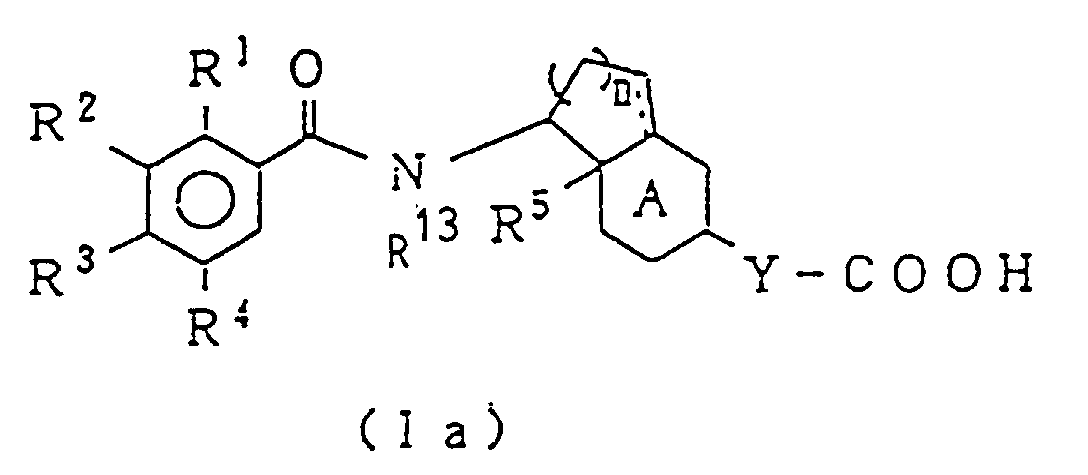
- A process for preparing carboxylic acid derivatives of the general formula (I) as defined in claim 13, wherein R1, R2, R3, R4, R5, n and A have the same significance as defined in claim 13, X is represented by -CONR13, wherein R13 is defined as in claim 13, and Y is represented by a single bond, which comprises the following steps:
condensing benzoic acid derivatives of the general formula (III):
with amine derivatives of the general formula (V):
to give the compound of the general formula (VI):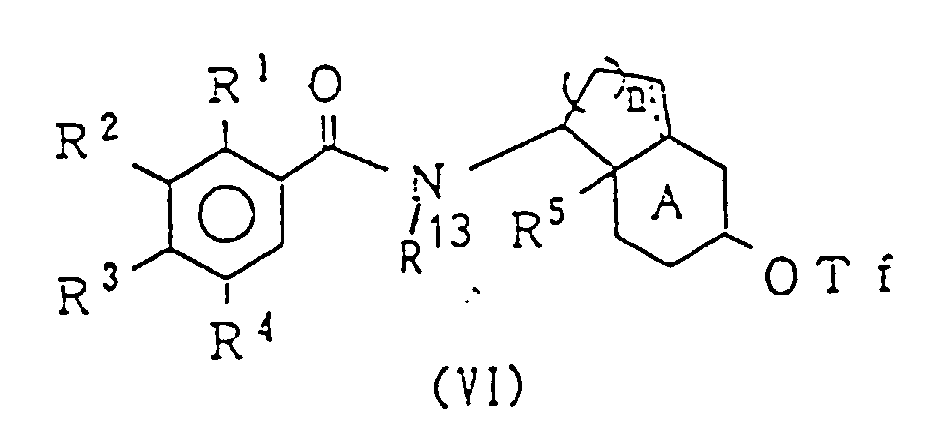

hydrolyzing the ester of the general formula (VII) with an alkali to give the objective compound of the formula (VIII):
- A process for preparing carboxylic acid derivatives of the general formula (I) as given in claim 13, wherein R1, R2, R3, R5, n, Y and A have the same significance as defined in claim 13, and X is -SO2NR13, wherein R13 is as defined in claim 13, which comprises the following steps:
reacting aniline derivatives of the general formula (IX):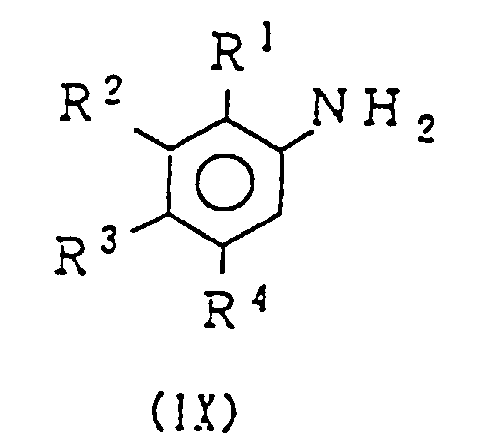

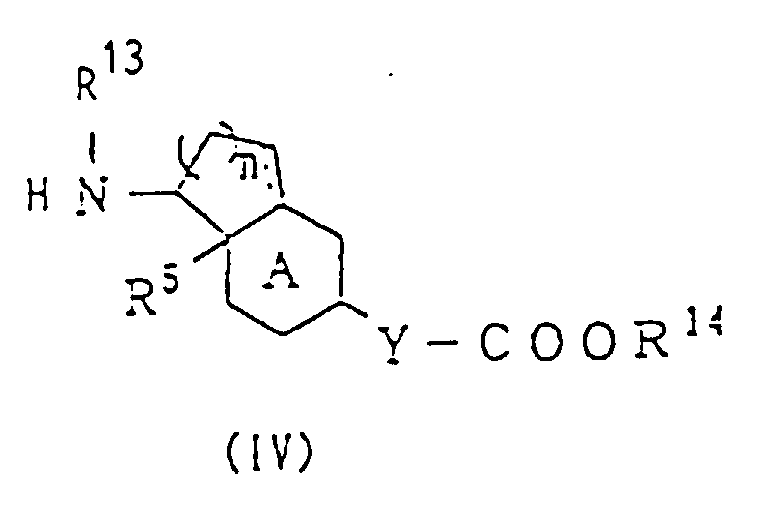
in a halogen-type solvent and subjecting the resultant product to alkali-hydrolysis in order to result in the objective compound of the general (XI):
- The use of carboxylic acid derivatives of the general formula (I) as given in claim 13, wherein R1, R2, R3, R4, R5, n, Y and A are as defined in claim 13, and X is -CONR13, wherein R13 is defined as given in claim 13, or pharmaceutically acceptable salts thereof for the preparation of a medicament effective in the treatment of androgen dependent diseases.
- The use according to claim 16, wherein the androgen dependent disease is represented by benign prostatic hyperplasia, acne, seborrhea, female hirsutism or male alopecia.
- A compound of the formula:

- A process for preparing carboxylic acid derivatives of the general formula (I')
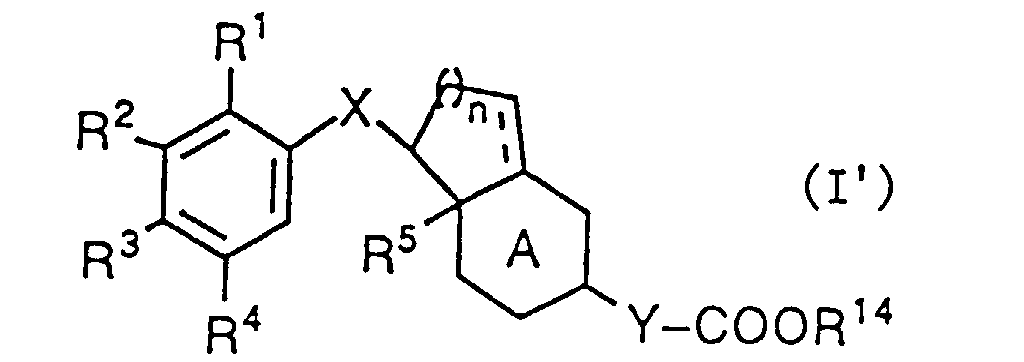
condensing benzoic acid derivatives of the general formula (III):


- A process for preparing carboxylic acid derivatives of the general formula(VII)
which comprises the following steps:
condensing benzoic acid derivatives of the general formula (III):


- A process for preparing carboxylic acid derivatives of the general formula (XI')
which comprises the following steps:
reacting aniline derivatives of the general formula (IX):


Applications Claiming Priority (2)
| Application Number | Priority Date | Filing Date | Title |
|---|---|---|---|
| JP4190991A JPH0641038A (en) | 1992-07-17 | 1992-07-17 | Carboxylic acid derivative |
| JP190991/92 | 1992-07-17 |
Publications (2)
| Publication Number | Publication Date |
|---|---|
| EP0579223A1 EP0579223A1 (en) | 1994-01-19 |
| EP0579223B1 true EP0579223B1 (en) | 1996-10-09 |
Family
ID=16267051
Family Applications (1)
| Application Number | Title | Priority Date | Filing Date |
|---|---|---|---|
| EP93111367A Expired - Lifetime EP0579223B1 (en) | 1992-07-17 | 1993-07-15 | Carboxylic acid derivatives having 5 alpha-reductase inhibitory activity |
Country Status (8)
| Country | Link |
|---|---|
| US (1) | US5385917A (en) |
| EP (1) | EP0579223B1 (en) |
| JP (1) | JPH0641038A (en) |
| AT (1) | ATE143942T1 (en) |
| CA (1) | CA2100642A1 (en) |
| DE (1) | DE69305263T2 (en) |
| ES (1) | ES2095529T3 (en) |
| TW (1) | TW270922B (en) |
Families Citing this family (27)
| Publication number | Priority date | Publication date | Assignee | Title |
|---|---|---|---|---|
| US5543417A (en) * | 1994-10-21 | 1996-08-06 | Merck & Co., Inc. | Combination method of treating acne using 4-AZA-5α-cholestan-ones and 4-AZA-5α-androstan-ones as selective 5α-reductase inhibitors with anti-bacterial, keratolytic, or anti-inflammatory agents |
| US5962725A (en) | 1996-09-05 | 1999-10-05 | Agouron Pharmaceuticals, Inc. | Intermediate compounds useful for making HIV protease inhibitors such as nelfinavir |
| US5925759A (en) | 1996-09-05 | 1999-07-20 | Agouron Pharmaceuticals, Inc. | Methods of making HIV-protease inhibitors and intermediates for making HIV-protease inhibitors |
| UA67727C2 (en) * | 1996-09-05 | 2004-07-15 | Агурон Фармасевтікелс, Інк. | Intermediate compounds for preparation of hiv-protease inhibitors and methods for the preparation of hiv-protease inhibitors |
| US6084107A (en) * | 1997-09-05 | 2000-07-04 | Agouron Pharmaceuticals, Inc. | Intermediates for making HIV-protease inhibitors |
| JP2003526407A (en) * | 1999-09-08 | 2003-09-09 | キューロン メディカル,インコーポレイテッド | System for controlling a set of treatment devices |
| DE10043074A1 (en) * | 2000-09-01 | 2002-03-14 | Aventis Cropscience Gmbh | Herbicidally active benzoylcyclohexanediones |
| US7662821B2 (en) | 2003-10-08 | 2010-02-16 | Bayer Schering Pharma Ag | Tetrahydronaphthalene derivatives, process for their production and their use as anti-inflammatory agents |
| PT1670458E (en) | 2003-10-08 | 2007-03-30 | Schering Ag | 1-amino-2-oxy-substituted tetrahydronaphtalene derivatives, methods for the production thereof, and their use as antiphlogistics |
| US7638515B2 (en) | 2003-10-08 | 2009-12-29 | Bayer Schering Pharma Aktiengesellschaft | Tetrahydronaphthalene derivatives, process for their production and their use as anti-inflammatory agents |
| CA2554696C (en) | 2004-02-13 | 2009-06-30 | Warner-Lambert Company Llc | Androgen receptor modulators |
| US20080153859A1 (en) | 2004-04-05 | 2008-06-26 | Hartmut Rehwinkel | Multiply-substituted tetrahydronaphthalene derivatives, process for their production and their use as anti-inflammatory agents |
| EP1737813A1 (en) | 2004-04-13 | 2007-01-03 | Warner-Lambert Company LLC | Androgen modulators |
| WO2005102990A1 (en) | 2004-04-22 | 2005-11-03 | Warner-Lambert Company Llc | Androgen modulators |
| CA2570047C (en) | 2004-07-08 | 2010-09-28 | Warner-Lambert Company Llc | 4-cycloalkoxy benzonitriles as androgen modulators |
| DE102005017316A1 (en) * | 2005-04-14 | 2006-10-19 | Schering Ag | Tetrahydronaphthalene derivatives, process for their preparation and their use as anti-inflammatory agents |
| TW200724139A (en) | 2005-05-05 | 2007-07-01 | Warner Lambert Co | Androgen modulators |
| EP1834948A1 (en) | 2006-03-15 | 2007-09-19 | Bayer Schering Pharma Aktiengesellschaft | Tetrahydronaphtalene derivatives, methods for the production thereof, and their use as antiinflammatory drugs |
| WO2008101240A1 (en) * | 2007-02-16 | 2008-08-21 | Emisphere Technologies, Inc. | Compounds having a cyclic moiety and compositions for delivering active agents |
| US9750563B2 (en) | 2009-09-22 | 2017-09-05 | Mederi Therapeutics, Inc. | Systems and methods for treating tissue with radiofrequency energy |
| US9474565B2 (en) | 2009-09-22 | 2016-10-25 | Mederi Therapeutics, Inc. | Systems and methods for treating tissue with radiofrequency energy |
| EP2480152B1 (en) | 2009-09-22 | 2018-08-29 | Mederi Therapeutics Inc. | Systems for controlling use and operation of a family of different treatment devices |
| US9775664B2 (en) | 2009-09-22 | 2017-10-03 | Mederi Therapeutics, Inc. | Systems and methods for treating tissue with radiofrequency energy |
| US10386990B2 (en) | 2009-09-22 | 2019-08-20 | Mederi Rf, Llc | Systems and methods for treating tissue with radiofrequency energy |
| SG11202009438UA (en) | 2018-04-18 | 2020-11-27 | Constellation Pharmaceuticals Inc | Modulators of methyl modifying enzymes, compositions and uses thereof |
| CN112262143A (en) | 2018-05-21 | 2021-01-22 | 星座制药公司 | Modulators of methyl-modified enzymes, compositions and uses thereof |
| PH12022550188A1 (en) | 2019-07-24 | 2022-11-21 | Constellation Pharmaceuticals Inc | Crystalline forms of 7-chloro-2-(4-(3-methoxyazetidin-1-yl)cyclohexyl)-2,4-dimethyl-n-((6-methyl-4-(methylthio)-2-oxo-1,2-dihydropyridin-3-yl)methyl)benzo[d][1,3]dioxole-5-carboxamide |
Family Cites Families (7)
| Publication number | Priority date | Publication date | Assignee | Title |
|---|---|---|---|---|
| JPS6097946A (en) * | 1983-11-01 | 1985-05-31 | Ono Pharmaceut Co Ltd | Carboxamide derivative, its production and remedy containing said derivative |
| DE3872937T2 (en) | 1987-05-11 | 1993-01-21 | Ono Pharmaceutical Co | BENZOYLAMINOPHENOXYBUTTERIC ACID DERIVATIVES. |
| EP0294035B1 (en) * | 1987-06-04 | 1994-08-31 | Ono Pharmaceutical Co., Ltd. | Benzoylaminophenoxybutanoic acid derivatives |
| US4882319A (en) | 1988-12-23 | 1989-11-21 | Smithkline Beckman Corporation | Phosphonic acid substituted aromatic steroids as inhibitors of steroid 5-α-reductase |
| US4937237A (en) | 1988-12-23 | 1990-06-26 | Smithkline Beckman Corporation | Phosphinic acid substituted aromatic steroids as inhibitors of steroid 5-60 -reductase |
| US4970205A (en) | 1988-12-23 | 1990-11-13 | Smithkline Beecham Corporation | Sulfonic acid substituted aromatic steroids as inhibitors of steroid 5-α-reductase |
| US4970204A (en) | 1989-08-23 | 1990-11-13 | Smithkline Beecham Corporation | 3-substituted nitro-steroid derivatives as 5-α-reductase inhibitors |
-
1992
- 1992-07-17 JP JP4190991A patent/JPH0641038A/en active Pending
-
1993
- 1993-07-12 TW TW082105531A patent/TW270922B/zh active
- 1993-07-15 EP EP93111367A patent/EP0579223B1/en not_active Expired - Lifetime
- 1993-07-15 DE DE69305263T patent/DE69305263T2/en not_active Expired - Fee Related
- 1993-07-15 ES ES93111367T patent/ES2095529T3/en not_active Expired - Lifetime
- 1993-07-15 CA CA002100642A patent/CA2100642A1/en not_active Abandoned
- 1993-07-15 AT AT93111367T patent/ATE143942T1/en not_active IP Right Cessation
- 1993-07-16 US US08/092,055 patent/US5385917A/en not_active Expired - Fee Related
Also Published As
| Publication number | Publication date |
|---|---|
| JPH0641038A (en) | 1994-02-15 |
| DE69305263D1 (en) | 1996-11-14 |
| US5385917A (en) | 1995-01-31 |
| ATE143942T1 (en) | 1996-10-15 |
| CA2100642A1 (en) | 1994-01-18 |
| EP0579223A1 (en) | 1994-01-19 |
| TW270922B (en) | 1996-02-21 |
| ES2095529T3 (en) | 1997-02-16 |
| DE69305263T2 (en) | 1997-03-13 |
Similar Documents
| Publication | Publication Date | Title |
|---|---|---|
| EP0579223A1 (en) | Carboxylic acid derivatives having 5 alpha-reductase inhibitory activity | |
| US4732897A (en) | Steroidic 5α-reductase inhibitors | |
| US5124350A (en) | Leukotriene b4 antagonists | |
| DE68904083T2 (en) | HMG-COA REDUCTINE INHIBITORS. | |
| WO2001019776A2 (en) | Novel derivatives of dicarboxylic acid having pharmaceutical properties | |
| EP0527458A1 (en) | New 3,5-di-tert.-butyl-4-hydroxyphenyl derivatives, process for their preparation and pharmaceutical compounds | |
| WO2007107243A1 (en) | Substituted chromanol derivatives and their use | |
| US5491152A (en) | Derivatives of cyclic ethers and sulfides for the treatment of atherosclerosis | |
| CA2486644A1 (en) | Anilino liver x-receptor modulators | |
| JPH10182583A (en) | New hydroxamic acid derivative | |
| US5654302A (en) | Prodrug esters of phenolic 2-piperidino-1-alkanols | |
| EP1572628B1 (en) | Isophtalic acid derivatives | |
| US5166208A (en) | Fredericamycin A derivatives | |
| US5726205A (en) | O-acyl-4-phenyl-cyclohexanols, their salts, medicaments containing such compounds and their use, as well as a method of preparing them | |
| US20080234258A1 (en) | Dihydroxyanthraquinones and Their Use | |
| US5057514A (en) | Compounds effective as cerebral schemia treating agents | |
| DE69713354T2 (en) | Hydroxamic acid derivatives | |
| US5288752A (en) | Compound effective as cerebral insufficiency improver | |
| EP0202529B1 (en) | Phenol derivatives, pharmaceutical compositions containing them and processes for the preparation of these compounds and pharmaceutical compositions | |
| HU211233A9 (en) | Bis (phenyl) ethane derivatives and phamaceuticals containing them | |
| GB2040936A (en) | Phenylthiophenylpiperidines | |
| US4889853A (en) | Hydroquinonlyphenyl butyric acid amide derivative | |
| KATAOKA et al. | Synthesis, Stereochemistry and Reactions of Selenoxanthen-10-io (alkoxalyl alkoxycarbonyl) methanides and Related Compounds | |
| KR20030076600A (en) | Novel Estrogen Receptor Ligands And MethodsⅠ | |
| US5962507A (en) | O-acyl-4-phenyl-cyclohexanols, their salts, medicaments containing such compounds, and their use, as well as a method of preparing them |
Legal Events
| Date | Code | Title | Description |
|---|---|---|---|
| PUAI | Public reference made under article 153(3) epc to a published international application that has entered the european phase |
Free format text: ORIGINAL CODE: 0009012 |
|
| AK | Designated contracting states |
Kind code of ref document: A1 Designated state(s): AT BE CH DE DK ES FR GB GR IE IT LI LU NL PT SE |
|
| RIN1 | Information on inventor provided before grant (corrected) |
Inventor name: HATANAKA, FUMIKO Inventor name: MORIOKA, MASAHIKO Inventor name: UENO, HIROAKI |
|
| 17P | Request for examination filed |
Effective date: 19940519 |
|
| RAP1 | Party data changed (applicant data changed or rights of an application transferred) |
Owner name: MITSUBISHI CHEMICAL CORPORATION |
|
| 17Q | First examination report despatched |
Effective date: 19950801 |
|
| GRAH | Despatch of communication of intention to grant a patent |
Free format text: ORIGINAL CODE: EPIDOS IGRA |
|
| GRAH | Despatch of communication of intention to grant a patent |
Free format text: ORIGINAL CODE: EPIDOS IGRA |
|
| GRAH | Despatch of communication of intention to grant a patent |
Free format text: ORIGINAL CODE: EPIDOS IGRA |
|
| GRAA | (expected) grant |
Free format text: ORIGINAL CODE: 0009210 |
|
| AK | Designated contracting states |
Kind code of ref document: B1 Designated state(s): AT BE CH DE DK ES FR GB GR IE IT LI LU NL PT SE |
|
| PG25 | Lapsed in a contracting state [announced via postgrant information from national office to epo] |
Ref country code: NL Free format text: LAPSE BECAUSE OF FAILURE TO SUBMIT A TRANSLATION OF THE DESCRIPTION OR TO PAY THE FEE WITHIN THE PRESCRIBED TIME-LIMIT Effective date: 19961009 Ref country code: LI Effective date: 19961009 Ref country code: GR Free format text: LAPSE BECAUSE OF FAILURE TO SUBMIT A TRANSLATION OF THE DESCRIPTION OR TO PAY THE FEE WITHIN THE PRESCRIBED TIME-LIMIT Effective date: 19961009 Ref country code: DK Effective date: 19961009 Ref country code: CH Effective date: 19961009 Ref country code: BE Effective date: 19961009 Ref country code: AT Effective date: 19961009 |
|
| REF | Corresponds to: |
Ref document number: 143942 Country of ref document: AT Date of ref document: 19961015 Kind code of ref document: T |
|
| ITF | It: translation for a ep patent filed | ||
| REF | Corresponds to: |
Ref document number: 69305263 Country of ref document: DE Date of ref document: 19961114 |
|
| ET | Fr: translation filed | ||
| REG | Reference to a national code |
Ref country code: IE Ref legal event code: FG4D Free format text: 70151 |
|
| PG25 | Lapsed in a contracting state [announced via postgrant information from national office to epo] |
Ref country code: SE Effective date: 19970109 Ref country code: PT Effective date: 19970109 |
|
| REG | Reference to a national code |
Ref country code: ES Ref legal event code: FG2A Ref document number: 2095529 Country of ref document: ES Kind code of ref document: T3 |
|
| NLV1 | Nl: lapsed or annulled due to failure to fulfill the requirements of art. 29p and 29m of the patents act | ||
| REG | Reference to a national code |
Ref country code: CH Ref legal event code: PL |
|
| PG25 | Lapsed in a contracting state [announced via postgrant information from national office to epo] |
Ref country code: IE Free format text: LAPSE BECAUSE OF NON-PAYMENT OF DUE FEES Effective date: 19970715 |
|
| PG25 | Lapsed in a contracting state [announced via postgrant information from national office to epo] |
Ref country code: LU Free format text: LAPSE BECAUSE OF NON-PAYMENT OF DUE FEES Effective date: 19970731 |
|
| PLBE | No opposition filed within time limit |
Free format text: ORIGINAL CODE: 0009261 |
|
| STAA | Information on the status of an ep patent application or granted ep patent |
Free format text: STATUS: NO OPPOSITION FILED WITHIN TIME LIMIT |
|
| 26N | No opposition filed | ||
| PGFP | Annual fee paid to national office [announced via postgrant information from national office to epo] |
Ref country code: FR Payment date: 19990617 Year of fee payment: 7 |
|
| PGFP | Annual fee paid to national office [announced via postgrant information from national office to epo] |
Ref country code: GB Payment date: 19990709 Year of fee payment: 7 |
|
| PGFP | Annual fee paid to national office [announced via postgrant information from national office to epo] |
Ref country code: ES Payment date: 19990716 Year of fee payment: 7 |
|
| PGFP | Annual fee paid to national office [announced via postgrant information from national office to epo] |
Ref country code: DE Payment date: 19990812 Year of fee payment: 7 |
|
| PG25 | Lapsed in a contracting state [announced via postgrant information from national office to epo] |
Ref country code: GB Free format text: LAPSE BECAUSE OF NON-PAYMENT OF DUE FEES Effective date: 20000715 |
|
| PG25 | Lapsed in a contracting state [announced via postgrant information from national office to epo] |
Ref country code: ES Free format text: LAPSE BECAUSE OF NON-PAYMENT OF DUE FEES Effective date: 20000716 |
|
| GBPC | Gb: european patent ceased through non-payment of renewal fee |
Effective date: 20000715 |
|
| PG25 | Lapsed in a contracting state [announced via postgrant information from national office to epo] |
Ref country code: FR Free format text: LAPSE BECAUSE OF NON-PAYMENT OF DUE FEES Effective date: 20010330 |
|
| REG | Reference to a national code |
Ref country code: FR Ref legal event code: ST |
|
| PG25 | Lapsed in a contracting state [announced via postgrant information from national office to epo] |
Ref country code: DE Free format text: LAPSE BECAUSE OF NON-PAYMENT OF DUE FEES Effective date: 20010501 |
|
| REG | Reference to a national code |
Ref country code: ES Ref legal event code: FD2A Effective date: 20010810 |
|
| PG25 | Lapsed in a contracting state [announced via postgrant information from national office to epo] |
Ref country code: IT Free format text: LAPSE BECAUSE OF NON-PAYMENT OF DUE FEES;WARNING: LAPSES OF ITALIAN PATENTS WITH EFFECTIVE DATE BEFORE 2007 MAY HAVE OCCURRED AT ANY TIME BEFORE 2007. THE CORRECT EFFECTIVE DATE MAY BE DIFFERENT FROM THE ONE RECORDED. Effective date: 20050715 |