EP0577016B1 - A method of removing scale - Google Patents
A method of removing scale Download PDFInfo
- Publication number
- EP0577016B1 EP0577016B1 EP93110154A EP93110154A EP0577016B1 EP 0577016 B1 EP0577016 B1 EP 0577016B1 EP 93110154 A EP93110154 A EP 93110154A EP 93110154 A EP93110154 A EP 93110154A EP 0577016 B1 EP0577016 B1 EP 0577016B1
- Authority
- EP
- European Patent Office
- Prior art keywords
- scale
- cooling water
- water system
- copolymer
- sulfonic acid
- Prior art date
- Legal status (The legal status is an assumption and is not a legal conclusion. Google has not performed a legal analysis and makes no representation as to the accuracy of the status listed.)
- Expired - Lifetime
Links
- JAPMJSVZDUYFKL-UHFFFAOYSA-N C1C2C1CCC2 Chemical compound C1C2C1CCC2 JAPMJSVZDUYFKL-UHFFFAOYSA-N 0.000 description 1
- ISLMMWPUKGICJW-UHFFFAOYSA-N CCC(C)(CC)NN=O Chemical compound CCC(C)(CC)NN=O ISLMMWPUKGICJW-UHFFFAOYSA-N 0.000 description 1
Classifications
-
- C—CHEMISTRY; METALLURGY
- C02—TREATMENT OF WATER, WASTE WATER, SEWAGE, OR SLUDGE
- C02F—TREATMENT OF WATER, WASTE WATER, SEWAGE, OR SLUDGE
- C02F5/00—Softening water; Preventing scale; Adding scale preventatives or scale removers to water, e.g. adding sequestering agents
- C02F5/08—Treatment of water with complexing chemicals or other solubilising agents for softening, scale prevention or scale removal, e.g. adding sequestering agents
- C02F5/10—Treatment of water with complexing chemicals or other solubilising agents for softening, scale prevention or scale removal, e.g. adding sequestering agents using organic substances
-
- C—CHEMISTRY; METALLURGY
- C02—TREATMENT OF WATER, WASTE WATER, SEWAGE, OR SLUDGE
- C02F—TREATMENT OF WATER, WASTE WATER, SEWAGE, OR SLUDGE
- C02F2103/00—Nature of the water, waste water, sewage or sludge to be treated
- C02F2103/02—Non-contaminated water, e.g. for industrial water supply
- C02F2103/023—Water in cooling circuits
-
- C—CHEMISTRY; METALLURGY
- C02—TREATMENT OF WATER, WASTE WATER, SEWAGE, OR SLUDGE
- C02F—TREATMENT OF WATER, WASTE WATER, SEWAGE, OR SLUDGE
- C02F2303/00—Specific treatment goals
- C02F2303/22—Eliminating or preventing deposits, scale removal, scale prevention
Definitions
- the present invention is related to a novel method of removing scale in a cooling water system. More particularly, the present invention is related to a method of efficiently removing scale by using a scale removing agent for a cooling water system comprising isoprene sulfonic acid copolymer which has excellent ability to remove scale and does not easily form gel, can remove scale without stopping operation of cooling water system while the ordinary operation of the cooling water system is maintained.
- refrigerators are advanced recently to the direction of packaging and higher performance and, because of this advancement, the rate of vaporization per unit heat transfer surface is highly enhanced in comparison with that of refrigerators of former types.
- impurities in water are concentrated to a higher degree.
- scale is easier to be formed than before and slight formation of scale leads to increase of consumed electric power or steam and decrease of cooling efficiency, making the scale hazard more important problem.
- a method of cleaning with an inorganic acid such as hydrochloric acid
- a method of using a water soluble carboxylic acid copolymer are adopted.
- the method of cleaning with an acid has drawbacks that the operation of the cooling water system must be stopped for a while because a cleaning apparatus is added to the system and the cleaning operation is conducted while operation of the system is stopped, that the cleaning operation takes a long time and that there are other problems like corrosion of water systems and danger during handling.
- a method of removing scale without stopping operation of cooling water system while the ordinary operation is maintained has been desired.
- a method of using verdigris removing agent comprising hydrazine has heretofore been known (Japanese Patent Publication 1988-45474).
- scale of calcium compounds cannot be removed by this method.
- a cleaning agent is added after the operation of the cooling water system is stopped and, after the cleaning for a specified time, the cleaning water is brought into a laboratory to measure concentration of calcium by using atomic absorption spectrum method or the like.
- Us 4,048,066 discloses a method for using a new improved composition for inhibiting or preventing accumulation of scale or the like on heating surfaces in a aqueous system, the composition including (A) copolymers of styrene sulfonic acid with acrylic or methacrylic acid, and their water-soluble salts; or (B) a mixture of polystyrene sulfonic acid with polyacrylic or polymethacrylic acid, and their water-soluble salts.
- Patent Abstracts of Japan, Vol. 16, no. 194 (C-938) and JP-A-40 28 708 disclose a copolymer having extremely high anti-scale effect and being useful as a water-treating agent, which is produced by copolymerizing a conjugated diene sulfonate, wherein the conjugated diene preferably is isoprene, a carboxyl-containing compound, and a hydroxyl-containing compound.
- US 3,682,224 discloses a copolymer of methacrylic acid and vinyl sulfonate, which is added to saline-water or sea-water in order to raise the temperature at which saline- and sea-water evaporators can be operated due to a reduction of the amount of scale deposited on vessels.
- the present invention has an object of solving the problems of the conventional scale removing agents and providing a method of removing scale using a polymeric scale removing agent which can remove scale without stopping operation of cooling water system while the ordinary operation of the cooling water system is maintained, does not have problem of corrosion of water systems or danger during handling and does not form gel easily.
- the present invention has another object of providing a method of removing scale in which the effect of cleaning is rapidly evaluated.
- a scale removing agent comprising as the effective component thereof an isoprene sulfonic acid copolymer containing repeating units derived from (meth)acrylic acid or a salt thereof and repeating units derived from isoprene sulfonic acid or a salt thereof in amounts of a specified ratio and having a specific range of molecular weight.
- the present invention comprises the following individual inventions:
- the scale removing agent of the present invention comprises a copolymer of a vinyl monomer having carboxyl group or a salt thereof and a isoprene monomer having sulfonic acid group or a salt thereof.
- vinyl monomer having carboxyl group or a salt thereof examples include acrylic acid, methacrylic acid, itaconic acid, maleic acid and salts thereof.
- the preferable examples among them are acrylic acid, methacrylic acid and salts thereof.
- Examples of the isoprene monomer having sulfonic acid or a salt thereof are sulfonic acid derivatives of isoprene and alkali metal salts, such as sodium salts, potassium salts and the like, of these compounds, alkaline earth metal salts, such as magnesium salts, calcium salts and the like, of these compounds and ammonium salts and organic amine salts of these compounds.
- sulfonic acid derivatives of isoprene are preferable.
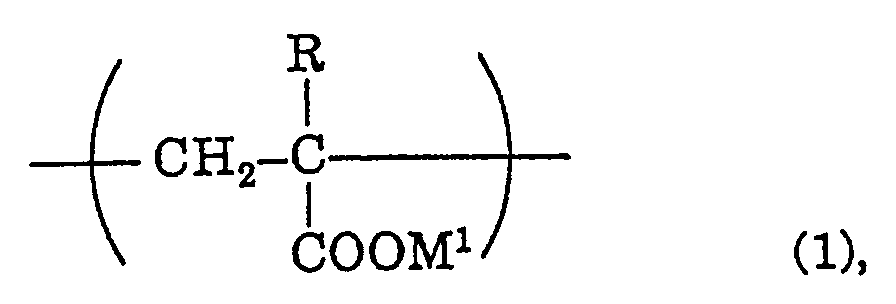
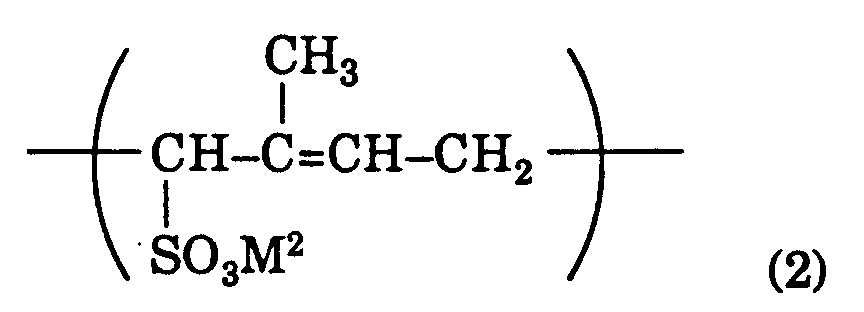
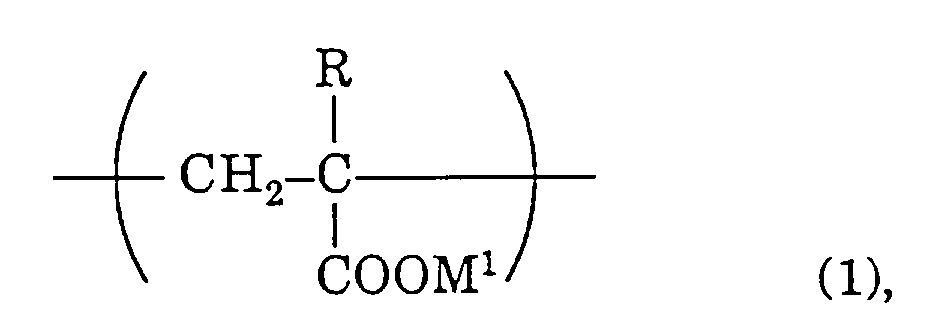
- the particularly preferable copolymer is a copolymer comprising as the effective component thereof isoprene sulfonic acid copolymer containing (A) repeating units expressed by the formula (1): wherein R and M 1 are the same as described above, and (B) repeating units expressed by the formula (2): or (C) repeating units expressed by the formula (3): wherein M 2 and M 3 are the same as describe above.
- M 1 , M 2 and M 3 in the formulae (1), (2) and (3) described above are a hydrogen atom or a monovalent cation, respectively.
- the monovalent cation are metal ions, such as sodium ion, potassium ion and the like, ammonium ion, alkyl- or alkanol-substituted ammonium ion and the like.
- the (meth)acrylic acid unit or the (meth)acrylic acid salt unit in the repeating unit (A) described above has the function to dissolve calcium ion by the chelating reaction with calcium ion in calcium carbonate attached to heat transfer surface or the like. When the content of the unit is higher, the amount of dissolved calcium is increased but the copolymer shows more tendency to form gel.
- the isoprene sulfonic acid unit and the isoprene sulfonic acid salt unit in the repeating unit (B) or in the repeating unit (C) has the function of preventing the formation of gel.
- the mol ratio of the repeating unit (A) and the repeating unit (B) or the repeating unit (C) in the isoprene sulfonic acid copolymer is in the range of 30 : 70 to 95 : 5 and preferably in the range of 80 : 20 to 95 : 5.
- the content of the repeating unit (A) is less than the range described above, the effect of dissolving calcium ion is not sufficiently exhibited.
- the content is more than the range, the copolymer has higher tendency to form gel.
- weight average molecular weight of the copolymer calibrated with polystyrene is in the range of 1,000 to 100,000, preferably in the range of 3,000 to 50,000 and more preferably in the range of 5,000 to 30,000. When the weight average molecular weight is out of this range, the object of the present invention is not sufficiently achieved.
- the isoprene sulfonic acid copolymer used in the scale removing agent of the present invention can be prepared by copolymerizing (meth)acrylic acid or a salt thereof constituting the repeating unit (A) described above and the isoprene sulfonic acid or a salt thereof constituting the repeating unit (B) or (C) described above by a conventional method.
- a suitable fraction of the free acid contained in the prepared copolymer may be converted into a salt type group by using an alkali or an amine according to necessity.
- copolymerizable monomers other than the monomers described above may be copolymerized according to desire within the range that the object of the present invention is not adversely effected.
- Example of the copolymerizable monomer other than the monomers described above are amides containing vinyl group, such as acrylamide, methacrylamide, dimethylacrylamide, dimethylmethacrylamide and the like, cyanovinyl compounds, such as acrylonitrile, methacrylonitrile and the like, alkyl esters of (meth)acrylic acid, such as methyl acrylate, ethyl acrylate, methyl methacrylate, ethyl methacrylate and the like, vinyl esters of carboxylic acids, such as vinyl acetate and the like, aromatic vinyl compounds, such as styrene, ⁇ -methylstyrene, p-methylstyrene and the like, and the like compounds.
- scale removing agent of the present invention scale preventing agents, anticorrosion agents, slime preventing agents, bactericides, chelating agents and other agents which are generally added to water treatment agents can be mixed as well.
- scale preventing agent examples include salts of polyacrylic acid, partial hydrolysis products of polyacrylamide, maleic acid polymers, itaconic acid polymers, acrylic copolymers containing hydroxyethyl methacrylate and the like compounds.
- anticorrosion agent examples include phosphorus compounds, such as phosphoric acid, polymerized phosphoric acid, phosphoric acid and the like, oxycarboxylic acids, thiazoles, triazoles, amines, hydroxamic acids and the like.
- slime preventing agent examples include chlorine gas, calcium hypochlorite, sodium hypochlorite, sodium chloroisocyanurate, hydrazine, quaternary ammonium salt agents and the like.
- the scale removing agent of the invention comprising the isoprene sulfonic acid copolymer as the effective component thereof thus prepared can cleave and remove scale deposited on the cooling water system while the ordinary operation of the system is maintained.
- the scale removing agent is charged from a pit of the cooling tower or the like into the cooling water system in which scale is formed and deposited in such an amount that the amount of the scale removing agent is generally 0.01 weight % or more, preferably in the range of 0.1 to 10 weight %, more preferably in the range of 0.5 to 8 weight % and most preferably in the range of 0.5 to 5 weight % based on the total amount of water contained in the system while operating the cooling water system, but closing a blowing valve.
- the scale removing agent may be charged by adding the whole amount at once or by adding it in several separate additions.
- Water added with the scale removing agent is circulated for several hours to several days to cleave and remove scale.
- the preferable method by which one can understand the time when the cleaning operation can finish is described later.
- the effect of the scale removing agent is further enhanced by diluting as much as possible by continuous forced addition of water or the like method to reduce the concentration of hardness component in the circulated water.
- the cooling water is diluted by forced overflow or by further continuation of the ordinary operation by opening the blowing valve.
- the whole cleaning process is finished.
- the scale removing function of the isoprene sulfonic acid copolymer can be shown by the following equations.
- the equations show that, in the condition of operation of the cooling water system, calcium carbonate formed on heat transfer surface or the like makes contact with the isoprene sulfonic acid copolymer and calcium ion is discharged by the chelating action of the copolymer according to the equations described above.
- the concentration of calcium ion is increased with progress of the reaction and the amount of the removed calcium carbonate scale can be found by measuring the concentration of calcium ion by using the atomic absorption spectrum method or the like method.
- the operation of the cooling water system is not stopped but a blowing valve alone is closed and then the whole of a specified amount of the acidic scale dissolving agent in which M 1 , M 2 and M 3 are hydrogen in the formulae (1), (2) and (3) described above is added.
- the pH value in the circulated water is decreased temporarily by the addition of the scale dissolving agent.
- the pH value is increased again by the increased dissolution of calcium carbonate with the progress of the cleaning operation. Therefore, when the pH value returned to 5 or more, or preferably to an approximately neutral value, it is decided that the cleaning process has been finished and the blowing valve is opened to resume the normal operation of the cooling water system.
- Mechanism by which the pH value of the circulated cleaning water is increased with progress of the cleaning after the addition of the acidic scale dissolving agent can be considered as following: CaCO 3 (solid) ⁇ Ca 2+ + CO 3 2- (liquid) CaCO 3 (solid) + H + ⁇ Ca 2+ + HCO 3 - Ca 2+ + Y m- (scale dissolving agent) ⁇ CaY n-
- the amount of addition of the acidic scale dissolving agent can be selected suitably according to the kind of the agent.
- the isoprene sulfonic acid copolymer described above it is preferred that the whole amount of the agent which is generally 0.01 weight % or more, preferably in the range of 0.1 to 10 weight %, more preferably in the range of 0.5 to 8 weight % and most preferably in the range of 0.5 to 5 weight % based on the total amount of water in the system is added at once.
- the pH value at the time when the calcium hardness ceased to increase is obtained in advance by a preliminary experiment and the finishing point of the cleaning process is decided by using this pH value as the criterion for finishing the cleaning operation.
- the relation between the calcium hardness and the pH value is also measured in advance by the preliminary experiment.
- the criterion of the pH value at which the descaling process is finished in the present invention is generally 5 or more and preferably in the range of 7.0 to 8.0.
- the measurement of the pH value may be made by using a simplified pH meter or by using a pH indicator.
- the pH indicator are Methyl Red (MR) (pH, 5.4 to 7.0; color change, red to yellow), Brom Cresol Purple (BCP) (pH, 5.6 to 7.2; color change, yellow to purple), Brom Thymol Blue (BTB) (pH, 6.2 to 7.8; color change, yellow to blue), Phenol Red (PR) (pH, 6.6 to 8.2; color change, yellow to red), a mixture of BTB and MR (pH, 5.0 to 8.0; color change, red to blue) and the like.
- MR Methyl Red
- BCP Brom Cresol Purple
- BTB Brom Thymol Blue
- PR Phenol Red
- PR Phenol Red
- Samples of water are taken at the start of the cleaning process and at specified times after the start of the cleaning process.
- the finishing of the cleaning process is decided by measuring the pH value by a pH meter or by the increase of pH or the change of color on addition of the indicator described above.
- the scale removing agent of cooling water system of the present invention has excellent ability to remove scale, neither requires much man power nor causes loss of productivity because the scale can be cleaved and removed without stopping the circulation of cooling water while the ordinary operation of the system is maintained and has no possibility of such danger to operator as found in conventional acid cleaning process because the agent is used at less acidic condition.
- the copolymer itself has the characteristic that gelling is not easily formed.
- the finishing point of the scale removal can be found easily by measuring the pH value on the spot of the operation without stopping the operation of the cooling water system.
- the dissolved amount of calcium carbonate increased with increase of the content of the acrylic acid unit until the dissolved amount decreased by the formation of gel.
- a test of removal of scale was conducted by using a model heat exchange apparatus.
- the scale removing agent of the present invention comprising the isoprene sulfonic acid copolymer as the effective component (mol ratio of acrylic acid/isoprene sulfonic acid, 90/10; molecular weight, 20,000) was added to the apparatus in such an amount that the amount of the copolymer was 5,000 mg/liter based on the total water in the system. The whole amount was added at once.
- the test was conducted under the following operating conditions.
- test time hour
- calcium hardness mg-CaCO 3 /l
- dissolved concentration mg-CaCO 3 /l
- the acidic scale dissolving agent a copolymer having weight average molecular weight of 20,000 comprising the acrylic acid unit and the isoprene sulfonic acid unit in a mol ratio of 90 : 10 was used.
- the material solution containing 40 weight % of the polymer had the pH value of 4.0.
- the color of the cooling water of these A and B systems was light brown and suspended solid was contained. However, the result of separate measurement by a membrane filter method showed that the polymers were not gelled.
- the specified pH value can be set at 7.2 in the system A and at 7.1 at the system B and the cleaning operation can be stopped when the pH value reached the specified value.
Landscapes
- Chemical & Material Sciences (AREA)
- Chemical Kinetics & Catalysis (AREA)
- General Chemical & Material Sciences (AREA)
- Life Sciences & Earth Sciences (AREA)
- Hydrology & Water Resources (AREA)
- Engineering & Computer Science (AREA)
- Environmental & Geological Engineering (AREA)
- Water Supply & Treatment (AREA)
- Organic Chemistry (AREA)
- Addition Polymer Or Copolymer, Post-Treatments, Or Chemical Modifications (AREA)
- Detergent Compositions (AREA)
- Preventing Corrosion Or Incrustation Of Metals (AREA)
Description



| scale removing agent | calcium hardness (mg-CaCO3/l) | gel point (mg-CaCO3/l) |
| AA/IPS 70/30 | 667 | 2200 |
| AA/IPS 80/20 | 824 | 2000 |
| AA/IPS 90/10 | 1113 | 1800 |
| AA/IPS 95/5 | 1250 | 1600 |
| itaconic acid homopolymer | 875 | 1000 |
| maleic acid homopolymer | 631 | 1200 |
| acrylic acid 100/0 | 800 | 800 |
| AA: acrylic acid unit IPS: isoprene sulfonic acid unit |
| test time (hour) | calcium hardness (mg-CaCO3/l) | dissolved concentration (mg-CaCO3/l) |
| 0 | 113 | - |
| 1 | 1069 | 956 |
| 2 | 1283 | 1170 |
| 5 | 1332 | 1219 |
| 20 | 1588 | 1475 |
| water system | cleaning time (hour) | pH | calcium hardness (mg-CaCO3/l) |
| A | 0 | 7.7 | 115 |
| 1 | 6.9 | 2330 | |
| 3 | 7.2 | 2483 | |
| 20 | 7.6 | 2470 | |
| B | 0 | 8.8 | 70 |
| 0.5 | 5.9 | 980 | |
| 1 | 6.1 | 1318 | |
| 3 | 6.8 | 2075 | |
| 6 | 7.1 | 2981 | |
| 10 | 7.3 | 2901 |
Claims (4)
- A method of removing scale in a cooling water system in which scale is formed which comprises adding 0.01 weight % or more based on the total amount of water contained in the cooling water system of a copolymer containing vinyl monomer units having carboxyl group or salt thereof and isoprene monomer units having sulfonic acid group, or salt thereof in amounts to make mol ratio of the carboxyl group to the sulfonic acid group in the range of 30 : 70 to 95 : 5 and having weight average molecular weight calibrated with polystyrene sulfonic acid sodium salt in the range of 1,000 to 100,000 to the cooling water system while operating the cooling water system, the cleaved or dissolved scale being discharged out of the cooling water system by blowing.
- A method of removing scale as claimed in Claim 1, wherein the copolymer comprises as the effective component thereof isoprene sulfonic add copolymer containing (A) repeating units expressed by the formula (1):wherein R is a hydrogen atom or methyl group and M1 is a hydrogen atom or a monovalent cation, and (B) repeating units expressed by the formula (2):
 or (C) repeating units expressed by the formula (3):
 wherein M2 and M3 are a hydrogen atom or a monovalent cation, respectively.
- The method of removing scale in claimed in Clam 1 or 2, further comprising, after addition of the scale removing agent containing the copolymer to the cooling water system, measuring the pH of the cooling water and discharging the cleaved or dissolved scale solution when the pH of the cooling water reaches a specific value designated in advance.
- A method of removing scale as claimed in Claim 3, wherein the specific value of pH is 5 or higher.
Applications Claiming Priority (2)
| Application Number | Priority Date | Filing Date | Title |
|---|---|---|---|
| JP194924/92 | 1992-06-29 | ||
| JP4194924A JPH0663590A (en) | 1992-06-29 | 1992-06-29 | Scale removing agent and scale removing method using the same |
Publications (2)
| Publication Number | Publication Date |
|---|---|
| EP0577016A1 EP0577016A1 (en) | 1994-01-05 |
| EP0577016B1 true EP0577016B1 (en) | 1998-09-30 |
Family
ID=16332613
Family Applications (1)
| Application Number | Title | Priority Date | Filing Date |
|---|---|---|---|
| EP93110154A Expired - Lifetime EP0577016B1 (en) | 1992-06-29 | 1993-06-25 | A method of removing scale |
Country Status (5)
| Country | Link |
|---|---|
| US (1) | US5346626A (en) |
| EP (1) | EP0577016B1 (en) |
| JP (1) | JPH0663590A (en) |
| KR (1) | KR960001398B1 (en) |
| DE (1) | DE69321296T2 (en) |
Families Citing this family (12)
| Publication number | Priority date | Publication date | Assignee | Title |
|---|---|---|---|---|
| KR100203201B1 (en) * | 1995-08-21 | 1999-06-15 | 다케토시 가즈오 | Water treating agent and method for treating water |
| US6001264A (en) * | 1995-08-21 | 1999-12-14 | Kurita Water Industries Ltd. | Water-treating agent and method for treating water |
| US5658465A (en) * | 1995-12-28 | 1997-08-19 | The B.F. Goodrich Company | Method for inhibiting the deposition of silica and silicate compounds in water systems |
| US5895763A (en) * | 1997-04-16 | 1999-04-20 | H.E.R.C. Products Incorporated | Controlled carbonate removal from water conduit systems |
| DE19746688A1 (en) * | 1997-10-22 | 1999-04-29 | Basf Ag | Method for cleaning parts of plant used for producing and processing (meth)acrylic esters |
| JP2002273478A (en) * | 2001-03-21 | 2002-09-24 | Jsr Corp | Scale prevention method |
| US6761774B2 (en) | 2001-05-24 | 2004-07-13 | Basf Corporation | Composition and method for the in situ removal scale from a substrate |
| US20030220213A1 (en) * | 2002-05-24 | 2003-11-27 | Bober Andrew M. | Color changing floor finish stripper |
| US7048803B2 (en) * | 2003-01-29 | 2006-05-23 | Jones-Hamilton Co. | Method of dissolving scale |
| US8147713B2 (en) * | 2006-06-30 | 2012-04-03 | Ppg Industries Ohio, Inc. | Composition and method for scale removal and leak detection |
| JP5972749B2 (en) * | 2012-10-18 | 2016-08-17 | オルガノ株式会社 | Scale cleaning liquid composition and scale cleaning method |
| BR112015025008B1 (en) * | 2013-04-02 | 2021-09-08 | Kurita Water Industries Ltd. | METHOD FOR REMOVING SCALES IN STEAM GENERATION INSTALLATION |
Family Cites Families (12)
| Publication number | Priority date | Publication date | Assignee | Title |
|---|---|---|---|---|
| US3682224A (en) * | 1970-12-17 | 1972-08-08 | Merrill Bleyle | Scale prevention agents of methacrylic acid-vinyl sulfonate copolymers for saline water evaporation |
| US4048066A (en) * | 1976-11-17 | 1977-09-13 | Chemed Corporation | Method of inhibiting scale |
| GB2054548B (en) * | 1979-06-19 | 1982-12-22 | Sanyo Chemical Ind Ltd | Scale removal |
| US4253968A (en) * | 1979-08-17 | 1981-03-03 | Hercules Incorporated | Process of inhibiting precipitation of calcium salts utilizing a copolymer of allyl monomers and maleic anhydride |
| JPS5881494A (en) * | 1981-11-11 | 1983-05-16 | Toagosei Chem Ind Co Ltd | Composition for water purifying agent |
| US4640793A (en) * | 1984-02-14 | 1987-02-03 | Calgon Corporation | Synergistic scale and corrosion inhibiting admixtures containing carboxylic acid/sulfonic acid polymers |
| JPS6247434A (en) * | 1985-08-24 | 1987-03-02 | Sumitomo Metal Ind Ltd | Method for recovering high purity zinc from zinc slag containing al |
| US5182343A (en) * | 1988-04-15 | 1993-01-26 | Japan Synthetic Rubber Co., Ltd. | Homopolymers of sulfonated isoprene and 1,3-butadiene and agents containing the same |
| JP2625914B2 (en) * | 1988-06-29 | 1997-07-02 | 日本合成ゴム株式会社 | Water treatment agent |
| US4913823A (en) * | 1988-10-14 | 1990-04-03 | The Mogul Corporation | Process for dissolving and removing scale from aqueous systems |
| JP3018421B2 (en) * | 1990-04-25 | 2000-03-13 | ジェイエスアール株式会社 | Water treatment agent for scale prevention |
| US5183573A (en) * | 1991-07-22 | 1993-02-02 | W. R. Grace & Co.-Conn. | Multipurpose scale preventer/remover |
-
1992
- 1992-06-29 JP JP4194924A patent/JPH0663590A/en active Pending
-
1993
- 1993-06-25 DE DE69321296T patent/DE69321296T2/en not_active Expired - Lifetime
- 1993-06-25 EP EP93110154A patent/EP0577016B1/en not_active Expired - Lifetime
- 1993-06-29 US US08/083,236 patent/US5346626A/en not_active Expired - Lifetime
- 1993-06-29 KR KR93011925A patent/KR960001398B1/en not_active Expired - Lifetime
Also Published As
| Publication number | Publication date |
|---|---|
| KR940005502A (en) | 1994-03-21 |
| US5346626A (en) | 1994-09-13 |
| KR960001398B1 (en) | 1996-01-27 |
| EP0577016A1 (en) | 1994-01-05 |
| DE69321296T2 (en) | 1999-03-11 |
| DE69321296D1 (en) | 1998-11-05 |
| JPH0663590A (en) | 1994-03-08 |
Similar Documents
| Publication | Publication Date | Title |
|---|---|---|
| US4913822A (en) | Method for control of scale and inhibition of corrosion in cooling water systems | |
| US5346626A (en) | Method of removing scale | |
| JPH0811238B2 (en) | A method for inhibiting the precipitation and deposition of scale-forming salts in aqueous systems. | |
| JPS585264B2 (en) | corrosion inhibitor | |
| JP2004528439A (en) | Method for controlling scale formation and deposition in aqueous systems | |
| JPH0642960B2 (en) | Scale and corrosion control method | |
| MXPA98004099A (en) | Agent to inhibit the incrustation and method to use the mi | |
| JPS5825343A (en) | Aqueous medium treatment and composition | |
| JPH10101744A (en) | Water-soluble n,n-diallyl-n-alkyl-n-(sulfoalkyl) ammoniumbetaine-containing copolymer and method for inhibiting precipitation and deposition of scale by using the same | |
| EP1622838B1 (en) | Polymer for water treatment | |
| JP2801465B2 (en) | How to prevent corrosion and scale on metal surfaces | |
| EP1405671B1 (en) | Method of preventing corrosion in a water system | |
| JP4970674B2 (en) | Scale prevention method | |
| US4576722A (en) | Scale and sludge compositions for aqueous systems | |
| JPS63258697A (en) | Corrosion inhibitor that also suppresses the scale of metals in water systems | |
| FR2515631A1 (en) | METHOD FOR CONTROLLING ENLARGING IN BOILERS USING CARBOXYLIC POLYMERS | |
| JPS5959298A (en) | Composition and method of suppressing scale | |
| MXPA06009128A (en) | Desalination scale inhibitors | |
| US4814406A (en) | Scale inhibitor | |
| EP0928778B1 (en) | Process for the treatment of boiler water | |
| JP4182454B2 (en) | Heat exchanger scale adhesion prevention method | |
| EP1243564A2 (en) | Process for preventing formation of scale | |
| JP2000070992A (en) | Scaling inhibiting method and scaling inhibitor | |
| JPS5827347B2 (en) | The first year of the year | |
| JP4467046B2 (en) | Metal corrosion inhibitor |
Legal Events
| Date | Code | Title | Description |
|---|---|---|---|
| PUAI | Public reference made under article 153(3) epc to a published international application that has entered the european phase |
Free format text: ORIGINAL CODE: 0009012 |
|
| AK | Designated contracting states |
Kind code of ref document: A1 Designated state(s): DE GB |
|
| 17P | Request for examination filed |
Effective date: 19940628 |
|
| 17Q | First examination report despatched |
Effective date: 19950809 |
|
| GRAG | Despatch of communication of intention to grant |
Free format text: ORIGINAL CODE: EPIDOS AGRA |
|
| GRAG | Despatch of communication of intention to grant |
Free format text: ORIGINAL CODE: EPIDOS AGRA |
|
| GRAG | Despatch of communication of intention to grant |
Free format text: ORIGINAL CODE: EPIDOS AGRA |
|
| GRAH | Despatch of communication of intention to grant a patent |
Free format text: ORIGINAL CODE: EPIDOS IGRA |
|
| RAP1 | Party data changed (applicant data changed or rights of an application transferred) |
Owner name: JAPAN SYNTHETIC RUBBER CO., LTD. Owner name: KURITA WATER INDUSTRIES LTD. |
|
| GRAH | Despatch of communication of intention to grant a patent |
Free format text: ORIGINAL CODE: EPIDOS IGRA |
|
| GRAA | (expected) grant |
Free format text: ORIGINAL CODE: 0009210 |
|
| AK | Designated contracting states |
Kind code of ref document: B1 Designated state(s): DE GB |
|
| REF | Corresponds to: |
Ref document number: 69321296 Country of ref document: DE Date of ref document: 19981105 |
|
| PLBE | No opposition filed within time limit |
Free format text: ORIGINAL CODE: 0009261 |
|
| STAA | Information on the status of an ep patent application or granted ep patent |
Free format text: STATUS: NO OPPOSITION FILED WITHIN TIME LIMIT |
|
| 26N | No opposition filed | ||
| REG | Reference to a national code |
Ref country code: GB Ref legal event code: IF02 |
|
| PGFP | Annual fee paid to national office [announced via postgrant information from national office to epo] |
Ref country code: DE Payment date: 20120620 Year of fee payment: 20 |
|
| PGFP | Annual fee paid to national office [announced via postgrant information from national office to epo] |
Ref country code: GB Payment date: 20120620 Year of fee payment: 20 |
|
| REG | Reference to a national code |
Ref country code: DE Ref legal event code: R071 Ref document number: 69321296 Country of ref document: DE |
|
| REG | Reference to a national code |
Ref country code: DE Ref legal event code: R071 Ref document number: 69321296 Country of ref document: DE |
|
| REG | Reference to a national code |
Ref country code: GB Ref legal event code: PE20 Expiry date: 20130624 |
|
| PG25 | Lapsed in a contracting state [announced via postgrant information from national office to epo] |
Ref country code: GB Free format text: LAPSE BECAUSE OF EXPIRATION OF PROTECTION Effective date: 20130624 Ref country code: DE Free format text: LAPSE BECAUSE OF EXPIRATION OF PROTECTION Effective date: 20130626 |