EP0576686B1 - Cell - Google Patents
Cell Download PDFInfo
- Publication number
- EP0576686B1 EP0576686B1 EP93902505A EP93902505A EP0576686B1 EP 0576686 B1 EP0576686 B1 EP 0576686B1 EP 93902505 A EP93902505 A EP 93902505A EP 93902505 A EP93902505 A EP 93902505A EP 0576686 B1 EP0576686 B1 EP 0576686B1
- Authority
- EP
- European Patent Office
- Prior art keywords
- polymer
- lithium
- solvent
- positive electrode
- prepared
- Prior art date
- Legal status (The legal status is an assumption and is not a legal conclusion. Google has not performed a legal analysis and makes no representation as to the accuracy of the status listed.)
- Expired - Lifetime
Links
- 229920000642 polymer Polymers 0.000 claims abstract description 56
- 239000000203 mixture Substances 0.000 claims abstract description 48
- 239000007784 solid electrolyte Substances 0.000 claims abstract description 41
- 239000003792 electrolyte Substances 0.000 claims abstract description 36
- 239000002904 solvent Substances 0.000 claims abstract description 32
- 125000002947 alkylene group Chemical group 0.000 claims abstract description 31
- 150000003839 salts Chemical class 0.000 claims abstract description 27
- 239000002131 composite material Substances 0.000 claims abstract description 25
- 238000004132 cross linking Methods 0.000 claims abstract description 14
- 239000007774 positive electrode material Substances 0.000 claims abstract description 11
- 238000002156 mixing Methods 0.000 claims abstract description 6
- UFHFLCQGNIYNRP-UHFFFAOYSA-N Hydrogen Chemical compound [H][H] UFHFLCQGNIYNRP-UHFFFAOYSA-N 0.000 claims abstract description 4
- 239000001257 hydrogen Substances 0.000 claims abstract description 4
- 229910052739 hydrogen Inorganic materials 0.000 claims abstract description 4
- 125000002496 methyl group Chemical group [H]C([H])([H])* 0.000 claims abstract description 4
- PEDCQBHIVMGVHV-UHFFFAOYSA-N glycerol group Chemical group OCC(O)CO PEDCQBHIVMGVHV-UHFFFAOYSA-N 0.000 claims description 30
- 229910052744 lithium Inorganic materials 0.000 claims description 26
- -1 dimetholsulfoxide Chemical compound 0.000 claims description 19
- WHXSMMKQMYFTQS-UHFFFAOYSA-N Lithium Chemical compound [Li] WHXSMMKQMYFTQS-UHFFFAOYSA-N 0.000 claims description 18
- XLYOFNOQVPJJNP-UHFFFAOYSA-N water Substances O XLYOFNOQVPJJNP-UHFFFAOYSA-N 0.000 claims description 18
- MHCFAGZWMAWTNR-UHFFFAOYSA-M lithium perchlorate Chemical compound [Li+].[O-]Cl(=O)(=O)=O MHCFAGZWMAWTNR-UHFFFAOYSA-M 0.000 claims description 12
- 229910001486 lithium perchlorate Inorganic materials 0.000 claims description 12
- RUOJZAUFBMNUDX-UHFFFAOYSA-N propylene carbonate Chemical compound CC1COC(=O)O1 RUOJZAUFBMNUDX-UHFFFAOYSA-N 0.000 claims description 11
- 238000010438 heat treatment Methods 0.000 claims description 8
- YEJRWHAVMIAJKC-UHFFFAOYSA-N 4-Butyrolactone Chemical compound O=C1CCCO1 YEJRWHAVMIAJKC-UHFFFAOYSA-N 0.000 claims description 7
- KMTRUDSVKNLOMY-UHFFFAOYSA-N Ethylene carbonate Chemical group O=C1OCCO1 KMTRUDSVKNLOMY-UHFFFAOYSA-N 0.000 claims description 7
- ZJCCRDAZUWHFQH-UHFFFAOYSA-N Trimethylolpropane Chemical group CCC(CO)(CO)CO ZJCCRDAZUWHFQH-UHFFFAOYSA-N 0.000 claims description 6
- XTHFKEDIFFGKHM-UHFFFAOYSA-N Dimethoxyethane Chemical compound COCCOC XTHFKEDIFFGKHM-UHFFFAOYSA-N 0.000 claims description 5
- WNXJIVFYUVYPPR-UHFFFAOYSA-N 1,3-dioxolane Chemical compound C1COCO1 WNXJIVFYUVYPPR-UHFFFAOYSA-N 0.000 claims description 4
- 239000004020 conductor Substances 0.000 claims description 4
- AMXOYNBUYSYVKV-UHFFFAOYSA-M lithium bromide Chemical compound [Li+].[Br-] AMXOYNBUYSYVKV-UHFFFAOYSA-M 0.000 claims description 4
- KWGKDLIKAYFUFQ-UHFFFAOYSA-M lithium chloride Chemical compound [Li+].[Cl-] KWGKDLIKAYFUFQ-UHFFFAOYSA-M 0.000 claims description 4
- PQXKHYXIUOZZFA-UHFFFAOYSA-M lithium fluoride Chemical compound [Li+].[F-] PQXKHYXIUOZZFA-UHFFFAOYSA-M 0.000 claims description 4
- HSZCZNFXUDYRKD-UHFFFAOYSA-M lithium iodide Chemical compound [Li+].[I-] HSZCZNFXUDYRKD-UHFFFAOYSA-M 0.000 claims description 4
- IIPYXGDZVMZOAP-UHFFFAOYSA-N lithium nitrate Chemical compound [Li+].[O-][N+]([O-])=O IIPYXGDZVMZOAP-UHFFFAOYSA-N 0.000 claims description 4
- HXJUTPCZVOIRIF-UHFFFAOYSA-N sulfolane Chemical compound O=S1(=O)CCCC1 HXJUTPCZVOIRIF-UHFFFAOYSA-N 0.000 claims description 4
- 125000000217 alkyl group Chemical group 0.000 claims description 3
- 125000004432 carbon atom Chemical group C* 0.000 claims description 3
- 229910001496 lithium tetrafluoroborate Inorganic materials 0.000 claims description 3
- MPCRDALPQLDDFX-UHFFFAOYSA-L Magnesium perchlorate Chemical compound [Mg+2].[O-]Cl(=O)(=O)=O.[O-]Cl(=O)(=O)=O MPCRDALPQLDDFX-UHFFFAOYSA-L 0.000 claims description 2
- AXZAYXJCENRGIM-UHFFFAOYSA-J dipotassium;tetrabromoplatinum(2-) Chemical compound [K+].[K+].[Br-].[Br-].[Br-].[Br-].[Pt+2] AXZAYXJCENRGIM-UHFFFAOYSA-J 0.000 claims description 2
- ZJZXSOKJEJFHCP-UHFFFAOYSA-M lithium;thiocyanate Chemical compound [Li+].[S-]C#N ZJZXSOKJEJFHCP-UHFFFAOYSA-M 0.000 claims description 2
- MCVFFRWZNYZUIJ-UHFFFAOYSA-M lithium;trifluoromethanesulfonate Chemical compound [Li+].[O-]S(=O)(=O)C(F)(F)F MCVFFRWZNYZUIJ-UHFFFAOYSA-M 0.000 claims description 2
- SXTGAOTXVOMSFW-UHFFFAOYSA-L magnesium;dithiocyanate Chemical compound [Mg+2].[S-]C#N.[S-]C#N SXTGAOTXVOMSFW-UHFFFAOYSA-L 0.000 claims description 2
- BZQRBEVTLZHKEA-UHFFFAOYSA-L magnesium;trifluoromethanesulfonate Chemical compound [Mg+2].[O-]S(=O)(=O)C(F)(F)F.[O-]S(=O)(=O)C(F)(F)F BZQRBEVTLZHKEA-UHFFFAOYSA-L 0.000 claims description 2
- 229910001487 potassium perchlorate Inorganic materials 0.000 claims description 2
- ZNNZYHKDIALBAK-UHFFFAOYSA-M potassium thiocyanate Chemical compound [K+].[S-]C#N ZNNZYHKDIALBAK-UHFFFAOYSA-M 0.000 claims description 2
- 229940116357 potassium thiocyanate Drugs 0.000 claims description 2
- GLGXXYFYZWQGEL-UHFFFAOYSA-M potassium;trifluoromethanesulfonate Chemical compound [K+].[O-]S(=O)(=O)C(F)(F)F GLGXXYFYZWQGEL-UHFFFAOYSA-M 0.000 claims description 2
- BAZAXWOYCMUHIX-UHFFFAOYSA-M sodium perchlorate Chemical compound [Na+].[O-]Cl(=O)(=O)=O BAZAXWOYCMUHIX-UHFFFAOYSA-M 0.000 claims description 2
- 229910001488 sodium perchlorate Inorganic materials 0.000 claims description 2
- 229910001495 sodium tetrafluoroborate Inorganic materials 0.000 claims description 2
- VGTPCRGMBIAPIM-UHFFFAOYSA-M sodium thiocyanate Chemical compound [Na+].[S-]C#N VGTPCRGMBIAPIM-UHFFFAOYSA-M 0.000 claims description 2
- XGPOMXSYOKFBHS-UHFFFAOYSA-M sodium;trifluoromethanesulfonate Chemical compound [Na+].[O-]S(=O)(=O)C(F)(F)F XGPOMXSYOKFBHS-UHFFFAOYSA-M 0.000 claims description 2
- 230000005855 radiation Effects 0.000 abstract description 4
- 125000004169 (C1-C6) alkyl group Chemical group 0.000 abstract 1
- 210000004027 cell Anatomy 0.000 description 72
- YXFVVABEGXRONW-UHFFFAOYSA-N Toluene Chemical compound CC1=CC=CC=C1 YXFVVABEGXRONW-UHFFFAOYSA-N 0.000 description 40
- 150000001875 compounds Chemical class 0.000 description 33
- KWYUFKZDYYNOTN-UHFFFAOYSA-M Potassium hydroxide Chemical compound [OH-].[K+] KWYUFKZDYYNOTN-UHFFFAOYSA-M 0.000 description 30
- 229920005604 random copolymer Polymers 0.000 description 23
- 230000000052 comparative effect Effects 0.000 description 19
- RVGRUAULSDPKGF-UHFFFAOYSA-N Poloxamer Chemical compound C1CO1.CC1CO1 RVGRUAULSDPKGF-UHFFFAOYSA-N 0.000 description 17
- IAYPIBMASNFSPL-UHFFFAOYSA-N Ethylene oxide Chemical compound C1CO1 IAYPIBMASNFSPL-UHFFFAOYSA-N 0.000 description 16
- GOOHAUXETOMSMM-UHFFFAOYSA-N Propylene oxide Chemical compound CC1CO1 GOOHAUXETOMSMM-UHFFFAOYSA-N 0.000 description 12
- 239000003054 catalyst Substances 0.000 description 10
- 239000007772 electrode material Substances 0.000 description 10
- 125000002887 hydroxy group Chemical group [H]O* 0.000 description 10
- 238000010992 reflux Methods 0.000 description 10
- OKTJSMMVPCPJKN-UHFFFAOYSA-N Carbon Chemical compound [C] OKTJSMMVPCPJKN-UHFFFAOYSA-N 0.000 description 9
- 239000007788 liquid Substances 0.000 description 9
- 238000000034 method Methods 0.000 description 9
- 238000003756 stirring Methods 0.000 description 9
- SMZOUWXMTYCWNB-UHFFFAOYSA-N 2-(2-methoxy-5-methylphenyl)ethanamine Chemical compound COC1=CC=C(C)C=C1CCN SMZOUWXMTYCWNB-UHFFFAOYSA-N 0.000 description 8
- NIXOWILDQLNWCW-UHFFFAOYSA-N 2-Propenoic acid Natural products OC(=O)C=C NIXOWILDQLNWCW-UHFFFAOYSA-N 0.000 description 8
- WYURNTSHIVDZCO-UHFFFAOYSA-N Tetrahydrofuran Chemical compound C1CCOC1 WYURNTSHIVDZCO-UHFFFAOYSA-N 0.000 description 8
- 239000010935 stainless steel Substances 0.000 description 8
- 229910001220 stainless steel Inorganic materials 0.000 description 8
- 229920001940 conductive polymer Polymers 0.000 description 7
- 150000002736 metal compounds Chemical class 0.000 description 7
- 230000015572 biosynthetic process Effects 0.000 description 6
- 239000000178 monomer Substances 0.000 description 6
- 239000007773 negative electrode material Substances 0.000 description 6
- JOXIMZWYDAKGHI-UHFFFAOYSA-N toluene-4-sulfonic acid Chemical compound CC1=CC=C(S(O)(=O)=O)C=C1 JOXIMZWYDAKGHI-UHFFFAOYSA-N 0.000 description 6
- 239000012298 atmosphere Substances 0.000 description 5
- 210000001787 dendrite Anatomy 0.000 description 5
- 239000011261 inert gas Substances 0.000 description 5
- 229920000767 polyaniline Polymers 0.000 description 5
- 239000007858 starting material Substances 0.000 description 5
- OZAIFHULBGXAKX-UHFFFAOYSA-N 2-(2-cyanopropan-2-yldiazenyl)-2-methylpropanenitrile Chemical compound N#CC(C)(C)N=NC(C)(C)C#N OZAIFHULBGXAKX-UHFFFAOYSA-N 0.000 description 4
- KMBMQZQZBOLJHN-UHFFFAOYSA-N 2-methyloxirane;oxolane Chemical compound CC1CO1.C1CCOC1 KMBMQZQZBOLJHN-UHFFFAOYSA-N 0.000 description 4
- CSCPPACGZOOCGX-UHFFFAOYSA-N Acetone Chemical compound CC(C)=O CSCPPACGZOOCGX-UHFFFAOYSA-N 0.000 description 4
- IAZDPXIOMUYVGZ-UHFFFAOYSA-N Dimethylsulphoxide Chemical compound CS(C)=O IAZDPXIOMUYVGZ-UHFFFAOYSA-N 0.000 description 4
- CERQOIWHTDAKMF-UHFFFAOYSA-N Methacrylic acid Chemical compound CC(=C)C(O)=O CERQOIWHTDAKMF-UHFFFAOYSA-N 0.000 description 4
- QAOWNCQODCNURD-UHFFFAOYSA-N Sulfuric acid Chemical compound OS(O)(=O)=O QAOWNCQODCNURD-UHFFFAOYSA-N 0.000 description 4
- 229910045601 alloy Inorganic materials 0.000 description 4
- 239000000956 alloy Substances 0.000 description 4
- 229910052799 carbon Inorganic materials 0.000 description 4
- 238000006243 chemical reaction Methods 0.000 description 4
- 239000011248 coating agent Substances 0.000 description 4
- 238000000576 coating method Methods 0.000 description 4
- GNTDGMZSJNCJKK-UHFFFAOYSA-N divanadium pentaoxide Chemical compound O=[V](=O)O[V](=O)=O GNTDGMZSJNCJKK-UHFFFAOYSA-N 0.000 description 4
- 239000011244 liquid electrolyte Substances 0.000 description 4
- NUJOXMJBOLGQSY-UHFFFAOYSA-N manganese dioxide Chemical compound O=[Mn]=O NUJOXMJBOLGQSY-UHFFFAOYSA-N 0.000 description 4
- 239000012528 membrane Substances 0.000 description 4
- 229910052751 metal Inorganic materials 0.000 description 4
- 239000002184 metal Substances 0.000 description 4
- GAGSAAHZRBTRGD-UHFFFAOYSA-N oxirane;oxolane Chemical group C1CO1.C1CCOC1 GAGSAAHZRBTRGD-UHFFFAOYSA-N 0.000 description 4
- 238000002360 preparation method Methods 0.000 description 4
- 239000007787 solid Substances 0.000 description 4
- 238000003860 storage Methods 0.000 description 4
- 239000001117 sulphuric acid Substances 0.000 description 4
- 235000011149 sulphuric acid Nutrition 0.000 description 4
- 238000012360 testing method Methods 0.000 description 4
- 229920005682 EO-PO block copolymer Polymers 0.000 description 3
- 239000006230 acetylene black Substances 0.000 description 3
- 239000003575 carbonaceous material Substances 0.000 description 3
- 238000010586 diagram Methods 0.000 description 3
- 239000008151 electrolyte solution Substances 0.000 description 3
- 230000007774 longterm Effects 0.000 description 3
- 238000004519 manufacturing process Methods 0.000 description 3
- 239000000463 material Substances 0.000 description 3
- 239000005518 polymer electrolyte Substances 0.000 description 3
- 239000000047 product Substances 0.000 description 3
- JWUJQDFVADABEY-UHFFFAOYSA-N 2-methyltetrahydrofuran Chemical compound CC1CCCO1 JWUJQDFVADABEY-UHFFFAOYSA-N 0.000 description 2
- PAYRUJLWNCNPSJ-UHFFFAOYSA-N Aniline Chemical compound NC1=CC=CC=C1 PAYRUJLWNCNPSJ-UHFFFAOYSA-N 0.000 description 2
- OMPJBNCRMGITSC-UHFFFAOYSA-N Benzoylperoxide Chemical compound C=1C=CC=CC=1C(=O)OOC(=O)C1=CC=CC=C1 OMPJBNCRMGITSC-UHFFFAOYSA-N 0.000 description 2
- RYGMFSIKBFXOCR-UHFFFAOYSA-N Copper Chemical compound [Cu] RYGMFSIKBFXOCR-UHFFFAOYSA-N 0.000 description 2
- QPLDLSVMHZLSFG-UHFFFAOYSA-N Copper oxide Chemical compound [Cu]=O QPLDLSVMHZLSFG-UHFFFAOYSA-N 0.000 description 2
- LFQSCWFLJHTTHZ-UHFFFAOYSA-N Ethanol Chemical compound CCO LFQSCWFLJHTTHZ-UHFFFAOYSA-N 0.000 description 2
- VEXZGXHMUGYJMC-UHFFFAOYSA-N Hydrochloric acid Chemical compound Cl VEXZGXHMUGYJMC-UHFFFAOYSA-N 0.000 description 2
- XEEYBQQBJWHFJM-UHFFFAOYSA-N Iron Chemical compound [Fe] XEEYBQQBJWHFJM-UHFFFAOYSA-N 0.000 description 2
- UQSXHKLRYXJYBZ-UHFFFAOYSA-N Iron oxide Chemical compound [Fe]=O UQSXHKLRYXJYBZ-UHFFFAOYSA-N 0.000 description 2
- ACIMRXKJKQGBGL-UHFFFAOYSA-N N-(2-aminoethyl)-5-chloro-1-naphthalenesulfonamide Chemical compound C1=CC=C2C(S(=O)(=O)NCCN)=CC=CC2=C1Cl ACIMRXKJKQGBGL-UHFFFAOYSA-N 0.000 description 2
- SECXISVLQFMRJM-UHFFFAOYSA-N N-Methylpyrrolidone Chemical compound CN1CCCC1=O SECXISVLQFMRJM-UHFFFAOYSA-N 0.000 description 2
- PXHVJJICTQNCMI-UHFFFAOYSA-N Nickel Chemical compound [Ni] PXHVJJICTQNCMI-UHFFFAOYSA-N 0.000 description 2
- 239000002202 Polyethylene glycol Substances 0.000 description 2
- 239000004743 Polypropylene Substances 0.000 description 2
- VYPSYNLAJGMNEJ-UHFFFAOYSA-N Silicium dioxide Chemical compound O=[Si]=O VYPSYNLAJGMNEJ-UHFFFAOYSA-N 0.000 description 2
- WGLPBDUCMAPZCE-UHFFFAOYSA-N Trioxochromium Chemical compound O=[Cr](=O)=O WGLPBDUCMAPZCE-UHFFFAOYSA-N 0.000 description 2
- JFBZPFYRPYOZCQ-UHFFFAOYSA-N [Li].[Al] Chemical compound [Li].[Al] JFBZPFYRPYOZCQ-UHFFFAOYSA-N 0.000 description 2
- 239000011149 active material Substances 0.000 description 2
- HSFWRNGVRCDJHI-UHFFFAOYSA-N alpha-acetylene Natural products C#C HSFWRNGVRCDJHI-UHFFFAOYSA-N 0.000 description 2
- ISAOCJYIOMOJEB-UHFFFAOYSA-N benzoin Chemical compound C=1C=CC=CC=1C(O)C(=O)C1=CC=CC=C1 ISAOCJYIOMOJEB-UHFFFAOYSA-N 0.000 description 2
- WMWLMWRWZQELOS-UHFFFAOYSA-N bismuth(iii) oxide Chemical compound O=[Bi]O[Bi]=O WMWLMWRWZQELOS-UHFFFAOYSA-N 0.000 description 2
- 239000010949 copper Substances 0.000 description 2
- 229910052802 copper Inorganic materials 0.000 description 2
- QDOXWKRWXJOMAK-UHFFFAOYSA-N dichromium trioxide Chemical compound O=[Cr]O[Cr]=O QDOXWKRWXJOMAK-UHFFFAOYSA-N 0.000 description 2
- 238000003487 electrochemical reaction Methods 0.000 description 2
- 238000010894 electron beam technology Methods 0.000 description 2
- 239000004744 fabric Substances 0.000 description 2
- SZVJSHCCFOBDDC-UHFFFAOYSA-N ferrosoferric oxide Chemical compound O=[Fe]O[Fe]O[Fe]=O SZVJSHCCFOBDDC-UHFFFAOYSA-N 0.000 description 2
- 238000009830 intercalation Methods 0.000 description 2
- 230000002687 intercalation Effects 0.000 description 2
- JWZCKIBZGMIRSW-UHFFFAOYSA-N lead lithium Chemical compound [Li].[Pb] JWZCKIBZGMIRSW-UHFFFAOYSA-N 0.000 description 2
- WABPQHHGFIMREM-UHFFFAOYSA-N lead(0) Chemical compound [Pb] WABPQHHGFIMREM-UHFFFAOYSA-N 0.000 description 2
- UIDWHMKSOZZDAV-UHFFFAOYSA-N lithium tin Chemical compound [Li].[Sn] UIDWHMKSOZZDAV-UHFFFAOYSA-N 0.000 description 2
- JKQOBWVOAYFWKG-UHFFFAOYSA-N molybdenum trioxide Chemical compound O=[Mo](=O)=O JKQOBWVOAYFWKG-UHFFFAOYSA-N 0.000 description 2
- ZKATWMILCYLAPD-UHFFFAOYSA-N niobium pentoxide Chemical compound O=[Nb](=O)O[Nb](=O)=O ZKATWMILCYLAPD-UHFFFAOYSA-N 0.000 description 2
- 229920001197 polyacetylene Polymers 0.000 description 2
- 229920001223 polyethylene glycol Polymers 0.000 description 2
- 229920001155 polypropylene Polymers 0.000 description 2
- 239000003566 sealing material Substances 0.000 description 2
- 239000000243 solution Substances 0.000 description 2
- 238000005406 washing Methods 0.000 description 2
- SWFHGTMLYIBPPA-UHFFFAOYSA-N (4-methoxyphenyl)-phenylmethanone Chemical compound C1=CC(OC)=CC=C1C(=O)C1=CC=CC=C1 SWFHGTMLYIBPPA-UHFFFAOYSA-N 0.000 description 1
- NGNBDVOYPDDBFK-UHFFFAOYSA-N 2-[2,4-di(pentan-2-yl)phenoxy]acetyl chloride Chemical compound CCCC(C)C1=CC=C(OCC(Cl)=O)C(C(C)CCC)=C1 NGNBDVOYPDDBFK-UHFFFAOYSA-N 0.000 description 1
- WHNBDXQTMPYBAT-UHFFFAOYSA-N 2-butyloxirane Chemical compound CCCCC1CO1 WHNBDXQTMPYBAT-UHFFFAOYSA-N 0.000 description 1
- NJWSNNWLBMSXQR-UHFFFAOYSA-N 2-hexyloxirane Chemical compound CCCCCCC1CO1 NJWSNNWLBMSXQR-UHFFFAOYSA-N 0.000 description 1
- VZMLJEYQUZKERO-UHFFFAOYSA-N 2-hydroxy-1-(2-methylphenyl)-2-phenylethanone Chemical compound CC1=CC=CC=C1C(=O)C(O)C1=CC=CC=C1 VZMLJEYQUZKERO-UHFFFAOYSA-N 0.000 description 1
- BQZJOQXSCSZQPS-UHFFFAOYSA-N 2-methoxy-1,2-diphenylethanone Chemical compound C=1C=CC=CC=1C(OC)C(=O)C1=CC=CC=C1 BQZJOQXSCSZQPS-UHFFFAOYSA-N 0.000 description 1
- 229920003026 Acene Polymers 0.000 description 1
- 229910000838 Al alloy Inorganic materials 0.000 description 1
- 239000004342 Benzoyl peroxide Substances 0.000 description 1
- 229920000049 Carbon (fiber) Polymers 0.000 description 1
- 229910000552 LiCF3SO3 Inorganic materials 0.000 description 1
- 229920000265 Polyparaphenylene Polymers 0.000 description 1
- 229910018162 SeO2 Inorganic materials 0.000 description 1
- 229910001128 Sn alloy Inorganic materials 0.000 description 1
- KEAYESYHFKHZAL-UHFFFAOYSA-N Sodium Chemical compound [Na] KEAYESYHFKHZAL-UHFFFAOYSA-N 0.000 description 1
- 244000028419 Styrax benzoin Species 0.000 description 1
- 235000000126 Styrax benzoin Nutrition 0.000 description 1
- NINIDFKCEFEMDL-UHFFFAOYSA-N Sulfur Chemical compound [S] NINIDFKCEFEMDL-UHFFFAOYSA-N 0.000 description 1
- 239000005864 Sulphur Substances 0.000 description 1
- 235000008411 Sumatra benzointree Nutrition 0.000 description 1
- 229910003092 TiS2 Inorganic materials 0.000 description 1
- RTAQQCXQSZGOHL-UHFFFAOYSA-N Titanium Chemical compound [Ti] RTAQQCXQSZGOHL-UHFFFAOYSA-N 0.000 description 1
- 238000002441 X-ray diffraction Methods 0.000 description 1
- KLARSDUHONHPRF-UHFFFAOYSA-N [Li].[Mn] Chemical compound [Li].[Mn] KLARSDUHONHPRF-UHFFFAOYSA-N 0.000 description 1
- HFBMWMNUJJDEQZ-UHFFFAOYSA-N acryloyl chloride Chemical compound ClC(=O)C=C HFBMWMNUJJDEQZ-UHFFFAOYSA-N 0.000 description 1
- 125000003647 acryloyl group Chemical group O=C([*])C([H])=C([H])[H] 0.000 description 1
- 229910052783 alkali metal Inorganic materials 0.000 description 1
- 150000001340 alkali metals Chemical class 0.000 description 1
- 239000004411 aluminium Substances 0.000 description 1
- 229910052782 aluminium Inorganic materials 0.000 description 1
- XAGFODPZIPBFFR-UHFFFAOYSA-N aluminium Chemical compound [Al] XAGFODPZIPBFFR-UHFFFAOYSA-N 0.000 description 1
- BFNBIHQBYMNNAN-UHFFFAOYSA-N ammonium sulfate Chemical compound N.N.OS(O)(=O)=O BFNBIHQBYMNNAN-UHFFFAOYSA-N 0.000 description 1
- 229910052921 ammonium sulfate Inorganic materials 0.000 description 1
- 239000001166 ammonium sulphate Substances 0.000 description 1
- 235000011130 ammonium sulphate Nutrition 0.000 description 1
- PYKYMHQGRFAEBM-UHFFFAOYSA-N anthraquinone Natural products CCC(=O)c1c(O)c2C(=O)C3C(C=CC=C3O)C(=O)c2cc1CC(=O)OC PYKYMHQGRFAEBM-UHFFFAOYSA-N 0.000 description 1
- 150000004056 anthraquinones Chemical class 0.000 description 1
- ADCOVFLJGNWWNZ-UHFFFAOYSA-N antimony trioxide Inorganic materials O=[Sb]O[Sb]=O ADCOVFLJGNWWNZ-UHFFFAOYSA-N 0.000 description 1
- QVGXLLKOCUKJST-UHFFFAOYSA-N atomic oxygen Chemical compound [O] QVGXLLKOCUKJST-UHFFFAOYSA-N 0.000 description 1
- 229960002130 benzoin Drugs 0.000 description 1
- 235000019400 benzoyl peroxide Nutrition 0.000 description 1
- 229920001400 block copolymer Polymers 0.000 description 1
- OJIJEKBXJYRIBZ-UHFFFAOYSA-N cadmium nickel Chemical compound [Ni].[Cd] OJIJEKBXJYRIBZ-UHFFFAOYSA-N 0.000 description 1
- 239000003990 capacitor Substances 0.000 description 1
- 239000006229 carbon black Substances 0.000 description 1
- 239000004917 carbon fiber Substances 0.000 description 1
- 125000002091 cationic group Chemical group 0.000 description 1
- 229910052798 chalcogen Inorganic materials 0.000 description 1
- 150000001787 chalcogens Chemical group 0.000 description 1
- 239000007795 chemical reaction product Substances 0.000 description 1
- CKFRRHLHAJZIIN-UHFFFAOYSA-N cobalt lithium Chemical compound [Li].[Co] CKFRRHLHAJZIIN-UHFFFAOYSA-N 0.000 description 1
- 229910052681 coesite Inorganic materials 0.000 description 1
- 238000001816 cooling Methods 0.000 description 1
- 229920001577 copolymer Polymers 0.000 description 1
- BERDEBHAJNAUOM-UHFFFAOYSA-N copper(I) oxide Inorganic materials [Cu]O[Cu] BERDEBHAJNAUOM-UHFFFAOYSA-N 0.000 description 1
- ARUVKPQLZAKDPS-UHFFFAOYSA-L copper(II) sulfate Chemical compound [Cu+2].[O-][S+2]([O-])([O-])[O-] ARUVKPQLZAKDPS-UHFFFAOYSA-L 0.000 description 1
- 229910000366 copper(II) sulfate Inorganic materials 0.000 description 1
- 229910052955 covellite Inorganic materials 0.000 description 1
- 229910052906 cristobalite Inorganic materials 0.000 description 1
- KRFJLUBVMFXRPN-UHFFFAOYSA-N cuprous oxide Chemical compound [O-2].[Cu+].[Cu+] KRFJLUBVMFXRPN-UHFFFAOYSA-N 0.000 description 1
- FDPIMTJIUBPUKL-UHFFFAOYSA-N dimethylacetone Natural products CCC(=O)CC FDPIMTJIUBPUKL-UHFFFAOYSA-N 0.000 description 1
- 239000002270 dispersing agent Substances 0.000 description 1
- 239000006185 dispersion Substances 0.000 description 1
- 238000007606 doctor blade method Methods 0.000 description 1
- 230000000694 effects Effects 0.000 description 1
- 238000010828 elution Methods 0.000 description 1
- 238000001704 evaporation Methods 0.000 description 1
- 230000008020 evaporation Effects 0.000 description 1
- 239000000945 filler Substances 0.000 description 1
- 229920001002 functional polymer Polymers 0.000 description 1
- 229910052733 gallium Inorganic materials 0.000 description 1
- 239000003365 glass fiber Substances 0.000 description 1
- 229910002804 graphite Inorganic materials 0.000 description 1
- 239000010439 graphite Substances 0.000 description 1
- 235000019382 gum benzoic Nutrition 0.000 description 1
- 125000004435 hydrogen atom Chemical group [H]* 0.000 description 1
- 239000003999 initiator Substances 0.000 description 1
- 230000010354 integration Effects 0.000 description 1
- 238000011835 investigation Methods 0.000 description 1
- 150000008040 ionic compounds Chemical class 0.000 description 1
- 150000002500 ions Chemical class 0.000 description 1
- 229910052742 iron Inorganic materials 0.000 description 1
- JEIPFZHSYJVQDO-UHFFFAOYSA-N iron(III) oxide Inorganic materials O=[Fe]O[Fe]=O JEIPFZHSYJVQDO-UHFFFAOYSA-N 0.000 description 1
- GEYXPJBPASPPLI-UHFFFAOYSA-N manganese(III) oxide Inorganic materials O=[Mn]O[Mn]=O GEYXPJBPASPPLI-UHFFFAOYSA-N 0.000 description 1
- 238000005259 measurement Methods 0.000 description 1
- 229910044991 metal oxide Inorganic materials 0.000 description 1
- 150000004706 metal oxides Chemical class 0.000 description 1
- 150000002739 metals Chemical class 0.000 description 1
- VHRYZQNGTZXDNX-UHFFFAOYSA-N methacryloyl chloride Chemical compound CC(=C)C(Cl)=O VHRYZQNGTZXDNX-UHFFFAOYSA-N 0.000 description 1
- VNWKTOKETHGBQD-UHFFFAOYSA-N methane Chemical compound C VNWKTOKETHGBQD-UHFFFAOYSA-N 0.000 description 1
- 238000004377 microelectronic Methods 0.000 description 1
- 230000007935 neutral effect Effects 0.000 description 1
- 229910052759 nickel Inorganic materials 0.000 description 1
- GNRSAWUEBMWBQH-UHFFFAOYSA-N nickel(II) oxide Inorganic materials [Ni]=O GNRSAWUEBMWBQH-UHFFFAOYSA-N 0.000 description 1
- GNMQOUGYKPVJRR-UHFFFAOYSA-N nickel(III) oxide Inorganic materials [O-2].[O-2].[O-2].[Ni+3].[Ni+3] GNMQOUGYKPVJRR-UHFFFAOYSA-N 0.000 description 1
- 239000012299 nitrogen atmosphere Substances 0.000 description 1
- 150000007524 organic acids Chemical class 0.000 description 1
- 239000003960 organic solvent Substances 0.000 description 1
- PZFKDUMHDHEBLD-UHFFFAOYSA-N oxo(oxonickeliooxy)nickel Chemical compound O=[Ni]O[Ni]=O PZFKDUMHDHEBLD-UHFFFAOYSA-N 0.000 description 1
- 239000001301 oxygen Substances 0.000 description 1
- 229910052760 oxygen Inorganic materials 0.000 description 1
- 239000002245 particle Substances 0.000 description 1
- 238000002161 passivation Methods 0.000 description 1
- QUJHRXZKXFVJJM-UHFFFAOYSA-N phenyl-(2-trimethylsilylphenyl)methanone Chemical compound C[Si](C)(C)C1=CC=CC=C1C(=O)C1=CC=CC=C1 QUJHRXZKXFVJJM-UHFFFAOYSA-N 0.000 description 1
- HKOOXMFOFWEVGF-UHFFFAOYSA-N phenylhydrazine Chemical compound NNC1=CC=CC=C1 HKOOXMFOFWEVGF-UHFFFAOYSA-N 0.000 description 1
- 229940067157 phenylhydrazine Drugs 0.000 description 1
- 229920000233 poly(alkylene oxides) Polymers 0.000 description 1
- 239000003505 polymerization initiator Substances 0.000 description 1
- 229920000128 polypyrrole Polymers 0.000 description 1
- 229920000123 polythiophene Polymers 0.000 description 1
- 229920000915 polyvinyl chloride Polymers 0.000 description 1
- 239000004800 polyvinyl chloride Substances 0.000 description 1
- 239000000843 powder Substances 0.000 description 1
- 239000002244 precipitate Substances 0.000 description 1
- 238000011160 research Methods 0.000 description 1
- 239000011369 resultant mixture Substances 0.000 description 1
- 238000007142 ring opening reaction Methods 0.000 description 1
- 238000007789 sealing Methods 0.000 description 1
- JPJALAQPGMAKDF-UHFFFAOYSA-N selenium dioxide Chemical compound O=[Se]=O JPJALAQPGMAKDF-UHFFFAOYSA-N 0.000 description 1
- 239000000377 silicon dioxide Substances 0.000 description 1
- 229910000108 silver(I,III) oxide Inorganic materials 0.000 description 1
- 238000004528 spin coating Methods 0.000 description 1
- 229910052682 stishovite Inorganic materials 0.000 description 1
- 239000000126 substance Substances 0.000 description 1
- 239000000758 substrate Substances 0.000 description 1
- 238000003786 synthesis reaction Methods 0.000 description 1
- YEAUATLBSVJFOY-UHFFFAOYSA-N tetraantimony hexaoxide Chemical compound O1[Sb](O2)O[Sb]3O[Sb]1O[Sb]2O3 YEAUATLBSVJFOY-UHFFFAOYSA-N 0.000 description 1
- 239000002562 thickening agent Substances 0.000 description 1
- QHGNHLZPVBIIPX-UHFFFAOYSA-N tin(II) oxide Inorganic materials [Sn]=O QHGNHLZPVBIIPX-UHFFFAOYSA-N 0.000 description 1
- 239000010936 titanium Substances 0.000 description 1
- 229910052719 titanium Inorganic materials 0.000 description 1
- 229910052905 tridymite Inorganic materials 0.000 description 1
- ZNOKGRXACCSDPY-UHFFFAOYSA-N tungsten(VI) oxide Inorganic materials O=[W](=O)=O ZNOKGRXACCSDPY-UHFFFAOYSA-N 0.000 description 1
- 229910000634 wood's metal Inorganic materials 0.000 description 1
Images


Classifications
-
- H—ELECTRICITY
- H01—ELECTRIC ELEMENTS
- H01M—PROCESSES OR MEANS, e.g. BATTERIES, FOR THE DIRECT CONVERSION OF CHEMICAL ENERGY INTO ELECTRICAL ENERGY
- H01M10/00—Secondary cells; Manufacture thereof
- H01M10/05—Accumulators with non-aqueous electrolyte
- H01M10/052—Li-accumulators
-
- H—ELECTRICITY
- H01—ELECTRIC ELEMENTS
- H01M—PROCESSES OR MEANS, e.g. BATTERIES, FOR THE DIRECT CONVERSION OF CHEMICAL ENERGY INTO ELECTRICAL ENERGY
- H01M10/00—Secondary cells; Manufacture thereof
- H01M10/05—Accumulators with non-aqueous electrolyte
- H01M10/056—Accumulators with non-aqueous electrolyte characterised by the materials used as electrolytes, e.g. mixed inorganic/organic electrolytes
- H01M10/0564—Accumulators with non-aqueous electrolyte characterised by the materials used as electrolytes, e.g. mixed inorganic/organic electrolytes the electrolyte being constituted of organic materials only
- H01M10/0565—Polymeric materials, e.g. gel-type or solid-type
-
- H—ELECTRICITY
- H01—ELECTRIC ELEMENTS
- H01M—PROCESSES OR MEANS, e.g. BATTERIES, FOR THE DIRECT CONVERSION OF CHEMICAL ENERGY INTO ELECTRICAL ENERGY
- H01M4/00—Electrodes
- H01M4/02—Electrodes composed of, or comprising, active material
-
- Y—GENERAL TAGGING OF NEW TECHNOLOGICAL DEVELOPMENTS; GENERAL TAGGING OF CROSS-SECTIONAL TECHNOLOGIES SPANNING OVER SEVERAL SECTIONS OF THE IPC; TECHNICAL SUBJECTS COVERED BY FORMER USPC CROSS-REFERENCE ART COLLECTIONS [XRACs] AND DIGESTS
- Y02—TECHNOLOGIES OR APPLICATIONS FOR MITIGATION OR ADAPTATION AGAINST CLIMATE CHANGE
- Y02E—REDUCTION OF GREENHOUSE GAS [GHG] EMISSIONS, RELATED TO ENERGY GENERATION, TRANSMISSION OR DISTRIBUTION
- Y02E60/00—Enabling technologies; Technologies with a potential or indirect contribution to GHG emissions mitigation
- Y02E60/10—Energy storage using batteries
Definitions
- the present invention relates to a galvanic cell comprising a solid polymer electrolyte of high ionic conductivity.
- the present inventors have investigated the preparation of a thin galvanic cell, specifically a sheet cell having a thickness of 100 to 500 ⁇ m which is small and light and has a high energy density, using a thin membrane of an ionic conductive polymer.
- a thin membrane of ionic conductive polymer is used problems arise, specifically the preparation of a thin membrane of metallic lithium having a quantity fully matching the membrane of ionic conductive polymer is technically difficult and accordingly manufacture of the galvanic cell becomes complex.
- the use of metallic lithium is restricted because of the difficulties such as formation of lithium dendrite and passivation of the surface.
- Lithium metal-containing alloys such as lithium-aluminium, lithium-lead and lithium-tin alloys have been extensively investigated. However these alloys are low in strength and hence the electrode is cracked or pulverized by repeated charge and discharge.
- a liquid electrolyte particularly an organic electrolytic solution containing dissolved ionic compound has been generally used as electrolyte for galvanic cells utilizing electrochemical reaction and other electrochemical devices such as electric double layer capacitors and electrochromic elements.
- electrolyte tends to leak liquid from the parts and to cause elution and evaporation of electrode material and hence problems, including lack of long-term reliability and scattering of the electrolytic solution during the sealing process, arise.
- the known solid electrolytes include a solid polymer electrolyte manufactured from a combination of a high polymer having a terminal acryloyl-modified alkylene oxide chain, a low molecular alkylene oxide copolymer, polyvinyl chloride and an electrolyte salt (Japanese Laid-Open Patent Publication No. 177409 of 1991) and a solid electrolyte manufactured from a combination of a terminal acryloyl-modified alkylene oxide chain, an inorganic ionic salt and an organic solvent such as propylene carbonate (Japanese Laid-Open Patent Publication No. 94501 of 1988).
- these electrolytes had problems in volume and mechanical strength, and a small light cell having a high energy density could not be prepared with such electrolytes.
- An object of the present invention is to provide a galvanic cell which has excellent long-term reliability and safety and also has a high performance and a high energy density though small and free of liquid leakage.
- the present inventors have carried out investigations to solve the above problems.
- the inventors found that a solid electrolyte which is excellent in mechanical strength and has an electric conductivity comparable with conventional electrolytes and also shows no bleed-out of solvent can be prepared by providing a terminal acryloyl-modified alkylene oxide polymer having an alkylene oxide polymer chain comprising not less than a definite number of monomer units as the polymer electrolyte, adding a solvent and a electrolyte in a specific ratio, and then crosslinking the polymer by irradiation and/or by heating.
- the inventors further found that a highly efficient galvanic cell can be prepared using such a solid electrolyte.
- a galvanic cell comprising a composite positive electrode and a negative electrode separated by a solid electrolyte, characterised in that:
- the invention enables the surface area of the active material in contact with the electrolyte layer or separator and a current collector to be increased. Thus a highly efficient electrode having an improved cycle characteristic can be obtained.
- the solid electrolyte of a cell according to the invention is an ionic conductive polymer.
- the solid electrolyte causes the formation of lithium dendrite near the negative electrode to be prevented and provided a separator having excellent mechanical strength and which is stable both thermally and electrochemically.
- the terminal acryloyl-modified alkylene oxide polymer may be prepared by a procedure in which a compound having three active hydrogens such as glycerol or trimethylolpropane is polymerized with an alkylene oxide by ring-opening and the resultant alkylene oxide polymer is esterified with an unsaturated organic acid such as acrylic acid or methacrylic acid or subjected to a dehydrochlorinating reaction with an acid chloride such as acrylic chloride or methacrylic chloride.
- a compound having three active hydrogens such as glycerol or trimethylolpropane
- the terminal acryloyl-modified alkylene oxide polymer is typically represented by the following formula (2): where R is a residue of a starting material, R' is an alkyl group having 1 to 6 carbon atoms, R" is hydrogen or methyl group and m and n are respectively 0 or an integer which is at least 1 and m + n ⁇ 35.
- the alkylene oxides used for the synthesis of the alkylene oxide polymer include, for example, ethylene oxide, propylene oxide, butylene oxide and 1,2-epoxyhexane, 1,2-epoxyoctane. Particularly preferred are ethylene oxide, propylene oxide and butylene oxide.
- the number of monomer units (monomer unit number) is required to be not less than 35 per functional polymer chain of the alkylene oxide polymer, that is, per polyalkylene oxide chain.
- the monomer unit number is less than 35, it is difficult to crosslink by mixing the solvent in the terminal acryloyl-modified alkylene oxide polymer in an amount not less than 220 weight % based on the polymer and thus the mechanical property is poor and bleed-out of the solvent to the surface of the crosslinked product is marked.
- the solvent used for the solid electrolyte of the galvanic cell of the present invention preferably is compatible with the terminal acryloyl-modified alkylene oxide polymer.
- the solvent is at least one solvent selected from ethylene carbonate, propylene carbonate, ⁇ -butyrolactone, dimethoxyethane, dimethylsulfoxide, dioxolane, sulfolane and water.
- the ratio of the solvent to the terminal acryloyl-modified alkylene oxide polymer is 220 to 950 weight %. If this ratio is lower than 220 weight %, the conductivity of the resultant solid electrolyte is low. When the ratio exceeds 950 weight %, the mechanical strength of the impregnated product is markedly lowered.
- the electrolyte salt used for the solid electrolyte of the galvanic cell of the present invention is preferably at least one salt selected from lithium fluoride, lithium chloride, lithium bromide, lithium iodide, lithium nitrate, lithium thiocyanate, lithium perchlorate, lithium trifluoromethanesulfonate, lithium tetrafluoroborate, lithium bistrifluoromethylsulfonylamide, lithium tristrifluoromethylsulfonylmethide, sodium thiocyanate, sodium perchlorate, sodium trifluoromethanesulfonate, sodium tetrafluoroborate, potassium thiocyanate, potassium perchlorate, potassium trifluoromethanesulfonate, potassium tetrafluoroborate, magnesium thiocyanate, magnesium perchlorate and magnesium trifluoromethanesulfonate.
- the amount of the electrolyte salt is preferably 1 to 30 weight % based on said solvent.
- the solid electrolyte used in the galvanic cell of the present invention can be prepared by a procedure in which a uniform liquid mixture containing the terminal acryloyl-modified alkylene oxide polymer, the electrolyte salt and the solvent is uniformly coated on a substrate by a knife coater, a gravure coater or a spin coater and then crosslinked by irradiation of high energy electromagnetic wave such as ultraviolet radiation, visible light or electron ray or by heating.
- a uniform liquid mixture containing the terminal acryloyl-modified alkylene oxide polymer, the electrolyte salt and the solvent is uniformly coated on a substrate by a knife coater, a gravure coater or a spin coater and then crosslinked by irradiation of high energy electromagnetic wave such as ultraviolet radiation, visible light or electron ray or by heating.
- the liquid mixture may be prepared by a procedure in which the solvent previously containing dissolved electrolyte salt is mixed uniformly with the terminal acryloyl-modified alkylene oxide polymer or by a procedure in which the solvent is mixed uniformly with the terminal acryloyl-modified alkylene oxide polymer and then the electrolyte salt is dissolved.
- a photopolymerization initiator such as trimethylsilylbenzophenone, benzoin, 2-methylbenzoin, 4-methoxybenzophenone, benzoin methyl ether or anthraquinone; and a polymerization initiator such as benzoyl peroxide or methy ethyl ketone peroxide may be added.
- the composite electrode is formed by being united with the electrode active material. It is preferred that the uniform liquid mixture (solid electrolyte composition) containing the terminal acryloyl-modified alkylene oxide polymer, the electrolyte salt and the solvent is mixed with the electrode active material and the polymer is crosslinked by irradiation and/or by heating.
- carbons such as graphite, carbon black and acetylene black and electron conductive substances such as metal powders and conductive metal oxides may be also used together.
- the ratio of the solid electrolyte to the electrode active material can be selected according to the electrode active material. For example, it is preferred in a galvanic cell utilizing intercalation of a layer compound, bear the point where the ionic conductivity of the electrolyte becomes to be maximum. Also in a galvanic cell utilizing the doping phenomenon, it is required that the ion concentration in the electrolyte follows the change by charge and discharge.
- the solid electrolyte composition (or a mixture thereof with an electrode active material) is coated on the surface of the electrode material and crosslinked to form a uniform solid electrolyte layer (or a composite electrode) on the electrode surface.
- Any known coating means such as roll coating, doctor blade coating, spin coating, bar coating and cast coating can be applied.
- group I metal compounds e.g., CuO, Cu 2 O, Ag 2 O, CuS and CuSO 4 ; group IV metal compounds, e.g., TiS 2 , SiO 2 and SnO; group V metal compounds, e.g., V 2 O 5 , V 6 O 12 , VO x , Nb 2 O 5 , Bi 2 O 3 and Sb 2 O 3 ; group VI metal compounds, e.g., CrO 3 , Cr 2 O 3 , MoO 3 , WO 3 and SeO 2 ; group VII metal compounds, e.g., MnO 2 and Mn 2 O 3 ; group VIII metal compounds, e.g., Fe 2 O 3 , FeO, Fe 3 O 4 , Ni 2 O 3 , NiO, CoO 3 and CoO; metal compounds, e.g., lithium-cobalt composite oxides and lithium-manganese composite oxides represented
- lithium metal and lithium metal-containing alloys such as lithium-aluminium alloy, lithium-lead, lithium-tin, lithium-aluminium-tin, lithium-gallium and Wood's metal.
- Alkali metals such as sodium metal and their alloys and conductive polymers capable of cationic doping such as polyacetylene and polythiophene can also be used. Such materials and metals can be used alone or in combinations of at least two.
- the negative electrode active materials which is mixed with the solid electrolyte composition and cured to form the composite negative electrode
- carbonaceous materials such as carbon.
- said carbonaceous material is a carbon powder (average particle size: not less than 15 ⁇ m) which is analyzed to be:
- a dispersing agent and a dispersing medium may be added in the preparation of the composite positive electrode and/or the composite negative electrode to give a uniform dispersion mixture.
- a thickener, a filler and an adhesion assistant can be also added.
- a positive collector plate such as material as aluminium, stainless steel, titanium or copper is preferably used
- a negative collector plate such as material as stainless steel, iron, nickel or copper is preferably used.
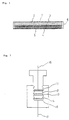
- a sheet cell comprises a positive collector plate 1, a composite positive electrode 2, a solid electrolyte 3, a negative electrode 4, a negative collector plate 5 and a sealing material 6.
- a test cell comprises a collector 11, a positive electrode 12, a solid electrolyte 13, a negative electrode 14, a collector 15, a lead wire for the positive electrode 16 and a lead wire for the negative electrode 17.
- a terminal acryloyl-modified ethylene oxide-propylene oxide random copolymer having a molecular weight of 7,290 (calculated from GPC) was prepared in the same manner as in Synthetic Example 2 except that the amounts of ethylene oxide and propylene oxide used were varied as shown in Table 1.
- a terminal acryloyl-modified propylene oxide polymer having a molecular weight of 8,970 was prepared in the same manner as in Synthetic Example 2 except that propylene oxide was used alone as the alkylene oxide as shown in Table 1.
- a terminal acryloyl-modified ethylene oxide-butylene oxide random copolymer having a molecular weight of 7,700 (calculated from GPC) was prepared in the same manner as in Synthetic Example 2 except that ethylene oxide and butylene oxide were used as the alkylene oxides as shown in Table 1.
- the solid electrolyte composition, before crosslinking, mentioned above was further applied on the positive electrode by a wire coater and crosslinked by using electron beam irradiation equipment in the same manner as mentioned above to form a solid electrolyte layer 50 ⁇ m thick.
- the above solid electrolyte layer was adhered to a metal lithium tip (50 ⁇ m thick, 12 mm diameter) and enclosed in a fluororesin cell shown in Fig. 2 to prepare a lithium cell.
- the open voltage of the cell was 3.4 V and the discharge capacity was 110 mA ⁇ h/g.
- a sheet cell of the present invention was prepared according to a procedure consisting of the following steps a) to c).
- the sheer cell comprises a positive collector plate 1 consisting of stainless steel which also serves as a housing, a composite electrode 2 comprising the solid electrolyte of the present invention, the solid electrolyte 3 of the present invention, a negative electrode 4 consisting of lithium metal, negative collector plate 5 consisting of stainless steel (which also serves as a housing), and a sealing material 6 consisting of a modified polypropylene.
- a sheet cell was prepared in the same manner as in Example 10 except that polyethylene glycol triacrylate was used instead of Compound A-1.
- the sheet cells prepared in Example 10 and Comparative Example 6 had an electrode area of 100 cm 2 .
- the initial discharge characteristics when these sheet cells were discharged at 25°C and 0.1 mA/cm 2 and the discharge characteristics after storage at 60°C for 100 days were examined.
- Fig. 3 shows the discharge characteristics immediately after preparation of the cells (initial discharge characteristics).
- Fig. 4 shows the discharge characteristics after storage at 60°C for 100 days.
- the sheet cell of Example 10 of the present invention has excellent initial discharge characteristics and discharge characteristics after storage at 60°C for 100 days as compared with the sheet cell of Comparative Example 6.
- a sheet cell was prepared according to the following procedure.
- a sheet cell was prepared in the same manner as in Example 11 except that polyethylene glycol triacrylate was used instead of Compound A-2.
- the sheet cell prepared in Example 11 and Comparative Example 7 had an electrode area of 100 cm 2 .
- a charge and discharge cycle test at a constant current was carried out at 25°C and 50 ⁇ A/cm 2 .
- the charge and discharge cycle test was carried out at a charge terminal voltage of 3.2 V and a discharge terminal voltage of 2.0 V.
- Fig. 5 shows the relationship between the charge and discharge cycle member and the capacities of the cells.
- the sheet cell of Example 11 of the present invention shows excellent charge and discharge cycle characteristics compared to the sheet cell of Comparative Example 7.
- the cell of the present invention does not show liquid leakage, which is feared when a liquid electrolyte is used, and has a high electric capacity and an excellent mechanical strength and therefore can be used with high reliability as a back-up power source for electronic equipment, a watch power source, a camera power source and a place-maker power source.
- an electrode of very high performance can be prepared by unifying a special solid electrolyte composition with the positive electrode active material to form a composite positive electrode for use as mentioned above, as it increases the actual surface area of the active material contacting with the electrolyte layer (separator) and the collector. Also the formation of lithium dendrite is prevented by using the solid electrolyte also as the electrolyte layer (separator) to give an electrolyte layer (separator) excellent in mechanical strength and thermally and electrochemically stable. Therefore, a composite electrode and an electrolyte most suitable electrochemically can be prepared and it not only improves the workability of the cell manufacturing process but also can improve the performance of the cell.
Landscapes
- Chemical & Material Sciences (AREA)
- Chemical Kinetics & Catalysis (AREA)
- General Chemical & Material Sciences (AREA)
- Electrochemistry (AREA)
- Engineering & Computer Science (AREA)
- Manufacturing & Machinery (AREA)
- Inorganic Chemistry (AREA)
- Physics & Mathematics (AREA)
- General Physics & Mathematics (AREA)
- Dispersion Chemistry (AREA)
- Condensed Matter Physics & Semiconductors (AREA)
- Secondary Cells (AREA)
- Compositions Of Macromolecular Compounds (AREA)
- Macromonomer-Based Addition Polymer (AREA)
- Primary Cells (AREA)
Abstract
Description
- The present invention relates to a galvanic cell comprising a solid polymer electrolyte of high ionic conductivity.
- Recent tendencies in microelectronics require a smaller, lighter and thinner galvanic cells having a high energy density for inclusion in electronic devices and integration with electronic elements and circuits for example as memory back-up power sources for electronic devices. Small light galvanic cells such as lithium cells have been already used in practice as primary cells. The fields of application of such cells are restricted. However, secondary galvanic cells using nonaqueous electrolytic solution enabling a reduction in size and weight have been proposed as a replacement for conventional lead cells and nickel-cadmium cells. However, no galvanic cell satisfying practical requirements, such as cycle characteristics and self-discharge characteristics of electrode active material, has hitherto been known.
- The present inventors have investigated the preparation of a thin galvanic cell, specifically a sheet cell having a thickness of 100 to 500 µm which is small and light and has a high energy density, using a thin membrane of an ionic conductive polymer. When a thin membrane of ionic conductive polymer is used problems arise, specifically the preparation of a thin membrane of metallic lithium having a quantity fully matching the membrane of ionic conductive polymer is technically difficult and accordingly manufacture of the galvanic cell becomes complex. In addition, when such a cell is used as a secondary galvanic cell, the use of metallic lithium is restricted because of the difficulties such as formation of lithium dendrite and passivation of the surface.
- Lithium metal-containing alloys such as lithium-aluminium, lithium-lead and lithium-tin alloys have been extensively investigated. However these alloys are low in strength and hence the electrode is cracked or pulverized by repeated charge and discharge.
- Selection of the electrolyte salts and improvements of the separator have been tried for preventing formation of lithium dendrite. For the purpose of preventing formation of lithium dendrite non-woven polypropylene fabrics have been laminated with non-woven glass fiber fabrics, conventionally used as separators, but to no substantial effect.
- In many research laboratories, intercalation or doping phenomenon of layer compounds have been especially investigated with a view to producing satisfactory electrode active material. Such treated layer compounds theoretically cause no complex chemical reaction during the electrochemical reaction of charge and discharge and accordingly an excellent charge-discharge cycle performance can be expected.
- A liquid electrolyte, particularly an organic electrolytic solution containing dissolved ionic compound has been generally used as electrolyte for galvanic cells utilizing electrochemical reaction and other electrochemical devices such as electric double layer capacitors and electrochromic elements. However, such a liquid electrolyte tends to leak liquid from the parts and to cause elution and evaporation of electrode material and hence problems, including lack of long-term reliability and scattering of the electrolytic solution during the sealing process, arise.
- In order to improve liquid leakage resistance and the storage stability, it is necessary to use an ionic conductive polymer having ionic conductivity, that is a solid electrolyte. However, when conventional ionic conductive polymers are used, there may be problems including complex processes of manufacturing the galvanic cell and the fact that use of metallic lithium is restricted as mentioned above. Thus, it has been difficult to provide a small light cell which has good long-term reliability and safety and also has a high performance and a high energy density.
- For example, the known solid electrolytes include a solid polymer electrolyte manufactured from a combination of a high polymer having a terminal acryloyl-modified alkylene oxide chain, a low molecular alkylene oxide copolymer, polyvinyl chloride and an electrolyte salt (Japanese Laid-Open Patent Publication No. 177409 of 1991) and a solid electrolyte manufactured from a combination of a terminal acryloyl-modified alkylene oxide chain, an inorganic ionic salt and an organic solvent such as propylene carbonate (Japanese Laid-Open Patent Publication No. 94501 of 1988). However, these electrolytes had problems in volume and mechanical strength, and a small light cell having a high energy density could not be prepared with such electrolytes.
- An object of the present invention is to provide a galvanic cell which has excellent long-term reliability and safety and also has a high performance and a high energy density though small and free of liquid leakage.
- The present inventors have carried out investigations to solve the above problems. The inventors found that a solid electrolyte which is excellent in mechanical strength and has an electric conductivity comparable with conventional electrolytes and also shows no bleed-out of solvent can be prepared by providing a terminal acryloyl-modified alkylene oxide polymer having an alkylene oxide polymer chain comprising not less than a definite number of monomer units as the polymer electrolyte, adding a solvent and a electrolyte in a specific ratio, and then crosslinking the polymer by irradiation and/or by heating. The inventors further found that a highly efficient galvanic cell can be prepared using such a solid electrolyte.
- In accordance with the present invention, there is provided a galvanic cell comprising a composite positive electrode and a negative electrode separated by a solid electrolyte, characterised in that:
- the solid electrode is prepared by dissolving a polymer in a solvent together with an electrolyte salt and crosslinking the polymer in the solution by irradiation and/or by heating to yield the polymer in solidified form and containing the electrolyte salt and the solvent;
- said polymer is a terminal acryloyl-modified
alkylene oxide polymer of the following formula:
in which R is glycerol or trimethylolpropane residue, R' is an alkyl group having 1 to 6 carbon atoms, R" is hydrogen or methyl group, and m1, m2, m3, n1, n2, and n3 are respectively 0 or an integer equal to at least 1 and the value of each of (m1 + n1), (m3 + n2) and (m3 + n3) ≥ 35, the solvent is selected from ethylene carbonate, propylene carbonate, τ-butyrolactone, dimethoxyethane, dimetholsulfoxide, dioxolane, sulfolane and water, and the amount of said solvent is 220 to 950 weight % based on said terminal acryloyl-modified alkylene oxide polymer; and the composite positive electrode is prepared by mixing a terminal acryloyl-modified alkylene oxide polymer in accordance with Formula (1), an electrolyte salt, a solvent selected from ethylene carbonate, propylene carbonate, τ-butyrolactone, dimethoxyethane, dimethylsulfoxide, dioxolane, sulfolane and water and a positive electrode active material and crosslinking the polymer in the mixture by irradiation and/or heating to yield the polymer in solidified form and containing the electrolyte salt and the solvent.

-
- The invention enables the surface area of the active material in contact with the electrolyte layer or separator and a current collector to be increased. Thus a highly efficient electrode having an improved cycle characteristic can be obtained.
- The solid electrolyte of a cell according to the invention is an ionic conductive polymer. The solid electrolyte causes the formation of lithium dendrite near the negative electrode to be prevented and provided a separator having excellent mechanical strength and which is stable both thermally and electrochemically.
- The terminal acryloyl-modified alkylene oxide polymer may be prepared by a procedure in which a compound having three active hydrogens such as glycerol or trimethylolpropane is polymerized with an alkylene oxide by ring-opening and the resultant alkylene oxide polymer is esterified with an unsaturated organic acid such as acrylic acid or methacrylic acid or subjected to a dehydrochlorinating reaction with an acid chloride such as acrylic chloride or methacrylic chloride. The terminal acryloyl-modified alkylene oxide polymer is typically represented by the following formula (2):where R is a residue of a starting material, R' is an alkyl group having 1 to 6 carbon atoms, R" is hydrogen or methyl group and m and n are respectively 0 or an integer which is at least 1 and m + n ≥ 35.

- The alkylene oxides used for the synthesis of the alkylene oxide polymer include, for example, ethylene oxide, propylene oxide, butylene oxide and 1,2-epoxyhexane, 1,2-epoxyoctane. Particularly preferred are ethylene oxide, propylene oxide and butylene oxide. The number of monomer units (monomer unit number) is required to be not less than 35 per functional polymer chain of the alkylene oxide polymer, that is, per polyalkylene oxide chain.
- If the monomer unit number is less than 35, it is difficult to crosslink by mixing the solvent in the terminal acryloyl-modified alkylene oxide polymer in an amount not less than 220 weight % based on the polymer and thus the mechanical property is poor and bleed-out of the solvent to the surface of the crosslinked product is marked.
- The solvent used for the solid electrolyte of the galvanic cell of the present invention preferably is compatible with the terminal acryloyl-modified alkylene oxide polymer. The solvent is at least one solvent selected from ethylene carbonate, propylene carbonate, γ-butyrolactone, dimethoxyethane, dimethylsulfoxide, dioxolane, sulfolane and water.
- The ratio of the solvent to the terminal acryloyl-modified alkylene oxide polymer is 220 to 950 weight %. If this ratio is lower than 220 weight %, the conductivity of the resultant solid electrolyte is low. When the ratio exceeds 950 weight %, the mechanical strength of the impregnated product is markedly lowered.
- The electrolyte salt used for the solid electrolyte of the galvanic cell of the present invention is preferably at least one salt selected from lithium fluoride, lithium chloride, lithium bromide, lithium iodide, lithium nitrate, lithium thiocyanate, lithium perchlorate, lithium trifluoromethanesulfonate, lithium tetrafluoroborate, lithium bistrifluoromethylsulfonylamide, lithium tristrifluoromethylsulfonylmethide, sodium thiocyanate, sodium perchlorate, sodium trifluoromethanesulfonate, sodium tetrafluoroborate, potassium thiocyanate, potassium perchlorate, potassium trifluoromethanesulfonate, potassium tetrafluoroborate, magnesium thiocyanate, magnesium perchlorate and magnesium trifluoromethanesulfonate. The amount of the electrolyte salt is preferably 1 to 30 weight % based on said solvent.
- The solid electrolyte used in the galvanic cell of the present invention can be prepared by a procedure in which a uniform liquid mixture containing the terminal acryloyl-modified alkylene oxide polymer, the electrolyte salt and the solvent is uniformly coated on a substrate by a knife coater, a gravure coater or a spin coater and then crosslinked by irradiation of high energy electromagnetic wave such as ultraviolet radiation, visible light or electron ray or by heating. The liquid mixture may be prepared by a procedure in which the solvent previously containing dissolved electrolyte salt is mixed uniformly with the terminal acryloyl-modified alkylene oxide polymer or by a procedure in which the solvent is mixed uniformly with the terminal acryloyl-modified alkylene oxide polymer and then the electrolyte salt is dissolved.
- To the liquid mixture, if required, a photopolymerization initiator such as trimethylsilylbenzophenone, benzoin, 2-methylbenzoin, 4-methoxybenzophenone, benzoin methyl ether or anthraquinone; and a polymerization initiator such as benzoyl peroxide or methy ethyl ketone peroxide may be added.
- As mentioned above, the composite electrode is formed by being united with the electrode active material. It is preferred that the uniform liquid mixture (solid electrolyte composition) containing the terminal acryloyl-modified alkylene oxide polymer, the electrolyte salt and the solvent is mixed with the electrode active material and the polymer is crosslinked by irradiation and/or by heating. In the procedure, carbons such as graphite, carbon black and acetylene black and electron conductive substances such as metal powders and conductive metal oxides may be also used together.
- The ratio of the solid electrolyte to the electrode active material can be selected according to the electrode active material. For example, it is preferred in a galvanic cell utilizing intercalation of a layer compound, bear the point where the ionic conductivity of the electrolyte becomes to be maximum. Also in a galvanic cell utilizing the doping phenomenon, it is required that the ion concentration in the electrolyte follows the change by charge and discharge.
- In the galvanic cell of the present invention, it is preferred that the solid electrolyte composition (or a mixture thereof with an electrode active material) is coated on the surface of the electrode material and crosslinked to form a uniform solid electrolyte layer (or a composite electrode) on the electrode surface. Any known coating means such as roll coating, doctor blade coating, spin coating, bar coating and cast coating can be applied.
- Among the positive electrode active materials used in the composite positive electrode, there are included the following cell electrode materials, group I metal compounds, e.g., CuO, Cu2O, Ag2O, CuS and CuSO4; group IV metal compounds, e.g., TiS2, SiO2 and SnO; group V metal compounds, e.g., V2O5, V6O12, VOx, Nb2O5, Bi2O3 and Sb2O3; group VI metal compounds, e.g., CrO3, Cr2O3, MoO3, WO3 and SeO2; group VII metal compounds, e.g., MnO2 and Mn2O3; group VIII metal compounds, e.g., Fe2O3, FeO, Fe3O4, Ni2O3, NiO, CoO3 and CoO; metal compounds, e.g., lithium-cobalt composite oxides and lithium-manganese composite oxides represented by the general formulae: Lix MX2 and Kix MNy X2, where M and N are respectively a metal of group I to group VIII and X is a chalcogen element such as oxygen and sulphur ; and conductive high molecular compounds and carbonaceous materials of pseudographite structure e.g., polypyrrole, polyaniline, polyparaphenylene, polyacetylene and polyacene.
- Generally used as negative electrode active materials in the negative electrode of the galvanic cell of the present invention are lithium metal and lithium metal-containing alloys such as lithium-aluminium alloy, lithium-lead, lithium-tin, lithium-aluminium-tin, lithium-gallium and Wood's metal. Alkali metals such as sodium metal and their alloys and conductive polymers capable of cationic doping such as polyacetylene and polythiophene can also be used. Such materials and metals can be used alone or in combinations of at least two.
- As the negative electrode active materials which is mixed with the solid electrolyte composition and cured to form the composite negative electrode, there may be used those exemplified as the negative electrode active material used in the negative electrode and carbonaceous materials such as carbon. Of course, they are not restricted to them and they can be used each or in combinations of at least two. It is preferred that said carbonaceous material is a carbon powder (average particle size: not less than 15µm) which is analyzed to be:
- Lattice spacing (d002):
- 3.35 to 3.40 Å
- Size of the crystallite to axis a direction:
- La ≥ 200Å
- Size of the crystallite to axis c direction:
- Le ≥ 200Å
- True density:
- 2.35 to 2.25 g/cm3
- A dispersing agent and a dispersing medium may be added in the preparation of the composite positive electrode and/or the composite negative electrode to give a uniform dispersion mixture. A thickener, a filler and an adhesion assistant can be also added.
- Furthermore, as a positive collector plate, such as material as aluminium, stainless steel, titanium or copper is preferably used, and as a negative collector plate, such as material as stainless steel, iron, nickel or copper is preferably used.
-
- Fig. 1 is a sectional view of an example of the sheet cell of the present invention;
- Fig. 2 is an outlined view of a test cell for evaluating the characteristics of the galvanic cell of the present invention;
- Fig. 3 is a diagram showing the initial discharge characteristics of the sheet cells prepared in Example 10 and Comparative Example 6 when discharged at 25°C and 0.1 mA/cm2;
- Fig. 4 is a diagram showing the initial discharge characteristics of the sheet cells prepared in Example 10 and Comparative Example 6 when discharged at 25°C and 0.1 mA/cm2 and stored at 60°C for 100 days; and
- Fig. 5 is a diagram showing the relationship between the charge-discharge cycle number of sheet cells prepared in Example 11 and Comparative Example & at 25°C and the cell capacities at 25°C.
-
- In Fig. 1, a sheet cell comprises a
positive collector plate 1, a compositepositive electrode 2, asolid electrolyte 3, anegative electrode 4, anegative collector plate 5 and a sealingmaterial 6. In Fig. 2, a test cell comprises acollector 11, apositive electrode 12, asolid electrolyte 13, anegative electrode 14, acollector 15, a lead wire for thepositive electrode 16 and a lead wire for thenegative electrode 17. - The present invention will be illustrated in more details by Examples and Comparative Examples.
- Into a 7ℓ autoclave, 92 g of glycerol (starting material), 9.5 g of potassium hydroxide (catalyst) and 4,700 g of ethylene oxide were fed and were reacted together at 130 °C for 5 hours and then neutralized and desalted to give 610 g of an ethylene oxide polymer. Its molecular weight was 4,270 (calculated from its hydroxyl number).
- Into a 2ℓ four-necked flask, 944 g (0.2 mole) of the above ethylene oxide polymer, 65 g (0.9 mole) of acrylic acid, 500 g of toluol and 2 g of concentrated sulphuric acid as catalyst were fed and reacted together under stirring while water was distilled off under reflux for 10 hours. Then the reacted composition was neutralized and desalted, and toluol was distilled off to obtain the desired terminal acryloyl-modified ethylene oxide polymer. Its molecular weight was 4,890 (calculated from GPC).
- Into a 7ℓ autoclave, 92 g of glycerol, 15.0 g of potassium hydroxide, 3,700 g of ethylene oxide and 1,240 g of propylene oxide were fed and they were reacted together at 115°C for 7 hours and then neutralized and desalted to obtain 4,990 g of an ethylene oxide-propylene oxide random copolymer. Its molecular weight was 5,020 (calculated from its hydroxyl number).
- Into a 2ℓ four-necked flask, 1,004 g (0.2 mole) of the above ethylene oxide-propylene oxide random copolymer, 65 g (0.9 mole) of acrylic acid, 500 g of toluol and 3 g of concentrated sulphuric acid as catalyst were fed and reacted together while water was distilled off under reflux for 10 hours. Thus the reacted composition was neutralized and desalted, and toluol was distilled off to obtain the desired terminal acryloyl-modified ethylene oxide-propylene oxide random copolymer. Its molecular weight was 5,180 (calculated from GPC).
- A terminal acryloyl-modified ethylene oxide-propylene oxide random copolymer having a molecular weight of 7,290 (calculated from GPC) was prepared in the same manner as in Synthetic Example 2 except that the amounts of ethylene oxide and propylene oxide used were varied as shown in Table 1.
- Into a 20ℓ autoclave, 92 g of glycerol, 46 g of potassium hydroxide, 7,950 g of ethylene oxide and 5,205 g of propylene oxide were fed, reacted together at 115°C for 10 hours, then neutralized and desalted to obtain 13,270 g of an ethylene oxide-propylene oxide random copolymer. Its molecular weight was 13,260 (calculated from its hydroxyl number).
- Into a 3ℓ four-necked flask, 1.326 g (0.1 mole) of the above ethylene oxide-propylene oxide random copolymer, 32.5 g (0.45 mole) of acrylic acid, 1000 g of toluol and 10 g of paratoluenesulfonic acid as the catalyst were fed and reacted together under stirring for 12 hours while water was distilled off under reflux. Then the reacted composition was neutralized and desalted, and toluol was distilled off to obtain the desired terminal acryloyl-modified ethylene oxide-propylene oxide random copolymer. Its molecular weight was 13,420 (calculated from GPC).
- Into a 20ℓ autoclave, 92 g of glycerol, 51 g of potassium hydroxide, 3.980 g of ethylene oxide and 10,500 g of propylene oxide were fed, reacted together at 115°C for 12 hours, and then neutralized and desalted to obtain 14,500 g of an ethylene oxide-propylene oxide random copolymer. Its molecular weight was 14,520 (calculated from its hydroxyl number).
- Into a 3ℓ four-necked flask, 1,452 g (0.1 mole) of the above ethylene oxide-propylene oxide random copolymer, 32.5 g (0.45 mole) of acrylic acid, 1000 g of toluol and 10 g of paratoluenesulfonic acid were fed and reacted together under stirring for 10 hours while water was distilled off under refluxing. Then the reacted composition was neutralized and desalted, and toluol was distilled off to obtain the desired terminal acryloyl-modified ethylene oxide-propylene oxide random copolymer. Its molecular weight was 14,680 (calculated from GPC).
- Into a 30ℓ autoclave, 134 g of trimethylolpropane (starting material), 68 g of potassium hydroxide and 10,600 g of ethylene oxide were fed and reacted together at 140°C for 11 hours. Thus, 8,800 g of propylene oxide was added and the mixture was further reacted together at 110°C for 15 hours, then neutralized and desalted to obtain 19,500 g of an ethylene oxide-propylene oxide block copolymer. Its molecular weight was 19,420 (calculated from its hydroxyl number).
- Into a 3ℓ four-necked flask, 1,942 g (0.1 mole) of the above ethylene oxide-propylene oxide block copolymer, 39 g (0.45 mole) of methacrylic acid, 1,200 g of toluol and 20 g of paratoluenesulfonic acid as catalyst were fed and reacted together under stirring for 10 hours while water was distilled off under reflux. Then the reacted composition was neutralized and desalted, and toluol was distilled off to obtain the desired terminal acryloyl-modified ethylene oxide-propylene oxide block copolymer. Its molecular weight was 19,630 (calculated from GPC).
- A terminal acryloyl-modified propylene oxide polymer having a molecular weight of 8,970 (calculated from GPC) was prepared in the same manner as in Synthetic Example 2 except that propylene oxide was used alone as the alkylene oxide as shown in Table 1.
- Into a 20ℓ autoclave, 134 g of trimethylolpropane (starting material), 48 g of potassium hydroxide and 11,900 g of butylene oxide were fed and reacted together at 120°C for 18 hours. Then, the mixture was neutralized and desalted to obtain 12,000 g of a butylene oxide polymer. Its molecular weight was 12,030 (calculated from its hydroxyl number).
- Into a 3ℓ four-necked flask, 1,203 g (0.1 mole) of the above butylene oxide-propylene oxide block copolymer, 33 g (0.46 mole) of acrylic acid, 1,500 g of toluol and 30 g of paratoluenesulfonic acid as catalyst were fed and reacted together under stirring for 10 hours while water was distilled off under reflux. Then the reacted composition was neutralized and desalted, and toluol was distilled off to obtain the desired terminal acryloyl-modified butylene oxide polymer. Its molecular weight was 12,200 (calculated from GPC).
- A terminal acryloyl-modified ethylene oxide-butylene oxide random copolymer having a molecular weight of 7,700 (calculated from GPC) was prepared in the same manner as in Synthetic Example 2 except that ethylene oxide and butylene oxide were used as the alkylene oxides as shown in Table 1.
- Into a 10ℓ autoclave, 92 g of glycerol, 24 g of potassium hydroxide, 6,970 g of propylene oxide and 1,100 g of butylene oxide were fed and reacted together at 110°C for 15 hours. After the reaction has been completed, the mixture was neutralized and desalted to obtain 8,100 g of a propylene oxide-butylene oxide random copolymer. Its molecular weight was 8,145 (calculated from its hydroxyl number).
- Into a 3ℓ four-necked flask, 814.5 g (0.1 mole) of the above propylene oxide-butylene oxide random copolymer, 39 g (0.45 mole) of methacrylic acid, 1,000 g of toluol and 5 g of sulphuric acid as catalyst were fed and reacted together under stirring for 10 hours while water was distilled off under reflux. Then the reacted composition was neutralized and desalted, and toluol was distilled off to obtain the desired terminal methacryloyl-modified propylene oxide-butylene oxide random copolymer. Its molecular weight was 8,360 (calculated from GPC).
- Into a 5ℓ autoclave, 92 g of glycerol, 11 g of potassium hydroxide, 2,600 g of ethylene oxide and 870 g of propylene oxide were fed and reacted together at 115°C for 8 hours. Then, the mixture was neutralized and desalted to obtain 3,580 g of an ethylene oxide-propylene oxide random copolymer. Its molecular weight was 3,600 (calculated from its hydroxyl number).
- Into a 2ℓ four-necked flask, 720 g (0.2 mole) of the above ethylene oxide-propylene oxide random copolymer, 65 g (0.9 mole) of acrylic acid, 1,000 g of toluol and 5 g of paratoluenesulfonic acid as catalyst were fed and reacted together under stirring for 10 hours while water was distilled off under reflux. Then the reacted composition was neutralized and desalted, and toluol was distilled off to obtain the desired terminal acryloylmodified ethylene oxide-propylene oxide random copolymer. Its molecular weight was 3,760 (calculated from GPC).
- Into a 5ℓ autoclave, 134 g of trimethylolpropane, 5.4 g of potassium hydroxide, 1,320 g of ethylene oxide and 350 g of propylene oxide were fed and reacted together at 115°C for 5 hours. Then, the mixture was neutralized and desalted to obtain 1,790 g of an ethylene oxide-propylene oxide random copolymer. Its molecular weight was 1,800 (calculated from its hydroxyl number).
- Into a 3ℓ four-necked flask, 900 g (0.5 mole) of the above ethylene oxide-propylene oxide random copolymer, 162 g (2.25 mole) of acrylic acid, 1,000 g of toluol and 5 g of paratoluenesulfonic acid as catalyst were fed and reacted together under stirring for 10 hours while water was distilled off under reflux. Then the reacted composition was neutralized and desalted, and toluol was distilled off to obtain the desired terminal acryloyl-modified ethylene oxide-propylene oxide random copolymer. Its molecular weight was 1,960 (calculated from GPC).
- Into a 10ℓ autoclave, 92 g of glycerol, 20 g of potassium hydroxide, 1,352 g of ethylene oxide and 4,330 g of butylene oxide were fed and reacted together at 115°C for 11 hours. Then, the mixture was neutralized and desalted to obtain 5,730 g of ethylene oxide-butylene oxide random copolymer. Its molecular weight was 5,740 (calculated from its hydroxyl number).
- Into a 2ℓ four-necked flask, 574 g (0.1 mole) of the above ethylene oxide-butylene oxide random copolymer, 39 g (0.45 mole) of methacrylic acid, 1,000 g of toluol and 5 g of sulphuric acid as catalyst were fed and reacted together under stirring for 10 hours while water was distilled off under reflux. Then the reacted composition was neutralized and desalted, and toluol was distilled off to obtain the desired terminal methacryloyl-modified ethylene oxide-butylene oxide random copolymer. Its molecular weight was 5,930 (calculated from GPC).
- The constitutions of the terminal acryloyl-modified alkylene oxide polymers prepared in the respective Synthetic Examples are shown in Table 1.
Compound Starting material Monomer Monomer arrangement Terminal acryloyl group M.W. EO PO BO 1 ○ 2 ○ A-1 G 35 ― ― H A 4,720 4,980 A-2 G 28 7 ― R A 5,020 5,180 A-3 G 40 10 ― R A 7,130 7,290 A-4 G 60 30 ― R A 13,260 13,420 A-5 G 30 60 ― R A 14,520 1,420 A-6 T 80 50 ― B M 19,420 19,630 A-7 G ― 50 ― H A 8,810 8,970 A-8 T ― ― 55 H A 12,030 12,200 A-9 G 40 ― 10 R A 7,540 7,700 A-10 G ― 40 5 R M 8,145 8,360 B-1 G 20 5 ― R A 3,600 3,760 B-2 T 10 2 ― R A 1,800 1,960 B-3 G 10 ― 20 R M 5,740 5,930 - Into a 1ℓ four-necked flask equipped with a stirrer, a thermometer, a cooling tube and a dropping funnel, 20 g of aniline, 18 ml of hydrochloric acid and 250 ml of water were added. They were cooled to 0°C and then a solution prepared by dissolving 49 g of ammonium sulphate in 120 g of water was dropped from a dropping funnel over 4 hours. Then the mixture was further stirred for 1 hour. The resulting precipitate was filtered and washed with water until the washing becomes neutral and then washed with ethanol until the washing became transparent. the washed product was dried in vacuo to give 10.2 g of dedoped polyaniline. 10 g of the dedoped polyaniline was dissolved in 300 g of N-methyl-2-pyrrolidone and reduced by adding 2 g of phenylhydrazine. After the reaction has been completed, the reaction product was precipitated from acetone and the deposited solid was filtered and washed with acetone and dried to give 8.0 g of grey positive electrode active material (referred to as "reduced polyaniline").
- 8 g of reduced polyaniline was used as positive electrode active material. To it, 2 g of a solid electrolyte composition, before crosslinking, comprising 1 part by weight of the terminal acryloyl-modified ethylene oxide polymer (Compound A-1), 4 parts by weight of propylene carbonate and 0.4 part by weight of lithium perchlorate and 2 g of carbon blank (Ketchen Black EC600J) were added, and the mixture was pulverized and mixed well in a ball under a nitrogen atmosphere and then spread on a
stainless steel plate 2 µm thick and 12 mm diameter and crosslinked by using electrocurtain electron beam irradiation equipment (Output: 200 KV, Exposure: 5 Mrad) to prepare a positive electrode 30 µm thick. The solid electrolyte composition, before crosslinking, mentioned above was further applied on the positive electrode by a wire coater and crosslinked by using electron beam irradiation equipment in the same manner as mentioned above to form asolid electrolyte layer 50 µm thick. - Then, the above solid electrolyte layer was adhered to a metal lithium tip (50 µm thick, 12 mm diameter) and enclosed in a fluororesin cell shown in Fig. 2 to prepare a lithium cell. As the result of the measurement, the open voltage of the cell was 3.4 V and the discharge capacity was 110 mA · h/g. These characteristics are comparable with the existing lithium cell using a liquid electrolyte.
- Cells were prepared in the same manner as in Example 1 except that the compositions of the solid electrolyte were varied as shown in Table 2. The characteristics of the resultant cells are shown in Table 2.
Sample Composition of solid electrolyte before crosslinking (g) Initial characteristics Comoound Solvent Electrolyte salt Open voltage ( V ) Discharge capacity ( mA · h/g ) Examples 2 A-2 (1) PC (6) LiClO4 (1.1) 3.5 120 3 A-3 (1) PC/DME(2/4) LiBF4 (2.0) 3.6 125 4 A-4 (1) GBL (9) LiSCN (0.9) 3.4 120 5 A-5 (1) PC (2.5) LiClO4(0.2) 3.3 121 6 A-6 (1) PC (9.5) LiCF3SO3(2.1) 3.4 130 7 A-7 (1) EC (5) LiClO4(0.5) 3.5 124 8 A-8 (1) SL (2.5) LiClO4(0.2) 3.1 122 9 A-9 (1) EC (4) LiClO4(0.6) 3.5 124 Comparative Example 1 A-1 (1) PC (1) LiClO4(0.1) 3.0 40 2 A-2 (1) PC (2) LiClO4(0.1) 3.1 38 - An attempt was made to prepare a positive electrode in the same manner as in Example 1 except that Compound B-1 was used instead of Compound A-1. However, the compound could not be completely crosslinked. Crosslinking was attempted using the solid electrolyte composition before crosslinking alone, but the resulting composition was not a solid electrolyte and no cell could be prepared from it.
- An attempt was made to prepare a positive electrode in the same manner as in Example 1 except that Compound B2 was used instead of Compound A-1 and the amount of propylene carbonate used was 3 parts by weight. The same result as in Comparative Example 3 was obtained.
- An attempt was made to prepare a cell in the same manner as in Example 1 except that Compound B-3 was used instead of Compound A-1 and the amount of propylene carbonate used was 3 parts by weight. However, liquid leakage from the cell was observed and no cell of practical utility could be prepared.
- A sheet cell of the present invention was prepared according to a procedure consisting of the following steps a) to c).
- a) A mixture X of manganese dioxide (positive electrode active material) and acetylene black (conductor) in a ratio of 85:15 (by weight) and a mixture Y of Compound A-3, lithium perchlorate, propylene carbonate and azobisisobutyronitrile in a ratio of 10:1:25:0.05 (by weight) were prepared. The mixtures were mixed together under dry inert gas atmosphere in a ratio of 10:3 (by weight). Then, this mixture was cast-coated on a collector prepared by forming a conductive carbon film on the surface of a positive collector plate comprising stainless steel and cured by being stood at 100°C for 1 hour to obtain a composite positive electrode. The thickness of the composite positive electrode film formed on the positive collector plate was 60 µm
- b) Lithium metal was used as the negative electrode active material and it was pressed onto a negative collector plate consisting of stainless steel. Then, on the lithium metal, a mixture of Compound A-3, lithium perchlorate, propylene carbonate and azobisisobutyronitrile in a ratio of 30:3:150:0.5 (by weight) was cast-coated and cured by being stood at 100°C for 1 hour under a dry inert gas atmosphere. The thickness of the solid electrolyte thus prepared was 20 µm.
- c) The solid electrolyte/lithium/negative collector plate prepared in step b) was contacted with the positive collector plate/composite positive electrode prepared in step a) to give a sheet cell as shown in Fig. 1.
-
- In Fig. 1, the sheer cell comprises a
positive collector plate 1 consisting of stainless steel which also serves as a housing, acomposite electrode 2 comprising the solid electrolyte of the present invention, thesolid electrolyte 3 of the present invention, anegative electrode 4 consisting of lithium metal,negative collector plate 5 consisting of stainless steel (which also serves as a housing), and a sealingmaterial 6 consisting of a modified polypropylene. - A sheet cell was prepared in the same manner as in Example 10 except that polyethylene glycol triacrylate was used instead of Compound A-1.
- The sheet cells prepared in Example 10 and Comparative Example 6 had an electrode area of 100 cm2. The initial discharge characteristics when these sheet cells were discharged at 25°C and 0.1 mA/cm2 and the discharge characteristics after storage at 60°C for 100 days were examined. Fig. 3 shows the discharge characteristics immediately after preparation of the cells (initial discharge characteristics). Fig. 4 shows the discharge characteristics after storage at 60°C for 100 days.
- As apparent from the results of Figs. 3 and 4, the sheet cell of Example 10 of the present invention has excellent initial discharge characteristics and discharge characteristics after storage at 60°C for 100 days as compared with the sheet cell of Comparative Example 6.
- A sheet cell was prepared according to the following procedure.
- a) A mixture of vanadium pentoxide (positive electrode active material) and acetylene black (conductor) in a ratio of 85:15 (by weight) and a mixture Y of Compound A-4, lithium hexafluoroarsenate, ethylene carbonate and 2-methyltetrahydrofuran in a ratio of 10:1:10:30 (by weight) were prepared and these mixtures were mixed together in a ratio of 10:3 under a dry inert gas atmosphere. Then, the resultant mixture was cast-coated on a collector prepared by forming a conductive carbon film on the surface of a positive collector plate and then cured by being stood at 100°C for 1 hour under a dry inert gas atmosphere. The thickness of the composite positive electrode film formed on the positive collector plate was 60µm.
- b) Lithium metal was used as the negative electrode active material of the cell and it was pressed onto a negative collector plate consisting of stainless steel. Then, on the lithium metal, a mixture of Compound A-4, lithium hexafluoroarsenate, ethylene carbonate and 2-methyltetrahydrofuran in a ratio of 30:6:30:60 (by weight) was cast-coated and cured by being stood at 100°C for 1 hour under a dry inert gas atmosphere. The thickness of the solid electrolyte thus prepared was 20µm.
- c) A sheet cell similar to that in Example 10 was prepared by contacting the solid electrolyte/lithium/negative collector plate prepared in step b) with the positive collector plate/composite positive electrode prepared in step a).
-
- A sheet cell was prepared in the same manner as in Example 11 except that polyethylene glycol triacrylate was used instead of Compound A-2.
- The sheet cell prepared in Example 11 and Comparative Example 7 had an electrode area of 100 cm2. Using the sheet cells, a charge and discharge cycle test at a constant current was carried out at 25°C and 50 µA/cm2. The charge and discharge cycle test was carried out at a charge terminal voltage of 3.2 V and a discharge terminal voltage of 2.0 V. Fig. 5 shows the relationship between the charge and discharge cycle member and the capacities of the cells.
- As apparent from the result of Fig. 5, the sheet cell of Example 11 of the present invention shows excellent charge and discharge cycle characteristics compared to the sheet cell of Comparative Example 7.
- The cell of the present invention does not show liquid leakage, which is feared when a liquid electrolyte is used, and has a high electric capacity and an excellent mechanical strength and therefore can be used with high reliability as a back-up power source for electronic equipment, a watch power source, a camera power source and a place-maker power source.
- In the present invention, an electrode of very high performance can be prepared by unifying a special solid electrolyte composition with the positive electrode active material to form a composite positive electrode for use as mentioned above, as it increases the actual surface area of the active material contacting with the electrolyte layer (separator) and the collector. Also the formation of lithium dendrite is prevented by using the solid electrolyte also as the electrolyte layer (separator) to give an electrolyte layer (separator) excellent in mechanical strength and thermally and electrochemically stable. Therefore, a composite electrode and an electrolyte most suitable electrochemically can be prepared and it not only improves the workability of the cell manufacturing process but also can improve the performance of the cell.
Claims (6)
- A galvanic cell comprising a composite positive electrode and a negative electrode separated by a solid electrolyte, characterised in that:the solid electrolyte is prepared by dissolving a polymer in a solvent together with an electrolyte salt and crosslinking the polymer in the solution by irradiation and/or by heating to yield the polymer in solidified form and containing the electrolyte salt and the solvent;said polymer is a terminal acryloyl-modified alkylene oxide polymer of the following formula:in which R is glycerol or trimethylolpropane residue, R' is an alkyl group having 1 to 6 carbon atoms, R" is hydrogen or methyl group, and m1, m2, m3, n1, n2, and n3 are respectively 0 or an integer equal to at least 1 and the value of each of (m1 + n1), (m2 + n2) and (n3 + n3) ≥ 35, the solvent is selected from ethylene carbonate, propylene carbonate, τ-butyrolactone, dimethoxyethane, dimetholsulfoxide, dioxolane, sulfolane and water, and the amount of said solvent is 220 to 950 weight % based on said terminal acryloyl-modified alkylene oxide polymer; and the composite positive electrode is prepared by mixing a terminal acryloyl-modified alkylene oxide polymer in accordance with Formula (1), an electrolyte salt, a solvent selected from ethylene carbonate, propylene carbonate, γ-butyrolactone, and water and a positive electrode active material and crosslinking the polymer in the mixture by irradiation and/or heating to yield the polymer in solidified form and containing the electrolyte salt and the solvent.
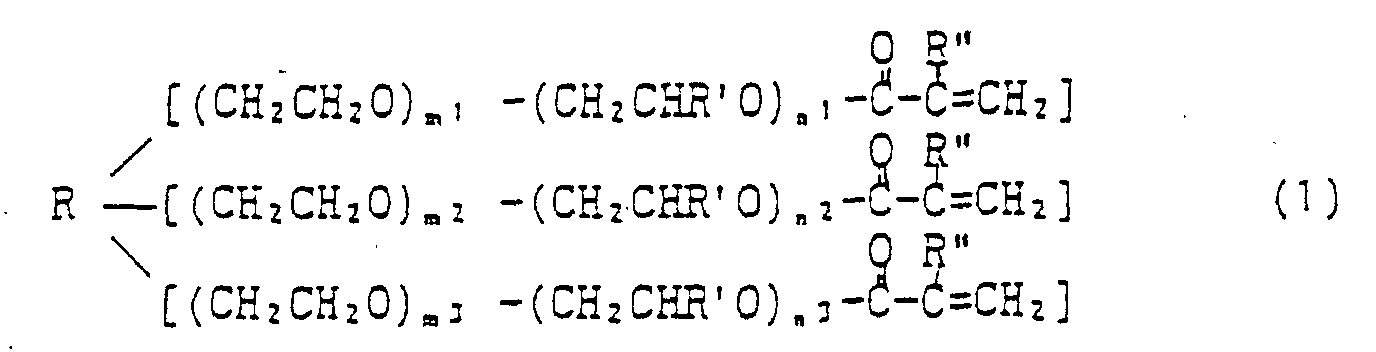
- A galvanic cell according to Claim 1, in which a conductive material is comprised in said composite positive electrode.
- A galvanic cell according to Claim 1 or 2, in which said negative electrode is a composite electrode containing a solid electrolyte prepared by mixing a terminal acryloyl-modified alkylene oxide polymer in accordance with Formula (1), an electrolyte salt and a solvent and crosslinking the polymer in the mixture by irradiation and/or by heating to yield the polymer in solidified form and containing the electrolyte salt and the solvent.
- A galvanic cell according to claim 3, in which a conductive material is comprised in said composite negative electrode.
- A galvanic cell according to any preceding claim, in which said electrolyte salt is at least one salt selected from lithium fluoride, lithium chloride, lithium bromide, lithium iodide, lithium nitrate, lithium thiocyanate, lithium perchlorate, lithium trifluoromethanesulfonate, lithium tetrafluoroborate, lithium bistrifluoromethylsulfonylamide, lithium tristrifluoromethylsulfonylmethide, sodium thiocyanate, sodium perchlorate, sodium trifluoromethanesulfonate, sodium tetrafluoroborate, potassium thiocyanate, potassium perchlorate, potassium trifluoromethanesulfonate, potassium tetrafluoroborate, magnesium thiocyanate, magnesium perchlorate and magnesium trifluoromethane-sulfonate.
- A galvanic cell according to any preceding claim, in which said electrolyte salt is used in a ratio of 1 to 35 weight % based on said solvent.
Applications Claiming Priority (4)
| Application Number | Priority Date | Filing Date | Title |
|---|---|---|---|
| JP3145192 | 1992-01-21 | ||
| JP31451/92 | 1992-01-21 | ||
| JP4031451A JPH05198303A (en) | 1992-01-21 | 1992-01-21 | Battery |
| PCT/JP1993/000064 WO1993014529A1 (en) | 1992-01-21 | 1993-01-20 | Cell |
Publications (3)
| Publication Number | Publication Date |
|---|---|
| EP0576686A1 EP0576686A1 (en) | 1994-01-05 |
| EP0576686A4 EP0576686A4 (en) | 1995-04-26 |
| EP0576686B1 true EP0576686B1 (en) | 2001-10-10 |
Family
ID=12331622
Family Applications (1)
| Application Number | Title | Priority Date | Filing Date |
|---|---|---|---|
| EP93902505A Expired - Lifetime EP0576686B1 (en) | 1992-01-21 | 1993-01-20 | Cell |
Country Status (6)
| Country | Link |
|---|---|
| US (1) | US5436090A (en) |
| EP (1) | EP0576686B1 (en) |
| JP (1) | JPH05198303A (en) |
| CA (1) | CA2106205C (en) |
| DE (1) | DE69330893T2 (en) |
| WO (1) | WO1993014529A1 (en) |
Families Citing this family (27)
| Publication number | Priority date | Publication date | Assignee | Title |
|---|---|---|---|---|
| JP3149247B2 (en) * | 1992-01-24 | 2001-03-26 | 第一工業製薬株式会社 | Ion conductive polymer electrolyte |
| US5665490A (en) * | 1993-06-03 | 1997-09-09 | Showa Denko K.K. | Solid polymer electrolyte, battery and solid-state electric double layer capacitor using the same as well as processes for the manufacture thereof |
| EP0649153B1 (en) * | 1993-10-19 | 1999-05-26 | Matsushita Electric Industrial Co., Ltd. | Ion-conductive polymer electrolyte and electrolytic capacitor using the same |
| DE69409936T2 (en) * | 1993-12-29 | 1998-12-10 | Tdk Corp., Tokio/Tokyo | Lithium secondary cell |
| JP3599859B2 (en) * | 1994-12-29 | 2004-12-08 | 石原産業株式会社 | Porous substance-polymer solid electrolyte composite, method for producing the same, and photoelectric conversion element using the same |
| TW318288B (en) * | 1995-02-21 | 1997-10-21 | Showa Denko Kk | |
| JP3394125B2 (en) * | 1995-11-28 | 2003-04-07 | 松下電器産業株式会社 | Non-aqueous electrolyte secondary battery |
| DE19612769A1 (en) | 1996-03-29 | 1997-10-02 | Basf Ag | Mixtures suitable as carrier material for solid electrolytes or separators for electrochemical cells |
| US5897974A (en) * | 1996-07-23 | 1999-04-27 | Rohm And Haas Company | Solid polymer electrolyte |
| JP3729610B2 (en) * | 1996-08-19 | 2005-12-21 | 株式会社デンソー | Flame retardant solid electrolyte |
| US6399254B1 (en) * | 1997-05-23 | 2002-06-04 | Dai-Ichi Kogyo Seiyaku Co., Ltd. | Solid electrolyte |
| JP3104127B2 (en) * | 1997-05-23 | 2000-10-30 | 第一工業製薬株式会社 | Solid electrolyte |
| EP1023746A1 (en) | 1997-10-02 | 2000-08-02 | Basf Aktiengesellschaft | Mixtures with special softening agents suited as a solid electrolyte or separator for electrochemical cells |
| JP4005192B2 (en) * | 1997-12-09 | 2007-11-07 | 第一工業製薬株式会社 | Solid battery |
| WO2000012172A1 (en) * | 1998-08-31 | 2000-03-09 | Birch Point Medical Inc. | Controlled dosage drug delivery system |
| JP3951039B2 (en) * | 1998-09-22 | 2007-08-01 | 第一工業製薬株式会社 | Solid electrolyte and method for producing the same |
| SE516891C2 (en) * | 1999-06-14 | 2002-03-19 | Ericsson Telefon Ab L M | Binder and / or electrolyte material for an electrode in a battery cell, electrode for a battery cell, and process for producing a binder and / or electrolyte material for an electrode |
| US6421561B1 (en) * | 1999-12-30 | 2002-07-16 | Birch Point Medical, Inc. | Rate adjustable drug delivery system |
| CA2367290A1 (en) * | 2002-01-16 | 2003-07-16 | Hydro Quebec | High stability polymer electrolyte > 4 volts as electrolyte for a hybrid supercondenser and electrochemical generator |
| DE10214035A1 (en) * | 2002-03-27 | 2003-10-09 | Mettler Toledo Gmbh | Polymer electrolyte, half cell for electrochemical measurements and their use |
| JP2005019064A (en) * | 2003-06-24 | 2005-01-20 | Canon Inc | Ionic conduction structure, secondary battery and method for producing them |
| JP4631689B2 (en) * | 2005-12-14 | 2011-02-16 | ダイキン工業株式会社 | Ionic conductor |
| WO2012132807A1 (en) * | 2011-03-31 | 2012-10-04 | 日産化学工業株式会社 | Gel electrolyte |
| EP2736094B1 (en) * | 2012-11-22 | 2016-06-29 | Samsung SDI Co., Ltd. | Positive active material layer for rechargeable lithium battery, separator for rechargeable lithium battery, and rechargeable lithium battery including at least one of the same |
| EP2889339B1 (en) * | 2013-12-24 | 2016-08-10 | ESSILOR INTERNATIONAL (Compagnie Générale d'Optique) | Optical article comprising an electrically conductive layer, and production method |
| US10752515B2 (en) | 2015-03-23 | 2020-08-25 | Council Of Scientific & Industrial Research | Lithium-substituted magnesium ferrite material based hydroelectric cell and process for preparation thereof |
| CN108140883B (en) | 2016-03-30 | 2021-01-29 | 株式会社Lg化学 | Solid polymer electrolyte and method for preparing same |
Family Cites Families (18)
| Publication number | Priority date | Publication date | Assignee | Title |
|---|---|---|---|---|
| JPS6394501A (en) * | 1986-10-09 | 1988-04-25 | 宇部興産株式会社 | Manufacture of ion conducting solid electrolytic shield |
| JPS63181259A (en) * | 1987-01-23 | 1988-07-26 | Ube Ind Ltd | Manufacturing method of positive electrode body for batteries |
| JPS6394563A (en) * | 1986-10-09 | 1988-04-25 | Ube Ind Ltd | solid electrolyte battery |
| US4908283A (en) * | 1986-10-09 | 1990-03-13 | Ube Industries, Ltd. | Preparation of ion conductive solid electrolyte |
| JPS63164176A (en) * | 1986-12-25 | 1988-07-07 | Mitsubishi Heavy Ind Ltd | Organic secondary cell |
| JP2817923B2 (en) * | 1987-10-30 | 1998-10-30 | デヴァーズ・エムエス・カンパニー | Solid state battery |
| US5238758A (en) * | 1987-10-30 | 1993-08-24 | Mhb Joint Venture | Badiation cured solid electrolytes and electrochemical devices employing the same |
| JPH01169873A (en) * | 1987-12-25 | 1989-07-05 | Ube Ind Ltd | battery |
| JPH01169807A (en) * | 1987-12-25 | 1989-07-05 | Ube Ind Ltd | Polymer solid electrolyte |
| JPH01169875A (en) * | 1987-12-25 | 1989-07-05 | Ube Ind Ltd | Cell |
| US4925751A (en) * | 1989-04-26 | 1990-05-15 | Shackle Dale R | High power solid state electrochemical laminar cell |
| JPH03139552A (en) * | 1989-10-24 | 1991-06-13 | Ube Ind Ltd | Ion conductive solid electrolyte |
| JP2543996B2 (en) * | 1989-12-06 | 1996-10-16 | 日本石油株式会社 | Polymer solid electrolyte |
| JPH0832752B2 (en) * | 1989-12-15 | 1996-03-29 | 株式会社ユアサコーポレーション | Polymer solid electrolyte |
| JPH03238771A (en) * | 1990-02-16 | 1991-10-24 | Toyo Ink Mfg Co Ltd | Thin type cell |
| JP2813834B2 (en) * | 1990-05-31 | 1998-10-22 | 第一工業製薬株式会社 | Ion conductive polymer electrolyte |
| JP2987474B2 (en) * | 1991-10-15 | 1999-12-06 | 第一工業製薬株式会社 | Solid electrolyte |
| IT1254941B (en) * | 1992-04-28 | 1995-10-11 | Eniricerche Spa | POLYETEREA-BASED SOLID POLYMER ELECTROLYTE |
-
1992
- 1992-01-21 JP JP4031451A patent/JPH05198303A/en active Pending
-
1993
- 1993-01-20 WO PCT/JP1993/000064 patent/WO1993014529A1/en not_active Ceased
- 1993-01-20 US US08/119,214 patent/US5436090A/en not_active Expired - Lifetime
- 1993-01-20 EP EP93902505A patent/EP0576686B1/en not_active Expired - Lifetime
- 1993-01-20 CA CA002106205A patent/CA2106205C/en not_active Expired - Lifetime
- 1993-01-20 DE DE69330893T patent/DE69330893T2/en not_active Expired - Lifetime
Also Published As
| Publication number | Publication date |
|---|---|
| CA2106205A1 (en) | 1993-07-22 |
| EP0576686A1 (en) | 1994-01-05 |
| EP0576686A4 (en) | 1995-04-26 |
| DE69330893D1 (en) | 2001-11-15 |
| JPH05198303A (en) | 1993-08-06 |
| US5436090A (en) | 1995-07-25 |
| DE69330893T2 (en) | 2002-06-13 |
| WO1993014529A1 (en) | 1993-07-22 |
| CA2106205C (en) | 1999-12-14 |
Similar Documents
| Publication | Publication Date | Title |
|---|---|---|
| EP0576686B1 (en) | Cell | |
| US6174621B1 (en) | Electroactive high storage capacity polyacetylene-co-polysulfur materials and electrolytic cells containing same | |
| US5437943A (en) | Positive electrode and secondary battery using the same | |
| US5523179A (en) | Rechargeable positive electrode | |
| KR100332080B1 (en) | Solid electrolyte and battery | |
| US5529860A (en) | Electroactive high storage capacity polyacetylene-co-polysulfur materials and electrolytic cells containing same | |
| US5601947A (en) | Electroactive high storage capacity polycarbon-sulfide materials and electrolytic cells containing same | |
| US4803137A (en) | Non-aqueous electrolyte secondary cell | |
| US5900336A (en) | Negative electrode for lithium secondary battery and lithium secondary battery using the negative electrode | |
| US4717634A (en) | Electric cells utilizing polyaniline as a positive electrode active material | |
| EP0347952A2 (en) | Negative electrodes for non-aqueous secondary batteries composed of sodium alloy | |
| US4472487A (en) | Battery having polymeric anode coated with reaction product of oxirane compound | |
| US4753858A (en) | Rechargeable sodium alloy anode | |
| EP0580865B1 (en) | Secondary battery | |
| JP3290229B2 (en) | Battery | |
| DE69803024T2 (en) | Non-aqueous secondary battery | |
| US5168020A (en) | Rechargeable sodium alloy anode | |
| DE69604898T2 (en) | SOLID POLYMER ELECTROLYTE, BATTERY AND SOLID DOUBLE LAYER CAPACITOR USING THEM AND METHOD FOR THE PRODUCTION THEREOF | |
| WO1991006132A1 (en) | Cell for making secondary batteries | |
| JP2504428B2 (en) | Secondary battery | |
| JP3306150B2 (en) | Ion conductive polymer electrolyte | |
| EP0643434B1 (en) | Method of cell manufacture | |
| JP3496287B2 (en) | Battery using ion-conductive polymer compound | |
| JP3298960B2 (en) | Battery | |
| US6309778B1 (en) | Electroactive high storage capacity polyacetylene-co-polysulfur materials and electrolytic cells containing same |
Legal Events
| Date | Code | Title | Description |
|---|---|---|---|
| PUAI | Public reference made under article 153(3) epc to a published international application that has entered the european phase |
Free format text: ORIGINAL CODE: 0009012 |
|
| 17P | Request for examination filed |
Effective date: 19931006 |
|
| AK | Designated contracting states |
Kind code of ref document: A1 Designated state(s): DE FR GB |
|
| A4 | Supplementary search report drawn up and despatched |
Effective date: 19950313 |
|
| AK | Designated contracting states |
Kind code of ref document: A4 Designated state(s): DE FR GB |
|
| 17Q | First examination report despatched |
Effective date: 19950707 |
|
| GRAG | Despatch of communication of intention to grant |
Free format text: ORIGINAL CODE: EPIDOS AGRA |
|
| 17Q | First examination report despatched |
Effective date: 19950707 |
|
| GRAG | Despatch of communication of intention to grant |
Free format text: ORIGINAL CODE: EPIDOS AGRA |
|
| GRAG | Despatch of communication of intention to grant |
Free format text: ORIGINAL CODE: EPIDOS AGRA |
|
| GRAG | Despatch of communication of intention to grant |
Free format text: ORIGINAL CODE: EPIDOS AGRA |
|
| GRAG | Despatch of communication of intention to grant |
Free format text: ORIGINAL CODE: EPIDOS AGRA |
|
| GRAH | Despatch of communication of intention to grant a patent |
Free format text: ORIGINAL CODE: EPIDOS IGRA |
|
| GRAH | Despatch of communication of intention to grant a patent |
Free format text: ORIGINAL CODE: EPIDOS IGRA |
|
| GRAA | (expected) grant |
Free format text: ORIGINAL CODE: 0009210 |
|
| AK | Designated contracting states |
Kind code of ref document: B1 Designated state(s): DE FR GB |
|
| REF | Corresponds to: |
Ref document number: 69330893 Country of ref document: DE Date of ref document: 20011115 |
|
| REG | Reference to a national code |
Ref country code: GB Ref legal event code: IF02 |
|
| ET | Fr: translation filed | ||
| PLBE | No opposition filed within time limit |
Free format text: ORIGINAL CODE: 0009261 |
|
| STAA | Information on the status of an ep patent application or granted ep patent |
Free format text: STATUS: NO OPPOSITION FILED WITHIN TIME LIMIT |
|
| 26N | No opposition filed | ||
| REG | Reference to a national code |
Ref country code: GB Ref legal event code: 732E |
|
| REG | Reference to a national code |
Ref country code: FR Ref legal event code: TQ |
|
| PGFP | Annual fee paid to national office [announced via postgrant information from national office to epo] |
Ref country code: FR Payment date: 20120206 Year of fee payment: 20 |
|
| PGFP | Annual fee paid to national office [announced via postgrant information from national office to epo] |
Ref country code: DE Payment date: 20120123 Year of fee payment: 20 |
|
| PGFP | Annual fee paid to national office [announced via postgrant information from national office to epo] |
Ref country code: GB Payment date: 20120120 Year of fee payment: 20 |
|
| REG | Reference to a national code |
Ref country code: DE Ref legal event code: R071 Ref document number: 69330893 Country of ref document: DE |
|
| REG | Reference to a national code |
Ref country code: DE Ref legal event code: R071 Ref document number: 69330893 Country of ref document: DE |
|
| REG | Reference to a national code |
Ref country code: GB Ref legal event code: PE20 Expiry date: 20130119 |
|
| PG25 | Lapsed in a contracting state [announced via postgrant information from national office to epo] |
Ref country code: GB Free format text: LAPSE BECAUSE OF EXPIRATION OF PROTECTION Effective date: 20130119 Ref country code: DE Free format text: LAPSE BECAUSE OF EXPIRATION OF PROTECTION Effective date: 20130122 |