EP0576225B1 - Lithium ion conducting electrolytes - Google Patents
Lithium ion conducting electrolytes Download PDFInfo
- Publication number
- EP0576225B1 EP0576225B1 EP93304803A EP93304803A EP0576225B1 EP 0576225 B1 EP0576225 B1 EP 0576225B1 EP 93304803 A EP93304803 A EP 93304803A EP 93304803 A EP93304803 A EP 93304803A EP 0576225 B1 EP0576225 B1 EP 0576225B1
- Authority
- EP
- European Patent Office
- Prior art keywords
- electrolyte
- conductivity
- electrolyte according
- lithium
- measured
- Prior art date
- Legal status (The legal status is an assumption and is not a legal conclusion. Google has not performed a legal analysis and makes no representation as to the accuracy of the status listed.)
- Expired - Lifetime
Links
Images
Classifications
-
- H—ELECTRICITY
- H01—ELECTRIC ELEMENTS
- H01M—PROCESSES OR MEANS, e.g. BATTERIES, FOR THE DIRECT CONVERSION OF CHEMICAL ENERGY INTO ELECTRICAL ENERGY
- H01M10/00—Secondary cells; Manufacture thereof
- H01M10/05—Accumulators with non-aqueous electrolyte
- H01M10/056—Accumulators with non-aqueous electrolyte characterised by the materials used as electrolytes, e.g. mixed inorganic/organic electrolytes
- H01M10/0561—Accumulators with non-aqueous electrolyte characterised by the materials used as electrolytes, e.g. mixed inorganic/organic electrolytes the electrolyte being constituted of inorganic materials only
- H01M10/0563—Liquid materials, e.g. for Li-SOCl2 cells
-
- H—ELECTRICITY
- H01—ELECTRIC ELEMENTS
- H01M—PROCESSES OR MEANS, e.g. BATTERIES, FOR THE DIRECT CONVERSION OF CHEMICAL ENERGY INTO ELECTRICAL ENERGY
- H01M10/00—Secondary cells; Manufacture thereof
- H01M10/05—Accumulators with non-aqueous electrolyte
- H01M10/052—Li-accumulators
-
- H—ELECTRICITY
- H01—ELECTRIC ELEMENTS
- H01M—PROCESSES OR MEANS, e.g. BATTERIES, FOR THE DIRECT CONVERSION OF CHEMICAL ENERGY INTO ELECTRICAL ENERGY
- H01M10/00—Secondary cells; Manufacture thereof
- H01M10/05—Accumulators with non-aqueous electrolyte
- H01M10/056—Accumulators with non-aqueous electrolyte characterised by the materials used as electrolytes, e.g. mixed inorganic/organic electrolytes
- H01M10/0564—Accumulators with non-aqueous electrolyte characterised by the materials used as electrolytes, e.g. mixed inorganic/organic electrolytes the electrolyte being constituted of organic materials only
- H01M10/0565—Polymeric materials, e.g. gel-type or solid-type
-
- H—ELECTRICITY
- H01—ELECTRIC ELEMENTS
- H01M—PROCESSES OR MEANS, e.g. BATTERIES, FOR THE DIRECT CONVERSION OF CHEMICAL ENERGY INTO ELECTRICAL ENERGY
- H01M6/00—Primary cells; Manufacture thereof
- H01M6/14—Cells with non-aqueous electrolyte
-
- H—ELECTRICITY
- H01—ELECTRIC ELEMENTS
- H01M—PROCESSES OR MEANS, e.g. BATTERIES, FOR THE DIRECT CONVERSION OF CHEMICAL ENERGY INTO ELECTRICAL ENERGY
- H01M6/00—Primary cells; Manufacture thereof
- H01M6/14—Cells with non-aqueous electrolyte
- H01M6/18—Cells with non-aqueous electrolyte with solid electrolyte
-
- H—ELECTRICITY
- H01—ELECTRIC ELEMENTS
- H01M—PROCESSES OR MEANS, e.g. BATTERIES, FOR THE DIRECT CONVERSION OF CHEMICAL ENERGY INTO ELECTRICAL ENERGY
- H01M6/00—Primary cells; Manufacture thereof
- H01M6/14—Cells with non-aqueous electrolyte
- H01M6/18—Cells with non-aqueous electrolyte with solid electrolyte
- H01M6/181—Cells with non-aqueous electrolyte with solid electrolyte with polymeric electrolytes
-
- H—ELECTRICITY
- H01—ELECTRIC ELEMENTS
- H01M—PROCESSES OR MEANS, e.g. BATTERIES, FOR THE DIRECT CONVERSION OF CHEMICAL ENERGY INTO ELECTRICAL ENERGY
- H01M2300/00—Electrolytes
- H01M2300/0017—Non-aqueous electrolytes
- H01M2300/0025—Organic electrolyte
- H01M2300/0028—Organic electrolyte characterised by the solvent
- H01M2300/0037—Mixture of solvents
-
- H—ELECTRICITY
- H01—ELECTRIC ELEMENTS
- H01M—PROCESSES OR MEANS, e.g. BATTERIES, FOR THE DIRECT CONVERSION OF CHEMICAL ENERGY INTO ELECTRICAL ENERGY
- H01M2300/00—Electrolytes
- H01M2300/0085—Immobilising or gelification of electrolyte
-
- H—ELECTRICITY
- H01—ELECTRIC ELEMENTS
- H01M—PROCESSES OR MEANS, e.g. BATTERIES, FOR THE DIRECT CONVERSION OF CHEMICAL ENERGY INTO ELECTRICAL ENERGY
- H01M6/00—Primary cells; Manufacture thereof
- H01M6/14—Cells with non-aqueous electrolyte
- H01M6/16—Cells with non-aqueous electrolyte with organic electrolyte
- H01M6/162—Cells with non-aqueous electrolyte with organic electrolyte characterised by the electrolyte
- H01M6/164—Cells with non-aqueous electrolyte with organic electrolyte characterised by the electrolyte by the solvent
-
- H—ELECTRICITY
- H01—ELECTRIC ELEMENTS
- H01M—PROCESSES OR MEANS, e.g. BATTERIES, FOR THE DIRECT CONVERSION OF CHEMICAL ENERGY INTO ELECTRICAL ENERGY
- H01M6/00—Primary cells; Manufacture thereof
- H01M6/14—Cells with non-aqueous electrolyte
- H01M6/16—Cells with non-aqueous electrolyte with organic electrolyte
- H01M6/162—Cells with non-aqueous electrolyte with organic electrolyte characterised by the electrolyte
- H01M6/166—Cells with non-aqueous electrolyte with organic electrolyte characterised by the electrolyte by the solute
-
- Y—GENERAL TAGGING OF NEW TECHNOLOGICAL DEVELOPMENTS; GENERAL TAGGING OF CROSS-SECTIONAL TECHNOLOGIES SPANNING OVER SEVERAL SECTIONS OF THE IPC; TECHNICAL SUBJECTS COVERED BY FORMER USPC CROSS-REFERENCE ART COLLECTIONS [XRACs] AND DIGESTS
- Y02—TECHNOLOGIES OR APPLICATIONS FOR MITIGATION OR ADAPTATION AGAINST CLIMATE CHANGE
- Y02E—REDUCTION OF GREENHOUSE GAS [GHG] EMISSIONS, RELATED TO ENERGY GENERATION, TRANSMISSION OR DISTRIBUTION
- Y02E60/00—Enabling technologies; Technologies with a potential or indirect contribution to GHG emissions mitigation
- Y02E60/10—Energy storage using batteries
Definitions
- the present invention relates generally to lithium ion high conducting, non-crystalline electrolyte systems and more particularly to a novel and unique class of solid electrolyte systems which are especially well suited for use with high current density systems such as primary and secondary batteries.
- a preferred embodiment of the present invention obtains all of the desiderata listed above and further provides a predominantly Li + -conducting viscous liquid electrolyte suitable for use in polymer sponge or conventional paste electrolytes to obtain a conductivity which is half an order of magnitude higher at room temperature than that obtainable with any previously known polymer-based electrolyte.
- the electrolyte of the present invention obtains an even greater conductivity advantage at temperatures above room temperature.
- the present invention relates to a novel high-conducting lithium-containing electrolyte comprising viscous liquid or rubbery solid lithium salt mixtures which obtain conductivity by the decoupled motion of the lithium ions-which, when produced in accordance herewith, remain freely mobile, at and below -20°C.
- a liquid lithium salt mixture which may be supercooled at room temperature, is combined with a small mole fraction (circa 20 percent of ether oxygens) of a high molecular weight polypropylene oxide (or a functionally equivalent high molecular weight soluble polymer) which provides a rubbery consistency and which protects against crystallization of the salts.
- the preferred solid electrolyte of the present invention obtains a previously unheard of combination of properties, namely, (a) conductivity in the order of 10 -2 ⁇ -1 cm -1 at room temperature in the absence of polymer and approaches 10 -3 ⁇ -1 cm -1 at room temperature when modified as herein described by the dissolution of polymer in to the salt; (b) conduction by lithium cations in a manner which avoids or minimizes the problems heretofore endemic to the common lithium salts-in-polymer electrolyte solution systems; (c) a rubbery consistency which readily absorbs stress on the electrolyte; (d) good adhesion to metal electrodes; and (e) a wide electrochemical window. While one or more of the foregoing properties has been heretofore obtainable in some of the known electrolytes, no electrolyte has ever been developed which obtained all of these properties in a single system.
- a principal object of the present invention is to provide a new and improved lithium conducting electrolyte which obtains unexpectedly high conductivity both at room temperature and at 100°C.
- Another object is to provide new and improved predominantly Li + - conducting solvent-free viscous liquid electrolyte which obtains conductivity of almost 10 -2 ⁇ -1 cm -1 at room temperature and almost 10 -1 ⁇ -1 cm -1 at 100°C.
- Still another object of the present invention is to provide a new and improved solvent free lithium ion conducting electrolyte containing molten lithium salts and having a long-chain high molecular weight polymer dissolved therein to provide a rubbery, non-brittle consistency to the electrolyte even at low temperatures without sacrificing the high conductivity obtained thereby.
- the high ionic conductive solid electrolyte of the present invention is based upon the creation of a system of the superionic glass-type of electrolyte in which, by suitable choice of components, the glass transition temperature can be pushed far below room temperature.
- a high conducting liquid Li + electrolytes having properties comparable to and in some ways superior to those obtained with the non-aqueous liquid Li + electrolyte heretofore known in which Li + is not the most mobile species.
- a second aspect of the present invention involves the dimensional stabilization of the viscous liquid lithium-conducting electrolyte by the dissolution of a relatively small amount of a long-chain (high molecular weight) polymer which, by the normal chain entanglement phenomenon, bestows a rubbery consistency to the ionic liquid.
- An essential and distinct feature of the new rubbery material of this invention is the high content of lithium salts relative to polymer.
- the preferred embodiment contains not less than 75 percent lithium salts, and not more than 25 percent polymer (based on mol percent of polymer repeat units), although some cases in which higher polymer contents (up to about 40 mol percent) have been used to lower the fusion temperatures of higher melting salt combinations as shown in Example 5 below.
- the high lithium content is desirable to maximize the dominance of lithium ion conduction in the material.
- the salts used in preparing the electrolyte of the present invention were mostly reagent grade chemicals obtained from companies such as ALPHA, ALDRICH, and like major suppliers. They were all used without further purification. Where available, anhydrous salts were used.
- suitable lithium salts which were useful in the practice of the present invention are the thiocyanate, iodide, bromide, chloride, nitrate, perchlorate, acetate, tetrafluoroborate, haloaluminate, such as tetrachloroaluminate, halodialuminate such as hexachlorobromodialuminate, thiohalodialuminate, such as hexachlorothiodialuminate.
- haloaluminates, and halothioaluminates were prepared in house from available reagents (lithium salts and aluminum halides); trifluoromethane sulfonate and perfluoromethane sulfonimide were obtained from 3M.
- the partially hydrated salts were dried under vacuum at temperatures in the vicinity of 150°C.
- Great care was needed in the case of LiSCN to avoid decomposition when the water content approached zero. Removal of water can be aided by the addition of acetonitrile or acetone which, in addition, are also found to aid with subsequent additions of high molecular weight polymer.
- Suitable polymers for use in the preparation of the rubbery embodiments of the present invention are polypropylene oxide ("PPO") PAREL-58 obtained from HERCULES, INC.; polyethylene oxide, (“PEO”) obtained from ALDRICH CHEMICAL CO.; and poly(bis(methoxyethoxy)-ethoxy ⁇ -phosphazine (“MEEP”), obtained from ETHYL CORPORATION; and comparable commercially available polymers.
- PPO polypropylene oxide
- PAREL-58 obtained from HERCULES, INC.
- PEO polyethylene oxide,
- MEEP poly(bis(methoxyethoxy)-ethoxy ⁇ -phosphazine
- Impedances and capacitances of the supercooled liquids prepared in the present invention were determined using a variety of different cells of cell constants chosen to suit the conductivity range in question. Ionic conductivities were determined automatically using a HEWLETT-PACKARD Model HP4192A-Frequency Analyzer. The initial study was conducted using an all-metal two electrode cell of cell constant about 0.02 cm -1 which had been used extensively in previous research for measurements of conductivity in the range from 10 -8 to 10 -3 ⁇ -1 cm -1 . Measurements were automated to cover a predetermined temperature range at a sequence of temperatures controlled to ⁇ 0.1°C by a EUROTHERM temperature controller. Conductivities were obtained from complex impedance plots in the standard manner.
- the conductivities of liquid, and supercooled liquids prepared in accordance with the present invention are illustrated in Examples 1, 7, 8 and 9.
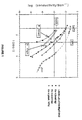
- the conductivities of the same salt composition in polymer-free, rubberized, and plasticized rubber states using the particular salt composition described in Example 4 (and used also in Example 12), are shown as a function of reciprocal absolute temperature in FIG. 1.
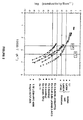
- Electrolytes prepared by the other examples reported herein are similarly charted in FIG. 2 where they are compared with the best results obtained from the prior art practices.
- the legend on each drawing identifies the example number or the essential components of the electrolyte plotted.
- the plots identified with surnames identify the inventor(s) of the U.S. Patent in which the reported material was first disclosed.
- the highest-conducting LiClO 4 solution in low molecular weight PPO (4000) is also included for comparison.
- the salts LiBr (0.355g), LiClO 4 (0.24g) and AlCl 3 (0.55g) were admixed in a dry-box and melted in a closed vessel at 120°C.
- the strong Lewis acid, AlCl 3 combines with the Lewis bases Br - and ClO 4 - to form a melt which is very resistant to crystallization at room temperature, and which is permanently stable as a liquid above 80°C.
- the lowest-melting LiAlX 4 composition has yet to be determined.
- This procedure provides a rubbery electrolyte containing 80 mol percent lithium salts and has a conductivity of 10 -4.5 ⁇ -1 cm -1 at room temperature and greater than 10 -2 ⁇ -1 cm -1 at 100°C.
- No rubbery electrolyte has been previously reported to have a higher conductivity at 100°C and, in addition, this conductivity is Li + - dominated.
- the ionic rubber is stable against crystallization since the same conductivity was obtained during slow heating as during slow cooling (see Fig. 1).
- the quaternary salt supercooled liquid and glass (T g about -25°C) has a conductivity two orders of magnitude higher than the rubber at -20°C (see Fig.1) but then crystallizes at a higher temperature.
- a related, but somewhat less successful, practice of the present invention involves the introduction of a plasticizer in stoichiometric quantities as a "solvate" compound, e.g., Mg(CH 3 CN) 4 (ClO 4 ) 2 , a compound having a melting point of only 90°C.
- a plasticizer e.g., Mg(CH 3 CN) 4 (ClO 4 ) 2
- This compound acts like a low-melting Li salt and promotes glass-forming properties on mixtures of lithium salts.
- a plasticizer in stoichiometric quantities as a "solvate” compound, e.g., Mg(CH 3 CN) 4 (ClO 4 ) 2 , a compound having a melting point of only 90°C.
- This compound acts like a low-melting Li salt and promotes glass-forming properties on mixtures of lithium salts.
- the conductivity of this melt was 10 -4.5 ⁇ -1 cm -1 , and it provides a glass transition temperature of about -25°C.
- Solutions containing about 50 mol percent Li salts and 50 mol percent of the solvate salt are stable liquids at room temperature and have conductivities near 10 -4.5 ⁇ -1 cm -1 and T g near -45°C.
- This practice, and analogous practices in which the four moles of CH 3 CN are replaced by one mole of the less volatile tetraglyme TG (which is involatile when in contact with Mg 2+ ), or by CN-(CH 2 )-CN, provides long term liquid stability and overcomes the problem of room temperature crystallization for this type of liquid.
- LiSCN lithium thiocyanate
- LiI lithium iodide
- LiNO 3 lithium nitrate
- LiClO 4 lithium perchlorate
- a PERKIN ELMER differential scanning calorimeter (DSC-4) was used to measure the glass transition temperature Tg, which was -20°C. Above 5°C, crystallization slowly occurred, but had this not occurred, an ambient temperature conductivity approaching 10 -2 ⁇ -1 cm -1 would have been realized. This system does not dissolve fully in polyethers because of the presence of LiNO 3 . Moreover it tends to decompose at high temperatures hence serves only as an illustration of possibilities to be explored.
- a glass-forming mixture containing four lithium salts (LiSCN, LiClO 4 , Li acetate[LiOAc] and LiI) was prepared by mixing 1.57g LiI, 1.17g LiOAc, 1.55g LiClO 4 and 3.85g LiSCN and melting as above, and the salt mixed with 0.25g of high molecular weight polypropylene oxide.
- acetonitrile was added as a molecular solvent.
- the solvent was removed by evaporation under vacuum at temperatures increasing from about 40°C to about 120°C.
- a rubbery, transparent solid with T g of -17°C was obtained having a slight brownish color resulting from traces of free iodine.
- the conductivity of the rapidly cooled rubber was circa 2 X 10 -4 ⁇ -1 cm -1 at room temperature which is superior to any conductivity known for a rubbery solid electrolyte to which no plasticizers have been added.
- Example 2 The composition of Example 2 was simplified to contain only LiSCN and LiClO 4 in order to gain maximum conductivity at high temperatures.
- a multicomponent mixture having good resistance to crystallization, good conductivity and excellent rubber characteristics was prepared according to the procedure of Example 1.
- 4.30 g LiI, 0.43 g LiBr; 1.79 g LiSCN, 1.50 g LiClO 4 , 1.15 g Mg(ClO 4 ) 2 and 0.99 g high molecular weight PPO are dissolved in acetone to yield a syrupy solution.
- the acetone and residual water is then removed by a combination of heating and vacuum evaporation taking care not exceed 120°C. The removal of water and acetone is confirmed by weighing.
- fluorinated anion salts of lithium was prepared by mixing 0.876 g LiBF 4 , 0.70 g Li CF 3 SO 3 and 0.4g PEO (MW 10 5 ) and heating using acetone as solvent. The product after removal of 100 percent of acetone was partly crystalline, but had conductivity of circa 10 -4 ⁇ -1 cm -1 20°C. Major improvements of this performance may be expected when new fluorinated anions, such as lithium perfluorosulfonimide ("imide”) and C(SO 2 CF 3 ) 3 (“methide”) are introduced.
- imide lithium perfluorosulfonimide
- methide C(SO 2 CF 3 ) 3
- AlCl 3 aluminum chloride
- This melt composition is not fully compatible with high molecular weight polyethylene oxide giving a sponge rather than rubber when PEO (MW 10 5 ) is incorporated into the system (using acetone as facilitator solvent) at less than 60 percent and blackening if temperature rises much above 60°C, during solvent removal.
- the conductivity of the sponge however remains high.
- the system is therefore presented as a superior Li conducting liquid electrolyte. It is preferred, when an aluminum salt is used in the salt mixture, to use poly[bis(methoxyethoxy)-ethoxy)-phosphazine] (MEEP) as the polymer of choice to produce a stable rubbery solid electrolyte having conductivity exceeding 10 -4 ⁇ -1 cm -1 .
- a melt containing 50/50 LiI:AlCl 3 was prepared according to the procedure of Example 6.
- This liquid which is thermodynamically stable at 80°C, has conductivity of 10 -1.2 ⁇ -1 cm -1 at 100°C, low AlCl 3 volatility, and relatively low hygroscopicity. At 80°C, the conductivity is 10 -1.3 ⁇ -1 cm -1 . It is an excellent low temperature, predominantly Li + -conducting, solvent-free electrolyte, but has no ability to supercool to room temperature.
- Example 2 Using the procedure of Example 1, a mixture containing 0.75 mole fraction of aluminum chloride and 0.25 mole fraction of lithium imide (perfluoromethanesulfonimide) Li N(CF 3 SO 2 ) 2 was heated and cooled to room temperature. The liquid was stable for prolonged periods of time at 25°C and the system obtained a conductivity of 10 -3.5 ⁇ -1 cm -1 . A glass forming mixture containing 0.75 mole fraction of the imide and 0.25 mole fraction of Li triflate (trifluoromethane sulfonate) on the other hand obtained only 10 -7 - ⁇ -1 cm -1 at 25°C.
- Li imide perfluoromethanesulfonimide
- Example 6 Using the procedure of Example 6, a mixture consisting of 0.63 g LiClO 4 and 1.96 g AlCl 3 , was melted and cooled. The conductivity at room temperature was 1.5 x 10 -3 ⁇ -1 cm -1 . When the weight of aluminum chloride was reduced to 1.37 g, (thus 63.5 mol percent AlCl 3 ) the conductivity at room temperature rose to 3.3 x 10 -3 ⁇ -1 cm -1 . The glass transition temperature of this liquid was determined to be -44°C. This mixture is very hostile to polypropylene oxide or polyethylene oxide polymer and requires an alternative polymer.
- a liquid containing chelated Mg 2+ ions as one component is prepared as follows: (anhydrous) Mg(ClO 4 ) 2 and tetraglyme (TG) are mixed in 1:1 proportions and dissolved in acetone. Vacuum evaporation is then used to quantitatively remove the acetone.
- the liquid Mg(ClO 4 ) 2 ⁇ TG is stable at room temperature indefinitely and has a T g of 30°C. 3.578g of Mg(ClO 4 ) 2 ⁇ TG is then mixed with 0.305g LiSCN and 0.517g LiI (the latter two being in the binary eutectic proportions) and heated with acetone solvent to dissolve.
- Example 4 The material of Example 4 is modified by the addition of 0.2 g of acetone (amounting to 10 mol percent acetone) and heating in a closed tube to 100°C for sufficient time for the acetone to diffuse through the entire rubber. This leads to a significant increase in conductivity, presumably due to a lowering of the glass transition temperature because the increase is most pronounced at low temperature. At 25°C the volatility of the acetone is very low.
- the conductivity of the modified material is 10 -3.7 ⁇ -1 cm -1 at room temperature.
Landscapes
- Chemical & Material Sciences (AREA)
- Engineering & Computer Science (AREA)
- Manufacturing & Machinery (AREA)
- Chemical Kinetics & Catalysis (AREA)
- Electrochemistry (AREA)
- General Chemical & Material Sciences (AREA)
- Inorganic Chemistry (AREA)
- Dispersion Chemistry (AREA)
- Condensed Matter Physics & Semiconductors (AREA)
- General Physics & Mathematics (AREA)
- Physics & Mathematics (AREA)
- Conductive Materials (AREA)
- Secondary Cells (AREA)
- Electric Double-Layer Capacitors Or The Like (AREA)
- Addition Polymer Or Copolymer, Post-Treatments, Or Chemical Modifications (AREA)
- Compositions Of Macromolecular Compounds (AREA)
- Primary Cells (AREA)
Abstract
Description
Claims (24)
- A lithium ion conducting electrolyte with high conductivity comprising:which mixture (i) or (ii) has been heated sufficiently to yield an ionic liquid and thereafter cooled, without crystallization or glass formation, to 100°C or lower.(i) a mixture of two or more lithium salts selected from the group consisting of: thiocyanate, iodide, bromide, chloride, nitrate, perchlorate, acetate, tetrafluoroborate, thiohalodialuminate, trifluoromethane sulfonate, haloaluminate, halodialuminate, perfluoromethane sulfonimide; and perfluoromethane sulfonmethide; or(ii) a mixture of one or more lithium salts selected from the group consisting of: thiocyanate, iodide, bromide, chloride, nitrate, perchlorate, acetate, tetrafluoroborate, thiohalodialuminate, trifluoromethane sulfonate, haloaluminate, halodialuminate, and perfluoromethane sulfonimide complexed with aluminum trichloride;
- An electrolyte as claimed in Claim 1, wherein the conductivity is greater than 10-5Ω-1cm-1 measured at 25°C, or 10-2Ω-1cm-1 measured at 100°C.
- An electrolyte according to Claim 1 having a conductivity of about 10-3Ω-1cm-1 measured at 25°C.
- An electrolyte according to Claim 1 having a conductivity of about 10-2.2Ω-1cm-1 measured at 25°C.
- An electrolyte according to Claim 1 having a conductivity of about 10-1.2Ω-1cm-1 measured at 100°C.
- An electrolyte according to any of Claims 1 to 5 in which said haloaluminate is tetrahaloaluminate.
- An electrolyte according to any one of Claims 1 to 5 in which said halodialuminate is hexachlorobromodialuminate.
- An electrolyte according to any one of Claims 1 to 7 in which said mixture further contains a magnesium salt selected from the group consisting of perchlorate and acetate.
- An electrolyte according to Claim 8 further containing a molecular constituent selected from the group consisting of: CH3CN, CN-CH2-CN, and tetraglyme; which molecular constituent has been selectively solvated by the Mg+2 cations to lower the freezing point of the electrolyte while maintaining the electrolyte's high conductivity.
- An electrolyte according to any one of Claims 1 to 9 comprising lithium perfluoromethane sulfonimide to which is added sufficient AlCl3 to lower the freezing point of the electrolyte to below room temperature.
- An electrolyte according to any one of Claims 1 to 10 to which is added a small mole fraction (mole fraction based on moles polymer repeat units per mole of salt) of a high molecular weight polymer to provide an ionic rubber electrolyte having conductivity of at least 10-4Ω-1cm-1 measured at 25°C and at least 10-2Ω-1cm-1 measured at 100°C.
- An electrolyte according to Claim 11 containing at least 60 mol percent of a lithium salt mixture and not more than 40 mol percent of a high molecular weight polymer which is soluble in said lithium salt.
- An electrolyte according to Claim 12 further containing Mg(ClO4)2.
- An electrolyte according to Claim 11 which contains at least 75 mol percent of said lithium salt mixture.
- An electrolyte according to Claim 11 which contains not more than 25 mol percent of said high molecular weight polymer.
- An electrolyte according to any one of Claims 11 to 15 in which said high molecular weight polymer is polypropylene oxide.
- An electrolyte according to any one of Claims 11 to 15 in which said high molecular weight polymer is polyethylene oxide.
- An electrolyte according to any one of Claims 11 to 15 in which said high molecular weight polymer is poly{bis(methoxyethoxy)ethoxy}-phosphazene.
- An electrolyte according to any one of Claims 1 to 18 which is solvent free.
- An electrolyte according to Claim 19 in which said ionic liquid is clear and homogenous and free of crystalline material.
- An electrolyte according to any one of Claims 1 to 18 which contains a small mole fraction of a solvent (mole fraction based on moles solvent per mole of salt).
- An electrolyte according to Claim 21 which contains not more than 10 mol percent of said solvent.
- An electrolyte according to Claim 22 in which said solvent is acetone.
- An electrolyte according to any one of Claims 1 to 23 further comprising powdered alumina to form a paste electrolyte having a conductivity of at least 10-3.3Ω-1cm-1 measured at 25°C.
Applications Claiming Priority (2)
| Application Number | Priority Date | Filing Date | Title |
|---|---|---|---|
| US901669 | 1992-06-22 | ||
| US07/901,669 US5506073A (en) | 1992-06-22 | 1992-06-22 | Lithium ion conducting electrolytes |
Publications (2)
| Publication Number | Publication Date |
|---|---|
| EP0576225A1 EP0576225A1 (en) | 1993-12-29 |
| EP0576225B1 true EP0576225B1 (en) | 1998-12-16 |
Family
ID=25414615
Family Applications (1)
| Application Number | Title | Priority Date | Filing Date |
|---|---|---|---|
| EP93304803A Expired - Lifetime EP0576225B1 (en) | 1992-06-22 | 1993-06-18 | Lithium ion conducting electrolytes |
Country Status (7)
| Country | Link |
|---|---|
| US (1) | US5506073A (en) |
| EP (1) | EP0576225B1 (en) |
| JP (1) | JPH06119807A (en) |
| AT (1) | ATE174727T1 (en) |
| CA (1) | CA2098870A1 (en) |
| DE (1) | DE69322547T2 (en) |
| MX (1) | MX9303749A (en) |
Cited By (2)
| Publication number | Priority date | Publication date | Assignee | Title |
|---|---|---|---|---|
| US10497970B2 (en) | 2013-03-14 | 2019-12-03 | Arizona Board Of Regents On Behalf Of Arizona State University | Alkali ion conducting plastic crystals |
| US10686224B2 (en) | 2017-04-19 | 2020-06-16 | Arizona Board Of Regents On Behalf Of Arizona State University | Battery with aluminum-containing cathode |
Families Citing this family (55)
| Publication number | Priority date | Publication date | Assignee | Title |
|---|---|---|---|---|
| US5786110A (en) * | 1992-06-22 | 1998-07-28 | Arizona Board Of Regents | Alkali-metal-ion conducting electrolytes |
| US5514493A (en) * | 1995-03-06 | 1996-05-07 | Minnesota Mining And Manufacturing Company | Perfluoroalkylsulfonates, sulfonimides, and sulfonyl methides, and electrolytes containing them |
| US5874616A (en) * | 1995-03-06 | 1999-02-23 | Minnesota Mining And Manufacturing Company | Preparation of bis (fluoroalkylenesulfonyl) imides and (fluoroalkysulfony) (fluorosulfonyl) imides |
| US6335878B1 (en) * | 1998-07-28 | 2002-01-01 | Hitachi, Ltd. | Non-volatile multi-level semiconductor flash memory device and method of driving same |
| GB9619133D0 (en) * | 1996-09-13 | 1996-10-23 | Secr Defence | An electrolyte |
| US7504473B2 (en) * | 2000-06-16 | 2009-03-17 | Arizona Board Of Regents For And On Behalf Of Arizona State University | Conductive polymeric compositions for lithium batteries |
| US7527899B2 (en) * | 2000-06-16 | 2009-05-05 | Arizona Board Of Regents For And On Behalf Of Arizona State University | Electrolytic orthoborate salts for lithium batteries |
| WO2001098396A1 (en) * | 2000-06-16 | 2001-12-27 | Arizona Board Of Regents, Acting On Behalf Of Arizona State University | Solid polymeric electrolytes for lithium batteries |
| KR100477744B1 (en) | 2001-10-31 | 2005-03-18 | 삼성에스디아이 주식회사 | Organic electrolytic solution and lithium secondary battery adopting the same |
| TWI263235B (en) * | 2002-04-02 | 2006-10-01 | Nippon Catalytic Chem Ind | Material for electrolytic solutions and use thereof |
| US20050026042A1 (en) * | 2003-07-29 | 2005-02-03 | Alain Vallee | Polyimide-based battery for a portable electronic appliance |
| US7390336B2 (en) * | 2003-07-29 | 2008-06-24 | Solicore, Inc. | Polyimide-based lithium metal battery |
| CA2482003A1 (en) * | 2004-10-12 | 2006-04-12 | Hydro-Quebec | Polymer-fused salt-solvent mixture, process for its manufacture and use of the mixture in electrochemical systems |
| KR100941299B1 (en) * | 2006-07-07 | 2010-02-11 | 주식회사 엘지화학 | Non-aqueous electrolyte additive with cyano group and electrochemical device using same |
| US9819053B1 (en) | 2012-04-11 | 2017-11-14 | Ionic Materials, Inc. | Solid electrolyte high energy battery |
| US11319411B2 (en) | 2012-04-11 | 2022-05-03 | Ionic Materials, Inc. | Solid ionically conducting polymer material |
| US11152657B2 (en) | 2012-04-11 | 2021-10-19 | Ionic Materials, Inc. | Alkaline metal-air battery cathode |
| US11251455B2 (en) | 2012-04-11 | 2022-02-15 | Ionic Materials, Inc. | Solid ionically conducting polymer material |
| US10559827B2 (en) | 2013-12-03 | 2020-02-11 | Ionic Materials, Inc. | Electrochemical cell having solid ionically conducting polymer material |
| US12074274B2 (en) | 2012-04-11 | 2024-08-27 | Ionic Materials, Inc. | Solid state bipolar battery |
| US9742008B2 (en) | 2013-12-03 | 2017-08-22 | Ionic Materials, Inc. | Solid, ionically conducting polymer material, and methods and applications for same |
| HUE053572T2 (en) | 2014-04-01 | 2021-07-28 | Ionic Mat Inc | High capacity polymer cathode and high energy density rechargeable cell containing the cathode |
| US10044064B2 (en) | 2014-04-18 | 2018-08-07 | Seeo, Inc. | Long cycle-life lithium sulfur solid state electrochemical cell |
| US9774058B2 (en) | 2014-04-18 | 2017-09-26 | Seeo, Inc. | Polymer composition with electrophilic groups for stabilization of lithium sulfur batteries |
| US10566632B2 (en) * | 2014-06-16 | 2020-02-18 | The Research Foundation For The State University Of New York | Hybrid electrolytes for group 2 cation-based electrochemical energy storage device |
| KR102640010B1 (en) | 2015-06-04 | 2024-02-22 | 아이오닉 머터리얼스, 인코퍼레이션 | Lithium metal battery with solid polymer electrolyte |
| EP3304620A4 (en) | 2015-06-04 | 2018-11-07 | Ionic Materials, Inc. | Solid state bipolar battery |
| US11342559B2 (en) | 2015-06-08 | 2022-05-24 | Ionic Materials, Inc. | Battery with polyvalent metal anode |
| KR102607433B1 (en) * | 2015-06-08 | 2023-11-27 | 아이오닉 머터리얼스, 인코퍼레이션 | Battery with aluminum anode and solid polymer |
| US10707531B1 (en) | 2016-09-27 | 2020-07-07 | New Dominion Enterprises Inc. | All-inorganic solvents for electrolytes |
| DE102016224420A1 (en) * | 2016-12-08 | 2018-06-14 | Robert Bosch Gmbh | Process for the preparation of a solid electrolyte |
| CN110337746A (en) | 2017-01-26 | 2019-10-15 | 离子材料公司 | Alkaline cell cathode with solid polymer electrolyte |
| WO2019135347A1 (en) | 2018-01-05 | 2019-07-11 | パナソニックIpマネジメント株式会社 | Solid electrolyte material and battery |
| WO2019135316A1 (en) | 2018-01-05 | 2019-07-11 | パナソニックIpマネジメント株式会社 | Solid electrolyte material and battery |
| WO2019135328A1 (en) | 2018-01-05 | 2019-07-11 | パナソニックIpマネジメント株式会社 | Solid electrolyte material and battery |
| WO2019135320A1 (en) | 2018-01-05 | 2019-07-11 | パナソニックIpマネジメント株式会社 | Solid electrolyte material and battery |
| JP7228816B2 (en) | 2018-01-05 | 2023-02-27 | パナソニックIpマネジメント株式会社 | Cathode materials and batteries |
| EP3736834A4 (en) | 2018-01-05 | 2021-03-10 | Panasonic Intellectual Property Management Co., Ltd. | Solid electrolyte material, and battery |
| WO2019135345A1 (en) | 2018-01-05 | 2019-07-11 | パナソニックIpマネジメント株式会社 | Solid electrolyte material, and battery |
| JP7611524B2 (en) * | 2018-01-05 | 2025-01-10 | パナソニックIpマネジメント株式会社 | Solid electrolyte material and battery |
| JP7281672B2 (en) | 2018-01-05 | 2023-05-26 | パナソニックIpマネジメント株式会社 | battery |
| JPWO2019135318A1 (en) | 2018-01-05 | 2021-01-14 | パナソニックIpマネジメント株式会社 | Solid electrolyte material and battery |
| CN111566756B (en) | 2018-01-26 | 2022-03-08 | 松下知识产权经营株式会社 | Solid electrolyte material and battery |
| CN111557057B (en) | 2018-01-26 | 2024-04-19 | 松下知识产权经营株式会社 | Positive electrode material and battery using same |
| CN111587508A (en) | 2018-01-26 | 2020-08-25 | 松下知识产权经营株式会社 | Battery with a battery cell |
| JP7217433B2 (en) | 2018-01-26 | 2023-02-03 | パナソニックIpマネジメント株式会社 | Cathode material and battery using the same |
| JP7429869B2 (en) | 2018-11-29 | 2024-02-09 | パナソニックIpマネジメント株式会社 | Negative electrode materials and batteries |
| WO2020110480A1 (en) | 2018-11-29 | 2020-06-04 | パナソニックIpマネジメント株式会社 | Negative electrode material, battery and method for producing battery |
| CN113508446B (en) * | 2019-03-29 | 2022-09-27 | 日本贵弥功株式会社 | Solid electrolyte, electricity storage device, and method for producing solid electrolyte |
| JP7402513B2 (en) * | 2020-03-06 | 2023-12-21 | 国立大学法人静岡大学 | Solid electrolytes, secondary batteries and capacitors |
| CN111600080A (en) * | 2020-05-28 | 2020-08-28 | 南开大学 | An electrolyte additive and electrolyte for improving low temperature performance of aqueous battery |
| US11928472B2 (en) | 2020-09-26 | 2024-03-12 | Intel Corporation | Branch prefetch mechanisms for mitigating frontend branch resteers |
| US12182317B2 (en) | 2021-02-13 | 2024-12-31 | Intel Corporation | Region-based deterministic memory safety |
| US12504891B2 (en) | 2021-06-24 | 2025-12-23 | Intel Corporation | Zero-redundancy tag storage for bucketed allocators |
| US12235791B2 (en) | 2021-08-23 | 2025-02-25 | Intel Corporation | Loop driven region based frontend translation control for performant and secure data-space guided micro-sequencing |
Family Cites Families (12)
| Publication number | Priority date | Publication date | Assignee | Title |
|---|---|---|---|---|
| US3445290A (en) * | 1966-12-12 | 1969-05-20 | Globe Union Inc | Silver and copper thiocyanate primary cells |
| US3615828A (en) * | 1970-03-09 | 1971-10-26 | Atomic Energy Commission | Secondary power-producing cell |
| SU532916A1 (en) * | 1975-05-04 | 1976-10-25 | Ленинградский Ордена Ленина Политехнический Институт Им. М.И.Калинина | Electrolyte for chemical lithium anode current source |
| US4164610A (en) * | 1977-05-23 | 1979-08-14 | Corning Glass Works | Glasses exhibiting high lithium ion mobility |
| JPS6053427B2 (en) * | 1978-02-16 | 1985-11-26 | 三洋電機株式会社 | non-aqueous electrolyte battery |
| US4234667A (en) * | 1979-03-02 | 1980-11-18 | The Regents Of The University Of California | Battery and method for fabricating same |
| DE2918940C2 (en) * | 1979-05-10 | 1984-08-09 | Max Planck Gesellschaft zur Förderung der Wissenschaften e.V., 3400 Göttingen | Solid ionic conductor material, its use and process for its manufacture |
| DE3039900C2 (en) * | 1979-10-29 | 1983-11-03 | Hitachi, Ltd., Tokyo | Solid electrolyte |
| DE3200757C1 (en) * | 1982-01-13 | 1983-07-21 | Fa. Carl Freudenberg, 6940 Weinheim | Flexible electrolytic cell |
| DK254484A (en) * | 1983-06-24 | 1984-12-25 | Ray O Vac Corp | PROCEDURE FOR GETTING HIGH CONDUCTIVITY IN THIONYL CHLORIDE ELECTROLYTES AND CELLS AND SALTS TO EXERCISE THE PROCEDURE |
| US4990413A (en) * | 1989-01-18 | 1991-02-05 | Mhb Joint Venture | Composite solid electrolytes and electrochemical devices employing the same |
| JPH0397758A (en) * | 1989-09-11 | 1991-04-23 | Dai Ichi Kogyo Seiyaku Co Ltd | Modification of electrical conductivity of molded article of resin |
-
1992
- 1992-06-22 US US07/901,669 patent/US5506073A/en not_active Expired - Lifetime
-
1993
- 1993-06-18 EP EP93304803A patent/EP0576225B1/en not_active Expired - Lifetime
- 1993-06-18 AT AT93304803T patent/ATE174727T1/en not_active IP Right Cessation
- 1993-06-18 DE DE69322547T patent/DE69322547T2/en not_active Expired - Fee Related
- 1993-06-21 CA CA002098870A patent/CA2098870A1/en not_active Abandoned
- 1993-06-22 MX MX9303749A patent/MX9303749A/en not_active IP Right Cessation
- 1993-06-22 JP JP5188613A patent/JPH06119807A/en active Pending
Non-Patent Citations (1)
| Title |
|---|
| The Merck Index, Merck & Co.Inc.Rahway, N.J.USA, 11th Ed.., pages 56 and 1451 * |
Cited By (2)
| Publication number | Priority date | Publication date | Assignee | Title |
|---|---|---|---|---|
| US10497970B2 (en) | 2013-03-14 | 2019-12-03 | Arizona Board Of Regents On Behalf Of Arizona State University | Alkali ion conducting plastic crystals |
| US10686224B2 (en) | 2017-04-19 | 2020-06-16 | Arizona Board Of Regents On Behalf Of Arizona State University | Battery with aluminum-containing cathode |
Also Published As
| Publication number | Publication date |
|---|---|
| EP0576225A1 (en) | 1993-12-29 |
| CA2098870A1 (en) | 1993-12-23 |
| DE69322547T2 (en) | 1999-05-27 |
| JPH06119807A (en) | 1994-04-28 |
| DE69322547D1 (en) | 1999-01-28 |
| MX9303749A (en) | 1994-05-31 |
| ATE174727T1 (en) | 1999-01-15 |
| US5506073A (en) | 1996-04-09 |
Similar Documents
| Publication | Publication Date | Title |
|---|---|---|
| EP0576225B1 (en) | Lithium ion conducting electrolytes | |
| US5962169A (en) | Lithium ion conducting electrolytes | |
| US5484670A (en) | Lithium ion conducting ionic electrolytes | |
| US6022643A (en) | Boron compounds as anion binding agents for nonaqueous battery electrolytes | |
| US5849432A (en) | Wide electrochemical window solvents for use in electrochemical devices and electrolyte solutions incorporating such solvents | |
| Webber | Conductivity and viscosity of Solutions of LiCF3 SO 3, Li (CF 3 SO 2) 2 N, and their mixtures | |
| JP3878206B2 (en) | Ionic conductive material with good corrosion resistance | |
| US4505997A (en) | Bis perhalogenoacyl -or sulfonyl-imides of alkali metals, their solid solutions with plastic materials and their use to the constitution of conductor elements for electrochemical generators | |
| EP0380490B1 (en) | Ion conductors | |
| JPS61176074A (en) | Electrochemical cells using non-aqueous electrolytes | |
| JPS63187578A (en) | ion conductive material | |
| CA2325505A1 (en) | Electrolytes containing mixed fluorocarbon/hydrocarbon imide and methide salts | |
| JPH0654687B2 (en) | Glassy oxidation-phosphorus sulfide solid lithium electrolyte | |
| Watanabe et al. | Conductivity study on ionic liquid/polymer complexes | |
| WO1997016862A9 (en) | Wide electrochemical window solvents for use in electrochemical devices and electrolyte solutions incorporating such solvents | |
| WO1997016862A1 (en) | Wide electrochemical window solvents for use in electrochemical devices and electrolyte solutions incorporating such solvents | |
| JPS6360509B2 (en) | ||
| JP3623050B2 (en) | Polymer electrolytes and electrochemical devices | |
| US5141827A (en) | Ion conductor or electrolyte for a galvanic element | |
| CS213352B2 (en) | Non-conducting electrochemical cell | |
| KR880001512B1 (en) | Improved non-aqueous cell safety | |
| US4704341A (en) | Lithium ion conductor | |
| US4426430A (en) | Inorganic NbF5 (TaF5)-P2 O5 electrolytes | |
| JP3081922B1 (en) | Solid electrolyte | |
| WO2001052341A1 (en) | Perfluoroalkanesulfonate salts in electrochemical systems |
Legal Events
| Date | Code | Title | Description |
|---|---|---|---|
| PUAI | Public reference made under article 153(3) epc to a published international application that has entered the european phase |
Free format text: ORIGINAL CODE: 0009012 |
|
| AK | Designated contracting states |
Kind code of ref document: A1 Designated state(s): AT BE CH DE DK ES FR GB GR IE IT LI LU MC NL PT SE |
|
| 17P | Request for examination filed |
Effective date: 19940204 |
|
| K1C3 | Correction of patent application (complete document) published |
Effective date: 19931229 |
|
| 17Q | First examination report despatched |
Effective date: 19940705 |
|
| GRAG | Despatch of communication of intention to grant |
Free format text: ORIGINAL CODE: EPIDOS AGRA |
|
| GRAG | Despatch of communication of intention to grant |
Free format text: ORIGINAL CODE: EPIDOS AGRA |
|
| GRAH | Despatch of communication of intention to grant a patent |
Free format text: ORIGINAL CODE: EPIDOS IGRA |
|
| GRAH | Despatch of communication of intention to grant a patent |
Free format text: ORIGINAL CODE: EPIDOS IGRA |
|
| GRAA | (expected) grant |
Free format text: ORIGINAL CODE: 0009210 |
|
| AK | Designated contracting states |
Kind code of ref document: B1 Designated state(s): AT BE CH DE DK ES FR GB GR IE IT LI LU MC NL PT SE |
|
| PG25 | Lapsed in a contracting state [announced via postgrant information from national office to epo] |
Ref country code: NL Free format text: LAPSE BECAUSE OF FAILURE TO SUBMIT A TRANSLATION OF THE DESCRIPTION OR TO PAY THE FEE WITHIN THE PRESCRIBED TIME-LIMIT Effective date: 19981216 Ref country code: LI Free format text: LAPSE BECAUSE OF FAILURE TO SUBMIT A TRANSLATION OF THE DESCRIPTION OR TO PAY THE FEE WITHIN THE PRESCRIBED TIME-LIMIT Effective date: 19981216 Ref country code: IT Free format text: LAPSE BECAUSE OF FAILURE TO SUBMIT A TRANSLATION OF THE DESCRIPTION OR TO PAY THE FEE WITHIN THE PRE;WARNING: LAPSES OF ITALIAN PATENTS WITH EFFECTIVE DATE BEFORE 2007 MAY HAVE OCCURRED AT ANY TIME BEFORE 2007. THE CORRECT EFFECTIVE DATE MAY BE DIFFERENT FROM THE ONE RECORDED.SCRIBED TIME-LIMIT Effective date: 19981216 Ref country code: GR Free format text: LAPSE BECAUSE OF NON-PAYMENT OF DUE FEES Effective date: 19981216 Ref country code: ES Free format text: THE PATENT HAS BEEN ANNULLED BY A DECISION OF A NATIONAL AUTHORITY Effective date: 19981216 Ref country code: CH Free format text: LAPSE BECAUSE OF FAILURE TO SUBMIT A TRANSLATION OF THE DESCRIPTION OR TO PAY THE FEE WITHIN THE PRESCRIBED TIME-LIMIT Effective date: 19981216 Ref country code: BE Free format text: LAPSE BECAUSE OF FAILURE TO SUBMIT A TRANSLATION OF THE DESCRIPTION OR TO PAY THE FEE WITHIN THE PRESCRIBED TIME-LIMIT Effective date: 19981216 Ref country code: AT Free format text: LAPSE BECAUSE OF FAILURE TO SUBMIT A TRANSLATION OF THE DESCRIPTION OR TO PAY THE FEE WITHIN THE PRESCRIBED TIME-LIMIT Effective date: 19981216 |
|
| REF | Corresponds to: |
Ref document number: 174727 Country of ref document: AT Date of ref document: 19990115 Kind code of ref document: T |
|
| REG | Reference to a national code |
Ref country code: CH Ref legal event code: EP |
|
| REF | Corresponds to: |
Ref document number: 69322547 Country of ref document: DE Date of ref document: 19990128 |
|
| GRAH | Despatch of communication of intention to grant a patent |
Free format text: ORIGINAL CODE: EPIDOS IGRA |
|
| REG | Reference to a national code |
Ref country code: IE Ref legal event code: FG4D |
|
| PG25 | Lapsed in a contracting state [announced via postgrant information from national office to epo] |
Ref country code: SE Free format text: LAPSE BECAUSE OF FAILURE TO SUBMIT A TRANSLATION OF THE DESCRIPTION OR TO PAY THE FEE WITHIN THE PRESCRIBED TIME-LIMIT Effective date: 19990316 Ref country code: PT Free format text: LAPSE BECAUSE OF FAILURE TO SUBMIT A TRANSLATION OF THE DESCRIPTION OR TO PAY THE FEE WITHIN THE PRESCRIBED TIME-LIMIT Effective date: 19990316 Ref country code: DK Free format text: LAPSE BECAUSE OF FAILURE TO SUBMIT A TRANSLATION OF THE DESCRIPTION OR TO PAY THE FEE WITHIN THE PRESCRIBED TIME-LIMIT Effective date: 19990316 |
|
| ET | Fr: translation filed | ||
| NLV1 | Nl: lapsed or annulled due to failure to fulfill the requirements of art. 29p and 29m of the patents act | ||
| PGFP | Annual fee paid to national office [announced via postgrant information from national office to epo] |
Ref country code: GB Payment date: 19990614 Year of fee payment: 7 |
|
| PG25 | Lapsed in a contracting state [announced via postgrant information from national office to epo] |
Ref country code: LU Free format text: LAPSE BECAUSE OF NON-PAYMENT OF DUE FEES Effective date: 19990618 Ref country code: IE Free format text: LAPSE BECAUSE OF NON-PAYMENT OF DUE FEES Effective date: 19990618 |
|
| PGFP | Annual fee paid to national office [announced via postgrant information from national office to epo] |
Ref country code: FR Payment date: 19990621 Year of fee payment: 7 |
|
| PGFP | Annual fee paid to national office [announced via postgrant information from national office to epo] |
Ref country code: DE Payment date: 19990630 Year of fee payment: 7 |
|
| REG | Reference to a national code |
Ref country code: CH Ref legal event code: PL |
|
| PLBE | No opposition filed within time limit |
Free format text: ORIGINAL CODE: 0009261 |
|
| STAA | Information on the status of an ep patent application or granted ep patent |
Free format text: STATUS: NO OPPOSITION FILED WITHIN TIME LIMIT |
|
| 26N | No opposition filed | ||
| PG25 | Lapsed in a contracting state [announced via postgrant information from national office to epo] |
Ref country code: MC Free format text: LAPSE BECAUSE OF NON-PAYMENT OF DUE FEES Effective date: 19991231 |
|
| REG | Reference to a national code |
Ref country code: IE Ref legal event code: MM4A |
|
| PG25 | Lapsed in a contracting state [announced via postgrant information from national office to epo] |
Ref country code: GB Free format text: LAPSE BECAUSE OF NON-PAYMENT OF DUE FEES Effective date: 20000618 |
|
| GBPC | Gb: european patent ceased through non-payment of renewal fee |
Effective date: 20000618 |
|
| PG25 | Lapsed in a contracting state [announced via postgrant information from national office to epo] |
Ref country code: FR Free format text: LAPSE BECAUSE OF NON-PAYMENT OF DUE FEES Effective date: 20010228 |
|
| REG | Reference to a national code |
Ref country code: FR Ref legal event code: ST |
|
| PG25 | Lapsed in a contracting state [announced via postgrant information from national office to epo] |
Ref country code: DE Free format text: LAPSE BECAUSE OF NON-PAYMENT OF DUE FEES Effective date: 20010403 |