EP0574571B1 - Pharmaceutical compositions containing polymer derivative-bound anthracycline glycosides and a method for their preparation - Google Patents
Pharmaceutical compositions containing polymer derivative-bound anthracycline glycosides and a method for their preparation Download PDFInfo
- Publication number
- EP0574571B1 EP0574571B1 EP93902124A EP93902124A EP0574571B1 EP 0574571 B1 EP0574571 B1 EP 0574571B1 EP 93902124 A EP93902124 A EP 93902124A EP 93902124 A EP93902124 A EP 93902124A EP 0574571 B1 EP0574571 B1 EP 0574571B1
- Authority
- EP
- European Patent Office
- Prior art keywords
- mol
- lyophilized composition
- composition according
- conjugate
- units
- Prior art date
- Legal status (The legal status is an assumption and is not a legal conclusion. Google has not performed a legal analysis and makes no representation as to the accuracy of the status listed.)
- Expired - Lifetime
Links
- 229940045799 anthracyclines and related substance Drugs 0.000 title claims abstract description 45
- 229930182470 glycoside Natural products 0.000 title claims abstract description 34
- 150000002338 glycosides Chemical class 0.000 title claims abstract description 34
- 229920000642 polymer Polymers 0.000 title claims description 29
- 238000000034 method Methods 0.000 title claims description 16
- 238000002360 preparation method Methods 0.000 title description 10
- 239000008194 pharmaceutical composition Substances 0.000 title description 2
- 239000000203 mixture Substances 0.000 claims abstract description 48
- 229920001577 copolymer Polymers 0.000 claims abstract description 32
- 239000000945 filler Substances 0.000 claims abstract description 26
- 125000006850 spacer group Chemical group 0.000 claims abstract description 23
- 108090000765 processed proteins & peptides Proteins 0.000 claims abstract description 21
- 230000008685 targeting Effects 0.000 claims abstract description 17
- 239000003795 chemical substances by application Substances 0.000 claims abstract description 13
- AOJJSUZBOXZQNB-TZSSRYMLSA-N Doxorubicin Chemical compound O([C@H]1C[C@@](O)(CC=2C(O)=C3C(=O)C=4C=CC=C(C=4C(=O)C3=C(O)C=21)OC)C(=O)CO)[C@H]1C[C@H](N)[C@H](O)[C@H](C)O1 AOJJSUZBOXZQNB-TZSSRYMLSA-N 0.000 claims description 75
- 229960004679 doxorubicin Drugs 0.000 claims description 39
- -1 polyoxyethylene stearate Polymers 0.000 claims description 18
- 239000003960 organic solvent Substances 0.000 claims description 14
- GUBGYTABKSRVRQ-QKKXKWKRSA-N Lactose Natural products OC[C@H]1O[C@@H](O[C@H]2[C@H](O)[C@@H](O)C(O)O[C@@H]2CO)[C@H](O)[C@@H](O)[C@H]1O GUBGYTABKSRVRQ-QKKXKWKRSA-N 0.000 claims description 11
- 239000008101 lactose Substances 0.000 claims description 10
- 229920000053 polysorbate 80 Polymers 0.000 claims description 9
- 239000000244 polyoxyethylene sorbitan monooleate Substances 0.000 claims description 8
- 235000010482 polyoxyethylene sorbitan monooleate Nutrition 0.000 claims description 8
- 229940068968 polysorbate 80 Drugs 0.000 claims description 8
- STQGQHZAVUOBTE-UHFFFAOYSA-N 7-Cyan-hept-2t-en-4,6-diinsaeure Natural products C1=2C(O)=C3C(=O)C=4C(OC)=CC=CC=4C(=O)C3=C(O)C=2CC(O)(C(C)=O)CC1OC1CC(N)C(O)C(C)O1 STQGQHZAVUOBTE-UHFFFAOYSA-N 0.000 claims description 7
- 239000007864 aqueous solution Substances 0.000 claims description 6
- STQGQHZAVUOBTE-VGBVRHCVSA-N daunorubicin Chemical compound O([C@H]1C[C@@](O)(CC=2C(O)=C3C(=O)C=4C=CC=C(C=4C(=O)C3=C(O)C=21)OC)C(C)=O)[C@H]1C[C@H](N)[C@H](O)[C@H](C)O1 STQGQHZAVUOBTE-VGBVRHCVSA-N 0.000 claims description 5
- 235000014113 dietary fatty acids Nutrition 0.000 claims description 5
- 239000003085 diluting agent Substances 0.000 claims description 5
- 239000000194 fatty acid Substances 0.000 claims description 5
- 229930195729 fatty acid Natural products 0.000 claims description 5
- 229920001983 poloxamer Polymers 0.000 claims description 5
- 235000000346 sugar Nutrition 0.000 claims description 5
- AOJJSUZBOXZQNB-VTZDEGQISA-N 4'-epidoxorubicin Chemical compound O([C@H]1C[C@@](O)(CC=2C(O)=C3C(=O)C=4C=CC=C(C=4C(=O)C3=C(O)C=21)OC)C(=O)CO)[C@H]1C[C@H](N)[C@@H](O)[C@H](C)O1 AOJJSUZBOXZQNB-VTZDEGQISA-N 0.000 claims description 4
- MSWZFWKMSRAUBD-UHFFFAOYSA-N beta-D-galactosamine Natural products NC1C(O)OC(CO)C(O)C1O MSWZFWKMSRAUBD-UHFFFAOYSA-N 0.000 claims description 4
- 229960000975 daunorubicin Drugs 0.000 claims description 4
- 229920000136 polysorbate Polymers 0.000 claims description 4
- WEZDRVHTDXTVLT-GJZGRUSLSA-N 2-[[(2s)-2-[[(2s)-2-[(2-aminoacetyl)amino]-3-phenylpropanoyl]amino]-4-methylpentanoyl]amino]acetic acid Chemical compound OC(=O)CNC(=O)[C@H](CC(C)C)NC(=O)[C@@H](NC(=O)CN)CC1=CC=CC=C1 WEZDRVHTDXTVLT-GJZGRUSLSA-N 0.000 claims description 3
- HTIJFSOGRVMCQR-UHFFFAOYSA-N Epirubicin Natural products COc1cccc2C(=O)c3c(O)c4CC(O)(CC(OC5CC(N)C(=O)C(C)O5)c4c(O)c3C(=O)c12)C(=O)CO HTIJFSOGRVMCQR-UHFFFAOYSA-N 0.000 claims description 3
- 108010009504 Gly-Phe-Leu-Gly Proteins 0.000 claims description 3
- XDXDZDZNSLXDNA-TZNDIEGXSA-N Idarubicin Chemical compound C1[C@H](N)[C@H](O)[C@H](C)O[C@H]1O[C@@H]1C2=C(O)C(C(=O)C3=CC=CC=C3C3=O)=C3C(O)=C2C[C@@](O)(C(C)=O)C1 XDXDZDZNSLXDNA-TZNDIEGXSA-N 0.000 claims description 3
- XDXDZDZNSLXDNA-UHFFFAOYSA-N Idarubicin Natural products C1C(N)C(O)C(C)OC1OC1C2=C(O)C(C(=O)C3=CC=CC=C3C3=O)=C3C(O)=C2CC(O)(C(C)=O)C1 XDXDZDZNSLXDNA-UHFFFAOYSA-N 0.000 claims description 3
- RVGRUAULSDPKGF-UHFFFAOYSA-N Poloxamer Chemical compound C1CO1.CC1CO1 RVGRUAULSDPKGF-UHFFFAOYSA-N 0.000 claims description 3
- 239000002202 Polyethylene glycol Substances 0.000 claims description 3
- 229920001213 Polysorbate 20 Polymers 0.000 claims description 3
- 229960001904 epirubicin Drugs 0.000 claims description 3
- 150000004665 fatty acids Chemical class 0.000 claims description 3
- 229930182830 galactose Natural products 0.000 claims description 3
- 229960000908 idarubicin Drugs 0.000 claims description 3
- OKPYIWASQZGASP-UHFFFAOYSA-N n-(2-hydroxypropyl)-2-methylprop-2-enamide Chemical compound CC(O)CNC(=O)C(C)=C OKPYIWASQZGASP-UHFFFAOYSA-N 0.000 claims description 3
- 229960000502 poloxamer Drugs 0.000 claims description 3
- 229920001223 polyethylene glycol Polymers 0.000 claims description 3
- UTVXFQMLZSPQLB-DHVFOXMCSA-N (3s,4r,5s,6s)-2-amino-6-methyloxane-3,4,5-triol Chemical compound C[C@@H]1OC(N)[C@@H](O)[C@H](O)[C@@H]1O UTVXFQMLZSPQLB-DHVFOXMCSA-N 0.000 claims description 2
- IIZPXYDJLKNOIY-JXPKJXOSSA-N 1-palmitoyl-2-arachidonoyl-sn-glycero-3-phosphocholine Chemical compound CCCCCCCCCCCCCCCC(=O)OC[C@H](COP([O-])(=O)OCC[N+](C)(C)C)OC(=O)CCC\C=C/C\C=C/C\C=C/C\C=C/CCCCC IIZPXYDJLKNOIY-JXPKJXOSSA-N 0.000 claims description 2
- OWEGMIWEEQEYGQ-UHFFFAOYSA-N 100676-05-9 Natural products OC1C(O)C(O)C(CO)OC1OCC1C(O)C(O)C(O)C(OC2C(OC(O)C(O)C2O)CO)O1 OWEGMIWEEQEYGQ-UHFFFAOYSA-N 0.000 claims description 2
- MSWZFWKMSRAUBD-GASJEMHNSA-N 2-amino-2-deoxy-D-galactopyranose Chemical compound N[C@H]1C(O)O[C@H](CO)[C@H](O)[C@@H]1O MSWZFWKMSRAUBD-GASJEMHNSA-N 0.000 claims description 2
- MSWZFWKMSRAUBD-IVMDWMLBSA-N 2-amino-2-deoxy-D-glucopyranose Chemical compound N[C@H]1C(O)O[C@H](CO)[C@@H](O)[C@@H]1O MSWZFWKMSRAUBD-IVMDWMLBSA-N 0.000 claims description 2
- MSWZFWKMSRAUBD-CBPJZXOFSA-N 2-amino-2-deoxy-D-mannopyranose Chemical compound N[C@@H]1C(O)O[C@H](CO)[C@@H](O)[C@@H]1O MSWZFWKMSRAUBD-CBPJZXOFSA-N 0.000 claims description 2
- GUBGYTABKSRVRQ-XLOQQCSPSA-N Alpha-Lactose Chemical compound O[C@@H]1[C@@H](O)[C@@H](O)[C@@H](CO)O[C@H]1O[C@@H]1[C@@H](CO)O[C@H](O)[C@H](O)[C@H]1O GUBGYTABKSRVRQ-XLOQQCSPSA-N 0.000 claims description 2
- WSFSSNUMVMOOMR-UHFFFAOYSA-N Formaldehyde Chemical compound O=C WSFSSNUMVMOOMR-UHFFFAOYSA-N 0.000 claims description 2
- WQZGKKKJIJFFOK-GASJEMHNSA-N Glucose Natural products OC[C@H]1OC(O)[C@H](O)[C@@H](O)[C@@H]1O WQZGKKKJIJFFOK-GASJEMHNSA-N 0.000 claims description 2
- PNIWLNAGKUGXDO-UHFFFAOYSA-N Lactosamine Natural products OC1C(N)C(O)OC(CO)C1OC1C(O)C(O)C(O)C(CO)O1 PNIWLNAGKUGXDO-UHFFFAOYSA-N 0.000 claims description 2
- GUBGYTABKSRVRQ-PICCSMPSSA-N Maltose Natural products O[C@@H]1[C@@H](O)[C@H](O)[C@@H](CO)O[C@@H]1O[C@@H]1[C@@H](CO)OC(O)[C@H](O)[C@H]1O GUBGYTABKSRVRQ-PICCSMPSSA-N 0.000 claims description 2
- CZMRCDWAGMRECN-UGDNZRGBSA-N Sucrose Chemical compound O[C@H]1[C@H](O)[C@@H](CO)O[C@@]1(CO)O[C@@H]1[C@H](O)[C@@H](O)[C@H](O)[C@@H](CO)O1 CZMRCDWAGMRECN-UGDNZRGBSA-N 0.000 claims description 2
- 229930006000 Sucrose Natural products 0.000 claims description 2
- WQZGKKKJIJFFOK-PHYPRBDBSA-N alpha-D-galactose Chemical group OC[C@H]1O[C@H](O)[C@H](O)[C@@H](O)[C@H]1O WQZGKKKJIJFFOK-PHYPRBDBSA-N 0.000 claims description 2
- 150000001413 amino acids Chemical class 0.000 claims description 2
- GUBGYTABKSRVRQ-QUYVBRFLSA-N beta-maltose Chemical compound OC[C@H]1O[C@H](O[C@H]2[C@H](O)[C@@H](O)[C@H](O)O[C@@H]2CO)[C@H](O)[C@@H](O)[C@@H]1O GUBGYTABKSRVRQ-QUYVBRFLSA-N 0.000 claims description 2
- 229960002442 glucosamine Drugs 0.000 claims description 2
- 239000008103 glucose Substances 0.000 claims description 2
- 150000004676 glycans Chemical class 0.000 claims description 2
- DOVBXGDYENZJBJ-ONMPCKGSSA-N lactosamine Chemical compound O=C[C@H](N)[C@@H](O)[C@H](O)[C@@H](CO)O[C@@H]1O[C@H](CO)[C@H](O)[C@H](O)[C@H]1O DOVBXGDYENZJBJ-ONMPCKGSSA-N 0.000 claims description 2
- 239000000787 lecithin Substances 0.000 claims description 2
- 235000010445 lecithin Nutrition 0.000 claims description 2
- 229940067606 lecithin Drugs 0.000 claims description 2
- 238000002156 mixing Methods 0.000 claims description 2
- 239000000256 polyoxyethylene sorbitan monolaurate Substances 0.000 claims description 2
- 235000010486 polyoxyethylene sorbitan monolaurate Nutrition 0.000 claims description 2
- 229920001282 polysaccharide Polymers 0.000 claims description 2
- 239000005017 polysaccharide Substances 0.000 claims description 2
- 229950008882 polysorbate Drugs 0.000 claims description 2
- 229940068977 polysorbate 20 Drugs 0.000 claims description 2
- 239000008174 sterile solution Substances 0.000 claims description 2
- 239000005720 sucrose Substances 0.000 claims description 2
- 150000005846 sugar alcohols Polymers 0.000 claims description 2
- 150000002148 esters Chemical class 0.000 claims 1
- 125000002791 glucosyl group Chemical group C1([C@H](O)[C@@H](O)[C@H](O)[C@H](O1)CO)* 0.000 claims 1
- 229910017053 inorganic salt Inorganic materials 0.000 claims 1
- 229940102223 injectable solution Drugs 0.000 abstract description 2
- XLYOFNOQVPJJNP-UHFFFAOYSA-N water Substances O XLYOFNOQVPJJNP-UHFFFAOYSA-N 0.000 description 30
- 239000000243 solution Substances 0.000 description 21
- LFQSCWFLJHTTHZ-UHFFFAOYSA-N Ethanol Chemical compound CCO LFQSCWFLJHTTHZ-UHFFFAOYSA-N 0.000 description 19
- 229940079593 drug Drugs 0.000 description 19
- 239000003814 drug Substances 0.000 description 19
- 238000009472 formulation Methods 0.000 description 18
- 238000004090 dissolution Methods 0.000 description 16
- WEVYAHXRMPXWCK-UHFFFAOYSA-N Acetonitrile Chemical compound CC#N WEVYAHXRMPXWCK-UHFFFAOYSA-N 0.000 description 15
- 239000002904 solvent Substances 0.000 description 15
- 206010028980 Neoplasm Diseases 0.000 description 14
- VEXZGXHMUGYJMC-UHFFFAOYSA-N Hydrochloric acid Chemical compound Cl VEXZGXHMUGYJMC-UHFFFAOYSA-N 0.000 description 10
- 238000004108 freeze drying Methods 0.000 description 10
- 239000008223 sterile water Substances 0.000 description 8
- 230000000694 effects Effects 0.000 description 7
- 231100000419 toxicity Toxicity 0.000 description 7
- 230000001988 toxicity Effects 0.000 description 7
- OKKJLVBELUTLKV-UHFFFAOYSA-N Methanol Chemical compound OC OKKJLVBELUTLKV-UHFFFAOYSA-N 0.000 description 6
- FAPWRFPIFSIZLT-UHFFFAOYSA-M Sodium chloride Chemical compound [Na+].[Cl-] FAPWRFPIFSIZLT-UHFFFAOYSA-M 0.000 description 6
- HEMHJVSKTPXQMS-UHFFFAOYSA-M Sodium hydroxide Chemical compound [OH-].[Na+] HEMHJVSKTPXQMS-UHFFFAOYSA-M 0.000 description 6
- 125000000217 alkyl group Chemical group 0.000 description 6
- 238000002474 experimental method Methods 0.000 description 6
- 238000004128 high performance liquid chromatography Methods 0.000 description 6
- 239000012086 standard solution Substances 0.000 description 6
- 238000012546 transfer Methods 0.000 description 6
- FBPFZTCFMRRESA-FSIIMWSLSA-N D-Glucitol Natural products OC[C@H](O)[C@H](O)[C@@H](O)[C@H](O)CO FBPFZTCFMRRESA-FSIIMWSLSA-N 0.000 description 5
- FBPFZTCFMRRESA-JGWLITMVSA-N D-glucitol Chemical compound OC[C@H](O)[C@@H](O)[C@H](O)[C@H](O)CO FBPFZTCFMRRESA-JGWLITMVSA-N 0.000 description 5
- KFZMGEQAYNKOFK-UHFFFAOYSA-N Isopropanol Chemical compound CC(C)O KFZMGEQAYNKOFK-UHFFFAOYSA-N 0.000 description 5
- 239000000600 sorbitol Substances 0.000 description 5
- WEAHRLBPCANXCN-UHFFFAOYSA-N Daunomycin Natural products CCC1(O)CC(OC2CC(N)C(O)C(C)O2)c3cc4C(=O)c5c(OC)cccc5C(=O)c4c(O)c3C1 WEAHRLBPCANXCN-UHFFFAOYSA-N 0.000 description 4
- NBIIXXVUZAFLBC-UHFFFAOYSA-N Phosphoric acid Chemical compound OP(O)(O)=O NBIIXXVUZAFLBC-UHFFFAOYSA-N 0.000 description 4
- 206010039491 Sarcoma Diseases 0.000 description 4
- DTQVDTLACAAQTR-UHFFFAOYSA-N Trifluoroacetic acid Chemical compound OC(=O)C(F)(F)F DTQVDTLACAAQTR-UHFFFAOYSA-N 0.000 description 4
- 210000004027 cell Anatomy 0.000 description 4
- 230000003247 decreasing effect Effects 0.000 description 4
- 125000002887 hydroxy group Chemical group [H]O* 0.000 description 4
- 239000002504 physiological saline solution Substances 0.000 description 4
- 229920001993 poloxamer 188 Polymers 0.000 description 4
- 229940044519 poloxamer 188 Drugs 0.000 description 4
- 230000009467 reduction Effects 0.000 description 4
- 239000012488 sample solution Substances 0.000 description 4
- 235000002639 sodium chloride Nutrition 0.000 description 4
- 239000008354 sodium chloride injection Substances 0.000 description 4
- 239000004094 surface-active agent Substances 0.000 description 4
- 239000008215 water for injection Substances 0.000 description 4
- IAYPIBMASNFSPL-UHFFFAOYSA-N Ethylene oxide Chemical compound C1CO1 IAYPIBMASNFSPL-UHFFFAOYSA-N 0.000 description 3
- CTKXFMQHOOWWEB-UHFFFAOYSA-N Ethylene oxide/propylene oxide copolymer Chemical group CCCOC(C)COCCO CTKXFMQHOOWWEB-UHFFFAOYSA-N 0.000 description 3
- 108010038807 Oligopeptides Proteins 0.000 description 3
- 102000015636 Oligopeptides Human genes 0.000 description 3
- 229920003171 Poly (ethylene oxide) Polymers 0.000 description 3
- 239000003817 anthracycline antibiotic agent Substances 0.000 description 3
- 201000011510 cancer Diseases 0.000 description 3
- 230000000747 cardiac effect Effects 0.000 description 3
- 239000003623 enhancer Substances 0.000 description 3
- 239000011521 glass Substances 0.000 description 3
- 238000001990 intravenous administration Methods 0.000 description 3
- 238000004519 manufacturing process Methods 0.000 description 3
- 239000012528 membrane Substances 0.000 description 3
- 230000008569 process Effects 0.000 description 3
- 239000011780 sodium chloride Substances 0.000 description 3
- 238000002798 spectrophotometry method Methods 0.000 description 3
- 239000000126 substance Substances 0.000 description 3
- 210000001519 tissue Anatomy 0.000 description 3
- TWCMVXMQHSVIOJ-UHFFFAOYSA-N Aglycone of yadanzioside D Natural products COC(=O)C12OCC34C(CC5C(=CC(O)C(O)C5(C)C3C(O)C1O)C)OC(=O)C(OC(=O)C)C24 TWCMVXMQHSVIOJ-UHFFFAOYSA-N 0.000 description 2
- PLMKQQMDOMTZGG-UHFFFAOYSA-N Astrantiagenin E-methylester Natural products CC12CCC(O)C(C)(CO)C1CCC1(C)C2CC=C2C3CC(C)(C)CCC3(C(=O)OC)CCC21C PLMKQQMDOMTZGG-UHFFFAOYSA-N 0.000 description 2
- IJGRMHOSHXDMSA-UHFFFAOYSA-N Atomic nitrogen Chemical compound N#N IJGRMHOSHXDMSA-UHFFFAOYSA-N 0.000 description 2
- 208000026310 Breast neoplasm Diseases 0.000 description 2
- 229930195725 Mannitol Natural products 0.000 description 2
- 229920001219 Polysorbate 40 Polymers 0.000 description 2
- 229920001214 Polysorbate 60 Polymers 0.000 description 2
- 241000700159 Rattus Species 0.000 description 2
- DKGAVHZHDRPRBM-UHFFFAOYSA-N Tert-Butanol Chemical compound CC(C)(C)O DKGAVHZHDRPRBM-UHFFFAOYSA-N 0.000 description 2
- 239000008186 active pharmaceutical agent Substances 0.000 description 2
- 229910000147 aluminium phosphate Inorganic materials 0.000 description 2
- 150000001412 amines Chemical class 0.000 description 2
- 150000008064 anhydrides Chemical class 0.000 description 2
- 230000000259 anti-tumor effect Effects 0.000 description 2
- 229940088679 drug related substance Drugs 0.000 description 2
- 238000001035 drying Methods 0.000 description 2
- 238000005516 engineering process Methods 0.000 description 2
- 150000002334 glycols Chemical class 0.000 description 2
- PFOARMALXZGCHY-UHFFFAOYSA-N homoegonol Natural products C1=C(OC)C(OC)=CC=C1C1=CC2=CC(CCCO)=CC(OC)=C2O1 PFOARMALXZGCHY-UHFFFAOYSA-N 0.000 description 2
- 230000007062 hydrolysis Effects 0.000 description 2
- 238000006460 hydrolysis reaction Methods 0.000 description 2
- 238000001727 in vivo Methods 0.000 description 2
- 239000007924 injection Substances 0.000 description 2
- 238000002347 injection Methods 0.000 description 2
- 230000002132 lysosomal effect Effects 0.000 description 2
- 230000014759 maintenance of location Effects 0.000 description 2
- 239000000594 mannitol Substances 0.000 description 2
- 235000010355 mannitol Nutrition 0.000 description 2
- 239000000463 material Substances 0.000 description 2
- 239000000178 monomer Substances 0.000 description 2
- 229940068965 polysorbates Drugs 0.000 description 2
- LWIHDJKSTIGBAC-UHFFFAOYSA-K potassium phosphate Substances [K+].[K+].[K+].[O-]P([O-])([O-])=O LWIHDJKSTIGBAC-UHFFFAOYSA-K 0.000 description 2
- 125000002924 primary amino group Chemical group [H]N([H])* 0.000 description 2
- 239000007787 solid Substances 0.000 description 2
- 230000007928 solubilization Effects 0.000 description 2
- 238000005063 solubilization Methods 0.000 description 2
- 238000003756 stirring Methods 0.000 description 2
- 125000004178 (C1-C4) alkyl group Chemical group 0.000 description 1
- 125000004169 (C1-C6) alkyl group Chemical group 0.000 description 1
- HMFKFHLTUCJZJO-OQUNMALSSA-N 2-[(2R)-2-[(2R,3R,4R)-3,4-bis(2-hydroxyethoxy)oxolan-2-yl]-2-(2-hydroxyethoxy)ethoxy]ethyl dodecanoate Chemical compound CCCCCCCCCCCC(=O)OCCOC[C@@H](OCCO)[C@H]1OC[C@@H](OCCO)[C@H]1OCCO HMFKFHLTUCJZJO-OQUNMALSSA-N 0.000 description 1
- HDTIFOGXOGLRCB-VVGYGEMISA-N 2-[2-[(2r,3r)-3,4-bis(2-hydroxyethoxy)oxolan-2-yl]-2-(2-hydroxyethoxy)ethoxy]ethyl (z)-octadec-9-enoate Chemical compound CCCCCCCC\C=C/CCCCCCCC(=O)OCCOCC(OCCO)[C@H]1OCC(OCCO)[C@H]1OCCO HDTIFOGXOGLRCB-VVGYGEMISA-N 0.000 description 1
- JUEUYDRZJNQZGR-UHFFFAOYSA-N 2-[[2-[[2-[(2-amino-4-methylpentanoyl)amino]-4-methylpentanoyl]amino]acetyl]amino]-3-phenylpropanoic acid Chemical compound CC(C)CC(N)C(=O)NC(CC(C)C)C(=O)NCC(=O)NC(C(O)=O)CC1=CC=CC=C1 JUEUYDRZJNQZGR-UHFFFAOYSA-N 0.000 description 1
- VHSHLMUCYSAUQU-UHFFFAOYSA-N 2-hydroxypropyl methacrylate Chemical compound CC(O)COC(=O)C(C)=C VHSHLMUCYSAUQU-UHFFFAOYSA-N 0.000 description 1
- HMFKFHLTUCJZJO-UHFFFAOYSA-N 2-{2-[3,4-bis(2-hydroxyethoxy)oxolan-2-yl]-2-(2-hydroxyethoxy)ethoxy}ethyl dodecanoate Chemical compound CCCCCCCCCCCC(=O)OCCOCC(OCCO)C1OCC(OCCO)C1OCCO HMFKFHLTUCJZJO-UHFFFAOYSA-N 0.000 description 1
- 208000024893 Acute lymphoblastic leukemia Diseases 0.000 description 1
- 208000014697 Acute lymphocytic leukaemia Diseases 0.000 description 1
- 208000031261 Acute myeloid leukaemia Diseases 0.000 description 1
- 206010005003 Bladder cancer Diseases 0.000 description 1
- 206010006187 Breast cancer Diseases 0.000 description 1
- 201000009030 Carcinoma Diseases 0.000 description 1
- 208000031229 Cardiomyopathies Diseases 0.000 description 1
- 206010048610 Cardiotoxicity Diseases 0.000 description 1
- FBPFZTCFMRRESA-KVTDHHQDSA-N D-Mannitol Chemical compound OC[C@@H](O)[C@@H](O)[C@H](O)[C@H](O)CO FBPFZTCFMRRESA-KVTDHHQDSA-N 0.000 description 1
- 229920002307 Dextran Polymers 0.000 description 1
- 239000004606 Fillers/Extenders Substances 0.000 description 1
- PAWIVEIWWYGBAM-YUMQZZPRSA-N Gly-Leu-Ala Chemical compound NCC(=O)N[C@@H](CC(C)C)C(=O)N[C@@H](C)C(O)=O PAWIVEIWWYGBAM-YUMQZZPRSA-N 0.000 description 1
- CCBIBMKQNXHNIN-ZETCQYMHSA-N Gly-Leu-Gly Chemical compound NCC(=O)N[C@@H](CC(C)C)C(=O)NCC(O)=O CCBIBMKQNXHNIN-ZETCQYMHSA-N 0.000 description 1
- TVUWMSBGMVAHSJ-KBPBESRZSA-N Gly-Leu-Phe Chemical compound NCC(=O)N[C@@H](CC(C)C)C(=O)N[C@H](C(O)=O)CC1=CC=CC=C1 TVUWMSBGMVAHSJ-KBPBESRZSA-N 0.000 description 1
- WMGHDYWNHNLGBV-ONGXEEELSA-N Gly-Phe-Ala Chemical compound OC(=O)[C@H](C)NC(=O)[C@@H](NC(=O)CN)CC1=CC=CC=C1 WMGHDYWNHNLGBV-ONGXEEELSA-N 0.000 description 1
- DHMQDGOQFOQNFH-UHFFFAOYSA-N Glycine Chemical compound NCC(O)=O DHMQDGOQFOQNFH-UHFFFAOYSA-N 0.000 description 1
- 241001622557 Hesperia Species 0.000 description 1
- 208000017604 Hodgkin disease Diseases 0.000 description 1
- 208000021519 Hodgkin lymphoma Diseases 0.000 description 1
- 208000010747 Hodgkins lymphoma Diseases 0.000 description 1
- DGAQECJNVWCQMB-PUAWFVPOSA-M Ilexoside XXIX Chemical compound C[C@@H]1CC[C@@]2(CC[C@@]3(C(=CC[C@H]4[C@]3(CC[C@@H]5[C@@]4(CC[C@@H](C5(C)C)OS(=O)(=O)[O-])C)C)[C@@H]2[C@]1(C)O)C)C(=O)O[C@H]6[C@@H]([C@H]([C@@H]([C@H](O6)CO)O)O)O.[Na+] DGAQECJNVWCQMB-PUAWFVPOSA-M 0.000 description 1
- 206010058467 Lung neoplasm malignant Diseases 0.000 description 1
- 206010025323 Lymphomas Diseases 0.000 description 1
- 241001465754 Metazoa Species 0.000 description 1
- 241000699670 Mus sp. Species 0.000 description 1
- 206010029096 Neoplasm prostate Diseases 0.000 description 1
- 206010029260 Neuroblastoma Diseases 0.000 description 1
- 208000015914 Non-Hodgkin lymphomas Diseases 0.000 description 1
- 206010033128 Ovarian cancer Diseases 0.000 description 1
- 206010061535 Ovarian neoplasm Diseases 0.000 description 1
- 102000035195 Peptidases Human genes 0.000 description 1
- 108091005804 Peptidases Proteins 0.000 description 1
- 206010035226 Plasma cell myeloma Diseases 0.000 description 1
- 239000004698 Polyethylene Substances 0.000 description 1
- 229920002642 Polysorbate 65 Polymers 0.000 description 1
- 229920002651 Polysorbate 85 Polymers 0.000 description 1
- 206010060862 Prostate cancer Diseases 0.000 description 1
- 241000700157 Rattus norvegicus Species 0.000 description 1
- HVUMOYIDDBPOLL-XWVZOOPGSA-N Sorbitan monostearate Chemical compound CCCCCCCCCCCCCCCCCC(=O)OC[C@@H](O)[C@H]1OC[C@H](O)[C@H]1O HVUMOYIDDBPOLL-XWVZOOPGSA-N 0.000 description 1
- 239000004147 Sorbitan trioleate Substances 0.000 description 1
- PRXRUNOAOLTIEF-ADSICKODSA-N Sorbitan trioleate Chemical compound CCCCCCCC\C=C/CCCCCCCC(=O)OC[C@@H](OC(=O)CCCCCCC\C=C/CCCCCCCC)[C@H]1OC[C@H](O)[C@H]1OC(=O)CCCCCCC\C=C/CCCCCCCC PRXRUNOAOLTIEF-ADSICKODSA-N 0.000 description 1
- 208000000728 Thymus Neoplasms Diseases 0.000 description 1
- 208000033781 Thyroid carcinoma Diseases 0.000 description 1
- 208000024770 Thyroid neoplasm Diseases 0.000 description 1
- IJCWFDPJFXGQBN-RYNSOKOISA-N [(2R)-2-[(2R,3R,4S)-4-hydroxy-3-octadecanoyloxyoxolan-2-yl]-2-octadecanoyloxyethyl] octadecanoate Chemical compound CCCCCCCCCCCCCCCCCC(=O)OC[C@@H](OC(=O)CCCCCCCCCCCCCCCCC)[C@H]1OC[C@H](O)[C@H]1OC(=O)CCCCCCCCCCCCCCCCC IJCWFDPJFXGQBN-RYNSOKOISA-N 0.000 description 1
- 238000009825 accumulation Methods 0.000 description 1
- 238000005903 acid hydrolysis reaction Methods 0.000 description 1
- 239000011149 active material Substances 0.000 description 1
- 239000000654 additive Substances 0.000 description 1
- XAGFODPZIPBFFR-UHFFFAOYSA-N aluminium Chemical compound [Al] XAGFODPZIPBFFR-UHFFFAOYSA-N 0.000 description 1
- 229910052782 aluminium Inorganic materials 0.000 description 1
- 239000004411 aluminium Substances 0.000 description 1
- 125000000539 amino acid group Chemical group 0.000 description 1
- 238000004458 analytical method Methods 0.000 description 1
- 239000002246 antineoplastic agent Substances 0.000 description 1
- 229940041181 antineoplastic drug Drugs 0.000 description 1
- 239000012736 aqueous medium Substances 0.000 description 1
- WQZGKKKJIJFFOK-VFUOTHLCSA-N beta-D-glucose Chemical compound OC[C@H]1O[C@@H](O)[C@H](O)[C@@H](O)[C@@H]1O WQZGKKKJIJFFOK-VFUOTHLCSA-N 0.000 description 1
- 239000012620 biological material Substances 0.000 description 1
- 230000015572 biosynthetic process Effects 0.000 description 1
- 201000001531 bladder carcinoma Diseases 0.000 description 1
- 229920001400 block copolymer Polymers 0.000 description 1
- 201000008275 breast carcinoma Diseases 0.000 description 1
- 230000005587 bubbling Effects 0.000 description 1
- 208000035269 cancer or benign tumor Diseases 0.000 description 1
- 150000001720 carbohydrates Chemical class 0.000 description 1
- 231100000259 cardiotoxicity Toxicity 0.000 description 1
- 230000015556 catabolic process Effects 0.000 description 1
- 210000000170 cell membrane Anatomy 0.000 description 1
- 229920005556 chlorobutyl Polymers 0.000 description 1
- 210000001072 colon Anatomy 0.000 description 1
- 208000029742 colonic neoplasm Diseases 0.000 description 1
- 150000001875 compounds Chemical class 0.000 description 1
- 230000021615 conjugation Effects 0.000 description 1
- 238000013270 controlled release Methods 0.000 description 1
- 238000002425 crystallisation Methods 0.000 description 1
- 230000008025 crystallization Effects 0.000 description 1
- 230000001186 cumulative effect Effects 0.000 description 1
- 238000006731 degradation reaction Methods 0.000 description 1
- 230000001419 dependent effect Effects 0.000 description 1
- 150000002016 disaccharides Chemical class 0.000 description 1
- 238000009826 distribution Methods 0.000 description 1
- 150000002027 dodecanoic acid esters Chemical class 0.000 description 1
- 239000002552 dosage form Substances 0.000 description 1
- 239000003937 drug carrier Substances 0.000 description 1
- 238000012377 drug delivery Methods 0.000 description 1
- 239000008344 egg yolk phospholipid Substances 0.000 description 1
- 229920001971 elastomer Polymers 0.000 description 1
- 125000004185 ester group Chemical group 0.000 description 1
- 239000012634 fragment Substances 0.000 description 1
- 239000012458 free base Substances 0.000 description 1
- 230000008014 freezing Effects 0.000 description 1
- 238000007710 freezing Methods 0.000 description 1
- 108010066198 glycyl-leucyl-phenylalanine Proteins 0.000 description 1
- 210000005003 heart tissue Anatomy 0.000 description 1
- 206010073071 hepatocellular carcinoma Diseases 0.000 description 1
- GNOIPBMMFNIUFM-UHFFFAOYSA-N hexamethylphosphoric triamide Chemical compound CN(C)P(=O)(N(C)C)N(C)C GNOIPBMMFNIUFM-UHFFFAOYSA-N 0.000 description 1
- 230000006872 improvement Effects 0.000 description 1
- 230000006698 induction Effects 0.000 description 1
- 238000001802 infusion Methods 0.000 description 1
- 239000004615 ingredient Substances 0.000 description 1
- 230000003993 interaction Effects 0.000 description 1
- 230000003834 intracellular effect Effects 0.000 description 1
- 238000010253 intravenous injection Methods 0.000 description 1
- 239000000644 isotonic solution Substances 0.000 description 1
- 231100000518 lethal Toxicity 0.000 description 1
- 230000001665 lethal effect Effects 0.000 description 1
- 208000032839 leukemia Diseases 0.000 description 1
- 239000002502 liposome Substances 0.000 description 1
- 239000007788 liquid Substances 0.000 description 1
- 238000004811 liquid chromatography Methods 0.000 description 1
- 210000004185 liver Anatomy 0.000 description 1
- 230000007774 longterm Effects 0.000 description 1
- 210000004072 lung Anatomy 0.000 description 1
- 201000005296 lung carcinoma Diseases 0.000 description 1
- 208000020816 lung neoplasm Diseases 0.000 description 1
- 201000001441 melanoma Diseases 0.000 description 1
- 239000012982 microporous membrane Substances 0.000 description 1
- 239000004005 microsphere Substances 0.000 description 1
- 150000002772 monosaccharides Chemical class 0.000 description 1
- 201000000050 myeloid neoplasm Diseases 0.000 description 1
- ZTUGCJNAJJDKDC-UHFFFAOYSA-N n-(3-hydroxypropyl)-2-methylprop-2-enamide Chemical compound CC(=C)C(=O)NCCCO ZTUGCJNAJJDKDC-UHFFFAOYSA-N 0.000 description 1
- 201000008026 nephroblastoma Diseases 0.000 description 1
- 229910052757 nitrogen Inorganic materials 0.000 description 1
- 239000002736 nonionic surfactant Substances 0.000 description 1
- 231100000252 nontoxic Toxicity 0.000 description 1
- 230000003000 nontoxic effect Effects 0.000 description 1
- 231100000956 nontoxicity Toxicity 0.000 description 1
- 230000002188 osteogenic effect Effects 0.000 description 1
- 201000008968 osteosarcoma Diseases 0.000 description 1
- 210000001672 ovary Anatomy 0.000 description 1
- 125000000636 p-nitrophenyl group Chemical group [H]C1=C([H])C(=C([H])C([H])=C1*)[N+]([O-])=O 0.000 description 1
- 238000007911 parenteral administration Methods 0.000 description 1
- 239000002245 particle Substances 0.000 description 1
- 125000001151 peptidyl group Chemical group 0.000 description 1
- 230000008884 pinocytosis Effects 0.000 description 1
- 231100000614 poison Toxicity 0.000 description 1
- 229920000573 polyethylene Polymers 0.000 description 1
- 239000000249 polyoxyethylene sorbitan monopalmitate Substances 0.000 description 1
- 235000010483 polyoxyethylene sorbitan monopalmitate Nutrition 0.000 description 1
- 239000001818 polyoxyethylene sorbitan monostearate Substances 0.000 description 1
- 235000010989 polyoxyethylene sorbitan monostearate Nutrition 0.000 description 1
- 239000001816 polyoxyethylene sorbitan tristearate Substances 0.000 description 1
- 235000010988 polyoxyethylene sorbitan tristearate Nutrition 0.000 description 1
- 229920001451 polypropylene glycol Polymers 0.000 description 1
- 229940101027 polysorbate 40 Drugs 0.000 description 1
- 229940113124 polysorbate 60 Drugs 0.000 description 1
- 229940099511 polysorbate 65 Drugs 0.000 description 1
- 229940113171 polysorbate 85 Drugs 0.000 description 1
- 239000001267 polyvinylpyrrolidone Substances 0.000 description 1
- 229920000036 polyvinylpyrrolidone Polymers 0.000 description 1
- 235000013855 polyvinylpyrrolidone Nutrition 0.000 description 1
- 235000011009 potassium phosphates Nutrition 0.000 description 1
- 238000012545 processing Methods 0.000 description 1
- 230000002035 prolonged effect Effects 0.000 description 1
- 210000002307 prostate Anatomy 0.000 description 1
- 201000001514 prostate carcinoma Diseases 0.000 description 1
- 208000023958 prostate neoplasm Diseases 0.000 description 1
- 235000019833 protease Nutrition 0.000 description 1
- 238000011160 research Methods 0.000 description 1
- 150000003839 salts Chemical class 0.000 description 1
- 239000000523 sample Substances 0.000 description 1
- 229920006395 saturated elastomer Polymers 0.000 description 1
- 150000004671 saturated fatty acids Chemical class 0.000 description 1
- 238000000926 separation method Methods 0.000 description 1
- 231100000161 signs of toxicity Toxicity 0.000 description 1
- 229910052708 sodium Inorganic materials 0.000 description 1
- 239000001488 sodium phosphate Substances 0.000 description 1
- 235000011008 sodium phosphates Nutrition 0.000 description 1
- 239000011343 solid material Substances 0.000 description 1
- 239000008137 solubility enhancer Substances 0.000 description 1
- 239000001587 sorbitan monostearate Substances 0.000 description 1
- 235000011076 sorbitan monostearate Nutrition 0.000 description 1
- 229940035048 sorbitan monostearate Drugs 0.000 description 1
- 235000019337 sorbitan trioleate Nutrition 0.000 description 1
- 229960000391 sorbitan trioleate Drugs 0.000 description 1
- 239000001589 sorbitan tristearate Substances 0.000 description 1
- 235000011078 sorbitan tristearate Nutrition 0.000 description 1
- 229960004129 sorbitan tristearate Drugs 0.000 description 1
- 239000008347 soybean phospholipid Substances 0.000 description 1
- 238000001228 spectrum Methods 0.000 description 1
- 150000008163 sugars Chemical class 0.000 description 1
- 238000003786 synthesis reaction Methods 0.000 description 1
- 229920001059 synthetic polymer Polymers 0.000 description 1
- 231100001274 therapeutic index Toxicity 0.000 description 1
- 238000002560 therapeutic procedure Methods 0.000 description 1
- 230000004797 therapeutic response Effects 0.000 description 1
- 150000003573 thiols Chemical class 0.000 description 1
- 210000001541 thymus gland Anatomy 0.000 description 1
- 201000002510 thyroid cancer Diseases 0.000 description 1
- 208000013077 thyroid gland carcinoma Diseases 0.000 description 1
- 231100000827 tissue damage Toxicity 0.000 description 1
- 230000000451 tissue damage Effects 0.000 description 1
- 231100000331 toxic Toxicity 0.000 description 1
- 230000002588 toxic effect Effects 0.000 description 1
- 239000003440 toxic substance Substances 0.000 description 1
- 230000002110 toxicologic effect Effects 0.000 description 1
- 231100000027 toxicology Toxicity 0.000 description 1
- 210000004881 tumor cell Anatomy 0.000 description 1
- 235000021122 unsaturated fatty acids Nutrition 0.000 description 1
- 208000010570 urinary bladder carcinoma Diseases 0.000 description 1
- 239000012905 visible particle Substances 0.000 description 1
- 238000011179 visual inspection Methods 0.000 description 1
- 238000009736 wetting Methods 0.000 description 1
Classifications
-
- A—HUMAN NECESSITIES
- A61—MEDICAL OR VETERINARY SCIENCE; HYGIENE
- A61K—PREPARATIONS FOR MEDICAL, DENTAL OR TOILETRY PURPOSES
- A61K9/00—Medicinal preparations characterised by special physical form
- A61K9/0012—Galenical forms characterised by the site of application
- A61K9/0019—Injectable compositions; Intramuscular, intravenous, arterial, subcutaneous administration; Compositions to be administered through the skin in an invasive manner
-
- A—HUMAN NECESSITIES
- A61—MEDICAL OR VETERINARY SCIENCE; HYGIENE
- A61K—PREPARATIONS FOR MEDICAL, DENTAL OR TOILETRY PURPOSES
- A61K47/00—Medicinal preparations characterised by the non-active ingredients used, e.g. carriers or inert additives; Targeting or modifying agents chemically bound to the active ingredient
- A61K47/50—Medicinal preparations characterised by the non-active ingredients used, e.g. carriers or inert additives; Targeting or modifying agents chemically bound to the active ingredient the non-active ingredient being chemically bound to the active ingredient, e.g. polymer-drug conjugates
- A61K47/51—Medicinal preparations characterised by the non-active ingredients used, e.g. carriers or inert additives; Targeting or modifying agents chemically bound to the active ingredient the non-active ingredient being chemically bound to the active ingredient, e.g. polymer-drug conjugates the non-active ingredient being a modifying agent
- A61K47/56—Medicinal preparations characterised by the non-active ingredients used, e.g. carriers or inert additives; Targeting or modifying agents chemically bound to the active ingredient the non-active ingredient being chemically bound to the active ingredient, e.g. polymer-drug conjugates the non-active ingredient being a modifying agent the modifying agent being an organic macromolecular compound, e.g. an oligomeric, polymeric or dendrimeric molecule
- A61K47/58—Medicinal preparations characterised by the non-active ingredients used, e.g. carriers or inert additives; Targeting or modifying agents chemically bound to the active ingredient the non-active ingredient being chemically bound to the active ingredient, e.g. polymer-drug conjugates the non-active ingredient being a modifying agent the modifying agent being an organic macromolecular compound, e.g. an oligomeric, polymeric or dendrimeric molecule obtained by reactions only involving carbon-to-carbon unsaturated bonds, e.g. poly[meth]acrylate, polyacrylamide, polystyrene, polyvinylpyrrolidone, polyvinylalcohol or polystyrene sulfonic acid resin
-
- A—HUMAN NECESSITIES
- A61—MEDICAL OR VETERINARY SCIENCE; HYGIENE
- A61K—PREPARATIONS FOR MEDICAL, DENTAL OR TOILETRY PURPOSES
- A61K9/00—Medicinal preparations characterised by special physical form
- A61K9/14—Particulate form, e.g. powders, Processes for size reducing of pure drugs or the resulting products, Pure drug nanoparticles
- A61K9/19—Particulate form, e.g. powders, Processes for size reducing of pure drugs or the resulting products, Pure drug nanoparticles lyophilised, i.e. freeze-dried, solutions or dispersions
-
- A—HUMAN NECESSITIES
- A61—MEDICAL OR VETERINARY SCIENCE; HYGIENE
- A61P—SPECIFIC THERAPEUTIC ACTIVITY OF CHEMICAL COMPOUNDS OR MEDICINAL PREPARATIONS
- A61P35/00—Antineoplastic agents
-
- A—HUMAN NECESSITIES
- A61—MEDICAL OR VETERINARY SCIENCE; HYGIENE
- A61K—PREPARATIONS FOR MEDICAL, DENTAL OR TOILETRY PURPOSES
- A61K47/00—Medicinal preparations characterised by the non-active ingredients used, e.g. carriers or inert additives; Targeting or modifying agents chemically bound to the active ingredient
- A61K47/06—Organic compounds, e.g. natural or synthetic hydrocarbons, polyolefins, mineral oil, petrolatum or ozokerite
- A61K47/08—Organic compounds, e.g. natural or synthetic hydrocarbons, polyolefins, mineral oil, petrolatum or ozokerite containing oxygen, e.g. ethers, acetals, ketones, quinones, aldehydes, peroxides
- A61K47/10—Alcohols; Phenols; Salts thereof, e.g. glycerol; Polyethylene glycols [PEG]; Poloxamers; PEG/POE alkyl ethers
-
- A—HUMAN NECESSITIES
- A61—MEDICAL OR VETERINARY SCIENCE; HYGIENE
- A61K—PREPARATIONS FOR MEDICAL, DENTAL OR TOILETRY PURPOSES
- A61K47/00—Medicinal preparations characterised by the non-active ingredients used, e.g. carriers or inert additives; Targeting or modifying agents chemically bound to the active ingredient
- A61K47/06—Organic compounds, e.g. natural or synthetic hydrocarbons, polyolefins, mineral oil, petrolatum or ozokerite
- A61K47/08—Organic compounds, e.g. natural or synthetic hydrocarbons, polyolefins, mineral oil, petrolatum or ozokerite containing oxygen, e.g. ethers, acetals, ketones, quinones, aldehydes, peroxides
- A61K47/14—Esters of carboxylic acids, e.g. fatty acid monoglycerides, medium-chain triglycerides, parabens or PEG fatty acid esters
-
- A—HUMAN NECESSITIES
- A61—MEDICAL OR VETERINARY SCIENCE; HYGIENE
- A61K—PREPARATIONS FOR MEDICAL, DENTAL OR TOILETRY PURPOSES
- A61K47/00—Medicinal preparations characterised by the non-active ingredients used, e.g. carriers or inert additives; Targeting or modifying agents chemically bound to the active ingredient
- A61K47/06—Organic compounds, e.g. natural or synthetic hydrocarbons, polyolefins, mineral oil, petrolatum or ozokerite
- A61K47/26—Carbohydrates, e.g. sugar alcohols, amino sugars, nucleic acids, mono-, di- or oligo-saccharides; Derivatives thereof, e.g. polysorbates, sorbitan fatty acid esters or glycyrrhizin
Definitions
- the present invention relates to stable lyophilized formulations containing polymer-bound anthracycline glycosides.
- Anthracycline antibiotics are among the most effective and widely used antitumour agents.
- the best known members of this class of compounds are Doxorubicin, Daunorubicin, Epirubicin and Idarubicin, which are used clinically to treat a variety of tumours.
- Doxorubicin, Daunorubicin, Epirubicin and Idarubicin which are used clinically to treat a variety of tumours.
- Several new derivatives have been synthesized for the purpose of finding an analogue with enhanced activity and/or lower toxicity, and some have already entered clinical trials.
- Anthracycline antibiotics display good activity against human neoplasms, including some solid tumours.
- Toxic side-effects including cardiomyopathy, the occurrence of which is related to the total dose of the drug, are associated to the administration of these drugs.
- anthracyclines When administered in free form, anthracyclines display an ubiquitous body distribution, with little preferential accumulation of the active drug in tumour tissue.
- Synthetic polymers based on N-alkylmethacrylamide, wherein the alkyl group may contain one or more hydroxy groups, have been proposed as potential drug carriers: see US-A-4062831, US-A-4097470 and EP-A-187547. Such polymers are soluble in aqueous media and have good biocompatibility.
- the so formed polymer-anthracycline glycoside conjugates consist therefore of an inert polymeric carrier, which is a N-alkylmethacrylamide based copolymer, combined through peptide spacers with an anthracycline glycoside and, optionally, a targeting moiety.
- the inert polymeric carrier is N-(2-hydroxypropyl)methacrylamide (HMPA).
- the oligopeptide spacers are cleaved only after internalization into cells by lysosomal thiol dependent proteinases (see, for example, Duncan R. et al . in Makromol. Chem. 184 , 1997-2005, 1983).
- the targeting moieties optionally present within the polymer structure are able to interact with specific receptors on cell surfaces. For example, galactose interacts with receptors localized on plasma membrane of liver/cells. In this manner the drug is specifically delivered to cancer tissue, such as hepatoma.
- the said polymer-anthracycline glycoside conjugates have been shown to possess antitumour activity in vivo, and decreased toxicity: for example, approximately 10-fold more doxorubicin can be administered in conjugate form without overt signs of toxicity (see, for example, Duncan R. et al . in Br. J. Cancer 57 , 147-156, 1987; Duncan R. et al . in J. Controlled Release 10 , 51-64, 1989; Cassidy J. et al . in Biochem. Pharmacol. 38 , 875-880, 1989).
- the conjugate (i) is termed "PK1" in which x varies from 85 to 98 mol%, y varies from 1 to 10 mol% and z varies from 0 to 14 mol%.
- the conjugate (ii) is termed "PK2" in which x varies from 80 to 97 mol%, y varies from 1 to 10 mol%, z varies from 0 to 18 mol% and w varies from 1 to 18 mol%.
- the anthracycline antibiotic is linked to the HPMA copolymer by a tetrapeptide sequence attached to the sugar amine of the anthracycline by a peptide bond. This linkage is resistant to acid hydrolysis, but the glycosidic bond between the sugar amine ring and the aglycone moiety is hydrolysed relatively easily, releasing the free aglycone.
- tumour targeting of the HPMA copolymer - Daunomycin conjugate may be related to the prolonged circulation of the drug in the bloodstream: in fact, certain tumours, including Walker Sarcoma, are known to have high rates of pinocytosis in vivo , and it has been suggested that extending the circulation times of antineoplastic drugs may elevate their relative concentrations in tumour cells (see, for example, Trouet A. et al in Nature New Biol. 239 , 110-112, 1972, and Busch H. et al in Cancer Res. 21 , 371-377, 1981).
- the present invention provides a lyophilized composition
- a lyophilized composition comprising (a) a conjugate comprising a N-alkyl methacrylamide-based copolymer and an anthracycline glycoside linked through a peptide spacer to the copolymer and (b) a cosolubilizing agent.
- a targeting moiety is linked through a peptide spacer to the polymer.
- the composition further comprises (c) a filler.
- a lyophilized pharmaceutical composition containing a polymer-anthracycline glycoside conjugate and having reduced dissolution time when reconstituted with an aqueous pharmaceutically acceptable diluent, so as to permit the practical and safe use of polymer-anthracycline conjugates in therapy.
- pharmaceutical pharmaceutically
- pharmaceutically pharmaceutically
- freeze-dried are used without distinction.
- the copolymer to which the anthracycline glycoside is linked consists essentially of units derived from a N-alkyl methacrylamide.
- the alkyl group is a C 1 -C 6 alkyl group.
- the alkyl group may contain one or more hydroxy groups.
- a suitable alkyl group may therefore be a C 1 -C 4 alkyl group substituted by a hydroxy group.
- a preferred alkyl group is a 2-hydroxy-propyl group.
- a preferred copolymer is a copolymer of N-(hydroxypropyl) methacrylamide (HPMA).
- the copolymer also consists essentially of other units derived from a methacryloyl monomer.
- the anthracycline glycoside is linked to these units via a peptide spacer.
- the units may therefore be considered as being derived from a N-methacryloylated peptide, the anthracycline being linked to the peptide.
- the units may be represented by formula (III): in which P denotes the peptide spacer and A denotes the anthracycline glycoside.
- the copolymer may comprise too yet other units which are derived from a methacryloyl monomer and to which a targeting moiety is linked via a peptide spacer. These units may therefore be considered as being derived from a N-methacryloylated peptide, the targeting moiety being linked to the peptide.
- the units may be represented by formula (IV): in which P denotes the peptide spacer and T denotes the targeting moiety.
- the copolymer typically contains the units derived from a N-alkyl methacrylamide in a proportion of 60 mol% or more, for example at least 80 mol% or at least 85 mol%. These units may be present in an amount up to 97 or 98 mol%.
- the units of formula (III) may be present in a proportion of from 1 to 20 mol%, for example from 1 to 10 mol%.
- the units of formula (IV) may be present in an amount of from 0 to 20 mol%, for example from 0 to 18 mol% or from 0 to 14 mol%.
- a preferred copolymer is copolymer of 1-[methacryloyl]amino-2-hydroxy-propane and N-methacryloylpeptidyl anthracycline and, optionally, 1-[methacryloyl peptidyl]amino-2-hydroxy propane and a N-methacryloylpeptidyl targeting moiety.
- the copolymer may be a copolymer of x mol% of ⁇ 1-[methacryloyl]amino-2-hydroxypropane units; y mol % of ⁇ -N-[methacryloyl-(P)](A) ⁇ units; optionally, z mol % of ⁇ 1-[methacryloyl-(P)]amino-2-hydroxypropane ⁇ units; and w mol % of ⁇ -N-[methacryloyl-(P)](T) ⁇ units wherein P is the peptide spacer A is the anthracycline glycoside T is the targeting moiety and x, y, z and w represent the molar percentages of the components. These percentages may vary within broad ranges such as from 80 to 98% for x; from 1 to 10% for y; from 0 to 18% for z and from 1 to 18% for w.
- Suitable conjugates are conjugates PK1 and PK2 mentioned above.
- these values may vary from about 85 to 98 mol/mol % for x; about 1 to 10 mol/mol % for y; and about 0 to 14 mol/mol % for z.
- the values may vary from about 80 to 97 mol/mol % for x, about 1 to 10 mol/mol % for y, about 0 to 18 mol/mol % for z and about 1 to 18 mol/mol % for w.
- the anthracycline glycoside covalently bound to the copolymers via the peptide spacers may be any anthracycline glycoside, for example one of those disclosed in GB-A-1161278, GB-A-1217133, GB-A-1457632, GB-A-1467383, GB-A-1500421 and GB-A-1511559.
- the anthracycline glycoside is, for example, doxorubicin, 4'-epi-doxorubicin (i.e. epirubicin), daunorubicin and 4-dimethoxy-daunorubicin (i.e. idarubicin).
- the peptide spacer may be from 1 to 10, for example from 2 to 4, amino acid residues long.
- the spacer should be susceptible to intracellular lysosomal hydrolysis.
- the spacer may be resistant to extracelluar hydrolysis. Suitable spacers were disclosed in EP-A-187547.
- the spacer may be Gly-Leu-Gly; Gly-Phe-Ala; Gly-Leu-Phe; Gly-Leu-Ala; Gly-Phe-Leu-Gly; Gly-Phe-Phe-Leu; Gly-Leu-Leu-Gly or Gly-Phe-Phe-Gly.
- the peptide spacer is Gly-Phe-Leu-Gly.
- one type of peptide spacer is carried by the N-alkyl methacrylamide-based copolymers so that the anthracycline glycoside and, if present, targeting moiety are linked to the copolymer through the same type of spacer.
- the targeting moiety is typically a saccharide, especially a monosaccharide or a disaccharide.
- the targeting moiety is galactose, galactosamine, glucosamine, mannosamine, fucosylamine or lactosamine.
- the targeting moiety may be a monoclonal antibody, for example a monoclonal antibody specific for a human neoplasm such as a neoplasm of the breast, colon, lung, prostate, ovary or thymus.
- polymer anthracycline conjugates employed in the compositions of the present invention may be, for example, those disclosed in US-A-4097470 and EP-A-187547, or similar conjugates. They may be prepared by known procedures, for example by procedures similar to those reported in these documents.
- the cosolubilizing agent used as a solubility enhancer in the lyophilized preparation of the invention is typically a surfactant selected for example from polyethylene sorbitan fatty acid esters (known generally as polysorbates), polyethylene-polypropylene glycol polymers (known generally as poloxamers), polyethylene glycol esters of fatty acids, and phosphatides.
- the surfactant should be non-toxic and acceptable for intravenous administration.
- Useful polyoxyethylene sorbitan fatty acid esters include partial C 12-20 saturated or unsaturated fatty acid esters of sorbitol and its mono- and di-anhydrides copolymerised with ethylene oxide. Typically, from 10 to 40, for example about 20 moles of ethylene oxide for each mole of sorbitol and its anhydrides will be present.
- the polysorbate is polysorbate 20 (polyoxyethylene 20 sorbitan monolaurate, Chemical Abstract ref. No. 9005-64-5, which is a mixture of partial lauric acid esters of sorbitol and its mono- and di-anhydrides copolymerized with approximately 20 moles of ethylene oxide for each mole of sorbitol and its anhydrides) or polysorbate 80 (polyoxyethylene 20 sorbitan monooleate, Chemical Abstract ref. No. 9005-65-6).
- polysorbate 40 polyoxyethylene 20 sorbitan monopalmitate, CAS No 9005-66-7
- polysorbate 60 polyoxyethylene 20 sorbitan mono-stearate CAS No 9005-67-8
- polysorbate 65 polyoxyethylene 20 sorbitan tristearate, CAS No. 9005-71-4
- polysorbate 85 polyoxyethylene 20 sorbitan trioleate CAS No 9005-70-3).
- Poloxamers include non-ionic surfactants with the structure HO(CH 2 -CH 2 -O) a -(CH(CH 3 )CH 2 O) b -(CH 2 -CH 2 -O) a H where b is an integer from 15 to 67 and a is an integer from 2 to 98.
- the Poloxamer is Poloxamer 188.
- Poloxamer 188 is one of a series of poly(oxyethylene)-poly(oxypropylene) block copolymers which may be used as a cosolubilising agent. In the formula above, a is 75 and b is 30 for Poloxamer 188 which thus has a molecular weight of 8350.
- the polyethylene glycol esters of fatty acids are, preferably, polyoxyethylene stearates.
- the phosphatide is preferably a lecithin, for example egg or soya lecithin.
- the relative proportions of the conjugate and cosolubilizing agent in the preparations of the invention are generally such that, per 10 parts by weight of conjugate, there are from about 0.01 to 1.0, preferably from 0.035 to 0.35, parts by weight of cosolubilizing agent.
- a particularly preferred weight ratio between the cosolubilizer and the conjugate is 0.1-0.2 : 10.0. This optimum ratio combines the good performance of the cosolubilizer as dissolution enhancer with its pharmaceutical acceptability, from a toxicological point of view. The use of more elevated amounts of surfactant is severely limited for toxicity and tolerability reasons.
- the lyophilized formulations may contain the polymer-anthracycline glycoside conjugate in varying amounts.
- Typical formulations contain, for example, a quantity of polymer anthracycline glycoside conjugate equivalent to 5, 10, 20, 25 or 50 mg of anthracycline glycoside.
- composition of the present invention may further contain auxiliary ingredients, whose presence may help to provide a rapidly soluble freeze-dried product.
- auxiliary ingredients include fillers (or diluents, or extenders) and an organic solvent.
- Fillers are generally used in lyophilization technology for facilitating the process and/or providing mechanical integrity to the lyophilized cake. However, fillers need not be present in the case of the present invention, as the polymer-anthracycline conjugates can be easily lyophilized with no additives, to form a firm and rigid cake.
- the word "filler” means a freely water soluble, solid particulate diluent which, when co-lyophilized with the polymer-anthracycline glycoside conjugate, may help solubilization of a slowly dissolving polymer upon addition of the reconstitution solvent by providing a "dragging" effect due to its high hydrophilicity.
- the water soluble filler suitable for use in the present invention can be any of the pharmaceutically acceptable inert solid materials typically used for lyophilization.
- Such fillers include, for example, sugars such as glucose, maltose, sucrose, and lactose; polyalcohols such as sorbitol and mannitol; amino acids such as glycine; polymers such as polyvinylpyrrolidone; polysaccharides such as dextran; certain inorganic salts such as sodium or potassium phosphates, or sodium chloride.
- the filler is lactose.
- the ratio of the weight of the polymer-anthracycline glycoside conjugate to the weight of the filler used in the compositions of the present invention should generally be within the range of from about 0.1:1 to about 20:1.
- the polymer-anthracycline glycoside conjugate:filler ratio is from about 1.0:1 to about 2.5:1.
- the amount of the filler is linked to that of the conjugate and is critical to the dissolution behaviour of the lyophilized cakes.
- the reconstitution time is markedly reduced, ranging from about 30-90 seconds to about 4-5 minutes, depending on the quantities of the conjugate, the filler and the cosolubilizer. Generally, the higher the ratio between the cosolubilizer and the conjugate, the less the reconstitution time.
- the filler and the cosolubilizer may act synergistically as dissolution enhancers.
- the presence of a filler also helps dissolution of the conjugate during the manufacturing of the solution to be freeze-dried. Therefore, the presence of a filler in the formulations of the present invention even if not strictly mandatory, is highly preferred. Experiments 1 and 2 illustrate this point in details.
- the invention also provides a method for producing a stable rapidly soluble lyophilized composition according to the invention, which method comprises
- Organic solvents are not commonly used in lyophilization technology. They are not as easy to handle as water and their use is also limited by the fact that parenteral freeze-dried dosage forms cannot be allowed to contain elevated residues of organic solvents for toxicity reasons. However, it is generally recognized that organic solvents may have certain useful properties, such as:
- an organic solvent in the solution to be freeze-dried further enhances the dissolution rate of the lyophilized product.
- a small concentration of organic solvent is effective, typically less than 5% v/v and preferably less than 1% v/v, with reference to the solution to be freeze-dried. 0.5% v/v or more of an organic solvent may therefore be employed. Experiment 2 illustrates this point.
- Organic solvents suitable for use in the present invention include ethanol, isopropanol, tert-butanol, and any other pharmaceutically acceptable solvent which is easily removed during the freeze-drying process, so that the finished lyophilized product contains only residues (if any) of such solvent, thus allowing parenteral administration with no toxicity and/or tolerability risks.
- the solvent is typically a water-miscible organic solvent.
- Preferred organic solvents for this purpose are organic aliphatic alcohols, in particular C 1 -C 4 alkanols such as ethanol.
- the present invention also provides a kit containing a lyophilized composition according to the invention in a sterile vial and a sterile solution for reconstituting the said lyophilized composition.
- the present invention further includes a method for preparing an injectable solution of polymer anthracycline glycoside conjugate, characterized by dissolving, in a solution suitable for injection, a stable, rapidly soluble, lyophilized preparation comprising a polymer-anthracycline conjugate, a cosolubilizer, and optionally a filler.
- the lyophilized formulations disclosed by the present invention may be prepared in a conventional way, following the usual freeze-drying techniques while taking, however, all precautions required in manipulation of toxic substances such as anthracycline glycosides.
- the cosolubilizer, the filer and the polymer anthracycline glycoside conjugate are successively dissolved under stirring in a suitable amount of deaerated water for injections, possibly containing the organic solvent. Then, further water is added to reach the desired final volume.
- the resulting solution is clarified and sterile filtered and aseptically distributed in sterile containers (vials) of desired capacity. Freezing of the solution, e.g. at -40°C to -50°C for about 4 to 5 hours, and drying, e.g. at a final temperature of 30°-40°C for about 6 to 8 hours is then performed and the vials are sealed according to usual procedures.
- the reconstitution of the freeze-dried preparations is performed in conventional manner.
- physiological saline solution (0.9% sodium chloride aqueous solution) is used in a volume which may vary depending on the type and the amount of the active polymer contained in the lyophilized cake: volumes from 5 mL to 25 mL of physiological saline solution may be, e.g., used for reconstituting amounts of polymer equivalent to 5 mg and 50 mg, respectively, of anthracycline glycoside.
- the injectable reconstituted solutions of the invention are administered either by rapid intravenous injection or (preferably) by intravenous infusion, according to a variety of possible dose schedules.
- compositions of the invention are useful for treating tumours in both human and animal hosts. They can be employed to improve the condition of a patient having a tumour.
- tumours that can be treated are, for instance, sarcomas, including osteogenic and soft tissue sarcomas, carcinoma, e.g., breast-, lung-, bladder-, thyroid-, prostate- and ovarian carcinoma, lymphomas, including Hodgkin and non-Hodgkin lymphomas, neuroblastoma, melanoma, myeloma, Wilms tumour, and leukemias, including acute lymphoblastic leukaemia and acute myeloblastic leukaemia.
- Lactose, polysorbate 80 and PK2 were subsequently dissolved under stirring into W.F.I., deaerated by nitrogen bubbling (about 90% of the finally required water volume). After adjusting pH to 5.0 with hydrochloric acid, ethanol was added.
- the solution was then brought to the final volume with deaerated W.F.I.
- the solution was then filtered under sterile conditions through a 0.22 ⁇ m microporous membrane. Volumes of 15.0 mL of solution were aseptically distributed into sterile, type I colourless glass vials having 50-56 mL capacity.
- the solutions were frozen in the vials at a temperature of -40 to -45°C for 4 to 5 hours. Lyophilization was then carried out, drying the product, in the final stage, at about 40°C for 5 to 6 hours.
- Vials were closed with sterile chlorobutyl rubber stoppers and sealed with aluminium caps.
- Freeze-dried vials containing compositions according to the present invention comprising about 50 mg of bound Doxorubicin were examined for long term stability over various periods of time at different temperatures.
- UV-Visible Spectrophotometer PHILIPS mod. PU 8740, or equivalent.
- HPLC methodology is as follows:
- the sample solution, the Doxorubicin HC1 standard solution, and the PK1/PK2 standard solutions are alternately injected into the liquid chromatograph at the following experimental conditions:
- Doxorubicin HC1 has a retention time of about 5 minutes
- the PK2 and the PK2 polymers conjugated with Doxorubicin have a retention time of about 16-17 minutes.
Landscapes
- Health & Medical Sciences (AREA)
- Public Health (AREA)
- Veterinary Medicine (AREA)
- Chemical & Material Sciences (AREA)
- Medicinal Chemistry (AREA)
- Pharmacology & Pharmacy (AREA)
- Life Sciences & Earth Sciences (AREA)
- Animal Behavior & Ethology (AREA)
- General Health & Medical Sciences (AREA)
- Epidemiology (AREA)
- Engineering & Computer Science (AREA)
- Bioinformatics & Cheminformatics (AREA)
- Dermatology (AREA)
- Chemical Kinetics & Catalysis (AREA)
- General Chemical & Material Sciences (AREA)
- Nuclear Medicine, Radiotherapy & Molecular Imaging (AREA)
- Organic Chemistry (AREA)
- Pharmaceuticals Containing Other Organic And Inorganic Compounds (AREA)
- Medicinal Preparation (AREA)
- Peptides Or Proteins (AREA)
- Acyclic And Carbocyclic Compounds In Medicinal Compositions (AREA)
Abstract
Description
- The present invention relates to stable lyophilized formulations containing polymer-bound anthracycline glycosides.
- Anthracycline antibiotics are among the most effective and widely used antitumour agents. The best known members of this class of compounds are Doxorubicin, Daunorubicin, Epirubicin and Idarubicin, which are used clinically to treat a variety of tumours. Several new derivatives have been synthesized for the purpose of finding an analogue with enhanced activity and/or lower toxicity, and some have already entered clinical trials.
- Anthracycline antibiotics display good activity against human neoplasms, including some solid tumours. Toxic side-effects, including cardiomyopathy, the occurrence of which is related to the total dose of the drug, are associated to the administration of these drugs.
- When administered in free form, anthracyclines display an ubiquitous body distribution, with little preferential accumulation of the active drug in tumour tissue.
- Numerous attempts have been made to improve therapeutic index and specificity of anthracyclines either by modifying their mode of delivery or by using a variety of drug delivery systems, such as liposomes, microspheres, antibodies, etc.
- Synthetic polymers based on N-alkylmethacrylamide, wherein the alkyl group may contain one or more hydroxy groups, have been proposed as potential drug carriers: see US-A-4062831, US-A-4097470 and EP-A-187547. Such polymers are soluble in aqueous media and have good biocompatibility.
- The copolymerisation of N-alkylmethacrylamide, wherein the alkyl group contains one or more hydroxy groups, with p-nitrophenylesters of N-methacrylolyl oligopeptides gives a polymer containing oligopeptide side chains terminating in reactive p-nitrophenyl ester groups, which allow binding to many drugs containing a primary amino group, such as anthracycline glycosides and, optionally, targeting moieties containing a primary amino group.
- The so formed polymer-anthracycline glycoside conjugates consist therefore of an inert polymeric carrier, which is a N-alkylmethacrylamide based copolymer, combined through peptide spacers with an anthracycline glycoside and, optionally, a targeting moiety. Preferably the inert polymeric carrier is N-(2-hydroxypropyl)methacrylamide (HMPA).
- The oligopeptide spacers are cleaved only after internalization into cells by lysosomal thiol dependent proteinases (see, for example, Duncan R. et al. in Makromol. Chem. 184, 1997-2005, 1983). The targeting moieties optionally present within the polymer structure are able to interact with specific receptors on cell surfaces. For example, galactose interacts with receptors localized on plasma membrane of liver/cells. In this manner the drug is specifically delivered to cancer tissue, such as hepatoma.
- The said polymer-anthracycline glycoside conjugates have been shown to possess antitumour activity in vivo, and decreased toxicity: for example, approximately 10-fold more doxorubicin can be administered in conjugate form without overt signs of toxicity (see, for example, Duncan R. et al. in Br. J. Cancer 57, 147-156, 1987; Duncan R. et al. in J. Controlled Release 10, 51-64, 1989; Cassidy J. et al. in Biochem. Pharmacol. 38, 875-880, 1989).
- The synthesis of the above mentioned conjugates has also been described (see, for example, Ríhová B. et al. in Biomaterials 10, 335-342, 1989).
- Particular conjugates between the HPMA copolymer and the anthracycline glycosides are:
- (i) a conjugate composed of x mol % of
units of formula (A), y mol % of units of formula (B)
and z mol % of units of formula (C):
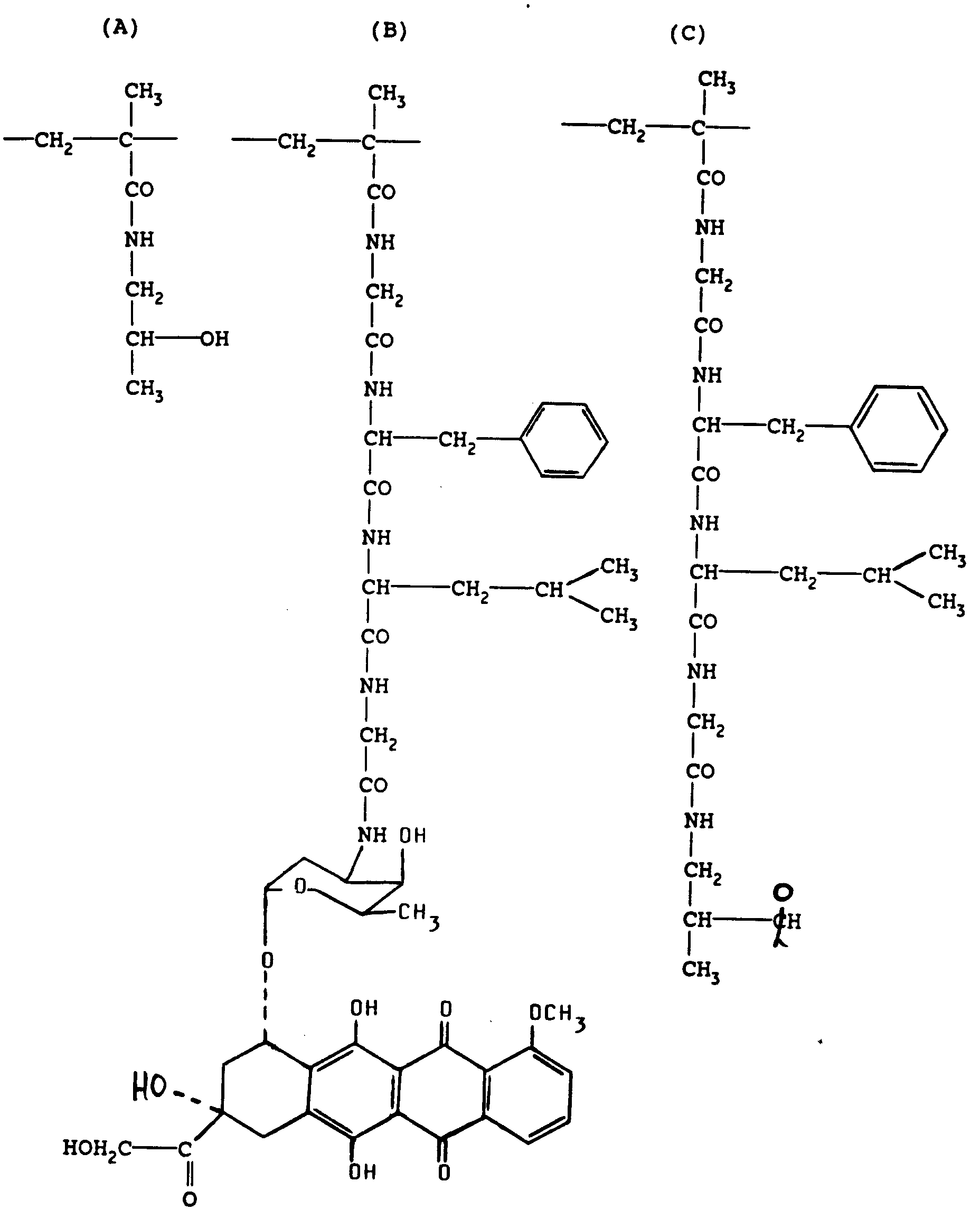
- and (ii) a conjugate composed of x mol % of
units of formula (A) above, y mol % of units of formula
(B) above, z mol % of units of formula (D) and w mol %
of units of formula (C) above:

-
- For simplicity only Doxorubicin conjugates are shown. The conjugate (i) is termed "PK1" in which x varies from 85 to 98 mol%, y varies from 1 to 10 mol% and z varies from 0 to 14 mol%. The conjugate (ii) is termed "PK2" in which x varies from 80 to 97 mol%, y varies from 1 to 10 mol%, z varies from 0 to 18 mol% and w varies from 1 to 18 mol%. In each conjugate, the anthracycline antibiotic is linked to the HPMA copolymer by a tetrapeptide sequence attached to the sugar amine of the anthracycline by a peptide bond. This linkage is resistant to acid hydrolysis, but the glycosidic bond between the sugar amine ring and the aglycone moiety is hydrolysed relatively easily, releasing the free aglycone.
- The conjugates (i) and (ii) may be shown below as formulae (I) and (II):
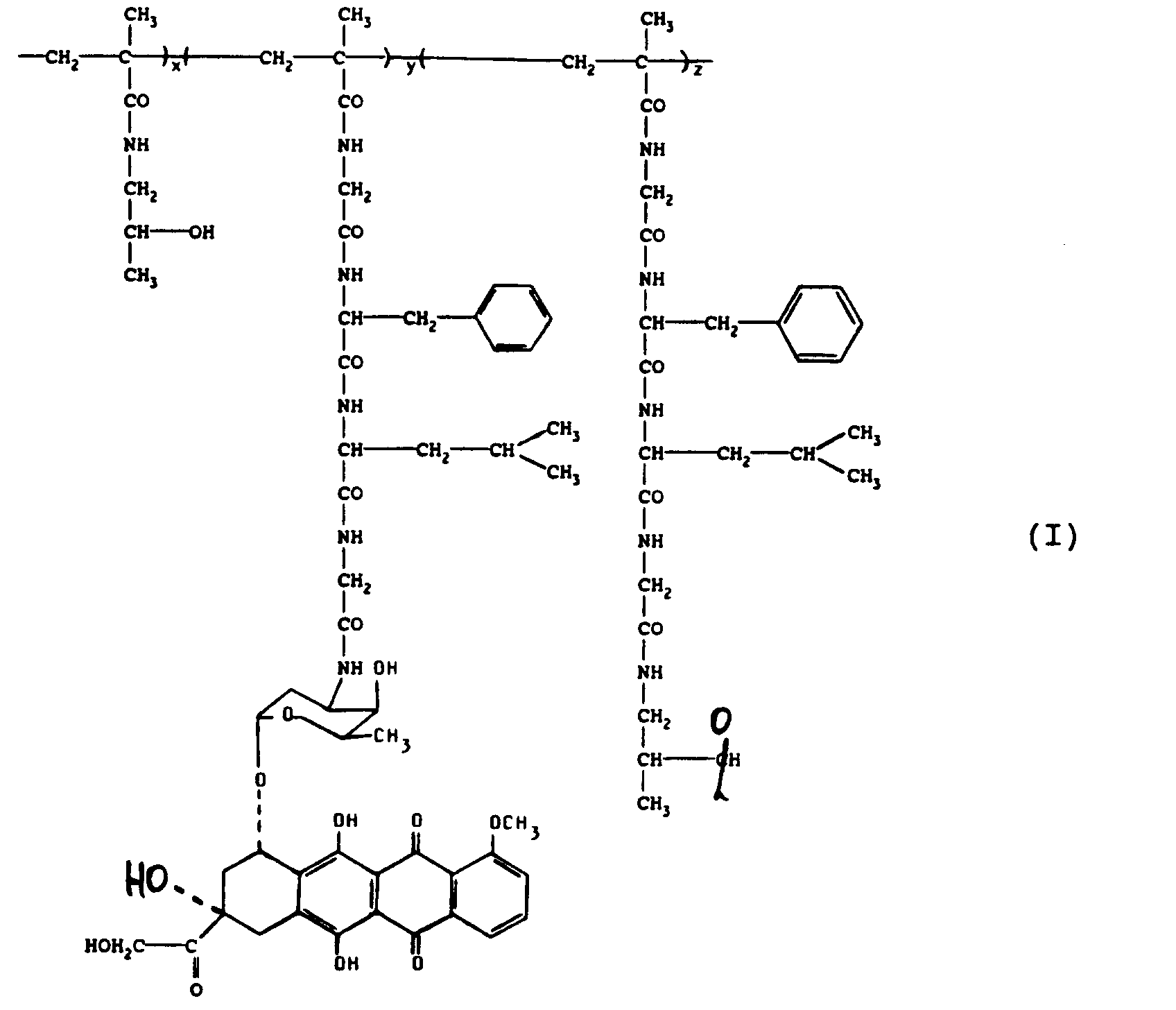

- As illustrated by Seymour L.W. et al in Biochemical Pharmacology 39, 1125-1131, 1990, following intravenous administration to mice, the pharmacokinetics of Doxorubicin were markedly altered by its conjugation to HPMA copolymer: the high initial levels of free Doxorubicin in plasma observed following administration of free drug were absent in the case of polymer Doxorubicin conjugates and the subsequently high levels of free Doxorubicin seen in other tissues were also abolished. In contrast, the circulating half-life of polymer Doxorubicin conjugates was approximately 15 times longer than that of the free drug. The initial peak level of free Doxorubicin in the heart was reduced 100-fold following administration of drug-conjugate.
- As high levels of anthracyclines in cardiac tissue are known to correlate with tissue damage and cumulative, delayed-onset cardiotoxicity, the decreased cardiac levels observed following administration of HPMA copolymer - Doxorubicin conjugate are a very important issue and may account for the decreased toxicity and improved efficacy reported in the literature for the polymer-conjugated drug: for example, a recent study using rats has shown a marked reduction in the toxicity of the HPMA copolymer Doxorubicin conjugate, with no evidence for any decrease in cardiac output up to 20 weeks following administration of the drug. In this study Doxorubicin was applied at 4 mg/Kg, a dose that is usually lethal when administered to rats in unconjugated form (for details, please refer to Yeung T.K. et al in "Proceedings of the British Association for Cancer Research Meeting", Glasgow, UK, 10 April 1989).
- The significant reduction in the cardiac doxorubicin content using stable, covalent polymer - conjugated drug is thought to be related to the fact that these conjugates are stable in the bloodstream and are only cleaved intracellularly.
- Similar HPMA copolymer - Daunomycin conjugates used to treat Walker Sarcoma in Wistar rats have been able to show both improvement in the therapeutic response compared with free Daunomycin and also a large increase in the amount of free Daunomycin detected in the tumour following administration of the polymer conjugated drug (see Cassidy J. et al in Biochem. Pharmacol. 38, 875-880, 1989). It has been speculated that this passive tumour targeting of the HPMA copolymer - Daunomycin conjugate may be related to the prolonged circulation of the drug in the bloodstream: in fact, certain tumours, including Walker Sarcoma, are known to have high rates of pinocytosis in vivo, and it has been suggested that extending the circulation times of antineoplastic drugs may elevate their relative concentrations in tumour cells (see, for example, Trouet A. et al in Nature New Biol. 239, 110-112, 1972, and Busch H. et al in Cancer Res. 21, 371-377, 1981).
- We have now investigated the formulation of anthracycline-HPMA copolymer conjugates. We found that, although the aqueous equilibrium solubility of polymer-anthracycline glycoside conjugates is sufficiently high (> 5% w/v), these polymers have got a remarkable hydrophobicity so that their dissolution rates in water were quite slow. Hence we found that, if lyophilized alone, anthracycline-HPMA copolymer conjugates formed a freeze-dried cake which dissolved very slowly. Complete dissolution took a very long time, i.e. even more than 30 minutes with continuous shaking. This is disadvantageous because of the recognized toxicity of the anthracycline glycosides family.
- Moreover we found that, after reconstitution with sterile water or with sterile physiological saline or with any other aqueous physiological diluent, some undissolved fragments of the polymer were entrained on the top of the froth and/or got caught on both the rubber stopper and the vial walls. This problem is of particular relevance because of the risk of administering intravenously some undissolved particles. However, we did find that the presence of a particular cosolubilizing agent in a freeze-dried preparation containing a polymer-anthracycline glycoside conjugate enhanced the solubility of the drug to a great extent, so that upon reconstitution complete dissolution of the conjugate may be achieved in less than one minute without any difficulty.
- Accordingly, the present invention provides a lyophilized composition comprising (a) a conjugate comprising a N-alkyl methacrylamide-based copolymer and an anthracycline glycoside linked through a peptide spacer to the copolymer and (b) a cosolubilizing agent. Optionally a targeting moiety is linked through a peptide spacer to the polymer. Also optionally, the composition further comprises (c) a filler.
- It is therefore possible to provide a lyophilized pharmaceutical composition containing a polymer-anthracycline glycoside conjugate and having reduced dissolution time when reconstituted with an aqueous pharmaceutically acceptable diluent, so as to permit the practical and safe use of polymer-anthracycline conjugates in therapy. In the present specification the terms "pharmaceutical", "pharmaceutically" and the like are meant to refer to applications in both human and veterinary field. The terms "lyophilized" and "freeze-dried" are used without distinction.
- The copolymer to which the anthracycline glycoside is linked consists essentially of units derived from a N-alkyl methacrylamide. Preferably the alkyl group is a C1-C6 alkyl group. The alkyl group may contain one or more hydroxy groups. A suitable alkyl group may therefore be a C1-C4 alkyl group substituted by a hydroxy group. A preferred alkyl group is a 2-hydroxy-propyl group. A preferred copolymer is a copolymer of N-(hydroxypropyl) methacrylamide (HPMA).
- The copolymer also consists essentially of other units derived from a methacryloyl monomer. The anthracycline glycoside is linked to these units via a peptide spacer. The units may therefore be considered as being derived from a N-methacryloylated peptide, the anthracycline being linked to the peptide. The units may be represented by formula (III):in which P denotes the peptide spacer and A denotes the anthracycline glycoside.

- The copolymer may comprise too yet other units which are derived from a methacryloyl monomer and to which a targeting moiety is linked via a peptide spacer. These units may therefore be considered as being derived from a N-methacryloylated peptide, the targeting moiety being linked to the peptide. The units may be represented by formula (IV):in which P denotes the peptide spacer and T denotes the targeting moiety.

- The copolymer typically contains the units derived from a N-alkyl methacrylamide in a proportion of 60 mol% or more, for example at least 80 mol% or at least 85 mol%. These units may be present in an amount up to 97 or 98 mol%. The units of formula (III) may be present in a proportion of from 1 to 20 mol%, for example from 1 to 10 mol%. The units of formula (IV) may be present in an amount of from 0 to 20 mol%, for example from 0 to 18 mol% or from 0 to 14 mol%.
- A preferred copolymer is copolymer of 1-[methacryloyl]amino-2-hydroxy-propane and N-methacryloylpeptidyl anthracycline and, optionally, 1-[methacryloyl peptidyl]amino-2-hydroxy propane and a N-methacryloylpeptidyl targeting moiety. More specifically, the copolymer may be a copolymer of x mol% of {1-[methacryloyl]amino-2-hydroxypropane units; y mol % of {-N-[methacryloyl-(P)](A)} units;
optionally, z mol % of {1-[methacryloyl-(P)]amino-2-hydroxypropane} units; and w mol % of {-N-[methacryloyl-(P)](T)} units
wherein P is the peptide spacer
A is the anthracycline glycoside
T is the targeting moiety
and x, y, z and w represent the molar percentages of the components. These percentages may vary within broad ranges such as from 80 to 98% for x; from 1 to 10% for y; from 0 to 18% for z and from 1 to 18% for w. - Suitable conjugates are conjugates PK1 and PK2 mentioned above. For the PK1 conjugate, these values may vary from about 85 to 98 mol/mol % for x; about 1 to 10 mol/mol % for y; and about 0 to 14 mol/mol % for z. For the PK2 conjugate the values may vary from about 80 to 97 mol/mol % for x, about 1 to 10 mol/mol % for y, about 0 to 18 mol/mol % for z and about 1 to 18 mol/mol % for w.
- The anthracycline glycoside covalently bound to the copolymers via the peptide spacers may be any anthracycline glycoside, for example one of those disclosed in GB-A-1161278, GB-A-1217133, GB-A-1457632, GB-A-1467383, GB-A-1500421 and GB-A-1511559. In particular, the anthracycline glycoside is, for example, doxorubicin, 4'-epi-doxorubicin (i.e. epirubicin), daunorubicin and 4-dimethoxy-daunorubicin (i.e. idarubicin).
- The peptide spacer may be from 1 to 10, for example from 2 to 4, amino acid residues long. The spacer should be susceptible to intracellular lysosomal hydrolysis. The spacer may be resistant to extracelluar hydrolysis. Suitable spacers were disclosed in EP-A-187547. In particular, the spacer may be Gly-Leu-Gly; Gly-Phe-Ala; Gly-Leu-Phe; Gly-Leu-Ala; Gly-Phe-Leu-Gly; Gly-Phe-Phe-Leu; Gly-Leu-Leu-Gly or Gly-Phe-Phe-Gly. Preferably the peptide spacer is Gly-Phe-Leu-Gly. Typically, one type of peptide spacer only is carried by the N-alkyl methacrylamide-based copolymers so that the anthracycline glycoside and, if present, targeting moiety are linked to the copolymer through the same type of spacer.
- The targeting moiety is typically a saccharide, especially a monosaccharide or a disaccharide. Preferably the targeting moiety is galactose, galactosamine, glucosamine, mannosamine, fucosylamine or lactosamine. Alternatively, the targeting moiety may be a monoclonal antibody, for example a monoclonal antibody specific for a human neoplasm such as a neoplasm of the breast, colon, lung, prostate, ovary or thymus.
- The polymer anthracycline conjugates employed in the compositions of the present invention may be, for example, those disclosed in US-A-4097470 and EP-A-187547, or similar conjugates. They may be prepared by known procedures, for example by procedures similar to those reported in these documents.
- The cosolubilizing agent used as a solubility enhancer in the lyophilized preparation of the invention is typically a surfactant selected for example from polyethylene sorbitan fatty acid esters (known generally as polysorbates), polyethylene-polypropylene glycol polymers (known generally as poloxamers), polyethylene glycol esters of fatty acids, and phosphatides. The surfactant should be non-toxic and acceptable for intravenous administration.
- Useful polyoxyethylene sorbitan fatty acid esters include partial C12-20 saturated or unsaturated fatty acid esters of sorbitol and its mono- and di-anhydrides copolymerised with ethylene oxide. Typically, from 10 to 40, for example about 20 moles of ethylene oxide for each mole of sorbitol and its anhydrides will be present.
- Preferably the polysorbate is polysorbate 20 (polyoxyethylene 20 sorbitan monolaurate, Chemical Abstract ref. No. 9005-64-5, which is a mixture of partial lauric acid esters of sorbitol and its mono- and di-anhydrides copolymerized with approximately 20 moles of ethylene oxide for each mole of sorbitol and its anhydrides) or polysorbate 80 (polyoxyethylene 20 sorbitan monooleate, Chemical Abstract ref. No. 9005-65-6). Other suitable polysorbates are polysorbate 40 (polyoxyethylene 20 sorbitan monopalmitate, CAS No 9005-66-7), polysorbate 60 (polyoxyethylene 20 sorbitan mono-stearate CAS No 9005-67-8), polysorbate 65 (polyoxyethylene 20 sorbitan tristearate, CAS No. 9005-71-4) and polysorbate 85 (polyoxyethylene 20 sorbitan trioleate CAS No 9005-70-3).
- Poloxamers include non-ionic surfactants with the structure HO(CH2-CH2-O)a-(CH(CH3)CH2O)b-(CH2-CH2-O)aH where b is an integer from 15 to 67 and a is an integer from 2 to 98. Preferably the Poloxamer is Poloxamer 188. Poloxamer 188 is one of a series of poly(oxyethylene)-poly(oxypropylene) block copolymers which may be used as a cosolubilising agent. In the formula above, a is 75 and b is 30 for Poloxamer 188 which thus has a molecular weight of 8350.
- The polyethylene glycol esters of fatty acids are, preferably, polyoxyethylene stearates. The phosphatide is preferably a lecithin, for example egg or soya lecithin.
- All the surfactants require co-lyophilization with the drug to exert their activity as dissolution enhancers. If they acted simply by decreasing the surface tension of the drug-containing solution or by a wetting effect, they should be equally active if either co-lyophilized with the drug or added to the reconstitution solvent. Co-lyophilization being required, this accounts for some unexpected interaction with the drug, which takes place in the solid state.
- The relative proportions of the conjugate and cosolubilizing agent in the preparations of the invention are generally such that, per 10 parts by weight of conjugate, there are from about 0.01 to 1.0, preferably from 0.035 to 0.35, parts by weight of cosolubilizing agent. A particularly preferred weight ratio between the cosolubilizer and the conjugate is 0.1-0.2 : 10.0. This optimum ratio combines the good performance of the cosolubilizer as dissolution enhancer with its pharmaceutical acceptability, from a toxicological point of view. The use of more elevated amounts of surfactant is severely limited for toxicity and tolerability reasons.
- The lyophilized formulations may contain the polymer-anthracycline glycoside conjugate in varying amounts. Typical formulations contain, for example, a quantity of polymer anthracycline glycoside conjugate equivalent to 5, 10, 20, 25 or 50 mg of anthracycline glycoside.
- In addition to the cosolubilizer, the composition of the present invention may further contain auxiliary ingredients, whose presence may help to provide a rapidly soluble freeze-dried product. These include fillers (or diluents, or extenders) and an organic solvent.
- Fillers are generally used in lyophilization technology for facilitating the process and/or providing mechanical integrity to the lyophilized cake. However, fillers need not be present in the case of the present invention, as the polymer-anthracycline conjugates can be easily lyophilized with no additives, to form a firm and rigid cake. As used herein, the word "filler" means a freely water soluble, solid particulate diluent which, when co-lyophilized with the polymer-anthracycline glycoside conjugate, may help solubilization of a slowly dissolving polymer upon addition of the reconstitution solvent by providing a "dragging" effect due to its high hydrophilicity.
- The water soluble filler suitable for use in the present invention can be any of the pharmaceutically acceptable inert solid materials typically used for lyophilization. Such fillers include, for example, sugars such as glucose, maltose, sucrose, and lactose; polyalcohols such as sorbitol and mannitol; amino acids such as glycine; polymers such as polyvinylpyrrolidone; polysaccharides such as dextran; certain inorganic salts such as sodium or potassium phosphates, or sodium chloride. In a preferred embodiment, the filler is lactose.
- The ratio of the weight of the polymer-anthracycline glycoside conjugate to the weight of the filler used in the compositions of the present invention should generally be within the range of from about 0.1:1 to about 20:1. In a preferred embodiment, the polymer-anthracycline glycoside conjugate:filler ratio is from about 1.0:1 to about 2.5:1. The amount of the filler is linked to that of the conjugate and is critical to the dissolution behaviour of the lyophilized cakes.
- If the filler is used alone (i.e. without any cosolubilizer), complete reconstitution takes a somewhat long time, e.g. from not less than 8-10 minutes up to more than 20-30 minutes depending on the relative amounts of both the filler and the conjugate polymer. This point is illustrated in details in Experiment 1.
- If the filler and the cosolubilizer are both present in the formulation, the reconstitution time is markedly reduced, ranging from about 30-90 seconds to about 4-5 minutes, depending on the quantities of the conjugate, the filler and the cosolubilizer. Generally, the higher the ratio between the cosolubilizer and the conjugate, the less the reconstitution time.
- Quite surprisingly, therefore, we have found that the filler and the cosolubilizer may act synergistically as dissolution enhancers. Moreover, we have unexpectedly found that the presence of a filler also helps dissolution of the conjugate during the manufacturing of the solution to be freeze-dried. Therefore, the presence of a filler in the formulations of the present invention even if not strictly mandatory, is highly preferred. Experiments 1 and 2 illustrate this point in details.
- The invention also provides a method for producing a stable rapidly soluble lyophilized composition according to the invention, which method comprises
- a) mixing, in an aqueous solution, the polymer-anthracycline conjugate, the cosolubilizing agent and, optionally, the filler and/or an organic solvent;
- b) freeze-drying the aqueous solution.
-
- Organic solvents are not commonly used in lyophilization technology. They are not as easy to handle as water and their use is also limited by the fact that parenteral freeze-dried dosage forms cannot be allowed to contain elevated residues of organic solvents for toxicity reasons. However, it is generally recognized that organic solvents may have certain useful properties, such as:
- promotion of the solubilization of a drug during the manufacturing of the solution to be freeze-dried (this is not important in the case of the present invention as the polymer anthracycline glycoside conjugates are more soluble in water than in alcohol,isopropanol, etc);
- reduction of the degradation rate of the active material in water during processing; and
- induction of crystallization of a drug in the frozen state.
- Unexpectedly, though, we found that the presence of an organic solvent in the solution to be freeze-dried further enhances the dissolution rate of the lyophilized product. A small concentration of organic solvent is effective, typically less than 5% v/v and preferably less than 1% v/v, with reference to the solution to be freeze-dried. 0.5% v/v or more of an organic solvent may therefore be employed. Experiment 2 illustrates this point.
- Organic solvents suitable for use in the present invention include ethanol, isopropanol, tert-butanol, and any other pharmaceutically acceptable solvent which is easily removed during the freeze-drying process, so that the finished lyophilized product contains only residues (if any) of such solvent, thus allowing parenteral administration with no toxicity and/or tolerability risks. The solvent is typically a water-miscible organic solvent. Preferred organic solvents for this purpose are organic aliphatic alcohols, in particular C1-C4 alkanols such as ethanol.
- The present invention also provides a kit containing a lyophilized composition according to the invention in a sterile vial and a sterile solution for reconstituting the said lyophilized composition.
- The present invention further includes a method for preparing an injectable solution of polymer anthracycline glycoside conjugate, characterized by dissolving, in a solution suitable for injection, a stable, rapidly soluble, lyophilized preparation comprising a polymer-anthracycline conjugate, a cosolubilizer, and optionally a filler.
- The lyophilized formulations disclosed by the present invention may be prepared in a conventional way, following the usual freeze-drying techniques while taking, however, all precautions required in manipulation of toxic substances such as anthracycline glycosides. Thus, for example, the cosolubilizer, the filer and the polymer anthracycline glycoside conjugate are successively dissolved under stirring in a suitable amount of deaerated water for injections, possibly containing the organic solvent. Then, further water is added to reach the desired final volume. The resulting solution is clarified and sterile filtered and aseptically distributed in sterile containers (vials) of desired capacity. Freezing of the solution, e.g. at -40°C to -50°C for about 4 to 5 hours, and drying, e.g. at a final temperature of 30°-40°C for about 6 to 8 hours is then performed and the vials are sealed according to usual procedures.
- Also, the reconstitution of the freeze-dried preparations, e.g., with sterile water, physiological saline solution, or any pharmaceutically acceptable isotonic solution, is performed in conventional manner. Thus, for example, the physiological saline solution (0.9% sodium chloride aqueous solution) is used in a volume which may vary depending on the type and the amount of the active polymer contained in the lyophilized cake: volumes from 5 mL to 25 mL of physiological saline solution may be, e.g., used for reconstituting amounts of polymer equivalent to 5 mg and 50 mg, respectively, of anthracycline glycoside. The injectable reconstituted solutions of the invention are administered either by rapid intravenous injection or (preferably) by intravenous infusion, according to a variety of possible dose schedules.
- The reconstituted compositions of the invention are useful for treating tumours in both human and animal hosts. They can be employed to improve the condition of a patient having a tumour. Examples of tumours that can be treated are, for instance, sarcomas, including osteogenic and soft tissue sarcomas, carcinoma, e.g., breast-, lung-, bladder-, thyroid-, prostate- and ovarian carcinoma, lymphomas, including Hodgkin and non-Hodgkin lymphomas, neuroblastoma, melanoma, myeloma, Wilms tumour, and leukemias, including acute lymphoblastic leukaemia and acute myeloblastic leukaemia.
- The following Experiments and Examples illustrate but do not limit the invention in any way. They clearly show that the formulations of the present invention assure a considerable saving of time, a reduction in the hazards of operator exposure, and a safe administration to patients.
- Influence of the cosolubilizer and of the filler on the dissolution time of freeze-dried preparations containing polymer Doxorubicin conjugate (PK1 conjugate) was examined. The following formulations were freeze-dried:
Trial No PK1 mg Lactose mg Polysorbate 80 mg W.F.I. 1 70 - - q.s. to 1.0 mL 2 70 50 - q.s. to 1.0 mL 3 70 140 - q.s. to 2.0 mL 4 70 140 2 q.s. to 2.0 mL - Reconstitution of the lyophilized preparations was performed either with sterile water or with Sodium Chloride Injection.
- Times for complete reconstitution were as follows:
Trial No. Time (min.) 1 about 60 (with both solvents) 2 about 40 (with both solvents) 3 15-20 (with both solvents) 4 less than 1 (with both solvents) - Influence of the simultaneous presence of the cosolubilizer and of the filler (with and without organic solvent in the freeze drying process) was examined for polymer-Doxorubicin conjugate (PK2 conjugate).
- The following formulations were freeze-dried:
Trial No PK1 mg Lactose mg Polysorbate 80 mg Ethanol mL W.F.I. 1 700 - 10 - qs to 15 mL 2 700 450 10 - qs to 15 mL 3 700 300 3 - qs to 15 mL 4 700 450 10 0.1 qs to 15 mL 5 700 300 10 0.1 qs to 20 mL 6 700 450 5 0.1 qs to 15 mL - The following results were obtained (reconstitution with sterile water):
Trial No. Time for complete dissolution (min.) 1 4 - 5 2 1.5 3 4 - 5 4 0.75 - 1.5 5 1.0 - 1.5 6 1.0 - 1.5 - Polymer-bound Doxorubicin formulations were prepared by following the procedure reported below. The relative proportions of the various components employed in the preparation were as hereinbelow indicated (amounts are per vial):
PK2 700 mg (equivalent to approx. 50 mg of Doxorubicin) Lactose 600 mg Polysorbate 80 10 mg Hydrochloric acid qs to pH = 5.0 Ethanol 0.1 mL Water for injections qs to 15.0 mL - Lactose, polysorbate 80 and PK2 were subsequently dissolved under stirring into W.F.I., deaerated by nitrogen bubbling (about 90% of the finally required water volume). After adjusting pH to 5.0 with hydrochloric acid, ethanol was added.
- The solution was then brought to the final volume with deaerated W.F.I. The solution was then filtered under sterile conditions through a 0.22 µm microporous membrane. Volumes of 15.0 mL of solution were aseptically distributed into sterile, type I colourless glass vials having 50-56 mL capacity.
- The solutions were frozen in the vials at a temperature of -40 to -45°C for 4 to 5 hours. Lyophilization was then carried out, drying the product, in the final stage, at about 40°C for 5 to 6 hours.
- Vials were closed with sterile chlorobutyl rubber stoppers and sealed with aluminium caps.
- Complete dissolution of the freeze-dried cakes (reconstitution either with sterile water or Sodium Chloride Injection ) took approximately 60 seconds.
- Following an analogous procedure, an identical Pk 1 polymer-bound Doxorubicin formulation was prepared.
- Operating in analogous fashion as described in Example 1, the following lyophilized formulations were prepared (amounts are per vial):
Trial No 1 2 3 PK2 mg 700 700 700 Lactose mg 450 450 450 Polysorbate 80 mg 10 10 10 Ethanol mL - 0.1 - Isopropanol mL - - 0.2 Hydrochloric acid q.s. to pH 5.0 5.0 5.0 W.F.I. q.s. to mL 15.0 15.0 15.0 - Complete dissolution of the freeze-dried cakes (reconstitution either with sterile water or Sodium chloride Injection) took approximately 0.75 - 1.5 minutes.
- Operating in analogous fashion as described in Example 1, the following lyophilized formulations were prepared (amounts are per vial):
Trial No 1 2 3 4 PK2 mg 700 700 700 700 Lactose mg 300 - 300 - Mannitol mg - 300 - 300 Polyoxyethylene stearate mg 5.0 5.0 - - Poloxamer 188 mg - - 5.0 5.0 Hydrochloric acid qs to pH 5.0 5.0 5.0 5.0 W.F.I. qs to mL 20.0 20.0 20.0 20.0 - Complete dissolution of the freeze-dried cakes (reconstitution with 25 mL of sterile water) was achieved within 3 to 5 minutes.
- Operating in analogous fashion as described in Example 1, the following lyophilized formulations were prepared (amounts are per vials - type I colourless glass vials having 8 - 10 mL capacity were used):
Trial No 1 2 3 PK1 70 - - PK2 - 70 70 Lactose 70 30 - Polysorbate 80 0.2 0.2 0.2 Sodium Chloride 20 20 20 W.F.I. 2.0 2.0 2.0 - Complete dissolution of the freeze-dried cakes (reconstitution with 2.5 mL of either sterile water or Sodium Chloride Injection) was obtained within 0.5 minutes.
- Freeze-dried vials containing compositions according to the present invention comprising about 50 mg of bound Doxorubicin were examined for long term stability over various periods of time at different temperatures.
- The following parameters were examined and the acceptable standards are also given.
- Appearance: colourless glass vials, containing a porous red, freeze-dried cake or mass, determined by visual inspection
- total doxorubicin content: U.V. spectrophotometric method
- related substances: HPLC method
- water: not more than 3%
- time for reconstitution: not more than 3 minutes
- appearance after reconstitution: clear and clean red solution, essentially free from visible particles of foreign matter
- pH after reconstitution: 4.5 - 7.0
- The U.V. spectrophotometric method employed is as follows:
-
- Doxorubicin HC1, working standard
- Methanol, UV grade
- Water for Injections, B.P. grade
- 2N hydrochloric acid, ACS grade
- 50 mg (Doxorubicin equivalent) PK1 freeze-dried vials
- 50 mg (Doxorubicin equivalent) PK2 freeze-dried vials
- High precision laboratory glassware
- UV-Visible Spectrophotometer, PHILIPS mod. PU 8740, or equivalent.
- Printer plotter, PHILIPS mod. 357820, or equivalent.
-
- Solvent for the spectrophotometric measurements:
- Transfer 5 ml of 2N HC1 into a 1000 ml volumetric flask and fill to the mark with methanol (Solvent 5).
- Standard solution
- Transfer about 10.7 mg, exactly weighed, of Doxorubicin HC1 working standard, corresponding to about 10 mg of Doxorubicin as free base, into a 50 ml volumetric flask and dissolve to volume with the Solvent S (Solution A).
- Dilute 10.0 ml, exactly measured, of the Solution A to 50 ml with the Solvent S, in volumetric flask.
- Sample solution
- Dissolve the contents of the freeze-dried vials of 50 mg (Doxorubicin equivalent) PK1 or PK2 in 25 ml of Water for Injections.
- Transfer 2.0 ml, exactly measured, into a 100 ml volumetric flask and dilute to volume with Solvent S.
- Register in 1 cm pathlength cells the spectra of the standard and sample solutions in the 350-550 nm range and read the adsorbance at the maximum wavelength (478 nm), using the Solvents as a blank.
- The HPLC methodology is as follows:
-
- Doxorubicin HC1, working standard
- PK1 drug substance, working standard
- PK2 drug substance, working standard
- Acetonitrile, HPLC grade
- Water, HPLC grade
- Trifluoroacetic acid, HPLC grade
- 2N sodium hydroxide, analytical grade
- 85% phosphoric acid, analytical grade
- 50 mg (Doxorubicin equivalent) PK1 freeze-dried vials
- 50 mg (Doxorubicin equivalent) PK2 freeze-dried vials
-
- Liquid chromatography Milton Roy CM 4000, or
equivalent, equipped with:
- chromatographic column: Vydac C18 (length: 250 mm, internal diameter: 4.6 mm), supplied by the Separations Group, Hesperia, California (USA)
- injection valve: Rheodyne model 7125, or equivalent, fitted with a 50 µl sample loop
- detector: Milton Roy model 3100 or equivalent
- Membrane filter, 0.22µm porosity, Millipore Durapore GVWP, or equivalent
- High precision laboratory glassware
-
- Mobile phase A consisting of water, containing 0.1% of trifluoroactic acid (v/v), filtered through the membrane filter and deaerated.
- Mobile phase B consisting of acetonitrile, containing 0.07% trifluoroacetic acid (v/v), filtered through the membrane filter and deaerated.
- Doxorubicin HC1 standard solution
- Transfer about 5 mg, exactly weighed, of Doxorubicin HC1 working standard into a 100 ml volumetric flask and dissolve to volume with water, HPLC grade. Dilute 5 ml, exactly measured, of this solution into a 50 ml volumetric flask with water/acetonitrile 70/30, HPLC grade.
- PK1 or PK2 standard solution
- Transfer an amount of the PK1 or PK2 polymer, working standard, exactly weighed and corresponding to about 10 mg of Doxorubicin HC1 into a 50 ml volumetric flask and dissolve to volume with water/acetonitrile 70/30, HPLC grade.
- Sample solution
- Dissolve the contents of a 50 mg (Doxorubicin equivalent) freeze-dried vial with 25 ml, exactly measured, of water, HPLC grade. Dilute 1 ml, exactly measured, into a 10 ml volumetric flask with water/acetonitrile 70/30, HPLC grade.
- Resolution solution
- Transfer about 10 mg of Doxorubicin HC1 into a 100 ml volumetric flask, dissolve with 5 ml of water, HPLC grade, add 5 ml of phosphoric acid, and allow to stand for about 30 minutes. Adjust with 2N sodium hydroxide (about 37 ml) to a pH of 2.6 ± 0.1, and fill to the mark with water, HPLC grade. (NOTE: portions of this solution may be frozen until needed, then thawed, and mixed before use).
- The sample solution, the Doxorubicin HC1 standard solution, and the PK1/PK2 standard solutions, are alternately injected into the liquid chromatograph at the following experimental conditions:

- Under these conditions, Doxorubicin HC1 has a retention time of about 5 minutes, the PK2 and the PK2 polymers conjugated with Doxorubicin have a retention time of about 16-17 minutes.
- The results obtained from studies of stability, for the formulations illustrated in example 1, are reported in the following Tables 1 to 5 for the PK1 formulation and in the following Tables 6 to 10 for the PK2 formulation with reference to one batch of both PK1 and PK2 freeze-dried vials.
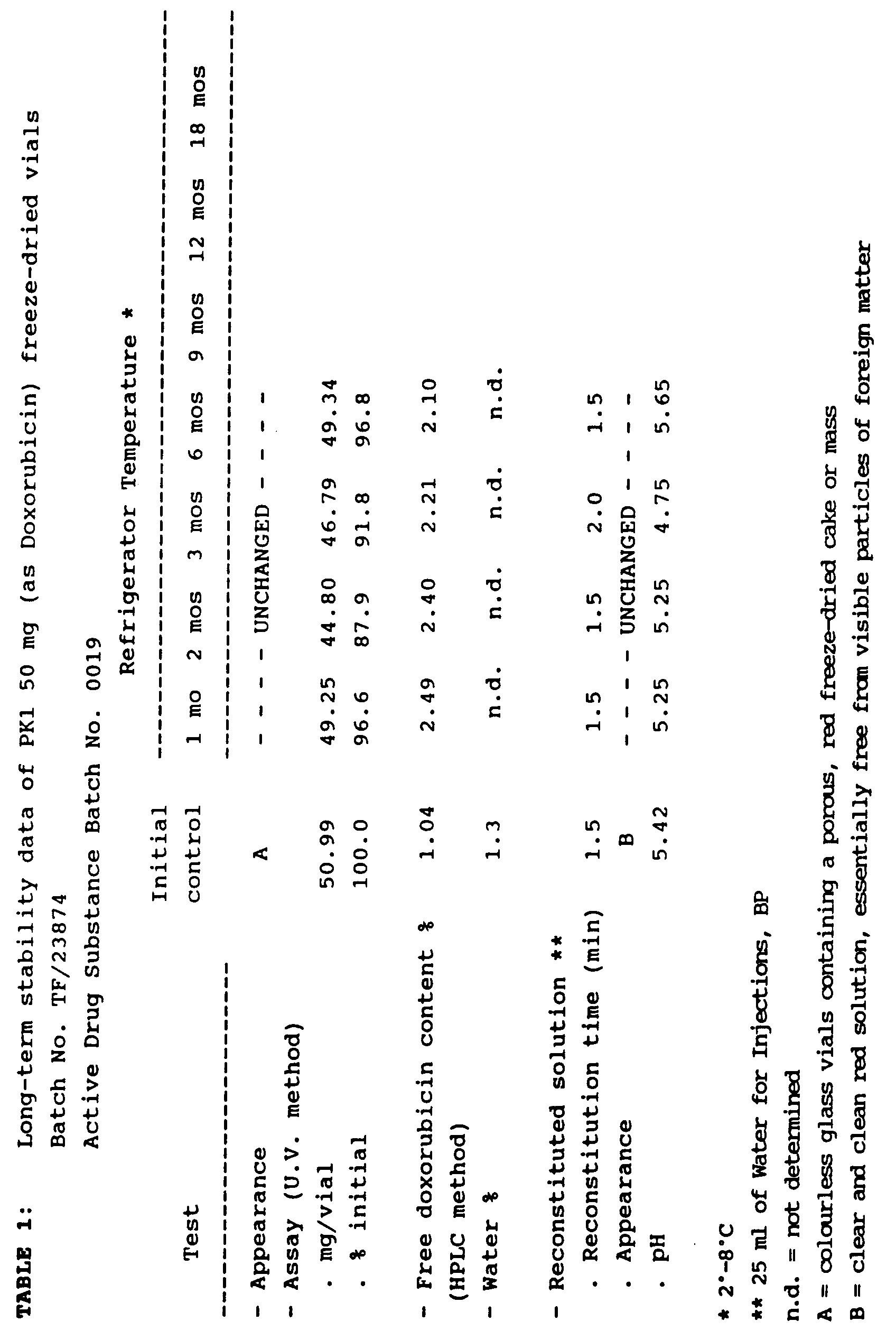


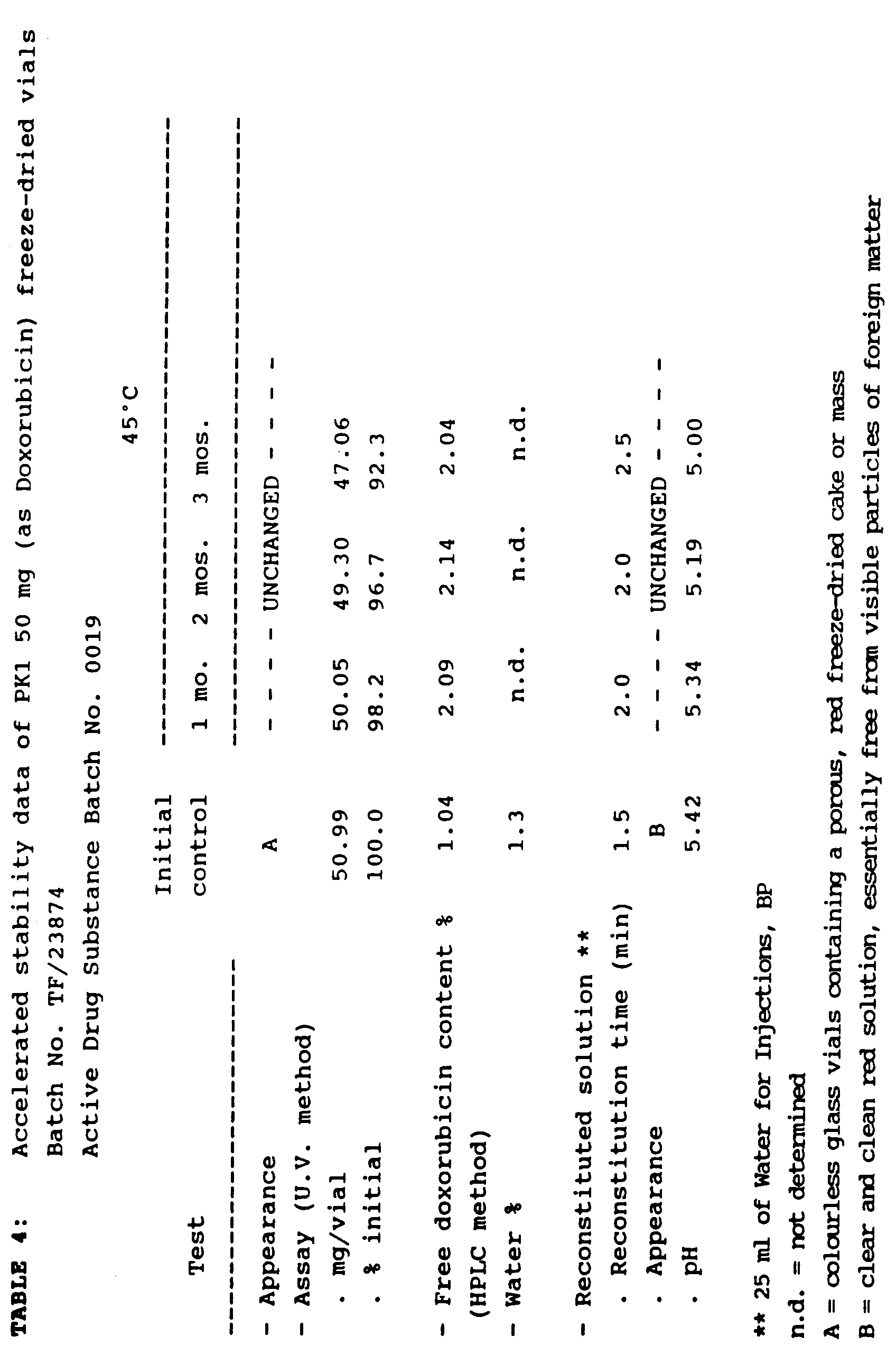
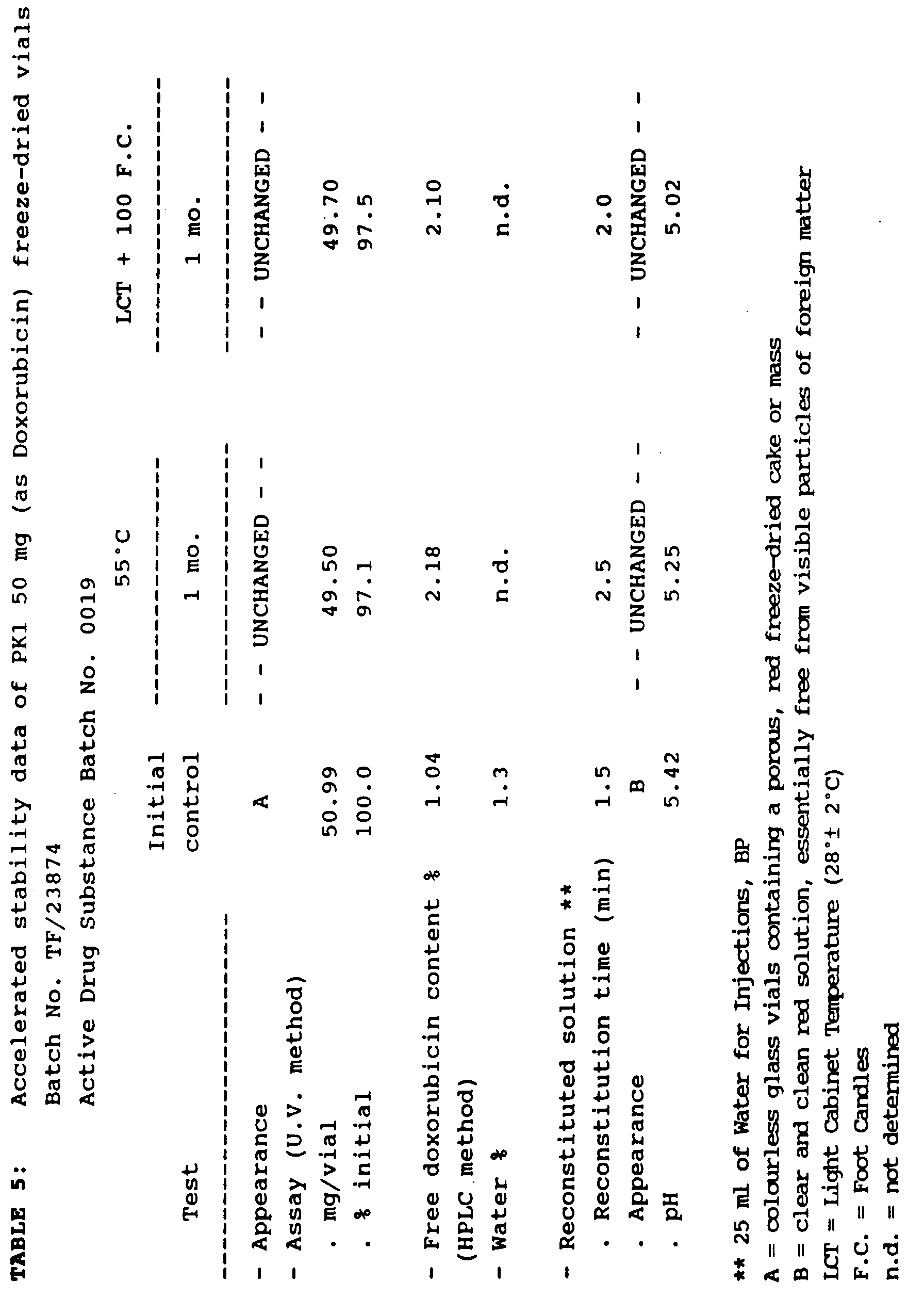

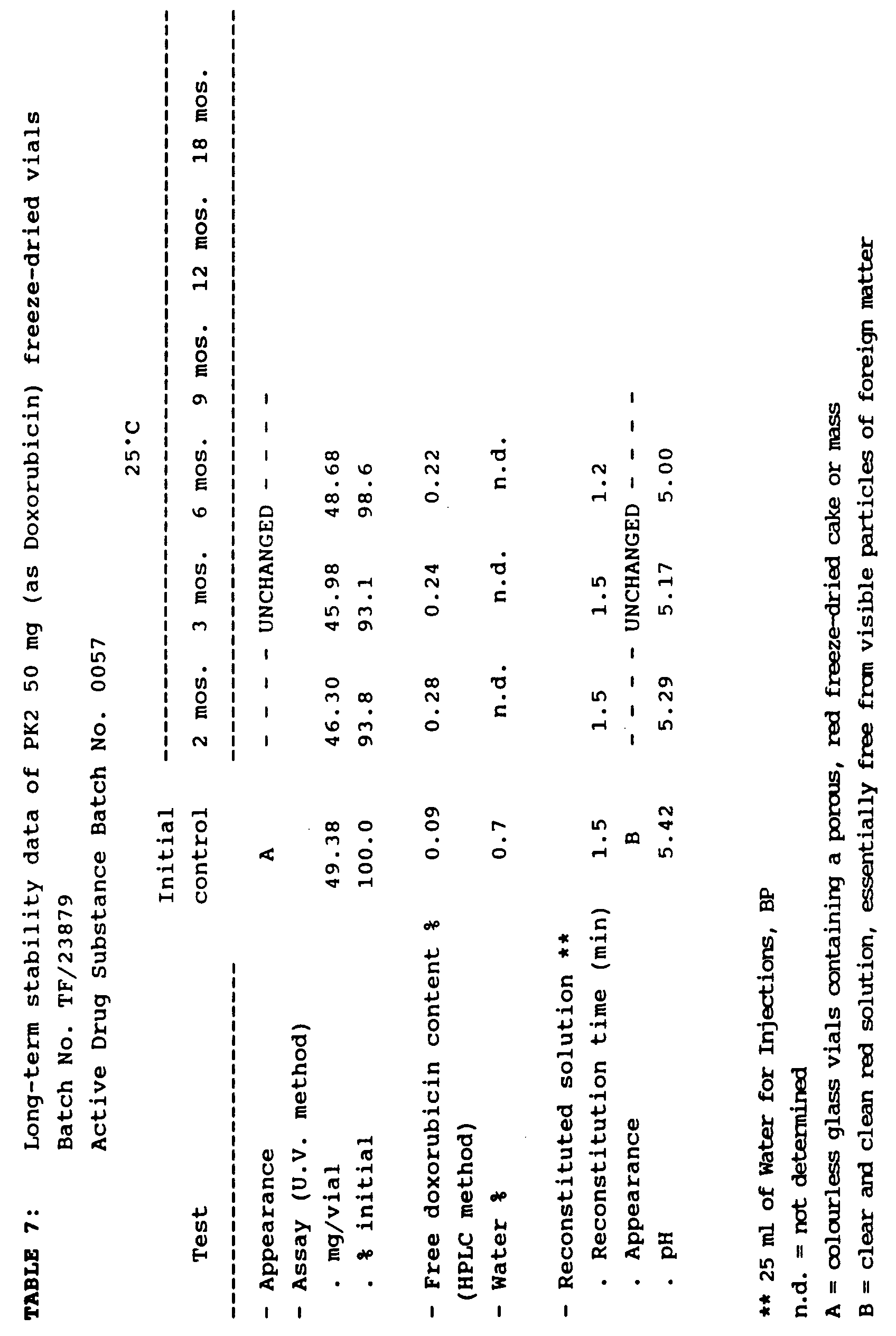
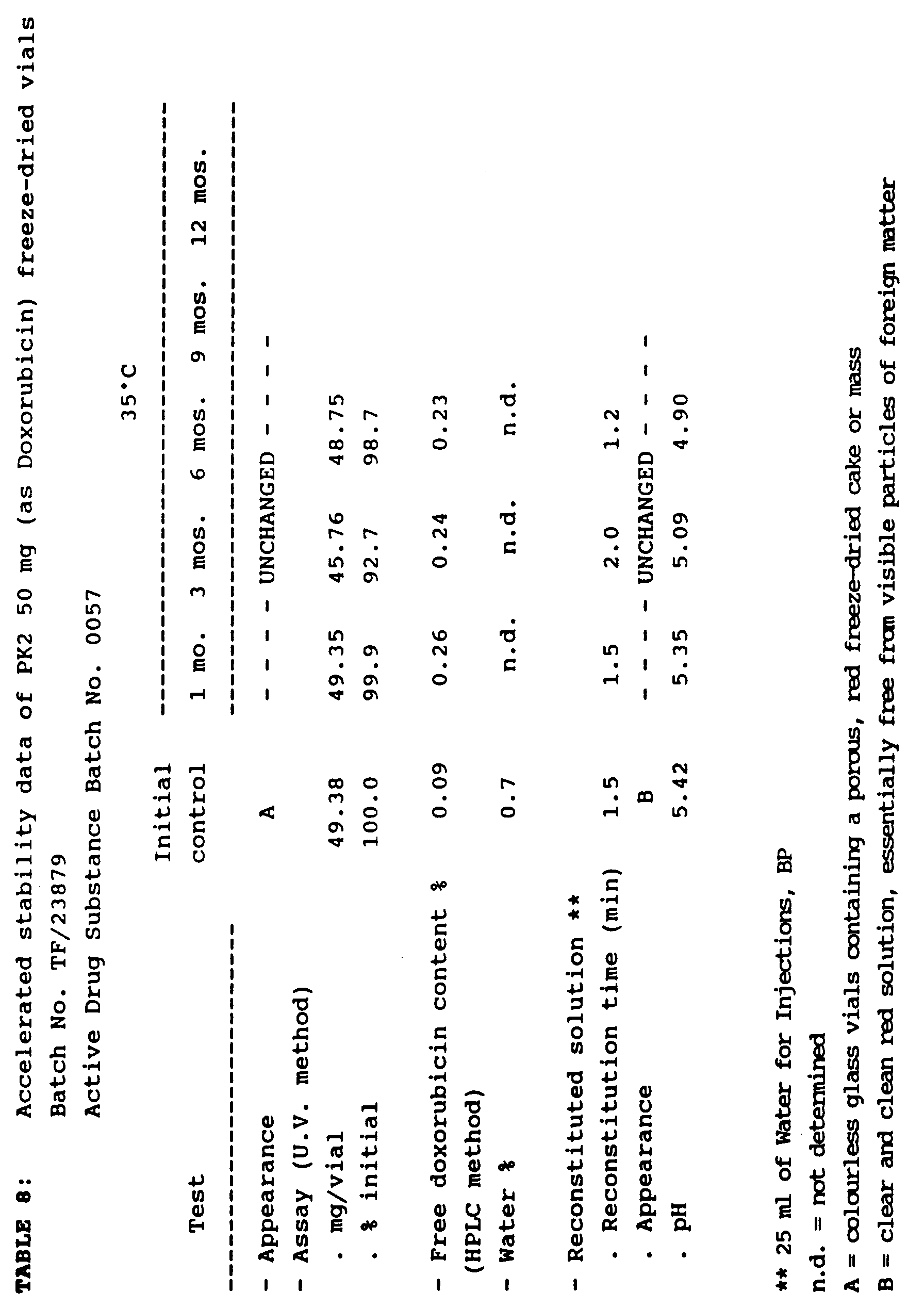


Claims (15)
- A lyophilized composition comprising (a) a conjugate comprising a N-alkyl methacrylamide-based copolymer and an anthracycline glycoside linked through a peptide spacer to the copolymer and (b) a cosolubilizing agent.
- A lyophilized composition according to claim 1 wherein the inert synthetic polymeric carrier is a copolymer of N-(2-hydroxypropyl) methacrylamide.
- A lyophilized composition according to claim 1 or 2, wherein the anthracycline glycoside is daunorubicin, doxorubicin, epirubicin or idarubicin.
- A lyophilized composition according to any one of the preceding claims wherein the peptide spacer is Gly-Phe-Leu-Gly.
- A lyophilized composition according to any one of the preceding claims, in which the cosolubilizing agent is a polysorbate, a poloxamer, a polyethylene glycol ester of a fatty acid or a phosphatide.
- A lyophilized composition according to claim 5 wherein the cosolubilising agent is selected from polysorbate 20, polysorbate 80, a poloxamer of formula HO(CH2CH2O)a.(CH(CH3)CH2O)b.(CH2CH2O)aH in which a is 75 and b is 30, a polyoxyethylene stearate and a lecithin.
- A lyophilized composition according to any one of the preceding claims, wherein the conjugate further comprises a targeting moiety linked through a peptide spacer to the copolymer.
- A lyophilized composition according to claim 7, wherein the targeting moiety is galactose, galactosamine, glucosamine, mannosamine, fucosylamine or lactosamine.
- A lyophilized composition according to claim 1 wherein the conjugate is (i) a conjugate composed of x mol % of units of formula (A), y mol % of units of formula (B) and = mol % of units of formula (C):wherein x is from 85 to 98 mol%, y is from 1 to 10 mol% and z is from 0 to 14 mol%, or (ii) a conjugate composed of x mol % of units of formula (A) above, y mol % of units of formula (B) above, z mol % of units of formula (D) and w mol % of units of formula (C) above:
 wherein w is from 1 to 18 mol%, x is from 80 to 97 mol%, y is from 1 to 10 mol% and z is from 0 to 18 mol%.
- A lyophilized composition according to any one of the preceding claims, which further comprises (c) a filler.
- A lyophilized composition according to claim 10, wherein the filler is a sugar, a polyalcohol, an amino acid, a polymer, a polysaccharide or an inorganic salt.
- A lyophilized composition according to claim 11 wherein the sugar is glucose, maltose, sucrose or lactose.
- A kit comprising:(a) a lyophilized composition according to any one of the preceding claims and(b) a sterile solution for reconstituting the said lyophilized composition.
- A method for preparing a lyophilized composition according to any one of claims 1 to 12 which comprises (a) mixing, in aqueous solution, the conjugate, the cosolubilizing agent and, optionally, a filler and/or an organic solvent and (b) lyophilizing the aqueous solution.
- A method for preparing an injectable aqueous solution, which method comprises reconstituting a lyophilized composition according to any one of claims 1 to 12 with a sterile aqueous diluent.
Applications Claiming Priority (3)
| Application Number | Priority Date | Filing Date | Title |
|---|---|---|---|
| GB929200247A GB9200247D0 (en) | 1992-01-07 | 1992-01-07 | Pharmaceutical compositions containing polymer derivative-bound anthracycline glycosides and a method for their preparation |
| GB9200247 | 1992-01-07 | ||
| PCT/EP1992/002968 WO1993013804A1 (en) | 1992-01-07 | 1992-12-21 | Pharmaceutical compositions containing polymer derivative-bound anthracycline glycosides and a method for their preparation |
Publications (2)
| Publication Number | Publication Date |
|---|---|
| EP0574571A1 EP0574571A1 (en) | 1993-12-22 |
| EP0574571B1 true EP0574571B1 (en) | 1999-05-06 |
Family
ID=10708214
Family Applications (1)
| Application Number | Title | Priority Date | Filing Date |
|---|---|---|---|
| EP93902124A Expired - Lifetime EP0574571B1 (en) | 1992-01-07 | 1992-12-21 | Pharmaceutical compositions containing polymer derivative-bound anthracycline glycosides and a method for their preparation |
Country Status (22)
| Country | Link |
|---|---|
| US (1) | US6245358B1 (en) |
| EP (1) | EP0574571B1 (en) |
| JP (1) | JPH06505755A (en) |
| KR (1) | KR100290222B1 (en) |
| AT (1) | ATE179618T1 (en) |
| AU (1) | AU666513B2 (en) |
| CA (1) | CA2105466A1 (en) |
| DE (1) | DE69229109T2 (en) |
| DK (1) | DK0574571T3 (en) |
| ES (1) | ES2133380T3 (en) |
| FI (1) | FI933853A0 (en) |
| GB (1) | GB9200247D0 (en) |
| GR (1) | GR3030633T3 (en) |
| HU (2) | HU217806B (en) |
| IL (1) | IL104256A (en) |
| MX (1) | MX9207605A (en) |
| NZ (1) | NZ246577A (en) |
| RU (1) | RU2118171C1 (en) |
| TW (1) | TW218847B (en) |
| UA (1) | UA32522C2 (en) |
| WO (1) | WO1993013804A1 (en) |
| ZA (1) | ZA9210049B (en) |
Cited By (1)
| Publication number | Priority date | Publication date | Assignee | Title |
|---|---|---|---|---|
| RU2488393C2 (en) * | 2007-11-12 | 2013-07-27 | Новартис Аг | Liquid compositions containing valsartan |
Families Citing this family (17)
| Publication number | Priority date | Publication date | Assignee | Title |
|---|---|---|---|---|
| GB9320781D0 (en) * | 1993-10-08 | 1993-12-01 | Erba Carlo Spa | Polymer-bound camptothecin derivatives |
| JP3107726B2 (en) | 1994-05-13 | 2000-11-13 | 株式会社クラレ | Water-swellable polymer gel |
| US5965118A (en) * | 1997-04-18 | 1999-10-12 | Access Pharmaceuticals, Inc. | Polymer-platinum compounds |
| WO1998047496A2 (en) * | 1997-04-18 | 1998-10-29 | Access Pharmaceuticals, Inc. | Polymer-platinum compounds |
| US7314956B2 (en) | 2001-08-08 | 2008-01-01 | Vaxim, Inc. | Multifunctional carrier for the delivery of a pharmacological agent or genetic material into a cell |
| WO2003017938A2 (en) * | 2001-08-22 | 2003-03-06 | Watson Pharmaceuticals, Inc. | Conjugates targeted to target receptors |
| US20030125268A1 (en) * | 2002-08-28 | 2003-07-03 | Rybak Mary Ellen Margaret | Farnesyl protein transferase inhibitor combinations with anti-tumor anthracycline derivatives |
| JP2006505579A (en) * | 2002-10-25 | 2006-02-16 | ファイザー・プロダクツ・インク | Accumulated formulations of aryl heterocyclic active drugs in suspension form |
| EP1594434B1 (en) * | 2003-01-14 | 2016-09-07 | Yeda Research and Development Co. | Parenteral formulations of peptides for the treatment of systemic lupus erythematosus |
| RU2283646C2 (en) * | 2004-04-27 | 2006-09-20 | Федеральное государственное унитарное предприятие "Научно-производственное объединение по медицинским иммунобиологическим препаратам "Микроген" Министерства здравоохранения Российской Федерации | Prostacor solution for making injections |
| WO2006122309A2 (en) * | 2005-05-11 | 2006-11-16 | Sicor, Inc. | Stable lyophilized anthracycline glycosides |
| RU2317102C1 (en) * | 2006-05-31 | 2008-02-20 | Автономная некоммерческая организация "Институт молекулярной диагностики" (АНО "ИнМоДи") | Peptide representing analog of alpha-fetoprotein fragment, conjugate of peptide with doxorubicin and pharmaceutical composition based on thereof for treatment of oncology disease |
| US20100160442A1 (en) * | 2006-07-18 | 2010-06-24 | Ossovskaya Valeria S | Formulations for cancer treatment |
| UA100852C2 (en) * | 2007-01-16 | 2013-02-11 | Байпар Сайенсиз, Инк. | Composition for use in treating cancer |
| WO2009118754A2 (en) * | 2008-03-28 | 2009-10-01 | Astron Research Limited | A process for preparing a stable lyophilized composition |
| WO2009133545A2 (en) * | 2008-04-30 | 2009-11-05 | Ben Gurion University Of The Negev Research And Development Authority | Vascular delivery systems |
| KR102239752B1 (en) * | 2019-12-11 | 2021-04-13 | 한국과학기술연구원 | Pharmaceutical composition for preventing or treating cancer comprising PD-L1 antibody and cancer-specific prodrug nanocomplex |
Family Cites Families (10)
| Publication number | Priority date | Publication date | Assignee | Title |
|---|---|---|---|---|
| CS173846B1 (en) * | 1974-04-23 | 1977-03-31 | ||
| CS173849B1 (en) * | 1974-04-25 | 1977-03-31 | ||
| US4460560A (en) * | 1982-06-18 | 1984-07-17 | University Of Southern California | Drug delivery by polymeric carriers |
| FR2561916B1 (en) * | 1984-03-30 | 1987-12-11 | Lafon Labor | GALENIC FORM FOR ORAL ADMINISTRATION AND METHOD FOR PREPARING IT BY LYOPHILIZATION OF AN OIL-TO-WATER EMISSION |
| FR2583983B1 (en) * | 1985-06-07 | 1988-05-27 | Centre Nat Rech Scient | NOVEL WATER-SOLUBLE MACROMOLECULAR PRODUCTS, THEIR PREPARATION AND THEIR USE AS MEDICAMENTS, ESPECIALLY ANTI-TUMOR AND PEST CONTROL |
| GB8519452D0 (en) * | 1985-08-02 | 1985-09-11 | Erba Farmitalia | Injectable solutions |
| US4968742A (en) * | 1987-11-09 | 1990-11-06 | Miles Inc. | Preparation of ligand-polymer conjugate having a controlled number of introduced ligands |
| US5135736A (en) * | 1988-08-15 | 1992-08-04 | Neorx Corporation | Covalently-linked complexes and methods for enhanced cytotoxicity and imaging |
| US5094848A (en) * | 1989-06-30 | 1992-03-10 | Neorx Corporation | Cleavable diphosphate and amidated diphosphate linkers |
| US5079018A (en) * | 1989-08-14 | 1992-01-07 | Neophore Technologies, Inc. | Freeze dry composition and method for oral administration of drugs, biologicals, nutrients and foodstuffs |
-
1992
- 1992-01-07 GB GB929200247A patent/GB9200247D0/en active Pending
- 1992-12-21 AU AU33468/93A patent/AU666513B2/en not_active Ceased
- 1992-12-21 WO PCT/EP1992/002968 patent/WO1993013804A1/en not_active Ceased
- 1992-12-21 AT AT93902124T patent/ATE179618T1/en not_active IP Right Cessation
- 1992-12-21 HU HU9302517A patent/HU217806B/en not_active IP Right Cessation
- 1992-12-21 CA CA002105466A patent/CA2105466A1/en not_active Abandoned
- 1992-12-21 NZ NZ246577A patent/NZ246577A/en unknown
- 1992-12-21 RU RU93055778A patent/RU2118171C1/en active
- 1992-12-21 UA UA93003781A patent/UA32522C2/en unknown
- 1992-12-21 FI FI933853A patent/FI933853A0/en unknown
- 1992-12-21 ES ES93902124T patent/ES2133380T3/en not_active Expired - Lifetime
- 1992-12-21 DK DK93902124T patent/DK0574571T3/en active
- 1992-12-21 DE DE69229109T patent/DE69229109T2/en not_active Expired - Fee Related
- 1992-12-21 EP EP93902124A patent/EP0574571B1/en not_active Expired - Lifetime
- 1992-12-21 KR KR1019930702671A patent/KR100290222B1/en not_active Expired - Fee Related
- 1992-12-21 JP JP5512103A patent/JPH06505755A/en active Pending
- 1992-12-28 ZA ZA9210049A patent/ZA9210049B/en unknown
- 1992-12-28 US US07/997,582 patent/US6245358B1/en not_active Expired - Fee Related
- 1992-12-29 IL IL10425692A patent/IL104256A/en not_active IP Right Cessation
- 1992-12-29 MX MX9207605A patent/MX9207605A/en not_active IP Right Cessation
- 1992-12-31 TW TW081110531A patent/TW218847B/zh active
-
1995
- 1995-06-30 HU HU95P/P00705P patent/HU211636A9/en unknown
-
1999
- 1999-06-30 GR GR990401719T patent/GR3030633T3/en unknown
Cited By (1)
| Publication number | Priority date | Publication date | Assignee | Title |
|---|---|---|---|---|
| RU2488393C2 (en) * | 2007-11-12 | 2013-07-27 | Новартис Аг | Liquid compositions containing valsartan |
Also Published As
| Publication number | Publication date |
|---|---|
| JPH06505755A (en) | 1994-06-30 |
| CA2105466A1 (en) | 1993-07-08 |
| FI933853A7 (en) | 1993-09-03 |
| GR3030633T3 (en) | 1999-10-29 |
| DE69229109D1 (en) | 1999-06-10 |
| HU211636A9 (en) | 1995-12-28 |
| DE69229109T2 (en) | 1999-08-26 |
| HUT74578A (en) | 1997-01-28 |
| US6245358B1 (en) | 2001-06-12 |
| FI933853L (en) | 1993-09-03 |
| NZ246577A (en) | 1996-03-26 |
| HU217806B (en) | 2000-04-28 |
| ATE179618T1 (en) | 1999-05-15 |
| FI933853A0 (en) | 1993-09-03 |
| ZA9210049B (en) | 1993-10-06 |
| WO1993013804A1 (en) | 1993-07-22 |
| GB9200247D0 (en) | 1992-02-26 |
| AU3346893A (en) | 1993-08-03 |
| MX9207605A (en) | 1993-08-01 |
| AU666513B2 (en) | 1996-02-15 |
| ES2133380T3 (en) | 1999-09-16 |
| IL104256A0 (en) | 1993-05-13 |
| DK0574571T3 (en) | 1999-11-01 |
| KR100290222B1 (en) | 2001-09-17 |
| UA32522C2 (en) | 2001-02-15 |
| RU2118171C1 (en) | 1998-08-27 |
| TW218847B (en) | 1994-01-11 |
| HU9302517D0 (en) | 1993-12-28 |
| EP0574571A1 (en) | 1993-12-22 |
| IL104256A (en) | 1997-02-18 |
Similar Documents
| Publication | Publication Date | Title |
|---|---|---|
| AU666513B2 (en) | Pharmaceutical compositions containing polymer derivative-bound anthracycline glycosides and a method for their preparation | |
| US20070060627A1 (en) | Organic compounds | |
| US20030148931A1 (en) | Pharmaceutical compositions containing dds compounds | |
| HU197988B (en) | Process for producing lyophilized pharmaceutical product containing anthracycline - glycoside - derivative | |
| US8883177B2 (en) | Pharmaceutical compositions for parenteral administration | |
| US10328093B2 (en) | Anthracycline formulations | |
| NL191507C (en) | Sealed container containing an injection-ready acid solution consisting essentially of a physiologically acceptable salt of an anthracycline glycoside dissolved in a physiological aqueous solvent therefor. | |
| US6683100B2 (en) | Organic compounds | |
| JP2002507583A (en) | Formulation for protection of PEG-interferon alpha conjugate | |
| AU779922B2 (en) | Formulations for parenteral use of estramustine phosphate and amino acids | |
| US20100179181A1 (en) | Pharmaceutical formulations of biodegradable biocompatible camptothecin-polymer conjugates | |
| KR20020059401A (en) | Formulations for parenteral use of estramustine phosphate and sulfoalkyl ether cyclodextrins | |
| JP3283543B2 (en) | Inclusion compound of therapeutic agent for lipid-soluble liver disease and PVLA | |
| AU777763B2 (en) | Formulations for parenteral use of estramustine phosphate with improved pharmacological properties | |
| US20080039425A1 (en) | Methods and Compositions to Reduce Tissue Irritation in Parenteral Formulations | |
| HK1209973B (en) | Anthracycline formulations |
Legal Events
| Date | Code | Title | Description |
|---|---|---|---|
| PUAI | Public reference made under article 153(3) epc to a published international application that has entered the european phase |
Free format text: ORIGINAL CODE: 0009012 |
|
| 17P | Request for examination filed |
Effective date: 19930825 |
|
| AK | Designated contracting states |
Kind code of ref document: A1 Designated state(s): AT BE CH DE DK ES FR GB GR IE IT LI NL PT SE |
|
| RAP1 | Party data changed (applicant data changed or rights of an application transferred) |
Owner name: PHARMACIA S.P.A. |
|
| RAP1 | Party data changed (applicant data changed or rights of an application transferred) |
Owner name: PHARMACIA & UPJOHN S.P.A. |
|
| GRAG | Despatch of communication of intention to grant |
Free format text: ORIGINAL CODE: EPIDOS AGRA |
|
| 17Q | First examination report despatched |
Effective date: 19980514 |
|
| GRAG | Despatch of communication of intention to grant |
Free format text: ORIGINAL CODE: EPIDOS AGRA |
|
| GRAH | Despatch of communication of intention to grant a patent |
Free format text: ORIGINAL CODE: EPIDOS IGRA |
|
| GRAH | Despatch of communication of intention to grant a patent |
Free format text: ORIGINAL CODE: EPIDOS IGRA |
|
| GRAA | (expected) grant |
Free format text: ORIGINAL CODE: 0009210 |
|
| AK | Designated contracting states |
Kind code of ref document: B1 Designated state(s): AT BE CH DE DK ES FR GB GR IE IT LI NL PT SE |
|
| REF | Corresponds to: |
Ref document number: 179618 Country of ref document: AT Date of ref document: 19990515 Kind code of ref document: T |
|
| REG | Reference to a national code |
Ref country code: CH Ref legal event code: NV Representative=s name: A. BRAUN, BRAUN, HERITIER, ESCHMANN AG PATENTANWAE Ref country code: CH Ref legal event code: EP |
|
| REF | Corresponds to: |
Ref document number: 69229109 Country of ref document: DE Date of ref document: 19990610 |
|
| REG | Reference to a national code |
Ref country code: IE Ref legal event code: FG4D |
|
| ET | Fr: translation filed | ||
| REG | Reference to a national code |
Ref country code: PT Ref legal event code: SC4A Free format text: AVAILABILITY OF NATIONAL TRANSLATION Effective date: 19990511 |
|
| REG | Reference to a national code |
Ref country code: ES Ref legal event code: FG2A Ref document number: 2133380 Country of ref document: ES Kind code of ref document: T3 |
|
| REG | Reference to a national code |
Ref country code: DK Ref legal event code: T3 |
|
| PLBE | No opposition filed within time limit |
Free format text: ORIGINAL CODE: 0009261 |
|
| STAA | Information on the status of an ep patent application or granted ep patent |
Free format text: STATUS: NO OPPOSITION FILED WITHIN TIME LIMIT |
|
| 26N | No opposition filed | ||
| PGFP | Annual fee paid to national office [announced via postgrant information from national office to epo] |
Ref country code: DK Payment date: 20010919 Year of fee payment: 10 |
|
| PGFP | Annual fee paid to national office [announced via postgrant information from national office to epo] |
Ref country code: NL Payment date: 20010921 Year of fee payment: 10 |
|
| PGFP | Annual fee paid to national office [announced via postgrant information from national office to epo] |
Ref country code: PT Payment date: 20010928 Year of fee payment: 10 |
|
| PGFP | Annual fee paid to national office [announced via postgrant information from national office to epo] |
Ref country code: GR Payment date: 20011017 Year of fee payment: 10 |
|
| PGFP | Annual fee paid to national office [announced via postgrant information from national office to epo] |
Ref country code: IE Payment date: 20011019 Year of fee payment: 10 |
|
| PGFP | Annual fee paid to national office [announced via postgrant information from national office to epo] |
Ref country code: GB Payment date: 20011102 Year of fee payment: 10 |
|
| PGFP | Annual fee paid to national office [announced via postgrant information from national office to epo] |
Ref country code: AT Payment date: 20011105 Year of fee payment: 10 |
|
| PGFP | Annual fee paid to national office [announced via postgrant information from national office to epo] |
Ref country code: FR Payment date: 20011203 Year of fee payment: 10 |
|
| PGFP | Annual fee paid to national office [announced via postgrant information from national office to epo] |
Ref country code: SE Payment date: 20011204 Year of fee payment: 10 |
|
| PGFP | Annual fee paid to national office [announced via postgrant information from national office to epo] |
Ref country code: ES Payment date: 20011212 Year of fee payment: 10 |
|
| PGFP | Annual fee paid to national office [announced via postgrant information from national office to epo] |
Ref country code: DE Payment date: 20011228 Year of fee payment: 10 |
|
| REG | Reference to a national code |
Ref country code: GB Ref legal event code: IF02 |
|
| PGFP | Annual fee paid to national office [announced via postgrant information from national office to epo] |
Ref country code: CH Payment date: 20020103 Year of fee payment: 10 |
|
| PGFP | Annual fee paid to national office [announced via postgrant information from national office to epo] |
Ref country code: BE Payment date: 20020117 Year of fee payment: 10 |
|
| PG25 | Lapsed in a contracting state [announced via postgrant information from national office to epo] |
Ref country code: GB Free format text: LAPSE BECAUSE OF NON-PAYMENT OF DUE FEES Effective date: 20021221 Ref country code: AT Free format text: LAPSE BECAUSE OF NON-PAYMENT OF DUE FEES Effective date: 20021221 |
|
| PG25 | Lapsed in a contracting state [announced via postgrant information from national office to epo] |
Ref country code: SE Free format text: LAPSE BECAUSE OF NON-PAYMENT OF DUE FEES Effective date: 20021222 |
|
| PG25 | Lapsed in a contracting state [announced via postgrant information from national office to epo] |
Ref country code: IE Free format text: LAPSE BECAUSE OF NON-PAYMENT OF DUE FEES Effective date: 20021223 Ref country code: ES Free format text: LAPSE BECAUSE OF NON-PAYMENT OF DUE FEES Effective date: 20021223 |
|
| PG25 | Lapsed in a contracting state [announced via postgrant information from national office to epo] |
Ref country code: LI Free format text: LAPSE BECAUSE OF NON-PAYMENT OF DUE FEES Effective date: 20021231 Ref country code: CH Free format text: LAPSE BECAUSE OF NON-PAYMENT OF DUE FEES Effective date: 20021231 Ref country code: BE Free format text: LAPSE BECAUSE OF NON-PAYMENT OF DUE FEES Effective date: 20021231 |
|
| PG25 | Lapsed in a contracting state [announced via postgrant information from national office to epo] |
Ref country code: DK Free format text: LAPSE BECAUSE OF NON-PAYMENT OF DUE FEES Effective date: 20030131 |
|
| BERE | Be: lapsed |
Owner name: *PHARMACIA & UPJOHN S.P.A. Effective date: 20021231 |
|
| PG25 | Lapsed in a contracting state [announced via postgrant information from national office to epo] |
Ref country code: PT Free format text: LAPSE BECAUSE OF NON-PAYMENT OF DUE FEES Effective date: 20030630 |
|
| PG25 | Lapsed in a contracting state [announced via postgrant information from national office to epo] |
Ref country code: NL Free format text: LAPSE BECAUSE OF NON-PAYMENT OF DUE FEES Effective date: 20030701 Ref country code: DE Free format text: LAPSE BECAUSE OF NON-PAYMENT OF DUE FEES Effective date: 20030701 |
|
| PG25 | Lapsed in a contracting state [announced via postgrant information from national office to epo] |
Ref country code: GR Free format text: LAPSE BECAUSE OF NON-PAYMENT OF DUE FEES Effective date: 20030707 |
|
| REG | Reference to a national code |
Ref country code: DK Ref legal event code: EBP |
|
| EUG | Se: european patent has lapsed | ||
| GBPC | Gb: european patent ceased through non-payment of renewal fee |
Effective date: 20021221 |
|
| REG | Reference to a national code |
Ref country code: CH Ref legal event code: PL |
|
| NLV4 | Nl: lapsed or anulled due to non-payment of the annual fee |
Effective date: 20030701 |
|
| PG25 | Lapsed in a contracting state [announced via postgrant information from national office to epo] |
Ref country code: FR Free format text: LAPSE BECAUSE OF NON-PAYMENT OF DUE FEES Effective date: 20030901 |
|
| REG | Reference to a national code |
Ref country code: PT Ref legal event code: MM4A Free format text: LAPSE DUE TO NON-PAYMENT OF FEES Effective date: 20030630 |
|
| REG | Reference to a national code |
Ref country code: IE Ref legal event code: MM4A |
|
| REG | Reference to a national code |
Ref country code: FR Ref legal event code: ST |
|
| REG | Reference to a national code |
Ref country code: ES Ref legal event code: FD2A Effective date: 20021223 |
|
| PG25 | Lapsed in a contracting state [announced via postgrant information from national office to epo] |
Ref country code: IT Free format text: LAPSE BECAUSE OF NON-PAYMENT OF DUE FEES Effective date: 20051221 |