EP0574474B1 - Bioresorbable material and an article of manufacture made of such material for medical use - Google Patents
Bioresorbable material and an article of manufacture made of such material for medical use Download PDFInfo
- Publication number
- EP0574474B1 EP0574474B1 EP92906037A EP92906037A EP0574474B1 EP 0574474 B1 EP0574474 B1 EP 0574474B1 EP 92906037 A EP92906037 A EP 92906037A EP 92906037 A EP92906037 A EP 92906037A EP 0574474 B1 EP0574474 B1 EP 0574474B1
- Authority
- EP
- European Patent Office
- Prior art keywords
- plasticizer
- weight
- lactide
- poly
- polymer
- Prior art date
- Legal status (The legal status is an assumption and is not a legal conclusion. Google has not performed a legal analysis and makes no representation as to the accuracy of the status listed.)
- Expired - Lifetime
Links
- 239000000463 material Substances 0.000 title claims abstract description 93
- 238000004519 manufacturing process Methods 0.000 title claims abstract description 7
- 239000004014 plasticizer Substances 0.000 claims abstract description 63
- JVTAAEKCZFNVCJ-UHFFFAOYSA-N lactic acid Chemical compound CC(O)C(O)=O JVTAAEKCZFNVCJ-UHFFFAOYSA-N 0.000 claims abstract description 29
- 239000000203 mixture Substances 0.000 claims abstract description 27
- 229920001577 copolymer Polymers 0.000 claims abstract description 18
- KRKNYBCHXYNGOX-UHFFFAOYSA-N citric acid Chemical compound OC(=O)CC(O)(C(O)=O)CC(O)=O KRKNYBCHXYNGOX-UHFFFAOYSA-N 0.000 claims abstract description 15
- 125000001495 ethyl group Chemical group [H]C([H])([H])C([H])([H])* 0.000 claims abstract description 15
- 239000004310 lactic acid Substances 0.000 claims abstract description 14
- 235000014655 lactic acid Nutrition 0.000 claims abstract description 14
- 229920006125 amorphous polymer Polymers 0.000 claims abstract description 9
- 229920003023 plastic Polymers 0.000 claims abstract description 8
- 239000004033 plastic Substances 0.000 claims abstract description 8
- 125000004051 hexyl group Chemical group [H]C([H])([H])C([H])([H])C([H])([H])C([H])([H])C([H])([H])C([H])([H])* 0.000 claims abstract description 5
- 125000000484 butyl group Chemical group [H]C([*])([H])C([H])([H])C([H])([H])C([H])([H])[H] 0.000 claims abstract description 4
- 229920000642 polymer Polymers 0.000 claims description 59
- 229920000747 poly(lactic acid) Polymers 0.000 claims description 53
- 239000004626 polylactic acid Substances 0.000 claims description 46
- 230000008961 swelling Effects 0.000 claims description 43
- QZCLKYGREBVARF-UHFFFAOYSA-N Acetyl tributyl citrate Chemical compound CCCCOC(=O)CC(C(=O)OCCCC)(OC(C)=O)CC(=O)OCCCC QZCLKYGREBVARF-UHFFFAOYSA-N 0.000 claims description 28
- 229920001432 poly(L-lactide) Polymers 0.000 claims description 10
- 229920001610 polycaprolactone Polymers 0.000 claims description 10
- 239000004632 polycaprolactone Substances 0.000 claims description 9
- -1 polytrimethylene carbonate Polymers 0.000 claims description 7
- 150000001860 citric acid derivatives Chemical class 0.000 claims description 4
- 229920000166 polytrimethylene carbonate Polymers 0.000 claims description 4
- 229920002463 poly(p-dioxanone) polymer Polymers 0.000 claims description 3
- 239000000622 polydioxanone Substances 0.000 claims description 3
- 239000002861 polymer material Substances 0.000 claims description 3
- PEDCQBHIVMGVHV-UHFFFAOYSA-N Glycerine Chemical compound OCC(O)CO PEDCQBHIVMGVHV-UHFFFAOYSA-N 0.000 abstract description 9
- YFHICDDUDORKJB-UHFFFAOYSA-N trimethylene carbonate Chemical compound O=C1OCCCO1 YFHICDDUDORKJB-UHFFFAOYSA-N 0.000 abstract description 9
- AEMRFAOFKBGASW-UHFFFAOYSA-N Glycolic acid Chemical compound OCC(O)=O AEMRFAOFKBGASW-UHFFFAOYSA-N 0.000 abstract description 6
- 239000000178 monomer Substances 0.000 abstract description 6
- AOLNDUQWRUPYGE-UHFFFAOYSA-N 1,4-dioxepan-5-one Chemical compound O=C1CCOCCO1 AOLNDUQWRUPYGE-UHFFFAOYSA-N 0.000 abstract description 4
- 229920001519 homopolymer Polymers 0.000 abstract description 4
- PAPBSGBWRJIAAV-UHFFFAOYSA-N ε-Caprolactone Chemical compound O=C1CCCCCO1 PAPBSGBWRJIAAV-UHFFFAOYSA-N 0.000 abstract description 4
- VPVXHAANQNHFSF-UHFFFAOYSA-N 1,4-dioxan-2-one Chemical compound O=C1COCCO1 VPVXHAANQNHFSF-UHFFFAOYSA-N 0.000 abstract description 3
- 150000003903 lactic acid esters Chemical class 0.000 abstract description 2
- 210000001519 tissue Anatomy 0.000 description 15
- DOOTYTYQINUNNV-UHFFFAOYSA-N Triethyl citrate Chemical compound CCOC(=O)CC(O)(C(=O)OCC)CC(=O)OCC DOOTYTYQINUNNV-UHFFFAOYSA-N 0.000 description 12
- 230000003239 periodontal effect Effects 0.000 description 10
- XLYOFNOQVPJJNP-UHFFFAOYSA-N water Substances O XLYOFNOQVPJJNP-UHFFFAOYSA-N 0.000 description 9
- 238000001356 surgical procedure Methods 0.000 description 7
- 238000012360 testing method Methods 0.000 description 7
- YMWUJEATGCHHMB-UHFFFAOYSA-N Dichloromethane Chemical compound ClCCl YMWUJEATGCHHMB-UHFFFAOYSA-N 0.000 description 6
- ZFOZVQLOBQUTQQ-UHFFFAOYSA-N Tributyl citrate Chemical compound CCCCOC(=O)CC(O)(C(=O)OCCCC)CC(=O)OCCCC ZFOZVQLOBQUTQQ-UHFFFAOYSA-N 0.000 description 6
- 230000007547 defect Effects 0.000 description 6
- 230000000694 effects Effects 0.000 description 6
- 230000035876 healing Effects 0.000 description 6
- 230000007062 hydrolysis Effects 0.000 description 6
- 238000006460 hydrolysis reaction Methods 0.000 description 6
- 238000000034 method Methods 0.000 description 6
- URAYPUMNDPQOKB-UHFFFAOYSA-N triacetin Chemical compound CC(=O)OCC(OC(C)=O)COC(C)=O URAYPUMNDPQOKB-UHFFFAOYSA-N 0.000 description 6
- 238000001727 in vivo Methods 0.000 description 5
- 238000011084 recovery Methods 0.000 description 5
- 230000017423 tissue regeneration Effects 0.000 description 5
- 239000003814 drug Substances 0.000 description 4
- 229940079593 drug Drugs 0.000 description 4
- 230000010354 integration Effects 0.000 description 4
- JJTUDXZGHPGLLC-UHFFFAOYSA-N lactide Chemical compound CC1OC(=O)C(C)OC1=O JJTUDXZGHPGLLC-UHFFFAOYSA-N 0.000 description 4
- 210000005036 nerve Anatomy 0.000 description 4
- 229920006254 polymer film Polymers 0.000 description 4
- 239000000243 solution Substances 0.000 description 4
- 125000006850 spacer group Chemical group 0.000 description 4
- RKDVKSZUMVYZHH-UHFFFAOYSA-N 1,4-dioxane-2,5-dione Chemical compound O=C1COC(=O)CO1 RKDVKSZUMVYZHH-UHFFFAOYSA-N 0.000 description 3
- QTBSBXVTEAMEQO-UHFFFAOYSA-N Acetic acid Chemical compound CC(O)=O QTBSBXVTEAMEQO-UHFFFAOYSA-N 0.000 description 3
- 208000010392 Bone Fractures Diseases 0.000 description 3
- 241000282693 Cercopithecidae Species 0.000 description 3
- XEKOWRVHYACXOJ-UHFFFAOYSA-N Ethyl acetate Chemical compound CCOC(C)=O XEKOWRVHYACXOJ-UHFFFAOYSA-N 0.000 description 3
- 229920000954 Polyglycolide Polymers 0.000 description 3
- 238000010521 absorption reaction Methods 0.000 description 3
- 210000000988 bone and bone Anatomy 0.000 description 3
- 239000001087 glyceryl triacetate Substances 0.000 description 3
- 235000013773 glyceryl triacetate Nutrition 0.000 description 3
- 239000007943 implant Substances 0.000 description 3
- 239000004633 polyglycolic acid Substances 0.000 description 3
- 230000008929 regeneration Effects 0.000 description 3
- 238000011069 regeneration method Methods 0.000 description 3
- 229960002622 triacetin Drugs 0.000 description 3
- 102000008186 Collagen Human genes 0.000 description 2
- 108010035532 Collagen Proteins 0.000 description 2
- WSFSSNUMVMOOMR-UHFFFAOYSA-N Formaldehyde Chemical compound O=C WSFSSNUMVMOOMR-UHFFFAOYSA-N 0.000 description 2
- WZUVPPKBWHMQCE-UHFFFAOYSA-N Haematoxylin Chemical compound C12=CC(O)=C(O)C=C2CC2(O)C1C1=CC=C(O)C(O)=C1OC2 WZUVPPKBWHMQCE-UHFFFAOYSA-N 0.000 description 2
- 239000000654 additive Substances 0.000 description 2
- 230000000996 additive effect Effects 0.000 description 2
- 239000003242 anti bacterial agent Substances 0.000 description 2
- 229940088710 antibiotic agent Drugs 0.000 description 2
- 229920005601 base polymer Polymers 0.000 description 2
- 230000006399 behavior Effects 0.000 description 2
- 230000015556 catabolic process Effects 0.000 description 2
- 230000008859 change Effects 0.000 description 2
- 229920001436 collagen Polymers 0.000 description 2
- 238000000748 compression moulding Methods 0.000 description 2
- 238000006731 degradation reaction Methods 0.000 description 2
- 238000010586 diagram Methods 0.000 description 2
- 229920001971 elastomer Polymers 0.000 description 2
- 230000002349 favourable effect Effects 0.000 description 2
- 239000011888 foil Substances 0.000 description 2
- 230000009477 glass transition Effects 0.000 description 2
- 230000012010 growth Effects 0.000 description 2
- 239000012456 homogeneous solution Substances 0.000 description 2
- 230000002209 hydrophobic effect Effects 0.000 description 2
- 239000012528 membrane Substances 0.000 description 2
- 230000006386 memory function Effects 0.000 description 2
- 229940073584 methylene chloride Drugs 0.000 description 2
- 210000000214 mouth Anatomy 0.000 description 2
- 229920001296 polysiloxane Polymers 0.000 description 2
- 229920002635 polyurethane Polymers 0.000 description 2
- 239000004814 polyurethane Substances 0.000 description 2
- 239000011148 porous material Substances 0.000 description 2
- 230000009467 reduction Effects 0.000 description 2
- 239000005060 rubber Substances 0.000 description 2
- 239000002904 solvent Substances 0.000 description 2
- 239000000126 substance Substances 0.000 description 2
- 230000008467 tissue growth Effects 0.000 description 2
- 239000001069 triethyl citrate Substances 0.000 description 2
- VMYFZRTXGLUXMZ-UHFFFAOYSA-N triethyl citrate Natural products CCOC(=O)C(O)(C(=O)OCC)C(=O)OCC VMYFZRTXGLUXMZ-UHFFFAOYSA-N 0.000 description 2
- 235000013769 triethyl citrate Nutrition 0.000 description 2
- 239000013638 trimer Substances 0.000 description 2
- 102000013142 Amylases Human genes 0.000 description 1
- 108010065511 Amylases Proteins 0.000 description 1
- 101100230100 Caenorhabditis elegans tbc-6 gene Proteins 0.000 description 1
- GHXZTYHSJHQHIJ-UHFFFAOYSA-N Chlorhexidine Chemical compound C=1C=C(Cl)C=CC=1NC(N)=NC(N)=NCCCCCCN=C(N)N=C(N)NC1=CC=C(Cl)C=C1 GHXZTYHSJHQHIJ-UHFFFAOYSA-N 0.000 description 1
- KCXVZYZYPLLWCC-UHFFFAOYSA-N EDTA Chemical compound OC(=O)CN(CC(O)=O)CCN(CC(O)=O)CC(O)=O KCXVZYZYPLLWCC-UHFFFAOYSA-N 0.000 description 1
- 101000599951 Homo sapiens Insulin-like growth factor I Proteins 0.000 description 1
- 101001076292 Homo sapiens Insulin-like growth factor II Proteins 0.000 description 1
- 206010020751 Hypersensitivity Diseases 0.000 description 1
- 102100037852 Insulin-like growth factor I Human genes 0.000 description 1
- 102100025947 Insulin-like growth factor II Human genes 0.000 description 1
- 241000282567 Macaca fascicularis Species 0.000 description 1
- 241000277269 Oncorhynchus masou Species 0.000 description 1
- 208000034530 PLAA-associated neurodevelopmental disease Diseases 0.000 description 1
- 102000010780 Platelet-Derived Growth Factor Human genes 0.000 description 1
- 108010038512 Platelet-Derived Growth Factor Proteins 0.000 description 1
- FAPWRFPIFSIZLT-UHFFFAOYSA-M Sodium chloride Chemical compound [Na+].[Cl-] FAPWRFPIFSIZLT-UHFFFAOYSA-M 0.000 description 1
- 102000004887 Transforming Growth Factor beta Human genes 0.000 description 1
- 108090001012 Transforming Growth Factor beta Proteins 0.000 description 1
- 239000002253 acid Substances 0.000 description 1
- 230000002378 acidificating effect Effects 0.000 description 1
- 230000032683 aging Effects 0.000 description 1
- 230000001476 alcoholic effect Effects 0.000 description 1
- 150000001298 alcohols Chemical class 0.000 description 1
- 229940061720 alpha hydroxy acid Drugs 0.000 description 1
- 150000001280 alpha hydroxy acids Chemical class 0.000 description 1
- 230000002421 anti-septic effect Effects 0.000 description 1
- 229940064004 antiseptic throat preparations Drugs 0.000 description 1
- 239000012298 atmosphere Substances 0.000 description 1
- 230000003190 augmentative effect Effects 0.000 description 1
- 238000005452 bending Methods 0.000 description 1
- 238000006065 biodegradation reaction Methods 0.000 description 1
- 239000007853 buffer solution Substances 0.000 description 1
- 238000003490 calendering Methods 0.000 description 1
- 238000005266 casting Methods 0.000 description 1
- 239000003054 catalyst Substances 0.000 description 1
- 230000010261 cell growth Effects 0.000 description 1
- 229960003260 chlorhexidine Drugs 0.000 description 1
- 230000000052 comparative effect Effects 0.000 description 1
- 230000006835 compression Effects 0.000 description 1
- 238000007906 compression Methods 0.000 description 1
- 230000001143 conditioned effect Effects 0.000 description 1
- 210000002808 connective tissue Anatomy 0.000 description 1
- 238000007334 copolymerization reaction Methods 0.000 description 1
- 208000031513 cyst Diseases 0.000 description 1
- 239000007857 degradation product Substances 0.000 description 1
- 239000004053 dental implant Substances 0.000 description 1
- 230000001419 dependent effect Effects 0.000 description 1
- 238000013461 design Methods 0.000 description 1
- YQGOJNYOYNNSMM-UHFFFAOYSA-N eosin Chemical compound [Na+].OC(=O)C1=CC=CC=C1C1=C2C=C(Br)C(=O)C(Br)=C2OC2=C(Br)C(O)=C(Br)C=C21 YQGOJNYOYNNSMM-UHFFFAOYSA-N 0.000 description 1
- 238000011156 evaluation Methods 0.000 description 1
- 230000006870 function Effects 0.000 description 1
- 210000004195 gingiva Anatomy 0.000 description 1
- 239000003292 glue Substances 0.000 description 1
- 238000004442 gravimetric analysis Methods 0.000 description 1
- 229920001600 hydrophobic polymer Polymers 0.000 description 1
- 150000001261 hydroxy acids Chemical class 0.000 description 1
- 230000001771 impaired effect Effects 0.000 description 1
- 238000002513 implantation Methods 0.000 description 1
- 230000001976 improved effect Effects 0.000 description 1
- 238000000338 in vitro Methods 0.000 description 1
- 238000011534 incubation Methods 0.000 description 1
- 208000015181 infectious disease Diseases 0.000 description 1
- 230000002757 inflammatory effect Effects 0.000 description 1
- 238000001746 injection moulding Methods 0.000 description 1
- 229940068935 insulin-like growth factor 2 Drugs 0.000 description 1
- 230000001788 irregular Effects 0.000 description 1
- 238000009940 knitting Methods 0.000 description 1
- 239000000314 lubricant Substances 0.000 description 1
- 229920002521 macromolecule Polymers 0.000 description 1
- 230000036244 malformation Effects 0.000 description 1
- 238000005259 measurement Methods 0.000 description 1
- 239000002184 metal Substances 0.000 description 1
- 238000007431 microscopic evaluation Methods 0.000 description 1
- 239000004005 microsphere Substances 0.000 description 1
- 238000002156 mixing Methods 0.000 description 1
- 238000000465 moulding Methods 0.000 description 1
- 210000000056 organ Anatomy 0.000 description 1
- 230000000399 orthopedic effect Effects 0.000 description 1
- 239000012188 paraffin wax Substances 0.000 description 1
- 239000008055 phosphate buffer solution Substances 0.000 description 1
- 230000001766 physiological effect Effects 0.000 description 1
- 229920005646 polycarboxylate Polymers 0.000 description 1
- 229920000728 polyester Polymers 0.000 description 1
- 229920002959 polymer blend Polymers 0.000 description 1
- 238000006116 polymerization reaction Methods 0.000 description 1
- 102000004169 proteins and genes Human genes 0.000 description 1
- 108090000623 proteins and genes Proteins 0.000 description 1
- 230000000284 resting effect Effects 0.000 description 1
- 229920002379 silicone rubber Polymers 0.000 description 1
- 239000004945 silicone rubber Substances 0.000 description 1
- 239000011780 sodium chloride Substances 0.000 description 1
- 239000007787 solid Substances 0.000 description 1
- 230000004936 stimulating effect Effects 0.000 description 1
- 230000008093 supporting effect Effects 0.000 description 1
- 238000013268 sustained release Methods 0.000 description 1
- 239000012730 sustained-release form Substances 0.000 description 1
- ZRKFYGHZFMAOKI-QMGMOQQFSA-N tgfbeta Chemical compound C([C@H](NC(=O)[C@H](C(C)C)NC(=O)CNC(=O)[C@H](CCC(O)=O)NC(=O)[C@H](CCCNC(N)=N)NC(=O)[C@H](CC(N)=O)NC(=O)[C@H](CC(C)C)NC(=O)[C@H]([C@@H](C)O)NC(=O)[C@H](CCC(O)=O)NC(=O)[C@H]([C@@H](C)O)NC(=O)[C@H](CC(C)C)NC(=O)CNC(=O)[C@H](C)NC(=O)[C@H](CO)NC(=O)[C@H](CCC(N)=O)NC(=O)[C@@H](NC(=O)[C@H](C)NC(=O)[C@H](C)NC(=O)[C@@H](NC(=O)[C@H](CC(C)C)NC(=O)[C@@H](N)CCSC)C(C)C)[C@@H](C)CC)C(=O)N[C@@H]([C@@H](C)O)C(=O)N[C@@H](C(C)C)C(=O)N[C@@H](CC=1C=CC=CC=1)C(=O)N[C@@H](C)C(=O)N1[C@@H](CCC1)C(=O)N[C@@H]([C@@H](C)O)C(=O)N[C@@H](CC(N)=O)C(=O)N[C@@H](CCC(O)=O)C(=O)N[C@@H](C)C(=O)N[C@@H](CC=1C=CC=CC=1)C(=O)N[C@@H](CCCNC(N)=N)C(=O)N[C@@H](C)C(=O)N[C@@H](CC(C)C)C(=O)N1[C@@H](CCC1)C(=O)N1[C@@H](CCC1)C(=O)N[C@@H](CCCNC(N)=N)C(=O)N[C@@H](CCC(O)=O)C(=O)N[C@@H](CCCNC(N)=N)C(=O)N[C@@H](CO)C(=O)N[C@@H](CCCNC(N)=N)C(=O)N[C@@H](CC(C)C)C(=O)N[C@@H](CC(C)C)C(O)=O)C1=CC=C(O)C=C1 ZRKFYGHZFMAOKI-QMGMOQQFSA-N 0.000 description 1
- 230000036962 time dependent Effects 0.000 description 1
- 239000012859 tissue stain Substances 0.000 description 1
- 230000000699 topical effect Effects 0.000 description 1
- 239000003981 vehicle Substances 0.000 description 1
- 239000003190 viscoelastic substance Substances 0.000 description 1
- 238000009941 weaving Methods 0.000 description 1
Images

Classifications
-
- A—HUMAN NECESSITIES
- A61—MEDICAL OR VETERINARY SCIENCE; HYGIENE
- A61L—METHODS OR APPARATUS FOR STERILISING MATERIALS OR OBJECTS IN GENERAL; DISINFECTION, STERILISATION OR DEODORISATION OF AIR; CHEMICAL ASPECTS OF BANDAGES, DRESSINGS, ABSORBENT PADS OR SURGICAL ARTICLES; MATERIALS FOR BANDAGES, DRESSINGS, ABSORBENT PADS OR SURGICAL ARTICLES
- A61L31/00—Materials for other surgical articles, e.g. stents, stent-grafts, shunts, surgical drapes, guide wires, materials for adhesion prevention, occluding devices, surgical gloves, tissue fixation devices
- A61L31/14—Materials characterised by their function or physical properties, e.g. injectable or lubricating compositions, shape-memory materials, surface modified materials
- A61L31/141—Plasticizers
-
- A—HUMAN NECESSITIES
- A61—MEDICAL OR VETERINARY SCIENCE; HYGIENE
- A61L—METHODS OR APPARATUS FOR STERILISING MATERIALS OR OBJECTS IN GENERAL; DISINFECTION, STERILISATION OR DEODORISATION OF AIR; CHEMICAL ASPECTS OF BANDAGES, DRESSINGS, ABSORBENT PADS OR SURGICAL ARTICLES; MATERIALS FOR BANDAGES, DRESSINGS, ABSORBENT PADS OR SURGICAL ARTICLES
- A61L27/00—Materials for grafts or prostheses or for coating grafts or prostheses
- A61L27/14—Macromolecular materials
- A61L27/18—Macromolecular materials obtained otherwise than by reactions only involving carbon-to-carbon unsaturated bonds
-
- A—HUMAN NECESSITIES
- A61—MEDICAL OR VETERINARY SCIENCE; HYGIENE
- A61L—METHODS OR APPARATUS FOR STERILISING MATERIALS OR OBJECTS IN GENERAL; DISINFECTION, STERILISATION OR DEODORISATION OF AIR; CHEMICAL ASPECTS OF BANDAGES, DRESSINGS, ABSORBENT PADS OR SURGICAL ARTICLES; MATERIALS FOR BANDAGES, DRESSINGS, ABSORBENT PADS OR SURGICAL ARTICLES
- A61L27/00—Materials for grafts or prostheses or for coating grafts or prostheses
- A61L27/50—Materials characterised by their function or physical properties, e.g. injectable or lubricating compositions, shape-memory materials, surface modified materials
- A61L27/502—Plasticizers
-
- A—HUMAN NECESSITIES
- A61—MEDICAL OR VETERINARY SCIENCE; HYGIENE
- A61L—METHODS OR APPARATUS FOR STERILISING MATERIALS OR OBJECTS IN GENERAL; DISINFECTION, STERILISATION OR DEODORISATION OF AIR; CHEMICAL ASPECTS OF BANDAGES, DRESSINGS, ABSORBENT PADS OR SURGICAL ARTICLES; MATERIALS FOR BANDAGES, DRESSINGS, ABSORBENT PADS OR SURGICAL ARTICLES
- A61L31/00—Materials for other surgical articles, e.g. stents, stent-grafts, shunts, surgical drapes, guide wires, materials for adhesion prevention, occluding devices, surgical gloves, tissue fixation devices
- A61L31/04—Macromolecular materials
- A61L31/06—Macromolecular materials obtained otherwise than by reactions only involving carbon-to-carbon unsaturated bonds
Definitions
- the present invention relates to a bioresorbable material and an article of manufacture made of such material for medical use to be implanted into a living organism, e.g. for selective influences on the healing process by guiding tissue growth, e.g. in healing after periodontal surgery (guided periodontal tissue regeneration) and in connection with regeneration of other hard and soft intra- and extra-oral tissues, the element preferably being in the form of an element, layer(s), foil, sheet or film, but the element may also be formed as a filament or tube.
- tissue regeneration applications mentioned in the introduction require another set of characteristics of the elements being used (aside from biodegradability and biocompatibility), primarily malleability at the time of surgery, and dimensional stability of the material during the healing phase after being implanted in vivo.
- Malleability as used herein is a led-like plasticity, i.e. the material does not immediately or over a short period regain the shape that it had before it was reshaped, which means that the material has no or very little memory.
- Malleability according to this definition is important at the time of surgery so that the material can be located along the tissue to be covered and the shape of the material can be adapted to the shape of the region to be covered, often in a three-dimensional fashion. This characteristic facilitates the surgical procedure. Moreover, absence of a memory of the element assures that the adjacent tissue is exposed to a minimum of pressure.
- Dimensional stability is important so that an appropriate design or shape imparted to the material can be maintained over a certain period of time which often can be defined as the period which is critical for the healing process. Dimensional stability reduces the tendency of the material to swell thereby eliminating a possible second source of pressure to the tissues adjacent to the implanted element.
- WO 90/7308 describes several embodiments of an element for guiding tissue growth in regeneration of supporting tissues of teeth and dental implants, in healing after periapical operations, and in connection with filling of bone cavities caused by cysts and malformations, and diastases caused by bone fractures.
- polymers are said to be suitable materials for the biodegradable element, and among others polylactide (PLA) is mentioned.
- PLA can be pliable if woven or knitted but is hardly malleable. It is moreover very difficult if at all possible to make structures other than those inherent in the weaving or knitting techniques.
- other known manufacturing technique such as compression molding, injection molding, or calendering among others, it is in fact possible to make small structures in PLA that are stable over a certain period, but such structures would not be malleable and would fracture easily due to the physical state of the PLA polymer itself.
- Polytrimethylene carbonate is a bioresorbable material which is soft but elastic rather than malleable, i.e. it will spring back when folded.
- this material Due to a low glass transition temperature this material has poor dimensional stability, and moreover, the bioresorption thereof extends over a long time, probably no less than two years, which could be a disadvantage, e.g. in the periodontal application, and has specific negative consequences, e.g. in the periodontal application where there is a connection between the bioresorbable element and the oral cavity with the consequent increased risk for infection.
- WO 88/04557 describes implants of different kinds which have desired mechanical and physiological properties and in a living organism have an unexpected favourable influence on the cell growth and the tissue regeneration.
- These implants comprise at least one basic polymer component and at least one hydrophobic polymer component which is at least as hydrophobic as lactide.
- the material of these implants can comprise bioresorable polymers with a plasticizer added.
- Plasticizers from the citrate ester family and triacetin have been in use to impart greater flexibility and suturability to nerve guidance tubes as mentioned in EP 0 226 061.
- These nerve guidance tubes are preferably made from poly-d,l-lactide but can also consist of polymers containing other ⁇ -hydroxy acids.
- US 4 961 707 describes a membrane for guided periodontal tissue regeneration made from a bioresorable material; among others poly lactic acid is mentioned, in which an additive may be incorporated.
- the additive could be a plasticizer from the citrate ester family.
- US 5 032 445 describes method and articles for treating periodontal desease and bone defects.
- an article When an article is used it should be made from a biocompatible, porous material selected from, among others, polycarboxylates and polyesters.
- bioresorbable polymers such as polymers, copolymers or blends thereof made from the group of monomers including glycolic acid, lactic acid, caprolactone, trimethylene carbonate, paradioxanone, and 1,5-dioxepan-2-one.
- bioresorbable polymers such as polymers, copolymers or blends thereof made from the group of monomers including glycolic acid, lactic acid, caprolactone, trimethylene carbonate, paradioxanone, and 1,5-dioxepan-2-one.
- the hydrolysis occurs through out the bulk of a device made of such bioresorbable materials as mentioned above and more acidic and alcoholic end groups are formed from the hydrolysis, which create a more hydrophilic environment in the device. More water penetrates into the bulk of the device than degradation products are leaving the same, which can be observed as a weight increase of the device by gravimetric analysis. This absorbed water creates a force from the interior that acts on the device, causing it to swell, if the device has a low modulus of elasticity, characterised as soft, or to disintegrate if the modulus of elasticity is high, characterised as hard.
- the disintegration will then occur first when the mechanical strength of the device has been lowered, due to degradation, to such an extent that the internal force is higher than the tensile strength of the material of the device.
- Polymers made of glycolic acid, lactic acid, caprolactone and paradioxanone are all polymers with high modulus of elasticity, while polymers of trimethylene carbonate and 1,5-dioxepan-2-one are examples of polymers with low modulus of elasticity.
- the modulus can be changed by copolymerization or by blending the different polymers.
- a plasticizer can be added to the polymer. It is, however, necessary that the plasticizer is compatible with the polymer so that the plasticizer is evenly distributed in the polymer.
- the plasticizer acts in a way like a lubricant for the polymer chains and increases the mobility in the system. This may also increase the ability of water to penetrate into the bulk of a device made from such a plasticized material. The strength of the material in such an element will be lower than that of the unplasticized material and, therefore, the swelling will be more pronouned and in some instances so severe that the material will have no practical use.
- the property of swelling for the above mentioned polymers is a natural consequence of hydrolysis and can not be hindered if one wants to have a resorbable material.
- a plasticizer When a plasticizer is added the swelling increases due to reduced mechanical strength of the plasticized material. Accordingly, only through careful selection of plasticizer and polymer, copolymer or blends thereof acceptable properties of a material to be used for a specific purpose can be achieved.
- the reason of incorporating a plasticizer has been to reduce the modulus of elasticity or to make an otherwise brittle material more flexible so that it can be bent or deformed without fracture. Polymers like poly-d,l-lactide or copolymers of lactide and glycolide are usually very brittle in their pure state.
- Plasticizers like citrate esters have little or no effect on the rate of resorption of the polymers mentioned above.
- the plasticizer triacetin has such an effect which may be explained by its rapid hydrolysis to glycerol and acetic acid.
- the liberated acetid acid may act as a catalyst for the hydrolysis of the polymer.
- the term internal plasticization is often used for systems when two monomers whose homopolymers have different glass transition temperatures (Tg) are copolymerized. Normally one polymer has a low Tg and the other a high Tg like poly-trimethylene carbonate (PTMC), Tg being approximately -18°C, and poly-d,l-lactide (d,l-PLA), Tg being approximately 57°C.
- PTMC poly-trimethylene carbonate
- d,l-PLA poly-d,l-lactide
- the copolymer made from these monomers will have a Tg ranging from -18 to 57°C depending on the ratio of the two monomers. Internal plasticization of poly-d,l-lactide can thus be achieved achieved by incorporating trimethylene carbonate into the chain.
- a monomer ratio of 70/30 between d,l-lactide and trimethylene carbonate (TMC) yields a copolymer with Tg approximately 25°C.
- TMC trimethylene carbonate
- caprolactone instead of TMC as the comonomer.
- Such polymers are described by S.J. Hanson et al (Hanson, S.J.; Jamshidi, K; Eberhart, R.C. Trans.Am. Soc. Intern. Organs, vol. XXXIV, 789-793, 1988) for evaluation of their potential use as vacular grafts and in GB 8918343 as a material than can be used for periodontal regeneration.
- cross linked rubbers mentioned above silicones and polyurethanes, cannot be plastically deformed by small forces due to their cross links which remember what the device looked like when the cross links were formed. These materials have a memory and always return to their original shape after the load has been released unless the material ruptures during deformation.
- the internal plasticized copolymers mentioned above also have a high degree of memory even though they may have a low modules of elasticity. Plasticizing these copolymers further with low molecular weight molecules compatible with the copolymer will reduce the memory that, decrease the viscosity in the system consisting of the plasticizer and the copolymer. This means that the time to regain the original shape increases after release of a small load.
- plasticizers may be, but are not limited to, ethyl butyl, and hexyl esters of acetylated or non-acetylated citric acid, ethyl terminated oligomers of lactic acid, wherein the number of lactic acid units ranges from 2 to 10, and lactic acid esters of glycerol.
- plasticizers act in the same way in order to plasticize homopolymers such as the amorphous poly-d,l-lactide or the amorphous copolymers of glycolide and lactide.
- plasticizer By incorporating the plasticizer in a correct ratio which depends on the properties of the polymer, copolymer or blends thereof, a material with very little momory or a led-like plasticity can be achieved. This makes the material malleable, which means that it is easy to deform and shape.
- the purpose of the present invention is to provide a bioresorbable and biocompatible element which combines malleability and dimensional stability so as to be advantageous in tissue regeneration and guiding applications.
- the invention provides a material including the features of claim 1, and an article of manufacture including the features of claim 8.
- the components should be combined in such a way as to make the material substantially malleable and substantially permanent in the shape imparted thereto without significant spring back.
- the material should lack or have marginal memory function so as to be more easily handled when it is to be implanted into the organism, the material at the same time being more compatible with surrounding tissue; a material which springs back can irritate or cut through surrounding tissue and may be difficult to handle practically at the surgery.
- the proportion plasticizer should be of the order ranging from 5 to 25 % by weight. The optimum varies depending on the composition of the polymer. The optimum falls between 9 and 17 % by weight if the polymer is based on PLA and the plasticizer is based on citrate esters; it is around 20 % by weight with the same polymer but with ethyl terminated lactic acid oligomers as the plasticizer agent. It must be understood that the bending module of a rectangular bar is dependent on the third power of the thickness of the bar. That means that a thick bar will feel more stiff than a thin bar and therefore need more force to be deformed.
- plasticizers correspond to an element having a thickness in the range of 30 ⁇ m to 1000 ⁇ m and preferably in the range from 50 to 150 ⁇ m.
- the plasticizer is selected from the group consisting of ethyl, butyl and hexyl esters of acetylated citric acid, and ethyl terminated oligomers of lactic acid, having no less than 2 and no more than 10 units.
- the major component in the material should be an amorphous polymer such as but not limited to poly-d,l-lactide, amorphous copolymers such as, poly lactide-co-trimethylene carbonate, poly-lactide-co-caprolactone, and any blends thereof that is compatible with the plasticizer in order to achieve a homogenous blend and to impart to the element an acceptable plastic malleability.
- the crystalline polymer ranges from 5 to 40 % by weight is selected from the group consisting of poly-l-lactide, polycaprolactone and polydioxanone.
- the material compositions include compositions that are suitable as vehicles for the delivery of biochemical substances, e.g. antibiotics such as tetra and minicycline, antiseptics such as clorhexidine, and growth stimulating substances such as Transforming Growth Factor beta, Insulin-like Growth Factor 1, Insulin-like Growth Factor 2, Platelet Derived Growth Factor and Bonemorphogenic Growth Protein.
- biochemical substances e.g. antibiotics such as tetra and minicycline
- antiseptics such as clorhexidine
- growth stimulating substances such as Transforming Growth Factor beta, Insulin-like Growth Factor 1, Insulin-like Growth Factor 2, Platelet Derived Growth Factor and Bonemorphogenic Growth Protein.
- the material By the polymer mixture having been plasticized in order to impart to the material the intended malleability, the material will, however, absorb water and such absorption causes swelling of the material to a degree which varies depending on the type of plasticizer used and the concentration thereof.
- the swelling of such plasticized polymers In order to envision the relationship between the swelling of such plasticized polymers and the properties of the plasticizer and polymer itself several mixtures where made in order to quantity the swelling of such blends. The following is a short general description of how the polymer plasticizer blends were made.
- the swelling was determined by exactly measuring the thickness of each test sample both prior to and after ageing in a saline phosphate buffer solution, pH 7.4. The samples were incubated at 37°C during the test. Measuring of thickness was performed by the use of a dial gauge.
- Composition Change in thickness % 10 days 20 days d,l-PLA i.v. 0.8 1 2 90 wt-% d,l-PLA i.v. 0.8/10 wt-% TEC 8 30 90 wt-% d,l-PLA i.v. 1.5/10 wt-% TEC 5 10 85 wt-% d,l-PLA i.v.
- TEC 63 105 85 wt-% d,l-PLA i.v. 0.8/15 wt-% TEC 10 31 85 wt-% d,l-PLA i.v. 1.5/15 wt-% TEC 8 13 90 wt-% d,l-PLA i.v. 0.8/10 wt-% TBC 2 8 90 wt-% d,l-PLA i.v. 1.5/10 wt-% TBC 3 9 85 wt-% d,l-PLA i.v. 1.5/15 wt-% TBC 6 16 90 wt-% d,l-PLA i.v.
- Table 1 above shows some of the polymer - plasticizer combinations of a two component system and their ability to swell after 10 and 20 days of incubation of the buffer solution.
- the swelling behaviour depends on the molecular weight of the base polymer, in this case poly-d,l-lactide, the content of plasticizer as well as the type of plasticizer.
- water soluble plasticizers like TEC tend to swell the polymeric material more than a water-insoluble plasticizer such as ATBC does.
- Increase in the molecular weight of poly-d,l-lactide increases he swelling when the plasticizer is ATBC while the opposite is true for TEC as the plasticizer. At present there is no explanation for this behaviour.
- Composition Change of thickness % 90 wt-% d,l-PLA i.v. 0.8/5 wt-% PCL/5 wt-% ATBC 4 5 75 wt-% d,l-PLA i.v. 0.8/20 wt-% PCL/5 wt-% ATBC 3 7 81 wt-% d,l-PLA i.v. 0.8/9 wt-% l-PLA/10 wt-% ATBC 4 6 81 wt-% d,l-PLA i.v. 1.5/9 wt-% l-PLA/10 wt-% ATBC 6 6 76 wt-% d,l-PLA i.v.
- Table 2 shows examples of swelling of materials composed of a three component system, that is two polymers and one plasticizer. Table 2 only shows blends of polymers but amorphous copolymers which have been mentioned earlier when discussing internal plasticization could as well have been used as the base polymer rather than poly-d,l-lactide. As can be seen the swelling is drastically reduced by the introduction of a small amount of a crystalline polymer like poly-1-lactide and poly-caprolacton. Also the more hydrophobic poly trimethylene carbonate has the ability to reduce the swelling but not to such an extent.
- the swelling can be up to 100 % and in some cases even up to 200 % measures as thickness increase, especially for copolymers of glycolide and lactide plasticized with water soluble plasticizers such as TEC or triacetin.
- the swelling may be magnitudes higher and no easy correlation has been found so that dimensional changes can be accurately predicted for an element implanted in vivo.
- In vivo studes indicate possible swelling of 300 % and more for certain combinations of plasticizer and copolymer like for instance low molecular weight poly-d,l-lactide plasticized with 14 wt-% TEC.
- the swelling has a negative biological influence by forcing an increased pressure on the surrounding tissue, which e.g.
- the element made of the material of the invention is perforated. This allows tissue ingrowth into the perforation apertures, resulting in firm integration of the element at the surgical site.
- the perforation apertures must be sufficiently large for the tissue integration to take place before the time of the exponential-like increase of the dimensions of the element. The time of occurrence of this event varies depending on the material composition but typically takes place at around 20-30 days in relatively stable compositions. Furthermore, the perforation apertures must be positioned close to each other on the element.
- the individual apertures as well as the total aperture area (“transparency”) of the element must have a minimum size.
- the individual perforations must be at least 10 ⁇ m in diameter. This is necessary for cells to grow through the perforation accompanied by a sufficient volume of collagen tissue to achieve the intended timely integration between tissues from both sides of the element.
- the "transparency" of a layer on an element should probably be at least 6 %. The intended integration will be accomplished faster if the "transparency" and the aperture size is larger. Thus an element or a layer of the material of the invention will swell less with a larger area covered by apertures.
- the upper limit of the "transparency” and aperture size (transverse dimension) is limited by mechanical properties of the material and the intended function of the element.
- the apertures are spaced at a center distance ranging from 700 ⁇ m to 150 ⁇ m.
- compositions are:
- perforation has been found to be particularly advantageous in connection with elements consisting of the compositions of the invention, the inventors are aware of the fact that such perforations may be advantageous in augmenting the stability of other polymers that are used in biodegradable and biocompatible elements not demonstrating the specific malleability of the material proposed according to the invention, and also for other applications than those referred to herein.
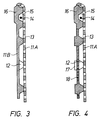
- the elements disclosed in the drawings are both of the type described in WO 90/07308 with reference to FIGS. 21 and 22 therein and comprise a sandwich structure made of a rectangular blank 10 having two substantially equal portions 11A and 11B shown fragmentarily only in FIG. 1.
- This blank is a foil having a thickness e.g. of about 100 ⁇ m and is e.g. of the size 10 x 20 mm.
- the blank is made of the polymer material of the invention and more particularly of a polylactide with plasticizer and was prepared as follows:
- the material thus produced has plastic malleability substantially without memory.
- the marginal memory function or very little memory of a material can be defined by using the time for an element of such material to regain shape after deformation by a small load, hereinafter denoted recovery time.
- recovery time the time for an element of such material to regain shape after deformation by a small load.
- FIG 2 A simple apparatus as shown in FIG 2 can be used. A strip 10 mm wide, 55 mm in length and 0.2 ⁇ 0.005 mm in thickness is used for the test. The specimens is clamped between two metal jaws at A so that the sample touches the periphery of a cylinder B. As seen in FIG 2 the length of the free hanging test sample from the point it touches the cylinder and out shall be 35 mm.
- the blank 10 of FIG 1 was produced by compression molding, but other manufacturing methods can be applied such as callendering, casting, molding, or other techniques.
- Portion 11B forms at one side thereof protrusions 12 which have the shape of truncated cones with a base diameter of about 0.4 mm and a height of about 0.2 mm.
- the protrusions of one row thereof adjacent portion 11A have a center distance of about 0.6 mm, and the center distance of the remaining rows being about 1.2 mm and the center distance between the rows being about 1.0 mm.
- the swelling may be of the order of 300 %.
- the swelling problem can be limited by combining components that impart to the material some hydrophobicity so as to limit the water absorption, and crystallinity so as to improve the strength of the material.
- the swelling can also be reduced by perforation of the element, and such perforation has been found in vivo to reduce swelling substantially.
- This method of reducing swelling is applied to the blank 10 manufactured as described above by treating the blank in order to perforate the portion 11A.
- the perforation apertures 13 are rectangular in shape 0.2 x 0.4 mm and the center distance between the apertures in each row is about 0.5 mm and between the rows about 0.35 mm.
- the apertures cover about 40 % of the surface area of portion 11A.
- the blank of FIG 1 has been folded to form a double-wall structure or laminate wherein the adjacent surfaces of portions 11A and 11B are spaced by the protrusions 12 at a distance of 0.2 mm to create a free space between the surfaces.
- the protrusions 12 forming spacers between portions 11A and 11B are glued to portion 11A.
- the glue used is a mixture of 17 % by weight of poly-d,l-lactide and 3 % by weight acetyltri-n-butyl citrate in ethyl acetate forming the rest of the mixture.
- a suture 14 for tying the sandwich type element of FIG 2 to a tooth with the smooth outside surface of portion 11B facing the tooth is located in a space 15 defined between portions 11A and 11B by a rib or bar 16 extending over the full width of portion 11B and protruding at both sides thereof, and the adjacent protrusions 12, to be used .
- the portion 11B forms at the outside surface thereof protrusions 17 distributed over the surface in the same configuration as protrusions 12 and having a height of about 0.1 mm. These protrusions are provided to form spacers between the outside surface of portion 11B and the surface of the tooth. Moreover, there are provided small circular apertures 18 having a typical diameter of 80 m and arranged in a hexagonal pattern wherein the center distance of the apertures is about 0.2 mm. These apertures cover an area of about 15 % of the surface area.
- the monkeys were given antibiotics at the time of surgery. Plaque control was maintained by topical application on teeth and surrounding gingiva, once a week, of a chlorhexidine solution. The monkeys were sacrificed 4 and 6 weeks after surgery. Following sacrifice, the jaws were removed and specimens containing the experimental teeth and their periodontal tissues were dissected and placed in a solution of 10 % buffered formalin. The specimens were decalcified in EDTA, dehydrated and embedded in paraffin. Bucco-lingual sections of each specimen were prepared with the microtome. The sections were stained with hematoxylin eosin or Mallory's connective tissue stain. From each root sections were used for microscopic analysis.
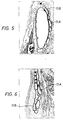
- FIG. 5 illustrates the swelling of an element of the type shown in FIG. 3 such swelling occurring in portion 11B while portion 11A is uneffectd by swelling, and the substantially reduced swelling of such material when perforated, marked by solid arrows.
- FIG. 6 shows an element of the type shown in FIG. 4 made of the same material as the element in FIG. 5 and having perforation in both layers. This figure demonstrates substantially reduced or substantially eliminated swelling of portion 11B.
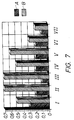
- FIG. 7 finally illustrates the results of measurements made on elements according to FIGS. 3 and 4 of the material of the invention columns A referring to portion 11A and columns B referring to portion 11B.
- the columns represent the measured width of said portions.
- the vertical axis indicates the measures width in mm, and the horizontal axis indicates the type of perforation used according to the table 3 below:
- Type Membrane Perforation Transparency % I Portion 11A Circular aperture diameter 200 ⁇ m 15 Portion 11B Unperforated II Portion 11A Circular aperture diameter 300 ⁇ m 31 Portion 11B Unperforated III Portion 11A Circular aperture diameter 300 ⁇ m 51 Portion 11B Unperforated IV Portion 11A Rectangular aperture 200 x 400 ⁇ m 31 Portion 11B Unperforated V Portion 11A Rectangular aperture 200 x 400 ⁇ m 41 Portion 11B Unperforated VI Portion 11A Circular aperture diameter 300 ⁇ m 30 Portion 11B Circular aperture diameter 60 ⁇ m 25 VII Portion 11
- the material of the elements was that specified in example 1 above.
Landscapes
- Health & Medical Sciences (AREA)
- Animal Behavior & Ethology (AREA)
- Veterinary Medicine (AREA)
- Public Health (AREA)
- Chemical & Material Sciences (AREA)
- General Health & Medical Sciences (AREA)
- Epidemiology (AREA)
- Life Sciences & Earth Sciences (AREA)
- Surgery (AREA)
- Vascular Medicine (AREA)
- Heart & Thoracic Surgery (AREA)
- Chemical Kinetics & Catalysis (AREA)
- Dermatology (AREA)
- Medicinal Chemistry (AREA)
- Oral & Maxillofacial Surgery (AREA)
- Transplantation (AREA)
- Materials For Medical Uses (AREA)
- Acyclic And Carbocyclic Compounds In Medicinal Compositions (AREA)
- Polyesters Or Polycarbonates (AREA)
Abstract
Description
| Composition | Change in thickness, % | |
| 10 days | 20 days | |
| d,l-PLA i.v. 0.8 | 1 | 2 |
| 90 wt-% d,l-PLA i.v. 0.8/10 wt-% TEC | 8 | 30 |
| 90 wt-% d,l-PLA i.v. 1.5/10 wt-% TEC | 5 | 10 |
| 85 wt-% d,l-PLA i.v. 0.5/15 wt-% TEC | 63 | 105 |
| 85 wt-% d,l-PLA i.v. 0.8/15 wt-% TEC | 10 | 31 |
| 85 wt-% d,l-PLA i.v. 1.5/15 wt-% TEC | 8 | 13 |
| 90 wt-% d,l-PLA i.v. 0.8/10 wt-% TBC | 2 | 8 |
| 90 wt-% d,l-PLA i.v. 1.5/10 wt-% TBC | 3 | 9 |
| 85 wt-% d,l-PLA i.v. 1.5/15 wt-% TBC | 6 | 16 |
| 90 wt-% d,l-PLA i.v. 0.8/10 wt-% ATBC | 1 | 3 |
| 90 wt-% d,l-PLA i.v. 1.5/10 wt-% ATBC | 4 | 7 |
| 85 wt-% d,l-PLA i.v. 0.8/15 wt-% ATBC | 2 | 6 |
| 85 wt-% d,l-PLA i.v. 1.5/15 wt-% ATBC | 3 | 15 |
| 85 wt-% d,l-PLA i.v. 0.8/15 wt-% ETL | 16 | 21 |
| 85 wt-% d,l-PLA i.v. 1.5/15 wt-% ETL | 6 | 8 |
| 80 wt-% d,l-PLA i.v. 0.5/20 wt-% ETL | 49 | 95 |
| 80 wt-% d,l-PLA i.v. 0.8/20 wt-% ETL | 15 | 40 |
| 80 wt-% d,l-PLA i.v. 1.5/20 wt-% ETL | 4 | 12 |
| d,l-PLA = Poly-d,l-lactide TEC = Triethyl citrate TBC = Tributyl citrate ATBC = Acetyltri butyl citrate ETL = Ethyl terminated oligomer of lactic acid, mainly trimer. i.v. Inherent viscosity |
| Composition | Change of thickness, % | |
| 90 wt-% d,l-PLA i.v. 0.8/5 wt-% PCL/5 wt-% ATBC | 4 | 5 |
| 75 wt-% d,l-PLA i.v. 0.8/20 wt-% PCL/5 wt-% ATBC | 3 | 7 |
| 81 wt-% d,l-PLA i.v. 0.8/9 wt-% l-PLA/10 wt-% ATBC | 4 | 6 |
| 81 wt-% d,l-PLA i.v. 1.5/9 wt-% l-PLA/10 wt-% ATBC | 6 | 6 |
| 76 wt-% d,l-PLA i.v. 0.8/9 wt-% l-PLA/15 wt-% ATBC | 4 | 6 |
| 76 wt-% d,l-PLA i.v. 1.5/9 wt-% l-PLA/15 wt-% ATBC | 3 | 3 |
| 40 wt-% d,l-PLA i.v. 0.8/60 wt-% PTMC | 0 | 1 |
| 60 wt-% d,l-PLA i.v. 0.8/40 wt-% PTMC | 1 | 3 |
| 80 wt-% d,l-PLA i.v. 0.8/20 wt-% PTMC | 3 | 4 |
| 76 wt-% d,l-PLA i.v. 0.8/9 wt-% PTMC/15 wt-% ATBC | 3 | 10 |
| 72 wt-% d,l-PLA i.v. 0.8/18 wt-% PTMC/10 wt-% ATBC | 6 | 15 |
| 76 wt-% d,l-PLA i.v. 0.8/9 wt-% PTMC/15 wt-% ETL | 4 | 10 |
| 66 wt-% d,l-PLA i.v. 0.8/19 wt-% PTMC/15 wt-% ETL | 6 | 13 |
| d,l-PLA = Poly-d,l-lactide PCL = Poly-caprolactone l-PLA = Poly-l-lactide PTMC = Poly-trimethylene carbonate ATBC = Acetyltri butyl citrate ETL = Ethyl terminated oligomer of lactic acid, mainly trimer. i.v. = Inherent viscosity. |
(plasticizer) were dissolved in 500 ml methylenechloride in order to get a homogeneous solution. The solution was placed in a cupboard overnight in order to allow most of the solvent to evaporate in order to form a polymer film of the mixture. The polymer film was transferred to a vacuum oven, and a vacuum of 1 mbar or less was applied. After one day the temperature in the oven was raised to 60°C and the film was left under this condition for 9 days.
| Type | Membrane | Perforation | Transparency |
| I | Portion | ||
| 11A | Circular aperture diameter 200 | 15 | |
| | | ||
| II | Portion | ||
| 11A | Circular aperture diameter 300 µm | 31 | |
| | | ||
| III | Portion | ||
| 11A | Circular aperture diameter 300 µm | 51 | |
| | | ||
| IV | Portion | ||
| 11A | Rectangular aperture 200 x 400 µm | 31 | |
| | | ||
| V | Portion | ||
| 11A | Rectangular aperture 200 x 400 µm | 41 | |
| | | ||
| VI | Portion | ||
| 11A | Circular aperture diameter 300 µm | 30 | |
| | Circular aperture diameter 60 µm | 25 | |
| VII | | Rectangular aperture 200 x 400 µm | 41 |
| | Circular aperture diameter 300 µm | 50 |
Claims (18)
- Bioresorbable material for medical use consisting of a mixture of bioresorbable polymer and plasticizer, characterized in that the polymer material comprises amorphous polymer or polymers selected from the group consisting of poly-d,1-lactide and copolymers of poly-d,l-lactide and polycaprolactone, poly-l-lactide, or polytrimethylene carbonate, and a crystalline polymer or polymers selected from the group consisting of poly-l-lactide, polycaprolactone and polydioxanone, the amorphous polymer amounting to at least 50 % by weight of the material, and that the plasticizer is selected from the group consisting of ethyl, butyl and hexyl esters of acetylated citric acid, and ethyl terminated oligomers of lactic acid, having no less than 2 and no more than 10 units, to impart to the material plastic malleability substantially without memory combined with low swelling.
- Bioresorbable material as in claim 1, characterized in that the crystalline polymer ranges from 5 to 40 % by weight.
- Bioresorbable material as in claim 1, characterized in that the amount of plasticizer ranges from 5 to 25 by weight.
- Bioresorbable material as in claim 3, characterized in that the polymer is based on polylactic acid and the plasticizer is based on citrate esters, and that the proportion of plasticizer ranges from 9 to 17 % by weight.
- Bioresorbable material as in claim 3, characterized in that the polymer is based on polylactic acid and the plasticizer is based on ethyl terminated lactic acid oligomers, and that the plasticizer amounts to about 20 % by weight.
- Bioresorbable material as in claim 3, characterized in that it comprises substantially 76 % by weight poly-d,1-lactide and 10 % by weight poly-l-lactide as polymers, and 14 % by weight acetyltri-n-butyl-citrate as plasticizer.
- Bioresorbable material as in claim 3, characterized in that it comprises substantially 75 % by weight poly-d,l-lactide and 10 % by weight polycaprolactone as polymers, and 15 % by weight acetyltri-n-butyl citrate as plasticizer.
- An article of manufacture for medical use consisting of a mixture of bioresorbable polymer and plasticizer, characterized in that the polymer material comprises amorphous polymer or polymers selected from the group consisting of poly-d,l-lactide and copolymers of poly-d,l-lactide and polycaprolactone, poly-l-lactide, or polytrimethylene carbonate, and a crystalline polymer or polymers selected from the group consisting of poly-l-lactide, polycaprolactone and polydioxanone, the amorphous polymer amounting to at least 50 % by weight of the material, and that the plasticizer is selected from the group consisting of ethyl, butyl and hexyl esters of acetylated citric acid, and ethyl terminated oligomers of lactic acid, having no less than 2 and no more than 10 units, said article having plastic malleability substantially without memory combined with low swelling.
- The article as in claim 8, characterized in that the crystalline polymer ranges from 5 to 40 % by weight.
- The article as in claim 8, characterized in that the amount of plasticizer ranges from 5 to 25 % by weight.
- The article as in claim 10, characterized in that the polymer is based on polylactic acid and the plasticizer is based on citrate esters, and that the proportion of plasticizer ranges from 9 to 17 % by weight.
- The article as in claim 10, characterized in that the polymer is based on polylactic acid and the plasticizer is based on ethyl terminated lactic acid oligomers, and that the plasticizer amounts to about 20 % by weight.
- The article as in claim 10, characterized in that it comprises substantially 76 % by weight poly-d,1-lactide and 10 % by weight poly-l-lactide as polymers, and 14 % by weight acetyltri-n-butyl citrate as plasticizer.
- The article as in claim 10, characterized in that it comprises substantially 75 % by weight poly-d,l-lactide and 10 % by weight polycaprolactone as polymers, and 15 % by weight acetyltri-n-butyl citrate as plasticizer.
- The article as in claim 8, characterized in that the article comprises a perforated element.
- The article as in claim 15, characterized in that the apertures of the perforation have a minimum transverse dimension of 10 µm.
- The article as in claim 15 or 16, characterized in that the total aperture area is at least 6 %.
- The article of any as in claims 15 to 17, characterized in that the apertures are spaced at a center to center distance ranging from 700 µm to 150 µm.
Applications Claiming Priority (3)
| Application Number | Priority Date | Filing Date | Title |
|---|---|---|---|
| SE9100610 | 1991-03-04 | ||
| SE9100610A SE9100610D0 (en) | 1991-03-04 | 1991-03-04 | BIORESORBABLE MATERIAL FOR MEDICAL USE |
| PCT/SE1992/000139 WO1992015340A1 (en) | 1991-03-04 | 1992-03-04 | Bioresorbable material and an article of manufacture made of such material for medical use |
Publications (3)
| Publication Number | Publication Date |
|---|---|
| EP0574474A4 EP0574474A4 (en) | 1993-12-13 |
| EP0574474A1 EP0574474A1 (en) | 1993-12-22 |
| EP0574474B1 true EP0574474B1 (en) | 1998-07-29 |
Family
ID=20382033
Family Applications (1)
| Application Number | Title | Priority Date | Filing Date |
|---|---|---|---|
| EP92906037A Expired - Lifetime EP0574474B1 (en) | 1991-03-04 | 1992-03-04 | Bioresorbable material and an article of manufacture made of such material for medical use |
Country Status (9)
| Country | Link |
|---|---|
| US (1) | US5525646A (en) |
| EP (1) | EP0574474B1 (en) |
| JP (1) | JP3475360B2 (en) |
| AT (1) | ATE168889T1 (en) |
| CA (1) | CA2103541A1 (en) |
| DE (1) | DE69226429T2 (en) |
| NO (1) | NO302154B1 (en) |
| SE (1) | SE9100610D0 (en) |
| WO (1) | WO1992015340A1 (en) |
Families Citing this family (119)
| Publication number | Priority date | Publication date | Assignee | Title |
|---|---|---|---|---|
| US5502158A (en) * | 1988-08-08 | 1996-03-26 | Ecopol, Llc | Degradable polymer composition |
| US6323307B1 (en) | 1988-08-08 | 2001-11-27 | Cargill Dow Polymers, Llc | Degradation control of environmentally degradable disposable materials |
| US5258488A (en) * | 1992-01-24 | 1993-11-02 | Cargill, Incorporated | Continuous process for manufacture of lactide polymers with controlled optical purity |
| US6005067A (en) * | 1992-01-24 | 1999-12-21 | Cargill Incorporated | Continuous process for manufacture of lactide polymers with controlled optical purity |
| US6326458B1 (en) | 1992-01-24 | 2001-12-04 | Cargill, Inc. | Continuous process for the manufacture of lactide and lactide polymers |
| US5142023A (en) * | 1992-01-24 | 1992-08-25 | Cargill, Incorporated | Continuous process for manufacture of lactide polymers with controlled optical purity |
| US5247059A (en) * | 1992-01-24 | 1993-09-21 | Cargill, Incorporated | Continuous process for the manufacture of a purified lactide from esters of lactic acid |
| US5247058A (en) * | 1992-01-24 | 1993-09-21 | Cargill, Incorporated | Continuous process for manufacture of lactide polymers with controlled optical purity |
| FR2691901B1 (en) * | 1992-06-04 | 1995-05-19 | Centre Nat Rech Scient | Use of mixtures of polymers derived from lactic acids in the preparation of bioresorbable membranes for guided tissue regeneration, in particular in periodontology. |
| CA2142333C (en) * | 1992-08-13 | 2004-04-27 | James H. Montador | Polymer compositions |
| EP0615555B1 (en) | 1992-10-02 | 2001-03-21 | Cargill, Incorporated | A melt-stable lactide polymer fabric and process for manufacture thereof |
| US6005068A (en) | 1992-10-02 | 1999-12-21 | Cargill Incorporated | Melt-stable amorphous lactide polymer film and process for manufacture thereof |
| WO1994008090A1 (en) * | 1992-10-02 | 1994-04-14 | Cargill, Incorporated | Paper having a melt-stable lactide polymer coating and process for manufacture thereof |
| US5338822A (en) * | 1992-10-02 | 1994-08-16 | Cargill, Incorporated | Melt-stable lactide polymer composition and process for manufacture thereof |
| US5763513A (en) * | 1994-05-19 | 1998-06-09 | Mitsui Toatsu Chemicals, Inc. | L-lactic acid polymer composition, molded product and film |
| DE69625822T2 (en) * | 1995-05-01 | 2003-06-05 | Sam Yang Co., Ltd. | IMPLANTABLE, BIORESORBABLE MEMBRANE AND METHOD FOR THE PRODUCTION THEREOF |
| US5866634A (en) * | 1995-09-25 | 1999-02-02 | Shin-Etsu Chemical Co., Ltd | Biodegradable polymer compositions and shrink films |
| JP3517855B2 (en) | 1995-10-03 | 2004-04-12 | トヨタ自動車株式会社 | Polylactic acid based resin composition |
| US5716413A (en) | 1995-10-11 | 1998-02-10 | Osteobiologics, Inc. | Moldable, hand-shapable biodegradable implant material |
| FR2742042B1 (en) * | 1995-12-11 | 1998-03-20 | Perouse Implant Lab | COATED VASCULAR PROSTHESIS AND PROCESS FOR THEIR PREPARATION |
| BR9612051A (en) * | 1995-12-18 | 1999-02-09 | Degussa | Medical implant |
| DE19601477C2 (en) * | 1996-01-17 | 1999-12-16 | Axel Kirsch | Fastening nail |
| US5839899A (en) * | 1996-03-01 | 1998-11-24 | Robinson; Dane Q. | Method and apparatus for growing jaw bone utilizing a guided-tissue regeneration plate support and fixation system |
| US5859101A (en) * | 1996-03-04 | 1999-01-12 | The Yokohama Rubber Co. Ltd. | Rubber composition for tire |
| US5756651A (en) * | 1996-07-17 | 1998-05-26 | Chronopol, Inc. | Impact modified polylactide |
| DE19641335A1 (en) * | 1996-10-08 | 1998-04-09 | Inst Textil & Faserforschung | Triblock terpolymer, its use in surgical sutures and manufacturing methods |
| ZA978537B (en) | 1996-09-23 | 1998-05-12 | Focal Inc | Polymerizable biodegradable polymers including carbonate or dioxanone linkages. |
| DE19641334A1 (en) * | 1996-10-08 | 1998-04-09 | Inst Textil & Faserforschung | Triblock terpolymer, its use in medical products and manufacturing processes |
| KR100403542B1 (en) * | 1996-11-27 | 2004-02-05 | 주식회사 삼양사 | Biodegradable sustained release topical composition |
| DE69732721T2 (en) * | 1996-12-03 | 2006-05-18 | Osteobiologics, Inc., San Antonio | BIODEGRADABLE ARTIFICIAL FILMS |
| JP2002512597A (en) * | 1996-12-20 | 2002-04-23 | アルザ コーポレイション | Injectable reservoir gel composition and method of making the composition |
| US6126919A (en) | 1997-02-07 | 2000-10-03 | 3M Innovative Properties Company | Biocompatible compounds for pharmaceutical drug delivery systems |
| DE19706621A1 (en) * | 1997-02-20 | 1998-08-27 | Inst Textil & Faserforschung | Bioresorbable wax-like composition, its use as bone wax and method of manufacture |
| WO1999007777A1 (en) * | 1997-08-08 | 1999-02-18 | Us Biomaterials Corporation | Biologically active glass-based substrate |
| US6165217A (en) * | 1997-10-02 | 2000-12-26 | Gore Enterprise Holdings, Inc. | Self-cohering, continuous filament non-woven webs |
| US6193991B1 (en) * | 1997-10-29 | 2001-02-27 | Atul J. Shukla | Biodegradable delivery systems of biologically active substances |
| JP3483753B2 (en) * | 1997-12-29 | 2004-01-06 | タキロン株式会社 | Biodegradable absorbent plastic adhesive |
| AU766959B2 (en) * | 1998-04-20 | 2003-10-30 | Genzyme Corporation | Drug delivery of proteins from polymeric blends |
| US8563232B2 (en) | 2000-09-12 | 2013-10-22 | Lifenet Health | Process for devitalizing soft-tissue engineered medical implants, and devitalized soft-tissue medical implants produced |
| US6293970B1 (en) * | 1998-06-30 | 2001-09-25 | Lifenet | Plasticized bone and soft tissue grafts and methods of making and using same |
| US7063726B2 (en) * | 1998-06-30 | 2006-06-20 | Lifenet | Plasticized bone grafts and methods of making and using same |
| US20100030340A1 (en) * | 1998-06-30 | 2010-02-04 | Wolfinbarger Jr Lloyd | Plasticized Grafts and Methods of Making and Using Same |
| US20030217415A1 (en) * | 1998-06-30 | 2003-11-27 | Katrina Crouch | Plasticized bone grafts and methods of making and using same |
| ES2169980B1 (en) | 1999-12-17 | 2003-11-01 | Lipotec Sa | MICROCAPSULES FOR THE PROLONGED RELEASE OF PHARMACOS. |
| US7592017B2 (en) * | 2000-03-10 | 2009-09-22 | Mast Biosurgery Ag | Resorbable thin membranes |
| US20030211974A1 (en) * | 2000-03-21 | 2003-11-13 | Brodbeck Kevin J. | Gel composition and methods |
| US6471706B1 (en) * | 2000-04-18 | 2002-10-29 | Walter Lorenz Surgical, Inc. | Resorbable bone distractor and method |
| CN1283215C (en) * | 2000-06-28 | 2006-11-08 | A·J·舒克拉 | Biodegradable carriers and delivery systems for biologically active substances |
| WO2002012395A1 (en) * | 2000-08-02 | 2002-02-14 | Mitsui Chemicals, Inc. | Resin composition and use thereof |
| AU2001286731A1 (en) * | 2000-08-25 | 2002-03-04 | Kensey Nash Corporation | Covered stents, systems for deploying covered stents |
| US20020106406A1 (en) * | 2000-12-08 | 2002-08-08 | Mchugh Anthony J. | Crystallizable/non-crystallizable polymer composites |
| CA2451187C (en) | 2001-06-22 | 2012-08-14 | Southern Biosystems, Inc. | Zero-order prolonged release coaxial implants |
| US6967234B2 (en) | 2002-12-18 | 2005-11-22 | Ethicon, Inc. | Alkyd-lactone copolymers for medical applications |
| US6747121B2 (en) | 2001-09-05 | 2004-06-08 | Synthes (Usa) | Poly(L-lactide-co-glycolide) copolymers, methods for making and using same, and devices containing same |
| ATE353347T1 (en) * | 2001-10-22 | 2007-02-15 | Massachusetts Inst Technology | BIODEGRADABLE POLYMER |
| US7722894B2 (en) * | 2001-10-22 | 2010-05-25 | Massachusetts Institute Of Technology | Biodegradable polymer |
| US7204875B2 (en) | 2001-10-24 | 2007-04-17 | Pentron Clinical Technologies, Llc | Dental filling material |
| US7204874B2 (en) | 2001-10-24 | 2007-04-17 | Pentron Clinical Technologies, Llc | Root canal filling material |
| US7750063B2 (en) | 2001-10-24 | 2010-07-06 | Pentron Clinical Technologies, Llc | Dental filling material |
| US7211136B2 (en) | 2001-10-24 | 2007-05-01 | Pentron Clinical Technologies, Llc | Dental filling material |
| US7303817B2 (en) | 2001-10-24 | 2007-12-04 | Weitao Jia | Dental filling material |
| US20030125508A1 (en) * | 2001-10-31 | 2003-07-03 | Kazuyuki Yamane | Crystalline polyglycolic acid, polyglycolic acid composition and production process thereof |
| US20030105530A1 (en) * | 2001-12-04 | 2003-06-05 | Inion Ltd. | Biodegradable implant and method for manufacturing one |
| US7005136B2 (en) * | 2002-03-29 | 2006-02-28 | Ethicon, Inc. | Bone replacement materials utilizing bioabsorbable liquid polymers |
| US7326426B2 (en) | 2002-03-29 | 2008-02-05 | Ethicon, Inc. | Compositions and medical devices utilizing bioabsorbable liquid polymers |
| US7368125B2 (en) | 2002-06-05 | 2008-05-06 | Ethicon, Inc. | Amphiphilic polymers for medical applications |
| US7026374B2 (en) | 2002-06-25 | 2006-04-11 | Aruna Nathan | Injectable microdispersions for medical applications |
| US8048444B2 (en) * | 2002-07-31 | 2011-11-01 | Mast Biosurgery Ag | Apparatus and method for preventing adhesions between an implant and surrounding tissues |
| EP1545389B1 (en) * | 2002-07-31 | 2020-04-22 | Mast Biosurgery AG | Apparatus for preventing adhesions between an implant and surrounding tissues |
| DE10237572A1 (en) | 2002-08-13 | 2004-02-26 | Biotronik Meß- und Therapiegeräte GmbH & Co. Ingenieurbüro Berlin | Stent with a polymer coating |
| US7704520B1 (en) * | 2002-09-10 | 2010-04-27 | Mast Biosurgery Ag | Methods of promoting enhanced healing of tissues after cardiac surgery |
| US6872799B2 (en) * | 2002-12-18 | 2005-03-29 | Ethicon, Inc. | Functionalized polymers for medical applications |
| US6866860B2 (en) * | 2002-12-19 | 2005-03-15 | Ethicon, Inc. | Cationic alkyd polyesters for medical applications |
| US20040120981A1 (en) * | 2002-12-20 | 2004-06-24 | Aruna Nathan | Crosslinked alkyd polyesters for medical applications |
| US20060083767A1 (en) * | 2003-02-27 | 2006-04-20 | Kai Deusch | Surgical prosthesis having biodegradable and nonbiodegradable regions |
| JP2006526424A (en) * | 2003-06-04 | 2006-11-24 | イニオン リミテッド | Biodegradable implant and method for producing the same |
| US20100266663A1 (en) * | 2003-09-10 | 2010-10-21 | Calhoun Christopher J | Tissue-treating implantable compositions |
| WO2006020922A2 (en) * | 2004-08-13 | 2006-02-23 | Mast Biosurgery Ag | Surgical prosthesis having biodegradable and nonbiodegradable regions |
| US20080091277A1 (en) * | 2004-08-13 | 2008-04-17 | Kai Deusch | Surgical prosthesis having biodegradable and nonbiodegradable regions |
| US20060041102A1 (en) * | 2004-08-23 | 2006-02-23 | Advanced Cardiovascular Systems, Inc. | Implantable devices comprising biologically absorbable polymers having constant rate of degradation and methods for fabricating the same |
| US20080119878A1 (en) * | 2005-08-12 | 2008-05-22 | Kai Deusch | Surgical prosthesis having biodegradable and nonbiodegradable regions |
| US20070036842A1 (en) * | 2005-08-15 | 2007-02-15 | Concordia Manufacturing Llc | Non-woven scaffold for tissue engineering |
| US20070106271A1 (en) * | 2005-11-09 | 2007-05-10 | Searete Llc, A Limited Liability Corporation | Remote control of substance delivery system |
| EP1964582B1 (en) * | 2005-12-02 | 2020-03-25 | Sunstar Suisse SA | Biocompatible material having biocompatible non-woven nano- or micro-fiber fabric produced by electrospinning method |
| US20070156230A1 (en) | 2006-01-04 | 2007-07-05 | Dugan Stephen R | Stents with radiopaque markers |
| US20090011486A1 (en) * | 2006-01-12 | 2009-01-08 | Massachusetts Institute Of Technology | Biodegradable Elastomers |
| WO2007082305A2 (en) | 2006-01-12 | 2007-07-19 | Massachusetts Institute Of Technology | Biodegradable elastomers |
| WO2007083797A1 (en) * | 2006-01-23 | 2007-07-26 | Terumo Kabushiki Kaisha | Stent |
| US20070191757A1 (en) * | 2006-02-16 | 2007-08-16 | Biodel Inc. | Method and Device for Sublingual Drug Delivery Using Iontophoresis |
| US20130331926A1 (en) | 2006-05-26 | 2013-12-12 | Abbott Cardiovascular Systems Inc. | Stents With Radiopaque Markers |
| US8535372B1 (en) | 2006-06-16 | 2013-09-17 | Abbott Cardiovascular Systems Inc. | Bioabsorbable stent with prohealing layer |
| US8128688B2 (en) | 2006-06-27 | 2012-03-06 | Abbott Cardiovascular Systems Inc. | Carbon coating on an implantable device |
| US7823263B2 (en) | 2006-07-11 | 2010-11-02 | Abbott Cardiovascular Systems Inc. | Method of removing stent islands from a stent |
| EP3061791B1 (en) | 2006-07-20 | 2019-01-16 | OrbusNeich Medical, Inc. | Bioabsorbable polymeric composition for a medical device |
| US8439952B2 (en) * | 2006-08-04 | 2013-05-14 | Integrity Intellect, Inc. | Connecting rod for bone anchors having a bioresorbable tip |
| US7959942B2 (en) | 2006-10-20 | 2011-06-14 | Orbusneich Medical, Inc. | Bioabsorbable medical device with coating |
| EP2073754A4 (en) | 2006-10-20 | 2012-09-26 | Orbusneich Medical Inc | Bioabsorbable polymeric composition and medical device background |
| SG175690A1 (en) | 2006-11-09 | 2011-11-28 | Kci Licensing Inc | Porous bioresorbable dressing conformable to a wound and methods of making same |
| US9555167B2 (en) * | 2006-12-11 | 2017-01-31 | 3M Innovative Properties Company | Biocompatible antimicrobial compositions |
| WO2008122044A2 (en) * | 2007-04-02 | 2008-10-09 | Georgia Tech Research Corporation | Implantable device for communicating with biological tissue |
| US8912304B2 (en) * | 2007-05-17 | 2014-12-16 | Massachusetts Institute Of Technology | Polyol-based polymers |
| US7901452B2 (en) | 2007-06-27 | 2011-03-08 | Abbott Cardiovascular Systems Inc. | Method to fabricate a stent having selected morphology to reduce restenosis |
| US7955381B1 (en) | 2007-06-29 | 2011-06-07 | Advanced Cardiovascular Systems, Inc. | Polymer-bioceramic composite implantable medical device with different types of bioceramic particles |
| US9744043B2 (en) | 2007-07-16 | 2017-08-29 | Lifenet Health | Crafting of cartilage |
| US20110130822A1 (en) * | 2007-07-20 | 2011-06-02 | Orbusneich Medical, Inc. | Bioabsorbable Polymeric Compositions and Medical Devices |
| US9248219B2 (en) * | 2007-09-14 | 2016-02-02 | Boston Scientific Scimed, Inc. | Medical devices having bioerodable layers for the release of therapeutic agents |
| ES2324009B1 (en) * | 2007-11-23 | 2010-05-21 | Gp Pharm S.A. | PHARMACEUTICAL COMPOSITION OF SUSTAINED RELEASE OF SOMATOSTATINE OR AN ANALOG OF HIS. |
| US8507614B2 (en) * | 2008-02-07 | 2013-08-13 | Poly-Med, Inc. | Multiphasic absorbable compositions of segmented l-lactide copolymers |
| EP2349077A4 (en) * | 2008-10-11 | 2015-01-21 | Orbusneich Medical Inc | BIOABSORBABLE POLYMERIC COMPOSITIONS AND MEDICAL DEVICES |
| US8568471B2 (en) | 2010-01-30 | 2013-10-29 | Abbott Cardiovascular Systems Inc. | Crush recoverable polymer scaffolds |
| US8808353B2 (en) | 2010-01-30 | 2014-08-19 | Abbott Cardiovascular Systems Inc. | Crush recoverable polymer scaffolds having a low crossing profile |
| US8726483B2 (en) | 2011-07-29 | 2014-05-20 | Abbott Cardiovascular Systems Inc. | Methods for uniform crimping and deployment of a polymer scaffold |
| US9339309B1 (en) | 2012-10-11 | 2016-05-17 | Nuvasive, Inc. | Systems and methods for inserting cross-connectors |
| CN103877620B (en) * | 2014-03-20 | 2016-09-14 | 朱晓明 | Orabase film and preparation method thereof |
| US9999527B2 (en) | 2015-02-11 | 2018-06-19 | Abbott Cardiovascular Systems Inc. | Scaffolds having radiopaque markers |
| US10172617B2 (en) * | 2015-03-25 | 2019-01-08 | Ethicon Llc | Malleable bioabsorbable polymer adhesive for releasably attaching a staple buttress to a surgical stapler |
| US9700443B2 (en) | 2015-06-12 | 2017-07-11 | Abbott Cardiovascular Systems Inc. | Methods for attaching a radiopaque marker to a scaffold |
| CN110314248B (en) * | 2019-07-24 | 2021-11-02 | 上海典范医疗科技有限公司 | Oral bone induction regeneration membrane and preparation method thereof |
| CN110787324B (en) * | 2019-11-03 | 2021-11-12 | 太原理工大学 | Preparation method of drug controlled release polylactic acid-based bone repair scaffold material |
Family Cites Families (8)
| Publication number | Priority date | Publication date | Assignee | Title |
|---|---|---|---|---|
| DE2406539A1 (en) * | 1974-02-12 | 1975-08-14 | Ethicon Inc | Plasticised polyester sutures - retaining good tensile strength in animal tissue |
| DE3689650T2 (en) * | 1985-12-17 | 1994-05-26 | United States Surgical Corp | High molecular weight bioabsorbable polymers and implants thereof. |
| US5061281A (en) * | 1985-12-17 | 1991-10-29 | Allied-Signal Inc. | Bioresorbable polymers and implantation devices thereof |
| DE3635679A1 (en) * | 1986-10-21 | 1988-05-05 | Dynamit Nobel Ag | SURGICAL SEWING MATERIAL |
| DE3774132D1 (en) * | 1986-12-17 | 1991-11-28 | Allied Signal Inc | IMPLANTABLE OBJECTS WITH A HYDROPHOBIC COMPONENT. |
| WO1990001521A1 (en) * | 1988-08-08 | 1990-02-22 | Battelle Memorial Institute | Degradable thermoplastic from lactides |
| SE8804641D0 (en) * | 1988-12-23 | 1988-12-23 | Procordia Oratech Ab | SURGICAL BARRIER |
| US5077049A (en) * | 1989-07-24 | 1991-12-31 | Vipont Pharmaceutical, Inc. | Biodegradable system for regenerating the periodontium |
-
1991
- 1991-03-04 SE SE9100610A patent/SE9100610D0/en unknown
-
1992
- 1992-03-04 JP JP50612392A patent/JP3475360B2/en not_active Expired - Lifetime
- 1992-03-04 WO PCT/SE1992/000139 patent/WO1992015340A1/en not_active Ceased
- 1992-03-04 CA CA002103541A patent/CA2103541A1/en not_active Abandoned
- 1992-03-04 EP EP92906037A patent/EP0574474B1/en not_active Expired - Lifetime
- 1992-03-04 US US08/108,688 patent/US5525646A/en not_active Expired - Lifetime
- 1992-03-04 AT AT92906037T patent/ATE168889T1/en not_active IP Right Cessation
- 1992-03-04 DE DE69226429T patent/DE69226429T2/en not_active Expired - Lifetime
-
1993
- 1993-09-03 NO NO933139A patent/NO302154B1/en unknown
Also Published As
| Publication number | Publication date |
|---|---|
| NO933139L (en) | 1993-11-03 |
| JPH06504702A (en) | 1994-06-02 |
| DE69226429T2 (en) | 1999-04-01 |
| DE69226429D1 (en) | 1998-09-03 |
| EP0574474A1 (en) | 1993-12-22 |
| US5525646A (en) | 1996-06-11 |
| ATE168889T1 (en) | 1998-08-15 |
| WO1992015340A1 (en) | 1992-09-17 |
| JP3475360B2 (en) | 2003-12-08 |
| EP0574474A4 (en) | 1993-12-13 |
| CA2103541A1 (en) | 1992-09-05 |
| NO933139D0 (en) | 1993-09-03 |
| SE9100610D0 (en) | 1991-03-04 |
| NO302154B1 (en) | 1998-02-02 |
Similar Documents
| Publication | Publication Date | Title |
|---|---|---|
| US5525646A (en) | Bioresorbable material and an article of manufacture made of such material for medical use | |
| US5468253A (en) | Elastomeric medical device | |
| Hutmacher et al. | A review of material properties of biodegradable and bioresorbable polymers and devices for GTR and GBR applications. | |
| Bourke et al. | Polymers derived from the amino acid L-tyrosine: polycarbonates, polyarylates and copolymers with poly (ethylene glycol) | |
| CA2363262C (en) | Bioabsorbable, biocompatible polymers for tissue engineering | |
| US6113624A (en) | Absorbable elastomeric polymer | |
| US5185408A (en) | Medical devices fabricated totally or in part from copolymers of recurring units derived from cyclic carbonates and lactides | |
| US5066772A (en) | Medical devices fabricated totally or in part from copolymers of recurring units derived from cyclic carbonates and lactides | |
| US4916193A (en) | Medical devices fabricated totally or in part from copolymers of recurring units derived from cyclic carbonates and lactides | |
| Cameron et al. | Synthetic bioresorbable polymers | |
| EP1401510B1 (en) | Biodegradable polymer systems | |
| US5358475A (en) | High molecular weight bioresorbable polymers and implantable devices thereof | |
| WO1996019248A2 (en) | METHOD OF CONTROLLING pH IN THE VICINITY OF BIODEGRADABLE IMPLANTS, AND METHOD OF INCREASING SURFACE POROSITY | |
| JP2001192337A (en) | Anti-adhesion material | |
| AU667048B2 (en) | Bioresorbable material and an article of manufacture made of such material for medical use | |
| Tiainen et al. | Tissue reactions to bioabsorbable ciprofloxacin-releasing polylactide-polyglycolide 80/20 screws in rabbits’ cranial bone | |
| Leenstra et al. | Biodegradation of non-porous films after submucoperiosteal implantation on the palate of Beagle dogs | |
| CN113368309A (en) | Barrier film | |
| Chu | Biodegradable polymers: an overview | |
| EP1878451A1 (en) | Bioabsorbable, biocompatible polymers for tissue engineering | |
| AU2004242432B2 (en) | Bioabsorbable, biocompatible polymers for tissue engineering | |
| EP2569024B1 (en) | Biocompatible material and device | |
| Vert | Understanding of the Bioresorption of PLA/GA Polymers with Respect | |
| Andrade et al. | Gregonis, DE, Chen, CM, and Andrade, JD (1976). The chemistry of some selected methacrylate hydrogels, in Hydrogels for Medical | |
| Lee | The role of free radicals in biodegradable polymeric biomaterials |
Legal Events
| Date | Code | Title | Description |
|---|---|---|---|
| PUAI | Public reference made under article 153(3) epc to a published international application that has entered the european phase |
Free format text: ORIGINAL CODE: 0009012 |
|
| 17P | Request for examination filed |
Effective date: 19930821 |
|
| AK | Designated contracting states |
Kind code of ref document: A1 Designated state(s): AT BE CH DE DK ES FR GB GR IT LI LU MC NL SE |
|
| 17Q | First examination report despatched |
Effective date: 19960220 |
|
| GRAG | Despatch of communication of intention to grant |
Free format text: ORIGINAL CODE: EPIDOS AGRA |
|
| GRAG | Despatch of communication of intention to grant |
Free format text: ORIGINAL CODE: EPIDOS AGRA |
|
| GRAH | Despatch of communication of intention to grant a patent |
Free format text: ORIGINAL CODE: EPIDOS IGRA |
|
| GRAH | Despatch of communication of intention to grant a patent |
Free format text: ORIGINAL CODE: EPIDOS IGRA |
|
| RAP1 | Party data changed (applicant data changed or rights of an application transferred) |
Owner name: SUNSTAR, INC. Owner name: GUIDOR AB |
|
| GRAA | (expected) grant |
Free format text: ORIGINAL CODE: 0009210 |
|
| ITF | It: translation for a ep patent filed | ||
| AK | Designated contracting states |
Kind code of ref document: B1 Designated state(s): AT BE CH DE DK ES FR GB GR IT LI LU MC NL SE |
|
| PG25 | Lapsed in a contracting state [announced via postgrant information from national office to epo] |
Ref country code: NL Free format text: LAPSE BECAUSE OF FAILURE TO SUBMIT A TRANSLATION OF THE DESCRIPTION OR TO PAY THE FEE WITHIN THE PRESCRIBED TIME-LIMIT Effective date: 19980729 Ref country code: LI Free format text: LAPSE BECAUSE OF FAILURE TO SUBMIT A TRANSLATION OF THE DESCRIPTION OR TO PAY THE FEE WITHIN THE PRESCRIBED TIME-LIMIT Effective date: 19980729 Ref country code: GR Free format text: LAPSE BECAUSE OF NON-PAYMENT OF DUE FEES Effective date: 19980729 Ref country code: FR Free format text: LAPSE BECAUSE OF FAILURE TO SUBMIT A TRANSLATION OF THE DESCRIPTION OR TO PAY THE FEE WITHIN THE PRESCRIBED TIME-LIMIT Effective date: 19980729 Ref country code: ES Free format text: THE PATENT HAS BEEN ANNULLED BY A DECISION OF A NATIONAL AUTHORITY Effective date: 19980729 Ref country code: CH Free format text: LAPSE BECAUSE OF FAILURE TO SUBMIT A TRANSLATION OF THE DESCRIPTION OR TO PAY THE FEE WITHIN THE PRESCRIBED TIME-LIMIT Effective date: 19980729 Ref country code: BE Free format text: LAPSE BECAUSE OF FAILURE TO SUBMIT A TRANSLATION OF THE DESCRIPTION OR TO PAY THE FEE WITHIN THE PRESCRIBED TIME-LIMIT Effective date: 19980729 Ref country code: AT Free format text: LAPSE BECAUSE OF FAILURE TO SUBMIT A TRANSLATION OF THE DESCRIPTION OR TO PAY THE FEE WITHIN THE PRESCRIBED TIME-LIMIT Effective date: 19980729 |
|
| REF | Corresponds to: |
Ref document number: 168889 Country of ref document: AT Date of ref document: 19980815 Kind code of ref document: T |
|
| REG | Reference to a national code |
Ref country code: CH Ref legal event code: EP |
|
| REF | Corresponds to: |
Ref document number: 69226429 Country of ref document: DE Date of ref document: 19980903 |
|
| PG25 | Lapsed in a contracting state [announced via postgrant information from national office to epo] |
Ref country code: SE Free format text: LAPSE BECAUSE OF FAILURE TO SUBMIT A TRANSLATION OF THE DESCRIPTION OR TO PAY THE FEE WITHIN THE PRESCRIBED TIME-LIMIT Effective date: 19981029 Ref country code: DK Free format text: LAPSE BECAUSE OF FAILURE TO SUBMIT A TRANSLATION OF THE DESCRIPTION OR TO PAY THE FEE WITHIN THE PRESCRIBED TIME-LIMIT Effective date: 19981029 |
|
| EN | Fr: translation not filed | ||
| NLV1 | Nl: lapsed or annulled due to failure to fulfill the requirements of art. 29p and 29m of the patents act | ||
| REG | Reference to a national code |
Ref country code: CH Ref legal event code: PL |
|
| PG25 | Lapsed in a contracting state [announced via postgrant information from national office to epo] |
Ref country code: LU Free format text: LAPSE BECAUSE OF NON-PAYMENT OF DUE FEES Effective date: 19990304 Ref country code: GB Free format text: LAPSE BECAUSE OF NON-PAYMENT OF DUE FEES Effective date: 19990304 |
|
| PLBE | No opposition filed within time limit |
Free format text: ORIGINAL CODE: 0009261 |
|
| STAA | Information on the status of an ep patent application or granted ep patent |
Free format text: STATUS: NO OPPOSITION FILED WITHIN TIME LIMIT |
|
| 26N | No opposition filed | ||
| PG25 | Lapsed in a contracting state [announced via postgrant information from national office to epo] |
Ref country code: MC Free format text: LAPSE BECAUSE OF NON-PAYMENT OF DUE FEES Effective date: 19990930 |
|
| GBPC | Gb: european patent ceased through non-payment of renewal fee |
Effective date: 19990304 |
|
| PGFP | Annual fee paid to national office [announced via postgrant information from national office to epo] |
Ref country code: DE Payment date: 20110328 Year of fee payment: 20 |
|
| PGFP | Annual fee paid to national office [announced via postgrant information from national office to epo] |
Ref country code: IT Payment date: 20110329 Year of fee payment: 20 |
|
| REG | Reference to a national code |
Ref country code: DE Ref legal event code: R071 Ref document number: 69226429 Country of ref document: DE |
|
| REG | Reference to a national code |
Ref country code: DE Ref legal event code: R071 Ref document number: 69226429 Country of ref document: DE |
|
| PG25 | Lapsed in a contracting state [announced via postgrant information from national office to epo] |
Ref country code: DE Free format text: LAPSE BECAUSE OF EXPIRATION OF PROTECTION Effective date: 20120305 |