EP0572344A1 - Disc for studying the interaction of two antibiotics or of one antibiotic associated with a product which effects, bacterial metabolism and method for using the same - Google Patents
Disc for studying the interaction of two antibiotics or of one antibiotic associated with a product which effects, bacterial metabolism and method for using the same Download PDFInfo
- Publication number
- EP0572344A1 EP0572344A1 EP93480062A EP93480062A EP0572344A1 EP 0572344 A1 EP0572344 A1 EP 0572344A1 EP 93480062 A EP93480062 A EP 93480062A EP 93480062 A EP93480062 A EP 93480062A EP 0572344 A1 EP0572344 A1 EP 0572344A1
- Authority
- EP
- European Patent Office
- Prior art keywords
- disc
- product
- hole
- antibiotics
- usual
- Prior art date
- Legal status (The legal status is an assumption and is not a legal conclusion. Google has not performed a legal analysis and makes no representation as to the accuracy of the status listed.)
- Withdrawn
Links
Images

Classifications
-
- C—CHEMISTRY; METALLURGY
- C12—BIOCHEMISTRY; BEER; SPIRITS; WINE; VINEGAR; MICROBIOLOGY; ENZYMOLOGY; MUTATION OR GENETIC ENGINEERING
- C12Q—MEASURING OR TESTING PROCESSES INVOLVING ENZYMES, NUCLEIC ACIDS OR MICROORGANISMS; COMPOSITIONS OR TEST PAPERS THEREFOR; PROCESSES OF PREPARING SUCH COMPOSITIONS; CONDITION-RESPONSIVE CONTROL IN MICROBIOLOGICAL OR ENZYMOLOGICAL PROCESSES
- C12Q1/00—Measuring or testing processes involving enzymes, nucleic acids or microorganisms; Compositions therefor; Processes of preparing such compositions
- C12Q1/02—Measuring or testing processes involving enzymes, nucleic acids or microorganisms; Compositions therefor; Processes of preparing such compositions involving viable microorganisms
- C12Q1/18—Testing for antimicrobial activity of a material
Definitions
- the subject of the invention is a disk for studying the interaction of two antibiotics or of an antibiotic associated with an active product on bacterial metabolism, for example a beta-lactamase inhibitor and its implementation method.
- sterile filter paper discs or discs loaded or impregnated with the antibiotics to be tested are applied, at different concentrations from a disc to the other.
- the antibiotics diffuse radially into the agar from the discs, so that around each of them there is a decreasing concentration gradient with distance from the disc.
- the discs appear surrounded by a zone of inhibition whose diameter makes it possible to calculate the C.M.I. compared to a calibration performed with known antibiotics.
- the invention relates to a disc whose technical characteristic allows the marriage of different molecules two by two. It is based on the fact that the diffusion is radial.
- the invention also relates to the method of implementation.
- the disc or washer according to the invention is of the round type made of sterile filter paper commonly used for antibiotic tests, said disc is characterized by the fact that it has, in its center, a hole and that it is loaded with one of the two products to be studied, said hole is made so as to be able to receive the usual antibiotic disc called "complementary disc" which takes its place in said central hole.
- the diameter of the disc according to the invention is approximately 11.5 mm, the diameter of the hole is 7 mm.
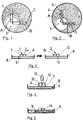
- Figure 1 is a view of the strip technique.
- Figure 2 is a view of the aligned disc technique.
- Figure 3 is a view of the technique of two discs in succession.
- Figure 4 is a view of the technique of the superimposed double disc.
- FIG. 5 is a view of the technique for incorporating one of the two antibiotics into the agar.
- Figure 6 is a plan view of the disc pierced with a hole according to the invention.
- FIG. 7 is a view of a disk of the usual type.
- Figure 8 is a plan view of the drilled disc which received the usual disc in the hole provided for this purpose.
- Figure 9 highlights the method according to the invention with a plan view of the pellets arranged in a Petri dish.
- the technique represented in FIG. 1, uses two strips 1, 2 which are each loaded with a product A or B.
- an interaction zone 3 is created but it is very delicate to interpret and impossible to study routinely.
- the aligned disc technique is almost identical to the strip technique, except that the strips are replaced by two series 4, 5 of usual discs 6.
- a series 4 of usual discs 6 is loaded with product A
- a second series 5 of usual discs 5 is loaded with product B.
- the interaction zone 3 has the same drawbacks as the previous technique.
- a usual disc 7 loaded with product A is placed in the Petri dish 8 containing agar 9, then another usual disc 10 loaded with product B is placed in the same place.
- the two usual discs 11 and 12 are superimposed, one the disc 11 is loaded with product A, the other the disc 12 is loaded with product B.
- a drop of water 13 is placed on the upper disc 12 to mix the products A, B of the two discs 11 and 12. Then, the user removes the disc 12 two hours later.
- FIG. 5 Another technique, represented in FIG. 5, consists in incorporating product A into the agar 9 and placing, on the agar, the usual disc 14 loaded with product B.
- the disc 15 according to the invention is of the round type made of sterile filter paper commonly used for testing antibiotics.
- the disc 15 is characterized in that it has, in its center, a hole 16.
- the hole 16 is made so as to be able to receive a usual disc 17.
- the disc 15 has a diameter of about 11.5 mm.
- the hole 16, drilled in the center, has a diameter of about 7 mm.
- the drilled disc 15 is loaded with one of the two products to be studied according to FIG. 8, product B.
- product B using the usual antibiotic disc 17 whose diameter is 6.5 mm and which takes place in the central hole of the disc 15.
- the radial concentration gradient is established.
- results are read as for the classic antibiogram by measuring the inhibition diameters and comparing them either to those obtained from the disks of the isolated products, or to the critical diameters determined by the antibiogram committees: CFA (French Antibiogram Committee), NCCLS (National Comity Central Laboratory S ....), WHO (World Health Office).
- the critical diameter determining the bacterial resistance is at least 13 mm; this is why the diameter of the disc is 11.5 mm. It should be large enough to allow stiffness of the disc and small enough to allow reading of the resistance zone.
Landscapes
- Chemical & Material Sciences (AREA)
- Life Sciences & Earth Sciences (AREA)
- Organic Chemistry (AREA)
- Health & Medical Sciences (AREA)
- Engineering & Computer Science (AREA)
- Zoology (AREA)
- Wood Science & Technology (AREA)
- Proteomics, Peptides & Aminoacids (AREA)
- Molecular Biology (AREA)
- Toxicology (AREA)
- Immunology (AREA)
- Microbiology (AREA)
- Biophysics (AREA)
- Analytical Chemistry (AREA)
- Physics & Mathematics (AREA)
- Biotechnology (AREA)
- Biochemistry (AREA)
- Bioinformatics & Cheminformatics (AREA)
- General Engineering & Computer Science (AREA)
- General Health & Medical Sciences (AREA)
- Genetics & Genomics (AREA)
- Apparatus Associated With Microorganisms And Enzymes (AREA)
- Measuring Or Testing Involving Enzymes Or Micro-Organisms (AREA)
- Investigating Or Analysing Biological Materials (AREA)
Abstract
Description
L'invention a pour objet un disque pour l'étude de l'interaction de deux antibiotiques ou d'un antibiotique associé à un produit actif sur le métabolisme bactérien, par exemple un inhibiteur de beta-lactamase et son procédé de mise en oeuvre.The subject of the invention is a disk for studying the interaction of two antibiotics or of an antibiotic associated with an active product on bacterial metabolism, for example a beta-lactamase inhibitor and its implementation method.
Deux techniques sont actuellement utilisées pour reconnaître l'activité antibiotique d'une substance chimique :
- en premier, la technique de dilution en milieu liquide permet de rechercher, par des dilutions successives du produit à expérimenter, la concentration minimale inhibitrice (C.M.I.)
- en second, la technique de la diffusion en gélose ou méthode des disques.
- first, the dilution technique in liquid medium makes it possible to find, by successive dilutions of the product to be tested, the minimum inhibitory concentration (MIC)
- second, the agar diffusion technique or disc method.
A la surface d'un milieu gélosé contenu dans des boîtes de Pétri, après ensemencement par le germe à étudier, on applique des rondelles ou disques de papier filtre stériles chargés ou imprégnés des antibiotiques à tester, à des concentrations différentes d'un disque à l'autre. Les antibiotiques diffusent radialement dans la gélose à partir des disques, de telle sorte qu'autour de chacun d'eux s'établit un gradient de concentration décroissant avec la distance par rapport au disque. Après quelques heures d'étuve, les disques apparaissent entourés d'une zone d'inhibition dont le diamètre permet de calculer la C.M.I. comparativement à un étalonnage effectué avec des antibiotiques connus.On the surface of an agar medium contained in petri dishes, after inoculation with the germ to be studied, sterile filter paper discs or discs loaded or impregnated with the antibiotics to be tested are applied, at different concentrations from a disc to the other. The antibiotics diffuse radially into the agar from the discs, so that around each of them there is a decreasing concentration gradient with distance from the disc. After a few hours of drying, the discs appear surrounded by a zone of inhibition whose diameter makes it possible to calculate the C.M.I. compared to a calibration performed with known antibiotics.
Dans différentes circonstances, il est nécessaire de charger le disque avec deux antibiotiques ou avec un antibiotique associé à un produit actif sur le métabolisme bactérien par exemple : un inhibiteur de béta-lactamase.In different circumstances, it is necessary to load the disc with two antibiotics or with an associated antibiotic to a product active on bacterial metabolism for example: a beta-lactamase inhibitor.
L'état de la technique peut être défini par les brevetsState of the art can be defined by patents suivants :following:
-
FR-A-2.288.782 : l'invention décrit un support en formeFR-A-2.288.782: the invention describes a shaped support
d'étoile à six branches dont chaque extrémité porte un disque deof six-pointed star, each end of which carries a disc of
test.test.
Le corps de base comporte une zone centrale entourée de sixThe base body has a central area surrounded by six bras équidistants. Leurs extrémités comportent des surfaces pourequidistant arms. Their ends have surfaces for la fixation des disques de test. La zone centrale comporte deuxfixing the test discs. The central area has two évidements pour la saisie du corps à l'aide de brucelles. Larecesses for gripping the body using tweezers. The partie des bras est en profilé creux. A part les extrémitéspart of the arms is in hollow profile. Apart from the ends portant les disques, tout le support est au-dessus du plan descarrying the discs, all the support is above the plane of the disques.discs. - FR-A-2.281.297 : ce distributeur est caractérisé par unFR-A-2.281.297: this dispenser is characterized by a mécanisme de table de distribution comportant des trous supérieursdistribution table mechanism with upper holes et inférieurs décalés ; un moyen de support de cartouches deand lower offset; a means of supporting cartridges of disques, une plaque de distribution à ouverture permettantdiscs, an opening distribution plate allowing d'aligner les trous supérieurs et inférieurs, et des ouverturesalign the top and bottom holes, and openings auxiliaires dans le mécanisme de distribution de table permettantauxiliaries in the table distribution mechanism allowing de contrôler visuellement le fonctionnement du distributeur et devisually check the operation of the dispenser and dégager éventuellement les disques coincés.remove any jammed discs.
- FR-A-2.268.076 : on prépare des disques d'essai deFR-A-2.268.076: test discs are prepared sensibilité aux antibiotiques en mettant un matériau absorbant ensensitivity to antibiotics by putting absorbent material in contact avec une dispersion d'un antibiotique du type béta-lactamecontact with a dispersion of a beta-lactam antibiotic cristallisé dans un véhicule non solvant volatil, en faisantcrystallized in a volatile non-solvent vehicle, making absorber cette dispersion par ce matériau, en évaporant ceabsorb this dispersion by this material, by evaporating this véhicule de ce matériau, ce qui laisse un dépôt uniformevehicle of this material, which leaves a uniform deposit d'antibiotique par unité de surface de matériau. On peut ensuiteof antibiotic per unit area of material. We can then découper des disques normalisés d'essai de sensibilité auxcut standardized test strips for sensitivity to antibiotiques.antibiotics.
Ces brevets et beaucoup d'autres traitent essentiellement de la distribution des disques.These patents and many others deal mainly with the distribution of discs.
Dans le cas où il est nécessaire de charger le disque avec deux antibiotiques ou avec un antibiotique associé à un produit actif sur le métabolisme bactérien, il est possible de préparer un disque contenant les deux produits, mais ceci est difficile à mettre en place dans la routine quotidienne d'un laboratoire d'analyse médicale. De plus, si l'on doit faire varier considérablement les antibiotiques associés, il est nécessaire de posséder un très grand nombre de disques différents correspondant aux différentes associations à étudier.In the case where it is necessary to load the disc with two antibiotics or with an antibiotic associated with a product active on bacterial metabolism, it is possible to prepare a disc containing the two products, but this is difficult to install in the daily routine of a medical analysis laboratory. In addition, if we have to vary considerably associated antibiotics, it is necessary to have a very large number of different discs corresponding to the different associations to be studied.
A cet effet, l'invention a pour objet un disque dont la caractéristique technique permet le mariage de différentes molécules deux à deux. Il est fondé sur le fait que la diffusion est radiale.To this end, the invention relates to a disc whose technical characteristic allows the marriage of different molecules two by two. It is based on the fact that the diffusion is radial.
L'invention a également pour objet le procédé de mise en oeuvre.The invention also relates to the method of implementation.
Le disque ou rondelle selon l'invention est du type rond en papier filtre stérile utilisé de manière usuel pour les tests d'antibiotiques, ledit disque est caractérisé par le fait qu'il comporte, en son centre, un trou et qu'il est chargé avec l'un des deux produits à étudier, ledit trou est réalisé de manière à pouvoir recevoir le disque usuel d'antibiotique dit "disque complémentaire" qui vient prendre sa place dans ledit trou central.The disc or washer according to the invention is of the round type made of sterile filter paper commonly used for antibiotic tests, said disc is characterized by the fact that it has, in its center, a hole and that it is loaded with one of the two products to be studied, said hole is made so as to be able to receive the usual antibiotic disc called "complementary disc" which takes its place in said central hole.
Selon un mode de réalisation particulier, le diamètre du disque selon l'invention est d'environ 11,5 mm, le diamètre du trou est de 7 mm.According to a particular embodiment, the diameter of the disc according to the invention is approximately 11.5 mm, the diameter of the hole is 7 mm.
Les dessins ci-joints sont donnés à titre d'exemples indicatifs et non limitatifs. Ils représentent un mode de réalisation préféré selon l'invention. Ils permettront de comprendre aisément l'invention.The attached drawings are given as indicative and non-limiting examples. They represent a preferred embodiment according to the invention. They will allow the invention to be easily understood.
La figure 1 est une vue de la technique des bandelettes.Figure 1 is a view of the strip technique.
La figure 2 est une vue de la technique des disques alignés.Figure 2 is a view of the aligned disc technique.
La figure 3 est une vue de la technique des deux disques à la suite.Figure 3 is a view of the technique of two discs in succession.
La figure 4 est une vue de la technique du double disque superposé.Figure 4 is a view of the technique of the superimposed double disc.
La figure 5 est une vue de la technique d'incorporation à la gélose d'un des deux antibiotiques.FIG. 5 is a view of the technique for incorporating one of the two antibiotics into the agar.
La figure 6 est une vue en plan du disque percé d'un trou selon l'invention.Figure 6 is a plan view of the disc pierced with a hole according to the invention.
La figure 7 est une vue d'un disque du type usuel.FIG. 7 is a view of a disk of the usual type.
La figure 8 est une vue en plan du disque percé qui a reçu le disque usuel dans le trou prévu à cet effet.Figure 8 is a plan view of the drilled disc which received the usual disc in the hole provided for this purpose.
La figure 9 met en évidence le procédé selon l'invention avec une vue en plan des pastilles disposées dans une boîte de Pétri.Figure 9 highlights the method according to the invention with a plan view of the pellets arranged in a Petri dish.
La technique, représentée à la figure 1, utilise deux bandelettes 1, 2 qui sont chacune chargée d'un produit A ou B. Au niveau de la fonction des deux bandelettes 1, 2, une zone d'interaction 3 se crée mais elle est très délicate à interpréter et impossible à étudier en routine.The technique, represented in FIG. 1, uses two strips 1, 2 which are each loaded with a product A or B. At the level of the function of the two strips 1, 2, an
La technique des disques alignés est quasiment identique à la technique des bandelettes, si ce n'est que les bandelettes sont remplacées par deux séries 4, 5 de disques usuels 6. Une série 4 de disques usuels 6 est chargée en produit A, une seconde série 5 de disques usuels 5 est chargée en produit B.The aligned disc technique is almost identical to the strip technique, except that the strips are replaced by two
La zone d'interaction 3 présente les mêmes inconvénients que la technique précédente.The
La technique des deux disques à la suite est représentée à la figure 3.The technique of two discs in succession is shown in Figure 3.
Il est mis un disque usuel 7 chargé en produit A dans la boîte de Petri 8 contenant de la gélose 9, puis on place un autre disque usuel 10 chargé en produit B au même endroit.A
La technique du double disque est représentée à la figure 4.The double disc technique is shown in Figure 4.
Les deux disques usuels 11 et 12 sont superposés, l'un le disque 11 est chargé en produit A, l'autre le disque 12 est chargé en produit B. Une goutte d'eau 13 est posée sur le disque supérieur 12 pour mélanger les produits A, B des deux disques 11 et 12. Puis, l'utilisateur enlève le disque 12 deux heures après.The two
Une autre technique, représentée à la figure 5, consiste à incorporer à la gélose 9 le produit A et à disposer, sur la gélose, le disque usuel 14 chargé en produit B.Another technique, represented in FIG. 5, consists in incorporating product A into the
Le disque 15 selon l'invention est du type rond en papier filtre stérile utilisé de manière usuelle pour les tests d'antibiotiques.The
Le disque 15 est caractérisé par le fait qu'il comporte, en son centre, un trou 16.The
Le trou 16 est réalisé de manière à pouvoir recevoir un disque usuel 17.The
Le disque 15 a un diamètre d'environ 11,5 mm.The
Le trou 16, percé en son centre, a un diamètre d'environ 7 mm.The
Selon le procédé de mise en oeuvre représenté à la figure 9, le disque percé 15 est chargé avec l'un des deux produits à étudier selon la figure 8, le produit B. Pour l'autre produit A, on utilise le disque usuel 17 d'antibiotique dont le diamètre est de 6,5 mm et qui vient prendre place dans le trou central du disque 15. Pour les deux produits A et B, le gradient de concentration radiale s'établit.According to the implementation method represented in FIG. 9, the drilled
La lecture des résultats s'effectue comme pour l'antibiogramme classique en mesurant les diamètres d'inhibition et en les comparant soit à ceux obtenus à partir des disques des produits isolés, soit aux diamètres critiques déterminés par les comités de l'antibiogramme : CFA (Comité Français d'Antibiogramme), NCCLS (National Comity Central Laboratory S....), OMS (Office Mondial de la Santé).The results are read as for the classic antibiogram by measuring the inhibition diameters and comparing them either to those obtained from the disks of the isolated products, or to the critical diameters determined by the antibiogram committees: CFA (French Antibiogram Committee), NCCLS (National Comity Central Laboratory S ....), WHO (World Health Office).
Le diamètre critique déterminant la résistance bactérienne est au minimum de 13 mm ; c'est pourquoi le diamètre du disque fait 11,5 mm. Il doit être suffisamment important pour permettre une rigidité du disque et suffisamment petit pour permettre la lecture de la zone de résistance.The critical diameter determining the bacterial resistance is at least 13 mm; this is why the diameter of the disc is 11.5 mm. It should be large enough to allow stiffness of the disc and small enough to allow reading of the resistance zone.
- 1, 2. Bandelettes1, 2. Strips
- 3. Zone d'interaction3. Interaction area
- 4, 5. Séries de disques usuels4, 5. Series of usual discs
- 6. Disques usuels6. Usual discs
- 7. Disque usuel chargé en produit A7. Usual disc loaded with product A
- 8. Boîte de Petri8. Petri dish
- 9. Gélose9. Agar
- 10. Disque usuel chargé en produit B10. Usual disc loaded with product B
- 11. Disque usuel chargé en produit A11. Usual disc loaded with product A
- 12. Disque usuel chargé en produit B12. Usual disc loaded with product B
- 13. Goutte d'eau13. Water drop
- 14. Disque usuel chargé en produit B14. Usual disc loaded with product B
- 15. Disque15. Disc
- 16. Trou16. Hole
- 17. Disque usuel chargé en produit A A, B Produits17. Usual disc loaded with product A A, B Products
Claims (4)
qu'il comporte, en son centre, un trou (16) et qu'il est chargé avec l'un des deux produits (A, B) à étudier, ledit trou (16) est réalisé de manière à pouvoir recevoir le disque usuel d'antibiotique dit "disque complémentaire" qui vient prendre sa place dans ledit trou central (16) dudit disque percé (15).Disc or washer of the round type made of sterile filter paper commonly used for testing antibiotics, characterized by the fact
that it has, in its center, a hole (16) and that it is loaded with one of the two products (A, B) to be studied, said hole (16) is produced so as to be able to receive the usual disc antibiotic called "complementary disc" which takes its place in said central hole (16) of said pierced disc (15).
que le diamètre du disque percé (15) est d'environ 11,5 mm, le diamètre du trou (16) est de 7 mm.Disc or washer according to Claim 1, characterized in that
that the diameter of the drilled disc (15) is approximately 11.5 mm, the diameter of the hole (16) is 7 mm.
que le diamètre critique déterminant la résistance bactérienne est au minimum de 13 mm ; le diamètre du disque (15) fait 11,5 mm ; il doit être suffisamment important pour permettre une rigidité du disque (15) et suffisamment petit pour permettre la lecture de la zone de résistance.Disc or washer according to Claim 1, characterized in that
that the critical diameter determining the bacterial resistance is at least 13 mm; the diameter of the disc (15) is 11.5 mm; it must be large enough to allow rigidity of the disc (15) and small enough to allow reading of the resistance zone.
que le disque percé (15) est chargé avec l'un des deux produits, le produit (B) ; pour l'autre produit (A), on utilise le disque usuel (17) d'antibiotique qui vient prendre place dans le trou central (16) du disque percé (15) ; pour les deux produits (A) et (B), le gradient de concentration radiale s'établit.Implementation method according to any one of claims 1, 2 or 3 characterized in that
that the pierced disc (15) is loaded with one of the two products, the product (B); for the other product (A), the usual disc (17) of antibiotic is used which comes to take place in the central hole (16) of the pierced disc (15); for the two products (A) and (B), the radial concentration gradient is established.
Applications Claiming Priority (2)
| Application Number | Priority Date | Filing Date | Title |
|---|---|---|---|
| FR9206681 | 1992-05-27 | ||
| FR9206681A FR2691610B1 (en) | 1992-05-27 | 1992-05-27 | DISC FOR STUDYING THE INTERACTION OF TWO ANTIBIOTICS OR AN ANTIBIOTIC ASSOCIATED WITH A PRODUCT ACTIVE IN BACTERIAL METABOLISM AND ITS IMPLEMENTING METHOD. |
Publications (1)
| Publication Number | Publication Date |
|---|---|
| EP0572344A1 true EP0572344A1 (en) | 1993-12-01 |
Family
ID=9430368
Family Applications (1)
| Application Number | Title | Priority Date | Filing Date |
|---|---|---|---|
| EP93480062A Withdrawn EP0572344A1 (en) | 1992-05-27 | 1993-05-24 | Disc for studying the interaction of two antibiotics or of one antibiotic associated with a product which effects, bacterial metabolism and method for using the same |
Country Status (2)
| Country | Link |
|---|---|
| EP (1) | EP0572344A1 (en) |
| FR (1) | FR2691610B1 (en) |
Citations (2)
| Publication number | Priority date | Publication date | Assignee | Title |
|---|---|---|---|---|
| FR2288782A1 (en) * | 1974-10-22 | 1976-05-21 | Wild & Co Ag | TEST DISCS SUPPORT FOR BACTERIAL GER SENSITIVITY TESTS |
| US5112742A (en) * | 1990-02-23 | 1992-05-12 | State University Of New York | Screening for anti-adhesin antibiotics by employing photoinduced cyanobacteria |
-
1992
- 1992-05-27 FR FR9206681A patent/FR2691610B1/en not_active Expired - Fee Related
-
1993
- 1993-05-24 EP EP93480062A patent/EP0572344A1/en not_active Withdrawn
Patent Citations (2)
| Publication number | Priority date | Publication date | Assignee | Title |
|---|---|---|---|---|
| FR2288782A1 (en) * | 1974-10-22 | 1976-05-21 | Wild & Co Ag | TEST DISCS SUPPORT FOR BACTERIAL GER SENSITIVITY TESTS |
| US5112742A (en) * | 1990-02-23 | 1992-05-12 | State University Of New York | Screening for anti-adhesin antibiotics by employing photoinduced cyanobacteria |
Also Published As
| Publication number | Publication date |
|---|---|
| FR2691610A1 (en) | 1993-12-03 |
| FR2691610B1 (en) | 1994-07-08 |
Similar Documents
| Publication | Publication Date | Title |
|---|---|---|
| Kartal et al. | HPLC method for the analysis of harmol, harmalol, harmine and harmaline in the seeds of Peganum harmala L. | |
| Pogačnik et al. | Determination of organophosphate and carbamate pesticides in spiked samples of tap water and fruit juices by a biosensor with photothermal detection | |
| Kalua et al. | Comparison of major volatile compounds from Riesling and Cabernet Sauvignon grapes (Vitis vinifera L.) from fruitset to harvest | |
| Davis et al. | Determination of alcohol in citrus juice by gas chromatographic analysis of headspace1 | |
| Field et al. | Determination of essential oils in hops by headspace solid-phase microextraction | |
| Zeisler et al. | Epicuticular wax on cherry laurel (Prunus laurocerasus) leaves does not constitute the cuticular transpiration barrier | |
| Fytianos et al. | Solid phase microextraction applied to the analysis of organophosphorus insecticides in fruits | |
| Soleas et al. | Method development and cultivar-related differences of nine biogenic amines in Ontario wines | |
| EP1608769B1 (en) | Method and device for the detection and/or identification of bacteria present in a sample | |
| Salameh et al. | Highlight on the problems generated by p-coumaric acid analysis in wine fermentations | |
| EP2942626B1 (en) | Device and method for identifying and determining blood groups | |
| Locatelli et al. | Analysis of seven selected antidepressant drugs in post–mortem samples using fabric phase sorptive extraction followed by high performance liquid chromatography-photodiode array detection | |
| EP0090901B1 (en) | Detection and differentiation of molecules naturally containing deuterium and application among others for determining the addition of sugar to wines | |
| Zhou et al. | Comparison of Amberlite XAD-2/Freon 11 extraction with liquid/liquid extraction for the determination of wine flavor components | |
| Berenguer-Navarro et al. | Chromatographic determination of cyanoglycosides prunasin and amygdalin in plant extracts using a porous graphitic carbon column | |
| Wollschläger et al. | Flow-through PSICAM: a new approach for determining water constituents absorption continuously | |
| Nikolelis et al. | A portable sensor for the rapid detection of naphthalene acetic acid in fruits and vegetables using stabilized in air lipid films with incorporated auxin-binding protein 1 receptor | |
| EP0572344A1 (en) | Disc for studying the interaction of two antibiotics or of one antibiotic associated with a product which effects, bacterial metabolism and method for using the same | |
| KR100715717B1 (en) | Residual pesticide diagnostic kit using honeybee-derived AEC and its antibodies | |
| Nikolelis et al. | Development of an electrochemical biosensor for the rapid detection of naphthalene acetic acid in fruits by using air stable lipid films with incorporated auxin-binding protein 1 receptor | |
| CA1335704C (en) | Process for counting, screening and identifying mycoplasms generally and specially urogenital mycoplasms, and biological substrate specially adapted to such | |
| FR2928003A1 (en) | METHOD FOR CONTROLLING CONTAMINATION OF BARRIERS. | |
| FR3005747A1 (en) | METHOD FOR BIODOSIMETRIC EVALUATION OF THE IRRADIATION DOSE RECEIVED BY AN INDIVIDUAL HAVING BEEN SUBJECTED TO IONIZING RADIATION | |
| CN101067620B (en) | Rapid screening kit and method for Sudan dyes in pepper products | |
| FR3024778A1 (en) | PROCESS FOR THE DETECTION OF DREPANOCYTOSIS AND KIT FOR ITS IMPLEMENTATION |
Legal Events
| Date | Code | Title | Description |
|---|---|---|---|
| PUAI | Public reference made under article 153(3) epc to a published international application that has entered the european phase |
Free format text: ORIGINAL CODE: 0009012 |
|
| AK | Designated contracting states |
Kind code of ref document: A1 Designated state(s): AT BE CH DE DK ES FR GB GR IE IT LI LU MC NL PT SE |
|
| 17P | Request for examination filed |
Effective date: 19940407 |
|
| STAA | Information on the status of an ep patent application or granted ep patent |
Free format text: STATUS: THE APPLICATION IS DEEMED TO BE WITHDRAWN |
|
| 18D | Application deemed to be withdrawn |
Effective date: 19951201 |