EP0570518B1 - Methods and apparatus for improved electrochemi-luminescence assays - Google Patents
Methods and apparatus for improved electrochemi-luminescence assays Download PDFInfo
- Publication number
- EP0570518B1 EP0570518B1 EP92906820A EP92906820A EP0570518B1 EP 0570518 B1 EP0570518 B1 EP 0570518B1 EP 92906820 A EP92906820 A EP 92906820A EP 92906820 A EP92906820 A EP 92906820A EP 0570518 B1 EP0570518 B1 EP 0570518B1
- Authority
- EP
- European Patent Office
- Prior art keywords
- particles
- electrode
- assay
- complex
- ecl
- Prior art date
- Legal status (The legal status is an assumption and is not a legal conclusion. Google has not performed a legal analysis and makes no representation as to the accuracy of the status listed.)
- Expired - Lifetime
Links
Images


Classifications
-
- G—PHYSICS
- G01—MEASURING; TESTING
- G01N—INVESTIGATING OR ANALYSING MATERIALS BY DETERMINING THEIR CHEMICAL OR PHYSICAL PROPERTIES
- G01N21/00—Investigating or analysing materials by the use of optical means, i.e. using sub-millimetre waves, infrared, visible or ultraviolet light
- G01N21/62—Systems in which the material investigated is excited whereby it emits light or causes a change in wavelength of the incident light
- G01N21/66—Systems in which the material investigated is excited whereby it emits light or causes a change in wavelength of the incident light electrically excited, e.g. electroluminescence
- G01N21/69—Systems in which the material investigated is excited whereby it emits light or causes a change in wavelength of the incident light electrically excited, e.g. electroluminescence specially adapted for fluids, e.g. molten metal
-
- C—CHEMISTRY; METALLURGY
- C07—ORGANIC CHEMISTRY
- C07H—SUGARS; DERIVATIVES THEREOF; NUCLEOSIDES; NUCLEOTIDES; NUCLEIC ACIDS
- C07H21/00—Compounds containing two or more mononucleotide units having separate phosphate or polyphosphate groups linked by saccharide radicals of nucleoside groups, e.g. nucleic acids
-
- C—CHEMISTRY; METALLURGY
- C12—BIOCHEMISTRY; BEER; SPIRITS; WINE; VINEGAR; MICROBIOLOGY; ENZYMOLOGY; MUTATION OR GENETIC ENGINEERING
- C12Q—MEASURING OR TESTING PROCESSES INVOLVING ENZYMES, NUCLEIC ACIDS OR MICROORGANISMS; COMPOSITIONS OR TEST PAPERS THEREFOR; PROCESSES OF PREPARING SUCH COMPOSITIONS; CONDITION-RESPONSIVE CONTROL IN MICROBIOLOGICAL OR ENZYMOLOGICAL PROCESSES
- C12Q1/00—Measuring or testing processes involving enzymes, nucleic acids or microorganisms; Compositions therefor; Processes of preparing such compositions
- C12Q1/68—Measuring or testing processes involving enzymes, nucleic acids or microorganisms; Compositions therefor; Processes of preparing such compositions involving nucleic acids
- C12Q1/6813—Hybridisation assays
- C12Q1/6816—Hybridisation assays characterised by the detection means
- C12Q1/6825—Nucleic acid detection involving sensors
-
- G—PHYSICS
- G01—MEASURING; TESTING
- G01N—INVESTIGATING OR ANALYSING MATERIALS BY DETERMINING THEIR CHEMICAL OR PHYSICAL PROPERTIES
- G01N21/00—Investigating or analysing materials by the use of optical means, i.e. using sub-millimetre waves, infrared, visible or ultraviolet light
- G01N21/62—Systems in which the material investigated is excited whereby it emits light or causes a change in wavelength of the incident light
- G01N21/66—Systems in which the material investigated is excited whereby it emits light or causes a change in wavelength of the incident light electrically excited, e.g. electroluminescence
-
- G—PHYSICS
- G01—MEASURING; TESTING
- G01N—INVESTIGATING OR ANALYSING MATERIALS BY DETERMINING THEIR CHEMICAL OR PHYSICAL PROPERTIES
- G01N21/00—Investigating or analysing materials by the use of optical means, i.e. using sub-millimetre waves, infrared, visible or ultraviolet light
- G01N21/75—Systems in which material is subjected to a chemical reaction, the progress or the result of the reaction being investigated
- G01N21/76—Chemiluminescence; Bioluminescence
-
- G—PHYSICS
- G01—MEASURING; TESTING
- G01N—INVESTIGATING OR ANALYSING MATERIALS BY DETERMINING THEIR CHEMICAL OR PHYSICAL PROPERTIES
- G01N33/00—Investigating or analysing materials by specific methods not covered by groups G01N1/00 - G01N31/00
- G01N33/48—Biological material, e.g. blood, urine; Haemocytometers
- G01N33/50—Chemical analysis of biological material, e.g. blood, urine; Testing involving biospecific ligand binding methods; Immunological testing
- G01N33/53—Immunoassay; Biospecific binding assay; Materials therefor
- G01N33/543—Immunoassay; Biospecific binding assay; Materials therefor with an insoluble carrier for immobilising immunochemicals
- G01N33/54313—Immunoassay; Biospecific binding assay; Materials therefor with an insoluble carrier for immobilising immunochemicals the carrier being characterised by its particulate form
-
- G—PHYSICS
- G01—MEASURING; TESTING
- G01N—INVESTIGATING OR ANALYSING MATERIALS BY DETERMINING THEIR CHEMICAL OR PHYSICAL PROPERTIES
- G01N33/00—Investigating or analysing materials by specific methods not covered by groups G01N1/00 - G01N31/00
- G01N33/48—Biological material, e.g. blood, urine; Haemocytometers
- G01N33/50—Chemical analysis of biological material, e.g. blood, urine; Testing involving biospecific ligand binding methods; Immunological testing
- G01N33/53—Immunoassay; Biospecific binding assay; Materials therefor
- G01N33/543—Immunoassay; Biospecific binding assay; Materials therefor with an insoluble carrier for immobilising immunochemicals
- G01N33/54313—Immunoassay; Biospecific binding assay; Materials therefor with an insoluble carrier for immobilising immunochemicals the carrier being characterised by its particulate form
- G01N33/54326—Magnetic particles
-
- G—PHYSICS
- G01—MEASURING; TESTING
- G01N—INVESTIGATING OR ANALYSING MATERIALS BY DETERMINING THEIR CHEMICAL OR PHYSICAL PROPERTIES
- G01N33/00—Investigating or analysing materials by specific methods not covered by groups G01N1/00 - G01N31/00
- G01N33/48—Biological material, e.g. blood, urine; Haemocytometers
- G01N33/50—Chemical analysis of biological material, e.g. blood, urine; Testing involving biospecific ligand binding methods; Immunological testing
- G01N33/53—Immunoassay; Biospecific binding assay; Materials therefor
- G01N33/543—Immunoassay; Biospecific binding assay; Materials therefor with an insoluble carrier for immobilising immunochemicals
- G01N33/54366—Apparatus specially adapted for solid-phase testing
-
- G—PHYSICS
- G01—MEASURING; TESTING
- G01N—INVESTIGATING OR ANALYSING MATERIALS BY DETERMINING THEIR CHEMICAL OR PHYSICAL PROPERTIES
- G01N33/00—Investigating or analysing materials by specific methods not covered by groups G01N1/00 - G01N31/00
- G01N33/48—Biological material, e.g. blood, urine; Haemocytometers
- G01N33/50—Chemical analysis of biological material, e.g. blood, urine; Testing involving biospecific ligand binding methods; Immunological testing
- G01N33/53—Immunoassay; Biospecific binding assay; Materials therefor
- G01N33/543—Immunoassay; Biospecific binding assay; Materials therefor with an insoluble carrier for immobilising immunochemicals
- G01N33/54366—Apparatus specially adapted for solid-phase testing
- G01N33/54373—Apparatus specially adapted for solid-phase testing involving physiochemical end-point determination, e.g. wave-guides, FETS, gratings
- G01N33/5438—Electrodes
-
- G—PHYSICS
- G01—MEASURING; TESTING
- G01N—INVESTIGATING OR ANALYSING MATERIALS BY DETERMINING THEIR CHEMICAL OR PHYSICAL PROPERTIES
- G01N33/00—Investigating or analysing materials by specific methods not covered by groups G01N1/00 - G01N31/00
- G01N33/48—Biological material, e.g. blood, urine; Haemocytometers
- G01N33/50—Chemical analysis of biological material, e.g. blood, urine; Testing involving biospecific ligand binding methods; Immunological testing
- G01N33/58—Chemical analysis of biological material, e.g. blood, urine; Testing involving biospecific ligand binding methods; Immunological testing involving labelled substances
- G01N33/582—Chemical analysis of biological material, e.g. blood, urine; Testing involving biospecific ligand binding methods; Immunological testing involving labelled substances with fluorescent label
-
- G—PHYSICS
- G01—MEASURING; TESTING
- G01N—INVESTIGATING OR ANALYSING MATERIALS BY DETERMINING THEIR CHEMICAL OR PHYSICAL PROPERTIES
- G01N1/00—Sampling; Preparing specimens for investigation
- G01N1/28—Preparing specimens for investigation including physical details of (bio-)chemical methods covered elsewhere, e.g. G01N33/50, C12Q
- G01N1/40—Concentrating samples
-
- G—PHYSICS
- G01—MEASURING; TESTING
- G01N—INVESTIGATING OR ANALYSING MATERIALS BY DETERMINING THEIR CHEMICAL OR PHYSICAL PROPERTIES
- G01N2458/00—Labels used in chemical analysis of biological material
- G01N2458/30—Electrochemically active labels
Definitions
- EP-A-0170446 is directed to an assay method which involves forming a complex between e.g. an analyte of interest and an electroactively labelled reagent and measuring a perturbation in an electrochemical characteristic of the components of the assay medium associated with the formation of the complex.
- the actual parameters whose variation is measured as a result of this perturbation comprise any two of potential, current and time.
- an electrical property of a species is measured through such technique as cyclic voltametry.
- the electrode is employed simply as a measurement tool.
- This invention provides homogeneous (non-separation) and heterogeneous (separation) methods and apparatus, for the conduct of binding assays and based upon the measurement of electrochemiluminescence emitted from an assay composition containing microparticulate matter.
- Such assays and apparatus can offer improved sensitivity, faster assay time, greater specificity, lower detection limits and greater precision than has heretofore been achieved.
- ECL moiety "metal-containing ECL moiety” "label,” “label compound,” and “label substance,” are used interchangeably. It is within the scope of the invention for the species termed "ECL moiety,” “metal-containing ECL moiety,” “organo-metallic, “metal-chelate,” “transition metal chelate” “rare earth metal chelate” "label compound,” “label substance” and “label” to be linked to molecules such as an analyte or an analog thereof, a binding partner of the analyte or an analog thereof, and further binding partners of such aforementioned binding partner, or a reactive component of binding with the analyte, an analog thereof or a binding partner as mentioned above.
- the above-mentioned species can also be linked to a combination of one or more binding partners and/or one or more reactive components. Additionally, the aforementioned species can also be linked to an analyte or its analog bound to a binding partner, a reactive component, or a combination of one or more binding partners and/or one or more reactive components. It is also within the scope of the invention for a plurality of the aforementioned species to be bound directly, or through other molecules as discussed above, to an analyte or its analog. For purposes of brevity, these ligands are referred to as an assay-performance-substance.
- a method for performing a binding assay for an analyte of interest in a sample comprising the steps of:
- Also provided is a method for performing a binding assay for an analyte of interest in a sample based upon measurement of electrochemiluminescence at an electrode surface comprising the steps:
- Fig. 6 is a graph showing specificity studies of the direct incorporation of electrochemiluminescent labeled oligonucleotides into biotinylated PCR products.
- Fig. 7 is a standard curve of directly incorporated electrochemiluminescent label and biotinylated oligonucleotides into HPV16 PCR products.
- Fig. 8 is a graph showing a point mutation assay for the Ha-ras oncogene.
- Fig. 9 is a graph showing an evaluation of the specificity of electrochemiluminescent labeled probes using P 32 electrochemiluminescent labeled probes for the Aa-ras oncogene.
- Fig. 11 is a standard curve of the rapid "no wash” hybridization assay for HPV18.
- Fig. 12 is a schematic representation of an assay cell used to conduct assays relying upon gravitational force to cause the complex to settle.
- Fig. 14 is a graph showing the intensity of electrochemiluminescence as a function of time in gravity cells having different heights of assay composition over the electrode, i.e., a comparison of the intensity-time relationship for two gasket thicknesses, wherein the values represented by the open circles are for a 0.015" gasket and the values represented by the darkened circles are for a 0.075" gasket.
- Fig. 16 is a schematic representation of a sedimentation assay cell which employs an electromagnet to cause the complex to settle on the electrode surface.
- Fig. 18 is a schematic representation of a collection cell including a permanent magnet.
- Fig. 20 is a schematic representation of the lines of force in the vicinity of the electrode surface as a function of the orientation of the magnet beneath the electrode surface.
- Fig. 21 is a schematic representation of a rotary flow cell wherein the complexes are deposited upon the surface of the electrode by centrifugation; the centrifugal method and apparatus of the invention for capturing particles; the centrifugal flow cell of the invention.
- Fig. 22 is a schematic representation of an evanescent-wave fluorescence detection.
- Figs. 23 and 24 show a cell and plurality of magnets for performing the magnetic microparticulate-based separation or non-separation assay method of the invention; the plurality of magnets of the magnet system imposes the field lines which are largely parallel to the plane of the electrode surface.
- Fig. 25 is a schematic drawing of a cell for performing the microparticulate-based non-separation and separation assays of the invention; the cell employs a working electrode and plurality of magnets as in Figs. 23 and 24.
- the invention is in a method for performing a binding assay for an analyte of interest in a sample.
- the steps include:
- the complex may be collected on, e.g., an electrode surface where it is excited and induced to electrochemiluminesce, as by impressing a voltage on the electrode.
- the invention is preferably carried out by collecting the complex in a measurement zone, i.e., on a surface at which it can be caused to luminesce
- the invention also embraces methods wherein the complex is collected outside a measurement zone and thereafter means are brought to that zone or other steps taken to induce and measure luminescence.
- the collection of the complex may be carried out by several different methods, including gravity settling, filtration, centrifugation and magnetic attraction of magnetically responsive particles which form part of the complex.
- gravity settling filtration, centrifugation and magnetic attraction of magnetically responsive particles which form part of the complex.
- filtration filtration, centrifugation and magnetic attraction of magnetically responsive particles which form part of the complex.
- centrifugation filtration, centrifugation and magnetic attraction of magnetically responsive particles which form part of the complex.
- While batch assays can be performed, continuous or semi-continuous assays can be performed in flow cells.
- the solid-phase remains in the measurement cell while the solution flows through and exits the cell. If the solid-phase (e.g., particles) are more dense than water, i.e., have a density greater than that of water, (more than 1.0 g/mL) the force of gravity upon the particles causes them to fall to the bottom of the cell.
- the cell can be constructed such that the particles settle to the bottom as the fluid flows through the cell or the cell can be constructed such that the majority of the sample is contained in the cell in a columnar compartment above the working electrode of an ECL system. Sufficient dwell time in the cell must be provided to permit the particles to settle on the surface of the electrode before inducing ECL.
- the assay composition containing suspended particles having a density greater than the balance of the assay composition may be subjected to centrifugation in order to remove the particles to a measurement zone where they are subsequently brought into contact with, e.g., an electrode to induce electrochemiluminescence or brought directly into contact with an electrode in the centrifugation step.
- the measurement cell is provided with means to rapidly rotate the sample and sample enclosure. Centrifugal force causes the particles in the sample to move outward from the axis of rotation of the sample enclosure and to collect on the outer surface of the sample enclosure.
- the outer surfaces of such sample enclosure may constitute the working electrode of an ECL measurement system.
- the particles may be removed by filtration from the assay composition.
- the particles need not have a density greater than the balance of the assay composition.
- the particles are separated from the solution and concentrated by drawing the solution through a filter, e.g. pumping and collecting the particles on the surface of the filter.
- This surface of the filter is, for example, coated with a thin metal film which can serve as the working electrode in an ECL detection system.
- heterogeneous and homogeneous formats for binding assays can be implemented using the methods described above to collect and concentrate the complex on the surface of an electrode.
- a heterogeneous binding assay the complex is separated from the composition before measuring luminescence from the label.
- homogeneous assays no separation of the bound (to the solid phase) and unbound labeled reagents is made.
- Heterogeneous binding assays are conducted using the invention by mixing the components of the assay composition and allowing them to react for a predetermined length of time.
- the assay composition is then subjected to a separation step wherein the solution is separated from the particles.
- Electrochemiluminescence is then measured from either the complex or the solution. Measuring the ECL from the complex after a concentration step permits measurement of analyte with better accuracy and with a lower detection limit than is possible without concentration.
- the invention is broadly applicable to analytes of interest which are capable of entering into binding reactions. These reactions include, e.g., antigen-antibody, ligand receptor, DNA and RNA interactions, and other known reactions.
- the invention relates to different methods and assays for qualitatively and quantitatively detecting the presence of such analytes of interest in a multicomponent sample.
- the sample which may contain the analyte of interest may be in solid, emulsion, suspension, liquid, or gas form, may be derived from, for example, cells and cell-derived products, water, food, blood, serum, hair, sweat, urine, feces, tissue, saliva, oils, organic solvents or air.
- the sample may further comprise, for example, water, acetonitrile, dimethyl sulfoxide, dimethyl formamide, n-methyl-pyrrolidone or alcohols or mixtures thereof.
- Typical analytes of interest are a whole cell or surface antigen, subcellular particle, virus, prion, viroid, antibody, antigen, hapten, fatty acid, nucleic acid, protein, lipoprotein, polysaccharide, lipopolysaccharide, glycoprotein, peptide, polypeptide, cellular metabolite, hormone, pharmacological agent, synthetic organic molecule, organometallic molecule, tranquilizer, barbiturate, alkaloid, steroid, vitamin, amino acid, sugar, lectin, recombinant or derived protein, biotin, avidin, streptavidin, or inorganic molecule present in the sample.
- the analyte of interest is present at a concentration of 10 -3 molar or less, for example, as low as 10 -12 molar or lower.
- the assay-performance-substance which is combined with the sample containing the analyte of interest contains at least one substance selected from the group consisting of (i) added analyte of interest or its analog, as defined above, (ii) a binding partner of the analyte of interest or its said analog, and (iii) a reactive component, as defined above, capable of binding with (i) or (ii), wherein one of said substances is linked to a compound or moiety, e.g. an ECL moiety capable of being induced to luminesce.
- a compound or moiety e.g. an ECL moiety capable of being induced to luminesce.
- the labeled substance may be a whole cell or surface antigen, a subcellular particle, virus, prion, viroid, antibody, antigen, hapten, lipid, fatty acid, nucleic acid, polysaccharide, protein, lipoprotein, lipopolysaccharide, glycoprotein, peptide, polypeptide, cellular metabolite, hormone, pharmacological agent, tranquilizer, barbiturate, alkaloid, steroid, vitamin, amino acid, sugar, nonbiological polymer (preferably soluble), lectin, recombinant or derived protein, synthetic organic molecule, organometallic molecule, inorganic molecule, biotin, avidin or streptavidin.
- the reagent is an electrochemiluminescent moiety conjugated to an antibody, antigen, nucleic acid, hapten, small nucleotide sequence, oligomer, ligand, enzyme, or biotin, avidin, streptavidin, Protein A, Protein G, or complexes thereof, or other secondary binding partner capable of binding to a primary binding partner through protein interactions.
- Analogs of the analyte of interest which can be natural or synthetic, are typically compounds which have binding properties comparable to the analyte, but can also be compounds of higher or lower binding capability.
- the reactive component capable of binding with the analyte or its analog, and/or with a binding partner thereof, and through which the ECL moiety can be linked to the analyte is suitably a second antibody or a protein such as Protein A or Protein G, or avidin or biotin or another component known in the art to enter into binding reactions.
- the ECL moieties are metal chelates.
- the metal of that chelate is suitably any metal such that the metal chelate will luminesce under the electrochemical conditions which are imposed on the reaction system in question.
- the metal of such metal chelates is, for instance, a transition metal (such as a d-block transition metal) or a rare earth metal.
- the metal is preferably ruthenium, osmium, rhenium, iridium, rhodium, platinum, indium, palladium, molybdenum, technetium, copper, chromium or tungsten. Especially preferred are ruthenium and osmium.
- the ligands which are linked to the metal in such chelates are usually heterocyclic or organic in nature, and play a role in determining whether or not the metal chelate is soluble in an aqueous environment or in an organic or other nonaqueous environment.
- the ligands can be polydentate, and can be substituted.
- Polydentate ligands include aromatic and aliphatic ligands.
- Suitable aromatic polydentate ligands include aromatic heterocyclic ligands.
- Preferred aromatic heterocyclic ligands are nitrogen-containing, such as, for example, bipyridyl, bipyrazyl, terpyridyl, and phenanthrolyl.
- Suitable substituents include for example, alkyl, substituted alkyl, aryl, substituted aryl, aralkyl, substituted aralkyl, carboxylate, carboxaldehyde, carboxamide, cyano, amino, hydroxy, imino, hydroxycarbonyl, aminocarbonyl, amidine, guanidinium, ureide, sulfur-containing groups, phosphorus containing groups, and the carboxylate ester of N-hydroxysuccinimide.
- the chelate may have one or more monodentate ligands, a wide variety of which are known to the art. Suitable monodentate ligands include, for example, carbon monoxide, cyanides, isocyanides, halides, and aliphatic, aromatic and heterocyclic phosphines, amines, stilbenes; and arsines.
- Suitable chelates are bis [(4,4'-carbomethoxy)-2,2'-bipyridine] 2-[3-(4-methyl-2,2'-bipyridine-4-yl)propyl]-1,3-dioxolane ruthenium (II); bis (2,2'bipyridine) [4-(butan-1-al)-4'-methyl-2,2'-bipyridine] ruthenium (II); bis (2,2'-bipyridine) [4-(4'-methyl-2,2'-bipyridine-4'-yl)-butyric acid] ruthenium (II); tris (2,2'bipyridine) ruthenium (II); (2,2'-bipyridine) [bis-bis(1,2-diphenylphosphino)ethylene] 2-[3-(4-methyl-2,2'-bipyridine-4'-yl)propyl]-1,3-dioxolane osmium (I
- ECL moieties The function of the ECL moieties is to emit electromagnetic radiation as a result of introduction into the reaction system of electrochemical energy. In order to do this, they must be capable of being stimulated to an excited energy state and also capable of emitting electromagnetic radiation, such as a photon of light, upon descending from that excited state. While not wishing to be bound by theoretical analysis of the mechanism of the ECL moiety's participation in the electrochemiluminescent reaction, we believe that it is oxidized by the introduction of electrochemical energy into the reaction system and then, through interaction with a reductant present in the system, is converted to the excited state. This state is relatively unstable, and the metal chelate quickly descends to a more stable state. In so doing, the chelate gives off electromagnetic radiation, such as a photon of light, which is detectable.
- the amount of metal chelate or other metal-containing ECL moiety incorporated in accordance with the invention will vary from system to system. Generally, the amount of such moiety utilized is that amount which is effective to result in the emission of a detectable, and if desired, quantitatable, emission of electromagnetic energy, from the aforementioned composition or system.
- the detection and/or quantitation of an analyte of interest is typically made from a comparison of the luminescence from a sample containing an analyte of interest and an ECL moiety to the luminescence emitted by a calibration standard developed with known amounts of the analyte of interest and ECL moiety. This assumes a homogeneous format. In the heterogeneous mode, a separation as discussed previously is carried out prior to ECL analysis.
- the identity and amount of the metal-containing ECL moiety will vary from one system to another, depending upon prevailing conditions.
- the appropriate metal-containing ECL moiety, and sufficient amount thereof to obtain the desired result can be determined empirically by those of ordinary skill in the art, once equipped with the teachings herein, without undue experimentation.
- the particles advantageously comprise microparticulate matter having a diameter of 0.001 to 200 ⁇ m, such as 0.05 ⁇ m to 200 ⁇ m, preferably 0.1 ⁇ m to 100 ⁇ m, most preferably 0.5 ⁇ m to 10 ⁇ m, and a surface component capable of binding to the analyte and/or one or more of the other substances defined above.
- the microparticulate matter may be crosslinked starch, dextrans, cellulose, proteins, organic polymers, styrene copolymer such as styrene/butadiene copolymer, acrylonitrile/butadiene/ styrene copolymer, vinylacetyl acrylate copolymer, or vinyl chloride/acrylate copolymer, inert inorganic particles, chromium dioxide, oxides of iron, silica, silica mixtures, and proteinaceous matter, or mixtures thereof.
- the particles are suspended in the ECL system.
- the particles can be or can include magnetically responsive particles.
- the electrolyte is a phase through which charge is carried by ions.
- the electrolyte is in the liquid phase, and is a solution of one or more salts or other species in water, an organic liquid or mixture of organic liquids, or a mixture of water and one or more organic liquids.
- other forms of electrolyte are also useful in certain embodiments of the invention.
- the electrolyte is suitably a solution of a salt in water.
- the salt can be a sodium salt or a potassium salt preferably, but incorporation of other cations is also suitable in certain embodiments, as long as the cation does not interfere with the electrochemiluminescent interaction sequence.
- the salt's anion may be a phosphate, for example, but the use of other anions is also permissible in certain embodiments of the invention --once again, as long as the selected anion does not interfere with the electrochemiluminescent interaction sequence.
- a reductant typically an amine or amine moiety (of a larger molecule) which can be oxidized and spontaneously decomposed to convert it into a highly reducing species. It is believed that the amine or amine moiety is also oxidized by electrochemical energy introduced into the reaction system. The amine or amine moiety loses one electron, and then deprotonates, or rearranges itself, into a strong reducing agent. This agent interacts with the oxidized metal-containing ECL moiety and causes it to assume the excited state discussed above.
- a reductant typically an amine or amine moiety (of a larger molecule) which can be oxidized and spontaneously decomposed to convert it into a highly reducing species. It is believed that the amine or amine moiety is also oxidized by electrochemical energy introduced into the reaction system. The amine or amine moiety loses one electron, and then deprotonates, or rearranges itself, into a strong reducing agent. This agent interacts with the oxidized metal-containing E
- the metal-containing ECL moiety utilized in the present invention is the reaction-limiting constituent. Accordingly, it is also typical that the amine or amine moiety is provided in a stoichiometric excess with respect thereto. Illustratively, the amine or amine moiety is employed in a concentration of 50-150 mM. For utilization at a pH of approximately 7, a concentration of 100 mM is often advantageous. In certain embodiments, the upper limit on amine or amine moiety concentration is determined by the maximum solubility of the amine or moiety in the environment in which it is being used, for example in water.
- the amount of amine or amine moiety employed is that which is sufficient to effect the transformation of the oxidized metal-containing ECL moiety into its excited state so that luminescence occurs.
- Those of ordinary skill in the art, equipped with the teachings herein, can determine empirically the amount of amine or amine moiety advantageously used for the particular system being analyzed, without undue experimentation.
- the ECL moiety used in accordance with the present invention is induced to emit electromagnetic radiation by stimulating it into an excited state. This is accomplished by exposing the system in which the ECL moiety is incorporated to electrochemical energy.
- the potential at which oxidation of the ECL moiety and the species forming a strong reductant occurs depends upon the exact chemical structures thereof, as well as factors such as the pH of the system and the nature of the electrode used to introduce electrochemical energy. It is well known to those of ordinary skill in the art how to determine the optimal potential and emission wavelength of an electrochemiluminescent system. Certain preferred methods of stimulating the ECL system are disclosed in PCT published application US 89/01814, the contents of which are incorporated herein by reference.
- Cell 12 itself includes a first mounting block 20 through which passes an inlet tube 22 and an outlet tube 24, which may be advantageously constructed of stainless steel.
- Mounting block 20 has a first, outer surface 26 and a second, inner surface 28 defining one side of a sample-holding volume 30 of cell 12 in which cell 12 holds the cleaning and/or conditioning and/or measurement solutions during corresponding operations of apparatus 10.
- Inlet and outlet tubes 22, 24 pass through mounting block 20 from outer surface 26 to inner surface 28 and open into sample-holding volume 30.
- a second mounting block 32 advantageously constructed of stainless steel also has a first, outer surface 34 and a second, inner surface 36. Second mounting block 32 is separated from first mounting block 20 by an annular spacer 38, advantageously constructed of Teflon or other non-contaminable material.
- Connectors 60, 62 are both connected to a first, "working electrode” terminal 64 of a voltage control 66, illustrated in Fig. 2.
- Voltage control 66 advantageously operates in the manner of a potentiostat to supply voltage signals to working electrodes 56, 58 and optionally to measure current flowing therefrom during an ECL measurement.
- connectors 60, 62 may be connected to separate terminals of voltage control 66 for individual operation.
- apparatus 10 may alternatively be constructed without an internal voltage control 66, and may be adapted to be connected to an external potentiostat which is separately controlled for providing the required voltage signals to electrodes 56, 58, 72, 74 and 70.
- These voltage signals applied in a specific manner as described below, provide repeatable initial conditions for the surfaces of working electrodes 56, 58 and advantageously for the surfaces of cell 12 as a whole, a feature which contributes significantly to improved precision in ECL measurements.
- kits may include vessels containing one or more of the components (a) to (h) recited above or the kits may contain vessels containing one or more reagent compositions as described above comprising mixtures of those components, all for use in the assay methods and systems of the invention.
- Particles having a wide range of mean diameters can also be employed. Particles having a mean diameter of from 0.001 to 200 ⁇ m such as 0.05 to 200 ⁇ m can be used; and preferably the particles have a mean diameter of from 0.01 to 10 ⁇ m.
- the magnetic particles may have a broad range of densities, i.e. from substantially less than that of water, 0.01, to 5 g/mL and preferably from 0.5 to 2 g/mL.
- the particle sizes can range from 0.001 to 200, such as 0.001 to 200 or 0.05 to 200 ⁇ m; and preferably from 0.01 to 10 ⁇ m.
- the concentration of the particles may range broadly from 1 to 10,000 ⁇ g per mL and preferably is from 5 to 1000 ⁇ g per mL.
- the assay was conducted and the results are shown in Fig. 6.
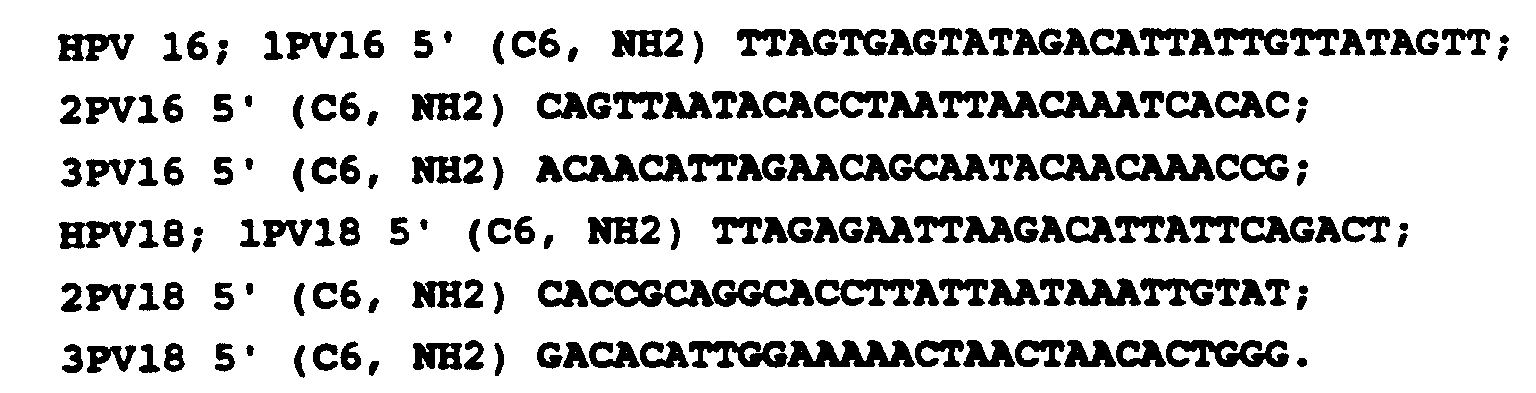
- the assay was for the presence of HPV 16 and 18 using DNA samples isolated from the cell lines SiHa and HeLa positive for both virus types and oligonucleotides specific for each virus type.
- the primers 2PV16, 2PV18 were biotinylated and 3PV16, 3PV18 were ECL-labeled-oligonucleotides.
- the 2/3PV16 and 2/3PV18 oligonucleotides were specific for HPV 16 and 18 respectively.
- the resultant bead captured ECL label was analyzed for ECL using an analyzer as described in Fig. 1. The results were plotted as ECL counts for each sample primer combination.
- Fig. 7 The resultant bead bound ECL label was analyzed for ECL using an analyzer as described in Fig. 1.
- the ECL peak photon counts were plotted against increasing concentrations HPV 16 DNA, expressed as a ratio of viral copies to total cellular DNA copies.
- the primers used in this analysis for HPV16 were 1PV16 (biotin label) and 2PV16 (ECL label). DNA used for each PCR was maintained at a constant 1 ⁇ g using calf thymus DNA.
- PCR was performed using biotinylated HRP2 with unlabeled HRP1 (for probes 1T24 and 1CHR) and biotinylated HRP1 with unlabeled HRP2 (for probes 2T24 and 2CHR), generating bead bound single stranded targets for hybridization.
- the DNA samples were the normal (Placenta) Ha-ras Gene and the mutant (NIH3T3-T24) Ha- ras Gene.
- PCR was performed as described in Fig. 8 using only biotinylated HRP2 with unlabeled HRP1 (for probes 1T24 and 1CHR).
- the probes used were: 1T24 and 1CHR containing P 32 (1T24-P, 1CHR-P) as controls. With the 1T24 and 1CHR containing both P 32 and ECL label to determine the effects of the ECL label.
- the samples were washed as earlier with TEMAC.
- the resultant bead bound P 32 was analyzed on addition of scintillation cocktail in a scintillation counter. The results were plotted as P 32 counts per second for each sample probe combination.
- Fig. 11 An assay was conducted and the results are shown in Fig. 11.
- the PCR was performed using biotinylated 2PV18 and unlabeled 1PV18 using HeLa DNA (400 copies per cell) using the PCR format illustrated in Fig. 3.
- the resultant PCR reaction was then hybridized with the specific probe ECL label-3PV18.
- the hybridization mixture was then added to streptavidin coated beads and the resultant bead bound ECL label was directly analyzed for ECL using an ECL analyzer as described in Fig. 1.
- the results were plotted as ECL counts verses HPV18 copies added to the PCR.
- a flow-through apparatus employing three electrodes, as described in Figs. 1 and 2, was used.
- the ECL measurement cycle consists of three steps: (1) preconditioning, (2) measuring, and (3) cleaning.
- the preconditioning step involves the application of a voltage triangle wave of 0.0 V to +2.2 V to -1.0 V to +0.6 V at 2.0 V/sec.
- the measurement step involves the application of a triangle waveform from +0.6 V to +2.8 V to +2.0 V at 1.0 V/s.
- the cleaning step involves the application of a voltage square wave from +0.0 V to +3.0 V to -0.5 V to 0.0 V. All voltages are relative to the Ag/AgCl reference electrode.
- Reference numeral 48 refers to a transparent window, reference numeral 122 to a gasket, reference numeral 22 to the inlet in the cell block, reference numeral 56/58 to the working electrode, reference numeral 24 to the sample outlet, reference numeral 20 to the cell block itself and reference 27 to an electromagnet.
- the plane of the cell block is oriented horizontally.
- Labeled microparticles (Dynal) in ECL buffer are drawn to the electrochemical cell by means of a peristaltic pump.
- permanent magnet 37 Prior to the sample introduction, permanent magnet 37 is positioned immediately below the working electrode/solution interface at a distance of 0.035 inches.
- the microparticles deposit onto an area over the working electrode, as defined by the area of the magnet.
- the pump is turned off and the magnetic withdrawn after the entire sample is deposited. The longer the collection time, the more particles are deposited. Increasing the concentration of particles on the working electrode results in an increased ECL intensity as shown in Fig. 19.
- Microparticles which are magnetically responsive, non-magnetically responsive, and of a wide range of densities can advantageously be collected by filtration upon the surface of a membrane filter.
- the particles are pumped through a portion of a filter membrane which has pore sizes which are smaller than the diameter of the particles but preferably are substantially smaller than the particle diameter and at a sufficiently high surface density such that the collection of particles will not cause blockage of the pores.
- the filter is advantageously largely transparent such that the filter, after collection of the particles, can be placed upon the surface of a working electrode for the purpose of inducing ECL from the particles and measuring the luminescence to measure the quantity of ECL label on the particles.
- Probes 1CHR and 1T24 were also labeled with 32 P using T4 polynucleotide kinase using established methods generating probes with a specific activity of 77,000 cpm/ng (5).
- RNA samples were hybridized to 2 ⁇ l of the SA-T35 complex (one step assay) or 25ng of the biotinylated T35 (two step assay). Samples were made up to 50 ⁇ l and hybridized for 3 hours at 50°C followed by the addition of 200 ⁇ g of anti DNA/RNA antibody coated particles in 20 ⁇ l of PBS 0.1%BSA. This mixture was mixed at room temperature for 1 hour followed by two washes in ECL buffer. Samples from the hybridization with the SA-T35 complex were resuspended in 530 ⁇ l of ECL buffer and analyzed as described in Example 1.
- Fig. 8 we show data from a point mutation assay for the Ha- ras oncogene.
- the PCR was performed as illustrated in Fig. 4 using biotinylated HRP2 with unlabeled HRP1 (for probes 1T24 and 1CHR) and biotinylated HRP1 with unlabeled HRP2 (for probes 2T24 and 2CHR), generating bead-bound single stranded targets for hybridization.
- the DNA samples were the normal (Placenta) Ha-ras Gene and the mutant (NIH3T3-T24) Ha-ras Gene.
Landscapes
- Health & Medical Sciences (AREA)
- Life Sciences & Earth Sciences (AREA)
- Chemical & Material Sciences (AREA)
- Immunology (AREA)
- Engineering & Computer Science (AREA)
- Molecular Biology (AREA)
- Biochemistry (AREA)
- General Health & Medical Sciences (AREA)
- Analytical Chemistry (AREA)
- Physics & Mathematics (AREA)
- Hematology (AREA)
- Urology & Nephrology (AREA)
- Biomedical Technology (AREA)
- General Physics & Mathematics (AREA)
- Pathology (AREA)
- Biotechnology (AREA)
- Microbiology (AREA)
- Food Science & Technology (AREA)
- Cell Biology (AREA)
- Organic Chemistry (AREA)
- Medicinal Chemistry (AREA)
- Zoology (AREA)
- Genetics & Genomics (AREA)
- Nuclear Medicine, Radiotherapy & Molecular Imaging (AREA)
- Proteomics, Peptides & Aminoacids (AREA)
- Wood Science & Technology (AREA)
- Chemical Kinetics & Catalysis (AREA)
- Plasma & Fusion (AREA)
- Bioinformatics & Cheminformatics (AREA)
- General Engineering & Computer Science (AREA)
- Biophysics (AREA)
- Investigating Or Analysing Materials By The Use Of Chemical Reactions (AREA)
- Investigating, Analyzing Materials By Fluorescence Or Luminescence (AREA)
- Plural Heterocyclic Compounds (AREA)
- Nitrogen Condensed Heterocyclic Rings (AREA)
- Heterocyclic Carbon Compounds Containing A Hetero Ring Having Oxygen Or Sulfur (AREA)
- Inorganic Compounds Of Heavy Metals (AREA)
- Investigating Or Analysing Biological Materials (AREA)
Abstract
Description


- (a) ECL Label:
- Ru(bpy)3 2+
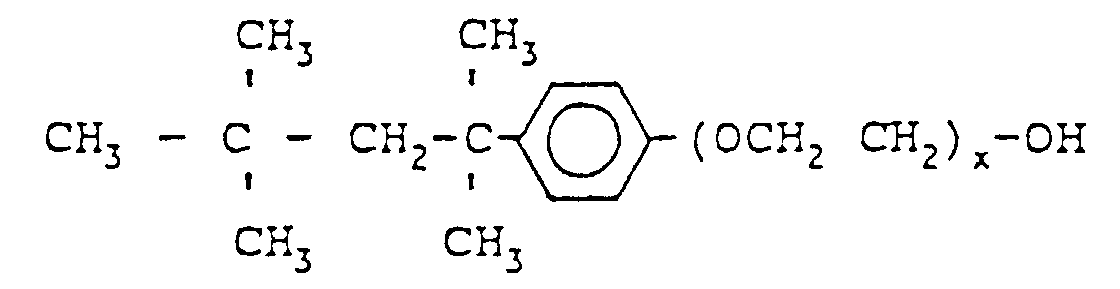
- (b) ECL Buffer:
- 112 mM KH2PO4, 88 mM
K2HPO4·3H2O, 50 µM NaCl, 6.5 mM
NaN3, 0.8 µM Triton X-100, 0.4
mM Tween - (c) ECL Diluent:
- 37.5 mM KH2PO4, 109.2 mM K2HPO4·3H2O, 151.7 mM NaCl, 0.65 mM NaN3, 0.43 mM bovine serum albumin in H2O
- (d) Ru(bpy)3 2+-NHS:
- Ru(2,2'-bipyridyl)2(4-[3-(1,3-dioxolan-2-yl)propyl]-4'-methyl-2,2'-bipyridine)2+
- (e) Dynal Particles:
-
- (i) Dynal M-450 Dynabeads, 4.5 µm diameter superparamagnetic particles, 30 mg/mL, obtained from Dynal, 45 North Station Plaza, Great Neck, NY 11021
- (ii) Dynal M-280 Dynabeads, 2.8 µM diameter superparamagnetic particles, 10 mg/mL, obtained for Dynal, 45 North Station Plaza, Great Neck, NY 11021
| ECL Measurements from Different Magnetically Responsive Particles | ||||
| Particle Type | Diameter (µm) | Density (g/mL) | Material | ECL Counts |
| Glass | 8.0 | 2.4 | soda lime glass | 2200 |
| 2.0 | 2.4 | soda lime glass | 8500 | |
| Quartz | 0.3 - 3.5 | 2.5 | SiO2 | 1150 |
| Gold | 1.0 - 2.0 | 19.3 | Au | 1100 |
| ECL Measurement from non-maanetically responsive Particles by Gravity Collection | ||||
| Particle Type | Diamete r (µm) | Particle Density (g/mL) | Material | ECL Counts |
| Rhone-Poulenc | 4.0 | 1.5 | Polystyrene Divinyl Benzene/Fe3O4 | 1680 |
| 1.5-2.1 | 1.4 | Polystyrene/Fe3O4 | 462 | |
| Polysciences | 1.5-2.1 | 2.1 | Polystyrene/FeO2 | 504 |
| Dynal | 4.5 | 1.5 | Polystyrene/Fe2O3 | 4200 |
| Cortex | 1.0-10 | 1.3 | Cellulose/Fe3O4 | 125 |
| 1.0-10 | 1.8 | Polyacrolein/Fe3O4 | 125 | |
| 1.0-25 | 1.2 | Polyacrylamide/Fe3O4 w/ charcoal | 125 | |
| Nickel | 3.0 | 8.9 | Ni | 125 |
| One-Step Separation Sandwich Assay; Detection of TSH | ||
| TSH Concentration (µIU/mL) | ECL Counts (Duplicate Samples) | |
| 0.00 | 1918 | 1885 |
| 0.05 | 2584 | 2530 |
| 0.10 | 3365 | 3288 |
| 0.50 | 8733 | 8652 |
| 2.50 | 35688 | 35347 |
| 10.0 | 125316 | 136994 |
| 25.0 | 300248 | 288272 |
| 50.0 | 549034 | 564948 |
| One-Step Non-Separation Sandwich Assay: Detection of TSH | ||
| TSH Concentration (µIU/mL) | ECL Counts (Duplicate Samples) | |
| 0.00 | 2610 | 2769 |
| 0.05 | 2870 | 2894 |
| 0.10 | 2970 | 2950 |
| 0.50 | 3473 | 3403 |
| 2.50 | 5588 | 5495 |
| 10.0 | 13051 | 13139 |
| 25.0 | 26468 | 27306 |
| 50.0 | 47104 | 48664 |
| Two-Step Separation Competitive Assay: Detection of Digoxin | ||
| Digoxin Concentration (ng/mL) | ECL Counts (Duplicate Samples) | |
| 0.0 | 22031 | 21154 |
| 0.5 | 13367 | 13638 |
| 1.0 | 9506 | 9607 |
| 2.0 | 5244 | 5129 |
| 3.0 | 2959 | 2994 |
| 5.0 | 1581 | 1631 |
| Two-Step Non-Separation Competitive Assay: Detection of Digoxin | ||
| Digoxin Concentration (ng/mL) | ECL Counts (Duplicate Samples) | |
| 0.0 | 42051 | 39643 |
| 0.5 | 28721 | 28074 |
| 1.0 | 22190 | 21364 |
| 2.0 | 14660 | 14542 |
| 3.0 | 11315 | 11893 |
| 5.0 | 9161 | 8945 |
| Two-Step Separation Competitive Assay: Detection of Digoxin | ||
| Digoxin Concentration (ng/mL) | ECL Counts (Duplicate Samples) | |
| 0.0 | 42613 | 35309 |
| 0.5 | 24211 | 24168 |
| 1.0 | 17561 | 17206 |
| 2.0 | 10491 | 9909 |
| 3.0 | 6712 | 7145 |
| 5.0 | 4680 | 4603 |
Oligonucleotides for the HPV study were directed to the E6 region as previously described (2).
The oligonucleotide sequences were as follows:


Oligonucleotides JK8 and JK8C for coupling to particles:


Oligonucleotide probe for aequorin RNA generated by in vitro transcription:



| Particles | Probe amount (fmoles) | ECL counts |
| JK8 | 12.5 | 5085 |
| 6.3 | 3035 | |
| 3.01 | 1345 | |
| 1.5 | 657 | |
| JK8C | 12.5 | 451 |
| 6.3 | 345 | |
| 3.01 | 256 | |
| 1.5 | 212 |
| ASSAY | RNA | ECL COUNTS (average) |
| One Step | Positive | 815 |
| Negative | 91 | |
| Two Step | Positive | 1123 |
| Negative | 194 |
| DNA | Amount | Average ECL counts |
| | 10 | 184 |
| 25 | 257 | |
| 50 | 266.5 | |
| | 10 | 87 |
| 25 | 70 | |
| 50 | 75 |
Claims (42)
- A method for performing a binding assay for an analyte of interest in a sample comprising the steps of:(a) forming a composition containing(i) said sample(ii) an assay-performance-substance which contains a component linked to a label compound capable of being induced to electrochemiluminesce; and(iii) a plurality of particles capable of specifically binding with the analyte and/or said assay-performance-substance;(b) incubating said composition to form a complex which includes a particle and said label compound;(c) collecting said complex in a measurement zone;(d) inducing the label compound in said complex to electrochemiluminesce by surface selective excitation of said compound on an electrode surface, and(e) measuring the emitted electrochemiluminescence to measure the amount of the analyte of interest in the sample.
- A method for performing a binding assay for an analyte of interest in a sample based upon measurement of electrochemiluminescence at an electrode surface comprising the steps:(a) forming a composition containing(i) said sample(ii) an assay-performance-substance which contains a component linked to a label compound capable of being induced to electrochemiluminesce, and(iii) a plurality of particles capable of specifically binding with the analyte and or said assay-performance-substance;(b) incubating said composition to form a complex which includes a particle and said label compound;(c) collecting said complex;(d) causing said collected complex to come in contact with an electrode surface and inducing the label compound in said complex to electrochemiluminesce by imposing a voltage on said electrode; and(e) measuring the emitted electrochemiluminescence to measure the amount of the analyte of interest in the sample.
- A method as claimed in claim 2 characterised in that said plurality of particles comprises suspended particles having a density greater than the balance of said composition;
and steps (c) and (d) compriseintroducing said composition into an assay cell;collecting said complex at the surface of an electrode located below at least a substantial portion of the volume of said assay cell by permitting said composition to reside in said cell for a time sufficient to permit the particles to settle upon said electrode surface by the force of gravity; andinducing the label compound in said collected complex to electrochemiluminesce by imposing a voltage on said electrode. - A method as claimed in claim 3 conducted as a batch process, the composition being permitted to reside within the said cell for a time sufficient to permit settling of said particles upon said electrode surface.
- A method as claimed in claim 3 conducted as a flow process wherein said composition is flowed through said cell at a sufficiently low rate to permit settling of at least a portion of said particles upon said electrode surface.
- A method as claimed in any one of claims 3 to 5 characterised in that said particles have a density of from 0.1 to 5g/mL.
- A method as claimed in claim 6 characterised in that said particles have a density of from 0.5 to 2g/mL.
- A method as claimed in any one of claims 3 to 7 characterised in that the size of said particles, measured as the mean diameter, ranges from 0.01 to 100µm.
- A method as claimed in claim 8 characterised in that the size of said particles ranges from 0.01 to 10µm.
- A method as claimed in any one of claims 3 to 9 characterised in that the concentration of particles in said composition is from 1 to 10,000 µg/mL.
- A method as claimed in claim 10 characterised in that said concentration of particles is in the range of from 5 to 1000 µg/mL.
- A method as claimed in any one of claims 3 to 11 characterised in that the density, size and concentration of said particles in said composition is such that the settling rate is at least 0.5 mm/minute.
- A method as claimed in any one of claims 3 to 12 wherein at least a substantial portion of said electrode surface is covered by a monolayer of said complex prior to inducing electrochemiluminescence.
- A method as claimed in claim 2 characterised in that said plurality of particles comprises suspended particles having a density greater than the balance of said composition
and step (c) comprises collecting said complex by centrifugation. - A method as claimed in claim 14 characterised in that said centrifugation step collects said complex at the surface of said electrode.
- A method as claimed in claim 14 or claim 15 characterised in that said particles have a density of from 0.1 to 5g/mL.
- A method as claimed in claim 16 characterised in that said particles have a density of from 0.5 to 2g/mL.
- A method as claimed in any one of claims 14 to 17 characterised in that electrochemiluminescence is measured while said sample is being centrifuged.
- A method as claimed in claim 2 characterised in thatcomponent (a) (iii) comprises a plurality of suspended particles capable of specifically binding with the analyte and/or said assay-performance-substance; andstep (c) comprises collecting said complex by filtration.
- A method as claimed in claim 19 characterised in that said filtration step collects said complex at the surface of said electrode.
- A method as claimed in claim 19 or claim 20 characterised in that the size of said particles, measured as the mean diameter, is from 0.001 to 100 µm.
- A method as claimed in claim 21 characterised in that the size of said particles ranges from 0.01 to 10 µm.
- A method as claimed in any one of claims 19 to 22 characterised in that said filtration takes place on a porous metallic electrode surface wherein said pore size, measured as mean diameter, is from 10 to 90% of the mean diameter of said particles.
- A method as claimed in claim 2 characterised in thatcomponent (a) (iii) comprises a plurality of magnetically responsive suspended particles; andstep (c) comprises collecting said complex by imposition of a magnetic field on said particles.
- A method as claimed in claim 24 characterised in that the imposition of said magnetic field causes said complex to collect at the surface of said electrode.
- A method as claimed in claim 2 characterised in thatcomponent (a) (iii) comprises a plurality of magnetically responsive suspended particles; andsteps (c) and (d) compriseintroducing said composition into an assay cell;collecting said complex at the surface of an electrode by imposition of a magnetic field on said particles; andinducing the label compound in said collected complex to electrochemiluminesce by imposing a voltage on said electrode.
- A method as claimed in claim 26 conducted as a batch process, the composition being permitted to reside within said cell for a time sufficient to permit said magnetic field to cause said particles to settle upon said electrode surface.
- A method as claimed in claim 26 conducted as a flow process wherein said composition is flowed through said cell at a sufficiently low rate to permit said magnetic field to cause said particles to settle upon said electrode surface.
- A method as claimed in any one of claims 26 to 28 characterised in that said particles have a magnetic susceptibility of at least 0.001 cgs units.
- A method as claimed in claim 29 characterised in that the magnetic susceptibility is at least 0.01 cgs units.
- A method as claimed in any one of claims 26 to 30 characterised in that said particles have a density of from 0.1 to 5 g/mL
- A method as claimed in claim 31 characterised in that the density of said particles is from 0.5 to 2 g/mL.
- A method as claimed in any one of claims 26 to 32 characterised in that the size of said particles, measured as the mean diameter, is from 0.001 to 100 µm.
- A method as claimed in claim 33 characterised in that the size of said particles is from 0.01 to 10 µm and the particles have low resonance.
- A method as claimed in any one of claims 26 to 34 characterised in that the concentration of particles in said composition is from 1 to 10,000 µg/mL.
- A method as claimed in claim 35 characterised in that said concentration of particles is from 5 to 1000 µg/mL.
- A method as claimed in any one of claims 26 to 36 characterised in that the magnetic susceptibility, density, size and concentration of said particles in said composition is such that the settling rate of said particles is at least 0.5 mm/min.
- A method as claimed in any one of claims 26 to 37 characterised in that at least a substantial portion of said electrode surface is covered by a monolayer of said complex prior to inducing electrochemiluminescence.
- A method as claimed in any one of claims 26 to 38 characterised in that the lines of force of said magnetic field are substantially parallel with the surface of said electrode in the region of said electrode surface.
- A method as claimed in any one of claims 26 to 39 characterised in that the magnetic field is withdrawn after collection of said complex and before inducing luminescence.
- An apparatus for performing a binding assay for an analyte of interest in a sample based upon measurement of electrochemiluminescence at an electrode surface comprising:(a) a cell defining an assay sample containing volume and having inlet and outlet means, an electrode, and further including means for obtaining a substantially even distribution on said electrode surface of a complex comprising the product of incubating a composition containing the sample, an assay performance substance which contains a component linked to a label compound capable of being induced to electrochemiluminescence, and a plurality of magnetically responsive particles capable of specifically binding with the analyte of interest and/or said assay-performance-substance, said means for obtaining an even distribution including means for generating a magnetic field oriented with respect to said electrode so that the lines of force of said magnetic field are substantially parallel with the surface of said electrode in the region of said surface;(b) means to impress a voltage upon said electrode; and(c) means to measure the electrochemiluminescence generated at said electrode.
- An apparatus as claimed in claim 41 characterised in that said means for generating a magnetic field includes a magnet in north-south orientation positioned vertically below said electrode.
Priority Applications (3)
| Application Number | Priority Date | Filing Date | Title |
|---|---|---|---|
| EP02022214A EP1286164B1 (en) | 1991-02-06 | 1992-02-05 | Methods and apparatus for improved luminescence assays |
| EP98200764A EP0877252B1 (en) | 1991-02-06 | 1992-02-05 | Method and apparatus for luminescence assays |
| DK98200764T DK0877252T3 (en) | 1991-02-06 | 1992-02-05 | Method and apparatus for luminescence assays |
Applications Claiming Priority (7)
| Application Number | Priority Date | Filing Date | Title |
|---|---|---|---|
| US65242791A | 1991-02-06 | 1991-02-06 | |
| US652427 | 1991-02-06 | ||
| US82727092A | 1992-02-03 | 1992-02-03 | |
| US82726992A | 1992-02-03 | 1992-02-03 | |
| US827270 | 1992-02-03 | ||
| US827269 | 1992-02-03 | ||
| PCT/US1992/000992 WO1992014139A1 (en) | 1991-02-06 | 1992-02-05 | Methods and apparatus for improved luminescence assays |
Related Child Applications (2)
| Application Number | Title | Priority Date | Filing Date |
|---|---|---|---|
| EP98200764A Division EP0877252B1 (en) | 1991-02-06 | 1992-02-05 | Method and apparatus for luminescence assays |
| EP98103972 Division | 1998-03-06 |
Publications (3)
| Publication Number | Publication Date |
|---|---|
| EP0570518A1 EP0570518A1 (en) | 1993-11-24 |
| EP0570518A4 EP0570518A4 (en) | 1994-05-18 |
| EP0570518B1 true EP0570518B1 (en) | 1998-11-18 |
Family
ID=27417877
Family Applications (3)
| Application Number | Title | Priority Date | Filing Date |
|---|---|---|---|
| EP02022214A Expired - Lifetime EP1286164B1 (en) | 1991-02-06 | 1992-02-05 | Methods and apparatus for improved luminescence assays |
| EP92906820A Expired - Lifetime EP0570518B1 (en) | 1991-02-06 | 1992-02-05 | Methods and apparatus for improved electrochemi-luminescence assays |
| EP98200764A Expired - Lifetime EP0877252B1 (en) | 1991-02-06 | 1992-02-05 | Method and apparatus for luminescence assays |
Family Applications Before (1)
| Application Number | Title | Priority Date | Filing Date |
|---|---|---|---|
| EP02022214A Expired - Lifetime EP1286164B1 (en) | 1991-02-06 | 1992-02-05 | Methods and apparatus for improved luminescence assays |
Family Applications After (1)
| Application Number | Title | Priority Date | Filing Date |
|---|---|---|---|
| EP98200764A Expired - Lifetime EP0877252B1 (en) | 1991-02-06 | 1992-02-05 | Method and apparatus for luminescence assays |
Country Status (16)
| Country | Link |
|---|---|
| EP (3) | EP1286164B1 (en) |
| JP (2) | JP3061416B2 (en) |
| KR (1) | KR100226231B1 (en) |
| CN (2) | CN1094593C (en) |
| AT (2) | ATE173542T1 (en) |
| AU (1) | AU668085B2 (en) |
| CA (1) | CA2103674C (en) |
| DE (3) | DE69233703T2 (en) |
| DK (2) | DK0877252T3 (en) |
| ES (3) | ES2126591T3 (en) |
| GR (1) | GR3029446T3 (en) |
| IE (1) | IE69060B1 (en) |
| IL (1) | IL100867A (en) |
| NZ (1) | NZ241537A (en) |
| TW (1) | TW316291B (en) |
| WO (1) | WO1992014139A1 (en) |
Cited By (1)
| Publication number | Priority date | Publication date | Assignee | Title |
|---|---|---|---|---|
| US7439017B2 (en) * | 1998-09-17 | 2008-10-21 | Bioveris Corporation | Assays for measuring nucleic acid binding proteins and enzyme activities |
Families Citing this family (69)
| Publication number | Priority date | Publication date | Assignee | Title |
|---|---|---|---|---|
| KR100212178B1 (en) * | 1991-07-10 | 1999-08-02 | 리차드 제이 마세이 | Method and apparatus for improved luminescence assays using particle concentration and chemiluminescence detection |
| ZA929351B (en) * | 1991-12-11 | 1993-06-04 | Igen Inc | Electrochemiluminescent label for DNA assays. |
| US5466416A (en) * | 1993-05-14 | 1995-11-14 | Ghaed; Ali | Apparatus and methods for carrying out electrochemiluminescence test measurements |
| DE59507438D1 (en) * | 1994-07-25 | 2000-01-20 | Roche Diagnostics Gmbh | HYDROPHILE METAL COMPLEXES |
| US5744367A (en) * | 1994-11-10 | 1998-04-28 | Igen International, Inc. | Magnetic particle based electrochemiluminescent detection apparatus and method |
| US6140045A (en) | 1995-03-10 | 2000-10-31 | Meso Scale Technologies | Multi-array, multi-specific electrochemiluminescence testing |
| NZ306051A (en) * | 1995-03-10 | 1999-11-29 | Meso Scale Technologies Llc | Testing using electrochemiluminescence |
| US6673533B1 (en) | 1995-03-10 | 2004-01-06 | Meso Scale Technologies, Llc. | Multi-array multi-specific electrochemiluminescence testing |
| US6207369B1 (en) | 1995-03-10 | 2001-03-27 | Meso Scale Technologies, Llc | Multi-array, multi-specific electrochemiluminescence testing |
| US6319670B1 (en) | 1995-05-09 | 2001-11-20 | Meso Scale Technology Llp | Methods and apparatus for improved luminescence assays using microparticles |
| US7314711B2 (en) | 1997-05-23 | 2008-01-01 | Bioveris Corporation | Assays employing electrochemiluminescent labels and electrochemiluminescence quenchers |
| JP3366842B2 (en) * | 1997-08-29 | 2003-01-14 | エーザイ株式会社 | Electrochemiluminescence cell |
| US6200531B1 (en) | 1998-05-11 | 2001-03-13 | Igen International, Inc. | Apparatus for carrying out electrochemiluminescence test measurements |
| US6136268A (en) * | 1999-08-17 | 2000-10-24 | Orion Diagnostica | Method for luminescence measurements |
| EP1451348B1 (en) * | 2001-09-10 | 2015-08-12 | Meso Scale Technologies, LLC | Methods, reagents, kits and apparatus for protein function analysis |
| US10022078B2 (en) | 2004-07-13 | 2018-07-17 | Dexcom, Inc. | Analyte sensor |
| US20030180814A1 (en) * | 2002-03-21 | 2003-09-25 | Alastair Hodges | Direct immunosensor assay |
| JP2005530183A (en) | 2002-06-20 | 2005-10-06 | バイオヴェリス コーポレイション | Electrochemiluminescence flow cell and flow cell components |
| CN100538362C (en) | 2002-11-07 | 2009-09-09 | 株式会社三菱化学药得论 | Magnetic material for collecting magnetic particles and application thereof |
| US7920906B2 (en) | 2005-03-10 | 2011-04-05 | Dexcom, Inc. | System and methods for processing analyte sensor data for sensor calibration |
| US9247900B2 (en) | 2004-07-13 | 2016-02-02 | Dexcom, Inc. | Analyte sensor |
| EP1787124A2 (en) | 2004-06-23 | 2007-05-23 | The University Of Texas System | Methods and compositions for the detection of biological molecules using a two particle complex |
| US7946984B2 (en) | 2004-07-13 | 2011-05-24 | Dexcom, Inc. | Transcutaneous analyte sensor |
| US20060275841A1 (en) * | 2004-12-20 | 2006-12-07 | Martin Blankfard | Assay method and apparatus with reduced sample matrix effects |
| US7300631B2 (en) * | 2005-05-02 | 2007-11-27 | Bioscale, Inc. | Method and apparatus for detection of analyte using a flexural plate wave device and magnetic particles |
| KR101311815B1 (en) | 2005-06-03 | 2013-10-22 | 보드 오브 리전츠 오브 더 유니버시티 오브 텍사스 시스템 | Electrochemistry and electrogenerated chemiluminescence with a single faradaic electrode |
| JPWO2007148762A1 (en) * | 2006-06-22 | 2009-11-19 | 雅彦 黒田 | Human papillomavirus (HPV) detection method, primer set and detection kit used therefor |
| PL2271938T3 (en) | 2008-04-11 | 2014-07-31 | Univ Texas | Method and apparatus for nanoparticle electrogenerated chemiluminescence amplification |
| AU2009244904B2 (en) | 2008-05-08 | 2014-04-17 | Board Of Regents Of The University Of Texas System | Luminescent nanostructured materials for use in electrogenerated chemiluminescence |
| CN102224410B (en) | 2008-09-24 | 2017-02-08 | 施特劳斯控股公司 | Imaging analyzer for testing analytes |
| US20100261292A1 (en) * | 2009-04-10 | 2010-10-14 | Meso Scale Technologies, Llc | Methods for Conducting Assays |
| US20140295420A1 (en) * | 2011-06-15 | 2014-10-02 | Koninklijke Philips N.V. | Processing of biological sample components |
| US20150056098A1 (en) * | 2011-12-28 | 2015-02-26 | Hitachi High-Technologies Corporation | Sample analysis device and sample analysis method |
| KR102601323B1 (en) | 2015-08-20 | 2023-11-10 | 에프. 호프만-라 로슈 아게 | Particle-based immunoassay using pegylated analyte-specific binders |
| BR112018017336A2 (en) | 2016-03-07 | 2018-12-26 | Hoffmann La Roche | in vitro method for detecting a p53 antibody (anti-p53 antibody) in a sample and fusion polypeptide |
| ES2974284T3 (en) | 2016-03-11 | 2024-06-26 | Roche Diagnostics Gmbh | Branched Chain Amines in Electrochemiluminescence Detection |
| EP3512364B1 (en) * | 2016-09-14 | 2021-11-03 | Philip Morris Products S.A. | Aerosol-generating system and method for controlling the same |
| JP7068323B2 (en) | 2017-02-02 | 2022-05-16 | エフ.ホフマン-ラ ロシュ アーゲー | Immunoassay using at least two pegged analyte-specific binders |
| DE102017114537A1 (en) * | 2017-06-29 | 2019-01-03 | Endress+Hauser Conducta Gmbh+Co. Kg | Sensor membrane, sensor cap and optical sensor |
| CN111433372B (en) * | 2017-10-19 | 2024-01-26 | 生物辐射实验室股份有限公司 | Digital amplification assays with unconventional and/or reverse variations in photoluminescence |
| EP3781600A1 (en) | 2018-04-18 | 2021-02-24 | F. Hoffmann-La Roche AG | Novel anti-thymidine kinase antibodies |
| US12031985B2 (en) | 2018-04-19 | 2024-07-09 | First Light Diagnostics, Inc. | Detection of targets |
| ES2983797T3 (en) | 2018-08-31 | 2024-10-24 | Hoffmann La Roche | Thymidine kinase (TK-1) in prognostic indices for LDLBG |
| CA3115279A1 (en) | 2018-10-04 | 2020-04-09 | First Light Diagnostics, Inc. | Analysis instrument |
| CN111351781B (en) * | 2018-12-20 | 2023-11-24 | 麦德龙生物株式会社 | Electrochemiluminescence analysis device and method for analyzing sample using same |
| CN111007593B (en) * | 2019-05-12 | 2022-05-13 | 桂林电子科技大学 | Capillary optical fiber micro-particle transport device based on thermal diffusion melting and embedding core |
| JP7421631B2 (en) | 2019-07-22 | 2024-01-24 | エフ. ホフマン-ラ ロシュ アーゲー | S100A8 as a blood biomarker for non-invasive diagnosis of endometriosis |
| KR20220016210A (en) | 2019-07-22 | 2022-02-08 | 에프. 호프만-라 로슈 아게 | S100A9 as a blood biomarker for non-invasive diagnosis of endometriosis |
| JP2022542056A (en) | 2019-07-22 | 2022-09-29 | エフ.ホフマン-ラ ロシュ アーゲー | S100A6 as a blood biomarker for non-invasive diagnosis of endometriosis |
| EP4004551A1 (en) | 2019-07-22 | 2022-06-01 | F. Hoffmann-La Roche AG | Substance p as blood biomarker for the non-invasive diagnosis of endometriosis |
| JP7315781B2 (en) | 2019-07-22 | 2023-07-26 | エフ. ホフマン-ラ ロシュ アーゲー | S100A12 as a blood biomarker for non-invasive diagnosis of endometriosis |
| BR112022009371A2 (en) | 2019-11-15 | 2022-08-09 | Hoffmann La Roche | METHODS TO DETERMINE THE QUANTITY OR CONCENTRATION OF ONE OR MORE ANTIBIOTIC ANALYTES, SAMPLING TUBES, USES OF A NUCLEOPHILICAL DERIVATIZATION REAGENT AND ANTIBIOTIC ANALYTE |
| CN111693516B (en) * | 2020-05-07 | 2023-04-21 | 四川轻化工大学 | Gas-liquid phase electrochemical luminescence detection device and detection method |
| CN111693515B (en) * | 2020-05-07 | 2022-06-17 | 四川轻化工大学 | A kind of flow electrochemiluminescence real-time detection device and detection method |
| JP7592456B2 (en) * | 2020-10-26 | 2024-12-02 | キヤノン株式会社 | Magnetic particles, particles for immunoassays and test reagents |
| WO2022090455A1 (en) | 2020-11-02 | 2022-05-05 | F. Hoffmann-La Roche Ag | Sars-cov-2 nucleocapsid antibodies |
| CN113030068A (en) * | 2021-02-01 | 2021-06-25 | 苏州易莱生物技术有限公司 | Electrochemiluminescence detection device |
| WO2022207628A1 (en) | 2021-03-30 | 2022-10-06 | F. Hoffmann-La Roche Ag | Scf as blood biomarker for the non-invasive diagnosis of endometriosis |
| CN117099001A (en) | 2021-04-01 | 2023-11-21 | 豪夫迈·罗氏有限公司 | PSP94 as a blood biomarker for non-invasive diagnosis of endometriosis |
| EP4341700A1 (en) | 2021-05-17 | 2024-03-27 | F. Hoffmann-La Roche AG | Sfrp4 as blood biomarker for the non-invasive diagnosis of adenomyosis |
| US20250042976A1 (en) | 2021-10-26 | 2025-02-06 | Roche Diagnostics Operations, Inc. | Monoclonal antibodies specific for sars-cov-2 rbd |
| WO2023131594A1 (en) | 2022-01-05 | 2023-07-13 | F. Hoffmann-La Roche Ag | Derivatization of compounds in patient samples for therapeutic drug monitoring (tdm) |
| WO2023247752A1 (en) | 2022-06-23 | 2023-12-28 | F. Hoffmann-La Roche Ag | Method for diagnosing endometriosis and for classifying the stage of endometriosis |
| EP4558825A1 (en) | 2022-07-22 | 2025-05-28 | F. Hoffmann-La Roche AG | Meteorin-like protein (metrnl) as (blood) biomarker for the diagnosis of polycystic ovarian syndrome |
| JP2025524025A (en) | 2022-07-22 | 2025-07-25 | エフ. ホフマン-ラ ロシュ アーゲー | Leukotriene A4 hydrolase (LTA4H) as a (blood) biomarker for the diagnosis of polycystic ovary syndrome |
| EP4558826A1 (en) | 2022-07-22 | 2025-05-28 | F. Hoffmann-La Roche AG | Fibroblast growth factor binding protein 1 (fgfbp1) as (blood) biomarker for the diagnosis of polycystic ovarian syndrome |
| EP4747637A1 (en) | 2023-07-20 | 2026-05-27 | F. Hoffmann-La Roche AG | Screening methods for antibody compositions |
| JP2026526931A (en) | 2023-07-28 | 2026-08-10 | エフ ホフマン-ラ ロッシュ アクチェン ゲゼルシャフト | Serum EphA1 as a biomarker for endometriosis |
| WO2026120128A1 (en) | 2024-12-05 | 2026-06-11 | Roche Diagnostics Gmbh | Serum transcriptional regulator erg as biomarker for endometriosis |
Family Cites Families (15)
| Publication number | Priority date | Publication date | Assignee | Title |
|---|---|---|---|---|
| EP0030087A1 (en) * | 1979-11-13 | 1981-06-10 | Technicon Instruments Company Limited | Immunoassay method and apparatus and kit for carrying out the method |
| DE3013765A1 (en) * | 1980-04-10 | 1981-10-15 | Philips Patentverwaltung Gmbh, 2000 Hamburg | DETECTOR ARRANGEMENT, ESPECIALLY FOR LIQUID CHROMATOGRAPHY |
| US4652533A (en) * | 1983-04-28 | 1987-03-24 | Pandex Laboratories, Inc. | Method of solid phase immunoassay incorporating a luminescent label |
| US4628037A (en) * | 1983-05-12 | 1986-12-09 | Advanced Magnetics, Inc. | Binding assays employing magnetic particles |
| EP0170446B1 (en) * | 1984-07-10 | 1991-03-06 | Serono Diagnostics Limited | Methods of assay |
| FI844027A7 (en) * | 1984-10-12 | 1986-04-13 | Labsystems Oy | IMMUNOLOGISTK BESTAEMNINGSFOERFARANDE. |
| GB8507706D0 (en) * | 1985-03-25 | 1985-05-01 | Genetics Int Inc | Magnetic nucleic acid sequences |
| WO1987006706A1 (en) * | 1986-04-30 | 1987-11-05 | Igen, Inc. | Electrochemiluminescent assays |
| WO1987007386A1 (en) * | 1986-05-22 | 1987-12-03 | Unilever Plc | Solid phase immunoassay method |
| GB8620893D0 (en) * | 1986-08-29 | 1986-10-08 | Unilever Plc | Assays |
| US5093268A (en) * | 1988-04-28 | 1992-03-03 | Igen, Inc. | Apparatus for conducting a plurality of simultaneous measurements of electrochemiluminescent phenomena |
| US5061445A (en) * | 1988-11-03 | 1991-10-29 | Igen, Inc. | Apparatus for conducting measurements of electrochemiluminescent phenomena |
| US5068088A (en) * | 1988-11-03 | 1991-11-26 | Igen, Inc. | Method and apparatus for conducting electrochemiluminescent measurements |
| DE68928994T2 (en) * | 1988-11-03 | 1999-12-16 | Igen International, Inc. | ELECTROCHEMILUMINESCENT TEST PROCEDURE |
| CA2002083C (en) * | 1988-11-03 | 2001-01-09 | Haresh P. Shah | Enhanced electrochemiluminescence |
-
1992
- 1992-02-04 IL IL10086792A patent/IL100867A/en not_active IP Right Cessation
- 1992-02-05 CA CA002103674A patent/CA2103674C/en not_active Expired - Lifetime
- 1992-02-05 DK DK98200764T patent/DK0877252T3/en active
- 1992-02-05 IE IE920380A patent/IE69060B1/en not_active IP Right Cessation
- 1992-02-05 AT AT92906820T patent/ATE173542T1/en active
- 1992-02-05 NZ NZ241537A patent/NZ241537A/en not_active IP Right Cessation
- 1992-02-05 WO PCT/US1992/000992 patent/WO1992014139A1/en not_active Ceased
- 1992-02-05 EP EP02022214A patent/EP1286164B1/en not_active Expired - Lifetime
- 1992-02-05 JP JP4506644A patent/JP3061416B2/en not_active Expired - Lifetime
- 1992-02-05 AU AU14206/92A patent/AU668085B2/en not_active Ceased
- 1992-02-05 DK DK92906820T patent/DK0570518T3/en active
- 1992-02-05 ES ES92906820T patent/ES2126591T3/en not_active Expired - Lifetime
- 1992-02-05 KR KR1019930702344A patent/KR100226231B1/en not_active Expired - Fee Related
- 1992-02-05 DE DE69233703T patent/DE69233703T2/en not_active Expired - Lifetime
- 1992-02-05 ES ES98200764T patent/ES2281119T3/en not_active Expired - Lifetime
- 1992-02-05 ES ES02022214T patent/ES2291407T3/en not_active Expired - Lifetime
- 1992-02-05 EP EP92906820A patent/EP0570518B1/en not_active Expired - Lifetime
- 1992-02-05 AT AT02022214T patent/ATE368224T1/en active
- 1992-02-05 DE DE69233675T patent/DE69233675T2/en not_active Expired - Lifetime
- 1992-02-05 EP EP98200764A patent/EP0877252B1/en not_active Expired - Lifetime
- 1992-02-05 DE DE69227624T patent/DE69227624T2/en not_active Expired - Lifetime
- 1992-02-07 CN CN92102540.8A patent/CN1094593C/en not_active Expired - Lifetime
- 1992-02-07 CN CNA021320268A patent/CN1495425A/en active Granted
- 1992-03-19 TW TW081102075A patent/TW316291B/zh active
-
1998
- 1998-07-15 JP JP20086598A patent/JP3182515B2/en not_active Expired - Lifetime
-
1999
- 1999-02-18 GR GR990400531T patent/GR3029446T3/en unknown
Cited By (1)
| Publication number | Priority date | Publication date | Assignee | Title |
|---|---|---|---|---|
| US7439017B2 (en) * | 1998-09-17 | 2008-10-21 | Bioveris Corporation | Assays for measuring nucleic acid binding proteins and enzyme activities |
Also Published As
Similar Documents
| Publication | Publication Date | Title |
|---|---|---|
| EP1286164B1 (en) | Methods and apparatus for improved luminescence assays | |
| US6078782A (en) | Methods for improved particle electrochemiluminescence assays | |
| US6325973B1 (en) | Methods and apparatus for improved luminescence assays | |
| US5779976A (en) | Apparatus for improved luminescence assays | |
| US5705402A (en) | Method and apparatus for magnetic microparticulate based luminescence assay including plurality of magnets | |
| US5962218A (en) | Methods and apparatus for improved luminescence assays | |
| WO1992014138A1 (en) | Method and apparatus for magnetic microparticulate based luminescence assay including plurality of magnets | |
| EP0594766B1 (en) | Methods for improved luminescence assays using particle concentration and chemiluminescence detection | |
| US5746974A (en) | Apparatus for improved luminescence assays using particle concentration, electrochemical generation of chemiluminescence and chemiluminescence detection | |
| US5770459A (en) | Methods and apparatus for improved luminescence assays using particle concentration, electrochemical generation of chemiluminescence detection | |
| US6881589B1 (en) | Electrochemiluminescent localizable complexes for assay compositions | |
| US7462322B2 (en) | Methods and apparatus for improved luminescence assays | |
| HK1017970B (en) | Methods and apparatus for improved electrochemi-luminescence assays | |
| HK1015878B (en) | Method and apparatus for luminescence assays | |
| AU676665C (en) | Methods and apparatus for improved luminescence assays usingparticle concentration and chemiluminescence detection | |
| HK1066059B (en) | Apparatus for luminescence assays |
Legal Events
| Date | Code | Title | Description |
|---|---|---|---|
| PUAI | Public reference made under article 153(3) epc to a published international application that has entered the european phase |
Free format text: ORIGINAL CODE: 0009012 |
|
| 17P | Request for examination filed |
Effective date: 19930828 |
|
| AK | Designated contracting states |
Kind code of ref document: A1 Designated state(s): AT BE CH DE DK ES FR GB GR IT LI LU MC NL SE |
|
| RHK1 | Main classification (correction) |
Ipc: G01N 33/543 |
|
| A4 | Supplementary search report drawn up and despatched | ||
| AK | Designated contracting states |
Kind code of ref document: A4 Designated state(s): AT BE CH DE DK ES FR GB GR IT LI LU MC NL SE |
|
| 17Q | First examination report despatched |
Effective date: 19960520 |
|
| GRAG | Despatch of communication of intention to grant |
Free format text: ORIGINAL CODE: EPIDOS AGRA |
|
| GRAG | Despatch of communication of intention to grant |
Free format text: ORIGINAL CODE: EPIDOS AGRA |
|
| GRAG | Despatch of communication of intention to grant |
Free format text: ORIGINAL CODE: EPIDOS AGRA |
|
| GRAH | Despatch of communication of intention to grant a patent |
Free format text: ORIGINAL CODE: EPIDOS IGRA |
|
| GRAH | Despatch of communication of intention to grant a patent |
Free format text: ORIGINAL CODE: EPIDOS IGRA |
|
| GRAG | Despatch of communication of intention to grant |
Free format text: ORIGINAL CODE: EPIDOS AGRA |
|
| GRAA | (expected) grant |
Free format text: ORIGINAL CODE: 0009210 |
|
| AK | Designated contracting states |
Kind code of ref document: B1 Designated state(s): AT BE CH DE DK ES FR GB GR IT LI LU MC NL SE |
|
| REF | Corresponds to: |
Ref document number: 173542 Country of ref document: AT Date of ref document: 19981215 Kind code of ref document: T |
|
| REG | Reference to a national code |
Ref country code: CH Ref legal event code: EP |
|
| RAP2 | Party data changed (patent owner data changed or rights of a patent transferred) |
Owner name: IGEN INTERNATIONAL, INC. |
|
| REF | Corresponds to: |
Ref document number: 69227624 Country of ref document: DE Date of ref document: 19981224 |
|
| NLT2 | Nl: modifications (of names), taken from the european patent patent bulletin |
Owner name: IGEN INTERNATIONAL, INC. |
|
| ITF | It: translation for a ep patent filed | ||
| REG | Reference to a national code |
Ref country code: FR Ref legal event code: TP |
|
| ET | Fr: translation filed | ||
| REG | Reference to a national code |
Ref country code: CH Ref legal event code: NV Representative=s name: ISLER & PEDRAZZINI AG |
|
| REG | Reference to a national code |
Ref country code: ES Ref legal event code: FG2A Ref document number: 2126591 Country of ref document: ES Kind code of ref document: T3 |
|
| NLXE | Nl: other communications concerning ep-patents (part 3 heading xe) |
Free format text: PAT. BUL. 04/99 PAGE 505: CORR.: IGEN INTERNATIONAL, INC. |
|
| REG | Reference to a national code |
Ref country code: DK Ref legal event code: T3 |
|
| PLBE | No opposition filed within time limit |
Free format text: ORIGINAL CODE: 0009261 |
|
| 26N | No opposition filed | ||
| REG | Reference to a national code |
Ref country code: GB Ref legal event code: IF02 |
|
| REG | Reference to a national code |
Ref country code: FR Ref legal event code: TP |
|
| BECA | Be: change of holder's address |
Owner name: *BIO VERIS CORP.16020 INDUSTRIAL DRIVE, US - GAITH Effective date: 20050322 |
|
| REG | Reference to a national code |
Ref country code: CH Ref legal event code: PUE Owner name: BIOVERIS CORPORATION Free format text: IGEN INTERNATIONAL, INC.#16020 INDUSTRIAL DRIVE#GAITHERSBURG, MD 20877 (US) -TRANSFER TO- BIOVERIS CORPORATION#16020 INDUSTRIAL DRIVE#GAITHERSBURG, MD 20877 (US) |
|
| NLS | Nl: assignments of ep-patents |
Owner name: BIOVERIS CORPORATION |
|
| PGFP | Annual fee paid to national office [announced via postgrant information from national office to epo] |
Ref country code: NL Payment date: 20070222 Year of fee payment: 16 |
|
| PGFP | Annual fee paid to national office [announced via postgrant information from national office to epo] |
Ref country code: SE Payment date: 20070227 Year of fee payment: 16 |
|
| PGFP | Annual fee paid to national office [announced via postgrant information from national office to epo] |
Ref country code: DK Payment date: 20070228 Year of fee payment: 16 |
|
| PGFP | Annual fee paid to national office [announced via postgrant information from national office to epo] |
Ref country code: LU Payment date: 20070305 Year of fee payment: 16 |
|
| PGFP | Annual fee paid to national office [announced via postgrant information from national office to epo] |
Ref country code: BE Payment date: 20070327 Year of fee payment: 16 |
|
| REG | Reference to a national code |
Ref country code: CH Ref legal event code: PCAR Free format text: ISLER & PEDRAZZINI AG;POSTFACH 1772;8027 ZUERICH (CH) |
|
| BECA | Be: change of holder's address |
Owner name: *BIO VERIS CORP.16020 INDUSTRIAL DRIVE, US - GAITH Effective date: 20050322 |
|
| PGFP | Annual fee paid to national office [announced via postgrant information from national office to epo] |
Ref country code: GR Payment date: 20070228 Year of fee payment: 16 |
|
| PGFP | Annual fee paid to national office [announced via postgrant information from national office to epo] |
Ref country code: MC Payment date: 20080118 Year of fee payment: 17 |
|
| BERE | Be: lapsed |
Owner name: *BIO VERIS CORP. Effective date: 20080228 |
|
| REG | Reference to a national code |
Ref country code: DK Ref legal event code: EBP |
|
| EUG | Se: european patent has lapsed | ||
| NLV4 | Nl: lapsed or anulled due to non-payment of the annual fee |
Effective date: 20080901 |
|
| PG25 | Lapsed in a contracting state [announced via postgrant information from national office to epo] |
Ref country code: NL Free format text: LAPSE BECAUSE OF NON-PAYMENT OF DUE FEES Effective date: 20080901 |
|
| PG25 | Lapsed in a contracting state [announced via postgrant information from national office to epo] |
Ref country code: SE Free format text: LAPSE BECAUSE OF NON-PAYMENT OF DUE FEES Effective date: 20080206 Ref country code: DK Free format text: LAPSE BECAUSE OF NON-PAYMENT OF DUE FEES Effective date: 20080229 |
|
| PG25 | Lapsed in a contracting state [announced via postgrant information from national office to epo] |
Ref country code: BE Free format text: LAPSE BECAUSE OF NON-PAYMENT OF DUE FEES Effective date: 20080228 |
|
| PG25 | Lapsed in a contracting state [announced via postgrant information from national office to epo] |
Ref country code: GR Free format text: LAPSE BECAUSE OF NON-PAYMENT OF DUE FEES Effective date: 20080903 |
|
| PG25 | Lapsed in a contracting state [announced via postgrant information from national office to epo] |
Ref country code: MC Free format text: LAPSE BECAUSE OF NON-PAYMENT OF DUE FEES Effective date: 20090228 |
|
| PG25 | Lapsed in a contracting state [announced via postgrant information from national office to epo] |
Ref country code: LU Free format text: LAPSE BECAUSE OF NON-PAYMENT OF DUE FEES Effective date: 20080205 |
|
| PGFP | Annual fee paid to national office [announced via postgrant information from national office to epo] |
Ref country code: AT Payment date: 20110124 Year of fee payment: 20 Ref country code: DE Payment date: 20110228 Year of fee payment: 20 Ref country code: CH Payment date: 20110103 Year of fee payment: 20 Ref country code: FR Payment date: 20110201 Year of fee payment: 20 Ref country code: IT Payment date: 20110219 Year of fee payment: 20 |
|
| PGFP | Annual fee paid to national office [announced via postgrant information from national office to epo] |
Ref country code: ES Payment date: 20110216 Year of fee payment: 20 Ref country code: GB Payment date: 20110124 Year of fee payment: 20 |
|
| REG | Reference to a national code |
Ref country code: DE Ref legal event code: R071 Ref document number: 69227624 Country of ref document: DE |
|
| REG | Reference to a national code |
Ref country code: DE Ref legal event code: R071 Ref document number: 69227624 Country of ref document: DE |
|
| REG | Reference to a national code |
Ref country code: CH Ref legal event code: PL |
|
| REG | Reference to a national code |
Ref country code: GB Ref legal event code: PE20 Expiry date: 20120204 |
|
| REG | Reference to a national code |
Ref country code: ES Ref legal event code: FD2A Effective date: 20120424 |
|
| PG25 | Lapsed in a contracting state [announced via postgrant information from national office to epo] |
Ref country code: DE Free format text: LAPSE BECAUSE OF EXPIRATION OF PROTECTION Effective date: 20120206 |
|
| PG25 | Lapsed in a contracting state [announced via postgrant information from national office to epo] |
Ref country code: GB Free format text: LAPSE BECAUSE OF EXPIRATION OF PROTECTION Effective date: 20120204 |
|
| PG25 | Lapsed in a contracting state [announced via postgrant information from national office to epo] |
Ref country code: ES Free format text: LAPSE BECAUSE OF EXPIRATION OF PROTECTION Effective date: 20120206 |
|
| REG | Reference to a national code |
Ref country code: AT Ref legal event code: MK07 Ref document number: 173542 Country of ref document: AT Kind code of ref document: T Effective date: 20120205 |