EP0569386B1 - Bridged cyclic ketal derivatives - Google Patents
Bridged cyclic ketal derivatives Download PDFInfo
- Publication number
- EP0569386B1 EP0569386B1 EP92902362A EP92902362A EP0569386B1 EP 0569386 B1 EP0569386 B1 EP 0569386B1 EP 92902362 A EP92902362 A EP 92902362A EP 92902362 A EP92902362 A EP 92902362A EP 0569386 B1 EP0569386 B1 EP 0569386B1
- Authority
- EP
- European Patent Office
- Prior art keywords
- octane
- dioxabicyclo
- phenylhexyl
- tricarboxylic acid
- trihydroxy
- Prior art date
- Legal status (The legal status is an assumption and is not a legal conclusion. Google has not performed a legal analysis and makes no representation as to the accuracy of the status listed.)
- Expired - Lifetime
Links
- 125000004122 cyclic group Chemical group 0.000 title 1
- 150000001875 compounds Chemical class 0.000 claims abstract description 359
- 238000002360 preparation method Methods 0.000 claims abstract description 16
- 208000031888 Mycoses Diseases 0.000 claims abstract description 9
- 206010017533 Fungal infection Diseases 0.000 claims abstract description 7
- 125000003118 aryl group Chemical group 0.000 claims description 111
- 150000002148 esters Chemical class 0.000 claims description 75
- 125000002887 hydroxy group Chemical group [H]O* 0.000 claims description 66
- RUIMBWGGEYKRPS-UHFFFAOYSA-N 1-(4-acetyloxy-5-methyl-3-methylidene-6-phenylhexyl)-4,6,7-trihydroxy-2,8-dioxabicyclo[3.2.1]octane-3,4,5-tricarboxylic acid Chemical compound O1C(C(O)(C(O2)C(O)=O)C(O)=O)(C(O)=O)C(O)C(O)C12CCC(=C)C(OC(C)=O)C(C)CC1=CC=CC=C1 RUIMBWGGEYKRPS-UHFFFAOYSA-N 0.000 claims description 65
- 125000004435 hydrogen atom Chemical group [H]* 0.000 claims description 60
- 125000002496 methyl group Chemical group [H]C([H])([H])* 0.000 claims description 46
- 125000006239 protecting group Chemical group 0.000 claims description 45
- 238000000034 method Methods 0.000 claims description 41
- 150000003839 salts Chemical class 0.000 claims description 41
- 125000004423 acyloxy group Chemical group 0.000 claims description 35
- 229910052739 hydrogen Inorganic materials 0.000 claims description 29
- 238000011282 treatment Methods 0.000 claims description 25
- 239000001257 hydrogen Substances 0.000 claims description 24
- BVKZGUZCCUSVTD-UHFFFAOYSA-L Carbonate Chemical group [O-]C([O-])=O BVKZGUZCCUSVTD-UHFFFAOYSA-L 0.000 claims description 15
- 230000015572 biosynthetic process Effects 0.000 claims description 14
- BEMCKMMIOXGFEF-UHFFFAOYSA-N 4,6,7-trihydroxy-1-(4-hydroxy-3,5-dimethyl-6-phenylhexyl)-2,8-dioxabicyclo[3.2.1]octane-3,4,5-tricarboxylic acid Chemical compound O1C(C(O)(C(O2)C(O)=O)C(O)=O)(C(O)=O)C(O)C(O)C12CCC(C)C(O)C(C)CC1=CC=CC=C1 BEMCKMMIOXGFEF-UHFFFAOYSA-N 0.000 claims description 13
- 125000004191 (C1-C6) alkoxy group Chemical group 0.000 claims description 11
- 125000001797 benzyl group Chemical group [H]C1=C([H])C([H])=C(C([H])=C1[H])C([H])([H])* 0.000 claims description 11
- 125000004178 (C1-C4) alkyl group Chemical group 0.000 claims description 10
- 125000001033 ether group Chemical group 0.000 claims description 10
- HTCMFDYTZSFSOR-UHFFFAOYSA-N 4,6,7-trihydroxy-1-(4-hydroxy-3,5-dimethyl-6-phenylhex-2-enyl)-2,8-dioxabicyclo[3.2.1]octane-3,4,5-tricarboxylic acid Chemical compound O1C(C(O)(C(O2)C(O)=O)C(O)=O)(C(O)=O)C(O)C(O)C12CC=C(C)C(O)C(C)CC1=CC=CC=C1 HTCMFDYTZSFSOR-UHFFFAOYSA-N 0.000 claims description 9
- 125000003668 acetyloxy group Chemical group [H]C([H])([H])C(=O)O[*] 0.000 claims description 9
- 239000003814 drug Substances 0.000 claims description 9
- 239000008194 pharmaceutical composition Substances 0.000 claims description 9
- KXDHJXZQYSOELW-UHFFFAOYSA-M Carbamate Chemical group NC([O-])=O KXDHJXZQYSOELW-UHFFFAOYSA-M 0.000 claims description 8
- 241000282414 Homo sapiens Species 0.000 claims description 8
- 125000001495 ethyl group Chemical group [H]C([H])([H])C([H])([H])* 0.000 claims description 8
- CRFMNILXSRPHLU-UHFFFAOYSA-N 1-(3,5-dimethyl-4-oxo-6-phenylhexyl)-4,6,7-trihydroxy-2,8-dioxabicyclo[3.2.1]octane-3,4,5-tricarboxylic acid Chemical compound O1C(C(O)(C(O2)C(O)=O)C(O)=O)(C(O)=O)C(O)C(O)C12CCC(C)C(=O)C(C)CC1=CC=CC=C1 CRFMNILXSRPHLU-UHFFFAOYSA-N 0.000 claims description 7
- 230000008569 process Effects 0.000 claims description 7
- TVRAUGAAXBMPAB-UHFFFAOYSA-N 1-(3,5-dimethyl-4-oxo-6-phenylhex-2-enyl)-4,6,7-trihydroxy-2,8-dioxabicyclo[3.2.1]octane-3,4,5-tricarboxylic acid Chemical compound O1C(C(O)(C(O2)C(O)=O)C(O)=O)(C(O)=O)C(O)C(O)C12CC=C(C)C(=O)C(C)CC1=CC=CC=C1 TVRAUGAAXBMPAB-UHFFFAOYSA-N 0.000 claims description 6
- GKPUICHRLKJGEQ-UHFFFAOYSA-N 1-(4-acetyloxy-5-methyl-3-methylidene-6-phenylhexyl)-4,6-dihydroxy-7-methoxycarbonyloxy-2,8-dioxabicyclo[3.2.1]octane-3,4,5-tricarboxylic acid Chemical compound COC(=O)OC1C(O)C(C(C(C(O)=O)O2)(O)C(O)=O)(C(O)=O)OC12CCC(=C)C(OC(C)=O)C(C)CC1=CC=CC=C1 GKPUICHRLKJGEQ-UHFFFAOYSA-N 0.000 claims description 6
- QTBSBXVTEAMEQO-UHFFFAOYSA-M Acetate Chemical compound CC([O-])=O QTBSBXVTEAMEQO-UHFFFAOYSA-M 0.000 claims description 6
- 125000002704 decyl group Chemical group [H]C([H])([H])C([H])([H])C([H])([H])C([H])([H])C([H])([H])C([H])([H])C([H])([H])C([H])([H])C([H])([H])C([H])([H])* 0.000 claims description 5
- CBOIHMRHGLHBPB-UHFFFAOYSA-N hydroxymethyl Chemical compound O[CH2] CBOIHMRHGLHBPB-UHFFFAOYSA-N 0.000 claims description 5
- DWPXXEOQLBSDEA-UHFFFAOYSA-N 1-(3,4-dihydroxy-5-methyl-6-phenylhexyl)-4,6,7-trihydroxy-2,8-dioxabicyclo[3.2.1]octane-3,4,5-tricarboxylic acid Chemical compound O1C(C(O)(C(O2)C(O)=O)C(O)=O)(C(O)=O)C(O)C(O)C12CCC(O)C(O)C(C)CC1=CC=CC=C1 DWPXXEOQLBSDEA-UHFFFAOYSA-N 0.000 claims description 4
- VSUBJBBPSZZQOU-UHFFFAOYSA-N 7-acetyloxy-1-(4-acetyloxy-5-methyl-3-methylidene-6-phenylhexyl)-4,6-dihydroxy-2,8-dioxabicyclo[3.2.1]octane-3,4,5-tricarboxylic acid Chemical compound O1C(C(O)(C(O2)C(O)=O)C(O)=O)(C(O)=O)C(O)C(OC(C)=O)C12CCC(=C)C(OC(C)=O)C(C)CC1=CC=CC=C1 VSUBJBBPSZZQOU-UHFFFAOYSA-N 0.000 claims description 4
- 238000004519 manufacturing process Methods 0.000 claims description 4
- 125000004169 (C1-C6) alkyl group Chemical group 0.000 claims description 3
- 125000006552 (C3-C8) cycloalkyl group Chemical group 0.000 claims description 3
- YSPQYZZRCWDCFH-UHFFFAOYSA-N 1-(3,5-dimethyl-6-phenylhexyl)-4,6,7-trihydroxy-2,8-dioxabicyclo[3.2.1]octane-3,4,5-tricarboxylic acid Chemical compound O1C(C(O)(C(O2)C(O)=O)C(O)=O)(C(O)=O)C(O)C(O)C12CCC(C)CC(C)CC1=CC=CC=C1 YSPQYZZRCWDCFH-UHFFFAOYSA-N 0.000 claims description 3
- GYIFFXCKAKLKDQ-UHFFFAOYSA-N 1-(3-ethyl-5-methyl-4-oxo-6-phenylhexyl)-4,6,7-trihydroxy-2,8-dioxabicyclo[3.2.1]octane-3,4,5-tricarboxylic acid Chemical compound O1C(C(O)(C(O2)C(O)=O)C(O)=O)(C(O)=O)C(O)C(O)C12CCC(CC)C(=O)C(C)CC1=CC=CC=C1 GYIFFXCKAKLKDQ-UHFFFAOYSA-N 0.000 claims description 3
- ZRQUICVGALPHEZ-UHFFFAOYSA-N 1-(4-acetyloxy-3,5-dimethyl-6-phenylhex-2-enyl)-4,6,7-trihydroxy-2,8-dioxabicyclo[3.2.1]octane-3,4,5-tricarboxylic acid Chemical compound O1C(C(O)(C(O2)C(O)=O)C(O)=O)(C(O)=O)C(O)C(O)C12CC=C(C)C(OC(C)=O)C(C)CC1=CC=CC=C1 ZRQUICVGALPHEZ-UHFFFAOYSA-N 0.000 claims description 3
- DGVFARJQZZGNCE-UHFFFAOYSA-N 1-(4-acetyloxy-3,5-dimethyl-6-phenylhexyl)-4,6,7-trihydroxy-2,8-dioxabicyclo[3.2.1]octane-3,4,5-tricarboxylic acid Chemical compound O1C(C(O)(C(O2)C(O)=O)C(O)=O)(C(O)=O)C(O)C(O)C12CCC(C)C(OC(C)=O)C(C)CC1=CC=CC=C1 DGVFARJQZZGNCE-UHFFFAOYSA-N 0.000 claims description 3
- GHIIONGUXKUKSQ-UHFFFAOYSA-N 4,6,7-trihydroxy-1-(3-methyl-4-oxo-6-phenylhexyl)-2,8-dioxabicyclo[3.2.1]octane-3,4,5-tricarboxylic acid Chemical compound O1C(C(O)(C(O2)C(O)=O)C(O)=O)(C(O)=O)C(O)C(O)C12CCC(C)C(=O)CCC1=CC=CC=C1 GHIIONGUXKUKSQ-UHFFFAOYSA-N 0.000 claims description 3
- TVWYPXUBTKNTQN-UHFFFAOYSA-N 4,6,7-trihydroxy-1-(4-hydroxy-5-methyl-3-oxo-6-phenylhexyl)-2,8-dioxobicyclo[3.2.1]octane-3,4,5-tricarboxylic acid Chemical compound OC1C(O)C(C(O)=O)(C(O)(C(C(O)=O)C2=O)C(O)=O)C(=O)C12CCC(=O)C(O)C(C)CC1=CC=CC=C1 TVWYPXUBTKNTQN-UHFFFAOYSA-N 0.000 claims description 3
- OQMKLHBQRLDQAU-UHFFFAOYSA-N 4,6,7-trihydroxy-1-(5-methyl-4-oxo-6-phenylhexyl)-2,8-dioxabicyclo[3.2.1]octane-3,4,5-tricarboxylic acid Chemical compound O1C(C(O)(C(O2)C(O)=O)C(O)=O)(C(O)=O)C(O)C(O)C12CCCC(=O)C(C)CC1=CC=CC=C1 OQMKLHBQRLDQAU-UHFFFAOYSA-N 0.000 claims description 3
- 239000000546 pharmaceutical excipient Substances 0.000 claims description 3
- 125000004209 (C1-C8) alkyl group Chemical group 0.000 claims description 2
- QFRJLWJCUPSILB-UHFFFAOYSA-N 1-(4-acetyloxy-5-methyl-3-methylidene-6-phenylhexyl)-6-butoxycarbonyloxy-4,7-dihydroxy-2,8-dioxabicyclo[3.2.1]octane-3,4,5-tricarboxylic acid Chemical compound O1C(C(O)(C(O2)C(O)=O)C(O)=O)(C(O)=O)C(OC(=O)OCCCC)C(O)C21CCC(=C)C(OC(C)=O)C(C)CC1=CC=CC=C1 QFRJLWJCUPSILB-UHFFFAOYSA-N 0.000 claims description 2
- 125000005119 alkyl cycloalkyl group Chemical group 0.000 claims description 2
- 239000000969 carrier Substances 0.000 claims 1
- XGFXEUQINQPYCQ-UHFFFAOYSA-N octane-2,3,4-tricarboxylic acid Chemical compound CCCC(C(O)=O)C(C(O)=O)C(CC)C(O)=O XGFXEUQINQPYCQ-UHFFFAOYSA-N 0.000 claims 1
- 239000000543 intermediate Substances 0.000 abstract description 178
- HVYWMOMLDIMFJA-DPAQBDIFSA-N cholesterol Chemical compound C1C=C2C[C@@H](O)CC[C@]2(C)[C@@H]2[C@@H]1[C@@H]1CC[C@H]([C@H](C)CCCC(C)C)[C@@]1(C)CC2 HVYWMOMLDIMFJA-DPAQBDIFSA-N 0.000 abstract description 33
- 108010022535 Farnesyl-Diphosphate Farnesyltransferase Proteins 0.000 abstract description 21
- 241001465754 Metazoa Species 0.000 abstract description 8
- 210000002381 plasma Anatomy 0.000 abstract description 4
- 230000009286 beneficial effect Effects 0.000 abstract description 3
- XEKOWRVHYACXOJ-UHFFFAOYSA-N Ethyl acetate Chemical compound CCOC(C)=O XEKOWRVHYACXOJ-UHFFFAOYSA-N 0.000 description 638
- WEVYAHXRMPXWCK-UHFFFAOYSA-N Acetonitrile Chemical compound CC#N WEVYAHXRMPXWCK-UHFFFAOYSA-N 0.000 description 289
- YMWUJEATGCHHMB-UHFFFAOYSA-N Dichloromethane Chemical compound ClCCl YMWUJEATGCHHMB-UHFFFAOYSA-N 0.000 description 234
- XLYOFNOQVPJJNP-UHFFFAOYSA-N water Substances O XLYOFNOQVPJJNP-UHFFFAOYSA-N 0.000 description 232
- 235000019439 ethyl acetate Nutrition 0.000 description 213
- CSNNHWWHGAXBCP-UHFFFAOYSA-L Magnesium sulfate Chemical compound [Mg+2].[O-][S+2]([O-])([O-])[O-] CSNNHWWHGAXBCP-UHFFFAOYSA-L 0.000 description 194
- 239000000243 solution Substances 0.000 description 182
- RTZKZFJDLAIYFH-UHFFFAOYSA-N Diethyl ether Chemical compound CCOCC RTZKZFJDLAIYFH-UHFFFAOYSA-N 0.000 description 177
- VEXZGXHMUGYJMC-UHFFFAOYSA-N Hydrochloric acid Chemical compound Cl VEXZGXHMUGYJMC-UHFFFAOYSA-N 0.000 description 145
- 239000000203 mixture Substances 0.000 description 132
- ZMANZCXQSJIPKH-UHFFFAOYSA-N Triethylamine Chemical compound CCN(CC)CC ZMANZCXQSJIPKH-UHFFFAOYSA-N 0.000 description 118
- 239000002904 solvent Substances 0.000 description 107
- 229910052943 magnesium sulfate Inorganic materials 0.000 description 97
- OKKJLVBELUTLKV-UHFFFAOYSA-N Methanol Chemical compound OC OKKJLVBELUTLKV-UHFFFAOYSA-N 0.000 description 96
- QAOWNCQODCNURD-UHFFFAOYSA-N Sulfuric acid Chemical compound OS(O)(=O)=O QAOWNCQODCNURD-UHFFFAOYSA-N 0.000 description 90
- HPALAKNZSZLMCH-UHFFFAOYSA-M sodium;chloride;hydrate Chemical compound O.[Na+].[Cl-] HPALAKNZSZLMCH-UHFFFAOYSA-M 0.000 description 84
- VYPSYNLAJGMNEJ-UHFFFAOYSA-N Silicium dioxide Chemical compound O=[Si]=O VYPSYNLAJGMNEJ-UHFFFAOYSA-N 0.000 description 83
- LFQSCWFLJHTTHZ-UHFFFAOYSA-N Ethanol Chemical compound CCO LFQSCWFLJHTTHZ-UHFFFAOYSA-N 0.000 description 80
- 239000012267 brine Substances 0.000 description 75
- WYURNTSHIVDZCO-UHFFFAOYSA-N Tetrahydrofuran Chemical compound C1CCOC1 WYURNTSHIVDZCO-UHFFFAOYSA-N 0.000 description 72
- 230000002829 reductive effect Effects 0.000 description 68
- 239000007983 Tris buffer Substances 0.000 description 65
- VHYFNPMBLIVWCW-UHFFFAOYSA-N 4-Dimethylaminopyridine Chemical compound CN(C)C1=CC=NC=C1 VHYFNPMBLIVWCW-UHFFFAOYSA-N 0.000 description 62
- 239000006260 foam Substances 0.000 description 61
- 239000000284 extract Substances 0.000 description 58
- IJGRMHOSHXDMSA-UHFFFAOYSA-N Atomic nitrogen Chemical class N#N IJGRMHOSHXDMSA-UHFFFAOYSA-N 0.000 description 56
- UIIMBOGNXHQVGW-UHFFFAOYSA-M Sodium bicarbonate Chemical compound [Na+].OC([O-])=O UIIMBOGNXHQVGW-UHFFFAOYSA-M 0.000 description 53
- 125000000636 p-nitrophenyl group Chemical group [H]C1=C([H])C(=C([H])C([H])=C1*)[N+]([O-])=O 0.000 description 53
- ZMXDDKWLCZADIW-UHFFFAOYSA-N N,N-Dimethylformamide Chemical compound CN(C)C=O ZMXDDKWLCZADIW-UHFFFAOYSA-N 0.000 description 51
- 239000012074 organic phase Substances 0.000 description 47
- 239000001117 sulphuric acid Substances 0.000 description 46
- 235000011149 sulphuric acid Nutrition 0.000 description 46
- 238000006243 chemical reaction Methods 0.000 description 43
- 239000007787 solid Substances 0.000 description 43
- -1 isoprenyl Chemical class 0.000 description 41
- 238000003818 flash chromatography Methods 0.000 description 39
- 238000004949 mass spectrometry Methods 0.000 description 39
- 239000003921 oil Substances 0.000 description 39
- 235000019198 oils Nutrition 0.000 description 39
- 239000000741 silica gel Substances 0.000 description 39
- 229910002027 silica gel Inorganic materials 0.000 description 39
- 125000005982 diphenylmethyl group Chemical group [H]C1=C([H])C([H])=C(C([H])=C1[H])C([H])(*)C1=C([H])C([H])=C([H])C([H])=C1[H] 0.000 description 38
- XDTMQSROBMDMFD-UHFFFAOYSA-N Cyclohexane Chemical compound C1CCCCC1 XDTMQSROBMDMFD-UHFFFAOYSA-N 0.000 description 37
- 229910004373 HOAc Inorganic materials 0.000 description 37
- 235000019441 ethanol Nutrition 0.000 description 37
- BDAGIHXWWSANSR-UHFFFAOYSA-N methanoic acid Natural products OC=O BDAGIHXWWSANSR-UHFFFAOYSA-N 0.000 description 36
- YLQBMQCUIZJEEH-UHFFFAOYSA-N tetrahydrofuran Natural products C=1C=COC=1 YLQBMQCUIZJEEH-UHFFFAOYSA-N 0.000 description 36
- KDLHZDBZIXYQEI-UHFFFAOYSA-N Palladium Chemical compound [Pd] KDLHZDBZIXYQEI-UHFFFAOYSA-N 0.000 description 35
- 238000004458 analytical method Methods 0.000 description 34
- 229910052799 carbon Inorganic materials 0.000 description 33
- QGZKDVFQNNGYKY-UHFFFAOYSA-N Ammonia Chemical compound N QGZKDVFQNNGYKY-UHFFFAOYSA-N 0.000 description 31
- 229960004132 diethyl ether Drugs 0.000 description 31
- CSCPPACGZOOCGX-UHFFFAOYSA-N Acetone Chemical compound CC(C)=O CSCPPACGZOOCGX-UHFFFAOYSA-N 0.000 description 30
- 238000001704 evaporation Methods 0.000 description 30
- 230000008020 evaporation Effects 0.000 description 30
- 239000002585 base Substances 0.000 description 29
- 229910002092 carbon dioxide Inorganic materials 0.000 description 29
- 238000002953 preparative HPLC Methods 0.000 description 29
- 238000000855 fermentation Methods 0.000 description 28
- 230000004151 fermentation Effects 0.000 description 28
- 230000014759 maintenance of location Effects 0.000 description 28
- 229910052757 nitrogen Inorganic materials 0.000 description 28
- 239000011541 reaction mixture Substances 0.000 description 28
- 239000010410 layer Substances 0.000 description 27
- 235000019341 magnesium sulphate Nutrition 0.000 description 27
- 239000002609 medium Substances 0.000 description 27
- 239000007864 aqueous solution Substances 0.000 description 26
- 239000003054 catalyst Substances 0.000 description 25
- XLYOFNOQVPJJNP-ZSJDYOACSA-N heavy water Substances [2H]O[2H] XLYOFNOQVPJJNP-ZSJDYOACSA-N 0.000 description 24
- KWYUFKZDYYNOTN-UHFFFAOYSA-M Potassium hydroxide Chemical compound [OH-].[K+] KWYUFKZDYYNOTN-UHFFFAOYSA-M 0.000 description 23
- 239000000706 filtrate Substances 0.000 description 23
- 229910000030 sodium bicarbonate Inorganic materials 0.000 description 23
- DTQVDTLACAAQTR-UHFFFAOYSA-N Trifluoroacetic acid Chemical compound OC(=O)C(F)(F)F DTQVDTLACAAQTR-UHFFFAOYSA-N 0.000 description 22
- 238000003756 stirring Methods 0.000 description 21
- PBCJIPOGFJYBJE-UHFFFAOYSA-N acetonitrile;hydrate Chemical compound O.CC#N PBCJIPOGFJYBJE-UHFFFAOYSA-N 0.000 description 20
- OSWFIVFLDKOXQC-UHFFFAOYSA-N 4-(3-methoxyphenyl)aniline Chemical compound COC1=CC=CC(C=2C=CC(N)=CC=2)=C1 OSWFIVFLDKOXQC-UHFFFAOYSA-N 0.000 description 18
- WFDIJRYMOXRFFG-UHFFFAOYSA-N Acetic anhydride Chemical compound CC(=O)OC(C)=O WFDIJRYMOXRFFG-UHFFFAOYSA-N 0.000 description 18
- HEDRZPFGACZZDS-UHFFFAOYSA-N Chloroform Chemical compound ClC(Cl)Cl HEDRZPFGACZZDS-UHFFFAOYSA-N 0.000 description 18
- 239000002253 acid Substances 0.000 description 18
- 235000019253 formic acid Nutrition 0.000 description 18
- 125000001997 phenyl group Chemical group [H]C1=C([H])C([H])=C(*)C([H])=C1[H] 0.000 description 18
- 239000000463 material Substances 0.000 description 17
- 229910000028 potassium bicarbonate Inorganic materials 0.000 description 17
- 235000015497 potassium bicarbonate Nutrition 0.000 description 17
- 239000011736 potassium bicarbonate Substances 0.000 description 17
- TYJJADVDDVDEDZ-UHFFFAOYSA-M potassium hydrogencarbonate Chemical compound [K+].OC([O-])=O TYJJADVDDVDEDZ-UHFFFAOYSA-M 0.000 description 17
- 239000000843 powder Substances 0.000 description 17
- 238000010992 reflux Methods 0.000 description 17
- 229920006395 saturated elastomer Polymers 0.000 description 17
- 235000017557 sodium bicarbonate Nutrition 0.000 description 17
- 229940126062 Compound A Drugs 0.000 description 16
- NLDMNSXOCDLTTB-UHFFFAOYSA-N Heterophylliin A Natural products O1C2COC(=O)C3=CC(O)=C(O)C(O)=C3C3=C(O)C(O)=C(O)C=C3C(=O)OC2C(OC(=O)C=2C=C(O)C(O)=C(O)C=2)C(O)C1OC(=O)C1=CC(O)=C(O)C(O)=C1 NLDMNSXOCDLTTB-UHFFFAOYSA-N 0.000 description 16
- 238000001914 filtration Methods 0.000 description 16
- 150000008282 halocarbons Chemical class 0.000 description 16
- GVNVAWHJIKLAGL-UHFFFAOYSA-N 2-(cyclohexen-1-yl)cyclohexan-1-one Chemical compound O=C1CCCCC1C1=CCCCC1 GVNVAWHJIKLAGL-UHFFFAOYSA-N 0.000 description 15
- 101150065749 Churc1 gene Proteins 0.000 description 15
- 102100038239 Protein Churchill Human genes 0.000 description 15
- PMZURENOXWZQFD-UHFFFAOYSA-L Sodium Sulfate Chemical compound [Na+].[Na+].[O-]S([O-])(=O)=O PMZURENOXWZQFD-UHFFFAOYSA-L 0.000 description 15
- YXFVVABEGXRONW-UHFFFAOYSA-N Toluene Chemical compound CC1=CC=CC=C1 YXFVVABEGXRONW-UHFFFAOYSA-N 0.000 description 15
- 229910021529 ammonia Inorganic materials 0.000 description 15
- IXCSERBJSXMMFS-UHFFFAOYSA-N hydrogen chloride Substances Cl.Cl IXCSERBJSXMMFS-UHFFFAOYSA-N 0.000 description 15
- 229910000041 hydrogen chloride Inorganic materials 0.000 description 15
- 239000000725 suspension Substances 0.000 description 15
- RYHBNJHYFVUHQT-UHFFFAOYSA-N 1,4-Dioxane Chemical compound C1COCCO1 RYHBNJHYFVUHQT-UHFFFAOYSA-N 0.000 description 14
- HEMHJVSKTPXQMS-UHFFFAOYSA-M Sodium hydroxide Chemical compound [OH-].[Na+] HEMHJVSKTPXQMS-UHFFFAOYSA-M 0.000 description 14
- 239000003795 chemical substances by application Substances 0.000 description 14
- 201000010099 disease Diseases 0.000 description 14
- 208000037265 diseases, disorders, signs and symptoms Diseases 0.000 description 14
- RIOQSEWOXXDEQQ-UHFFFAOYSA-N triphenylphosphine Chemical compound C1=CC=CC=C1P(C=1C=CC=CC=1)C1=CC=CC=C1 RIOQSEWOXXDEQQ-UHFFFAOYSA-N 0.000 description 14
- VTYYLEPIZMXCLO-UHFFFAOYSA-L Calcium carbonate Chemical compound [Ca+2].[O-]C([O-])=O VTYYLEPIZMXCLO-UHFFFAOYSA-L 0.000 description 13
- 102100037997 Squalene synthase Human genes 0.000 description 13
- PEDCQBHIVMGVHV-UHFFFAOYSA-N Glycerine Chemical compound OCC(O)CO PEDCQBHIVMGVHV-UHFFFAOYSA-N 0.000 description 12
- FAPWRFPIFSIZLT-UHFFFAOYSA-M Sodium chloride Chemical compound [Na+].[Cl-] FAPWRFPIFSIZLT-UHFFFAOYSA-M 0.000 description 12
- HCHKCACWOHOZIP-UHFFFAOYSA-N Zinc Chemical compound [Zn] HCHKCACWOHOZIP-UHFFFAOYSA-N 0.000 description 12
- LEHBURLTIWGHEM-UHFFFAOYSA-N pyridinium chlorochromate Chemical compound [O-][Cr](Cl)(=O)=O.C1=CC=[NH+]C=C1 LEHBURLTIWGHEM-UHFFFAOYSA-N 0.000 description 12
- AIIFPABLBNZZGY-UHFFFAOYSA-N 1-(4-acetyloxy-5-methyl-3-methylidene-6-phenylhexyl)-4,6-dihydroxy-7-(2-methoxyethoxymethoxy)-2,8-dioxabicyclo[3.2.1]octane-3,4,5-tricarboxylic acid Chemical compound COCCOCOC1C(O)C(C(C(C(O)=O)O2)(O)C(O)=O)(C(O)=O)OC12CCC(=C)C(OC(C)=O)C(C)CC1=CC=CC=C1 AIIFPABLBNZZGY-UHFFFAOYSA-N 0.000 description 11
- 238000004587 chromatography analysis Methods 0.000 description 11
- IAZDPXIOMUYVGZ-WFGJKAKNSA-N Dimethyl sulfoxide Chemical compound [2H]C([2H])([2H])S(=O)C([2H])([2H])[2H] IAZDPXIOMUYVGZ-WFGJKAKNSA-N 0.000 description 10
- 238000005917 acylation reaction Methods 0.000 description 10
- 125000000217 alkyl group Chemical group 0.000 description 10
- 239000008346 aqueous phase Substances 0.000 description 10
- 238000010828 elution Methods 0.000 description 10
- 239000012071 phase Substances 0.000 description 10
- 239000000523 sample Substances 0.000 description 10
- 239000012279 sodium borohydride Substances 0.000 description 10
- 229910000033 sodium borohydride Inorganic materials 0.000 description 10
- JQWHASGSAFIOCM-UHFFFAOYSA-M sodium periodate Chemical compound [Na+].[O-]I(=O)(=O)=O JQWHASGSAFIOCM-UHFFFAOYSA-M 0.000 description 10
- 238000005406 washing Methods 0.000 description 10
- 235000012000 cholesterol Nutrition 0.000 description 9
- 244000005700 microbiome Species 0.000 description 9
- VLKZOEOYAKHREP-UHFFFAOYSA-N n-Hexane Chemical compound CCCCCC VLKZOEOYAKHREP-UHFFFAOYSA-N 0.000 description 9
- 239000000377 silicon dioxide Substances 0.000 description 9
- OKTJSMMVPCPJKN-UHFFFAOYSA-N Carbon Chemical class [C] OKTJSMMVPCPJKN-UHFFFAOYSA-N 0.000 description 8
- 230000010933 acylation Effects 0.000 description 8
- 229940125904 compound 1 Drugs 0.000 description 8
- 229940125782 compound 2 Drugs 0.000 description 8
- RGZRSLKIOCHTSI-UHFFFAOYSA-N hydron;n-methylhydroxylamine;chloride Chemical compound Cl.CNO RGZRSLKIOCHTSI-UHFFFAOYSA-N 0.000 description 8
- 230000000302 ischemic effect Effects 0.000 description 8
- 229910052938 sodium sulfate Inorganic materials 0.000 description 8
- 125000000999 tert-butyl group Chemical group [H]C([H])([H])C(*)(C([H])([H])[H])C([H])([H])[H] 0.000 description 8
- JGFZNNIVVJXRND-UHFFFAOYSA-N N,N-Diisopropylethylamine (DIPEA) Chemical compound CCN(C(C)C)C(C)C JGFZNNIVVJXRND-UHFFFAOYSA-N 0.000 description 7
- 230000001965 increasing effect Effects 0.000 description 7
- 239000003960 organic solvent Substances 0.000 description 7
- 235000011118 potassium hydroxide Nutrition 0.000 description 7
- 235000011152 sodium sulphate Nutrition 0.000 description 7
- JUJWROOIHBZHMG-UHFFFAOYSA-N Pyridine Chemical compound C1=CC=NC=C1 JUJWROOIHBZHMG-UHFFFAOYSA-N 0.000 description 6
- KEAYESYHFKHZAL-UHFFFAOYSA-N Sodium Chemical compound [Na] KEAYESYHFKHZAL-UHFFFAOYSA-N 0.000 description 6
- 239000004480 active ingredient Substances 0.000 description 6
- 229910052784 alkaline earth metal Inorganic materials 0.000 description 6
- RDOXTESZEPMUJZ-UHFFFAOYSA-N anisole Chemical compound COC1=CC=CC=C1 RDOXTESZEPMUJZ-UHFFFAOYSA-N 0.000 description 6
- TZCXTZWJZNENPQ-UHFFFAOYSA-L barium sulfate Inorganic materials [Ba+2].[O-]S([O-])(=O)=O TZCXTZWJZNENPQ-UHFFFAOYSA-L 0.000 description 6
- 125000000649 benzylidene group Chemical group [H]C(=[*])C1=C([H])C([H])=C([H])C([H])=C1[H] 0.000 description 6
- 229910000019 calcium carbonate Inorganic materials 0.000 description 6
- 239000006071 cream Substances 0.000 description 6
- WACQKHWOTAEEFS-UHFFFAOYSA-N cyclohexane;ethyl acetate Chemical compound CCOC(C)=O.C1CCCCC1 WACQKHWOTAEEFS-UHFFFAOYSA-N 0.000 description 6
- 238000011161 development Methods 0.000 description 6
- 230000007062 hydrolysis Effects 0.000 description 6
- 238000006460 hydrolysis reaction Methods 0.000 description 6
- 208000015181 infectious disease Diseases 0.000 description 6
- 229910052500 inorganic mineral Inorganic materials 0.000 description 6
- 235000010755 mineral Nutrition 0.000 description 6
- 239000011707 mineral Substances 0.000 description 6
- 125000006501 nitrophenyl group Chemical group 0.000 description 6
- 229910052763 palladium Inorganic materials 0.000 description 6
- 239000000047 product Substances 0.000 description 6
- 239000011780 sodium chloride Substances 0.000 description 6
- 239000012312 sodium hydride Substances 0.000 description 6
- 229910000104 sodium hydride Inorganic materials 0.000 description 6
- 150000003512 tertiary amines Chemical class 0.000 description 6
- DLYUQMMRRRQYAE-UHFFFAOYSA-N tetraphosphorus decaoxide Chemical compound O1P(O2)(=O)OP3(=O)OP1(=O)OP2(=O)O3 DLYUQMMRRRQYAE-UHFFFAOYSA-N 0.000 description 6
- BIAAQBNMRITRDV-UHFFFAOYSA-N 1-(chloromethoxy)-2-methoxyethane Chemical compound COCCOCCl BIAAQBNMRITRDV-UHFFFAOYSA-N 0.000 description 5
- OPFFSLQHSCNUPP-UHFFFAOYSA-N 4,6,7-trihydroxy-1-(4-hydroxy-5-methyl-3-methylidene-6-phenylhexyl)-2,8-dioxabicyclo[3.2.1]octane-3,4,5-tricarboxylic acid Chemical compound O1C(C(O)(C(O2)C(O)=O)C(O)=O)(C(O)=O)C(O)C(O)C12CCC(=C)C(O)C(C)CC1=CC=CC=C1 OPFFSLQHSCNUPP-UHFFFAOYSA-N 0.000 description 5
- VOLRSQPSJGXRNJ-UHFFFAOYSA-N 4-nitrobenzyl bromide Chemical compound [O-][N+](=O)C1=CC=C(CBr)C=C1 VOLRSQPSJGXRNJ-UHFFFAOYSA-N 0.000 description 5
- 201000001320 Atherosclerosis Diseases 0.000 description 5
- 208000024172 Cardiovascular disease Diseases 0.000 description 5
- FBPFZTCFMRRESA-KVTDHHQDSA-N D-Mannitol Chemical compound OC[C@@H](O)[C@@H](O)[C@H](O)[C@H](O)CO FBPFZTCFMRRESA-KVTDHHQDSA-N 0.000 description 5
- 229930091371 Fructose Natural products 0.000 description 5
- 239000005715 Fructose Substances 0.000 description 5
- RFSUNEUAIZKAJO-ARQDHWQXSA-N Fructose Chemical compound OC[C@H]1O[C@](O)(CO)[C@@H](O)[C@@H]1O RFSUNEUAIZKAJO-ARQDHWQXSA-N 0.000 description 5
- WQZGKKKJIJFFOK-GASJEMHNSA-N Glucose Natural products OC[C@H]1OC(O)[C@H](O)[C@@H](O)[C@@H]1O WQZGKKKJIJFFOK-GASJEMHNSA-N 0.000 description 5
- 244000068988 Glycine max Species 0.000 description 5
- 235000010469 Glycine max Nutrition 0.000 description 5
- 241000282412 Homo Species 0.000 description 5
- UFHFLCQGNIYNRP-UHFFFAOYSA-N Hydrogen Chemical compound [H][H] UFHFLCQGNIYNRP-UHFFFAOYSA-N 0.000 description 5
- 208000035150 Hypercholesterolemia Diseases 0.000 description 5
- DNIAPMSPPWPWGF-UHFFFAOYSA-N Propylene glycol Chemical compound CC(O)CO DNIAPMSPPWPWGF-UHFFFAOYSA-N 0.000 description 5
- 229910000288 alkali metal carbonate Inorganic materials 0.000 description 5
- 150000008041 alkali metal carbonates Chemical class 0.000 description 5
- 230000000843 anti-fungal effect Effects 0.000 description 5
- WQZGKKKJIJFFOK-VFUOTHLCSA-N beta-D-glucose Chemical compound OC[C@H]1O[C@@H](O)[C@H](O)[C@@H](O)[C@@H]1O WQZGKKKJIJFFOK-VFUOTHLCSA-N 0.000 description 5
- 239000003153 chemical reaction reagent Substances 0.000 description 5
- 238000004185 countercurrent chromatography Methods 0.000 description 5
- 230000020176 deacylation Effects 0.000 description 5
- 238000005947 deacylation reaction Methods 0.000 description 5
- 230000032050 esterification Effects 0.000 description 5
- 238000005886 esterification reaction Methods 0.000 description 5
- 239000002024 ethyl acetate extract Substances 0.000 description 5
- 238000000605 extraction Methods 0.000 description 5
- 230000002538 fungal effect Effects 0.000 description 5
- 125000005843 halogen group Chemical group 0.000 description 5
- 238000006317 isomerization reaction Methods 0.000 description 5
- 125000006237 oxymethylenoxy group Chemical group [H]C([H])([*:1])[*:2] 0.000 description 5
- 238000005949 ozonolysis reaction Methods 0.000 description 5
- 239000013557 residual solvent Substances 0.000 description 5
- 238000004007 reversed phase HPLC Methods 0.000 description 5
- 239000011734 sodium Substances 0.000 description 5
- NLXLAEXVIDQMFP-UHFFFAOYSA-N Ammonia chloride Chemical compound [NH4+].[Cl-] NLXLAEXVIDQMFP-UHFFFAOYSA-N 0.000 description 4
- CIWBSHSKHKDKBQ-JLAZNSOCSA-N Ascorbic acid Chemical compound OC[C@H](O)[C@H]1OC(=O)C(O)=C1O CIWBSHSKHKDKBQ-JLAZNSOCSA-N 0.000 description 4
- 241000222120 Candida <Saccharomycetales> Species 0.000 description 4
- 208000031226 Hyperlipidaemia Diseases 0.000 description 4
- GUBGYTABKSRVRQ-QKKXKWKRSA-N Lactose Natural products OC[C@H]1O[C@@H](O[C@H]2[C@H](O)[C@@H](O)C(O)O[C@@H]2CO)[C@H](O)[C@@H](O)[C@H]1O GUBGYTABKSRVRQ-QKKXKWKRSA-N 0.000 description 4
- 208000005764 Peripheral Arterial Disease Diseases 0.000 description 4
- 208000030831 Peripheral arterial occlusive disease Diseases 0.000 description 4
- 150000007513 acids Chemical class 0.000 description 4
- 125000003342 alkenyl group Chemical group 0.000 description 4
- DIKBFYAXUHHXCS-UHFFFAOYSA-N bromoform Chemical compound BrC(Br)Br DIKBFYAXUHHXCS-UHFFFAOYSA-N 0.000 description 4
- 150000001732 carboxylic acid derivatives Chemical class 0.000 description 4
- 230000000747 cardiac effect Effects 0.000 description 4
- 230000002490 cerebral effect Effects 0.000 description 4
- BJDCWCLMFKKGEE-CMDXXVQNSA-N chembl252518 Chemical compound C([C@@](OO1)(C)O2)C[C@H]3[C@H](C)CC[C@@H]4[C@@]31[C@@H]2O[C@H](O)[C@@H]4C BJDCWCLMFKKGEE-CMDXXVQNSA-N 0.000 description 4
- 239000000460 chlorine Substances 0.000 description 4
- 229940126214 compound 3 Drugs 0.000 description 4
- OKKJLVBELUTLKV-MICDWDOJSA-N deuteriomethanol Chemical compound [2H]CO OKKJLVBELUTLKV-MICDWDOJSA-N 0.000 description 4
- 238000001035 drying Methods 0.000 description 4
- 238000006266 etherification reaction Methods 0.000 description 4
- 238000009472 formulation Methods 0.000 description 4
- 239000008103 glucose Substances 0.000 description 4
- 235000011187 glycerol Nutrition 0.000 description 4
- 208000020346 hyperlipoproteinemia Diseases 0.000 description 4
- 230000005764 inhibitory process Effects 0.000 description 4
- 239000012948 isocyanate Substances 0.000 description 4
- 150000002513 isocyanates Chemical class 0.000 description 4
- 125000000468 ketone group Chemical group 0.000 description 4
- 150000002576 ketones Chemical class 0.000 description 4
- 239000008101 lactose Substances 0.000 description 4
- 239000007788 liquid Substances 0.000 description 4
- REEZZSHJLXOIHL-UHFFFAOYSA-N octanoyl chloride Chemical compound CCCCCCCC(Cl)=O REEZZSHJLXOIHL-UHFFFAOYSA-N 0.000 description 4
- 150000007530 organic bases Chemical class 0.000 description 4
- 229910052760 oxygen Inorganic materials 0.000 description 4
- 229940086066 potassium hydrogencarbonate Drugs 0.000 description 4
- 230000009467 reduction Effects 0.000 description 4
- 239000011369 resultant mixture Substances 0.000 description 4
- 238000000926 separation method Methods 0.000 description 4
- 238000010898 silica gel chromatography Methods 0.000 description 4
- FYSNRJHAOHDILO-UHFFFAOYSA-N thionyl chloride Chemical compound ClS(Cl)=O FYSNRJHAOHDILO-UHFFFAOYSA-N 0.000 description 4
- 229910052725 zinc Inorganic materials 0.000 description 4
- 239000011701 zinc Substances 0.000 description 4
- CHRJZRDFSQHIFI-UHFFFAOYSA-N 1,2-bis(ethenyl)benzene;styrene Chemical compound C=CC1=CC=CC=C1.C=CC1=CC=CC=C1C=C CHRJZRDFSQHIFI-UHFFFAOYSA-N 0.000 description 3
- UUFQTNFCRMXOAE-UHFFFAOYSA-N 1-methylmethylene Chemical compound C[CH] UUFQTNFCRMXOAE-UHFFFAOYSA-N 0.000 description 3
- ZWEHNKRNPOVVGH-UHFFFAOYSA-N 2-Butanone Chemical compound CCC(C)=O ZWEHNKRNPOVVGH-UHFFFAOYSA-N 0.000 description 3
- AVKUGVAEGODODR-UHFFFAOYSA-N 4,6,7-trihydroxy-1-(5-methyl-3-methylidene-4-oxo-6-phenylhexyl)-2,8-dioxabicyclo[3.2.1]octane-3,4,5-tricarboxylic acid Chemical compound O1C(C(O)(C(O2)C(O)=O)C(O)=O)(C(O)=O)C(O)C(O)C12CCC(=C)C(=O)C(C)CC1=CC=CC=C1 AVKUGVAEGODODR-UHFFFAOYSA-N 0.000 description 3
- 229920001817 Agar Polymers 0.000 description 3
- VHUUQVKOLVNVRT-UHFFFAOYSA-N Ammonium hydroxide Chemical compound [NH4+].[OH-] VHUUQVKOLVNVRT-UHFFFAOYSA-N 0.000 description 3
- CURLTUGMZLYLDI-UHFFFAOYSA-N Carbon dioxide Chemical compound O=C=O CURLTUGMZLYLDI-UHFFFAOYSA-N 0.000 description 3
- VEXZGXHMUGYJMC-UHFFFAOYSA-M Chloride anion Chemical compound [Cl-] VEXZGXHMUGYJMC-UHFFFAOYSA-M 0.000 description 3
- ZAMOUSCENKQFHK-UHFFFAOYSA-N Chlorine atom Chemical compound [Cl] ZAMOUSCENKQFHK-UHFFFAOYSA-N 0.000 description 3
- QMMFVYPAHWMCMS-UHFFFAOYSA-N Dimethyl sulfide Chemical compound CSC QMMFVYPAHWMCMS-UHFFFAOYSA-N 0.000 description 3
- IAZDPXIOMUYVGZ-UHFFFAOYSA-N Dimethylsulphoxide Chemical compound CS(C)=O IAZDPXIOMUYVGZ-UHFFFAOYSA-N 0.000 description 3
- 108010010803 Gelatin Proteins 0.000 description 3
- KDXKERNSBIXSRK-YFKPBYRVSA-N L-lysine Chemical compound NCCCC[C@H](N)C(O)=O KDXKERNSBIXSRK-YFKPBYRVSA-N 0.000 description 3
- 239000004472 Lysine Substances 0.000 description 3
- CBENFWSGALASAD-UHFFFAOYSA-N Ozone Chemical compound [O-][O+]=O CBENFWSGALASAD-UHFFFAOYSA-N 0.000 description 3
- YGYAWVDWMABLBF-UHFFFAOYSA-N Phosgene Chemical compound ClC(Cl)=O YGYAWVDWMABLBF-UHFFFAOYSA-N 0.000 description 3
- 229920002472 Starch Polymers 0.000 description 3
- 229930182558 Sterol Natural products 0.000 description 3
- CZMRCDWAGMRECN-UGDNZRGBSA-N Sucrose Chemical compound O[C@H]1[C@H](O)[C@@H](CO)O[C@@]1(CO)O[C@@H]1[C@H](O)[C@@H](O)[C@H](O)[C@@H](CO)O1 CZMRCDWAGMRECN-UGDNZRGBSA-N 0.000 description 3
- 229930006000 Sucrose Natural products 0.000 description 3
- UCKMPCXJQFINFW-UHFFFAOYSA-N Sulphide Chemical compound [S-2] UCKMPCXJQFINFW-UHFFFAOYSA-N 0.000 description 3
- ITLHXEGAYQFOHJ-UHFFFAOYSA-N [diazo(phenyl)methyl]benzene Chemical compound C=1C=CC=CC=1C(=[N+]=[N-])C1=CC=CC=C1 ITLHXEGAYQFOHJ-UHFFFAOYSA-N 0.000 description 3
- FXXACINHVKSMDR-UHFFFAOYSA-N acetyl bromide Chemical compound CC(Br)=O FXXACINHVKSMDR-UHFFFAOYSA-N 0.000 description 3
- 230000002378 acidificating effect Effects 0.000 description 3
- 239000000443 aerosol Substances 0.000 description 3
- 239000008272 agar Substances 0.000 description 3
- 230000001476 alcoholic effect Effects 0.000 description 3
- 150000008044 alkali metal hydroxides Chemical class 0.000 description 3
- 150000001408 amides Chemical class 0.000 description 3
- 235000001014 amino acid Nutrition 0.000 description 3
- VZTDIZULWFCMLS-UHFFFAOYSA-N ammonium formate Chemical compound [NH4+].[O-]C=O VZTDIZULWFCMLS-UHFFFAOYSA-N 0.000 description 3
- 235000011114 ammonium hydroxide Nutrition 0.000 description 3
- 150000001450 anions Chemical class 0.000 description 3
- 125000003710 aryl alkyl group Chemical group 0.000 description 3
- 238000009903 catalytic hydrogenation reaction Methods 0.000 description 3
- 210000004027 cell Anatomy 0.000 description 3
- 229910052801 chlorine Inorganic materials 0.000 description 3
- 239000002131 composite material Substances 0.000 description 3
- 238000007796 conventional method Methods 0.000 description 3
- 239000006184 cosolvent Substances 0.000 description 3
- 235000012343 cottonseed oil Nutrition 0.000 description 3
- 125000000753 cycloalkyl group Chemical group 0.000 description 3
- 229960001760 dimethyl sulfoxide Drugs 0.000 description 3
- 239000012153 distilled water Substances 0.000 description 3
- 239000003480 eluent Substances 0.000 description 3
- 239000000839 emulsion Substances 0.000 description 3
- 239000007789 gas Substances 0.000 description 3
- 239000008273 gelatin Substances 0.000 description 3
- 229920000159 gelatin Polymers 0.000 description 3
- 235000019322 gelatine Nutrition 0.000 description 3
- 235000011852 gelatine desserts Nutrition 0.000 description 3
- 230000012010 growth Effects 0.000 description 3
- RAXXELZNTBOGNW-UHFFFAOYSA-N imidazole Natural products C1=CNC=N1 RAXXELZNTBOGNW-UHFFFAOYSA-N 0.000 description 3
- 239000003112 inhibitor Substances 0.000 description 3
- 239000002054 inoculum Substances 0.000 description 3
- 238000002955 isolation Methods 0.000 description 3
- 230000033001 locomotion Effects 0.000 description 3
- 235000010355 mannitol Nutrition 0.000 description 3
- 235000012054 meals Nutrition 0.000 description 3
- 229910052751 metal Inorganic materials 0.000 description 3
- 239000002184 metal Substances 0.000 description 3
- FBBDOOHMGLLEGJ-UHFFFAOYSA-N methane;hydrochloride Chemical compound C.Cl FBBDOOHMGLLEGJ-UHFFFAOYSA-N 0.000 description 3
- UZKWTJUDCOPSNM-UHFFFAOYSA-N methoxybenzene Substances CCCCOC=C UZKWTJUDCOPSNM-UHFFFAOYSA-N 0.000 description 3
- 150000004702 methyl esters Chemical class 0.000 description 3
- DBNQIOANXZVWIP-UHFFFAOYSA-N n,n-dimethyl-1,1-bis[(2-methylpropan-2-yl)oxy]methanamine Chemical compound CC(C)(C)OC(N(C)C)OC(C)(C)C DBNQIOANXZVWIP-UHFFFAOYSA-N 0.000 description 3
- 239000004533 oil dispersion Substances 0.000 description 3
- 239000002674 ointment Substances 0.000 description 3
- 239000012044 organic layer Substances 0.000 description 3
- 239000007800 oxidant agent Substances 0.000 description 3
- 125000006503 p-nitrobenzyl group Chemical group [H]C1=C([H])C(=C([H])C([H])=C1[N+]([O-])=O)C([H])([H])* 0.000 description 3
- 239000003208 petroleum Substances 0.000 description 3
- 239000003755 preservative agent Substances 0.000 description 3
- 230000002265 prevention Effects 0.000 description 3
- 230000000069 prophylactic effect Effects 0.000 description 3
- 235000021251 pulses Nutrition 0.000 description 3
- UMJSCPRVCHMLSP-UHFFFAOYSA-N pyridine Natural products COC1=CC=CN=C1 UMJSCPRVCHMLSP-UHFFFAOYSA-N 0.000 description 3
- 239000011347 resin Substances 0.000 description 3
- 229920005989 resin Polymers 0.000 description 3
- 238000011218 seed culture Methods 0.000 description 3
- 235000010356 sorbitol Nutrition 0.000 description 3
- 239000000600 sorbitol Substances 0.000 description 3
- 238000001179 sorption measurement Methods 0.000 description 3
- 239000007921 spray Substances 0.000 description 3
- 230000003019 stabilising effect Effects 0.000 description 3
- 239000008107 starch Substances 0.000 description 3
- 229940032147 starch Drugs 0.000 description 3
- 235000019698 starch Nutrition 0.000 description 3
- 150000003432 sterols Chemical class 0.000 description 3
- 235000003702 sterols Nutrition 0.000 description 3
- 239000005720 sucrose Substances 0.000 description 3
- 239000000375 suspending agent Substances 0.000 description 3
- 238000003786 synthesis reaction Methods 0.000 description 3
- 239000003826 tablet Substances 0.000 description 3
- 238000012360 testing method Methods 0.000 description 3
- 238000002560 therapeutic procedure Methods 0.000 description 3
- 230000000699 topical effect Effects 0.000 description 3
- TYLYVJBCMQFRCB-UHFFFAOYSA-K trichlororhodium;trihydrate Chemical compound O.O.O.[Cl-].[Cl-].[Cl-].[Rh+3] TYLYVJBCMQFRCB-UHFFFAOYSA-K 0.000 description 3
- 239000003981 vehicle Substances 0.000 description 3
- PUPZLCDOIYMWBV-UHFFFAOYSA-N (+/-)-1,3-Butanediol Chemical compound CC(O)CCO PUPZLCDOIYMWBV-UHFFFAOYSA-N 0.000 description 2
- CABVTRNMFUVUDM-VRHQGPGLSA-N (3S)-3-hydroxy-3-methylglutaryl-CoA Chemical compound O[C@@H]1[C@H](OP(O)(O)=O)[C@@H](COP(O)(=O)OP(O)(=O)OCC(C)(C)[C@@H](O)C(=O)NCCC(=O)NCCSC(=O)C[C@@](O)(CC(O)=O)C)O[C@H]1N1C2=NC=NC(N)=C2N=C1 CABVTRNMFUVUDM-VRHQGPGLSA-N 0.000 description 2
- YYGNTYWPHWGJRM-UHFFFAOYSA-N (6E,10E,14E,18E)-2,6,10,15,19,23-hexamethyltetracosa-2,6,10,14,18,22-hexaene Chemical compound CC(C)=CCCC(C)=CCCC(C)=CCCC=C(C)CCC=C(C)CCC=C(C)C YYGNTYWPHWGJRM-UHFFFAOYSA-N 0.000 description 2
- 125000006273 (C1-C3) alkyl group Chemical group 0.000 description 2
- KJTLQQUUPVSXIM-ZCFIWIBFSA-N (R)-mevalonic acid Chemical compound OCC[C@](O)(C)CC(O)=O KJTLQQUUPVSXIM-ZCFIWIBFSA-N 0.000 description 2
- WOGITNXCNOTRLK-VOTSOKGWSA-N (e)-3-phenylprop-2-enoyl chloride Chemical compound ClC(=O)\C=C\C1=CC=CC=C1 WOGITNXCNOTRLK-VOTSOKGWSA-N 0.000 description 2
- LTMQZVLXCLQPCT-UHFFFAOYSA-N 1,1,6-trimethyltetralin Chemical compound C1CCC(C)(C)C=2C1=CC(C)=CC=2 LTMQZVLXCLQPCT-UHFFFAOYSA-N 0.000 description 2
- SCYULBFZEHDVBN-UHFFFAOYSA-N 1,1-Dichloroethane Chemical compound CC(Cl)Cl SCYULBFZEHDVBN-UHFFFAOYSA-N 0.000 description 2
- KOZPGJFIEVANMC-UHFFFAOYSA-N 1-(3,5-dimethyl-6-phenylhex-3-enyl)-4,6,7-trihydroxy-2,8-dioxabicyclo[3.2.1]octane-3,4,5-tricarboxylic acid Chemical compound O1C(C(O)(C(O2)C(O)=O)C(O)=O)(C(O)=O)C(O)C(O)C12CCC(C)=CC(C)CC1=CC=CC=C1 KOZPGJFIEVANMC-UHFFFAOYSA-N 0.000 description 2
- UJMMWHYPMQXKNT-UHFFFAOYSA-N 1-(4-acetyloxy-5-methyl-3-methylidene-6-phenylhexyl)-6-hydroxy-4,7-bis(2-methoxyethoxymethoxy)-2,8-dioxabicyclo[3.2.1]octane-3,4,5-tricarboxylic acid Chemical compound COCCOCOC1C(O)C(C(C(C(O)=O)O2)(OCOCCOC)C(O)=O)(C(O)=O)OC12CCC(=C)C(OC(C)=O)C(C)CC1=CC=CC=C1 UJMMWHYPMQXKNT-UHFFFAOYSA-N 0.000 description 2
- OWEGMIWEEQEYGQ-UHFFFAOYSA-N 100676-05-9 Natural products OC1C(O)C(O)C(CO)OC1OCC1C(O)C(O)C(O)C(OC2C(OC(O)C(O)C2O)CO)O1 OWEGMIWEEQEYGQ-UHFFFAOYSA-N 0.000 description 2
- WRMNZCZEMHIOCP-UHFFFAOYSA-N 2-phenylethanol Chemical compound OCCC1=CC=CC=C1 WRMNZCZEMHIOCP-UHFFFAOYSA-N 0.000 description 2
- VWFJDQUYCIWHTN-YFVJMOTDSA-N 2-trans,6-trans-farnesyl diphosphate Chemical compound CC(C)=CCC\C(C)=C\CC\C(C)=C\CO[P@](O)(=O)OP(O)(O)=O VWFJDQUYCIWHTN-YFVJMOTDSA-N 0.000 description 2
- QUYXWRMZWGIFDD-UHFFFAOYSA-N 4,6,7-trihydroxy-1-(3-oxopropyl)-2,8-dioxabicyclo[3.2.1]octane-3,4,5-tricarboxylic acid Chemical compound O1C2(CCC=O)C(O)C(O)C1(C(O)=O)C(C(O)=O)(O)C(C(O)=O)O2 QUYXWRMZWGIFDD-UHFFFAOYSA-N 0.000 description 2
- WMVSVUFGUSRLAR-UHFFFAOYSA-N 4,6,7-trihydroxy-1-(4-oxo-7-phenylheptyl)-2,8-dioxabicyclo[3.2.1]octane-3,4,5-tricarboxylic acid Chemical compound OC1C(O)C(C(C(C(O)=O)O2)(O)C(O)=O)(C(O)=O)OC12CCCC(=O)CCCC1=CC=CC=C1 WMVSVUFGUSRLAR-UHFFFAOYSA-N 0.000 description 2
- FOFWLXQRPPAOSC-UHFFFAOYSA-N 4,7-diacetyloxy-1-(4-acetyloxy-5-methyl-3-methylidene-6-phenylhexyl)-6-hydroxy-2,8-dioxabicyclo[3.2.1]octane-3,4,5-tricarboxylic acid Chemical compound O1C(C(OC(C)=O)(C(O2)C(O)=O)C(O)=O)(C(O)=O)C(O)C(OC(C)=O)C12CCC(=C)C(OC(C)=O)C(C)CC1=CC=CC=C1 FOFWLXQRPPAOSC-UHFFFAOYSA-N 0.000 description 2
- YJNINJXESSDLSJ-UHFFFAOYSA-N 4-cyclohexylbutanoyl chloride Chemical compound ClC(=O)CCCC1CCCCC1 YJNINJXESSDLSJ-UHFFFAOYSA-N 0.000 description 2
- IIWAGNNALINQLK-UHFFFAOYSA-N 7-phenylheptanoyl chloride Chemical compound ClC(=O)CCCCCCC1=CC=CC=C1 IIWAGNNALINQLK-UHFFFAOYSA-N 0.000 description 2
- GUBGYTABKSRVRQ-XLOQQCSPSA-N Alpha-Lactose Chemical compound O[C@@H]1[C@@H](O)[C@@H](O)[C@@H](CO)O[C@H]1O[C@@H]1[C@@H](CO)O[C@H](O)[C@H](O)[C@H]1O GUBGYTABKSRVRQ-XLOQQCSPSA-N 0.000 description 2
- USFZMSVCRYTOJT-UHFFFAOYSA-N Ammonium acetate Chemical compound N.CC(O)=O USFZMSVCRYTOJT-UHFFFAOYSA-N 0.000 description 2
- 239000005695 Ammonium acetate Substances 0.000 description 2
- 241000228212 Aspergillus Species 0.000 description 2
- BVKZGUZCCUSVTD-UHFFFAOYSA-M Bicarbonate Chemical compound OC([O-])=O BVKZGUZCCUSVTD-UHFFFAOYSA-M 0.000 description 2
- WKBOTKDWSSQWDR-UHFFFAOYSA-N Bromine atom Chemical compound [Br] WKBOTKDWSSQWDR-UHFFFAOYSA-N 0.000 description 2
- FBPFZTCFMRRESA-FSIIMWSLSA-N D-Glucitol Natural products OC[C@H](O)[C@H](O)[C@@H](O)[C@H](O)CO FBPFZTCFMRRESA-FSIIMWSLSA-N 0.000 description 2
- KJTLQQUUPVSXIM-UHFFFAOYSA-N DL-mevalonic acid Natural products OCCC(O)(C)CC(O)=O KJTLQQUUPVSXIM-UHFFFAOYSA-N 0.000 description 2
- QOSSAOTZNIDXMA-UHFFFAOYSA-N Dicylcohexylcarbodiimide Chemical compound C1CCCCC1N=C=NC1CCCCC1 QOSSAOTZNIDXMA-UHFFFAOYSA-N 0.000 description 2
- 240000001414 Eucalyptus viminalis Species 0.000 description 2
- 241000233866 Fungi Species 0.000 description 2
- AVXURJPOCDRRFD-UHFFFAOYSA-N Hydroxylamine Chemical compound ON AVXURJPOCDRRFD-UHFFFAOYSA-N 0.000 description 2
- DGAQECJNVWCQMB-PUAWFVPOSA-M Ilexoside XXIX Chemical compound C[C@@H]1CC[C@@]2(CC[C@@]3(C(=CC[C@H]4[C@]3(CC[C@@H]5[C@@]4(CC[C@@H](C5(C)C)OS(=O)(=O)[O-])C)C)[C@@H]2[C@]1(C)O)C)C(=O)O[C@H]6[C@@H]([C@H]([C@@H]([C@H](O6)CO)O)O)O.[Na+] DGAQECJNVWCQMB-PUAWFVPOSA-M 0.000 description 2
- XEEYBQQBJWHFJM-UHFFFAOYSA-N Iron Chemical compound [Fe] XEEYBQQBJWHFJM-UHFFFAOYSA-N 0.000 description 2
- 235000010643 Leucaena leucocephala Nutrition 0.000 description 2
- 240000007472 Leucaena leucocephala Species 0.000 description 2
- WHXSMMKQMYFTQS-UHFFFAOYSA-N Lithium Chemical compound [Li] WHXSMMKQMYFTQS-UHFFFAOYSA-N 0.000 description 2
- GUBGYTABKSRVRQ-PICCSMPSSA-N Maltose Natural products O[C@@H]1[C@@H](O)[C@H](O)[C@@H](CO)O[C@@H]1O[C@@H]1[C@@H](CO)OC(O)[C@H](O)[C@H]1O GUBGYTABKSRVRQ-PICCSMPSSA-N 0.000 description 2
- 241000124008 Mammalia Species 0.000 description 2
- BAVYZALUXZFZLV-UHFFFAOYSA-N Methylamine Chemical compound NC BAVYZALUXZFZLV-UHFFFAOYSA-N 0.000 description 2
- PVNIIMVLHYAWGP-UHFFFAOYSA-N Niacin Chemical compound OC(=O)C1=CC=CN=C1 PVNIIMVLHYAWGP-UHFFFAOYSA-N 0.000 description 2
- PXHVJJICTQNCMI-UHFFFAOYSA-N Nickel Chemical compound [Ni] PXHVJJICTQNCMI-UHFFFAOYSA-N 0.000 description 2
- 239000001888 Peptone Substances 0.000 description 2
- 108010080698 Peptones Proteins 0.000 description 2
- NBIIXXVUZAFLBC-UHFFFAOYSA-N Phosphoric acid Chemical compound OP(O)(O)=O NBIIXXVUZAFLBC-UHFFFAOYSA-N 0.000 description 2
- BHEOSNUKNHRBNM-UHFFFAOYSA-N Tetramethylsqualene Natural products CC(=C)C(C)CCC(=C)C(C)CCC(C)=CCCC=C(C)CCC(C)C(=C)CCC(C)C(C)=C BHEOSNUKNHRBNM-UHFFFAOYSA-N 0.000 description 2
- 208000002474 Tinea Diseases 0.000 description 2
- HEDRZPFGACZZDS-MICDWDOJSA-N Trichloro(2H)methane Chemical compound [2H]C(Cl)(Cl)Cl HEDRZPFGACZZDS-MICDWDOJSA-N 0.000 description 2
- 241000223238 Trichophyton Species 0.000 description 2
- XSQUKJJJFZCRTK-UHFFFAOYSA-N Urea Chemical compound NC(N)=O XSQUKJJJFZCRTK-UHFFFAOYSA-N 0.000 description 2
- 241000222126 [Candida] glabrata Species 0.000 description 2
- 150000001263 acyl chlorides Chemical class 0.000 description 2
- 150000001266 acyl halides Chemical class 0.000 description 2
- 239000000853 adhesive Substances 0.000 description 2
- 238000013019 agitation Methods 0.000 description 2
- 229910052783 alkali metal Inorganic materials 0.000 description 2
- 229910000102 alkali metal hydride Inorganic materials 0.000 description 2
- 150000008046 alkali metal hydrides Chemical class 0.000 description 2
- 150000004703 alkoxides Chemical class 0.000 description 2
- WQZGKKKJIJFFOK-PHYPRBDBSA-N alpha-D-galactose Chemical compound OC[C@H]1O[C@H](O)[C@H](O)[C@@H](O)[C@H]1O WQZGKKKJIJFFOK-PHYPRBDBSA-N 0.000 description 2
- 150000001413 amino acids Chemical class 0.000 description 2
- 235000019257 ammonium acetate Nutrition 0.000 description 2
- 229940043376 ammonium acetate Drugs 0.000 description 2
- 150000003863 ammonium salts Chemical class 0.000 description 2
- 239000002518 antifoaming agent Substances 0.000 description 2
- 229940121375 antifungal agent Drugs 0.000 description 2
- GUBGYTABKSRVRQ-QUYVBRFLSA-N beta-maltose Chemical compound OC[C@H]1O[C@H](O[C@H]2[C@H](O)[C@@H](O)[C@H](O)O[C@@H]2CO)[C@H](O)[C@@H](O)[C@@H]1O GUBGYTABKSRVRQ-QUYVBRFLSA-N 0.000 description 2
- 230000033228 biological regulation Effects 0.000 description 2
- YNHIGQDRGKUECZ-UHFFFAOYSA-L bis(triphenylphosphine)palladium(ii) dichloride Chemical compound [Cl-].[Cl-].[Pd+2].C1=CC=CC=C1P(C=1C=CC=CC=1)C1=CC=CC=C1.C1=CC=CC=C1P(C=1C=CC=CC=1)C1=CC=CC=C1 YNHIGQDRGKUECZ-UHFFFAOYSA-L 0.000 description 2
- 210000004369 blood Anatomy 0.000 description 2
- 239000008280 blood Substances 0.000 description 2
- 229910052796 boron Inorganic materials 0.000 description 2
- GDTBXPJZTBHREO-UHFFFAOYSA-N bromine Substances BrBr GDTBXPJZTBHREO-UHFFFAOYSA-N 0.000 description 2
- 229910052794 bromium Inorganic materials 0.000 description 2
- DVECBJCOGJRVPX-UHFFFAOYSA-N butyryl chloride Chemical compound CCCC(Cl)=O DVECBJCOGJRVPX-UHFFFAOYSA-N 0.000 description 2
- 239000002775 capsule Substances 0.000 description 2
- 125000004432 carbon atom Chemical group C* 0.000 description 2
- 238000001460 carbon-13 nuclear magnetic resonance spectrum Methods 0.000 description 2
- 125000005587 carbonate group Chemical group 0.000 description 2
- 125000006244 carboxylic acid protecting group Chemical group 0.000 description 2
- 230000003197 catalytic effect Effects 0.000 description 2
- WRJWRGBVPUUDLA-UHFFFAOYSA-N chlorosulfonyl isocyanate Chemical compound ClS(=O)(=O)N=C=O WRJWRGBVPUUDLA-UHFFFAOYSA-N 0.000 description 2
- GUTLYIVDDKVIGB-UHFFFAOYSA-N cobalt atom Chemical compound [Co] GUTLYIVDDKVIGB-UHFFFAOYSA-N 0.000 description 2
- 230000008878 coupling Effects 0.000 description 2
- 238000010168 coupling process Methods 0.000 description 2
- 238000005859 coupling reaction Methods 0.000 description 2
- RVOJTCZRIKWHDX-UHFFFAOYSA-N cyclohexanecarbonyl chloride Chemical compound ClC(=O)C1CCCCC1 RVOJTCZRIKWHDX-UHFFFAOYSA-N 0.000 description 2
- 238000007257 deesterification reaction Methods 0.000 description 2
- PXBRQCKWGAHEHS-UHFFFAOYSA-N dichlorodifluoromethane Chemical group FC(F)(Cl)Cl PXBRQCKWGAHEHS-UHFFFAOYSA-N 0.000 description 2
- WBKFWQBXFREOFH-UHFFFAOYSA-N dichloromethane;ethyl acetate Chemical compound ClCCl.CCOC(C)=O WBKFWQBXFREOFH-UHFFFAOYSA-N 0.000 description 2
- UZUODNWWWUQRIR-UHFFFAOYSA-L disodium;3-aminonaphthalene-1,5-disulfonate Chemical compound [Na+].[Na+].C1=CC=C(S([O-])(=O)=O)C2=CC(N)=CC(S([O-])(=O)=O)=C21 UZUODNWWWUQRIR-UHFFFAOYSA-L 0.000 description 2
- 239000002270 dispersing agent Substances 0.000 description 2
- PRAKJMSDJKAYCZ-UHFFFAOYSA-N dodecahydrosqualene Natural products CC(C)CCCC(C)CCCC(C)CCCCC(C)CCCC(C)CCCC(C)C PRAKJMSDJKAYCZ-UHFFFAOYSA-N 0.000 description 2
- 229940079593 drug Drugs 0.000 description 2
- 239000003937 drug carrier Substances 0.000 description 2
- 238000002474 experimental method Methods 0.000 description 2
- 235000013312 flour Nutrition 0.000 description 2
- 238000005187 foaming Methods 0.000 description 2
- 238000004108 freeze drying Methods 0.000 description 2
- 229930182830 galactose Natural products 0.000 description 2
- 239000000499 gel Substances 0.000 description 2
- 230000008570 general process Effects 0.000 description 2
- 125000005456 glyceride group Chemical group 0.000 description 2
- 150000004820 halides Chemical class 0.000 description 2
- 238000010438 heat treatment Methods 0.000 description 2
- 238000004128 high performance liquid chromatography Methods 0.000 description 2
- 238000005984 hydrogenation reaction Methods 0.000 description 2
- 238000007327 hydrogenolysis reaction Methods 0.000 description 2
- 230000000055 hyoplipidemic effect Effects 0.000 description 2
- 230000000871 hypocholesterolemic effect Effects 0.000 description 2
- 238000000338 in vitro Methods 0.000 description 2
- 238000001802 infusion Methods 0.000 description 2
- 239000004615 ingredient Substances 0.000 description 2
- 230000002401 inhibitory effect Effects 0.000 description 2
- 239000007924 injection Substances 0.000 description 2
- 238000002347 injection Methods 0.000 description 2
- CDAISMWEOUEBRE-GPIVLXJGSA-N inositol Chemical compound O[C@H]1[C@H](O)[C@@H](O)[C@H](O)[C@H](O)[C@@H]1O CDAISMWEOUEBRE-GPIVLXJGSA-N 0.000 description 2
- 229960000367 inositol Drugs 0.000 description 2
- 230000010354 integration Effects 0.000 description 2
- UEXQBEVWFZKHNB-UHFFFAOYSA-N intermediate 29 Natural products C1=CC(N)=CC=C1NC1=NC=CC=N1 UEXQBEVWFZKHNB-UHFFFAOYSA-N 0.000 description 2
- INQOMBQAUSQDDS-UHFFFAOYSA-N iodomethane Chemical compound IC INQOMBQAUSQDDS-UHFFFAOYSA-N 0.000 description 2
- 125000001449 isopropyl group Chemical group [H]C([H])([H])C([H])(*)C([H])([H])[H] 0.000 description 2
- 229910052744 lithium Inorganic materials 0.000 description 2
- HQKMJHAJHXVSDF-UHFFFAOYSA-L magnesium stearate Chemical compound [Mg+2].CCCCCCCCCCCCCCCCCC([O-])=O.CCCCCCCCCCCCCCCCCC([O-])=O HQKMJHAJHXVSDF-UHFFFAOYSA-L 0.000 description 2
- 239000012528 membrane Substances 0.000 description 2
- 125000000956 methoxy group Chemical group [H]C([H])([H])O* 0.000 description 2
- XMJHPCRAQCTCFT-UHFFFAOYSA-N methyl chloroformate Chemical compound COC(Cl)=O XMJHPCRAQCTCFT-UHFFFAOYSA-N 0.000 description 2
- 235000013379 molasses Nutrition 0.000 description 2
- 125000004108 n-butyl group Chemical group [H]C([H])([H])C([H])([H])C([H])([H])C([H])([H])* 0.000 description 2
- 125000003136 n-heptyl group Chemical group [H]C([H])([H])C([H])([H])C([H])([H])C([H])([H])C([H])([H])C([H])([H])C([H])([H])* 0.000 description 2
- 125000004123 n-propyl group Chemical group [H]C([H])([H])C([H])([H])C([H])([H])* 0.000 description 2
- 235000015097 nutrients Nutrition 0.000 description 2
- 230000003647 oxidation Effects 0.000 description 2
- 238000007254 oxidation reaction Methods 0.000 description 2
- WURFKUQACINBSI-UHFFFAOYSA-M ozonide Chemical compound [O]O[O-] WURFKUQACINBSI-UHFFFAOYSA-M 0.000 description 2
- XGISHOFUAFNYQF-UHFFFAOYSA-N pentanoyl chloride Chemical compound CCCCC(Cl)=O XGISHOFUAFNYQF-UHFFFAOYSA-N 0.000 description 2
- 235000019319 peptone Nutrition 0.000 description 2
- 229920000642 polymer Polymers 0.000 description 2
- SCVFZCLFOSHCOH-UHFFFAOYSA-M potassium acetate Chemical compound [K+].CC([O-])=O SCVFZCLFOSHCOH-UHFFFAOYSA-M 0.000 description 2
- 229960004063 propylene glycol Drugs 0.000 description 2
- 235000013772 propylene glycol Nutrition 0.000 description 2
- 238000000425 proton nuclear magnetic resonance spectrum Methods 0.000 description 2
- 238000000746 purification Methods 0.000 description 2
- 230000005855 radiation Effects 0.000 description 2
- 230000000717 retained effect Effects 0.000 description 2
- CDAISMWEOUEBRE-UHFFFAOYSA-N scyllo-inosotol Natural products OC1C(O)C(O)C(O)C(O)C1O CDAISMWEOUEBRE-UHFFFAOYSA-N 0.000 description 2
- 125000002914 sec-butyl group Chemical group [H]C([H])([H])C([H])([H])C([H])(*)C([H])([H])[H] 0.000 description 2
- 229940031439 squalene Drugs 0.000 description 2
- TUHBEKDERLKLEC-UHFFFAOYSA-N squalene Natural products CC(=CCCC(=CCCC(=CCCC=C(/C)CCC=C(/C)CC=C(C)C)C)C)C TUHBEKDERLKLEC-UHFFFAOYSA-N 0.000 description 2
- 239000003381 stabilizer Substances 0.000 description 2
- 239000000126 substance Substances 0.000 description 2
- 239000000758 substrate Substances 0.000 description 2
- 239000000829 suppository Substances 0.000 description 2
- 239000002511 suppository base Substances 0.000 description 2
- 235000020357 syrup Nutrition 0.000 description 2
- 239000006188 syrup Substances 0.000 description 2
- 230000009885 systemic effect Effects 0.000 description 2
- 229940124597 therapeutic agent Drugs 0.000 description 2
- 229910052723 transition metal Inorganic materials 0.000 description 2
- 150000003624 transition metals Chemical class 0.000 description 2
- 125000005270 trialkylamine group Chemical group 0.000 description 2
- CWMPPVPFLSZGCY-VOTSOKGWSA-N (2E)-oct-2-enoic acid Chemical compound CCCCC\C=C\C(O)=O CWMPPVPFLSZGCY-VOTSOKGWSA-N 0.000 description 1
- XRNVSPDQTPVECU-UHFFFAOYSA-N (4-bromophenyl)methanamine Chemical compound NCC1=CC=C(Br)C=C1 XRNVSPDQTPVECU-UHFFFAOYSA-N 0.000 description 1
- YYGNTYWPHWGJRM-ZRLZRGHBSA-N (6E,10E,14E,18E)-2,6,10,15,19,23-hexamethyl(114C)tetracosa-2,6,10,14,18,22-hexaene Chemical compound [14CH3]C(C)=CCC\C(\C)=C\CC\C(\C)=C\CC\C=C(/C)\CC\C=C(/C)\CCC=C(C)C YYGNTYWPHWGJRM-ZRLZRGHBSA-N 0.000 description 1
- 125000006274 (C1-C3)alkoxy group Chemical group 0.000 description 1
- ZORQXIQZAOLNGE-UHFFFAOYSA-N 1,1-difluorocyclohexane Chemical compound FC1(F)CCCCC1 ZORQXIQZAOLNGE-UHFFFAOYSA-N 0.000 description 1
- DDMOUSALMHHKOS-UHFFFAOYSA-N 1,2-dichloro-1,1,2,2-tetrafluoroethane Chemical compound FC(F)(Cl)C(F)(F)Cl DDMOUSALMHHKOS-UHFFFAOYSA-N 0.000 description 1
- UHFUMRFGCFEGMS-UHFFFAOYSA-N 1-(3,5-dimethyl-6-phenylhex-2-enyl)-4,6,7-trihydroxy-2,8-dioxabicyclo[3.2.1]octane-3,4,5-tricarboxylic acid Chemical compound O1C(C(O)(C(O2)C(O)=O)C(O)=O)(C(O)=O)C(O)C(O)C12CC=C(C)CC(C)CC1=CC=CC=C1 UHFUMRFGCFEGMS-UHFFFAOYSA-N 0.000 description 1
- ATOXCRGUCUZPSB-UHFFFAOYSA-N 1-(4-acetyloxy-5-methyl-3-methylidene-6-phenylhexyl)-4,7-dihydroxy-6-methoxy-2,8-dioxabicyclo[3.2.1]octane-3,4,5-tricarboxylic acid Chemical compound O1C(C(O)(C(O2)C(O)=O)C(O)=O)(C(O)=O)C(OC)C(O)C21CCC(=C)C(OC(C)=O)C(C)CC1=CC=CC=C1 ATOXCRGUCUZPSB-UHFFFAOYSA-N 0.000 description 1
- NSIRWOKEFASLAP-UHFFFAOYSA-N 1-(4-acetyloxy-5-methyl-3-methylidene-6-phenylhexyl)-4,7-dihydroxy-6-nonoxycarbonyloxy-2,8-dioxabicyclo[3.2.1]octane-3,4,5-tricarboxylic acid Chemical compound O1C(C(O)(C(O2)C(O)=O)C(O)=O)(C(O)=O)C(OC(=O)OCCCCCCCCC)C(O)C21CCC(=C)C(OC(C)=O)C(C)CC1=CC=CC=C1 NSIRWOKEFASLAP-UHFFFAOYSA-N 0.000 description 1
- SCDDBDDKQSCKJM-UHFFFAOYSA-N 1-(4-acetyloxy-5-methyl-3-methylidene-6-phenylhexyl)-4-hydroxy-6-methoxycarbonyloxy-7-(2-methoxyethoxymethoxy)-2,8-dioxabicyclo[3.2.1]octane-3,4,5-tricarboxylic acid Chemical compound COCCOCOC1C(OC(=O)OC)C(C(C(C(O)=O)O2)(O)C(O)=O)(C(O)=O)OC12CCC(=C)C(OC(C)=O)C(C)CC1=CC=CC=C1 SCDDBDDKQSCKJM-UHFFFAOYSA-N 0.000 description 1
- KEADFLKOHNTCOI-UHFFFAOYSA-N 1-(4-acetyloxy-5-methyl-3-methylidene-6-phenylhexyl)-4-hydroxy-7-(2-methoxyethoxymethoxy)-6-nonoxycarbonyloxy-2,8-dioxabicyclo[3.2.1]octane-3,4,5-tricarboxylic acid Chemical compound O1C(C(O)(C(O2)C(O)=O)C(O)=O)(C(O)=O)C(OC(=O)OCCCCCCCCC)C(OCOCCOC)C21CCC(=C)C(OC(C)=O)C(C)CC1=CC=CC=C1 KEADFLKOHNTCOI-UHFFFAOYSA-N 0.000 description 1
- XODWKMSPYAUOOQ-UHFFFAOYSA-N 1-(4-acetyloxy-5-methyl-3-methylidene-6-phenylhexyl)-6-(ethylcarbamoyloxy)-4-hydroxy-7-(2-methoxyethoxymethoxy)-2,8-dioxabicyclo[3.2.1]octane-3,4,5-tricarboxylic acid Chemical compound O1C(C(O)(C(O2)C(O)=O)C(O)=O)(C(O)=O)C(OC(=O)NCC)C(OCOCCOC)C21CCC(=C)C(OC(C)=O)C(C)CC1=CC=CC=C1 XODWKMSPYAUOOQ-UHFFFAOYSA-N 0.000 description 1
- VMYZAADXWSMFEV-UHFFFAOYSA-N 1-(4-acetyloxy-5-methyl-3-methylidene-6-phenylhexyl)-6-butoxycarbonyloxy-4-hydroxy-7-(2-methoxyethoxymethoxy)-2,8-dioxabicyclo[3.2.1]octane-3,4,5-tricarboxylic acid Chemical compound O1C(C(O)(C(O2)C(O)=O)C(O)=O)(C(O)=O)C(OC(=O)OCCCC)C(OCOCCOC)C21CCC(=C)C(OC(C)=O)C(C)CC1=CC=CC=C1 VMYZAADXWSMFEV-UHFFFAOYSA-N 0.000 description 1
- OWTHVTOGXFARQQ-UHFFFAOYSA-N 1-(4-acetyloxy-5-methyl-3-methylidene-6-phenylhexyl)-6-carbamoyloxy-4-hydroxy-7-(2-methoxyethoxymethoxy)-2,8-dioxabicyclo[3.2.1]octane-3,4,5-tricarboxylic acid Chemical compound COCCOCOC1C(OC(N)=O)C(C(C(C(O)=O)O2)(O)C(O)=O)(C(O)=O)OC12CCC(=C)C(OC(C)=O)C(C)CC1=CC=CC=C1 OWTHVTOGXFARQQ-UHFFFAOYSA-N 0.000 description 1
- RLQCVHAGSNONIV-UHFFFAOYSA-N 1-(4-acetyloxy-5-methyl-3-methylidene-6-phenylhexyl)-6-methoxy-4,7-bis(2-methoxyethoxymethoxy)-2,8-dioxabicyclo[3.2.1]octane-3,4,5-tricarboxylic acid Chemical compound COCCOCOC1C(OC)C(C(C(C(O)=O)O2)(OCOCCOC)C(O)=O)(C(O)=O)OC12CCC(=C)C(OC(C)=O)C(C)CC1=CC=CC=C1 RLQCVHAGSNONIV-UHFFFAOYSA-N 0.000 description 1
- LBWWUETVPADDAK-UHFFFAOYSA-N 1-dimethoxyphosphoryl-3-methyl-4-phenylbutan-2-one Chemical compound COP(=O)(OC)CC(=O)C(C)CC1=CC=CC=C1 LBWWUETVPADDAK-UHFFFAOYSA-N 0.000 description 1
- ONYIBVIIOCEBIV-UHFFFAOYSA-N 1-dimethoxyphosphoryl-4-phenylbutan-2-one Chemical compound COP(=O)(OC)CC(=O)CCC1=CC=CC=C1 ONYIBVIIOCEBIV-UHFFFAOYSA-N 0.000 description 1
- ZVTZGGAWAWFQOO-UHFFFAOYSA-N 1-dimethoxyphosphoryl-5-phenylpentan-2-one Chemical compound COP(=O)(OC)CC(=O)CCCC1=CC=CC=C1 ZVTZGGAWAWFQOO-UHFFFAOYSA-N 0.000 description 1
- IIZPXYDJLKNOIY-JXPKJXOSSA-N 1-palmitoyl-2-arachidonoyl-sn-glycero-3-phosphocholine Chemical compound CCCCCCCCCCCCCCCC(=O)OC[C@H](COP([O-])(=O)OCC[N+](C)(C)C)OC(=O)CCC\C=C/C\C=C/C\C=C/C\C=C/CCCCC IIZPXYDJLKNOIY-JXPKJXOSSA-N 0.000 description 1
- HLQSEJBREPQBRW-UHFFFAOYSA-N 2-(1-adamantyl)acetyl chloride Chemical compound C1C(C2)CC3CC2CC1(CC(=O)Cl)C3 HLQSEJBREPQBRW-UHFFFAOYSA-N 0.000 description 1
- CWMPPVPFLSZGCY-UHFFFAOYSA-N 2-Octenoic Acid Natural products CCCCCC=CC(O)=O CWMPPVPFLSZGCY-UHFFFAOYSA-N 0.000 description 1
- NGNBDVOYPDDBFK-UHFFFAOYSA-N 2-[2,4-di(pentan-2-yl)phenoxy]acetyl chloride Chemical compound CCCC(C)C1=CC=C(OCC(Cl)=O)C(C(C)CCC)=C1 NGNBDVOYPDDBFK-UHFFFAOYSA-N 0.000 description 1
- MOVMEFHWBOWMFU-UHFFFAOYSA-N 2-chloroacetyl isocyanate Chemical compound ClCC(=O)N=C=O MOVMEFHWBOWMFU-UHFFFAOYSA-N 0.000 description 1
- HNUKTDKISXPDPA-UHFFFAOYSA-N 2-oxopropyl Chemical group [CH2]C(C)=O HNUKTDKISXPDPA-UHFFFAOYSA-N 0.000 description 1
- WGYHMNKUIHUFLF-UHFFFAOYSA-N 4,6,7-trihydroxy-1-(2-oxoethyl)-2,8-dioxabicyclo[3.2.1]octane-3,4,5-tricarboxylic acid Chemical compound O1C2(CC=O)C(O)C(O)C1(C(O)=O)C(C(O)=O)(O)C(C(O)=O)O2 WGYHMNKUIHUFLF-UHFFFAOYSA-N 0.000 description 1
- DRGPUGLSRICCRR-UHFFFAOYSA-N 4,6,7-trihydroxy-1-(3-methyl-4-oxo-6-phenylhex-2-enyl)-2,8-dioxabicyclo[3.2.1]octane-3,4,5-tricarboxylic acid Chemical compound O1C(C(O)(C(O2)C(O)=O)C(O)=O)(C(O)=O)C(O)C(O)C12CC=C(C)C(=O)CCC1=CC=CC=C1 DRGPUGLSRICCRR-UHFFFAOYSA-N 0.000 description 1
- ZLGJJGMBXSGBFN-UHFFFAOYSA-N 4,6,7-trihydroxy-1-(3-oxobutyl)-2,8-dioxabicyclo[3.2.1]octane-3,4,5-tricarboxylic acid Chemical compound O1C2(C(O)=O)C(O)C(O)C1(CCC(=O)C)OC(C(O)=O)C2(O)C(O)=O ZLGJJGMBXSGBFN-UHFFFAOYSA-N 0.000 description 1
- VBJONUDNZUTHHL-UHFFFAOYSA-N 4,6,7-trihydroxy-1-(4-hydroxy-5-methyl-3-oxo-6-phenylhexyl)-2,8-dioxabicyclo[3.2.1]octane-3,4,5-tricarboxylic acid Chemical compound O1C(C(O)(C(O2)C(O)=O)C(O)=O)(C(O)=O)C(O)C(O)C12CCC(=O)C(O)C(C)CC1=CC=CC=C1 VBJONUDNZUTHHL-UHFFFAOYSA-N 0.000 description 1
- PZDKZXDHNVLOEL-UHFFFAOYSA-N 4,6,7-trihydroxy-1-(4-oxo-6-phenylhex-2-enyl)-2,8-dioxabicyclo[3.2.1]octane-3,4,5-tricarboxylic acid Chemical compound OC1C(O)C(C(C(C(O)=O)O2)(O)C(O)=O)(C(O)=O)OC12CC=CC(=O)CCC1=CC=CC=C1 PZDKZXDHNVLOEL-UHFFFAOYSA-N 0.000 description 1
- QWYFXVNLFPTQRF-UHFFFAOYSA-N 4,6,7-trihydroxy-1-(4-oxo-6-phenylhexyl)-2,8-dioxabicyclo[3.2.1]octane-3,4,5-tricarboxylic acid Chemical compound OC1C(O)C(C(C(C(O)=O)O2)(O)C(O)=O)(C(O)=O)OC12CCCC(=O)CCC1=CC=CC=C1 QWYFXVNLFPTQRF-UHFFFAOYSA-N 0.000 description 1
- RPSONNSOAVKIBY-UHFFFAOYSA-N 4,6,7-trihydroxy-1-(4-oxo-7-phenylhept-2-enyl)-2,8-dioxabicyclo[3.2.1]octane-3,4,5-tricarboxylic acid Chemical compound OC1C(O)C(C(C(C(O)=O)O2)(O)C(O)=O)(C(O)=O)OC12CC=CC(=O)CCCC1=CC=CC=C1 RPSONNSOAVKIBY-UHFFFAOYSA-N 0.000 description 1
- CRWVMHXLTABDMM-UHFFFAOYSA-N 4,6,7-trihydroxy-1-(5-methyl-3-methylidene-6-phenylhexyl)-2,8-dioxabicyclo[3.2.1]octane-3,4,5-tricarboxylic acid Chemical compound O1C(C(O)(C(O2)C(O)=O)C(O)=O)(C(O)=O)C(O)C(O)C12CCC(=C)CC(C)CC1=CC=CC=C1 CRWVMHXLTABDMM-UHFFFAOYSA-N 0.000 description 1
- GBMIISSFONIJQW-UHFFFAOYSA-N 4,6,7-trihydroxy-1-(5-methyl-4-oxo-6-phenylhex-2-enyl)-2,8-dioxabicyclo[3.2.1]octane-3,4,5-tricarboxylic acid Chemical compound O1C(C(O)(C(O2)C(O)=O)C(O)=O)(C(O)=O)C(O)C(O)C12CC=CC(=O)C(C)CC1=CC=CC=C1 GBMIISSFONIJQW-UHFFFAOYSA-N 0.000 description 1
- QCQCHGYLTSGIGX-GHXANHINSA-N 4-[[(3ar,5ar,5br,7ar,9s,11ar,11br,13as)-5a,5b,8,8,11a-pentamethyl-3a-[(5-methylpyridine-3-carbonyl)amino]-2-oxo-1-propan-2-yl-4,5,6,7,7a,9,10,11,11b,12,13,13a-dodecahydro-3h-cyclopenta[a]chrysen-9-yl]oxy]-2,2-dimethyl-4-oxobutanoic acid Chemical compound N([C@@]12CC[C@@]3(C)[C@]4(C)CC[C@H]5C(C)(C)[C@@H](OC(=O)CC(C)(C)C(O)=O)CC[C@]5(C)[C@H]4CC[C@@H]3C1=C(C(C2)=O)C(C)C)C(=O)C1=CN=CC(C)=C1 QCQCHGYLTSGIGX-GHXANHINSA-N 0.000 description 1
- WUBBRNOQWQTFEX-UHFFFAOYSA-N 4-aminosalicylic acid Chemical compound NC1=CC=C(C(O)=O)C(O)=C1 WUBBRNOQWQTFEX-UHFFFAOYSA-N 0.000 description 1
- ZCYVEMRRCGMTRW-UHFFFAOYSA-N 7553-56-2 Chemical compound [I] ZCYVEMRRCGMTRW-UHFFFAOYSA-N 0.000 description 1
- IKHGUXGNUITLKF-UHFFFAOYSA-N Acetaldehyde Chemical group CC=O IKHGUXGNUITLKF-UHFFFAOYSA-N 0.000 description 1
- NIXOWILDQLNWCW-UHFFFAOYSA-N Acrylic acid Chemical compound OC(=O)C=C NIXOWILDQLNWCW-UHFFFAOYSA-N 0.000 description 1
- 235000019489 Almond oil Nutrition 0.000 description 1
- QGZKDVFQNNGYKY-UHFFFAOYSA-O Ammonium Chemical compound [NH4+] QGZKDVFQNNGYKY-UHFFFAOYSA-O 0.000 description 1
- 239000004254 Ammonium phosphate Substances 0.000 description 1
- 235000003276 Apios tuberosa Nutrition 0.000 description 1
- 244000105624 Arachis hypogaea Species 0.000 description 1
- 235000010777 Arachis hypogaea Nutrition 0.000 description 1
- 235000010744 Arachis villosulicarpa Nutrition 0.000 description 1
- 241000228197 Aspergillus flavus Species 0.000 description 1
- BSYNRYMUTXBXSQ-UHFFFAOYSA-N Aspirin Chemical compound CC(=O)OC1=CC=CC=C1C(O)=O BSYNRYMUTXBXSQ-UHFFFAOYSA-N 0.000 description 1
- 241000416162 Astragalus gummifer Species 0.000 description 1
- 241000335423 Blastomyces Species 0.000 description 1
- 241000228405 Blastomyces dermatitidis Species 0.000 description 1
- ZOXJGFHDIHLPTG-UHFFFAOYSA-N Boron Chemical compound [B] ZOXJGFHDIHLPTG-UHFFFAOYSA-N 0.000 description 1
- 239000004358 Butane-1, 3-diol Substances 0.000 description 1
- OYPRJOBELJOOCE-UHFFFAOYSA-N Calcium Chemical compound [Ca] OYPRJOBELJOOCE-UHFFFAOYSA-N 0.000 description 1
- 241000222122 Candida albicans Species 0.000 description 1
- 206010007134 Candida infections Diseases 0.000 description 1
- 241000222173 Candida parapsilosis Species 0.000 description 1
- KXDHJXZQYSOELW-UHFFFAOYSA-N Carbamic acid Chemical group NC(O)=O KXDHJXZQYSOELW-UHFFFAOYSA-N 0.000 description 1
- 239000004215 Carbon black (E152) Substances 0.000 description 1
- OKTJSMMVPCPJKN-OUBTZVSYSA-N Carbon-13 Chemical compound [13C] OKTJSMMVPCPJKN-OUBTZVSYSA-N 0.000 description 1
- 229920002134 Carboxymethyl cellulose Polymers 0.000 description 1
- 229920001268 Cholestyramine Polymers 0.000 description 1
- VYZAMTAEIAYCRO-UHFFFAOYSA-N Chromium Chemical compound [Cr] VYZAMTAEIAYCRO-UHFFFAOYSA-N 0.000 description 1
- 241000223203 Coccidioides Species 0.000 description 1
- 241000223205 Coccidioides immitis Species 0.000 description 1
- 229920002911 Colestipol Polymers 0.000 description 1
- RYGMFSIKBFXOCR-UHFFFAOYSA-N Copper Chemical compound [Cu] RYGMFSIKBFXOCR-UHFFFAOYSA-N 0.000 description 1
- 229910021595 Copper(I) iodide Inorganic materials 0.000 description 1
- 229920002261 Corn starch Polymers 0.000 description 1
- 201000007336 Cryptococcosis Diseases 0.000 description 1
- 241000221204 Cryptococcus neoformans Species 0.000 description 1
- FBPFZTCFMRRESA-JGWLITMVSA-N D-glucitol Chemical compound OC[C@H](O)[C@@H](O)[C@H](O)[C@H](O)CO FBPFZTCFMRRESA-JGWLITMVSA-N 0.000 description 1
- XUIIKFGFIJCVMT-GFCCVEGCSA-N D-thyroxine Chemical compound IC1=CC(C[C@@H](N)C(O)=O)=CC(I)=C1OC1=CC(I)=C(O)C(I)=C1 XUIIKFGFIJCVMT-GFCCVEGCSA-N 0.000 description 1
- 206010012444 Dermatitis diaper Diseases 0.000 description 1
- 229920002307 Dextran Polymers 0.000 description 1
- 239000004375 Dextrin Substances 0.000 description 1
- 229920001353 Dextrin Polymers 0.000 description 1
- YXHKONLOYHBTNS-UHFFFAOYSA-N Diazomethane Chemical compound C=[N+]=[N-] YXHKONLOYHBTNS-UHFFFAOYSA-N 0.000 description 1
- 239000004338 Dichlorodifluoromethane Substances 0.000 description 1
- XBPCUCUWBYBCDP-UHFFFAOYSA-N Dicyclohexylamine Chemical compound C1CCCCC1NC1CCCCC1 XBPCUCUWBYBCDP-UHFFFAOYSA-N 0.000 description 1
- 108090000790 Enzymes Proteins 0.000 description 1
- 102000004190 Enzymes Human genes 0.000 description 1
- 241001480035 Epidermophyton Species 0.000 description 1
- 241001480036 Epidermophyton floccosum Species 0.000 description 1
- 241000400611 Eucalyptus deanei Species 0.000 description 1
- 244000166102 Eucalyptus leucoxylon Species 0.000 description 1
- 235000004694 Eucalyptus leucoxylon Nutrition 0.000 description 1
- VWFJDQUYCIWHTN-FBXUGWQNSA-N Farnesyl diphosphate Natural products CC(C)=CCC\C(C)=C/CC\C(C)=C/COP(O)(=O)OP(O)(O)=O VWFJDQUYCIWHTN-FBXUGWQNSA-N 0.000 description 1
- VWFJDQUYCIWHTN-UHFFFAOYSA-N Farnesyl pyrophosphate Natural products CC(C)=CCCC(C)=CCCC(C)=CCOP(O)(=O)OP(O)(O)=O VWFJDQUYCIWHTN-UHFFFAOYSA-N 0.000 description 1
- HEMJJKBWTPKOJG-UHFFFAOYSA-N Gemfibrozil Chemical compound CC1=CC=C(C)C(OCCCC(C)(C)C(O)=O)=C1 HEMJJKBWTPKOJG-UHFFFAOYSA-N 0.000 description 1
- 241000250507 Gigaspora candida Species 0.000 description 1
- 229940121710 HMGCoA reductase inhibitor Drugs 0.000 description 1
- 241000228402 Histoplasma Species 0.000 description 1
- 241000228404 Histoplasma capsulatum Species 0.000 description 1
- 239000004354 Hydroxyethyl cellulose Substances 0.000 description 1
- 229920000663 Hydroxyethyl cellulose Polymers 0.000 description 1
- 206010061598 Immunodeficiency Diseases 0.000 description 1
- 235000019766 L-Lysine Nutrition 0.000 description 1
- 229910011687 LiCu Inorganic materials 0.000 description 1
- KDXKERNSBIXSRK-UHFFFAOYSA-N Lysine Natural products NCCCCC(N)C(O)=O KDXKERNSBIXSRK-UHFFFAOYSA-N 0.000 description 1
- FYYHWMGAXLPEAU-UHFFFAOYSA-N Magnesium Chemical compound [Mg] FYYHWMGAXLPEAU-UHFFFAOYSA-N 0.000 description 1
- 235000019759 Maize starch Nutrition 0.000 description 1
- 241000555688 Malassezia furfur Species 0.000 description 1
- 229930195725 Mannitol Natural products 0.000 description 1
- NTIZESTWPVYFNL-UHFFFAOYSA-N Methyl isobutyl ketone Chemical compound CC(C)CC(C)=O NTIZESTWPVYFNL-UHFFFAOYSA-N 0.000 description 1
- UIHCLUNTQKBZGK-UHFFFAOYSA-N Methyl isobutyl ketone Natural products CCC(C)C(C)=O UIHCLUNTQKBZGK-UHFFFAOYSA-N 0.000 description 1
- 229920000168 Microcrystalline cellulose Polymers 0.000 description 1
- 241001480037 Microsporum Species 0.000 description 1
- 241000893980 Microsporum canis Species 0.000 description 1
- ZOKXTWBITQBERF-UHFFFAOYSA-N Molybdenum Chemical compound [Mo] ZOKXTWBITQBERF-UHFFFAOYSA-N 0.000 description 1
- 229920000715 Mucilage Polymers 0.000 description 1
- 206010028080 Mucocutaneous candidiasis Diseases 0.000 description 1
- FXHOOIRPVKKKFG-UHFFFAOYSA-N N,N-Dimethylacetamide Chemical compound CN(C)C(C)=O FXHOOIRPVKKKFG-UHFFFAOYSA-N 0.000 description 1
- VZUNGTLZRAYYDE-UHFFFAOYSA-N N-methyl-N'-nitro-N-nitrosoguanidine Chemical compound O=NN(C)C(=N)N[N+]([O-])=O VZUNGTLZRAYYDE-UHFFFAOYSA-N 0.000 description 1
- 239000007832 Na2SO4 Substances 0.000 description 1
- 229930193140 Neomycin Natural products 0.000 description 1
- 208000012868 Overgrowth Diseases 0.000 description 1
- 102000004316 Oxidoreductases Human genes 0.000 description 1
- 108090000854 Oxidoreductases Proteins 0.000 description 1
- 229910019142 PO4 Inorganic materials 0.000 description 1
- 241001537205 Paracoccidioides Species 0.000 description 1
- 241000526686 Paracoccidioides brasiliensis Species 0.000 description 1
- 206010034016 Paronychia Diseases 0.000 description 1
- 241000029132 Paronychia Species 0.000 description 1
- ABLZXFCXXLZCGV-UHFFFAOYSA-N Phosphorous acid Chemical compound OP(O)=O ABLZXFCXXLZCGV-UHFFFAOYSA-N 0.000 description 1
- ATTZFSUZZUNHBP-UHFFFAOYSA-N Piperonyl sulfoxide Chemical compound CCCCCCCCS(=O)C(C)CC1=CC=C2OCOC2=C1 ATTZFSUZZUNHBP-UHFFFAOYSA-N 0.000 description 1
- 239000002202 Polyethylene glycol Substances 0.000 description 1
- 239000004146 Propane-1,2-diol Substances 0.000 description 1
- XBDQKXXYIPTUBI-UHFFFAOYSA-M Propionate Chemical compound CCC([O-])=O XBDQKXXYIPTUBI-UHFFFAOYSA-M 0.000 description 1
- 241000700157 Rattus norvegicus Species 0.000 description 1
- 241000786363 Rhampholeon spectrum Species 0.000 description 1
- 229910021604 Rhodium(III) chloride Inorganic materials 0.000 description 1
- 229920005654 Sephadex Polymers 0.000 description 1
- 239000012507 Sephadex™ Substances 0.000 description 1
- DBMJMQXJHONAFJ-UHFFFAOYSA-M Sodium laurylsulphate Chemical compound [Na+].CCCCCCCCCCCCOS([O-])(=O)=O DBMJMQXJHONAFJ-UHFFFAOYSA-M 0.000 description 1
- 239000004141 Sodium laurylsulphate Substances 0.000 description 1
- 235000021355 Stearic acid Nutrition 0.000 description 1
- QAOWNCQODCNURD-UHFFFAOYSA-L Sulfate Chemical compound [O-]S([O-])(=O)=O QAOWNCQODCNURD-UHFFFAOYSA-L 0.000 description 1
- 208000007712 Tinea Versicolor Diseases 0.000 description 1
- 206010043870 Tinea infections Diseases 0.000 description 1
- 206010056131 Tinea versicolour Diseases 0.000 description 1
- 229920001615 Tragacanth Polymers 0.000 description 1
- 241000893966 Trichophyton verrucosum Species 0.000 description 1
- OKJPEAGHQZHRQV-UHFFFAOYSA-N Triiodomethane Natural products IC(I)I OKJPEAGHQZHRQV-UHFFFAOYSA-N 0.000 description 1
- 241001238303 Turdus fuscater Species 0.000 description 1
- 201000007096 Vulvovaginal Candidiasis Diseases 0.000 description 1
- 240000008042 Zea mays Species 0.000 description 1
- 235000005824 Zea mays ssp. parviglumis Nutrition 0.000 description 1
- 235000002017 Zea mays subsp mays Nutrition 0.000 description 1
- ATZKAUGGNMSCCY-VVFNRDJMSA-N [(1r,2r,3r)-2-[(3e)-4,8-dimethylnona-3,7-dienyl]-2-methyl-3-[(1e,5e)-2,6,10-trimethylundeca-1,5,9-trienyl]cyclopropyl]methyl phosphono hydrogen phosphate Chemical compound CC(C)=CCC\C(C)=C\CC\C(C)=C\[C@@H]1[C@@H](COP(O)(=O)OP(O)(O)=O)[C@]1(C)CC\C=C(/C)CCC=C(C)C ATZKAUGGNMSCCY-VVFNRDJMSA-N 0.000 description 1
- QTBSBXVTEAMEQO-HQMMCQRPSA-N acetic acid Chemical compound C[14C](O)=O QTBSBXVTEAMEQO-HQMMCQRPSA-N 0.000 description 1
- QTBSBXVTEAMEQO-UHFFFAOYSA-N acetic acid Substances CC(O)=O QTBSBXVTEAMEQO-UHFFFAOYSA-N 0.000 description 1
- KXKVLQRXCPHEJC-UHFFFAOYSA-N acetic acid trimethyl ester Natural products COC(C)=O KXKVLQRXCPHEJC-UHFFFAOYSA-N 0.000 description 1
- 238000006640 acetylation reaction Methods 0.000 description 1
- 229960001138 acetylsalicylic acid Drugs 0.000 description 1
- 239000013543 active substance Substances 0.000 description 1
- 125000005073 adamantyl group Chemical group C12(CC3CC(CC(C1)C3)C2)* 0.000 description 1
- 239000000654 additive Substances 0.000 description 1
- 230000001070 adhesive effect Effects 0.000 description 1
- 238000005273 aeration Methods 0.000 description 1
- 150000001298 alcohols Chemical class 0.000 description 1
- 150000001335 aliphatic alkanes Chemical class 0.000 description 1
- 150000001342 alkaline earth metals Chemical class 0.000 description 1
- 125000003302 alkenyloxy group Chemical group 0.000 description 1
- 125000003545 alkoxy group Chemical group 0.000 description 1
- 125000005910 alkyl carbonate group Chemical group 0.000 description 1
- 150000001350 alkyl halides Chemical class 0.000 description 1
- KCNKJCHARANTIP-SNAWJCMRSA-N allyl-{4-[3-(4-bromo-phenyl)-benzofuran-6-yloxy]-but-2-enyl}-methyl-amine Chemical compound C=1OC2=CC(OC/C=C/CN(CC=C)C)=CC=C2C=1C1=CC=C(Br)C=C1 KCNKJCHARANTIP-SNAWJCMRSA-N 0.000 description 1
- 239000008168 almond oil Substances 0.000 description 1
- 229910000147 aluminium phosphate Inorganic materials 0.000 description 1
- CEGOLXSVJUTHNZ-UHFFFAOYSA-K aluminium tristearate Chemical compound [Al+3].CCCCCCCCCCCCCCCCCC([O-])=O.CCCCCCCCCCCCCCCCCC([O-])=O.CCCCCCCCCCCCCCCCCC([O-])=O CEGOLXSVJUTHNZ-UHFFFAOYSA-K 0.000 description 1
- 150000001412 amines Chemical class 0.000 description 1
- WGQKYBSKWIADBV-UHFFFAOYSA-N aminomethyl benzene Natural products NCC1=CC=CC=C1 WGQKYBSKWIADBV-UHFFFAOYSA-N 0.000 description 1
- 229960004909 aminosalicylic acid Drugs 0.000 description 1
- 235000019270 ammonium chloride Nutrition 0.000 description 1
- 239000000908 ammonium hydroxide Substances 0.000 description 1
- 229910000148 ammonium phosphate Inorganic materials 0.000 description 1
- 235000019289 ammonium phosphates Nutrition 0.000 description 1
- 239000000538 analytical sample Substances 0.000 description 1
- 239000003242 anti bacterial agent Substances 0.000 description 1
- 230000002141 anti-parasite Effects 0.000 description 1
- 229940088710 antibiotic agent Drugs 0.000 description 1
- 229940125687 antiparasitic agent Drugs 0.000 description 1
- 239000003096 antiparasitic agent Substances 0.000 description 1
- 238000013459 approach Methods 0.000 description 1
- 239000011260 aqueous acid Substances 0.000 description 1
- 239000012223 aqueous fraction Substances 0.000 description 1
- 239000007900 aqueous suspension Substances 0.000 description 1
- 239000008135 aqueous vehicle Substances 0.000 description 1
- 150000001483 arginine derivatives Chemical class 0.000 description 1
- 125000005333 aroyloxy group Chemical group 0.000 description 1
- 125000005018 aryl alkenyl group Chemical group 0.000 description 1
- 125000002102 aryl alkyloxo group Chemical group 0.000 description 1
- 238000003556 assay Methods 0.000 description 1
- 208000002479 balanitis Diseases 0.000 description 1
- 239000003637 basic solution Substances 0.000 description 1
- 229960000686 benzalkonium chloride Drugs 0.000 description 1
- PASDCCFISLVPSO-UHFFFAOYSA-N benzoyl chloride Chemical compound ClC(=O)C1=CC=CC=C1 PASDCCFISLVPSO-UHFFFAOYSA-N 0.000 description 1
- CADWTSSKOVRVJC-UHFFFAOYSA-N benzyl(dimethyl)azanium;chloride Chemical compound [Cl-].C[NH+](C)CC1=CC=CC=C1 CADWTSSKOVRVJC-UHFFFAOYSA-N 0.000 description 1
- 150000003939 benzylamines Chemical class 0.000 description 1
- 229920000080 bile acid sequestrant Polymers 0.000 description 1
- 239000011230 binding agent Substances 0.000 description 1
- 230000003115 biocidal effect Effects 0.000 description 1
- 230000001851 biosynthetic effect Effects 0.000 description 1
- 239000006172 buffering agent Substances 0.000 description 1
- 230000003139 buffering effect Effects 0.000 description 1
- 235000019437 butane-1,3-diol Nutrition 0.000 description 1
- NRDQFWXVTPZZAZ-UHFFFAOYSA-N butyl carbonochloridate Chemical compound CCCCOC(Cl)=O NRDQFWXVTPZZAZ-UHFFFAOYSA-N 0.000 description 1
- 239000011575 calcium Substances 0.000 description 1
- 229910052791 calcium Inorganic materials 0.000 description 1
- VSGNNIFQASZAOI-UHFFFAOYSA-L calcium acetate Chemical compound [Ca+2].CC([O-])=O.CC([O-])=O VSGNNIFQASZAOI-UHFFFAOYSA-L 0.000 description 1
- 239000001639 calcium acetate Substances 0.000 description 1
- 235000011092 calcium acetate Nutrition 0.000 description 1
- 229960005147 calcium acetate Drugs 0.000 description 1
- 239000001506 calcium phosphate Substances 0.000 description 1
- 229910000389 calcium phosphate Inorganic materials 0.000 description 1
- 235000011010 calcium phosphates Nutrition 0.000 description 1
- 159000000007 calcium salts Chemical class 0.000 description 1
- 229940095731 candida albicans Drugs 0.000 description 1
- 208000032343 candida glabrata infection Diseases 0.000 description 1
- 229940055022 candida parapsilosis Drugs 0.000 description 1
- 201000003984 candidiasis Diseases 0.000 description 1
- 239000004202 carbamide Substances 0.000 description 1
- 230000002252 carbamoylating effect Effects 0.000 description 1
- 239000001569 carbon dioxide Substances 0.000 description 1
- 229960004424 carbon dioxide Drugs 0.000 description 1
- 125000002915 carbonyl group Chemical group [*:2]C([*:1])=O 0.000 description 1
- PFKFTWBEEFSNDU-UHFFFAOYSA-N carbonyldiimidazole Chemical compound C1=CN=CN1C(=O)N1C=CN=C1 PFKFTWBEEFSNDU-UHFFFAOYSA-N 0.000 description 1
- 235000010948 carboxy methyl cellulose Nutrition 0.000 description 1
- 239000001768 carboxy methyl cellulose Substances 0.000 description 1
- 125000002843 carboxylic acid group Chemical group 0.000 description 1
- 150000001735 carboxylic acids Chemical class 0.000 description 1
- 239000008112 carboxymethyl-cellulose Substances 0.000 description 1
- 239000005018 casein Substances 0.000 description 1
- BECPQYXYKAMYBN-UHFFFAOYSA-N casein, tech. Chemical compound NCCCCC(C(O)=O)N=C(O)C(CC(O)=O)N=C(O)C(CCC(O)=N)N=C(O)C(CC(C)C)N=C(O)C(CCC(O)=O)N=C(O)C(CC(O)=O)N=C(O)C(CCC(O)=O)N=C(O)C(C(C)O)N=C(O)C(CCC(O)=N)N=C(O)C(CCC(O)=N)N=C(O)C(CCC(O)=N)N=C(O)C(CCC(O)=O)N=C(O)C(CCC(O)=O)N=C(O)C(COP(O)(O)=O)N=C(O)C(CCC(O)=N)N=C(O)C(N)CC1=CC=CC=C1 BECPQYXYKAMYBN-UHFFFAOYSA-N 0.000 description 1
- 235000021240 caseins Nutrition 0.000 description 1
- 150000001768 cations Chemical class 0.000 description 1
- 210000000170 cell membrane Anatomy 0.000 description 1
- 238000005119 centrifugation Methods 0.000 description 1
- 229920001429 chelating resin Polymers 0.000 description 1
- 239000003638 chemical reducing agent Substances 0.000 description 1
- 238000002512 chemotherapy Methods 0.000 description 1
- FZFAMSAMCHXGEF-UHFFFAOYSA-N chloro formate Chemical compound ClOC=O FZFAMSAMCHXGEF-UHFFFAOYSA-N 0.000 description 1
- 238000013375 chromatographic separation Methods 0.000 description 1
- 238000011097 chromatography purification Methods 0.000 description 1
- 229910052804 chromium Inorganic materials 0.000 description 1
- 239000011651 chromium Substances 0.000 description 1
- 230000001684 chronic effect Effects 0.000 description 1
- KNHUKKLJHYUCFP-UHFFFAOYSA-N clofibrate Chemical compound CCOC(=O)C(C)(C)OC1=CC=C(Cl)C=C1 KNHUKKLJHYUCFP-UHFFFAOYSA-N 0.000 description 1
- 229960001214 clofibrate Drugs 0.000 description 1
- 229910017052 cobalt Inorganic materials 0.000 description 1
- 239000010941 cobalt Substances 0.000 description 1
- 229940110456 cocoa butter Drugs 0.000 description 1
- 235000019868 cocoa butter Nutrition 0.000 description 1
- 239000003240 coconut oil Substances 0.000 description 1
- 235000019864 coconut oil Nutrition 0.000 description 1
- ACTIUHUUMQJHFO-UPTCCGCDSA-N coenzyme Q10 Chemical compound COC1=C(OC)C(=O)C(C\C=C(/C)CC\C=C(/C)CC\C=C(/C)CC\C=C(/C)CC\C=C(/C)CC\C=C(/C)CC\C=C(/C)CC\C=C(/C)CC\C=C(/C)CCC=C(C)C)=C(C)C1=O ACTIUHUUMQJHFO-UPTCCGCDSA-N 0.000 description 1
- 235000017471 coenzyme Q10 Nutrition 0.000 description 1
- GMRWGQCZJGVHKL-UHFFFAOYSA-N colestipol Chemical compound ClCC1CO1.NCCNCCNCCNCCN GMRWGQCZJGVHKL-UHFFFAOYSA-N 0.000 description 1
- 229960002604 colestipol Drugs 0.000 description 1
- 208000030499 combat disease Diseases 0.000 description 1
- 238000009833 condensation Methods 0.000 description 1
- 230000005494 condensation Effects 0.000 description 1
- 238000012790 confirmation Methods 0.000 description 1
- 229910052802 copper Inorganic materials 0.000 description 1
- 239000010949 copper Substances 0.000 description 1
- LSXDOTMGLUJQCM-UHFFFAOYSA-M copper(i) iodide Chemical compound I[Cu] LSXDOTMGLUJQCM-UHFFFAOYSA-M 0.000 description 1
- 235000005822 corn Nutrition 0.000 description 1
- 239000003246 corticosteroid Substances 0.000 description 1
- 229960001334 corticosteroids Drugs 0.000 description 1
- 239000013058 crude material Substances 0.000 description 1
- 238000012258 culturing Methods 0.000 description 1
- 208000005035 cutaneous candidiasis Diseases 0.000 description 1
- 125000000000 cycloalkoxy group Chemical group 0.000 description 1
- 125000001316 cycloalkyl alkyl group Chemical group 0.000 description 1
- 125000005356 cycloalkylalkenyl group Chemical group 0.000 description 1
- 125000005112 cycloalkylalkoxy group Chemical group 0.000 description 1
- 125000000113 cyclohexyl group Chemical group [H]C1([H])C([H])([H])C([H])([H])C([H])(*)C([H])([H])C1([H])[H] 0.000 description 1
- 125000001511 cyclopentyl group Chemical group [H]C1([H])C([H])([H])C([H])([H])C([H])(*)C1([H])[H] 0.000 description 1
- 230000006196 deacetylation Effects 0.000 description 1
- 238000003381 deacetylation reaction Methods 0.000 description 1
- IPIVAXLHTVNRBS-UHFFFAOYSA-N decanoyl chloride Chemical compound CCCCCCCCCC(Cl)=O IPIVAXLHTVNRBS-UHFFFAOYSA-N 0.000 description 1
- 238000005202 decontamination Methods 0.000 description 1
- 230000003588 decontaminative effect Effects 0.000 description 1
- 230000007423 decrease Effects 0.000 description 1
- 230000003247 decreasing effect Effects 0.000 description 1
- 239000003405 delayed action preparation Substances 0.000 description 1
- 230000002939 deleterious effect Effects 0.000 description 1
- 238000010511 deprotection reaction Methods 0.000 description 1
- 238000013461 design Methods 0.000 description 1
- 235000019425 dextrin Nutrition 0.000 description 1
- 239000008121 dextrose Substances 0.000 description 1
- 229960001767 dextrothyroxine Drugs 0.000 description 1
- 125000005265 dialkylamine group Chemical group 0.000 description 1
- MNNHAPBLZZVQHP-UHFFFAOYSA-N diammonium hydrogen phosphate Chemical compound [NH4+].[NH4+].OP([O-])([O-])=O MNNHAPBLZZVQHP-UHFFFAOYSA-N 0.000 description 1
- 235000019404 dichlorodifluoromethane Nutrition 0.000 description 1
- 229940042935 dichlorodifluoromethane Drugs 0.000 description 1
- YNHIGQDRGKUECZ-UHFFFAOYSA-N dichloropalladium;triphenylphosphanium Chemical compound Cl[Pd]Cl.C1=CC=CC=C1[PH+](C=1C=CC=CC=1)C1=CC=CC=C1.C1=CC=CC=C1[PH+](C=1C=CC=CC=1)C1=CC=CC=C1 YNHIGQDRGKUECZ-UHFFFAOYSA-N 0.000 description 1
- 229940087091 dichlorotetrafluoroethane Drugs 0.000 description 1
- 235000018823 dietary intake Nutrition 0.000 description 1
- AIUDWMLXCFRVDR-UHFFFAOYSA-N dimethyl 2-(3-ethyl-3-methylpentyl)propanedioate Chemical class CCC(C)(CC)CCC(C(=O)OC)C(=O)OC AIUDWMLXCFRVDR-UHFFFAOYSA-N 0.000 description 1
- VAYGXNSJCAHWJZ-UHFFFAOYSA-N dimethyl sulfate Chemical compound COS(=O)(=O)OC VAYGXNSJCAHWJZ-UHFFFAOYSA-N 0.000 description 1
- 150000002009 diols Chemical class 0.000 description 1
- 235000011180 diphosphates Nutrition 0.000 description 1
- KCIDZIIHRGYJAE-YGFYJFDDSA-L dipotassium;[(2r,3r,4s,5r,6r)-3,4,5-trihydroxy-6-(hydroxymethyl)oxan-2-yl] phosphate Chemical compound [K+].[K+].OC[C@H]1O[C@H](OP([O-])([O-])=O)[C@H](O)[C@@H](O)[C@H]1O KCIDZIIHRGYJAE-YGFYJFDDSA-L 0.000 description 1
- 239000007884 disintegrant Substances 0.000 description 1
- 150000002031 dolichols Chemical class 0.000 description 1
- 239000002552 dosage form Substances 0.000 description 1
- 229940047652 ear drops Drugs 0.000 description 1
- 239000008157 edible vegetable oil Substances 0.000 description 1
- 230000000694 effects Effects 0.000 description 1
- 230000008030 elimination Effects 0.000 description 1
- 238000003379 elimination reaction Methods 0.000 description 1
- 239000003995 emulsifying agent Substances 0.000 description 1
- 230000002708 enhancing effect Effects 0.000 description 1
- 230000008686 ergosterol biosynthesis Effects 0.000 description 1
- 208000004000 erythrasma Diseases 0.000 description 1
- BEFDCLMNVWHSGT-UHFFFAOYSA-N ethenylcyclopentane Chemical compound C=CC1CCCC1 BEFDCLMNVWHSGT-UHFFFAOYSA-N 0.000 description 1
- WUDNUHPRLBTKOJ-UHFFFAOYSA-N ethyl isocyanate Chemical compound CCN=C=O WUDNUHPRLBTKOJ-UHFFFAOYSA-N 0.000 description 1
- 125000000816 ethylene group Chemical group [H]C([H])([*:1])C([H])([H])[*:2] 0.000 description 1
- 238000011156 evaluation Methods 0.000 description 1
- 229940012356 eye drops Drugs 0.000 description 1
- 125000004030 farnesyl group Chemical group [H]C([*])([H])C([H])=C(C([H])([H])[H])C([H])([H])C([H])([H])C([H])=C(C([H])([H])[H])C([H])([H])C([H])([H])C([H])=C(C([H])([H])[H])C([H])([H])[H] 0.000 description 1
- 239000003925 fat Substances 0.000 description 1
- 235000019197 fats Nutrition 0.000 description 1
- 230000009123 feedback regulation Effects 0.000 description 1
- 239000000945 filler Substances 0.000 description 1
- 238000001640 fractional crystallisation Methods 0.000 description 1
- 238000005194 fractionation Methods 0.000 description 1
- 239000012634 fragment Substances 0.000 description 1
- 239000003349 gelling agent Substances 0.000 description 1
- 229960003627 gemfibrozil Drugs 0.000 description 1
- 230000002068 genetic effect Effects 0.000 description 1
- 235000001727 glucose Nutrition 0.000 description 1
- 239000001963 growth medium Substances 0.000 description 1
- 150000003278 haem Chemical class 0.000 description 1
- 229930195733 hydrocarbon Natural products 0.000 description 1
- 150000002430 hydrocarbons Chemical class 0.000 description 1
- 229910000039 hydrogen halide Inorganic materials 0.000 description 1
- 239000012433 hydrogen halide Substances 0.000 description 1
- 230000002209 hydrophobic effect Effects 0.000 description 1
- 150000004679 hydroxides Chemical class 0.000 description 1
- 235000019447 hydroxyethyl cellulose Nutrition 0.000 description 1
- 239000002471 hydroxymethylglutaryl coenzyme A reductase inhibitor Substances 0.000 description 1
- 230000000642 iatrogenic effect Effects 0.000 description 1
- 239000007943 implant Substances 0.000 description 1
- 238000002513 implantation Methods 0.000 description 1
- 239000012535 impurity Substances 0.000 description 1
- 238000011534 incubation Methods 0.000 description 1
- 150000007529 inorganic bases Chemical class 0.000 description 1
- 238000003780 insertion Methods 0.000 description 1
- 230000037431 insertion Effects 0.000 description 1
- 208000005005 intertrigo Diseases 0.000 description 1
- 238000010255 intramuscular injection Methods 0.000 description 1
- 239000007927 intramuscular injection Substances 0.000 description 1
- 238000001990 intravenous administration Methods 0.000 description 1
- 229910052740 iodine Inorganic materials 0.000 description 1
- 239000011630 iodine Substances 0.000 description 1
- 239000003456 ion exchange resin Substances 0.000 description 1
- 229920003303 ion-exchange polymer Polymers 0.000 description 1
- 150000002500 ions Chemical class 0.000 description 1
- 229910052742 iron Inorganic materials 0.000 description 1
- 235000010445 lecithin Nutrition 0.000 description 1
- 239000000787 lecithin Substances 0.000 description 1
- 229940067606 lecithin Drugs 0.000 description 1
- 150000002632 lipids Chemical class 0.000 description 1
- 238000004811 liquid chromatography Methods 0.000 description 1
- 238000005567 liquid scintillation counting Methods 0.000 description 1
- 238000000622 liquid--liquid extraction Methods 0.000 description 1
- 210000004185 liver Anatomy 0.000 description 1
- 239000006210 lotion Substances 0.000 description 1
- 239000007937 lozenge Substances 0.000 description 1
- 239000000314 lubricant Substances 0.000 description 1
- 235000018977 lysine Nutrition 0.000 description 1
- 229960003646 lysine Drugs 0.000 description 1
- 239000011777 magnesium Substances 0.000 description 1
- 229910052749 magnesium Inorganic materials 0.000 description 1
- 235000019359 magnesium stearate Nutrition 0.000 description 1
- WPBNNNQJVZRUHP-UHFFFAOYSA-L manganese(2+);methyl n-[[2-(methoxycarbonylcarbamothioylamino)phenyl]carbamothioyl]carbamate;n-[2-(sulfidocarbothioylamino)ethyl]carbamodithioate Chemical compound [Mn+2].[S-]C(=S)NCCNC([S-])=S.COC(=O)NC(=S)NC1=CC=CC=C1NC(=S)NC(=O)OC WPBNNNQJVZRUHP-UHFFFAOYSA-L 0.000 description 1
- 239000000594 mannitol Substances 0.000 description 1
- 230000013011 mating Effects 0.000 description 1
- 238000005259 measurement Methods 0.000 description 1
- 230000001404 mediated effect Effects 0.000 description 1
- 230000004060 metabolic process Effects 0.000 description 1
- 150000004704 methoxides Chemical class 0.000 description 1
- XELZGAJCZANUQH-UHFFFAOYSA-N methyl 1-acetylthieno[3,2-c]pyrazole-5-carboxylate Chemical compound CC(=O)N1N=CC2=C1C=C(C(=O)OC)S2 XELZGAJCZANUQH-UHFFFAOYSA-N 0.000 description 1
- OJURWUUOVGOHJZ-UHFFFAOYSA-N methyl 2-[(2-acetyloxyphenyl)methyl-[2-[(2-acetyloxyphenyl)methyl-(2-methoxy-2-oxoethyl)amino]ethyl]amino]acetate Chemical compound C=1C=CC=C(OC(C)=O)C=1CN(CC(=O)OC)CCN(CC(=O)OC)CC1=CC=CC=C1OC(C)=O OJURWUUOVGOHJZ-UHFFFAOYSA-N 0.000 description 1
- 229920000609 methyl cellulose Polymers 0.000 description 1
- 235000010270 methyl p-hydroxybenzoate Nutrition 0.000 description 1
- 125000000250 methylamino group Chemical group [H]N(*)C([H])([H])[H] 0.000 description 1
- 239000012022 methylating agents Substances 0.000 description 1
- 235000010981 methylcellulose Nutrition 0.000 description 1
- 239000001923 methylcellulose Substances 0.000 description 1
- DVSDBMFJEQPWNO-UHFFFAOYSA-N methyllithium Chemical compound C[Li] DVSDBMFJEQPWNO-UHFFFAOYSA-N 0.000 description 1
- BOZILQFLQYBIIY-INTXDZFKSA-N mevinic acid Chemical compound C1=C[C@H](C)[C@H](CC[C@@H](O)C[C@@H](O)CC(O)=O)[C@H]2[C@@H](OC(=O)[C@@H](C)CC)CCC=C21 BOZILQFLQYBIIY-INTXDZFKSA-N 0.000 description 1
- 235000019813 microcrystalline cellulose Nutrition 0.000 description 1
- 229940016286 microcrystalline cellulose Drugs 0.000 description 1
- 239000008108 microcrystalline cellulose Substances 0.000 description 1
- 230000004048 modification Effects 0.000 description 1
- 238000012986 modification Methods 0.000 description 1
- 239000002808 molecular sieve Substances 0.000 description 1
- 229910052750 molybdenum Inorganic materials 0.000 description 1
- 239000011733 molybdenum Substances 0.000 description 1
- PSHKMPUSSFXUIA-UHFFFAOYSA-N n,n-dimethylpyridin-2-amine Chemical compound CN(C)C1=CC=CC=N1 PSHKMPUSSFXUIA-UHFFFAOYSA-N 0.000 description 1
- QQZOPKMRPOGIEB-UHFFFAOYSA-N n-butyl methyl ketone Natural products CCCCC(C)=O QQZOPKMRPOGIEB-UHFFFAOYSA-N 0.000 description 1
- 125000001280 n-hexyl group Chemical group C(CCCCC)* 0.000 description 1
- WGESLFUSXZBFQF-UHFFFAOYSA-N n-methyl-n-prop-2-enylprop-2-en-1-amine Chemical class C=CCN(C)CC=C WGESLFUSXZBFQF-UHFFFAOYSA-N 0.000 description 1
- CPQCSJYYDADLCZ-UHFFFAOYSA-N n-methylhydroxylamine Chemical compound CNO CPQCSJYYDADLCZ-UHFFFAOYSA-N 0.000 description 1
- 125000000740 n-pentyl group Chemical group [H]C([H])([H])C([H])([H])C([H])([H])C([H])([H])C([H])([H])* 0.000 description 1
- 229940100662 nasal drops Drugs 0.000 description 1
- 229960004927 neomycin Drugs 0.000 description 1
- 229910052759 nickel Inorganic materials 0.000 description 1
- 229960003512 nicotinic acid Drugs 0.000 description 1
- 235000001968 nicotinic acid Nutrition 0.000 description 1
- 239000011664 nicotinic acid Substances 0.000 description 1
- 150000002823 nitrates Chemical class 0.000 description 1
- 150000002825 nitriles Chemical class 0.000 description 1
- 239000002687 nonaqueous vehicle Substances 0.000 description 1
- VKOFPDUSOTWTPX-UHFFFAOYSA-N nonyl carbonochloridate Chemical compound CCCCCCCCCOC(Cl)=O VKOFPDUSOTWTPX-UHFFFAOYSA-N 0.000 description 1
- 230000000269 nucleophilic effect Effects 0.000 description 1
- QIQXTHQIDYTFRH-UHFFFAOYSA-N octadecanoic acid Chemical compound CCCCCCCCCCCCCCCCCC(O)=O QIQXTHQIDYTFRH-UHFFFAOYSA-N 0.000 description 1
- OQCDKBAXFALNLD-UHFFFAOYSA-N octadecanoic acid Natural products CCCCCCCC(C)CCCCCCCCC(O)=O OQCDKBAXFALNLD-UHFFFAOYSA-N 0.000 description 1
- 125000002347 octyl group Chemical group [H]C([*])([H])C([H])([H])C([H])([H])C([H])([H])C([H])([H])C([H])([H])C([H])([H])C([H])([H])[H] 0.000 description 1
- 230000003287 optical effect Effects 0.000 description 1
- 150000007524 organic acids Chemical class 0.000 description 1
- 235000005985 organic acids Nutrition 0.000 description 1
- 206010033072 otitis externa Diseases 0.000 description 1
- 230000020477 pH reduction Effects 0.000 description 1
- 238000007911 parenteral administration Methods 0.000 description 1
- 230000037361 pathway Effects 0.000 description 1
- 229940066779 peptones Drugs 0.000 description 1
- KHIWWQKSHDUIBK-UHFFFAOYSA-N periodic acid Chemical compound OI(=O)(=O)=O KHIWWQKSHDUIBK-UHFFFAOYSA-N 0.000 description 1
- 229940067107 phenylethyl alcohol Drugs 0.000 description 1
- NBIIXXVUZAFLBC-UHFFFAOYSA-K phosphate Chemical compound [O-]P([O-])([O-])=O NBIIXXVUZAFLBC-UHFFFAOYSA-K 0.000 description 1
- 239000010452 phosphate Substances 0.000 description 1
- 201000000508 pityriasis versicolor Diseases 0.000 description 1
- 229940096701 plain lipid modifying drug hmg coa reductase inhibitors Drugs 0.000 description 1
- 239000004033 plastic Substances 0.000 description 1
- 229920003023 plastic Polymers 0.000 description 1
- 229920001223 polyethylene glycol Polymers 0.000 description 1
- 239000002952 polymeric resin Substances 0.000 description 1
- 235000010482 polyoxyethylene sorbitan monooleate Nutrition 0.000 description 1
- 229920001296 polysiloxane Polymers 0.000 description 1
- 229920000053 polysorbate 80 Polymers 0.000 description 1
- 239000004810 polytetrafluoroethylene Substances 0.000 description 1
- 229920001343 polytetrafluoroethylene Polymers 0.000 description 1
- 239000001267 polyvinylpyrrolidone Substances 0.000 description 1
- 229920000036 polyvinylpyrrolidone Polymers 0.000 description 1
- 235000013855 polyvinylpyrrolidone Nutrition 0.000 description 1
- BITYAPCSNKJESK-UHFFFAOYSA-N potassiosodium Chemical compound [Na].[K] BITYAPCSNKJESK-UHFFFAOYSA-N 0.000 description 1
- 235000011056 potassium acetate Nutrition 0.000 description 1
- 159000000001 potassium salts Chemical class 0.000 description 1
- LPNYRYFBWFDTMA-UHFFFAOYSA-N potassium tert-butoxide Chemical compound [K+].CC(C)(C)[O-] LPNYRYFBWFDTMA-UHFFFAOYSA-N 0.000 description 1
- 229920001592 potato starch Polymers 0.000 description 1
- 238000001556 precipitation Methods 0.000 description 1
- 239000002243 precursor Substances 0.000 description 1
- 238000012746 preparative thin layer chromatography Methods 0.000 description 1
- 230000002335 preservative effect Effects 0.000 description 1
- FYPMFJGVHOHGLL-UHFFFAOYSA-N probucol Chemical compound C=1C(C(C)(C)C)=C(O)C(C(C)(C)C)=CC=1SC(C)(C)SC1=CC(C(C)(C)C)=C(O)C(C(C)(C)C)=C1 FYPMFJGVHOHGLL-UHFFFAOYSA-N 0.000 description 1
- 229960003912 probucol Drugs 0.000 description 1
- 238000012545 processing Methods 0.000 description 1
- 239000003380 propellant Substances 0.000 description 1
- 238000011321 prophylaxis Methods 0.000 description 1
- 235000010232 propyl p-hydroxybenzoate Nutrition 0.000 description 1
- QELSKZZBTMNZEB-UHFFFAOYSA-N propylparaben Chemical class CCCOC(=O)C1=CC=C(O)C=C1 QELSKZZBTMNZEB-UHFFFAOYSA-N 0.000 description 1
- 230000006798 recombination Effects 0.000 description 1
- 238000005215 recombination Methods 0.000 description 1
- 238000011084 recovery Methods 0.000 description 1
- 238000011160 research Methods 0.000 description 1
- 230000004044 response Effects 0.000 description 1
- 230000002441 reversible effect Effects 0.000 description 1
- 229910052703 rhodium Inorganic materials 0.000 description 1
- 239000010948 rhodium Substances 0.000 description 1
- MHOVAHRLVXNVSD-UHFFFAOYSA-N rhodium atom Chemical compound [Rh] MHOVAHRLVXNVSD-UHFFFAOYSA-N 0.000 description 1
- SONJTKJMTWTJCT-UHFFFAOYSA-K rhodium(iii) chloride Chemical compound [Cl-].[Cl-].[Cl-].[Rh+3] SONJTKJMTWTJCT-UHFFFAOYSA-K 0.000 description 1
- 239000002453 shampoo Substances 0.000 description 1
- 235000020374 simple syrup Nutrition 0.000 description 1
- 206010040872 skin infection Diseases 0.000 description 1
- 239000002002 slurry Substances 0.000 description 1
- 229910052708 sodium Inorganic materials 0.000 description 1
- URGAHOPLAPQHLN-UHFFFAOYSA-N sodium aluminosilicate Chemical compound [Na+].[Al+3].[O-][Si]([O-])=O.[O-][Si]([O-])=O URGAHOPLAPQHLN-UHFFFAOYSA-N 0.000 description 1
- 235000019333 sodium laurylsulphate Nutrition 0.000 description 1
- 159000000000 sodium salts Chemical class 0.000 description 1
- 229940080313 sodium starch Drugs 0.000 description 1
- 238000000638 solvent extraction Methods 0.000 description 1
- 238000003797 solvolysis reaction Methods 0.000 description 1
- 239000004334 sorbic acid Substances 0.000 description 1
- 235000010199 sorbic acid Nutrition 0.000 description 1
- 229940075582 sorbic acid Drugs 0.000 description 1
- 235000011069 sorbitan monooleate Nutrition 0.000 description 1
- 239000001593 sorbitan monooleate Substances 0.000 description 1
- 229940035049 sorbitan monooleate Drugs 0.000 description 1
- 241000894007 species Species 0.000 description 1
- 230000003595 spectral effect Effects 0.000 description 1
- 238000001228 spectrum Methods 0.000 description 1
- 230000002269 spontaneous effect Effects 0.000 description 1
- 238000010561 standard procedure Methods 0.000 description 1
- 239000008117 stearic acid Substances 0.000 description 1
- 125000004079 stearyl group Chemical group [H]C([*])([H])C([H])([H])C([H])([H])C([H])([H])C([H])([H])C([H])([H])C([H])([H])C([H])([H])C([H])([H])C([H])([H])C([H])([H])C([H])([H])C([H])([H])C([H])([H])C([H])([H])C([H])([H])C([H])([H])C([H])([H])[H] 0.000 description 1
- 230000003637 steroidlike Effects 0.000 description 1
- 235000000346 sugar Nutrition 0.000 description 1
- 229910021653 sulphate ion Inorganic materials 0.000 description 1
- 208000011580 syndromic disease Diseases 0.000 description 1
- 229920003002 synthetic resin Polymers 0.000 description 1
- 239000000454 talc Substances 0.000 description 1
- 235000012222 talc Nutrition 0.000 description 1
- 229910052623 talc Inorganic materials 0.000 description 1
- BWMISRWJRUSYEX-SZKNIZGXSA-N terbinafine hydrochloride Chemical compound Cl.C1=CC=C2C(CN(C\C=C\C#CC(C)(C)C)C)=CC=CC2=C1 BWMISRWJRUSYEX-SZKNIZGXSA-N 0.000 description 1
- 230000001225 therapeutic effect Effects 0.000 description 1
- 230000008719 thickening Effects 0.000 description 1
- 239000002562 thickening agent Substances 0.000 description 1
- RTKIYNMVFMVABJ-UHFFFAOYSA-L thimerosal Chemical compound [Na+].CC[Hg]SC1=CC=CC=C1C([O-])=O RTKIYNMVFMVABJ-UHFFFAOYSA-L 0.000 description 1
- 238000004809 thin layer chromatography Methods 0.000 description 1
- 229960004906 thiomersal Drugs 0.000 description 1
- 201000004647 tinea pedis Diseases 0.000 description 1
- JOXIMZWYDAKGHI-UHFFFAOYSA-N toluene-4-sulfonic acid Chemical compound CC1=CC=C(S(O)(=O)=O)C=C1 JOXIMZWYDAKGHI-UHFFFAOYSA-N 0.000 description 1
- 238000011200 topical administration Methods 0.000 description 1
- 235000010487 tragacanth Nutrition 0.000 description 1
- 239000000196 tragacanth Substances 0.000 description 1
- 229940116362 tragacanth Drugs 0.000 description 1
- 238000012546 transfer Methods 0.000 description 1
- 230000009466 transformation Effects 0.000 description 1
- QORWJWZARLRLPR-UHFFFAOYSA-H tricalcium bis(phosphate) Chemical compound [Ca+2].[Ca+2].[Ca+2].[O-]P([O-])([O-])=O.[O-]P([O-])([O-])=O QORWJWZARLRLPR-UHFFFAOYSA-H 0.000 description 1
- CYRMSUTZVYGINF-UHFFFAOYSA-N trichlorofluoromethane Chemical compound FC(Cl)(Cl)Cl CYRMSUTZVYGINF-UHFFFAOYSA-N 0.000 description 1
- 229940029284 trichlorofluoromethane Drugs 0.000 description 1
- FIQMHBFVRAXMOP-UHFFFAOYSA-N triphenylphosphane oxide Chemical compound C=1C=CC=CC=1P(C=1C=CC=CC=1)(=O)C1=CC=CC=C1 FIQMHBFVRAXMOP-UHFFFAOYSA-N 0.000 description 1
- LENZDBCJOHFCAS-UHFFFAOYSA-N tris Chemical class OCC(N)(CO)CO LENZDBCJOHFCAS-UHFFFAOYSA-N 0.000 description 1
- SOBHUZYZLFQYFK-UHFFFAOYSA-K trisodium;hydroxy-[[phosphonatomethyl(phosphonomethyl)amino]methyl]phosphinate Chemical compound [Na+].[Na+].[Na+].OP(O)(=O)CN(CP(O)([O-])=O)CP([O-])([O-])=O SOBHUZYZLFQYFK-UHFFFAOYSA-K 0.000 description 1
- 238000000870 ultraviolet spectroscopy Methods 0.000 description 1
- 229910052720 vanadium Inorganic materials 0.000 description 1
- GPPXJZIENCGNKB-UHFFFAOYSA-N vanadium Chemical compound [V]#[V] GPPXJZIENCGNKB-UHFFFAOYSA-N 0.000 description 1
- 235000015112 vegetable and seed oil Nutrition 0.000 description 1
- 239000008158 vegetable oil Substances 0.000 description 1
- 230000035899 viability Effects 0.000 description 1
- 125000000391 vinyl group Chemical group [H]C([*])=C([H])[H] 0.000 description 1
- 239000003039 volatile agent Substances 0.000 description 1
- 208000002003 vulvitis Diseases 0.000 description 1
- 238000010792 warming Methods 0.000 description 1
- 239000000080 wetting agent Substances 0.000 description 1
- 239000011995 wilkinson's catalyst Substances 0.000 description 1
- 238000010626 work up procedure Methods 0.000 description 1
- 239000012138 yeast extract Substances 0.000 description 1
Classifications
-
- C—CHEMISTRY; METALLURGY
- C07—ORGANIC CHEMISTRY
- C07D—HETEROCYCLIC COMPOUNDS
- C07D493/00—Heterocyclic compounds containing oxygen atoms as the only ring hetero atoms in the condensed system
- C07D493/02—Heterocyclic compounds containing oxygen atoms as the only ring hetero atoms in the condensed system in which the condensed system contains two hetero rings
- C07D493/08—Bridged systems
-
- A—HUMAN NECESSITIES
- A61—MEDICAL OR VETERINARY SCIENCE; HYGIENE
- A61P—SPECIFIC THERAPEUTIC ACTIVITY OF CHEMICAL COMPOUNDS OR MEDICINAL PREPARATIONS
- A61P3/00—Drugs for disorders of the metabolism
- A61P3/06—Antihyperlipidemics
-
- C—CHEMISTRY; METALLURGY
- C12—BIOCHEMISTRY; BEER; SPIRITS; WINE; VINEGAR; MICROBIOLOGY; ENZYMOLOGY; MUTATION OR GENETIC ENGINEERING
- C12P—FERMENTATION OR ENZYME-USING PROCESSES TO SYNTHESISE A DESIRED CHEMICAL COMPOUND OR COMPOSITION OR TO SEPARATE OPTICAL ISOMERS FROM A RACEMIC MIXTURE
- C12P17/00—Preparation of heterocyclic carbon compounds with only O, N, S, Se or Te as ring hetero atoms
- C12P17/18—Preparation of heterocyclic carbon compounds with only O, N, S, Se or Te as ring hetero atoms containing at least two hetero rings condensed among themselves or condensed with a common carbocyclic ring system, e.g. rifamycin
- C12P17/181—Heterocyclic compounds containing oxygen atoms as the only ring heteroatoms in the condensed system, e.g. Salinomycin, Septamycin
Definitions
- This invention relates to novel compounds having hypocholesterolemic, hypolipidemic and/or antifungal activity, to processes for their preparation, to pharmaceutical compositions containing them and to their use in medicine, particularly in the treatment and/or prevention of atherosclerosis and associated cardiovascular diseases.
- the invention also relates to novel compounds which are useful as intermediates for the preparation of compounds having hypocholesterolemic, hypolipidemic and/or antifungal activity.
- High levels of blood cholesterol and blood lipids are conditions which are implicated in the onset of vessel wall disease. Methods for effective reduction of plasma cholesterol levels are therefore of high interest. Cholesterol concentrations can be reduced, for example, by lowering the dietary intake of the sterol, by enhancing its metabolism and elimination or by decreasing its rate of biosynthesis. The most effective approaches to lowering physiological cholesterol levels are likely to include inhibition of cholesterol biosynthesis as a component since cholesterol synthesis is subject to feedback regulation, so that decreases in cholesterol levels tend to be compensated for by increased biosynthesis.
- Mevalonic acid is a common precursor of all isoprenyl derivatives, including in animals coenzyme Q, heme A and the dolichols.
- the first biosynthetic step which leads exclusively to sterols, the condensation of two farnesyl pyrophosphates to give squalene, is a second site of regulation.
- the synthesis of squalene from farnesyl pyrophosphate involves an isolable intermediate, presqualene pyrophosphate, and the entire synthetic sequence is catalysed by squalene synthase (farnesyldiphosphate: farnesyldiphosphate farnesyltransferase, EC 2.5.1.21), a membrane-bound enzyme.
- squalene synthase farnesyldiphosphate: farnesyldiphosphate farnesyltransferase, EC 2.5.1.21
- Agents which act to inhibit the enzyme squalene synthase are therefore potential drugs for the regulation of cholesterogenesis. The use of such agents is attractive as non-steroidal pathways should be minimally affected.
- R 1 as an acyloxy group examples include -OCO-X-CH 2 CH(CH 3 )CH 2 CH 3 [where X is -CH 2 CH(OH)CH(CH 3 )-, -CH 2 CH(OH)CH 2 - or -CH 2 CH 2 CH(CH 3 )-], alkanoyloxy, alkenoyloxy, aroyloxy, arylalkanoyloxy, arylalkenoyloxy, cycloalkanoyloxy, cycloalkylalkanoyloxy and cycloalkylalkenoyloxy.
- R 1 as a carbonate group examples include alkylcarbonates, alkenylcarbonates, arylcarbonates, arylalkylcarbonates, arylalkenylcarbonates, cycloalkylcarbonates, cycloalkylalkylcarbonates and cycloalkylalkenylcarbonates.
- R 1 represents a carbamate group this may be, for example, a group -OCONR 14 R 15 where R 14 represents a hydrogen atom or an alkyl group and R 15 represents a hydrogen atom or a group selected from alkyl, alkenyl, aryl, arylalkyl, arylalkenyl, cycloalkyl, cycloalkylalkyl and cycloalkylalkenyl.
- R 1 as an ether group examples include alkoxy, alkenyloxy, arylalkoxy, arylalkenyloxy, cycloalkyloxy, cycloalkylalkoxy and cycloalkylalkenyloxy.
- suitable alkyl groups include methyl, ethyl, n-propyl, i-propyl, n-butyl, s-butyl, t-butyl, n-pentyl, n-hexyl, n-heptyl and n-nonyl.
- alkenyl' as part of a group within R 1 may be an alkenyl group containing 2-10 carbon atoms and is optionally substituted by one or more C 1-4 alkyl groups.
- alkenyl portion is part of an arylalkenoyloxy group it may represent, for example, an ethenyl group.
- 'aryl' as a group or part of a group means phenyl or phenyl substituted by one or more moieties including for example halogen atoms, hydroxyl, C 1-3 alkyl and C 1-3 alkoxy groups.
- 'cycloalkyl' as a group or part of a group means a C 3-8 cycloalkyl group.
- suitable cycloalkyl groups include cyclopentyl, cyclohexyl and adamantyl.
- alkyl' within R 2 means a straight or branched alkyl chain.
- suitable alkyl groups include methyl, ethyl, n-propyl, i-propyl, n-butyl, s-butyl, t-butyl and n-heptyl.
- R 1 preferably represents an acyloxy, carbonate or ether group, particularly an acyloxy group.
- Examples of preferred acyloxy groups within R 1 include alkanoyloxy, alkenoyloxy, -OCOPh, phenylalkanoyloxy, phenylalkenoyloxy, cycloalkanoyloxy and cycloalkylalkanoyloxy.
- Particular alkanoyloxy groups within R 1 include-OCO(CH 2 ) 4 COCH 3 , -OCO(CH 2 ) 3 COCH 3 , -OCO(CH 2 ) 6 CH 3 , -OCOCH 3 , -OCO(CH 2 ) 8 CH 3 and -OCO(CH 2 ) 3 CH 3 .
- Particular phenylalkanoyloxy groups within R 1 include -OCO(CH 2 ) 6 Ph.
- Particular phenylalkenoyloxy groups within R 1 include
- Particular cycloalkanoyloxy groups within R 1 include -OCOC 6 H 11 and -OCOAdamant-1-yl.
- Particular cycloalkylalkanoyloxy groups within R 1 include -OCO(CH 2 ) 3 C 6 H 11 .
- R 2 preferably represents a hydroxyl, acetoxy or -OCO 2 CH 3 group.
- R 8 and/or R 10 represents an acyloxy group this may be, for example, a C 1-6 alkanoyloxy group and is preferably acetoxy.
- R 3 preferably represents a group selected from -CH -- CR 8 CR 9 R 10 CHR 11 CH 2 Ph and
- Particularly preferred compounds of the invention are :
- Physiologically acceptable salts include inorganic base salts such as alkali metal salts (e.g. sodium and potassium salts including the trisodium, dipotassium and tripotassium salts), alkaline earth metal salts (e.g. calcium salts), ammonium salts and amino acid salts (e.g. lysine and arginine salts including the tri-L-lysine salts).
- Suitable organic base salts include amine salts such as trialkylamine (e.g. triethylamine), dialkylamine (e.g. dicyclohexylamine), optionally substituted benzylamine (e.g. p-bromobenzylamine) and tris(hydroxymethyl)methylamine salts.
- Compounds of the invention have been found to inhibit the enzyme squalene synthase and cholesterol biosynthesis and are therefore of use in medicine, particularly in a variety of conditions where a lowering of the level of blood plasma cholesterol in animals (especially humans) would be beneficial.
- diseases associated with hypercholesterolemia and hyperlipoproteinemia especially atherosclerosis and cardiovascular diseases (such as cardiac ischaemic diseases, cerebral ischaemic diseases and peripheral arterial disease).
- Compounds of the invention which inhibit squalene synthase may also be of use in combating fungal infections in animals, including humans.
- they may be useful in the treatment of systemic infections caused by, for example Candida (e.g. Candida albicans , Candida glabrata , Candida parapsilosis and Candida pseudotrop ), Cryptococcus neoformans , Aspergillus Sp (e.g. Aspergillus flavus and Aspergillus fumigantus ), Coccidioides (e.g. Coccidioides immitis ), Paracoccidioides (e.g. Paracoccidioides brasiliensis ), Histoplasma (e.g.
- Histoplasma capsulatum or Blastomyces (e.g. Blastomyces dermatitidis ). They may also be useful in treating topical infections caused by species of Trichophyton , Microsporum or Epidermophyton (e.g. Trichophyton mentographytes , Microsporum canis or Epidermophyton floccosum ). They may also be of use in treating fungal diseases caused by Torulopsis glabrata and Pityrosporum ovale .
- the in vitro evaluation of the anti-fungal activity of compounds of the invention can be performed by determining the minimum inhibitory concentration (MIC) which is the concentration of the test compound in a suitable medium at which growth of a particular microorganism fails to occur.
- MIC minimum inhibitory concentration
- compounds of the invention which inhibit squalene synthase may recommend themselves for the treatment of a variety of fungal infections in human beings and animals.
- infections include mycotic infections such as candidiasis and chronic mucocandidiasis (e.g. thrush and vaginal candidiasis) and skin infections caused by fungi, cutaneous and mucocutaneous candidiasis, dermatophytoses including ringworm and tinea infections, athletes foot, paronychia, pityriasis versicolor, erythrasma, intertrigo, fungal nappy rash, candida vulvitis, candida balanitis and otitis externa.
- mycotic infections such as candidiasis and chronic mucocandidiasis (e.g. thrush and vaginal candidiasis) and skin infections caused by fungi, cutaneous and mucocutaneous candidiasis, dermatophytoses including ringworm and tinea infections,
- prophylactic agents may also be useful as prophylactic agents to prevent systemic and topical fungal infections.
- Use as prophylactic agents may, for example, be appropriate as part of a selective gut decontamination regimen in the prevention of infection in immunocompromised patients. Prevention of fungal overgrowth during antibiotic treatment may also be desirable in some disease syndromes or iatrogenic states.
- compositions of the invention which inhibit squalene synthase may be administered as the raw chemical, it is preferable to present the active ingredient as a pharmaceutical formulation.
- the invention thus further provides a pharmaceutical formulation comprising compounds of the invention which inhibits squalene synthase together with one or more pharmaceutically acceptable carriers thereof and, optionally, other therapeutic and/or prophylactic ingredients.
- the carrier(s) must be 'acceptable' in the sense of being compatible with the other ingredients of the formulation and not deleterious to the recipient thereof.
- compositions of the invention include those in a form especially formulated for oral, buccal, parenteral, implant, rectal, topical, ophthalmic or genito-urinary administration or in a form suitable for administration by inhalation or insufflation.
- Tablets and capsules for oral administration may contain conventional excipients such as binding agents, for example, syrup, acacia, gelatin, sorbitol, tragacanth, mucilage of starch or polyvinylpyrrolidone; fillers, for example, lactose, sugar, microcrystalline cellulose, maize-starch, calcium phosphate or sorbitol; lubricants, for example, magnesium stearate, stearic acid, talc, polyethylene glycol or silica; disintegrants, for example, potato starch or sodium starch glycollate; or wetting agents such as sodium lauryl sulphate.
- the tablets may be coated according to methods well known in the art.
- Oral liquid preparations may be in the form of, for example, aqueous or oily suspensions, solutions, emulsions, syrups or elixirs, or may be presented as a dry product for constitution with water or other suitable vehicle before use.
- Such liquid preparations may contain conventional additives such as suspending agents, for example, sorbitol syrup, methyl cellulose, glucose/sugar syrup, gelatin, hydroxyethylcellulose, carboxymethyl cellulose, aluminium stearate gel or hydrogenated edible fats; emulsifying agents, for example, lecithin, sorbitan mono-oleate or acacia; non-aqueous vehicles (which may include edible oils), for example, almond oil, fractionated coconut oil, oily esters, propylene glycol or ethyl alcohol; and preservatives, for example, methyl or propyl p -hydroxybenzoates or sorbic acid.
- the compositions may also be formulated as suppositories, e
- composition may take the form of tablets or lozenges formulated in conventional manner.
- composition according to the invention may be formulated for parenteral administration by injection or continuous infusion.
- Formulations for injection may be presented in unit dose form in ampoules, or in multi-dose containers with an added preservative.
- the compositions may take such forms as suspensions, solutions, or emulsions in oily or aqueous vehicles, and may contain formulatory agents such as suspending, stabilising and/or dispersing agents.
- the active ingredient may be in powder form for constitution with a suitable vehicle, e.g. sterile, pyrogen-free water, before use.
- compositions according to the invention are conveniently delivered in the form of an aerosol spray presentation from pressurised packs with the use of a suitable propellant, e.g. dichlorodifluoromethane, trichlorofluoromethane, dichlorotetrafluoroethane, carbon dioxide or other suitable gas, or from a nebuliser.
- a suitable propellant e.g. dichlorodifluoromethane, trichlorofluoromethane, dichlorotetrafluoroethane, carbon dioxide or other suitable gas
- a suitable propellant e.g. dichlorodifluoromethane, trichlorofluoromethane, dichlorotetrafluoroethane, carbon dioxide or other suitable gas
- a suitable propellant e.g. dichlorodifluoromethane, trichlorofluoromethane, dichlorotetrafluoroethane, carbon dioxide or other suitable gas
- the dosage unit
- compositions according to the invention may take the form of a dry powder composition, for example a powder mix of the compound and a suitable powder base such as lactose or starch.
- the powder composition may be presented in unit dosage form in, for example, capsules or cartridges of e.g. gelatin, or blister packs from which the powder may be administered with the aid of an inhaler or insufflator.
- compositions may take the form of a suppository, e.g. containing a conventional suppository base, or a pessary, e.g. containing a conventional pessary base.
- compositions may also be formulated for topical administration in the form of ointments, creams, gels, lotions, shampoos, powders (including spray powders), pessaries, tampons, sprays, dips, aerosols, drops (e.g. eye, ear or nose drops) or pour-ons.
- Ointments and creams may, for example, be formulated with an aqueous or oily base with the addition of suitable thickening and/or gelling agents.
- Ointments for administration to the eye may be manufactured in a sterile manner using sterilised components.
- Pour-ons may, for example, be formulated for veterinary use in oils containing organic solvents, optionally with formulatory agents, e.g.
- Pessaries and tampons for vaginal insertion may be formulated using conventional techniques and, where appropriate, may contain an effervescent vehicle. Such compositions may also contain other active ingredients such as corticosteroids, antibiotics or antiparasitics as appropriate.
- Liquid preparations for intranasal delivery may take the form of solutions or suspensions and may contain conventional excipients such as tonicity adjusting agents, for example, sodium chloride, dextrose or mannitol; preservatives, for example benzalkonium chloride, thiomersal, phenylethyl alcohol; and other formulating agents such as suspending, buffering, stabilising and/or dispersing agents.
- tonicity adjusting agents for example, sodium chloride, dextrose or mannitol
- preservatives for example benzalkonium chloride, thiomersal, phenylethyl alcohol
- other formulating agents such as suspending, buffering, stabilising and/or dispersing agents.
- Transdermal administration may be affected by the design of a suitable system which promotes adsorption of the active compound through the skin and would typically consist of a base formulation enclosed within an adhesive stick-on patch comprising backing films, membranes and release liners.
- composition according to the invention may also be formulated as a depot preparation.
- Such long acting formulations may be administered by implantation (for example subcutaneously or intramuscularly) or by intramuscular injection.
- a compound of the invention may be formulated with suitable polymeric or hydrophobic materials (for example as an emulsion in an acceptable oil) or ion exchange resins, or as sparingly soluble derivatives, for example, as a sparingly soluble salt.
- each unit will preferably contain 0.001mg to 1000mg, advantageously 0.01mg to 400mg, of active ingredient where a compound of the invention is to be administered orally.
- the daily dosage as employed for adult human treatment will preferably range from 0.001mg to 5000mg of active ingredient, most preferably from 0.01mg to 2000mg which may be administered in 1 to 4 daily doses, for example, depending on the route of administration and on the condition of the patient and the disease to be treated.
- the compound may be administered by intravenous infusion using, for example, up to 50mg/kg/day of the active ingredient.
- the duration of treatment will be dictated by the rate of response rather than by arbitrary numbers of days.
- a combination comprising a compound of the invention which inhibits squalene synthase together with another therapeutically active agent, such as an inhibitor of 3-hydroxy-3-methylglutaryl coenzyme A (HMG CoA) reductase or another agent which reduces serum cholesterol and/or inhibits cholesterol biosynthesis, for example a bile acid sequestrant or an antihyperlipoproteinemic or antihyperlipemic agent such as probucol, gemfibrozil, clofibrate, dextrothyroxine or its sodium salt, colestipol or its hydrochloride salt, cholestyramine, nicotinic acid, neomycin, p-aminosalicylic acid, aspirin, DEAE-Sephadex, a poly(diallylmethylamine) derivative, an ionene or poly(diallyld
- compositions comprising a combination as defined above together with a pharmaceutically acceptable carrier thereof comprise a further aspect of the invention.
- the individual components of such combinations may be administered either sequentially or simultaneously in separate or combined pharmaceutical formulations.
- each compound of the invention When a compound of the invention is used in combination with a second therapeutic agent against the same condition the dose of each compound may differ from that when the compound is used alone. Appropriate doses will be readily appreciated by those skilled in the art.
- a compound of formula (I) or a physiologically acceptable salt thereof or a pharmaceutical composition comprising a compound of formula (I) or a physiologically acceptable salt thereof as defined above for use in therapy, particularly for the treatment of conditions where a lowering of the level of blood plasma cholesterol in animals (especially humans) would be beneficial, or for the treatment of fungal infections in animals (especially humans).
- a compound of formula (I) or a physiologically acceptable salt thereof or a pharmaceutical composition comprising a compound of formula (I) or a physiologically acceptable salt thereof as defined above for use in the treatment of diseases associated with hypercholesterolemia and/or hyperlipoproteinemia, especially atherosclerosis and cardiovascular diseases (such as cardiac ischaemic diseases, cerebral ischaemic diseases and peripheral arterial disease).
- diseases associated with hypercholesterolemia and/or hyperlipoproteinemia especially atherosclerosis and cardiovascular diseases (such as cardiac ischaemic diseases, cerebral ischaemic diseases and peripheral arterial disease).
- a compound of formula (I) or a physiologically acceptable salt thereof in the manufacture of a medicament for the treatment of diseases associated with hypercholesterolemia and/or hyperlipoproteinemia, especially atherosclerosis and cardiovascular diseases (such as cardiac ischaemic diseases, cerebral ischaemic diseases and peripheral arterial disease).
- a method of treatment of the human or non-human animal body to combat diseases associated with hypercholesterolemia and/or hyperlipoproteinemia especially atherosclerosis and cardiovascular diseases (such as cardiac ischaemic diseases, cerebral ischaemic diseases and peripheral arterial disease) or to combat fungal diseases, which method comprises administering to said body an effective amount of a compound of formula (I) or a physiologically acceptable salt thereof.
- references herein to treatment extend to prophylaxis as well as the treatment of established conditions or infections.
- the compounds of the invention may be prepared by the processes described below.
- reaction between compounds (II) and (IIIa) or (IIIb) may conveniently be carried out in an ether solvent (e.g. tetrahydrofuran) in the presence of a strong base such as an alkali metal hydride (e.g. sodium hydride) at a temperature in the range of 0° to 20°C.
- ether solvent e.g. tetrahydrofuran
- a strong base such as an alkali metal hydride (e.g. sodium hydride) at a temperature in the range of 0° to 20°C.
- Another general process (B) comprises converting a compound of formula (I) or a protected derivative thereof to a different compound of formula (I) or a protected derivative thereof, followed, if necessary, by the removal of any protecting groups present. Specific examples of interconversion reactions are described hereinafter.
- Compounds of formulae (IIIa) and (IIIb) are either known compounds or may be prepared by methods analogous to those used to prepare the known compounds of formulae (IIIa) and (IIIb).
- Compounds of formula (II) in which R 3a represents CHO may be prepared by ozonolysis of a compound of formula (IV) (wherein R 1 , R 2 , R 4a , R 5a and R 6a are as defined previously).
- a compound of formula (IV) may conveniently be treated with ozone in a halogenated hydrocarbon solvent (e.g. dichloromethane) at a low temperature (e.g. -70°C to 0°C), followed by treatment with either a triarylphosphine such as triphenylphosphine or a dialkyl sulphide such as dimethyl sulphide to provide the desired compound of formula (II).
- a halogenated hydrocarbon solvent e.g. dichloromethane
- a triarylphosphine such as triphenylphosphine
- a dialkyl sulphide such as dimethyl sulphide
- Compounds of formula (IV) may be prepared by isomerization of a compound of formula (V) (wherein R 1 , R 2 , R 4a , R 5a and R 6a are as previously defined).
- the isomerization may conveniently be effected by heating a compound of formula (V) with a suitable transition metal catalyst such as rhodium trichloride in an aqueous alcoholic solvent (e.g. aqueous methanol).
- Compounds of formula (I) in which R 9 is hydrogen and R 10 is a hydroxyl group may be prepared by reducing the keto group in formula (V) using, for example, sodium borohydride in an alcoholic solvent (e.g. methanol) at a temperature in the range 0° to 20°C or using zinc dust in an aqueous ether (e.g. aqueous tetrahydrofuran), followed where necessary by removing any protecting groups present.
- an alcoholic solvent e.g. methanol
- zinc dust in an aqueous ether e.g. aqueous tetrahydrofuran
- Compounds of formula (I) in which R 9 is hydrogen and R 10 is a hydroxyl group may be prepared by reducing the keto group in formula (IV) using, for example, sodium borohydride in an alcoholic solvent (e.g. methanol) at a temperature in the range 0° to 20°C or using zinc dust in an aqueous ether (e.g. aqueous tetrahydrofuran), followed where necessary by removing any protecting groups present.
- an alcoholic solvent e.g. methanol
- zinc dust in an aqueous ether e.g. aqueous tetrahydrofuran
- keto compounds of formula (I) or protected derivatives thereof may then be converted to the corresponding compounds of formula (I) in which R 8 is C 2-4 alkyl, R 9 is hydrogen and R 10 is a hydroxyl, C 1-6 alkoxy or acyloxy group by reduction as described hereinabove, followed where appropriate by etherification or acylation as described hereinafter, followed, where necessary, by removal of any protecting groups present.
- keto compounds of formula (I) or protected derivatives thereof may then be converted to the corresponding compounds of formula (I) in which R 9 is hydrogen and R 10 is a hydroxyl, C 1-6 alkoxy or acyloxy group by reduction as described hereinabove, followed where appropriate by etherification or acylation as described hereinafter, followed by removal of any protecting groups present.
- the aforementioned conversion of CR 9 R 10 as CHOH to CHR 10 where R 10 is a C 1-6 alkoxy group may be effected by reaction under conventional conditions for ether formation.
- the conversion may conveniently be effected by reaction with a halide R 17 Hal (where Hal is a halogen atom such as bromine or iodine and R 17 is a C 1-6 alkyl group) preferably in the presence of a suitable base such as an alkali metal hydroxide (e.g. potassium hydroxide), an alkali metal hydride (e.g. sodium hydride) or an alkali metal alkoxide (e.g. potassium tert-butoxide) in a solvent such as an ether (e.g. tetrahydrofuran) or a dialkylamide (e.g. dimethylformamide).
- a suitable base such as an alkali metal hydroxide (e.g. potassium hydroxide), an alkali metal hydride (e.g. sodium
- the aforementioned conversion of CR 9 R 10 as CHOH to CHR 10 where R 10 is an acyloxy group may conveniently be effected by reaction with a suitable acylating agent under conventional conditions.
- the conversion may conveniently be effected by reaction with an acyl halide, for example an acyl chloride, in the presence of 4-dimethylaminopyridine with or without a suitable base such as a tertiary amine (e.g.triethyamine) or using an alkali metal carbonate or alkaline earth metal carbonate (e.g. calcium carbonate) in a solvent such as a halogenated hydrocarbon (e.g. dichloromethane).
- Compounds of formula (I) in which R 3 represents a group may be prepared from compounds of formula (VI) by catalytic hydrogenolysis using a suitable palladium catalyst, for example palladium-on-barium sulphate in a suitable solvent such as an alcohol (e.g. ethanol), followed where necessary by removing any protecting groups present.
- a suitable palladium catalyst for example palladium-on-barium sulphate in a suitable solvent such as an alcohol (e.g. ethanol), followed where necessary by removing any protecting groups present.
- R 3 represents may be prepared from compounds of formula (VII) (wherein R 1 , R 2 , R 4a R 5a and R 6a are as defined previously) by heating the compound of formula (VII) with ammonium formate in the presence of a suitable palladium catalyst such as (Ph 3 P) 2 PdCl 2 and in a suitable solvent such as an ether (e.g. dioxan), followed where necessary by removing any protecting groups present.
- a suitable palladium catalyst such as (Ph 3 P) 2 PdCl 2
- a suitable solvent such as an ether (e.g. dioxan)
- Compounds of formula (I) in which R 3 represents may be prepared from a compound of formula (I) in which R 3 represents by isomerization using, for example, a hydrogen halide (e.g. hydrogen chloride) in a solvent such as an ether (e.g. dioxan).
- a hydrogen halide e.g. hydrogen chloride
- a solvent such as an ether (e.g. dioxan).
- R 3 represents may also be prepared from compounds of formula (I) in which R 3 represents or protected derivatives thereof using a suitable oxidising agent such as pyridinium chlorochromate in a halogenated hydrocarbon solvent (e.g. dichloromethane), followed where necessary by removal of any protecting groups present.
- a suitable oxidising agent such as pyridinium chlorochromate in a halogenated hydrocarbon solvent (e.g. dichloromethane)
- R 3 represents
- a solvent such as a halogenated hydrocarbon (e.g. dichloromethane) at a low temperature (e.g. -70°C to 0°C), followed by treatment with either a triarylphosphine such as triphenylphosphine or a dialkyl sulphide such as dimethyl sulphide, and thereafter where necessary followed by removing any protecting groups present.
- a triarylphosphine such as triphenylphosphine or a dialkyl sulphide such as dimethyl sulphide
- Compounds of formula (I) in which R 3 represents may be prepared from compounds of formula (I) in which R 3 represents or protected derivatives thereof by reduction, for example using a suitable reducing agent such as sodium borohydride in an appropriate solvent (e.g. an alcohol such as methanol) at reduced temperature (e.g. -10°C to +10°C), followed where necessary by removal of any protecting groups present.
- a suitable reducing agent such as sodium borohydride in an appropriate solvent (e.g. an alcohol such as methanol) at reduced temperature (e.g. -10°C to +10°C), followed where necessary by removal of any protecting groups present.
- Compounds of formula (I) in which R 3 represents a group (in which R 10 is hydrogen, hydroxy or acetoxy) may also be prepared from compounds of formulae (VI) and (VII) as appropriate by catalytic hydrogenation using hydrogen in the presence of a suitable palladium catalyst (e.g. palladium-on-carbon) in a solvent such as ethyl acetate, or a mixture of an alcohol (e.g. ethanol) and a halogenated hydrocarbon (e.g. dichloromethane) in the presence of triethylamine, or by isomerisation using a suitable palladium catalyst as defined above under the conditions described just above, optionally in the presence of hydrogen, followed where appropriate by removing any protecting groups present.
- a suitable palladium catalyst e.g. palladium-on-carbon
- solvent such as ethyl acetate, or a mixture of an alcohol (e.g. ethanol) and a halogenated hydrocarbon (e.g. dichlorome
- Compounds of formula (II) in which R 3a represents CH 2 CHO may conveniently be prepared from the aforementioned compounds of formula (I) in which R 3 represents by oxidation using a suitable oxidising agent such as a periodate (e.g. sodium periodate) in an aqueous ether (e.g aqueous tetrahydrofuran) conveniently at a temperature in the range 0°-20°C.
- a suitable oxidising agent such as a periodate (e.g. sodium periodate) in an aqueous ether (e.g aqueous tetrahydrofuran) conveniently at a temperature in the range 0°-20°C.
- R 3a represents CH 2 COCH 3
- R 3a represents CH 2 COCH 3
- a solvent such as a halogenated hydrocarbon (e.g. dichloromethane) at a low temperature (e.g. -70°C to 0°C), followed by treatment with either a triarylphosphine such as triphenylphosphine or a dialkyl sulphide such as dimethyl sulphide.
- Compounds of formula (V) may conveniently be prepared from compounds of formula (VI) by oxidation, using for example a suitable oxidising agent such as pyridinium chlorochromate in a halogenated hydrocarbon solvent (e.g. dichloromethane).
- a suitable oxidising agent such as pyridinium chlorochromate in a halogenated hydrocarbon solvent (e.g. dichloromethane).
- compounds of formula (I) in which R 2 represents a group -OCOR 7 or -OCO 2 R 7 may be prepared by reacting a compound of formula (IX) (wherein R 1 is as defined previously, R 3b is as defined for R 3 above or is a protected derivative thereof and R 4b , R 5b and R 6b are protecting groups) under conventional conditions for ester and carbonate formation, followed by removal of the protecting groups present.
- the reaction may conveniently be effected by treating a compound of formula (IX) with a compound R 7 COHal or R 7 OCOHal as appropriate, wherein Hal represents a halogen atom such as chlorine or bromine.
- reaction with a compound R 7 COHal or R 7 OCOHal may conveniently be effected in the presence of 4-dimethylaminopyridine with or without a suitable base such as a tertiary amine (e.g. triethylamine) or using an alkali metal carbonate or alkaline earth metal carbonate (e.g. calcium carbonate) in a solvent such as a halogenated hydrocarbon (e.g. dichloromethane).
- a suitable base such as a tertiary amine (e.g. triethylamine) or using an alkali metal carbonate or alkaline earth metal carbonate (e.g. calcium carbonate) in a solvent such as a halogenated hydrocarbon (e.g. dichloromethane).
- a suitable base such as a tertiary amine (e.g. triethylamine) or using an alkali metal carbonate or alkaline earth metal carbonate (e.g. calcium carbonate) in
- R 1 in the compounds of formula (IX) represents a hydroxyl group this hydroxyl group will also be susceptible to ester and carbonate formation.
- R 1 in the compounds of formula (IX) represents a hydroxyl group this hydroxyl group will also be susceptible to ester and carbonate formation.
- R 1 in the preparation of compounds of formula (I) in which R 1 is a hydroxyl group it may be appropriate to have protected the R 1 hydroxyl group in compounds of formula (IX) or utilise a compound of formula (IX) in which R 1 is an acyloxy group, and following the reaction to form the 7-position ester or carbonate group remove the protecting group or deacylate as appropriate to provide the desired compound of formula (I) in which R 1 is hydroxyl.
- Compounds of formula (I) in which R 2 represents an acetoxy group may conveniently be prepared from compounds of formula (IX) by reaction with acetic anhydride followed, if desired, by removal of the protecting groups present.
- the acetylation reaction may conveniently be effected in the presence of a suitable base such as a tertiary amine (e.g. triethylamine) in a solvent such as a halogenated hydrocarbon (e.g. dichloromethane).
- Selective deacetylation of a compound of formula (X) in which R 4a , R 5a and R 6a are hydrogen atoms may conveniently be achieved by solvolysis in a suitable alcohol such as ethanol at a suitable temperature (e.g. room temperature) to provide the desired compounds of formula (I) in which R 2 is an acetoxy group.
- a suitable alcohol such as ethanol
- a suitable temperature e.g. room temperature
- compounds of formula (I) in which R 1 represents an acyloxy, carbonate, carbamate or ether group may be prepared from compounds of formula (XI) (wherein R 2a is as defined for R 2 above or is a protected hydroxyl group, R 3b and R 4a -R 6a are as defined previously and R 18 is a hydroxyl group or a protected hydroxyl group) by reaction to convert the 6 position hydroxyl group to an acyloxy, carbonate, carbamate or ether group, followed by removal of any protecting groups present.
- the acylation reaction may conveniently be effected by treating a compound of formula (XI) with an acyl halide (e.g. an acyl chloride) in the presence of 4-dimethylaminopyridine with or without a suitable base such as a tertiary amine (e.g. triethylamine) or using an alkali metal carbonate or alkaline earth metal carbonate (e.g. calcium carbonate) in a solvent such as a halogenated hydrocarbon (e.g. dichloromethane).
- an acyl halide e.g. an acyl chloride
- 4-dimethylaminopyridine with or without a suitable base such as a tertiary amine (e.g. triethylamine) or using an alkali metal carbonate or alkaline earth metal carbonate (e.g. calcium carbonate) in a solvent such as a halogenated hydrocarbon (e.g. dichloromethane).
- a suitable base
- the reaction to form a carbonate may conveniently be effected by treating a compound of formula (XI) with a suitable haloformate (e.g. chloroformate) in the presence of dimethylaminopyridine with or without a suitable base such as tertiary amine (e.g. triethylamine) or using an alkali metal carbonate or alkaline earth metal carbonate (e.g. calcium carbonate) in a solvent such as a halogenated hydrocarbon (e.g. dichloromethane).
- a suitable haloformate e.g. chloroformate
- dimethylaminopyridine with or without a suitable base such as tertiary amine (e.g. triethylamine) or using an alkali metal carbonate or alkaline earth metal carbonate (e.g. calcium carbonate) in a solvent such as a halogenated hydrocarbon (e.g. dichloromethane).
- a suitable haloformate e.
- compounds of formula (I) in which R 1 represents a group -OCONR 14 R 15 may conveniently be prepared by treating a compound of formula (XI) with a suitable isocyanate in a solvent such as a halogenated hydrocarbon (e.g. dichloromethane) at a temperature in the range of 0° to 20°C.
- a suitable isocyanate such as a halogenated hydrocarbon (e.g. dichloromethane) at a temperature in the range of 0° to 20°C.
- a compound of formula (XI) may be reacted with an isocyanate capable of generating the desired compound under appropriate work-up conditions.
- Suitable isocyanates include, for example, chlorosulphonyl isocyanate and chloroacetyl isocyanate.
- Compounds in which R 1 represents -OCONHR 15 where R 15 is other than a hydrogen atom may be prepared using an isocyanate R 1 5NCO.
- Compounds of formula (I) in which R 1 represents a group -OCONR 14 R 15 may also be prepared by treating a compound of formula (XI) with a reagent capable of converting the 6-OH group to a group -OCOX (where X is a leaving group such as a halogen atom, e.g. chlorine, or imidazole), followed by treatment with an amine R 14 R 15 NH (including ammonia).
- Suitable reagents capable of effecting the desired conversion of R 1 to -OCOX include phosgene and carbonyldiimidazole.
- the reaction may conveniently be carried out in a solvent such as an ether (e.g.
- a reagent such as phosgene
- the reaction is conveniently carried out in the presence of a non-nucleophilic organic base such as pyridine.
- the reaction to form an ether may conveniently be effected by treating a compound of formula (XI) with a halide (e.g. an alkyl halide) in the presence of a suitable base such as an alkali metal hydroxide (e.g. potassium hydroxide) in a solvent such as a sulphoxide (e.g. dimethylsulphoxide).
- a halide e.g. an alkyl halide
- a suitable base such as an alkali metal hydroxide (e.g. potassium hydroxide)
- a solvent such as a sulphoxide (e.g. dimethylsulphoxide).
- Compounds of formula (XI) may conveniently be prepared from compounds of formula (XII) (wherein R 2a , R 3b , R 4a -R 6a and R 18 are as defined previously in formula (XI) above) by treating (XII) with a hydroxylamine (e.g. N-methylhydroxylamine hydrochloride) optionally in the presence of a suitable base (e.g. a trialkylamine such as triethylamine) in a solvent such as dimethylformamide.
- a hydroxylamine e.g. N-methylhydroxylamine hydrochloride
- a suitable base e.g. a trialkylamine such as triethylamine
- Suitable carboxylic acid protecting groups for R 4a , R 5a and R 6a and hydroxyl protecting group where required include any conventional protecting group, for example as described in 'Protective Groups in Organic Chemistry', Ed. J. F. W. McOmie (Plenum Press, 1973) or 'Protective Groups in Organic Synthesis' by Theodora W. Greene (John Wiley and Sons, 1981).
- suitable carboxylic acid protecting groups include alkyl groups such as t-butyl, 2-methoxyethoxymethyl or aralkyl groups such as benzyl, diphenylmethyl or p-nitrobenzyl.
- suitable hydroxyl protecting groups include groups such as 2-methoxyethoxymethyl.
- the protecting groups may be removed using conventional techniques.
- an alkyl group such as t-butyl may, for example, be removed under anhydrous acid conditions (for example using hydrogen chloride in a solvent such as an ether, e.g. dioxan).
- An aralkyl group may conveniently be removed by catalytic hydrogenation using for example a suitable metal catalyst such as palladium-on-carbon.
- a p-nitrobenzyl group may conveniently be removed using zinc metal and hydrochloric acid in a solvent such as an ether (e.g. tetrahydrofuran or aqueous tetrahydrofuran).
- a diphenylmethyl group or a 2-methoxyethoxymethyl group may conveniently be removed using aqueous formic acid or trifluoroacetic acid.
- Esterification of appropriate compounds of formulae (VI), (VII), (VIII), (XIII) and (XIV) to the corresponding methyl esters may conveniently be effected by treatment with a methylating agent such as a methyl halide (e.g. methyl iodide) or dimethyl sulphate in a suitable organic solvent such as an amide (e.g. dimethylacetamide or preferably dimethylformamide) in the presence of a base such as a bicarbonate (e.g. sodium bicarbonate).
- a methylating agent such as a methyl halide (e.g. methyl iodide) or dimethyl sulphate
- a suitable organic solvent such as an amide (e.g. dimethylacetamide or preferably dimethylformamide)
- a base such as a bicarbonate (e.g. sodium bicarbonate).
- the reaction may conveniently be carried out at a temperature ranging from 0° to 100°C, preferably 20° to 30°
- the esterification may be effected by treatment with an ethereal solution of diazomethane in a suitable solvent such as methanol.
- a suitable solvent such as methanol.
- the esterification may also be effected by treatment with methanol in the presence of a suitable acid such as a mineral acid (e.g. hydrochloric acid) at about room temperature.
- a suitable acid such as a mineral acid (e.g. hydrochloric acid) at about room temperature.
- Conversion of one methyl ester of formula (VI) or (VII) or (VIII) or (XIII) or (XIV) to a different methyl ester may be carried out by appropriate esterification/deesterification steps.
- the deesterification may be effected under standard conditions, for example by base hydrolysis.
- R 4a , R 5a and R 6a represent R 4 , R 5 and R 6 respectively as defined for compounds of formula (I) above
- R 1 represents a hydrogen atom, a hydroxyl group or a group selected from or -OCO-X-CH 2 CH(CH 3 )CH 2 CH 3 [where X is -CH 2 CH(OH)CH(CH 3 )-, -CH 2 CH(OH)CH 2 - or -CH 2 CH 2 CH(CH 3 )-]
- Microorganisms capable of producing a compound of the formula (VI), (VII), (VIII), (XIII) or (XIV) may readily be identified by using a small scale test and analysing a test sample obtained from fermentation of the microorganism using standard methodology.
- the microorganism to be conventionally used is a strain of microorganism deposited on 31st May 1989 in the culture collection of Glaxo Group Research Limited, Microbiology Division, Greenford Road, Greenford, Middlesex, England, UB6 OHE (collection number 202 in the World Directory of Collections of Cultures of Microorganisms, 1982; curator : Miss A M Harris) under accession no. C2932 or a mutant thereof.
- UB6 OHE selection number 202 in the World Directory of Collections of Cultures of Microorganisms, 1982; curator : Miss A M Harris
- the strain deposited at Greenford under accession no. C2932 has also been deposited in the permanent culture collection of the CAB International Mycological Institute, Ferry Road, Kew, Surrey, England. The strain was received by the Institute on 25th May 1989 and was subsequently given the accession no. IMI 332962 and a deposit date of 27th June 1989 (date of confirmation of viability). The deposited strain is identified herein by reference to the Institute accession no. IMI 332962.
- Mutants of the IMI 332962 may arise spontaneously or may be produced by a variety of methods including those outlined in Techniques for the Development of Micro-organisms by H. I. Adler in 'Radiation and Radioisotopes for Industrial Microorganisms', Proceedings of the Symposium, Vienna 1973, p241, International Atomic Energy Authority. Such methods include ionising radiation, chemical methods e.g. treatment with N-methyl-N'-nitro-N-nitrosoguanidine (NTG), heat, genetic techniques, such as recombination and transformation, and selective techniques for spontaneous mutants.
- NTG N-methyl-N'-nitro-N-nitrosoguanidine
- the production of compounds of the formulae (VI), (VII), (VIII), (XIII) and (XIV) by fermentation of a suitable organism may be effected by conventional means i.e. by culturing the organism in the presence of assimilable sources of carbon, nitrogen and mineral salts.
- Sources of carbon nitrogen and minerals may be provided by either simple or complex nutrients.
- Sources of carbon will generally include glucose, maltose, starch, glycerol, molasses, dextrin, lactose, sucrose, fructose, galactose, myo-inositol, D-mannitol, soya bean oil, carboxylic acids, amino acids, glycerides, alcohols, alkanes and vegetable oils.
- Sources of carbon will generally comprise from 0.5 to 10% by weight of the fermentation medium. Fructose, glucose and sucrose represent preferred sources of carbon.
- Sources of nitrogen will generally include soya bean meal, corn steep liquors, distillers solubles, yeast extracts, cottonseed meal, peptones, ground nut meal, malt extract, molasses, casein, amino acid mixtures, ammonia (gas or solution), ammonium salts or nitrates. Urea and other amides may also be used. Sources of nitrogen will generally comprise from 0.1 to 10% by weight of the fermentation medium.
- Nutrient mineral salts which may be incorporated into the culture medium include the generally used salts capable of yielding sodium potassium, ammonium, iron, magnesium, zinc, nickel, cobalt, manganese, vanadium, chromium, calcium, copper, molybdenum, boron, phosphate, sulphate, chloride and carbonate ions.
- Cultivation of the organism will generally be effected at a temperature of from 20 to 40°C preferably from 20 to 35°C, especially around 25 to 28°C, and will desirably take place with aeration and agitation e.g. by shaking or stirring.
- the medium may initially be inoculated with a small quantity of mycelium and/or spores.
- the vegetative inoculum obtained may be transferred to the fermentation medium, or to one or more seed stages where further growth takes place before transfer to the principal fermentation medium.
- the fermentation will generally be carried out in the pH range 3.5 to 9.5, preferably 4.5 to 7.5. It may be necessary to add a base or an acid to the fermentation medium to keep the pH within the desired range.
- Suitable bases which may be added include alkali metal hydroxides such as aqueous sodium hydroxide or potassium hydroxide.
- Suitable acids include mineral acids such as hydrochloric, sulphuric or phosphoric acid.
- the fermentation may be carried out for a period of 4-30 days, preferably about 7-18 days.
- An antifoam may be present to control excessive foaming and added at intervals as required.
- Carbon and/or nitrogen sources may also be fed into the fermentation medium as required.
- Compounds of formulae (VI), (VII), (VIII), (XIII) and (XIV) may be present in both the fermentation liquor and the mycelial fraction, which may conveniently be separated by filtration or centrifugation.
- the liquor may be optionally thereafter treated with an acid such as sulphuric acid in the presence of an organic solvent until the pH is below pH 6 (e.g. about pH 3).
- Compounds of formulae (VI), (VII), (VIII), (XIII) and (XIV) may be separated from the fermentation broth by conventional isolation and separation techniques. It will be appreciated that the choice of isolation techniques may be varied widely.
- Compounds of formulae (VI), (VII), (VIII), (XIII) and (XIV) may be isolated and purified by a variety of fractionation techniques, for example adsorption-elution, precipitation, fractional crystallisation, solvent extraction and liquid-liquid partition which may be combined in various ways.
- Adsorption onto a solid support followed by elution has been found to be suitable for isolating and purifying compounds of the invention.
- Compounds of formulae (VI), (VII), (VIII), (XIII) and (XIV) may be extracted from the cells and the aqueous phase with an appropriate organic solvent such as a ketone (e.g. acetone, methyl ethyl ketone or methyl isobutyl ketone), a halogenated hydrocarbon, an alcohol, a diol (e.g. propane-1,2-diol or butane-1,3-diol) or an ester (e.g. methyl acetate or ethyl acetate).
- a ketone e.g. acetone, methyl ethyl ketone or methyl isobutyl ketone
- a halogenated hydrocarbon e.g. a halogenated hydrocarbon
- an alcohol e.g. propane-1,2-diol or butane-1,3-diol
- an ester e.g. methyl acetate or
- the water-immiscible solvent extracts may themselves be extracted with basic aqueous solutions, and after acidification of these basic solutions the desired compounds may be reextracted into water-immiscible organic phase. Removal of the solvent from the organic extracts (e.g. by evaporation) yields a material containing the desired compounds.
- Chromatography may be effected on a suitable support such as silica; a non-functional macroreticular adsorption resin for example cross-linked styrene divinyl benzene polymer resins such as Amberlite XAD-2, XAD-4, XAD-16 or XAD-1180 resins (Rohm & Haas Ltd) or Kastell S112 (Montedison); a substituted styrene-divinyl benzene polymer, for example a halogenated (e.g. brominated) styrene-divinyl benzene polymer such as Diaion SP207 (Mitsubishi); an anion exchanger (e.g.
- IRA-35 or IRA-68 an organic solvent-compatible cross-linked dextran such as Sephadex LH20 (Pharmacia UK Ltd), or on reverse phase supports such as hydrocarbon linked silica e.g. C 18 -linked silica.
- An alternative chromatographic means for the purification/separation of compounds of formulae (VI), (VII), (VIII), (XIII) and (XIV) is countercurrent chromatography using a coil extracter such as a multi-layer coil extracter.
- the cell extracts may be loaded directly without removal of solvent.
- the extract may either be loaded directly at about pH3 or at about pH8 following filtration of solid impurities.
- Suitable solvents/eluants for the chromatographic purification/ separation of compounds of formulae (VI), (VII), (VIII), (XIII) and (XIV) will, of course, depend on the nature of the column type and support.
- a solvent system comprising ethyl acetate, hexane, methanol and an aqueous acid (e.g. aqueous sulphuric acid) to be particularly suitable.
- an anion exchanger such as IRA-35 the resin may conveniently be washed with aqueous acetone followed by elution with sulphuric acid in aqueous acetone.
- a compound of formula (VI), (VII), (VIII), (XIII) or (XIV) is obtained in the form solution in an organic solvent, for example after purification by chromatography, the solvent may be removed by conventional procedures, e.g. by evaporation, to yield the required compound. If desired, the compound may be further purified by the aforementioned chromatographic techniques.
- Acylation to provide a compound of formula (XIII) may conveniently be effected by treating a corresponding compound of formula (XIV) or a protected derivative thereof with an acid of formula (XV) or an activated derivative thereof such as the corresponding acid chloride under conventional esterfication conditions followed by removal of any protecting groups present.
- the acylation reaction may conveniently be carried out in the presence of 4-dimethylaminopyridine with or without a suitable base such as a tertiary amine (e.g. triethylamine) or using an alkali metal carbonate or alkaline earth metal carbon (e.g. calcium carbonate) in a solvent such as a halogenated hydrocarbon (e.g. dichloromethane).
- the compound of formula (XV) may conveniently be prepared by hydrolysis of a compound of formula (XIII), for example by base catalysed hydrolysis using a base such as aqueous sodium hydroxide in a solvent such as an alcohol (e.g. methanol).
- a base such as aqueous sodium hydroxide in a solvent such as an alcohol (e.g. methanol).
- Deacylation of compounds of formulae (VI), (VII), (VIII) and (XIII) may be effected by acid or base catalysed hydrolysis.
- Suitable bases include hydroxides such as sodium hydroxide and potassium hydroxide and alkoxides (e.g. methoxides).
- the base catalysed hydrolysis may take place in water optionally in the presence of an organic co-solvent such as an ether (e.g. tetrahydrofuran) or an alcohol (e.g. methanol) at a temperature in the range of 0° to 100°C, preferably at elevated temperature.
- an alkoxide is used as the base the reaction may conveniently be effected in an alcohol solvent (e.g.
- Suitable acids include mineral acids (e.g. hydrochloric acid) and organic acids (e.g. p-toluenesulphonic acid).
- the acid catalysed hydrolysis may be carried out in water optionally in the presence of an organic co-solvent such as an ether (e.g. dioxan or tetrahydrofuran) or a ketone (e.g. acetone) at a temperature in the range of 0° to 100°C, preferably at room temperature.
- an organic co-solvent such as an ether (e.g. dioxan or tetrahydrofuran) or a ketone (e.g. acetone)
- R 1 represents a hydroxyl group
- R 1 represents an acyloxy group as previously defined in formula (I) using the following procedure.
- R 1 represents a substituted 2(E)-octenoyl group this may be converted to a hydroxyl group by treatment with a hydroxylamine (e.g. N-methylhydroxylamine) in the presence of a base (e.g. an organic base such as triethylamine) in a suitable organic solvent such as an amide (e.g. dimethylformamide) at a temperature ranging from, for example, 0° to 50°C, preferably 20° to 30°C.
- a hydroxylamine e.g. N-methylhydroxylamine
- a base e.g. an organic base such as triethylamine
- amide e.g. dimethylformamide
- Salts of compounds of formula (I) may be conveniently formed by treating a compound of formula (I) with an appropriate salt or base.
- salts may conveniently be prepared by mating a compound of formula (I) with a salt or a base selected from sodium or potassium hydroxide, hydrogen carbonate, carbonate or acetate (e.g. potassium hydroxide, potassium hydrogen carbonate, sodium hydrogen carbonate or potassium acetate), ammonium acetate, calcium acetate and L-lysine as appropriate.
- the salt may, for example, be prepared by adding the appropriate salt or base (if necessary as an aqueous solution) to a solution or suspension of the compound of formula (I) in a suitable solvent such as water and/or a cosolvent such as an alcohol (e.g. methanol), a nitrile (e.g. acetonitrile) or a ketone (e.g. acetone) at temperatures of for example 0°C to 80°C and conveniently at about room temperature.
- a suitable solvent such as
- the compounds of formulae (II), (IV), (V), (X) and (XV) are novel intermediates and form a further aspect of the present invention.
- Novel intermediates of formulae (VI), (VII), (VIII), (IX), (XI), (XII), (XIII) and (XIV) form another aspect of the present invention.
- IMI 332962 was grown on agar plates of the following composition:
- the pH of the medium before autoclaving was in the range of 5.3-5.5.
- the inoculated plates were incubated at 28°C for 14 days.
- Several 6mm diameter plugs of agar covered with fungal mycelium were cut from the growing edge of the culture and two plugs were transferred into each of several cryotubes containing 1.6ml of sterile distilled water.
- the tubes were capped and stored at room temperature until required.
- seed medium (A) contained in 250ml Erlenmeyer flasks : Seed medium (A): Peptone (Oxoid L34) 10g Malt extract (Oxoid L39) 21g Glycerol 40g Junlon 110 (Honeywill & Stein Ltd., Wallington, Surrey) 1g Distilled water to 1 litre
- the pH of the medium was adjusted to 6.3-6.5 with aqueous sodium hydroxide before autoclaving
- the flasks of inoculated seed medium were incubated at 25°C on a shaker platform, which rotated at 250rpm with a 50mm diameter orbital motion, for 5 days.
- the contents of the flasks were pooled and homogenised.
- the homogenised seed culture was used at 3% (v/v) to inoculate 120, 50ml aliquots of fermentation medium (B) in 250ml Erlenmeyer flasks : Fermentation medium (B): Glycerol 50g Soyabean oil 30g Cottonseed flour (Sigma) 10g Distilled water to 1 litre
- the pH of the medium before autoclaving was in the range 6.1-6.3.
- the flasks were incubated as above with shaking for 8 days.
- the aqueous back extracts were bulked, adjusted to pH 2.8 as above and re-extracted into 2 x 800ml of ethyl acetate. These extracts were combined and evaporated to dryness to yield a brown oil.
- This oil was further processed by countercurrent chromatography using an Ito Multi-layer Coil Extractor (P. C. Inc., Potomac, Maryland, USA).
- the coil used was the standard preparative coil consisting of approximately 70 metres of 2.6mm internal diameter PTFE tubing giving a total volume of about 380ml.
- the solvent system used was a mixture of ethyl acetate, hexane, methanol and N/100 sulphuric acid (6:5:5:6 by volume).
- the lower phase was kept stationary.
- the coil was filled with the lower phase using a Gilson Model 303 pump and a Model 804C Manometric Module (Gilson, V Amsterdam Le Bel, France).
- the oil (497mg in 4ml of the upper phase +4ml of the lower phase) was then injected at the "tail" end of the column.
- the centrifuge was then operated at 800 rev/min. and the mobile (upper) phase pumped at 4ml/min. from the "tail” end of the column. 20ml fractions were collected and monitored by measuring inhibition of squalene synthase.
- the later fractions were pooled with an additional fraction (46mg, yellow oil) obtained by similar processing of another batch (5L) of fermentation broth produced as described in Example 3 below.
- the bulked material was further processed by countercurrent chromatography using as solvent a mixture of ethyl acetate, hexane, methanol and N/100 sulphuric acid (3:2:2:3 by volume) with the lower phase kept stationary.
- the instrument was operated and fractions were collected and monitored as described previously and the mobile (upper phase) was pumped at 5ml/min.
- the biologically active fractions were bulked and evaporated to druyness to yield title Compound B (33mg) as a pale yellow oil.
- the oil (578mg) was further processed by high peformance liquid chromatography (HPLC) using a Gilson autopreparative system composed of 3 Gilson solvent delivery pumps (model 303), an 811 Dynamic mixer and an 802C manometric module.
- HPLC high peformance liquid chromatography
- the chromatography was carried out on a Dynamax Microsorb C18 (5 ⁇ m) semi-preparative column (250 x 10mm).
- the mobile phase was a gradient composed of acetonitrile and 0.1% v/v formic acid to pH 3.15 with ammonium acetate (1:3 ⁇ 4:1 ⁇ 1:3) pumped at 2.8-5.6ml/min with a run time of 65 minutes.
- the homogenised seed culture was used at 3% (v/v) to inoculate 120, 50ml aliquots of fermentation medium (B) in 250ml Erlenmeyer flasks. The flasks were incubated with shaking as above for 10 days.
- the flasks were incubated at 25°C on a shaker platform, which rotated at 250rpm with a 50mm diameter orbital motion, for 4 days.
- the contents of the seed flasks were pooled and used at 3% (v/v) to inoculate 120 50ml aliquots of fermentation medium (B) in 250 ml Erlenmeyer flasks.
- the flasks were incubated with shaking as above for 9 days.
- the culture was incubated with shaking as above at 200rpm for 450h with the culture aerated at 500L/min and fed at 120h with a 50% (w/v) solution of fructose at 5g/L/day increasing to 7.5g/L/day at 162h.
- Composite pulse decoupled 125.75MHz carbon-13 nmr spectrum in deutero-chloroform [ ⁇ values with the number of attached protons in parenthesis] : 171.5 (0), 171.0 (0), 169.1 (0), 167.0 (0), 166.7 (0), 157.9 (1), 145.4 (0), 140.1(0), 128.9 (1), 128.1 (1), 125.8 (1), 117.8 (1), 111.4(2), 105.8 (0), 88.5 (0), 81.6 (1), 80.7 (1), 79.3 (1), 75.1(1), 74.2 (0), 42.9 (2), 39.7 (2), 36.7 (1), 34.2 (1), 33.6 (2), 31.6 (1), 29.4 (2), 25.4 (2), 20.9 (3), 19.8 (3), 18.8 (3), 13.5 (3), 10.9 (3).
- reaction mixture was then diluted with ethyl acetate (2000ml) and extracted with 2N hydrochloric acid (3x400ml).
- the organic layer was dried and evaporated and the residue purified by silica gel chromatography (Merck 9385) eluting with cyclohexane : ethyl acetate mixtures. Appropriate fractions were combined and evaporated, and the residue purified by silica gel chromatography (Merck 9385) eluting with cyclohexane/ethyl acetate mixtures.
- Example 13 A solution of Example 13 (1g) in dimethylformamide (15ml) was treated with p-nitrobenzyl bromide (1.3g) and triethylamine (0.84ml) and the mixture was stirred at 20°C for 18h. The reaction mixture was diluted with ethyl acetate and poured onto hydrochloric acid (2M; 100ml).
- ⁇ (DMSO-d 6 ) includes 0.8-0.9(m,C H 3 ), 1.03-1.12(m,C H 3 CHCO), 4.02 and 4.07(2d,J5Hz,7H), 5.1-5.45(m,3H,ArC H 2 O), 6.30(d,J5Hz,6H), 6.41 and 6.43(2s,7O H ), 6.81(s,4O H ), 7.2-7.4(aromatic protons of phenyl ring), 7.55 and 7.64(2d,J8Hz, 2 and 6 protons of 4-nitrophenyl rings), 8.14, 8.19 and 8.24(3d,J8Hz,3 and 5 protons of 4-nitrophenyl rings).
- reaction mixture was then diluted with ethyl acetate (2000ml) and extracted with 2N hydrochloric acid (3 x 400ml). The organic layer was dried and evaporated and the residue purified by silica gel chromatography (Merck 9385) eluting with cyclohexane : ethyl acetate mixtures.
- Rhodium trichloride trihydrate 200mg was added to the methanol solution, and the mixture was heated to reflux for 7h under nitrogen. The mixture was concentrated under reduced pressure and then diluted with ethyl acetate.
- the cooled solution was diluted with ethyl acetate (200ml), and washed sequentially with 2N hydrochloric acid (2x30ml), water (30ml), saturated sodium bicarbonate (2x30ml), water (30ml) and brine (30ml), dried (MgSO 4 ) and evaporated to dryness, under reduced pressure, to leave a gum.
- reaction mixture was diluted with ethyl acetate (250ml) and washed successively with 0.5N aqueous hydrochloric acid (2x80ml), water (80ml), saturated aqueous sodium bicarbonate (80ml) and brine (80ml).
- reaction mixture was diluted with ethyl acetate (150ml) and washed successively with 0.5N aqueous hydrochloric acid (2x50ml), water (50ml), saturated aqueous sodium bicarbonate (50ml) and brine (50ml).
- the resulting solution was heated to reflux for 16hr.
- the cooled solution was diluted with ethyl acetate (200ml), and washed sequentially with 2 N hydrochloric acid (2x30ml), water (30ml), saturated sodium bicarbonate (2x30ml), water (30ml) and brine (30ml), dried (MgSO 4 ) and evaporated to dryness, under reduced pressure, to leave a gum (576mg).
- the reaction mixture was separated between ethyl acetate (250ml) and water (100ml).
- the organic phase was washed with water (4x100ml) and saturated brine (1x100ml).
- the organic phase was dried with anhydrous MgSO 4 and the solvent was removed under reduced pressure.
- the residue was purified by flash chromatography using Merck Kiesselgel 60 (47g) packed with cyclohexane eluted in a gradient to cyclohexane, ethyl acetate (2:3).
- the two epimers were separated by preparative HPLC using a Spherisorb ODS-2 (2x25cm) column eluting with acetonitrile : water 1:1 containing sulphuric acid (0.15ml/L), flow rate 10ml/min.
- the required fractions were combined, partially evaporated under reduced pressure, and extracted with ethyl acetate. The extracts were dried and evaporated to give the title compounds as white solids.
- Example 6 A solution of Example 6, isomer 1 (48mg) and sodium bicarbonate (36mg) in water (3ml) was treated with sodium borohydride (3mg) and stirred at 21°C. After 1.25h further sodium borohydride (3mg) was added and after a further 1h the solution was partitioned between ethyl acetate (10ml) and 2M-hydrochloric acid (10ml). The aqueous phase was extracted with ethyl acetate (2x5ml). Combined organic extracts were washed with water and brine (2x10ml each), dried (MgSO 4 ) and evaporated to a solid.
- the epimers were separated by preparative HPLC using a Spherisorb ODS-2 (2x25cm) column eluting with acetonitrile:water 60:40 containing sulphuric acid (0.15ml/L), flow rate 10ml/min. The required fractions were combined, partially evaporated under reduced pressure, and extracted with ethyl acetate. The extracts were dried and evaporated to give the title compounds as white solids.
- Example 6 isomer 2 A part solution/part suspension of Example 6 isomer 2 (5 lmg) in saturated sodium bicarbonate solution (5ml) was treated with sodium borohydride (3mg) and stirred at 21°C. After lh further sodium borohydride (3mg) was added and after another hour the solution was partitioned between ethyl acetate (25ml) and 2M-hydrochloric acid (25ml). The aqueous phase was extracted with further ethyl acetate (2x10ml). Combined extracts were washed with water and brine (2x15ml each), dried (MgSO 4 ) and evaporated to a foam.
- the first component eluted from the column was title Compound 3 (25mg); ⁇ (DMSO-d 6 ) includes 0.75-0.90 (m, C H 3 , 2.05 (s, OCOC H 3 ), 4.96 and 4.97 (2s, 3 H ), 6.15 (broad s, 6H), 7.10-7.35 (aromatic protons); approximate molecular weight 694.78; -FAB mass spectrometry [M-H]-693; -FAB mass spectrometry [M-CO 2 H)- 649.
- the second compound eluted from the column was title Compound 4 (40mg); ⁇ (CD 3 OD) includes 0.90 - 0.80 (m, C H 3 ), 4.02 (m, 7 H ), 5.23 (s, 3 H ), 6.25 (broad s, 6 H ), 7.1 - 7.4 (aromatic protons); approximate molecular weight 636.75; [M+H]+ 637.74.
- ⁇ (DMSOd 6 ) includes 0.8-1.0(m,C H 3 ), 5.0(s,3 H ), 6.18 (broad singlet,6H), 7.15-7.35 (aromatic protons); approximate molecular weight 652.75; -FAB mass spectrometry [M-H]- 651; -FAB mass spectrometry [M-CO 2 H]- 607.
- ⁇ (DMSO-d 6 ) values include 0.65-0.88(m C H 3 ), 1.58(s,C H 3 ), 3.91(broad s,7 H ), 5.0 (s,3 H ), 5.51(t,13H 3 ,C H -CH 2 -), 6,17(broad s,6 H ), 7.15-7.32(m,aromatic protons); approximate molecular weight 650.73; -FAB mass spectrometry [M-H]- 649; -FAB mass spectrometry [M-CO 2 H]- 605.
- the first component eluted (analytical HPLC retention time 15.5min, Spherisorb ODS-2, solvent 45% acetonitrite-water containing 0.15ml concentrated sulphuric acid/L) (41mg) in dioxan (1ml) was treated with potassium hydroxide solution (0.1M; 1.89ml) at 20°C.
- the solution was diluted with water (10ml) and freeze-dried to give isomer 2 of the title compound (40mg) as a white solid; ⁇ (D 2 O) includes 0.75-0.85(m,C H 3 )F 1,10(d,J7Hz,C H 3 CHCO), 2.39(t,J7Hz,OCOC H 2 CH 2 ), 3.95(broad singlet,7H), 4.88(s,3H), 6.13(broad singlet,6H), 7.2-7.4(aromatic protons); -FAB mass spectrometry [M-H]- 763.
- the organic solution was washed with brine, dried (MgSO 4 ) and purified by reverse-phase HPLC (1 inch Spherisorb ODS-2, flow rate 10ml/min eluting with 50% acetonitrile-water containing 0.15ml concentrated sulphuric acid/L). Appropriate fractions were combined, the acetonitrile was removed by evaporation under reduced pressure (bath temperature ⁇ 40°C) and the aqueous solution was extracted with ethyl acetate (x3), washed with brine, dried (MgSO 4 ) and evaporated to dryness.
- reverse-phase HPLC 1 inch Spherisorb ODS-2, flow rate 10ml/min eluting with 50% acetonitrile-water containing 0.15ml concentrated sulphuric acid/L. Appropriate fractions were combined, the acetonitrile was removed by evaporation under reduced pressure (bath temperature ⁇ 40°C) and the aqueous solution was extracted
- the column was eluted with 40%-60% acetonitrile/water with 150 ⁇ l/L conc. H 2 SO 4 , flowrate 15 ml/min. Appropriate fractions from each run were combined and the acetonitrile removed under reduced pressure to leave an acidic, aqueous solution of the title compound .
- the aqueous solution was extracted with ethyl acetate (150 ml) and the organic phase washed with water (2 x 50 ml) and saturated brine (50 ml) before being dried over MgSO 4 . The solvent was then removed under reduced pressure yielding a white foam.
- the column was eluted with 50%-80% acetonitrile/water with 150 ⁇ l/L conc. H 2 SO 4 , flow rate 15 ml/min. Appropriate fractions from each run were combined and the acetonitrile removed under reduced pressure to leave an acidic, aqueous solution of the title compound .
- the aqueous solution was extracted with ethyl acetate (100 ml) and the organic phase washed with water (50 ml) and brine (50 ml). The solution was then dried over MgSO 4 and the solvent removed under reduced pressure to yield a colourless gum.
- Example 37 (81mg) in water (30ml) was treated with potassium hydrogen carbonate (38mg) and stirred for 0.5h. The aqueous solution was then washed with diethyl ether (80ml) and freeze dried overnight to give the title compound (93mg) as a white solid.
- the ethyl acetate extract was washed with brine (2x50ml), dried (MgSO 4 ) and evaporated to dryness to give a foam.
- This material was purified by preparative hplc using acetonitrile-water 2:3 containing sulphuric acid 0.15ml/L and a Spherisorb 5-ODS-2 column (25cmx20mm). Appropriate fractions were combined and the acetonitrile was removed by evaporation under reduced pressure (bath temp. 40°C) and the aqueous solution was extracted with ethyl acetate (50mlx3).
- the column was eluted with 40%-60% acetonitrile/water with 150 ⁇ l/L conc. H 2 SO 4 , flow rate 15 ml/min. Appropriate fractions from each run were combined and the acetonitrile removed under reduced pressure to leave an acidic, aqueous solution of the title compound .
- the aqueous solution was extracted with ethyl acetate (100 ml) and the organic phase washed with water (2 x 50 ml) and saturated brine (50 ml) before being dried over MgSO 4 . The solvent was then removed under reduced pressure yielding a colourless gum.
- Example 57 The product of Example 57 (100mg) was suspended in water (75ml) containing potassium hydrogen carbonate (42mg) and sonicated for 30min. The resulting cloudy solution was extracted with diethyl ether (50ml) and the clear aqueous phase was freeze-dried to give the title compound (96mg); ⁇ (D 2 O) includes 1.96(s, CH 3 C(O)-O-), 3.82(s,7-H), 3.89-4.11(m,-O-C(O)-O- CH 2 CH 2 ), 5.98(s,6-H) and 6.93-7.17(m,aromatic protons), hplc retention time 5.87min (Spherisorb ODS-2, 60% acetonitrile/water + 0.15ml H 2 SO 4 /litre : 40% H 2 O + 0.15ml H 2 SO 4 /litre).
- Example 60 The product of Example 60 (102mg) in water (20ml) was treated with potassium hydrogen carbonate (47.2mg) and stirred for 0.5h. The aqueous solution was then washed with diethyl ether (100ml) and freeze dried overnight to give the title compound (113mg) as a white solid.
- the foam was dissolved in 1:1 acetonitrile/water (5ml) and loaded onto a preparative HPLC column (250mmx20mm, Spherisorb ODS-2).
- the column was eluted with 35% acetonitrile/water containing 150 ⁇ l/L conc H 2 SO 4 at a flow rate of 15ml/min.
- Appropriate fractions were combined and the acetonitrile removed under reduced pressure to leave an acidic, aqueous solution.
- the solution was saturated with sodium chloride solution and then extracted with ethyl acetate (3x50ml).
- the combined organic layers were dried (anhydrous MgSO 4 ) and the solvent was removed under reduced pressure to yield a colourless glass.
- the residue was purified by reverse-phase HPLC (1 inch Spherisorb ODS-2, flow rate 15ml/min eluting with 35% increasing to 95% acetonitrile-water containing 0.15ml concentrated sulphuric acid/L). Appropriate fractions were combined and the acetonitrile was removed under reduced pressure.
- This material was purified by preparative hplc [Spherisorb ODS-2 column, flow rate 15ml/min, 45% (95:5 MeCN:H 2 O containing 0.15ml conc. H 2 SO 4 /L] 55% H 2 O containing 0.15ml conc. H 2 SO 4 /L). Appropriate fractions were combined and the acetonitrile evaporated.
- Example 56 A solution of Example 56 (500mg) in ethanol (20ml) was hydrogenated at room temperature and atmospheric pressure for 6.5 days using 20% palladium on charcoal catalyst (200mg). The catalyst was removed by filtration through kieselguhr and the filtrate was evaporated to give a gum. This material (438mg) was purified portionwise by hplc [ODS-2 column:eluent 40% (acetonitrile:water 95:5 containing 0.15ml/litre conc sulphuric acid)]. Appropriate fractions were combined, acetonitrile evaporated and the aqueous residue extracted with ethyl acetate (3x100ml).
- the residue was purified by reverse-phase hplc on a Spherisorb ODS-2 (25cmx2cm id) column eluting with 45% acetonitrile:water (95:5) containing 0.15ml/L conc H 2 SO 4 :55% water containing 0.15ml/L conc H 2 SO 4 . Appropriate fractions were combined, and the acetonitrile removed under reduced pressure. The aqueous phase was extracted with ethyl acetate (x3), and the organic phase was washed with brine (x2), dried and evaporated to dryness.
- the isolate has been identified as a species of the genus Phoma , and the identity confirmed by the CAB International Mycological Institute.
- Example 30 In this test the title compounds in Examples 1, 7, 11, 12, 13, 18, 24, 31, 39, 41, 45, 57, 64 and the 6-decanoate in Example 30 had MICs in the range of 0.1 to 31 ⁇ g/ml against a variety of clinically relevant pathogens.
- 'Active ingredient' refers to a compound of the present invention, for example a compound described in the Examples hereinabove.
- the active ingredient, microcrystalline cellulose, lactose and cross-linked polyvinylpyrrolidone are sieved through a 500 micron sieve and blended in a suitable mixer.
- the magnesium stearate is sieved though a 250 micron sieve and blended with the active blend.
- the blend is compressed into tablets using suitable punches.
- the active ingredient, lactose and pregelatinised starch are blended together and granulated with water.
- the wet mass is dried and milled.
- the magnesium stearate and cross-linked polyvinylpyrrolidone are screened through a 250 micron sieve and blended with the granule.
- the resultant blend is compressed using suitable tablet punches.
- the active ingredient and pregelatinised starch are screened through a 500 micron mesh sieve, blended together and lubricated with magnesium stearate (meshed through a 250 micron sieve). The blend is filled into hard gelatin capsules of a suitable size.
- Active Ingredient 5.0mg Lactose 177.0mg Polyvinylpyrrolidone 8.0mg Cross-linked Polyvinylpyrrolidone 8.0mg Magnesium Stearate 2.0mg Fill Weight 200.0mg ⁇
- the active ingredient and lactose are blended together and granulated with a solution of polyvinylpyrrolidone.
- the wet mass is dried and milled.
- the magnesium stearate and cross-linked polyvinylpyrrolidone are screened through a 250 micron sieve and blended with the granule.
- the resultant blend is filled into hard gelatin capsules of a suitable size.
- the hydroxypropyl methylcellulose is dispersed in a portion of hot purified water together with the hydroxybenzoates and the solution is allowed to cool to room temperature.
- the saccharin sodium, flavours and sorbitol solution are added to the bulk solution.
- the active ingredient is dissolved in a portion of the remaining water and added to the bulk solution.
- Suitable buffers may be added to control the pH in the region of maximum stability.
- the solution is made up to volume, filtered and filled into suitable containers.
- the active ingredient and dextrose are dissolved in a portion of the bulk solution.
- Suitable buffers may be added to control the pH in the region of maximum stability.
- the solution is made up to volume, filtered and filled into suitable containers.
- the solution may be provided as a sterile unit dose presentation such that the preservatives are omitted from the formulation.
Landscapes
- Organic Chemistry (AREA)
- Chemical & Material Sciences (AREA)
- Health & Medical Sciences (AREA)
- Life Sciences & Earth Sciences (AREA)
- Engineering & Computer Science (AREA)
- Bioinformatics & Cheminformatics (AREA)
- General Health & Medical Sciences (AREA)
- Chemical Kinetics & Catalysis (AREA)
- General Chemical & Material Sciences (AREA)
- Wood Science & Technology (AREA)
- Zoology (AREA)
- Microbiology (AREA)
- Nuclear Medicine, Radiotherapy & Molecular Imaging (AREA)
- General Engineering & Computer Science (AREA)
- Biotechnology (AREA)
- Genetics & Genomics (AREA)
- Diabetes (AREA)
- Hematology (AREA)
- Obesity (AREA)
- Medicinal Chemistry (AREA)
- Biochemistry (AREA)
- Pharmacology & Pharmacy (AREA)
- Animal Behavior & Ethology (AREA)
- Public Health (AREA)
- Veterinary Medicine (AREA)
- Pharmaceuticals Containing Other Organic And Inorganic Compounds (AREA)
- Steroid Compounds (AREA)
- Nitrogen And Oxygen Or Sulfur-Condensed Heterocyclic Ring Systems (AREA)
- Organic Low-Molecular-Weight Compounds And Preparation Thereof (AREA)
- Acyclic And Carbocyclic Compounds In Medicinal Compositions (AREA)
- Heterocyclic Carbon Compounds Containing A Hetero Ring Having Oxygen Or Sulfur (AREA)
Abstract
Description
- This invention relates to novel compounds having hypocholesterolemic, hypolipidemic and/or antifungal activity, to processes for their preparation, to pharmaceutical compositions containing them and to their use in medicine, particularly in the treatment and/or prevention of atherosclerosis and associated cardiovascular diseases. The invention also relates to novel compounds which are useful as intermediates for the preparation of compounds having hypocholesterolemic, hypolipidemic and/or antifungal activity.
- High levels of blood cholesterol and blood lipids are conditions which are implicated in the onset of vessel wall disease. Methods for effective reduction of plasma cholesterol levels are therefore of high interest. Cholesterol concentrations can be reduced, for example, by lowering the dietary intake of the sterol, by enhancing its metabolism and elimination or by decreasing its rate of biosynthesis. The most effective approaches to lowering physiological cholesterol levels are likely to include inhibition of cholesterol biosynthesis as a component since cholesterol synthesis is subject to feedback regulation, so that decreases in cholesterol levels tend to be compensated for by increased biosynthesis.
- One rate-controlling step in the biosynthesis of cholesterol is the formation of mevalonic acid from 3-hydroxy-3-methylglutaryl coenzyme A (HMG CoA) and clinical successes have been achieved with the mevinic acid family of HMG CoA reductase inhibitors in the treatment of hypercholesterolemia. Mevalonic acid, however, is a common precursor of all isoprenyl derivatives, including in animals coenzyme Q, heme A and the dolichols.
- The first biosynthetic step which leads exclusively to sterols, the condensation of two farnesyl pyrophosphates to give squalene, is a second site of regulation. The synthesis of squalene from farnesyl pyrophosphate involves an isolable intermediate, presqualene pyrophosphate, and the entire synthetic sequence is catalysed by squalene synthase (farnesyldiphosphate: farnesyldiphosphate farnesyltransferase, EC 2.5.1.21), a membrane-bound enzyme. Agents which act to inhibit the enzyme squalene synthase are therefore potential drugs for the regulation of cholesterogenesis. The use of such agents is attractive as non-steroidal pathways should be minimally affected.
- The biosynthesis of ergosterol, the major sterol component of fungal cell membranes, is analogous to that of cholesterol in mammals, including humans, and is thus mediated by the enzyme squalene synthase. Agents which act to inhibit the enzyme squalene synthase in fungal cells are therefore potential drugs for antifungal chemotherapy.
- We have now found a group of novel compounds which act as inhibitors of the enzyme squalene synthase and/or are intermediates for the preparation of compounds which act as inhibitors of the enzyme squalene synthase.
- Thus, in a first aspect of the present invention, we provide compounds of the general formula (I)

- R2 represents a hydrogen atom, a hydroxyl group, a group -OCOR7 or a group -OCO2R7 (where R7 is a group selected from C1-8alkyl, aryl, arylC1-4alkyl and C3-8cycloalkyl);
- R3 represents a group selected from

-CH--CR8CR9R10CHR11(CH2)mPh,

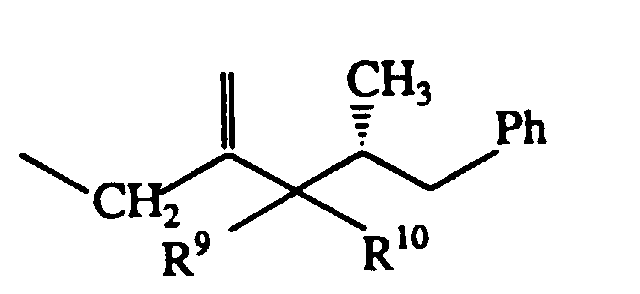

-CH2C(=CH2)CH(OH)CH(CH2OH)CH2Ph,
-CH2C(=CH2)CH(NHCOCH3)CH(CH3)CH2Ph,


- R4, R5 and R6 may each independently represent a hydrogen atom or a methyl group; and salts thereof;
- It is to be understood that where the configuration of any double bond or chiral centre present in R1, R2 and/or R3 in formula (I) is not defined the present invention is intended to cover all geometrical and optical isomers, including diastereoisomers, of such compounds of formula (I).
- It will also be appreciated that compounds of the invention containing a ket group may exist in the corresponding enolic form.
- It is to be understood that when the dotted line in the relevant R3 groupings represents the absence of a single bond -CH---CR8CR9R10CHR11(CH2)mPh and -CH2CR12 ---CR11CR9R10CHR11(CH2)nPh will represent -CH2CHR8CR9R10CHR11(CH2)mPh and -CH2CHR12CHR11CR9R10CHR11(CH2)nPh respectively, and when the dotted line represents the presence of a single bond -CH---CR8CR9R10CHR11(CH2)mPh and -CH2CR12 ---CR11CR9R10CHR11(CH2)nPh will represent -CH=CRCR8CR9R10CHR11(CH2)mPh and -CH2CR12=CR11CR9R10CHR11(CH2)nPh respectively.
- Examples of R1 as an acyloxy group include


-CH2CH(OH)CH(CH3)-,

- Examples of R1 as a carbonate group include alkylcarbonates, alkenylcarbonates, arylcarbonates, arylalkylcarbonates, arylalkenylcarbonates, cycloalkylcarbonates, cycloalkylalkylcarbonates and cycloalkylalkenylcarbonates. When R1 represents a carbamate group this may be, for example, a group -OCONR14R15 where R14 represents a hydrogen atom or an alkyl group and R15 represents a hydrogen atom or a group selected from alkyl, alkenyl, aryl, arylalkyl, arylalkenyl, cycloalkyl, cycloalkylalkyl and cycloalkylalkenyl.
- Examples of R1 as an ether group include alkoxy, alkenyloxy, arylalkoxy, arylalkenyloxy, cycloalkyloxy, cycloalkylalkoxy and cycloalkylalkenyloxy.
- The term 'alkyl' as part of a group within R1 may be an alkyl chain containing 1-10 carbon atoms optionally substituted by a hydroxyl group, an oxo function (=0) or one or more C1-4alkyl groups. Examples of suitable alkyl groups include methyl, ethyl, n-propyl, i-propyl, n-butyl, s-butyl, t-butyl, n-pentyl, n-hexyl, n-heptyl and n-nonyl.
- The term 'alkenyl' as part of a group within R1 may be an alkenyl group containing 2-10 carbon atoms and is optionally substituted by one or more C1-4alkyl groups. When the alkenyl portion is part of an arylalkenoyloxy group it may represent, for example, an ethenyl group.
- The term 'aryl' as a group or part of a group means phenyl or phenyl substituted by one or more moieties including for example halogen atoms, hydroxyl, C1-3alkyl and C1-3alkoxy groups.
- The term 'cycloalkyl' as a group or part of a group means a C3-8cycloalkyl group. Examples of suitable cycloalkyl groups include cyclopentyl, cyclohexyl and adamantyl.
- The term 'alkyl' within R2 means a straight or branched alkyl chain. Examples of suitable alkyl groups include methyl, ethyl, n-propyl, i-propyl, n-butyl, s-butyl, t-butyl and n-heptyl.
- Compounds of formula (I) in which R4, R5 and R6 represent hydrogen atoms or physiologically acceptable cations are generally preferred.
- R1 preferably represents an acyloxy, carbonate or ether group, particularly an acyloxy group.
- Examples of preferred acyloxy groups within R1 include


- R2 preferably represents a hydroxyl, acetoxy or -OCO2CH3 group.
- When R8 and/or R10 represents an acyloxy group this may be, for example, a C1-6alkanoyloxy group and is preferably acetoxy.
- R3 preferably represents a group selected from -CH--CR8CR9R10CHR11CH2Ph and

- The group -CH--CR8- within R3 may preferably represent a group selected from -CH=C(CH3)-, -CH2CH(CH3)-, -CH2CH(OH)-, -CH2C(=0)-, -CH2CH2- and -CH2CH(CH2CH3)-.
- The group -CR9R10- within R3 may preferably represent a group selected from -CH(OH)-, -C(=0)-, -CH2- and -CH(OCOCH3)-.
- It is to be understood that this invention covers any combination of the aforementioned particular and preferred groupings.
- Particularly preferred compounds of the invention are :
- [1S-[1α(4S*,5S*),3α,4β,5α,6α(2E,4R*,6R*),7β]]1-(4-hydroxy-5-methyl-3-methylene-6-phenylhexyl)-4,6,7-trihydroxy-2,8-dioxabicyclo[3.2.1] octane-3,4,5-tricarboxylic acid, 6-(4,6-dimethyl-2-octenoate);
- [1S-[1α[(E),5S*],3α,4β,5α,6α(2E,4R*,6R*),7β]] 1-(3,5-dimethyl-4-oxo-6-phenyl-2-hexenyl)-4,6,7-trihydroxy-2,8-dioxabicyclo[3.2.1]octane-3,4,5-tricarboxylic acid, 6-(4,6-dimethyl-2-octenoate);
- [1S-[1α[(E),4R*,5S*],3α,4β,5α,6α(2E,4R*,6R*),7β]] 1-(4-hydroxy-3,5-dimethyl-6-phenyl-2-hexenyl)-4,6,7-trihydroxy-2,8-dioxabicyclo[3.2.1]octane-3,4,5-tricarboxylic acid, 6-(4,6-dimethyl-2-octenoate);
- [1S-[1α[3R*(S*),5S*],3α,4β,5α,6α(2E,4R*,6R*),7β]] 1-(3,5-dimethyl-4-oxo-6-phenylhexyl)-4,6,7-trihydroxy-2,8-dioxabicyclo[3.2.1]octane-3,4,5-tricarboxylic acid, 6-(4,6-dimethyl-2-octenoate), isomer 1;
- [1S-[1α[3R*(S*),4R*,5S*],3α,4β,5α,6α(2E,4R*,6R*),7β]] 1-(4-hydroxy-3,5-dimethyl-6-phenylhexyl)-4,6,7-trihydroxy-2,8-dioxabicyclo[3.2.1]octane-3,4,5-tricarboxylic acid, 6-(4,6-dimethyl-2-octenoate), isomer 1;
- [1S-[1α[3R*(S*),4S*,5S*],3α,4β,5α,6α(2E,4R*,6R*),7β]] 1-(4-hydroxy-3,5-dimethyl-6-phenylhexyl)-4,6,7-trihydroxy-2,8-dioxabicyclo[3.2.1]octane-3,4,5-tricarboxylic acid, 6-(4,6-dimethyl-2-octenoate), isomer 2;
- [1S-[1α[3R*(S*),4R*(S*),5S*],3α,4β,5α,6α(2E,4R*,6R*),7β]] 1-(4-hydroxy-3,5-dimethyl-6-phenylhexyl)-4,6,7-trihydroxy-2,8-dioxabicyclo[3.2.1]octane-3,4,5-tricarboxylic acid, 6-(4,6-dimethyl-2-octenoate), isomer 3;
- [1S-[1α[3R*(S*),4R*(S*),5S*],3α,4β,5α,6α(2E,4R*,6R*),7β]] 1-(4-hydroxy-3,5-dimethyl-6-phenylhexyl)-4,6,7-trihydroxy-2,8-dioxabicyclo[3.2.1]octane-3,4,5-tricarboxylic acid, 6-(4,6-dimethyl-2-octenoate), isomer 4;
- [1S-[1α(3R*S*,5S*),3α,4β,5α,6α(2E,4R*,6R*),7β]] 1-(3-ethyl-5-methyl-4-oxo-6-phenylhexyl)-4,6,7-trihydroxy-2,8-dioxabicyclo[3.2.1]octane-3,4,5-tricarboxylic acid, 6-(4,6-dimethyl-2-octenoate);
- [1S-[1α[(E),4R*,5S*],3α,4β,5α,6α(4S*,6R*),7β]] 1-(4-acetyloxy-3,5-dimethyl-6-phenyl-2-hexenyl)-4,6,7-trihydroxy-2,8-dioxabicyclo[3.2.1]octane-3,4,5-tricarboxylic acid, 6-(4,6-dimethyloctanoate);
- [1S-[1α(3R*S*,4S*,5S*),3α,4β,5α,6α(4S*,6R*),7β]] 1-(4-acetyloxy-3,5-dimethyl-6-phenylhexyl)-4,6,7-trihydroxy-2,8-dioxabicyclo[3.2.1]octane-3,4,5-tricarboxylic acid, 6-(4,6-dimethyloctanoate);
- [1S-[1α(3R*S*,5R*), 3α,4β,5α,6α (4S*,6R*),7β]] 1-(3,5-dimethyl-6-phenylhexyl)-4,6,7-trihydroxy-2,8-dioxabicyclo[3.2.1]octane-3,4,5-tricarboxylic acid, 6-(4,6-dimethyloctanoate);
- [1S-[1α(3R*S*,4S*,5S*),3α,4β,5α,6α(4S*,6R*),7β]] 1-(3,5-dimethyl-4-hydroxy-6-phenylhexyl)-4,6,7-trihydroxy-2,8-dioxabicyclo[3.2.1]octane-3,4,5-tricarboxylic acid, 6-(4,6-dimethyloctanoate);
- [1S-[1α[(E),4R*,5S*],3α,4β,5α,6α(4S*,6R*),7β]] 1-(3,5-dimethyl-4-hydroxy-6-phenyl-2-hexenyl)-4,6,7-trihydroxy-2,8-dioxabicyclo[3.2.1]octane-3,4,5-tricarboxylic acid, 6-(4,6-dimethyloctanoate);
- [1S-[1α(3R*(S*),5S*),3α,4β,5α,6α(4S*,6R*),7β]] 1-(3,5-dimethyl-4-oxo-6-phenylhexyl)-4,6,7-trihydroxy-2,8-dioxabicyclo[3.2.1]octane-3,4,5-tricarboxylic acid, 6-(4,6-dimethyloctanoate), 3,4,5-tripotassium salt, isomer 1;
- [1S-[1α(4R*,5S*),3α,4β,5α,6α(4S*,6R*),7β]] 1-(4-hydroxy-5-methyl-3-oxo-6-phenylhexyl)-4,6,7-trihydroxy-2,8-dioxobicyclo[3.2.1]octane-3,4,5-tricarboxylic acid, 6-(4,6-dimethyloctanoate);
- [1S-[1α(3R*S*,4R*,5S*),3α,4β,5α,6α(4S*,6R*),7β]] 1-(3,4-dihydroxy-5-methyl-6-phenylhexyl)-4,6,7-trihydroxy-2,8-dioxabicyclo[3.2.1]octane-3,4,5-tricarboxylic acid, 6-(4,6-dimethyloctanoate);
- [1S-[1α(5R*S*),3α,4β,5α,6α(4S*,6R*),7β]] 1-(5-methyl-4-oxo-6-phenylhexyl)4,6,7-trihydroxy-2,8-dioxabicyclo[3.2.1]octane-3,4,5-tricarboxylic acid, 6-(4,6-dimethyloctanoate);
- [1S-(1α[3R*(S*)],3α,4β,5α,6α(4S *,6R*),7β]] 1-(3-methyl-4-oxo-6-phenylhexyl)4,6,7-trihydroxy-2,8-dioxabicyclo[3.2.1]octane-3,4,5-tricarboxylic acid, 6-(4,6-dimethyloctanoate);
- [1S-[1α(4R*,5S*),3α,4β,5α,6α(2E,4R*,6R*),7β]] 7-acetyloxy-1-(4-acetyloxy-5-methyl-3-methylene-6-phenylhexyl)-4,6-dihydroxy-2,8-dioxabicyclo[3.2.1]octane-3,4,5-tricarboxylic acid, 6-(4,6-dimethyl-2-octenoate);
- [1S-[1α(4R*,5S*),3α,4β,5α,6α(2E,4R*,6R*),7β]] 1-(4-acetyloxy-5-methyl-3-methylene-6-phenylhexyl)-4,6-dihydroxy-7-[(methoxycarbonyl)oxy]-2,8-dioxabicyclo[3.2.1]octane-3,4,5-tricarboxylic acid, 6-(4,6-dimethyl-2-octenoate);
- [1S-[1α(4R*,5S*),3α,4β,5α,6α,7β]] 1-(4-acetyloxy-5-methyl-3-methylene-6-phenylhexyl)-4,6,7-trihydroxy-2,8-dioxabicyclo[3.2.1]octane-3,4,5-tricarboxylic acid, 6-acetate;
- [1S-[1α(4R*,5S*),3α,4β,5α,6α,7β]] 1-(4-acetyloxy-5-methyl-3-methylene-6-phenylhexyl)-4,6,7-trihydroxy-2,8-dioxabicyclo[3.2.1]octane-3,4,5-tricarboxylic acid, 6-decanoate;
- [1S-[1α(4R*,5S*),3α,4β,5α,6α,7β]] 1-(4-acetyloxy-5-methyl-3-methylene-6-phenylhexyl)-4,6,7-trihydroxy-2,8-dioxabicyclo[3.2.1]octane-3,4,5-tricarboxylic acid, 6-octanoate;
- [1S-[1α(4R*,5S*)3α,4β,5α,6α,7β]] 1-(4-acetyloxy-5-methyl-3-methylene-6-phenylhexyl)-4,6,7-trihydroxy-2,8-dioxabicyclo[3.2.1]octane-3,4,5-tricarboxylic acid, 6-pentanoate;
- [1S-[1α(4R*,5S*)3α,4β,5α,6α,7β]] 1-(4-acetyloxy-5-methyl-3-methylene-6-phenylhexyl)-4,6,7-trihydroxy-2,8-dioxabicyclo[3.2.1]octane-3,4,5-tricarboxylic acid, 6-(7-phenylheptanoate);
- [1S-[1α(4R*,5S*),3α,4β,5α,6α,7β]] 1-(4-acetyloxy-5-methyl-3-methylene-6-phenylhexyl)-4,6,7-trihydroxy-2,8-dioxabicyclo[3.2.1]octane-3,4,5-tricarboxylic acid, 6-(4-cyclohexylbutanoate);
- [1S-[1α(4R*,5S*),3α,4β,5α,6α,7β]] 1-(4-acetyloxy-5-methyl-3-methylene-6-phenylhexyl)-4,6,7-trihydroxy-2,8-dioxabicyclo[3.2.1]octane-3,4,5-tricarboxylic acid, 6-(cyclohexanecarboxylate);
- [1S-[1α(4R*,5S*),3α,4β,5α,6α,7β]] 1-(4-acetyloxy-5-methyl-3-methylene-6-phenylhexyl)-4,6,7-trihydroxy-2,8-dioxabicyclo[3.2.1]octane-3,4,5-tricarboxylic acid, 6-[1-(tricyclo[3.3.1.13,7]decyl)acetate] ;
- [1S-[4α(4R*,5S*),3α,4β,5α,6α,7β]] 1-(4-acetyloxy-5-methyl-3-methylene-6-phenylhexyl)-4,6,7-trihydroxy-2,8-dioxabicyclo[3.2.1]octane-3,4,5-tricarboxylic acid, 6-benzoate;
- [1S-[1α(4R*,5S*),3α,4β,5α,6α(2E),7β]] 1-(4-acetyloxy-5-methyl-3-methylene-6-phenylhexyl)-4,6,7-trihydroxy-2,8-dioxabicyclo[3.2.1]octane-3,4,5-tricarboxylic acid, 6-(3-phenyl-2-propenoate);
- [1S-[1α(4R*,5S*),3α,4β,5α,6α,7β]] 1-(4-acetyloxy-5-methyl-3-methylene-6-phenylhexyl)-4,6,7-trihydroxy-2,8-dioxabicyclo[3.2.1]octane-3,4,5-tricarboxylic acid, 6-(5-oxo-hexanoate);
- [1S-[1α(4R*,5S*),3α,4β,5α,6α,7β]] 1-(4-acetyloxy-5-methyl-3-methylene-6-phenylhexyl)-4,6,7-trihydroxy-2,8-dioxabicyclo[3.2.1]octane-3,4,5-tricarboxylic acid, 6-(6-oxo-heptanoate);
- [1S-[1α(4R*,5S*),3α,4β,5α,6α,7β]] 1-(4-acetyloxy-5-methyl-3-methylene-6-phenylhexyl)-4,7-dihydroxy-6-methoxy-2,8-dioxabicyclo[3.2.1]octane-3,4,5-tricarboxylic acid;
- [1S-[1α(4R*,5S*),3α,4β,5α,6α,7β]] 1-(4-acetyloxy-5-methyl-3-methylene-6-phenylhexyl)-4,6,7-trihydroxy-2,8-dioxabicyclo[3.2.1]octane-3,4,5-tricarboxylic acid, 6-[(E/Z)-3-octenoate];
- Other preferred compounds of the invention are :
- [1S-[1α(4R*,5S*),3α,4β.5α,6α,7β]] 1-(4-acetyloxy-5-methyl-3-methylene-6-phenylhexyl)-4,7-dihydroxy-6-[(nonoxycarbonyl)oxy]-2,8-dioxabicyclo[3.2.1]octane-3,4,5-tricarboxylic acid;
- [1S-[1α(4R*,5S*)3α,4β,5α,6α,7β]] 1-(4-acetyloxy-5-methyl-3-methylene-6-phenylhexyl)-6-[(butoxycarbonyl)oxy]-4,7-dihydroxy-2,8-dioxabicyclo[3.2.1]octane-3,4,5-tricarboxylic acid;
- Compounds of formula (I) in which R1 represents a hydroxyl group are particularly useful as intermediates for the preparation of related structures having squalene synthase inhibitory activity.
- Compounds of the present invention may form salts with inorganic and organic bases. Physiologically acceptable salts include inorganic base salts such as alkali metal salts (e.g. sodium and potassium salts including the trisodium, dipotassium and tripotassium salts), alkaline earth metal salts (e.g. calcium salts), ammonium salts and amino acid salts (e.g. lysine and arginine salts including the tri-L-lysine salts). Suitable organic base salts include amine salts such as trialkylamine (e.g. triethylamine), dialkylamine (e.g. dicyclohexylamine), optionally substituted benzylamine (e.g. p-bromobenzylamine) and tris(hydroxymethyl)methylamine salts.
- Compounds of the invention have been found to inhibit the enzyme squalene synthase and cholesterol biosynthesis and are therefore of use in medicine, particularly in a variety of conditions where a lowering of the level of blood plasma cholesterol in animals (especially humans) would be beneficial. Examples of such conditions include diseases associated with hypercholesterolemia and hyperlipoproteinemia, especially atherosclerosis and cardiovascular diseases (such as cardiac ischaemic diseases, cerebral ischaemic diseases and peripheral arterial disease).
- Compounds of the invention which inhibit squalene synthase may also be of use in combating fungal infections in animals, including humans. For example, they may be useful in the treatment of systemic infections caused by, for example Candida (e.g. Candida albicans, Candida glabrata, Candida parapsilosis and Candida pseudotrop), Cryptococcus neoformans, Aspergillus Sp (e.g. Aspergillus flavus and Aspergillus fumigantus), Coccidioides (e.g. Coccidioides immitis), Paracoccidioides (e.g. Paracoccidioides brasiliensis), Histoplasma (e.g. Histoplasma capsulatum) or Blastomyces (e.g. Blastomyces dermatitidis). They may also be useful in treating topical infections caused by species of Trichophyton, Microsporum or Epidermophyton (e.g. Trichophyton mentographytes, Microsporum canis or Epidermophyton floccosum). They may also be of use in treating fungal diseases caused by Torulopsis glabrata and Pityrosporum ovale.
- The in vitro evaluation of the anti-fungal activity of compounds of the invention can be performed by determining the minimum inhibitory concentration (MIC) which is the concentration of the test compound in a suitable medium at which growth of a particular microorganism fails to occur.
- In view of their potential in antifungal therapy, compounds of the invention which inhibit squalene synthase may recommend themselves for the treatment of a variety of fungal infections in human beings and animals. Such infections include mycotic infections such as candidiasis and chronic mucocandidiasis (e.g. thrush and vaginal candidiasis) and skin infections caused by fungi, cutaneous and mucocutaneous candidiasis, dermatophytoses including ringworm and tinea infections, athletes foot, paronychia, pityriasis versicolor, erythrasma, intertrigo, fungal nappy rash, candida vulvitis, candida balanitis and otitis externa. They may also be useful as prophylactic agents to prevent systemic and topical fungal infections. Use as prophylactic agents may, for example, be appropriate as part of a selective gut decontamination regimen in the prevention of infection in immunocompromised patients. Prevention of fungal overgrowth during antibiotic treatment may also be desirable in some disease syndromes or iatrogenic states.
- The ability of compounds of the invention to inhibit the enzyme squalene synthase in mammals and fungi may be demonstrated in vitro using [2-14C]famesylpyrophosphate as a substrate under assay conditions similar to those described by S. A. Biller et al. in J. Medicinal Chemistry 31(10), 1869-1871 (1988); [14C]squalene is separated from unreacted substrate on thin layer chromatography plates and determined by liquid scintillation counting. The ability of compounds of the invention to inhibit cholesterol biosynthesis may be demonstrated by measuring inhibition from [14C]-acetate in liver slices from male Wistar rats using a method similar to that described by Y. Tsujita et al. in Biochem. Biophys. Acta, Volume 877, 50-60 (1986) and modified to include measurement of cholesterol by high performance liquid chromatography (h.p.l.c.).
- While it is possible that, for use in therapy, compounds of the invention which inhibit squalene synthase may be administered as the raw chemical, it is preferable to present the active ingredient as a pharmaceutical formulation. The invention thus further provides a pharmaceutical formulation comprising compounds of the invention which inhibits squalene synthase together with one or more pharmaceutically acceptable carriers thereof and, optionally, other therapeutic and/or prophylactic ingredients. The carrier(s) must be 'acceptable' in the sense of being compatible with the other ingredients of the formulation and not deleterious to the recipient thereof.
- The compositions of the invention include those in a form especially formulated for oral, buccal, parenteral, implant, rectal, topical, ophthalmic or genito-urinary administration or in a form suitable for administration by inhalation or insufflation.
- Tablets and capsules for oral administration may contain conventional excipients such as binding agents, for example, syrup, acacia, gelatin, sorbitol, tragacanth, mucilage of starch or polyvinylpyrrolidone; fillers, for example, lactose, sugar, microcrystalline cellulose, maize-starch, calcium phosphate or sorbitol; lubricants, for example, magnesium stearate, stearic acid, talc, polyethylene glycol or silica; disintegrants, for example, potato starch or sodium starch glycollate; or wetting agents such as sodium lauryl sulphate. The tablets may be coated according to methods well known in the art. Oral liquid preparations may be in the form of, for example, aqueous or oily suspensions, solutions, emulsions, syrups or elixirs, or may be presented as a dry product for constitution with water or other suitable vehicle before use. Such liquid preparations may contain conventional additives such as suspending agents, for example, sorbitol syrup, methyl cellulose, glucose/sugar syrup, gelatin, hydroxyethylcellulose, carboxymethyl cellulose, aluminium stearate gel or hydrogenated edible fats; emulsifying agents, for example, lecithin, sorbitan mono-oleate or acacia; non-aqueous vehicles (which may include edible oils), for example, almond oil, fractionated coconut oil, oily esters, propylene glycol or ethyl alcohol; and preservatives, for example, methyl or propyl p-hydroxybenzoates or sorbic acid. The compositions may also be formulated as suppositories, e.g. containing conventional suppository bases such as cocoa butter or other glycerides.
- For buccal administration the composition may take the form of tablets or lozenges formulated in conventional manner.
- The composition according to the invention may be formulated for parenteral administration by injection or continuous infusion. Formulations for injection may be presented in unit dose form in ampoules, or in multi-dose containers with an added preservative. The compositions may take such forms as suspensions, solutions, or emulsions in oily or aqueous vehicles, and may contain formulatory agents such as suspending, stabilising and/or dispersing agents. Alternatively the active ingredient may be in powder form for constitution with a suitable vehicle, e.g. sterile, pyrogen-free water, before use.
- For administration by inhalation the compositions according to the invention are conveniently delivered in the form of an aerosol spray presentation from pressurised packs with the use of a suitable propellant, e.g. dichlorodifluoromethane, trichlorofluoromethane, dichlorotetrafluoroethane, carbon dioxide or other suitable gas, or from a nebuliser. In the case of a pressurised aerosol the dosage unit may be determined by providing a valve to deliver a metered amount.
- Alternatively, for administration by inhalation the compositions according to the invention may take the form of a dry powder composition, for example a powder mix of the compound and a suitable powder base such as lactose or starch. The powder composition may be presented in unit dosage form in, for example, capsules or cartridges of e.g. gelatin, or blister packs from which the powder may be administered with the aid of an inhaler or insufflator.
- The compositions may take the form of a suppository, e.g. containing a conventional suppository base, or a pessary, e.g. containing a conventional pessary base.
- The compositions may also be formulated for topical administration in the form of ointments, creams, gels, lotions, shampoos, powders (including spray powders), pessaries, tampons, sprays, dips, aerosols, drops (e.g. eye, ear or nose drops) or pour-ons. Ointments and creams may, for example, be formulated with an aqueous or oily base with the addition of suitable thickening and/or gelling agents. Ointments for administration to the eye may be manufactured in a sterile manner using sterilised components. Pour-ons may, for example, be formulated for veterinary use in oils containing organic solvents, optionally with formulatory agents, e.g. stabilising and solubilising agents. Pessaries and tampons for vaginal insertion may be formulated using conventional techniques and, where appropriate, may contain an effervescent vehicle. Such compositions may also contain other active ingredients such as corticosteroids, antibiotics or antiparasitics as appropriate.
- Liquid preparations for intranasal delivery may take the form of solutions or suspensions and may contain conventional excipients such as tonicity adjusting agents, for example, sodium chloride, dextrose or mannitol; preservatives, for example benzalkonium chloride, thiomersal, phenylethyl alcohol; and other formulating agents such as suspending, buffering, stabilising and/or dispersing agents.
- Transdermal administration may be affected by the design of a suitable system which promotes adsorption of the active compound through the skin and would typically consist of a base formulation enclosed within an adhesive stick-on patch comprising backing films, membranes and release liners.
- The composition according to the invention may also be formulated as a depot preparation. Such long acting formulations may be administered by implantation (for example subcutaneously or intramuscularly) or by intramuscular injection. Thus, for example, a compound of the invention may be formulated with suitable polymeric or hydrophobic materials (for example as an emulsion in an acceptable oil) or ion exchange resins, or as sparingly soluble derivatives, for example, as a sparingly soluble salt.
- When the compositions comprise dosage units, each unit will preferably contain 0.001mg to 1000mg, advantageously 0.01mg to 400mg, of active ingredient where a compound of the invention is to be administered orally. The daily dosage as employed for adult human treatment will preferably range from 0.001mg to 5000mg of active ingredient, most preferably from 0.01mg to 2000mg which may be administered in 1 to 4 daily doses, for example, depending on the route of administration and on the condition of the patient and the disease to be treated.
- The compound may be administered by intravenous infusion using, for example, up to 50mg/kg/day of the active ingredient. The duration of treatment will be dictated by the rate of response rather than by arbitrary numbers of days.
- Compounds of the invention which inhibit squalene synthase may also be used in combination with other therapeutic agents, and the invention thus provides, in a further aspect, a combination comprising a compound of the invention which inhibits squalene synthase together with another therapeutically active agent, such as an inhibitor of 3-hydroxy-3-methylglutaryl coenzyme A (HMG CoA) reductase or another agent which reduces serum cholesterol and/or inhibits cholesterol biosynthesis, for example a bile acid sequestrant or an antihyperlipoproteinemic or antihyperlipemic agent such as probucol, gemfibrozil, clofibrate, dextrothyroxine or its sodium salt, colestipol or its hydrochloride salt, cholestyramine, nicotinic acid, neomycin, p-aminosalicylic acid, aspirin, DEAE-Sephadex, a poly(diallylmethylamine) derivative, an ionene or poly(diallyldimethylammonium) chloride.
- The combinations referred to above may conveniently be presented for use in the form of a pharmaceutical formulation and thus pharmaceutical formulations comprising a combination as defined above together with a pharmaceutically acceptable carrier thereof comprise a further aspect of the invention. The individual components of such combinations may be administered either sequentially or simultaneously in separate or combined pharmaceutical formulations.
- When a compound of the invention is used in combination with a second therapeutic agent against the same condition the dose of each compound may differ from that when the compound is used alone. Appropriate doses will be readily appreciated by those skilled in the art.
- According to another aspect of the present invention, we provide a compound of formula (I) or a physiologically acceptable salt thereof or a pharmaceutical composition comprising a compound of formula (I) or a physiologically acceptable salt thereof as defined above for use in therapy, particularly for the treatment of conditions where a lowering of the level of blood plasma cholesterol in animals (especially humans) would be beneficial, or for the treatment of fungal infections in animals (especially humans).
- In a particular aspect of the present invention, we provide a compound of formula (I) or a physiologically acceptable salt thereof or a pharmaceutical composition comprising a compound of formula (I) or a physiologically acceptable salt thereof as defined above for use in the treatment of diseases associated with hypercholesterolemia and/or hyperlipoproteinemia, especially atherosclerosis and cardiovascular diseases (such as cardiac ischaemic diseases, cerebral ischaemic diseases and peripheral arterial disease).
- According to a further aspect of the present invention, we provide the use of a compound of formula (I) or a physiologically acceptable salt thereof in the manufacture of a medicament for the treatment of diseases associated with hypercholesterolemia and/or hyperlipoproteinemia, especially atherosclerosis and cardiovascular diseases (such as cardiac ischaemic diseases, cerebral ischaemic diseases and peripheral arterial disease).
- According to another aspect of the present invention, we provide the use of a compound of formula (I) or a physiologically acceptable salt thereof in the manufacture of a medicament for the treatment of fungal infections in a human or non-human animal patient.
- According to a further aspect of the present invention, we provide a method of treatment of the human or non-human animal body to combat diseases associated with hypercholesterolemia and/or hyperlipoproteinemia, especially atherosclerosis and cardiovascular diseases (such as cardiac ischaemic diseases, cerebral ischaemic diseases and peripheral arterial disease) or to combat fungal diseases, which method comprises administering to said body an effective amount of a compound of formula (I) or a physiologically acceptable salt thereof.
- It will be appreciated by those skilled in the art that references herein to treatment extend to prophylaxis as well as the treatment of established conditions or infections.
- The compounds of the invention may be prepared by the processes described below.
- Thus, a general process (A) for the preparation of compounds of formula (I) in which R3 represents a group -CH=CR8CR9R10CHR11(CH2)mPh or a group -CH2CR12=CR11CR9R10CHR11 (CH2)nPh where R8 is hydrogen or C1-4alkyl comprises reacting a compound of formula (II)


- The reaction between compounds (II) and (IIIa) or (IIIb) may conveniently be carried out in an ether solvent (e.g. tetrahydrofuran) in the presence of a strong base such as an alkali metal hydride (e.g. sodium hydride) at a temperature in the range of 0° to 20°C.
- Another general process (B) comprises converting a compound of formula (I) or a protected derivative thereof to a different compound of formula (I) or a protected derivative thereof, followed, if necessary, by the removal of any protecting groups present. Specific examples of interconversion reactions are described hereinafter.
- Compounds of formula (I) in which R3 represents a group -CH2CHR8CR9R10CHR11(CH2)mPh or CH2CHR12CHR11CR9R10CHR11(CH2)nPh may be prepared from the corresponding compounds of formula (I) in which R3 represents a group -CH=CR8CR9R10CHR11(CH2)mPh or CH2CR12=CR11CR9R10CHR11(CH2)nPh or protected derivatives thereof under appropriate reducing conditions, for example by catalytic hydrogenation [e.g. hydrogenation in the presence of palladium-on-carbon in a suitable solvent such as an ester (e.g. ethyl acetate) or an alcohol (e.g. ethanol)], followed, where appropriate, by removing any protecting groups present.
- Compounds of formulae (IIIa) and (IIIb) are either known compounds or may be prepared by methods analogous to those used to prepare the known compounds of formulae (IIIa) and (IIIb).
- Compounds of formula (II) in which R3a represents CHO may be prepared by ozonolysis of a compound of formula (IV)

- Compounds of formula (IV) may be prepared by isomerization of a compound of formula (V)

- Compounds of formula (I) in which R3 represents a group

- Compounds of formula (I) in which R3 represents a group

- Compounds of formula (I) in which R3 represents a group (wherein R8 is
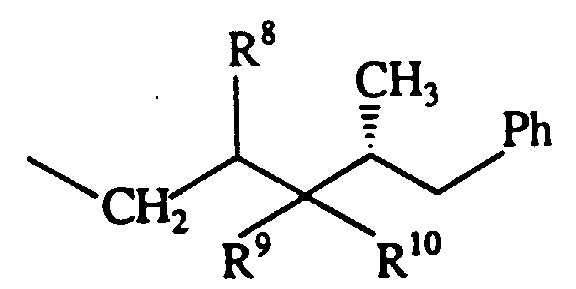
- Compounds of formula (I) in which R3 represents a group


- The aforementioned conversion of CR9R10 as CHOH to CHR10 where R10 is a C1-6alkoxy group may be effected by reaction under conventional conditions for ether formation. Thus, for example, the conversion may conveniently be effected by reaction with a halide R17Hal (where Hal is a halogen atom such as bromine or iodine and R17 is a C1-6alkyl group) preferably in the presence of a suitable base such as an alkali metal hydroxide (e.g. potassium hydroxide), an alkali metal hydride (e.g. sodium hydride) or an alkali metal alkoxide (e.g. potassium tert-butoxide) in a solvent such as an ether (e.g. tetrahydrofuran) or a dialkylamide (e.g. dimethylformamide).
- The aforementioned conversion of CR9R10 as CHOH to CHR10 where R10 is an acyloxy group may conveniently be effected by reaction with a suitable acylating agent under conventional conditions. Thus, for example the conversion may conveniently be effected by reaction with an acyl halide, for example an acyl chloride, in the presence of 4-dimethylaminopyridine with or without a suitable base such as a tertiary amine (e.g.triethyamine) or using an alkali metal carbonate or alkaline earth metal carbonate (e.g. calcium carbonate) in a solvent such as a halogenated hydrocarbon (e.g. dichloromethane).
- Compounds of formula (I) in which R3 represents a group

- Compounds of formula (I) in which R3 represents


- Compounds of formula (I) in which R3 represents


- Compounds of formula (I) in which R3 represents


- Compounds of formula (I) in which R3 represents


- Compounds of formula (I) in which R3 represents


- Compounds of formula (I) in which R3 represents a group

- Compounds of formula (II) in which R3a represents CH2CHO may conveniently be prepared from the aforementioned compounds of formula (I) in which R3 represents

- Compounds of formula (II) in which R3a represents CH2COCH3 may conveniently be prepared from compounds of formula (VIII)

- Compounds of formula (VIII) in which R4a, R5a and R6a represent protecting groups may be prepared from the corresponding compounds of formula (VIII) in which R4a, R5a and R6a are hydrogen atoms using standard methods of carboxylic acid group protection. Such compounds of formula (VIII) in which R4a, R5a and R6a represent hydrogen atoms may conveniently be prepared from compounds of formula (VI) in which R4a, R5a and R6a are hydrogen atoms by catalytic hydrogenolysis using palladium-on-barium sulphate in a suitable solvent such as an alcohol (e.g. ethanol).
- Compounds of formula (V) may conveniently be prepared from compounds of formula (VI) by oxidation, using for example a suitable oxidising agent such as pyridinium chlorochromate in a halogenated hydrocarbon solvent (e.g. dichloromethane).
- It will be appreciated that certain of the above reactions (e.g. hydrogenation, ozonolysis and isomerisation) may not be suitable for compounds in which R1 contains one or two double bonds. In these cases the reaction will be effected on a compound containing an R1 group stable under the conditions of the reaction. The reaction may then be followed by appropriate means described herein to introduce the desired R1 grouping.
- Compounds of formulae (VI) and (VII) in which one or more of R4a, R5a and R6a represents a protecting group may be prepared from the corresponding carboxylic acid of formula (VI) or (VII) using standard protection methods.
- According to a further process (C), compounds of formula (I) in which R2 represents a group -OCOR7 or -OCO2R7 may be prepared by reacting a compound of formula (IX)

- The reaction with a compound R7COHal or R7OCOHal may conveniently be effected in the presence of 4-dimethylaminopyridine with or without a suitable base such as a tertiary amine (e.g. triethylamine) or using an alkali metal carbonate or alkaline earth metal carbonate (e.g. calcium carbonate) in a solvent such as a halogenated hydrocarbon (e.g. dichloromethane).
- It will be appreciated that when R1 in the compounds of formula (IX) represents a hydroxyl group this hydroxyl group will also be susceptible to ester and carbonate formation. Thus, in the preparation of compounds of formula (I) in which R1 is a hydroxyl group it may be appropriate to have protected the R1 hydroxyl group in compounds of formula (IX) or utilise a compound of formula (IX) in which R1 is an acyloxy group, and following the reaction to form the 7-position ester or carbonate group remove the protecting group or deacylate as appropriate to provide the desired compound of formula (I) in which R1 is hydroxyl.
- Compounds of formula (I) in which R2 represents an acetoxy group may conveniently be prepared from compounds of formula (IX) by reaction with acetic anhydride followed, if desired, by removal of the protecting groups present. The acetylation reaction may conveniently be effected in the presence of a suitable base such as a tertiary amine (e.g. triethylamine) in a solvent such as a halogenated hydrocarbon (e.g. dichloromethane). If excess acetic anhydride, base and 4-dimethylaminopyridine are used the reaction proceeds to provide a 4,7-diacetylated compound of formula (X)

- Selective deacetylation of a compound of formula (X) in which R4a, R5a and R6a are hydrogen atoms may conveniently be achieved by solvolysis in a suitable alcohol such as ethanol at a suitable temperature (e.g. room temperature) to provide the desired compounds of formula (I) in which R2 is an acetoxy group.
- According to another process (D), compounds of formula (I) in which R1 represents an acyloxy, carbonate, carbamate or ether group may be prepared from compounds of formula (XI)

- Thus, for example, the acylation reaction may conveniently be effected by treating a compound of formula (XI) with an acyl halide (e.g. an acyl chloride) in the presence of 4-dimethylaminopyridine with or without a suitable base such as a tertiary amine (e.g. triethylamine) or using an alkali metal carbonate or alkaline earth metal carbonate (e.g. calcium carbonate) in a solvent such as a halogenated hydrocarbon (e.g. dichloromethane).
- The reaction to form a carbonate may conveniently be effected by treating a compound of formula (XI) with a suitable haloformate (e.g. chloroformate) in the presence of dimethylaminopyridine with or without a suitable base such as tertiary amine (e.g. triethylamine) or using an alkali metal carbonate or alkaline earth metal carbonate (e.g. calcium carbonate) in a solvent such as a halogenated hydrocarbon (e.g. dichloromethane).
- Compounds of formula (I) in which R1 represents a group -OCONR14R15 may be prepared from compounds of formula (XI) by reaction with a suitable carbamoylating agent under conventional conditions, followed by removal of the protecting groups present.
- Thus, for example, compounds of formula (I) in which R1 represents a group -OCONR14R15 (where at least one of R14 and R15 is a hydrogen atom) may conveniently be prepared by treating a compound of formula (XI) with a suitable isocyanate in a solvent such as a halogenated hydrocarbon (e.g. dichloromethane) at a temperature in the range of 0° to 20°C. When R1 represents -OCONH2 a compound of formula (XI) may be reacted with an isocyanate capable of generating the desired compound under appropriate work-up conditions. Suitable isocyanates include, for example, chlorosulphonyl isocyanate and chloroacetyl isocyanate. Compounds in which R1 represents -OCONHR15 where R15 is other than a hydrogen atom may be prepared using an isocyanate R15NCO.
- Compounds of formula (I) in which R1 represents a group -OCONR14R15 may also be prepared by treating a compound of formula (XI) with a reagent capable of converting the 6-OH group to a group -OCOX (where X is a leaving group such as a halogen atom, e.g. chlorine, or imidazole), followed by treatment with an amine R14R15NH (including ammonia). Suitable reagents capable of effecting the desired conversion of R1 to -OCOX include phosgene and carbonyldiimidazole. The reaction may conveniently be carried out in a solvent such as an ether (e.g. tetrahydrofuran) or a halogenated hydrocarbon (e.g. dichloromethane) at a reduced temperature (e.g. -40°to 0°C). When a reagent such as phosgene is used, the reaction is conveniently carried out in the presence of a non-nucleophilic organic base such as pyridine.
- Compounds of formula (I) in which R1 represents a group -OCONR14R15 where both R14 and R15 are other than hydrogen atoms may also be prepared from compounds of formula (XI) by treating (XI) with a reagent HalCONR14R15 where Hal is a halogen atom (e.g. chlorine) in a solvent such as a halogenated hydrocarbon (e.g. dichloromethane) in the presence of an organic base (e.g. pyridine).
- The reaction to form an ether may conveniently be effected by treating a compound of formula (XI) with a halide (e.g. an alkyl halide) in the presence of a suitable base such as an alkali metal hydroxide (e.g. potassium hydroxide) in a solvent such as a sulphoxide (e.g. dimethylsulphoxide).
- If it is desired to prepare compounds of formula (I) in which R2 represents a hydroxyl group from compounds of formula (XI) then it may be necessary to have protected the 7-position hydroxyl group in compounds of formula (XI). Suitable protecting groups and methods of deprotection are described hereinafter.
- Compounds of formula (IX) in which R1 represents an acyloxy, carbonate, carbamate or ether group may conveniently be prepared from compounds of formula (XI) in which R2a represents a protected hydroxyl group using the procedure described in process (C) above, followed by removal of the protecting group(s) present.
- Compounds of formula (XI) may conveniently be prepared from compounds of formula (XII)

- Compounds of formula (IX) in which R1 represents a hydroxyl group may also be prepared from compounds of formula (XII) in which R2a and R18 represent hydroxyl groups, R3b is as defined previously and R4a-R6a are protecting groups according to the deacylation procedure described above for the preparation of compounds of formula (XI) from compounds of formula (XII).
- Compounds of formula (XII) in which R2a and R18 represent protected hydroxyl groups and/or R3b represents a protected R3 group may conveniently be prepared from the corresponding compounds of formula (XII) in which R2a and R18 represent hydroxyl groups and/or R3b represents a group R3. Suitable hydroxyl protecting groups are described hereinafter.
- Compounds of formula (XII) in which R2a represents a group -OCOR7 or -OCO2R7 may be prepared from the corresponding compounds of formula (XII) in which R2a represents a hydroxyl group according to the general procedure described hereinabove for the preparation of compounds of formula (I) from compounds of formula (IX).
- Compounds of formula (XII) in which R2a and R18 represent hydroxyl groups and R3b represents a group R3 may conveniently be prepared from compounds of formula (XIII)

- Compounds of formula (XI) in which R2a and R18 represent hydroxyl groups and R3b is as defined for R3 may also be prepared from compounds of formula (XIV)

- Suitable carboxylic acid protecting groups for R4a, R5a and R6a and hydroxyl protecting group where required include any conventional protecting group, for example as described in 'Protective Groups in Organic Chemistry', Ed. J. F. W. McOmie (Plenum Press, 1973) or 'Protective Groups in Organic Synthesis' by Theodora W. Greene (John Wiley and Sons, 1981). Examples of suitable carboxylic acid protecting groups include alkyl groups such as t-butyl, 2-methoxyethoxymethyl or aralkyl groups such as benzyl, diphenylmethyl or p-nitrobenzyl. Examples of suitable hydroxyl protecting groups include groups such as 2-methoxyethoxymethyl.
- The protecting groups may be removed using conventional techniques. Thus, an alkyl group such as t-butyl may, for example, be removed under anhydrous acid conditions (for example using hydrogen chloride in a solvent such as an ether, e.g. dioxan). An aralkyl group may conveniently be removed by catalytic hydrogenation using for example a suitable metal catalyst such as palladium-on-carbon. Alternatively, a p-nitrobenzyl group may conveniently be removed using zinc metal and hydrochloric acid in a solvent such as an ether (e.g. tetrahydrofuran or aqueous tetrahydrofuran). A diphenylmethyl group or a 2-methoxyethoxymethyl group may conveniently be removed using aqueous formic acid or trifluoroacetic acid.
- Esterification of appropriate compounds of formulae (VI), (VII), (VIII), (XIII) and (XIV) to the corresponding methyl esters may conveniently be effected by treatment with a methylating agent such as a methyl halide (e.g. methyl iodide) or dimethyl sulphate in a suitable organic solvent such as an amide (e.g. dimethylacetamide or preferably dimethylformamide) in the presence of a base such as a bicarbonate (e.g. sodium bicarbonate). The reaction may conveniently be carried out at a temperature ranging from 0° to 100°C, preferably 20° to 30°C. Alternatively, the esterification may be effected by treatment with an ethereal solution of diazomethane in a suitable solvent such as methanol. The esterification may also be effected by treatment with methanol in the presence of a suitable acid such as a mineral acid (e.g. hydrochloric acid) at about room temperature.
- Conversion of one methyl ester of formula (VI) or (VII) or (VIII) or (XIII) or (XIV) to a different methyl ester may be carried out by appropriate esterification/deesterification steps. The deesterification may be effected under standard conditions, for example by base hydrolysis.
- Compounds of formulae (VI) and (VII) in which R4a, R5a and R6a represent R4, R5 and R6 respectively as defined for compounds of formula (I) above, R1 represents a hydrogen atom, a hydroxyl group or a group selected from


- Microorganisms capable of producing a compound of the formula (VI), (VII), (VIII), (XIII) or (XIV) may readily be identified by using a small scale test and analysing a test sample obtained from fermentation of the microorganism using standard methodology.
- In particular the microorganism to be conventionally used is a strain of microorganism deposited on 31st May 1989 in the culture collection of Glaxo Group Research Limited, Microbiology Division, Greenford Road, Greenford, Middlesex, England, UB6 OHE (collection number 202 in the World Directory of Collections of Cultures of Microorganisms, 1982; curator : Miss A M Harris) under accession no. C2932 or a mutant thereof. It is to be understood that the above mentioned culture collection centre has given its unreserved and irrevocable consent to the microorganism deposited being made available to any person making a valid request therefor to the culture collection in accordance with Rule 17 of the UK Patents Rules 1982.
- The strain deposited at Greenford under accession no. C2932 has also been deposited in the permanent culture collection of the CAB International Mycological Institute, Ferry Road, Kew, Surrey, England. The strain was received by the Institute on 25th May 1989 and was subsequently given the accession no. IMI 332962 and a deposit date of 27th June 1989 (date of confirmation of viability). The deposited strain is identified herein by reference to the Institute accession no. IMI 332962.
- The characteristics thus far identified for IMI 332962 are given in Example 68 hereinafter.
- It will be appreciated that the desired intermediates may also be prepared from a mutant of IMI 332962.
- Mutants of the IMI 332962 may arise spontaneously or may be produced by a variety of methods including those outlined in Techniques for the Development of Micro-organisms by H. I. Adler in 'Radiation and Radioisotopes for Industrial Microorganisms', Proceedings of the Symposium, Vienna 1973, p241, International Atomic Energy Authority. Such methods include ionising radiation, chemical methods e.g. treatment with N-methyl-N'-nitro-N-nitrosoguanidine (NTG), heat, genetic techniques, such as recombination and transformation, and selective techniques for spontaneous mutants.
- The production of compounds of the formulae (VI), (VII), (VIII), (XIII) and (XIV) by fermentation of a suitable organism may be effected by conventional means i.e. by culturing the organism in the presence of assimilable sources of carbon, nitrogen and mineral salts.
- Assimilable sources of carbon, nitrogen and minerals may be provided by either simple or complex nutrients. Sources of carbon will generally include glucose, maltose, starch, glycerol, molasses, dextrin, lactose, sucrose, fructose, galactose, myo-inositol, D-mannitol, soya bean oil, carboxylic acids, amino acids, glycerides, alcohols, alkanes and vegetable oils. Sources of carbon will generally comprise from 0.5 to 10% by weight of the fermentation medium. Fructose, glucose and sucrose represent preferred sources of carbon.
- Sources of nitrogen will generally include soya bean meal, corn steep liquors, distillers solubles, yeast extracts, cottonseed meal, peptones, ground nut meal, malt extract, molasses, casein, amino acid mixtures, ammonia (gas or solution), ammonium salts or nitrates. Urea and other amides may also be used. Sources of nitrogen will generally comprise from 0.1 to 10% by weight of the fermentation medium.
- Nutrient mineral salts which may be incorporated into the culture medium include the generally used salts capable of yielding sodium potassium, ammonium, iron, magnesium, zinc, nickel, cobalt, manganese, vanadium, chromium, calcium, copper, molybdenum, boron, phosphate, sulphate, chloride and carbonate ions.
- Cultivation of the organism will generally be effected at a temperature of from 20 to 40°C preferably from 20 to 35°C, especially around 25 to 28°C, and will desirably take place with aeration and agitation e.g. by shaking or stirring. The medium may initially be inoculated with a small quantity of mycelium and/or spores. The vegetative inoculum obtained may be transferred to the fermentation medium, or to one or more seed stages where further growth takes place before transfer to the principal fermentation medium. The fermentation will generally be carried out in the pH range 3.5 to 9.5, preferably 4.5 to 7.5. It may be necessary to add a base or an acid to the fermentation medium to keep the pH within the desired range. Suitable bases which may be added include alkali metal hydroxides such as aqueous sodium hydroxide or potassium hydroxide. Suitable acids include mineral acids such as hydrochloric, sulphuric or phosphoric acid.
- The fermentation may be carried out for a period of 4-30 days, preferably about 7-18 days. An antifoam may be present to control excessive foaming and added at intervals as required. Carbon and/or nitrogen sources may also be fed into the fermentation medium as required.
- Compounds of formulae (VI), (VII), (VIII), (XIII) and (XIV) may be present in both the fermentation liquor and the mycelial fraction, which may conveniently be separated by filtration or centrifugation. The liquor may be optionally thereafter treated with an acid such as sulphuric acid in the presence of an organic solvent until the pH is below pH 6 (e.g. about pH 3).
- Compounds of formulae (VI), (VII), (VIII), (XIII) and (XIV) may be separated from the fermentation broth by conventional isolation and separation techniques. It will be appreciated that the choice of isolation techniques may be varied widely.
- Compounds of formulae (VI), (VII), (VIII), (XIII) and (XIV) may be isolated and purified by a variety of fractionation techniques, for example adsorption-elution, precipitation, fractional crystallisation, solvent extraction and liquid-liquid partition which may be combined in various ways.
- Adsorption onto a solid support followed by elution has been found to be suitable for isolating and purifying compounds of the invention.
- Compounds of formulae (VI), (VII), (VIII), (XIII) and (XIV) may be extracted from the cells and the aqueous phase with an appropriate organic solvent such as a ketone (e.g. acetone, methyl ethyl ketone or methyl isobutyl ketone), a halogenated hydrocarbon, an alcohol, a diol (e.g. propane-1,2-diol or butane-1,3-diol) or an ester (e.g. methyl acetate or ethyl acetate). Generally, more than one extraction may be desirable to achieve optimum recovery. The water-immiscible solvent extracts may themselves be extracted with basic aqueous solutions, and after acidification of these basic solutions the desired compounds may be reextracted into water-immiscible organic phase. Removal of the solvent from the organic extracts (e.g. by evaporation) yields a material containing the desired compounds.
- Chromatography (including high performance liquid chromatography) may be effected on a suitable support such as silica; a non-functional macroreticular adsorption resin for example cross-linked styrene divinyl benzene polymer resins such as Amberlite XAD-2, XAD-4, XAD-16 or XAD-1180 resins (Rohm & Haas Ltd) or Kastell S112 (Montedison); a substituted styrene-divinyl benzene polymer, for example a halogenated (e.g. brominated) styrene-divinyl benzene polymer such as Diaion SP207 (Mitsubishi); an anion exchanger (e.g. IRA-35 or IRA-68) an organic solvent-compatible cross-linked dextran such as Sephadex LH20 (Pharmacia UK Ltd), or on reverse phase supports such as hydrocarbon linked silica e.g. C18-linked silica. An alternative chromatographic means for the purification/separation of compounds of formulae (VI), (VII), (VIII), (XIII) and (XIV) is countercurrent chromatography using a coil extracter such as a multi-layer coil extracter.
- Compounds of formulae (VI), (VII), (VIII), (XIII) and (XIV) may also be isolated and purified by the use of a liquid anion exchanger such as LA 2.
- When IRA-68 or, particularly, IRA-35 is used as the solid adsorbant the cell extracts may be loaded directly without removal of solvent. The extract may either be loaded directly at about pH3 or at about pH8 following filtration of solid impurities.
- Suitable solvents/eluants for the chromatographic purification/ separation of compounds of formulae (VI), (VII), (VIII), (XIII) and (XIV) will, of course, depend on the nature of the column type and support. When using countercurrent chromatography we have found a solvent system comprising ethyl acetate, hexane, methanol and an aqueous acid (e.g. aqueous sulphuric acid) to be particularly suitable. When using an anion exchanger such as IRA-35 the resin may conveniently be washed with aqueous acetone followed by elution with sulphuric acid in aqueous acetone.
- The presence of compounds of formulae (VI), (VII), (VIII), (XIII) and (XIV) during the extraction/isolation procedures may be monitored by conventional techniques such as h.p.l.c. or UV spectroscopy or by utilising the properties of the compounds.
- Where a compound of formula (VI), (VII), (VIII), (XIII) or (XIV) is obtained in the form solution in an organic solvent, for example after purification by chromatography, the solvent may be removed by conventional procedures, e.g. by evaporation, to yield the required compound. If desired, the compound may be further purified by the aforementioned chromatographic techniques.
- Acylation to provide a compound of formula (XIII) may conveniently be effected by treating a corresponding compound of formula (XIV) or a protected derivative thereof with an acid of formula (XV)

- The compound of formula (XV) may conveniently be prepared by hydrolysis of a compound of formula (XIII), for example by base catalysed hydrolysis using a base such as aqueous sodium hydroxide in a solvent such as an alcohol (e.g. methanol).
- Deacylation of compounds of formulae (VI), (VII), (VIII) and (XIII) may be effected by acid or base catalysed hydrolysis. Suitable bases include hydroxides such as sodium hydroxide and potassium hydroxide and alkoxides (e.g. methoxides). The base catalysed hydrolysis may take place in water optionally in the presence of an organic co-solvent such as an ether (e.g. tetrahydrofuran) or an alcohol (e.g. methanol) at a temperature in the range of 0° to 100°C, preferably at elevated temperature. When an alkoxide is used as the base the reaction may conveniently be effected in an alcohol solvent (e.g. methanol) at a temperature in the range of 0° to 100°C. Suitable acids include mineral acids (e.g. hydrochloric acid) and organic acids (e.g. p-toluenesulphonic acid). The acid catalysed hydrolysis may be carried out in water optionally in the presence of an organic co-solvent such as an ether (e.g. dioxan or tetrahydrofuran) or a ketone (e.g. acetone) at a temperature in the range of 0° to 100°C, preferably at room temperature.
- Compounds of formulae (VI) and (VII) where R1 represents a hydroxyl group may conveniently be prepared from the corresponding compounds where R1 represents an acyloxy group as previously defined in formula (I) using the following procedure. Thus, for example, when R1 represents a substituted 2(E)-octenoyl group this may be converted to a hydroxyl group by treatment with a hydroxylamine (e.g. N-methylhydroxylamine) in the presence of a base (e.g. an organic base such as triethylamine) in a suitable organic solvent such as an amide (e.g. dimethylformamide) at a temperature ranging from, for example, 0° to 50°C, preferably 20° to 30°C.
- It is to be understood that the acylation or deacylation and esterification processes may be combined as sequential or simultaneous reaction steps as appropriate.
- Salts of compounds of formula (I) may be conveniently formed by treating a compound of formula (I) with an appropriate salt or base. Thus, for example, salts may conveniently be prepared by mating a compound of formula (I) with a salt or a base selected from sodium or potassium hydroxide, hydrogen carbonate, carbonate or acetate (e.g. potassium hydroxide, potassium hydrogen carbonate, sodium hydrogen carbonate or potassium acetate), ammonium acetate, calcium acetate and L-lysine as appropriate. The salt may, for example, be prepared by adding the appropriate salt or base (if necessary as an aqueous solution) to a solution or suspension of the compound of formula (I) in a suitable solvent such as water and/or a cosolvent such as an alcohol (e.g. methanol), a nitrile (e.g. acetonitrile) or a ketone (e.g. acetone) at temperatures of for example 0°C to 80°C and conveniently at about room temperature.
- The compounds of formulae (II), (IV), (V), (X) and (XV) are novel intermediates and form a further aspect of the present invention. Novel intermediates of formulae (VI), (VII), (VIII), (IX), (XI), (XII), (XIII) and (XIV) form another aspect of the present invention.
- The following examples are provided by way of illustrating the invention and are not intended to limit the invention in any way.
- (a) IMI 332962 was grown on agar plates of the following composition:


- The pH of the medium before autoclaving was in the range of 5.3-5.5. The inoculated plates were incubated at 28°C for 14 days. Several 6mm diameter plugs of agar covered with fungal mycelium were cut from the growing edge of the culture and two plugs were transferred into each of several cryotubes containing 1.6ml of sterile distilled water. The tubes were capped and stored at room temperature until required.
- Two agar plugs were used to inoculate each of eight 50ml aliquots of seed medium (A) contained in 250ml Erlenmeyer flasks :
Seed medium (A): Peptone (Oxoid L34) 10g Malt extract (Oxoid L39) 21g Glycerol 40g Junlon 110 (Honeywill & Stein Ltd., Wallington, Surrey) 1g Distilled water to 1 litre - The pH of the medium was adjusted to 6.3-6.5 with aqueous sodium hydroxide before autoclaving
- The flasks of inoculated seed medium were incubated at 25°C on a shaker platform, which rotated at 250rpm with a 50mm diameter orbital motion, for 5 days. The contents of the flasks were pooled and homogenised. The homogenised seed culture was used at 3% (v/v) to inoculate 120, 50ml aliquots of fermentation medium (B) in 250ml Erlenmeyer flasks :
Fermentation medium (B): Glycerol 50g Soyabean oil 30g Cottonseed flour (Sigma) 10g Distilled water to 1 litre - The pH of the medium before autoclaving was in the range 6.1-6.3. The flasks were incubated as above with shaking for 8 days.
- The fermentation broth (approximately 6L) from flasks incubated for 8 days was filtered to remove the mycelium and the filtrate adjusted to pH 2.8 with sulphuric acid (20% v/v) and extracted with 3 x 2 volumes of ethyl acetate. The ethyl acetate extracts were bulked and back extracted with 2 x 400ml of aqueous sodium hydrogen carbonate solution (1% w/v). The aqueous back extracts were bulked, adjusted to pH 2.8 as above and re-extracted into 2 x 800ml of ethyl acetate. These extracts were combined and evaporated to dryness to yield a brown oil. This oil was further processed by countercurrent chromatography using an Ito Multi-layer Coil Extractor (P. C. Inc., Potomac, Maryland, USA). The coil used was the standard preparative coil consisting of approximately 70 metres of 2.6mm internal diameter PTFE tubing giving a total volume of about 380ml. The solvent system used was a mixture of ethyl acetate, hexane, methanol and N/100 sulphuric acid (6:5:5:6 by volume). The lower phase was kept stationary. The coil was filled with the lower phase using a Gilson Model 303 pump and a Model 804C Manometric Module (Gilson, Villiers Le Bel, France). The oil (497mg in 4ml of the upper phase +4ml of the lower phase) was then injected at the "tail" end of the column. The centrifuge was then operated at 800 rev/min. and the mobile (upper) phase pumped at 4ml/min. from the "tail" end of the column. 20ml fractions were collected and monitored by measuring inhibition of squalene synthase.
- Consecutive fractions showing activity against squalene synthase were bulked. The earlier fractions were evaporated to dryness to yield the title Compound A (90mg) as a pale yellow oil.
- The later fractions were pooled with an additional fraction (46mg, yellow oil) obtained by similar processing of another batch (5L) of fermentation broth produced as described in Example 3 below. The bulked material was further processed by countercurrent chromatography using as solvent a mixture of ethyl acetate, hexane, methanol and N/100 sulphuric acid (3:2:2:3 by volume) with the lower phase kept stationary. The instrument was operated and fractions were collected and monitored as described previously and the mobile (upper phase) was pumped at 5ml/min. The biologically active fractions were bulked and evaporated to druyness to yield title Compound B (33mg) as a pale yellow oil.
- (b) The mycelium separated from 6L broth, from flasks incubated for 8 days according to the procedure in part (a) above, was extracted with methanol (2 x 3L) and filtered. The filtrate was concentrated by evaporation to ca. 500ml, adjusted to pH 3.0 with formic acid and extracted with 3 x 500ml of ethyl acetate. The ethyl acetate extracts were bulked and back extracted with 2 x 200ml of sodium hydrogen carbonate solution (1% w/v). The aqueous back extracts were bulked, adjusted to pH 3.0 and re-extracted into 2 x 500ml of ethyl acetate. All the organic fractions were combined and reduced to dryness using a rotary evaporator to yield a brown oil. The oil (578mg) was further processed by high peformance liquid chromatography (HPLC) using a Gilson autopreparative system composed of 3 Gilson solvent delivery pumps (model 303), an 811 Dynamic mixer and an 802C manometric module. The chromatography was carried out on a Dynamax Microsorb C18 (5µm) semi-preparative column (250 x 10mm). The mobile phase was a gradient composed of acetonitrile and 0.1% v/v formic acid to pH 3.15 with ammonium acetate (1:3 → 4:1 → 1:3) pumped at 2.8-5.6ml/min with a run time of 65 minutes. This method was repeated 16 times. 13 x 4.95 minute fractions were collected and monitored by measuring inhibition of squalene synthase. Fraction number 5 from each run was bulked, acidified to pH 3.0 with formic acid and extracted with 2 x 100ml ethyl acetate. The organic phase was removed and evaporated to dryness to yield the title Compound A (172mg) as a pale yellow oil.
- (c) (i) Eight 0.5ml aliquots from a 5 day old fermentation carried out as in part (a) above were used to inoculate eight 50ml aliquots of seed medium (A) contained in 250ml Erlenmeyer flasks. The flasks were incubated at 25°C on a shaker platform, which rotated at 250rpm with a 50mm diameter orbital motion, for 4 days. The contents of the flasks were pooled and homogenised.
- The homogenised seed culture was used at 3% (v/v) to inoculate 120, 50ml aliquots of fermentation medium (B) in 250ml Erlenmeyer flasks. The flasks were incubated with shaking as above for 10 days.
- (c) (ii) Homogenised seed culture prepared as in part (c)(i) above were used at 3% (v/v) to inoculate two fermentation vessels, each of 5 litres capacity, containing 3 litres of fermentation medium (B). The inoculated medium was maintained at 25°C and agitated with two six bladed turbine impellers (70mm diameter) rotating at 500 rpm. The culture was aerated by sparging with sterile air at 3 Lpm. Provision was made for control of excessive foaming of the culture by the addition of silicone antifoam (Dow Corning 1520). The contents of the two culture vessels were combined after 11 days growth and further processed by countercurrent chromatography according to the procedure in part (a) above to give the title Compound A (137mg); 500MHz proton nmr in deutero-methanol includes signals at about δ 0.84-0.90 (m,9H), 1.03 (d,7,3H), 1.09-1.19 (m,2H), 2.10 (s,3H), 2.24 (m,1H), 2.34 (m,1H), 2.68 (dd,13,6,1H), 4.04 (d,2,1H), 4.97 (s,1H), 5.02 (s,1H), 5.08 (d, 5,1H), 5.27 (s,1H), 5.80 (d,16,1H), 6.31 (d,2,1H), 6.85 (dd,16,8,1H), 7.14 (t,7,1H), 7.19 (d,7,2H), 7.26 (t,7,2H); composite pulse decoupled 125.75 MHz carbon-13 nmr in deutero-methanol includes peaks at about δ 172.5 (0), 172.1(0), 170.1(0), 168.5(0), 166.5 (0), 157.6 (1), 147.7 (0), 141.6 (0), 130.2 (1), 129.3 (1), 126.9 (1), 119.8 (1), 111.5 (2), 106.8 (0), 91.1 (0), 82.5 (1), 81.0 (1), 80.1 (1), 76.6 (1), 75.6 (0), 44.4 (2), 40.9 (2), 37.7 (1), 35.6 (1), 34.9 (2), 33.1(1), 30.8 (2), 26.5 (2), 20.9 (3), 20.5 (3), 19.2 (3), 14.1 (3), 11.4 (3).
- (d) (i) Frozen stocks of inoculum were prepared from a 5 day old fermentation carried out as in part (a) above. Samples of culture were centrifuged for 10 min and the mycelium resuspended to the original volume in 15% glycerol and 0.01% Tween 80. The mycelium was spun down and resuspended again before being distributed in 1.8ml amounts in plastic tubes and stored at -20°C. Eight 0.5ml aliquots of frozen inoculum were used to inoculate eight 50ml aliquots of seed medium (A) contained in 250ml Erlenmeyer flasks. The flasks were incubated at 25°C on a shaker platform, which rotated at 250rpm with a 50mm diameter orbital motion, for 4 days. The contents of the seed flasks were pooled and used at 3% (v/v) to inoculate 120 50ml aliquots of fermentation medium (B) in 250 ml Erlenmeyer flasks. The flasks were incubated with shaking as above for 9 days.
- (d) (ii) The contents of 4 final stage flasks grown as in part (d)(i) above were pooled after 7 days incubation and homogenised to provide the seed for 120 50ml aliquots of fermentation medium (B) which were incubated for 8 days as in parts (c)(i) and (d)(i) above. The fermentation broth (approximately 6L) from flasks incubated for 8 days was filtered to remove the mycelium. The filtrate was adjusted to pH 2.8 with sulphuric acid (20% v/v) and extracted into ethyl acetate, back extracted into sodium hydrogen carbonate and re-extracted into ethyl acetate at pH 2.8 as described in part (a) above. The ethyl acetate extract was concentrated under reduced pressure to a yellow oil which was dissolved in methanol (10ml). This solution was evaporated to 3ml and applied to a column (32 x 2.5cm) of ODS-3 (Whatman Partisil Bioprep 40, 75 Angstrom, slurry packed in acetonitrile-water, 20:80). The column was eluted with a stepwise gradient of a mixture of acetonitrile and water, increasing the proportion of acetonitrile as follows : 1:4, 3:7, 2:3, 1:1, 3:2. Fractions were monitored by HPLC and those containing the title Compound A were evaporated to remove acetonitrile. The resulting aqueous suspensions were pooled and freeze dried overnight to yield the title Compound A (59mg) as an off-white solid. Compound B may also be prepared as a solid using a similar freeze drying technique.
- (e) The procedure in part (d)(i) was followed except that the pooled seed flasks were used at 3% (v/v) to inoculate 4 litres of seed medium (A) in a 7L fermenter. The culture was incubated with agitation as above at 500rpm for 2 days with the culture aerated at 4L/min. 1.2L of the culture was removed and used to inoculate a 70L fermenter filled with 40L seed medium (A). The culture was incubated as above at 500rpm for 2 days with the culture aerated at 40L/min. 15L of the culture was removed and added to a 780L fermenter filled with 500L fermentation medium (C).
Fermentation medium (C): Fructose 50g Soyabean oil 30g Cottonseed flour (Sigma) 20g Natural pH - The culture was incubated with shaking as above at 200rpm for 450h with the culture aerated at 500L/min and fed at 120h with a 50% (w/v) solution of fructose at 5g/L/day increasing to 7.5g/L/day at 162h. Analysis of the broth at 450h indicated a yield of the title Compound A of 1056 mg/L.
- The above procedure was repeated on a reduced scale but replacing fructose with other sources of carbon selected from glucose, galactose, sucrose, maltose, lactose, myo-inositol, D-mannitol and soyabean oil. Analysis of the broth from each experiment at 450h indicated a substantial titre of the title Compound A.
- Compound A prepared according to the above procedures was consistent with a product having the following characterising features :
- Approximate molecular weight 690; -FAB mass spectrometry [M-H]-689.2789; +FAB mass spectrometry [M+Na}+ 713.2753; Molecular formula C35H46O14.
- 500 MHz proton nmr spectrum in deutero-chloroform [6 values with multiplicities, coupling constants (HZ) and integration values in parenthesis] : 0.79 to 0.85 (m,9H), 1.00 (d,7,3H), 1.04 to 1.15 (m,2H), 2.09 (s,3H), 2.40 (m,1H), 2.69 (dd,13,5,1H), 4.05 (s,1H), 4.94 (s,1H), 4.96 (s,1H), 5.06 (d,4,1H), 5.30 (s,1H), 5.78 (d,16,1H), 5.92 (s,1H), 6.88 (dd,16,8,1H), 7.11 (d,7,2H), 7.14 (t,7,1H), 7.24 (t,7,2H).
- Composite pulse decoupled 125.75MHz carbon-13 nmr spectrum in deutero-chloroform [δ values with the number of attached protons in parenthesis] : 171.5 (0), 171.0 (0), 169.1 (0), 167.0 (0), 166.7 (0), 157.9 (1), 145.4 (0), 140.1(0), 128.9 (1), 128.1 (1), 125.8 (1), 117.8 (1), 111.4(2), 105.8 (0), 88.5 (0), 81.6 (1), 80.7 (1), 79.3 (1), 75.1(1), 74.2 (0), 42.9 (2), 39.7 (2), 36.7 (1), 34.2 (1), 33.6 (2), 31.6 (1), 29.4 (2), 25.4 (2), 20.9 (3), 19.8 (3), 18.8 (3), 13.5 (3), 10.9 (3).
- Compound B prepared according to the above procedure was consistent with a product having the following characterising features :
- Approximate molecular weight 648; -FAB mass spectrometry [M-H]-647.2708; +FAB mass spectrometry [M+Na}+ 671; Molecular formula C33H44O13; electron impact (EI) mass spectrometry gave the following fragment ions : m/z 91, 170, 497.
- 500 MHz proton nmr spectrum in deutero-methanol [δ values with multiplicities, coupling constants (Hz) and integration values in parenthesis] : 0.80 to 0.90 (m,9H), 1.03 (d,7,3H), 1.05 to 1.19 (m,2H), 2.28 (m,1H), 2.37 (dd,13,9,1H), 2.76 (dd,13,5,1H), 3.92 (d,5,1H), 4.08 (d,2,1H), 5.00 (s,1H), 5.10 (s,1H), 5.27 (s,1H), 5.78 (d,16,1H), 6.31 (d,2,1H), 6.84 (dd,16,8,1H), 7.13 (t,7,1H), 7.21 (d,7,2H), 7.24 (t,7,2H).
- Composite pulse decoupled 125.75MHz carbon-13 nmr spectrum in deutero-methanol [δ values with the number of attached protons in parenthesis] : 172.4 (0), 170.1 (0), 168.4 (0), 166.5 (0), 157.6 (1), 152.0 (0), 142.5 (0), 130.2 (1), 129.2 (1), 126.6 (1), 119.8 (1), 110.7 (2), 107.1 (0), 91.0 (0), 82.3 (1), 81.0 (1), 78.6 (1), 76.6 (1), 75.6 (0), 44.4 (2), 41.2 (2), 39.0 (1), 35.6 (1), 35.1 (2), 33.1(1), 30.8 (2), 26.0 (2), 20.5 (3), 19.2 (3), 14.0 (3), 11.4 (3).
- To a stirred solution of freeze dried Compound B of Intermediate 1 (2.50g) and triethylamine (1.78ml) in N,N-dimethylformamide (20ml) was added 4-nitrobenzyl bromide (2.75g) and the resulting mixture left to stir at room temperature for 22h. The mixture was diluted with 2M aqueous hydrochloric acid (450ml) and extracted with ethyl acetate (3x150ml). The extracts were combined, washed with saturated aqueous sodium bicarbonate (2x150ml) and brine (2x150ml), dried over magnesium sulphate and evaporated to a foam. Flash column chromatography on silica gel (Merck 9385, 700ml) eluting with ethyl acetate:cyclohexane (1:2) gave the title compound (2.98g) as a cream-yellow foam; δ (CDCl3) includes 0.77-0.90(m,9H,CH 3), 1.02(d,3H,J=7Hz,CH 3), 4.98-5.38(m,ArCH 2,C=CH 2,3H), 5.48(d,1H,J=15Hz,CH=CHCO2), 5.86(broad s,1H,6H), 6.85(dd, 1H,J=15,7Hz,CH=CHCO2), 7.10-7.28(m,aromatic protons of phenyl ring), 7.37-7.52(m,6H,2 and 6 protons of 4-nitrophenyl rings), 8.08-8.23(m,6H,3 and 5 protons of 4-nitrophenyl rings).
- To a solution of Intermediate 2 (2.85g) in dichloromethane (75ml) was added a solution of pyridinium chlorochromate (874mg) in dichloromethane (75ml) and the resulting mixture left to stir at room temperature for 19h. The mixture was diluted with diethyl ether (100ml) and filtered through kieselguhr in vacuo. The filtrate was evaporated to a foam. Flash column chromatography on silica gel (Merck 9385, 700ml) eluting with ethyl acetate:cyclohexane (1:3) gave the title compound (2.47g) as a cream foam; δ (CDCl3) includes 0.79-0.87(m,6H,CH 3), 1.01(d,3H,J=7Hz,CH 3), 1.08(d,3H,J=7Hz,CH 3), 5.07-5.39(m,ArCH 2,3H), 5.47(d,1H,J=15Hz,CH=CHCO2), 5.83 and 6.02(2s,2H,C=CH 2), 5.88(d,1H,J=2Hz,6H), 6.85(dd,J=15,7Hz,CH=CHCO2), 7.08-7.29(m,aromatic protons of phenyl ring), 7.41-7.54 (m,6H,2 and 6 protons of 4-nitrophenyl rings), 8.09-8.24(m,6H,3 and 5 protons of 4-nitrophenyl rings).
- A solution of freeze dried Compound B of Intermediate 1 (2.00g) in dichloromethane (26ml) under nitrogen was treated with a 0.86M solution of diphenyldiazomethane in dichloromethane (13ml) dropwise over 20min. The resulting mixture was left to stir at room temperature for 22h. The mixture was evaporated to a foam. Flash column chromatography on silica gel (Merck 9385, 700ml) eluting with ethyl acetate:cyclohexane (1:4) gave the title compound (2.51g) as a white foam; δ (CDCl3) includes 0.81-0.88(m,9H,CH 3), 1.00(d,3H,J=7Hz,CH 3), 4.96(d,1H,J=15Hz,CH=CHCO2), 5.00 and 5.07(2s,2H,C=CH 2), 5.33(s,1H,3H), 5.79(d,1H,J=2Hz,6H), 6.68(dd,1H,J=15,7Hz,CH=CHCO2), 6.79,6.85 and 6.93(3s,3H,Ph2CH), 7.09-7.33(m,aromatic protons).
- A solution of Intermediate 4 (2.41g) in dichloromethane (100ml) was treated with pyridinium chlorochromate (679mg) and the resulting mixture left to stir at room temperature for 18h. The mixture was diluted with diethyl ether (100ml) and filtered through Kieselguhr in vacuo. The filtrate was evaporated to a foam. Flash column chromatography on silica gel (Merck 9385, 700ml) eluting with ethyl acetate:cyclohexane (1:8) gave the title compound (1.34g) as a white foam; δ (CDCl3) includes 0.82-0.92(m,6H,CH 3), 0.99(d,3H,J=7Hz,CH 3). 1.08(d,3H,J=7Hz,CH 3), 3.48(sextet,1H,J=7Hz, CH2CH(CH3)CO), 4.93(d,1H,J=15Hz,CH=CHCO2), 5.34(s,1H,3H), 5.79 and 5.93(2s, 2H,C=CH 2), 5.82(d,1H,J=2Hz,6H), 6.67(dd,1H,J=15,7Hz,CH=CHCO2), 6.81,6.83 and 6.92(3s,3H,Ph2CH), 7.10-7.36(m,aromatic protons).
- A solution of Intermediate 5 (1.00g) in methanol:water (10:1) (100ml) was treated with rhodium (III) chloride trihydrate (69mg) and the resulting mixture refluxed under nitrogen for 6h then allowed to cool to room temperature over 73h. The mixture was evaporated to a gum. Flash column chromatography on silica gel (Merck 9385, 300ml) eluting with ethyl acetate:cyclohexane (1:4) gave a pale-yellow gum. Further flash column chromatography on silica gel (Merck 9385, 50ml) eluting with ethyl acetate:cyclohexane (1:4) gave the title compound (84mg) as a colourless gum; δ (CDCl3) includes 0.79-0.88(m,6H,CH 3), 0.98(d,6H,J=7Hz,CH 3), 3.49(sextet,1H,J=7Hz,CH2CH(CH3)CO), 4.69(d, 1H,J=15Hz, CH=CHCO2), 5.34(s, 1H,3H), 5.82(d, 1H,J=2Hz,6H), 6.69(dd,1H,J=15,7Hz,CH=CHCO2), 6.82,6.84 and 6.94(3s,3H,Ph2CH), 7.03-7.33(m,aromatic protons).
- A solution of Intermediate 3 (1.15g) in methanol:water (10:1) (88ml) was treated with rhodium (III) chloride trihydrate (115mg) and the resulting mixture refluxed under nitrogen for 6h then allowed to cool to room temperature over 20h. The mixture was evaporated to a gum. Flash column chromatography on silica gel (Merck 9385, 300ml) eluting with ethyl acetate:cyclohexane (1:4 then 1:2) gave the title compound (659mg) as a cream-coloured foam; δ (CDCl3) includes 0.78-0.87(m,CH 3), 3.44(sextet,1H,J=7Hz,CH2CH(CH3)CO), 5.08-5.38(m,ArCH 2OCO,3H), 5.43(d,1H,J=15Hz,CH=CHCO2), 5.86(d,1H,J=2Hz,6H), 7.08-7.28(m,aromatic protons of phenyl ring), 7.37-7.48 (m,6H,2 and 6 protons of 4-nitrophenyl rings), 8.09-8.19(m,6H,3 and 5 protons of 4-nitrophenyl rings).
- A solution of Intermediate 7 (630mg) in methanol (15ml) was cooled to ∼3°C and treated with sodium borohydride (45mg). The resulting mixture was left to stir at room temperature for lh then treated with 2M aqueous hydrochloric acid (1ml) and the methanol removed in vacuo. The remainder was diluted with further 2M aqueous hydrochloric acid (60ml) and extracted with ethyl acetate (2x20ml). The summed extracts were washed with water (20ml) and brine (20ml), dried over magnesium sulphate and evaporated to a foam. Preparative thin layer chromatography on silica gel (Whatman PK6F, 20x20cm plates, 1000µm layer) using ethyl acetate:cyclohexane (1:1, 5 elutions, then 4:3, 2 elutions) as eluent gave title Compound 2 (29mg) as a clear, colourless gum; δ (CDCl3) includes 0.62(d,3H, J=7Hz,CH 3), 0.74-0.90(m,CH 3), 0.96(d,3H,J=7Hz,CH 3), 5.07-5.37(m,ArCH 2OCO,3H), 5.43(d,1H,J=15Hz,CH=CHCO2), 5.57(t,1H, J=7Hz, CH=C(CH3)), 5.87(d, 1H,J=2Hz,6H), 6.83(dd,1H,J=15,7Hz,CH=CHCO2), 7.12-7.31(m,aromatic protons of phenyl ring), 7.37-7.56(m,6H,2 and 6 protons of 4-nitrophenyl rings), 8.07-8.25(m,6H,3 and 5 protons of 4-nitrophenyl rings). Title Compound 1 (40mg) was also isolated as a clear, colourless gum; δ (CDCl3) includes 0.72- 0.89(m,9H,CH 3), 0.96(d,3H,J=7Hz,CH 3), 5.06-5.38(m, ArCH 2OCO,3H), 5.43(d,1H, J=15Hz,CH=CHCO2), 5.67(t, 1H,J=7Hz,CH=C(CH3)), 5.88(d, 1H,J=2Hz,6H), 6.80(dd, 1HJ=15,7Hz,CH=CHCO2)C 7.09-7.29(m,aromatic protons of phenyl ring), 7.37- 7.56(m,6H,2 and 6 protons of 4-nitrophenyl rings), 8.07-8.25(m,6H,3 and 5 protons of 4-nitrophenyl rings).
- A solution of Intermediate 2 (675mg) in methanol (180ml) and water (30ml) was treated with Wilkinsons catalyst (68mg) and refluxed under nitrogen for 6 hours. The solvent was evaporated and the residue, together with some crude material prepared similarly (59mg) was chromatographed on silica (Merck 7734, 72g) eluting with chloroform : acetone 10:1. The required fractions were combined and evaporated to give the title compound (504mg) as a 4:3 ratio of epimers; δ(CDCl3) includes 0.8-0.9 (m,CH 3), 1.05 (m,CH 3) 2.95 (m,CH3CHCO), 3.21 and 3.26 (2dJ3Hz,OH), 3.82 and 3.88 (2s,4OH), 3.98 and 4.08 (2t,J2Hz,7H), 5.08- 5.4 (3H,aryl CH 2), 5.48 (2d,J16Hz,OCOCH=CH), 5.82 (2d,6H), 6.85 (2dd,J9 and 16Hz,OCOCH=CH), 7.1-7.3 (C6 H 5), 7.45 (2 and 6 protons of 4-nitrophenyl rings), 8.15 (3 and 5 protons of 4-nitrophenyl rings).
- Freeze-dried Compound A of Intermediate 1 (7.5g) in dry dichloromethane (32ml) were heated at reflux, under nitrogen and treated dropwise over 20 min with N,N-dimethylformamide di-ten.butyl acetal (31.3ml). The mixture was heated under reflux for lh when a further addition of N,N-dimethylformamide di-tert.butyl acetal (7.21ml) was made over 3 min. The mixture was heated under reflux for a further 4h and was then allowed to cool to room temperature, diluted with diethyl ether (200ml) and washed with brine (3 x 100ml). The organic phase was dried (MgSO4) and evaporated to give foam. This was subjected to flash chromatography on silica gel (Merck 9385, 1100ml) eluting with ethyl acetate:cyclohexane (1:6). Fractions which contained the major component were combined and evaporated to give the title compound (6.55g) as a cream-yellow foam; δ (CDCl3) includes 1.43(s,Me 3C-), 1.48(s,Me 3C-), 1.60(s,Me 3C-), 2.08(s,CH 3CO2-), 2.93(d,J-3Hz,7-OH), 4.00(broad s,7- H), 4.08(s,4-OH), 4.95(bs,C=CH 2), 5.05(s,3-H), 5.11(d,J-5Hz,CH3CO2CH), 5.77(d,J-15Hz,CH=CH.CHMe), 6.01(d,J-2Hz,6-H), 6.91(dd,J-15Hz,7Hz,CH=CH.CHMe) and 7.10-7.30(m,aromatic protons).
- Intermediate 10 (336mg) in dioxan (5ml) was treated with ammonium formate (49mg) and bis(triphenylphosphine) palladium (II) chloride (27mg). The mixture was stirred and heated under reflux, under nitrogen for 4 hours. Further quantities of ammonium formate (52mg) and bis(triphenylphosphine) palladium (II) chloride (27mg) were then added and the mixture heated under reflux for a further 18 hours. The mixture was allowed to cool and was added to water (100ml) and partitioned with ethyl acetate (2x80ml). The organic extracts were combined, dried (MgSO4) and evaporated under induced pressure to give a gum. This was subjected to flash silica gel (Merck 9385, 200ml) chromatography, eluting with cyclohexane:ethyl acetate (4:1). Fractions which contained the major component were combined and evaporated to give the title compound (237mg) as a pale yellow foam; δ (CDCl3) includes 0.75-0.83(m,3-CH 3 groups), 1.03(d,J=7.5Hz,CH=CH.CHCH 3), 1.46(s,Me 3C-), 1.48(s,Me 3C-), 1.59(s,Me 3C-), 2.90(d,J=2.5Hz,7-OH), 4.03(m,7-H), 4.07(s,4-OH), 4.74 and 4.81(2bs,C=CH 2), 5.30(s,3-H), 5.76(d,J=16Hz,CH=CH.CHMe), 6.90(dd,J=16Hz,8Hz,CH=CH.CHMe), 7.08-7.30(m,aromatic protons).
- Intermediate 5 (250mg) in dry tetrahydrofuran (3ml) was added dropwise to a stirred solution of lithium dimethylcuprate prepared from copper (I) iodide (100mg) and methyllithium (1.4M, 0.74ml) in dry tetrahydrofuran (5ml) at -10°C under nitrogen in dry tetrahydrofuran, under nitrogen at such a rate that the temperature did not exceed -10°C. When the addition was complete the resulting yellow suspension was stirred at -10°C for 30 min when a saturated aqueous solution of ammonium chloride (20ml, adjusted to pH8 by the addition of 0.880 ammonia solution) was added and the resulting mixture was stirred at 0°C for 20 min. The mixture was extracted with ether (2x50ml) and the organic extracts were combined, dried (MgSO4) and evaporated to give a foam. The major component was isolated by preparative layer chromatography (Whatman PF6 20x20cm plates) developing three times with cyclohexane:ethyl acetate (3:1). The major component was eluted with ethyl acetate to give, after filtration and evaporation of the solvent, the title compound (140mg) as a colourless foam; δ (CDCl3) includes 0.66(t,J=7.5Hz,C(=0).CH.CH2 CH 3), 0.98(d,J=7Hz,CH=CH.CHCH 3), 1.02(d,J=7Hz,C(=0).CHCH 3), 2.80-3.04(m,CH(Et)C(=O)CH(CH3)), 3.19(d,J=2.5Hz,7-OH), 3.88(s,4-OH), 3.96(m,7-H), 4.96(d,J=15Hz,CH=H.CHMe), 5.29(s,3-H), 5.77(d,J=2.5Hz,6-H), 6.66(dd,J=15Hz,8.75Hz,CH=CH.CHMe), 6.80(s,Ph2CH), 6.82(s,Ph2 CH), 6.91(s,Ph2 CH), 7.05-7.33(m,aromatic protons).
- A solution of freeze dried Compound B of Intermediate 1 (10.0g) in ethanol (1000ml) was hydrogenated for 70mins using 5% palladium on barium sulphate catalyst (800mg). The catalyst was removed by filtration through Kieselguhr and the bed washed with more ethanol. The combined filtrates were evaporated to dryness to give a mixture. This mixture was combined with further material prepared as above and the combined mixture (18.61g) in dry N,N-dimethylformamide (220ml) was treated with triethylamine (11.58g) and 4-nitrobenzyl bromide (24.71g) and stirred at room temperature for 22h. The reaction mixture was then diluted with ethyl acetate (2000ml) and extracted with 2N hydrochloric acid (3x400ml). The organic layer was dried and evaporated and the residue purified by silica gel chromatography (Merck 9385) eluting with cyclohexane : ethyl acetate mixtures. Appropriate fractions were combined and evaporated, and the residue purified by silica gel chromatography (Merck 9385) eluting with cyclohexane/ethyl acetate mixtures. Appropriate fractions were combined to give a sample of the title compound (18.79g) and a portion was further purified by silica gel chromatography (Merck 9385) eluting with cyclohexane : ethyl acetate mixtures to give the title compound as a foam; δ (CDCl3) includes 1.66-1.55 (2s,-CH2-CH 3C= of both E/Z isomers) 3.90 (t,J=2Hz,7H), 4.82 and 4.98 (2d,J=10Hz,-MeC=CH-CHMe-) 5.82 (d,J=2Hz, 6H), 7.04-7.30 (m,aromatic protons phenylhexenyl sidechain) 7.4-8.25 (m, aromatic protons p-nitro benzyl); approximate molecular weight 1040.1; +FAB mass spectrometry [M + NH4]+ 1057.
- A solution of Example 13 (1g) in dimethylformamide (15ml) was treated with p-nitrobenzyl bromide (1.3g) and triethylamine (0.84ml) and the mixture was stirred at 20°C for 18h. The reaction mixture was diluted with ethyl acetate and poured onto hydrochloric acid (2M; 100ml). The organic phase was washed with 2MHCl, NaHCO3, H2O, dried (MgSO4) and chromatographed on silica gel (Merck 7734, 60g) eluting with ethyl acetate:cyclohexane (1:1) to give the title compound (743mg); δ(CDCl3) includes 0.7-0.9(m,CH 3), 4.03(broad singlet,7H), 5.1-5.4(m,ArCH 2O,and 3H), 5.8(broad singlet,6H), 7.1-7.3(aromatic protons of phenyl ring), 7.4-7.52(2 and 6 protons of 4-nitrophenyl rings), 8.1-8.24(3 and 5 protons of 4-nitrophenyl rings).
- A solution of Intermediate 14 (1.15g) in dichloromethane (40ml) was stirred with pyridinium chlorochromate (400mg) for 3h at 20°C. The solvent was removed under reduced pressure and the residue was partitioned between ethyl acetate and 2M hydrochloric acid. The organic solution was washed with 2MHCl, brine, dried and chromatographed on silica gel (Merck 7734, 35g) eluting with ethyl acetate-cyclohexane (1:1) to give the title compound (902mg); δ(DMSO-d6) includes 0.8-0.9(m,CH 3), 1.03-1.12(m,CH 3CHCO), 4.02 and 4.07(2d,J5Hz,7H), 5.1-5.45(m,3H,ArCH 2O), 6.30(d,J5Hz,6H), 6.41 and 6.43(2s,7OH), 6.81(s,4OH), 7.2-7.4(aromatic protons of phenyl ring), 7.55 and 7.64(2d,J8Hz, 2 and 6 protons of 4-nitrophenyl rings), 8.14, 8.19 and 8.24(3d,J8Hz,3 and 5 protons of 4-nitrophenyl rings).
- A solution of freeze dried Compound B of Intermediate 1 (10.0g) in ethanol (1000ml) was hydrogenated for 70mins using 5% palladium on barium sulphate catalyst (800mg). The catalyst was removed by filtration through Kieselguhr and the bed washed with more ethanol. The combined filtrates were evaporated to dryness to give a mixture. This mixture was combined with further material prepared as above and the combined mixture (18.61g) in dry N,N-dimethylformamide (220ml) was treated with triethylamine (11.58g) and 4-nitrobenzyl bromide (24.71g) and stirred at room temperature for 22h. The reaction mixture was then diluted with ethyl acetate (2000ml) and extracted with 2N hydrochloric acid (3 x 400ml). The organic layer was dried and evaporated and the residue purified by silica gel chromatography (Merck 9385) eluting with cyclohexane : ethyl acetate mixtures. Appropriate fractions were combined and evaporated to give a sample of the title compound (18.79g); δ (CDCl3) includes 3.97-4.07 (m,4-OH,7H and CH(OH)CHCH3), 5.12 (s,C=CH2), 5.18-5.31 (m,ArCH 2), 5.35 (s,3H), 5.81 (d,J=2Hz,6H), 7.1-7.3, 7.37-7.53 and 8.09-8.25 (3m,aromatic protons).
- A solution of Intermediate 16 (165mg) in dichloromethane (60ml) was ozonolysed at -70°C for 15min. The ozonide was reduced with triphenylphosphine (70mg) and the mixture was allowed to warm to 20°C. The solution was concentrated and chromatographed on silica gel (Merck 7734, 25g) eluting with ethyl acetate-cyclohexane (1:1) to give the title compound (127mg); δ(CDCl3) includes 0.7-0.88(m,CH 3), 4.02(broad triplet,7H), 4.15(dd,J2.5 and 4Hz,CH(OH)CO), 5.15-5.30(m,3H,ArCH 2O), 5.79(dJ2Hz,6H), 7.19-7.28(aromatic protons of phenyl ring), 7.43,7.44 and 7.49(3d,J8Hz,2 and 6 protons of 4-nitrophenyl rings), 8.14,8.17 and 8.20(3d,J8Hz,3 and 5 protons of 4-nitrophenyl rings).
- A solution of Intermediate 17 (492mg) in methanol (9ml) was cooled in an ice-bath and then treated with sodium borohydride (35mg). After 0.5h the reaction was quenched by addition of 2M hydrochloric acid. The methanol was removed under reduced pressure and the residue was partitioned between 2M hydrochloric acid and ethyl acetate. The organic solution was washed with NaHCO3 solution, brine, dried (MgSO4) and chromatographed on silica gel (Merck 7734, 25g) eluting with ethyl acetate-cyclohexane (1:1→3:1) to give the title compound (300mg); δ(CDCl3) includes 0.75-0.9(m,CH 3), 4.03 and 4.05(2 broad singlets, 7H), 5.1-5.3(m,ArCH 2O), 5.35 and 5.39(2s,3H), 5.85(broad singlet,6H), 7,1-7.3(aromatic protons of phenyl ring), 7.38-7.5(2 and 6 protons of 4-nitrophenyl rings), 8.08-8.24(3 and 5 protons of 4-nitrophenyl rings).
- Pyridinium chlorochromate (1.7g) was added to a solution of Intermediate 16 (4.9g) in dichloromethane (50ml) and the mixture was stirred at 20°C for 4h. The solvent was removed under reduced pressure, and the residue was partitioned between ethyl acetate and water. The organic phase was washed with H2O, 2M HCl, brine, dried and chromatographed on silica gel (Merck 7734; 150g) eluting with ethyl acetate : cyclohexane (1:1) to give a foam which was dissolved in methanol (200ml). Rhodium trichloride trihydrate (200mg) in water (25ml) was added to the methanol solution, and the mixture was heated to reflux for 7h under nitrogen. The mixture was concentrated under reduced pressure and then diluted with ethyl acetate. The organic phase was washed with H2O, 2M HCl, brine, dried and chromatographed on silica gel (Merck 7734; 100g) eluting with ethyl acetate : cyclohexane (1:1) to give the title compound (2.4g); δ(CDCl3) includes 0.79-0.87(m,CH 3), 1.80 (s,CH 3C=C), 5.38 (s,3-H), 5.81 (d,J=2Hz,6-H), 6.83 (t,J=7Hz,CH=C), 7.1-7.3 (aromatic protons of phenyl ring), 7.36-7.46 (2 and 6 protons of 4-nitrophenyl rings), 8.1-8.2 (3 and 5 protons of 4-nitrophenyl rings).
- A solution of Intermediate 19 (2.38g) in dichloromethane (130ml) was cooled to -70°C and ozonolysed for 1h. The ozonide was reduced with triphenylphosphine (888mg) and the mixture was allowed to warm to 20,°C. The solution was concentrated and chromatographed on silica gel (Merck 7734; 100g) eluting with ethyl acetate : dichloromethane (1:9) to give the title compound (834mg); δ(CDCl3) includes 0.75-0.86 (m,CH 3), 2.10 (t,J=8Hz,CH 2CO2), 3.04 and 3.43 each (d,J=18Hz,CH 2CHO), 3.94 (s,4-OH), 4.09 (d,J=2Hz,7-H), 4.20 (t,J=2Hz,7-H), 5.49 (s,3-H), 6.10 (d,J=2Hz,6-H), 7.42, 7.48, 7.49 each (d,J=8Hz, 2 and 6 protons of 4-nitrophenyl rings), 8.16, 8.19, 8.21 each (d, J=8Hz, 3 and 5 protons of 4-nitrophenyl rings), 9.81 (s,CHO); analysis found: C,56.34;H,5.08;N,4.41; C42H45N3O19 requires C,56.31;H,5.06;N,4.69 %
- Dimethyl 2-oxo-4-phenylbutylphosphonate (92mg) in tetrahydrofuran (3ml) was added to a suspension of sodium hydride (60% oil dispersion; 15mg) in tetrahydrofuran (1 ml) under nitrogen. When the evolution of hydrogen subsided a solution of Intermediate 20 (250mg) in tetrahydrofuran (5ml) was added and the solution was stirred at 20°C for 1h. 2M hydrochloric acid was added and the mixture was extracted with ethyl acetate. The organic phase was washed with NaHCO3 2M HCl, brine, dried, and chromatographed on silica gel (Merck 7734; 15g) eluting with ethyl acetate : dichloromethane (1:9 increasing to 1:3) to give the title compound (218mg); δ(CDCl3) includes 0.77-0.88 (m,CH 3), 2.12 (t,J=7Hz,CH 2CO2), 3.84 (s,4-OH), 4.00 (br.s,7-H), 5.79 (d,J=2Hz,6-H), 6.26 (d,J=16Hz, CH=CHCO), 6.91 (dt,J=16 and 7Hz,CH=CHCO), 7.16-7.3 (aromatic protons of phenyl ring), 7.44 and 7.49 each (d,J=9Hz,2 and 6 protons of nitrophenyl rings), 8.15, 8.17 and 8.20 each (d,J=9Hz,3 and 5 protons of nitrophenyl rings).
- Dimethyl 3-methyl-2-oxo-4-phenylbutylphosphonate (110mg) in tetrahydrofuran (3ml) was added to a suspension of sodium hydride (60% oil dispersion; 15mg) in tetrahydrofuran (0.5ml) under nitrogen. When the evolution of hydrogen subsided a solution of Intermediate 20 (250mg) in tetrahydrofuran (10ml) was added and the solution was stirred at 20°C for lh. Dilute hydrochloric acid was added and the mixture was extracted with ethyl acetate. The organic phase was washed with 2M HCl, NaHCO3, brine, dried and chromatographed on silica gel (Merck 7734, 25g) eluting with ethyl acetate : dichloromethane (1:9) to give the title compound (156mg); δ(CDCl3) includes 0.75-0.87 (m, CH 3), 1.06 (d,J=6Hz, COCHCH 3), 2.13 (t,J=8Hz, CH 2CO2), 3.87 (s,4-OH), 4.00 (m,7-H), 5.80 (d,J=2Hz,6-H), 6.29 (d,J=16Hz,CH=CHCO), 6.92 (dt,J=16 and 7Hz,CH=CHCO), 7.1-7.27 (aromatic protons of phenyl ring), 7.44 and 7.48 each (d,J=8Hz,2 and 6 protons of nitrophenyl rings), 8.11-8.21 (3 and 5 protons of nitrophenyl rings).
- A solution of phosphonic acid [(1R,S) 1-methyl-2-oxo-4-phenylbutyl]dimethyl ester (97mg) in dry tetrahydrofuran (3ml) was added to a stirred suspension of sodium hydride (60% dispersed in oil, 15mg) in dry tetrahydrofuran (1ml) under nitrogen. After 3min a solution of Intermediate 20 (250mg) in dry tetrahydrofuran (15ml) was added and the resulting solution was stirred, under nitrogen, at room temperature for 45min. The mixture was poured into 2N hydrochloric acid and partitioned with ethyl acetate (2x100ml). The organic extracts were combined and washed with 2N hydrochloric acid, aqueous saturated sodium hydrogen carbonate solution, brine and then dried (MgSO4). Evaporation of the solvent gave a gum which was chromatographed on silica gel (250g) eluting with dichloromethane ethyl acetate mixtures. Fractions which contained the appropriate component were combined and evaporated to give the title compound (117mg); δ (CDCl3) includes 1.82(s,C=C(CH 3). C(=0)), 2,10(t,J=7Hz,OC(=0)CH 2CH2), 3.22(d,J=2Hz,7-OH), 3.85(s,4-OH), 4.00(s,fine splitting,7-H), 5.80(d,J<2Hz,6-H), 6.81(t,J=5Hz, CH2.CH=C(CH3)), 7.10-7.54(m,aromatic protons), 8.08-8.25(m,aromatic protons).
- Dimethyl 2-oxo-5-phenylpentylphosphonate (97mg) in tetrahydrofuran (3ml) was added to a suspension of sodium hydride (60% oil dispersion; 15mg) in tetrahydrofuran (1ml) under nitrogen. When the evolution of hydrogen subsided a solution of Intermediate 20 (250mg) in tetrahydrofuran (5ml) was added and the solution was stirred at 20°C for 0.5h. Dilute hydrochloric acid was added and the mixture was extracted with ethyl acetate. The organic phase was washed with 2M HCl, NaHCO3, brine, dried and chromatographed on silica gel (Merck 7734, 25g) eluting with ethyl acetate : dichloromethane (1:9→1:3) to give the title compound (200mg); δ(CDCl3) includes 0.77-0.88 (m,CH 3), 2.12 (t,J=7Hz,CH 2CO2), 3.86 (s,4-OH), 4.01 (br.t,7-H), 5.34 (s,3-H), 5.80 (d,J=2Hz,6-H), 6.25 (d,J=16Hz,CH=CHCO), 6.89 (dt,J=16 and 7Hz,CH=COCH), 7.12-7.3 (aromatic protons of phenyl ring), 7.45, 7.46 and 7.50 each (d,J=8Hz,2 and 6 protons of nitrophenyl rings), 8.15, 8.18 and 8.20 each (d,J=8Hz,3 and 5 protons of nitrophenyl rings); analysis found: C,60.95;H,5.56;N,3.89; C53H57N3O19 requires C,61.20;H,5.52;N,4.04 %
- A solution of Intermediate 17 (6.927g) in methanol (128ml) was cooled to 0°C and treated with sodium borohydride (500mg). The mixture was stirred at 0°C for 30min when 2N hydrochloric acid (50ml) was added slowly. The methanol was evaporated and a further addition of 2N hydrochloric acid (100ml) was made. The mixture was partitioned with ethyl acetate (2x200ml) and the organic extracts were combined, washed with saturated aqueous sodium hydrogen carbonate solution, brine and dried (MgSO4). Evaporation of the solvent gave a foam which was chromatographed on silica gel (Merck Kieselgel 60, 300g) eluting with cyclohexane:ethyl acetate (1:1) and ethyl acetate. Fractions which contained the major component were combined and evaporated to give a white foam (2.541g) (hereinafter referred to as Intermediate C).
- A portion (2.343g) of this material was dissolved in tetrahydrofuran (60ml) and the solution was stirred and treated with a solution of sodium metaperiodate (1g) in water (28ml). The mixture was stirred at room temperature for 24h when the tetrahydrofuran was evaporated and the cloudy aqueous phase was diluted with water (100ml) and extracted with ethyl acetate (2x150ml). The organic extracts were combined, dried (MgSO4) and evaporated to give a yellow oil. This was chromatographed on silica gel (Merck Keiselgel 60, 300g) eluting with ethyl acetate:cyclohexane (3:1). Fractions which contained a major component of intermediate polarity were combined and evaporated to give the title compound (336mg) as a white foam; δ (CDCl3) includes 2.13(t,J=7.5Hz,OCCH 2CH2), 2.69-2.96(m,CH 2CHO), 3.21(d,J=3Hz,7-OH), 3.81(s,4-OH), 4.05(m,7-H), 5.79(d,J=2.5Hz,6-H)), 7.38-7.58 and 8.10-8.27(2m,aromatic protons), 9.81(s,CHO); analysis found:C,56.59; H,5.29; N,4.67%; C43H47N3O19(909.8) requires C,56.76; H,5.21; N,4.62%.
- Fractions which contained the more polar major component were combined and evaporated to give a colourless foam, whose pmr spectrum resembled that of an authentic sample of Intermediate 26 hereinafter.
- A portion (200mg) of Intermediate C (from Intermediate 25 experiment above) was dissolved in tetrahydrofuran (5ml) and the solution was stirred and a solution of sodium metaperiodate (50mg) in water (1.5ml) was added. The resulting solution was stirred at room temperature for 4h when a further addition of sodium metaperiodate (15mg) in water (0.5ml) was made. The mixture was stirred at room temperature for 24h when a further addition of sodium metaperiodate (20mg) in water (0.2ml) was made. The mixture was stirred at room temperature for 18h and was then poured into water (50ml) and extracted with ethyl acetate (2x100ml). The organic extracts were combined, dried (MgSO4) and evaporated to give a gum. This was chromatographed on silica gel (Merck Kieselgel 60, 100g) eluting with cyclohexane:ethyl acetate (3:2). Fractions which contained the major component were combined and evaporated to give the title compound (99mg); δ (CDCl3) includes 2.15(t,J=7.5Hz,OC(=0)CH 2CH2), 2.68-2.99(m,CH2 CH 2CHO), 3.16(bs,7-OH), 3.68(s,CO2 CH 3), 3.77(s,7-H), 4.04(s,4-OH), 5.81(d,J<2Hz,6-H), 7.50(d,J=8.75Hz,aromatic protons), 7.54(d,J=8.75Hz,aromatic protons), 8.19(2dJ=8.75Hz,aromatic protons), 9.83(s,CHO); analysis found: C,57.99; H,5.97; N,3.30%; C37H44O17 (788.7) inquires C,57.89; H,5.99; N,3.33%.
- A solution of Intermediate 13 (1.72g) in dichloromethane (300ml) was cooled to -70°C and subjected to ozonolysis for 10 minutes to give a blue colour. Nitrogen was then bubbled in and after a further 14 minutes triphenylphosphine (1.3g) was added and the solution was allowed to reach 21°C. It was then evaporated to an oil which was chromatographed on silica (Merck 7734; 300g) eluting with chloroform : acetone 7:1 then 6:1. The required fractions were combined and evaporated to give the title compound as a white foam (1.39g), containing triphenylphosphine oxide (2mol equiv); ν(CHBr3) 1769 and 1744 (ketone and ester C=O), 1523 and 1347cm-1 (NO2); δ(CDCl3) includes 0.75-0.9 (m,CH 3), 2.16 (s,CH 3CO), 3.75 (d,J3Hz,7-OH), 3.93 (s,4-OH), 4.09 (t,J3Hz,7-H), 5.15-5.36 (aryl CH 2,3-H), 5.89 (d,J2Hz,6-H), 7.45 (2 and 6 protons of 4-nitrophenyl rings), 8.15 (3 and 5 protons of 4-nitrophenyl rings).
- To a stirred solution of the freeze-dried Compound A of Intermediate 1 (10.65g) in dichloromethane (250ml) was added dropwise over 20 minutes a 0.5M solution of diphenyldiazomethane. Addition of diphenyldiazomethane was continued until a pale pink colour remained. The solution was stirred at 20°C for 3hr and evaporated to dryness under reduced pressure to afford a foam.
- This was purified (two batches of 12.4g each) by flash chromatography on Merck 9385 Kieselgel (2x250g; petrol : ethyl acetate = 5:1 eluant). The appropriate fractions were combined and evaporated to dryness under reduced pressure to provide the title compound (17.6g) as a colourless foam; δ (CDCl3) includes 0.80-1.05 (m,CH 3,12 protons), 2.06 (s,OCOCH 3), 3.25 (d,J2Hz,7OH), 3.92 (s,4OH), 3.95 (t,J2Hz,7H), 4.96 (d,J12Hz,CH=CHCH(CH3)), 4.99 (m,=CH 2), 5.1 (d,J4Hz,CHOCH3), 5.34 (s,3H), 5.81 (d,J2Hz,6H), 6.68 (d,dJ8Hz,12Hz,CH=CHCH(CH3)), 6.81(s), 6.82 (s), 6.87 (s), (CHPh2) and 7.05-7.35 (m,aromatic protons);
Analysis Found : C,74.4; H,6.4;
C74H76O14 requires : C,74.7; H,6.4%. - To a cooled (5°C) stirred solution of Intermediate 28 (476mg) in dichloroethane (5ml) was added N,N-diisopropylethylamine (258mg) and 2-methoxyethoxymethyl chloride (250mg) keeping the temperature below 5°C by means of an ice/salt bath. The solution was allowed to warm to 20°C over 30 minutes and then heated to reflux for 6hr. The solution was cooled (20°C) and further N,N-diisopropylethylamine (129mg) and 2-methoxyethoxymethyl chloride (125mg) added. The resulting solution was heated to reflux for 16hr. The cooled solution was diluted with ethyl acetate (200ml), and washed sequentially with 2N hydrochloric acid (2x30ml), water (30ml), saturated sodium bicarbonate (2x30ml), water (30ml) and brine (30ml), dried (MgSO4) and evaporated to dryness, under reduced pressure, to leave a gum. This was purified by flash chromatography on Merck '9385' Kieselgel (64g; petrol : ethyl acetate = 5:1 eluant). The appropriate fractions were combined and evaporated to dryness, under reduced pressure, to furnish a solid (441mg).
- A sample (380mg) of the solid was further purified by flash chromatography on Merck '9385' Kieselgel (36g; dichloromethane : ethyl acetate = 45:1 eluant). The appropriate fractions of the more polar product were combined and evaporated to dryness, under reduced pressure to afford the title compound (284mg) as a colourless gum; δ (CDCl3) includes 0.79-0.97 (m,CH 3,12 protons), 2.08 (s,OCOCH 3), 3.3 (s,OCH2CH2OCH 3), 3.43 (m,OCH2CH 2OCH3), 3.67 (m,OCH 2CH2OCH3), 3.89 (s,4OH), 4.06 (broad s,7H), 4.77 (d,J6Hz,OCH 2OCH2CH2), 4.84 (d,J12Hz,CH=CHCH(CH3)), 4.96 (d,J6Hz,OCH 2OCH2CH2), 5.0 (broad s,=CH 2), 5.15 (d,J4Hz,CHOAc), 5.34 (s,3H), 6.33 (broad s,6H) 6.65 (d,dJ7Hz,J12Hz,CH=CHCH(CH3)), 6.65 (s), 6.83 (s), 6.85 (s) (CHPh2), 7.05-7.32 (m,aromatic protons);
Analysis Found: C,72.4; H,6.6%;
C78H84O16.0.25CH2Cl2 (1298.8) requires : C,72.4; H,6.6%. - A solution of Intermediate 29 (4.77g) in N,N-dimethylformamide (30ml) was stirred at 20°C, and N-methylhydroxylamine hydrochloride (623mg) and triethylamine (1.57ml) were added. The resulting suspension was stirred for 18 hours, and then partitioned between ethyl acetate (300ml) and 2N-hydrochloric acid (100ml). The organic phase was washed with 2N-hydrochloric acid (100ml), water (3x100ml), and brine (100ml), and dried (magnesium sulphate), and evaporated to dryness. The residue was purified by flash chromatography on Merck '9385' Kieselgel (250g, petrol : ethyl acetate = 2:1 eluant) to give the title compound (3.76g) as a colourless foam; δ(CDCl3) includes 0.81 (d,J7Hz,CH 3), 2.05 (s,OCOCH 3), 3.15-3.35 (m), 3.40-3.55 (m), (OCH 2CH 2O), 3.24 (s,OCH 3), 3.86 (s,4OH), 3.88 (broad s,7H), 4.05 (d,J3Hz,6OH), 4.68 and 4.74 (ABq,J8Hz,OCH 2O), 5.00 (broad s,=CH 2), 5.10-5.18 (m,6H,CHOAc), 5.13 (s,3H), 6.58 (s), 6.80 (s), 6.87 (s), (CHPh2), 7.0-7.3 (m,aromatic protons);
Analysis Found: C,72.7;H,6.1;
C68H68O15 (1125.2) requires C,72.6;H,6.1%. - Freeze-dried Compound A of Intermediate 1 (7.5g) in dry dichloromethane (32ml) was heated at reflux, under nitrogen and treated dropwise over 20 min with N,N-dimethylformamide di-tert.butyl acetal (31.3ml). The mixture was heated under reflux for lh when a further addition of N,N-dimethylformamide di-tert.butyl acetal (7.21ml) was made over 3 min. The mixture was heated under reflux for a further 4h and was then allowed to cool to room temperature, diluted with diethyl ether (200ml) and washed with brine (3x100ml). The organic phase was dried (MgSO4) and evaporated to give a red-brown foam (10.75g). This was subjected to flash chromatography on silica gel (Merck 9385, 1100ml) eluting with ethyl acetate:cyclohexane (1:6). Fractions which contained the major component were combined and evaporated to give the title compound (6.55g) as a cream-yellow foam; νmax (CHBr3) ca 3400-3600 (OH), 1755 (ester C=0), 1730 (ester C=0) and 1250cm-1 (ester C=0); δ (CDCl3) includes 1.43(s,Me 3C-), 1.48(s,Me 3C-), 1.60(s,Me 3C-), 2.08(s,CH 3CO2-), 2.93(d,J=3Hz,7-OH), 4.00(broad s,7-H), 4.08(s,4-OH), 4.95(bs,C=CH 2), 5.05(s,3-H), 5.11(d,J=5Hz,CH3CO2CH), 5.77(d,J= 15Hz, CH=CH.CHMe), 6.01(d,J=2Hz,6-H), 6.91(dd,J=15Hz,7Hz,CH=CH.CHMe) and 7.10-7.30(m,aromatic protons).
- A solution of Intermediate 31 (0.38g) in dry dichloromethane (3ml) was treated with triethylamine (0.61ml) and acetic anhydride (0.083ml) with stirring under nitrogen and the mixture stirred for 24h at room temperature. An additional portion of acetic anhydride (0.20ml) was added, and stirring continued for another 18h at room temperature and 2h at reflux. A further portion of acetic anhydride (0.15ml) was added and after a further lh at reflux the mixture was allowed to cool. The mixture was diluted with dichloromethane (50ml) and the resultant solution washed three times with saturated aqueous sodium bicarbonate solution (20ml), dried and evaporated to give a gum. This material was chromatographed using a silica gel column eluting with ethyl acetate-cyclohexane (1:5) and appropriate fractions were combined and evaporated to give the title compound (0.39g) as a pale yellow gum; δ (CDCl3) values include 1.43, 1.48 and 1.66(3s,3xC(CH 3)3), 2.10 and 2.14(2s,CH 3CO2), 4.11(s,OH), 4.92-5.02(m,C=CH 2), 4.96(s,(CH3)3O2CCH), 5.10-5.18(m,CH3CO2CH), 5.78(d,J16Hz,O2CCH=CH), 6.45(d,J2Hz,CHO2CCH=CH), 6.92(dd,J16 and 8Hz,O2CCH=CH).
- A solution of the freeze dried Compound A of Intermediate 1 (1g), p-nitrobenzyl bromide (1.26ml) and triethylamine (0.63ml) in dimethylformamide (10ml) was stirred at 21°C for 23h and then partitioned between ethyl acetate (100ml) and 2M-hydrochloric and (100ml). The aqueous phase was extracted with ethyl acetate (50ml). Combined organic extracts were wasted with 2M-hydrochloric acid (100ml), water and brine (2x100ml each), dried (MgSO4), and evaporated to a gum. This was chromatographed on silica (Merck 7734, 200g) eluting with chloroform :acetone 15:1. The required fractions were combined and evaporated to give the title compound as a white foam (758mg), δ (CDCl3) includes 0.8-0.9(m,CH 3), 1.0(d,J6Hz,CH 3CH=CH), 2.08(s,OCOCH 3), 3.25(d,J2Hz,7OH), 3.90(s,4OH), 4.05(t,J2Hz,7H), 4.99(d,J7Hz,C=CH 2), 5.05-4.9(CHOAc, arylCH 2,3H), 5.49(d,J16Hz,OCOCH=CH), 5.85(d,J2Hz,6H), 6.85(dd,J9 and 16Hz,OCOCH=CH), 7.05-7.3(C6 H 5), 7.45(2 and 6 protons of 4-nitrophenyl rings), 8.15(3 and 5 protons of 4-nitrophenyl rings).
- A solution of Intermediate 33 (180mg) in dichloromethane (1ml), acetic anhydride (1ml) and triethylamine (2ml) was treated with 4-dimethyl aminopyridine (53mg) and kept at 21°C for 2.5 days, then it was partitioned between ethyl acetate (50ml) and 2M-hydrochloric acid (50ml). The organic phase was washed with further acid (50ml). Combined acidic washes were extracted with ethyl acetate (50ml). Combined organic extracts were washed with saturated sodium bicarbonate solution and brine (2x50ml each), dried (MgSO4) evaporated to an oil. This was chromatographed on silica (Merck 7734, 26g) eluting with cyclohexane : ethyl acetate 2:1. The required fractions were combined and evaporated to give the title compound as a yellow foam (174mg); δ(CDCl3) includes 0.75-0.9 (m,CH 3), 0.95 (d,J6Hz,CH 3CH=CH), 1.95 and 2.15 (s,4 and 7- OCOCH 3), 2.10 (s,OCOCH 3), 4.9-5.3 (m,CHOAc,aryl CH 2,7H,3H,C=CH 2), 5.55 (d,J16Hz,OCOCH=CH), 6.50 (d,J2Hz,6H), 6.85 (dd,J9 and 16Hz,OCOCH=CH), 7.1-7.5 (C6 H 5 and 2 and 6 protons of 4-nitrophenyl rings), 8.1-8.25 (3 and 5 protons of 4-nitrophenyl rings).
- A solution of Intermediate 28 (892 mg) and 4-dimethylaminopyridine (183.3 mg) in dichloromethane (1.5 ml) was cooled to 0°C under nitrogen. To this cold solution was added methyl chloroformate (64 µl) with vigorous stirring. The resulting solution was allowed to warm to room temperature and was subsequently stirred for 2 hours. The solvent was removed from the reaction mixture under reduced pressure leaving a white residue which was separated between ethyl acetate (100 ml) and water (50 ml). The organic phase was washed with water (2 x 25 ml) and saturated brine (30 ml) and dried over MgSO4. The solvent was then removed under reduced pressure to yield a foam. This was purified by flash column chromatography on Merck Kieselgel 60 (80 g) with 2% ethyl acetate/dichloromethane as eluent. Appropriate fractions were combined and the solvent was removed under reduced pressure to yield the title compound as a white foam, (990.4 mg); δ (CDCl3) includes 0.76-0.89 (m, CH 3, 9 protons). 0.93 (d,J=7 Hz, CH 3), 2.07 (s, OCOCH 3), 3.83 (s, OCO2CH 3), 3.89 (s, 4 OH), 4.86 (d, J=16 Hz, OCOCH=CH), 5.01 (s, broad =CH 2), 5.08 (d, J=2 Hz, 7H), 5.14 (d, J=5 Hz, CHOAc), 5.26 (s, 3H), 6.33 (d, J=2 Hz, 6H), 6.64 (dd, J=8.5 Hz, 16 Hz, CH=CHCH(Me)), 6.74 (s, CHPh2), 6.84 (s, CHPh2), 7.05-7.35 (m, aromatic protons).
Analysis Found: C, 72.93%; H, 6.26%, C76H78O16 (1247.46) requires C, 73.18%; H, 6.30%. - To a stirred solution of Intermediate 35 (400 mg) and N-methyl hydroxylamine hydrochloride (53.6 mg) in N,N-dimethylformamide (1.5 ml) was added triethylamine (134 µl) with stirring. The resulting reaction mixture was then stirred under nitrogen at room temperature for 21 hours. The reaction mixture was separated between ethyl acetate (50 ml) and 1N hydrochloric acid (25 ml) and the organic phase washed with water (2 x 25 ml) and saturated brine (25 ml). The solution was then dried over MgSO4 and the solvent removed under reduced pressure to yield a solid. This was then purified by flash column chromatography on Merck Kieselgel 60 (20 g) with elution by 25% ethyl acetate/petroleum ether. Appropriate fractions were combined and the solvent removed under reduced pressure to yield the title compound as a white foam (329.8 mg); δ (CDCl3) includes 0.83 (d, J=6.5 Hz, -CH 3), 2.04 (s, OCOCH 3), 3.74 (s, 4-OH), 3.80 (s, OCO2CH 3), 4.8 (d, J=2 Hz, 7H), 4.99 (s, broad, =CH 2), 5.02 (s, 3H), 5,10 (d, J=4.5 Hz, CHOAc), 5.23 (dd, J=2 Hz, 4.5 Hz, 6H), 6.61 (s, CHPh2), 6.82 (s, CHPh2), 6.86 (s, CHPh2), 7.03-7.31 (m, aromatic protons);
Analysis Found: C, 71.67%; H, 5.38%;
C66H62O15.0.5 EtOAc requires C, 71.69%; H, 5.84%. - To a stirred solution of the freeze dried Compound A of Intermediate 1 (2.00g) in dichloromethane (20ml) at 0°C, diisopropyethylamine (2.44ml) followed by 2-methoxyethoxymethyl chloride (1.60ml) was added. The reaction was stirred at 20°C for 2h. Water (50ml) and ethyl acetate (50ml) were added, and after separation, the aqueous was re-extracted with ethyl acetate (2x50ml). Washing of the combined organics with brine (100ml) and drying followed by evaporation of the solvent gave an oil which was subjected to flash chromatography (4% methanol in chloroform) to give the title compound (2.79g) as a pale yellow oil; δ(CD3OD) includes 0.80-0.90 (9H,m,3xCH 3), 1.03 (3H,d,J=7Hz,CH 3), 4.05 (1H,d,J=2Hz,7-H), 4.22 (1H,s,4-OH), 4.98 (2H,d,=CH2), 5.09 (1H,d,J=5Hz,CHOAc), 5.30 (1H,s,3H), 5.38 (2H,d,J=1 1Hz,OCH2O), 5.43 (2H,s,OCH2O), 5.54 (2H,s,OCH2O), 5.77 (1H,d,J=16Hz,CH=CHCO2), 5.88 (1H,d,J=2Hz,6-H), 6.88 (1H,dd,J=16,9Hz,CH=CHCO2), 7,10-7.30(5H,m,Ph);
Analysis Found: C,57.84%,H,7.58%;
C47H70O20 requires C,57.88%; H, 7.07%. - To a stirred solution of Intermediate 37 (500mg) in N,N-dimethylformamide (3ml) at 20°C, triethylamine (70µl) was added followed by N-methylhydroxylamine hydrochloride (46mg). The reaction was stirred for 16h and the solvent was then removed under reduced pressure. The residue was subjected to flash chromatography (2-10% methanol in chloroform) to give the title compound as a yellow oil (170mg); δ(CD3OD) includes 0.83 (3H,d,J=7Hz,CH 3), 2.08 (3H,s,OAc), 3.35, 3,37, 3,40 (9H,3s,3xOCH 3), 4.17 (1H,d,J=2Hz,7-H), 4.98, 5.03 (2H,2s,=CH2), 5.15 (1H,d,J=2Hz,6-H), 5.18 (1H,s,3H), 5.28 (1H,d,J=5Hz,OCH 2O), 5.37 (2H,s,OCH 2O), 5.46 (1H,d,J=5Hz,OCH 2O), 5.53 (1H,d,J=5Hz,OCH2O), 5.62 (1H,d,J=5Hz,OCH2O), 7.10-7.34 (5H,m,Ph).
- To a solution of Intermediate 28 (120mg) in dry N,N-dimethylformamide (1ml) was added N-methylhydroxylamine hydrochloride (17mg) and triethylamine (42µl). After stirring at room temperature for 16h the reaction mixture was diluted with ethyl acetate (50ml), washed with 2M hydrochloric acid (50ml), water (4x50ml) and brine (50ml), and dried (Na2SO4). The solvent was evaporated and the residue purified by flash chromatography (16g, Merck '9385' silica gel). Elution with ethyl acetate : petroleum ether (1:2) afforded the title compound as a white foam (97mg); δ(CDCl3) values include 0.88 (3H,d,J7Hz,CH 3), 2.08 (3H,s,OCOCH 3), 3.80 (1H,s,4-OH), 4.04 (1H,dd,J5Hz,J2Hz,7H), 4.97-5.07 (4H,m,=CH 2,CHOAC,6-H), 5.27 (1H,s,3H), 6.72, 6.80 and 6.85 (3H,3s,3xCHPh2), 7.02-7.30 (35H,m,aromatic protons);
Analysis Found: C,73.90;H,5.89;
C64H60O13 requires C,74.10;H3.85%. - A solution of Intermediate 39 (519mg) and 4-dimethylaminopyridine (128mg) in dry dichloromethane (10ml) was stirred at 0°C, and octanoyl chloride (0.85ml) was added. The solution was stirred at 0°C for 20 minutes, and then partitioned between ethyl acetate (50ml) and 2N-hydrochloric acid (25ml). The organic phase was washed with water, and brine (25ml of each), and dried (magnesium sulphate), and evaporated to dryness. The residue was purified by flash chromatography on Merck '9385' Kieselgel (60g, petrol : ethyl acetate = 4:1 eluant) to give (in order of elution from the column):
Compound 1 (250mg); δ (CDCl3) includes 0.8-0.9 (m,CH 3,9 protons), 1.1-1.3 (m,OCOCH2CH2(CH 2)4Me), 2.06 (s,OCOCH 3) 3.93 (s,OH), 5.01 (broad s,=CH 2), 5.13 (d,J5Hz,CHOAc), 5.21 (broad s,3H,7H), 6.29 (broad s,6H), 6.68 (s), 6.85 (s), 6.87 (s), (CHPh2), 7.05-7.3 (m,aromatic protons); Compound 2 (27mg); δ (CDCl3) includes 0.8-0.9 (m,CH 3,6 protons), 1.15-1.35 (m,OCOCH2CH2(CH 2)4Me), 2.05 (s,OCOCH 3), 2.72 (broad s,6OH), 3.80 (s,4OH), 4.85 (d,J2Hz,7H), 4.95 (s,3H), 5.00 (broad s,=CH 2), 5.10 (d,J5Hz,CHOAc), 5.14 (narrow m,6H), 6.58 (s), 6.82 (s), 6.86 (s), (CHPh2), 7.0-7.3 (m,aromatic protons); and Compound 3 (100mg) having a similar n.m.r. spectrum to an authentic sample prepared in Intermediate 15 hereinafter. - A solution of Intermediate 39 (104mg) in dry dichloromethane (5ml) was stirred at 20°C, and octanoyl chloride (0.5ml of 1M-solution in dichloromethane) and Calofort U (CaCO3, 100mg) were added. The resulting suspension was stirred for 40 hours, then diluted with dichloromethane (25ml), washed with 2 N-hydrochloric acid (25ml), and dried (magnesium sulphate), and evaporated to dryness. The residue was purified by flash chromatography on Merck '9385' Kieselgel (20g, petrol : ethyl acetate = 4:1 eluant) to give the title compound (57mg) as a colourless oil; δ (CDCl3) includes 0.8-0.95 (m,CH 3,6 protons), 1.2-1.4 (m,OCOCH2CH2(CH 2)4Me), 1.55-1.8 (m,OCOCH2CH 2(CH2)4Me), 2.06 (s,OCOCH 3), 3.20 (broad s,7OH), 3.90 (broad s,7H), 3.93 (s,4OH), 5.00 (broad s,=CH 2), 5.10 (d,J5Hz,CHOAc), 5.33 (s,3H), 5.75 (broad s,6H), 6.80 (s), 6.85 (s), 6.92 (s), (CHPh2), 7.0-7.3 (m,aromatic protons).
- A solution of Intermediate 28 (476mg) in dry dichloromethane (15ml) was stirred at 20°C and acetyl bromide (74mg) and 4-dimethylaminopyridine (73mg) were added. The resulting solution was stirred for 18 hours, then more acetyl bromide (0.06ml) and 4-dimethylaminopyridine (98mg) were added, and stirring was continued for a further 24hours. The mixture was partitioned between ethyl acetate (100ml) and 2N-hydrochloric acid (50ml), and the organic phase was washed with water, and brine (50ml of each), and dried (magnesium sulphate), and evaporated to dryness. The residue was purified by flash chromatography. on Merck '9385' Kieselgel (40g, petrol : ethyl acetate = 4:1 eluant) to give the title compound (334mg) as a colourless foam; δ (CDCl3) includes 0.80-0.95 (m,CH 3,12 protons), 2.06 (s,OCOCH 3), 2.13 (s,OCOCH 3), 3.90 (s,OH), 4.88 (d,J16Hz,OCOCH=CH), 5.01 (broad s,=CH 2), 5.12 (d,J5Hz,CHOAc), 5.23 (s,3H), 5.28 (broad s,7H), 6.32 (broad s, 6H) 6.65 (dd, J8,16Hz,CH=CHCH(Me)), 6.71 (s), 6.85 (s), 6.88 (s), (CHPh2), 7.1-7.4 (m,aromatic protons).
- A solution of Intermediate 28 (357mg), octanoyl chloride (0.4ml of 1M-solution in dichloromethane) and 4-dimethylaminopyridine (49mg) in dry dichloromethane (10ml) was stirred at 20°C for 18 hours. The solution was diluted with ethyl acetate (100ml), then washed with 2N-hydrochloric acid, water and brine (50ml of each), and dried (magnesium sulphate), and evaporated to dryness. The residue was purified by flash chromatography on Merck '9385' Kieselgel (40g, petrol : ethyl acetate = 4:1 eluant) to give the title compound (340mg) as a colourless foam; δ (CDCl3) includes 0.80-0.95 (m,CH 3,15 protons), 1.2-1.4 (m,OCOCH2CH2(CH 2)4Me), 1.6 (m,OCOCH2CH 2(CH2)4Me), 2.39 (m,OCOCH 2(CH2)5Me), 2.06 (s,OCOCH 3), 3.91 (s,OH), 4.88 (d,J16Hz,OCOCH=CH), 5.01 (broad s,=CH 2), 5.12 (d,J5Hz,CHOAc), 5.24 (s,3H), 5.29 (broad s,7H), 6.30 (broad s,6H), 6.63 (ddJ8,16Hz,CH=CHCH(Me)), 6.72 (s), 6.85 (s), 6.88 (s), (CHPh2), 7.05-7.30 (m,aromatic protons).
- A solution of Intermediate 42 (324mg) in N,N-dimethylformamide (5ml) was stirred at 20°C, and N-methylhydroxylamine hydrochloride (44mg) and triethylamine (0.11ml) were added. The resulting suspension was stirred for 24hours, and then partitioned between ethyl acetate (50ml) and 2N-hydrochloric acid (25ml). The organic phase was washed with water (3x25ml), and brine (25ml), and dried (magnesium sulphate), and evaporated to dryness. The residue was purified by chromatography on Merck '9385' Kieselgel (30g, petrol : ethyl acetate = 2:1 eluant) to give the title compound (233mg) as a colourless foam; δ (CDCl3) includes 0.83 (d,J8Hz,CH 3), 2.06 (s), 2.08 (s), (OCOCH 3), 2.71 (d,J3Hz,6OH), 3.77 (s,4OH), 4.85 (broad s,7H), 4.97 (s,3H), 4.99 (s,=CH 2), 5.09 (d,J5Hz,CHOAc), 5.16 (narrow m,6H), 6.58 (s), 6.82 (s), 6.86 (s), (CHPh2), 7.0-7.3 (m,aromatic protons).
- A solution of Intermediate 43 (300mg) in N,N-dimethylformamide (5ml) was stirred at 20°C, and N-methylhydroxylamine hydrochloride (38mg) and triethylamine (0.096ml) were added. The resulting suspension was stirred for 18 hours, and then partitioned between ethyl acetate (50ml) and 2 N-hydrochloric acid (25ml). The organic phase was washed with water (3x25ml), and brine (25ml), and dried (magnesium sulphate), and evaporated to dryness. The residue was purified by chromatography on Merck '9385' Kieselgel (30g, petrol : ethyl acetate = 4:1 eluant) to give the title compound (190mg) as a colourless foam; δ (CDCl3) includes 0.8-0.9 (m,CH 3,6 protons), 1.2-1.3 (m,OCOCH2CH2(CH 2)4Me), 2.05 (s,OCOCH 3), 2.65 (broad s,6OH), 3.78 (s,4OH), 4.85 (broad s,7H), 4.96 (s,3H), 5.00 (s,=CH 2), 5.10 (d,J5Hz,CHOAc), 5.13 (narrow m,6H), 6.60 (s), 6.82 (s), 6.86 (s), (CHPh2), 7.05-7.3 (m,aromatic protons).
- Intermediate 30 (600mg) was stirred (15h) at room temperature with pentanoyl chloride (96mg),4-dimethylaminopyridine (13mg) and triethylamine (270mg) in dichloromethane (25ml). After this time more 4-dimethylaminopyridine (13mg) and pentanoyl chloride (32mg) were added and the mixture stirred for a further 2h. Ethyl acetate (250ml) was then added and the organic solution washed with hydrochloric acid (2N, 100ml), water (100ml), saturated aqueous sodium bicarbonate solution (100ml) and finally brine (100ml). The organic phase was dried over anhydrous sodium sulphate and evaporated to an oil which was subjected to flash column chromatography on silica gel eluting with ethyl acetate : cyclohexane mixtures to give the title compound (466mg) as a white foam; δ (CDCl3) includes 2.05 (s,-OCOCH 3), 3.28 (s,-CH2OCH 3), 3.92 (s,4-OH), 3.95 (d,J=1Hz,7-H), 4.75 and 4.89 (2d,J=7Hz,-OCH 2O-), 5.02 (s,C=CH 2), 5.14 (d,J=5Hz,-CH-OAc), 5.32 (s,3-H), 6.30 (d,J=1Hz,6-H), 6.59, 6.82 and 6.86 (3s,Ph2CH-) and 7.02-7.35 (m,aromatic protons).
- Intermediate 30 (600mg) was stirred (15h) at room temperature with 7-phenylheptanoyl chloride (0.2ml), 4-dimethylaminopyridine (26mg) and triethylamine (270mg) in dichloromethane (25ml). After this time more 4-dimethylaminopyridine (26mg) and 7-phenyl heptanoyl chloride (0.1ml) were added and the mixture stirred for a further 2h. Ethyl acetate (250ml) was then added and the organic solution washed with hydrochloric acid (2N,100ml), water (100ml), aqueous saturated sodium bicarbonate soln (100ml) and finally brine (100ml). The organic phase was dried over sodium sulphate and evaporated to an oil which was subjected to flash column chromatography on silica gel eluting with ethyl acetate : cyclohexane mixtures to give the title compound (533mg) as a foam; δ (CDCl3) includes 2.06 (s,-OCOCH 3), 3.28 (s,-CH2OCH 3), 3.89 (s,4-OH), 4.00 (d,J=1Hz,7-H), 4.75 and 4.89 (2d,J=7Hz,-OCH 2O-), 5.02 (s,-CH=CH 2), 5.12 (d,J=5Hz,- CHOAC), 5.31 (s,3-H), 6.30 (d,J=1Hz,6-H), 6.58,6.84,6.86 (3s,PhCH 2-), 7.02-7.36 (m,aromatic protons);
Analysis Found: C74.0%,H6.9%;C81H84O16 requires C74,1%,H6.5%. - To a solution of Intermediate 30 (600mg) in dichloromethane (20ml) was added triethylamine (0.22ml), 4-cyclohexanebutyryl chloride (154mg) and 4-dimethylaminopyridine (6.6mg) and the mixture stirred at room temperature for 23h. After 20h, further 4-dimethylaminopyridine (6.6mg), and after 21h, further triethylamine (0.11ml) and 4-cyclohexanebutyryl chloride (77mg) were added. The reaction mixture was diluted with ethyl acetate (250ml) and washed successively with 0.5N aqueous hydrochloric acid (2x80ml), water (80ml), saturated aqueous sodium bicarbonate (80ml) and brine (80ml). The organic phase was dried (MgSO4) and evaporated to a gum which was subjected to flash column chromatography on silica gel (Merck 9385, 350ml) eluting with ethyl acetate:cyclohexane (1:5) to give the title compound (478mg) as an opaque, cream gum; δ (CDCl3) includes 0.84(d,3H,J=7Hz,CH 3), 2.07(s,3H,O2CCH 3), 3.30(s,3H,OCH 3), 3.91(s,1H,4OH), 4.00(d,1H,J=2Hz,7H), 4.76 and 4.90(2d,2H,J=7Hz,OCH 2O), 5.02(broad s,2H,C=CH 2), 5.13(d,1H,J=7Hz,CHO2CCH3), 5.32(s,1H,3H), 6.30(d,1H, J=2Hz,6H), 6.61,6.84,6.85(3s,3H,Ph2CH), 7.01-7.43(m,aromatic protons).
- To a solution of Intermediate 30 (300mg) in dichloromethane (10ml) was added triethylamine (0.11ml), cyclohexanecarbonyl chloride (59mg) and 4-dimethylaminopyridine (3.3mg) and the mixture stirred at room temperature for 21h. After 18.5h, further cyclohexanecarbonyl chloride (30mg) and triethylamine (57 µl) were added. The reaction mixture was diluted with ethyl acetate (150ml) and washed successively with 0.5N aqueous hydrochloric acid (2x50ml), water (50ml), saturated aqueous sodium bicarbonate (50ml) and brine (50ml). The organic phase was dried (MgSO4) and evaporated to a gum which was subjected to flash column chromatography on silica gel (Merck 9385, 100ml) eluting with ethyl acetate:cyclohexane (1:4) to give the title compound (271mg) as an opaque cream-yellow gum; δ (CDCl3) includes 0.84(d,3H,J=7Hz,CH 3), 2.06(s,3H,O2CCH 3), 3.29(s,3H,OCH 3), 3.87(s,1H,4OH), 3.98(d,1H,J=2Hz,7H), 4.76 and 4.88(2d,2H,J=7Hz,OCH 2O), 5.02(broad s,2H,C=CH 2), 5.14 (d,1H,J=7Hz,CHO2CCH3), 5.36(s,1H,3H), 6.35(d,1H,J=2Hz,6H), 6.58,6.83,6.88(3s,3H,Ph2CH), 7.03-7.36(m,aromatic protons).
- To a solution of Intermediate 30 (400mg) in dichloromethane (10ml) was added triethylamine (0.15ml), 1-adamantaneacetyl chloride (115mg) and 4-dimethylaminopyridine (4.4mg) and the mixture stirred at room temperature for 23h. The reaction mixture was diluted with ethyl acetate (150ml) and washed successively with 0.5N aqueous hydrochloric acid (2x50ml), water (50ml), saturated aqueous sodium bicarbonate (50ml) and brine (50ml). The organic phase was dried (MgSO4) and evaporated to a foam which was subjected to flash column chromatography on silica gel (Merck 9385, 150ml) eluting with ethyl acetate:cyclohexane (1:5) to give the title compound (386mg) as a clear, colourless gum; δ (CDCl3) includes 0.85(d,3H,J=7Hz,CH 3), 2.07(s,3H,O2CCH 3), 3.28(s,3H,OCH 3), 3.89(s,1H,4OH), 4.04(d,1H,J=2Hz,7H), 4.76 and 4.94(2d,2H,J=7Hz,OCH 2O), 5.03(broad s,2H,C=CH 2), 5.14(d,1H,J=7Hz,CHO2CCH3), 5.34(s,1H,3H), 6.30(d,1H,J=2Hz,6H), 6.58,6.83,6.86(3s,3H,Ph2CH), 7.03-7.43(m,aromatic protons).
- To a solution of Intermediate 30 (600mg) in dichloromethane (20ml) was added triethylamine (0.37ml), benzoyl chloride (0.16ml) and 4-dimethylaminopyridine (13mg) and the mixture stirred at room temperature for 21h. After 19h, further triethylamine (0.11 ml) and 4-dimethylaminopyridine (33mg) were added. The reaction mixture was diluted with ethyl acetate (150ml) and washed successively with 0.5N aqueous hydrochloric acid (2x75ml), water (75ml), saturated aqueous sodium bicarbonate (75ml) and brine (75ml). The organic phase was dried (MgSO4) and evaporated to a foam which was subjected to flash column chromatography on silica gel (Merck 9385, 420ml) eluting with ethyl acetate:cyclohexane (1:4) to give the title compound (575mg) as a white, solidified foam; δ (CDCl3) includes 0.85(d,3H,J=7Hz,CH 3), 2.05(s,3H,O2CCH 3), 3.23(s,3H,OCH 3), 3.89(s,1H,4OH), 4.15(d,1H,J=2Hz,7H), 4.82 and 4.98(2d,2H,J=7Hz,OCH 2O), 5.03(broad s,2H,C=CH 2), 5.14(d,1H,J=7Hz,CHO2CCH3), 5.43(s,1H,3H), 6.54(d,1H,J=2Hz,6H), 6.63,6.84,6.85(3s,3H,Ph2CH), 7.02-7.63(m,ammatic protons).
- To a solution of Intermediate 30 (300mg) in dichloromethane (10ml) was added triethylamine (0.19ml), cinnamoyl chloride (113mg) and 4-dimethylaminopyridine (6.6mg) and the mixture stirred at room temperature for 24h. After 16h, further triethylamine (0.11ml), cinnamoyl chloride (45mg) and 4-dimethylaminopyridine (33.0mg) were added. The reaction mixture was diluted with ethyl acetate (150ml) and washed successively with 0.5N aqueous hydrochloric acid (2x50ml), water (50ml), saturated aqueous sodium bicarbonate (50ml) and brine (50ml). The organic phase was dried (MgSO4) and evaporated to a foam which was subjected to flash column chromatography on silica gel (Merck 9385, 150ml) eluting with ethyl acetate:cyclohexane (1:4) to give the title compound (303mg) as an opaque cream gum; δ (CDCl3) includes 0.85(d,3H,J=7Hz,CH 3), 2.06(s,3H,O2CCH 3), 3.29(s,3H,OCH 3), 3.93(s,1H,4OH), 4.12(broad s,1H,7H), 4.80 and 4.97(2d,2H,J=7Hz,OCH 2O), 5.03(broad s,2H,C=CH 2), 5.15(d,1H,J=7Hz,CHO2CCH3), 5.39(s,1H,3H), 5.66(d,1H,J=15Hz,CH=CHPh), 6.46(broad s,1H,6H), 6.63,6.86 and 6.92(3s,3H,Ph2CH), 7.03-7.44(m,aromatic protons), 7.48(d, 1H,J=15Hz,CH=CHPh).
- Intermediate 30 (1.125g) was dissolved in acetone (40ml) and 1,3-dicyclohexylcarbodiimide (515mg) and 4-dimethylaminopyridine (30mg) were added. The reaction mixture was allowed to stand at room temperature for 20h. It was then filtered and the filtrate was evaporated to dryness. The gum was dissolved in dichloromethane and chromatographed on silica (40-63µ) using ethyl acetate-cyclohexane 1:3 and ethyl acetate 1:2 as solvent to give the title compound (1.15g). A sample of the title compound was purified by preparative plate chromatography using ethyl acetate-cyclohexane 1:7 as solvent Elution with ethyl acetate gave an analytical sample of the title compound; δ (CDCl3) includes 0.83(d,J=6Hz,CH 3), 2.08 and 2.09(2s,COCH 3 and OCOCH 3), 3.30(s,OCH 3), 3.90(s,4OH), 4.01(s,7H), 4.74 and 4.90(2d,J=6Hz,OCH 2O), 5.02(s,=CH 2), 5.14(d,J=4Hz,CHOAc), 5.31(s,3H), 6.30(s,6H), 6.61(s,CHPh2), 6.82,6.83(2s,CHPh2), 7.05-7.3(aromatic protons);
Analysis Found: C,71.65; H,6.3,
C74H76O11 requires C,71.8; H,6.2%. - Intermediate 30 (1g) was dissolved in dichloromethane (70ml, dried over molecular sieves 3A) and 1,3-dicyclohexylcarbodiimide (520mg) and 4-dimethylaminopyridine (30mg) were added. The reaction mixture was allowed to stand at room temperature for 24h. It was then filtered and the filtrate was evaporated to dryness and purified by preparative plate chromatography using ethyl acetate-dichloromethane 1:9 as solvent. Elution with ethyl acetate gave the title compound (560mg); δ (CDCl3) includes 0.88(d,J=6Hz,CH 3), 2.1 and 2.16(2s,COCH 3 and OCOCH 3), 3.34(s,OCH 3), 3.92(s,4OH), 4.05(s,7H), 4.78,4.93(2dJ=6Hz,OCH 2O), 5.06(s,=CH 2), 5.16(d,J=5Hz,CHOAc), 5.35(s,3H), 6.33(s,6H), 6.63(s,CHPh2), 6.87.6.88(2s,CHPh2), 7.05-7.35(aromatic protons);
Analysis Found: C,71.6; H,6.5,
C75H78O17 requires C,72.0; H,6.3%. - A solution of Intermediate 30 (405mg) and 4-dimethylaminopyridine (88mg) in dichloromethane (1.6ml) was cooled to 0°C under nitrogen. Methyl chloroformate (28µl) was added with vigorous stirring and the resulting reaction mixture allowed to warm to room temperature with subsequent stirring for 45 minutes. The solvent was removed from the reaction mixture under reduced pressure and the residue separated between ethyl acetate (60 ml) and 1N HCl (25 ml). The organic layer was then washed with H2O (2 x 20 ml) and saturated brine (20 ml), dried over MgSO4 and evaporated under reduced pressure to yield the title compound (376.9mg) as a white foam; δ (CDCl3) includes 0.86 (d, J=6.5 Hz, CH 3), 2.08 (s, OCOCH3), 3.31 (s, OCH2CH2OCH 3), 3.60 (s, OCC2CH 3), 3.85 (s, 4OH), 4.11 (s, 7H), 4.75. 4.92 (ABq, J=44 Hz,-OCH 2O-), 5.00 (s, =CH2), 5.12 (d, J=5 Hz, CHOAc), 5.29 (s, 3H), 6.18 (s, 6H), 6.64 (s, CHPh2), 6.83 (s, CHPh2), 6.85 (s, CHPh2), 7.0-7.4 (m, aromatic protons).
Analysis found: C,70.7; H,6.06;
C70H70O17 requires : C,71.05; H,5.96% - A solution of Intermediate 30 (405.1mg) and 4-dimethylaminopyridine (88mg) in dichloromethane (1.5 ml) was cooled to 0°C under nitrogen. To this cold solution was added nonyl-chloroformate (2.4 ml of a 0.45M solution in dichloromethane) with vigorous stirring. The resulting reaction mixture was allowed to warm to room temperature and was subsequently stirred for 16 hours. The solvent was removed from the reaction mixture under reduced pressure and the residue separated between ethyl acetate (50 ml) and lN HC (25 ml). The organic phase was washed with water (2 x 15 ml) and saturated brine (20 ml), and then dried over MgSO4. The solvent was then removed under reduced pressure to yield a gum which was purified by flash column chromatography on Merck Kieselgel 60 (40 g) with 20% ethyl acetate/petroleum ether as eluent. The appropriate fractions were combined and the solvent removed under reduced pressure to yield the title compound, (347.3mg) as a white foam; δ (CDCl3) includes 0.83 (d, J=6.75 Hz, CH 3), 0.89 (t, J=6.5 Hz, OCO2(CH2)8CH 3), 1.28 (s, broad, OCO2CH2(CH 2)7CH3), 2.06 (s, OCOCH 3), 3.31 (s, -OCH2CH2OCH 3), 3.42 (t, J=4.5 Hz, OCO2CH 2(CH2)7CH3), 3.83 (s, 4 OH), 4.12 (d, J=1.5 Hz, 7H), 4.76, 4.93 (ABq, J=44 Hz, -OCH 2O-), 5.10 (d, J=5 Hz, CHOAc), 5.27 (s, 3H), 6.18 (d, J=1.5 Hz, 6H), 6.58 (s, CHPh2),6.82 (s, CHPh2), 6.84 (s, CHPh2), 7.0-7.31 (m, aromatic protons).
Analysis Found: C,72.35; H,6.82;
C78H86O17 requires : C,72.31; H,6.69%. - Intermediate 30 (600mg) was stirred (16h) at room temperature with n-butyl chloroformate (217.5mg), triethylamine (270mg) and 4-dimethyl aminopyridine (109mg) in dichloromethane (25ml). Ethyl acetate (250ml) was then added and the organic solution washed with hydrochloric acid (2N, 100ml), water (100ml), aqueous sodium bicarbonate soln (saturated, 100ml) and finally brine (100ml). The organic phase was dried over anhydrous sodium sulphate and evaporated to an oil which was subjected to flash column chromatography on silica gel eluting with ethyl acetate : cyclohexane mixtures gave the title compound (527mg) as a foam; δ(CDCl3) includes 2.06 (s,-OCOCH 3), 4.12 (d,J=lHz,7-H), 4.75 and 4.94 (2d,J=7Hz,-OCH 2O-), 4.98 (s,-C=CH 2), 5.10 (d,J=5Hz,-CH-OAc), 5.26 (s,3-H), 6.18 (d,J=1Hz,6-H), 6.59, 6.80 and 6.84 (3s,PhCH 2-), 7.00-7.36 (m,aromatic protons). Analysis found C71.4%,H6.4%;C73H76O17 requires C71.6%,H6.3%.
- To a cooled (5°C) stirred solution of Intermediate 28 (476mg) in dichloroethane (5ml) was added N,N-diisopropylethylamine (258mg, 0.35ml) and 2-methoxyethoxymethyl chloride (250mg, 0.228ml) keeping the temperature below 5°C by means of an ice/salt bath. The solution was allowed to warm to 20°C over 30 minutes and then heated to reflux for 6hr. The solution was cooled (20°C) and further N,N-diisopropylethylmnine (129mg, 0.175ml) and 2-methoxyethoxymethyl chloride (125mg, 0.114ml) added. The resulting solution was heated to reflux for 16hr. The cooled solution was diluted with ethyl acetate (200ml), and washed sequentially with 2N hydrochloric acid (2x30ml), water (30ml), saturated sodium bicarbonate (2x30ml), water (30ml) and brine (30ml), dried (MgSO4) and evaporated to dryness, under reduced pressure, to leave a gum (576mg).
- The gum was purified by flash chromatography on Merck '9385' Kieselgel (64g; petrol : ethyl acetate = 5:1 eluant). The appropriate fractions were combined and evaporated to dryness, under reduced pressure, to furnish a solid (441mg).
- A sample (380mg) of the solid was further purified by flash chromatography on Merck '9385' Kieselgel (36g; dichloromethane : ethyl acetate = 45:1 eluant). The appropriate fractions of the more polar product were combined and evaporated to dryness, under reduced pressure to afford the title compound (23mg) as a colourless gum; δ (CDCl3) includes 0.75-0.93 (m,CH 3,12 protons), 2.05 (s,OCOCH 3), 3.05 (m,4OCH2CH 2OCH3), 3.09 (s,4OCH 3), 3.29 (s,7OCH 3), 3.45(m,4OCH 2CH2OCH3, 7OCH2CH 2OCH3), 3.65 (m,7OCH 2CH2OCH3), 4.01 (d,J2Hz,7H), 4.72-4.95 (m,4,7OCH 2OCH2CH2OCH3,CH=CHCH(CH3)), 5.01 (broad s,=CH 2), 5.13 (d,J4Hz, CHOAc), 5.37 (s,3H), 6.41 (broad s,6H), 6.61 (dd,J7Hz,12Hz,CH=CHCH(CH3)), 6.7 (broad s), 6.8 (s), 6.86 (s) (CHPh2), 7.04-7.35 (m, aromatic protons);
Analysis found: C,71.7; H,6.9;
C82H92O18 requires : C,72.1; H,6.8% - To a stirred solution of Intermediate 58 (632mg) in anhydrous N,N-dimethylformamide (5ml) at room temperature under nitrogen was added N-methylhydroxylamine hydrochloride (77mg) and triethylamine (0.19ml). The resultant mixture was stirred for 66 hours at room temperature under nitrogen. The reaction mixture was separated between water (150ml) and ethyl acetate (500ml). The organic phase was washed with water (4x150ml) and saturated brine (1x100ml). The organic phase was dried over anhydrous MgSO4 and the solvent was removed under reduced pressure to yield an off-white viscous oil (667mg). This material was purified by flash chromatography on Merck Kieselgel 60 (34g) packed with cyclohexane eluted in a gradient to cyclohexane, ethyl acetate (1:1). The appropriate fractions were combined and the solvent removed under reduced pressure to yield the title compound as a white foam (536mg); δ (CDCl3) includes 0.84 (d,7.5Hz,3H,CH 3), 2.06 (s,3H,OCOCH 3), 3.02 (s,3H,4OCH2CH2OCH 3), 3.20 (s,3H,70CH2CH2OCH 3), 3.85 (d,2.25Hz, 1H,7CH), 4.29 (brd,6.25Hz,1H,6OH), 5.00 (brs,2H,=CH 2), 5.08-5.11 (m,2H,CHOAc and 3CH), 6.63 (s,1H,CHPh2), 6.74 (s,1H,CHPh2), 6.88 (s,1H,CHPh2), 6.96-7.39ppm (m,35H aromatic protons);
Analysis found: C,71.34; H,6.29;
C72H76O17 requires : C,71.27; H,6.29% - Powdered potassium hydroxide (47mg) was vigorously stirred at room temperature with dimethylsulphoxide (3ml) for 15 minutes. A solution of Intermediate 59 (511mg) in dimethylsulphoxide (4ml) was added and the mixture treated immediately with iodomethane (0.53ml). The resultant mixture was stirred at room temperature for 4½ hours.
- The reaction mixture was separated between ethyl acetate (250ml) and water (100ml). The organic phase was washed with water (4x100ml) and saturated brine (1x100ml). The organic phase was dried with anhydrous MgSO4 and the solvent was removed under reduced pressure. The residue was purified by flash chromatography using Merck Kiesselgel 60 (47g) packed with cyclohexane eluted in a gradient to cyclohexane, ethyl acetate (2:3). The appropriate fractions were combined and the solvent was removed under reduced pressure to yield the title compound, as a white solid (97mg) δ (CDCl3) includes 0.84 (d,J7.5Hz,3H,CH 3), 2.06 (s,3H,OCOCH 3), 2.84 (s,3H,6OCH 3), 3.03 (s,3H,4OCH2CH2OCH 3), 3.31 (s,3H,7OCH2CH2OCH 3), 3.99 (d,J2.2Hz,1H,7CH), 5.00 (s,2H,=CH 2), 5.1 (d,J6.25Hz,1H,CHOAc), 5.14 (s,1H,3CH), 6.71 (brs,1H,CHPh2), 6.83 (s,1H,CHPh2), 7.03-7.39 (m,35H,aromatic protons);
- A solution of Intermediate 30 (250mg) in dichloromethane (5ml) was cooled to 0°C and treated with chlorosulphonylisocyanate (40µL). The mixture was stirred for lh at 20°C and then aqueous saturated sodium bicarbonate solution was added. The mixture was stirred for 2.5h and then the dichloromethane was removed under reduced pressure. The residue was diluted with ethyl acetate and the organic phase was washed with NaHCO3, 2M HCl, brine, dried and evaporated to dryness to give the title compound (258mg); δ(CDCl3)(V175432) includes 0.85 (d,J=7Hz,CH 3CH), 2.06 (s,AcO), 3.30 (s,OCH 3), 3.93 (s,4-OH), 4.09 (d,J=2Hz,7-H), 4.75 and 4.99 (2d,J=8Hz,OCH 2O), 5.02 (s,C=-CH 2), 5.14 (d,J=-6Hz,CHOAc), 5.30 (s,3-H), 6.17 (d,J=2Hz,6-H), 6.62 and 6.85 (2s,CHPh2), 7.05-7.35 (aromatic protons).
- A solution of Intermediate 30 (1.5g) in dichloromethane (25ml) and triethylamine (674mg) was treated with 4-dimethylaminopyridine (33mg) and octenoyl chloride (301mg) (prepared from 2-octenoic acid and thionyl chloride at reflux for 2h, followed by evaporation of excess thionyl chloride). The mixture was stirred at room temperature for 24h when further quantities of the octenoyl chloride (500mg), 4-dimethylaminopyridine (66mg) and triethylamine (3ml) were added. The mixture was stirred for a further 24h, diluted with ethyl acetate (250ml) and washed with 3N hydrochloric acid (3x200ml), saturated aqueous sodium bicarbonate solution (2x200ml) and brine (200ml). The organic phase was dried (MgSO4) and evaporated to give a brown foam. This was chromatographed on silica gel (Merck 7734, 200g) eluting with cyclohexane:ethyl acetate (4:1). Appropriate fractions were combined and evaporated to give the title compounds as a pale brown gum (477mg); δ(CDCl3) includes 2.06 (s,OCCH 3), 3.28 (s,CH2OCH 3), 3.87 (s,4-OH), 4.00 (s,7-H), 5.01 (s,=CH 2), 5.12 (d,J=5Hz,CHOCOCH3), 5.32 (s,3-H), 6.62 and 6.63 (2d,J<2Hz,6-H,E/Z isomers), 7.00-7.35 (m,aromatic protons).
Analysis Found: C,72.47;H,6.62% C76H80O16. ½H2O requires : C,72.53;H,6.49%. - A solution of Intermediate 30 (515mg) in dichloromethane (3ml) and triethylamine (1ml) was treated with 4-dimethylaminopyridine (12mg) and ethyl isocyanate (0.25ml). The mixture was heated to 60°C for 2h and then stirred at 20°C for 66h. The solution was diluted with dichloromethane and washed with 2M HCl (x4), dried, and chromatographed on silica gel (Merck 7734; 75g) eluting with dichloromethane and then ethyl acetate:dichloromethane (1:19) to give the title compound (237mg); νmax (CHBr3) 3422 (N-H and O-H), 1732cm-1 (C=O); δ(CDCl3) includes 0.8-0.9(m,CH 3), 0.93(t,J7Hz,CH 3CH2N), 2.07(s,AcO), 3.3(s,OCH 3), 3.96(s,4-OH), 4.10(dJ<2Hz,7-H), 5.13(d,J5Hz,CHOAc), 5.3(s,3-H), 6.18(d,J<2Hz,6-H), 6.62 and 6.84(s,CHPh2), 7.02-7.4(m,C6 H 5).
- A solution of Intermediate 30 (500mg) in dichloromethane (10ml) and pyridine (5ml) was added to phosgene (2ml) at 0°C. The mixture was diluted with dichloromethane (15ml) and stirred for 1h allowing the temperature to rise to 15°C. Excess methylamine gas was condensed into the reaction mixture at -50°C and then water (15ml) was added. The mixture was stirred vigorously and allowed to warm to 20°C. The two phases were separated and the organic phase was washed with aqueous HCI, water, dried and chromatographed on silica gel (Merck 7734; 30g) eluting with ethyl acetate:cyclohexane (1:3) increasing to (9:11) to give the title compound (180mg); νmax (CHBr3) 3430 (N-H and O-H), 1733 (C=O, esters), 1681cm-1 (C=O, carbamate); δ (CDCl3) includes 0.85(d,J7Hz,CHCH 3), 2.08(s,ACO), 2.45(d,J6Hz,NHCH 3), 3.31(s,OCH 3), 3.99(d,J<2Hz,7-H), 5.02(s,=CH 2), 5.13(d,J5Hz,CHOAc), 5.3(s,3-H), 6.17(d,J<2Hz,6-H), 6.66, 6.82 and 6.85(3s,CHPh2), 7.03-7.45(m,C6 H 5).
- To a stirred solution of Intermediate 3 (250mg) in water:tetrahydrofuran (1:2) (15ml) at room temperature was added zinc dust (1.00g) then 2M aqueous hydrochloric acid, dropwise, until the pH remained constant at ca. 1.0. The mixture was filtered in vacuo and extracted with ethyl acetate (3x10ml). The extracts were combined, washed with 2M aqueous hydrochloric acid (3x10ml) and brine (10ml), dried over magnesium sulphate, and evaporated to a gum. This was purified by preparative hplc on a Spherisorb ODS-2 (20x250mm) column eluting with 43% (acetonitrile:water (95:5) containing 0.15mm/l conc. H2SO4): 57% (water containing 0.l5ml/l conc. H2SO4). Appropriate fractions from each run were combined, the acetonitrile removed in vacuo (bath temperature <40°C) and the remainder extracted with ethyl acetate. The combined extracts were washed with water, dried over magnesium sulphate and evaporated to give the title compound (20mg) as a clear, colourless gum; [α]23 D + 2.03° (c, 1.009 in CHCl3); δ (CD3OD) includes 0.73(d,3H,J=7Hz,CH 3), 0.82-0.94(m,6H,CH 3), 1.03(d,3H,J=7Hz,CH 3), 3.86 (d,J=7Hz,=CCHOH), 5.27(s,1H,3H),5.78(d,1H,J=15Hz,CH=CHCO2), 6.33(broad s,1H,6H), 6.84 (dd,1H,J=15,7Hz,CH=CHCO2), 7.08-7.28 (m,5H,aromatic protons).
- A solution of Intermediate 6 (80mg) in anisole (0.4ml) was treated with trifluoroacetic acid (1.6ml) and the resulting mixture left to stand at room temperature for ½h. The mixture was diluted with diethyl ether (20ml) and extracted with 1% aqueous potassium bicarbonate (2x20ml). The combined extracts were washed with diethyl ether (20ml) and acidified with 2N aqueous hydrochloric acid. The resultant mixture was extracted with ethyl acetate (2x20ml) and the summed extracts washed with water (20ml) and brine (20ml), dried over magnesium sulphate and evaporated to a gum. This was purified by preparative hplc on a Spherisorb ODS-2 (20x250mm) column eluting with 58% acetonitrile:water (95:5) containing 0.15ml/l conc. H2SO4:42% water containing 0.15ml/l conc. H2SO4. Appropriate fractions from each run were combined, the acetonitrile removed in vacuo (bath temperature <40°C) and the remainder extracted with ethyl acetate. The combined extracts were dried over magnesium sulphate and evaporated to a clear gum. This was dissolved in 1,4-dioxan and freeze-dried to give the title compound (16mg) as a white powder; δ (CD3OD) includes 0.75-0.92(m,9H,CH 3), 1.02(d,3H,J=7Hz, CH 3), 3.72(sextet,1H,J=7Hz,CH2CH(CH3)CO), 5.32(broad s,1H,3H), 5.53(d,1H, J=15Hz,CH=CHCO2), 6.37(d,1H,J=2Hz,6H), 6.76(dd,1H,J=15,7Hz,CH=CHCO2), 7.04-7.29(m,6H,CH=C(CH3)COCH and aromatic protons); analytical HPLC, retention time 6.54 min (Spherisorb ODS-2, solvent 40-70% acetonitrile -0.05M ammonium phosphate).
- A solution of Intermediate 5 (150mg) in anisole (0.75ml) was treated with trifluoroacetic acid (3ml) and the resulting mixture left to stand at room temperature for ½h. The mixture was concentrated in vacuo, diluted with diethyl ether (30ml) and extracted with 1% aqueous potassium bicarbonate (2x30ml). The combined extracts were washed with diethyl ether (30ml) and acidified with 2N aqueous hydrochloric acid. The resultant mixture was extracted with ethyl acetate (2x30ml) and the summed extracts washed with water (30ml) and brine (30ml), dried over magnesium sulphate and evaporated to a foam. This was purified by preparative hplc on a Spherisorb ODS-2 (20x250mm) column eluting with 54% acetonitrile:water (95:5) containing 0.15ml/l conc. H2SO4:46%A water containing 0.15ml/l conc. H2SO4. Appropriate fractions from each run were combined, the acetonitrile removed in vacuo (bath temperature <40°C) and the remainder extracted with ethyl acetate. The combined extracts were dried over magnesium sulphate, and evaporated to a clear gum. This was disolved in 1,4-dioxan and freeze-dried to give the title compound (68mg) as a white powder; νmax (nujol) 3700-2300(OH,carboxylic acid), 1741cm-1(C=O); δ (CD3OD) includes 0.84-0.92(m,6H,CH 3), 1.04(d,3H,J=7Hz,CH 3), 1.08(d,3H,J=7Hz,CH 3), 5.26(s,1H,3H), 5.87 and 6.06(2s,2H,C=CH 2), 6.29(d,1H,J=2Hz,6H), 6.84(dd,1H,J=15,7Hz,CH=CH2CO2), 7.09-7.28(m,5H,aromatic protons).
- A solution of title Compound 2 of Intermediate 8 (29mg) in water:tetrahydrofuran (1:2) (3ml) was treated with zinc dust (72mg) then 2M aqueous hydrochloric acid until the pH remained constant at ca. 1.0. The resulting mixture was filtered in vacuo and extracted with ethyl acetate (3x2ml). The summed extracts were washed with 2M aqueous hydrochloric acid (2x2ml) and brine (2ml), dried over magnesium sulphate and evaporated to a gum. This was purified by preparative hplc on a Spherisorb ODS-2 (20x250mm) column eluting with 58% acetonitrile:water (95:5) containing 0.15ml/l conc. H2SO4: 42% water containing 0.15ml/l conc. H2SO4. Appropriate fractions from each run were combined, the acetonitrile removed in vacuo (bath temperature <40°C) and the remainder extracted with ethyl acetate. The combined extracts were dried over magnesium sulphate and evaporated to a clear gum. This was disolved in 1,4-dioxan and freeze-dried to give the title compound as a white powder (8mg); δ (CD3OD) includes 0.61(d,3H,J=7Hz,CH 3), 0.78-0.94(m,CH 3), 0.96(d,3H,J=7Hz,CH 3), 1.68(s,3H,CH=C(CH 3)), 5.25(s,1H,3H), 6.30(broad s,1H,6H), 6.77(dd, 1H,J=15,7Hz,CH=CHCO2), 7.09-7.29(m,5H,aromatic protons); approximate molecular weight 648; -FAB mass spectrometry [M-H]- 647; -FAB mass spectrometry [M-CO2H]- 603.
- A solution of title Compound 1 of Intermediate 8 (40mg) in water:tetrahydrofuran (1:2) (3ml) was treated with zinc dust (99mg) then 2M aqueous hydrochloric acid until the pH remained constant at ca. 1.0. The resulting mixture was filtered in vacuo and extracted with ethyl acetate (3x2ml). The summed extracts were washed with 2M aqueous hydrochloric acid (2x2ml) and brine (2ml), dried over magnesium sulphate and evaporated to a gum. This was purified by preparative hplc on a Spherisorb ODS-2 (20x250mm) column eluting with 58% acetonitrile:water (95:5) containing 0.15ml/l conc. H2SO4 : 42% water containing 0.l5ml/l conc. H2SO4. Appropriate fractions from each run were combined, the acetonitrile removed in vacuo (bath temperature <40°C) and the remainder extracted with ethyl acetate. The combined extracts were dried over magnesium sulphate and evaporated to a clear gum. This was disolved in 1,4-dioxan and freeze-dried to give the title compound as a white powder (6mg); δ (CD3OD) includes 0.78-0.93(m,9H,CH 3), 0.96(d,3H,J=7Hz,CH 3), 1.67(s,3H,CH=C(CH 3)), 5.26(s,1H,3H), 5.58(d,1H,J=15Hz, CH=CHCO2), 6.33(broad s,1H,6H), 6.77(dd, 1H,J=15,7Hz,CH=CHCO2), 7.09-7.29(m,5H,aromatic protons); approximate molecular weight 648; -FAB mass spectrometry [M-H]- 647; -FAB mass spectrometry [M-CO2H]- 603.
- A solution of Intermediate 9 (464mg) in tetrahydrofuran (20ml) and water (8ml) was treated with zinc dust (1.15g), stirred and treated dropwise over five minutes at 21°C with 2M-hydrochloric acid (7ml) until the pH remained at ca 1.5. After a further 20 minutes the mixture was filtered and the retained solid was washed with ethyl acetate (50ml). Combined filtrate and washings were further diluted with ethyl acetate (50ml) and washed with 2M- hydrochloric acid, water and brine (2x50ml each), dried (MgSO4) and evaporated to a foam. The two epimers were separated by preparative HPLC using a Spherisorb ODS-2 (2x25cm) column eluting with acetonitrile : water 1:1 containing sulphuric acid (0.15ml/L), flow rate 10ml/min. The required fractions were combined, partially evaporated under reduced pressure, and extracted with ethyl acetate. The extracts were dried and evaporated to give the title compounds as white solids. Isomer 1 (72mg) δ(CDCl3) includes 0.8-0.9 (m,CH 3), 0.95-1.15 (m,CH 3), 2.8-3.1 (m,CH3CHCO), 3.92 (bs,7H), 5.26 (bs,3H), 5.80(d,J16Hz,OCOCH=CH), 5.90 (bs,6H), 6.90 (dd,J9 and 16Hz,OCOCH=CH), 7.1-7.3 (aromatic protons), analytical HPLC retention time 16.lmin (spherisorb ODS-2, solvent acetonitrile : water 45:55 containing 0.15ml/L sulphuric acid), and Isomer 2 (136mg), δ(CDCl3) includes 0.75- 0.95 (m,CH 3), 0.95-1.2 (m,CH 3), 2.85-3.05 (m,CH3CHCO), 4.05 (bs,7H), 5.28 (bs,3H), 5.80 (d,J16Hz,OCOCH=CH), 5.93 (bs,6H), 6.88 (dd,J9 and 16Hz, OCOCH=CH), 7.1-7.3 (aromatic protons); analytical HPLC retention time 15.6min (spherisorb ODS-2,solvent acetonitrile : water 45:55 containing 0.15ml/L sulphuric acid).
- A solution of Example 6, isomer 1 (48mg) and sodium bicarbonate (36mg) in water (3ml) was treated with sodium borohydride (3mg) and stirred at 21°C. After 1.25h further sodium borohydride (3mg) was added and after a further 1h the solution was partitioned between ethyl acetate (10ml) and 2M-hydrochloric acid (10ml). The aqueous phase was extracted with ethyl acetate (2x5ml). Combined organic extracts were washed with water and brine (2x10ml each), dried (MgSO4) and evaporated to a solid. The epimers were separated by preparative HPLC using a Spherisorb ODS-2 (2x25cm) column eluting with acetonitrile:water 60:40 containing sulphuric acid (0.15ml/L), flow rate 10ml/min. The required fractions were combined, partially evaporated under reduced pressure, and extracted with ethyl acetate. The extracts were dried and evaporated to give the title compounds as white solids. Isomer 1 (11mg), δ (CD3OD) includes 0.8-0.95(m,CH 3), 0.95-1.1(m,CH 3), 3.20(t,J6Hz,CHOH), 4.04(d,J2Hz,7H), 5.25(s,3H), 5.80(d,J16Hz,OCOCH=CH), 6.30(d,J2Hz,6H), 6.84(dd,J9 and 16Hz,OCOCH=CH), 7.1-7.3(aromatic protons); analytical HPLC, retention time 2.6min (Spherisorb ODS-2, solvent acetonitrile:water 55:45 containing 0.15ml/L sulphuric acid), and Isomer 2 (7mg), δ (CD3OD) includes 0.75-0.95(m,CH 3), 0.95-1.1(m,CH 3), 3.18(t,J6Hz,CHOH), 4.11(d,J2Hz,7H), 5.25(s,3H), 5.78(d,J16Hz,OCOCH=CH), 6.30(d,J2Hz,6H), 6.82(dd,J9 and 16Hz,OCOCH=CH), 7.1-7.3(aromatic protons); analytical HPLC retention time 3.95 min (Spherisorb ODS-2, solvent acetonitrile:water 55:45 containing 0.15ml/L sulphuric acid).
- A part solution/part suspension of Example 6 isomer 2 (5 lmg) in saturated sodium bicarbonate solution (5ml) was treated with sodium borohydride (3mg) and stirred at 21°C. After lh further sodium borohydride (3mg) was added and after another hour the solution was partitioned between ethyl acetate (25ml) and 2M-hydrochloric acid (25ml). The aqueous phase was extracted with further ethyl acetate (2x10ml). Combined extracts were washed with water and brine (2x15ml each), dried (MgSO4) and evaporated to a foam. This was combined with material prepared similarly (42mg) and the epimers were separated by preparative HPLC using a Dynamax C18 (2x25cm) column eluting with acetonitrile:water 60:40 containing sulphuric acid (0.15ml/L), flow rate 10ml/min. The required fractions were combined, partially evaporated under reduced pressure, and extracted with ethyl acetate. The extracts were dried and evaporated to give the title compounds as white solids. Isomer 3 (20mg), δ (CD3OD) includes 0.7-1.1(m,CH 3), 4,10(d,J2Hz,7H), 5.27(s,3H), 5.79(d,J16Hz,OCOCH=CH), 6.32(d,J2Hz,6H), 6.82(dd,J9 and 16Hz,OCOCH=CH), 7.1-7.3(aromatic protons); analytical HPLC retention time 3.5min (Spherisorb ODS-2, solvent acetonitrile:water 55:45 containing 0.15ml/L sulphuric acid), and Isomer 4 (30mg), δ (CD3OD) includes 0.75-1.0(m,CH 3), 1.02(d,J6Hz,CH 3), 3.14(dd,J2 and 9Hz,CHOH), 4,10(d,J2H,7H), 5.22(s,3H), 5.78(d,J16Hz,OCOCH=CH), 6.30(d,J2Hz,6H), 6.82(dd,J9 and 16Hz,OCOCH=CH), 7.1-7.3(aromatic protons); analytical HPLC retention time 3.9min (Spherisorb ODS-2, solvent acetonitrile:water 55:45 containing 0.15ml/L sulphuric acid).
- Intermediate 11 (237mg) was dissolved in 3.1M HCVdioxan (1.2ml) and the solution was stood at room temperature for 18h. The solution was evaporated and azeotroped several times with ether to give a foam. This was treated with 6.8M HCl:dioxan (0.64ml) and the resulting solution was stood at room temperature for 18h. The solution was evaporated and azeotroped several times with ether to give a foam. Preparative hplc Sphersorb ODS-2 column, 63% (95:5 MeCN:H2O +0.15ml conc. H2SO4/litre) 37% H2O + 0.15ml conc. H2SO4/litre fow rate 15ml/min showed three major components to be present; Fractions which contained the first of these to be eluted were combined and the acetonitrile evaporated under reduced pressure at 30°C. The aqueous fraction was extracted with dichloromethane (4x50ml) and the organic extracts were combined and dried (MgSO4). Evaporation of the solvent gave the title compound (27mg) as a cream coloured solid, δ (DMSO-d6) includes 0.91(d,J=7Hz,CH=CH,CHMe), 1.55(s,CH=C(Me)CH2), 3.86(bd,J=5Hz,7-H), 4.94(s,3-H), 5.22(bt,J=6Hz,CH2.CH=CMe), 5.55(d,J=15Hz,CO.CH=CH), 6.64(dd,J=15Hz,7.5Hz,CO.CH=CH.CHMe), 7.11-7.31(m,aromatic protons); preparative HPLC, retention time 21.3min [Spherisorb ODS-2, solvent 63% (95:5) acetonitrile:water + 0.15ml conc. H2SO4/litre) 37% (H2O + 0.15ml conc. H2SO4/litre), flow rate 15ml/min.]
- Intermediate 12 (139mg) was dissolved in trifluoroacetic acid (4:1ml) and anisole (1.02ml) and the solution was stood at room temperature for 90 min. The solution was evaporated and the residue was partitioned between 2% aqueous potassium bicarbonate solution (70ml) and ether (30ml). The organic phase was separated and washed with 2% aqueous potassium bicarbonate solution (30ml). The aqueous phases were combined and partitioned with ethyl acetate (20ml). The pH of the aqueous phase was adjusted to pH1 with concentrated hydrochloric acid and it was then partitioned with ethyl acetate (100ml). The organic phase was dried (MgSO4) and evaporated to give a solid.
- The previous organic extracts were combined and evaporated and the residue suspended in acetonitrile:water (1:3) and loaded onto a Whatman Panisil Prep 40 ODS-3 75A silica gel column which was eluted with water:acetonitrile (3:1). Appropriate fractions were combined and the acetonitile was evaporated. The aqueous phase was freeze dried to give a solid. This was combined with the previously isolated solid and purified by preparative hplc Spherisorb ODS-2 column, eluted with 59% (MeCN:H2O + 2ml conc. H2SO4/litre) and 41% (H2O + 2ml conc. H2SO4/litre), flow rate 15ml/min. Appropriate fractions were combined and the acetonitrile was evaporated. The residual cloudy aqueous phase was extracted with ethyl acetate (3x200ml) and the organic extracts were combined, dried (MgSO4) and evaporated. The residue was partially dissolved in water and subjected to freeze-drying to give the title compound (24mg) as a pale brown solid; δ (DMSO-d6) includes 0.60(t,J=6Hz,C(=0)CH.CH2 CH 3), 4.97(s,3-H), 5.77(d, J=13Hz, CH=CH. CHMe), 6.18(bs,6-H), 6.72(dd,J=13Hz,7Hz,CH=CH.CHMe), 7.11-7.31(m,aromatic protons); analytical HPLC, retention time 19.07 min [Spherisorb ODS-2, solvent 48% (95:5 acetonitrile:water + 0.15ml conc. H2SO4/litre) and 52% (H2O + 0.15ml conc. H2SO4/litre flow rate 1.5ml/min)].
- A solution of freeze dried Compound A of Intermediate 1 (1g) in ethyl acetate (30ml) was hydrogenated for 1h using 10% Pd/C (120mg) as catalyst. The catalyst was removed by filtration through Kieselguhr and the filtrate was evaporated to dryness to give a gum.
Four 20mg portions of the gum were dissolved in acetonitrile/ water 1:1 (2ml) and loaded onto a preparative HPLC column (20 mm x 250 mm) of Spherisorb ODS-2. The column was developed with acetonitrile/water 3:2 containing sulphuric acid (0.15 ml/L), flow rate 10 ml/min. Appropriate fractions from each run were combined, the acetonitrile was removed by evaporation under reduced pressure (bath temperature < 40°C) and the aqueous solutions were extracted with ethyl acetate (x3), washed with water (x2), dried (MgSO4) and evaporated to dryness. The first component eluted was the title compound (4mg); δ (CD3OD) includes 0.80 - 0.90 (m, CH 3 9 protons), 1.28 (s, -C(CH 3=CH), 2.06 (s, OCOCH 3, 4.07 (s, broad 7H), 5.25 (s, 3H), 5.61 (t, 12.5 Hz, CH2CH), 6.23 (broad s, 6H), 7.3 (m, aromatic protons); analytical HPLC retention time 6.7 min. (Spherisorb ODS C-2, solvent acetonitrile - water 55:45 containing 0.15 ml sulphuric acid/L.). - A solution of freeze dried Compound A of Intermediate 1 (300mg) was hydrogenated for 6 days using 10% Pd/C (150 mg) as catalyst. The catalyst was removed by filtration through Kieselguhr and the filtrate was evaporated to give a gum. Four portions (20 mg, 80 mg, 70 mg, 70 mg) of the gum were dissolved in acetonitrile/water 2:1 and loaded onto a preparative HPLC column (20 mm x 50 mm) of Spherisorb ODS-2. The column was developed each time with acetonitrile/ water 65:35 containing sulphuric acid (0.15 ml/L), flow rate 10 ml/min. Appropriate fractions from each run were combined and the acetonitrile was removed by evaporation under reduced pressure (bath temperature < 40°C). The aqueous solutions were extracted with ethyl acetate (x3), washed with water (x2), dried (MgSO4) and evaporated to dryness. The first component eluted from the column was title Compound 3 (25mg); δ (DMSO-d6) includes 0.75-0.90 (m, CH 3, 2.05 (s, OCOCH 3), 4.96 and 4.97 (2s, 3H), 6.15 (broad s, 6H), 7.10-7.35 (aromatic protons); approximate molecular weight 694.78; -FAB mass spectrometry [M-H]-693; -FAB mass spectrometry [M-CO2H)- 649. The second compound eluted from the column was title Compound 4 (40mg); δ (CD3OD) includes 0.90 - 0.80 (m, CH 3), 4.02 (m, 7H), 5.23 (s, 3H), 6.25 (broad s, 6H), 7.1 - 7.4 (aromatic protons); approximate molecular weight 636.75; [M+H]+ 637.74.
- A solution of freeze dried Compound B of Intermediate 1 in ethyl acetate (30ml) was hydrogenated for 3 days using 10% Pd/C (150mg) as catalyst. The catalyst was removed by filtration through Kieselguhr and the filtrate was evaporated to dryness to give a gum. Four 57mg portions of the gum were dissolved in acetonitrile/water 1:1 (1ml) and loaded onto a preparative HPLC column of Spherisorb ODS-2 (20mmx2s0mm). The column was eluted with acetonitrile-water (50:50) followed by acetonitrile-water (55:45) and acetonitrile-water (60:40), all containing sulphuric acid (0.15ml/L). Appropriate fractions were combined, the acetonitrile was removed by evaporation under reduced presure (bath temp <40°C) and the aqueous solutions were extracted with ethyl acetate (x3), washed with water (x2), dried (MgSO4) and evaporated to dryness to give the title compound (35mg); δ(DMSOd6) includes 0.8-1.0(m,CH 3), 5.0(s,3H), 6.18 (broad singlet,6H), 7.15-7.35 (aromatic protons); approximate molecular weight 652.75; -FAB mass spectrometry [M-H]- 651; -FAB mass spectrometry [M-CO2H]- 607.
- A solution of freeze dried Compound B of Intermediate 1 (250mg) in ethyl alcohol (25ml) containing triethylamine (1.25ml) was added to a suspension of Pd-C (10%,100mg) suspended in dichloromethane (2.5ml). The reaction mixture was stirred with hydrogen for 3h, the reaction mixture was acidified with 2N hydrochloric acid and the catalyst removed by filtration. The filtrate was evaporated to low volume, ethyl acetate (100ml) was added and the solution was washed with water (x3), dried MgSO4 and evaporated to dryness. Four 50mg portions of the resultant were dissolved in acetonitrile/water (1:1) containing sulphuric acid (0.15ml/L) and loaded onto a preparative HPLC column of Sphenisorb ODS-2 (20mmx250mm). The column was eluted with acetonitrile-water (1:1) containing sulphuric acid (0.15ml/L). Appropriate fractions were combined, the acetonitrile was removed by evaporation under reduced pressure (bath temp <40°C) and the aqueous solutions were extracted with ethyl acetate (x3), washed with water (x2), dried (MgSO4) and evaporated to dryness to give the title compound (34mg); δ(DMSO-d6) values include 0.65-0.88(m CH 3), 1.58(s,CH 3), 3.91(broad s,7H), 5.0 (s,3H), 5.51(t,13H3,CH-CH2-), 6,17(broad s,6H), 7.15-7.32(m,aromatic protons); approximate molecular weight 650.73; -FAB mass spectrometry [M-H]- 649; -FAB mass spectrometry [M-CO2H]- 605.
- Intermediate 13 (0.635g) was dissolved in tetrahydrofuran (8ml) and water (32ml) and stirred with zinc (1.64g) at room temperature. Hydrochloric acid (2N) was added dropwise over a 5 minute period until a pH1 was obtained. The mixture was then stirred for an hour and filtered through Kieselguhr. The bed was washed with ethyl acetate (200ml) and the combined filtrates washed with 2N hydrochloric acid (3x25ml), dried and evaporated to yield a gum. A portion (100mg) of this mixture was purified by preparative h.p.l.c (Spherisorb ODS-2 (20x250mm)) eluting with acetonitrile : water (70:30) containing sulphuric acid (0.15ml/l) (flow rate l5mVmin). Appropriate fractions were combined from each run, the acetonitrile was removed by evaporation under reduced pressure (bath temp <40°C) and the aqueous solution was extracted with ethyl acetate (x3), dried and evaporated to yield a gum. This was freeze dried from aqueous dioxan to give the title compound (76mg) as a white solid; δ(CD3OD) includes 1.66 (d,J=2Hz,CH2C(CH 3)=CH.CHCH3), 2.74-2.89 (m,C(CH3)=CH.CH.CH3), 3.95 and 4.04 (2d,7H,E/Z isomers), 4.97 and 5.05 (2bd,J=10Hz,C(CH3)=CH.CHCH3, E/Z isomers), 5.23 (s,3-H), 6.25 and 6.27 (2d,J=ca.2Hz,6-H), 7.04-7.27 (m, aromatic protons); approximate molecular weight 634; -FAB mass spectrometry [M-H]- 633.
- A solution of Intermediate 15 (396mg) in tetrahydrofuran (20ml) and water (8ml) was treated with zinc dust (1g) followed by dropwise addition of hydrochloric acid (2M; 4ml) until the pH of the solution was stable at 1. The excess zinc was collected by filtration, washed with ethyl acetate and the combined filtrate and washings were washed with 2MHCl (x3), brine, dried (MgSO4) and evaporated to give of a gum. The residue was purified by reverse-phase HPLC (1 inch Spherisorb ODS-2, flow rate 10ml/min eluting with 55% acetonitrile-water containing 0.15ml concentrated sulphuric acid/litre). Appropriate fractions from each run were combined, the acetonitrite was removed by evaporation under reduced pressure (bath temperature <40°C) and the aqueous solutions were extracted with ethyl acetate (x3), washed with water (x2) dried (MgSO4) and evaporated to dryness.
- The first component eluted (analytical HPLC retention time 15.5min, Spherisorb ODS-2, solvent 45% acetonitrite-water containing 0.15ml concentrated sulphuric acid/L) (41mg) in dioxan (1ml) was treated with potassium hydroxide solution (0.1M; 1.89ml) at 20°C. The solution was diluted with water (10ml) and freeze-dried to give isomer 1 of the title compound (48mg) as a white solid; δ(D2O) includes 0.79-0.89(m,CH 3), 1.05 and 1.09(2d,J7Hz,CH 3CHCO), 2.40(t,J8Hz,OCOCH 2CH2), 3.83(broad singlet,7H), 4.87(s,3H), 6,13(broad singlet,6H), 7.23-7.4(ammatic); -FAB mass spectrometry [M-H]- 763.
- The second component eluted (analytical HPLC retention time 17.lmin) (35mg) in dioxan (2ml) was treated with potassium hydroxide solution (0.1M; 1.61ml) at 20°C. The solution was diluted with water (10ml) and freeze-dried to give isomer 2 of the title compound (40mg) as a white solid; δ(D2O) includes 0.75-0.85(m,CH 3)F 1,10(d,J7Hz,CH 3CHCO), 2.39(t,J7Hz,OCOCH 2CH2), 3.95(broad singlet,7H), 4.88(s,3H), 6.13(broad singlet,6H), 7.2-7.4(aromatic protons); -FAB mass spectrometry [M-H]- 763.
- A solution of Intermediate 17 (123mg) was hydrogenated over 10% palladium-on-carbon (20mg) in ethanol (10ml) for 1.33h. The catalyst was collected by filtration and washed with ethanol. The combined filtrate and washings were evaporated to dryness and the residue was partitioned between ether (30ml) and water (30ml) containing 0.88 ammonia (1ml). The aqueous layer was extracted with ether (x3), acidified to pH 1 with 2MHCl, and extracted with ethyl acetate. The organic solution was washed with water (x2), dried (MgSO4), evaporated and the residue was freeze-dried from water (15ml) to give the title compound (65mg) as a white solid; δ(CD3OD) includes 0.75-0.9(m,CH 3), 4.0(d,J2Hz,7H), 4.09(d,J3Hz,CH(OH)CO), 5.22(s,3H), 6.26(d,J2Hz,6H), 7,13-7.30(aromatic protons); approximate molecular weight 652.7; -FAB mass spectrometry [M-H]-651; -FAB mass spectrometry [M-CO2H]- 607.
- A solution of Intermediate 18 (52mg) in ethanol (6ml) was hydrogenated over 10% palladium-on-carbon (6mg) for 1h. The catalyst was collected by filtration and washed with ethanol. The combined filtrate and washings were evaporated under reduced pressure. The residue was partitioned between ether (15ml) and water (15ml) containing 0.88 ammonia (1ml). The aqueous layer was extracted with ether (x3), acidified with 2MHCl and extracted with ethyl acetate. The organic solution was washed with brine, dried (MgSO4) and purified by reverse-phase HPLC (1 inch Spherisorb ODS-2, flow rate 10ml/min eluting with 50% acetonitrile-water containing 0.15ml concentrated sulphuric acid/L). Appropriate fractions were combined, the acetonitrile was removed by evaporation under reduced pressure (bath temperature <40°C) and the aqueous solution was extracted with ethyl acetate (x3), washed with brine, dried (MgSO4) and evaporated to dryness. The residue was freeze-dried to give the title compound (24mg); δ(CD3OD) includes 0.8-0.9(m,CH 3), 4.02(broad singlet,7H), 5.23(s,3H), 6.27(broad singlet,6H), 7.1-7.38(m,aromatic protons); approximate molecular weight 654.7; -FAB mass spectrometry [M-H]- 653; -FAB mass spectrometry [M-CO2H]- 609.
- A solution of Intermediate 21 (206mg) in ethanol (30ml) was hydrogenated over 10% palladium-on-carbon (30mg) for 3h. The catalyst was collected by filtration and washed with ethanol. The combined filtrate and washings were evaporated under reduced pressure. The residue was partitioned between ether (30ml) containing 0.88 ammonia (2ml). The aqueous layer was extracted with ether (x3), acidified with 2M HCl and extracted with ethyl acetate. The organic solution was washed with brine, dried (MgSO4) and purified by reverse-phase HPLC (1 inch Spherisorb ODS-2, flow rate 15ml/min eluting with 50% acetonitrile-water containing 0.15ml concentrated sulphuric acid/L). Appropriate fractions were combined, the acetonitrile was removed by evaporation under reduced pressure and the aqueous solution was extracted with ethyl acetate (x3), washed with brine, dried and evaporated to dryness to give the title compound (90mg); δ(CD3OD) includes 0.82-0.91 (m,CH 3), 2.30(t,J=7Hz,CH 2CO2), 4.02 (d,J=2Hz,7-H), 5.21 (s,3-H), 6.28 (br.s,6-H), 7.12-7.28 (C6 H 5); approximate molecular weight 622.6; -FAB mass spectrometry [M-H]- 621.
- A solution of Intermediate 22 (288mg) in ethanol (30ml) was hydrogenated over 10% palladium-on-carbon (50mg) for 18h. The catalyst was collected by filtration and washed with ethanol. The combined filtrate and washings were evaporated under reduced pressure. The residue was partitioned between ether (30ml) and water (40ml) containing 0.88 ammonia (2ml). The aqueous layer was extracted with ether (x3), acidified with 2M HCl, and extracted with ethyl acetate (x4). The organic phase was washed with brine, dried and purified by reverse-phase HPLC (1 inch Spherisorb ODS-2 flow rate 15ml/min eluting with 50% increasing to 90% acetonitrile-water containing 0. 15ml concentrated sulphuric acid/L). Appropriate fractions were combined, the acetonitrile was removed by evaporation under reduced pressure and the aqueous solution was extracted with ethyl acetate, washed with brine, dried, and evaporated to dryness to give the title compound (104.8mg); δ(CD3OD) includes 0.82-0.92 (m,CH 3), 1.05 (d,J=7Hz,COCHCH 3), 2.30 (t,J=7Hz,CH 2CO2), 4.03 (br.s,7-H), 5.23 (s,3-H), 6.26 (br s,6-H), 7.12-7.30(C6 H 5); approximate molecular weight 636.7; -FAB mass spectrometry [M-H]-635.
- A solution of Intermediate 23 (107mg) in ethanol (20ml) was stirred with 10% palladium on charcoal catalyst (70mg) and hydrogenated for 24h at room temperature and atmospheric pressure. The catalyst was removed by filtration and the filter pad was washed with ethanol. The washings and filtrate were combined and evaporated and the residue was dissolved in water (30ml) containing 0.88 ammonia solution (2ml) and partitioned with diethyl ether (8x30ml). The aqueous phase was acidified to pH1 with 2N hydrochloric acid and extracted with ethyl acetate (2x80ml). The organic extracts were combined, dried (MgSO4) and evaporated to give the title compound (60mg); δ (CD3OD) includes 1.05 and 1.02(2d,J=2.5Hz,CH2CH(CH 3)C(=0)), 2.30(t,J=7.5Hz,OC(0)CH 2CH2),2.67-2.87(m,CH 2CH2CH(CH3)C(0),CH2 CH 2CH(CH3)C(0) and CH2CH2 CH(CH3)C(0), 4.00(d,J<2Hz,7-H), 5.22(s,3-H), 6.24(d,J<2Hz,6H), 7.08-7.28(m,aromatic protons); approximate molecular weight 636.7; thermospray [M-H]- 635.
- A solution of Intermediate 24 (177mg) in ethanol (25ml) was hydrogenated over 10% palladium-on-carbon (25mg) for 3h. The catalyst was collected by filtration and washed with ethanol. The combined filtrate and washings were evaporated under reduced pressure. The residue was partitioned between ether (30ml) and water (40ml) containing 0.88 ammonia (3ml). The aqueous layer was extracted with ether (x3), acidified with 2M HCl, and extracted with ethyl acetate. The organic phase was washed with brine, dried and purified by reverse-phase HPLC (1 inch Spherisorb ODS-2 flow rate 15ml/min) eluting with 60% increasing to 95% acetonitrile-water containing 0.15ml concentrated sulphuric acid/L. Appropriate fractions were combined, the acetonitrile was removed by evaporation under reduced pressure and the aqueous solution was extracted with ethyl acetate, washed with brine, dried and evaporated to dryness to give the title compound (68mg); δ(CD3OD) includes 0.8-0.9 (m,CH 3), 2.29 (t,J=7Hz,CH 2CO2), 4.04 (d,J=2Hz,7-OH), 5.22 (s,3-H), 6.24 (d,J=2Hz,6-H), 7.09-7.29 (m,C6H5); analytical HPLC retention time 4.0min (Spherisorb ODS-2, solvent 50→90% acetonitrile - H2O containing 0.15ml concentrated sulphuric acid/L).
- A solution of Example 22 (63mg) in acetone (2ml) was added to a solution of potassium bicarbonate (30mg) in water (15ml) dropwise with stirring and warming until the mixture became homogeneous. The solution was then freeze-dried to give the title compound (74mg); δ(D2O) includes 0.75-0.85 (m,CH 3), 2.39 (t,J=7Hz,CH 2CO2), 4.00 (d,J=2Hz, 7-OH), 4.89 (s,3-H), 6.15 (d,J=2Hz,6-H), 7.2-7.4. (m,C6H5); analysis found: C,45.7;H,5.63, C32H41K3O13. 5H2O (841.1) requires C,45.7;H6.1%; analytical HPLC retention time 3.82 min (Spherisorb ODS-2, solvent 50→90% acetonitrile - H2O containing 0.15ml concentrated sulphuric acid/L).
- Intermediate 32 (0.050g) was treated with a solution of hydrogen chloride in dioxan (6.9M, 1ml) and the resulting solution left to stand at room temperature for 19h then evaporated to give a gum. This material was chromatographed using a 'Baker'-10 SPE octadecyl (C18) disposable column eluting with acetonitrile-water (4:1) and appropriate fractions were combined and evaporated to give a white solid. This material was further purified by preparative HPLC chromatography using a Dynamax C18 column eluting with acetonitrile-0.15% v/v aqueous trifluoroacetic acid (3:2) and appropriate fractions were combined and freeze-dried to give the title compound (0.005g) as a white solid; δ (CD3OD) values include 2.09 and 2.17 (2s,CH 3CO2), 2.69 (dd,J14 and 6Hz,CHPh), 5.08 and 5.20 (2d,J5 and J2Hz,CH3CO2 CH), 5.80 (d,J16Hz,O2CCH=CH), 6.47 (bs,CHO2CCH=CH), 6.83 (dd, J16 and 8Hz,O2CCH=CH); analytical HPLC, retention time 11.42 min (Dynamax C18, solvent 60% acetonitrile-water containing 0.15ml trifluoroacetic acid/L).
- A solution of Intermediate 34 (160mg) in tetrahydrofuran (5ml) and water (2ml) was stirred with zinc dust (380mg) at 21°C and treated dropwise with 2M-hydrochloric acid (2ml) over 20 minutes. Further acid (1.5ml) was added and after an additional 10 minutes the mixture was filtered. The retained solid was washed with ethyl acetate (25ml). Combined filtrate and washings were diluted with ethyl acetate (25ml) and 2M-hydrochloric acid (25ml). The organic phase was washed with water and brine (2x25ml each), dried (MgSO4) and evaporated to a solid This was purified by preparative HPLC using a Spherisorb ODS-2 column (2x25cm) eluting with acetonitrile:water 65:35 containing sulphuric acid (0.15ml/L), flow rate 10ml/min. The required fractions were combined, partially evaporated under reduced pressure, and extracted with ethyl acetate. The extracts were dried and evaporated to the title compound as a pale yellow solid (70mg); δ (CD3OD) includes 0.8-1.0 (m,CH 3), 1.05 (d,J6Hz,CH 3CH=CH), 2.05,2.10 and 2.16 (s,OCOCH 3), 4.99 (d,J9Hz,C=CH 2), 5.02- 5.20 (3H,7H, CHOAc), 5.80 (dd,J16Hz,OCOCH=CH), 6.43 (d,J2Hz,6H), 6.86 (dd,J9 and 16Hz,OCOCH=CH), 7.1-7.3 (aromatic protons); approximate molecular weight 774.8; -FAB mass spectrometry [M-H]-773; -FAB mass spectrometry [M-CH3CO]-731.
- To a solution of Intermediate 35 (359 mg) in formic acid (11 ml) was added water (2.4 ml) with stirring. The resulting reaction mixture was stirred at 60°C for 1 hour, after which time it was separated between ethyl acetate (80 ml) and water (30 ml). The organic phase was washed with saturated brine (2 x 30 ml) and dried over MgSO4. The ethyl acetate was then removed under reduced pressure to yield a colourless oil. This was dissolved in 1:1 acetonitrile/water (40 ml) and loaded in 5 ml aliquots onto an HPLC column (250 mm x 20 mm id, Spherisorb ODS-2). The column was eluted with 40%-60% acetonitrile/water with 150 µl/L conc. H2SO4, flowrate 15 ml/min. Appropriate fractions from each run were combined and the acetonitrile removed under reduced pressure to leave an acidic, aqueous solution of the title compound. The aqueous solution was extracted with ethyl acetate (150 ml) and the organic phase washed with water (2 x 50 ml) and saturated brine (50 ml) before being dried over MgSO4. The solvent was then removed under reduced pressure yielding a white foam. This foam was then dissolved in water (5 ml) and freeze-dried to give a white, solid sample of the title compound (159.6 mg); δ (CD3OD) includes 0.8-0.93 (m, CH 3, 9 protons), 1.03 (d, J=7 Hz, CH 3), 2.09 (s, OCOCH 3) 4.98,5.02 (2S, =CH 2), 5.07 (m, 3H, 7H), 5.10 (d, J=5 Hz, CHOAc), 5.81 (d, J=16 Hz, OCOCH=CH), 6.47 (s, broad, 6H), 6.86 (dd, J=16 Hz, 8.5 Hz, CH=CHCH(Me)), 7.1-7.3 (m, aromatic protons);
Analysis Found: C, 56.66%; H, 6.43%,
C37H48O16.2 H2O (784.82) requires C, 56.63%; H, 6.68%.
Approximate molecular weight 748.8; thermospray negative [M-H]-747; [M-CO2H]-703; [M-OCOCH3]-689. - To a solution of Intermediate 36 (299.9 mg) in formic acid (10 ml) was added, water (2 ml) with vigorous stirring. The resulting reaction mixture was then stirred at room temperature for 2 hours. The reaction mixture was separated between ethyl acetate (75 ml) and water (50 ml), and washed with both water (50 ml) and saturated brine (50 ml) before being dried over MgSO4. The solvent was then removed under reduced pressure to yield a colourless gum. This was dissolved in 1:1 acetonitrile/water (40 ml) and loaded in 5 ml aliquots onto a preparative HPLC column (250 mm x 20 mm id, Spherisorb ODS-2). The column was eluted with 50%-80% acetonitrile/water with 150 µl/L conc. H2SO4, flow rate 15 ml/min. Appropriate fractions from each run were combined and the acetonitrile removed under reduced pressure to leave an acidic, aqueous solution of the title compound. The aqueous solution was extracted with ethyl acetate (100 ml) and the organic phase washed with water (50 ml) and brine (50 ml). The solution was then dried over MgSO4 and the solvent removed under reduced pressure to yield a colourless gum. This gum was then suspended in water (7 ml) and freeze-dried to give the title compound as a white solid (74.4 mg); δ (CD3OD) includes 0.84 (d, J=7 Hz, -CH 3), 2.11 (s, OCOCH 3), 4.94 (s, 3H), 4.99, 5.03 (2s, =CH 2), 5.08 (d, J=1.5 Hz, 7H), 5.11 (d, J=4.5 Hz, CHOAc), 5.34 (s, broad, 6H), 7,12-7.31 (m, aromatic protons);
Analysis Found: C, 46.32%; H, 5.52%,
C27H32O15. 3H2O.0.5 H2SO4 (699.64), requires C, 46.35%; H, 5.62%. - To a stirred solution of Intermediate 38 (0.70g) in dry dichloromethane (2ml) at 0°C, 4-N,N-dimethylaminopyridine (213mg) was added followed by acetyl bromide (64µl). The mixture was stirred at 0°C for 20min. Water (10ml) and ethyl acetate (10ml) were added, and after extraction the aqueous was re-extracted with ethyl acetate (2x10ml). The combined organics were dried and evaporated to give an oil which was subjected to flash chromatography (5% methanol in chloroform). Combination of the required fractions gave a yellow oil which was dissolved in dichloromethane (2ml) and stirred at 0°C. Trifluoroacetic acid (2ml) was added and after 16h at 3°C the volatiles were evaporated. The residue was partitioned between water (20ml) and ethyl acetate (20ml) and after separation the aqueous was re-extracted with ethyl acetate (2x20ml). The combined organics were washed (water 50ml, brine 50ml) and dried (MgSO4). Evaporation of the solvent gave a yellow foam. This was purified by HPLC using acetonitrile-water mixtures on a Spherisorb ODS-2 column (PLC 474). Appropriate fractions were combined and the acetonitrile evaporated. The aqueous was extracted with ethyl acetate (3 times), the combined organics dried (MgSO4) and the solvent evaporated. The residues were taken up in water and lyophilised and dried over phosphorus pentoxide at 50°C in vacuo to give as white solids Compound 1 (21mg); δ(CD3OD) includes 0.85 (d,J=7Hz,3H), 2.03 (3H,s,OAc), 2,10 (3H,s,OAc), 4.03 (1H,d,J=2Hz,7-H), 4.98,5.01 (2H,2s,=CH2), 5.08 (1H,dJ=5Hz,CHOAc), 5.26 (1H,s,3H) 6.28 (1H,d,J=2Hz,6-H), 7.12-7.30 (5H,m,Ph); approximate molecular weight 580.5; -FAB mass spectrometry [M-H]-579; +FAB mass spectrometry [M+Na]+601;
Analysis Found: C52.84%,H,5.51%,
C27H32O4. 2H2O (620.5) requires C,52.60%;H,5.89% and Compound 2 (85mg); δ (CD3OD) includes 0.84 (3H,dJ=7Hz,3H), 2.02 (3H,s,OAc), 2.10 (3H,s,OAc), 2.14 (3H,s,OAc), 4.96,5.00 (2H,2s,=CH2), 5.04 (1H,s,3-H), 5.07 (1H,d,J=6Hz,CHOAc), 5.18 (1H,d,J=2Hz,7-H), 6.51 (1H,brs,6-H), 7.12-7.30 (SH,m,Ph); -FAB mass spectrometry [M-H]-621; -FAB mass spectrometry [M-CO2H]-B77; +FAB mass spectrometry [M+Na]+643; - To a stirred solution of Intermediate 38 (0.70g) in dichloromethane (2ml) at 0°C, 4-N,N-dimethylaminopyridine (213mg) was added followed by n-butyryl chloride (90µl). After 12h at 30°C, a further portion of n-butyryl chloride (30µl) was added and after a further 30min, water (20ml) was added. Extraction with ethyl acetate (3x20ml), drying of the combined organics (MgSO4) and evaporation of the solvent gave a yellow oil which was subjected to flash chromatography (3%, methanol in chloroform). Combination of the required fractions gave a clear colourless oil which was dissolved in dichloromethane (2ml) at 0°C and trifluoroacetic acid (2ml) was added. The solution was stored at 3°C for 16h and the solvent removed to give a pale yellow oil which was purified by HPLC using acetonitrile water mixtures containing 150µl/L of sulphuric acid on a spherisorb ODS-2 column (PLC 476). Appropriate fractions was combined, the acetonitrile was removed by evaporation under reduced pressure and the aqueous was extracted with ethyl acetate (3 times), the combined organics dried (MgSO4) and the solvent evaporated. The residue was taken up in water and lyophilised and dried over P2O5 at 50°C in vacuo to give the title compound (60mg) as a white solid; δ(CD3OD) includes 0.91 (3H,d,J=7Hz,CH 3CH), 1.02 (3H,t,J=7Hz,CHCH2), 1.05 (3H,t,J=7Hz,CH 3CH2), 1.72 (4H,m,2xCH3CH 2), 2.18 (3H,s,OAc), 5.05,5.09 (2H,2s,=CH2), 5.15 (1H,d,J=5Hz,CHOAc), 5.18 (1H,s,3-H), 5.27 (1H,d,J=2Hz,7-H), 6.50 (1H,d,J=2Hz,6-H), 7.19-7.38 (5H,m,Ph); -FAB mass spectrometry [M-H]-677; -FAB mass spectrometry (M-CO2H]-633; approximate molecular weight 678.7;
Analysis Found: C,56.46%;H,6.27%;
C33H42O15. H2O requires C,56.89%;H,6.37%. - To a solution of Intermediate 38 (680mg) and 4-N,N-dimethylaminopyridine (160mg) in dichloromethane (1ml) at 0°C under dry N2, n-decanoyl chloride (124mg) was added. After 20min, ethyl acetate (5ml) was added and the mixture was washed with water (5ml). The aqueous was re-extracted with ethyl acetate (5ml) and the combined organics washed with 2M hydrochloric acid (2x5ml) and brine (2x5ml). The organics were dried (MgSO4) and reduced to a white foam which was subjected to flash chromatography (20% ethyl acetate, petrol). Combination of the required fractions gave a white solid which was suspended in a mixture of formic acid (4ml) and water (1ml) and stirred at 50-60°C for 4h. Water (5ml) was added and the mixture extracted with ethyl acetate (3x5ml). The organics were dried (MgSO4) and the solvent evaporated to give an oil which was purified by HPLC in 55-85% acetonitrile, water mixtures containing 150µl/L of sulphuric acid, on a 1 in spherisorb ODS-2 column (PLC 489). Appropriate fraction were combined, the acetonitrile was removed by evaporation under reduced pressure and the aqueous was extracted with ethyl acetate (3 times), the combined organics dried (MgSO4) and the solvent evaporated. The residues were taken up in water and lyophilised to give [1S-[1α(4R*,5S*),3α,4β,5α,6α,7β]] 1-(4-acetyloxy-5-methyl-3-methylene-6-phenylhexyl)-4,6,7-trihydroxy-2,8-dioxabicyclo[3.2.1]octane-3,4,5 -tricarboxylic acid, 6-decanoate (25mg); δ(CD3OD) includes 0.86 (6H,m,2xCH 3), 1.30 (12H,brs,CH 2), 2.11 (3H,s,OAc), 4.02 (1H,d,J=2Hz,7-H), 4.98,5.03 (2H,2s,=CH2), 5.08(1H,d,J=5Hz,CHOAc), 5.25(1H,s,3-H), 6.29(1H,d,J=2Hz,6-H), 7.10-7.31 (5H,m,Ph); thermospray negative [M-H]-691; thermospray negative [M-CH3CO2H]-632;
Analysis Found: C, 59.00%;H,7.07%,
C35H48O15.H2O requires C,59.14%,H,7.09%, and [1S-[1α(4R*,5S*),3α,4β,5α,6α,7β]] 1-(4-acetyloxy-5-methyl-3-methylene-6-phenylhexyl)-4,6,7-trihydroxy-2,8-dioxabicyclo[3.2.1]octane-3,4,5-tricarboxylic acid, 7-decanoate (25mg); δ(CD3OD) includes 0.85 (6H,m,2xCH 3), 1.30 (12H,brs,CH 2)F 2.11 (3H,s,OAc), 4.98,5.03 (2H,2s,=CH2), 5.03(1H,s,7-H), 5.11 (1H,d,J=5Hz,CHOAC), 5.25 (1H,d,J=2Hz,6-H), 5.31(1H,s,3-H), 7.10-7.31 (5H,m,Ph); -FAB mass spectrometry [M-H]-691, [M-CO2H]-647, [M-CH3CO2]-633;
Analysis Found: C, 59.86%;H,6.85%,
C35H48O14.0.5H2O requires C,59.90%;H,7.04%. - To a stirred solution of Intermediate 38 (900mg) in dry dichloromethane (3ml) at 0°C, 4-N,N-dimethylaminopyridine (282mg) was added, followed by n-octanoyl chloride (0.19ml). After 20min, water (20ml) and ethyl acetate (20ml) were added and the layers were separated. Extraction of the aqueous with ethyl acetate (3x20ml), drying of the combined organics (MgSO4) and evaporation of the solvent gave a yellow oil which was subjected to flash chromatography (3% methanol in chloroform). Combination of the required fractions gave an oil which was dissolved in methylene chloride (0.5ml) at 0°C and trifluoroacetic acid (0.5ml) was added dropwise. The mixture was stirred for 45min at 0°C and kept at 3°C for 4h. Water was added and the volume reduced dryness. The residue was purified by HPLC using acetonitrile water mixtures containing 150µl/L of sulphuric acid, on a spherisorb ODS-2 column (PLC 464). Appropriate fractions were combined, the acetonitrile was removed by evaporation under reduced pressure and the aqueous extracted with ethyl acetate (3 times). The combined organics were dried (MgSO4) and the solvent evaporated. The residue was taken up in water and lyophilised followed by drying over P2O5 at 50°C in vacuo to give the title compound (25mg) as a white solid; δ(CD3OD) includes 0.95 (6H,m,2xCH3), 4.00 (1H,s,7H), 4.95,5.05 (2H,2s,=CH2), 5.10 (1H,d,J=5Hz,CHOAc), 5.20 (1H,brs,3-H), 6.35 (1H,brs,6-H), 7.10-7.30 (5H,m,Ph); approximate molecular weight 664.7; -FAB mass spectrometry [M-H]-664; -FAB mass spectrometry [M-CO(CH2)6CH3]-538.
- A solution of Compound 1 of Intermediate 40 (300mg) in trifluoroacetic acid (9ml) and water (1ml) was stirred at 20°C for 30 minutes, then diluted with water (5ml), and evaporated to dryness, and residual solvents were removed by addition and evaporation of toluene (3x10ml). The residue was purified by preparative HPLC (Spherisorb ODS-2, development with 60 to 90% acetonitrile in water containing sulphuric acid ((0.15ml/L), flow rate 10ml/min). The appropriate fractions were combined, the acetonitrile evaporated off, and the residual aqueous solution (ca 20ml) extracted with ethyl acetate (2x50ml). The extract was washed with water, and brine (25ml of each), and dried (magnesium sulphate), and evaporated to dryness to give the title compound (45mg) as a colourless solid; δ(CD3OD) includes 0.8-0.9 (m,CH 3, 9 protons), 1.2-1.4 (m,OCOCH2CH2(CH2)4Me), 1.55-1.7 (m,OCOCH2CH 2(CH2)4Me), 2.10 (s,OCOCH 3), 5.00 (s), 5.03 (s), (=CH 2), 5.09 (d,J7hz,CHOAc), 5.11 (s,3H), 5.22 (d,J2Hz,7H), 6.40 (d,J2Hz,6H), 7.1-7.3 (m,aromatic protons);
Analysis Found: C,60.8;H,7.1,
C41H58O15. H2O requires C,60.9;H,7.5%. - A solution of Compound 2 of Intermediate 40 (180mg) in formic acid (5ml) and water (1ml) was heated to 50 to 60°C for 2 hours, and then evaporated to dryness, and residual solvents were removed by addition and evapoation of toluene (3x10ml). The residue was dissolved in ether (20ml), and the solution extracted with 1%-aqueous potassium bicarbonate (2x20ml). The extract was washed with ether (20ml), then covered with ethyl acetate (40ml), and 2 N-hydrochloric acid was added, with stirring, to pH1. The organic phase was washed with water, and brine (20ml of each), and dried (magnesium sulphate), and evaporated to an oily solid A portion (81mg) of this material was purified by preparative HPLC (PLC 509, Spherisorb ODS-2, development with 60% acetonitrile in water containing sulphuric acid (0.15ml/L)). Fractions containing the major component were combined, the acetonitrile evaporated off, and the residual aqueous solution (ca 25ml) extracted with ethyl acetate (3x25ml). The extract was washed with water, and brine (25ml of each), and dried (magnesium sulphate), and evaporated to dryness to give the title compound (50mg) as a colourless solid; δ(CD3OD) includes 0.8-0.9 (m,CH 3,6 protons), 1.2-1.4 (m,OCOCH2CH2(CH 2)4Me), 1.6-1.7 (m,OCOCH2CH 2(CH2)4Me), 2.45 (t,J7Hz,OCOCH 2(CH2)5Me), 2.10 (s,OCOCH 3), 5.00 (s,3H), 5.05 (broad s,=CH 2)F 5.12 (d,J5Hz,CHOAc), 5.25 (d,J2Hz), 5.32 (d,J2Hz), (6H,7H), 7.1-7.3 (m,aromatic protons);
Analysis Found: C,58.4;H,6.7,
C33H34O14. 0.75H2O requires C,58.4;H,6.8%. - A solution of Intermediate 41 (120mg) in trifluoroacetic acid (4.5ml) and water (0.5ml) was stirred at 20°C for 30 minutes, then diluted with water (5ml), and evaporated to dryness, and residual solvents were removed by addition and evaporation of toluene (3x10ml). The residue was dissolved in ether (20ml), and the solution extracted twice with 1% aqueous potassium bicarbonate (20ml, 10ml). The combined extract was washed with ether (10ml), then covered with ethyl acetate (30ml), and 2N-hydrochloric acid was added, with stirring, to pH1. The organic phase was washed with water, and brine (20ml of each), and dried (magnesium sulphate), and evaporated to dryness to give the title compound (60mg) as a gum. A portion of this material (42mg) was further purified by preparative HPLC (PLC 498,Spherisorb ODS-2, development with 50-85% acetonitrile in water containing sulphuric acid ((0.15ml/L), flow rate 10ml/min). The appropriate fractions were combined, the acetonitrile evaporated off and the residual aqueous solution (ca 20ml) extracted with ethyl acetate (3x25ml). The extract was washed with water, and brine (25ml of each), and dried (magnesium sulphate), and evaporated to dryness to give the title compound (3mg); having spectral characteristics corresponding to an authentic sample prepared in Example 31 above.
- A solution of Intermediate 43 (140mg) in formic acid (5ml) and water (1ml) was heated to 50 to 60°C for 2 hours, then evaporated to dryness, and residual solvents were removed by addition and evaporation of toluene (3x10ml). The residue was purified by preparative HPLC (PLC 522, Spherisorb ODS-2, development with 68 to 90% acetonitrile in water containing sulphuric acid (0.15ml/L), flow rate 10ml/min). The appropriate fractions were combined, the acetonitrile evaporated off, and the residual aqueous solution (ca 20ml) extracted with ethyl acetate (3x50ml). The extract was washed with water, and brine (25ml of each), and dried (magnesium sulphate), and evaporated to dryness to give the title compound (20mg) as a colourless solid; δ(CD3OD) includes 0.8-0.9 (m,12 protons) and 1.02 (d,J7Hz,3 protons), (CH 3), 1.25-1.4 (m,OCOCH2CH2(CH 2)4Me), 1.6 to 1.7 (m,OCOCH2CH 2(CH2)4Me), 2.45 (m,OCOCH 2(CH2)5Me), 2.10 (s,OCOCH 3), 4.97 (s) and 5.02 (s), (=CH 2), 5.10 (d,J4Hz,CHOAc), 5.15 (s,3H), 5.25 (d,J2Hz,7H), 5.80 (d,J16Hz,OCOCH=CH), 6.44 (d,J2Hz,6H), 6.83 (dd,J7, 16Hz,OCOCH=CHCH(Me)), 7.1-7.4 (m,aromatic protons); Analysis Found: C,63.1;H,7.4, C43H60O15 (816.95) requires C,63.2;H,7.4%.
- A solution of Intermediate 44 (220mg) in formic acid (5ml) and water (1ml) was heated to 50 to 60°C for 2hours, then evaporated to dryness, and residual solvents were removed by addition and evaporation of toluene (3x10ml). The residue was dissolved in ether (20ml), and the solution extracted with 1% aqueous potassium bicarbonate (20ml, 10ml). The extract was washed with ether (10ml), then covered with ethyl acetate (30ml), and 2N-hydrochloric acid was added, with stirring, to pH1. The organic phase was washed with water and brine (20ml of each), and dried (magnesium sulphate), and evaporated to a foam. A portion of this material (83mg) was purified by preparative HPLC (Spherisorb ODS-2, development with 35% acetonitrile in water containing sulphuric acid (0.15ml/L), flow rate 10ml/min). Fractions containing the major component were combined, the acetonitrile evaporated off, and the residual aqueous solution (ca 20ml) extracted with ethyl acetate (3x50ml). The extract was washed with water and brine (50ml of each), and dried (magnesium sulphate), and evaporated to dryness to give the title compound (45mg) as a colourless solid; δ(CD3OD) includes 0.83 (d,J8Hz,CH 3), 2.10 (s), 2.16 (s), (OCOCH 3), 4.98 (s,3H), 5.02 (s,=CH 2), 5.10 (dJ5Hz,CHOAc), 5.24 (d,J2Hz), 5.28 (d,J5Hz), (6H,7H), 7.1-7.3 (m,aromatic protons);
Analysis Found: C, 53.7;H,5.6,
C27H32O14.1.25H2O (603.1) requires C,53.8,H,5.8%. - Intermediate 46 (447mg) was heated (4h) at 65°C in formic acid (12.5ml) and water (3.9ml). The reaction mixture was evaporated to dryness and the residue partitioned between water (30ml) containing 0.880 ammonia soln (3ml) and diethylether (30ml). The aqueous layer was washed with more diethylether (2x30ml) and then acidified with 2N hydrochloric acid to pH1. This was then extracted with ethyl acetate (2x100ml) and the organic ectracts dried over sodium sulphate and evaporated to give a residue. This material was purified by preparative h.p.l.c. (5ODS-2 column) eluting with 60% (95% acetonitrile, 5% water with 0.15ml/litre conc. sulsphuric acid) in water also containing 0.15ml/litre conc. sulphuric acid. Appropriate fractions were combined and the acetonitrile evaporated The resultant aqueous solution was extracted with ethyl acetate (3x) and the organic phase dried over sodium sulphate and evaporated to give the title compound (81mg) as a gum; δ(CDCl3) includes 0.75-0.92 (m,-CH2CH 3 and -CHCH 3), 2.05 (s,-OCOCH 3), 4.03 (s,7-H), 4.94 and 4.98 (2s,C=CH 2), 5.06 (d,J=4Hz,-CHOAc), 5.28 (s,3-H), 5.94 (s,6-H) and 7.05-7.30 (m,aromatic protons); HPLC S5ODS-2 column, 50% MeCN/H2O containing 150µl/L H2SO4 gave a retention time of 4.11min.
- Example 37 (81mg) in water (30ml) was treated with potassium hydrogen carbonate (38mg) and stirred for 0.5h. The aqueous solution was then washed with diethyl ether (80ml) and freeze dried overnight to give the title compound (93mg) as a white solid. HPLC S5ODS-2 column, 50% MeCN/H2O containing 150µl/L H2SO4 gave a retention time of 11.18min; δ(D2O) includes 0.66-0.82 (m,- CH2CH 3 and -CHCH 3), 2.04 (s,-COCH 3), 3.79 (d,J=2Hz,7-H), 4.74 (s,3-H), 4.78 (d,J=5Hz,-CHCOCH3), 4.85 and 4.92 (2s,-C=-CH 2), 6.04 (d,J=1Hz,6-H) and 7.06-7.26 (m,aromatic protons).
- Intermediate 47 (533mg) was heated (2h) at 65°C in formic acid (14.9ml) and water (4.6ml). The reaction mixture was evaporated to dryness and the residue partitioned between water (30ml) containing 0.880 ammonia soln (3ml) and diethyl ether (30ml). The aqueous layer was washed with more diethyl ether (2x30ml) and then acidified with 2N hydrochloric acid to pH1. This was then extracted with ethyl acetate (2x100ml) and the organic extracts dried over sodium sulphate and evaporated to give a residue. This material was purified by preparative h.p.l.c, (5ODS-2 column) eluting with 70% (95% acetonitrile, 5% water with 0.15ml/litre conc. sulphuric acid) in water also containing 0.15ml/litre conc sulphuric acid. Appropriate fractions were combined and acetonitrile evaporated. The resultant aqueous solution was extracted with ethyl acetate (3x) and the organic phase dried over sodium sulphate to give the title compound (102mg); δ(CD3OD) includes 0.82-0.94 (m,-CHCH 3 and -CH2CH 3), 2.02 (s,-COCH 3), 4.02 (d,J=2Hz,7-H), 6.28 (d,J=2Hz,6-H), 7.08-7.30 (m,aromatic protons). HPLC S5ODS-2 column, 60% MeCN/H2O containing 150µl/L H2SO4 gave a retention time of 7.29min.
- Example 39 (102mg) in water (30ml) was treated with potassium hydrogen carbonate (41.4mg) and stirred for 0.5h. The solution was then washed with diethylether (100ml) and freeze dried overnight to give the title compound (151mg) as a white solid; HPLC S5ODS-2 column, 50% MeCN/H2O containing 150µl/L H2SO gave a retention time of 12.18min; δ(D2O) includes 0.62-0.68 (m,2x-CH2CH 3)F 1.96 (s,-COCH 3), 3.74 (d,J=2Hz,7-H), 5.96 (s,6-H), 6.96-7.21 (m,aromatic protons).
- To a solution of Intermediate 48 (628mg) in 98-100% formic acid (17.1ml) was added water (5.4ml) and the mixture stirred at 65°C for 1.5h. The reaction was evaporated to a gum and partitioned between diethyl ether (150ml) and water (150ml) containing 0.88 ammonia (10ml). The aqueous layer was washed with diethyl ether (3x50ml), acidified to pH1 with 2M aqueous hydrochloric acid and extracted with ethyl acetate (2x75ml). The combined organic extracts were washed with brine (50ml),dried (MgSO4) and evaporated to a gum. This was purified by preparative hplc on a Spherisorb ODS-2 (20x250mm) column eluting with 60% (acetonitrile:water (95:5) containing 0.15ml/l conc. H2SO4):40% (water containing 0.15ml/l conc. H2SO4). Appropriate fractions from each run were combined, the acetonitrile removed in vacuo (bath temperature <40°C) and the remainder saturated with sodium chloride and extracted with ethyl acetate. The combined extracts were washed with brine, dried (MgSO4) and evaporated to give the title compound (146mg) as a clear, colourless oil; δ (CD3OD) includes 0.87(d,3H,J=7Hz,CH 3), 2.10(s,3H,O2CCH 3)C 4.03(d,1H,J=2Hz,7H), 4.98 and 5.04(2s,2H,C=CH 2), 5.08(d, 1H,J=7Hz,CHO2CCH3)S 5.27(s,1H,3H), 6.27(d,1H,J=2Hz,6H), 7.12-7.31(m,5H,aromatic protons); analytical hplc (Spherisorb ODS-2, solvent 50% acetonitrile:water containing 0.15ml/l conc.H2SO4) gave a retention time of 10.57min.
- To a mixture of Example 41 (143mg) and water (50ml) was added potassium bicarbonate (61mg) and the reaction stirred vigorously at room temperature for 0.5h and then sonicated for 15min. The mixture was washed with diethyl ether (25ml) and the aqueous layer freeze-dried to give the title compound (165mg) as a white powder; δ (D2O) includes 0.91(d,3H,J=7Hz,CH 3), 2.18(s,3H,O2CCH 3), 3.97(broad s,1H,7H), 6.19(broad s,1H,6H), 7.23-7.42(m,5H,aromatic protons); analytical hplc (Spherisorb ODS-2, solvent 50% acetonitrile:water containing 0.15ml/l conc. H2SO4) gave a retention time of 10.40min.
- To a solution of Intermediate 49 (92mg) in 98-100% formic acid (2.6ml) was added water (0.81ml) and the mixture stirred at 65°C for 1h. The reaction was evaporated to a gum and partitioned between diethyl ether (30ml) and water (30ml) containing 0.88 ammonia (2ml). The aqueous layer was washed with diethyl ether (3x10ml), acidified to pH1 with 2M aqueous hydrochloric acid and extracted with ethyl acetate (2x15ml). The combined organic extracts were washed with brine (10ml), dried (MgSO4) and evaporated to a gum. This was purified by preparative hplc on a Spherisorb ODS-2 (20x250mm) column eluting with 48% (acetonitrile:water (95:5) containing 0.15ml/l conc. H2SO4):52% (water containing 0.15ml/I conc. H2SO4). Appropriate fractions from each run were combined, the acetonitrile removed in vacuo (bath temperature <40°C) and the remainder saturated with sodium chloride and extracted with ethyl acetate. The combined extracts were washed with brine, dried (MgSO4) and evaporated to give the title compound (32mg) as an opaque white gum; δ (CD3OD) includes 0.87(d,3H,J=7Hz,CH 3), 2.09(s,3H,O2CCH 3), 4.00(d,1H,J=2Hz,7H), 4.98 and 5.04(2s,2H,C=CH 2), 5.07(d,1H,J=7Hz,CHO2CCH3), 5.27(s,1H,3H), 6.28(d,1H,J=2Hz,6H), 7.07-7.42(m,5H,aromatic protons); approximate molecular weight 648; -FAB mass spectrometry [M-H]- 647.
- To a mixture of Example 43 (26mg) and water (15ml) was added potassium bicarbonate (11.9mg) and the reaction stirred vigorously at room temperature for 0.5h. The mixture was washed with diethyl ether (15ml) and the aqueous layer freeze-dried to give the title compound (29mg) as a white powder; δ (D2O) includes 0.93(d,3H,J=7Hz,CH 3), 2.21(s,3H,O2CCH 3)C 3.94(s,1H,7H), 6.17(s,1H,6H), 7.18-7.44(m,5H,aromatic protons); analytical hplc (Spherisorb ODS-2, solvent 40% acetonitrile:water containing 0.15ml/l conc. H2SO4) gave a retention time of 11.70min.
- To a solution of Intermediate 50 (375mg) in 98-100% formic acid (10.1ml) was added water (3.2ml) and the mixture stirred at 65°C for 2.5h. The reaction was evaporated to a gum and partitioned between diethyl ether (75ml) and water (75ml) containing 0.88 ammonia (5ml). The aqueous layer was washed with diethyl ether (3x25ml), acidified to pH1 with 2M aqueous hydrochloric acid and extracted with ethyl acetate (2x35ml). The combined organic extracts were washed with brine (25ml), dried (MgSO4) and evaporated to gum. This was purified by preparative hplc on a Spherisorb ODS-2 (20x250mm) column eluting with 61% (acetonitrile:water (95:5) containing 0.15ml/l conc. H2SO4):39% (water containing 0.15ml/l conc. H2SO4). Appropriate fractions from each run were combined, the acetonitrile removed in vacuo (bath temperature<40°C) and the remainder saturated with sodium chloride and extracted with ethyl acetate. The combined extracts were washed with brine, dried (MgSO4) and evaporated to give the title compound (107mg) as an opaque, white gum; δ (CD3OD) includes 0.86(d,3H,J=7Hz,CH 3), 2.10(s,3H,O2CCH 3)C 4.04(d,1H,J=2Hz,7H), 4.99 and 5.04(2s,2H,C=CH 2), 5.07(d,1H,J=7Hz,CHO2CCH3), 5.27(s,1H,3H), 6.23(d,1H,J=2Hz,6H), 7.12-7.33(m,5H,aromatic protons); analytical hplc (Spherisorb ODS-2, solvent 50% acetonitrile:water containing 0.15ml/l conc. H2SO4) gave a retention time of 8.40min.
- To a mixture of Example 45 (105mg) and water (30ml) was added potassium bicarbonate (43mg) and the reaction stirred vigorously at room temperature for 10min and then sonicated for 15min. The mixture was washed with diethyl ether (l5ml) and the aqueous layer freeze-dried to give the title compound (118mg) as a white powder; δ (D2O) includes 0.88(d,3H,J=7Hz,CH 3), 2.17(s,3H,O2CCH 3), 4.07(broad s,1H,7H), 6.15(broad s,1H,6H), 7.19-7.43(m,5H,aromatic protons); analytical hplc (Spherisorb ODS-2, solvent 50% acetonitrile:water containing 0.15ml/l conc. H2SO4) gave a retention time of 8.50min.
- To a solution of Intermediate 51 (570mg) in 98-100% formic acid (16.2ml) was added water (5.1ml) and the mixture stirred at 65°C for 2.5h. The reaction was evaporated to an oil then partitioned between diethyl ether (150ml) and water (150ml) containing 0.88 ammonia (10ml). The aqueous layer was washed with diethyl ether (3x50ml), acidified to pH1 with 2N aqueous hydrochloric acid and extracted with ethyl acetate (2x75ml). The combined organic extracts were washed with brine (50ml), dried (MgSO4) and evaporated to a gum. This was purified by preparative hplc on a Spherisorb ODS-2 (20x250mm) column eluting with 50% (acetonitrile:water (95:5) containing 0.15ml/l conc. H2SO4):50% (water containing 0.15ml/l conc. H2SO4). Appropriate fractions from each run were combined, the acetonitrile removed in vacuo (bath temperature <40°C) and the remainder saturated with sodium chloride and extracted with ethyl acetate. The combined extracts were washed with brine, dried (MgSO4) and evaporated to give the title compound (182mg) as a clear, colourless gum; analytical HPLC (Spherisorb ODS-2, solvent 45-60% (over 22 min) acetonitrile/water containing 0.15ml/L concentrated sulphuric acid) gave a retention time of 7.14min; -FAB mass spectrometry [M-H]- 641.
- To a mixture of Example 47 (182mg) and water (45ml) was added potassium bicarbonate (84mg) and the reaction stirred vigorously at room temperature for 0.5h. The mixture was washed with diethyl ether (25ml) and the aqueous layer freeze-dried to give the title compound (208mg) as a white powder; δ (D2O) includes 0.88(d,3H,J=7Hz,CH 3), 2.15(s,3H,O2CCH 3), 4.07(d,1H,J=2Hz,7H), 6.39(broad s,1H,6H),7.13-8.08(4m,10H,aromatic protons); analytical hplc (Spherisorb ODS-2, solvent 50% acetonitrile:water containing 0.15ml/l conc. H2SO4) gave a retention time of 4.10min.
- To a solution of Intermediate 52 (612mg) in 98-100% formic acid (17.1ml) was added water (5.4ml) and the mixture stirred at 65°C for 1.5h. The reaction was evaporated to a gum and partitioned between diethyl ether (150ml) and water (150ml) containing 0.88 ammonia (10ml). The aqueous layer was washed with diethyl ether (3x50ml), acidified to pH1 with 2M aqueous hydrochloric acid and extracted with ethyl acetate (2x75ml). The combined organic extracts were washed with brine (50ml), dried (MgSO4) and evaporated to a foam. This was purified by preparative hplc on a Spherisorb ODS-2 (20x250mm) column eluting with 50% (acetonitrile:water (95:5) containing 0.15ml/l conc. H2SO4):50% (water containing 0.15ml/l conc. H2SO4). Appropriate fractions from each run were combined, the acetonitrile removed in vacuo (bath temperature<40°C) and the remainder saturated with sodium chloride and extracted with ethyl acetate. The combined extracts were washed with brine, dried (MgSO4) and evaporated to give the title compound (188mg) as a white foam/gum; δ (CD3OD) includes 0.87(d,3H,J=7Hz,CH 3), 2.10(s,3H,O2CCH 3), 4.13(broad s,1H,7H), 4.98 and 5.04(2s,2H,C=CH 2), 5.09(d,1H,J=7Hz,CHO2CCH3), 5.31(s,1H,3H), 6.40(broad s,1H,6H), 6.51(d,1H,J=15Hz,CH=CHPh), 7.04-7.63(3m,10H,aromatic protons), 7.72(d,1H,J=15Hz,CH=CHPh); analytical hplc, [Spherisorb ODS-2, solvents B (acetonitrile:water (95:5) containing 0.15ml/l conc. H2SO4) and A (water containing 0.11ml/l conc. H2SO4) in a gradient of 45-60% B over 20min] gave a retention time of 10.66min.
- To a mixture of Example 49 (181mg) and water (45ml) was added potassium bicarbonate (80mg) and the reaction stirred vigorously at room temperature for 0.5h. The mixture was washed with diethyl ether (25ml) and the aqueous layer freeze-dried to give the title compound (214mg) as a white powder; δ (D2O) includes 0.88(d,3H,J=7Hz,CH 3), 2.17(s,3H,O2CH 3), 4.06(s,1H,7H), 6.30(broad s,1H,6H), 6.58(d,1H,J=15Hz,CH=CHPh), 7.15-7.74(3m,10H,aromatic protons), 7.77(d,1H,J=15Hz,CH=CHPh; analytical hplc (Spherisorb ODS-2, solvent 40% acetonitrile:water containing 0.15ml/l conc. H2SO4) gave a retention time of 13.48 min.
- Intermediate 53 (600mg) was dissolved in formic acid (16ml) and water (4ml). The solution was heated at 65° for 110min, it was then evaporated to dryness and the mixture was partitioned between ether (100ml) and ammonium hydroxide (100ml, containing 3.3ml of 0.88 ammonia). The aqueous layer was washed with ether (2x50ml) and the ether layer was discarded. The aqueous layer was acidified with 4M hydrochloric acid (l5ml) and the required acid was extracted into ethyl acetate (1x100ml), (2x50ml). The ethyl acetate extract was washed with brine (2x50ml), dried (MgSO4) and evaporated to dryness to give a foam. This material was purified by preparative hplc using acetonitrile-water 2:3 containing sulphuric acid 0.15ml/L and a Spherisorb 5-ODS-2 column (25cmx20mm). Appropriate fractions were combined and the acetonitrile was removed by evaporation under reduced pressure (bath temp. 40°C) and the aqueous solution was extracted with ethyl acetate (50mlx3). The ethyl acetate extract was washed with water (25mlx3), dried (MgSO4) and evaporated to dryness to give the title compound (100mg); δ (CD3OD) includes 0.85(d,J=6Hz,CH 3), 2.1 and 2.12(2s,COCH 3 and OCOCH 3), 4.03(s,7H), 4.98,5.03(2s,=CH 2), 5.1(d,J=4Hz,CHOAc), 5.26(s,3H), 6.3(s,6H), 7.14-7.3(aromatic protons); analysis found: C,54.8; H,6.2, C31H38O15. 1.5H2O requires C,54.9, H,6.1%.
- Example 51 (83mg) was stirred with potassium hydrogen carbonate (36mg) in water (50ml) at room temperature for lh. It was then extracted with diethyl ether (50ml), the ether layer was discarded and the aqueous layer was freeze-dried to give the title compound (83mg); δ (D2O) includes 0.91(d,6Hz,CH-CH 3), 2.20,2.21(2s,OCH 3 and COCH 3), 4.0(s,7H), 4.9(s,3H), 4.92(d,J=4Hz,CHOAc), 5.08b.01(2s,=CH 2), 6.21(s,6H),7.24-7.41(aromatic protons), Hplc (15cm, 5ODS-2 analytical column solvent acetonitrile-water containing 0.15ml H2SO4/L, gradient 45-60% acetonitrile over 20min) gave a retention time of 5.06 min.
- Intermediate 54 (530mg) was dissolved in formic acid (12ml) and water (4ml). The solution was heated at 65°C for 2h and then evaporated to dryness. It was then dissolved in acetonitrile-water 2:3 containing sulphuric acid (1ml/1, 20ml) and chromatographed on P40 silica (100ml) using acetonitrile-water 2:3 containing sulphuric acid (1ml/L) as solvent. Appropriate fractions were combined, the acetonitrile was removed by evaporation under reduced pressure and the aqueous mixture was extracted with ethyl acetate (100mlx3). The extract was washed with water, dried (MgSO4) and evaporated to dryness to give the title compound (110mg); δ (CD3OD) includes 0.86(d,J=6Hz,CH 3), 2. and 2.11(2s,COCH 3 and OCOCH 3), 4.03(s,7H), 4.98 and 5.03(2s,=CH 2), 5.1(d,J=3Hz,CHOAc), 5.17(s,3H), 6.3(s,6H), 7.15-7.3(aromatic protons); analysis found: C,55.6; H,6.0; H2O; 3.8%, C32H40015 1.5 H2O requires C,55.6; H,6.3; H2O 3.9%.
- Example 53 (94mg) was stirred with potassium hydrogen carbonate (40mg) in water (50ml) for 30min. It was then extracted with ether (50ml), the ether layer was discarded and the aqueous layer was freeze-dried to give the title compound (86mg); δ (D2O) includes 0.91 (d,J=7Hz,CH-CH 3), 2.19,2.20(2s,OCH 3 and COCH 3), 3.98(s,7H), 4.9(s,3H), 5.02,5.08(2s,=CH 2), 6.2(s,6H), 7.22-7.43(aromatic protons); Hplc (15cm, 50DS-2 analytical column solvent acetonitrile-water containing 0.15ml sulphuric acid/L, gradient 45-60% acetonitrile over 20min) gave a retention time of 5.4 min.
- Compound 1 of Example 28 (160mg) was stirred with potassium hydrogen carbonate (78mg) in water (50ml) at room temperature for 15min. The mixture was then extracted with diethyl ether (50ml), the ether layer was discarded and the aqueous layer was freeze-dried to give the title compound (174mg); δ (D2O) includes 0.90(d,6Hz,CH.CH 3), 2.1(s,6-OCOCH 3), 2.2(s,OCOCH 3), 4.04(s,7H), 4.9(s,3H), 4.94(d,J=6Hz,CHOAc), 5.0 and 5.07(2s,=CH2)F 6.22(s,6H), 7.26-7.41(aromatic protons) Hplc (15cm, 50DS-2 analytical column solvent acetonitrile-water containing 0.15ml H2SO4/L gradient 45-60° acetonitrile over 20min) gave a retention time of 4.37 min.
- To a stirred solution of Intermediate 55 (398.6mg) in formic acid (14 ml) was added water (2.8 ml). The resulting solution was stirred at 60°C for 5 hours after which time it was separated between ethyl acetate (80 ml) and water (30 ml). The organic phase was then dried with saturated brine (2 x 30 ml) and MgSO4. The solvent was then removed under reduced pressure to yield a colourless gum. This was dissolved in 1:1 acetonitrile/water (40 ml) and 5 ml aliquots of the resulting solution were applied to a preparative HPLC column (250 mm x 20 mm id, Spherisorb ODS-2) and eluted with 40%-60% acetonitrile/water with 150 µl/L conc. H2SO4, flow rate 15 ml/min. Appropriate fractions from each run were combined and the acetonitrile was removed by evaporation at reduced pressure. The remaining aqueous solution was extracted with ethyl acetate (80 ml) and the organic phase washed with water (40 ml) and saturated brine (30 ml). It was then dried over MgSO4 and evaporated under reduced pressure to a colourless gum which was suspended in water (5ml) and freeze dried to a white, solid sample of the title compound (63.2mg); δ (CD3OD) includes 0.85 (d, J=6.5 Hz, CH 3), 2.11 (s, OCOCH 3), 3.78 (s, OCO2CH 3), 4.07 (d, J=2 Hz, 7H), 4.96, 5.02 (2s, =CH 2), 5.09 (d, J=5 Hz, CHOAc), 5.21 (s, 3H), 6.23 (d, J=2 Hz, 6H), 7.1-7.3 (m, aromatic protons); -FAB mass spectrometry 595 [M-H]-, 551 [M-CO2H]-, 475 [M-CO2H-OCO2CH3]-; approximate molecular weight 596.6.
Analysis Found: C,49.59;H,5.53;N,1.93;
C27H32O15.3.5H2O.0.9CH3CN requires C,49.66;H,6.03;N,1.81%. - To a solution of Intermediate 56 (325.1mg) in formic acid (10.6 ml) was added water (2.1 ml) with stirring. The resulting reaction mixture was stirred at 60°C for 5 hours after which time it was separated between water (30 ml) and ethyl acetate (80 ml). The organic phase was washed with water (25 ml) and saturated brine (25 ml), and dried over MgSO4. The solvent was then removed under reduced pressure to yield a colourless gum. This was dissolved in 1:1 acetonitrile/water (40 ml) and loaded in 5 ml aliquots onto an HPLC column (250 mm x 20 mm id, Spherisorb ODS-2). The column was eluted with 40%-60% acetonitrile/water with 150 µl/L conc. H2SO4, flow rate 15 ml/min. Appropriate fractions from each run were combined and the acetonitrile removed under reduced pressure to leave an acidic, aqueous solution of the title compound. The aqueous solution was extracted with ethyl acetate (100 ml) and the organic phase washed with water (2 x 50 ml) and saturated brine (50 ml) before being dried over MgSO4. The solvent was then removed under reduced pressure yielding a colourless gum. This gum was suspended in water (5 ml) and freeze dried to a white, solid sample of the title compound (54.4mg); δ (CD3OD) includes 0.86 (d, J=7 Hz, CH 3) 0.89 (t, J=6.5 Hz, OCO2(CH2)8CH 3), 1.29 (s, broad, OCO2CH2CH2(CH 2)6CH3), 1.65 (t, J=7 Hz. OCO2CH2CH2(CH2)6CH3), 2.10 (s, OCOCH 3), 4.07 (s, 7H), 4.14 (t, J=6 Hz, OCO2CH 2(CH2)7CH3), 4.96, 5.02 (2s, =-CH 2), 5.08 (d, J=5 Hz, CHOAc), 5.22 (s, 3H), 6.20 (s, broad, 6H), 7.1-7.4 (m, aromatic protons); approximate molecular weight 708.8; thermospray (TSP) negative, 707 [M-H]- 537, [M-CO2(CH2)8CH3]-, 519 [M-OCO2(CH2)8CH3]-.
Analysis Found: C, 59.16;H,6.82;
C35H48O15 requires : 59.31; H,6.83%. - The product of Example 56 (148mg) was dissolved in water (50ml) containing potassium hydrogen carbonate (73mg). The resulting solution was extracted with diethyl ether (50ml) and the aqueous phase was freeze-dried to give the title compound (161mg) δ(D2O) includes 0.73(d,J=6Hz,CH 3CH), 2.01(s,CH 3C(O)-O), 3.62(s,CH 3OC-(O)-O), 3.93(d,J=2Hz,7-H), 4.69(s,3-H),4.75(d,J=3Hz,CH3C(O) -O-CH), 4.81,4.88(2s,C=CH 2)F 6.00(d,J=2Hz,6-H) and 7.03-7.24(m,aromatic protons); hplc retention time 4.15min (Spherisorb ODS-2 column, 35% acetonitrile/water + 0.15ml H2SO4/litre : 65%H2O + 0.15ml H2SO4/litre).
- The product of Example 57 (100mg) was suspended in water (75ml) containing potassium hydrogen carbonate (42mg) and sonicated for 30min. The resulting cloudy solution was extracted with diethyl ether (50ml) and the clear aqueous phase was freeze-dried to give the title compound (96mg); δ (D2O) includes 1.96(s,CH 3C(O)-O-), 3.82(s,7-H), 3.89-4.11(m,-O-C(O)-O-CH 2CH2), 5.98(s,6-H) and 6.93-7.17(m,aromatic protons), hplc retention time 5.87min (Spherisorb ODS-2, 60% acetonitrile/water + 0.15ml H2SO4/litre : 40% H2O + 0.15ml H2SO4/litre).
- Intermediate 57 (520mg) was heated (3h) at 65°C in formic acid (14.5ml) and water (4.5ml). The reaction mixture was evaporated to dryness and the residue partitioned between water (30ml) containing 0.880 ammonia soln (3ml) and diethyl ether (30ml). The aqueous layer was washed with more diethyl ether (2x30ml) and then acidified with 2N hydrochloric acid to pH1. This was then extracted with ethyl acetate (2x100ml) and the organic extracts dried over sodium sulphate and evaporated to give a residue. This material was purified by preparative h.p.l.c. (5ODS-2 column) eluting with 60% (95% acetonitrile, 5% water with 0.15ml/litre conc. sulphuric acid) in water also containing 0.15ml/litre conc. sulphuric acid. Appropriate fractions were combined and acetonitrile evaporated. The resultant aqueous solution was extracted with ethyl acetate (3x) and the orgainic phase dried over sodium sulphate to give the title compound (122mg) as a foam; δ(CD3OD) includes 0.82-0.98 (m,-CH2CH 3 and -CHCH 3), 2.10 (s,-OCOCH 3), 4.09 (s,7-H), 4.96 and 5.02 (2s,-C=CH 2), 5.08 (d,J=5Hz,-CH-OAc), 5.24 (s,3-H), 6.18 (s,6-H) and 7.05-7.35 (m,aromatic protons). Analysis found C54.0%,H6.0%,H2O 3.5%;C30H38O15. 3/2 H2O requires C54.1%,H6.2%,H2O 4.1%.
- The product of Example 60 (102mg) in water (20ml) was treated with potassium hydrogen carbonate (47.2mg) and stirred for 0.5h. The aqueous solution was then washed with diethyl ether (100ml) and freeze dried overnight to give the title compound (113mg) as a white solid. HPLC S5ODS-2 column, 40% MeCN/H2O containing 150µl/L H2SO4 gave a retention time of 8.12min; δ(D2O) includes 0.87-0.98 (m,-CH2CH 3 and -CHCH 3), 2.22 (s,-COCH 3), 4.08 (d,J=2Hz,7-H), 4.22 (t,J=6Hz,-OCO2CH 2CH2-), 4.98 and 5.06 (2s,-C=CH 2) 6.14 (d,J=1Hz,6-H) and 7.24-7.42 (m,aromatic protons).
- Intermediate 60 (140mg) was dissolved in formic acid (98-100%, 3.52ml) and the solution was stirred at room temperature for 30 minutes. Water (0.70ml) was added and stirring continued at 55°C for 7 hours and at room temperature for 16 hours. The solvent was removed under reduced pressure to give a yellow oil. The residue was taken up in 3% KHCO3 (50ml) and washed with diethyl ether (2x120ml). The aqueous phase was acidified with 2N HCl to pH1-2, and was saturated with solid NaCl. This saturated aqueous layer was now extracted with ethyl acetate (2xl50ml). The combined ethyl acetate fractions were dried over anhydrous MgSO4 and the solvent was removed under reduced pressure to give a beige coloured foam, (61mg).
- The foam was dissolved in 1:1 acetonitrile/water (5ml) and loaded onto a preparative HPLC column (250mmx20mm, Spherisorb ODS-2). The column was eluted with 35% acetonitrile/water containing 150µl/L conc H2SO4 at a flow rate of 15ml/min. Appropriate fractions were combined and the acetonitrile removed under reduced pressure to leave an acidic, aqueous solution. The solution was saturated with sodium chloride solution and then extracted with ethyl acetate (3x50ml). The combined organic layers were dried (anhydrous MgSO4) and the solvent was removed under reduced pressure to yield a colourless glass. The material was taken up in water (5ml) and freeze-dried to yield the title compound as a white foam (15mg); δ (CD3OD) includes 0.85 (d,J6.25Hz,3H,CH 3), 2.11 (s,3H,OCOCH 3), 3.44 (s,3H,6OCH 3, 4.05 (brs,1H,7CH), 7.10-7.30ppm (m,5H, aromatic protons); -FAB mass spectrometry [M-H]- m/z 551.7; νmax (Nujol) 1711cm-1 (C=0).
- A solution of Intermediate 61 (321mg) was dissolved in absolute formic acid (10ml) and diluted dropwise with water (3ml). The solution was heated for 1h at 70°C. The mixture was concentrated under reduced pressure and partitioned between ether (30ml) and water containing 0.880 ammonia (2ml). The aqueous phase was extracted with ether (3x15ml), acidified with 2MHCI (20ml) and extracted with ethyl acetate (100ml). The organic phase was washed with 2MHCl, brine, dried, and evaporated. The residue was purified by reverse-phase HPLC (1 inch Spherisorb ODS-2, flow rate 15ml/min eluting with 35% increasing to 95% acetonitrile-water containing 0.15ml concentrated sulphuric acid/L). Appropriate fractions were combined and the acetonitrile was removed under reduced pressure. The aqueous phase was extracted with ethyl acetate (x3), and the organic phase was washed with brine (x2), dried, and evaporated to give the title compound (46mg); νmax (nujol) 3472, 3366 (N-H), 3600-2300 (O-H,carboxylic acid), 1726cm-1 (C=0 ester, carbamate, carboxylic acids), δ(CD3OD) includes 0.85 (d,J=7Hz,CH 3CH), 2.10 (s,AcO), 4.07 (d,J=2Hz,7-H), 4.98 and 5.02 (2s,C=CH 2), 5.08 (d,J=5Hz,CHOAc), 5.25 (s,3-H), 6.15 (dJ=2Hz,6-H), 7.12-7.3 (m,C6 H 5).
- A solution of Intermediate 62 (470mg) was dissolved in warm formic acid (20ml). Water (6ml) was added and the resulting solution was stirred at 65°C for 2h. The solution was evaporated and the residue partitioned between ether (50ml) and water (50ml, containing 5ml of 0.880 ammonia solution). The aqueous phase was separated, extracted with ether (3x50ml), acidified to pH1 with concentrated hydrochloric acid and extracted with ethyl acetate (4x50ml). The organic extracts were combined, washed with water (50ml), dried (MgSO4) and evaporated to give a pale brown solid. This material was purified by preparative hplc [Spherisorb ODS-2 column, flow rate 15ml/min, 45% (95:5 MeCN:H2O containing 0.15ml conc. H2SO4/L] 55% H2O containing 0.15ml conc. H2SO4/L). Appropriate fractions were combined and the acetonitrile evaporated. The cloudy aqueous phase was extracted with ethyl acetate (4x100ml) and the extracts were combined, dried (MgSO4) and evaporated to give the title compounds as a cream coloured solid (59mg); δ(CD3OD) includes 0.82-0.95 (m,CH 3 groups), 2.10 (s,OCCH 3), 3.02 (bdJ=5Hz 1 of,OCOCH 2CH=CH), 3.09 (bt,J∼5Hz,1 of OCOCH 2CH=CH), 4.02 (s,fine splitting,7-H), 4.97 and 5.02 (2s,=CH2), 5.08 (dJ=5Hz,CHOCOCH3), 5.25 (s,3-H), 5.41-5.65 (m,CH=CH) 6.92 (s,fine splitting,6-H), 7.10-7.31 (m,aromatic protons); Mass spectrum 680 (MNH4 +) implies M+=662.
- A solution of Example 56 (500mg) in ethanol (20ml) was hydrogenated at room temperature and atmospheric pressure for 6.5 days using 20% palladium on charcoal catalyst (200mg). The catalyst was removed by filtration through kieselguhr and the filtrate was evaporated to give a gum. This material (438mg) was purified portionwise by hplc [ODS-2 column:eluent 40% (acetonitrile:water 95:5 containing 0.15ml/litre conc sulphuric acid)]. Appropriate fractions were combined, acetonitrile evaporated and the aqueous residue extracted with ethyl acetate (3x100ml). Organic extracts were dried (MgSO4) and evaporated to yield the title compound (I) (64mg) as a white solid; δ (CD3OD) includes 2.08 and 2.12(2s,OCOCH 3), 3.78(broad s,OCO2CH 3), 5.19 and 5.22(2s,3H), 6.16(s,6H), 7.08-7.30(m,aromatic protons);
Analysis Found: C,51.38%; H,6.06%; H2O 5.5%. C27H34O15.2H2O requires: C,51.1%; H,6.04%; H2O 5.67%. - The slower running component was extracted similarly to give the title compound (II) (103mg) as a white waxy solid; δ (CD3OD) includes 3.76 and 3.78(2s,OCO2CH 3), 4.10(d,J=3Hz,7H), 4.15(dJ=3Hz,7H), 5.20 and 5.22(2s,3H), 6.12 and 6.18(2s,6H), 7.08-7.28(m,aromatic protons.
Analysis Found: C,53.42%; H,6.53%; H2O, 3.22%. C25H32O13.2H2O requires: C,53.76%; H,6.14%; H2O, 3.90%. - A solution of Intermediate 63 (230mg) in absolute formic acid (l5ml) was heated to 80°C diluted with water (4ml) and stirred at 80°C for 2h. The mixture was then allowed to cool to 20°C and then evaporated to dryness under reduced pressure. The residue was purified by reverse-phase hplc on a Spherisorb ODS-2 (25cmx2cm id) column eluting with 45% acetonitrile:water (95:5) containing 0.15ml/L conc H2SO4:55% water containing 0.15ml/L conc H2SO4. Appropriate fractions were combined, and the acetonitrile removed under reduced pressure. The aqueous phase was extracted with ethyl acetate (x3), and the organic phase was washed with brine (x2), dried, evaporated to dryness. The residue was dissolved in water and freeze-dried to give the title compound (94mg); δ (CD3OD) includes 0.85(d,J7Hz,CHCH 3), 1.09(t,J7Hz,NCH2CH 3)S 2.10(s,AcO), 4.05(br s,7-H), 4.99 and 5.02(2s,=CH 2), 5.08(d,J5Hz,CHOAc), 5.25(s,3-H), 6.18(br s,6-H), 7.1-7.3(m,C6 H 5);
Analysis Found: C, 50.66; H,5.83; N, 2.02%. C28H35NO14.3H2O requires: C,50.67; H,6.23; N, 2.11%. - A solution of Intermediate 64 (180mg) in absolute formic (5ml) was heated to 70°C diluted with water (1.7ml) and stirred at 70 C for 2h. The mixture was allowed to cool to 20°C and the formic acid was removed under reduced pressure. The residue was partitioned between water (30ml), ammonia (0.88; 3ml) and ether (30ml). The aqueous layer was extracted with ether (x3), acidified with 2M HCI to pH 1 and extracted with ethyl acetate. The organic solution was washed with brine, dried, and evaporated to dryness. The residue was purified by reverse-phase hplc on a Spherisorb ODS-2 (25cmx2cm id) column eluting with 45% acetonitrile:water (95:5) containing 0.15ml/L conc H2SO4:55% water containing 0.15ml/L conc H2SO4. Appropriate fractions were combined, and the acetonitrile removed under reduced pressure. The aqueous phase was extracted with ethyl acetate (x3), and the organic phase was washed with brine (x2), dried and evaporated to dryness. The residue was dissolved in water and freeze-dried to give the title compound (25mg); δ (CD3OD) includes 0.86(d,J7Hz,CHCH 3), 2.10(s,AcO), 2.70(s,NCH 3), 4.05(br s,7-H), 4.98 and 5.02(2s,=CH 2), 5.08(d,J5Hz,CHOAc), 5.26(s,3-H), 6.17(br s,6-H), 7.1-7.3(m,C6 H 5);
Analysis Found: C, 50.47; H,5.48; N, 2.15%. C27H33NO14.2.5H2O requires: C,50.62; H,5.98; N, 2.19%. - After 2-3 weeks growth at 25°C on oatmeal agar the colonies were smoke grey to mouse grey in colour (Rayner's Mycological Colour Chart, 1970; published by the Commonwealth Agricultural Bureaux) on both the surface and reverse of the colony.
- Morphological observations of the strain grown at 25°C on oatmeal agar were made under an optical microscope. The fungus had no sexual reproductive stage but formed pycnidia, thereby placing it in the class Coelomycetes. The fungus produced rostrate pycnidia with loose hyphac and both aseptate and one-septate conidia. The conidia were approximately 5-9 x 1.5-3µM in dimensions (usually 7-9 x 1.502.5µM). Numerous multiseptate/multicellular, globose structures resembling chlamydospores or pycnidial initials were also observed. Distinct dictyochlamydospores were absent.
- The isolate has been identified as a species of the genus Phoma, and the identity confirmed by the CAB International Mycological Institute.
- (1) The ability of compounds of the invention to inhibit the enzyme squalene synthase was demonstrated using [2-14C] farnesylpyrophosphate as substrate under assay conditions similar to those described by S. A. Biller et al in J Medicinal Chemistry 31(10), 1869-1871 (1988). [14C] Squalene was separated from unreacted substrate on thin layer chromatography plates and determined by liquid scintillation counting. Inhibition of squalene synthase was quantified by incubating rat liver homogenate with various concentrations of the test compound in the presence of [2-14C] farnesylpyrophosphate. The concentration of compound giving 50% inhibition of [14C] squalene production in a 30 minute assay was taken as the IC50 value.
- In this test the title compounds in Examples 1, 2, 3, 5, 6, 7, 8, 9, 10, 11, 12, 13, 14, 15, 17, 18, 19, 20, 21, 24, 25, 26, 29, 31, 37, 39, 41, 43, 45, 47, 49, 51, 53, 56, 57, 60, 64, 66, 67, isomer 1 in Example 16, Compounds 1 and 2 in Example 28, the 6-decanoate in Example 30 and Compound (I) in Example 65 had IC5O values of less than 100nM.
- (2) The in vitro evaluation of the antifungal activity of compounds of the invention was performed by determining the minimum concentration (MIC) of the test compound at which growth of the particular microorganism in a suitable medium failed to occur. In practice, a series of agar plates, each having the test compound incorporated at a particular concentration, was inoculated with a standard culture of a clinically relevant pathogen, for example Candida albicans, and each plate was then incubated at 37°C for 24 to 48 hours depending on the pathogen. The plates were then examined for the presence or absence of growth of the fungus and the appropriate MIC was noted.
- In this test the title compounds in Examples 1, 7, 11, 12, 13, 18, 24, 31, 39, 41, 45, 57, 64 and the 6-decanoate in Example 30 had MICs in the range of 0.1 to 31 µg/ml against a variety of clinically relevant pathogens.
- In the following examples the term 'Active ingredient' refers to a compound of the present invention, for example a compound described in the Examples hereinabove.
-
a) Active Ingredient 5.0mg Lactose 95.0mg Microcrystalline Cellulose Cross-linked Polyvinylpyrrolidone 8.0mg 90.0mg Magnesium Stearate 2.0mg Compression Weight 
- The active ingredient, microcrystalline cellulose, lactose and cross-linked polyvinylpyrrolidone are sieved through a 500 micron sieve and blended in a suitable mixer. The magnesium stearate is sieved though a 250 micron sieve and blended with the active blend. The blend is compressed into tablets using suitable punches.


- The active ingredient, lactose and pregelatinised starch are blended together and granulated with water. The wet mass is dried and milled. The magnesium stearate and cross-linked polyvinylpyrrolidone are screened through a 250 micron sieve and blended with the granule. The resultant blend is compressed using suitable tablet punches.
-
a) Active Ingredient 5.0mg Pregelatinised Starch 193.0mg Magnesium Stearate 2.0mg Fill Weight 
- The active ingredient and pregelatinised starch are screened through a 500 micron mesh sieve, blended together and lubricated with magnesium stearate (meshed through a 250 micron sieve). The blend is filled into hard gelatin capsules of a suitable size.
b) Active Ingredient 5.0mg Lactose 177.0mg Polyvinylpyrrolidone 8.0mg Cross-linked Polyvinylpyrrolidone 8.0mg Magnesium Stearate 2.0mg Fill Weight 
- The active ingredient and lactose are blended together and granulated with a solution of polyvinylpyrrolidone. The wet mass is dried and milled. The magnesium stearate and cross-linked polyvinylpyrrolidone are screened through a 250 micron sieve and blended with the granule. The resultant blend is filled into hard gelatin capsules of a suitable size.
-
a) Active Ingredient 5.0mg Hydroxypropyl Methylcellulose 45.0mg Propyl Hydroxybenzoate 1.5mg Butyl Hydroxybenzoate 0.75mg Saccharin Sodium 5.0mg Sorbitol Solution 1.0ml Suitable Buffers qs Suitable Flavours qs Purified Water to 10.0ml - The hydroxypropyl methylcellulose is dispersed in a portion of hot purified water together with the hydroxybenzoates and the solution is allowed to cool to room temperature. The saccharin sodium, flavours and sorbitol solution are added to the bulk solution. The active ingredient is dissolved in a portion of the remaining water and added to the bulk solution. Suitable buffers may be added to control the pH in the region of maximum stability. The solution is made up to volume, filtered and filled into suitable containers.
-


- The active ingredient and dextrose are dissolved in a portion of the bulk solution. Suitable buffers may be added to control the pH in the region of maximum stability. The solution is made up to volume, filtered and filled into suitable containers.
- Alternatively, the solution may be provided as a sterile unit dose presentation such that the preservatives are omitted from the formulation.
-
% w/w Active Ingredient 0.1 Dextrose (Anhydrous) 5.0 Suitable Buffers qs Purified Water to 100


-CH2CH(OH)CH2- or -CH2CH2CH(CH3)-)]
and R2 represents a hydrogen atom or a hydroxyl group then R3 cannot represent


Claims (18)
- Compounds having the formula (I)
 R1 represents a hydrogen atom or a hydroxyl, acyloxy, carbonate, carbamate or ether group;R2 represents a hydrogen atom, a hydroxyl group, a group -OCOR7 or a group -OCO2R7 (where R7 is a group selected from C1-8alkyl, aryl, arylC1-4alkyl and C3-8cycloalkyl);R3 represents a group selected from


 R4, R5 and R6 may each independently represent a hydrogen atom or a methyl group; and salts thereof;With the provisos that (1) R1 and R2 cannot both represent hydrogen atoms and (2) when R1 represents a hydrogen atom, a hydroxyl group or an acyloxy group selected from


- Compounds according to Claim 1 in which R4, R5 and R6 represent hydrogen atoms.
- Compounds according to Claim 1 or Claim 2 in which R1 represents an acyloxy, carbonate or ether group.
- Compound according to Claim 1 or Claim 2 in which R1 represents an acyloxy group.
- Compounds according to Claim 4 in which R1 represents a group selected from


- Compounds according to any preceding claim in which R2 represents a hydroxyl, acetoxy or -OCO2CH3 group.
- Compounds according to any preceding claim in which R3 represents -CH--CR8CR9R10CHR11CH2Ph or

- Compounds according to any preceding claim in which within R3 the group -CH--CR8- represents -CH=C(CH3)-, -CH2CH(CH3)-, -CH2CH(OH)-, -CH2CH2- or -CH2CH(CH2CH3)-.
- Compounds according to any preceding claim in which within R3 the group -CR9R10- represents -CH(OH)-, -C(=0)-, -CH2- or -CH(OCOCH3)-.
- [1S-[1α(4S*,5S*),3α,4β,5α,6α(2E,4R*,6R*),7β]] 1-(4-hydroxy-5-methyl-3-methylene-6-phenylhexyl)-4,6,7-trihydroxy-2,8-dioxabicydo[3.2.1] octane-3,4,5-tricarboxylic acid, 6-(4,6-dimethyl-2-octenoate);[1S-[1α[(E),5S*],3α,4β,5α,6α(2E,4R*,6R*],7β]] 1-(3,5-dimethyl-4-oxo-6-phenyl-2-hexenyl)-4,6,7-trihydroxy-2,8-dioxabicyclo[3.2.1]octane-3,4,5-tricarboxylic acid, 6-(4,6-dimethyl-2-octenoate);[1S-(1α[(E),4R*,5S*],3α,4β,5α,6α(2E,4R*,6R*),7β]] 1-(4-hydroxy-3,5-dimethyl-6-phenyl-2-hexenyl)-4,6,7-trihydroxy-2,8-dioxabicyclo[3.2.1]octane-3,4,5-tricarboxylic acid, 6-(4,6-dimethyl-2-octenoate);[1S-[1α[3R*(S*),5S*],3α,4β,5α,6α(2E,4R*,6R*),7β]] 1-(3,5-dimethyl-4-oxo-6-phenylhexyl)-4,6,7-trihydroxy-2,8-dioxabicyclo[3.2.1]octane-3,4,5-tricarboxylic acid, 6-(4,6-dimethyl-2-octenoate), isomer 1;[1S-[1α[3R*(S*),4R*,5S*],3α,4β,5α,6α(2E,4R*,6R*),7β]] 1-(4-hydroxy-3,5-dimethyl-6-phenylhexyl)-4,6,7-trihydroxy-2,8-dioxabicyclo[3.2.1]octane-3,4,5-tricarboxylic acid, 6-(4,6-dimethyl-2-octenoate), isomer 1;[1S-[1α[3R*(S*),4S*,5S*],3α,4β,5α,6α(2E,4R*,6R*),7β]] 1-(4-hydroxy-3,5-dimethyl-6-phenylhexyl)-4,6,7-trihydroxy-2,8-dioxabicyclo[3.2.1]octane-3,4,5-tricarboxylic acid, 6-(4,6-dimethyl-2-octenoate), isomer 2;[1S-[1α[3R*(S*),4R*(S*),5S*],3α,4β,5α,6α(2E,4R*,6R*),7β]] 1-(4-hydroxy-3,5-dimethyl-6-phenylhexyl)-4,6,7-trihydroxy-2,8-dioxabicyclo[3.2.1]octane-3,4,5-tricarboxylic acid, 6-(4,6-dimethyl-2-octenoate), isomer 3;[1S-[1α[3R*(S*),4R*(S*),5S*],3α,4β,5α,6α(2E,4R*,6R*),7β]] 1-(4-hydroxy-3,5-dimethyl-6-phenylhexyl)-4,6,7-trihydroxy-2,8-dioxabicyclo[3.2.1]octane-3,4,5-tricarboxylic acid, 6-(4,6-dimethyl-2-octenoate), isomer 4;[1S-[1α(3R*S*,5S*),3α,4β,5α,6α(2E,4R*,6R*),7β]] 1-(3-ethyl-5-methyl-4-oxo-6-phenylhexyl)-4,6,7-trihydroxy-2,8-dioxabicyclo[3.2.1]octane-3,4,5-tricarboxylic acid, 6-(4,6-dimethyl-2-octenoate);[1S-[1α[(E),4R*,5S*],3α,4β,5α,6α(4S*,6R*),7β]] 1-(4-acetyloxy-3,5-dimethyl-6-phenyl-2-hexenyl)-4,6,7-trihydroxy-2,8-dioxabicyclo[3.2.1]octane-3,4,5-tricarboxylic acid, 6-(4,6-dimethyloctanoate);[1S-[1α(3R*S*,4S*,5S*),3α,4β,5α,6α (4S*,6R*),7β]] 1-(4-acetyloxy-3,5-dimethyl-6-phenylhexyl)-4,6,7-trihydroxy-2,8-dioxabicyclo[3.2.1]octane-3,4,5-tricarboxylic acid, 6-(4,6-dimethyloctanoate);[1S-[1α(3R*S*,5R*), 3α,4β,5α,6α (4S*,6R*),7β]] 1-(3,5-dimethyl-6-phenylhexyl)-4,6,7-trihydroxy-2,8-dioxabicyclo[3.2.1]octane-3,4,5-tricarboxylic acid, 6-(4,6-dimethyloctanoate);[1S-[1α(3R*S*,4S*,5S*),3α,4β,5α,6α(4S*,6R*),7β]] 1-(3,5-dimethyl-4-hydroxy-6-phenylhexyl)-4,6,7-trihydroxy-2,8-dioxabicydo[3.2.1]octane-3,4,5-tricarboxylic acid, 6-(4,6-dimethyloctanoate);[1S-[1α[(E),4R*,5S*],3α,4β,5α,6α(4S*,6R*),7β]] 1-(3,5-dimethyl-4-hydroxy-6-phenyl-2-hexenyl)-4,6,7-trihydroxy-2,8-dioxabicyclo[3.2.1]octane-3,4,5-tricarboxylic acid, 6-(4,6-dimethyloctanoate);[1S-[1α(3R*(S*),5S*)3α,4β,5α,6α(4S*,6R*),7β]] 1-(3,5-dimethyl-4-oxo-6-phenylhexyl)-4,6,7-trihydroxy-2,8-dioxabicycoo[3.2.1]octane-3,4,5-tricarboxylic acid, 6-(4,6-dimethyloctanoate), 3,4,5-tripotassium salt, isomer 1;[1S-[1α(4R*,5S*),3α,4β,5α,6α(4S*,6R*),7β]] 1-(4-hydroxy-5-methyl-3-oxo-6-phenylhexyl)-4,6,7-trihydroxy-2,8-dioxobicyclo[3.2.1]octane-3,4,5-tricarboxylic acid, 6-(4,6-dimethyloctanoate);[1S-[1α(3R*S*,4R*,5S*),3α,4β,5α,6α(4S*,6R*),7β]] 1-(3,4-dihydroxy-5-methyl-6-phenylhexyl)-4,6,7-trihydroxy-2,8-dioxabicyclo[3.2.1]octane-3,4,5-tricarboxylic acid, 6-(4,6-dimethyloctanoate);[1S-[1α(5R*S*),3α,4β,5α,6α(4S*,6R*),7β]] 1-(5-methyl-4-oxo-6-phenylhexyl)-4,6,7-trihydroxy-2,8-dioxabicyclo[3.2.1]octane-3,4,5-tricarboxylic acid, 6-(4,6-dimethyloctanoate);[1S-[1α[3R*(S*)],3α,4β,5α,6α(4S*,6R*),7β]] 1-(3-methyl-4-oxo-6-phenylhexyl)-4,6,7-trihydroxy-2,8-dioxabicyclo[3.2.1]octane-3,4,5-tricarboxylic acid, 6-(4,6-dimethyloctanoate);[1S-[1α(4R*,5S*),3α,4β,5α,6α(2E,4R*,6R*),7β]] 7-acetyloxy-1-(4-acetyloxy-5-methyl-3-methylene-6-phenylhexyl)-4,6-dihydroxy-2,8-dioxabicyclo[3.2.1]octane-3,4,5-tricarboxylic acid, 6-(4,6-dimethyl-2-octenoate);[1S-[1α(4R*,5S*),3α,4β,5α,6α(2E,4R*,6R*),7β]] 1-(4-acetyloxy-5-methyl-3-methylene-6-phenylhexyl)-4,6-dihydroxy-7-[(methoxycarbonyl)oxy]-2,8-dioxabicyclo[3.2.1]octane-3,4,5-tricarboxylic acid, 6-(4,6-dimethyl-2-octenoate);[1S-[1α(4R*,5S*),3α,4β,5α,6α,7β]] 1-(4-acetyloxy-5-methyl-3-methylene-6-phenylhexyl)-4,6,7-trihydroxy-2,8-dioxabicyclo[3.2.1]octane-3,4,5-tricarboxylic acid, 6-acetate;[1S-[1α(4R*,5S*),3α,4β,5α,6α,7β]] 1-(4-acetyloxy-5-methyl-3-methylene-6-phenylhexyl)-4,6,7-trihydroxy-2,8-dioxabicyclo[3.2.1]octane-3,4,5-tricarboxylic acid, 6-decanoate;[1S-[1α(4R*,5S*),3α,4β,5α,6α,7β]] 1-(4-acetyloxy-5-methyl-3-methylene-6-phenylhexyl)-4,6,7-trihydroxy-2,8-dioxabicyclo[3.2.1]octane-3,4,5-tricarboxylic acid, 6-octanoate;[1S-[1α(4R*,5S*)3α,4β,5α,6α,7β]] 1-(4-acetyloxy-5-methyl-3-methylene-6-phenylhexyl)-4,6,7-trihydroxy-2,8-dioxabicycl[3.2.1]octane-3,4,5-tricarboxylic acid, 6-pentanoate;[1S-[1α(4R*,5S*)3α,4β,5α,6α,7β]] 1-(4-acetyloxy-5-methyl-3-methylene-6-phenylhexyl)-4,6,7-trihydroxy-2,8-dioxabicyclo[3.2.1]octane-3,4,5-tricarboxylic acid, 6-(7-phenylheptanoate);[1S-[1α(4R*, 5S*),3α,4β,5α,6α,7β]] 1-(4-acetyloxy-5-methyl-3-methylene-6-phenylhexyl)-4,6,7-trihydroxy-2,8-dioxabicyclo[3.2.1]octane-3,4,5-tricarboxylic acid, 6-(4-cyclohexylbutanoate);[1S-[1α(4R*,5S*),3α,4β,5α,6α,7β]] 1-(4-acetyloxy-5-methyl-3-methylene-6-phenylhexyl)-4,6,7-trihydroxy-2,8-dioxabicyclo[3.2.1]octane-3,4,5-tricarboxylic acid, 6-(cyclohexanecarboxylate);[1S-[1α(4R*,5S*),3α,4β,5α,6α,7β]] 1-(4-acetyloxy-5-methyl-3-methylene-6-phenylhexyl)-4,6,7-trihydroxy-2,8-dioxabicyclo[3.2.1]octane-3,4,5-tricarboxylic acid, 6-[1-(tricyclo[3.3.1.13.7]decyl)acetate];[1S-[4α(4R*,5S*),3α,4β,5α,6α,7β]] 1-(4-acetyloxy-5-methyl-3-methylene-6-phenylhexyl)-4,6,7-trihydroxy-2,8-dioxabicyclo[3.2.1]octane-3,4,5-tricarboxylic acid, 6-benzoate;[1S-[1α(4R*,5S*),3α,4β,5α,6α(2E),7β]] 1-(4-acethoxy-5-methyl-3-methylene-6-phenylhexyl)-4,6,7-trihydroxy-2,8-dioxabicyclo[3.2.1]octane-3,4,5-tricarboxylic acid, 6-(3-phenyl-2-propenoate);[1S-[1α(4R*,5S*),3α,4β,5α,6α,7β]] 1-(4-acetyloxy-5-methyl-3-methylene-6-phenylhexyl)-4,6,7-trihydroxy-2,8-dioxabicyclo[3.2.1]octane-3,4,5-tricarboxylic acid, 6-(5-oxo-hexanoate);[1S-[1α(4R*,5S*),3α,4β,5α,6α,7β]] 1-(4-acetyloxy-5-methyl-3-methylene-6-phenylhexyl)-4,6,7-trihydroxy-2,8-dioxabicyclo[3.2.1]octane-3,4,5-tricarboxylic acid, 6-(6-oxo-heptanoate);[1S-[1α(4R*,5S*),3α,4β,5α,6α,7β]] 1-(4-acetyloxy-5-methyl-3-ethylene-6-phenylhexyl)-4,7-dihydroxy-6-methoxy-2,8-dioxabicyclo[3.2.1]octane-3,4,5-tricarboxylic acid;[1S-[1α(4R*,5S*),3α,4β,5α,6α,7β]] 1-(4-acetyloxy-5-methyl-3-methylene-6-phenylhexyl)-4,6,7-trihydroxy-2,8-dioxabicyclo[3.2.1]octane-3,4,5-tricarboxylic acid, 6-[(E/Z)-3-octenoate];and physiologically acceptable salts thereof.
- [1S-[1α(4R*,5S*),3α,4β,5α,6α,7β]] 1-(4-acetyloxy-5-methyl-3-methylene-6-phenylhexyl)-4,7-dihydroxy-6-[(nonoxycatonyl)oxy]-2,8-dioxabicyclo[3.2.1]octane-3,4,5-tricarboxylic acid;
[1S-[1α(4R*,5S*)3α,4β,5α,6α,7β]] 1-(4-acetyloxy-5-methyl-3-methylene-6-phenylhexyl)-6-[(butoxycarbonyl)oxy]-4,7-dihydroxy-2,8-dioxabicyclo[3.2.1]octane-3,4,5-tricarboxylic acid;
and physiologically acceptable salts thereof. - A pharmaceutical composition comprising a compound according to any of Claims 1 to 11 together with one or more carriers and/or excipients.
- Use of a compound according to any of the Claims 1 to 11 in the manufacture of a medicament for the treatment of fungal infections in a human or non-human animal patient.
- A process for the preparation of a compound as claimed in Claim 1 which comprises :(A) (in the preparation of compounds of formula (I) in which R3 represents a group -CH=CR8CR9R10CHR11(CH2)mPh or a group -CH2CR12=CR11CR9R10CHR11(CH2)nPh where R8 is hydrogen or C1-4alkyl) reacting a compound of formula (II)


 (B) converting a compound of formula (I) or a protected derivative thereof to a different compound of formula (I) or a protected derivative thereof, followed, if necessary, by the removal of any protecting groups present;(C) (in the preparation of compounds of formula (I) in which R2 represents a group -OCOR7 or -OCO2R7) reacting a compound of formula (IX)
 (D) (in the preparation of compounds of formula (I) in which R1 represents an acyloxy, carbonate, carbamate or ether group) reacting a compound of formula (XI)
- Compounds of formula (II)

- Compounds of formula (IV)

- Compounds of formula (V)

- Compounds of formula (X)

Applications Claiming Priority (15)
| Application Number | Priority Date | Filing Date | Title |
|---|---|---|---|
| GB919100429A GB9100429D0 (en) | 1991-01-09 | 1991-01-09 | Chemical compounds |
| GB91004291 | 1991-01-09 | ||
| GB91004283 | 1991-01-09 | ||
| GB919100430A GB9100430D0 (en) | 1991-01-09 | 1991-01-09 | Chemical compounds |
| GB91004309 | 1991-01-09 | ||
| GB919100428A GB9100428D0 (en) | 1991-01-09 | 1991-01-09 | Chemical compounds |
| GB919100418A GB9100418D0 (en) | 1991-01-09 | 1991-01-09 | Chemical compounds |
| GB91004184 | 1991-01-09 | ||
| GB919116600A GB9116600D0 (en) | 1991-08-01 | 1991-08-01 | Chemical compounds |
| GB91166009 | 1991-08-01 | ||
| GB91166884 | 1991-08-02 | ||
| GB919116688A GB9116688D0 (en) | 1991-08-02 | 1991-08-02 | Chemical compounds |
| GB919117109A GB9117109D0 (en) | 1991-08-07 | 1991-08-07 | Chemical compounds |
| GB91171090 | 1991-08-07 | ||
| PCT/EP1992/000017 WO1992012159A1 (en) | 1991-01-09 | 1992-01-05 | Bridged cyclic ketal derivatives |
Publications (2)
| Publication Number | Publication Date |
|---|---|
| EP0569386A1 EP0569386A1 (en) | 1993-11-18 |
| EP0569386B1 true EP0569386B1 (en) | 1996-09-25 |
Family
ID=27562848
Family Applications (2)
| Application Number | Title | Priority Date | Filing Date |
|---|---|---|---|
| EP92100095A Pending EP0497091A1 (en) | 1991-01-09 | 1992-01-05 | Bridged cyclic ketal derivatives |
| EP92902362A Expired - Lifetime EP0569386B1 (en) | 1991-01-09 | 1992-01-05 | Bridged cyclic ketal derivatives |
Family Applications Before (1)
| Application Number | Title | Priority Date | Filing Date |
|---|---|---|---|
| EP92100095A Pending EP0497091A1 (en) | 1991-01-09 | 1992-01-05 | Bridged cyclic ketal derivatives |
Country Status (10)
| Country | Link |
|---|---|
| EP (2) | EP0497091A1 (en) |
| JP (1) | JPH06504774A (en) |
| AT (1) | ATE143369T1 (en) |
| AU (1) | AU661469B2 (en) |
| CA (1) | CA2100257A1 (en) |
| DE (1) | DE69214127T2 (en) |
| IE (1) | IE920056A1 (en) |
| IL (1) | IL100612A (en) |
| NZ (1) | NZ241254A (en) |
| WO (1) | WO1992012159A1 (en) |
Families Citing this family (19)
| Publication number | Priority date | Publication date | Assignee | Title |
|---|---|---|---|---|
| NZ239663A (en) * | 1990-09-13 | 1993-07-27 | Merck & Co Inc | Ester derivatives of dioxabicyclo(3,2,1)-octane, medicaments, and a fungus which makes them |
| MX9202156A (en) * | 1991-05-10 | 1993-08-01 | Merck & Co Inc | NOVELTY COMPOUNDS TO REDUCE CHOLESTEROL. |
| US5256689A (en) * | 1991-05-10 | 1993-10-26 | Merck & Co., Inc. | Cholesterol lowering compounds |
| EP0598021A1 (en) * | 1991-08-07 | 1994-05-25 | Merck & Co. Inc. | Novel cholesterol lowering compound |
| US5262435A (en) * | 1992-02-10 | 1993-11-16 | Merck & Co., Inc. | Cholesterol lowering compounds |
| US5294627A (en) * | 1992-08-27 | 1994-03-15 | Merck & Co., Inc. | Directed biosynthesis of biologically active compounds |
| US5302604A (en) * | 1992-03-09 | 1994-04-12 | Merck & Co., Inc. | Cholesterol lowering compounds produced by directed biosynthesis |
| GB9205140D0 (en) * | 1992-03-10 | 1992-04-22 | Glaxo Group Ltd | Chemical compounds |
| GB9205136D0 (en) * | 1992-03-10 | 1992-04-22 | Glaxo Group Ltd | Chemical compounds |
| US5258401A (en) * | 1992-07-10 | 1993-11-02 | Merck & Co., Inc. | Cholesterol lowering compounds |
| US5369125A (en) * | 1992-07-17 | 1994-11-29 | Merck & Co., Inc. | Cholesterol-lowering agents |
| US5283256A (en) * | 1992-07-22 | 1994-02-01 | Merck & Co., Inc. | Cholesterol-lowering agents |
| US5270332A (en) * | 1992-08-21 | 1993-12-14 | Merck & Co., Inc. | Cholesteral lowering agents |
| US5326783A (en) * | 1992-08-25 | 1994-07-05 | Merck & Co., Inc. | Cholesterol lowering compounds |
| US5278320A (en) * | 1992-09-11 | 1994-01-11 | Merck & Co., Inc. | Cholesterol lowering compounds produced by directed biosynthesis |
| US5332728A (en) * | 1992-11-23 | 1994-07-26 | Bristol-Myers Squibb Company | Method for treating a fungal infection |
| US5447717A (en) * | 1993-02-25 | 1995-09-05 | Merck & Co., Inc. | Cholesterol-lowering agents |
| US5712261A (en) * | 1993-10-04 | 1998-01-27 | Magnin; David R. | Method for preventing or treating hypertriglyceridemia |
| US5430055A (en) * | 1994-04-08 | 1995-07-04 | Pfizer Inc. | Inhibitor of squalene synthase |
Family Cites Families (6)
| Publication number | Priority date | Publication date | Assignee | Title |
|---|---|---|---|---|
| CH606071A5 (en) * | 1972-05-30 | 1978-10-13 | Ciba Geigy Ag | Fibrinolytic anhydro-furanose ether derivs. |
| US4837205A (en) * | 1986-09-02 | 1989-06-06 | Merck & Co., Inc. | Prodrugs of antihypercholesterolemic compounds |
| US5026554A (en) * | 1990-09-13 | 1991-06-25 | Merck & Co., Inc. | Method of inhibiting fungal growth using squalene synthetase inhibitors |
| IL96440A (en) * | 1990-11-22 | 1996-07-23 | Shlomo Elfanbaum | Method of using a play ladder |
| EP0639194A1 (en) * | 1991-01-09 | 1995-02-22 | Glaxo Group Limited | Cyclic ketal derivatives |
| GB9105152D0 (en) * | 1991-03-12 | 1991-04-24 | Glaxo Group Ltd | Chemical compounds |
-
1992
- 1992-01-05 EP EP92100095A patent/EP0497091A1/en active Pending
- 1992-01-05 WO PCT/EP1992/000017 patent/WO1992012159A1/en not_active Ceased
- 1992-01-05 EP EP92902362A patent/EP0569386B1/en not_active Expired - Lifetime
- 1992-01-05 AU AU11560/92A patent/AU661469B2/en not_active Ceased
- 1992-01-05 CA CA002100257A patent/CA2100257A1/en not_active Abandoned
- 1992-01-05 JP JP4502453A patent/JPH06504774A/en active Pending
- 1992-01-05 AT AT92902362T patent/ATE143369T1/en not_active IP Right Cessation
- 1992-01-05 DE DE69214127T patent/DE69214127T2/en not_active Expired - Fee Related
- 1992-01-08 IE IE005692A patent/IE920056A1/en unknown
- 1992-01-08 NZ NZ241254A patent/NZ241254A/en unknown
- 1992-01-08 IL IL10061292A patent/IL100612A/en not_active IP Right Cessation
Also Published As
| Publication number | Publication date |
|---|---|
| AU1156092A (en) | 1992-08-17 |
| JPH06504774A (en) | 1994-06-02 |
| CA2100257A1 (en) | 1992-07-10 |
| WO1992012159A1 (en) | 1992-07-23 |
| DE69214127D1 (en) | 1996-10-31 |
| NZ241254A (en) | 1993-08-26 |
| DE69214127T2 (en) | 1997-02-13 |
| EP0569386A1 (en) | 1993-11-18 |
| ATE143369T1 (en) | 1996-10-15 |
| EP0497091A1 (en) | 1992-08-05 |
| IE920056A1 (en) | 1992-07-15 |
| AU661469B2 (en) | 1995-07-27 |
| IL100612A0 (en) | 1992-09-06 |
| IL100612A (en) | 1996-03-31 |
Similar Documents
| Publication | Publication Date | Title |
|---|---|---|
| EP0568546B1 (en) | Bridged cyclic ketal derivatives | |
| EP0497091A1 (en) | Bridged cyclic ketal derivatives | |
| EP0494622A1 (en) | Bridged cyclic ketal derivatives | |
| KR100391401B1 (en) | Antifungal Sorridin Derivatives | |
| EP0503520A1 (en) | Cyclic ketal derivatives | |
| EP0639194A1 (en) | Cyclic ketal derivatives | |
| WO1992012157A1 (en) | Bridged cyclic ketal derivatives | |
| WO1993018040A1 (en) | Cyclic ketal derivatives | |
| WO1993007151A1 (en) | Cyclic ketal derivatives | |
| WO1993018039A1 (en) | Cyclic ketal derivatives | |
| EP0524677A1 (en) | Cyclic ketal derivatives | |
| WO1994022870A1 (en) | Cyclic ketal derivatives for the treatment of acne | |
| HK1004222B (en) | Antifungal sordaridin derivatives |
Legal Events
| Date | Code | Title | Description |
|---|---|---|---|
| PUAI | Public reference made under article 153(3) epc to a published international application that has entered the european phase |
Free format text: ORIGINAL CODE: 0009012 |
|
| 17P | Request for examination filed |
Effective date: 19930713 |
|
| AK | Designated contracting states |
Kind code of ref document: A1 Designated state(s): AT BE CH DE DK ES FR GB GR IT LI LU MC NL |
|
| 17Q | First examination report despatched |
Effective date: 19950120 |
|
| RBV | Designated contracting states (corrected) |
Designated state(s): AT BE CH DE DK ES FR GB GR IT LI LU MC NL PT |
|
| XX | Miscellaneous (additional remarks) |
Free format text: VERBUNDEN MIT 92100095.6/0497091 (EUROPAEISCHE ANMELDENUMMER/VEROEFFENTLICHUNGSNUMMER) DURCH ENTSCHEIDUNG VOM 23.02.95. |
|
| GRAA | (expected) grant |
Free format text: ORIGINAL CODE: 0009210 |
|
| GRAH | Despatch of communication of intention to grant a patent |
Free format text: ORIGINAL CODE: EPIDOS IGRA |
|
| AK | Designated contracting states |
Kind code of ref document: B1 Designated state(s): AT BE CH DE DK ES FR GB GR IT LI LU MC NL PT |
|
| PG25 | Lapsed in a contracting state [announced via postgrant information from national office to epo] |
Ref country code: NL Free format text: LAPSE BECAUSE OF FAILURE TO SUBMIT A TRANSLATION OF THE DESCRIPTION OR TO PAY THE FEE WITHIN THE PRESCRIBED TIME-LIMIT Effective date: 19960925 Ref country code: LI Effective date: 19960925 Ref country code: IT Free format text: LAPSE BECAUSE OF FAILURE TO SUBMIT A TRANSLATION OF THE DESCRIPTION OR TO PAY THE FEE WITHIN THE PRE;WARNING: LAPSES OF ITALIAN PATENTS WITH EFFECTIVE DATE BEFORE 2007 MAY HAVE OCCURRED AT ANY TIME BEFORE 2007. THE CORRECT EFFECTIVE DATE MAY BE DIFFERENT FROM THE ONE RECORDED.SCRIBED TIME-LIMIT Effective date: 19960925 Ref country code: GR Free format text: LAPSE BECAUSE OF FAILURE TO SUBMIT A TRANSLATION OF THE DESCRIPTION OR TO PAY THE FEE WITHIN THE PRESCRIBED TIME-LIMIT Effective date: 19960925 Ref country code: ES Free format text: THE PATENT HAS BEEN ANNULLED BY A DECISION OF A NATIONAL AUTHORITY Effective date: 19960925 Ref country code: DK Effective date: 19960925 Ref country code: CH Effective date: 19960925 Ref country code: BE Effective date: 19960925 Ref country code: AT Effective date: 19960925 |
|
| REF | Corresponds to: |
Ref document number: 143369 Country of ref document: AT Date of ref document: 19961015 Kind code of ref document: T |
|
| XX | Miscellaneous (additional remarks) |
Free format text: VERBUNDEN MIT 92100095.6/0497091 (EUROPAEISCHE ANMELDENUMMER/VEROEFFENTLICHUNGSNUMMER) DURCH ENTSCHEIDUNG VOM 23.02.95. |
|
| REF | Corresponds to: |
Ref document number: 69214127 Country of ref document: DE Date of ref document: 19961031 |
|
| ET | Fr: translation filed | ||
| PGFP | Annual fee paid to national office [announced via postgrant information from national office to epo] |
Ref country code: GB Payment date: 19961227 Year of fee payment: 6 |
|
| PG25 | Lapsed in a contracting state [announced via postgrant information from national office to epo] |
Ref country code: PT Effective date: 19970102 |
|
| PGFP | Annual fee paid to national office [announced via postgrant information from national office to epo] |
Ref country code: FR Payment date: 19970109 Year of fee payment: 6 |
|
| PGFP | Annual fee paid to national office [announced via postgrant information from national office to epo] |
Ref country code: DE Payment date: 19970113 Year of fee payment: 6 |
|
| PG25 | Lapsed in a contracting state [announced via postgrant information from national office to epo] |
Ref country code: LU Free format text: LAPSE BECAUSE OF NON-PAYMENT OF DUE FEES Effective date: 19970131 |
|
| NLV1 | Nl: lapsed or annulled due to failure to fulfill the requirements of art. 29p and 29m of the patents act | ||
| REG | Reference to a national code |
Ref country code: CH Ref legal event code: PL |
|
| PG25 | Lapsed in a contracting state [announced via postgrant information from national office to epo] |
Ref country code: MC Effective date: 19970731 |
|
| PLBE | No opposition filed within time limit |
Free format text: ORIGINAL CODE: 0009261 |
|
| STAA | Information on the status of an ep patent application or granted ep patent |
Free format text: STATUS: NO OPPOSITION FILED WITHIN TIME LIMIT |
|
| 26N | No opposition filed | ||
| PG25 | Lapsed in a contracting state [announced via postgrant information from national office to epo] |
Ref country code: GB Free format text: LAPSE BECAUSE OF NON-PAYMENT OF DUE FEES Effective date: 19980105 |
|
| PG25 | Lapsed in a contracting state [announced via postgrant information from national office to epo] |
Ref country code: FR Free format text: THE PATENT HAS BEEN ANNULLED BY A DECISION OF A NATIONAL AUTHORITY Effective date: 19980131 |
|
| GBPC | Gb: european patent ceased through non-payment of renewal fee |
Effective date: 19980105 |
|
| PG25 | Lapsed in a contracting state [announced via postgrant information from national office to epo] |
Ref country code: DE Free format text: LAPSE BECAUSE OF NON-PAYMENT OF DUE FEES Effective date: 19981001 |
|
| REG | Reference to a national code |
Ref country code: FR Ref legal event code: ST |