EP0566030A2 - Process for producing optically active olefin - Google Patents
Process for producing optically active olefin Download PDFInfo
- Publication number
- EP0566030A2 EP0566030A2 EP93105826A EP93105826A EP0566030A2 EP 0566030 A2 EP0566030 A2 EP 0566030A2 EP 93105826 A EP93105826 A EP 93105826A EP 93105826 A EP93105826 A EP 93105826A EP 0566030 A2 EP0566030 A2 EP 0566030A2
- Authority
- EP
- European Patent Office
- Prior art keywords
- group
- optionally protected
- hydrogen atom
- formula
- hydroxyl group
- Prior art date
- Legal status (The legal status is an assumption and is not a legal conclusion. Google has not performed a legal analysis and makes no representation as to the accuracy of the status listed.)
- Granted
Links
- 0 CCC(C)(C)*(C)[C@@]1([C@@](*)(C([C@@](C)C=C*)C(*)(*)C(*)*)C(*)(*)C(C)(C)C(C)(*)C1(C)C)I Chemical compound CCC(C)(C)*(C)[C@@]1([C@@](*)(C([C@@](C)C=C*)C(*)(*)C(*)*)C(*)(*)C(C)(C)C(C)(*)C1(C)C)I 0.000 description 2
Classifications
-
- C—CHEMISTRY; METALLURGY
- C07—ORGANIC CHEMISTRY
- C07J—STEROIDS
- C07J9/00—Normal steroids containing carbon, hydrogen, halogen or oxygen substituted in position 17 beta by a chain of more than two carbon atoms, e.g. cholane, cholestane, coprostane
-
- C—CHEMISTRY; METALLURGY
- C07—ORGANIC CHEMISTRY
- C07C—ACYCLIC OR CARBOCYCLIC COMPOUNDS
- C07C401/00—Irradiation products of cholesterol or its derivatives; Vitamin D derivatives, 9,10-seco cyclopenta[a]phenanthrene or analogues obtained by chemical preparation without irradiation
-
- C—CHEMISTRY; METALLURGY
- C07—ORGANIC CHEMISTRY
- C07C—ACYCLIC OR CARBOCYCLIC COMPOUNDS
- C07C69/00—Esters of carboxylic acids; Esters of carbonic or haloformic acids
- C07C69/96—Esters of carbonic or haloformic acids
-
- C—CHEMISTRY; METALLURGY
- C07—ORGANIC CHEMISTRY
- C07J—STEROIDS
- C07J51/00—Normal steroids with unmodified cyclopenta(a)hydrophenanthrene skeleton not provided for in groups C07J1/00 - C07J43/00
Definitions
- the present invention relates to a process for producing an optically active olefin. More particularly, the present invention relates to a process for producing an optically active olefin having a ring structure represented by a hydroindene skeleton, a decalin skeleton or a steroid skeleton, stereospecifically from a corresponding optically active ester derivative.
- the optically active olefin produced by the present process has a physiological activity by itself and is useful as a medicine or as an intermediate for synthesis of physiologically active substances, particularly steroids.
- optically active steroids there can be mentioned, for example, 24-epi-1,25-dihydroxyvitamin D 2 and 22,23-dehydro-1,24-dihydrox- yvitamin D 3 which are under development as a medicine for osteoporosis having a low side effect, as well as 20-epi-22,23-dehydro-24,26,27-trihomovitamin D 3 whose 20-position has a steric configuration reverse to that of natural steroids and which is expected as a medicine for psoriasis, dysimmunity, malignant tumor, etc. According to Bulletin of Chemical Society of Japan, Vol.
- these steroids can be synthesized by reacting an aldehyde derivative such as Diels-Alder adduct between 1a,3;8-diacetoxypregna-5,7-diene-20S-carbaldehyde (an ergosterol derivative) and 4-phenyl-1,2,4-triazoline-3,5-dione, 5,6-trans-1 ⁇ ,3 ⁇ -bis(t-butyldimethylsilyloxy)-9,10-seco-pregna-5,7,10(19)-triene-20R-carbaldehyde (an ergocalciferol derivative) or the like, with a sulfone derivative such as 3-(tetrahydropyran-2-yl)oxy-2,3-dimethylbutyl phenyl sulfone or the like in the presence of a base to form a corresponding 22-hydroxy-23-sulfone derivative and then subjecting the 22-hydroxy-23-s
- an aldehyde derivative such
- said aldehyde derivative can be obtained by epimerizing a 20S-aldehyde derivative obtained from a natural steroid, to form a mixture of a 20S-aldehyde derivative and a 20R-aldehyde derivative and then subjecting the mixture to liquid chromatography to separate the two isomers from each other.
- This process employs a complex procedure and is unsuitable for industrial production of the above 20R-aldehyde derivative.
- an olefin can be obtained regioselectively by reducing straight-chain or branched-chain allyl compounds with formic acid in the presence of a catalyst comprising a palladium salt and a trialkylphosphine or a triarylphosphine, particularly a catalyst comprising a palladium salt and tributylphosphine [Tetrahedron Letters, No. 7, pp. 613-616 (1979); Synthesis, 1986, pp. 623-627; Chemistry Letters, pp. 1017-1020 (1984); and Organic Synthesis Chemistry, Vol. 49 No. 6 (1991) pp. 526-540].
- the present inventors have found that when an optically active ester derivative having a particular ring structure represented by an hydroindene skeleton, a decalin skeleton or a steroid skeleton is reacted with formic acid or a salt thereof in the presence of a palladium salt/tertiary phosphine catalyst, the reaction proceeds highly stereospecifically, whereby a corresponding optically active olefin can be produced at a high yield and, as a result, an optically active olefin, which is steroid having an optically active side chain or an intermediate for synthesis thereof, can be produced industrially at a high yield and a high selectivity.
- the term "lower” refers to that any group or compound prefixed with the term has 6 or less, preferably 4 or less carbon atoms.
- the "organic group” represented by R 1 is not particularly restricted unless it has a functional group (e.g. an allyl ester group) capable of becoming a substrate for palladium-catalyzed reaction with formic acid, and can be selected from a wide range of organic groups.
- a functional group e.g. an allyl ester group
- R 1 can be selected from a wide range of organic groups.
- a functional group e.g. an allyl ester group
- straight-chain, branched-chain or alicyclic saturated or unsaturated hydrocarbon groups which may have substituents optionally.
- hydrocarbon groups examples include alkyl groups (particularly those of 1-10 carbon atoms) such as ethyl, propyl, 2-methylpropyl, 3-methylbutan-2-yl, cyclopropylmethyl, 3-methylbutyl, 3-ethylpentyl and the like; and alkenyl groups (particularly those of 2-10 carbon atoms) such as 3-methyl-1-butenyl, 3-ethyl-1-pentenyl, 4-methyl-1-pentenyl, 5-methyl-1,3-hexadienyl and the like.
- Each of these hydrocarbon groups may be optionally substituted by at least one, preferably 1-6, more preferably 1-2 substituents selected from, for example, a hydroxyl group which may be optionally protected, an oxo group which may be optionally protected, a carboxyl group which may be optionally protected, a halogen atom, etc.
- R 1 preferable are those groups which form side chains in the D ring of steroid, for example, straight-chain or branched chain alkyl groups which may each be optionally substituted by 1-2 groups selected from the group consisting of a hydroxyl group which may be optionally protected, an oxo group which may be optionally protected, a carboxyl group which may be optionally protected and a cycloalkyl group.
- the protective group for hydroxyl group in "a hydroxyl group which may be optionally protected” can be an ordinary protective group which can be easily eliminated by an ordinary deprotection means such as hydrolysis, hydrogenolysis or the like.
- a protective group there can be mentioned, for example, acyl groups such as formyl, acetyl, propionyl, butyryl, isobutyryl, valeryl, isovaleryl, pivaloyl, caproyl, benzoyl, trifluoroacetyl and the like; alkoxycarbonyl groups such as methoxycarbonyl, ethoxycarbonyl, propoxycarbonyl, allyloxycarbonyl, benzyloxycarbonyl and the like; trisubstituted silyl groups such as trimethylsilyl, triethylsilyl, triisopropylsilyl, tert-butyldimethylsilyl, tert-butyldiphenylsilyl and the
- acyclic ketals such as dimethylketal, diethylketal, dibenzylketal and the like
- cyclic ketals such as ethyleneketal, bromomethylethyleneketal, o-nitrobenzylethyleneketal, trimethyleneketal, 2-methylenetrimethyleneketal, 2,2-dibromotrimethyleneketal, 2,2-dimethyltrimethyleneketal and the like
- acyclic thioketals such as dimethylthioketal, diethylthioketal, and the like
- cyclic thioketals such as ethylenethioketal, trimethylenethioketal and the like.
- a carboxyl group which may be optionally protected there can be mentioned, for example, lower alkoxycarbonyl groups such as methoxycarbonyl, ethoxycarbonyl, propoxycarbonyl, isopropoxycarbonyl, butoxycarbonyl, sec-butoxycarbonyl, t-butoxycarbonyl and the like; and aralkyloxycarbonyl groups such as benzyloxycarbonyl, p-methoxybenzyloxycarbonyl and the like.
- alkoxy group and “alkenyloxy group” represented by R 2 can be straight-chain or branched-chain and each is preferably a lower group of generally 6 or less carbon atoms.
- alkoxy group there can be mentioned lower alkoxy groups such as methoxy, ethoxy, propoxy, isopropoxy, butoxy, sec-butoxy, tert- butoxy, hexyloxy and the like.
- alkenyloxy group there can be mentioned lower alkenyloxy groups such as 3-butenyloxy and the like.
- the "aralkyloxy” group refers to an aryl-substituted alkoxy group whose alkoxy portion has the same definition as above.
- the aryl portion which is preferably a phenyl group, may be optionally substituted by, for example, halogen atom(s), nitro group(s), lower alkyl group(s) (e.g. methyl), lower alkoxy group(s) (e.g. methoxy), etc.
- halogen atom(s) nitro group(s)
- lower alkyl group(s) e.g. methyl
- lower alkoxy group(s) e.g. methoxy
- Examples of such a substituted or unsubstituted aralkyloxy group are benzyloxy, p-methoxybenzyloxy, p-chlorobenzyloxy and phenethyloxy.
- R 2 is a lower alkoxy group.
- the "lower alkyl group" represented by each of R 10 and R11 can also be straight-chain or branched-chain and includes, for example, methyl, ethyl, propyl, isopropyl, butyl, sec-butyl and tert-butyl. Of these, methyl and ethyl are preferable.
- the "organic group" represented by each of R 31 , R 32 , R 41 , R 42 , R 51 , R 52, R 61, R 62, R 7 1 , R 72, R81 , R82 , R 91 and R 92 is not particularly restricted unless it has a functional group capable of becoming a substrate for palladium-catalyzed reaction with formic acid, for example, a functional group such as allyl ester or the like, and can be a straight-chain, branched-chain or cyclic saturated or unsaturated hydrocarbon group which may have a substituent optionally.
- Such as hydrocarbon group includes, for example, alkyl groups such as methyl, ethyl, propyl, isopropyl, butyl, sec-butyl, tert-butyl and the like; alkenyl groups such as vinyl, propenyl, 1-butenyl and the like; cycloalkyl groups such as cyclopropyl, cyclopentyl, cyclohexyl and the like; cycloalkylidenealkyl groups such as 2-(2-methylenecyclohexylidene)ethyl and the like; cycloalkenylalkenyl groups such as 2-(2-methyl-1-cyclohexenyl)ethenyl and the like; cycloalkenyl groups such as cyclopentenyl, cyclohexenyl and the like; aryl groups such as phenyl, tolyl and the like; and aralkyl groups such as benzyl, phenethyl and
- hydrocarbon groups may be optionally substituted by, for example, a hydroxyl group which may be optionally protected, an oxo group which may be optionally protected, a carboxyl group which may be optionally protected, a cyano group, an unsubstituted or mono- or disubstituted amino group (e.g. amino, methylamino, dimethylamino, acetylamino, benzyloxycarbonylaimino, t-butoxycarbonylamino, benzoylamino, p-toluenesulfonylamino), a halogen atom, or the like.
- a hydroxyl group which may be optionally protected
- an oxo group which may be optionally protected
- carboxyl group which may be optionally protected
- a cyano group an unsubstituted or mono- or disubstituted amino group (e.g. amino, methylamino, dimethylamino, acet
- Each one pair of the substituents on two adjacent carbon atoms i.e. (R 31 or R 32 ) and (R 41 or R 42 ), (R 41 or R 42 ) and (R 51 or R 52 ), (R 51 or R 52 ) and R 11 , R 11 and (R 61 or R 62 ), (R 61 or R 62 ) and (R 71 or R 72 ), (R 71 or R 72 ) and (R 81 or R 82 ), and (R 81 or R 82 ) and (R 91 or R 92 ), may be bonded to each other to form an additional carbon-to-carbon bond; however, the two substituents on the same carbon atom cannot form respective additional carbon-to-carbon bonds simultaneously.
- Each one pair of the substituents on the same carbon atom i.e. R 31 and R 32 , R 41 and R 42 , R 51 and R 52 , R 61 and R 62 R 71 and R 72 , R 81 and R 82 and R 91 and R 92 , may be bonded to each other to form an oxo group which may be optionally protected or a methylene group which may be optionally substituted.
- the "methylene group which may be optionally substituted" includes a group represented by a formula wherein each of Z 1 and Z 2 represents a hydrogen atom or an organic group mentioned for R 31 to R 91 and one of Z 1 and Z 2 is preferably a hydrogen atom.
- Preferable examples of such a methylene group are wherein Y 3 represents a hydroxyl group which may be optionally protected;
- compounds having at least the C and D rings portion of steroid skeleton for example, compounds having a steroid skeleton such as androstane skeleton, estran skeleton, seco-androstan skeleton or the like, norsteroid compounds having a skeleton corresponding to the B, C and D rings portion of steroid skeleton, homosteroid compounds having a steroid skeleton whose D ring portion is a 6-membered ring, and compounds having a hydroindene skeleton corresponding to the C and D ring portions of steroid skeleton.
- These compounds may have double bonds which do not take part in the reaction with formic acid or a salt thereof, at any site and may further have any substituents which do not take part in said reaction.
- substituents there can be mentioned, for example, a hydroxyl group, halogen atoms, a protected hydroxyl group, an alkyl group which may have a substituent, an alkenyl group which may have a substituent, and an aryl group which may have a substituent.
- the compound of formula (Ila) or (llb) may be in the form of a Diels-Alder adduct with, for example, 4-phenyl-1,2,4-triazoline-3,5-dione, 1,4-dihydrophthalazine-1,4-dione, sulfur dioxide or the like.
- the palladium salt which is used as a catalyst when the compound of formula (Ila) or (llb) is reacted with formic acid or a salt thereof, can be a per se known compound.
- palladium acetylacetonate palladium acetate, palladium chloride, palladium nitrate, bis(acetonitrile)palladium chloride, tris(dibenzylideneacetone)dipalladium chloroform.
- palladium acetate and palladium acetylacetonate are particularly preferable.
- the tertiary phosphine which is used in combination with the palladium salt, can also be a per se known compound such as a trialkylphosphine or a triarylphosphine.
- the carbon atoms of the alkyl portion of the trialkylphosphine are not particularly restricted but are generally 2-8 in view of the availability of such a trialkylphosphine.
- the alkyl portion may be straight-chain, branched chain or cyclic.
- Specific examples of such a trialkylphosphine are tributylphosphine, trihexylphosphine, trioctylphosphine and tricyclohexylphosphine.
- Specific example of the triarylphosphine is triphenylphosphine. Tributylphosphine is particularly preferable.
- the proportion of the tertiary phosphine to the palladium salt is not particularly restricted and can be varied depending upon the kind of starting material used, etc.
- the tertiary phosphine can be in an amount of about 0.5 to about 10 moles per gram atom of the palladium of the palladium salt.
- Use of the trialkylphosphine in an amount of 0.5-5 moles per gram atom of the palladium is preferable because the reaction can be conducted at low temperatures.
- Use of the triarylphosphine in an amount of 0.5-2 moles per gram atom of the palladium is preferable.
- Use of the tertiary phosphine in an amount of about 1-2 mole per gram atom of the palladium is convenient.
- the palladium salt can be used in an amount of generally 0.0001-1 gram atom, preferably 0.001-0.3 gram atom, more preferably 0.01-0.1 gram atom in terms of palladium atom, per mole of the compound of formula (Ila) or (IIb).
- the compound of formula (Ila) or (llb) is reacted with formic acid or its salt.
- the formic acid salt is preferably a salt soluble in the organic solvent used in the reaction, and there can be mentioned, for example, ammonium salts of formic acid such as ammonium formate, triethylammonium formate, diisopropylethylammonium formate and the like.
- the amount of formic acid or its salt used is not particularly restricted and can be varied depending upon the kind of the compound of formula (Ila) or (llb), the kind of the catalyst, etc., but can be generally 1-10 moles, preferably 1-5 moles per mole of the compound of formula (Ila) or (llb).
- the reaction of the compound of formula (Ila) or (llb) with formic acid or its salt can be conducted in the presence of a base, as necessary.
- the base is preferably a tertiary amine such as triethylamine, diisopropylethylamine, pyridine or the like.
- the amount of the base used is generally 0.01-10 moles, preferably 0.5-2 moles per mole of formic acid or its salt.
- the reaction according to the present invention can be conducted at relatively low temperature owing to the use of the above-mentioned catalyst. It can be conducted generally at about -10°C to about 40 °C, preferably at about 0 ° C to about 30 °C. Depending upon the case, however, it can be conducted under heating up to the boiling point of the reaction solvent.
- the reaction can be conducted in the presence of an organic solvent.
- organic solvent there can be used, for example, hydrocarbons such as hexane, benzene and the like; ethers such as diethyl ether, tetrahydrofuran, dioxane and the like; acetonitrile, dimethylformamide; dimethyl sulfoxide; and chloroform.
- hydrocarbons such as hexane, benzene and the like
- ethers such as diethyl ether, tetrahydrofuran, dioxane and the like
- acetonitrile dimethylformamide
- dimethyl sulfoxide dimethyl sulfoxide
- chloroform chloroform
- the optically active ester derivative of formula (Ila), which is used as a starting material in the above reaction, can be synthesized by esterifying a corresponding allyl alcohol [hereinafter referred to as allyl alcohol (a)].
- This esterification can be conducted by an ordinary esterification reaction.
- the ester derivative of formula (Ila) can be obtained, for example, by reacting an alkali metal salt of an allyl alcohol (a) with a chloroformic acid ester or reacting an allyl alcohol (a) with a chloroformic acid ester in the presence of a base such as pyridine or the like [Helv. Chim. Acta, Vol. 37, p.45 (1954)].
- the allyl alcohol (a) can be obtained by reacting a corresponding carbonyl compound with an alkenyl metal such as 1-alkenyl lithium having an E-configuration.
- the allyl alcohol (a) can also be obtained by reacting a corresponding carbonyl compound with an alkynyl metal such as 1-alkynyl lithium, 1-alkynyl magnesium or the like to form an acetylene alcohol and reducing the actylene alcohol with lithium aluminum hydride.
- the optically active ester derivative of formula (llb) can be synthesized from a corresponding allyl alcohol [hereinafter referred to as allyl alcohol (b)] by a process similar to the above.
- the allyl alcohol (b) can be obtained by reacting a corresponding carbonyl compound with an alkenyl metal such as 1-alkenyl lithium having a Z-configuration.
- the allyl alcohol (b) can also be obtained by reaction a corresponding carbonyl compound with an alkynl metal such as 1-alkynyl lithium, 1-alkynyl magnesium or the like to form an acetylene alcohol and reducing the actylene alcohol with a Lindlar catalyst, a diimide or the like.
- optically active olefins of formulas (la) and (Ib) can be produced from the optically active ester derivatives of formulas (Ila) and (llb), respectively, at high yields at high selectivities.
- the compound of formula (la) or (Ib) can be isolated from the reaction mixture and purified by a per se known method which generally used for isolation and purification of an organic compound from a reaction mixture containing the compound.
- the reaction mixture containing the compound of formula (la) or (Ib) is poured into ice water; the resulting mixture is subjected to extraction with an organic solvent such as hexane, diethyl ether, ethyl acetate or the like; the extract is washed with cold diluted hydrochloric acid, an aqueous sodium hydrogencarbonate solution, an aqueous sodium chloride solution, etc. in this order, followed by drying and concentration to obtain a crude product; the crude product is as necessary purified by recrystallization, chromatography, etc., whereby an olefin of formula (la) or (Ib) can be obtained.
- the reaction according to the present invention proceeds very stereospecifically. That is, when an ester derivative of formula (Ila) is used as a starting material, there is obtained an optically active olefin of formula (la) having the same steric configuration as the side chain of a steroid compound whose 20-position has a steric configuration reverse to that of natural steroid. When an ester derivative of formula (llb) is used as a starting material, there is obtained an optically active olefin of formula (Ib) having the same steric configuration as the side chain of a steroid compound whose 20-position has a steric configuration same as that of natural steroid.
- olefin of formula (la) or (Ib) has a physiological activity by itself and is useful as a medicine or as an intermediate for synthesis of physiologically active substances, particularly steroids.
- (22E)-1,3,25-tris(t-butyldimethylsilyloxy)-cholesta-5,7,22-triene and (22E)-1,3-bis(t-butyldimethyl- silyloxy)-25-methoxymethoxycholesta-5,7,22-triene can be converted to 22,23-dehydro-1,25-dihydrox- yvitamin D 3 having a strong vitamin D activity, by being subjected to photoisomerization, thermal isomerization and deprotection by an ordinary method used in the synthesis of vitamin D derivatives.
- the reaction mixture was warmed to room temperature in 1 hour, then mixed with water and subjected to extraction with ethyl acetate.
- the extract was water-washed, dried over anhydrous magnesium sulfate, and concentrated under reduced pressure.
- the residue was dissolved in a mixed solution consisting of 8 ml of ethanol and 3 ml of tetrahydrofuran.
- To the solution was added 75 mg of sodium borohydride, and the mixture was stirred at room temperature for 1.5 hours to reduce unreacted 3-(t-butyldimethylsilyloxy)pregn-5-en-20-one.
- the reaction mixture was mixed with water and subjected to extraction with ethyl acetate.
- the reaction mixture was warmed to 0°C and mixed with an aqueous ammonium chloride solution.
- the mixture was subjected to extraction with diethyl ether.
- the extract was washed with a saturated aqueous sodium chloride solution, dried over anhydrous magnesium sulfate and concentrated under reduced pressure.
- the residue was purified by silica gel column chromatography to obtain 97 mg of 2-(4-benzoyloxy-7a-methyl-2,3,3a,4,5,6,7,7a-octahydroinden-1-yl)-7-ethyl-7-methoxymethoxy-3-nonyn-2-ol having the following properties.
- the reaction mixture was mixed with an aqueous sodium hydrogencarbonate solution, followed by extraction with ethyl acetate.
- the extract was washed with an aqueous sodium hydrogencarbonate solution, dried over anhydrous magnesium sulfate and concentrated under reduced pressure to obtain 26 mg of 2-(4-methoxycarbonyloxy-7a-methyl-2,3,3a,4,5,6,7,7a-octahydroinden-1-yl)-7-ethyl-7-methoxymethoxy-3E-nonen-2-yl methyl carbonate.
- the extract was dried over anhydrous sodium sulfate and concentrated under reduced pressure to obtain 320 mg of 25-(1-ethoxyethyoxy)-3-(t-butyldimethylsilyloxy)cholesta-5,22E-dien-20-yl methyl carbonate.
- reaction mixture was diluted with hexane, then water-washed, dried over anhydrous magnesium sulfate and filtered through Florisil.
- the filtrate was concentrated under reduced pressure to obtain 240.7 mg of (20R,22E)-3,26-di(t-butyldimethylsilyloxy)-27-norcholesta-5,22-diene having the following properties, as white crystals.
- 0.1 mM of palladium acetate and 0.1 mM of tributylphosphine were mixed in 3 ml of benzene in an argon atmosphere to prepare a yellow solution of a palladium catalyst.
- a solution of 5 mM of formic acid and 5 mM of triethylamine dissolved in 5 ml of benzene was added.
Landscapes
- Chemical & Material Sciences (AREA)
- Organic Chemistry (AREA)
- Health & Medical Sciences (AREA)
- General Health & Medical Sciences (AREA)
- Steroid Compounds (AREA)
- Organic Low-Molecular-Weight Compounds And Preparation Thereof (AREA)
- Low-Molecular Organic Synthesis Reactions Using Catalysts (AREA)
Abstract

wherein R1 represents an organic group and X represents a polycyclic carbon ring group, by reacting a corresponding optically active ester derivative represented by a formula
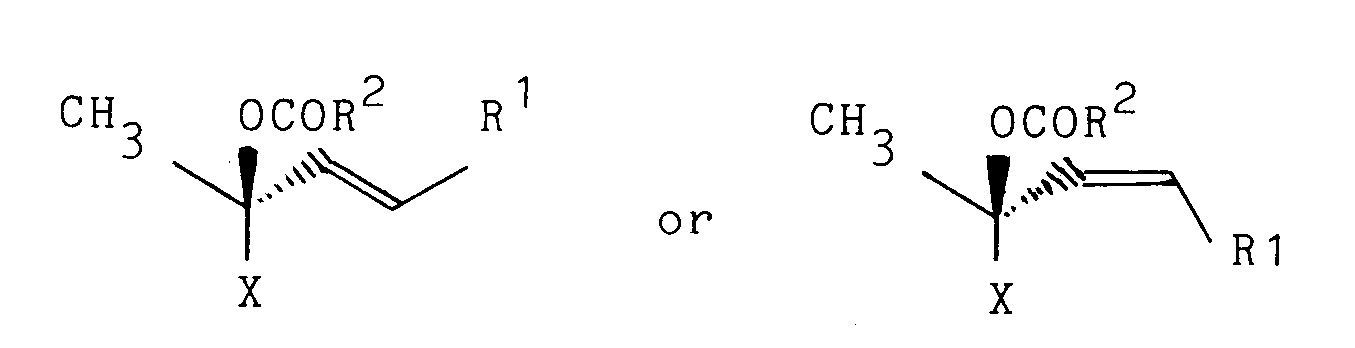
wherein R1 and X are as defined above and R2 represents a hydrogen atom, an alkoxy group, an alkenyloxy group or a substituted or unsubstituted aralkyloxy group, with formic acid or a salt thereof in the presence of a catalyst comprising a palladium salt and a tertiary phosphine.
Description
- The present invention relates to a process for producing an optically active olefin. More particularly, the present invention relates to a process for producing an optically active olefin having a ring structure represented by a hydroindene skeleton, a decalin skeleton or a steroid skeleton, stereospecifically from a corresponding optically active ester derivative. The optically active olefin produced by the present process has a physiological activity by itself and is useful as a medicine or as an intermediate for synthesis of physiologically active substances, particularly steroids.
- In steroid synthesis, efforts have been made to control the steric configuration of steroid side chain. As a result, for example, as optically active steroids which have a double bond at the 22-position and whose 20-position is optically active, various compounds have been made known. As such optically active steroids, there can be mentioned, for example, 24-epi-1,25-dihydroxyvitamin D2 and 22,23-dehydro-1,24-dihydrox- yvitamin D3 which are under development as a medicine for osteoporosis having a low side effect, as well as 20-epi-22,23-dehydro-24,26,27-trihomovitamin D3 whose 20-position has a steric configuration reverse to that of natural steroids and which is expected as a medicine for psoriasis, dysimmunity, malignant tumor, etc. According to Bulletin of Chemical Society of Japan, Vol. 62, p.3132 (1989), these steroids can be synthesized by reacting an aldehyde derivative such as Diels-Alder adduct between 1a,3;8-diacetoxypregna-5,7-diene-20S-carbaldehyde (an ergosterol derivative) and 4-phenyl-1,2,4-triazoline-3,5-dione, 5,6-trans-1α,3β-bis(t-butyldimethylsilyloxy)-9,10-seco-pregna-5,7,10(19)-triene-20R-carbaldehyde (an ergocalciferol derivative) or the like, with a sulfone derivative such as 3-(tetrahydropyran-2-yl)oxy-2,3-dimethylbutyl phenyl sulfone or the like in the presence of a base to form a corresponding 22-hydroxy-23-sulfone derivative and then subjecting the 22-hydroxy-23-sulfone derivative to reduction using a sodium-mercury amalgam.
- The above synthesis process, however, is not suitable for industrial application because it uses highly toxic mercury as a reagent. A steroid whose 20-position has a steric configuration reverse to that of natural steroids can be obtained from the above-mentioned aldehyde derivative whose 20-position has an R steric configuration. According to PCT International Publication No. W091/00271 and Tetrahedron, Vol., 43, p.4609 (1987), said aldehyde derivative can be obtained by epimerizing a 20S-aldehyde derivative obtained from a natural steroid, to form a mixture of a 20S-aldehyde derivative and a 20R-aldehyde derivative and then subjecting the mixture to liquid chromatography to separate the two isomers from each other. This process, however, employs a complex procedure and is unsuitable for industrial production of the above 20R-aldehyde derivative.
- Hence, it is needed to develop a process capable of producing a steroid having an optically active side chain, industrially at a high yield at a high selectivity.
- Meanwhile, it is known that an olefin can be obtained regioselectively by reducing straight-chain or branched-chain allyl compounds with formic acid in the presence of a catalyst comprising a palladium salt and a trialkylphosphine or a triarylphosphine, particularly a catalyst comprising a palladium salt and tributylphosphine [Tetrahedron Letters, No. 7, pp. 613-616 (1979); Synthesis, 1986, pp. 623-627; Chemistry Letters, pp. 1017-1020 (1984); and Organic Synthesis Chemistry, Vol. 49 No. 6 (1991) pp. 526-540].
- In these documents, however, only acyclic or monocyclic allylic esters of relatively low molecular weight are reported and no mention is made on the optical activity. In the cases of such open-chain olefins as mentioned in the above documents, the above reaction shows no stereospeficity.
- The present inventors have found that when an optically active ester derivative having a particular ring structure represented by an hydroindene skeleton, a decalin skeleton or a steroid skeleton is reacted with formic acid or a salt thereof in the presence of a palladium salt/tertiary phosphine catalyst, the reaction proceeds highly stereospecifically, whereby a corresponding optically active olefin can be produced at a high yield and, as a result, an optically active olefin, which is steroid having an optically active side chain or an intermediate for synthesis thereof, can be produced industrially at a high yield and a high selectivity.
- According to one aspect of the present invention, there is provided a process for producing an optically active olefin represented by general formula (la)

wherein - R1 represents an organic group;
- R10 represents a lower alkyl group;
- R11 represents a hydrogen atom or a lower alkyl group;
- each of R31, R32, R41, R42, R51, R52, R61, R62, R71, R72, R81, R82, R91 and R92 represents a hydrogen atom, a hydroxyl group which may be optionally protected, or an organic group, or
- each one pair of the substituents on two adjacent carbon atoms, i.e. (R31 or R32) and (R41 or R42), (R41 or R42) and (R51 or R52), (R51 or R52) and R11, R11 and (R61 or R62), (R61 or R62) and (R71 or R72), (R71 or R72) and (R81 or R 82), and (R81 or R82) and (R91 or R92), may be bonded to each other to form an additional carbon-to-carbon bond, or
- one pair of the substituents on the same carbon atom, i.e. R31 and R32, R41 and R42, R51 and R52, R61 and R62, R71 and R72, R81 and R82, and R91 and R92, may be bonded to each other to form an oxo group which may be optionally protected or a methylene group which may be optionally substituted, or
- R61, R62, R71 and R72 may form an additional ring together with the carbon atoms to which they are bonded; and
- m is 0 or 1,
- which process comprises reacting an optically active ester derivative represented by general formula (Ila)

wherein R1, R10, R11, R31, R32, R41, R42, R51, R52, R61, R62, R71, R72, R81, R 82, R91, R92 and m are as defined above and R2 represents a hydrogen atom, an alkoxy group, an alkenyloxy group or a substituted or unsubstituted aralkyloxy group, with formic acid or a salt thereof in the presence of a catalyst comprising a palladium salt and a tertiary phosphine. - According to another aspect of the present invention, there is provided a process for producing an optically active olefin represented by general formula (Ib)

wherein R1, R10, R11, R31, R32, R41, R42, R51, R52, R61, R62, R7 R72, R81, R82, R91, R92 and m are as defined above, which process comprises reacting an optically active ester derivative represented by general formula (IIb)
wherein R1, R2, R10, R11, R31, R32, R41, R42, R51, R52, R61, R62, R7 R72, R81, R82, R91, R92 and m are as defined above, with formic acid or a salt thereof in the presence of a catalyst comprising a palladium salt and a tertiary phosphine. - The processes provided by the present invention are hereinafter described in detail.
- In the present invention, the term "lower" refers to that any group or compound prefixed with the term has 6 or less, preferably 4 or less carbon atoms.
- In the general formulas (Ia), (Ib), (Ila) and (IIb), the "organic group" represented by R1 is not particularly restricted unless it has a functional group (e.g. an allyl ester group) capable of becoming a substrate for palladium-catalyzed reaction with formic acid, and can be selected from a wide range of organic groups. However, there can be mentioned, in particular, straight-chain, branched-chain or alicyclic saturated or unsaturated hydrocarbon groups which may have substituents optionally. Examples of such hydrocarbon groups include alkyl groups (particularly those of 1-10 carbon atoms) such as ethyl, propyl, 2-methylpropyl, 3-methylbutan-2-yl, cyclopropylmethyl, 3-methylbutyl, 3-ethylpentyl and the like; and alkenyl groups (particularly those of 2-10 carbon atoms) such as 3-methyl-1-butenyl, 3-ethyl-1-pentenyl, 4-methyl-1-pentenyl, 5-methyl-1,3-hexadienyl and the like. Each of these hydrocarbon groups may be optionally substituted by at least one, preferably 1-6, more preferably 1-2 substituents selected from, for example, a hydroxyl group which may be optionally protected, an oxo group which may be optionally protected, a carboxyl group which may be optionally protected, a halogen atom, etc.
- Of the above groups as R1, preferable are those groups which form side chains in the D ring of steroid, for example, straight-chain or branched chain alkyl groups which may each be optionally substituted by 1-2 groups selected from the group consisting of a hydroxyl group which may be optionally protected, an oxo group which may be optionally protected, a carboxyl group which may be optionally protected and a cycloalkyl group.
- Herein, the protective group for hydroxyl group in "a hydroxyl group which may be optionally protected", can be an ordinary protective group which can be easily eliminated by an ordinary deprotection means such as hydrolysis, hydrogenolysis or the like. As such a protective group, there can be mentioned, for example, acyl groups such as formyl, acetyl, propionyl, butyryl, isobutyryl, valeryl, isovaleryl, pivaloyl, caproyl, benzoyl, trifluoroacetyl and the like; alkoxycarbonyl groups such as methoxycarbonyl, ethoxycarbonyl, propoxycarbonyl, allyloxycarbonyl, benzyloxycarbonyl and the like; trisubstituted silyl groups such as trimethylsilyl, triethylsilyl, triisopropylsilyl, tert-butyldimethylsilyl, tert-butyldiphenylsilyl and the like; 1-alkoxyalkyl groups such as methoxymethyl, methoxyethoxymethyl, 1-ethoxyethyl, 1-methoxy-1-methylethyl and the like; and 2-oxacycloalkyl groups such as tetrahydrofuranyl, tetrahydropyranyl and the like. When there are two hydroxyl groups adjacent to each other, these adjacent hydroxyl groups may be protected in the form of an acetal with an aldehyde or a ketone.
- As the protective group for oxo group in "an oxo group which may be optionally protected", there can be mentioned, for example, acyclic ketals such as dimethylketal, diethylketal, dibenzylketal and the like; cyclic ketals such as ethyleneketal, bromomethylethyleneketal, o-nitrobenzylethyleneketal, trimethyleneketal, 2-methylenetrimethyleneketal, 2,2-dibromotrimethyleneketal, 2,2-dimethyltrimethyleneketal and the like; acyclic thioketals such as dimethylthioketal, diethylthioketal, and the like; and cyclic thioketals such as ethylenethioketal, trimethylenethioketal and the like.
- As the protected carboxyl group in "a carboxyl group which may be optionally protected", there can be mentioned, for example, lower alkoxycarbonyl groups such as methoxycarbonyl, ethoxycarbonyl, propoxycarbonyl, isopropoxycarbonyl, butoxycarbonyl, sec-butoxycarbonyl, t-butoxycarbonyl and the like; and aralkyloxycarbonyl groups such as benzyloxycarbonyl, p-methoxybenzyloxycarbonyl and the like.
- As preferable examples of the organic group represented by R1, there can be mentioned the followings:


- In the above, the hydroxyl group, the oxo group and the carboxyl group may be protected as mentioned above.
- The "alkoxy group" and "alkenyloxy group" represented by R2 can be straight-chain or branched-chain and each is preferably a lower group of generally 6 or less carbon atoms. As the alkoxy group, there can be mentioned lower alkoxy groups such as methoxy, ethoxy, propoxy, isopropoxy, butoxy, sec-butoxy, tert- butoxy, hexyloxy and the like. As the alkenyloxy group, there can be mentioned lower alkenyloxy groups such as 3-butenyloxy and the like. The "aralkyloxy" group refers to an aryl-substituted alkoxy group whose alkoxy portion has the same definition as above. The aryl portion, which is preferably a phenyl group, may be optionally substituted by, for example, halogen atom(s), nitro group(s), lower alkyl group(s) (e.g. methyl), lower alkoxy group(s) (e.g. methoxy), etc. Examples of such a substituted or unsubstituted aralkyloxy group are benzyloxy, p-methoxybenzyloxy, p-chlorobenzyloxy and phenethyloxy.
- Preferable as R2 is a lower alkoxy group.
- The "lower alkyl group" represented by each of R10 and R11 can also be straight-chain or branched-chain and includes, for example, methyl, ethyl, propyl, isopropyl, butyl, sec-butyl and tert-butyl. Of these, methyl and ethyl are preferable.
- The "organic group" represented by each of R31, R32, R41, R42, R51, R52, R61, R62, R71, R72, R81, R82, R91 and R92 is not particularly restricted unless it has a functional group capable of becoming a substrate for palladium-catalyzed reaction with formic acid, for example, a functional group such as allyl ester or the like, and can be a straight-chain, branched-chain or cyclic saturated or unsaturated hydrocarbon group which may have a substituent optionally.
- Such as hydrocarbon group includes, for example, alkyl groups such as methyl, ethyl, propyl, isopropyl, butyl, sec-butyl, tert-butyl and the like; alkenyl groups such as vinyl, propenyl, 1-butenyl and the like; cycloalkyl groups such as cyclopropyl, cyclopentyl, cyclohexyl and the like; cycloalkylidenealkyl groups such as 2-(2-methylenecyclohexylidene)ethyl and the like; cycloalkenylalkenyl groups such as 2-(2-methyl-1-cyclohexenyl)ethenyl and the like; cycloalkenyl groups such as cyclopentenyl, cyclohexenyl and the like; aryl groups such as phenyl, tolyl and the like; and aralkyl groups such as benzyl, phenethyl and the like.
- These hydrocarbon groups may be optionally substituted by, for example, a hydroxyl group which may be optionally protected, an oxo group which may be optionally protected, a carboxyl group which may be optionally protected, a cyano group, an unsubstituted or mono- or disubstituted amino group (e.g. amino, methylamino, dimethylamino, acetylamino, benzyloxycarbonylaimino, t-butoxycarbonylamino, benzoylamino, p-toluenesulfonylamino), a halogen atom, or the like.
- Each one pair of the substituents on two adjacent carbon atoms, i.e. (R31 or R32) and (R41 or R42), (R41 or R42) and (R51 or R52), (R51 or R52) and R11, R11 and (R61 or R62), (R61 or R62) and (R71 or R72), (R71 or R 72) and (R81 or R82), and (R81 or R82) and (R91 or R92), may be bonded to each other to form an additional carbon-to-carbon bond; however, the two substituents on the same carbon atom cannot form respective additional carbon-to-carbon bonds simultaneously.
- Each one pair of the substituents on the same carbon atom, i.e. R31 and R32, R41 and R42, R51 and R52, R61 and R62 R71 and R72, R81 and R82 and R91 and R92, may be bonded to each other to form an oxo group which may be optionally protected or a methylene group which may be optionally substituted. The "methylene group which may be optionally substituted", includes a group represented by a formula

wherein each of Z1 and Z2 represents a hydrogen atom or an organic group mentioned for R31 to R91 and one of Z1 and Z2 is preferably a hydrogen atom. Preferable examples of such a methylene group are
wherein Y3 represents a hydroxyl group which may be optionally protected; - Y4 represents a hydrogen atom, a fluorine atom or a lower alkoxy group which may be substituted by a hydroxyl group which may be optionally protected;
- Y5 represents a hydrogen atom or a hydroxyl group which may be optionally protected; and
- Y6 represents a lower alkoxy group.
- R61, R62, R71 and R71 may form an additional ring together with the carbon atoms to which they are bonded. The ring may be a monocyclic or polycyclic saturated or unsaturated ring. There can be mentioned, for example, rings of cyclohexane skeleton or decalin skeleton. The ring is preferably the A and B rings portion of steroid.
- As the compound constituting the ring structure of formula (Ila) or (llb), there can be mentioned compounds having at least the C and D rings portion of steroid skeleton, for example, compounds having a steroid skeleton such as androstane skeleton, estran skeleton, seco-androstan skeleton or the like, norsteroid compounds having a skeleton corresponding to the B, C and D rings portion of steroid skeleton, homosteroid compounds having a steroid skeleton whose D ring portion is a 6-membered ring, and compounds having a hydroindene skeleton corresponding to the C and D ring portions of steroid skeleton. These compounds may have double bonds which do not take part in the reaction with formic acid or a salt thereof, at any site and may further have any substituents which do not take part in said reaction. As such substituents, there can be mentioned, for example, a hydroxyl group, halogen atoms, a protected hydroxyl group, an alkyl group which may have a substituent, an alkenyl group which may have a substituent, and an aryl group which may have a substituent.
- Preferable examples of the portion of formula (Ila) or (llb), represented by a formula
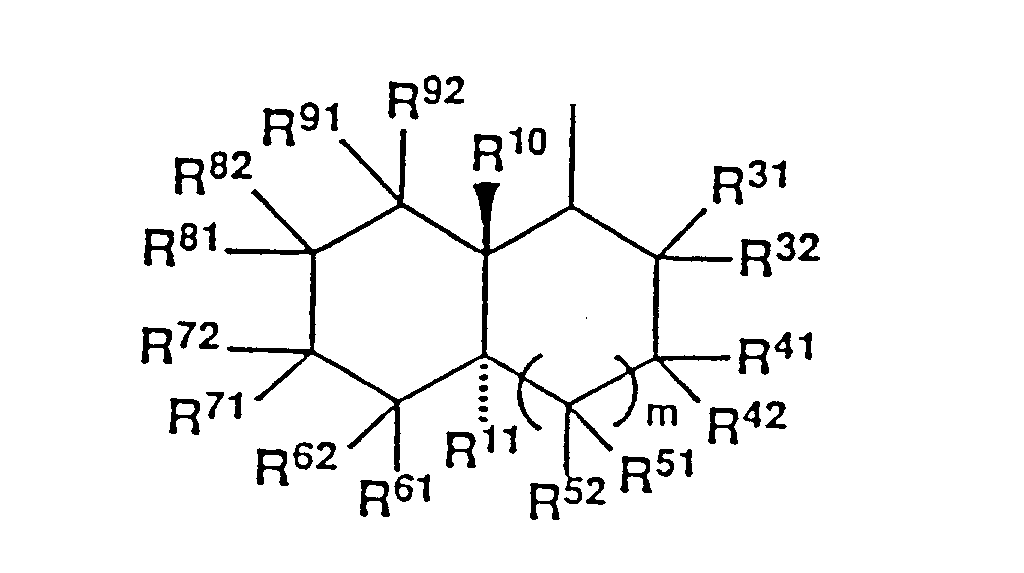
are as follows. - (1) A formula

wherein one of R63, R64, R73 and R74 represents a hydroxyl group which may be optionally protected or a group of formula (a)
(Y3 represents a hydroxyl group which may be optionally protected; Y4 represents a hydrogen atom, a fluorine atom or a lower alkoxy group which may be substituted by a hydroxyl group which may be optionally protected; and Y5 represents a hydrogen atom or a hydroxyl group which may be optionally protected), and each of the remaining groups is a hydrogen atom or the remaining two groups on two adjacent carbon atoms are bonded to each other to form an additional carbon-to-carbon bond, or- R63 and R64 are bonded to each other to form an oxo group which may be optionally protected or a group represented by formula (b), (c), (d) or (e)

- (Y3, Y4 and Y5 are as defined above and Y6 represents a lower alkoxy group) and R73 and R74 each represent a hydrogen atom, or
- R63, R64, R73 and R74 constitute the A and B rings portion of steroid together with the carbon atoms to which they are bonded; and
- R2, R10 and m are as defined above.
- R63 and R64 are bonded to each other to form an oxo group which may be optionally protected or a group represented by formula (b), (c), (d) or (e)
- (2) A formula

wherein one of R65 and R66 is a hydroxyl group which may be optionally protected and the other is a hydrogen atom, or- R65 and R66 are bonded to each other to form an oxo group which may be protected or a group represented by formula (c), (d), (e) mentioned above; and
- R2 and R10 are as defined above.
- (3) A formula

wherein Y7 and Y9 each represent a hydrogen atom or a hydroxyl group which may be optionally protected;- Y8 represents a hydrogen atom, a fluorine atom or a lower alkoxy group which may be substituted by a hydroxyl group which may be optionally protected; and
- --- represents a single or double bond; and
- R2 and R10 are as defined above.
- Preferable example of the optically active ester derivative of formula (Ila) is a compound represented by formula (IIa-1), (IIa-2) or (Ila-3):


wherein R1' represents a straight-chain or branched chain alkyl group which may be optionally substituted by one or two groups selected from the group consisting of a hydroxyl group which may be optionally protected, an oxo group which may be optionally protected, a carboxyl group which may be optionally protected and a cycloalkyl group; and R2, R10, R63, R64, R65, R66, R73, R 74, Y7, Y8, Y9, m and --- are as defined above. - Preferable example of the optionally active ester derivative of formula (IIb) is a compound represented by formula (IIb-1), (IIb-2) or (IIb-3):
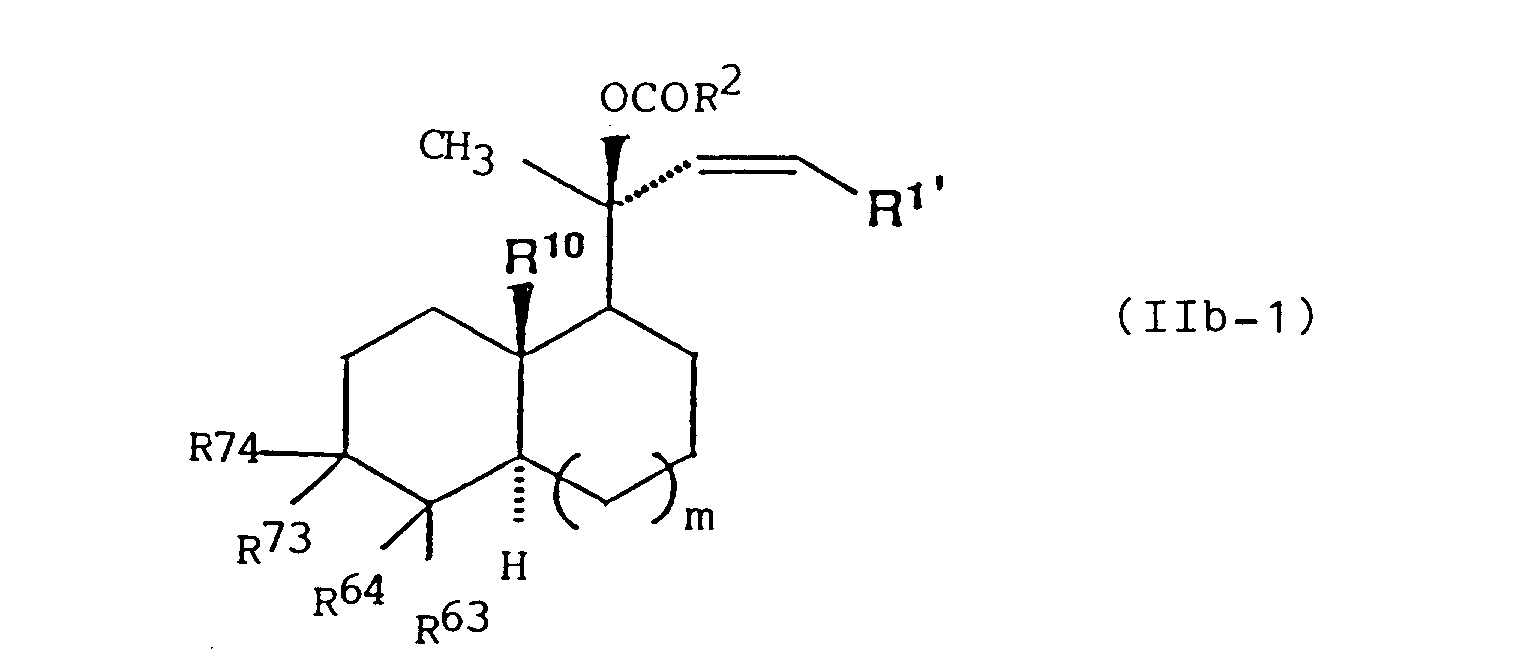

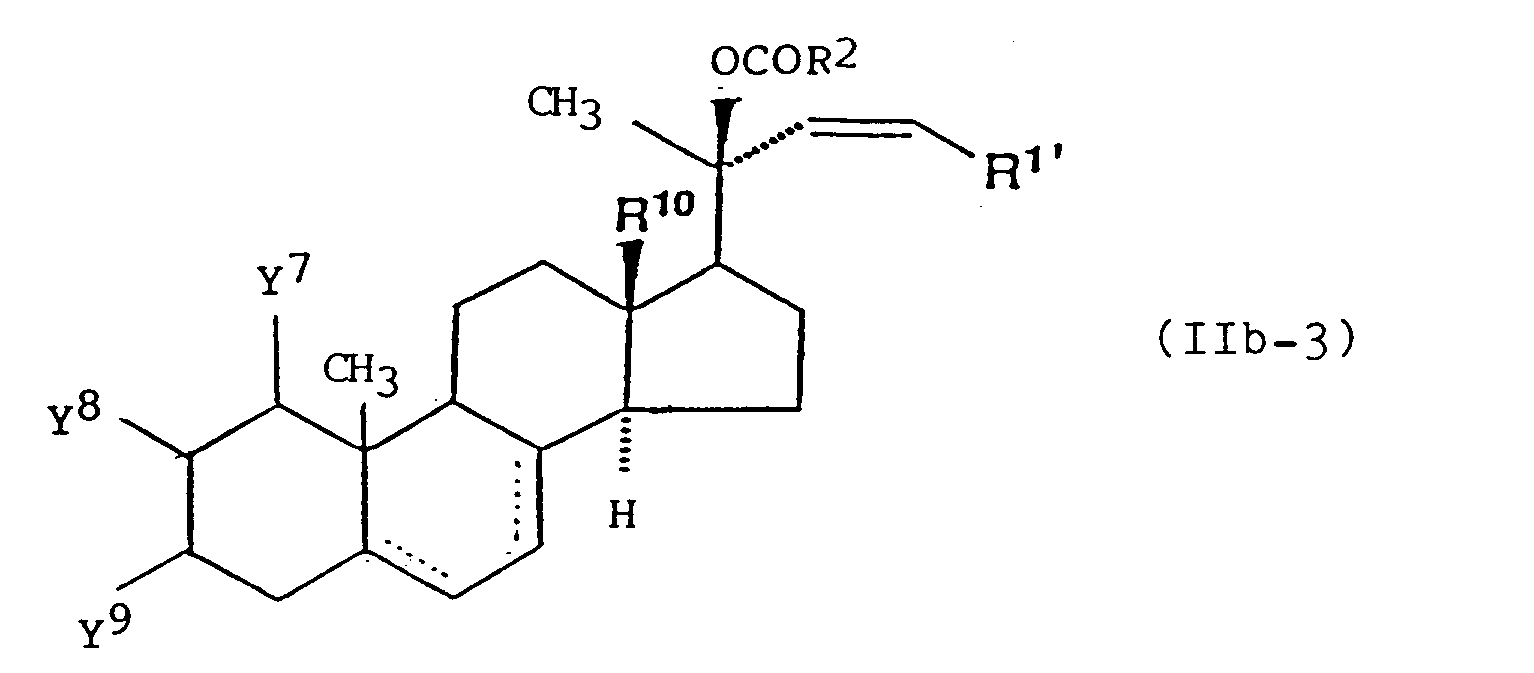
wherein R1', R2, R10, R63, R64, R65, R 66, R73, R74, Y7, Ya, Y9, m and --- are as defined above.
- Particularly preferable examples of the compounds (Ila) and (Ilb) are as follows, besides those used in Examples described later:
- 3-hydroxycholesta-5,22E-dien-20-yl ester or a hydroxyl group-protected derivative thereof;
- 3-hydroxycholesta-5,22Z-dien-20-yl ester or a hydroxyl group-protected derivative thereof;
- 1,3-dihydroxycholesta-5,7,22E-trien-20-yl ester or a hydroxyl group-protected derivative thereof;
- 1,3-dihydroxycholesta-5,7,22Z-trien-20-yl ester or a hydroxyl group-protected derivative thereof;
- 1,3,25-trihydroxycholesta-5,7,22Z-trien-20-yl ester or a hydroxyl group-protected derivative thereof;
- 1,3,25-trihydroxycholesta-5,7,22E-trien-20-yl ester or a hydroxyl group-protected derivative thereof;
- 1,3,25-trihydroxyergosta-5,7,22Z-trien-20-yl ester or a hydroxyl group-protected derivative thereof;
- 24-epi-1,3,25-trihydroxyergosta-5,7,22Z-trien-20-yl ester or a hydroxyl group-protected derivative thereof;
- 1,3,25-trihydroxy-24,26,27-trihomocholesta-5,7,22E-trien-20-yl ester or a hydroxyl group-protected derivative thereof;
- 1,3,25-trihydroxy-24,26,27-trihomo-9,10-secocholesta-5,7,10(19),22E-tetraen-20-yl ester or a hydroxyl group-protected derivative thereof;
- 24-epi-1,3,25-trihydroxy-9,10-secoergosta-5,7,10(19),22Z-tetraen-20-yl ester or a hydroxyl group-protected derivative thereof;
- 1,3,25-trihydroxy-24,26,27-trihomo-9,10-secocholesta-5(10),6,8,22E-tetraen-20-yl ester or a hydroxyl group-protected derivative thereof;
- 1,3,25-trihydroxy-26-nor-26-methoxycarbonylcholesta-5,7,22Z-trien-20-yl ester or a hydroxyl group-protected derivative thereof;
- 1,3,24-trihydroxycholesta-5,7,22Z-trien-20-yl ester or a hydroxyl group-protected derivative thereof;
- 2-hydroxypropoxy-1,3,25-trihydroxycholesta-5,7,22Z-trien-20-yl ester or a hydroxyl group-protected derivative thereof;
- 1,3,25,26-tetrahydroxycholesta-5,7,22Z-trien-20-yl ester or a hydroxyl group-protected derivative thereof;
- 1,3,7,8,25-pentahydroxy-24,26,27-trihomo-9,10-secocholesta-5,10(19),22E-trien-20-yl ester or a hydroxyl group-protected derivative thereof;
- 2-(4-hydroxy-7a-methyl-2,3,3a,4,5,6,7,7a-octahydroinden-1-yl)-7-ethyl-7-hydroxy-5-nonen-2-yl ester or a hydroxyl group-protected derivative thereof;
- 2-(4-hydroxy-7a-methyl-2,3,3a,4,5,6,7,7a-octahydroinden-1-yl)-5,6-demthyl-3-hepten-2-yl ester or a hydroxyl group-protected derivative thereof;
- 3-hydroxy-9,10-secoergosta-5,7,10(19),22E-tetraen-20-yl ester or a hydroxyl group-protected derivative thereof;
and 2-(4-(2-(3-hydroxy-2-methylenebicyclo[3.1.0]-hexan-1-yl)-2-methoxyethylidene)-2,3,3a,4,5,6,7,7a-octahydro-7a-methylinden-1-yl)-5,6-dimethyl-3-hepten-2-yl ester or a hydroxyl group-protected derivative thereof. - The compound of formula (Ila) or (llb) may be in the form of a Diels-Alder adduct with, for example, 4-phenyl-1,2,4-triazoline-3,5-dione, 1,4-dihydrophthalazine-1,4-dione, sulfur dioxide or the like.
- The palladium salt, which is used as a catalyst when the compound of formula (Ila) or (llb) is reacted with formic acid or a salt thereof, can be a per se known compound. There can be mentioned, for example, palladium acetylacetonate, palladium acetate, palladium chloride, palladium nitrate, bis(acetonitrile)palladium chloride, tris(dibenzylideneacetone)dipalladium chloroform. Of these, palladium acetate and palladium acetylacetonate are particularly preferable.
- The tertiary phosphine, which is used in combination with the palladium salt, can also be a per se known compound such as a trialkylphosphine or a triarylphosphine. The carbon atoms of the alkyl portion of the trialkylphosphine are not particularly restricted but are generally 2-8 in view of the availability of such a trialkylphosphine. The alkyl portion may be straight-chain, branched chain or cyclic. Specific examples of such a trialkylphosphine are tributylphosphine, trihexylphosphine, trioctylphosphine and tricyclohexylphosphine. Specific example of the triarylphosphine is triphenylphosphine. Tributylphosphine is particularly preferable.
- The proportion of the tertiary phosphine to the palladium salt is not particularly restricted and can be varied depending upon the kind of starting material used, etc. However, in general, the tertiary phosphine can be in an amount of about 0.5 to about 10 moles per gram atom of the palladium of the palladium salt. Use of the trialkylphosphine in an amount of 0.5-5 moles per gram atom of the palladium is preferable because the reaction can be conducted at low temperatures. Use of the triarylphosphine in an amount of 0.5-2 moles per gram atom of the palladium is preferable. Use of the tertiary phosphine in an amount of about 1-2 mole per gram atom of the palladium is convenient.
- The palladium salt can be used in an amount of generally 0.0001-1 gram atom, preferably 0.001-0.3 gram atom, more preferably 0.01-0.1 gram atom in terms of palladium atom, per mole of the compound of formula (Ila) or (IIb).
- The compound of formula (Ila) or (llb) is reacted with formic acid or its salt. The formic acid salt is preferably a salt soluble in the organic solvent used in the reaction, and there can be mentioned, for example, ammonium salts of formic acid such as ammonium formate, triethylammonium formate, diisopropylethylammonium formate and the like.
- The amount of formic acid or its salt used is not particularly restricted and can be varied depending upon the kind of the compound of formula (Ila) or (llb), the kind of the catalyst, etc., but can be generally 1-10 moles, preferably 1-5 moles per mole of the compound of formula (Ila) or (llb).
- The reaction of the compound of formula (Ila) or (llb) with formic acid or its salt can be conducted in the presence of a base, as necessary. The base is preferably a tertiary amine such as triethylamine, diisopropylethylamine, pyridine or the like. The amount of the base used is generally 0.01-10 moles, preferably 0.5-2 moles per mole of formic acid or its salt.
- The reaction according to the present invention can be conducted at relatively low temperature owing to the use of the above-mentioned catalyst. It can be conducted generally at about -10°C to about 40 °C, preferably at about 0 ° C to about 30 °C. Depending upon the case, however, it can be conducted under heating up to the boiling point of the reaction solvent.
- The reaction can be conducted in the presence of an organic solvent. As the organic solvent, there can be used, for example, hydrocarbons such as hexane, benzene and the like; ethers such as diethyl ether, tetrahydrofuran, dioxane and the like; acetonitrile, dimethylformamide; dimethyl sulfoxide; and chloroform. Of these, tetrahydrofuran, dioxane and benzene are preferable.
- The optically active ester derivative of formula (Ila), which is used as a starting material in the above reaction, can be synthesized by esterifying a corresponding allyl alcohol [hereinafter referred to as allyl alcohol (a)]. This esterification can be conducted by an ordinary esterification reaction. The ester derivative of formula (Ila) can be obtained, for example, by reacting an alkali metal salt of an allyl alcohol (a) with a chloroformic acid ester or reacting an allyl alcohol (a) with a chloroformic acid ester in the presence of a base such as pyridine or the like [Helv. Chim. Acta, Vol. 37, p.45 (1954)]. The allyl alcohol (a) can be obtained by reacting a corresponding carbonyl compound with an alkenyl metal such as 1-alkenyl lithium having an E-configuration. The allyl alcohol (a) can also be obtained by reacting a corresponding carbonyl compound with an alkynyl metal such as 1-alkynyl lithium, 1-alkynyl magnesium or the like to form an acetylene alcohol and reducing the actylene alcohol with lithium aluminum hydride.
- Also, the optically active ester derivative of formula (llb) can be synthesized from a corresponding allyl alcohol [hereinafter referred to as allyl alcohol (b)] by a process similar to the above. The allyl alcohol (b) can be obtained by reacting a corresponding carbonyl compound with an alkenyl metal such as 1-alkenyl lithium having a Z-configuration. The allyl alcohol (b) can also be obtained by reaction a corresponding carbonyl compound with an alkynl metal such as 1-alkynyl lithium, 1-alkynyl magnesium or the like to form an acetylene alcohol and reducing the actylene alcohol with a Lindlar catalyst, a diimide or the like.
- According to the present process mentioned above, optically active olefins of formulas (la) and (Ib) can be produced from the optically active ester derivatives of formulas (Ila) and (llb), respectively, at high yields at high selectivities.
- The compound of formula (la) or (Ib) can be isolated from the reaction mixture and purified by a per se known method which generally used for isolation and purification of an organic compound from a reaction mixture containing the compound. For example, the reaction mixture containing the compound of formula (la) or (Ib) is poured into ice water; the resulting mixture is subjected to extraction with an organic solvent such as hexane, diethyl ether, ethyl acetate or the like; the extract is washed with cold diluted hydrochloric acid, an aqueous sodium hydrogencarbonate solution, an aqueous sodium chloride solution, etc. in this order, followed by drying and concentration to obtain a crude product; the crude product is as necessary purified by recrystallization, chromatography, etc., whereby an olefin of formula (la) or (Ib) can be obtained.
- The reaction according to the present invention proceeds very stereospecifically. That is, when an ester derivative of formula (Ila) is used as a starting material, there is obtained an optically active olefin of formula (la) having the same steric configuration as the side chain of a steroid compound whose 20-position has a steric configuration reverse to that of natural steroid. When an ester derivative of formula (llb) is used as a starting material, there is obtained an optically active olefin of formula (Ib) having the same steric configuration as the side chain of a steroid compound whose 20-position has a steric configuration same as that of natural steroid.
- The thus obtained olefin of formula (la) or (Ib) has a physiological activity by itself and is useful as a medicine or as an intermediate for synthesis of physiologically active substances, particularly steroids. For example, (22E)-1,3,25-tris(t-butyldimethylsilyloxy)-cholesta-5,7,22-triene and (22E)-1,3-bis(t-butyldimethyl- silyloxy)-25-methoxymethoxycholesta-5,7,22-triene can be converted to 22,23-dehydro-1,25-dihydrox- yvitamin D3 having a strong vitamin D activity, by being subjected to photoisomerization, thermal isomerization and deprotection by an ordinary method used in the synthesis of vitamin D derivatives.
- The present invention is hereinafter described more specifically by way of Examples. However, the Examples are merely for illustration and not for restriction of the present invention.
- 2.35 ml of 1.5 M pentane solution of t-butyl lithium was dropwise added to a solution of 606 mg of (Z)-5-iodo-4-penten-1-yl t-butyldimethylsilyl ether dissolved in 5 ml of diethyl ether, at -78 °C in 9 minutes in an argon atmosphere. The reaction mixture was stirred at the same temperature for 2 hours. Thereto was dropwise added, in 5 minutes, a solution of 640 mg of 3-(t-butyldimethylsilyloxy)pregn-5-en-20-one dissolved in 10 ml of tetrahydrofuran. The reaction mixture was warmed to room temperature in 1 hour, then mixed with water and subjected to extraction with ethyl acetate. The extract was water-washed, dried over anhydrous magnesium sulfate, and concentrated under reduced pressure. The residue was dissolved in a mixed solution consisting of 8 ml of ethanol and 3 ml of tetrahydrofuran. To the solution was added 75 mg of sodium borohydride, and the mixture was stirred at room temperature for 1.5 hours to reduce unreacted 3-(t-butyldimethylsilyloxy)pregn-5-en-20-one. The reaction mixture was mixed with water and subjected to extraction with ethyl acetate. The extract was water-washed, dried over anhydrous magnesium sulfate and concentrated under reduced pressure. The residue was purified by silica gel column chromatography to obtain 706.5 mg (yield: 75%) of (22Z)-3,26-di(t-butyldimethylsilyloxy)-27-norcholesta-5,22-dien-20-ol.
- In 7 ml of tetrahydrofuran was dissolved 706.5 mg of the (22Z)-3,26-di(t-butyldimethylsilyloxy)-27- norcholesta-5,22-dien-20-ol obtained in Reference Example 1. To the solution was dropwise added, at -78 °C, 0.9 ml of 1.5 M pentane solution of t-butyl lithium. The reaction mixture was stirred at the same temperature for 30 minutes. Thereto was dropwise added 0.13 ml of methyl chloroformate. The mixture was stirred at room temperature for 15 hours. The reaction mixture was mixed with an aqueous sodium hydrogencarbonate solution and subjected to extraction with ethyl acetate. The extract was washed with an aqueous sodium hydrogencarbonate solution, dried over anhydrous magnesium sulfate and concentrated under reduced pressure to obtain 782.6 mg of (22Z)-3,26-di(t-butyldimethylsilyloxy)-27-norcholesta-5,22-dien-20-yl methyl carbonate as white crystals.
- Reactions, separation and purification were conducted in the same manner as in Reference Example 1 except that the (Z)-5-iodo-4-penten-1-yl t-butyldimethylsilyl ether used in Reference Example 1 was replaced by (E)-5-iodo-4-penten-1-yl t-butyldimethylsiliy ether, to obtain 939 mg of (22E)-3,26-di(t-butyl- dimethylsilyloxy)-27-norcholesta-5,22-dien-20-ol.
- In 8 ml of tetrahydrofuran was dissolved 939 mg of the (22E)-3,26-di(t-butyldimethylsilyloxy)-27- norcholesta-5,22-dien-20-ol obtained in Reference Example 3. To the solution was dropwise added 1.2 ml of 1.5 M pentane solution of t-butyl lithium at -83 ° C in 5 minutes. The reaction mixture was stirred at the same temperature for 30 minutes. Thereto was dropwise added 0.17 ml of methyl chloroformate, and the mixture was stirred overnight at room temperature. The reaction mixture was mixed with an aqueous sodium hydrogencarbonate solution and subjected to extraction with ethyl acetate. The extract was washed with an aqueous sodium hydrogencarbonate solution, dried over anhydrous magnesium sulfate and concentrated under reduced pressure to obtain (22E)-3,26-di(t-butyldimethylsilyloxy)-27-norcholesta-5,22-dien-20-yl methyl carbonate.
- 0.32 ml of 1.6 M hexane solution of butyl lithium was dropwise added to a solution of 120 mg of 5-ethyl-5-methoxymethoxy-1-heptyne dissolved in 4 ml of tetrahydrofuran, at -78 ° C in a nitrogen atmosphere. The reaction mixture was stirred at the same temperature for 30 minutes. Thereto was dropwise added a solution of 112 mg of 4-benzoyloxy-7a-methyl-2,3,3a,4,5,6,7,7a-octahydroinden-1-yl-ethanone dissolved in 3 ml of tetrahydrofuran. The reaction mixture was warmed to 0°C and mixed with an aqueous ammonium chloride solution. The mixture was subjected to extraction with diethyl ether. The extract was washed with a saturated aqueous sodium chloride solution, dried over anhydrous magnesium sulfate and concentrated under reduced pressure. The residue was purified by silica gel column chromatography to obtain 97 mg of 2-(4-benzoyloxy-7a-methyl-2,3,3a,4,5,6,7,7a-octahydroinden-1-yl)-7-ethyl-7-methoxymethoxy-3-nonyn-2-ol having the following properties.
- NMR spectrum (270 MHz, CDCL3)6
- 0.83 (6H,t,J = 7.6Hz), 1.33 (3H,s), 1.47 (3H,s), 3.37 (3H,s), 4.65 (2H,s), 5.43 (1 H,s), 7.43 (2H,t,J = 7Hz), 7.55 (1 H,q,J = 7Hz), 8.08 (2H,d,J = 7Hz)
- 97 mg of 2-(4-benzoyloxy-7a-methyl-2,3,3a,4,5,-6,7,7a-octahydroinden-1-yl)-7-ethyl-7-methoxymethoxy-3-nonyn-2-ol obtained in Reference Example 5 was dissolved in 2 ml of tetrahydrofuran. The solution was dropwise added, at room temperature, to a suspension of 120 mg of lithium aluminum hydride in 3 ml of tetrahydrofuran. The mixture was refluxed for 30 minutes. The reaction mixture was cooled and then diluted with diethyl ether. The mixture was poured into an aqueous solution containing ammonium chloride and sodium hydroxide. The resulting mixture was subjected to extraction with diethyl ether. The extract was washed with a saturated aqueous sodium chloride solution, dried over anhydrous magnesium sulfate and concentrated under reduced pressure. The residue was purified by silica gel column chromatography to obtain 40 mg of 2-(4-hydroxy-7a-methyl-2,3,3a,4,5,6,7,7a-octahydroinden-1-yl)-7-ethyl-7-methoxymethoxy-3E-nonen-2-ol having the following properties.
- NMR spectrum (270 MHz, CDCL3)6
- 0.84 (6H,t,J = 7.6Hz), 1.10 (3H,s), 1.32 (3H,s), 3.40 (3H,s), 4.09 (1 H,br.s), 4.66 (2H,s), 5.46-5.64 (2H,m)
- 20 mg of 2-(4-hydroxy-7a-methyl-2,3,3a,4,5,6,-7,7a-octahydroinden-1-yl)-7-ethyl-7-methoxymethoxy-3E-nonen-2-ol obtained in Reference Example 6 was dissolved in 4 ml of tetrahydrofuran. To the solution was dropwise added, -78 °C, 0.08 ml of 1.6 M hexane solution of n-butyl lithium. The reaction mixture was stirred at the same temperature for 10 minutes. Thereto was dropwise added 0.013 ml of methyl chloroformate. The mixture was stirred at room temperature for 15 hours. The reaction mixture was mixed with an aqueous sodium hydrogencarbonate solution, followed by extraction with ethyl acetate. The extract was washed with an aqueous sodium hydrogencarbonate solution, dried over anhydrous magnesium sulfate and concentrated under reduced pressure to obtain 26 mg of 2-(4-methoxycarbonyloxy-7a-methyl-2,3,3a,4,5,6,7,7a-octahydroinden-1-yl)-7-ethyl-7-methoxymethoxy-3E-nonen-2-yl methyl carbonate.
- 733.9 mg of trans-1-iodo-4-(1-ethoxyethoxy)-4-methyl-1-pentene was dissolved in 7 ml of diethyl ether. To the solution was dropwise added 2.9 ml of 1.6 M pentane solution of t-butyl lithium at -80 °C in a nitrogen atmosphere. The reaction mixture was stirred at the same temperature for 2 hours. Thereto was dropwise added a solution of 430 mg of 3-(t-butyldimethylsilyloxy)pregna-5-en-20-one dissolved in 9 ml of tetrahydrofuran. The mixture was stirred for 20 minutes. The reaction mixture was heated to room temperature. Thereto was added water, followed by extraction with ethyl acetate. The react was washed with a saturated aqueous sodium chloride solution, dried over anhydrous sodium sulfate and concentrated under reduced pressure. The residue was purified by silica gel column chromatography to obtain 291 mg of 25-(1-ethoxyethyoxy)-3-(t-butyldimethylsilyloxy)cholesta-5,22E-dien-20-ol.
- 291.7 mg of 25-(1-ethoxyethoxy)-3-(t-butyldimethylsilyloxy)cholesta-5,22E-dien-20-ol was dissolved in 5 ml of tetrahydrofuran. To the solution was dropwise added 0.38 ml of 1.6 M pentane solution of t-butyl lithium at -80 ° C in a nitrogen atmosphere. The reaction mixture was stirred at the same temperature for 30 minutes. Thereto was added 0.06 ml of methyl chloroformate. The mixture was stirred for 14 hours. The reaction mixture was warmed to room temperature and mixed with an aqueous sodium hydrogencarbonate solution. The mixture was subjected to extraction with ethyl acetate. The extract was dried over anhydrous sodium sulfate and concentrated under reduced pressure to obtain 320 mg of 25-(1-ethoxyethyoxy)-3-(t-butyldimethylsilyloxy)cholesta-5,22E-dien-20-yl methyl carbonate.
- Reactions, separation and purification were conducted in the same manner as in Reference Example 8 except that the trans-1-iodo-4-(1-ethoxyethoxy)-4-methyl-1-pentene used in Reference Example 8 was replaced by cis-1-iodo-4-(1-ethoxyethoxy)-4-methyl-1-pentene, to obtain 468 mg of 25-(1-ethoxyethyoxy)-3-(t-butyldimethylsilyloxy)cholesta-5,22Z-dien-20-ol.
- Reactions, separation and purification were conducted in the same manner as in Reference Example 9 except that 291.7 mg of the 25-(1-ethoxyethoxy)-3-(t-butyldimethylsilyloxy)cholesta-5,22E-dien-20-ol used in Reference Example 9 was replaced by 634 mg of 25-(1-ethoxyethoxy)-3-(t-butyldimethylsilyloxy)cholesta-5,22Z-dien-20-ol, to obtain 695 mg of 25-(1-ethoxyethyoxy)-3-(t-butyldimethylsilyloxy)cholesta-5,222-dien-20-yl methyl carbonate.
- Reactions, separation and purification were conducted in the same manner as in Reference Example 8 except that the trans-1-iodo-4-(1-ethoxyethoxy)-4-methyl-1-pentene used in Reference Example 8 was replaced by cis-1-iodo-4-(1-methoxymethoxy)-4-methyl-1-pentene, to obtain 304 mg of 25-(1-methox- ymethyoxy)-3-(t-butyldimethylsilyloxy)cholesta-5,22Z-dien-20-ol.
- Reactions, separation and purification were conducted in the same manner as in Reference Example 9 except that the 25-(1-ethoxyethoxy)-3-(t-butyldimethylsilyloxy)cholesta-5,22E-dien-20-ol used in Reference Example 9 was replaced by 634 mg of 25-(1-methoxymethoxy)-3-(t-butyldimethylsilyloxy)cholesta-5,22Z-dien-20-ol, to obtain 359.4 mg of 25-(1-methoxymethyoxy)-3-(t-butyldimethylsilyloxy)cholesta-5,22Z-dien-20-yl methyl carbonate.
- 30.4 mg of palladium acetylacetonate and 0.025 ml of tributylphosphine were mixed in 2 ml of benzene in an argon atmosphere to prepare a yellow solution of a palladium catalyst. To this catalyst solution was added 2.5 ml of 1.0 M benzene solution of triethylammonium formate. Thereto was further added a solution of 344 mg of (20S,22Z)-3,26-di(t-butyldimethylsilyloxy)-27-norcholesta-5,22-dien-20-yl methyl carbonate (obtained in Reference Example 2) dissolved in 2 ml of benzene. The mixture was stirred at room temperature for 45 minutes. The reaction mixture was diluted with hexane, then water-washed, dried over anhydrous magnesium sulfate and filtered through Florisil. The filtrate was concentrated under reduced pressure to obtain 240.7 mg of (20R,22E)-3,26-di(t-butyldimethylsilyloxy)-27-norcholesta-5,22-diene having the following properties, as white crystals.
- NMR spectrum (400 MHz, CDCL3)6
- 0.04 (6H,s), 0.05 (6H,s), 0.68 (3H,s), 0.89 (18H,s), 1.00 (18H,s), 1.00 (3H,d,J=6.5Hz), 0.88-2.31 (25H,m), 3.47 (1 H,t,t,J = 5.0Hz), 3.59 (2H,t,J = 6.6Hz), 5.24-5.34 (3H,m)
- Reactions, separation and purification were conducted in the same manner as in Example 1 except that 2.5 ml of the 1.0 M benzene solution of triethylammonium formate used in Example 1 was replaced by 1.0 ml of 1.0 M benzene solution of triethylammonium formate, to obtain 294.2 mg of (20R,22E)-3,26-di(t-butyldimethylsilyloxy)-27-norcholesta-5,22-diene.
- 294.2 mg of the (20R,22E)-3,26-di(t-butyldimethylsilyloxy)-27-norcholesta-5,22-diene obtained above was dissolved in 5 ml of tetrahydrofuran. To the solution was added 2.40 ml of 1 M tetrahydrofuran solution of tetrabutylammonoium fluoride. The mixture was stirred at room temperature for 15 hours. The reaction mixture was diluted with methylene chloride, followed by water washing. The aqueous layer was subjected to extraction with methylene chloride and chloroform. The organic layer was dried over anhydrous magnesium sulfate. The solvent was removed by distillation. The residue was washed with hot hexane, and the resulting solid was recrystallized from chloroform to obtain 126.6 mg of (20R,22E)-27-norcholesta-5,22- diene-3,26-diol having the following properties, as white crystals. The mother liquor of recrystallization was concentrated and recrystallized from chloroform to obtain 18.9 mg of (20R,22E)-27-norcholesta-5,22-diene-3,26-diol was crystals.
- NMR spectrum (400 MHz, CDCL3)8
- 0.64 (3H,s), 0.88 (3H,d,J = 6.6Hz), 0.98 (3H,s), 0.89-2.30 (27H,m), 3.50 (1 H,m), 3.64 (2H,t,J = 6.6Hz), 5.29-5.34 (3H,m)
- 30.4 mg of palladium acetylacetonate and 0.025 ml of tributylphosphine were mixed in 2 ml of benzene in an argon atmosphere to prepare a yellow solution of a palladium catalyst. To the catalyst solution was added 5 ml of 1.0 M benzene solution of triethylammonium formate. Thereto was added a solution obtained by dissolving, in 9 ml of benzene, 688 mg of the (20S,22E)-3,26-di(t-butyldimethylsilyloxy)-27-norcholesta-5,22-dien-20-yl methyl carbonate obtained in Reference Example 4. The mixture was stirred at room temperature for 3 hours. The reaction mixture was diluted with hexane, followed by water washing, drying over anhydrous magnesium sulfate and filtration through Florisil. The filtrate was concentrated under reduced pressure to obtain 568.7 mg of (20S,22E)-3,26-di(t-butyldimethylsilyloxy)-27-norcholesta-5,22-diene having the following properties, as white crystals.
- NMR spectrum (400 MHz, CDCL3)8
- 0.05 (12H,s), 0.64 (3H,s), 0.88-0.90 (21H,s x 3), 0.98 (3H,m), 0.89-2.26 (25H,m), 3.47 (1H,m), 3.60 (2H,t,J=6.6Hz), 5.22-5.30 (3H,m)
- 30.4 mg of palladium acetylacetonate and 0.025 ml of tributylphosphine were mixed in 2 ml of benzene in an argon atmosphere to prepare a yellow solution of a palladium catalyst. To the catalyst solution was added 5 ml of 1.0 M benzene solution of triethylammonium formate. 2 ml of the mixture was taken and mixed with a solution obtained by dissolving, in 2 ml of benzene, 26 mg of the (2S)-2-(4-methoxycarbonyloxy-7a-methyl-2,3,3a,4,5,6,7,7a-octahydroinden-1-yl)-7-ethyl-7-methoxymethoxy-3E-nonen-2-yl methyl carbonate obtained in Reference Example 7. The mixture was stirred at room temperature for 1 hour. The reaction mixture was diluted with hexane, followed by water washing, drying over anhydrous magnesium sulfate and filtration through Florisil. The filtrate was concentrated under reduced pressure to obtain 20 mg of (2S)-2-(4-methoxycarbonyloxy-7a-methyl-2,3,3a,4,5,6,7,7a-octahydroinden-1-yl)-7-ethyl-7-methoxymethoxy-3E-nonen having the following properties.
- NMR spectrum (270 MHz, CDCL3)6
- 0.83 (6H,t,J = 7Hz), 0.89 (3H,d,J = 7Hz), 1.26 (3H,s), 3.40 (3H,s), 3.76 (3H,s), 4.66 (2H,s), 5.0 (1 H,br.s), 5.16-5.39 (2H,m)
- 29.2 mg of palladium acetylacetonate and 0.024 ml of tributylphosphine were mixed in 1 ml of benzene in an argon atmosphere to prepare a yellow solution of a palladium catalyst. To the catalyst solution was added a mixture of 2.5 mM of formic acid and 2.4 mM of triethylamine. There was further added a solution obtained by dissolving, in 2 ml of benzene, 314 mg of the (20S)-25-(1-ethoxyethyoxy)-3-(t-butyldimethyl- silyloxy)cholesta-5,22E-dien-20-yl methyl carbonate obtained in Reference Example 9. The mixture was stirred at room temperature for 45 minutes. The reaction mixture was diluted with 40 ml of hexane, followed by water washing, drying over anhydrous magnesium sulfate and concentration under reduced pressure to obtain 210 mg (yield: 75 %) of (20S)-25-(1-ethoxyethoxy)-3-(t-butyldimethylsilyloxy)cholesta-5,22E-diene.
- The above obtained 25-(1-ethoxyethyoxy)-3(t-butyldimethylsilyloxy)cholesta-5,22E-diene was dissolved in 20 ml of methanol. To solution wad added 3 mg of pyridinium p-toluenesulfonate. The mixture was stirred at room temperature for 3 hours. An aqueous sodium hydrogencarbonate solution was added to the reaction mixture, followed by extraction with ethyl acetate. The extract was dried over anhydrous magnesium sulfate and concentrated under reduced pressure to obtain (20S)-cholesta-5,22E-diene-3,25-diol.
- Melting point: 205-205.5 ° C
- 'H-NMR spectrum (CDCL3)8
- 0.66 (s,3H), 0.92 (d,J=6.60Hz,3H), 0.99 (s,3H), 1.201 (s,3H), 1.204 (s,3H), 3.46-3.55 (m,1H), 5.31-5.46 (m,3H)
- 13C-NMR spectrum (CDCL3)8
- 12.1, 19.4, 20.8, 21.7, 24.1, 27.9, 31.7, 31.8, 31.9, 36.5, 37.2, 39.2, 40.4, 42.3, 42.4, 47.0, 50.2, 56.1, 56.6, 70.7, 71.8, 121.6, 122.5, 140.0, 141.9
- 64 mg of palladium acetylacetonate and 0.052 ml of tributylphosphine were mixed in 4.5 ml of benzene in an argon atmosphere to prepare a yellow solution of a palladium catalyst. To the catalyst solution was added a mixture of 2.1 m mol of formic acid and 2.1 m mol of triethylamine. There was further added a solution obtained obtained by dissolving, in 2 ml of benzene, 695 mg of the (20S)-25-(1-ethoxyethoxy)-3-(t-butyldimethylsilyloxy)cholesta-5,22Z-dien-20-yl methyl carbonate obtained in Reference Example 11. The mixture was stirred at room temperature for 1.5 hours. The reaction mixture was diluted with 40 ml of hexane, followed by water washing, drying over anhydrous magnesium sulfate and concentration under reduced pressure to obtain (20R)-25-(1-ethoxyethoxy)-3-(t-butyldimethylsilyloxy)cholesta-5,22E-diene.
- The above obtained (20R)-25-(1-ethoxyethoxy)-3-(t-butyldimethylsilyloxy)cholesta-5,22E-diene was dissolved in 20 ml of methanol. To the solution was added 3 mg of pyridinium p-toluenesulfonate. The mixture was stirred at room temperature for 3 hours. An aqueous sodium hydrogencarbonate solution was added to the reaction mixture, followed by extraction with ethyl acetate. The extract was dried over anhydrous magnesium sulfate and concentrated under reduced pressure to obtain 376 mg of (20R)-cholesta-5,22E-diene-3,25-diol.
- Melting point: 180-180.5 ° C
- 'H-NMR spectrum (CDCL3)8
- 0.70 (s,3H), 1.00 (s,3H), 1.03 (d,J=6.59Hz,3H), 1.19 (s,3H), 3.46-3.57 (m,1H), 5.31-5.43 (m,3H)
- 13C-NMR spectrum (CDCL3)8
- 12.1, 19.4, 20.7, 21.1, 24.3, 28.8, 29.0, 31.6, 31.9, 36.5, 37.2, 39.7, 40.3, 42.3, 46.8, 50.1, 55.6, 56.8, 70.5, 71.8, 121.6, 122.5, 140.7, 141.9
- 38.1 mg of palladium acetylacetonate and 0.003 ml of tributylphosphine were mixed in 3 ml of benzene in an argon atmosphere to prepare a yellow solution of a palladium catalyst. To the solution was added a mixture of 1.25 m mol of formic acid and 1.25 m mol of triethylamine. There was further added a solution obtained obtained by dissolving, in 2 ml of benzene, 359 mg of the (20S)-25-(1-methoxymethoxy)-3-(t-butyldimethylsilyloxy)-cholesta-5,22Z-dien-20-yl methyl carbonate obtained in Reference Example 13. The mixture was stirred at room temperature for 2.5 hours. The reaction mixture was diluted with 40 ml of hexane, followed by water washing, drying over anhydrous magnesium sulfate and concentration under reduced pressure to obtain (20R)-25-(1-methoxymethoxy)-3-(t-butyldimethylsilyloxy)cholesta-5,22E-diene.
- The above obtained (20R)-25-(1-methoxymethoxy)-3-(t-butyldimethylsilyloxy)cholesta-5,22E-diene was dissolved in 3 ml of acetic acid. To the solution was added 0.2 mg of 2N sulfic acid. The mixture was stirred at room temperature for 3 hours. The reaction mixture was put into water, followed by extraction with ethyl acetate. The extract was washed, dried over anhydrous magnesium sulfate and concentrated under reduced pressure to obtain (20R)-3-(t-butyldimethylsilyloxy)cholesta-5,22E-dien-25-ol.
- The above obtained (20R)-3-(t-butyldimethylsilyloxy)cholesta-5,22E-dien-25-ol was dissolved in 10 ml of tetrahydrofuran. To the solution was added 1.5 mg of tetrahydrofuran solution of 1 M of tetrabutylammonium fluoride. The mixture was stirred at room temperature for 2 hours. The reaction mixture was diluted with methylene chloride, followed by water washing, drying over anhydrous magnesium sulfate and concentrated under reduced pressure to obtain 250 mg of (20R)-cholesta-5,22E-diene-3,25-diol. Reference Example 13
- 2.3 ml of 1.5 M pentene solution of t-butyllithum was dropwise added, at -78 °C, to a solution 416 mg of
- (E)-3,4-dimethyl-1-iodo-1-pentene dissolved in 5 ml of diethyl ether. The reaction mixture was stirred at room temperature for 2 hours. Thereto was dropwise added a solution of 682 mg of 1-acetyl-4-(2-(3-(t-butyldimethylsilyloxy)-2-methylenebicyclo[3.1.0]hexane-1-yl)-2-methoxyethylidene)-2,3,3a,4,5,6,7,7a-octahydro-7a-methylindene dissolved in 10 ml of tetrahydrofuran. The mixture was stirred for 1 hour. Thereto was dropwise added 0.3 ml of methyl chloroformate. The mixture was stirred at room temperature overnight. The reaction mixture was mixed with an aqueous sodium hydrogencarbonate solution, followed by extraction with ethyl acetate. The extract was washed with an aqueous sodium hydrogencarbonate solution and concentrated under reduced pressure to obtain 1.04 g (2S,3E)-5,6-dimethyl-2-(4-(2-(3-(t-butyldimethylsilyloxy)-2-methylenebicyclo[3.1.0]hexane-1-yl)-2-methoxyethylidene)-2,3,3a,4,5,6,7,7a-octahydro-7a-methylinden-1-yl)-2-methoxycarbonyloxy-3-heptene having the follow property.
- 0.1 mM of palladium acetate and 0.1 mM of tributylphosphine were mixed in 3 ml of benzene in an argon atmosphere to prepare a yellow solution of a palladium catalyst. To the solution was added a solution of 5 mM of formic acid and 5 mM of triethylamine dissolved in 5 ml of benzene. There was further added 614 mg (1 mM) of (2S,3E)-5,6-dimethyl-2-(4-(2-(3-(t-butyldimethylsilyloxy)-2-methylenebicyclo[3.1.0]hexane-1-yl)-2-methoxyethylidene-2,3,3a,4,5,6,7,7a-octahydro-7a-methylinden-1-yl)-2-methoxycarbonyloxy-3- heptene. The mixture was stirred at room temperature for 3 hours. The reaction mixture was diluted with 40 ml of water, followed by extraction with pentane. The extract was dried and concentrated. The residue was purified by silica gel column chromatography to obtain 464 mg (yield: 86%) of (2S)-5,6-dimethyl-2-(4-(2-(3-(t-butyldimethylsilyloxy)-2-methyl-enebicyclo[3.1.0]hexane-1-yl)-2-methoxyethylidene)-2,3,3a,4,5,6,7,7a-octahydro-7a-methylinden-1-yl)-3-heptene having the follow property. FD mass spectrum [M]+ 540
Claims (15)

wherein
which process comprises reacting an optically active ester derivative represented by general formula (Ila)

wherein R1, R10, R11, R31, R32, R41, R42, R51, R52, R61, R62, R71, R72, R81, R82, R91, R92 and m are as defined above and R2 represents a hydrogen atom, an alkoxy group, an alkenyloxy group or a substituted or unsubstituted aralkyloxy group, with formic acid or a salt thereof in the presence of a catalyst comprising a palladium salt and a tertiary phosphine.

wherein

wherein R1, R10, R11, R31, R32, R41, R42, R51, R52, R61, R62, R71, R72, R81, R82, R91, R92 and m are as defined above and R2 represents a hydrogen atom, an alkoxy group, an alkenyloxy group or a substituted or unsubstituted aralkyloxy group, with formic acid or a salt thereof in the presence of a catalyst comprising a palladium salt and a tertiary phosphine.

wherein R1' represents a straight-chain or branched chain alkyl group which may be optionally substituted by one or two groups selected from the group consisting of a hydroxyl group which may be optionally protected, an oxo group which may be optionally protected, a carboxyl group which may be optionally protected and a cycloalkyl group;
one of R63, R64, R73 and R74 represents a hydroxyl group which may be optionally protected or a group of formula (a)

(Y3 represents a hydroxyl group which may be optionally protected; Y4 represents a hydrogen atom, a fluorine atom or a lower alkoxy group which may be substituted by a hydroxyl group which may be optionally protected; and Y5 represents a hydrogen atom or a hydroxyl group which may be optionally protected), and each of the remaining groups is a hydrogen atom or the remaining two groups on two adjacent carbon atoms are bonded to each other to form an additional carbon-to-carbon bond, or


wherein one of R65 and R66 is a hydroxyl group which may be optionally protected and the other is a hydrogen atom, or

wherein Y7 and Y9 each represent a hydrogen atom or a hydroxyl group which may be optionally protected;

wherein R1' represents a straight-chain or branched-chain alkyl group which may be optionally substituted by one or two groups selected from the group consisting of a hydroxyl group which may be optionally protected, an oxo group which may be optionally protected, a carboxyl group which may be optionally protected and a cycloalkyl group;


wherein one of R65 and R66 is a hydroxyl group which may be optionally protected and the other is a hydrogen atom, or
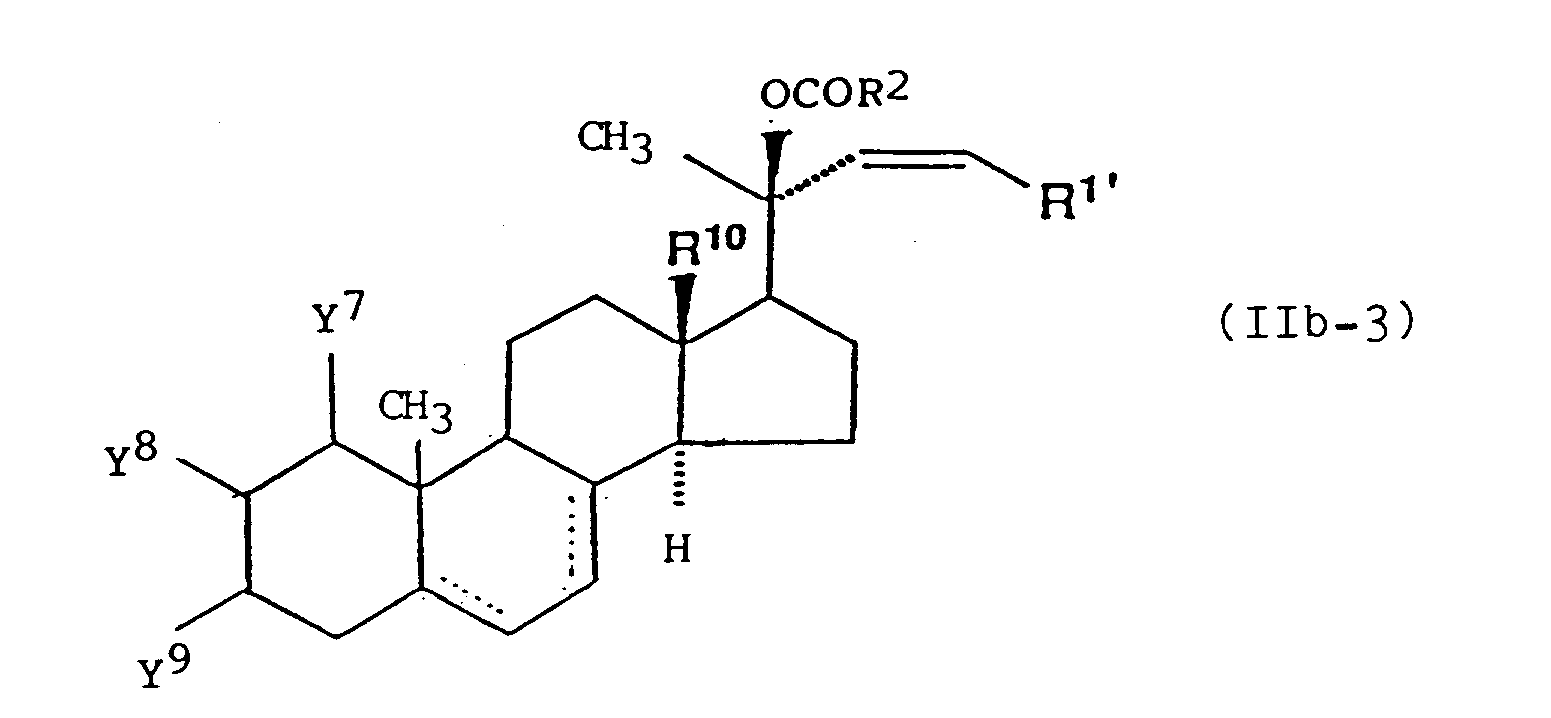
wherein Y7 and Y9 each represent a hydrogen atom or a hydroxyl group which may be optionally protected;
Applications Claiming Priority (6)
| Application Number | Priority Date | Filing Date | Title |
|---|---|---|---|
| JP12118292 | 1992-04-14 | ||
| JP121182/92 | 1992-04-14 | ||
| JP12118292 | 1992-04-14 | ||
| JP205938/92 | 1992-07-08 | ||
| JP20593892 | 1992-07-08 | ||
| JP20593892 | 1992-07-08 |
Publications (3)
| Publication Number | Publication Date |
|---|---|
| EP0566030A2 true EP0566030A2 (en) | 1993-10-20 |
| EP0566030A3 EP0566030A3 (en) | 1994-12-07 |
| EP0566030B1 EP0566030B1 (en) | 1999-11-10 |
Family
ID=26458601
Family Applications (1)
| Application Number | Title | Priority Date | Filing Date |
|---|---|---|---|
| EP93105826A Expired - Lifetime EP0566030B1 (en) | 1992-04-14 | 1993-04-08 | Process for producing optically active olefin |
Country Status (6)
| Country | Link |
|---|---|
| US (1) | US5600047A (en) |
| EP (1) | EP0566030B1 (en) |
| JP (1) | JP3227263B2 (en) |
| DE (1) | DE69326972T2 (en) |
| DK (1) | DK0566030T3 (en) |
| IL (1) | IL105373A (en) |
Families Citing this family (1)
| Publication number | Priority date | Publication date | Assignee | Title |
|---|---|---|---|---|
| US10882035B2 (en) | 2016-05-10 | 2021-01-05 | Promega Corporation | Palladium catalysts with improved performance in biological environments |
Family Cites Families (3)
| Publication number | Priority date | Publication date | Assignee | Title |
|---|---|---|---|---|
| US4051157A (en) * | 1976-01-05 | 1977-09-27 | Wisconsin Alumni Research Foundation | Catalytic allylic alkylation |
| US4419287A (en) * | 1980-12-16 | 1983-12-06 | The Regents Of The University Of California | Stereocontrolled synthesis of steroidal side chains |
| GB8914963D0 (en) * | 1989-06-29 | 1989-08-23 | Leo Pharm Prod Ltd | Chemical compounds |
-
1993
- 1993-04-08 EP EP93105826A patent/EP0566030B1/en not_active Expired - Lifetime
- 1993-04-08 DK DK93105826T patent/DK0566030T3/en active
- 1993-04-08 DE DE69326972T patent/DE69326972T2/en not_active Expired - Fee Related
- 1993-04-14 IL IL105373A patent/IL105373A/en not_active IP Right Cessation
- 1993-04-14 JP JP08766493A patent/JP3227263B2/en not_active Expired - Fee Related
-
1995
- 1995-06-02 US US08/459,637 patent/US5600047A/en not_active Expired - Fee Related
Also Published As
| Publication number | Publication date |
|---|---|
| IL105373A0 (en) | 1993-08-18 |
| US5600047A (en) | 1997-02-04 |
| DE69326972T2 (en) | 2000-05-18 |
| IL105373A (en) | 1998-02-08 |
| EP0566030B1 (en) | 1999-11-10 |
| DK0566030T3 (en) | 2000-04-25 |
| JPH0680589A (en) | 1994-03-22 |
| DE69326972D1 (en) | 1999-12-16 |
| EP0566030A3 (en) | 1994-12-07 |
| JP3227263B2 (en) | 2001-11-12 |
Similar Documents
| Publication | Publication Date | Title |
|---|---|---|
| EP3967700B1 (en) | Method for preparing cholesterol, derivative thereof, and analog thereof | |
| US6590111B2 (en) | Selective reduction of alkyne compounds | |
| RU2318805C2 (en) | Method for preparing retinal or adduct (complete-e)-retinal with hydroquinone and intermediate substances | |
| EP0270867A1 (en) | Steroid derivatives and processes of preparing same | |
| CN110885304B (en) | Preparation method of deuterated calcitriol and intermediate thereof | |
| EP0015122B1 (en) | New 25-hydroxy-24-oxocholestane derivatives and preparation thereof | |
| EP0566030B1 (en) | Process for producing optically active olefin | |
| EP3505506B1 (en) | Method for producing 3,7-dimethyl-7-octenol and method for producing 3,7-dimethyl-7-octenyl carboxylate compound | |
| JPH0586021A (en) | 10-oxovitamin D analog | |
| CA3136913A1 (en) | Improved, cost effective process for synthesis of vitamin d3 and its analogue calcifediol from ergosterol | |
| WO2021071372A1 (en) | Process of vitamin k2 derivatives preparation | |
| EP2011781B1 (en) | Process for production of indene derivative, and intermediate for production of the derivative | |
| KR101117246B1 (en) | Process for obtaining vitamin D derivatives from monohalogenovinyl compounds | |
| KR100679115B1 (en) | Method for preparing 1-alpha-hydroxycholecalciferol derivative | |
| US4159998A (en) | Process for the preparation of 2-(7-hydroxyalkyl)-4R, 4S or 4RS -hydroxy-cyclopent-2-enone | |
| JPH047755B2 (en) | ||
| US2779791A (en) | Alkinyl and alkenyl substituted dicyclohexyl ethane compounds | |
| KR100247555B1 (en) | A process for preparing intermediate of steroid | |
| EP0534582A1 (en) | Methylation or ethylation agent and process for an 1,4-addition of a methyl- or ethylgroup to an alpha, beta-insaturated ketogroup | |
| CN118852313A (en) | A method for preparing triterpenoid compounds | |
| CA2156304A1 (en) | Process for producing intermediate for 13,14-didehydroprostaglandin e | |
| IE44292B1 (en) | Cyclopentanol derivatives | |
| JPH0640954A (en) | Production of propene derivative | |
| JPH0649021A (en) | Method for producing prostaglandin F2α | |
| JPH0413695A (en) | Production of steroid derivative |
Legal Events
| Date | Code | Title | Description |
|---|---|---|---|
| PUAI | Public reference made under article 153(3) epc to a published international application that has entered the european phase |
Free format text: ORIGINAL CODE: 0009012 |
|
| AK | Designated contracting states |
Kind code of ref document: A2 Designated state(s): CH DE DK FR GB IT LI NL |
|
| PUAL | Search report despatched |
Free format text: ORIGINAL CODE: 0009013 |
|
| AK | Designated contracting states |
Kind code of ref document: A3 Designated state(s): CH DE DK FR GB IT LI NL |
|
| 17P | Request for examination filed |
Effective date: 19950227 |
|
| 17Q | First examination report despatched |
Effective date: 19980907 |
|
| GRAG | Despatch of communication of intention to grant |
Free format text: ORIGINAL CODE: EPIDOS AGRA |
|
| GRAG | Despatch of communication of intention to grant |
Free format text: ORIGINAL CODE: EPIDOS AGRA |
|
| GRAG | Despatch of communication of intention to grant |
Free format text: ORIGINAL CODE: EPIDOS AGRA |
|
| GRAH | Despatch of communication of intention to grant a patent |
Free format text: ORIGINAL CODE: EPIDOS IGRA |
|
| GRAH | Despatch of communication of intention to grant a patent |
Free format text: ORIGINAL CODE: EPIDOS IGRA |
|
| GRAA | (expected) grant |
Free format text: ORIGINAL CODE: 0009210 |
|
| AK | Designated contracting states |
Kind code of ref document: B1 Designated state(s): CH DE DK FR GB IT LI NL |
|
| PG25 | Lapsed in a contracting state [announced via postgrant information from national office to epo] |
Ref country code: NL Free format text: LAPSE BECAUSE OF FAILURE TO SUBMIT A TRANSLATION OF THE DESCRIPTION OR TO PAY THE FEE WITHIN THE PRESCRIBED TIME-LIMIT Effective date: 19991110 Ref country code: FR Free format text: LAPSE BECAUSE OF FAILURE TO SUBMIT A TRANSLATION OF THE DESCRIPTION OR TO PAY THE FEE WITHIN THE PRESCRIBED TIME-LIMIT Effective date: 19991110 |
|
| REG | Reference to a national code |
Ref country code: CH Ref legal event code: EP |
|
| ITF | It: translation for a ep patent filed | ||
| REF | Corresponds to: |
Ref document number: 69326972 Country of ref document: DE Date of ref document: 19991216 |
|
| REG | Reference to a national code |
Ref country code: CH Ref legal event code: NV Representative=s name: BOVARD AG PATENTANWAELTE |
|
| NLV1 | Nl: lapsed or annulled due to failure to fulfill the requirements of art. 29p and 29m of the patents act | ||
| EN | Fr: translation not filed | ||
| REG | Reference to a national code |
Ref country code: DK Ref legal event code: T3 |
|
| PLBE | No opposition filed within time limit |
Free format text: ORIGINAL CODE: 0009261 |
|
| 26N | No opposition filed | ||
| REG | Reference to a national code |
Ref country code: GB Ref legal event code: IF02 |
|
| PGFP | Annual fee paid to national office [announced via postgrant information from national office to epo] |
Ref country code: GB Payment date: 20030402 Year of fee payment: 11 |
|
| PGFP | Annual fee paid to national office [announced via postgrant information from national office to epo] |
Ref country code: DK Payment date: 20030416 Year of fee payment: 11 Ref country code: CH Payment date: 20030416 Year of fee payment: 11 |
|
| PGFP | Annual fee paid to national office [announced via postgrant information from national office to epo] |
Ref country code: DE Payment date: 20030417 Year of fee payment: 11 |
|
| PG25 | Lapsed in a contracting state [announced via postgrant information from national office to epo] |
Ref country code: GB Free format text: LAPSE BECAUSE OF NON-PAYMENT OF DUE FEES Effective date: 20040408 |
|
| PG25 | Lapsed in a contracting state [announced via postgrant information from national office to epo] |
Ref country code: LI Free format text: LAPSE BECAUSE OF NON-PAYMENT OF DUE FEES Effective date: 20040430 Ref country code: DK Free format text: LAPSE BECAUSE OF NON-PAYMENT OF DUE FEES Effective date: 20040430 Ref country code: CH Free format text: LAPSE BECAUSE OF NON-PAYMENT OF DUE FEES Effective date: 20040430 |
|
| PG25 | Lapsed in a contracting state [announced via postgrant information from national office to epo] |
Ref country code: DE Free format text: LAPSE BECAUSE OF NON-PAYMENT OF DUE FEES Effective date: 20041103 |
|
| GBPC | Gb: european patent ceased through non-payment of renewal fee |
Effective date: 20040408 |
|
| REG | Reference to a national code |
Ref country code: CH Ref legal event code: PL |
|
| PG25 | Lapsed in a contracting state [announced via postgrant information from national office to epo] |
Ref country code: IT Free format text: LAPSE BECAUSE OF NON-PAYMENT OF DUE FEES;WARNING: LAPSES OF ITALIAN PATENTS WITH EFFECTIVE DATE BEFORE 2007 MAY HAVE OCCURRED AT ANY TIME BEFORE 2007. THE CORRECT EFFECTIVE DATE MAY BE DIFFERENT FROM THE ONE RECORDED. Effective date: 20050408 |