EP0564045B1 - Composite membrane and its use for the dehydratation of organic solvents or concentrated acetic acid solutions - Google Patents
Composite membrane and its use for the dehydratation of organic solvents or concentrated acetic acid solutions Download PDFInfo
- Publication number
- EP0564045B1 EP0564045B1 EP93200916A EP93200916A EP0564045B1 EP 0564045 B1 EP0564045 B1 EP 0564045B1 EP 93200916 A EP93200916 A EP 93200916A EP 93200916 A EP93200916 A EP 93200916A EP 0564045 B1 EP0564045 B1 EP 0564045B1
- Authority
- EP
- European Patent Office
- Prior art keywords
- composite membrane
- layer
- support layer
- acetic acid
- membrane according
- Prior art date
- Legal status (The legal status is an assumption and is not a legal conclusion. Google has not performed a legal analysis and makes no representation as to the accuracy of the status listed.)
- Expired - Lifetime
Links
- 239000012528 membrane Substances 0.000 title claims abstract description 67
- 239000002131 composite material Substances 0.000 title claims abstract description 32
- 239000003960 organic solvent Substances 0.000 title claims abstract description 8
- QTBSBXVTEAMEQO-UHFFFAOYSA-N Acetic acid Chemical compound CC(O)=O QTBSBXVTEAMEQO-UHFFFAOYSA-N 0.000 title claims description 81
- 208000005156 Dehydration Diseases 0.000 title 1
- 239000004800 polyvinyl chloride Substances 0.000 claims abstract description 49
- 229920000915 polyvinyl chloride Polymers 0.000 claims abstract description 48
- 229920002239 polyacrylonitrile Polymers 0.000 claims abstract description 43
- XLYOFNOQVPJJNP-UHFFFAOYSA-N water Substances O XLYOFNOQVPJJNP-UHFFFAOYSA-N 0.000 claims abstract description 28
- 229920000642 polymer Polymers 0.000 claims abstract description 23
- 230000018044 dehydration Effects 0.000 claims abstract description 20
- 238000006297 dehydration reaction Methods 0.000 claims abstract description 20
- 230000035699 permeability Effects 0.000 claims abstract description 10
- 239000004696 Poly ether ether ketone Substances 0.000 claims abstract description 6
- 229920002530 polyetherether ketone Polymers 0.000 claims abstract description 6
- 229920002492 poly(sulfone) Polymers 0.000 claims abstract description 4
- 229920008285 Poly(ether ketone) PEK Polymers 0.000 claims abstract description 3
- 229920002401 polyacrylamide Polymers 0.000 claims abstract description 3
- 229920006393 polyether sulfone Polymers 0.000 claims abstract description 3
- 239000012466 permeate Substances 0.000 claims description 12
- 229920000728 polyester Polymers 0.000 claims description 3
- 239000010410 layer Substances 0.000 description 76
- 239000000203 mixture Substances 0.000 description 19
- 230000004907 flux Effects 0.000 description 15
- ZMXDDKWLCZADIW-UHFFFAOYSA-N N,N-Dimethylformamide Chemical compound CN(C)C=O ZMXDDKWLCZADIW-UHFFFAOYSA-N 0.000 description 14
- LFQSCWFLJHTTHZ-UHFFFAOYSA-N Ethanol Chemical compound CCO LFQSCWFLJHTTHZ-UHFFFAOYSA-N 0.000 description 9
- 239000011521 glass Substances 0.000 description 7
- 238000005373 pervaporation Methods 0.000 description 7
- 238000010409 ironing Methods 0.000 description 6
- 238000000034 method Methods 0.000 description 6
- VLKZOEOYAKHREP-UHFFFAOYSA-N n-Hexane Chemical compound CCCCCC VLKZOEOYAKHREP-UHFFFAOYSA-N 0.000 description 6
- 239000011148 porous material Substances 0.000 description 6
- 238000000926 separation method Methods 0.000 description 6
- 239000011248 coating agent Substances 0.000 description 5
- 238000000576 coating method Methods 0.000 description 5
- 238000003618 dip coating Methods 0.000 description 5
- WYURNTSHIVDZCO-UHFFFAOYSA-N Tetrahydrofuran Chemical compound C1CCOC1 WYURNTSHIVDZCO-UHFFFAOYSA-N 0.000 description 4
- 239000007788 liquid Substances 0.000 description 4
- 239000000463 material Substances 0.000 description 4
- 239000002904 solvent Substances 0.000 description 4
- 230000007423 decrease Effects 0.000 description 3
- 238000001035 drying Methods 0.000 description 3
- KFZMGEQAYNKOFK-UHFFFAOYSA-N Isopropanol Chemical compound CC(C)O KFZMGEQAYNKOFK-UHFFFAOYSA-N 0.000 description 2
- 239000004372 Polyvinyl alcohol Substances 0.000 description 2
- 239000011247 coating layer Substances 0.000 description 2
- XBDQKXXYIPTUBI-UHFFFAOYSA-N dimethylselenoniopropionate Natural products CCC(O)=O XBDQKXXYIPTUBI-UHFFFAOYSA-N 0.000 description 2
- BDAGIHXWWSANSR-UHFFFAOYSA-N methanoic acid Natural products OC=O BDAGIHXWWSANSR-UHFFFAOYSA-N 0.000 description 2
- 229920006254 polymer film Polymers 0.000 description 2
- 229920005597 polymer membrane Polymers 0.000 description 2
- 229920002451 polyvinyl alcohol Polymers 0.000 description 2
- 239000000126 substance Substances 0.000 description 2
- OSWFIVFLDKOXQC-UHFFFAOYSA-N 4-(3-methoxyphenyl)aniline Chemical compound COC1=CC=CC(C=2C=CC(N)=CC=2)=C1 OSWFIVFLDKOXQC-UHFFFAOYSA-N 0.000 description 1
- 239000012159 carrier gas Substances 0.000 description 1
- 229920002301 cellulose acetate Polymers 0.000 description 1
- 230000001112 coagulating effect Effects 0.000 description 1
- 238000010276 construction Methods 0.000 description 1
- 229920001577 copolymer Polymers 0.000 description 1
- 230000007547 defect Effects 0.000 description 1
- 238000009792 diffusion process Methods 0.000 description 1
- 238000001704 evaporation Methods 0.000 description 1
- 230000008020 evaporation Effects 0.000 description 1
- 238000001914 filtration Methods 0.000 description 1
- 235000019253 formic acid Nutrition 0.000 description 1
- 230000035515 penetration Effects 0.000 description 1
- 229920002689 polyvinyl acetate Polymers 0.000 description 1
- 239000011118 polyvinyl acetate Substances 0.000 description 1
- 235000019260 propionic acid Nutrition 0.000 description 1
- IUVKMZGDUIUOCP-BTNSXGMBSA-N quinbolone Chemical compound O([C@H]1CC[C@H]2[C@H]3[C@@H]([C@]4(C=CC(=O)C=C4CC3)C)CC[C@@]21C)C1=CCCC1 IUVKMZGDUIUOCP-BTNSXGMBSA-N 0.000 description 1
Images
Classifications
-
- B—PERFORMING OPERATIONS; TRANSPORTING
- B01—PHYSICAL OR CHEMICAL PROCESSES OR APPARATUS IN GENERAL
- B01D—SEPARATION
- B01D61/00—Processes of separation using semi-permeable membranes, e.g. dialysis, osmosis or ultrafiltration; Apparatus, accessories or auxiliary operations specially adapted therefor
- B01D61/36—Pervaporation; Membrane distillation; Liquid permeation
- B01D61/362—Pervaporation
-
- B—PERFORMING OPERATIONS; TRANSPORTING
- B01—PHYSICAL OR CHEMICAL PROCESSES OR APPARATUS IN GENERAL
- B01D—SEPARATION
- B01D71/00—Semi-permeable membranes for separation processes or apparatus characterised by the material; Manufacturing processes specially adapted therefor
- B01D71/06—Organic material
- B01D71/30—Polyalkenyl halides
- B01D71/301—Polyvinylchloride
Definitions
- the invention relates to a composite membrane with a porous polymer support layer and a polymer top layer.
- Such a composite membrane is known from DE-A-3.220.570.
- the known membrane comprises a porous support layer of polyacrylonitrile, polysulfon, etc., a top layer of polyvinyl alcohol or cellulose acetate, whereby the support layer usually is applied to a carrier layer such as a woven or non-woven material.
- a carrier layer such as a woven or non-woven material.
- the top layer is responsible for the separation; nothing has been said about a possible contribution of the support layer to the selectivity.
- US-A-49 31 181 discloses a composite membrane with a microporous polymer support layer and a polymer top layer which is suitable for the dehydration of organic solvents.
- the invention now contemplates to provide a membrane, which is especially suitable for the dehydration of organic solvents, especially acetic acid.
- the present invention provides a composite membrane with a porous polymer support layer and a polymer top layer, characterized in that the porous polymer support layer is polyacrylonitrile (PAN), polyacrylamide, polyetheretherketone (PEEK), polyetherketone (PEK), polysulfon or polyethersulfon, whereas the polymer top layer is a dense layer comprising polyvinyl chloride having selective water permeability.
- PAN polyacrylonitrile
- PEEK polyetheretherketone
- PEK polyetherketone
- polysulfon or polyethersulfon whereas the polymer top layer is a dense layer comprising polyvinyl chloride having selective water permeability.
- layer comprising polyvinyl chloride means that it mainly consists of polyvinyl chloride or instead thereof a copolymer of PVC or modified PVC is applied.
- polyvinyl chloride small amounts of another material may be present, such as polyvinyl acetate, polyvinyl alcohol, etc.
- This combination of the abovementioned porous polymer support layer and a dense top layer comprising polyvinyl chloride is particularly suitable for the dehydration of organic solvents at a high selectivity and a high flux.
- a composite membrane with a porous polyacrylonitrile support layer and a dense polyvinyl chloride top layer is extremely suitable for the dehydration of concentrated acetic acid solutions at a temperature of 80 to 90°C through a pervaporation process.
- This membrane appears to be especially resistant to such an agressive solution at 80 to 90°C under guarantee of a high selectivity and a high flux, which is of great commercial importance in dehydration of acetic acid solutions in an economic manner.
- the composite membrane according to the invention is supported by a carrier layer, whereby the support layer rests on the carrier layer.
- the construction of such a composite membrane is therefore top layer, support layer and carrier layer. This is especially important in industrial applications of such composite membranes.
- non-woven polyester is taken for the carrier layer, whereby, however, also other suitable materials may be applied.
- the porous support layer possesses a surface porosity of 0 to 5 x 10 -2 m 2 /m 2 and preferably a surface porosity of 0 to 1 x 10 -3 m 2 /m 2 .
- the thickness of the top layer of the composite membrane according to the invention amounts to 0,05 to 5 ⁇ m, while a thickness of 0,1 to 5 ⁇ m is preferred.
- a partial pressure difference is created over the membrane being the operating force for substance transport, through which the components of the liquid mixture may dissolve in the membrane and may diffuse through the membrane.
- solubility and diffusion rate there will permeate more from a certain component per unit of time as compared with the other component or components.
- the permeate leaves as a vapour the membrane and is subsequently condensed and collected. In this manner components of a liquid mixture may be separated from each other. This form of separation may only take place optimally if the separating layer of the membrane is densely packed and free of defects (leaks).
- Pervaporation membranes are characterized in their selectivity and permeability, both properties depending on the material.
- the permeability divided by the membrane thickess gives the flux, usually expressed in the units kg/m 2 .hour.
- An ideal pervaporation membrane has a high selectivity for the component to be separated with associated therewith a high membrane flux.
- Pervaporation is an excellent separation process for the separation of mixtures forming an azeotrope or other mixtures being difficult to separate by means of destillation, like e.g. isomeric mixtures, water/ethanol, water/acetic acid, water/formic acid, etc.
- polyvinyl chloride (PVC) and polyacrylonitrile (PAN) appear to be extremely selective and also possess a good chemical resistance in the dehydration of organic solvents like ethanol, isopropanol, acetic acid and propionic acid.
- organic solvents like ethanol, isopropanol, acetic acid and propionic acid.
- the total membrane thickness should be as small as possible.
- Homogeneous membranes thinner than ⁇ 5 ⁇ m loose their mechanical strength and for the dehydration of acetic acid it also appears that the selectivity of PVC and PAN membranes decreases when the membrane gets thinner, see table A.
- a laminated membrane consisting of a dense, defect-free PVC film ironed on a dense, defect-free PAN-film, gives higher selectivities for the dehydration of acetic acid/water mixtures, especially with higher concentrations of acetic acid in the feed mixture, and it also appears that the selectivity is less depending on the thickness than with PVC and PAN alone, see table B and C.
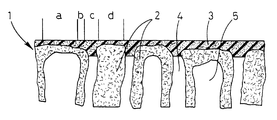
- the drawing is a schematic representation of a composite membrane according to the invention, however, without carrier layer.
- a microporous asymmetrical PAN membrane, which serves as support layer for an ultrathin PVC coating may give, depending on the structure of the PAN support layer, an increased selectivity.
- FIG. 1 represents the composite membrane according to the invention.
- the dense top layer 3 is applied on the porous support layer 2 with pores 4 and cavities 5 .
- the composite membrane 1 is globally to be divided in three different areas, i.e. a, b and c.
- the porosity of the support layer is relatively small and the support layer in area a is sufficiently thin, then the contribution of the support layer to the selectivity of the composite membrane will be relatively large. Since it may be expected that the selectivity of area a is larger than the selectivity of area c (table C), then the selectivity of the composite membrane will increase as the porosity of the support layer decreases. Depending on the penetration depth of the top layer in the pore and the thickness of the support layer in area a the flux of the composite membrane will also change as the porosity of the support layer decreases.
- the support layer being polyacrylonitrile (PAN)
- PAN polyacrylonitrile
- the support layer is made by dissolving the polymer in N,N-dimethylformamide (DMF) and applying by using an ironing machine a homogeneous thin layer on a non-woven and subsequently coagulating in a water bath.
- DMF N,N-dimethylformamide
- a porous support layer being attached to the non-woven arises.
- the PAN support layer is rinsed for one day with water it is submerged for 5 hours in an ethanol bath, followed by another 5 hours submersion in a hexane bath. Finally the PAN support layer is air-dried at room temperature.
- PAN concentration in the ironing solution By increasing the PAN concentration in the ironing solution a lower porosity may be reached.
- These PAN support membranes may be characterized by measuring the permeability of air at a certain feed pressure, by measuring the pore radius as well as the porosity.
- the PAN support layers When the PAN support layers are dry they may be provided by a PVC coating under provision of the preferred membrane according to the invention.
- the solvent being used in order to dissolve the PVC may not attack the structure of the support layer.
- Tetrahydrofurane a proper solvent for PVC, is such a solvent, which appears not to attack the structure of the support layer and which also properly moistens the PAN surface, so that a homogeneously distributed PVC coating layer is obtained.
- the PVC coating may be applied by means of ironing of a diluted (0.5-10% by weight) PVC solution using an ironing roll or by means of a dip-coating technique, whereby the support layer is submerged in a diluted (0,5 to 10% by weight) PVC solution in such a manner that only the top of the support layer is moistened.
- a diluted (0,5 to 10% by weight) PVC solution for support layers of 25 by 20 cm this may be executed in practice by luting the support layer at the bottom (only at the marging) to a glass plate in such a manner that the PVC solution cannot moisten the support layer. Then the glass plate is located vertically in a glass box, which is only open on the top and is provided with a tap at the bottom.
- a polymer solution is prepared by dissolving 20% by weight of polyacrylonitrile (PAN A7, DuPont) in N,N-dimethylformamide.
- PAN A7 polyacrylonitrile
- N,N-dimethylformamide N,N-dimethylformamide
- a thin homogeneously distributed layer was applied on a polyester non-woven after filtration and deaeration using an ironing machine with an ironing thickness of 0.25 mm. After a very short time this polymer film was coagulated in a water bath having a temperature of 17.5°C. After that the thus obtained support layer was rinsed in water for more than 1 day, followed by submersion in an ethanol bath for 5 hours, followed by submersion in a hexane bath for another 5 hours and this was air-dried.
- porous PAN support layer was obtained with a porosity of 1.65 x 10 -4 m 2 /m 2 , an average pore radius of 21.4 nm and an air permeability of 0.414 L/cm 2 .min at a feed pressure of 2 bar. After complete drying of the support layer this was provided with a thin PVC layer using dip-coating as described hereinbefore. By using a 5% by weight PVC in tetrahydrofurane solution a PVC top layer of 0.8 ⁇ m was obtained.
- This membrane is subsequently measured through for 8 hours for the dehydration of acetic acid at 80°C, whereby on the permeate side a pressure was applied of 0,133 - 0,665 mbar (0.1 to 0.5 mmHg).
- a polymer solution was prepared by dissolving 25% by weight of polyacrilonitrile (PAN A7, DuPont) in N,N-dimethylformamide. According to the same procedure as in Example 1 a porous PAN support layer was obtained with a porosity of 6.24 x 10 -5 m 2 m 2 , an average pore radius of 10.1 nm and an air permeability of 0.096 L/cm 2 .min at a feed pressure of 2 bar. After complete drying of the support layer this was provided with a thin PVC-layer using dip coating as described hereinbefore. By using a 5% by weight of PVC in tetrahydrofurane solution a PVC top layer was obtained of 1.0 ⁇ m.
- This membrane was subsequently measured through for 8 hours for the dehydration of acetic acid at 80°C, whereby at the permeate side a pressure of 0,133 - 0,665 mbar (0.1 to 0.5) mmHg was applied.
- Example 2 A same support layer as in Example 2 was used and in the same manner provided with a PVC coating on the understanding that now a 3% by weight PVC solution was used. In this manner a composite membrane was obtained with a top layer of 0.3 ⁇ m. This membrane was subsequently measured through for 8 hours for the dehydration of acetic acid at 80°C, whereby at the permeate side a pressure of 0,133 - 0,665 mbar (0.1 to 0.5 mmHg) was applied.
- a polymer solution was obtained by dissolving 27.5% by weight of polyacrylonitrile (PAN A7, DuPont) in N,N-dimethylformamide.
- PAN A7 polyacrylonitrile
- a porous PAN support layer was obtained with a porosity of 7.54 x 10 -6 m 2 /m 2 , an average pore radius of 8.2 nm and an air permeability of 0.032 L/cm 2 .min at a feed pressure of 2 bar. After complete drying of the support layer this was provided with a thin PVC layer using dip-coating as described hereinbefore.
- a top layer was obtained of 0.5 ⁇ m.
- This membrane was subsequently measured through for 8 hours for the dehydration of acetic acid at 80°C, whereby at the permeate side a pressure of 0,133 - 0,665 mbar (0.1 to 0.5 mmHg) was applied.
Landscapes
- Chemical & Material Sciences (AREA)
- Chemical Kinetics & Catalysis (AREA)
- Engineering & Computer Science (AREA)
- Water Supply & Treatment (AREA)
- Separation Using Semi-Permeable Membranes (AREA)
- Laminated Bodies (AREA)
Abstract
Description
- The invention relates to a composite membrane with a porous polymer support layer and a polymer top layer.
- Such a composite membrane is known from DE-A-3.220.570. The known membrane comprises a porous support layer of polyacrylonitrile, polysulfon, etc., a top layer of polyvinyl alcohol or cellulose acetate, whereby the support layer usually is applied to a carrier layer such as a woven or non-woven material. According to DE-A-3.220.570 the top layer is responsible for the separation; nothing has been said about a possible contribution of the support layer to the selectivity.
- US-A-49 31 181 (D1) discloses a composite membrane with a microporous polymer support layer and a polymer top layer which is suitable for the dehydration of organic solvents.
- The invention now contemplates to provide a membrane, which is especially suitable for the dehydration of organic solvents, especially acetic acid.
- To this end the present invention provides a composite membrane with a porous polymer support layer and a polymer top layer, characterized in that the porous polymer support layer is polyacrylonitrile (PAN), polyacrylamide, polyetheretherketone (PEEK), polyetherketone (PEK), polysulfon or polyethersulfon, whereas the polymer top layer is a dense layer comprising polyvinyl chloride having selective water permeability.
- The term layer comprising polyvinyl chloride means that it mainly consists of polyvinyl chloride or instead thereof a copolymer of PVC or modified PVC is applied.
- However, besides polyvinyl chloride small amounts of another material may be present, such as polyvinyl acetate, polyvinyl alcohol, etc.
- Usually polyvinyl chloride without other polymers is preferred.
- This combination of the abovementioned porous polymer support layer and a dense top layer comprising polyvinyl chloride is particularly suitable for the dehydration of organic solvents at a high selectivity and a high flux.
- Surprisingly it has been found according to the invention that a composite membrane with a porous polyacrylonitrile support layer and a dense polyvinyl chloride top layer is extremely suitable for the dehydration of concentrated acetic acid solutions at a temperature of 80 to 90°C through a pervaporation process. This membrane appears to be especially resistant to such an agressive solution at 80 to 90°C under guarantee of a high selectivity and a high flux, which is of great commercial importance in dehydration of acetic acid solutions in an economic manner.
- At many applications it is desired that the composite membrane according to the invention is supported by a carrier layer, whereby the support layer rests on the carrier layer. The construction of such a composite membrane is therefore top layer, support layer and carrier layer. This is especially important in industrial applications of such composite membranes.
- Usually a non-woven polyester is taken for the carrier layer, whereby, however, also other suitable materials may be applied.
- In order to obtain good results the porous support layer possesses a surface porosity of 0 to 5 x 10⁻² m2/m2 and preferably a surface porosity of 0 to 1 x 10⁻³ m2/m2.
- The thickness of the top layer of the composite membrane according to the invention amounts to 0,05 to 5 µm, while a thickness of 0,1 to 5 µm is preferred.
- In the dehydration of acetic acid solutions the process is carried out at 80 to 90°C.
- Pervaporation is a separation process, in which a liquid mixture is contacted with a polymer membrane (= polymer film) and whereby on the other side of the membrane an inert carrier gas is flown along or a vacuum is applied. In this manner a partial pressure difference is created over the membrane being the operating force for substance transport, through which the components of the liquid mixture may dissolve in the membrane and may diffuse through the membrane. By a difference in solubility and diffusion rate there will permeate more from a certain component per unit of time as compared with the other component or components. The permeate leaves as a vapour the membrane and is subsequently condensed and collected. In this manner components of a liquid mixture may be separated from each other. This form of separation may only take place optimally if the separating layer of the membrane is densely packed and free of defects (leaks).
- Pervaporation membranes are characterized in their selectivity and permeability, both properties depending on the material. The selectivity (α) is defined as:

and the permeability is defined as being the amount of component, which permeates the membrane per square meter membrane surface, per unit of time, multiplied by the membrane thickness. The permeability divided by the membrane thickess gives the flux, usually expressed in the units kg/m2.hour. An ideal pervaporation membrane has a high selectivity for the component to be separated with associated therewith a high membrane flux. - Pervaporation is an excellent separation process for the separation of mixtures forming an azeotrope or other mixtures being difficult to separate by means of destillation, like e.g. isomeric mixtures, water/ethanol, water/acetic acid, water/formic acid, etc.
- As mentioned hereinbefore polyvinyl chloride (PVC) and polyacrylonitrile (PAN) appear to be extremely selective and also possess a good chemical resistance in the dehydration of organic solvents like ethanol, isopropanol, acetic acid and propionic acid. In order to obtain besides the high selectivity a flux being as high as possible, the total membrane thickness should be as small as possible. Homogeneous membranes thinner than ± 5 µm loose their mechanical strength and for the dehydration of acetic acid it also appears that the selectivity of PVC and PAN membranes decreases when the membrane gets thinner, see table A.
TABLE A Selectivity of PVC membranes as a function of the membrane thickness for dehydration of a 80/20% by weight of acetic acid/water mixture at 80°C. polymer membrane thickness (µm) concentration in permeate (water % by weight) selectivity flux (kg/m2.hour) PVC 17 99.5 796 0.017 PVC 11 99.4 663 0.035 PVC 9 99.3 567 0.039 PVC 3 98.3 231 0.149 PAN 31.5 99.9 2662 0.025 PAN 20 99.8 1996 0.040 PAN 6.5 98.7 304 0.115 PAN 3.5 89.0 32 0.216 - However, now it appears that a laminated membrane, consisting of a dense, defect-free PVC film ironed on a dense, defect-free PAN-film, gives higher selectivities for the dehydration of acetic acid/water mixtures, especially with higher concentrations of acetic acid in the feed mixture, and it also appears that the selectivity is less depending on the thickness than with PVC and PAN alone, see table B and C.
TABLE B Selectivity for PVC/PAN laminate membranes and PVC and PAN membranes as function of the feed concentration for the dehydration of an acetic acid/water mixture using pervaporation at 80°C PVC thickness (µm) PAN thickness (µm) Feed concentration (water % by weight) Permeate concentration (water % by weight Selectivity 4.5 4.5 40.20 99.80 742 4.5 4.5 29.50 99.90 2387 4.5 4.5 19.90 99.92 5027 4.5 4.5 2.10 99.30 6613 20 40.30 99.45 268 20 29.50 99.30 339 20 19.90 99.00 398 20 2.0 62.70 82 20 40.00 99.92 1874 20 29.70 99.91 2628 20 21.80 99.84 2238 20 1.80 83.70 280 TABLE C Selectivity for PVC/PAN laminate membranes as a function of the layer thickness for the dehydration of a 80/20 % by weight acetic acid/water mixture using pervaporation at 80°C PVC thickness (µm) PAN thickness (µm) Feed concentration (water % by weight) Permeate concentration (water % by weight Selectivity 2 11 20.00 99.90 3996 4.5 4.5 19.90 99.92 5027 3 3 21.10 99.00 370 1 2 21.20 98.90 334 - The invention is now further elucidated with reference to the drawing.
- The drawing is a schematic representation of a composite membrane according to the invention, however, without carrier layer.
- A microporous asymmetrical PAN membrane, which serves as support layer for an ultrathin PVC coating may give, depending on the structure of the PAN support layer, an increased selectivity.
- In the
drawing 1 represents the composite membrane according to the invention. On theporous support layer 2 withpores 4 andcavities 5 thedense top layer 3 is applied. - From the drawing it follows that the
composite membrane 1 is globally to be divided in three different areas, i.e. a, b and c. - If the porosity of the support layer is relatively small and the support layer in area a is sufficiently thin, then the contribution of the support layer to the selectivity of the composite membrane will be relatively large. Since it may be expected that the selectivity of area a is larger than the selectivity of area c (table C), then the selectivity of the composite membrane will increase as the porosity of the support layer decreases. Depending on the penetration depth of the top layer in the pore and the thickness of the support layer in area a the flux of the composite membrane will also change as the porosity of the support layer decreases.
- In case of the support layer being polyacrylonitrile (PAN) the support layer is made by dissolving the polymer in N,N-dimethylformamide (DMF) and applying by using an ironing machine a homogeneous thin layer on a non-woven and subsequently coagulating in a water bath. As a consequence of liquid-liquid separation in this manner a porous support layer being attached to the non-woven arises. After that the PAN support layer is rinsed for one day with water it is submerged for 5 hours in an ethanol bath, followed by another 5 hours submersion in a hexane bath. Finally the PAN support layer is air-dried at room temperature. By increasing the PAN concentration in the ironing solution a lower porosity may be reached. These PAN support membranes may be characterized by measuring the permeability of air at a certain feed pressure, by measuring the pore radius as well as the porosity.
- When the PAN support layers are dry they may be provided by a PVC coating under provision of the preferred membrane according to the invention. The solvent being used in order to dissolve the PVC may not attack the structure of the support layer. Tetrahydrofurane, a proper solvent for PVC, is such a solvent, which appears not to attack the structure of the support layer and which also properly moistens the PAN surface, so that a homogeneously distributed PVC coating layer is obtained.
- The PVC coating may be applied by means of ironing of a diluted (0.5-10% by weight) PVC solution using an ironing roll or by means of a dip-coating technique, whereby the support layer is submerged in a diluted (0,5 to 10% by weight) PVC solution in such a manner that only the top of the support layer is moistened. For support layers of 25 by 20 cm this may be executed in practice by luting the support layer at the bottom (only at the marging) to a glass plate in such a manner that the PVC solution cannot moisten the support layer. Then the glass plate is located vertically in a glass box, which is only open on the top and is provided with a tap at the bottom. By filling the glass box with a diluted (0.5 to 10% by weight) PVC solution the PAN surface (on the upper side) is moistened, after 5 to 10 minutes waiting the tap on the bottom of the glass box is opened and the PVC solution slowly flows out of the glass box, leaving a thin PVC layer behind on the PAN support layer. After evaporation of the solvent the composite membrane may be removed from the glass plate and is then ready for use. In this manner PVC coating layers of 0.1 to 5 µm may be applied. In the literature dip-coating techniques have been described whereby many metres of support layer in one go may be treated and provided with a coating.
- The invention will now be further elucidated with reference to the following examples, to which the invention is not limited.
- A polymer solution is prepared by dissolving 20% by weight of polyacrylonitrile (PAN A7, DuPont) in N,N-dimethylformamide. Of this polymer solution a thin homogeneously distributed layer was applied on a polyester non-woven after filtration and deaeration using an ironing machine with an ironing thickness of 0.25 mm. After a very short time this polymer film was coagulated in a water bath having a temperature of 17.5°C. After that the thus obtained support layer was rinsed in water for more than 1 day, followed by submersion in an ethanol bath for 5 hours, followed by submersion in a hexane bath for another 5 hours and this was air-dried. Thus a porous PAN support layer was obtained with a porosity of 1.65 x 10⁻⁴ m2/m2, an average pore radius of 21.4 nm and an air permeability of 0.414 L/cm2.min at a feed pressure of 2 bar. After complete drying of the support layer this was provided with a thin PVC layer using dip-coating as described hereinbefore. By using a 5% by weight PVC in tetrahydrofurane solution a PVC top layer of 0.8 µm was obtained. This membrane is subsequently measured through for 8 hours for the dehydration of acetic acid at 80°C, whereby on the permeate side a pressure was applied of 0,133 - 0,665 mbar (0.1 to 0.5 mmHg). By using a feed composition of 79.70% by weight of acetic acid and 20.30% by weight of water a selectivity was obtained of α = 112 and a flux of 0.527 kg/m2.hour. Of a feed composition of 98.60% by weight of acetic acid and 1.40% by weight of water a selectivity was obtained of α = 74 and a flux of 0.277 kg/m2.hour.
- A polymer solution was prepared by dissolving 25% by weight of polyacrilonitrile (PAN A7, DuPont) in N,N-dimethylformamide. According to the same procedure as in Example 1 a porous PAN support layer was obtained with a porosity of 6.24 x 10⁻⁵ m2m2, an average pore radius of 10.1 nm and an air permeability of 0.096 L/cm2.min at a feed pressure of 2 bar. After complete drying of the support layer this was provided with a thin PVC-layer using dip coating as described hereinbefore. By using a 5% by weight of PVC in tetrahydrofurane solution a PVC top layer was obtained of 1.0 µm. This membrane was subsequently measured through for 8 hours for the dehydration of acetic acid at 80°C, whereby at the permeate side a pressure of 0,133 - 0,665 mbar (0.1 to 0.5) mmHg was applied. By using a feed composition of 79.40% by weight of acetic acid and 20.60% by weight of water a selectivity was obtained of α = 180 and a flux of 0.364 kg/m2.hour. By using a feed composition of 98.50% by weight of acetic acid and 1.50% by weight of water a selectivity was obtained of α = 318 and a flux of 0.126 kg/m2.hour.
- A same support layer as in Example 2 was used and in the same manner provided with a PVC coating on the understanding that now a 3% by weight PVC solution was used. In this manner a composite membrane was obtained with a top layer of 0.3 µm. This membrane was subsequently measured through for 8 hours for the dehydration of acetic acid at 80°C, whereby at the permeate side a pressure of 0,133 - 0,665 mbar (0.1 to 0.5 mmHg) was applied. By using a feed composition of 79.60% by weight of acetic acid and 20.40% by weight of water a selectivity was obtained of α = 182 and a flux of 0.742 kg/m2.hour. By using a feed composition of 98.00% by weight of acetic acid and 2.00% by weight of water a selectivity was obtained of α = 206 and a flux of 0.153 kg/m2.hour.
- A polymer solution was obtained by dissolving 27.5% by weight of polyacrylonitrile (PAN A7, DuPont) in N,N-dimethylformamide. According to the same procedure as in Example I a porous PAN support layer was obtained with a porosity of 7.54 x 10⁻⁶ m2/m2, an average pore radius of 8.2 nm and an air permeability of 0.032 L/cm2.min at a feed pressure of 2 bar. After complete drying of the support layer this was provided with a thin PVC layer using dip-coating as described hereinbefore. By using a 3% by weight of PVC in tetrahydrofurane solution a top layer was obtained of 0.5 µm. This membrane was subsequently measured through for 8 hours for the dehydration of acetic acid at 80°C, whereby at the permeate side a pressure of 0,133 - 0,665 mbar (0.1 to 0.5 mmHg) was applied. By using a feed composition of 79.80% by weight of acetic acid and 20.20% by weight of water a selectivity was obtained of α = 274 and a flux of 0.558 kg/m2.hour. Using a feed composition of 98.07% by weight of acetic acid and 1.93% by weight of water a selectivity was obtained of α = 261 and a flux of 0.140 kg/m2.hour.
Claims (12)
- Composite membrane with a porous polymer support layer and a polymer top layer, characterized in that the porous polymer support layer is polyacrylonitrile (PAN), polyacrylamide, polyetheretherketone (PEEK), polyetherketone (PEK), polysulfon or polyethersulfon, whereas the polymer top layer is a dense layer comprising polyvinyl chloride having selective water permeability.
- Composite membrane according to claim 1, characterized in that the membrane is provided with a porous polyacrylonitrile support layer and a polyvinyl chloride top layer.
- Composite membrane accoreing to claim 1 or 2, characterized in that the support layer is present on a carrier layer.
- Composite membrane according to claim 3, characterized in that the carrier layer is a polyester non-woven.
- Composite membrane according to claims 1 to 4, characterized in that the porous support layer has a surface porosity of 0 to 5 x 10⁻² m2/m2.
- Composite membrane according to claim 5, characterized in that the porous support layer has a surface porosity of 0 to 1 x 10⁻³ m2/m2.
- Composite membrane according to caims 1 to 6, characterized in that the top layer has a thickness of 0.05 to 5 µm.
- Composite membrane according to claims 1 to 7, characterized in that the top layer has a thickness of 0.5 to 5 µm.
- Use of the composite membrane according to claims 1 to 8 for the dehydration of organic solvents.
- Use of the composite membrane according to claims 1 to 8 for the dehydration of concentrated acetic acid solutions.
- Use of the composite membrane according to claim 9, for the dehydration of an aqueous organic solvent with a water content of 0.5 to 90% by weight at a temperature of 20 to 95°C and a pressure of 0,133 - 0,665 mbar (0.1 to 0.5 mmHg) at the permeate side.
- Use according to claim 10, characterized in that the concentrated acetic acid solution is dehydrated at 80 to 90°C.
Applications Claiming Priority (2)
| Application Number | Priority Date | Filing Date | Title |
|---|---|---|---|
| NL9200624 | 1992-04-03 | ||
| NL9200624A NL9200624A (en) | 1992-04-03 | 1992-04-03 | COMPOSITE MEMBRANE, USE THEREOF AND METHOD FOR DEWATERING ORGANIC SOLVENTS. |
Publications (2)
| Publication Number | Publication Date |
|---|---|
| EP0564045A1 EP0564045A1 (en) | 1993-10-06 |
| EP0564045B1 true EP0564045B1 (en) | 1996-11-27 |
Family
ID=19860654
Family Applications (1)
| Application Number | Title | Priority Date | Filing Date |
|---|---|---|---|
| EP93200916A Expired - Lifetime EP0564045B1 (en) | 1992-04-03 | 1993-03-31 | Composite membrane and its use for the dehydratation of organic solvents or concentrated acetic acid solutions |
Country Status (5)
| Country | Link |
|---|---|
| US (1) | US5552054A (en) |
| EP (1) | EP0564045B1 (en) |
| AT (1) | ATE145567T1 (en) |
| DE (1) | DE69306149T2 (en) |
| NL (1) | NL9200624A (en) |
Families Citing this family (8)
| Publication number | Priority date | Publication date | Assignee | Title |
|---|---|---|---|---|
| DE4409906C1 (en) * | 1994-03-23 | 1995-05-11 | Metallgesellschaft Ag | Composite membrane and process for the production thereof |
| EP0826413A1 (en) * | 1996-08-26 | 1998-03-04 | Max-Planck-Gesellschaft zur Förderung der Wissenschaften e.V. Berlin | Method for producing filter elements and the filter elements thus produced |
| US6517725B2 (en) | 1999-05-27 | 2003-02-11 | Porous Media | Oil dehydrator |
| KR20020011593A (en) * | 2000-08-03 | 2002-02-09 | 이재근 | Method for forming gas separation membraines |
| US6478953B2 (en) | 2000-11-30 | 2002-11-12 | Porous Media Corporation | Oil filter and dehydrator |
| KR100855664B1 (en) | 2007-02-15 | 2008-09-03 | 웅진케미칼 주식회사 | Method for preparing a support-integrated porous membrane, membrane produced therefrom and bending filter using the same |
| CN104307386B (en) * | 2014-11-05 | 2016-08-24 | 华文蔚 | A kind of preparation method of the asymmetric high flux PVC hollow fiber membrane of hydrophilic modifying |
| KR101742862B1 (en) | 2015-02-11 | 2017-06-15 | 인하대학교 산학협력단 | Liquid Filtration Structure Integrated with Artificial Membrane |
Family Cites Families (8)
| Publication number | Priority date | Publication date | Assignee | Title |
|---|---|---|---|---|
| US3950247A (en) * | 1970-06-16 | 1976-04-13 | Monsanto Company | Separation procedure |
| US4230463A (en) * | 1977-09-13 | 1980-10-28 | Monsanto Company | Multicomponent membranes for gas separations |
| JPS54125187A (en) * | 1978-03-24 | 1979-09-28 | Asahi Chem Ind Co Ltd | Membrane separating method for oil-containing treating liquid |
| JPS61200803A (en) * | 1985-03-02 | 1986-09-05 | Agency Of Ind Science & Technol | Organic acid permselective polymer membrane |
| US4761232A (en) * | 1986-03-07 | 1988-08-02 | Porex Technologies Corp. Of Georgia | Macroporous substrate containing microporous matrix |
| IL89970A (en) * | 1989-04-14 | 1994-10-21 | Weizmann Kiryat Membrane Prod | Composite membranes containing a coated layer of crosslinked polyaromatic polymers and/or sulfonated poly (haloalkylenes) |
| US4931181A (en) * | 1989-06-02 | 1990-06-05 | Membrane Technology & Research, Inc. | Composite membranes for fluid separations |
| US5147549A (en) * | 1991-07-22 | 1992-09-15 | Texaco Inc. | Membrane separation process |
-
1992
- 1992-04-03 NL NL9200624A patent/NL9200624A/en not_active Application Discontinuation
-
1993
- 1993-03-31 DE DE69306149T patent/DE69306149T2/en not_active Expired - Fee Related
- 1993-03-31 AT AT93200916T patent/ATE145567T1/en not_active IP Right Cessation
- 1993-03-31 EP EP93200916A patent/EP0564045B1/en not_active Expired - Lifetime
-
1995
- 1995-03-22 US US08/407,981 patent/US5552054A/en not_active Expired - Fee Related
Also Published As
| Publication number | Publication date |
|---|---|
| ATE145567T1 (en) | 1996-12-15 |
| EP0564045A1 (en) | 1993-10-06 |
| NL9200624A (en) | 1993-11-01 |
| US5552054A (en) | 1996-09-03 |
| DE69306149T2 (en) | 1997-06-19 |
| DE69306149D1 (en) | 1997-01-09 |
Similar Documents
| Publication | Publication Date | Title |
|---|---|---|
| EP0245863B1 (en) | Composite ultrafiltration membranes | |
| US3762566A (en) | Supported semipermeable membranes and process for preparing same | |
| US4875908A (en) | Process for selectively separating gaseous mixtures containing water vapor | |
| EP0207721B1 (en) | Anisotropic membranes for gas separation | |
| EP0592706B1 (en) | Use of cellulose ester blend membranes | |
| US4871378A (en) | Ultrathin ethylcellulose/poly(4-methylpentene-1) permselective membranes | |
| EP0273267A2 (en) | Method of separating a particular component from its liquid solution | |
| US3625734A (en) | Ultra-thin liquid membrane construction | |
| US3593855A (en) | High flow porous reverse osmosis membranes containing lipids | |
| EP3088073B1 (en) | High-functional polyamide-based dry water treatment separator and method for manufacturing same | |
| EP0564045A1 (en) | Composite membrane and its use for the dehydratation of organic solvents or concetrated acetic acid solutions | |
| JPH07500283A (en) | How to remove alcohol from liquid | |
| EP0084768B1 (en) | Continuous production of polymethylpentene membranes | |
| JPH07275676A (en) | Multiple membrane,its preparation and method of application | |
| EP0553111B1 (en) | Thin film composite ultrafiltration membrane | |
| US3676203A (en) | Semipermeable membranes | |
| EP0190212A1 (en) | Separation of water from organic fluids. | |
| KR890006716A (en) | Highly aromatic anisotropic polyurea / urethane membranes and their use to separate aromatic and non-aromatic compounds | |
| Lang et al. | Preparation and testing of polyvinyl alcohol composite membranes for reverse osmosis | |
| JPH0254135B2 (en) | ||
| JPS60106504A (en) | Separation of aqueous solution of organic substance using membrane | |
| EP4434613A1 (en) | Fabrication of membranes via combined evaporation- and precipitant-induced phase separation | |
| JPS61257205A (en) | Permselective membrane for alcohol and separation of alcohol using the same | |
| Schauer et al. | Pervaporation and membrane distillation through membranes made of poly (2, 6‐dimethyl‐1, 4‐phenylene oxide) | |
| JP3218101B2 (en) | Semipermeable membrane for separating organic matter and method for producing the same |
Legal Events
| Date | Code | Title | Description |
|---|---|---|---|
| PUAI | Public reference made under article 153(3) epc to a published international application that has entered the european phase |
Free format text: ORIGINAL CODE: 0009012 |
|
| AK | Designated contracting states |
Kind code of ref document: A1 Designated state(s): AT BE CH DE DK ES FR GB GR IE IT LI LU MC NL PT SE |
|
| 17P | Request for examination filed |
Effective date: 19940217 |
|
| RAP1 | Party data changed (applicant data changed or rights of an application transferred) |
Owner name: DEUTSCHE CARBONE AG |
|
| 17Q | First examination report despatched |
Effective date: 19950207 |
|
| GRAG | Despatch of communication of intention to grant |
Free format text: ORIGINAL CODE: EPIDOS AGRA |
|
| GRAH | Despatch of communication of intention to grant a patent |
Free format text: ORIGINAL CODE: EPIDOS IGRA |
|
| RTI1 | Title (correction) | ||
| GRAH | Despatch of communication of intention to grant a patent |
Free format text: ORIGINAL CODE: EPIDOS IGRA |
|
| GRAA | (expected) grant |
Free format text: ORIGINAL CODE: 0009210 |
|
| AK | Designated contracting states |
Kind code of ref document: B1 Designated state(s): AT BE CH DE DK ES FR GB GR IE IT LI LU MC NL PT SE |
|
| PG25 | Lapsed in a contracting state [announced via postgrant information from national office to epo] |
Ref country code: GR Free format text: LAPSE BECAUSE OF FAILURE TO SUBMIT A TRANSLATION OF THE DESCRIPTION OR TO PAY THE FEE WITHIN THE PRESCRIBED TIME-LIMIT Effective date: 19961127 Ref country code: ES Free format text: THE PATENT HAS BEEN ANNULLED BY A DECISION OF A NATIONAL AUTHORITY Effective date: 19961127 Ref country code: DK Effective date: 19961127 Ref country code: AT Effective date: 19961127 |
|
| REF | Corresponds to: |
Ref document number: 145567 Country of ref document: AT Date of ref document: 19961215 Kind code of ref document: T |
|
| REG | Reference to a national code |
Ref country code: IE Ref legal event code: FG4D Free format text: 70769 |
|
| REF | Corresponds to: |
Ref document number: 69306149 Country of ref document: DE Date of ref document: 19970109 |
|
| ITF | It: translation for a ep patent filed | ||
| PG25 | Lapsed in a contracting state [announced via postgrant information from national office to epo] |
Ref country code: SE Effective date: 19970227 Ref country code: PT Effective date: 19970227 |
|
| ET | Fr: translation filed | ||
| REG | Reference to a national code |
Ref country code: CH Ref legal event code: NV Representative=s name: ISLER & PEDRAZZINI AG |
|
| PG25 | Lapsed in a contracting state [announced via postgrant information from national office to epo] |
Ref country code: LU Free format text: LAPSE BECAUSE OF NON-PAYMENT OF DUE FEES Effective date: 19970331 Ref country code: IE Free format text: LAPSE BECAUSE OF NON-PAYMENT OF DUE FEES Effective date: 19970331 |
|
| ET | Fr: translation filed |
Free format text: CORRECTIONS |
|
| NLR4 | Nl: receipt of corrected translation in the netherlands language at the initiative of the proprietor of the patent | ||
| PG25 | Lapsed in a contracting state [announced via postgrant information from national office to epo] |
Ref country code: MC Effective date: 19970930 |
|
| PLBE | No opposition filed within time limit |
Free format text: ORIGINAL CODE: 0009261 |
|
| STAA | Information on the status of an ep patent application or granted ep patent |
Free format text: STATUS: NO OPPOSITION FILED WITHIN TIME LIMIT |
|
| 26N | No opposition filed | ||
| PGFP | Annual fee paid to national office [announced via postgrant information from national office to epo] |
Ref country code: CH Payment date: 20000209 Year of fee payment: 8 |
|
| PGFP | Annual fee paid to national office [announced via postgrant information from national office to epo] |
Ref country code: DE Payment date: 20000221 Year of fee payment: 8 |
|
| PGFP | Annual fee paid to national office [announced via postgrant information from national office to epo] |
Ref country code: BE Payment date: 20000223 Year of fee payment: 8 |
|
| PGFP | Annual fee paid to national office [announced via postgrant information from national office to epo] |
Ref country code: FR Payment date: 20000228 Year of fee payment: 8 |
|
| PGFP | Annual fee paid to national office [announced via postgrant information from national office to epo] |
Ref country code: NL Payment date: 20000327 Year of fee payment: 8 |
|
| PGFP | Annual fee paid to national office [announced via postgrant information from national office to epo] |
Ref country code: GB Payment date: 20000329 Year of fee payment: 8 |
|
| PG25 | Lapsed in a contracting state [announced via postgrant information from national office to epo] |
Ref country code: LI Free format text: LAPSE BECAUSE OF NON-PAYMENT OF DUE FEES Effective date: 20010331 Ref country code: GB Free format text: LAPSE BECAUSE OF NON-PAYMENT OF DUE FEES Effective date: 20010331 Ref country code: CH Free format text: LAPSE BECAUSE OF NON-PAYMENT OF DUE FEES Effective date: 20010331 Ref country code: BE Free format text: LAPSE BECAUSE OF NON-PAYMENT OF DUE FEES Effective date: 20010331 |
|
| BERE | Be: lapsed |
Owner name: DEUTSCHE CARBONE A.G. Effective date: 20010331 |
|
| PG25 | Lapsed in a contracting state [announced via postgrant information from national office to epo] |
Ref country code: NL Free format text: LAPSE BECAUSE OF NON-PAYMENT OF DUE FEES Effective date: 20011001 |
|
| REG | Reference to a national code |
Ref country code: CH Ref legal event code: PL |
|
| GBPC | Gb: european patent ceased through non-payment of renewal fee |
Effective date: 20010331 |
|
| PG25 | Lapsed in a contracting state [announced via postgrant information from national office to epo] |
Ref country code: FR Free format text: LAPSE BECAUSE OF NON-PAYMENT OF DUE FEES Effective date: 20011130 |
|
| NLV4 | Nl: lapsed or anulled due to non-payment of the annual fee |
Effective date: 20011001 |
|
| REG | Reference to a national code |
Ref country code: FR Ref legal event code: ST |
|
| PG25 | Lapsed in a contracting state [announced via postgrant information from national office to epo] |
Ref country code: DE Free format text: LAPSE BECAUSE OF NON-PAYMENT OF DUE FEES Effective date: 20020101 |
|
| PG25 | Lapsed in a contracting state [announced via postgrant information from national office to epo] |
Ref country code: IT Free format text: LAPSE BECAUSE OF NON-PAYMENT OF DUE FEES;WARNING: LAPSES OF ITALIAN PATENTS WITH EFFECTIVE DATE BEFORE 2007 MAY HAVE OCCURRED AT ANY TIME BEFORE 2007. THE CORRECT EFFECTIVE DATE MAY BE DIFFERENT FROM THE ONE RECORDED. Effective date: 20050331 |