EP0560987B1 - Navigation apparatus for vehicles - Google Patents
Navigation apparatus for vehicles Download PDFInfo
- Publication number
- EP0560987B1 EP0560987B1 EP92920698A EP92920698A EP0560987B1 EP 0560987 B1 EP0560987 B1 EP 0560987B1 EP 92920698 A EP92920698 A EP 92920698A EP 92920698 A EP92920698 A EP 92920698A EP 0560987 B1 EP0560987 B1 EP 0560987B1
- Authority
- EP
- European Patent Office
- Prior art keywords
- guidance
- information
- control means
- navigation apparatus
- voice
- Prior art date
- Legal status (The legal status is an assumption and is not a legal conclusion. Google has not performed a legal analysis and makes no representation as to the accuracy of the status listed.)
- Expired - Lifetime
Links
- 238000000034 method Methods 0.000 claims description 5
- 239000000872 buffer Substances 0.000 description 51
- 230000003139 buffering effect Effects 0.000 description 5
- 238000013459 approach Methods 0.000 description 1
- 239000003086 colorant Substances 0.000 description 1
- 230000006835 compression Effects 0.000 description 1
- 238000007906 compression Methods 0.000 description 1
- 238000010276 construction Methods 0.000 description 1
- 238000010586 diagram Methods 0.000 description 1
- 230000000694 effects Effects 0.000 description 1
- 230000005389 magnetism Effects 0.000 description 1
- 230000001131 transforming effect Effects 0.000 description 1
Images





Classifications
-
- B—PERFORMING OPERATIONS; TRANSPORTING
- B60—VEHICLES IN GENERAL
- B60R—VEHICLES, VEHICLE FITTINGS, OR VEHICLE PARTS, NOT OTHERWISE PROVIDED FOR
- B60R16/00—Electric or fluid circuits specially adapted for vehicles and not otherwise provided for; Arrangement of elements of electric or fluid circuits specially adapted for vehicles and not otherwise provided for
- B60R16/02—Electric or fluid circuits specially adapted for vehicles and not otherwise provided for; Arrangement of elements of electric or fluid circuits specially adapted for vehicles and not otherwise provided for electric constitutive elements
- B60R16/037—Electric or fluid circuits specially adapted for vehicles and not otherwise provided for; Arrangement of elements of electric or fluid circuits specially adapted for vehicles and not otherwise provided for electric constitutive elements for occupant comfort, e.g. for automatic adjustment of appliances according to personal settings, e.g. seats, mirrors, steering wheel
- B60R16/0373—Voice control
-
- G—PHYSICS
- G01—MEASURING; TESTING
- G01C—MEASURING DISTANCES, LEVELS OR BEARINGS; SURVEYING; NAVIGATION; GYROSCOPIC INSTRUMENTS; PHOTOGRAMMETRY OR VIDEOGRAMMETRY
- G01C21/00—Navigation; Navigational instruments not provided for in groups G01C1/00 - G01C19/00
- G01C21/26—Navigation; Navigational instruments not provided for in groups G01C1/00 - G01C19/00 specially adapted for navigation in a road network
- G01C21/34—Route searching; Route guidance
- G01C21/36—Input/output arrangements for on-board computers
- G01C21/3626—Details of the output of route guidance instructions
- G01C21/3629—Guidance using speech or audio output, e.g. text-to-speech
Definitions
- the present invention relates to a vehicle navigation apparatus which is capable of executing a voice and/or a screen display guidance for navigating a vehicle to a destination point when the vehicle is driven by a driver.
- a conventional vehicle navigation apparatus for example, disclosed in JP-A-60-202307, is operated in such a manner, when it is detected that a vehicle reaches a designated specific area in an intersection, the navigation apparatus notifies a correct direction to which the vehicle should next proceed after passing this intersection of a driver by means of a voice and/or a display guidance.
- Another conventional vehicle navigation apparatus for example, disclosed in JP-A-63-21199, is operated to make a voice guidance after a vehicle has run a predetermined distance past an intersection.
- the driver cannot know various information concerning an immediate next - approaching intersection, an intersection succeeding this immediate next - approaching intersection, or a target, before the vehicle passes this intersection. Therefore, it was difficult to know such oncoming information to be subsequently issued sufficiently beforehand so that the driver can ensure driving safety.
- the navigation guidance is automatically provided every time the vehicle has run a predetermined distance or every time a predetermined time has elapsed, the driver may feel a nuisance to hear it when he does not want it.
- the conventional navigation apparatus is characterized in that it gives a driver the navigation information without taking account of driver's intention. Therefore, there was an inconvenience such that the navigation information was not obtained timely, even if the driver wanted to know it.
- EP-A-0 314 398 describes a navigation apparatus based on a present position calculating system.
- the navigation apparatus comprises present position calculating means, storing means for storing map information, guidance information and route information, manually operated request means for generating a request signal for requesting information regarding the next guidance point, control means for retrieving and notifying guidance information regarding the next guidance point and a voice output means for outputting guidance information processed by the control means.
- guidance information on the travelling direction can only be output at a guidance point e.g. an intersection. Outputting of guidance information at a current position e.g. between two intersections is not provided.
- WO-A-91/18345 refers to a voice message decoding and buffering system.
- the system includes a microprocessor, a set of message buffers for storing voice messages and a bus which couples the message buffering system to a host computer and a CDROM.
- the system can be used in an automobile navigation system. It instructs the driver of a car on what route to take to a specified destination and orally advises the driver when he manually operates request means.
- the conventional navigation apparatuses are disadvantageous in that a required information is not always given to a driver when or where he wants to really know it.
- the present invention has a purpose, in view of above - described problems and disadvantages encountered in the prior art, to provide a vehicle navigation apparatus which is functionized to generate a voice response output of a navigation guidance immediately after a driver requests it.
- Another purpose of the present invention is to provide a vehicle navigation apparatus which is capable of accessing a necessary voice guidance information in accordance with the driver's request in a short period of time.
- the vehicle navigation apparatus in accordance with the present invention can be applicable to any kind of navigation apparatus, and especially can be suitably used for a vehicle navigation apparatus which executes a voice guidance in response to a driver's request in addition to an automatic voice guidance.
- Fig.1 shows a hardware constitution of a vehicle navigation apparatus in accordance with the present invention.
- the present invention provides a navigation apparatus capable of communicating with a driver so as to guide the vehicle properly to a destination point. Namely, during the vehicle is navigated to the destination point, this navigation apparatus can provide a voice response of a guidance information immediately in response to the driver's request. On the other hand, when the driver does not issue any request, the navigation apparatus only provides an automatic voice response of the guidance information with an adequate caution sound when the vehicle passes a predetermined check point such as an intersection.
- the voice phrases to be generated during the vehicle is running are constructed by the combination of the following four items; (1) a caution sound, (2) a distance between the present vehicle position and the target object, (3) the target object, and (4) a direction to which the vehicle should proceed after passing the target object.
- a caution sound For example, "pop” is used as a phrase representing the above - described caution sound (1), and "approximately 400m from here", “soon” and the like are used as phrases representative of the above - described distance from the present vehicle position to the target object (2).
- the vehicle navigation apparatus includes an arithmetic section 1 executing an overall control of this system, a CDROM 2 storing navigation data such as maps and targets and voice data, a CDROM driver 3 for reading out necessary data from the CDROM 2 in accordance with a command from the arithmetic section 1 and writing it into a voice data RAM 4- 1 (hereinafter, referred to as "voice buffer"), a voice response section 4 for transforming the voice data synthesized in the voice buffer 4 - 1 into a voice signal by an ADPCM decoder4 - 2, a speaker 5 being connected to the voice response section 4 for generating a guidance voice in accordance with the transformed voice signal, a display section 6 for displaying a navigation guidance on a display screen and the like in response to driver's request or automatically, an input section 7 for inputting a destination point or requesting the navigation guidance, a present position measuring section 10 for identifying a present position of the vehicle, and a route memorizing section 11 for memorizing the route data in accordance with the
- the arithmetic section 1 includes a route calculating section 1 - 1 for calculating an appropriate route leading to the destination point, and a route guidance section 1 - 2 for executing a voice guidance and/or a display guidance automatically or in response to the driver's request.
- the route calculating section 1 - 1 calculates an appropriate route leading the destination point on the basis of the following three information; i.e. a target position information supplied from the input section 7, a present position information measured in the present position measuring section 10, and a map information supplied from the CDROM driver 3. And then, thus calculated route data is stored in the route memorizing section 11.
- the route guidance section 1 - 2 has a function to judge whether or not a present position of the vehicle is approaching a predetermined check point on the vehicle proceeding line with reference to the route leading to the destination point. Namely, with this function, the timing for providing an automatic voice guidance can be detected when the vehicle reaches a point located a predetermined distance before from an intersection on the guide route, or after the vehicle has passed this intersection.
- the caution sound is outputted first of all and, after a predetermined time; for example, approximately 0.2 sec, has elapsed, the guidance voice is outputted successively. At the same time, the present vehicle position on the determined route is displayed in the display section 6.
- the route guidance section 1 - 2 outputs a command to the voice response section 4 to provide a voice guidance concerning the present vehicle position and also outputs a command to the display section 6 to display a map indicating the present place.
- the CDROM 2 serves as a data base storing all the data such as map data, voice data and so on, being required for executing the navigation. Among these data, only the voice data are memorized by being compressed through a voice compression method such as ADPCM method.
- Fig.2 shows one example of the content of the voice data, being recorded in the CDROM 2.
- These memorized content is predetermined in accordance with the following data categories; a voice segment, an intersection name, a mark name, a road name, a destination point name, and the like. For example, “pop" “at intersection” “approximately 300 m from here” etc. are designated as the voice segment, and "Okazaki IC (interchange)" "A country club” etc. are designated as the destination point name.
- the voice response section 4 synthesizes compressed voices, phrases, unified sentences, sounds and the like and outputs the synthesized result through the speaker 5.
- the voice data required for giving the guidance information concerning the oncoming mark point, which is closest from the present vehicle position, is written one after another into the voice buffer 4 - 1 of this voice response section 4. On the contrary, old voice data not required in this guidance information are erased successively, so that new voice data are sufficiently memorized in this voice buffer 4 - 1.
- the capacity of this voice buffer 4 - 1 is prepared in accordance with the number of phrases and, for example, is constituted by 20 phrases.
- Basic phrases to be synthesized are classified into various categories such as a voice segment, an intersection name, a mark name, a road name, a target name etc.
- the arithmetic section 1 can grasp a present vehicle position on the basis of a route, a travelling distance, and an advancing direction, the most preferable phrase combination can be determined from the map data base corresponding to the present vehicle position.
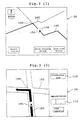
- the display section 6 is disposed inside of an instrument panel adjacent to a driver's seat, so that a driver can watch the display screen shown, for example, in Fig.3 to know the present vehicle position or to obtain information concerning an oncoming route.
- the selected route is indicated by a bold line 100 and another road is indicated by a thin line 102 on the display screen 20 shown in Fig.3(1).
- the present vehicle position is shown by a circle mark 104, and a vehicle advancing direction is shown by an arrow 106.
- buttons which are manipulated for the setting of route guidance and switching of the displayed screen or the guidance used during navigation. That is, the display section 6 is provided with several touch panels which are associated with the displayed buttons, so that above - described operation can be carried out in response to signals inputted through the touching operation of these buttons.
- These buttons and touch panels constitute an input signal generating device, that serves as a part of the input section 7. However, its detail explanation is omitted here.
- buttons On the display screen (i.e. a section map) 20 there are provided the following three buttons; i.e. a detail button for enlarging the present position and its vicinity area, a guide stop button for stopping the guidance, and a wide area button for displaying a wide area including the present position.
- the display screen is changed to an enlarged display screen 30 shown in Fig.3(2).
- Fig.3(2) an intersection name 110 and a distance 112 from the present vehicle position to this intersection are both displayed. Furthermore, upon this display exchange, a guidance voice is issued for providing a navigation guide at this intersection.
- the voice guidance is issued after a caution sound is once issued. If there is a request from the driver, the voice guidance is issued without any caution sound.
- the input section 7 includes a request sensor 7 - 1, that generates a signal (a trigger) for commanding the navigation processing based on the driver's intent, so that the destination point can be inputted or the driver can immediately obtain a necessary guidance information through the voice and/or screen display when the driver wants it. Moreover, the input section 7 can be constituted such that the destination point is inputted in response to a designation of the destination point on the display screen in the display section 6.
- the present position measuring section 10 acts to identify the present vehicle position on the basis of several information; i.e. a present vehicle positional information received by a GPS receiver 12 that utilizes a satellite navigation system (GPS), a direction information obtained from an azimuth instrument 8, a travelling distance information obtained from a distance meter 9, and a map information obtained from the CDROM driver 3.
- GPS satellite navigation system
- the azimuth instrument 8 detects an advancing direction of the vehicle on the basis of the earth's magnetism.
- the distance meter 9 detects the travelling distance on the basis of the rotation number of wheel.
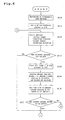
- Fig.4 shows a flow chart of a voice response processing in accordance with a first embodiment of the present invention
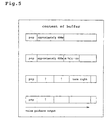
- Fig.5 shows a content of the voice buffer.
- "Approximately 400m from here” "at Fujii - cho” "turn right” are used as phrases.
- the arithmetic section 1 When the vehicle is approaching the destination point, the arithmetic section 1 continues to select necessary phrases required for providing guidance information, one after another, on the basis of the present vehicle position.
- step S1 it is judged in a step S1 whether or not the vehicle is approaching adjacent to a predetermined guide point; i.e. it is judged in the step S1 whether or not a timing has come for the automatic voice guidance. If the judgement in the step S1 indicates that the timing for the automatic voice guidance has not come yet, it is further judged in a step S2 whether or not there is any driver's request.
- a phrase selecting processing (A) is carried out in a step S3 in such a manner that a phrase is constructed by a caution sound, a remaining distance, a target object, and an advancing direction.
- a buffering operation is carried out in a step S5 and, in turn, a voice response operation is carried out in a step S6.
- the display screen is switched to the detail map shown in Fig.3(2) so as to display an intersection name, a distance from the present vehicle position to the destination point, and a direction to which the vehicle is scheduled to proceed after passing the intersection.
- a phrase selecting processing (B) is carried out in a step S4 in such a manner that a phrase is constructed by a remaining distance, a target object, and an advancing direction.
- a buffering operation is carried out in the step S5 and, in turn, a voice response operation is carried out in the step S6.
- the buffering operation will be explained with reference to Fig.5.
- the CDROM driver 3 basically accesses the CDROM 2 to select phrases and writes them in the voice buffer 4 - 1.
- the CDROM driver 3 executes its accessing operation in accordance with a predetermined phrase construction. That is, the caution sound phrase "pop”, the remaining distance phrase “approximately 400m from here", the target object phrase "at Fujii - cho", and the advancing direction phrase “turn right”, are accessed successively. These phrases are written in the voice buffer 4 - 1.
- the voice response processing is carried out to transform these buffered phrases into voice signals through the ADPCM decoder 4 - 2.
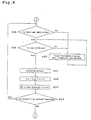
- Figs. 6 to 8 show flow charts of a voice response processing executed in the navigation apparatus in accordance with this embodiment.
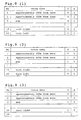
- Fig.9 shows the content of the voice buffer 4 - 1 used in this voice response processing.
- the voice buffer 4 - 1 has a storing capacity of 20 phrases.
- the content of the voice buffer 4 - 1 is basically constituted by the combination of a phrase corresponding to voice data, an existing flag f indicating that phrase is presently selected, and a used frequency n indicating a used frequency of each phrase.
- proper guidance information phrases are constructed to include a remaining distance, a target object, and an advancing direction on the basis of the determined course and the present vehicle position. For example, respective phrases of "pop" “approximately 400m from here” “at Fujii - cho” “turn right” are selected as the guidance information phrases.
- step S13 it is judged in a step S13 whether or not the selected phrases are the same as previous one.
- step S18 it is next judged in a step S18 whether or not the timing has come for the automatic voice response.
- the selected phrases are separated into two groups; i.e. phrases already existing in the buffers and phrases not existing in the buffers, in a step S15.
- step S17 it is judged in a step S17 whether or not all the selected phrases exist in the buffer. If all the selected phrases exist in the buffer, it is checked in the step S18 if the timing has come for the automatic voice response.
- step S24 If all or some of the selected phrases are missing in the buffers, it is in turn checked in a step S24 whether or not there is any empty buffer. In the case where there is no empty buffer, there will be a processing for newly providing an empty buffer. To the contrary, in the case where there is any empty buffer; for example, in the case where it is supposed that one buffer being designated by a reference No. 20 shown in Fig.9(3) is currently empty, it is subsequently checked in a step S26 whether or not all the selected phrases can be stored in this buffer. That is, it is checked if the size of this empty buffer is sufficient or not in the step S26.
- the used frequencies of the phrases currently existing in the buffers are checked and some of buffers occupied by less - frequently used phrases are cleared in a step S25.
- the used frequency is taken into consideration. Normally, once the vehicle has passed one certain intersection, the same intersection name is seldom used again. Therefore, the buffer storing this intersection name is first of all erased.
- the size of the buffer is checked again in the step S26. By repeating this routine, it becomes possible to prepare a buffer having a size fitting to the selected phrases.
- step S18 When all the selected phrases are completed buffered, it is then checked in the step S18 if the timing has come for the automatic voice response or not. If the judgement in the step S18 is NO, it is then judged in a step S19 whether or not there is any driver's request. If there is no driver's request, the processing returns to the step S12.
- phrases are selected in the order of the remaining distance, the target object, and the advancing direction, as shown in Fig.9(5), in a step S20. Then, these selected phrases are successively read out from the buffer 4 - 1 and transformed into voice signals through the ADPCM decoder 4 - 2, and then outputted from the speaker 5, in a step S21.
- the caution sound "pop" is not selected in the case where there is any driver's request, it is advantageous in that the driver can listen the voice response without any time lag.
- phrases are selected in the order of the caution sound, the remaining distance, the target object, and the advancing direction, as shown in Fig.9(6), in a step S22. Then, these selected phrases are successively read out from the buffer 4 - 1 and transformed into voice signals through the ADPCM decoder 4 - 2, and then outputted from the speaker 5, in a step S23.
- the caution sound "pop" is issued in the beginning, and then the voice response is provided so as to follow this caution sound.
Landscapes
- Engineering & Computer Science (AREA)
- Radar, Positioning & Navigation (AREA)
- Remote Sensing (AREA)
- Automation & Control Theory (AREA)
- Health & Medical Sciences (AREA)
- Audiology, Speech & Language Pathology (AREA)
- General Health & Medical Sciences (AREA)
- Multimedia (AREA)
- Physics & Mathematics (AREA)
- General Physics & Mathematics (AREA)
- Mechanical Engineering (AREA)
- Navigation (AREA)
Description
- The present invention relates to a vehicle navigation apparatus which is capable of executing a voice and/or a screen display guidance for navigating a vehicle to a destination point when the vehicle is driven by a driver.
- A conventional vehicle navigation apparatus, for example, disclosed in JP-A-60-202307, is operated in such a manner, when it is detected that a vehicle reaches a designated specific area in an intersection, the navigation apparatus notifies a correct direction to which the vehicle should next proceed after passing this intersection of a driver by means of a voice and/or a display guidance. Another conventional vehicle navigation apparatus, for example, disclosed in JP-A-63-21199, is operated to make a voice guidance after a vehicle has run a predetermined distance past an intersection.
- However, in these conventional navigation apparatus, the navigation guidance is issued punctually in accordance with predetermined procedure along a predetermined route no matter how the driver wants to know it. Accordingly, these conventional systems are not useful in that the navigation guidance is not always obtained when the driver wants it.
- For example, in the case where the navigation guidance is not made until the vehicle has completely passed an intersection, the driver cannot know various information concerning an immediate next - approaching intersection, an intersection succeeding this immediate next - approaching intersection, or a target, before the vehicle passes this intersection. Therefore, it was difficult to know such oncoming information to be subsequently issued sufficiently beforehand so that the driver can ensure driving safety.
- Furthermore, as the navigation guidance is automatically provided every time the vehicle has run a predetermined distance or every time a predetermined time has elapsed, the driver may feel a nuisance to hear it when he does not want it.
- Namely, the conventional navigation apparatus is characterized in that it gives a driver the navigation information without taking account of driver's intention. Therefore, there was an inconvenience such that the navigation information was not obtained timely, even if the driver wanted to know it.
- Furthermore, as numerous data such as maps, voice responses and so on are memorized in the same CDROM in a concentrated manner, it takes a long time to access a required data. Especially, in the case where two adjacent guidance information are issued during a limited time during a vehicle runs a short distance, the vehicle may proceed a significant distance while the necessary data is accessed in the massive CDROM and therefore it may happen that the navigation guidance is not given to a driver until the vehicle reaches immediately before the next target point. Thus, the driver may be forced to suddenly brake or steer the vehicle to change the course in accordance with the given guidance information, endangering the driving safety.
- Further navigation apparatuses are known from DE-A-31 22 901, EP-A-0 314 398, EP-A-0 341 645, JP-A-1-169316, EP-A-0 158 214, JP-A-63-259412 and JP-A-62-108111.
- In particular, EP-A-0 314 398 describes a navigation apparatus based on a present position calculating system. The navigation apparatus comprises present position calculating means, storing means for storing map information, guidance information and route information, manually operated request means for generating a request signal for requesting information regarding the next guidance point, control means for retrieving and notifying guidance information regarding the next guidance point and a voice output means for outputting guidance information processed by the control means. However, guidance information on the travelling direction can only be output at a guidance point e.g. an intersection. Outputting of guidance information at a current position e.g. between two intersections is not provided.
- WO-A-91/18345 refers to a voice message decoding and buffering system. The system includes a microprocessor, a set of message buffers for storing voice messages and a bus which couples the message buffering system to a host computer and a CDROM. The system can be used in an automobile navigation system. It instructs the driver of a car on what route to take to a specified destination and orally advises the driver when he manually operates request means.
- The conventional navigation apparatuses are disadvantageous in that a required information is not always given to a driver when or where he wants to really know it.
- Accordingly, the present invention has a purpose, in view of above - described problems and disadvantages encountered in the prior art, to provide a vehicle navigation apparatus which is functionized to generate a voice response output of a navigation guidance immediately after a driver requests it.
- Another purpose of the present invention is to provide a vehicle navigation apparatus which is capable of accessing a necessary voice guidance information in accordance with the driver's request in a short period of time.
- The purposes are accomplished by the features of the claims.
- The vehicle navigation apparatus in accordance with the present invention can be applicable to any kind of navigation apparatus, and especially can be suitably used for a vehicle navigation apparatus which executes a voice guidance in response to a driver's request in addition to an automatic voice guidance.
- Fig.1 is a block diagram showing a system constitution of a vehicle navigation apparatus in accordance with the present invention;
- Fig.2 is a view showing one example of voice data recorded in a CDROM;
- Fig.3 is an explanatory view showing one example of a display screen displayed in a display section, wherein Fig.3(1) shows a usual screen and Fig.3(2) shows a screen displayed during a limited period of time when a navigation guidance is executed;
- Fig.4 is a flow chart showing a voice response processing carried out in the vehicle navigation apparatus in accordance with the first embodiment of the present invention;
- Fig.5 is an explanatory view showing data content in the buffers;
- Fig.6 is a flow chart showing a voice response processing carried out in the vehicle navigation apparatus in accordance with the second embodiment of the present invention;
- Figs.7 and 8 are flow charts showing the remainder of the flow chart shown in Fig.6; and
- Fig.9 is an explanatory view showing data content in the buffers, in the voice response processing carried out in the vehicle navigation apparatus in accordance with the second embodiment of the present invention.
-
- Hereinafter, referring now to the accompanying drawings, the present invention is explained in detail.
- Fig.1 shows a hardware constitution of a vehicle navigation apparatus in accordance with the present invention. The present invention provides a navigation apparatus capable of communicating with a driver so as to guide the vehicle properly to a destination point. Namely, during the vehicle is navigated to the destination point, this navigation apparatus can provide a voice response of a guidance information immediately in response to the driver's request. On the other hand, when the driver does not issue any request, the navigation apparatus only provides an automatic voice response of the guidance information with an adequate caution sound when the vehicle passes a predetermined check point such as an intersection.
- In this embodiment, the voice phrases to be generated during the vehicle is running are constructed by the combination of the following four items; (1) a caution sound, (2) a distance between the present vehicle position and the target object, (3) the target object, and (4) a direction to which the vehicle should proceed after passing the target object. For example, "pop" is used as a phrase representing the above - described caution sound (1), and "approximately 400m from here", "soon" and the like are used as phrases representative of the above - described distance from the present vehicle position to the target object (2).
Furthermore, "at Fujii - cho", "at a signal", "at an intersection not being equipped with a signal" and the like are used as phrases representative of the above - described target object (3), and "advance straight", "turn right" and the like are used as phrases representative of the above - described direction (4). - In Fig.1, the vehicle navigation apparatus includes an
arithmetic section 1 executing an overall control of this system, aCDROM 2 storing navigation data such as maps and targets and voice data, aCDROM driver 3 for reading out necessary data from theCDROM 2 in accordance with a command from thearithmetic section 1 and writing it into a voice data RAM 4- 1 (hereinafter, referred to as "voice buffer"), avoice response section 4 for transforming the voice data synthesized in the voice buffer 4 - 1 into a voice signal by an ADPCM decoder4 - 2, aspeaker 5 being connected to thevoice response section 4 for generating a guidance voice in accordance with the transformed voice signal, adisplay section 6 for displaying a navigation guidance on a display screen and the like in response to driver's request or automatically, aninput section 7 for inputting a destination point or requesting the navigation guidance, a presentposition measuring section 10 for identifying a present position of the vehicle, and aroute memorizing section 11 for memorizing the route data in accordance with the destination point. - The
arithmetic section 1 includes a route calculating section 1 - 1 for calculating an appropriate route leading to the destination point, and a route guidance section 1 - 2 for executing a voice guidance and/or a display guidance automatically or in response to the driver's request. - The route calculating section 1 - 1 calculates an appropriate route leading the destination point on the basis of the following three information; i.e. a target position information supplied from the
input section 7, a present position information measured in the presentposition measuring section 10, and a map information supplied from theCDROM driver 3. And then, thus calculated route data is stored in theroute memorizing section 11. - The route guidance section 1 - 2 has a function to judge whether or not a present position of the vehicle is approaching a predetermined check point on the vehicle proceeding line with reference to the route leading to the destination point. Namely, with this function, the timing for providing an automatic voice guidance can be detected when the vehicle reaches a point located a predetermined distance before from an intersection on the guide route, or after the vehicle has passed this intersection.
- On the basis of this judgement result, appropriate phrases to be used at this guide point, including a caution sound, are selected and stored in the voice buffer 4 - 1. Subsequently, these selected phrases are transformed into voices and outputted through the ADPCM decoder 4 - 2.
- In this case, the caution sound is outputted first of all and, after a predetermined time; for example, approximately 0.2 sec, has elapsed, the guidance voice is outputted successively. At the same time, the present vehicle position on the determined route is displayed in the
display section 6. - Furthermore, in the case where a request signal is inputted, the route guidance section 1 - 2 outputs a command to the
voice response section 4 to provide a voice guidance concerning the present vehicle position and also outputs a command to thedisplay section 6 to display a map indicating the present place. - Furthermore, it is also possible to constitute the system in such a manner that the displayed guidance is displayed in response to the driver's request; i.e. the signal inputted through the
input section 7. - The CDROM 2 serves as a data base storing all the data such as map data, voice data and so on, being required for executing the navigation. Among these data, only the voice data are memorized by being compressed through a voice compression method such as ADPCM method.
- Fig.2 shows one example of the content of the voice data, being recorded in the CDROM 2. These memorized content is predetermined in accordance with the following data categories; a voice segment, an intersection name, a mark name, a road name, a destination point name, and the like. For example, "pop" "at intersection" "approximately 300 m from here" etc. are designated as the voice segment, and "Okazaki IC (interchange)" "A country club" etc. are designated as the destination point name.
- The
voice response section 4 synthesizes compressed voices, phrases, unified sentences, sounds and the like and outputs the synthesized result through thespeaker 5. The voice data required for giving the guidance information concerning the oncoming mark point, which is closest from the present vehicle position, is written one after another into the voice buffer 4 - 1 of thisvoice response section 4. On the contrary, old voice data not required in this guidance information are erased successively, so that new voice data are sufficiently memorized in this voice buffer 4 - 1. Furthermore, the capacity of this voice buffer 4 - 1 is prepared in accordance with the number of phrases and, for example, is constituted by 20 phrases. - Basic phrases to be synthesized are classified into various categories such as a voice segment, an intersection name, a mark name, a road name, a target name etc. As the
arithmetic section 1 can grasp a present vehicle position on the basis of a route, a travelling distance, and an advancing direction, the most preferable phrase combination can be determined from the map data base corresponding to the present vehicle position. - Thus determined phrases are transformed into analogue signals through the ADPCM decoder 4 - 2, and then issued through the
speaker 5 in a form of voice response such as "Approximately 400m from here" "at Ishikawa - cho" "turn right". - The
display section 6 is disposed inside of an instrument panel adjacent to a driver's seat, so that a driver can watch the display screen shown, for example, in Fig.3 to know the present vehicle position or to obtain information concerning an oncoming route. In case of the disclosed example, the selected route is indicated by abold line 100 and another road is indicated by athin line 102 on thedisplay screen 20 shown in Fig.3(1). The present vehicle position is shown by acircle mark 104, and a vehicle advancing direction is shown by anarrow 106. As a method for clearly discriminating respective roads, it is also preferable to change their colors, as well as discrimination of line thickness. - Furthermore, the above-described screen is provided with several function buttons, which are manipulated for the setting of route guidance and switching of the displayed screen or the guidance used during navigation. That is, the
display section 6 is provided with several touch panels which are associated with the displayed buttons, so that above - described operation can be carried out in response to signals inputted through the touching operation of these buttons. These buttons and touch panels constitute an input signal generating device, that serves as a part of theinput section 7. However, its detail explanation is omitted here. - On the display screen (i.e. a section map) 20 there are provided the following three buttons; i.e. a detail button for enlarging the present position and its vicinity area, a guide stop button for stopping the guidance, and a wide area button for displaying a wide area including the present position.
- When the vehicle approaches an
intersection 108 where the vehicle is scheduled to change the route, the display screen is changed to anenlarged display screen 30 shown in Fig.3(2). In Fig.3(2), anintersection name 110 and adistance 112 from the present vehicle position to this intersection are both displayed. Furthermore, upon this display exchange, a guidance voice is issued for providing a navigation guide at this intersection. - In this case, if the timing has come for the automatic voice guidance, the voice guidance is issued after a caution sound is once issued. If there is a request from the driver, the voice guidance is issued without any caution sound.
- The
input section 7 includes a request sensor 7 - 1, that generates a signal (a trigger) for commanding the navigation processing based on the driver's intent, so that the destination point can be inputted or the driver can immediately obtain a necessary guidance information through the voice and/or screen display when the driver wants it. Moreover, theinput section 7 can be constituted such that the destination point is inputted in response to a designation of the destination point on the display screen in thedisplay section 6. - The present
position measuring section 10 acts to identify the present vehicle position on the basis of several information; i.e. a present vehicle positional information received by aGPS receiver 12 that utilizes a satellite navigation system (GPS), a direction information obtained from anazimuth instrument 8, a travelling distance information obtained from adistance meter 9, and a map information obtained from theCDROM driver 3. Thus obtained vehicle present position information is supplied to thearithmetic section 1. By the way, theazimuth instrument 8 detects an advancing direction of the vehicle on the basis of the earth's magnetism. And, thedistance meter 9 detects the travelling distance on the basis of the rotation number of wheel. - Next, the voice response processing is explained with reference to accompanying drawings. Fig.4 shows a flow chart of a voice response processing in accordance with a first embodiment of the present invention, and Fig.5 shows a content of the voice buffer. In the following explanation, "Approximately 400m from here" "at Fujii - cho" "turn right" are used as phrases.
- When the vehicle is approaching the destination point, the
arithmetic section 1 continues to select necessary phrases required for providing guidance information, one after another, on the basis of the present vehicle position. - First of all, it is judged in a step S1 whether or not the vehicle is approaching adjacent to a predetermined guide point; i.e. it is judged in the step S1 whether or not a timing has come for the automatic voice guidance. If the judgement in the step S1 indicates that the timing for the automatic voice guidance has not come yet, it is further judged in a step S2 whether or not there is any driver's request.
- For example, if the position indicated in Fig.3(1) supposed to be the timing for the automatic voice guidance, a phrase selecting processing (A) is carried out in a step S3 in such a manner that a phrase is constructed by a caution sound, a remaining distance, a target object, and an advancing direction. Subsequently, a buffering operation is carried out in a step S5 and, in turn, a voice response operation is carried out in a step S6.
- At the same time, the display screen is switched to the detail map shown in Fig.3(2) so as to display an intersection name, a distance from the present vehicle position to the destination point, and a direction to which the vehicle is scheduled to proceed after passing the intersection. When the judgement in the step S2 indicates that the driver requests the guidance information at a certain place, a phrase selecting processing (B) is carried out in a step S4 in such a manner that a phrase is constructed by a remaining distance, a target object, and an advancing direction. Subsequently, a buffering operation is carried out in the step S5 and, in turn, a voice response operation is carried out in the step S6.
- The buffering operation will be explained with reference to Fig.5. The
CDROM driver 3 basically accesses theCDROM 2 to select phrases and writes them in the voice buffer 4 - 1.
First of all, theCDROM driver 3 executes its accessing operation in accordance with a predetermined phrase construction. That is, the caution sound phrase "pop", the remaining distance phrase "approximately 400m from here", the target object phrase "at Fujii - cho", and the advancing direction phrase "turn right", are accessed successively. These phrases are written in the voice buffer 4 - 1. - When all the phrases constituting the guidance information to be issued as the automatic voice response or as the voice response in accordance with the driver's request have been buffered in this manner, the voice response processing is carried out to transform these buffered phrases into voice signals through the ADPCM decoder 4 - 2.
- Next, another embodiment of the navigation apparatus in accordance with the present invention is explained. Though the voice response processing in the above - described embodiment is carried out in such a manner that the
CDROM 2 is accessed with respect to all of these three or four phrases and then their voice data are buffered, this embodiment is different from this above - described embodiment in that the voice response is given immediately to the driver at the timing of automatic voice response or in response to the driver's request without accessing theCDROM 2. - Figs. 6 to 8 show flow charts of a voice response processing executed in the navigation apparatus in accordance with this embodiment. Fig.9 shows the content of the voice buffer 4 - 1 used in this voice response processing. By the way, the voice buffer 4 - 1 has a storing capacity of 20 phrases.
The content of the voice buffer 4 - 1 is basically constituted by the combination of a phrase corresponding to voice data, an existing flag f indicating that phrase is presently selected, and a used frequency n indicating a used frequency of each phrase. - The existing flag f is set to f=1 in the case where this phrase is presently selected and, to the contrary, is set to f=0 in the case where this phrase is not selected. In the example shown in Fig.9(1), the used frequency n is set to n=1 in each phrase being first buffered. And, all the existing flags f is set to f=0 since no phrase is selected.
- When the
arithmetic section 1 initiates its execution, as some of repeatedly used phrases are known, these frequently used phrases such as "approximately 100m" "approximately 400m" "turn right" "turn left" and the like which indicate the remaining distance and the advancing direction etc. are buffered in a plurality of voice buffers in advance in a step S10. Then, in a step S11, the used frequency of this buffered phrase is set to "1". - Next, in a step S12, proper guidance information phrases are constructed to include a remaining distance, a target object, and an advancing direction on the basis of the determined course and the present vehicle position. For example, respective phrases of "pop" "approximately 400m from here" "at Fujii - cho" "turn right" are selected as the guidance information phrases.
- Subsequently, it is judged in a step S13 whether or not the selected phrases are the same as previous one. In the case where the selected phrases are not varied, it is next judged in a step S18 whether or not the timing has come for the automatic voice response. On the other hand, in the case where the selected phrases are modified from the previous one, the flags f in the buffers are all cleared (i.e. the existing flag f is set to f=0) in a step S14, so that previously selected phrases are erased.
- The selected phrases are separated into two groups; i.e. phrases already existing in the buffers and phrases not existing in the buffers, in a step S15. As the phrases already existing in the buffers should be left without being erased, the existing flags f of the guidance information phrases "approximately 400m from here" and "turn right" are set to f=1 and their used frequencies n are increased by +1 to be n=2, respectively, in a step S16.
- Next, it is judged in a step S17 whether or not all the selected phrases exist in the buffer. If all the selected phrases exist in the buffer, it is checked in the step S18 if the timing has come for the automatic voice response.
- If all or some of the selected phrases are missing in the buffers, it is in turn checked in a step S24 whether or not there is any empty buffer. In the case where there is no empty buffer, there will be a processing for newly providing an empty buffer. To the contrary, in the case where there is any empty buffer; for example, in the case where it is supposed that one buffer being designated by a reference No. 20 shown in Fig.9(3) is currently empty, it is subsequently checked in a step S26 whether or not all the selected phrases can be stored in this buffer. That is, it is checked if the size of this empty buffer is sufficient or not in the step S26.
- In the case where there is no empty buffer or in the case where the empty buffer does not have a sufficient size, the used frequencies of the phrases currently existing in the buffers are checked and some of buffers occupied by less - frequently used phrases are cleared in a step S25. In more detail, to determine the buffer to be erased, the used frequency is taken into consideration. Normally, once the vehicle has passed one certain intersection, the same intersection name is seldom used again. Therefore, the buffer storing this intersection name is first of all erased.
- When one buffer is cleared, the size of the buffer is checked again in the step S26. By repeating this routine, it becomes possible to prepare a buffer having a size fitting to the selected phrases.
- When a buffer (for example, the buffer No. 20 shown in Fig.9(4)) is newly prepared, the selected phrase "Fujii - cho" is buffered in this buffer. And, the existing flag f is set to "1" in a step S28 and the used frequency n is set to "+1" in a step S29. Thereafter, it is checked in a step S30 whether or not there is any phrase to be buffered. If any phrase is left, the processing is again repeated from the step S24.
- When all the selected phrases are completed buffered, it is then checked in the step S18 if the timing has come for the automatic voice response or not. If the judgement in the step S18 is NO, it is then judged in a step S19 whether or not there is any driver's request. If there is no driver's request, the processing returns to the step S12.
- If there is any driver's request, as the buffers are filled with the phrases selected in the previous processing, phrases are selected in the order of the remaining distance, the target object, and the advancing direction, as shown in Fig.9(5), in a step S20. Then, these selected phrases are successively read out from the buffer 4 - 1 and transformed into voice signals through the ADPCM decoder 4 - 2, and then outputted from the
speaker 5, in a step S21. As the caution sound "pop" is not selected in the case where there is any driver's request, it is advantageous in that the driver can listen the voice response without any time lag. - If the judgement in the step S18 indicates that there is no driver's request, phrases are selected in the order of the caution sound, the remaining distance, the target object, and the advancing direction, as shown in Fig.9(6), in a step S22. Then, these selected phrases are successively read out from the buffer 4 - 1 and transformed into voice signals through the ADPCM decoder 4 - 2, and then outputted from the
speaker 5, in a step S23. In the case where the automatic voice response is provided, the caution sound "pop" is issued in the beginning, and then the voice response is provided so as to follow this caution sound. - As apparent from above - described explanation, in accordance with the present invention, the following functions and effects are enjoyed.
- (a) The control means automatically provides the
guidance information in a form of the voice response in
accordance with the driver's request. Therefore, the driver
can listen this guidance information while paying attention on
driving safety.
At the same time, the driver can request the guidance information anytime and anywhere he wants to know it, in order to listen the voice response of the latest guidance information. - (b) This system directly accesses the phrases which are prepared in the buffers beforehand, without accessing the data base in response to the driver's request. A waiting time from the driver's request until the voice response is actually issued can be extremely shortened. Therefore, the driver can drive the car safely, by being given the guidance information sufficiently in advance.
- (c) Buffers always store the frequently used phrases, so that the CDROM is prevented from being accessed every time when these frequently used phrases are selected. Therefore, it becomes possible to speed up an overall processing speed.
- (d) In the case where one buffer does not have enough size, the phrases are buffered separately in a plurality of buffers. Therefore, the real - time voice response of the guidance information can be realized by the smallest number of buffers. In other words, it is concluded that the buffers can be effectively utilized in accordance with the present invention.
-
Claims (11)
- A navigation apparatus comprising:characterized in thata) current position detecting means (10) for detecting a current position of a vehicle;b) information storing means (2,3) for storing map information and guidance information;c) route storing means (11) for storing route information;d) manually operated request means (7) for generating a request signal for requesting information regarding the next guidance point on a current route that needs guidance;e) control means (1) for retrieving and notifying guidance information regarding the next guidance point that needs guidance from the information storing means; andf) output means (4) for outputting in the form of voices the guidance information processed by the control meansg) the control means (1) is adapted to process the guidance information on the basis of a current position and the route information stored in the route storing means (11).
- A navigation apparatus according to claim 1, wherein the guidance information regarding the next guidance point is the distance between the current position and the next guidance point.
- A navigation apparatus according to claim 1 or 2, wherein the control means (1) decides whether the vehicle reaches a predetermined guidance point and controls the automatic output of the guidance information when the vehicle reaches said predetermined point and the output means (4) automatically outputs the guidance information in response to the control means (1), if the driver does not issue any request.
- A navigation apparatus according to claim 3, wherein the control means (1) comprises means for determining whether guidance has been requested automatically, and means for determining whether guidance has been requested by the request means, and wherein if it is determined that guidance has been requested by the request means while a guidance is being provided, the control means cancels the current guidance and operates to provide the guidance requested.
- A navigation apparatus according to claim 4, wherein when it is determined that guidance has been requested by the request means, the control means (1) uses a manner of notifying guidance that differs from a manner of notifying guidance used when it is determined that guidance has been automatically requested.
- A navigation apparatus according to any of claims 1 to 5, whereina) the guidance information includes a plurality of separate voice phrases;b) guidance information storing means (4-1) are provided for temporarily storing the guidance information retrieved by the control means separately for each voice phrase; andc) the control means (1) retrieves guidance information separately for individual voice phrases from the information storing means (2,3).
- A navigation apparatus according to claim 6, wherein the control means (1) determines whether each of the voice phrases required for the next guidance is stored in the guidance information storing means, and the control means (1) retrieves from the information storing means only the voice phrases that are needed for the next guidance but not stored in the guidance information storing means (4-1), and stores the voice phrases into the guidance information storing means (4-1).
- A navigation apparatus according to claim 6 or 7, wherein the control means (1) includes comparing means for comparing frequencies of use of individual voice phrases of the guidance information stored in the guidance information storing means (4-1), and the control means updates the guidance information on the basis of the frequencies of use of the individual voice phrases.
- A navigation apparatus according to any of claims 6 to 8, wherein the control means (1) retrieves necessary voice phrases from the guidance information storing means (4-1) and composes a piece of guidance information by using the voice phrases retrieved.
- A navigation apparatus according to claim 9, wherein the control means (1) changes manners of notifying guidance by retrieving alert sound data from the guidance information storing means (4-1) and using the alert sound data to notify guidance only when it is determined that guidance has been automatically requested.
- A navigation apparatus according to any of claims 1 to 10, which calculates a route to a destination and traces a vehicle to perform guidance along the route.
Applications Claiming Priority (7)
| Application Number | Priority Date | Filing Date | Title |
|---|---|---|---|
| JP258172/91 | 1991-10-04 | ||
| JP25817291 | 1991-10-04 | ||
| JP25817291A JP3151731B2 (en) | 1991-10-04 | 1991-10-04 | Navigation device |
| JP220109/92 | 1992-08-19 | ||
| JP22010992A JP3164902B2 (en) | 1992-08-19 | 1992-08-19 | Vehicle navigation system |
| JP22010992 | 1992-08-19 | ||
| PCT/JP1992/001293 WO1993007447A1 (en) | 1991-10-04 | 1992-10-05 | Navigation apparatus for vehicles |
Publications (3)
| Publication Number | Publication Date |
|---|---|
| EP0560987A1 EP0560987A1 (en) | 1993-09-22 |
| EP0560987A4 EP0560987A4 (en) | 1994-08-24 |
| EP0560987B1 true EP0560987B1 (en) | 1999-09-08 |
Family
ID=26523541
Family Applications (1)
| Application Number | Title | Priority Date | Filing Date |
|---|---|---|---|
| EP92920698A Expired - Lifetime EP0560987B1 (en) | 1991-10-04 | 1992-10-05 | Navigation apparatus for vehicles |
Country Status (4)
| Country | Link |
|---|---|
| US (1) | US6317687B1 (en) |
| EP (1) | EP0560987B1 (en) |
| DE (1) | DE69229946T2 (en) |
| WO (1) | WO1993007447A1 (en) |
Families Citing this family (48)
| Publication number | Priority date | Publication date | Assignee | Title |
|---|---|---|---|---|
| US5903228A (en) * | 1994-05-27 | 1999-05-11 | Sony Corporation | Map information display apparatus and traveling route display apparatus and route guidance apparatus for moving body |
| EP0715750B1 (en) * | 1994-07-01 | 2000-02-02 | Koninklijke Philips Electronics N.V. | Navigation system |
| DE69521783T2 (en) * | 1994-08-08 | 2002-04-25 | Siemens Ag | NAVIGATION DEVICE FOR A LANDING VEHICLE WITH MEANS FOR GENERATING AN EARLY VOICE MESSAGE WITH MULTIPLE ELEMENTS, AND VEHICLE THEREFOR |
| JP3414872B2 (en) * | 1995-01-20 | 2003-06-09 | 三菱電機株式会社 | Car navigation system |
| JP3452098B2 (en) * | 1995-04-04 | 2003-09-29 | アイシン・エィ・ダブリュ株式会社 | Vehicle navigation system |
| JPH10224665A (en) * | 1997-02-04 | 1998-08-21 | Sony Corp | Delivery system |
| US7813875B2 (en) | 2002-10-10 | 2010-10-12 | Sirf Technology, Inc. | Layered host based satellite positioning solutions |
| US7043363B2 (en) * | 2002-10-10 | 2006-05-09 | Sirf Technology, Inc. | Host based satellite positioning systems |
| JP4622101B2 (en) * | 2000-12-27 | 2011-02-02 | ソニー株式会社 | Information processing apparatus, information processing method for information processing apparatus, and information processing system |
| US7283905B1 (en) | 2001-12-11 | 2007-10-16 | Garmin Ltd. | System and method for estimating impedance time through a road network |
| US6704645B1 (en) | 2001-12-11 | 2004-03-09 | Garmin Ltd. | System and method for estimating impedance time through a road network |
| US6647337B1 (en) | 2001-12-20 | 2003-11-11 | Garmin Ltd. | Navigation system, method and device for labeling thoroughfares |
| US6650996B1 (en) | 2001-12-20 | 2003-11-18 | Garmin Ltd. | System and method for compressing data |
| US6581003B1 (en) | 2001-12-20 | 2003-06-17 | Garmin Ltd. | Systems and methods for a navigational device with forced layer switching based on memory constraints |
| US6545637B1 (en) | 2001-12-20 | 2003-04-08 | Garmin, Ltd. | Systems and methods for a navigational device with improved route calculation capabilities |
| US6847884B1 (en) | 2001-12-20 | 2005-01-25 | Garmin Ltd. | PDA system, method and device for labeling thoroughfares |
| US6892135B1 (en) | 2001-12-21 | 2005-05-10 | Garmin Ltd. | Navigation system, method and device with automatic next turn page |
| US6901330B1 (en) | 2001-12-21 | 2005-05-31 | Garmin Ltd. | Navigation system, method and device with voice guidance |
| US6975940B1 (en) | 2001-12-21 | 2005-12-13 | Garmin Ltd. | Systems, functional data, and methods for generating a route |
| US6675093B1 (en) | 2001-12-21 | 2004-01-06 | Garmin Ltd. | Systems, functional data, and methods for generating a route |
| US7043362B2 (en) * | 2001-12-21 | 2006-05-09 | Garmin Ltd. | PDA with integrated address book and electronic map waypoints |
| US6847890B1 (en) | 2001-12-21 | 2005-01-25 | Garmin Ltd. | Guidance with feature accounting for insignificant roads |
| US6859721B1 (en) * | 2001-12-21 | 2005-02-22 | Garmin Ltd. | System, device and method for providing proximate addresses |
| US6546335B1 (en) * | 2001-12-21 | 2003-04-08 | Garmin, Ltd. | System, functional data, and methods to bias map matching |
| US7277794B1 (en) | 2001-12-21 | 2007-10-02 | Garmin Ltd. | Guidance with feature accounting for insignificant roads |
| US6999873B1 (en) * | 2001-12-21 | 2006-02-14 | Garmin Ltd. | Navigation system, method and device with detour algorithm |
| US6687615B1 (en) * | 2001-12-21 | 2004-02-03 | Garmin Ltd. | Navigation system, method and device with detour algorithm |
| US7184886B1 (en) | 2001-12-21 | 2007-02-27 | Garmin Ltd. | Navigation system, method and device with detour algorithm |
| US8046164B1 (en) | 2002-02-08 | 2011-10-25 | Garmin Switzerland Gmbh | Systems and methods for track log selection |
| US6826473B1 (en) | 2002-02-08 | 2004-11-30 | Garmin Ltd. | PDA with integrated navigation functions and expense reporting |
| US6799115B1 (en) | 2002-02-28 | 2004-09-28 | Garmin Ltd. | Systems, functional data, and methods to pack n-dimensional data in a PDA |
| US20030181162A1 (en) * | 2002-03-20 | 2003-09-25 | Michael Matula | " Satellite set-top box for mobile applications " |
| DK1599703T3 (en) * | 2003-02-26 | 2007-07-30 | Tomtom Int Bv | Navigation device with touch screen |
| JP4271550B2 (en) * | 2003-10-27 | 2009-06-03 | アルパイン株式会社 | Audio system, audio apparatus, and audio signal output processing method |
| JP4126284B2 (en) * | 2004-03-08 | 2008-07-30 | 松下電器産業株式会社 | Interactive route guidance device |
| US7289905B2 (en) * | 2004-11-24 | 2007-10-30 | General Motors Corporation | Navigation guidance cancellation apparatus and methods of canceling navigation guidance |
| US7908080B2 (en) | 2004-12-31 | 2011-03-15 | Google Inc. | Transportation routing |
| US7925320B2 (en) | 2006-03-06 | 2011-04-12 | Garmin Switzerland Gmbh | Electronic device mount |
| US7917290B1 (en) * | 2007-01-16 | 2011-03-29 | Uniden America Corporation | Method and apparatus for automatic point of interest creator from contact list for GPS units |
| US8160813B1 (en) * | 2007-09-07 | 2012-04-17 | Mcdermed Julie K | Travel toy that illustrates time on a trip |
| US8099238B2 (en) * | 2007-11-14 | 2012-01-17 | Telecommunication Systems, Inc. | Stateful, double-buffered dynamic navigation voice prompting |
| DE102007058651A1 (en) * | 2007-12-04 | 2009-06-10 | Navigon Ag | Method for operating a navigation device |
| JP5464875B2 (en) * | 2009-03-10 | 2014-04-09 | アルパイン株式会社 | Navigation device and traffic line display method |
| US9702723B2 (en) | 2012-03-01 | 2017-07-11 | Nokia Technologies Oy | Method and apparatus for receiving user estimation of navigational instructions |
| CN102765357B (en) * | 2012-07-17 | 2015-03-18 | 东南(福建)汽车工业有限公司 | Vehicle-mounted intelligent safety system and implementation method thereof |
| JP6064544B2 (en) * | 2012-11-27 | 2017-01-25 | ソニー株式会社 | Image processing apparatus, image processing method, program, and terminal device |
| US12504294B2 (en) * | 2020-03-27 | 2025-12-23 | Pioneer Corporation | Information providing device, information providing method, and information providing program for acquiring guidance location information indicating distance between position of recipient and position of guidance location |
| JP2022059958A (en) * | 2020-10-02 | 2022-04-14 | フォルシアクラリオン・エレクトロニクス株式会社 | Navigation device |
Family Cites Families (20)
| Publication number | Priority date | Publication date | Assignee | Title |
|---|---|---|---|---|
| DE3122901A1 (en) * | 1981-06-10 | 1982-12-30 | Klaus Prof. Dr. 2863 Ritterhude Haefner | Automatic navigation system for land vehicles and water craft |
| JPS59157798A (en) | 1983-02-24 | 1984-09-07 | 株式会社デンソー | Running guide for vehicle |
| JPS60202307A (en) * | 1984-03-28 | 1985-10-12 | Hitachi Ltd | Navigation system having advance instructing function |
| NL8402497A (en) | 1984-08-14 | 1986-03-03 | Philips Nv | VEHICLE NAVIGATION SYSTEM EQUIPPED WITH AN ADAPTIVE INSURANCE NAVIGATION SYSTEM BASED ON MEASUREMENT OF THE SPEED AND CROSS-GEAR ACCELERATION OF THE VEHICLE AND PROVIDED WITH A CORRECTION UNIT FOR CORRECTING THE MEASURED VALUES. |
| JPS61158817U (en) * | 1985-03-25 | 1986-10-02 | ||
| JPS62108111A (en) * | 1985-11-07 | 1987-05-19 | Canon Inc | Run supporting system |
| JPS62151713A (en) * | 1985-12-26 | 1987-07-06 | Pioneer Electronic Corp | Vehicle navigation device |
| JPS63208092A (en) * | 1987-02-24 | 1988-08-29 | 日本電気株式会社 | Electronic road map for automobile |
| JPS63259412A (en) * | 1987-04-16 | 1988-10-26 | Nippon Telegr & Teleph Corp <Ntt> | Navigation system performing guidance by voice |
| JPH0820265B2 (en) | 1987-07-10 | 1996-03-04 | アイシン・エィ・ダブリュ株式会社 | Vehicle navigation system |
| JP2680312B2 (en) | 1987-07-10 | 1997-11-19 | アイシン・エィ・ダブリュ株式会社 | Vehicle navigation system |
| JP2694869B2 (en) * | 1987-10-30 | 1997-12-24 | アイシン・エィ・ダブリュ株式会社 | Navigation device |
| JPH01169316A (en) * | 1987-12-25 | 1989-07-04 | Aisin Seiki Co Ltd | Moving body tracking apparatus |
| EP0346491A4 (en) | 1987-12-28 | 1992-08-19 | Aisin Aw Co., Ltd. | A display unit of navigation system |
| JPH01173818A (en) | 1987-12-28 | 1989-07-10 | Aisin Aw Co Ltd | Navigation device for vehicle |
| JP2659742B2 (en) | 1988-03-02 | 1997-09-30 | アイシン・エィ・ダブリュ株式会社 | Navigation device |
| US4876651A (en) * | 1988-05-11 | 1989-10-24 | Honeywell Inc. | Digital map system |
| WO1991018345A1 (en) * | 1990-05-22 | 1991-11-28 | Optical Media International | Voice message decoding and buffering system |
| US5177685A (en) * | 1990-08-09 | 1993-01-05 | Massachusetts Institute Of Technology | Automobile navigation system using real time spoken driving instructions |
| US5220507A (en) * | 1990-11-08 | 1993-06-15 | Motorola, Inc. | Land vehicle multiple navigation route apparatus |
-
1992
- 1992-10-05 DE DE69229946T patent/DE69229946T2/en not_active Expired - Lifetime
- 1992-10-05 US US08/030,481 patent/US6317687B1/en not_active Expired - Lifetime
- 1992-10-05 WO PCT/JP1992/001293 patent/WO1993007447A1/en not_active Ceased
- 1992-10-05 EP EP92920698A patent/EP0560987B1/en not_active Expired - Lifetime
Also Published As
| Publication number | Publication date |
|---|---|
| DE69229946T2 (en) | 2000-05-04 |
| DE69229946D1 (en) | 1999-10-14 |
| WO1993007447A1 (en) | 1993-04-15 |
| US6317687B1 (en) | 2001-11-13 |
| EP0560987A1 (en) | 1993-09-22 |
| EP0560987A4 (en) | 1994-08-24 |
Similar Documents
| Publication | Publication Date | Title |
|---|---|---|
| US6317687B1 (en) | Vehicle navigation apparatus providing both automatic guidance and guidance information in response to manual input request | |
| US5303159A (en) | Navigation system with off-route detection and route recalculation | |
| US5406492A (en) | Directional voice-type navigation apparatus | |
| EP0588086B1 (en) | Voice route-guidance system | |
| US5371497A (en) | Navigation system for vehicles | |
| US6253153B1 (en) | Vehicle navigation system and method | |
| JPH1183517A (en) | Route guidance device for vehicles | |
| JP3222616B2 (en) | Car navigation system | |
| JP2715214B2 (en) | Vehicle travel guidance device | |
| JP3098623B2 (en) | Route guidance device for vehicles | |
| JP2025105759A (en) | IMAGE CONTROL PROGRAM, IMAGE CONTROL DEVICE, AND IMAGE CONTROL METHOD | |
| JPS63265113A (en) | Navigation apparatus for vehicle | |
| JP4576730B2 (en) | Navigation device | |
| JP2721835B2 (en) | Vehicle navigation system | |
| JP3151731B2 (en) | Navigation device | |
| JP3164902B2 (en) | Vehicle navigation system | |
| JPH0566131A (en) | Voiced guide apparatus | |
| JP3402011B2 (en) | Route guidance device for vehicles | |
| JP2752605B2 (en) | Vehicle navigation system | |
| JP2959604B2 (en) | Vehicle navigation system | |
| JP3140187B2 (en) | Route guidance device for vehicles | |
| JP2002310671A (en) | Navigation apparatus | |
| JP2001512841A (en) | Car navigation system | |
| JP2000055681A (en) | Navigation apparatus, route deviation detection processing method in this apparatus, and recording medium recording program | |
| JP3203732B2 (en) | Map display device |
Legal Events
| Date | Code | Title | Description |
|---|---|---|---|
| PUAI | Public reference made under article 153(3) epc to a published international application that has entered the european phase |
Free format text: ORIGINAL CODE: 0009012 |
|
| AK | Designated contracting states |
Kind code of ref document: A1 Designated state(s): DE FR |
|
| 17P | Request for examination filed |
Effective date: 19931011 |
|
| A4 | Supplementary search report drawn up and despatched |
Effective date: 19940705 |
|
| AK | Designated contracting states |
Kind code of ref document: A4 Designated state(s): DE FR |
|
| 17Q | First examination report despatched |
Effective date: 19950609 |
|
| GRAG | Despatch of communication of intention to grant |
Free format text: ORIGINAL CODE: EPIDOS AGRA |
|
| GRAG | Despatch of communication of intention to grant |
Free format text: ORIGINAL CODE: EPIDOS AGRA |
|
| GRAH | Despatch of communication of intention to grant a patent |
Free format text: ORIGINAL CODE: EPIDOS IGRA |
|
| GRAH | Despatch of communication of intention to grant a patent |
Free format text: ORIGINAL CODE: EPIDOS IGRA |
|
| GRAA | (expected) grant |
Free format text: ORIGINAL CODE: 0009210 |
|
| AK | Designated contracting states |
Kind code of ref document: B1 Designated state(s): DE FR |
|
| ET | Fr: translation filed | ||
| REF | Corresponds to: |
Ref document number: 69229946 Country of ref document: DE Date of ref document: 19991014 |
|
| PLBE | No opposition filed within time limit |
Free format text: ORIGINAL CODE: 0009261 |
|
| STAA | Information on the status of an ep patent application or granted ep patent |
Free format text: STATUS: NO OPPOSITION FILED WITHIN TIME LIMIT |
|
| 26N | No opposition filed | ||
| PGFP | Annual fee paid to national office [announced via postgrant information from national office to epo] |
Ref country code: DE Payment date: 20100929 Year of fee payment: 19 |
|
| PGFP | Annual fee paid to national office [announced via postgrant information from national office to epo] |
Ref country code: FR Payment date: 20111103 Year of fee payment: 20 |
|
| REG | Reference to a national code |
Ref country code: DE Ref legal event code: R071 Ref document number: 69229946 Country of ref document: DE |
|
| REG | Reference to a national code |
Ref country code: DE Ref legal event code: R071 Ref document number: 69229946 Country of ref document: DE |