EP0555342B1 - Syndet bar with long chain alkyl sulfates for improved processability and bar characteristics - Google Patents
Syndet bar with long chain alkyl sulfates for improved processability and bar characteristics Download PDFInfo
- Publication number
- EP0555342B1 EP0555342B1 EP91920209A EP91920209A EP0555342B1 EP 0555342 B1 EP0555342 B1 EP 0555342B1 EP 91920209 A EP91920209 A EP 91920209A EP 91920209 A EP91920209 A EP 91920209A EP 0555342 B1 EP0555342 B1 EP 0555342B1
- Authority
- EP
- European Patent Office
- Prior art keywords
- bar
- syndet
- long chain
- alkyl
- syndet bar
- Prior art date
- Legal status (The legal status is an assumption and is not a legal conclusion. Google has not performed a legal analysis and makes no representation as to the accuracy of the status listed.)
- Expired - Lifetime
Links
Classifications
-
- C—CHEMISTRY; METALLURGY
- C11—ANIMAL OR VEGETABLE OILS, FATS, FATTY SUBSTANCES OR WAXES; FATTY ACIDS THEREFROM; DETERGENTS; CANDLES
- C11D—DETERGENT COMPOSITIONS; USE OF SINGLE SUBSTANCES AS DETERGENTS; SOAP OR SOAP-MAKING; RESIN SOAPS; RECOVERY OF GLYCEROL
- C11D10/00—Compositions of detergents, not provided for by one single preceding group
- C11D10/04—Compositions of detergents, not provided for by one single preceding group based on mixtures of surface-active non-soap compounds and soap
- C11D10/042—Compositions of detergents, not provided for by one single preceding group based on mixtures of surface-active non-soap compounds and soap based on anionic surface-active compounds and soap
-
- C—CHEMISTRY; METALLURGY
- C11—ANIMAL OR VEGETABLE OILS, FATS, FATTY SUBSTANCES OR WAXES; FATTY ACIDS THEREFROM; DETERGENTS; CANDLES
- C11D—DETERGENT COMPOSITIONS; USE OF SINGLE SUBSTANCES AS DETERGENTS; SOAP OR SOAP-MAKING; RESIN SOAPS; RECOVERY OF GLYCEROL
- C11D17/00—Detergent materials or soaps characterised by their shape or physical properties
- C11D17/0047—Detergents in the form of bars or tablets
- C11D17/006—Detergents in the form of bars or tablets containing mainly surfactants, but no builders, e.g. syndet bar
-
- C—CHEMISTRY; METALLURGY
- C11—ANIMAL OR VEGETABLE OILS, FATS, FATTY SUBSTANCES OR WAXES; FATTY ACIDS THEREFROM; DETERGENTS; CANDLES
- C11D—DETERGENT COMPOSITIONS; USE OF SINGLE SUBSTANCES AS DETERGENTS; SOAP OR SOAP-MAKING; RESIN SOAPS; RECOVERY OF GLYCEROL
- C11D1/00—Detergent compositions based essentially on surface-active compounds; Use of these compounds as a detergent
- C11D1/02—Anionic compounds
- C11D1/04—Carboxylic acids or salts thereof
- C11D1/10—Amino carboxylic acids; Imino carboxylic acids; Fatty acid condensates thereof
-
- C—CHEMISTRY; METALLURGY
- C11—ANIMAL OR VEGETABLE OILS, FATS, FATTY SUBSTANCES OR WAXES; FATTY ACIDS THEREFROM; DETERGENTS; CANDLES
- C11D—DETERGENT COMPOSITIONS; USE OF SINGLE SUBSTANCES AS DETERGENTS; SOAP OR SOAP-MAKING; RESIN SOAPS; RECOVERY OF GLYCEROL
- C11D1/00—Detergent compositions based essentially on surface-active compounds; Use of these compounds as a detergent
- C11D1/02—Anionic compounds
- C11D1/12—Sulfonic acids or sulfuric acid esters; Salts thereof
- C11D1/126—Acylisethionates
-
- C—CHEMISTRY; METALLURGY
- C11—ANIMAL OR VEGETABLE OILS, FATS, FATTY SUBSTANCES OR WAXES; FATTY ACIDS THEREFROM; DETERGENTS; CANDLES
- C11D—DETERGENT COMPOSITIONS; USE OF SINGLE SUBSTANCES AS DETERGENTS; SOAP OR SOAP-MAKING; RESIN SOAPS; RECOVERY OF GLYCEROL
- C11D1/00—Detergent compositions based essentially on surface-active compounds; Use of these compounds as a detergent
- C11D1/02—Anionic compounds
- C11D1/12—Sulfonic acids or sulfuric acid esters; Salts thereof
- C11D1/16—Sulfonic acids or sulfuric acid esters; Salts thereof derived from divalent or polyvalent alcohols
Definitions
- This invention relates to cleansing bars based on synthetic surfactants and to processes of making them.
- Synthetic surfactant-based personal cleansing bars have attracted much interest recently because they tend to be milder to the skin than soap-based products. This mildness, however, comes with negatives to both the manufacturer and the consumer. The manufacturer experiences difficult processability due to the sticky nature of such products, as well as high raw material costs. The consumer experiences the negative performance properties of smear, bar softness and consequently high wear rates.
- This invention relates to skin cleansing syndet bar compositions which provide improved processability and still maintain consumer acceptable bar quality. Therefore, one object of this invention is to provide a composition which exhibits improved processability.
- This invention is an improved mild personal cleansing syndet bar comprising: at least 18% by weight long chain alkyl sulfate having essentially saturated C15-C22, preferably C16-C18, alkyl chains, preferably cetearyl sulfate, combined with a selected plasticizer preferably selected from paraffin, fatty acids, and polyethylene glycols, and mixtures thereof.
- the matrix provides the physical characteristics (processability and bar messiness) while the actives provide lathering and mild properties.
- the matrix if not chosen correctly, can impede lather generation, cause poor bar feel, enhance wear rate beyond an acceptable level, and/or reduce product mildness.
- the actives must be chosen so as to provide acceptable levels of lathering without negatively impacting mildness, a common tradeoff in formulations.
- a syndet bar comprising: (1) from 18% to 55%, preferably from 20% to 45%, of C15-C22, preferably C16-C18, essentially saturated long alkyl (chain) sulfates; (2) from 10% to 50%, preferably from 15% to 40% plasticizer having a melting point of from 23°C to 110°C; (3) preferably from 10% to 50%, more preferably from 15% to 40%, high lathering, mild surfactants; (4) from 0% to 20%, preferably from 5% to 15%, sodium soap; and (5) from 2% to 10%, preferably from 3% to 8%, water.
- the long chain alkyl sulfates comprise said long chain alkyl chains at a level of at least 90%, preferably 93%, and more preferably 97%.
- the long chain alkyl sulfates are derived from corresponding saturated straight chain alcohols.
- the preferred alkyl sulfate has a ratio of C16 and C18 alkyl chains of from 4:1 to 1:4.
- a commercially available C16-C18 alkyl sulfate is SIPON® EC-111 (formerly SIPEX® EC-111), sodium cetearyl sulfate, which is approximately 60% C16 and 36% C18.
- SIPON® EC-111 is sold by Alcolac Company, Baltimore, MD 21226.
- Henkel Corp. Ambler, PA 19002.
- Henkel's sodium cetearyl sulfate LANETTE E (RTM)
- RTM is an estimated 50-50% C16-C18 alkyl sulfate sold as an emulsifier.
- syndet bar means that the bar has more synthetic surfactant than soap unless otherwise specified.
- AS syndet bar means a syndet bar containing alkyl sulfate surfactant.
- surfactant mildness can be measured by a skin barrier destruction test which is used to assess the irritancy potential of surfactants. In this test the milder the surfactant, the lesser the skin barrier is destroyed. Skin barrier destruction is measured by the relative amount of radiolabeled water (3H-H2O) which passes from the test solution through the skin epidermis into the physiological buffer contained in the diffusate chamber. This test is described by T.J. Franz in the J. Invest. Dermatol. , 1975, 64, pp.
- the long chain alkyl sulfate comprises 18-55% by weight of the bars of this invention.
- Other syndet bar ingredients are selected from: other surfactants, polymeric skin feel aids, moisturizers, plasticizers, fillers, etc.
- a preferred syndet bar comprises: 20-45% of cetearyl sulfate; 5-15% soap; and 1-35%, preferably 5-30%, moisturizer; 10-50% plasticizers; and 2-10%, preferably 3-8%, water.
- the synthetic detergent surfactant system in the bars should contain the long chain alkyl sulfate.
- detergent surfactants can be used; particularly from 10% to 50%, preferably from 15% to 40%, of lather enhancing detergent co-surfactant, e.g., mild ones, e.g., sodium lauroyl sarcosinate, alkylglycerylether sulfonate, and sulfonated fatty acids.
- lather enhancing detergent co-surfactant e.g., mild ones, e.g., sodium lauroyl sarcosinate, alkylglycerylether sulfonate, and sulfonated fatty acids.
- surfactants examples include other alkyl sulfates, anionic acyl sarcosinates, methyl acyl taurates, N-acyl glutamates, acyl isethionates, alkyl sulfosuccinates, alkyl phosphate esters, ethoxylated alkyl phosphate esters, trideceth sulfates, protein condensates, mixtures of ethoxylated alkyl sulfates and alkyl amine oxides, betaines, sultaines, and mixtures thereof.
- alkyl ether sulfates with 1 to 12 ethoxy groups, especially ammonium and sodium lauryl ether sulfates.
- Alkyl chains for these other surfactants are C8-C22, preferably C10-C18.
- the acyl esters of isethionic acid salts, with esters of C16-C18 acyl isethionates and no more than 25% or lower C14 acyl groups are also useful.
- Preferred is stearoyl isethioniate with C14 3%; C16 50%; and C18 47%.
- Alkyl glycosides and methyl glucose esters are preferred mild nonionics which may be mixed with other mild anionic or amphoteric surfactants in the compositions of this invention.
- the bars of this invention have up to 10% of shorter chain or traditional (coconut) alkyl sulfates and still maintain the mildness requirement of the bar.
- a second essential material of the present invention is a plastic binder, also referred to herein as a plasticizer.
- the syndet bar of this invention also comprises from 10% to 50%, preferably from 15% to 40%, plasticizer.
- the plasticizers suitable for use in the compositions according to the present invention have melting points in the range of from 23°C to 110°C, preferably from 30°C to 100°C.
- the plasticizer is selected from paraffin, fatty acid, and polyethylene glycols.
- the preferred cation in the AS salt is sodium. However, other cations such as triethanolammonium (TEA), ammonium, and K, etc., are also usable.
- cationic polymer includes naturally and synthetically derived cationic polymers.
- CN means coconut and “T” means tallow herein, unless otherwise specified. All percentages and proportions are by weight, unless otherwise specified.
- a preferred synbar contains a mixture of free fatty acid (or polyethylene glycol) and paraffin at a ratio of from 3:1 to 1:1.
- a preferred AS syndet bar also contains from 10% to 35% moisturizer, preferably one selected from glycerin and free fatty acid or mixtures thereof.
- the free fatty acid serves the purpose as moisturizing and plasticizer ingredient.
- the syndet bar of this invention may comprise 0% to about 5% of a suitably fast hydrating cationic polymer.
- the polymers have molecular weights of from 1000 to 3,000,000.
- the cationic polymer is selected from the group consisting of:
- members of the cationic polysaccharide class include the cationic hydroxyethyl cellulose JR 400 made by Union Carbide Corporation; the cationic starches Stalok® 100, 200, 300 and 400 made by Staley, Inc.; the cationic galactomannans based on guar gum of the Galactasol 800 series by Henkel, Inc. and the Jaguar Series by Celanese Corporation.
- Examples of members of the class of copolymers of saccharides and synthetic cationic monomers include those composed of cellulose derivatives (e.g. hydroxyethyl cellulose) and N,N-diallyl,N-N-dialkyl ammonium chloride available from National Starch Corporation under the trade name Celquat.
- cellulose derivatives e.g. hydroxyethyl cellulose
- N,N-diallyl,N-N-dialkyl ammonium chloride available from National Starch Corporation under the trade name Celquat.
- the cationic synthetic polymers useful in the present invention are cationic polyalkylene imines, ethoxypolyalklene imines, and poly[N-[-3-(dimethylammonio)propyl]-N'-[3-(ethyleneoxyethylene dimethylammonio)propyl]urea dichloride] the latter of which is available from Miranol Chemical Company, Inc. under the trademark of Miranol A-15, CAS Reg. No. 68555-36-2.
- Preferred cationic polymeric skin conditioning agents used in the present invention are those cationic polysaccharides of the cationic guar gum class with molecular weights of 1,000 to 3,000,000. More preferred molecular weights are from 2,500 to 350,000. These polymers have a polysaccharide backbone comprised of galactomannan units and a degree of cationic substitution ranging from 0.04 per anhydroglucose unit to 0.80 per anhydroglucose unit with the substituent cationic group being the adduct of 2,3-epoxypropyltrimethyl ammonium chloride to the natural polysaccharide backbone. Examples are JAGUAR C-14-S, C-15 and C-17 sold by Celanese Corporation. In order to achieve the benefits described in this invention, the polymer must have characteristics, either structural or physical which allow it to be suitably and fully hydrated and subsequently well incorporated into the soap matrix.
- perfumes can be used in formulating the skin cleansing products, generally at a level of from 0.1% to 1.5% of the composition.
- Alcohols, hydrotropes, colorants, and fillers such as talc, clay, calcium carbonate and dextrin can also be used.
- Cetearyl alcohol is a mixture of cetyl and stearyl alcohols.
- Preservatives e.g., sodium ethylenediaminetetraacetate (EDTA), generally at a level of less than 1% of the composition, can be incorporated in the cleansing products to prevent color and odor degradation.
- Antibacterials can also be incorporated, usually at levels up to 1.5%.
- the syndet bars of this invention have a pH of from 4 to 9 in a 1% aqueous solution.
- the preferred pH is 5 to 8, more preferably about 7.
- the rolling cylinder adhesion test is designed to simulate the adhesion of the processed synbar formulation to the surfaces of the processing equipment (drying/flaking/plodding/milling/stamping). It has been shown to correlate with stickiness of products during processing. This stickiness is inversely related to overall bar processability.
- the synbar of this invention has a Relative RCAT (Rolling Cylinder Adhesion Test) Value of less than 1, preferably less than 0.9, and more preferably less than 0.8. A Relative RCAT Value of 1 is assigned to a comparable bar made without the processing aid.
- the equipment used for this test is the following.
- An inclined plane (15°) with raised edges is used as the base for the rolling cylinder.
- the cylinder itself is made from plexiglass tubing of 101.6 mm (4") outer diameter and 30.2 cm (11-7/8") overall length; it weighs 735.2 grams.
- the RCAT data is a measure of processability in that it correlates very well with stickiness during processing. Comparative Example 1 is difficult to process because the material adheres to cooling, plodding and stamping equipment during manufacture. All formulas which have a relative RCAT value of less than 1.0, therefore, are easier to process. Of Examples 3-44, for which data are available, all have lower RCAT values and improved processability.
- Hygroscopicity is the tendency for a product to take up water under equilibrium conditions. It is a causative factor in the stickiness of materials. The higher the hygroscopicity, the stickier and more difficult to process a material tends to be.
- Hygroscopicity is measured by shaving approximately one gram of a bar product and knowing the initial weight and moisture accurately.
- the shaved product is placed in a constant temperature (80°F-27°C), constant humidity (80% R.H.) environment.
- the total weight of the sample is taken hourly until no further weight is gained.
- the difference between the initial and final weights is the increase in moisture content of the sample; this value, when combined with the initial moisture, is the hygroscopicity.
- the crutcher mix is dried and cooled using a combination flash chamber and chill roll or chill belt.
- the crutcher mix is first heated to approximately 300°F (149°C) by a heat exchanger and then flash dried in a chamber above the chill roll or chill belt. From the flash chamber the hot, dried mix is extruded onto the chill roll or chill belt.
- the chill belt or chill roll provides a uniform, thin, cool (85-95°F, 29-35°C) product in flake or chip form. Typical moisture for the flake is 1-10%, preferably about 2-4.5%.
- the ways to regulate the moisture in the order of preference, are (1) increasing or decreasing steam pressure on the heat exchanger; (2) increasing or decreasing crutcher mix rate to the heat exchanger; and (3) increasing or decreasing crutcher mix temperature to the heat exchanger.
- the flakes are weighed and mixed in a batch amalgamator to obtain uniform flake size. Preweighed perfume is added to the flakes and mixed in the amalgamator to obtain the desired finished product perfume level. The perfumed flakes are transferred to the mix hopper or directly to the plodder.
- the 3-roll soap mills are set up with the first roll at 120°F (49°C) and the other two mills at about 44°F (7°C).
- the material is passed through the mills several times to provide a homogeneous mixture of perfume and dried flakes.
- the plodder is set up with the barrel temperature at about 125°F (52°C) and the nose temperature at 120°F (49°C).
- the ideal plodder is a dual stage plodder that allows use of a vacuum of about 50.8-84.5 kPa (15-25 inches of Hg).
- the plugs should be cut in 127 mm (5") sections and stamped with a cold die block using die liquor such as alcohol, if appropriate.
- Example 1 is an AGS-based, state-of-the-art product
- Example 2 is an estimated formulation of Colgate-Palmolive VEL® syndet bar with ⁇ 15.0% sodium cetearyl sulfate.
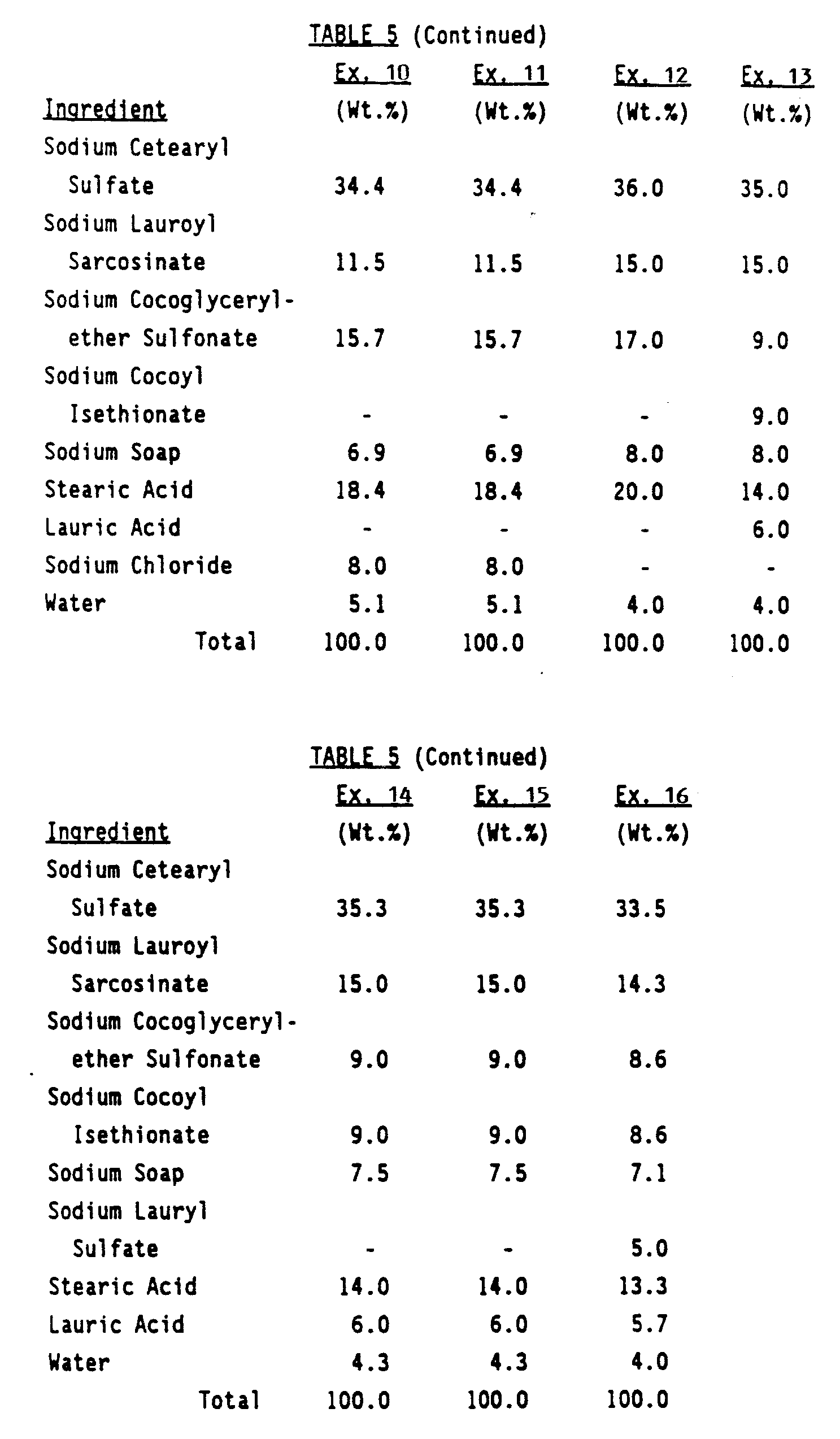
- Examples 3-49 contain from 26-46% sodium cetearyl sulfate and represent the broad range of formulations acceptable within the matrix of this invention.
- the sodium cetearyl sulfate contains primary C16-C18 alkyl chains.
- Comparative Example 1 is the control bar for assessing processability of the bars of this invention. See Table 4. Using this comparative example, it will be shown that bars described below have improved processability without sacrificing mildness or other bar performance properties.
- Comparative Example 2 is a standard syndet bar made by the Colgate-Palmolive Co. under the name Vel®. This product contains an estimated 10% to 15% sodium cetearyl sulfate, significantly less than the levels required in the present invention. Additionally, the Vel bar has unacceptable bar use properties such as smear and lather volume. TABLE 4 Comparative Examples 1 and 2 (Wt.%) Ingredient Ex. 1 Ex.
- Examples 3-46 are all based on a matrix composed of sodium cetearyl sulfate (26-46%) and stearic acid (0-20%).
- various lathering surfactants such as sodium lauroyl sarcosinate (0-20%); sodium cocoglycerylether sulfonate (0-35%); sodium cocoyl isethionate (0-17%); and sodium soap (0-15%).
- Lauric acid (0-20%) along with the stearic acid, are added to ensure product pH less than or equal to 7.5.
- Processing aids such as plasticizers (paraffin, cottonseed oil and PEG-8000), and fillers, calcium carbonate and dextrins are added (0-15%) to reduce stickiness and improve plodding.
- Examples 31, 41 and 46 are highly preferred syndet bars which are easy to process while still performing well in terms of bar properties.
Landscapes
- Chemical & Material Sciences (AREA)
- Organic Chemistry (AREA)
- Engineering & Computer Science (AREA)
- Chemical Kinetics & Catalysis (AREA)
- Oil, Petroleum & Natural Gas (AREA)
- Wood Science & Technology (AREA)
- Life Sciences & Earth Sciences (AREA)
- Detergent Compositions (AREA)
- Cosmetics (AREA)
- Organic Low-Molecular-Weight Compounds And Preparation Thereof (AREA)
- Addition Polymer Or Copolymer, Post-Treatments, Or Chemical Modifications (AREA)
- Bakery Products And Manufacturing Methods Therefor (AREA)
- Pharmaceuticals Containing Other Organic And Inorganic Compounds (AREA)
- Steroid Compounds (AREA)
- Moulds For Moulding Plastics Or The Like (AREA)
Abstract
Description
- This invention relates to cleansing bars based on synthetic surfactants and to processes of making them.
- Synthetic surfactant-based personal cleansing bars have attracted much interest recently because they tend to be milder to the skin than soap-based products. This mildness, however, comes with negatives to both the manufacturer and the consumer. The manufacturer experiences difficult processability due to the sticky nature of such products, as well as high raw material costs. The consumer experiences the negative performance properties of smear, bar softness and consequently high wear rates.
- There is a strong need to develop a mild bar product that is easily processable on conventional equipment while having acceptable in-use characteristics. Prior art soap syndet bars are described in FR-A-1 548 196, EP-A-0 281 028, GB-A-1 294 754 and DD-A-32 812.
- This invention relates to skin cleansing syndet bar compositions which provide improved processability and still maintain consumer acceptable bar quality. Therefore, one object of this invention is to provide a composition which exhibits improved processability.
- This invention is an improved mild personal cleansing syndet bar comprising: at least 18% by weight long chain alkyl sulfate having essentially saturated C₁₅-C₂₂, preferably C₁₆-C₁₈, alkyl chains, preferably cetearyl sulfate, combined with a selected plasticizer preferably selected from paraffin, fatty acids, and polyethylene glycols, and mixtures thereof.
- To develop a mild synthetic surfactant-based bar without the processability and performance negatives outlined above, it is advantageous to think of the bar as two separate components: the matrix and the actives. The matrix provides the physical characteristics (processability and bar messiness) while the actives provide lathering and mild properties. The matrix, if not chosen correctly, can impede lather generation, cause poor bar feel, enhance wear rate beyond an acceptable level, and/or reduce product mildness. Likewise, the actives must be chosen so as to provide acceptable levels of lathering without negatively impacting mildness, a common tradeoff in formulations.
- It will be appreciated that the development of an appropriate matrix is a delicate balancing act between plasticity and brittleness while not compromising lather performance. Typical matrix materials such as triglycerides, fatty alcohols, monoglycerides, etc., tend to form a sufficiently plastic matrix but also tend to depress lather potential. Other commonly used matrix materials such as salts, sugars, polysaccharides, etc., tend to make an overly brittle and water-soluble matrix that induces poor bar messiness performance.
- Disclosed is a syndet bar comprising: (1) from 18% to 55%, preferably from 20% to 45%, of C₁₅-C₂₂, preferably C₁₆-C₁₈, essentially saturated long alkyl (chain) sulfates; (2) from 10% to 50%, preferably from 15% to 40% plasticizer having a melting point of from 23°C to 110°C; (3) preferably from 10% to 50%, more preferably from 15% to 40%, high lathering, mild surfactants; (4) from 0% to 20%, preferably from 5% to 15%, sodium soap; and (5) from 2% to 10%, preferably from 3% to 8%, water.
- The long chain alkyl sulfates, as defined herein, comprise said long chain alkyl chains at a level of at least 90%, preferably 93%, and more preferably 97%. The long chain alkyl sulfates are derived from corresponding saturated straight chain alcohols. The preferred alkyl sulfate has a ratio of C₁₆ and C₁₈ alkyl chains of from 4:1 to 1:4. A commercially available C₁₆-C₁₈ alkyl sulfate is SIPON® EC-111 (formerly SIPEX® EC-111), sodium cetearyl sulfate, which is approximately 60% C₁₆ and 36% C₁₈. SIPON® EC-111 is sold by Alcolac Company, Baltimore, MD 21226. Another source is Henkel Corp., Ambler, PA 19002. Henkel's sodium cetearyl sulfate, LANETTE E (RTM), is an estimated 50-50% C₁₆-C₁₈ alkyl sulfate sold as an emulsifier.
- The terms "synthetic bar," also "syndet bar," as used herein mean that the bar has more synthetic surfactant than soap unless otherwise specified. The term "AS syndet bar" means a syndet bar containing alkyl sulfate surfactant.
- The percentages, ratios, and parts herein are on a total composition weight basis, unless otherwise specified. All levels and ranges herein are approximations unless otherwise specified.
- It is noted that surfactant mildness can be measured by a skin barrier destruction test which is used to assess the irritancy potential of surfactants. In this test the milder the surfactant, the lesser the skin barrier is destroyed. Skin barrier destruction is measured by the relative amount of radiolabeled water (³H-H₂O) which passes from the test solution through the skin epidermis into the physiological buffer contained in the diffusate chamber. This test is described by T.J. Franz in the J. Invest. Dermatol., 1975, 64, pp. 190-195; and in US-A-4,673,525, Small et al., issued June 16, 1987 and which disclose a mild alkyl glyceryl ether sulfonate (AGS) surfactant based synbar comprising a "standard" alkyl glyceryl ether sulfonate mixture. Barrier destruction testing surprisingly shows that the long chain alkyl sulfates are milder than standard AGS.
- The long chain alkyl sulfate comprises 18-55% by weight of the bars of this invention. Other syndet bar ingredients are selected from: other surfactants, polymeric skin feel aids, moisturizers, plasticizers, fillers, etc. A preferred syndet bar comprises: 20-45% of cetearyl sulfate; 5-15% soap; and 1-35%, preferably 5-30%, moisturizer; 10-50% plasticizers; and 2-10%, preferably 3-8%, water. To insure mildness and bar firmness, the synthetic detergent surfactant system in the bars should contain the long chain alkyl sulfate.
- Other detergent surfactants can be used; particularly from 10% to 50%, preferably from 15% to 40%, of lather enhancing detergent co-surfactant, e.g., mild ones, e.g., sodium lauroyl sarcosinate, alkylglycerylether sulfonate, and sulfonated fatty acids. Examples of other surfactants include other alkyl sulfates, anionic acyl sarcosinates, methyl acyl taurates, N-acyl glutamates, acyl isethionates, alkyl sulfosuccinates, alkyl phosphate esters, ethoxylated alkyl phosphate esters, trideceth sulfates, protein condensates, mixtures of ethoxylated alkyl sulfates and alkyl amine oxides, betaines, sultaines, and mixtures thereof. Included in the surfactants are the alkyl ether sulfates with 1 to 12 ethoxy groups, especially ammonium and sodium lauryl ether sulfates. Alkyl chains for these other surfactants are C₈-C₂₂, preferably C₁₀-C₁₈. The acyl esters of isethionic acid salts, with esters of C₁₆-C₁₈ acyl isethionates and no more than 25% or lower C₁₄ acyl groups are also useful. Preferred is stearoyl isethioniate with C₁₄ 3%; C₁₆ 50%; and C₁₈ 47%. Alkyl glycosides and methyl glucose esters are preferred mild nonionics which may be mixed with other mild anionic or amphoteric surfactants in the compositions of this invention. The bars of this invention have up to 10% of shorter chain or traditional (coconut) alkyl sulfates and still maintain the mildness requirement of the bar.
- A second essential material of the present invention is a plastic binder, also referred to herein as a plasticizer. The syndet bar of this invention also comprises from 10% to 50%, preferably from 15% to 40%, plasticizer. The plasticizers suitable for use in the compositions according to the present invention have melting points in the range of from 23°C to 110°C, preferably from 30°C to 100°C. The plasticizer is selected from paraffin, fatty acid, and polyethylene glycols.
- The preferred cation in the AS salt is sodium. However, other cations such as triethanolammonium (TEA), ammonium, and K, etc., are also usable. As used herein the term "cationic polymer" includes naturally and synthetically derived cationic polymers. The abbreviation "CN" means coconut and "T" means tallow herein, unless otherwise specified. All percentages and proportions are by weight, unless otherwise specified.
- A preferred synbar contains a mixture of free fatty acid (or polyethylene glycol) and paraffin at a ratio of from 3:1 to 1:1.
- A preferred AS syndet bar also contains from 10% to 35% moisturizer, preferably one selected from glycerin and free fatty acid or mixtures thereof. In this case, the free fatty acid serves the purpose as moisturizing and plasticizer ingredient.
- The syndet bar of this invention may comprise 0% to about 5% of a suitably fast hydrating cationic polymer. The polymers have molecular weights of from 1000 to 3,000,000.
- The cationic polymer (skin conditioning agent) is selected from the group consisting of:
- (I) cationic polysaccharides;
- (II) cationic copolymers of saccharides and synthetic cationic monomers, and
- (III) synthetic polymers selected from the group consisting of:
- (A) cationic polyakylene imines
- (B) cationic ethoxy polyalkylene imines, and
- (C) cationic poly[N-[-3-(dimethylammonio)propyl]-N'-[3-(ethyleneoxyethylene dimethylammonio)propyl]urea dichloride].
- Specific examples of members of the cationic polysaccharide class include the cationic hydroxyethyl cellulose JR 400 made by Union Carbide Corporation; the cationic starches Stalok® 100, 200, 300 and 400 made by Staley, Inc.; the cationic galactomannans based on guar gum of the Galactasol 800 series by Henkel, Inc. and the Jaguar Series by Celanese Corporation.
- Examples of members of the class of copolymers of saccharides and synthetic cationic monomers include those composed of cellulose derivatives (e.g. hydroxyethyl cellulose) and N,N-diallyl,N-N-dialkyl ammonium chloride available from National Starch Corporation under the trade name Celquat.
- The cationic synthetic polymers useful in the present invention are cationic polyalkylene imines, ethoxypolyalklene imines, and poly[N-[-3-(dimethylammonio)propyl]-N'-[3-(ethyleneoxyethylene dimethylammonio)propyl]urea dichloride] the latter of which is available from Miranol Chemical Company, Inc. under the trademark of Miranol A-15, CAS Reg. No. 68555-36-2.
- Preferred cationic polymeric skin conditioning agents used in the present invention are those cationic polysaccharides of the cationic guar gum class with molecular weights of 1,000 to 3,000,000. More preferred molecular weights are from 2,500 to 350,000. These polymers have a polysaccharide backbone comprised of galactomannan units and a degree of cationic substitution ranging from 0.04 per anhydroglucose unit to 0.80 per anhydroglucose unit with the substituent cationic group being the adduct of 2,3-epoxypropyltrimethyl ammonium chloride to the natural polysaccharide backbone. Examples are JAGUAR C-14-S, C-15 and C-17 sold by Celanese Corporation. In order to achieve the benefits described in this invention, the polymer must have characteristics, either structural or physical which allow it to be suitably and fully hydrated and subsequently well incorporated into the soap matrix.
- Other ingredients of the present invention are selected for the various applications. E.g., perfumes can be used in formulating the skin cleansing products, generally at a level of from 0.1% to 1.5% of the composition. Alcohols, hydrotropes, colorants, and fillers such as talc, clay, calcium carbonate and dextrin can also be used. Cetearyl alcohol is a mixture of cetyl and stearyl alcohols. Preservatives, e.g., sodium ethylenediaminetetraacetate (EDTA), generally at a level of less than 1% of the composition, can be incorporated in the cleansing products to prevent color and odor degradation. Antibacterials can also be incorporated, usually at levels up to 1.5%. The following patents disclose or refer to such ingredients and formulations which can be used in the soap/synbars of this invention:
Pat. No. Issue Date Inventor(s) US-A-4,234,464 11/1980 Morshauser US-A-4,061,602 12/1977 Oberstar et al. US-A-4,472,297 9/1984 Bolich et al. US-A-4,491,539 1/1985 Hoskins et al. US-A-4,540,507 9/1985 Grollier US-A-4,673,525 6/1987 Small et al. US-A-4,704,224 11/1987 Saud US-A-4,812,253 3/1989 Small et al. US-A-4,820,447 4/1989 Medcalf et al. US-A-4,954,282 9/1990 Rys et al. - The syndet bars of this invention have a pH of from 4 to 9 in a 1% aqueous solution. The preferred pH is 5 to 8, more preferably about 7.
- The following test procedures are used to evaluate the critical bar performance attributes of mildness and bar processability.
- The rolling cylinder adhesion test (RCAT) is designed to simulate the adhesion of the processed synbar formulation to the surfaces of the processing equipment (drying/flaking/plodding/milling/stamping). It has been shown to correlate with stickiness of products during processing. This stickiness is inversely related to overall bar processability. The synbar of this invention has a Relative RCAT (Rolling Cylinder Adhesion Test) Value of less than 1, preferably less than 0.9, and more preferably less than 0.8. A Relative RCAT Value of 1 is assigned to a comparable bar made without the processing aid.
- The equipment used for this test is the following. An inclined plane (15°) with raised edges is used as the base for the rolling cylinder. The cylinder itself is made from plexiglass tubing of 101.6 mm (4") outer diameter and 30.2 cm (11-7/8") overall length; it weighs 735.2 grams.
- All evaluations are conducted in a constant temperature/humidity environment at 80°F (26°C) and 15% relative humidity. The synbar product to be tested is grated into small pieces (about 2 mm in length). About 20 grams of the grated product are spread evenly over the surface of the inclined plane (which is covered with Kraft freezer paper). The preweighed cylinder is then placed at the head of the inclined plane and allowed to roll freely over the material until it reaches the end of the run. The cylinder is reweighed, the difference being the weight of material adhering to it. The higher the amount of material adhering to the cylinder, the stickier the product and the more difficult to process. The data is expressed as a percentage of material stuck to the cylinder (RCAT %) relative to the amount of material available (20 grams).
- In Table 1 below, syndet bar Examples 1-44 (described in more detail below in the Examples section of Table 5) are tested for stickiness using RCAT. Comparative Example 1 is a state-of-the-art syndet bar similar to the exemplified bars of Small et al., supra.
TABLE 1 Rolling Cylinder Adhesion (Stickiness) Test (RCAT) Values Example RCAT (%) Rel. RCAT* 1 56.5 1.0 ** 2 32.8 0.58*** 3 18.5 0.33 4 17.5+ 0.31 6 25.7 0.45 7 18.9 0.33 8 17.2+ 0.30 9 18.2+ 0.32 10 19.2 0.34 11 28.1 0.50 14 18.1 0.32 15 26.3 0.47 16 24.7 0.44 17 24.4 0.43 19 39.9 0.71 21 34.0 0.60 24 39.3 0.70 25 28.0 0.50 27 31.3 0.55 28 40.0 0.71 29 29.8 0.53 30 16.0+ 0.28 31 23.5 0.42 32 20.0 0.35 41 26.0 0.46 42 12.0+ 0.21 43 9.5+ 0.17 *RCAT/56.5. **State-of-the-art syndet bar. ***VEL® syndet bar. + Best bars of less stickiness. - The RCAT data is a measure of processability in that it correlates very well with stickiness during processing. Comparative Example 1 is difficult to process because the material adheres to cooling, plodding and stamping equipment during manufacture. All formulas which have a relative RCAT value of less than 1.0, therefore, are easier to process. Of Examples 3-44, for which data are available, all have lower RCAT values and improved processability.
- The improved processability of these formulas is a direct result of the decreased hygroscopicity of these formulas.
- Hygroscopicity is the tendency for a product to take up water under equilibrium conditions. It is a causative factor in the stickiness of materials. The higher the hygroscopicity, the stickier and more difficult to process a material tends to be.
- Hygroscopicity is measured by shaving approximately one gram of a bar product and knowing the initial weight and moisture accurately. The shaved product is placed in a constant temperature (80°F-27°C), constant humidity (80% R.H.) environment. The total weight of the sample is taken hourly until no further weight is gained. The difference between the initial and final weights is the increase in moisture content of the sample; this value, when combined with the initial moisture, is the hygroscopicity.
- In Table 2, the Examples correspond to those shown in Table 1 and are described in detail in Table 5 hereinbelow. The experimental syndet bar Examples all have improved hygroscopicity over the standard bar Example 1.
TABLE 2 Hygroscopicity Values Example Hygroscopicity (%) Relative Hygroscopicity* 1 26.83 1.0 15 9.24 0.34 21 9.29 0.35 22 7.59 0.28 23 9.54 0.32 24 6.69 0.25 25 7.73 0.29 26 7.73 0.29 27 8.12 0.30 28 8.42 0.31 29 9.28 0.35 30 7.40 0.28 31 8.69 0.32 32 9.70 0.36 *Hygroscopicity/26.83 = Standard - This test was performed according to the procedure described in U.S. Pat. No. 4,812,253, Small et al., issued Mar. 14, 1989,
- Frequently, materials which tend to improve processability also tend to have other negatives, particularly in terms of product mildness. Referring to Table 3, using the barrier destruction method to assess product mildness, individual raw materials sodium cetearyl sulfate is shown to be surprisingly more mild than the ultra mild sodium cocoglycerylether sulfonate, as well as a shorter chained AS, sodium dodecyl sulfate. The lower the number in Table 3 the milder the product.
TABLE 3 mg ³H₂O Transported Water 0.137 Sodium Cetearyl Sulfate 0.302 Sodium Cocoglycerylether Sulfonate 0.458 Sodium Dodecyl Sulfate 1.289 Sodium Laurate 1.805 -
- 1. Add melted sodium cetearyl sulfate to the crutcher.
- 2. Add predetermined quantity of Hamposyl L-30 solution to the crucher mix.
- 3. Add the predetermined quantity of AGS paste to the water in the crutcher. The AGS paste can be at ambient temperature or preheated to 150°F (65°C).
- 4. Turn on the agitator and recirculation pump and maintain temperature in crutcher at 130-150°F (54-65°C) by adjusting steam and water valves.
- 5. Allow contents in crutcher mix to return to 130-150°F (54-65°C) prior to adding predetermined quantity of stearic acid.
- 6. Add to heated crutcher mix predetermined quantity of soap or NaOH to form in-situ soap.
- 7. Allow the contents in the crutcher to mix and/or react for about 15 minutes while maintaining the temperature at 130-150°F (54-65°C).
- 8. Add to heated crutcher mix the predetermined quantity of acyl isethionate. Allow contents in crutcher to mix for about 20 minutes while maintaining temperature at 130-150°F (54-65°C).
- 9. Add sodium chloride plasticizer and titanium dioxide to the heated crutcher mix.
- 10. Add lauric and/or coconut fatty acids to crutcher mix and allow contents of crutcher to mix for about 15 minutes while maintaining temperature at 130-150°F (54-65°C).
- The crutcher mix is dried and cooled using a combination flash chamber and chill roll or chill belt. The crutcher mix is first heated to approximately 300°F (149°C) by a heat exchanger and then flash dried in a chamber above the chill roll or chill belt. From the flash chamber the hot, dried mix is extruded onto the chill roll or chill belt. The chill belt or chill roll provides a uniform, thin, cool (85-95°F, 29-35°C) product in flake or chip form. Typical moisture for the flake is 1-10%, preferably about 2-4.5%. The ways to regulate the moisture, in the order of preference, are (1) increasing or decreasing steam pressure on the heat exchanger; (2) increasing or decreasing crutcher mix rate to the heat exchanger; and (3) increasing or decreasing crutcher mix temperature to the heat exchanger.
- The flakes are weighed and mixed in a batch amalgamator to obtain uniform flake size. Preweighed perfume is added to the flakes and mixed in the amalgamator to obtain the desired finished product perfume level. The perfumed flakes are transferred to the mix hopper or directly to the plodder.
- The 3-roll soap mills are set up with the first roll at 120°F (49°C) and the other two mills at about 44°F (7°C). The material is passed through the mills several times to provide a homogeneous mixture of perfume and dried flakes.
- The plodder is set up with the barrel temperature at about 125°F (52°C) and the nose temperature at 120°F (49°C). The ideal plodder is a dual stage plodder that allows use of a vacuum of about 50.8-84.5 kPa (15-25 inches of Hg). The plugs should be cut in 127 mm (5") sections and stamped with a cold die block using die liquor such as alcohol, if appropriate.
- The following examples are illustrative and are not intended to limit the scope of the invention(s). The detailed methods of making milled bars is well known. All levels and ranges, temperatures, results etc., used herein are approximations unless otherwise specified.
- The formulations illustrated in Examples 1 and 2 are comparative examples included for illustration. Example 1 is an AGS-based, state-of-the-art product, while Example 2 is an estimated formulation of Colgate-Palmolive VEL® syndet bar with ≦15.0% sodium cetearyl sulfate.
- Examples 3-49 contain from 26-46% sodium cetearyl sulfate and represent the broad range of formulations acceptable within the matrix of this invention. The sodium cetearyl sulfate contains primary C₁₆-C₁₈ alkyl chains.
- Comparative Example 1 is the control bar for assessing processability of the bars of this invention. See Table 4. Using this comparative example, it will be shown that bars described below have improved processability without sacrificing mildness or other bar performance properties.
- Comparative Example 2 is a standard syndet bar made by the Colgate-Palmolive Co. under the name Vel®. This product contains an estimated 10% to 15% sodium cetearyl sulfate, significantly less than the levels required in the present invention. Additionally, the Vel bar has unacceptable bar use properties such as smear and lather volume.
TABLE 4 Comparative Examples 1 and 2 (Wt.%) Ingredient Ex. 1 Ex. 2 Sodium Cocoglycerylether Sulfonate 53.7 - Sodium Lauroyl Sarcosinate 12.5 - Sodium Soap 7.2 - Sodium Cocomonoglyceryl Sulfate - 40-45 Sodium Cetearyl Sulfate - 10-15 Cetearyl Alcohol - 15.0 Stearic Acid 9.8 - Lauric Acid 6.5 - Coconut Oil - 5.0 Coconut Fatty Acid - 2.4 Sodium Chloride 4.0 10.9 Sodium Sulfate - 6.3 Polyquaternium-7 (RTM) 1.0 - Polyquaternium-10 (RTM) 0.5 - Water 4.0 1.0 - Examples 3-46 are all based on a matrix composed of sodium cetearyl sulfate (26-46%) and stearic acid (0-20%). To this matrix are added various lathering surfactants such as sodium lauroyl sarcosinate (0-20%); sodium cocoglycerylether sulfonate (0-35%); sodium cocoyl isethionate (0-17%); and sodium soap (0-15%). Lauric acid (0-20%) along with the stearic acid, are added to ensure product pH less than or equal to 7.5. Processing aids such as plasticizers (paraffin, cottonseed oil and PEG-8000), and fillers, calcium carbonate and dextrins are added (0-15%) to reduce stickiness and improve plodding.



- Examples 31, 41 and 46 are highly preferred syndet bars which are easy to process while still performing well in terms of bar properties.
Claims (8)
- A personal cleansing syndet bar comprising: from 18% to 55% of essentially saturated long chain C₁₅-C₂₂ alkyl sulfate; from 0 to 10% of alkyl sulfate having chain length of less than C₁₅; from 0% to 20% of soap; and from 10% to 50% of a plastic binder having a melting point of from 23°C to 110°C and wherein said plastic binder is selected from paraffin, fatty acid, and polyethylene glycols, and mixtures thereof; and wherein said syndet bar has a pH of from 4.0 to 8.0 in 1% aqueous solution.
- A personal cleansing syndet bar according to Claim 1 wherein said plastic binder is selected from the group consisting of paraffin waxes and fatty acids.
- The syndet bar of Claim 1 or 2 wherein the level of long chain alkyl sulfate is from 20% to 45% by weight of said bar and said soap is from 5% to 15% by weight of said bar; and wherein said plastic binder melting point is from 30°C to 100°C and wherein said long chain is C₁₆-C₁₈.
- The personal cleansing syndet bar of Claim 1 or 2 wherein said bar comprises from 15% to 40% of said plastic binder; and wherein said long chain alkyl sulfate is present at a level of from 20% to 45% and is a saturated long chain alkyl sulfate surfactant having saturated alkyl chains of from 16 to 18 carbon atoms; and from 15% to 40% of a mild cosurfactant.
- The syndet bar of Claim 4 wherein said mild cosurfactant is selected from higher lathering sodium lauroyl sarcosinate, alkyl glycerylether sulfonate, sodium cocoyl isethionate, stearoyl isethionate, and mixtures thereof, and comprises from 2.0% to 10% water and wherein said syndet bar is a milled bar and has a pH of from 5 to 8 in 1% aqueous solution.
- The syndet bar of Claim 1 or 2 wherein said soap-synthetic bar contains other components selected from: moisturizers, colorants, solvents, fillers, other surfactants, polymeric skin feel and mildness aids, perfumes, and preservatives, and water at a level of from 3% to 8% wherein said bar contains said C₁₆ and C₁₈ alkyl chains having a ratio of from 4:1 to 1:4.
- The personal cleansing syndet bar of Claim 4 wherein said mild cosurfactant is selected from sodium lauroyl sarcosinate, alkyl glycerylether sulfonate, sodium cocoyl isethionate, stearoyl isethionate, and mixtures thereof, and comprises from 2.0% to 10% water; and wherein said syndet bar is a milled bar and said pH is from 5 to 8 in 1% aqueous solution; and wherein said bar contains said C₁₆ and C₁₈ alkyl chains having a ratio of from 4:1 to 1:4 and contains from 15% to 40% of a mixture of free fatty acids and paraffin at a ratio of from 3:1 to 1:1.
- The syndet bar of Claim 3 wherein said plastic binder is a mixture of free fatty acid or polyethylene glycol and paraffin at a ratio of from 3:1 to 1:1.
Applications Claiming Priority (3)
| Application Number | Priority Date | Filing Date | Title |
|---|---|---|---|
| US60561490A | 1990-10-30 | 1990-10-30 | |
| PCT/US1991/007774 WO1992007931A1 (en) | 1990-10-30 | 1991-10-21 | Syndet bar with long chain alkyl sulfates for improved processability and bar characteristics |
| US605614 | 2000-06-28 |
Publications (2)
| Publication Number | Publication Date |
|---|---|
| EP0555342A1 EP0555342A1 (en) | 1993-08-18 |
| EP0555342B1 true EP0555342B1 (en) | 1995-12-20 |
Family
ID=24424453
Family Applications (1)
| Application Number | Title | Priority Date | Filing Date |
|---|---|---|---|
| EP91920209A Expired - Lifetime EP0555342B1 (en) | 1990-10-30 | 1991-10-21 | Syndet bar with long chain alkyl sulfates for improved processability and bar characteristics |
Country Status (19)
| Country | Link |
|---|---|
| EP (1) | EP0555342B1 (en) |
| JP (1) | JPH06504764A (en) |
| CN (1) | CN1062164A (en) |
| AT (1) | ATE131865T1 (en) |
| AU (1) | AU8929291A (en) |
| BR (1) | BR9107038A (en) |
| CA (1) | CA2095039A1 (en) |
| DE (1) | DE69115714T2 (en) |
| EG (1) | EG19712A (en) |
| FI (1) | FI931933A7 (en) |
| IE (1) | IE913772A1 (en) |
| MA (1) | MA22329A1 (en) |
| MX (1) | MX9101830A (en) |
| MY (1) | MY131207A (en) |
| NO (1) | NO931543L (en) |
| NZ (1) | NZ240376A (en) |
| PT (1) | PT99367A (en) |
| TR (1) | TR27389A (en) |
| WO (1) | WO1992007931A1 (en) |
Families Citing this family (6)
| Publication number | Priority date | Publication date | Assignee | Title |
|---|---|---|---|---|
| JPH04237962A (en) * | 1991-01-18 | 1992-08-26 | Matsushita Electric Ind Co Ltd | Flat type solid electrolyte fuel cell |
| US6326339B1 (en) * | 1997-03-04 | 2001-12-04 | Lever Brothers Company, Division Of Conopco, Inc. | Cleansing system comprising synthetic detergent bar and pouf |
| JP5002580B2 (en) * | 2005-03-18 | 2012-08-15 | スリーエム イノベイティブ プロパティズ カンパニー | Solid cleaner for cooking food surfaces |
| US20070066500A1 (en) * | 2005-09-21 | 2007-03-22 | Conopco, Inc., D/B/A Unilever | Composition with enhanced squeaky feel |
| BR112021020418A2 (en) | 2019-05-07 | 2021-12-07 | Basf Se | Surfactant composition and use of the compositions |
| FR3111908A1 (en) * | 2020-06-26 | 2021-12-31 | Samir CONSTANTINI | Acid pH soap or shampoo bar |
Family Cites Families (5)
| Publication number | Priority date | Publication date | Assignee | Title |
|---|---|---|---|---|
| ZA677791B (en) * | 1966-12-29 | |||
| GB1257679A (en) * | 1969-02-20 | 1971-12-22 | ||
| GB1294754A (en) * | 1969-12-01 | 1972-11-01 | Unilever Ltd | Synthetic detergent toilet bars |
| EP0239165A3 (en) * | 1986-03-27 | 1988-03-23 | Cornelis Van Buuren | Synthetic soap and method for the preparation thereof |
| DE3707035A1 (en) * | 1987-03-05 | 1988-09-15 | Henkel Kgaa | MOLDED DETERGENTS |
-
1991
- 1991-10-21 EP EP91920209A patent/EP0555342B1/en not_active Expired - Lifetime
- 1991-10-21 JP JP4500772A patent/JPH06504764A/en active Pending
- 1991-10-21 DE DE69115714T patent/DE69115714T2/en not_active Expired - Fee Related
- 1991-10-21 BR BR919107038A patent/BR9107038A/en unknown
- 1991-10-21 AT AT91920209T patent/ATE131865T1/en not_active IP Right Cessation
- 1991-10-21 WO PCT/US1991/007774 patent/WO1992007931A1/en not_active Ceased
- 1991-10-21 FI FI931933A patent/FI931933A7/en not_active Application Discontinuation
- 1991-10-21 AU AU89292/91A patent/AU8929291A/en not_active Abandoned
- 1991-10-21 CA CA002095039A patent/CA2095039A1/en not_active Abandoned
- 1991-10-26 TR TR01032/91A patent/TR27389A/en unknown
- 1991-10-27 EG EG64991A patent/EG19712A/en active
- 1991-10-29 MX MX9101830A patent/MX9101830A/en unknown
- 1991-10-29 MA MA22611A patent/MA22329A1/en unknown
- 1991-10-29 IE IE377291A patent/IE913772A1/en unknown
- 1991-10-29 MY MYPI91001995A patent/MY131207A/en unknown
- 1991-10-29 PT PT99367A patent/PT99367A/en not_active Application Discontinuation
- 1991-10-29 NZ NZ240376A patent/NZ240376A/en unknown
- 1991-10-30 CN CN91111137A patent/CN1062164A/en active Pending
-
1993
- 1993-04-28 NO NO93931543A patent/NO931543L/en unknown
Also Published As
| Publication number | Publication date |
|---|---|
| CN1062164A (en) | 1992-06-24 |
| FI931933A0 (en) | 1993-04-29 |
| MX9101830A (en) | 1992-06-05 |
| PT99367A (en) | 1992-09-30 |
| EP0555342A1 (en) | 1993-08-18 |
| NO931543L (en) | 1993-06-30 |
| TR27389A (en) | 1995-02-03 |
| ATE131865T1 (en) | 1996-01-15 |
| IE913772A1 (en) | 1992-05-22 |
| NO931543D0 (en) | 1993-04-28 |
| MA22329A1 (en) | 1992-07-01 |
| FI931933L (en) | 1993-04-29 |
| BR9107038A (en) | 1993-08-31 |
| MY131207A (en) | 2007-07-31 |
| NZ240376A (en) | 1994-11-25 |
| EG19712A (en) | 1995-12-31 |
| AU8929291A (en) | 1992-05-26 |
| CA2095039A1 (en) | 1992-05-01 |
| FI931933A7 (en) | 1993-04-29 |
| DE69115714T2 (en) | 1996-08-29 |
| JPH06504764A (en) | 1994-06-02 |
| DE69115714D1 (en) | 1996-02-01 |
| WO1992007931A1 (en) | 1992-05-14 |
Similar Documents
| Publication | Publication Date | Title |
|---|---|---|
| EP0728185B1 (en) | Improved acylisethionate skin cleansing bar containing liquid polyols and magnesium soap | |
| US4820447A (en) | Mild skin cleansing soap bar with hydrated cationic polymer skin conditioner | |
| US5154849A (en) | Mild skin cleansing toilet bar with silicone skin mildness/moisturizing aid | |
| US5204014A (en) | Low pH mild personal cleansing bar with lathering mild synthetic surfactant and magnesium soap | |
| US5076953A (en) | Skin cleansing synbars with low moisture and/or selected polymeric skin mildness aids | |
| US4946618A (en) | Toilet bar composition containing cationic guar gum | |
| EP0308189B1 (en) | Skin cleansing toilet bar with low moisture content | |
| EP0606262B1 (en) | Mild personal cleansing bar composition with balanced surfactants, fatty acids, and paraffin wax | |
| EP0227321B1 (en) | Mild skin cleansing soap bar and method of making | |
| EP0308190A2 (en) | Ultra mild skin cleansing toilet bar with selected mixed polymers | |
| US5681980A (en) | Topped, distilled, cocoyl isethionate skin cleansing bar | |
| US5064555A (en) | Mild skin cleansing soap bar with hydrated cationic polymer skin conditioner | |
| IE920240A1 (en) | Binder systems for bar soaps based on long chain alkyl¹sulfates for improved smear and lather | |
| IE920906A1 (en) | Mild personal cleansing bars with improved processability | |
| US5393449A (en) | Personal cleansing stamped synbar containing alkyl glyceryl ether sulfonate and acyl isethionate | |
| EP0367335B1 (en) | Toilet bar composition containing cationic guar gum | |
| EP0575440B1 (en) | LOW pH MILD PERSONAL CLEANSING BAR | |
| NZ240376A (en) | Personal cleansing surfactant bar containing c15-c22 alkyl sulphate, a plastic binder and optionally soap | |
| AU610489B2 (en) | Mild skin cleansing soap bar with hydrated cationic polymer |
Legal Events
| Date | Code | Title | Description |
|---|---|---|---|
| PUAI | Public reference made under article 153(3) epc to a published international application that has entered the european phase |
Free format text: ORIGINAL CODE: 0009012 |
|
| 17P | Request for examination filed |
Effective date: 19930423 |
|
| AK | Designated contracting states |
Kind code of ref document: A1 Designated state(s): AT BE CH DE DK ES FR GB GR IT LI LU NL SE |
|
| 17Q | First examination report despatched |
Effective date: 19931029 |
|
| GRAA | (expected) grant |
Free format text: ORIGINAL CODE: 0009210 |
|
| AK | Designated contracting states |
Kind code of ref document: B1 Designated state(s): AT BE CH DE DK ES FR GB GR IT LI LU NL SE |
|
| PG25 | Lapsed in a contracting state [announced via postgrant information from national office to epo] |
Ref country code: NL Free format text: LAPSE BECAUSE OF FAILURE TO SUBMIT A TRANSLATION OF THE DESCRIPTION OR TO PAY THE FEE WITHIN THE PRESCRIBED TIME-LIMIT Effective date: 19951220 Ref country code: LI Effective date: 19951220 Ref country code: GR Free format text: LAPSE BECAUSE OF FAILURE TO SUBMIT A TRANSLATION OF THE DESCRIPTION OR TO PAY THE FEE WITHIN THE PRESCRIBED TIME-LIMIT Effective date: 19951220 Ref country code: ES Free format text: THE PATENT HAS BEEN ANNULLED BY A DECISION OF A NATIONAL AUTHORITY Effective date: 19951220 Ref country code: DK Effective date: 19951220 Ref country code: CH Effective date: 19951220 Ref country code: BE Effective date: 19951220 Ref country code: AT Effective date: 19951220 |
|
| REF | Corresponds to: |
Ref document number: 131865 Country of ref document: AT Date of ref document: 19960115 Kind code of ref document: T |
|
| REF | Corresponds to: |
Ref document number: 69115714 Country of ref document: DE Date of ref document: 19960201 |
|
| ET | Fr: translation filed | ||
| ITF | It: translation for a ep patent filed | ||
| PG25 | Lapsed in a contracting state [announced via postgrant information from national office to epo] |
Ref country code: SE Effective date: 19960320 |
|
| NLV1 | Nl: lapsed or annulled due to failure to fulfill the requirements of art. 29p and 29m of the patents act | ||
| PG25 | Lapsed in a contracting state [announced via postgrant information from national office to epo] |
Ref country code: GB Effective date: 19961021 |
|
| PLBE | No opposition filed within time limit |
Free format text: ORIGINAL CODE: 0009261 |
|
| STAA | Information on the status of an ep patent application or granted ep patent |
Free format text: STATUS: NO OPPOSITION FILED WITHIN TIME LIMIT |
|
| PG25 | Lapsed in a contracting state [announced via postgrant information from national office to epo] |
Ref country code: LU Free format text: LAPSE BECAUSE OF NON-PAYMENT OF DUE FEES Effective date: 19961031 |
|
| 26N | No opposition filed | ||
| GBPC | Gb: european patent ceased through non-payment of renewal fee |
Effective date: 19961021 |
|
| PG25 | Lapsed in a contracting state [announced via postgrant information from national office to epo] |
Ref country code: FR Effective date: 19970630 |
|
| PG25 | Lapsed in a contracting state [announced via postgrant information from national office to epo] |
Ref country code: DE Effective date: 19970701 |
|
| REG | Reference to a national code |
Ref country code: FR Ref legal event code: ST |
|
| PG25 | Lapsed in a contracting state [announced via postgrant information from national office to epo] |
Ref country code: IT Free format text: LAPSE BECAUSE OF NON-PAYMENT OF DUE FEES;WARNING: LAPSES OF ITALIAN PATENTS WITH EFFECTIVE DATE BEFORE 2007 MAY HAVE OCCURRED AT ANY TIME BEFORE 2007. THE CORRECT EFFECTIVE DATE MAY BE DIFFERENT FROM THE ONE RECORDED. Effective date: 20051021 |