EP0555022B1 - Electrophotographic toner and process for producing it - Google Patents
Electrophotographic toner and process for producing it Download PDFInfo
- Publication number
- EP0555022B1 EP0555022B1 EP93300658A EP93300658A EP0555022B1 EP 0555022 B1 EP0555022 B1 EP 0555022B1 EP 93300658 A EP93300658 A EP 93300658A EP 93300658 A EP93300658 A EP 93300658A EP 0555022 B1 EP0555022 B1 EP 0555022B1
- Authority
- EP
- European Patent Office
- Prior art keywords
- cooh
- resin
- toner
- vinyl resin
- glycidyl
- Prior art date
- Legal status (The legal status is an assumption and is not a legal conclusion. Google has not performed a legal analysis and makes no representation as to the accuracy of the status listed.)
- Expired - Lifetime
Links
Classifications
-
- G—PHYSICS
- G03—PHOTOGRAPHY; CINEMATOGRAPHY; ANALOGOUS TECHNIQUES USING WAVES OTHER THAN OPTICAL WAVES; ELECTROGRAPHY; HOLOGRAPHY
- G03G—ELECTROGRAPHY; ELECTROPHOTOGRAPHY; MAGNETOGRAPHY
- G03G9/00—Developers
- G03G9/08—Developers with toner particles
-
- G—PHYSICS
- G03—PHOTOGRAPHY; CINEMATOGRAPHY; ANALOGOUS TECHNIQUES USING WAVES OTHER THAN OPTICAL WAVES; ELECTROGRAPHY; HOLOGRAPHY
- G03G—ELECTROGRAPHY; ELECTROPHOTOGRAPHY; MAGNETOGRAPHY
- G03G9/00—Developers
- G03G9/08—Developers with toner particles
- G03G9/087—Binders for toner particles
- G03G9/08784—Macromolecular material not specially provided for in a single one of groups G03G9/08702 - G03G9/08775
- G03G9/08791—Macromolecular material not specially provided for in a single one of groups G03G9/08702 - G03G9/08775 characterised by the presence of specified groups or side chains
-
- G—PHYSICS
- G03—PHOTOGRAPHY; CINEMATOGRAPHY; ANALOGOUS TECHNIQUES USING WAVES OTHER THAN OPTICAL WAVES; ELECTROGRAPHY; HOLOGRAPHY
- G03G—ELECTROGRAPHY; ELECTROPHOTOGRAPHY; MAGNETOGRAPHY
- G03G9/00—Developers
- G03G9/08—Developers with toner particles
- G03G9/087—Binders for toner particles
- G03G9/08784—Macromolecular material not specially provided for in a single one of groups G03G9/08702 - G03G9/08775
- G03G9/08793—Crosslinked polymers
-
- G—PHYSICS
- G03—PHOTOGRAPHY; CINEMATOGRAPHY; ANALOGOUS TECHNIQUES USING WAVES OTHER THAN OPTICAL WAVES; ELECTROGRAPHY; HOLOGRAPHY
- G03G—ELECTROGRAPHY; ELECTROPHOTOGRAPHY; MAGNETOGRAPHY
- G03G9/00—Developers
- G03G9/08—Developers with toner particles
- G03G9/087—Binders for toner particles
- G03G9/08784—Macromolecular material not specially provided for in a single one of groups G03G9/08702 - G03G9/08775
- G03G9/08795—Macromolecular material not specially provided for in a single one of groups G03G9/08702 - G03G9/08775 characterised by their chemical properties, e.g. acidity, molecular weight, sensitivity to reactants
Definitions
- This invention relates to an electrophotographic toner suitable for use in developing electrostatic latent images in electrophotography, electrostatic recording, electrostatic printing and the like, which is capable of meeting requirements even for high-speed copying machines, while assuring well-balanced fixing and offset resistance and excellent grindability, and to a process for the production of said toner.
- Electrophotography as practiced in a PPC (plain paper copier) copying machine or printer generally comprises forming an electrostatic latent image on a photoconductor, developing the latent image with a toner, transferring the toner image onto a base sheet such as a paper sheet and then heating and fixing the toner image by a hot roll. Since fixing is conducted under heat and pressure, this process features high speed and excellent thermal efficiency, hence, superb fixing efficiency.
- This hot roll method is, in contrast to its excellent thermal efficiency, accompanied by the so-called offset phenomenon, that is, the problem that because the toner is brought into contact with a surface of the hot roll, the toner sticks and is transferred onto the surface of the hot roll, and is then transferred back onto the next base sheet to smear the same.
- a reduction in molecular weight leads to a resin having insufficient cohesive force, whereby the offset phenomenon tends to occur more readily.
- Such a low molecular weight is therefore not preferred.
- a low-molecular resin is generally blended with a high-molecular resin so that the low cohesive force of the low-molecular resin is supplemented by the better cohesive force of the high-molecular resin; however, flowability is somewhat sacrificed by this approach. Examples of such techniques are proposed, for example, in Japanese Patent Publication Nos. 6895/1980 and 32180/1988, and US-A-4,921,771. These techniques are however still insufficient for the tendency toward ever higher copying speeds and, in many instances, countermeasures are taken based on improvements in copying machines.
- silicone oil is coated on a surface of a hot roll by fabric or paper to prevent offsetting.
- the construction of the copying machine becomes complex so that its repair and maintenance are complicated, leading to higher repair and maintenance cost. This approach is thus not preferred.
- a fixing toner which is a toner for high-speed machines and is suitable for use in the oilless fixing method that does not require the use of oil such as silicone oil.
- Japanese Patent Publication No. 36582/1985 discloses use of a crosslinked polymer produced by emulsion polymerization.
- the crosslinked polymer employed contains 50-99% of a gel component.
- offset resistance is improved but grindability is reduced.
- grindability is improved but offset resistance is not improved. It has thus been extremely difficult to satisfy both offset resistance and grindability.
- this method requires combined use of a dispersant or dispersion aid upon production of a crosslinked polymer.
- Such a dispersant or dispersion aid is highly hygroscopic so that it adversely affects electrical properties, especially charge stability. It is therefore necessary to eliminate the dispersant or dispersion aid as much as possible after the production of the crosslinked polymer. A great deal of labor is however needed to completely eliminate the dispersant or dispersion aid by washing the resultant crosslinked polymer. This washing produces a lot of waste water, thereby posing a further difficulty in its treatment.
- US-A-4,966,829 discloses that a good toner can be obtained by including a vinyl polymer which contains 0.1 - 60 wt.% of a gel component and, when analyzed by GPC in a form dissolved in THF, presents a main peak corresponding to molecular weights of 1,000-25,000 and at least one subpeak or shoulder corresponding to molecular weights of 3,000-150,000.
- the process adopted to produce the vinyl polymer is suspension polymerization which, like emulsion polymerization, also requires the use of a dispersion or dispersing aid in practice.
- the toner disclosed in this U.S. patent is therefore accompanied by exactly the same problem as the emulsion polymerization described above. With a view toward overcoming this problem, the present inventors have already provided, as a toner resin having good fixing property, a resin produced by solution polymerization (see US-A-4,963,456).
- a resin produced by solution polymerization requires elimination of solvent subsequent to the completion of the polymerization. Since low-volatility components such as unreacted remaining monomers and decomposition products of an initiator can be all distilled off upon elimination of the solvent, it is possible to obtain a homogeneous resin which contains impurities of a very low order and is stable electrically. The resin is therefore considered to be optimal for use in the production of a toner.
- Production of a crosslinked polymer by solution polymerization is however accompanied by the problem that the production cannot be continued due to occurrence of Weissenberg effect, that is, winding of the resin around a stirring shaft.
- Japanese Patent Publication No. 38700/1985 discloses a toner binder produced by heating and mixing (A) a copolymer containing 3-40% of a glycidyl-containing monomer and (B) a crosslinkable compound.
- the toner however contains many remaining epoxy groups so that toner particles of opposite charge are formed in a long-term test. The toner therefore involves a problem in durability.
- EP-A-0,412,712 discloses toner compositions having as principal components a resin (A) containing carboxyl groups and a resin (B) containing glycidyl or ⁇ -methylglycidyl groups.
- Resin A is obtained by reacting a multivalent metal compound (e.g. an acetate or oxide of an alkaline earth metal) with a copolymer obtained by copolymerizing a styrene type monomer, a (meth)acrylic ester monomer and a vinyl type monomer containing carboxyl groups.
- Resin B is a copolymer obtained by copolymerizing two different vinyl monomers, one containing glycidyl or ⁇ -methylglycidyl groups.
- US-A-4,504,563 discloses a toner composition based on a vinyl copolymer having an acid value of 5 to 100, obtained by copolymerizing an ethylenically unsaturated monomer, such as styrene, with an acid monomer such as acrylic acid.
- An object of the present invention is to satisfy the requirements described above. It has been found that a toner capable of meeting requirements even for high-speed copying machines, while assuring well-balanced fixing property, offset resistance, blocking resistance and good grindability can be obtained by crosslinking a specific resin, which has been produced by solution polymerization, with a glycidyl-containing compound at a predetermined ratio, leading to the completion of the present invention.
- an electrophotographic toner which comprises at least a colorant, a binder and a charge control agent, said binder being the resin obtained by reacting : (A) a COOH-containing vinyl resin which has a number-average molecular weight (Mn) of 1,000-20,000, a weight-average molecular weight (Mw) of 50,000-1,000,000 Mw/Mn being at least 3.5, an acid value of 1.0-10 KOH mg/g and a glass transition temperature (Tg) of 40-75°C; and (B) a glycidyl compound in an amount sufficient to provide 0.05-1.0 equivalent of glycidyl groups per equivalent of COOH groups in the COOH-containing vinyl resin (A), the glycidyl compound being a glycidyl-ester-containing resin which has a weight-average molecular weight of 3,000-10,000 and an epoxy value of 0.01-0.3 eq/100 g.
- Mn number-average molecular weight
- Mw weight-average molecular
- an electrophotographic toner which comprises melting and kneading a composition formed of a colorant, a charge control agent and a binder, said binder being obtained by reacting (A) a COOH-containing vinyl resin which has a number-average molecular weight (Mn) of 1,000-20,000, a weight-average molecular weight (Mw) of 50,000-1,000,000 Mw/Mn being at least 3.5, an acid value of 1.0-10 KOH mg/g and a glass transition temperature (Tg) of 40-75°C and (B) a glycidyl compound in an amount sufficient to provide 0.05-1.0 equivalent of glycidyl groups per equivalent of COOH groups in the COOH-containing vinyl resin (A), the glycidyl compound being a glycidyl-ester-containing resin which has a weight-average molecular weight of 3,000-10,000 and an epoxy value of 0.01-0.3 eq/100
- COOH-containing vinyl resin (A) which is one of the components of the binder in the present invention
- COOH-containing vinyl monomer examples include acrylic acid, methacrylic acid, maleic anhydride, maleic acid, fumaric acid, cinnamic acid, and monoesters of unsaturated dibasic acids such as methyl fumarate, ethyl fumarate, propyl fumarate, butyl fumarate, octyl fumarate, methyl maleate, ethyl maleate, propyl maleate, butyl maleate and octyl maleate.
- Examples of the further vinyl monomer copolymerizable with the COOH-containing vinyl monomer include styrenes such as styrene, p-methylstyrene, ⁇ -methylstyrene and vinyl toluene; acrylic esters such as methyl acrylate, ethyl acrylate, propyl acrylate, butyl acrylate, octyl acrylate, cyclohexyl acrylate, stearyl acrylate, benzyl acrylate, furfuryl acrylate, hydroxyethyl acrylate, hydroxybutyl acrylate, dimethylaminomethyl acrylate and dimethylaminoethyl acrylate; methacrylic esters such as methyl methacrylate, ethyl methacrylate, propyl methacrylate, butyl methacrylate, octyl methacrylate, cyclohexyl methacrylate, stearyl
- the COOH-containing vinyl resin (A) is a resin having a wide molecular-weight distribution, that is, having a number-average molecular weight of 1,000-20,000 and a weight-average molecular weight of 50,000-1,000,000, Mw/Mn being at least 3.5, and having a glass transition temperature (Tg) of 40-75°C.
- Tg glass transition temperature
- weight-average molecular weight when the weight-average molecular weight is smaller than 50,000, substantial crosslinking is required for improved offset resistance. An increase in crosslinking, however, leads to a higher whole molecular weight and thus to deteriorated fixing property. Weight-average molecular weights larger than 1,000,000, on the other hand, cause gelation at a smaller crosslinking degree so that the fixing property is deteriorated. It is difficult to achieve a good balance between fixing property and offset resistance especially at an Mw/Mn ratio smaller than 3.5. An improvement in offset resistance inevitably leads to a deterioration in fixing property.
- the softening point increases, thereby impairing the fixing property so that the target toner cannot be obtained.
- the COOH content of the COOH-containing vinyl resin (A) is 1.0-10 KOH mg/g in terms of acid value. Acid values smaller than 1.0 KOH mg/g are too small to exhibit the advantages of the present invention. If the acid value is greater than 10 KOH mg/g, on the other hand, gelation takes place even at low degrees of crosslinking: the resulting gel separates and precipitates in the resin. The viscosity is therefore not increased, failing to improve the offset resistance.
- the glycidyl glycidyl compound (B) in the present invention is a glycidyl-ester-containing vinyl resin which has a weight-average molecular weight of 3,000-10,000 and an epoxy value of 0.01-0.3 eq/100 g.
- the glycidyl-ester-containing vinyl resin is obtained by copolymerizing at least one glycidyl-containing vinyl monomer, such as glycidyl acrylate, ⁇ -methylglycidyl acrylate, glycidyl methacrylate or 8-methylglycidyl methacrylate, with a further vinyl monomer.
- the weight-average molecular weight of the resin is smaller than 3,000, the viscosity is hardly increased even when crosslinked, thereby failing to improve the offset resistance. If the weight-average molecular weight is greater than 10,000, on the other hand, the compatibility of the crosslinked substance is deteriorated during the crosslinking reaction and the crosslinked substance separates and precipitates in the resin. The viscosity is therefore not increased, failing to improve the offset resistance.
- the epoxy value is preferably in a range of 0.01-0.2 eq/100 g. If the epoxy value is smaller than 0.01 eq/100 g, no substantial viscosity increase occurs so that the offset resistance cannot be improved.
- An epoxy value greater than 0.2 eq/100g leads to a crosslinked substance having deteriorated compatibility so that the crosslinked substance separates and precipitates in the resin. Despite the formation of gel, the viscosity is not increased so that the offset resistance is not improved.
- the glycidyl compound (B) is used in an amount sufficient to provide 0.05-1.0 equivalent of glycidyl groups per equivalent of COOH groups in the COOH-containing vinyl resin (A). If the ratio is smaller than 0.05 equivalent, the advantages of the present invention cannot be exhibited. Ratios greater than 1.0, on the other hand, cause fluctuations in charge during a long-term durability test. Ratios outside the above range, therefore, are not preferred.
- a homogeneous solution of the vinyl monomers and a polymerization initiator in at least one solvent selected from aromatic hydrocarbons - such as benzene, toluene, ethylbenzene, xylene and cumene - "Solvesso #100" and "Solvesso #150" (trade names; products of Esso Kagaku K.K.) is continuously charged into a pressure vessel, which has been filled up with the solvent in advance, while the temperature and internal pressure of the vessel are kept constant, whereby polymerization is conducted. After attainment of a steady state, the polymerization mixture is stored in a tank to provide a low-molecular polymer solution.
- a high-molecular polymer solution is obtained by bulk polymerization.
- the high-molecular solution and the low-molecular solution are thoroughly mixed together.
- the resultant mixture is subjected to solvent removal by a distillation in a vacuum system of about 0-200 mmHg (0-267 hPa).
- the vinyl resin and the solvent are thus separated, whereby a COOH-containing vinyl resin (A) can be obtained in a solid form.
- the two components of the binder which is a characteristic element in the present invention namely, the COOH-containing vinyl resin (A) and the glycidyl compound (B) can be reacted in various ways as will be described below:
- a widely used, known dye or pigment can be employed as the colorant.
- exemplary colorants include black pigments such as carbon black, acetylene black, lamp black and magnetite; chrome yellow, yellow iron oxide, hansa yellow G, quinoline yellow lake, permanent yellow NCG, molybdenum orange, vulcan orange, indanthrenes, brilliant orange GK, red iron oxide, brilliant carmine 6B, flizarin lake, methyl violet lake, fast violet B, cobalt blue, alkali blue lake, phthalocyanin blue, fast sky blue, pigment green B, malachite green lake, titanium oxide and zinc white; and magnetic powders such as magnetite and soft ferrite. They may each be used generally in an amount of 0.1-20 parts by weight per 100 parts by weight of the toner components as measured prior to mixing.
- resins such as polyester resins, polyamide resins, vinyl chloride resins, polyvinyl butyral resins, styrene-butadiene resins, cumarone-indene resins, melamine resins and polyolefin resins can each be mixed in part to an extent not impairing the objects of the present invention.
- a known charge control agent led by nigrosine, a quaternary ammonium salt or a metal-containing azo dye can be suitably selected and used. They may each be used in an amount of 0.1-10 parts by weight per 100 parts by weight of the toner components as measured prior to mixing.
- any methods known per se in the art can be employed for the production of the toner.
- the resins, a colorant, a charge control agent, wax and the like are premixed.
- the premix is heated, melted and kneaded with a twin-screw kneader.
- the resultant mass is then cooled, pulverized and classified, whereby fine particles of about 10 ⁇ m are obtained.
- the number-average molecular weight and weight-average molecular weight as referred to in the present invention are those determined by GPC. They are molecular weights converted in accordance with a calibration curve which was drawn based on monodisperse standard polystyrene. Measurement conditions are as shown below:
- the resultant vinyl resin had a number-average molecular weight of 3800, a weight-average molecular weight of 210,000, a Tg of 63°C and an acid value of 6.2.
- the mass so formed was cooled and pulverized, followed by the addition of 8 parts of carbon black ("MA100”, trade name; product of Mitsubishi Kasei Corporation), 5 parts of polypropylene wax ("Biscol 550P”, trade name; product of Sanyo Kasei K.K.) and, as a charge control agent, 1 part of "Eisen Spiron Black TRH” (trade name; product of Hodogaya Kagaku K.K.). They were mixed in a Henschel mixer. The resultant mixture was thereafter kneaded at 150°C with the twin-screw kneader ("PCM-30", trade name; manufactured by Ikegai Tekko Co., Ltd.).
- PCM-30 twin-screw kneader
- the mass so formed was cooled, pulverized and classified, whereby a toner having a particle size of about 10 ⁇ m was obtained.
- a toner having a particle size of about 10 ⁇ m was obtained.
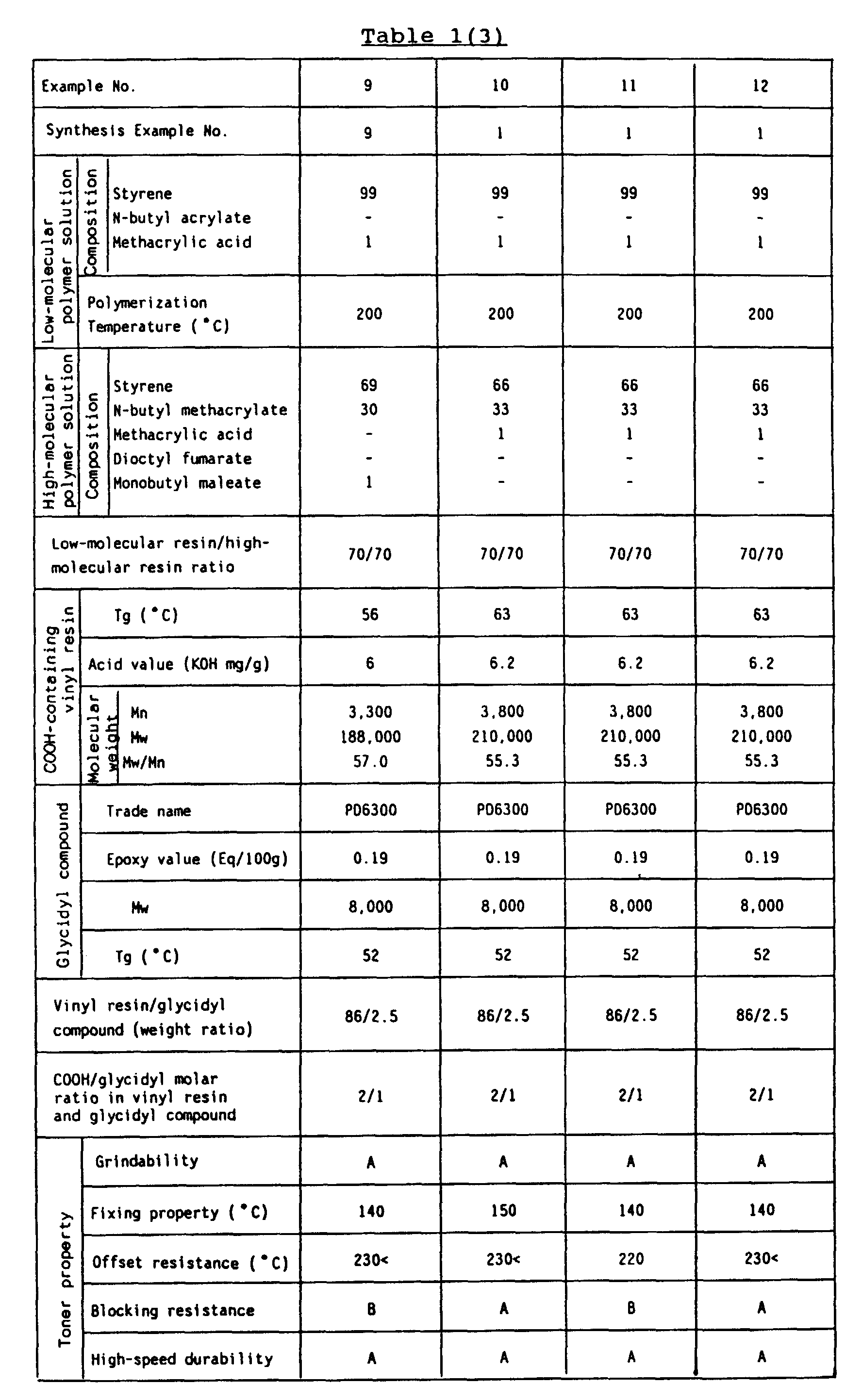
- a mixture consisting of 3 parts of the toner so obtained and 97 parts of a carrier as a developing agent and a modified commercial copying machine pictures were obtained. Evaluation results of the pictures are presented in Table 1.
- a toner was obtained as in Example 1 except that the vinyl resin obtained in Synthesis Example 2 was used instead of the vinyl resin obtained in Synthesis Example 1.
- pictures were evaluated. The evaluation results are presented in Table 1.
- a toner was obtained as in Example 1 except that the vinyl resin obtained in Synthesis Example 3 was used instead of the vinyl resin obtained in Synthesis Example 1.
- pictures were evaluated. The evaluation results are presented in Table 1.
- a toner was obtained as in Example 1 except that the vinyl resin obtained in Synthesis Example 5 was used instead of the vinyl resin obtained in Synthesis Example 1.
- pictures were evaluated. The evaluation results are presented in Table 1.
- a toner was obtained as in Example 1 except that the amount of PD6300 was decreased from 2.5 parts to 1.25 parts. In exactly the same manner as in Example 1, pictures were evaluated. The evaluation results are presented in Table 1.
- a toner was obtained as in Example 1 except that PD6300 was replaced by PD6100 (trade name of a glycidyl-containing styrene-acryl resin produced by Mitsui Toatsu Chemicals, Inc., epoxy value: 0.10 eq/100 g, weight-average molecular weight: 8,000, Tg: 56°C).
- PD6100 trade name of a glycidyl-containing styrene-acryl resin produced by Mitsui Toatsu Chemicals, Inc., epoxy value: 0.10 eq/100 g, weight-average molecular weight: 8,000, Tg: 56°C.
- a toner was obtained as in Example 1 except that the vinyl resin obtained in Synthesis Example 7 was used instead of the vinyl resin obtained in Synthesis Example 1.
- pictures were evaluated. The evaluation results are presented in Table 1.
- a toner was obtained as in Example 1 except that the vinyl resin obtained in Synthesis Example 8 was used instead of the vinyl resin obtained in Synthesis Example 1.
- pictures were evaluated. The evaluation results are presented in Table 1.
- a toner was obtained as in Example 1 except that the vinyl resin obtained in Synthesis Example 9 was used instead of the vinyl resin obtained in Synthesis Example 1.
- pictures were evaluated. The evaluation results are presented in Table 1.
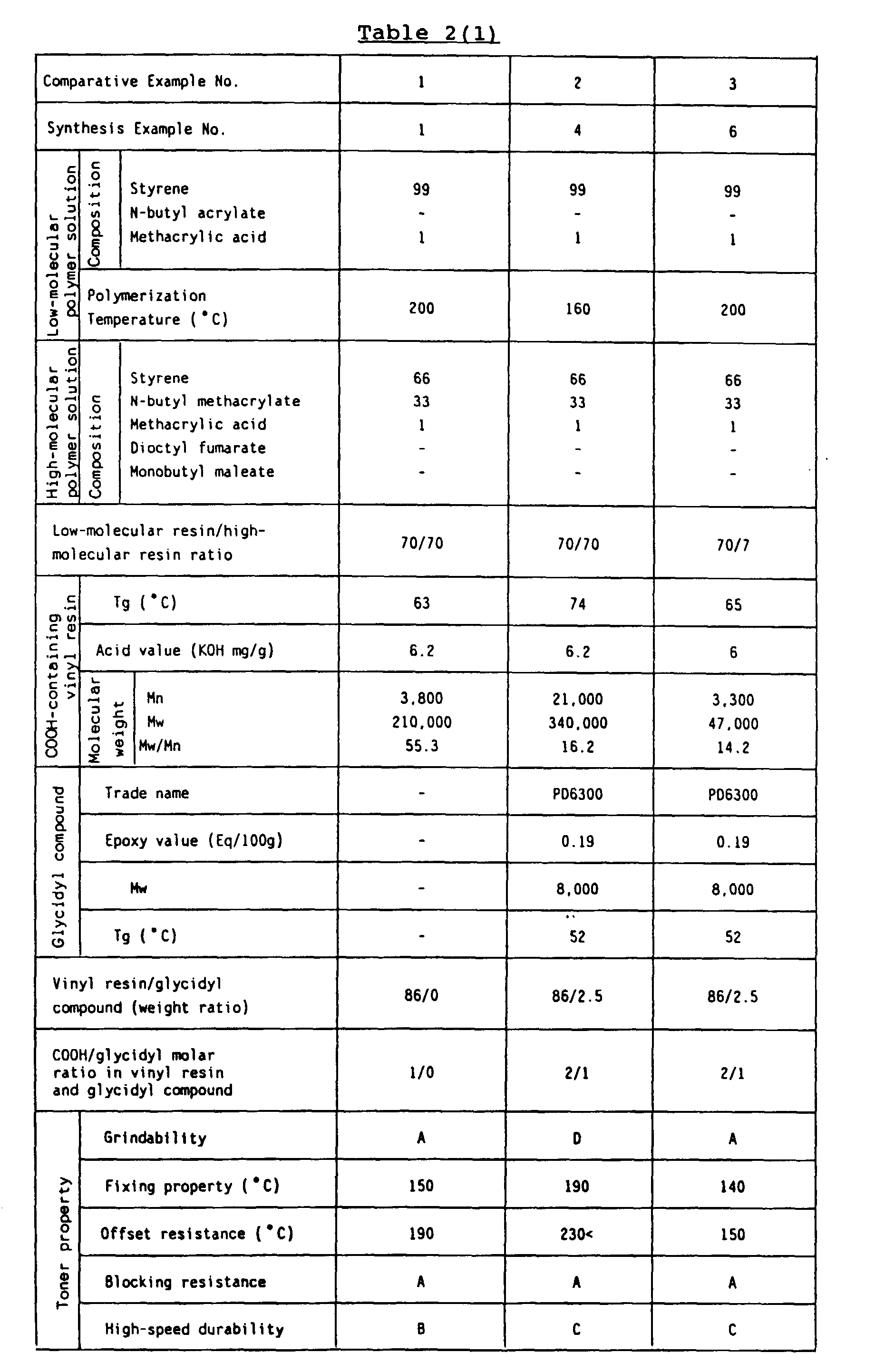
- a toner was obtained as in Example 1 except that the glycidyl compound was not used. In exactly the same manner as in Example 1, pictures were evaluated. The evaluation results are presented in Table 2.
- a toner was obtained as in Example 1 except that the vinyl resin obtained in Synthesis Example 4 was used instead of the vinyl resin obtained in Synthesis Example 1.
- pictures were evaluated. The evaluation results are presented in Table 2.
- a toner was obtained as in Example 1 except that the vinyl resin obtained in Synthesis Example 6 was used instead of the vinyl resin obtained in Synthesis Example 1.
- pictures were evaluated. The evaluation results are presented in Table 2.
- a toner was obtained as in Example 1 except that the vinyl resin obtained in Synthesis Example 10 was used instead of the vinyl resin obtained in Synthesis Example 1.
- pictures were evaluated. The evaluation results are presented in Table 2.
- a toner was obtained as in Example 1 except that the vinyl resin obtained in Synthesis Example 11 was used instead of the vinyl resin obtained in Synthesis Example 1.
- pictures were evaluated. The evaluation results are presented in Table 2.
- a toner was obtained as in Example 1 except that the vinyl resin obtained in Synthesis Example 12 was used instead of the vinyl resin obtained in Synthesis Example 1 and the glycidyl compound was not used. In exactly the same manner as in Example 1, pictures were evaluated. The evaluation results are presented in Table 2.
- Copying was conducted while changing the temperature of fixing rolls 10°C by 10°C.
- a rubber eraser ("MONO", trade mark; plastic eraser produced by Tombow Pencil Co., Ltd.) was reciprocated 100 times under predetermined constant pressure across a solid black area and the white background on each copy. The blackness of the solid black area was then measured by an ink densitometer, and the extent of dropping of the toner was indicated by a density ratio.
- the fixing property was expressed in terms of the lowest temperature at which at least 80% of the density was left.
- a continuous test was conducted using a commercial high-speed copying machine (copying speed: 72 copies per minute) until 10,000 copies of a pattern were made, whereby the reproducibility of the pattern was checked. A difference in image quality between copies made before and after the continuous test was determined.
- each toner Upon production of each toner, a portion of the mass kneaded in the twin-screw kneader was collected subsequent to the cooling.
- the mass was pulverized into a particle size range of from under 10-mesh to 16-mesh by a jet mill.
- the particle size distribution was measured by a Coulter counter to determine the percentage of 5-20 ⁇ m particles.
- each toner according to the present invention has well-balanced fixing property and blocking resistance and good grindability and high-speed durability so that it can show excellent performance in actual use.
Landscapes
- Physics & Mathematics (AREA)
- Spectroscopy & Molecular Physics (AREA)
- General Physics & Mathematics (AREA)
- Developing Agents For Electrophotography (AREA)
Description



Claims (6)
- An electrophotographic toner comprising at least a colorant, a binder resin and a charge control agent, the binder resin being the resin obtained by reacting: (A) a COOH-containing vinyl resin having a number-average molecular weight (Mn) of 1,000-20,000, a weight-average molecular weight (Mw) of 50,000-1,000,000, Mw/Mn being at least 3.5, an acid value of 1.0-10 KOH mg/g and a glass transition temperature (Tg) of 40-75°C; and (B) a glycidyl compound in an amount sufficient to provide 0.05-1.0 equivalent of glycidyl groups per equivalent of COOH groups in the COOH-containing vinyl resin (A), the glycidyl compound being a glycidyl-ester-containing resin which has a weight-average molecular weight of 3,000-10,000 and an epoxy value of 0.01-0.3 eq/100g.
- The toner of claim 1, wherein the COOH-containing vinyl resin (A) has been obtained by copolymerizing a monomer, which comprises at least one carboxylic acid or a carboxylic acid derivative selected from the group consisting of acrylic acid, methacrylic acid, maleic anhydride, maleic acid, fumaric acid, cinnamic acid and monoesters of unsaturated dibasic acids, with a further vinyl monomer copolymerizable therewith.
- The toner of claim 2, wherein the further vinyl monomer is selected from styrenes, acrylate esters, methacrylate esters, dialkyl fumarates, acrylonitrile, acrylamide and methacrylamide.
- A process for the production of electrophotographic toner, which comprises:
melting and kneading a composition composed of a colorant, a charge control agent and a binder, said binder being obtained by a reaction of (A) a COOH-containing vinyl resin having a number-average molecular weight (Mn) of 1,000-20,000, a weight-average molecular weight (Mw) of 50,000-1,000,000 Mw/Mn being at least 3.5, an acid value of 1.0-10 KOH mg/g and a glass transition temperature (Tg) of 40-75°C and (B) a glycidyl compound in an amount sufficient to provide 0.05-1.0 equivalent of glycidyl groups per equivalent of COOH groups in the COOH-containing vinyl resin (A), the glycidyl compound being a glycidyl-ester-containing resin which has a weight-average molecular weight of 3,000-10,000 and an epoxy value of 0.01-0.3 eq/100g; and finely pulverizing the resultant mass. 4 - The process of claim 4, wherein at least a part of the COOH-containing vinyl resin (A) has been produced by solution polymerization.
- The process of claim 4, wherein the binder is obtainable by heating, melting and kneading, and reacting the COOH-containing vinyl resin (A) and the glycidyl compound (B) at 160-220°C.
Applications Claiming Priority (4)
| Application Number | Priority Date | Filing Date | Title |
|---|---|---|---|
| JP1587792 | 1992-01-31 | ||
| JP15877/92 | 1992-01-31 | ||
| JP107510/92 | 1992-04-27 | ||
| JP10751092 | 1992-04-27 |
Publications (2)
| Publication Number | Publication Date |
|---|---|
| EP0555022A1 EP0555022A1 (en) | 1993-08-11 |
| EP0555022B1 true EP0555022B1 (en) | 1998-04-01 |
Family
ID=26352103
Family Applications (1)
| Application Number | Title | Priority Date | Filing Date |
|---|---|---|---|
| EP93300658A Expired - Lifetime EP0555022B1 (en) | 1992-01-31 | 1993-01-29 | Electrophotographic toner and process for producing it |
Country Status (5)
| Country | Link |
|---|---|
| US (1) | US5370958A (en) |
| EP (1) | EP0555022B1 (en) |
| KR (1) | KR0126661B1 (en) |
| CA (1) | CA2088093C (en) |
| DE (1) | DE69317688T2 (en) |
Families Citing this family (16)
| Publication number | Priority date | Publication date | Assignee | Title |
|---|---|---|---|---|
| US5794105A (en) * | 1995-03-03 | 1998-08-11 | Minolta Co., Ltd. | Image forming apparatus and toner for full color development |
| US6194115B1 (en) * | 1997-02-12 | 2001-02-27 | Toray Industries, Inc. | Toner composition for developing electrostatic latent image |
| US6057072A (en) * | 1997-03-31 | 2000-05-02 | Eastman Kodak Company | Toner compositions containing activated carbons |
| JP3363856B2 (en) | 1998-12-17 | 2003-01-08 | キヤノン株式会社 | Positively chargeable toner, image forming method and image forming apparatus |
| US20020033470A1 (en) | 2000-07-19 | 2002-03-21 | Evans John W. | Non-aqueous heat transfer fluid and use thereof |
| US6670087B2 (en) | 2000-11-07 | 2003-12-30 | Canon Kabushiki Kaisha | Toner, image-forming apparatus, process cartridge and image forming method |
| EP1353236B1 (en) * | 2002-04-10 | 2008-06-18 | Canon Kabushiki Kaisha | Toner |
| EP1564600B1 (en) * | 2002-08-08 | 2010-10-06 | Mitsui Chemicals, Inc. | Binder resin for toner and toner |
| DE602004002137T2 (en) * | 2003-03-27 | 2007-07-19 | Canon K.K. | toner |
| WO2004107058A1 (en) * | 2003-05-29 | 2004-12-09 | Mitsui Chemicals, Inc. | Binder resin for toner and toner for electrophotography |
| CN100578372C (en) * | 2003-08-01 | 2010-01-06 | 佳能株式会社 | Toner |
| JP2005129279A (en) * | 2003-10-22 | 2005-05-19 | Canon Inc | Organic light emitting device |
| US7351509B2 (en) * | 2004-02-20 | 2008-04-01 | Canon Kabushiki Kaisha | Toner |
| US7306889B2 (en) * | 2004-02-20 | 2007-12-11 | Canon Kabushiki Kaisha | Process for producing toner, and toner |
| US8034522B2 (en) * | 2006-11-13 | 2011-10-11 | Reichhold, Inc. | Polyester toner resin compositions |
| EP3121217B1 (en) * | 2014-03-20 | 2019-07-17 | Mitsubishi Chemical Corporation | Vinyl polymer powder, thermoplastic resin composition, and molded body thereof |
Family Cites Families (7)
| Publication number | Priority date | Publication date | Assignee | Title |
|---|---|---|---|---|
| US3938992A (en) * | 1973-07-18 | 1976-02-17 | Eastman Kodak Company | Electrographic developing composition and process using a fusible, crosslinked binder polymer |
| JPS5950061B2 (en) * | 1979-04-09 | 1984-12-06 | 富士ゼロックス株式会社 | Toner for developing electrostatic latent images |
| EP0347800B1 (en) * | 1988-06-23 | 1995-02-22 | Mitsubishi Gas Chemical Company, Inc. | Toner for electrostatic images |
| JPH02310563A (en) * | 1989-05-26 | 1990-12-26 | Arakawa Chem Ind Co Ltd | Binder of toner for electrophotography and manufacture thereof |
| JP2754242B2 (en) * | 1989-06-13 | 1998-05-20 | 三洋化成工業株式会社 | Charge control agent |
| CA2022283C (en) * | 1989-07-31 | 1996-07-30 | Takayoshi Matsunaga | Resin composition for toners and a toner containing the same |
| JP2886951B2 (en) * | 1990-07-30 | 1999-04-26 | 三井化学株式会社 | Dry toner binder |
-
1993
- 1993-01-26 CA CA002088093A patent/CA2088093C/en not_active Expired - Lifetime
- 1993-01-29 EP EP93300658A patent/EP0555022B1/en not_active Expired - Lifetime
- 1993-01-29 KR KR1019930001119A patent/KR0126661B1/en not_active Expired - Lifetime
- 1993-01-29 US US08/010,871 patent/US5370958A/en not_active Expired - Lifetime
- 1993-01-29 DE DE69317688T patent/DE69317688T2/en not_active Expired - Lifetime
Also Published As
| Publication number | Publication date |
|---|---|
| EP0555022A1 (en) | 1993-08-11 |
| CA2088093C (en) | 1999-06-29 |
| KR930016833A (en) | 1993-08-30 |
| DE69317688T2 (en) | 1998-07-23 |
| KR0126661B1 (en) | 1997-12-29 |
| CA2088093A1 (en) | 1993-08-01 |
| DE69317688D1 (en) | 1998-05-07 |
| US5370958A (en) | 1994-12-06 |
Similar Documents
| Publication | Publication Date | Title |
|---|---|---|
| US5370958A (en) | Electrophotographic toner and production process thereof | |
| JP3794762B2 (en) | Toner for electrophotography | |
| US6497983B2 (en) | Toner binder for electrophotography and toner for electrophotography | |
| JP4043475B2 (en) | Binder resin and toner for toner | |
| JPH08320593A (en) | Binder resin and electrostatic charge image developing toner containing the same | |
| JP3118341B2 (en) | Electrophotographic toner and method for producing the same | |
| US5389483A (en) | Electrophotographic toner having two ethylene polymers | |
| EP0323512B1 (en) | Toner for electrophotography | |
| JP3701691B2 (en) | Toner for electrophotography | |
| JP2006171364A (en) | Binder resin for toner, and electrophotographic toner | |
| JP3929272B2 (en) | Electrophotographic toner binder and electrophotographic toner | |
| JPS61188545A (en) | Electrostatic latent image developing toner | |
| JP3891610B2 (en) | Toner for electrophotography | |
| US20040229146A1 (en) | Low temperature fixing toner | |
| JP3532033B2 (en) | Electrophotographic toner | |
| KR20220120775A (en) | Toners for high-speed machines and their effects | |
| JPS6394251A (en) | Toner | |
| JP2938567B2 (en) | Electrophotographic toner | |
| JP3128897B2 (en) | Method for producing polymerized toner | |
| JPH05341564A (en) | Toner for heat roller fixation | |
| JP3139846B2 (en) | Electrophotographic toner composition and method for producing the same | |
| JP2001013734A (en) | Negatively chargeable toner | |
| JP4368511B2 (en) | Toner for electrophotography | |
| JP4017548B2 (en) | Binder resin for toner and toner for electrophotography | |
| JP2595244B2 (en) | Toner for developing electrostatic latent images |
Legal Events
| Date | Code | Title | Description |
|---|---|---|---|
| PUAI | Public reference made under article 153(3) epc to a published international application that has entered the european phase |
Free format text: ORIGINAL CODE: 0009012 |
|
| AK | Designated contracting states |
Kind code of ref document: A1 Designated state(s): CH DE FR GB LI NL |
|
| 17P | Request for examination filed |
Effective date: 19940118 |
|
| 17Q | First examination report despatched |
Effective date: 19960221 |
|
| GRAG | Despatch of communication of intention to grant |
Free format text: ORIGINAL CODE: EPIDOS AGRA |
|
| GRAG | Despatch of communication of intention to grant |
Free format text: ORIGINAL CODE: EPIDOS AGRA |
|
| GRAH | Despatch of communication of intention to grant a patent |
Free format text: ORIGINAL CODE: EPIDOS IGRA |
|
| GRAH | Despatch of communication of intention to grant a patent |
Free format text: ORIGINAL CODE: EPIDOS IGRA |
|
| GRAA | (expected) grant |
Free format text: ORIGINAL CODE: 0009210 |
|
| AK | Designated contracting states |
Kind code of ref document: B1 Designated state(s): CH DE FR GB LI NL |
|
| REG | Reference to a national code |
Ref country code: CH Ref legal event code: NV Representative=s name: R. A. EGLI & CO. PATENTANWAELTE Ref country code: CH Ref legal event code: EP |
|
| REF | Corresponds to: |
Ref document number: 69317688 Country of ref document: DE Date of ref document: 19980507 |
|
| ET | Fr: translation filed | ||
| REG | Reference to a national code |
Ref country code: GB Ref legal event code: 732E |
|
| RAP2 | Party data changed (patent owner data changed or rights of a patent transferred) |
Owner name: MITSUI CHEMICALS, INC. |
|
| REG | Reference to a national code |
Ref country code: FR Ref legal event code: TP |
|
| NLS | Nl: assignments of ep-patents |
Owner name: MITSUI CHEMICALS, INC. |
|
| NLT2 | Nl: modifications (of names), taken from the european patent patent bulletin |
Owner name: MITSUI CHEMICALS, INC. |
|
| REG | Reference to a national code |
Ref country code: CH Ref legal event code: PK |
|
| PLBE | No opposition filed within time limit |
Free format text: ORIGINAL CODE: 0009261 |
|
| 26N | No opposition filed | ||
| REG | Reference to a national code |
Ref country code: GB Ref legal event code: IF02 |
|
| PGFP | Annual fee paid to national office [announced via postgrant information from national office to epo] |
Ref country code: CH Payment date: 20120112 Year of fee payment: 20 Ref country code: FR Payment date: 20120202 Year of fee payment: 20 |
|
| PGFP | Annual fee paid to national office [announced via postgrant information from national office to epo] |
Ref country code: DE Payment date: 20120125 Year of fee payment: 20 |
|
| PGFP | Annual fee paid to national office [announced via postgrant information from national office to epo] |
Ref country code: GB Payment date: 20120125 Year of fee payment: 20 |
|
| PGFP | Annual fee paid to national office [announced via postgrant information from national office to epo] |
Ref country code: NL Payment date: 20120125 Year of fee payment: 20 |
|
| REG | Reference to a national code |
Ref country code: DE Ref legal event code: R071 Ref document number: 69317688 Country of ref document: DE |
|
| REG | Reference to a national code |
Ref country code: NL Ref legal event code: V4 Effective date: 20130129 |
|
| REG | Reference to a national code |
Ref country code: GB Ref legal event code: PE20 Expiry date: 20130128 |
|
| PG25 | Lapsed in a contracting state [announced via postgrant information from national office to epo] |
Ref country code: GB Free format text: LAPSE BECAUSE OF EXPIRATION OF PROTECTION Effective date: 20130128 Ref country code: DE Free format text: LAPSE BECAUSE OF EXPIRATION OF PROTECTION Effective date: 20130130 |