EP0553165B1 - Method for the production of ductile cast iron - Google Patents
Method for the production of ductile cast iron Download PDFInfo
- Publication number
- EP0553165B1 EP0553165B1 EP91918037A EP91918037A EP0553165B1 EP 0553165 B1 EP0553165 B1 EP 0553165B1 EP 91918037 A EP91918037 A EP 91918037A EP 91918037 A EP91918037 A EP 91918037A EP 0553165 B1 EP0553165 B1 EP 0553165B1
- Authority
- EP
- European Patent Office
- Prior art keywords
- melt
- modifying agent
- sample
- cast iron
- vessel
- Prior art date
- Legal status (The legal status is an assumption and is not a legal conclusion. Google has not performed a legal analysis and makes no representation as to the accuracy of the status listed.)
- Expired - Lifetime
Links
Images

Classifications
-
- B—PERFORMING OPERATIONS; TRANSPORTING
- B22—CASTING; POWDER METALLURGY
- B22D—CASTING OF METALS; CASTING OF OTHER SUBSTANCES BY THE SAME PROCESSES OR DEVICES
- B22D2/00—Arrangement of indicating or measuring devices, e.g. for temperature or viscosity of the fused mass
-
- G—PHYSICS
- G01—MEASURING; TESTING
- G01N—INVESTIGATING OR ANALYSING MATERIALS BY DETERMINING THEIR CHEMICAL OR PHYSICAL PROPERTIES
- G01N33/00—Investigating or analysing materials by specific methods not covered by groups G01N1/00 - G01N31/00
- G01N33/20—Metals
- G01N33/204—Structure thereof, e.g. crystal structure
-
- G—PHYSICS
- G01—MEASURING; TESTING
- G01N—INVESTIGATING OR ANALYSING MATERIALS BY DETERMINING THEIR CHEMICAL OR PHYSICAL PROPERTIES
- G01N33/00—Investigating or analysing materials by specific methods not covered by groups G01N1/00 - G01N31/00
- G01N33/20—Metals
- G01N33/205—Metals in liquid state, e.g. molten metals
Definitions
- the present invention relates to a method for the production of ductile cast iron, comprising controlling and correcting the composition and physical properties of the cast iron melt. More particularly, the method comprises the steps of determining the inherent structural characteristics of the melt by thermal melt analysis and making corrections that are necessary.
- Thermal analysis has long been applied for determining the characteristics of metal melts.
- the thermal analysis method allows a sample of the melt to be solidified in a suitable vessel provided with one or more thermocouples by means of which the temperatures which prevail as the sample solidifies are recorded. The precipitation of different phases and phase transformations can be seen from the temperature-time curves.
- US-A-4 667 725 teaches a method of determining the structure characteristics of a melt which will permit determination of the metallographic structure which develops during the solidification of a metal melt.
- the method comprises extracting a sample from the melt and permitting the melt to solidify in a sample vessel provided with two thermosensors, one of which is placed in the centre of the sample volume and the other of which is placed in the vicinity of the inner wall of the sample vessel.
- the various temperatures in time are recorded through both thermosensors. From these recordings, values of miniumum and maximum points, duration of level temperatures, shoulders, derivatives, etc. are used to predict the structure characteristics that will be obtained.
- the method according to US-A-4 667 725 is mainly directed to the production of compacted cast iron, which has been a challenging task for the man skilled in this art.
- this technique can also be used to predict the structure characteristics of a melt intended for casting ductile cast iron.
- a typical melt for casting ductile cast iron has a C.E. value of 4.4-4.6, i.e. a hypereutectic cast iron.
- the method will only disclose that nodular graphite solidification will be obtained. No information relating to excessive amounts of structure modifying agent can be obtained.
- the modifying agent content may have decreased, by fading or burning-off, during the process of casting and thus the moulds that are filled last may possibly receive a cast iron melt which contains insufficient amounts of modifying agent.
- Fading is contingent on the actual process applied and the particular production equipment used. For example, in one particular foundry fading was established to be 0.003% Mg with each 5 minute period. The casting period was about 15 minutes in this case. In other words, the modifying agent content (in this case the magnesium content) was found to decrease by a total of 0.009% during the whole casting period.
- the modifying agent content in this case the magnesium content
- the present invention enables the need for a modifying agent to be diminished without risk of obtaining castings in which the graphite is not completely in nodular form.
- the invention resides in a method for the production of ductile cast iron, by carefully controlling and correcting the composition and inherent physical properties of the cast iron melt.
- the method comprises extracting a sample from a melt intended for casting ductile cast iron.
- This melt will contain a modifying agent in a quantity which is at least enough to create nodular graphite when solidifying. Excess amounts of modifying agent should be avoided.
- a melt sample is introduced into a sample vessel, which is permitted to come into thermal equilibrium with the melt.
- the sample vessel is provided with two thermosensors, one of which is positioned so as to be in the centre of the sample volume and the other of which is positioned so as to be in the vicinity of the wall of the sample vessel.
- the sample melt contained in the vessel is permitted to solidify and the temperature values prevailing during the process of solidification are recorded through the thermosensors.
- thermosensors can i.a. thermocouples or pyrometers be used.
- a given quantity of an oxide, a sulphide or an oxysulphide in an amount which is sufficient to oxidise the modifying agent present in the sample, so as to lower the percentage of modifying agent present by about 0.01% (calculated for magnesium).
- the modifying agent is of a type known to the man skilled in this art. Normally, magnesium is used, often in combination with rare earth metals, although other agents may also be usd. For the sake of simplicity, we refer here to a modifying agent consisting solely of magnesium, which makes it possible to give realistic percentage figures. The person skilled in this art will immediately realize the corrections that are required when using other modifying agents.
- a determined amount of an oxidizing agent is added to the sample vessel.
- This oxidizing agent will react with the melt sample, which is a determined volume dependent on the design of the sample vessel used, by oxidizing the modifying agent, usually magnesium.
- This oxidizing action reduces the content of active modifying agent by a predetermined percentage which is calculated to correspond to the loss of active modifying agent due to fading during the normal time of the casting process.
- Figure 1 shows the relationship between different types of graphite precipitation, expressed in percentage of nodular graphite crystals, and the percentage of dissolved elementary magnesium.
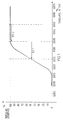
- Figure 2 of the drawings shows a typical recording of a good ductile cast iron melt, where the amount of dissolved elementary magnesium is decreased by 0.01%.
- FIG. 2 shows typical curves (Tc, Tw) for an acceptable melt from which ductile cast iron can be cast.
- T* w which is the super-cooling achieved at the thermocouple located in the vicinity of the sample vessel wall, Tw, which informs about the precipitation nuclei in the melt.
- rek w which is the positive derivative of the solidification curve in the lower part of the diagram
- ⁇ T c which is the difference between the equilibrium eutectic temperature T E and maximum growth temperature at the centre of (the curve Tc) of the sample volume.
- This value ⁇ T c gives information about the percentage of nodular graphite precipitations.
- the person skilled in this art will realize which values correspond to the equipment used.
- the signal from the thermocouples is a function of the latent heat evolved during the solidification process.
- the rate of evolution of latent "heat” can be established as a function of the aspect ratio length divided by witdth of graphite crystals, from say 20/1 for a typical compacted graphite crystal to 1/1 in the case of a fully modular crystal.
- a cast iron melt was produced in which the true content of dissolved elementary magnesium was 0.035% (subsequently calculated).
- a thermal analysis was carried out in a known manner on a melt sample contained in a sample vessel of the kind specified in the general part of the specification. This analysis showed that the melt sample was of acceptable quality with an almost complete nodularity.
- a cast iron melt in which the true active magnesium content was 0.055% was tested according to the present invention.
- the cast iron melt was intended for the production castings over a casting period of 15 minutes. No problem concerning nodularity was observed, although a metallographic analysis showed some oxide inclusions and a minor amount of carbides in the solidified sample. The test showed that the modifying agent was in excess and could be decreased in the next batch of melt. Alternatively, the magnesium content can be decreased by using a holding time before casting or by adding an appropriate amount of an oxidation agent.
- the invention provides a valuable tool in the art of casting ductile cast iron products.
Landscapes
- Chemical & Material Sciences (AREA)
- Health & Medical Sciences (AREA)
- Life Sciences & Earth Sciences (AREA)
- Engineering & Computer Science (AREA)
- Biochemistry (AREA)
- Immunology (AREA)
- Food Science & Technology (AREA)
- Medicinal Chemistry (AREA)
- Physics & Mathematics (AREA)
- Analytical Chemistry (AREA)
- Pathology (AREA)
- General Health & Medical Sciences (AREA)
- General Physics & Mathematics (AREA)
- Crystallography & Structural Chemistry (AREA)
- Mechanical Engineering (AREA)
- Refinement Of Pig-Iron, Manufacture Of Cast Iron, And Steel Manufacture Other Than In Revolving Furnaces (AREA)
- Treatment Of Steel In Its Molten State (AREA)
- Transition And Organic Metals Composition Catalysts For Addition Polymerization (AREA)
- Management, Administration, Business Operations System, And Electronic Commerce (AREA)
- Refrigerator Housings (AREA)
- Telephone Function (AREA)
Abstract
Description
- The present invention relates to a method for the production of ductile cast iron, comprising controlling and correcting the composition and physical properties of the cast iron melt. More particularly, the method comprises the steps of determining the inherent structural characteristics of the melt by thermal melt analysis and making corrections that are necessary.
- Thermal analysis has long been applied for determining the characteristics of metal melts. The thermal analysis method allows a sample of the melt to be solidified in a suitable vessel provided with one or more thermocouples by means of which the temperatures which prevail as the sample solidifies are recorded. The precipitation of different phases and phase transformations can be seen from the temperature-time curves.
- In the production of ductile iron, it is essential that the amount of structure modifying agent present is sufficient to provide nodular graphite precipitation. There must, of course, also be a sufficient amount of nucleating agent present.
- US-A-4 667 725 teaches a method of determining the structure characteristics of a melt which will permit determination of the metallographic structure which develops during the solidification of a metal melt. The method comprises extracting a sample from the melt and permitting the melt to solidify in a sample vessel provided with two thermosensors, one of which is placed in the centre of the sample volume and the other of which is placed in the vicinity of the inner wall of the sample vessel. During the process of solidification, the various temperatures in time are recorded through both thermosensors. From these recordings, values of miniumum and maximum points, duration of level temperatures, shoulders, derivatives, etc. are used to predict the structure characteristics that will be obtained. The method according to US-A-4 667 725 is mainly directed to the production of compacted cast iron, which has been a challenging task for the man skilled in this art. However, this technique can also be used to predict the structure characteristics of a melt intended for casting ductile cast iron. A typical melt for casting ductile cast iron has a C.E. value of 4.4-4.6, i.e. a hypereutectic cast iron. The method will only disclose that nodular graphite solidification will be obtained. No information relating to excessive amounts of structure modifying agent can be obtained. This means that even if the amount of modifying agent is sufficient to obtain a good cast product at the moment of extracting the sample, the modifying agent content may have decreased, by fading or burning-off, during the process of casting and thus the moulds that are filled last may possibly receive a cast iron melt which contains insufficient amounts of modifying agent.
- Fading is contingent on the actual process applied and the particular production equipment used. For example, in one particular foundry fading was established to be 0.003% Mg with each 5 minute period. The casting period was about 15 minutes in this case. In other words, the modifying agent content (in this case the magnesium content) was found to decrease by a total of 0.009% during the whole casting period.
- The above-mentioned problem has forced the foundryman to use a relatively high excess of modifying agent, so as to guarantee a completely nodular graphite cast iron throughout each production run. The use of an excess quantity of modifying agent, such as magnesium, has the following drawbacks:
- 1. It makes the process more expensive;
- 2. It increases the tendency to residual carbide formations; and
- 3. It may form unwanted oxide inclusions in the castings.
- There is an apparent need for a method which will allow the addition of modifying agent, such as magnesium and corresponding metals to be decreased.
- The present invention enables the need for a modifying agent to be diminished without risk of obtaining castings in which the graphite is not completely in nodular form.
- The invention is defined by the features set forth in the appended claims.
- The invention resides in a method for the production of ductile cast iron, by carefully controlling and correcting the composition and inherent physical properties of the cast iron melt. The method comprises extracting a sample from a melt intended for casting ductile cast iron. This melt will contain a modifying agent in a quantity which is at least enough to create nodular graphite when solidifying. Excess amounts of modifying agent should be avoided. A melt sample is introduced into a sample vessel, which is permitted to come into thermal equilibrium with the melt. The sample vessel is provided with two thermosensors, one of which is positioned so as to be in the centre of the sample volume and the other of which is positioned so as to be in the vicinity of the wall of the sample vessel. The sample melt contained in the vessel is permitted to solidify and the temperature values prevailing during the process of solidification are recorded through the thermosensors. As thermosensors can i.a. thermocouples or pyrometers be used.
- According to one embodiment of the invention, a given quantity of an oxide, a sulphide or an oxysulphide, in an amount which is sufficient to oxidise the modifying agent present in the sample, so as to lower the percentage of modifying agent present by about 0.01% (calculated for magnesium).
- The modifying agent is of a type known to the man skilled in this art. Normally, magnesium is used, often in combination with rare earth metals, although other agents may also be usd. For the sake of simplicity, we refer here to a modifying agent consisting solely of magnesium, which makes it possible to give realistic percentage figures. The person skilled in this art will immediately realize the corrections that are required when using other modifying agents.
- According to the present invention, a determined amount of an oxidizing agent is added to the sample vessel. This oxidizing agent will react with the melt sample, which is a determined volume dependent on the design of the sample vessel used, by oxidizing the modifying agent, usually magnesium. This oxidizing action reduces the content of active modifying agent by a predetermined percentage which is calculated to correspond to the loss of active modifying agent due to fading during the normal time of the casting process.
- It is also possible to extract a melt sample with a ladle and then add an appropriate amount of oxidating agent to the ladle. The sample vessel can then be submerged in the ladle and filled with melt. The sample vessel is thereafter taken up and the recording of the solidification temperatures carried out.
- The invention will now be explained in more detail with reference to the accompanying drawings.
- Figure 1 shows the relationship between different types of graphite precipitation, expressed in percentage of nodular graphite crystals, and the percentage of dissolved elementary magnesium. Figure 2 of the drawings shows a typical recording of a good ductile cast iron melt, where the amount of dissolved elementary magnesium is decreased by 0.01%.
- The values make it possible to predict the percentage of magnesium present when the graphite formed is not completely nodular (or compacted). This is shown in Figure 1, which illustrates the relationship between the percentage of nodular graphite formed and the content of dissolved elementary magnesium. From Figure 1, it can be seen that this area is from about 0.016% to 0.032% Mg and that information concerning the percentage of nodular graphite formed also informs about the percentage of dissolved elementary magnesium within this area of ca 0.016-0.032% Mg. In the area above ca 0.032% Mg, it is impossible to observe changes in the magnesium content from the solidification curves, while at contents below 0.016% Mg, the graphite is fully compacted until it becomes flaky below ca 0.008% Mg.
- Figure 2 shows typical curves (Tc, Tw) for an acceptable melt from which ductile cast iron can be cast. The most important values are T*w which is the super-cooling achieved at the thermocouple located in the vicinity of the sample vessel wall, Tw, which informs about the precipitation nuclei in the melt. Of value is also the rekw value, which is the positive derivative of the solidification curve in the lower part of the diagram and the ΔTc value which is the difference between the equilibrium eutectic temperature TE and maximum growth temperature at the centre of (the curve Tc) of the sample volume. This value ΔTc gives information about the percentage of nodular graphite precipitations. The person skilled in this art will realize which values correspond to the equipment used.
- The signal from the thermocouples is a function of the latent heat evolved during the solidification process. As the growth rate depends on the growth mechanism which in turn is influenced by the amount of modifying element present in the melt, the rate of evolution of latent "heat" can be established as a function of the aspect ratio length divided by witdth of graphite crystals, from say 20/1 for a typical compacted graphite crystal to 1/1 in the case of a fully modular crystal.
- The diagrame of the thermal analysis values changes in morphology is therefore at its maximum in the midst of the S-curve shown in Figure 1 and a minima where the curve flattens out.
- The invention is exemplified in the following examples, which are not intended to restrict the scope of the invention.
- A cast iron melt was produced in which the true content of dissolved elementary magnesium was 0.035% (subsequently calculated). A thermal analysis was carried out in a known manner on a melt sample contained in a sample vessel of the kind specified in the general part of the specification. This analysis showed that the melt sample was of acceptable quality with an almost complete nodularity.
- It was the intention to complete the entire casting process within a time period of 15 minutes from the moment of taking a sample. Assuming that the fading rate of Mg is 0.003%/5 minutes, the true Mg-level will be 0.026% at the end of this 15-minute period and will have entered the area in which an inferior ductile iron quality with a nodularity of less than the standard 80% appears in the final castings of the series.
- In the thermal analysis, carried out in accordance with the invention, the original magnesium level of the sample was reduced by 0.010% through the iron and sulphur addition, thus giving a result corresponding to 0.035-0.010 = 0.025% Mg and a nodularity of about 50% (cf. Figure 1).
- Thus, it is necessary to increase the Mg content of the whole melt to at least 0.042% Mg, so as to compensate for magnesium which is lost through fading during the entire process (e.g. 15 minutes). Thus, an additional amount of 0.042-0.035 = 0.007% Mg is necessary.
- A cast iron melt in which the true active magnesium content was 0.055% was tested according to the present invention. The thermal analysis showed a nodularity of 100% (0.055-0.010 = 0.045).
- The cast iron melt was intended for the production castings over a casting period of 15 minutes. No problem concerning nodularity was observed, although a metallographic analysis showed some oxide inclusions and a minor amount of carbides in the solidified sample. The test showed that the modifying agent was in excess and could be decreased in the next batch of melt. Alternatively, the magnesium content can be decreased by using a holding time before casting or by adding an appropriate amount of an oxidation agent.
- Thus, the invention provides a valuable tool in the art of casting ductile cast iron products.
Claims (6)
- A method in the production of ductile cast iron containg a modifying agent in a quantity sufficient to provide modular graphitization, in which the solidification characteristics of the cast iron melt are controlled and corrected, said method comprisinga) taking a sample from the melt, the mother melt, with the aid of a sample vessel, and permitting the vessel to come into thermal equilibrium with the melt, said vessel being provided with two thermosensors, one of which is placed in the centre of the vessel and the other in the vicinity of the vessel wall;b) permitting the sample to solidify and recording temperatures during the process of solidification and calculating from the tempertures recorded during solidification period in a manner known the nodularity of the precipitated graphite crystals and the corresponding percentage of structure modifying agent,c) providing the melt in the sample vessel with a defined proportion of an oxide, a sulphide or an oxysulphide having the ability to oxidize a certain amount of the modifying agent present in the sample, this amount corresponding to the fading rate of active modifying agent that prevails during the entire casting process, andd) adding additional modifying agent to the mother melt when the analysis shows that the modifying agent present is insufficient to provide all castings with a completely nodular graphite structure.
- A method according to Claim 1, characterized in that the modifying agent is predominantly magnesium.
- A method according to Claim 2, characterized in that the content of active magnesium is lowered through oxidation by 0.005-0.015%.
- A method according to Claim 1, characterized in that the initial content of modifying agent in the mother melt is sufficiently small to ensure that the subsequently decreased content of modifying agent will be beneath 0.03%, thereby enabling further modifying agent to be added to the mother melt in an amount which is just sufficient to obtain a completely nodular graphite in all castings obtained from the mother melt.
- A method alternative to Claim 1, characterized in that a sample of the mother melt is taken in a ladle and that an appropriate amount of oxides, sulphides or oxysulphides is added to the ladle and that the sample vessel equipped with said two thermosensors is submerged in the sample contained in the ladle and then taken up for the solidification temperature recording.
- A method according to Claim 1, characterized in that said thermosensors are thermocouples.
Applications Claiming Priority (3)
| Application Number | Priority Date | Filing Date | Title |
|---|---|---|---|
| SE9003290 | 1990-10-15 | ||
| SE9003290A SE501003C2 (en) | 1990-10-15 | 1990-10-15 | Process for the production of iron |
| PCT/SE1991/000686 WO1992006810A1 (en) | 1990-10-15 | 1991-10-11 | Method for the production of ductile cast iron |
Publications (2)
| Publication Number | Publication Date |
|---|---|
| EP0553165A1 EP0553165A1 (en) | 1993-08-04 |
| EP0553165B1 true EP0553165B1 (en) | 1997-05-07 |
Family
ID=20380649
Family Applications (1)
| Application Number | Title | Priority Date | Filing Date |
|---|---|---|---|
| EP91918037A Expired - Lifetime EP0553165B1 (en) | 1990-10-15 | 1991-10-11 | Method for the production of ductile cast iron |
Country Status (17)
| Country | Link |
|---|---|
| US (1) | US5373888A (en) |
| EP (1) | EP0553165B1 (en) |
| JP (1) | JP2643026B2 (en) |
| KR (1) | KR100218122B1 (en) |
| AT (1) | ATE152649T1 (en) |
| AU (1) | AU651389B2 (en) |
| BR (1) | BR9106974A (en) |
| CA (1) | CA2093419A1 (en) |
| DE (1) | DE69126033T2 (en) |
| ES (1) | ES2100962T3 (en) |
| FI (1) | FI931644A0 (en) |
| HU (1) | HU9301096D0 (en) |
| MX (1) | MX174314B (en) |
| PL (1) | PL169001B1 (en) |
| RU (1) | RU2121511C1 (en) |
| SE (1) | SE501003C2 (en) |
| WO (1) | WO1992006810A1 (en) |
Families Citing this family (19)
| Publication number | Priority date | Publication date | Assignee | Title |
|---|---|---|---|---|
| SE466059B (en) * | 1990-02-26 | 1991-12-09 | Sintercast Ltd | PROCEDURES FOR CONTROL AND ADJUSTMENT OF PRIMARY NUCLEAR FORM |
| US5314000A (en) * | 1993-05-03 | 1994-05-24 | General Electric Company | Method of controlling grain size distribution in investment casting |
| JP2510947B2 (en) * | 1993-10-15 | 1996-06-26 | 有限会社日本サブランスプローブエンジニアリング | Method for discriminating presence / absence of spheroidizing agent or CV agent in molten cast iron and chilling tendency of flake graphite cast iron, and sampling container used therefor |
| SE504136C2 (en) * | 1995-02-07 | 1996-11-18 | Sintercast Ab | Process for the production of single-piece castings where certain parts contain compact graphite iron and other gray cast iron |
| FR2731797B1 (en) * | 1995-03-17 | 1997-04-11 | Renault | METHOD AND DEVICE FOR DETERMINING THE PRECIPITATION STRUCTURE OF THE GRAPHITE CONTAINED IN A CAST BEFORE CASTING |
| JP2750832B2 (en) * | 1995-05-16 | 1998-05-13 | 株式会社木村鋳造所 | Method for determining the properties of molten cast iron |
| SE506802C2 (en) * | 1996-03-18 | 1998-02-16 | Sintercast Ab | Process for producing compact graphite iron comprising a thermal analysis step |
| WO1998025133A1 (en) * | 1996-12-04 | 1998-06-11 | Sintercast Ab | Method for judging the properties of molten cast iron |
| SE9704208L (en) * | 1997-11-17 | 1999-05-18 | Sintercast Ab | New procedure |
| DE19938580A1 (en) * | 1999-08-18 | 2001-02-22 | Fischer Georg Fahrzeugtech | Sensor and method for determining the magnesium content of a cast iron melt |
| RU2162110C1 (en) * | 2000-05-22 | 2001-01-20 | Ящура Александр Игнатьевич | Method of special irons production |
| DE10025940A1 (en) * | 2000-05-26 | 2001-11-29 | Georg Fischer Disa Ag | Process for the production of spheroidal graphite cast iron |
| RU2186123C2 (en) * | 2000-09-26 | 2002-07-27 | Открытое акционерное общество "Северсталь" | Method of producing synthetic graphitized pig iron |
| RU2197531C2 (en) * | 2001-04-17 | 2003-01-27 | Открытое акционерное общество "Икар" Курганский завод трубопроводной арматуры | Method of manufacture of castings from iron- chromium alloys |
| RU2343216C2 (en) * | 2006-01-31 | 2009-01-10 | Владилен Борисович Бирюков | Technique of babbit-metal alloys receiving |
| RU2324742C2 (en) * | 2006-07-24 | 2008-05-20 | Открытое Акционерное Общество "Румо" | Synthetic cast iron production method |
| RU2337973C2 (en) * | 2006-09-11 | 2008-11-10 | Открытое акционерное общество "КАМАЗ-Металлургия" | Control mode of process for manufacturing graphite and high-duty cast iron with globular and vermicular graphite for casting receiving |
| EP2090670B1 (en) | 2007-12-05 | 2011-05-25 | Casa Maristas Azterlan | Method for predicting spheroidisation degree in defined zones of spheroidal graphitic cast iron pieces |
| US7846381B2 (en) * | 2008-01-29 | 2010-12-07 | Aarrowcast, Inc. | Ferritic ductile cast iron alloys having high carbon content, high silicon content, low nickel content and formed without annealing |
Family Cites Families (13)
| Publication number | Priority date | Publication date | Assignee | Title |
|---|---|---|---|---|
| DE287391C (en) * | ||||
| SE350606B (en) * | 1970-04-27 | 1972-10-30 | S Baeckerud | |
| DE2739159C3 (en) * | 1976-09-09 | 1980-03-13 | Electro-Nite, N.V., Houthalen (Belgien) | Process for the preparation of samples of spherulitic or worm line-shaped cast iron |
| FR2391473A1 (en) * | 1977-05-18 | 1978-12-15 | Electro Nite | METHOD AND DEVICE FOR DETERMINING THE METALLOGRAPHIC STRUCTURE OF METALS OR ALLOYS |
| JPS596385B2 (en) * | 1978-05-17 | 1984-02-10 | 矢作製鉄株式会社 | Rapid determination method and device for the degree of graphite nodularity in molten cast iron |
| US4354391A (en) * | 1980-12-24 | 1982-10-19 | Li Chou H | Sampling method |
| DE3412024C1 (en) * | 1984-03-31 | 1985-07-18 | Fritz Winter, Eisengießerei oHG, 3570 Stadtallendorf | Method and device for thermal analysis of cast iron |
| SE444817B (en) * | 1984-09-12 | 1986-05-12 | Sintercast Ab | PROCEDURE FOR THE PREPARATION OF CASTING IRON |
| SE446775B (en) * | 1985-02-05 | 1986-10-06 | Stig Lennart Baeckerud | DEVICE FOR THERMAL ANALYSIS AND MODIFICATION OF METAL MELTOR |
| PL149360B1 (en) * | 1985-10-31 | 1990-02-28 | Inst Odlewnictwa | Apparatus for predicing as-solidified structure of casting alloys in particular cast iron spheroidization degree |
| JPS63101050A (en) * | 1986-10-16 | 1988-05-06 | Asahi Malleable Iron Co Ltd | Method for deciding inoculation effect of cast iron |
| SE466059B (en) * | 1990-02-26 | 1991-12-09 | Sintercast Ltd | PROCEDURES FOR CONTROL AND ADJUSTMENT OF PRIMARY NUCLEAR FORM |
| SE469712B (en) * | 1990-10-15 | 1993-08-30 | Sintercast Ltd | PROCEDURES FOR PREPARING THE IRON WITH COMPACT GRAPHITE |
-
1990
- 1990-10-15 SE SE9003290A patent/SE501003C2/en unknown
-
1991
- 1991-10-11 AU AU87443/91A patent/AU651389B2/en not_active Ceased
- 1991-10-11 CA CA002093419A patent/CA2093419A1/en not_active Abandoned
- 1991-10-11 JP JP3517070A patent/JP2643026B2/en not_active Expired - Lifetime
- 1991-10-11 ES ES91918037T patent/ES2100962T3/en not_active Expired - Lifetime
- 1991-10-11 US US08/039,126 patent/US5373888A/en not_active Expired - Fee Related
- 1991-10-11 KR KR1019930701078A patent/KR100218122B1/en not_active Expired - Fee Related
- 1991-10-11 EP EP91918037A patent/EP0553165B1/en not_active Expired - Lifetime
- 1991-10-11 AT AT91918037T patent/ATE152649T1/en not_active IP Right Cessation
- 1991-10-11 HU HU931096A patent/HU9301096D0/en unknown
- 1991-10-11 WO PCT/SE1991/000686 patent/WO1992006810A1/en not_active Ceased
- 1991-10-11 DE DE69126033T patent/DE69126033T2/en not_active Expired - Fee Related
- 1991-10-11 BR BR919106974A patent/BR9106974A/en not_active IP Right Cessation
- 1991-10-11 RU RU93004966A patent/RU2121511C1/en active
- 1991-10-11 PL PL91298855A patent/PL169001B1/en unknown
- 1991-10-14 MX MX9101584A patent/MX174314B/en not_active IP Right Cessation
-
1993
- 1993-04-13 FI FI931644A patent/FI931644A0/en not_active Application Discontinuation
Also Published As
| Publication number | Publication date |
|---|---|
| HU9301096D0 (en) | 1993-08-30 |
| JP2643026B2 (en) | 1997-08-20 |
| AU8744391A (en) | 1992-05-20 |
| DE69126033D1 (en) | 1997-06-12 |
| US5373888A (en) | 1994-12-20 |
| PL169001B1 (en) | 1996-05-31 |
| AU651389B2 (en) | 1994-07-21 |
| MX174314B (en) | 1994-05-04 |
| SE9003290L (en) | 1992-04-16 |
| WO1992006810A1 (en) | 1992-04-30 |
| FI931644A7 (en) | 1993-04-13 |
| JPH06504319A (en) | 1994-05-19 |
| ES2100962T3 (en) | 1997-07-01 |
| BR9106974A (en) | 1993-08-24 |
| EP0553165A1 (en) | 1993-08-04 |
| CA2093419A1 (en) | 1992-04-16 |
| SE501003C2 (en) | 1994-10-17 |
| RU2121511C1 (en) | 1998-11-10 |
| SE9003290D0 (en) | 1990-10-15 |
| FI931644A0 (en) | 1993-04-13 |
| DE69126033T2 (en) | 1997-08-14 |
| KR100218122B1 (en) | 1999-09-01 |
| ATE152649T1 (en) | 1997-05-15 |
Similar Documents
| Publication | Publication Date | Title |
|---|---|---|
| EP0553165B1 (en) | Method for the production of ductile cast iron | |
| EP0192764B1 (en) | A method for producing cast-iron, and in particular cast-iron which contains vermicular graphite | |
| Kirkwood | Microsegregation | |
| EP0553188B1 (en) | A method for the production of compacted graphite cast iron | |
| Chojecki et al. | Influence of chemical composition on the hot tearing formation of cast steel | |
| EP0948740B1 (en) | Method for producing compacted cast iron | |
| JP2584590B2 (en) | Determination of carbon equivalent in microstructure-improved cast iron | |
| Mampaey | Quantitative description of solidification morphology of lamellar and spheroidal graphite cast iron | |
| Mampaey | Quantification of the solidification morphology of lamellar and spheroidal graphite cast iron | |
| Backerud | Method for the production of ductile cast iron | |
| Nizovskii et al. | An Investigation of the Formation of Solid Metal Residues in the Ladle With the Low Temperature Casting of Steel | |
| Closset et al. | Method of Quantitative Evaluation of the Metallurgical Quality of Al--Si--Mg Casting Alloys | |
| Herfurth | Better Opportunities for Use of Cast Iron With Vermicular Graphite | |
| Dabalà et al. | THE CHARACTERISTIC PARAMETERS OF THERMAL ANALYSIS AND THEIR EFFECT ON SOLIDIFICATION OF CAST IRONS | |
| Okada et al. | The Nucleation of Graphite Eutectic in Molten White Cast Iron Below Graphite Eutectic Temperature of Fe--C System |
Legal Events
| Date | Code | Title | Description |
|---|---|---|---|
| PUAI | Public reference made under article 153(3) epc to a published international application that has entered the european phase |
Free format text: ORIGINAL CODE: 0009012 |
|
| 17P | Request for examination filed |
Effective date: 19930410 |
|
| AK | Designated contracting states |
Kind code of ref document: A1 Designated state(s): AT BE CH DE DK ES FR GB GR IT LI LU NL SE |
|
| RAP1 | Party data changed (applicant data changed or rights of an application transferred) |
Owner name: SINTERCAST AB |
|
| GRAG | Despatch of communication of intention to grant |
Free format text: ORIGINAL CODE: EPIDOS AGRA |
|
| 17Q | First examination report despatched |
Effective date: 19960605 |
|
| GRAH | Despatch of communication of intention to grant a patent |
Free format text: ORIGINAL CODE: EPIDOS IGRA |
|
| GRAH | Despatch of communication of intention to grant a patent |
Free format text: ORIGINAL CODE: EPIDOS IGRA |
|
| GRAA | (expected) grant |
Free format text: ORIGINAL CODE: 0009210 |
|
| AK | Designated contracting states |
Kind code of ref document: B1 Designated state(s): AT BE CH DE DK ES FR GB GR IT LI LU NL SE |
|
| PG25 | Lapsed in a contracting state [announced via postgrant information from national office to epo] |
Ref country code: NL Free format text: LAPSE BECAUSE OF FAILURE TO SUBMIT A TRANSLATION OF THE DESCRIPTION OR TO PAY THE FEE WITHIN THE PRESCRIBED TIME-LIMIT Effective date: 19970507 Ref country code: LI Effective date: 19970507 Ref country code: GR Free format text: LAPSE BECAUSE OF FAILURE TO SUBMIT A TRANSLATION OF THE DESCRIPTION OR TO PAY THE FEE WITHIN THE PRESCRIBED TIME-LIMIT Effective date: 19970507 Ref country code: DK Effective date: 19970507 Ref country code: CH Effective date: 19970507 Ref country code: BE Effective date: 19970507 Ref country code: AT Effective date: 19970507 |
|
| REF | Corresponds to: |
Ref document number: 152649 Country of ref document: AT Date of ref document: 19970515 Kind code of ref document: T |
|
| REG | Reference to a national code |
Ref country code: CH Ref legal event code: EP |
|
| ET | Fr: translation filed | ||
| REF | Corresponds to: |
Ref document number: 69126033 Country of ref document: DE Date of ref document: 19970612 |
|
| REG | Reference to a national code |
Ref country code: ES Ref legal event code: FG2A Ref document number: 2100962 Country of ref document: ES Kind code of ref document: T3 |
|
| NLV1 | Nl: lapsed or annulled due to failure to fulfill the requirements of art. 29p and 29m of the patents act | ||
| PG25 | Lapsed in a contracting state [announced via postgrant information from national office to epo] |
Ref country code: LU Free format text: LAPSE BECAUSE OF NON-PAYMENT OF DUE FEES Effective date: 19971011 |
|
| REG | Reference to a national code |
Ref country code: CH Ref legal event code: PL |
|
| PLBE | No opposition filed within time limit |
Free format text: ORIGINAL CODE: 0009261 |
|
| STAA | Information on the status of an ep patent application or granted ep patent |
Free format text: STATUS: NO OPPOSITION FILED WITHIN TIME LIMIT |
|
| 26N | No opposition filed | ||
| PGFP | Annual fee paid to national office [announced via postgrant information from national office to epo] |
Ref country code: GB Payment date: 20010925 Year of fee payment: 11 |
|
| PGFP | Annual fee paid to national office [announced via postgrant information from national office to epo] |
Ref country code: FR Payment date: 20010928 Year of fee payment: 11 |
|
| PGFP | Annual fee paid to national office [announced via postgrant information from national office to epo] |
Ref country code: DE Payment date: 20011019 Year of fee payment: 11 |
|
| PGFP | Annual fee paid to national office [announced via postgrant information from national office to epo] |
Ref country code: ES Payment date: 20011022 Year of fee payment: 11 |
|
| REG | Reference to a national code |
Ref country code: GB Ref legal event code: IF02 |
|
| PG25 | Lapsed in a contracting state [announced via postgrant information from national office to epo] |
Ref country code: GB Free format text: LAPSE BECAUSE OF NON-PAYMENT OF DUE FEES Effective date: 20021011 |
|
| PG25 | Lapsed in a contracting state [announced via postgrant information from national office to epo] |
Ref country code: ES Free format text: LAPSE BECAUSE OF NON-PAYMENT OF DUE FEES Effective date: 20021012 |
|
| PG25 | Lapsed in a contracting state [announced via postgrant information from national office to epo] |
Ref country code: DE Free format text: LAPSE BECAUSE OF NON-PAYMENT OF DUE FEES Effective date: 20030501 |
|
| GBPC | Gb: european patent ceased through non-payment of renewal fee |
Effective date: 20021011 |
|
| PG25 | Lapsed in a contracting state [announced via postgrant information from national office to epo] |
Ref country code: FR Free format text: LAPSE BECAUSE OF NON-PAYMENT OF DUE FEES Effective date: 20030630 |
|
| REG | Reference to a national code |
Ref country code: FR Ref legal event code: ST |
|
| REG | Reference to a national code |
Ref country code: ES Ref legal event code: FD2A Effective date: 20031112 |
|
| PG25 | Lapsed in a contracting state [announced via postgrant information from national office to epo] |
Ref country code: IT Free format text: LAPSE BECAUSE OF NON-PAYMENT OF DUE FEES;WARNING: LAPSES OF ITALIAN PATENTS WITH EFFECTIVE DATE BEFORE 2007 MAY HAVE OCCURRED AT ANY TIME BEFORE 2007. THE CORRECT EFFECTIVE DATE MAY BE DIFFERENT FROM THE ONE RECORDED. Effective date: 20051011 |
|
| PGFP | Annual fee paid to national office [announced via postgrant information from national office to epo] |
Ref country code: SE Payment date: 20061009 Year of fee payment: 16 |
|
| EUG | Se: european patent has lapsed | ||
| PG25 | Lapsed in a contracting state [announced via postgrant information from national office to epo] |
Ref country code: SE Free format text: LAPSE BECAUSE OF NON-PAYMENT OF DUE FEES Effective date: 20071012 |