EP0552987B1 - CD Player - Google Patents
CD Player Download PDFInfo
- Publication number
- EP0552987B1 EP0552987B1 EP93300499A EP93300499A EP0552987B1 EP 0552987 B1 EP0552987 B1 EP 0552987B1 EP 93300499 A EP93300499 A EP 93300499A EP 93300499 A EP93300499 A EP 93300499A EP 0552987 B1 EP0552987 B1 EP 0552987B1
- Authority
- EP
- European Patent Office
- Prior art keywords
- setup
- disk
- area
- information
- home position
- Prior art date
- Legal status (The legal status is an assumption and is not a legal conclusion. Google has not performed a legal analysis and makes no representation as to the accuracy of the status listed.)
- Expired - Lifetime
Links
Images






Classifications
-
- G—PHYSICS
- G11—INFORMATION STORAGE
- G11B—INFORMATION STORAGE BASED ON RELATIVE MOVEMENT BETWEEN RECORD CARRIER AND TRANSDUCER
- G11B19/00—Driving, starting, stopping record carriers not specifically of filamentary or web form, or of supports therefor; Control thereof; Control of operating function ; Driving both disc and head
- G11B19/02—Control of operating function, e.g. switching from recording to reproducing
- G11B19/12—Control of operating function, e.g. switching from recording to reproducing by sensing distinguishing features of or on records, e.g. diameter end mark
-
- G—PHYSICS
- G11—INFORMATION STORAGE
- G11B—INFORMATION STORAGE BASED ON RELATIVE MOVEMENT BETWEEN RECORD CARRIER AND TRANSDUCER
- G11B19/00—Driving, starting, stopping record carriers not specifically of filamentary or web form, or of supports therefor; Control thereof; Control of operating function ; Driving both disc and head
-
- G—PHYSICS
- G11—INFORMATION STORAGE
- G11B—INFORMATION STORAGE BASED ON RELATIVE MOVEMENT BETWEEN RECORD CARRIER AND TRANSDUCER
- G11B19/00—Driving, starting, stopping record carriers not specifically of filamentary or web form, or of supports therefor; Control thereof; Control of operating function ; Driving both disc and head
- G11B19/02—Control of operating function, e.g. switching from recording to reproducing
-
- G—PHYSICS
- G11—INFORMATION STORAGE
- G11B—INFORMATION STORAGE BASED ON RELATIVE MOVEMENT BETWEEN RECORD CARRIER AND TRANSDUCER
- G11B19/00—Driving, starting, stopping record carriers not specifically of filamentary or web form, or of supports therefor; Control thereof; Control of operating function ; Driving both disc and head
- G11B19/20—Driving; Starting; Stopping; Control thereof
-
- G—PHYSICS
- G11—INFORMATION STORAGE
- G11B—INFORMATION STORAGE BASED ON RELATIVE MOVEMENT BETWEEN RECORD CARRIER AND TRANSDUCER
- G11B27/00—Editing; Indexing; Addressing; Timing or synchronising; Monitoring; Measuring tape travel
- G11B27/10—Indexing; Addressing; Timing or synchronising; Measuring tape travel
- G11B27/102—Programmed access in sequence to addressed parts of tracks of operating record carriers
- G11B27/105—Programmed access in sequence to addressed parts of tracks of operating record carriers of operating discs
-
- G—PHYSICS
- G11—INFORMATION STORAGE
- G11B—INFORMATION STORAGE BASED ON RELATIVE MOVEMENT BETWEEN RECORD CARRIER AND TRANSDUCER
- G11B27/00—Editing; Indexing; Addressing; Timing or synchronising; Monitoring; Measuring tape travel
- G11B27/10—Indexing; Addressing; Timing or synchronising; Measuring tape travel
- G11B27/19—Indexing; Addressing; Timing or synchronising; Measuring tape travel by using information detectable on the record carrier
- G11B27/28—Indexing; Addressing; Timing or synchronising; Measuring tape travel by using information detectable on the record carrier by using information signals recorded by the same method as the main recording
- G11B27/32—Indexing; Addressing; Timing or synchronising; Measuring tape travel by using information detectable on the record carrier by using information signals recorded by the same method as the main recording on separate auxiliary tracks of the same or an auxiliary record carrier
- G11B27/327—Table of contents
- G11B27/329—Table of contents on a disc [VTOC]
-
- G—PHYSICS
- G11—INFORMATION STORAGE
- G11B—INFORMATION STORAGE BASED ON RELATIVE MOVEMENT BETWEEN RECORD CARRIER AND TRANSDUCER
- G11B27/00—Editing; Indexing; Addressing; Timing or synchronising; Monitoring; Measuring tape travel
- G11B27/36—Monitoring, i.e. supervising the progress of recording or reproducing
-
- G—PHYSICS
- G11—INFORMATION STORAGE
- G11B—INFORMATION STORAGE BASED ON RELATIVE MOVEMENT BETWEEN RECORD CARRIER AND TRANSDUCER
- G11B2220/00—Record carriers by type
- G11B2220/20—Disc-shaped record carriers
- G11B2220/21—Disc-shaped record carriers characterised in that the disc is of read-only, rewritable, or recordable type
- G11B2220/215—Recordable discs
- G11B2220/218—Write-once discs
-
- G—PHYSICS
- G11—INFORMATION STORAGE
- G11B—INFORMATION STORAGE BASED ON RELATIVE MOVEMENT BETWEEN RECORD CARRIER AND TRANSDUCER
- G11B2220/00—Record carriers by type
- G11B2220/20—Disc-shaped record carriers
- G11B2220/25—Disc-shaped record carriers characterised in that the disc is based on a specific recording technology
- G11B2220/2537—Optical discs
- G11B2220/2545—CDs
Definitions
- the present invention relates to a CD (Compact Disk) player, and more particularly, to a CD player capable of playing back a partially recorded, additionally recordable CD-R (CD Recordable).
- CD Compact Disk
- the CD is well known as a recording medium to record acoustic information or the like.
- the CD has a lead-in area LIA where index information of recorded information is recorded, a program area PA where actual musical information is recorded, and a lead-out area LOA indicating the end of the program area PA, formed thereon in the named order from the inner periphery of the disk, as shown in Fig. 1(a).
- Those areas LIA, PA and LOA as a whole are called an information area.
- a signal to be recorded is a digital signal modulated by EFM (Eight to Fourteen Modulation), and includes a main code (main information) such as musical information, and a sub code such as a time code (time information).
- TOC Table Of Contents
- the total number of recorded information pieces e.g., the total number of musical pieces
- the total program time e.g., the total playing time
- musical information or the like is recorded as a main code in the program area PA.
- LOA is recorded a lead-out code indicating the lead-out area.
- Fig. 2 shows a flowchart of a process for reading TOC information in the conventional CD player. It is seen from the flowchart that conventionally, the information area is searched first for the lead-in area for a given period of time (steps S51, S52 and S53). If the lead-in area cannot be detected when the time is out, i.e., the TOC information cannot be read out, it is considered that the disk is a "normal CD without TOC" and the information to that effect is stored (step S57). When the lead In area is detected, the TOC information is read until the reading is complete or the time is out (steps S54, S55 and S56).
- the disk When the time is out, or the TOC information cannot be read, the disk is considered as a "normal CD without TOC" and the information to that effect is stored (step S57). When the reading is complete, on the other hand, the disk is considered as a "normal CD with TOC” and the information to that effect is stored (step S58).
- the disk discrimination information thus acquired and stored will be used in later processes such as information searching.
- CD-R While a CD having the above-described recording format is a read-only recording medium, an additionally recordable CD-R having the same format as the CDs has been developed recently.
- This CD-R recording format standard is standardized into a so-called “Orange Book”, and conforms to the CD format standard (called a "red book”).
- the CD-R disks are classified into the following three types as shown in Fig. 1(b) to Fig. 1(d) depending on the recording status.
- Fig. 1(b) shows a section of a blank or unrecorded CD-R disk where no information has been recorded yet.
- Fig. 1(c) shows a section of a partially recorded CD-R disk (hereinafter referred to as "PRD") where information is partially written.
- Fig. 1(d) shows a section of a finalized CD-R disk for which recording is complete and which has finally been formatted in nearly the same format as CDs.
- the lead-in area LIA, program area PA and lead-out area LOA are also formatted on each CD-R in the same manner as that of CDs.
- a pregroove is formed on the recording track of a CD-R, and it is wobbled by a frequency that is acquired through FM modulation of a carrier with data indicating the absolute time information (ATIP: Absolute Time In Pregroove).
- the tracking control and spindle control are performed according to the pregroove so that information is recorded on and read from a blank disk as well as a PRD.
- a PMA Program Memory Area
- a PMA Program Memory Area
- a temporary TOC area to store the recording history of recorded information is provided on the PRD at the inner periphery side of an area I that is reserved for the lead-in area LIA as indicated in Fig. 1(c). In this PMA the following three types of information are recorded.
- the first information includes the start and end addresses of information recorded in the program area, which are recorded in the same format as TOC information that is recorded in the lead-in area.
- the second type is disk identification information (optional) which may be 6-digit numeral information to identify a disk as needed.
- the third type is skip command information and skip release information, which are associated with a command to skip the recorded information piece (track) by piece or part of each piece (track) of the recorded information (time designatable in the latter case) at the time of playing back the disk.
- the reason for recording such information as temporary TOC in the PMA is that since information is writable in the remaining program area PA on the PRD, TOC information cannot be recorded in the lead-in area LIA until the finalization of recording is instructed finally.
- the CD-R recording apparatus records predetermined information and TOC information recorded in the PMA as a sub code in the area I for the lead-in area LIA, and records a predetermined lead-out code indicating the lead-out area LOA in the area O for the lead-out area LOA in order to provide the same format as that of CDs at last. This allows the conventional CD player to play back the finalized CD-R.
- the conventional CD player is capable of playing back a finalized CD-R, it cannot reproduce reproducible information from a PRD through that information is stored in the program area PA. To describe in detail, it is so because of the following reasons. Although a PRD has TOC information recorded in the PMA provided on the inner periphery side of the lead-in-area, the conventional CD player is equipped with no mechanism to access that PMA. In addition, the area I for the lead-in area LIA and the area O for the lead-out area LOA remain mirror-finished and the conventional CD player is not designed to perform the proper control on information reading from such areas so that runaway of the servo system may occur in reading information from those areas.
- the CD player may be equipped with the mechanism to access the PMA and some means to read the pregroove and perform the tracking and spindle controls.
- the provision of such means only for the PRD is not cost effective.
- EP-A-0294490 discloses an optical disk discriminating device which discriminates a reproduction-only disk from a recording disk by utilizing a difference in the reflection factor on the recording surface of the optical disk. Operation of the disk recording reproducing apparatus is automatically switched over depending on the kind of disk.
- the conventional CD player moves the pickup to the position corresponding to a predetermined home position on a CD in accordance with the recording format of the CD and performs a setup operation such as pull-in of a servo system.
- This home position is set near the boundary between the lead-in area LIA and program area PA for the conventional CD player.
- the home position on the CD is likely to deviate depending on the precision of the mechanism of the CD player and the eccentricity of the CD.
- the predetermined physical home position of the pickup may not therefore correspond to the predetermined home position on the CD.
- a CD player for discriminating a disk by control means arranged to detect a lead-in area and to read TOC information, characterized by: disk discriminating means for discriminating a disk as a not finalised one either when a mirror-finished portion is detected by said control means when detecting said lead-in area, or when said lead-in area cannot be detected and said TOC information cannot be read by said control means.
- the CD player of the present invention discriminates if the lead-in area is detected. At the same time, it is detected if the lead-in area is mirror-finished according to a predetermined decision routine in the control to detect the lead-in area.
- the disk discriminating means discriminates the disk to be played back as a not finalised one when a mirror-finished portion is detected in the control to detect the lead-in area. If the lead-in area cannot be detected within a predetermined period of time and the TOC information cannot be read in the TOC information reading control, the disk discriminating means also discriminates the disk to be played back as a not finalised one. When the disk is discriminated as a not finalised one in the operation to play back the disk, the proper control for that disk can be executed to play back the disk.
- the first setup position e.g. a predetermined position near the boundary between the lead-in area and program area of a CD located near the innermost periphery of the CD, predetermined for the setup operation, until the setup operation
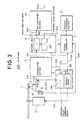
- Fig. 3 presents a block diagram showing the basic structure of a CD player to which the present invention is applied.
- a CD (or a partially recorded or a finalized CD-R) 1 to be played back is placed on a turntable (not shown) of a CD player 100.
- a spindle motor 2 rotates the CD 1 based on a spindle servo control signal S SC from a servo unit 3.
- a pickup 4 reads recorded data on the CD 1 and outputs it as a playback RF signal S RF to a preamplifier section 5.
- the preamplifier section 5 amplifies the playback RF signal S RF , and outputs the amplified signal to a decoder unit 6.
- the preamplifier section 5 also produces an error signal S ER from the playback RF signal S RF and outputs it to the servo unit 3.
- the servo unit 3 includes a first servo section 3A and a second servo section 3B.
- the first servo section 3A produces a tracking error signal S TE and a focusing error signal S FE from the error signal S ER and a control signal S CON from a system controller 7 to execute tracking servo and focusing servo for the pickup 4.
- the first servo section 3A also performs carriage servo to drive a carriage 8 based on the control signal S CON from the system controller 7 and the error signal S ER from the preamplifier section 5.
- a home position detection switch 9 Near the carriage 8 is provided a home position detection switch 9, which detects the home position of the carriage 8 and outputs a home position detection signal S HM to the system controller 7.
- the decoder unit 6 includes an audio-data decoding section 6A and a control-data decoding section 6B.
- the audio-data decoding section 6A converts the received playback RF signal S RF into a binary signal, separates a frame sync pattern therefrom, demodulates the signal based on the EFM (Eight to Fourteen Modulation), performs signal processing, such as error correction, on the resultant signal, and outputs audio data D AD to a D/A converter section 10.
- the audio-data decoding section 6A also outputs control data D CN included in a sub code to the control-data decoding section 6B.
- the decoding section 6B decodes the control data D CN and outputs the resultant data to the system controller 7.
- the decoder unit 6 produces a spindle servo error signal S SE from the input playback RF signal S RF and outputs it to the second servo section 3B.
- the second servo section 3B serves as a spindle servo section. Based on the spindle servo error signal S SE and control signal S CON , the second servo section 3B outputs the spindle servo control signal S SC to the spindle motor 2 to rotate the spindle motor 2 at a predetermined speed.
- the D/A converter section 10 converts the input audio data D AD into an analog signal and outputs it as an audio output signal S OUT .
- the system controller 7 performs the general control of the CD player 100 based on the control data D CN and an operation control signal from a display/operation section 11.
- the display/operation section 11 is equipped with a display section (not shown) to display various types of information and inform a user of such information, and performs various displays under the control of the system controller 7.
- any CD has a track formed in an area between the radius of 23 mm and the radius of 25.5 mm, so that to invoke focus servo at the time of playing back a CD, a home position may be set in this area and a beam from the pickup may be irradiated on this home position to perform the setup operation. Preferred setup operations will be described later.
- the system controller 7 when the disk 1 is set, the system controller 7 first drives the carriage 8 as a servo mechanism via the servo unit 3 to move the pickup 4 to the home position set near the innermost portion of the program area. Then, the system controller 7 performs a setup operation (e.g. as described below) to drive the spindle motor 2 and sequentially activate the individual servos, making the CD player ready for information reproduction.
- a setup operation e.g. as described below
- the setup may not be carried out. In this case, the pickup 4 is moved outward of the home position and the setup is tried again as done in the previous embodiments, allowing the information at the innermost portion of the program area to be reproduced.
- This process of reading the TOC information includes a process serving a the disk discriminating means of the present invention. That is, it is discriminating whether the disk is a "normal CD with TOC", "normal CD without TOC” or "PRD” that is a partially recorded, additionally recordable disk, based on the result of reading the TOC information, and information on the discrimination result is stored as disk discrimination information. Thereafter, when playback is instructed from the display/operation section 11, reproduction of the recorded information in the program area is controlled according to the disk discrimination information.
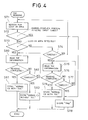
- Fig. 4 illustrates a flowchart of a process for reading TOC information (TOC reading), which includes the disk discriminating means of the present invention.
- TOC reading TOC information
- the TOC reading process of this embodiment will be explained referring to this flowchart.
- the system controller 7 searches for the lead-in area (step S71). If the reproduced disk is a PRD, the lead-in area is mirror-finished so that the pickup 4 moves on the mirror-finished portion and no servo is enabled, causing runaway of the servo system. At this time, when detecting the runaway of the servo system, the system controller 7 stops the spindle motor 2 and executes the setup operation to search for the lead-in area again. In this embodiment, when searching for the lead-in area results in three runaways of the servo system, it is discriminated that the lead-in area is mirror-finished and the disk is a PRD, and "PRD" is stored as the disk discrimination information (step S72).
- the lead-in area is considered as mirror-finished when runaway of the servo system occurs three times in the process of detecting the mirror-finished portion. But as the number of the runaways is determined in consideration of scratches or vibration of the disk, any number can be selected as long as the mirror-finished state is surely detected.
- the disk is discriminated as a PRD and "PRD" is stored as the disk discrimination information (steps S76, S77 and S78).
- the disk is discriminated as a normal CD from which the TOC information can be read, and "normal CD with TOC" is stored as the disk discrimination information (step S79).
- step S73 the routine goes to a process of reading TOC information as done in the prior art. If the reading is completed, the disk is discriminated as a "normal CD with TOC", or if the reading cannot be accomplished before the time is out, the disk is discriminated as a "normal CD without TOC", and the discrimination result is stored as the disk discrimination information in each case (steps S80, S81, S82 and S83).
- Table 1 below shows the correlation between the conditions and the results of the disk discrimination.
- the CD player according to the present invention can discriminate a not finalised disk and can perform later playback control according to the disk in use, ensuring the reproduction of recorded information from the not finalised disk.
- the invention may also comprise a setup routine.
- the pickup is moved to the initial position. For instance, if the home position is set so that the beam spot position is about 24 mm in radius from the center of the CD 1, the system controller 7 controls the first servo section 3A and drives the carriage 8 to move the pickup 4 toward the inner periphery of the CD 1. As a result, the carriage 8 is moved to the position (initial position) where the beam spot from the pickup 4 comes closer to the center of the CD 1 than the predetermined home position (about 24 mm in radius). The carriage 8 is moved by radial servo that sets the relative speed of the beam spot to the recording track in the radial direction constant.
- the pickup 4 is moved to the activation position. This movement is done by moving the carriage 8 in the same manner as the movement to the initial position but toward the outer periphery of the CD 1 this time. It is detected that the pickup 4 has reached the activation position when the home position detection switch 9 is turned off, and then the movement to the activation position is terminated. Accordingly, the activation position comes slightly outward of the home position.
- the system controller 7 activates a semiconductor laser (not shown) in the pickup 4 and waits for the laser to be stable.
- the system controller 7 activates the focus servo.
- the system controller 7 feeds a large constant current to the spindle motor 2 via the second servo section 3B of the servo unit 3 and accelerates the rotation of the CD 1 to about 500 rpm nearly equal to the rotational speed involved in accessing the inner periphery side of the CD 1.
- the system controller 7 examines if the focus servo have completed pull-in.
- the system controller 7 activates the tracking servo and carriage servo, and then examines if both servos are completed pull-in.
- the system controller 7 switches the spindle servo to sync servo, which thereafter controls the spindle motor 2 to make the rotating CD 1 have nearly the correct linear speed.
- the speed of the spindle motor 2 may not be the correct linear speed.
- the system controller 7 detects the frame sync in the reproduced signal, and performs control based on the frame sync so that the speed of the spindle motor 2 comes within a range of several percent of the correct linear speed, and the PLL is locked in.
- the setup operation is terminated after the above steps 1) to 9) are executed, and the CD player goes to the normal playback operation.
- the above sequence of steps is just one example of the setup operation, and is in no way restrictive.
- the system controller 7 determines whether or not TOC information has already been read (step S1).
- the disk is certainly a PRD, i.e., the disk is surely a PRD because the TOC information cannot be read, so that the routine goes to step S17.
- the TOC information has been read in step S1
- step S3 it is determined based on the home position detection signal if the setup has been carried out properly.
- step S19 it is determined based on the home position detection signal if the setup has been carried out properly.
- the setup operation is performed at a position outward of the normal home position or an outer home position H 2 (see Fig. 5) (step S4).
- step S5 it is determined if the setup has been carried out properly at the outer home position H 2 (step S5).
- the setup routine will be terminated (step S19).
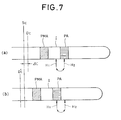
- step S6 When the setup has not been carried out properly at the outer home position H 2 , it is determined from the stored information whether or not the setup has ever been executed for this disk (step S6). When it is found that the setup has never been done for this disk, it is unknown that the disk is a blank disk, so that the setup operation will be performed again at the normal home position H 1 (step S7). The setup operation is retried at the normal home position H 1 because of the following reason. In the case where the recording time of the program area PA is short and further the center D C of the disk is shifted from (or eccentric to) the rotational center S C of the spindle motor 2 by ⁇ C as shown in in Fig.
- the pickup 4 may be positioned beyond the recorded area of the program area PA at the outer home position H 2 by the rotation of the disk while the setup operation may be performed at the normal home position H 1 , as indicated in Fig. 6(b).
- the disk is not a blank disk so that the routine goes to step S20.
- the disk may be a blank disk
- step S8 It is then determined if the setup has been carried out properly (step S8). When the proper setup has been done, the setup routine will be terminated (step S19).
- the setup routine enters a setup retry routine (steps S10 through S12).
- this setup retry routine it is determined how many times the retry has been done (step S10); and if it is going to be an even-numbered retry, the setup operation is performed at the normal home position H 1 (step S11); or if it is going to be an odd-numbered retry, the setup operation is performed at the outer home position H 2 (step S12).
- the setup operation is performed at the outer home position H 2 (step S12).
- step S13 it is determined if the setup has been carried out properly at the home position (either the normal home position H 1 or outer home position H 2 ) (step S13).
- the setup routine will be terminated (step S22).
- step S13 When it is determined in step S13 that the setup has not been carried out properly at that home position, it is determined if the blank disk flag BLF indicates "1" (step S14).
- the flag BLF 1 in this case, the flag BLF is reset to "0" (step S15) and a blank disk process such as stopping the operation or rejecting the disk is executed (step S16) before the routine is terminated (step S22).
- step S20 it is determined if the setup retry has already been done six times in the setup retry routine. As no setup retry has been done yet in this case, the process goes to the setup retry routine. If the setup retry has already been done six times, on the other hand, it is considered that the setup is disabled and the operation will be terminated (step S21).
- this setup retry routine it is determined how many times the retry has been done (step S10); and if it is going to be an even-numbered retry, the setup operation is performed at the normal home position H 1 (step S11); or if it is going to be an odd-numbered retry, the setup operation is performed at the outer home position H 2 (step S12).
- the setup operation is performed at the outer home position H 2 (step S12).
- step S13 it is determined if the setup has been carried out properly at the home position.
- the setup routine will be terminated (step S22).
- step S13 When it is determined in step S13 that the setup has not been carried out properly at that home position, it is determined if the blank disk flag BLF indicates "1" (step S14).
- step S20 the routine goes to step S20 to determine whether or not the setup retry has already been done six times (step S20). As the setup retry has been done once in this case, the process goes again to the setup retry routine. In this setup retry routine, it is determined how many times the retry has been done. As it is the second, even-numbered retry, the setup operation is performed at the normal home position H 1 (step S11). Then, it is determined if the setup has been carried out properly at the home position (step S13). When the setup has been done properly, the setup routine will be terminated (step S22).
- step S13 When it is determined in step S13 that the setup has not been carried out properly at that home position, the sequence of steps S10 to S14 and S20 is likewise executed to perform the setup operation until the sixth setup retry is made.
- the setup retry routine therefore, the setup operation at the outer home position H 2 and the setup operation at the normal home position H 1 are executed alternately, three times at the normal home position H 1 and three times at the outer home position H 2 at a maximum.
- the setup is not successful in any of the six setup operations, it is considered that the setup is disabled and the operation will be terminated (step S21).
- the setup operation at the outer home position H 2 and the setup operation at the normal home position H 1 are alternately performed in the setup retry routine, so that it is very likely to accomplish the setup operation even if the set disk is a CD or CD-R, increasing the possibility to play back a PRD.
- FIG. 8 A second embodiment of the preferred setup routine will be described referring to Figs. 8 and 9.
- This embodiment differs from the first embodiment in that a second outer home position H 3 located outward of the outer home position H 2 , as well as the aforementioned normal home position H 1 and outer home position H 2 , is provided as a home position at which the setup operation is performed.
- Fig. 8 illustrates an operational flowchart of the part which differs from the operational flowchart shown in Fig. 4.
- the operational flowchart in Fig. 8 illustrates a setup retry process that is executed instead of the setup retry routine of steps S10 to S12 in Fig. 5.
- the setup operation is executed, first at the normal home position H 1 , then at the outer home position H 2 , then at the second outer home position H 3 , then again at the normal home position H 1 , and so forth.
- the first and fourth setup operations are performed at the normal home position H 1 (step S31)
- the second and fifth setup operations are performed at the outer home position H 2 (step S33)
- the third and sixth setup operations are performed at the second outer home position H 3 (step S34).
- the setup operation is carried out, first at the normal home position H 1 , then at the outer home position H 2 , then at the second outer home position H 3 , then again at the normal home position H 1 , and so forth.
- the setup operation may be executed in an arbitrary order.
- one or more home positions may be provided further outward of the second home position H 3 so that the setup operation can be executed, first at the normal home position H 1 , then at the outer home position H 2 , ..., then at the outermost home position H n , then again at the normal home position H 1 , and so forth.
- the setup operation may be performed, first at the innermost setup position, then at the second innermost setup position, ..., then at the outermost setup position, then again at the innermost setup position, and so forth ir the second embodiment
- the setup operation may be performed, first at the outermost setup position, then sequentially at inner setup positions.
- the setup operation may be performed, first at the innermost setup position, then sequentially at outer setup positions up to the outermost setup position, then at those of the inner setup positions which are properly selected.
- setup retry operations may be performed an arbitrary number of times equal to or greater than two.
- the first setup position e.g., a predetermined position near the boundary between the lead-in area and program area of a CD
- n-th e.g., 2, 3, 10.1.
Landscapes
- Optical Recording Or Reproduction (AREA)
Description
Fig. 1(c) shows a section of a partially recorded CD-R disk (hereinafter referred to as "PRD") where information is partially written.
Fig. 1(d) shows a section of a finalized CD-R disk for which recording is complete and which has finally been formatted in nearly the same format as CDs.
However, the home position on the CD is likely to deviate depending on the precision of the mechanism of the CD player and the eccentricity of the CD. The predetermined physical home position of the pickup may not therefore correspond to the predetermined home position on the CD. With a PRD set in the conventional CD player, since no information is yet recorded in the area I for the lead-in area LIA which remains mirror-finished, the setup operation cannot be carried out when the physical home position of the pickup enters this area I. Even if the setup operation is tried again (setup entry), the physical home position of the pickup is very likely to enter the area I for the lead-in area LIA again, making it unlikely to properly finish the setup operation. Even if some information has been recorded on the CD-R, it is considered that the disk is set with the back side facing the pickup, thus terminating the reproducing operation or rejecting that disk.
disk discriminating means for discriminating a disk as a not finalised one either when a mirror-finished portion is detected by said control means when detecting said lead-in area, or when said lead-in area cannot be detected and said TOC information cannot be read by said control means.
| Lead-in Area | TOC Reading | Results | |
| (1) | detected | readable | normal CD with TOC |
| (2) | detected | timeout | normal CD without TOC |
| (3) | timeout | readable | normal CD with TOC |
| (4) | timeout | timeout | PRD |
| (5) | mirror-finished portion detected | --- | PRD |
Claims (2)
- A CD player (100) for discriminating a disk by control means arranged to detect a lead-in area and to read TOC information, characterized by:
disk discriminating means for discriminating a disk as a not finalised one either when a mirror-finished portion is detected by said control means when detecting said lead-in area, or when said lead-in area cannot be detected and said TOC information cannot be read by said control means. - A CD player (100) as claimed in claim 1, further comprising means for performing a setup operation to set up a pickup (4) and a servo system (3) to reproduce information recorded on a CD, comprising:
setup control means (7) for sequentially performing said setup operation, starting from a first setup position located near the innermost periphery of said CD, predetermined for said setup operation, until said setup operation is complete at any of n-th setup positions lying outwardly of said first setup position, and, if said setup operation is not completed even at an n-th setup position, performing said setup operation again at at least one set position lying inwardly of said n-th setup position, whereby n= 2, 3, .... .
Priority Applications (1)
| Application Number | Priority Date | Filing Date | Title |
|---|---|---|---|
| EP97204142A EP0838817B1 (en) | 1992-01-24 | 1993-01-25 | CD player |
Applications Claiming Priority (4)
| Application Number | Priority Date | Filing Date | Title |
|---|---|---|---|
| JP11441/92 | 1992-01-24 | ||
| JP11436/92 | 1992-01-24 | ||
| JP4011436A JP3065762B2 (en) | 1992-01-24 | 1992-01-24 | Disc playback device |
| JP04011441A JP3101049B2 (en) | 1992-01-24 | 1992-01-24 | Read-only CD player |
Related Child Applications (1)
| Application Number | Title | Priority Date | Filing Date |
|---|---|---|---|
| EP97204142A Division EP0838817B1 (en) | 1992-01-24 | 1993-01-25 | CD player |
Publications (3)
| Publication Number | Publication Date |
|---|---|
| EP0552987A2 EP0552987A2 (en) | 1993-07-28 |
| EP0552987A3 EP0552987A3 (en) | 1995-02-01 |
| EP0552987B1 true EP0552987B1 (en) | 1998-09-16 |
Family
ID=26346859
Family Applications (2)
| Application Number | Title | Priority Date | Filing Date |
|---|---|---|---|
| EP93300499A Expired - Lifetime EP0552987B1 (en) | 1992-01-24 | 1993-01-25 | CD Player |
| EP97204142A Expired - Lifetime EP0838817B1 (en) | 1992-01-24 | 1993-01-25 | CD player |
Family Applications After (1)
| Application Number | Title | Priority Date | Filing Date |
|---|---|---|---|
| EP97204142A Expired - Lifetime EP0838817B1 (en) | 1992-01-24 | 1993-01-25 | CD player |
Country Status (3)
| Country | Link |
|---|---|
| US (2) | US5414684A (en) |
| EP (2) | EP0552987B1 (en) |
| DE (2) | DE69321000T2 (en) |
Families Citing this family (21)
| Publication number | Priority date | Publication date | Assignee | Title |
|---|---|---|---|---|
| US5471441A (en) * | 1992-01-24 | 1995-11-28 | Pioneer Electronic Corporation | CD player capable of playing back partially recorded CD |
| JPH06259927A (en) * | 1993-03-09 | 1994-09-16 | Sony Corp | Disk housing casing |
| KR0133982B1 (en) * | 1994-04-13 | 1998-04-22 | 김광호 | How to set the initial position of the pickup device |
| JPH08147702A (en) * | 1994-11-11 | 1996-06-07 | Mitsumi Electric Co Ltd | Optical disc writing method |
| JPH08335364A (en) * | 1995-06-07 | 1996-12-17 | Matsushita Electric Ind Co Ltd | Optical disc player |
| JPH0963253A (en) * | 1995-08-23 | 1997-03-07 | Sony Corp | Disk unit |
| KR987000661A (en) * | 1995-10-20 | 1998-03-30 | 이데이 노부유키 | Apparatus for recording data on and / or reproducing data from a recording medium and a method of recording data on and / or reproducing data from a recording medium) |
| US5859824A (en) * | 1996-06-03 | 1999-01-12 | Alpine Electronics, Inc. | Digital disk player |
| US7308485B2 (en) * | 1997-04-15 | 2007-12-11 | Gracenote, Inc. | Method and system for accessing web pages based on playback of recordings |
| US5987525A (en) * | 1997-04-15 | 1999-11-16 | Cddb, Inc. | Network delivery of interactive entertainment synchronized to playback of audio recordings |
| US7167857B2 (en) | 1997-04-15 | 2007-01-23 | Gracenote, Inc. | Method and system for finding approximate matches in database |
| TW375736B (en) * | 1997-07-15 | 1999-12-01 | Matsushita Electric Industrial Co Ltd | Optical disk recording method, recording device, playback method and playback device |
| US20020048224A1 (en) * | 1999-01-05 | 2002-04-25 | Dygert Timothy W. | Playback device having text display and communication with remote database of titles |
| JP2001014800A (en) | 1999-06-29 | 2001-01-19 | Pioneer Electronic Corp | Optical disk recording device and recording control method |
| EP1103973A3 (en) * | 1999-11-18 | 2002-02-06 | Pioneer Corporation | Apparatus for and method of recording and reproducing information |
| US7046956B1 (en) | 2000-06-09 | 2006-05-16 | 67 Khz, Inc. | Messaging and promotion for digital audio media players |
| BR0107127A (en) | 2000-08-23 | 2002-07-02 | Koninkl Philips Electronics Nv | Method to improve the rendering of a content item, client system configured to improve the rendering of a content item, and, server system configured to facilitate an improved rendering of a content item |
| JP3543805B2 (en) * | 2002-03-08 | 2004-07-21 | 船井電機株式会社 | Optical disk recording and playback device |
| JP2003281821A (en) * | 2002-03-22 | 2003-10-03 | Sony Corp | Writable recording medium, identification information recording method, information recording device, identification information reproduction method, and information reproduction device |
| US20070198660A1 (en) * | 2006-02-21 | 2007-08-23 | Cohen Marc S | Advertising Supported Recorded and Downloaded Music System |
| TWI349272B (en) * | 2007-10-30 | 2011-09-21 | Sunplus Technology Co Ltd | Method for determining completeness of optical disk and method for playing optical disk |
Family Cites Families (10)
| Publication number | Priority date | Publication date | Assignee | Title |
|---|---|---|---|---|
| JPH0828054B2 (en) * | 1983-11-30 | 1996-03-21 | ソニー株式会社 | Disk-shaped recording medium |
| JPS63109366U (en) * | 1986-12-27 | 1988-07-14 | ||
| US4872068A (en) * | 1987-01-28 | 1989-10-03 | Pioneer Electronic Corporation | Disk playing method resulting in reduced start-up time |
| DE3719218A1 (en) * | 1987-06-09 | 1988-12-22 | Thomson Brandt Gmbh | CD PLAYER |
| NL9000328A (en) * | 1989-06-23 | 1991-01-16 | Philips Nv | METHOD AND APPARATUS FOR APPLYING INFORMATION PATTERNS TO A RECORD CARRIER |
| JP2708531B2 (en) * | 1989-03-07 | 1998-02-04 | パイオニア株式会社 | Disc player |
| JPH0734305B2 (en) * | 1989-06-06 | 1995-04-12 | パイオニア株式会社 | Information recording medium playing device |
| US5189656A (en) * | 1990-02-28 | 1993-02-23 | Pioneer Electronic Corporation | Control system for a compact disk player |
| JPH07105128B2 (en) * | 1990-04-17 | 1995-11-13 | パイオニア株式会社 | Display device of multi-disc player |
| JPH04228165A (en) * | 1990-09-26 | 1992-08-18 | Sony Corp | Portable disk player |
-
1993
- 1993-01-22 US US08/007,872 patent/US5414684A/en not_active Expired - Lifetime
- 1993-01-25 EP EP93300499A patent/EP0552987B1/en not_active Expired - Lifetime
- 1993-01-25 EP EP97204142A patent/EP0838817B1/en not_active Expired - Lifetime
- 1993-01-25 DE DE69321000T patent/DE69321000T2/en not_active Expired - Fee Related
- 1993-01-25 DE DE69330972T patent/DE69330972T2/en not_active Expired - Fee Related
-
1995
- 1995-01-04 US US08/368,665 patent/US5515351A/en not_active Expired - Lifetime
Also Published As
| Publication number | Publication date |
|---|---|
| DE69321000D1 (en) | 1998-10-22 |
| DE69330972D1 (en) | 2001-11-22 |
| US5414684A (en) | 1995-05-09 |
| DE69330972T2 (en) | 2002-04-04 |
| EP0838817B1 (en) | 2001-10-17 |
| US5515351A (en) | 1996-05-07 |
| DE69321000T2 (en) | 1999-05-12 |
| EP0552987A2 (en) | 1993-07-28 |
| EP0552987A3 (en) | 1995-02-01 |
| EP0838817A1 (en) | 1998-04-29 |
Similar Documents
| Publication | Publication Date | Title |
|---|---|---|
| EP0837473B1 (en) | CD player | |
| US5414684A (en) | Method and apparatus for discriminating type of disks positioned on a CD player | |
| JP3377048B2 (en) | Playback apparatus and playback method for write-once optical disc | |
| US7433285B2 (en) | Disk having unique code for identifying its type for optical disk player and method for discriminating types thereof | |
| JPH1186338A (en) | Hybrid disc and disc identification method | |
| EP0557717B1 (en) | CD playing apparatus | |
| JP3039824B2 (en) | Playback end control method for optical disk playback device | |
| JP2001243638A (en) | Information reproducing apparatus and information reproducing method | |
| US5633840A (en) | Method of setting an initial position of a pickup based on disk recognition and a disk player therefor | |
| EP0552985B1 (en) | Method and apparatus for reproducing information | |
| JP3856072B2 (en) | Music information reproducing apparatus and method | |
| JPH07220284A (en) | Disc and disc player | |
| JP3069187B2 (en) | Disc playback device | |
| JP3065762B2 (en) | Disc playback device | |
| JP3101049B2 (en) | Read-only CD player | |
| JPH04247327A (en) | Optical information recorder | |
| JP3681006B2 (en) | Recording information search method for CD playback device | |
| JPH05205447A (en) | Cd reproducing device | |
| JPH0954958A (en) | Optical disk device and recording / reproducing method thereof | |
| JPH08279161A (en) | Optical disk and reproducing method | |
| JP2006331638A (en) | Music information playback apparatus and music information playback method |
Legal Events
| Date | Code | Title | Description |
|---|---|---|---|
| PUAI | Public reference made under article 153(3) epc to a published international application that has entered the european phase |
Free format text: ORIGINAL CODE: 0009012 |
|
| AK | Designated contracting states |
Kind code of ref document: A2 Designated state(s): DE FR GB |
|
| PUAL | Search report despatched |
Free format text: ORIGINAL CODE: 0009013 |
|
| AK | Designated contracting states |
Kind code of ref document: A3 Designated state(s): DE FR GB |
|
| 17P | Request for examination filed |
Effective date: 19950206 |
|
| 17Q | First examination report despatched |
Effective date: 19951222 |
|
| GRAG | Despatch of communication of intention to grant |
Free format text: ORIGINAL CODE: EPIDOS AGRA |
|
| GRAG | Despatch of communication of intention to grant |
Free format text: ORIGINAL CODE: EPIDOS AGRA |
|
| GRAH | Despatch of communication of intention to grant a patent |
Free format text: ORIGINAL CODE: EPIDOS IGRA |
|
| GRAH | Despatch of communication of intention to grant a patent |
Free format text: ORIGINAL CODE: EPIDOS IGRA |
|
| GRAA | (expected) grant |
Free format text: ORIGINAL CODE: 0009210 |
|
| AK | Designated contracting states |
Kind code of ref document: B1 Designated state(s): DE FR GB |
|
| PG25 | Lapsed in a contracting state [announced via postgrant information from national office to epo] |
Ref country code: FR Free format text: LAPSE BECAUSE OF FAILURE TO SUBMIT A TRANSLATION OF THE DESCRIPTION OR TO PAY THE FEE WITHIN THE PRESCRIBED TIME-LIMIT Effective date: 19980916 |
|
| REF | Corresponds to: |
Ref document number: 69321000 Country of ref document: DE Date of ref document: 19981022 |
|
| PG25 | Lapsed in a contracting state [announced via postgrant information from national office to epo] |
Ref country code: GB Free format text: LAPSE BECAUSE OF NON-PAYMENT OF DUE FEES Effective date: 19990125 |
|
| EN | Fr: translation not filed | ||
| PLBE | No opposition filed within time limit |
Free format text: ORIGINAL CODE: 0009261 |
|
| 26N | No opposition filed | ||
| GBPC | Gb: european patent ceased through non-payment of renewal fee |
Effective date: 19990125 |
|
| PGFP | Annual fee paid to national office [announced via postgrant information from national office to epo] |
Ref country code: DE Payment date: 20070118 Year of fee payment: 15 |
|
| PG25 | Lapsed in a contracting state [announced via postgrant information from national office to epo] |
Ref country code: DE Free format text: LAPSE BECAUSE OF NON-PAYMENT OF DUE FEES Effective date: 20080801 |