EP0551913A1 - Erasable ink composition for writing on impervious surface - Google Patents
Erasable ink composition for writing on impervious surface Download PDFInfo
- Publication number
- EP0551913A1 EP0551913A1 EP19930100571 EP93100571A EP0551913A1 EP 0551913 A1 EP0551913 A1 EP 0551913A1 EP 19930100571 EP19930100571 EP 19930100571 EP 93100571 A EP93100571 A EP 93100571A EP 0551913 A1 EP0551913 A1 EP 0551913A1
- Authority
- EP
- European Patent Office
- Prior art keywords
- parts
- ink composition
- carboxylic acid
- writing
- fuji
- Prior art date
- Legal status (The legal status is an assumption and is not a legal conclusion. Google has not performed a legal analysis and makes no representation as to the accuracy of the status listed.)
- Granted
Links
- 239000000976 ink Substances 0.000 title claims abstract description 58
- 239000000203 mixture Substances 0.000 title claims abstract description 56
- 229920005989 resin Polymers 0.000 claims abstract description 44
- 239000011347 resin Substances 0.000 claims abstract description 44
- 239000000049 pigment Substances 0.000 claims abstract description 40
- 239000003795 chemical substances by application Substances 0.000 claims abstract description 30
- 229920002503 polyoxyethylene-polyoxypropylene Polymers 0.000 claims abstract description 14
- -1 polyoxypropylene Polymers 0.000 claims abstract description 13
- 239000003960 organic solvent Substances 0.000 claims abstract description 12
- 150000001346 alkyl aryl ethers Chemical class 0.000 claims abstract description 11
- 229920001400 block copolymer Polymers 0.000 claims abstract description 9
- 239000007788 liquid Substances 0.000 claims abstract description 9
- 229920001451 polypropylene glycol Polymers 0.000 claims abstract description 5
- 150000002894 organic compounds Chemical class 0.000 claims abstract description 4
- KFZMGEQAYNKOFK-UHFFFAOYSA-N Isopropanol Chemical compound CC(C)O KFZMGEQAYNKOFK-UHFFFAOYSA-N 0.000 claims description 102
- LFQSCWFLJHTTHZ-UHFFFAOYSA-N Ethanol Chemical compound CCO LFQSCWFLJHTTHZ-UHFFFAOYSA-N 0.000 claims description 76
- 235000019441 ethanol Nutrition 0.000 claims description 67
- DNIAPMSPPWPWGF-UHFFFAOYSA-N Propylene glycol Chemical compound CC(O)CO DNIAPMSPPWPWGF-UHFFFAOYSA-N 0.000 claims description 12
- 150000002148 esters Chemical group 0.000 claims description 10
- 150000001733 carboxylic acid esters Chemical class 0.000 claims description 8
- ZJCCRDAZUWHFQH-UHFFFAOYSA-N Trimethylolpropane Chemical compound CCC(CO)(CO)CO ZJCCRDAZUWHFQH-UHFFFAOYSA-N 0.000 claims description 6
- 125000000217 alkyl group Chemical group 0.000 claims description 6
- 125000001931 aliphatic group Chemical group 0.000 claims description 5
- PEDCQBHIVMGVHV-UHFFFAOYSA-N Glycerine Chemical compound OCC(O)CO PEDCQBHIVMGVHV-UHFFFAOYSA-N 0.000 claims description 4
- 229920006395 saturated elastomer Polymers 0.000 claims description 4
- 125000003118 aryl group Chemical group 0.000 claims description 3
- 235000011187 glycerol Nutrition 0.000 claims description 2
- WXZMFSXDPGVJKK-UHFFFAOYSA-N pentaerythritol Chemical compound OCC(CO)(CO)CO WXZMFSXDPGVJKK-UHFFFAOYSA-N 0.000 claims description 2
- 150000004670 unsaturated fatty acids Chemical class 0.000 claims description 2
- 235000021122 unsaturated fatty acids Nutrition 0.000 claims description 2
- 150000001735 carboxylic acids Chemical class 0.000 claims 2
- WNLRTRBMVRJNCN-UHFFFAOYSA-L adipate(2-) Chemical compound [O-]C(=O)CCCCC([O-])=O WNLRTRBMVRJNCN-UHFFFAOYSA-L 0.000 claims 1
- 125000005907 alkyl ester group Chemical group 0.000 claims 1
- 125000005909 ethyl alcohol group Chemical group 0.000 claims 1
- 125000005498 phthalate group Chemical group 0.000 claims 1
- 229940116351 sebacate Drugs 0.000 claims 1
- CXMXRPHRNRROMY-UHFFFAOYSA-L sebacate(2-) Chemical compound [O-]C(=O)CCCCCCCCC([O-])=O CXMXRPHRNRROMY-UHFFFAOYSA-L 0.000 claims 1
- 150000003900 succinic acid esters Chemical group 0.000 claims 1
- 125000003262 carboxylic acid ester group Chemical class [H]C([H])([*:2])OC(=O)C([H])([H])[*:1] 0.000 abstract 1
- 229920002037 poly(vinyl butyral) polymer Polymers 0.000 description 31
- 235000010724 Wisteria floribunda Nutrition 0.000 description 26
- 150000001298 alcohols Chemical class 0.000 description 26
- RVGRUAULSDPKGF-UHFFFAOYSA-N Poloxamer Chemical compound C1CO1.CC1CO1 RVGRUAULSDPKGF-UHFFFAOYSA-N 0.000 description 9
- 239000000463 material Substances 0.000 description 8
- DOIRQSBPFJWKBE-UHFFFAOYSA-N dibutyl phthalate Chemical compound CCCCOC(=O)C1=CC=CC=C1C(=O)OCCCC DOIRQSBPFJWKBE-UHFFFAOYSA-N 0.000 description 4
- LYCAIKOWRPUZTN-UHFFFAOYSA-N ethylene glycol Natural products OCCO LYCAIKOWRPUZTN-UHFFFAOYSA-N 0.000 description 4
- 229920001983 poloxamer Polymers 0.000 description 4
- ZWEHNKRNPOVVGH-UHFFFAOYSA-N 2-Butanone Chemical compound CCC(C)=O ZWEHNKRNPOVVGH-UHFFFAOYSA-N 0.000 description 3
- XEKOWRVHYACXOJ-UHFFFAOYSA-N Ethyl acetate Chemical compound CCOC(C)=O XEKOWRVHYACXOJ-UHFFFAOYSA-N 0.000 description 3
- OKKJLVBELUTLKV-UHFFFAOYSA-N Methanol Chemical compound OC OKKJLVBELUTLKV-UHFFFAOYSA-N 0.000 description 3
- DRRMRHKHTQRWMB-UHFFFAOYSA-N [3-(2-ethylhexanoyloxy)-2,2-bis(2-ethylhexanoyloxymethyl)propyl] 2-ethylhexanoate Chemical compound CCCCC(CC)C(=O)OCC(COC(=O)C(CC)CCCC)(COC(=O)C(CC)CCCC)COC(=O)C(CC)CCCC DRRMRHKHTQRWMB-UHFFFAOYSA-N 0.000 description 3
- 239000002253 acid Substances 0.000 description 3
- ZFMQKOWCDKKBIF-UHFFFAOYSA-N bis(3,5-difluorophenyl)phosphane Chemical compound FC1=CC(F)=CC(PC=2C=C(F)C=C(F)C=2)=C1 ZFMQKOWCDKKBIF-UHFFFAOYSA-N 0.000 description 3
- ONTQJDKFANPPKK-UHFFFAOYSA-L chembl3185981 Chemical compound [Na+].[Na+].CC1=CC(C)=C(S([O-])(=O)=O)C=C1N=NC1=CC(S([O-])(=O)=O)=C(C=CC=C2)C2=C1O ONTQJDKFANPPKK-UHFFFAOYSA-L 0.000 description 3
- 229920006026 co-polymeric resin Polymers 0.000 description 3
- 239000003086 colorant Substances 0.000 description 3
- 150000005690 diesters Chemical class 0.000 description 3
- WGCNASOHLSPBMP-UHFFFAOYSA-N hydroxyacetaldehyde Natural products OCC=O WGCNASOHLSPBMP-UHFFFAOYSA-N 0.000 description 3
- VNLRTFSQCPNNIM-UHFFFAOYSA-N octadecyl octanoate Chemical compound CCCCCCCCCCCCCCCCCCOC(=O)CCCCCCC VNLRTFSQCPNNIM-UHFFFAOYSA-N 0.000 description 3
- 239000011369 resultant mixture Substances 0.000 description 3
- 239000002904 solvent Substances 0.000 description 3
- XLYOFNOQVPJJNP-UHFFFAOYSA-N water Substances O XLYOFNOQVPJJNP-UHFFFAOYSA-N 0.000 description 3
- CSPVUHYZUZZRGF-RNFRBKRXSA-N (4R,6R)-hydroxy-2,2,6-trimethylcyclohexanone Chemical compound C[C@@H]1C[C@@H](O)CC(C)(C)C1=O CSPVUHYZUZZRGF-RNFRBKRXSA-N 0.000 description 2
- DHGBAFGZLVRESL-UHFFFAOYSA-N 14-methylpentadecyl 16-methylheptadecanoate Chemical compound CC(C)CCCCCCCCCCCCCCC(=O)OCCCCCCCCCCCCCC(C)C DHGBAFGZLVRESL-UHFFFAOYSA-N 0.000 description 2
- HFWHTGSLDKKCMD-UHFFFAOYSA-N 2,2-bis(octanoyloxymethyl)butyl octanoate Chemical compound CCCCCCCC(=O)OCC(CC)(COC(=O)CCCCCCC)COC(=O)CCCCCCC HFWHTGSLDKKCMD-UHFFFAOYSA-N 0.000 description 2
- 229930185327 Actinol Natural products 0.000 description 2
- MQIUGAXCHLFZKX-UHFFFAOYSA-N Di-n-octyl phthalate Natural products CCCCCCCCOC(=O)C1=CC=CC=C1C(=O)OCCCCCCCC MQIUGAXCHLFZKX-UHFFFAOYSA-N 0.000 description 2
- LRHPLDYGYMQRHN-UHFFFAOYSA-N N-Butanol Chemical compound CCCCO LRHPLDYGYMQRHN-UHFFFAOYSA-N 0.000 description 2
- GWEVSGVZZGPLCZ-UHFFFAOYSA-N Titan oxide Chemical compound O=[Ti]=O GWEVSGVZZGPLCZ-UHFFFAOYSA-N 0.000 description 2
- RTAQQCXQSZGOHL-UHFFFAOYSA-N Titanium Chemical compound [Ti] RTAQQCXQSZGOHL-UHFFFAOYSA-N 0.000 description 2
- 239000011324 bead Substances 0.000 description 2
- BJQHLKABXJIVAM-UHFFFAOYSA-N bis(2-ethylhexyl) phthalate Chemical compound CCCCC(CC)COC(=O)C1=CC=CC=C1C(=O)OCC(CC)CCCC BJQHLKABXJIVAM-UHFFFAOYSA-N 0.000 description 2
- BKEUNIPSDCRXQK-UHFFFAOYSA-N butyl 16-methylheptadecanoate Chemical compound CCCCOC(=O)CCCCCCCCCCCCCCC(C)C BKEUNIPSDCRXQK-UHFFFAOYSA-N 0.000 description 2
- DHAZIUXMHRHVMP-UHFFFAOYSA-N butyl tetradecanoate Chemical compound CCCCCCCCCCCCCC(=O)OCCCC DHAZIUXMHRHVMP-UHFFFAOYSA-N 0.000 description 2
- 150000001732 carboxylic acid derivatives Chemical class 0.000 description 2
- 235000014113 dietary fatty acids Nutrition 0.000 description 2
- 229930195729 fatty acid Natural products 0.000 description 2
- 239000000194 fatty acid Substances 0.000 description 2
- 150000004665 fatty acids Chemical class 0.000 description 2
- DWMMZQMXUWUJME-UHFFFAOYSA-N hexadecyl octanoate Chemical compound CCCCCCCCCCCCCCCCOC(=O)CCCCCCC DWMMZQMXUWUJME-UHFFFAOYSA-N 0.000 description 2
- FUZZWVXGSFPDMH-UHFFFAOYSA-M hexanoate Chemical compound CCCCCC([O-])=O FUZZWVXGSFPDMH-UHFFFAOYSA-M 0.000 description 2
- 229940093629 isopropyl isostearate Drugs 0.000 description 2
- 229940057995 liquid paraffin Drugs 0.000 description 2
- 238000000034 method Methods 0.000 description 2
- 239000004006 olive oil Substances 0.000 description 2
- 239000003973 paint Substances 0.000 description 2
- 229920000728 polyester Polymers 0.000 description 2
- BDERNNFJNOPAEC-UHFFFAOYSA-N propan-1-ol Chemical compound CCCO BDERNNFJNOPAEC-UHFFFAOYSA-N 0.000 description 2
- NEOZOXKVMDBOSG-UHFFFAOYSA-N propan-2-yl 16-methylheptadecanoate Chemical compound CC(C)CCCCCCCCCCCCCCC(=O)OC(C)C NEOZOXKVMDBOSG-UHFFFAOYSA-N 0.000 description 2
- 239000000126 substance Substances 0.000 description 2
- DNIAPMSPPWPWGF-GSVOUGTGSA-N (R)-(-)-Propylene glycol Chemical compound C[C@@H](O)CO DNIAPMSPPWPWGF-GSVOUGTGSA-N 0.000 description 1
- DTCCVIYSGXONHU-CJHDCQNGSA-N (z)-2-(2-phenylethenyl)but-2-enedioic acid Chemical compound OC(=O)\C=C(C(O)=O)\C=CC1=CC=CC=C1 DTCCVIYSGXONHU-CJHDCQNGSA-N 0.000 description 1
- JOLQKTGDSGKSKJ-UHFFFAOYSA-N 1-ethoxypropan-2-ol Chemical compound CCOCC(C)O JOLQKTGDSGKSKJ-UHFFFAOYSA-N 0.000 description 1
- ARXJGSRGQADJSQ-UHFFFAOYSA-N 1-methoxypropan-2-ol Chemical compound COCC(C)O ARXJGSRGQADJSQ-UHFFFAOYSA-N 0.000 description 1
- GFVYDNHWTCHDSN-UHFFFAOYSA-N 14-methylpentadecyl octanoate Chemical compound CCCCCCCC(=O)OCCCCCCCCCCCCCC(C)C GFVYDNHWTCHDSN-UHFFFAOYSA-N 0.000 description 1
- WPIOBXGJZUSKGK-UHFFFAOYSA-N 16-methylheptadecyl dodecanoate Chemical compound CCCCCCCCCCCC(=O)OCCCCCCCCCCCCCCCC(C)C WPIOBXGJZUSKGK-UHFFFAOYSA-N 0.000 description 1
- SAMYFBLRCRWESN-UHFFFAOYSA-N 16-methylheptadecyl hexadecanoate Chemical compound CCCCCCCCCCCCCCCC(=O)OCCCCCCCCCCCCCCCC(C)C SAMYFBLRCRWESN-UHFFFAOYSA-N 0.000 description 1
- RKJGFHYCZPZJPE-UHFFFAOYSA-N 2,2-bis(16-methylheptadecanoyloxymethyl)butyl 16-methylheptadecanoate Chemical compound CC(C)CCCCCCCCCCCCCCC(=O)OCC(CC)(COC(=O)CCCCCCCCCCCCCCC(C)C)COC(=O)CCCCCCCCCCCCCCC(C)C RKJGFHYCZPZJPE-UHFFFAOYSA-N 0.000 description 1
- XNWFRZJHXBZDAG-UHFFFAOYSA-N 2-METHOXYETHANOL Chemical compound COCCO XNWFRZJHXBZDAG-UHFFFAOYSA-N 0.000 description 1
- NFIHXTUNNGIYRF-UHFFFAOYSA-N 2-decanoyloxypropyl decanoate Chemical compound CCCCCCCCCC(=O)OCC(C)OC(=O)CCCCCCCCC NFIHXTUNNGIYRF-UHFFFAOYSA-N 0.000 description 1
- ZNQVEEAIQZEUHB-UHFFFAOYSA-N 2-ethoxyethanol Chemical compound CCOCCO ZNQVEEAIQZEUHB-UHFFFAOYSA-N 0.000 description 1
- FMNZBNCPTJEVDS-KVVVOXFISA-N 2-ethyl-2-(hydroxymethyl)propane-1,3-diol;(z)-octadec-9-enoic acid Chemical compound CCC(CO)(CO)CO.CCCCCCCC\C=C/CCCCCCCC(O)=O FMNZBNCPTJEVDS-KVVVOXFISA-N 0.000 description 1
- SIXWIUJQBBANGK-UHFFFAOYSA-N 4-(4-fluorophenyl)-1h-pyrazol-5-amine Chemical compound N1N=CC(C=2C=CC(F)=CC=2)=C1N SIXWIUJQBBANGK-UHFFFAOYSA-N 0.000 description 1
- HBTAOSGHCXUEKI-UHFFFAOYSA-N 4-chloro-n,n-dimethyl-3-nitrobenzenesulfonamide Chemical compound CN(C)S(=O)(=O)C1=CC=C(Cl)C([N+]([O-])=O)=C1 HBTAOSGHCXUEKI-UHFFFAOYSA-N 0.000 description 1
- 229920000178 Acrylic resin Polymers 0.000 description 1
- 239000004925 Acrylic resin Substances 0.000 description 1
- DKPFZGUDAPQIHT-UHFFFAOYSA-N Butyl acetate Natural products CCCCOC(C)=O DKPFZGUDAPQIHT-UHFFFAOYSA-N 0.000 description 1
- ZVFDTKUVRCTHQE-UHFFFAOYSA-N Diisodecyl phthalate Chemical compound CC(C)CCCCCCCOC(=O)C1=CC=CC=C1C(=O)OCCCCCCCC(C)C ZVFDTKUVRCTHQE-UHFFFAOYSA-N 0.000 description 1
- LVGKNOAMLMIIKO-UHFFFAOYSA-N Elaidinsaeure-aethylester Natural products CCCCCCCCC=CCCCCCCCC(=O)OCC LVGKNOAMLMIIKO-UHFFFAOYSA-N 0.000 description 1
- CMBYOWLFQAFZCP-UHFFFAOYSA-N Hexyl dodecanoate Chemical compound CCCCCCCCCCCC(=O)OCCCCCC CMBYOWLFQAFZCP-UHFFFAOYSA-N 0.000 description 1
- 229920000877 Melamine resin Polymers 0.000 description 1
- 239000004640 Melamine resin Substances 0.000 description 1
- NTIZESTWPVYFNL-UHFFFAOYSA-N Methyl isobutyl ketone Chemical compound CC(C)CC(C)=O NTIZESTWPVYFNL-UHFFFAOYSA-N 0.000 description 1
- UIHCLUNTQKBZGK-UHFFFAOYSA-N Methyl isobutyl ketone Natural products CCC(C)C(C)=O UIHCLUNTQKBZGK-UHFFFAOYSA-N 0.000 description 1
- 235000019485 Safflower oil Nutrition 0.000 description 1
- 229920001800 Shellac Polymers 0.000 description 1
- CFRNDJFRRKMHTL-UHFFFAOYSA-N [3-octanoyloxy-2,2-bis(octanoyloxymethyl)propyl] octanoate Chemical compound CCCCCCCC(=O)OCC(COC(=O)CCCCCCC)(COC(=O)CCCCCCC)COC(=O)CCCCCCC CFRNDJFRRKMHTL-UHFFFAOYSA-N 0.000 description 1
- 150000007933 aliphatic carboxylic acids Chemical class 0.000 description 1
- WMNULTDOANGXRT-UHFFFAOYSA-N bis(2-ethylhexyl) butanedioate Chemical compound CCCCC(CC)COC(=O)CCC(=O)OCC(CC)CCCC WMNULTDOANGXRT-UHFFFAOYSA-N 0.000 description 1
- ZWYAVGUHWPLBGT-UHFFFAOYSA-N bis(6-methylheptyl) decanedioate Chemical compound CC(C)CCCCCOC(=O)CCCCCCCCC(=O)OCCCCCC(C)C ZWYAVGUHWPLBGT-UHFFFAOYSA-N 0.000 description 1
- 239000003240 coconut oil Substances 0.000 description 1
- 235000019864 coconut oil Nutrition 0.000 description 1
- 239000002131 composite material Substances 0.000 description 1
- 150000001875 compounds Chemical class 0.000 description 1
- 238000007796 conventional method Methods 0.000 description 1
- 229920001577 copolymer Polymers 0.000 description 1
- SASYSVUEVMOWPL-NXVVXOECSA-N decyl oleate Chemical compound CCCCCCCCCCOC(=O)CCCCCCC\C=C/CCCCCCCC SASYSVUEVMOWPL-NXVVXOECSA-N 0.000 description 1
- 230000001419 dependent effect Effects 0.000 description 1
- 229940031578 diisopropyl adipate Drugs 0.000 description 1
- 229940031569 diisopropyl sebacate Drugs 0.000 description 1
- XFKBBSZEQRFVSL-UHFFFAOYSA-N dipropan-2-yl decanedioate Chemical compound CC(C)OC(=O)CCCCCCCCC(=O)OC(C)C XFKBBSZEQRFVSL-UHFFFAOYSA-N 0.000 description 1
- LVGKNOAMLMIIKO-QXMHVHEDSA-N ethyl oleate Chemical compound CCCCCCCC\C=C/CCCCCCCC(=O)OCC LVGKNOAMLMIIKO-QXMHVHEDSA-N 0.000 description 1
- 229940093471 ethyl oleate Drugs 0.000 description 1
- 238000011156 evaluation Methods 0.000 description 1
- 125000005456 glyceride group Chemical group 0.000 description 1
- 150000002334 glycols Chemical class 0.000 description 1
- FPMPNVIMFPEKRN-UHFFFAOYSA-N hexyl 16-methylheptadecanoate Chemical compound CCCCCCOC(=O)CCCCCCCCCCCCCCC(C)C FPMPNVIMFPEKRN-UHFFFAOYSA-N 0.000 description 1
- 229940100463 hexyl laurate Drugs 0.000 description 1
- XUGNVMKQXJXZCD-UHFFFAOYSA-N isopropyl palmitate Chemical compound CCCCCCCCCCCCCCCC(=O)OC(C)C XUGNVMKQXJXZCD-UHFFFAOYSA-N 0.000 description 1
- 229940075495 isopropyl palmitate Drugs 0.000 description 1
- 229940113915 isostearyl palmitate Drugs 0.000 description 1
- 150000002576 ketones Chemical class 0.000 description 1
- 239000011976 maleic acid Substances 0.000 description 1
- 239000002736 nonionic surfactant Substances 0.000 description 1
- 229940049964 oleate Drugs 0.000 description 1
- ZQPPMHVWECSIRJ-KTKRTIGZSA-N oleic acid Chemical compound CCCCCCCC\C=C/CCCCCCCC(O)=O ZQPPMHVWECSIRJ-KTKRTIGZSA-N 0.000 description 1
- 235000008390 olive oil Nutrition 0.000 description 1
- 239000001053 orange pigment Substances 0.000 description 1
- 125000006353 oxyethylene group Chemical group 0.000 description 1
- 229920001296 polysiloxane Polymers 0.000 description 1
- 235000005713 safflower oil Nutrition 0.000 description 1
- 239000003813 safflower oil Substances 0.000 description 1
- ZLGIYFNHBLSMPS-ATJNOEHPSA-N shellac Chemical compound OCCCCCC(O)C(O)CCCCCCCC(O)=O.C1C23[C@H](C(O)=O)CCC2[C@](C)(CO)[C@@H]1C(C(O)=O)=C[C@@H]3O ZLGIYFNHBLSMPS-ATJNOEHPSA-N 0.000 description 1
- 239000004208 shellac Substances 0.000 description 1
- 229940113147 shellac Drugs 0.000 description 1
- 235000013874 shellac Nutrition 0.000 description 1
- 229920002050 silicone resin Polymers 0.000 description 1
- 229920001909 styrene-acrylic polymer Polymers 0.000 description 1
- 150000005846 sugar alcohols Polymers 0.000 description 1
- 229910052719 titanium Inorganic materials 0.000 description 1
- 239000010936 titanium Substances 0.000 description 1
- 239000004408 titanium dioxide Substances 0.000 description 1
- 229940118594 trimethylolpropane triisostearate Drugs 0.000 description 1
Classifications
-
- C—CHEMISTRY; METALLURGY
- C09—DYES; PAINTS; POLISHES; NATURAL RESINS; ADHESIVES; COMPOSITIONS NOT OTHERWISE PROVIDED FOR; APPLICATIONS OF MATERIALS NOT OTHERWISE PROVIDED FOR
- C09D—COATING COMPOSITIONS, e.g. PAINTS, VARNISHES OR LACQUERS; FILLING PASTES; CHEMICAL PAINT OR INK REMOVERS; INKS; CORRECTING FLUIDS; WOODSTAINS; PASTES OR SOLIDS FOR COLOURING OR PRINTING; USE OF MATERIALS THEREFOR
- C09D11/00—Inks
- C09D11/16—Writing inks
Definitions
- This invention relates to an erasable ink composition for writing on an impervious writing surface, and more particularly, to an erasable ink composition which contains a separating agent therein to provide writing on an impervious writing surface such as a so-called white board which is readily erasable by wiping lightly with an eraser made of, for example, felt.
- a variety of erasble ink compositions to write on an impervious writing surface to provide writing thereon which is readily erasble by wiping with, for example, an eraser made of felt are already known, as disclosed in, for example, Japanese Patent Application Laid-open No. 63-43981, No. 62-265377 and No, 2-129278.
- these prior erasble ink compositions contain carboxylic acid esters, liquid paraffin, silicone resins or nonionic surfactants as a separating agent therein, and thus it is known that they provide writing which is insufficiently erasable depending upon the material of impervious writing surface.
- the prior erasable ink compositions have erasability dependendent on the material of impervious writing surface.
- such an ink composition provides writing which is not readily erasable after long standing.
- the prior erasable ink compositions have erasability dependendent on time.
- an ink composition containing polyoxyethylene polyoxypropylene block copolymer is disclosed in Japanese Patent Application Laid-open No. 60-206881.
- this ink composition is a so-called strippable paint made usable in writing instruments, and can not be used as an erasable writing ink composition.
- an erasable ink composition for writing on an impervious writing surface comprising an organic solvent, a resin, a pigment, and a separating agent, which comprises;
- the ink compostion of the invention contains an organic solvent preferably such as an alcohol or a glycol monoalkyl ether.
- the alcohol is preferably an aliphatic alcohol of 1-4 carbons such as methanol, ethanol, isopropyl alcohol, n-propyl alcohol or butanol.
- the glycol monoalkyl ether is preferably a monoalkyl ether of glycol of 2-4 carbons such as ethylene glycol monomethyl ether, ethylene glycol monoethyl ether, propylene glycol monomethyl ether or propylene glycol monoethyl ether. These solvents may be used singly or as a mixture.
- the ink compostion of the invention contains such an organic solvent in an amount of 40-90% by weight, preferably in an amount of 50-75% by weight,
- the amount of organic solvent is too large, the resultant ink composition has no viscosity suitable for writing, and may not provide writing of a sufficlent darkness.
- the amount of organic solvent is too small, the resultant ink composition has a viscosity too large to write well, and it is also bad in storage stability.
- the ink compostion of the invention may further contain a dialkyl ketone wherein the alkyl has 1-4 carbons such as methyl ethyl ketone or methyl isobutyl ketone, or a lower aliphatic carboxylic acid ester wherein the carboxylic acid has 2-4 carbons and the alkyl has 1-3 carbons preferably such as ethyl acetate or butyl acetate, as a dissolving aid for a resin in an organic solvent used which will be described hereinafter.
- a dialkyl ketone wherein the alkyl has 1-4 carbons such as methyl ethyl ketone or methyl isobutyl ketone
- a lower aliphatic carboxylic acid ester wherein the carboxylic acid has 2-4 carbons and the alkyl has 1-3 carbons preferably such as ethyl acetate or butyl acetate, as a dissolving aid for a resin in an organic solvent used which will
- the ink compostion of the invention contains a pigment as a colorant.
- the amount of the pigment is determined in accordance with the pigment used and the darkness required. However, when the amount is too large, the resultant ink composition may have too large a viscosity and may be poor in writability and storability as well as erasability of writing, while when the amount is too small, the resultant ink composition may provide infeaibly faint writing, and may also writing poor in erasability.
- the ink compostion of the invention contain a pigment in an amount of 1-30% by weight, preferably of 3-15% by weight.
- a resin is contained in the ink composition so that the ink composition has a viscosity suitable for writing and has a suitable adhesion onto an impervious writing surface. It is necessary that the resin is soluble in the organic solvent used in the ink composition, and such a resin includes, for example, polyvinyl butyral resin, acrylic resin, styrene-acrylic copolymer resin, styrene-maleic acid copolymer resin, shellac resin and rosin-maleic acid copolymer resin.
- the resultant ink composition When the resin is contained in excess, the resultant ink composition may have too large a viscosity and may deteriorate in writability, storability and erasability of writing, whereas when the amount is too small, the resultant ink composition may not have a viscosity suitable for writing, and may also provide writing of insufficient erasability.
- the ink compostion of the invention contains a resin in an amount of 1-20% by weight, preferably of 5-15% by weight.
- the ink compostion of the invention contains a separating agent which is liquid at normal temperatures.
- the separating agent is composed of two components, the first component is a polyoxyethylene polyoxypropylene block copolymer which is liquid at normal temperatures, and preferably has an oxyethylene content of not more than 40% by weight, and a molecular weight of 700-3000.
- Such a polyoxyethylene polyoxypropylene block copolymer is commercially available such as Newpol PE-61, PE-62 or PE-71 (Sanyo Kasei Kogyo K.K., Japan), Pluronic L-31, L-42, L-61, L-72, L-81 or L-101 (Asahi Denka Kogyo K.K., Japan), Epan 420 or 720 (Dai-ichi Kogyo Seiyaku K.K., Japan), Emulgen PP-150 or PP-230 (Kao K.K., Japan), Pronon 102 or 201 (Nippon Yushi K,K., Japan), Actinol P-3035 (Matsumoto Yushi Seiyaku K.K., Japan), Lionol PL-32, PL-42 or PL-712 (Lion K.K., Japan).
- the polyoxyethylene polyoxypropylene block copolymer is contained in an amount of 5-20% by weight baked on the ink compostion.
- the amount is too small, the resultant ink composition may not have a sufficient erasability, whereas when the amount is too large, the resultant ink composition may have a viscosity too large for writing well, or write faintly. It is preferred that the ink composition contains the copolymer in an amount of 7-15% by weight.
- the second component of the separating agent used in the invention is at least one organic compound selected from the group consisting of a carboxylic acid ester, a polyoxypropylene monoalkyl ether and a polyoxyethylene polyoxypropylene monoalkyl ether which is liquid at normal temperatures.
- the carboxylic acid ester may be a carboxylic acid alkyl ester, a dibasic acid diester or a mono- or polyester of a polydric alcohol.
- the carboxylic acid alkyl ester is preferably such a carboxylic acid alkyl ester wherein the carboxylic acid is a saturated or an unsaturated and has 8-20 carbons, and the alkyl has 2-20 carbons.
- a carboxylic acid alkyl ester may be exemplified by cetyl octanoate, isocetyl octanoate, stearyl octanoate, hexyl laurate, isostearyl laurate, butyl myristate, isopropyl palmitate, isostearyl palmitate, isopropyl isostearate, butyl isostearate, hexyl isostearate, isocetyl isostearate, ethyl oleate or decyl oleate.
- the dibasic acid diester used includes an aliphatic dibasic carboxylic acid diester or an aromatic dibasic carboxylic acid diester, preferably a dialkyl ester wherein the alkyl has 2-20 carbons.
- the dibasic acid diester used includes, for instance, di-2-ethylhexyl succinate, diisopropyl adipate, dioctyl adipate, diisopropyl sebacate, dibutyl phthalate, dioctyl phthalate and diisodecyl phthalate.
- the ester of polydric alcohol is preferably a mono- or a polyester derived from an aliphatic polyhydric alcohol of 4-8 carbons including glycols and a saturated or an unsaturated fatty acid of 6-24 carbons.
- the ester of polydric alcohol used includes, for instance, an ester of trimethylol propane such as trimethylol propane (mono, di or tri)oleate, trimethylol propane (mono, di or tri)caproate, tri-2-ethylhexyl trimethylates (such as trialkyl esters of trimethylol compound, exemplified by trimethylol propane), trimethylol propane triisopalmitate, trimethylol propane trioctanoate or trimethylol propane triisostearate; an ester of pentaerythritol such as pentaerythritol tetraoctanoate or pentaerythritol tetra-2-ethyl hexano
- the polyoxyethylene polyoxypropylene monoalkyl ether used in the invention is commercially available, and may be exemplified by Nikkol PBC-31 or PBC-41 (Nikko Chemicals K.K., Japan), Newpol 50HB-55, 50HB-100, 50HB-260, 50HB-400, 50HB-600 or 50HB-1000 (Sanyo Kasei Kogyo K.K., Japan), Dovanox DL-0206, DM-2007 or DH-0300 (Lion K.K., Japan), Lionol L-358, L-745, L-785 or L-950 (Lion K.K., Japan).
- the polyoxypropylene monoalkyl ether is also commercially available, and may be exemplified by Newpol LB-65, LB-285, LB-385, LB-625, LB-1145 LB-1715 or LB-3000 (Sanyo Kasei Kogyo K.K., Japan).
- the second separating agent is contained in the ink composition in an amount of 2-10% by weight, preferably of 3-8% by weight, based on the ink composition.
- the amount of the second separating agent is too small, the resultant ink composition may not have a sufficient erasability, whereas when the amount is too large, the resultant ink composition may have a viscosity too large for writing well, or write faintly.
- the first and second separating agents are contained in conjunction in an amount of 10-23% by weight.
- the use of polyoxyethylene polyoxypropylene block copolymer only as a separating agent does not provide an ink composition of a high erasability.
- the use of the above mentioned second separating agent in conjunction with the polyoxyethylene polyoxypropylene block copolymer as a composite separating agent provides an ink composition of a high erasability.
- the ink composition of the invention writes well on any impervious writing surface, and the writing is readily erased with an eraser of, for example, felt, irrespectively of the material of the impervious writing surface.
- the writing can be readily erased after long standing.
- the ink composition of the invention may be produced by a conventional method, and is not limited to any specific method.
- a normal pigment is used as a colorant
- the pigment is mixed With a resin in an organic solvent
- the resultant mixture is milled in a beads mill to disperse the pigment finely in the solvent to form a mill base, there are added a separating agent and other components if necessary to the mill base, and then the resultant mixture is stirred.
- a resin-coated pigment is used as a colorant, all the components may be mixed together at the same time, and the pigment may be dispersed in the solvent used with a paint shaker.
- the resultant ink composition may be filtered or centrifuged to remove there from coarse materials.
- Newpol PE-61 8 parts Isocetyl isostearate 8 parts Fuji AS Green 1) 10 parts Fuji AS White 2) 3 parts Ethyl alcohol 61 parts Isopropyl alcohol 10 parts Notes: 1)-6) Polyvinyl butyral resin-coated pigment dispersible in alcohols, available from Fuji Shikiso K.K., Japan
- Newpol PE-62 5 parts Isopropyl isostearate 12 parts Fuji AS Blue 3) 10 parts Fuji AS White 2) 3 parts Ethyl alcohol 60 parts Isopropyl alcohol 10 parts Notes: 1)-6) Polyvinyl butyral resin-coated pigment dispersible in alcohols, available from Fuji Shikiso K.K., Japan
- Newpol PE-61 4 parts Fuji AS Green 1) 10 parts Fuji AS White 2) 3 parts Ethyl alcohol 73 parts Isopropyl alcohol 10 parts Notes: 1)-6) Polyvinyl butyral resin-coated pigment dispersible in alcohols, available from Fuji Shikiso K.K., Japan
- Pluronic L-101 7 parts Diisooctyl phthalate 3 parts Fuji AS White 2) 20 parts Ethyl alcohol 60 parts Isopropyl alcohol 10 parts Notes: 1)-6) Polyvinyl butyral resin-coated pigment dispersible in alcohols, available from Fuji Shikiso K.K., Japan
- Pluronic L-42 8 parts Trimethylol propane oleate 6 parts Fuji AS Black 6) 15 parts Ethyl alcohol 61 parts Isopropyl alcohol 10 parts Notes: 1)-6) Polyvinyl butyral resin-coated pigment dispersible in alcohols, available from Fuji Shikiso K.K., Japan
- Pluronic L-42 8 parts Pentaerythritol tetra-2-ethylhexanoate 6 parts Fluorescent orange base 41 parts White base 5 parts Ethyl alcohol 35 parts Isopropyl alcohol 5 parts
- the above fluorescent orange base has the composition below: Epocolor FP-40 7) 36 parts Denka Butyral 9) 9 parts Isopropyl alcohol 10 parts Ethyl alcohol 45 parts Notes: 7) Fluorescent orange pigment available from Nihon Shokubai Kogyo K.K., Japan 9) Polyvinyl butyral resin available from Denki Kagaku Kogyo K.K., Japan
- Such a pigment bass as above may be usually prepared by adding a pigment to a solution of a resin such as polyvinyl butyral resin in an organic solvent, and mixing the resultant mixture in a beads mill.
- a resin such as polyvinyl butyral resin in an organic solvent
- the above white base has the composition below: Titanium KR-380 8) 60 parts Denka Butyral 9) 6 parts Isopropyl alcohol 7 parts Ethyl alcohol 27 parts Notes: 8) Titanium dioxide available from Titan Kogyo K.K., Japan 9) Polyvinyl butyral resin available from Denki Kagaku Kogyo K.K., Japan
- the above bkue base has the composition below: Phthlocyanine blue (dye) 13 parts Esreck BL-1 10) 13 parts Solmix AP-1 11) 74 parts Notes: 10) Polyvinyl butyral resin available from Sekisui Kagaku Kogyo K.K., Japan 11) Modified ethanol available from Nippon Kasei K.K., Japan
- Newpol PE-61 8 parts Newpol LB-625 8 parts Fuji AS Green 1) 10 parts Fuji AS White 2) 3 parts Ethyl alcohol 61 parts Isopropyl alcohol 10 parts Notes: 1)-6) Polyvinyl butyral resin-coated pigment dispersible in alcohols, available from Fuji Shikiso K.K., Japan
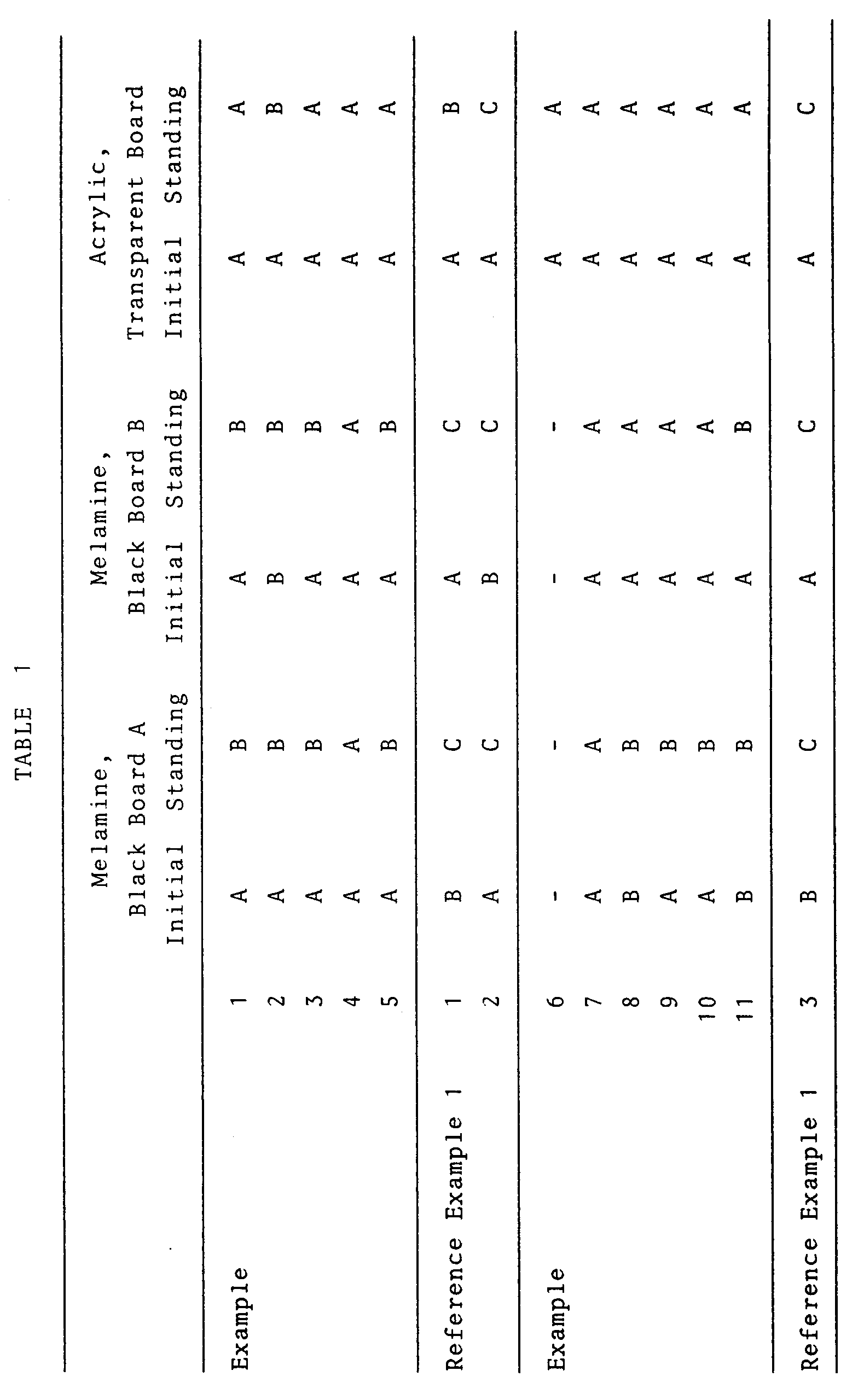
- the initial erasability is defined as the erasability of writing when being wiped with an eraser made of felt immediately after the writing was formed
- the standing erasability is defined as the erasability of writing when being wiped with an eraser made of felt after standing at a temperature of 40°C and a relative humidity of 40% for seven days.
- the writing boards there were used two melamine resin boards.
- the erasability was evaluated as follows. When the writing was erased by wiping five times with a sheet of felt (5 cm x 5 cm) under a load of 200 g or 400 g, the erasability was marked “A”; when the writing was erased by wiping eight times under a load of 800 g, the erasability was marked “B”; and when the writing was not erased by wiping ten times under a load of 800 g, the erasability was marked “C”. The mark "-" indicates that evaluation is not possible since the color of the writing board was the same as that of the writing formed thereon.
- the ink composition of the invention provides writing on an impervious surface which is readily erasable after long standing.
- the ink composition has also erasability substantially independent on the material of impervious surface, and provides erasable writing on any impervious surface.
- the ink composition of the invention contains the first and the second separating agent in conjunction.
- the first separating agent improves, in particular, the dependence of erasability and standing erasability of writing. These improvement may be derived from the following properties of the agent.
- the agent has a good wettability to any impervious surface, however it does not spread on the surface, i.e., it remains where writing is formed.
- the agent is water soluble, however, it contains substantially a constant amount of water, and it does not readily evaporate from the writing formed.
- the prior separating agents such as known esters, silicone or liquid paraffin spreads and evaporate on an impervious surface, and change in water content on the surface, so that that the writing formed with an ink composition containing such a separating agent may have a poor erasability as time passes.
- Is is also likely that such an ink composition has varied wettability depending on the material of impervious surface, and thus the erasability is undesirably dependent on the material of impervious surface on which writing is formed.
- the second separating agent improves, in particular, the fluidity and wettability of the first separating agent, thereby to improve erasability as a whole.
- the second separating agent also improves the coloration of writing on a black color impervious writing board.
Landscapes
- Chemical & Material Sciences (AREA)
- Life Sciences & Earth Sciences (AREA)
- Engineering & Computer Science (AREA)
- Materials Engineering (AREA)
- Wood Science & Technology (AREA)
- Organic Chemistry (AREA)
- Inks, Pencil-Leads, Or Crayons (AREA)
Abstract
- (a) a polyoxyethylene polyoxypropylene block copolymer, as a first separating agent, which is liquid at normal temperatures in an amount of 5-20% by weight, and
- (b) at least one organic compound selected from the group consisting of a carboxylic acid ester, a polyoxypropylene monoalkyl ether and a polyoxyethylene polyoxypropylene monoalkyl ether, as a second separating agent, which is liquid at normal temperatures in an amount of 2-10% by weight.
Description
- This invention relates to an erasable ink composition for writing on an impervious writing surface, and more particularly, to an erasable ink composition which contains a separating agent therein to provide writing on an impervious writing surface such as a so-called white board which is readily erasable by wiping lightly with an eraser made of, for example, felt.
- A variety of erasble ink compositions to write on an impervious writing surface to provide writing thereon which is readily erasble by wiping with, for example, an eraser made of felt are already known, as disclosed in, for example, Japanese Patent Application Laid-open No. 63-43981, No. 62-265377 and No, 2-129278. However, these prior erasble ink compositions contain carboxylic acid esters, liquid paraffin, silicone resins or nonionic surfactants as a separating agent therein, and thus it is known that they provide writing which is insufficiently erasable depending upon the material of impervious writing surface. Namely, the prior erasable ink compositions have erasability dependendent on the material of impervious writing surface. It is also known that such an ink composition provides writing which is not readily erasable after long standing. Namely, the prior erasable ink compositions have erasability dependendent on time.
- An ink composition containing polyoxyethylene polyoxypropylene block copolymer is disclosed in Japanese Patent Application Laid-open No. 60-206881. However, this ink composition is a so-called strippable paint made usable in writing instruments, and can not be used as an erasable writing ink composition.
- It is an object of the invention to provide an ink composition which provides writing on an impervious writing surface readily erasable irrespective of the material of the surface and after long standing,
- According to the invention, there is provided an erasable ink composition for writing on an impervious writing surface comprising an organic solvent, a resin, a pigment, and a separating agent, which comprises;
- (a) a polyoxyethylene polyoxypropylene block copolymer which is liquid at normal temperatures in an amount of 5-20% by weight, and
- (b) at least one organic compound selected from the group consisting of a carboxylic acid ester, a polyoxypropylene monoalkyl ether and a polyoxyethylene polyoxypropylene monoalkyl ether which is liquid at normal temperatures in an amount of 2-10% by weight.
- The ink compostion of the invention contains an organic solvent preferably such as an alcohol or a glycol monoalkyl ether. The alcohol is preferably an aliphatic alcohol of 1-4 carbons such as methanol, ethanol, isopropyl alcohol, n-propyl alcohol or butanol. The glycol monoalkyl ether is preferably a monoalkyl ether of glycol of 2-4 carbons such as ethylene glycol monomethyl ether, ethylene glycol monoethyl ether, propylene glycol monomethyl ether or propylene glycol monoethyl ether. These solvents may be used singly or as a mixture.
- The ink compostion of the invention contains such an organic solvent in an amount of 40-90% by weight, preferably in an amount of 50-75% by weight, When the amount of organic solvent is too large, the resultant ink composition has no viscosity suitable for writing, and may not provide writing of a sufficvient darkness. When the amount of organic solvent is too small, the resultant ink composition has a viscosity too large to write well, and it is also bad in storage stability.
- The ink compostion of the invention may further contain a dialkyl ketone wherein the alkyl has 1-4 carbons such as methyl ethyl ketone or methyl isobutyl ketone, or a lower aliphatic carboxylic acid ester wherein the carboxylic acid has 2-4 carbons and the alkyl has 1-3 carbons preferably such as ethyl acetate or butyl acetate, as a dissolving aid for a resin in an organic solvent used which will be described hereinafter.
- The ink compostion of the invention contains a pigment as a colorant. The amount of the pigment is determined in accordance with the pigment used and the darkness required. However, when the amount is too large, the resultant ink composition may have too large a viscosity and may be poor in writability and storability as well as erasability of writing, while when the amount is too small, the resultant ink composition may provide infeaibly faint writing, and may also writing poor in erasability. Usually the ink compostion of the invention contain a pigment in an amount of 1-30% by weight, preferably of 3-15% by weight.
- A resin is contained in the ink composition so that the ink composition has a viscosity suitable for writing and has a suitable adhesion onto an impervious writing surface. It is necessary that the resin is soluble in the organic solvent used in the ink composition, and such a resin includes, for example, polyvinyl butyral resin, acrylic resin, styrene-acrylic copolymer resin, styrene-maleic acid copolymer resin, shellac resin and rosin-maleic acid copolymer resin.
- When the resin is contained in excess, the resultant ink composition may have too large a viscosity and may deteriorate in writability, storability and erasability of writing, whereas when the amount is too small, the resultant ink composition may not have a viscosity suitable for writing, and may also provide writing of insufficient erasability. Usually the ink compostion of the invention contains a resin in an amount of 1-20% by weight, preferably of 5-15% by weight.
- The ink compostion of the invention contains a separating agent which is liquid at normal temperatures. According to the invention, the separating agent is composed of two components, the first component is a polyoxyethylene polyoxypropylene block copolymer which is liquid at normal temperatures, and preferably has an oxyethylene content of not more than 40% by weight, and a molecular weight of 700-3000.
- Such a polyoxyethylene polyoxypropylene block copolymer is commercially available such as Newpol PE-61, PE-62 or PE-71 (Sanyo Kasei Kogyo K.K., Japan), Pluronic L-31, L-42, L-61, L-72, L-81 or L-101 (Asahi Denka Kogyo K.K., Japan), Epan 420 or 720 (Dai-ichi Kogyo Seiyaku K.K., Japan), Emulgen PP-150 or PP-230 (Kao K.K., Japan), Pronon 102 or 201 (Nippon Yushi K,K., Japan), Actinol P-3035 (Matsumoto Yushi Seiyaku K.K., Japan), Lionol PL-32, PL-42 or PL-712 (Lion K.K., Japan).
- The polyoxyethylene polyoxypropylene block copolymer is contained in an amount of 5-20% by weight baked on the ink compostion. When the amount is too small, the resultant ink composition may not have a sufficient erasability, whereas when the amount is too large, the resultant ink composition may have a viscosity too large for writing well, or write faintly. It is preferred that the ink composition contains the copolymer in an amount of 7-15% by weight.
- The second component of the separating agent used in the invention is at least one organic compound selected from the group consisting of a carboxylic acid ester, a polyoxypropylene monoalkyl ether and a polyoxyethylene polyoxypropylene monoalkyl ether which is liquid at normal temperatures. The carboxylic acid ester may be a carboxylic acid alkyl ester, a dibasic acid diester or a mono- or polyester of a polydric alcohol.
- The carboxylic acid alkyl ester is preferably such a carboxylic acid alkyl ester wherein the carboxylic acid is a saturated or an unsaturated and has 8-20 carbons, and the alkyl has 2-20 carbons. Such a carboxylic acid alkyl ester may be exemplified by cetyl octanoate, isocetyl octanoate, stearyl octanoate, hexyl laurate, isostearyl laurate, butyl myristate, isopropyl palmitate, isostearyl palmitate, isopropyl isostearate, butyl isostearate, hexyl isostearate, isocetyl isostearate, ethyl oleate or decyl oleate.
- The dibasic acid diester used includes an aliphatic dibasic carboxylic acid diester or an aromatic dibasic carboxylic acid diester, preferably a dialkyl ester wherein the alkyl has 2-20 carbons. Thus, the dibasic acid diester used includes, for instance, di-2-ethylhexyl succinate, diisopropyl adipate, dioctyl adipate, diisopropyl sebacate, dibutyl phthalate, dioctyl phthalate and diisodecyl phthalate.
- The ester of polydric alcohol is preferably a mono- or a polyester derived from an aliphatic polyhydric alcohol of 4-8 carbons including glycols and a saturated or an unsaturated fatty acid of 6-24 carbons. Accordingly, the ester of polydric alcohol used includes, for instance, an ester of trimethylol propane such as trimethylol propane (mono, di or tri)oleate, trimethylol propane (mono, di or tri)caproate, tri-2-ethylhexyl trimethylates (such as trialkyl esters of trimethylol compound, exemplified by trimethylol propane), trimethylol propane triisopalmitate, trimethylol propane trioctanoate or trimethylol propane triisostearate; an ester of pentaerythritol such as pentaerythritol tetraoctanoate or pentaerythritol tetra-2-ethyl hexanoate; an ester of propylene glycol such as propylene glycol monocaprilate, propylene glycol dicaprilate or propylene glycol didecanoate; or a fatty acid (mono, di or tri)glyceride or a mixture of these (esters of glycerine and fatty acids) such as olive oil, safflower oil or coconut oil.
- The polyoxyethylene polyoxypropylene monoalkyl ether used in the invention is commercially available, and may be exemplified by Nikkol PBC-31 or PBC-41 (Nikko Chemicals K.K., Japan), Newpol 50HB-55, 50HB-100, 50HB-260, 50HB-400, 50HB-600 or 50HB-1000 (Sanyo Kasei Kogyo K.K., Japan), Dovanox DL-0206, DM-2007 or DH-0300 (Lion K.K., Japan), Lionol L-358, L-745, L-785 or L-950 (Lion K.K., Japan).
- The polyoxypropylene monoalkyl ether is also commercially available, and may be exemplified by Newpol LB-65, LB-285, LB-385, LB-625, LB-1145 LB-1715 or LB-3000 (Sanyo Kasei Kogyo K.K., Japan).
- The second separating agent is contained in the ink composition in an amount of 2-10% by weight, preferably of 3-8% by weight, based on the ink composition. When the amount of the second separating agent is too small, the resultant ink composition may not have a sufficient erasability, whereas when the amount is too large, the resultant ink composition may have a viscosity too large for writing well, or write faintly.
- According to the invention, it is in particular preferred that the first and second separating agents are contained in conjunction in an amount of 10-23% by weight.
- As hereinbefore set forth, the use of polyoxyethylene polyoxypropylene block copolymer only as a separating agent does not provide an ink composition of a high erasability. However, according to the invention, the use of the above mentioned second separating agent in conjunction with the polyoxyethylene polyoxypropylene block copolymer as a composite separating agent provides an ink composition of a high erasability. Thus, the ink composition of the invention writes well on any impervious writing surface, and the writing is readily erased with an eraser of, for example, felt, irrespectively of the material of the impervious writing surface. In addition, the writing can be readily erased after long standing.
- The ink composition of the invention may be produced by a conventional method, and is not limited to any specific method. By way of example, when a normal pigment is used as a colorant, the pigment is mixed With a resin in an organic solvent, the resultant mixture is milled in a beads mill to disperse the pigment finely in the solvent to form a mill base, there are added a separating agent and other components if necessary to the mill base, and then the resultant mixture is stirred. When a resin-coated pigment is used as a colorant, all the components may be mixed together at the same time, and the pigment may be dispersed in the solvent used with a paint shaker. In either methods, the resultant ink composition may be filtered or centrifuged to remove there from coarse materials.
- Examples of the ink composition of the invention will now be described, however, the invention is not limited thereto. In the examples, parts are parts by weight.
-
Newpol PE-61 8 parts Isocetyl isostearate 8 parts Fuji AS Green1) 10 parts Fuji AS White2) 3 parts Ethyl alcohol 61 parts Isopropyl alcohol 10 parts Notes:
1)-6) Polyvinyl butyral resin-coated pigment dispersible in alcohols, available from Fuji Shikiso K.K., Japan -
Newpol PE-62 5 parts Isopropyl isostearate 12 parts Fuji AS Blue3) 10 parts Fuji AS White2) 3 parts Ethyl alcohol 60 parts Isopropyl alcohol 10 parts Notes:
1)-6) Polyvinyl butyral resin-coated pigment dispersible in alcohols, available from Fuji Shikiso K.K., Japan -
Newpol PE-71 12 parts Cetyl octanoate 4 parts Fuji AS Red4) 10 parts Fuji AS White2) 4 parts Ethyl alcohol 51 parts Isopropyl alcohol 10 parts Notes:
1)-6) Polyvinyl butyral resin-coated pigment dispersible in alcohols, available from Fuji Shikiso K.K., Japan -
Newpol PE-61 4 parts Fuji AS Green1) 10 parts Fuji AS White2) 3 parts Ethyl alcohol 73 parts Isopropyl alcohol 10 parts Notes:
1)-6) Polyvinyl butyral resin-coated pigment dispersible in alcohols, available from Fuji Shikiso K.K., Japan -
Pluronic L-31 10 parts Stearyl octanoate 4 parts Fuji AS Orange5) 13 parts Fuji AS White2) 2 parts Ethyl alcohol 60 parts Isopropyl alcohol 10 parts Notes:
1)-6) Polyvinyl butyral resin-coated pigment dispersible in alcohols, available from Fuji Shikiso K.K., Japan -
Pluronic L-42 7 parts Butyl myristate 3 parts Fuji AS White2) 20 parts Ethyl alcohol 60 parts Isopropyl alcohol 10 parts Notes:
1)-6) Polyvinyl butyral resin-coated pigment dispersible in alcohols, available from Fuji Shikiso K.K., Japan -
Pluronic L-61 10 parts Butyl isostearate 6 parts Fuji AS Black6) 15 parts Ethyl alcohol 59 parts Isopropyl alcohol 10 parts Notes:
1)-6) Polyvinyl butyral resin-coated pigment dispersible in alcohols, available from Fuji Shikiso K.K., Japan -
Stearyl octanoate 15 parts Fuji AS Orange5) 13 parts Fuji AS White2) 2 parts Ethyl alcohol 60 parts Isopropyl alcohol 10 parts Notes:
1)-6) Polyvinyl butyral resin-coated pigment dispersible in alcohols, available from Fuji Shikiso K.K., Japan -
Pronon 102 7 parts Dioctyl adipate 8 parts Fuji AS Orange5) 13 parts Fuji AS White2) 2 parts Ethyl alcohol 60 parts Isopropyl alcohol 10 parts Notes:
1)-6) Polyvinyl butyral resin-coated pigment dispersible in alcohols, available from Fuji Shikiso K.K., Japan -
Lionol PL-42 15 parts Diisooctyl sebacate 2 parts Fuji AS Green1) 10 parts Fuji AS White2) 3 parts Ethyl alcohol 51 parts Isopropyl alcohol 10 parts Notes:
1)-6) Polyvinyl butyral resin-coated pigment dispersible in alcohols, available from Fuji Shikiso K.K., Japan -
Epan 420 5 parts Dibutyl phthalate 6 parts Fuji AS Blue3) 10 parts Fuji AS White2) 3 parts Ethyl alcohol 66 parts Isopropyl alcohol 10 parts Notes:
1)-6) Polyvinyl butyral resin-coated pigment dispersible in alcohols, available from Fuji Shikiso K.K., Japan -
Emulgen PP-150 8 parts Dioctyl phthalate 4 parts Fuji AS Red4) 10 parts Fuji AS White2) 4 parts Ethyl alcohol 64 parts Isopropyl alcohol 10 parts Notes:
1)-6) Polyvinyl butyral resin-coated pigment dispersible in alcohols, available from Fuji Shikiso K.K., Japan -
Pluronic L-101 7 parts Diisooctyl phthalate 3 parts Fuji AS White2) 20 parts Ethyl alcohol 60 parts Isopropyl alcohol 10 parts Notes:
1)-6) Polyvinyl butyral resin-coated pigment dispersible in alcohols, available from Fuji Shikiso K.K., Japan -
Dioctyl adipate 15 parts Fuji AS Orange5) 13 parts Fuji AS White2) 2 parts Ethyl alcohol 60 parts Isopropyl alcohol 10 parts Notes:
1)-6) Polyvinyl butyral resin-coated pigment dispersible in alcohols, available from Fuji Shikiso K.K., Japan -
Pluronic L-42 8 parts Trimethylol propane oleate 6 parts Fuji AS Black6) 15 parts Ethyl alcohol 61 parts Isopropyl alcohol 10 parts Notes:
1)-6) Polyvinyl butyral resin-coated pigment dispersible in alcohols, available from Fuji Shikiso K.K., Japan -
Newpol PE-71 10 parts Trimethylol propane trioctanoate 5 parts Fuji AS Orange5) 13 parts Fuji AS White2) 2 parts Ethyl alcohol 60 parts Isopropyl alcohol 10 parts Notes:
1)-6) Polyvinyl butyral resin-coated pigment dispersible in alcohols, available from Fuji Shikiso K.K., Japan -
Pluronic L-42 8 parts Pentaerythritol tetra-2-ethylhexanoate 6 parts Fluorescent orange base 41 parts White base 5 parts Ethyl alcohol 35 parts Isopropyl alcohol 5 parts - The above fluorescent orange base has the composition below:
Epocolor FP-407) 36 parts Denka Butyral9) 9 parts Isopropyl alcohol 10 parts Ethyl alcohol 45 parts Notes:
7) Fluorescent orange pigment available from Nihon Shokubai Kogyo K.K., Japan9) Polyvinyl butyral resin available from Denki Kagaku Kogyo K.K., Japan - Such a pigment bass as above may be usually prepared by adding a pigment to a solution of a resin such as polyvinyl butyral resin in an organic solvent, and mixing the resultant mixture in a beads mill.
- The above white base has the composition below:
Titanium KR-3808) 60 parts Denka Butyral9) 6 parts Isopropyl alcohol 7 parts Ethyl alcohol 27 parts Notes:
8) Titanium dioxide available from Titan Kogyo K.K., Japan9) Polyvinyl butyral resin available from Denki Kagaku Kogyo K.K., Japan -
Epan 720 12 parts Olive oil12) 6 parts Blue base 40 parts White base 5 parts Ethyl alcohol 35 parts Isopropyl alcohol 5 parts Notes:
12) Available from Nikko Chemicals K.K., Japan - The above bkue base has the composition below:
Phthlocyanine blue (dye) 13 parts Esreck BL-110) 13 parts Solmix AP-111) 74 parts Notes:
10) Polyvinyl butyral resin available from Sekisui Kagaku Kogyo K.K., Japan11) Modified ethanol available from Nippon Kasei K.K., Japan -
Pentaerythritol tetra-2-ethylhexanoate 14 parts Fluorescent orange base 41 parts White base 5 parts Ethyl alcohol 35 parts Isopropyl alcohol 5 parts -
Pronon 102 7 parts Nikkol PBC-31 8 parts Fuji AS Orange5) 13 parts Fuji AS White2) 2 parts Ethyl alcohol 60 parts Isopropyl alcohol 10 parts Notes:
1)-6) Polyvinyl butyral resin-coated pigment dispersible in alcohols, available from Fuji Shikiso K.K., Japan -
Lionol PL-42 10 parts Newpol 50HB-26 7 parts Fuji AS Green1) 10 parts Fuji AS White2) 3 parts Ethyl alcohol 51 parts Isopropyl alcohol 10 parts Notes:
1)-6) Polyvinyl butyral resin-coated pigment dispersible in alcohols, available from Fuji Shikiso K.K., Japan -
Epan 420 5 parts Dovanox DL-020 6 parts Fuji AS Blue3) 10 parts Fuji AS White2) 3 parts Ethyl alcohol 66 parts Isopropyl alcohol 10 parts Notes:
1)-6) Polyvinyl butyral resin-coated pigment dispersible in alcohols, available from Fuji Shikiso K.K., Japan -
Emulgen PP-150 8 parts Lionol L-745 4 parts Fuji AS Red4) 10 parts Fuji AS White2) 4 parts Ethyl alcohol 64 parts Isopropyl alcohol 10 parts Notes:
1)-6) Polyvinyl butyral resin-coated pigment dispersible in alcohols, available from Fuji Shikiso K.K., Japan -
Pluronic L-42 8 parts Newpol 50HB-660 7 parts Fuji AS White2) 20 parts Ethyl alcohol 55 parts Isopropyl alcohol 10 parts Notes:
1)-6) Polyvinyl butyral resin-coated pigment dispersible in alcohols, available from Fuji Shikiso K.K., Japan -
Nikkol PBC-31 15 parts Fuji AS Orange5) 13 parts Fuji AS White2) 2 parts Ethyl alcohol 53 parts Isopropyl alcohol 10 parts Notes: 1)-6) Polyvinyl butyral resin-coated pigment dispersible in alcohols, available from Fuji Shikiso K.K., Japan -
Actinol P-3035 8 parts Newpol LB-65 6 parts Fuji AS White2) 20 parts Ethyl alcohol 56 parts Isopropyl alcohol 10 parts Notes:
1)-6) Polyvinyl butyral resin-coated pigment dispersible in alcohols, available from Fuji Shikiso K.K., Japan -
Lionol PL-712 10 parts Newpol LB-285 5 parts Fuji AS Orange5) 13 parts Fuji AS White2) 2 parts Ethyl alcohol 60 parts Isopropyl alcohol 10 parts Notes:
1)-6) Polyvinyl butyral resin-coated pigment dispersible in alcohols, available from Fuji Shikiso K.K., Japan -
Pluronic L-61 8 parts Newpol LB-385 6 parts Fluorescent orange base 41 parts White base 5 parts Ethyl alcohol 35 parts Isopropyl alcohol 5 parts -
Newpol PE-61 8 parts Newpol LB-625 8 parts Fuji AS Green1) 10 parts Fuji AS White2) 3 parts Ethyl alcohol 61 parts Isopropyl alcohol 10 parts Notes:
1)-6) Polyvinyl butyral resin-coated pigment dispersible in alcohols, available from Fuji Shikiso K.K., Japan -
-
Newpol LB-285 15 parts Fuji AS Orange 5) 13 parts Fuji AS White 2) 2 parts Ethyl alcohol 60 parts Isopropyl alcohol 10 parts Notes:
1)-6) Polyvinyl butyral resin-coated pigment dispersible in alcohols, available from Fuji Shikiso K.K., Japan - Writing was formed on various impervious writing surfaces as shown in Table 1, and its initial erasability and standing erasability were examined. The initial erasability is defined as the erasability of writing when being wiped with an eraser made of felt immediately after the writing was formed, and the standing erasability is defined as the erasability of writing when being wiped with an eraser made of felt after standing at a temperature of 40°C and a relative humidity of 40% for seven days. Among the writing boards, there were used two melamine resin boards.
- The erasability was evaluated as follows. When the writing was erased by wiping five times with a sheet of felt (5 cm x 5 cm) under a load of 200 g or 400 g, the erasability was marked "A"; when the writing was erased by wiping eight times under a load of 800 g, the erasability was marked "B"; and when the writing was not erased by wiping ten times under a load of 800 g, the erasability was marked "C". The mark "-" indicates that evaluation is not possible since the color of the writing board was the same as that of the writing formed thereon.
- As indicated in Table 1, the ink composition of the invention provides writing on an impervious surface which is readily erasable after long standing. The ink composition has also erasability substantially independent on the material of impervious surface, and provides erasable writing on any impervious surface.
- More specifically, the ink composition of the invention contains the first and the second separating agent in conjunction. The first separating agent improves, in particular, the dependence of erasability and standing erasability of writing. These improvement may be derived from the following properties of the agent. The agent has a good wettability to any impervious surface, however it does not spread on the surface, i.e., it remains where writing is formed. In addition, the agent is water soluble, however, it contains substantially a constant amount of water, and it does not readily evaporate from the writing formed. In contrast, the prior separating agents such as known esters, silicone or liquid paraffin spreads and evaporate on an impervious surface, and change in water content on the surface, so that that the writing formed with an ink composition containing such a separating agent may have a poor erasability as time passes. Is is also likely that such an ink composition has varied wettability depending on the material of impervious surface, and thus the erasability is undesirably dependent on the material of impervious surface on which writing is formed.
- In turn, the second separating agent improves, in particular, the fluidity and wettability of the first separating agent, thereby to improve erasability as a whole. The second separating agent also improves the coloration of writing on a black color impervious writing board.


Claims (9)
- An erasable ink composition for writing on an impervious writing surface comprising an organic solvent, a resin, a pigment, and a separating agent which comprises:(a) a polyoxyethylene polyoxypropylene block copolymer, as a first separating agent, which is liquid at normal temperatures in an amount of 5-20% by weight, and(b) at least one organic compound selected from the group consisting of a carboxylic acid ester, a polyoxypropylene monoalkyl ether and a polyoxyethylene polyoxypropylene monoalkyl ether, as a second separating agent, which is liquid at normal temperatures in an amount of 2-10% by weight.
- The ink composition as claimed in claim 1 wherein the carboxylic acid ester is an alkyl ester of a saturated or an unsaturated carboxylic acid wherein the carboxylic acid has 8-20 carbons and the alkyl has 2-20 carbons.
- The ink composition as claimed in claim 1 wherein the carboxylic acid ester is an aliphatic dibasic carboxylic acid diester or an aromatic dibasic carboxylic acid diester wherein the alkyl has 2-20 carbons.
- The ink composition as claimed in claim 3 wherein the aliphatic dibasic carboxylic acid diester is a succinate, an adipate or a sebacate.
- The ink composition as claimed in claim 3 wherein the aromatic dibasic carboxylic acid diester is a phthalate.
- The ink composition as claimed in claim 1 wherein the carboxylic acid ester is an ester of an aliphatic polyhdric alcohol of 4-8 carbons and a saturated or an unsaturated fatty acid of 6-24 carbons.
- The ink composition as claimed in claim 6 wherein the polyhdric alcohol is glycerine, trimethylol propane, pentaerythritol or propylene glycol.
- The ink composition as claimed in claim 1 which contains the first and the second separating agents in conjunction in an amount of 10-23% by weight.
- The ink composition as claimed in claim 1 wherein the organic solvent is ethyl alcohol or isopropyl alcohol, or a mixture of these.
Applications Claiming Priority (2)
| Application Number | Priority Date | Filing Date | Title |
|---|---|---|---|
| JP6708/92 | 1992-01-17 | ||
| JP670892A JP3049140B2 (en) | 1992-01-17 | 1992-01-17 | Erasable ink composition for writing board |
Publications (2)
| Publication Number | Publication Date |
|---|---|
| EP0551913A1 true EP0551913A1 (en) | 1993-07-21 |
| EP0551913B1 EP0551913B1 (en) | 1995-11-15 |
Family
ID=11645799
Family Applications (1)
| Application Number | Title | Priority Date | Filing Date |
|---|---|---|---|
| EP19930100571 Expired - Lifetime EP0551913B1 (en) | 1992-01-17 | 1993-01-15 | Erasable ink composition for writing on impervious surface |
Country Status (4)
| Country | Link |
|---|---|
| US (1) | US5324764A (en) |
| EP (1) | EP0551913B1 (en) |
| JP (1) | JP3049140B2 (en) |
| DE (1) | DE69300771T2 (en) |
Cited By (7)
| Publication number | Priority date | Publication date | Assignee | Title |
|---|---|---|---|---|
| US5447560A (en) * | 1994-03-03 | 1995-09-05 | Rohn And Haas Company | Method for improving erasability or erasable marking compositions |
| US5916357A (en) * | 1997-03-25 | 1999-06-29 | The Gillette Company | Eradicable inks |
| EP2671928A1 (en) * | 2012-06-06 | 2013-12-11 | Canon Kabushiki Kaisha | Ink, ink cartridge and ink jet recording process |
| WO2015013085A1 (en) * | 2013-07-22 | 2015-01-29 | Sanford, L.P. | Ink composition comprising colorant particles containing polymeric particles |
| FR3065224A1 (en) * | 2017-04-18 | 2018-10-19 | Societe Bic | DRY CLEANING INK BASED ON ALCOHOL |
| WO2018193196A1 (en) | 2017-04-18 | 2018-10-25 | Societe Bic | Dry erase ink with improved drying time |
| WO2020064652A1 (en) | 2018-09-26 | 2020-04-02 | Societe Bic | Alcohol-based dry erasable ink for writing instrument |
Families Citing this family (32)
| Publication number | Priority date | Publication date | Assignee | Title |
|---|---|---|---|---|
| US5530043A (en) * | 1994-05-25 | 1996-06-25 | Ppg Industries, Inc. | Low volatile organic content pigment grind composition |
| US5492614A (en) * | 1994-05-25 | 1996-02-20 | Ppg Industries, Inc. | Method of electrodeposition using an electrocoating composition containing a low volatile organic content pigment grind composition |
| WO1997039070A1 (en) * | 1996-04-15 | 1997-10-23 | Mitsubishi Pencil Kabushiki Kaisha | Oil-base pigment ink composition for writing utensils |
| US5981626A (en) * | 1997-02-14 | 1999-11-09 | Binney & Smith Inc. | Washable coloring composition suitable for use in dry erase markers |
| US5900094A (en) * | 1997-02-14 | 1999-05-04 | Binney & Smith Inc. | Image transfer method for use with water based dry erase markers |
| US5968241A (en) * | 1997-02-14 | 1999-10-19 | Binney & Smith Inc. | Washable coloring composition |
| US6004057A (en) | 1997-11-24 | 1999-12-21 | Fulop; Jacqueline I. | Marking and eradicating instrument and method of use of same |
| US6031023A (en) * | 1997-12-03 | 2000-02-29 | Milliken & Company | Dry erase ink composition |
| US6423418B1 (en) | 1998-03-05 | 2002-07-23 | Omnova Solutions Inc. | Easily cleanable polymer laminates |
| JP2002505218A (en) * | 1998-03-05 | 2002-02-19 | オムノヴア ソリユーシヨンズ インコーポレーテツド | Easy to clean polymer laminate |
| US6383651B1 (en) | 1998-03-05 | 2002-05-07 | Omnova Solutions Inc. | Polyester with partially fluorinated side chains |
| US6686051B1 (en) | 1998-03-05 | 2004-02-03 | Omnova Solutions Inc. | Cured polyesters containing fluorinated side chains |
| US7320829B2 (en) | 1998-03-05 | 2008-01-22 | Omnova Solutions Inc. | Fluorinated polymer and amine resin compositions and products formed therefrom |
| CA2291567C (en) * | 1998-12-03 | 2007-10-30 | The Pilot Ink Co., Ltd. | Rubber-erasable aqueous ink for writing material composition and writing materials using the same |
| US6673889B1 (en) | 1999-06-28 | 2004-01-06 | Omnova Solutions Inc. | Radiation curable coating containing polyfuorooxetane |
| US6521033B1 (en) * | 1999-07-14 | 2003-02-18 | Adger Kogyo Co., Ltd. | Ink composition, writing instrument containing same and method of forming image on receiving surface |
| US6403760B1 (en) | 1999-12-28 | 2002-06-11 | Omnova Solutions Inc. | Monohydric polyfluorooxetane polymer and radiation curable coatings containing a monofunctional polyfluorooxetane polymer |
| US6962966B2 (en) | 1999-12-28 | 2005-11-08 | Omnova Solutions Inc. | Monohydric polyfluorooxetane oligomers, polymers, and copolymers and coatings containing the same |
| US6458193B1 (en) * | 2000-05-16 | 2002-10-01 | Milliken & Company | Washable coloring compositions |
| US6465565B1 (en) | 2000-07-06 | 2002-10-15 | Omnova Solutions, Inc. | Anionic waterborne polyurethane dispersions containing polyfluorooxetanes |
| US6465566B2 (en) | 2000-07-06 | 2002-10-15 | Omnova Solutions Inc. | Anionic waterborne polyurethane dispersions containing polyfluorooxetanes |
| WO2002092660A2 (en) * | 2001-05-14 | 2002-11-21 | Omnova Soltions Inc | Polymeric surfactants derived from cyclic monomers having pendant fluorinated carbon groups |
| US6660828B2 (en) | 2001-05-14 | 2003-12-09 | Omnova Solutions Inc. | Fluorinated short carbon atom side chain and polar group containing polymer, and flow, or leveling, or wetting agents thereof |
| KR200287597Y1 (en) * | 2002-05-31 | 2002-08-30 | 동아연필 주식회사 | Sprayer with Removalable Ink |
| JP2005537358A (en) * | 2002-08-30 | 2005-12-08 | スリーエム イノベイティブ プロパティズ カンパニー | Method for manufacturing erasable article and article |
| US20040202820A1 (en) * | 2002-08-30 | 2004-10-14 | 3M Innovative Properties Company | Perforated electret articles and method of making the same |
| US20040040652A1 (en) * | 2002-08-30 | 2004-03-04 | 3M Innovative Properties Company | Methods for electrostatically adhering an article to a substrate |
| US20040043221A1 (en) * | 2002-08-30 | 2004-03-04 | 3M Innovative Properties Company | Method of adhering a film and articles therefrom |
| US7713375B2 (en) * | 2006-08-31 | 2010-05-11 | Avery Dennison Corporation | Dry erase writing board and method |
| US8741039B2 (en) * | 2007-02-21 | 2014-06-03 | Sanford, L.P. | Permanent ink compositions and writing instruments containing same |
| JP7139112B2 (en) * | 2017-12-26 | 2022-09-20 | 株式会社パイロットコーポレーション | Oil-based ink composition for writing instrument and writing instrument using the same |
| BR112020021411A2 (en) | 2018-04-27 | 2021-01-19 | Kabushiki Kaisha Pilot Corporation (Also Trading As Pilot Corporation) | COMPOSITION OF OIL-BASED INK AND MARKING PEN. |
Citations (1)
| Publication number | Priority date | Publication date | Assignee | Title |
|---|---|---|---|---|
| EP0209367A1 (en) * | 1985-07-16 | 1987-01-21 | Tosoh Corporation | Ink composition for writing board |
Family Cites Families (5)
| Publication number | Priority date | Publication date | Assignee | Title |
|---|---|---|---|---|
| US3834823A (en) * | 1972-05-25 | 1974-09-10 | Gillette Co | Marking boards and erasable ink compositions therefor |
| JPS5980476A (en) * | 1982-10-29 | 1984-05-09 | Pilot Pen Co Ltd:The | Erasable ink for ball-point pen |
| JPS604574A (en) * | 1983-06-22 | 1985-01-11 | Sakura Color Prod Corp | Ink composition for writing board |
| JPH01249870A (en) * | 1988-03-30 | 1989-10-05 | Pentel Kk | Pigment ink for ball point pen |
| US4978390A (en) * | 1988-10-27 | 1990-12-18 | Binney & Smith Inc. | Washable solid marking composition |
-
1992
- 1992-01-17 JP JP670892A patent/JP3049140B2/en not_active Expired - Fee Related
-
1993
- 1993-01-15 EP EP19930100571 patent/EP0551913B1/en not_active Expired - Lifetime
- 1993-01-15 DE DE69300771T patent/DE69300771T2/en not_active Expired - Fee Related
- 1993-01-19 US US08/005,974 patent/US5324764A/en not_active Expired - Lifetime
Patent Citations (1)
| Publication number | Priority date | Publication date | Assignee | Title |
|---|---|---|---|---|
| EP0209367A1 (en) * | 1985-07-16 | 1987-01-21 | Tosoh Corporation | Ink composition for writing board |
Non-Patent Citations (2)
| Title |
|---|
| PATENT ABSTRACTS OF JAPAN vol. 010, no. 067 (C-333)(2124) 15 March 1986 & JP-A-60 206 881 ( PENTEL KK ) * |
| PATENT ABSTRACTS OF JAPAN vol. 014, no. 356 (C-745)(4299) 2 August 1990 & JP-A-02 129 278 ( MITSUBISHI PENCIL CO LTD ) * |
Cited By (15)
| Publication number | Priority date | Publication date | Assignee | Title |
|---|---|---|---|---|
| US5447560A (en) * | 1994-03-03 | 1995-09-05 | Rohn And Haas Company | Method for improving erasability or erasable marking compositions |
| US5916357A (en) * | 1997-03-25 | 1999-06-29 | The Gillette Company | Eradicable inks |
| US6221432B1 (en) | 1997-03-25 | 2001-04-24 | Yichun Wang | Eradicable inks |
| US9388322B2 (en) | 2012-06-06 | 2016-07-12 | Canon Kabushiki Kaisha | Ink, ink cartridge and ink jet recording process |
| EP2671928A1 (en) * | 2012-06-06 | 2013-12-11 | Canon Kabushiki Kaisha | Ink, ink cartridge and ink jet recording process |
| WO2015013085A1 (en) * | 2013-07-22 | 2015-01-29 | Sanford, L.P. | Ink composition comprising colorant particles containing polymeric particles |
| US9109126B2 (en) | 2013-07-22 | 2015-08-18 | Sanford, L.P. | Ink compositions comprising colorant particles containing polymeric particles |
| FR3065224A1 (en) * | 2017-04-18 | 2018-10-19 | Societe Bic | DRY CLEANING INK BASED ON ALCOHOL |
| WO2018193196A1 (en) | 2017-04-18 | 2018-10-25 | Societe Bic | Dry erase ink with improved drying time |
| WO2018193197A1 (en) | 2017-04-18 | 2018-10-25 | Societe Bic | Alcohol-based dry-erasable ink |
| DE112018002062T5 (en) | 2017-04-18 | 2020-01-02 | Societe Bic | ALCOHOL-BASED DRY-ERASABLE INK |
| US11286397B2 (en) | 2017-04-18 | 2022-03-29 | SOCIéTé BIC | Alcohol-based dry-erasable ink |
| US11970623B2 (en) | 2017-04-18 | 2024-04-30 | SOCIéTé BIC | Dry erase ink with improved drying time |
| WO2020064652A1 (en) | 2018-09-26 | 2020-04-02 | Societe Bic | Alcohol-based dry erasable ink for writing instrument |
| US12071552B2 (en) | 2018-09-26 | 2024-08-27 | SOCIéTé BIC | Alcohol-based dry erasable ink for writing instrument |
Also Published As
| Publication number | Publication date |
|---|---|
| JPH05194904A (en) | 1993-08-03 |
| US5324764A (en) | 1994-06-28 |
| DE69300771D1 (en) | 1995-12-21 |
| DE69300771T2 (en) | 1996-07-04 |
| JP3049140B2 (en) | 2000-06-05 |
| EP0551913B1 (en) | 1995-11-15 |
Similar Documents
| Publication | Publication Date | Title |
|---|---|---|
| EP0551913B1 (en) | Erasable ink composition for writing on impervious surface | |
| EP0304887B1 (en) | Erasable ink compositions | |
| US5316574A (en) | Erasable ink composition for writing on impervious surface | |
| US4578117A (en) | Erasable ink composition | |
| KR890000422B1 (en) | Marking pen ink composition | |
| EP0322805B1 (en) | Water base erasable ink compositions | |
| EP0584735B1 (en) | Water base erasable ink composition for use in marking pens | |
| US4822417A (en) | Marking ink composition | |
| US4162164A (en) | Cyanine dye based high saturation sympathetic ink having time delayed disappearance | |
| DE69220912T2 (en) | Aqueous ink composition | |
| US4830670A (en) | Erasable ballpoint-pen ink before being cured | |
| US7291210B2 (en) | Solid drawing material and method for producing the same | |
| JP3810895B2 (en) | Ink composition for oil-based marking pen | |
| JPH08231914A (en) | Ink composition | |
| EP0501167B1 (en) | Liquid dye preparations | |
| JPH1180645A (en) | Water-based marking pen ink for writing boards | |
| JP3480602B2 (en) | Oil-based ink composition | |
| JPH11158421A (en) | Oil-based ink composition for ballpoint pens | |
| JP2001200186A (en) | Ink composition for oil marking pen | |
| JPH04239569A (en) | Water-base marking pen ink for writing board | |
| JPH086062B2 (en) | Erasable marking pen ink composition | |
| JPH08157763A (en) | Ink composition for oil-based marking pen | |
| JP3693446B2 (en) | Oil-based ink for marking pens | |
| JPS6155274A (en) | Printing agent for water-proof moisture permeable processed cloth | |
| JP4594625B2 (en) | Oil-based pigment ink composition |
Legal Events
| Date | Code | Title | Description |
|---|---|---|---|
| PUAI | Public reference made under article 153(3) epc to a published international application that has entered the european phase |
Free format text: ORIGINAL CODE: 0009012 |
|
| AK | Designated contracting states |
Kind code of ref document: A1 Designated state(s): DE FR GB |
|
| 17P | Request for examination filed |
Effective date: 19931020 |
|
| 17Q | First examination report despatched |
Effective date: 19941214 |
|
| GRAA | (expected) grant |
Free format text: ORIGINAL CODE: 0009210 |
|
| AK | Designated contracting states |
Kind code of ref document: B1 Designated state(s): DE FR GB |
|
| REF | Corresponds to: |
Ref document number: 69300771 Country of ref document: DE Date of ref document: 19951221 |
|
| ET | Fr: translation filed | ||
| PLBE | No opposition filed within time limit |
Free format text: ORIGINAL CODE: 0009261 |
|
| STAA | Information on the status of an ep patent application or granted ep patent |
Free format text: STATUS: NO OPPOSITION FILED WITHIN TIME LIMIT |
|
| 26N | No opposition filed | ||
| REG | Reference to a national code |
Ref country code: GB Ref legal event code: IF02 |
|
| PGFP | Annual fee paid to national office [announced via postgrant information from national office to epo] |
Ref country code: FR Payment date: 20060110 Year of fee payment: 14 |
|
| PGFP | Annual fee paid to national office [announced via postgrant information from national office to epo] |
Ref country code: GB Payment date: 20060111 Year of fee payment: 14 |
|
| PGFP | Annual fee paid to national office [announced via postgrant information from national office to epo] |
Ref country code: DE Payment date: 20060112 Year of fee payment: 14 |
|
| PG25 | Lapsed in a contracting state [announced via postgrant information from national office to epo] |
Ref country code: DE Free format text: LAPSE BECAUSE OF NON-PAYMENT OF DUE FEES Effective date: 20070801 |
|
| GBPC | Gb: european patent ceased through non-payment of renewal fee |
Effective date: 20070115 |
|
| REG | Reference to a national code |
Ref country code: FR Ref legal event code: ST Effective date: 20070930 |
|
| PG25 | Lapsed in a contracting state [announced via postgrant information from national office to epo] |
Ref country code: GB Free format text: LAPSE BECAUSE OF NON-PAYMENT OF DUE FEES Effective date: 20070115 |
|
| PG25 | Lapsed in a contracting state [announced via postgrant information from national office to epo] |
Ref country code: FR Free format text: LAPSE BECAUSE OF NON-PAYMENT OF DUE FEES Effective date: 20070131 |