EP0547557B1 - N-vinylimidazolidine derivatives, preparation thereof, insecticides containing same as an effective ingredient and intermediates thereof - Google Patents
N-vinylimidazolidine derivatives, preparation thereof, insecticides containing same as an effective ingredient and intermediates thereof Download PDFInfo
- Publication number
- EP0547557B1 EP0547557B1 EP92121317A EP92121317A EP0547557B1 EP 0547557 B1 EP0547557 B1 EP 0547557B1 EP 92121317 A EP92121317 A EP 92121317A EP 92121317 A EP92121317 A EP 92121317A EP 0547557 B1 EP0547557 B1 EP 0547557B1
- Authority
- EP
- European Patent Office
- Prior art keywords
- group
- phenyl group
- carbon atoms
- substituted
- phenyl
- Prior art date
- Legal status (The legal status is an assumption and is not a legal conclusion. Google has not performed a legal analysis and makes no representation as to the accuracy of the status listed.)
- Expired - Lifetime
Links
- 0 C*(C)CC(CN1)NC1=N[N+]([O-])=O Chemical compound C*(C)CC(CN1)NC1=N[N+]([O-])=O 0.000 description 4
Classifications
-
- C—CHEMISTRY; METALLURGY
- C07—ORGANIC CHEMISTRY
- C07D—HETEROCYCLIC COMPOUNDS
- C07D401/00—Heterocyclic compounds containing two or more hetero rings, having nitrogen atoms as the only ring hetero atoms, at least one ring being a six-membered ring with only one nitrogen atom
- C07D401/02—Heterocyclic compounds containing two or more hetero rings, having nitrogen atoms as the only ring hetero atoms, at least one ring being a six-membered ring with only one nitrogen atom containing two hetero rings
- C07D401/06—Heterocyclic compounds containing two or more hetero rings, having nitrogen atoms as the only ring hetero atoms, at least one ring being a six-membered ring with only one nitrogen atom containing two hetero rings linked by a carbon chain containing only aliphatic carbon atoms
-
- A—HUMAN NECESSITIES
- A01—AGRICULTURE; FORESTRY; ANIMAL HUSBANDRY; HUNTING; TRAPPING; FISHING
- A01N—PRESERVATION OF BODIES OF HUMANS OR ANIMALS OR PLANTS OR PARTS THEREOF; BIOCIDES, e.g. AS DISINFECTANTS, AS PESTICIDES OR AS HERBICIDES; PEST REPELLANTS OR ATTRACTANTS; PLANT GROWTH REGULATORS
- A01N51/00—Biocides, pest repellants or attractants, or plant growth regulators containing organic compounds having the sequences of atoms O—N—S, X—O—S, N—N—S, O—N—N or O-halogen, regardless of the number of bonds each atom has and with no atom of these sequences forming part of a heterocyclic ring
-
- C—CHEMISTRY; METALLURGY
- C07—ORGANIC CHEMISTRY
- C07D—HETEROCYCLIC COMPOUNDS
- C07D233/00—Heterocyclic compounds containing 1,3-diazole or hydrogenated 1,3-diazole rings, not condensed with other rings
- C07D233/04—Heterocyclic compounds containing 1,3-diazole or hydrogenated 1,3-diazole rings, not condensed with other rings having one double bond between ring members or between a ring member and a non-ring member
- C07D233/28—Heterocyclic compounds containing 1,3-diazole or hydrogenated 1,3-diazole rings, not condensed with other rings having one double bond between ring members or between a ring member and a non-ring member with hetero atoms or with carbon atoms having three bonds to hetero atoms with at the most one bond to halogen, e.g. ester or nitrile radicals, directly attached to ring carbon atoms
- C07D233/44—Nitrogen atoms not forming part of a nitro radical
- C07D233/52—Nitrogen atoms not forming part of a nitro radical with hetero atoms directly attached to said nitrogen atoms
-
- C—CHEMISTRY; METALLURGY
- C07—ORGANIC CHEMISTRY
- C07D—HETEROCYCLIC COMPOUNDS
- C07D401/00—Heterocyclic compounds containing two or more hetero rings, having nitrogen atoms as the only ring hetero atoms, at least one ring being a six-membered ring with only one nitrogen atom
- C07D401/14—Heterocyclic compounds containing two or more hetero rings, having nitrogen atoms as the only ring hetero atoms, at least one ring being a six-membered ring with only one nitrogen atom containing three or more hetero rings
-
- C—CHEMISTRY; METALLURGY
- C07—ORGANIC CHEMISTRY
- C07D—HETEROCYCLIC COMPOUNDS
- C07D405/00—Heterocyclic compounds containing both one or more hetero rings having oxygen atoms as the only ring hetero atoms, and one or more rings having nitrogen as the only ring hetero atom
- C07D405/02—Heterocyclic compounds containing both one or more hetero rings having oxygen atoms as the only ring hetero atoms, and one or more rings having nitrogen as the only ring hetero atom containing two hetero rings
- C07D405/06—Heterocyclic compounds containing both one or more hetero rings having oxygen atoms as the only ring hetero atoms, and one or more rings having nitrogen as the only ring hetero atom containing two hetero rings linked by a carbon chain containing only aliphatic carbon atoms
-
- C—CHEMISTRY; METALLURGY
- C07—ORGANIC CHEMISTRY
- C07D—HETEROCYCLIC COMPOUNDS
- C07D405/00—Heterocyclic compounds containing both one or more hetero rings having oxygen atoms as the only ring hetero atoms, and one or more rings having nitrogen as the only ring hetero atom
- C07D405/14—Heterocyclic compounds containing both one or more hetero rings having oxygen atoms as the only ring hetero atoms, and one or more rings having nitrogen as the only ring hetero atom containing three or more hetero rings
-
- C—CHEMISTRY; METALLURGY
- C07—ORGANIC CHEMISTRY
- C07D—HETEROCYCLIC COMPOUNDS
- C07D417/00—Heterocyclic compounds containing two or more hetero rings, at least one ring having nitrogen and sulfur atoms as the only ring hetero atoms, not provided for by group C07D415/00
- C07D417/02—Heterocyclic compounds containing two or more hetero rings, at least one ring having nitrogen and sulfur atoms as the only ring hetero atoms, not provided for by group C07D415/00 containing two hetero rings
- C07D417/06—Heterocyclic compounds containing two or more hetero rings, at least one ring having nitrogen and sulfur atoms as the only ring hetero atoms, not provided for by group C07D415/00 containing two hetero rings linked by a carbon chain containing only aliphatic carbon atoms
Definitions
- the present invention relates to novel imidazolidine derivatives, their preparation, insecticides containing the derivatives as an effective ingredient, and novel intermediates.
- N-vinylimidazolidine derivatives of the present invention are useful as agricultural chemicals (particularly, as insecticides) in the fields of agriculture and intermediates of them are useful in various industrial fields and particularly as intermediates for agricultural chemicals.
- the present inventors earnestly investigated so as to solve the above-mentioned problems and, as a result, have found that novel N-vinylimidazolidine derivatives of the formula (1) have an excellent insecticidal activity. On the basis of the finding, they have completed the present invention.
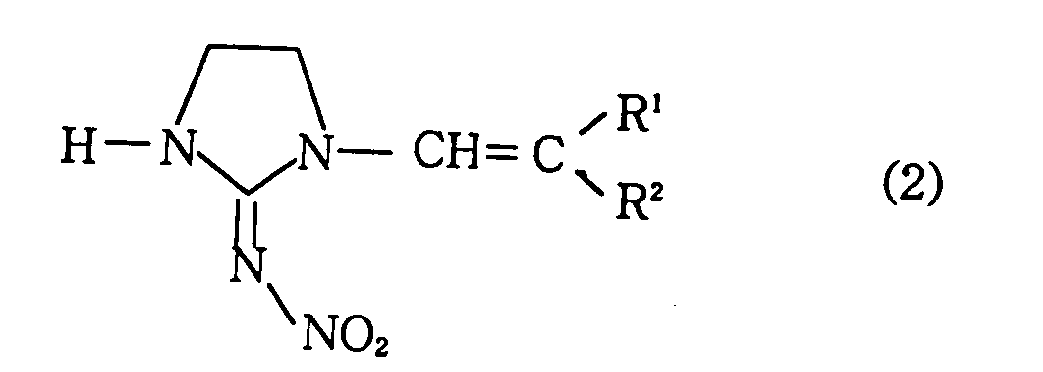
- the present invention provides novel N-vinylimidazolidine derivatives of the formula (1): where R 1 and R 2 have the same meanings as mentioned above, a process of producing them, an insecticide containing them as an effective ingredient, novel intermediates, which are for producing the compounds (1), of the formula (2): where R 1 and R 2 have the same meanings as mentioned above, and processes of producing the intermediates.
- alkyl group having from 1 to 18 carbon atoms for R 1 and R 2 in the above-mentioned formulae include a methyl group, an ethyl group, an n-propyl group, an iso-propyl group, an n-butyl group, an iso-butyl group, a sec-butyl group, a tert-butyl group, an n-pentyl group, an n-hexyl group, an n-octyl group, an n-decyl group and an n-octadecyl group;
- the alkoxy group having from 1 to 4 for them include a methoxy group, an ethoxygroup, an n-propoxygroup, an iso-propoxy group, an n-butoxygroup, an iso-butoxy group and a sec-butoxy group;
- the alkylthio group having from 1 to 4 for them include a methylthio group, an ethy
- substituents of the substituted phenyl group are, for example, an alkyl group having from 1 to 4 carbon atoms such as a methyl group, an ethyl group, a propyl group, an iso-propyl group and a t-butyl group; a halogen atom such as a fluorine atom, a chlorine atom, a bromine atom and an iodine atom; an alkoxy group having from 1 to 4 carbon atoms such as a methoxy group, an ethoxy group, an n-propoxy group, an iso-propoxy group, an n-butoxy group, an iso-butoxy group and a sec-butoxy group; an alkylthio group having from 1 to 4 carbon atoms such as a methylthio group, an ethylthio group, an n-propylthio group, an iso-propylthio group and an n-butylthio group;
- Compounds of the formula (1) may be produced with ease by reacting an N-vinylimidazolidine derivative of the formula (2) and a 2-chloropyridin-5-ylmethyl halide or 2-chlorothiazol-5-ylmethyl halide of the formula (3) in the presence of a deacidifying agent in various solvents.
- the deacidifying agent examples include alkali metal hydroxides such as sodium hydroxide, potassium hydroxide and the like; alkaline earth metal hydroxides such as magnesium hydroxide, calcium hydroxide and the like; alkali metal hydrides such as sodium hydride, potassium hydride and the like; alkali metal alcoholates such as sodium methylate, sodium ethylate and the like; alkali metal oxides such as sodium oxide and the like; carbonates such as sodium carbonate, potassium carbonate and the like; hydrogencarbonates such as sodium hydrogencarbonate, potassium hydrogencarbonate and the like; hydrogensulfates such as sodium hydrogensulfate, potassium hydrogensulfate and the like; phosphates such as trisodium phosphate, disodium phosphate and the like; acetates such as sodium acetate, potassium acetate and the like; organic bases such as triethylamine, DBU, DIMAP and the like; and butyl lithium, sodium amide, and the like.
- the solvents may include not only water but also aromatic hydrocarbons such as benzene, toluene, xylene and the like; aliphatic hydrocarbons such as hexane, heptane, petroleum benzine and the like; aprotic polar solvents such as dimethylformamide, dimethylacetamide, dimethylsulfoxide, 1,3-dimethyl-2-imidazolidinone, 1-methyl-2-pyrrolidinone and the like; ethers such as ethyl ether, diisopropyl ether, 1,2-dimethoxyethane, tetrahydrofuran, dioxane and the like; nitriles such as acetonitrile, propionitrile and the like; ketones such as acetone, diisopropyl ketone and the like; ester such as methyl acetate, ethyl acetate, ethyl propionate and the like; and alcohols such as methanol,
- phase transfer catalysts such as tetrabutylammonium bromide, triethylbenzylammonium chloride and the like, intended imidazolidine derivatives can be obtained in high yield.
- reaction temperature and the reaction time can be varied over wide ranges.
- the reaction temperature is in the range of from -20 to 100°C, preferably from 0 to 100°C; and the reaction time is in the range of from 0.01 to 30 hours, preferably from 0.1 to 15 hours.
- substituent(s) of a compound of the formula (2) may be protected with so-called protective group(s) to produce a derivative of the intended compound (1), which is then deprotected to obtain the N-vinylimidazolidine derivative (1).
- the starting compound of the formula (2) may be produced in accordance with the following reaction scheme (2): where R 1 , R 2 , R 3 , R 4 and R have the same meanings as mentioned above.
- compounds of the formula (2) may be produced with ease and in high yield by reacting a 2-nitroiminoimidazolidine of the formula (5) and an aldehyde of the formula (4) or an aldehyde homologue of the formula (6). They may also be produced with ease and in high yield by reacting a 2-nitroimino-N-dialkoxymethylimidazolidine of the formula (7) and an active methylene-having compound of the formula (8).
- compounds of the formula (2) of the present invention could not be produced by the method described in U.S. Patent 4,742,060.
- compounds of the formula (2) are novel compounds which have first been produced by the present inventors, and the reaction of itself of producing them is also a novel reaction which has first been found out by them.
- the reaction may be effected in the absence of a solvent or in a solvent.
- a solvent usable are, for example, alcohols such as methanol, ethanol, propanol and the like; aromatic hydrocarbons such as benzene, toluene, xylene and the like; halogenated hydrocarbons such as chloroform, 1,2-dichloroethane and the like; aprotic polar solvents such as dimethylformamide, dimethylacetamide, dimethylsulfoxide, 1,3-dimehtyl-2-imidazolidinone, 1-methyl-2-pyrrolidinone and the like; ethers such as ethyl ether, diisopropyl ether, 1,2-dimethoxyethane, tetrahydrofuran, dioxane and the like; nitrile such as acetonitrile, propionitrile and the like; and 7 ketones such as acetone, diisopropyl ketone and the like
- a catalyst may be used for the reaction, which includes, for example, mineral acids such as sulfuric acid, hydrochloric acid, phosphoric acid, nitric acid and the like; sulfonic acids such as p-toluenesulfonic acid, methanesulfonic acid, trifluoromethanesulfonic acid and the like; carboxylic acids such as acetic acid, benzoic acid, formic acid and the like; Lewis acids such as aluminium chloride, tin tetrachloride, zinc chloride, boron trifluoride, titanium tetrachloride and the like; ammonium salts such as pyridine hydrochloride, tetrametylammonium chloride and the like; hydrogensulfates such as sodium hydrogensulfate, potassium hydrogensulfate and the like; hydrogencarbonates such as sodium hydrogencarbonate, potassium hydrogencarbonate and the like; acidic or basic oxides such as zirconium oxide, silica gel,
- reaction temperature and the reaction time can be varied over wide ranges.
- the reaction temperature is in the range of from -80 to 300°C, preferably from -30 to 200°C.
- the reaction is effected generally under a normal pressure condition but may also be effected under an elevated pressure.
- the reaction time is in the range of from 0.001 to 30 hours, preferably from 0.01 to 20 hours.
- the amount of the aldehyde derivative (4) to be used may be from 0.1 to 30 mols, economically from 0.3 to 10.0 mols, to mol of the 2-nitroiminoimidazolidine (5).
- the reaction may be effected in the absence of a solvent or in a solvent.
- the solvent usable are, for example, aromatic hydrocarbons such as benzene, toluene, xylene and the like; halogenated hydrocarbons such as chloroform, 1,2-dichloroethane and the like; aprotic polar solvents such as dimethylformamide, dimethylacetamide, dimethylsulfoxide, 1,3-dimethyl-2-imidazolidinone, 1-methyl-2-pyrrolidinone and the like; ethers such as ethyl ether, diisopropyl ether, 1,2-dimethoxyethane, tetrahydrofuran, dioxane and the like; nitriles such as acetonitrile, propionitrile and the like; ketones such as acetone, diisopropyl ketone and the like; and alcohols such as methanol, ethanol, propanol and the like.
- a catalyst may be used for the reaction, which includes, for example, mineral acids such as sulfuric acid, hydrochloric acid, phosphoric acid, nitric acid and the like; sulfonic acids such as p-toluenesulfonic acid, methanesulfonic acid, trifluoromethanesulfonic acid and the like; carboxylic acids such as acetic acid, benzoic acid, formic acid and the like; Lewis acids such as aluminium chloride, tin tetrachloride, zinc chloride, boron trifluoride, titanium tetrachloride and the like; ammonium salts such as pyridine hydrochloride, tetrametylammonium chloride and the like; acidic or basic oxides such as zirconium oxide, silica gel, alumina and the like; hydrogensulfates such as sodium hydrogensulfate, potassium hydrogensulfate and the like; hydrogencarbonates such as sodium hydrogencarbonate, potassium hydrogen
- reaction temperature and the reaction time can be varied over wide ranges.
- the reaction temperature is in the range of from -80 to 300°C, preferably from -30 to 200°C.
- the reaction is effected generally under a normal pressure condition but may also be effected under an elevated pressure.
- the reaction time is in the range of from 0.001 to 30 hours, preferably from 0.01 to 20 hours.
- the amount of the ethane derivative (6) to be used may be 1.0 mol or more to mol of the 2-nitroiminoimidazolidine (5) with no limitation of the uppermost limit thereof. From the economical viewpoint, it is preferably from 0.3 to 10.0 mols to mol of the 2-nitroguanidine (5).
- Compounds of the formula (6) may also be obtained by acetalization of an aldehyde of the formula (4) or by reaction of a Grignard reagent and an orthoformate. They may also be obtained by reaction of a methyl methylsulfinylmethylsulfide and an alkyl halide or aryl halide (literatures for the production methods: Journal of Organic Synthetic Chemical Association, Vol. 37, No. 11 (1979); General Logic of Chemistry, No. 19, 75-96 (1978); Tetrahedron Letters, No. 34, 3151-3154 (1974); Tetrahedron Letters, No. 26, 2681-2684 (1972)).
- the reaction temperature and the reaction time can be varied over wide ranges.
- the reaction temperature is in the range of from -80 to 300°C, preferably from -30 to 200°C.
- the reaction time is in the range of from 0.001 to 30 hours, preferably from 0.01 to 20 hours.
- the amount of the active methylene-having compound to be used may be 1.0 mol or more to mol of the dialkoxymethylimidazolidine derivative (7) with no limitation of the uppermost limit thereof. From the economical viewpoint, it is preferably from 0.3 to 10.0 mols to mol of the derivative (7).
- Alkoxymethylimidazolidine derivatives of the formula (7) may be produced by reaction of an imidazolidine derivative and an orthoformate.
- the reaction may be effected in the absence of a solvent or in a solvent.
- a solvent usable are, for example, aprotic polar solvents such as di methylformamide, di methylsulfoxide, 1,3-dimethyl-2-imidazolidinone and the like.
- the reaction temperature is in the range of from 50 to 200°C; and the reaction time is in the range of from 0.5 to 15 hours.
- the amount of the orthoformate to be used is preferably from 1 to 10 mols per mol of the imidazolidine derivative (5).
- 2-chloropyridin-5-ylmethyl halides of the formula (3) and 2-chloro-5-chloromethylthiaozle are known compounds and can be produced by known methods (literatures for the production method: J. Heterocyclic Chem., 16, 333 (1979); J. Med. Chem., 14, 557 (1971)).
- the derivatives of the formula (1) according to the invention have great insecticidal activity and can be used as an insecticide.
- the derivatives of the formula (1) of the invention show a high control effect on harmful insects without involving any phyto-toxicity to cultivated plants
- Insect pests to which the derivatives of the invention can be applied include:
- the compounds of the invention not only have a higher insecticidal effect of exterminating harmful insects as compared with conventional imidazolidine skeleton-having compounds but also extremely low toxic and therefore may be used safely in all sites.
- the compounds of the invention may rapidly be decomposed by light or the like in the natural environment so that they hardly remain in crops. Further, the water solubility of the compounds is low so that they hardly dissolve out into ground water or rivers. In producing the compounds of the invention, formation of by-products is extremely small and the compounds may be produced with ease. They are therefore industrially advantageous.
- any specific requirement is not necessary to formulate them into various preparations, such as emulsions, wettable powders, dusts, granules, fine powders, oils, aerosols, poisonous feeds and the like, according to the procedures of preparing general agricultural chemicals well known in the art.
- carrier used herein is intended to mean synthetic or natural, organic or inorganic materials which assist the effective ingredient to arrive at sites or portions to be treated and which are formulated in order to make easy storage, transport and handling of the effective compound.
- Appropriate solid carriers include, for example, clays such as montomorilonite, kaolinite and the like, inorganic substances such as diatomaceous earth, white clay, talc, vermiculite, gypsum, calcium carbonate, silica gel, ammonium sulfate and the like, plant organic substances such as soybean flour, saw dust, wheat flour and the like, and urea.
- clays such as montomorilonite, kaolinite and the like
- inorganic substances such as diatomaceous earth, white clay, talc, vermiculite, gypsum, calcium carbonate, silica gel, ammonium sulfate and the like
- plant organic substances such as soybean flour, saw dust, wheat flour and the like, and urea.
- Suitable liquid carriers include, for example, aromatic hydrocarbons such as toluene, xylene, cumene and the like, paraffin hydrocarbons such as kerosene, mineral oils and the like, ketones such as acetone, methyl ethyl ketone, cyclohexanone and the like, ethers such as dioxane, tetrahydrofuran and the like, glymes such as ethylene glycol dimethyl ether, ethylene glycol diethyl ether and the like, alcohols such as methanol, ethanol, propanol, ethylene glycol and the like; phthalates such as dioctyl phthalate and the like, and dimethylformamide, dimethylsulfoxide, water, and the like.
- aromatic hydrocarbons such as toluene, xylene, cumene and the like
- paraffin hydrocarbons such as kerosene, mineral oils and the like
- ketones such as acetone, methyl e
- the following adjuvants may be used singly or in combination, depending on the type of preparation, the manner of application and the purpose.
- water-soluble salts such as ligninsulfonates, nonionic surface active agents such as alkyl benzene sulfonates, alkylsulfates and the like, lubricants such as calcium stearate, waxes and the like, stabilizers such as isopro- poxy hydrogenphosphates, and methyl cellulose, carboxymethyl cellulose, casein, gum arabi and the like.
- ligninsulfonates nonionic surface active agents such as alkyl benzene sulfonates, alkylsulfates and the like
- lubricants such as calcium stearate, waxes and the like
- stabilizers such as isopro- poxy hydrogenphosphates
- methyl cellulose, carboxymethyl cellulose, casein, gum arabi and the like are examples of the adjuvants.
- the compounds of the formula (1) of the invention may develop better insecticidal activity when used in combination of two or more. If other physiologically active substances or chemicals are used in combination, multi-purpose compositions with good efficacy can be prepared with the possibility of developing a synergistic effect.
- physiologically active substances include: synthetic pyrethroid insecticides and various isomers thereof or pyrethrum extracts, such as allethrin, N-(chrysanthemoylmethyl)-3,4,5,6-tetrahydrophthalimide, 5-benzyl-3-furylmethyl chrysanthemate, 3-phenoxybenzyl chrysanthemate, 5-propargylfur- furyl chrysanthemate and other known cyclopropanecarboxylic acid esters, 3-phenoxybenzyl 2,2-dimethyl-3-(2,2-dichlorovinyl)-cyclopropane-1-carboxylate, 3-phenoxy-a-cyanobenzyl 2,2-dimethyl-3-(2,2-dichlorovinyl)-cyclopropane-1-carboxylate, 3-phenoxy-a-cyanobenzyl, 2,2-dimethyi-3-(2,2-dibromovinyi)-cyciopropane-1--
- O,O-dimethyl-O-(2,2-dichlorovinyl)phosphate DDVP
- O,O-dimethyl-O-(3-methyl-4-nitrophenyl)phosphorothioate diazinone
- O,O-dimethyl-O-4-cyanophenylphos- phorothioate O,O-dimethyl-S-[a-(ethoxycarbonyl)benzyl]phosphorodithioate, 2-methoxy-4H-1,3,2-benzo- dioxaphosphorin-2-sulfide, O,O-diethyl-O-4-cyanophenylphosphonothioate
- MMP pyrimifosmethyl, isoxa- thione, chloropyrifosmethyl, chloropyrifos, ESP, profenofos, malason, dimethoate, thiomethone, ethylthiome- thone, forosan,
- antioxidants or UV absorbers may be added in appropriate amounts, if necessary, including, for example, phenol derivatives or bisphenol derivatives such as BHT (2,6-di-t-butyl-4-methylphenol), BHA (butylhydroxyanisole) and the like, arylamines or benzophenone compounds such as phenyl-a-naphthylamine, phenyl- ⁇ -naphthylamine, condensates of phenetidine and acetone, thereby obtaining more stable compositions.
- phenol derivatives or bisphenol derivatives such as BHT (2,6-di-t-butyl-4-methylphenol), BHA (butylhydroxyanisole) and the like
- arylamines or benzophenone compounds such as phenyl-a-naphthylamine, phenyl- ⁇ -naphthylamine, condensates of phenetidine and acetone, thereby obtaining more stable compositions.
- the compounds of the formula (1) of the invention are used as an insecticide, they are used in an amount of from 0.0001 to 95 wt.%, preferably from 0.01 to 50 wt.% of the insecticide.
- the effective ingredient is used at a concentration of from 0.01 to 5000 ppm, preferably from 0.1 to 1000 ppm.
- the application amount per 10 ares is generally in the range of from 1 to 300 g of the effective ingredient.
- a mixture comprising 7.0 g of 1- ⁇ 2-(3,4-dichlorophenyl)vinyl ⁇ -2-nitroiminoimidazolidine, 7.5 g of 2-chloro-5-chloromethylpyridine, 6.4 g of potassium carbonate and 50 ml of dimethylsulfoxide was stirred at 60°C for one hour.
- the reaction mixture was poured into water, extracted with ethyl acetate, washed with water, dried (with anhydrous MgS0 4 ) and concentrated to give an oily residue.
- a mixture comprising 20.0 g of 1-(2-methoxyvinyl)-2-nitroiminoimidaozlidine, 18.0 g of 2-chloro-5-chloromethylpyridine, 15.0 g of potassium carbonate and 150 ml of dimethylsulfoxide was stirred at 70°C for 2 hours.
- the reaction mixture was poured into water, extracted with ethyl acetate, washed with water, dried (with anhydrous MgS0 4 ) and concentrated to give an oily residue.
- a mixture comprising 6.0 g of 1- ⁇ 2-(2-chloropyridin-5-yl)vinyl ⁇ -2-nitroiminoimidazolidine, 8.0 g of 2-chloro-5-chloromethylpyridine, 6.8 g of potassium carbonate and 60 ml of dimethylsulfoxide was stirred at 75°C for 2.5 hours.
- the reaction mixture was poured into water, extracted with ethyl acetate, washed with water, dried (with anhydrous MgS0 4 ) and concentrated to give an oily residue.
- a mixture comprising 5.0 g of 3,4-dichlorobenzyl chloride, 0.68 g of magnesium turning and 30 ml of ethyl ether was ultrasonically treated at room temperature to prepare a Grignard reagent. After the magnesium turning was lost, 4.2 g of ethyl orthoformate and 30 ml of toluene were added, and ethyl ether was removed by distillation. Afterwards, the reaction mixture was heated under reflux for 1.5 hours.
- a mixture comprising 8.1 g of 2-phenoxyethanol, 12.6 g of pyridinium chlorochromate and 100 ml of methylene chloride was stirred for 1.5 hours with ice-cooling and then for 4 hours at room temperature.
- the reaction mixture was subjected to decantation, and the solvent was removed by distillation to give 10.6 g of an oily residue.
- To this were added 5.1 g of nitroiminoimidazolidine, 0.07 g of boron trifluoride ether complex and 30 ml of 1,3-dimethyl-2-imidazolidinone, and the whole was stirred for one hour at 100°C.
- reaction mixture was poured into water, extracted with ethyl acetate, washed with water, dried (with anhydrous MgS0 4 ) and concentrated to give an oily residue. This was purified by column chromatography (silica gel, eluent: ethyl acetate) to give 0.28 g of 1-(2-phenoxyvinyl)-2-nitroiminoimidazolidine.
- a mixture comprising 10.0 g of 2-ethylthioethanol, 24.4 g of pyridinium chlorochromate and 100 ml of methylene chloride was stirred for 2 hours with cooling with ice.
- the reaction mixture was subjected to decantation to separate a methylene chloride layer, to which were added 12.3 g of nitroiminoimidazolidine, 14.5 g of phosphorus oxychloride and 11.0 g of 1.3-dimethyl-2-imidazolidinone and heated under reflux for 2 hours.
- the reaction mixture was poured into water, extracted with ethyl acetate, washed with water, dried (with anhydrous MgS0 4 ) and concentrated to give an oily residue.
- a mixture comprising 25 g of 2-nitroiminoimidazolidine, 100 g of ethyl orthoformate and 25 ml of 1,3-di- metyl-2-imidazolidinone was heated under reflux for 3 hours. After cooled to room temperature, the reaction mixture was poured into water and extracted with ethyl acetate. After washed with water and dried (with anhydrous magnesium sulfate), the solvent was removed by distillation under reduced pressure. The crystals thus obtained were sludged with ether to give 32 g of 1-diethoxymethyl-2-nitroiminoimidaozlidine.
- compositions of the present invention are more particularly described by way of the following formulation examples, in which all "parts” are “parts by weight”.
- the emulsion prepared in Formulation Example 1 was diluted to a predetermined concentration and 2 ml of the diluted emulsion was applied over a bundle of several rice seedlings (about third leaf stage). After drying in air, the treated seedlings were covered with a metal gauze cylinder, in which ten female adults of the smaller brown planthopperwere released, followed by placing in a temperature controlled room at 25°C. After48 hours, the mortality was checked. The results are shown in Table 3.
- the emulsion prepared in Formulation Example 1 was diluted to a predetermined concentration and 3 ml of the diluted emulsion was applied over a bundle of several rice seedlings (about third leaf stage). After drying in air, the treated seedlings were covered with a metal gauze cylinder, in which ten female adults of the leafhopper that is resistant to organophosphate and carbamate insecticides were released, followed by placing in a temperature controlled room at 25°C. After 48 hours, the mortality was checked. The results are shown in Table 4.
- the emulsion prepared in Formulation Example 1 was diluted to predetermined concentrations, and 2 ml of each diluted emulsion was applied overa bundle of several rice seedlings (aboutthird leafstage). After drying in air, the treated seedlings were covered with a metal gauze cylinder, in which ten female adults of the smaller brown planthopperwere released, followed by placing in a temperature controlled room at 25°C. After48 hours, the mortality was checked, from which the medium-lethal concentration (LC 50 ) was obtained. The results are shown in Table 7.
- the emulsion prepared in Formulation Example 1 was diluted to predetermined concentrations, and 2 ml of each diluted emulsion was applied overa bundle of several rice seedlings (aboutthird leafstage). After drying in air, the treated seedlings were covered with a metal gauze cylinder, in which ten female adults of the leafhopper that is resistant to organophosphate and carbamate insecticides were released, followed by placing in a temperature controlled room at 25°C. After 48 hours, the mortality was checked, from which the 50 %-lethal concentration (LC 50 ) was obtained. The results are shown in Table 7.
- the compounds of the invention have higher insecticidal activity than the known compounds of the prior art.
- the compound of the invention having a predetermined concentration was dissolved in corn oil and applied to 6-week mice by forced peroral administration. Up to 14 days from the administration, the number of the died mice was counted periodically, from which the 50 %-lethal concentration (LD 50 ) was obtained. One group for the test comprised ten mice. The results are shown in Table 8.
- Novel N-vinylimidazolidine derivatives of the formula (1) of the present invention are excellent compounds having a high insecticidal power and a broad insecticidal spectrum.
- Novel N-vinylimidasolidine derivatives of the formula (1) of the invention may be produced with ease from novel intermediates of the formula (2) in accordance with the process of the invention.
Landscapes
- Chemical & Material Sciences (AREA)
- Organic Chemistry (AREA)
- Life Sciences & Earth Sciences (AREA)
- Agronomy & Crop Science (AREA)
- Pest Control & Pesticides (AREA)
- Plant Pathology (AREA)
- Health & Medical Sciences (AREA)
- Engineering & Computer Science (AREA)
- Dentistry (AREA)
- General Health & Medical Sciences (AREA)
- Wood Science & Technology (AREA)
- Zoology (AREA)
- Environmental Sciences (AREA)
- Agricultural Chemicals And Associated Chemicals (AREA)
- Plural Heterocyclic Compounds (AREA)
Description
- The present invention relates to novel imidazolidine derivatives, their preparation, insecticides containing the derivatives as an effective ingredient, and novel intermediates.
- N-vinylimidazolidine derivatives of the present invention are useful as agricultural chemicals (particularly, as insecticides) in the fields of agriculture and intermediates of them are useful in various industrial fields and particularly as intermediates for agricultural chemicals.
- Heretofore, a lot of insecticidal compounds having a skeleton of imidazolidine derivatives have been known. A lot of compounds having an imidazolidine skeleton have also been disclosed. For instance, USP 4,742,060 describes imidazolidine derivatives of the following formula in which R represents an optionally halogen-substituted alkenyl group having from 2 to 3 carbon atoms and it mentions that the derivatives have an insecticidal activity, concretely illustrating 1-(2-chloropyridin-5-ylmethyl)-2-nitroimino-3-allylimidazolidine (R is allyl).

- As a method of producing them, it illustrates the following reaction scheme:

- Heretofore, a lot of insecticidal compounds having an imidazolidine skeleton have been known. However, in general, these compounds have various problems for use as an agricultural chemical, as they have high acute toxicity and remain in crops for a long period of time. In addition, they have high solubility in water so that when they are used as a spraying powder, they cause a problem of environmental pollution of ground water and rivers. Under the situation that the environmental problem would be much severer in the future, agricultural chemicals which are non-toxic, which may easily be decomposed in the environment and not remain therein and which do not contaminate rivers are needed much, and the present inventors have studied production of N-vinylimidazolidine derivatives and biological activity of them. As a result, they have succeeded in production of novel N-vinylimidazolidine derivatives which are not described in known literatures and additionally have found that the derivatives have an extremely excellent insecticidal activity.
- Accordingly, it is an object of the present invention to provide novel N-vinylimidazolidine derivatives which are free from drawbacks of the above-mentioned known imidazolidine derivatives, a simple process for producing the derivatives, high-activity insecticides containing them as an effective ingredient, and novel intermediates for production of the novel N-vinylimidazolidine derivatives.
- The present inventors earnestly investigated so as to solve the above-mentioned problems and, as a result, have found that novel N-vinylimidazolidine derivatives of the formula (1) have an excellent insecticidal activity. On the basis of the finding, they have completed the present invention.
- According to the present invention, there are provided N-vinylimidazolidine derivatives of a formula (1):

- Z-X (3)
- Briefly, the present invention provides novel N-vinylimidazolidine derivatives of the formula (1):


- Specific examples of the alkyl group having from 1 to 18 carbon atoms for R1 and R2 in the above-mentioned formulae include a methyl group, an ethyl group, an n-propyl group, an iso-propyl group, an n-butyl group, an iso-butyl group, a sec-butyl group, a tert-butyl group, an n-pentyl group, an n-hexyl group, an n-octyl group, an n-decyl group and an n-octadecyl group; the alkoxy group having from 1 to 4 for them include a methoxy group, an ethoxygroup, an n-propoxygroup, an iso-propoxy group, an n-butoxygroup, an iso-butoxy group and a sec-butoxy group; the alkylthio group having from 1 to 4 for them include a methylthio group, an ethylthio group, an n-propylthio group, an isopropylthio group and an n-butylthio group.
- As substituents of the substituted phenyl group, mentioned are, for example, an alkyl group having from 1 to 4 carbon atoms such as a methyl group, an ethyl group, a propyl group, an iso-propyl group and a t-butyl group; a halogen atom such as a fluorine atom, a chlorine atom, a bromine atom and an iodine atom; an alkoxy group having from 1 to 4 carbon atoms such as a methoxy group, an ethoxy group, an n-propoxy group, an iso-propoxy group, an n-butoxy group, an iso-butoxy group and a sec-butoxy group; an alkylthio group having from 1 to 4 carbon atoms such as a methylthio group, an ethylthio group, an n-propylthio group, an iso-propylthio group and an n-butylthio group; a haloalkoxy group having from 1 to 4 carbon atoms such as a difluor- omethoxy group, a trifluoromethoxy group, a difluorochloromethoxy group, a difluorobromomethoxy group, a chloromethoxy group, a dichloromethoxy group, a trichloromethoxy group, a bromomethoxy group, a 2-chlor- oethoxy group, a 2-bromoethoxy group, a 1,1-difluoro-2,2-dichloroethoxy group, a 1,1,2,2-tetrafluoroethoxy group, a 2, 2,2-trifluoroethoxy group, a 1,1-dibromo-2,2,2-trifluoroethoxy group, a 2,2-dichloroethoxy group, a 2,2,2-trichloroethoxy group, a 1,2-dichloroethoxy group, a 3-chloropropoxy group, a 3-bromopropoxy group, a 4-chlorobutoxy group and a 4-bromobutoxy group; and a haloalkyl group having from 1 to 4 carbon atoms such as a trifluoromethyl group, a 2,2,2-trifluoroethyl group, a perfluorobutyl group, a chloromethyl group, a dichloromethyl group, a trichloromethyl group, a 2-chloroethyl group and a bromomethyl group. The substituted phenyl group includes a di-substituted one.
- Compounds of the formula (1) may be produced in accordance with the following reaction scheme (1):

- Compounds (1) and intermediates (2) both includes E- and Z-isomers.
- Compounds of the formula (1) may be produced with ease by reacting an N-vinylimidazolidine derivative of the formula (2) and a 2-chloropyridin-5-ylmethyl halide or 2-chlorothiazol-5-ylmethyl halide of the formula (3) in the presence of a deacidifying agent in various solvents.
- Examples of the deacidifying agent include alkali metal hydroxides such as sodium hydroxide, potassium hydroxide and the like; alkaline earth metal hydroxides such as magnesium hydroxide, calcium hydroxide and the like; alkali metal hydrides such as sodium hydride, potassium hydride and the like; alkali metal alcoholates such as sodium methylate, sodium ethylate and the like; alkali metal oxides such as sodium oxide and the like; carbonates such as sodium carbonate, potassium carbonate and the like; hydrogencarbonates such as sodium hydrogencarbonate, potassium hydrogencarbonate and the like; hydrogensulfates such as sodium hydrogensulfate, potassium hydrogensulfate and the like; phosphates such as trisodium phosphate, disodium phosphate and the like; acetates such as sodium acetate, potassium acetate and the like; organic bases such as triethylamine, DBU, DIMAP and the like; and butyl lithium, sodium amide, and the like.
- The solvents may include not only water but also aromatic hydrocarbons such as benzene, toluene, xylene and the like; aliphatic hydrocarbons such as hexane, heptane, petroleum benzine and the like; aprotic polar solvents such as dimethylformamide, dimethylacetamide, dimethylsulfoxide, 1,3-dimethyl-2-imidazolidinone, 1-methyl-2-pyrrolidinone and the like; ethers such as ethyl ether, diisopropyl ether, 1,2-dimethoxyethane, tetrahydrofuran, dioxane and the like; nitriles such as acetonitrile, propionitrile and the like; ketones such as acetone, diisopropyl ketone and the like; ester such as methyl acetate, ethyl acetate, ethyl propionate and the like; and alcohols such as methanol, ethanol, propanol, 2-ethylhexyl alcohol and the like.
- Where there are used phase transfer catalysts such as tetrabutylammonium bromide, triethylbenzylammonium chloride and the like, intended imidazolidine derivatives can be obtained in high yield.
- The reaction temperature and the reaction time can be varied over wide ranges. In general, the reaction temperature is in the range of from -20 to 100°C, preferably from 0 to 100°C; and the reaction time is in the range of from 0.01 to 30 hours, preferably from 0.1 to 15 hours.
- Though not always necessary, substituent(s) of a compound of the formula (2) may be protected with so- called protective group(s) to produce a derivative of the intended compound (1), which is then deprotected to obtain the N-vinylimidazolidine derivative (1).
- In the preceding reaction scheme, the starting compound of the formula (2):
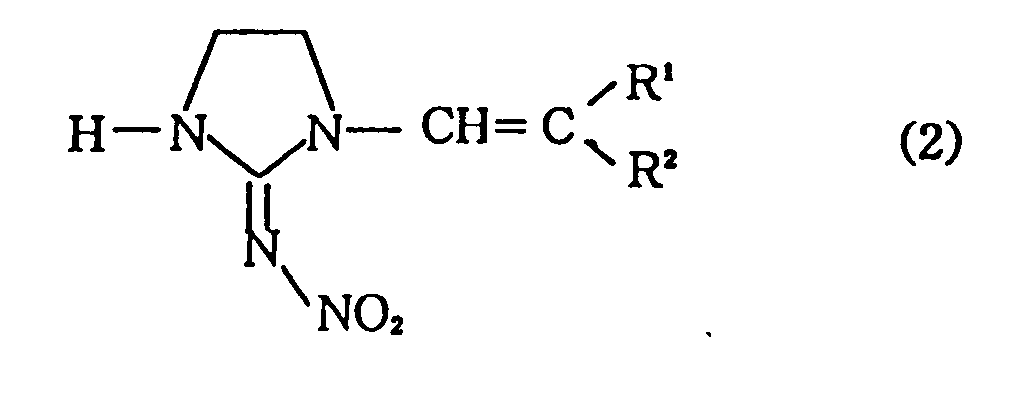


- Precisely, compounds of the formula (2) may be produced with ease and in high yield by reacting a 2-nitroiminoimidazolidine of the formula (5) and an aldehyde of the formula (4) or an aldehyde homologue of the formula (6). They may also be produced with ease and in high yield by reacting a 2-nitroimino-N-dialkoxymethylimidazolidine of the formula (7) and an active methylene-having compound of the formula (8). In this connection, it is to be specifically noted that compounds of the formula (2) of the present invention could not be produced by the method described in U.S. Patent 4,742,060.
- Therefore, compounds of the formula (2) are novel compounds which have first been produced by the present inventors, and the reaction of itself of producing them is also a novel reaction which has first been found out by them.
- Method (A) through Method (C) for producing compounds of the formula (2) of the present invention will be explained in detail hereunder.
- The reaction may be effected in the absence of a solvent or in a solvent. As the solvent, usable are, for example, alcohols such as methanol, ethanol, propanol and the like; aromatic hydrocarbons such as benzene, toluene, xylene and the like; halogenated hydrocarbons such as chloroform, 1,2-dichloroethane and the like; aprotic polar solvents such as dimethylformamide, dimethylacetamide, dimethylsulfoxide, 1,3-dimehtyl-2-imidazolidinone, 1-methyl-2-pyrrolidinone and the like; ethers such as ethyl ether, diisopropyl ether, 1,2-dimethoxyethane, tetrahydrofuran, dioxane and the like; nitrile such as acetonitrile, propionitrile and the like; and 7 ketones such as acetone, diisopropyl ketone and the like.
- Though not always necessary, a catalyst may be used for the reaction, which includes, for example, mineral acids such as sulfuric acid, hydrochloric acid, phosphoric acid, nitric acid and the like; sulfonic acids such as p-toluenesulfonic acid, methanesulfonic acid, trifluoromethanesulfonic acid and the like; carboxylic acids such as acetic acid, benzoic acid, formic acid and the like; Lewis acids such as aluminium chloride, tin tetrachloride, zinc chloride, boron trifluoride, titanium tetrachloride and the like; ammonium salts such as pyridine hydrochloride, tetrametylammonium chloride and the like; hydrogensulfates such as sodium hydrogensulfate, potassium hydrogensulfate and the like; hydrogencarbonates such as sodium hydrogencarbonate, potassium hydrogencarbonate and the like; acidic or basic oxides such as zirconium oxide, silica gel, alumina and the like; acidic gas such as sulfurous acid gas, carbon dioxide and the like; and phenols, and the like.
- The reaction temperature and the reaction time can be varied over wide ranges. In general, the reaction temperature is in the range of from -80 to 300°C, preferably from -30 to 200°C.
- The reaction is effected generally under a normal pressure condition but may also be effected under an elevated pressure.
- The reaction time is in the range of from 0.001 to 30 hours, preferably from 0.01 to 20 hours.
- The amount of the aldehyde derivative (4) to be used may be from 0.1 to 30 mols, economically from 0.3 to 10.0 mols, to mol of the 2-nitroiminoimidazolidine (5).
- Compounds of the formula (5) may be produced by reaction of ethylenediamine or its hydrochloride and nitroguanidine (literature for the production method: J. Am. Chem. Soc., 70, 430 (1948)).
- Compounds of the formula (2) may be produced with ease and in high yield by reaction of a compound of the formula (6) and a 2-nitroiminoimidazolidine derivative of the formula (5).
- The reaction may be effected in the absence of a solvent or in a solvent. As the solvent, usable are, for example, aromatic hydrocarbons such as benzene, toluene, xylene and the like; halogenated hydrocarbons such as chloroform, 1,2-dichloroethane and the like; aprotic polar solvents such as dimethylformamide, dimethylacetamide, dimethylsulfoxide, 1,3-dimethyl-2-imidazolidinone, 1-methyl-2-pyrrolidinone and the like; ethers such as ethyl ether, diisopropyl ether, 1,2-dimethoxyethane, tetrahydrofuran, dioxane and the like; nitriles such as acetonitrile, propionitrile and the like; ketones such as acetone, diisopropyl ketone and the like; and alcohols such as methanol, ethanol, propanol and the like.
- Though not always necessary, a catalyst may be used for the reaction, which includes, for example, mineral acids such as sulfuric acid, hydrochloric acid, phosphoric acid, nitric acid and the like; sulfonic acids such as p-toluenesulfonic acid, methanesulfonic acid, trifluoromethanesulfonic acid and the like; carboxylic acids such as acetic acid, benzoic acid, formic acid and the like; Lewis acids such as aluminium chloride, tin tetrachloride, zinc chloride, boron trifluoride, titanium tetrachloride and the like; ammonium salts such as pyridine hydrochloride, tetrametylammonium chloride and the like; acidic or basic oxides such as zirconium oxide, silica gel, alumina and the like; hydrogensulfates such as sodium hydrogensulfate, potassium hydrogensulfate and the like; hydrogencarbonates such as sodium hydrogencarbonate, potassium hydrogencarbonate and the like; acidic gas such as sulfurous acid gas, carbon dioxide and the like; and phenols, and the like.
- The reaction temperature and the reaction time can be varied over wide ranges. In general, the reaction temperature is in the range of from -80 to 300°C, preferably from -30 to 200°C.
- The reaction is effected generally under a normal pressure condition but may also be effected under an elevated pressure.
- The reaction time is in the range of from 0.001 to 30 hours, preferably from 0.01 to 20 hours.
- The amount of the ethane derivative (6) to be used may be 1.0 mol or more to mol of the 2-nitroiminoimidazolidine (5) with no limitation of the uppermost limit thereof. From the economical viewpoint, it is preferably from 0.3 to 10.0 mols to mol of the 2-nitroguanidine (5).
- Compounds of the formula (6) may also be obtained by acetalization of an aldehyde of the formula (4) or by reaction of a Grignard reagent and an orthoformate. They may also be obtained by reaction of a methyl methylsulfinylmethylsulfide and an alkyl halide or aryl halide (literatures for the production methods: Journal of Organic Synthetic Chemical Association, Vol. 37, No. 11 (1979); General Logic of Chemistry, No. 19, 75-96 (1978); Tetrahedron Letters, No. 34, 3151-3154 (1974); Tetrahedron Letters, No. 26, 2681-2684 (1972)).
- Compounds of the formula (2) may be produced with ease and in high yield by reaction of an aldehyde homologue of the formula (7) and an active methylene-having compound of the formula (8).
- The reaction temperature and the reaction time can be varied over wide ranges. In general, the reaction temperature is in the range of from -80 to 300°C, preferably from -30 to 200°C. The reaction time is in the range of from 0.001 to 30 hours, preferably from 0.01 to 20 hours. The amount of the active methylene-having compound to be used may be 1.0 mol or more to mol of the dialkoxymethylimidazolidine derivative (7) with no limitation of the uppermost limit thereof. From the economical viewpoint, it is preferably from 0.3 to 10.0 mols to mol of the derivative (7).
- Alkoxymethylimidazolidine derivatives of the formula (7) may be produced by reaction of an imidazolidine derivative and an orthoformate. The reaction may be effected in the absence of a solvent or in a solvent. As the solvent, usable are, for example, aprotic polar solvents such as di methylformamide, di methylsulfoxide, 1,3-dimethyl-2-imidazolidinone and the like. The reaction temperature is in the range of from 50 to 200°C; and the reaction time is in the range of from 0.5 to 15 hours. The amount of the orthoformate to be used is preferably from 1 to 10 mols per mol of the imidazolidine derivative (5).
- Compounds of the formula (7) include tautomers of the following formula (3):

- On the other hand, 2-chloropyridin-5-ylmethyl halides of the formula (3) and 2-chloro-5-chloromethylthiaozle are known compounds and can be produced by known methods (literatures for the production method: J. Heterocyclic Chem., 16, 333 (1979); J. Med. Chem., 14, 557 (1971)).
- The derivatives of the formula (1) according to the invention have great insecticidal activity and can be used as an insecticide. The derivatives of the formula (1) of the invention show a high control effect on harmful insects without involving any phyto-toxicity to cultivated plants
- Insect pests to which the derivatives of the invention can be applied, for instance, include:
- LEPIDOPTERA
- Pieris rapae crucivora Boisduval - Common cabbageworn
- Spodoptera litura Fabricius - Common cutworm
- Ostrinia furnacalis Guenee - Oriental corn borer
- Plutella xylostella Linne - Diamond backmoth
- Chilo suppressalis Walker - Rice stem borer
- Cnaphalocrocis medinalis Guenee - Rice leaf roller
- HEMIPTERA
- Nephotettix cincticeps Uhler - Green rice leafhopper
- Nilaparvata lugens Stal - Brown rice planthopper
- Laodelphax striatellus Fallen - Small brown planthopper
- Unaspis yanonensis Kuwana - Arrowhead scale
- Myzus persicae Sulzer - Green peach aphid
- Aphis gossypii Glover - Cotton aphid
- Lipaphis pseudobrassicae Davis - Turnip aphid
- Nezara antennata Scott - Common green stink bug
- Trialeurodes vaporariorum Westwood - Greenhouse whitefly
- COLEOPTERA
- Cellosobruches chinensis Linne - Azuki bean weevil
- Sitophilus oryzae Linne - Rice weevil
- Henosepilachna vigintioctopunctata Fablicius - 28-spotted lady beetle
- Anomala rufocuprea Motschulsky - Soy bean beetle
- Leptinotarsa decemlineata Say - Colorado potato beetle
- Lissorhoptrus oryzophilus Kuschel - Rice water weevi I
- ORTHOPTERA
- Blattella germanica Linne - German cockroach
- Periplaneta americana Linne - American cockroach
- Gryllotalpa africana palisot de Beauvois = African mole cricket
- Locusta migratoria denica Linne - Asiatic locust Reticulitermes speratus kolbe
- Coptatermes formosanus Shiraki - Formosan sublerronean termite
- DIPTERA
- Musca domestica vicina Macuart - House fly
- Aedes aegypti Linne - Yellow fever mosquito
- Culex pipens pallens - Coquillett
- Culex tritaeniorhyneus - Giles
- The compounds of the invention not only have a higher insecticidal effect of exterminating harmful insects as compared with conventional imidazolidine skeleton-having compounds but also extremely low toxic and therefore may be used safely in all sites. In addition, since the compounds of the invention may rapidly be decomposed by light or the like in the natural environment so that they hardly remain in crops. Further, the water solubility of the compounds is low so that they hardly dissolve out into ground water or rivers. In producing the compounds of the invention, formation of by-products is extremely small and the compounds may be produced with ease. They are therefore industrially advantageous.
- Where the compounds of the formula (1) of the invention is actually applied, they may be used singly without addition of any other ingredient. However, it is usual to formulate carriers in order to make easy application as a Reference Chemical.
- For preparation of the compounds of the invention, any specific requirement is not necessary to formulate them into various preparations, such as emulsions, wettable powders, dusts, granules, fine powders, oils, aerosols, poisonous feeds and the like, according to the procedures of preparing general agricultural chemicals well known in the art.
- The term "carrier" used herein is intended to mean synthetic or natural, organic or inorganic materials which assist the effective ingredient to arrive at sites or portions to be treated and which are formulated in order to make easy storage, transport and handling of the effective compound.
- Appropriate solid carriers include, for example, clays such as montomorilonite, kaolinite and the like, inorganic substances such as diatomaceous earth, white clay, talc, vermiculite, gypsum, calcium carbonate, silica gel, ammonium sulfate and the like, plant organic substances such as soybean flour, saw dust, wheat flour and the like, and urea.
- Suitable liquid carriers include, for example, aromatic hydrocarbons such as toluene, xylene, cumene and the like, paraffin hydrocarbons such as kerosene, mineral oils and the like, ketones such as acetone, methyl ethyl ketone, cyclohexanone and the like, ethers such as dioxane, tetrahydrofuran and the like, glymes such as ethylene glycol dimethyl ether, ethylene glycol diethyl ether and the like, alcohols such as methanol, ethanol, propanol, ethylene glycol and the like; phthalates such as dioctyl phthalate and the like, and dimethylformamide, dimethylsulfoxide, water, and the like.
- In order to reinforce the efficacy of the compounds of the formula (1) of the invention, the following adjuvants may be used singly or in combination, depending on the type of preparation, the manner of application and the purpose.
- Forthe purpose of emulsification, dispersion, spreading, wetting, bonding and stabilization, there are used water-soluble salts such as ligninsulfonates, nonionic surface active agents such as alkyl benzene sulfonates, alkylsulfates and the like, lubricants such as calcium stearate, waxes and the like, stabilizers such as isopro- poxy hydrogenphosphates, and methyl cellulose, carboxymethyl cellulose, casein, gum arabi and the like. It should be noted that the adjuvants are not limited to those mentioned above and other adjuvants ordinarily used for this purposes may also be used.
- The compounds of the formula (1) of the invention may develop better insecticidal activity when used in combination of two or more. If other physiologically active substances or chemicals are used in combination, multi-purpose compositions with good efficacy can be prepared with the possibility of developing a synergistic effect. Examples of such physiologically active substances include: synthetic pyrethroid insecticides and various isomers thereof or pyrethrum extracts, such as allethrin, N-(chrysanthemoylmethyl)-3,4,5,6-tetrahydrophthalimide, 5-benzyl-3-furylmethyl chrysanthemate, 3-phenoxybenzyl chrysanthemate, 5-propargylfur- furyl chrysanthemate and other known cyclopropanecarboxylic acid esters, 3-phenoxybenzyl 2,2-dimethyl-3-(2,2-dichlorovinyl)-cyclopropane-1-carboxylate, 3-phenoxy-a-cyanobenzyl 2,2-dimethyl-3-(2,2-dichlorovinyl)-cyclopropane-1-carboxylate, 3-phenoxy-a-cyanobenzyl, 2,2-dimethyi-3-(2,2-dibromovinyi)-cyciopropane-1-carboxylate, 3-phenoxy-a-cyanobenzyl-a-isopropyl-4-chlorophenylacetate, lesmetrin, cihalotrin, cifurtrin, fenpropatrin, teralometrin, cycloprotrin, furcitrinate, furvalinate and the like; organo-phosphate insecticides such as O,O-diethyl-O-(3-oxo-2-phenyl-2H-pyridazin-6-yl)phosphorothioate (available from Mitsui Toatsu Chemicals, Inc. under the trade name of Ofunack), O,O-dimethyl-O-(2,2-dichlorovinyl)phosphate (DDVP), O,O-dimethyl-O-(3-methyl-4-nitrophenyl)phosphorothioate, diazinone, O,O-dimethyl-O-4-cyanophenylphos- phorothioate, O,O-dimethyl-S-[a-(ethoxycarbonyl)benzyl]phosphorodithioate, 2-methoxy-4H-1,3,2-benzo- dioxaphosphorin-2-sulfide, O,O-diethyl-O-4-cyanophenylphosphonothioate, MMP, pyrimifosmethyl, isoxa- thione, chloropyrifosmethyl, chloropyrifos, ESP, profenofos, malason, dimethoate, thiomethone, ethylthiome- thone, forosan, DMTP, prothiofos, sulprofos, pyrachlofos, monochlotofos, CVP, propafos, acephate, DEP, EPN, ethione and the like; carbamate insecticides such as 1-naphthyl N-methylcarbamate (NAC), m-tolyl N-methylcarbamate (MTMC), 2-dimethylamino-5,6-dimethylpyrimidin-4-yl dimethylcarbamate (Pyrimer), 3,4-dimethylphenyl N-methylcarbamate, 2-isopropoxyphenyl N-methylcarbamate, MIPC, BPMC, XMC, ethiophen- carb, bendaiocarb, carbosulfan, benfuracarb, mesomil, oxamil, thiodicarb and the like; aryl propyl ether insecticides such as 3-phenoxybenzyl 2-(4-chlorophenyl)-2-methyl propyl ether, 3-phenoxy-4-fluorobenzyl 2-(4-chlorophenyl)-2-methylpropyl ether, 3-phenoxybenzyl 2-(4-ethoxyphenyl)-2-methylpropyl ether, 3-phenoxy-4-(florobenzyl 2-(4-ethoxyphenyl)-2-methylpropyl ether and the like; aromatic alkane insecticides such as 1-(3-phenoxyphenyl)-4-(4-chlorophenyl)-4-methylpentane, 1-(3-phenoxy-4-fluoropehnyl)-4-(4-chlorophenyl)-4-methylpentane, 1-(3-phenoxyphenyl)-4-(4-ethoxyphenyl)-4-methylpentane, 1-(3-phenoxy-4-fluorophenyl)-4-(4-ethoxyphenyl)-4-methylpentane and the like; insecticidal natural substances such as nicotine sulfate, poly- nactine composites, avermectin, mirbemectin and the like; insecticides such as caltap, thicyclam, bensultap, difurbenzulone, chlorofurazulone, tefurbenzulone, bufurophedine, benzoepine and the like; acaricides such as kersene, CPCBS, BPPS, tetradifon, amitrazu, benzomate, phenothiocarb, hexathiazox, fenbutatin oxide, dienochlor, chlofenthedine, phenopyroxymate and the like; and other insecticides, acaricides, fungicides, ne- matocides, herbicides, plant growth regulators, fertilizers, soil improving materials, molting inhibitors, JH activators, BT agents, microorganisms-derived toxins, natural or synthetic insect hormone disturbing agents, attractants, repellents, insectopathogenic microorganisms and small animals and other agricultural chemicals.
- Although the compounds of the formula (1) of the invention are stable to light, heat and oxidation, antioxidants or UV absorbers may be added in appropriate amounts, if necessary, including, for example, phenol derivatives or bisphenol derivatives such as BHT (2,6-di-t-butyl-4-methylphenol), BHA (butylhydroxyanisole) and the like, arylamines or benzophenone compounds such as phenyl-a-naphthylamine, phenyl-β-naphthylamine, condensates of phenetidine and acetone, thereby obtaining more stable compositions.
- When the compounds of the formula (1) of the invention are used as an insecticide, they are used in an amount of from 0.0001 to 95 wt.%, preferably from 0.01 to 50 wt.% of the insecticide.
- When the insecticide of the invention is applied, the effective ingredient is used at a concentration of from 0.01 to 5000 ppm, preferably from 0.1 to 1000 ppm.
- The application amount per 10 ares is generally in the range of from 1 to 300 g of the effective ingredient.
- The present invention is more particularly described by way of examples, which, should not be construed as limiting the invention.
- A mixture comprising 7.0 g of 1-{2-(3,4-dichlorophenyl)vinyl}-2-nitroiminoimidazolidine, 7.5 g of 2-chloro-5-chloromethylpyridine, 6.4 g of potassium carbonate and 50 ml of dimethylsulfoxide was stirred at 60°C for one hour. The reaction mixture was poured into water, extracted with ethyl acetate, washed with water, dried (with anhydrous MgS04) and concentrated to give an oily residue. This was purified by column chromatography (silica gel, eluent: ethyl acetate) to give 5.7 g of 1-( 2-chloropyridin-5-ylmethyl)-2-nitroimino-3-(3,4-dichlorphe- nylvinyl)-imidazolidine.
- A mixture comprising 5.0 g of 1-{2-(3-cyanophenyl)vinyl}-2-nitroiminoimidazolidine, 7.4 g of 2-chloro-5-chloromethylpyridine, 5.4 g of potassium carbonate and 50 ml of dimethylsulfoxide was stirred at 60°C for one hour. The reaction mixture was poured into water, extracted with ethyl acetate, washed with water, dried (with anhydrous MgS04) and concentrated to give an oily residue. To this was added ethyl ether, and the crystals precipitated out were filtered out and dried to give 5.9 g of 1-(2-chloropyridin-5-ylmethyl)-2-nitroimino-3-{2-(3-cyanophenyl)vinyl)-imidazolidine.
- A mixture comprising 15.4 g of 1-(2,2-diphenylvinyl)-2-nitroiminoimidazolidine, 8.1 g of 2-chloro-5-chloromethylpyridine, 6.9 g of potassium carbonate and 80 ml of dimethylsulfoxide was stirred at 60°C for 2 hours. The reaction mixture was poured into water, extracted with ethyl acetate, washed with water, dried (with anhydrous MgS04) and concentrated to give a crude product. To this was added 100 ml of ethyl acetate for recrystallization, and 13 g of 1-(2-chloropyridin-5-ylmethyl)-2-nitroimino-3-(2,2-diphenylvinyl)imidazolidine was obtained.
- A mixture comprising 5.0 g of 1-{4-(2,2,2-trifluoroethoxy)phenylvinyl}-2-nitroiminoimidazolidine, 5.8 g of 2-chloro-5-chloromethylpyridine, 8.4 g of potassium carbonate and 30 ml of dimethylsulfoxide was stirred at 60°C for one hour. The reaction mixture was poured into water, extracted with ethyl acetate, washed with water, dried (with anhydrous MgS04) and concentrated to give an oily residue. This was purified by column chromatography (silica gel, eluent : ethyl acetate/hexane = 4/1) to give 4.9 g of 1-(2-chloropyridin-5-ylmethyl)-2-ni- troimino-3-{4-(2,2,2-trifluoroethoxy)phenylvinyl}-imidazolidine.
- A mixture comprising 6.0 g of 1-(1-propenyl)-2-nitroiminoimidazolidine, 7.0 g of potassium carbonate, 70 ml of DMSO and 7.4 g of 2-chloro-5-chloromethylpyridine was stirred at60°Cforone hour. The reaction mixture was poured into water, extracted with ethyl acetate, washed with water, dried (with anhydrous MgS04) and concentrated to give an oily residue. This was purified by column chromatography (silica gel, eluent : ethyl acetate/hexane = 2/1) to give 8.6 g of 1-(2-chloropyridin-5-ylmethyl)-2-nitroimino-3-(1-propenyl)imidazolidine.
- A mixture comprising 3.7 g of 1-(2-ethyl-1-hexenyl)-2-nitroiminoimidazolidine, 3.3 g of 2-chloro-5-chloromethylpyridine, 4.4 g of potassium carbonate and 20 ml of dimethylsulfoxide was stirred at 60°C for one hour. The reaction mixture was poured into water, extracted with ethyl acetate, washed with water, dried (with anhydrous MgS04) and concentrated to give an oily residue. This was purified by column chromatography (silica gel, eluent : ethyl acetate/hexane = 2/1) to give 4.3 g of 1-(2-chloropyridin-5-ylmethyl)-2-nitroimino-3-(2- ethyi-1-hexenyi)imidazoiidine.
- A mixture comprising 20.0 g of 1-(2-methoxyvinyl)-2-nitroiminoimidaozlidine, 18.0 g of 2-chloro-5-chloromethylpyridine, 15.0 g of potassium carbonate and 150 ml of dimethylsulfoxide was stirred at 70°C for 2 hours. The reaction mixture was poured into water, extracted with ethyl acetate, washed with water, dried (with anhydrous MgS04) and concentrated to give an oily residue. This was purified by column chromatography (silica gel, eluent: ethyl acetate) to give 9.8 g of 1-(2-chloropyridin-5-ylmethyl)-2-nitroimino-3-(cis-2-methox- yvinyl)imidazolidine and 0.58 g of 1-(2-chloropyridin-5-ylmethyl)-2-nitroimino-3-(trans-2-methoxyvinyl)imidazolidine.
- A mixture comprising 2.8 g of 1-(2-phenoxyvinyl)-2-nitroiminoimidazolidine, 3.6 g of 2-chloro-5-chloromethylpyridine, 3.2 g of potassium carbonate and 15 ml of dimethylsulfoxide was stirred at 70°C for one hour. The reaction mixture was poured into water, extracted with ethyl acetate, washed with water, dried (with anhydrous MgS04) and concentrated to give an oily residue. This was purified by column chromatography (silica gel, eluent : ethyl acetate) to give 3.0 g of 1-(2-chloropyridin-5-ylmethyl)-2-nitroimino-3-(2-phenoxyvinyl)-imidazolidine.
- A mixture comprising 3.0 g of 1-(formylvinyl)-2-nitroiminoimidazolidine, 0.7 g of sodium hydride and 30 ml of DMF was stirred at 40°C for 15 minutes. After this was cooled to room temperature, 3.2 g of 2-chloro-5-chloromethylpyridine was added thereto and stirred at 60°C for 2 hours. The reaction mixture was poured into water, extracted with ethyl acetate, washed with water, dried (with anhydrous MgS04) and concentrated to give an oily residue. This was purified by column chromatography (silica gel, eluent: ethyl acetate) to give 2.3 g of 1-(2-chloropyridin-5-ylmethyl)-2-nitroimino-3-(2-formylvinyl)imidazolidine.
- A mixture comprising 8.0 g of 1-(2-ethylthiovinyl)-2-nitroiminoimidazolidine, 7.2 g of 2-chloro-5-chloromethylpyridine, 20.0 g of potassium carbonate and 30 ml of dimethylsulfoxide was stirred at 60°C for 30 minutes. The reaction mixture was poured into water, extracted with ethyl acetate, washed with water, dried (with anhydrous MgS04) and concentrated to give an oily residue. This was purified by column chromatography (silica gel, eluent : ethyl acetate/hexane = 4/1) to give 8.3 g of 1-(2-chloropyridin-5-ylmethyl)-2-nitroimino-3-(2-ethylthiovinyl)imidazolidine.
- A mixture comprising 6.0 g of 1-{2-(2-chloropyridin-5-yl)vinyl}-2-nitroiminoimidazolidine, 8.0 g of 2-chloro-5-chloromethylpyridine, 6.8 g of potassium carbonate and 60 ml of dimethylsulfoxide was stirred at 75°C for 2.5 hours. The reaction mixture was poured into water, extracted with ethyl acetate, washed with water, dried (with anhydrous MgS04) and concentrated to give an oily residue. This was purified by column chromatography (silica gel, eluent: ethyl acetate) to give 3.9 g of 1-(2-chloropyridin-5-ylmethyl)-2-nitroimino-3-{trans-2-(2-chloropyridin-5-yl)vinyl)imidazolidine.
- A mixture comprising 6.9 g of 1-(2-phenylvinyl)-2-nitroiminoimidaozlidine, 10.0 g of 2-chloro-5-chloromethylthiazole, 8.2 g of potassium carbonate and 30 ml of dimethylsulfoxide was stirred at 60°C for one hour. The reaction mixture was poured into water, extracted with ethyl acetate, washed with water, dried (with anhydrous MgS04) and concentrated to give an oily residue. This was purified by column chromatography (silica gel, eluent: ethyl acetate) to give 7.9 g of 1-(2-chlorothiazol-5-ylmehtyl)-2-nitroimino-3-(2-phenylvinyl)-imidazolidine.
- In the same manner as in the preceding Examples 1 to 12, other compounds of the formula (1) were prepared, which were shown in Table 1 and Table 2 below along with the compounds prepared in the preceding examples.


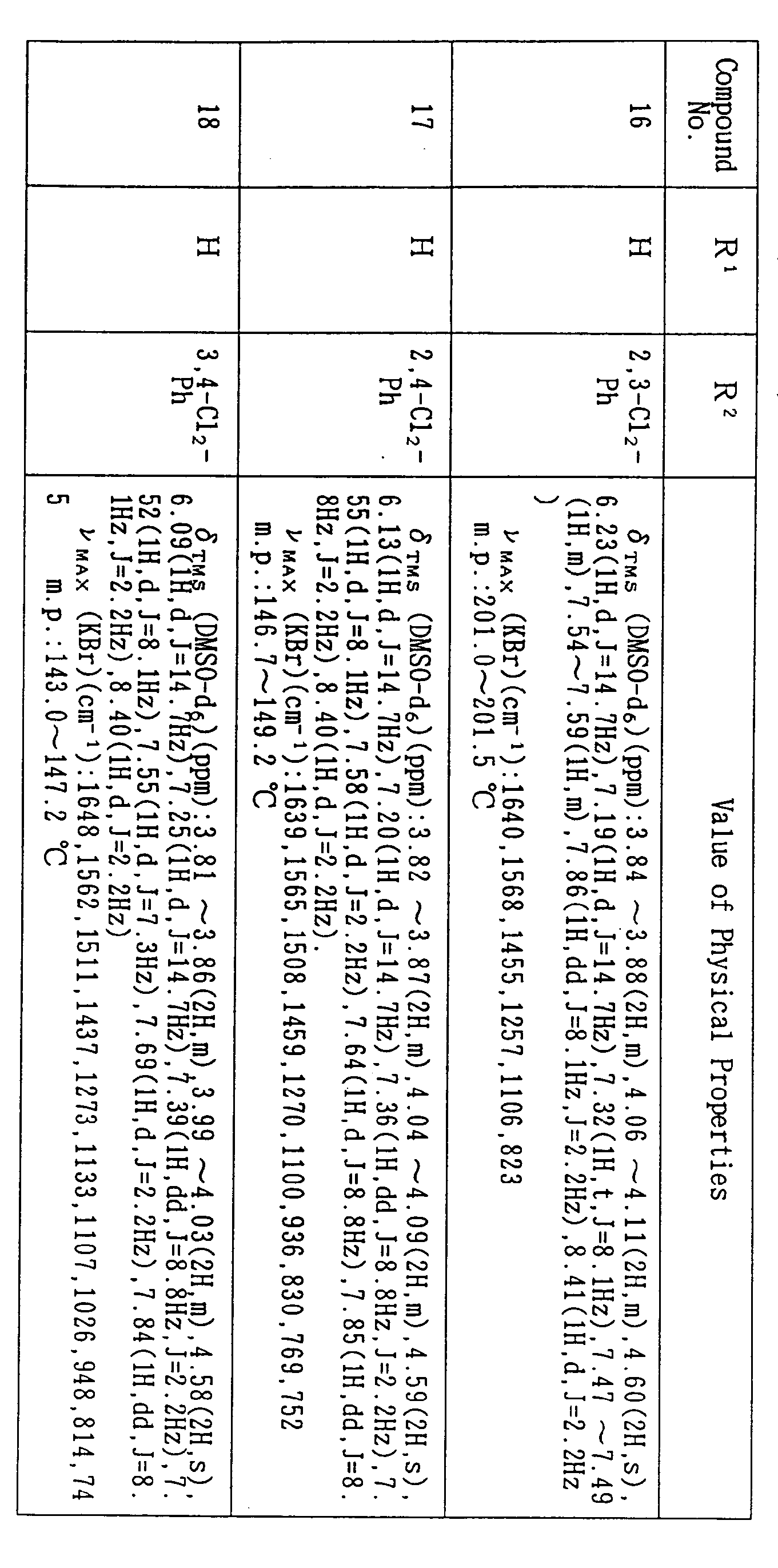


- Next, preparation of intermediates of the formula (2) is mentioned below by way of the following examples.
- A mixture comprising 6.0 g of 2-nitroimidazolidine, 1.22 g of phenylacetaldehyde (50 % in diethyl phthalate), 60 ml of dimethylformamide and 0.05 g of boron trifluoride ether complex was stirred at 80°C for one hour. The reaction mixture was poured into water, extracted with ethyl acetate, washed with water, dried (with anhydrous MgS04) and concentrated. The crystals thus precipitated out were sludged with ether and dried to give 4.3 g of 1-(2-phenylvinyl)-2-nitroiminoimidazolidine.
- 2.59 g of methyl methylsulfinyl methylsulfide and 4.26 g of trifluorobenzyl chloride were dissolved in 30 ml of THF in nitrogen atmosphere, and 29 ml of n-butyl lithium (1.6 M hexane solution) was dropwise added thereto at - 70°C. After addition, this was stirred for 40 minutes at-70°C and then for 3 hours at room temperature. Water was added to the reaction mixture, which was then extracted with ethyl acetate, washed with water and dried (with anhydrous MgS04). After the solvent was removed by distillation, a black oil was obtained. To this were added 1.52 g of nitroiminoimidazolidine and 20 ml of DMF. Then, one ml of concentrated hydrochloric acid was added thereto at 80°C and stirred for 4 hours at the same temperature. Water was added to the reaction mixture, which was then extracted with ethyl acetate, washed with water and dried (with anhydrous MgS04). After the solvent was removed by distillation, a solid was obtained, which was then sludged with ether to give 0.87 g of yellow crystals of 1-{4-(2,2,2-trifluoroethoxy)phenylvinyl}-2-nitroiminoimidazolidine.
- A mixture comprising 5.0 g of 3,4-dichlorobenzyl chloride, 0.68 g of magnesium turning and 30 ml of ethyl ether was ultrasonically treated at room temperature to prepare a Grignard reagent. After the magnesium turning was lost, 4.2 g of ethyl orthoformate and 30 ml of toluene were added, and ethyl ether was removed by distillation. Afterwards, the reaction mixture was heated under reflux for 1.5 hours. This was poured into water, extracted with ethyl acetate, washed with water, dried (with anhydrous MgS04) and concentrated to give 6.5 g of an oily residue, to which were added 2.5 g of nitroiminoimidazolidine and 25 ml of 1,3-dimethyl-2-imida- solidinone. To the resulting mixture was added 0.07 g of boron trifluoride ether complex at 90°C, and this was stirred for 1.5 hours at the same temperature. The reaction mixture was poured into water, extracted with ethyl acetate, washed with water, dried (with anhydrous MgS04) and concentrated to give an oily residue. Ether was added to the residue, and the crystals thus precipitated out were filtrated and dried to give 2.3 g of 1-(3,4-dichlorophenylvinyl)-2-nitroiminoimidazolidine.
- 3.48 g of methyl methylsulfinyl methylsulfide was dissolved in 30 ml of THF in nitrogen atmosphere, and 18 ml of n-butyl lithium (1.6 M hexane solution) was dropwise added thereto at -78°C and stirred for 10 minutes at the same temperature. A solution of 5.0 g of m-bromomethylbenzonitrile as dissolved in 20 ml of THF was dropwise added thereto and then stirred for 2 hours at the same temperature. Water was added to the reaction mixture, which was then extracted with ethyl acetate, washed with water and dried (with anhydrous MgS04). Then, the solvent was removed by distillation to give a colorless transparent oil. To this were added 1.98 g of nitroiminoimidazolidine and 20 ml of DMF. Then, one ml of concentrated hydrochloric acid was added thereto at 80°C and stirred for one hour at the same temperature. Water was added to the reaction mixture, which was then extracted with ethyl acetate, washed with water and dried (with anhydrous MgS04). Then, the solvent was removed by distillation to give a solid, which was sludged with ether to give 0.73 g of pale yellow crystals of 1-{2-(3-cyanophenyl)vinyl}-2-nitroiminoimidazolidine.
- A mixture comprising 4.0 g of 2-nitroiminoimidazolidine, 20 ml of 1,3-dimethyl-2-imidazolidine, 7.5 g of phosphorus oxychloride and 2.7 g of propionaldehyde was stirred for 30 minutes at room temperature. The reaction mixture was poured into water, extracted with ethyl acetate, washed with water, dried (with anhydrous MgS04) and concentrated. The crystals thus precipitated out were sludged with ethyl acetate, filtrated and dried to give 1.7 g of 1-(1-propenyl)-2-nitroiminoimidazolidine.
- A mixture comprising 8.1 g of 2-phenoxyethanol, 12.6 g of pyridinium chlorochromate and 100 ml of methylene chloride was stirred for 1.5 hours with ice-cooling and then for 4 hours at room temperature. The reaction mixture was subjected to decantation, and the solvent was removed by distillation to give 10.6 g of an oily residue. To this were added 5.1 g of nitroiminoimidazolidine, 0.07 g of boron trifluoride ether complex and 30 ml of 1,3-dimethyl-2-imidazolidinone, and the whole was stirred for one hour at 100°C. The reaction mixture was poured into water, extracted with ethyl acetate, washed with water, dried (with anhydrous MgS04) and concentrated to give an oily residue. This was purified by column chromatography (silica gel, eluent: ethyl acetate) to give 0.28 g of 1-(2-phenoxyvinyl)-2-nitroiminoimidazolidine.
- A mixture comprising 8.4 g of 2-nitroimidazoiidine, 70 ml of 1,3-dimethyl-2-imidazolidinone, 14.2 g of phosphorus oxychloride and 20.3 g of 1,1,3,3-tetraethoxypropane was stirred at 70°C for 2.5 hours. The reaction mixture was poured into water, extracted with ethyl acetate, washed with water, dried (with anhydrous MgS04) and concentrated to give an oily residue. This was purified by column chromatography (silica gel, eluent: ethyl acetate/hexane = 2/1) to give 2.5 g of 1-(2-formylvinyl)-2-nitroiminoimidazolidine.
- A mixture comprising 10.0 g of 2-ethylthioethanol, 24.4 g of pyridinium chlorochromate and 100 ml of methylene chloride was stirred for 2 hours with cooling with ice. The reaction mixture was subjected to decantation to separate a methylene chloride layer, to which were added 12.3 g of nitroiminoimidazolidine, 14.5 g of phosphorus oxychloride and 11.0 g of 1.3-dimethyl-2-imidazolidinone and heated under reflux for 2 hours. The reaction mixture was poured into water, extracted with ethyl acetate, washed with water, dried (with anhydrous MgS04) and concentrated to give an oily residue. This was purified by column chromatography (silica gel, eluent : ethyl acetate/hexane = 3/1) to give 2.3 g of 1-(2-ethylthiovinyl)-2-nitroiminoimidazolidine.
- A mixture comprising 4.0 g of 2-nitroiminoimidazolidine, 4.7 g of 2-ethylhexylaldehyde, 0.05 g of boron trifluoride ether complex and 20 ml of 1,3-dimethyl-2-imidazolidinone was stirred at 120°C for 3 hours. The reaction mixture was poured into water, extracted with ethyl acetate, washed with water, dried (with anhydrous MgS04) and concentrated. The crystals thus precipitated out were sludged with ethyl acetate, filtrated and dried to give 1.7 g of 1-(2-ethyl-1-hexenyl)-2-nitroiminoimidazolidine.
- 5.0 g of 2-nitroiminoimidazolidine and 4.5 g of propionaldehyde were dissolved in 25 ml of N,N-dimethylformamide, and 4.0 g of phosphorus pentoxide was added thereto with cooling with ice over a period of 20 minutes and thereafter stirred for 10 minutes at 10°C. 20 ml of water and 20 ml of ethyl acetate were added to the reaction mixture, and the crystals thus precipitated out were filtrated and dried to give 4.3 g of 1-(1-propenyl)-2-nitroiminoimidazolidine.
- 2.0 g of 2-nitroiminoimidazolidine and 3.4 g of n-decylaldehyde were dissolved in 20 ml of N,N-dimethy- limidazolidinone, and 2.8 g of phosphorus oxychloride was added thereto at room temperature over a period of 20 minutes and thereafter stirred for 10 minutes at 50°C. Water was poured into the reaction mixture, which was then extracted with ethyl acetate, washed with water, dried with anhydrous sodium sulfate and concentrated to give 2.1 g of an oily product of 1-(1-n-decenyl)-2-nitroiminoimidazolidine.
- 4.0 g of 2-nitroiminoimidaozlidine, 3.0 g of propionaldehyde, 6.0 g of acetic anhydride and 0.1 g of potassium hydrogensulfate were dissolved in 15 ml of N,N-dimethylformamide and stirred at 60°C for 2 hours. 10 ml of ethyl acetate and 20 ml of hexane were added to the reaction mixture and stirred for 30 minutes. The crystals thus precipitated out were filtrated, washed with ethyl acetate and dried to give 3.5 g of 1-(1-propenyl)-2-nitroiminoimidazolidine.
- In the same manner as in the preceding Examples 13 to 24, other compounds of the formula (2) were prepared and shown in Table 3 below.


- Next, preparation of intermediates of the formula (7) is mentioned below by way of the following example.
- A mixture comprising 25 g of 2-nitroiminoimidazolidine, 100 g of ethyl orthoformate and 25 ml of 1,3-di- metyl-2-imidazolidinone was heated under reflux for 3 hours. After cooled to room temperature, the reaction mixture was poured into water and extracted with ethyl acetate. After washed with water and dried (with anhydrous magnesium sulfate), the solvent was removed by distillation under reduced pressure. The crystals thus obtained were sludged with ether to give 32 g of 1-diethoxymethyl-2-nitroiminoimidaozlidine.
- 8TMS (CDCI3)(ppm): 1.24 (6H, t, J=6.9Hz), 3.44 to 3.87 (8H, m), 5.95 (1 H, s), 8.36 (1 H, s)
- VMAX (KBr)(cm-1): 3340, 1570, 1530, 1470, 1440, 1280, 1220, 1170, 1090, 1040, 1010 m.p.: 100.2 to 101.8°C
- Next, the compositions of the present invention are more particularly described by way of the following formulation examples, in which all "parts" are "parts by weight".
- 20 parts of the compound of the invention, 10 parts of Sorpol 355S (surfactant available from Toho Chem. Co.) and 70 parts of xylene were uniformly stirred and mixed to give an emulsion.
- 10 parts of the compound of the invention, 2 parts of sodium alkylnaphthalenesulfonate, 5 parts of white carbon and 82 parts of diatomaceous earth were uniformly stirred and mixed to give 100 parts of a wettable powder.
- 0.3 part of the compound of the invention and 0.3 part of white carbon were uniformly mixed, and 99.2 parts of clay and 0.2 part of Driless A (available from Sankyo Co.) were added thereto and uniformly ground and mixed to give 100 parts of a powder preparation.
- 2 parts of the compound of the invention, 2 parts of white carbon, 2 parts of sodium ligninsulfonate and 94 parts of bentonite were uniformly ground and mixed, and water was added thereto and kneaded, granulated and dried to give 100 parts of a granular preparation.
- 20 parts of the compound of the invention and 5 parts of 20 % aqueous solution of polyvinyl alcohol were fully stirred and mixed, and 75 parts of 0.8 % aqueous solution of xanthane gum was added thereto and again stirred and mixed to give 100 parts of a flowable preparation.
- 10 parts of the compound of the invention, 3 parts of carboxymethyl cellulose, 2 parts of sodium ligninsulfonate, one part of sodium diocytlsulfosuccinate and 84 parts of water were uniformly wet-ground to give 100 parts of a flowable preparation.
- The insecticidal activity of the compounds of the formula (1) of the invention is clarified by way of the following test examples.
- The emulsion prepared in Formulation Example 1 was diluted to a predetermined concentration and 2 ml of the diluted emulsion was applied over a bundle of several rice seedlings (about third leaf stage). After drying in air, the treated seedlings were covered with a metal gauze cylinder, in which ten female adults of the smaller brown planthopperwere released, followed by placing in a temperature controlled room at 25°C. After48 hours, the mortality was checked. The results are shown in Table 3.

- The emulsion prepared in Formulation Example 1 was diluted to a predetermined concentration and 3 ml of the diluted emulsion was applied over a bundle of several rice seedlings (about third leaf stage). After drying in air, the treated seedlings were covered with a metal gauze cylinder, in which ten female adults of the leafhopper that is resistant to organophosphate and carbamate insecticides were released, followed by placing in a temperature controlled room at 25°C. After 48 hours, the mortality was checked. The results are shown in Table 4.

- An acetone solution of the compound of the invention was added to a Petri dish with a diameter of 9 cm, followed by removal of the acetone by evaporation. Twenty female adults of the Azuki bean weevil, which were 2 to 3 days after emergence were placed in the dish at 25°C. After 48 hours, the mortality was checked. The results are shown in Table 5.

- 20 ml of a dilution of the emulsion prepared in Formulation Example 1 was sprayed over potted eggplant seedlings (fourth or fifth leaf stage), as having been grown in a greenhouse, on which the green peach aphids had been parasitic. After the application, the seedlings were placed in the greenhouse and, after three days, the number of the aphids was checked. The results are shown in Table 6.

- The emulsion prepared in Formulation Example 1 was diluted to predetermined concentrations, and 2 ml of each diluted emulsion was applied overa bundle of several rice seedlings (aboutthird leafstage). After drying in air, the treated seedlings were covered with a metal gauze cylinder, in which ten female adults of the smaller brown planthopperwere released, followed by placing in a temperature controlled room at 25°C. After48 hours, the mortality was checked, from which the medium-lethal concentration (LC50) was obtained. The results are shown in Table 7.
- The emulsion prepared in Formulation Example 1 was diluted to predetermined concentrations, and 2 ml of each diluted emulsion was applied overa bundle of several rice seedlings (aboutthird leafstage). After drying in air, the treated seedlings were covered with a metal gauze cylinder, in which ten female adults of the leafhopper that is resistant to organophosphate and carbamate insecticides were released, followed by placing in a temperature controlled room at 25°C. After 48 hours, the mortality was checked, from which the 50 %-lethal concentration (LC50) was obtained. The results are shown in Table 7.
- 20 ml of a 10 ppm dilution of the emulsion prepared in Formulation Example 1 was sprayed over potted eggplant seedlings (fourth orfifth leaf stage), as having been grown in a greenhouse, on which the green peach aphids had been parasitic. After the application, the seedlings were placed in the greenhouse and, after three days, the number of the aphids was checked, from which the density of the living insects was obtained. The tests were repeated two times. The results are shown in Table 7.

- From these results, it is noted that the compounds of the invention have higher insecticidal activity than the known compounds of the prior art.
- The compound of the invention having a predetermined concentration was dissolved in corn oil and applied to 6-week mice by forced peroral administration. Up to 14 days from the administration, the number of the died mice was counted periodically, from which the 50 %-lethal concentration (LD50) was obtained. One group for the test comprised ten mice. The results are shown in Table 8.

- From the results of the test, it is understood that the compounds of the present invention are less toxic and are more safe than the known compound of the prior art.
- Novel N-vinylimidazolidine derivatives of the formula (1) of the present invention are excellent compounds having a high insecticidal power and a broad insecticidal spectrum.
- Novel N-vinylimidasolidine derivatives of the formula (1) of the invention may be produced with ease from novel intermediates of the formula (2) in accordance with the process of the invention.
where Z has the same meaning as mentioned above; and X represents a chlorine atom or a bromine atom; and an insecticide containing a compound of the formula (1) as an effective ingredient;
and N-vinylimidazolidine derivatives of the formula (2);
and a process of producing N-vinylimidazolidine derivatives of the formula (2) by reacting a compound of a formula (4):


and a process of producing N-vinylimidazolidine derivatives of the formula (2):


Claims (16)


where Z has the same meaning as in claim 1 and X represents a chlorine atom or a bromine atom.


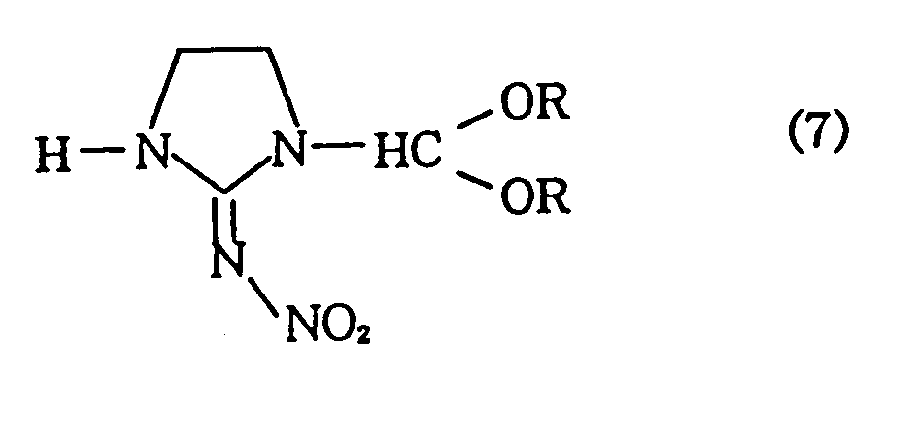

Applications Claiming Priority (2)
| Application Number | Priority Date | Filing Date | Title |
|---|---|---|---|
| JP331781/91 | 1991-12-16 | ||
| JP33178191 | 1991-12-16 |
Publications (2)
| Publication Number | Publication Date |
|---|---|
| EP0547557A1 EP0547557A1 (en) | 1993-06-23 |
| EP0547557B1 true EP0547557B1 (en) | 1994-07-27 |
Family
ID=18247566
Family Applications (1)
| Application Number | Title | Priority Date | Filing Date |
|---|---|---|---|
| EP92121317A Expired - Lifetime EP0547557B1 (en) | 1991-12-16 | 1992-12-15 | N-vinylimidazolidine derivatives, preparation thereof, insecticides containing same as an effective ingredient and intermediates thereof |
Country Status (5)
| Country | Link |
|---|---|
| US (1) | US5310920A (en) |
| EP (1) | EP0547557B1 (en) |
| KR (1) | KR950013766B1 (en) |
| DE (1) | DE69200279T2 (en) |
| ES (1) | ES2057956T3 (en) |
Families Citing this family (5)
| Publication number | Priority date | Publication date | Assignee | Title |
|---|---|---|---|---|
| DE4236204A1 (en) * | 1992-10-27 | 1994-04-28 | Bayer Ag | Substituted aza (cyclo) alkanes |
| US6307053B1 (en) * | 2000-12-29 | 2001-10-23 | Sinon Corporation | Process for preparing imidacloprid |
| DE10119423A1 (en) * | 2001-04-20 | 2002-10-24 | Bayer Ag | New cyanoimino- or nitroimino-substituted azole derivatives or analogs, useful as pesticides, e.g. insecticides, acaricides, nematocides, ectoparasiticides or antifouling agents |
| US6742347B1 (en) * | 2003-01-07 | 2004-06-01 | Carrier Corporation | Feedforward control for absorption chiller |
| CN112250636A (en) * | 2020-11-09 | 2021-01-22 | 广西科技大学 | 5-aminoimidazole compound and synthesis method thereof |
Family Cites Families (4)
| Publication number | Priority date | Publication date | Assignee | Title |
|---|---|---|---|---|
| US5001138B1 (en) * | 1985-02-04 | 1998-01-20 | Bayer Agrochem Kk | Heterocyclic compounds |
| EP0192060B1 (en) * | 1985-02-04 | 1991-09-18 | Nihon Bayer Agrochem K.K. | Heterocyclic compounds |
| JPH0784461B2 (en) * | 1986-12-19 | 1995-09-13 | 日本バイエルアグロケム株式会社 | Insecticidal nitroimino or cyanoimino compounds |
| DE3712307A1 (en) * | 1987-04-10 | 1988-10-20 | Bayer Ag | 3-SUBSTITUTED 1- (2-CHLORINE-THIAZOL-5-YL-METHYL) -2- NITROIMINO-1,3-DIAZACYCLOAL CHANES |
-
1992
- 1992-12-15 EP EP92121317A patent/EP0547557B1/en not_active Expired - Lifetime
- 1992-12-15 ES ES92121317T patent/ES2057956T3/en not_active Expired - Lifetime
- 1992-12-15 DE DE69200279T patent/DE69200279T2/en not_active Expired - Fee Related
- 1992-12-15 US US07/991,051 patent/US5310920A/en not_active Expired - Fee Related
- 1992-12-16 KR KR1019920024531A patent/KR950013766B1/en not_active Expired - Fee Related
Also Published As
| Publication number | Publication date |
|---|---|
| EP0547557A1 (en) | 1993-06-23 |
| DE69200279D1 (en) | 1994-09-01 |
| US5310920A (en) | 1994-05-10 |
| ES2057956T3 (en) | 1994-10-16 |
| KR950013766B1 (en) | 1995-11-15 |
| DE69200279T2 (en) | 1994-12-01 |
Similar Documents
| Publication | Publication Date | Title |
|---|---|---|
| JP2610988B2 (en) | New heterocyclic compounds and insecticides | |
| KR950005740B1 (en) | Process for preparing nitromethylene derivative | |
| US5192778A (en) | Dialkoxymethylimidazolidine derivatives, preparation thereof, insecticides containing same as an effective ingredient and intermediates therefor | |
| JP2583429B2 (en) | Imidazolines and insecticides | |
| KR100744987B1 (en) | Fungicides | |
| JPH085859B2 (en) | New alkylenediamines | |
| JPS62207266A (en) | Novel heterocyclic compound | |
| JP2846911B2 (en) | Acrylate fungicide | |
| JPH013184A (en) | Nitro-substituted heterocyclic compounds and pesticides | |
| EP0329020A1 (en) | Pyrazole derivatives, processes for their manufacture and insecticidal, miticidal and fungicidal compositions containg the derivatives as active ingredients | |
| EP0891975A1 (en) | Pyrazoles and agricultural chemicals containing them as active ingredients | |
| JP3023794B2 (en) | Insecticidal nitro-substituted heterocyclic compounds | |
| US5264584A (en) | Dialkoxymethylimidazolidine derivatives | |
| EP0462573B1 (en) | Pyrazolecarboxamide, insecticidal and miticidal composition, and fungicidal composition for use in agriculture and horticulture | |
| US5310920A (en) | N-vinylimidazolidine derivatives insecticides containing same as an effective ingredient | |
| EP0490323B1 (en) | Imidazolidine derivatives, preparation thereof, insecticides containing same as an effective ingredient and intermediates therefor | |
| KR100349484B1 (en) | Plant disease release agent | |
| JPH0514716B2 (en) | ||
| CS247091B2 (en) | Antifungicide agent for appliaction in the agriculture and production method of its affective compounds | |
| JP2961516B2 (en) | New heterocyclic compounds and insecticides | |
| JP2764784B2 (en) | New heterocyclic compounds and insecticides | |
| JP3258402B2 (en) | N-vinyl imidazolidine derivative, process for producing the same, insecticide and intermediate containing the same as active ingredient | |
| KR930008449B1 (en) | Dialkoxymethyl imidazo lindine derivatives, preparation thereof, insecticides containing same as an effective ingredient and intermediate thereof | |
| JP3352082B2 (en) | New heterocyclic compounds | |
| JP3437462B2 (en) | Insecticide |
Legal Events
| Date | Code | Title | Description |
|---|---|---|---|
| PUAI | Public reference made under article 153(3) epc to a published international application that has entered the european phase |
Free format text: ORIGINAL CODE: 0009012 |
|
| 17P | Request for examination filed |
Effective date: 19921215 |
|
| AK | Designated contracting states |
Kind code of ref document: A1 Designated state(s): CH DE ES FR GB IT LI NL |
|
| 17Q | First examination report despatched |
Effective date: 19931119 |
|
| GRAA | (expected) grant |
Free format text: ORIGINAL CODE: 0009210 |
|
| ITF | It: translation for a ep patent filed | ||
| AK | Designated contracting states |
Kind code of ref document: B1 Designated state(s): CH DE ES FR GB IT LI NL |
|
| REF | Corresponds to: |
Ref document number: 69200279 Country of ref document: DE Date of ref document: 19940901 |
|
| REG | Reference to a national code |
Ref country code: ES Ref legal event code: FG2A Ref document number: 2057956 Country of ref document: ES Kind code of ref document: T3 |
|
| ET | Fr: translation filed | ||
| PLBE | No opposition filed within time limit |
Free format text: ORIGINAL CODE: 0009261 |
|
| STAA | Information on the status of an ep patent application or granted ep patent |
Free format text: STATUS: NO OPPOSITION FILED WITHIN TIME LIMIT |
|
| 26N | No opposition filed | ||
| REG | Reference to a national code |
Ref country code: CH Ref legal event code: PFA Free format text: MITSUI TOATSU CHEMICALS, INCORPORATED TRANSFER- MITSUI CHEMICALS, INC. |
|
| REG | Reference to a national code |
Ref country code: GB Ref legal event code: 732E |
|
| REG | Reference to a national code |
Ref country code: FR Ref legal event code: TP |
|
| REG | Reference to a national code |
Ref country code: ES Ref legal event code: PC2A |
|
| NLS | Nl: assignments of ep-patents |
Owner name: MITSUI CHEMICALS, INC. |
|
| PGFP | Annual fee paid to national office [announced via postgrant information from national office to epo] |
Ref country code: DE Payment date: 20001211 Year of fee payment: 9 |
|
| PGFP | Annual fee paid to national office [announced via postgrant information from national office to epo] |
Ref country code: FR Payment date: 20001212 Year of fee payment: 9 |
|
| PGFP | Annual fee paid to national office [announced via postgrant information from national office to epo] |
Ref country code: GB Payment date: 20001213 Year of fee payment: 9 |
|
| PGFP | Annual fee paid to national office [announced via postgrant information from national office to epo] |
Ref country code: ES Payment date: 20001220 Year of fee payment: 9 |
|
| PGFP | Annual fee paid to national office [announced via postgrant information from national office to epo] |
Ref country code: NL Payment date: 20001231 Year of fee payment: 9 |
|
| PG25 | Lapsed in a contracting state [announced via postgrant information from national office to epo] |
Ref country code: GB Free format text: LAPSE BECAUSE OF NON-PAYMENT OF DUE FEES Effective date: 20011215 |
|
| REG | Reference to a national code |
Ref country code: GB Ref legal event code: IF02 |
|
| PGFP | Annual fee paid to national office [announced via postgrant information from national office to epo] |
Ref country code: CH Payment date: 20020104 Year of fee payment: 10 |
|
| PG25 | Lapsed in a contracting state [announced via postgrant information from national office to epo] |
Ref country code: NL Free format text: LAPSE BECAUSE OF NON-PAYMENT OF DUE FEES Effective date: 20020701 |
|
| PG25 | Lapsed in a contracting state [announced via postgrant information from national office to epo] |
Ref country code: DE Free format text: LAPSE BECAUSE OF NON-PAYMENT OF DUE FEES Effective date: 20020702 |
|
| GBPC | Gb: european patent ceased through non-payment of renewal fee |
Effective date: 20011215 |
|
| PG25 | Lapsed in a contracting state [announced via postgrant information from national office to epo] |
Ref country code: FR Free format text: LAPSE BECAUSE OF NON-PAYMENT OF DUE FEES Effective date: 20020830 |
|
| NLV4 | Nl: lapsed or anulled due to non-payment of the annual fee |
Effective date: 20020701 |
|
| REG | Reference to a national code |
Ref country code: FR Ref legal event code: ST |
|
| PG25 | Lapsed in a contracting state [announced via postgrant information from national office to epo] |
Ref country code: ES Free format text: LAPSE BECAUSE OF NON-PAYMENT OF DUE FEES Effective date: 20021216 |
|
| PG25 | Lapsed in a contracting state [announced via postgrant information from national office to epo] |
Ref country code: LI Free format text: LAPSE BECAUSE OF NON-PAYMENT OF DUE FEES Effective date: 20021231 Ref country code: CH Free format text: LAPSE BECAUSE OF NON-PAYMENT OF DUE FEES Effective date: 20021231 |
|
| REG | Reference to a national code |
Ref country code: CH Ref legal event code: PL |
|
| REG | Reference to a national code |
Ref country code: ES Ref legal event code: FD2A Effective date: 20030113 |
|
| PG25 | Lapsed in a contracting state [announced via postgrant information from national office to epo] |
Ref country code: IT Free format text: LAPSE BECAUSE OF NON-PAYMENT OF DUE FEES;WARNING: LAPSES OF ITALIAN PATENTS WITH EFFECTIVE DATE BEFORE 2007 MAY HAVE OCCURRED AT ANY TIME BEFORE 2007. THE CORRECT EFFECTIVE DATE MAY BE DIFFERENT FROM THE ONE RECORDED. Effective date: 20051215 |