EP0546397B1 - Method for the purification of tetrahydropyran-4-carboxylic esters - Google Patents
Method for the purification of tetrahydropyran-4-carboxylic esters Download PDFInfo
- Publication number
- EP0546397B1 EP0546397B1 EP92120260A EP92120260A EP0546397B1 EP 0546397 B1 EP0546397 B1 EP 0546397B1 EP 92120260 A EP92120260 A EP 92120260A EP 92120260 A EP92120260 A EP 92120260A EP 0546397 B1 EP0546397 B1 EP 0546397B1
- Authority
- EP
- European Patent Office
- Prior art keywords
- tetrahydropyran
- column
- butyrolactone
- weight
- carboxylic acid
- Prior art date
- Legal status (The legal status is an assumption and is not a legal conclusion. Google has not performed a legal analysis and makes no representation as to the accuracy of the status listed.)
- Expired - Lifetime
Links
- AVPKHOTUOHDTLW-UHFFFAOYSA-N oxane-4-carboxylic acid Chemical class OC(=O)C1CCOCC1 AVPKHOTUOHDTLW-UHFFFAOYSA-N 0.000 title claims description 28
- 238000000034 method Methods 0.000 title claims description 10
- 238000000746 purification Methods 0.000 title description 2
- XLYOFNOQVPJJNP-UHFFFAOYSA-N water Substances O XLYOFNOQVPJJNP-UHFFFAOYSA-N 0.000 claims description 24
- 239000000203 mixture Substances 0.000 claims description 21
- 238000003786 synthesis reaction Methods 0.000 claims description 7
- LFQSCWFLJHTTHZ-UHFFFAOYSA-N Ethanol Chemical compound CCO LFQSCWFLJHTTHZ-UHFFFAOYSA-N 0.000 claims description 6
- 230000015572 biosynthetic process Effects 0.000 claims description 6
- YEJRWHAVMIAJKC-UHFFFAOYSA-N 4-Butyrolactone Chemical class O=C1CCCO1 YEJRWHAVMIAJKC-UHFFFAOYSA-N 0.000 claims description 5
- 238000004821 distillation Methods 0.000 claims description 5
- 229910052739 hydrogen Inorganic materials 0.000 claims description 5
- 239000001257 hydrogen Substances 0.000 claims description 5
- 125000000217 alkyl group Chemical group 0.000 claims description 4
- 229930188620 butyrolactone Natural products 0.000 claims description 4
- 238000006243 chemical reaction Methods 0.000 claims description 4
- 150000002148 esters Chemical class 0.000 claims description 4
- 125000004435 hydrogen atom Chemical class [H]* 0.000 claims description 4
- 150000001298 alcohols Chemical class 0.000 claims description 3
- 239000003054 catalyst Substances 0.000 claims description 3
- 125000002252 acyl group Chemical group 0.000 claims description 2
- 125000004178 (C1-C4) alkyl group Chemical group 0.000 claims 1
- OKKJLVBELUTLKV-UHFFFAOYSA-N Methanol Chemical compound OC OKKJLVBELUTLKV-UHFFFAOYSA-N 0.000 description 30
- QTBSBXVTEAMEQO-UHFFFAOYSA-N Acetic acid Chemical compound CC(O)=O QTBSBXVTEAMEQO-UHFFFAOYSA-N 0.000 description 18
- ROXIKYWASXLFTR-UHFFFAOYSA-N 4-(2-hydroxyethyl)oxolan-2-one Chemical compound OCCC1COC(=O)C1 ROXIKYWASXLFTR-UHFFFAOYSA-N 0.000 description 12
- 239000000047 product Substances 0.000 description 12
- OGZGPYCCMHAOGQ-UHFFFAOYSA-N 4-(2-methoxyethyl)oxolan-2-one Chemical compound COCCC1COC(=O)C1 OGZGPYCCMHAOGQ-UHFFFAOYSA-N 0.000 description 10
- ZPLYWPBYRYGYBR-UHFFFAOYSA-N 2-(5-oxooxolan-3-yl)ethyl acetate Chemical compound CC(=O)OCCC1COC(=O)C1 ZPLYWPBYRYGYBR-UHFFFAOYSA-N 0.000 description 6
- 125000002496 methyl group Chemical group [H]C([H])([H])* 0.000 description 6
- XBDQKXXYIPTUBI-UHFFFAOYSA-M Propionate Chemical compound CCC([O-])=O XBDQKXXYIPTUBI-UHFFFAOYSA-M 0.000 description 5
- KXKVLQRXCPHEJC-UHFFFAOYSA-N acetic acid trimethyl ester Natural products COC(C)=O KXKVLQRXCPHEJC-UHFFFAOYSA-N 0.000 description 5
- 125000001495 ethyl group Chemical group [H]C([H])([H])C([H])([H])* 0.000 description 4
- 238000010992 reflux Methods 0.000 description 4
- 239000008096 xylene Substances 0.000 description 4
- WEVYAHXRMPXWCK-UHFFFAOYSA-N Acetonitrile Chemical compound CC#N WEVYAHXRMPXWCK-UHFFFAOYSA-N 0.000 description 3
- UHOVQNZJYSORNB-UHFFFAOYSA-N Benzene Chemical compound C1=CC=CC=C1 UHOVQNZJYSORNB-UHFFFAOYSA-N 0.000 description 3
- YXFVVABEGXRONW-UHFFFAOYSA-N Toluene Chemical compound CC1=CC=CC=C1 YXFVVABEGXRONW-UHFFFAOYSA-N 0.000 description 3
- VLKZOEOYAKHREP-UHFFFAOYSA-N n-Hexane Chemical compound CCCCCC VLKZOEOYAKHREP-UHFFFAOYSA-N 0.000 description 3
- 230000008707 rearrangement Effects 0.000 description 3
- HEDRZPFGACZZDS-UHFFFAOYSA-N Chloroform Chemical compound ClC(Cl)Cl HEDRZPFGACZZDS-UHFFFAOYSA-N 0.000 description 2
- UFHFLCQGNIYNRP-UHFFFAOYSA-N Hydrogen Chemical compound [H][H] UFHFLCQGNIYNRP-UHFFFAOYSA-N 0.000 description 2
- IMNFDUFMRHMDMM-UHFFFAOYSA-N N-Heptane Chemical compound CCCCCCC IMNFDUFMRHMDMM-UHFFFAOYSA-N 0.000 description 2
- CTQNGGLPUBDAKN-UHFFFAOYSA-N O-Xylene Chemical compound CC1=CC=CC=C1C CTQNGGLPUBDAKN-UHFFFAOYSA-N 0.000 description 2
- NQRYJNQNLNOLGT-UHFFFAOYSA-N Piperidine Chemical compound C1CCNCC1 NQRYJNQNLNOLGT-UHFFFAOYSA-N 0.000 description 2
- JUJWROOIHBZHMG-UHFFFAOYSA-N Pyridine Chemical compound C1=CC=NC=C1 JUJWROOIHBZHMG-UHFFFAOYSA-N 0.000 description 2
- 150000001733 carboxylic acid esters Chemical class 0.000 description 2
- HGCIXCUEYOPUTN-UHFFFAOYSA-N cyclohexene Chemical compound C1CCC=CC1 HGCIXCUEYOPUTN-UHFFFAOYSA-N 0.000 description 2
- 125000000959 isobutyl group Chemical group [H]C([H])([H])C([H])(C([H])([H])[H])C([H])([H])* 0.000 description 2
- 125000001449 isopropyl group Chemical group [H]C([H])([H])C([H])(*)C([H])([H])[H] 0.000 description 2
- 125000004108 n-butyl group Chemical group [H]C([H])([H])C([H])([H])C([H])([H])C([H])([H])* 0.000 description 2
- 125000004123 n-propyl group Chemical group [H]C([H])([H])C([H])([H])C([H])([H])* 0.000 description 2
- 238000011084 recovery Methods 0.000 description 2
- 125000002914 sec-butyl group Chemical group [H]C([H])([H])C([H])([H])C([H])(*)C([H])([H])[H] 0.000 description 2
- 125000000999 tert-butyl group Chemical group [H]C([H])([H])C(*)(C([H])([H])[H])C([H])([H])[H] 0.000 description 2
- VZGDMQKNWNREIO-UHFFFAOYSA-N tetrachloromethane Chemical compound ClC(Cl)(Cl)Cl VZGDMQKNWNREIO-UHFFFAOYSA-N 0.000 description 2
- 150000003738 xylenes Chemical class 0.000 description 2
- 0 *C(C(*)O1)C(CCO*)C1=O Chemical compound *C(C(*)O1)C(CCO*)C1=O 0.000 description 1
- 125000000954 2-hydroxyethyl group Chemical group [H]C([*])([H])C([H])([H])O[H] 0.000 description 1
- XDTMQSROBMDMFD-UHFFFAOYSA-N Cyclohexane Chemical compound C1CCCCC1 XDTMQSROBMDMFD-UHFFFAOYSA-N 0.000 description 1
- 238000010533 azeotropic distillation Methods 0.000 description 1
- 238000009835 boiling Methods 0.000 description 1
- AEKPZNDJHWFONI-UHFFFAOYSA-N butyrolactone II Natural products O1C(=O)C(O)=C(C=2C=CC(O)=CC=2)C1(C(=O)OC)CC1=CC=C(O)C=C1 AEKPZNDJHWFONI-UHFFFAOYSA-N 0.000 description 1
- 239000006227 byproduct Substances 0.000 description 1
- 125000004432 carbon atom Chemical group C* 0.000 description 1
- 230000003197 catalytic effect Effects 0.000 description 1
- 239000012043 crude product Substances 0.000 description 1
- 238000010586 diagram Methods 0.000 description 1
- 125000004051 hexyl group Chemical group [H]C([H])([H])C([H])([H])C([H])([H])C([H])([H])C([H])([H])C([H])([H])* 0.000 description 1
- 239000000543 intermediate Substances 0.000 description 1
- 238000004519 manufacturing process Methods 0.000 description 1
- CXLGNJCMPWUZKM-UHFFFAOYSA-N oxane-4-carbaldehyde Chemical compound O=CC1CCOCC1 CXLGNJCMPWUZKM-UHFFFAOYSA-N 0.000 description 1
- UMJSCPRVCHMLSP-UHFFFAOYSA-N pyridine Natural products COC1=CC=CN=C1 UMJSCPRVCHMLSP-UHFFFAOYSA-N 0.000 description 1
- 239000011541 reaction mixture Substances 0.000 description 1
- 238000010626 work up procedure Methods 0.000 description 1
Images
Classifications
-
- C—CHEMISTRY; METALLURGY
- C07—ORGANIC CHEMISTRY
- C07D—HETEROCYCLIC COMPOUNDS
- C07D309/00—Heterocyclic compounds containing six-membered rings having one oxygen atom as the only ring hetero atom, not condensed with other rings
- C07D309/02—Heterocyclic compounds containing six-membered rings having one oxygen atom as the only ring hetero atom, not condensed with other rings having no double bonds between ring members or between ring members and non-ring members
- C07D309/08—Heterocyclic compounds containing six-membered rings having one oxygen atom as the only ring hetero atom, not condensed with other rings having no double bonds between ring members or between ring members and non-ring members with hetero atoms or with carbon atoms having three bonds to hetero atoms with at the most one bond to halogen, e.g. ester or nitrile radicals, directly attached to ring carbon atoms
Definitions
- This invention relates to a process for the pure recovery of tetrahydropyran-4-carboxylic acid esters, as are formed in the reaction of 3- (2-hydroxyethyl) and 3- (2-acyloxyethyl) butyrolactones with lower alcohols in the presence of oxidic catalysts.
- Tetrahydropyran-4-carboxylic acid esters are important intermediates for the production of 4-formyl-tetrahydropyran.
- the object was to develop a process for the pure recovery of tetrahydropyran-4-carboxylic acid esters from such mixtures.
- composition 15 to 30 wt .-% tetrahydropyran-4-carboxylic acid ester, 15 to 25 wt .-% methanol, 5 to 25 wt .-% water, 5 to 20 wt .-% 3- (2-methoxyethyl) - butyrolactone, 5 to 15 wt .-% 3-spiro-cyclopropyl-butyrolactone, 0.05 to 15 wt .-% 3- (2-hydroxyethyl) butyrolactone and 0.1 to 3 wt .-% high boilers.
- the new process is carried out using three columns, for example as follows: In a first column, which has a theoretical number of plates from 5 to 25, 95 to 100% of the alcohol R 1 -OH and up to 10% of the water contained in the mixture are distilled off overhead from the mixture. The mixture can be returned to the tetrahydropyran-4-carboxylic acid ester synthesis. The temperatures and pressures at the head are 50 to 80 ° C and 700 to 1100 mbar. The reflux ratio is 1 to 10.
- the bottom of the first column the tetrahydropyran-4-carboxylic acid ester, 3- (2-methoxyethyl) butyrolactone, 3-spiro-cyclopropyl-butyrolactone, 3- (2-hydroxyethyl) butyrolactone, water and any remaining alcohol R1-OH and Contains high boilers, is fed into the second column with a theoretical number of plates from 18 to 40.
- a water tractor possibly xylene, is metered in between floors 15 and 30. With a head pressure of 35 to 350 mbar and a head temperature of 18 to 70 ° C, a head product is obtained which consists of water and the water tractor.
- the water tractor is returned to the column and water to the tetrahydropyran-4-carboxylic acid ester synthesis via a phase separator.
- the reflux ratio is between 1 and 9.
- tetrahydropyran-4-carboxylic acid ester is discharged at a temperature of 90 to 150 ° C.
- the bottom of the second column which can contain 3- (2-methoxyethyl) butyrolactone, 3-spiro-cyclopropyl-butyrolactone and 3- (2-hydroxyethyl) butyrolactone and high boilers, is transferred to a third column with a theoretical number of plates of 5 fed to 25, in which 3- (2-methoxyethyl) butyrolactone, 3-spiro-cyclopropyl-butyrolactone and 3- (2-hydroxyethyl) butyrolactone can be removed overhead and, if appropriate, recycled into the tetrahydropyran-4-carboxylic acid ester synthesis .
- the temperatures and pressures at the top of the third column are 90 to 140 ° C and 1 and 100 mbar.
- the reflux ratio is, for example, 1 to 10.
- a water tractor is used to separate the water in the second column.
- water tractors e.g. Cyclohexane, cyclohexene, benzene, toluene, hexane, heptane, CCl4, chloroform, acetonitrile, pyridine or piperidine, in particular xylenes or the isomer mixture of the xylenes can be used.
- the composition of the discharge changes as follows: 15 to 30 wt .-% tetrahydropyran-4-carboxylic acid ester, 15 to 30 wt % Methanol, 5 to 15% by weight methyl acetate, 5 to 25% by weight water, 2 to 10% by weight acetic acid, 5 to 20% by weight 3- (2-methoxyethyl) butyrolactone, 2 up to 15% by weight 3-spirocyclopropyl butyrolactone, 0.05 to 10% by weight 3- (2-hydroxyethyl) butyrolactone / 3- (2-acetoxyethyl) butyrolactone and 0.1 to 3% by weight High boilers.
- 3- (2-methoxyethyl) butyrolactone and 3-spirocyclopropyl-butyrolactone can be separated by distillation in a further column.
- R1, R2 and R3 are independently C1 to C4 alkyl such as methyl, ethyl, n-propyl, iso-propyl, n-butyl, iso-butyl, sec-butyl and tert-butyl, preferably methyl and Ethyl, particularly preferably methyl, and R2 and R3 additionally particularly preferably hydrogen.
- R4 is C1 to C6 alkyl such as methyl, ethyl, n-propyl, iso-propyl, n-butyl, iso-butyl, sec-butyl and tert-butyl, preferably methyl and ethyl, particularly preferably methyl, and hydrogen and -CO-R2.
- tetrahydropyran-4-carboxylic acid esters can be separated off particularly advantageously from the starting mixtures.
- the azeotropic removal of the water saves one distillation step since the tetrahydropyran-4-carboxylic acid esters can be discharged laterally in the same column.
- higher carboxylic esters C1-C4 can be obtained by this process.
- the reaction mixture obtained by catalytic rearrangement of 3- (2-acetoxyethyl) butyrolactone was distilled and had the following composition: 23.8% by weight of tetrahydropyran-4-carboxylic acid ester, 3.3% by weight of 3-spiro-cyclopropyl-butyrolactone, 7.9% by weight of 3- (2-methoxyethyl) butyrolactone, 2.4% by weight of 3- (2-hydroxyethyl) butyrolactone, 5.2% by weight of 3- (2-acetoxyethyl) butyrolactone, 2.5% by weight of acetic acid, 8.5% by weight of methyl acetate, 26.3% by weight of methanol and 15.9% by weight water.
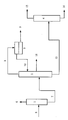
- the diagram of the distillation device used can be seen from the drawing. 1000 parts of the mixture are introduced into the first column (1) via the feed line (5).
- the column has 10 theoretical plates.
- a reflux ratio of 320 parts of a top product (6) with the composition 74% by weight of methanol, 20.7% by weight of methyl acetate and 3.2% by weight is obtained.
- -% Water is obtained at a head temperature of 63 ° C. and a head pressure of 900 mbar.
- bottom product (7) from the first column (1) 100 parts of bottom product (7) from the first column (1) are passed into the second column (2) with 40 theoretical plates.
- 0.1 l of xylene (isomer mixture) is added as a water tractor, which is continuously returned to the column via a phase separator (3) (10).
- a top temperature of 28 ° C. a top pressure of 70 mbar and a boiling rate of 1.6, 23 parts of top product (9) having the composition 80.1% by weight of water, 11.2% by weight of acetic acid, 3, 3% by weight of methanol, 1.8% by weight of tetrahydropyran-4-carboxylic acid ester and 44 parts of bottom product (12) with the composition 0.1% by weight of tetrahydropyran-4-carboxylic acid ester, 10.7% by weight of 3 -Spiro-cyclopropyl-butyrolactone, 28.9% by weight 3- (2-methoxyethyl) butyrolactone, 6.1% by weight 3- (2-Hyd
- bottom product (12) from column 2 100 parts are passed into the third column (4).
- 61 parts of top product (13) and 29 parts of bottom product (14) are obtained in the form of unidentified high boilers.
Landscapes
- Chemical & Material Sciences (AREA)
- Organic Chemistry (AREA)
- Organic Low-Molecular-Weight Compounds And Preparation Thereof (AREA)
- Pyrane Compounds (AREA)
- Low-Molecular Organic Synthesis Reactions Using Catalysts (AREA)
- Furan Compounds (AREA)
Description
Diese Erfindung betrifft ein Verfahren zur Reingewinnung von Tetrahydropyran-4-carbonsäureestern, wie sie bei der Umsetzung von 3-(2-Hydroxyethyl)-und 3-(2-Acyloxyethyl)-butyrolactonen mit niederen Alkoholen in Gegenwart von oxidischen Katalysatoren gebildet werden.This invention relates to a process for the pure recovery of tetrahydropyran-4-carboxylic acid esters, as are formed in the reaction of 3- (2-hydroxyethyl) and 3- (2-acyloxyethyl) butyrolactones with lower alcohols in the presence of oxidic catalysts.
Tetrahydropyran-4-carbonsäureester sind wichtige Zwischenprodukte für die Herstellung von 4-Formyl-tetrahydropyran.Tetrahydropyran-4-carboxylic acid esters are important intermediates for the production of 4-formyl-tetrahydropyran.
Es ist bekannt, daß sich 3-(2-Hydroxyethyl)-butyrolacton mit Methanol zu Tetrahydropyran-4-carbonsäureestern umsetzen läßt (EP-A-284 969). Bei dieser Umsetzung fällt ein Gemisch an, das Tetrahydropyran-4-carbonsäureester, 3-(2-Hydroxyethyl)-butyrolacton, 3-(2-Methoxyethyl)-butyrolacton, 3-Spiro-cyclopropyl-butyrolacton, Methanol, gegebenfalls Wasser, gegebenenfalls Essigsäure und gegebenenfalls Essigsäuremethylester enthält, das bei der Aufarbeitung Probleme bereitet.It is known that 3- (2-hydroxyethyl) butyrolactone can be reacted with methanol to give tetrahydropyran-4-carboxylic acid esters (EP-A-284 969). In this reaction, a mixture is obtained, the tetrahydropyran-4-carboxylic acid ester, 3- (2-hydroxyethyl) butyrolactone, 3- (2-methoxyethyl) butyrolactone, 3-spiro-cyclopropyl-butyrolactone, methanol, optionally water, optionally acetic acid and optionally contains methyl acetate, which causes problems during the workup.
Es bestand die Aufgabe, ein Verfahren zur Reingewinnung von Tetrahydropyran-4-carbonsäureester aus derartigen Gemischen zu entwickeln.The object was to develop a process for the pure recovery of tetrahydropyran-4-carboxylic acid esters from such mixtures.
Demgemäß wurde ein neues und verbessertes verfahren zur Reinigung von Tetrahydropyran-4-carbonsäurestern der allgemeinen Formel I

in der
R¹ bis R³ C₁- bis C₄-Alkyl, und R² und R³ zusätzlich Wasserstoff bedeuten,
aus Gemischen, die bei der Umsetzung von Butyrolactonen der allgemeinen Formel II

in der
R² und R³ die obengenannte Bedeutung besitzen und R⁴ ein Wasserstoffatom, eine Alkylgruppe mit 1 bis 6 Kohlenstoffatomen oder eine Acylgruppe der Formel -CO-R² bedeuten, mit Alkoholen der Formel R¹OH in Gegenwart von oxidischen Katalysatoren entstehen, durch Destillation, dadurch gekennzeichnet, daß man
- a) in einer ersten Kolonne mit einer theoretischen Bodenzahl von 5 bis 25 bei einem Kopfdruck von 700 bis 1100 mbar und einer Kopftemperatur von 50 bis 80°C einen Alkohol und bis zu 10 % des Wassers über Kopf abtrennt,
- b) das Sumpfprodukt der ersten Kolonne in eine zweite Kolonne mit einer theoretischen Bodenzahl von 18 bis 40 überführt, welcher zwischen dem 15. und 30. Boden ein Wasserschlepper in Kreisfahrweise zudosiert wird, die bei einem Kopfdruck von 35 bis 350 mbar und einer Kopftemperatur von 18 bis 70°C arbeitet, wobei zwischen dem 8. und 18. Boden bei einer Temperatur von 90 bis 150°C die Tetrahydropyran-4-carbonsäurester ausgeschleust werden, und gegebenenfalls
- c) das Sumpfprodukt der zweiten Kolonne in eine dritte Kolonne mit einer theoretischen Bodenzahl von 5 bis 25 einspeist und bei einem Kopfdruck von 1 bis 100 mbar und einer Kopftemperatur von 90 bis 140°C die Kopfprodukte in die Tetrahydropyran-4-carbonsäurester-Synthese zurückführt.
in the
R¹ to R³ are C₁ to C₄ alkyl, and R² and R³ are additionally hydrogen,
from mixtures which are used in the reaction of butyrolactones of the general formula II
in the
R² and R³ have the abovementioned meaning and R⁴ is a hydrogen atom, an alkyl group having 1 to 6 carbon atoms or an acyl group of the formula -CO-R², with alcohols of the formula R¹OH in the presence of oxidic catalysts, by distillation, characterized in that
- a) in a first column with a theoretical plate number of 5 to 25 at a top pressure of 700 to 1100 mbar and a top temperature of 50 to 80 ° C., an alcohol and up to 10% of the water are removed overhead,
- b) the bottom product of the first column is transferred to a second column with a theoretical number of plates from 18 to 40, to which a water tug is metered in a circular manner between the 15th and 30th plate, at a top pressure of 35 to 350 mbar and a top temperature of 18 to 70 ° C works, between the 8th and 18th floor at a temperature of 90 to 150 ° C, the tetrahydropyran-4-carboxylic acid esters are removed, and optionally
- c) the bottom product of the second column is fed into a third column with a theoretical number of plates from 5 to 25 and at a top pressure of 1 to 100 mbar and a top temperature of 90 to 140 ° C. the top products are returned to the tetrahydropyran-4-carboxylic acid ester synthesis .
Die für das neue Verfahren eingesetzten Tetrahydropyran-4-carbonsäureester I Rohprodukte enthaltenden Gemische erhält man z.B. bei der Umlagerung von 3-(2-Hydroxyethyl)-butyrolacton II mit Methanol. Sie haben z.B. die folgende Zusammensetzung: 15 bis 30 Gew.-% Tetrahydropyran-4-carbonsäureester, 15 bis 25 Gew.-% Methanol, 5 bis 25 Gew.-% Wasser, 5 bis 20 Gew.-% 3-(2-Methoxyethyl)-butyrolacton, 5 bis 15 Gew.-% 3-Spiro-cyclopropyl-butyrolacton, 0,05 bis 15 Gew.-% 3-(2-Hydroxyethyl)-butyrolacton und 0,1 bis 3 Gew.-% Hochsieder.The mixtures containing tetrahydropyran-4-carboxylic acid ester I crude products used for the new process are obtained e.g. in the rearrangement of 3- (2-hydroxyethyl) butyrolactone II with methanol. You have e.g. the following composition: 15 to 30 wt .-% tetrahydropyran-4-carboxylic acid ester, 15 to 25 wt .-% methanol, 5 to 25 wt .-% water, 5 to 20 wt .-% 3- (2-methoxyethyl) - butyrolactone, 5 to 15 wt .-% 3-spiro-cyclopropyl-butyrolactone, 0.05 to 15 wt .-% 3- (2-hydroxyethyl) butyrolactone and 0.1 to 3 wt .-% high boilers.
Das neue Verfahren wird unter Verwendung von drei Kolonnen z.B. wie folgt durchgeführt:
In einer ersten Kolonne, die eine theoretische Bodenzahl von 5 bis 25 aufweist, wird aus dem Gemisch 95 bis 100 % des Alkohols R¹-OH und bis zu 10 % des im Gemisch enthaltenen Wassers über Kopf abdestilliert. Das Gemisch läßt sich in die Tetrahydropyran-4-carbonsäureester-Synthese zurückführen. Die Temperaturen und Drücke am Kopf betragen 50 bis 80°C und 700 bis 1100 mbar. Das Rücklaufverhältnis beträgt 1 bis 10.The new process is carried out using three columns, for example as follows:
In a first column, which has a theoretical number of plates from 5 to 25, 95 to 100% of the alcohol R 1 -OH and up to 10% of the water contained in the mixture are distilled off overhead from the mixture. The mixture can be returned to the tetrahydropyran-4-carboxylic acid ester synthesis. The temperatures and pressures at the head are 50 to 80 ° C and 700 to 1100 mbar. The reflux ratio is 1 to 10.
Der Sumpf der ersten Kolonne, der Tetrahydropyran-4-carbonsäureester, 3-(2-Methoxyethyl)-butyrolacton, 3-Spiro-cyclopropyl-butyrolacton, 3-(2-Hydroxyethyl)-butyrolacton, Wasser und gegebenfalls verbliebenes Alkohols R¹-OH sowie Hochsieder enthält, wird in die zweite Kolonne mit einer theoretischen Bodenzahl von 18 bis 40 eingespeist. Zusätzlich wird zwischen Boden 15 und 30 ein Wasserschlepper, gegebenfalls Xylol, zudosiert. Bei einem Kopfdruck von 35 bis 350 mbar und einer Kopftemperatur von 18 bis 70°C erhält man ein Kopfprodukt, das aus Wasser und dem Wasserschlepper besteht. Über einen Phasenscheider wird der Wasserschlepper in die Kolonne und Wasser in die Tetrahydropyran-4-carbonsäureester-Synthese zurückgeführt. Das Rücklaufverhältnis liegt zwischen 1 und 9. Zwischen Boden 8 und 18 wird bei einer Temperatur von 90 bis 150°C Tetrahydropyran-4-carbonsäureester ausgeschleust.The bottom of the first column, the tetrahydropyran-4-carboxylic acid ester, 3- (2-methoxyethyl) butyrolactone, 3-spiro-cyclopropyl-butyrolactone, 3- (2-hydroxyethyl) butyrolactone, water and any remaining alcohol R¹-OH and Contains high boilers, is fed into the second column with a theoretical number of plates from 18 to 40. In addition, a water tractor, possibly xylene, is metered in between floors 15 and 30. With a head pressure of 35 to 350 mbar and a head temperature of 18 to 70 ° C, a head product is obtained which consists of water and the water tractor. The water tractor is returned to the column and water to the tetrahydropyran-4-carboxylic acid ester synthesis via a phase separator. The reflux ratio is between 1 and 9. Between
Der Sumpf der zweiten Kolonne, der 3-(2-Methoxyethyl)-butyrolacton, 3-Spiro-cyclopropyl-butyrolacton und 3-(2-Hydroxyethyl)-butyrolacton sowie Hochsieder enthalten kann, wird in eine dritte Kolonne mit einer theoretischen Bodenzahl von 5 bis 25 eingespeist, in der 3-(2-Methoxyethyl)-butyrolacton, 3-Spiro-cyclopropyl-butyrolacton und 3-(2-Hydroxyethyl)-butyrolacton über Kopf abgetrennt und gegebenfalls in die Tetrahydropyran-4-carbonsäureester-Synthese zurückgeführt werden können. Die Temperaturen und Drücke am Kopf der dritten Kolonne liegen bei 90 bis 140°C und 1 und 100 mbar. Das Rücklaufverhältnis liegt z.B. bei 1 bis 10.The bottom of the second column, which can contain 3- (2-methoxyethyl) butyrolactone, 3-spiro-cyclopropyl-butyrolactone and 3- (2-hydroxyethyl) butyrolactone and high boilers, is transferred to a third column with a theoretical number of plates of 5 fed to 25, in which 3- (2-methoxyethyl) butyrolactone, 3-spiro-cyclopropyl-butyrolactone and 3- (2-hydroxyethyl) butyrolactone can be removed overhead and, if appropriate, recycled into the tetrahydropyran-4-carboxylic acid ester synthesis . The temperatures and pressures at the top of the third column are 90 to 140 ° C and 1 and 100 mbar. The reflux ratio is, for example, 1 to 10.
Zur Abtrennung des Wassers in der zweiten Kolonne wird ein Wasserschlepper eingesetzt. Als Wasserschlepper können z.B. Cyclohexan, Cyclohexen, Benzol, Toluol, Hexan, Heptan, CCl₄, Chloroform, Acetonitril, Pyridin oder Piperidin, insbesondere Xylole oder das Isomerengemisch der Xylole verwendet werden.A water tractor is used to separate the water in the second column. As water tractors e.g. Cyclohexane, cyclohexene, benzene, toluene, hexane, heptane, CCl₄, chloroform, acetonitrile, pyridine or piperidine, in particular xylenes or the isomer mixture of the xylenes can be used.
Führt man die Umlagerung zu Tetrahydropyran-4-carbonsäureester mit Estern wie z.B. 3-(2-Acetoxyethyl)-butyrolacton an Stelle von 3-(2-Hydroxyethyl)-butyrolacton durch, so ändert sich die Zusammensetzung des Austrags wie folgt: 15 bis 30 Gew.-% Tetrahydropyran-4-carbonsäureester, 15 bis 30 Gew.-% Methanol, 5 bis 15 Gew.-% Methylacetat, 5 bis 25 Gew.-% Wasser, 2 bis 10 Gew.-% Essigsäure, 5 bis 20 Gew.-% 3-(2-Methoxyethyl)-butyrolacton, 2 bis 15 Gew.-% 3-Spirocyclopropyl-butyrolacton, 0,05 bis 10 Gew.-% 3-(2-Hydroxyethyl)-butyrolacton/3-(2-Acetoxyethyl)-butyrolacton und 0,1 bis 3 Gew.-% Hochsieder.If the rearrangement is carried out to tetrahydropyran-4-carboxylic acid esters with esters such as e.g. 3- (2-Acetoxyethyl) butyrolactone instead of 3- (2-hydroxyethyl) butyrolactone, the composition of the discharge changes as follows: 15 to 30 wt .-% tetrahydropyran-4-carboxylic acid ester, 15 to 30 wt % Methanol, 5 to 15% by weight methyl acetate, 5 to 25% by weight water, 2 to 10% by weight acetic acid, 5 to 20% by weight 3- (2-methoxyethyl) butyrolactone, 2 up to 15% by weight 3-spirocyclopropyl butyrolactone, 0.05 to 10% by weight 3- (2-hydroxyethyl) butyrolactone / 3- (2-acetoxyethyl) butyrolactone and 0.1 to 3% by weight High boilers.
Die Aufarbeitung verläuft analog zu dem beschriebenen Verfahren mit dem Unterschied, daß bei der ersten Kolonne neben Methanol auch Methylacetat über Kopf abgetrennt wird. Die mengenmäßig geringen Anteile Essigsäure, die im Gemisch enthalten sein können, werden in der zweiten Kolonne mit dem Wasser abgetrennt.Working up is analogous to the process described, with the difference that in the first column, methyl acetate is also removed overhead, in addition to methanol. The small amounts of acetic acid, which may be present in the mixture, are separated off with the water in the second column.
Sollen die Nebenprodukte nicht in die Synthesestufe zurückgeführt werden, so lassen sich 3-(2-Methoxyethyl)-butyrolacton und 3-Spirocyclopropyl-butyrolacton destillativ in einer weiteren Kolonne trennen.If the by-products are not to be returned to the synthesis stage, 3- (2-methoxyethyl) butyrolactone and 3-spirocyclopropyl-butyrolactone can be separated by distillation in a further column.
R¹, R² und R³ bedeuten unabhängig voneinander C₁- bis C₄-Alkyl wie Methyl, Ethyl, n-Propyl, iso-Propyl, n-Butyl, iso-Butyl, sec.-Butyl und tert.-Butyl, bevorzugt Methyl und Ethyl, besonders bevorzugt Methyl, sowie R² und R³ zusätzlich besonders bevorzugt Wasserstoff.R¹, R² and R³ are independently C₁ to C₄ alkyl such as methyl, ethyl, n-propyl, iso-propyl, n-butyl, iso-butyl, sec-butyl and tert-butyl, preferably methyl and Ethyl, particularly preferably methyl, and R² and R³ additionally particularly preferably hydrogen.
R⁴ bedeutet C₁- bis C₆-Alkyl wie Methyl, Ethyl, n-Propyl, iso-Propyl, n-Butyl, iso-Butyl, sec.-Butyl und tert.-Butyl, bevorzugt Methyl und Ethyl, besonders bevorzugt Methyl, sowie Wasserstoff und -CO-R².R⁴ is C₁ to C₆ alkyl such as methyl, ethyl, n-propyl, iso-propyl, n-butyl, iso-butyl, sec-butyl and tert-butyl, preferably methyl and ethyl, particularly preferably methyl, and hydrogen and -CO-R².
Nach diesem Verfahren lassen sich Tetrahydropyran-4-carbonsäureester besonders vorteilhaft aus den Ausgangsgemischen abtrennen. Durch die azeotrope Abtrennung des Wassers läßt sich ein Destillationsschritt einsparen, da man die Tetrahydropyran-4-carbonsäureester in der gleichen Kolonne seitlich austragen kann. Prinzipiell lassen sich auch höhere Carbonester (C₁-C₄) nach diesem Verfahren gewinnen.According to this process, tetrahydropyran-4-carboxylic acid esters can be separated off particularly advantageously from the starting mixtures. The azeotropic removal of the water saves one distillation step since the tetrahydropyran-4-carboxylic acid esters can be discharged laterally in the same column. In principle, higher carboxylic esters (C₁-C₄) can be obtained by this process.
Es wurde durch katalytische Umlagerung von 3-(2-Acetoxyethyl)-butyrolacton erhaltenes Reaktionsgemisch destilliert, das die folgende Zusammensetzung aufwies:
23,8Gew.-% Tetrahydropyran-4-carbonsäureester,
3,3 Gew.-% 3-Spiro-cyclopropyl-butyrolacton,
7,9 Gew.-% 3-(2-Methoxyethyl)-butyrolacton,
2,4 Gew.-% 3-(2-Hydroxyethyl)-butyrolacton,
5,2 Gew.-% 3-(2-Acetoxyethyl)-butyrolacton,
2,5 Gew.-% Essigsäure,
8,5 Gew.-% Methylacetat,
26,3Gew.-% Methanol und
15,9Gew.-% Wasser.The reaction mixture obtained by catalytic rearrangement of 3- (2-acetoxyethyl) butyrolactone was distilled and had the following composition:
23.8% by weight of tetrahydropyran-4-carboxylic acid ester,
3.3% by weight of 3-spiro-cyclopropyl-butyrolactone,
7.9% by weight of 3- (2-methoxyethyl) butyrolactone,
2.4% by weight of 3- (2-hydroxyethyl) butyrolactone,
5.2% by weight of 3- (2-acetoxyethyl) butyrolactone,
2.5% by weight of acetic acid,
8.5% by weight of methyl acetate,
26.3% by weight of methanol and
15.9% by weight water.
Das Schema der verwendeten Destillationsvorrichtung ist aus der Zeichnung ersichtlich. Über die Zuleitung (5) werden 1000 Teile des Gemisches in die erste Kolonne (1) eingeleitet. Die Kolonne hat 10 theoretische Böden. Bei einer Kopftemperatur von 63°C und einem Kopfdruck von 900 mbar erhält man bei einem Rücklaufverhältnis von 320 Teile eines Kopfproduktes (6) mit der Zusammensetzung 74 Gew.-% Methanol, 20,7 Gew.-% Methylacetat und 3,2 Gew.-% Wasser. Als Sumpfprodukt werden 680 Teile eines Gemisches aus 33,6 Gew.-% Tetrahydropyran-4-carbonsäureester, 4,8 Gew.-% 3-Spiro-cyclopropyl-butyrolacton, 11.9 Gew.-% 3-(2-Methoxyethyl)-butyrolacton, 3,9 Gew.-% 3-(2-Hydroxyethyl)-butyrolacton, 6,3 Gew.-% 3-(2-Acetoxyethyl)-butyrolacton, 3 Gew.-% Essigsäure, 0,1 Gew.-% Methanol und 17.5 Gew.-% Wasser erhalten.The diagram of the distillation device used can be seen from the drawing. 1000 parts of the mixture are introduced into the first column (1) via the feed line (5). The column has 10 theoretical plates. At a head temperature of 63 ° C. and a head pressure of 900 mbar, a reflux ratio of 320 parts of a top product (6) with the composition 74% by weight of methanol, 20.7% by weight of methyl acetate and 3.2% by weight is obtained. -% Water. 680 parts of a mixture of 33.6% by weight of tetrahydropyran-4-carboxylic acid ester, 4.8% by weight of 3-spiro-cyclopropyl-butyrolactone and 11.9% by weight of 3- (2-methoxyethyl) butyrolactone are used as the bottom product , 3.9% by weight of 3- (2-hydroxyethyl) butyrolactone, 6.3% by weight of 3- (2-acetoxyethyl) butyrolactone, 3% by weight of acetic acid, 0.1% by weight of methanol and 17.5 wt .-% water obtained.
100 Teile Sumpfprodukt (7) aus der ersten Kolonne (1) werden in die zweite Kolonne (2) mit 40 theoretischen Böden geleitet. Als Wasserschlepper werden 0,1 l Xylol (Isomerengemisch) zugesetzt, welches über einen Phasenscheider (3) kontinuierlich in die Kolonne zurückgeführt wird (10). Bei einer Kopftemperatur von 28°C, einem Kopfdruck von 70 mbar und einer Aufkochrate von 1,6 erhält man 23 Teile Kopfprodukt (9) der Zusammensetzung 80,1 Gew.-% Wasser, 11,2 Gew.-% Essigsäure, 3,3 Gew.-% Methanol, 1,8 Gew.-% Tetrahydropyran-4- carbonsäureester und 44 Teile Sumpfprodukt (12) mit der Zusammensetzung 0,1 Gew.-% Tetrahydropyran-4-carbonsäureester, 10,7 Gew.-% 3-Spiro-cyclopropyl-butyrolacton, 28,9 Gew.-% 3-(2-Methoxy- ethyl)-butyrolacton, 6,1 Gew.-% 3-(2-Hydroxyethyl)-butyrolacton und 15,1 Gew.-% 3-(2-Acetoxyethyl)-butyrolacton. Bei einer Temperatur von 108°C werden 33 Teile als Seitenstrom (11) am Boden 17 mit der Zusammensetzung 99,5 Gew.-% Tetrahydropyran-4-carbonsäureester ausgeschleust.100 parts of bottom product (7) from the first column (1) are passed into the second column (2) with 40 theoretical plates. 0.1 l of xylene (isomer mixture) is added as a water tractor, which is continuously returned to the column via a phase separator (3) (10). At a top temperature of 28 ° C., a top pressure of 70 mbar and a boiling rate of 1.6, 23 parts of top product (9) having the composition 80.1% by weight of water, 11.2% by weight of acetic acid, 3, 3% by weight of methanol, 1.8% by weight of tetrahydropyran-4-carboxylic acid ester and 44 parts of bottom product (12) with the composition 0.1% by weight of tetrahydropyran-4-carboxylic acid ester, 10.7% by weight of 3 -Spiro-cyclopropyl-butyrolactone, 28.9% by weight 3- (2-methoxyethyl) butyrolactone, 6.1% by weight 3- (2-Hydroxyethyl) butyrolactone and 15.1% by weight 3- (2-acetoxyethyl) butyrolactone. At a temperature of 108 ° C., 33 parts are discharged as side stream (11) at the bottom 17 with the composition 99.5% by weight of tetrahydropyran-4-carboxylic acid ester.
100 Teile Sumpfprodukt (12) aus Kolonne 2 werden in die dritte Kolonne (4) geleitet. Bei einer Kondensattemperatur von 128°C und einem Kopfdruck von 3 mbar erhält man 61 Teile Kopfprodukt (13) und 29 Teile Sumpfprodukt (14) in Form von nicht identifizierten Hochsiedern.100 parts of bottom product (12) from
Claims (1)
- A process for purifying esters of tetrahydropyran-4-carboxylic acid of the formula I

R¹ to R³ are each C₁-C₄-alkyl, and R² and R³ are each additionally hydrogen, from mixtures produced in the reaction of butyrolactones of the formula II
R² and R³ have the abovementioned meanings, and R⁴ is hydrogen, alkyl of 1-6 carbons or acyl of the formula -CO-R², with alcohols of the formula R¹OH in the presence of oxide catalysts, by distillation, which comprisesa) removing overhead, in a first column with 5-25 theoretical plates with a distillate pressure of 700-1100 mbar and a distillate temperature of 50-80°C, an alcohol and up to 10% of the water,b) transferring the bottom product from the first column into a second column with 18-40 theoretical plates, into which a water entrainer is metered between plates 15 and 30, and is circulated, and which operates with a distillate pressure of 35-350 mbar and a distillate temperature of 18-70°C, with the esters of tetrahydropyran-4-carboxylic acid being removed between plates 8 and 18 at 90-150°C, and, where appropriate,c) feeding the bottom product from the second column into a third column with 5-25 theoretical plates, and returning the overhead products at a distillate pressure of 1-100 mbar and a distillate temperature of 90-140°C to the synthesis of the esters of tetrahydropyran-4-carboxylic acid.
Applications Claiming Priority (2)
| Application Number | Priority Date | Filing Date | Title |
|---|---|---|---|
| DE4141221 | 1991-12-13 | ||
| DE4141221A DE4141221A1 (en) | 1991-12-13 | 1991-12-13 | METHOD FOR PURIFYING TETRAHYDROPYRAN-4-CARBONIC ACID ESTERS |
Publications (2)
| Publication Number | Publication Date |
|---|---|
| EP0546397A1 EP0546397A1 (en) | 1993-06-16 |
| EP0546397B1 true EP0546397B1 (en) | 1995-10-11 |
Family
ID=6447019
Family Applications (1)
| Application Number | Title | Priority Date | Filing Date |
|---|---|---|---|
| EP92120260A Expired - Lifetime EP0546397B1 (en) | 1991-12-13 | 1992-11-27 | Method for the purification of tetrahydropyran-4-carboxylic esters |
Country Status (3)
| Country | Link |
|---|---|
| EP (1) | EP0546397B1 (en) |
| JP (1) | JP3410497B2 (en) |
| DE (2) | DE4141221A1 (en) |
Families Citing this family (1)
| Publication number | Priority date | Publication date | Assignee | Title |
|---|---|---|---|---|
| DE59902100D1 (en) * | 1998-09-10 | 2002-08-29 | Basf Ag | Process for the separation of impurities from 3- (2-acetoxy-ethyl) dihydro-2 (3H) furanone |
Family Cites Families (1)
| Publication number | Priority date | Publication date | Assignee | Title |
|---|---|---|---|---|
| DE3710805A1 (en) * | 1987-03-31 | 1988-10-20 | Basf Ag | METHOD FOR PRODUCING TETRAHYDROPYRAN-4-CARBONIC ACID ESTERS |
-
1991
- 1991-12-13 DE DE4141221A patent/DE4141221A1/en not_active Withdrawn
-
1992
- 1992-11-27 EP EP92120260A patent/EP0546397B1/en not_active Expired - Lifetime
- 1992-11-27 DE DE59203987T patent/DE59203987D1/en not_active Expired - Lifetime
- 1992-12-14 JP JP33283092A patent/JP3410497B2/en not_active Expired - Fee Related
Also Published As
| Publication number | Publication date |
|---|---|
| JP3410497B2 (en) | 2003-05-26 |
| DE4141221A1 (en) | 1993-06-17 |
| EP0546397A1 (en) | 1993-06-16 |
| DE59203987D1 (en) | 1995-11-16 |
| JPH05247024A (en) | 1993-09-24 |
Similar Documents
| Publication | Publication Date | Title |
|---|---|---|
| DE3428319C2 (en) | ||
| EP0790230A1 (en) | Process for the continuous preparation of alkyl esters of (meth)acrylic acid | |
| EP0795535A1 (en) | Process and equipment for the continuous preparation of alkyl esters of (meth)acrylic acid | |
| DE102007031473A1 (en) | Process for the preparation of ethylene glycol dimethacrylate | |
| DE2450856C3 (en) | Process for the purification of dimethyl carbonate | |
| EP0780359B1 (en) | Esterification process of (meth)acrylic acid with an alcanol | |
| EP0767163B1 (en) | Process for esterifying (meth)acrylic acid with an alcanol | |
| EP2162421B1 (en) | Method for producing butanediol dimethacrylates | |
| EP0581115B1 (en) | Process for separating methanol from dimethyl carbonate/methanol mixtures | |
| DE2538532C2 (en) | Process for the separation of stereospecific farnesyl acetic acid or its esters from stereoisomeric mixtures | |
| DE3806304A1 (en) | METHOD FOR PURIFYING CARBONIC ACID ESTERS CONTAINING ALDEHYDE, ACETALS AND / OR UNSATURATED COMPOUNDS | |
| EP0780360B1 (en) | Esterification process of (meth)acrylic acid with an alcanol | |
| EP0956279A1 (en) | Process for the esterification of (meth)acrylic acid with an alkanol | |
| EP0121760A1 (en) | Process for the manufacture of 3-hydroxytetrahydrofuran | |
| EP1060155A1 (en) | Method for distilling mixtures containing butanediol | |
| EP0055797B1 (en) | Process for the preparation of substituted acetic acids and/or of their esters and of substituted acetonitriles, respectively | |
| DE60213998T2 (en) | PROCESS FOR PREPARING 2 OXOCARBOXYLIC ACID ESTERS | |
| DE69613303T2 (en) | Process for the preparation of alph-beta-unsaturated trifluoromethyl carboxyl compounds | |
| EP0010236B1 (en) | Process for the synthesis of 2,3-dimethyl-2,3-butane diol | |
| EP0765860A1 (en) | Process for esterifying (meth)acrylic acid with an alcanol | |
| EP0546397A1 (en) | Method for the purification of tetrahydropyran-4-carboxylic esters | |
| EP0286981B1 (en) | Method for the production of carboxylic acid methyl esters | |
| EP0030330B1 (en) | Process for preparing carboxylic acid esters containing aldehydes and/or acetals | |
| DE2262969A1 (en) | PROCESS FOR THE SEPARATION OF ACRYLIC ACID ALKYLESTERS FROM MIXTURES CONTAINING ACRYLIC ACID | |
| US5414097A (en) | Purification of esters of tetrahydro-pyran-4-carboxylic acid |
Legal Events
| Date | Code | Title | Description |
|---|---|---|---|
| PUAI | Public reference made under article 153(3) epc to a published international application that has entered the european phase |
Free format text: ORIGINAL CODE: 0009012 |
|
| 17P | Request for examination filed |
Effective date: 19930306 |
|
| AK | Designated contracting states |
Kind code of ref document: A1 Designated state(s): BE CH DE FR GB IT LI NL |
|
| 17Q | First examination report despatched |
Effective date: 19950315 |
|
| GRAA | (expected) grant |
Free format text: ORIGINAL CODE: 0009210 |
|
| AK | Designated contracting states |
Kind code of ref document: B1 Designated state(s): BE CH DE FR GB IT LI NL |
|
| REF | Corresponds to: |
Ref document number: 59203987 Country of ref document: DE Date of ref document: 19951116 |
|
| GBT | Gb: translation of ep patent filed (gb section 77(6)(a)/1977) |
Effective date: 19951026 |
|
| ITF | It: translation for a ep patent filed | ||
| ET | Fr: translation filed | ||
| PLBE | No opposition filed within time limit |
Free format text: ORIGINAL CODE: 0009261 |
|
| STAA | Information on the status of an ep patent application or granted ep patent |
Free format text: STATUS: NO OPPOSITION FILED WITHIN TIME LIMIT |
|
| 26N | No opposition filed | ||
| REG | Reference to a national code |
Ref country code: GB Ref legal event code: IF02 |
|
| PGFP | Annual fee paid to national office [announced via postgrant information from national office to epo] |
Ref country code: NL Payment date: 20041103 Year of fee payment: 13 |
|
| PGFP | Annual fee paid to national office [announced via postgrant information from national office to epo] |
Ref country code: FR Payment date: 20041109 Year of fee payment: 13 |
|
| PGFP | Annual fee paid to national office [announced via postgrant information from national office to epo] |
Ref country code: GB Payment date: 20041124 Year of fee payment: 13 |
|
| PGFP | Annual fee paid to national office [announced via postgrant information from national office to epo] |
Ref country code: DE Payment date: 20041125 Year of fee payment: 13 |
|
| PGFP | Annual fee paid to national office [announced via postgrant information from national office to epo] |
Ref country code: CH Payment date: 20041129 Year of fee payment: 13 |
|
| PGFP | Annual fee paid to national office [announced via postgrant information from national office to epo] |
Ref country code: BE Payment date: 20050203 Year of fee payment: 13 |
|
| PG25 | Lapsed in a contracting state [announced via postgrant information from national office to epo] |
Ref country code: GB Free format text: LAPSE BECAUSE OF NON-PAYMENT OF DUE FEES Effective date: 20051127 Ref country code: IT Free format text: LAPSE BECAUSE OF NON-PAYMENT OF DUE FEES;WARNING: LAPSES OF ITALIAN PATENTS WITH EFFECTIVE DATE BEFORE 2007 MAY HAVE OCCURRED AT ANY TIME BEFORE 2007. THE CORRECT EFFECTIVE DATE MAY BE DIFFERENT FROM THE ONE RECORDED. Effective date: 20051127 |
|
| PG25 | Lapsed in a contracting state [announced via postgrant information from national office to epo] |
Ref country code: LI Free format text: LAPSE BECAUSE OF NON-PAYMENT OF DUE FEES Effective date: 20051130 Ref country code: CH Free format text: LAPSE BECAUSE OF NON-PAYMENT OF DUE FEES Effective date: 20051130 Ref country code: BE Free format text: LAPSE BECAUSE OF NON-PAYMENT OF DUE FEES Effective date: 20051130 |
|
| PG25 | Lapsed in a contracting state [announced via postgrant information from national office to epo] |
Ref country code: DE Free format text: LAPSE BECAUSE OF THE APPLICANT RENOUNCES Effective date: 20051220 |
|
| PG25 | Lapsed in a contracting state [announced via postgrant information from national office to epo] |
Ref country code: NL Free format text: LAPSE BECAUSE OF NON-PAYMENT OF DUE FEES Effective date: 20060601 |
|
| REG | Reference to a national code |
Ref country code: CH Ref legal event code: PL |
|
| GBPC | Gb: european patent ceased through non-payment of renewal fee |
Effective date: 20051127 |
|
| PG25 | Lapsed in a contracting state [announced via postgrant information from national office to epo] |
Ref country code: FR Free format text: LAPSE BECAUSE OF NON-PAYMENT OF DUE FEES Effective date: 20060731 |
|
| NLV4 | Nl: lapsed or anulled due to non-payment of the annual fee |
Effective date: 20060601 |
|
| REG | Reference to a national code |
Ref country code: FR Ref legal event code: ST Effective date: 20060731 |
|
| BERE | Be: lapsed |
Owner name: *BASF A.G. Effective date: 20051130 |