EP0544819B1 - Indole derivatives which inhibit leukotriene biosynthesis - Google Patents
Indole derivatives which inhibit leukotriene biosynthesis Download PDFInfo
- Publication number
- EP0544819B1 EP0544819B1 EP91917405A EP91917405A EP0544819B1 EP 0544819 B1 EP0544819 B1 EP 0544819B1 EP 91917405 A EP91917405 A EP 91917405A EP 91917405 A EP91917405 A EP 91917405A EP 0544819 B1 EP0544819 B1 EP 0544819B1
- Authority
- EP
- European Patent Office
- Prior art keywords
- carbon atoms
- alkyl
- portion contains
- group
- alkyl portion
- Prior art date
- Legal status (The legal status is an assumption and is not a legal conclusion. Google has not performed a legal analysis and makes no representation as to the accuracy of the status listed.)
- Expired - Lifetime
Links
- 150000002617 leukotrienes Chemical class 0.000 title description 23
- 230000015572 biosynthetic process Effects 0.000 title description 21
- 150000002475 indoles Chemical class 0.000 title description 9
- 229940054051 antipsychotic indole derivative Drugs 0.000 title description 2
- 125000000217 alkyl group Chemical group 0.000 claims description 330
- 125000004432 carbon atom Chemical group C* 0.000 claims description 294
- -1 4-pyridylthio Chemical group 0.000 claims description 122
- 150000001875 compounds Chemical class 0.000 claims description 93
- 238000006243 chemical reaction Methods 0.000 claims description 69
- 125000003545 alkoxy group Chemical group 0.000 claims description 61
- 238000000034 method Methods 0.000 claims description 58
- 229910052736 halogen Inorganic materials 0.000 claims description 32
- 150000002367 halogens Chemical class 0.000 claims description 31
- 125000001188 haloalkyl group Chemical group 0.000 claims description 29
- 150000003839 salts Chemical class 0.000 claims description 24
- 125000002915 carbonyl group Chemical group [*:2]C([*:1])=O 0.000 claims description 17
- 150000002148 esters Chemical class 0.000 claims description 16
- 125000001997 phenyl group Chemical group [H]C1=C([H])C([H])=C(*)C([H])=C1[H] 0.000 claims description 15
- 125000002947 alkylene group Chemical group 0.000 claims description 14
- 229910052739 hydrogen Inorganic materials 0.000 claims description 14
- 239000001257 hydrogen Substances 0.000 claims description 14
- 125000004453 alkoxycarbonyl group Chemical group 0.000 claims description 13
- 125000001072 heteroaryl group Chemical group 0.000 claims description 13
- 125000003884 phenylalkyl group Chemical group 0.000 claims description 13
- 125000003178 carboxy group Chemical group [H]OC(*)=O 0.000 claims description 11
- 125000004435 hydrogen atom Chemical group [H]* 0.000 claims description 11
- 150000001768 cations Chemical class 0.000 claims description 10
- 239000003814 drug Substances 0.000 claims description 10
- 125000002941 2-furyl group Chemical group O1C([*])=C([H])C([H])=C1[H] 0.000 claims description 9
- 125000004105 2-pyridyl group Chemical group N1=C([*])C([H])=C([H])C([H])=C1[H] 0.000 claims description 9
- 125000003349 3-pyridyl group Chemical group N1=C([H])C([*])=C([H])C([H])=C1[H] 0.000 claims description 9
- 125000001541 3-thienyl group Chemical group S1C([H])=C([*])C([H])=C1[H] 0.000 claims description 9
- 125000000339 4-pyridyl group Chemical group N1=C([H])C([H])=C([*])C([H])=C1[H] 0.000 claims description 9
- 125000000951 phenoxy group Chemical group [H]C1=C([H])C([H])=C(O*)C([H])=C1[H] 0.000 claims description 9
- 150000001408 amides Chemical class 0.000 claims description 8
- 125000003917 carbamoyl group Chemical group [H]N([H])C(*)=O 0.000 claims description 8
- 125000005359 phenoxyalkyl group Chemical group 0.000 claims description 8
- 125000004183 alkoxy alkyl group Chemical group 0.000 claims description 7
- 125000003282 alkyl amino group Chemical group 0.000 claims description 7
- 125000004663 dialkyl amino group Chemical group 0.000 claims description 7
- 125000002768 hydroxyalkyl group Chemical group 0.000 claims description 7
- 125000004450 alkenylene group Chemical group 0.000 claims description 6
- 125000004414 alkyl thio group Chemical group 0.000 claims description 6
- 125000004446 heteroarylalkyl group Chemical group 0.000 claims description 6
- 125000004196 benzothienyl group Chemical group S1C(=CC2=C1C=CC=C2)* 0.000 claims description 5
- 125000002993 cycloalkylene group Chemical group 0.000 claims description 5
- 125000000714 pyrimidinyl group Chemical group 0.000 claims description 5
- 125000004618 benzofuryl group Chemical group O1C(=CC2=C1C=CC=C2)* 0.000 claims description 4
- 125000000609 carbazolyl group Chemical group C1(=CC=CC=2C3=CC=CC=C3NC12)* 0.000 claims description 4
- 125000002883 imidazolyl group Chemical group 0.000 claims description 4
- 230000002401 inhibitory effect Effects 0.000 claims description 4
- 125000005956 isoquinolyl group Chemical group 0.000 claims description 4
- 125000004660 phenylalkylthio group Chemical group 0.000 claims description 4
- 125000003356 phenylsulfanyl group Chemical group [*]SC1=C([H])C([H])=C([H])C([H])=C1[H] 0.000 claims description 4
- 125000000168 pyrrolyl group Chemical group 0.000 claims description 4
- 125000004174 2-benzimidazolyl group Chemical group [H]N1C(*)=NC2=C([H])C([H])=C([H])C([H])=C12 0.000 claims description 3
- 125000000175 2-thienyl group Chemical group S1C([*])=C([H])C([H])=C1[H] 0.000 claims description 3
- 125000003682 3-furyl group Chemical group O1C([H])=C([*])C([H])=C1[H] 0.000 claims description 3
- UFHFLCQGNIYNRP-UHFFFAOYSA-N Hydrogen Chemical compound [H][H] UFHFLCQGNIYNRP-UHFFFAOYSA-N 0.000 claims description 3
- 102000003820 Lipoxygenases Human genes 0.000 claims description 3
- 108090000128 Lipoxygenases Proteins 0.000 claims description 3
- 125000005114 heteroarylalkoxy group Chemical group 0.000 claims description 3
- 125000000335 thiazolyl group Chemical group 0.000 claims description 3
- 241000124008 Mammalia Species 0.000 claims description 2
- 125000004356 hydroxy functional group Chemical group O* 0.000 claims 22
- 150000002431 hydrogen Chemical class 0.000 claims 5
- 125000004429 atom Chemical group 0.000 claims 3
- 125000001637 1-naphthyl group Chemical group [H]C1=C([H])C([H])=C2C(*)=C([H])C([H])=C([H])C2=C1[H] 0.000 claims 2
- 125000001622 2-naphthyl group Chemical group [H]C1=C([H])C([H])=C2C([H])=C(*)C([H])=C([H])C2=C1[H] 0.000 claims 2
- 238000004519 manufacturing process Methods 0.000 claims 2
- 125000005843 halogen group Chemical group 0.000 claims 1
- 229940067157 phenylhydrazine Drugs 0.000 claims 1
- 125000001041 indolyl group Chemical group 0.000 abstract description 8
- 102000004190 Enzymes Human genes 0.000 abstract description 5
- 108090000790 Enzymes Proteins 0.000 abstract description 5
- 208000027866 inflammatory disease Diseases 0.000 abstract description 2
- 206010020751 Hypersensitivity Diseases 0.000 abstract 1
- 230000007815 allergy Effects 0.000 abstract 1
- XEKOWRVHYACXOJ-UHFFFAOYSA-N Ethyl acetate Chemical compound CCOC(C)=O XEKOWRVHYACXOJ-UHFFFAOYSA-N 0.000 description 151
- VLKZOEOYAKHREP-UHFFFAOYSA-N n-Hexane Chemical class CCCCCC VLKZOEOYAKHREP-UHFFFAOYSA-N 0.000 description 131
- IAZDPXIOMUYVGZ-WFGJKAKNSA-N Dimethyl sulfoxide Chemical compound [2H]C([2H])([2H])S(=O)C([2H])([2H])[2H] IAZDPXIOMUYVGZ-WFGJKAKNSA-N 0.000 description 72
- 235000019439 ethyl acetate Nutrition 0.000 description 67
- 239000000243 solution Substances 0.000 description 65
- RTZKZFJDLAIYFH-UHFFFAOYSA-N Diethyl ether Chemical compound CCOCC RTZKZFJDLAIYFH-UHFFFAOYSA-N 0.000 description 62
- CSNNHWWHGAXBCP-UHFFFAOYSA-L Magnesium sulfate Chemical compound [Mg+2].[O-][S+2]([O-])([O-])[O-] CSNNHWWHGAXBCP-UHFFFAOYSA-L 0.000 description 58
- YMWUJEATGCHHMB-UHFFFAOYSA-N Dichloromethane Chemical compound ClCCl YMWUJEATGCHHMB-UHFFFAOYSA-N 0.000 description 56
- OKKJLVBELUTLKV-UHFFFAOYSA-N Methanol Chemical compound OC OKKJLVBELUTLKV-UHFFFAOYSA-N 0.000 description 54
- VYPSYNLAJGMNEJ-UHFFFAOYSA-N Silicium dioxide Chemical compound O=[Si]=O VYPSYNLAJGMNEJ-UHFFFAOYSA-N 0.000 description 52
- 239000007787 solid Substances 0.000 description 51
- 239000000741 silica gel Substances 0.000 description 50
- 229910002027 silica gel Inorganic materials 0.000 description 50
- XLYOFNOQVPJJNP-UHFFFAOYSA-N water Substances O XLYOFNOQVPJJNP-UHFFFAOYSA-N 0.000 description 46
- LFQSCWFLJHTTHZ-UHFFFAOYSA-N Ethanol Chemical compound CCO LFQSCWFLJHTTHZ-UHFFFAOYSA-N 0.000 description 43
- 229910001868 water Inorganic materials 0.000 description 42
- 238000002360 preparation method Methods 0.000 description 40
- 238000005160 1H NMR spectroscopy Methods 0.000 description 36
- 238000004587 chromatography analysis Methods 0.000 description 34
- 238000004458 analytical method Methods 0.000 description 32
- 238000003756 stirring Methods 0.000 description 31
- 229910052943 magnesium sulfate Inorganic materials 0.000 description 29
- 235000019341 magnesium sulphate Nutrition 0.000 description 29
- 239000000047 product Substances 0.000 description 27
- 238000000746 purification Methods 0.000 description 25
- SIKJAQJRHWYJAI-UHFFFAOYSA-N Indole Chemical compound C1=CC=C2NC=CC2=C1 SIKJAQJRHWYJAI-UHFFFAOYSA-N 0.000 description 22
- 239000012267 brine Substances 0.000 description 22
- HPALAKNZSZLMCH-UHFFFAOYSA-M sodium;chloride;hydrate Chemical compound O.[Na+].[Cl-] HPALAKNZSZLMCH-UHFFFAOYSA-M 0.000 description 22
- QTBSBXVTEAMEQO-UHFFFAOYSA-N Acetic acid Chemical compound CC(O)=O QTBSBXVTEAMEQO-UHFFFAOYSA-N 0.000 description 21
- HEMHJVSKTPXQMS-UHFFFAOYSA-M Sodium hydroxide Chemical compound [OH-].[Na+] HEMHJVSKTPXQMS-UHFFFAOYSA-M 0.000 description 21
- ZMANZCXQSJIPKH-UHFFFAOYSA-N Triethylamine Chemical compound CCN(CC)CC ZMANZCXQSJIPKH-UHFFFAOYSA-N 0.000 description 21
- 125000002249 indol-2-yl group Chemical group [H]C1=C([H])C([H])=C2N([H])C([*])=C([H])C2=C1[H] 0.000 description 18
- IAZDPXIOMUYVGZ-UHFFFAOYSA-N Dimethylsulphoxide Chemical compound CS(C)=O IAZDPXIOMUYVGZ-UHFFFAOYSA-N 0.000 description 17
- 229940093499 ethyl acetate Drugs 0.000 description 17
- 239000000203 mixture Substances 0.000 description 17
- UIIMBOGNXHQVGW-UHFFFAOYSA-M sodium bicarbonate Substances [Na+].OC([O-])=O UIIMBOGNXHQVGW-UHFFFAOYSA-M 0.000 description 16
- UHOVQNZJYSORNB-UHFFFAOYSA-N Benzene Chemical compound C1=CC=CC=C1 UHOVQNZJYSORNB-UHFFFAOYSA-N 0.000 description 15
- VEXZGXHMUGYJMC-UHFFFAOYSA-N Hydrochloric acid Chemical compound Cl VEXZGXHMUGYJMC-UHFFFAOYSA-N 0.000 description 14
- 0 CC(C)c1ccc2[n](CC(CC3)=CC=C3Cl)c(CC(C)(C)*C(*)=O)c(*C(C)(C)C)c2c1 Chemical compound CC(C)c1ccc2[n](CC(CC3)=CC=C3Cl)c(CC(C)(C)*C(*)=O)c(*C(C)(C)C)c2c1 0.000 description 13
- XBDQKXXYIPTUBI-UHFFFAOYSA-N Propionic acid Substances CCC(O)=O XBDQKXXYIPTUBI-UHFFFAOYSA-N 0.000 description 13
- 239000012298 atmosphere Substances 0.000 description 13
- 235000019441 ethanol Nutrition 0.000 description 13
- 229910004373 HOAc Inorganic materials 0.000 description 12
- JUJWROOIHBZHMG-UHFFFAOYSA-N Pyridine Chemical compound C1=CC=NC=C1 JUJWROOIHBZHMG-UHFFFAOYSA-N 0.000 description 12
- 125000002887 hydroxy group Chemical group [H]O* 0.000 description 12
- 238000001953 recrystallisation Methods 0.000 description 11
- 102000001381 Arachidonate 5-Lipoxygenase Human genes 0.000 description 10
- 108010093579 Arachidonate 5-lipoxygenase Proteins 0.000 description 10
- AVXURJPOCDRRFD-UHFFFAOYSA-N Hydroxylamine Chemical compound ON AVXURJPOCDRRFD-UHFFFAOYSA-N 0.000 description 10
- ZMXDDKWLCZADIW-UHFFFAOYSA-N N,N-Dimethylformamide Chemical compound CN(C)C=O ZMXDDKWLCZADIW-UHFFFAOYSA-N 0.000 description 10
- 239000002253 acid Substances 0.000 description 10
- 239000000284 extract Substances 0.000 description 10
- PZOUSPYUWWUPPK-UHFFFAOYSA-N indole Natural products CC1=CC=CC2=C1C=CN2 PZOUSPYUWWUPPK-UHFFFAOYSA-N 0.000 description 10
- RKJUIXBNRJVNHR-UHFFFAOYSA-N indolenine Natural products C1=CC=C2CC=NC2=C1 RKJUIXBNRJVNHR-UHFFFAOYSA-N 0.000 description 10
- 239000003921 oil Substances 0.000 description 10
- 235000019198 oils Nutrition 0.000 description 10
- KVQNNPYCGSXVQA-UHFFFAOYSA-N propylurea Chemical compound [CH2]CCNC(N)=O KVQNNPYCGSXVQA-UHFFFAOYSA-N 0.000 description 10
- VZGDMQKNWNREIO-UHFFFAOYSA-N tetrachloromethane Chemical compound ClC(Cl)(Cl)Cl VZGDMQKNWNREIO-UHFFFAOYSA-N 0.000 description 10
- NLXLAEXVIDQMFP-UHFFFAOYSA-N Ammonia chloride Chemical compound [NH4+].[Cl-] NLXLAEXVIDQMFP-UHFFFAOYSA-N 0.000 description 9
- PEDCQBHIVMGVHV-UHFFFAOYSA-N Glycerine Chemical compound OCC(O)CO PEDCQBHIVMGVHV-UHFFFAOYSA-N 0.000 description 9
- YXFVVABEGXRONW-UHFFFAOYSA-N Toluene Chemical compound CC1=CC=CC=C1 YXFVVABEGXRONW-UHFFFAOYSA-N 0.000 description 9
- 229940079593 drug Drugs 0.000 description 9
- 230000005764 inhibitory process Effects 0.000 description 9
- 239000010410 layer Substances 0.000 description 9
- AICOOMRHRUFYCM-ZRRPKQBOSA-N oxazine, 1 Chemical compound C([C@@H]1[C@H](C(C[C@]2(C)[C@@H]([C@H](C)N(C)C)[C@H](O)C[C@]21C)=O)CC1=CC2)C[C@H]1[C@@]1(C)[C@H]2N=C(C(C)C)OC1 AICOOMRHRUFYCM-ZRRPKQBOSA-N 0.000 description 9
- PTMBWNZJOQBTBK-UHFFFAOYSA-N pyridin-4-ylmethanol Chemical compound OCC1=CC=NC=C1 PTMBWNZJOQBTBK-UHFFFAOYSA-N 0.000 description 9
- 239000011734 sodium Substances 0.000 description 9
- 235000017557 sodium bicarbonate Nutrition 0.000 description 9
- 239000000725 suspension Substances 0.000 description 9
- QGZKDVFQNNGYKY-UHFFFAOYSA-N Ammonia Chemical compound N QGZKDVFQNNGYKY-UHFFFAOYSA-N 0.000 description 8
- 239000008194 pharmaceutical composition Substances 0.000 description 8
- 239000000843 powder Substances 0.000 description 8
- 239000011541 reaction mixture Substances 0.000 description 8
- NEDIHQXMAGZSHL-UHFFFAOYSA-N 3-[3-tert-butylsulfanyl-1-[(4-chlorophenyl)methyl]-5-(quinolin-2-ylmethoxy)indol-2-yl]-2,2-dimethylpropanal Chemical compound C12=CC=C(OCC=3N=C4C=CC=CC4=CC=3)C=C2C(SC(C)(C)C)=C(CC(C)(C)C=O)N1CC1=CC=C(Cl)C=C1 NEDIHQXMAGZSHL-UHFFFAOYSA-N 0.000 description 7
- XSQUKJJJFZCRTK-UHFFFAOYSA-N Urea Chemical compound NC(N)=O XSQUKJJJFZCRTK-UHFFFAOYSA-N 0.000 description 7
- 235000019270 ammonium chloride Nutrition 0.000 description 7
- NIZHERJWXFHGGU-UHFFFAOYSA-N isocyanato(trimethyl)silane Chemical compound C[Si](C)(C)N=C=O NIZHERJWXFHGGU-UHFFFAOYSA-N 0.000 description 7
- 229910000030 sodium bicarbonate Inorganic materials 0.000 description 7
- 125000001424 substituent group Chemical group 0.000 description 7
- XZXPTDNPXMLREA-UHFFFAOYSA-N 3-[3-tert-butylsulfanyl-1-[(4-chlorophenyl)methyl]-5-propan-2-ylindol-2-yl]-2,2-dimethylpropanal Chemical compound O=CC(C)(C)CC1=C(SC(C)(C)C)C2=CC(C(C)C)=CC=C2N1CC1=CC=C(Cl)C=C1 XZXPTDNPXMLREA-UHFFFAOYSA-N 0.000 description 6
- OAKJQQAXSVQMHS-UHFFFAOYSA-N Hydrazine Chemical compound NN OAKJQQAXSVQMHS-UHFFFAOYSA-N 0.000 description 6
- DNIAPMSPPWPWGF-UHFFFAOYSA-N Propylene glycol Chemical compound CC(O)CO DNIAPMSPPWPWGF-UHFFFAOYSA-N 0.000 description 6
- 210000000224 granular leucocyte Anatomy 0.000 description 6
- VNYSSYRCGWBHLG-AMOLWHMGSA-N leukotriene B4 Chemical compound CCCCC\C=C/C[C@@H](O)\C=C\C=C\C=C/[C@@H](O)CCCC(O)=O VNYSSYRCGWBHLG-AMOLWHMGSA-N 0.000 description 6
- CTSLXHKWHWQRSH-UHFFFAOYSA-N oxalyl chloride Chemical compound ClC(=O)C(Cl)=O CTSLXHKWHWQRSH-UHFFFAOYSA-N 0.000 description 6
- 150000002923 oximes Chemical class 0.000 description 6
- UMJSCPRVCHMLSP-UHFFFAOYSA-N pyridine Natural products COC1=CC=CN=C1 UMJSCPRVCHMLSP-UHFFFAOYSA-N 0.000 description 6
- VSNHCAURESNICA-UHFFFAOYSA-N Hydroxyurea Chemical compound NC(=O)NO VSNHCAURESNICA-UHFFFAOYSA-N 0.000 description 5
- 238000010521 absorption reaction Methods 0.000 description 5
- 230000009471 action Effects 0.000 description 5
- 239000002585 base Substances 0.000 description 5
- 210000004369 blood Anatomy 0.000 description 5
- 239000008280 blood Substances 0.000 description 5
- 238000001816 cooling Methods 0.000 description 5
- 238000003818 flash chromatography Methods 0.000 description 5
- 125000000524 functional group Chemical group 0.000 description 5
- 238000001727 in vivo Methods 0.000 description 5
- 239000012044 organic layer Substances 0.000 description 5
- 229920001223 polyethylene glycol Polymers 0.000 description 5
- 239000002904 solvent Substances 0.000 description 5
- 238000003786 synthesis reaction Methods 0.000 description 5
- GLNGSZJMRNXKEY-UHFFFAOYSA-N 6-[3-tert-butylsulfanyl-1-[(4-chlorophenyl)methyl]-5-propan-2-ylindol-2-yl]-5-(carbamoylamino)-5-methylhexanoic acid Chemical compound OC(=O)CCCC(C)(NC(N)=O)CC1=C(SC(C)(C)C)C2=CC(C(C)C)=CC=C2N1CC1=CC=C(Cl)C=C1 GLNGSZJMRNXKEY-UHFFFAOYSA-N 0.000 description 4
- IJGRMHOSHXDMSA-UHFFFAOYSA-N Atomic nitrogen Chemical compound N#N IJGRMHOSHXDMSA-UHFFFAOYSA-N 0.000 description 4
- HEDRZPFGACZZDS-UHFFFAOYSA-N Chloroform Chemical compound ClC(Cl)Cl HEDRZPFGACZZDS-UHFFFAOYSA-N 0.000 description 4
- WTDHULULXKLSOZ-UHFFFAOYSA-N Hydroxylamine hydrochloride Chemical compound Cl.ON WTDHULULXKLSOZ-UHFFFAOYSA-N 0.000 description 4
- GUBGYTABKSRVRQ-QKKXKWKRSA-N Lactose Natural products OC[C@H]1O[C@@H](O[C@H]2[C@H](O)[C@@H](O)C(O)O[C@@H]2CO)[C@H](O)[C@@H](O)[C@H]1O GUBGYTABKSRVRQ-QKKXKWKRSA-N 0.000 description 4
- WMFOQBRAJBCJND-UHFFFAOYSA-M Lithium hydroxide Chemical compound [Li+].[OH-] WMFOQBRAJBCJND-UHFFFAOYSA-M 0.000 description 4
- JGFZNNIVVJXRND-UHFFFAOYSA-N N,N-Diisopropylethylamine (DIPEA) Chemical compound CCN(C(C)C)C(C)C JGFZNNIVVJXRND-UHFFFAOYSA-N 0.000 description 4
- FZERHIULMFGESH-UHFFFAOYSA-N N-phenylacetamide Chemical compound CC(=O)NC1=CC=CC=C1 FZERHIULMFGESH-UHFFFAOYSA-N 0.000 description 4
- CDBYLPFSWZWCQE-UHFFFAOYSA-L Sodium Carbonate Chemical compound [Na+].[Na+].[O-]C([O-])=O CDBYLPFSWZWCQE-UHFFFAOYSA-L 0.000 description 4
- FAPWRFPIFSIZLT-UHFFFAOYSA-M Sodium chloride Chemical compound [Na+].[Cl-] FAPWRFPIFSIZLT-UHFFFAOYSA-M 0.000 description 4
- VSCWAEJMTAWNJL-UHFFFAOYSA-K aluminium trichloride Chemical compound Cl[Al](Cl)Cl VSCWAEJMTAWNJL-UHFFFAOYSA-K 0.000 description 4
- 239000007864 aqueous solution Substances 0.000 description 4
- YZXBAPSDXZZRGB-DOFZRALJSA-N arachidonic acid Chemical compound CCCCC\C=C/C\C=C/C\C=C/C\C=C/CCCC(O)=O YZXBAPSDXZZRGB-DOFZRALJSA-N 0.000 description 4
- 239000003795 chemical substances by application Substances 0.000 description 4
- 229940125782 compound 2 Drugs 0.000 description 4
- 201000010099 disease Diseases 0.000 description 4
- 208000037265 diseases, disorders, signs and symptoms Diseases 0.000 description 4
- 230000000694 effects Effects 0.000 description 4
- 239000006260 foam Substances 0.000 description 4
- OFOBLEOULBTSOW-UHFFFAOYSA-N malonic acid group Chemical group C(CC(=O)O)(=O)O OFOBLEOULBTSOW-UHFFFAOYSA-N 0.000 description 4
- 125000004430 oxygen atom Chemical group O* 0.000 description 4
- 239000000546 pharmaceutical excipient Substances 0.000 description 4
- 229910052708 sodium Inorganic materials 0.000 description 4
- 229910000104 sodium hydride Inorganic materials 0.000 description 4
- OYYBRGSAUZZRMP-UHFFFAOYSA-N 3-[3-tert-butylsulfanyl-1-[(4-chlorophenyl)methyl]-5-methoxyindol-2-yl]-2,2-dimethylpropanal Chemical compound O=CC(C)(C)CC1=C(SC(C)(C)C)C2=CC(OC)=CC=C2N1CC1=CC=C(Cl)C=C1 OYYBRGSAUZZRMP-UHFFFAOYSA-N 0.000 description 3
- ANYJJIBMUVTJFD-UHFFFAOYSA-N 3-[3-tert-butylsulfanyl-1-[(4-fluorophenyl)methyl]-5-propan-2-ylindol-2-yl]-2,2-dimethylpropanal Chemical compound O=CC(C)(C)CC1=C(SC(C)(C)C)C2=CC(C(C)C)=CC=C2N1CC1=CC=C(F)C=C1 ANYJJIBMUVTJFD-UHFFFAOYSA-N 0.000 description 3
- WFDIJRYMOXRFFG-UHFFFAOYSA-N Acetic anhydride Chemical compound CC(=O)OC(C)=O WFDIJRYMOXRFFG-UHFFFAOYSA-N 0.000 description 3
- VHUUQVKOLVNVRT-UHFFFAOYSA-N Ammonium hydroxide Chemical compound [NH4+].[OH-] VHUUQVKOLVNVRT-UHFFFAOYSA-N 0.000 description 3
- 108091003079 Bovine Serum Albumin Proteins 0.000 description 3
- JAPMJSVZDUYFKL-UHFFFAOYSA-N C1C2C1CCC2 Chemical compound C1C2C1CCC2 JAPMJSVZDUYFKL-UHFFFAOYSA-N 0.000 description 3
- RYECOJGRJDOGPP-UHFFFAOYSA-N Ethylurea Chemical compound CCNC(N)=O RYECOJGRJDOGPP-UHFFFAOYSA-N 0.000 description 3
- KFZMGEQAYNKOFK-UHFFFAOYSA-N Isopropanol Chemical compound CC(C)O KFZMGEQAYNKOFK-UHFFFAOYSA-N 0.000 description 3
- UFPQIRYSPUYQHK-VRKJBCFNSA-N Leukotriene A4 Natural products CCCCCC=C/CC=C/C=C/C=C/[C@@H]1O[C@H]1CCCC(=O)O UFPQIRYSPUYQHK-VRKJBCFNSA-N 0.000 description 3
- GWNVDXQDILPJIG-SHSCPDMUSA-N Leukotriene C4 Natural products CCCCCC=C/CC=C/C=C/C=C/C(SCC(NC(=O)CCC(N)C(=O)O)C(=O)NCC(=O)O)C(O)CCCC(=O)O GWNVDXQDILPJIG-SHSCPDMUSA-N 0.000 description 3
- AFVFQIVMOAPDHO-UHFFFAOYSA-N Methanesulfonic acid Chemical compound CS(O)(=O)=O AFVFQIVMOAPDHO-UHFFFAOYSA-N 0.000 description 3
- SJRJJKPEHAURKC-UHFFFAOYSA-N N-Methylmorpholine Chemical compound CN1CCOCC1 SJRJJKPEHAURKC-UHFFFAOYSA-N 0.000 description 3
- 239000007832 Na2SO4 Substances 0.000 description 3
- 241000700159 Rattus Species 0.000 description 3
- PMZURENOXWZQFD-UHFFFAOYSA-L Sodium Sulfate Chemical compound [Na+].[Na+].[O-]S([O-])(=O)=O PMZURENOXWZQFD-UHFFFAOYSA-L 0.000 description 3
- VMHLLURERBWHNL-UHFFFAOYSA-M Sodium acetate Chemical compound [Na+].CC([O-])=O VMHLLURERBWHNL-UHFFFAOYSA-M 0.000 description 3
- 230000002378 acidificating effect Effects 0.000 description 3
- 150000001299 aldehydes Chemical class 0.000 description 3
- 239000000908 ammonium hydroxide Substances 0.000 description 3
- 229940098773 bovine serum albumin Drugs 0.000 description 3
- 239000002775 capsule Substances 0.000 description 3
- 239000004202 carbamide Substances 0.000 description 3
- BWEFEUTYNRSOKX-IZZDOVSWSA-N chembl3212774 Chemical class C1=CC=C2C(/C=N/O)=CNC2=C1 BWEFEUTYNRSOKX-IZZDOVSWSA-N 0.000 description 3
- KRKNYBCHXYNGOX-UHFFFAOYSA-N citric acid Chemical compound OC(=O)CC(O)(C(O)=O)CC(O)=O KRKNYBCHXYNGOX-UHFFFAOYSA-N 0.000 description 3
- 238000000576 coating method Methods 0.000 description 3
- 239000012230 colorless oil Substances 0.000 description 3
- UAOMVDZJSHZZME-UHFFFAOYSA-N diisopropylamine Chemical compound CC(C)NC(C)C UAOMVDZJSHZZME-UHFFFAOYSA-N 0.000 description 3
- 239000006185 dispersion Substances 0.000 description 3
- 239000003937 drug carrier Substances 0.000 description 3
- 239000003995 emulsifying agent Substances 0.000 description 3
- 239000000706 filtrate Substances 0.000 description 3
- 239000003112 inhibitor Substances 0.000 description 3
- 238000002347 injection Methods 0.000 description 3
- 239000007924 injection Substances 0.000 description 3
- 150000002576 ketones Chemical class 0.000 description 3
- UFPQIRYSPUYQHK-WAQVJNLQSA-N leukotriene A4 Chemical compound CCCCC\C=C/C\C=C/C=C/C=C/[C@@H]1O[C@H]1CCCC(O)=O UFPQIRYSPUYQHK-WAQVJNLQSA-N 0.000 description 3
- GWNVDXQDILPJIG-NXOLIXFESA-N leukotriene C4 Chemical compound CCCCC\C=C/C\C=C/C=C/C=C/[C@H]([C@@H](O)CCCC(O)=O)SC[C@@H](C(=O)NCC(O)=O)NC(=O)CC[C@H](N)C(O)=O GWNVDXQDILPJIG-NXOLIXFESA-N 0.000 description 3
- 239000000463 material Substances 0.000 description 3
- 125000002496 methyl group Chemical group [H]C([H])([H])* 0.000 description 3
- 231100000252 nontoxic Toxicity 0.000 description 3
- 230000003000 nontoxic effect Effects 0.000 description 3
- 230000037361 pathway Effects 0.000 description 3
- 239000006187 pill Substances 0.000 description 3
- 238000010992 reflux Methods 0.000 description 3
- 229910052938 sodium sulfate Inorganic materials 0.000 description 3
- 235000011152 sodium sulphate Nutrition 0.000 description 3
- 239000007909 solid dosage form Substances 0.000 description 3
- 239000000126 substance Substances 0.000 description 3
- 239000003826 tablet Substances 0.000 description 3
- 239000003981 vehicle Substances 0.000 description 3
- 239000000080 wetting agent Substances 0.000 description 3
- PUPZLCDOIYMWBV-UHFFFAOYSA-N (+/-)-1,3-Butanediol Chemical compound CC(O)CCO PUPZLCDOIYMWBV-UHFFFAOYSA-N 0.000 description 2
- JNYAEWCLZODPBN-JGWLITMVSA-N (2r,3r,4s)-2-[(1r)-1,2-dihydroxyethyl]oxolane-3,4-diol Chemical compound OC[C@@H](O)[C@H]1OC[C@H](O)[C@H]1O JNYAEWCLZODPBN-JGWLITMVSA-N 0.000 description 2
- GEFOOEKDCASQRS-UHFFFAOYSA-N 1-[(4-chlorophenyl)methyl]-1-[4-(quinolin-2-ylmethoxy)phenyl]hydrazine Chemical compound C=1C=C(OCC=2N=C3C=CC=CC3=CC=2)C=CC=1N(N)CC1=CC=C(Cl)C=C1 GEFOOEKDCASQRS-UHFFFAOYSA-N 0.000 description 2
- ONBQEOIKXPHGMB-VBSBHUPXSA-N 1-[2-[(2s,3r,4s,5r)-3,4-dihydroxy-5-(hydroxymethyl)oxolan-2-yl]oxy-4,6-dihydroxyphenyl]-3-(4-hydroxyphenyl)propan-1-one Chemical compound O[C@@H]1[C@H](O)[C@@H](CO)O[C@H]1OC1=CC(O)=CC(O)=C1C(=O)CCC1=CC=C(O)C=C1 ONBQEOIKXPHGMB-VBSBHUPXSA-N 0.000 description 2
- SLFIEJIVUUYZSN-PZJWPPBQSA-N 1-[[(1r,2r)-2-[3-tert-butylsulfanyl-1-[(4-chlorophenyl)methyl]-5-propan-2-ylindol-2-yl]cyclopropyl]methyl]-1-hydroxyurea Chemical compound C1([C@H]2[C@@H](C2)CN(O)C(N)=O)=C(SC(C)(C)C)C2=CC(C(C)C)=CC=C2N1CC1=CC=C(Cl)C=C1 SLFIEJIVUUYZSN-PZJWPPBQSA-N 0.000 description 2
- MUCYRGGMVNGLNP-UHFFFAOYSA-N 1-benzofuran;1-benzothiophene Chemical compound C1=CC=C2OC=CC2=C1.C1=CC=C2SC=CC2=C1 MUCYRGGMVNGLNP-UHFFFAOYSA-N 0.000 description 2
- VBICKXHEKHSIBG-UHFFFAOYSA-N 1-monostearoylglycerol Chemical compound CCCCCCCCCCCCCCCCCC(=O)OCC(O)CO VBICKXHEKHSIBG-UHFFFAOYSA-N 0.000 description 2
- WCXSCSQEEQHANA-UHFFFAOYSA-N 1h-indole;urea Chemical class NC(N)=O.C1=CC=C2NC=CC2=C1 WCXSCSQEEQHANA-UHFFFAOYSA-N 0.000 description 2
- HZAXFHJVJLSVMW-UHFFFAOYSA-N 2-Aminoethan-1-ol Chemical compound NCCO HZAXFHJVJLSVMW-UHFFFAOYSA-N 0.000 description 2
- DMPFDPXSPGHZAC-UHFFFAOYSA-N 3-[3-tert-butylsulfanyl-1-[(4-chlorophenyl)methyl]-5-(quinolin-2-ylmethoxy)indol-2-yl]-2,2-dimethylpropan-1-ol Chemical compound C12=CC=C(OCC=3N=C4C=CC=CC4=CC=3)C=C2C(SC(C)(C)C)=C(CC(C)(C)CO)N1CC1=CC=C(Cl)C=C1 DMPFDPXSPGHZAC-UHFFFAOYSA-N 0.000 description 2
- ARUZLVFQHYWIGL-UHFFFAOYSA-N 3-[3-tert-butylsulfanyl-1-[(4-chlorophenyl)methyl]-5-propan-2-ylindol-2-yl]-2,2-dimethylpropan-1-amine Chemical compound NCC(C)(C)CC1=C(SC(C)(C)C)C2=CC(C(C)C)=CC=C2N1CC1=CC=C(Cl)C=C1 ARUZLVFQHYWIGL-UHFFFAOYSA-N 0.000 description 2
- JNCYEWVTBDMQEV-UHFFFAOYSA-N 3-[3-tert-butylsulfanyl-1-[(4-chlorophenyl)methyl]-5-propan-2-ylindol-2-yl]-n-[3-[carbamoyl(hydroxy)amino]propyl]-2,2-dimethylpropanamide Chemical compound NC(=O)N(O)CCCNC(=O)C(C)(C)CC1=C(SC(C)(C)C)C2=CC(C(C)C)=CC=C2N1CC1=CC=C(Cl)C=C1 JNCYEWVTBDMQEV-UHFFFAOYSA-N 0.000 description 2
- ZMHMRVYQJRBWAF-UHFFFAOYSA-N 3-[3-tert-butylsulfanyl-5-propan-2-yl-1-(pyridin-4-ylmethyl)indol-2-yl]-2,2-dimethylpropanoic acid Chemical compound OC(=O)C(C)(C)CC1=C(SC(C)(C)C)C2=CC(C(C)C)=CC=C2N1CC1=CC=NC=C1 ZMHMRVYQJRBWAF-UHFFFAOYSA-N 0.000 description 2
- SDLQGAJNDMZXNO-UHFFFAOYSA-N 3-[3-tert-butylsulfanyl-5-propan-2-yl-1-(thiophen-2-ylmethyl)indol-2-yl]-2,2-dimethylpropanoic acid Chemical compound OC(=O)C(C)(C)CC1=C(SC(C)(C)C)C2=CC(C(C)C)=CC=C2N1CC1=CC=CS1 SDLQGAJNDMZXNO-UHFFFAOYSA-N 0.000 description 2
- MTUYEDAOTOYINR-UHFFFAOYSA-N 3-[[3-[3-tert-butylsulfanyl-1-[(4-chlorophenyl)methyl]-5-propan-2-ylindol-2-yl]-2,2-dimethylpropyl]amino]propan-1-ol Chemical compound OCCCNCC(C)(C)CC1=C(SC(C)(C)C)C2=CC(C(C)C)=CC=C2N1CC1=CC=C(Cl)C=C1 MTUYEDAOTOYINR-UHFFFAOYSA-N 0.000 description 2
- GAJJBSCMLWJMKT-UHFFFAOYSA-N 4-(quinolin-2-ylmethoxy)aniline Chemical compound C1=CC(N)=CC=C1OCC1=CC=C(C=CC=C2)C2=N1 GAJJBSCMLWJMKT-UHFFFAOYSA-N 0.000 description 2
- RDEYORKJEDLLDB-DQVHGTJVSA-N 5-Hydroperoxyeicosatetraenoic acid Chemical group CCCCCCCCCCC\C=C\C=C\C(\OO)=C\C=C\C(O)=O RDEYORKJEDLLDB-DQVHGTJVSA-N 0.000 description 2
- KGIJOOYOSFUGPC-MSFIICATSA-N 5-Hydroxyeicosatetraenoic acid Chemical compound CCCCCC=CCC=CCC=C\C=C\[C@@H](O)CCCC(O)=O KGIJOOYOSFUGPC-MSFIICATSA-N 0.000 description 2
- KGIJOOYOSFUGPC-XRXZHELTSA-N 5-hydroxyeicosatetraenoic acid Natural products CCCCCC=CCC=CCC=C\C=C\C(O)CCCC(O)=O KGIJOOYOSFUGPC-XRXZHELTSA-N 0.000 description 2
- HBAQYPYDRFILMT-UHFFFAOYSA-N 8-[3-(1-cyclopropylpyrazol-4-yl)-1H-pyrazolo[4,3-d]pyrimidin-5-yl]-3-methyl-3,8-diazabicyclo[3.2.1]octan-2-one Chemical class C1(CC1)N1N=CC(=C1)C1=NNC2=C1N=C(N=C2)N1C2C(N(CC1CC2)C)=O HBAQYPYDRFILMT-UHFFFAOYSA-N 0.000 description 2
- DLFVBJFMPXGRIB-UHFFFAOYSA-N Acetamide Chemical class CC(N)=O DLFVBJFMPXGRIB-UHFFFAOYSA-N 0.000 description 2
- 229920001817 Agar Polymers 0.000 description 2
- GUBGYTABKSRVRQ-XLOQQCSPSA-N Alpha-Lactose Chemical compound O[C@@H]1[C@@H](O)[C@@H](O)[C@@H](CO)O[C@H]1O[C@@H]1[C@@H](CO)O[C@H](O)[C@H](O)[C@H]1O GUBGYTABKSRVRQ-XLOQQCSPSA-N 0.000 description 2
- BVKZGUZCCUSVTD-UHFFFAOYSA-M Bicarbonate Chemical compound OC([O-])=O BVKZGUZCCUSVTD-UHFFFAOYSA-M 0.000 description 2
- FERIUCNNQQJTOY-UHFFFAOYSA-N Butyric acid Chemical compound CCCC(O)=O FERIUCNNQQJTOY-UHFFFAOYSA-N 0.000 description 2
- VTYYLEPIZMXCLO-UHFFFAOYSA-L Calcium carbonate Chemical compound [Ca+2].[O-]C([O-])=O VTYYLEPIZMXCLO-UHFFFAOYSA-L 0.000 description 2
- 239000004215 Carbon black (E152) Substances 0.000 description 2
- QUSNBJAOOMFDIB-UHFFFAOYSA-N Ethylamine Chemical compound CCN QUSNBJAOOMFDIB-UHFFFAOYSA-N 0.000 description 2
- 108010010803 Gelatin Proteins 0.000 description 2
- 241000206672 Gelidium Species 0.000 description 2
- DGAQECJNVWCQMB-PUAWFVPOSA-M Ilexoside XXIX Chemical compound C[C@@H]1CC[C@@]2(CC[C@@]3(C(=CC[C@H]4[C@]3(CC[C@@H]5[C@@]4(CC[C@@H](C5(C)C)OS(=O)(=O)[O-])C)C)[C@@H]2[C@]1(C)O)C)C(=O)O[C@H]6[C@@H]([C@H]([C@@H]([C@H](O6)CO)O)O)O.[Na+] DGAQECJNVWCQMB-PUAWFVPOSA-M 0.000 description 2
- BAVYZALUXZFZLV-UHFFFAOYSA-N Methylamine Chemical compound NC BAVYZALUXZFZLV-UHFFFAOYSA-N 0.000 description 2
- OPFJDXRVMFKJJO-ZHHKINOHSA-N N-{[3-(2-benzamido-4-methyl-1,3-thiazol-5-yl)-pyrazol-5-yl]carbonyl}-G-dR-G-dD-dD-dD-NH2 Chemical compound S1C(C=2NN=C(C=2)C(=O)NCC(=O)N[C@H](CCCN=C(N)N)C(=O)NCC(=O)N[C@H](CC(O)=O)C(=O)N[C@H](CC(O)=O)C(=O)N[C@H](CC(O)=O)C(N)=O)=C(C)N=C1NC(=O)C1=CC=CC=C1 OPFJDXRVMFKJJO-ZHHKINOHSA-N 0.000 description 2
- UTHAHJHOYYIBDP-UHFFFAOYSA-N ON=CC(C)(C)CC1=C(SC(C)(C)C)C2=CC(C(C)C)=CC=C2N1CC1=CC=CS1 Chemical compound ON=CC(C)(C)CC1=C(SC(C)(C)C)C2=CC(C(C)C)=CC=C2N1CC1=CC=CS1 UTHAHJHOYYIBDP-UHFFFAOYSA-N 0.000 description 2
- 229910019142 PO4 Inorganic materials 0.000 description 2
- ISWSIDIOOBJBQZ-UHFFFAOYSA-N Phenol Chemical compound OC1=CC=CC=C1 ISWSIDIOOBJBQZ-UHFFFAOYSA-N 0.000 description 2
- GLUUGHFHXGJENI-UHFFFAOYSA-N Piperazine Chemical compound C1CNCCN1 GLUUGHFHXGJENI-UHFFFAOYSA-N 0.000 description 2
- NQRYJNQNLNOLGT-UHFFFAOYSA-N Piperidine Chemical compound C1CCNCC1 NQRYJNQNLNOLGT-UHFFFAOYSA-N 0.000 description 2
- 239000002202 Polyethylene glycol Substances 0.000 description 2
- WQDUMFSSJAZKTM-UHFFFAOYSA-N Sodium methoxide Chemical compound [Na+].[O-]C WQDUMFSSJAZKTM-UHFFFAOYSA-N 0.000 description 2
- 229920002472 Starch Polymers 0.000 description 2
- CZMRCDWAGMRECN-UGDNZRGBSA-N Sucrose Chemical compound O[C@H]1[C@H](O)[C@@H](CO)O[C@@]1(CO)O[C@@H]1[C@H](O)[C@@H](O)[C@H](O)[C@@H](CO)O1 CZMRCDWAGMRECN-UGDNZRGBSA-N 0.000 description 2
- 229930006000 Sucrose Natural products 0.000 description 2
- LBLWJCOOLUGHGG-UHFFFAOYSA-N [4-(quinolin-2-ylmethoxy)phenyl]hydrazine Chemical compound C1=CC(NN)=CC=C1OCC1=CC=C(C=CC=C2)C2=N1 LBLWJCOOLUGHGG-UHFFFAOYSA-N 0.000 description 2
- 229960001413 acetanilide Drugs 0.000 description 2
- 239000004480 active ingredient Substances 0.000 description 2
- 230000006978 adaptation Effects 0.000 description 2
- 239000002671 adjuvant Substances 0.000 description 2
- 235000010419 agar Nutrition 0.000 description 2
- 235000010443 alginic acid Nutrition 0.000 description 2
- 229920000615 alginic acid Polymers 0.000 description 2
- 125000003342 alkenyl group Chemical group 0.000 description 2
- 125000005083 alkoxyalkoxy group Chemical group 0.000 description 2
- AZDRQVAHHNSJOQ-UHFFFAOYSA-N alumane Chemical class [AlH3] AZDRQVAHHNSJOQ-UHFFFAOYSA-N 0.000 description 2
- 229910052782 aluminium Inorganic materials 0.000 description 2
- XAGFODPZIPBFFR-UHFFFAOYSA-N aluminium Chemical compound [Al] XAGFODPZIPBFFR-UHFFFAOYSA-N 0.000 description 2
- 150000001412 amines Chemical class 0.000 description 2
- 125000003277 amino group Chemical group 0.000 description 2
- RDOXTESZEPMUJZ-UHFFFAOYSA-N anisole Chemical compound COC1=CC=CC=C1 RDOXTESZEPMUJZ-UHFFFAOYSA-N 0.000 description 2
- 229940114079 arachidonic acid Drugs 0.000 description 2
- 235000021342 arachidonic acid Nutrition 0.000 description 2
- 125000003118 aryl group Chemical group 0.000 description 2
- 238000003556 assay Methods 0.000 description 2
- 239000000440 bentonite Substances 0.000 description 2
- 229910000278 bentonite Inorganic materials 0.000 description 2
- 235000012216 bentonite Nutrition 0.000 description 2
- SVPXDRXYRYOSEX-UHFFFAOYSA-N bentoquatam Chemical compound O.O=[Si]=O.O=[Al]O[Al]=O SVPXDRXYRYOSEX-UHFFFAOYSA-N 0.000 description 2
- SESFRYSPDFLNCH-UHFFFAOYSA-N benzyl benzoate Chemical compound C=1C=CC=CC=1C(=O)OCC1=CC=CC=C1 SESFRYSPDFLNCH-UHFFFAOYSA-N 0.000 description 2
- 125000001797 benzyl group Chemical group [H]C1=C([H])C([H])=C(C([H])=C1[H])C([H])([H])* 0.000 description 2
- 229920002988 biodegradable polymer Polymers 0.000 description 2
- 239000004621 biodegradable polymer Substances 0.000 description 2
- SIPUZPBQZHNSDW-UHFFFAOYSA-N bis(2-methylpropyl)aluminum Chemical compound CC(C)C[Al]CC(C)C SIPUZPBQZHNSDW-UHFFFAOYSA-N 0.000 description 2
- MCQRPQCQMGVWIQ-UHFFFAOYSA-N boron;methylsulfanylmethane Chemical compound [B].CSC MCQRPQCQMGVWIQ-UHFFFAOYSA-N 0.000 description 2
- NNTOJPXOCKCMKR-UHFFFAOYSA-N boron;pyridine Chemical compound [B].C1=CC=NC=C1 NNTOJPXOCKCMKR-UHFFFAOYSA-N 0.000 description 2
- HIYAVKIYRIFSCZ-UHFFFAOYSA-N calcium ionophore A23187 Natural products N=1C2=C(C(O)=O)C(NC)=CC=C2OC=1CC(C(CC1)C)OC1(C(CC1C)C)OC1C(C)C(=O)C1=CC=CN1 HIYAVKIYRIFSCZ-UHFFFAOYSA-N 0.000 description 2
- 239000011203 carbon fibre reinforced carbon Substances 0.000 description 2
- 239000000969 carrier Substances 0.000 description 2
- 210000004027 cell Anatomy 0.000 description 2
- 239000003610 charcoal Substances 0.000 description 2
- OSASVXMJTNOKOY-UHFFFAOYSA-N chlorobutanol Chemical compound CC(C)(O)C(Cl)(Cl)Cl OSASVXMJTNOKOY-UHFFFAOYSA-N 0.000 description 2
- 229940126142 compound 16 Drugs 0.000 description 2
- 229940126086 compound 21 Drugs 0.000 description 2
- 235000008504 concentrate Nutrition 0.000 description 2
- 239000012141 concentrate Substances 0.000 description 2
- 239000013058 crude material Substances 0.000 description 2
- 239000013078 crystal Substances 0.000 description 2
- 230000003111 delayed effect Effects 0.000 description 2
- 239000012954 diazonium Substances 0.000 description 2
- 150000001989 diazonium salts Chemical class 0.000 description 2
- 235000014113 dietary fatty acids Nutrition 0.000 description 2
- 239000002552 dosage form Substances 0.000 description 2
- 239000000839 emulsion Substances 0.000 description 2
- RJCGNNHKSNIUAT-UHFFFAOYSA-N ethyl 3-aminopropanoate;hydron;chloride Chemical compound Cl.CCOC(=O)CCN RJCGNNHKSNIUAT-UHFFFAOYSA-N 0.000 description 2
- 125000001495 ethyl group Chemical group [H]C([H])([H])C([H])([H])* 0.000 description 2
- 239000000194 fatty acid Substances 0.000 description 2
- 229930195729 fatty acid Natural products 0.000 description 2
- 239000000945 filler Substances 0.000 description 2
- 125000002541 furyl group Chemical group 0.000 description 2
- 239000008273 gelatin Substances 0.000 description 2
- 229920000159 gelatin Polymers 0.000 description 2
- 235000019322 gelatine Nutrition 0.000 description 2
- 235000011852 gelatine desserts Nutrition 0.000 description 2
- 238000007429 general method Methods 0.000 description 2
- RWSXRVCMGQZWBV-WDSKDSINSA-N glutathione Chemical compound OC(=O)[C@@H](N)CCC(=O)N[C@@H](CS)C(=O)NCC(O)=O RWSXRVCMGQZWBV-WDSKDSINSA-N 0.000 description 2
- 239000008187 granular material Substances 0.000 description 2
- 238000004128 high performance liquid chromatography Methods 0.000 description 2
- 229930195733 hydrocarbon Natural products 0.000 description 2
- 238000011065 in-situ storage Methods 0.000 description 2
- CGIGDMFJXJATDK-UHFFFAOYSA-N indomethacin Chemical compound CC1=C(CC(O)=O)C2=CC(OC)=CC=C2N1C(=O)C1=CC=C(Cl)C=C1 CGIGDMFJXJATDK-UHFFFAOYSA-N 0.000 description 2
- 239000003701 inert diluent Substances 0.000 description 2
- 239000007972 injectable composition Substances 0.000 description 2
- 238000002955 isolation Methods 0.000 description 2
- JJWLVOIRVHMVIS-UHFFFAOYSA-N isopropylamine Chemical compound CC(C)N JJWLVOIRVHMVIS-UHFFFAOYSA-N 0.000 description 2
- 239000008101 lactose Substances 0.000 description 2
- 210000000265 leukocyte Anatomy 0.000 description 2
- 239000007788 liquid Substances 0.000 description 2
- 239000008297 liquid dosage form Substances 0.000 description 2
- HQKMJHAJHXVSDF-UHFFFAOYSA-L magnesium stearate Chemical compound [Mg+2].CCCCCCCCCCCCCCCCCC([O-])=O.CCCCCCCCCCCCCCCCCC([O-])=O HQKMJHAJHXVSDF-UHFFFAOYSA-L 0.000 description 2
- 239000000401 methanolic extract Substances 0.000 description 2
- VFRXMMIRFNYCEH-UHFFFAOYSA-N methyl 3-[3-tert-butylsulfanyl-1-[(4-chlorophenyl)methyl]-5-(quinolin-2-ylmethoxy)indol-2-yl]-2,2-dimethylpropanoate Chemical compound COC(=O)C(C)(C)CC1=C(SC(C)(C)C)C2=CC(OCC=3N=C4C=CC=CC4=CC=3)=CC=C2N1CC1=CC=C(Cl)C=C1 VFRXMMIRFNYCEH-UHFFFAOYSA-N 0.000 description 2
- SNVLJLYUUXKWOJ-UHFFFAOYSA-N methylidenecarbene Chemical group C=[C] SNVLJLYUUXKWOJ-UHFFFAOYSA-N 0.000 description 2
- 150000007522 mineralic acids Chemical class 0.000 description 2
- WYQSDUSDAAVWEL-UHFFFAOYSA-N n-[3-[3-tert-butylsulfanyl-1-[(4-chlorophenyl)methyl]-5-propan-2-ylindol-2-yl]-2,2-dimethylpropyl]-n-hydroxyacetamide Chemical compound CC(=O)N(O)CC(C)(C)CC1=C(SC(C)(C)C)C2=CC(C(C)C)=CC=C2N1CC1=CC=C(Cl)C=C1 WYQSDUSDAAVWEL-UHFFFAOYSA-N 0.000 description 2
- OTTLQUFDRPMYLD-UHFFFAOYSA-N n-[3-[3-tert-butylsulfanyl-1-[(4-chlorophenyl)methyl]-5-propan-2-ylindol-2-yl]-2,2-dimethylpropyl]acetamide Chemical compound CC(=O)NCC(C)(C)CC1=C(SC(C)(C)C)C2=CC(C(C)C)=CC=C2N1CC1=CC=C(Cl)C=C1 OTTLQUFDRPMYLD-UHFFFAOYSA-N 0.000 description 2
- ZDQYPEKXSXAFLC-UHFFFAOYSA-N n-[3-[3-tert-butylsulfanyl-1-[(4-chlorophenyl)methyl]-5-propan-2-ylindol-2-yl]-2,2-dimethylpropylidene]hydroxylamine Chemical compound ON=CC(C)(C)CC1=C(SC(C)(C)C)C2=CC(C(C)C)=CC=C2N1CC1=CC=C(Cl)C=C1 ZDQYPEKXSXAFLC-UHFFFAOYSA-N 0.000 description 2
- QPYOEKUUIVLDGT-UHFFFAOYSA-N n-hydroxy-1h-indole-2-carboxamide Chemical class C1=CC=C2NC(C(=O)NO)=CC2=C1 QPYOEKUUIVLDGT-UHFFFAOYSA-N 0.000 description 2
- 229910052757 nitrogen Inorganic materials 0.000 description 2
- 239000002674 ointment Substances 0.000 description 2
- 239000004006 olive oil Substances 0.000 description 2
- 150000007524 organic acids Chemical class 0.000 description 2
- NBIIXXVUZAFLBC-UHFFFAOYSA-K phosphate Chemical compound [O-]P([O-])([O-])=O NBIIXXVUZAFLBC-UHFFFAOYSA-K 0.000 description 2
- 239000010452 phosphate Substances 0.000 description 2
- 229920000642 polymer Polymers 0.000 description 2
- BWHMMNNQKKPAPP-UHFFFAOYSA-L potassium carbonate Chemical compound [K+].[K+].[O-]C([O-])=O BWHMMNNQKKPAPP-UHFFFAOYSA-L 0.000 description 2
- 239000002244 precipitate Substances 0.000 description 2
- 239000003755 preservative agent Substances 0.000 description 2
- 125000002924 primary amino group Chemical group [H]N([H])* 0.000 description 2
- JEFLCRQZVGPRNG-UHFFFAOYSA-N propan-2-yl 4-[1-[(4-chlorophenyl)methyl]-2-[[hydroxy(methyl)carbamoyl]-(3-oxopropyl)amino]-5-propan-2-yl-3h-indol-2-yl]butanoate Chemical compound CC(C)OC(=O)CCCC1(N(CCC=O)C(=O)N(C)O)CC2=CC(C(C)C)=CC=C2N1CC1=CC=C(Cl)C=C1 JEFLCRQZVGPRNG-UHFFFAOYSA-N 0.000 description 2
- SRBJGNHNUKGBRO-UHFFFAOYSA-N propan-2-yl 4-[3-tert-butylsulfanyl-1-[3-(hydroxycarbamoylamino)propyl]-5-propan-2-ylindol-2-yl]butanoate Chemical compound CC(C)C1=CC=C2N(CCCNC(=O)NO)C(CCCC(=O)OC(C)C)=C(SC(C)(C)C)C2=C1 SRBJGNHNUKGBRO-UHFFFAOYSA-N 0.000 description 2
- 125000001436 propyl group Chemical group [H]C([*])([H])C([H])([H])C([H])([H])[H] 0.000 description 2
- 229960004063 propylene glycol Drugs 0.000 description 2
- 125000003373 pyrazinyl group Chemical group 0.000 description 2
- 125000004076 pyridyl group Chemical group 0.000 description 2
- 238000010791 quenching Methods 0.000 description 2
- 230000000171 quenching effect Effects 0.000 description 2
- 125000005493 quinolyl group Chemical group 0.000 description 2
- 238000003127 radioimmunoassay Methods 0.000 description 2
- 238000011084 recovery Methods 0.000 description 2
- 230000002829 reductive effect Effects 0.000 description 2
- 230000004044 response Effects 0.000 description 2
- 229930195734 saturated hydrocarbon Natural products 0.000 description 2
- 239000001632 sodium acetate Substances 0.000 description 2
- 235000017281 sodium acetate Nutrition 0.000 description 2
- 229910000029 sodium carbonate Inorganic materials 0.000 description 2
- 235000017550 sodium carbonate Nutrition 0.000 description 2
- 239000011780 sodium chloride Substances 0.000 description 2
- LPXPTNMVRIOKMN-UHFFFAOYSA-M sodium nitrite Chemical compound [Na+].[O-]N=O LPXPTNMVRIOKMN-UHFFFAOYSA-M 0.000 description 2
- 239000008247 solid mixture Substances 0.000 description 2
- 235000019698 starch Nutrition 0.000 description 2
- 239000005720 sucrose Substances 0.000 description 2
- 229910052717 sulfur Inorganic materials 0.000 description 2
- 125000004434 sulfur atom Chemical group 0.000 description 2
- 239000000829 suppository Substances 0.000 description 2
- 239000000375 suspending agent Substances 0.000 description 2
- 239000006188 syrup Substances 0.000 description 2
- 235000020357 syrup Nutrition 0.000 description 2
- 238000012360 testing method Methods 0.000 description 2
- 125000001544 thienyl group Chemical group 0.000 description 2
- VZCYOOQTPOCHFL-UHFFFAOYSA-N trans-butenedioic acid Natural products OC(=O)C=CC(O)=O VZCYOOQTPOCHFL-UHFFFAOYSA-N 0.000 description 2
- RIOQSEWOXXDEQQ-UHFFFAOYSA-N triphenylphosphine Chemical compound C1=CC=CC=C1P(C=1C=CC=CC=1)C1=CC=CC=C1 RIOQSEWOXXDEQQ-UHFFFAOYSA-N 0.000 description 2
- 239000001993 wax Substances 0.000 description 2
- SZUVGFMDDVSKSI-WIFOCOSTSA-N (1s,2s,3s,5r)-1-(carboxymethyl)-3,5-bis[(4-phenoxyphenyl)methyl-propylcarbamoyl]cyclopentane-1,2-dicarboxylic acid Chemical compound O=C([C@@H]1[C@@H]([C@](CC(O)=O)([C@H](C(=O)N(CCC)CC=2C=CC(OC=3C=CC=CC=3)=CC=2)C1)C(O)=O)C(O)=O)N(CCC)CC(C=C1)=CC=C1OC1=CC=CC=C1 SZUVGFMDDVSKSI-WIFOCOSTSA-N 0.000 description 1
- GHYOCDFICYLMRF-UTIIJYGPSA-N (2S,3R)-N-[(2S)-3-(cyclopenten-1-yl)-1-[(2R)-2-methyloxiran-2-yl]-1-oxopropan-2-yl]-3-hydroxy-3-(4-methoxyphenyl)-2-[[(2S)-2-[(2-morpholin-4-ylacetyl)amino]propanoyl]amino]propanamide Chemical compound C1(=CCCC1)C[C@@H](C(=O)[C@@]1(OC1)C)NC([C@H]([C@@H](C1=CC=C(C=C1)OC)O)NC([C@H](C)NC(CN1CCOCC1)=O)=O)=O GHYOCDFICYLMRF-UTIIJYGPSA-N 0.000 description 1
- ITOFPJRDSCGOSA-KZLRUDJFSA-N (2s)-2-[[(4r)-4-[(3r,5r,8r,9s,10s,13r,14s,17r)-3-hydroxy-10,13-dimethyl-2,3,4,5,6,7,8,9,11,12,14,15,16,17-tetradecahydro-1h-cyclopenta[a]phenanthren-17-yl]pentanoyl]amino]-3-(1h-indol-3-yl)propanoic acid Chemical compound C([C@H]1CC2)[C@H](O)CC[C@]1(C)[C@@H](CC[C@]13C)[C@@H]2[C@@H]3CC[C@@H]1[C@H](C)CCC(=O)N[C@H](C(O)=O)CC1=CNC2=CC=CC=C12 ITOFPJRDSCGOSA-KZLRUDJFSA-N 0.000 description 1
- QFLWZFQWSBQYPS-AWRAUJHKSA-N (3S)-3-[[(2S)-2-[[(2S)-2-[5-[(3aS,6aR)-2-oxo-1,3,3a,4,6,6a-hexahydrothieno[3,4-d]imidazol-4-yl]pentanoylamino]-3-methylbutanoyl]amino]-3-(4-hydroxyphenyl)propanoyl]amino]-4-[1-bis(4-chlorophenoxy)phosphorylbutylamino]-4-oxobutanoic acid Chemical compound CCCC(NC(=O)[C@H](CC(O)=O)NC(=O)[C@H](Cc1ccc(O)cc1)NC(=O)[C@@H](NC(=O)CCCCC1SC[C@@H]2NC(=O)N[C@H]12)C(C)C)P(=O)(Oc1ccc(Cl)cc1)Oc1ccc(Cl)cc1 QFLWZFQWSBQYPS-AWRAUJHKSA-N 0.000 description 1
- RVTZGYMWSXIOMP-UHFFFAOYSA-N (4-methoxyphenyl)hydrazine;hydrate;hydrochloride Chemical compound O.Cl.COC1=CC=C(NN)C=C1 RVTZGYMWSXIOMP-UHFFFAOYSA-N 0.000 description 1
- XDQKEIUCXZHYSE-UHFFFAOYSA-N (4-propan-2-ylphenyl)hydrazine;hydrate;hydrochloride Chemical compound O.Cl.CC(C)C1=CC=C(NN)C=C1 XDQKEIUCXZHYSE-UHFFFAOYSA-N 0.000 description 1
- 125000004178 (C1-C4) alkyl group Chemical group 0.000 description 1
- 125000000229 (C1-C4)alkoxy group Chemical group 0.000 description 1
- 125000004191 (C1-C6) alkoxy group Chemical group 0.000 description 1
- 125000004169 (C1-C6) alkyl group Chemical group 0.000 description 1
- 229940058015 1,3-butylene glycol Drugs 0.000 description 1
- KQNBRMUBPRGXSL-UHFFFAOYSA-N 1-(bromomethyl)-4-chlorobenzene Chemical compound ClC1=CC=C(CBr)C=C1 KQNBRMUBPRGXSL-UHFFFAOYSA-N 0.000 description 1
- NVNPLEPBDPJYRZ-UHFFFAOYSA-N 1-(bromomethyl)-4-fluorobenzene Chemical group FC1=CC=C(CBr)C=C1 NVNPLEPBDPJYRZ-UHFFFAOYSA-N 0.000 description 1
- GNHVXUYQTRDICK-UHFFFAOYSA-N 1-[(4-chlorophenyl)methyl]-1-(4-propan-2-ylphenyl)hydrazine Chemical compound C1=CC(C(C)C)=CC=C1N(N)CC1=CC=C(Cl)C=C1 GNHVXUYQTRDICK-UHFFFAOYSA-N 0.000 description 1
- JQZAEUFPPSRDOP-UHFFFAOYSA-N 1-chloro-4-(chloromethyl)benzene Chemical compound ClCC1=CC=C(Cl)C=C1 JQZAEUFPPSRDOP-UHFFFAOYSA-N 0.000 description 1
- LDMOEFOXLIZJOW-UHFFFAOYSA-N 1-dodecanesulfonic acid Chemical class CCCCCCCCCCCCS(O)(=O)=O LDMOEFOXLIZJOW-UHFFFAOYSA-N 0.000 description 1
- PJUPKRYGDFTMTM-UHFFFAOYSA-N 1-hydroxybenzotriazole;hydrate Chemical compound O.C1=CC=C2N(O)N=NC2=C1 PJUPKRYGDFTMTM-UHFFFAOYSA-N 0.000 description 1
- ZYVYEJXMYBUCMN-UHFFFAOYSA-N 1-methoxy-2-methylpropane Chemical compound COCC(C)C ZYVYEJXMYBUCMN-UHFFFAOYSA-N 0.000 description 1
- IIZPXYDJLKNOIY-JXPKJXOSSA-N 1-palmitoyl-2-arachidonoyl-sn-glycero-3-phosphocholine Chemical compound CCCCCCCCCCCCCCCC(=O)OC[C@H](COP([O-])(=O)OCC[N+](C)(C)C)OC(=O)CCC\C=C/C\C=C/C\C=C/C\C=C/CCCCC IIZPXYDJLKNOIY-JXPKJXOSSA-N 0.000 description 1
- IHWDSEPNZDYMNF-UHFFFAOYSA-N 1H-indol-2-amine Chemical class C1=CC=C2NC(N)=CC2=C1 IHWDSEPNZDYMNF-UHFFFAOYSA-N 0.000 description 1
- QOPBEBWGSGFROG-UHFFFAOYSA-N 2-(1h-indol-2-yl)acetic acid Chemical class C1=CC=C2NC(CC(=O)O)=CC2=C1 QOPBEBWGSGFROG-UHFFFAOYSA-N 0.000 description 1
- DKKCAHNTVNRXAN-UHFFFAOYSA-N 2-(1h-indol-2-yloxymethyl)quinoline Chemical class C1=CC=CC2=NC(COC=3NC4=CC=CC=C4C=3)=CC=C21 DKKCAHNTVNRXAN-UHFFFAOYSA-N 0.000 description 1
- FALRKNHUBBKYCC-UHFFFAOYSA-N 2-(chloromethyl)pyridine-3-carbonitrile Chemical compound ClCC1=NC=CC=C1C#N FALRKNHUBBKYCC-UHFFFAOYSA-N 0.000 description 1
- WDETYCRYUBGKCE-UHFFFAOYSA-N 2-(chloromethyl)quinolin-1-ium;chloride Chemical compound Cl.C1=CC=CC2=NC(CCl)=CC=C21 WDETYCRYUBGKCE-UHFFFAOYSA-N 0.000 description 1
- BSQHVKZJTOVHBK-UHFFFAOYSA-N 2-chloro-3-iodoprop-1-ene Chemical compound ClC(=C)CI BSQHVKZJTOVHBK-UHFFFAOYSA-N 0.000 description 1
- NEAQRZUHTPSBBM-UHFFFAOYSA-N 2-hydroxy-3,3-dimethyl-7-nitro-4h-isoquinolin-1-one Chemical class C1=C([N+]([O-])=O)C=C2C(=O)N(O)C(C)(C)CC2=C1 NEAQRZUHTPSBBM-UHFFFAOYSA-N 0.000 description 1
- 125000003903 2-propenyl group Chemical group [H]C([*])([H])C([H])=C([H])[H] 0.000 description 1
- NZOONKHCNQFYCI-UHFFFAOYSA-N 3-[3-tert-butylsulfanyl-1-[(4-chlorophenyl)methyl]-5-(quinolin-2-ylmethoxy)indol-2-yl]-2,2-dimethylpropanoic acid Chemical compound C12=CC=C(OCC=3N=C4C=CC=CC4=CC=3)C=C2C(SC(C)(C)C)=C(CC(C)(C)C(O)=O)N1CC1=CC=C(Cl)C=C1 NZOONKHCNQFYCI-UHFFFAOYSA-N 0.000 description 1
- XURMWQATPGKMEI-UHFFFAOYSA-N 3-[3-tert-butylsulfanyl-1-[(4-chlorophenyl)methyl]-5-(quinoxalin-2-ylmethoxy)indol-2-yl]-2,2-dimethylpropanal Chemical compound C12=CC=C(OCC=3N=C4C=CC=CC4=NC=3)C=C2C(SC(C)(C)C)=C(CC(C)(C)C=O)N1CC1=CC=C(Cl)C=C1 XURMWQATPGKMEI-UHFFFAOYSA-N 0.000 description 1
- VZWIDJFYRWCQFM-UHFFFAOYSA-N 3-[3-tert-butylsulfanyl-1-[(4-chlorophenyl)methyl]-5-[(1-methylindol-2-yl)methoxy]indol-2-yl]-2,2-dimethylpropanal Chemical compound C=1C2=CC=CC=C2N(C)C=1COC(C=C1C(SC(C)(C)C)=C2CC(C)(C)C=O)=CC=C1N2CC1=CC=C(Cl)C=C1 VZWIDJFYRWCQFM-UHFFFAOYSA-N 0.000 description 1
- PVXVTWMVUIMUOK-UHFFFAOYSA-N 3-[3-tert-butylsulfanyl-1-[(4-chlorophenyl)methyl]-5-[(6-methoxynaphthalen-2-yl)methoxy]indol-2-yl]-2,2-dimethylpropanal Chemical compound C1=CC2=CC(OC)=CC=C2C=C1COC(C=C1C(SC(C)(C)C)=C2CC(C)(C)C=O)=CC=C1N2CC1=CC=C(Cl)C=C1 PVXVTWMVUIMUOK-UHFFFAOYSA-N 0.000 description 1
- CSABGAKERHXFFH-UHFFFAOYSA-N 3-[3-tert-butylsulfanyl-1-[(4-chlorophenyl)methyl]-5-propan-2-ylindol-2-yl]-n-[2-[[hydroxy(methyl)carbamoyl]amino]ethyl]-2,2-dimethylpropanamide Chemical compound CN(O)C(=O)NCCNC(=O)C(C)(C)CC1=C(SC(C)(C)C)C2=CC(C(C)C)=CC=C2N1CC1=CC=C(Cl)C=C1 CSABGAKERHXFFH-UHFFFAOYSA-N 0.000 description 1
- FJKROLUGYXJWQN-UHFFFAOYSA-N 4-hydroxybenzoic acid Chemical compound OC(=O)C1=CC=C(O)C=C1 FJKROLUGYXJWQN-UHFFFAOYSA-N 0.000 description 1
- HIYAVKIYRIFSCZ-CYEMHPAKSA-N 5-(methylamino)-2-[[(2S,3R,5R,6S,8R,9R)-3,5,9-trimethyl-2-[(2S)-1-oxo-1-(1H-pyrrol-2-yl)propan-2-yl]-1,7-dioxaspiro[5.5]undecan-8-yl]methyl]-1,3-benzoxazole-4-carboxylic acid Chemical compound O=C([C@@H](C)[C@H]1O[C@@]2([C@@H](C[C@H]1C)C)O[C@@H]([C@@H](CC2)C)CC=1OC2=CC=C(C(=C2N=1)C(O)=O)NC)C1=CC=CN1 HIYAVKIYRIFSCZ-CYEMHPAKSA-N 0.000 description 1
- AMKGKYQBASDDJB-UHFFFAOYSA-N 9$l^{2}-borabicyclo[3.3.1]nonane Chemical compound C1CCC2CCCC1[B]2 AMKGKYQBASDDJB-UHFFFAOYSA-N 0.000 description 1
- FEJUGLKDZJDVFY-UHFFFAOYSA-N 9-borabicyclo[3.3.1]nonane Substances C1CCC2CCCC1B2 FEJUGLKDZJDVFY-UHFFFAOYSA-N 0.000 description 1
- RZVAJINKPMORJF-UHFFFAOYSA-N Acetaminophen Chemical compound CC(=O)NC1=CC=C(O)C=C1 RZVAJINKPMORJF-UHFFFAOYSA-N 0.000 description 1
- QTBSBXVTEAMEQO-UHFFFAOYSA-M Acetate Chemical compound CC([O-])=O QTBSBXVTEAMEQO-UHFFFAOYSA-M 0.000 description 1
- WEVYAHXRMPXWCK-UHFFFAOYSA-N Acetonitrile Chemical compound CC#N WEVYAHXRMPXWCK-UHFFFAOYSA-N 0.000 description 1
- 206010001052 Acute respiratory distress syndrome Diseases 0.000 description 1
- 239000005995 Aluminium silicate Substances 0.000 description 1
- 206010002198 Anaphylactic reaction Diseases 0.000 description 1
- 235000003276 Apios tuberosa Nutrition 0.000 description 1
- YZXBAPSDXZZRGB-DOFZRALJSA-M Arachidonate Chemical compound CCCCC\C=C/C\C=C/C\C=C/C\C=C/CCCC([O-])=O YZXBAPSDXZZRGB-DOFZRALJSA-M 0.000 description 1
- 244000105624 Arachis hypogaea Species 0.000 description 1
- 235000010777 Arachis hypogaea Nutrition 0.000 description 1
- 235000010744 Arachis villosulicarpa Nutrition 0.000 description 1
- 241000416162 Astragalus gummifer Species 0.000 description 1
- 201000001320 Atherosclerosis Diseases 0.000 description 1
- BTBUEUYNUDRHOZ-UHFFFAOYSA-N Borate Chemical compound [O-]B([O-])[O-] BTBUEUYNUDRHOZ-UHFFFAOYSA-N 0.000 description 1
- 238000006418 Brown reaction Methods 0.000 description 1
- LBROIZSUUCGCSJ-UHFFFAOYSA-N CC(C)(SC1=C(N(C2=CC=C(C=C12)OCC1=NC2=CC=CC=C2C=C1)CC1=CC=C(C=C1)Cl)CC(C=O)(C)C)C.[Na] Chemical compound CC(C)(SC1=C(N(C2=CC=C(C=C12)OCC1=NC2=CC=CC=C2C=C1)CC1=CC=C(C=C1)Cl)CC(C=O)(C)C)C.[Na] LBROIZSUUCGCSJ-UHFFFAOYSA-N 0.000 description 1
- UGIXUFBXBUXAMB-UHFFFAOYSA-N CC(C)c(cc12)ccc1[n](CC1=CC=CCC1)c(CC(C)(C)C(O)=O)c2SC(C)(C)C Chemical compound CC(C)c(cc12)ccc1[n](CC1=CC=CCC1)c(CC(C)(C)C(O)=O)c2SC(C)(C)C UGIXUFBXBUXAMB-UHFFFAOYSA-N 0.000 description 1
- JYKDFTJDPKDCFR-DPNNOFEESA-O CC(C)c(cc12)ccc1[n](Cc(cc1)ccc1Cl)c(CC(C)(C)/C=[NH+]/NC(NC)=N)c2SC(C)(C)C Chemical compound CC(C)c(cc12)ccc1[n](Cc(cc1)ccc1Cl)c(CC(C)(C)/C=[NH+]/NC(NC)=N)c2SC(C)(C)C JYKDFTJDPKDCFR-DPNNOFEESA-O 0.000 description 1
- HIYAVKIYRIFSCZ-CVXKHCKVSA-N Calcimycin Chemical compound CC([C@H]1OC2([C@@H](C[C@H]1C)C)O[C@H]([C@H](CC2)C)CC=1OC2=CC=C(C(=C2N=1)C(O)=O)NC)C(=O)C1=CC=CN1 HIYAVKIYRIFSCZ-CVXKHCKVSA-N 0.000 description 1
- OYPRJOBELJOOCE-UHFFFAOYSA-N Calcium Chemical compound [Ca] OYPRJOBELJOOCE-UHFFFAOYSA-N 0.000 description 1
- BVKZGUZCCUSVTD-UHFFFAOYSA-L Carbonate Chemical compound [O-]C([O-])=O BVKZGUZCCUSVTD-UHFFFAOYSA-L 0.000 description 1
- 229920002134 Carboxymethyl cellulose Polymers 0.000 description 1
- KRKNYBCHXYNGOX-UHFFFAOYSA-K Citrate Chemical compound [O-]C(=O)CC(O)(CC([O-])=O)C([O-])=O KRKNYBCHXYNGOX-UHFFFAOYSA-K 0.000 description 1
- 235000005979 Citrus limon Nutrition 0.000 description 1
- 244000131522 Citrus pyriformis Species 0.000 description 1
- FBPFZTCFMRRESA-FSIIMWSLSA-N D-Glucitol Natural products OC[C@H](O)[C@H](O)[C@@H](O)[C@H](O)CO FBPFZTCFMRRESA-FSIIMWSLSA-N 0.000 description 1
- FBPFZTCFMRRESA-KVTDHHQDSA-N D-Mannitol Chemical compound OC[C@@H](O)[C@@H](O)[C@H](O)[C@H](O)CO FBPFZTCFMRRESA-KVTDHHQDSA-N 0.000 description 1
- FBPFZTCFMRRESA-JGWLITMVSA-N D-glucitol Chemical compound OC[C@H](O)[C@@H](O)[C@H](O)[C@H](O)CO FBPFZTCFMRRESA-JGWLITMVSA-N 0.000 description 1
- FEWJPZIEWOKRBE-JCYAYHJZSA-N Dextrotartaric acid Chemical compound OC(=O)[C@H](O)[C@@H](O)C(O)=O FEWJPZIEWOKRBE-JCYAYHJZSA-N 0.000 description 1
- 235000019739 Dicalciumphosphate Nutrition 0.000 description 1
- MYMOFIZGZYHOMD-UHFFFAOYSA-N Dioxygen Chemical compound O=O MYMOFIZGZYHOMD-UHFFFAOYSA-N 0.000 description 1
- 239000012988 Dithioester Substances 0.000 description 1
- LVGKNOAMLMIIKO-UHFFFAOYSA-N Elaidinsaeure-aethylester Natural products CCCCCCCCC=CCCCCCCCC(=O)OCC LVGKNOAMLMIIKO-UHFFFAOYSA-N 0.000 description 1
- JIGUQPWFLRLWPJ-UHFFFAOYSA-N Ethyl acrylate Chemical compound CCOC(=O)C=C JIGUQPWFLRLWPJ-UHFFFAOYSA-N 0.000 description 1
- PIICEJLVQHRZGT-UHFFFAOYSA-N Ethylenediamine Chemical compound NCCN PIICEJLVQHRZGT-UHFFFAOYSA-N 0.000 description 1
- RRSNDVCODIMOFX-MPKOGUQCSA-N Fc1c(Cl)cccc1[C@H]1[C@@H](NC2(CCCCC2)[C@@]11C(=O)Nc2cc(Cl)ccc12)C(=O)Nc1ccc(cc1)C(=O)NCCCCCc1cccc2C(=O)N(Cc12)C1CCC(=O)NC1=O Chemical compound Fc1c(Cl)cccc1[C@H]1[C@@H](NC2(CCCCC2)[C@@]11C(=O)Nc2cc(Cl)ccc12)C(=O)Nc1ccc(cc1)C(=O)NCCCCCc1cccc2C(=O)N(Cc12)C1CCC(=O)NC1=O RRSNDVCODIMOFX-MPKOGUQCSA-N 0.000 description 1
- 239000004606 Fillers/Extenders Substances 0.000 description 1
- 238000006783 Fischer indole synthesis reaction Methods 0.000 description 1
- 229930195212 Fischerindole Natural products 0.000 description 1
- VZCYOOQTPOCHFL-OWOJBTEDSA-N Fumaric acid Chemical compound OC(=O)\C=C\C(O)=O VZCYOOQTPOCHFL-OWOJBTEDSA-N 0.000 description 1
- WQZGKKKJIJFFOK-GASJEMHNSA-N Glucose Natural products OC[C@H]1OC(O)[C@H](O)[C@@H](O)[C@@H]1O WQZGKKKJIJFFOK-GASJEMHNSA-N 0.000 description 1
- 108010024636 Glutathione Proteins 0.000 description 1
- AEMRFAOFKBGASW-UHFFFAOYSA-N Glycolic acid Polymers OCC(O)=O AEMRFAOFKBGASW-UHFFFAOYSA-N 0.000 description 1
- 201000005569 Gout Diseases 0.000 description 1
- 239000004705 High-molecular-weight polyethylene Substances 0.000 description 1
- 241000282412 Homo Species 0.000 description 1
- CPELXLSAUQHCOX-UHFFFAOYSA-N Hydrogen bromide Chemical compound Br CPELXLSAUQHCOX-UHFFFAOYSA-N 0.000 description 1
- HCUARRIEZVDMPT-UHFFFAOYSA-N Indole-2-carboxylic acid Chemical class C1=CC=C2NC(C(=O)O)=CC2=C1 HCUARRIEZVDMPT-UHFFFAOYSA-N 0.000 description 1
- 208000022559 Inflammatory bowel disease Diseases 0.000 description 1
- JVTAAEKCZFNVCJ-UHFFFAOYSA-M Lactate Chemical compound CC(O)C([O-])=O JVTAAEKCZFNVCJ-UHFFFAOYSA-M 0.000 description 1
- 240000007472 Leucaena leucocephala Species 0.000 description 1
- 235000010643 Leucaena leucocephala Nutrition 0.000 description 1
- WHXSMMKQMYFTQS-UHFFFAOYSA-N Lithium Chemical compound [Li] WHXSMMKQMYFTQS-UHFFFAOYSA-N 0.000 description 1
- FYYHWMGAXLPEAU-UHFFFAOYSA-N Magnesium Chemical compound [Mg] FYYHWMGAXLPEAU-UHFFFAOYSA-N 0.000 description 1
- 240000003183 Manihot esculenta Species 0.000 description 1
- 235000016735 Manihot esculenta subsp esculenta Nutrition 0.000 description 1
- 229930195725 Mannitol Natural products 0.000 description 1
- 241001465754 Metazoa Species 0.000 description 1
- 239000012359 Methanesulfonyl chloride Substances 0.000 description 1
- 229920000168 Microcrystalline cellulose Polymers 0.000 description 1
- XGEGHDBEHXKFPX-UHFFFAOYSA-N N-methylthiourea Natural products CNC(N)=O XGEGHDBEHXKFPX-UHFFFAOYSA-N 0.000 description 1
- 229910002651 NO3 Inorganic materials 0.000 description 1
- 229910004878 Na2S2O4 Inorganic materials 0.000 description 1
- PXHVJJICTQNCMI-UHFFFAOYSA-N Nickel Chemical compound [Ni] PXHVJJICTQNCMI-UHFFFAOYSA-N 0.000 description 1
- NHNBFGGVMKEFGY-UHFFFAOYSA-N Nitrate Chemical compound [O-][N+]([O-])=O NHNBFGGVMKEFGY-UHFFFAOYSA-N 0.000 description 1
- 240000007817 Olea europaea Species 0.000 description 1
- 241000283973 Oryctolagus cuniculus Species 0.000 description 1
- MUBZPKHOEPUJKR-UHFFFAOYSA-N Oxalic acid Chemical compound OC(=O)C(O)=O MUBZPKHOEPUJKR-UHFFFAOYSA-N 0.000 description 1
- 102000015439 Phospholipases Human genes 0.000 description 1
- 108010064785 Phospholipases Proteins 0.000 description 1
- 229920003171 Poly (ethylene oxide) Polymers 0.000 description 1
- 229920002732 Polyanhydride Polymers 0.000 description 1
- 229920000954 Polyglycolide Polymers 0.000 description 1
- 229920001710 Polyorthoester Polymers 0.000 description 1
- ZLMJMSJWJFRBEC-UHFFFAOYSA-N Potassium Chemical compound [K] ZLMJMSJWJFRBEC-UHFFFAOYSA-N 0.000 description 1
- 201000004681 Psoriasis Diseases 0.000 description 1
- 208000013616 Respiratory Distress Syndrome Diseases 0.000 description 1
- 206010039085 Rhinitis allergic Diseases 0.000 description 1
- 235000004443 Ricinus communis Nutrition 0.000 description 1
- 206010040070 Septic Shock Diseases 0.000 description 1
- KEAYESYHFKHZAL-UHFFFAOYSA-N Sodium Chemical compound [Na] KEAYESYHFKHZAL-UHFFFAOYSA-N 0.000 description 1
- DBMJMQXJHONAFJ-UHFFFAOYSA-M Sodium laurylsulphate Chemical compound [Na+].CCCCCCCCCCCCOS([O-])(=O)=O DBMJMQXJHONAFJ-UHFFFAOYSA-M 0.000 description 1
- 235000002595 Solanum tuberosum Nutrition 0.000 description 1
- 244000061456 Solanum tuberosum Species 0.000 description 1
- SSZBUIDZHHWXNJ-UHFFFAOYSA-N Stearinsaeure-hexadecylester Natural products CCCCCCCCCCCCCCCCCC(=O)OCCCCCCCCCCCCCCCC SSZBUIDZHHWXNJ-UHFFFAOYSA-N 0.000 description 1
- 208000032851 Subarachnoid Hemorrhage Diseases 0.000 description 1
- QAOWNCQODCNURD-UHFFFAOYSA-L Sulfate Chemical compound [O-]S([O-])(=O)=O QAOWNCQODCNURD-UHFFFAOYSA-L 0.000 description 1
- 229910010062 TiCl3 Inorganic materials 0.000 description 1
- 229920001615 Tragacanth Polymers 0.000 description 1
- 240000008042 Zea mays Species 0.000 description 1
- 235000005824 Zea mays ssp. parviglumis Nutrition 0.000 description 1
- 235000002017 Zea mays subsp mays Nutrition 0.000 description 1
- MUYNVZIHHYGFHC-PZJWPPBQSA-N [(1r,2r)-2-[3-tert-butylsulfanyl-1-[(4-chlorophenyl)methyl]-5-propan-2-ylindol-2-yl]cyclopropyl]methylurea Chemical compound C1([C@H]2[C@@H](C2)CNC(N)=O)=C(SC(C)(C)C)C2=CC(C(C)C)=CC=C2N1CC1=CC=C(Cl)C=C1 MUYNVZIHHYGFHC-PZJWPPBQSA-N 0.000 description 1
- 239000001089 [(2R)-oxolan-2-yl]methanol Substances 0.000 description 1
- 239000002250 absorbent Substances 0.000 description 1
- 230000002745 absorbent Effects 0.000 description 1
- 239000003655 absorption accelerator Substances 0.000 description 1
- 229940022663 acetate Drugs 0.000 description 1
- WETWJCDKMRHUPV-UHFFFAOYSA-N acetyl chloride Chemical compound CC(Cl)=O WETWJCDKMRHUPV-UHFFFAOYSA-N 0.000 description 1
- 239000012346 acetyl chloride Substances 0.000 description 1
- 125000002777 acetyl group Chemical group [H]C([H])([H])C(*)=O 0.000 description 1
- 150000007513 acids Chemical class 0.000 description 1
- 208000011341 adult acute respiratory distress syndrome Diseases 0.000 description 1
- 201000000028 adult respiratory distress syndrome Diseases 0.000 description 1
- 239000000783 alginic acid Substances 0.000 description 1
- 229960001126 alginic acid Drugs 0.000 description 1
- 150000004781 alginic acids Chemical class 0.000 description 1
- 150000001335 aliphatic alkanes Chemical class 0.000 description 1
- 239000003513 alkali Substances 0.000 description 1
- 125000004457 alkyl amino carbonyl group Chemical group 0.000 description 1
- 125000004448 alkyl carbonyl group Chemical group 0.000 description 1
- 201000010105 allergic rhinitis Diseases 0.000 description 1
- BHELZAPQIKSEDF-UHFFFAOYSA-N allyl bromide Chemical compound BrCC=C BHELZAPQIKSEDF-UHFFFAOYSA-N 0.000 description 1
- WYTGDNHDOZPMIW-RCBQFDQVSA-N alstonine Chemical compound C1=CC2=C3C=CC=CC3=NC2=C2N1C[C@H]1[C@H](C)OC=C(C(=O)OC)[C@H]1C2 WYTGDNHDOZPMIW-RCBQFDQVSA-N 0.000 description 1
- 230000004075 alteration Effects 0.000 description 1
- 235000012211 aluminium silicate Nutrition 0.000 description 1
- 229910021529 ammonia Inorganic materials 0.000 description 1
- 230000036783 anaphylactic response Effects 0.000 description 1
- 208000003455 anaphylaxis Diseases 0.000 description 1
- 150000008064 anhydrides Chemical class 0.000 description 1
- 239000003242 anti bacterial agent Substances 0.000 description 1
- 230000000844 anti-bacterial effect Effects 0.000 description 1
- 239000002260 anti-inflammatory agent Substances 0.000 description 1
- 229940121363 anti-inflammatory agent Drugs 0.000 description 1
- 230000001741 anti-phlogistic effect Effects 0.000 description 1
- 230000001407 anti-thrombic effect Effects 0.000 description 1
- 239000000043 antiallergic agent Substances 0.000 description 1
- 239000003429 antifungal agent Substances 0.000 description 1
- 229940121375 antifungal agent Drugs 0.000 description 1
- 239000000427 antigen Substances 0.000 description 1
- 102000036639 antigens Human genes 0.000 description 1
- 108091007433 antigens Proteins 0.000 description 1
- 239000003699 antiulcer agent Substances 0.000 description 1
- 238000013459 approach Methods 0.000 description 1
- 239000006286 aqueous extract Substances 0.000 description 1
- 229940114078 arachidonate Drugs 0.000 description 1
- 125000006615 aromatic heterocyclic group Chemical group 0.000 description 1
- 210000003567 ascitic fluid Anatomy 0.000 description 1
- 208000006673 asthma Diseases 0.000 description 1
- 239000003637 basic solution Substances 0.000 description 1
- 125000000499 benzofuranyl group Chemical group O1C(=CC2=C1C=CC=C2)* 0.000 description 1
- WPYMKLBDIGXBTP-UHFFFAOYSA-N benzoic acid Chemical compound OC(=O)C1=CC=CC=C1 WPYMKLBDIGXBTP-UHFFFAOYSA-N 0.000 description 1
- 125000001164 benzothiazolyl group Chemical group S1C(=NC2=C1C=CC=C2)* 0.000 description 1
- 125000003236 benzoyl group Chemical group [H]C1=C([H])C([H])=C(C([H])=C1[H])C(*)=O 0.000 description 1
- 229960002903 benzyl benzoate Drugs 0.000 description 1
- KGNDCEVUMONOKF-UGPLYTSKSA-N benzyl n-[(2r)-1-[(2s,4r)-2-[[(2s)-6-amino-1-(1,3-benzoxazol-2-yl)-1,1-dihydroxyhexan-2-yl]carbamoyl]-4-[(4-methylphenyl)methoxy]pyrrolidin-1-yl]-1-oxo-4-phenylbutan-2-yl]carbamate Chemical compound C1=CC(C)=CC=C1CO[C@H]1CN(C(=O)[C@@H](CCC=2C=CC=CC=2)NC(=O)OCC=2C=CC=CC=2)[C@H](C(=O)N[C@@H](CCCCN)C(O)(O)C=2OC3=CC=CC=C3N=2)C1 KGNDCEVUMONOKF-UGPLYTSKSA-N 0.000 description 1
- WQZGKKKJIJFFOK-VFUOTHLCSA-N beta-D-glucose Chemical compound OC[C@H]1O[C@@H](O)[C@H](O)[C@@H](O)[C@@H]1O WQZGKKKJIJFFOK-VFUOTHLCSA-N 0.000 description 1
- 239000011230 binding agent Substances 0.000 description 1
- 230000004071 biological effect Effects 0.000 description 1
- 230000036760 body temperature Effects 0.000 description 1
- 230000037396 body weight Effects 0.000 description 1
- 239000000872 buffer Substances 0.000 description 1
- 239000006172 buffering agent Substances 0.000 description 1
- 235000019437 butane-1,3-diol Nutrition 0.000 description 1
- 125000004369 butenyl group Chemical group C(=CCC)* 0.000 description 1
- 239000011575 calcium Substances 0.000 description 1
- 229910052791 calcium Inorganic materials 0.000 description 1
- 229910000019 calcium carbonate Inorganic materials 0.000 description 1
- 235000010216 calcium carbonate Nutrition 0.000 description 1
- FATUQANACHZLRT-KMRXSBRUSA-L calcium glucoheptonate Chemical compound [Ca+2].OC[C@@H](O)[C@@H](O)[C@H](O)[C@@H](O)C(O)C([O-])=O.OC[C@@H](O)[C@@H](O)[C@H](O)[C@@H](O)C(O)C([O-])=O FATUQANACHZLRT-KMRXSBRUSA-L 0.000 description 1
- 239000003710 calcium ionophore Substances 0.000 description 1
- 239000001506 calcium phosphate Substances 0.000 description 1
- CJZGTCYPCWQAJB-UHFFFAOYSA-L calcium stearate Chemical compound [Ca+2].CCCCCCCCCCCCCCCCCC([O-])=O.CCCCCCCCCCCCCCCCCC([O-])=O CJZGTCYPCWQAJB-UHFFFAOYSA-L 0.000 description 1
- 239000008116 calcium stearate Substances 0.000 description 1
- 235000013539 calcium stearate Nutrition 0.000 description 1
- HAMNKKUPIHEESI-UHFFFAOYSA-O carbamohydrazonoylazanium Chemical compound NC(N)=N[NH3+] HAMNKKUPIHEESI-UHFFFAOYSA-O 0.000 description 1
- 150000001721 carbon Chemical group 0.000 description 1
- 229910052799 carbon Inorganic materials 0.000 description 1
- QGJOPFRUJISHPQ-NJFSPNSNSA-N carbon disulfide-14c Chemical compound S=[14C]=S QGJOPFRUJISHPQ-NJFSPNSNSA-N 0.000 description 1
- 150000003857 carboxamides Chemical class 0.000 description 1
- 239000001768 carboxy methyl cellulose Substances 0.000 description 1
- 235000010948 carboxy methyl cellulose Nutrition 0.000 description 1
- 150000001732 carboxylic acid derivatives Chemical class 0.000 description 1
- 239000008112 carboxymethyl-cellulose Substances 0.000 description 1
- 239000002327 cardiovascular agent Substances 0.000 description 1
- 229940125692 cardiovascular agent Drugs 0.000 description 1
- 239000004359 castor oil Substances 0.000 description 1
- 239000003054 catalyst Substances 0.000 description 1
- 210000003169 central nervous system Anatomy 0.000 description 1
- 239000003874 central nervous system depressant Substances 0.000 description 1
- 238000005119 centrifugation Methods 0.000 description 1
- 229960000541 cetyl alcohol Drugs 0.000 description 1
- 239000003153 chemical reaction reagent Substances 0.000 description 1
- 229960004926 chlorobutanol Drugs 0.000 description 1
- 239000004927 clay Substances 0.000 description 1
- 239000011248 coating agent Substances 0.000 description 1
- 229940110456 cocoa butter Drugs 0.000 description 1
- 235000019868 cocoa butter Nutrition 0.000 description 1
- 229940125773 compound 10 Drugs 0.000 description 1
- 229940125797 compound 12 Drugs 0.000 description 1
- 229940126543 compound 14 Drugs 0.000 description 1
- 229940125810 compound 20 Drugs 0.000 description 1
- 229940125833 compound 23 Drugs 0.000 description 1
- 235000005822 corn Nutrition 0.000 description 1
- 235000012343 cottonseed oil Nutrition 0.000 description 1
- 238000002425 crystallisation Methods 0.000 description 1
- 230000008025 crystallization Effects 0.000 description 1
- 125000004956 cyclohexylene group Chemical group 0.000 description 1
- 125000004979 cyclopentylene group Chemical group 0.000 description 1
- 125000001559 cyclopropyl group Chemical group [H]C1([H])C([H])([H])C1([H])* 0.000 description 1
- 125000004980 cyclopropylene group Chemical group 0.000 description 1
- 230000003247 decreasing effect Effects 0.000 description 1
- 238000006392 deoxygenation reaction Methods 0.000 description 1
- 238000001212 derivatisation Methods 0.000 description 1
- 125000004473 dialkylaminocarbonyl group Chemical group 0.000 description 1
- NEFBYIFKOOEVPA-UHFFFAOYSA-K dicalcium phosphate Chemical compound [Ca+2].[Ca+2].[O-]P([O-])([O-])=O NEFBYIFKOOEVPA-UHFFFAOYSA-K 0.000 description 1
- 229940038472 dicalcium phosphate Drugs 0.000 description 1
- 229910000390 dicalcium phosphate Inorganic materials 0.000 description 1
- ZBCBWPMODOFKDW-UHFFFAOYSA-N diethanolamine Chemical compound OCCNCCO ZBCBWPMODOFKDW-UHFFFAOYSA-N 0.000 description 1
- FAMRKDQNMBBFBR-BQYQJAHWSA-N diethyl azodicarboxylate Substances CCOC(=O)\N=N\C(=O)OCC FAMRKDQNMBBFBR-BQYQJAHWSA-N 0.000 description 1
- HPNMFZURTQLUMO-UHFFFAOYSA-N diethylamine Chemical compound CCNCC HPNMFZURTQLUMO-UHFFFAOYSA-N 0.000 description 1
- UGMCXQCYOVCMTB-UHFFFAOYSA-K dihydroxy(stearato)aluminium Chemical compound CCCCCCCCCCCCCCCCCC(=O)O[Al](O)O UGMCXQCYOVCMTB-UHFFFAOYSA-K 0.000 description 1
- 229940043279 diisopropylamine Drugs 0.000 description 1
- 238000007865 diluting Methods 0.000 description 1
- 239000003085 diluting agent Substances 0.000 description 1
- 125000002147 dimethylamino group Chemical group [H]C([H])([H])N(*)C([H])([H])[H] 0.000 description 1
- 229910001882 dioxygen Inorganic materials 0.000 description 1
- MKRTXPORKIRPDG-UHFFFAOYSA-N diphenylphosphoryl azide Chemical compound C=1C=CC=CC=1P(=O)(N=[N+]=[N-])C1=CC=CC=C1 MKRTXPORKIRPDG-UHFFFAOYSA-N 0.000 description 1
- 239000002270 dispersing agent Substances 0.000 description 1
- 238000004090 dissolution Methods 0.000 description 1
- 238000004821 distillation Methods 0.000 description 1
- POULHZVOKOAJMA-UHFFFAOYSA-M dodecanoate Chemical compound CCCCCCCCCCCC([O-])=O POULHZVOKOAJMA-UHFFFAOYSA-M 0.000 description 1
- 239000008298 dragée Substances 0.000 description 1
- 239000006196 drop Substances 0.000 description 1
- 230000001804 emulsifying effect Effects 0.000 description 1
- 239000002702 enteric coating Substances 0.000 description 1
- 238000009505 enteric coating Methods 0.000 description 1
- 125000004185 ester group Chemical group 0.000 description 1
- BEFDCLMNVWHSGT-UHFFFAOYSA-N ethenylcyclopentane Chemical compound C=CC1CCCC1 BEFDCLMNVWHSGT-UHFFFAOYSA-N 0.000 description 1
- CJAONIOAQZUHPN-KKLWWLSJSA-N ethyl 12-[[2-[(2r,3r)-3-[2-[(12-ethoxy-12-oxododecyl)-methylamino]-2-oxoethoxy]butan-2-yl]oxyacetyl]-methylamino]dodecanoate Chemical compound CCOC(=O)CCCCCCCCCCCN(C)C(=O)CO[C@H](C)[C@@H](C)OCC(=O)N(C)CCCCCCCCCCCC(=O)OCC CJAONIOAQZUHPN-KKLWWLSJSA-N 0.000 description 1
- VICYTAYPKBLQFB-UHFFFAOYSA-N ethyl 3-bromo-2-oxopropanoate Chemical compound CCOC(=O)C(=O)CBr VICYTAYPKBLQFB-UHFFFAOYSA-N 0.000 description 1
- 125000004494 ethyl ester group Chemical group 0.000 description 1
- FAMRKDQNMBBFBR-UHFFFAOYSA-N ethyl n-ethoxycarbonyliminocarbamate Chemical compound CCOC(=O)N=NC(=O)OCC FAMRKDQNMBBFBR-UHFFFAOYSA-N 0.000 description 1
- LVGKNOAMLMIIKO-QXMHVHEDSA-N ethyl oleate Chemical compound CCCCCCCC\C=C/CCCCCCCC(=O)OCC LVGKNOAMLMIIKO-QXMHVHEDSA-N 0.000 description 1
- 229940093471 ethyl oleate Drugs 0.000 description 1
- FKRCODPIKNYEAC-UHFFFAOYSA-N ethyl propionate Chemical compound CCOC(=O)CC FKRCODPIKNYEAC-UHFFFAOYSA-N 0.000 description 1
- 239000003885 eye ointment Substances 0.000 description 1
- 150000004665 fatty acids Chemical class 0.000 description 1
- 238000001914 filtration Methods 0.000 description 1
- 239000000796 flavoring agent Substances 0.000 description 1
- 238000009472 formulation Methods 0.000 description 1
- 238000001640 fractional crystallisation Methods 0.000 description 1
- 239000012458 free base Substances 0.000 description 1
- 230000002496 gastric effect Effects 0.000 description 1
- 210000001035 gastrointestinal tract Anatomy 0.000 description 1
- 238000003304 gavage Methods 0.000 description 1
- 239000007903 gelatin capsule Substances 0.000 description 1
- 239000008103 glucose Substances 0.000 description 1
- 235000001727 glucose Nutrition 0.000 description 1
- 229960003180 glutathione Drugs 0.000 description 1
- YQEMORVAKMFKLG-UHFFFAOYSA-N glycerine monostearate Natural products CCCCCCCCCCCCCCCCCC(=O)OC(CO)CO YQEMORVAKMFKLG-UHFFFAOYSA-N 0.000 description 1
- SVUQHVRAGMNPLW-UHFFFAOYSA-N glycerol monostearate Natural products CCCCCCCCCCCCCCCCC(=O)OCC(O)CO SVUQHVRAGMNPLW-UHFFFAOYSA-N 0.000 description 1
- PCHJSUWPFVWCPO-UHFFFAOYSA-N gold Chemical compound [Au] PCHJSUWPFVWCPO-UHFFFAOYSA-N 0.000 description 1
- 239000010931 gold Substances 0.000 description 1
- 229910052737 gold Inorganic materials 0.000 description 1
- XLYOFNOQVPJJNP-ZSJDYOACSA-N heavy water Substances [2H]O[2H] XLYOFNOQVPJJNP-ZSJDYOACSA-N 0.000 description 1
- BXWNKGSJHAJOGX-UHFFFAOYSA-N hexadecan-1-ol Chemical compound CCCCCCCCCCCCCCCCO BXWNKGSJHAJOGX-UHFFFAOYSA-N 0.000 description 1
- IPCSVZSSVZVIGE-UHFFFAOYSA-M hexadecanoate Chemical compound CCCCCCCCCCCCCCCC([O-])=O IPCSVZSSVZVIGE-UHFFFAOYSA-M 0.000 description 1
- 210000003630 histaminocyte Anatomy 0.000 description 1
- 239000012456 homogeneous solution Substances 0.000 description 1
- 239000003906 humectant Substances 0.000 description 1
- 150000002430 hydrocarbons Chemical class 0.000 description 1
- QAOWNCQODCNURD-UHFFFAOYSA-M hydrogensulfate Chemical compound OS([O-])(=O)=O QAOWNCQODCNURD-UHFFFAOYSA-M 0.000 description 1
- 230000007062 hydrolysis Effects 0.000 description 1
- 238000006460 hydrolysis reaction Methods 0.000 description 1
- DCPMPXBYPZGNDC-UHFFFAOYSA-N hydron;methanediimine;chloride Chemical compound Cl.N=C=N DCPMPXBYPZGNDC-UHFFFAOYSA-N 0.000 description 1
- USZLCYNVCCDPLQ-UHFFFAOYSA-N hydron;n-methoxymethanamine;chloride Chemical compound Cl.CNOC USZLCYNVCCDPLQ-UHFFFAOYSA-N 0.000 description 1
- RGZRSLKIOCHTSI-UHFFFAOYSA-N hydron;n-methylhydroxylamine;chloride Chemical compound Cl.CNO RGZRSLKIOCHTSI-UHFFFAOYSA-N 0.000 description 1
- XLYOFNOQVPJJNP-UHFFFAOYSA-M hydroxide Chemical compound [OH-] XLYOFNOQVPJJNP-UHFFFAOYSA-M 0.000 description 1
- RCBVKBFIWMOMHF-UHFFFAOYSA-L hydroxy-(hydroxy(dioxo)chromio)oxy-dioxochromium;pyridine Chemical compound C1=CC=NC=C1.C1=CC=NC=C1.O[Cr](=O)(=O)O[Cr](O)(=O)=O RCBVKBFIWMOMHF-UHFFFAOYSA-L 0.000 description 1
- DFIWPZCPDJDKLF-UHFFFAOYSA-N hydroxyurea;1h-indole Chemical class NC(=O)NO.C1=CC=C2NC=CC2=C1 DFIWPZCPDJDKLF-UHFFFAOYSA-N 0.000 description 1
- 238000000338 in vitro Methods 0.000 description 1
- 229930005303 indole alkaloid Natural products 0.000 description 1
- 238000001802 infusion Methods 0.000 description 1
- 150000007529 inorganic bases Chemical class 0.000 description 1
- 230000003834 intracellular effect Effects 0.000 description 1
- 238000007918 intramuscular administration Methods 0.000 description 1
- 238000010255 intramuscular injection Methods 0.000 description 1
- 239000007927 intramuscular injection Substances 0.000 description 1
- 238000007912 intraperitoneal administration Methods 0.000 description 1
- 238000001990 intravenous administration Methods 0.000 description 1
- 208000028867 ischemia Diseases 0.000 description 1
- 239000012948 isocyanate Substances 0.000 description 1
- 150000002513 isocyanates Chemical class 0.000 description 1
- 125000001449 isopropyl group Chemical group [H]C([H])([H])C([H])(*)C([H])([H])[H] 0.000 description 1
- 239000007951 isotonicity adjuster Substances 0.000 description 1
- ZLVXBBHTMQJRSX-VMGNSXQWSA-N jdtic Chemical compound C1([C@]2(C)CCN(C[C@@H]2C)C[C@H](C(C)C)NC(=O)[C@@H]2NCC3=CC(O)=CC=C3C2)=CC=CC(O)=C1 ZLVXBBHTMQJRSX-VMGNSXQWSA-N 0.000 description 1
- NLYAJNPCOHFWQQ-UHFFFAOYSA-N kaolin Chemical compound O.O.O=[Al]O[Si](=O)O[Si](=O)O[Al]=O NLYAJNPCOHFWQQ-UHFFFAOYSA-N 0.000 description 1
- PRFXRIUZNKLRHM-UHFFFAOYSA-N l-prostaglandin B2 Natural products CCCCCC(O)C=CC1=C(CC=CCCCC(O)=O)C(=O)CC1 PRFXRIUZNKLRHM-UHFFFAOYSA-N 0.000 description 1
- 229940099584 lactobionate Drugs 0.000 description 1
- JYTUSYBCFIZPBE-AMTLMPIISA-N lactobionic acid Chemical compound OC(=O)[C@H](O)[C@@H](O)[C@@H]([C@H](O)CO)O[C@@H]1O[C@H](CO)[C@H](O)[C@H](O)[C@H]1O JYTUSYBCFIZPBE-AMTLMPIISA-N 0.000 description 1
- 229940070765 laurate Drugs 0.000 description 1
- 239000000787 lecithin Substances 0.000 description 1
- 235000010445 lecithin Nutrition 0.000 description 1
- 229940067606 lecithin Drugs 0.000 description 1
- YEESKJGWJFYOOK-IJHYULJSSA-N leukotriene D4 Chemical compound CCCCC\C=C/C\C=C/C=C/C=C/[C@H]([C@@H](O)CCCC(O)=O)SC[C@H](N)C(=O)NCC(O)=O YEESKJGWJFYOOK-IJHYULJSSA-N 0.000 description 1
- OTZRAYGBFWZKMX-JUDRUQEKSA-N leukotriene E4 Chemical compound CCCCCC=CCC=C\C=C\C=C\[C@@H](SC[C@H](N)C(O)=O)[C@@H](O)CCCC(O)=O OTZRAYGBFWZKMX-JUDRUQEKSA-N 0.000 description 1
- 239000002502 liposome Substances 0.000 description 1
- 239000006194 liquid suspension Substances 0.000 description 1
- 229910052744 lithium Inorganic materials 0.000 description 1
- DLEDOFVPSDKWEF-UHFFFAOYSA-N lithium butane Chemical compound [Li+].CCC[CH2-] DLEDOFVPSDKWEF-UHFFFAOYSA-N 0.000 description 1
- 239000000314 lubricant Substances 0.000 description 1
- 239000011777 magnesium Substances 0.000 description 1
- 229910052749 magnesium Inorganic materials 0.000 description 1
- 235000019359 magnesium stearate Nutrition 0.000 description 1
- 238000012423 maintenance Methods 0.000 description 1
- VZCYOOQTPOCHFL-UPHRSURJSA-N maleic acid Chemical compound OC(=O)\C=C/C(O)=O VZCYOOQTPOCHFL-UPHRSURJSA-N 0.000 description 1
- 210000004962 mammalian cell Anatomy 0.000 description 1
- 239000000594 mannitol Substances 0.000 description 1
- 235000010355 mannitol Nutrition 0.000 description 1
- 230000007246 mechanism Effects 0.000 description 1
- 238000000968 medical method and process Methods 0.000 description 1
- 239000012528 membrane Substances 0.000 description 1
- 230000002503 metabolic effect Effects 0.000 description 1
- 230000004060 metabolic process Effects 0.000 description 1
- 229910052751 metal Inorganic materials 0.000 description 1
- 239000002184 metal Substances 0.000 description 1
- QARBMVPHQWIHKH-UHFFFAOYSA-N methanesulfonyl chloride Chemical compound CS(Cl)(=O)=O QARBMVPHQWIHKH-UHFFFAOYSA-N 0.000 description 1
- UZKWTJUDCOPSNM-UHFFFAOYSA-N methoxybenzene Substances CCCCOC=C UZKWTJUDCOPSNM-UHFFFAOYSA-N 0.000 description 1
- HRDXJKGNWSUIBT-UHFFFAOYSA-N methoxybenzene Chemical group [CH2]OC1=CC=CC=C1 HRDXJKGNWSUIBT-UHFFFAOYSA-N 0.000 description 1
- 125000001160 methoxycarbonyl group Chemical group [H]C([H])([H])OC(*)=O 0.000 description 1
- 125000004184 methoxymethyl group Chemical group [H]C([H])([H])OC([H])([H])* 0.000 description 1
- XGEGHDBEHXKFPX-NJFSPNSNSA-N methylurea Chemical compound [14CH3]NC(N)=O XGEGHDBEHXKFPX-NJFSPNSNSA-N 0.000 description 1
- 239000004530 micro-emulsion Substances 0.000 description 1
- 244000005700 microbiome Species 0.000 description 1
- 229940016286 microcrystalline cellulose Drugs 0.000 description 1
- 235000019813 microcrystalline cellulose Nutrition 0.000 description 1
- 239000008108 microcrystalline cellulose Substances 0.000 description 1
- 238000002156 mixing Methods 0.000 description 1
- CQDGTJPVBWZJAZ-UHFFFAOYSA-N monoethyl carbonate Chemical compound CCOC(O)=O CQDGTJPVBWZJAZ-UHFFFAOYSA-N 0.000 description 1
- 208000037891 myocardial injury Diseases 0.000 description 1
- MZRVEZGGRBJDDB-UHFFFAOYSA-N n-Butyllithium Substances [Li]CCCC MZRVEZGGRBJDDB-UHFFFAOYSA-N 0.000 description 1
- 125000004108 n-butyl group Chemical group [H]C([H])([H])C([H])([H])C([H])([H])C([H])([H])* 0.000 description 1
- FOPVBMRCPZYOMW-UHFFFAOYSA-N n-cyclohexyl-n-(cyclohexylcarbamoyl)-4-(1h-indol-3-yl)butanamide Chemical class C=1NC2=CC=CC=C2C=1CCCC(=O)N(C(=O)NC1CCCCC1)C1CCCCC1 FOPVBMRCPZYOMW-UHFFFAOYSA-N 0.000 description 1
- CPQCSJYYDADLCZ-UHFFFAOYSA-N n-methylhydroxylamine Chemical group CNO CPQCSJYYDADLCZ-UHFFFAOYSA-N 0.000 description 1
- 125000004123 n-propyl group Chemical group [H]C([H])([H])C([H])([H])C([H])([H])* 0.000 description 1
- 125000005487 naphthalate group Chemical group 0.000 description 1
- 239000007922 nasal spray Substances 0.000 description 1
- 229940097496 nasal spray Drugs 0.000 description 1
- 125000004433 nitrogen atom Chemical group N* 0.000 description 1
- 231100000344 non-irritating Toxicity 0.000 description 1
- 239000012457 nonaqueous media Substances 0.000 description 1
- QIQXTHQIDYTFRH-UHFFFAOYSA-N octadecanoic acid Chemical compound CCCCCCCCCCCCCCCCCC(O)=O QIQXTHQIDYTFRH-UHFFFAOYSA-N 0.000 description 1
- 229940049964 oleate Drugs 0.000 description 1
- ZQPPMHVWECSIRJ-KTKRTIGZSA-M oleate Chemical compound CCCCCCCC\C=C/CCCCCCCC([O-])=O ZQPPMHVWECSIRJ-KTKRTIGZSA-M 0.000 description 1
- 235000008390 olive oil Nutrition 0.000 description 1
- 239000000668 oral spray Substances 0.000 description 1
- 229940041678 oral spray Drugs 0.000 description 1
- 150000007530 organic bases Chemical class 0.000 description 1
- 150000002895 organic esters Chemical class 0.000 description 1
- 229940039748 oxalate Drugs 0.000 description 1
- 230000003647 oxidation Effects 0.000 description 1
- 238000007254 oxidation reaction Methods 0.000 description 1
- 125000003544 oxime group Chemical class 0.000 description 1
- 238000006213 oxygenation reaction Methods 0.000 description 1
- 239000012188 paraffin wax Substances 0.000 description 1
- 239000002245 particle Substances 0.000 description 1
- 230000007170 pathology Effects 0.000 description 1
- PNJWIWWMYCMZRO-UHFFFAOYSA-N pent‐4‐en‐2‐one Natural products CC(=O)CC=C PNJWIWWMYCMZRO-UHFFFAOYSA-N 0.000 description 1
- 239000002304 perfume Substances 0.000 description 1
- 239000003208 petroleum Substances 0.000 description 1
- 230000000144 pharmacologic effect Effects 0.000 description 1
- WVDDGKGOMKODPV-ZQBYOMGUSA-N phenyl(114C)methanol Chemical compound O[14CH2]C1=CC=CC=C1 WVDDGKGOMKODPV-ZQBYOMGUSA-N 0.000 description 1
- 150000003904 phospholipids Chemical class 0.000 description 1
- 229920005862 polyol Polymers 0.000 description 1
- 150000003077 polyols Chemical class 0.000 description 1
- 235000013855 polyvinylpyrrolidone Nutrition 0.000 description 1
- 239000001267 polyvinylpyrrolidone Substances 0.000 description 1
- 229920000036 polyvinylpyrrolidone Polymers 0.000 description 1
- 239000011591 potassium Substances 0.000 description 1
- 229910052700 potassium Inorganic materials 0.000 description 1
- CHKVPAROMQMJNQ-UHFFFAOYSA-M potassium bisulfate Chemical compound [K+].OS([O-])(=O)=O CHKVPAROMQMJNQ-UHFFFAOYSA-M 0.000 description 1
- 229910000343 potassium bisulfate Inorganic materials 0.000 description 1
- 235000015320 potassium carbonate Nutrition 0.000 description 1
- 229910000027 potassium carbonate Inorganic materials 0.000 description 1
- 230000036515 potency Effects 0.000 description 1
- 230000003389 potentiating effect Effects 0.000 description 1
- 230000002335 preservative effect Effects 0.000 description 1
- 230000002265 prevention Effects 0.000 description 1
- 150000003141 primary amines Chemical class 0.000 description 1
- 230000002035 prolonged effect Effects 0.000 description 1
- 239000003380 propellant Substances 0.000 description 1
- 125000004368 propenyl group Chemical group C(=CC)* 0.000 description 1
- PRFXRIUZNKLRHM-OSJNIVAESA-N prostaglandin b2 Chemical compound CCCCC[C@H](O)\C=C\C1=C(C\C=C\CCCC(O)=O)C(=O)CC1 PRFXRIUZNKLRHM-OSJNIVAESA-N 0.000 description 1
- 230000006337 proteolytic cleavage Effects 0.000 description 1
- AOJFQRQNPXYVLM-UHFFFAOYSA-N pyridin-1-ium;chloride Chemical compound [Cl-].C1=CC=[NH+]C=C1 AOJFQRQNPXYVLM-UHFFFAOYSA-N 0.000 description 1
- 150000003856 quaternary ammonium compounds Chemical class 0.000 description 1
- 150000003254 radicals Chemical class 0.000 description 1
- 239000000376 reactant Substances 0.000 description 1
- 230000008707 rearrangement Effects 0.000 description 1
- 210000000664 rectum Anatomy 0.000 description 1
- 230000009467 reduction Effects 0.000 description 1
- 238000006722 reduction reaction Methods 0.000 description 1
- 238000006268 reductive amination reaction Methods 0.000 description 1
- 239000003340 retarding agent Substances 0.000 description 1
- 206010039073 rheumatoid arthritis Diseases 0.000 description 1
- 125000002914 sec-butyl group Chemical group [H]C([H])([H])C([H])([H])C([H])(*)C([H])([H])[H] 0.000 description 1
- 150000003335 secondary amines Chemical class 0.000 description 1
- 230000028327 secretion Effects 0.000 description 1
- 239000008159 sesame oil Substances 0.000 description 1
- 235000011803 sesame oil Nutrition 0.000 description 1
- 150000004760 silicates Chemical class 0.000 description 1
- RMAQACBXLXPBSY-UHFFFAOYSA-N silicic acid Chemical compound O[Si](O)(O)O RMAQACBXLXPBSY-UHFFFAOYSA-N 0.000 description 1
- 235000012239 silicon dioxide Nutrition 0.000 description 1
- 239000001509 sodium citrate Substances 0.000 description 1
- NLJMYIDDQXHKNR-UHFFFAOYSA-K sodium citrate Chemical compound O.O.[Na+].[Na+].[Na+].[O-]C(=O)CC(O)(CC([O-])=O)C([O-])=O NLJMYIDDQXHKNR-UHFFFAOYSA-K 0.000 description 1
- BEOOHQFXGBMRKU-UHFFFAOYSA-N sodium cyanoborohydride Chemical compound [Na+].[B-]C#N BEOOHQFXGBMRKU-UHFFFAOYSA-N 0.000 description 1
- JVBXVOWTABLYPX-UHFFFAOYSA-L sodium dithionite Chemical compound [Na+].[Na+].[O-]S(=O)S([O-])=O JVBXVOWTABLYPX-UHFFFAOYSA-L 0.000 description 1
- 239000012312 sodium hydride Substances 0.000 description 1
- 235000019333 sodium laurylsulphate Nutrition 0.000 description 1
- 235000010288 sodium nitrite Nutrition 0.000 description 1
- 239000004334 sorbic acid Substances 0.000 description 1
- 235000010199 sorbic acid Nutrition 0.000 description 1
- 229940075582 sorbic acid Drugs 0.000 description 1
- 239000000600 sorbitol Substances 0.000 description 1
- 239000007921 spray Substances 0.000 description 1
- 239000008107 starch Substances 0.000 description 1
- 239000008223 sterile water Substances 0.000 description 1
- 239000003206 sterilizing agent Substances 0.000 description 1
- 238000007920 subcutaneous administration Methods 0.000 description 1
- 238000010254 subcutaneous injection Methods 0.000 description 1
- 239000007929 subcutaneous injection Substances 0.000 description 1
- 239000000758 substrate Substances 0.000 description 1
- KDYFGRWQOYBRFD-UHFFFAOYSA-L succinate(2-) Chemical compound [O-]C(=O)CCC([O-])=O KDYFGRWQOYBRFD-UHFFFAOYSA-L 0.000 description 1
- 229940014800 succinic anhydride Drugs 0.000 description 1
- 235000000346 sugar Nutrition 0.000 description 1
- 150000008163 sugars Chemical class 0.000 description 1
- 239000004094 surface-active agent Substances 0.000 description 1
- 239000003765 sweetening agent Substances 0.000 description 1
- 208000011580 syndromic disease Diseases 0.000 description 1
- 239000000454 talc Substances 0.000 description 1
- 229910052623 talc Inorganic materials 0.000 description 1
- 235000012222 talc Nutrition 0.000 description 1
- 229940095064 tartrate Drugs 0.000 description 1
- IMCGHZIGRANKHV-AJNGGQMLSA-N tert-butyl (3s,5s)-2-oxo-5-[(2s,4s)-5-oxo-4-propan-2-yloxolan-2-yl]-3-propan-2-ylpyrrolidine-1-carboxylate Chemical compound O1C(=O)[C@H](C(C)C)C[C@H]1[C@H]1N(C(=O)OC(C)(C)C)C(=O)[C@H](C(C)C)C1 IMCGHZIGRANKHV-AJNGGQMLSA-N 0.000 description 1
- WMOVHXAZOJBABW-UHFFFAOYSA-N tert-butyl acetate Chemical compound CC(=O)OC(C)(C)C WMOVHXAZOJBABW-UHFFFAOYSA-N 0.000 description 1
- 125000000999 tert-butyl group Chemical group [H]C([H])([H])C(*)(C([H])([H])[H])C([H])([H])[H] 0.000 description 1
- WMXCDAVJEZZYLT-UHFFFAOYSA-N tert-butylthiol Chemical compound CC(C)(C)S WMXCDAVJEZZYLT-UHFFFAOYSA-N 0.000 description 1
- 150000003512 tertiary amines Chemical class 0.000 description 1
- JRMUNVKIHCOMHV-UHFFFAOYSA-M tetrabutylammonium bromide Chemical compound [Br-].CCCC[N+](CCCC)(CCCC)CCCC JRMUNVKIHCOMHV-UHFFFAOYSA-M 0.000 description 1
- BSYVTEYKTMYBMK-UHFFFAOYSA-N tetrahydrofurfuryl alcohol Chemical compound OCC1CCCO1 BSYVTEYKTMYBMK-UHFFFAOYSA-N 0.000 description 1
- 230000001225 therapeutic effect Effects 0.000 description 1
- 230000004797 therapeutic response Effects 0.000 description 1
- 150000007970 thio esters Chemical class 0.000 description 1
- ZPHGMBGIFODUMF-UHFFFAOYSA-N thiophen-2-ylmethanol Chemical compound OCC1=CC=CS1 ZPHGMBGIFODUMF-UHFFFAOYSA-N 0.000 description 1
- YONPGGFAJWQGJC-UHFFFAOYSA-K titanium(iii) chloride Chemical compound Cl[Ti](Cl)Cl YONPGGFAJWQGJC-UHFFFAOYSA-K 0.000 description 1
- JOXIMZWYDAKGHI-UHFFFAOYSA-N toluene-4-sulfonic acid Chemical compound CC1=CC=C(S(O)(=O)=O)C=C1 JOXIMZWYDAKGHI-UHFFFAOYSA-N 0.000 description 1
- 238000011200 topical administration Methods 0.000 description 1
- 235000010487 tragacanth Nutrition 0.000 description 1
- 239000000196 tragacanth Substances 0.000 description 1
- 229940116362 tragacanth Drugs 0.000 description 1
- 125000004665 trialkylsilyl group Chemical group 0.000 description 1
- 125000006168 tricyclic group Chemical group 0.000 description 1
- 125000000026 trimethylsilyl group Chemical group [H]C([H])([H])[Si]([*])(C([H])([H])[H])C([H])([H])[H] 0.000 description 1
- BPLKQGGAXWRFOE-UHFFFAOYSA-M trimethylsulfoxonium iodide Chemical compound [I-].C[S+](C)(C)=O BPLKQGGAXWRFOE-UHFFFAOYSA-M 0.000 description 1
- 238000005292 vacuum distillation Methods 0.000 description 1
- 229940070710 valerate Drugs 0.000 description 1
- NQPDZGIKBAWPEJ-UHFFFAOYSA-N valeric acid Chemical compound CCCCC(O)=O NQPDZGIKBAWPEJ-UHFFFAOYSA-N 0.000 description 1
- 235000015112 vegetable and seed oil Nutrition 0.000 description 1
- 239000008158 vegetable oil Substances 0.000 description 1
- 125000000391 vinyl group Chemical group [H]C([*])=C([H])[H] 0.000 description 1
Classifications
-
- C—CHEMISTRY; METALLURGY
- C07—ORGANIC CHEMISTRY
- C07D—HETEROCYCLIC COMPOUNDS
- C07D401/00—Heterocyclic compounds containing two or more hetero rings, having nitrogen atoms as the only ring hetero atoms, at least one ring being a six-membered ring with only one nitrogen atom
- C07D401/02—Heterocyclic compounds containing two or more hetero rings, having nitrogen atoms as the only ring hetero atoms, at least one ring being a six-membered ring with only one nitrogen atom containing two hetero rings
- C07D401/12—Heterocyclic compounds containing two or more hetero rings, having nitrogen atoms as the only ring hetero atoms, at least one ring being a six-membered ring with only one nitrogen atom containing two hetero rings linked by a chain containing hetero atoms as chain links
-
- A—HUMAN NECESSITIES
- A61—MEDICAL OR VETERINARY SCIENCE; HYGIENE
- A61P—SPECIFIC THERAPEUTIC ACTIVITY OF CHEMICAL COMPOUNDS OR MEDICINAL PREPARATIONS
- A61P29/00—Non-central analgesic, antipyretic or antiinflammatory agents, e.g. antirheumatic agents; Non-steroidal antiinflammatory drugs [NSAID]
-
- A—HUMAN NECESSITIES
- A61—MEDICAL OR VETERINARY SCIENCE; HYGIENE
- A61P—SPECIFIC THERAPEUTIC ACTIVITY OF CHEMICAL COMPOUNDS OR MEDICINAL PREPARATIONS
- A61P37/00—Drugs for immunological or allergic disorders
- A61P37/08—Antiallergic agents
-
- A—HUMAN NECESSITIES
- A61—MEDICAL OR VETERINARY SCIENCE; HYGIENE
- A61P—SPECIFIC THERAPEUTIC ACTIVITY OF CHEMICAL COMPOUNDS OR MEDICINAL PREPARATIONS
- A61P43/00—Drugs for specific purposes, not provided for in groups A61P1/00-A61P41/00
-
- C—CHEMISTRY; METALLURGY
- C07—ORGANIC CHEMISTRY
- C07D—HETEROCYCLIC COMPOUNDS
- C07D209/00—Heterocyclic compounds containing five-membered rings, condensed with other rings, with one nitrogen atom as the only ring hetero atom
- C07D209/02—Heterocyclic compounds containing five-membered rings, condensed with other rings, with one nitrogen atom as the only ring hetero atom condensed with one carbocyclic ring
- C07D209/04—Indoles; Hydrogenated indoles
- C07D209/30—Indoles; Hydrogenated indoles with hetero atoms or with carbon atoms having three bonds to hetero atoms with at the most one bond to halogen, directly attached to carbon atoms of the hetero ring
-
- C—CHEMISTRY; METALLURGY
- C07—ORGANIC CHEMISTRY
- C07D—HETEROCYCLIC COMPOUNDS
- C07D409/00—Heterocyclic compounds containing two or more hetero rings, at least one ring having sulfur atoms as the only ring hetero atoms
- C07D409/02—Heterocyclic compounds containing two or more hetero rings, at least one ring having sulfur atoms as the only ring hetero atoms containing two hetero rings
- C07D409/06—Heterocyclic compounds containing two or more hetero rings, at least one ring having sulfur atoms as the only ring hetero atoms containing two hetero rings linked by a carbon chain containing only aliphatic carbon atoms
Definitions
- This invention relates to compounds having pharmacological activity, to pharmaceutical compositions containing such compounds and to medical methods of treatment. More particularly, the present invention concerns certain substituted indole urea, oxime, acetamide and hydroxamic acid compounds, pharmaceutical compositions containing the compounds, and to a method of treating disease states which involve leukotrienes and other metabolic products resulting from the action of 5-lipoxygenase on arachidonic acid.
- 5-Lipoxygenase is the first dedicated enzyme in the pathway leading to the biosynthesis of leukotrienes. This important enzyme has a rather restricted distribution, being found predominantly in leukocytes and mast cells of most mammals. Normally 5-lipoxygenase is present in the cell in an inactive form; however, when leukocytes respond to external stimuli, intracellular 5-lipoxygenase can be rapidly activated. This enzyme catalyzes the addition of molecular oxygen to fatty acids with cis , cis -1,4-pentadiene structures, converting them to 1-hydroperoxy- trans,cis -2,4-pentadienes.
- Arachidonic acid the 5-lipoxygenase substrate which leads to leukotriene products, is found in very low concentrations in mammalian cells and must first be hydrolyzed from membrane phospholipids through the actions of phospholipases in response to extracellular stimuli.
- the initial product of 5-lipoxygenase action on arachidonate is 5-hydroperoxyeicosatetraenoic acid (5-HPETE) which can be reduced to 5-hydroxyeicosatetraenoic acid (5-HETE) or converted to leukotriene A4 (LTA4).
- This reactive leukotriene intermediate is enzymatically hydrated to leukotriene B4 (LTB4) or conjugated to the tripeptide, glutathione, to produce leukotriene C4 (LTC4).
- LTA4 can also be hydrolyzed nonenzymatically to form two isomers of LTB4.
- Successive proteolytic cleavage steps convert LTC4 to leukotrienes D4 and E4 (LTD4 and LTE4).
- Other products resulting from further oxygenation steps have also been described in the literature.
- Products of the 5-lipoxygenase cascade are extremely potent substances which produce a wide variety of biological effects, often in the nanomolar to picomolar concentration range.
- the enzyme 5-lipoxygenase catalyzes the first step leading to the biosynthesis of all the leukotrienes and therefore inhibition of this enzyme provides an approach to limit the effects of all the products of this pathway.
- Compounds which inhibit 5-lipoxygenase are thus useful in the treatment of disease states such as those listed above in which the leukotrienes play an important role.
- European Patent Application 85308948.0 Publication No. 0 186 367) to Connor et al. discloses and claims acidic indole compounds for use as antiallergy agents.
- European Patent Application 90117171.0 Publication No. 0 416 609 to Brooks et al. discloses and claims indole-, benzofuran- and benzothiophene-containing lipoxygenase-inhibiting compounds.
- A is selected from the group consisting of straight or branched divalent alkylene of from one to twelve carbon atoms, straight or branched divalent alkenylene of from two to twelve carbon atoms, and divalent cycloalkylene of from three to eight carbon atoms.
- the substituent group R1 is selected from the group consisting of hydrogen; alkylthio of from one to six carbon atoms; phenylthio; phenylalkylthio in which the alkyl portion contains from one to six carbon atoms; 2-, 3-, and 4-pyridylthio; 2- and 3-thienylthio; 2-thiazolylthio; and a group having the structure with the proviso that when R1 is -C(O)(CH2) n NHC(O)N(OM)R5, then R2 is selected from -COOH, -COO ⁇ B+ where B is a pharmaceutically acceptable cation, and -COO(alkyl) where the alkyl group is of from one to six carbon atoms.
- the phenyl ring of the phenylthio or phenylalkylthio groups are optionally substituted with one or two groups selected from alkyl of from one to six carbon atoms, haloalkyl of from one to six carbon atoms, alkoxy of from one to twelve carbon atoms, hydroxy and halogen.
- the substituent group R2 is selected from the group consisting of
- n is an integer of from one to four
- R5 is selected from the group consisting of
- the substituent group R6 is, at each occurrence, selected from hydrogen, and alkyl of from one to six carbon atoms and the substituent group R7 is selected from the group consisting of
- the group M is selected from the group consisting of hydrogen, a pharmaceutically acceptable cation, and a pharmaceutically acceptable metabolically cleavable group.
- R3 is selected from the group consisting of phenylalkyl in which the alkyl portion contains from one to six carbon atoms; and heteroarylalkyl in which the alkyl portion contains from one to six carbon atoms and the heteroaryl group is selected from the group consisting of 2-, 3- and 4-pyridyl, 2- and 3-thienyl, 2- and 3-furyl, indolyl, pyrazinyl, isoquinolyl, quinolyl; imidazolyl, pyrrolyl, pyrimidyl, benzofuryl, benzothienyl, thiazolyl; and carbazolyl.
- the rings of the phenylalkyl or heteroarylalkyl groups are optionally substituted with one or two groups selected from alkyl of from one to six carbon atoms; alkoxy of from one to twelve carbon atoms; phenyl, optionally substituted with alkyl of from one to six carbon atoms, haloalkyl of from one to six carbon atoms, alkoxy of from one to six carbon atoms, hydroxy, or halogen; phenoxy, optionally substituted with alkyl of from one to six carbon atoms, haloalkyl of from one to six carbon atoms, alkoxy of from one to six carbon atoms, hydroxy, or halogen; 2-,3-, or 4-pyridyl, optionally substituted with alkyl of from one to six carbon atoms, haloalkyl of from one to six carbon atoms, alkoxy of from one to six carbon atoms, hydroxy, or halogen; and 2-
- R4 is selected from the group consisting R4 is selected from the group consisting of (1) alkyl of from one to six carbon atoms; (2) alkoxy of from one to twelve carbon atoms; (3) phenyl; (4) phenoxy; (5) phenylalkyloxy in which the alkyloxy portion contains from one to six carbon atoms; and (6) 1- and 2-naphthylalkyloxy in which the alkyloxy portion contains from one to six carbon atoms ; in which the ring portion of each of the foregoing is optionally substituted with (a) alkyl of from one to six carbon atoms, (b) haloalkyl of from one to six carbon atoms, (c) alkoxy of from one to six carbon atoms, (d) hydroxy or (e) halogen.
- R4 is selected from heteroarylalkyloxy in which the alkyloxy portion contains from one to six carbon atoms and the heteroaryl portion is selected from the group consisting of (7) 2-, 3-, and 6-quinolyl; (8) 2-, 3-, and 4-pyridyl; (9) 2-benzothiazolyl; (10) 2-quinoxalyl; (11) 2- and 3-indolyl; (12) 2- and 3-benzimidazolyl; (13) 2- and 3-benzo[b]thienyl; (14) 2- and 3-benzo[b]furyl; (15) 2-benzimidazolyl; (16) 2-thiazolyl, and (17) 1-, 3-, and 4-isoquinolyl, wherein the ring portion of each of the foregoing groups (7) through (17) is optionally substituted with alkyl of from one to six carbon atoms, haloalkyl of from one to six carbon atoms, alkoxy of from one to twelve carbon atoms, halogen, or hydroxy.
- alkyl refers to a monovalent group derived from a straight or branched chain saturated hydrocarbon by the removal of a single hydrogen atom. Alkyl groups are exemplified by methyl, ethyl, n - and iso -propyl, n -, sec -, iso - and tert -butyl, and the like.
- alkylene denotes a divalent group derived from a straight or branched chain saturated hydrocarbon by the removal of two hydrogen atoms, for example methylene, 1,2-ethylene, 1,1-ethylene, 1,3-propylene, and the like.
- alkenyl denotes a monovalent group derived from a hydrocarbon containing at least one carbon-carbon double bond by the removal of a single hydrogen atom.
- Alkenyl groups include, for example, ethenyl, propenyl, butenyl, 1-methyl-2-buten-1-yl and the like.
- alkenylene denotes a divalent group derived from a straight or branched chain hydrocaron containing at least one carbon-carbon double bond.
- cycloalkylene refers to a divalent group derived from a saturated carbocyclic hydrocarbon by the removal of two hydrogen atoms, for example cyclopropylene, cyclopentylene, cyclohexylene, and the like.
- alkylthio denotes an alkyl group, as defined above, attached to the parent molecular moiety through a sulfur atom.
- heterocyclic aryl and “heteroaryl” as used herein refers to substituted or unsubstituted 5-or 6-membered ring aromatic groups containing one, two or three nitrogen atoms, one nitrogen and one sulfur atom, or one nitrogen and one oxygen atom.
- heteroaryl also includes bi- or tricyclic groups in which the aromatic heterocyclic ring is fused to one or two benzene rings.
- heteroaryl groups are pyridyl, thienyl, furyl, indolyl, pyrazinyl, isoquinolyl, quinolyl, imidazolyl, pyrrolyl, pyrimidyl, benzofuryl, benzothienyl, carbazolyl, and the like.
- metabolically cleavable group denotes a group which is cleaved in vivo to yield the parent molecule in which M is hydrogen.
- metabolically cleavable groups include -COR, -COOR, -CONRR and -CH2OR radicals where R is selected independently at each occurrence from alkyl, trialkylsilyl, carbocyclic aryl or carbocyclic aryl substituted with one or more of C1-C4 alkyl, halogen, hydroxy or C1-C4 alkoxy.
- Representative metabolically cleavable groups include acetyl, methoxycarbonyl, benzoyl, methoxymethyl and trimethylsilyl groups.
- hydroxyalkyl means an alkyl group as defined above, having one, two or three hydrogen atoms replaced by hydroxyl groups, with the proviso that no more than one hydroxy group may be attached to a single carbon atom of the alkyl group.
- phenylalkyl denotes a phenyl group attached to the parent molecular moiety through an alkylene group.
- Alkoxy means an alkyl group, as defined above, attached to the parent molecular moeity through an oxygen atom.
- Representative alkoxy groups include methoxy, ethoxy, propoxy, tert -butoxy and the like.
- Alkoxyalkyl means an alkoxy group, as defined above, attached to the parent molecular moiety through an alkylene group.
- phenoxy represents a phenyl group attached to the parent molecular moiety through an oxygen atom.
- phenoxyalkyl denotes a phenoxy group attached to the parent molecular moiety through an alkylene group.
- Typical phenoxyalkyl groups include phenoxymethyl, phenoxyethyl, and the like.
- (Alkoxyalkoxy)alkyl stands for a group in which an alkoxy group, as defined above is attached through its oxygen atom to a second alkoxy group which, in turn, is attached through an alkylene group to the parent molecular moiety.
- Representative (alkoxyalkoxy)alkyl groups include methoxymethoxymethyl, methylethoxymethyl, ethoxyethoxymethyl, and the like.
- (alkoxycarbonyl)alkyl denotes an ester group (-COOalkyl)) attached through an alkylene group to the parent molecular moiety, for example, ethoxycarbonylmethyl, ethoxycarbonylethyl, and the like.
- (aminocarbonyl)alkyl means, respectively, an amino group, or an amino group substituted by one or two alkyl groups, as defined above, attached through a carbonyl group and thence through an alkylene group to the parent molecular moiety.
- Representative groups of this type include -(CH2)C(O)NH2, -(CH2)C(O)NHCH3, -(CH2)C(O)N(CH3)2 and the like.
- (C-malanato)alkyl represents a malonic acid group, attached through its methylene carbon to the parent molecular moiety through an alkylene group; i.e. a group of the formula
- (C-(dialkylmalanato))alkyl represents a malonic acid group in which the two acid functional groups have been esterified with alkyl groups, attached to the parent molecular moiety at its methylene carbon through an alkylene group.
- (N-alkyl-N-hydroxyamino)carbonyl)alkyl stands for a group of the formula in which "alkylene” and “alkyl” are as defined above.
- the compounds of the present invention comprise a class of substituted indoles in which the 3-position is substituted by an alkylthio group or an (N-hydroxyamido)alkylcarbonyl group of the formula in which n is an integer of from one to four, M is as previously defined, and R5 is hydrogen or lower alkyl.
- Preferred compounds of the present invention are those in which the 3-position substituent is alkylthio.
- the 2-position of the indole nucleus of the compounds of the present invention is substituted with a urea, N-hydroxyurea, hydroxamate, guanidyl, or hydroximino group, any of which may be further substituted. These groups are attached to the indole nucleus through an alkylene, alkenylene, or cycloalkylene spacing group.
- Preferred compounds of the present invention are those in which the substituent at the 2-position of the indole nucleus is selected from N-hydroxyurea groups of the structures N'-hydroxyurea groups of the structures urea groups of the structure and O-substituted oxime groups of the structure where R5, R6 and R7 are as defined above.
- the 1-position of the indole nucleus of compounds of this invention is substituted by an alkyl-substituted carbocyclic aromatic group, an alkyl-substituted heteroaryl group, an N-hydroxyurea of the structure -(CH2) n N(OH)C(O)NR5R6 or -CH2) n N(R5)C(O)N(OH)R6, where R5 at each occurrence selected from hydrogen and lower alkyl and R6 has the values defined above.
- the integer, n is 1 to 4, inclusive.
- Preferred compounds of the present invention are those where the substituent at position 1 of the indole nucleus is benzyl or benzyl substituted by C1-C6 alkyl, C1-C6 alkoxy, phenoxy, halogen, or hydroxy.
- the present invention contemplates all such compounds, including cis - and trans - geometric isomers, R- and S-enantiomers, diastereomers, and mixtures thereof as falling within the scope of the invention. If a particular enantiomer is desired, it may be prepared by chiral synthesis or by derivatization with a chiral auxiliary where the resulting diastereomeric mixture is separated and the auxiliary group cleaved to provide the pure desired enantiomers.
- diastereomeric salts are formed with an appropriate optically active acid or base, followed by resolution of the diastereomers thus formed by fractional crystallization or chromatographic means well known in the art and subsequent recovery of the pure enantiomers.
- Certain compounds of the present invention may contain a basic functional group such as amino, alkylamino, or dialkylamino and are thus capable of forming salts with pharmaceutically acceptable acids.
- pharmaceutically acceptable salts refers to the relatively non-toxic, inorganic and organic acid addition salts of compounds of the present invention. These salts can be prepared in situ during the final isolation and purification of the compounds or by separately reacting the purified compound in its free base form with a suitable organic or inorganic acid and isolating the salt thus formed.
- Representative salts include the hydrobromide, hydrochloride, sulfate, bisulfate, phosphate, nitrate, acetate, oxalate, valerate, oleate, palmitate, stearate, laurate, borate, benzoate, lactate, phosphate, tosylate, citrate, maleate, fumarate, succinate, tartrate, naphthylate, mesylate, glucoheptonate, lactobionate, laurylsulphonate salts and the like. (See, for example S. M. Berge, et al., "Pharmaceutical Salts," J, Pharm, Sci. , 66 : 1-19 (1977)).
- the compounds may contain one or more acidic functional groups such as carboxyl and the like and are capable of forming salts with pharmaceutically acceptable bases.
- pharmaceutically acceptable salts refers to the relatively non-toxic, inorganic and organic base addition salts of compounds of the present invention. These salts can be likewise prepared in situ during the final isolation and purification of the compounds or by separately reacting the purified compound in its free acid form with a suitable base such as the hydroxide, carbonate or bicarbonate of a pharmaceutically acceptable metal cation or with ammonia, or an organic primary, secondary, or tertiary amine.
- suitable base such as the hydroxide, carbonate or bicarbonate of a pharmaceutically acceptable metal cation or with ammonia, or an organic primary, secondary, or tertiary amine.
- Representative alkali or alkaline earth salts include the lithium, sodium, potassium, calcium, magnesium and aluminum salts and the like.
- Organic amines useful for the formation of base addition salts include ethylamine, diethylamine, ethylenediamine, ethanolamine, diethanolamine, piperazine, and the like. (See, for example S. M. Berge, et al., "Pharmaceutical Salts,” J, Pharm, Sci. , 66 : 1-19 (1977) which is incorporated herein by reference.)
- the compounds of the present invention are synthesized by the following general synthetic mutes.
- One general method for the synthesis of intermediate indoles used to prepare compounds of this invention shown in Reaction Scheme 1, employs the Fischer indole synthesis (cf. Advanced Organic Chemistry, Reactions, Mechanisms, and Structure, 3rd Ed. by J. March, John Wiley and Sons, 1985, p. 1032).
- a hydrazine I is reacted with ketone II in a sutiable solvent at a temperature between 20 o C and the refluxing temperature of the chosen solvent to provide the indole product III .
- the intermediate indole III is subsequently transformed by the procedures described for individual examples to provide the final products of this invention.
- Reaction Scheme 2 Another general method illustrated in Reaction Scheme 2, involves the reaction of hydrazine intermediate IV with the ketone intermediate V to provide the indole intermediate VI .
- the intermediate VI is then treated under basic conditions with a halogenated alkylaryl compound VII , where aryl is a heteroaryl group such as furanyl, thienyl, pyridyl, pyrimidyl, thiazoyl, benzothiazolyl, benzothiophenyl, benzofuranyl, or substituted phenyl.
- aryl is a heteroaryl group such as furanyl, thienyl, pyridyl, pyrimidyl, thiazoyl, benzothiazolyl, benzothiophenyl, benzofuranyl, or substituted phenyl.
- the assay using human heparinized whole blood was incubated for 30 minutes at 37 o C after adding 50 »M of ionophore A23187.
- the plasma layer was obtained by centrifugation and deproteinized by the addition of four volumes of methanol.
- the methanol extract was analyzed for LTB4 by HPLC or radioimmunoassay.
- Rats were sacrificed 15 minutes after this challenge and the peritoneal fluids were collected and analyzed for leukotriene levels. Test compounds were administered by gavage one hour prior to the antigen challenge. Percent inhibition values were determined by comparing the treatment group to the mean of the control group. Compounds of this invention are orally effective in preventing the in vivo biosynthesis of leukotrienes as illustrated for representative examples shown in Table 2. Table 2 Inhibition of Leukotriene (LT) Biosynthesis In Vivo Example Percent Leukotriene inhibition at 100 »mol/kg oral dose 2 46% 3 68% 5 86% 6 86% 20 99%
- the present invention also provides pharmaceutical compositions which comprise one or more of the compounds of formula I above formulated together with one or more non-toxic pharmaceutically acceptable carriers.
- the pharmaceutical compositions may be specially formulated for oral administration in solid or liquid form, for parenteral injection, or for rectal or vaginal administration.
- compositions of this invention can be administered to humans and other animals orally, rectally, parenterally , intracisternally, intravaginally, intraperitoneally, topically (as by powders, ointments, or drops), bucally, or as an oral or nasal spray.
- parenteral administration refers to modes of administration which include intravenous, intramuscular, intraperitoneal, intrasternal, subcutaneous and intraarticular injection and infusion.
- compositions of this invention for parenteral injection comprise pharmaceutically acceptable sterile aqueous or nonaqueous solutions, dispersions, suspensions or emulsions as well as sterile powders for reconstitution into sterile injectable solutions or dispersions just prior to use.
- suitable aqueous and nonaqueous carriers, diluents, solvents or vehicles include water, ethanol, polyols (such as glycerol, propylene glycol, polyethylene glycol, and the like), and suitable mixtures thereof, vegetable oils (such as olive oil), and injectable organic esters such as ethyl oleate.
- Proper fluidity can be maintained, for example, by the use of coating materials such as lecithin, by the maintenance of the required particle size in the case of dispersions, and by the use of surfactants.
- compositions may also contain adjuvants such as preservative, wetting agents, emulsifying agents, and dispersing agents. Prevention of the action of microorganisms may be ensured by the inclusion of various antibacterial and antifungal agents, for example, paraben, chlorobutanol, phenol sorbic acid, and the like. It may also be desirable to include isotonic agents such as sugars, sodium chloride, and the like, Prolonged absorption of the injectable pharmaceutical form may be brought about by the inclusion of agents which delay absorption such as aluminum monostearate and gelatin.
- adjuvants such as preservative, wetting agents, emulsifying agents, and dispersing agents.
- the absorption of the drug in order to prolong the effect of the drug, it is desirable to slow the absorption of the drug from subcutaneous or intramuscular injection. This may be accomplished by the use of a liquid suspension of crystalline or amorphous material with poor water solubility. The rate of absorption of the drug then depends upon its rate of dissolution which, in turn, may depend upon crystal size and crystalline form. Alternatively, delayed absorption of a parenterally administered drug form is accomplished by dissolving or suspending the drug in an oil vehicle.
- Injectable depot forms are made by forming microencapsule matrices of the drug in biodegradable polymers such as polylactide-polyglycolide. Depending upon the ratio of drug to polymer and the nature of the particular polymer employed, the rate of drug release can be controlled. Examples of other biodegradable polymers include poly(orthoesters) and poly(anhydrides) Depot injectable formulations are also prepared by entrapping the drug in liposomes or microemulsions which are compatible with body tissues.
- biodegradable polymers such as polylactide-polyglycolide.
- Depot injectable formulations are also prepared by entrapping the drug in liposomes or microemulsions which are compatible with body tissues.
- the injectable formulations can be sterilized, for example, by filtration through a bacterial-retaining filter, or by incorporating sterilizing agents in the form of sterile solid compositions which can be dissolved or dispersed in sterile water or other sterile injectable medium just prior to use.
- Solid dosage forms for oral administration include capsules, tablets, pills, powders, and granules.
- the active compound is mixed with at least one inert, pharmaceutically acceptable excipient or carrier such as sodium citrate or dicalcium phosphate and/or a) fillers or extenders such as starches, lactose, sucrose, glucose, mannitol, and silicic acid, b) binders such as, for example, carboxymethylcellulose, alginates, gelatin, polyvinylpyrrolidone, sucrose, and acacia, c) humectants such as glycerol, d) disintegrating agents such as agar-agar, calcium carbonate, potato or tapioca starch, alginic acid, certain silicates, and sodium carbonate, e) solution retarding agents such as paraffin, f) absorption accelerators such as quaternary ammonium compounds, g) wetting agents such as, for example, cetyl alcohol and gly
- compositions of a similar type may also be employed as fillers in soft and hard-filled gelatin capsules using such excipients as lactose or milk sugar as well as high molecular weight polyethylene glycols and the like.
- the solid dosage forms of tablets, dragees, capsules, pills, and granules can be prepared with coatings and shells such as enteric coatings and other coatings well known in the pharmaceutical formulating art. They may optionally contain opacifying agents and can also be of a composition that they release the active ingredient(s) only, or preferentially, in a certain part of the intestinal tract, optionally, in a delayed manner. Examples of embedding compositions which can be used include polymeric substances and waxes.
- the active compounds can also be in micro-encapsulated form, if appropriate, with one or more of the above-mentioned excipients.
- Liquid dosage forms for oral administration include pharmaceutically acceptable emulsions, solutions, suspensions, syrups and elixirs.
- the liquid dosage forms may contain inert diluents commonly used in the art such as, for example, water or other solvents, solubilizing agents and emulsifiers such as ethyl alcohol, isopropyl alcohol, ethyl carbonate, ethyl acetate, benzyl alcohol, benzyl benzoate, propylene glycol, 1,3-butylene glycol, dimethyl formamide, oils (in particular, cottonseed, groundnut, corn, germ, olive, castor, and sesame oils), glycerol, tetrahydrofurfuryl alcohol, polyethylene glycols and fatty acid esters of sorbitan, and mixtures thereof.
- inert diluents commonly used in the art such as, for example, water or other solvents, solubilizing agents and emulsifiers such
- the oral compositions can also include adjuvants such as wetting agents, emulsifying and suspending agents, sweetening, flavoring, and perfuming agents.
- adjuvants such as wetting agents, emulsifying and suspending agents, sweetening, flavoring, and perfuming agents.
- Suspensions in addition to the active compounds, may contain suspending agents as, for example, ethoxylated isostearyl alcohols, polyoxyethylene sorbitol and sorbitan esters, microcrystalline cellulose, aluminum metahydroxide, bentonite, agar-agar, and tragacanth, and mixtures thereof.
- suspending agents as, for example, ethoxylated isostearyl alcohols, polyoxyethylene sorbitol and sorbitan esters, microcrystalline cellulose, aluminum metahydroxide, bentonite, agar-agar, and tragacanth, and mixtures thereof.
- compositions for rectal or vaginal administration are preferably suppositories which can be prepared by mixing the compounds of this invention with suitable non-irritating excipients or carriers such as cocoa butter, polyethylene glycol or a suppository wax which are solid at room temperature but liquid at body temperature and therefore melt in the rectum or vaginal cavity and release the active compound.
- suitable non-irritating excipients or carriers such as cocoa butter, polyethylene glycol or a suppository wax which are solid at room temperature but liquid at body temperature and therefore melt in the rectum or vaginal cavity and release the active compound.
- Dosage forms for topical administration of a compound of this invention include powders, sprays, ointments and inhalants.
- the active compound is mixed under sterile conditions with a pharmaceutically acceptable carrier and any needed preservatives, buffers, or propellants which may be required.
- Opthalmic formulations, eye ointments, powders and solutions are also contemplated as being within the scope of this invention.
- Actual dosage levels of active ingredients in the pharmaceutical compositions of this invention may he varied so as to obtain an amount of the active compound(s) that is effective to achieve the desired therapeutic response for a particular patient, compositions, and mode of administration.
- the selected dosage level will depend upon the activity of the particular compound, the route of administration, the severity of the condition being treated, and the condition and prior medical history of the patient being treated. However, it is within the skill of the art to start doses of the compound at levels lower than required for to achieve the desired therapeutic effect and to gradually increase the dosage until the desired effect is achieved.
- dosage levels of about 1 to about 50, more preferably of about 5 to about 20 mg of active compound per kilogram of body weight per day are administered orally to a mammalian patient.
- the effective daily dose may be divided into multiple doses for purposes of administration, e.g. two to four separate doses per day.
- Compound 1.1 was prepared by adaptation of the procedure reported in EPA 87311031.6. To a stirring benzene (7.4 mL) solution of Compound 1.1 (525 mg, 1.11 mmol), triethylamine (0.16 mL, 1.17 mmol) and diphenylphosphorylazide (0.25 mL,1.11 mmol) were added. The reaction was refluxed for one hour; N-methylhydroxylamine hydrochloride (96 mg, 1.12 mmol) in triethylamine (0.16 mL, 1.13 mmol) and H2O (0.25 mL) was added, and the reaction stirred two hours at reflux. The cooled reaction mixture was poured into aq.
- Compound 2.1 was prepared by reduction of compound 1.1 as follows. To a 0°C solution of Compound 1.1 (2.61 g, 5.53 mmol) in 50 mL of dry THF, a 2.0 M (THF) borane dimethylsulfide solution was added dropwise (5.80 mL, 11.6 mmol). The reaction was stirred 17 hours at room temperature; methanol (10 mL) was added, and it was then concentrated in vacuo , filtered through a silica gel pad, and purified by chromatography (silica gel, 20% EtOAc/hexanes) to obtain 1.69 g of compound 2.1 as a white, amorphous solid. m.p.
- Compound 16 was prepared following the procedure described in Example 15 where 2-thiophenemethanol was substituted for 4-pyridinemethanol. Purification by flash chromatography (sg, 5-10% EtOAc/CCl4/ 2% HOAc) afforded 1.95 g of Compound 16 as a pale yellow solid. m.p.
- Compound 14.3 is converted to the corresponding oxime, 17.1 , following the procedures described for the conversion of 1.1 to 2 . Subsequently, 17.1 is converted into 17 following the procedures for the conversion of 2 into 3 .
- Hydroxylamine 3.1 is converted to 18 by treatment with acetyl chloride (2 equiv) and triethylamine to give the N,O-diacetate 18.1 , which is O-deprotected by treatment with aqueous NaOH to provide 18 .
- Compound 7 is reduced to the corresponding alcohol, 19.1 , following the procedure employed for the conversion of 1.1 to 2.1 , and is subsequently converted to 19 following the procedure employed to transform 15.3 into 15 .
- Compound 20 was prepared by following the procedure employed for the conversion of 2.2 to 2 where Carboxymethoxylamine hemihydrochloride was used in place of hydroxylamine hydrochloride. After purification by flash chromatography (silica gel, 20/75/5 EtOAc/Hexane/HOAc), 500 mg of a white amorphous solid was obtained. m.p.
- Substituted indole N-hydroxyureas presented in Table 3 are prepared by the method used for Example 1 substituting N-methylhydroxylamine for the requisite N-substituted hydroxylamine, R20NHOH.
- Substituted indole oxime derivatives as shown in Table 8 are prepared by the method used for Example 2 substituting compound 1.1 with the indole acid compounds described in Table 7 and reaction of the requisite aldehyde with the appropriate hydroxylamine, R24ONH2.
- Substituted indole oxime derivatives as shown in Table 9 are prepared by the method used for Example 11 where 11.1 is desulfurized to provide the indole intermediate 11.2 and then 11.2 is converted to various oxime derivatives by the method of Example 2 substituting hydroxylamine with the requisite O-substituted hydroxylamine, R25ONH2.
- Substituted indole amine derivatives presented in Table 10 are prepared by reductive amination (with for example sodium cyanoborohydride) of the aldehyde 2.2 using the requisite amine.
- Substituted indole hydroxamic acid derivatives as shown in Table 11 are prepared by the method of Example 3 substituting trimethylsilylisocyanate with the requisite carboxylic acid chloride or anhydride and suitable base such as pyridine or triethylamine.
- Substituted indole hydroxamic acid derivatives X presented in Table 12 are prepared by the method of Example 4 substituting the intermediate 4.1 with the requisite alpha-substituted ketone intermediate VIII to provide the indole intermediate IX which is then converted to the corresponding oxime derivatives X.
- Example 16 Starting with the product of Example 16 (2.36 g, 5.49 mmol) and adapting the procedure described in Example 2 , 3.12 g of crude oxime (containing pyridinium hydrochloride) was obtained. A portion (165 mg) of this product was purified by chromatography (silica gel, 5/95 EtOAc/hexanes) to yield 25 mg of 279 as a solid. m.p.
- Example 279 Starting with the product of Example 279 (1.31 g, 2.95 mmol) and adapting the procedure described in Example 21 , 0.63 g of Compound 280.1 was obtained after purification by chromatography (silica gel, 20/78/2 EtOAc/hexanes/isopropylamine and 10/90 MeOH/CH2Cl2).
- Compound 280 was prepared from 280.1 (0.24 g, 0.57 mmol) by adapting the procedure of Example 3 . After purification by chromatography (silica gel, 75/25 THF/hexanes) and recrystallization from EtOAc/hexanes/MeOH, 19 mg of Compound 280 was obtained as a white solid. m.p.
- Compound 281.1 was prepared by adapting the procedure reported in EPA 87311031.6 using 4-methoxyphenylhydrazine hydrochloride hydrate.
- Compound 281 was prepared by following the procedure detailed in Example 20 . After purification by chromatography (silica gel, 20/78/2 EtOAc/hexanes/HOAc) and recrystallization from benzene/hexanes, 0.57 g of 281 was obtained as a white powder. m.p.
- Compound 282 was prepared by the methodology in Example 6 used to convert 6.1 to 6.2 . After purification by chromatography (silica gel, 20/80 EtOAc/hexanes and 20/78/2 EtOAc/hexanes/HOAc) and recrystallization from benzene/petroleum ether, 0.20 g of 282 as a white solid was obtained. m.p.
- Compound 285.1 was obtained from Compound 15.1 by adapting the hydrolysis procedure reported in EPA 87311031.6.
- Triethylamine (1,62 g, 16.0 mmol) was then added dropwise, the cooling bath was withdrawn and the reaction allowed to warm to r.t. It was then diluted with aqueous sat'd NaHCO3 (20 mls) and the layers were separated. The aqueous was extracted with CH2Cl2 (2x 20 mls). The organics were combined, dried with MgSO4 and concentrated.
- the desired product 289 is prepared from 287 according to the procedure of Example 12 .
- the desired product 290 is prepared from 288 according to the procedure of Example 12 .
- the desired product 291 is prepared from 281.3 by the procedure of Example 287.
- the desired product 292 is prepared from 285.2 by the procedure of Example 285 substituting carboxy-1-ethoxylamine hydrochloride for carboxymethoxylamine hemihydrochloride.
- the desired product 293 is prepared by the procedure of Example 288 substituting carboxy-1-ethoxylamine hydrochloride for carboxymethoxylamine hemihydrochloride. Additional examples of the present invention are prepared by the procedure of Example 288 utilizing the requisite hydrazine and carboxyalkoxyamine as indicated in Table 13.
Landscapes
- Chemical & Material Sciences (AREA)
- Organic Chemistry (AREA)
- Health & Medical Sciences (AREA)
- General Health & Medical Sciences (AREA)
- Veterinary Medicine (AREA)
- General Chemical & Material Sciences (AREA)
- Medicinal Chemistry (AREA)
- Nuclear Medicine, Radiotherapy & Molecular Imaging (AREA)
- Chemical Kinetics & Catalysis (AREA)
- Pharmacology & Pharmacy (AREA)
- Life Sciences & Earth Sciences (AREA)
- Animal Behavior & Ethology (AREA)
- Public Health (AREA)
- Engineering & Computer Science (AREA)
- Bioinformatics & Cheminformatics (AREA)
- Pulmonology (AREA)
- Immunology (AREA)
- Pain & Pain Management (AREA)
- Rheumatology (AREA)
- Pharmaceuticals Containing Other Organic And Inorganic Compounds (AREA)
- Indole Compounds (AREA)
- Plural Heterocyclic Compounds (AREA)
- Medicines That Contain Protein Lipid Enzymes And Other Medicines (AREA)
- Nitrogen Condensed Heterocyclic Rings (AREA)
Abstract
Description
- This application is a continuation-in-part of copending application Serial No. 570,248 filed 20 August 1990.
- This invention relates to compounds having pharmacological activity, to pharmaceutical compositions containing such compounds and to medical methods of treatment. More particularly, the present invention concerns certain substituted indole urea, oxime, acetamide and hydroxamic acid compounds, pharmaceutical compositions containing the compounds, and to a method of treating disease states which involve leukotrienes and other metabolic products resulting from the action of 5-lipoxygenase on arachidonic acid.
- 5-Lipoxygenase is the first dedicated enzyme in the pathway leading to the biosynthesis of leukotrienes. This important enzyme has a rather restricted distribution, being found predominantly in leukocytes and mast cells of most mammals. Normally 5-lipoxygenase is present in the cell in an inactive form; however, when leukocytes respond to external stimuli, intracellular 5-lipoxygenase can be rapidly activated. This enzyme catalyzes the addition of molecular oxygen to fatty acids with cis,cis-1,4-pentadiene structures, converting them to 1-hydroperoxy-trans,cis-2,4-pentadienes. Arachidonic acid, the 5-lipoxygenase substrate which leads to leukotriene products, is found in very low concentrations in mammalian cells and must first be hydrolyzed from membrane phospholipids through the actions of phospholipases in response to extracellular stimuli. The initial product of 5-lipoxygenase action on arachidonate is 5-hydroperoxyeicosatetraenoic acid (5-HPETE) which can be reduced to 5-hydroxyeicosatetraenoic acid (5-HETE) or converted to leukotriene A₄ (LTA₄). This reactive leukotriene intermediate is enzymatically hydrated to leukotriene B₄ (LTB₄) or conjugated to the tripeptide, glutathione, to produce leukotriene C₄ (LTC₄). LTA₄ can also be hydrolyzed nonenzymatically to form two isomers of LTB₄. Successive proteolytic cleavage steps convert LTC₄ to leukotrienes D₄ and E₄ (LTD₄ and LTE₄). Other products resulting from further oxygenation steps have also been described in the literature. Products of the 5-lipoxygenase cascade are extremely potent substances which produce a wide variety of biological effects, often in the nanomolar to picomolar concentration range.
- The remarkable potencies and diversity of actions of products of the 5-lipoxygenase pathway have led to the suggestion that they play important roles in a variety of diseases. Alterations in leukotriene metabolism have been demonstrated in a number of disease states including asthma, allergic rhinitis, rheumatoid arthritis, gout, psoriasis, adult respiratory distress syndrome, inflammatory bowel disease, endotoxin shock syndrome, atherosclerosis, ischemia induced myocardial injury, and central nervous system pathology resulting from the formation of leukotrienes following stroke or subarachnoid hemorrhage.
- The enzyme 5-lipoxygenase catalyzes the first step leading to the biosynthesis of all the leukotrienes and therefore inhibition of this enzyme provides an approach to limit the effects of all the products of this pathway. Compounds which inhibit 5-lipoxygenase are thus useful in the treatment of disease states such as those listed above in which the leukotrienes play an important role.
- United States Patent 3,859,305 to Posselt, et al. discloses certain indole aminoketones which are useful as cardiovascular agents.
- United States Patent 3,931,229 to Zinnes, et al. discloses and claims certain 3-thiomethyl-(2-[2-(dialkylamino)ethyl]indoles having utility as central nervous system depressants and anti-aggression agents.
- United States Patent 4,021,448 to Bell discloses and claims certain 2-substituted-indole-1-(lower alkane)carboxamides having utility for decreasing gastric secretions and as anti-ulcer agents.
- United States Patent 4,119,638 to Ray discloses and claims certain thioesters of 1-(4-chlorobenzoyl)-5-methoxy-2-methylindole-3-acetic acid useful as antiinflammatory agents.
- United States Patent 4,464,379 to Betzing, et al. discloses and claims certain 1-(4-chlorobenzoyl)-2-methyl-5-methoxyindole-3-acetic acid derivatives having antithrombic, antiarteriosclerotic, and antiphlogistic activity.
- European Patent Application 87 311031.6 (Publication No. 0 275 667) to Gillard, et al. discloses and claims certain 3-(hetero-substituted)-N-benzylindoles as leukotriene biosynthesis inhibitors.
- S. Raucher, et al., in "Indole Alkaloid Synthesis via Claissen Rearrangement," J. Am. Chem. Soc., 103(9):2419-2412 (1981), disclose certain 1H-indole-2-acetic acid derivatives.
- Kobayashi, et al., in "Indole Derivatives XII. Reaction of Indole-2-carboxylic Acid Derivatives with Carbon Disulfide," Yakugaku Zasshi. 91(11): 1164-1173 (1971) (in Japanese; Chemical Abstracts English-language abstract: CA76: 46033k (1972)), disclose the synthesis of certain 1-methyl-2-carboxamido-3-(dithioester)-indoles.
- European Patent Application 85308948.0 (Publication No. 0 186 367) to Connor et al. discloses and claims acidic indole compounds for use as antiallergy agents.
- European Patent Application 90309149.4 (Publication No. 0 419 049) to Prasit et al. discloses and claims (quinolin-2-ylmethoxy)indoles for use as inhibitors of the biosynthesis of leukotrienes.
- European Patent Application 90117171.0 (Publication No. 0 416 609) to Brooks et al. discloses and claims indole-, benzofuran- and benzothiophene-containing lipoxygenase-inhibiting compounds.
- United States Patent 4,873,259 to Summers et al. discloses and claims indole-, benzofuran- and benzothiophene-containing lipoxygenase-inhibiting compounds.
- It has been found, in accordance with the present invention that certain substituted indolyl compounds are effective inhibitors of leukotriene biosynthesis and are thus useful for the treatment or amelioration of inflammatory disease states in which the leukotrienes play a role. In one embodiment of the present invention, there are provided compounds of Formula I:

or a pharmaceutically acceptable salt, ester, or amide thereof. - In the compounds of this invention, A is selected from the group consisting of straight or branched divalent alkylene of from one to twelve carbon atoms, straight or branched divalent alkenylene of from two to twelve carbon atoms, and divalent cycloalkylene of from three to eight carbon atoms.
- The substituent group R¹ is selected from the group consisting of hydrogen; alkylthio of from one to six carbon atoms; phenylthio; phenylalkylthio in which the alkyl portion contains from one to six carbon atoms; 2-, 3-, and 4-pyridylthio; 2- and 3-thienylthio; 2-thiazolylthio; and a group having the structure
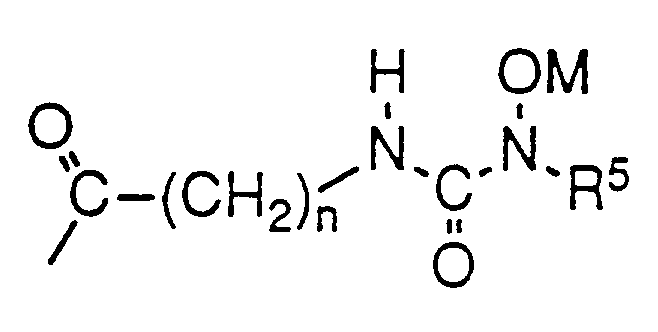
with the proviso that when R¹ is -C(O)(CH₂)nNHC(O)N(OM)R⁵, then R² is selected from -COOH, -COO⁻ B⁺ where B is a pharmaceutically acceptable cation, and -COO(alkyl) where the alkyl group is of from one to six carbon atoms. In the foregoing definition of R¹, the phenyl ring of the phenylthio or phenylalkylthio groups are optionally substituted with one or two groups selected from alkyl of from one to six carbon atoms, haloalkyl of from one to six carbon atoms, alkoxy of from one to twelve carbon atoms, hydroxy and halogen. - The substituent group R² is selected from the group consisting of

- In the foregoing definitions of R², n is an integer of from one to four, and R⁵ is selected from the group consisting of
- (1) alkyl of from one to six carbon atoms,
- (2) hydroxyalkyl of from one to six carbon atoms,
- (3) phenylalkyl in which the alkyl portion contains from one to six carbon atoms,
- (4) alkoxyalkyl in which the alkoxy and alkyl portions each, independently, contain from one to six carbon atoms,
- (5) phenoxyalkyl in which the alkyl portion contains from one to six carbon atoms,
- (6) (alkoxyalkoxyl)alkyl in which each alkoxy portion, independently, contains from one to six carbon atoms, and the alkyl portion contains from one to six carbon atoms,
- (7) (alkoxycarbonyl)alkyl in which the alkoxycarbonyl portion contains from two to six carbon atoms and the alkyl portion contains from one to six carbon atoms,
- (8) (aminocarbonyl)alkyl in which the alkyl portion contains from one to six carbon atoms,
- (9) ((alkylamino)carbonyl)alkyl in which each alkyl portion independently contains from one to six carbon atoms,
- (10) ((dialkylamino)carbonyl)alkyl in which each alkyl portion independently contains from one to six carbon atoms,
- (11) 2-, 3-, and 4-pyridylalkyl in which the alkyl portion contains from one to six carbon atoms,
- (12) (2-furyl)alkyl in which the alkyl portion contains from one to six carbon atoms,
- (13) (3-thienyl)alkyl in which the alkyl portion contains from one to six carbon atoms,
- (14) (2-benzo[b]thienyl)alkyl in which the alkyl portion contains from one to six carbon atoms,
- (15) (2-benzo[b]furyl)alkyl in which the alkyl portion contains from one to six carbon atoms,
- (16) (5-(1,2,4-triazolyl))alkyl in which the alkyl portion contains from one to six carbon atoms,
- (17) (2-imidazolyl)alkyl in which the alkyl portion contains from one to six carbon atoms,
- (18) (2-thiazolyl)alkyl in which the alkyl portion contains from one to six carbon atoms,
- (19) (2-pyrimidyl)alkyl in which the alkyl portion contains from one to six carbon atoms, and
- (20) (5-tetrazolyl)alkyl in which the alkyl portion contains from one to six carbon atoms.
- In the foregoing definition of R², the substituent group R⁶ is, at each occurrence, selected from hydrogen, and alkyl of from one to six carbon atoms and the substituent group R⁷ is selected from the group consisting of
- (1) alkyl of from one to six carbon atoms,
- (2) hydroxyalkyl of from one to six carbon atoms,
- (3) phenylalkyl in which the alkyl portion contains from one to six carbon atoms,
- (4) ((carboxy)phenyl)alkyl in which the alkyl portion contains from one to six carbon atoms,
- (5) alkoxyalkyl in which the alkoxy and alkyl portions each, independently, contain from one to six carbon atoms,
- (6) phenoxyalkyl in which the alkyl portion contains from one to six carbon atoms,
- (7) (carboxyl)alkyl in which the alkyl portion contains from one to six carbon atoms,
- (8) (C-malanato)alkyl in which the alkyl portion contains from one to six carbon atoms,
- (9) (C-(dialkylmalanato))alkyl in which each alkyl portion, independently, contains from one to six carbon atoms,
- (10) (alkoxyalkoxyl)alkyl in which each alkoxy portion, independently, contains from one to six carbon atoms, and the alkyl portion contains from one to six carbon atoms,
- (11) (alkoxycarbonyl)alkyl in which the alkoxycarbonyl portion contains from two to six carbon atoms and the alkyl portion contains from one to six carbon atoms,
- (12) ((N-alkyl-N-hydroxyamino)carbonyl)alkyl in which each alkyl portion, independently, contains from one to six carbon atoms,
- (13) (aminocarbonyl)alkyl in which the alkyl portion contains from one to six carbon atoms,
- (14) ((alkylamino)carbonyl)alkyl in which each alkyl portion independently contains from one to six carbon atoms,
- (15) ((dialkylamino)carbonyl)alkyl in which each alkyl portion independently contains from one to six carbon atoms,
- (16) (N-morpholinyl)alkyl in which the alkyl portion contains from one to six carbon atoms,
- (17) (N-thiomorpholinyl)alkyl in which the alkyl portion contains from one to six carbon atoms,
- (18) (N-piperidinyl)alkyl in which the alkyl portion contains from one to six carbon atoms,
- (19) (N-piperazinyl)alkyl in which the alkyl portion contains from one to six carbon atoms,
- (20) 2-,3-, and 4-pyridylalkyl in which the alkyl portion contains from one to six carbon atoms,
- (21) (2-furyl)alkyl in which the alkyl portion contains from one to six carbon atoms,
- (22) (3-thienyl)alkyl in which the alkyl portion contains from one to six carbon atoms,
- (23) (2-benzo[b]thienyl)alkyl in which the alkyl portion contains from one to six carbon atoms,
- (24) (2-benzo[b]furyl)alkyl in which the alkyl portion contains from one to six carbon atoms,
- (25) (5-(1,2,4-triazolyl))alkyl in which the alkyl portion contains from one to six carbon atoms,
- (26) (2-imidazolyl)alkyl in which the alkyl portion contains from one to six carbon atoms,
- (27) (2-thiazolyl)alkyl in which the alkyl portion contains from one to six carbon atoms,
- (28) (2-pyrimidyl)alkyl in which the alkyl portion contains from one to six carbon atoms, and
- (29) (5-tetrazolyl)alkyl in which the alkyl portion contains from one to six carbon atoms.
- The group M is selected from the group consisting of hydrogen, a pharmaceutically acceptable cation, and a pharmaceutically acceptable metabolically cleavable group.
- R³ is selected from the group consisting of phenylalkyl in which the alkyl portion contains from one to six carbon atoms; and heteroarylalkyl in which the alkyl portion contains from one to six carbon atoms and the heteroaryl group is selected from the group consisting of 2-, 3- and 4-pyridyl, 2- and 3-thienyl, 2- and 3-furyl, indolyl, pyrazinyl, isoquinolyl, quinolyl; imidazolyl, pyrrolyl, pyrimidyl, benzofuryl, benzothienyl, thiazolyl; and carbazolyl.
- In the foregoing definition of R³, the rings of the phenylalkyl or heteroarylalkyl groups are optionally substituted with one or two groups selected from alkyl of from one to six carbon atoms; alkoxy of from one to twelve carbon atoms; phenyl, optionally substituted with alkyl of from one to six carbon atoms, haloalkyl of from one to six carbon atoms, alkoxy of from one to six carbon atoms, hydroxy, or halogen; phenoxy, optionally substituted with alkyl of from one to six carbon atoms, haloalkyl of from one to six carbon atoms, alkoxy of from one to six carbon atoms, hydroxy, or halogen; 2-,3-, or 4-pyridyl, optionally substituted with alkyl of from one to six carbon atoms, haloalkyl of from one to six carbon atoms, alkoxy of from one to six carbon atoms, hydroxy, or halogen; and 2-, 3-, or 4-pyridyloxy, optionally substituted with alkyl of from one to six carbon atoms, haloalkyl of from one to six carbon atoms, alkoxy of from one to six carbon atoms, hydroxy, or halogen; and (CH₂)nN(OH)C(O)NR⁵R⁶; and -(CH₂)nN(R⁵)C(O)N(OM)R⁶; with the proviso that when R³ is -(CH₂)nN(OH)C(O)NR⁵R⁶ or -(CH₂)nN(R⁶)C(O)N(OM)R⁶, then R² is selected from -COOH, -COO⁻ B⁺ where B is a pharmaceutically acceptable cation, and -COO(alkyl) where the alkyl group is of from one to six carbon atoms.
- In the compounds of this invention, R⁴ is selected from the group consisting
R⁴ is selected from the group consisting of (1) alkyl of from one to six carbon atoms; (2) alkoxy of from one to twelve carbon atoms; (3) phenyl; (4) phenoxy; (5) phenylalkyloxy in which the alkyloxy portion contains from one to six carbon atoms; and (6) 1- and 2-naphthylalkyloxy in which the alkyloxy portion contains from one to six carbon atoms ; in which the ring portion of each of the foregoing is optionally substituted with (a) alkyl of from one to six carbon atoms, (b) haloalkyl of from one to six carbon atoms, (c) alkoxy of from one to six carbon atoms, (d) hydroxy or (e) halogen. Additionally, R⁴ is selected from heteroarylalkyloxy in which the alkyloxy portion contains from one to six carbon atoms and the heteroaryl portion is selected from the group consisting of (7) 2-, 3-, and 6-quinolyl; (8) 2-, 3-, and 4-pyridyl; (9) 2-benzothiazolyl; (10) 2-quinoxalyl; (11) 2- and 3-indolyl; (12) 2- and 3-benzimidazolyl; (13) 2- and 3-benzo[b]thienyl; (14) 2- and 3-benzo[b]furyl; (15) 2-benzimidazolyl; (16) 2-thiazolyl, and (17) 1-, 3-, and 4-isoquinolyl, wherein the ring portion of each of the foregoing groups (7) through (17) is optionally substituted with alkyl of from one to six carbon atoms, haloalkyl of from one to six carbon atoms, alkoxy of from one to twelve carbon atoms, halogen, or hydroxy. - As used throughout this specification and the appended claims, the term "alkyl" refers to a monovalent group derived from a straight or branched chain saturated hydrocarbon by the removal of a single hydrogen atom. Alkyl groups are exemplified by methyl, ethyl, n- and iso-propyl, n-, sec-, iso- and tert-butyl, and the like.
- The term "alkylene" denotes a divalent group derived from a straight or branched chain saturated hydrocarbon by the removal of two hydrogen atoms, for example methylene, 1,2-ethylene, 1,1-ethylene, 1,3-propylene, and the like.
- The term "alkenyl" denotes a monovalent group derived from a hydrocarbon containing at least one carbon-carbon double bond by the removal of a single hydrogen atom. Alkenyl groups include, for example, ethenyl, propenyl, butenyl, 1-methyl-2-buten-1-yl and the like.
- The term "alkenylene" denotes a divalent group derived from a straight or branched chain hydrocaron containing at least one carbon-carbon double bond. Examples of alkenylene include -CH=CH-, -CH₂CH=CH-, -C(CH₃)=CH-, -CH₂CH=CHCH₂-, and the like.
- The term "cycloalkylene" refers to a divalent group derived from a saturated carbocyclic hydrocarbon by the removal of two hydrogen atoms, for example cyclopropylene, cyclopentylene, cyclohexylene, and the like.
- The term "alkylthio" denotes an alkyl group, as defined above, attached to the parent molecular moiety through a sulfur atom.
- The terms "heterocyclic aryl" and "heteroaryl" as used herein refers to substituted or unsubstituted 5-or 6-membered ring aromatic groups containing one, two or three nitrogen atoms, one nitrogen and one sulfur atom, or one nitrogen and one oxygen atom. The term heteroaryl also includes bi- or tricyclic groups in which the aromatic heterocyclic ring is fused to one or two benzene rings. Representative heteroaryl groups are pyridyl, thienyl, furyl, indolyl, pyrazinyl, isoquinolyl, quinolyl, imidazolyl, pyrrolyl, pyrimidyl, benzofuryl, benzothienyl, carbazolyl, and the like.
- The term "metabolically cleavable group" denotes a group which is cleaved in vivo to yield the parent molecule in which M is hydrogen. Examples of metabolically cleavable groups include -COR, -COOR, -CONRR and -CH₂OR radicals where R is selected independently at each occurrence from alkyl, trialkylsilyl, carbocyclic aryl or carbocyclic aryl substituted with one or more of C₁-C₄ alkyl, halogen, hydroxy or C₁-C₄ alkoxy. Representative metabolically cleavable groups include acetyl, methoxycarbonyl, benzoyl, methoxymethyl and trimethylsilyl groups.
- The term "hydroxyalkyl" means an alkyl group as defined above, having one, two or three hydrogen atoms replaced by hydroxyl groups, with the proviso that no more than one hydroxy group may be attached to a single carbon atom of the alkyl group.
- The term "phenylalkyl" denotes a phenyl group attached to the parent molecular moiety through an alkylene group.
- "Alkoxy" means an alkyl group, as defined above, attached to the parent molecular moeity through an oxygen atom. Representative alkoxy groups include methoxy, ethoxy, propoxy, tert-butoxy and the like.
- "Alkoxyalkyl" means an alkoxy group, as defined above, attached to the parent molecular moiety through an alkylene group.
- The term "phenoxy" represents a phenyl group attached to the parent molecular moiety through an oxygen atom.
- The term "phenoxyalkyl" denotes a phenoxy group attached to the parent molecular moiety through an alkylene group. Typical phenoxyalkyl groups include phenoxymethyl, phenoxyethyl, and the like.
- "(Alkoxyalkoxy)alkyl stands for a group in which an alkoxy group, as defined above is attached through its oxygen atom to a second alkoxy group which, in turn, is attached through an alkylene group to the parent molecular moiety. Representative (alkoxyalkoxy)alkyl groups include methoxymethoxymethyl, methylethoxymethyl, ethoxyethoxymethyl, and the like.
- The term "(alkoxycarbonyl)alkyl denotes an ester group (-COOalkyl)) attached through an alkylene group to the parent molecular moiety, for example, ethoxycarbonylmethyl, ethoxycarbonylethyl, and the like.
- The terms "(aminocarbonyl)alkyl," "(alkylaminocarbonyl)alkyl," and "(dialkylaminocarbonyl)Alkyl" mean, respectively, an amino group, or an amino group substituted by one or two alkyl groups, as defined above, attached through a carbonyl group and thence through an alkylene group to the parent molecular moiety. Representative groups of this type include -(CH₂)C(O)NH₂, -(CH₂)C(O)NHCH₃, -(CH₂)C(O)N(CH₃)₂ and the like.
- The term "(C-malanato)alkyl" represents a malonic acid group, attached through its methylene carbon to the parent molecular moiety through an alkylene group; i.e. a group of the formula

Similarly, the term "(C-(dialkylmalanato))alkyl represents a malonic acid group in which the two acid functional groups have been esterified with alkyl groups, attached to the parent molecular moiety at its methylene carbon through an alkylene group. - The term "((N-alkyl-N-hydroxyamino)carbonyl)alkyl" stands for a group of the formula

in which "alkylene" and "alkyl" are as defined above. - The compounds of the present invention comprise a class of substituted indoles in which the 3-position is substituted by an alkylthio group or an

(N-hydroxyamido)alkylcarbonyl group of the formula
in which n is an integer of from one to four, M is as previously defined, and R⁵ is hydrogen or lower alkyl. Preferred compounds of the present invention are those in which the 3-position substituent is alkylthio. - The 2-position of the indole nucleus of the compounds of the present invention is substituted with a urea, N-hydroxyurea, hydroxamate, guanidyl, or hydroximino group, any of which may be further substituted. These groups are attached to the indole nucleus through an alkylene, alkenylene, or cycloalkylene spacing group. Preferred compounds of the present invention are those in which the substituent at the 2-position of the indole nucleus is selected from N-hydroxyurea groups of the structures

N'-hydroxyurea groups of the structures
urea groups of the structure
and O-substituted oxime groups of the structure
where R⁵, R⁶ and R⁷ are as defined above. - The 1-position of the indole nucleus of compounds of this invention is substituted by an alkyl-substituted carbocyclic aromatic group, an alkyl-substituted heteroaryl group, an N-hydroxyurea of the structure -(CH₂)nN(OH)C(O)NR⁵R⁶ or -CH₂)nN(R⁵)C(O)N(OH)R⁶, where R⁵ at each occurrence selected from hydrogen and lower alkyl and R⁶ has the values defined above. The integer, n, is 1 to 4, inclusive. Preferred compounds of the present invention are those where the substituent at position 1 of the indole nucleus is benzyl or benzyl substituted by C₁-C₆ alkyl, C₁-C₆ alkoxy, phenoxy, halogen, or hydroxy.
- Specific examples of compounds contemplated as falling within the scope of this invention include, but are not limited to the following examples, including the pharmaceutically acceptable salts and esters thereof:
N'-hydroxy-N'-methyl-N-2-[2-methyl-3-(1-(4-chlorophenylmethyl)-3-(1,1-dimethylethylthio)-5-(1-methylethyl)indol-2-yl)]propyl urea;
2,2-dimethyl-3-[1-(4-chlorophenylmethyl)-3-(1,1-dimethylethylthio)-5-(1-methylethyl)indol-2-yl]propionaldehyde oxime;
N-hydroxy-N-2,2-dimethyl-3-[(1-(4-chlorophenylmethyl)-3-(1,1-dimethylethylthio)-5-(1-methylethyl))indol-2-yl]propyl urea;
N'-hydroxy-N'methyl-N-2-[(1-(4-chlorophenylmethyl)-3-(1,1-dimethylethylthio)-5-(1-methylethyl))indol-2-yl]ethyl urea;
N-2,2-dimethyl-3-[(1-(4-chlorophenylmethyl)-3-(1,1-dimethylethyl-thio)-5-(1-methylethyl))indol-2-yl]propyl urea;
N'-hydroxy-N'-methyl-N-2-[3-(1-(4-chlorophenylmethyl)-3-(1,1-dimethylethylthio)-5-(1-methylethyl)indol-2-yl)-2,2-dimethylpropionylamino]ethyl urea;
1-(4-chlorophenylmethyl)-2-[2,2-dimethyl-3-((3-hydroxypropyl)-amino)propyl]-3-(1.1-dimethylethylthio)-5-(1-methylethyl)indole;
N-2-[2-methyl-3-(1-(4-chlorophenylmethyl)-3-(1,1-dimethylethylthio)-5-(1-methylethyl)indol-2-yl)]propyl urea;
3-[3-(1-(4-chlorophenylmethyl)-3-(1,1-dimethylethylthio)-5-(1-methylethyl)indol-2-yl)-2-aminocarbonylamino-2-methylpropyl)propanoic acid, ethyl ester;
3-[3-(1-(4-chlorophenylmethyl)-3-(1,1-dimethylethylthio)-5-(1-methylethyl)indol-2-yl)-2-aminocarbonylamino-2-methylpropyl]propanoic acid;
N'-hydroxy-N'-methyl-N-[1-(4-chlorophenylmethyl)-5-(1-methylethyl)-2-((2-methyl-2-ethoxycarbonyl)propyl)indol-2-yl]-3-oxopropylurea;
1-(4-chlorophenylmethyl)-3-(1,1-dimethylethylthio)-2-[3-(2,2-dimethyl-1-guanidinylimino)propyl]-5-(1-methylethyl)indole;
N-hydroxy-N-[trans-2-(1-(4-chlorophenylmethyl)-3-(1,1-dimethylethylthio)-5-(1-methylethyl)indol-2-yl)cyclopropyl]methylurea;
3-[3-(1,1-dimethylethylthio)-5-(1-methylethyl)-1-(4-pyridinylmethyl)indol-2-yl]-2,2-dimethylpropanoic acid;
3-[3-(1,1-dimethylethylthio)-5-(1-methylethyl)-1-(2-thienylmethyl)indol-2-yl]-2,2-dimethylpropanoic acid;
N-hydroxy-N-trans-[3-(1-(4-chlorophenylmethyl)-3-(1,1-dimethylethylthio)-5-(1-methylethyl)indol-2-yl)]prop-2-enylurea;
N-[3-(1-(4-chlorophenylmethyl)-3-(1,1-dimethylethylthio)-5-(1-methylethyl)indol-2-yl)-2,2dimethylpropyl]acetohydroxamic acid;
N-hydroxy-N-3-[3-(1-(4-chlorophenylmethyl)-3-(1,1-dimethylethylthio)-5-(1-methylethyl)indol-2-yl)-2,2-dimethylpropionylamino]propyl urea;
3-[1-(4-chlorophenylmethyl)-3-(1,1-dimethylethylthio)-5-(1-methylethyl)indol-2-yl]-2,2-dimethylpropionaldehyde oxime-O-2-acetic acid;
2-(3-amino-2,2-dimethylpropyl )-1-(4-chlorophenylmethyl)-3-(1,1-dimethylethylthio)-5-(1-methylethyl)indole;
N-[3-(1-(4-chlorophenylmethyl)-3-(1,1-dimethylethylthio)-5-(1-methylethyl)indol-2-yl)-2,2-dimethylpropyl]acetamide;
N-[trans-2-(1-(4-chlomphenylmethyl)-3-(1,1-dimethylethylthio)-5-(1-methylethyl)indol-2-yl)cyclopropyl]methyl urea;
N'-hydroxy-N-3-[3-(1,1-dimethylethylthio)-5-(1-methylethyl)-2-((2-methyl-2-ethoxycarbonyl)propyl)indol-1-yl]propyl urea;
2,2-dimethyl-3-[1-(2-thiophenylmethyl)-3-(1,1-dimethylethylthio)-5-(1-methylethyl)indol-2-yl]propionaldehyde oxime;
N-2,2-dimethyl-3-[(1-(2-thiophenylmethyl)-3-(1,1-dimethylethyl-thio)-5-(1-methylethyl)indol-2-yl]propyl urea;
3-[1-(4-chlorophenylmethyl)-3-(1,1-dimethylethylthio)-5-(methoxy)indol-2-yl]-2,2-dimethylpropionaldehyde oxime-O-2-acetic acid;
3-[1-(4-chlorophenylmethyl)-3-(1,1-dimethylethylthio)-5-(1-methylethyl)-indol-2-yl]-2,2-dimethylpropionaldehyde oxime-O-3-propionic acid;
N-{3-[1-(4-chlorophenylmethyl)-3-(1,1-dimethylethylthio)-5-(1-methylethyl)indol-2-yl]-2,2-dimethylpropionaldehyde oxime-O}-methyl urea;
N-2-[1-(4-chlorophenylmethyl)-3-(1,1-dimethylethylthio)-5-(1-methylethyl)indol-2-yl)-2,2-dimethylpropionylamino]ethyl urea;
3-[1-(4-fluorophenylmethyl)-3-(1,1-dimethylethylthio)-5-(1-methylethyl)-indol-2-yl]-2,2-dimethylpropionaldehyde oxime-O-2-acetic acid;
3-[1-(4-chlorophenylmethyl)-3-(1,1-dimethylethylthio)-5-(1-methylethyl)-indol-2-yl]-2,2-dimethylpropionaidehyde oxime-O-2-propionic acid;
3-[3-(1,1-dimethylethylthio)-5-(quinolin-2-ylmethoxy)-1-(4-chlorophenylmethyl)-indol-2-yl]-2,2-dimethylpropionaldehyde oxime-O-2-acetic acid;
3-[3-(1,1-dimethylethylthio)-5-(quinolin-2-ylmethoxy)-1-(-4-chlorophenylmethyl) indol-2-yl]-2,2-dimethylpropionaldehyde oxime-O-2-(3-methyl)butyric acid
3-[3-(1,1-dimethylethylthio)-5-(6,7-dichloroquinolin-2-ylmethoxy-1-(4-chlorophenylmethyl) indol-2-yl]-2,2-dimethylpropionaldehyde oxime-O-2-acetic acid
3-[3-(1,1-dimethylethylthio)-5-(6-fluoroquinolin-2-ylmethoxy-1-(4-chlorophenylmethyl) indol-2-yl]-2,2-dimethylpropionaldehyde oxime-O-2-propionic acid;
3-[3-(1,1-dimethylethylthio)-5-(quinoxalin-2-ylmethoxy)-1-(4-chlorophenylmethyl) indol-2-yl]-2,2-dimethylpropionaldehyde oxime-O-2-acetic acid;
3-[3-(1,1-dimethylethylthio)-5-(6-methoxynaphth-2-ylmethoxy)-1-(4-chlorophenylmethyl) indol-2-yl]-2,2-dimethylpropionaldehyde oxime-O-2-acetic acid;
3-[3-(1,1-dimethylethylthio)-5-(2-oxyquinolin-6-ylmethoxy)-1-(4-chlorophenylmethyl) indol-2-yl]-2,2-dimethylpropionaldehyde oxime-O-2-acetic acid;
3-[3-(1,1-dimethylethylthio)-5-(pyrid-2-ylmethoxy)-1-(4-chlorophenylmethyl) indol-2-yl]-2,2-dimethylprypionaldehyde oxime-O-2-acetic acid;
3-[3-(1,1-dimethylethylthio)-5-(N-methylindol-2-ylmethoxy)-1-(4-chlorophenylmethyl) indol-2-yl]-2,2-dimethylpropionaldehyde oxime-O-2-acetic acid;
3-[3-(1,1-dimethylethylthio)-5-(4-fluorophen-2-ylmethoxy)-1-(4-chlorophenylmethyl) indol-2-yl]-2,2-dimethylpropionaldehyde oxime-O-2-acetic acid; and
Certain compounds of this invention may exist in geometric or stereoisomeric forms. The present invention contemplates all such compounds, including cis- and trans- geometric isomers, R- and S-enantiomers, diastereomers, and mixtures thereof as falling within the scope of the invention. If a particular enantiomer is desired, it may be prepared by chiral synthesis or by derivatization with a chiral auxiliary where the resulting diastereomeric mixture is separated and the auxiliary group cleaved to provide the pure desired enantiomers. Alternatively, where the molecule contains a basic functional group such as amino or an acidic functional group such as carboxyl, diastereomeric salts are formed with an appropriate optically active acid or base, followed by resolution of the diastereomers thus formed by fractional crystallization or chromatographic means well known in the art and subsequent recovery of the pure enantiomers. - Certain compounds of the present invention may contain a basic functional group such as amino, alkylamino, or dialkylamino and are thus capable of forming salts with pharmaceutically acceptable acids. The term "pharmaceutically acceptable salts" in this respect, refers to the relatively non-toxic, inorganic and organic acid addition salts of compounds of the present invention. These salts can be prepared in situ during the final isolation and purification of the compounds or by separately reacting the purified compound in its free base form with a suitable organic or inorganic acid and isolating the salt thus formed. Representative salts include the hydrobromide, hydrochloride, sulfate, bisulfate, phosphate, nitrate, acetate, oxalate, valerate, oleate, palmitate, stearate, laurate, borate, benzoate, lactate, phosphate, tosylate, citrate, maleate, fumarate, succinate, tartrate, naphthylate, mesylate, glucoheptonate, lactobionate, laurylsulphonate salts and the like. (See, for example S. M. Berge, et al., "Pharmaceutical Salts," J, Pharm, Sci., 66: 1-19 (1977)).
- In other cases, the compounds may contain one or more acidic functional groups such as carboxyl and the like and are capable of forming salts with pharmaceutically acceptable bases. The term "pharmaceutically acceptable salts" in these instances refers to the relatively non-toxic, inorganic and organic base addition salts of compounds of the present invention. These salts can be likewise prepared in situ during the final isolation and purification of the compounds or by separately reacting the purified compound in its free acid form with a suitable base such as the hydroxide, carbonate or bicarbonate of a pharmaceutically acceptable metal cation or with ammonia, or an organic primary, secondary, or tertiary amine. Representative alkali or alkaline earth salts include the lithium, sodium, potassium, calcium, magnesium and aluminum salts and the like. Representative organic amines useful for the formation of base addition salts include ethylamine, diethylamine, ethylenediamine, ethanolamine, diethanolamine, piperazine, and the like. (See, for example S. M. Berge, et al., "Pharmaceutical Salts," J, Pharm, Sci., 66: 1-19 (1977) which is incorporated herein by reference.)
- The compounds of the present invention are synthesized by the following general synthetic mutes. One general method for the synthesis of intermediate indoles used to prepare compounds of this invention, shown in Reaction Scheme 1, employs the Fischer indole synthesis (cf. Advanced Organic Chemistry, Reactions, Mechanisms, and Structure, 3rd Ed. by J. March, John Wiley and Sons, 1985, p. 1032). In this method a hydrazine I is reacted with ketone II in a sutiable solvent at a temperature between 20oC and the refluxing temperature of the chosen solvent to provide the indole product III. The intermediate indole III is subsequently transformed by the procedures described for individual examples to provide the final products of this invention.

Another general method illustrated in Reaction Scheme 2, involves the reaction of hydrazine intermediate IV with the ketone intermediate V to provide the indole intermediate VI. The intermediate VI is then treated under basic conditions with a halogenated alkylaryl compound VII, where aryl is a heteroaryl group such as furanyl, thienyl, pyridyl, pyrimidyl, thiazoyl, benzothiazolyl, benzothiophenyl, benzofuranyl, or substituted phenyl.
- Inhibition of leukotriene biosynthesis by representative compounds of the present invention was evaluated in assays involving calcium ionophore-induced LTB₄ biosynthesis expressed by human polymorphonuclear leukocytes (PMNL) or human whole blood. Human PMNL were isolated from heparinized (20 USP units/mL) venous blood using Ficoll-Hypaque Mono-Poly Resolving Medium. Human PMNL suspensions (5 x 10⁶ cells/250 »L) were preincubated with test compounds or vehicle for 15 min at 37 oC followed by calcium ionophore A23187 challenge (final concentration of 8.3 »M) and the reaction terminated after 10 min by adding two volumes of methanol containing prostaglandin B₂ as an internal recovery standard. The methanol extracts were analyzed for LTB₄ content by HPLC or radioimmunoassay.
- The assay using human heparinized whole blood was incubated for 30 minutes at 37 oC after adding 50 »M of ionophore A23187. The plasma layer was obtained by centrifugation and deproteinized by the addition of four volumes of methanol. The methanol extract was analyzed for LTB₄ by HPLC or radioimmunoassay.
- The inhibitory activity of representative examples is shown in Table 1.
Table 1 Inhibition of LTB₄ Biosynthesis in Human PMNL and Human Whole Blood Example Human PMNL IC₅₀ (»M) Human Whole Blood IC₅₀ (»M) 1 0.15 1.3 2 0.27 2.2 3 0.17 1.6 4 0.57 6.7 5 0.18 0.71 6 0.15 1.2 6.2 0.31 1.4 7 4.2 6.9 8 0.4 5.2 9 77% @ 1.6 5.6 10 70% @ 1.6 2.5 11 1.5 6.9 12 100% @ 3.1 1.3 13 - 3.0 14 40% @ 0.78 2.5 15 0.09 0.9 16 -- 5.5 20 -- 0.68 21 -- 1.1 22 -- 2.1 23 0.4 2.7 24 1.1 - - Inhibition of the biosynthesis of leukotrienes in vivo after oral administration of compound was determined using a rat peritoneal anaphylaxis model in a similar manner as that described by Young and coworkers (Young, P. R.; Dyer, R.D.; Carter, G. W. Fed. Proc., Fed. Am. Soc. Exp. Biol. 1985, 44, 1185). In this model rats were injected intraperitoneally (ip) with rabbit antibody to bovine serum albumin (BSA) and three hours later injected ip with BSA to induce an antigen-antibody response. Rats were sacrificed 15 minutes after this challenge and the peritoneal fluids were collected and analyzed for leukotriene levels. Test compounds were administered by gavage one hour prior to the antigen challenge. Percent inhibition values were determined by comparing the treatment group to the mean of the control group. Compounds of this invention are orally effective in preventing the in vivo biosynthesis of leukotrienes as illustrated for representative examples shown in Table 2.
Table 2 Inhibition of Leukotriene (LT) Biosynthesis In Vivo Example Percent Leukotriene inhibition at 100 »mol/kg oral dose 2 46% 3 68% 5 86% 6 86% 20 99% - The present invention also provides pharmaceutical compositions which comprise one or more of the compounds of formula I above formulated together with one or more non-toxic pharmaceutically acceptable carriers. The pharmaceutical compositions may be specially formulated for oral administration in solid or liquid form, for parenteral injection, or for rectal or vaginal administration.
- The pharmaceutical compositions of this invention can be administered to humans and other animals orally, rectally, parenterally , intracisternally, intravaginally, intraperitoneally, topically (as by powders, ointments, or drops), bucally, or as an oral or nasal spray. The term "parenteral" administration as used herein refers to modes of administration which include intravenous, intramuscular, intraperitoneal, intrasternal, subcutaneous and intraarticular injection and infusion.
- Pharmaceutical compositions of this invention for parenteral injection comprise pharmaceutically acceptable sterile aqueous or nonaqueous solutions, dispersions, suspensions or emulsions as well as sterile powders for reconstitution into sterile injectable solutions or dispersions just prior to use. Examples of suitable aqueous and nonaqueous carriers, diluents, solvents or vehicles include water, ethanol, polyols (such as glycerol, propylene glycol, polyethylene glycol, and the like), and suitable mixtures thereof, vegetable oils (such as olive oil), and injectable organic esters such as ethyl oleate. Proper fluidity can be maintained, for example, by the use of coating materials such as lecithin, by the maintenance of the required particle size in the case of dispersions, and by the use of surfactants.
- These compositions may also contain adjuvants such as preservative, wetting agents, emulsifying agents, and dispersing agents. Prevention of the action of microorganisms may be ensured by the inclusion of various antibacterial and antifungal agents, for example, paraben, chlorobutanol, phenol sorbic acid, and the like. It may also be desirable to include isotonic agents such as sugars, sodium chloride, and the like, Prolonged absorption of the injectable pharmaceutical form may be brought about by the inclusion of agents which delay absorption such as aluminum monostearate and gelatin.
- In some cases, in order to prolong the effect of the drug, it is desirable to slow the absorption of the drug from subcutaneous or intramuscular injection. This may be accomplished by the use of a liquid suspension of crystalline or amorphous material with poor water solubility. The rate of absorption of the drug then depends upon its rate of dissolution which, in turn, may depend upon crystal size and crystalline form. Alternatively, delayed absorption of a parenterally administered drug form is accomplished by dissolving or suspending the drug in an oil vehicle.
- Injectable depot forms are made by forming microencapsule matrices of the drug in biodegradable polymers such as polylactide-polyglycolide. Depending upon the ratio of drug to polymer and the nature of the particular polymer employed, the rate of drug release can be controlled. Examples of other biodegradable polymers include poly(orthoesters) and poly(anhydrides) Depot injectable formulations are also prepared by entrapping the drug in liposomes or microemulsions which are compatible with body tissues.
- The injectable formulations can be sterilized, for example, by filtration through a bacterial-retaining filter, or by incorporating sterilizing agents in the form of sterile solid compositions which can be dissolved or dispersed in sterile water or other sterile injectable medium just prior to use.
- Solid dosage forms for oral administration include capsules, tablets, pills, powders, and granules. In such solid dosage forms, the active compound is mixed with at least one inert, pharmaceutically acceptable excipient or carrier such as sodium citrate or dicalcium phosphate and/or a) fillers or extenders such as starches, lactose, sucrose, glucose, mannitol, and silicic acid, b) binders such as, for example, carboxymethylcellulose, alginates, gelatin, polyvinylpyrrolidone, sucrose, and acacia, c) humectants such as glycerol, d) disintegrating agents such as agar-agar, calcium carbonate, potato or tapioca starch, alginic acid, certain silicates, and sodium carbonate, e) solution retarding agents such as paraffin, f) absorption accelerators such as quaternary ammonium compounds, g) wetting agents such as, for example, cetyl alcohol and glycerol monostearate, h) absorbents such as kaolin and bentonite clay, and i) lubricants such as talc, calcium stearate, magnesium stearate, solid polyethylene glycols, sodium lauryl sulfate, and mixtures thereof. In the case of capsules, tablets and pills, the dosage form may also comprise buffering agents.
- Solid compositions of a similar type may also be employed as fillers in soft and hard-filled gelatin capsules using such excipients as lactose or milk sugar as well as high molecular weight polyethylene glycols and the like.
- The solid dosage forms of tablets, dragees, capsules, pills, and granules can be prepared with coatings and shells such as enteric coatings and other coatings well known in the pharmaceutical formulating art. They may optionally contain opacifying agents and can also be of a composition that they release the active ingredient(s) only, or preferentially, in a certain part of the intestinal tract, optionally, in a delayed manner. Examples of embedding compositions which can be used include polymeric substances and waxes.
- The active compounds can also be in micro-encapsulated form, if appropriate, with one or more of the above-mentioned excipients.
- Liquid dosage forms for oral administration include pharmaceutically acceptable emulsions, solutions, suspensions, syrups and elixirs. In addition to the active compounds, the liquid dosage forms may contain inert diluents commonly used in the art such as, for example, water or other solvents, solubilizing agents and emulsifiers such as ethyl alcohol, isopropyl alcohol, ethyl carbonate, ethyl acetate, benzyl alcohol, benzyl benzoate, propylene glycol, 1,3-butylene glycol, dimethyl formamide, oils (in particular, cottonseed, groundnut, corn, germ, olive, castor, and sesame oils), glycerol, tetrahydrofurfuryl alcohol, polyethylene glycols and fatty acid esters of sorbitan, and mixtures thereof.
- Besides inert diluents, the oral compositions can also include adjuvants such as wetting agents, emulsifying and suspending agents, sweetening, flavoring, and perfuming agents.
- Suspensions, in addition to the active compounds, may contain suspending agents as, for example, ethoxylated isostearyl alcohols, polyoxyethylene sorbitol and sorbitan esters, microcrystalline cellulose, aluminum metahydroxide, bentonite, agar-agar, and tragacanth, and mixtures thereof.
- Compositions for rectal or vaginal administration are preferably suppositories which can be prepared by mixing the compounds of this invention with suitable non-irritating excipients or carriers such as cocoa butter, polyethylene glycol or a suppository wax which are solid at room temperature but liquid at body temperature and therefore melt in the rectum or vaginal cavity and release the active compound.
- Dosage forms for topical administration of a compound of this invention include powders, sprays, ointments and inhalants. The active compound is mixed under sterile conditions with a pharmaceutically acceptable carrier and any needed preservatives, buffers, or propellants which may be required. Opthalmic formulations, eye ointments, powders and solutions are also contemplated as being within the scope of this invention.
- Actual dosage levels of active ingredients in the pharmaceutical compositions of this invention may he varied so as to obtain an amount of the active compound(s) that is effective to achieve the desired therapeutic response for a particular patient, compositions, and mode of administration. The selected dosage level will depend upon the activity of the particular compound, the route of administration, the severity of the condition being treated, and the condition and prior medical history of the patient being treated. However, it is within the skill of the art to start doses of the compound at levels lower than required for to achieve the desired therapeutic effect and to gradually increase the dosage until the desired effect is achieved.
- Generally dosage levels of about 1 to about 50, more preferably of about 5 to about 20 mg of active compound per kilogram of body weight per day are administered orally to a mammalian patient. If desired, the effective daily dose may be divided into multiple doses for purposes of administration, e.g. two to four separate doses per day.
- The following examples are presented to enable one skilled in the art to practice the present invention. These examples are merely illustrative of the invention as it is defined by the appended claims.
-

- Compound 1.1 was prepared by adaptation of the procedure reported in EPA 87311031.6. To a stirring benzene (7.4 mL) solution of Compound 1.1(525 mg, 1.11 mmol), triethylamine (0.16 mL, 1.17 mmol) and diphenylphosphorylazide (0.25 mL,1.11 mmol) were added. The reaction was refluxed for one hour; N-methylhydroxylamine hydrochloride (96 mg, 1.12 mmol) in triethylamine (0.16 mL, 1.13 mmol) and H₂O (0.25 mL) was added, and the reaction stirred two hours at reflux. The cooled reaction mixture was poured into aq. sat'd NH₄Cl and extracted with EtOAc (2x). The combined organic extracts were washed (sat'd, aq NaHCO₃, H₂O, and brine), dried (MgSO₄), and concentrated in vacuo to yield 362 mg of desired product 1 as a cream-colored amorphous solid, after purification by chromatography (silica gel, 35% EtOAc/hexanes). m.p. 95-100°C; ¹H NMR (300 MHz, DMSO-d₆); 1.20 (9H, s), 1.23 (6H, d, 7.5 Hz), 1.3 (6H, s), 2.95 (4H, m), 3.38 (2H, s), 5.57 (2H, s), 6.35 (1H, s), 6.87 (2H, d, J = 8.4Hz), 6.97 (1H, dd, J = 8.4, 1.5 Hz), 7.27 (1H, d, J = 9Hz), 7.34 (2H, d, J = 9Hz), 7.48 (1H, d, J = 1.5 Hz), 9.42 (1H, s); MS (M+H)⁺ = 516. Analysis calc'd for C₂₈H₃₈ClN₃O₂S: C, 65.16; H, 7.42; N, 8.14; Found: C, 64.87; H, 7.45; N, 7.94.
-

- Compound 2.1 was prepared by reduction of compound 1.1 as follows. To a 0°C solution of Compound 1.1(2.61 g, 5.53 mmol) in 50 mL of dry THF, a 2.0 M (THF) borane dimethylsulfide solution was added dropwise (5.80 mL, 11.6 mmol). The reaction was stirred 17 hours at room temperature; methanol (10 mL) was added, and it was then concentrated in vacuo, filtered through a silica gel pad, and purified by chromatography (silica gel, 20% EtOAc/hexanes) to obtain 1.69 g of compound 2.1 as a white, amorphous solid. m.p. 67-70°C; ¹H NMR (300 MHz, DMSO-d₆); 0.82 (6H, s), 1.18 (9H, s), 1.22 (6H, d, J = 7.75 Hz), 2.93 (3H, m), 3.15 (2H, d, J = 6 Hz), 4.82 (1H, t, J = 6 Hz), 5.58 (2H, s), 6.87 (2H, d, J = 8.25 Hz), 6.97 (1H, dd, J = 8.25 and 1.5 Hz), 7.25 (1H, d, J = 8.25), 7.33 (2H, d, J = 8.25 Hz), 7.47 (1H, d, J = 1.5 Hz); MS (M+H)⁺ = 458.
- To a -63°C solution of oxalylchloride (0.41 mL, 4.66 mmol) in dry methylene chloride (4.7 mL), the following reagents were added: DMSO (0.41 mL, 5.32 mmol) in dry methylene chloride (5.32 mL) (dropwise over a five minute period) and Compound 2(1.22 g, 2.66 mmol) in dry methylene chloride (18 mL) (also dropwise over a five minute period). The reaction was stirred ten minutes after the addition of Compound 2 was completed, and then triethylamine (1.67 mL, 12.0 mmol) in dry methylene chloride (4.0 mL) was added dropwise over a five minute period and stirred one hour before quenching the cold reaction mixture with 10% KHSO₄ (aq). This solution was poured into a separatory funnel containing hexanes. The layers were separated, and the aqueous back extracted with ether. The organic layers were combined, washed (1 x sat'd, aq NaHCO₃; 1 x H₂O; and 3 x brine), dried (MgSO₄), and concentrated in vacuo to yield 1.16 g of a yellow, amorphous solid aldehyde intermediate 2.2.
- To a stirring solution of Compound 2.2(1.16 g, 2.54 mmol) in ethanol (8.5 mL), under N₂(g), pyridine (0.26 mL, 3.18 mmol) and hydroxylamine hydrochloride (210 mg, 3.05 mmol) were added neat and sequentially. The reaction was stirred 16 hours before concentrating in vacuo to yield 1.20 g of Compound 2 as a pale, yellow amorphous solid. A portion of oxime was purified by flash chromatography (silica gel, 10% EtOAc/hexanes) to yield 179 mg of the title compound as an amorphous white solid. m.p. 80 - 85°C; ¹H NMR (300 MHz, DMSO-d₆); 1.08 (6H, s), 1.20 (9H, s), 1.23 (6H, d, J = 6.75 Hz), 2.95 (1H, septet, J = 6.75 Hz), 3.08 (2H, br s), 5.45 (2H, s), 6.88 (2H, d, J = 8.25 Hz), 6.97 (1H, dd, J = 1.5 and 8.25 Hz), 7.26 (1H, d, J = 8.25 Hz), 7.32 (2H, d, J = 8.25 Hz), 7.39 (1H, s), 7.46 (1H, d, J = 1.5 Hz), 10.43 (1H, s); MS (M+H)⁺ = 471. Analysis calc'd for C₂₇H₃₅ClN₂OS: C, 68.84; H, 7.49; N, 5.95; Found: C, 68.56; H, 7.58; N, 5.70.
-

- To a stirring solution of Compound 2 (1.16 g, 2.46 mmol) in ethanol (5.0 mL), under N₂(g) atmosphere, borane pyridine complex (0.84 mL, 8.33 mmol) was added neat. The reaction was stirred for two hours, cooled to 0°C, and 12M HCl (1.4 mL, 16.7 mmol) in ethanol (1.0 mL) added dropwise over a 30 minute period. After stirring 16 hours at room temperature, 50 mL of H₂O was added to the reaction, and 4N NaOH(aq) added to raise the pH to 14. The basic solution was extracted with ether. The organic layer was washed (brine), dried (MgSO₄), and concentrated in vacuo. The crude material was purified by chromatography (silica gel, 50% EtOAc/hexanes), yielding 898 mg of hydroxylamine intermediate 3.1 as an amorphous, white solid.
- To a stirring solution of 3.1 (642 mg, 1.36 mmol) in THF (5 mL) was added trimethylsilyl isocyanate (0.24 mL, 1.5 mmol). After stirring 90 minutes, additional trimethylsilyl isocyanate(TMSNCO) (0.10 mL, 0.73 mmol) was added. The reaction was stirred for one hour then poured into a separatory funnel containing NH₄Cl (sat'd, aq) and extracted with ethyl acetate. The organic layer was washed (brine), dried (MgSO₄) concentrated in vacuo, and purified by chromatography (silica gel, 50-75% EtOAc/hexane) to yield 427 mg of desired product 3 as a white amorphous solid. m.p. 95 - 100°C; ¹H NMR (300 MHz, DMSO-d₆); 0.90 (6H, s), 1.18 (9H, s), 1.22 (6H, d, J = 6.75 Hz), 2.95 (3H, m), 3.35 (2H, s), 5.52 (2H, s), 6.25 (2H, s), 6.90 (2H, d, J = 9 Hz), 6.95 (1H, dd, J = 1.5, 9 Hz), 7.23 (1H, d, 1=9 Hz), 7.33 (2H, d, J = 9 Hz), 7.47 (1H, d, 1.5 Hz), 9.28 (1H, s); MS (M+H)⁺ = 516. Analysis calc'd for C₂₈H₃₈ClN₃O₂S (0.25 H₂O): C, 64.59; H, 7.45; N, 8.07; Found: C, 64.58; H, 7.45; N, 7.95.
-

- To a solution of diisopropylamine (11.5 mL, 81.1 mmol) in dry THF (175 mL) at 0°C, under N₂(g) atmosphere, n-BuLi (2.5M in hexanes) (31.0 mL, 77 mmol) was added over a fifteen minute interval. The reaction was stirred for 15 additional minutes at both 0°C and -78°C; t-butyl acetate (10.0 mL, 69.9 mmol) in dry THF (15 mL) was added dropwise over a 15 minute period. After stirring 45 minutes at -78°C, 2-chloro, 3-iodo-1-propene (15.8 g, 78 mmol) was added, and the reaction stirred for 15 minutes at -78°C and 15 minutes at 0°C before quenching with excess NH₄Cl (sat'd, aq). The quenched reaction mixture was poured into a separatory funnel and extracted with EtOAc (2x). The combined organic layers were washed (10% aq HCl, H₂O, and brine), dried (MgSO₄), and concentrated in vacuo to yield 18.87 g of a dark red oil. 10.18 g of intermediate 4.1, as a pale red oil, was obtained after distillation ( b.p. 79.5-83°C).
- Starting with Compound 4.1(2.5 g, 13.11 mmol) and adapting the procedure reported in EPA 87311031.6 used in Example 1, 1.09 g of the Fischer-Indole product 4.2, was obtained as a yellow waxy solid after purification by chromatography (silica gel, 5% EtOAc/hexane). Compound 4.2 ( 293 mg, 0.586 mmol) was stirred in CH₂Cl₂ (2.5 mL), TFA 0.45 mL (5.86 mmol), and anisole (0.13 mL, 1.17 mmol) overnight. After purification by chromatography (silica gel, EtOAc and 5-10% MeOH/CHCl₃), 187 mg of the acid intermediate 4.3 was obtained.
- Starting with intermediate 4.3 (161 mg, 0.363 mmol) and following the procedure outlined in Example 1, 100 mg of desired product 4 was obtained as a white solid after purification by chromatography (silica gel, 50% EtOAc/hexane). m.p. 87 - 93°C; ¹H NMR (300 MHz, DMSO-d₆); 1.23 (6H, d, J = 7.5 Hz), 1.28 (9H, s), 2.95 (4H, m), 3.08 (2H, m), 3.15 (2H, m), 5.62 (2H, s), 6.98 (3H, m), 7.20 (1H, d, J = 8.25 Hz), 7.25 (1H, m), 7.37 (2H, m), 7.46 (1H, d, J = 1.5 Hz), 9.33 (1H, m); MS (M+H)⁺ = 488, (M+NH₄)⁺ = 505. Analysis calc'd for C₂₆H₃₄ClN₃O₂S: C, 63.98; H, 7.02; N, 8.61; Found: C, 63.69; H, 7.13; N, 8.37.
-

- A stirring solution of 3 (632 mg, 1.22 mmol) in methanol (10 mL), under N₂(g) atmosphere, was warmed to 45°C (H₂O bath). To this solution was added NaOAc x 3H₂O (2.0 g, 14.64 mmol) in H₂O (3 mL). After stirring a few minutes the reaction became homogeneous, and 3.1 mL of a 1.2 M TiCl₃ aqueous was added dropwise over a few minutes. After stirring 24 hours, the reaction was partially concentrated in vacuo. The resultant concentrate was poured into 50% aq NaCl (100 mL) and extracted carefully with a 2/1 THF/ethyl acetate (2 x 100 mL) solution. The organic extracts were combined, washed (sat'd, aq NaHCO₃ and brine), dried (MgSO₄), concentrated in vacuo, and purified by chromatography (silica gel, 5% MeOH/CH₂Cl₂) to yield 350 mg of desired product 5 as a white amorphous solid. m.p. 109 - 112°C; ¹H NMR (300 MHz, DMSO-d₆); 0.82 (6H, s), 1.20 (9H, s), 1.23 (6H, d, 6.75 Hz), 2.83 - 2.98 (5H, m), 5.43 (2H, s), 5.52 (2H, s), 6.06 (1H, br t, J = 6 Hz), 6.88 (2H, d, J = 8.25 Hz), 6.97 (1H, dd, J = 8.25, 1.5 Hz), 7.24 (1H, d, J = 8.25 Hz), 7.32 (2H, d, J = 8.25 Hz), 7.47 (1H, d, J = 1.5 Hz); MS (M+H)⁺ = 500. Analysis calc'd for C₂₈H₃₈ClN₃OS: C, 67.24; H, 7.66; N, 8.40; Found: C, 67.11; H, 7.74; N, 8.25.
-

- The following reactants were combined in a round-bottom flask: Compound 1.1 (8.0 g, 16.9 mmol), β-alanine ethyl ester hydrochloride (2.65 g, 16.9 mmol), and 1-hydroxybenztriazole hydrate (6.85 g, 50.7 mmol). The vessel was placed under N₂(g) atmosphere; DMF (43 mL) and N-methyl morpholine (3.70 mL, 33.8 mmol) were then added. The reaction was cooled to -23°C (CCl₄CO₂ bath) and stirred ten minutes before adding 1-ethyl-3-(3-aminomethyl) carbodiimide hydrochloride (3.24 g, 16.9 mmol). The reaction was allowed to slowly warm to room temperature and stir overnight. The reaction mixture was poured into NaHCO₃ (200 mL) (aq, sat'd) and extracted with EtOAc (2 x 500 mL). The combined organic extracts were washed (4 x H₂O, 3 x brine), dried (MgSO₄), concentrated in vacuo, and purified by chromatography (silica gel, 20-35% EtOAc/hexane) to yield 8.83 g of intermediate ester 6.1. m.p. 45 - 50°C; ¹H NMR (300 MHz, DMSO-d₆); 1.08 (6H, s), 1.14 (3H, t, J= 6.75 Hz), 1.19 (9H, s), 1.23 (6H, d, J = 6.75 Hz), 2.42 (2H, t, J = 7.50 Hz), 2.95 (1H, septet, J = 6.75 Hz), 3.15 (2H, s), 3.22 - 3.32 (2H, m), 4.0 (2H, quartet, J = 6.75 Hz), 5.45 (2H, s), 6.86 (2H, d, J = 8.25 Hz), 6.97 (1H, dd, J = 8.25, 1.5 Hz), 7.24 (1H, d, 8.25 Hz), 7.32 (2H, d, J = 8.25 Hz), 7.47 (1H, d, 1.5 Hz), 7.58 (1H, br t, J = 5.25 Hz); MS (M+H)⁺ = 571.
- To a stirring solution of ester 6.1 (7.31 g, 12.8 mmol) in THF (40 mL), LiOH (880 mg, 21.0 mmol) in H₂O (23 mL) was added. The reaction was stirred for four hours then acidified with HCl (12M). The aqueous solution was extracted with EtOAc (2 x 300 mL). The combined aqueous extracts were dried (MgSO₄), concentrated in vacuo and purified by chromatography (silica gel, 20-50% EtOAc/hexane/2%HOAc) to yield 6.80 g of acid 6.2 as a white, amorphous solid. m.p. 80.3 - 83.0°C; ¹H NMR (300 MHz, DMSO-d₆); 1.08 (6H, s), 1.20 (9H, s), 1.23 (6H, d, J = 6.75 Hz), 2.36 (2H, t, J = 7.50 Hz), 2.95 (1H, septet, J = 6.75 Hz), 3.17 (2H, s), 3.20-3.30 (2H, m), 5.45 (2H, s), 6.87 (2H, d, J = 8.25 Hz), 6.97 (1H, dd, J = 1.5 Hz, 8.25 Hz), 7.24 (1H, d, J = 8.25 Hz), 7.32 (2H, d, J = 8.25 Hz), 7.47 (1H, d, J = 1.5 Hz), 7.57 (1H, br t, J = 5.25 Hz); MS (M+H)⁺ = 543.
- Starting with acid intermediate 6.2 (746 mg, 1.37 mmol) and following the procedure of Example I listed above, 315 mg of desired product 6 was obtained as a white, amorphous solid. m.p. 99.3 - 105°C; ¹H NMR (300 MHz, DMSO-d₆); 1.08 (6H, s), 1.20 (9H, s), 1.23 (6H, d, J = 7.5 Hz), 2.88 - 3.00 (4H, m), 3.05 - 3.15 (4H, m), 3.17 (2H, s), 5.43 (2H, s), 6.87 (2H, d, J = 8.25 Hz), 6.98 (1H, dd, J = 1.5, 8.25 Hz), 7.05 (1H, m), 7.25 (1H, d, J = 8.25 Hz), 7.32 (2H, d, J = 8.25 Hz), 7.47 (1H, d, J = 1.5 Hz), 7.59 (1H, m), 9.32 (1H, s); MS (M+H)⁺ = 587. Analysis calc'd for C₃₁H₄₃ClN₄O₃S(0.5 H₂O): C, 62.45; H, 7.44; N, 9.40; Found: C, 62.71; H, 7.33; N, 9.38.
-

- To a stirring solution, under N₂ (g) atmosphere, of ester 6.1 (964 mg, 1.69 mmol) in Et₂O (4 mL) and THF (10 mL), 1.0 M LAH (ether) solution (3.38 mL, 3.38 mmol with respect to aluminum) was added dropwise over a 90 second period. After stirring 3 hours, the reaction mixture was quenched with H₂O (0.2 mL), 15% aqueous NaOH (0.2 mL), and H₂O (0.6 mL). The resulting aluminum salts were filtered off through a celite pad with EtOAc (200 mL). The filtrate was concentrated in vacuo and purified by chromatography (silica gel, 10-35% EtOAc/hexane/2%isopropylamlne) to yield 680 mg of desired product 7 as a clear, colorless oil. ¹H NMR (300 MHz, DMSO-d₆); 0.87 (6H, s), 1.20 (9H, s), 1.23 (6H, d, J = 7.5 Hz), 1.55-1.64 (3H, m), 2.27 (2H, br s), 2.58 (2H, br t, J = 6.0 Hz), 2.90 - 3.00 (3H, m), 3.48 (2H, t, J = 6.0 Hz), 4.50 (1H, br s), 5.65 (2H, br s), 6.87 (2H, d, J = 8.25 Hz), 6.95 (1H, dd, J = 1.5, 8.25 Hz), 7.23 (1H, d, J = 8.25 Hz), 7.32 (2H, d, J = 8.25 Hz), 7.47 (1H, d, 1 = 1.5 Hz); MS (M+H)⁺ = 515. Analysis calc'd for C₃₀H₄₃ClN₂OS: C, 69.94; H, 8.41; N, 5.44; Found: C, 70.56; H, 8.57; N, 5.49.
-

- Starting with Compound 1.1 (1.00 g, 2.12 mmol) and 14.8 N ammonium hydroxide (0.90 g, 2.23 mmol) and following the procedure outlined in Example 1, 344 mg of desired product 8 was obtained as white, powdery solid after recrystallization (Et₂O/CH₂Cl₂/hexane). m.p. 206. 1-206.5°C; ¹H NMR (300 MHz, DMSO-d₆); 1.18 (15H, s), 1.23 (6H, d, J = 6.75 Hz), 2.95 (1H, septet, J = 6.75 Hz), 3.4 (2H, s), 5.41 (2H, s), 5.58 (2H, s), 5.92 (1H, s), 6.90 (2H, d, J = 8.25 Hz), 6.97 (1H, dd, J = 1.5 and 8.25 Hz), 7.28-7.35 (3H, m), 7.46 (1H, d, J = 1.5 Hz); MS (M·)⁺ = 485. Analysis calc'd for C₂₇H₃₆ClN₃OS: C, 66.71; H, 7.46; N, 8.64; Found: C, 66.89; H, 7.51; N, 8.59.
-

- Starting with Compound 1.1 (1.34 g, 2.84 mmol) and β-alanine ethyl ester hydrochloride (445 mg, 2.84 mmol) and following the procedure outlined in Example 1, 1.28 g of Compound 9 was obtained as a white, amorphous solid after purification by chromatography (silica gel, 30% EtOAc/hexane). m.p. 131°C; ¹H NMR (300 MHz, DMSO-d₆); 1.18-1.21(18 H, m), 1.23 (6H, d, J = 6.9 Hz), 2.42 (2H, t, J = 6.7 Hz), 2.95 (1H, septet, J = 7.5 Hz), 3.23 (2H, quartet, J = 6.0 Hz), 3.38 (2H, br s), 4.08 (2H, quartet, J = 7.2 Hz), 5.52 (2H, s), 5.83 (1H, t, J = 6.25 Hz), 5.87 (1H, s), 6.89 (2H, d, J = 8.6 Hz), 6.97 (1H, dd, J = 1.5 and 8.4 Hz), 7.22 (1H, d, J = 8.2 Hz), 7.32 (2H, d, J = 8.4 Hz), 7.46 (1H, d, J = 1.7 Hz); MS (M+H)⁺ = 586. Analysis calc'd for C₃₂H₄₄ClN₃O₃S: C, 65.56; H, 7.56; N, 7.17; Found: C, 65.76; H, 7.65; N, 7.12.
-

Starting with Compound 9 (1.00 g, 1.71 mmol) and following the procedure outlined in Example 6, 930 mg of desired product 10 was obtained as white, amorphous solid after purification by chromatography (silica gel, 15-50%EtOAc/2%HOAc/hexane). m.p. 139-141°C;
¹H NMR (300 MHz, DMSO-d₆); 1.18 (15H, s), 1.23 (6H, d, J = 6.9 Hz), 2.36 (2H, t, J = 6.5 Hz), 2.95 (1H, septet, J = 6.9 Hz), 3.20 (2H, quartet, J = 6.0 Hz), 3.37 (2H, br s), 5.52 (2H, s), 5.83 (1H, t, J = 6.25 Hz), 5.89 (1H, s), 6.88 (2H, d, J = 8.6 Hz), 6.97 (1H, dd, J = 1.7 and 8.6 Hz), 7.22 (1H, d, J = 8.2 Hz), 7.32 (2H, d, J = 8.2 Hz), 7.46 (1H, J = 1.7 Hz); MS (M+H)⁺ = 558/560. Analysis calc'd for C₃₀H₄₀ClN₃O₃S: C, 62.54; H, 7.35 ; N, 7.29; Found: C, 62.56; H, 7.12; N, 6.97. -

Starting with Compound 11.1 (3.60 g, 7.20 mmol), the ethyl ester of Compound 1.1, in benzene (70 mL), AlCl₃ (2.88 g, 21.6 mmol) was added neat. The reaction was stirred for one hour, under N₂(g) atmosphere. The brown reaction mixture was poured into a separatory funnel containing 10% aqueous HCl and extracted with EtOAc. The combined organic extracts were washed (2 x H₂O and 1 x brine), dried (MgSO₄), and concentrated in vacuo to yield 3.63 g of a dark orange syrup. After purification by chromatography (silica gel, 10-20% Et₂O/hexane), 1.68 g of Compound 11.2 was obtained as a viscous oil. - To a stirring solution, under N₂ (g) atmosphere, of Compound 11.2 (1.68 g, 4.08 mmol) in distilled CH₂Cl₂ (35 mL), succinic anhydride (410 mg, 4.10 mmol) was added neat. The reaction was cooled to 0°C, and AlCl₃ (1.25 g, 9.40 mmol) added via a powder addition funnel (over a three minute interval). After stirring overnight at room temperature, the reaction mixture was poured into dilute aqueous HCl and extracted with EtOAc. The combined organic extracts were washed (1x brine), dried (MgSO₄), and concentrated in vacuo. The crude concentrate was purified by chromatography (silica gel, 20% EtOAc/2%HOAc/hexane), followed by recrystallization (CH₂Cl₂/hexane) to yield 535 mg of Compound 11.3 as a fine white solid. m.p. 172.5-174°C.
- Starting with Compound 11.3 (385 mg, 0.752 mmol) and following the procedure outlined in Example 1, 30 mg of Compound 11 as a salmon-colored solid was obtained after purification by chromatography (silica gel, 20 - 50% EtOAc/hexane/2%HOAc) and recrystallization (EtOAc/hexane). m.p. 150.5-152°C; ¹H NMR (300 MHz, DMSO-d₆); 1.10 (3H, t, J = 6.75 Hz), 1.16 (9H, s), 1.25 (6H, d, J = 6.75 Hz), 2.95 (3H, s), 3.02 (1H, septet, J = 6.75 Hz), 3.23 (2H, t, J = 6.75 Hz), 3.45 (2H, quartet, J = 6.0 Hz), 3.58 (2H, s), 4.0 (2H, quartet, J = 6.75 Hz), 5.50 (2H, br s), 6.92 (3H, m), 7.08 (1H, dd, J = 1.5 and 8.25 Hz), 7.32 (1H, d, J = 8.25 Hz), 7.35 (2H, d, J = 8.25 Hz), 7.76 (1H, br s), 9.39 (1H, s); MS (M+H)⁺ = 556.
Analysis calc'd for C₃₀H₃₈ClN₃O₅(0.25 H₂0): C, 64.28; H, 6.92 ; N, 7.50; Found: C, 64.33; H, 6.86; N, 7.35. -
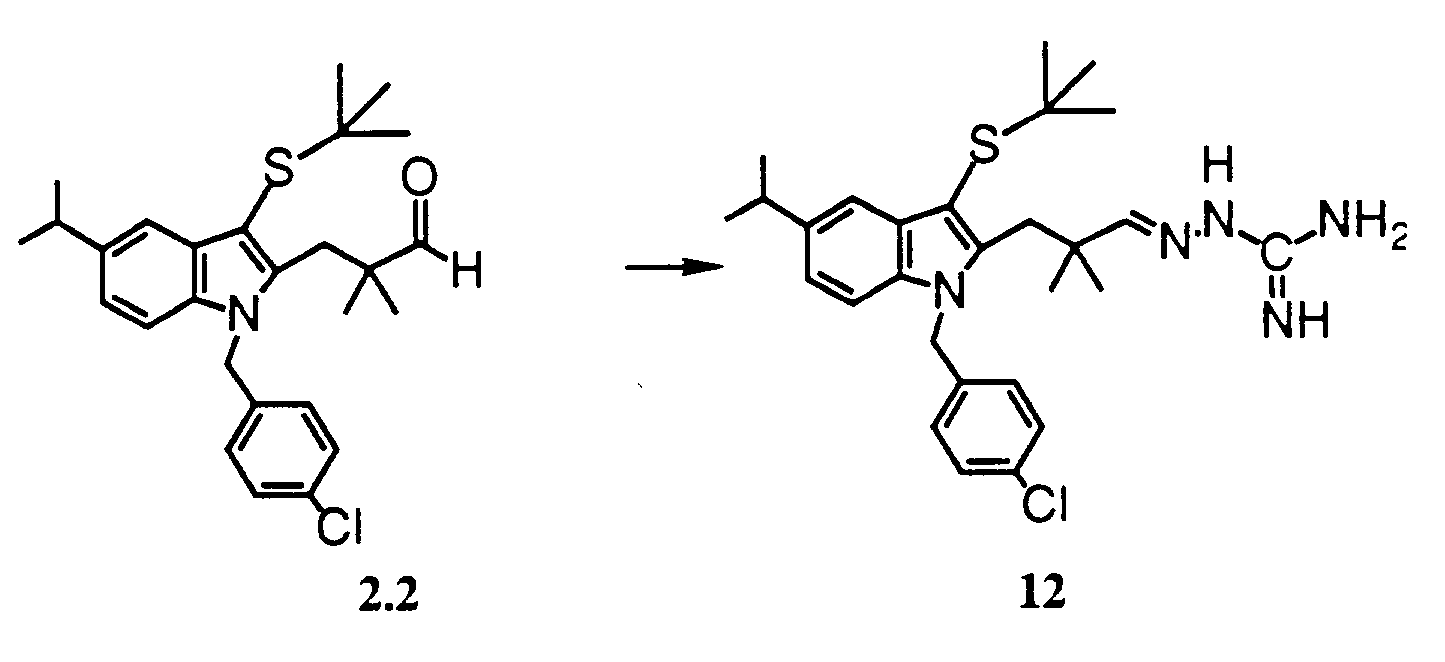
- Compound 2.2 (676 mg, 1.48 mmol) was suspended in EtOH (3 mL) and stirred under N₂(g) atmosphere. Aminoguanadinium hydrogen carbonate (205 mg, 1.50 mmol) was suspended in MeOH (3 mL) and 6N HCl aqueous added until all of the solid dissolved. The aminoguanidinium solution was added to the solution of Compound 2.2, and the reaction allowed to stir 16 hours. The reaction was concentrated in vacuo and purified by chromatography (silica gel, 5.5% MeOH/2% isopropylamine/CHCl₃) to yield 374 mg of Compound 12 as a cream-colored amorphous solid. m.p. 105-107°C; ¹H NMR (300 MHz, DMSO-d₆); 1.07 (6H, s), 1.20 (9H, s), 1.22 (6H, d, J = 6.75 Hz), 2.95 (1H, septet, J = 6.75 Hz), 3.05 (2H, br s), 5.22 (2H, br s), 5.40 (2H, s), 5.51 (2H, br s), 6.85 (2H, d, J = 8.25 Hz), 6.97 (1H, dd, J = 8.25 and 1.5 Hz), 7.27 (1H, d, J = 8.25 Hz), 7.32 (3H, m), 7.46 (1H, d, J = 1.5 Hz); MS (M+H)⁺ = 512/514.
Analysis calc'd for C₂₈H₃₈ClN₅S(0.25 H₂O): C, 65.09; H, 7.51; N, 13.67; Found: C, 64.97; H, 7.51; N, 13.47. -

- To a stirring THF (2 mL) solution of Compound 10 (314 mg, 0.563 mmol), NaOMe (30.4 mg, 0.563 mmol) was added and the reaction stirred at room temperature. The reaction was carried out under N₂(g) atmosphere. After one hour the reaction was taken up in 50% EtOAc/THF, washed (2 x brine), dried (MgSO₄), and purified by chromatography (silica gel, 5% MeOH/CH₂Cl₂) to yield 236 mg of Compound 13 as an off-white amorphous solid. m.p. 176 - 185°C; ¹H NMR (300 MHz, DMSO-d₆); 1.18 (15H, s), 1.22 (6H, d, J = 6.75 Hz), 2.26 (2H, t, J = 6.0 Hz), 2.95 (1H, septet, J = 6.75 Hz), 3.17 (2H, m), 3.38 (2H, br s), 5.53 (2H, br s), 5.88 (1H, br s), 6.0 (1H, br s), 6.89 (2H, d, J = 8.25 Hz), 6.96 (1H, dd, J = 8.25 and 1.5 Hz), 7.23 (1H, d, J = 8.25 Hz), 7.32 (2H, d, J = 8.25 Hz), 7.46 (1H, d, J = 1.5 Hz); MS (M+H)⁺ = 580 and (M+Na) = 602. Analysis calc'd for C₃₀H₃₉ClN₃O₃: C, 62.12; H, 6.78; N, 7.24; Found: C, 62.21; H, 6.78; N, 7.34.
-

- To a solution of ethyl bromopyruvate (10.00 g, 51.3 mmol) in THF (250 mL) at 0oC, was added 2-methyl-2-propanethiol (4.86 g, 53.87 mmol) followed by the dropwise addition of triethylamine (6.22 g, 61.56 mmol). The cooling bath was removed and the reaction allowed to come to rt and stir for 15 h. The reaction was then diluted with brine (250 mL) and extracted with ethyl acetate (3x 250 mL). The organics were combined, dried with MgSO4 and concentrated. Vacuum distillation of the resulting residue (0.7 mm Hg) afforded 6.47 g (62%) of ethyl t-butylthiopyruvate as a colorless oil (b.p.89-92oC) which was used immediately.
- To a solution of ethyl t-butylpyruvate (6.46 g, 31.7 mmol) in toluene (120 mL) was added N-(4-isopropylphenyl)-N-(4-chlorobenzyl)-hydrazine (11.43 g, 36.7 mmol), sodium acetate (3.30 g, 40.26 mmol) and acetic acid (60 mL). The reaction was stirred for 24 h in the dark. It was then diluted with brine (200 mL) and extracted with ethyl acetate (3x 200 mL). The organics were combined, dried with MgSO₄ and concentrated. The resulting residue was chromatographed (silica gel, ether:hexanes, 2:98) to afford 7.53 g (46%) of intermediate 14.1.
- To a solution of intermediate 14.1 (7.51 g, 16.91 mmol) in toluene (25 mL) at - 78oC, was added diisobutylaluminum hydride (50.73 mL of a 1.0 M solution in hexanes, 50.73 mmol) dropwise. Upon completion of addition, the reaction was stirred for 30 min at -78oC. It was then quenched with aqueous 10% HCl (75 mL) and warmed to rt and extracted with ethyl acetate (3x 75 mL). The organics were combined, dried with MgSO₄ and concentrated. The unpurified residue was taken up in CH₂Cl₂ (80 mL) and pyridinium dichromate (9.54 g, 25.37 mmol) was added. The reaction was stirred for 15 h, then filtered through Celite. The filtrate was concentrated. The resulting residue was chromatographed (silica gel, ether:hexanes, 3:97) to afford 4.16 g (61% over the two steps) of intermediate 14.2 as an off-white solid.
- A solution of intermediate 14.2 (4.15 g, 10.4 mmol) and malonic acid (1.40 g, 13.5 mmol) in pyridine (5 mL) containing piperidine (177 mg, 2.08 mmol) was refluxed for 18 h. It was then cooled to rt and poured into ice/conc. HCl (50 mL). This aqueous solution was then extracted with ethyl acetate (3x 50 mL). The organics were combined, dried with MgSO₄ and concentrated. The resulting residue was chromatographed (silica gel, ether:hexanes:acetic acid, 30:69:1) to afford 1.06 g (23%) of intermediate 14.3 as a gold foam.
- To a solution of intermediate 14.3 (1.05 g, 2.4 mmol) in CH₂Cl₂ (10 mL) was added oxalyl chloride (362 mg, 2.9 mmol) followed by a drop of N,N-dimethylformamide. The reaction was stirred for 1 hr, then concentrated. The resulting residue was taken up in CH₂Cl₂ (10 mL) and cooled to 0oC. N,O-Dimethylhydroxylamine hydrochloride (283 mg, 2.9 mmol) was added followed by pyridine (456 mg, 5.76 mmol). The cooling bath was withdrawn and the reaction allowed to warm to rt, diluted with brine (10 mL), and the layers were separated. The aqueous layer was extracted with CH₂Cl₂ (2x 10 mL). The organics were combined, dried with MgSO₄ and concentrated. The resulting residue was chromatographed (silica gel, ether:hexanes, 1:1) to afford 1.04 g (89%) of intermediate 14.4 as a brown oil.
- To a suspension of trimethylsulfoxonium iodide (514 mg, 2.3 mmol) in DMSO (5 mL) was added sodium hydride (57 mg of 97% dry, 2.3 mmol) and the resulting mixture was stirred for 20 min. Intermediate 14.4 (1.03 g, 2.1 mmol) was then added dropwise as a solution in DMSO (5 mL) and the reaction was stirred for 2 h at rt then brought to 50oC for 18 h. It was then cooled to rt and diluted with brine (15 mL). This aqueous solution was extracted with ethyl acetate (3x 20 mL). The organics were combined, dried with MgSO₄ and concentrated. The resulting residue was chromatographed (silica gel, ether:hexanes, 25:75) to afford intermediate 972 mg (93%) of intermediate 14.7 as a colorless oil.
- To a solution of intermediate 14.7 (962 mg, 1.93 mmol) in THF (9 mL) at 0oC, was added diisobutylaluminum hydride (2.02 mL of a 1.0 M solution in hexanes, 2.02 mmol) dropwise. Upon complete addition, the reaction was stirred for 30 min. It was then diluted with 10% aqueous HCl (10 mL) and extracted with ethyl acetate (3x 10 mL). The organics were combined, dried with MgSO₄ and concentrated. The resulting residue was chromatographed (silica gel, ether:hexanes, 15:85) to afford 349 mg (41%) of intermediate 14.8 along with 372 mg (44%) of intermediate 14.9. Intermediate 14.9(362 mg, 0.819 mmol) was recycled to intermediate 14.8(218 mg, 61%) following the oxidation procedure described for the conversion of 2.1 to 2.2.
- A solution of intermediate 14.8 (567 mg, 1.29 mmol) in 1:1 ethanol:pyridine (6 mL) was stirred for 18 h and concentrated. The resulting residue was taken up in brine (5 mL) and extracted with ethyl acetate (3x 5 mL). The organics were combined, dried with MgSO₄ and concentrated to afford intermediate 14.10.
- To a solution of intermediate 14.10 from above in ethanol (6 mL) was added borane-pyridine (264 mg, 2.84 mmol) and the mixture was stirred for 30 min. Aqueous 6N HCl (0.516 mL, 3.10 mmol) was added dropwise and the reaction was stirred for 1 hr. It was then neutralized by the addition of aqueous 2N NaOH, diluted with brine (5 mL) and extracted with ethyl acetate(3x 10 mL). The organics were combined, dried with MgSO₄ and concentrated to afford intermediate 14.11.
- To a solution of intermediate 14.11 in THF (6 mL) was added trimethylsilyl isocyanate (163 mg, 1.42 mmol) and the reaction was stirred for 10 min and concentrated. The resulting residue was chromatographed (silica gel, ether:hexanes to ether:methanol, 70:30 to 90:10) to afford the desired material as a foam. ¹H NMR (300 MHz, DMSO-d₆): 0.98 (m, 1H), 1.22 (d, 6H), 1.24 (s, 9H), 1.31 (m, 1H), 1.62 (m, 1H), 1.72 (m, 1H), 2.95 (septet, 1H), 3.21 (m, 1H), 3.66 (dd, 1H, J = 5 Hz, J = 14 Hz), 5.58 (br s, 2H), 6.30 (br s, 2H), 6.98 (m, 3H), 7.24 (d, 1H, J = 8.5 Hz), 7.35 (m, 2H), 7.46 (m, 1H), 9.30 (s, 1H); MS (M+H)⁺=500; Analysis calc'd for C₂₇H₃₄ClN₃O₂S.1/4H₂O: C, 64.27, H, 6.89, N, 8.33; Found: C, 64.26, H, 6.82, N, 7.92.
-

- Compound 15.1 was prepared by adaptation of the procedure reported in EPA 87311031.6 using 4-isopropylphenyl hydrazine hydrochloride hydrate. To a -23°C (CO₂(s)/CCl₄ bath) stirred THF (80 mL) solution of 4-pyridinemethanol (2.18 g, 20 mmol) under N₂(g) atmosphere, methanesulfonyl chloride (1.60 mL, 20 mmol) and methylamine (2.88 mL, 20 6 mmol) were added neat and sequentially. The reaction was stirred at -23°C one hour to give the corresponding mesylate. To a stirred DMSO (25 mL) solution of 15.1 (5.0 g, 13.3 mmol) under N₂(g) atmosphere, neat NaH (1.08 g, 35.9 mmol) was added. The above-formed mesylate was cannulated into the reaction mixture within 2 minutes of adding the NaH. The reaction was stirred for 120 minutes before it was quenched with sat'd aqueous NH₄Cl and extracted with EtOAc (2 x 200 mL) and 1/1 THF/EtOAc (1 x 100 mL). The combined organic extracts were washed (brine), dried (Na₂SO₄), and concentrated in vacuo to yield 1.24 g of compound 15.2 as a pale yellow solid.
- 15.2 (1.24 g, 2.66 mmol) was converted to 15 by adapting the procedure outlined in Example 1, to provide 0.60 g of 15 as a white, fibrous solid after recrystallization from CH₂Cl₂/EtOAc/hexane. m.p. 258 °C; ¹H NMR (300 MHz, DMSO-d₆); 1.01 (6H, s), 1.18-1.27 (15H, m), 2.96 (1H, septet, J = 6.75 Hz), 3.18 (2H, br s), 5.55 (2H, s), 6.77 (2H, d, J = 6.75 Hz), 7.0 (1H, dd, J = 8.25 and 1.5 Hz), 7.27 (1H, d, J = 8.25 Hz), 7.50 (1H, d, J = 1.5 Hz), 8.45 (2H, d, J = 6.75 Hz), 12.45 (1H, br s). MS (M+H)⁺ = 439. Analysis calc'd for C₂₆H₃₄N₂O₂S(0.5 H₂O): C, 70.47; H, 7.85 ; N, 6.32; Found: C, 70.57; H, 7.82; N, 6.30.
-

- Compound 16 was prepared following the procedure described in Example 15 where 2-thiophenemethanol was substituted for 4-pyridinemethanol. Purification by flash chromatography (sg, 5-10% EtOAc/CCl₄/ 2% HOAc) afforded 1.95 g of Compound 16 as a pale yellow solid. m.p. 130.5 - 132 °C; ¹H NMR (300 MHz, DMSO-d₆); 1.12 (6H, s), 1.18 (9H, s), 1.23 (6H, d, J = 7 Hz), 2.95 (1H, septet, J = 7 Hz), 3.31 (2H, s), 5.65 (2H, s), 6.91 (1H, dd, J = 4 and 5 Hz), 6.97 (1H, dd, J = 1.5 and 4 Hz), 7.02 (1H, dd, J = 1.5 and 8.25 Hz), 7.33 (1H, dd, J = 1.5 and 5 Hz), 7.42 - 7.48 (2H, m), 12.47 (1H, br s). MS (M+H)⁺ = 444 and (M+NH₄)⁺ = 461. Analysis calc'd for C₂₅H₃₃NO₂S₂: C, 67.68; H, 7.50; N, 3.16; Found: C, 67.45; H, 7.50; N, 3.10.
-

- Compound 14.3 is converted to the corresponding oxime, 17.1, following the procedures described for the conversion of 1.1 to 2. Subsequently, 17.1 is converted into 17 following the procedures for the conversion of 2 into 3.
-

- Hydroxylamine 3.1 is converted to 18 by treatment with acetyl chloride (2 equiv) and triethylamine to give the N,O-diacetate 18.1, which is O-deprotected by treatment with aqueous NaOH to provide 18.
-
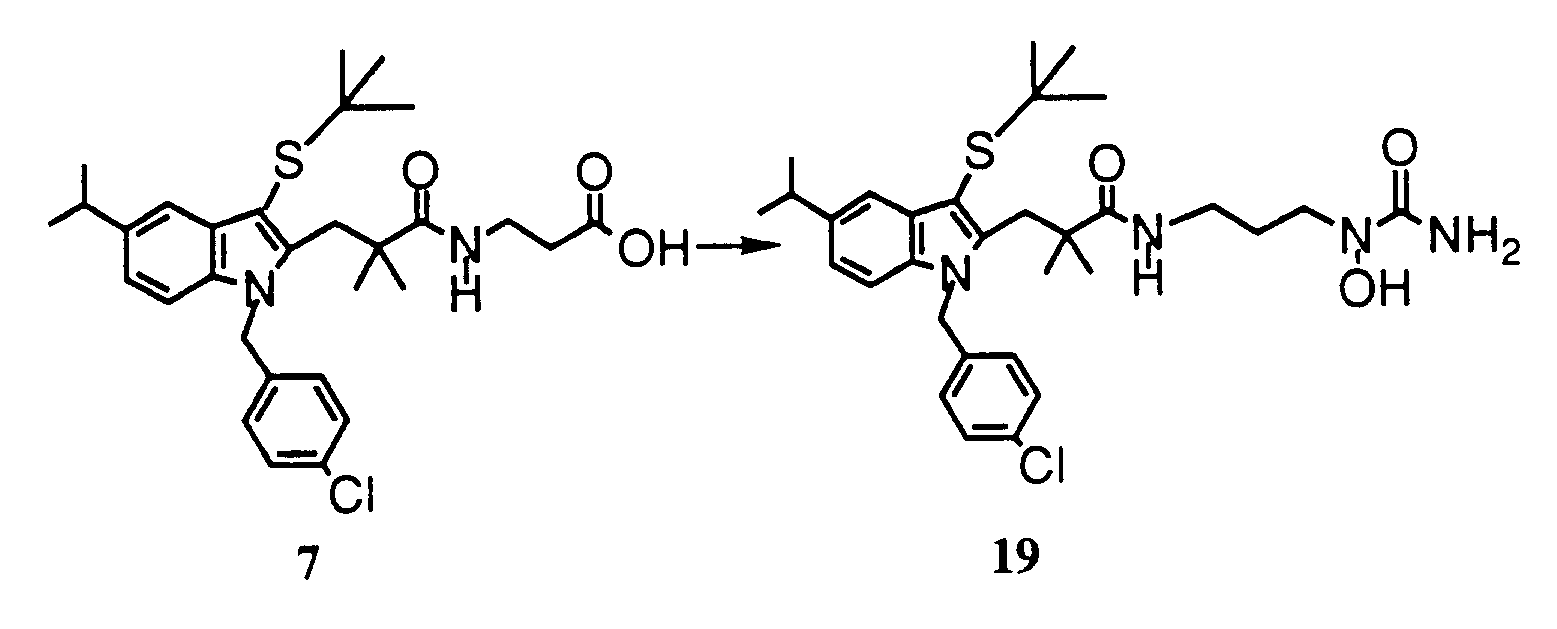
- Compound 7 is reduced to the corresponding alcohol, 19.1, following the procedure employed for the conversion of 1.1 to 2.1, and is subsequently converted to 19 following the procedure employed to transform 15.3 into 15.
-

- Compound 20 was prepared by following the procedure employed for the conversion of 2.2 to 2 where Carboxymethoxylamine hemihydrochloride was used in place of hydroxylamine hydrochloride. After purification by flash chromatography (silica gel, 20/75/5 EtOAc/Hexane/HOAc), 500 mg of a white amorphous solid was obtained. m.p. 65 - 75°C; ¹H NMR (300 MHz, DMSO-d₆); 1.08 (6H, s), 1.20 (9H, s), 1.23 (6H, d, J = 7 Hz), 2.95 (1H, septet, J = 7 Hz), 3.09 (2H, bs), 4.43 (2H, s), 5.47 (2H, s), 6.88 (2H, d, J = 8.25 Hz), 6.98 (1H, dd, J = 1.5 and 8.25 Hz), 7.25 (1H, d, J = 8.25 Hz), 7.34 (2H, d, J = 8.25 Hz), 7.47 (1H, d, J = 1.5 Hz), 7.55 (1H, s), 12.67 (1H, bs); MS (M+H)⁺ = 529. Analysis calc'd for C₂₉H₃₇ClN₂O₃S: C, 65.83; H, 7.05; N, 5.29; Found: C, 66.07; H, 7.09; N, 5.15.
-

- To a stirring solution of Compound 3.1 (10.9 g, 23.1 mmol) in 2/1/1 EtOH/EtOAc/THF, 20 g of an aqueous preparation of RaNi (50% in H₂O) was added. After stirring for thirty minutes, the reaction was carefully filtered. The catalyst was washed with THF -- making sure it was not allowed to go completely dry. The resulting filtrate was concentrated and purified by flash chromatography (silica gel, 3.5/96.5 MeOH/CH₂Cl₂) to yield 7.84 g of Compound 21 as an amorphous white solid.
- M.p. 58 - 68°C; ¹H NMR (300 MHz, DMSO-d₆); 0.82 (6H, s), 1.20 (9H, s), 1.23 (6H, d, J = 7 Hz), 1.85 (2H, bs), 2.38 (2H, s), 2.87 - 3.00 (3H, m), 5.58 (2H, s), 6.88 (2H, d, J = 8.25 Hz), 6.96 (1H, dd, J = 1.5 and 8.25 Hz), 7.23 (1H, d, J = 8.25 Hz), 7.33 (2H, d, J = 8.25 Hz), 7.46 (1H, d, J = 1.5 Hz); MS (M+H)⁺ = 457. Analysis calc'd for C₂₇H₃₇ClN₂S: C, 70.94; H, 8.16; N, 6.13; Found: C, 70.64; H, 8.13; N, 6.11.
-

- To a 0°C stirring solution of Compound 21(525 mg, 1.15 mmol) in CH₃CN (4 mL), diisopropylethylamine (0.40 mL, 2.3 mmol) and acetic anhydride (0.11 mL, 1.15 mol) were added neat and sequentially. The cooling bath was removed immediately. After five minutes, the reaction was poured into 10% HCl (aq) and extracted with EtOAc (2 x 50 mL). The organic layers were combined, washed (3 x brine), dried (MgSO₄), and concentrated in vacuo to yield 591 mg of an off-white solid. Recrystallization from Et₂O/CH₂CL₂EtOAc/Hexane afforded 130 mg of a white solid.
- M.p. 137.8 - 139°C; ¹H NMR (300 MHz, DMSO-d₆); 0.82 (6H, s), 1.20 (9H, s), 1.22 (6H, d, J = 7 Hz), 1.85 (3H, s), 2.82 - 3.08 (5H, m), 5.52 (2H, s), 6.87 (2H, d, J = 8.25 Hz), 6.97 (1H, dd, J = 1.5 and 8.25 Hz), 7.23 (1H, d, J = 8.25 Hz), 7.33 (2H, d, J = 8.25 Hz), 7.47 (1H, d, J = 1.5 Hz), 7.83 (1H, t, J = 6Hz); MS (M+H)⁺ = 499. Analysis calc'd for C₂₉H₃₉ClN₂OS: C, 69.78; H, 7.88; N, 5.16; Found: C, 69.87; H, 7.91; N, 5.60.
-

- Compound 23 was prepared starting with Compound 14 and following the procedure employed for the conversion of 3 to 5. Purification by flash chromatography (silica gel, 95/5 Et₂O/MeOH) afforded 20 mg of 23 as an amorphous white solid. ¹H NMR (300 MHz, DMSO-d₆); 0.89 (1H,m), 1.18 (1H, m), 1.21 (6H, d, J = 7Hz), 1.24 (9H, s), 1.45 (1H, m), 1.68 (1H, m), 2.94 (2H, m), 3.30 (1H, m), 5.44 (2H, bs), 5.58 (2H, bs), 6.06 (1H, J = 6 Hz); MS (M+H)⁺ = 484 and (M+NH4) = 501.
-


- To a stirring DMSO solution (15 mL) of 15.1(2.91 g, 8.22 mmol), NaH (271 mg, 9.05 mmol) and allyl bromide (0.78 mL, 9.05 mmol) were added neat and sequentially. The reaction was stirred under N₂(g) for 18 hours then poured into 50% aqueous NH₄Cl and extracted with EtOAc (2 x 50 mL). The combined organic extracts were washed (2 x H₂O and 3 x brine), dried (MgSO₄), and concentrated in vacuo to yield 273 mg of a viscous, yellow oil. This was purified by chromatography (silica gel, 2% EtOAc/CCl₄) to yield 214 mg of allyl intermediate 24.1 as a viscous oil.
- To a stirring THF (17 mL) solution of 24.1 (1.80 g, 4.33 mmol) under N₂(g) ,a 0.5 M solution of 9-BBN in THF (43.3 mL, 21.7 mmol) was added rapidly, and the reaction allowed to stir 18 hours at room temperature. NaOH (868 mg, 21.7 mmol) in H₂O (7 mL) was added all at once. The reaction was cooled to 0°C (ice/H₂O bath) and a 30% aqueous H₂O₂ solution (7.4 g, 65 mmol) added in three portions over a 5 minute period. The reaction was stirred for 10 minutes at 0°C before diluting with brine (75 mL) and extracting with Et₂O (2 x 100 mL). The Et₂O extracts were combined, washed (2 x 50 mL, brine), dried (Na₂SO₄), and concentrated in vacuo to yield 1.12 g of hydroxy intermediate 24.2 as an orange, viscous oil after purification by chromatography (silica gel, 35% EtOAc/hexane).
- To a stirring THF (10 mL) solution of 24.2 under N₂(g) atmosphere, triphenylphosphine (810 mg, 3.09 mmol) and bis-N,O-tert-butyloxycarbonyl-hydroxylamine (665 mg, 2.85 mmol) were added neat and sequentially. The homogeneous solution was cooled to - 10°C (ice/EtOH bath) and diethylazodicarboxylate (0.49 mL, 3.09 mmol) in THF (2 mL) was added dropwise over a 5 minute interval. The reaction was allowed to warm to room temperature and stir 18 hours. The reaction was concentrated in vacuo and purified by chromatography (silica gel, 3% EtOAc/CCl₄) to obtain 702 mg of 24.3 as an amorphous solid.
- To a stirring CH₂Cl₂ (5 mL) solution of 24.3, was added TFA (5 mL). The reaction was stirred 8 minutes and then immediately poured into a sat'd aqueous Na₂CO₃ solution and extracted with EtOAc (2 x 100 mL). The organic extracts were combined, washed (50% aqueous NaHCO₃, and brine), dried (Na₂SO₄), and concentrated in vacuo to yield 384 mg of the resulting hydroxylamine, 24.4. This was used without further purification.
- To a stirring THF (3 mL) solution of 24.4 (355 mg, 0.791 mmol) under N₂(g) atmosphere, trimethylsilyl isocyanate (0.63 mL, 3.96 mmol) was added. The reaction was stirred for 90 minutes, concentrated in vacuo , and purified by chromatography (silica gel, 3% MeOH/CH₂Cl₂) to yield 184 mg of 24 as an amorphous solid. m.p. 64°C; ¹H NMR (300 MHz, DMSO-d₆); 1.10 (6H, s), 1.13-1.20(12 H, m), 1.25 (6H, d, J = 6.9 Hz), 1.81 (2H, quintet, J = 6.9 Hz), 2.97 (1H, septet, J = 6.9 Hz), 3.22-3.32 (4H, m), 4.06 (2H, quartet, J = 6.9 Hz), 4.21 (2H, t, J = 6.9 Hz), 6.33 (2H, s), 7.05 (1H, dd, J= 1.5 and 8.25 Hz), 7.41 (1H, d, J = 8.25 Hz), 7.43 (1H, d, J = 1.5 Hz), 9.28 (1H, s); MS (M+H)⁺ = 492 and (M+NH₄)⁺ = 509. Analysis calc'd for C₂₆H₄₁N₃O₄S(0.5 H₂O): C, 62.94; H, 8.43 ; N, 8.47; Found: C, 62.99; H, 8.49; N, 8.39.
- Substituted indole N-hydroxyureas presented in Table 3 are prepared by the method used for Example 1 substituting N-methylhydroxylamine for the requisite N-substituted hydroxylamine, R²⁰NHOH.

- Substituted indole N-hydroxyurea compounds of the present invention presented in Table 4 are prepared by the method used for Example 3 substituting trimethylsilylisocyanate with the requisite N-substituted isocyanate, R²²-N=C=O.

- Substituted indole urea compounds in accordance with the present invention presented in Table 5 are prepared by the method used for Example 5 by deoxygenation of the N-hydroxyurea examples shown in Table 4.

- Substituted indole oxime derivatives presented in Table 6 are prepared by the method used for Example 2 substituting hydroxylamine with the requisite O-substituted hydroxylamine R²³ONH₂.


- Substituted indole acid derivatives presented in Table 7 are prepared by the method used for Example 15 substituting 4-pyridylmethanol with the requisite heteroarylmethanol intermediate B-OH.

- Substituted indole oxime derivatives as shown in Table 8 are prepared by the method used for Example 2 substituting compound 1.1 with the indole acid compounds described in Table 7 and reaction of the requisite aldehyde with the appropriate hydroxylamine, R²⁴ONH₂.

- Substituted indole oxime derivatives as shown in Table 9 are prepared by the method used for Example 11 where 11.1 is desulfurized to provide the indole intermediate 11.2 and then 11.2 is converted to various oxime derivatives by the method of Example 2 substituting hydroxylamine with the requisite O-substituted hydroxylamine, R²⁵ONH₂.


- Substituted indole amine derivatives presented in Table 10 are prepared by reductive amination (with for example sodium cyanoborohydride) of the aldehyde 2.2 using the requisite amine.


- Substituted indole hydroxamic acid derivatives as shown in Table 11 are prepared by the method of Example 3 substituting trimethylsilylisocyanate with the requisite carboxylic acid chloride or anhydride and suitable base such as pyridine or triethylamine.
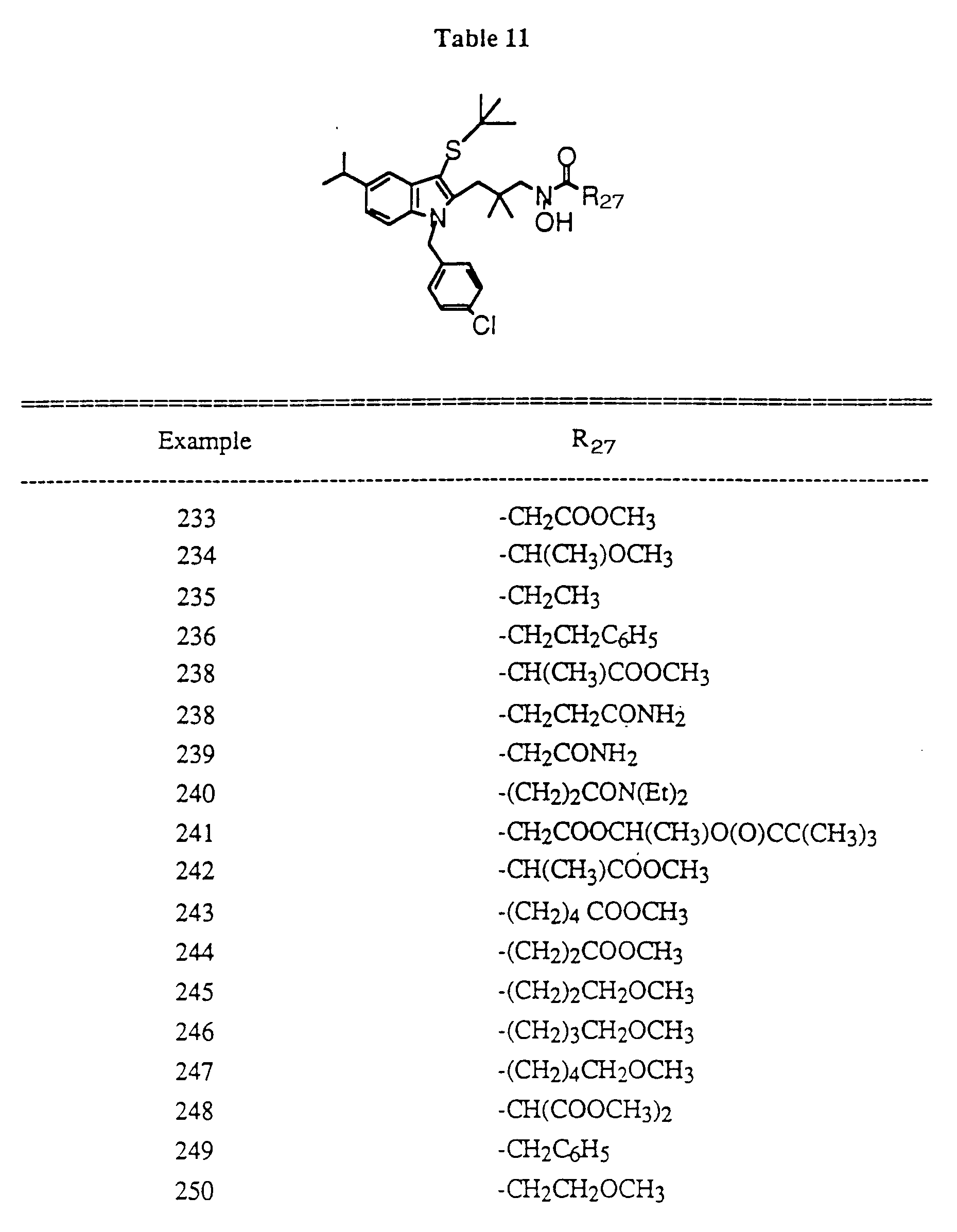

- Substituted indole hydroxamic acid derivatives X presented in Table 12 are prepared by the method of Example 4 substituting the intermediate 4.1 with the requisite alpha-substituted ketone intermediate VIII to provide the indole intermediate IX which is then converted to the corresponding oxime derivatives X.


-

Starting with the product of Example 16 (2.36 g, 5.49 mmol) and adapting the procedure described in Example 2, 3.12 g of crude oxime (containing pyridinium hydrochloride) was obtained. A portion (165 mg) of this product was purified by chromatography (silica gel, 5/95 EtOAc/hexanes) to yield 25 mg of 279 as a solid. m.p. 115.5 - 117°C; ¹H NMR (300 MHz, DMSO-d₆); 1.10(6H, s), 1.18(9H, s), 1.23 (6H, d), 2.95 (1H, septet, J=7 Hz), 3.17 (2H, bs), 5.62 (2H, bs), 6.92 (1H, dd, J = 4 and 5 Hz), 6.95 - 7.05 (2H, m), 7.33 (1H, dd, J = 1.5 and 5 Hz), 7.38 - 7.45 (3H, m), 10.44 (1H, s); MS (M+H)⁺ = 443 and (M+NH₄) = 460. Analysis calc'd for C₂₅H₃₄N₂OS₂: C, 67.83; H, 7.74; N, 6.33; Found: C, 67.50; H, 7.81; N, 6.18. -

- Starting with the product of Example 279 (1.31 g, 2.95 mmol) and adapting the procedure described in Example 21, 0.63 g of Compound 280.1 was obtained after purification by chromatography (silica gel, 20/78/2 EtOAc/hexanes/isopropylamine and 10/90 MeOH/CH₂Cl₂). Compound 280 was prepared from 280.1 (0.24 g, 0.57 mmol) by adapting the procedure of Example 3. After purification by chromatography (silica gel, 75/25 THF/hexanes) and recrystallization from EtOAc/hexanes/MeOH, 19 mg of Compound 280 was obtained as a white solid. m.p. 163.5 - 164.5°C; ¹H NMR (300 MHz, DMSO-d₆); 0.83 (6H, s), 1.18 (9H, s), 1.22 (6H, d, J = 7 Hz), 2.88 - 3.00 (5H, m), 5.45 (2H, bs), 5.67 (2H, bs), 6.07 (1H, bt, J = 6 Hz), 6.91 (1H, dd, J = 4 and 5.3 Hz), 6.96 - 7.02 (2H, m), 7.32 (1H, dd, J = 1,5 and 5.3 Hz), 7.37 - 7.46 (2H, m); MS (M+H)⁺ = 472. Analysis calc'd for C₂₆H₃₇N₃OS₂: C, 66.20; H, 7.91; N, 8.91; Found: C, 66.53; H, 8.00; N, 8.93.
-

- Compound 281.1 was prepared by adapting the procedure reported in EPA 87311031.6 using 4-methoxyphenylhydrazine hydrochloride hydrate.
- Starting with 281.1 (8.0 g, 23 mmol) and adapting the procedure described in Example 15, in which 4-chlorobenzyl bromide was substituted for 4-pyridinemethanol, 6. 17 g of crude 281.2 was obtained. A portion (1.05 g) of this crude material was purified by recrystallization from EtOAc/hexanes to yield 0.87 g of Compound 281.2 as a white solid. m.p. 193.5 - 194.5°C; ¹H NMR (300 MHz, DMSO-d₆); 1.06 (6H, s), 1.17 (9H, s), 3.15 (2H, bs), 3.72 (3H, s), 5.43 (2H, s), 6.68 (1H, dd, J = 2.25 and 9 Hz), 6.78 (2H, d, J = 9 Hz), 7.06 (1H, d, J = 2.25 Hz), 7.25 (1H, d, J = 9 Hz), 7.28 (2H, d, J = 9 Hz), 12.42 (1H, bs); MS (M+H)⁺ = 460 and (M+Na)⁺ = 482. Analysis calc'd for C₂₅H₃₀ClNO₃S(0.25 H₂O): C, 64.64; H, 6.62; N, 3.02; Found: C, 64.57; H, 6.39; N, 3.02.
- Starting with 281.2 (5.1 g, 11 mmol) and adapting the procedure described in Example 2,4.1 g of 281.3 was obtained after purification by chromatography (silica gel, 10/90 and 20/80 EtOAc/hexanes).
- Compound 281 was prepared by following the procedure detailed in Example 20. After purification by chromatography (silica gel, 20/78/2 EtOAc/hexanes/HOAc) and recrystallization from benzene/hexanes, 0.57 g of 281 was obtained as a white powder. m.p. 138 - 139°C; ¹H NMR (300 MHz, DMSO-d₆); 1.08 (6H, s), 1.22 (9H, s), 3.07 (2H, bs), 3.75 (3H, s), 4.42 (2H, s), 5.47 (2H, s), 6.72 (1H, dd, J = 1.5 and 9 Hz), 6.85 (2H, d, J = 9 Hz), 7.08 (1H, d, J = 1.5 Hz), 7.23 (1H, d, J = 9 Hz), 7.32 (2H, d, J = 9 Hz), 7.55 (1H, s); MS (M+H)⁺ = 516. Analysis calc'd for C₂₇H₃₃ClN₂O₄S: C, 62.72; H, 6.43; N, 5.42; Found: C, 62.68; H, 6.43; N, 5.34.
-

To a stirring EtOH (6.5 mL) solution of the product of Example 2, ethyl acrylate (0.27 mL, 2.5 mmol) and 0.25 mL of 2N KOH (EtOH) were added. The reaction was heated to 60°C under N₂(g) for 18 hours. The reaction was cooled to room temperature, concentrated in vacuo and diluted with Et₂O. The Et₂O solution was washed with 50% (aq) NaHCO₃. The layers were separated and the aqueous layer back-extracted with Et₂O. The combined organic extracts were washed (1xbrine), dried (MgSO₄), concentrated in vacuo, and purified by chromatography (silica gel, 10/90 Et₂O/hexanes and 20/80 EtOAc/hexanes) to yield 0.64 g of recovered 2 and 0.58 g of 282.1 as a pale yellow oil. - Compound 282 was prepared by the methodology in Example 6 used to convert 6.1 to 6.2. After purification by chromatography (silica gel, 20/80 EtOAc/hexanes and 20/78/2 EtOAc/hexanes/HOAc) and recrystallization from benzene/petroleum ether, 0.20 g of 282 as a white solid was obtained. m.p. 50 - 70°C; ¹H NMR (300 MHz, DMSO-d₆); 1.04 (6H, s), 1.16 (9H, s), 1.18 (6H, d, J = 7 Hz), 2.43 (2H, t, J = 6 Hz), 2.91 (1H, septet, J = 7 Hz), 3.06 (2H, bs), 4.02 (2H, t, J = 6 Hz), 5.39 (2H, s), 6.85 (2H, d, J = 9 Hz), 6.93 (1H, dd, J = 1.5 and 9 Hz), 7.18 (1H, d, J = 9 Hz), 7.29 (2H, d, J = 9 Hz), 7.43 (2H, s), 12.26 (1H, bs); MS (M+H)⁺ = 542. Analysis calc'd for C₃₀H₃₉ClN₂O₂S: C, 66.34; H, 7.24; N, 5.16; Found: C, 66.37; H, 7.28; N, 5.08.
-

- Starting with 282 (0.49 g 0.92 mmol) and adapting the procedure described in Example 1, substituting ammonium chloride for ammonium hydroxide, 59 mg of 283 was obtained as a white amorphous solid after purification by chromatography (silica gel, 50/50 EtOAc/hexanes and EtOAc). m.p. 90 - 110°C; ¹H NMR (300 MHz, DMSO-d₆); 1.05 (6H, s), 1.16 (9H, s),1.18 (6H, d, J = 7 Hz), 2.91 (1H, septet, J=7 Hz), 3.07 (2H, bs), 4.79 (2H, d, J = 7 Hz), 5.37 (2H, s), 5.72 (2H, s), 6.84 (2H, d, J = 9 Hz), 6.88 - 6.96 (2H, m), 7.18 (1H, d, J = 9 Hz), 7.30 (2H, d, J = 9 Hz), 7.43 (1H, d, J = 1.5 Hz), 7.45 (1H, s); MS (M+H)⁺ = 542 and (M+Na)⁺ = 565. Analysis calc'd for C₂₉H₃₉ClN₄O₂S: C, 64.13; H, 7.24; N, 10.31; Found: C, 63.86; H, 7.34; N, 10.01.
-

- Starting with Compound 6.2 (0.99 g, 1.82 mmol) and adapting the procedure described in Example 1, substituting ammonium chloride for ammonium hydroxide, 0.43 g of Compound 284 was obtained as a white amorphous solid after purification by chromatography (silica gel, 5/95 MeOH/CH₂Cl₂). m.p. 100 - 111°C; ¹H NMR (300 MHz, DMSO-d₆); 1.08(6H, s), 1.19 (9H, s), 1.24 (6H, d, J = 7 Hz), 2.88 - 3.12 (5H, m), 3.16 (2H, s), 5.44 (2H, s), 5.52 (2H, s), 6.03 (1H, t, J = 4.5 Hz), 6.85 (2H, d, J = 8 Hz), 7.25 (1H, d, J = 8 Hz), 7.33 (2H, d, J = 8 Hz), 7.47 (1H, d, J = 1.5 Hz), 7.67 (1H, t, J = 4.5 Hz); MS (M+H)⁺ = 557/559. Analysis calc'd for C₃₀H₄₁ClN₄O₂S(0.25 H₂O): C, 64.15; H, 7.45; N, 9.97; Found: C, 64.13; H, 7.33; N, 9.94.
-
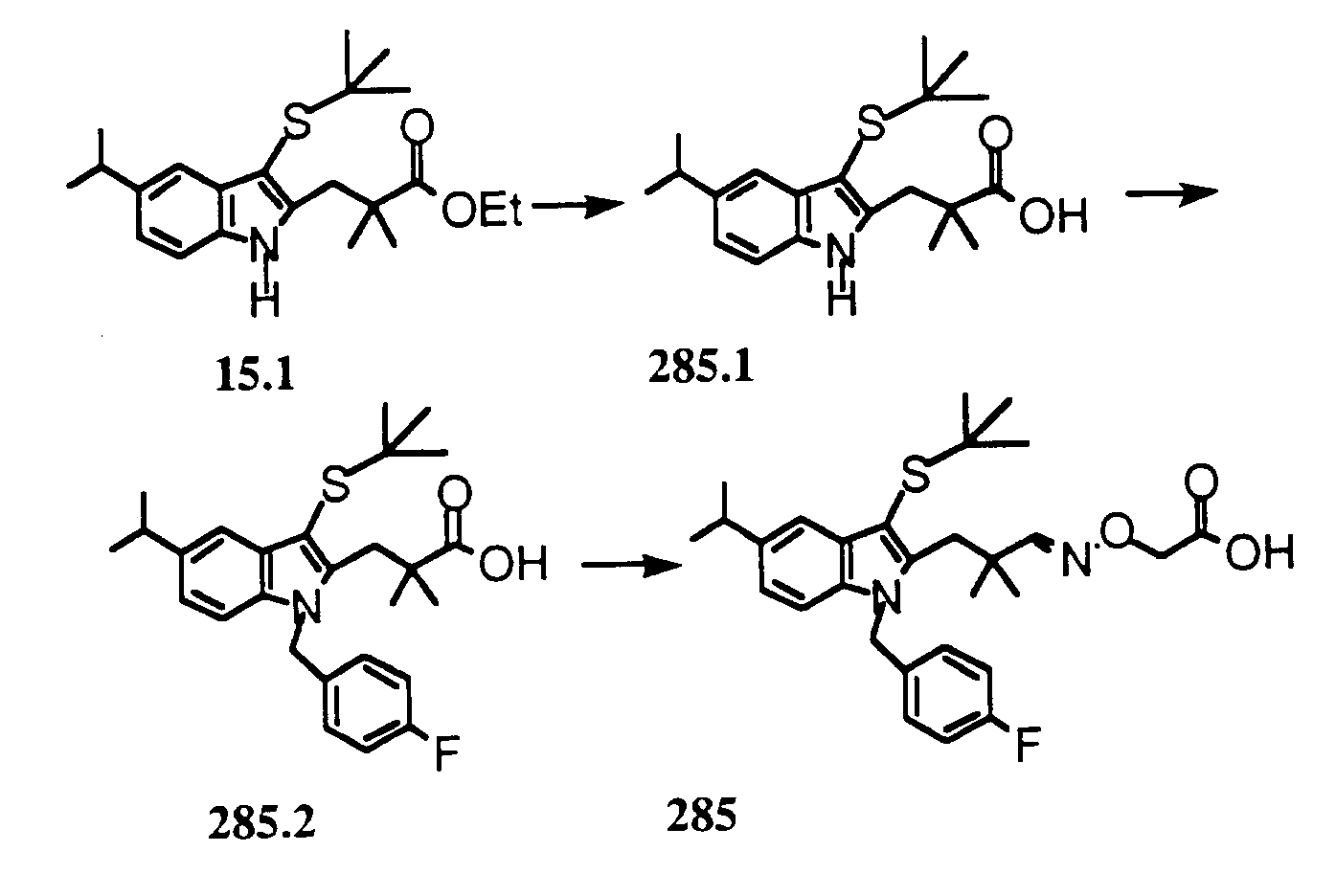
- Compound 285.1 was obtained from Compound 15.1 by adapting the hydrolysis procedure reported in EPA 87311031.6.
- Using compound 285.1 (0.11 g, 0.33 mmol) and adapting the procedure used to convert 15.1 to 15.2, substituting 4-fluorobenzyl bromide for 4-pyridinemethanol 43 mg of Compound 285.2 was obtained as a white solid after purification by chromatography (silica gel, 5/93/2 EtOAc/CCl₄/HOAc) followed by recrystallization from benzene/hexanes. m.p. 180-181°C; ¹H NMR (300 MHz, DMSO-d₆); 1.10 (6H, s), 1.19 (9H, s), 1.22 (6H, d, J = 7 Hz), 2.96 (1H, septet, J = 7 Hz), 3.22 (2H, bs), 5.47 (2H, s), 6.88 (2H, dd, J = 6 and 9 Hz), 6.99 (1H, dd, J = 1.5 and 9 Hz), 7.11 (2H, t, J = 9 Hz), 7.29 (1H, d, J = 9 Hz), 7.47 (1H, d, J = 1.5 Hz), 12.45 (1H, bs); MS (M+H)⁺ = 456 and (M+Na)⁺ = 478. Analysis calc'd for C₂₇H₃₄FNO₂S(0.25 H₂O): C, 70.48; H, 7.56; N, 3.04; Found: C, 70.67; H, 7.37 N, 3.05.
- Starting with Compound 285.2 and adapting the procedure described in Example 281, 0.82 g of 285 was obtained as a white powder after purification by chromatography (silica gel, 20/78/2 EtOAc/hexanes/HOAc) followed by recrystallization from hexanes. m.p. 124 -125°C; ¹H NMR (300 MHz, DMSO-d₆); 1.06 (6H, s), 1.13 - 1.30 (15H, m), 2.95 (1H, m), 3.10 (2H, bs), 4.43 (2H, s), 5.47 (2H, bs), 6.87 - 7.02 (3H, m), 7.10 (2H, bt, J = 9 Hz), 7.25 (1H, d, J = 9 Hz), 7.47 (1H, s), 7.56 (1H, s), 12.67 (1H, bs); MS (M+H)⁺ = 512 and (M+Na)⁺ = 535. Analysis calc'd for C₂₉H₃₇FN₂O₃S: C, 67.94; H, 7.27; N, 5.46; Found: C, 68.45; H, 7.29 N, 5.48.
-

- Starting with 20 (1.16 g, 2.19 mmol) and adapting the procedure described in Example 13, 0.51 g of 286 was obtained as a pale pink solid. m.p. 218 - 220°C; ¹H NMR (300 MHz, DMSO-d₆); 1.06 (6H, s), 1.19 (9H, s),1.23 (6H, d, J = 6 Hz), 2.95 (1H, septet, J = 6 Hz), 3.05 (2H, bs), 4.12 (2H, s), 5.50 (2H, s), 6.90 (2H, d, J = 9 Hz), 6.97 (1H, dd, J = 1.5 and 9 Hz), 7.25 (1H, d, J=9 Hz), 7.32 (2H, d, J = 9 Hz), 7.41 (1H, s), 7.47 (1H, d, J = 1.5 Hz); MS (M+H)⁺ = 551. Analysis calc'd for C₂₉H₃₆ClN₂O₃SNa: C, 63.20; H, 6.58; N, 5.08; Found: C, 63.09; H, 6.59; N, 5.04.
-

- Starting with 2.2 and adapting the procedure described in Example 20, substituting carboxy-1-ethyoxylamine hydrochloride for carboxymethoxylamine hemihydrochloride, 0.20 g of Compound 287 was obtained as a white amorphous solid after purification by chromatography (silica gel, 20/78/2 EtOAc/hexanes/HOAc). m.p. 70 -90°C; ¹H NMR (300 MHz, DMSO-d₆); 1.07 (6H, d, J = 7 Hz), 1.20 (9H, s), 1.22 (6H, d ,J = 7 Hz), 1.28 (3H, d , J = 7 Hz), 2.95 (septet, J = 7 Hz), 3.08 (1H, bs), 4.45 (1H, quartet, J = 7 Hz), 5.45 (2H, bs), 6.87 (2H, d, J = 9 Hz), 6.97 (1H, dd, J = 1.5 and 9 Hz), 7.24 (1H, J = 9 Hz), 7.33 (2H, J=9 Hz), 7.47 (1H, J = 1.5 Hz), 7.50 (1H, s), 12.61 (1H, bs); MS (M+H)⁺ = 543 and (M+NH₄)⁺ = 560. Analysis calc'd for C₃₀H₃₉ClN₂O₃S: C, 66.34; H, 7.24; N, 5.16; Found: C, 66.46; H, 7.39; N, 5.08.
-

- A solution of 4-acetamidophenol (14.28g, 94.4 mmol), 2-(chloromethyl)quinoline monohydrochloride (20.22 g, 94.4 mmol) and freshly powdered K₂CO₃ (39.14 g, 283.2 mmol) in DMF (250 mls) for 4 days. It was then poured into 1:1 ice:H₂O (600 mls). The resulting precipitate was collected and washed with water. It was then crystallized in 95% ethanol to afford 25.31 g (91%) of 4-(quinolin-2-ylmethoxy)acetanilide.
- A suspension of 4-(quinolin-2-ylmethoxy)acetanilide (25.29 g, 86.6 mmol) in 95% ethanol (200 mls) containing 10 M KOH (25 mls) was heated at reflux for 3 days. It was then cooled to r.t. and the ethanol was stripped off in vacuo. The resulting residue was diluted with water (40 mls) and the precipitate collected and washed well with water. It was then taken up in hot ethylacetate (500 mls) and decolorized with charcoal. The solution was boiled to leave a volume of 200 mls, and hexane was added (200 mls). The solution was allowed to cool to r.t. and the crystals collected to afford 16.63 g (77%) of 4-(quinolin-2-ylmethoxy)aniline.
- To a suspension of 4-(quinolin-2-ylmethoxy)aniline (10.62 g, 42.5 mmol) in H₂O (40 mls) was added concentrated HCl (10.63 mls, 127.5 mmol) and the suspension was vigorously stirred to obtain a fine white suspension, then cooled to 0oC. A solution of sodium nitrite (3.02 g, 43.78 mmol) in H₂O (9 mls) was then added dropwise. Upon completion of addition, the reaction was stirred for 1 hr at 0oC to afford the diazonium salt as a clear orange/yellow solution.
- To a solution of Na₂S₂O₄ (56.20 g of an 85% purity sample, 274.35 mmol) in water (250 mls ), and ether (250 mls) containing NaOH (1.90 mls of a 2N solution, 3.79 mmol) at 0oC, was added the solution of the diazonium salt from above, dropwise and with vigorous stirring. Upon completion of addition, NaOH (75.89 mls of a 2N solution, 151.8 mmol) was added dropwise. The cooling bath was removed and the reaction allowed to warm to r.t. and stirred for 1 hr. The orange solid was then collected, washed well with ether and finally with water. The resulting solid was freeze dried for 18 hrs to afford 9.84 g (87%) of 4-(quinolin-2-ylmethoxy)phenylhydrazine as a pale orange solid.
- To a solution of diisopropylethylamine (7.67 g, 59.36 mmol) in CH₂Cl₂ (150 mls) was added 4-(quinolin-2-ylmethoxy)phenylhydrazine (9.83 g, 37.1 mmol). This was followed by the addition of 4-chlorobenzyl chloride (8.96 g, 55.65 mmol), tetrabutylammonium bromide (3.59 g, 11.13 mmol) and an additional 50 mls of CH₂Cl₂ and the reaction was stirred for 24 hrs. It was then diluted with H₂O (200 mls) and the layers were separated. The aqueous was extracted with CH₂Cl₂ (2x 200 mls). the organics were combined, dried with MgSO₄ and concentrated. The resulting solid was washed with 9:1 ether:methanol (250 mls) to afford 8.89 g (64%) of 1-(4-chlorophenylmethyl)-1-(4-(quinolin-2-ylmethoxy)phenyl)hydrazine as a pale yellow solid.
- To a solution of methyl 2,2-dimethyl-4-keto-5-(1,1-dimethylethylthio)pentenoate (5.29 g, 21.5 mmol) in toluene (50 mls) and acetic acid (25 mls) was added sodium acetate (2.03 g, 24.73 mmol) followed by 1-(4-chlorophenylmethyl)-1-(4-(quinolin-2-ylmethoxy)phenyl)hydrazine (8.88 g, 22.8 mmol) and the reaction was stirred for 5 days in the dark. It was then poured into water (500 mls) and extracted with ethylacetate (3x 100 mls). The combined organics were then washed with water (3 x 100 mls). Solid NaHCO₃ (10 g) was added to the organics and the mixture was filtered and finally washed with water (2x 100 mls). It was then dried with MgSO₄ and concentrated. The resulting residue was chromatographed (silica gel, ether:hexanes, 2:8 to 3:7) to afford methyl 3-[3-(1,1-dimethylethylthio)-5-(quinolin-2-ylmethoxy)-1-(4-chlorophenylmethyl)indol-2-yl]-2,2-dimethylpropionate.
- A solution of methyl 3-[3-(1,1-dimethylethylthio)-5-(quinolin-2-ylmethoxy)-1-(4-chlorophenylmethyl)indol-2-yl]-2,2-dimethylpropionate (3.48 g, 5.8 mmol) in 1:2:1 THF:methanol:1N LiOH (80 mls) was heated at 80oC for 3 hrs. It was then cooled to r.t., diluted with water (50 mls) and washed with ether (1x 60 mls). The aqueous layer was then acidified to pH5 by the addition of solid citric acid and extracted with ethylacetate (3x 60 mls). The organics were combined, dried with MgSO₄, decolorized with charcoal and concentrated. Crystallization in ethylacetate/hexanes afforded 3-[3-(1,1-dimethylethylthio)-5-(quinolin-2-ylmethoxy)-1-(4-chlorophenylmethyl)indol-2-yl]-2,2-dimethylpropionic acid.
- To a solution of 3-[3-1,1-dimethylethylthio)-5-(quinolin-2-ylmethoxy)-1-(4-chlorophenylmethyl)indol-2-yl]-2,2-dimethylpropionic acid (2.57 g, 4.4 mmol) in THF (20 mls) was added borane dimethyl sulfide complex (1.06 g, 14.0 mmol) dropwise. Upon completion of addition, the reaction was stirred for 18 hrs. It was then quenched slowly and dropwise with aqueous sat'd NaHCO₃ (30 mls). The THF was stripped off in vacuo and the aqueous residue was extracted with ethylacetate (3x 50 mls). The organics were combined, dried with MgSO₄ and concentrated. The resulting residu e was chromatographed (silica gel, ether:hexanes, 1:1) to afford 1.82 g (72%) of 3-[3-(1,1-dimethylethylthio)-5-(quinolin-2-ylmethoxy)-1-(4-chlorophenylmethyl)indol-2-yl]-2,2-dimethylpropanol as a white foam.
- To a solution of oxalyl chloride (461 mg, 3.6 mmol) in CH₂Cl₂ (10 mls) at - 78oC was added dimethylsulfoxide (600 mg, 7.68 mmol) dropwise and the resulting mixture was stirred for 5 mins. A solution of 3-[3-(1,1-dimethylethylthio)-5-(quinolin-2-ylmethoxy)-1-(4-chlorophenylmethyl)indol-2-yl]-2,2-dimethylpropanol (1.81 g, 3.2 mmol) in CH₂Cl₂ (5 mls) was then added dropwise and the reaction was stirred for 20 mins at -78oC. Triethylamine (1,62 g, 16.0 mmol) was then added dropwise, the cooling bath was withdrawn and the reaction allowed to warm to r.t. It was then diluted with aqueous sat'd NaHCO₃ (20 mls) and the layers were separated. The aqueous was extracted with CH₂Cl₂ (2x 20 mls). The organics were combined, dried with MgSO₄ and concentrated. The resulting residue was chromatographed (silica gel, ether:hexanes, 1:1) to afford 1.58 g (86%) of 3-[3-(1,1-dimethylethylthio)-5-(quinolin-2-ylmethoxy)-1-(4-chlorophenylmethyl)indol-2-yl]-2,2-dimethylpropionaldehyde as a lemon yellow solid.
- A solution of 3-[3-(1,1-dimethylethylthio)-5-(quinolin-2-ylmethoxy)-1-(4-chlorophenylmethyl)indol-2-yl]-2,2-dimethylpropionaldehyde (1.57 g, 2.7 mmol) and carboxymethoxylamine hemihydrochloride (361 gm, 1.6 mmol) in 1:1 ethanol:pyridine (15 mls) was stirred for 18 hrs. The reaction was then concentrated in vacuo. The resulting residue was taken up in water (20 mls) and extracted with ethylacetate (3x 20 mls). The organics were combined, dried with MgSO₄ and concentrated. The sample was chromatographed (silica gel, ether:hexanes containing 2% HOAc, 1:1) to afford 3-[3-(1,1-dimethylethylthio)-5-(quinolin-2-ylmethoxy)-1-(4-chlorophenylmethyl)indol-2-yl]-2,2-dimethylpropionaldehyde oxime-O-2-acetic acid as a foam. ¹H NMR (300 MHz,. DMSO-d₆): 0.98m (s, 9H), 1.05 (s, 6H), 3.04 (bs, 2H), 4.42 (s, 2H), 5.39 (s, 2H), 5.45 (s, 2H), 6.85 (m, 3H), 7.13 (d, 1H, J = 2.5 Hz), 7.30 (m, 3H), 7.53 (s, 1H), 7.58-7.68 (m, 2H), 7.79 (m, 1H), 7.97 (m, 1H), 8.05 (d, 1H, J = 8.5 Hz), 8.37 (d, 1H, J = 8.5 Hz); MS (M+H)⁺=644; Analysis calc'd for C₃₆H₃₈ClN₃O₄S·1/2H₂O: C, 66.19, H, 6.02, N, 6.43; Found: C, 66.30, H, 6.12, N, 6.22.
- The desired product 289 is prepared from 287 according to the procedure of Example 12.
- The desired product 290 is prepared from 288 according to the procedure of Example 12.
-

The desired product 291 is prepared from 281.3 by the procedure of Example 287. -

The desired product 292 is prepared from 285.2 by the procedure of Example 285 substituting carboxy-1-ethoxylamine hydrochloride for carboxymethoxylamine hemihydrochloride. -

The desired product 293 is prepared by the procedure of Example 288 substituting carboxy-1-ethoxylamine hydrochloride for carboxymethoxylamine hemihydrochloride.
Additional examples of the present invention are prepared by the procedure of Example 288 utilizing the requisite hydrazine and carboxyalkoxyamine as indicated in Table 13.
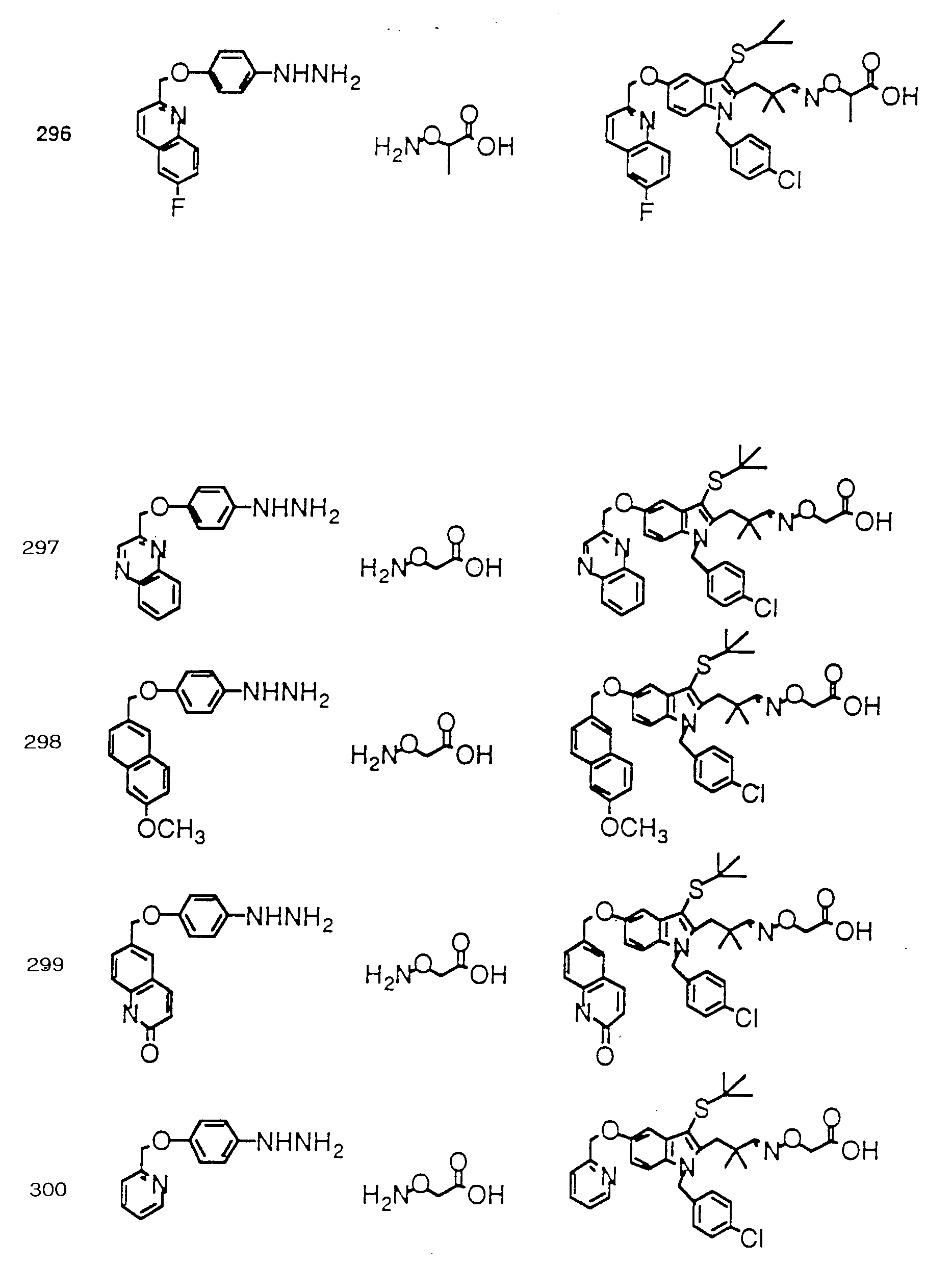

- The foregoing examples are provided to enable one skilled in the art to practice the present invention. These examples are merely illustrative of the invention as it is claimed in the appended claims.
Claims (10)
- A process for preparing a compound of Formula I:
 A is selected from the group consisting of(a) straight or branched divalent alkylene of from one to twelve carbon atoms,(b) straight or branched divalent alkenylene of from two to twelve carbon atoms, and(c) divalent cycloalkylene of from three to eight carbon atoms;R¹ is selected from the group consisting of(a) hydrogen;(b) alkylthio of from one to six carbon atoms;(c) phenylthio optionally substituted with one or two groups selected from the group consisting of(1) alkyl of from one to six carbon atoms,(2) haloalkyl of from one to six carbon atoms,(3) alkoxy of from one to twelve carbon atoms,(4) hydroxy, and(5) halogen;(d) phenylalkylthio in which the alkyl group contains from one to six carbon atoms and the phenyl ring is optionally substituted with one or two groups selected from the group consisting of(1) alkyl of from one to six carbon atoms,(2) haloalkyl of from one to six carbon atoms,(3) alkoxy of from one to twelve carbon atoms,(4) hydroxy, and(5) halogen;(e) 2-,3-, and 4-pyridylthio;(f) 2- and 3-thienylthio;(g) 2-thiazolylthio; and(h)with the proviso that when R¹ is -C(O)(CH₂)nNHC(O)N(OM)R⁵, then R² is selected from the group consisting of
-COOH,
-COO⁻ B⁺ where B is a pharmaceutically acceptable cation, and
-COO(alkyl) where the alkyl group is of from one to six carbon atoms;R² is selected from the group consisting of(a) (b)
(b) (c)
(c) (d)
(d) (e)
(e)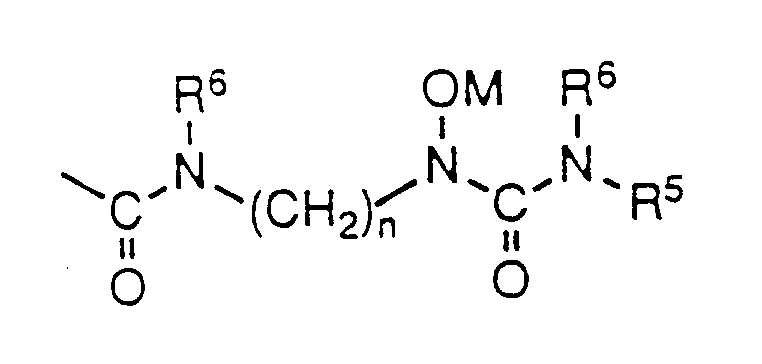 (f)
(f) (g)
(g) (h)
(h) (i)
(i) (j)
(j) (k)
(k) (l)
(l) (m)wherein
 n is an integer of from one to four,R⁵ is selected from the group consisting of(1) alkyl of from one to six carbon atoms,(2) hydroxyalkyl of from one to six carbon atoms,(3) phenylalkyl in which the alkyl portion contains from one to six carbon atoms,(4) alkoxyalkyl in which the alkoxy and alkyl portions each, independently, contain from one to six carbon atoms,(5) phenoxyalkyl in which the alkyl portion contains from one to six carbon atoms,(6) (alkoxyalkoxyl)alkyl in which each alkoxy portion, independently, contains from one to six carbon atoms, and the alkyl portion contains from one to six carbon atoms,(7) (alkoxycarbonyl)alkyl in which the alkoxycarbonyl portion contains from two to six carbon atoms and the alkyl portion contains from one to six carbon atoms,(8) (aminocarbonyl)alkyl in which the alkyl portion contains from one to six carbon atoms,(9) ((alkylamino)carbonyl)alkyl in which each alkyl portion independently contains from one to six carbon atoms,(10) ((dialkylamino)carbonyl)alkyl in which each alkyl portion independently contains from one to six carbon atoms,(11) 2-, 3-, and 4-pyridylalkyl in which the alkyl portion contains from one to six carbon atoms,(12) (2-furyl)alkyl in which the alkyl portion contains from one to six carbon atoms,(13) (3-thienyl)alkyl in which the alkyl portion contains from one to six carbon atoms,(14) (2-benzo[b]thienyl)alkyl in which the alkyl portion contains from one to six carbon atoms,(15) (2-benzo[b]furyl)alkyl in which the alkyl portion contains from one to six carbon atoms,(16) (5-(1,2,4-triazolyl))alkyl in which the alkyl portion contains from one to six carbon atoms,(17) (2-imidazolyl)alkyl in which the alkyl portion contains from one to six carbon atoms,(18) (2-thiazolyl)alkyl in which the alkyl portion contains from one to six carbon atoms,(19) (2-pyrimidyl)alkyl in which the alkyl portion contains from one to six carbon atoms,(20) (5-tetrazolyl)alkyl in which the alkyl portion contains from one to six carbon atoms,R⁶ is, at each occurence, selected from
hydrogen, and
alkyl of from one to six carbon atoms;R⁷ is selected from the group consisting of(1) alkyl of from one to six carbon atoms,(2) hydroxyalkyl of from one to six carbon atoms,(3) phenylalkyl in which the alkyl portion contains from one to six carbon atoms,(4) ((carboxyl)phenyl)alkyl in which the alkyl portion contains from one to six carbon atoms,(5) alkoxyalkyl in which the alkoxy and alkyl portions each, independently, contain from one to six carbon atoms,(6) phenoxyalkyl in which the alkyl portion contains from one to six carbon atoms,(7) (carboxyl)alkyl in which the alkyl portion contains from one to six carbon atoms,(8) (C-malanato)alkyl in which the alkyl portion contains from one to six carbon atoms,(9) (C-(dialkylmalanato)alkyl in which each alkyl portion, independently, contains from one to six carbon atoms,(10) (alkoxyalkoxyl)alkyl in which each alkoxy portion, independently, contains from one to six carbon atoms, and the alkyl portion contains from one to six carbon atoms,(11) (alkoxycarbonyl)alkyl in which the alkoxycarbonyl portion contains from two to six carbon atoms and the alkyl portion contains from one to six carbon atoms,(12) ((N-alkyl-N-hydroxyamino)carbonyl)-alkyl in which each alkyl portion, independently, contains from one to six carbon atoms,(13) (aminocarbonyl)alkyl in which the alkyl portion contains from one to six carbon atoms,(14) ((alkylamino)carbonyl)alkyl in which each alkyl portion independently contains from one to six carbon atoms,(15) ((dialkylamino)carbonyl)alkyl in which each alkyl portion independently contains from one to six carbon atoms,(16) (N-morpholinyl)alkyl in which the alkyl portion contains from one to six carbon atoms,(17) (N-thiomorpholinyl)alkyl in which the alkyl portion contains from one to six carbon atoms,(18) (N-piperidinyl)alkyl in which the alkyl portion contains from one to six carbon atoms,(19) (N-piperazinyl)alkyl in which the alkyl portion contains from one to six carbon atoms,(20) 2-, 3-, and 4-pyridylalkyl in which the alkyl portion contains from one to six carbon atoms,(21) (2-furyl)alkyl in which the alkyl portion contains from one to six carbon atoms,(22) (3-thienyl)alkyl in which the alkyl portion contains from one to six carbon atoms,(23) (2-benzo[b]thienyl)alkyl in which the alkyl portion contains from one to six carbon atoms,(24) (2-benzo[b]furyl)alkyl in which the alkyl portion contains from one to six carbon atoms,(25) (5-(1,2,4-triazolyl))alkyl in which the alkyl portion contains from one to six carbon atoms,(26) (2-imidazolyl)alkyl in which the alkyl portion contains from one to six carbon atoms,(27) (2-thiazolyl)alkyl in which the alkyl portion contains from one to six carbon atoms,(28) (2-pyrimidyl)alkyl in which the alkyl portion contains from one to six carbon atoms,(29) (5-tetrazolyl)alkyl in which the alkyl portion contains from one to six carbon atoms,M is selected from the group consisting of
hydrogen,
a pharmaceutically acceptable cation, and
a pharmaceutically acceptable metabolically cleavable group;R³ is selected from the group consisting of(a) phenylalkyl in which the alkyl portion contains from one to six carbon atoms;(b) heteroarylalkyl in which the alkyl portion contains from one to six carbon atoms and the heteroaryl group is selected from the group consisting of(1) 2-, 3- and 4-pyridyl,(2) 2- and 3-thienyl,(3) 2- and 3-furyl,(4) indolyl,(5) pyrazinyl,(6) isoquinolyl,(7) quinolyl;(8) imidazolyl,(9) pyrrolyl,(10) pyrimidyl,(11) benzofuryl,(12) benzothienyl,(13) thiazolyl; and(14) carbazolyl,wherein the rings of the phenylalkyl or heteroarylalkyl groups are optionally substituted with one or two groups selected from
alkyl of from one to six carbon atoms;
alkoxy of from one to twelve carbon atoms, phenyl, optionally substituted with
alkyl of from one to six carbon atoms,
haloalkyl of from one to six carbon atoms,
alkoxy of from one to six carbon atoms,
hydroxy, or
halogen;
phenoxy, optionally substituted with
alkyl of from one to six carbon atoms,
haloalkyl of from one to six carbon atoms,
alkoxy of from one to six carbon atoms,
hydroxy, or
halogen;
2-, 3-, or 4-pyridyl, optionally substituted with
alkyl of from one to six carbon atoms,
haloalkyl of from one to six carbon atoms,
alkoxy of from one to six carbon atoms,
hydroxy, or
halogen; and
2-, 3-, or 4-pyridyloxy, optionally substituted with
alkyl of from one to six carbon atoms,
haloalkyl of from one to six carbon atoms,
alkoxy of from one to six carbon atoms,
hydroxy, or
halogen;(c) -(CH₂)nN(OH)C(O)NR⁵R⁶; and(d) -(CH₂)nN(R⁶)C(O)N(OM)R⁶with the proviso that when R³ is -(CH₂)nN(OH)C(O)NR⁵R⁶ or -(CH₂)nN(R⁶)C(O)N(OM)R⁶, then R² is selected from
-COOH,
-COO⁻ B⁺ where B is a pharmaceutically acceptable cation,and
-COO(alkyl) where the alkyl group is of from one to six carbon atoms;R⁴ is selected from the group consisting ofsaid process comprising the steps of:
alkyl of from one to six carbon atoms;
alkoxy of from one to twelve carbon atoms,
phenyl, optionally substituted with
alkyl of from one to six carbon atoms,
haloalkyl of from one to six carbon atoms,
alkoxy of from one to six carbon atoms,
hydroxy or
halogen; and
phenoxy, optionally substituted with
alkyl of from one to six carbon atoms,
haloalkyl of from one to six carbon atoms,
alkoxy of from one to six carbon atoms,
hydroxy,
halogen;
phenylalkyloxy in which the alkyloxy portion contains from one to six carbon atoms and the phenyl ring is optionally substituted with
alkyl of from one to six carbon atoms,
haloalkyl of from one to six carbon atoms,
alkoxy of from one to six carbon atoms,
hydroxy,
halogen;
1- and 2-naphthylalkyloxy in which the alkyloxy portion contains from one to six carbon atoms and the 1- or 2-naphthyl portion is optionally substituted with
alkyl of from one to six carbon atoms,
haloalkyl of from one to six carbon atoms,
alkoxy of from one to six carbon atoms,
hydroxy,
halogen;
heteroarylalkyloxy in which the alkyloxy portion contains from one to six carbon atoms and the heteroaryl portion is selected from the group consisting of
2-, 3-, and 6-quinolyl,
2-, 3-, and 4-pyridyl,
2-benzothiazolyl,
2-quinoxalyl,
2- and 3-indolyl,
2- and 3-benzimidazolyl,
2- and 3-benzo[b]thienyl,
2- and 3-benzo[b]furyl,
2-benzimidazolyl,
2-thiazolyl, and
1-, 3-, and 4-isoquinolyl, and
the heteroaryl portion is optionally substituted with
alkyl of from one to six carbon atoms,
haloalkyl of from one to six carbon atoms,
alkoxy of from one to twelve carbon atoms,
halogen, or
hydroxy;a) reacting a substituted phenyl hydrazine compound of the formula:

 b) when B is hydrogen, reacting the product of step a) with a compound of the formula R³X, where X is halogen, under basic conditions to produce a product where B is R³; andc) thereafter converting, by conventional means, the product of step b) or the product of step a), where B is R³, to a compound of the formula
- A process as defined by Claim 1 for making a compound wherein R² is selected from the group consisting of(a)
 (b)
(b) (c)or
(c)or
a pharmaceutically acceptable salt, ester, or amide thereof, wherein n, R⁵, and R⁶ are as defined therein. - A process as defined by Claim 1 for making a compound wherein R² is selected from the group consisting of(a)
 (b)
(b) (c)
(c) (d)or
(d)or
a pharmaceutically acceptable salt, ester, or amide thereof, wherein n, R⁵, and R⁶ are as defined therein. - A process as defined by Claim 1 for making a compound wherein R² is selected from the group consisting of(a)
 (b)
(b) (c)wherein n, R⁵ and R⁶ are as defined therein, or a pharmaceutically acceptable salt, ester, or amide thereof.
- A process as defined by Claim 1 for making a compound wherein R² has the structure

- A process as defined by Claim 1 for making a compound wherein R² is selected from the group consisting of(a)
 (b)or
(b)or
a pharmaceutically acceptable salt, ester or amide thereof, wherein R⁶ is as defined therein. - Use of a compound of Formula I:
 A is selected from the group consisting of(a) straight or branched divalent alkylene of from one to twelve carbon atoms,(b) straight or branched divalent alkenylene of from two to twelve carbon atoms, and(c) divalent cycloalkylene of from three to eight carbon atoms;R¹ is selected from the group consisting of(a) hydrogen;(b) alkylthio of from one to six carbon atoms;(c) phenylthio optionally substituted with one or two groups selected from the group consisting of(1) alkyl of from one to six carbon atoms,(2) haloalkyl of from one to six carbon atoms,(3) alkoxy of from one to twelve carbon atoms,(4) hydroxy, and(5) halogen;(d) phenylalkylthio in which the alkyl group contains from one to six carbon atoms and the phenyl ring is optionally substituted with one or two groups selected from the group consisting of(1) alkyl of from one to six carbon atoms,(2) haloalkyl of from one to six carbon atoms,(3) alkoxy of from one to twelve carbon atoms,(4) hydroxy, and(5) halogen;(e) 2-, 3-, and 4-pyridylthio;(f) 2- and 3-thienylthio;(g) 2-thiazolylthio; and(h)with the proviso that when R¹ is -C(O)(CH₂)nNHC(O)N(OM)R⁵, then R² is selected from the group consisting of
-COOH,
-COO⁻ B⁺ where B is a pharmaceutically acceptable cation, and
-COO(alkyl) where the alkyl group is of from one to six carbon atoms;R² is selected from the group consisting of(a) (b)
(b) (c)
(c) (d)
(d) (e)
(e)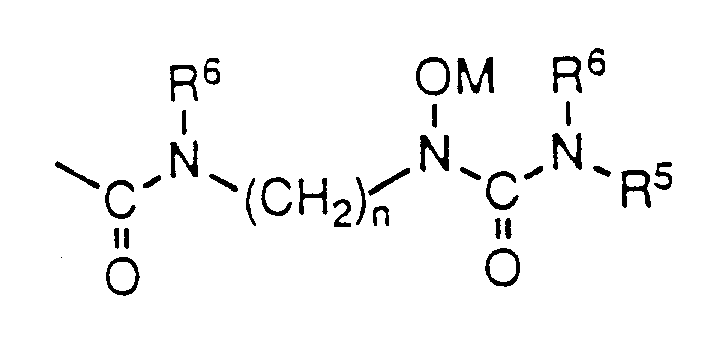 (f)
(f) (g)
(g) (h)
(h) (i)
(i) (j)
(j) (k)
(k) (l)
(l) (m)wherein
 n is an integer of from one to four,R⁵ is selected from the group consisting of(1) alkyl of from one to six carbon atoms,(2) hydroxyalkyl of from one to six carbon atoms,(3) phenylalkyl in which the alkyl portion contains from one to six carbon atoms,(4) alkoxyalkyl in which the alkoxy and alkyl portions each, independently, contain from one to six carbon atoms,(5) phenoxyalkyl in which the alkyl portion contains from one to six carbon atoms,(6) (alkoxyalkoxyl)alkyl in which each alkoxy portion, independently, contains from one to six carbon atoms, and the alkyl portion contains from one to six carbon atoms,(7) (alkoxycarbonyl)alkyl in which the alkoxycarbonyl portion contains from two to six carbon atoms and the alkyl portion contains from one to six carbon atoms,(8) (aminocarbonyl)alkyl in which the alkyl portion contains from one to six carbon atoms,(9) ((alkylamino)carbonyl)alkyl in which each alkyl portion independently contains from one to six carbon atoms,(10) ((dialkylamino)carbonyl)alkyl in which each alkyl portion independently contains from one to six carbon atoms,(11) 2-, 3-, and 4-pyridylalkyl in which the alkyl portion contains from one to six carbon atoms,(12) (2-furyl)alkyl in which the alkyl portion contains from one to six carbon atoms,(13) (3-thienyl)alkyl in which the alkyl portion contains from one to six carbon atoms,(14) (2-benzo[b]thienyl)alkyl in which the alkyl portion contains from one to six carbon atoms,(15) (2-benzo[b]furyl)alkyl in which the alkyl portion contains from one to six carbon atoms,(16) (5-(1,2,4-triazolyl))alkyl in which the alkyl portion contains from one to six carbon atoms,(17) (2-imidazolyl)alkyl in which the alkyl portion contains from one to six carbon atoms,(18) (2-thiazolyl)alkyl in which the alkyl portion contains from one to six carton atoms,(19) (2-pyrimidyl)alkyl in which the alkyl portion contains from one to six carton atoms,(20) (5-tetrazolyl)alkyl in which the alkyl portion contains from one to six carbon atoms,R⁶ is, at each occurence, selected from
hydrogen, and
alkyl of from one to six carbon atoms;R⁷ is selected from the group consisting of(1) alkyl of from one to six carbon atoms,(2) hydroxyalkyl of from one to six carbon atoms,(3) phenylalkyl in which the alkyl portion contains from one to six carbon atoms,(4) ((carboxyl)phenyl)alkyl in which the alkyl portion contains from one to six carbon atoms,(5) alkoxyalkyl in which the alkoxy and alkyl portions each, independently, contain from one to six carbon atoms,(6) phenoxyalkyl in which the alkyl portion contains from one to six carbon atoms,(7) (carboxyl)alkyl in which the alkyl portion contains from one to six carbon atoms,(8) (C-malanato)alkyl in which the alkyl portion contains from one to six carbon atoms,(9) (C-(dialkylmalanato)alkyl in which each alkyl portion, independently, contains from one to six carbon atoms,(10) (alkoxyalkoxyl)alkyl in which each alkoxy portion, independently, contains from one to six carbon atoms, and the alkyl portion contains (from one to six carbon atoms,(11) (alkoxycarbonyl)alkyl in which the alkoxycarbonyl portion contains from two to six carbon atoms and the alkyl portion contains from one to six carbon atoms,(12) ((N-alkyl-N-hydroxyamino)carbonyl)-alkyl in which each alkyl portion, independently contains from one to six carbon atoms,(13) (aminocarbonyl)alkyl in which the alkyl portion contains from one to six carbon atoms,(14) ((alkylamino)carbonyl)alkyl in which each alkyl portion independently contains from one to six carbon atoms,(15) ((dialkylamino)carbonyl)alkyl in which each alkyl portion independently contains from one to six carbon atoms,(16) (N-morpholinyl)alkyl in which the alkyl portion contains from one to six carbon atoms,(17) (N-thiomorpholinyl)alkyl in which the alkyl portion contains from one to six carbon atoms,(18) (N-piperidinyl)alkyl in which the alkyl portion contains from one to six carbon atoms,(19) (N-piperazinyl)alkyl in which the alkyl portion contains from one to six carbon atoms,(20) 2-, 3-, and 4-pyridylalkyl in which the alkyl portion contains from one to six carbon atoms,(21) (2-furyl)alkyl in which the alkyl portion contains from one to six carbon atoms,(22) (3-thienyl)alkyl in which the alkyl portion contains from one to six carbon atoms,(23) (2-benzo[b]thienyl)alkyl in which the alkyl portion contains from one to six cannon atoms,(24) (2-benzo[b]furyl)alkyl in which the alkyl portion contains from one to six carbon atoms,(25) (5-(1,2,4-triazolyl))alkyl in which the alkyl portion contains from one to six carbon atoms,(26) (2-imidazolyl)alkyl in which the alkyl portion contains from one to six carbon atoms,(27) (2-thiazolyl)alkyl in which the alkyl portion contains from one to six carbon atoms,(28) (2-pyrimidyl)alkyl in which the alkyl portion contains from one to six carbon atoms,(29) (5-tetrazolyl)alkyl in which the alkyl portion contains from one to six carbon atoms,M is selected from the group consisting of
hydrogen,
a pharmaceutically acceptable cation, and
a pharmaceutically acceptable metabolically cleavable group;R³ is selected from the group consisting of(a) phenylalkyl in which the alkyl portion contains from one to six carbon atoms;(b) heteroarylalkyl in which the alkyl portion contains from one to six carbon atoms and the heteroaryl group is selected from the group consisting of(1) 2-, 3- and 4-pyridyl,(2) 2- and 3-thienyl,(3) 2- and 3-furyl,(4) indolyl,(5) pyrazinyl,(6) isoquinolyl,(7) quinolyl;(8) imidazolyl,(9) pyrrolyl,(10) pyrimidyl,(11) benzofuryl,(12) benzothienyl,(13) thiazolyl; and(14) carbazolyl,wherein the rings of the phenylalkyl or heteroarylalkyl groups are optionally substituted with one or two groups selected from
alkyl of from one to six carbon atoms;
alkoxy of from one to twelve carbon atoms,
phenyl, optionally substituted with
alkyl of from one to six carbon atoms,
haloalkyl of from one to six carbon atoms,
alkoxy of from one to six carbon atoms,
hydroxy, or
halogen;
phenoxy optionally substituted with
alkyl of from one to six carbon atoms,
haloalkyl of from one to six carbon atoms,
alkoxy of from one to six carbon atoms,
hydroxy, or
halogen;
2-, 3-, or 4-pyridyl, optionally substituted with
alkyl of from one to six carbon atoms,
haloalkyl of from one to six carbon atoms,
alkoxy of from one to six carbon atoms,
hydroxy, or
halogen; and
2-, 3-, or 4-pyridyloxy, optionally substituted with
alkyl of from one to six carbon atoms,
haloalkyl of from one to six carbon atoms,
alkoxy of from one to six carbon atoms,
hydroxy, or
halogen;(c) -(CH₂)nN(OH)C(O)NR⁵R⁶; and(d) -(CH₂)nN(R⁶)C(O)N(OM)R⁶with the proviso that when R³ is -(CH₂)nN(OH)C(O)NR⁵R⁶ or -(CH₂)nN(R⁶)C(O)N(OM)R⁶, then R² is selected from
-COOH,
-COO⁻ B⁺ where B is a pharmaceutically acceptable cation, and
-COO(alkyl) where the alkyl group is of from one to six carbon atoms;R⁴ is selected from the group consisting offor manufacturing a medicament for inhibiting; lipoxygenase enzymes in a host mammal in need of such treatment.
alkyl of from one to six carbon atoms;
alkoxy of from one to twelve carbon atoms,
phenyl, optionally substituted with
alkyl of from one to six carbon atoms,
haloalkyl of from one to six carbon atoms,
alkoxy of from one to six carbon atoms,
hydroxy or
halogen; and
phenoxy, optionally substituted with
alkyl of from one to six carbon atoms,
haloalkyl of from one to six carbon atoms,
alkoxy of from one to six carbon atoms,
hydroxy,
halogen;
phenylalkyloxy in which the alkyloxy portion contains from one to six carbon atoms and the phenyl ring is optionally substituted with
alkyl of from one to six carbon atoms,
haloalkyl of from one to six carbon atoms,
alkoxy of from one to six carbon atoms,
hydroxy,
halogen;
1- and 2-naphthylalkyloxy in which the alkyloxy portion contains from one to six carbon atoms and the 1- or 2-naphthyl portion is optionally substituted with
alkyl of from one to six carbon atoms,
haloalkyl of from one to six carbon atoms,
alkoxy of from one to six carbon atoms,
hydroxy,
halogen;
heteroarylalkyloxy in which the alkyloxy portion contains from one to six carbon atoms and the heteroaryl portion is selected from the group consisting of
2-, 3-, and 6-quinolyl,
2-, 3-, and 4-pyridyl,
2-benzothiazolyl,
2-quinoxalyl,
2- and 3-indolyl,
2- and 3-benzimidazolyl,
2- and 3-benzo[b]thienyl,
2- and 3-benzo[b]furyl,
2-benzimidazolyl,
2-thiazolyl, and
1-, 3-, and 4-isoquinolyl, and
the heteroaryl portion is optionally substituted with
alkyl of from one to six carbon atoms,
haloalkyl of from one to six carbon atoms,
alkoxy of from one to twelve carbon atoms,
halogen, or
hydroxy,
Applications Claiming Priority (3)
| Application Number | Priority Date | Filing Date | Title |
|---|---|---|---|
| US570248 | 1990-08-20 | ||
| US07/570,248 US5095031A (en) | 1990-08-20 | 1990-08-20 | Indole derivatives which inhibit leukotriene biosynthesis |
| PCT/US1991/005621 WO1992003132A1 (en) | 1990-08-20 | 1991-08-07 | Indole derivatives which inhibit leukotriene biosynthesis |
Publications (3)
| Publication Number | Publication Date |
|---|---|
| EP0544819A1 EP0544819A1 (en) | 1993-06-09 |
| EP0544819A4 EP0544819A4 (en) | 1993-10-20 |
| EP0544819B1 true EP0544819B1 (en) | 1995-12-06 |
Family
ID=24278860
Family Applications (1)
| Application Number | Title | Priority Date | Filing Date |
|---|---|---|---|
| EP91917405A Expired - Lifetime EP0544819B1 (en) | 1990-08-20 | 1991-08-07 | Indole derivatives which inhibit leukotriene biosynthesis |
Country Status (12)
| Country | Link |
|---|---|
| US (2) | US5095031A (en) |
| EP (1) | EP0544819B1 (en) |
| JP (1) | JPH06500557A (en) |
| AT (1) | ATE131051T1 (en) |
| CA (1) | CA2090006A1 (en) |
| DE (1) | DE69115280T2 (en) |
| DK (1) | DK0544819T3 (en) |
| ES (1) | ES2083595T3 (en) |
| GR (1) | GR3019198T3 (en) |
| IE (1) | IE912855A1 (en) |
| PT (1) | PT98710B (en) |
| WO (1) | WO1992003132A1 (en) |
Families Citing this family (54)
| Publication number | Priority date | Publication date | Assignee | Title |
|---|---|---|---|---|
| US5252585A (en) * | 1992-02-03 | 1993-10-12 | Merck Frosst Canada, Inc. | Fluorinated quinoline indoles as inhibitors of the biosynthesis of leukotrienes |
| US5229516A (en) * | 1989-10-27 | 1993-07-20 | American Home Products Corporation | Substituted indole-, indene-, pyranoindole- and tetrahydrocarbazole-alkanoic acid derivatives as inhibitors of PLA2 and lipoxygenase |
| HUT64023A (en) * | 1991-03-22 | 1993-11-29 | Sandoz Ag | Process for producing aminoguanidine derivatives and pharmaceutical compositions comprising such compounds |
| US5214204A (en) * | 1991-07-19 | 1993-05-25 | Abbott Laboratories | Arylamidoalkyl-n-hydroxyurea compounds having lipoxygenase inhibitory activity |
| FR2680366B1 (en) * | 1991-08-13 | 1995-01-20 | Adir | NOVEL ARYLETHYLAMINE DERIVATIVES, PROCESSES FOR THEIR PREPARATION AND THE PHARMACEUTICAL COMPOSITIONS CONTAINING THEM. |
| US5389650A (en) * | 1991-09-30 | 1995-02-14 | Merck Frosst Canada, Inc. | (Azaarylmethoxy)indoles as inhibitors of leukotriene biosynthesis |
| US5290798A (en) * | 1991-09-30 | 1994-03-01 | Merck Frosst Canada, Inc. | (hetero-arylmethoxy)indoles as inhibitors of leukotriene biosynthesis |
| US5308850A (en) * | 1991-09-30 | 1994-05-03 | Merck Frosst Canada, Inc. | (Bicyclic-hetero-arylmethoxy)indoles as inhibitors of leukotriene biosynthesis |
| CA2079374C (en) * | 1991-09-30 | 2003-08-05 | Merck Frosst Canada Incorporated | (bicyclic-azaarylmethoxy)indoles as inhibitors of leukotriene biosynthesis |
| US5190968A (en) * | 1991-09-30 | 1993-03-02 | Merck Frosst Canada, Inc. | (Polycyclic-arylmethoxy) indoles as inhibitors of leukotriene biosynthesis |
| WO1993011731A2 (en) * | 1991-12-12 | 1993-06-24 | The Trustees Of The University Of Pennsylvania | Alicyclic peptidomimetics |
| CA2129429A1 (en) * | 1992-02-13 | 1993-08-14 | Richard Frenette | (azaaromaticalkoxy) indoles as inhibitors of leukotriene biosynthesis |
| US5274096A (en) * | 1992-03-17 | 1993-12-28 | Merck & Co., Inc. | Hydrazine synthesis |
| US5334719A (en) * | 1992-06-17 | 1994-08-02 | Merck Frosst Canada, Inc. | Bicyclic(azaaromatic)indoles as inhibitors of leukotriene bisynthesis |
| AU4413893A (en) * | 1992-06-22 | 1994-01-24 | Merck Frosst Canada Inc. | Fluorinated quinoline indoles as inhibitors of the biosynthesis of leukotrienes |
| FR2692574B1 (en) * | 1992-06-23 | 1995-06-23 | Sanofi Elf | 4-HYDROXY BENZENETHIO DERIVATIVES, THEIR PREPARATION AND THEIR USE FOR THE PREPARATION OF AMINOALKOXYBENZENESULFONYL DERIVATIVES. |
| DE4233100A1 (en) * | 1992-10-01 | 1994-04-07 | Hoechst Ag | Process for the stereoselective synthesis of 3-substituted 2-sulfonylmethylpropionic acids and intermediates |
| US5288743A (en) * | 1992-11-20 | 1994-02-22 | Abbott Laboratories | Indole carboxylate derivatives which inhibit leukotriene biosynthesis |
| US5374635A (en) * | 1993-03-29 | 1994-12-20 | Merck Frosst Canada, Inc. | Furo[3,2-b]pyridines and thieno[3,2-b]pyridines as inhibitors of leukotriene biosynthesis |
| US5424329A (en) * | 1993-08-18 | 1995-06-13 | Warner-Lambert Company | Indole-2-carboxamides as inhibitors of cell adhesion |
| FR2734816B1 (en) * | 1995-05-31 | 1997-07-04 | Adir | NOVEL ARYL (ALKYL) PROPYLAMIDES, PROCESS FOR THEIR PREPARATION AND THE PHARMACEUTICAL COMPOSITIONS CONTAINING THEM |
| US5756531A (en) * | 1996-04-30 | 1998-05-26 | Abbott Laboratories | Iminoxy derivatives of indole and indene compounds as inhibitors of prostaglandin biosynthesis |
| US5750558A (en) * | 1996-06-06 | 1998-05-12 | Abbott Laboratories | Oxime derivatives of indole and indene compounds as inhibitors of prostaglandin biosynthesis |
| US6184238B1 (en) | 1996-12-26 | 2001-02-06 | Nikken Chemicals Co., Ltd. | N-hydroxyurea derivative and pharmaceutical composition containing the same |
| GEP20032920B (en) * | 1998-02-25 | 2003-03-25 | Genetics Inst | Inhibitors of Phospholipase Enzymes |
| US6500853B1 (en) | 1998-02-28 | 2002-12-31 | Genetics Institute, Llc | Inhibitors of phospholipase enzymes |
| FR2799756B1 (en) * | 1999-10-15 | 2001-12-14 | Adir | NOVEL BENZOTHIOPHENIC, BENZOFURANIC AND INDOLIC DERIVATIVES, PROCESS FOR THEIR PREPARATION AND THE PHARMACEUTICAL COMPOSITIONS CONTAINING THEM |
| PL373410A1 (en) * | 2002-02-01 | 2005-08-22 | F.Hoffman-La Roche Ag | Substituted indoles as alpha-1 agonists |
| TW200307542A (en) | 2002-05-30 | 2003-12-16 | Astrazeneca Ab | Novel compounds |
| SE0201635D0 (en) * | 2002-05-30 | 2002-05-30 | Astrazeneca Ab | Novel compounds |
| SE0202241D0 (en) * | 2002-07-17 | 2002-07-17 | Astrazeneca Ab | Novel Compounds |
| SE0301569D0 (en) * | 2003-05-27 | 2003-05-27 | Astrazeneca Ab | Novel compounds |
| SE0302232D0 (en) * | 2003-08-18 | 2003-08-18 | Astrazeneca Ab | Novel Compounds |
| SE0303180D0 (en) * | 2003-11-26 | 2003-11-26 | Astrazeneca Ab | Novel compounds |
| US20050244458A1 (en) * | 2004-04-30 | 2005-11-03 | Allergan, Inc. | Sustained release intraocular implants and methods for treating ocular neuropathies |
| GB0500604D0 (en) * | 2005-01-13 | 2005-02-16 | Astrazeneca Ab | Novel process |
| US7977359B2 (en) | 2005-11-04 | 2011-07-12 | Amira Pharmaceuticals, Inc. | 5-lipdxygenase-activating protein (FLAP) inhibitors |
| GB2431927B (en) * | 2005-11-04 | 2010-03-17 | Amira Pharmaceuticals Inc | 5-Lipoxygenase-activating protein (FLAP) inhibitors |
| US20070225285A1 (en) * | 2005-11-04 | 2007-09-27 | Amira Pharmaceuticals, Inc. | 5-lipoxygenase-activating protein (flap) inhibitors |
| US20070244128A1 (en) * | 2005-11-04 | 2007-10-18 | Amira Pharmaceuticals, Inc. | 5-lipoxygenase-activating protein (flap) inhibitors |
| US8399666B2 (en) * | 2005-11-04 | 2013-03-19 | Panmira Pharmaceuticals, Llc | 5-lipoxygenase-activating protein (FLAP) inhibitors |
| US20070219206A1 (en) * | 2005-11-04 | 2007-09-20 | Amira Pharmaceuticals, Inc. | 5-lipoxygenase-activating protein (flap) inhibitors |
| US7741360B2 (en) * | 2006-05-26 | 2010-06-22 | Astrazeneca Ab | Bi-aryl or aryl-heteroaryl substituted indoles |
| WO2008067566A1 (en) | 2006-11-30 | 2008-06-05 | Amira Pharmaceuticals, Inc. | Compositions and treatments comprising 5-lipoxygenase-activating protein inhibitors and nitric oxide modulators |
| WO2008097930A1 (en) * | 2007-02-05 | 2008-08-14 | Amira Pharmaceuticals, Inc. | Reverse indoles as 5-lipoxygenase-activating protein (flap) inhibitors |
| TW200920369A (en) * | 2007-10-26 | 2009-05-16 | Amira Pharmaceuticals Inc | 5-lipoxygenase activating protein (flap) inhibitor |
| JP5791500B2 (en) * | 2008-05-23 | 2015-10-07 | パンミラ ファーマシューティカルズ,エルエルシー. | 5-lipoxygenase activating protein inhibitor |
| US8546431B2 (en) | 2008-10-01 | 2013-10-01 | Panmira Pharmaceuticals, Llc | 5-lipoxygenase-activating protein (FLAP) inhibitors |
| WO2011140164A1 (en) * | 2010-05-06 | 2011-11-10 | Merck Sharp & Dohme Corp. | Aza-indole derivatives useful as modulators of faah |
| ES2878405T3 (en) | 2014-02-04 | 2021-11-18 | Bioscience Pharma Partners Llc | Use of flap inhibitors to reduce neuroinflammation-mediated injury in the central nervous system |
| EP3268085A4 (en) | 2015-03-13 | 2018-10-31 | The Board of Trustees of The Leland Stanford Junior University | Ltb4 inhibition to prevent and treat human lymphedema |
| US11718614B2 (en) | 2018-06-25 | 2023-08-08 | Suzhou Mednes Pharma Tech Co., Ltd. | Compounds and methods for treatment of hedgehog pathway associated conditions |
| MX2023014819A (en) | 2021-06-14 | 2024-03-21 | Scorpion Therapeutics Inc | Urea derivatives which can be used to treat cancer. |
| CN118451061A (en) * | 2021-12-20 | 2024-08-06 | 费尔黑文制药公司 | OXER1 antagonists and uses thereof |
Family Cites Families (17)
| Publication number | Priority date | Publication date | Assignee | Title |
|---|---|---|---|---|
| US3859305A (en) * | 1970-03-10 | 1975-01-07 | Degussa | Indole aminoketones |
| US3931229A (en) * | 1973-08-23 | 1976-01-06 | Warner-Lambert Company | 3-Thiomethyl-2[2-(dialkylamino)ethyl]indoles |
| US4021448A (en) * | 1975-10-21 | 1977-05-03 | Sterling Drug Inc. | 2-Substituted-indole-1-lower-alkanecarboxamides |
| US4119638A (en) * | 1976-11-29 | 1978-10-10 | G. D. Searle & Co. | Thio-ester of 1 (p-chlorobenzoyl)-5-methoxy-2-methylindole-3-acetic acid |
| US4464379A (en) * | 1981-06-01 | 1984-08-07 | A. Nattermann & Cie Gmbh | Indol acetic acid derivatives and anti-inflamatory and related uses thereof |
| US4556672A (en) * | 1984-03-19 | 1985-12-03 | Pfizer Inc. | 3-Substituted 2-oxindole-1-carboxamides as analgesic and anti-inflammatory agents |
| US4654360A (en) * | 1984-06-01 | 1987-03-31 | Syntex (U.S.A.) Inc. | 1,2,3-trisubstituted indoles for treatment of inflammation |
| US4675332A (en) * | 1984-12-10 | 1987-06-23 | Warner-Lambert Company | Acidic tetrazolyl substituted indole compounds and their use as antiallergy agents |
| GB8623429D0 (en) * | 1985-10-17 | 1986-11-05 | Ici America Inc | Carboximide derivatives |
| GB8707051D0 (en) * | 1986-04-15 | 1987-04-29 | Ici America Inc | Heterocyclic carboxamides |
| GB8623819D0 (en) * | 1986-10-03 | 1986-11-05 | Glaxo Group Ltd | Heterocyclic compounds |
| IL84796A (en) * | 1986-12-17 | 1992-03-29 | Merck Frosst Canada Inc | Substituted n-benzyl-indoles and pharmaceutical compositions containing them |
| US4992464A (en) * | 1987-02-10 | 1991-02-12 | Abbott Laboratories | Heteroaryl N-hydroxy amides and ureas with polar substituents as 5-lipoxygenase inhibitors |
| US4873259A (en) * | 1987-06-10 | 1989-10-10 | Abbott Laboratories | Indole, benzofuran, benzothiophene containing lipoxygenase inhibiting compounds |
| US5179703A (en) * | 1987-11-17 | 1993-01-12 | International Business Machines Corporation | Dynamically adaptive environment for computer programs |
| NZ234883A (en) * | 1989-08-22 | 1995-01-27 | Merck Frosst Canada Inc | Quinolin-2-ylmethoxy indole derivatives, preparation and pharmaceutical compositions thereof |
| IL95584A (en) * | 1989-09-07 | 1995-03-15 | Abbott Lab | Indole-, benzofuran-, and benzothiophene-containing lipoxygenase- inhibiting compounds, and pharmaceutical compositions containing them. |
-
1990
- 1990-08-20 US US07/570,248 patent/US5095031A/en not_active Expired - Fee Related
-
1991
- 1991-08-07 WO PCT/US1991/005621 patent/WO1992003132A1/en not_active Ceased
- 1991-08-07 EP EP91917405A patent/EP0544819B1/en not_active Expired - Lifetime
- 1991-08-07 JP JP3516031A patent/JPH06500557A/en active Pending
- 1991-08-07 DK DK91917405.2T patent/DK0544819T3/en active
- 1991-08-07 DE DE69115280T patent/DE69115280T2/en not_active Expired - Fee Related
- 1991-08-07 US US07/969,294 patent/US5459150A/en not_active Expired - Fee Related
- 1991-08-07 ES ES91917405T patent/ES2083595T3/en not_active Expired - Lifetime
- 1991-08-07 AT AT91917405T patent/ATE131051T1/en not_active IP Right Cessation
- 1991-08-07 CA CA002090006A patent/CA2090006A1/en not_active Abandoned
- 1991-08-12 IE IE285591A patent/IE912855A1/en unknown
- 1991-08-19 PT PT98710A patent/PT98710B/en not_active IP Right Cessation
-
1996
- 1996-03-05 GR GR960400602T patent/GR3019198T3/en unknown
Also Published As
| Publication number | Publication date |
|---|---|
| WO1992003132A1 (en) | 1992-03-05 |
| DK0544819T3 (en) | 1996-04-09 |
| ES2083595T3 (en) | 1996-04-16 |
| PT98710B (en) | 1999-01-29 |
| GR3019198T3 (en) | 1996-06-30 |
| PT98710A (en) | 1992-07-31 |
| US5459150A (en) | 1995-10-17 |
| JPH06500557A (en) | 1994-01-20 |
| EP0544819A4 (en) | 1993-10-20 |
| EP0544819A1 (en) | 1993-06-09 |
| DE69115280T2 (en) | 1996-06-13 |
| US5095031A (en) | 1992-03-10 |
| IE912855A1 (en) | 1992-02-26 |
| CA2090006A1 (en) | 1992-02-21 |
| ATE131051T1 (en) | 1995-12-15 |
| DE69115280D1 (en) | 1996-01-18 |
Similar Documents
| Publication | Publication Date | Title |
|---|---|---|
| US5095031A (en) | Indole derivatives which inhibit leukotriene biosynthesis | |
| US5288743A (en) | Indole carboxylate derivatives which inhibit leukotriene biosynthesis | |
| JP2545145B2 (en) | Furoxyl and pyrrole containing lipoxygenase inhibitor compounds | |
| US5288751A (en) | [(Substituted) phenyalkyl]furylalkynyl-and [substituted) phenyalkyl] thienylalkynyl-N-hydroxyurea inhibitors or leukotriene biosynthesis | |
| US5399699A (en) | Indole iminooxy derivatives which inhibit leukotriene biosynthesis | |
| US6683074B1 (en) | Cyclic amine derivatives-CCR-3 receptor antagonists | |
| JPH11505502A (en) | Aryl sulfonamide-substituted hydroxamic acids as matrix metalloproteinase inhibitors | |
| EP0416609A2 (en) | Benzo[b]thiophene-containing lipoxygenase-inhibiting compounds | |
| CA2437492A1 (en) | Fused heterocyclic compounds | |
| US5169854A (en) | N-substituted-furylalkenyl hydroxamic acid and N-hydroxyurea compounds having lipoxygenase inhibitory activity | |
| US4992464A (en) | Heteroaryl N-hydroxy amides and ureas with polar substituents as 5-lipoxygenase inhibitors | |
| JP2000501411A (en) | Benzofurancarboxamide and sulfonamide | |
| US5512581A (en) | Iminoxycarboxylates and derivatives as inhibitors of leukotriene biosynthesis | |
| US5514702A (en) | Arylamidoalkyl-N-hydroxyurea compounds having lipoxygenase inhibitory activity | |
| EP0540673B1 (en) | Acetylene derivatives having lipoxygenase inhibitory activity | |
| US5358955A (en) | Aryl and heteroarylmethoxyphenyl inhibitors of leukotriene biosynthesis | |
| US5516789A (en) | Lipoxygenase and cyclooxygenase inhibiting compounds | |
| US5420282A (en) | Thiopyrano(2,3,4-c,d) indolyloxime ether alkylcarboxylates | |
| US5506261A (en) | Substituted aryl- and heteroarylalkenyl-N-hydroxyurea inhibitors of leukotriene biosynthesis | |
| US5326883A (en) | Oxime ether derivatives having lipoxygenase inhibitory activity | |
| US4803197A (en) | 2,1-benzothiazepine-2,2-dioxide-5-carboxylic acid derivatives | |
| CZ20004818A3 (en) | Hydroxamic acid derivatives as inhibitors of human CD23 production and TNF release |
Legal Events
| Date | Code | Title | Description |
|---|---|---|---|
| PUAI | Public reference made under article 153(3) epc to a published international application that has entered the european phase |
Free format text: ORIGINAL CODE: 0009012 |
|
| 17P | Request for examination filed |
Effective date: 19930209 |
|
| AK | Designated contracting states |
Kind code of ref document: A1 Designated state(s): AT BE CH DE DK ES FR GB GR IT LI LU NL SE |
|
| A4 | Supplementary search report drawn up and despatched |
Effective date: 19930902 |
|
| AK | Designated contracting states |
Kind code of ref document: A4 Designated state(s): AT BE CH DE DK ES FR GB GR IT LI LU NL SE |
|
| 17Q | First examination report despatched |
Effective date: 19940118 |
|
| GRAA | (expected) grant |
Free format text: ORIGINAL CODE: 0009210 |
|
| AK | Designated contracting states |
Kind code of ref document: B1 Designated state(s): AT BE CH DE DK ES FR GB GR IT LI LU NL SE |
|
| REF | Corresponds to: |
Ref document number: 131051 Country of ref document: AT Date of ref document: 19951215 Kind code of ref document: T |
|
| REF | Corresponds to: |
Ref document number: 69115280 Country of ref document: DE Date of ref document: 19960118 |
|
| ITF | It: translation for a ep patent filed | ||
| REG | Reference to a national code |
Ref country code: CH Ref legal event code: NV Representative=s name: A. BRAUN, BRAUN, HERITIER, ESCHMANN AG PATENTANWAE |
|
| ET | Fr: translation filed | ||
| REG | Reference to a national code |
Ref country code: DK Ref legal event code: T3 |
|
| REG | Reference to a national code |
Ref country code: ES Ref legal event code: FG2A Ref document number: 2083595 Country of ref document: ES Kind code of ref document: T3 |
|
| REG | Reference to a national code |
Ref country code: GR Ref legal event code: FG4A Free format text: 3019198 |
|
| PGFP | Annual fee paid to national office [announced via postgrant information from national office to epo] |
Ref country code: DK Payment date: 19960620 Year of fee payment: 6 |
|
| PGFP | Annual fee paid to national office [announced via postgrant information from national office to epo] |
Ref country code: NL Payment date: 19960624 Year of fee payment: 6 |
|
| PGFP | Annual fee paid to national office [announced via postgrant information from national office to epo] |
Ref country code: GB Payment date: 19960710 Year of fee payment: 6 |
|
| PGFP | Annual fee paid to national office [announced via postgrant information from national office to epo] |
Ref country code: SE Payment date: 19960718 Year of fee payment: 6 |
|
| PGFP | Annual fee paid to national office [announced via postgrant information from national office to epo] |
Ref country code: AT Payment date: 19960723 Year of fee payment: 6 |
|
| PGFP | Annual fee paid to national office [announced via postgrant information from national office to epo] |
Ref country code: GR Payment date: 19960725 Year of fee payment: 6 |
|
| PGFP | Annual fee paid to national office [announced via postgrant information from national office to epo] |
Ref country code: LU Payment date: 19960801 Year of fee payment: 6 |
|
| PGFP | Annual fee paid to national office [announced via postgrant information from national office to epo] |
Ref country code: ES Payment date: 19960814 Year of fee payment: 6 |
|
| PGFP | Annual fee paid to national office [announced via postgrant information from national office to epo] |
Ref country code: FR Payment date: 19960816 Year of fee payment: 6 |
|
| PGFP | Annual fee paid to national office [announced via postgrant information from national office to epo] |
Ref country code: DE Payment date: 19960828 Year of fee payment: 6 |
|
| PGFP | Annual fee paid to national office [announced via postgrant information from national office to epo] |
Ref country code: BE Payment date: 19960910 Year of fee payment: 6 |
|
| PGFP | Annual fee paid to national office [announced via postgrant information from national office to epo] |
Ref country code: CH Payment date: 19961004 Year of fee payment: 6 |
|
| PLBE | No opposition filed within time limit |
Free format text: ORIGINAL CODE: 0009261 |
|
| STAA | Information on the status of an ep patent application or granted ep patent |
Free format text: STATUS: NO OPPOSITION FILED WITHIN TIME LIMIT |
|
| 26N | No opposition filed | ||
| PG25 | Lapsed in a contracting state [announced via postgrant information from national office to epo] |
Ref country code: LU Free format text: LAPSE BECAUSE OF NON-PAYMENT OF DUE FEES Effective date: 19970807 Ref country code: GB Free format text: LAPSE BECAUSE OF NON-PAYMENT OF DUE FEES Effective date: 19970807 Ref country code: DK Free format text: LAPSE BECAUSE OF NON-PAYMENT OF DUE FEES Effective date: 19970807 Ref country code: AT Free format text: LAPSE BECAUSE OF NON-PAYMENT OF DUE FEES Effective date: 19970807 |
|
| REG | Reference to a national code |
Ref country code: DK Ref legal event code: EBP |
|
| PG25 | Lapsed in a contracting state [announced via postgrant information from national office to epo] |
Ref country code: SE Free format text: LAPSE BECAUSE OF NON-PAYMENT OF DUE FEES Effective date: 19970808 Ref country code: ES Free format text: LAPSE BECAUSE OF NON-PAYMENT OF DUE FEES Effective date: 19970808 |
|
| PG25 | Lapsed in a contracting state [announced via postgrant information from national office to epo] |
Ref country code: LI Free format text: LAPSE BECAUSE OF NON-PAYMENT OF DUE FEES Effective date: 19970831 Ref country code: GR Free format text: LAPSE BECAUSE OF NON-PAYMENT OF DUE FEES Effective date: 19970831 Ref country code: CH Free format text: LAPSE BECAUSE OF NON-PAYMENT OF DUE FEES Effective date: 19970831 Ref country code: BE Free format text: LAPSE BECAUSE OF NON-PAYMENT OF DUE FEES Effective date: 19970831 |
|
| BERE | Be: lapsed |
Owner name: ABBOTT LABORATORIES Effective date: 19970831 |
|
| PG25 | Lapsed in a contracting state [announced via postgrant information from national office to epo] |
Ref country code: NL Free format text: LAPSE BECAUSE OF NON-PAYMENT OF DUE FEES Effective date: 19980301 |
|
| GBPC | Gb: european patent ceased through non-payment of renewal fee |
Effective date: 19970807 |
|
| REG | Reference to a national code |
Ref country code: CH Ref legal event code: PL |
|
| PG25 | Lapsed in a contracting state [announced via postgrant information from national office to epo] |
Ref country code: FR Free format text: LAPSE BECAUSE OF NON-PAYMENT OF DUE FEES Effective date: 19980430 |
|
| PG25 | Lapsed in a contracting state [announced via postgrant information from national office to epo] |
Ref country code: DE Free format text: LAPSE BECAUSE OF NON-PAYMENT OF DUE FEES Effective date: 19980501 |
|
| EUG | Se: european patent has lapsed |
Ref document number: 91917405.2 |
|
| NLV4 | Nl: lapsed or anulled due to non-payment of the annual fee |
Effective date: 19980301 |
|
| REG | Reference to a national code |
Ref country code: FR Ref legal event code: ST |
|
| REG | Reference to a national code |
Ref country code: ES Ref legal event code: FD2A Effective date: 19980910 |
|
| PG25 | Lapsed in a contracting state [announced via postgrant information from national office to epo] |
Ref country code: IT Free format text: LAPSE BECAUSE OF NON-PAYMENT OF DUE FEES;WARNING: LAPSES OF ITALIAN PATENTS WITH EFFECTIVE DATE BEFORE 2007 MAY HAVE OCCURRED AT ANY TIME BEFORE 2007. THE CORRECT EFFECTIVE DATE MAY BE DIFFERENT FROM THE ONE RECORDED. Effective date: 20050807 |