EP0543919B1 - Use of heterocyclic amino-alcohol compounds in the manufacture of a medicament for treatment of cns diseases - Google Patents
Use of heterocyclic amino-alcohol compounds in the manufacture of a medicament for treatment of cns diseases Download PDFInfo
- Publication number
- EP0543919B1 EP0543919B1 EP91915773A EP91915773A EP0543919B1 EP 0543919 B1 EP0543919 B1 EP 0543919B1 EP 91915773 A EP91915773 A EP 91915773A EP 91915773 A EP91915773 A EP 91915773A EP 0543919 B1 EP0543919 B1 EP 0543919B1
- Authority
- EP
- European Patent Office
- Prior art keywords
- radical
- alkyl
- phenyl
- hydrogen
- use according
- Prior art date
- Legal status (The legal status is an assumption and is not a legal conclusion. Google has not performed a legal analysis and makes no representation as to the accuracy of the status listed.)
- Expired - Lifetime
Links
- -1 heterocyclic amino-alcohol compounds Chemical class 0.000 title claims abstract description 234
- 239000003814 drug Substances 0.000 title claims description 9
- 238000004519 manufacturing process Methods 0.000 title claims 2
- 238000011282 treatment Methods 0.000 title abstract description 8
- 201000010099 disease Diseases 0.000 title abstract description 7
- 208000037265 diseases, disorders, signs and symptoms Diseases 0.000 title abstract description 7
- 150000001875 compounds Chemical class 0.000 claims abstract description 105
- 230000006378 damage Effects 0.000 claims abstract description 18
- 208000027418 Wounds and injury Diseases 0.000 claims abstract description 17
- 208000014674 injury Diseases 0.000 claims abstract description 17
- 231100000189 neurotoxic Toxicity 0.000 claims abstract description 17
- 230000002887 neurotoxic effect Effects 0.000 claims abstract description 17
- 230000004770 neurodegeneration Effects 0.000 claims abstract description 9
- 208000015122 neurodegenerative disease Diseases 0.000 claims abstract description 9
- 206010028923 Neonatal asphyxia Diseases 0.000 claims abstract description 5
- 208000037212 Neonatal hypoxic and ischemic brain injury Diseases 0.000 claims abstract description 5
- 230000002218 hypoglycaemic effect Effects 0.000 claims abstract description 5
- 208000033300 perinatal asphyxia Diseases 0.000 claims abstract description 5
- 208000024827 Alzheimer disease Diseases 0.000 claims abstract description 3
- 208000023105 Huntington disease Diseases 0.000 claims abstract description 3
- 208000018737 Parkinson disease Diseases 0.000 claims abstract description 3
- 208000010125 myocardial infarction Diseases 0.000 claims abstract description 3
- 150000003254 radicals Chemical class 0.000 claims description 58
- 125000000217 alkyl group Chemical group 0.000 claims description 44
- 125000004435 hydrogen atom Chemical group [H]* 0.000 claims description 43
- 229910052739 hydrogen Inorganic materials 0.000 claims description 42
- 239000001257 hydrogen Substances 0.000 claims description 42
- 125000001997 phenyl group Chemical group [H]C1=C([H])C([H])=C(*)C([H])=C1[H] 0.000 claims description 29
- 150000003839 salts Chemical class 0.000 claims description 29
- 229910052717 sulfur Inorganic materials 0.000 claims description 26
- 125000004432 carbon atom Chemical group C* 0.000 claims description 22
- 229910052760 oxygen Inorganic materials 0.000 claims description 18
- 239000001301 oxygen Substances 0.000 claims description 18
- QVGXLLKOCUKJST-UHFFFAOYSA-N atomic oxygen Chemical compound [O] QVGXLLKOCUKJST-UHFFFAOYSA-N 0.000 claims description 17
- NINIDFKCEFEMDL-UHFFFAOYSA-N Sulfur Chemical compound [S] NINIDFKCEFEMDL-UHFFFAOYSA-N 0.000 claims description 16
- 125000000753 cycloalkyl group Chemical group 0.000 claims description 16
- 239000011593 sulfur Substances 0.000 claims description 16
- 125000003545 alkoxy group Chemical group 0.000 claims description 15
- 125000005843 halogen group Chemical group 0.000 claims description 14
- RWRDLPDLKQPQOW-UHFFFAOYSA-N Pyrrolidine Chemical compound C1CCNC1 RWRDLPDLKQPQOW-UHFFFAOYSA-N 0.000 claims description 12
- 125000001072 heteroaryl group Chemical group 0.000 claims description 11
- CIUQDSCDWFSTQR-UHFFFAOYSA-N [C]1=CC=CC=C1 Chemical compound [C]1=CC=CC=C1 CIUQDSCDWFSTQR-UHFFFAOYSA-N 0.000 claims description 10
- 125000004434 sulfur atom Chemical group 0.000 claims description 10
- 125000000623 heterocyclic group Chemical group 0.000 claims description 9
- 229910052757 nitrogen Inorganic materials 0.000 claims description 9
- 125000004433 nitrogen atom Chemical group N* 0.000 claims description 8
- 125000004453 alkoxycarbonyl group Chemical group 0.000 claims description 7
- 125000004430 oxygen atom Chemical group O* 0.000 claims description 7
- 125000004946 alkenylalkyl group Chemical group 0.000 claims description 6
- 125000004448 alkyl carbonyl group Chemical group 0.000 claims description 6
- 125000000113 cyclohexyl group Chemical group [H]C1([H])C([H])([H])C([H])([H])C([H])(*)C([H])([H])C1([H])[H] 0.000 claims description 6
- 125000002496 methyl group Chemical group [H]C([H])([H])* 0.000 claims description 6
- 230000000324 neuroprotective effect Effects 0.000 claims description 6
- 150000002825 nitriles Chemical class 0.000 claims description 6
- KHUXNRRPPZOJPT-UHFFFAOYSA-N phenoxy radical Chemical compound O=C1C=C[CH]C=C1 KHUXNRRPPZOJPT-UHFFFAOYSA-N 0.000 claims description 6
- 125000004346 phenylpentyl group Chemical group C1(=CC=CC=C1)CCCCC* 0.000 claims description 6
- 125000001797 benzyl group Chemical group [H]C1=C([H])C([H])=C(C([H])=C1[H])C([H])([H])* 0.000 claims description 5
- 125000001589 carboacyl group Chemical group 0.000 claims description 5
- GLUUGHFHXGJENI-UHFFFAOYSA-N diethylenediamine Natural products C1CNCCN1 GLUUGHFHXGJENI-UHFFFAOYSA-N 0.000 claims description 5
- 125000004442 acylamino group Chemical group 0.000 claims description 4
- 125000005085 alkoxycarbonylalkoxy group Chemical group 0.000 claims description 4
- 125000005078 alkoxycarbonylalkyl group Chemical group 0.000 claims description 4
- 125000003178 carboxy group Chemical group [H]OC(*)=O 0.000 claims description 4
- 125000004093 cyano group Chemical group *C#N 0.000 claims description 4
- 229910052736 halogen Inorganic materials 0.000 claims description 4
- 150000002367 halogens Chemical group 0.000 claims description 4
- 125000000959 isobutyl group Chemical group [H]C([H])([H])C([H])(C([H])([H])[H])C([H])([H])* 0.000 claims description 4
- 125000004108 n-butyl group Chemical group [H]C([H])([H])C([H])([H])C([H])([H])C([H])([H])* 0.000 claims description 4
- 125000004043 oxo group Chemical group O=* 0.000 claims description 4
- 125000004344 phenylpropyl group Chemical group 0.000 claims description 4
- 125000005592 polycycloalkyl group Polymers 0.000 claims description 4
- HNJBEVLQSNELDL-UHFFFAOYSA-N pyrrolidin-2-one Chemical compound O=C1CCCN1 HNJBEVLQSNELDL-UHFFFAOYSA-N 0.000 claims description 4
- NQRYJNQNLNOLGT-UHFFFAOYSA-N tetrahydropyridine hydrochloride Natural products C1CCNCC1 NQRYJNQNLNOLGT-UHFFFAOYSA-N 0.000 claims description 4
- 208000013016 Hypoglycemia Diseases 0.000 claims description 3
- 125000005073 adamantyl group Chemical group C12(CC3CC(CC(C1)C3)C2)* 0.000 claims description 3
- 125000003342 alkenyl group Chemical group 0.000 claims description 3
- 125000003236 benzoyl group Chemical group [H]C1=C([H])C([H])=C(C([H])=C1[H])C(*)=O 0.000 claims description 3
- 125000001995 cyclobutyl group Chemical group [H]C1([H])C([H])([H])C([H])(*)C1([H])[H] 0.000 claims description 3
- 125000001511 cyclopentyl group Chemical group [H]C1([H])C([H])([H])C([H])([H])C([H])(*)C1([H])[H] 0.000 claims description 3
- 125000001559 cyclopropyl group Chemical group [H]C1([H])C([H])([H])C1([H])* 0.000 claims description 3
- 125000000286 phenylethyl group Chemical group [H]C1=C([H])C([H])=C(C([H])=C1[H])C([H])([H])C([H])([H])* 0.000 claims description 3
- 125000003356 phenylsulfanyl group Chemical group [*]SC1=C([H])C([H])=C([H])C([H])=C1[H] 0.000 claims description 3
- BNJMRELGMDUDDB-UHFFFAOYSA-N $l^{1}-sulfanylbenzene Chemical compound [S]C1=CC=CC=C1 BNJMRELGMDUDDB-UHFFFAOYSA-N 0.000 claims description 2
- MUCRNMOJUGSYIM-UHFFFAOYSA-N 1-(2,3-dihydro-1-benzothiophen-5-yl)-2-(octylamino)propan-1-ol Chemical compound CCCCCCCCNC(C)C(O)C1=CC=C2SCCC2=C1 MUCRNMOJUGSYIM-UHFFFAOYSA-N 0.000 claims description 2
- COPGRPQWUMVLBD-UHFFFAOYSA-N 1-(2,3-dihydro-1h-inden-5-yl)-2-(4-phenylbutylamino)propan-1-ol Chemical compound C=1C=C2CCCC2=CC=1C(O)C(C)NCCCCC1=CC=CC=C1 COPGRPQWUMVLBD-UHFFFAOYSA-N 0.000 claims description 2
- KJANAGRGXNTSDD-UHFFFAOYSA-N 1-(2,3-dihydro-1h-indol-5-yl)-2-(octylamino)propan-1-ol Chemical compound CCCCCCCCNC(C)C(O)C1=CC=C2NCCC2=C1 KJANAGRGXNTSDD-UHFFFAOYSA-N 0.000 claims description 2
- UJMGWLVNBSKBDR-UHFFFAOYSA-N 1-(2-methyl-2,3-dihydro-1-benzofuran-5-yl)-2-(octylamino)propan-1-ol Chemical compound CCCCCCCCNC(C)C(O)C1=CC=C2OC(C)CC2=C1 UJMGWLVNBSKBDR-UHFFFAOYSA-N 0.000 claims description 2
- BTUVUQQKQHVBPP-UHFFFAOYSA-N 1-(3,4-dihydro-2h-thiochromen-6-yl)-2-(2-phenoxyethylamino)propan-1-ol Chemical compound C=1C=C2SCCCC2=CC=1C(O)C(C)NCCOC1=CC=CC=C1 BTUVUQQKQHVBPP-UHFFFAOYSA-N 0.000 claims description 2
- JWBXDPNEGMODGZ-UHFFFAOYSA-N 1-(3,4-dihydro-2h-thiochromen-6-yl)-2-(4-phenylbutylamino)propan-1-ol Chemical compound C=1C=C2SCCCC2=CC=1C(O)C(C)NCCCCC1=CC=CC=C1 JWBXDPNEGMODGZ-UHFFFAOYSA-N 0.000 claims description 2
- NGLJZOICHPACDB-UHFFFAOYSA-N 1-(3,4-dihydro-2h-thiochromen-6-yl)-2-(octylamino)propan-1-ol Chemical compound S1CCCC2=CC(C(O)C(C)NCCCCCCCC)=CC=C21 NGLJZOICHPACDB-UHFFFAOYSA-N 0.000 claims description 2
- ATLGSVNYCOOHIB-UHFFFAOYSA-N 2-(4-phenylbutylamino)-1-(2,3,4,5-tetrahydro-1-benzothiepin-7-yl)propan-1-ol Chemical compound C=1C=C2SCCCCC2=CC=1C(O)C(C)NCCCCC1=CC=CC=C1 ATLGSVNYCOOHIB-UHFFFAOYSA-N 0.000 claims description 2
- HUCYCDIEYRVVDD-UHFFFAOYSA-N 2-[2-(4-chlorophenoxy)ethylamino]-1-(2,3-dihydro-1h-inden-5-yl)propan-1-ol Chemical compound C=1C=C2CCCC2=CC=1C(O)C(C)NCCOC1=CC=C(Cl)C=C1 HUCYCDIEYRVVDD-UHFFFAOYSA-N 0.000 claims description 2
- QEMHMNGXMZSDRL-UHFFFAOYSA-N 2-[4-(4-chlorophenyl)butylamino]-1-(2,3-dihydro-1-benzothiophen-5-yl)propan-1-ol Chemical compound C=1C=C2SCCC2=CC=1C(O)C(C)NCCCCC1=CC=C(Cl)C=C1 QEMHMNGXMZSDRL-UHFFFAOYSA-N 0.000 claims description 2
- HGUGNFUVNSJSOU-UHFFFAOYSA-N 3-[[1-(2,3-dihydro-1h-inden-5-yl)-1-hydroxypropan-2-yl]amino]-1-(4-fluorophenyl)-2-methylpropan-1-one Chemical compound C=1C=C2CCCC2=CC=1C(O)C(C)NCC(C)C(=O)C1=CC=C(F)C=C1 HGUGNFUVNSJSOU-UHFFFAOYSA-N 0.000 claims description 2
- ULGZDMOVFRHVEP-RWJQBGPGSA-N Erythromycin Chemical group O([C@@H]1[C@@H](C)C(=O)O[C@@H]([C@@]([C@H](O)[C@@H](C)C(=O)[C@H](C)C[C@@](C)(O)[C@H](O[C@H]2[C@@H]([C@H](C[C@@H](C)O2)N(C)C)O)[C@H]1C)(C)O)CC)[C@H]1C[C@@](C)(OC)[C@@H](O)[C@H](C)O1 ULGZDMOVFRHVEP-RWJQBGPGSA-N 0.000 claims description 2
- WZKSXHQDXQKIQJ-UHFFFAOYSA-N F[C](F)F Chemical compound F[C](F)F WZKSXHQDXQKIQJ-UHFFFAOYSA-N 0.000 claims description 2
- 206010019196 Head injury Diseases 0.000 claims description 2
- UFHFLCQGNIYNRP-UHFFFAOYSA-N Hydrogen Chemical compound [H][H] UFHFLCQGNIYNRP-UHFFFAOYSA-N 0.000 claims description 2
- 206010040047 Sepsis Diseases 0.000 claims description 2
- LBPAFGAQPSXLBP-UHFFFAOYSA-N [1-(2,3-dihydro-1-benzothiophen-5-yl)-2-(4-phenylbutylamino)propyl] cyclohexanecarboxylate Chemical compound C1CCCCC1C(=O)OC(C=1C=C2CCSC2=CC=1)C(C)NCCCCC1=CC=CC=C1 LBPAFGAQPSXLBP-UHFFFAOYSA-N 0.000 claims description 2
- DZFLNDCPNAVLJA-UHFFFAOYSA-N [1-(2,3-dihydro-1-benzothiophen-5-yl)-2-(4-phenylbutylamino)propyl] propanoate Chemical compound C=1C=C2SCCC2=CC=1C(OC(=O)CC)C(C)NCCCCC1=CC=CC=C1 DZFLNDCPNAVLJA-UHFFFAOYSA-N 0.000 claims description 2
- 125000000304 alkynyl group Chemical group 0.000 claims description 2
- 125000006254 cycloalkyl carbonyl group Chemical group 0.000 claims description 2
- 125000000582 cycloheptyl group Chemical group [H]C1([H])C([H])([H])C([H])([H])C([H])([H])C([H])(*)C([H])([H])C1([H])[H] 0.000 claims description 2
- 125000004210 cyclohexylmethyl group Chemical group [H]C([H])(*)C1([H])C([H])([H])C([H])([H])C([H])([H])C([H])([H])C1([H])[H] 0.000 claims description 2
- 125000006547 cyclononyl group Chemical group [H]C1([H])C([H])([H])C([H])([H])C([H])([H])C([H])([H])C([H])(*)C([H])([H])C([H])([H])C1([H])[H] 0.000 claims description 2
- 125000000640 cyclooctyl group Chemical group [H]C1([H])C([H])([H])C([H])([H])C([H])([H])C([H])(*)C([H])([H])C([H])([H])C1([H])[H] 0.000 claims description 2
- 206010015037 epilepsy Diseases 0.000 claims description 2
- 125000001495 ethyl group Chemical group [H]C([H])([H])C([H])([H])* 0.000 claims description 2
- 125000005059 halophenyl group Chemical group 0.000 claims description 2
- 125000004446 heteroarylalkyl group Chemical group 0.000 claims description 2
- 125000005326 heteroaryloxy alkyl group Chemical group 0.000 claims description 2
- 125000005343 heterocyclic alkyl group Chemical group 0.000 claims description 2
- YAMHXTCMCPHKLN-UHFFFAOYSA-N imidazolidin-2-one Chemical compound O=C1NCCN1 YAMHXTCMCPHKLN-UHFFFAOYSA-N 0.000 claims description 2
- 125000001972 isopentyl group Chemical group [H]C([H])([H])C([H])(C([H])([H])[H])C([H])([H])C([H])([H])* 0.000 claims description 2
- 125000001449 isopropyl group Chemical group [H]C([H])([H])C([H])(*)C([H])([H])[H] 0.000 claims description 2
- 125000003136 n-heptyl group Chemical group [H]C([H])([H])C([H])([H])C([H])([H])C([H])([H])C([H])([H])C([H])([H])C([H])([H])* 0.000 claims description 2
- 125000001280 n-hexyl group Chemical group C(CCCCC)* 0.000 claims description 2
- 125000000740 n-pentyl group Chemical group [H]C([H])([H])C([H])([H])C([H])([H])C([H])([H])C([H])([H])* 0.000 claims description 2
- 125000004123 n-propyl group Chemical group [H]C([H])([H])C([H])([H])C([H])([H])* 0.000 claims description 2
- 125000001971 neopentyl group Chemical group [H]C([*])([H])C(C([H])([H])[H])(C([H])([H])[H])C([H])([H])[H] 0.000 claims description 2
- 125000001400 nonyl group Chemical group [H]C([*])([H])C([H])([H])C([H])([H])C([H])([H])C([H])([H])C([H])([H])C([H])([H])C([H])([H])C([H])([H])[H] 0.000 claims description 2
- LEVJVKGPFAQPOI-UHFFFAOYSA-N phenylmethanone Chemical compound O=[C]C1=CC=CC=C1 LEVJVKGPFAQPOI-UHFFFAOYSA-N 0.000 claims description 2
- 125000001436 propyl group Chemical group [H]C([*])([H])C([H])([H])C([H])([H])[H] 0.000 claims description 2
- 125000002914 sec-butyl group Chemical group [H]C([H])([H])C([H])([H])C([H])(*)C([H])([H])[H] 0.000 claims description 2
- 208000013223 septicemia Diseases 0.000 claims description 2
- 125000000999 tert-butyl group Chemical group [H]C([H])([H])C(*)(C([H])([H])[H])C([H])([H])[H] 0.000 claims description 2
- GIZSHQYTTBQKOQ-UHFFFAOYSA-N threo-Syringoylglycerol Chemical compound COC1=CC(C(O)C(O)CO)=CC(OC)=C1O GIZSHQYTTBQKOQ-UHFFFAOYSA-N 0.000 claims description 2
- 125000003944 tolyl group Chemical group 0.000 claims description 2
- 125000003837 (C1-C20) alkyl group Chemical group 0.000 claims 9
- 125000000027 (C1-C10) alkoxy group Chemical group 0.000 claims 1
- BDERNNFJNOPAEC-UHFFFAOYSA-N 1-propanol Substances CCCO BDERNNFJNOPAEC-UHFFFAOYSA-N 0.000 claims 1
- ORTFAQDWJHRMNX-UHFFFAOYSA-N hydroxidooxidocarbon(.) Chemical compound O[C]=O ORTFAQDWJHRMNX-UHFFFAOYSA-N 0.000 claims 1
- 206010021143 Hypoxia Diseases 0.000 abstract description 13
- 239000000203 mixture Substances 0.000 abstract description 13
- HOKKHZGPKSLGJE-GSVOUGTGSA-N N-Methyl-D-aspartic acid Chemical compound CN[C@@H](C(O)=O)CC(O)=O HOKKHZGPKSLGJE-GSVOUGTGSA-N 0.000 abstract description 8
- 230000007954 hypoxia Effects 0.000 abstract description 8
- 208000028867 ischemia Diseases 0.000 abstract description 7
- 206010002660 Anoxia Diseases 0.000 abstract description 5
- 241000976983 Anoxia Species 0.000 abstract description 5
- 208000028017 Psychotic disease Diseases 0.000 abstract description 5
- 208000006011 Stroke Diseases 0.000 abstract description 5
- 230000007953 anoxia Effects 0.000 abstract description 5
- 102000018899 Glutamate Receptors Human genes 0.000 abstract description 4
- 108010027915 Glutamate Receptors Proteins 0.000 abstract description 4
- 230000002964 excitative effect Effects 0.000 abstract description 2
- 239000004090 neuroprotective agent Substances 0.000 abstract description 2
- 201000000980 schizophrenia Diseases 0.000 abstract description 2
- UYNVMODNBIQBMV-UHFFFAOYSA-N 4-[1-hydroxy-2-[4-(phenylmethyl)-1-piperidinyl]propyl]phenol Chemical compound C1CC(CC=2C=CC=CC=2)CCN1C(C)C(O)C1=CC=C(O)C=C1 UYNVMODNBIQBMV-UHFFFAOYSA-N 0.000 description 25
- 230000027455 binding Effects 0.000 description 25
- 229960003998 ifenprodil Drugs 0.000 description 23
- WHUUTDBJXJRKMK-VKHMYHEASA-N L-glutamic acid Chemical compound OC(=O)[C@@H](N)CCC(O)=O WHUUTDBJXJRKMK-VKHMYHEASA-N 0.000 description 16
- 229940049906 glutamate Drugs 0.000 description 16
- ATHGHQPFGPMSJY-UHFFFAOYSA-N spermidine Chemical compound NCCCCNCCCN ATHGHQPFGPMSJY-UHFFFAOYSA-N 0.000 description 16
- 229930195712 glutamate Natural products 0.000 description 13
- DHMQDGOQFOQNFH-UHFFFAOYSA-N Glycine Chemical compound NCC(O)=O DHMQDGOQFOQNFH-UHFFFAOYSA-N 0.000 description 12
- PFNFFQXMRSDOHW-UHFFFAOYSA-N spermine Chemical compound NCCCNCCCCNCCCN PFNFFQXMRSDOHW-UHFFFAOYSA-N 0.000 description 12
- 239000012528 membrane Substances 0.000 description 10
- 229920000768 polyamine Polymers 0.000 description 10
- 230000000694 effects Effects 0.000 description 9
- 238000000034 method Methods 0.000 description 9
- 238000009472 formulation Methods 0.000 description 8
- 125000002768 hydroxyalkyl group Chemical group 0.000 description 8
- 229940063673 spermidine Drugs 0.000 description 8
- 102000004868 N-Methyl-D-Aspartate Receptors Human genes 0.000 description 7
- 108090001041 N-Methyl-D-Aspartate Receptors Proteins 0.000 description 7
- 239000002253 acid Substances 0.000 description 7
- 125000004183 alkoxy alkyl group Chemical group 0.000 description 7
- 238000002474 experimental method Methods 0.000 description 7
- 238000003556 assay Methods 0.000 description 6
- 229910052799 carbon Inorganic materials 0.000 description 6
- 210000003169 central nervous system Anatomy 0.000 description 6
- 238000010494 dissociation reaction Methods 0.000 description 6
- 230000005593 dissociations Effects 0.000 description 6
- 125000001153 fluoro group Chemical group F* 0.000 description 6
- 238000002372 labelling Methods 0.000 description 6
- 102000005962 receptors Human genes 0.000 description 6
- 108020003175 receptors Proteins 0.000 description 6
- 229940063675 spermine Drugs 0.000 description 6
- FJLRGFADCXTJNV-CAWMZFRYSA-N (1s)-1-(2,3-dihydro-1-benzothiophen-5-yl)-2-(4-phenylbutylamino)propan-1-ol Chemical compound CC([C@@H](O)C=1C=C2CCSC2=CC=1)NCCCCC1=CC=CC=C1 FJLRGFADCXTJNV-CAWMZFRYSA-N 0.000 description 5
- HTSNFXAICLXZMA-UHFFFAOYSA-N 3-(1-propyl-3-piperidinyl)phenol Chemical compound C1N(CCC)CCCC1C1=CC=CC(O)=C1 HTSNFXAICLXZMA-UHFFFAOYSA-N 0.000 description 5
- 239000004471 Glycine Substances 0.000 description 5
- 125000003118 aryl group Chemical group 0.000 description 5
- 239000002585 base Substances 0.000 description 5
- 150000001721 carbon Chemical group 0.000 description 5
- 125000001309 chloro group Chemical group Cl* 0.000 description 5
- 125000001316 cycloalkyl alkyl group Chemical group 0.000 description 5
- 238000011534 incubation Methods 0.000 description 5
- 210000002569 neuron Anatomy 0.000 description 5
- 230000009871 nonspecific binding Effects 0.000 description 5
- 230000009870 specific binding Effects 0.000 description 5
- QKNYBSVHEMOAJP-UHFFFAOYSA-N 2-amino-2-(hydroxymethyl)propane-1,3-diol;hydron;chloride Chemical compound Cl.OCC(N)(CO)CO QKNYBSVHEMOAJP-UHFFFAOYSA-N 0.000 description 4
- IJGRMHOSHXDMSA-UHFFFAOYSA-N Atomic nitrogen Chemical compound N#N IJGRMHOSHXDMSA-UHFFFAOYSA-N 0.000 description 4
- 208000010496 Heart Arrest Diseases 0.000 description 4
- VLSMHEGGTFMBBZ-OOZYFLPDSA-M Kainate Chemical compound CC(=C)[C@H]1C[NH2+][C@H](C([O-])=O)[C@H]1CC([O-])=O VLSMHEGGTFMBBZ-OOZYFLPDSA-M 0.000 description 4
- 238000007792 addition Methods 0.000 description 4
- 238000004458 analytical method Methods 0.000 description 4
- 210000004556 brain Anatomy 0.000 description 4
- 210000004027 cell Anatomy 0.000 description 4
- 239000002552 dosage form Substances 0.000 description 4
- 229940079593 drug Drugs 0.000 description 4
- 230000002461 excitatory amino acid Effects 0.000 description 4
- 239000003257 excitatory amino acid Substances 0.000 description 4
- 238000001914 filtration Methods 0.000 description 4
- 125000001188 haloalkyl group Chemical group 0.000 description 4
- 239000003112 inhibitor Substances 0.000 description 4
- 239000003446 ligand Substances 0.000 description 4
- 230000003287 optical effect Effects 0.000 description 4
- 150000007524 organic acids Chemical class 0.000 description 4
- 125000003884 phenylalkyl group Chemical group 0.000 description 4
- OPNUROKCUBTKLF-UHFFFAOYSA-N 1,2-bis(2-methylphenyl)guanidine Chemical compound CC1=CC=CC=C1N\C(N)=N\C1=CC=CC=C1C OPNUROKCUBTKLF-UHFFFAOYSA-N 0.000 description 3
- PTGXAUBQBSGPKF-UHFFFAOYSA-N 4-[1-hydroxy-2-(4-phenylbutan-2-ylamino)propyl]phenol Chemical compound C=1C=C(O)C=CC=1C(O)C(C)NC(C)CCC1=CC=CC=C1 PTGXAUBQBSGPKF-UHFFFAOYSA-N 0.000 description 3
- HBAQYPYDRFILMT-UHFFFAOYSA-N 8-[3-(1-cyclopropylpyrazol-4-yl)-1H-pyrazolo[4,3-d]pyrimidin-5-yl]-3-methyl-3,8-diazabicyclo[3.2.1]octan-2-one Chemical class C1(CC1)N1N=CC(=C1)C1=NNC2=C1N=C(N=C2)N1C2C(N(CC1CC2)C)=O HBAQYPYDRFILMT-UHFFFAOYSA-N 0.000 description 3
- 239000000556 agonist Substances 0.000 description 3
- 230000037396 body weight Effects 0.000 description 3
- 125000001246 bromo group Chemical group Br* 0.000 description 3
- 229960003455 buphenine Drugs 0.000 description 3
- 239000011203 carbon fibre reinforced carbon Substances 0.000 description 3
- 230000001054 cortical effect Effects 0.000 description 3
- 125000004982 dihaloalkyl group Chemical group 0.000 description 3
- 239000003085 diluting agent Substances 0.000 description 3
- 125000001145 hydrido group Chemical group *[H] 0.000 description 3
- 125000002887 hydroxy group Chemical group [H]O* 0.000 description 3
- RAXXELZNTBOGNW-UHFFFAOYSA-N imidazole Natural products C1=CNC=N1 RAXXELZNTBOGNW-UHFFFAOYSA-N 0.000 description 3
- 230000005764 inhibitory process Effects 0.000 description 3
- 239000008188 pellet Substances 0.000 description 3
- 125000006684 polyhaloalkyl group Polymers 0.000 description 3
- 238000000159 protein binding assay Methods 0.000 description 3
- 102000004169 proteins and genes Human genes 0.000 description 3
- 108090000623 proteins and genes Proteins 0.000 description 3
- 238000000926 separation method Methods 0.000 description 3
- 125000001424 substituent group Chemical group 0.000 description 3
- MGRVRXRGTBOSHW-UHFFFAOYSA-N (aminomethyl)phosphonic acid Chemical compound NCP(O)(O)=O MGRVRXRGTBOSHW-UHFFFAOYSA-N 0.000 description 2
- 108091006146 Channels Proteins 0.000 description 2
- ASNFTDCKZKHJSW-UHFFFAOYSA-N DL-Quisqualic acid Natural products OC(=O)C(N)CN1OC(=O)NC1=O ASNFTDCKZKHJSW-UHFFFAOYSA-N 0.000 description 2
- 108010010803 Gelatin Proteins 0.000 description 2
- MBBZMMPHUWSWHV-BDVNFPICSA-N N-methylglucamine Chemical compound CNC[C@H](O)[C@@H](O)[C@H](O)[C@H](O)CO MBBZMMPHUWSWHV-BDVNFPICSA-N 0.000 description 2
- NBIIXXVUZAFLBC-UHFFFAOYSA-N Phosphoric acid Chemical compound OP(O)(O)=O NBIIXXVUZAFLBC-UHFFFAOYSA-N 0.000 description 2
- 229920002873 Polyethylenimine Polymers 0.000 description 2
- OFOBLEOULBTSOW-UHFFFAOYSA-N Propanedioic acid Natural products OC(=O)CC(O)=O OFOBLEOULBTSOW-UHFFFAOYSA-N 0.000 description 2
- ASNFTDCKZKHJSW-REOHCLBHSA-N Quisqualic acid Chemical compound OC(=O)[C@@H](N)CN1OC(=O)NC1=O ASNFTDCKZKHJSW-REOHCLBHSA-N 0.000 description 2
- WHBMMWSBFZVSSR-UHFFFAOYSA-N R3HBA Natural products CC(O)CC(O)=O WHBMMWSBFZVSSR-UHFFFAOYSA-N 0.000 description 2
- QAOWNCQODCNURD-UHFFFAOYSA-N Sulfuric acid Chemical compound OS(O)(=O)=O QAOWNCQODCNURD-UHFFFAOYSA-N 0.000 description 2
- 150000007513 acids Chemical class 0.000 description 2
- 230000009471 action Effects 0.000 description 2
- 230000001154 acute effect Effects 0.000 description 2
- 125000002252 acyl group Chemical group 0.000 description 2
- 125000005038 alkynylalkyl group Chemical group 0.000 description 2
- 229940024606 amino acid Drugs 0.000 description 2
- 150000001413 amino acids Chemical class 0.000 description 2
- 230000008485 antagonism Effects 0.000 description 2
- 239000005557 antagonist Substances 0.000 description 2
- 238000000376 autoradiography Methods 0.000 description 2
- 238000012925 biological evaluation Methods 0.000 description 2
- 230000015572 biosynthetic process Effects 0.000 description 2
- 210000005013 brain tissue Anatomy 0.000 description 2
- 239000000872 buffer Substances 0.000 description 2
- 239000002775 capsule Substances 0.000 description 2
- 210000001638 cerebellum Anatomy 0.000 description 2
- 210000003710 cerebral cortex Anatomy 0.000 description 2
- 239000003153 chemical reaction reagent Substances 0.000 description 2
- 239000003795 chemical substances by application Substances 0.000 description 2
- VDQQXEISLMTGAB-UHFFFAOYSA-N chloramine T Chemical compound [Na+].CC1=CC=C(S(=O)(=O)[N-]Cl)C=C1 VDQQXEISLMTGAB-UHFFFAOYSA-N 0.000 description 2
- 230000002860 competitive effect Effects 0.000 description 2
- 238000002425 crystallisation Methods 0.000 description 2
- 230000008025 crystallization Effects 0.000 description 2
- 125000004122 cyclic group Chemical group 0.000 description 2
- ZUOUZKKEUPVFJK-UHFFFAOYSA-N diphenyl Chemical compound C1=CC=CC=C1C1=CC=CC=C1 ZUOUZKKEUPVFJK-UHFFFAOYSA-N 0.000 description 2
- 239000003937 drug carrier Substances 0.000 description 2
- 230000003492 excitotoxic effect Effects 0.000 description 2
- 239000008273 gelatin Substances 0.000 description 2
- 229920000159 gelatin Polymers 0.000 description 2
- 235000019322 gelatine Nutrition 0.000 description 2
- 235000011852 gelatine desserts Nutrition 0.000 description 2
- LNEPOXFFQSENCJ-UHFFFAOYSA-N haloperidol Chemical group C1CC(O)(C=2C=CC(Cl)=CC=2)CCN1CCCC(=O)C1=CC=C(F)C=C1 LNEPOXFFQSENCJ-UHFFFAOYSA-N 0.000 description 2
- 210000001320 hippocampus Anatomy 0.000 description 2
- 239000001866 hydroxypropyl methyl cellulose Substances 0.000 description 2
- 235000010979 hydroxypropyl methyl cellulose Nutrition 0.000 description 2
- 229920003088 hydroxypropyl methyl cellulose Polymers 0.000 description 2
- UFVKGYZPFZQRLF-UHFFFAOYSA-N hydroxypropyl methyl cellulose Chemical compound OC1C(O)C(OC)OC(CO)C1OC1C(O)C(O)C(OC2C(C(O)C(OC3C(C(O)C(O)C(CO)O3)O)C(CO)O2)O)C(CO)O1 UFVKGYZPFZQRLF-UHFFFAOYSA-N 0.000 description 2
- 230000003993 interaction Effects 0.000 description 2
- 150000007522 mineralic acids Chemical class 0.000 description 2
- 125000006682 monohaloalkyl group Chemical group 0.000 description 2
- 125000001624 naphthyl group Chemical group 0.000 description 2
- 230000001537 neural effect Effects 0.000 description 2
- 230000036963 noncompetitive effect Effects 0.000 description 2
- 235000005985 organic acids Nutrition 0.000 description 2
- 238000007911 parenteral administration Methods 0.000 description 2
- 230000001575 pathological effect Effects 0.000 description 2
- 125000000951 phenoxy group Chemical group [H]C1=C([H])C([H])=C(O*)C([H])=C1[H] 0.000 description 2
- 230000003389 potentiating effect Effects 0.000 description 2
- 238000002360 preparation method Methods 0.000 description 2
- 230000008569 process Effects 0.000 description 2
- 230000002829 reductive effect Effects 0.000 description 2
- 239000000243 solution Substances 0.000 description 2
- 239000000126 substance Substances 0.000 description 2
- 239000000725 suspension Substances 0.000 description 2
- 229960001479 tosylchloramide sodium Drugs 0.000 description 2
- 238000005406 washing Methods 0.000 description 2
- ZTGMHFIGNYXMJV-SQTRZTOVSA-N (1R)-1,13-dimethyl-10-prop-2-enyl-10-azatricyclo[7.3.1.02,7]trideca-2(7),3,5-trien-4-ol hydrochloride Chemical compound CC1C2CC3=C([C@@]1(CCN2CC=C)C)C=C(C=C3)O.Cl ZTGMHFIGNYXMJV-SQTRZTOVSA-N 0.000 description 1
- MIOPJNTWMNEORI-GMSGAONNSA-N (S)-camphorsulfonic acid Chemical compound C1C[C@@]2(CS(O)(=O)=O)C(=O)C[C@@H]1C2(C)C MIOPJNTWMNEORI-GMSGAONNSA-N 0.000 description 1
- 125000006002 1,1-difluoroethyl group Chemical group 0.000 description 1
- KKASHOYQNHWCEV-UHFFFAOYSA-N 1-(2-methyl-2,3-dihydro-1-benzothiophen-5-yl)-2-(4-phenylbutylamino)propan-1-ol Chemical compound C=1C=C2SC(C)CC2=CC=1C(O)C(C)NCCCCC1=CC=CC=C1 KKASHOYQNHWCEV-UHFFFAOYSA-N 0.000 description 1
- YJJNHHPEONPNLI-UHFFFAOYSA-N 1-(4-chlorophenyl)-2-[1-(4-fluorophenyl)piperidin-2-yl]ethanol Chemical compound C=1C=C(Cl)C=CC=1C(O)CC1CCCCN1C1=CC=C(F)C=C1 YJJNHHPEONPNLI-UHFFFAOYSA-N 0.000 description 1
- QVZXBANNBNDOFW-UHFFFAOYSA-N 1-(4-phenylbutyl)piperidine Chemical class C1CCCCN1CCCCC1=CC=CC=C1 QVZXBANNBNDOFW-UHFFFAOYSA-N 0.000 description 1
- ULZRKSDAMUWQEZ-UHFFFAOYSA-N 1-anilinoethanol Chemical class CC(O)NC1=CC=CC=C1 ULZRKSDAMUWQEZ-UHFFFAOYSA-N 0.000 description 1
- RZODGEVHXWTMRS-UHFFFAOYSA-N 10h-phenothiazine;9h-thioxanthene Chemical class C1=CC=C2CC3=CC=CC=C3SC2=C1.C1=CC=C2NC3=CC=CC=C3SC2=C1 RZODGEVHXWTMRS-UHFFFAOYSA-N 0.000 description 1
- 125000004206 2,2,2-trifluoroethyl group Chemical group [H]C([H])(*)C(F)(F)F 0.000 description 1
- KZTWONRVIPPDKH-UHFFFAOYSA-N 2-(piperidin-1-yl)ethanol Chemical class OCCN1CCCCC1 KZTWONRVIPPDKH-UHFFFAOYSA-N 0.000 description 1
- GSNPDHKOFRJWKY-UHFFFAOYSA-N 2-[aminooxy(hydroxy)phosphoryl]pentanoic acid Chemical class CCCC(C(O)=O)P(O)(=O)ON GSNPDHKOFRJWKY-UHFFFAOYSA-N 0.000 description 1
- CEKBDCFPGSKRFK-UHFFFAOYSA-N 2-amino-4-[2-(phosphonomethyl)phenyl]butanoic acid Chemical compound OC(=O)C(N)CCC1=CC=CC=C1CP(O)(O)=O CEKBDCFPGSKRFK-UHFFFAOYSA-N 0.000 description 1
- VNDWQCSOSCCWIP-UHFFFAOYSA-N 2-tert-butyl-9-fluoro-1,6-dihydrobenzo[h]imidazo[4,5-f]isoquinolin-7-one Chemical compound C1=2C=CNC(=O)C=2C2=CC(F)=CC=C2C2=C1NC(C(C)(C)C)=N2 VNDWQCSOSCCWIP-UHFFFAOYSA-N 0.000 description 1
- 125000000175 2-thienyl group Chemical group S1C([*])=C([H])C([H])=C1[H] 0.000 description 1
- HTSNFXAICLXZMA-ZDUSSCGKSA-N 3-[(3r)-1-propylpiperidin-3-yl]phenol Chemical compound C1N(CCC)CCC[C@@H]1C1=CC=CC(O)=C1 HTSNFXAICLXZMA-ZDUSSCGKSA-N 0.000 description 1
- BMYNFMYTOJXKLE-UHFFFAOYSA-N 3-azaniumyl-2-hydroxypropanoate Chemical compound NCC(O)C(O)=O BMYNFMYTOJXKLE-UHFFFAOYSA-N 0.000 description 1
- OYPRJOBELJOOCE-UHFFFAOYSA-N Calcium Chemical compound [Ca] OYPRJOBELJOOCE-UHFFFAOYSA-N 0.000 description 1
- KRKNYBCHXYNGOX-UHFFFAOYSA-K Citrate Chemical compound [O-]C(=O)CC(O)(CC([O-])=O)C([O-])=O KRKNYBCHXYNGOX-UHFFFAOYSA-K 0.000 description 1
- CKLJMWTZIZZHCS-UHFFFAOYSA-N D-OH-Asp Natural products OC(=O)C(N)CC(O)=O CKLJMWTZIZZHCS-UHFFFAOYSA-N 0.000 description 1
- 239000012848 Dextrorphan Substances 0.000 description 1
- MYMOFIZGZYHOMD-UHFFFAOYSA-N Dioxygen Chemical compound O=O MYMOFIZGZYHOMD-UHFFFAOYSA-N 0.000 description 1
- 206010013654 Drug abuse Diseases 0.000 description 1
- LFQSCWFLJHTTHZ-UHFFFAOYSA-N EtOH Substances CCO LFQSCWFLJHTTHZ-UHFFFAOYSA-N 0.000 description 1
- PIICEJLVQHRZGT-UHFFFAOYSA-N Ethylenediamine Chemical compound NCCN PIICEJLVQHRZGT-UHFFFAOYSA-N 0.000 description 1
- DSLZVSRJTYRBFB-UHFFFAOYSA-N Galactaric acid Natural products OC(=O)C(O)C(O)C(O)C(O)C(O)=O DSLZVSRJTYRBFB-UHFFFAOYSA-N 0.000 description 1
- IAJILQKETJEXLJ-UHFFFAOYSA-N Galacturonsaeure Natural products O=CC(O)C(O)C(O)C(O)C(O)=O IAJILQKETJEXLJ-UHFFFAOYSA-N 0.000 description 1
- WHUUTDBJXJRKMK-UHFFFAOYSA-N Glutamic acid Natural products OC(=O)C(N)CCC(O)=O WHUUTDBJXJRKMK-UHFFFAOYSA-N 0.000 description 1
- VEXZGXHMUGYJMC-UHFFFAOYSA-N Hydrochloric acid Chemical compound Cl VEXZGXHMUGYJMC-UHFFFAOYSA-N 0.000 description 1
- CPELXLSAUQHCOX-UHFFFAOYSA-N Hydrogen bromide Chemical compound Br CPELXLSAUQHCOX-UHFFFAOYSA-N 0.000 description 1
- DGAQECJNVWCQMB-PUAWFVPOSA-M Ilexoside XXIX Chemical compound C[C@@H]1CC[C@@]2(CC[C@@]3(C(=CC[C@H]4[C@]3(CC[C@@H]5[C@@]4(CC[C@@H](C5(C)C)OS(=O)(=O)[O-])C)C)[C@@H]2[C@]1(C)O)C)C(=O)O[C@H]6[C@@H]([C@H]([C@@H]([C@H](O6)CO)O)O)O.[Na+] DGAQECJNVWCQMB-PUAWFVPOSA-M 0.000 description 1
- CKLJMWTZIZZHCS-UWTATZPHSA-N L-Aspartic acid Natural products OC(=O)[C@H](N)CC(O)=O CKLJMWTZIZZHCS-UWTATZPHSA-N 0.000 description 1
- CKLJMWTZIZZHCS-REOHCLBHSA-N L-aspartic acid Chemical compound OC(=O)[C@@H](N)CC(O)=O CKLJMWTZIZZHCS-REOHCLBHSA-N 0.000 description 1
- MKXZASYAUGDDCJ-SZMVWBNQSA-N LSM-2525 Chemical compound C1CCC[C@H]2[C@@]3([H])N(C)CC[C@]21C1=CC(OC)=CC=C1C3 MKXZASYAUGDDCJ-SZMVWBNQSA-N 0.000 description 1
- 108090000543 Ligand-Gated Ion Channels Proteins 0.000 description 1
- 102000004086 Ligand-Gated Ion Channels Human genes 0.000 description 1
- WHXSMMKQMYFTQS-UHFFFAOYSA-N Lithium Chemical compound [Li] WHXSMMKQMYFTQS-UHFFFAOYSA-N 0.000 description 1
- FYYHWMGAXLPEAU-UHFFFAOYSA-N Magnesium Chemical compound [Mg] FYYHWMGAXLPEAU-UHFFFAOYSA-N 0.000 description 1
- 101710138657 Neurotoxin Proteins 0.000 description 1
- 102000004108 Neurotransmitter Receptors Human genes 0.000 description 1
- 108090000590 Neurotransmitter Receptors Proteins 0.000 description 1
- GRYLNZFGIOXLOG-UHFFFAOYSA-N Nitric acid Chemical compound O[N+]([O-])=O GRYLNZFGIOXLOG-UHFFFAOYSA-N 0.000 description 1
- 229940127307 Noncompetitive NMDA Receptor Antagonists Drugs 0.000 description 1
- ZLMJMSJWJFRBEC-UHFFFAOYSA-N Potassium Chemical compound [K] ZLMJMSJWJFRBEC-UHFFFAOYSA-N 0.000 description 1
- 241000700159 Rattus Species 0.000 description 1
- 239000007983 Tris buffer Substances 0.000 description 1
- HCHKCACWOHOZIP-UHFFFAOYSA-N Zinc Chemical compound [Zn] HCHKCACWOHOZIP-UHFFFAOYSA-N 0.000 description 1
- 238000009825 accumulation Methods 0.000 description 1
- 125000002777 acetyl group Chemical group [H]C([H])([H])C(*)=O 0.000 description 1
- 125000004423 acyloxy group Chemical group 0.000 description 1
- IAJILQKETJEXLJ-RSJOWCBRSA-N aldehydo-D-galacturonic acid Chemical compound O=C[C@H](O)[C@@H](O)[C@@H](O)[C@H](O)C(O)=O IAJILQKETJEXLJ-RSJOWCBRSA-N 0.000 description 1
- 125000001931 aliphatic group Chemical group 0.000 description 1
- 229910052783 alkali metal Inorganic materials 0.000 description 1
- 229930013930 alkaloid Natural products 0.000 description 1
- 125000005081 alkoxyalkoxyalkyl group Chemical group 0.000 description 1
- 125000005120 alkyl cycloalkyl alkyl group Chemical group 0.000 description 1
- 125000005119 alkyl cycloalkyl group Chemical group 0.000 description 1
- 125000005037 alkyl phenyl group Chemical group 0.000 description 1
- 125000004414 alkyl thio group Chemical group 0.000 description 1
- 125000002947 alkylene group Chemical group 0.000 description 1
- 239000004411 aluminium Substances 0.000 description 1
- 229910052782 aluminium Inorganic materials 0.000 description 1
- XAGFODPZIPBFFR-UHFFFAOYSA-N aluminium Chemical compound [Al] XAGFODPZIPBFFR-UHFFFAOYSA-N 0.000 description 1
- 229910000147 aluminium phosphate Inorganic materials 0.000 description 1
- 210000004727 amygdala Anatomy 0.000 description 1
- 239000002269 analeptic agent Substances 0.000 description 1
- 230000003042 antagnostic effect Effects 0.000 description 1
- 230000003276 anti-hypertensive effect Effects 0.000 description 1
- 230000002253 anti-ischaemic effect Effects 0.000 description 1
- 230000000949 anxiolytic effect Effects 0.000 description 1
- 125000003710 aryl alkyl group Chemical group 0.000 description 1
- 229960005261 aspartic acid Drugs 0.000 description 1
- 125000004429 atom Chemical group 0.000 description 1
- JUHORIMYRDESRB-UHFFFAOYSA-N benzathine Chemical compound C=1C=CC=CC=1CNCCNCC1=CC=CC=C1 JUHORIMYRDESRB-UHFFFAOYSA-N 0.000 description 1
- WPYMKLBDIGXBTP-UHFFFAOYSA-N benzoic acid group Chemical group C(C1=CC=CC=C1)(=O)O WPYMKLBDIGXBTP-UHFFFAOYSA-N 0.000 description 1
- 125000006515 benzyloxy alkyl group Chemical group 0.000 description 1
- 125000000051 benzyloxy group Chemical group [H]C1=C([H])C([H])=C(C([H])=C1[H])C([H])([H])O* 0.000 description 1
- 239000011230 binding agent Substances 0.000 description 1
- 235000010290 biphenyl Nutrition 0.000 description 1
- 239000004305 biphenyl Substances 0.000 description 1
- 230000000903 blocking effect Effects 0.000 description 1
- 230000006931 brain damage Effects 0.000 description 1
- 231100000874 brain damage Toxicity 0.000 description 1
- 208000029028 brain injury Diseases 0.000 description 1
- 244000309464 bull Species 0.000 description 1
- 239000011575 calcium Substances 0.000 description 1
- 229910052791 calcium Inorganic materials 0.000 description 1
- OFAIGZWCDGNZGT-UHFFFAOYSA-N caramiphen Chemical compound C=1C=CC=CC=1C1(C(=O)OCCN(CC)CC)CCCC1 OFAIGZWCDGNZGT-UHFFFAOYSA-N 0.000 description 1
- 229960004160 caramiphen Drugs 0.000 description 1
- BVKZGUZCCUSVTD-UHFFFAOYSA-N carbonic acid Chemical compound OC(O)=O BVKZGUZCCUSVTD-UHFFFAOYSA-N 0.000 description 1
- 239000000969 carrier Substances 0.000 description 1
- 208000015114 central nervous system disease Diseases 0.000 description 1
- 238000005119 centrifugation Methods 0.000 description 1
- VDANGULDQQJODZ-UHFFFAOYSA-N chloroprocaine Chemical compound CCN(CC)CCOC(=O)C1=CC=C(N)C=C1Cl VDANGULDQQJODZ-UHFFFAOYSA-N 0.000 description 1
- 229960002023 chloroprocaine Drugs 0.000 description 1
- OEYIOHPDSNJKLS-UHFFFAOYSA-N choline Chemical compound C[N+](C)(C)CCO OEYIOHPDSNJKLS-UHFFFAOYSA-N 0.000 description 1
- 229960001231 choline Drugs 0.000 description 1
- 238000004587 chromatography analysis Methods 0.000 description 1
- 230000001684 chronic effect Effects 0.000 description 1
- 238000013270 controlled release Methods 0.000 description 1
- 230000008878 coupling Effects 0.000 description 1
- 238000010168 coupling process Methods 0.000 description 1
- 238000005859 coupling reaction Methods 0.000 description 1
- WZHCOOQXZCIUNC-UHFFFAOYSA-N cyclandelate Chemical compound C1C(C)(C)CC(C)CC1OC(=O)C(O)C1=CC=CC=C1 WZHCOOQXZCIUNC-UHFFFAOYSA-N 0.000 description 1
- 238000007405 data analysis Methods 0.000 description 1
- 230000007850 degeneration Effects 0.000 description 1
- 230000001419 dependent effect Effects 0.000 description 1
- 229960001985 dextromethorphan Drugs 0.000 description 1
- JAQUASYNZVUNQP-PVAVHDDUSA-N dextrorphan Chemical compound C1C2=CC=C(O)C=C2[C@@]23CCN(C)[C@@H]1[C@H]2CCCC3 JAQUASYNZVUNQP-PVAVHDDUSA-N 0.000 description 1
- 229950006878 dextrorphan Drugs 0.000 description 1
- 125000004983 dialkoxyalkyl group Chemical group 0.000 description 1
- 125000004772 dichloromethyl group Chemical group [H]C(Cl)(Cl)* 0.000 description 1
- ZBCBWPMODOFKDW-UHFFFAOYSA-N diethanolamine Chemical compound OCCNCCO ZBCBWPMODOFKDW-UHFFFAOYSA-N 0.000 description 1
- 229940043237 diethanolamine Drugs 0.000 description 1
- 125000001028 difluoromethyl group Chemical group [H]C(F)(F)* 0.000 description 1
- 125000005982 diphenylmethyl group Chemical group [H]C1=C([H])C([H])=C(C([H])=C1[H])C([H])(*)C1=C([H])C([H])=C([H])C([H])=C1[H] 0.000 description 1
- 239000002270 dispersing agent Substances 0.000 description 1
- 239000006185 dispersion Substances 0.000 description 1
- 238000004821 distillation Methods 0.000 description 1
- 238000003821 enantio-separation Methods 0.000 description 1
- 150000002148 esters Chemical class 0.000 description 1
- MWQBWSPPTQGZII-UHFFFAOYSA-N ethoxy(phenyl)phosphinic acid Chemical compound CCOP(O)(=O)C1=CC=CC=C1 MWQBWSPPTQGZII-UHFFFAOYSA-N 0.000 description 1
- 229940012017 ethylenediamine Drugs 0.000 description 1
- 238000011156 evaluation Methods 0.000 description 1
- 231100000318 excitotoxic Toxicity 0.000 description 1
- 239000012458 free base Substances 0.000 description 1
- 125000002541 furyl group Chemical group 0.000 description 1
- DSLZVSRJTYRBFB-DUHBMQHGSA-N galactaric acid Chemical compound OC(=O)[C@H](O)[C@@H](O)[C@@H](O)[C@H](O)C(O)=O DSLZVSRJTYRBFB-DUHBMQHGSA-N 0.000 description 1
- 239000011521 glass Substances 0.000 description 1
- 229960002989 glutamic acid Drugs 0.000 description 1
- 239000008187 granular material Substances 0.000 description 1
- 210000004326 gyrus cinguli Anatomy 0.000 description 1
- 125000004994 halo alkoxy alkyl group Chemical group 0.000 description 1
- 125000004438 haloalkoxy group Chemical group 0.000 description 1
- 229960003878 haloperidol Drugs 0.000 description 1
- 125000005842 heteroatom Chemical group 0.000 description 1
- XMBWDFGMSWQBCA-UHFFFAOYSA-N hydrogen iodide Chemical compound I XMBWDFGMSWQBCA-UHFFFAOYSA-N 0.000 description 1
- 238000000338 in vitro Methods 0.000 description 1
- 238000001727 in vivo Methods 0.000 description 1
- 230000002401 inhibitory effect Effects 0.000 description 1
- 238000002347 injection Methods 0.000 description 1
- 239000007924 injection Substances 0.000 description 1
- 238000007918 intramuscular administration Methods 0.000 description 1
- 239000007927 intramuscular injection Substances 0.000 description 1
- 238000010255 intramuscular injection Methods 0.000 description 1
- 238000001990 intravenous administration Methods 0.000 description 1
- 238000010253 intravenous injection Methods 0.000 description 1
- 239000002555 ionophore Substances 0.000 description 1
- 230000000236 ionophoric effect Effects 0.000 description 1
- 230000000302 ischemic effect Effects 0.000 description 1
- 125000000842 isoxazolyl group Chemical group 0.000 description 1
- 230000002147 killing effect Effects 0.000 description 1
- 229910052744 lithium Inorganic materials 0.000 description 1
- 239000000314 lubricant Substances 0.000 description 1
- 239000011777 magnesium Substances 0.000 description 1
- 229910052749 magnesium Inorganic materials 0.000 description 1
- 210000005171 mammalian brain Anatomy 0.000 description 1
- 230000007246 mechanism Effects 0.000 description 1
- 229960003194 meglumine Drugs 0.000 description 1
- 125000000956 methoxy group Chemical group [H]C([H])([H])O* 0.000 description 1
- 125000000325 methylidene group Chemical group [H]C([H])=* 0.000 description 1
- 125000002816 methylsulfanyl group Chemical group [H]C([H])([H])S[*] 0.000 description 1
- 239000002052 molecular layer Substances 0.000 description 1
- 125000005186 naphthyloxy group Chemical group C1(=CC=CC2=CC=CC=C12)O* 0.000 description 1
- 230000010807 negative regulation of binding Effects 0.000 description 1
- 239000002581 neurotoxin Substances 0.000 description 1
- 231100000618 neurotoxin Toxicity 0.000 description 1
- 239000002858 neurotransmitter agent Substances 0.000 description 1
- 150000002829 nitrogen Chemical class 0.000 description 1
- ORTFAQDWJHRMNX-UHFFFAOYSA-M oxidooxomethyl Chemical compound [O-][C]=O ORTFAQDWJHRMNX-UHFFFAOYSA-M 0.000 description 1
- 125000005004 perfluoroethyl group Chemical group FC(F)(F)C(F)(F)* 0.000 description 1
- 230000000144 pharmacologic effect Effects 0.000 description 1
- 125000005359 phenoxyalkyl group Chemical group 0.000 description 1
- WLJVXDMOQOGPHL-UHFFFAOYSA-N phenylacetic acid Chemical compound OC(=O)CC1=CC=CC=C1 WLJVXDMOQOGPHL-UHFFFAOYSA-N 0.000 description 1
- 125000004193 piperazinyl group Chemical group 0.000 description 1
- SMCWNPAVVQIDBM-UHFFFAOYSA-N piperidine-1,2-dicarboxylic acid Chemical class OC(=O)C1CCCCN1C(O)=O SMCWNPAVVQIDBM-UHFFFAOYSA-N 0.000 description 1
- 230000012354 positive regulation of binding Effects 0.000 description 1
- 230000001242 postsynaptic effect Effects 0.000 description 1
- 229910052700 potassium Inorganic materials 0.000 description 1
- 239000011591 potassium Substances 0.000 description 1
- 239000000843 powder Substances 0.000 description 1
- 239000003755 preservative agent Substances 0.000 description 1
- 230000002335 preservative effect Effects 0.000 description 1
- 238000009117 preventive therapy Methods 0.000 description 1
- 229960004919 procaine Drugs 0.000 description 1
- MFDFERRIHVXMIY-UHFFFAOYSA-N procaine Chemical compound CCN(CC)CCOC(=O)C1=CC=C(N)C=C1 MFDFERRIHVXMIY-UHFFFAOYSA-N 0.000 description 1
- 125000004076 pyridyl group Chemical group 0.000 description 1
- 125000000714 pyrimidinyl group Chemical group 0.000 description 1
- 125000000719 pyrrolidinyl group Chemical group 0.000 description 1
- 230000002441 reversible effect Effects 0.000 description 1
- 229920006395 saturated elastomer Polymers 0.000 description 1
- 230000035945 sensitivity Effects 0.000 description 1
- 229910052708 sodium Inorganic materials 0.000 description 1
- 239000011734 sodium Substances 0.000 description 1
- 238000013222 sprague-dawley male rat Methods 0.000 description 1
- 239000007858 starting material Substances 0.000 description 1
- 230000004936 stimulating effect Effects 0.000 description 1
- 238000007920 subcutaneous administration Methods 0.000 description 1
- 239000007929 subcutaneous injection Substances 0.000 description 1
- 238000010254 subcutaneous injection Methods 0.000 description 1
- 238000000859 sublimation Methods 0.000 description 1
- 230000008022 sublimation Effects 0.000 description 1
- 208000011117 substance-related disease Diseases 0.000 description 1
- 125000000475 sulfinyl group Chemical group [*:2]S([*:1])=O 0.000 description 1
- 125000000472 sulfonyl group Chemical group *S(*)(=O)=O 0.000 description 1
- 239000004094 surface-active agent Substances 0.000 description 1
- 230000000946 synaptic effect Effects 0.000 description 1
- 210000002182 synaptic membrane Anatomy 0.000 description 1
- 230000005062 synaptic transmission Effects 0.000 description 1
- 238000003786 synthesis reaction Methods 0.000 description 1
- 229940124597 therapeutic agent Drugs 0.000 description 1
- 230000001225 therapeutic effect Effects 0.000 description 1
- 238000002560 therapeutic procedure Methods 0.000 description 1
- 125000000335 thiazolyl group Chemical group 0.000 description 1
- LGQCVMYAEFTEFN-DQYPLSBCSA-N tocris-1079 Chemical compound C1C2=CC=C(O)C=C2[C@]2(C)[C@H](C)[C@H]1N(CC=C)CC2 LGQCVMYAEFTEFN-DQYPLSBCSA-N 0.000 description 1
- 230000000699 topical effect Effects 0.000 description 1
- 125000002023 trifluoromethyl group Chemical group FC(F)(F)* 0.000 description 1
- LENZDBCJOHFCAS-UHFFFAOYSA-N tris Chemical compound OCC(N)(CO)CO LENZDBCJOHFCAS-UHFFFAOYSA-N 0.000 description 1
- 125000002221 trityl group Chemical group [H]C1=C([H])C([H])=C([H])C([H])=C1C([*])(C1=C(C(=C(C(=C1[H])[H])[H])[H])[H])C1=C([H])C([H])=C([H])C([H])=C1[H] 0.000 description 1
- 238000003828 vacuum filtration Methods 0.000 description 1
- 239000003981 vehicle Substances 0.000 description 1
- 210000004885 white matter Anatomy 0.000 description 1
- 229910052725 zinc Inorganic materials 0.000 description 1
- 239000011701 zinc Substances 0.000 description 1
Classifications
-
- A—HUMAN NECESSITIES
- A61—MEDICAL OR VETERINARY SCIENCE; HYGIENE
- A61K—PREPARATIONS FOR MEDICAL, DENTAL OR TOILETRY PURPOSES
- A61K31/00—Medicinal preparations containing organic active ingredients
- A61K31/33—Heterocyclic compounds
- A61K31/395—Heterocyclic compounds having nitrogen as a ring hetero atom, e.g. guanethidine or rifamycins
- A61K31/435—Heterocyclic compounds having nitrogen as a ring hetero atom, e.g. guanethidine or rifamycins having six-membered rings with one nitrogen as the only ring hetero atom
- A61K31/44—Non condensed pyridines; Hydrogenated derivatives thereof
- A61K31/445—Non condensed piperidines, e.g. piperocaine
-
- A—HUMAN NECESSITIES
- A61—MEDICAL OR VETERINARY SCIENCE; HYGIENE
- A61K—PREPARATIONS FOR MEDICAL, DENTAL OR TOILETRY PURPOSES
- A61K31/00—Medicinal preparations containing organic active ingredients
- A61K31/13—Amines
- A61K31/135—Amines having aromatic rings, e.g. ketamine, nortriptyline
-
- A—HUMAN NECESSITIES
- A61—MEDICAL OR VETERINARY SCIENCE; HYGIENE
- A61K—PREPARATIONS FOR MEDICAL, DENTAL OR TOILETRY PURPOSES
- A61K31/00—Medicinal preparations containing organic active ingredients
- A61K31/33—Heterocyclic compounds
- A61K31/335—Heterocyclic compounds having oxygen as the only ring hetero atom, e.g. fungichromin
- A61K31/34—Heterocyclic compounds having oxygen as the only ring hetero atom, e.g. fungichromin having five-membered rings with one oxygen as the only ring hetero atom, e.g. isosorbide
-
- A—HUMAN NECESSITIES
- A61—MEDICAL OR VETERINARY SCIENCE; HYGIENE
- A61K—PREPARATIONS FOR MEDICAL, DENTAL OR TOILETRY PURPOSES
- A61K31/00—Medicinal preparations containing organic active ingredients
- A61K31/33—Heterocyclic compounds
- A61K31/38—Heterocyclic compounds having sulfur as a ring hetero atom
-
- A—HUMAN NECESSITIES
- A61—MEDICAL OR VETERINARY SCIENCE; HYGIENE
- A61K—PREPARATIONS FOR MEDICAL, DENTAL OR TOILETRY PURPOSES
- A61K31/00—Medicinal preparations containing organic active ingredients
- A61K31/33—Heterocyclic compounds
- A61K31/38—Heterocyclic compounds having sulfur as a ring hetero atom
- A61K31/385—Heterocyclic compounds having sulfur as a ring hetero atom having two or more sulfur atoms in the same ring
-
- A—HUMAN NECESSITIES
- A61—MEDICAL OR VETERINARY SCIENCE; HYGIENE
- A61K—PREPARATIONS FOR MEDICAL, DENTAL OR TOILETRY PURPOSES
- A61K31/00—Medicinal preparations containing organic active ingredients
- A61K31/33—Heterocyclic compounds
- A61K31/38—Heterocyclic compounds having sulfur as a ring hetero atom
- A61K31/39—Heterocyclic compounds having sulfur as a ring hetero atom having oxygen in the same ring
-
- A—HUMAN NECESSITIES
- A61—MEDICAL OR VETERINARY SCIENCE; HYGIENE
- A61K—PREPARATIONS FOR MEDICAL, DENTAL OR TOILETRY PURPOSES
- A61K31/00—Medicinal preparations containing organic active ingredients
- A61K31/33—Heterocyclic compounds
- A61K31/395—Heterocyclic compounds having nitrogen as a ring hetero atom, e.g. guanethidine or rifamycins
- A61K31/40—Heterocyclic compounds having nitrogen as a ring hetero atom, e.g. guanethidine or rifamycins having five-membered rings with one nitrogen as the only ring hetero atom, e.g. sulpiride, succinimide, tolmetin, buflomedil
-
- A—HUMAN NECESSITIES
- A61—MEDICAL OR VETERINARY SCIENCE; HYGIENE
- A61K—PREPARATIONS FOR MEDICAL, DENTAL OR TOILETRY PURPOSES
- A61K31/00—Medicinal preparations containing organic active ingredients
- A61K31/33—Heterocyclic compounds
- A61K31/395—Heterocyclic compounds having nitrogen as a ring hetero atom, e.g. guanethidine or rifamycins
- A61K31/41—Heterocyclic compounds having nitrogen as a ring hetero atom, e.g. guanethidine or rifamycins having five-membered rings with two or more ring hetero atoms, at least one of which being nitrogen, e.g. tetrazole
- A61K31/415—1,2-Diazoles
-
- A—HUMAN NECESSITIES
- A61—MEDICAL OR VETERINARY SCIENCE; HYGIENE
- A61K—PREPARATIONS FOR MEDICAL, DENTAL OR TOILETRY PURPOSES
- A61K31/00—Medicinal preparations containing organic active ingredients
- A61K31/33—Heterocyclic compounds
- A61K31/395—Heterocyclic compounds having nitrogen as a ring hetero atom, e.g. guanethidine or rifamycins
- A61K31/495—Heterocyclic compounds having nitrogen as a ring hetero atom, e.g. guanethidine or rifamycins having six-membered rings with two or more nitrogen atoms as the only ring heteroatoms, e.g. piperazine or tetrazines
-
- A—HUMAN NECESSITIES
- A61—MEDICAL OR VETERINARY SCIENCE; HYGIENE
- A61K—PREPARATIONS FOR MEDICAL, DENTAL OR TOILETRY PURPOSES
- A61K31/00—Medicinal preparations containing organic active ingredients
- A61K31/33—Heterocyclic compounds
- A61K31/395—Heterocyclic compounds having nitrogen as a ring hetero atom, e.g. guanethidine or rifamycins
- A61K31/535—Heterocyclic compounds having nitrogen as a ring hetero atom, e.g. guanethidine or rifamycins having six-membered rings with at least one nitrogen and one oxygen as the ring hetero atoms, e.g. 1,2-oxazines
-
- A—HUMAN NECESSITIES
- A61—MEDICAL OR VETERINARY SCIENCE; HYGIENE
- A61K—PREPARATIONS FOR MEDICAL, DENTAL OR TOILETRY PURPOSES
- A61K31/00—Medicinal preparations containing organic active ingredients
- A61K31/33—Heterocyclic compounds
- A61K31/395—Heterocyclic compounds having nitrogen as a ring hetero atom, e.g. guanethidine or rifamycins
- A61K31/55—Heterocyclic compounds having nitrogen as a ring hetero atom, e.g. guanethidine or rifamycins having seven-membered rings, e.g. azelastine, pentylenetetrazole
-
- A—HUMAN NECESSITIES
- A61—MEDICAL OR VETERINARY SCIENCE; HYGIENE
- A61P—SPECIFIC THERAPEUTIC ACTIVITY OF CHEMICAL COMPOUNDS OR MEDICINAL PREPARATIONS
- A61P25/00—Drugs for disorders of the nervous system
-
- A—HUMAN NECESSITIES
- A61—MEDICAL OR VETERINARY SCIENCE; HYGIENE
- A61P—SPECIFIC THERAPEUTIC ACTIVITY OF CHEMICAL COMPOUNDS OR MEDICINAL PREPARATIONS
- A61P25/00—Drugs for disorders of the nervous system
- A61P25/18—Antipsychotics, i.e. neuroleptics; Drugs for mania or schizophrenia
-
- A—HUMAN NECESSITIES
- A61—MEDICAL OR VETERINARY SCIENCE; HYGIENE
- A61P—SPECIFIC THERAPEUTIC ACTIVITY OF CHEMICAL COMPOUNDS OR MEDICINAL PREPARATIONS
- A61P9/00—Drugs for disorders of the cardiovascular system
- A61P9/10—Drugs for disorders of the cardiovascular system for treating ischaemic or atherosclerotic diseases, e.g. antianginal drugs, coronary vasodilators, drugs for myocardial infarction, retinopathy, cerebrovascula insufficiency, renal arteriosclerosis
-
- Y—GENERAL TAGGING OF NEW TECHNOLOGICAL DEVELOPMENTS; GENERAL TAGGING OF CROSS-SECTIONAL TECHNOLOGIES SPANNING OVER SEVERAL SECTIONS OF THE IPC; TECHNICAL SUBJECTS COVERED BY FORMER USPC CROSS-REFERENCE ART COLLECTIONS [XRACs] AND DIGESTS
- Y02—TECHNOLOGIES OR APPLICATIONS FOR MITIGATION OR ADAPTATION AGAINST CLIMATE CHANGE
- Y02A—TECHNOLOGIES FOR ADAPTATION TO CLIMATE CHANGE
- Y02A50/00—TECHNOLOGIES FOR ADAPTATION TO CLIMATE CHANGE in human health protection, e.g. against extreme weather
- Y02A50/30—Against vector-borne diseases, e.g. mosquito-borne, fly-borne, tick-borne or waterborne diseases whose impact is exacerbated by climate change
Definitions
- This invention is in the field of clinical neurology and relates specifically to a class of compounds, compositions and methods for CNS-disease treatment, such as for controlling or treating chronic or acute neurotoxic injury or brain damage resulting from ischemic conditions, and for treating certain neurodegenerative diseases.
- These compounds would be particularly useful for treating neurotoxic injury which follows periods of hypoxia, anoxia, or ischemia associated with stroke, cardiac arrest, perinatal asphyxia or hypoglycemic events.
- brain tissue is particularly sensitive to deprivation of oxygen or energy. Permanent damage to neurons can occur during brief periods of hypoxia, anoxia or ischemia.
- Neurotoxic injury is known to be caused or accelerated by certain excitatory amino acids (EAA) found naturally in the central nervous system (CNS).
- EAA excitatory amino acids
- CNS central nervous system
- Glutamate (Glu) is an endogenous amino acid which has been characterized as a fast excitatory transmitter in the mammalian brain. Glutamate is also known as a powerful neurotoxin capable of killing CNS neurons under certain pathological conditions which accompany stroke and cardiac arrest. Normal glutamate concentrations are maintained within brain tissue by energy-consuming transport systems.
- hypoglycemia Under low energy conditions which occur during conditions of hypoglycemia, hypoxia or ischemia, cells can release glutamate. Under such low energy conditions the cell is not able to take glutamate back into the cell. Initial glutamate release stimulates further release of glutamate which results in an extracellular glutamate accumulation and a cascade of neurotoxic injury.
- Glutamate is characterized as a broad spectrum agonist having activity at three neuronal excitatory amino acid receptor sites. These receptor sites are named after the amino acids which selectively excite them, namely: Kainate (KA), N-methyl-D-aspartate (NMDA or NMA) and quisqualate (QUIS). Glutamate is believed to be a mixed agonist capable of binding to and exciting all three receptor types.
- agents which selectively block or antagonize the action of glutamate at the EAA synaptic receptors of central neurons can prevent neurotoxic injury associated with anoxia, hypoxia or ischemia caused by stroke, cardiac arrest or perinatal asphyxia.
- the NMDA receptor complex is involved in multiple physiological and pathological events, inasmuch as the NMDA receptor complex is a ligand-gated ion channel that can be modulated by diverse substances acting at distinct recognition sites.
- polyamines including spermine and spermidine profoundly enhance the binding of channel ligands, such as [3H]TCP(N-1-[2-thienyl]cyclohexyl)piperidine) and [3H]dizocilipine (MK-801) by acting as agonist modulators, like glycine.
- Polyamines may act by increasing the frequency of channel opening or by increasing the duration of the open state.
- piperidineethanol derivatives such as ifenprodil and 1-(4-chlorophenyl)-2-[1-(4-fluorophenyl)piperidinyl]ethanol, which are known anti-ischemic agents, have been found to be non-competitive NMDA receptor antagonists [C. Carter et al, J. Pharm Exp. Ther. , 247 (3), 1222-1232 (1988)]. Also, tritiated and iodinated ifenprodil molecules have been employed to examine the characteristics of the polyamine domain of the NMDA receptor-complex [P. M. Beart et al, Neurosci. Lett. , 124 , 187-189 (1991)].
- a neuroprotective effect is provided in a subject by the use of compounds as defined below in a medicament for treating a subject susceptible to, or afflicted with, neurotoxic injury or a neurodegenerative disease with a therapeuticaly-effective amount of a compound characterized in having activity as a mediator or as an inhibitor at a major neuronal excitatory amino acid receptor site, such as the NMDA receptor site.
- Such receptor mediator or inhibitor compounds may be selected from a class of heterocyclic amino-alcohol compounds defined by Formula I: wherein X is selected from oxygen atom, sulfur atom, -CH2- and -NH-; wherein Y is selected from -CH2- and -NH-; wherein n is a number selected from one through three, inclusive; wherein R1 is selected from hydrogen, alkyl, hydroxyalkyl, alkoxyalkyl, cycloalkyl, cycloalkylalkyl, phenyl and carboxyl; wherein R2 is selected from hydrogen, alkyl, hydroxyalkyl, cycloalkyl and cycloalkylalkyl; wherein each of R3 and R4 is independently selected from hydrogen, alkyl, haloalkyl, cycloalkyl, cycloalkylalkyl, alkylcycloalkyl, alkylcycloalkylalkyl, phenyl, phenylalkyl, dipheny
- a preferred class of compounds consists of compounds of Formula I wherein X is selected from oxygen atom, sulfur atom, -CH2- and -NH-; wherein Y is selected from -CH2- and -NH-; wherein n is a number selected from one through three, inclusive; wherein R1 is selected from hydrogen, alkyl, hydroxyalkyl, cycloalkyl, phenyl and carboxyl; wherein R2 is selected from hydrogen, alkyl and cycloalkyl; wherein each of R3 and R4 is independently selected from hydrogen, methyl, ethyl, n-propyl, isopropyl, n-butyl, isobutyl, sec-butyl, iso-butyl, tert-butyl, n-pentyl, neopentyl, iso-pentyl, n-hexyl, n-heptyl, n-octyl, n-nonyl,
- a more preferred class of compounds consists of compounds of Formula I wherein R1 is selected from hydrogen, linear or branched C1 to C3 alkyl radicals, a phenyl radical and a carboxyl radical; wherein R2 is selected from a linear or branched C1 to C3 alkyl radical; wherein R3 is selected from a mono or polyunsaturated C3 to C18 alkenyl radical; a mono or polyunsaturated C3 to C12 alkenyl radical substituted by phenyl and optionally containing an oxygen or sulfur linkage; a mono or polyunsaturated C3 to C18 alkynyl radical; a mono or polyunsaturated C3 to C12 alkynyl radical substituted by phenyl and optionally containing an oxygen or sulfur linkage; a cycloalkyl C3 to C10 radical; a C2 to C20 linear or branched alkyl radical; a linear or branched C2 to C18 alkyl radical, containing at
- R1 is hydrogen or alkyl (C1 to C3) radical; wherein R2 is selected from alkyl (C1 to C3) radical; wherein R3 is selected from a mono or polyunsaturated alkenyl (C3 to C18) radical; a mono or polyunsaturated alkynyl (C3 to C18) radical; a cycloalkyl (C3 to C8) radical; an alkyl (C2 to C18) radical; an alkyl (C2 to C18) radical substituted by a group selected from phenylthio radical, an alkoxy (C1 to C6) radical, an alkythio (C1 to C6) radical, a phenoxy radical, a benzoyl radical and one or two phenyl radicals; a group selected from a phenyl, benzoyl, phenylthio or phenoxy radical each substituted by an alkyl (C1 to C3) or a
- a highly preferred family of compounds consists of compounds of Formula I wherein R1 is selected from hydrogen and one or two linear or branched C1 to C3 alkyl radicals; wherein R2 is selected from alkyl (C1 to C3) radical; wherein R3 is selected from C3 to C18 alkenyl radical; C3 to C18 alkynyl radical; C3 to C18 cycloalkyl radical; linear or branched C2 to C18 alkyl radical; linear or branched C2 to C18 alkyl radical containing one or more oxygen or sulfur linkages, and optionally substituted by at least one or more groups selected from alkoxycarbonyl, pyrrolidine, pyrrolidinone or imidazolidone radical, by one or two phenyl, phenoxy, phenylthio, indanyloxy radicals; one or more groups selected from phenyl, phenoxy, phenylthio radical substituted by one or two C1 to C4 alkyl or C1 to C4 alk
- a class of compounds of very high interest consists of compounds of Formula II wherein n is one or two; wherein R3 is hydrogen; wherein R4 is selected from phenylpropyl, phenylbutyl, phenylpentyl, phenoxypropyl, phenoxybutyl and phenylpentyl, wherein the propyl and butyl radicals may be linear or branched; and wherein R3 and R4 may be taken together to form phenylmethylpiperidinyl; or a pharmaceutically-acceptable salt thereof.
- Specific compounds of interest within Formula I are compounds, and their pharmaceutically-acceptable salts, of the following group: 1-(6-thiochromanyl)-2-n-octylamino-1-propanol; 1-(6-thiochromanyl)-2-(4-phenylbutylamino)-1-propanol; 1-(6-thiochromanyl)-2-[2-(phenoxy)ethylamino]-1-propanol; 1-(2,3-dihydro-5-benzo(b)thienyl)-2-n-octylamino-1-propanol; 1-(2,3-dihydro-5-benzo(b)thienyl-2-(4-phenylbutylamino)-1-propanol; 1-(2,3-dihydro-5-benzo(b)thienyl)-2-[4-(p-chlorophenyl)butylamino]-1-propanol; 1-(2-methyl-2,
- Compounds of particular interest are shown in Table I.
- Compounds of most particular interest are Compound #7 (which is the erythro form of 1-(2,3-dihydro-5-benzo[b]thienyl)-2-(4-phenylbutylamino-1-propanol; also known as tibalosine), Compound #2, Compound #24, Compound #26, Compound #42, Compound #75, Compound #183 (which is the threo form of tibalosine), Compound #184 (which is the (-)-isomer of tibalosine), Compound #185 (which is the (+)-isomer of tibalosine) and Compound #186.
- Compound #7 which is the erythro form of 1-(2,3-dihydro-5-benzo[b]thienyl)-2-(4-phenylbutylamino-1-propanol; also known as tibalosine
- Compounds of Formula I may be prepared by methods shown in U.S. Patent No. 4,638,070.
- hydrogen denotes a single hydrogen atom (H). This hydrogen group may be attached, for example, to an oxygen atom to form a hydroxyl group; or, as another example, one hydrogen group may be attached to a carbon atom to form a ⁇ CH- group; or, as another example, two hydrido groups may be attached to a carbon atom to form a -CH2- group.
- alkyl is used, either alone or within other terms such as “haloalkyl” and "hydroxyalkyl”
- alkyl embraces linear or branched radicals having one to about twenty carbon atoms or, preferably, one to about fifteen carbon atoms.
- More preferred alkyl radicals are "lower alkyl” radicals having one to about twelve carbon atoms.
- cycloalkyl embraces cyclic radicals having three to about ten ring carbon atoms, preferably three to about six carbon atoms, such as cyclopropyl, cyclobutyl, cyclopentyl and cyclohexyl.
- polycycloalkyl denotes a radical having two or more cycloalkyl rings; for example, an alkylene group of one or more methylene radicals may bridge a cycloalkyl ring in one or more places to form an adamantyl group.
- Preferred polycycloalkyl groups contain 10 to about 20 carbon atoms.
- haloalkyl embraces radicals wherein any one or more of the alkyl carbon atoms is substituted with one or more halo groups, preferably selected from bromo, chloro and fluoro.
- haloalkyl preferably selected from bromo, chloro and fluoro.
- haloalkyl preferably selected from bromo, chloro and fluoro.
- a monohaloalkyl group for example, may have either a bromo, a chloro, or a fluoro atom within the group.
- Dihaloalkyl and polyhaloalkyl groups may be substituted with two or more of the same halo groups, or may have a combination of different halo groups.
- a dihaloalkyl group may have two fluoro atoms, such as difluoromethyl and difluorobutyl groups, or two chloro atoms, such as a dichloromethyl group, or one fluoro atom and one chloro atom, such as a fluoro-chloromethyl group.
- Examples of a polyhaloalkyl are trifluoromethyl, 1,1-difluoroethyl, 2,2,2-trifluoroethyl, perfluoroethyl and 2,2,3,3-tetrafluoropropyl groups.
- difluoroalkyl embraces alkyl groups having two fluoro atoms substituted on any one or two of the alkyl group carbon atoms.
- alkylol and hydroxyalkyl embrace linear or branched alkyl groups having one to about ten carbon atoms any one of which may be substituted with one or more hydroxyl groups.
- alkenylalkyl embraces linear or branched radicals having two to about twenty carbon atoms, preferably three to about ten carbon atoms, and containing at least one carbon-carbon double bond, which carbon-carbon double bond may have either cis or trans geometry within the alkenyl moiety.
- alkynylalkyl embraces linear or branched radicals having two to about twenty carbon atoms, preferably two to about ten carbon atoms, and containing at least one carbon-carbon triple bond.
- alkoxy and alkoxyalkyl embrace linear or branched oxy-containing radicals each having alkyl portions of one to about ten carbon atoms, such as methoxy group.
- alkoxyalkyl also embraces alkyl radicals having two or more alkoxy groups attached to the alkyl radical, that is, to form monoalkoxyalkyl and dialkoxyalkyl groups.
- alkoxy or “alkoxyalkyl” radicals may be further substituted with one or more halo atoms, such as fluoro, chloro or bromo, to provide haloalkoxy or haloalkoxyalkyl groups.
- halo atoms such as fluoro, chloro or bromo
- alkylthio embraces radicals containing a linear or branched alkyl group, of one to about ten carbon atoms attached to a divalent sulfur atom, such as a methylthio group.
- aryl embraces aromatic radicals such as phenyl, naphthyl and biphenyl.
- aralkyl embraces aryl-substituted alkyl radicals such as benzyl, diphenylmethyl, triphenylmethyl, phenyl-ethyl, phenylbutyl and diphenylethyl.
- benzyl and "phenylmethyl” are interchangeable.
- phenoxy and "phenthio” denote radical respectively, aryl groups having an oxygen or sulfur atom through which the radical is attached to a nucleus, examples of which are phenoxy and phenylthio.
- sulfinyl and “sulfonyl”, whether used alone or linked to other terms, denotes respectively divalent radicals SO and SO2.
- aralkoxy embraces an aryl group attached to an alkoxy group to form, for example, benzyloxy.
- acyl whether used alone, or within a term such as acyloxy, denotes a radical provided by the residue after removal of hydroxyl from an organic acid, examples of such radical being acetyl and benzoyl.
- “Lower alkanoyl” is an example of a more preferred sub-class of acyl.
- heterocyclic denotes a saturated or partially unsaturated five- or six-membered ring system containing one or more atoms selected from oxygen, sulfur and nitrogen, such as morpholino, piperidinyl, piperazinyl and pyrrolidinyl.
- heteroaryl embraces aromatic ring systems containing one or two hetero atoms selected from oxygen, nitrogen and sulfur in a ring system having five or six ring members, examples of which are imidazole, imidazolidione, naphthyl, naphthyloxy, indanoyl, indanoyloxy, thienyl, furanyl, pyridinyl, thiazolyl, pyrimidyl and isoxazolyl.
- Such heteroaryl may be attached as a substituent through a carbon atom of the heteroaryl ring system, or may be attached through a carbon atom of an oxygen atom or a sulfur atom substituted on a heteroaryl ring-member carbon atom through which the heteroaryl group is attached to the R3/R4-substituted nitrogen atom of Formula I.
- such heteroaryl may be attached through a ring nitrogen atom as long as aromaticity of the heteroaryl moiety is preserved after attachment.
- Such "heterocyclic" and “heteroaryl” groups may be formed so as to include the nitrogen atom of Formula I to which the R3 and R4 substituents are attached.
- isomeric forms including, optical isomers, enantiomers and diastereoisomers.
- pharmaceutically-acceptable salts of the Formula I compounds are also included in this invention.
- pharmaceutically-acceptable salts embraces salts commonly used to form alkali metal salts and to form addition salts of free acids or free bases. The nature of the salt is not critical, provided that it is pharmaceutically-acceptable.
- Suitable pharmaceutically-acceptable acid addition salts of compounds of Formula I may be prepared from an inorganic acid or from an organic acid. Examples of such inorganic acids are hydrochloric, hydrobromic, hydroiodic, nitric, carbonic, sulfuric and phosphoric acid.
- organic acids may be selected from aliphatic, cycloaliphatic, aromatic, araliphatic, heterocyclic, carboxylic and sulfonic classes of organic acids, example of which are formic, acetic, propionic, succinic, glycolic, gluconic, lactic, malic, tartaric, citric, ascorbic, glucuronic, maleic, fumaric, pyruvic, aspartic, glutamic, benzoic, anthranilic, p-hydroxybenzoic, salicyclic, phenylacetic, mandelic, embonic (pamoic), methansulfonic, ethanesulfonic, 2-hydroxyethanesulfonic, pantothenic, benzenesulfonic, toluenesulfonic, sulfanilic, mesylic, cyclohexylaminosulfonic, stearic, algenic, ⁇ -hydroxybutyric, malonic, galacta
- Suitable pharmaceutically-acceptable base addition salts of compounds of Formula I include metallic salts made from aluminium, calcium, lithium, magnesium, potassium, sodium and zinc or organic salts made from N,N'-dibenzylethylenediamine, chloroprocaine, choline, diethanolamine, ethylenediamine, meglumine (N-methylglucamine) and procaine. All of these salts may be prepared by conventional means from the corresponding compound of Formula I by reacting, for example, the appropriate acid or base with the compound of Formula I.
- Compounds of general Formula I can possess one or more asymmetic carbon atoms and are thus capable to existing in the form of optical isomers as well as in the form of racemic or nonracemic mixtures thereof.
- the optical isomers can be obtained by resolution of the racemic mixtures according to conventional processes, for example by formation of diastereoisomeric salts by treatment with an optically active acid or base.
- appropriate acids are tartaric, diacetyltartaric, dibenzoyltartaric, ditoluoyltartaric and camphorsulfonic acid and then separation of the mixture of diastereoisomers by crystallization followed by liberation of the optically active bases from these salts.
- a different process for separation of optical isomers involves the use of a chiral chromatography column optimally chosen to maximize the separation of the enantiomers.
- Still another available method involves synthesis of covalent diastereoisomeric molecules by reacting compounds of Formula I with an optically pure acid in an activated form or an optically pure isocycanate.
- the synthesized diastereoisomers can be separated by conventional means such as chromatography, distillation, crystallization or sublimation, and then hydrolyzed to deliver the enantiomericaly pure compound.
- the optically active compounds of Formula I can likewise be obtained by utilizing optically active starting materials. These isomers may be in the form of a free acid, a free base, an ester or a salt.
- the NMDA receptor-ionophore complex consists of a number of interacting domains, including one for polyamines where ifenprodil binds to exert its non-competitive antagonism. Ifenprodil was iodinated with Na125I/chloramine-T, purified and its binding characterized. In cortical membranes, binding of [125I] ifenprodil was saturable (K d 145 nM, B max 2.5 pmol/mg protein) and to a single site.
- binding sites for [125I]ifenprodil were localized in several regions including anterior cingulate cortex, hippocampus and amygdala.
- Membranes were prepared from freshly dissected brains of adult male Sprague-Dawley rats (175-250g).
- [ 125 I]Ifenprodil Crude membranes were prepared from freshly dissected cerebral cortices as described elsewhere [P. M. Beart et al, Nuerosci. Lett. , 124 , 187-189 (1991)]. Briefly, assays were performed in 5mM Tris HCl pH 7.7 containing [125I]ifenprodil (20,000 dpms, ⁇ 20pM) and cortical membranes (0.5 mg wet wt.) in a final volume of 0.5 mL. Incubations were for 30 min.
- the final membrane pellet was resuspended in 80 volumes of 5 mM Tris HCl pH 7.7 and binding assays were performed in 5 mM Tris HCl pH 7.7, containing [3H]TCP (6nM) and cortical washed/frozen-thawed synaptic membranes (1.25 mg wet wt., 100 ⁇ g protein) in a final volume of 250 ⁇ l. Incubations were for 60 min. at 25°C. employing 6 concentrations of spermidine (6.67 - 100 ⁇ M) in triplicate determinations in the absence and presence of various drugs in the same individual experiment.
- Assay tubes with no additions (basal) and containing 5 ⁇ M MK-801 in the absence and presence of drugs were routinely included in each experiment. Assays were terminated by rapid vacuum filtration through GF/B filter paper (pre-soaked in 0.5% aqueous polyethyleneimine) in a Brandel M-48R Cell Harvester and thorough washing with ice-cold 5 mM Tris HCl pH 7.7. R(+)-[ 3 H]3-PPP : Crude membranes were prepared from whole brain (minus cerebellum) as described previously [P. M. Beart et al, J. Neurochem. , 53 , 779-788 (1989)].
- a filtration binding assay was employed under similar conditions to those of Largent et al (1986) with 3 nM R (+)-[3H]-3-PPP and a 90 min. incubation at 25°C (Beart et al, 1989). Non-specific binding was defined with 10 ⁇ M 1,3-di(2-tolyl)guanidine (DTG).
- AMPA DL-1-amino-3-hydroxy-5-methyl-4-isoxazolepropionic acid
- Binding data were analyzed by the iterative curve fitting programs EBDA and LIGAND as fully described elsewhere [Beart et al, Id. , (1989)]. Results obtained from experiments examining spermidine-stimulated binding of [3H]TCP were analyzed by the program FLEXIFIT [V. Guardabasso et al, FASEB J. , 2 , 209-215 (1988)] which iteratively fits data to a sigmoidal model providing estimates of IC50 and slope for the drug under study.
- Radioisotopes were obtained from New England Nuclear (Boston, MA): L[3H]-Glutamate (specific activity 55 Ci/mmole), [3H]Glycine (specific activity 35 Ci/mmole), R(+)-[3H]3-PPP (specific activity 108 Ci/mmole), [3H]TCP (specific activity 60 ci/mmole).
- Na125I specific activity 2200 Ci/mmole
- Chemicals were obtained from the following sources: Chloramine-T, Merck (Darmstadt, Germany); glycine, NMDA and kainate, Sigma Chemical Co. (St. Louis, MO); AMPA, Dr. P.
- Krogsgaard-Larsen (Copenhagen, Denmark); caramiphen, dextromethorphan and dextrorphan, Dr. J. Church (Vancouver, Canada); DTG, Dr. E. Weber (Portland, OR); dizocilipine (MK-801), Merck, Sharpe and Dohme (Harlow, U.K.); ifenprodil and SL 82.0715, Synthelabo (Bagneux, France); (+)SKF 10,047 (N-allylnormetazocine), National Institute on Drug Abuse (Rockville, MA); Compounds of Table I, G. D. Searle & Co. (Mont-St-Guibert, Belgium); R(+)-3-PPP, Astra (Sodertalje, Sweden). All other reagents were purchased from commercial suppliers.
- K G Dissociation constant for one site fit
- K H Dissociation constant at high affinity site for two site fit
- K L Dissociation constant at low affinity site for two site fit
- %R H Percent of high affinity binding sites for two site fit
- Compounds of Formula I would be useful to treat various CNS-related diseases. Biological evaluation of representative compounds of Formula I shows that such compounds are potent inhibitors mediators interacting at the NMDA receptor site complex. From data shown in Table II, it is evident that compounds of Formula I would be useful as neuroprotective agents. For example, such compounds would be useful to reduce or control neurotoxic injury associated with conditions of hypoxia, anoxia, or ischemia. These conditions may result from stroke, cardiac arrest such as resulting from myocardial infarct, perinatal asphyxia, head trauma, hypoglycemia, epilepsy, septicemia and similar events.
- compounds of Formula I would be useful to treat various neurodegenerative disease states linked to excitotoxic actions at the NMDA receptor complex. Examples of such disease states are Parkinson's disease, Huntington's chorea and Alzheimer's disease. As shown by sigma binding data of Table III, compounds of Formula I would be useful to treat various psychotic disorders such as schizophrenia.
- the phrase "therapeutically-effective amount" is that amount of compound of Formula I administered to a subject which would be useful to alleviate or moderate a CNS-related disease in a subject afflicted with, or susceptible to, such disease.
- Administration of compounds within Formula I to humans can be by any technique capable of introducing the compounds into the bloodstream of a human patient, including oral administration, and by intravenous, intramuscular and subcutaneous injections.
- Compounds indicated for prophylactic therapy will preferably be administered in a daily dose generally in a range from 0.1 mg to 100 mg per kilogram of body weight per day.
- a more preferred dosage will be a range from 1 mg to 100 mg per kilogram of body weight.
- Most preferred is a dosage in a range from about 1 to 50 mg per kilogram of body weight per day.
- a suitable dose can be administered, in multiple sub-doses per day. These sub-doses may be administered in unit dosage forms.
- a dose or sub-dose may contain from 1 mg to 100 mg of active compound per unit dosage form.
- a more preferred dosage will contain from 2 mg to 50 mg of active compound per unit dosage form.
- the active compound is usually administered in a pharmaceutically-acceptable formulation, although in some acute-care situations a compound of Formula I may be administered alone.
- Such formulations may comprise the active compound together with one or more pharmaceutically-acceptable carriers or diluents. Other therapeutic agents may also be present in the formulation.
- a pharmaceutically-acceptable carrier or diluent provides an appropriate vehicle for delivery of the active compound without introducing undesirable side effects. Delivery of the active compound in such formulations may be by various routes including oral, nasal, topical, buccal and sublingual, or by parenteral administration such as subcutaneous, intramuscular, intravenous and intradermal routes.
- Formulations for oral administration may be in the form of capsules containing the active compound dispersed in a binder such as gelatin or hydroxypropylmethyl cellulose, together with one or more of a lubricant, preservative, surface-active or dispersing agent.
- a binder such as gelatin or hydroxypropylmethyl cellulose
- Such capsules or tablets may contain controlled-release formulation as may be provided in a dispersion of active compound in hydroxypropylmethyl cellulose.
- Formulations for parenteral administration may be in the form of aqueous or non-aqueous isotonic sterile injection solutions or suspensions. These solutions and suspensions may be prepared from sterile powders or granules having one or more of the carriers or diluents mentioned for use in the formulations for oral administration.
Landscapes
- Health & Medical Sciences (AREA)
- Pharmacology & Pharmacy (AREA)
- Veterinary Medicine (AREA)
- Public Health (AREA)
- General Health & Medical Sciences (AREA)
- Chemical & Material Sciences (AREA)
- Animal Behavior & Ethology (AREA)
- Medicinal Chemistry (AREA)
- Life Sciences & Earth Sciences (AREA)
- Epidemiology (AREA)
- Engineering & Computer Science (AREA)
- Bioinformatics & Cheminformatics (AREA)
- Chemical Kinetics & Catalysis (AREA)
- Nuclear Medicine, Radiotherapy & Molecular Imaging (AREA)
- General Chemical & Material Sciences (AREA)
- Organic Chemistry (AREA)
- Biomedical Technology (AREA)
- Neurosurgery (AREA)
- Neurology (AREA)
- Cardiology (AREA)
- Urology & Nephrology (AREA)
- Vascular Medicine (AREA)
- Heart & Thoracic Surgery (AREA)
- Psychiatry (AREA)
- Pharmaceuticals Containing Other Organic And Inorganic Compounds (AREA)
- Hydrogenated Pyridines (AREA)
- Furan Compounds (AREA)
- Pyrane Compounds (AREA)
- Plural Heterocyclic Compounds (AREA)
- Indole Compounds (AREA)
- Acyclic And Carbocyclic Compounds In Medicinal Compositions (AREA)
- Heterocyclic Compounds Containing Sulfur Atoms (AREA)
Abstract
Description
- This is a continuation-in-part of U.S. Application Ser. No. 07/566,744 filed on August 13, 1990.
- This invention is in the field of clinical neurology and relates specifically to a class of compounds, compositions and methods for CNS-disease treatment, such as for controlling or treating chronic or acute neurotoxic injury or brain damage resulting from ischemic conditions, and for treating certain neurodegenerative diseases.
- These compounds would be particularly useful for treating neurotoxic injury which follows periods of hypoxia, anoxia, or ischemia associated with stroke, cardiac arrest, perinatal asphyxia or hypoglycemic events.
- Unlike other tissues which can survive extended periods of hypoxia, brain tissue is particularly sensitive to deprivation of oxygen or energy. Permanent damage to neurons can occur during brief periods of hypoxia, anoxia or ischemia. Neurotoxic injury is known to be caused or accelerated by certain excitatory amino acids (EAA) found naturally in the central nervous system (CNS). Glutamate (Glu) is an endogenous amino acid which has been characterized as a fast excitatory transmitter in the mammalian brain. Glutamate is also known as a powerful neurotoxin capable of killing CNS neurons under certain pathological conditions which accompany stroke and cardiac arrest. Normal glutamate concentrations are maintained within brain tissue by energy-consuming transport systems. Under low energy conditions which occur during conditions of hypoglycemia, hypoxia or ischemia, cells can release glutamate. Under such low energy conditions the cell is not able to take glutamate back into the cell. Initial glutamate release stimulates further release of glutamate which results in an extracellular glutamate accumulation and a cascade of neurotoxic injury.
- It has been shown that the sensitivity of central neurons to hypoxia and ischemia can be reduced by either blockage of synaptic transmission or by the specific antagonism of postsynaptic glutamate receptors [see S. M. Rothman et al, Annals of Neurology, 19, No. 2 (1986)]. Glutamate is characterized as a broad spectrum agonist having activity at three neuronal excitatory amino acid receptor sites. These receptor sites are named after the amino acids which selectively excite them, namely: Kainate (KA), N-methyl-D-aspartate (NMDA or NMA) and quisqualate (QUIS). Glutamate is believed to be a mixed agonist capable of binding to and exciting all three receptor types.
- Neurons which have EAA receptors on their dendritic or somal surfaces undergo acute excitotoxic degeneration when these receptors are excessively activated by glutamate. Thus, agents which selectively block or antagonize the action of glutamate at the EAA synaptic receptors of central neurons can prevent neurotoxic injury associated with anoxia, hypoxia or ischemia caused by stroke, cardiac arrest or perinatal asphyxia.
- It is known that compounds of various structures, such aminophosphonovalerate derivatives and piperidine dicarboxylate derivatives, may act as competitive antagonists at the NMDA receptor. In particular, compounds such as 2-amino-4-(2-phosphonomethylphenyl)butyric acid and 2-(2-amino-2-carboxy)ethylphenylphosphonic acid have been synthesized for evaluation as antagonists in blocking the action of the neurotransmitter compounds L-glutamic acid and L-aspartic acid [K. Matoba et al, Chem. Pharm Bull., 32 (10), 3918-3925 (1984)].
- There is other evidence that the NMDA receptor complex is involved in multiple physiological and pathological events, inasmuch as the NMDA receptor complex is a ligand-gated ion channel that can be modulated by diverse substances acting at distinct recognition sites. For example, there is evidence that polyamines including spermine and spermidine profoundly enhance the binding of channel ligands, such as [³H]TCP(N-1-[2-thienyl]cyclohexyl)piperidine) and [³H]dizocilipine (MK-801) by acting as agonist modulators, like glycine. Polyamines may act by increasing the frequency of channel opening or by increasing the duration of the open state.
- Certain piperidineethanol derivatives, such as ifenprodil and 1-(4-chlorophenyl)-2-[1-(4-fluorophenyl)piperidinyl]ethanol, which are known anti-ischemic agents, have been found to be non-competitive NMDA receptor antagonists [C. Carter et al, J. Pharm Exp. Ther., 247 (3), 1222-1232 (1988)]. Also, tritiated and iodinated ifenprodil molecules have been employed to examine the characteristics of the polyamine domain of the NMDA receptor-complex [P. M. Beart et al, Neurosci. Lett., 124, 187-189 (1991)].
- It has been found that ifenprodil has considerable affinity for the sigma site in vitro [P. C. Contreras et al, Neurosci. Lett., 116, 190-193 (1990)]. Sigma binding affinity has also been found in vivo and it has been further suggested that sigma ligands may have neuroprotective properties [J. Benavides et al, Neurosci. Abstracts, 16, 541 (1990)].
- There are many classes of compounds known for treatment of psychotic disorders. For example, current therapeutic treatments for psychoses use compounds classifiable as phenothiazine-thioxanthenes, as phenylbutylpiperidines and also as certain alkaloids. An example of a phenylbutylpiperidine compound of current use in psychotic treatment therapy is haloperidol (A.F. Gilman et al, The Pharmacological Basis of Therapeutics, 7th Edn., p. 404, MacMillan (1985)].
- The reference 'Collection Czechoslov. Chem. Commun.', 39 (2), 617-623, 1974, describes some phenylaminoethanols which in certain cases and mostly high doses posess a CNS-activity. These are 1-(5-indanyl)-2-amino-N,N-n-butyl-methylethanol, 1-(5-indanyl)-2-amino-N-phenylmethylpiperazinoethanol and 1-(5-indanyl)-2-amino-N-cycloheptyl-ethanol.
- The reference Arch. Int. Pharm., 266 (2), 264-281, 1983 discloses the antihypertensive effect of Tibalosine - a t ienylphenyl-aminoethanol - which is said to also exhibit anxiolytic activity. The reference, however, is silent with respect to a NMDA-antagonistic and neuro-protective effect of said compound.
- A neuroprotective effect is provided in a subject by the use of compounds as defined below in a medicament for treating a subject susceptible to, or afflicted with, neurotoxic injury or a neurodegenerative disease with a therapeuticaly-effective amount of a compound characterized in having activity as a mediator or as an inhibitor at a major neuronal excitatory amino acid receptor site, such as the NMDA receptor site. Such receptor mediator or inhibitor compounds may be selected from a class of heterocyclic amino-alcohol compounds defined by Formula I:

wherein X is selected from oxygen atom, sulfur atom, -CH₂- and -NH-;
wherein Y is selected from -CH₂- and -NH-;
wherein n is a number selected from one through three, inclusive;
wherein R¹ is selected from hydrogen, alkyl, hydroxyalkyl, alkoxyalkyl, cycloalkyl, cycloalkylalkyl, phenyl and carboxyl;
wherein R² is selected from hydrogen, alkyl, hydroxyalkyl, cycloalkyl and cycloalkylalkyl;
wherein each of R³ and R⁴ is independently selected from hydrogen, alkyl, haloalkyl, cycloalkyl, cycloalkylalkyl, alkylcycloalkyl, alkylcycloalkylalkyl, phenyl, phenylalkyl, diphenylalkyl, alkylphenyl, alkylphenylalkyl, halophenyl, halophenylalkyl, phenoxyalkyl, halophenoxyalkyl, alkoxyphenoxyalkyl, cyanophenoxyalkyl, benzyloxyalkyl, alkoxyalkyl; alkoxyalkoxyalkyl, alkoxycarbonylalkyl, phenylthioalkyl, alkylcarbonylaminophenylalkyl, halophenylcarbonylalkyl, halobenzylcarbonylalkyl, alkylcarbonylphenoxyalkyl, alkoxycarbonylphenoxyalkyl, alkylphenoxyalkyl, alkenylalkyl, alkynylalkyl, alkynylalkyloxyalkyl, polycycloalkyl, saturated heterocyclic, saturated heterocyclicalkyl, heteroarylalkyl and heteroaryloxyalkyl;
wherein R³ and R⁴ may be taken together to form a saturated heterocyclic group or a heteroaryl group, either of which groups may be further substituted, said groups selected from alkylphenylpiperidinyl, morpholino, phenylmorpholino, alkylmorpholino, 1-alkyl-2-phenylmorpholino, phenylalkylpiperidinyl, phenylpiperidinyl, C₁-C₂₀-alkylphenylpiperazinyl, phenylpiperazinyl, phenylalkylpyrrolidinyl and phenylalkylpiperazinyl;
wherein R⁵ is selected from hydrogen, alkyl, hydroxyalkyl, cycloalkyl, cycloalkylalkyl, phenylalkyl and phenyl;
wherein R⁶ is selected from hydrogen, alkanoyl and cycloalkanoyl;
and wherein any of the foregoing R¹ - R⁶ radicals may be further substituted at a substitutable position with a radical selected from alkyl, cycloalkyl, cycloalkylalkyl, alkoxy, alkenylalkyl, alkoxyalkyl, hydroxyalkyl, oxo, cyano, halo, phenyl and phenylalkyl;
or a pharmaceutically-acceptable salt thereof. - The invention does not comprise the use of compounds of Formula I wherein X, Y are CH₂, n=1, R¹, R², R⁵, R⁶ are H and R³ is n-butyl, R⁴ methyl or R³, R⁴ are phenylmethylpiperazinylor R³, R⁴ are phenylpiperazinyl, which compounds being known as having a central stimulant effect from "Czechoslovak Chem. Com.," 1/39, 1974, pages 617-623.
- A preferred class of compounds consists of compounds of Formula I
wherein X is selected from oxygen atom, sulfur atom, -CH₂- and -NH-;
wherein Y is selected from -CH₂- and -NH-;
wherein n is a number selected from one through three, inclusive;
wherein R¹ is selected from hydrogen, alkyl, hydroxyalkyl, cycloalkyl, phenyl and carboxyl;
wherein R² is selected from hydrogen, alkyl and cycloalkyl;
wherein each of R³ and R⁴ is independently selected from hydrogen, methyl, ethyl, n-propyl, isopropyl, n-butyl, isobutyl, sec-butyl, iso-butyl, tert-butyl, n-pentyl, neopentyl, iso-pentyl, n-hexyl, n-heptyl, n-octyl, n-nonyl, n-decyl, n-undecyl, n-duodecyl, n-tredecyl, n-tetradecyl, cyclopropyl, cyclobutyl, cyclopentyl, cyclohexyl, cycloheptyl, cyclohexyl, cyclooctyl, cyclononyl, cyclohexylmethyl, cyclohexylethyl, cyclohexylpropyl, cyclohexylbutyl, methylcyclohexylbutyl, phenyl, benzyl, phenylethyl, phenylpropyl, phenylbutyl, phenylpentyl, phenylhexyl, diphenylmethylethyl, diphenylmethylpropyl, methylphenyl, methylphenylmethyl, methylphenylethyl, methylphenylpropyl, methylphenylbutyl, chlorophenylbutyl, fluorophenylbutyl, phenoxyethyl, phenoxypropyl, phenoxybutyl, dimethoxyphenylethyl; chlorophenoxyethyl, dichlorophenoxyethyl, methylphenoxyethyl, methoxyphenoxyethyl, dimethoxyphenoxyethyl, cyanophenoxyethyl, benzyloxyethyl, butoxypropyl, butoxyethoxypropyl, methoxycarbonyldecyl, methoxyethoxypropyl, butoxypropoxypropyl, phenylthioethyl, phenylthiopropyl, phenylthiobutyl, methylcarbonylaminophenoxyethyl, fluorophenylcarbonylpropyl, fluorobenzylcarbonylpropyl, ethylcarbonylphenoxyethyl, methoxycarbonylphenoxyethyl, tert-butylphenoxyethyl, alkenylalkyl, propargylpropyl, propargylbutyl, propargylpentyl, propargylhexyl, propargylpropyloxypropyl, methylsulfonylaminophenoxybutyl, adamantyl, imidazolidonepropyl, pyrrolidinylmethyl, pyrrolidinenylethyl, pyrrolidinylpropyl, naphthyloxyethyl, naphthyloxypropyl, indanoyloxyethyl, indanoyloxypropyl, pyrrolidinylmethyl and pyrrolidinylethyl;
wherein R³ and R⁴ may be taken together to form a saturated heterocyclic group or a heteroaryl group, either of which groups may be further substituted, said groups selected from methylphenylpiperidinyl, morpholino, phenylmorpholino, methylmorpholino, 1-methyl-2-phenylmorpholino, phenylmethylpiperidinyl, phenylpiperidinyl, phenylmethylpyrrolidinyl, phenylpiperazinyl, methylphenylpiperazinyl and phenylmethylpiperazinyl;
wherein R⁵ is selected from hydrogen, alkyl, and cycloalkyl;
wherein R⁶ is selected from hydrogen, alkanoyl and cycloalkanoyl;
and wherein any of the foregoing R¹ - R⁶ radicals may be further substituted at a substitutable position with a radical selected from alkyl, cycloalkyl, alkenylalkyl, alkoxyalkyl, hydroxyalkyl, oxo, cyano, halo, phenyl and phenylalkyl;
or a pharmaceutically-acceptable salt thereof. - A more preferred class of compounds consists of compounds of Formula I
wherein R¹ is selected from hydrogen, linear or branched C₁ to C₃ alkyl radicals, a phenyl radical and a carboxyl radical;
wherein R² is selected from a linear or branched C₁ to C₃ alkyl radical;
wherein R³ is selected from a mono or polyunsaturated C₃ to C₁₈ alkenyl radical; a mono or polyunsaturated C₃ to C₁₂ alkenyl radical substituted by phenyl and optionally containing an oxygen or sulfur linkage; a mono or polyunsaturated C₃ to C₁₈ alkynyl radical; a mono or polyunsaturated C₃ to C₁₂ alkynyl radical substituted by phenyl and optionally containing an oxygen or sulfur linkage; a cycloalkyl C₃ to C₁₀ radical; a C₂ to C₂₀ linear or branched alkyl radical; a linear or branched C₂ to C₁₈ alkyl radical, containing at least one oxygen or sulfur linkage and optionally substituted with one or more groups selected from C₁ to C₃ alkoxycarbonyl, pyrrolidine, pyrrolidinone, imidazolidone, phenyl, phenoxy, phenylthio, benzoyl, indanyloxy, naphthyloxy, and phenyl, phenoxy, phenylthio and benzoyl radicals substituted by one or more C₁ to C₄ alkyl or C₁ to C₄ alkoxy radicals, by one or two halogen atoms, or by a nitrile, hydroxy, amino, C₂ to C₆ alkylcarbonyl, C₂ to C₄ acylamino, C₂ to C₅ alkoxycarbonyl, or C₁ to C₄ alkylsulfonamido radical, or by an alkoxycarbonylalkyl in which both the alkoxy and alkyl moieties contain from 1 to 4 carbon atoms, or alkoxycarbonylalkoxy in which each alkoxy moiety contains from 1 to 4 carbon atoms;
wherein R⁴ when taken with R³ and adjacent nitrogen atom, forms a piperazine radical substituted in position 4 by a phenyl radical or by a phenyl radical itself substituted by one or (C₁ to C₄) two alkyl or (C₁ to C₄) alkoxy radicals, one or two halogen atoms, or a trifluoromethyl radical;
wherein R⁵ is selected from hydrogen, halogen, and a C₁ to C₃ alkyl radical;
wherein R⁶ is selected from a hydrogen, a linear or branched C₂ to C₁₁ alkylcarbonyl radical and a C₃ to C₈ cycloalkyl carbonyl radical;
wherein n is selected from one, two and three;
wherein X is selected from sulfur, oxygen, a -CH₂- radical or a -NH- radical;
wherein Y is selected from a -CH₂- radical or sulfur provided that when simultaneously X is oxygen, Y is -CH₂- group, n is 2, each of R¹ and R⁵ is hydrogen, R² is methyl and R⁸ is hydrido or an alkyl carbonyl radical, R⁴ does not form a substituted piperazine radical with R³ and the adjacent nitrogen atom; or a pharmaceutically-acceptable salt thereof. - An even more preferred family of compounds consists of compounds of Formula I
wherein R¹ is hydrogen or alkyl (C₁ to C₃) radical;
wherein R² is selected from alkyl (C₁ to C₃) radical;
wherein R³ is selected from a mono or polyunsaturated alkenyl (C₃ to C₁₈) radical; a mono or polyunsaturated alkynyl (C₃ to C₁₈) radical; a cycloalkyl (C₃ to C₈) radical; an alkyl (C₂ to C₁₈) radical; an alkyl (C₂ to C₁₈) radical substituted by a group selected from phenylthio radical, an alkoxy (C₁ to C₆) radical, an alkythio (C₁ to C₆) radical, a phenoxy radical, a benzoyl radical and one or two phenyl radicals; a group selected from a phenyl, benzoyl, phenylthio or phenoxy radical each substituted by an alkyl (C₁ to C₃) or a halogen; a group selected from a phenoxy radical substituted by a nitrile or an alkylcarbonyl (C₂ to C₃) radical;
wherein R⁴ is hydrido or when taken with R³ and the adjacent nitrogen atom forms a group selected from a piperazine radical substituted by a phenyl radical which is in turn substituted by an alkyl (C₁ to C₃) radical and a group selected from a piperidine radical substituted by an alkyl (C₁ to C₃) radical which is itself substituted by a phenyl radical;
wherein R⁵ is selected from hydrogen and alkyl C₁ to C₃) radical;
wherein R⁶ is selected from hydrogen, a linear or branched alkylcarbonyl (C₂ to C₉) radical and a cycloalkylcarbonyl (C₃ to C₆) radical;
wherein n is selected from a number selected from one, two and three;
wherein X is selected from sulfur atom, oxygen atom and -NH- radical;
wherein Y is selected from a -CH₂- radical and sulfur atom;
or a pharmaceutically-acceptable salt thereof. - A highly preferred family of compounds consists of compounds of Formula I wherein R¹ is selected from hydrogen and one or two linear or branched C₁ to C₃ alkyl radicals; wherein R² is selected from alkyl (C₁ to C₃) radical;
wherein R³ is selected from C₃ to C₁₈ alkenyl radical; C₃ to C₁₈ alkynyl radical; C₃ to C₁₈ cycloalkyl radical; linear or branched C₂ to C₁₈ alkyl radical; linear or branched C₂ to C₁₈ alkyl radical containing one or more oxygen or sulfur linkages, and optionally substituted by at least one or more groups selected from alkoxycarbonyl, pyrrolidine, pyrrolidinone or imidazolidone radical, by one or two phenyl, phenoxy, phenylthio, indanyloxy radicals; one or more groups selected from phenyl, phenoxy, phenylthio radical substituted by one or two C₁ to C₄ alkyl or C₁ to C₄ alkoxy radicals; or one or two halogen atoms; one or more groups selected from nitrile, hydroxy, amino, C₂ to C₉ alkyl carbonyl, C₂ to C₄ acylamino, alkoxycarbonyl, or C₁ to C₄ alkylsulfonamido radical, or one or more groups selected from alkoxycarbonylalkyl in which the alkyl and alkoxy moieties contain from 1 to 4 carbon atoms, or alkoxy carbonyl alkoxy in which each alkoxy moiety contains from 1 to 4 carbon atoms;
wherein X is selected from sulfur, oxygen and a -CH₂- radical; and Y is a -CH₂- radical. - A class of compounds of very high interest consists of compounds of Formula II

wherein n is one or two; wherein R³ is hydrogen; wherein R⁴ is selected from phenylpropyl, phenylbutyl, phenylpentyl, phenoxypropyl, phenoxybutyl and phenylpentyl, wherein the propyl and butyl radicals may be linear or branched; and wherein R³ and R⁴ may be taken together to form phenylmethylpiperidinyl; or a pharmaceutically-acceptable salt thereof. - Specific compounds of interest within Formula I are compounds, and their pharmaceutically-acceptable salts, of the following group:
1-(6-thiochromanyl)-2-n-octylamino-1-propanol;
1-(6-thiochromanyl)-2-(4-phenylbutylamino)-1-propanol;
1-(6-thiochromanyl)-2-[2-(phenoxy)ethylamino]-1-propanol;
1-(2,3-dihydro-5-benzo(b)thienyl)-2-n-octylamino-1-propanol;
1-(2,3-dihydro-5-benzo(b)thienyl-2-(4-phenylbutylamino)-1-propanol;
1-(2,3-dihydro-5-benzo(b)thienyl)-2-[4-(p-chlorophenyl)butylamino]-1-propanol;
1-(2-methyl-2,3-dihydro-5-benzo(b)thienyl)-2-(4-phenylbutylamino)-1-propanol;
1-(2-methyl-2,3-dihydro-5-benzo(b)furanyl)-2-n-octylamino-1-propanol;
1-(2,3,4,5-tetrahydrobenzo(b)thiepin-7-yl)-2-(4-phenylbutylamino)-1-propanol;
1-(2,3-dihydro-5-indolyl)-2-n-octylamino-1-propanol;
1-(2,3-dihydro-5-benzo(b)thienyl)-2-(4-phenylbutylamino)-1-propionyl-oxypropane;
1-(2,3-dihydro-5-benzo(b)thienyl)-2-(4-phenylbutylamino)-1-cyclohexyl-carbonyloxypropane;
1-(5-indanyl)-2-(4-phenylbutylamino)-1-propanol;
1-(5-indanyl)-2-[2-(4-chlorophenoxy)ethylamino]-1-propanol;
and 1-(5-indanyl)-2-[2-(4-fluorobenzoyl)propylamino]-1-propanol. - Compounds of particular interest are shown in Table I. Compounds of most particular interest are Compound #7 (which is the erythro form of 1-(2,3-dihydro-5-benzo[b]thienyl)-2-(4-phenylbutylamino-1-propanol; also known as tibalosine), Compound #2, Compound #24, Compound #26, Compound #42, Compound #75, Compound #183 (which is the threo form of tibalosine), Compound #184 (which is the (-)-isomer of tibalosine), Compound #185 (which is the (+)-isomer of tibalosine) and Compound #186.
- Compounds of Formula I may be prepared by methods shown in U.S. Patent No. 4,638,070.
- Representative compounds of Formula I are shown in Table I, wherein Compounds #1-#186 are defined with reference to Formula I

with substituents X, Y, n and R¹ - R⁶ defined in Table I, as follows:


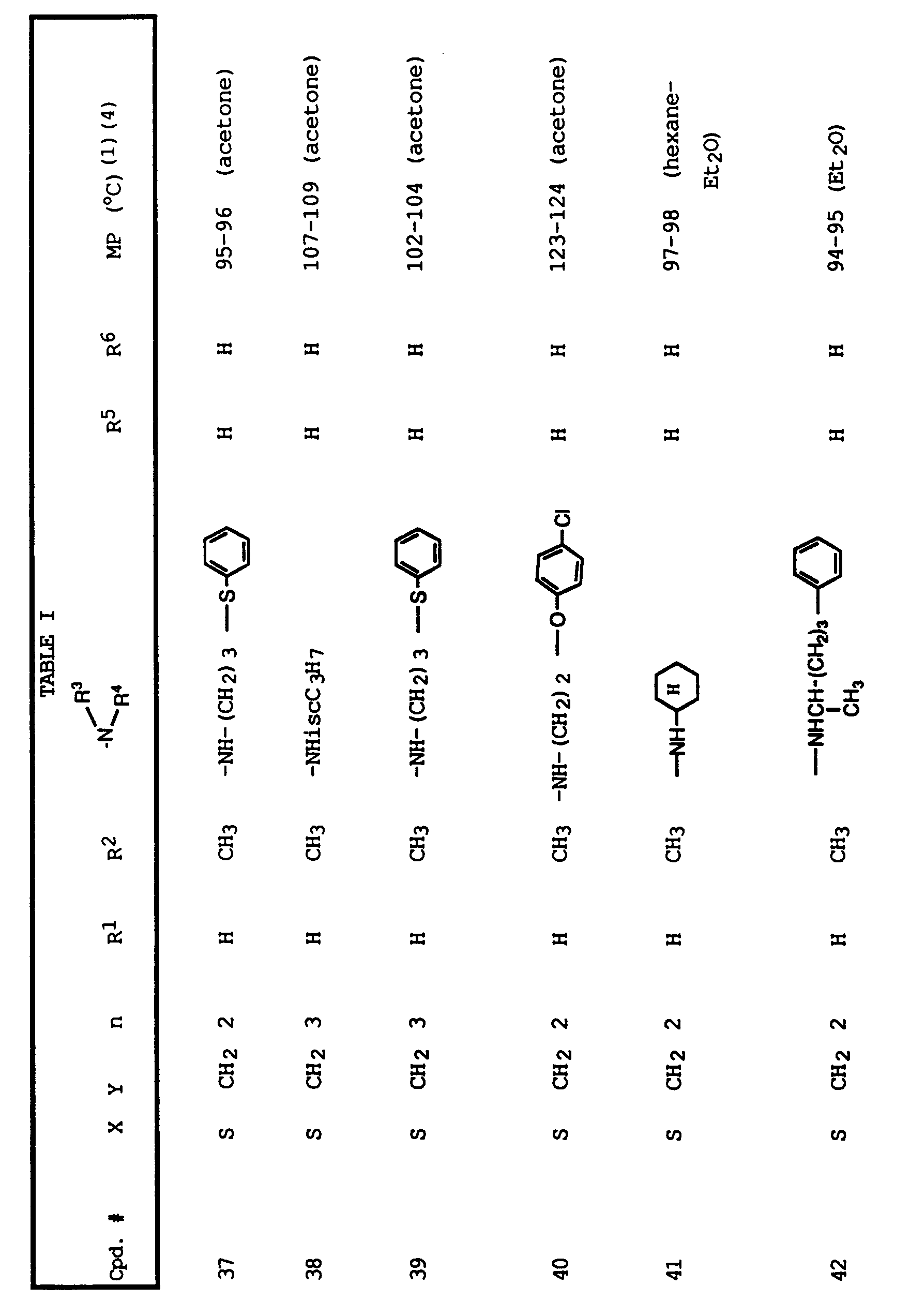


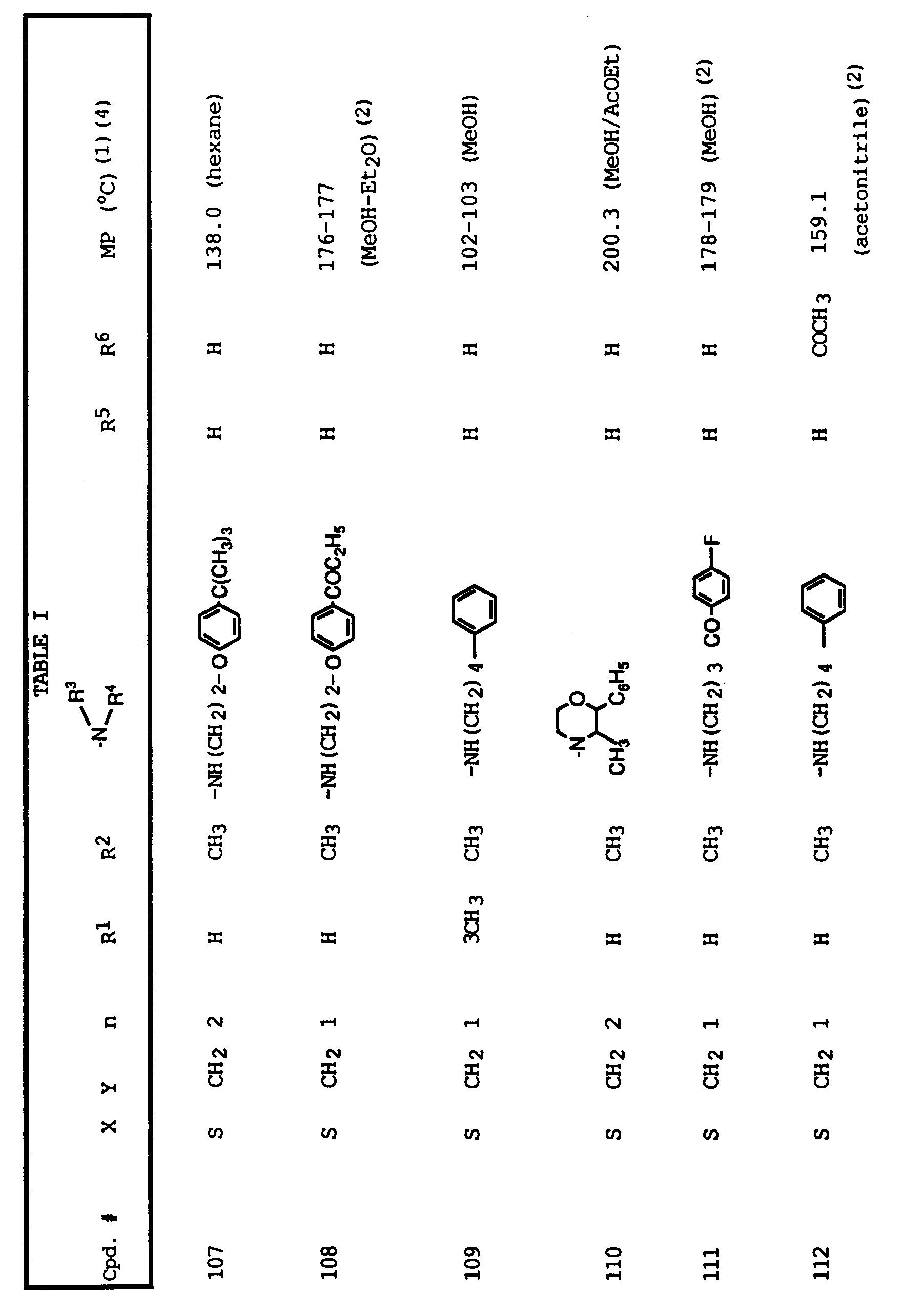


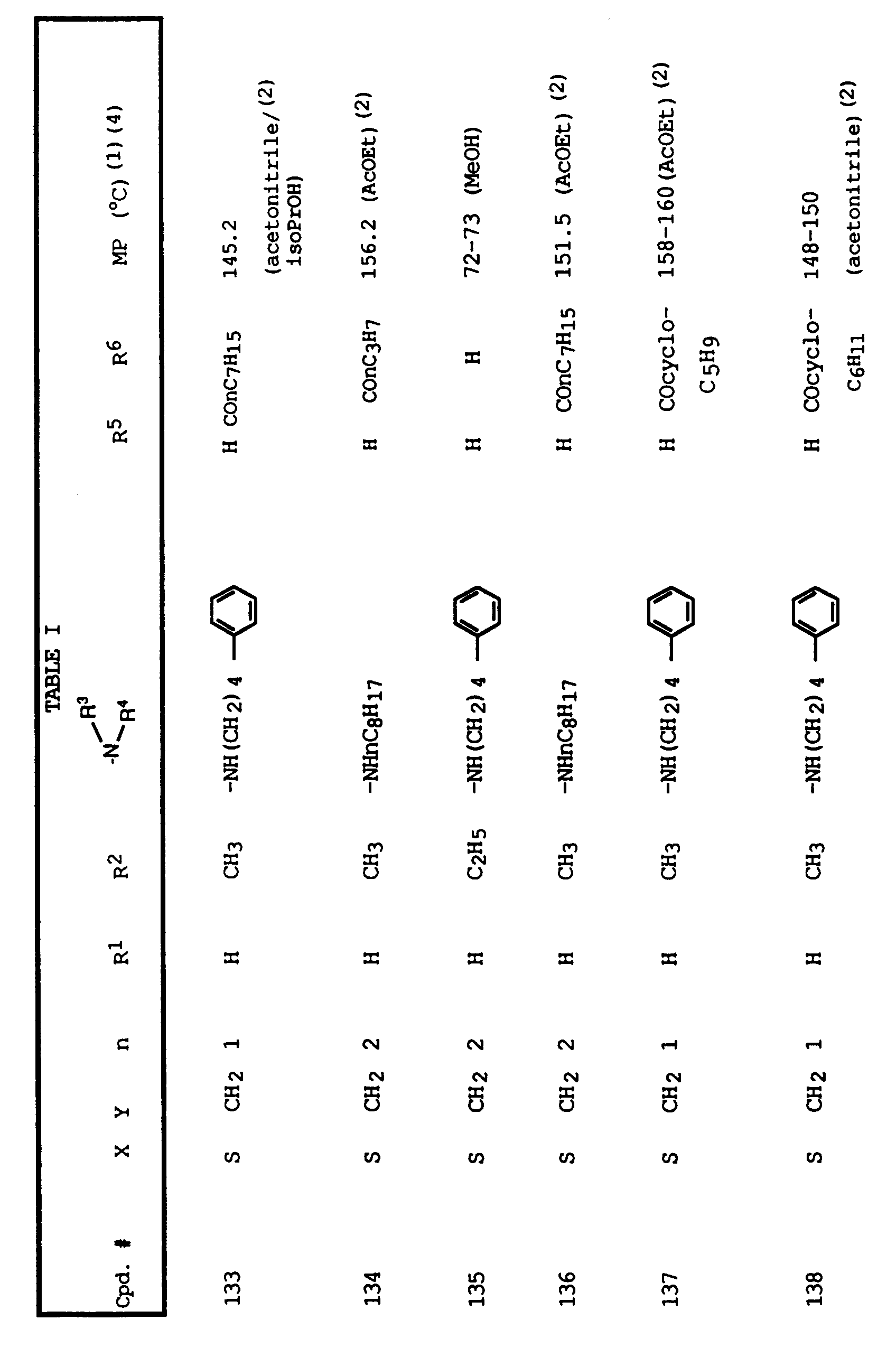


- The term "hydrogen" denotes a single hydrogen atom (H). This hydrogen group may be attached, for example, to an oxygen atom to form a hydroxyl group; or, as another example, one hydrogen group may be attached to a carbon atom to form a 〉CH- group; or, as another example, two hydrido groups may be attached to a carbon atom to form a -CH₂- group. Where the term "alkyl" is used, either alone or within other terms such as "haloalkyl" and "hydroxyalkyl", the term "alkyl" embraces linear or branched radicals having one to about twenty carbon atoms or, preferably, one to about fifteen carbon atoms. More preferred alkyl radicals are "lower alkyl" radicals having one to about twelve carbon atoms. The term "cycloalkyl" embraces cyclic radicals having three to about ten ring carbon atoms, preferably three to about six carbon atoms, such as cyclopropyl, cyclobutyl, cyclopentyl and cyclohexyl. The term "polycycloalkyl" denotes a radical having two or more cycloalkyl rings; for example, an alkylene group of one or more methylene radicals may bridge a cycloalkyl ring in one or more places to form an adamantyl group. Preferred polycycloalkyl groups contain 10 to about 20 carbon atoms. The term "haloalkyl" embraces radicals wherein any one or more of the alkyl carbon atoms is substituted with one or more halo groups, preferably selected from bromo, chloro and fluoro. Specifically embraced by the term "haloalkyl" are monohaloalkyl, dihaloalkyl and polyhaloalkyl groups. A monohaloalkyl group, for example, may have either a bromo, a chloro, or a fluoro atom within the group. Dihaloalkyl and polyhaloalkyl groups may be substituted with two or more of the same halo groups, or may have a combination of different halo groups. A dihaloalkyl group, for example, may have two fluoro atoms, such as difluoromethyl and difluorobutyl groups, or two chloro atoms, such as a dichloromethyl group, or one fluoro atom and one chloro atom, such as a fluoro-chloromethyl group. Examples of a polyhaloalkyl are trifluoromethyl, 1,1-difluoroethyl, 2,2,2-trifluoroethyl, perfluoroethyl and 2,2,3,3-tetrafluoropropyl groups. The term "difluoroalkyl" embraces alkyl groups having two fluoro atoms substituted on any one or two of the alkyl group carbon atoms. The terms "alkylol" and "hydroxyalkyl" embrace linear or branched alkyl groups having one to about ten carbon atoms any one of which may be substituted with one or more hydroxyl groups. The term "alkenylalkyl" embraces linear or branched radicals having two to about twenty carbon atoms, preferably three to about ten carbon atoms, and containing at least one carbon-carbon double bond, which carbon-carbon double bond may have either cis or trans geometry within the alkenyl moiety. The term "alkynylalkyl" embraces linear or branched radicals having two to about twenty carbon atoms, preferably two to about ten carbon atoms, and containing at least one carbon-carbon triple bond. The terms "alkoxy" and "alkoxyalkyl" embrace linear or branched oxy-containing radicals each having alkyl portions of one to about ten carbon atoms, such as methoxy group. The term "alkoxyalkyl" also embraces alkyl radicals having two or more alkoxy groups attached to the alkyl radical, that is, to form monoalkoxyalkyl and dialkoxyalkyl groups. The "alkoxy" or "alkoxyalkyl" radicals may be further substituted with one or more halo atoms, such as fluoro, chloro or bromo, to provide haloalkoxy or haloalkoxyalkyl groups. The term "alkylthio" embraces radicals containing a linear or branched alkyl group, of one to about ten carbon atoms attached to a divalent sulfur atom, such as a methylthio group. The term "aryl" embraces aromatic radicals such as phenyl, naphthyl and biphenyl. The term "aralkyl" embraces aryl-substituted alkyl radicals such as benzyl, diphenylmethyl, triphenylmethyl, phenyl-ethyl, phenylbutyl and diphenylethyl. The terms "benzyl" and "phenylmethyl" are interchangeable. The terms "phenoxy" and "phenthio" denote radical respectively, aryl groups having an oxygen or sulfur atom through which the radical is attached to a nucleus, examples of which are phenoxy and phenylthio. The terms "sulfinyl" and "sulfonyl", whether used alone or linked to other terms, denotes respectively divalent radicals SO and SO₂. The term "aralkoxy", alone or within another term, embraces an aryl group attached to an alkoxy group to form, for example, benzyloxy. The term "acyl" whether used alone, or within a term such as acyloxy, denotes a radical provided by the residue after removal of hydroxyl from an organic acid, examples of such radical being acetyl and benzoyl. "Lower alkanoyl" is an example of a more preferred sub-class of acyl. The term "heterocyclic" denotes a saturated or partially unsaturated five- or six-membered ring system containing one or more atoms selected from oxygen, sulfur and nitrogen, such as morpholino, piperidinyl, piperazinyl and pyrrolidinyl. The term "heteroaryl" embraces aromatic ring systems containing one or two hetero atoms selected from oxygen, nitrogen and sulfur in a ring system having five or six ring members, examples of which are imidazole, imidazolidione, naphthyl, naphthyloxy, indanoyl, indanoyloxy, thienyl, furanyl, pyridinyl, thiazolyl, pyrimidyl and isoxazolyl. Such heteroaryl may be attached as a substituent through a carbon atom of the heteroaryl ring system, or may be attached through a carbon atom of an oxygen atom or a sulfur atom substituted on a heteroaryl ring-member carbon atom through which the heteroaryl group is attached to the R³/R⁴-substituted nitrogen atom of Formula I. Also, such heteroaryl may be attached through a ring nitrogen atom as long as aromaticity of the heteroaryl moiety is preserved after attachment. Such "heterocyclic" and "heteroaryl" groups may be formed so as to include the nitrogen atom of Formula I to which the R³ and R⁴ substituents are attached.
- Also included in the family of compounds of Formula I are isomeric forms including, optical isomers, enantiomers and diastereoisomers. Also included in this invention are the pharmaceutically-acceptable salts of the Formula I compounds. The term "pharmaceutically-acceptable salts" embraces salts commonly used to form alkali metal salts and to form addition salts of free acids or free bases. The nature of the salt is not critical, provided that it is pharmaceutically-acceptable. Suitable pharmaceutically-acceptable acid addition salts of compounds of Formula I may be prepared from an inorganic acid or from an organic acid. Examples of such inorganic acids are hydrochloric, hydrobromic, hydroiodic, nitric, carbonic, sulfuric and phosphoric acid. Appropriate organic acids may be selected from aliphatic, cycloaliphatic, aromatic, araliphatic, heterocyclic, carboxylic and sulfonic classes of organic acids, example of which are formic, acetic, propionic, succinic, glycolic, gluconic, lactic, malic, tartaric, citric, ascorbic, glucuronic, maleic, fumaric, pyruvic, aspartic, glutamic, benzoic, anthranilic, p-hydroxybenzoic, salicyclic, phenylacetic, mandelic, embonic (pamoic), methansulfonic, ethanesulfonic, 2-hydroxyethanesulfonic, pantothenic, benzenesulfonic, toluenesulfonic, sulfanilic, mesylic, cyclohexylaminosulfonic, stearic, algenic, β-hydroxybutyric, malonic, galactaric and galacturonic acid. Suitable pharmaceutically-acceptable base addition salts of compounds of Formula I include metallic salts made from aluminium, calcium, lithium, magnesium, potassium, sodium and zinc or organic salts made from N,N'-dibenzylethylenediamine, chloroprocaine, choline, diethanolamine, ethylenediamine, meglumine (N-methylglucamine) and procaine. All of these salts may be prepared by conventional means from the corresponding compound of Formula I by reacting, for example, the appropriate acid or base with the compound of Formula I.
- Compounds of general Formula I can possess one or more asymmetic carbon atoms and are thus capable to existing in the form of optical isomers as well as in the form of racemic or nonracemic mixtures thereof. The optical isomers can be obtained by resolution of the racemic mixtures according to conventional processes, for example by formation of diastereoisomeric salts by treatment with an optically active acid or base. Examples of appropriate acids are tartaric, diacetyltartaric, dibenzoyltartaric, ditoluoyltartaric and camphorsulfonic acid and then separation of the mixture of diastereoisomers by crystallization followed by liberation of the optically active bases from these salts. A different process for separation of optical isomers involves the use of a chiral chromatography column optimally chosen to maximize the separation of the enantiomers. Still another available method involves synthesis of covalent diastereoisomeric molecules by reacting compounds of Formula I with an optically pure acid in an activated form or an optically pure isocycanate. The synthesized diastereoisomers can be separated by conventional means such as chromatography, distillation, crystallization or sublimation, and then hydrolyzed to deliver the enantiomericaly pure compound. The optically active compounds of Formula I can likewise be obtained by utilizing optically active starting materials. These isomers may be in the form of a free acid, a free base, an ester or a salt.
- The NMDA receptor-ionophore complex consists of a number of interacting domains, including one for polyamines where ifenprodil binds to exert its non-competitive antagonism. Ifenprodil was iodinated with Na¹²⁵I/chloramine-T, purified and its binding characterized. In cortical membranes, binding of [¹²⁵I] ifenprodil was saturable (Kd 145 nM, Bmax 2.5 pmol/mg protein) and to a single site. Specific binding was reversible, being dissociable with 1mM spermine and poorly dissociable with 1mM spermine and poorly dissociable with 16.7 µM SL 82.0715, and represented 70-75% of total binding by filtration. In autoradiographic studies using slide-mounted sections, binding sites for [¹²⁵I]ifenprodil were localized in several regions including anterior cingulate cortex, hippocampus and amygdala.
- Membranes were prepared from freshly dissected brains of adult male Sprague-Dawley rats (175-250g).
[ 125 I]Ifenprodil : Crude membranes were prepared from freshly dissected cerebral cortices as described elsewhere [P. M. Beart et al, Nuerosci. Lett., 124, 187-189 (1991)]. Briefly, assays were performed in 5mM Tris HCl pH 7.7 containing [¹²⁵I]ifenprodil (20,000 dpms, ∼20pM) and cortical membranes (0.5 mg wet wt.) in a final volume of 0.5 mL. Incubations were for 30 min. at 20°C, in triplicate, employing 12 concentrations of competing drugs. Non-specific binding was defined with 10 mM spermine. Assays were terminated by rapid filtration through GF/B filter paper and washing [Beart et al, Id., (1991)].
Polyamine-stimulated [ 3 H]TCP: Crude synaptic ("buffy coat") membranes were prepared from freshly dissected cerebral cortices. Membrane preparations were extensively washed employing 3 freeze-thaw cycles. The final pellet was stored at -70°C for 1-7 days prior to assay. On the day of assay, the membrane pellet was washed twice by resuspension and centrifugation (45,000 g, 10 min.). The final membrane pellet was resuspended in 80 volumes of 5 mM Tris HCl pH 7.7 and binding assays were performed in 5 mM Tris HCl pH 7.7, containing [³H]TCP (6nM) and cortical washed/frozen-thawed synaptic membranes (1.25 mg wet wt., 100 µg protein) in a final volume of 250 µl. Incubations were for 60 min. at 25°C. employing 6 concentrations of spermidine (6.67 - 100 µM) in triplicate determinations in the absence and presence of various drugs in the same individual experiment. Assay tubes with no additions (basal) and containing 5 µM MK-801 in the absence and presence of drugs were routinely included in each experiment. Assays were terminated by rapid vacuum filtration through GF/B filter paper (pre-soaked in 0.5% aqueous polyethyleneimine) in a Brandel M-48R Cell Harvester and thorough washing with ice-cold 5 mM Tris HCl pH 7.7.
R(+)-[ 3 H]3-PPP: Crude membranes were prepared from whole brain (minus cerebellum) as described previously [P. M. Beart et al, J. Neurochem., 53, 779-788 (1989)]. A filtration binding assay was employed under similar conditions to those of Largent et al (1986) with 3 nM R (+)-[³H]-3-PPP and a 90 min. incubation at 25°C (Beart et al, 1989). Non-specific binding was defined with 10 µM 1,3-di(2-tolyl)guanidine (DTG). - Coronal sections of rat brain (10 µm) were thaw-mounted on to gelatin coated, glass microscope slides and stored at -20°C (overnight - 3 days). Procedures for labelling and autoradiography with L[³H]-glutamate (NMDA-sensitive and [¹²⁵I]ifenprodil have been given elsewhere [M. Cincotta et al, Anal Biochem., 177, 150-155 (1989)]; Beart et al, 1991). Non-specific binding was defined with DL-1-amino-3-hydroxy-5-methyl-4-isoxazolepropionic acid (AMPA) hydrobromide (33 µM) plus kainate (10 µM) and 10 mM spermine, respectively. For [³H] glycine the method was similar to that of Bristow et al (1986) and performed in 50 mM Tris citrate pH 7.4 with 250 nM [³H] ligand and a 20 min. incubation at 20°C. Non-specific binding was defined with 200 µM glycine. For labelling with L[³H]-glutamate and [³H]glycine, sections were preincubated in appropriate buffer, dried in cool air and incubated under 250 µl of incubation buffer.
- Binding data were analyzed by the iterative curve fitting programs EBDA and LIGAND as fully described elsewhere [Beart et al, Id., (1989)]. Results obtained from experiments examining spermidine-stimulated binding of [³H]TCP were analyzed by the program FLEXIFIT [V. Guardabasso et al, FASEB J., 2, 209-215 (1988)] which iteratively fits data to a sigmoidal model providing estimates of IC₅₀ and slope for the drug under study.
- Radioisotopes were obtained from New England Nuclear (Boston, MA): L[³H]-Glutamate (specific activity 55 Ci/mmole), [³H]Glycine (specific activity 35 Ci/mmole), R(+)-[³H]3-PPP (specific activity 108 Ci/mmole), [³H]TCP (specific activity 60 ci/mmole). Na¹²⁵I (specific activity 2200 Ci/mmole) was purchased from Amersham (Little Chalfront, U.K.). Chemicals were obtained from the following sources: Chloramine-T, Merck (Darmstadt, Germany); glycine, NMDA and kainate, Sigma Chemical Co. (St. Louis, MO); AMPA, Dr. P. Krogsgaard-Larsen (Copenhagen, Denmark); caramiphen, dextromethorphan and dextrorphan, Dr. J. Church (Vancouver, Canada); DTG, Dr. E. Weber (Portland, OR); dizocilipine (MK-801), Merck, Sharpe and Dohme (Harlow, U.K.); ifenprodil and SL 82.0715, Synthelabo (Bagneux, France); (+)SKF 10,047 (N-allylnormetazocine), National Institute on Drug Abuse (Rockville, MA); Compounds of Table I, G. D. Searle & Co. (Mont-St-Guibert, Belgium); R(+)-3-PPP, Astra (Sodertalje, Sweden). All other reagents were purchased from commercial suppliers.
- The binding assay using [¹²⁵I]ifenprodil and filtration methodology gave an excellent signal-to-noise ratio beyond one half-life; under the conditions employed specific binding represented 70-80% of specific binding. [¹²⁵I]Ifenprodil bound rapidly and saturably to a single population of sites: dissociation constant 121 (45-236) nM and density of binding sites 228 (84-619) pmol/mg protein (estimates and 95% confidence intervals, n=3 (Beart et al, 1991). Polyamines completely inhibited specific binding: dissociation constants for spermine and spermidine were 24 ± 13 (n=4) and 44 ± 10 µM (n=3), respectively. The ifenprodil analogue, SL82.0715, exhibited a dissociation constant of 2.3 ± 0.13 µM (n=3).
- From a wide range of preliminary experiments, the inclusion of BSA (0.2%) was found to be essential for the demonstration of discretely distributed binding sites for [¹²³I]ifenprodil relative to non-specific images. Attempts to employ polyethyleneimine (0.05%) to reduce non-specific binding actually resulted in enhanced binding of [¹²⁵I]ifenprodil to white matter. Autoradiographic labelling patterns revealed heterogeneous labelling of many telencephalic, diencephalic and mesencephalic brain areas [see Beart et al, Id., (1991)]. In hippocampus, the topographic labelling pattern was consistent with that generally considered to be NMDA-like ([W. F. Maragos et al, J. Neurosci., 8, 493-501 (1988)]. Labelling observed with [¹²⁵I]ifenprodil in cerebellum was over the molecular layer, however, relative to that found for the binding of NMDA-selective [³H]glutamate and [³H]glycine in the granular layer.
- Compounds of Table I were evaluated against the binding of [¹²⁵I]ifenprodil and found to also fully inhibit specific binding of [¹²⁵I]ifenprodil (Table II).
- Compounds of Table I were also evaluated against spermidine-stimulated bind of [³H]TCP, since this system represents a convenient functional model of the coupling of the polyamine domain to the NMDA ionophore [R. W. Ransom et al, J Neurachem., 51, 830-836 (1988)]. All tested compounds of Table I were found to inhibit polyamine-stimulated binding of [³H]TCP in an apparently non-competitive manner, i.e., the inhibition was concentration dependent, but maximal stimulation of binding by spermidine was reduced (Table II). Computerized-analyses of inhibition data suggested that the mechanism of inhibition by Compounds of Table I was competitive with respect to spermidine.
TABLE II POLYAMINE DOMAIN INTERACTION COMPOUND # [¹²⁵I]IFENPRODIL SPERMIDINE[³H]TCP Kd (µM) IC₅₀ (µM) 7 3.6 ± 0.3 8.2 183 9.3 ± 5.4 + 184 6.3 ± 1.8 + 185 3.5 ± 1.1 59 2 9.3 ± 5.5 + 186 6.7 ± 1.1 + 26 12 N.T. 42 2.7 ± 0.4 + 75 5.0 ± 1.4 + 24 3.7 ± 1.1 + Ifenprodil 0.15 ± 0.03 6.8 Nylidrin 30 ± 8.5 73 SL82.0715 2.3 ± 0.1 N.T. Values are mean ± s.e.m. (n=3 or 4 observations). At least two independent experiments were performed in studies of polyamine-stimulated binding of [³H]TCP. N.T. = not tested.
+ = inhibitory at 50 µM. - Compounds of Table I inhibited the binding of R(+)-[³H]3-PPP. This type of binding has been previously demonstrated to label a binding site with the characteristics of a sigma site [Beart et al, Id., (1989)]. Compound #185 and Compound #186 were found to be very potent inhibitors of the binding of R(+)-[³H]3-PPP (Table III). For all of the tested Compounds of Table I the pattern of inhibition of binding yielded Hill coefficients < 1. Further analyses suggested that the interaction of Compounds of Table I, ifenprodil and nylidrin with the site labelled by R(+)-[³H]3-PPP, was better described by a two-site model (Table III). The proportion of sites in the high affinity state was generally in the range of 60-80% of the total sites. These computer-assisted analyses revealed that Compound #7 possessed appreciable affinity for the high affinity sigma site, as did its two enantiomers, Compound #184 and Compound #185.
TABLE III Sigma Site Binding COMPOUND # KG(nM) KH(nM) KL(µM) %RH 7 170 44 11 66 183 450 (300) (130) (84) 184 230 6.1 6.1 54 185 32 (4.6) (0.3) (63) 2 400* (150) (4.3) (72) 186 30 (2.9) (0.6) (72) 75 340 86 4.3 67 24 390* (89) (3.0) (63) Ifenprodil 20 11 19 82 Nylidrin 38 19 11 86 (+)SKF10.047 1500 48 6.3 60 Values are from analyses of pooled data files; n=2 independent experiments. *one experiment. Binding data fitted better to 2 site model (P<0.05), except when values in parentheses (P<0.05).
KG = Dissociation constant for one site fit
KH = Dissociation constant at high affinity site for two site fit
KL = Dissociation constant at low affinity site for two site fit
%RH = Percent of high affinity binding sites for two site fit - Compounds of Formula I would be useful to treat various CNS-related diseases. Biological evaluation of representative compounds of Formula I shows that such compounds are potent inhibitors mediators interacting at the NMDA receptor site complex. From data shown in Table II, it is evident that compounds of Formula I would be useful as neuroprotective agents. For example, such compounds would be useful to reduce or control neurotoxic injury associated with conditions of hypoxia, anoxia, or ischemia. These conditions may result from stroke, cardiac arrest such as resulting from myocardial infarct, perinatal asphyxia, head trauma, hypoglycemia, epilepsy, septicemia and similar events. Also, as is evident from the data in Table II, compounds of Formula I would be useful to treat various neurodegenerative disease states linked to excitotoxic actions at the NMDA receptor complex. Examples of such disease states are Parkinson's disease, Huntington's chorea and Alzheimer's disease. As shown by sigma binding data of Table III, compounds of Formula I would be useful to treat various psychotic disorders such as schizophrenia. As used herein, the phrase "therapeutically-effective amount" is that amount of compound of Formula I administered to a subject which would be useful to alleviate or moderate a CNS-related disease in a subject afflicted with, or susceptible to, such disease.
- Administration of compounds within Formula I to humans can be by any technique capable of introducing the compounds into the bloodstream of a human patient, including oral administration, and by intravenous, intramuscular and subcutaneous injections.
- Compounds indicated for prophylactic therapy will preferably be administered in a daily dose generally in a range from 0.1 mg to 100 mg per kilogram of body weight per day. A more preferred dosage will be a range from 1 mg to 100 mg per kilogram of body weight. Most preferred is a dosage in a range from about 1 to 50 mg per kilogram of body weight per day. A suitable dose can be administered, in multiple sub-doses per day. These sub-doses may be administered in unit dosage forms. Typically, a dose or sub-dose may contain from 1 mg to 100 mg of active compound per unit dosage form. A more preferred dosage will contain from 2 mg to 50 mg of active compound per unit dosage form. Most preferred is a dosage form containing from 3 mg to 25 mg of active compound per unit dose.
- The active compound is usually administered in a pharmaceutically-acceptable formulation, although in some acute-care situations a compound of Formula I may be administered alone. Such formulations may comprise the active compound together with one or more pharmaceutically-acceptable carriers or diluents. Other therapeutic agents may also be present in the formulation. A pharmaceutically-acceptable carrier or diluent provides an appropriate vehicle for delivery of the active compound without introducing undesirable side effects. Delivery of the active compound in such formulations may be by various routes including oral, nasal, topical, buccal and sublingual, or by parenteral administration such as subcutaneous, intramuscular, intravenous and intradermal routes.
- Formulations for oral administration may be in the form of capsules containing the active compound dispersed in a binder such as gelatin or hydroxypropylmethyl cellulose, together with one or more of a lubricant, preservative, surface-active or dispersing agent. Such capsules or tablets may contain controlled-release formulation as may be provided in a dispersion of active compound in hydroxypropylmethyl cellulose.
- Formulations for parenteral administration may be in the form of aqueous or non-aqueous isotonic sterile injection solutions or suspensions. These solutions and suspensions may be prepared from sterile powders or granules having one or more of the carriers or diluents mentioned for use in the formulations for oral administration.
Claims (23)
- Use of a therapeutically-effective amount of a compound of Formula I:

wherein Y is selected from -CH₂- and -NH-;
wherein n is a number selected from one through three, inclusive;
wherein R¹ is selected from hydrogen, C₁-C₂₀-alkyl, C₁-C₂₀-hydroxyalkyl, C₁-C₁₀-alkoxyalkyl, C₃-C₁₀-cycloalkyl, C₃-C₁₀-cycloalkyl-C₁-C₂₀-alkyl, phenyl and carboxyl;
wherein R² is selected from hydrogen, C₁-C₂₀-alkyl, C₁-C₂₀-hydroxyalkyl, C₃-C₁₀-cycloalkyl and C₃-C₁₀-cycloalkyl-C₁-C₂₀-alkyl;
wherein each of R³ and R⁴ is independently selected from hydrogen, C₁-C₂₀-alkyl, C₁-C₂₀-haloalkyl, C₃-C₁₀-cycloalkyl, C₃-C₁₀-cycloalkyl-C₁-C₂₀-alkyl, C₁-C₂₀-alkyl-C₃-C₁₀-cycloalkyl, C₁-C₂₀-alkyl-C₃-C₁₀-cycloalkylalkyl, phenyl, phenyl-C₁-C₂₀-alkyl, diphenyl-C₁-C₂₀-alkyl, C₁-C₂₀-alkylphenyl, C₁-C₂₀-alkylphenyl-C₁-C₂₀-alkyl, halophenyl, halophenyl-C₁-C₂₀-alkyl, phenoxy-C₁-C₂₀-alkyl, halophenoxy-C₁-C₂₀-alkyl, C₁-C₁₀-alkoxyphenoxy-C₁-C₂₀-alkyl, cyanophenoxy-C₁-C₂₀-alkyl, benzyloxy-C₁-C₂₀-alkyl, C₁-C₁₀-alkoxyalkyl, C₁-C₁₀-alkoxy-C₁-C₁₀-alkoxyalkyl, C₁-C₁₀-alkoxycarbonyl-C₁-C₂₀-alkyl, phenylthio-C₁-C₂₀-alkyl, C₁-C₂₀-alkylcarbonylaminophenyl-C₁-C₂₀-alkyl, halophenylcarbonyl-C₁-C₂₀-alkyl, halobenzylcarbonyl-C₁-C₂₀-alkyl, C₁-C₂₀-alkylcarbonylphenoxy-C₁-C₂₀-alkyl, C₁-C₁₀-alkoxycarbonylphenoxy-C₁-C₂₀-alkyl, C₁-C₂₀-alkylphenoxy-C₁-C₂₀-alkyl, C₂-C₂₀-alkenylalkyl, C₂-C₂₀-alkynylalkyl, C₂-C₂₀-alkynylalkyloxy-C₁-C₂₀-alkyl, polycycloalkyl, saturated heterocyclic, saturated heterocyclicalkyl, heteroarylalkyl and heteroaryloxyalkyl;
wherein R³ and R⁴ may be taken together to form a saturated heterocyclic group or a heteroaryl group, either of which groups may be further substituted, said groups selected from C₁-C₂₀-alkylphenylpiperidinyl, morpholino, phenylmorpholino, C₁-C₂₀-alkylmorpholino, 1-C₁-C₂₀-alkyl-2-phenylmorpholino, phenyl-C₁-C₂₀-alkylpiperidinyl, C₁-C₂₀-alkylphenylpiperazinyl, phenylpiperidinyl, phenyl-C₁-C₂₀-alkylpyrrolidinyl, phenylpiperazinyl and phenyl-C₁-C₂₀-alkylpiperazinyl;
wherein R⁵ is selected from hydrogen, C₁-C₂₀-alkyl, C₁-C₂₀-hydroxyalkyl, C₃-C₁₀-cycloalkyl, C₃-C₁₀-cycloalkyl-C₁-C₂₀-alkyl, phenyl-C₁-C₂₀-alkyl and phenyl;
wherein R⁶ is selected from hydrogen, alkanoyl and C₃-C₁₀-cycloalkanoyl;
and wherein any of the foregoing R¹ - R⁶ radicals may be further substituted at a substitutable position with a radical selected from C₁-C₂₀-alkyl, C₃-C₁₀-cycloalkyl, C₃-C₁₀-cycloalkyl-C₁-C₂₀-alkyl, C₁-C₁₀-alkoxy, C₂-C₂₀-alkenylalkyl, C₁-C₁₀-alkoxyalkyl, C₁-C₂₀-hydroxyalkyl, oxo, cyano, halo, phenyl and phenyl-C₁-C₂₀-alkyl;
or a pharmaceutically-acceptable salt thereof except the compounds wherein X and Y are CH₂, n is 1, R¹, R², R⁵, R⁶ are hydrogen anda) R³ is n-butyl and R⁴ being methyl;b) R³ and R⁴ are forming together with N the phenylmethylpiperazinyl group;c) R³ and R⁴ are forming together with N the phenylpiperazinyl group;for the manufacture of a medicament to provide a neuroprotective effect in a subject susceptible to, or afflicted with neurotoxic injury or a neurodegenerative disease - Use according to Claim 1 wherein said compound is selected from compounds of Formula I
wherein R¹ is selected from hydrogen, C₁-C₂₀-alkyl, C₁-C₂₀-hydroxyalkyl, C₃-C₁₀-cycloalkyl, phenyl and carboxyl;
wherein R² is selected from hydrogen, C₁-C₂₀-alkyl and C₃-C₁₀-cycloalkyl;
wherein each or R³ and R⁴ is independently selected from hydrogen, methyl, ethyl, n-propyl, isopropyl, n-butyl, isobutyl, sec-butyl, iso-butyl, tert-butyl, n-pentyl, neopentyl, iso-pentyl, n-hexyl, n-heptyl, n-octyl, n-nonyl, n-decyl, n-undecyl, n-duodecyl, n-tredecyl, n-tetradecyl, cyclopropyl, cyclobutyl, cyclopentyl, cyclohexyl, cycloheptyl, cyclohexyl, cyclooctyl, cyclononyl, cyclohexylmethyl, cyclohexylethyl, cyclohexylpropyl, cyclohexylbutyl, methylcyclohexylbutyl, phenyl, benzyl, phenylethyl, phenylpropyl, phenylbutyl, phenylpentyl, phenylhexyl, diphenylmethylethyl, diphenylmethylpropyl, methylphenyl, methylphenylmethyl, methylphenylethyl, methylphenylpropyl, methylphenylbutyl, chlorophenylbutyl, fluorophenylbutyl, phenoxyethyl, pnenoxypropyl, phenoxybutyl, dimethoxyphenylethyl, chlorophenoxyethyl, dichlorophenoxyethyl, methylphenoxyethyl, methoxyphenoxyethyl, dimethoxyphenoxyethyl, cyanophenoxyethyl, benzyloxyethyl, butoxypropyl, butoxyethoxypropyl, methoxycarbonyldecyl, methoxyethoxypropyl, butoxypropoxypropyl, phenylthioethyl, phenylthiopropyl, phenylthiobutyl, methylcarbonylaminophenoxyethyl, fluorophenylcarbonylpropyl, fluorobenzylcarbonylpropyl, ethylcarbonylphenoxyethyl, methoxycarbonylphenoxyethyl, tert-butylphenoxyethyl, alkenylalkyl, propargylpropyl, propargylbutyl, propargylpentyl, propargylhexyl, propargylpropyloxypropyl, methylsulfonylaminophenoxybutyl, adamantyl, imidazolidonepropyl, pyrrolidinylmethyl, pyrrolidinylethyl, pyrrolidinylpropyl, naphthyloxyethyl, naphthyloxypropyl, indanoyloxyethyl, indanoyloxypropyl, pyrrolldinylmethyl and pyrrolidinylethyl;
wherein R³ and R⁴ may be taken together to form a saturated heterocyclic group or a heteroaryl group, either of which groups may be further substituted, said groups selected from methylphenylpiperidinyl, morpholino, phenylmorpholino, methylmorpholino, 1-methyl-2-phenylmorpholino, phenylmethylpiperidinyl, phenylpiperidinyl, phenylmethylpyrrolidinyl, phenylpiperazinyl, methylphenylpiperazinyl and phenylmethylpiperazinyl;
wherein R⁵ is selected from hydrogen, C₁-C₂₀-alkyl and C₃-C₁₀-cycloalkyl;
wherein R⁶ is selected from hydrogen, alkanoyl and cycloalkanoyl;
and wherein any of the foregoing R¹ - R⁶ radicals may be further substituted at a substitutable position with a radical selected from C₁-C₂₀-alkyl, C₃-C₁₀-cycloalkyl, C₂-C₂₀-alkenylalkyl, C₁-C₁₀-alkoxyalkyl, C₁-C₂₀-hydroxyalkyl, oxo, cyano, halo, phenyl and phenyl-C₁-C₂₀-alkyl;
or a pharmaceutically-acceptable salt thereof. - Use according to Claim 1 wherein said compound is selected from compounds of Formula I wherein R¹ is selected from hydrogen, linear or branched C₁ to C₃ alkyl radicals, a phenyl radical or a carboxy radical;
wherein R² is selected from a linear or branched C₁ to C₃ alkyl radical;
wherein R³ is selected from a mono or polyunsaturated C₃ to C₁₈ alkenyl radical; a mono or polyunsaturated C₃ to C₁₂ alkenyl radical substituted by phenyl and optionally containing an oxygen or sulfur linkage; a mono or polyunsaturated C₃ to C₁₈ alkynyl radical; a mono or polyunsaturated C₃ to C₁₂ alkynyl radical substituted by phenyl and optionally containing an oxygen or sulfur linkage; a cycloalkyl C₃ to C₁₀ radical; a C₂ to C₂₀ linear or branched alkyl radical; a linear or branched C₂ to C₁₈ alkyl radical, containing at least one oxygen or sulfur linkage and optionally substituted with one or more groups selected from C₁ to C₃ alxoxycarbonyl, pyrrolidine, pyrrolidinone, imidazolidone, phenyl, phenoxy, phenylthio, benzoyl, indanyloxy, naphthyloxy, and phenyl, phenoxy, phenylthio and benzoyl radicals substituted by one or more C₁ to C₄ alkyl or C₁ to C₄ alkoxy radicals, by one or two halogen atoms, or by a nitrile, hydroxy, amino, C₂ to C₆ alkylcarbonyl, C₂ to C₄ acylamino, C₂ to C₅ alkoxycarbonyl, or C₁ to C₄ alkylsulfonamido radical, or by an alkoxycarbonylalkyl in which both the alkoxy and alkyl moieties contain from 1 to 4 carbon atoms, or alkoxycarbonylalkoxy in which each alkoxy moiety contains from 1 to 4 carbon atoms;
wherein R⁴ when taken with R³ and adjacent nitrogen atom, forms a piperazinyl radical substituted in position 4 by a phenyl radical or by a phenyl radical itself substituted by one or (C₁ to C₄) two alkyl or (C₁ to C₄) alkoxy radicals, one or two halogen atoms, or a trifluoromethyl radical;
wherein R⁵ is selected from hydrogen, halogen, and a C₁ to C₃ alkyl radical;
wherein R⁶ is selected from a hydrogen, a linear or branched C₂ to C₁₁ alkylcarbonyl radical and a C₃ to C₈ cycloalkyl carbonyl radical;
wherein n is selected from one, two and three;
wherein X is selected from sulfur, oxygen, a CH₂ radical or a NH radical;
wherein Y is selected from a -CH₂- radical or sulfur provided that when simultaneously X is oxygen, Y is -CH₂- group, n is 2, each of R¹ and R⁵ is hydrogen, R² is methyl and R⁸ is hydrogen or an alkyl carbonyl radical, R⁴ does not form a substituted piperazine radical with R³ and the adjacent nitrogen atom; or a pharmaceutically-acceptable salt thereof. - Use according to Claim 3 wherein said compound is selected from compounds of Formula I wherein R¹ is hydrogen or alkyl (C₁ to C₃) radical;
wherein R² is selected from alkyl (C₁ to C₃) radical;
wherein R³ is selected from a mono or polyunsaturated alkenyl (C₃ to C₁₈) radical; a mono or polyunsaturated alkynyl (C₃ to C₁₈) radical; a cycloalkyl (C₃ to C₈) radical; an alkyl (C₂ to C₁₈) radical; an alkyl (C₂ to C₁₈) radical substituted by a group selected from phenylthio radical, an alkoxy (C₁ to C₆) radical, an alkythio (C₁ to C₆) radical, a phenoxy radical, a benzoyl radical and one or two phenyl radicals; a group selected from a phenyl, benzoyl, phenylthio or phenoxy radical each substituted by an alkyl (C₁ to C₃) or a halogen; a group selected from a phenoxy radical substituted by a nitrile or an alkylcarbonyl (C₂ to C₃) radical;
wherein R⁴ is selected from hydrogen or when taken with R³ and the adjacent nitrogen atom forms a group selected from a piperazine radical substituted by a phenyl radical which is in turn substituted by an alkyl (C₁ to C₃) radical and a group selected from a piperidine radical substituted by an alkyl (C₁ to C₃) radical which is itself substituted by a phenyl radical;
wherein R⁵ is selected from hydrogen and alkyl (C₁ to C₃) radical;
wherein R⁶ is selected from hydrogen, a linear or branched alkylcarbonyl (C₂ to C₉) radical and a cycloalkylcarbonyl (C₃ to C₆) radical;
wherein n is selected from a number selected from one, two and three;
wherein X is selected from sulfur atom, oxygen atom and NH radical;
wherein Y is selected from a -CH₂- radical and sulfur atom;
or a pharmaceutically-acceptable salt thereof. - Use according to Claim 4 wherein said compound is selected from compounds of Formula I wherein R¹ is selected from hydrogen and one or two linear or branched C₁ to C₃ alkyl radicals; wherein R² is selected from alkyl (C₁ to C₃) radical;
wherein R³ is selected from C₃ to C₁₈ alkenyl radical;
C₃ to C₁₈ alkynyl radical; C₃ to C₁₈ cycloalkyl radical; linear or branched C₂ to C₁₈ alkyl radical; linear or branched C₂ to C₁₈ alkyl radical containing one or more oxygen or sulfur linkages, and optionally substituted by at least one or more groups selected from alkoxycarbonyl, pyrrolidine, pyrrolidinone or imidazolidone radical, by one or two phenyl, phenoxy, phenylthio, indanyloxy radicals; one or more groups selected from phenyl, phenoxy, phenylthio radical substituted by one or two C₁ to C₄ alkyl or C₁ to C₄ alkoxy radicals; or one or two halogen atoms; one or more groups selected from nitrile, hydroxy, amino, C₂ to C₉ alkyl carbonyl, C₂ to C₄ acylamino, alkoxycarbonyl, or C₁ to C₄ alkylsulfonamido radical, or one or more groups selected from alxoxycarbonylalkyl in which the alkyl and alkoxy moieties contain from 1 to 4 carbon atoms, or alkoxy carbonyl alkoxy in which each alkoxy moiety contains from 1 to 4 carbon atoms;
wherein X is selected from sulfur, oxygen and a CH₂ radical; and Y is a CH₂ radical. - Use according to Claim 5 wherein said compound is selected from compounds of Formula II

- Use according to Claim 2 wherein said compound is selected from compounds and the pharmaceutically-acceptable salts thereof, or the group consisting of 1-(6-thiochromanyl)-2-n-octylamino-1-propanol;
1-(6-thiochromanyl)-2-(4-phenylbutylamino)-1-propanol; 1-(6-thiochromanyl)-2-[2-(phenoxy)ethylamino]-1-propanol; 1-(2,3-dihydro-5-benzo(b)thienyl)-2-n-octylamino-1-propanol;
1-(2,3-dihydro-5-benzo(b)thienyl-2-(4-phenylbutylamino)-1-propanol; 1-(2,3-dihydro-5-benzo(b)thienyl)-2-[4-(p-chlorophenyl)butylamino]-1-propanol;
1-(2-methyl-2,3-dihydro-5-benzo(b)thienyl)-2-(4-phenlybutylamino)-1-propanol;
1-(2-methyl-2,3-dihydro-5-benzo(b)furanyl)-2-n-octylamino-1-propanol;
1-(2,3,4,5-tetrahydrobenzo(b)thiepin-7-yl)-2-(4-phenylbutylamino)-1-propanol;
1-(2,3-dihydro-5-indolyl)-2-n-octylamino-1-propanol; 1-(2,3-dihydro-5-benzo(b)thienyl)-2-(4-phenylbutylamino)-1-propionyl-oxypropane;
1-(2,3-dihydro-5-benzo(b)thienyl)-2-(4-phenylbutylamino)-1-cyclohexyl-carbonyloxypropane;
1-(5-indanyl)-2-(4-phenylbutylamino)-1-propanol; 1-(5-indanyl)-2-[2-(4-chlorophenoxy)ethylamino]-1-propanol; and 1-(5-indanyl)-2-[2-(4-fluorobenzoyl)propylamino]-1-propanol. - Use according to Claim 7 wherein said compound is the erythro form of 1-(2,3-dihydro-5-benzo[b]thienyl)-2-(4-phenylbutylamino-1-propanol or a pharmaceutically-acceptable salt thereof.
- Use according to Claim 7 wherein said compound is the threo form of 1-(2,3-dihydro-5-benzo[b]thienyl)-2-(4-phenylbutylamino-1-propanol or a pharmaceutically-acceptable salt thereof.
- Use according to Claim 7 wherein said compound is (-)-1-(2,3-dihydro-5-benzo[b]thienyl)-2-(4-phenylbutylamino-1-propanol or a pharmaceutically-acceptable salt thereof.
- Use according to Claim 7 wherein said compound is (+)-1-(2,3-dihydro-5-benzo[b]thienyl)-2-(4-phenylbutylamino-1-propanol or a pharmaceutically-acceptable salt thereof.
- Use according to Claim 1 wherein said neuroprotective effect is provided in a subject afflicted with, or susceptible to, neurotoxic injury.
- Use according to Claim 12 wherein said neurotoxic injury is associated with stroke.
- Use according to Claim 12 wherein said neurotoxic injury is associated with myocardial infarction.
- Use according to Claim 12 wherein said neurotoxic injury is associated with perinatal asphyxia.
- Use according to Claim 12 wherein said neurotoxic injury is associated with head trauma.
- Use according to Claim 12 wherein said neurotoxic injury is associated with hypoglycemia.
- Use according to Claim 12 wherein said neurotoxic injury is associated with epilepsy.
- Use according to Claim 12 wherein said neurotoxic injury is associated with septicemia.
- Use according to Claim 1 wherein said neuroprotective effect is provided in a subject afflicted with or susceptible to neurodegenerative disease.
- Use according to Claim 20 wherein said neurodegenerative disease is Parkinson's disease.
- Use according to Claim 20 wherein said neurodegenerative disease is Huntington's chorea.
- Use according to Claim 20 wherein said neurodegenerative disease is Alzheimer's disease.
Applications Claiming Priority (3)
| Application Number | Priority Date | Filing Date | Title |
|---|---|---|---|
| US566744 | 1983-12-29 | ||
| US56674490A | 1990-08-13 | 1990-08-13 | |
| PCT/US1991/005028 WO1992003131A1 (en) | 1990-08-13 | 1991-07-22 | Use of heterocyclic amino-alcohol compounds for treatment of cns diseases |
Publications (2)
| Publication Number | Publication Date |
|---|---|
| EP0543919A1 EP0543919A1 (en) | 1993-06-02 |
| EP0543919B1 true EP0543919B1 (en) | 1996-04-10 |
Family
ID=24264187
Family Applications (1)
| Application Number | Title | Priority Date | Filing Date |
|---|---|---|---|
| EP91915773A Expired - Lifetime EP0543919B1 (en) | 1990-08-13 | 1991-07-22 | Use of heterocyclic amino-alcohol compounds in the manufacture of a medicament for treatment of cns diseases |
Country Status (10)
| Country | Link |
|---|---|
| US (1) | US5462965A (en) |
| EP (1) | EP0543919B1 (en) |
| JP (1) | JPH06500099A (en) |
| AT (1) | ATE136461T1 (en) |
| AU (1) | AU8400891A (en) |
| CA (1) | CA2087449A1 (en) |
| DE (1) | DE69118700D1 (en) |
| IE (1) | IE67814B1 (en) |
| PT (1) | PT98427A (en) |
| WO (1) | WO1992003131A1 (en) |
Families Citing this family (15)
| Publication number | Priority date | Publication date | Assignee | Title |
|---|---|---|---|---|
| AU654013B2 (en) * | 1991-03-13 | 1994-10-20 | Regents Of The University Of Minnesota | 2-hydroxy-3(4-iodophenyl)-1-(4-phenylpiperidinyl) propane |
| FR2742051B1 (en) * | 1995-12-06 | 1998-02-06 | Synthelabo | USE OF COMPOUNDS HAVING AFFINITY FOR THE (3H) IFENPRODIL BINDING SITE FOR THE MANUFACTURE OF DRUGS USEFUL IN THE PREVENTION AND TREATMENT OF NEUROPATHIES |
| DE19625582A1 (en) * | 1996-06-27 | 1998-01-02 | Asta Medica Ag | Use of flupirtine for the prophylaxis and therapy of diseases that are associated with an unphysiologically high cell death rate |
| GB2321455A (en) * | 1997-01-24 | 1998-07-29 | Norsk Hydro As | Lipophilic derivatives of biologically active compounds |
| UA73749C2 (en) * | 1999-11-01 | 2005-09-15 | Diarylenines | |
| RU2170576C1 (en) * | 1999-11-15 | 2001-07-20 | Государственное учреждение науки Институт токсикологии | Substituted acetylene aminoalcohol hydrochlorides showing antihaloperidol activity |
| ATE433993T1 (en) * | 2003-02-26 | 2009-07-15 | Univ Johns Hopkins | MODULATORY COMPOUNDS AND METHODS FOR GLUTAMATE TRANSPORT |
| AU2004285473A1 (en) * | 2003-10-21 | 2005-05-12 | Johns Hopkins University | Neuroprotection with beta-lactam compounds |
| GB0624757D0 (en) * | 2006-12-12 | 2007-01-17 | Sosei R & D Ltd | Novel compounds |
| PT3071203T (en) | 2013-11-18 | 2021-03-11 | Forma Therapeutics Inc | Tetrahydroquinoline compositions as bet bromodomain inhibitors |
| WO2015074081A1 (en) | 2013-11-18 | 2015-05-21 | Bair Kenneth W | Benzopiperazine compositions as bet bromodomain inhibitors |
| BR112021018481A2 (en) | 2019-03-27 | 2021-11-23 | Curasen Therapeutics Inc | Beta adrenergic agonist and methods for using the same |
| US20220315534A1 (en) * | 2019-07-01 | 2022-10-06 | Curasen Therapeutics, Inc. | Beta adrenergic agonist and methods of using the same |
| CN116096715A (en) * | 2020-07-06 | 2023-05-09 | 泰科根公司 | Beneficial benzothiophene compositions for mental disorders or enhancement |
| CA3187217A1 (en) | 2020-08-06 | 2022-02-10 | Matthew BAGGOTT | 2-aminoindane compounds for mental disorders or enhancement |
Family Cites Families (8)
| Publication number | Priority date | Publication date | Assignee | Title |
|---|---|---|---|---|
| US4638070A (en) * | 1978-12-21 | 1987-01-20 | Continental Pharma | Heterocyclic amino-alcohol derivatives |
| US4882352A (en) * | 1986-07-28 | 1989-11-21 | Nelson Research & Development Co. | Method for treating schizophrenia |
| GB8615560D0 (en) * | 1986-06-25 | 1986-07-30 | Maggioni Farma | Aminoalcohols |
| WO1987002359A1 (en) * | 1985-10-14 | 1987-04-23 | Maggioni-Winthrop S.P.A. | Dihydrobenzothiophene and thiochromane aminoalcohols |
| GB8615562D0 (en) * | 1986-06-25 | 1986-07-30 | Maggioni Farma | Aminoalcohols |
| US4657899A (en) * | 1986-04-09 | 1987-04-14 | Nova Pharmaceutical Corporation | Antagonists of specific excitatory amino acid neurotransmitter receptors |
| GB8823605D0 (en) * | 1988-10-07 | 1988-11-16 | Merck Sharp & Dohme | Therapeutic agents |
| EP0389425B1 (en) * | 1989-03-22 | 1995-04-26 | Ciba-Geigy Ag | Benzotiopyranyl amines |
-
1991
- 1991-07-22 EP EP91915773A patent/EP0543919B1/en not_active Expired - Lifetime
- 1991-07-22 CA CA002087449A patent/CA2087449A1/en not_active Abandoned
- 1991-07-22 US US07/949,815 patent/US5462965A/en not_active Expired - Fee Related
- 1991-07-22 AT AT91915773T patent/ATE136461T1/en not_active IP Right Cessation
- 1991-07-22 AU AU84008/91A patent/AU8400891A/en not_active Abandoned
- 1991-07-22 DE DE69118700T patent/DE69118700D1/en not_active Expired - Lifetime
- 1991-07-22 JP JP3514081A patent/JPH06500099A/en active Pending
- 1991-07-22 WO PCT/US1991/005028 patent/WO1992003131A1/en not_active Ceased
- 1991-07-23 PT PT98427A patent/PT98427A/en not_active Application Discontinuation
- 1991-07-23 IE IE260291A patent/IE67814B1/en not_active IP Right Cessation
Also Published As
| Publication number | Publication date |
|---|---|
| JPH06500099A (en) | 1994-01-06 |
| PT98427A (en) | 1992-05-29 |
| IE67814B1 (en) | 1996-05-01 |
| CA2087449A1 (en) | 1992-02-14 |
| DE69118700D1 (en) | 1996-05-15 |
| WO1992003131A1 (en) | 1992-03-05 |
| EP0543919A1 (en) | 1993-06-02 |
| AU8400891A (en) | 1992-03-17 |
| ATE136461T1 (en) | 1996-04-15 |
| US5462965A (en) | 1995-10-31 |
| IE912602A1 (en) | 1992-02-26 |
Similar Documents
| Publication | Publication Date | Title |
|---|---|---|
| AU2022270115B2 (en) | Cycloalkyl 3-oxopiperazine carboxamides and cycloheteroalkyl 3-oxopiperazine carboxamides as nav1.8 inhibitors | |
| WO1992003131A1 (en) | Use of heterocyclic amino-alcohol compounds for treatment of cns diseases | |
| KR101692275B1 (en) | Secondary structure stabilized nmda receptor modulators and uses thereof | |
| US4988710A (en) | Aryl-cycloalkyl-alkanolamines for treatment of cholinergic neurotoxins | |
| RU94044671A (en) | Use of nonpeptide antagonists of tachykinin receptors | |
| KR20220029681A (en) | Methods of Treatment of Idiopathic Pulmonary Fibrosis | |
| TW201924681A (en) | Combination use of KOR agonist and MOR agonist in the preparation of a medicament for the treatment of pain | |
| JPS61134314A (en) | Veterinary sedative analgesic | |
| DE60122015T2 (en) | TREATMENT OF AFFECTIVE DISORDERS BY COMBINED EFFECT OF A NICOTINE RECEPTOR AGONIST AND A MONOAMINERGIC SUBSTANCE | |
| JP2022116304A (en) | PPARγ agonists for the treatment of hematological cancers | |
| Pochwat et al. | New investigational agents for the treatment of major depressive disorder | |
| KR960017663A (en) | Binding Receptor Antagonists | |
| CN112638376B (en) | Substituted tetrahydrocyclopenta [ c ] pyrroles, substituted dihydropyrrolidines, analogs thereof, and methods of use thereof | |
| JPH02225412A (en) | Antipsychotic drug composition containing glycine b | |
| JP2020511486A (en) | Isoxazole carboxamide compounds and uses thereof | |
| TR199701497T1 (en) | Composition that prevents brain disease. | |
| KR940702726A (en) | Use of substituted quinoline-3-carboxyamide compounds and methods of treating multiple sclerosis using the same | |
| EP1576985A1 (en) | Use of D4 and 5-HT2A antagonists, inverse agonists or partial agonists | |
| US20030176488A1 (en) | Method for treating depression | |
| CN1081669A (en) | Compounds for use in the treatment of neurodegenerative diseases | |
| JP2016528171A5 (en) | ||
| US4945097A (en) | Aryl-cycloalkyl-alkanolamines for treatment of neurotoxic injury | |
| ATE302184T1 (en) | PHENOXYALKYLAMINE DERIVATIVES AS AGONISTS OF THE OPIOID DELTA RECEPTOR | |
| JP2877231B2 (en) | Optical isomers of spiroquinuclidine derivatives, methods for their preparation, pharmaceutical compositions comprising them and therapeutic methods using them | |
| WO2004110458A1 (en) | Phenothiazine enantiomers as agents for the prevention of bone loss |
Legal Events
| Date | Code | Title | Description |
|---|---|---|---|
| PUAI | Public reference made under article 153(3) epc to a published international application that has entered the european phase |
Free format text: ORIGINAL CODE: 0009012 |
|
| 17P | Request for examination filed |
Effective date: 19930107 |
|
| AK | Designated contracting states |
Kind code of ref document: A1 Designated state(s): AT BE CH DE DK ES FR GB GR IT LI LU NL SE |
|
| 17Q | First examination report despatched |
Effective date: 19931207 |
|
| GRAH | Despatch of communication of intention to grant a patent |
Free format text: ORIGINAL CODE: EPIDOS IGRA |
|
| GRAA | (expected) grant |
Free format text: ORIGINAL CODE: 0009210 |
|
| AK | Designated contracting states |
Kind code of ref document: B1 Designated state(s): AT BE CH DE DK ES FR GB GR IT LI LU NL SE |
|
| PG25 | Lapsed in a contracting state [announced via postgrant information from national office to epo] |
Ref country code: DK Effective date: 19960410 Ref country code: CH Effective date: 19960410 Ref country code: LI Effective date: 19960410 Ref country code: FR Effective date: 19960410 Ref country code: NL Free format text: LAPSE BECAUSE OF FAILURE TO SUBMIT A TRANSLATION OF THE DESCRIPTION OR TO PAY THE FEE WITHIN THE PRESCRIBED TIME-LIMIT Effective date: 19960410 Ref country code: GR Free format text: LAPSE BECAUSE OF FAILURE TO SUBMIT A TRANSLATION OF THE DESCRIPTION OR TO PAY THE FEE WITHIN THE PRESCRIBED TIME-LIMIT Effective date: 19960410 Ref country code: BE Effective date: 19960410 Ref country code: ES Free format text: THE PATENT HAS BEEN ANNULLED BY A DECISION OF A NATIONAL AUTHORITY Effective date: 19960410 Ref country code: AT Effective date: 19960410 Ref country code: IT Free format text: LAPSE BECAUSE OF FAILURE TO SUBMIT A TRANSLATION OF THE DESCRIPTION OR TO PAY THE FEE WITHIN THE PRESCRIBED TIME-LIMIT;WARNING: LAPSES OF ITALIAN PATENTS WITH EFFECTIVE DATE BEFORE 2007 MAY HAVE OCCURRED AT ANY TIME BEFORE 2007. THE CORRECT EFFECTIVE DATE MAY BE DIFFERENT FROM THE ONE RECORDED. Effective date: 19960410 |
|
| REF | Corresponds to: |
Ref document number: 136461 Country of ref document: AT Date of ref document: 19960415 Kind code of ref document: T |
|
| REF | Corresponds to: |
Ref document number: 69118700 Country of ref document: DE Date of ref document: 19960515 |
|
| PG25 | Lapsed in a contracting state [announced via postgrant information from national office to epo] |
Ref country code: SE Effective date: 19960710 |
|
| PG25 | Lapsed in a contracting state [announced via postgrant information from national office to epo] |
Ref country code: DE Effective date: 19960711 |
|
| PG25 | Lapsed in a contracting state [announced via postgrant information from national office to epo] |
Ref country code: GB Effective date: 19960722 |
|
| PG25 | Lapsed in a contracting state [announced via postgrant information from national office to epo] |
Ref country code: LU Free format text: LAPSE BECAUSE OF NON-PAYMENT OF DUE FEES Effective date: 19960731 |
|
| NLV1 | Nl: lapsed or annulled due to failure to fulfill the requirements of art. 29p and 29m of the patents act | ||
| EN | Fr: translation not filed | ||
| REG | Reference to a national code |
Ref country code: CH Ref legal event code: PL |
|
| PLBE | No opposition filed within time limit |
Free format text: ORIGINAL CODE: 0009261 |
|
| STAA | Information on the status of an ep patent application or granted ep patent |
Free format text: STATUS: NO OPPOSITION FILED WITHIN TIME LIMIT |
|
| GBPC | Gb: european patent ceased through non-payment of renewal fee |
Effective date: 19960722 |
|
| 26N | No opposition filed |