EP0543918B1 - High performance pigments of low oil absorption: preparation, properties and end-use applications - Google Patents
High performance pigments of low oil absorption: preparation, properties and end-use applications Download PDFInfo
- Publication number
- EP0543918B1 EP0543918B1 EP91915704A EP91915704A EP0543918B1 EP 0543918 B1 EP0543918 B1 EP 0543918B1 EP 91915704 A EP91915704 A EP 91915704A EP 91915704 A EP91915704 A EP 91915704A EP 0543918 B1 EP0543918 B1 EP 0543918B1
- Authority
- EP
- European Patent Office
- Prior art keywords
- sams
- reaction
- clay
- pigment
- pore
- Prior art date
- Legal status (The legal status is an assumption and is not a legal conclusion. Google has not performed a legal analysis and makes no representation as to the accuracy of the status listed.)
- Expired - Lifetime
Links
- 239000000049 pigment Substances 0.000 title claims abstract description 111
- 238000010521 absorption reaction Methods 0.000 title claims abstract description 53
- 238000002360 preparation method Methods 0.000 title claims description 5
- 239000011148 porous material Substances 0.000 claims abstract description 115
- 239000004927 clay Substances 0.000 claims abstract description 85
- 238000006243 chemical reaction Methods 0.000 claims abstract description 81
- 239000000945 filler Substances 0.000 claims abstract description 20
- 229910000503 Na-aluminosilicate Inorganic materials 0.000 claims abstract description 17
- 235000012217 sodium aluminium silicate Nutrition 0.000 claims abstract description 17
- BPQQTUXANYXVAA-UHFFFAOYSA-N Orthosilicate Chemical compound [O-][Si]([O-])([O-])[O-] BPQQTUXANYXVAA-UHFFFAOYSA-N 0.000 claims abstract description 15
- 239000003973 paint Substances 0.000 claims abstract description 14
- 239000000047 product Substances 0.000 claims description 119
- 239000000203 mixture Substances 0.000 claims description 65
- VYPSYNLAJGMNEJ-UHFFFAOYSA-N Silicium dioxide Chemical compound O=[Si]=O VYPSYNLAJGMNEJ-UHFFFAOYSA-N 0.000 claims description 57
- 239000007787 solid Substances 0.000 claims description 56
- 239000002245 particle Substances 0.000 claims description 51
- 239000004115 Sodium Silicate Substances 0.000 claims description 36
- 229910052681 coesite Inorganic materials 0.000 claims description 35
- 229910052906 cristobalite Inorganic materials 0.000 claims description 35
- 229910052682 stishovite Inorganic materials 0.000 claims description 35
- 229910052905 tridymite Inorganic materials 0.000 claims description 35
- KKCBUQHMOMHUOY-UHFFFAOYSA-N Na2O Inorganic materials [O-2].[Na+].[Na+] KKCBUQHMOMHUOY-UHFFFAOYSA-N 0.000 claims description 33
- 229910052911 sodium silicate Inorganic materials 0.000 claims description 32
- NTHWMYGWWRZVTN-UHFFFAOYSA-N sodium silicate Chemical compound [Na+].[Na+].[O-][Si]([O-])=O NTHWMYGWWRZVTN-UHFFFAOYSA-N 0.000 claims description 31
- 238000009826 distribution Methods 0.000 claims description 30
- 238000000034 method Methods 0.000 claims description 24
- 238000002156 mixing Methods 0.000 claims description 24
- 239000000377 silicon dioxide Substances 0.000 claims description 20
- NLYAJNPCOHFWQQ-UHFFFAOYSA-N kaolin Chemical compound O.O.O=[Al]O[Si](=O)O[Si](=O)O[Al]=O NLYAJNPCOHFWQQ-UHFFFAOYSA-N 0.000 claims description 16
- 238000001027 hydrothermal synthesis Methods 0.000 claims description 14
- 239000007795 chemical reaction product Substances 0.000 claims description 13
- 239000002131 composite material Substances 0.000 claims description 13
- 239000000429 sodium aluminium silicate Substances 0.000 claims description 13
- URGAHOPLAPQHLN-UHFFFAOYSA-N sodium aluminosilicate Chemical compound [Na+].[Al+3].[O-][Si]([O-])=O.[O-][Si]([O-])=O URGAHOPLAPQHLN-UHFFFAOYSA-N 0.000 claims description 13
- 239000005995 Aluminium silicate Substances 0.000 claims description 10
- PNEYBMLMFCGWSK-UHFFFAOYSA-N aluminium oxide Inorganic materials [O-2].[O-2].[O-2].[Al+3].[Al+3] PNEYBMLMFCGWSK-UHFFFAOYSA-N 0.000 claims description 10
- 229910052593 corundum Inorganic materials 0.000 claims description 10
- 229910001845 yogo sapphire Inorganic materials 0.000 claims description 10
- 235000012211 aluminium silicate Nutrition 0.000 claims description 9
- 238000004519 manufacturing process Methods 0.000 claims description 9
- 239000002609 medium Substances 0.000 claims description 8
- 239000011541 reaction mixture Substances 0.000 claims description 6
- 239000000470 constituent Substances 0.000 claims description 5
- 239000012736 aqueous medium Substances 0.000 claims description 4
- 229920001971 elastomer Polymers 0.000 claims description 4
- 238000005259 measurement Methods 0.000 claims description 4
- 238000013461 design Methods 0.000 claims description 3
- 238000010438 heat treatment Methods 0.000 claims description 3
- 239000011164 primary particle Substances 0.000 claims description 3
- 230000001788 irregular Effects 0.000 claims description 2
- 239000007858 starting material Substances 0.000 claims 2
- 239000000376 reactant Substances 0.000 claims 1
- 230000003014 reinforcing effect Effects 0.000 claims 1
- 239000011800 void material Substances 0.000 claims 1
- 238000000576 coating method Methods 0.000 abstract description 29
- 239000011248 coating agent Substances 0.000 abstract description 28
- 239000002002 slurry Substances 0.000 description 51
- 238000009472 formulation Methods 0.000 description 27
- 230000003287 optical effect Effects 0.000 description 18
- GWEVSGVZZGPLCZ-UHFFFAOYSA-N Titan oxide Chemical compound O=[Ti]=O GWEVSGVZZGPLCZ-UHFFFAOYSA-N 0.000 description 16
- 229910001868 water Inorganic materials 0.000 description 15
- 239000003153 chemical reaction reagent Substances 0.000 description 12
- 150000004760 silicates Chemical class 0.000 description 12
- 239000012065 filter cake Substances 0.000 description 11
- 230000000704 physical effect Effects 0.000 description 11
- 230000008569 process Effects 0.000 description 11
- 238000012360 testing method Methods 0.000 description 11
- 239000010419 fine particle Substances 0.000 description 10
- 239000000463 material Substances 0.000 description 10
- 239000008199 coating composition Substances 0.000 description 9
- XLYOFNOQVPJJNP-UHFFFAOYSA-N water Substances O XLYOFNOQVPJJNP-UHFFFAOYSA-N 0.000 description 9
- 239000002585 base Substances 0.000 description 8
- 238000007792 addition Methods 0.000 description 7
- 238000000149 argon plasma sintering Methods 0.000 description 6
- QSHDDOUJBYECFT-UHFFFAOYSA-N mercury Chemical compound [Hg] QSHDDOUJBYECFT-UHFFFAOYSA-N 0.000 description 6
- 229910052753 mercury Inorganic materials 0.000 description 6
- 230000002829 reductive effect Effects 0.000 description 6
- 229920002125 Sokalan® Polymers 0.000 description 5
- 230000008901 benefit Effects 0.000 description 5
- 230000000052 comparative effect Effects 0.000 description 5
- 229910052622 kaolinite Inorganic materials 0.000 description 5
- 229920000642 polymer Polymers 0.000 description 5
- VTYYLEPIZMXCLO-UHFFFAOYSA-L Calcium carbonate Chemical compound [Ca+2].[O-]C([O-])=O VTYYLEPIZMXCLO-UHFFFAOYSA-L 0.000 description 4
- 230000015572 biosynthetic process Effects 0.000 description 4
- 230000007423 decrease Effects 0.000 description 4
- 230000002787 reinforcement Effects 0.000 description 4
- 235000019351 sodium silicates Nutrition 0.000 description 4
- 238000002441 X-ray diffraction Methods 0.000 description 3
- 230000004075 alteration Effects 0.000 description 3
- 230000002238 attenuated effect Effects 0.000 description 3
- 230000001186 cumulative effect Effects 0.000 description 3
- 230000006872 improvement Effects 0.000 description 3
- 239000011159 matrix material Substances 0.000 description 3
- 238000000518 rheometry Methods 0.000 description 3
- 238000010058 rubber compounding Methods 0.000 description 3
- 238000003860 storage Methods 0.000 description 3
- 241001340526 Chrysoclista linneella Species 0.000 description 2
- QAOWNCQODCNURD-UHFFFAOYSA-N Sulfuric acid Chemical compound OS(O)(=O)=O QAOWNCQODCNURD-UHFFFAOYSA-N 0.000 description 2
- 230000009471 action Effects 0.000 description 2
- 239000003513 alkali Substances 0.000 description 2
- 229910052783 alkali metal Inorganic materials 0.000 description 2
- 150000001340 alkali metals Chemical class 0.000 description 2
- BYFGZMCJNACEKR-UHFFFAOYSA-N aluminium(i) oxide Chemical compound [Al]O[Al] BYFGZMCJNACEKR-UHFFFAOYSA-N 0.000 description 2
- 238000004458 analytical method Methods 0.000 description 2
- 230000002902 bimodal effect Effects 0.000 description 2
- 229910000019 calcium carbonate Inorganic materials 0.000 description 2
- 239000011162 core material Substances 0.000 description 2
- 238000010790 dilution Methods 0.000 description 2
- 239000012895 dilution Substances 0.000 description 2
- 230000000694 effects Effects 0.000 description 2
- 238000002474 experimental method Methods 0.000 description 2
- 230000005484 gravity Effects 0.000 description 2
- 239000004816 latex Substances 0.000 description 2
- 229920000126 latex Polymers 0.000 description 2
- 238000011068 loading method Methods 0.000 description 2
- 238000011020 pilot scale process Methods 0.000 description 2
- 238000002459 porosimetry Methods 0.000 description 2
- 239000006254 rheological additive Substances 0.000 description 2
- 239000000243 solution Substances 0.000 description 2
- 238000001694 spray drying Methods 0.000 description 2
- 239000000126 substance Substances 0.000 description 2
- 239000000725 suspension Substances 0.000 description 2
- 230000009897 systematic effect Effects 0.000 description 2
- 239000004408 titanium dioxide Substances 0.000 description 2
- 101150040772 CALY gene Proteins 0.000 description 1
- BVKZGUZCCUSVTD-UHFFFAOYSA-L Carbonate Chemical compound [O-]C([O-])=O BVKZGUZCCUSVTD-UHFFFAOYSA-L 0.000 description 1
- 241000446313 Lamella Species 0.000 description 1
- MZZSDCJQCLYLLL-UHFFFAOYSA-N Secalonsaeure A Natural products COC(=O)C12OC3C(CC1=C(O)CC(C)C2O)C(=CC=C3c4ccc(O)c5C(=O)C6=C(O)CC(C)C(O)C6(Oc45)C(=O)OC)O MZZSDCJQCLYLLL-UHFFFAOYSA-N 0.000 description 1
- 238000005299 abrasion Methods 0.000 description 1
- 229910052910 alkali metal silicate Inorganic materials 0.000 description 1
- 229910000323 aluminium silicate Inorganic materials 0.000 description 1
- 230000033228 biological regulation Effects 0.000 description 1
- 230000008859 change Effects 0.000 description 1
- 239000011362 coarse particle Substances 0.000 description 1
- 150000001875 compounds Chemical class 0.000 description 1
- 238000009833 condensation Methods 0.000 description 1
- 230000005494 condensation Effects 0.000 description 1
- 230000003247 decreasing effect Effects 0.000 description 1
- 230000002939 deleterious effect Effects 0.000 description 1
- 230000006866 deterioration Effects 0.000 description 1
- 238000007865 diluting Methods 0.000 description 1
- 239000002270 dispersing agent Substances 0.000 description 1
- 239000006185 dispersion Substances 0.000 description 1
- 238000001035 drying Methods 0.000 description 1
- 239000000839 emulsion Substances 0.000 description 1
- 238000005516 engineering process Methods 0.000 description 1
- 238000011156 evaluation Methods 0.000 description 1
- 230000001747 exhibiting effect Effects 0.000 description 1
- 238000001914 filtration Methods 0.000 description 1
- 239000013505 freshwater Substances 0.000 description 1
- 238000002347 injection Methods 0.000 description 1
- 239000007924 injection Substances 0.000 description 1
- 230000000670 limiting effect Effects 0.000 description 1
- 238000010979 pH adjustment Methods 0.000 description 1
- 230000035515 penetration Effects 0.000 description 1
- 238000013031 physical testing Methods 0.000 description 1
- 229920000058 polyacrylate Polymers 0.000 description 1
- 238000012545 processing Methods 0.000 description 1
- 230000000135 prohibitive effect Effects 0.000 description 1
- 238000005086 pumping Methods 0.000 description 1
- 230000035484 reaction time Effects 0.000 description 1
- 230000009467 reduction Effects 0.000 description 1
- 239000012763 reinforcing filler Substances 0.000 description 1
- 238000013341 scale-up Methods 0.000 description 1
- 238000012216 screening Methods 0.000 description 1
- 239000013049 sediment Substances 0.000 description 1
- SONHXMAHPHADTF-UHFFFAOYSA-M sodium;2-methylprop-2-enoate Chemical compound [Na+].CC(=C)C([O-])=O SONHXMAHPHADTF-UHFFFAOYSA-M 0.000 description 1
- 239000007921 spray Substances 0.000 description 1
- 230000006641 stabilisation Effects 0.000 description 1
- 238000011105 stabilization Methods 0.000 description 1
- PXQLVRUNWNTZOS-UHFFFAOYSA-N sulfanyl Chemical class [SH] PXQLVRUNWNTZOS-UHFFFAOYSA-N 0.000 description 1
- 238000010998 test method Methods 0.000 description 1
- 239000002562 thickening agent Substances 0.000 description 1
- OGIDPMRJRNCKJF-UHFFFAOYSA-N titanium oxide Inorganic materials [Ti]=O OGIDPMRJRNCKJF-UHFFFAOYSA-N 0.000 description 1
- 238000005406 washing Methods 0.000 description 1
Images


Classifications
-
- D—TEXTILES; PAPER
- D21—PAPER-MAKING; PRODUCTION OF CELLULOSE
- D21H—PULP COMPOSITIONS; PREPARATION THEREOF NOT COVERED BY SUBCLASSES D21C OR D21D; IMPREGNATING OR COATING OF PAPER; TREATMENT OF FINISHED PAPER NOT COVERED BY CLASS B31 OR SUBCLASS D21G; PAPER NOT OTHERWISE PROVIDED FOR
- D21H19/00—Coated paper; Coating material
- D21H19/36—Coatings with pigments
- D21H19/38—Coatings with pigments characterised by the pigments
- D21H19/40—Coatings with pigments characterised by the pigments siliceous, e.g. clays
-
- C—CHEMISTRY; METALLURGY
- C04—CEMENTS; CONCRETE; ARTIFICIAL STONE; CERAMICS; REFRACTORIES
- C04B—LIME, MAGNESIA; SLAG; CEMENTS; COMPOSITIONS THEREOF, e.g. MORTARS, CONCRETE OR LIKE BUILDING MATERIALS; ARTIFICIAL STONE; CERAMICS; REFRACTORIES; TREATMENT OF NATURAL STONE
- C04B28/00—Compositions of mortars, concrete or artificial stone, containing inorganic binders or the reaction product of an inorganic and an organic binder, e.g. polycarboxylate cements
- C04B28/24—Compositions of mortars, concrete or artificial stone, containing inorganic binders or the reaction product of an inorganic and an organic binder, e.g. polycarboxylate cements containing alkyl, ammonium or metal silicates; containing silica sols
- C04B28/26—Silicates of the alkali metals
-
- C—CHEMISTRY; METALLURGY
- C08—ORGANIC MACROMOLECULAR COMPOUNDS; THEIR PREPARATION OR CHEMICAL WORKING-UP; COMPOSITIONS BASED THEREON
- C08K—Use of inorganic or non-macromolecular organic substances as compounding ingredients
- C08K5/00—Use of organic ingredients
- C08K5/16—Nitrogen-containing compounds
- C08K5/34—Heterocyclic compounds having nitrogen in the ring
-
- C—CHEMISTRY; METALLURGY
- C09—DYES; PAINTS; POLISHES; NATURAL RESINS; ADHESIVES; COMPOSITIONS NOT OTHERWISE PROVIDED FOR; APPLICATIONS OF MATERIALS NOT OTHERWISE PROVIDED FOR
- C09C—TREATMENT OF INORGANIC MATERIALS, OTHER THAN FIBROUS FILLERS, TO ENHANCE THEIR PIGMENTING OR FILLING PROPERTIES ; PREPARATION OF CARBON BLACK ; PREPARATION OF INORGANIC MATERIALS WHICH ARE NO SINGLE CHEMICAL COMPOUNDS AND WHICH ARE MAINLY USED AS PIGMENTS OR FILLERS
- C09C1/00—Treatment of specific inorganic materials other than fibrous fillers; Preparation of carbon black
- C09C1/40—Compounds of aluminium
- C09C1/405—Compounds of aluminium containing combined silica, e.g. mica
-
- C—CHEMISTRY; METALLURGY
- C09—DYES; PAINTS; POLISHES; NATURAL RESINS; ADHESIVES; COMPOSITIONS NOT OTHERWISE PROVIDED FOR; APPLICATIONS OF MATERIALS NOT OTHERWISE PROVIDED FOR
- C09D—COATING COMPOSITIONS, e.g. PAINTS, VARNISHES OR LACQUERS; FILLING PASTES; CHEMICAL PAINT OR INK REMOVERS; INKS; CORRECTING FLUIDS; WOODSTAINS; PASTES OR SOLIDS FOR COLOURING OR PRINTING; USE OF MATERIALS THEREFOR
- C09D7/00—Features of coating compositions, not provided for in group C09D5/00; Processes for incorporating ingredients in coating compositions
- C09D7/40—Additives
- C09D7/60—Additives non-macromolecular
- C09D7/61—Additives non-macromolecular inorganic
-
- C—CHEMISTRY; METALLURGY
- C09—DYES; PAINTS; POLISHES; NATURAL RESINS; ADHESIVES; COMPOSITIONS NOT OTHERWISE PROVIDED FOR; APPLICATIONS OF MATERIALS NOT OTHERWISE PROVIDED FOR
- C09D—COATING COMPOSITIONS, e.g. PAINTS, VARNISHES OR LACQUERS; FILLING PASTES; CHEMICAL PAINT OR INK REMOVERS; INKS; CORRECTING FLUIDS; WOODSTAINS; PASTES OR SOLIDS FOR COLOURING OR PRINTING; USE OF MATERIALS THEREFOR
- C09D7/00—Features of coating compositions, not provided for in group C09D5/00; Processes for incorporating ingredients in coating compositions
- C09D7/40—Additives
- C09D7/66—Additives characterised by particle size
- C09D7/68—Particle size between 100-1000 nm
-
- C—CHEMISTRY; METALLURGY
- C09—DYES; PAINTS; POLISHES; NATURAL RESINS; ADHESIVES; COMPOSITIONS NOT OTHERWISE PROVIDED FOR; APPLICATIONS OF MATERIALS NOT OTHERWISE PROVIDED FOR
- C09D—COATING COMPOSITIONS, e.g. PAINTS, VARNISHES OR LACQUERS; FILLING PASTES; CHEMICAL PAINT OR INK REMOVERS; INKS; CORRECTING FLUIDS; WOODSTAINS; PASTES OR SOLIDS FOR COLOURING OR PRINTING; USE OF MATERIALS THEREFOR
- C09D7/00—Features of coating compositions, not provided for in group C09D5/00; Processes for incorporating ingredients in coating compositions
- C09D7/40—Additives
- C09D7/66—Additives characterised by particle size
- C09D7/69—Particle size larger than 1000 nm
-
- D—TEXTILES; PAPER
- D21—PAPER-MAKING; PRODUCTION OF CELLULOSE
- D21H—PULP COMPOSITIONS; PREPARATION THEREOF NOT COVERED BY SUBCLASSES D21C OR D21D; IMPREGNATING OR COATING OF PAPER; TREATMENT OF FINISHED PAPER NOT COVERED BY CLASS B31 OR SUBCLASS D21G; PAPER NOT OTHERWISE PROVIDED FOR
- D21H17/00—Non-fibrous material added to the pulp, characterised by its constitution; Paper-impregnating material characterised by its constitution
- D21H17/63—Inorganic compounds
- D21H17/67—Water-insoluble compounds, e.g. fillers, pigments
- D21H17/68—Water-insoluble compounds, e.g. fillers, pigments siliceous, e.g. clays
-
- C—CHEMISTRY; METALLURGY
- C01—INORGANIC CHEMISTRY
- C01P—INDEXING SCHEME RELATING TO STRUCTURAL AND PHYSICAL ASPECTS OF SOLID INORGANIC COMPOUNDS
- C01P2002/00—Crystal-structural characteristics
- C01P2002/70—Crystal-structural characteristics defined by measured X-ray, neutron or electron diffraction data
- C01P2002/72—Crystal-structural characteristics defined by measured X-ray, neutron or electron diffraction data by d-values or two theta-values, e.g. as X-ray diagram
-
- C—CHEMISTRY; METALLURGY
- C01—INORGANIC CHEMISTRY
- C01P—INDEXING SCHEME RELATING TO STRUCTURAL AND PHYSICAL ASPECTS OF SOLID INORGANIC COMPOUNDS
- C01P2004/00—Particle morphology
- C01P2004/01—Particle morphology depicted by an image
- C01P2004/03—Particle morphology depicted by an image obtained by SEM
-
- C—CHEMISTRY; METALLURGY
- C01—INORGANIC CHEMISTRY
- C01P—INDEXING SCHEME RELATING TO STRUCTURAL AND PHYSICAL ASPECTS OF SOLID INORGANIC COMPOUNDS
- C01P2004/00—Particle morphology
- C01P2004/20—Particle morphology extending in two dimensions, e.g. plate-like
-
- C—CHEMISTRY; METALLURGY
- C01—INORGANIC CHEMISTRY
- C01P—INDEXING SCHEME RELATING TO STRUCTURAL AND PHYSICAL ASPECTS OF SOLID INORGANIC COMPOUNDS
- C01P2004/00—Particle morphology
- C01P2004/50—Agglomerated particles
-
- C—CHEMISTRY; METALLURGY
- C01—INORGANIC CHEMISTRY
- C01P—INDEXING SCHEME RELATING TO STRUCTURAL AND PHYSICAL ASPECTS OF SOLID INORGANIC COMPOUNDS
- C01P2004/00—Particle morphology
- C01P2004/51—Particles with a specific particle size distribution
-
- C—CHEMISTRY; METALLURGY
- C01—INORGANIC CHEMISTRY
- C01P—INDEXING SCHEME RELATING TO STRUCTURAL AND PHYSICAL ASPECTS OF SOLID INORGANIC COMPOUNDS
- C01P2004/00—Particle morphology
- C01P2004/60—Particles characterised by their size
- C01P2004/61—Micrometer sized, i.e. from 1-100 micrometer
-
- C—CHEMISTRY; METALLURGY
- C01—INORGANIC CHEMISTRY
- C01P—INDEXING SCHEME RELATING TO STRUCTURAL AND PHYSICAL ASPECTS OF SOLID INORGANIC COMPOUNDS
- C01P2004/00—Particle morphology
- C01P2004/60—Particles characterised by their size
- C01P2004/62—Submicrometer sized, i.e. from 0.1-1 micrometer
-
- C—CHEMISTRY; METALLURGY
- C01—INORGANIC CHEMISTRY
- C01P—INDEXING SCHEME RELATING TO STRUCTURAL AND PHYSICAL ASPECTS OF SOLID INORGANIC COMPOUNDS
- C01P2006/00—Physical properties of inorganic compounds
- C01P2006/10—Solid density
-
- C—CHEMISTRY; METALLURGY
- C01—INORGANIC CHEMISTRY
- C01P—INDEXING SCHEME RELATING TO STRUCTURAL AND PHYSICAL ASPECTS OF SOLID INORGANIC COMPOUNDS
- C01P2006/00—Physical properties of inorganic compounds
- C01P2006/12—Surface area
-
- C—CHEMISTRY; METALLURGY
- C01—INORGANIC CHEMISTRY
- C01P—INDEXING SCHEME RELATING TO STRUCTURAL AND PHYSICAL ASPECTS OF SOLID INORGANIC COMPOUNDS
- C01P2006/00—Physical properties of inorganic compounds
- C01P2006/14—Pore volume
-
- C—CHEMISTRY; METALLURGY
- C01—INORGANIC CHEMISTRY
- C01P—INDEXING SCHEME RELATING TO STRUCTURAL AND PHYSICAL ASPECTS OF SOLID INORGANIC COMPOUNDS
- C01P2006/00—Physical properties of inorganic compounds
- C01P2006/16—Pore diameter
-
- C—CHEMISTRY; METALLURGY
- C01—INORGANIC CHEMISTRY
- C01P—INDEXING SCHEME RELATING TO STRUCTURAL AND PHYSICAL ASPECTS OF SOLID INORGANIC COMPOUNDS
- C01P2006/00—Physical properties of inorganic compounds
- C01P2006/16—Pore diameter
- C01P2006/17—Pore diameter distribution
-
- C—CHEMISTRY; METALLURGY
- C01—INORGANIC CHEMISTRY
- C01P—INDEXING SCHEME RELATING TO STRUCTURAL AND PHYSICAL ASPECTS OF SOLID INORGANIC COMPOUNDS
- C01P2006/00—Physical properties of inorganic compounds
- C01P2006/19—Oil-absorption capacity, e.g. DBP values
-
- C—CHEMISTRY; METALLURGY
- C01—INORGANIC CHEMISTRY
- C01P—INDEXING SCHEME RELATING TO STRUCTURAL AND PHYSICAL ASPECTS OF SOLID INORGANIC COMPOUNDS
- C01P2006/00—Physical properties of inorganic compounds
- C01P2006/22—Rheological behaviour as dispersion, e.g. viscosity, sedimentation stability
-
- C—CHEMISTRY; METALLURGY
- C01—INORGANIC CHEMISTRY
- C01P—INDEXING SCHEME RELATING TO STRUCTURAL AND PHYSICAL ASPECTS OF SOLID INORGANIC COMPOUNDS
- C01P2006/00—Physical properties of inorganic compounds
- C01P2006/40—Electric properties
-
- C—CHEMISTRY; METALLURGY
- C01—INORGANIC CHEMISTRY
- C01P—INDEXING SCHEME RELATING TO STRUCTURAL AND PHYSICAL ASPECTS OF SOLID INORGANIC COMPOUNDS
- C01P2006/00—Physical properties of inorganic compounds
- C01P2006/60—Optical properties, e.g. expressed in CIELAB-values
-
- C—CHEMISTRY; METALLURGY
- C01—INORGANIC CHEMISTRY
- C01P—INDEXING SCHEME RELATING TO STRUCTURAL AND PHYSICAL ASPECTS OF SOLID INORGANIC COMPOUNDS
- C01P2006/00—Physical properties of inorganic compounds
- C01P2006/80—Compositional purity
-
- C—CHEMISTRY; METALLURGY
- C01—INORGANIC CHEMISTRY
- C01P—INDEXING SCHEME RELATING TO STRUCTURAL AND PHYSICAL ASPECTS OF SOLID INORGANIC COMPOUNDS
- C01P2006/00—Physical properties of inorganic compounds
- C01P2006/90—Other properties not specified above
-
- C—CHEMISTRY; METALLURGY
- C04—CEMENTS; CONCRETE; ARTIFICIAL STONE; CERAMICS; REFRACTORIES
- C04B—LIME, MAGNESIA; SLAG; CEMENTS; COMPOSITIONS THEREOF, e.g. MORTARS, CONCRETE OR LIKE BUILDING MATERIALS; ARTIFICIAL STONE; CERAMICS; REFRACTORIES; TREATMENT OF NATURAL STONE
- C04B2111/00—Mortars, concrete or artificial stone or mixtures to prepare them, characterised by specific function, property or use
- C04B2111/20—Resistance against chemical, physical or biological attack
- C04B2111/203—Oil-proof or grease-repellant materials
-
- C—CHEMISTRY; METALLURGY
- C08—ORGANIC MACROMOLECULAR COMPOUNDS; THEIR PREPARATION OR CHEMICAL WORKING-UP; COMPOSITIONS BASED THEREON
- C08K—Use of inorganic or non-macromolecular organic substances as compounding ingredients
- C08K3/00—Use of inorganic substances as compounding ingredients
- C08K3/18—Oxygen-containing compounds, e.g. metal carbonyls
- C08K3/20—Oxides; Hydroxides
- C08K3/22—Oxides; Hydroxides of metals
-
- C—CHEMISTRY; METALLURGY
- C08—ORGANIC MACROMOLECULAR COMPOUNDS; THEIR PREPARATION OR CHEMICAL WORKING-UP; COMPOSITIONS BASED THEREON
- C08K—Use of inorganic or non-macromolecular organic substances as compounding ingredients
- C08K3/00—Use of inorganic substances as compounding ingredients
- C08K3/34—Silicon-containing compounds
Definitions
- the pigments described herein are synthetic sodium aluminosilicate compositions (SAMS) prepared from the hydrothermal reaction of select kaolin clays with sodium silicates.
- SAMS synthetic sodium aluminosilicate compositions
- the products of this invention are "unique” in that they offer high performance properties despite their low oil absorption characteristics. Literature relevant to discussing these new pigment technology is cited below:
- SAMS products are still produced by sodium silicate/clay reactions conducted under hydrothermal conditions as generally disclosed in U.S. Patents 4,812,299 and 4,863,796. However, they represent a significant refinement in the art and can be thought of as a more preferred embodiment of the earlier Wason patents.
- the SAMS products of this invention represent an anomaly to the prior art knowledge in that they offer superior performance properties, yet have low oil absorption values.
- SAMS performance properties were equated directly to structure as defined by a set of oil absorption criteria.
- WO-A87/01359 discloses SAMS compositions and, more particularly synthetic alkali metal alumino-silicates produced by the hydrothermal reaction of caolin clays and alkali metal silicates.
- the SAMS products of said document fail to exhibit the combination of low oil absorption, very high total pore volume, the narrow pore-size distribution and the partical fineness of the present invention.
- the present invention provides a sodium aluminosilicate pigment having the following empirical formula in terms of oxide constituents:
- SAMS products of the present invention are characterized by the following empirical formula in terms of oxide constituents:
- High mole ratio silicates are defined herein as SiO 2 /Na 2 O ratios of 2.6-3.5, preferably 3.1-3.4.
- Medium mole ratio silicates are defined as having SiO 2 /Na 2 O mole ratios ranging from 2.0-2.5.
- Low mole ratio silicates are defined as having SiO 2 /Na 2 O mole ratios as those ranging from 1.0-1.9.
- the present invention also provides paper products containing the SAMS product of this invention as coating pigments and paper fillers.
- the coating pigments and fillers of this invention are used in accordance with procedures known to the art.
- the SAMS products of the invention are also useful in paints as paint pigments for both oil-based and water-based paints.
- the SAMS products of the invention are also useful as rubber pigments to provide reinforcement properties.
- the present invention also provides a method for the preparation of the novel SAMS products of the present invention which comprises reacting sodium silicate with clay under hydrothermal conditions wherein the ratio of B (sodium silicate) to C (clay) ranges from 0.1 up to 0.5 and wherein high mole ratio silicates require a B/C ratio of 0.2, medium mole ratio silicates require a B/C ratio of 0.2 to 0.3. and low mole ratio silicates require a B/C ratio of 0.3 to 0.5. and further provided that the batch composition during the reaction will be expressed by the following stoichiometric ranges:
- SAMS reaction parameters include the following:
- an analogous SAMS product was produced using a 2-gallon laboratory Parr reactor.
- the reactions utilized D-silicate (2.06 mole ratio composition) with the appropriate hydrous clay at a B/C molar ratio of 0.2 and 14% reactor solids.
- the reactions were subjected to a 828 kPa (120 psig) (172°C) cook over one hour using a Parr mixing speed of 150 rpm.
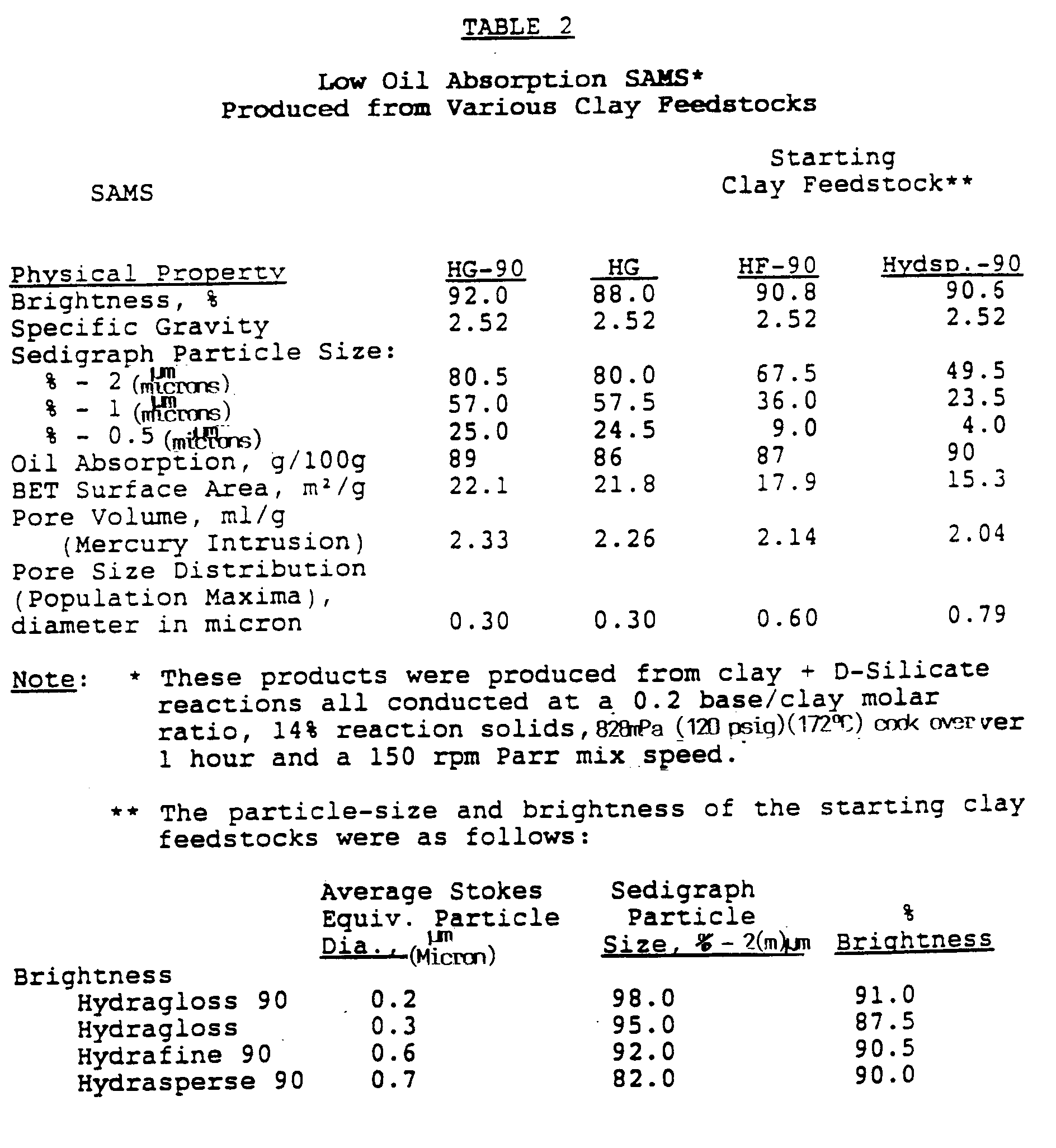
- the physical properties of the various SAMS pigments indicate substantial changes in pore structure and final particle size as a function of the initial clay feedstock particle size.
- the average particle size of the clay feedstock increased, there was a corresponding increase in the SAMS product particle size.
- the pigment pore volume was observed to decrease and the pore size distribution shifted towards larger pore diameters.
- Example 2 Based on the optical/light scattering concepts presented in Example 1, it is apparent that clay feedstocks of 0.2-0.6 ⁇ m (micron) average particle diameter must be utilized to produce SAMS products with preferred properties. However, those feedstocks of 0.2-0.3 ⁇ m (micron) average particle diameter are most highly preferred to use since SAMS pore diameters of similar dimension are produced. SAMS pigments offering microvoids of uniform 0.3 ⁇ m (micron) diameter are expected to be the most optically efficient. It should also be noted that the oil absorption values reported in Table 2 show very little variation; hence, defining SAMS pigment structure on the basis of oil absorption appears to hold little predictive value.
- reaction parameter concepts discussed in Examples 1-3 (concerning silicate type and B/C ratio selection, as well as percent solids, mixing intensity and clay feedstock requirements) preferred products of this invention were produced using a 946.4-liter (250-gallon) Pilot scale reactor.
- This high pressure reactor was equipped with a 43.18 cm (17-inch) diameter marine style impeller having variable speed capability and, in contrast to the laboratory Parr reactor, was heated entirely by internal steam sparging rather than by an external heat source.
- Hydrothermal reactions of Hydragloss 90 clay with D-silicate and with Meta-silicate were conducted, respectively, in accordance with the conditions outlined in Table 4-A. Reactions #1 and #2 with D-silicate were identical except for a change in reactor mixing intensity. Reactions with Meta-silicate at low and high speeds were also conducted; however, the extremely poor filtration characteristics of the resulting low speed material prevented further processing of it to a finished spray-dried product.
- initial batch solids in the pilot reactions had to be adjusted up to allow for some solids dilution resulting form steam condensation.
- Final reaction solids at operating temperature and pressure were approximately 10%.
- the product slurry was discharged to a drop tank and subsequently diluted with 719,2 l (190 gallons) of fresh water.
- the hot slurry (65°C) was then filtered using a rotary vacuum string discharge type filter equipped with an accessory wash blanket so as to wash the filter cake material to a conductivity value of 400 ⁇ -1 (mohs) or less.
- the wash blanket was required to lower product conductivity (by removing soluble alkali) and to obtain the maximum product brightness.
- the SAMS filter cakes were redispersed at approximately 22% solids using low shear mixing and subsequently spray-dried for testing work. They physical properties of each product are also summarized in Table 4-A. The very high pore volume (greater than 2.5 ml/g) of each product should be noted. In comparison, Samtone 581 (of the prior art) has an oil absorption value of about 150 g/100 g. As previously observed, a higher mixing intensity produced a SAMS product of coarser particle size (compare products #1 and 2).
- the filler data of Table 4-B indicate that the two SAMS products of finer particle size (i.e., A and C) offer equivalent, if not generally superior, performance to calcined clay (particularly at the 12% filler level).
- SAMS pigment A also provided comparable brightness and whiteness values versus the calcined clay.
- pigment B provided reduced opacifying properties across the board versus SAMS pigments A or C. This performance drop can be attributed to the much coarser particle size of pigment B.
- the preferred average particle diameter size range for SAMS products of the present invention is 0.5-0.7 ⁇ m (micron) (by Stokes Law) or approximately 8% -2 ⁇ m (microns).
- the improvement in opacity over Samtone 581 can be explained on the basis of superior pigment pore structure design that provides more effective scattering of visible light.
- the formulation containing the new SAMS also showed notable advantages versus the Samtone 581 formulation in both high shear and low shear coating viscosities, which is a direct consequence of its lower oil absorption properties.
- Lower coating viscosities for the new SAMS formulation (G) translated to improved runability on the "CLC" pilot coater.
- Example 4 the #1 reaction product of Example 4 was appropriately scaled up to a 27255-liter (7200-gallon) high pressure reactor.
- a full scale production run was commences wherein water, 13920.0 kg (31,934 lbs), and D-sodium silicate, 925.3 kg (2,040 lbs.) (as received), were added to the reactor.
- the D-silicate reagent has a Si0 2 nNa 2 0 mole ratio composition of 2.06 and is 44.1% active.
- 3635.5 kg (8,015 pounds) of Hydragloss 90 dispersed filter cake slurry at 51.9% solids was added.
- the reactor contents were continuously mixed by a mechanical agitator turning at 8 rpm (0.915 m/s (180.1 fpm) tip speed) and heated to a final temperature of 175°C (837 kPa (130 psig)) using live steam.
- the steam addition was accomplished by employing an internal steam sparger system.
- the reaction solids had reached 10%.
- the resulting product slurry was vented into a drop tank and subsequently filtered, washed with water, redispersed and then spray-dried to a moisture content of approximately 3%.
- reaction batch composition can be described as having a Base/Clay molar ratio of 0.3 at 10% solids or alternatively, in terms of the oxide constituents, as
- a critical feature of the reaction process to produce the SAMS in this example involves the careful regulation of steam flow used in bringing the reactor contents up to 897 kPa (130 psig) (175°C).
- Table 5-B summarizes the hydrothermal conditions needed to produce the desired SAMS product (target particle size equals 85%-2 ⁇ m (microns)).
- target particle size equals 85%-2 ⁇ m (microns)
- a coarse particle size SAMS product (70% -2 ⁇ m (microns)) was produced when a linear pressure-up profile covering 27 minutes was employed. This particle size problem remained despite further adjustments in the reactor's mechanical mixing intensity. In this reaction, downward adjustments in mixing speed below 8 rpm did not provide further decreases in SAMS product particle, size.
- the preferred SAMS product of this invention exhibits a novel combination of properties relative to the starting Hydragloss 90 clay and to the Samtone 581 product.
- Of particular significance is the large difference in oil absorption capacity between the new SAMS product and Samtone 581; yet, the total pore volumes of these two products as determined by mercury intrusion are virtually identical (both equalling 2.85 ml/g).
- the cumulative pore volume curves for SAMS Example 5 and Samtone 581 are presented in Figure 8 for comparative purposes. Substantial differences in their intrusion profiles are evident.
- the differences in pore size distribution can be seen in Figure 9, which is a derivative type plot of log differential intrusion versus pore diameter (where log differential intrusion equals dV/dlogD).
- a medium of 1.5 refractive index containing microvoids of uniform 0.3 ⁇ m (micron) diameter should provide optimum light scattering efficiency for visible light. It is also expected that uniform 0.3 microvoids would be more efficient than a broad type pore distribution of equivalent average size.
- Samtone 581 has a rather broad bimodal type pore size distribution with maxima occurring at pore diameters of 0.95 and 0.38 ⁇ m (micron) respectively.
- SAMS Example 5 was engineered by synthetic means to contain a high pore volume structure having a relatively narrow pore size distribution centered very close to 0.3 ⁇ m (micron). It is then not surprising that SAMS Example 5 should exhibit superior optical performance properties to those of the prior art. Total pore volume and pore size distribution, as determined by mercury intrusion, provide a basis for a more universal explanation of SAMS structured pigment performance than oil absorption measurements.
- SAMS Example 5 appears in SEM photographs to be structured agglomerants composed of small flat platelets (see Figure 10).
- the present SAMS contain remnants of altered clay platelets having an integrated rimmed area of amorphous non-diffracting alkali metal silicate-kaolin reaction product.
- rimmed it is meant that the altered primary particles are comprised of a core material having an integral border or outer edge material of different constitution from the core.
- the primary particles are generally in the form of lamella (irregular to pseudo-hexagonal shaped plates).
- the rim is an outer edge or border which usually substantially encompasses the plate perimeter.
- amorphous it is meant that the material does not have a characteristic x-ray diffraction pattern.
- SAMS of the present invention typically show lower degrees of clay platelet alteration than Samtone 581 (see Figure 11).
- Figure 11 the 0,0,1 diffraction peaks of kaolinite, SAMS Example 5, and Samtone 581 (from top to bottom respectively) are compared and the relative peak heights indicate a greater percentage of kaolinite content left in the SAMS products of Example 5.
- the makedown system consisted of a 265.0-liter (700-gallon) Cowles wet-out tank used in sequence with a second Cowles mix tank of 11,356.2-liter (3,000-gallon) capacity.
- the composite slurry leaving the Cowles tank was then pumped by means of an air diaphragm pump to a large, agitated storage tank capable of holding several tank cars of product.
- the wet-out tank is our process was equipped with a 149.1 kW (200 horsepower) Cowles that was operated at a tip speed of 21.8 m/s (4300 fpm) (3:1 tank to blade diameter ratio and no baffles).
- the larger mix tank was equipped with a 261.0 kW (350 horsepower) Cowles that was operated at a tip speed of 25.4 m/s (5000 fpm) (4:1 tank to blade diameter ratio plus baffles).
- the additional high shear mixing received in this second Cowles tank was very important as it improves product dispersion and lowers Hercules viscosity. Typically, the product throughout rate averaged 4.0 dry tons/hour.
- the slurry and spray-dried feedstocks utilized in this makedown process were prepared as follows. In a 567,812-liter (150,000-gallon) storage tank, 556,007 l (146,900 gallons) of SAMS Example 5 (as dispersed filter cake slurry of 22.0% solids) was blended with 5653 l (2550 gallons) of 52.2% solids Hydragloss 90 dispersed filter cake slurry to yield a 95/5 dry weight ratio composite pigment slurry. This filter cake slurry blend represented 148418 kg (163.6 dry tons) of composite pigment at 22.6% total solids. The amount of Daxad 30 organic dispersant totaled 0.03% (on active polymer basis). Approximately 75% of our filter cake slurry blend was stray-dried using typical commercial drying conditions. The dry composite pigment was then used in combination with the remaining filter cake slurry blend to yield a final slurry product of 50% solids.
- Combining the dry and slurry feedstocks was accomplished by simultaneously feeding them into the Cowles wet-out tank at rates of 44.5 kg/min (98 lb/min). and (62.5 l/min )16.5 gal/min., respectively.
- the dry composite pigment was metered in by means of automated dry bin/feeder system. They above feed rates translate to the formation of a 95/5 composite slurry having about 52% solids at a continuous through-put of 3628.8 kg/h (4.0 dry tons/hour). The makedown process was continued until 136080 kg (150 dry tons) of slurry product had been produced (solids were verified by a specific gravity check to be 52.0%).
- the polymer was incorporated by means of a tank recirculation line equipped with an injection port/in-line mixer combination.
- 81.6 kg (180.0 active pounds) of Acrysol TT-615 was added (0.06% by weight) to yield a final slurry product having a Brookfield (20 rpm) viscosity of 660 mPas (centipoise) and a Hercules viscosity (in 10 -5 N (in dynes)) of 18+/640 rpm using the A-Bob.
- the slurry product thereby exhibited good stability properties over a 4-week time period and can be pumped by customers using ordinary centrifugal type pumps.
- SAMS structured pigment slurry (as per above) offering uncompromised performance properties relative to the spray-dried SAMS Example 5 control.
- An application study was therefore undertaken to compare the performance of three different SAMS products in an offset type coating formulation. Specific details concerning the coating formulations and the "CLC" coating conditions are summarized in Table 6-C.
- the pigment portion of our coating formulations consisted of a 90/10 blend of #1 fine particle size clay/SAMS pigment wherein Samtone 581, SAMS Example 5 and the 95/5 structured pigment slurry were critically compared.
- the observed coating properties suggest no deleterious effects on sheet opacity as a consequence of producing a high solids slurry out of SAMS Example 5.
- an offset formulation containing a 90/10 #1 fine particle clay/Ti0 2 pigment blend was modified such that 2.5 parts and then finally 5.0 parts of Ti0 2 were replaced.
- the SAMS product of Example 5 was added on a relative dry weight replacement basis of 3.7:1 and 1.:1 respectively. One hundred parts of total pigment were maintained in the formulations.
- Other details concerning the coating formulations or the "CLC" coating conditions can be found in Table 7-A. As can be seen from the coating performance data of Table 7-A, the SAMS pigment allowed up to 5 parts of Ti0 2 to be removed form the formulation without any significant decrease in sheet opacity or brightness, and with a concomitant improvement in printed gloss. Sheet smoothness as measured by Parker Print Surf was essentially equivalent to the control coating formulation.
- the SAMS test pigments in this paint study were used in combination with a high brightness, fine particle size hydrous caly (Huber HG-90). In both cases, a 55/45 dry weight ratio of HG-90/SAMS was employed to yield composite pigment systems. The HG-90j/SAMS composites were then compared head to head with Optiwhite calcined clay on an equal volume replacement basis to keep the PVC constant.
- the paint properties for theme formulations are presented in table 9. Paint B, which contains the SAMS of Example 5, showed some significant performance advantages in hiding power (i.e., contract ratio) and in relative tinting strength versus Paint A containing Samhide 583. When compared to the Optiwhite control formulation, the relative optical advantages seen with SAMS Example 5 are even greater.
- Paint B yielded somewhat higher values than the other formulations. This property can be attributed to the fine particle size nature of our SAMS Example 5 and Huber HG-90 products. This performance feature can be considered an advantage from the standpoint that it provides greater formulation flexibility. Latex paint formulations ranging from flats to satin finishes can thus utilize SAMS Example 5, whereas Samhide 583 often provides too much flatting efficiency to be used in the latter.
- the SAMS product of this invention was examined as originally produced (per Example 4) and in a pH adjusted form.
- the latter product was produced by adding sufficient sulfuric acid to the SAMS dispersed filter cake material to obtain a slurry pH of 6.2 and then spray-drying as before.
- Fillers used as controls in our rubber study included Samflex 585 (per the prior SAMS art) and Nucap 100W (a high brightness, fine particle size, Mercaptosilane-modified kaolin clay). All SAMS materials were used without the addition of any Mercaptosile treatment.
- Table 10-A The comparative physical properties of the various test fillers are summarized in Table 10-A.
Landscapes
- Chemical & Material Sciences (AREA)
- Engineering & Computer Science (AREA)
- Organic Chemistry (AREA)
- Materials Engineering (AREA)
- Inorganic Chemistry (AREA)
- Life Sciences & Earth Sciences (AREA)
- Wood Science & Technology (AREA)
- Dispersion Chemistry (AREA)
- Ceramic Engineering (AREA)
- Chemical Kinetics & Catalysis (AREA)
- Nanotechnology (AREA)
- Structural Engineering (AREA)
- Health & Medical Sciences (AREA)
- Medicinal Chemistry (AREA)
- Polymers & Plastics (AREA)
- Silicates, Zeolites, And Molecular Sieves (AREA)
- Pigments, Carbon Blacks, Or Wood Stains (AREA)
- Paper (AREA)
- Compositions Of Macromolecular Compounds (AREA)
- Paints Or Removers (AREA)
- Silicon Compounds (AREA)
- Filling Or Discharging Of Gas Storage Vessels (AREA)
- Solid-Sorbent Or Filter-Aiding Compositions (AREA)
Abstract
Description
- The pigments described herein are synthetic sodium aluminosilicate compositions (SAMS) prepared from the hydrothermal reaction of select kaolin clays with sodium silicates. The products of this invention are "unique" in that they offer high performance properties despite their low oil absorption characteristics. Literature relevant to discussing these new pigment technology is cited below:
- (1) S.K. Wason, U.S. Patents Nos. 4,812,299 and 4,863,796 (1989) and references cited therein.
- (2) S.K. Wason, J. Soc. Cosmet. Chem., 29:497-521 (Aug., 1978).
- (3) P. Lepoutre, N. Pauler, B. Alince and M. Rigdahl, J. Of Pulp and Paper Science: Vol. 15, No. 5, 183 (1989).
- (4) R. E. Hardy and G.M. Freeman: TAPPI Coating (5) S.K. Wason, WO-A 87/01359 Conference Proceedings, 147-153 (May, 1989).
-
- A method for preparing high performance SAMS pigments with low oil absorption properties is disclosed. These SAMS products are still produced by sodium silicate/clay reactions conducted under hydrothermal conditions as generally disclosed in U.S. Patents 4,812,299 and 4,863,796. However, they represent a significant refinement in the art and can be thought of as a more preferred embodiment of the earlier Wason patents. In particular, the SAMS products of this invention represent an anomaly to the prior art knowledge in that they offer superior performance properties, yet have low oil absorption values. In the prior art, SAMS performance properties were equated directly to structure as defined by a set of oil absorption criteria. In this invention, a new definition of SAMS pigment structure derived from porosimetry based principles is proposed that offers a more universal understanding of pigment structure/property relationships. Applying these new structure principles, a select and unobvious combination of reaction parameters were identified and then utilized to yield SAMS type pigments having some unique structural properties as follows:
- 1. A pore structure which has very high total pore volume (exceeding 2.5 ml/g in the most preferred embodiment of the invention).
- 2. A relatively narrow pore size distribution that is centered near a pore diameter of 0.3 micron (which is the optimal porosity design for efficient scattering of visible light).
- 3. An oil absorption value that is less than 115 g/100 g despite their high pore volume content (this insures improved wet-out and slurry rheology properties versus the Samtone 581 product).
- 4. A product particle size that falls within the range of 78-90% -2 µm (microns) (a 0.5-0.7 µm (micron) average particle diameter) as determined by x-ray sedigraph.
-
- It should be noted that many structured SAMS pigments of the prior art have pore volumes greater than 2.5 ml/g; but clearly failed to simultaneously meet the last three criteria summarized above. For example, WO-A87/01359 discloses SAMS compositions and, more particularly synthetic alkali metal alumino-silicates produced by the hydrothermal reaction of caolin clays and alkali metal silicates. The SAMS products of said document fail to exhibit the combination of low oil absorption, very high total pore volume, the narrow pore-size distribution and the partical fineness of the present invention. To produce SAMS pigments having the unique total combination of structural properties set forth in this invention, several advancements in the hydrothermal reaction process had to be realized. In particular, the important role that reactor mixing intensity plays in determining pore structure and particle size properties had to be discovered and then utilized to help fine tune final SAMS properties. Secondly, upon scale-up to production, the steam addition rate used in bringing the reactor up to its operating temperature and pressure was found to be critical. Needed adjustments in product particle size were eventually realized by properly controlling the steam flow profile. This was accomplished by using an automated steam flow control valve system. Additionally, reactor solids have to be precisely chosen for each Base/Clay combination to yield the required pore size distribution properties. Changes in reaction solids of even 2%, very often had profound influences on pigment structure. The importance of these reaction parameters was not recognized in the prior art process.
- The present invention provides a sodium aluminosilicate pigment having the following empirical formula in terms of oxide constituents:
- (0.01-0.5) Na2O : Al2O3 : (2.01-3.0) SiO2 : (1.0-3.0) H2O, said pigment being produced by the hydrothermal reaction of a sodium silicate and a clay in an aqueous medium at a ratio of sodium silicate (B) to clay (C) of 0.1:1 to 0.5:1,
- (0.2-0.5) Na2O : Al2O3 : (2.30-2.83) SiO2.
-
- Reference is now made to the drawings accompanying the application wherein:
- Figures 1, 2, 6 and 9 are pore size distribution curves which are plots of log differential intrusion versus pore diameter;
- Figures 3 and 4 are curves showing the effect of clay particle size and are plots of cumulative pore volume versus pore diameter;
- Figures 5 and 8 are curves showing cumulative pore volume versus diameter for different reaction solids contents and a prior art comparison, respectively;
- Figure 7 is a plot of reactor profile comparing steam flow, reactor pressure and time;
- Figure 10 shows four photomicrographs of SAMS products;
- Figure 11 is a diffraction pattern showing a product of the invention and a prior art product; and
- Figure 12 is an x-ray diffraction pattern of the SAMS product of Example 5.
-
- The present invention is further illustrated by the following examples, which should be regarded as demonstrating only some of the preferred embodiments and not limiting thereof.
- In the examples reference is made to the following trademarked products:
- (1) Hydragloss™ 90 - a fine particle size refined East Georgia clay product useful as a paper filler, the 90 indicating a GE brightness of greater than 90, available from J.M. Huber Corporation.
- (2) SAMTONE 581 - a paper coating available from J.M. Huber Corporation.
- (3) Hydragloss™ - fine particle East Georgia refined clay used as a paper filler or coating, available from J.M. Huber Corporation.
- (4) Hydrafine™ 90 - Delaminated clay useful as paper filler or coating, available from J.M. Huber Corporation.
- (5) Hydrasperse™ 90 - a fine particle refined Georgia clay paper filler or coating, available from J.M. Huber Corporation.
- (6) Ansilex 93 - a calcined clay paper coating, available commercially from Engelhard Corporation.
-
- The SAMS products of the present invention are characterized by the following empirical formula in terms of oxide constituents:
- (0.01-0.5)Na2O : Al203 : (2.01-3.0)SiO2 : (1.0-3.0) H2O, by having an oil absorption capacity of less than 115 g/100 g while simultaneously possessing a total pore volume of at least 2.0 ml/g, and wherein the pigment pore volume will consist entirely of pore diameter size between 0.2 and 0.7 µm (microns), more ideally near 0.3 µm (microns). SAMS products of this invention are produced using a carefully controlled combination of reaction conditions utilizing the following batch reaction mixture:
-
- In the reaction, use of high mole ratio silicates requires a B/C molar ratio of 0.2, use of medium mole ratio silicates requires a B/C molar ratio of 0.2-0.3, and use of low mole ratio silicates requires a B/C ratio of 0.3-0.5.
- High mole ratio silicates are defined herein as SiO2/Na2O ratios of 2.6-3.5, preferably 3.1-3.4. Medium mole ratio silicates are defined as having SiO2/Na2O mole ratios ranging from 2.0-2.5. Low mole ratio silicates are defined as having SiO2/Na2O mole ratios as those ranging from 1.0-1.9.
- The present invention also provides paper products containing the SAMS product of this invention as coating pigments and paper fillers. The coating pigments and fillers of this invention are used in accordance with procedures known to the art. The SAMS products of the invention are also useful in paints as paint pigments for both oil-based and water-based paints. The SAMS products of the invention are also useful as rubber pigments to provide reinforcement properties.
- The present invention also provides a method for the preparation of the novel SAMS products of the present invention which comprises reacting sodium silicate with clay under hydrothermal conditions wherein the ratio of B (sodium silicate) to C (clay) ranges from 0.1 up to 0.5 and wherein high mole ratio silicates require a B/C ratio of 0.2, medium mole ratio silicates require a B/C ratio of 0.2 to 0.3. and low mole ratio silicates require a B/C ratio of 0.3 to 0.5. and further provided that the batch composition during the reaction will be expressed by the following stoichiometric ranges:
- (0.2-0.5) Na2O : Al2O3 : (2.30-2.83) SiO2 and recovering the product.
-
- In this example, a systematic study of SAMS products prepared from sodium silicate/
Hydragloss™ 90 reactions conducted under hydrothermal conditions was undertaken. The purpose of this study was to demonstrate the unique relationship between silicate type and Base/Clay ratio as required to yield SAMS products of this invention. The complete matrix of reactions investigated is summarized in Table 1-A. As shown there, sodium silicate reagents ranging in Si02/Na 20 mole ratio composition from 3.33 to 1.0 were studied at various B/C molar ratios. A table detailing the composition and properties of the various sodium silicate reagents available from PQ Corporation (United States) is enclosed as Table 1-D. - In all cases, the SAMS reactions of Table 1-A were conducted at 12% solids in a 7.571-liter (2-gallon) laboratory Parr Reactor using 828 kPa (120 psig) (172°C) conditions over a one-hour cook period and a constant mixing speed of 250 rpm. The total reaction batch weight always equalled 5600 g. On that basis, for example, the reaction of N-silicate with
Hydragloss™ 90 clay at a 0.1 B/C molar ratio required the following batch recipe: -
Step 1 - 610.05 g of
active Hydragloss 90 spray-dried clay was made down in water at 50% solids using a Waring blender. - Step 2A
- sodium silicate solution was prepared by combining 164.8 g of N-silicate reagent (as received) and 4215.1 g of water.
-
Step 3 - The
hydragloss 90 clay slurry and sodium silicate solution were combined, mixed well and then charged to the Parr reactor for subsequent heating at 175°C. - The remaining reactions outlined in Table 1-A were put together in a fully analogous fashion. Upon completing the one hour cook period at 828 kPa (120 psig) (172°C), each product slurry was cooled to about 65°C and filtered on a Buchner funnel. The filter cake material was washed with three volumes of water and subsequently re-dispersed under low shear at approximately 20% solids for spray-drying in a Nichols Model 53 dryer. The spray-dried products were then subjected to a full battery of physical property tests, such as percent brightness, sedigraph particle size, oil absorption and pore volume analysis by mercury intrusion. The mercury porosimetry data, in particular total pore volume and pore size distribution, are important in accessing the potential optical functionality of structured SAMS pigments.
- In the prior art mentioned above, Wason et al, U.S. Patent No. 4,812,299 and J. Soc. (Cosmet Chem. 29:497-521 (1978), the structural characteristics of silica and silicate pigments have been loosely defined in terms of a set of oil absorption criteria. That method attempts to classify the gross structure level of a pigment on the basis of that pigment's oil absorption capacity (see Table 1-B for classifications). An inherent implication of this structure concept has been that pigments of high structure (i.e., high oil absorption) are thought to offer more performance functionality than pigments of low oil absorption (U.S. patent 4,812,299). Using that basic guideline, the SAMS reaction products representing the preferred embodiment of the prior art were engineered with respect to maximizing their oil absorption capacity.
- It is now apparent that SAMS pigment structure cannot be properly defined by oil absorption values. The method falsely assumes that all pigment porosity is accessible to oil penetration through capillary type action. Oil absorption measurements of pigment structure provide a relative assessment of pore volume, but wherein only certain pores of sufficient diameter to accommodate oil are actually accounted for. Data presented later in Example 5 indicate that oil absorption measurements neglect large portions of pigments porosity that are very important to light scattering efficiency. Another inherent weakness of the oil absorption methodology is that no information is obtained concerning average pore size or pore size distribution.
- A more universal understanding of property/structure relationships in SAMS products has been gained by collecting total pore volume and pore size distribution information by mercury intrusion and comparing structural characteristics on that basis. The gross structure level of a SAMS pigment is defined here on the basis of its total pore volume (see Table 1-B for the various structure classifications). From prior art optical considerations discussed elsewhere (Le Poutre et al), it follows that the total pore volume and particularly the pore size distribution of a given microvoid structure should be related to overall pigment performance. Optical theory indicates that for a porous medium of 1.5 refractive index that microvoids of 0.2-0.7 µm (micron) diameter are needed for efficient scattering of visible light. Optimal scattering efficiency is provided by microvoids of uniform 0.3 µm (micron) diameter. Working under these theoretical premises, a class of unique SAMS compositions exhibiting enhanced performance properties can be engineered by the proper selection of various reaction parameters. Important SAMS reaction parameters include the following:
- Hydrous clay feedstock (starting particle size)
- Molar ratio composition of sodium silicate
- Base/Clay molar ratio
- Reaction time
- Reaction temperature/pressure
- Reaction solids
- Reactor mixing intensity
- Steam addition profile
- From the large matrix of reactions examined per Table 1-A), those which produced SAMS products that illustrate the general embodiment of this invention are listed in Table 1-C. The respective physical properties of these products are summarized in Table 1-C as well. The physical property criteria used to describe SAMS compositions of this invention are as follows:
- 1. The SAMS products will have an oil absorption
capacity less than 115 g/100 g, while simultaneously
possessing a total pore volume of at least 2.0 ml/g.
It is extremely important that the SAMS products have
an oil absorption capacity less than 115 g/100 g for
assuring acceptable wet-out and rheological behavior
when producing aqueous product slurries. A main
objective of this SAMS invention was to develop a
functional equivalent to
Samtone 581, a sodium alumino silicate paper coating, that also had the capability of being shipped to customers in bulk as a high solids slurry.Samtone 581 cannot be slurried at 50% solids unless the functionality of the slurry product is significantly reduced by large additions of fine particle size hydrous clay which serves solely as a rheological additive (see Example 6). The ability to produce a SAMS product slurry of at least 50% solids was of commercial importance since large volume customers (particularly paper mills) were in most cases unwilling to buy dry products in bags or sacks. Extensive labor costs arise when dry bag product must be "made down" on site at the customer's facility. It should also be noted that slurry solids of 50% or greater are needed, otherwise freight rates become cost prohibitive. Likewise, Samtone 581 (unlike calcined clay) could not be supplied to customers in bulk sparger cars because of its poor wet-out properties Therefore, it became necessary to develop a second generation low oil absorption SAMS product offering bulk slurry capabilities yet maintaining high pigment performance attributes in the end use applciations. To offer good optical performance, SAMS structured pigments must still contain a total pore volume of at least 2.0 ml/g. The high pore volume of such products enhances the optical efficiency of various paper and costing systems by increasing the number of microvoids present to scatter visible light. It should also be noted that lowering the oil absorption properties of SAMS and thus improving its rheology has other practical ramifications. For example, better rheology enables higher SAMS pigment loadings to be used in paper coatings formulations that are to be applied to paper under high shear type conditions. - 2. In a more preferred embodiment of the present
invention, SAMS pigments with an oil absorption less
than 115 g/100 g possess a total pore volume of at
least 2.0 ml/g but wherein the pigment pore volume
consists entirely of pore diameters sized between 0.2-0.7
µm (micron) or more ideally near 0.3 µm (micron). Based on
the optical considerations discussed earlier,
microvoids having diameters comparable in size to the
wavelength range of visible light should be the most
efficient light scatterers. On this basis, the matrix
of reactions suited to yielding SAMS pigments of
superior optical performance is reduced considerably in
scope. Several of the reaction products listed in
Table 1-C do not meet the more stringent criteria of
the preferred embodiment (see footnote section of Table
1-C). Nonetheless, reaction products satisfying the
preferred embodiment criteria can still be produced
from sodium silicate reagents ranging in Si02/
Na 20 mole ratio composition from 1.0 to 3.33. However, the exact Base/Clay reaction ratio requirements vary substantially from one silicate type to another. The silicate plus Base/Clay ratio combinations producing preferred SAMS product compositions can be generally summarized as follows:SODIUM SILICATE TYPE REQUIRED B/C MOLAR RATIO For high mole ratio silicates (N @ 3.33 Si02/Na20) 0.2 For medium mole ratio silicates (D & RU, from 2.0-2.5 Si02/Na20) 0.2 - 0.3 For low mole ratio silicates (meta & BW, from 1.0-1.7 Si02/Na20) 0.3 - 0.5 - (0.2-0.5) Na20 : A1203 : (2.30-2.83) Si02 This scheme is intended to be a general guideline on preferred silicate plus B/C ratio combinations rather than an absolute one, since other reaction parameters do have some influence on resulting pore structure properties as well. To better understand the interdependent relationship between silicate mole ratio composition and B/C reaction ratio as pertaining to SAMS pore structure, one has to only examine the pore size distribution curves of Figures 1 and 2 respectively. In these figures, the plots of log differential intrusion versus pore diameter are used to illustrate changes in relative pore size distribution. In Figure 1, the pore size distributions for several SAMS products of 0.3 B/C ratio are compared that were produced from different sodium silicate reagents. These curves show that the pore size distribution broadens significantly towards larger pore diameters as the sodium silicate mole ratio composition increased from 1.0 to 3.33. A similar systematic broadening of pore size distribution towards larger pore diameters can also be observed in Figure 2 as higher B/C reaction ratios are employed. In Figure 2, SAMS products consisting of BW-50 silicate and
- 3. In the most preferred embodiment of the present
invention, SAMS pigments having an oil absorption less
than 115 g/100 g would possess a total pore volume
exceeding 2.5 ml/g wherein the pores would have nearly
uniform pore size diameter of 0.3 µm (micron) for providing
optimal light scattering properties. None of the SAMS
products listed in Table 1-C meet these new criteria;
however, such products can be produced once other
reaction parameters beyond silicate type and B/C ratio
are taken into consideration and fully optimized. The
SAMS pigment that will be presented in Example 5
fulfills the above criteria and represents the most
"state of the art" product. Once the influence from
other reaction parameters is fully taken into account,
then some distinct preferences arise among the
available silicate reagents used in producing SAMS
products. Sodium silicates having a Si02/
Na 20 mole ratio composition of about 2.06 are most highly preferred for the following reasons: - a. Sodium silicates of higher mole ratio composition (particularly N at 3.33 M.R.) have a greater propensity to yield SAMS products of coarser particle size and also higher oil absorption. These properties result from the higher silica contents provided by such sodium silicate reagents. Both of these trends are in opposition to the desired SAMS pigment properties.
- b. Sodium silicates of very low mole ratio composition (like meta at 1.0 M.R.) require somewhat higher Base/Clay reaction ratios to yield a functionally equivalent SAMS product. Using greater amounts of silicate reagent is undesirable from the standpoint of increasing the manufacturing costs.
-
- This experiment illustrates the significant influence that clay feedstock particle size has on resulting SAMS product properties. In particular, the influence on SAMS pore structure and on SAMS product particle size are addressed here. In this study, low oil absorption SAMS products meeting the physical criteria of this invention were prepared from four different hydrous clay feedstocks respectively. The clay feedstocks varied in average Stokes equivalent particle diameter between 0.2 and 0.7 µm (micron). In summation, the clay feedstocks examined represent an assortment of
Number 1 andNumber 2 type hydrous clay products currently marketed by J. M. Huber under thetrade names Hydragloss 90, Hydragloss,Hydrafine™ 90 andHydrasperse™ 90. - For each clay feedstock, an analogous SAMS product was produced using a 2-gallon laboratory Parr reactor. The reactions utilized D-silicate (2.06 mole ratio composition) with the appropriate hydrous clay at a B/C molar ratio of 0.2 and 14% reactor solids. The reactions were subjected to a 828 kPa (120 psig) (172°C) cook over one hour using a Parr mixing speed of 150 rpm. For a total batch weight of 5600 g, this required 685.2 gm of active spray-dried clay (subsequently made down to 50% solids) to be combined with 224.0 g of D-silicate reagent (as received) and 4,005.6 g of dilution water to yield the desired reaction stoichiometry. The reaction products were filtered, washed and spray dried as described previously in Example 1.
- In accordance with Table 2, the physical properties of the various SAMS pigments indicate substantial changes in pore structure and final particle size as a function of the initial clay feedstock particle size. As the average particle size of the clay feedstock increased, there was a corresponding increase in the SAMS product particle size. At the same time, the pigment pore volume was observed to decrease and the pore size distribution shifted towards larger pore diameters. These pore structure trends are shown graphically in Figures 3 and 4 respectively. It is very interesting to note that the maxima associated with the pore size distribution curves occur at diameter sizes that closely match the average Stokes equivalent particle diameter values determined for the initial clay feedstocks. Based on the optical/light scattering concepts presented in Example 1, it is apparent that clay feedstocks of 0.2-0.6 µm (micron) average particle diameter must be utilized to produce SAMS products with preferred properties. However, those feedstocks of 0.2-0.3 µm (micron) average particle diameter are most highly preferred to use since SAMS pore diameters of similar dimension are produced. SAMS pigments offering microvoids of uniform 0.3 µm (micron) diameter are expected to be the most optically efficient. It should also be noted that the oil absorption values reported in Table 2 show very little variation; hence, defining SAMS pigment structure on the basis of oil absorption appears to hold little predictive value.
- In this example, the influence of reaction solids and of reactor mixing intensity on SAMS structure properties are examined respectively. Using the selection guidelines set forth in Example 1, D-silicate (2.06 mole ratio) was utilized in our reactions at a Base/Clay molar ratio of 0.3. In all cases, the D-silicate/clay reactions were conducted in a 7.571 l (2-gallon) laboratory Parr reactor using a 828 kPa (120 psig) (172°C) cook over 1 hour. Specific details concerning the other reaction parameters (such as percent reaction solids, hydrous clay feedstock, and/or Parr mixing intensity) are summarized accordingly in Table 3. All reaction batches were based on a total reactor charge of 5600 g in analogy with Examples 1 and 2. The reaction products were also filtered, washed and spray-dried as previously described.
- In Part One of this study, Omnifil based SAMS products were produced at different reaction solids ranging from 10-16%. The physical properties of these reaction products indicate substantial changes in pore structure as well as final particle size as the reaction solids were changed (see Table 3). As the reaction solids were systematically increased from 10 to finally 16% solids, there was a corresponding increase in the SAMS product particle size. At the same time, the pore size distribution was observed to broaden somewhat towards pore sizes of greater diameter. Changes in total pore volume with increasing reaction solids were also noted; however, the observed variations did not appear to assume any parallel or regular trend. The pore structure variations resulting from reactor solids changes is shown graphically in Figures 5 and 6. As seen in Figure 6, broadening of the pore size distribution was actually the result of bimodal pore character being formed as higher reaction solids were used. In designing reaction batches to produce SAMS pigments with preferred properties in accordance with this invention, care must obviously be taken in choosing the proper reaction solids. A reactor solids level that maximizes product pore volume is preferred; however, this factor must be weighed against particle size and pore size distribution considerations arising from the reaction conditions. For this reason, reactions of this invention are generally best conducted within the 10-14% solids range since product particle size is generally finer and the pore size distribution remains centered closer to a diameter size of 0.3 µm (micron). The importance of product particle size on functional performance will be addressed in Example 4. It should again be pointed out that oil absorption methods failed to distinguish any structural differences in these SAMS products.
- In Part Two of this study,
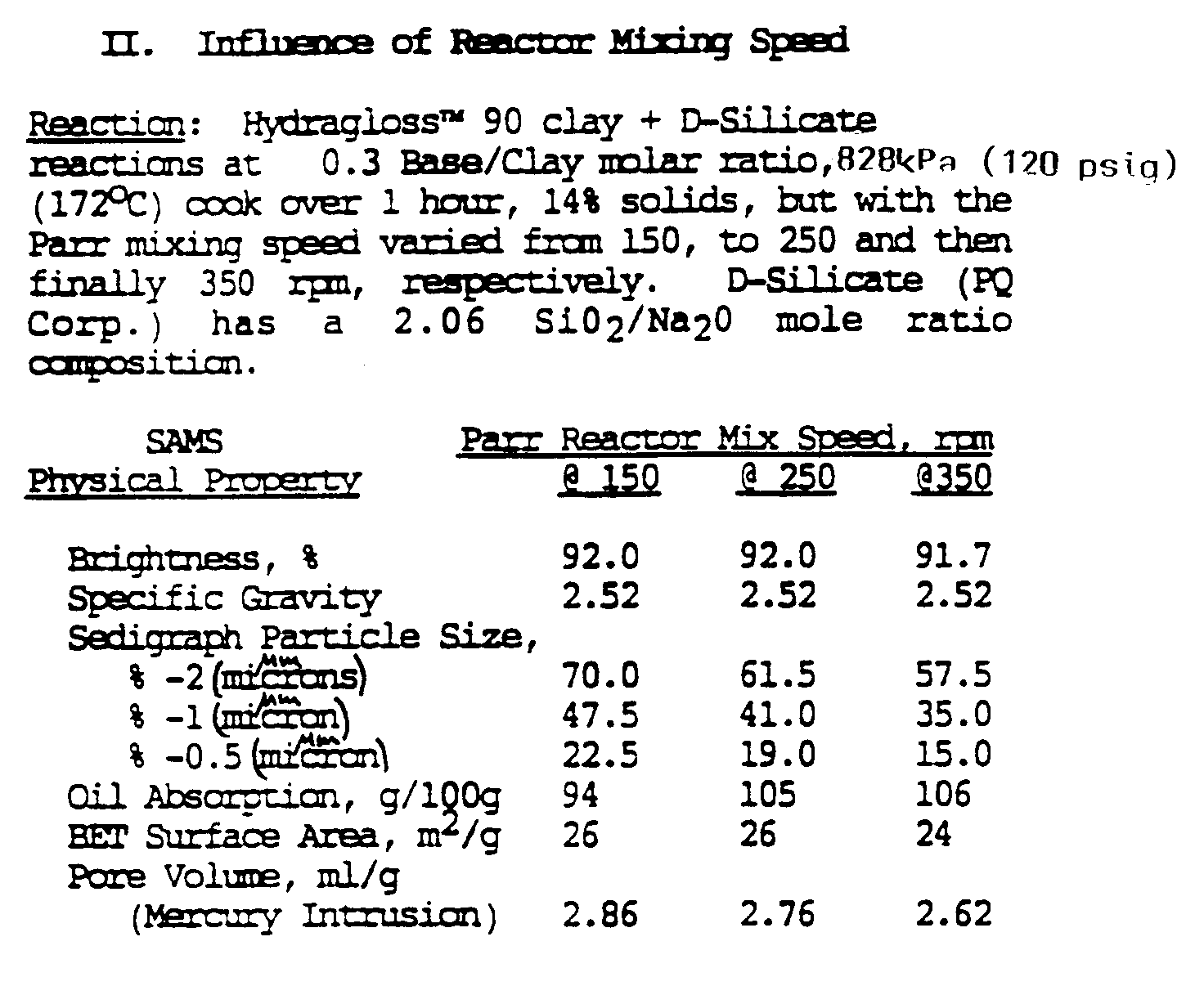
Hydragloss 90 based SAMS products were produced at 14% reaction solids but wherein mixing intensities ranging from 150 to 350 rpm were examined. The physical properties of these SAMS products indicate that structural changes do occur as the mixing intensity was varied. As the Parr mixing speed was increased from 150 to 250, and then finally to 350, rpm, there was a corresponding increase in the SAMS product particle size (see Table 3). At the same time, the pigment pore volume was being substantially decreased while oil absorption capacity was actually increased. Using minimal mixing speeds to increase pigment pore volume and to lower oil absorption capacity, is an important aspect of our SAMS reaction process. Slower mixing speeds were also preferred from the standpoint of yielding SAMS products of finer particle size (around 85% -2 µm (microns) is preferred, see Example 4).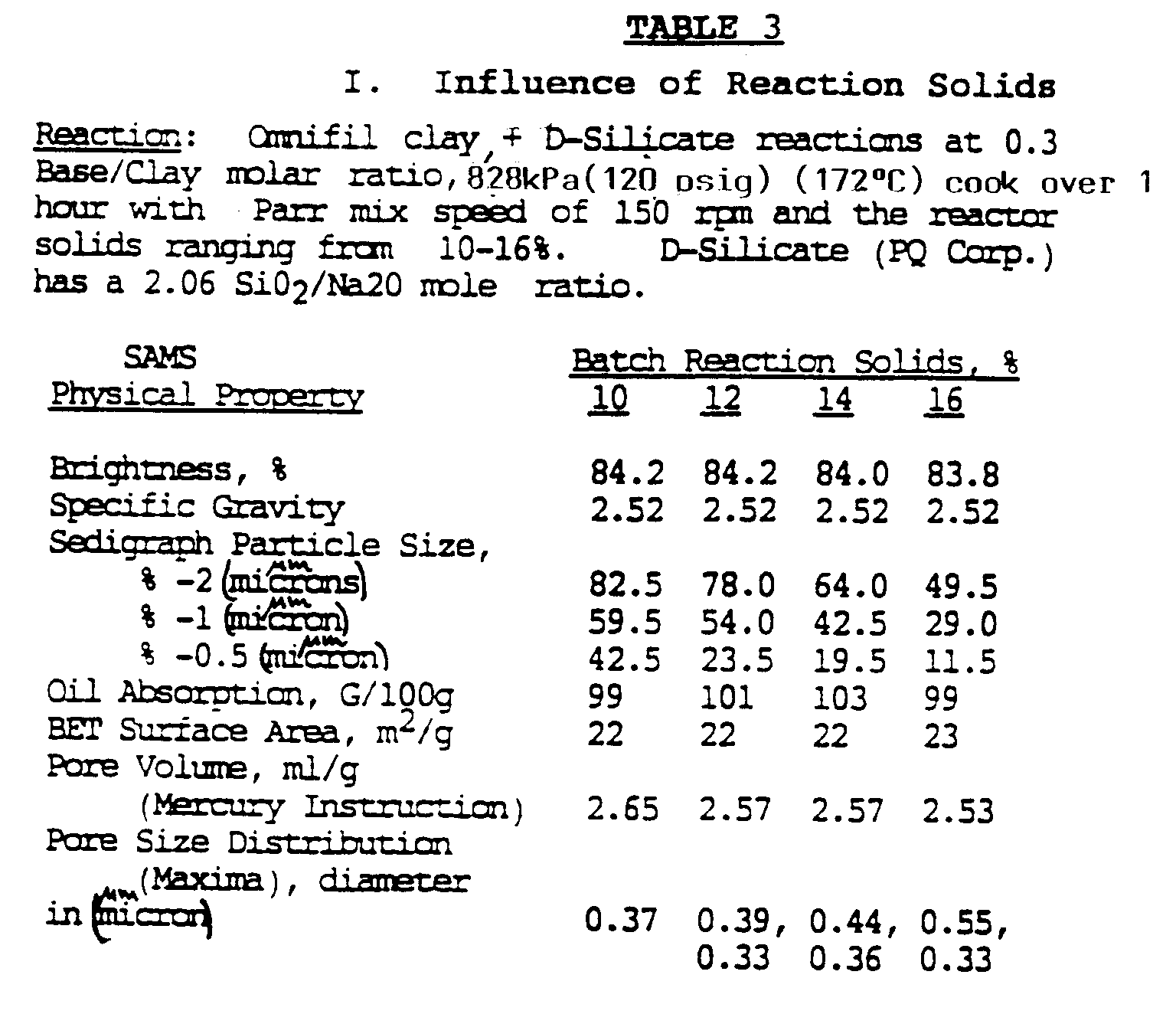
- Using the reaction parameter concepts discussed in Examples 1-3 (concerning silicate type and B/C ratio selection, as well as percent solids, mixing intensity and clay feedstock requirements) preferred products of this invention were produced using a 946.4-liter (250-gallon) Pilot scale reactor. This high pressure reactor was equipped with a 43.18 cm (17-inch) diameter marine style impeller having variable speed capability and, in contrast to the laboratory Parr reactor, was heated entirely by internal steam sparging rather than by an external heat source. Hydrothermal reactions of
Hydragloss 90 clay with D-silicate and with Meta-silicate were conducted, respectively, in accordance with the conditions outlined in Table 4-A. Reactions # 1 and #2 with D-silicate were identical except for a change in reactor mixing intensity. Reactions with Meta-silicate at low and high speeds were also conducted; however, the extremely poor filtration characteristics of the resulting low speed material prevented further processing of it to a finished spray-dried product. - As shown in the materials section of Table 4-A, initial batch solids in the pilot reactions had to be adjusted up to allow for some solids dilution resulting form steam condensation. Final reaction solids at operating temperature and pressure were approximately 10%. After completing the cook period, the product slurry was discharged to a drop tank and subsequently diluted with 719,2 l (190 gallons) of fresh water. The hot slurry (65°C) was then filtered using a rotary vacuum string discharge type filter equipped with an accessory wash blanket so as to wash the filter cake material to a conductivity value of 400 Ω-1 (mohs) or less. The wash blanket was required to lower product conductivity (by removing soluble alkali) and to obtain the maximum product brightness. The SAMS filter cakes were redispersed at approximately 22% solids using low shear mixing and subsequently spray-dried for testing work. They physical properties of each product are also summarized in Table 4-A. The very high pore volume (greater than 2.5 ml/g) of each product should be noted. In comparison, Samtone 581 (of the prior art) has an oil absorption value of about 150 g/100 g. As previously observed, a higher mixing intensity produced a SAMS product of coarser particle size (compare
products # 1 and 2). - In Part Two of this study, the products of Table 4-A were evaluated as fillers in a wet-end paper application and as coating pigments in a LWC/rotogravure type coating application. In the paper filler study, the three SAMS products were evaluated relative to a premium calcined clay control (Ansilex 93). Handsheets were prepared containing 4, 8 and 12 parts of filler respectively. Details concerning the furnish as well as the other test parameters are summarized in Table 4-B. Optical properties including corrected opacity, brightness and whiteness were determined on five handsheets formed for each test. the averaged results are also reported in Table 4-B.
- In terms of sheet opacity, the filler data of Table 4-B indicate that the two SAMS products of finer particle size (i.e., A and C) offer equivalent, if not generally superior, performance to calcined clay (particularly at the 12% filler level). SAMS pigment A also provided comparable brightness and whiteness values versus the calcined clay. Despite their similarities in pare structure, pigment B provided reduced opacifying properties across the board versus SAMS pigments A or C. This performance drop can be attributed to the much coarser particle size of pigment B. On this basis, the preferred average particle diameter size range for SAMS products of the present invention is 0.5-0.7 µm (micron) (by Stokes Law) or approximately 8% -2 µm (microns).
- In a coating study, SAMS of reaction #3 (per Table 4-A) was compared to
Samtone 581 in a LWC/roto type formulation wherein five parts of structured pigment was used in combination with 95 parts of delaminated clay. A 60/40 delaminated/#2 clay pigment combination served as a typical control formulation. Other details concerning the coating formulations or the "CLC" coating parameters are summarized in Table 4-C. The coating properties of each system are also reported there. Both SAMS containing formulations (F and G) provided superior opacity and brightness versus the control (E). In terms of opacity, sheet gloss and printed gloss properties, the SAMS of the present invention clearly out-performedSamtone 581. In particular, the improvement in opacity overSamtone 581 can be explained on the basis of superior pigment pore structure design that provides more effective scattering of visible light. The formulation containing the new SAMS also showed notable advantages versus theSamtone 581 formulation in both high shear and low shear coating viscosities, which is a direct consequence of its lower oil absorption properties. Lower coating viscosities for the new SAMS formulation (G) translated to improved runability on the "CLC" pilot coater.


- In this study, the #1 reaction product of Example 4 was appropriately scaled up to a 27255-liter (7200-gallon) high pressure reactor. A full scale production run was commences wherein water, 13920.0 kg (31,934 lbs), and D-sodium silicate, 925.3 kg (2,040 lbs.) (as received), were added to the reactor. The D-silicate reagent has a Si02nNa20 mole ratio composition of 2.06 and is 44.1% active. Next, 3635.5 kg (8,015 pounds) of
Hydragloss 90 dispersed filter cake slurry at 51.9% solids was added. The reactor contents were continuously mixed by a mechanical agitator turning at 8 rpm (0.915 m/s (180.1 fpm) tip speed) and heated to a final temperature of 175°C (837 kPa (130 psig)) using live steam. The steam addition was accomplished by employing an internal steam sparger system. Upon reaching our operating temperature and pressure, the reaction solids had reached 10%. After heating the reaction batch at 897 kPa (130 psig) for a total of 65 minutes, the resulting product slurry was vented into a drop tank and subsequently filtered, washed with water, redispersed and then spray-dried to a moisture content of approximately 3%. In analogy with the pilot scale work, a string discharge rotary vacuum filter equipped with an accessory was blanket was used to yield wet filter cake material having a conductivity value of 400 Ω-1 (mohs) or less. From experience we have determined that a conductivity value of 400 Ω-1 (mohs) insures that sufficient product washing has occurred to achieve the maximum possible product brightness. Given the amounts of D-silicate,Hydragloss 90 clay and water employed in this hydrothermal process, the reaction batch composition can be described as having a Base/Clay molar ratio of 0.3 at 10% solids or alternatively, in terms of the oxide constituents, as - 0.30 Na2O : A1203 : 2.62 Si02 : 159
H 20
when normalized with respect to the - 0.15 Na20 : A1203 : 2.34 Si02 : 2.0
H 20. - (0.01-0.5) Na20 : A1203 : (2.01-3.0) Si02 : (1.0-3.0)
H 20. - 2.0 Na2203 : 3.3 Si02 : 2.2
H 20. -
- A critical feature of the reaction process to produce the SAMS in this example involves the careful regulation of steam flow used in bringing the reactor contents up to 897 kPa (130 psig) (175°C). Table 5-B summarizes the hydrothermal conditions needed to produce the desired SAMS product (target particle size equals 85%-2 µm (microns)). In an earlier production run, a coarse particle size SAMS product (70% -2 µm (microns)) was produced when a linear pressure-up profile covering 27 minutes was employed. This particle size problem remained despite further adjustments in the reactor's mechanical mixing intensity. In this reaction, downward adjustments in mixing speed below 8 rpm did not provide further decreases in SAMS product particle, size. Consequently, a new pressure-up profile of reduced slope was established that extended the reactor's ramp-up time out to 35 minutes (see Figure 7). This strategy was accomplished by setting a 379.5 kPa (55 psi) intermediate pressure point whereat the steam flow was rapidly reduced by approximately 50% using an automated steam flow control valve system. These changes acted to slow down the reaction associated with aggregate formation and thereby yielded a SAMS product of finer particle size. Laboratory studies have shown that the particle size of SAMS products are largely established during the pressure-up phase and little if any changes offer after approximately 15 minutes into the cook period. It is therefore not surprising that changes in steam flow influence particle size formation. The importance of steam addition rate in controlling particle size was not recognized in the prior art production process.
- As can be seen in Table 5-A, the preferred SAMS product of this invention exhibits a novel combination of properties relative to the starting
Hydragloss 90 clay and to theSamtone 581 product. Of particular significance is the large difference in oil absorption capacity between the new SAMS product andSamtone 581; yet, the total pore volumes of these two products as determined by mercury intrusion are virtually identical (both equalling 2.85 ml/g). The cumulative pore volume curves for SAMS Example 5 andSamtone 581 are presented in Figure 8 for comparative purposes. Substantial differences in their intrusion profiles are evident. The differences in pore size distribution can be seen in Figure 9, which is a derivative type plot of log differential intrusion versus pore diameter (where log differential intrusion equals dV/dlogD). From Figure 9, it is easy to explain the lower oil absorption capacity of SAMS Example 5 on the basis of its finer pore size distribution versusSamtone 581. Apparently, SAMS Example 5 has many pores that are too small to participate in oil absorption via normal capillary type action. If characterized on the basis of established oil absorption criteria (References 1-3), SAMS Example 5 would have been classified as "low structure" when in fact it actually has a high pore volume content. Structure/oil absorption criteria would have thus incorrectly suggested that SAMS Example 5 would provide lower optical and functional properties thanSamtone 581 in various end-use applciations. Applciations data are presented in the following Examples which clearly demonstrate the superior functional performance of the new SAMS products. - As discussed in Example 1, a medium of 1.5 refractive index containing microvoids of uniform 0.3 µm (micron) diameter should provide optimum light scattering efficiency for visible light. It is also expected that uniform 0.3 microvoids would be more efficient than a broad type pore distribution of equivalent average size. As can be seen in Figure 9,
Samtone 581 has a rather broad bimodal type pore size distribution with maxima occurring at pore diameters of 0.95 and 0.38 µm (micron) respectively. In contrast, SAMS Example 5 was engineered by synthetic means to contain a high pore volume structure having a relatively narrow pore size distribution centered very close to 0.3 µm (micron). It is then not surprising that SAMS Example 5 should exhibit superior optical performance properties to those of the prior art. Total pore volume and pore size distribution, as determined by mercury intrusion, provide a basis for a more universal explanation of SAMS structured pigment performance than oil absorption measurements. - Like
Samtone 581, SAMS Example 5 appears in SEM photographs to be structured agglomerants composed of small flat platelets (see Figure 10). Likewise, the present SAMS contain remnants of altered clay platelets having an integrated rimmed area of amorphous non-diffracting alkali metal silicate-kaolin reaction product. By the term "rimmed", it is meant that the altered primary particles are comprised of a core material having an integral border or outer edge material of different constitution from the core. The primary particles are generally in the form of lamella (irregular to pseudo-hexagonal shaped plates). The rim is an outer edge or border which usually substantially encompasses the plate perimeter. By the term "amorphous" it is meant that the material does not have a characteristic x-ray diffraction pattern. When comparing the x-ray diffraction patterns of SAMS Example 5 andSamtone 581 to that of the startingHydragloss 90 clay, attenuated kaolinite peaks arising from the kaolin clay remnants are similarly observed. However, it was quite interesting to note that SAMS of the present invention typically show lower degrees of clay platelet alteration than Samtone 581 (see Figure 11). In Figure 11, the 0,0,1 diffraction peaks of kaolinite, SAMS Example 5, and Samtone 581 (from top to bottom respectively) are compared and the relative peak heights indicate a greater percentage of kaolinite content left in the SAMS products of Example 5. In Figure 12, a typical XRD scan of SAMS Example 5 over the two theta region from 10-40 degrees is presented showing the attentuated kaolinite pattern. The same conclusions regarding the extent of clay alteration can also be drawn by comparing the percent loss on ignition values for the two SAMS products (LOI values decrease with increasing extent of clay alteration).Comparison of Typical Properties: Commercial-Scale SAMS Products vs. Hydragloss 90 FeedstockChemical Analysis, % Hydragloss 90 Clay SAMTONE 581 Low Oil Abs. SAMS Ti0 0.94 0.51 0.50 Fe O 0.98 0.83 0.80 Si0 44.79 54.57 47.74 Al O 38.37 27.95 34.66 Na O 0.03 6.75 3.23 H O (% LOI) 13.86 10.71 12.23 XRD Kaolinite Attenuated Kaolin Attenuated Kaolin Physical Properties: Pore Volume, ml/g (by Mercury Intrusion) 0.60 2.85 2.85 BET Surface Area, m2/g 22.0 21.5 22.0 pH (at 20% solids) 6.8 11.2 10.6 Oil Absorption, g/ 100g pigment 40 150 105 Einlehner Abrasion, mg wire loss/100g 4.0 3.5 2.8 Brightness, % 91.4 92.6 92.2 Specific Gravity 2.60 2.43 2.52 Sedigraph Particle Size, % - 2 µm (microns) 98.0 61.0 84.0 The Effect of Reactor Steam Flow on SAMS Product Formation
Commercial Scale Production of Low Oil Absorption SAMSReaction Parameters Targeted Product (84% - 2µm (m) particle size) SAMS w/ 70% - 2µm (m) particle size Initial. Steam Flow (into reactor), kg/h (lbs./hr.) 13834.5 (30,500) 13834.5 (30,500) Intermediate Pressure Point, Steam Reduction 50% None (linear Pressure - up profile) @ kPa (psi) @ 3795** (55 psi) Ramp-Up Time, min. 35 27 Final Cook Pressure, kPa (psig) 897 (130) 897 (130) Cook Time, min. 65 65 Reactor Mix Speed, rpm 8 8 (m/s (fpm) tip speed) 0.51 (100.5) 0.51 (100.5) - In this experiment, the superior slurry makedown and rheological properties of SAMS Example 5 versus
Samtone 581 are demonstrated. Also a process is disclosed for preparing a SAMS structured pigment slurry offering high performance properties and having a 50% minimum solids. In a production scale trial, a structured pigment slurry derived from the SAMS of Example 5 was produced using a high shear Cowles, continuous makedown type process. In the makedown, a spray-dried 95/5 composite blend of SAMS/Hydragloss 90 was used for building slurry solids directly in a continuous fashion. The makedown system consisted of a 265.0-liter (700-gallon) Cowles wet-out tank used in sequence with a second Cowles mix tank of 11,356.2-liter (3,000-gallon) capacity. The composite slurry leaving the Cowles tank was then pumped by means of an air diaphragm pump to a large, agitated storage tank capable of holding several tank cars of product. - The wet-out tank is our process was equipped with a 149.1 kW (200 horsepower) Cowles that was operated at a tip speed of 21.8 m/s (4300 fpm) (3:1 tank to blade diameter ratio and no baffles). The larger mix tank was equipped with a 261.0 kW (350 horsepower) Cowles that was operated at a tip speed of 25.4 m/s (5000 fpm) (4:1 tank to blade diameter ratio plus baffles). The additional high shear mixing received in this second Cowles tank was very important as it improves product dispersion and lowers Hercules viscosity. Typically, the product throughout rate averaged 4.0 dry tons/hour.
- The slurry and spray-dried feedstocks utilized in this makedown process were prepared as follows. In a 567,812-liter (150,000-gallon) storage tank, 556,007 l (146,900 gallons) of SAMS Example 5 (as dispersed filter cake slurry of 22.0% solids) was blended with 5653 l (2550 gallons) of 52.2% solids Hydragloss 90 dispersed filter cake slurry to yield a 95/5 dry weight ratio composite pigment slurry. This filter cake slurry blend represented 148418 kg (163.6 dry tons) of composite pigment at 22.6% total solids. The amount of
Daxad 30 organic dispersant totaled 0.03% (on active polymer basis). Approximately 75% of our filter cake slurry blend was stray-dried using typical commercial drying conditions. The dry composite pigment was then used in combination with the remaining filter cake slurry blend to yield a final slurry product of 50% solids. - Combining the dry and slurry feedstocks was accomplished by simultaneously feeding them into the Cowles wet-out tank at rates of 44.5 kg/min (98 lb/min). and (62.5 l/min )16.5 gal/min., respectively. k The dry composite pigment was metered in by means of automated dry bin/feeder system. They above feed rates translate to the formation of a 95/5 composite slurry having about 52% solids at a continuous through-put of 3628.8 kg/h (4.0 dry tons/hour). The makedown process was continued until 136080 kg (150 dry tons) of slurry product had been produced (solids were verified by a specific gravity check to be 52.0%). With all the slurry product now in the large storage tank, solids were reduced to 50.0% with water and the viscosity values determined. At this juncture, the Brookfield (20 rpm) and Hercules (A-Bob) viscosities were 180 mPas (centipoise) and 18+/655 rpm respectively (see Table 6-A). The viscosity values for a
Samtone 581/Hydragloss 90 clay composite slurry of 50% solids produced under similar high shear Cowles makedown conditions are presented in the table as well for comparative purposes. To achieve comparable slurry makedown and rheological properties, 20 parts ofHydragloss 90 clay (rather than just 5) has to be used with theSamtone 581 as a rheological additive. Adding such a high percentage ofHydragloss 90 is not practical as it seriously compromises opacifying properties in many paper related applications for SAMS. The paper coating performance of our structured pigment slurry prepared from SAMS Example 5 will be addressed later in Table 6-C. - Given the relatively low Brookfield viscosity of our 95/5 structured pigment slurry (180 mPas (centipoise) at 20 rpm), poor slurry stability was inevitable. A stability study indicated the presence of hard sediment after only three days. Therefore, a polymeric thickening agent, preferably an alkali soluble acrylic polymer emulsion like Acrysol TT-615, was employed to improve pigment suspension properties (see Reference 7). Good pigment suspension properties are needed when slurries are to be shipped long distances in bulk by a tank car. To the 136080 kg (150 dry tons) of slurry produced form the original makedown process, Acrysol TT-615 polymer was subsequently added. The polymer was incorporated by means of a tank recirculation line equipped with an injection port/in-line mixer combination. In total, 81.6 kg (180.0 active pounds) of Acrysol TT-615 was added (0.06% by weight) to yield a final slurry product having a Brookfield (20 rpm) viscosity of 660 mPas (centipoise) and a Hercules viscosity (in 10-5N (in dynes)) of 18+/640 rpm using the A-Bob. The slurry product thereby exhibited good stability properties over a 4-week time period and can be pumped by customers using ordinary centrifugal type pumps. Achieving a 50% solids structured pigment slurry having good stability and pumpability properties was an importance objective of this work. Based on manufacturing experience grained from additional trial runs, the typical range of properties found for the 95/5 structured pigment slurry of this invention are summarized in Table 6i-B. Finally, it should also be noted that a critical feature of the slurry process involves initial makedown to 52% solids and then diluting back to 50%; otherwise, Hercules viscosities suitable for centrifugal pumping are generally not achieved.
- Another important objective of this work was to produce a SAMS structured pigment slurry (as per above) offering uncompromised performance properties relative to the spray-dried SAMS Example 5 control. An application study was therefore undertaken to compare the performance of three different SAMS products in an offset type coating formulation. Specific details concerning the coating formulations and the "CLC" coating conditions are summarized in Table 6-C. The pigment portion of our coating formulations consisted of a 90/10 blend of #1 fine particle size clay/SAMS pigment wherein
Samtone 581, SAMS Example 5 and the 95/5 structured pigment slurry were critically compared. The observed coating properties suggest no deleterious effects on sheet opacity as a consequence of producing a high solids slurry out of SAMS Example 5. In fact, substantial improvements in sheet gloss and printed gloss are actually provided by the slurried SAMS version relative to its original spray-dried control (compare formulation C to B). The performance advantages are even greater when comparing (C) against the formulation containing the Samtone 581 (A).Comparison of Structured Pigment Slurries Produced from SAMTONE 581 and the Low Oil AbsorptionSAMS Property SAMTONE 581/ HG-90 Composite Low Oil Abs. SAMS*/HG-90 Composite Slurry Makedown Conditions High Shear Cowles High Shear Cowles MS/HG-90 Wt. Ratio 80/20 95/5 Slurry Solids, % 50.0 50.0 Slurry Viscosities (before Acrysol polymer stabilization): --Brookfield (20 rpm), mPas (cps) 172 180 --Hercules (A-Bob, 1100 rpm), 10-5N (dynes) 18+/520 rpm 18+/655 rpm Specifications for SAMS Structured Pigment Slurry Physical Property Target Value SAMS/HG-90 Ratio, by dry wt. 95/5 Slurry Solids, % 49 - 51 Weight per liter, kg (per Gallon, lbs.) 1.42-1.44(11.84 - 12.05) Acrysol ICS-1 Polymer Dosage, active wt. % (on dry pigment) 0.04 - 0.09 Brookfield Viscosity at 50% Solids, (20 rpm, #2 spindle), mPas (cps) 600- 800 Hercules Viscosity at. 50% Solids, (A-Bob, 1100 rpm) 10-5N (dynes) 18.0 - 18+/400 rpm Particle Size (sedigraph), % - 2 µm (microns) 92-96 Wet Sieve Residue, 325 Mesh (Max.), % 0.01 

- In this example, evaluation studies were undertaken to illustrate the titanium dioxide extension capabilities of SAMS Example 5 in some typical LWC/offset paper coating applications. Two separate coating formulations were examined, wherein both cases up to five parts of Ti02 pigment were successfully replaced with the SAMS product of Example 5 (see Tables 7-A and 7-B respectively).
- In the first coating set, an offset formulation containing a 90/10 #1 fine particle clay/Ti02 pigment blend was modified such that 2.5 parts and then finally 5.0 parts of Ti02 were replaced. The SAMS product of Example 5 was added on a relative dry weight replacement basis of 3.7:1 and 1.:1 respectively. One hundred parts of total pigment were maintained in the formulations. Other details concerning the coating formulations or the "CLC" coating conditions can be found in Table 7-A. As can be seen from the coating performance data of Table 7-A, the SAMS pigment allowed up to 5 parts of Ti02 to be removed form the formulation without any significant decrease in sheet opacity or brightness, and with a concomitant improvement in printed gloss. Sheet smoothness as measured by Parker Print Surf was essentially equivalent to the control coating formulation.
- In the second offset coating study, a fine clay-carbonate type formulation was used. A 70/20/10 pigment blend of #1 fine particle size clay, ultrafine ground calcium carbonate and Ti02 pigment, respectively, was modified such that 5.0 parts of Ti02 was replaced with the SAMS of Example 5 at a 1.5:1 dry weight replacement ratio basis. One hundred parts of total pigment were maintained in the formulation by adjusting the fine clay content accordingly. Other details concerning the coating formulations or the "CLC" coating conditions are summarized in Table 7-B. The coating performance data of Table 7-B indicate similar performance trends as observed in the first coating set. Sheet opacity, brightness and smoothness were all maintained, while printed gloss was improved with the replacement of 5 parts Ti02 with 7.5 parts of SAMS Example 5. However, it should be noted that the Ti02 replacement efficiency of our SAMS was better in this offset formulation than in the non-carbonate containing one (1.5:1 versus 1.9:1 of SAMS to Ti02 respectively).
- In conclusion, a unique structured pigment system has been presented that increases the amount of microvoids created in a coating formulation, which in turn increased the light scattering capacity of the coating. This enhancement in light scattering effectively allows the removal of some titanium dioxide. Up to 50% removal of Ti02 pigment was achieved with minimal deterioration of optical properties. The SAMS structured pigment did increase viscosity somewhat, although not excessively.


- In this study, the optical performance of SAMS Example 5 was compared to that of
Samtone 581 in a wet end paper filler application. The performance properties were compared at filler loadings of 6% and 12% respectively. Details concerning the furnish and other test conditions are summarized in Table 8. Optical properties including corrected opacity, brightness and whiteness were determined on 5 handsheets formed for each test. The averaged results are also reported in Table 8.
- In this program, the optical performance properties of SAMS Example 5 were compared to those of the prior art product, Samhide 583, in an interior latex flat paint formulation. A flashed calcined clay pigment, Optiwhite, was also included in the paint study to provide a conventional control formulation for comparative purposes. A detailed outline of the test formulations is presented in Table 9. As shown there, pigments common to all three formulations included Ti02 (at 179.7 g/l (at 150.0 lbs./100 gal.)) and coarse ground calcium carbonate (at 147.4 g/l (at 123.0 lbs./100 gal.)). The pigment volume concentration of these formulations was 58.9%.
- The SAMS test pigments in this paint study were used in combination with a high brightness, fine particle size hydrous caly (Huber HG-90). In both cases, a 55/45 dry weight ratio of HG-90/SAMS was employed to yield composite pigment systems. The HG-90j/SAMS composites were then compared head to head with Optiwhite calcined clay on an equal volume replacement basis to keep the PVC constant. The paint properties for theme formulations are presented in table 9. Paint B, which contains the SAMS of Example 5, showed some significant performance advantages in hiding power (i.e., contract ratio) and in relative tinting strength versus Paint A containing Samhide 583. When compared to the Optiwhite control formulation, the relative optical advantages seen with SAMS Example 5 are even greater. In terms of sheen and gloss, Paint B yielded somewhat higher values than the other formulations. This property can be attributed to the fine particle size nature of our SAMS Example 5 and Huber HG-90 products. This performance feature can be considered an advantage from the standpoint that it provides greater formulation flexibility. Latex paint formulations ranging from flats to satin finishes can thus utilize SAMS Example 5, whereas Samhide 583 often provides too much flatting efficiency to be used in the latter.

- In this study, a low oil absorption SAMS pigment in accordance with our invention (
reaction product # 1 of Table 4-A) was examined as a high brightness reinforcing filler in a white rubber formulation. The rubber formulation used in this study is typical of those for a white sidewall tire application. Specific details concerning the components of our screening formulation can be found in Table 10-B. - The SAMS product of this invention was examined as originally produced (per Example 4) and in a pH adjusted form. The latter product was produced by adding sufficient sulfuric acid to the SAMS dispersed filter cake material to obtain a slurry pH of 6.2 and then spray-drying as before. Fillers used as controls in our rubber study included Samflex 585 (per the prior SAMS art) and Nucap 100W (a high brightness, fine particle size, Mercaptosilane-modified kaolin clay). All SAMS materials were used without the addition of any Mercaptosile treatment. The comparative physical properties of the various test fillers are summarized in Table 10-A.
- In Table 10-B, the physical testing results from our study are summarized. The test data indicate that the new SAMS of pH 6.2 provided reinforcement properties virtually equivalent to that of Nucap 100W. It is truly remarkable that an untreated clay based product would provide modulus and tear properties equal to that of a Mercapto-treated clay. In comparison to Samflex 585 of the prior art, the new SAMS of pH 6i.2 offered far superior modulus and tear properties. the pH adjustment of our low oil absorption SAMS (compare formulations B and C) was seen to desirably lengthen the cure time plus improve modulus and tear properties. However, modulus and tear were gained at the expense of some tensile and elongation. Of particular note was the superior optical performance of the new SAMS products (original or pH adjusted) versus the other fillers. It is also truly remarkable that SAMS fillers of lower starting brightness should so clearly out perform Samflex 585 in rubber compound brightness and whiteness values. This performance feature can be explained on the basis of superior capabilities in Ti02 extension.
- In summary, the excellent reinforcement and optical performance properties of SAMS products from this invention, make these materials highly desirable fillers for white rubber formulations. In addition, the greater reinforcement properties of our new SAMS are unexpected given the prior art concepts of structure/ performance based on oil absorption.


wherein the hydrothermal reaction is carried out by adding sufficient steam to the reactor to establish thermal reaction conditions ranging over a period of 10 minutes to 45 minutes under a steam pressure sufficient to raise the reactor pressure to 379.2 kPa (55 psi), and by controlling mixing intensity so as to obtain
said pigment being characterized by having a pore volume structure of at least 2.0 ml/g, a relatively narrow pore size distribution wherein the pore diameters range from 0.2 to 0.7 µm and are centered near a pore diameter of 0.3 µm, an oil absorption of less than about 115 g/100 g and an average particle diameter of 0.5-0.7, as determined by x-ray sedigraph,
said hydrothermal reaction being carried out using a batch reaction mixture comprising:
(0.2-0.5) Na2O : Al2O : Al2O3 : (2.30-2.83) SiO2, a ratio of sodium silicate (B) to clay (C) in the reaction mixture of 0.1:1 to 0.5:1, and a SiO2/Na2O mole ratio in the batch ranging from 1.0:1 to 3.33:1, respectively.
| A Study of Sodium Silicate/ | ||
| Sodium Silicate Reagent Reacted with HG-90 Clay | Base/Clay Molar Ratios Examined | Reaction Solids,% |
| N (3.33 Si02/ | 0.1 - 0.5 | 12.0 |
| RU (2.47 Si02/ | 0.1 - 0.5 | 12.0 |
| D (2.06 Si02/ | 0.1 - 0.6 | 12.0 |
| BW-50 (2.06 | 0.1 - 0.6 | 12.0 |
| Meta (1.0 Si02/ | 0.1 - 0.6 | 12.0 |
| Comparison of Pigment Structure Definitions: Oil Absorption versus Pore Volume | ||
| Pigment Structure Level | "Old Definition" Based on Oil Absorption, g/100g | "New Definition" Based on Total Pore ml/g |
| VHS (Very High Structure) | Above 200 | Above 3.3 |
| HS (High Structure) | 175-200 | 2.5-3.3 |
| MS (Medium Structure) | 125-175 | 1.6-2.5 |
| LS (Low Structure) | 75-125 | 0.8-1.6 |
| VLS (Very Low Structure) | Less Than 75 | Less than 0.8 |
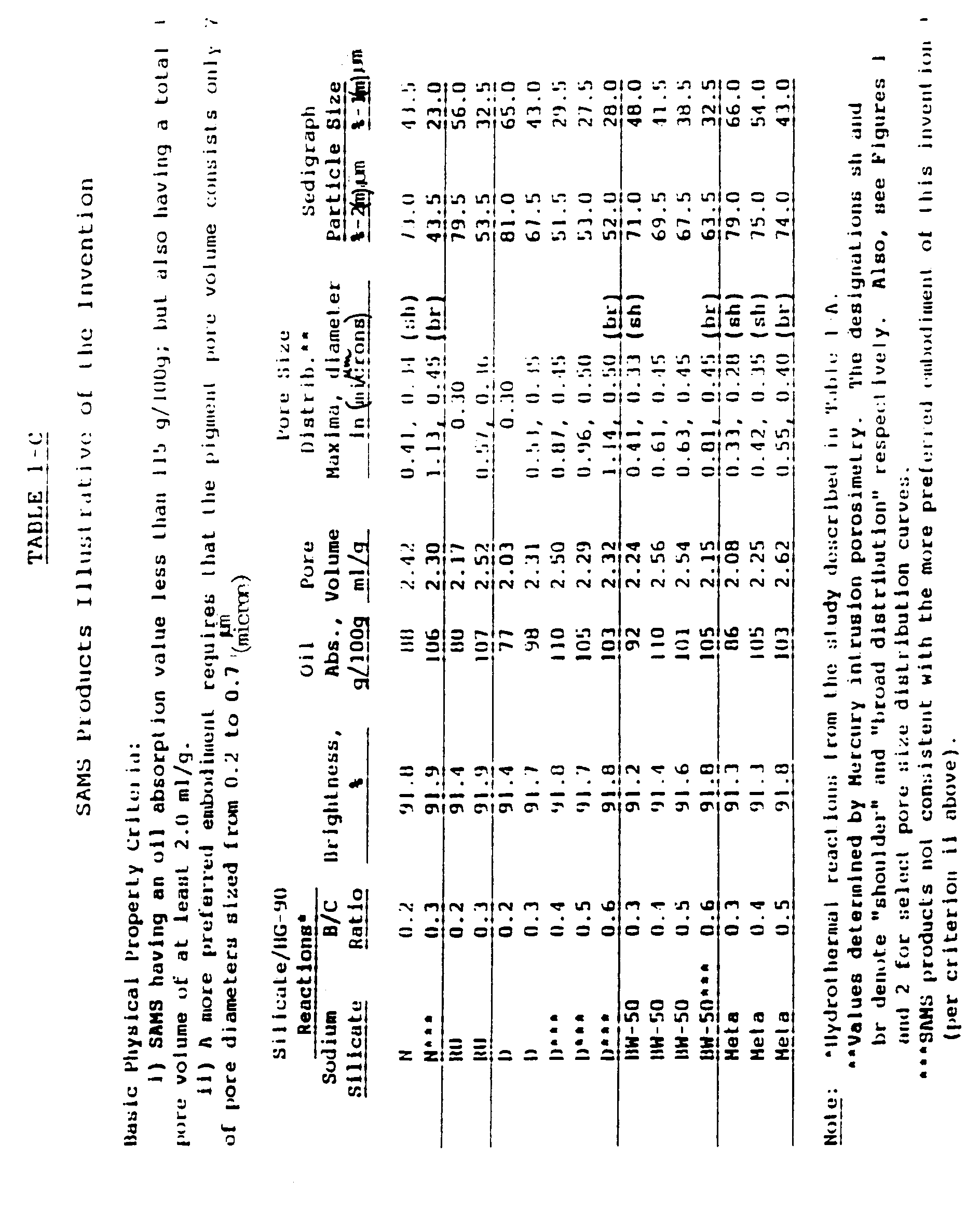
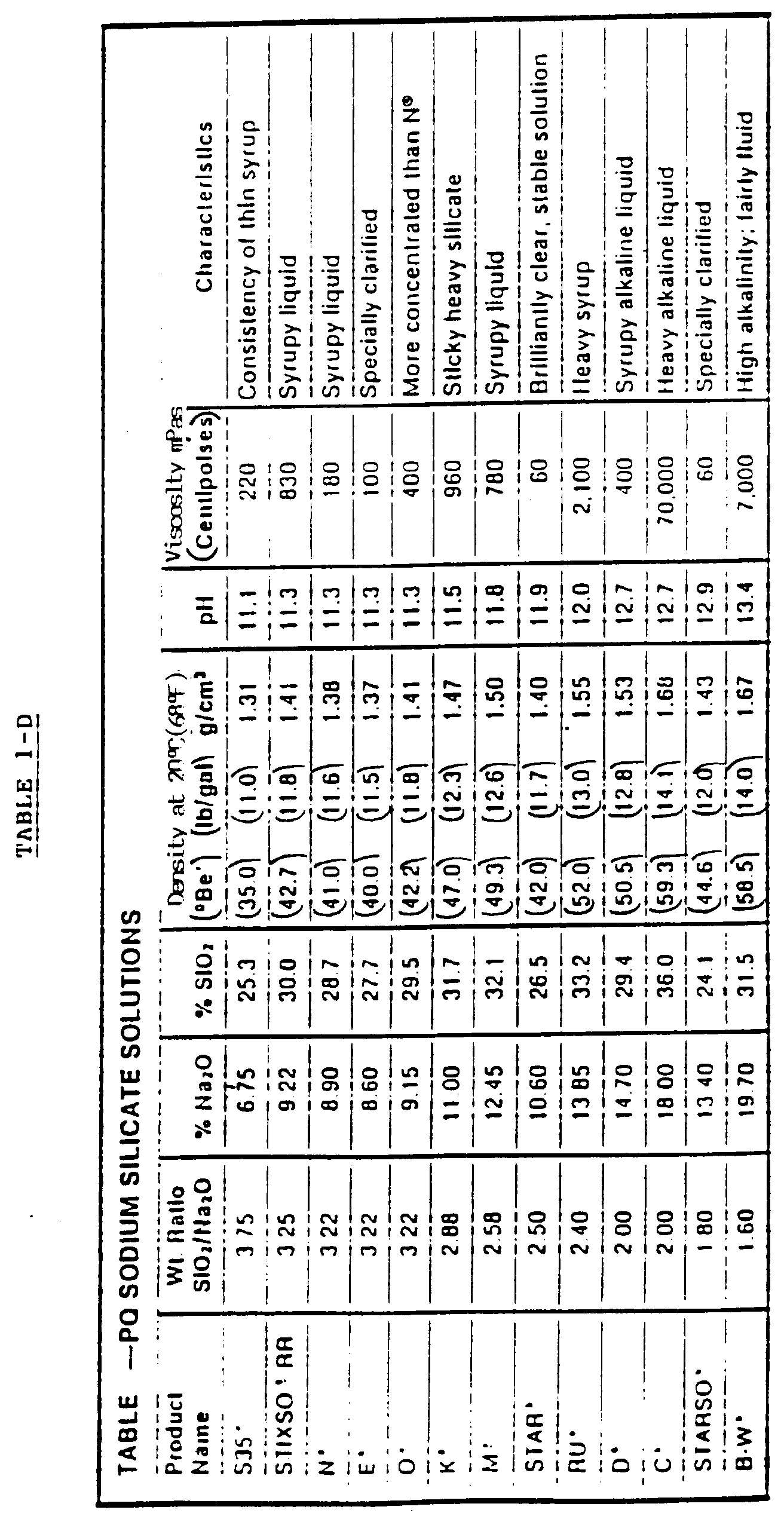
Claims (13)
- A sodium aluminosilicate pigment having the following empirical formula in terms of oxide constituents:said pigment being produced by the hydrothermal reaction of a sodium silicate and a clay in an aqueous medium at a ratio of sodium silicate (B) to clay (C) of 0.1:1 to 0.5:1,(0.01-0.5) Na2O : Al2O3 : (2.01-3.0) SiO2 : (1.0-3.0) H2O,
wherein the hydrothermal reaction is carried out by adding sufficient steam to the reactor to establish thermal reaction conditions ranging over a period of 10 minutes to 45 minutes under a steam pressure sufficient to raise the reactor pressure to 379.2 kPa (55 psi), and by controlling mixing intensity so as to obtain
said pigment being characterized by having a pore volume structure of at least 2.0 ml/g, a relatively narrow pore size distribution wherein the pore diameters range from 0.2 to 0.7 µm and are centered near a pore diameter of 0.3 µm, an oil absorption of less than about 115 g/100 g and an average particle diameter of 0.5-0.7 µm, as determined by x-ray sedigraph,
said hydrothermal reaction being carried out using a batch reaction mixture comprising:(0.2-0.5) Na2O : Al2O3 : (2.30-2.83) SiO2. - A sodium aluminosilicate pigment according to claim 1 wherein the SiO2/Na2O mole ratio in the batch reaction ranges from 0.1:1 to 3.33:1, and pore volume exceeds 2.5 ml/g.
- A sodium aluminosilicate pigment according to claim 2 wherein, in the reaction, the silicate used is a high mole ratio silicate and the B/C molar ratio ranges from 0.2 to 0.3.
- A sodium aluminosilicate pigment according to claim 2 wherein the ratio of B/C is from 0.3-0.5 and the SiO2/Na2O mole ratio of the starting silicate ranges from 1.0-1.9, and the oil absorption value ranges from 30 g/100 g to 115/100 g.
- A method for the production of a sodium aluminosilicate pigment which comprises the reaction of a sodium silicate having a SiO2/Na2O mole ratio of 1.0 to 3.33 with clay under hydrothermal reaction conditions at a mole ratio of sodium silicate (B) to clay (C) of 0.1 to 0.5, the reaction being carried out using the following batch reaction mixture:wherein the hydrothermal reaction is carried out by adding sufficient steam to the reactor to establish thermal reaction conditions ranging over a period of 10 minutes to 45 minutes under a steam pressure sufficient to raise the reactor pressure to 397.2 KPa (55 psi), and by controlling mixing intensity, so as to obtain said pigment being characterized by having a pore volume of at least 2.0 ml/g and a relatively narrow pore size distribution wherein the pore diameters range from 0.2 to 0.7 µm and are centered near a pore diameter of 0.3 µm.(0.2-0.5) Na2O : Al2O3 : (2.30-2.83) SiO2
- A method according to claim 5 wherein during the reaction, the reaction solids range from 10 to 14 wt.%.
- A method according to claim 5 wherein the SiO2/Na2O mole ratio in the batch reaction ranges from 0.1:1 to 3.33:1, respectively.
- A composite product comprising structured agglomerants produced by the reaction of sodium silicate (B) and kaolin clay (C) under hydrothermal conditions at a B/C ratio of 0.1:1 to 0.5:1 wherein the hydrothermal reaction is carried out by adding sufficient steam to the reactor to establish thermal reaction conditions ranging over a period of 10 minutes to 45 minutes under a steam pressure sufficient to raise the reactor pressure to 379.2 kPa (55 psi), and by controlling mixing intensity,
said structured agglomerants being characterized by having(a) a total pore volume of greater than 2.0 ml/g, which represents the sum of the microvoids within the structured agglomerants;(b) a pore volume consisting of microvoids within said structured agglomerants which have a pore diameter size of 0.2 to 0.7 µm, said pore diamter size being near the optimal porosity for the efficient scattering of light for a porous material having a refracting index of 1.5;(c) an oil absorption of less than 115 g/100 g; and(d) an aggolmerated particle size of about 0.5 to 0.7 µm with around 85% of the particles being less than 2 µm. - A method for the preparation of sodium aluminosilicate pigments which have a pore size distribution centered near the optimal porosity design of 0.3 µm for efficient scattering of visible light, which comprises:(a) a selecting kaolin clay reactants which have an average ultimate particle size of about 0.2 to 0.6 µm based on sedigraph measurements;(b) providing a sodium silicate solution which has an SiO2/Na2O mole ratio of about 1.0:1 to 3.33:1;(c) mixing the kaolin clay with the sodium silicate solution in an aqueous medium at a ratio of sodium silicate (B) to kaolin clay (C) of 0.1:1 to 0.5:1, and at a batch reaction mixture comprising(0.2-0.5) Na2O : Al2O3 : (2.30-2.83) SiO2;(d) reacting said mixture under hydrothermal conditions by heating in the presence of steam to a pressure in the range of 689.5 to 1034.2 KPa (100 to 150 psig) and a temperature of up to 175°C;(e) continuing said reaction for a sufficient period for the sodium silicate to react with kaolin clay and form structured agglomerants composed of agglomerated small flat platelets, wherein the platelets have an integrated rimmed area of amorphous non-diffracting sodium silicate clay reaction product and the primary particles are generally in the form of irregular to pseudo-hexagonal shaped plates, said structured agglomerants being characterized by the following properties:(1) an oil absorption of less than 115 g/100 g;(2) an agglomerated particle size of about 0.5-0.7 µm (micron) with around 85% of the particles being less than 2 µm (microns);(3) a total pore volume of greater than 2.0 ml/g; and(4) a pore volume consisting of microvoids within said structured agglomerants, which microvoids have a pore diameter of 0.2 to 0.7 µm (microns); wherein said total pore volume (3) represents substantially the sum of the microvoids contained within said structured agglomerants.
- A method for the preparation of pigments which have a pore volume as represented by the sum of the microvoids which have void diameters as measured in microns which are comparable in size to the optimal wavelength range for efficient scattering of visible light, which comprises:(a) determining the optimal scattering efficiency of a porous clay medium having a predetermined refractive index;(b) selecting a clay starting material of said predetermined refractive index which has an average ultimate particle size in µm (microns) which is comparable to the µm (micron) size of the microvoids necessary for the optimal wavelength range for efficient scattering of visible light;(c) reacting a sodium silicate solution (B) with said clay (C) in aqueous medium under hydrothermal conditions involving the addition of sufficient steam to the reactor to establish thermal reaction conditions ranging over a period of 10 minutes to 45 minutes under a steam pressure sufficient to raise the reactor pressure to 379.2 kPa (55 psi) to produce an agglomerated reaction product; and(d) recovering said agglomerated reaction product, said agglomerated product being composed of agglomerated small flat platelets, said agglomerated products having an agglomerate particle size comparable in size to the clay starting material, and a total pore volume as represented by the sum of the microvoids between the particles in said agglomerate, which is comparable to the pore volume of a pigment which has the optimal wavelength range for efficient scattering of visible light.
- A paper composition containing as a pigment or filler the sodium aluminosilicate pigment of claim 1.
- A paint composition containing as a paint pigment, the sodium aluminosilicate pigment of claim 1.
- A rubber composition containing as a reinforcing pigment, the sodium aluminosilicate pigment of claim 1.
Applications Claiming Priority (3)
| Application Number | Priority Date | Filing Date | Title |
|---|---|---|---|
| US56756390A | 1990-08-15 | 1990-08-15 | |
| US567563 | 1990-08-15 | ||
| PCT/US1991/005750 WO1992003387A1 (en) | 1990-08-15 | 1991-08-13 | High performance pigments of low oil absorption: preparation, properties and end-use applications |
Publications (3)
| Publication Number | Publication Date |
|---|---|
| EP0543918A1 EP0543918A1 (en) | 1993-06-02 |
| EP0543918A4 EP0543918A4 (en) | 1995-06-14 |
| EP0543918B1 true EP0543918B1 (en) | 2000-05-17 |
Family
ID=24267680
Family Applications (1)
| Application Number | Title | Priority Date | Filing Date |
|---|---|---|---|
| EP91915704A Expired - Lifetime EP0543918B1 (en) | 1990-08-15 | 1991-08-13 | High performance pigments of low oil absorption: preparation, properties and end-use applications |
Country Status (10)
| Country | Link |
|---|---|
| EP (1) | EP0543918B1 (en) |
| JP (1) | JP3387496B2 (en) |
| AT (1) | ATE193039T1 (en) |
| AU (1) | AU8400091A (en) |
| CA (1) | CA2089388C (en) |
| DE (1) | DE69132210T2 (en) |
| DK (1) | DK0543918T3 (en) |
| FI (1) | FI102904B (en) |
| NZ (1) | NZ239401A (en) |
| WO (1) | WO1992003387A1 (en) |
Families Citing this family (3)
| Publication number | Priority date | Publication date | Assignee | Title |
|---|---|---|---|---|
| US5551975A (en) * | 1994-06-23 | 1996-09-03 | J. M. Huber Corporation | Structured pigment compositions, methods for preparation and use |
| FI121890B (en) * | 2009-06-08 | 2011-05-31 | Upm Kymmene Corp | A new type of paper and a process for making it |
| DE102022127872A1 (en) * | 2022-10-21 | 2024-05-02 | Technische Universität Braunschweig, Körperschaft des öffentlichen Rechts | Nanocomposite modified asphalt binder and its production |
Family Cites Families (5)
| Publication number | Priority date | Publication date | Assignee | Title |
|---|---|---|---|---|
| US3690907A (en) * | 1970-05-20 | 1972-09-12 | Dow Chemical Co | Method of producing clay-base pigment |
| US4416805A (en) * | 1978-12-20 | 1983-11-22 | J. M. Huber Corporation | Synthesis of zeolites of small and uniform size having a high magnesium exchange capacity |
| US4812299A (en) * | 1986-06-17 | 1989-03-14 | J. M. Huber Corporation | Synthetic alkali metal alumino-silicates, methods and uses, compositions and their methods of preparation |
| US4863796A (en) * | 1986-06-17 | 1989-09-05 | J. M. Huber Corporation | Paper coated with synthetic alkali metal alumino-silicates |
| DE3789657D1 (en) * | 1986-06-17 | 1994-05-26 | Huber Corp J M | SYNTHETIC ALKALI-METAL-ALUMINO-SILICATES, METHODS AND USE, PREPARATIONS, AND THEIR METHOD FOR THE PRODUCTION THEREOF. |
-
1991
- 1991-08-13 EP EP91915704A patent/EP0543918B1/en not_active Expired - Lifetime
- 1991-08-13 DE DE69132210T patent/DE69132210T2/en not_active Expired - Fee Related
- 1991-08-13 WO PCT/US1991/005750 patent/WO1992003387A1/en not_active Ceased
- 1991-08-13 AU AU84000/91A patent/AU8400091A/en not_active Abandoned
- 1991-08-13 DK DK91915704T patent/DK0543918T3/en active
- 1991-08-13 AT AT91915704T patent/ATE193039T1/en not_active IP Right Cessation
- 1991-08-13 JP JP51416491A patent/JP3387496B2/en not_active Expired - Fee Related
- 1991-08-13 CA CA002089388A patent/CA2089388C/en not_active Expired - Fee Related
- 1991-08-15 NZ NZ239401A patent/NZ239401A/en unknown
-
1993
- 1993-02-12 FI FI930624A patent/FI102904B/en not_active IP Right Cessation
Also Published As
| Publication number | Publication date |
|---|---|
| NZ239401A (en) | 1994-10-26 |
| WO1992003387A1 (en) | 1992-03-05 |
| JP3387496B2 (en) | 2003-03-17 |
| EP0543918A4 (en) | 1995-06-14 |
| CA2089388C (en) | 1999-07-27 |
| EP0543918A1 (en) | 1993-06-02 |
| DE69132210T2 (en) | 2001-03-29 |
| FI102904B1 (en) | 1999-03-15 |
| DK0543918T3 (en) | 2000-09-25 |
| JPH06500067A (en) | 1994-01-06 |
| FI930624A0 (en) | 1993-02-12 |
| DE69132210D1 (en) | 2000-06-21 |
| AU8400091A (en) | 1992-03-17 |
| CA2089388A1 (en) | 1992-02-16 |
| FI102904B (en) | 1999-03-15 |
| ATE193039T1 (en) | 2000-06-15 |
| FI930624L (en) | 1993-03-30 |
Similar Documents
| Publication | Publication Date | Title |
|---|---|---|
| US6623555B1 (en) | Composite precipitated calcium carbonate/silicon compound pigment and method of making same | |
| US5316576A (en) | High performance pigments of low oil absorption: preparation, properties and end-use applications | |
| US5591256A (en) | High performance synthetic alkali metal alumino-silicate, methods and uses, compositions and high solids reaction methods of their preparation | |
| US5551975A (en) | Structured pigment compositions, methods for preparation and use | |
| EP0556311A1 (en) | Aggregated composite mineral pigments | |
| US7758688B2 (en) | Unusually narrow particle size distribution calcined kaolins | |
| US5342485A (en) | Process for preparing ultra-white alumina trihydrate | |
| EP1761597A1 (en) | Composites of starch containing silicon, method for the production thereof, and use for making paper and board | |
| US20140373753A1 (en) | System and method for a financial transaction system having a secure biometric verification system | |
| AU661582B2 (en) | Composite pigmentary material | |
| US5814143A (en) | Zirconium modified synthetic alkali metal silicate pigment and method of making | |
| EP2912224B1 (en) | Cationic polyoxometalate-coated alumina trihydrate dispersants | |
| JPH05178606A (en) | Method for producing hydrated silicic acid for papermaking | |
| WO1992003387A1 (en) | High performance pigments of low oil absorption: preparation, properties and end-use applications | |
| US5203918A (en) | Method for forming aggregated kaolin pigment | |
| JPH0647460B2 (en) | Synthetic alkali metal aluminosilicates, methods and uses, compositions and methods for their manufacture | |
| WO2000078874A1 (en) | Pigment materials and their preparation and use | |
| US20040107871A1 (en) | Aluminum trihydrate containing slurries | |
| AU706596B2 (en) | Process for preparing ultra-white alumina trihydrate | |
| WO1996006225A1 (en) | Process for preparing ultra-white alumina trihydrate | |
| WO2002064505A1 (en) | Process for reductive bleaching of alkaline earth metal carbonates | |
| EP0788571A1 (en) | Process for preparing ultra-white alumina trihydrate |
Legal Events
| Date | Code | Title | Description |
|---|---|---|---|
| PUAI | Public reference made under article 153(3) epc to a published international application that has entered the european phase |
Free format text: ORIGINAL CODE: 0009012 |
|
| 17P | Request for examination filed |
Effective date: 19930215 |
|
| AK | Designated contracting states |
Kind code of ref document: A1 Designated state(s): AT BE CH DE DK ES FR GB GR IT LI LU NL SE |
|
| RHK1 | Main classification (correction) |
Ipc: C09C 1/42 |
|
| A4 | Supplementary search report drawn up and despatched |
Effective date: 19950425 |
|
| AK | Designated contracting states |
Kind code of ref document: A4 Designated state(s): AT BE CH DE DK ES FR GB GR IT LI LU NL SE |
|
| 17Q | First examination report despatched |
Effective date: 19960927 |
|
| GRAG | Despatch of communication of intention to grant |
Free format text: ORIGINAL CODE: EPIDOS AGRA |
|
| GRAG | Despatch of communication of intention to grant |
Free format text: ORIGINAL CODE: EPIDOS AGRA |
|
| GRAH | Despatch of communication of intention to grant a patent |
Free format text: ORIGINAL CODE: EPIDOS IGRA |
|
| GRAH | Despatch of communication of intention to grant a patent |
Free format text: ORIGINAL CODE: EPIDOS IGRA |
|
| GRAA | (expected) grant |
Free format text: ORIGINAL CODE: 0009210 |
|
| AK | Designated contracting states |
Kind code of ref document: B1 Designated state(s): AT BE CH DE DK ES FR GB GR IT LI LU NL SE |
|
| PG25 | Lapsed in a contracting state [announced via postgrant information from national office to epo] |
Ref country code: IT Free format text: LAPSE BECAUSE OF FAILURE TO SUBMIT A TRANSLATION OF THE DESCRIPTION OR TO PAY THE FEE WITHIN THE PRESCRIBED TIME-LIMIT;WARNING: LAPSES OF ITALIAN PATENTS WITH EFFECTIVE DATE BEFORE 2007 MAY HAVE OCCURRED AT ANY TIME BEFORE 2007. THE CORRECT EFFECTIVE DATE MAY BE DIFFERENT FROM THE ONE RECORDED. Effective date: 20000517 Ref country code: GR Free format text: LAPSE BECAUSE OF NON-PAYMENT OF DUE FEES Effective date: 20000517 Ref country code: ES Free format text: THE PATENT HAS BEEN ANNULLED BY A DECISION OF A NATIONAL AUTHORITY Effective date: 20000517 |
|
| REF | Corresponds to: |
Ref document number: 193039 Country of ref document: AT Date of ref document: 20000615 Kind code of ref document: T |
|
| REG | Reference to a national code |
Ref country code: CH Ref legal event code: EP |
|
| REG | Reference to a national code |
Ref country code: CH Ref legal event code: NV Representative=s name: AMMANN PATENTANWAELTE AG BERN |
|
| REF | Corresponds to: |
Ref document number: 69132210 Country of ref document: DE Date of ref document: 20000621 |
|
| PGFP | Annual fee paid to national office [announced via postgrant information from national office to epo] |
Ref country code: FR Payment date: 20000719 Year of fee payment: 10 |
|
| PGFP | Annual fee paid to national office [announced via postgrant information from national office to epo] |
Ref country code: GB Payment date: 20000720 Year of fee payment: 10 Ref country code: SE Payment date: 20000720 Year of fee payment: 10 Ref country code: DE Payment date: 20000720 Year of fee payment: 10 |
|
| PGFP | Annual fee paid to national office [announced via postgrant information from national office to epo] |
Ref country code: DK Payment date: 20000721 Year of fee payment: 10 Ref country code: CH Payment date: 20000721 Year of fee payment: 10 Ref country code: AT Payment date: 20000721 Year of fee payment: 10 |
|
| PGFP | Annual fee paid to national office [announced via postgrant information from national office to epo] |
Ref country code: NL Payment date: 20000724 Year of fee payment: 10 |
|
| ET | Fr: translation filed | ||
| PGFP | Annual fee paid to national office [announced via postgrant information from national office to epo] |
Ref country code: BE Payment date: 20000809 Year of fee payment: 10 |
|
| PG25 | Lapsed in a contracting state [announced via postgrant information from national office to epo] |
Ref country code: LU Free format text: LAPSE BECAUSE OF NON-PAYMENT OF DUE FEES Effective date: 20000813 |
|
| REG | Reference to a national code |
Ref country code: DK Ref legal event code: T3 |
|
| PLBE | No opposition filed within time limit |
Free format text: ORIGINAL CODE: 0009261 |
|
| STAA | Information on the status of an ep patent application or granted ep patent |
Free format text: STATUS: NO OPPOSITION FILED WITHIN TIME LIMIT |
|
| 26N | No opposition filed | ||
| PG25 | Lapsed in a contracting state [announced via postgrant information from national office to epo] |
Ref country code: DK Free format text: LAPSE BECAUSE OF NON-PAYMENT OF DUE FEES Effective date: 20010813 Ref country code: GB Free format text: LAPSE BECAUSE OF NON-PAYMENT OF DUE FEES Effective date: 20010813 Ref country code: AT Free format text: LAPSE BECAUSE OF NON-PAYMENT OF DUE FEES Effective date: 20010813 |
|
| PG25 | Lapsed in a contracting state [announced via postgrant information from national office to epo] |
Ref country code: SE Free format text: LAPSE BECAUSE OF NON-PAYMENT OF DUE FEES Effective date: 20010814 |
|
| PG25 | Lapsed in a contracting state [announced via postgrant information from national office to epo] |
Ref country code: LI Free format text: LAPSE BECAUSE OF NON-PAYMENT OF DUE FEES Effective date: 20010831 Ref country code: BE Free format text: LAPSE BECAUSE OF NON-PAYMENT OF DUE FEES Effective date: 20010831 Ref country code: CH Free format text: LAPSE BECAUSE OF NON-PAYMENT OF DUE FEES Effective date: 20010831 |
|
| BERE | Be: lapsed |
Owner name: J.M. HUBER CORP. Effective date: 20010831 |
|
| PG25 | Lapsed in a contracting state [announced via postgrant information from national office to epo] |
Ref country code: NL Free format text: LAPSE BECAUSE OF NON-PAYMENT OF DUE FEES Effective date: 20020301 |
|
| EUG | Se: european patent has lapsed |
Ref document number: 91915704.0 |
|
| GBPC | Gb: european patent ceased through non-payment of renewal fee |
Effective date: 20010813 |
|
| REG | Reference to a national code |
Ref country code: CH Ref legal event code: PL |
|
| REG | Reference to a national code |
Ref country code: DK Ref legal event code: EBP |
|
| PG25 | Lapsed in a contracting state [announced via postgrant information from national office to epo] |
Ref country code: FR Free format text: LAPSE BECAUSE OF NON-PAYMENT OF DUE FEES Effective date: 20020430 |
|
| NLV4 | Nl: lapsed or anulled due to non-payment of the annual fee |
Effective date: 20020301 |
|
| PG25 | Lapsed in a contracting state [announced via postgrant information from national office to epo] |
Ref country code: DE Free format text: LAPSE BECAUSE OF NON-PAYMENT OF DUE FEES Effective date: 20020501 |
|
| REG | Reference to a national code |
Ref country code: FR Ref legal event code: ST |