EP0541550B1 - New intermediates, their production and use - Google Patents
New intermediates, their production and use Download PDFInfo
- Publication number
- EP0541550B1 EP0541550B1 EP90917427A EP90917427A EP0541550B1 EP 0541550 B1 EP0541550 B1 EP 0541550B1 EP 90917427 A EP90917427 A EP 90917427A EP 90917427 A EP90917427 A EP 90917427A EP 0541550 B1 EP0541550 B1 EP 0541550B1
- Authority
- EP
- European Patent Office
- Prior art keywords
- formula
- carbonochloridate
- hydrogen
- mmol
- stands
- Prior art date
- Legal status (The legal status is an assumption and is not a legal conclusion. Google has not performed a legal analysis and makes no representation as to the accuracy of the status listed.)
- Expired - Lifetime
Links
- 238000004519 manufacturing process Methods 0.000 title claims abstract description 12
- 239000000543 intermediate Substances 0.000 title abstract description 19
- 229940002612 prodrug Drugs 0.000 claims abstract description 20
- 239000000651 prodrug Substances 0.000 claims abstract description 20
- 239000003814 drug Substances 0.000 claims abstract description 13
- 229940079593 drug Drugs 0.000 claims abstract description 12
- 239000001257 hydrogen Substances 0.000 claims abstract description 12
- 229910052739 hydrogen Inorganic materials 0.000 claims abstract description 12
- UFHFLCQGNIYNRP-UHFFFAOYSA-N Hydrogen Chemical compound [H][H] UFHFLCQGNIYNRP-UHFFFAOYSA-N 0.000 claims abstract description 11
- 125000003118 aryl group Chemical group 0.000 claims abstract description 11
- 125000005842 heteroatom Chemical group 0.000 claims abstract description 6
- 229910052760 oxygen Inorganic materials 0.000 claims abstract description 6
- 229910052757 nitrogen Inorganic materials 0.000 claims abstract description 4
- 125000001424 substituent group Chemical group 0.000 claims abstract description 4
- 125000006273 (C1-C3) alkyl group Chemical group 0.000 claims abstract description 3
- 125000001931 aliphatic group Chemical group 0.000 claims abstract description 3
- 125000003710 aryl alkyl group Chemical group 0.000 claims abstract description 3
- QVGXLLKOCUKJST-UHFFFAOYSA-N atomic oxygen Chemical compound [O] QVGXLLKOCUKJST-UHFFFAOYSA-N 0.000 claims abstract description 3
- 125000002915 carbonyl group Chemical group [*:2]C([*:1])=O 0.000 claims abstract description 3
- 125000000623 heterocyclic group Chemical group 0.000 claims abstract description 3
- 239000001301 oxygen Substances 0.000 claims abstract description 3
- 229910052717 sulfur Inorganic materials 0.000 claims abstract description 3
- 238000000034 method Methods 0.000 claims description 24
- 150000001875 compounds Chemical class 0.000 claims description 18
- 238000006243 chemical reaction Methods 0.000 claims description 13
- FVAUCKIRQBBSSJ-UHFFFAOYSA-M sodium iodide Chemical compound [Na+].[I-] FVAUCKIRQBBSSJ-UHFFFAOYSA-M 0.000 claims description 12
- MUIBMNBAKWONDC-UHFFFAOYSA-N carbonochloridoyloxymethyl butanoate Chemical compound CCCC(=O)OCOC(Cl)=O MUIBMNBAKWONDC-UHFFFAOYSA-N 0.000 claims description 5
- 150000001732 carboxylic acid derivatives Chemical class 0.000 claims description 5
- YBBRCQOCSYXUOC-UHFFFAOYSA-N sulfuryl dichloride Chemical group ClS(Cl)(=O)=O YBBRCQOCSYXUOC-UHFFFAOYSA-N 0.000 claims description 5
- 239000012320 chlorinating reagent Substances 0.000 claims description 4
- 235000009518 sodium iodide Nutrition 0.000 claims description 4
- YVYSIZZTTQEOJW-UHFFFAOYSA-N carbonochloridoyloxymethyl propanoate Chemical compound CCC(=O)OCOC(Cl)=O YVYSIZZTTQEOJW-UHFFFAOYSA-N 0.000 claims description 3
- XMBWDFGMSWQBCA-UHFFFAOYSA-N hydrogen iodide Chemical compound I XMBWDFGMSWQBCA-UHFFFAOYSA-N 0.000 claims description 3
- 125000004178 (C1-C4) alkyl group Chemical group 0.000 claims description 2
- 229910001413 alkali metal ion Inorganic materials 0.000 claims description 2
- 125000002541 furyl group Chemical group 0.000 claims description 2
- 125000002883 imidazolyl group Chemical group 0.000 claims description 2
- 125000002971 oxazolyl group Chemical group 0.000 claims description 2
- 125000001997 phenyl group Chemical group [H]C1=C([H])C([H])=C(*)C([H])=C1[H] 0.000 claims description 2
- 238000002360 preparation method Methods 0.000 claims description 2
- 125000004076 pyridyl group Chemical group 0.000 claims description 2
- 125000000714 pyrimidinyl group Chemical group 0.000 claims description 2
- 125000000168 pyrrolyl group Chemical group 0.000 claims description 2
- 150000003839 salts Chemical class 0.000 claims description 2
- 125000000335 thiazolyl group Chemical group 0.000 claims description 2
- 125000001544 thienyl group Chemical group 0.000 claims description 2
- 230000001131 transforming effect Effects 0.000 claims description 2
- MULZXZRAWSJCCF-UHFFFAOYSA-N carbonochloridoyloxymethyl acetate Chemical compound CC(=O)OCOC(Cl)=O MULZXZRAWSJCCF-UHFFFAOYSA-N 0.000 claims 1
- GHGHDTQEVUBIBQ-UHFFFAOYSA-N carbonochloridoyloxymethyl benzoate Chemical compound ClC(=O)OCOC(=O)C1=CC=CC=C1 GHGHDTQEVUBIBQ-UHFFFAOYSA-N 0.000 claims 1
- QRLZXKMYHSFGDZ-UHFFFAOYSA-N carbonochloridoyloxymethyl pentanoate Chemical compound CCCCC(=O)OCOC(Cl)=O QRLZXKMYHSFGDZ-UHFFFAOYSA-N 0.000 claims 1
- 125000004435 hydrogen atom Chemical group [H]* 0.000 claims 1
- 238000003756 stirring Methods 0.000 description 27
- 239000000243 solution Substances 0.000 description 23
- HEDRZPFGACZZDS-UHFFFAOYSA-N Chloroform Chemical compound ClC(Cl)Cl HEDRZPFGACZZDS-UHFFFAOYSA-N 0.000 description 18
- UIIMBOGNXHQVGW-UHFFFAOYSA-M Sodium bicarbonate Chemical compound [Na+].OC([O-])=O UIIMBOGNXHQVGW-UHFFFAOYSA-M 0.000 description 18
- OFBQJSOFQDEBGM-UHFFFAOYSA-N Pentane Chemical compound CCCCC OFBQJSOFQDEBGM-UHFFFAOYSA-N 0.000 description 14
- 238000001704 evaporation Methods 0.000 description 13
- 230000008020 evaporation Effects 0.000 description 13
- 239000000706 filtrate Substances 0.000 description 12
- 150000002148 esters Chemical class 0.000 description 11
- DZLFLBLQUQXARW-UHFFFAOYSA-N tetrabutylammonium Chemical compound CCCC[N+](CCCC)(CCCC)CCCC DZLFLBLQUQXARW-UHFFFAOYSA-N 0.000 description 11
- RTZKZFJDLAIYFH-UHFFFAOYSA-N Diethyl ether Chemical compound CCOCC RTZKZFJDLAIYFH-UHFFFAOYSA-N 0.000 description 10
- WYURNTSHIVDZCO-UHFFFAOYSA-N Tetrahydrofuran Chemical compound C1CCOC1 WYURNTSHIVDZCO-UHFFFAOYSA-N 0.000 description 10
- -1 aryl chloromethyl carbonates Chemical class 0.000 description 10
- VZGDMQKNWNREIO-UHFFFAOYSA-N tetrachloromethane Chemical compound ClC(Cl)(Cl)Cl VZGDMQKNWNREIO-UHFFFAOYSA-N 0.000 description 10
- 229910052943 magnesium sulfate Inorganic materials 0.000 description 9
- 239000000203 mixture Substances 0.000 description 9
- 229910000030 sodium bicarbonate Inorganic materials 0.000 description 9
- HEDRZPFGACZZDS-MICDWDOJSA-N Trichloro(2H)methane Chemical compound [2H]C(Cl)(Cl)Cl HEDRZPFGACZZDS-MICDWDOJSA-N 0.000 description 8
- 238000001914 filtration Methods 0.000 description 8
- ZMXDDKWLCZADIW-UHFFFAOYSA-N N,N-Dimethylformamide Chemical compound CN(C)C=O ZMXDDKWLCZADIW-UHFFFAOYSA-N 0.000 description 7
- 239000012074 organic phase Substances 0.000 description 7
- CSCPPACGZOOCGX-UHFFFAOYSA-N Acetone Chemical compound CC(C)=O CSCPPACGZOOCGX-UHFFFAOYSA-N 0.000 description 6
- BTANRVKWQNVYAZ-UHFFFAOYSA-N butan-2-ol Chemical compound CCC(C)O BTANRVKWQNVYAZ-UHFFFAOYSA-N 0.000 description 6
- VLKZOEOYAKHREP-UHFFFAOYSA-N n-Hexane Chemical compound CCCCCC VLKZOEOYAKHREP-UHFFFAOYSA-N 0.000 description 6
- UUFQTNFCRMXOAE-UHFFFAOYSA-N 1-methylmethylene Chemical compound C[CH] UUFQTNFCRMXOAE-UHFFFAOYSA-N 0.000 description 5
- ZMANZCXQSJIPKH-UHFFFAOYSA-N Triethylamine Chemical compound CCN(CC)CC ZMANZCXQSJIPKH-UHFFFAOYSA-N 0.000 description 5
- BFUWRLFOXRAWGF-UHFFFAOYSA-N ethylsulfanylformic acid Chemical compound CCSC(O)=O BFUWRLFOXRAWGF-UHFFFAOYSA-N 0.000 description 5
- 239000000725 suspension Substances 0.000 description 5
- 238000005160 1H NMR spectroscopy Methods 0.000 description 4
- SJRJJKPEHAURKC-UHFFFAOYSA-N N-Methylmorpholine Chemical compound CN1CCOCC1 SJRJJKPEHAURKC-UHFFFAOYSA-N 0.000 description 4
- JUJWROOIHBZHMG-UHFFFAOYSA-N Pyridine Chemical compound C1=CC=NC=C1 JUJWROOIHBZHMG-UHFFFAOYSA-N 0.000 description 4
- JYWJULGYGOLCGW-UHFFFAOYSA-N chloromethyl chloroformate Chemical compound ClCOC(Cl)=O JYWJULGYGOLCGW-UHFFFAOYSA-N 0.000 description 4
- JPCDQCQGUMTOBH-UHFFFAOYSA-N chloromethyl ethylsulfanylformate Chemical compound CCSC(=O)OCCl JPCDQCQGUMTOBH-UHFFFAOYSA-N 0.000 description 4
- FFUAGWLWBBFQJT-UHFFFAOYSA-N hexamethyldisilazane Chemical compound C[Si](C)(C)N[Si](C)(C)C FFUAGWLWBBFQJT-UHFFFAOYSA-N 0.000 description 4
- 231100000252 nontoxic Toxicity 0.000 description 4
- 230000003000 nontoxic effect Effects 0.000 description 4
- WSLDOOZREJYCGB-UHFFFAOYSA-N 1,2-Dichloroethane Chemical compound ClCCCl WSLDOOZREJYCGB-UHFFFAOYSA-N 0.000 description 3
- NGNBDVOYPDDBFK-UHFFFAOYSA-N 2-[2,4-di(pentan-2-yl)phenoxy]acetyl chloride Chemical group CCCC(C)C1=CC=C(OCC(Cl)=O)C(C(C)CCC)=C1 NGNBDVOYPDDBFK-UHFFFAOYSA-N 0.000 description 3
- YMWUJEATGCHHMB-UHFFFAOYSA-N Dichloromethane Chemical compound ClCCl YMWUJEATGCHHMB-UHFFFAOYSA-N 0.000 description 3
- XEKOWRVHYACXOJ-UHFFFAOYSA-N Ethyl acetate Chemical compound CCOC(C)=O XEKOWRVHYACXOJ-UHFFFAOYSA-N 0.000 description 3
- WSFSSNUMVMOOMR-UHFFFAOYSA-N Formaldehyde Chemical compound O=C WSFSSNUMVMOOMR-UHFFFAOYSA-N 0.000 description 3
- OKKJLVBELUTLKV-UHFFFAOYSA-N Methanol Chemical compound OC OKKJLVBELUTLKV-UHFFFAOYSA-N 0.000 description 3
- HEMHJVSKTPXQMS-UHFFFAOYSA-M Sodium hydroxide Chemical compound [OH-].[Na+] HEMHJVSKTPXQMS-UHFFFAOYSA-M 0.000 description 3
- 230000015572 biosynthetic process Effects 0.000 description 3
- IJOOHPMOJXWVHK-UHFFFAOYSA-N chlorotrimethylsilane Chemical compound C[Si](C)(C)Cl IJOOHPMOJXWVHK-UHFFFAOYSA-N 0.000 description 3
- 230000006866 deterioration Effects 0.000 description 3
- 238000004821 distillation Methods 0.000 description 3
- CCGKOQOJPYTBIH-UHFFFAOYSA-N ethenone Chemical compound C=C=O CCGKOQOJPYTBIH-UHFFFAOYSA-N 0.000 description 3
- 125000002346 iodo group Chemical group I* 0.000 description 3
- 239000002244 precipitate Substances 0.000 description 3
- 235000017557 sodium bicarbonate Nutrition 0.000 description 3
- JZCSVFRKWQWAQB-UHFFFAOYSA-N 1-carbonochloridoyloxyethyl butanoate Chemical compound CCCC(=O)OC(C)OC(Cl)=O JZCSVFRKWQWAQB-UHFFFAOYSA-N 0.000 description 2
- SMNDYUVBFMFKNZ-UHFFFAOYSA-N 2-furoic acid Chemical compound OC(=O)C1=CC=CO1 SMNDYUVBFMFKNZ-UHFFFAOYSA-N 0.000 description 2
- QSNSCYSYFYORTR-UHFFFAOYSA-N 4-chloroaniline Chemical compound NC1=CC=C(Cl)C=C1 QSNSCYSYFYORTR-UHFFFAOYSA-N 0.000 description 2
- IJGRMHOSHXDMSA-UHFFFAOYSA-N Atomic nitrogen Chemical compound N#N IJGRMHOSHXDMSA-UHFFFAOYSA-N 0.000 description 2
- 229910015900 BF3 Inorganic materials 0.000 description 2
- KZMGYPLQYOPHEL-UHFFFAOYSA-N Boron trifluoride etherate Chemical compound FB(F)F.CCOCC KZMGYPLQYOPHEL-UHFFFAOYSA-N 0.000 description 2
- FERIUCNNQQJTOY-UHFFFAOYSA-M Butyrate Chemical compound CCCC([O-])=O FERIUCNNQQJTOY-UHFFFAOYSA-M 0.000 description 2
- FERIUCNNQQJTOY-UHFFFAOYSA-N Butyric acid Chemical compound CCCC(O)=O FERIUCNNQQJTOY-UHFFFAOYSA-N 0.000 description 2
- XBPCUCUWBYBCDP-UHFFFAOYSA-N Dicyclohexylamine Chemical class C1CCCCC1NC1CCCCC1 XBPCUCUWBYBCDP-UHFFFAOYSA-N 0.000 description 2
- ZAFNJMIOTHYJRJ-UHFFFAOYSA-N Diisopropyl ether Chemical compound CC(C)OC(C)C ZAFNJMIOTHYJRJ-UHFFFAOYSA-N 0.000 description 2
- JGFZNNIVVJXRND-UHFFFAOYSA-N N,N-Diisopropylethylamine (DIPEA) Chemical compound CCN(C(C)C)C(C)C JGFZNNIVVJXRND-UHFFFAOYSA-N 0.000 description 2
- 238000005481 NMR spectroscopy Methods 0.000 description 2
- LCTONWCANYUPML-UHFFFAOYSA-N Pyruvic acid Chemical compound CC(=O)C(O)=O LCTONWCANYUPML-UHFFFAOYSA-N 0.000 description 2
- WQDUMFSSJAZKTM-UHFFFAOYSA-N Sodium methoxide Chemical compound [Na+].[O-]C WQDUMFSSJAZKTM-UHFFFAOYSA-N 0.000 description 2
- 125000000217 alkyl group Chemical group 0.000 description 2
- 150000001356 alkyl thiols Chemical class 0.000 description 2
- 239000007864 aqueous solution Substances 0.000 description 2
- 239000002585 base Substances 0.000 description 2
- GFPGFNMSICUKEL-UHFFFAOYSA-N butan-2-yloxycarbonyloxymethyl propanoate Chemical compound CCC(C)OC(=O)OCOC(=O)CC GFPGFNMSICUKEL-UHFFFAOYSA-N 0.000 description 2
- 150000001735 carboxylic acids Chemical class 0.000 description 2
- 239000003610 charcoal Substances 0.000 description 2
- 238000005660 chlorination reaction Methods 0.000 description 2
- JLBNMNOUGQAHOQ-UHFFFAOYSA-N chloromethyl butylsulfanylformate Chemical compound CCCCSC(=O)OCCl JLBNMNOUGQAHOQ-UHFFFAOYSA-N 0.000 description 2
- 239000012043 crude product Substances 0.000 description 2
- DNJIEGIFACGWOD-UHFFFAOYSA-N ethanethiol Chemical compound CCS DNJIEGIFACGWOD-UHFFFAOYSA-N 0.000 description 2
- NVGKNYSCOOWRIL-UHFFFAOYSA-N ethylsulfanylcarbonyloxymethyl 2-acetamidoacetate Chemical compound CCSC(=O)OCOC(=O)CNC(C)=O NVGKNYSCOOWRIL-UHFFFAOYSA-N 0.000 description 2
- PBHDOLSAGHCBKX-UHFFFAOYSA-N ethylsulfanylcarbonyloxymethyl 2-oxopropanoate Chemical compound CCSC(=O)OCOC(=O)C(C)=O PBHDOLSAGHCBKX-UHFFFAOYSA-N 0.000 description 2
- COTPDNIRZMOEDK-UHFFFAOYSA-N ethylsulfanylcarbonyloxymethyl butanoate Chemical compound CCCC(=O)OCOC(=O)SCC COTPDNIRZMOEDK-UHFFFAOYSA-N 0.000 description 2
- WBYQIZAFINSCRA-UHFFFAOYSA-N ethylsulfanylcarbonyloxymethyl furan-2-carboxylate Chemical compound CCSC(=O)OCOC(=O)C1=CC=CO1 WBYQIZAFINSCRA-UHFFFAOYSA-N 0.000 description 2
- DOFRGKDFAQWZPR-UHFFFAOYSA-N ethylsulfanylcarbonyloxymethyl propanoate Chemical compound CCSC(=O)OCOC(=O)CC DOFRGKDFAQWZPR-UHFFFAOYSA-N 0.000 description 2
- 239000000284 extract Substances 0.000 description 2
- 238000004108 freeze drying Methods 0.000 description 2
- 125000002887 hydroxy group Chemical group [H]O* 0.000 description 2
- 239000012528 membrane Substances 0.000 description 2
- 125000002924 primary amino group Chemical group [H]N([H])* 0.000 description 2
- 239000000047 product Substances 0.000 description 2
- 238000000746 purification Methods 0.000 description 2
- UMJSCPRVCHMLSP-UHFFFAOYSA-N pyridine Natural products COC1=CC=CN=C1 UMJSCPRVCHMLSP-UHFFFAOYSA-N 0.000 description 2
- 239000011734 sodium Substances 0.000 description 2
- 239000002904 solvent Substances 0.000 description 2
- 239000012258 stirred mixture Substances 0.000 description 2
- 150000003512 tertiary amines Chemical group 0.000 description 2
- TUNFSRHWOTWDNC-UHFFFAOYSA-N tetradecanoic acid Chemical compound CCCCCCCCCCCCCC(O)=O TUNFSRHWOTWDNC-UHFFFAOYSA-N 0.000 description 2
- 238000005406 washing Methods 0.000 description 2
- XLYOFNOQVPJJNP-UHFFFAOYSA-N water Substances O XLYOFNOQVPJJNP-UHFFFAOYSA-N 0.000 description 2
- WYRSGXAIHNMKOL-UHFFFAOYSA-N $l^{1}-sulfanylethane Chemical compound CC[S] WYRSGXAIHNMKOL-UHFFFAOYSA-N 0.000 description 1
- VGRZLNZCHIQMAE-UHFFFAOYSA-N (4-chlorophenyl)carbamoyloxymethyl propanoate Chemical compound CCC(=O)OCOC(=O)NC1=CC=C(Cl)C=C1 VGRZLNZCHIQMAE-UHFFFAOYSA-N 0.000 description 1
- QEXRDKAXGSPPMI-UHFFFAOYSA-N (4-nitrophenoxy)carbonyloxymethyl propanoate Chemical compound CCC(=O)OCOC(=O)OC1=CC=C([N+]([O-])=O)C=C1 QEXRDKAXGSPPMI-UHFFFAOYSA-N 0.000 description 1
- 0 *C(OC(*)=O)OC(Cl)=O Chemical compound *C(OC(*)=O)OC(Cl)=O 0.000 description 1
- DUGBMQGRBPYGQJ-UHFFFAOYSA-N 1-[(4-chlorophenyl)carbamoyloxy]ethyl butanoate Chemical compound CCCC(=O)OC(C)OC(=O)NC1=CC=C(Cl)C=C1 DUGBMQGRBPYGQJ-UHFFFAOYSA-N 0.000 description 1
- BTJIUGUIPKRLHP-UHFFFAOYSA-N 4-nitrophenol Chemical compound OC1=CC=C([N+]([O-])=O)C=C1 BTJIUGUIPKRLHP-UHFFFAOYSA-N 0.000 description 1
- BOUPCBYDYMLPDU-UHFFFAOYSA-N CC/[S+]=C(\[O-])/O Chemical compound CC/[S+]=C(\[O-])/O BOUPCBYDYMLPDU-UHFFFAOYSA-N 0.000 description 1
- 238000005967 Finkelstein reaction Methods 0.000 description 1
- 241001465754 Metazoa Species 0.000 description 1
- DBTDEFJAFBUGPP-UHFFFAOYSA-N Methanethial Chemical compound S=C DBTDEFJAFBUGPP-UHFFFAOYSA-N 0.000 description 1
- LSDPWZHWYPCBBB-UHFFFAOYSA-N Methanethiol Chemical compound SC LSDPWZHWYPCBBB-UHFFFAOYSA-N 0.000 description 1
- CTQNGGLPUBDAKN-UHFFFAOYSA-N O-Xylene Chemical compound CC1=CC=CC=C1C CTQNGGLPUBDAKN-UHFFFAOYSA-N 0.000 description 1
- YGYAWVDWMABLBF-UHFFFAOYSA-N Phosgene Chemical compound ClC(Cl)=O YGYAWVDWMABLBF-UHFFFAOYSA-N 0.000 description 1
- 229910006024 SO2Cl2 Inorganic materials 0.000 description 1
- DKGAVHZHDRPRBM-UHFFFAOYSA-N Tert-Butanol Chemical compound CC(C)(C)O DKGAVHZHDRPRBM-UHFFFAOYSA-N 0.000 description 1
- 239000002253 acid Substances 0.000 description 1
- 238000005917 acylation reaction Methods 0.000 description 1
- 150000001298 alcohols Chemical class 0.000 description 1
- 125000003277 amino group Chemical group 0.000 description 1
- 239000008346 aqueous phase Substances 0.000 description 1
- 230000004888 barrier function Effects 0.000 description 1
- WQAQPCDUOCURKW-UHFFFAOYSA-N butanethiol Chemical compound CCCCS WQAQPCDUOCURKW-UHFFFAOYSA-N 0.000 description 1
- 239000006227 byproduct Substances 0.000 description 1
- AOGYCOYQMAVAFD-UHFFFAOYSA-M carbonochloridate Chemical compound [O-]C(Cl)=O AOGYCOYQMAVAFD-UHFFFAOYSA-M 0.000 description 1
- WRWHFVRDUAQRIQ-UHFFFAOYSA-N carbonothioic O,O-acid Chemical group OC(O)=S WRWHFVRDUAQRIQ-UHFFFAOYSA-N 0.000 description 1
- 238000003421 catalytic decomposition reaction Methods 0.000 description 1
- 230000003197 catalytic effect Effects 0.000 description 1
- 238000007385 chemical modification Methods 0.000 description 1
- 229910052801 chlorine Inorganic materials 0.000 description 1
- 150000001805 chlorine compounds Chemical class 0.000 description 1
- 125000001309 chloro group Chemical group Cl* 0.000 description 1
- QOPVNWQGBQYBBP-UHFFFAOYSA-N chloroethyl chloroformate Chemical compound CC(Cl)OC(Cl)=O QOPVNWQGBQYBBP-UHFFFAOYSA-N 0.000 description 1
- 238000004587 chromatography analysis Methods 0.000 description 1
- 239000006184 cosolvent Substances 0.000 description 1
- 238000001212 derivatisation Methods 0.000 description 1
- XBDQKXXYIPTUBI-UHFFFAOYSA-N dimethylselenoniopropionate Natural products CCC(O)=O XBDQKXXYIPTUBI-UHFFFAOYSA-N 0.000 description 1
- HCUYBXPSSCRKRF-UHFFFAOYSA-N diphosgene Chemical compound ClC(=O)OC(Cl)(Cl)Cl HCUYBXPSSCRKRF-UHFFFAOYSA-N 0.000 description 1
- WTDRDQBEARUVNC-UHFFFAOYSA-N dopa Chemical compound OC(=O)C(N)CC1=CC=C(O)C(O)=C1 WTDRDQBEARUVNC-UHFFFAOYSA-N 0.000 description 1
- 238000012377 drug delivery Methods 0.000 description 1
- 238000001035 drying Methods 0.000 description 1
- 230000000694 effects Effects 0.000 description 1
- JROGBPMEKVAPEH-GXGBFOEMSA-N emetine dihydrochloride Chemical compound Cl.Cl.N1CCC2=CC(OC)=C(OC)C=C2[C@H]1C[C@H]1C[C@H]2C3=CC(OC)=C(OC)C=C3CCN2C[C@@H]1CC JROGBPMEKVAPEH-GXGBFOEMSA-N 0.000 description 1
- 125000001495 ethyl group Chemical group [H]C([H])([H])C([H])([H])* 0.000 description 1
- 125000000524 functional group Chemical group 0.000 description 1
- 230000002496 gastric effect Effects 0.000 description 1
- 238000010438 heat treatment Methods 0.000 description 1
- 229910000043 hydrogen iodide Inorganic materials 0.000 description 1
- QAOWNCQODCNURD-UHFFFAOYSA-M hydrogensulfate Chemical compound OS([O-])(=O)=O QAOWNCQODCNURD-UHFFFAOYSA-M 0.000 description 1
- 239000002198 insoluble material Substances 0.000 description 1
- 239000007788 liquid Substances 0.000 description 1
- 239000007791 liquid phase Substances 0.000 description 1
- 230000008018 melting Effects 0.000 description 1
- 238000002844 melting Methods 0.000 description 1
- 230000002503 metabolic effect Effects 0.000 description 1
- XMJHPCRAQCTCFT-UHFFFAOYSA-N methyl chloroformate Chemical compound COC(Cl)=O XMJHPCRAQCTCFT-UHFFFAOYSA-N 0.000 description 1
- 239000002808 molecular sieve Substances 0.000 description 1
- 125000000896 monocarboxylic acid group Chemical group 0.000 description 1
- DUWWHGPELOTTOE-UHFFFAOYSA-N n-(5-chloro-2,4-dimethoxyphenyl)-3-oxobutanamide Chemical compound COC1=CC(OC)=C(NC(=O)CC(C)=O)C=C1Cl DUWWHGPELOTTOE-UHFFFAOYSA-N 0.000 description 1
- 238000005192 partition Methods 0.000 description 1
- 239000012071 phase Substances 0.000 description 1
- 150000002989 phenols Chemical class 0.000 description 1
- IMGHPTQQUMHNLG-UHFFFAOYSA-M potassium;2-acetamidoacetate Chemical compound [K+].CC(=O)NCC([O-])=O IMGHPTQQUMHNLG-UHFFFAOYSA-M 0.000 description 1
- 230000008569 process Effects 0.000 description 1
- 235000019260 propionic acid Nutrition 0.000 description 1
- 125000006239 protecting group Chemical group 0.000 description 1
- LVTJOONKWUXEFR-FZRMHRINSA-N protoneodioscin Natural products O(C[C@@H](CC[C@]1(O)[C@H](C)[C@@H]2[C@]3(C)[C@H]([C@H]4[C@@H]([C@]5(C)C(=CC4)C[C@@H](O[C@@H]4[C@H](O[C@H]6[C@@H](O)[C@@H](O)[C@@H](O)[C@H](C)O6)[C@@H](O)[C@H](O[C@H]6[C@@H](O)[C@@H](O)[C@@H](O)[C@H](C)O6)[C@H](CO)O4)CC5)CC3)C[C@@H]2O1)C)[C@H]1[C@H](O)[C@H](O)[C@H](O)[C@@H](CO)O1 LVTJOONKWUXEFR-FZRMHRINSA-N 0.000 description 1
- 230000009257 reactivity Effects 0.000 description 1
- 238000011084 recovery Methods 0.000 description 1
- 238000001953 recrystallisation Methods 0.000 description 1
- 150000003335 secondary amines Chemical group 0.000 description 1
- 238000001577 simple distillation Methods 0.000 description 1
- 229910052708 sodium Inorganic materials 0.000 description 1
- URGAHOPLAPQHLN-UHFFFAOYSA-N sodium aluminosilicate Chemical compound [Na+].[Al+3].[O-][Si]([O-])=O.[O-][Si]([O-])=O URGAHOPLAPQHLN-UHFFFAOYSA-N 0.000 description 1
- MFBOGIVSZKQAPD-UHFFFAOYSA-M sodium butyrate Chemical compound [Na+].CCCC([O-])=O MFBOGIVSZKQAPD-UHFFFAOYSA-M 0.000 description 1
- 239000007858 starting material Substances 0.000 description 1
- 238000003786 synthesis reaction Methods 0.000 description 1
- YLQBMQCUIZJEEH-UHFFFAOYSA-N tetrahydrofuran Natural products C=1C=COC=1 YLQBMQCUIZJEEH-UHFFFAOYSA-N 0.000 description 1
- 230000000699 topical effect Effects 0.000 description 1
- 230000009466 transformation Effects 0.000 description 1
- 239000005051 trimethylchlorosilane Substances 0.000 description 1
- 239000008096 xylene Substances 0.000 description 1
Classifications
-
- C—CHEMISTRY; METALLURGY
- C07—ORGANIC CHEMISTRY
- C07C—ACYCLIC OR CARBOCYCLIC COMPOUNDS
- C07C271/00—Derivatives of carbamic acids, i.e. compounds containing any of the groups, the nitrogen atom not being part of nitro or nitroso groups
- C07C271/06—Esters of carbamic acids
- C07C271/08—Esters of carbamic acids having oxygen atoms of carbamate groups bound to acyclic carbon atoms
- C07C271/10—Esters of carbamic acids having oxygen atoms of carbamate groups bound to acyclic carbon atoms with the nitrogen atoms of the carbamate groups bound to hydrogen atoms or to acyclic carbon atoms
- C07C271/22—Esters of carbamic acids having oxygen atoms of carbamate groups bound to acyclic carbon atoms with the nitrogen atoms of the carbamate groups bound to hydrogen atoms or to acyclic carbon atoms to carbon atoms of hydrocarbon radicals substituted by carboxyl groups
-
- A—HUMAN NECESSITIES
- A61—MEDICAL OR VETERINARY SCIENCE; HYGIENE
- A61P—SPECIFIC THERAPEUTIC ACTIVITY OF CHEMICAL COMPOUNDS OR MEDICINAL PREPARATIONS
- A61P43/00—Drugs for specific purposes, not provided for in groups A61P1/00-A61P41/00
-
- C—CHEMISTRY; METALLURGY
- C07—ORGANIC CHEMISTRY
- C07C—ACYCLIC OR CARBOCYCLIC COMPOUNDS
- C07C271/00—Derivatives of carbamic acids, i.e. compounds containing any of the groups, the nitrogen atom not being part of nitro or nitroso groups
- C07C271/06—Esters of carbamic acids
- C07C271/08—Esters of carbamic acids having oxygen atoms of carbamate groups bound to acyclic carbon atoms
- C07C271/26—Esters of carbamic acids having oxygen atoms of carbamate groups bound to acyclic carbon atoms with the nitrogen atom of at least one of the carbamate groups bound to a carbon atom of a six-membered aromatic ring
-
- C—CHEMISTRY; METALLURGY
- C07—ORGANIC CHEMISTRY
- C07C—ACYCLIC OR CARBOCYCLIC COMPOUNDS
- C07C329/00—Thiocarbonic acids; Halides, esters or anhydrides thereof
- C07C329/02—Monothiocarbonic acids; Derivatives thereof
- C07C329/04—Esters of monothiocarbonic acids
- C07C329/06—Esters of monothiocarbonic acids having sulfur atoms of thiocarbonic groups bound to acyclic carbon atoms
-
- C—CHEMISTRY; METALLURGY
- C07—ORGANIC CHEMISTRY
- C07C—ACYCLIC OR CARBOCYCLIC COMPOUNDS
- C07C69/00—Esters of carboxylic acids; Esters of carbonic or haloformic acids
- C07C69/96—Esters of carbonic or haloformic acids
-
- C—CHEMISTRY; METALLURGY
- C07—ORGANIC CHEMISTRY
- C07C—ACYCLIC OR CARBOCYCLIC COMPOUNDS
- C07C2601/00—Systems containing only non-condensed rings
- C07C2601/12—Systems containing only non-condensed rings with a six-membered ring
- C07C2601/14—The ring being saturated
Definitions
- the present invention relates to hitherto unknown intermediates of the below formula I for use in the synthesis of prodrugs.
- the said prodrug is non-toxic and, when administered to a warm-blooded animal including a human being, is enzymatically and/or chemically cleaved in such a manner as to release the drug at its target or site of activity, quantitatively and at a desirable rate, while the remaining cleaved moiety remains non-toxic and is metabolized in such a manner that non-toxic metabolic products are produced.
- the prodrug can be provided without excessive costs in connection with its production, in particular without an appreciable loss of drug itself during its production and recovery, since the drug is usually the more expensive part of the prodrug.
- the intermediate used to react with the drug in providing the prodrug should advantageously be stable and still be reasonably reactive.
- acyloxyalkoxycarbonyl derivatives have become interesting bioreversible prodrug moieties of drugs and medicaments which are more readily bioavailable than the drug itself, and further are less irritating to topical and gastric mucosal membranes and are more permeable through such membranes.
- R 1 may be further substituted, and its chain be interrupted by hetero atoms like oxygen, or by carbonyl group(s).
- R 3 means hydrogen or C 1 -C 3 alkyl. Esters of this type have for instance been used as prodrugs of R'COOH and have been shown to be enzymatically hydrolyzed in man. Obviously such esters will also liberate D-H.
- esters of the formula II have been produced in a multi-step procedure, confer J. Med. Chem. 1988, 31, p. 318ff, where the drug (containing a primary or secondary amine group being the point of reaction) is reacted with a compound of formula III in which formula, R 1' and R are hydrogen or lower alkyl.
- the relationship between the reactivities of the two electrophilic centres in (3) is temporarily reversed by conversion of the acid chloride function to the less reactive carbonothioate group of (4).
- the acid chloride function of (7) (being the desired intermediate of formula I) is finally restored by chlorination.
- the double esters (6) were mostly prepared by stirring a suspension of sodium carboxylate in dimethylformamide with the iodo compound (5) at room temperature for 20 hours.
- Simple carboxylic acids tend to give higher yields (80-100%) than carboxylic acids containing additional functional groups.
- Other methods are workable, confer e.g. Scheme A, methods E, F, and J (Examples 9, 10, and 14, respectively).
- the double esters (6) were generally pure enough for subsequent conversion, in step 4 of Scheme A, to the desired intermediates (7) by restoring the acid chloride function through reaction with sulfuryl chloride, preferably in the presence of a catalytic amount of boron trifluoride etherate at -25 - -30 ° C and subsequent stirring at 0 ° C for one hour and half an hour at room temperature.
- the distillable compounds (7) were produced in high yields and could be kept without deterioration for years in a refrigerator.
- the synthetic sequence is not restricted to acyloxymethyl carbonochloridates.
- 1-chloroalkyl carbonochloridates for (3) and treating the derived 0-1-chloroalkyl S-alkyl carbonothioate with TBA butanoate in tetrahydrofuran for a suitable period of time, followed by sulfuryl chloride treatment provided a solution of 1-butanoyloxyalkyl carbonochloridate, but these intermediates seem to be less stable than (7).
- the present intermediates of formula I can generally be prepared by reacting a 1-haloalkyl carbonochloridate of the formula IV where R 3 has the above meanings, is reacted with R 2 SR 4 , R 2 being C 1 -C 4 alkyl, and R 4 being hydrogen or an alkali metal ion, to form a 1-haloalkyl carbonothioate of the formula V R 2 and R 3 having the above meanings, which is transformed into a 1-acyloxyalkyl carbonothioate of the formula VI R 1 , R 2 , and R 3 having the above meanings, by reaction with a salt of a carboxylic acid R 1 COOH, R 1 having the above meanings, and finally reacting the compound of formula VI with a chlorinating agent to yield the desired intermediate of formula I.
- R 3 H
- the present intermediates are preferably being prepared by converting the compound of formula V to the corresponding iodide by reaction with sodium iodide, before transforming it via VI to I.
- the preferred chlorinating agent used in the final step of the preparation of the present intermediates is sulfuryl chloride.
- the present intermediates of the formula I can be provided in good yields and of reasonable costs, that they are stable, and even very reactive, in their intended use in the production of prodrugs. Due to the polyfunctionality of the intermediates, and the known catalytic decomposition of simple alkyl carbonochloridates, acylation reactions like the one used in providing the desired prodrugs could be expected to be troublesome, but this turned out not to be so, as illustrated by the non-optimized reactions of I with a few hydroxyl or amino group containing compounds (Examples 16-21).
- the present intermediates are effective means in the production of the prodrugs in question, and they provide said final prodrugs in good yields in one step processes.
- Example 3 The Procedure of Example 3 is slightly modified by increasing the amount of Nal to 30 g (200 ml), adding NaHCO 3 (0.8 g, 10 mmol), and heating at 40 °C for 4 h. Yield: 23.1 g (94%).
Landscapes
- Organic Chemistry (AREA)
- Chemical & Material Sciences (AREA)
- Health & Medical Sciences (AREA)
- General Health & Medical Sciences (AREA)
- Veterinary Medicine (AREA)
- Chemical Kinetics & Catalysis (AREA)
- General Chemical & Material Sciences (AREA)
- Medicinal Chemistry (AREA)
- Nuclear Medicine, Radiotherapy & Molecular Imaging (AREA)
- Pharmacology & Pharmacy (AREA)
- Life Sciences & Earth Sciences (AREA)
- Animal Behavior & Ethology (AREA)
- Engineering & Computer Science (AREA)
- Public Health (AREA)
- Bioinformatics & Cheminformatics (AREA)
- Organic Low-Molecular-Weight Compounds And Preparation Thereof (AREA)
- Pharmaceuticals Containing Other Organic And Inorganic Compounds (AREA)
- Heterocyclic Carbon Compounds Containing A Hetero Ring Having Nitrogen And Oxygen As The Only Ring Hetero Atoms (AREA)
- Plural Heterocyclic Compounds (AREA)
- Furan Compounds (AREA)
- Pyridine Compounds (AREA)
- Pyrrole Compounds (AREA)
- Acyclic And Carbocyclic Compounds In Medicinal Compositions (AREA)
- Heterocyclic Compounds Containing Sulfur Atoms (AREA)
- Preparation Of Compounds By Using Micro-Organisms (AREA)
Abstract
Description
- The present invention relates to hitherto unknown intermediates of the below formula I for use in the synthesis of prodrugs.
- In recent years, chemical modification of drugs into labile derivatives (prodrugs) with improved physicochemical properties that enable better transport through biological barriers has become a useful approach for improving drug delivery. Such transformation is often practised on ionizable molecules containing e.g. a carboxylic acid, an amino, or a hydroxy group that can be utilized for derivatization, in order to modify their ionization at physiological pH and to render desirable partition and solubility properties.
- A necessary requirement of this approach is that the said prodrug is non-toxic and, when administered to a warm-blooded animal including a human being, is enzymatically and/or chemically cleaved in such a manner as to release the drug at its target or site of activity, quantitatively and at a desirable rate, while the remaining cleaved moiety remains non-toxic and is metabolized in such a manner that non-toxic metabolic products are produced.
- It is, of course, also desirable that the prodrug can be provided without excessive costs in connection with its production, in particular without an appreciable loss of drug itself during its production and recovery, since the drug is usually the more expensive part of the prodrug.
- The intermediate used to react with the drug in providing the prodrug should advantageously be stable and still be reasonably reactive.
- In recent years, acyloxyalkoxycarbonyl derivatives have become interesting bioreversible prodrug moieties of drugs and medicaments which are more readily bioavailable than the drug itself, and further are less irritating to topical and gastric mucosal membranes and are more permeable through such membranes. An example of such prodrug is shown in the formula II

- Some esters of the formula II have been produced in a multi-step procedure, confer J. Med. Chem. 1988, 31, p. 318ff, where the drug (containing a primary or secondary amine group being the point of reaction) is reacted with a compound of formula III

- The intermediates of formula III have the disadvantage of reacting rather slowly, if at all, when used in the production of prodrugs of formula II (Chemistry and Industry, 1967, p. 1960). Also, they seem to be non crystalline and not very stable and are therefore difficult and costly to use technically (purification by chromatography).
- It has now surprisingly turned out that intermediates of the formula I

- The intermediates of formula I, in which R3 stands for hydrogen have been shown to be the more reactive and stable ones when used in the production of the desired prodrugs, and are thus the preferred ones according to the present invention.
- It will be obvious to the man skilled in the art that, depending on the meaning of D or R1 it may become necessary during the production of compounds of formula I or formula II to protect temporarily possible substituents reactive to acid chlorides and to remove the protective group(s) after reaction of I with D-H.
- Also according to the invention, the intermediates of formula I (R3 = H) can be produced according to the following Scheme A (R1 and R2 having the above meanings)

- It was known that the compound (3) could react with alcohols and phenols in the presence of pyridine to afford the derived alkyl or aryl chloromethyl carbonates, but this method did not work with alkylthiols. However, according to the present invention, when pyridine was replaced with a tertiary amine, such as triethylamine or diisopropylethylamine, and when an ethereal solution of a mercaptan R2SH and the tertiary amine was added to an ice-cold solution of (3) in ether, good to excellent yields (75-100%) of O-chloromethyl S-alkyl or S-aryl carbonothioates (4) could be obtained. Another possibility turned out to be the reaction of a suspension of R2SNa in ether with (3) affording varying yields (40-90%) of (4), the yields increasing with larger alkylthiols.
- Before performing the reaction leading to an ester (6), the compound (4) was converted to its iodo analogue (5) by the Finkelstein reaction using sodium iodide at elevated temperature (40*C), confer Scheme A, mostly in the presence of sodium hydrogen carbonate to neutralize traces of hydrogen iodide formed since addition of this base was found to preserve (5) from deterioration. Without this addition, (5b) became coloured in a few hours. Reaction in acetone at 40 ° C for four hours with two equivalents of sodium iodide (and 0.1 equivalent of sodium hydrogen carbonate) was found to be optimal.
- Due to their presumed instability, the crude liquid iodo compounds (5) obtained in almost quantitative yields were generally used immediately for the next step without any attempt at purification. However, the above mentioned addition of the preserving amount of the weak base showed to be sufficient to prevent deterioration of the iodo compounds, even when kept for years at -20 ° C.
- The double esters (6) were mostly prepared by stirring a suspension of sodium carboxylate in dimethylformamide with the iodo compound (5) at room temperature for 20 hours. However, the use of liquid-liquid phase transfer conditions (method D in Scheme A) turned out to be the preferable method, the optimum being the addition for half an hour of the iodo ester (5) (R3 = H) at room temperature to a stirred mixture of tetrabutylammonium (TBA) hydrogen sulfate, sodium hydrogen carbonate, and carboxylic acid (1.3:2.6:1.3) in water and methylene chloride, 1,2-dichloroethane, or ethyl acetate followed by stirring for 1 hour. Simple carboxylic acids tend to give higher yields (80-100%) than carboxylic acids containing additional functional groups. Other methods are workable, confer e.g. Scheme A, methods E, F, and J (Examples 9, 10, and 14, respectively).
- When purified by distillation, the double esters (6) were generally pure enough for subsequent conversion, in step 4 of Scheme A, to the desired intermediates (7) by restoring the acid chloride function through reaction with sulfuryl chloride, preferably in the presence of a catalytic amount of boron trifluoride etherate at -25 - -30 ° C and subsequent stirring at 0 ° C for one hour and half an hour at room temperature. The distillable compounds (7) were produced in high yields and could be kept without deterioration for years in a refrigerator.
- The synthetic sequence is not restricted to acyloxymethyl carbonochloridates. By substituting 1-chloroalkyl carbonochloridates for (3) and treating the derived 0-1-chloroalkyl S-alkyl carbonothioate with TBA butanoate in tetrahydrofuran for a suitable period of time, followed by sulfuryl chloride treatment provided a solution of 1-butanoyloxyalkyl carbonochloridate, but these intermediates seem to be less stable than (7).
- The present intermediates of formula I can generally be prepared by reacting a 1-haloalkyl carbonochloridate of the formula IV


- If, in formula I, R3 = H, the present intermediates are preferably being prepared by converting the compound of formula V to the corresponding iodide by reaction with sodium iodide, before transforming it via VI to I.
- The preferred chlorinating agent used in the final step of the preparation of the present intermediates is sulfuryl chloride.
- As mentioned above, it has surprisingly turned out that the present intermediates of the formula I can be provided in good yields and of reasonable costs, that they are stable, and even very reactive, in their intended use in the production of prodrugs. Due to the polyfunctionality of the intermediates, and the known catalytic decomposition of simple alkyl carbonochloridates, acylation reactions like the one used in providing the desired prodrugs could be expected to be troublesome, but this turned out not to be so, as illustrated by the non-optimized reactions of I with a few hydroxyl or amino group containing compounds (Examples 16-21). The present intermediates are effective means in the production of the prodrugs in question, and they provide said final prodrugs in good yields in one step processes.
- The invention shall in the following be further illustrated. The numbers and number/letter combinations used refer to Scheme A, to the Tables 1-10 and to the Examples given in the following.
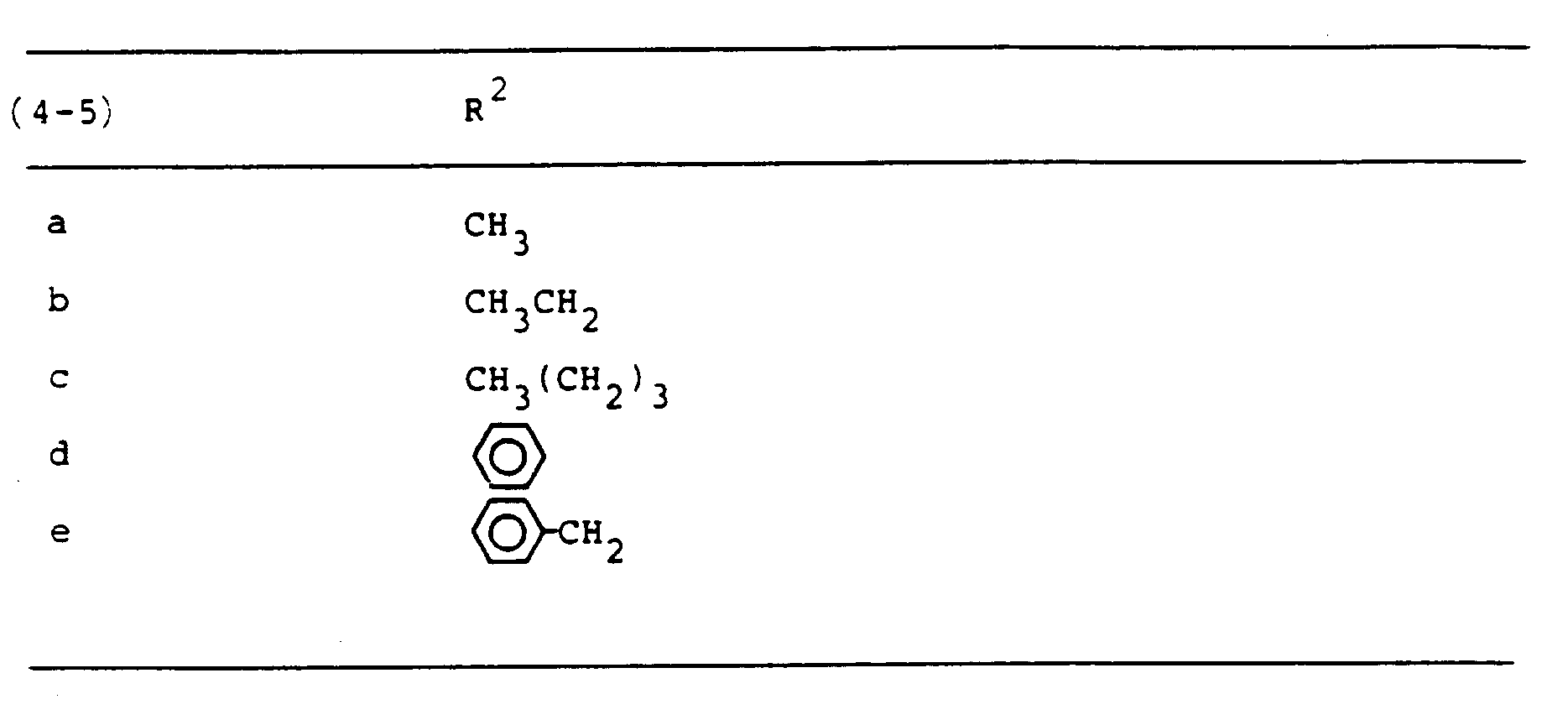


- O-Chloromethyl S-Ethyl Carbonothioate (4b):
- A solution of ethanethiol (37 mL, 500 mmol) and Et3N (Fluka, purum, 69.3 mL, 500 mmol) in Et20 (200 mL) is added during 2 h to a stirred solution of 3 (44.0 mL, 500 mmol) in Et20 (900 mL) at 0-5 °C. After stirring an additional 30 min. at 0-5 ° C and during the night at room temperature the resulting suspension is filtered. The filtrate is evaporated and the residue distilled to give 4b; yield: 57.9-62.6 g (75-81%), bp 67-70 °C/14 mbar.
- O-Chloromethyl S-n-Butyl Carbonothioate (4c):
- To a stirred 1 M solution of NaOMe in MeOH (100 mL) at 0-5 °C is dropwise added n-butanethiol (10.7 mL, 100 mmol). After evaporation to dryness the residue is suspended in Et20 (200 mL) at -75 °C. A solution of 3 (8.8 mL, 100 mmol) in Et20 (50 mL) is added dropwise during 1 h with stirring followed by stirring overnight at ambient temperature. Evaporation of the solvent after filtration furnishes crude product which distilled yields 13.2 g (72%) of 4c, bp 99-101 °C/24 mbar.
- O-lodomethyl S-Ethyl Carbonothioate (5b):
- The ester 4b (15.4 g, 100 mmol) is added to a solution of Nal (22.5 g, 150 mmol) in Me2 CO (125 ml) and stirred for 3 h at 40 °C followed by filtration and washing with Me2CO and Et20. The filtrate is evaporated and the residue partitioned (all solutions being ice-cold) between pentane (300 mL) and H20 (100 mL). The organic phase is washed with aqueous 5% NaHCO3 (50 mL), 1% aqueous Na2S203 (50 mL, or more until colourlessness is achieved), H20 (2 x 50 mL), dried (MgS04), and evaporated. Yield of crude product: 23.6 g (96%).
- The Procedure of Example 3 is slightly modified by increasing the amount of Nal to 30 g (200 ml), adding NaHCO3 (0.8 g, 10 mmol), and heating at 40 °C for 4 h. Yield: 23.1 g (94%).
- O-Butanoyloxymethyl S-Ethyl Carbonothioate (6db):
- Crude 5b (23.6 g, 96 mmol) is added during 30 min to a stirred suspension of sodium butanoate (10.5 g, 96 mmol) in dry DMF (125 mL) at -20 °C followed by stirring overnight at ambient temperature. After filtration and washing with DMF (5 mL) and Et20 (10 mL),Et20 (250 mL) and ice-cold H20 (100 mL) are added to the combined filtrates. The aqueous phase is separated and extracted with Et20 (100 mL). The combined organic phases are washed (all solutions ice-cold) with 5% aqueous NaHCO3 (50 mL), H20 (50 mL), 0.01 N HCI (100 mL), and H20 (2 x 50 mL). After drying (MgS04) and evaporation of solvents the residue is distilled to yield 15.0 g (76%) of 6db, bp 75-80 °C/0.5 mbar.
- O-(2-Furancarbonyloxymethyl) S-Ethyl Carbonothioate (6mb):
- 2-Furancarboxylic acid (5.6 g, 50 mmol) is added to a stirred solution of NaHCO3 (8.4 g, 100 mmol) and TBA HS04 (17.0 g, 50 mmol) in H20 (100 mL) at room temperature. After stirring for 10 min 1,2-dichloroethane (100 mL) is added and the stirring continued for 30 min. 5b (12.5 g, 50 mmol) in 1,2-dichloroethane (25 mL) is added over 15 min. The mixture is stirred for 60 min at room temperature. The organic phase is separated, washed with H20 (50 mL), dried (MgS04), and evaporated. The residue is stirred with Et20 (100 mL), insoluble material filtered off and washed with Et20. The combined Et20-phases are evaporated and the residue crystallized from ice-cold pentane to yield 8.5 g (74%) of 6mb, mp 37.2-38.4 °C.
- O-Propanoyloxymethyl S-Ethyl Carbonothioate (6cb):
- To a stirred solution of NaHCO3 (45 g, 536 mmol) in H20 (540 ml) is added TBA HS04 (91.2 g, 268 mmol), propanoic acid (20.1 mL, 268 mmol), and CH2CI2 (540 ml). Following stirring for 1 h at room temperature a solution of 5b (49.2 g, 200 mmol) in CH2CI2 (100 mL) is added during 45 min keeping the temperature below 30 °C. The stirring is continued for 1 1/2 h. The organic phase is separated, washed with H20 (200 mL), dried (MgS04), and evaporated. The residue is stirred in Et20 (800 mL) during the night, filtered, and washed with Et20 (50 mL). The filtrate is evaporated and distilled to yield 38.0 g (98%) of 6cb, bp 71-73 °C/0.3 mbar.
- O-(2-Oxopropanoyloxymethyl) S-Ethyl Carbonothioate (6ob):
- Redistilled 2-oxopropanoic acid (12.6 ml, 0.18 mol) is added to a vigorously stirred mixture of NaHCO3 - (30.6 g, 0.36 mol), TBA HS04 (61.2 g, 0.18 mol), H20 (360 mL), and CH2CI2 (360 mL) in an open Erlenmeyer flask. Following stirring for 10 min 5b (44.0 g, 0.18 mol) in CH2CI2 (400 mL) is added during 3 h at 25 °C together with CH2CI2 (500 mL) in portions to compensate for the evaporation. In this way the formation of sulfurous by-products is minimized. The mixture is extracted with CH2CI2 (300 + 200 mL). The combined organic phases are washed with H20 (2 x 200 mL), dried (MgS04) and evaporated. The residue is triturated with Et20 (600 mL). After filtration the filtrate is treated with charcoal, evaporated, and the residue crystallized from pentane at -70 °C to yield 6ob, melting below room temperature.
- O-Tetradecanoyoxymethyl S-Ethyl Carbonothioate (6kb):
- A THF solution (20 mL) of TBA tetradecanoate (8.4 g, 18 mmol), prepared by freeze-drying an aqueous solution of equimolar TBA OH and tetradecanoic acid, is slowly (30 min) added to a stirred solution of 5b (4.5 g, 18 mmol) in THF (20 mL) at room temperature. Following stirring during the night the precipitate formed is removed by filtration and washed with THF (5 mL). The filtrate is evaporated and the residue triturated with Et20 (100 mL) and filtered. The filtrate leaves 6.2 g (99%) impure (80% by 1H-NMR) oily product after evaporation.
- O-(N-Acetylglycyl)oxymethyl S-Ethyl Carbonothioate (6tb):
- Finely powdered potassium N-acetylglycinate (5.8 g, 37 mmol) and TBA I (1.2 g, 3.4 mmol) are thoroughly mixed and shaken for 5 min with 5b (8.3 g, 34 mmol). The mixture is left for 48 h at room temperature and then extracted with Et20 (4 x 40 mL). The combined extracts are filtered and evaporated. The residue (6.4
- g) is thoroughly extracted with pentane (4 x 25 mL) to remove unreacted 5b. The residue is freed from remaining traces of pentane by evaporation, leaving 3.7 g of 6tb (46%).
- Butanoyloxymethyl Carbonochloridate (7d):
- Redistilled SO2Cl2 (5.85 mL, 72 mmol) is added to 6db (14.8 g, 72 mmol) at 0-5 ° C with stirring during 15 min followed by stirring at room temperature (45 min). Evaporation at room temperature and 20 mbar during the night and distillation yields 11.8 g (91 %) of 7d, bp 80-82 °C/13 mbar.
- Propanoyloxymethyl Carbonochloridate (7c):
- Redistilled S02CI2 (5.7 mL, 70 mmol) is added at once to 6cb (13.5 g, 70 mmol) at -25 - -30 °C with stirring. After stirring at this temperature for 10 min BF3•OEt2 (0.3 mL) is added followed by stirring at 0 °C (1 h) and at room temperature (30 min). Evaporation at room temperature and 20 mbar (about 1 h) and subsequent distillation yields 10.0 g (86%) of 7c, bp 70-71 °C/13 mbar.
- 0-1-Chloroethyl S-Ethyl Carbonothioate
- By following the procedure of Method A but replacing 3 by 1-chloroethyl carbonochloridate a 75% yield of the title compound is obtained with bp 71-73 °C/13 mbar.

- IR (10% CHCl3): v = 1715 cm-1.
- NMR (CDCl3/TMS)44: 6 = 1.31 (t, 3H, J = 7 Hz, CH3CH2); 1.78 (d, 3H, J = 6 Hz, CH3CH); 2.90 (q, 2H, J = 7 Hz, CH2); 6.57 (q, 1 H, J = 6 Hz, CH).
- 0-1-Butanoyloxyethyl S-Ethyl Carbonothioate:
- To a stirred solution of TBA butanoate (32.9 g, 100 mmol), prepared by freeze-drying an aqueous solution of equimolar TBA OH and butanoic acid, in THF (500 ml) is added 0-1-chloroethyl S-ethyl carbonate (16.9 g, 100 mmol) at room temperature. Following stirring for 4 d and evaporation the residue is partioned between ice-cold Et20 (600 mL) and H20 (100 mL). The organic phase is extracted with H2o (2 x 75 mL), dried (MgS04) and evaporated. The residue is distilled to yield 14.3 g (68%) of the title compound, bp 69-72 °C/0.3 mbar.

- IR (10% CHCl3): ν = 1750 cm-1.
- NMR (CDCl3/TMS)44: δ = 0.98 (t, 3H, J = 7 Hz, CH3(CH2)2);
- 1.31 (t, 3H, J = 7.5 Hz, CH3CH2S); 1.48 (d, 3H, J = 5 Hz, CH3CH); 1.5-2.0 (m, 2H, CH3CH2CH2); 2.31 (t, 2H, J = 7 Hz, CH2CO); 2.88 (q, 2H, J = 7.5 Hz, CH2S); 6.92 (q, 1 H, J = 5 Hz, CH).
- 1-Butanoyloxyethyl Carbonochloridate:
- Redistilled S02CI2 (0.2 mL, 2.5 mmol) is added to 0-1-butanoyloxyethyl S-ethylcarbonothioate (0.55 g, 2.5 mmol) at -40 °C. The temperature is slowly (0.5 h) raised to 0 °C followed by the addition of CCl4 (5 mL) and BF3•OEt2 (3 drops). After stirring at 0 °C for 1 h CCl4 (5 mL) is added and the solution half-way evaporated. Addition of CCl4 (5 mL) and half-way evaporation is repeated three times to leave the title compound (80% purity by 1H-NMR) only stable in solution.
- IR (10% CCI4): ν = = 1760 cm-1.
- 1H-NMR (CDCl3:CCl4 (1:1)/TMS)45: δ = 0.98 (t, 3H, J = 7.5 Hz, CH3(CH2)2); 1.57 (d, 3H, J = 5.5 Hz,
- CH3CH); 1.6 (m, 2H, CH3CH2CH2); 2.34 (t, 2H, J = 7.5 Hz, CH2CO); 6.80 (q, 1 H, J = 5.5 Hz, CH).
- Sec-Butyl Propanoyloxymethyl Carbonate (8c3):
- To a solution of 2-butanol (0.92 mL, 10 mmol) and 4-methyl-morpholine (1.1 mL, 10 mmol) in CHCl3 (20 mL) at -70 °C is added 7c (1.7 g, 10 mmol) during 20 min with stirring. The temperature is kept at -70 °C for 1 h and then raised (1 h) to room temperature. Next day following evaporation the residue is triturated with Et20 (25 mL) and filtered. The filtrate is evaporated and distilled to give 1.0 g (50%) of the title compound with bp 66-68 °C/5 mbar.
- 4-Nitrophenyl Propionyloxymethyl Carbonate (8c5):
- 4-Methylmorpholine (0.67 mL, 6.0 mmol) is added to a suspension of 4-nitrophenol (0.83 g, 6.0 mmol) in CH2CI2 (10 mL) with stirring. A solution of 7c (1.27 g, 95% purity, 7.2 mmol) in CH2CI2 (3 mL) is added during 20 min followed by stirring at 0 °C (30 min) and overnight at room temperature. After filtration the filtrate is evaporated and the residue partitioned between ice-cold Et20 (25 mL) and H20 (25 mL). The organic phase is extracted with ice-cold 0.5 N NaOH (10 mL), H20 (3 x 15 mL), dried (MgS04) and evaporated. The residue (1.50 g) is extracted with hexane (2 x 10 mL) to leave the title compound (0.98 g, 61 %), mp 35-36 °C.
- Propanoyloxymethyl 4-Chlorophenylcarbamate (8c1):
- Me3SiCl (2.3 mL, 18 mmol) is added to 4-chloroaniline (4.6 g, 36 mmol) in Et20 (50 mL) at room temperature with stirring during 20 min. Following an additional 30 min stirring 7c (4.05 g, purity 90%, 22 mmol) in Et20 (30 mL) is slowly (1 h) added. The stirring is continued overnight. The precipitate is filtered off and the filtrate extracted with ice-cold 0.1 N HCI (50 mL), H20 (3 x 50 mL), dried (MgS04) and evaporated. The residue (4.9 g) is extracted with hexane (50 mL) to leave 3.3 g (71%) of the title compound, mp 90-91 °C.
- 1-Butanoyloxyethyl 4-Chlorophenylcarbamate:
- A solution of 1-butanoyloxyethyl carbonochloridate (5 mmol) in CHCl3 (10 mL) prepared as above but substituting CHCl3 for CCl4 is added to a solution of 4-chloroaniline (1.3 g, 10 mmol) in Et20 (40 mL) at -70 °C. Following stirring for 2 h at -70 °C and 3 h at -40 °C the mixture is kept at -20 °C for 3 d. After filtration, treatment of the filtrate with charcoal, and evaporation of the filtrate the residue is triturated with ice-cold pentane (15 mL) and recrystallized from pentane (70 mL) to yield 0.4 g (28%) of the title compound with mp 52-54 °C.

- IR (10% CHCl3): ν = 1750 cm-1.
- 1H-NMR (CDCl3/TMS)45: 6 = 0.95 (t, 3H, J = 7 Hz, CH3(CH2)2CO); 1.50 (d, 3H, J = 5.5 Hz, CH3CH); 1.7 (m, 2H, CH3CH2CH2CO); 2.31 (t, 2H, J = 7 Hz, CH2CO); 6.8 (bs, 1H, NH); 6.91 (q, 1H, J = 5.5 Hz,
- CHCH3); 7.28 (m, 4H arom.)
- Sec-Butyl Propanoyloxymethyl Carbonate (8c3):
- A mixture of 2-butanol (0.092 mL, 1 mmol), 7c (0.17 g, 1 mmol), and powdered molecular sieve (0.15 g, 4A) in alcohol-free CHCl3 (2 mL) is refluxed for 18 h. Following filtration through filter-aid and evaporation 0.2 g (98%) of the title compound is obtained.
-


- To A (10 mmol) in chloroform (15 ml) at -70 °C was added butanoyloxymethyl carbonochloridate (1.8 g, 10 mmol) in chloroform (5 ml). The temperature was slowly (over 2 hours) raised to 20 °C, and the mixture stirred at 20 °C for 16 hours. Then 5% extra butanoyloxymethyl carbonochloridate (-100 mg) was added, the mixture stirred at 20 °C for 3.5 hours and evaporated in vacuo. The residue was dissolved in tertiary butanol (100 ml), hydrolysed with water (10 ml) for 20 minutes, dried with MgS04 and evaporated in vacuo.
- The residue was extracted twice with ether (100 + 50 ml) for 72 hours. The extracts were evaporated in vacuo to give 3.3 g of B.

- To a filtered solution of B (3.0 g; 8.8 mmol) in isopropyl ether (50 ml) at 0 °C was added dicyclohexylamine (1.75 ml; 8.8 mmol). The mixture was stirred at 0 °C for 15 minutes, the precipitate collected, washed with isopropyl ether (3 x 10 ml) and recrystallized first from acetone/ether (15/25 ml), then from acetone (40 ml) (60 °C/0 ° C) to yield 1.2 g (23%) of the title compound C with Mp: 135 °C.
Claims (8)


Applications Claiming Priority (3)
| Application Number | Priority Date | Filing Date | Title |
|---|---|---|---|
| GB9001405 | 1990-01-22 | ||
| GB909001405A GB9001405D0 (en) | 1990-01-22 | 1990-01-22 | New intermediates,their production and use |
| PCT/DK1990/000308 WO1991010639A1 (en) | 1990-01-22 | 1990-11-28 | New intermediates, their production and use |
Publications (2)
| Publication Number | Publication Date |
|---|---|
| EP0541550A1 EP0541550A1 (en) | 1993-05-19 |
| EP0541550B1 true EP0541550B1 (en) | 1994-09-07 |
Family
ID=10669692
Family Applications (1)
| Application Number | Title | Priority Date | Filing Date |
|---|---|---|---|
| EP90917427A Expired - Lifetime EP0541550B1 (en) | 1990-01-22 | 1990-11-28 | New intermediates, their production and use |
Country Status (13)
| Country | Link |
|---|---|
| US (1) | US5401868A (en) |
| EP (1) | EP0541550B1 (en) |
| JP (1) | JP3025532B2 (en) |
| AT (1) | ATE111073T1 (en) |
| AU (1) | AU6883191A (en) |
| CA (1) | CA2064872C (en) |
| DE (1) | DE69012351T2 (en) |
| DK (1) | DK0541550T3 (en) |
| ES (1) | ES2061077T3 (en) |
| GB (1) | GB9001405D0 (en) |
| HU (1) | HUT60459A (en) |
| IE (1) | IE64470B1 (en) |
| WO (1) | WO1991010639A1 (en) |
Cited By (2)
| Publication number | Priority date | Publication date | Assignee | Title |
|---|---|---|---|---|
| US7790708B2 (en) | 2001-06-11 | 2010-09-07 | Xenoport, Inc. | Prodrugs of GABA analogs, compositions and uses thereof |
| US8048917B2 (en) | 2005-04-06 | 2011-11-01 | Xenoport, Inc. | Prodrugs of GABA analogs, compositions and uses thereof |
Families Citing this family (20)
| Publication number | Priority date | Publication date | Assignee | Title |
|---|---|---|---|---|
| WO2001005768A1 (en) | 1999-07-19 | 2001-01-25 | Shionogi & Co., Ltd. | Tricyclic compounds bearing acyloxymethoxycarbonyl pendants |
| JP2004501067A (en) * | 2000-01-28 | 2004-01-15 | ローム アンド ハース カンパニー | Pharmaceuticals with enhanced properties |
| US6376548B1 (en) | 2000-01-28 | 2002-04-23 | Rohm And Haas Company | Enhanced propertied pesticides |
| US6818787B2 (en) | 2001-06-11 | 2004-11-16 | Xenoport, Inc. | Prodrugs of GABA analogs, compositions and uses thereof |
| US7232924B2 (en) * | 2001-06-11 | 2007-06-19 | Xenoport, Inc. | Methods for synthesis of acyloxyalkyl derivatives of GABA analogs |
| MXPA03011566A (en) * | 2001-06-11 | 2004-10-28 | Xenoport Inc | DOSAGE FORMS OF GABA ANALOGS ORALALLY ADMINISTERED THAT HAVE REDUCED TOXICITY. |
| US6927036B2 (en) * | 2002-02-19 | 2005-08-09 | Xero Port, Inc. | Methods for synthesis of prodrugs from 1-acyl-alkyl derivatives and compositions thereof |
| PA8579701A1 (en) * | 2002-08-23 | 2005-05-24 | Pfizer Prod Inc | BETA-LACTAMASA INHIBITOR PROFARMACO |
| EP1636240A1 (en) * | 2003-06-05 | 2006-03-22 | Pfizer Products Inc. | Beta-lactamase inhibitor prodrug |
| US7662987B2 (en) * | 2003-07-15 | 2010-02-16 | Xenoport, Inc. | Methods for synthesis of acyloxyalkyl compounds |
| KR20110097942A (en) * | 2003-08-20 | 2011-08-31 | 제노포트 인코포레이티드 | Acyloxyalkyl carbamate prodrugs, synthesis and methods of use |
| CN1902175B (en) * | 2003-12-30 | 2012-08-22 | 什诺波特有限公司 | Synthesis of acyloxyalkyl carbamate prodrugs and intermediates thereof |
| ES2405329T3 (en) | 2003-12-30 | 2013-05-30 | Xenoport, Inc. | Synthesis of acyloxyalkyl carbonate prodrugs and intermediates thereof |
| US7351740B2 (en) | 2005-06-20 | 2008-04-01 | Xenoport, Inc. | Acyloxyalkyl carbamate prodrugs of tranexamic acid, methods of synthesis and use |
| US7531572B2 (en) * | 2006-07-28 | 2009-05-12 | Xenoport, Inc. | Acyloxyalkyl carbamate prodrugs of α-amino acids, methods of synthesis and use |
| US20090318728A1 (en) * | 2008-06-24 | 2009-12-24 | Teva Pharmaceutical Industries Ltd. | Processes for preparing prodrugs of gabapentin and intermediates thereof |
| US20110060040A1 (en) * | 2009-09-04 | 2011-03-10 | Xenoport, Inc. | Uses of acyloxyalkyl carbamate prodrugs of tranexamic acid |
| JP6105207B2 (en) * | 2012-03-30 | 2017-03-29 | 美津濃株式会社 | Racket frame |
| US20140024621A1 (en) | 2012-07-23 | 2014-01-23 | Ms Therapeutics Limited | Aminopyridine compounds and their uses |
| KR102670655B1 (en) * | 2020-08-13 | 2024-05-29 | 난징 헤론 파마슈티컬 사이언스 앤 테크놀로지 컴퍼니 리미티드 | Ibuprofen ester prodrug, pharmaceutical composition, manufacturing method and application |
Family Cites Families (8)
| Publication number | Priority date | Publication date | Assignee | Title |
|---|---|---|---|---|
| US3479328A (en) * | 1966-11-18 | 1969-11-18 | Ashland Oil Inc | Novel monomers and polymers |
| US3769271A (en) * | 1971-04-15 | 1973-10-30 | Lilly Co Eli | N-protected amino acids and peptides |
| FR2363546A1 (en) * | 1976-09-07 | 1978-03-31 | Poudres & Explosifs Ste Nale | ALLYLIC-ACRYLIC MIXED MONOMERS, THEIR PREPARATION AND POLYMERS THEREOF |
| DE2939660A1 (en) * | 1979-09-29 | 1981-04-16 | Basf Ag, 6700 Ludwigshafen | NEW CARBAMATES, THEIR PRODUCTION AND THE PHARMACEUTICAL PREPARATIONS CONTAINING THEM |
| JPS58189186A (en) * | 1982-04-30 | 1983-11-04 | Takeda Chem Ind Ltd | Cephalosporin derivative |
| IL67445A (en) * | 1982-12-09 | 1985-11-29 | Teva Pharma | Ethoxycarbonyloxy ethyl esters of non-steroidal anti-inflammatory carboxylic acids |
| DE3301670A1 (en) * | 1983-01-20 | 1984-07-26 | Bayer Ag, 5090 Leverkusen | SIZE |
| US5221754A (en) * | 1989-06-09 | 1993-06-22 | Research Corporation Technologies, Inc. | Reagents for rapid peptide synthesis |
-
1990
- 1990-01-22 GB GB909001405A patent/GB9001405D0/en active Pending
- 1990-11-28 AT AT90917427T patent/ATE111073T1/en not_active IP Right Cessation
- 1990-11-28 EP EP90917427A patent/EP0541550B1/en not_active Expired - Lifetime
- 1990-11-28 AU AU68831/91A patent/AU6883191A/en not_active Abandoned
- 1990-11-28 CA CA002064872A patent/CA2064872C/en not_active Expired - Fee Related
- 1990-11-28 HU HU9200477A patent/HUT60459A/en unknown
- 1990-11-28 ES ES90917427T patent/ES2061077T3/en not_active Expired - Lifetime
- 1990-11-28 US US07/835,444 patent/US5401868A/en not_active Expired - Lifetime
- 1990-11-28 DK DK90917427.8T patent/DK0541550T3/en active
- 1990-11-28 WO PCT/DK1990/000308 patent/WO1991010639A1/en not_active Ceased
- 1990-11-28 DE DE69012351T patent/DE69012351T2/en not_active Expired - Fee Related
- 1990-11-28 JP JP3501196A patent/JP3025532B2/en not_active Expired - Lifetime
- 1990-11-29 IE IE430990A patent/IE64470B1/en not_active IP Right Cessation
Non-Patent Citations (1)
| Title |
|---|
| F.H.C. STEWART: "Formation of Depsipeptide Ester Bonds by Accelerated.......", 1967, Chemistry and Industry, see p. 1960-61, the whole article * |
Cited By (5)
| Publication number | Priority date | Publication date | Assignee | Title |
|---|---|---|---|---|
| US7790708B2 (en) | 2001-06-11 | 2010-09-07 | Xenoport, Inc. | Prodrugs of GABA analogs, compositions and uses thereof |
| US8168623B2 (en) | 2001-06-11 | 2012-05-01 | Xenoport, Inc. | Prodrugs of GABA analogs, compositions and uses thereof |
| US8367722B2 (en) | 2001-06-11 | 2013-02-05 | Xenoport, Inc. | Methods of using prodrugs of pregabalin |
| US9238616B2 (en) | 2001-06-11 | 2016-01-19 | Xenoport, Inc. | Prodrugs of gaba analogs, compositions and uses thereof |
| US8048917B2 (en) | 2005-04-06 | 2011-11-01 | Xenoport, Inc. | Prodrugs of GABA analogs, compositions and uses thereof |
Also Published As
| Publication number | Publication date |
|---|---|
| IE904309A1 (en) | 1991-07-31 |
| ATE111073T1 (en) | 1994-09-15 |
| CA2064872C (en) | 2002-01-22 |
| US5401868A (en) | 1995-03-28 |
| WO1991010639A1 (en) | 1991-07-25 |
| DE69012351T2 (en) | 1995-02-09 |
| HU9200477D0 (en) | 1992-08-28 |
| AU6883191A (en) | 1991-08-05 |
| EP0541550A1 (en) | 1993-05-19 |
| IE64470B1 (en) | 1995-08-09 |
| CA2064872A1 (en) | 1991-07-23 |
| GB9001405D0 (en) | 1990-03-21 |
| HUT60459A (en) | 1992-09-28 |
| DK0541550T3 (en) | 1994-10-17 |
| DE69012351D1 (en) | 1994-10-13 |
| JP3025532B2 (en) | 2000-03-27 |
| ES2061077T3 (en) | 1994-12-01 |
| JPH05503925A (en) | 1993-06-24 |
Similar Documents
| Publication | Publication Date | Title |
|---|---|---|
| US5401868A (en) | Aryloxymethylcarbonochloridate ester intermediates for use in synthesizing pro drugs and their use therefor | |
| EP3481201B1 (en) | Processes for the preparation of 4-alkoxy-3-(acyl or alkyl)oxypicolinamides | |
| US7238829B2 (en) | Process for the preparation of naproxene nitroxyalkylesters | |
| EP0195734A2 (en) | Preparation of herbicides bearing phosphonate groups and of intermediates from benzoxazines | |
| US6844450B2 (en) | Process for the production of a racemic thioctic acid | |
| EP1745017B1 (en) | Synthesis of trithiocarbonate raft gents and intermediates thereof | |
| CA1282425C (en) | Process for preparing hmg-coa reductase inhibitors with a 3,5-dihydroxypentanoate subunit | |
| JPH0959218A (en) | L-lactic acid oligomer derivative | |
| JP3332561B2 (en) | Method for producing thioaryl compound | |
| KR100214729B1 (en) | Process for preparing malonic acid monoester | |
| JP3091022B2 (en) | Method for producing glutaric acid derivative | |
| US5149857A (en) | Process for production of sulfonium compounds | |
| US5693857A (en) | Process and intermediate for the preparation of 2-hydroxy-3-sulfido-3-phenyl propanoic acids | |
| US4234514A (en) | Method of preparing ketoxime carbamates | |
| EP0747362B1 (en) | Substituted quinoline herbicide intermediates and process | |
| JPH0733709A (en) | Process for producing oxalic acid monoester compound | |
| JP3750122B2 (en) | Method for producing azetidinone compound | |
| EP0012868A1 (en) | 1,2,3-Thiadiazol-5-yl-thioglycolic acid, its derivatives and process for their preparation | |
| KR100503022B1 (en) | A highly efficient synthetic process for the preparation of simvastatin and new intermediates therefor | |
| KR810000738B1 (en) | Preparation of 5-alkoxy-picolinate | |
| KR890000523B1 (en) | Process for preparing cephalosporin derivatives | |
| KR920005746B1 (en) | Method for preparing oxazinobenzothiazine 6,6-dioxide derivative | |
| JP3851990B2 (en) | Method for producing acryloylcarbamate | |
| JPH059165A (en) | Substituted phenoxycarboxylic acid amide derivative | |
| JPS62267267A (en) | Pyrazole derivative and production thereof |
Legal Events
| Date | Code | Title | Description |
|---|---|---|---|
| PUAI | Public reference made under article 153(3) epc to a published international application that has entered the european phase |
Free format text: ORIGINAL CODE: 0009012 |
|
| 17P | Request for examination filed |
Effective date: 19920529 |
|
| AK | Designated contracting states |
Kind code of ref document: A1 Designated state(s): AT BE CH DE DK ES FR GB GR IT LI LU NL SE |
|
| 17Q | First examination report despatched |
Effective date: 19931203 |
|
| GRAA | (expected) grant |
Free format text: ORIGINAL CODE: 0009210 |
|
| AK | Designated contracting states |
Kind code of ref document: B1 Designated state(s): AT BE CH DE DK ES FR GB GR IT LI LU NL SE |
|
| REF | Corresponds to: |
Ref document number: 111073 Country of ref document: AT Date of ref document: 19940915 Kind code of ref document: T |
|
| ITF | It: translation for a ep patent filed | ||
| REF | Corresponds to: |
Ref document number: 69012351 Country of ref document: DE Date of ref document: 19941013 |
|
| REG | Reference to a national code |
Ref country code: DK Ref legal event code: T3 |
|
| REG | Reference to a national code |
Ref country code: ES Ref legal event code: FG2A Ref document number: 2061077 Country of ref document: ES Kind code of ref document: T3 |
|
| ET | Fr: translation filed | ||
| EAL | Se: european patent in force in sweden |
Ref document number: 90917427.8 |
|
| REG | Reference to a national code |
Ref country code: GR Ref legal event code: FG4A Free format text: 3013975 |
|
| PLBE | No opposition filed within time limit |
Free format text: ORIGINAL CODE: 0009261 |
|
| STAA | Information on the status of an ep patent application or granted ep patent |
Free format text: STATUS: NO OPPOSITION FILED WITHIN TIME LIMIT |
|
| 26N | No opposition filed | ||
| REG | Reference to a national code |
Ref country code: GB Ref legal event code: IF02 |
|
| PGFP | Annual fee paid to national office [announced via postgrant information from national office to epo] |
Ref country code: DK Payment date: 20060816 Year of fee payment: 17 |
|
| PGFP | Annual fee paid to national office [announced via postgrant information from national office to epo] |
Ref country code: AT Payment date: 20061102 Year of fee payment: 17 |
|
| PGFP | Annual fee paid to national office [announced via postgrant information from national office to epo] |
Ref country code: FR Payment date: 20061117 Year of fee payment: 17 |
|
| PGFP | Annual fee paid to national office [announced via postgrant information from national office to epo] |
Ref country code: NL Payment date: 20061121 Year of fee payment: 17 |
|
| PGFP | Annual fee paid to national office [announced via postgrant information from national office to epo] |
Ref country code: GB Payment date: 20061122 Year of fee payment: 17 |
|
| PGFP | Annual fee paid to national office [announced via postgrant information from national office to epo] |
Ref country code: SE Payment date: 20061124 Year of fee payment: 17 Ref country code: CH Payment date: 20061124 Year of fee payment: 17 Ref country code: ES Payment date: 20061124 Year of fee payment: 17 |
|
| PGFP | Annual fee paid to national office [announced via postgrant information from national office to epo] |
Ref country code: GR Payment date: 20061130 Year of fee payment: 17 Ref country code: IT Payment date: 20061130 Year of fee payment: 17 |
|
| PGFP | Annual fee paid to national office [announced via postgrant information from national office to epo] |
Ref country code: LU Payment date: 20061204 Year of fee payment: 17 |
|
| PGFP | Annual fee paid to national office [announced via postgrant information from national office to epo] |
Ref country code: BE Payment date: 20061220 Year of fee payment: 17 |
|
| PGFP | Annual fee paid to national office [announced via postgrant information from national office to epo] |
Ref country code: DE Payment date: 20070102 Year of fee payment: 17 |
|
| REG | Reference to a national code |
Ref country code: CH Ref legal event code: PFA Owner name: LEO PHARMACEUTICAL PRODUCTS LTD A/S (LOVENS KEMIS Free format text: LEO PHARMACEUTICAL PRODUCTS LTD A/S (LOVENS KEMISKE FABRIK PRODUKTIONSAKTIESELSKAB)#INDUSTRIPARKEN 55#BALLERUP (DK) -TRANSFER TO- LEO PHARMACEUTICAL PRODUCTS LTD A/S (LOVENS KEMISKE FABRIK PRODUKTIONSAKTIESELSKAB)#INDUSTRIPARKEN 55#BALLERUP (DK) |
|
| BERE | Be: lapsed |
Owner name: *LEO PHARMACEUTICAL PRODUCTS LTD A/S (LOVENS KEMIS Effective date: 20071130 |
|
| REG | Reference to a national code |
Ref country code: DK Ref legal event code: EBP |
|
| EUG | Se: european patent has lapsed | ||
| GBPC | Gb: european patent ceased through non-payment of renewal fee |
Effective date: 20071128 |
|
| PG25 | Lapsed in a contracting state [announced via postgrant information from national office to epo] |
Ref country code: CH Free format text: LAPSE BECAUSE OF NON-PAYMENT OF DUE FEES Effective date: 20071130 Ref country code: LI Free format text: LAPSE BECAUSE OF NON-PAYMENT OF DUE FEES Effective date: 20071130 |
|
| REG | Reference to a national code |
Ref country code: CH Ref legal event code: PL |
|
| NLV4 | Nl: lapsed or anulled due to non-payment of the annual fee |
Effective date: 20080601 |
|
| PG25 | Lapsed in a contracting state [announced via postgrant information from national office to epo] |
Ref country code: AT Free format text: LAPSE BECAUSE OF NON-PAYMENT OF DUE FEES Effective date: 20071128 |
|
| PG25 | Lapsed in a contracting state [announced via postgrant information from national office to epo] |
Ref country code: BE Free format text: LAPSE BECAUSE OF NON-PAYMENT OF DUE FEES Effective date: 20071130 |
|
| PG25 | Lapsed in a contracting state [announced via postgrant information from national office to epo] |
Ref country code: DE Free format text: LAPSE BECAUSE OF NON-PAYMENT OF DUE FEES Effective date: 20080603 Ref country code: SE Free format text: LAPSE BECAUSE OF NON-PAYMENT OF DUE FEES Effective date: 20071129 Ref country code: DK Free format text: LAPSE BECAUSE OF NON-PAYMENT OF DUE FEES Effective date: 20071130 Ref country code: NL Free format text: LAPSE BECAUSE OF NON-PAYMENT OF DUE FEES Effective date: 20080601 |
|
| REG | Reference to a national code |
Ref country code: FR Ref legal event code: ST Effective date: 20080930 |
|
| PG25 | Lapsed in a contracting state [announced via postgrant information from national office to epo] |
Ref country code: GB Free format text: LAPSE BECAUSE OF NON-PAYMENT OF DUE FEES Effective date: 20071128 |
|
| REG | Reference to a national code |
Ref country code: ES Ref legal event code: FD2A Effective date: 20071129 |
|
| PG25 | Lapsed in a contracting state [announced via postgrant information from national office to epo] |
Ref country code: FR Free format text: LAPSE BECAUSE OF NON-PAYMENT OF DUE FEES Effective date: 20071130 Ref country code: ES Free format text: LAPSE BECAUSE OF NON-PAYMENT OF DUE FEES Effective date: 20071129 |
|
| PG25 | Lapsed in a contracting state [announced via postgrant information from national office to epo] |
Ref country code: GR Free format text: LAPSE BECAUSE OF NON-PAYMENT OF DUE FEES Effective date: 20080605 |
|
| PG25 | Lapsed in a contracting state [announced via postgrant information from national office to epo] |
Ref country code: LU Free format text: LAPSE BECAUSE OF NON-PAYMENT OF DUE FEES Effective date: 20071128 Ref country code: IT Free format text: LAPSE BECAUSE OF NON-PAYMENT OF DUE FEES Effective date: 20071128 |