EP0540972B1 - Process for oxidizing organic materials with hydrogen peroxide under conditions of irradiation in aqueous phase - Google Patents
Process for oxidizing organic materials with hydrogen peroxide under conditions of irradiation in aqueous phase Download PDFInfo
- Publication number
- EP0540972B1 EP0540972B1 EP92118279A EP92118279A EP0540972B1 EP 0540972 B1 EP0540972 B1 EP 0540972B1 EP 92118279 A EP92118279 A EP 92118279A EP 92118279 A EP92118279 A EP 92118279A EP 0540972 B1 EP0540972 B1 EP 0540972B1
- Authority
- EP
- European Patent Office
- Prior art keywords
- process according
- ions
- reaction
- anyone
- added
- Prior art date
- Legal status (The legal status is an assumption and is not a legal conclusion. Google has not performed a legal analysis and makes no representation as to the accuracy of the status listed.)
- Expired - Lifetime
Links
Images


Classifications
-
- C—CHEMISTRY; METALLURGY
- C02—TREATMENT OF WATER, WASTE WATER, SEWAGE, OR SLUDGE
- C02F—TREATMENT OF WATER, WASTE WATER, SEWAGE, OR SLUDGE
- C02F1/00—Treatment of water, waste water, or sewage
- C02F1/72—Treatment of water, waste water, or sewage by oxidation
- C02F1/725—Treatment of water, waste water, or sewage by oxidation by catalytic oxidation
-
- C—CHEMISTRY; METALLURGY
- C02—TREATMENT OF WATER, WASTE WATER, SEWAGE, OR SLUDGE
- C02F—TREATMENT OF WATER, WASTE WATER, SEWAGE, OR SLUDGE
- C02F1/00—Treatment of water, waste water, or sewage
- C02F1/30—Treatment of water, waste water, or sewage by irradiation
-
- C—CHEMISTRY; METALLURGY
- C02—TREATMENT OF WATER, WASTE WATER, SEWAGE, OR SLUDGE
- C02F—TREATMENT OF WATER, WASTE WATER, SEWAGE, OR SLUDGE
- C02F1/00—Treatment of water, waste water, or sewage
- C02F1/72—Treatment of water, waste water, or sewage by oxidation
- C02F1/722—Oxidation by peroxides
-
- C—CHEMISTRY; METALLURGY
- C02—TREATMENT OF WATER, WASTE WATER, SEWAGE, OR SLUDGE
- C02F—TREATMENT OF WATER, WASTE WATER, SEWAGE, OR SLUDGE
- C02F2305/00—Use of specific compounds during water treatment
- C02F2305/10—Photocatalysts
Definitions
- the present invention relates to a process for the purpose of oxidizing organic materials in aqueous phase with hydrogen peroxide (H 2 O 2 ), under irradiation conditions.
- the present invention relates to an improved process for oxidizing organic substrates, in aqueous phase, with hydrogen peroxide and in the presence of ferrous ions Fe-(II), and optionally cupric ions Cu-(II), carried out under irradiation with artificial visible light.
- the process is particularly applicable in order to enable wastes of industrial origin to be disposed of, which are treated as aqueous dispersions, with a consumption of reactant (hydrogen peroxide), which may be 50% lower than as necessary in the case of the oxidation processes using hydrogen peroxide, known from the prior art.
- reactant hydrogen peroxide
- hydroxy radical OH° generated by the decomposition of H 2 O 2 , was demonstrated to be the responsible for the oxidation and hydroxylation of a wide range of organic and aliphatic compounds (substrates).
- an oxidation process, with hydrogen peroxide, of organic compounds in aqueous phase, of the above said type can be enhanced by operating under irradiation conditions with artificial light.
- a purpose of the present invention is of providing an enhanced process for oxidizing organic substances or materials in aqueous dispersion, with the use of hydrogen peroxide in the presence of ferrous ions Fe-(II) and, optionally, cupric ions Cu-(II).
- Another purpose is of providing a process for the oxidation of organic compounds in aqueous dispersion with an oxidation yield ("efficiency") which is increased up to approximately twice as high, as compared to the efficiency which can be reached according to the prior art, and with correspondigly reduced H 2 O 2 consumptions.
- a further purpose is of providing a process within the scope of which such flexible parametric conditions exist, as to make it possible said process to be accomplished under conditions of graduality of oxidation of the organic compounds, up to their complete destruction (into CO 2 ).
- organic materials or “organic compounds”
- Said materials may, e.g., be constituted by any organic substances oxidizable with H 2 O 2 , and, in particular, substances of phenolic character (phenols, substituted phenols, and so forth), aliphatic compounds, which may also contain functional moieties (aminic, amidic, carboxylated compounds, and so forth).
- phenolic character phenols, substituted phenols, and so forth
- aliphatic compounds which may also contain functional moieties (aminic, amidic, carboxylated compounds, and so forth).
- aqueous phase encompasses any physical form of homogeneous or heterogeneous dispersion in a substantially aqueous medium (solutions, suspensions, emulsions, colloids, and so forth).
- the process according to the present invention is applied to substrates in aqueous dispersion, which is maintained at a lower pH value than 7, by adding to said dispersion the salt which supplies ferrous ion Fe-(II) and optionally cupric ion Cu-(II) and H 2 O 2 , according to the stoichiometric ratio as necessary for the desired (partial or total) degree of oxidation of the (total) content of organic matter to be oxidized.
- the efficiency of oxidation of the oxidizer system on the substrate is of basic importance, because it reflects the amount of H 2 O 2 (expressed as g/l of H 2 O 2 at 100%) to be used in order to obtain a determined oxidation degree.
- the efficiency of the oxidating system indicates the degree of catalytic enhancement achieved with the use of the irradiation according to the present invention.
- the efficiency of the system of the present invention is calculated as the percent increase over said value, as the ratio of the percent decrease in COD value reached, to the value of the ratio of O 2 f/O 2 r, wherein O 2 f represents the amount of oxygen actually fed (as H 2 O 2 ), and O 2 r represents the amount of oxygen demanded by the oxidation (also as H 2 O 2 ).
- the change in efficiency of the total oxidation reaction i.e., yielding CO 2 as the end oxidation product
- solutions containing a concentration of 25 g/l of p-nitrophenol, phenol, p-chlorophenol, formaldehyde and dimethylformamide as a function of the ratio of actually supplied oxygen (as H 2 O 2 ) to oxygen demand (as H 2 O 2 ), as represented as O 2 f/O 2 r.
- the ratio of O 2 f/O 2 r represents the ratio of the concentration, expressed as g/l, of 100%-H 2 O 2 actually added to the aqueous reaction dispersion/solution (O 2 f), to the concentration, (still expressed as g/l of 100%-H 2 O 2 ) which is necessary in order to completely oxidize the substrate with CO 2 being produced as the end oxidation product (O 2 r), assuming for the system, a priori , an efficiency of 100%.
- the efficiency for instance in the case of PNF, varies from values, for conventional HPWO process, of 120-130%, at values of O 2 f/O 2 r ratio comprised within the range of from 0.2 to 0.53, up to values of 146-175% for the process according to the present invention, at the same values, i.e., of from 0.2 to 0.53, of O 2 f/O 2 r ratio.
- irradiation times comprised within the range of from 1 minute to about 4 hours, can be sufficient.
- the oxidation efficiency ranges from 130% to 120% in the case of the conventional (HPWO) process, with values of O 2 f/O 2 r ratio comprised within the range of from 0.2 to 0.6; said values correspond to values of % decrease in COD (Chemical Oxygen Demand) comprised within the range of from 10% to 65%, as shown by Chart 2.
- COD Chemical Oxygen Demand
- the decrease in COD during the course of the oxidation reaction is the measure of the amount of organic matter completely oxidized to yield CO 2 as the end oxidation product.
- the "HPWO + h ⁇ " line in Chart 1 shows the surprising result obtained according to the present invention: by irradiating the reaction mixture containing PNF (as disclosed in Example 1), the reaction efficiency is comprised within the range of from 175% to 137%, at values of O 2 f/O 2 r ratio comprised within the range of from 0.2 to 0.6 -- i.e., of a percent decrease in COD comprised within the range of from 20% to 80%.
- Chart 3 demonstrates the benefit yielded by the process according to the present invention, as compared to the known HPWO process (without irradiation), on various substrates.
- the percentage of "benefit” of the oxidative system is reported, expressed as the percent-difference between the O 2 f/O 2 r ratios relevant to the process of the invention "HPWO + ⁇ " and those relevant to the conventional process "HPWO”.
- the % decrease in COD is reported.
- the saving is of 10 g/l of 100%-H 2 O 2 per each litre of waste liquors containing 25 g/l of PNF.
- the process according to the present invention secures a higher oxidation efficiency than HPWO technique known from the prior art, on a wide range of organic compounds: from phenols to substituted phenols, to aliphatic compounds with amidic, aldehydic or carboxy functional groups, making it possible a considerable saving to be accomplished in the amount of H 2 O 2 to be used for their oxidation.
- Examples 2 (repetition of Example 1, without irradiation); 3 (repetition of Example 1, with only application of irradiation, without H 2 O 2 ); 4 (repetition of Example 2, under darkness conditions), are given for comparison purposes.
- the reaction is started by dropwise adding H 2 O 2 at 49.88%, charged to a graduated dripping funnel of 25 ml of capacity.
- the dropwise addition rate is of 0.5 - 0.55 ml/minute.
- the pH value of the reaction mixture is monitored as follows: 3 ml of the reaction mixture is collected with a pipette and is charged to a test tube. The collected sample is cooled down to room temperature with tap water. The electrode of pH-meter is dipped in the cooled solution and the pH value of the latter is measured. The 3-ml sample collected is then immediately returned back into the reaction flask.
- the samples of reaction mixture are collected when the added amount of H 2 O 2 at 49.88% corresponds to the following values of O 2 f/O 2 r ratio: 0.22; 0.5; 0.8; 0.9 and 1.2 (respectively corresponding to 11.5; 28; 37; 44.5 and 63 ml of H 2 O 2 at 49.88%). Each sampling consists in drawing 5 ml of reaction mixture.
- the reaction time was of 120 minutes.
- the COD value was measured according to the standard method with potassium dichromate.
- the ratio of % COD decrease to the value of O 2 f/O 2 r yields the % efficiency of the oxidation at that reaction time.
- the results are reported in Tables 1 and 2 and in Charts from 1 to 4.
- Example 5 The efficiency of phenol oxidation carried out by means of the process according to the present invention (Example 5) was compared to the efficiency of said oxidation when it was carried out by means of the HPWO process known from the prior art (Comparative Example 5a).
- the concentration of phenol was of 25 g/litre in both cases.
- the concentrations of reactants and the reaction modalities were the same as disclosed in Example 1 (according to the invention) and in Example 2 (HPWO, without irradiation with light), respectively.
- the samples were drawn, for both the processes according to the invention (Example 5) and of Comparative Example 5a (HPWO), at values of O 2 f/O 2 r ratio, of 0.235; 0.52; 0.72; 0.87; 1.2; 1.56 and 2.2.
- PCF p-chlorophenol
- Example 6 The efficiency of p-chlorophenol (PCF) oxidation carried out by means of the process according to the present invention (Example 6) was compared to the efficiency of the same oxidation, when it was carried out by means of the HPWO process known from the prior art (Comparative Example 6a).
- the concentration of PCF was of 25 g/litre in both cases.
- the concentrations of reactants and the reaction modalities were the same as disclosed in Examples 1 and 2, respectively relating to the process of the invention and HPWO.
- the samples were drawn, for both the processes according to the invention (Example 6) and of Comparative Example 6 (HPWO), at values of O 2 f/O 2 r ratio, of 0.26; 0.48; 0.99 and 2.1. The results are reported in Tables 1 and 2, and in Chart 3.
- the process according to the invention results to be 33% more efficient than HPWO at a ratio of O 2 f/O 2 r of 0.25. It can be observed that by means of the process according to the invention, a COD decrease of 90% is reached with a ratio of O 2 f/O 2 r of 1, whilst the same % COD decrease is reached with HPWO process with a ratio of O 2 f/O 2 r of 1.9.
- Example 7 The efficiency of oxidation of a solution containing 20 g/l of formaldehyde carried out by means of the process according to the present invention (Example 7) was compared to the efficiency of the same oxidation, when it was carried out by means of the HPWO process known from the prior art (Comparative Example 7a).
- the concentrations of reactants and the reaction modalities were the same as disclosed in Examples 1 and 2.
- the samples were drawn, for both the processes according to the invention (Example 7) and Comparative Example 7a (HPWO), at values of O 2 f/O 2 r ratio of 0.196; 0.450; 0.670; 1 and 1.4.
- the "advantage" of the process of the invention within a range of % COD decrease values of from 10% to 90%, is of 10%.
- Table 2 sets forth the amount of H 2 O 2 , expressed as grammes of 100-% H 2 O 2 per each litre of waste liquors, which is saved with the process according to the present invention, relatively to HPWO. It can be seen that from a decrease in DMF of 20%, up to a decrease in DMF of 90%, an average of 59% of 100%-H 2 O 2 is saved with the process of the invention, per each litre of waste liquors containing 25 g/l of DMF to be oxidized.
Landscapes
- Chemical & Material Sciences (AREA)
- Organic Chemistry (AREA)
- Engineering & Computer Science (AREA)
- Environmental & Geological Engineering (AREA)
- Water Supply & Treatment (AREA)
- Hydrology & Water Resources (AREA)
- Life Sciences & Earth Sciences (AREA)
- Health & Medical Sciences (AREA)
- Toxicology (AREA)
- Chemical Kinetics & Catalysis (AREA)
- Treatment Of Water By Oxidation Or Reduction (AREA)
- Catalysts (AREA)
- Physical Water Treatments (AREA)
- Organic Low-Molecular-Weight Compounds And Preparation Thereof (AREA)
Abstract
Description
- The present invention relates to a process for the purpose of oxidizing organic materials in aqueous phase with hydrogen peroxide (H2O2), under irradiation conditions.
- In particular, the present invention relates to an improved process for oxidizing organic substrates, in aqueous phase, with hydrogen peroxide and in the presence of ferrous ions Fe-(II), and optionally cupric ions Cu-(II), carried out under irradiation with artificial visible light.
- The process is particularly applicable in order to enable wastes of industrial origin to be disposed of, which are treated as aqueous dispersions, with a consumption of reactant (hydrogen peroxide), which may be 50% lower than as necessary in the case of the oxidation processes using hydrogen peroxide, known from the prior art.
- Processes for the oxidation of organic compounds in aqueous dispersion with the use of hydrogen peroxide as the oxidizer agent, are known.
- It is known as well, chat the mechanism of the oxidizing process in which hydrogen peroxide is used, is activated in general by transition metals, and, in particular, by ferrous ion Fe-(II), possibly associated with cupric ion Cu-(II).
- The hydroxy radical OH°, generated by the decomposition of H2O2, was demonstrated to be the responsible for the oxidation and hydroxylation of a wide range of organic and aliphatic compounds (substrates).
- In particular, it is well-known that the reaction on a large number of organic substrates, in aqueous dispersion, carried out in the presence of Fe-(II) and possibly Cu-(II), can also take place in a catalytic way, because hydrogen peroxide oxidizes Fe-(II) yielding Fe-(III) and generating hydroxy radicals which oxidize the substrate yielding intermediate compounds, which, in their turn, may promote the reduction of Fe-(III) radicals to yield Fe-(II) radicals, bringing the cycle back to its initial state.
- The present Applicant has found now that, according to the present invention, an oxidation process, with hydrogen peroxide, of organic compounds in aqueous phase, of the above said type, can be enhanced by operating under irradiation conditions with artificial light.
- Therefore, a purpose of the present invention is of providing an enhanced process for oxidizing organic substances or materials in aqueous dispersion, with the use of hydrogen peroxide in the presence of ferrous ions Fe-(II) and, optionally, cupric ions Cu-(II).
- Another purpose is of providing a process for the oxidation of organic compounds in aqueous dispersion with an oxidation yield ("efficiency") which is increased up to approximately twice as high, as compared to the efficiency which can be reached according to the prior art, and with correspondigly reduced H2O2 consumptions.
- Finally, a further purpose is of providing a process within the scope of which such flexible parametric conditions exist, as to make it possible said process to be accomplished under conditions of graduality of oxidation of the organic compounds, up to their complete destruction (into CO2).
- These and still other purposes which will be clearer for those skilled in the art from the following disclosure, are achieved, according to the present invention, by a process for oxidizing organic materials or compounds, in aqueous phase, with hydrogen peroxide and in the presence of ferrous ions Fe-(II) and optionally ferric ions Fe(III) and cupric ions Cu-(II), which process is characterized in that the reaction is carried out by operating under conditions of irradiation with artificial visible light having a wavelength of from 350 to 700 nm, obtainable by means of a tungsten lamp.
- In the following, in the present disclosure, by the expressions "organic materials" or "organic compounds", reference is made in general to substances and/or compounds, and/or combinations of substances or compounds which are of at least partially organic character, and anyway are capable of being oxidized, at least partially, by means of the process defined hereinabove.
- Said materials may, e.g., be constituted by any organic substances oxidizable with H2O2, and, in particular, substances of phenolic character (phenols, substituted phenols, and so forth), aliphatic compounds, which may also contain functional moieties (aminic, amidic, carboxylated compounds, and so forth).
- In an analogous way, for the purposes of the present disclosure, the definition of "aqueous phase" encompasses any physical form of homogeneous or heterogeneous dispersion in a substantially aqueous medium (solutions, suspensions, emulsions, colloids, and so forth).
- As defined in greater detail, the process according to the present invention is applied to substrates in aqueous dispersion, which is maintained at a lower pH value than 7, by adding to said dispersion the salt which supplies ferrous ion Fe-(II) and optionally cupric ion Cu-(II) and H2O2, according to the stoichiometric ratio as necessary for the desired (partial or total) degree of oxidation of the (total) content of organic matter to be oxidized.
- Particularly interesting results are achieved by either partially or totally keeping the operating conditions within the following parametric ranges:
- -- concentration of the aqueous dispersion, preferably aqueous solution, of the substrate, comprised within the range of approximately from 0.01 to 5.0% by weight
- -- pH value approximately comprised within the range of from 2 to 7, and preferably of from 3 to 4, usually by adding, whenever necessary, H2SO4 or NaOH, in diluted solution;
- -- ferrous ion Fe-(II) and cupric ion Cu-(II) are added as respective soluble salts thereof, such as Fe-(II) sulfate, Fe-(II) chloride, Fe-(II) nitrate, ammonium-Fe-(II) sulfate, Cu-(II) sulfate, and so forth. Co-using the corresponding ferric [Fe-(III)] salts is also possible. Fe-(II) sulfate and Cu-(II) sulfate are preferred owing to operating and economic reasons.
Above said Fe-(II) and Cu-(II) ions are usually added in amounts comprised within the range of from 50 to 1,000 ppm of Fe-(II) ion, and comprised within the range of from 0 to 440 ppm of Cu-(II) ion; preferably, equivalent amounts of both ions, comprised within the range of from 100 to 200 ppm, are used; - -- hydrogen peroxide is used according to a molar ratio, relatively to the substrate, or to the total of substrates present in the aqueous dispersion, which may vary, as a function of the stoichiometry of the (either partial or total) oxidation reaction envisaged, and of the concentration of the substrate to be oxidized.
For orientative purposes, in the case of complete oxidation, with CO2 being obtained as the end oxidation product, molar ratios comprised within the range of approximately from 1:1 to 2.5:1, relatively to the substrate to be oxidized, with reference to the total stoichiometry of the compound(s) which take part in the oxidationr reaction, are operatively effective.
Finally, hydrogen peroxide is preferably metered to the liquors to be treated in a gradual, continuous way, in correlation with temperature, the nature of the organic material, the absorption, and so forth. The concentration of hydrogen peroxide does not constitute a discriminating parameter; due to reasons of operating simplicity and easiness, hydrogen peroxide with a concentration comprised within the range of from 30% to 50% is preferably used.
The process is carried out under conditions of irradiation with application of artificial visible light within the usual range of from 350 to 700 nm (hν), with values of total oxidation yield (efficiency) substantially corresponding to the theoretical maximal values being reached with applied useful visible light power values comprised within the range of from 50 to about 1,000 Watts/dm3. Normally effective results are obtained with useful power values comprised within the range of approximately from 400 to 500 Watts/dm3.
Also temperature can vary within wide limits, which are comprised between substantiallyroom temperature values 10°C and 100°C, according to the operating conditions, and as a function of the quality and quantity of organic substances present, and so forth. - By operating under the above disclosed conditions, i.e., irradiating the aqueous reaction dispersion with artificial light within the visible range, as is better disclosed in the following, an unexpected result is reached: the efficiency, of H2O - Fe-(II) oxidative system is increased up to twice as high, as compared to the reaction carried out under the same conditions, but in the absence of irradiation.
- The efficiency of oxidation of the oxidizer system on the substrate is of basic importance, because it reflects the amount of H2O2 (expressed as g/l of H2O2 at 100%) to be used in order to obtain a determined oxidation degree.
- Therefore, the higher the efficiency of the oxidizer system, the smaller the amount of hydrogen peroxide actually required in order to perform the oxidation.
- Therefore, within the scope of the present disclosure, the efficiency of the oxidating system indicates the degree of catalytic enhancement achieved with the use of the irradiation according to the present invention.
- By assuming, a priori, an efficiency of 100% for the oxidizer system accomplished in the absence of irradiation, the efficiency of the system of the present invention is calculated as the percent increase over said value, as the ratio of the percent decrease in COD value reached, to the value of the ratio of O2f/O2r, wherein O2f represents the amount of oxygen actually fed (as H2O2), and O2r represents the amount of oxygen demanded by the oxidation (also as H2O2).
- As is demonstrated in the following examples, the change in efficiency of the total oxidation reaction (i.e., yielding CO2 as the end oxidation product) on solutions containing a concentration of 25 g/l of p-nitrophenol, phenol, p-chlorophenol, formaldehyde and dimethylformamide, as a function of the ratio of actually supplied oxygen (as H2O2) to oxygen demand (as H2O2), as represented as O2f/O2r.
- In this case, the ratio of O2f/O2r represents the ratio of the concentration, expressed as g/l, of 100%-H2O2 actually added to the aqueous reaction dispersion/solution (O2f), to the concentration, (still expressed as g/l of 100%-H2O2) which is necessary in order to completely oxidize the substrate with CO2 being produced as the end oxidation product (O2r), assuming for the system, a priori, an efficiency of 100%.
- In the following disclosure, the following symbols have the following meaning:
- PNF
- = p-nitrophenol
- PCF
- = p-chlorophenol
- HPWO
- = oxidation in aqueous phase with H2O and Fe-(II)/Cu-(II)
- PH
- = phenol
- FORMAL
- = formaldehyde
- DMF
- = dimethylformaldehyde
- hν
- = artificial visible light.
- In following Table 1, the efficiency values are reported which were reached on said substrates in aqueous solution, together with the values of percent reduction in COD (ΔCOD -- Chemical Oxygen Demand).
- In Table 1, for DMF + HPWO + hν and DMF + HPWO reactions, the percent value is reported of oxidative breakdown reached.
- In Table 2, the percent values of differences in COD values (ΔCOD%) are reported, which were observed in the same processes, under the same conditions. The symbols have the same meaning.
- The irradiation applied alone (on PNF), in the absence of H2O2-Fe-(II) system, did not yield any detectable effects of decrease in COD values within a time period of 60 minutes.


- As one may observe, the efficiency, for instance in the case of PNF, varies from values, for conventional HPWO process, of 120-130%, at values of O2f/O2r ratio comprised within the range of from 0.2 to 0.53, up to values of 146-175% for the process according to the present invention, at the same values, i.e., of from 0.2 to 0.53, of O2f/O2r ratio.
- The value of percent change in COD (ΔCOD), which, for values of O4f/O2r comprised within the range of from 0.2 to 0.53, respectively is of from 29% to 60% for the conventional HWPO process, is increased up to 39% and 77% respectively, for the novel process HPWO + hν, under corresponding conditions.
- According to the nature of the substrate(s) and of the parametric conditions adopted for their oxidation, irradiation times comprised within the range of from 1 minute to about 4 hours, can be sufficient.
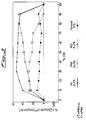
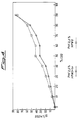
- For better clearness, in the charts displayed in accompanying Figures 1-4, the trend of the process according to the present invention, as applied to a solution containing 25 g/litre of p-nitrophenol (PFN) is shown as a function of O2f/O2r ratio, under such conditions as described in Example 1, as compared to the conventional HPWO process (Example 2), carried out under darkness conditions (Example 4) too.
- As one may observe, the oxidation efficiency ranges from 130% to 120% in the case of the conventional (HPWO) process, with values of O2f/O2r ratio comprised within the range of from 0.2 to 0.6; said values correspond to values of % decrease in COD (Chemical Oxygen Demand) comprised within the range of from 10% to 65%, as shown by
Chart 2. As already said hereinabove, the value of COD is directly correlated with the amount of O2 demanded for the oxidation of the organic matter contained in the solution. - The decrease in COD during the course of the oxidation reaction is the measure of the amount of organic matter completely oxidized to yield CO2 as the end oxidation product. The "HPWO + hν" line in
Chart 1 shows the surprising result obtained according to the present invention: by irradiating the reaction mixture containing PNF (as disclosed in Example 1), the reaction efficiency is comprised within the range of from 175% to 137%, at values of O2f/O2r ratio comprised within the range of from 0.2 to 0.6 -- i.e., of a percent decrease in COD comprised within the range of from 20% to 80%. - The line "HPWO + ν" shown in
Chart 2 demonstrates that by means of the process according to the present invention, a % decrease in COD is obtained as a function of the ratio of O2f/O2r, which is higher than as obtainable by means of the HPWO reaction known from the prior art, until a value of % COD decrease of 80% is reached; at that value, the % decrease in COD and the % efficiency of all systems become substantially identical. - Chart 3 demonstrates the benefit yielded by the process according to the present invention, as compared to the known HPWO process (without irradiation), on various substrates. On the ordinate, the percentage of "benefit" of the oxidative system is reported, expressed as the percent-difference between the O2f/O2r ratios relevant to the process of the invention "HPWO + ν " and those relevant to the conventional process "HPWO". On the abscissa, the % decrease in COD is reported. Positive values represent the percent benefit (0 = HPWO) of the process according to the present invention, over the HPWO process known from the prior art.
- According to PNF line in Chart 3, one may observe that, within the range of values of % decrease in COD of from 10% to 80%, the process according to the present invention shows an average benefit of 26%. The process of the invention is nearly comparable to the known HPWO process only as regards the oxidation of the last 10% of organic matter. Finally, Chart 4 explicitly shows the saving in H2O2 as a function of the % decrease in COD.
- In the case of a solution containing 25 g/l of PNF, in order to obtain a % decrease in COD of 70%, 50 g/l of 100%-H2O2 and 40 g/l of 100%-H2O2 are necessary in HPWO process, and in the process of the present invention respectively.
- The saving is of 10 g/l of 100%-H2O2 per each litre of waste liquors containing 25 g/l of PNF.
- Analogous remarks may be made from an examination of Tables 1 and 2, with reference to the other substrates tested.
- Summing-up, the process according to the present invention secures a higher oxidation efficiency than HPWO technique known from the prior art, on a wide range of organic compounds: from phenols to substituted phenols, to aliphatic compounds with amidic, aldehydic or carboxy functional groups, making it possible a considerable saving to be accomplished in the amount of H2O2 to be used for their oxidation.
- The present invention is disclosed now in greater detail by referring to the following examples, which anyway are supplied for merely illustrative purposes.
- In the examples, the symbols have the same meanings as specified hereinabove.
- Examples 2 (repetition of Example 1, without irradiation); 3 (repetition of Example 1, with only application of irradiation, without H2O2); 4 (repetition of Example 2, under darkness conditions), are given for comparison purposes.
- Inside a flask equipped with condenser, dripping funnel, thermometer and magnetic-anchor stirrer, 6.38 g of p-nitrophenol (PNF) is dissolved in 225 ml of distilled water, with an initial concentration of 25 g/l of PNF being obtained. Then, a sample of 5 ml is drawn in order to measure the COD value at t = 0 (zero time), with the initial volume of the reaction solution being thusly reduced down to 250 ml. The pH value of the mixture is then adjusted at 3.5, by adding 0.15 ml of H2SO4 at 96%. To the mixture, 0.25 g of FeSO4.7H2O, equivalent to 201 ppm of Fe-(II) and 0.2 g of CuSO4.5H2O, equivalent to 204 ppm of Cu-(II) are added. The flask is dipped in an oil bath, until an inner temperature of 97°C is reached, then a mild stirring of flask contents is started up. Laterally, outside the reaction flask, a 100-W tungsten lamp is installed, so positioned that the light beam is directed from up downwards, in order to better irradiate the mixture contained inside the flask. The flask, the lamp and the oil bath are then wrapped with an aluminum foil, in order to enable the maximal irradiation exclusively of the reaction mixture to be reached, and in order to simulate the presumable actual operating conditions on a full-scale facility.
- The reaction is started by dropwise adding H2O2 at 49.88%, charged to a graduated dripping funnel of 25 ml of capacity. The dropwise addition rate is of 0.5 - 0.55 ml/minute. The pH value of the reaction mixture is monitored as follows: 3 ml of the reaction mixture is collected with a pipette and is charged to a test tube. The collected sample is cooled down to room temperature with tap water. The electrode of pH-meter is dipped in the cooled solution and the pH value of the latter is measured. The 3-ml sample collected is then immediately returned back into the reaction flask. The pH value is kept comprised within the range of from 3.2 to 3.8 -- i.e., of round 3.5±0.3, by adding 0.25 ml of NaOH at 10% per each dpH = -1 from 3.5, or by adding 0.2 ml of H2SO4 at 15% per each dpH = +1 from 3.5. The samples of reaction mixture are collected when the added amount of H2O2 at 49.88% corresponds to the following values of O2f/O2r ratio: 0.22; 0.5; 0.8; 0.9 and 1.2 (respectively corresponding to 11.5; 28; 37; 44.5 and 63 ml of H2O2 at 49.88%). Each sampling consists in drawing 5 ml of reaction mixture.
- The reaction time was of 120 minutes. On each sample drawn, the COD value was measured according to the standard method with potassium dichromate. The ratio of % COD decrease to the value of O2f/O2r yields the % efficiency of the oxidation at that reaction time. The results are reported in Tables 1 and 2 and in Charts from 1 to 4.
- The same concentrations of PNF, FeSO4.7H2O and CuSO4.5H2 are used and the same procedures as disclosed in Examples 1 are followed. The lamp is not used, and the reaction system is not wrapped with aluminum foil, it being therefore left exposed to daylight. The samplings are carried out at the same values of O2f/O2r ratio, as reported in Example 1. The results are reported in Tables 1 and 2, and in Charts 1-4.
- The same concentrations of PNF and of reactants are used and the same procedures as disclosed in Examples 1 are followed; however, FeSO4.7H2O and CuSO4.5H2 are not used (with the dripping funnel being consequently omitted from the reaction system). The pH value is measured every 20 minutes, in the way as disclosed in Example 1. Only two samples of 5 ml each are collected, and namely, the first one at t = 0 and the second one at t = 60 minutes. The oxidation reaction with only light irradiation, in the absence of H2O2, did not give any results.
- The same concentrations of PNF and reactants are used, and the same modalities are followed, as disclosed in Example 2. Therefore, the reaction equipment is wrapped with an aluminum foil, with daylight being completely excluded from reaction chamber. The samples are collected at values of O2f/O2r ratio, of 0.26; 0.72 and 1. The results are reported in Table 1 and in
Charts - The efficiency of phenol oxidation carried out by means of the process according to the present invention (Example 5) was compared to the efficiency of said oxidation when it was carried out by means of the HPWO process known from the prior art (Comparative Example 5a). The concentration of phenol was of 25 g/litre in both cases. The concentrations of reactants and the reaction modalities were the same as disclosed in Example 1 (according to the invention) and in Example 2 (HPWO, without irradiation with light), respectively. The samples were drawn, for both the processes according to the invention (Example 5) and of Comparative Example 5a (HPWO), at values of O2f/O2r ratio, of 0.235; 0.52; 0.72; 0.87; 1.2; 1.56 and 2.2. The results are reported in Tables 1 and 2, and in Chart 3. The process according to the invention (Example 5) is 1.76 times as efficient as HPWO system (Comparative Example 5a), up to a ratio of O2f/O2r of 1.4 -- which corresponds to a 95% decrease in COD. The benefit of the process of the invention over HPWO process is shown in Chart 3, from which one may observe that the process according to the invention shows a 50% advantage over HPWO process, within a range of % COD decrease values of from 10% to 90%.
- The efficiency of p-chlorophenol (PCF) oxidation carried out by means of the process according to the present invention (Example 6) was compared to the efficiency of the same oxidation, when it was carried out by means of the HPWO process known from the prior art (Comparative Example 6a). The concentration of PCF was of 25 g/litre in both cases. The concentrations of reactants and the reaction modalities were the same as disclosed in Examples 1 and 2, respectively relating to the process of the invention and HPWO. The samples were drawn, for both the processes according to the invention (Example 6) and of Comparative Example 6 (HPWO), at values of O2f/O2r ratio, of 0.26; 0.48; 0.99 and 2.1. The results are reported in Tables 1 and 2, and in Chart 3.
- The process according to the invention results to be 33% more efficient than HPWO at a ratio of O2f/O2r of 0.25. It can be observed that by means of the process according to the invention, a COD decrease of 90% is reached with a ratio of O2f/O2r of 1, whilst the same % COD decrease is reached with HPWO process with a ratio of O2f/O2r of 1.9.
- The advantage of the process of the invention over HPWO process is shown in Chart 3.
- It can be observed that the average advantage, within a range of % COD decrease values of from 10% to 90%, is of 35%. In Table 2, the lower consumption of H2O2 made possible by the process according to the invention is evidenced.
- The efficiency of oxidation of a solution containing 20 g/l of formaldehyde carried out by means of the process according to the present invention (Example 7) was compared to the efficiency of the same oxidation, when it was carried out by means of the HPWO process known from the prior art (Comparative Example 7a). The concentrations of reactants and the reaction modalities were the same as disclosed in Examples 1 and 2. The samples were drawn, for both the processes according to the invention (Example 7) and Comparative Example 7a (HPWO), at values of O2f/O2r ratio of 0.196; 0.450; 0.670; 1 and 1.4.
- The results are reported in Tables 1 and 2, and in Chart 3.
- As shown in Chart 3, the "advantage" of the process of the invention, within a range of % COD decrease values of from 10% to 90%, is of 10%.
- On an average, the oxidation efficiency results 15-20% higher in the process according to the invention, than in HPWO process.
- The decrease in concentration of a solution containing 25 g/l of dimethylformamide (DMF), caused by the oxidation reaction, was compared for the process according to the invention (Example 8) and HPWO process (Comparative Example 8a).
- The concentrations of reactants and the reaction modalities were as disclosed in Examples 1 and 2 respectively.
- The samples were drawn in both oxidation processes after adding H2O2 at O2f/O2r ratios of 0.4; 0.75; 1.3.
- The reactions of both processes were compared by comparing the % decrease in DMF concentration, as referred to the value of O2f/O2r ratio, for each sample drawn. The data reported in Tables 1 and 2 show that already after values of O2f/O2r ratio of 0.4 and 0.75, the % decreases in DMF concentration were of 80% and 90% respectively for the process according to the invention, whereas with the same values or O2f/O2r ratio, the % decreases in DMF concentration were of 35% and 55%, respectively, for HPWO process.
- Table 2 sets forth the amount of H2O2, expressed as grammes of 100-% H2O2 per each litre of waste liquors, which is saved with the process according to the present invention, relatively to HPWO. It can be seen that from a decrease in DMF of 20%, up to a decrease in DMF of 90%, an average of 59% of 100%-H2O2 is saved with the process of the invention, per each litre of waste liquors containing 25 g/l of DMF to be oxidized.
Claims (17)
- A process for oxidizing an organic substrate, wherein hydrogen peroxide (H2O2) is added to the substrate dispersed in an aqueous medium, in the presence of ferrous ions Fe(II) and, optionally, ferric ions Fe(III) and cupric ions Cu(II), the reaction being carried out under irradiation with artificial visible light having a wavelength of from 350 to 700 nm, obtainable by means of a tungsten lamp.
- The process according to claim 1, wherein the organic substrate is in the form of a homogeneous or heterogeneous aqueous dispersion.
- The process according to claim 2, wherein the aqueous dispersion is a solution, suspension, emulsion, or colloid.
- The process according to anyone of the preceding claims, wherein the reaction is carried out at a pH value lower than 7.
- The process according to claim 4, wherein the reaction is carried out at a pH value of from 2 to 7.
- The process according to claim 5, wherein the reaction is carried out at a pH value of from 3 to 4.
- The process according to anyone of the preceding claims, wherein the concentration of the organic substrate in the aqueous medium is from 0.01 to 5.0% by weight.
- The process according to anyone of the preceding claims, wherein the ferrous ions Fe(II) are added to the aqueous medium as a salt selected from Fe(II) sulfate, Fe(II) chloride, Fe(II) nitrate, ammonium-Fe(II) sulfate, and mixtures of said salts with the corresponding ferric Fe(III) salts.
- The process according to anyone of the preceding claims, wherein the ferrous Fe(II) ions are added to the reaction medium in association with cupric Cu(II) ions.
- The process according to claim 9, wherein ferrous Fe(II) ions and cupric Cu(II) ions are added to the reaction medium as FeSO4 and CuSO4 respectively.
- The process according to anyone of the preceding claims, wherein the ferrous Fe(II) ions are added to the reaction mixture in an amount of from 50 to 1,000 ppm.
- The process according to anyone of the preceding claims, wherein cupric Cu(II) ions are added to the reaction medium in an amount of from 0 to 440 ppm.
- The process according to anyone of the preceding claims, wherein the ferrous Fe(II) ions and the cupric Cu(II) ions are added to the reaction medium in equivalent amounts, within the range of from 100 to 200 ppm.
- The process according to anyone of the preceding claims, wherein the hydrogen peroxide is added to the reaction medium in metered amounts of from 1 to 2.5 parts per part of the organic substrate.
- The process according to anyone of the preceding claims, wherein the hydrogen peroxide added to the reaction medium is in the form of a solution containing from 30% to 50% by weight of H2O2.
- The process according to anyone of the precedeing claims, wherein the reaction is carried out at a temperature of from 10° to 100°C.
- The process according to anyone of the preceding claims, wherein the irradiation with artificial visible light is carried out with an applied useful power of from 400 to 500 watts/dm3.
Applications Claiming Priority (2)
| Application Number | Priority Date | Filing Date | Title |
|---|---|---|---|
| ITMI912950A IT1251772B (en) | 1991-11-06 | 1991-11-06 | PROCESS FOR THE OXIDATION OF ORGANIC MATERIALS WITH HYDROGEN PEROXIDE IN CONDITIONS OF IRRADIATION IN THE WATER PHASE |
| ITMI912950 | 1991-11-06 |
Publications (2)
| Publication Number | Publication Date |
|---|---|
| EP0540972A1 EP0540972A1 (en) | 1993-05-12 |
| EP0540972B1 true EP0540972B1 (en) | 1997-04-16 |
Family
ID=11361040
Family Applications (1)
| Application Number | Title | Priority Date | Filing Date |
|---|---|---|---|
| EP92118279A Expired - Lifetime EP0540972B1 (en) | 1991-11-06 | 1992-10-26 | Process for oxidizing organic materials with hydrogen peroxide under conditions of irradiation in aqueous phase |
Country Status (6)
| Country | Link |
|---|---|
| US (1) | US5382337A (en) |
| EP (1) | EP0540972B1 (en) |
| JP (1) | JPH05221878A (en) |
| AT (1) | ATE151731T1 (en) |
| DE (1) | DE69219068T2 (en) |
| IT (1) | IT1251772B (en) |
Families Citing this family (14)
| Publication number | Priority date | Publication date | Assignee | Title |
|---|---|---|---|---|
| JPH05329489A (en) * | 1992-04-01 | 1993-12-14 | Fuji Electric Co Ltd | Water treatment method using ozone |
| US5958247A (en) * | 1994-03-28 | 1999-09-28 | Siemens Aktiengesellschaft | Method for disposing of a solution containing an organic acid |
| FR2756554B1 (en) * | 1996-12-02 | 2000-02-04 | Solvay | PROCESS FOR DECOLORATION AND DETOXICATION OF AQUEOUS EFFLUENTS |
| ES2297895T5 (en) * | 1997-10-10 | 2012-07-03 | Pure Bioscience | Disinfectant and preparation method |
| US7261905B2 (en) * | 1999-04-07 | 2007-08-28 | Pure Bioscience | Disinfectant and method of making |
| US6890953B2 (en) * | 2000-04-06 | 2005-05-10 | Innovative Medical Services | Process for treating water |
| US20040044073A1 (en) * | 2002-08-31 | 2004-03-04 | Innovative Medical Services | Composition and process for treating acne |
| TW200425940A (en) * | 2003-05-16 | 2004-12-01 | Chung Shan Inst Of Science | An air cleaning florescent lamp coated with photocatalysis materials |
| US7435438B1 (en) | 2003-05-16 | 2008-10-14 | Pure Bioscience | Disinfectant and method of use |
| US20050245605A1 (en) * | 2003-08-28 | 2005-11-03 | Arata Andrew B | Anhydrous silver dihydrogen citrate compositions |
| DE102004025007B4 (en) * | 2004-05-21 | 2020-01-09 | Deutsches Zentrum für Luft- und Raumfahrt e.V. | Photocatalytic emulsion splitting |
| US20060051430A1 (en) * | 2004-09-07 | 2006-03-09 | Arata Andrew B | Silver dihydrogen citrate compositions |
| CN103318988B (en) * | 2013-06-19 | 2014-12-17 | 环境保护部华南环境科学研究所 | Novel method for treating rhodamine B by visible light reinforcement fenton-like reaction, and its application |
| IT202200021435A1 (en) | 2022-10-18 | 2024-04-18 | Eurosider Sas Di Milli Ottavio & C | PHOTOCATALYTIC ULTRAVIOLET LAMP AND METHOD FOR ITS CONSTRUCTION |
Family Cites Families (6)
| Publication number | Priority date | Publication date | Assignee | Title |
|---|---|---|---|---|
| JPS5447357A (en) * | 1977-09-22 | 1979-04-13 | Toa Gosei Chem Ind | Waste water disposal method |
| DE3501528A1 (en) * | 1985-01-18 | 1986-07-24 | Forschungsinstitut für Edelmetalle und Metallchemie, 7070 Schwäbisch Gmünd | Process for the oxidation of poorly degradable organic compounds, such as complexing agents and heavy metal complexes, in waste waters |
| US4861484A (en) * | 1988-03-02 | 1989-08-29 | Synlize, Inc. | Catalytic process for degradation of organic materials in aqueous and organic fluids to produce environmentally compatible products |
| US5043080A (en) * | 1990-02-26 | 1991-08-27 | Solarchem Enterprises Inc. | Treating contaminated effluents and groundwaters |
| DE4026831A1 (en) * | 1990-08-24 | 1992-02-27 | Inventa Ag | Catalytic oxidn. of organic components in waste water at low temp. - using hydrogen peroxide and ferric salt in presence of titanium di:oxide |
| US5266214A (en) * | 1992-12-22 | 1993-11-30 | Cryptonics Corporation | Photocatalytic method for treatment of contaminated water |
-
1991
- 1991-11-06 IT ITMI912950A patent/IT1251772B/en active IP Right Grant
-
1992
- 1992-10-26 DE DE69219068T patent/DE69219068T2/en not_active Expired - Fee Related
- 1992-10-26 EP EP92118279A patent/EP0540972B1/en not_active Expired - Lifetime
- 1992-10-26 AT AT92118279T patent/ATE151731T1/en not_active IP Right Cessation
- 1992-11-04 JP JP4295387A patent/JPH05221878A/en active Pending
- 1992-11-05 US US07/972,152 patent/US5382337A/en not_active Expired - Fee Related
Also Published As
| Publication number | Publication date |
|---|---|
| ATE151731T1 (en) | 1997-05-15 |
| JPH05221878A (en) | 1993-08-31 |
| IT1251772B (en) | 1995-05-24 |
| DE69219068D1 (en) | 1997-05-22 |
| US5382337A (en) | 1995-01-17 |
| ITMI912950A1 (en) | 1993-05-06 |
| EP0540972A1 (en) | 1993-05-12 |
| DE69219068T2 (en) | 1997-09-11 |
| ITMI912950A0 (en) | 1991-11-06 |
Similar Documents
| Publication | Publication Date | Title |
|---|---|---|
| Jiang et al. | Progress in the development and use of ferrate (VI) salt as an oxidant and coagulant for water and wastewater treatment | |
| US5382337A (en) | Process for oxidizing organic materials with hydrogen peroxide under conditions of irradiation in aqueous phase | |
| Lunar et al. | Degradation of photographic developers by Fenton’s reagent: condition optimization and kinetics for metol oxidation | |
| Neyens et al. | A review of classic Fenton’s peroxidation as an advanced oxidation technique | |
| US4340490A (en) | Process for the detoxification of waste water containing phenol, phenol derivative or phenol and formaldehyde | |
| Catalkaya et al. | Color, TOC and AOX removals from pulp mill effluent by advanced oxidation processes: A comparative study | |
| Al Momani et al. | A comparative study of the advanced oxidation of 2, 4-dichlorophenol | |
| US4012321A (en) | Oxidation of refractory organics in aqueous waste streams by hydrogen peroxide and ultraviolet light | |
| EP0373268B1 (en) | Oxidation of organic compounds in water | |
| Zhu et al. | Application of ferrous-hydrogen peroxide for the treatment of H-acid manufacturing process wastewater | |
| US5178772A (en) | Process for destruction of metal complexes by ultraviolet irradiation | |
| US4569769A (en) | Wastewater treatment | |
| JPH06226272A (en) | Method of reducing content of organic chemical substance in waste liquid | |
| Soler et al. | Effect of inorganic ions on the solar detoxification of water polluted with pesticides | |
| Madhavan et al. | Kinetics of degradation of acid red 88 in the presence of Co2+-ion/peroxomonosulphate reagent | |
| US5068038A (en) | Method of lowering the AOX content in water | |
| US4446029A (en) | Destruction of iron cyanide complexes | |
| EP0360989B1 (en) | Process for the chemically oxidative treatment of water containing toxic and/or non or slowly biodegradable substances | |
| US6558556B1 (en) | Iron-catalysed oxidation of manganese and other inorganic species in aqueous solutions | |
| DE4430391A1 (en) | Preferential oxidn. of harmful matter esp. organic halide in soln. | |
| JPH1119664A (en) | Decomposition of biodegradable organic matter and removal of phosphorus by zirconium oxide / ferric salt / hydrogen peroxide / ultraviolet system | |
| US3929636A (en) | Process for conditioning effluent contaminated by aldehyde compounds | |
| KR970006498B1 (en) | Detoxification of Aqueous Cyanide Solution | |
| DE2703268C2 (en) | Process for the detoxification of waste water containing phenol, phenol derivatives or phenol and formaldehyde | |
| JPH0780479A (en) | Method for treating waste liquid containing organic compounds |
Legal Events
| Date | Code | Title | Description |
|---|---|---|---|
| PUAI | Public reference made under article 153(3) epc to a published international application that has entered the european phase |
Free format text: ORIGINAL CODE: 0009012 |
|
| AK | Designated contracting states |
Kind code of ref document: A1 Designated state(s): AT BE CH DE DK ES FR GB GR IE IT LI LU NL PT SE |
|
| 17P | Request for examination filed |
Effective date: 19931029 |
|
| 17Q | First examination report despatched |
Effective date: 19950310 |
|
| GRAG | Despatch of communication of intention to grant |
Free format text: ORIGINAL CODE: EPIDOS AGRA |
|
| GRAH | Despatch of communication of intention to grant a patent |
Free format text: ORIGINAL CODE: EPIDOS IGRA |
|
| ITF | It: translation for a ep patent filed | ||
| GRAH | Despatch of communication of intention to grant a patent |
Free format text: ORIGINAL CODE: EPIDOS IGRA |
|
| GRAA | (expected) grant |
Free format text: ORIGINAL CODE: 0009210 |
|
| AK | Designated contracting states |
Kind code of ref document: B1 Designated state(s): AT BE CH DE DK ES FR GB GR IE IT LI LU NL PT SE |
|
| PG25 | Lapsed in a contracting state [announced via postgrant information from national office to epo] |
Ref country code: NL Effective date: 19970416 Ref country code: LI Effective date: 19970416 Ref country code: GR Free format text: LAPSE BECAUSE OF FAILURE TO SUBMIT A TRANSLATION OF THE DESCRIPTION OR TO PAY THE FEE WITHIN THE PRESCRIBED TIME-LIMIT Effective date: 19970416 Ref country code: ES Free format text: THE PATENT HAS BEEN ANNULLED BY A DECISION OF A NATIONAL AUTHORITY Effective date: 19970416 Ref country code: DK Effective date: 19970416 Ref country code: CH Effective date: 19970416 Ref country code: BE Effective date: 19970416 Ref country code: AT Effective date: 19970416 |
|
| REF | Corresponds to: |
Ref document number: 151731 Country of ref document: AT Date of ref document: 19970515 Kind code of ref document: T |
|
| REG | Reference to a national code |
Ref country code: CH Ref legal event code: EP |
|
| REF | Corresponds to: |
Ref document number: 69219068 Country of ref document: DE Date of ref document: 19970522 |
|
| ET | Fr: translation filed | ||
| PG25 | Lapsed in a contracting state [announced via postgrant information from national office to epo] |
Ref country code: SE Effective date: 19970716 Ref country code: PT Effective date: 19970716 |
|
| REG | Reference to a national code |
Ref country code: IE Ref legal event code: FG4D Free format text: 73288 |
|
| NLV1 | Nl: lapsed or annulled due to failure to fulfill the requirements of art. 29p and 29m of the patents act | ||
| PG25 | Lapsed in a contracting state [announced via postgrant information from national office to epo] |
Ref country code: LU Free format text: LAPSE BECAUSE OF NON-PAYMENT OF DUE FEES Effective date: 19971026 Ref country code: IE Free format text: LAPSE BECAUSE OF NON-PAYMENT OF DUE FEES Effective date: 19971026 |
|
| REG | Reference to a national code |
Ref country code: CH Ref legal event code: PL |
|
| PLBE | No opposition filed within time limit |
Free format text: ORIGINAL CODE: 0009261 |
|
| STAA | Information on the status of an ep patent application or granted ep patent |
Free format text: STATUS: NO OPPOSITION FILED WITHIN TIME LIMIT |
|
| 26N | No opposition filed | ||
| REG | Reference to a national code |
Ref country code: GB Ref legal event code: IF02 |
|
| PGFP | Annual fee paid to national office [announced via postgrant information from national office to epo] |
Ref country code: FR Payment date: 20031003 Year of fee payment: 12 |
|
| PGFP | Annual fee paid to national office [announced via postgrant information from national office to epo] |
Ref country code: GB Payment date: 20031022 Year of fee payment: 12 |
|
| PGFP | Annual fee paid to national office [announced via postgrant information from national office to epo] |
Ref country code: DE Payment date: 20031103 Year of fee payment: 12 |
|
| PG25 | Lapsed in a contracting state [announced via postgrant information from national office to epo] |
Ref country code: GB Free format text: LAPSE BECAUSE OF NON-PAYMENT OF DUE FEES Effective date: 20041026 |
|
| PG25 | Lapsed in a contracting state [announced via postgrant information from national office to epo] |
Ref country code: DE Free format text: LAPSE BECAUSE OF NON-PAYMENT OF DUE FEES Effective date: 20050503 |
|
| GBPC | Gb: european patent ceased through non-payment of renewal fee |
Effective date: 20041026 |
|
| PG25 | Lapsed in a contracting state [announced via postgrant information from national office to epo] |
Ref country code: FR Free format text: LAPSE BECAUSE OF NON-PAYMENT OF DUE FEES Effective date: 20050630 |
|
| REG | Reference to a national code |
Ref country code: FR Ref legal event code: ST |
|
| PG25 | Lapsed in a contracting state [announced via postgrant information from national office to epo] |
Ref country code: IT Free format text: LAPSE BECAUSE OF NON-PAYMENT OF DUE FEES;WARNING: LAPSES OF ITALIAN PATENTS WITH EFFECTIVE DATE BEFORE 2007 MAY HAVE OCCURRED AT ANY TIME BEFORE 2007. THE CORRECT EFFECTIVE DATE MAY BE DIFFERENT FROM THE ONE RECORDED. Effective date: 20051026 |