EP0540357B1 - Protein-silicone copolymers and compositions containing them - Google Patents
Protein-silicone copolymers and compositions containing them Download PDFInfo
- Publication number
- EP0540357B1 EP0540357B1 EP92309969A EP92309969A EP0540357B1 EP 0540357 B1 EP0540357 B1 EP 0540357B1 EP 92309969 A EP92309969 A EP 92309969A EP 92309969 A EP92309969 A EP 92309969A EP 0540357 B1 EP0540357 B1 EP 0540357B1
- Authority
- EP
- European Patent Office
- Prior art keywords
- protein
- copolymer
- silicone
- component
- copolymer according
- Prior art date
- Legal status (The legal status is an assumption and is not a legal conclusion. Google has not performed a legal analysis and makes no representation as to the accuracy of the status listed.)
- Expired - Lifetime
Links
Classifications
-
- C—CHEMISTRY; METALLURGY
- C08—ORGANIC MACROMOLECULAR COMPOUNDS; THEIR PREPARATION OR CHEMICAL WORKING-UP; COMPOSITIONS BASED THEREON
- C08H—DERIVATIVES OF NATURAL MACROMOLECULAR COMPOUNDS
- C08H1/00—Macromolecular products derived from proteins
-
- A—HUMAN NECESSITIES
- A61—MEDICAL OR VETERINARY SCIENCE; HYGIENE
- A61K—PREPARATIONS FOR MEDICAL, DENTAL OR TOILETRY PURPOSES
- A61K8/00—Cosmetics or similar toiletry preparations
- A61K8/18—Cosmetics or similar toiletry preparations characterised by the composition
- A61K8/30—Cosmetics or similar toiletry preparations characterised by the composition containing organic compounds
- A61K8/64—Proteins; Peptides; Derivatives or degradation products thereof
-
- A—HUMAN NECESSITIES
- A61—MEDICAL OR VETERINARY SCIENCE; HYGIENE
- A61K—PREPARATIONS FOR MEDICAL, DENTAL OR TOILETRY PURPOSES
- A61K8/00—Cosmetics or similar toiletry preparations
- A61K8/18—Cosmetics or similar toiletry preparations characterised by the composition
- A61K8/30—Cosmetics or similar toiletry preparations characterised by the composition containing organic compounds
- A61K8/64—Proteins; Peptides; Derivatives or degradation products thereof
- A61K8/645—Proteins of vegetable origin; Derivatives or degradation products thereof
-
- A—HUMAN NECESSITIES
- A61—MEDICAL OR VETERINARY SCIENCE; HYGIENE
- A61K—PREPARATIONS FOR MEDICAL, DENTAL OR TOILETRY PURPOSES
- A61K8/00—Cosmetics or similar toiletry preparations
- A61K8/18—Cosmetics or similar toiletry preparations characterised by the composition
- A61K8/30—Cosmetics or similar toiletry preparations characterised by the composition containing organic compounds
- A61K8/64—Proteins; Peptides; Derivatives or degradation products thereof
- A61K8/65—Collagen; Gelatin; Keratin; Derivatives or degradation products thereof
-
- A—HUMAN NECESSITIES
- A61—MEDICAL OR VETERINARY SCIENCE; HYGIENE
- A61K—PREPARATIONS FOR MEDICAL, DENTAL OR TOILETRY PURPOSES
- A61K8/00—Cosmetics or similar toiletry preparations
- A61K8/18—Cosmetics or similar toiletry preparations characterised by the composition
- A61K8/72—Cosmetics or similar toiletry preparations characterised by the composition containing organic macromolecular compounds
- A61K8/84—Cosmetics or similar toiletry preparations characterised by the composition containing organic macromolecular compounds obtained by reactions otherwise than those involving only carbon-carbon unsaturated bonds
- A61K8/89—Polysiloxanes
- A61K8/896—Polysiloxanes containing atoms other than silicon, carbon, oxygen and hydrogen, e.g. dimethicone copolyol phosphate
- A61K8/898—Polysiloxanes containing atoms other than silicon, carbon, oxygen and hydrogen, e.g. dimethicone copolyol phosphate containing nitrogen, e.g. amodimethicone, trimethyl silyl amodimethicone or dimethicone propyl PG-betaine
-
- A—HUMAN NECESSITIES
- A61—MEDICAL OR VETERINARY SCIENCE; HYGIENE
- A61Q—SPECIFIC USE OF COSMETICS OR SIMILAR TOILETRY PREPARATIONS
- A61Q5/00—Preparations for care of the hair
- A61Q5/02—Preparations for cleaning the hair
-
- C—CHEMISTRY; METALLURGY
- C08—ORGANIC MACROMOLECULAR COMPOUNDS; THEIR PREPARATION OR CHEMICAL WORKING-UP; COMPOSITIONS BASED THEREON
- C08G—MACROMOLECULAR COMPOUNDS OBTAINED OTHERWISE THAN BY REACTIONS ONLY INVOLVING UNSATURATED CARBON-TO-CARBON BONDS
- C08G77/00—Macromolecular compounds obtained by reactions forming a linkage containing silicon with or without sulfur, nitrogen, oxygen or carbon in the main chain of the macromolecule
- C08G77/42—Block-or graft-polymers containing polysiloxane sequences
Definitions
- This invention relates to certain new protein-silicone copolymers and to their use in cosmetics and toiletries.
- Proteins from a variety of animal and vegetable sources can be used and the relative film-forming and moisture-retentive propeties can be controlled by the selection of a particular protein and its average molecular weight. It is also possible to chemically modify proteins to modify their behaviour and functionality; such chemical modification includes, for example, esterification of carboxyl groups, acylation of amino groups and quaternisation of amino groups.
- Benefits claimed for proteins and their derivatives in the conditioning of hair include improved combability, gloss, moisture control, body and reduced 'fly-away'.
- benefits include moisturisation, skin-firming/smoothing, improved feel and anti-irritation effect.
- silicones Another category of conditioning agents which have established a significant role in cosmetics products are silicones.
- Silicone is a general term for a range of chemicals with different behaviour and effects but characterised by the "silicon-oxygen-silicon” chain.
- Polydimethylsiloxanes (dimethicones) exhibit low solubility in water, low surface tension and antifoam behaviour and have been found to confer gloss and lubricity to hair and a soft feel to skin.
- silicone glycols diimethicone polyols
- silicone glycols diimethicone polyols
- amino functional silicones e.g. amodimethicones
- amodimethicones amino functional silicones
- proteins and “silicones” represent two distinct categories of valuable conditioning agents for skin and hair with different physical properties and functional benefits.
- modified proteins which would have some properties characteristic of silicones (e.g. increased lubricity) or alternatively silicones with some of the benefits of proteins (greater water solubility and substantivity), offers potential for the formulation of cosmetic products with novel properties.
- European Patent 0295 983 describes products formed by the condensation of a silane, silanol or siloxane with the carboxylic acid group of amino acids.
- the products, which contain only one silicon atom per molecule, are claimed to have useful therapeutic and cosmetic effects.
- JP-A-3223207 describes certain peptide-modified silicone derivatives, which are not cross-linked, and their use as cosmetic bases.
- a protein-silicone copolymer wherein the silicone component is covalently bonded to amino groups of the protein and at least some of the silicone component forms cross-links between different protein chains, the protein component forming from 5% to 98% by weight of the copolymer.
- the present invention also comprises a cosmetic formulation, especially but not exclusively for the treatment of the skin and/or the hair, which comprises a protein-silicone copolymer according to the invention.
- the copolymers according to the invention can be prepared by covalently attaching organofunctional silane/silicone compounds to the protein amino groups to form larger polymer molecules including protein cross-linking.
- further polymerisation may occur through condensation of silanol groups and such further polymerisation increases the amount of cross-linking.
- the protein may be derived from either animal or vegetable sources or by fermentation. It may be in the form of a chemically modified protein (for example quaternised) provided that some free amino groups are still present on the protein molecules.
- proteins which are currently used in cosmetic formulations and which can be used as the protein component of the copolymer, include collagen, elastin, keratin, casein, wheat protein, soya protein, and silk.
- the term "protein” is used to include both native and hydrolysed proteins and it thus comprises both proteins properly so-called and polypeptides, peptides and peptones since the latter can all be categorised as hydrolysed proteins.
- the average molecular weight of the protein component may be from 500 to 500,000 Daltons, that is preferably within the range of from 500 to 50,000 Daltons and is more preferably within the range of from 1000 to 20,000 Daltons, expressed as weight average molecular weight derived from size exclusion chromatography.
- the protein component prefferably be capable of solution in water or other suitable solvent or co-solvent (such as an alcohol, propylene glycol, or polyethylene glycol) to enable reaction to occur.
- suitable solvent or co-solvent such as an alcohol, propylene glycol, or polyethylene glycol
- the organofunctional silicone used for reaction with the protein component to form the copolymer must contain a functional group capable of reacting with the chain terminal and/or side chain amino groups of the protein.
- Suitable reactive groups include, for example, acyl halide, sulphonyl halide, anhydride, aldehyde and epoxide groups.
- the silicone component may be any compound which contains a siloxane group (Si-O-Si) or any silane capable of forming a siloxane in situ by condensation of silanol (Si-OH) groups (see Reaction 1 below) or any alkoxysilane or halosilane which hydrolyses to form a corresponding silanol (see Reaction 2 below) and then condenses to form a siloxane group (Reaction 1).
- the silicone reactant must be capable of forming cross-links with the protein component.
- Crosslinking may be obtained either through the use of polyfunctional silicone reactants or of monofunctional silicone reactants containing silanol groups (or alkoxysilane or halosilane groups convertible to silanol groups by hydrolysis) capable of forming siloxane cross-links by condensation between different chains.
- monofunctional silicone reactants should therefore have at least one and up to three hydroxy groups attached to at least one silicon atom in their structure.
- the silanol group(s) will be in a part of the reactant molecule remote from the amino-reactive organofunctional group.
- Reactants I and III are examples of difunctional silicones capable of directly producing cross-links with protein amino groups.
- Reactants II and IV are monofunctional reactants capable of reaction with only one amino group of the protein to form a silanol-terminated chain; two or more of such chains can form siloxane cross-links by condensation of silanol groups attached to different chains.
- the copolymer according to the invention may contain silicone-containing chains attached to the protein components at either end or at both ends, the proportions of single chains to cross-links being controlled by the choice and amount of the reactants and by the reaction conditions. Additional crosslinking may occur on concentrating or drying solutions of the copolymer.
- the organofunctional silicone/silane reactant is preferably soluble in a solvent common to the protein for efficient reaction.
- the conditions for reaction of the organofunctional silicones/silanes with the protein to achieve the desired degree of reaction and crosslinking must be carefully controlled, but will be apparent to or readily determinable by those skilled in the art of protein modification.
- the pH of the system For reaction of the protein amino groups to occur, it is usually necessary for the pH of the system to be above pH 7 and preferably within the pH range 8 to 11.5.
- the reaction may be carried out at room temperature, but an elevated temperature and more preferably a temperature of from 40-80°C is preferably used.
- the protein component of the protein-silicone copolymers may represent from 5% to 98% of the copolymer, but more preferably 50 to 90% by weight.
- the protein-silicone copolymers may be supplied as solutions in a suitable solvent, as dispersions or emulsions or as powder.
- the chemical structure of the protein-silicone copolymers according to the invention are complicated and it is not possible to write a single general structural formula for these compounds.
- the silicone component of the protein-silicone copolymers may be illustrated by simplified structures V and VI below, depending upon whether the silicone constitutes a crosslink (V) or a chain attached to the protein at one end (VI).
- the protein-silicone copolymers may contain several silicone chains per protein molecule, depending upon the molecular weight of protein, the proportion of silicone to protein and the degree of cross-linking.
- the copolymers can be characterised in terms of both chemical and physical properties by standard techniques and the degree of modification of protein amino groups and the protein and silicone contents determined.
- the protein-silicone copolymers according to the invention and described above have been found to exhibit physical and chemical properties which make them valuable for cosmetic formulations used for conditioning of hair or skin.
- the properties vary with the composition of the protein-silicone copolymer, but specific benefits which have been found include: solubility in aqueous, aqueous/alcoholic or alcoholic solutions, self-cross-linking (polymerisation) behaviour on drying to a film, enhanced substantivity to skin and hair, moisture retention, novel feel on skin, and excellent wet and drying combing behaviour on hair.
- the inclusion of the protein-silicone copolymers into cosmetic formulations can be at any desired level; it is generally preferred to use from 0.1 to 5% w/w of the copolymer.
- carboxyl groups of the protein component and/or amino groups of the protein component which are not bonded to the silicone component can be chemically modified by reaction with a non-silicone, eg. by esterification, acylation or quaternisation.
- a protein-silicone copolymer was prepared by reaction of an organofunctional silane with hydrolysed collagen protein having a weight average molecular weight of approximately 5,000 Daltons.
- the product had the general structure illustrated in V and VI where:
- the degree of modification of the protein amino groups was 48% and the protein content of the copolymer was 90%.
- the product was significantly more viscous than the original collagen hydrolysate at equivalent concentration, as a consequence of partial cross-linking as indicated by the figures below:- Viscosity at 25%, 25°C Hydrolysed Collagen 30 mps Collagen-Silicone Copolymer 500 mps
- the copolymer was soluble in water and 50/50 alcohol-water.
- the copolymer When applied as a solution to a glass-slide and dried, the copolymer produced a hard, glossy (non-tacky) film. Attempts to redissolve the film in water at 25°C resulted in only 90% dissolution of the copolymer. In contrast, the parent hydrolysed collagen treated similarly dissolved completely and much more rapidly. This behaviour of the copolymer was attributed to the formation of cross-links.
- a protein-silicone copolymer was prepared by reaction of an organofunctional silane with hydrolysed wheat protein having a weight average molecular weight of approximately 10,000 Daltons.
- the product had the general structure illustrated in V and VI where:-
- the degree of modification of the protein amino groups was 60%. The remaining amino groups were then quaternised to attach lauryl dimethyl quat groups to the copolymer, bringing the total modification of amino groups of 85%.
- the resultant protein-silicone copolymer (quaternised) exhibited inverse solubility in water. That is, it was more soluble at high active concentrations in water than at low active concentrations. The effect was very pH dependent. At PH 7, a haze developed at concentrations below approximately 10% concentration; at pH 4.5 the haze point was at approximately 20% concentration at pH 9 the haze point was at approximately 1% concentration.
- the viscosity of the copolymer was significantly increased compared with the starting wheat protein at equivalent concentrations, due to crosslinking, as indicated below: Viscosity at 27% w/w, 25°C Wheat Protein 40 mps Wheat Protein-Silicone Copolymer 680 mps
- the copolymer was soluble in aqueous solutions of anionic surfactants.
- anionic surfactants for example, a 6% aqueous sodium lauryl ether sulphate solution containing 2% active copolymer at pH 7 was a clear solution.
- a protein-silicone copolymer was prepared by reaction of an organofunctional silicone with an ethyl ester of hydrolysed collagen having a weight average molecular weight of approximately 4,000 Daltons.
- the product had the general structure illustrated in V and VI where:-
- the copolymer contained 45% protein and 70% of the amino groups had been modified.
- the alcohol-soluble copolymer is useful for hair sprays, providing a glossy film on the hair. It is insoluble in water and precipitates from alcoholic solution on addition of water.
- a protein-silicone copolymer was prepared by reaction of an organofunctional silane with hydrolysed wheat protein having a weight average molecular weight of approximately 3,500 Daltons.
- the product had the general structure illustrated in V and VI, where:
- the degree of modification of the protein amino groups was 82% and the protein content of the copolymer was 50%.
- the viscosity of the copolymer measured at 27% w/w concentration, 25°C was 400 mps, which represented a substantial increase over the viscosity of the parent protein hydrolysate, due to cross-linking.
- the copolymer exhibited inverse solubility in water in the pH region below approximately pH6.
- Hair swatches were treated with 3% active solutions of the copolymer at pH7 and then rinsed with water.
- the wet combability was assessed by eight panellists, in comparison with tresses similarly treated with the parent hydrolysed wheat protein.
- the hair tresses were subsequently dried and assessed for dry combability.
- the tresses treated with the copolymer were found to be significantly better on both wet and dry combability than the control tresses treated with the wheat protein hydrolysate.
Landscapes
- Health & Medical Sciences (AREA)
- Life Sciences & Earth Sciences (AREA)
- Chemical & Material Sciences (AREA)
- Veterinary Medicine (AREA)
- Public Health (AREA)
- General Health & Medical Sciences (AREA)
- Animal Behavior & Ethology (AREA)
- Epidemiology (AREA)
- Birds (AREA)
- Organic Chemistry (AREA)
- Polymers & Plastics (AREA)
- Medicinal Chemistry (AREA)
- Chemical Kinetics & Catalysis (AREA)
- Engineering & Computer Science (AREA)
- Biochemistry (AREA)
- Materials Engineering (AREA)
- Cosmetics (AREA)
- Compositions Of Macromolecular Compounds (AREA)
Description
- This invention relates to certain new protein-silicone copolymers and to their use in cosmetics and toiletries.
- The use of proteins, their hydrolysates and chemically modified derivatives in cosmetic formulations to provide performance and conditioning benefits to skin and hair is well known. These benefits derive mainly from the film-forming and moisture-retentive properties exhibited by such "cosmetic proteins" together with their substantivity to hair and skin, that is their ability to adsorb to hair and skin and to resist elution with water.
- Proteins from a variety of animal and vegetable sources can be used and the relative film-forming and moisture-retentive propeties can be controlled by the selection of a particular protein and its average molecular weight. It is also possible to chemically modify proteins to modify their behaviour and functionality; such chemical modification includes, for example, esterification of carboxyl groups, acylation of amino groups and quaternisation of amino groups.
- Benefits claimed for proteins and their derivatives in the conditioning of hair include improved combability, gloss, moisture control, body and reduced 'fly-away'. For skin, benefits include moisturisation, skin-firming/smoothing, improved feel and anti-irritation effect.
- Another category of conditioning agents which have established a significant role in cosmetics products are silicones. "Silicone" is a general term for a range of chemicals with different behaviour and effects but characterised by the "silicon-oxygen-silicon" chain. Polydimethylsiloxanes (dimethicones) exhibit low solubility in water, low surface tension and antifoam behaviour and have been found to confer gloss and lubricity to hair and a soft feel to skin. To overcome the limitations of water insolubility, silicone glycols (dimethicone polyols) have been developed which also exhibit foaming behaviour and confer lubricity to keratin substrates.
- In order to provide substantivity to hair, amino functional silicones (e.g. amodimethicones) have been developed which are also capable of polymerising on the hair, but are water-insoluble.
- From the foregoing it will be understood that "proteins" and "silicones" represent two distinct categories of valuable conditioning agents for skin and hair with different physical properties and functional benefits.
- The possibility of developing modified proteins which would have some properties characteristic of silicones (e.g. increased lubricity) or alternatively silicones with some of the benefits of proteins (greater water solubility and substantivity), offers potential for the formulation of cosmetic products with novel properties.
- Products which are mixtures of silicones and proteins have been proposed and marketed, but it will be obvious to those skilled in the art of cosmetic formulations that mixtures will not provide the desired improvement in solubility characteristics or substantivity and lubricity for rinse-off systems.
- European Patent 0295 983 describes products formed by the condensation of a silane, silanol or siloxane with the carboxylic acid group of amino acids. The products, which contain only one silicon atom per molecule, are claimed to have useful therapeutic and cosmetic effects.
- JP-A-3223207 describes certain peptide-modified silicone derivatives, which are not cross-linked, and their use as cosmetic bases.
- We have now developed a range of cross-linked protein-silicone copolymers in which the silicone component is covalently bonded to amino groups of the protein and which provide the benefits, that is the desirable physical characteristics, of both proteins and of silicones, for the conditioning of skin and/or hair which are not achievable with simple mixtures or with non-crosslinked products.
- According to the present invention, there is provided a protein-silicone copolymer wherein the silicone component is covalently bonded to amino groups of the protein and at least some of the silicone component forms cross-links between different protein chains, the protein component forming from 5% to 98% by weight of the copolymer.
- The present invention also comprises a cosmetic formulation, especially but not exclusively for the treatment of the skin and/or the hair, which comprises a protein-silicone copolymer according to the invention.
- The copolymers according to the invention can be prepared by covalently attaching organofunctional silane/silicone compounds to the protein amino groups to form larger polymer molecules including protein cross-linking. In addition, further polymerisation may occur through condensation of silanol groups and such further polymerisation increases the amount of cross-linking.
- The protein may be derived from either animal or vegetable sources or by fermentation. It may be in the form of a chemically modified protein (for example quaternised) provided that some free amino groups are still present on the protein molecules. Examples of proteins which are currently used in cosmetic formulations and which can be used as the protein component of the copolymer, include collagen, elastin, keratin, casein, wheat protein, soya protein, and silk. In this specification, the term "protein" is used to include both native and hydrolysed proteins and it thus comprises both proteins properly so-called and polypeptides, peptides and peptones since the latter can all be categorised as hydrolysed proteins.
- The average molecular weight of the protein component may be from 500 to 500,000 Daltons, that is preferably within the range of from 500 to 50,000 Daltons and is more preferably within the range of from 1000 to 20,000 Daltons, expressed as weight average molecular weight derived from size exclusion chromatography.
- It is necessary for the protein component to be capable of solution in water or other suitable solvent or co-solvent (such as an alcohol, propylene glycol, or polyethylene glycol) to enable reaction to occur.
- The organofunctional silicone used for reaction with the protein component to form the copolymer must contain a functional group capable of reacting with the chain terminal and/or side chain amino groups of the protein. Suitable reactive groups include, for example, acyl halide, sulphonyl halide, anhydride, aldehyde and epoxide groups. The silicone component may be any compound which contains a siloxane group (Si-O-Si) or any silane capable of forming a siloxane in situ by condensation of silanol (Si-OH) groups (see Reaction 1 below) or any alkoxysilane or halosilane which hydrolyses to form a corresponding silanol (see Reaction 2 below) and then condenses to form a siloxane group (Reaction 1).


- The silicone reactant must be capable of forming cross-links with the protein component. Crosslinking may be obtained either through the use of polyfunctional silicone reactants or of monofunctional silicone reactants containing silanol groups (or alkoxysilane or halosilane groups convertible to silanol groups by hydrolysis) capable of forming siloxane cross-links by condensation between different chains. Such monofunctional silicone reactants should therefore have at least one and up to three hydroxy groups attached to at least one silicon atom in their structure. Generally, but not necessarily, the silanol group(s) will be in a part of the reactant molecule remote from the amino-reactive organofunctional group.
- Examples of suitable organofunctional silicone/silane reactants include compounds I-IV below:


- Reactants I and III are examples of difunctional silicones capable of directly producing cross-links with protein amino groups. Reactants II and IV are monofunctional reactants capable of reaction with only one amino group of the protein to form a silanol-terminated chain; two or more of such chains can form siloxane cross-links by condensation of silanol groups attached to different chains.
- It is not necessary for all of the silicone component to form cross-links with the protein component. The copolymer according to the invention may contain silicone-containing chains attached to the protein components at either end or at both ends, the proportions of single chains to cross-links being controlled by the choice and amount of the reactants and by the reaction conditions. Additional crosslinking may occur on concentrating or drying solutions of the copolymer.
- The organofunctional silicone/silane reactant is preferably soluble in a solvent common to the protein for efficient reaction. The conditions for reaction of the organofunctional silicones/silanes with the protein to achieve the desired degree of reaction and crosslinking must be carefully controlled, but will be apparent to or readily determinable by those skilled in the art of protein modification.
- For reaction of the protein amino groups to occur, it is usually necessary for the pH of the system to be above pH 7 and preferably within the pH range 8 to 11.5. The reaction may be carried out at room temperature, but an elevated temperature and more preferably a temperature of from 40-80°C is preferably used.
- The protein component of the protein-silicone copolymers may represent from 5% to 98% of the copolymer, but more preferably 50 to 90% by weight. The protein-silicone copolymers may be supplied as solutions in a suitable solvent, as dispersions or emulsions or as powder.
- The chemical structure of the protein-silicone copolymers according to the invention are complicated and it is not possible to write a single general structural formula for these compounds. The silicone component of the protein-silicone copolymers may be illustrated by simplified structures V and VI below, depending upon whether the silicone constitutes a crosslink (V) or a chain attached to the protein at one end (VI).


- (a) the protein chain represents a protein or hydrolysed protein which may be chemically modified. Such chemical modification may be performed prior or subsequent to the production of the protein-silicone copolymer. The average molecular weight of the protein is preferably from 500 to 500,000 Daltons;
- (b) X is the linking group resulting from reaction of protein amino groups and the amino-reactive group on the organofunctional silicone/silane reactant.
X may, for example, be:

- (c) R, R1, R2, R3 may be - CH3 or -OH,
- (d) Y = OH or -X-OH,
- (e) n = 1-50; m = 0-50
- It will be apparent that the protein-silicone copolymers may contain several silicone chains per protein molecule, depending upon the molecular weight of protein, the proportion of silicone to protein and the degree of cross-linking. The copolymers can be characterised in terms of both chemical and physical properties by standard techniques and the degree of modification of protein amino groups and the protein and silicone contents determined.
- The protein-silicone copolymers according to the invention and described above have been found to exhibit physical and chemical properties which make them valuable for cosmetic formulations used for conditioning of hair or skin. The properties vary with the composition of the protein-silicone copolymer, but specific benefits which have been found include: solubility in aqueous, aqueous/alcoholic or alcoholic solutions, self-cross-linking (polymerisation) behaviour on drying to a film, enhanced substantivity to skin and hair, moisture retention, novel feel on skin, and excellent wet and drying combing behaviour on hair.
- The inclusion of the protein-silicone copolymers into cosmetic formulations can be at any desired level; it is generally preferred to use from 0.1 to 5% w/w of the copolymer.
- In the copolymers of the invention, carboxyl groups of the protein component and/or amino groups of the protein component which are not bonded to the silicone component, can be chemically modified by reaction with a non-silicone, eg. by esterification, acylation or quaternisation.
- In order that the invention may be more fully understood, the following examples, in which all percentages are by weight, are given by way of illustration only:
- A protein-silicone copolymer was prepared by reaction of an organofunctional silane with hydrolysed collagen protein having a weight average molecular weight of approximately 5,000 Daltons. The product had the general structure illustrated in V and VI where:
- R = CH3
- R1 = OH
- R2 = CH3
- R3 = OH
- X =
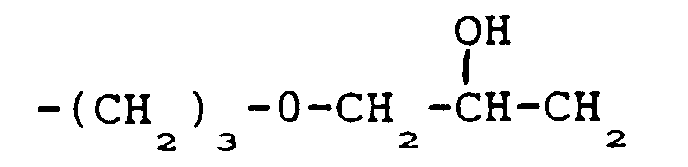
- Y = OH
- n = 1,m = 0
- The degree of modification of the protein amino groups was 48% and the protein content of the copolymer was 90%. The product was significantly more viscous than the original collagen hydrolysate at equivalent concentration, as a consequence of partial cross-linking as indicated by the figures below:-
Viscosity at 25%, 25°C Hydrolysed Collagen 30 mps Collagen-Silicone Copolymer 500 mps - The copolymer was soluble in water and 50/50 alcohol-water.
- Silicon NMR (nuclear magnetic resonance) studies on the copolymer identified the presence of peaks attributable to both silanol and siloxane groups; that is, single chains and cross-linking chains.
- When applied as a solution to a glass-slide and dried, the copolymer produced a hard, glossy (non-tacky) film. Attempts to redissolve the film in water at 25°C resulted in only 90% dissolution of the copolymer. In contrast, the parent hydrolysed collagen treated similarly dissolved completely and much more rapidly. This behaviour of the copolymer was attributed to the formation of cross-links.
- When the copolymer was applied to the skin as a 5% solution it exhibited the characteristic tack of hydrolysed collagen, but with a pleasing lubricating feel and when dry conferred a smooth feel to the skin.
- When a hair swatch was treated by immersing it in a 2% solution of the copolymer for 30 seconds followed by rinsing with water, the hair exhibited excellent wet-combing behaviour when compared with a water-control. Radiolabelling studies of substantivity to hair showed that the copolymer exhibited behaviour characteristic of proteins, but with enhanced substantivity compared with the parent hydrolysed collagen.
- A protein-silicone copolymer was prepared by reaction of an organofunctional silane with hydrolysed wheat protein having a weight average molecular weight of approximately 10,000 Daltons. The product had the general structure illustrated in V and VI where:-
- R = OH
- R1 = OH
- R2 = OH R3 = OH
- X =

- Y = OH
- n = 1, m = 0
- The degree of modification of the protein amino groups was 60%. The remaining amino groups were then quaternised to attach lauryl dimethyl quat groups to the copolymer, bringing the total modification of amino groups of 85%.
- The resultant protein-silicone copolymer (quaternised) exhibited inverse solubility in water. That is, it was more soluble at high active concentrations in water than at low active concentrations. The effect was very pH dependent. At PH 7, a haze developed at concentrations below approximately 10% concentration; at pH 4.5 the haze point was at approximately 20% concentration at pH 9 the haze point was at approximately 1% concentration.
- The viscosity of the copolymer was significantly increased compared with the starting wheat protein at equivalent concentrations, due to crosslinking, as indicated below:
Viscosity at 27% w/w, 25°C Wheat Protein 40 mps Wheat Protein-Silicone Copolymer 680 mps - The copolymer was soluble in aqueous solutions of anionic surfactants. For example, a 6% aqueous sodium lauryl ether sulphate solution containing 2% active copolymer at pH 7 was a clear solution.
- Substantivity tests performed on hair, using radiolabelled copolymer showed that the copolymer was substantive to hair from this anionic shampoo system. Hair swatches treated in this way exhibited improved wet and dry combability and general manageability.
- A protein-silicone copolymer was prepared by reaction of an organofunctional silicone with an ethyl ester of hydrolysed collagen having a weight average molecular weight of approximately 4,000 Daltons. The product had the general structure illustrated in V and VI where:-
- R= CH3
- R1= CH3
- R2= CH3
- R3= CH3
- X =

- n = 12
- 90g of the ethyl ester of hydrolysed collagen dissolved in 210g absolute ethanol were placed in a 1 litre glass reaction vessel fitted with a stirrer and a reflux condenser. The temperature was increased to 70°C using a water-bath and the pH adjusted to 11.0 with solid sodium hydroxide. 108g of organofunctional silane (reactant of formula III above, n=12) were added and the temperature and pH maintained at 70°C and pH 11.0 respectively overnight. The pH was then reduced by addition of concentrated sulphuric acid to pH 6 and the solution filtered to give a solution of protein-silicone copolymer.
- The copolymer contained 45% protein and 70% of the amino groups had been modified.
- The alcohol-soluble copolymer is useful for hair sprays, providing a glossy film on the hair. It is insoluble in water and precipitates from alcoholic solution on addition of water.
- A protein-silicone copolymer was prepared by reaction of an organofunctional silane with hydrolysed wheat protein having a weight average molecular weight of approximately 3,500 Daltons. The product had the general structure illustrated in V and VI, where:
- R= OH
- R1= CH3
- R2= OH
- R3= CH3
- X =

- Y = OH
- n = 1, m = 0
- The degree of modification of the protein amino groups was 82% and the protein content of the copolymer was 50%.
- The viscosity of the copolymer, measured at 27% w/w concentration, 25°C was 400 mps, which represented a substantial increase over the viscosity of the parent protein hydrolysate, due to cross-linking.
- The copolymer exhibited inverse solubility in water in the pH region below approximately pH6.
- On drying a solution of the copolymer having a pH of 7 to form a constant weight film at 25°C, 40% RH, additional cross-linking occurred so that the copolymer could only be redissolved to the extent of 67% in pH7 buffer at 25°C. A similar film formed from a pH4 solution could only be redissolved to the extent of 62%. In contrast, control films of the parent wheat protein hydrolysate dissolved completely and much more rapidly.
- Hair swatches were treated with 3% active solutions of the copolymer at pH7 and then rinsed with water. The wet combability was assessed by eight panellists, in comparison with tresses similarly treated with the parent hydrolysed wheat protein. The hair tresses were subsequently dried and assessed for dry combability. The tresses treated with the copolymer were found to be significantly better on both wet and dry combability than the control tresses treated with the wheat protein hydrolysate.
- 1% of the copolymer was added to a conventional shampoo formulation which was used to treat hair tresses. The contact time was 10 minutes, after which the tresses were thoroughly rinsed with water and dried. Control tresses were treated with the same shampoo containing no copolymer.
- 24 panellists assessed the hair tresses for feel, shine and dry-combing behaviour. Tresses treated with shampoo containing copolymer were scored higher than the control tresses in terms of feel, shine and dry-combability.
Claims (10)
- A protein-silicone copolymer wherein the silicone component is covalently bonded to amino groups of the protein and at least some of the silicone component forms cross-links between different protein chains, the protein component forming from 5% to 98% by weight of the copolymer.
- A copolymer according to claim 1, wherein the protein component forms from 50% to 90% by weight of the copolymer.
- A copolymer according to claim 1 or 2, wherein the protein component has a weight average molecular weight of from 500 to 500,000 Daltons.
- A copolymer according to any of claims 1 to 3, wherein carboxyl groups of the protein component and/or amino groups of the protein component which are not bonded to the silicone component, have been chemically modified by reaction with a non-silicone.
- A copolymer according to claim 4, wherein said modification has been effected by esterification, acylation or quaternisation.
- A copolymer according to any of claims 1 to 5, wherein the protein component is collagen, elastin, keratin, casein, wheat protein, soya protein, or silk.
- A copolymer according to any of claims 1 to 6, which comprises cross-links of the structure:


-(CH2)3-O-CH2-CH(OH)-CH2-,
R, R1, R2 and R3, which may be the same or different, are -CH3 or -OH, andn is an integer from 1 to 50. - A copolymer according to claim 7, which additionally comprises free siloxane groups of the structure:

- A cosmetic formulation which comprises a copolymer as claimed in any of claims 1 to 8.
- A cosmetic formulation according to claim 9, which comprises from 0.1 to 5% w/w of the copolymer.
Applications Claiming Priority (2)
| Application Number | Priority Date | Filing Date | Title |
|---|---|---|---|
| GB919123251A GB9123251D0 (en) | 1991-11-01 | 1991-11-01 | Protein-silicone copolymers |
| GB9123251 | 1991-11-01 |
Publications (3)
| Publication Number | Publication Date |
|---|---|
| EP0540357A2 EP0540357A2 (en) | 1993-05-05 |
| EP0540357A3 EP0540357A3 (en) | 1993-08-25 |
| EP0540357B1 true EP0540357B1 (en) | 1996-07-24 |
Family
ID=10703940
Family Applications (1)
| Application Number | Title | Priority Date | Filing Date |
|---|---|---|---|
| EP92309969A Expired - Lifetime EP0540357B1 (en) | 1991-11-01 | 1992-10-30 | Protein-silicone copolymers and compositions containing them |
Country Status (5)
| Country | Link |
|---|---|
| US (1) | US5412074A (en) |
| EP (1) | EP0540357B1 (en) |
| JP (1) | JP3470813B2 (en) |
| DE (1) | DE69212430T2 (en) |
| GB (1) | GB9123251D0 (en) |
Cited By (1)
| Publication number | Priority date | Publication date | Assignee | Title |
|---|---|---|---|---|
| KR100312178B1 (en) * | 1999-10-06 | 2001-11-03 | 서경배 | the new amino acid silicon polymers, the method for producing them, the amino acid silicon polymer-suface treated cosmetic particles, and the cosmetic composition including the above particles |
Families Citing this family (48)
| Publication number | Priority date | Publication date | Assignee | Title |
|---|---|---|---|---|
| FR2717075B1 (en) * | 1994-03-14 | 1996-04-05 | Oreal | Aqueous organopolysiloxane makeup gel. |
| US5753214A (en) * | 1994-08-24 | 1998-05-19 | Seiwa Kasei Co., Ltd. | Base material for cosmetics and uses of the same |
| GB9506926D0 (en) * | 1995-04-04 | 1995-05-24 | Croda Int Plc | Cystine-siicone copolymers and their use for treating keratin substrates |
| US5760019A (en) * | 1996-07-12 | 1998-06-02 | The Research Foundation Of State University Of New York | Silanol enzyme inhibitors |
| DE19848002A1 (en) * | 1998-10-17 | 2000-04-20 | Goldschmidt Ag Th | Polypeptide-polysiloxane copolymers |
| JP2000191792A (en) * | 1998-12-25 | 2000-07-11 | Seiwa Kasei:Kk | Polysiloxane particles |
| WO2000044337A1 (en) * | 1999-01-29 | 2000-08-03 | Avon Products, Inc. | Heat safe hair care composition and method of protecting hair from heat treatment |
| DE10036522A1 (en) * | 2000-07-27 | 2002-02-21 | Ge Bayer Silicones Gmbh & Co | Novel linear aminoacid modified polyquaternary polysiloxanes are useful in cosmetic formulations for skin and hair care, in polishes and as softeners |
| DE10036532A1 (en) * | 2000-07-27 | 2002-02-21 | Ge Bayer Silicones Gmbh & Co | Novel approximatelya,approximatelyc-aminofunctionalized polysiloxanes are useful in cosmetic formulations for skin and hair care, in polishes and as softeners. |
| JP4646098B2 (en) * | 2001-08-23 | 2011-03-09 | 株式会社成和化成 | Cosmetic base material |
| US7001988B2 (en) | 2001-09-25 | 2006-02-21 | Keraplast Technologies, Ltd. | Methods for controlling peptide solubility, chemically modified peptides, and stable solvent systems for producing same |
| AU2007211894B2 (en) * | 2002-03-14 | 2009-07-30 | Croda International Plc | Protein-Silane/Siloxane Copolymers, their Preparation and their Use |
| GB0206048D0 (en) | 2002-03-14 | 2002-04-24 | Croda Int Plc | Use |
| US7670594B1 (en) * | 2002-04-09 | 2010-03-02 | Zenetech LLC | Hair and skin conditioning compositions |
| NZ536158A (en) * | 2002-04-10 | 2009-12-24 | Keraplast Tech Ltd | Heterogeneous protein networks crosslinked with silicone-containing links, and methods for producing them |
| US7001987B2 (en) | 2002-04-22 | 2006-02-21 | Keraplast Technologies, Ltd. | Hydrogel with controllable mechanical, chemical, and biological properties and method for making same |
| US6989437B2 (en) | 2002-04-10 | 2006-01-24 | Keraplast Technologies, Ltd. | Methods for producing, films comprising, and methods for using heterogeneous crosslinked protein networks |
| US6914126B2 (en) | 2002-04-10 | 2005-07-05 | Keraplast Technologies, Ltd. | Methods for producing, films comprising, and methods for using heterogenous crosslinked protein networks |
| EP1509336B1 (en) | 2002-05-20 | 2011-01-19 | Danisco US Inc. | Synthesis of inorganic structures using templation and catalysis by self assembled repeat protein polymers |
| US7297678B2 (en) | 2003-03-12 | 2007-11-20 | Genencor International, Inc. | Use of repeat sequence protein polymers in personal care compositions |
| US20050142094A1 (en) | 2003-03-12 | 2005-06-30 | Manoj Kumar | Use of repeat sequence protein polymers in personal care compositions |
| CA2524707A1 (en) | 2003-05-14 | 2004-12-02 | Dow Corning Corporation | Repeat sequence protein polymer active agent conjugates, methods and uses |
| JP4850709B2 (en) | 2003-05-14 | 2012-01-11 | ダニスコ・ユーエス・インコーポレーテッド | Controlled release of active agent using repetitive sequence protein polymer |
| US20050008604A1 (en) * | 2003-06-17 | 2005-01-13 | Schultz Thomas M. | Modified soy proteins in personal care compositions |
| US7439012B2 (en) | 2004-08-17 | 2008-10-21 | Wake Forest University Health Sciences | Ambient stored blood plasma expanders containing keratose |
| US8920827B2 (en) | 2005-10-21 | 2014-12-30 | Wake Forest University Health Sciences | Keratin bioceramic compositions |
| EP1991253B1 (en) | 2006-02-10 | 2013-07-31 | Wake Forest University Health Sciences | Nerve regeneration employing keratin biomaterials |
| WO2007098053A2 (en) | 2006-02-17 | 2007-08-30 | Wake Forest University Health Sciences | Coatings and biomedical implants formed from keratin biomaterials |
| US8273702B2 (en) | 2006-02-17 | 2012-09-25 | Wake Forest University Health Sciences | Wound healing compositions containing keratin biomaterials |
| WO2008023025A1 (en) * | 2006-08-22 | 2008-02-28 | Technische Universität Dresden | Hybrid materials from a silicate-treated collagen matrix, methods for the production thereof and the use thereof |
| US9068162B2 (en) | 2007-08-17 | 2015-06-30 | Wake Forest University Health Sciences | Keratin biomaterials for cell culture and methods of use |
| US8062466B2 (en) * | 2008-05-06 | 2011-11-22 | Asahi Rubber Inc. | Base material for adhesion and silicone rubber-adhered article using thereof |
| AU2010271428B2 (en) | 2009-07-09 | 2013-05-02 | Colgate-Palmolive Company | Method for reducing wrinkles using a fabric care composition |
| US10434213B2 (en) | 2010-03-05 | 2019-10-08 | Wake Forest University Health Sciences | Controlled delivery system |
| US8545893B2 (en) | 2010-03-08 | 2013-10-01 | Wake Forest University Health Sciences | Keratin biomaterials for treatment of ischemia |
| WO2012068376A2 (en) | 2010-11-17 | 2012-05-24 | Wake Forest University Health Sciences | Keratin compositions for treatment of bone deficiency or injury |
| DE102011085492A1 (en) | 2011-10-31 | 2013-05-02 | Evonik Goldschmidt Gmbh | New amino group-containing siloxanes, process for their preparation and use |
| FR2992318B1 (en) * | 2012-06-22 | 2018-11-16 | Centre Nat Rech Scient | PEPTIDE-SILICE HYBRID MATERIALS |
| DE102013214081A1 (en) | 2013-07-18 | 2015-01-22 | Evonik Industries Ag | Novel amino acid modified siloxanes, process for their preparation and use |
| EP3063227B1 (en) | 2013-10-31 | 2020-09-02 | Dow Silicones Corporation | Cross-linked composition and method of forming the same |
| US10092780B2 (en) | 2013-10-31 | 2018-10-09 | Dow Silicones Corporation | Cosmetic composition comprising a carboxy-functional elastomer |
| EP3063208B1 (en) | 2013-10-31 | 2017-10-18 | Dow Corning Corporation | Cross-linked composition and method of forming the same |
| DE102014218005A1 (en) | 2014-09-09 | 2016-03-10 | Henkel Ag & Co. Kgaa | Oxidation colorant with protein siloxane polymers |
| FR3032979B1 (en) * | 2015-02-23 | 2017-02-10 | Syral Belgium Nv | COATING COMPOSITION COMPRISING HYDROLYZED WHEAT PROTEINS |
| JP7732983B2 (en) * | 2019-12-09 | 2025-09-02 | モダン メドウ,インコーポレイテッド | Leather-like material comprising melt-blended collagen and thermoplastic polymer |
| CN116075584A (en) | 2020-09-09 | 2023-05-05 | 联合利华知识产权控股有限公司 | laundry spray composition |
| CN116096847A (en) | 2020-09-09 | 2023-05-09 | 联合利华知识产权控股有限公司 | Laundry compositions |
| WO2022169633A1 (en) | 2021-02-02 | 2022-08-11 | Federici Brands, Llc | Composition comprising a hydrolyzed keratin and a silane crosslinking agent and process for hair protection during bleaching |
Family Cites Families (7)
| Publication number | Priority date | Publication date | Assignee | Title |
|---|---|---|---|---|
| GB1286467A (en) | 1968-11-18 | 1972-08-23 | Agfa Gevaert | Proteinaceous colloid compositions and their adherence to glass supports |
| JPS608745B2 (en) * | 1978-02-14 | 1985-03-05 | 三洋化成工業株式会社 | Immunologically active substance-frosted glass composite, method for producing the same, and measurement reagent containing the composite |
| JPS60204708A (en) * | 1984-03-30 | 1985-10-16 | Lion Corp | Humectant |
| EP0235526A3 (en) * | 1986-01-29 | 1988-03-23 | Leipziger Arzneimittelwerk GmbH | Activated polymer solids and process for their manufacture |
| IL78678A0 (en) * | 1986-05-04 | 1986-08-31 | Yeda Res & Dev | Substituted silica |
| US4713116A (en) | 1987-01-02 | 1987-12-15 | Ralston Purina Company | Protein modified with a silanation reagent as an adhesive binder and process of producing |
| US5100956A (en) * | 1990-06-27 | 1992-03-31 | Siltech Inc. | Silicone protein polymers |
-
1991
- 1991-11-01 GB GB919123251A patent/GB9123251D0/en active Pending
-
1992
- 1992-04-27 JP JP13637792A patent/JP3470813B2/en not_active Expired - Lifetime
- 1992-10-30 EP EP92309969A patent/EP0540357B1/en not_active Expired - Lifetime
- 1992-10-30 DE DE69212430T patent/DE69212430T2/en not_active Expired - Lifetime
- 1992-11-02 US US07/971,023 patent/US5412074A/en not_active Expired - Lifetime
Cited By (1)
| Publication number | Priority date | Publication date | Assignee | Title |
|---|---|---|---|---|
| KR100312178B1 (en) * | 1999-10-06 | 2001-11-03 | 서경배 | the new amino acid silicon polymers, the method for producing them, the amino acid silicon polymer-suface treated cosmetic particles, and the cosmetic composition including the above particles |
Also Published As
| Publication number | Publication date |
|---|---|
| EP0540357A3 (en) | 1993-08-25 |
| JPH05148119A (en) | 1993-06-15 |
| EP0540357A2 (en) | 1993-05-05 |
| US5412074A (en) | 1995-05-02 |
| GB9123251D0 (en) | 1991-12-18 |
| DE69212430D1 (en) | 1996-08-29 |
| DE69212430T2 (en) | 1997-02-20 |
| JP3470813B2 (en) | 2003-11-25 |
Similar Documents
| Publication | Publication Date | Title |
|---|---|---|
| US5412074A (en) | Silcone modified proteins | |
| EP0736297B1 (en) | Cystine-silicone polymers and their use for treating keratin substrates | |
| KR100778610B1 (en) | Its use in modified starch solutions and personal care products | |
| JP4763239B2 (en) | Protein-silane / siloxane copolymers, their preparation, and their use | |
| JP2000143797A (en) | Polypeptide-polysiloxane-copolymers, their preparation and their use as surfactants | |
| EP0767191A2 (en) | Polymer, preparation process thereof, hairtreating compositions and cosmetic compositions | |
| JP2515452B2 (en) | Cosmetics | |
| KR20100129262A (en) | Keratin derivatives and preparation method thereof | |
| KR20120129877A (en) | Cosmetic base material and cosmetic containing this cosmetic base meterial | |
| US6251379B1 (en) | Hair cosmetic composition | |
| CN1145218A (en) | hair care products | |
| JP3315535B2 (en) | Cosmetic base material | |
| JP3407765B2 (en) | Cosmetic base material | |
| DE69928713T2 (en) | Silane copolymer and process for its preparation | |
| US5444154A (en) | Crosslinked protein polymers as humectants | |
| JP2002138022A (en) | Hair cosmetics and hair treatment method | |
| PH26697A (en) | Hair setting composition | |
| JPH11240822A (en) | Hair treating agent | |
| BR112012023809B1 (en) | protein-acrylate copolymer, composition, methods for producing protein-acrylate copolymer and for treating hair, and, use | |
| JP2002121117A (en) | Cosmetic ingredients | |
| JP2009161519A (en) | Cosmetic base and hair cosmetic | |
| JP3726939B2 (en) | Method for producing silane compound copolymer composition | |
| JP2736425B2 (en) | Cosmetics containing alkylated modified products of animal or plant-derived protein hydrolysates | |
| JP4646098B2 (en) | Cosmetic base material | |
| JP3446977B2 (en) | Hair dye |
Legal Events
| Date | Code | Title | Description |
|---|---|---|---|
| PUAI | Public reference made under article 153(3) epc to a published international application that has entered the european phase |
Free format text: ORIGINAL CODE: 0009012 |
|
| AK | Designated contracting states |
Kind code of ref document: A2 Designated state(s): DE FR GB IT |
|
| PUAL | Search report despatched |
Free format text: ORIGINAL CODE: 0009013 |
|
| AK | Designated contracting states |
Kind code of ref document: A3 Designated state(s): DE FR GB IT |
|
| 17P | Request for examination filed |
Effective date: 19940218 |
|
| 17Q | First examination report despatched |
Effective date: 19941121 |
|
| GRAH | Despatch of communication of intention to grant a patent |
Free format text: ORIGINAL CODE: EPIDOS IGRA |
|
| GRAH | Despatch of communication of intention to grant a patent |
Free format text: ORIGINAL CODE: EPIDOS IGRA |
|
| GRAA | (expected) grant |
Free format text: ORIGINAL CODE: 0009210 |
|
| AK | Designated contracting states |
Kind code of ref document: B1 Designated state(s): DE FR GB IT |
|
| ITF | It: translation for a ep patent filed | ||
| REF | Corresponds to: |
Ref document number: 69212430 Country of ref document: DE Date of ref document: 19960829 |
|
| ET | Fr: translation filed | ||
| PLBE | No opposition filed within time limit |
Free format text: ORIGINAL CODE: 0009261 |
|
| 26N | No opposition filed | ||
| REG | Reference to a national code |
Ref country code: GB Ref legal event code: IF02 |
|
| PGFP | Annual fee paid to national office [announced via postgrant information from national office to epo] |
Ref country code: DE Payment date: 20101022 Year of fee payment: 19 |
|
| PGFP | Annual fee paid to national office [announced via postgrant information from national office to epo] |
Ref country code: IT Payment date: 20101027 Year of fee payment: 19 Ref country code: GB Payment date: 20101021 Year of fee payment: 19 |
|
| PGFP | Annual fee paid to national office [announced via postgrant information from national office to epo] |
Ref country code: FR Payment date: 20111103 Year of fee payment: 20 |
|
| REG | Reference to a national code |
Ref country code: DE Ref legal event code: R071 Ref document number: 69212430 Country of ref document: DE |
|
| REG | Reference to a national code |
Ref country code: DE Ref legal event code: R071 Ref document number: 69212430 Country of ref document: DE |
|
| REG | Reference to a national code |
Ref country code: GB Ref legal event code: PE20 Expiry date: 20121029 |
|
| PG25 | Lapsed in a contracting state [announced via postgrant information from national office to epo] |
Ref country code: GB Free format text: LAPSE BECAUSE OF EXPIRATION OF PROTECTION Effective date: 20121029 |