EP0540127B1 - Haloalkaliphilic Microorganisms - Google Patents
Haloalkaliphilic Microorganisms Download PDFInfo
- Publication number
- EP0540127B1 EP0540127B1 EP92203366A EP92203366A EP0540127B1 EP 0540127 B1 EP0540127 B1 EP 0540127B1 EP 92203366 A EP92203366 A EP 92203366A EP 92203366 A EP92203366 A EP 92203366A EP 0540127 B1 EP0540127 B1 EP 0540127B1
- Authority
- EP
- European Patent Office
- Prior art keywords
- bacteria
- growth
- grows
- nacl
- positive
- Prior art date
- Legal status (The legal status is an assumption and is not a legal conclusion. Google has not performed a legal analysis and makes no representation as to the accuracy of the status listed.)
- Expired - Lifetime
Links
Images


Classifications
-
- C—CHEMISTRY; METALLURGY
- C12—BIOCHEMISTRY; BEER; SPIRITS; WINE; VINEGAR; MICROBIOLOGY; ENZYMOLOGY; MUTATION OR GENETIC ENGINEERING
- C12P—FERMENTATION OR ENZYME-USING PROCESSES TO SYNTHESISE A DESIRED CHEMICAL COMPOUND OR COMPOSITION OR TO SEPARATE OPTICAL ISOMERS FROM A RACEMIC MIXTURE
- C12P1/00—Preparation of compounds or compositions, not provided for in groups C12P3/00 - C12P39/00, by using microorganisms or enzymes
- C12P1/04—Preparation of compounds or compositions, not provided for in groups C12P3/00 - C12P39/00, by using microorganisms or enzymes by using bacteria
-
- C—CHEMISTRY; METALLURGY
- C12—BIOCHEMISTRY; BEER; SPIRITS; WINE; VINEGAR; MICROBIOLOGY; ENZYMOLOGY; MUTATION OR GENETIC ENGINEERING
- C12N—MICROORGANISMS OR ENZYMES; COMPOSITIONS THEREOF; PROPAGATING, PRESERVING, OR MAINTAINING MICROORGANISMS; MUTATION OR GENETIC ENGINEERING; CULTURE MEDIA
- C12N1/00—Microorganisms; Compositions thereof; Processes of propagating, maintaining or preserving microorganisms or compositions thereof; Processes of preparing or isolating a composition containing a microorganism; Culture media therefor
- C12N1/20—Bacteria; Culture media therefor
-
- C—CHEMISTRY; METALLURGY
- C12—BIOCHEMISTRY; BEER; SPIRITS; WINE; VINEGAR; MICROBIOLOGY; ENZYMOLOGY; MUTATION OR GENETIC ENGINEERING
- C12N—MICROORGANISMS OR ENZYMES; COMPOSITIONS THEREOF; PROPAGATING, PRESERVING, OR MAINTAINING MICROORGANISMS; MUTATION OR GENETIC ENGINEERING; CULTURE MEDIA
- C12N1/00—Microorganisms; Compositions thereof; Processes of propagating, maintaining or preserving microorganisms or compositions thereof; Processes of preparing or isolating a composition containing a microorganism; Culture media therefor
- C12N1/20—Bacteria; Culture media therefor
- C12N1/205—Bacterial isolates
-
- C—CHEMISTRY; METALLURGY
- C12—BIOCHEMISTRY; BEER; SPIRITS; WINE; VINEGAR; MICROBIOLOGY; ENZYMOLOGY; MUTATION OR GENETIC ENGINEERING
- C12R—INDEXING SCHEME ASSOCIATED WITH SUBCLASSES C12C - C12Q, RELATING TO MICROORGANISMS
- C12R2001/00—Microorganisms ; Processes using microorganisms
- C12R2001/01—Bacteria or Actinomycetales ; using bacteria or Actinomycetales
Definitions
- the present invention is in the field of microbiology and more particularly in the field of halophilic, alkaliphilic microorganisms.
- Alkaliphilic microorganisms are defined as organisms which exhibit optimum growth in an alkaline pH environment, particularly in excess of pH 8, and generally in the range between pH 9 and 10. Alkaliphiles may also be found living in environments having a pH as high as 12. Obligate alkaliphiles are incapable of growth at neutral pH.
- Alkaliphiles may be found in such everyday environments as garden soil, where transient alkaline conditions may arise due to biological activity such as ammonification, sulphate reduction or photosynthesis. A much richer source of a greater variety of alkaliphilic organisms may be found in naturally occurring, stable alkaline environments such as soda lakes.
- Halophilic bacteria are defined as microorganisms that grow optimally in the presence of salt (sodium chloride). Since microorganisms are often capable of growth over a wide range of salt concentrations, the term halophile is usually reserved for microorganisms having a minimum requirement in excess of the concentration found in sea water (ca. 0.5 M or 3%).
- Extremely halophilic bacteria are defined as bacteria that grow optimally at above 20% NaCl (3-4 molar). Extreme halophiles inhabit hypersaline environments. The most intensely studied extremely halophilic bacteria belong to the order Halobacteriales. With the exception of the genera Natronobacterium and Natronococcus , all known Halobacteria are obligate halophiles which require at least 12-15% salt for growth and a pH around neutrality. These bacteria belong to the Kingdom Euryarchaeota of the Domain Archaea (the archaeobacteria) (Woese, C.R., et al , Proc. Natl. Acad. Sci. U.S.A., 87 , (1990), 4576-4579).
- haloalkaliphile was first used by Soliman and Trüper to describe bacteria that are both halophilic and alkaliphilic. (Soliman, G.S.H. & Trüper, H.G., (1982), Zbl. Bakt. Hyg., I. Abt. Orig. C3, pp. 318-329). Until now the only known examples of such bacteria belong to the Kingdom Euryarchaeota (Tindall, B.J. & Trüper, H.G., (1986), System. Appl. Microbiol., 7 , 202-212).
- Soda lakes an example of naturally-occurring alkaline environments which may also be hypersaline, are found in various locations around the world. They are caused by a combination of geological, geographical and climatic conditions. They are characterized by the presence or large amounts of sodium carbonate (or complexes of this salt) formed by evaporation concentration, as well as the corresponding lack of Ca 2+ and Mg 2+ which would remove carbonate ions as insoluble salts.
- a salt lake is generated with pH 6-8, and whose ion composition is dependent on the local geology.
- the Dead Sea in Israel is a typical example of a slightly acidic (pH 6-7) saline lake enriched with divalent cations, particularly Mg 2+ .
- the Great Salt Lake in Utah, U.S.A. is an example of a Mg 2+ -depleted brine and is slightly alkaline (pH 7-8).
- Salterns provide excellent model systems over a range of salinities (from sea water to super-saturation), and their chemistry and microbiology have been intensely studied (Javor, B., in Hypersaline Environments , Springer-Verlag, Berlin/Heidelberg, 1989).
- the African Rift Valley is probably unusual in having lakes with significant, largely permanent bodies of brine.
- the Kenyan-Tanzanian section of the Rift Valley contains a number of alkaline soda lakes with a range of total salinities from around 5% (w/v) in the more dilute lakes (e.g. Elmenteita, Bogoria, Nakuru, etc.), to saturation (30% or greater) in parts of lakes Magadi, Little Magadi (Nasikie Engida) and Natron.
- These lakes are devoid of significant amounts of Ca 2+ and Mg 2+ (in most cases below the level of detection) and have pH values in the range from 9 to above 11.5 in the most concentrated lakes.
- soda lakes are nevertheless home to a large population of prokaryotes, a few types of which may dominate as permanent or seasonal blooms.
- the organisms range from alkaliphilic cyanobacteria to haloalkaliphilic archaeobacteria. At the higher salinities (characterized by higher conductivities) haloalkaliphilic archaeobacteria predominate.
- it is not unusual to find common types of alkaliphilic organisms inhabiting soda lakes in various widely dispersed locations throughout the world such as in the East African Rift Valley, in the western U.S., Cambodia, China and Hungary.
- natronobacteria have been isolated and identified from soda lakes and soils located in China (Wang, D. and Tang, Q., " Natronobacterium from Soda Lakes of China” in Recent Advances in Microbial Ecology (Proceedings of the 5th International Symposium on Microbial Ecology, eds. T. Hattori et al ., Japan Scientific Societies Press, Tokyo, (1989), pp. 68-72), the Soviet Union (Zvyagintseva, I.S. and Tarasor, A.L. (1988) Microbiologiya, 57 , 664-669) and in the western U.S. (Morth, S. and Tindall, B.J. (1985) System. Appl.
- Alkaliphiles isolated from non-saline environments are also discussed by Horikoshi, K. and Akiba, T. in Alkalophilic Microorganisms (Springer-Verlag, Berlin/Heidelberg/N.Y., 1982).
- alkaliphilic organisms from saline environments such as soda lakes are not discussed therein.
- Strictly anaerobic bacteria from alkaline, hypersaline environments have been recently described by Shiba, H., in Superbugs (eds. K. Horikoshi and W.D. Grant); Japan Scientific Societies Press, Tokyo, and Springer-Verlag, Berlin, Heidelberg, N.Y., (1991), pp. 191-211; and by Nakatsugawa, N., ibid, pp. 212-220.
- Alkaliphiles have already made an impact in the application of biotechnology for the manufacture of consumer products.
- Alkaliphilic enzymes produced by alkaliphilic microorganisms have already found use in industrial processes and have considerable economic potential. For example, these enzymes are currently used in detergent compositions and in leather tanning, and are foreseen to find applications in the food, waste treatment and textile industries. Additionally, alkaliphiles and their enzymes are potentially useful for biotransformations, especially in the synthesis of pure enantiomers. Also, many of the microorganisms described herein are brightly pigmented and are potentially useful for the production of natural colorants.
- the present invention provides pure cultures of novel haloalkaliphilic bacteria. These bacteria have been isolated from samples of soil, water, sediment, trona (NaHCO 3 ⁇ Na 2 CO 3 ⁇ 2H 2 O) and a number of other sources, all of which were obtained from in and around alkaline, hypersaline lakes. These haloalkaliphiles have been analyzed according to the principles of numerical taxonomy with respect to each other and also to other known haloalkaliphilic bacteria in order to confirm their novelty. In addition, these bacterial taxa are further circumscribed by chemotaxonomic analysis.
- the present invention also provides data as to the composition of the environments from which the samples containing the microorganisms were obtained, as well as the media required for their efficient isolation and culturing such that one of ordinary skill may easily locate such an environment and be able to isolate the organisms of the present invention by following the procedures described herein.
- These enzymes are capable of performing their functions in high pH, saline environments which makes them uniquely suited for applications requiring such extreme conditions.
- enzymes having alkali- and salt-tolerance may be employed in detergent compositions, in leather tanning and in the food, waste treatment and textile industries, as well as for biotransformations such as the production of pure enantiomers.
- the samples were collected in sterile plastic bags. Sampling was conducted at lakes Magadi, Little Magadi (Nasikie Engida) and Natron, all of which are located in Kenyan-Tanzanian Rift Valley of East Africa. Alkaline soda lakes having similar environments may also be found in Cambodia, China, Egypt and the western U.S.. At each sampling site, physical parameters such as pH, conductivity and temperature were measured as well as the physical appearance of the site and the sample. Some of the samples were treated locally within 36 hours of collection of the sample but the majority were examined off-site, several weeks after collection.
- Table 1 lists various strains which have been isolated. The strains are listed according to the location from which the sample was taken and the physical appearance of the sample itself. Table 2 provides examples of chemical analyses of the lake waters at the sampling locations at the time of extraction of the samples. These data are consistent with earlier analyses (Grant, W.D. and Tindall, B.J., in Microbes in Extreme Environments , (eds. R.A. Herbert and G.A. Codd); Academic Press, London, 1986).
- Table 3 provides a list of the isolated strains arranged according to the results of the numerical taxonomic analysis ( Figure 1). Furthermore Table 3 provides physical properties of the sample, in particular the temperature, conductivity and alkaline pH, as well as the numerous isolation media employed for obtaining pure cultures of the new bacteria. These media are letter coded with reference to Appendix A.
- Tables 1, 2 and 3 provide data from which the environment of the sampling locations may be characterized.
- the chemical and physical analysis of the samples confirm the presence of alkaline pH, as well as the presence of unusually high levels of Na 2 CO 3 , coupled with low levels of Ca 2+ and Mg 2+ .
- the different nutrient media employed for the isolation of the new haloalkaliphilic bacteria are designated Medium A - Medium F.
- the composition of the various media employed is shown in Appendix A.
- soda lake water samples, or dilutions thereof were streaked out on an alkaline, saline nutrient agar, pH 10 - pH 10.5 (Medium A).
- Samples of a more solid consistency, mud, sediment, etc. were first suspended in an alkaline, saline nutrient broth (Medium A) before spreading on an alkaline, saline nutrient agar (Medium A).
- the bacteria were cultivated in a heated incubator, preferably at 37°C.
- the samples were suspended in an alkaline, saline nutrient broth (Medium A) and the bacteria cultivated by shaking, preferably at 37°C for 2 - 7 days before spreading the broth onto an alkaline, saline nutrient agar (Medium A) for the isolation of bacterial colonies.
- saline nutrient broth Medium A
- the bacteria cultivated by shaking, preferably at 37°C for 2 - 7 days before spreading the broth onto an alkaline, saline nutrient agar (Medium A) for the isolation of bacterial colonies.
- samples were spread onto alkaline, saline nutrient agar containing specific substrates such as lactalbumin or casein.
- the bacteria in the sample may be enriched for 1 day or several weeks in a non-specific alkaline, saline nutrient broth such as Medium A before spreading the broth onto an alkaline, saline nutrient agar specific for the detection of bacteria exhibiting enzyme activity such as proteolytic activity.
- hypersaline lakes Twenty-five strains of bacteria isolated from in an around alkaline, hypersaline lakes were assigned to the category haloalkaliphile on the basis of their ability to grow in a NaCl concentration of 15% or more and at greater than pH 10.
- Haloalkaliphilic Reference Strains RS2 Natronobacterium gregoryi NCIMB 2189 RS3 Natronobacterium magadii NCIMB 2190 RS4 Natronobacterium pharaonis NCIMB 2191 RS5 Natronobacterium pharaonis DSM 2160 RS6 Natronococcus occultus NCIMB 2192
- the phenetic data consisting of 107 characters was scored for 123 two-state characters (presence-absence characters) using binary notation as indicated in Appendix C. Additive scaling was used where appropriate (e.g. growth on NaCl) and where necessary qualitative multistate characters (e.g. colony color) were sub-divided into several mutually exclusive character states.
- the data was set out in the form of an "n x t" matrix, whose t columns represent the t bacterial strains which are to be grouped on the basis of resemblances, and whose n rows are the unit characters. Taxonomic resemblance of the bacterial strains was estimated by means of a similarity coefficient (Sneath, P.H.A.
- the coded data were analyzed using the TAXPAK program package (Sackin, M.J., "Programmes for classification and identification”. In Methods in Microbiology , Volume 19 (eds. R.R. Colwell and R. Grigorova), pp. 459-494, Academic Press, London, 1987) run on a DEC VAX computer system at the University of Leicester, U.K..
- the data were analyzed using the NTSYS-pc (version 1.50) program package run on a IBM PS/2 desk top computer (Rolf, F.J., Numerical taxonomy and multivariate analysis system, Applied Biostatistics Inc. and Wales Publishing Ltd., Setauket, New York, 1988).
- a similarity matrix was constructed for all pairs of strains using the Simple Matching Coefficient (S SM ), (Sneath, P.H.A. and Sokal, R.R., Numerical Taxonomy , p. 132; W.H. Freeman & Company, San Francisco, 1973) using the RTBNSIM program in TAXPAK.
- S SM Simple Matching Coefficient
- R.R. Numerical Taxonomy , p. 132; W.H. Freeman & Company, San Francisco, 1973
- the result of the cluster analysis is a dendrogram which is provided in Figure 1.
- the dendrogram illustrates the levels of similarity between the bacterial strains.
- the dendrogram is obtained by using the DENDGR program in TAXPAK.
- the phenetic data were re-analyzed using the Jaccard Coefficient (S J ) (Sneath, P.H.A. and Sokal, R.R., Numerical Taxonomy , p. 131; W.H. Freeman & Company, San Francisco, 1973) by running the RTBNSIM program in TAXPAK.
- S J Jaccard Coefficient
- a further dendrogram was obtained by using the SMATCLST with UPGMA option and DENDGR sub-routines in TAXPAK and is illustrated in Figure 2.
- Figure 1 illustrates the results of the cluster analysis, based on the Simple Matching coefficient and the UPGMA algorithm, of 25 new, haloalkaliphilic bacteria isolated from in and around alkaline lakes, together with 5 known haloalkaliphilic bacteria.
- haloalkaliphilic Four natural clusters or phenons of haloalkaliphilic are generated at the 78.5% similarity level. These four clusters include 22 of the 25 new, haloalkaliphilic bacteria isolated from alkaline lakes. Although the choice of 78.5% for the level of delineation may seem arbitrary, it is in keeping with current practices in numerical taxonomy (Austin, B. and Priest, F., in Modern Bacterial Taxonomy , p. 37; Van Nostrand Reinhold; Wokingham, U.K., (1986). Placing the delineation at a lower percentage would combine groups of clearly unrelated organisms whose definition is not supported by the data, while a higher percentage would produce a multitude of less well defined clusters.
- Cluster 1 and Cluster 2 contain exclusively archaeobacteria, and that Cluster 3 and Cluster 4 contain only eubacteria. This conclusion is supported by chemotaxonomic evidence (see discussion below).
- the group membership of the clusters is further confirmed by the pattern of clusters obtained using the Jaccard coefficient (see below and Figure 2).
- Cluster 3 and Cluster 4 exclusively contain novel haloalkaliphilic eubacteria representing 9 of the newly isolated strains, and these may represent new taxa.
- Three of the new haloalkaliphilic strains fall outside the major clusters. These non-clustering strains are 103Nt.4, 31M.4 and 931LM.4 and their inter-relationships are more difficult to define, but they probably represent new phenons presently not described.
- the Jaccard coefficient is a useful adjunct to the Simple Matching coefficient as it can be used to detect phenons in the latter due to undue weight being attached to negative matching data. Consequently, the Jaccard coefficient is useful for confirming the validity of clusters defined initially by the use of the Simple Matching coefficient.
- the Jaccard coefficient is particularly useful in comparing biochemically unreactive or slow growing organisms (Austin, B. and Priest, F., supra, p. 37).
- the 4 clusters generated by the S SM /UPGMA method are recovered fully in the dendrogram produced by the S J /UPGMA method ( Figure 2). Although there is some rearrangement in the pattern of the clusters, the group memberships remain the same in both dendrograms. However, in this case the clusters are defined at the 59% (S J ) level (the minimum required to define Cluster 1 (S SM ) in which case the (eubacterial) Clusters 3 and 4 are combined. Although this could indicate that these two clusters are differentiated mainly on matching negative characters, an examination of both original dendrograms suggests that a more likely explanation is the heterogeneity of Cluster 1. Strains 30M.4 and 87M.4 appear to form a sub-group within Cluster 1.
- centroid of each individual cluster generated by the S SM /UPGMA method was computed using the RGROUPS program in TAXPAK.
- the centroid of a cluster of points representing real organisms projected into hyperspace represents a hypothetical average organism.
- the centroid rarely, if ever, represents a real organism. Therefore, the Euclidean distances of each of the members of the cluster from the centroid of the cluster were calculated in order to establish which organism was closest to the hypothetical average organism.
- the organism closest to the centroid was designated the "centrotype organism" (indicated with the superscript "CT").
- the centrotype organism can be thought of as the "Type Strain" which most closely represents the essential and discriminating features of each particular cluster.
- the centrotype strains are recorded in Table 5.
- Centrotype Strains Cluster Number Number of Strains in Cluster Mean Euclidean Centrotype Distance of Strains from Centroid Standard Deviation Strain Euclidean Distance from Centroid 1 7 3.14 0.72 86M.4 1.79 2 11 2.85 0.36 98Nt.4 2.14 3 3 3.61 1.08 93dLM.4 1.53 4 6 2.55 0.41 95LM.4 1.60
- Haloalkaliphile Grows at pH 10 on a medium containing 20% NaCl. Grows in the presence of 12-30% NaCl.
- saline, nutrient-agar (Medium A) forms salmon-pink colored, circular colonies, about 2 mm in diameter, which have a convex elevation and entire margin.
- antibiotics gentamicin, ampicillin, penicillin G, chloramphenicol, streptomycin, tetracycline, oleandomycin, polymixin, rifampicin, neomycin, vancomycin and kanamycin. Growth is not inhibited by the antibiotics: erythromycin, novobiocin and bacitracin.
- Chemoorganotroph Grows on complex substrates such as yeast extracts, peptones and casamino acids.
- the membrane lipids contain glycerol diether moieties, indicating the archaeobacteria nature of strain 86M.4.
- Haloalkaliphile Grows at pH 10 on a medium containing 20% NaCl. Grows in the presence of 12-30% NaCl.
- saline, nutrient-agar (Medium A) forms opaque, friable, pink colored, circular colonies, 1-2 mm in diameter, which have a convex elevation and entire margin.
- antibiotics gentamicin, ampicillin, penicillin G, chloramphenicol, streptomycin, tetracycline, oleandomycin, polymixin, neomycin, vancomycin and kanamycin. Growth is not inhibited by the antibiotics: erythromycin, novobiocin, rifampicin and bacitracin.
- Chemoorganotroph Grows on complex substrates such as yeast extracts, peptones and casamino acids.
- Haloalkaliphile Grows at pH 10 on a medium containing 20% NaCl. Grows in the presence of 15-30% NaCl.
- saline, nutrient-agar (Medium A) forms opaque, mucoid, red colored, circular colonies, about 1 mm in diameter, which have a convex elevation and entire margin.
- antibiotics streptomycin, tetracycline, polymixin, neomycin and kanamycin. Growth is not inhibited by the antibiotics: gentamicin, ampicillin, penicillin G, erythromycin, novobiocin, oleandomycin, rifampicin, vancomycin and bacitracin.
- Chemoorganotroph Grows on complex substrates such as yeast extracts, peptones and casamino acids.
- Haloalkaliphile Grows at pH 10 on a medium containing 20% NaCl. Grows in the presence of 8-30% NaCl.
- saline, nutrient-agar (Medium A) forms opaque, yellow colored, circular colonies, about 2 mm in diameter, which have a convex elevation and entire margin.
- antibiotics gentamicin, streptomycin, tetracycline, polymixin, neomycin and kanamycin. Growth is not inhibited by the antibiotics: ampicillin, penicillin G, chloramphenicol, erythromycin, novobiocin, oleandomycin, rifampicin, vancomycin and bacitracin.
- Chemoorganotroph Grows on complex substrates such as yeast extracts, peptones and casamino acids.
- strains which do not fall into the four clusters defined here are also novel bacteria not previously known or described. These strains, coded 103Nt.4, 31M.4 and 931LM.4 may represent rarer varieties of haloalkaliphilic bacteria. A description of these "non-clustering" strains has been made so as to be able to distinguish these organisms from all other bacteria previously known and described.
- Haloalkaliphile grows at pH 10 on a medium containing 20% NaCl. Grows in presence of 0-30% NaCl.
- saline, nutrient-agar (Medium A) forms opaque orange colored, circular colonies, 2-3 mm in diameter, which have a convex elevation and entire margin.
- antibiotics gentamicin, chloramphenicol, fusidic acid, erythromycin, methicillin, oleandomycin, rifampicin, vancomycin, and bacitracin. Growth is not inhibited by the antibiotics: nitrofurantoin, ampicillin, nalidixic acid, sulphamethoxazole, trimethoprim, penicillin G, novobiocin, streptomycin, tetracycline, polymixin, neomycin, and kanamycin.
- Chemoorganotroph Grows on complex substrates such as yeast extract, peptones and casamino acids. Growth is stimulated by a variety of simple sugars, amino acids and organic acids.
- the membrane lipids are based on fatty acid esters indicating the eubacterial nature of Strain 103Nt.4.
- Obligate haloalkaliphile grows at pH 10 on a medium containing 20% NaCl. Grows in the presence of 15-30% NaCl. No growth in 12% NaCl.
- saline, nutrient-agar (Medium A) forms cream colored, circular colonies, about 1 mm in diameter, which have a convex elevation and entire margin.
- antibiotics sulphamethoxazole, trimethoprim, polymixin, rifampicin, and bacitracin. Growth is not inhibited by the antibiotics: gentamicin, nitrofurantoin, ampicillin, nalidixic acid, penicillin G, chloramphenicol, erythromycin, fusidic acid, methicillin, novobiocin, streptomycin, tetracycline, and oleandomycin.
- Chemoorganotroph Grows on complex substrates such as yeast extract, peptones and casamino acids.
- the membrane lipids contain glycerol diether moieties indicating the archaeobacterial nature of Strain 31M.4.
- Haloalkaliphile grows at pH 10 on a medium containing 20% NaCl. Grows in presence of 0-30% NaCl.
- antibiotics gentamicin, ampicillin, nalidixic acid, penicillin G, chloramphenicol, erythromycin, fusidic acid, methicillin, novobiocin, streptomycin, tetracycline.
- Chemoorganotroph Grows on complex substrates such as yeast extract, peptones and casamino acids.
- the membrane lipids contain glycerol diether moieties indicating the archaeobacterial nature of Strain 931LM.4.
- Chemotaxonomy is the study of the chemical variations of cells in relation to systematics.
- the analysis of chromosomal DNA, ribosomal RNA, proteins, cell walls and membranes, for example, can give valuable insights into taxonomic relationships and may be used as a further tool to classify or to verify the taxonomy of microorganisms (Goodfellow, M. and Minnikin, D.E. in Chemical Methods in Bacterial Systematics , (eds. Goodfellow, M. and Minnikin, D.E.), Academic Press, London and Orlando, FL, (1985), pp. 1-15).
- the membrane lipids were extracted from bacteria and analyzed by this layer chromatography according to the methods described by Ross, H.N.M. et al , ((1981), Journal of General Microbiology, 123 , 75-80).
- the haloalkaliphilic microorganisms of the present invention produce a variety of enzymes (c.f. Appendices D and E). These enzymes are capable of performing their functions at an extremely high pH and high salt concentrations, making them uniquely suited for their application in a variety of processes requiring such enzymatic activity in such environments or reaction conditions.
- Examples of the various applications for enzymes having alkali- and salt-tolerance are in detergent compositions, leather tanning, food treatment, waste treatment and in the textile industry. These enzymes may also be used for biotransformations, especially in the preparation of pure enantiomers.
- haloalkaliphiles may easily be screened for the production of alkali- and salt-tolerant enzymes having, for example, lipolytic, proteolytic, starch-degrading or other activities using the methods described in Appendix B.
- the broth in which haloalkaliphilic bacteria are cultured typically contains one or more types of enzymatic activity.
- the broth containing the enzyme or enzymes may be used directly in the desired process after the removal of the bacteria therefrom by means of centrifugation or filtration, for example.
- the culture filtrate may be concentrated by freeze drying, before or after dialysis, or by ultrafiltration.
- the enzymes may also be recovered by precipitation and filtration.
- the enzyme or enzymes contained in the broth may be isolated and purified by chromatographic means or by gel electrophoresis, for example, before being applied to the desired process.
- genes encoding these alkali- and salt-tolerant enzymes may be isolated, cloned and brought to expression in compatible expression hosts to provide a source of larger volumes of enzyme products which may be, if desired, more easily purified and used in a desired industrial application, should the wild-type strain fail to produce sufficient amounts of the desired enzyme, or does not ferment well.
- the enzymatic preparation may be used in wash tests to determine the efficacy of the enzymatic activity.
- Enzyme preparations from the haloalkaliphilic bacteria may be tested in a specially developed mini-wash test using cotton swatches soiled, for example, with protein-, lipid-and/or starch-containing components.
- the swatches Prior to the wash test, the swatches can be pre-treated with a solution containing an anionic surfactant, sodium perborate and a bleach activator (TAED). After this treatment, the test swatches are rinsed in running demineralized water and air-dried. This treatment results in the fixation of the soil, making its removal more difficult.
- TAED bleach activator
- the washing tests may be performed using a defined detergent composition plus a specific amount of enzymatic activity in the presence of the test swatches. After washing, the swatches are rinsed in running demineralized water and air-dried. The reflectance of the test swatches is measured with a photometer.
- MEDIUM A Yeast Extract (Difco: Detroit, MI, USA) 10.0 gl -1 Casamino Acids (Difco) 7.5 gl -1 Trisodium citrate 3.0 gl -1 KCl 2.0 gl -1 MgSO 4 ⁇ 7H 2 O 1.0 gl -1 MnCl 2 ⁇ 4H 2 O 0.00036 gl -1 FeSO 4 ⁇ 7H 2 O 0.05 gl -1 NaCl 200.0 gl -1 Na 2 CO 3 18.5 gl -1 Agar 20.0 gl -1 MEDIUM B Yeast Extract 10.0 gl -1 Casamino Acids 7.5 gl -1 Trisodium citrate 3.0 gl -1 KCl 2.0 gl -1 MgSO 4 ⁇ 7H 2 O 1.0 gl -1 MnCl 2 ⁇ 4H 2 O 0.00036 gl -1 FeSO 4 ⁇ 7H 2 O 0.05 gl
Landscapes
- Life Sciences & Earth Sciences (AREA)
- Chemical & Material Sciences (AREA)
- Engineering & Computer Science (AREA)
- Health & Medical Sciences (AREA)
- Organic Chemistry (AREA)
- Wood Science & Technology (AREA)
- Zoology (AREA)
- Biotechnology (AREA)
- Bioinformatics & Cheminformatics (AREA)
- Genetics & Genomics (AREA)
- Biochemistry (AREA)
- General Health & Medical Sciences (AREA)
- General Engineering & Computer Science (AREA)
- Microbiology (AREA)
- Tropical Medicine & Parasitology (AREA)
- Biomedical Technology (AREA)
- Virology (AREA)
- Medicinal Chemistry (AREA)
- Mycology (AREA)
- Chemical Kinetics & Catalysis (AREA)
- General Chemical & Material Sciences (AREA)
- Micro-Organisms Or Cultivation Processes Thereof (AREA)
- Measuring Or Testing Involving Enzymes Or Micro-Organisms (AREA)
- Medicines Containing Material From Animals Or Micro-Organisms (AREA)
- Enzymes And Modification Thereof (AREA)
- Preparation Of Compounds By Using Micro-Organisms (AREA)
- Agricultural Chemicals And Associated Chemicals (AREA)
Abstract
Description
- The present invention is in the field of microbiology and more particularly in the field of halophilic, alkaliphilic microorganisms.
- Alkaliphilic microorganisms are defined as organisms which exhibit optimum growth in an alkaline pH environment, particularly in excess of pH 8, and generally in the range between pH 9 and 10. Alkaliphiles may also be found living in environments having a pH as high as 12. Obligate alkaliphiles are incapable of growth at neutral pH.
- Alkaliphiles may be found in such everyday environments as garden soil, where transient alkaline conditions may arise due to biological activity such as ammonification, sulphate reduction or photosynthesis. A much richer source of a greater variety of alkaliphilic organisms may be found in naturally occurring, stable alkaline environments such as soda lakes.
- Halophilic bacteria are defined as microorganisms that grow optimally in the presence of salt (sodium chloride). Since microorganisms are often capable of growth over a wide range of salt concentrations, the term halophile is usually reserved for microorganisms having a minimum requirement in excess of the concentration found in sea water (ca. 0.5 M or 3%).
- Extremely halophilic bacteria are defined as bacteria that grow optimally at above 20% NaCl (3-4 molar). Extreme halophiles inhabit hypersaline environments. The most intensely studied extremely halophilic bacteria belong to the order Halobacteriales. With the exception of the genera Natronobacterium and Natronococcus, all known Halobacteria are obligate halophiles which require at least 12-15% salt for growth and a pH around neutrality. These bacteria belong to the Kingdom Euryarchaeota of the Domain Archaea (the archaeobacteria) (Woese, C.R., et al, Proc. Natl. Acad. Sci. U.S.A., 87, (1990), 4576-4579).
- The term "haloalkaliphile" was first used by Soliman and Trüper to describe bacteria that are both halophilic and alkaliphilic. (Soliman, G.S.H. & Trüper, H.G., (1982), Zbl. Bakt. Hyg., I. Abt. Orig. C3, pp. 318-329). Until now the only known examples of such bacteria belong to the Kingdom Euryarchaeota (Tindall, B.J. & Trüper, H.G., (1986), System. Appl. Microbiol., 7, 202-212).
- The most extreme hypersaline environments are microbiologically the least diverse but nevertheless contain a distinct, rich and complex flora of extreme halophilic bacteria. It has been suggested that these environments are dominated by the Euryarchaeota with few eubacteria present (Rodriguez-Valera, F., in Halophilic Bacteria, vol. 1, (Rodriguez-Valera, F., ed.) CRC Press, Inc., Boca Raton, Florida, (1988), pp. 3-30).
- Soda lakes, an example of naturally-occurring alkaline environments which may also be hypersaline, are found in various locations around the world. They are caused by a combination of geological, geographical and climatic conditions. They are characterized by the presence or large amounts of sodium carbonate (or complexes of this salt) formed by evaporation concentration, as well as the corresponding lack of Ca2+ and Mg2+ which would remove carbonate ions as insoluble salts.
- In situations where the concentrations of Ca2+ and Mg2+ exceed that of carbonate, or where they are equimolar, a salt lake is generated with pH 6-8, and whose ion composition is dependent on the local geology. The Dead Sea in Israel is a typical example of a slightly acidic (pH 6-7) saline lake enriched with divalent cations, particularly Mg2+. On the other hand, the Great Salt Lake in Utah, U.S.A. is an example of a Mg2+-depleted brine and is slightly alkaline (pH 7-8).
- The commercial production of common salt from sea water in solar evaporation ponds (salterns) generates man-made hypersaline environments. Salterns provide excellent model systems over a range of salinities (from sea water to super-saturation), and their chemistry and microbiology have been intensely studied (Javor, B., in Hypersaline Environments, Springer-Verlag, Berlin/Heidelberg, 1989).
- The African Rift Valley is probably unusual in having lakes with significant, largely permanent bodies of brine. The Kenyan-Tanzanian section of the Rift Valley contains a number of alkaline soda lakes with a range of total salinities from around 5% (w/v) in the more dilute lakes (e.g. Elmenteita, Bogoria, Nakuru, etc.), to saturation (30% or greater) in parts of lakes Magadi, Little Magadi (Nasikie Engida) and Natron. These lakes are devoid of significant amounts of Ca2+ and Mg2+ (in most cases below the level of detection) and have pH values in the range from 9 to above 11.5 in the most concentrated lakes.
- Despite this apparently harsh environment, soda lakes are nevertheless home to a large population of prokaryotes, a few types of which may dominate as permanent or seasonal blooms. The organisms range from alkaliphilic cyanobacteria to haloalkaliphilic archaeobacteria. At the higher salinities (characterized by higher conductivities) haloalkaliphilic archaeobacteria predominate. Moreover, it is not unusual to find common types of alkaliphilic organisms inhabiting soda lakes in various widely dispersed locations throughout the world such as in the East African Rift Valley, in the western U.S., Tibet, China and Hungary. For example, natronobacteria have been isolated and identified from soda lakes and soils located in China (Wang, D. and Tang, Q., "Natronobacterium from Soda Lakes of China" in Recent Advances in Microbial Ecology (Proceedings of the 5th International Symposium on Microbial Ecology, eds. T. Hattori et al., Japan Scientific Societies Press, Tokyo, (1989), pp. 68-72), the Soviet Union (Zvyagintseva, I.S. and Tarasor, A.L. (1988) Microbiologiya, 57, 664-669) and in the western U.S. (Morth, S. and Tindall, B.J. (1985) System. Appl. Microbiol., 6, 247-250). Natronobacteria have also been found in soda lakes located in Tibet (W.D. Grant, unpublished observations) and India (Upasani, V. and Desai, S. (1990) Arch. Microbiol., 154, pp. 589-593).
- A more detailed study of soda lakes and alkaliphilic organisms in general is provided in Grant, W.D., Mwatha, W.E. and Jones, B.E. (1990) FEMS Microbiology Reviews, 75, 255-270, the text of which is hereby incorporated by reference. Lists of alkaline soda lakes may be found in the publications of Grant, W.D. and Tindall, B.J. in Microbes in Extreme Environments, (eds. R.A. Herbert and G.A. Codd); Academic Press, London, (1986), pp. 22-54); and Tindall, B.J. in Halophilic Bacteria, Volume 1, (ed. F. Rodriguez-Valera); CRC Press Inc., Boca Raton, FL, (1988), pp. 31-70, both texts are also hereby incorporated by reference. A detailed study of hypersaline environments is provided in Javor, B., in Hypersaline Environments, supra).
- Alkaliphiles isolated from non-saline environments are also discussed by Horikoshi, K. and Akiba, T. in Alkalophilic Microorganisms (Springer-Verlag, Berlin/Heidelberg/N.Y., 1982). However, alkaliphilic organisms from saline environments such as soda lakes are not discussed therein. Strictly anaerobic bacteria from alkaline, hypersaline environments have been recently described by Shiba, H., in Superbugs (eds. K. Horikoshi and W.D. Grant); Japan Scientific Societies Press, Tokyo, and Springer-Verlag, Berlin, Heidelberg, N.Y., (1991), pp. 191-211; and by Nakatsugawa, N., ibid, pp. 212-220.
- Alkaliphiles have already made an impact in the application of biotechnology for the manufacture of consumer products. Alkaliphilic enzymes produced by alkaliphilic microorganisms have already found use in industrial processes and have considerable economic potential. For example, these enzymes are currently used in detergent compositions and in leather tanning, and are foreseen to find applications in the food, waste treatment and textile industries. Additionally, alkaliphiles and their enzymes are potentially useful for biotransformations, especially in the synthesis of pure enantiomers. Also, many of the microorganisms described herein are brightly pigmented and are potentially useful for the production of natural colorants.
- The present invention provides pure cultures of novel haloalkaliphilic bacteria. These bacteria have been isolated from samples of soil, water, sediment, trona (NaHCO3·Na2CO3·2H2O) and a number of other sources, all of which were obtained from in and around alkaline, hypersaline lakes. These haloalkaliphiles have been analyzed according to the principles of numerical taxonomy with respect to each other and also to other known haloalkaliphilic bacteria in order to confirm their novelty. In addition, these bacterial taxa are further circumscribed by chemotaxonomic analysis.
- The present invention also provides data as to the composition of the environments from which the samples containing the microorganisms were obtained, as well as the media required for their efficient isolation and culturing such that one of ordinary skill may easily locate such an environment and be able to isolate the organisms of the present invention by following the procedures described herein.
- It is also an object of the present invention to provide microorganisms which produce useful alkali- and salt-tolerant enzymes, as well as methods for obtaining substantially pure preparations of these enzymes. These enzymes are capable of performing their functions in high pH, saline environments which makes them uniquely suited for applications requiring such extreme conditions. For example, enzymes having alkali- and salt-tolerance may be employed in detergent compositions, in leather tanning and in the food, waste treatment and textile industries, as well as for biotransformations such as the production of pure enantiomers.
-
- Figure 1.
- Dendrogram showing clusters (phenons) obtained with the SSM coefficient and Unweighted Average Linkage procedure.
- Figure 2.
- Dendrogram showing clusters (phenons) obtained with the SJ coefficient and Unweighted Average Linkage procedure.
- Several hundreds of strains of bacteria have been isolated from samples of soil, water, sediment, trona (NaHCO3·Na2CO3·2H2O) and a number of other sources in and around alkaline, hypersaline lakes. These samples were obtained as part of an investigation over a period of three years. The isolated bacteria are non-phototrophic eubacteria and archaeobacteria. Up until now, only a few haloalkaliphilic archaeobacteria have been well characterized (see Table 4).
- The samples were collected in sterile plastic bags. Sampling was conducted at lakes Magadi, Little Magadi (Nasikie Engida) and Natron, all of which are located in Kenyan-Tanzanian Rift Valley of East Africa. Alkaline soda lakes having similar environments may also be found in Tibet, China, Egypt and the western U.S.. At each sampling site, physical parameters such as pH, conductivity and temperature were measured as well as the physical appearance of the site and the sample. Some of the samples were treated locally within 36 hours of collection of the sample but the majority were examined off-site, several weeks after collection.
- Table 1 lists various strains which have been isolated. The strains are listed according to the location from which the sample was taken and the physical appearance of the sample itself. Table 2 provides examples of chemical analyses of the lake waters at the sampling locations at the time of extraction of the samples. These data are consistent with earlier analyses (Grant, W.D. and Tindall, B.J., in Microbes in Extreme Environments, (eds. R.A. Herbert and G.A. Codd); Academic Press, London, 1986).
- Table 3 provides a list of the isolated strains arranged according to the results of the numerical taxonomic analysis (Figure 1). Furthermore Table 3 provides physical properties of the sample, in particular the temperature, conductivity and alkaline pH, as well as the numerous isolation media employed for obtaining pure cultures of the new bacteria. These media are letter coded with reference to Appendix A.
- Tables 1, 2 and 3 provide data from which the environment of the sampling locations may be characterized. The chemical and physical analysis of the samples confirm the presence of alkaline pH, as well as the presence of unusually high levels of Na2CO3, coupled with low levels of Ca2+ and Mg2+. It is known that the basic environments of soda lakes are stable with respect to their pH and ionic composition. Moreover, the microbial populations found at these sites remain largely stable. Thus, it is to be expected that the environment from which bacteria according to the present invention may be obtained may be determined from the data presented in Tables 1-3.
Alkaliphilic Strains Arranged According to Their Place of Origin STRAINS SAMPLE LOCATION SAMPLE APPEARANCE ANALYSIS 30M.1, 31M.1 86M.4, 87M.4 Lake Magadi (final salt making pond) Liquor and salts 1 82M.4 83M.4 Lake Magadi (south causeway pumping station) Black liquor Surface trona crust 2 84M.4 Lake Magadi (pre-concentration salt pan P1) Red liquor and salts 3 85M.4 Lake Magadi ("fish water canal") Water and sediment 4 88M.4 Lake Magadi (salt factory) "coarse salt" 89M.4 Lake Magadi (upper NW arm) Water and sediment 5 90M.4 Lake Magadi (upper NW arm) Soda crust and mud 93dLM.4, 93lLM.4 Little Lake Magadi (north west springs) Soda encrusted mud 95LM.4, 96LM.4 Little Lake Magadi (south east lagoon) Water + sediment + trona crust 6 97Nt.4, 98Nt.4 Lake Natron (East shore, lake-basin-margin soda spring Spring water and surrounding sediment 7 99Nt.4 100Nt.4 Lake Natron (dried lake bed, littoral zone) Black soda mud Dried soda crust 101Nt.4, 102dNt.4, 102lNt.4, 103Nt.4 Lake Natron (soda seep) Algal mat + water Soda crusts 104Nt.4 Stream flowing to lake Orange surface scum and water 8 105Nt.4 Pool in stream Water and sediment 9 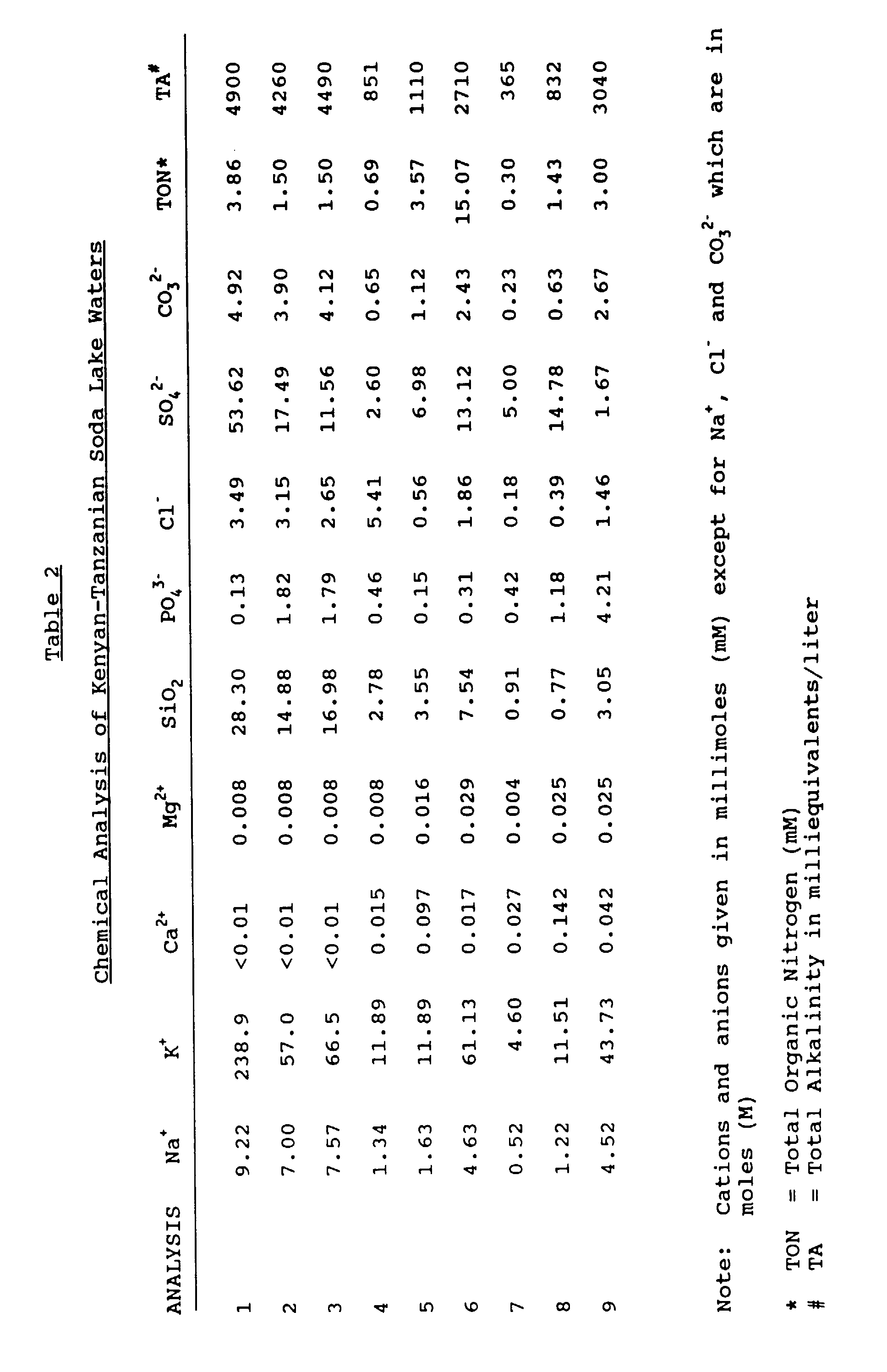
ORIGIN OF THE STRAINS ARRANGED BY CLUSTER CLUSTER STRAIN SAMPLE ISOLATION MEDIUM LOCATION pH Temp. °C Conductivity mS/cm 1 30M.4 Magadi 12.5 55 60 A 1 87M.4 Magadi 12.3 56 >100 B 1 85M.4 Magadi 10.5 33 80.4 B 1 89M.4 Magadi 10.5 30 60-90 B 1 86M.4CT Magadi 12.3 56 >100 B 1 88M.4 Magadi NR NR NR B 2 82M.4 Magadi 12 48 87 B 2 100Nt.4 Natron NR NR NR B 2 98Nt.4CT Natron 10-10.5 35 35 C 2 99Nt.4 Natron NR 45 NR C 2 96LM.4 Little Magadi 11 37 >100 D 2 1021Nt.4 Natron NR NR NR B 2 104Nt.4 Natron 10-10.5 NR 45 B 3 83M.4 Magadi NR NR NR C 3 93dLM.4CT Little Magadi NR NR NR E 3 84M.4 Magadi 12 44 87.5 B 4 90M.4 Magadi NR NR NR E 4 95LM.4CT Little Magadi 11 37 >100 F 4 97Nt.4 Natron 10-10.5 35 35 C 4 105Nt.4 Natron 11 44 60-90 B 4 102dNt.4 Natron NR NR NR B 4 101Nt.4 Natron 11 40 26-36 C - 103Nt.4 Natron NR NR NR B - 31M.4 Magadi 12.5 55 60 A - 931LM.4 Little Magadi NR NR NR E * Clusters of microorganisms are obtained by analysis according to the principles of numerical taxonomy using the SSM/UPGMA method (see discussion below and Figure 1).
NR = not tested
The letter codes given for the Isolation Media refer to Appendix A. - A diversity of enrichment and isolation methods were applied. Some of the methods were specifically designed for the enrichment and isolation of haloalkaliphilic bacteria which exhibit specific types of enzyme activity at an alkaline pH. Other techniques of a more general nature were applied for the isolation of diverse sorts of haloalkaliphilic bacteria. In some cases, the specific conditions prevailing in the lakes (Table 2) were taken into account when experiments were performed for the isolation of bacteria.
- The different nutrient media employed for the isolation of the new haloalkaliphilic bacteria are designated Medium A - Medium F. The composition of the various media employed is shown in Appendix A.
- For the isolation of non-specific haloalkaliphilic organotrophic bacteria, soda lake water samples, or dilutions thereof were streaked out on an alkaline, saline nutrient agar, pH 10 - pH 10.5 (Medium A). Samples of a more solid consistency, mud, sediment, etc. were first suspended in an alkaline, saline nutrient broth (Medium A) before spreading on an alkaline, saline nutrient agar (Medium A). The bacteria were cultivated in a heated incubator, preferably at 37°C. In some cases, the samples were suspended in an alkaline, saline nutrient broth (Medium A) and the bacteria cultivated by shaking, preferably at 37°C for 2 - 7 days before spreading the broth onto an alkaline, saline nutrient agar (Medium A) for the isolation of bacterial colonies.
- For the isolation of haloalkaliphilic bacteria exhibiting specific types of enzyme activity, samples were spread onto alkaline, saline nutrient agar containing specific substrates such as lactalbumin or casein. In some instances, the bacteria in the sample may be enriched for 1 day or several weeks in a non-specific alkaline, saline nutrient broth such as Medium A before spreading the broth onto an alkaline, saline nutrient agar specific for the detection of bacteria exhibiting enzyme activity such as proteolytic activity.
- Twenty-five strains of bacteria isolated from in an around alkaline, hypersaline lakes were assigned to the category haloalkaliphile on the basis of their ability to grow in a NaCl concentration of 15% or more and at greater than pH 10.
- The 25 strains were tested for 107 characters. For practical purposes the characters were divided into 123 character states. The results were analyzed using the principles of numerical taxonomy (Sneath, P.H.A. and Sokal, R.R., in Numerical Taxonomy, W.H. Freeman & Co., San Francisco, 1973). The characters tested and manner of testing are compiled in Appendix B. In addition, Appendix C records how each character state was coded for taxonomic analysis.
- As controls, 5 known haloalkaliphilic archaeobacteria were subjected to the same analysis using the same conditions. These reference bacteria are the only available known haloalkaliphilic bacteria. These 5 known reference bacteria are recorded in Table 4 from which it will be seen that the "Type Strain" of the known species has been used where available.
Haloalkaliphilic Reference Strains RS2 Natronobacterium gregoryi NCIMB 2189 RS3 Natronobacterium magadii NCIMB 2190 RS4 Natronobacterium pharaonis NCIMB 2191 RS5 Natronobacterium pharaonis DSM 2160 RS6 Natronococcus occultus NCIMB 2192 - The phenetic data, consisting of 107 characters was scored for 123 two-state characters (presence-absence characters) using binary notation as indicated in Appendix C. Additive scaling was used where appropriate (e.g. growth on NaCl) and where necessary qualitative multistate characters (e.g. colony color) were sub-divided into several mutually exclusive character states. The data was set out in the form of an "n x t" matrix, whose t columns represent the t bacterial strains which are to be grouped on the basis of resemblances, and whose n rows are the unit characters. Taxonomic resemblance of the bacterial strains was estimated by means of a similarity coefficient (Sneath, P.H.A. and Sokal, R.R., Numerical Taxonomy, supra, pp. 114-187). Although many different coefficients have been used for biological classification, only a few have found regular use in bacteriology. We have chosen to apply two association coefficients (Sneath, P.H.A. and Sokal, R.R., ibid, p. 129 et seq.), namely, the Simple Matching and Jaccard coefficients. These have been frequently applied to the analysis of bacteriological data and have a wide acceptance by those skilled in the art since they have been shown to result in robust classifications.
- The coded data were analyzed using the TAXPAK program package (Sackin, M.J., "Programmes for classification and identification". In Methods in Microbiology, Volume 19 (eds. R.R. Colwell and R. Grigorova), pp. 459-494, Academic Press, London, 1987) run on a DEC VAX computer system at the University of Leicester, U.K.. In addition, the data were analyzed using the NTSYS-pc (version 1.50) program package run on a IBM PS/2 desk top computer (Rolf, F.J., Numerical taxonomy and multivariate analysis system, Applied Biostatistics Inc. and Exeter Publishing Ltd., Setauket, New York, 1988).
- A similarity matrix was constructed for all pairs of strains using the Simple Matching Coefficient (SSM), (Sneath, P.H.A. and Sokal, R.R., Numerical Taxonomy, p. 132; W.H. Freeman & Company, San Francisco, 1973) using the RTBNSIM program in TAXPAK. Cluster analysis of the similarity matrix was accomplished using the Unweighted Pair Group Method with Arithmetic Averages (UPGMA) algorithm, also known as the Unweighted Average Linkage procedure by running the SMATCLST sub-routine in TAXPAK.
- The result of the cluster analysis is a dendrogram which is provided in Figure 1. The dendrogram illustrates the levels of similarity between the bacterial strains. The dendrogram is obtained by using the DENDGR program in TAXPAK.
- The phenetic data were re-analyzed using the Jaccard Coefficient (SJ) (Sneath, P.H.A. and Sokal, R.R., Numerical Taxonomy, p. 131; W.H. Freeman & Company, San Francisco, 1973) by running the RTBNSIM program in TAXPAK. A further dendrogram was obtained by using the SMATCLST with UPGMA option and DENDGR sub-routines in TAXPAK and is illustrated in Figure 2.
- Figure 1 illustrates the results of the cluster analysis, based on the Simple Matching coefficient and the UPGMA algorithm, of 25 new, haloalkaliphilic bacteria isolated from in and around alkaline lakes, together with 5 known haloalkaliphilic bacteria.
- Four natural clusters or phenons of haloalkaliphilic are generated at the 78.5% similarity level. These four clusters include 22 of the 25 new, haloalkaliphilic bacteria isolated from alkaline lakes. Although the choice of 78.5% for the level of delineation may seem arbitrary, it is in keeping with current practices in numerical taxonomy (Austin, B. and Priest, F., in Modern Bacterial Taxonomy, p. 37; Van Nostrand Reinhold; Wokingham, U.K., (1986). Placing the delineation at a lower percentage would combine groups of clearly unrelated organisms whose definition is not supported by the data, while a higher percentage would produce a multitude of less well defined clusters. Furthermore, an inspection of the original data, especially the colony characteristics and the antibiotic sensitivity, indicates that Cluster 1 and
Cluster 2 contain exclusively archaeobacteria, and thatCluster 3 andCluster 4 contain only eubacteria. This conclusion is supported by chemotaxonomic evidence (see discussion below). The group membership of the clusters is further confirmed by the pattern of clusters obtained using the Jaccard coefficient (see below and Figure 2). - At the 78.5% level, 2 of the clusters (
Cluster 3 and Cluster 4) exclusively contain novel haloalkaliphilic eubacteria representing 9 of the newly isolated strains, and these may represent new taxa. Three of the new haloalkaliphilic strains fall outside the major clusters. These non-clustering strains are 103Nt.4, 31M.4 and 931LM.4 and their inter-relationships are more difficult to define, but they probably represent new phenons presently not described. - The distribution of positive characters in the clusters is given in Appendix E.
- The Jaccard coefficient is a useful adjunct to the Simple Matching coefficient as it can be used to detect phenons in the latter due to undue weight being attached to negative matching data. Consequently, the Jaccard coefficient is useful for confirming the validity of clusters defined initially by the use of the Simple Matching coefficient. The Jaccard coefficient is particularly useful in comparing biochemically unreactive or slow growing organisms (Austin, B. and Priest, F., supra, p. 37).
- The 4 clusters generated by the SSM/UPGMA method are recovered fully in the dendrogram produced by the SJ/UPGMA method (Figure 2). Although there is some rearrangement in the pattern of the clusters, the group memberships remain the same in both dendrograms. However, in this case the clusters are defined at the 59% (SJ) level (the minimum required to define Cluster 1 (SSM) in which case the (eubacterial)
Clusters - When the phenetic data was examined using the NTSYS programmes exactly the same result was achieved for the clustering of the strains.
- The centroid of each individual cluster generated by the SSM/UPGMA method was computed using the RGROUPS program in TAXPAK. The centroid of a cluster of points representing real organisms projected into hyperspace represents a hypothetical average organism. The centroid rarely, if ever, represents a real organism. Therefore, the Euclidean distances of each of the members of the cluster from the centroid of the cluster were calculated in order to establish which organism was closest to the hypothetical average organism. The organism closest to the centroid was designated the "centrotype organism" (indicated with the superscript "CT").
- The centrotype organism can be thought of as the "Type Strain" which most closely represents the essential and discriminating features of each particular cluster. The centrotype strains are recorded in Table 5.
Centrotype Strains Cluster Number Number of Strains in Cluster Mean Euclidean Centrotype Distance of Strains from Centroid Standard Deviation Strain Euclidean Distance from Centroid 1 7 3.14 0.72 86M.4 1.79 2 11 2.85 0.36 98Nt.4 2.14 3 3 3.61 1.08 93dLM.4 1.53 4 6 2.55 0.41 95LM.4 1.60 - An aerobic, coccoid bacterium. No spores observed.
- Haloalkaliphile. Grows at pH 10 on a medium containing 20% NaCl. Grows in the presence of 12-30% NaCl.
- On alkaline, saline, nutrient-agar (Medium A) forms salmon-pink colored, circular colonies, about 2 mm in diameter, which have a convex elevation and entire margin.
- Temperature: grows optimally at 30-40°C. Growth at 20°C but not at 45°C.
KOH Test negative Aminopeptidase Test negative Oxidase Reaction negative Catalase Reaction positive Hydrolysis of Gelatin negative Hydrolysis of Starch negative - Growth is inhibited by the antibiotics: gentamicin, ampicillin, penicillin G, chloramphenicol, streptomycin, tetracycline, oleandomycin, polymixin, rifampicin, neomycin, vancomycin and kanamycin. Growth is not inhibited by the antibiotics: erythromycin, novobiocin and bacitracin.
- Chemoorganotroph. Grows on complex substrates such as yeast extracts, peptones and casamino acids.
- The membrane lipids contain glycerol diether moieties, indicating the archaeobacteria nature of strain 86M.4.
- An aerobic, coccoid bacterium. No spores observed.
- Haloalkaliphile. Grows at pH 10 on a medium containing 20% NaCl. Grows in the presence of 12-30% NaCl.
- On alkaline, saline, nutrient-agar (Medium A) forms opaque, friable, pink colored, circular colonies, 1-2 mm in diameter, which have a convex elevation and entire margin.
- Temperature: grows optimally at 30-40°C. Growth at 20°C but not at 45°C.
KOH Test positive Aminopeptidase Test negative Oxidase Reaction positive Catalase Reaction positive Hydrolysis of Gelatin positive Hydrolysis of Starch positive - Growth is inhibited by the antibiotics: gentamicin, ampicillin, penicillin G, chloramphenicol, streptomycin, tetracycline, oleandomycin, polymixin, neomycin, vancomycin and kanamycin. Growth is not inhibited by the antibiotics: erythromycin, novobiocin, rifampicin and bacitracin.
- Chemoorganotroph. Grows on complex substrates such as yeast extracts, peptones and casamino acids.
- An aerobic, Gram-negative, rod-shaped bacterium. No spores observed.
- Haloalkaliphile. Grows at pH 10 on a medium containing 20% NaCl. Grows in the presence of 15-30% NaCl.
- On alkaline, saline, nutrient-agar (Medium A) forms opaque, mucoid, red colored, circular colonies, about 1 mm in diameter, which have a convex elevation and entire margin.
- Temperature: grows optimally at 30-40°C. Growth at 20°C but not at 45°C.
KOH Test positive Aminopeptidase Test negative Oxidase Reaction negative Catalase Reaction positive Hydrolysis of Gelatin positive Hydrolysis of Starch positive - Growth is inhibited by the antibiotics: streptomycin, tetracycline, polymixin, neomycin and kanamycin. Growth is not inhibited by the antibiotics: gentamicin, ampicillin, penicillin G, erythromycin, novobiocin, oleandomycin, rifampicin, vancomycin and bacitracin.
- Chemoorganotroph. Grows on complex substrates such as yeast extracts, peptones and casamino acids.
- An aerobic, Gram-negative, rod-shaped bacterium. No spores observed.
- Haloalkaliphile. Grows at pH 10 on a medium containing 20% NaCl. Grows in the presence of 8-30% NaCl.
- On alkaline, saline, nutrient-agar (Medium A) forms opaque, yellow colored, circular colonies, about 2 mm in diameter, which have a convex elevation and entire margin.
- Temperature: grows optimally at 30-40°C. Growth at 20°C but not at 45°C.
KOH Test positive Aminopeptidase Test negative Oxidase Reaction negative Catalase Reaction positive Hydrolysis of Gelatin positive Hydrolysis of Starch negative - Growth is inhibited by the antibiotics: gentamicin, streptomycin, tetracycline, polymixin, neomycin and kanamycin. Growth is not inhibited by the antibiotics: ampicillin, penicillin G, chloramphenicol, erythromycin, novobiocin, oleandomycin, rifampicin, vancomycin and bacitracin.
- Chemoorganotroph. Grows on complex substrates such as yeast extracts, peptones and casamino acids.
- The strains which do not fall into the four clusters defined here are also novel bacteria not previously known or described. These strains, coded 103Nt.4, 31M.4 and 931LM.4 may represent rarer varieties of haloalkaliphilic bacteria. A description of these "non-clustering" strains has been made so as to be able to distinguish these organisms from all other bacteria previously known and described.
- An aerobic, Gram-negative, rod-shaped bacterium. No spores observed.
- Haloalkaliphile, grows at pH 10 on a medium containing 20% NaCl. Grows in presence of 0-30% NaCl.
- On alkaline, saline, nutrient-agar (Medium A) forms opaque orange colored, circular colonies, 2-3 mm in diameter, which have a convex elevation and entire margin.
- Temperature: grows optimally at 30-40°C. Growth at 20°C but not at 45°C.
KOH test positive Aminopeptidase test negative Oxidase reaction negative Catalase reaction positive Hydrolysis of Gelatin positive Hydrolysis of Starch positive - Growth is inhibited by the antibiotics: gentamicin, chloramphenicol, fusidic acid, erythromycin, methicillin, oleandomycin, rifampicin, vancomycin, and bacitracin. Growth is not inhibited by the antibiotics: nitrofurantoin, ampicillin, nalidixic acid, sulphamethoxazole, trimethoprim, penicillin G, novobiocin, streptomycin, tetracycline, polymixin, neomycin, and kanamycin.
- Chemoorganotroph. Grows on complex substrates such as yeast extract, peptones and casamino acids. Growth is stimulated by a variety of simple sugars, amino acids and organic acids.
- The membrane lipids are based on fatty acid esters indicating the eubacterial nature of Strain 103Nt.4.
- An aerobic, Gram-positive, rod-shaped bacterium. No spores observed.
- Obligate haloalkaliphile, grows at pH 10 on a medium containing 20% NaCl. Grows in the presence of 15-30% NaCl. No growth in 12% NaCl.
- On alkaline, saline, nutrient-agar (Medium A) forms cream colored, circular colonies, about 1 mm in diameter, which have a convex elevation and entire margin.
- Temperature: grows optimally at 30-40°C. Grows at 20°C and 45°C, but not at 50°C.
KOH test negative Aminopeptidase test negative Oxidase reaction negative Catalase reaction negative Hydrolysis of Starch positive - Grows is inhibited by the antibiotics: sulphamethoxazole, trimethoprim, polymixin, rifampicin, and bacitracin. Growth is not inhibited by the antibiotics: gentamicin, nitrofurantoin, ampicillin, nalidixic acid, penicillin G, chloramphenicol, erythromycin, fusidic acid, methicillin, novobiocin, streptomycin, tetracycline, and oleandomycin.
- Chemoorganotroph. Grows on complex substrates such as yeast extract, peptones and casamino acids.
- The membrane lipids contain glycerol diether moieties indicating the archaeobacterial nature of Strain 31M.4.
- An aerobic, Gram-variable, coccoid bacterium. No spores observed.
- Haloalkaliphile, grows at pH 10 on a medium containing 20% NaCl. Grows in presence of 0-30% NaCl.
- On alkaline, saline, nutrient-agar (Medium A) forms pink colored, irregular colonies, 1-2 mm in diameter, which have a raised elevation and entire margin.
KOH test positive Oxidase reaction negative Hydrolysis of Starch positive - Growth is inhibited by the antibiotics: nitrofurantoin and trimethoprim.
- Growth is not inhibited by the antibiotics: gentamicin, ampicillin, nalidixic acid, penicillin G, chloramphenicol, erythromycin, fusidic acid, methicillin, novobiocin, streptomycin, tetracycline.
- Chemoorganotroph. Grows on complex substrates such as yeast extract, peptones and casamino acids.
- The membrane lipids contain glycerol diether moieties indicating the archaeobacterial nature of Strain 931LM.4.
- Chemotaxonomy is the study of the chemical variations of cells in relation to systematics. The analysis of chromosomal DNA, ribosomal RNA, proteins, cell walls and membranes, for example, can give valuable insights into taxonomic relationships and may be used as a further tool to classify or to verify the taxonomy of microorganisms (Goodfellow, M. and Minnikin, D.E. in Chemical Methods in Bacterial Systematics, (eds. Goodfellow, M. and Minnikin, D.E.), Academic Press, London and Orlando, FL, (1985), pp. 1-15).
- All membrane lipids of the archaeobacteria identified to date are characterized by unusual structural features, which can be considered to be specific taxonomic markers for this group of microorganisms. While all living organisms so far known have membrane lipids based on ester linkages, the archaeobacteria have lipids based on ether linkages. (De Rosa, M. et al, (1986), Microbiological Reviews, 50, 70-80).
- The membrane lipids were extracted from bacteria and analyzed by this layer chromatography according to the methods described by Ross, H.N.M. et al, ((1981), Journal of General Microbiology, 123, 75-80).
- The results of this analysis for representative strains of the haloalkaliphilic bacteria of the present invention are set out in Table 6. These show clearly that the strains of Cluster 1 and
Cluster 2 lack fatty acid methyl esters, but contain glycerol diethyl moieties characteristic of the archaeobacteria. The strains ofCluster 3 andCluster 4 contain fatty acid methyl esters but no glycerol diethyl moieties, thus confirming their identity as eubacteria. These results further underline a fundamental difference between the bacteria ofClusters 1 and 2 andClusters Core Lipids of Haloalkaliphilic Bacteria CLUSTER STRAIN CORE LIPID 1 30M.4 GDEM 87M.4 GDEM 89M.4 GDEM 86M.4CT GDEM 88M.4 GDEM 2 82M.4 GDEM 100Nt.4 GDEM 99Nt.4 GDEM 96LM.4 GDEM 102lNt.4 GDEM 104Nt.4 GDEM 3 84M.4 FAME 4 90M.4 FAME 105Nt.4 FAME 101Nt.4 FAME - 103Nt.4 FAME - 31M.4 GDEM - 93lLM.4 GDEM GDEM = glycerol diether moieties
FAME = fatty acid methyl esters - The haloalkaliphilic microorganisms of the present invention produce a variety of enzymes (c.f. Appendices D and E). These enzymes are capable of performing their functions at an extremely high pH and high salt concentrations, making them uniquely suited for their application in a variety of processes requiring such enzymatic activity in such environments or reaction conditions.
- Examples of the various applications for enzymes having alkali- and salt-tolerance are in detergent compositions, leather tanning, food treatment, waste treatment and in the textile industry. These enzymes may also be used for biotransformations, especially in the preparation of pure enantiomers.
- The haloalkaliphiles may easily be screened for the production of alkali- and salt-tolerant enzymes having, for example, lipolytic, proteolytic, starch-degrading or other activities using the methods described in Appendix B.
- The broth in which haloalkaliphilic bacteria are cultured typically contains one or more types of enzymatic activity. The broth containing the enzyme or enzymes may be used directly in the desired process after the removal of the bacteria therefrom by means of centrifugation or filtration, for example.
- If desired, the culture filtrate may be concentrated by freeze drying, before or after dialysis, or by ultrafiltration. The enzymes may also be recovered by precipitation and filtration. Alternatively, the enzyme or enzymes contained in the broth may be isolated and purified by chromatographic means or by gel electrophoresis, for example, before being applied to the desired process.
- The genes encoding these alkali- and salt-tolerant enzymes may be isolated, cloned and brought to expression in compatible expression hosts to provide a source of larger volumes of enzyme products which may be, if desired, more easily purified and used in a desired industrial application, should the wild-type strain fail to produce sufficient amounts of the desired enzyme, or does not ferment well.
- In one embodiment, the enzymatic preparation may be used in wash tests to determine the efficacy of the enzymatic activity.
- Enzyme preparations from the haloalkaliphilic bacteria may be tested in a specially developed mini-wash test using cotton swatches soiled, for example, with protein-, lipid-and/or starch-containing components. Prior to the wash test, the swatches can be pre-treated with a solution containing an anionic surfactant, sodium perborate and a bleach activator (TAED). After this treatment, the test swatches are rinsed in running demineralized water and air-dried. This treatment results in the fixation of the soil, making its removal more difficult.
- The washing tests may be performed using a defined detergent composition plus a specific amount of enzymatic activity in the presence of the test swatches. After washing, the swatches are rinsed in running demineralized water and air-dried. The reflectance of the test swatches is measured with a photometer.
-
Media Used in the Present Invention MEDIUM A Yeast Extract (Difco: Detroit, MI, USA) 10.0 gl-1 Casamino Acids (Difco) 7.5 gl-1 Trisodium citrate 3.0 gl-1 KCl 2.0 gl-1 MgSO4·7H2O 1.0 gl-1 MnCl2·4H2O 0.00036 gl-1 FeSO4·7H2O 0.05 gl-1 NaCl 200.0 gl-1 Na2CO3 18.5 gl-1 Agar 20.0 gl-1 MEDIUM B Yeast Extract 10.0 gl-1 Casamino Acids 7.5 gl-1 Trisodium citrate 3.0 gl-1 KCl 2.0 gl-1 MgSO4·7H2O 1.0 gl-1 MnCl2·4H2O 0.00036 gl-1 FeSO4·7H2O 0.05 gl-1 NaCl 200.0 gl-1 Na2CO3 18.5 gl-1 Casein 20.0 gl-1 Agar 20.0 gl-1 MEDIUM C Yeast Extract 10.0 gl-1 Casamino Acids 7.5 gl-1 Trisodium citrate 3.0 gl-1 KCl 2.0 gl-1 MgSO4·7H2O 1.0 gl-1 MnCl2·4H2O 0.00036 gl-1 FeSO4·7H2O 0.05 gl-1 NaCl 200.0 gl-1 Na2CO3 18.5 gl-1 Lactalbumin 10.0 gl-1 Agar 20.0 gl-1 MEDIUM D Yeast Extract 0.2 gl-1 Casamino Acids 0.15 gl-1 Trisodium citrate 1.5 gl-1 KCl 2.0 gl-1 MgSO4·7H2O 1.0 gl-1 MnCl2·4H2O 0.00036 gl-1 FeSO4·7H2O 0.05 gl-1 NaCl 150.0 gl-1 Na2CO3 150.0 gl-1 Casein 20.0 gl-1 Agar 20.0 gl-1 MEDIUM E Yeast Extract 0.2 gl-1 Casamino Acids 0.15 gl-1 Trisodium citrate 1.5 gl-1 KCl 2.0 gl-1 MgSO4·7H2O 1.0 gl-1 MnCl2·4H2O 0.00036 gl-1 FeSO4·7H2O 0.05 gl-1 NaCl 150.0 gl-1 Na2CO3 150.0 gl-1 Lactalbumin 10.0 gl-1 Agar 20.0 gl-1 MEDIUM F Glucose 0.2 gl-1 Peptone (Difco) 0.1 gl-1 Yeast Extract 0.1 gl-1 K2HPO4 1.0 gl-1 MgSO4·7H2O 0.2 gl-1 NaCl 40.0 gl-1 Na2CO3 10.0 gl-1 Casein 20.0 gl-1 Agar 20.0 gl-1 -
- 1. Character numbers 1 to 12
Colony color, size, form, elevation, margin
A suspension of bacteria was spread over an alkaline, saline, nutrient agar (Medium A) and cultivated at 37°C. Colonies were examined after 7 to 14 days. - 2. Character numbers 13 to 15
Cell morphology, Gram's stain reaction
Bacterial cells were cultivated in alkaline, saline, nutrient broth (Medium A without agar) until adequate growth was obtained. The cells were spun down in a centrifuge and resuspended in a small amount of fresh medium. A drop of the bacterial suspension was allowed to air-dry on a microscope slide. The Gram's staining test was performed using the Dussault modification (Journal of Bacteriology, 70, 484-485, 1955) with safranin as counterstain. - 3. Character number 16
KOH test
The test was performed using 3% KOH in 20% NaCl + 1% Na2CO3 on 7 to 14 days old bacterial cultures grown on alkaline, saline, nutrient agar (Medium A) as described by Halebian et al., in Journal of Clinical Microbiology, 13, 444-448, 1981 and compared with the reaction in solution containing only 20% NaCl + 1% Na2CO3. - 4. Character number 17
Aminopeptidase reaction
The test was performed using the diagnostic test strips Bactident® Aminopeptidase (E. Merck, Darmstadt, Germany). A yellow color within 30 minutes was recorded as a positive reaction. - 5. Character number 18
Oxidase reaction
Filter paper moistened with a 1% aqueous solution of N, N, N1, N1-tetramethyl-p-phenylenediamine or, oxidase identification discs (bioMérieux: Charbonières-les-Bains, France) were smeared with a young bacterial culture from alkaline, saline, nutrient agar. A purple color within 1 minute was recorded as a positive reaction. E. coli was used as a negative control. - 6. Character number 19
Catalase reaction
A bacterial colony from alkaline, saline, nutrient agar was suspended in a drop of 3% hydrogen peroxide solution, or "1D color catalase" reagent (bioMérieux). Bubbles of oxygen released was recorded as a positive reaction. - 7. Character number 20
Gelatin hydrolysis
Charcoal-gelatin discs (bioMérieux) or "chargels" (Oxoid) were incubated at 37°C in an alkaline, saline, nutrient broth (Medium A) together with bacteria. A black sediment indicated a positive reaction. - 8. Character number 21 and 39
Skim milk and starch hydrolysis test
Bacteria were inoculated on to alkaline, saline, nutrient agar (Medium A) supplemented with 5.0 g/l skim powder or 2.0 g/l starch, and incubated at 37°C. Areas of clearing around bacterial colonies in an otherwise opaque agar were recorded as a positive reaction. Zones of starch hydrolysis were confirmed by staining with iodine solution (lugol). - 9. Character numbers 22 - 29
NaCl tolerance
Two methods were applied. - (a) Bacterial strains were cultivated at 37°C on an alkaline, nutrient agar (Medium A) containing 0%, 4%, 8%, 12%, 15%, 20%, 25% or 30% (w/v) NaCl. The agar plates were examined for bacterial growth after 7 - 14 days.
- (b) Bacterial strains were cultivated at 37°C in an alkaline nutrient broth (Medium A) containing 0%, 4%, 8%, 12%, 15%, 20%, 25% or 30% (w/v) NaCl. Bacterial growth was monitored regularly up to 14 days by optical density measurements using a Klett meter (green filter).
- 10.
Bacterial numbers
Growth temperature
Bacterial strains were inoculate in alkaline, saline, nutrient broth (Medium A) and incubated at 10°C, 15°C, 20°C, 45°C or 50°C. Bacterial growth was monitored regularly up to 14 days by optical density measurements using a Klett meter (green filter). - 11. Character numbers 32- 38
Carbohydrate utilisation
A minimal medium composed (g/l distilled water) of yeast extract, 1.0; KNO3, 1.0; KCl, 2.0; MgSO47H2O, 1.0; MnCl2·4H2O, 0.00036; FeSO4·7H2O, 0.05; NaCl, 200.0; Na2CO3, 18.5; agar, 20.0 was supplemented with 2.0 g/l of the carbohydrate under test and poured into square Petri dishes.
Bacteria were inoculated, using a 25 point multi-point inoculator, from 1.0 ml of a bacterial suspension in an alkaline, saline, nutrient broth (Medium A). The agarplates were incubated at 37°C for up to 14 days. The results were recorded by comparing bacterial growth on minimal nutrient medium containing a carbohydrate supplement with growth on a minimal medium without the carbohydrate under test. - 12. Character numbers 40 - 51
Amino acids as carbon and nitrogen source
The same technique was employed as for tests 32 - 38. - 13. Character numbers 52 - 70
Enzymatic activities
Use was made of the commercially available test strip APIZYM (API-bioMérieux) which was used according to the manufacturer's instructions, except that the haloalkaliphilic bacterial cells were suspended in alkaline, saline, nutrient broth (Medium A). The strips were incubated at 37°C for 4 hours. - 14. Character numbers 71 - 91
Antibiotic sensitivity
A light suspension of bacteria in alkaline, saline, nutrient broth was spread on the surface of alkaline nutrient, saline agar (Medium A) and allowed to dry. Commercially available antibiotic susceptibility test disks (Oxoid or Mast Laboratories: Merseyside, U.K.) were applied to the agar surface. The bacteria were cultivated at 37°C for up to 14 days. Clear zones around the antibiotic disks indicated sensitivity and were recorded as positive. - 15. Character numbers 92 - 123
Growth on carbon substrates
Use was made of the commercially available test strip ATB 32 GN (API-bioMerieux: La Balme les Grottes, France). The strips were used according to the manufacturer's instructions but with the addition of 1.0 ml of a solution containing 20% NaCl and 1% Na2CO3 to the vials of basal medium provided. The strips were incubated at 37°C for 48 hours. -
-
Unit Tests for Analysis by Numerical Taxonomy TEST CHARACTER NUMBER CHARACTER STATE POSITIVE (present) NEGATIVE (absent) Colony color 1 yellow 1 0 2 cream/beige 1 0 3 orange 1 0 4 pink/red 1 0 Colony size (diameter in mm) 5 ≤ 1 mm 1 0 6 > 1 mm 1 0 Colony form 7 circular 1 0 8 punctiform 1 0 9 irregular 1 0 Colony elevation 10 convex 1 0 11 raised 1 0 Colony margin 12 entire 1 0 Cell morphology 13 rod = 1 coccus = 0 Gram's stain 14 Gram positive 1 0 15 Gram negative 1 0 KOH test 16 1 0 Aminopeptidase reaction 17 1 0 Oxidase reaction 18 1 0 Catalase reaction 19 1 0 Gelatin hydrolysis 20 1 0 Skim milk test 21 1 0 NaCl tolerance 22 growth at 0% 1 0 23 growth at 4% 1 0 24 growth at 8% 1 0 25 growth at 12% 1 0 26 growth at 15% 1 0 27 growth at 20% 1 0 28 growth at 25% 1 0 29 growth at 30% 1 0 Growth temperature 30 growth at ≤ 20°C 1 0 31 growth at ≥ 45°C 1 0 Carbohydrate utilization 32 Fumerate 1 0 33 Fructose 1 0 34 Succinate 1 0 35 Formate 1 0 36 Lactose 1 0 37 Galactose 1 0 38 Xylose 1 0 39 Starch 1 0 Amino acids as carbon and nitrogen sources 40 Serine 1 0 41 Proline 1 0 42 Asparagine 1 0 43 Arginine 1 0 44 Alanine 1 0 45 Lysine 1 0 46 Methionine 1 0 47 Phenylalanine 1 0 48 Glycine 1 0 49 Valine 1 0 50 Glutamate 1 0 51 Leucine 1 0 Enzymatic activity 52 Alkaline phosphatase 1 0 53 Esterase (C4) 1 0 54 Esterase lipase (C8) 1 0 55 Lipase (C14) 1 0 56 Leucine arylamidase 1 0 57 Valine arylamidase 1 0 58 Cystine arylamidase 1 0 59 Trypsin 1 0 60 Chymotrypsin 1 0 61 Acid phosphatase 1 0 62 Naphthol-AS-BI-phosphohydrolase 1 0 63 α-galactosidase 1 0 64 β-galactosidase 1 0 65 β-glucuronidase 1 0 66 α-glucosidase 1 0 67 β-glucosidase 1 0 68 N-acetyl-β-glucosaminidase 1 0 69 α-mannosidase 1 0 70 α-fucosidase 1 0 Antibiotic sensitivity 71 Gentamicin 10 µg 1 0 72 Nitrofurantoin 50 µg 1 0 73 Ampicillin 25 µg 1 0 (inhibition of growth = positive) 74 Nalidixic Acid 30 µg 1 0 75 Sulphmethoxazole 50 µg 1 0 76 Trimethoprim 2·5 µg 1 0 77 Penicillin G 10 IU 1 0 78 Chloramphenicol 25 µg 1 0 79 Erythromycin 5 µg1 0 80 Fusidic Acid 10 µg 1 0 81 Methicillin 10 µg 1 0 82 Novobiocin 5 µg1 0 83 Streptomycin 10 µg 1 0 84 Tetracycline 25 µg 1 0 85 Oleandomycin 5 µg1 0 86 Polymixin 300 IU 1 0 87 Rifampicin 2 µg1 0 88 Neomycin 30 µg 1 0 89 Vancomycin 30 µg1 0 90 Kanamycin 30 µg 1 0 91 Bacitracin 10 IU 1 0 Growth on Carbon Substrates (ATB) 92 Rhamnose 1 0 93 N-acetylglucosamine 1 0 94 Ribose 1 0 95 Inositol 1 0 96 Saccharose 1 0 97 Maltose 1 0 98 Itaconate 1 0 99 Suberate 1 0 100 Malonate 1 0 101 Acetate 1 0 102 Lactate 1 0 103 Alanine 1 0 104 Mannitol 1 0 105 Glucose 1 0 106 Salicin 1 0 107 Melibiose 1 0 108 Fucose 1 0 109 Sorbitol 1 0 110 Arabinose 1 0 111 Propionate 1 0 112 Caprate 1 0 113 Valerate 1 0 114 Citrate 1 0 115 Histidine 1 0 116 5-ketogluconate 1 0 117 Glycogen 1 0 118 3-hydroxybenzoate 1 0 119 Serine 1 0 120 2-ketogluconate 1 0 121 3-hydroxybenzoate 1 0 122 4-hydroxybutyrate 1 0 123 Proline 1 0 -
Screening for Proteolytic, Amylolytic and Lipolytic Activity Proteolytic Activity Cluster 1 STRAIN LACTALBUMIN CASEIN GELATIN 30M.4 n.t. n.t. n.t. 87M.4 n.t. + + 85M.4 n.t. + + 89M.4 n.t. + + 86M.4CT n.t. + - 88M.4 n.t. + + RS4 n.t. n.t. + Cluster 2STRAIN LACTALBUMIN CASEIN GELATIN 82M.4 n.t. + + 100Nt.4 n.t. + + 98Nt.4CT + n.t. + 99Nt.4 + n.t. - RS5 n.t. n.t. + RS6 n.t. n.t. + RS2 n.t. n.t. + RS3 n.t. n.t. + 96LM.4 n.t. + + 1021Nt.4 n.t. + n.t. 104Nt.4 n.t. + + Cluster 3STRAIN LACTALBUMIN CASEIN GELATIN 83M.4 + n.t. + 93dLM.4CT + n.t. + 84M.4 n.t. + - Cluster 4STRAIN LACTALBUMIN CASEIN GELATIN 90M.4 + n.t. + 95LM.4CT n.t. + + 97Nt.4 + n.t. + 105Nt.4 n.t. + + 102dNt.4 n.t. + + 101Nt.4 + n.t. + Non-Clustering Strains STRAIN LACTALBUMIN CASEIN GELATIN 103Nt.4 n.t. + + 31M.4 n.t. n.t. n.t. 931LM.4 + n.t. n.t. Amylolytic and Lipolytic Activity Cluster 1 STRAIN STARCH HYDROLYSIS ESTERASE LIPASE LIPASE 30M.4 - + - 87M.4 + + - 85M.4 - + - 89M.4 + + - 86M.4CT - + - 88M.4 - + - RS4 - + - Cluster 2STRAIN STARCH HYDROLYSIS ESTERASE LIPASE LIPASE 82M.4 - + - 100Nt.4 - + - 98Nt.4CT + + - 99Nt.4 + + - RS5 - + - RS6 + + - RS2 - + - RS3 - + - 96LM.4 - + + 1021Nt.4 - + + 104Nt.4 - + - Cluster 3STRAIN STARCH HYDROLYSIS ESTERASE LIPASE LIPASE 83M.4 + + - 93dLM.4CT + + - 84M.4 + + - Cluster 4STRAIN STARCH HYDROLYSIS ESTERASE LIPASE LIPASE 90M.4 - + - 95LM.4CT - + - 97Nt.4 - + - 105Nt.4 - + - 102dNt.4 - + - 101Nt.4 - + - Non-clustering Strains STRAIN STARCH HYDROLYSIS ESTERASE LIPASE LIPASE 103Nt.4 + + - 31M.4 + + - 931LM.4 + + + n.t. = not tested - Proteolytic Activity determined on media B - F (Appendix A) and according to character 20 (Appendix B)
- Starch Hydrolysis determined according to character 39 (Appendix B)
- Esterase Lipase Activity determined according to character 54 (Appendix B)
- Lipase Activity determined according to character 55 (Appendix B)
-
Distribution of Positive Characters to Clusters of Haloalkaliphilic Bacteria Defined at the 78.5% Similarity Level (SSM) CHARACTER 1 2 3 4 Colony color yellow 0 0 0 67 Colony color cream/beige 14 9 33 17 Colony color orange 0 0 0 17 Colony color pink/red 86 91 67 0 Colony size ≤ 1 mm 57 91 100 0 Colony size ≥ 1 mm 43 9 0 100 Colony circular 71 82 100 100 Colony punctiform 29 18 0 0 Colony irregular 0 0 0 0 Colony elevation convex 100 100 100 100 Colony elevation raised 0 0 0 0 Colony margin entire 100 100 100 100 Cells rod-shaped 29 36 67 83 Gram positive 29 27 33 17 Gram negative 43 82 67 67 KOH test 43 100 100 33 Aminopeptidase reaction 0 0 0 0 Oxidase reaction 0 9 0 17 Catalase reaction 100 91 100 100 Gelatin hydrolysis 71 82 67 100 Skim milk test 0 0 0 17 Growth at 0% NaCl 0 0 0 17 Growth at 4% NaCl 0 9 33 33 Growth at 8% NaCl 29 18 33 83 Growth at 12% NaCl 86 100 67 100 Growth at 15% NaCl 100 100 100 100 Growth at 20% NaCl 100 100 100 100 Growth at 25% NaCl 100 100 100 100 Growth at 30% NaCl 71 100 100 100 Growth at ≤ 20°C 57 64 100 33 Growth at ≥ 45°C 14 27 33 33 Fumarate 57 82 67 33 Fructose 43 91 33 33 Succinate 57 82 33 33 Formate 0 55 0 0 Lactose 0 0 0 0 Galactose 57 91 67 33 Xylose 29 0 0 17 Starch 29 27 100 0 Serine 14 9 33 0 Proline 57 91 67 33 Asparagine 0 9 0 0 Arginine 57 91 67 33 Alanine 57 91 67 33 Lysine 43 82 67 0 Methionine 29 18 33 0 Phenylalanine 0 0 0 17 Glycine 0 0 0 0 Valine 43 91 33 0 Glutamate 14 0 33 0 Leucine 0 9 0 0 Alkaline phosphatase 0 27 0 0 Esterase (C4) 100 100 100 100 Esterase Lipase (C8) 100 100 100 100 Lipase (C14) 0 18 0 0 Leucine arylamidase 100 100 100 83 Valine arylamidase 14 73 0 0 Cystine arylamidase 14 18 0 0 Trypsin 14 9 0 0 Chymotrypsin 29 36 0 33 Acid phosphatase 0 18 0 17 Naphthol-AS-BI-phosphohydrolase 0 27 0 0 α-galactosidase 0 0 0 0 β-galactosidase 0 0 0 0 β-glucuronidase 0 0 0 0 α-glucosidase 57 55 33 33 β-glucosidase 29 0 0 0 N-acetyl-β-glucosaminidase 0 9 0 0 α-mannosidase 0 0 0 0 α-fucosidase 0 0 0 0 Gentamycin 0 0 67 50 Nitrofurantoin 43 82 0 0 Ampicillin 0 0 100 67 Nalidixic Acid 0 18 0 0 Sulphmethoxazole 43 82 0 17 Trimethoprim 57 91 0 17 Penicillin B 0 0 100 100 Chloramphenicol 0 0 100 100 Erythromycin 86 73 100 100 Fusidic Acid 14 9 0 17 Methicillin 0 0 0 0 Novobiocin 100 82 33 100 Streptomycin 0 18 67 0 Tetracycline 14 9 33 17 Oleandomycin 0 0 100 100 Polymixin 0 0 0 0 Rifampicin 14 64 67 83 Neomycin 0 0 0 0 Vancomycin 0 0 100 83 Kanamycin 0 0 0 17 Bacitracin 100 82 100 100 Rhamnose 57 0 33 0 N-acetylglucosamine 71 0 33 0 Ribose 0 0 33 0 Inositol 71 9 67 0 Saccharose 71 9 33 33 Maltose 71 9 67 17 Itaconate 0 0 0 0 Suberate 14 0 33 0 Malonate 71 0 67 0 Acetate 71 0 67 0 Lactate 71 0 67 0 Alanine 71 9 33 0 Mannitol 57 0 33 0 Glucose 71 0 33 17 Salicin 29 0 0 0 Melibiose 57 0 67 0 Fucose 43 0 0 0 Sorbitol 43 0 33 0 Arabitol 43 0 33 0 Propionate 57 0 67 0 Caprate 14 27 0 17 Valerate 57 0 67 0 Citrate 71 0 67 17 Histidine 57 0 67 17 5-ketogluconate 14 0 33 0 Glycogen 71 9 67 0 3-hydroxybenzoate 0 0 0 0 Serine 57 73 67 0 2-ketogluconate 43 73 67 33 3-hydroxybutyrate 71 0 67 17 4-hydroxybenzoate 71 18 67 0 Proline 71 55 67 0
Claims (8)
- A pure bacterial culture useful for the production of alkali-tolerant and salt-tolerant enzymes, wherein the bacteria consist of aerobic, haloalkaliphilic bacteria giving:with the proviso that said culture is other than that of deposited organism NCIMB 2191.a) a positive response in the following tests:1) catalase2) growth in 15% to 25% NaCl3) esterase4) esterase lipase5) leucine arylamidase6) novobiocin7) bacitracin;b) a negative response to the following tests:1) oxidase2) growth in 4% NaCl3) alkaline phosphatase4) acid phosphatase5) ampicillin6) penicillin G7) chloramphenicol8) oleandomycin9) vancomycin.
- A pure bacterial culture useful for the production of alkali-tolerant and salt-tolerant enzymes, wherein the bacteria consist of aerobic, haloalkaliphilic bacteria giving:with the proviso that said culture is other than that of deposited organism NCIMB 2184, NCIMB 2140, DSM 2160 or NCIMB 2142.a) a positive response in the following tests:1) KOH test2) growth in 12 % to 30% NaCl3) esterase4) esterase lipase5) leucine arylamidase;b) a negative response in the following tests:1) growth in 0% NaCl2) ampicillin3) penicillin G4) chloramphenicol5) oleandomycin6) vancomycin.
- A pure bacterial culture useful for the production of alkali-tolerant and salt-tolerant enzymes, wherein the bacteria consist of aerobic, haloalkaliphilic bacteria giving:a) a positive response in the following tests:1) colonies circular, convex, entire2) KOH test3) catalase4) growth in 15% to 30% NaCl5) growth at 20°C or less6) starch hydrolysis7) esterase8) esterase lipase9) leucine arylamidase10) ampicillin11) penicillin G12) chloramphenicol13) oleandomycin14) vancomycin15) bacitracin;b) a negative response in the following tests:1) oxidase2) growth in 0% NaCl3) alkaline phosphatase4) acid phosphatase
- A pure bacterial culture useful for the production of alkali-tolerant and salt-tolerant enzymes, wherein the bacteria consist of aerobic, haloalkaliphilic bacteria giving:a) a positive response in the following tests:1) colonies circular, convex, entire2) catalase3) gelatin hydrolysis4) grows in 12% to 30% NaCl5) esterase6) esterase lipase7) penicillin G8) chloramphenicol9) novobiocin10) oleandomycin11) bacitracinb) a negative response in the following tests:1) colonies colored red or pink2) starch hydrolysis3) alkaline phosphatase
- A pure bacterial culture useful for the production of alkali-tolerant and salt-tolerant enzymes, wherein the bacteria consist of aerobic, Gram-negative, rod-shaped haloalkaliphilic bacteria having the following characteristics:a) on alkaline, saline, nutrient agar, forms opaque, orange colored circular colonies, 2-3 mm in diameter, which have a convex elevation and entire margin;b) grows at 20%c) no growth at 45°Cd) KOH test is positivee) aminopeptidase is test negativef) oxidase test is negativeg) catalase test is positiveh) grows in presence of 0% to 30% NaCli) hydrolysis of gelatin is positivej) hydrolysis of starch is positivek) growth is inhibited by the antibiotics:1) gentamicin2) chloramphenicol3) fusidic acid4) erythromycin5) methicillin6) oleandomycin7) rifampicin8) vancomycin9) bacitracinl) growth is not inhibited by the antibiotics:1) nitrofurantoin2) ampicillin3) nalidixic acid4) sulphamethoxazole5) trimethoprim6) penicillin G7) novobiocin8) streptomycin9) tetracycline10) polymixin11) neomycin12) kanamycinm) grows on simple sugarsn) grows on amino acidso) grows on organic acidsp) grows on yeast extract and peptonesq) contains membrane lipids based on fatty acid esters.
- A pure bacterial culture useful for the production of alkali-tolerant and salt-tolerant enzymes, wherein the bacteria consist of aerobic, Gram-positive, rod-shaped haloalkaliphilic bacteria having the following characteristics:a) on alkaline, saline, nutrient agar, forms cream colored circular colonies, above 1 mm in diameter, which have a convex elevation and entire margin;b) grows at 20°Cc) grows at 45°Cd) KOH test is negativee) aminopeptidase test is negativef) oxidase test is negativeg) catalase test is negativeh) obligate halophilei) grows in the presence of 15% to 30% NaClj) hydrolysis of starch is positivek) growth is not inhibited by the antibiotics:1) gentamicin2) nitrofurantoin3) ampicillin4) nalidixic acid5) penicillin G6) chloramphenicol7) erythromycin8) fusidic acid9) methicillin10) novobiocin11) streptomycin12) tetracycline13) oleandomycinl) growth is inhibited by the antibiotics:1) sulphamethoxazole2) trimethoprim3) polymixin4) rifampicin5) bacitracinm) grows on yeast extract and peptonesn) contains membrane lipids composed of glycerol diether moieties.
- A pure bacterial culture useful for the production of alkali-tolerant and salt-tolerant enzymes, wherein the bacteria consist of aerobic, Gram-variable, coccoid-shaped haloalkaliphilic bacteria having the following characteristics:a) on alkaline, saline, nutrient agar, forms pink-colored, irregular colonies, 1-2 mm in diameter, which have a raised elevation and entire margin;b) KOH test is positivec) oxidase test is negatived) grows in the presence of 0% to 30% NaCle) hydrolysis of starch is positivef) growth is inhibited by the antibiotics:1) nitrofurantoin2) trimethoprimg) growth is not inhibited by the antibiotics:1) gentamicin2) ampicillin3) nalidixic acid4) penicillin G5) chloramphenicol6) erythromycin7) fusidic acid8) methicillin9) novobiocin10) streptomycin11) tetracyclineh) grows on yeast extract and peptonesi) contains membrane lipids composed of glycerol diether moieties.
- A method for the preparation of alkali- and salt-tolerant enzymes comprising:culturing the bacteria of any one of claims 1-7 in a culture medium;separating the bacteria from the culture medium; andrecovering enzyme activity from the culture medium.
Priority Applications (1)
| Application Number | Priority Date | Filing Date | Title |
|---|---|---|---|
| EP92203366A EP0540127B1 (en) | 1991-10-31 | 1992-10-30 | Haloalkaliphilic Microorganisms |
Applications Claiming Priority (3)
| Application Number | Priority Date | Filing Date | Title |
|---|---|---|---|
| EP91202834 | 1991-10-31 | ||
| EP91202834 | 1991-10-31 | ||
| EP92203366A EP0540127B1 (en) | 1991-10-31 | 1992-10-30 | Haloalkaliphilic Microorganisms |
Publications (2)
| Publication Number | Publication Date |
|---|---|
| EP0540127A1 EP0540127A1 (en) | 1993-05-05 |
| EP0540127B1 true EP0540127B1 (en) | 1999-12-29 |
Family
ID=8207975
Family Applications (1)
| Application Number | Title | Priority Date | Filing Date |
|---|---|---|---|
| EP92203366A Expired - Lifetime EP0540127B1 (en) | 1991-10-31 | 1992-10-30 | Haloalkaliphilic Microorganisms |
Country Status (13)
| Country | Link |
|---|---|
| EP (1) | EP0540127B1 (en) |
| JP (1) | JPH06504207A (en) |
| KR (1) | KR930703431A (en) |
| AT (1) | ATE188246T1 (en) |
| AU (1) | AU661873B2 (en) |
| CA (1) | CA2097431A1 (en) |
| DE (1) | DE69230490T2 (en) |
| DK (1) | DK0540127T3 (en) |
| ES (1) | ES2141718T3 (en) |
| FI (1) | FI932903L (en) |
| NO (1) | NO309199B1 (en) |
| NZ (1) | NZ244949A (en) |
| WO (1) | WO1993009219A1 (en) |
Families Citing this family (10)
| Publication number | Priority date | Publication date | Assignee | Title |
|---|---|---|---|---|
| WO2001030984A2 (en) * | 1999-10-27 | 2001-05-03 | Aarhus Universitet | Novel halotolerant and halophilic enzymes and the use of halotolerant and halophilic enzymes |
| WO2002081761A2 (en) * | 2001-04-10 | 2002-10-17 | Billiton Sa Limited | Bioleaching of a sulphide concentrate in a saline solution |
| WO2004101763A2 (en) | 2003-05-12 | 2004-11-25 | Genencor International, Inc. | Novel lipolytic enzyme lip1 |
| EP1625217B1 (en) * | 2003-05-12 | 2014-12-17 | Danisco US Inc. | Novel lipolytic enzyme elip |
| US20070213518A1 (en) | 2003-05-12 | 2007-09-13 | Jones Brian E | Novel Lipolytic Enzyme Lip2 |
| SG148934A1 (en) | 2007-06-11 | 2009-01-29 | Novozymes As | A process for combined biopolishing and bleach clean-up |
| EP2885405B1 (en) | 2012-08-16 | 2019-04-17 | Novozymes A/S | Method for treating textile with endoglucanase |
| WO2014086659A2 (en) | 2012-12-06 | 2014-06-12 | Ahmedabad Textile Industry's Research Association | Method for enzymatical preparation of textiles |
| EP2970542B1 (en) | 2013-03-15 | 2019-07-24 | Lubrizol Advanced Materials, Inc. | Itaconic acid copolymers |
| WO2015138872A1 (en) | 2014-03-14 | 2015-09-17 | Lubrizol Advanced Materials, Inc. | Itaconic acid polymers and copolymers |
Family Cites Families (1)
| Publication number | Priority date | Publication date | Assignee | Title |
|---|---|---|---|---|
| JPH05501960A (en) * | 1990-08-06 | 1993-04-15 | ジェネンコー インターナショナル インコーポレイテッド | Gram-negative alkaliphilic microorganism |
-
1992
- 1992-10-30 AU AU29575/92A patent/AU661873B2/en not_active Ceased
- 1992-10-30 AT AT92203366T patent/ATE188246T1/en not_active IP Right Cessation
- 1992-10-30 FI FI932903A patent/FI932903L/en unknown
- 1992-10-30 NZ NZ244949A patent/NZ244949A/en unknown
- 1992-10-30 WO PCT/NL1992/000194 patent/WO1993009219A1/en not_active Ceased
- 1992-10-30 DK DK92203366T patent/DK0540127T3/en active
- 1992-10-30 ES ES92203366T patent/ES2141718T3/en not_active Expired - Lifetime
- 1992-10-30 JP JP5508333A patent/JPH06504207A/en active Pending
- 1992-10-30 DE DE69230490T patent/DE69230490T2/en not_active Expired - Lifetime
- 1992-10-30 EP EP92203366A patent/EP0540127B1/en not_active Expired - Lifetime
- 1992-10-30 CA CA002097431A patent/CA2097431A1/en not_active Abandoned
-
1993
- 1993-06-24 KR KR1019930701945A patent/KR930703431A/en not_active Ceased
- 1993-06-29 NO NO932381A patent/NO309199B1/en not_active IP Right Cessation
Also Published As
| Publication number | Publication date |
|---|---|
| NZ244949A (en) | 1996-02-27 |
| CA2097431A1 (en) | 1993-05-01 |
| ATE188246T1 (en) | 2000-01-15 |
| DK0540127T3 (en) | 2000-06-13 |
| NO309199B1 (en) | 2000-12-27 |
| FI932903A7 (en) | 1993-06-23 |
| ES2141718T3 (en) | 2000-04-01 |
| AU2957592A (en) | 1993-06-07 |
| KR930703431A (en) | 1993-11-30 |
| NO932381L (en) | 1993-06-29 |
| JPH06504207A (en) | 1994-05-19 |
| AU661873B2 (en) | 1995-08-10 |
| FI932903A0 (en) | 1993-06-23 |
| WO1993009219A1 (en) | 1993-05-13 |
| FI932903L (en) | 1993-06-23 |
| DE69230490T2 (en) | 2000-05-11 |
| DE69230490D1 (en) | 2000-02-03 |
| EP0540127A1 (en) | 1993-05-05 |
| NO932381D0 (en) | 1993-06-29 |
Similar Documents
| Publication | Publication Date | Title |
|---|---|---|
| AU661873B2 (en) | Haloalkaliphilic microorganisms | |
| US5401657A (en) | Gram-positive alkaliphilic microorganisms | |
| US5858748A (en) | Gram-positive alkaliphilic microorganisms | |
| US6420147B1 (en) | Haloalkaliphilic microorganisms | |
| US5719047A (en) | Gram-negative alkaliphilic microorganisms | |
| Singh et al. | Achromobacter panacis sp. nov., isolated from rhizosphere of Panax ginseng | |
| KR100215259B1 (en) | Gram negative alkali microorganism | |
| CN108676738A (en) | One plant of production alkali protease Halophiles and its application | |
| EP0523769B1 (en) | Gram-positive alkaliphilic microorganisms | |
| US5571716A (en) | Gram-negative alkaliphilic microorganisms | |
| Tahoun et al. | Bacillus subtilis and Pseudomonas aeruginosa as potent protease enzyme producers isolated from the aquatic environment | |
| Abirami et al. | Partial purification of extracellular amylase from halotolerant actinomycetes Streptomyces brasiliensis MML2028. | |
| Cherekar et al. | Production and characterization of a haloalkaline pectinase from Halomonas pantellerinsis strain SSL8 isolated from Sambhar lake, Rajasthan. | |
| Ateş | Identification of Halophilic Microorganisms isolated from Van Lake and Determination of their Extremozymes | |
| Kang et al. | Yeon-Ju Kim, Van-An Hoang, Kwi-Sik Bae & Deok-Chun Yang | |
| LARSEN et al. | ISOLATION OF AN AMYLASE PRODUCING BACTERIA | |
| NZ239297A (en) | Gram negative alkaliphilic bacterial cultures and their use in producing alkali tolerant enzymes |
Legal Events
| Date | Code | Title | Description |
|---|---|---|---|
| PUAI | Public reference made under article 153(3) epc to a published international application that has entered the european phase |
Free format text: ORIGINAL CODE: 0009012 |
|
| AK | Designated contracting states |
Kind code of ref document: A1 Designated state(s): AT BE CH DE DK ES FR GB GR IE IT LI LU MC NL PT SE |
|
| 17P | Request for examination filed |
Effective date: 19930329 |
|
| 17Q | First examination report despatched |
Effective date: 19950516 |
|
| RAP1 | Party data changed (applicant data changed or rights of an application transferred) |
Owner name: GENENCOR INTERNATIONAL, INC. |
|
| GRAG | Despatch of communication of intention to grant |
Free format text: ORIGINAL CODE: EPIDOS AGRA |
|
| GRAG | Despatch of communication of intention to grant |
Free format text: ORIGINAL CODE: EPIDOS AGRA |
|
| GRAG | Despatch of communication of intention to grant |
Free format text: ORIGINAL CODE: EPIDOS AGRA |
|
| GRAH | Despatch of communication of intention to grant a patent |
Free format text: ORIGINAL CODE: EPIDOS IGRA |
|
| GRAH | Despatch of communication of intention to grant a patent |
Free format text: ORIGINAL CODE: EPIDOS IGRA |
|
| GRAA | (expected) grant |
Free format text: ORIGINAL CODE: 0009210 |
|
| AK | Designated contracting states |
Kind code of ref document: B1 Designated state(s): AT BE CH DE DK ES FR GB GR IE IT LI LU MC NL PT SE |
|
| PG25 | Lapsed in a contracting state [announced via postgrant information from national office to epo] |
Ref country code: IT Free format text: LAPSE BECAUSE OF FAILURE TO SUBMIT A TRANSLATION OF THE DESCRIPTION OR TO PAY THE FEE WITHIN THE PRE;WARNING: LAPSES OF ITALIAN PATENTS WITH EFFECTIVE DATE BEFORE 2007 MAY HAVE OCCURRED AT ANY TIME BEFORE 2007. THE CORRECT EFFECTIVE DATE MAY BE DIFFERENT FROM THE ONE RECORDED.SCRIBED TIME-LIMIT Effective date: 19991229 Ref country code: SE Free format text: THE PATENT HAS BEEN ANNULLED BY A DECISION OF A NATIONAL AUTHORITY Effective date: 19991229 Ref country code: GR Free format text: LAPSE BECAUSE OF NON-PAYMENT OF DUE FEES Effective date: 19991229 Ref country code: AT Free format text: LAPSE BECAUSE OF FAILURE TO SUBMIT A TRANSLATION OF THE DESCRIPTION OR TO PAY THE FEE WITHIN THE PRESCRIBED TIME-LIMIT Effective date: 19991229 Ref country code: LI Free format text: LAPSE BECAUSE OF FAILURE TO SUBMIT A TRANSLATION OF THE DESCRIPTION OR TO PAY THE FEE WITHIN THE PRESCRIBED TIME-LIMIT Effective date: 19991229 Ref country code: BE Free format text: LAPSE BECAUSE OF FAILURE TO SUBMIT A TRANSLATION OF THE DESCRIPTION OR TO PAY THE FEE WITHIN THE PRESCRIBED TIME-LIMIT Effective date: 19991229 Ref country code: CH Free format text: LAPSE BECAUSE OF FAILURE TO SUBMIT A TRANSLATION OF THE DESCRIPTION OR TO PAY THE FEE WITHIN THE PRESCRIBED TIME-LIMIT Effective date: 19991229 |
|
| REF | Corresponds to: |
Ref document number: 188246 Country of ref document: AT Date of ref document: 20000115 Kind code of ref document: T |
|
| REG | Reference to a national code |
Ref country code: CH Ref legal event code: EP |
|
| REF | Corresponds to: |
Ref document number: 69230490 Country of ref document: DE Date of ref document: 20000203 |
|
| REG | Reference to a national code |
Ref country code: IE Ref legal event code: FG4D |
|
| PG25 | Lapsed in a contracting state [announced via postgrant information from national office to epo] |
Ref country code: PT Free format text: LAPSE BECAUSE OF FAILURE TO SUBMIT A TRANSLATION OF THE DESCRIPTION OR TO PAY THE FEE WITHIN THE PRESCRIBED TIME-LIMIT Effective date: 20000329 |
|
| REG | Reference to a national code |
Ref country code: ES Ref legal event code: FG2A Ref document number: 2141718 Country of ref document: ES Kind code of ref document: T3 |
|
| ET | Fr: translation filed | ||
| REG | Reference to a national code |
Ref country code: DK Ref legal event code: T3 |
|
| REG | Reference to a national code |
Ref country code: CH Ref legal event code: PL |
|
| PLBE | No opposition filed within time limit |
Free format text: ORIGINAL CODE: 0009261 |
|
| PG25 | Lapsed in a contracting state [announced via postgrant information from national office to epo] |
Ref country code: LU Free format text: LAPSE BECAUSE OF NON-PAYMENT OF DUE FEES Effective date: 20001030 Ref country code: IE Free format text: LAPSE BECAUSE OF NON-PAYMENT OF DUE FEES Effective date: 20001030 |
|
| PG25 | Lapsed in a contracting state [announced via postgrant information from national office to epo] |
Ref country code: MC Free format text: THE PATENT HAS BEEN ANNULLED BY A DECISION OF A NATIONAL AUTHORITY Effective date: 20001031 |
|
| 26N | No opposition filed | ||
| REG | Reference to a national code |
Ref country code: IE Ref legal event code: MM4A |
|
| REG | Reference to a national code |
Ref country code: GB Ref legal event code: IF02 |
|
| PGFP | Annual fee paid to national office [announced via postgrant information from national office to epo] |
Ref country code: FR Payment date: 20021008 Year of fee payment: 11 |
|
| PGFP | Annual fee paid to national office [announced via postgrant information from national office to epo] |
Ref country code: ES Payment date: 20021031 Year of fee payment: 11 Ref country code: NL Payment date: 20021031 Year of fee payment: 11 |
|
| PG25 | Lapsed in a contracting state [announced via postgrant information from national office to epo] |
Ref country code: ES Free format text: LAPSE BECAUSE OF NON-PAYMENT OF DUE FEES Effective date: 20031031 |
|
| PG25 | Lapsed in a contracting state [announced via postgrant information from national office to epo] |
Ref country code: NL Free format text: LAPSE BECAUSE OF NON-PAYMENT OF DUE FEES Effective date: 20040501 |
|
| PG25 | Lapsed in a contracting state [announced via postgrant information from national office to epo] |
Ref country code: FR Free format text: LAPSE BECAUSE OF NON-PAYMENT OF DUE FEES Effective date: 20040630 |
|
| NLV4 | Nl: lapsed or anulled due to non-payment of the annual fee |
Effective date: 20040501 |
|
| REG | Reference to a national code |
Ref country code: FR Ref legal event code: ST |
|
| REG | Reference to a national code |
Ref country code: ES Ref legal event code: FD2A Effective date: 20031031 |
|
| PGFP | Annual fee paid to national office [announced via postgrant information from national office to epo] |
Ref country code: DE Payment date: 20101027 Year of fee payment: 19 |
|
| PGFP | Annual fee paid to national office [announced via postgrant information from national office to epo] |
Ref country code: GB Payment date: 20101025 Year of fee payment: 19 |
|
| PGFP | Annual fee paid to national office [announced via postgrant information from national office to epo] |
Ref country code: DK Payment date: 20111026 Year of fee payment: 20 |
|
| REG | Reference to a national code |
Ref country code: DE Ref legal event code: R071 Ref document number: 69230490 Country of ref document: DE |
|
| REG | Reference to a national code |
Ref country code: DE Ref legal event code: R071 Ref document number: 69230490 Country of ref document: DE |
|
| REG | Reference to a national code |
Ref country code: DK Ref legal event code: EUP |
|
| REG | Reference to a national code |
Ref country code: GB Ref legal event code: PE20 Expiry date: 20121029 |
|
| PG25 | Lapsed in a contracting state [announced via postgrant information from national office to epo] |
Ref country code: GB Free format text: LAPSE BECAUSE OF EXPIRATION OF PROTECTION Effective date: 20121029 |