EP0539408B1 - Stable pharmaceutical compositions containing a fibroblast growth factor - Google Patents
Stable pharmaceutical compositions containing a fibroblast growth factor Download PDFInfo
- Publication number
- EP0539408B1 EP0539408B1 EP91912379A EP91912379A EP0539408B1 EP 0539408 B1 EP0539408 B1 EP 0539408B1 EP 91912379 A EP91912379 A EP 91912379A EP 91912379 A EP91912379 A EP 91912379A EP 0539408 B1 EP0539408 B1 EP 0539408B1
- Authority
- EP
- European Patent Office
- Prior art keywords
- fgf
- growth factor
- fibroblast growth
- bulking agent
- bfgf
- Prior art date
- Legal status (The legal status is an assumption and is not a legal conclusion. Google has not performed a legal analysis and makes no representation as to the accuracy of the status listed.)
- Expired - Lifetime
Links
- 102000018233 Fibroblast Growth Factor Human genes 0.000 title claims abstract description 45
- 108050007372 Fibroblast Growth Factor Proteins 0.000 title claims abstract description 45
- 229940126864 fibroblast growth factor Drugs 0.000 title claims abstract description 44
- 239000008194 pharmaceutical composition Substances 0.000 title description 3
- 239000000203 mixture Substances 0.000 claims abstract description 54
- -1 alkali metal salt Chemical class 0.000 claims abstract description 23
- 239000004067 bulking agent Substances 0.000 claims abstract description 20
- 235000018417 cysteine Nutrition 0.000 claims abstract description 17
- XUJNEKJLAYXESH-UHFFFAOYSA-N cysteine Natural products SCC(N)C(O)=O XUJNEKJLAYXESH-UHFFFAOYSA-N 0.000 claims abstract description 17
- 229920001214 Polysorbate 60 Polymers 0.000 claims abstract description 10
- 229920002678 cellulose Polymers 0.000 claims abstract description 10
- 239000001913 cellulose Substances 0.000 claims abstract description 10
- 235000014113 dietary fatty acids Nutrition 0.000 claims abstract description 10
- 239000000194 fatty acid Substances 0.000 claims abstract description 10
- 229930195729 fatty acid Natural products 0.000 claims abstract description 10
- 229910052783 alkali metal Inorganic materials 0.000 claims abstract description 8
- XUJNEKJLAYXESH-REOHCLBHSA-N L-Cysteine Chemical compound SC[C@H](N)C(O)=O XUJNEKJLAYXESH-REOHCLBHSA-N 0.000 claims abstract description 7
- 125000004181 carboxyalkyl group Chemical group 0.000 claims abstract description 7
- 239000000243 solution Substances 0.000 claims description 27
- 238000000034 method Methods 0.000 claims description 19
- VHJLVAABSRFDPM-QWWZWVQMSA-N dithiothreitol Chemical group SC[C@@H](O)[C@H](O)CS VHJLVAABSRFDPM-QWWZWVQMSA-N 0.000 claims description 13
- FBPFZTCFMRRESA-KVTDHHQDSA-N D-Mannitol Chemical group OC[C@@H](O)[C@@H](O)[C@H](O)[C@H](O)CO FBPFZTCFMRRESA-KVTDHHQDSA-N 0.000 claims description 9
- 229930195725 Mannitol Natural products 0.000 claims description 9
- 239000003963 antioxidant agent Substances 0.000 claims description 9
- 230000003078 antioxidant effect Effects 0.000 claims description 9
- 239000000594 mannitol Substances 0.000 claims description 9
- 235000010355 mannitol Nutrition 0.000 claims description 9
- 150000001413 amino acids Chemical group 0.000 claims description 7
- 239000011521 glass Substances 0.000 claims description 7
- 235000010482 polyoxyethylene sorbitan monooleate Nutrition 0.000 claims description 7
- 239000000244 polyoxyethylene sorbitan monooleate Substances 0.000 claims description 7
- 229940068968 polysorbate 80 Drugs 0.000 claims description 7
- 229920000053 polysorbate 80 Polymers 0.000 claims description 7
- DPXJVFZANSGRMM-UHFFFAOYSA-N acetic acid;2,3,4,5,6-pentahydroxyhexanal;sodium Chemical group [Na].CC(O)=O.OCC(O)C(O)C(O)C(O)C=O DPXJVFZANSGRMM-UHFFFAOYSA-N 0.000 claims description 5
- 239000001768 carboxy methyl cellulose Substances 0.000 claims description 5
- 235000019812 sodium carboxymethyl cellulose Nutrition 0.000 claims description 5
- 229920001027 sodium carboxymethylcellulose Polymers 0.000 claims description 5
- 229920003171 Poly (ethylene oxide) Polymers 0.000 claims description 4
- 239000003085 diluting agent Substances 0.000 claims description 4
- HDTRYLNUVZCQOY-UHFFFAOYSA-N α-D-glucopyranosyl-α-D-glucopyranoside Natural products OC1C(O)C(O)C(CO)OC1OC1C(O)C(O)C(O)C(CO)O1 HDTRYLNUVZCQOY-UHFFFAOYSA-N 0.000 claims description 3
- GUBGYTABKSRVRQ-XLOQQCSPSA-N Alpha-Lactose Chemical compound O[C@@H]1[C@@H](O)[C@@H](O)[C@@H](CO)O[C@H]1O[C@@H]1[C@@H](CO)O[C@H](O)[C@H](O)[C@H]1O GUBGYTABKSRVRQ-XLOQQCSPSA-N 0.000 claims description 3
- GUBGYTABKSRVRQ-QKKXKWKRSA-N Lactose Natural products OC[C@H]1O[C@@H](O[C@H]2[C@H](O)[C@@H](O)C(O)O[C@@H]2CO)[C@H](O)[C@@H](O)[C@H]1O GUBGYTABKSRVRQ-QKKXKWKRSA-N 0.000 claims description 3
- HDTRYLNUVZCQOY-WSWWMNSNSA-N Trehalose Natural products O[C@@H]1[C@@H](O)[C@@H](O)[C@@H](CO)O[C@@H]1O[C@@H]1[C@H](O)[C@@H](O)[C@@H](O)[C@@H](CO)O1 HDTRYLNUVZCQOY-WSWWMNSNSA-N 0.000 claims description 3
- HDTRYLNUVZCQOY-LIZSDCNHSA-N alpha,alpha-trehalose Chemical compound O[C@@H]1[C@@H](O)[C@H](O)[C@@H](CO)O[C@@H]1O[C@@H]1[C@H](O)[C@@H](O)[C@H](O)[C@@H](CO)O1 HDTRYLNUVZCQOY-LIZSDCNHSA-N 0.000 claims description 3
- 239000007864 aqueous solution Substances 0.000 claims description 3
- FBPFZTCFMRRESA-GUCUJZIJSA-N galactitol Chemical compound OC[C@H](O)[C@@H](O)[C@@H](O)[C@H](O)CO FBPFZTCFMRRESA-GUCUJZIJSA-N 0.000 claims description 3
- 239000008101 lactose Substances 0.000 claims description 3
- 239000001267 polyvinylpyrrolidone Substances 0.000 claims description 3
- 229920000036 polyvinylpyrrolidone Polymers 0.000 claims description 3
- 235000013855 polyvinylpyrrolidone Nutrition 0.000 claims description 3
- 238000009472 formulation Methods 0.000 abstract description 18
- 108090000379 Fibroblast growth factor 2 Proteins 0.000 description 27
- 102000003974 Fibroblast growth factor 2 Human genes 0.000 description 26
- 108090000623 proteins and genes Proteins 0.000 description 24
- 102000004169 proteins and genes Human genes 0.000 description 22
- 235000018102 proteins Nutrition 0.000 description 21
- FAPWRFPIFSIZLT-UHFFFAOYSA-M Sodium chloride Chemical compound [Na+].[Cl-] FAPWRFPIFSIZLT-UHFFFAOYSA-M 0.000 description 14
- XLYOFNOQVPJJNP-UHFFFAOYSA-N water Substances O XLYOFNOQVPJJNP-UHFFFAOYSA-N 0.000 description 14
- 238000004108 freeze drying Methods 0.000 description 13
- IJGRMHOSHXDMSA-UHFFFAOYSA-N Atomic nitrogen Chemical compound N#N IJGRMHOSHXDMSA-UHFFFAOYSA-N 0.000 description 10
- 239000000047 product Substances 0.000 description 10
- 125000003275 alpha amino acid group Chemical group 0.000 description 8
- 239000008364 bulk solution Substances 0.000 description 8
- 229940079593 drug Drugs 0.000 description 8
- 239000003814 drug Substances 0.000 description 8
- 238000002360 preparation method Methods 0.000 description 8
- 101001052035 Homo sapiens Fibroblast growth factor 2 Proteins 0.000 description 7
- 238000004128 high performance liquid chromatography Methods 0.000 description 7
- 239000008363 phosphate buffer Substances 0.000 description 7
- 239000011780 sodium chloride Substances 0.000 description 7
- 238000003860 storage Methods 0.000 description 7
- 235000001014 amino acid Nutrition 0.000 description 6
- 235000006708 antioxidants Nutrition 0.000 description 6
- 238000000855 fermentation Methods 0.000 description 6
- 230000004151 fermentation Effects 0.000 description 6
- 229920000609 methyl cellulose Polymers 0.000 description 6
- 235000010981 methylcellulose Nutrition 0.000 description 6
- 239000001923 methylcellulose Substances 0.000 description 6
- 239000002904 solvent Substances 0.000 description 6
- DTQVDTLACAAQTR-UHFFFAOYSA-N Trifluoroacetic acid Chemical compound OC(=O)C(F)(F)F DTQVDTLACAAQTR-UHFFFAOYSA-N 0.000 description 5
- 239000007788 liquid Substances 0.000 description 5
- 229910052757 nitrogen Inorganic materials 0.000 description 5
- 239000003381 stabilizer Substances 0.000 description 5
- FBPFZTCFMRRESA-FSIIMWSLSA-N D-Glucitol Natural products OC[C@H](O)[C@H](O)[C@@H](O)[C@H](O)CO FBPFZTCFMRRESA-FSIIMWSLSA-N 0.000 description 4
- DHMQDGOQFOQNFH-UHFFFAOYSA-N Glycine Chemical compound NCC(O)=O DHMQDGOQFOQNFH-UHFFFAOYSA-N 0.000 description 4
- 229920000663 Hydroxyethyl cellulose Polymers 0.000 description 4
- 239000004354 Hydroxyethyl cellulose Substances 0.000 description 4
- 229920002684 Sepharose Polymers 0.000 description 4
- 238000001035 drying Methods 0.000 description 4
- 230000000694 effects Effects 0.000 description 4
- 235000019447 hydroxyethyl cellulose Nutrition 0.000 description 4
- 235000010979 hydroxypropyl methyl cellulose Nutrition 0.000 description 4
- 239000001866 hydroxypropyl methyl cellulose Substances 0.000 description 4
- 229920003088 hydroxypropyl methyl cellulose Polymers 0.000 description 4
- UFVKGYZPFZQRLF-UHFFFAOYSA-N hydroxypropyl methyl cellulose Chemical compound OC1C(O)C(OC)OC(CO)C1OC1C(O)C(O)C(OC2C(C(O)C(OC3C(C(O)C(O)C(CO)O3)O)C(CO)O2)O)C(CO)O1 UFVKGYZPFZQRLF-UHFFFAOYSA-N 0.000 description 4
- 239000000463 material Substances 0.000 description 4
- 239000012528 membrane Substances 0.000 description 4
- 230000008569 process Effects 0.000 description 4
- 238000000746 purification Methods 0.000 description 4
- 239000000600 sorbitol Substances 0.000 description 4
- WEVYAHXRMPXWCK-UHFFFAOYSA-N Acetonitrile Chemical compound CC#N WEVYAHXRMPXWCK-UHFFFAOYSA-N 0.000 description 3
- IAYPIBMASNFSPL-UHFFFAOYSA-N Ethylene oxide Chemical compound C1CO1 IAYPIBMASNFSPL-UHFFFAOYSA-N 0.000 description 3
- 239000004372 Polyvinyl alcohol Substances 0.000 description 3
- 229920005654 Sephadex Polymers 0.000 description 3
- 239000012507 Sephadex™ Substances 0.000 description 3
- HEMHJVSKTPXQMS-UHFFFAOYSA-M Sodium hydroxide Chemical compound [OH-].[Na+] HEMHJVSKTPXQMS-UHFFFAOYSA-M 0.000 description 3
- 239000000872 buffer Substances 0.000 description 3
- 230000015556 catabolic process Effects 0.000 description 3
- 210000004027 cell Anatomy 0.000 description 3
- 150000001875 compounds Chemical class 0.000 description 3
- 238000006731 degradation reaction Methods 0.000 description 3
- 239000004033 plastic Substances 0.000 description 3
- 229920003023 plastic Polymers 0.000 description 3
- 229920001184 polypeptide Polymers 0.000 description 3
- 229920002451 polyvinyl alcohol Polymers 0.000 description 3
- 102000004196 processed proteins & peptides Human genes 0.000 description 3
- 108090000765 processed proteins & peptides Proteins 0.000 description 3
- 239000003223 protective agent Substances 0.000 description 3
- 230000001681 protective effect Effects 0.000 description 3
- 239000012488 sample solution Substances 0.000 description 3
- 239000012086 standard solution Substances 0.000 description 3
- 239000000126 substance Substances 0.000 description 3
- 102000009027 Albumins Human genes 0.000 description 2
- 108010088751 Albumins Proteins 0.000 description 2
- 241000024188 Andala Species 0.000 description 2
- KCXVZYZYPLLWCC-UHFFFAOYSA-N EDTA Chemical compound OC(=O)CN(CC(O)=O)CCN(CC(O)=O)CC(O)=O KCXVZYZYPLLWCC-UHFFFAOYSA-N 0.000 description 2
- 239000004471 Glycine Substances 0.000 description 2
- HTTJABKRGRZYRN-UHFFFAOYSA-N Heparin Chemical compound OC1C(NC(=O)C)C(O)OC(COS(O)(=O)=O)C1OC1C(OS(O)(=O)=O)C(O)C(OC2C(C(OS(O)(=O)=O)C(OC3C(C(O)C(O)C(O3)C(O)=O)OS(O)(=O)=O)C(CO)O2)NS(O)(=O)=O)C(C(O)=O)O1 HTTJABKRGRZYRN-UHFFFAOYSA-N 0.000 description 2
- 229920001213 Polysorbate 20 Polymers 0.000 description 2
- 229920001219 Polysorbate 40 Polymers 0.000 description 2
- 238000010521 absorption reaction Methods 0.000 description 2
- 229920013820 alkyl cellulose Polymers 0.000 description 2
- 150000008064 anhydrides Chemical class 0.000 description 2
- 230000001580 bacterial effect Effects 0.000 description 2
- 230000008901 benefit Effects 0.000 description 2
- 229960000686 benzalkonium chloride Drugs 0.000 description 2
- CADWTSSKOVRVJC-UHFFFAOYSA-N benzyl(dimethyl)azanium;chloride Chemical compound [Cl-].C[NH+](C)CC1=CC=CC=C1 CADWTSSKOVRVJC-UHFFFAOYSA-N 0.000 description 2
- 230000004071 biological effect Effects 0.000 description 2
- 238000005119 centrifugation Methods 0.000 description 2
- 125000000151 cysteine group Chemical group N[C@@H](CS)C(=O)* 0.000 description 2
- 229920001971 elastomer Polymers 0.000 description 2
- 238000001914 filtration Methods 0.000 description 2
- 238000007710 freezing Methods 0.000 description 2
- 230000008014 freezing Effects 0.000 description 2
- 239000003102 growth factor Substances 0.000 description 2
- 229960002897 heparin Drugs 0.000 description 2
- 229920000669 heparin Polymers 0.000 description 2
- 238000012792 lyophilization process Methods 0.000 description 2
- 238000004519 manufacturing process Methods 0.000 description 2
- 230000000813 microbial effect Effects 0.000 description 2
- 230000002297 mitogenic effect Effects 0.000 description 2
- 230000003647 oxidation Effects 0.000 description 2
- 238000007254 oxidation reaction Methods 0.000 description 2
- 238000004806 packaging method and process Methods 0.000 description 2
- 229920000136 polysorbate Polymers 0.000 description 2
- 229940068965 polysorbates Drugs 0.000 description 2
- 239000003755 preservative agent Substances 0.000 description 2
- 238000012545 processing Methods 0.000 description 2
- 239000011541 reaction mixture Substances 0.000 description 2
- 238000011012 sanitization Methods 0.000 description 2
- 239000006228 supernatant Substances 0.000 description 2
- 230000029663 wound healing Effects 0.000 description 2
- ZORQXIQZAOLNGE-UHFFFAOYSA-N 1,1-difluorocyclohexane Chemical compound FC1(F)CCCCC1 ZORQXIQZAOLNGE-UHFFFAOYSA-N 0.000 description 1
- HMFKFHLTUCJZJO-UHFFFAOYSA-N 2-{2-[3,4-bis(2-hydroxyethoxy)oxolan-2-yl]-2-(2-hydroxyethoxy)ethoxy}ethyl dodecanoate Chemical compound CCCCCCCCCCCC(=O)OCCOCC(OCCO)C1OCC(OCCO)C1OCCO HMFKFHLTUCJZJO-UHFFFAOYSA-N 0.000 description 1
- 239000002028 Biomass Substances 0.000 description 1
- 241000283690 Bos taurus Species 0.000 description 1
- 229920002134 Carboxymethyl cellulose Polymers 0.000 description 1
- MYMOFIZGZYHOMD-UHFFFAOYSA-N Dioxygen Chemical compound O=O MYMOFIZGZYHOMD-UHFFFAOYSA-N 0.000 description 1
- 102000009024 Epidermal Growth Factor Human genes 0.000 description 1
- 101800003838 Epidermal growth factor Proteins 0.000 description 1
- 241000588724 Escherichia coli Species 0.000 description 1
- 101150021185 FGF gene Proteins 0.000 description 1
- 102100024785 Fibroblast growth factor 2 Human genes 0.000 description 1
- 239000004606 Fillers/Extenders Substances 0.000 description 1
- 238000010268 HPLC based assay Methods 0.000 description 1
- 241001465754 Metazoa Species 0.000 description 1
- 241001529936 Murinae Species 0.000 description 1
- 108091028043 Nucleic acid sequence Proteins 0.000 description 1
- 239000004677 Nylon Substances 0.000 description 1
- 229920002642 Polysorbate 65 Polymers 0.000 description 1
- 229920002651 Polysorbate 85 Polymers 0.000 description 1
- 108020004511 Recombinant DNA Proteins 0.000 description 1
- 102000007056 Recombinant Fusion Proteins Human genes 0.000 description 1
- 108010008281 Recombinant Fusion Proteins Proteins 0.000 description 1
- 241000283984 Rodentia Species 0.000 description 1
- 239000004147 Sorbitan trioleate Substances 0.000 description 1
- PRXRUNOAOLTIEF-ADSICKODSA-N Sorbitan trioleate Chemical compound CCCCCCCC\C=C/CCCCCCCC(=O)OC[C@@H](OC(=O)CCCCCCC\C=C/CCCCCCCC)[C@H]1OC[C@H](O)[C@H]1OC(=O)CCCCCCC\C=C/CCCCCCCC PRXRUNOAOLTIEF-ADSICKODSA-N 0.000 description 1
- 239000004098 Tetracycline Substances 0.000 description 1
- IJCWFDPJFXGQBN-RYNSOKOISA-N [(2R)-2-[(2R,3R,4S)-4-hydroxy-3-octadecanoyloxyoxolan-2-yl]-2-octadecanoyloxyethyl] octadecanoate Chemical compound CCCCCCCCCCCCCCCCCC(=O)OC[C@@H](OC(=O)CCCCCCCCCCCCCCCCC)[C@H]1OC[C@H](O)[C@H]1OC(=O)CCCCCCCCCCCCCCCCC IJCWFDPJFXGQBN-RYNSOKOISA-N 0.000 description 1
- LPQOADBMXVRBNX-UHFFFAOYSA-N ac1ldcw0 Chemical compound Cl.C1CN(C)CCN1C1=C(F)C=C2C(=O)C(C(O)=O)=CN3CCSC1=C32 LPQOADBMXVRBNX-UHFFFAOYSA-N 0.000 description 1
- 230000002378 acidificating effect Effects 0.000 description 1
- 239000008186 active pharmaceutical agent Substances 0.000 description 1
- 239000013543 active substance Substances 0.000 description 1
- 239000000654 additive Substances 0.000 description 1
- 230000000996 additive effect Effects 0.000 description 1
- 230000002411 adverse Effects 0.000 description 1
- 230000002776 aggregation Effects 0.000 description 1
- 238000004220 aggregation Methods 0.000 description 1
- 238000004458 analytical method Methods 0.000 description 1
- 230000000845 anti-microbial effect Effects 0.000 description 1
- 239000004599 antimicrobial Substances 0.000 description 1
- 239000012620 biological material Substances 0.000 description 1
- 125000000484 butyl group Chemical group [H]C([*])([H])C([H])([H])C([H])([H])C([H])([H])[H] 0.000 description 1
- 229920005549 butyl rubber Polymers 0.000 description 1
- 125000002057 carboxymethyl group Chemical group [H]OC(=O)C([H])([H])[*] 0.000 description 1
- 230000006652 catabolic pathway Effects 0.000 description 1
- 150000001768 cations Chemical class 0.000 description 1
- 239000013592 cell lysate Substances 0.000 description 1
- XMEVHPAGJVLHIG-FMZCEJRJSA-N chembl454950 Chemical compound [Cl-].C1=CC=C2[C@](O)(C)[C@H]3C[C@H]4[C@H]([NH+](C)C)C(O)=C(C(N)=O)C(=O)[C@@]4(O)C(O)=C3C(=O)C2=C1O XMEVHPAGJVLHIG-FMZCEJRJSA-N 0.000 description 1
- 238000006243 chemical reaction Methods 0.000 description 1
- 239000003153 chemical reaction reagent Substances 0.000 description 1
- 239000003795 chemical substances by application Substances 0.000 description 1
- 239000011248 coating agent Substances 0.000 description 1
- 238000000576 coating method Methods 0.000 description 1
- 230000000052 comparative effect Effects 0.000 description 1
- 230000009073 conformational modification Effects 0.000 description 1
- 238000010276 construction Methods 0.000 description 1
- 238000011109 contamination Methods 0.000 description 1
- 239000002577 cryoprotective agent Substances 0.000 description 1
- 230000036425 denaturation Effects 0.000 description 1
- 238000004925 denaturation Methods 0.000 description 1
- 238000013461 design Methods 0.000 description 1
- 238000011161 development Methods 0.000 description 1
- 238000007865 diluting Methods 0.000 description 1
- 229940088679 drug related substance Drugs 0.000 description 1
- 239000000839 emulsion Substances 0.000 description 1
- 238000005516 engineering process Methods 0.000 description 1
- 239000006167 equilibration buffer Substances 0.000 description 1
- 150000002148 esters Chemical class 0.000 description 1
- 230000005496 eutectics Effects 0.000 description 1
- 239000013613 expression plasmid Substances 0.000 description 1
- 230000002349 favourable effect Effects 0.000 description 1
- 210000002950 fibroblast Anatomy 0.000 description 1
- 238000001502 gel electrophoresis Methods 0.000 description 1
- 239000001963 growth medium Substances 0.000 description 1
- 210000005260 human cell Anatomy 0.000 description 1
- 230000002779 inactivation Effects 0.000 description 1
- 239000011261 inert gas Substances 0.000 description 1
- 238000002347 injection Methods 0.000 description 1
- 239000007924 injection Substances 0.000 description 1
- 239000002054 inoculum Substances 0.000 description 1
- JDNTWHVOXJZDSN-UHFFFAOYSA-N iodoacetic acid Chemical compound OC(=O)CI JDNTWHVOXJZDSN-UHFFFAOYSA-N 0.000 description 1
- 230000007774 longterm Effects 0.000 description 1
- 229920002521 macromolecule Polymers 0.000 description 1
- 238000013411 master cell bank Methods 0.000 description 1
- 230000007246 mechanism Effects 0.000 description 1
- 239000002609 medium Substances 0.000 description 1
- 244000005700 microbiome Species 0.000 description 1
- 102000035118 modified proteins Human genes 0.000 description 1
- 108091005573 modified proteins Proteins 0.000 description 1
- 230000007935 neutral effect Effects 0.000 description 1
- 229920001778 nylon Polymers 0.000 description 1
- 239000002245 particle Substances 0.000 description 1
- 239000008188 pellet Substances 0.000 description 1
- 230000000704 physical effect Effects 0.000 description 1
- 239000002504 physiological saline solution Substances 0.000 description 1
- 239000013612 plasmid Substances 0.000 description 1
- 229920000642 polymer Polymers 0.000 description 1
- 235000010486 polyoxyethylene sorbitan monolaurate Nutrition 0.000 description 1
- 239000000256 polyoxyethylene sorbitan monolaurate Substances 0.000 description 1
- 235000010483 polyoxyethylene sorbitan monopalmitate Nutrition 0.000 description 1
- 239000000249 polyoxyethylene sorbitan monopalmitate Substances 0.000 description 1
- 235000010989 polyoxyethylene sorbitan monostearate Nutrition 0.000 description 1
- 239000001818 polyoxyethylene sorbitan monostearate Substances 0.000 description 1
- 235000010988 polyoxyethylene sorbitan tristearate Nutrition 0.000 description 1
- 239000001816 polyoxyethylene sorbitan tristearate Substances 0.000 description 1
- 229920001296 polysiloxane Polymers 0.000 description 1
- 229940068977 polysorbate 20 Drugs 0.000 description 1
- 229940101027 polysorbate 40 Drugs 0.000 description 1
- 229940113124 polysorbate 60 Drugs 0.000 description 1
- 229940099511 polysorbate 65 Drugs 0.000 description 1
- 229940113171 polysorbate 85 Drugs 0.000 description 1
- XAEFZNCEHLXOMS-UHFFFAOYSA-M potassium benzoate Chemical compound [K+].[O-]C(=O)C1=CC=CC=C1 XAEFZNCEHLXOMS-UHFFFAOYSA-M 0.000 description 1
- 230000002335 preservative effect Effects 0.000 description 1
- 230000002265 prevention Effects 0.000 description 1
- 230000009467 reduction Effects 0.000 description 1
- 230000026267 regulation of growth Effects 0.000 description 1
- 239000011347 resin Substances 0.000 description 1
- 229920005989 resin Polymers 0.000 description 1
- 150000003839 salts Chemical class 0.000 description 1
- 239000000523 sample Substances 0.000 description 1
- 229920006395 saturated elastomer Polymers 0.000 description 1
- 150000004671 saturated fatty acids Chemical class 0.000 description 1
- 238000005204 segregation Methods 0.000 description 1
- 239000001488 sodium phosphate Substances 0.000 description 1
- 229910000162 sodium phosphate Inorganic materials 0.000 description 1
- 239000012064 sodium phosphate buffer Substances 0.000 description 1
- 159000000000 sodium salts Chemical class 0.000 description 1
- 239000007787 solid Substances 0.000 description 1
- 235000011069 sorbitan monooleate Nutrition 0.000 description 1
- 239000001593 sorbitan monooleate Substances 0.000 description 1
- 229940035049 sorbitan monooleate Drugs 0.000 description 1
- 235000019337 sorbitan trioleate Nutrition 0.000 description 1
- 229960000391 sorbitan trioleate Drugs 0.000 description 1
- 235000011078 sorbitan tristearate Nutrition 0.000 description 1
- 239000001589 sorbitan tristearate Substances 0.000 description 1
- 229960004129 sorbitan tristearate Drugs 0.000 description 1
- 230000000087 stabilizing effect Effects 0.000 description 1
- 230000004936 stimulating effect Effects 0.000 description 1
- 238000000859 sublimation Methods 0.000 description 1
- 230000008022 sublimation Effects 0.000 description 1
- 230000002195 synergetic effect Effects 0.000 description 1
- 238000010998 test method Methods 0.000 description 1
- 229960002180 tetracycline Drugs 0.000 description 1
- 229930101283 tetracycline Natural products 0.000 description 1
- 235000019364 tetracycline Nutrition 0.000 description 1
- 229960004989 tetracycline hydrochloride Drugs 0.000 description 1
- 150000003522 tetracyclines Chemical class 0.000 description 1
- 238000010257 thawing Methods 0.000 description 1
- 238000012546 transfer Methods 0.000 description 1
- RYFMWSXOAZQYPI-UHFFFAOYSA-K trisodium phosphate Chemical compound [Na+].[Na+].[Na+].[O-]P([O-])([O-])=O RYFMWSXOAZQYPI-UHFFFAOYSA-K 0.000 description 1
- 235000021122 unsaturated fatty acids Nutrition 0.000 description 1
- VBEQCZHXXJYVRD-GACYYNSASA-N uroanthelone Chemical compound C([C@@H](C(=O)N[C@H](C(=O)N[C@@H](CS)C(=O)N[C@@H](CC(N)=O)C(=O)N[C@@H](CS)C(=O)N[C@H](C(=O)N[C@@H]([C@@H](C)CC)C(=O)NCC(=O)N[C@@H](CC=1C=CC(O)=CC=1)C(=O)N[C@@H](CO)C(=O)NCC(=O)N[C@@H](CC(O)=O)C(=O)N[C@@H](CCCNC(N)=N)C(=O)N[C@@H](CS)C(=O)N[C@@H](CCC(N)=O)C(=O)N[C@@H]([C@@H](C)O)C(=O)N[C@@H](CCCNC(N)=N)C(=O)N[C@@H](CC(O)=O)C(=O)N[C@@H](CC(C)C)C(=O)N[C@@H](CCCNC(N)=N)C(=O)N[C@@H](CC=1C2=CC=CC=C2NC=1)C(=O)N[C@@H](CC=1C2=CC=CC=C2NC=1)C(=O)N[C@@H](CCC(O)=O)C(=O)N[C@@H](CC(C)C)C(=O)N[C@@H](CCCNC(N)=N)C(O)=O)C(C)C)[C@@H](C)O)NC(=O)[C@H](CO)NC(=O)[C@H](CC(O)=O)NC(=O)[C@H](CC(C)C)NC(=O)[C@H](CO)NC(=O)[C@H](CCC(O)=O)NC(=O)[C@@H](NC(=O)[C@H](CC=1NC=NC=1)NC(=O)[C@H](CCSC)NC(=O)[C@H](CS)NC(=O)[C@@H](NC(=O)CNC(=O)CNC(=O)[C@H](CC(N)=O)NC(=O)[C@H](CC(C)C)NC(=O)[C@H](CS)NC(=O)[C@H](CC=1C=CC(O)=CC=1)NC(=O)CNC(=O)[C@H](CC(O)=O)NC(=O)[C@H](CC=1C=CC(O)=CC=1)NC(=O)[C@H](CO)NC(=O)[C@H](CO)NC(=O)[C@H]1N(CCC1)C(=O)[C@H](CS)NC(=O)CNC(=O)[C@H]1N(CCC1)C(=O)[C@H](CC=1C=CC(O)=CC=1)NC(=O)[C@H](CO)NC(=O)[C@@H](N)CC(N)=O)C(C)C)[C@@H](C)CC)C1=CC=C(O)C=C1 VBEQCZHXXJYVRD-GACYYNSASA-N 0.000 description 1
- 238000005406 washing Methods 0.000 description 1
Classifications
-
- A—HUMAN NECESSITIES
- A61—MEDICAL OR VETERINARY SCIENCE; HYGIENE
- A61K—PREPARATIONS FOR MEDICAL, DENTAL OR TOILETRY PURPOSES
- A61K9/00—Medicinal preparations characterised by special physical form
- A61K9/14—Particulate form, e.g. powders, Processes for size reducing of pure drugs or the resulting products, Pure drug nanoparticles
- A61K9/19—Particulate form, e.g. powders, Processes for size reducing of pure drugs or the resulting products, Pure drug nanoparticles lyophilised, i.e. freeze-dried, solutions or dispersions
-
- A—HUMAN NECESSITIES
- A61—MEDICAL OR VETERINARY SCIENCE; HYGIENE
- A61K—PREPARATIONS FOR MEDICAL, DENTAL OR TOILETRY PURPOSES
- A61K38/00—Medicinal preparations containing peptides
- A61K38/16—Peptides having more than 20 amino acids; Gastrins; Somatostatins; Melanotropins; Derivatives thereof
- A61K38/17—Peptides having more than 20 amino acids; Gastrins; Somatostatins; Melanotropins; Derivatives thereof from animals; from humans
- A61K38/18—Growth factors; Growth regulators
- A61K38/1825—Fibroblast growth factor [FGF]
-
- A—HUMAN NECESSITIES
- A61—MEDICAL OR VETERINARY SCIENCE; HYGIENE
- A61K—PREPARATIONS FOR MEDICAL, DENTAL OR TOILETRY PURPOSES
- A61K47/00—Medicinal preparations characterised by the non-active ingredients used, e.g. carriers or inert additives; Targeting or modifying agents chemically bound to the active ingredient
- A61K47/06—Organic compounds, e.g. natural or synthetic hydrocarbons, polyolefins, mineral oil, petrolatum or ozokerite
- A61K47/20—Organic compounds, e.g. natural or synthetic hydrocarbons, polyolefins, mineral oil, petrolatum or ozokerite containing sulfur, e.g. dimethyl sulfoxide [DMSO], docusate, sodium lauryl sulfate or aminosulfonic acids
-
- A—HUMAN NECESSITIES
- A61—MEDICAL OR VETERINARY SCIENCE; HYGIENE
- A61K—PREPARATIONS FOR MEDICAL, DENTAL OR TOILETRY PURPOSES
- A61K47/00—Medicinal preparations characterised by the non-active ingredients used, e.g. carriers or inert additives; Targeting or modifying agents chemically bound to the active ingredient
- A61K47/06—Organic compounds, e.g. natural or synthetic hydrocarbons, polyolefins, mineral oil, petrolatum or ozokerite
- A61K47/26—Carbohydrates, e.g. sugar alcohols, amino sugars, nucleic acids, mono-, di- or oligo-saccharides; Derivatives thereof, e.g. polysorbates, sorbitan fatty acid esters or glycyrrhizin
-
- A—HUMAN NECESSITIES
- A61—MEDICAL OR VETERINARY SCIENCE; HYGIENE
- A61K—PREPARATIONS FOR MEDICAL, DENTAL OR TOILETRY PURPOSES
- A61K47/00—Medicinal preparations characterised by the non-active ingredients used, e.g. carriers or inert additives; Targeting or modifying agents chemically bound to the active ingredient
- A61K47/30—Macromolecular organic or inorganic compounds, e.g. inorganic polyphosphates
- A61K47/36—Polysaccharides; Derivatives thereof, e.g. gums, starch, alginate, dextrin, hyaluronic acid, chitosan, inulin, agar or pectin
- A61K47/38—Cellulose; Derivatives thereof
Definitions
- the present invention relates to freeze dried (lyophilized) compositions containing fibroblast growth factor (FGF) having human mitogenic activity, in particular, human basic fibroblast growth factor (bFGF).
- FGF fibroblast growth factor
- bFGF human basic fibroblast growth factor
- the bFGF may be natural or produced by recombinant means.
- Lyophilization also known as freeze drying
- lyophilization is a process of drying a composition in which water is sublimed from the composition after it is frozen.
- the particular advantages of this process are that materials which are relatively unstable in an aqueous solution can be processed and filled into dosage containers in the liquid state, taking advantage of the relative ease of processing of a liquid; dried without elevated temperatures, thereby eliminating adverse thermal effects; and then stored in the dry state in which there are relatively few stability problems.
- the product can be stabilized against loss of biological activity to provide a long shelf life.
- EP-A-0 308 238 describes stable lyophilized compositions comprising a polypeptide growth factor having human mitogenic activity and a water soluble or water swellable, pharmaceutically acceptable polymer capable of imparting viscosity to a reconstituted solution of the composition.
- a growth factor epidermal growth factor (EGF) is particularly mentioned.
- the present invention provides a lyophilized composition which comprises a fibroblast growth factor (FGF), a pharmaceutically acceptable bulking agent and either:
- FGF fibroblast growth factor
- FGF includes the class of polypeptides that have biological activity similar to that exhibited by the natural human FGF polypeptide.
- FGF includes acidic and basic FGF, such as human FGF produced by recombinant DNA techniques or derived from natural sources, as well as closely related mammalian FGF, eg. bovine, murine or rodent.
- FGF also includes chemically modified FGF such as a FGF in which at least one of the four cysteine aminoacid residues are derivatized.
- a FGF for use in the invention may therefore be a carboxymethylated FGF wherein the -SH group of one or more of cysteine residues has been converted into a -S-CH 2 -COOH group.
- Any bFGF molecule as described in, for instance, WO 86/07595; WO 87/01728; EP-A-0226181; Abraham et al, EMBO J. 5, 2523-2528, 1986; or Lobb, Eur. J. Clin. Invest. 18, 321-336, 1988; may be usefully employed in the invention.
- a mixture of bFGFs may be employed. This may be an approximately 50:50 mixture of:
- Human basic FGF for example produced by recombinant DNAtechniques, is preferred for use in the present invention.
- a specific carboxymethylated FGF for use in the invention is the 146 amino acid form of bFGF, as described in WO 87/01728, wherein the two cysteine residues at positions 69 and 87 are irreversibly blocked by carboxymethyl groups, i.e. as -S-CH 2 -COOH groups.
- This specific carboxymethylated FGF will be referred to as CM-FGF. It is therefore a bFGF having the amino acid sequence from position 10 to position 155 shown in SEQ ID NO:1 in which the Cys residues at positions 78 and 96 in SEQ ID NO:1 are carboxymethylated.
- the composition further includes an antioxidant, selected to prevent substantially oxidation of the FGF when the composition of the invention is stored over an extended period of time. eg. 1-3 months.
- the anti-oxidant is dithiothreitol (DTT).
- DTT dithiothreitol
- the antioxidant will typically be present in an amount of from 0.01% to 100%, preferably from 0.1% to 25% by weight of the bulking agent.
- the bulking agent is any bulking agent suitable for use in freeze-drying.
- the bulking agent generally has good properties as a rigidizer, in order to avoid melt-back or collapse of the product during lyophilization.
- Suitable pharmaceutically acceptable bulking agents include mannitol, lactose, polyvinylpyrrolidone, galactitol and trehalose. Of these, mannitol is preferred.
- the amount of FGF in the composition of the present invention is typically from 0.01 % to 5%, preferably 0.1 to 1 %, of the weight of the bulking agent.
- the FGF in admixture with a pharmaceutically acceptable bulking agent may be stabilized by the presence of an alkali metal salt of a carboxyalkyl cellulose, for example a carboxy C1-4 alkyl cellulose.
- the alkali metal salt may be for example the sodium salt or potassium salt.
- This component will usually be present in an amount from 0.1 % to 50%, preferably from 2.5% to 10%, by weight of the bulking agent.
- Sodium carboxymethyl cellulose is preferred.
- the use of a cellulose salt surprisingly provides stability to compositions of the present invention which is not obtainable from neutral alkyl cellulose, eg. methyl cellulose.
- compositions of the present invention may also be stabilized by the use of a polyoxyethylene sorbitan fatty acid ester and cysteine. It has surprisingly been found that these two components act synergistically to provide increased stability.
- polyoxyethylene sorbitan fatty acid esters include partial C 12-20 saturated or unsaturated fatty acid esters of sorbitol and its mono- and di-anhydrides copolymerised with ethylene oxide. Typically, from 10 to 40, for example about 20 moles of ethylene oxide for each mole of sorbitol and its anhydrides will be present.
- Polyoxyethyle sorbitan fatty acid esters are known generally as polysorbates.
- polysorbates examples include polysorbate 20 (polyoxyethylene 20 Sorbitan Monolaurate, Chemical Abstracts reference No 9005-64-5), which is a mixture of partial lauric esters of sorbitol and its mono- and di-anhydrides copolymerised with approximately 20 moles of ethylene oxide for each mole of sorbitol and its anhydrides, polysorbate 40 (polyoxyethylene 20 sorbitan monopalmitate, CAS No 9005-66-7), polysorbate 60 (polyoxyethylene 20 sorbitan monostearate CAS No 9005-67-8), polysorbate 65 (polyoxyethylene 20 sorbitan tristearate, CAS No.
- polysorbate 20 polyoxyethylene 20 Sorbitan Monolaurate, Chemical Abstracts reference No 9005-64-5
- polysorbate 40 polyoxyethylene 20 sorbitan monopalmitate, CAS No 9005-66-7
- polysorbate 60 polyoxyethylene 20 sorbitan monostearate CAS No 9005-67-8
- polysorbate 65 polyoxy
- polysorbate 80 polyoxyethylene 20 sorbitan mono-oleate, CAS No 9005-65-6) and polysorbate 85 (polyoxyethylene 20 sorbitan trioleate CAS No 9005-70-3).
- the amount of the polyoxyethylene sorbitan fatty acid ester is preferably from 0.01 % to 25%, most preferably from 0.1 % to 1 % by weight of the bulking agent.
- the amount of cysteine in compositions of the invention is preferably from 0.001 % to 1 %, most preferably 0.01 % to 0.1% by weight of the bulking agent.
- compositions of the present invention will normally be formulated in bulk solution prior to freeze drying.
- the bulk solution may be freeze-dried in any quantity, although preferably the bulk solution will be divided into aliquots containing from 5 to 500, for example from 10 to 100 and preferably 50 micrograms of FGF. These aliquots will be freeze-dried separately, eg. in individual glass vials. Before the solution is freeze-dried, it may be sterilized for example by filtration. A0.2 f..lm nylon membrane filter may be used for this purpose. Using HPLC analysis carried out after such filtration, we have found that FGF is consistently recovered on a quantitative basis.
- Lyophilization essentially consists of the following steps. First, the solution to be freeze-dried is frozen at a temperature below its eutectic temperature in an evacuation chamber. The chamber is then evacuated, usually below 13.3 Pa (0.1 Torr). Ice is sublimed on a cold condensing surface at a temperature below that of the product, the condensing surface being within the chamberorin a connecting chamber. Then, heat is introduced to the product under controlled conditions, thereby providing energy for sublimation at a rate designed to keep the product below its eutetic temperature. Atypical freeze-drying cycle is as follows:
- Aliquots of the composition of the present invention may be dispensed into sterile vials.
- Sterile glass vials can be suitable. It is known that proteins adhere to glass surfaces, and we have found that when the lyophilized compositions of the present inventions is reconstituted in a glass vial, some loss of protein due to adhesion occurs. However, we have found that coating the glass vials with silicone emulsion (Pharmaceutical grade) in order to minimise sticking successfully overcomes this problem.
- the lyophilized compositions of the present invention may be stored under air or vacuum. Preferably however, they will be stored under an inert gas, eg. nitrogen.
- the lyophilised composition of the invention therefore consists essentially of a FGF, a pharmaceutically acceptable bulking agent and either (a) an alkali metal salt of a carboxyalkyl cellulose or (b) a polyoxyethylene sorbitan fatty acid ester and cysteine.
- the freeze-dried composition of the invention may be reconstituted using any pharmaceutically acceptable solvent.
- the solvent used will provide a reconstituted solution with a pH of between 5.0 and 7.0.
- a 0.9% solution of sodium chloride i.e. physiological saline
- the solution contains an effective amount of an anti-microbial preservative agent.
- Benzalkonium chloride at a concentration of about 0.005% by weight is particularly suitable, since its efficacy is well documented and because it is commonly used in pharmaceutical formulations, for example as an opthalmic preservative. We have found that 0.005% by weight benzalkonium chloride effectively inhibits microbial activity in reconstituted solutions of the present invention.
- FGF is a growth factor that plays a role in the regulation of growth of normal human cells. FGF has utility in stimulating wound healing and the growth fibroblast cells.
- the present invention thus also provides a kit containing the lyophilized composition described above in a sterile vial and a sterile diluent for reconstitution of the lyophilized composition.
- the invention further includes a method of preparing an aqueous FGF solution which comprises reconstituting the freeze dried composition of the present invention with an aqueous diluent, eg. the pharmaceutically acceptable solvent described above.
- the compositions or kits according to the present invention are useful in a method of treatment of the human or animal body, eg. in the treatment of wound healing.
- the FGFs used are the basic FGF FCE 26184 which is a recombinant protein drug available from Farmitalia Carlo Erba Biotechnology Development Department and CM-FGF which is a chemically modified protein obtained from bFGF (146 amino acid form). Their preparation is described below in the Preparation Examples.
- bFGF and CM-FGF are obtainable as a frozen bulk solution at a concentration of active substance of approximately 2.0 mg/ml for bFGF and 1.1 mg/ml for CM-FGF (this concentration is expressed as protein content measured by the biruet reaction, the solvent is at pH 6.0 obtained with a 10 f..lM phosphate buffer).
- a bacterial strain E. coli type B, from the Institute Pasteur collection, was transformed with a plasmid carrying both the human gene coding for bFGF and the gene for tetracycline resistance. This transformed strain was used for the production of recombinant non-glycosylated h-bFGF (human bFGF).
- a Master Cell Bank (15 freeze-dried vials) and a Working Cell Bank (W.C.B.) (70 vials stored in liquid nitrogen at -190°C) of this strain were prepared. The content of one vial of W.C.B. was used as the inoculum for the fermentation phase.
- the fermentation process was carried out in 10 1 fermentors filled with 4 1 of culture medium. Tetracycline hydrochloride was added to the medium in order to maintain the conditions of strain selection. After 20 hours of growth at 37°C the final biomass was 42 ⁇ 2 g/I dry weight, and the production of bFGF was 2500 + 500 mg/I as measured by comparative gel electrophoresis.
- Enrichment in pure oxygen was required during the fermentation phase in order to allow a large bacterial growth.
- the cells were separated from the total fermentation broth by centrifugation.
- the resulting pellet was resuspended in a sodium phosphate buffer containing sodium chloride.
- a minimum of 3 passages through a high pressure homogenizer were necessary for efficient cell breakage.
- the resulting cell lysate was clarified by centrifugation and the supernatant was collected for further processing.
- the clarified supernatant was loaded on a column of Sepharose (Trade Mark) S Fast Flow (cation exchanger) and the product was eluted from this column using a gradient of increasing sodium chloride concentrations in a phosphate buffer.
- the product was further purified on a column of Heparin Sepharose (Trade Mark) 6 B by eluting with a gradient of increasing sodium chloride concentration in a phosphate buffer. Finally a buffer exchange was made on a Sephadex (Trade Mark) G25 resin to obtain the product in the bulk product buffer (Sodium phosphate -EDTA).
- FCE 26184 This is an approximately 50:50 mixture of:
- CM-FGF carboxymethylated bFGF
- DTT does not inhibit degradation of the protein in the freeze-dried state when it is stored over an extended period of time.
- a 50 ⁇ g freeze-dried formulation of bFGF containing mannitol as a bulking agent and DTT as antioxidant did not yield an acceptable stability: a potency loss (HPLC method) of about 10% was detected after storage for one week at 35°C and 25°C.
- lyoprotectant is being defined as a compound that stabilizes and prevents the degradation of a protein both during freeze-drying and afterwards, during storage, whereas a cryoprotectant only infers protection from freezing damage".
- HPMC Hydroxypropylmethylcellulose
- NaCMC sodium carboxymethyl cellulose
- MC methylcellulose
- HEC hydroxyethylcellulose
- PVA polyvinyl alcohol
- sodium chloride sodium chloride
- glycine cysteine and albumin
- Solutions containing bFGF (50 wg/ml), mannitol (20 mg/ml as bulking agent, DTT (either 0.5 or 0.1 mg/ml) as antioxidant, and a suitable concentration of each potential stabilizer were prepared aseptically, filled into vials (nominal volume: 1.0 ml), and freeze-dried. The effect of storage on the protein potency in the final freeze-dried formulation was checked through accelerated stability studies (35°C).
- PVA, sodium chloride, glycine and albumin proved to be highly incompatible with bFGF.
- Polysorbate 80 or cysteine proved to be ineffective, if used alone. However the combination of polysorbate 80 and cysteine surprisingly worked well as a stabilizer. Furthermore, either polysorbate 80 or cysteine acted synergistically with NaCMC.
- cellulose derivatives such as HPMC, MC, and HEC, tested as protecting agents, provided to be ineffective, most probably because they lack carboxylic group.
- polysorbate 80 The low stabilizing activity of polysorbate 80 might be expected, due to the low coordination power of this additive towards the water molecules. On the contrary, the synergistic effect of polysorbate 80 with both cysteine and NaCMC was quite unexpected.
- CM-FGF CM-FGF
- mannitol 20 mg/ml
- DTT 0.1 mg
- a suitable concentration of each potential stabilizer were prepared aseptically, filled into vials (nominal volume 1.0 ml), and freeze dried. The effect of storage on the protein potency in the final freeze dried formulation was checked through accelerated stability studies (35° C/45° C). As already seen for bFGF, Na-CMC significantly improves CM-FGF stability.
- HPLC assay of the samples was performed using the following materials, equipment and solutions, under the conditions provided below.
- the standard and sample solution are alternatively injected at least 3 times into the liquid chromatograph under the following experimental conditions:
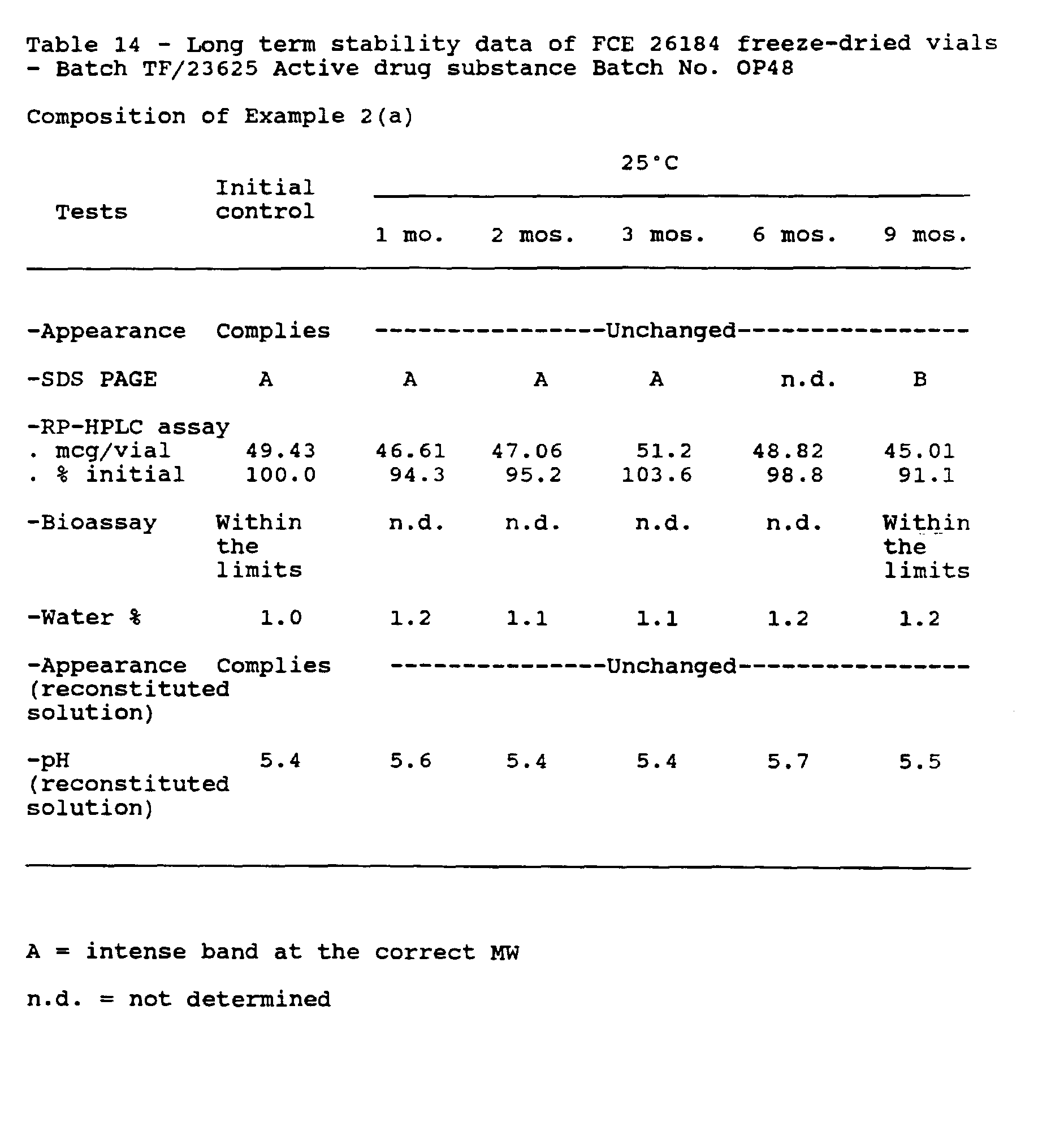
- Freeze dried vials containing compositions according to the present invention comprising abut 50 ⁇ g of bFGF were examined for long term stability over various periods of time at different temperatures. The results are shown in Tables 3 to 22. The following parameters were examined and the acceptable standards are also given.
Landscapes
- Health & Medical Sciences (AREA)
- Chemical & Material Sciences (AREA)
- Life Sciences & Earth Sciences (AREA)
- Public Health (AREA)
- Medicinal Chemistry (AREA)
- Pharmacology & Pharmacy (AREA)
- Epidemiology (AREA)
- Animal Behavior & Ethology (AREA)
- General Health & Medical Sciences (AREA)
- Veterinary Medicine (AREA)
- Engineering & Computer Science (AREA)
- Oil, Petroleum & Natural Gas (AREA)
- General Chemical & Material Sciences (AREA)
- Chemical Kinetics & Catalysis (AREA)
- Bioinformatics & Cheminformatics (AREA)
- Biochemistry (AREA)
- Molecular Biology (AREA)
- Inorganic Chemistry (AREA)
- Zoology (AREA)
- Gastroenterology & Hepatology (AREA)
- Immunology (AREA)
- Proteomics, Peptides & Aminoacids (AREA)
- Medicines That Contain Protein Lipid Enzymes And Other Medicines (AREA)
- Medicinal Preparation (AREA)
Abstract
Description
- The present invention relates to freeze dried (lyophilized) compositions containing fibroblast growth factor (FGF) having human mitogenic activity, in particular, human basic fibroblast growth factor (bFGF). The bFGF may be natural or produced by recombinant means.
- Safe handling and administration of protein drugs represent significant challenges to pharmaceutical formulators as proteins possess unique chemical and physical properties which pose difficult stability problems: a variety of degradation pathways exist of proteins, involving both chemical and physical instability. These macromolecules are also at risk from microbial degradation due to adventitious contamination of the solutions during purification or storage. All these considerations are especially critical for the pharmaceutical manufacturer who is formulating and packaging these agents with the expectation of an economically favorable shelf-life. Thus, a thorough preformulation programme is an essential step for protein drugs, to solve their possible formulation problems. In addition, a range of stability-indicating test methods is necessary, in order to ensure shelf-life is maintained.
- Many biological materials, including proteins which will rapidly deteriorate even in frozen solutions, can be kept in a viable state for long periods of time by lyophilization of the material. Lyophilization (also known as freeze drying) is a process of drying a composition in which water is sublimed from the composition after it is frozen. The particular advantages of this process are that materials which are relatively unstable in an aqueous solution can be processed and filled into dosage containers in the liquid state, taking advantage of the relative ease of processing of a liquid; dried without elevated temperatures, thereby eliminating adverse thermal effects; and then stored in the dry state in which there are relatively few stability problems. Thus, the product can be stabilized against loss of biological activity to provide a long shelf life.
- It is often impractical to design formulations based merely on the lyophilization of the bulk drug. This is so because usually the amounts of the drug used in the formulation will be very small. This is a problem because during the lyophilization process the drug can be pulled from the lyophilization container by the vacuum employed in the process. Furthermore, many polypeptides are relatively unstable when lyophilized in small concentrations. They can absorb to product packaging and lose activity. Many lyophilized pharmaceutical compositions rely on the use of diluent or extender to increase the amount of solid present during the lyophilization process and thereby eliminate the problems associated with lyophilization of small amounts of bulk drug.
- EP-A-0 308 238 describes stable lyophilized compositions comprising a polypeptide growth factor having human mitogenic activity and a water soluble or water swellable, pharmaceutically acceptable polymer capable of imparting viscosity to a reconstituted solution of the composition. As a growth factor, epidermal growth factor (EGF) is particularly mentioned.
- The present invention provides a lyophilized composition which comprises a fibroblast growth factor (FGF), a pharmaceutically acceptable bulking agent and either:
- (a) an alkali metal salt of a carboxyalkyl cellulose, or
- (b) a polyoxyethylene sorbitan fatty acid ester and cysteine.
- In this application, FGF includes the class of polypeptides that have biological activity similar to that exhibited by the natural human FGF polypeptide. Thus, FGF includes acidic and basic FGF, such as human FGF produced by recombinant DNA techniques or derived from natural sources, as well as closely related mammalian FGF, eg. bovine, murine or rodent. FGF also includes chemically modified FGF such as a FGF in which at least one of the four cysteine aminoacid residues are derivatized. A FGF for use in the invention may therefore be a carboxymethylated FGF wherein the -SH group of one or more of cysteine residues has been converted into a -S-CH2-COOH group. Any bFGF molecule as described in, for instance, WO 86/07595; WO 87/01728; EP-A-0226181; Abraham et al, EMBO J. 5, 2523-2528, 1986; or Lobb, Eur. J. Clin. Invest. 18, 321-336, 1988; may be usefully employed in the invention.
- A mixture of bFGFs may be employed. This may be an approximately 50:50 mixture of:
- - a 154 amino acid human bFGF having the amino acid sequence of the 155 amino acid form which is reported by Abraham et al and shown in SEQ ID NO:1 but without the N-terminal Met residue; and
- - a 153 amino acid human bFGF having the amino acid sequence shown in SEQ ID N0:1 but without the N-terminal Met and Ala residues.
- Human basic FGF, for example produced by recombinant DNAtechniques, is preferred for use in the present invention. A specific carboxymethylated FGF for use in the invention is the 146 amino acid form of bFGF, as described in WO 87/01728, wherein the two cysteine residues at positions 69 and 87 are irreversibly blocked by carboxymethyl groups, i.e. as -S-CH2-COOH groups. This specific carboxymethylated FGF will be referred to as CM-FGF. It is therefore a bFGF having the amino acid sequence from position 10 to position 155 shown in SEQ ID NO:1 in which the Cys residues at positions 78 and 96 in SEQ ID NO:1 are carboxymethylated.
- In one embodiment of the present invention the composition further includes an antioxidant, selected to prevent substantially oxidation of the FGF when the composition of the invention is stored over an extended period of time. eg. 1-3 months. Preferably the anti-oxidant is dithiothreitol (DTT). When present, the antioxidant will typically be present in an amount of from 0.01% to 100%, preferably from 0.1% to 25% by weight of the bulking agent.
- The bulking agent is any bulking agent suitable for use in freeze-drying. The bulking agent generally has good properties as a rigidizer, in order to avoid melt-back or collapse of the product during lyophilization. Suitable pharmaceutically acceptable bulking agents include mannitol, lactose, polyvinylpyrrolidone, galactitol and trehalose. Of these, mannitol is preferred. The amount of FGF in the composition of the present invention is typically from 0.01 % to 5%, preferably 0.1 to 1 %, of the weight of the bulking agent.
- It has surprisingly been found that the FGF in admixture with a pharmaceutically acceptable bulking agent may be stabilized by the presence of an alkali metal salt of a carboxyalkyl cellulose, for example a carboxy C1-4 alkyl cellulose. The alkali metal salt may be for example the sodium salt or potassium salt. This component will usually be present in an amount from 0.1 % to 50%, preferably from 2.5% to 10%, by weight of the bulking agent. Sodium carboxymethyl cellulose is preferred. The use of a cellulose salt surprisingly provides stability to compositions of the present invention which is not obtainable from neutral alkyl cellulose, eg. methyl cellulose.
- Compositions of the present invention may also be stabilized by the use of a polyoxyethylene sorbitan fatty acid ester and cysteine. It has surprisingly been found that these two components act synergistically to provide increased stability. Examples of polyoxyethylene sorbitan fatty acid esters include partial C12-20 saturated or unsaturated fatty acid esters of sorbitol and its mono- and di-anhydrides copolymerised with ethylene oxide. Typically, from 10 to 40, for example about 20 moles of ethylene oxide for each mole of sorbitol and its anhydrides will be present. Polyoxyethyle sorbitan fatty acid esters are known generally as polysorbates. Examples of polysorbates include polysorbate 20 (polyoxyethylene 20 Sorbitan Monolaurate, Chemical Abstracts reference No 9005-64-5), which is a mixture of partial lauric esters of sorbitol and its mono- and di-anhydrides copolymerised with approximately 20 moles of ethylene oxide for each mole of sorbitol and its anhydrides, polysorbate 40 (polyoxyethylene 20 sorbitan monopalmitate, CAS No 9005-66-7), polysorbate 60 (polyoxyethylene 20 sorbitan monostearate CAS No 9005-67-8), polysorbate 65 (polyoxyethylene 20 sorbitan tristearate, CAS No. 9005-71-4, polysorbate 80 (polyoxyethylene 20 sorbitan mono-oleate, CAS No 9005-65-6) and polysorbate 85 (polyoxyethylene 20 sorbitan trioleate CAS No 9005-70-3). The amount of the polyoxyethylene sorbitan fatty acid ester is preferably from 0.01 % to 25%, most preferably from 0.1 % to 1 % by weight of the bulking agent. The amount of cysteine in compositions of the invention is preferably from 0.001 % to 1 %, most preferably 0.01 % to 0.1% by weight of the bulking agent.
- Compositions of the present invention will normally be formulated in bulk solution prior to freeze drying. The bulk solution may be freeze-dried in any quantity, although preferably the bulk solution will be divided into aliquots containing from 5 to 500, for example from 10 to 100 and preferably 50 micrograms of FGF. These aliquots will be freeze-dried separately, eg. in individual glass vials. Before the solution is freeze-dried, it may be sterilized for example by filtration. A0.2 f..lm nylon membrane filter may be used for this purpose. Using HPLC analysis carried out after such filtration, we have found that FGF is consistently recovered on a quantitative basis.
- Lyophilization essentially consists of the following steps. First, the solution to be freeze-dried is frozen at a temperature below its eutectic temperature in an evacuation chamber. The chamber is then evacuated, usually below 13.3 Pa (0.1 Torr). Ice is sublimed on a cold condensing surface at a temperature below that of the product, the condensing surface being within the chamberorin a connecting chamber. Then, heat is introduced to the product under controlled conditions, thereby providing energy for sublimation at a rate designed to keep the product below its eutetic temperature. Atypical freeze-drying cycle is as follows:
- (a) Freeze at -45°C, and maintain this temperature for four hours.
- (b) Primary drying at -45°C to +25°C for approximately twelve hours, with vacuum level less than 13.3 Pa (0.1 Torr) and a condenser temperature of -60°C.
- (c) Secondary drying at +25°C for approximately eleven hours, with the same vacuum and condenser temperature as described in (b) above. We have found this freeze-drying cycle to be suited to preparation of batches of FGF produced in accordance with the present invention. However, it will be apparent to those of ordinary skill in the art that variations of this protocol which do not substantially alter the stability of the FGF may be made.
- Aliquots of the composition of the present invention may be dispensed into sterile vials. Sterile glass vials can be suitable. It is known that proteins adhere to glass surfaces, and we have found that when the lyophilized compositions of the present inventions is reconstituted in a glass vial, some loss of protein due to adhesion occurs. However, we have found that coating the glass vials with silicone emulsion (Pharmaceutical grade) in order to minimise sticking successfully overcomes this problem.
- We have also observed that when the glass vials are sealed with conventional rubber stoppers, losses of protein may occur due to absorption of the FGF to the rubber surfaces. The use of fluororesin laminated butyl rubber stoppers prevents this absorption process.
- The lyophilized compositions of the present invention may be stored under air or vacuum. Preferably however, they will be stored under an inert gas, eg. nitrogen.
- The lyophilised composition of the invention therefore consists essentially of a FGF, a pharmaceutically acceptable bulking agent and either (a) an alkali metal salt of a carboxyalkyl cellulose or (b) a polyoxyethylene sorbitan fatty acid ester and cysteine.
- The freeze-dried composition of the invention may be reconstituted using any pharmaceutically acceptable solvent. Preferably, the solvent used will provide a reconstituted solution with a pH of between 5.0 and 7.0. Preferably, a 0.9% solution of sodium chloride (i.e. physiological saline) is the reconstitution solvent. Optionally, the solution contains an effective amount of an anti-microbial preservative agent. Benzalkonium chloride at a concentration of about 0.005% by weight is particularly suitable, since its efficacy is well documented and because it is commonly used in pharmaceutical formulations, for example as an opthalmic preservative. We have found that 0.005% by weight benzalkonium chloride effectively inhibits microbial activity in reconstituted solutions of the present invention.
- FGF is a growth factor that plays a role in the regulation of growth of normal human cells. FGF has utility in stimulating wound healing and the growth fibroblast cells. The present invention thus also provides a kit containing the lyophilized composition described above in a sterile vial and a sterile diluent for reconstitution of the lyophilized composition. The invention further includes a method of preparing an aqueous FGF solution which comprises reconstituting the freeze dried composition of the present invention with an aqueous diluent, eg. the pharmaceutically acceptable solvent described above. The compositions or kits according to the present invention are useful in a method of treatment of the human or animal body, eg. in the treatment of wound healing.
- The Examples which follow illustrate aspects of the present invention.
- In the following Examples, the FGFs used are the basic FGF FCE 26184 which is a recombinant protein drug available from Farmitalia Carlo Erba Biotechnology Development Department and CM-FGF which is a chemically modified protein obtained from bFGF (146 amino acid form). Their preparation is described below in the Preparation Examples. bFGF and CM-FGF are obtainable as a frozen bulk solution at a concentration of active substance of approximately 2.0 mg/ml for bFGF and 1.1 mg/ml for CM-FGF (this concentration is expressed as protein content measured by the biruet reaction, the solvent is at pH 6.0 obtained with a 10 f..lM phosphate buffer).
- We have observed that thawing these bulk solutions and diluting them to a concentration of about 50 wg/ml using a 2% mannitol solution does not affect protein stability. HPLC analyses of diluted solutions show active drug substance (bFGF or CM-FGF) is quantitatively recovered.
- The construction of the synthetic DNA sequence for bFGF and of the expression plasmid carrying such sequence was performed according to the procedure described in EP-A-363675. The fermentation and purification process was carried out as follows:
- A bacterial strain, E. coli type B, from the Institute Pasteur collection, was transformed with a plasmid carrying both the human gene coding for bFGF and the gene for tetracycline resistance. This transformed strain was used for the production of recombinant non-glycosylated h-bFGF (human bFGF). A Master Cell Bank (15 freeze-dried vials) and a Working Cell Bank (W.C.B.) (70 vials stored in liquid nitrogen at -190°C) of this strain were prepared. The content of one vial of W.C.B. was used as the inoculum for the fermentation phase.
- The fermentation process was carried out in 10 1 fermentors filled with 4 1 of culture medium. Tetracycline hydrochloride was added to the medium in order to maintain the conditions of strain selection. After 20 hours of growth at 37°C the final biomass was 42±2 g/I dry weight, and the production of bFGF was 2500 + 500 mg/I as measured by comparative gel electrophoresis.
- Enrichment in pure oxygen was required during the fermentation phase in order to allow a large bacterial growth.
- The cells (microorganisms) were separated from the total fermentation broth by centrifugation. The resulting pellet was resuspended in a sodium phosphate buffer containing sodium chloride. A minimum of 3 passages through a high pressure homogenizer were necessary for efficient cell breakage. The resulting cell lysate was clarified by centrifugation and the supernatant was collected for further processing.
- The clarified supernatant was loaded on a column of Sepharose (Trade Mark) S Fast Flow (cation exchanger) and the product was eluted from this column using a gradient of increasing sodium chloride concentrations in a phosphate buffer. The product was further purified on a column of Heparin Sepharose (Trade Mark) 6 B by eluting with a gradient of increasing sodium chloride concentration in a phosphate buffer. Finally a buffer exchange was made on a Sephadex (Trade Mark) G25 resin to obtain the product in the bulk product buffer (Sodium phosphate -EDTA).
- Sepharose S Fast Flow and Sephadex G25 columns were sanitized by washing with sodium hydroxide solutions. Heparin Sepharose was washed alternatively with solutions at pH = 8.5 and pH =5.5 containing 3M sodium chloride.
- In this way, there was obtained bFGF designated FCE 26184. This is an approximately 50:50 mixture of:
- - a 154 amino acid human bFGF having the amino acid sequence of the 155 amino acid form which is reported by Abraham et al and shown in SEQ ID NO:1 but without the N-terminal Met residue; and
- - a 153 amino acid human bFGF having the amino acid sequence shown in SEQ ID N0:1 but without the N-terminal Met and Ala residues.
- To a solution of 100 mg of recombinant human bFGF (146 aminoacid form), obtained as described in WO 87/01728, in 110 ml of 25 mM phosphate buffer pH 8.0/5 mM EDTA, was added 400 mg of iodoacetic acid in 110 ml of the same buffer. The reaction mixture was allowed to stand at room temperature for two hours in the dark. The reaction mixture was then directly loaded on a MonoS column (HR 10/10, Pharmacia) equilibrated in 25 mM phosphate buffer pH 7.5. In order to eliminate the reagent excess, the column was extensively washed with the equilibration buffer and the carboxymethylated bFGF (CM-FGF) was eluted with a linear gradient from 0 to 1 M NaCi in 25 mM phosphate buffer pH 7.5. The CM-FGF containing fractions were desalted on a Sephadex G-25 column (Pharmacia) equilibrated in 10 nM phosphate buffer pH 6.0/0.1 mM EDTA.
- We have found that the presence of an antioxidant, eg. 1,4-dithiothreitol (DTT) is effective in protecting the protein in solution against oxidation.
- However, in spite of its good protective effect in solution, DTT does not inhibit degradation of the protein in the freeze-dried state when it is stored over an extended period of time. In fact a 50 µg freeze-dried formulation of bFGF containing mannitol as a bulking agent and DTT as antioxidant did not yield an acceptable stability: a potency loss (HPLC method) of about 10% was detected after storage for one week at 35°C and 25°C. Thus the need existed to incorporate a protective agent into the formulation.
- According to P. P. De Luca and M. W. Townsend (Journal of Parenteral Science and Technology. vol. 42, No. 6, Nov.-Dec. 1988, page 190) "prevention and reduction of conformational modifications in proteins due to freezing, drying, or extended storage may be attained through the use of lyo- or cryo-protectans. A lyoprotectant is being defined as a compound that stabilizes and prevents the degradation of a protein both during freeze-drying and afterwards, during storage, whereas a cryoprotectant only infers protection from freezing damage".
- Based on these theoretical considerations, experimental work was thus undertaken to determine the FCE 26184 and CM-FGF protective capacity of a number of compounds which might act as lyoprotectants.
- Hydroxypropylmethylcellulose (HPMC), sodium carboxymethyl cellulose (NaCMC), methylcellulose (MC), hydroxyethylcellulose (HEC), polyvinyl alcohol (PVA), sodium chloride, glycine, cysteine and albumin were selected as possible protective agents. Solutions containing bFGF (50 wg/ml), mannitol (20 mg/ml as bulking agent, DTT (either 0.5 or 0.1 mg/ml) as antioxidant, and a suitable concentration of each potential stabilizer were prepared aseptically, filled into vials (nominal volume: 1.0 ml), and freeze-dried. The effect of storage on the protein potency in the final freeze-dried formulation was checked through accelerated stability studies (35°C).
- Basic experimental results are summarized in Table 1. As already mentioned, the freeze-dried formulation containing mannitol and DTT underwent 10% potency loss after one week storage.
- A loss of the same extent was observed when cysteine was added with the aim of exploiting its synergism with DTT.
- The presences of a lyoprotectant, such as NaCMC significantly improved protein stability. Other cellulose derivatives (HPMC, HEC, MC) proved to be ineffective as stabilizers (data are presented in Table 1 only for MC, but other derivatives behaved similarly).
- PVA, sodium chloride, glycine and albumin proved to be highly incompatible with bFGF. Polysorbate 80 or cysteine proved to be ineffective, if used alone. However the combination of polysorbate 80 and cysteine surprisingly worked well as a stabilizer. Furthermore, either polysorbate 80 or cysteine acted synergistically with NaCMC.
- Data presented in Table 1 put into evidence the key role played by the lyoprotectants as stabilizing agents for the protein in the freeze-dried state. Possible mechanism for the protective capacity of these compounds could reside in their ability to prevent the segregation of water from the protein in the freeze-dried preparation. In each freeze-dried formulation tested, water is present (as residual humidity) to an extent exceeding that of the drug and sufficient to maintain the protein in a hydrated conformation. Any challenge (temperature: low, or high; solvents) which disrupts the shell of water loosely coordinated by the protein structure brings about a protein inactivation through denaturation or aggregation. Stabilizers such as NaCMC are able to tightly coordinate water molecules through either their hydrophilic structure of their polar carboxylic group. As consequence, they maintain the protein microenvironment in a hydrated state.
- Other cellulose derivatives, such as HPMC, MC, and HEC, tested as protecting agents, provided to be ineffective, most probably because they lack carboxylic group.
- The low stabilizing activity of polysorbate 80 might be expected, due to the low coordination power of this additive towards the water molecules. On the contrary, the synergistic effect of polysorbate 80 with both cysteine and NaCMC was quite unexpected.

- Experimental results for CM-FGF are summarized in Table 2, in which n.d. means not determined. Solutions containing CM-FGF (50 µg/ml), mannitol (20 mg/ml) as bulking agent, DTT (0.1 mg), and a suitable concentration of each potential stabilizerwere prepared aseptically, filled into vials (nominal volume 1.0 ml), and freeze dried. The effect of storage on the protein potency in the final freeze dried formulation was checked through accelerated stability studies (35° C/45° C). As already seen for bFGF, Na-CMC significantly improves CM-FGF stability.

- HPLC assay of the samples was performed using the following materials, equipment and solutions, under the conditions provided below.
- Materials:
- bFGF frozen bulk solution, working standard
- CM-FGF frozen bulk solution, working standard
- Acetonitrile, HPLC grade
- Water, HPLC grade
- Trifluoroacetic acid, analytical grade
- 1,4-dithiothreitol, analytical grade
- Equipment:
- . Liquid chromatograph Milton Roy model CM 4000, or equivalent, equipped with:
- .. chromatographic column: (length 250 mm, internal diameter 4.6 mm) filled with Vydac 218TP54 300
- A (average particle size 5 mcm), or equivalent
- .. injection valve: Rheodyne model 7125, or equivalent, fitted with a 100 mcl sample loop
- .. detector Shimadzu model SFD 6A, or equivalent
- .. integrating recorder: SP 4270 (Spectra-Physics), or equivalent
- . Membrane filter, 0.22 µm porosity, Millipore Durapore GVWP, or equivalent
- . High precision laboratory glassware
- . Plastic pipet tips (Gilson)
- . Automatic pipets (Gilson)
- . Disposable plastic microtubes, capacity 2.5 ml (Eppendorf)
- Solutions:
- . Mobile phase (A) consisting of water, containing 0.1% of trifluoracetic acid (w/v), filtered through the membrane filter and deaerated.
- . Mobile phase (B) consisting of 95% acetonitrile-5% water containing 0.1% of trifluoroacetic acid (w/v), filtered through the membrane filter and deaerated.
- . 1.4-dithiothreitoI solution
- Prepare a solution containing about 1 mg/ml in HPLC grade water
- . Standard solution
- Transfer a suitable volume of bulk solution of bFGF or CM-FGF working standard, accurately measured, into a disposable plastic microtube.
- Dilute with a suitable volume of 1,4-dithiothreitol solution in order to obtain a final solution containing about 50 mcg/ml of bFGF or CM-FGF.
- The standard solution must be freshly prepared and used within a working day.
- . Sample solution
- Prepare the sample solution using at least five freeze-dried vials.
- The content of each vial dosed at 50 mcg of bFGF or CM-FGF is dissolved in 1.0 ml of HPLC grade water, then a pool is made with all prepared solutions.
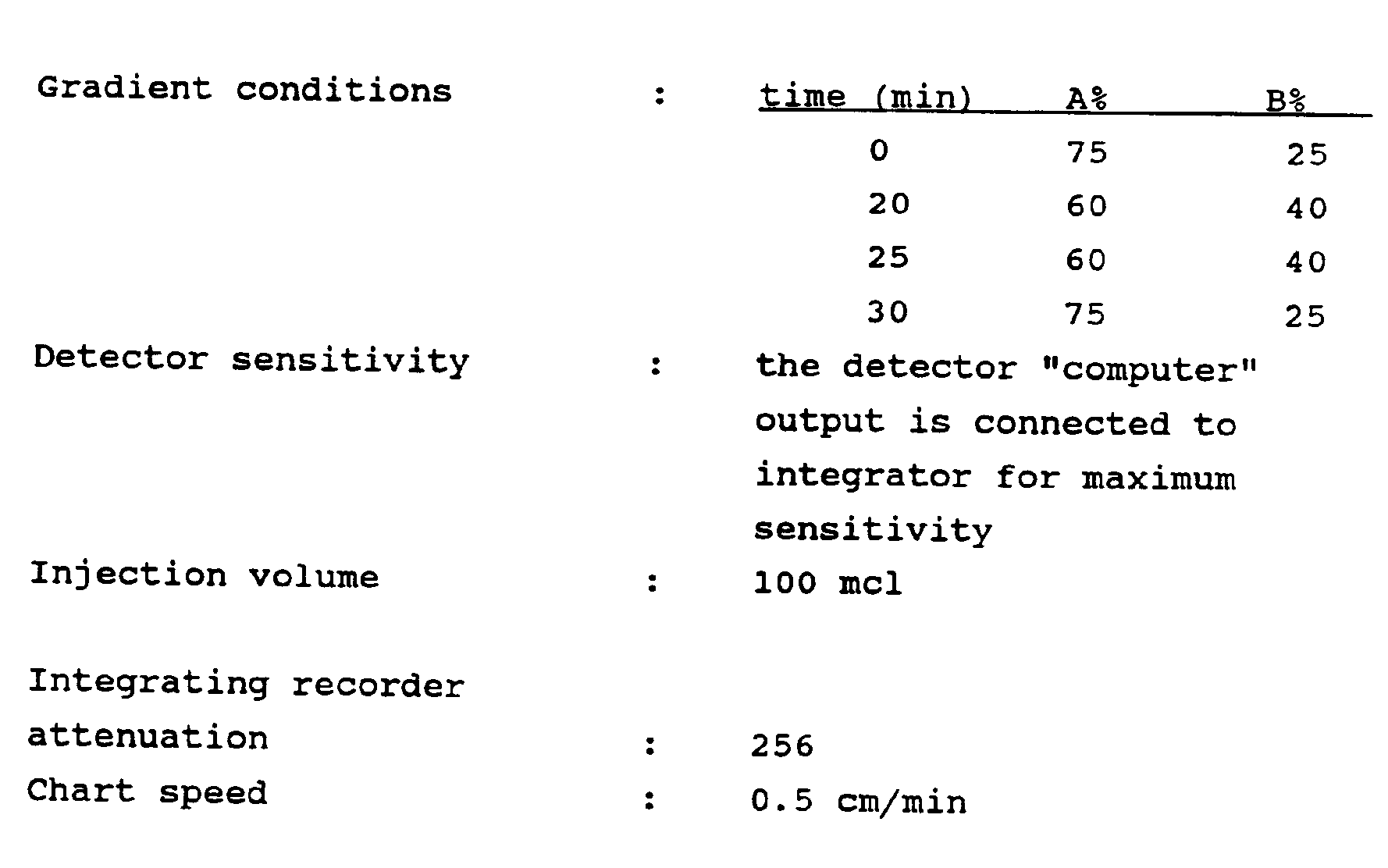
- Chromatographic (HPLC) conditions:
- The standard and sample solution are alternatively injected at least 3 times into the liquid chromatograph under the following experimental conditions:

-
- a) Formulation of bFGF composition stabilised with sodium carboxymethylcellulose.

- b) Formulation of bFGF composition stabilized with Polysorbated 80 and cysteine

- Both formulations were freeze dried and individual vials are sealed under nitrogen.
- c) Formulation of CM-FGF composition stabilised with sodium carboxymethylcellulose.

- d) Formulation of CM-FGF composition stabilized with Polysorbated 80 and cysteine

- Both formulations were freeze-dried and individual vials are sealed under nitrogen.
- e) Formulation of CM-FGF composition stabilized with Polysorbated 80 and cysteine

- Both formulations were freeze dried and individual vials are sealed under nitrogen.
- Freeze dried vials containing compositions according to the present invention comprising abut 50 µg of bFGF were examined for long term stability over various periods of time at different temperatures. The results are shown in Tables 3 to 22. The following parameters were examined and the acceptable standards are also given.
-




Claims (12)
Applications Claiming Priority (3)
| Application Number | Priority Date | Filing Date | Title |
|---|---|---|---|
| GB9015824 | 1990-07-18 | ||
| GB909015824A GB9015824D0 (en) | 1990-07-18 | 1990-07-18 | Stable pharmaceutical compositions containing a fibroblast growth factor |
| PCT/EP1991/001330 WO1992001442A1 (en) | 1990-07-18 | 1991-07-16 | Stable pharmaceutical compositions containing a fibroblast growth factor |
Publications (2)
| Publication Number | Publication Date |
|---|---|
| EP0539408A1 EP0539408A1 (en) | 1993-05-05 |
| EP0539408B1 true EP0539408B1 (en) | 1994-04-20 |
Family
ID=10679294
Family Applications (1)
| Application Number | Title | Priority Date | Filing Date |
|---|---|---|---|
| EP91912379A Expired - Lifetime EP0539408B1 (en) | 1990-07-18 | 1991-07-16 | Stable pharmaceutical compositions containing a fibroblast growth factor |
Country Status (8)
| Country | Link |
|---|---|
| EP (1) | EP0539408B1 (en) |
| JP (1) | JP3100058B2 (en) |
| AU (1) | AU659997B2 (en) |
| CA (1) | CA2087430A1 (en) |
| DE (1) | DE69101784T2 (en) |
| ES (1) | ES2055607T3 (en) |
| GB (1) | GB9015824D0 (en) |
| WO (1) | WO1992001442A1 (en) |
Families Citing this family (10)
| Publication number | Priority date | Publication date | Assignee | Title |
|---|---|---|---|---|
| GB9120304D0 (en) * | 1991-09-24 | 1991-11-06 | Erba Carlo Spa | Stable pharmaceutical compositions containing a granulocyte macrophage colony stimulating factor |
| EP0580874A4 (en) * | 1992-02-14 | 1997-02-26 | Kaken Pharma Co Ltd | Remedy for airway diseases |
| US6267958B1 (en) | 1995-07-27 | 2001-07-31 | Genentech, Inc. | Protein formulation |
| EP0852951A1 (en) | 1996-11-19 | 1998-07-15 | Roche Diagnostics GmbH | Stable lyophilized monoclonal or polyclonal antibodies containing pharmaceuticals |
| US6417167B1 (en) | 1997-02-05 | 2002-07-09 | Kirin Beer Kabushiki Kaisha | Lyophilized compositions containing shingoglycolipid and process for preparing them |
| DE69824301T2 (en) * | 1997-02-05 | 2005-06-02 | Kirin Beer K.K. | GLYCOSPHINGOLIPIDE CONTAINING FREEZE-DRIED COMPOSITION |
| DE69900746T2 (en) * | 1998-01-30 | 2002-08-14 | Scios Inc., Mountain View | CONTROLLED ADMINISTRATION OF PEPTIDES OR PROTEINS |
| AU2001286996A1 (en) * | 2000-08-31 | 2002-03-13 | Chiron Corporation | Stabilized fgf formulations containing reducing agents |
| TWI527590B (en) | 2011-06-17 | 2016-04-01 | 艾瑞斯貿易公司 | Lyophilized formulation of FGF-18 |
| CN117205162B (en) * | 2023-09-12 | 2024-06-25 | 上海腾瑞制药股份有限公司 | Preparation method of recombinant human acidic fibroblast growth factor freeze-dried preparation |
Family Cites Families (6)
| Publication number | Priority date | Publication date | Assignee | Title |
|---|---|---|---|---|
| NZ222413A (en) * | 1986-11-05 | 1991-06-25 | Ethicon Inc | Compositions containing a polypeptide growth factor and a water-soluble cellulose polymer stabiliser |
| JPH01152092A (en) * | 1987-09-15 | 1989-06-14 | Mead Corp:The | Image receiving sheet having heat initiator |
| NZ226170A (en) * | 1987-09-18 | 1990-07-26 | Ethicon Inc | Stable freeze-dried pharmaceutical composition containing epidermal growth factor |
| NZ226171A (en) * | 1987-09-18 | 1990-06-26 | Ethicon Inc | Gel formulation containing polypeptide growth factor |
| AU614137B2 (en) * | 1988-06-06 | 1991-08-22 | Takeda Chemical Industries Ltd. | Stabilized fgf composition and production thereof |
| CA2020654A1 (en) * | 1989-07-07 | 1991-01-08 | Yohko Akiyama | Stabilized fgf composition and production thereof |
-
1990
- 1990-07-18 GB GB909015824A patent/GB9015824D0/en active Pending
-
1991
- 1991-07-16 CA CA002087430A patent/CA2087430A1/en not_active Abandoned
- 1991-07-16 WO PCT/EP1991/001330 patent/WO1992001442A1/en not_active Ceased
- 1991-07-16 ES ES91912379T patent/ES2055607T3/en not_active Expired - Lifetime
- 1991-07-16 DE DE69101784T patent/DE69101784T2/en not_active Expired - Fee Related
- 1991-07-16 EP EP91912379A patent/EP0539408B1/en not_active Expired - Lifetime
- 1991-07-16 JP JP03511862A patent/JP3100058B2/en not_active Expired - Fee Related
- 1991-07-16 AU AU81094/91A patent/AU659997B2/en not_active Ceased
Also Published As
| Publication number | Publication date |
|---|---|
| ES2055607T3 (en) | 1994-08-16 |
| DE69101784D1 (en) | 1994-05-26 |
| WO1992001442A1 (en) | 1992-02-06 |
| JP3100058B2 (en) | 2000-10-16 |
| GB9015824D0 (en) | 1990-09-05 |
| JPH05508640A (en) | 1993-12-02 |
| AU659997B2 (en) | 1995-06-08 |
| CA2087430A1 (en) | 1992-01-19 |
| DE69101784T2 (en) | 1994-08-04 |
| EP0539408A1 (en) | 1993-05-05 |
| AU8109491A (en) | 1992-02-18 |
Similar Documents
| Publication | Publication Date | Title |
|---|---|---|
| JP4018133B2 (en) | Aqueous preparation of human growth hormone | |
| JP3530300B2 (en) | Stable transglutaminase formulations and methods for producing them | |
| US20070020289A1 (en) | Preparations and processes for stabilizing biological materials by means of drying processes without freezing | |
| EP1220685B1 (en) | Pharmaceutical compositions of fibrinolytic agent | |
| JP4971160B2 (en) | Stable PEGylated interferon formulation | |
| KR20110086583A (en) | Factor 8 Formulations | |
| US5714458A (en) | Stable pharmaceutical compositions containing a fibroblast growth factor | |
| AU659997B2 (en) | Stable pharmaceutical compositions containing a fibroblast growth factor | |
| CA2117761C (en) | Pharmaceutical compositions containing il-6 | |
| WO1993005799A1 (en) | Lyophilized stable pharmaceutical compositions containing a granulocyte macrophage colony stimulating factor | |
| US20010046487A1 (en) | Methods for loading platelets, stabilizing platelets for dry storage and compositions obtained thereby | |
| US20080293624A1 (en) | Stabilized FGF formulations containing reducing agents | |
| JP2025533237A (en) | Liquid Dalbavancin Compositions | |
| JP2025535828A (en) | Pharmaceutical compositions of echinocandin analogs and methods for preparing same | |
| WO2007034509A2 (en) | Recombinant granulocyte-colony stimulating factor formulation and process | |
| HK1068500A (en) | Pharmaceutical compositions of fibrinolytic agent | |
| MXPA03008545A (en) | Pharmaceutical compositions containing human growth hormone. |
Legal Events
| Date | Code | Title | Description |
|---|---|---|---|
| PUAI | Public reference made under article 153(3) epc to a published international application that has entered the european phase |
Free format text: ORIGINAL CODE: 0009012 |
|
| 17P | Request for examination filed |
Effective date: 19921224 |
|
| AK | Designated contracting states |
Kind code of ref document: A1 Designated state(s): DE ES FR GB IT SE |
|
| 17Q | First examination report despatched |
Effective date: 19930728 |
|
| GRAA | (expected) grant |
Free format text: ORIGINAL CODE: 0009210 |
|
| AK | Designated contracting states |
Kind code of ref document: B1 Designated state(s): DE ES FR GB IT SE |
|
| ITF | It: translation for a ep patent filed | ||
| REF | Corresponds to: |
Ref document number: 69101784 Country of ref document: DE Date of ref document: 19940526 |
|
| ET | Fr: translation filed | ||
| REG | Reference to a national code |
Ref country code: ES Ref legal event code: FG2A Ref document number: 2055607 Country of ref document: ES Kind code of ref document: T3 |
|
| EAL | Se: european patent in force in sweden |
Ref document number: 91912379.4 |
|
| PLBE | No opposition filed within time limit |
Free format text: ORIGINAL CODE: 0009261 |
|
| STAA | Information on the status of an ep patent application or granted ep patent |
Free format text: STATUS: NO OPPOSITION FILED WITHIN TIME LIMIT |
|
| 26N | No opposition filed | ||
| PGFP | Annual fee paid to national office [announced via postgrant information from national office to epo] |
Ref country code: GB Payment date: 19991020 Year of fee payment: 9 |
|
| PGFP | Annual fee paid to national office [announced via postgrant information from national office to epo] |
Ref country code: DE Payment date: 19991022 Year of fee payment: 9 |
|
| PGFP | Annual fee paid to national office [announced via postgrant information from national office to epo] |
Ref country code: FR Payment date: 19991026 Year of fee payment: 9 |
|
| PGFP | Annual fee paid to national office [announced via postgrant information from national office to epo] |
Ref country code: SE Payment date: 19991027 Year of fee payment: 9 |
|
| PGFP | Annual fee paid to national office [announced via postgrant information from national office to epo] |
Ref country code: ES Payment date: 19991029 Year of fee payment: 9 |
|
| PG25 | Lapsed in a contracting state [announced via postgrant information from national office to epo] |
Ref country code: GB Free format text: LAPSE BECAUSE OF NON-PAYMENT OF DUE FEES Effective date: 20000716 |
|
| PG25 | Lapsed in a contracting state [announced via postgrant information from national office to epo] |
Ref country code: SE Free format text: LAPSE BECAUSE OF NON-PAYMENT OF DUE FEES Effective date: 20000717 Ref country code: ES Free format text: LAPSE BECAUSE OF NON-PAYMENT OF DUE FEES Effective date: 20000717 |
|
| GBPC | Gb: european patent ceased through non-payment of renewal fee |
Effective date: 20000716 |
|
| EUG | Se: european patent has lapsed |
Ref document number: 91912379.4 |
|
| PG25 | Lapsed in a contracting state [announced via postgrant information from national office to epo] |
Ref country code: FR Free format text: LAPSE BECAUSE OF NON-PAYMENT OF DUE FEES Effective date: 20010330 |
|
| REG | Reference to a national code |
Ref country code: FR Ref legal event code: ST |
|
| PG25 | Lapsed in a contracting state [announced via postgrant information from national office to epo] |
Ref country code: DE Free format text: LAPSE BECAUSE OF NON-PAYMENT OF DUE FEES Effective date: 20010501 |
|
| REG | Reference to a national code |
Ref country code: ES Ref legal event code: FD2A Effective date: 20010810 |
|
| PG25 | Lapsed in a contracting state [announced via postgrant information from national office to epo] |
Ref country code: IT Free format text: LAPSE BECAUSE OF NON-PAYMENT OF DUE FEES;WARNING: LAPSES OF ITALIAN PATENTS WITH EFFECTIVE DATE BEFORE 2007 MAY HAVE OCCURRED AT ANY TIME BEFORE 2007. THE CORRECT EFFECTIVE DATE MAY BE DIFFERENT FROM THE ONE RECORDED. Effective date: 20050716 |