EP0538416B1 - Substituted monocyclic aryl compounds exhibiting selective leukotriene b 4 antagonist activity - Google Patents
Substituted monocyclic aryl compounds exhibiting selective leukotriene b 4 antagonist activity Download PDFInfo
- Publication number
- EP0538416B1 EP0538416B1 EP91917272A EP91917272A EP0538416B1 EP 0538416 B1 EP0538416 B1 EP 0538416B1 EP 91917272 A EP91917272 A EP 91917272A EP 91917272 A EP91917272 A EP 91917272A EP 0538416 B1 EP0538416 B1 EP 0538416B1
- Authority
- EP
- European Patent Office
- Prior art keywords
- methyl
- phenethyl
- benzyloxy
- crr
- carbamoylmethyl
- Prior art date
- Legal status (The legal status is an assumption and is not a legal conclusion. Google has not performed a legal analysis and makes no representation as to the accuracy of the status listed.)
- Expired - Lifetime
Links
- 230000000694 effects Effects 0.000 title abstract description 14
- 230000001747 exhibiting effect Effects 0.000 title description 3
- 239000003913 leukotriene B4 receptor antagonist Substances 0.000 title description 2
- 125000001424 substituent group Chemical group 0.000 claims abstract description 39
- VNYSSYRCGWBHLG-AMOLWHMGSA-N leukotriene B4 Chemical compound CCCCC\C=C/C[C@@H](O)\C=C\C=C\C=C/[C@@H](O)CCCC(O)=O VNYSSYRCGWBHLG-AMOLWHMGSA-N 0.000 claims abstract description 37
- 238000011282 treatment Methods 0.000 claims abstract description 18
- 239000005557 antagonist Substances 0.000 claims abstract description 11
- 150000001875 compounds Chemical class 0.000 claims description 101
- 239000001257 hydrogen Substances 0.000 claims description 22
- 229910052739 hydrogen Inorganic materials 0.000 claims description 22
- 125000004435 hydrogen atom Chemical group [H]* 0.000 claims description 22
- 125000000217 alkyl group Chemical group 0.000 claims description 13
- 125000004169 (C1-C6) alkyl group Chemical group 0.000 claims description 11
- 125000003118 aryl group Chemical group 0.000 claims description 11
- -1 monocyclic aryl compound Chemical class 0.000 claims description 11
- WLJVXDMOQOGPHL-UHFFFAOYSA-N phenylacetic acid Chemical compound OC(=O)CC1=CC=CC=C1 WLJVXDMOQOGPHL-UHFFFAOYSA-N 0.000 claims description 10
- 125000001997 phenyl group Chemical group [H]C1=C([H])C([H])=C(*)C([H])=C1[H] 0.000 claims description 9
- METKIMKYRPQLGS-UHFFFAOYSA-N atenolol Chemical compound CC(C)NCC(O)COC1=CC=C(CC(N)=O)C=C1 METKIMKYRPQLGS-UHFFFAOYSA-N 0.000 claims description 8
- LCPDWSOZIOUXRV-UHFFFAOYSA-N phenoxyacetic acid Chemical compound OC(=O)COC1=CC=CC=C1 LCPDWSOZIOUXRV-UHFFFAOYSA-N 0.000 claims description 8
- 150000003839 salts Chemical class 0.000 claims description 7
- 125000003831 tetrazolyl group Chemical group 0.000 claims description 7
- 150000001732 carboxylic acid derivatives Chemical group 0.000 claims description 6
- 125000002950 monocyclic group Chemical group 0.000 claims description 6
- 125000004191 (C1-C6) alkoxy group Chemical group 0.000 claims description 5
- 229960003424 phenylacetic acid Drugs 0.000 claims description 5
- 239000003279 phenylacetic acid Substances 0.000 claims description 5
- 206010020751 Hypersensitivity Diseases 0.000 claims description 3
- 241000124008 Mammalia Species 0.000 claims description 3
- 239000004480 active ingredient Substances 0.000 claims description 3
- 125000003545 alkoxy group Chemical group 0.000 claims description 3
- 125000001188 haloalkyl group Chemical group 0.000 claims description 3
- 208000027866 inflammatory disease Diseases 0.000 claims description 3
- OJCXKYYTVACLIO-FYWRMAATSA-N (e)-3-[5-[2-[methyl(2-phenylethyl)amino]-2-oxoethyl]-2-phenylmethoxyphenyl]prop-2-enoic acid Chemical compound C=1C=C(OCC=2C=CC=CC=2)C(\C=C\C(O)=O)=CC=1CC(=O)N(C)CCC1=CC=CC=C1 OJCXKYYTVACLIO-FYWRMAATSA-N 0.000 claims description 2
- 239000003937 drug carrier Substances 0.000 claims description 2
- 125000001475 halogen functional group Chemical group 0.000 claims 1
- 230000002757 inflammatory effect Effects 0.000 claims 1
- 239000008194 pharmaceutical composition Substances 0.000 claims 1
- 238000000034 method Methods 0.000 abstract description 34
- 239000000203 mixture Substances 0.000 abstract description 34
- 230000001225 therapeutic effect Effects 0.000 abstract description 6
- 208000037265 diseases, disorders, signs and symptoms Diseases 0.000 abstract description 5
- 150000001735 carboxylic acids Chemical group 0.000 abstract description 2
- 208000035475 disorder Diseases 0.000 abstract description 2
- XEKOWRVHYACXOJ-UHFFFAOYSA-N Ethyl acetate Chemical compound CCOC(C)=O XEKOWRVHYACXOJ-UHFFFAOYSA-N 0.000 description 73
- 239000000243 solution Substances 0.000 description 41
- CSNNHWWHGAXBCP-UHFFFAOYSA-L Magnesium sulfate Chemical compound [Mg+2].[O-][S+2]([O-])([O-])[O-] CSNNHWWHGAXBCP-UHFFFAOYSA-L 0.000 description 38
- OKKJLVBELUTLKV-UHFFFAOYSA-N Methanol Chemical compound OC OKKJLVBELUTLKV-UHFFFAOYSA-N 0.000 description 36
- 235000019439 ethyl acetate Nutrition 0.000 description 32
- YMWUJEATGCHHMB-UHFFFAOYSA-N Dichloromethane Chemical compound ClCCl YMWUJEATGCHHMB-UHFFFAOYSA-N 0.000 description 31
- XLYOFNOQVPJJNP-UHFFFAOYSA-N water Substances O XLYOFNOQVPJJNP-UHFFFAOYSA-N 0.000 description 30
- UHOVQNZJYSORNB-UHFFFAOYSA-N Benzene Chemical compound C1=CC=CC=C1 UHOVQNZJYSORNB-UHFFFAOYSA-N 0.000 description 25
- RTZKZFJDLAIYFH-UHFFFAOYSA-N Diethyl ether Chemical compound CCOCC RTZKZFJDLAIYFH-UHFFFAOYSA-N 0.000 description 25
- 210000004027 cell Anatomy 0.000 description 24
- 239000000047 product Substances 0.000 description 24
- 238000012360 testing method Methods 0.000 description 24
- VLKZOEOYAKHREP-UHFFFAOYSA-N n-Hexane Chemical compound CCCCCC VLKZOEOYAKHREP-UHFFFAOYSA-N 0.000 description 23
- IAZDPXIOMUYVGZ-UHFFFAOYSA-N Dimethylsulphoxide Chemical compound CS(C)=O IAZDPXIOMUYVGZ-UHFFFAOYSA-N 0.000 description 20
- 229910052943 magnesium sulfate Inorganic materials 0.000 description 19
- 235000019341 magnesium sulphate Nutrition 0.000 description 19
- 239000011541 reaction mixture Substances 0.000 description 19
- LFQSCWFLJHTTHZ-UHFFFAOYSA-N Ethanol Chemical compound CCO LFQSCWFLJHTTHZ-UHFFFAOYSA-N 0.000 description 18
- HEMHJVSKTPXQMS-UHFFFAOYSA-M Sodium hydroxide Chemical compound [OH-].[Na+] HEMHJVSKTPXQMS-UHFFFAOYSA-M 0.000 description 18
- 239000000872 buffer Substances 0.000 description 18
- 238000002360 preparation method Methods 0.000 description 15
- 238000006243 chemical reaction Methods 0.000 description 14
- VEXZGXHMUGYJMC-UHFFFAOYSA-N Hydrochloric acid Chemical compound Cl VEXZGXHMUGYJMC-UHFFFAOYSA-N 0.000 description 13
- 208000024780 Urticaria Diseases 0.000 description 13
- CSCPPACGZOOCGX-UHFFFAOYSA-N Acetone Chemical compound CC(C)=O CSCPPACGZOOCGX-UHFFFAOYSA-N 0.000 description 12
- 241000700199 Cavia porcellus Species 0.000 description 12
- ZMXDDKWLCZADIW-UHFFFAOYSA-N N,N-Dimethylformamide Chemical compound CN(C)C=O ZMXDDKWLCZADIW-UHFFFAOYSA-N 0.000 description 12
- 238000003556 assay Methods 0.000 description 11
- 125000001495 ethyl group Chemical group [H]C([H])([H])C([H])([H])* 0.000 description 11
- 210000000224 granular leucocyte Anatomy 0.000 description 11
- CURLTUGMZLYLDI-UHFFFAOYSA-N Carbon dioxide Chemical compound O=C=O CURLTUGMZLYLDI-UHFFFAOYSA-N 0.000 description 10
- 241000700198 Cavia Species 0.000 description 10
- 125000002496 methyl group Chemical group [H]C([H])([H])* 0.000 description 10
- SASNBVQSOZSTPD-UHFFFAOYSA-N n-methylphenethylamine Chemical compound CNCCC1=CC=CC=C1 SASNBVQSOZSTPD-UHFFFAOYSA-N 0.000 description 10
- BWHMMNNQKKPAPP-UHFFFAOYSA-L potassium carbonate Chemical compound [K+].[K+].[O-]C([O-])=O BWHMMNNQKKPAPP-UHFFFAOYSA-L 0.000 description 10
- 239000002904 solvent Substances 0.000 description 10
- WYURNTSHIVDZCO-UHFFFAOYSA-N Tetrahydrofuran Chemical compound C1CCOC1 WYURNTSHIVDZCO-UHFFFAOYSA-N 0.000 description 9
- 230000002776 aggregation Effects 0.000 description 9
- 238000004220 aggregation Methods 0.000 description 9
- 239000012267 brine Substances 0.000 description 9
- 229940093499 ethyl acetate Drugs 0.000 description 9
- 239000010410 layer Substances 0.000 description 9
- HPALAKNZSZLMCH-UHFFFAOYSA-M sodium;chloride;hydrate Chemical compound O.[Na+].[Cl-] HPALAKNZSZLMCH-UHFFFAOYSA-M 0.000 description 9
- 230000015572 biosynthetic process Effects 0.000 description 8
- 238000000746 purification Methods 0.000 description 8
- 230000009870 specific binding Effects 0.000 description 8
- 239000000725 suspension Substances 0.000 description 8
- VYPSYNLAJGMNEJ-UHFFFAOYSA-N Silicium dioxide Chemical compound O=[Si]=O VYPSYNLAJGMNEJ-UHFFFAOYSA-N 0.000 description 7
- 239000002253 acid Substances 0.000 description 7
- YZXBAPSDXZZRGB-DOFZRALJSA-N arachidonic acid Chemical class CCCCC\C=C/C\C=C/C\C=C/C\C=C/CCCC(O)=O YZXBAPSDXZZRGB-DOFZRALJSA-N 0.000 description 7
- 230000027455 binding Effects 0.000 description 7
- 230000005764 inhibitory process Effects 0.000 description 7
- 150000002617 leukotrienes Chemical class 0.000 description 7
- 239000000741 silica gel Substances 0.000 description 7
- 229910002027 silica gel Inorganic materials 0.000 description 7
- 238000003756 stirring Methods 0.000 description 7
- 239000003981 vehicle Substances 0.000 description 7
- HMRIWBBWYXEHRZ-UHFFFAOYSA-N 2-propoxypyridine Chemical compound CCCOC1=CC=CC=N1 HMRIWBBWYXEHRZ-UHFFFAOYSA-N 0.000 description 6
- VHYFNPMBLIVWCW-UHFFFAOYSA-N 4-Dimethylaminopyridine Chemical compound CN(C)C1=CC=NC=C1 VHYFNPMBLIVWCW-UHFFFAOYSA-N 0.000 description 6
- PEDCQBHIVMGVHV-UHFFFAOYSA-N Glycerine Chemical compound OCC(O)CO PEDCQBHIVMGVHV-UHFFFAOYSA-N 0.000 description 6
- ATNOAWAQFYGAOY-GPTZEZBUSA-J [Na+].[Na+].[Na+].[Na+].Cc1cc(ccc1\N=N\c1ccc2c(cc(c(N)c2c1O)S([O-])(=O)=O)S([O-])(=O)=O)-c1ccc(\N=N\c2ccc3c(cc(c(N)c3c2O)S([O-])(=O)=O)S([O-])(=O)=O)c(C)c1 Chemical compound [Na+].[Na+].[Na+].[Na+].Cc1cc(ccc1\N=N\c1ccc2c(cc(c(N)c2c1O)S([O-])(=O)=O)S([O-])(=O)=O)-c1ccc(\N=N\c2ccc3c(cc(c(N)c3c2O)S([O-])(=O)=O)S([O-])(=O)=O)c(C)c1 ATNOAWAQFYGAOY-GPTZEZBUSA-J 0.000 description 6
- 239000006185 dispersion Substances 0.000 description 6
- 229960003699 evans blue Drugs 0.000 description 6
- 238000003818 flash chromatography Methods 0.000 description 6
- 238000002347 injection Methods 0.000 description 6
- 239000007924 injection Substances 0.000 description 6
- 239000000543 intermediate Substances 0.000 description 6
- 239000003921 oil Substances 0.000 description 6
- 235000019198 oils Nutrition 0.000 description 6
- LEZBTLFVZMOIRM-UHFFFAOYSA-N 2-(2-formyl-5-phenylmethoxyphenyl)-n-methyl-n-(2-phenylethyl)acetamide Chemical compound C=1C(OCC=2C=CC=CC=2)=CC=C(C=O)C=1CC(=O)N(C)CCC1=CC=CC=C1 LEZBTLFVZMOIRM-UHFFFAOYSA-N 0.000 description 5
- 0 CN*(*N=C)O*=C Chemical compound CN*(*N=C)O*=C 0.000 description 5
- FAPWRFPIFSIZLT-UHFFFAOYSA-M Sodium chloride Chemical compound [Na+].[Cl-] FAPWRFPIFSIZLT-UHFFFAOYSA-M 0.000 description 5
- 229910002092 carbon dioxide Inorganic materials 0.000 description 5
- 230000009610 hypersensitivity Effects 0.000 description 5
- 239000008188 pellet Substances 0.000 description 5
- 239000004033 plastic Substances 0.000 description 5
- 229920003023 plastic Polymers 0.000 description 5
- 235000015320 potassium carbonate Nutrition 0.000 description 5
- 229910000027 potassium carbonate Inorganic materials 0.000 description 5
- 230000004044 response Effects 0.000 description 5
- LSBDFXRDZJMBSC-UHFFFAOYSA-N 2-phenylacetamide Chemical compound NC(=O)CC1=CC=CC=C1 LSBDFXRDZJMBSC-UHFFFAOYSA-N 0.000 description 4
- FXFYOPQLGGEACP-UHFFFAOYSA-N 6-methylcoumarin Chemical compound O1C(=O)C=CC2=CC(C)=CC=C21 FXFYOPQLGGEACP-UHFFFAOYSA-N 0.000 description 4
- XKRFYHLGVUSROY-UHFFFAOYSA-N Argon Chemical compound [Ar] XKRFYHLGVUSROY-UHFFFAOYSA-N 0.000 description 4
- 241001465754 Metazoa Species 0.000 description 4
- 150000007513 acids Chemical class 0.000 description 4
- 230000009471 action Effects 0.000 description 4
- 150000001299 aldehydes Chemical class 0.000 description 4
- 239000002775 capsule Substances 0.000 description 4
- 125000004432 carbon atom Chemical group C* 0.000 description 4
- 239000003153 chemical reaction reagent Substances 0.000 description 4
- 238000004587 chromatography analysis Methods 0.000 description 4
- 238000001816 cooling Methods 0.000 description 4
- 239000000706 filtrate Substances 0.000 description 4
- 239000007789 gas Substances 0.000 description 4
- 125000005843 halogen group Chemical group 0.000 description 4
- 238000002955 isolation Methods 0.000 description 4
- 239000007788 liquid Substances 0.000 description 4
- XHXFXVLFKHQFAL-UHFFFAOYSA-N phosphoryl trichloride Chemical compound ClP(Cl)(Cl)=O XHXFXVLFKHQFAL-UHFFFAOYSA-N 0.000 description 4
- 238000000159 protein binding assay Methods 0.000 description 4
- 238000010992 reflux Methods 0.000 description 4
- 239000011780 sodium chloride Substances 0.000 description 4
- 238000006467 substitution reaction Methods 0.000 description 4
- 238000003786 synthesis reaction Methods 0.000 description 4
- 239000003826 tablet Substances 0.000 description 4
- GGUBFICZYGKNTD-UHFFFAOYSA-N triethyl phosphonoacetate Chemical compound CCOC(=O)CP(=O)(OCC)OCC GGUBFICZYGKNTD-UHFFFAOYSA-N 0.000 description 4
- MDKDZFBQBATNGG-UHFFFAOYSA-N 2-(2-oxochromen-6-yl)acetonitrile Chemical compound N#CCC1=CC=C2OC(=O)C=CC2=C1 MDKDZFBQBATNGG-UHFFFAOYSA-N 0.000 description 3
- GUTRZMALLIWWMQ-UHFFFAOYSA-N 2-[2-[methyl(2-phenylethyl)amino]-2-oxoethyl]-4-phenylmethoxybenzoic acid Chemical compound C=1C(OCC=2C=CC=CC=2)=CC=C(C(O)=O)C=1CC(=O)N(C)CCC1=CC=CC=C1 GUTRZMALLIWWMQ-UHFFFAOYSA-N 0.000 description 3
- AMLKEDBYDOCGEG-UHFFFAOYSA-N 2-hydroxy-4-phenylmethoxybenzaldehyde Chemical compound C1=C(C=O)C(O)=CC(OCC=2C=CC=CC=2)=C1 AMLKEDBYDOCGEG-UHFFFAOYSA-N 0.000 description 3
- QAHMOTAFNBSEGV-UHFFFAOYSA-N 3-[2-[2-[methyl(2-phenylethyl)amino]-2-oxoethyl]-4-phenylmethoxyphenyl]prop-2-enoic acid Chemical compound C=1C(OCC=2C=CC=CC=2)=CC=C(C=CC(O)=O)C=1CC(=O)N(C)CCC1=CC=CC=C1 QAHMOTAFNBSEGV-UHFFFAOYSA-N 0.000 description 3
- NSDCINLDXHWOFO-UHFFFAOYSA-N 3-ethoxycarbonyl-5-hydroxybenzoic acid Chemical compound CCOC(=O)C1=CC(O)=CC(C(O)=O)=C1 NSDCINLDXHWOFO-UHFFFAOYSA-N 0.000 description 3
- SXGORICKDFCMDY-UHFFFAOYSA-N 3-ethoxycarbonyl-5-methoxybenzoic acid Chemical compound CCOC(=O)C1=CC(OC)=CC(C(O)=O)=C1 SXGORICKDFCMDY-UHFFFAOYSA-N 0.000 description 3
- LGVQLJNXNWRMNU-UHFFFAOYSA-N 6-(bromomethyl)chromen-2-one Chemical compound O1C(=O)C=CC2=CC(CBr)=CC=C21 LGVQLJNXNWRMNU-UHFFFAOYSA-N 0.000 description 3
- 108091003079 Bovine Serum Albumin Proteins 0.000 description 3
- UFPQIRYSPUYQHK-VRKJBCFNSA-N Leukotriene A4 Natural products CCCCCC=C/CC=C/C=C/C=C/[C@@H]1O[C@H]1CCCC(=O)O UFPQIRYSPUYQHK-VRKJBCFNSA-N 0.000 description 3
- DNIAPMSPPWPWGF-UHFFFAOYSA-N Propylene glycol Chemical compound CC(O)CO DNIAPMSPPWPWGF-UHFFFAOYSA-N 0.000 description 3
- 201000004681 Psoriasis Diseases 0.000 description 3
- 101100545004 Saccharomyces cerevisiae (strain ATCC 204508 / S288c) YSP2 gene Proteins 0.000 description 3
- ZMANZCXQSJIPKH-UHFFFAOYSA-N Triethylamine Chemical compound CCN(CC)CC ZMANZCXQSJIPKH-UHFFFAOYSA-N 0.000 description 3
- 238000007239 Wittig reaction Methods 0.000 description 3
- 125000003342 alkenyl group Chemical group 0.000 description 3
- 229940114079 arachidonic acid Drugs 0.000 description 3
- 235000021342 arachidonic acid Nutrition 0.000 description 3
- 208000006673 asthma Diseases 0.000 description 3
- 239000002585 base Substances 0.000 description 3
- AGEZXYOZHKGVCM-UHFFFAOYSA-N benzyl bromide Chemical compound BrCC1=CC=CC=C1 AGEZXYOZHKGVCM-UHFFFAOYSA-N 0.000 description 3
- 238000004364 calculation method Methods 0.000 description 3
- 239000003795 chemical substances by application Substances 0.000 description 3
- 125000004093 cyano group Chemical group *C#N 0.000 description 3
- LOKCTEFSRHRXRJ-UHFFFAOYSA-I dipotassium trisodium dihydrogen phosphate hydrogen phosphate dichloride Chemical compound P(=O)(O)(O)[O-].[K+].P(=O)(O)([O-])[O-].[Na+].[Na+].[Cl-].[K+].[Cl-].[Na+] LOKCTEFSRHRXRJ-UHFFFAOYSA-I 0.000 description 3
- 201000010099 disease Diseases 0.000 description 3
- 150000002148 esters Chemical class 0.000 description 3
- GAQXEMAYAFWHRB-UHFFFAOYSA-N ethyl 2-[3,5-bis(phenylmethoxy)phenyl]acetate Chemical compound C=1C(OCC=2C=CC=CC=2)=CC(CC(=O)OCC)=CC=1OCC1=CC=CC=C1 GAQXEMAYAFWHRB-UHFFFAOYSA-N 0.000 description 3
- AZGHJYHGGATZSQ-UHFFFAOYSA-N ethyl 3-[2-[2-[methyl(2-phenylethyl)amino]-2-oxoethyl]-4-phenylmethoxyphenyl]prop-2-enoate Chemical compound C1=C(CC(=O)N(C)CCC=2C=CC=CC=2)C(C=CC(=O)OCC)=CC=C1OCC1=CC=CC=C1 AZGHJYHGGATZSQ-UHFFFAOYSA-N 0.000 description 3
- SBQJVUCVHRHIEI-UHFFFAOYSA-N ethyl 3-[5-(2-methoxy-2-oxoethyl)-2-phenylphenyl]prop-2-enoate Chemical compound CCOC(=O)C=CC1=CC(CC(=O)OC)=CC=C1C1=CC=CC=C1 SBQJVUCVHRHIEI-UHFFFAOYSA-N 0.000 description 3
- 238000011534 incubation Methods 0.000 description 3
- 230000004968 inflammatory condition Effects 0.000 description 3
- 239000004615 ingredient Substances 0.000 description 3
- 150000002576 ketones Chemical class 0.000 description 3
- UFPQIRYSPUYQHK-WAQVJNLQSA-N leukotriene A4 Chemical compound CCCCC\C=C/C\C=C/C=C/C=C/[C@@H]1O[C@H]1CCCC(O)=O UFPQIRYSPUYQHK-WAQVJNLQSA-N 0.000 description 3
- GWNVDXQDILPJIG-NXOLIXFESA-N leukotriene C4 Chemical compound CCCCC\C=C/C\C=C/C=C/C=C/[C@H]([C@@H](O)CCCC(O)=O)SC[C@@H](C(=O)NCC(O)=O)NC(=O)CC[C@H](N)C(O)=O GWNVDXQDILPJIG-NXOLIXFESA-N 0.000 description 3
- YEESKJGWJFYOOK-IJHYULJSSA-N leukotriene D4 Chemical compound CCCCC\C=C/C\C=C/C=C/C=C/[C@H]([C@@H](O)CCCC(O)=O)SC[C@H](N)C(=O)NCC(O)=O YEESKJGWJFYOOK-IJHYULJSSA-N 0.000 description 3
- 238000004519 manufacturing process Methods 0.000 description 3
- 239000000463 material Substances 0.000 description 3
- 238000005259 measurement Methods 0.000 description 3
- NQEMTLKNISHPMB-UHFFFAOYSA-N methyl 2-(3-formyl-4-phenylphenyl)acetate Chemical compound O=CC1=CC(CC(=O)OC)=CC=C1C1=CC=CC=C1 NQEMTLKNISHPMB-UHFFFAOYSA-N 0.000 description 3
- 244000005700 microbiome Species 0.000 description 3
- MFWVCFRKGUYDJB-UHFFFAOYSA-N n-methyl-n-(2-phenylethyl)-2-(3-phenylmethoxyphenyl)acetamide Chemical compound C=1C=CC(OCC=2C=CC=CC=2)=CC=1CC(=O)N(C)CCC1=CC=CC=C1 MFWVCFRKGUYDJB-UHFFFAOYSA-N 0.000 description 3
- 150000002825 nitriles Chemical class 0.000 description 3
- 125000000449 nitro group Chemical group [O-][N+](*)=O 0.000 description 3
- 230000009871 nonspecific binding Effects 0.000 description 3
- QYSGYZVSCZSLHT-UHFFFAOYSA-N octafluoropropane Chemical compound FC(F)(F)C(F)(F)C(F)(F)F QYSGYZVSCZSLHT-UHFFFAOYSA-N 0.000 description 3
- 239000002953 phosphate buffered saline Substances 0.000 description 3
- 229920001223 polyethylene glycol Polymers 0.000 description 3
- 230000003389 potentiating effect Effects 0.000 description 3
- 239000000843 powder Substances 0.000 description 3
- 230000009467 reduction Effects 0.000 description 3
- 238000006722 reduction reaction Methods 0.000 description 3
- 229920006395 saturated elastomer Polymers 0.000 description 3
- 239000002002 slurry Substances 0.000 description 3
- 238000000527 sonication Methods 0.000 description 3
- 239000007858 starting material Substances 0.000 description 3
- 239000011550 stock solution Substances 0.000 description 3
- 239000000126 substance Substances 0.000 description 3
- 210000001519 tissue Anatomy 0.000 description 3
- IUNJCFABHJZSKB-UHFFFAOYSA-N 2,4-dihydroxybenzaldehyde Chemical compound OC1=CC=C(C=O)C(O)=C1 IUNJCFABHJZSKB-UHFFFAOYSA-N 0.000 description 2
- ZWEHNKRNPOVVGH-UHFFFAOYSA-N 2-Butanone Chemical compound CCC(C)=O ZWEHNKRNPOVVGH-UHFFFAOYSA-N 0.000 description 2
- OXIJAXADJOFLGS-UHFFFAOYSA-N 2-[3,5-bis(phenylmethoxy)phenyl]acetic acid Chemical compound C=1C(OCC=2C=CC=CC=2)=CC(CC(=O)O)=CC=1OCC1=CC=CC=C1 OXIJAXADJOFLGS-UHFFFAOYSA-N 0.000 description 2
- KZDYPLZWXNYANM-UHFFFAOYSA-N 2-[3-(carboxymethyl)-5-(2-phenylethoxy)phenyl]acetic acid Chemical compound OC(=O)CC1=CC(CC(O)=O)=CC(OCCC=2C=CC=CC=2)=C1 KZDYPLZWXNYANM-UHFFFAOYSA-N 0.000 description 2
- BDARBBMCESUSBC-UHFFFAOYSA-N 2-[3-(carboxymethyl)-5-phenylmethoxyphenyl]acetic acid Chemical compound OC(=O)CC1=CC(CC(O)=O)=CC(OCC=2C=CC=CC=2)=C1 BDARBBMCESUSBC-UHFFFAOYSA-N 0.000 description 2
- QNVNLUSHGRBCLO-UHFFFAOYSA-N 5-hydroxybenzene-1,3-dicarboxylic acid Chemical compound OC(=O)C1=CC(O)=CC(C(O)=O)=C1 QNVNLUSHGRBCLO-UHFFFAOYSA-N 0.000 description 2
- HBAQYPYDRFILMT-UHFFFAOYSA-N 8-[3-(1-cyclopropylpyrazol-4-yl)-1H-pyrazolo[4,3-d]pyrimidin-5-yl]-3-methyl-3,8-diazabicyclo[3.2.1]octan-2-one Chemical class C1(CC1)N1N=CC(=C1)C1=NNC2=C1N=C(N=C2)N1C2C(N(CC1CC2)C)=O HBAQYPYDRFILMT-UHFFFAOYSA-N 0.000 description 2
- DLFVBJFMPXGRIB-UHFFFAOYSA-N Acetamide Chemical compound CC(N)=O DLFVBJFMPXGRIB-UHFFFAOYSA-N 0.000 description 2
- 206010003497 Asphyxia Diseases 0.000 description 2
- IJGRMHOSHXDMSA-UHFFFAOYSA-N Atomic nitrogen Chemical compound N#N IJGRMHOSHXDMSA-UHFFFAOYSA-N 0.000 description 2
- 241000167854 Bourreria succulenta Species 0.000 description 2
- 229920002261 Corn starch Polymers 0.000 description 2
- 102000004190 Enzymes Human genes 0.000 description 2
- 108090000790 Enzymes Proteins 0.000 description 2
- 238000005863 Friedel-Crafts acylation reaction Methods 0.000 description 2
- 108010010803 Gelatin Proteins 0.000 description 2
- 206010061218 Inflammation Diseases 0.000 description 2
- 208000022559 Inflammatory bowel disease Diseases 0.000 description 2
- 102000003680 Leukotriene B4 receptors Human genes 0.000 description 2
- 108090000093 Leukotriene B4 receptors Proteins 0.000 description 2
- 102000003820 Lipoxygenases Human genes 0.000 description 2
- 108090000128 Lipoxygenases Proteins 0.000 description 2
- WMFOQBRAJBCJND-UHFFFAOYSA-M Lithium hydroxide Chemical compound [Li+].[OH-] WMFOQBRAJBCJND-UHFFFAOYSA-M 0.000 description 2
- 208000019693 Lung disease Diseases 0.000 description 2
- JGFZNNIVVJXRND-UHFFFAOYSA-N N,N-Diisopropylethylamine (DIPEA) Chemical compound CCN(C(C)C)C(C)C JGFZNNIVVJXRND-UHFFFAOYSA-N 0.000 description 2
- 229920002274 Nalgene Polymers 0.000 description 2
- ISWSIDIOOBJBQZ-UHFFFAOYSA-N Phenol Chemical compound OC1=CC=CC=C1 ISWSIDIOOBJBQZ-UHFFFAOYSA-N 0.000 description 2
- ABLZXFCXXLZCGV-UHFFFAOYSA-N Phosphorous acid Chemical class OP(O)=O ABLZXFCXXLZCGV-UHFFFAOYSA-N 0.000 description 2
- 239000002202 Polyethylene glycol Substances 0.000 description 2
- JUJWROOIHBZHMG-UHFFFAOYSA-N Pyridine Chemical compound C1=CC=NC=C1 JUJWROOIHBZHMG-UHFFFAOYSA-N 0.000 description 2
- PXIPVTKHYLBLMZ-UHFFFAOYSA-N Sodium azide Chemical compound [Na+].[N-]=[N+]=[N-] PXIPVTKHYLBLMZ-UHFFFAOYSA-N 0.000 description 2
- UIIMBOGNXHQVGW-DEQYMQKBSA-M Sodium bicarbonate-14C Chemical compound [Na+].O[14C]([O-])=O UIIMBOGNXHQVGW-DEQYMQKBSA-M 0.000 description 2
- CZMRCDWAGMRECN-UGDNZRGBSA-N Sucrose Chemical compound O[C@H]1[C@H](O)[C@@H](CO)O[C@@]1(CO)O[C@@H]1[C@H](O)[C@@H](O)[C@H](O)[C@@H](CO)O1 CZMRCDWAGMRECN-UGDNZRGBSA-N 0.000 description 2
- 229930006000 Sucrose Natural products 0.000 description 2
- QFWVNEBRTUUHIE-UHFFFAOYSA-N [3-(hydroxymethyl)-5-methoxyphenyl]methanol Chemical compound COC1=CC(CO)=CC(CO)=C1 QFWVNEBRTUUHIE-UHFFFAOYSA-N 0.000 description 2
- 238000010521 absorption reaction Methods 0.000 description 2
- IPBVNPXQWQGGJP-UHFFFAOYSA-N acetic acid phenyl ester Natural products CC(=O)OC1=CC=CC=C1 IPBVNPXQWQGGJP-UHFFFAOYSA-N 0.000 description 2
- 125000002252 acyl group Chemical group 0.000 description 2
- 239000000556 agonist Substances 0.000 description 2
- 125000003368 amide group Chemical group 0.000 description 2
- 125000003277 amino group Chemical group 0.000 description 2
- 238000013459 approach Methods 0.000 description 2
- 229910052786 argon Inorganic materials 0.000 description 2
- 125000003710 aryl alkyl group Chemical group 0.000 description 2
- 239000012131 assay buffer Substances 0.000 description 2
- 208000010668 atopic eczema Diseases 0.000 description 2
- 239000001045 blue dye Substances 0.000 description 2
- ILAHWRKJUDSMFH-UHFFFAOYSA-N boron tribromide Chemical compound BrB(Br)Br ILAHWRKJUDSMFH-UHFFFAOYSA-N 0.000 description 2
- 229910052799 carbon Inorganic materials 0.000 description 2
- 239000001569 carbon dioxide Substances 0.000 description 2
- 125000003178 carboxy group Chemical group [H]OC(*)=O 0.000 description 2
- 230000003399 chemotactic effect Effects 0.000 description 2
- 235000019693 cherries Nutrition 0.000 description 2
- OSASVXMJTNOKOY-UHFFFAOYSA-N chlorobutanol Chemical compound CC(C)(O)C(Cl)(Cl)Cl OSASVXMJTNOKOY-UHFFFAOYSA-N 0.000 description 2
- 238000000576 coating method Methods 0.000 description 2
- 238000004440 column chromatography Methods 0.000 description 2
- 239000008120 corn starch Substances 0.000 description 2
- 239000012043 crude product Substances 0.000 description 2
- 230000001419 dependent effect Effects 0.000 description 2
- 238000010790 dilution Methods 0.000 description 2
- 239000012895 dilution Substances 0.000 description 2
- 239000002612 dispersion medium Substances 0.000 description 2
- 231100000673 dose–response relationship Toxicity 0.000 description 2
- 239000000975 dye Substances 0.000 description 2
- 229920001971 elastomer Polymers 0.000 description 2
- 239000003480 eluent Substances 0.000 description 2
- IDZMZHPTOBCJDG-UHFFFAOYSA-N ethyl 2-(3,5-dihydroxyphenyl)acetate Chemical compound CCOC(=O)CC1=CC(O)=CC(O)=C1 IDZMZHPTOBCJDG-UHFFFAOYSA-N 0.000 description 2
- 238000002474 experimental method Methods 0.000 description 2
- 239000012467 final product Substances 0.000 description 2
- 239000012530 fluid Substances 0.000 description 2
- 235000003599 food sweetener Nutrition 0.000 description 2
- 238000001640 fractional crystallisation Methods 0.000 description 2
- 229920000159 gelatin Polymers 0.000 description 2
- 239000008273 gelatin Substances 0.000 description 2
- 235000019322 gelatine Nutrition 0.000 description 2
- 235000011852 gelatine desserts Nutrition 0.000 description 2
- RWSXRVCMGQZWBV-WDSKDSINSA-N glutathione Chemical compound OC(=O)[C@@H](N)CCC(=O)N[C@@H](CS)C(=O)NCC(O)=O RWSXRVCMGQZWBV-WDSKDSINSA-N 0.000 description 2
- 229910052736 halogen Inorganic materials 0.000 description 2
- 150000002367 halogens Chemical class 0.000 description 2
- 230000004054 inflammatory process Effects 0.000 description 2
- 230000028709 inflammatory response Effects 0.000 description 2
- 238000001990 intravenous administration Methods 0.000 description 2
- OTZRAYGBFWZKMX-JUDRUQEKSA-N leukotriene E4 Chemical compound CCCCCC=CCC=C\C=C\C=C\[C@@H](SC[C@H](N)C(O)=O)[C@@H](O)CCCC(O)=O OTZRAYGBFWZKMX-JUDRUQEKSA-N 0.000 description 2
- 239000003446 ligand Substances 0.000 description 2
- 230000033001 locomotion Effects 0.000 description 2
- 210000003141 lower extremity Anatomy 0.000 description 2
- 210000002540 macrophage Anatomy 0.000 description 2
- HQKMJHAJHXVSDF-UHFFFAOYSA-L magnesium stearate Chemical compound [Mg+2].CCCCCCCCCCCCCCCCCC([O-])=O.CCCCCCCCCCCCCCCCCC([O-])=O HQKMJHAJHXVSDF-UHFFFAOYSA-L 0.000 description 2
- 238000004949 mass spectrometry Methods 0.000 description 2
- 210000004379 membrane Anatomy 0.000 description 2
- 239000012528 membrane Substances 0.000 description 2
- RWIKCBHOVNDESJ-NSCUHMNNSA-N methyl (e)-4-bromobut-2-enoate Chemical compound COC(=O)\C=C\CBr RWIKCBHOVNDESJ-NSCUHMNNSA-N 0.000 description 2
- YWPUAJPEDOSMNP-UHFFFAOYSA-N methyl 2-(2-oxochromen-6-yl)acetate Chemical compound O1C(=O)C=CC2=CC(CC(=O)OC)=CC=C21 YWPUAJPEDOSMNP-UHFFFAOYSA-N 0.000 description 2
- OXUZXUDSZHRMTH-UHFFFAOYSA-N methyl 2-(5-hydroxy-4-phenylpyridin-2-yl)acetate Chemical compound C1=NC(CC(=O)OC)=CC(C=2C=CC=CC=2)=C1O OXUZXUDSZHRMTH-UHFFFAOYSA-N 0.000 description 2
- VTLLHQPJPSORGS-UHFFFAOYSA-N methyl 2-[3-hydroxy-5-(2-methoxy-2-oxoethyl)phenyl]acetate Chemical compound COC(=O)CC1=CC(O)=CC(CC(=O)OC)=C1 VTLLHQPJPSORGS-UHFFFAOYSA-N 0.000 description 2
- WVAGUIOPLGYTOX-UHFFFAOYSA-N methyl 3-(2-hydroxy-4-phenylmethoxyphenyl)prop-2-enoate Chemical compound C1=C(O)C(C=CC(=O)OC)=CC=C1OCC1=CC=CC=C1 WVAGUIOPLGYTOX-UHFFFAOYSA-N 0.000 description 2
- 230000003287 optical effect Effects 0.000 description 2
- 239000012044 organic layer Substances 0.000 description 2
- 238000006213 oxygenation reaction Methods 0.000 description 2
- 238000007911 parenteral administration Methods 0.000 description 2
- 230000008506 pathogenesis Effects 0.000 description 2
- 210000003200 peritoneal cavity Anatomy 0.000 description 2
- 239000000546 pharmaceutical excipient Substances 0.000 description 2
- 229940049953 phenylacetate Drugs 0.000 description 2
- 239000006187 pill Substances 0.000 description 2
- 239000003755 preservative agent Substances 0.000 description 2
- 238000003825 pressing Methods 0.000 description 2
- 125000002924 primary amino group Chemical group [H]N([H])* 0.000 description 2
- 125000002572 propoxy group Chemical group [*]OC([H])([H])C(C([H])([H])[H])([H])[H] 0.000 description 2
- 125000006239 protecting group Chemical group 0.000 description 2
- 230000035945 sensitivity Effects 0.000 description 2
- 238000010898 silica gel chromatography Methods 0.000 description 2
- 229910000104 sodium hydride Inorganic materials 0.000 description 2
- 239000007787 solid Substances 0.000 description 2
- 238000003860 storage Methods 0.000 description 2
- 238000007920 subcutaneous administration Methods 0.000 description 2
- 239000005720 sucrose Substances 0.000 description 2
- 235000000346 sugar Nutrition 0.000 description 2
- 239000004094 surface-active agent Substances 0.000 description 2
- 239000003765 sweetening agent Substances 0.000 description 2
- 239000006188 syrup Substances 0.000 description 2
- 235000020357 syrup Nutrition 0.000 description 2
- VZGDMQKNWNREIO-UHFFFAOYSA-N tetrachloromethane Chemical compound ClC(Cl)(Cl)Cl VZGDMQKNWNREIO-UHFFFAOYSA-N 0.000 description 2
- 150000003536 tetrazoles Chemical class 0.000 description 2
- 150000003573 thiols Chemical class 0.000 description 2
- WJKHJLXJJJATHN-UHFFFAOYSA-N triflic anhydride Chemical compound FC(F)(F)S(=O)(=O)OS(=O)(=O)C(F)(F)F WJKHJLXJJJATHN-UHFFFAOYSA-N 0.000 description 2
- 230000008728 vascular permeability Effects 0.000 description 2
- JNBOAUIJLDEICX-LJCAKPRGSA-N (5s)-6-[6-[(1e,3r,5z)-3-hydroxyundeca-1,5-dienyl]pyridin-2-yl]hexane-1,5-diol Chemical compound CCCCC\C=C/C[C@@H](O)\C=C\C1=CC=CC(C[C@@H](O)CCCCO)=N1 JNBOAUIJLDEICX-LJCAKPRGSA-N 0.000 description 1
- XEMMPYMKENDJKL-OUKQBFOZSA-N (e)-3-[3-chloro-5-[2-[methyl(2-phenylethyl)amino]-2-oxoethyl]-2-phenylmethoxyphenyl]prop-2-enoic acid Chemical compound C=1C(Cl)=C(OCC=2C=CC=CC=2)C(\C=C\C(O)=O)=CC=1CC(=O)N(C)CCC1=CC=CC=C1 XEMMPYMKENDJKL-OUKQBFOZSA-N 0.000 description 1
- XMBSISVJRGBXPO-UHFFFAOYSA-N 1,3-bis[3,5-bis(phenylmethoxy)phenyl]propan-2-one Chemical compound C=1C(OCC=2C=CC=CC=2)=CC(OCC=2C=CC=CC=2)=CC=1CC(=O)CC(C=C(OCC=1C=CC=CC=1)C=1)=CC=1OCC1=CC=CC=C1 XMBSISVJRGBXPO-UHFFFAOYSA-N 0.000 description 1
- RYHBNJHYFVUHQT-UHFFFAOYSA-N 1,4-Dioxane Chemical compound C1COCCO1 RYHBNJHYFVUHQT-UHFFFAOYSA-N 0.000 description 1
- KOJXGMJOTRYLBD-UHFFFAOYSA-N 1-[3,5-bis(phenylmethoxy)phenyl]ethanone Chemical compound C=1C(OCC=2C=CC=CC=2)=CC(C(=O)C)=CC=1OCC1=CC=CC=C1 KOJXGMJOTRYLBD-UHFFFAOYSA-N 0.000 description 1
- IIZPXYDJLKNOIY-JXPKJXOSSA-N 1-palmitoyl-2-arachidonoyl-sn-glycero-3-phosphocholine Chemical compound CCCCCCCCCCCCCCCC(=O)OC[C@H](COP([O-])(=O)OCC[N+](C)(C)C)OC(=O)CCC\C=C/C\C=C/C\C=C/C\C=C/CCCCC IIZPXYDJLKNOIY-JXPKJXOSSA-N 0.000 description 1
- KJUGUADJHNHALS-UHFFFAOYSA-N 1H-tetrazole Substances C=1N=NNN=1 KJUGUADJHNHALS-UHFFFAOYSA-N 0.000 description 1
- BDBHJSHCZKNLJL-UHFFFAOYSA-N 2-(2-amino-2-oxoethyl)benzoic acid Chemical compound NC(=O)CC1=CC=CC=C1C(O)=O BDBHJSHCZKNLJL-UHFFFAOYSA-N 0.000 description 1
- YLZROSUZMGQROV-UHFFFAOYSA-N 2-(2-formyl-4-phenylmethoxyphenyl)-n-methyl-n-(2-phenylethyl)acetamide Chemical group C=1C=C(OCC=2C=CC=CC=2)C=C(C=O)C=1CC(=O)N(C)CCC1=CC=CC=C1 YLZROSUZMGQROV-UHFFFAOYSA-N 0.000 description 1
- LWJIQHVZXIXDEX-UHFFFAOYSA-N 2-(2-formyl-5-phenoxyphenyl)-n-methyl-n-(2-phenylethyl)acetamide Chemical group C=1C(OC=2C=CC=CC=2)=CC=C(C=O)C=1CC(=O)N(C)CCC1=CC=CC=C1 LWJIQHVZXIXDEX-UHFFFAOYSA-N 0.000 description 1
- MZMHZTNFMWLDRC-UHFFFAOYSA-N 2-(2-formyl-5-phenylphenyl)-n-methyl-n-(2-phenylethyl)acetamide Chemical group C=1C(C=2C=CC=CC=2)=CC=C(C=O)C=1CC(=O)N(C)CCC1=CC=CC=C1 MZMHZTNFMWLDRC-UHFFFAOYSA-N 0.000 description 1
- LLZKAZNUCYYBQO-UHFFFAOYSA-N 2-(3-phenylmethoxyphenyl)acetic acid Chemical group OC(=O)CC1=CC=CC(OCC=2C=CC=CC=2)=C1 LLZKAZNUCYYBQO-UHFFFAOYSA-N 0.000 description 1
- RMCAYDUOENYGKJ-UHFFFAOYSA-N 2-[3-(carboxymethoxy)-5-(3-phenylprop-2-enoxy)phenoxy]acetic acid Chemical compound OC(=O)COC1=CC(OCC(=O)O)=CC(OCC=CC=2C=CC=CC=2)=C1 RMCAYDUOENYGKJ-UHFFFAOYSA-N 0.000 description 1
- JUCANSFVBCWHQW-UHFFFAOYSA-N 2-[3-(carboxymethoxy)-5-(3-phenylprop-2-enoxy)phenyl]acetic acid Chemical compound OC(=O)COC1=CC(CC(O)=O)=CC(OCC=CC=2C=CC=CC=2)=C1 JUCANSFVBCWHQW-UHFFFAOYSA-N 0.000 description 1
- PAUCTDPTAPLNHO-UHFFFAOYSA-N 2-[3-(carboxymethyl)-5-(3-phenylprop-2-enoxy)phenyl]acetic acid Chemical compound OC(=O)CC1=CC(CC(O)=O)=CC(OCC=CC=2C=CC=CC=2)=C1 PAUCTDPTAPLNHO-UHFFFAOYSA-N 0.000 description 1
- HFOOBXRATFKQMM-UHFFFAOYSA-N 2-[3-(hydroxymethyl)-4-phenylphenyl]-n-methyl-n-(2-phenylethyl)acetamide Chemical group C=1C=C(C=2C=CC=CC=2)C(CO)=CC=1CC(=O)N(C)CCC1=CC=CC=C1 HFOOBXRATFKQMM-UHFFFAOYSA-N 0.000 description 1
- GPLCOYXAAWCWPG-UHFFFAOYSA-N 2-[5-(carboxymethyl)-5-(3-phenylprop-2-enoxy)cyclohexa-1,3-dien-1-yl]acetic acid Chemical compound C1C(CC(=O)O)=CC=CC1(CC(O)=O)OCC=CC1=CC=CC=C1 GPLCOYXAAWCWPG-UHFFFAOYSA-N 0.000 description 1
- 125000000094 2-phenylethyl group Chemical group [H]C1=C([H])C([H])=C(C([H])=C1[H])C([H])([H])C([H])([H])* 0.000 description 1
- WMPPDTMATNBGJN-UHFFFAOYSA-N 2-phenylethylbromide Chemical compound BrCCC1=CC=CC=C1 WMPPDTMATNBGJN-UHFFFAOYSA-N 0.000 description 1
- 125000003903 2-propenyl group Chemical group [H]C([*])([H])C([H])=C([H])[H] 0.000 description 1
- OYGLCIBRSPTZAL-UHFFFAOYSA-N 3-[5-[2-[methyl(2-phenylethyl)amino]-2-oxoethyl]-2-phenylphenyl]prop-2-enoic acid Chemical compound C=1C=C(C=2C=CC=CC=2)C(C=CC(O)=O)=CC=1CC(=O)N(C)CCC1=CC=CC=C1 OYGLCIBRSPTZAL-UHFFFAOYSA-N 0.000 description 1
- OEDWIKDEEXZWAU-UHFFFAOYSA-N 3-bromo-2,2-dimethylpropanenitrile Chemical compound BrCC(C)(C)C#N OEDWIKDEEXZWAU-UHFFFAOYSA-N 0.000 description 1
- RUROFEVDCUGKHD-UHFFFAOYSA-N 3-bromoprop-1-enylbenzene Chemical compound BrCC=CC1=CC=CC=C1 RUROFEVDCUGKHD-UHFFFAOYSA-N 0.000 description 1
- JNUUNUQHXIOFDA-XTDASVJISA-N 5-HPETE Chemical compound CCCCC\C=C/C\C=C/C\C=C/C=C/C(OO)CCCC(O)=O JNUUNUQHXIOFDA-XTDASVJISA-N 0.000 description 1
- WQBQLOFLKMADJW-UHFFFAOYSA-N 5-[2-[methyl(2-phenylethyl)amino]-2-oxoethyl]-2-phenylbenzoic acid Chemical compound C=1C=C(C=2C=CC=CC=2)C(C(O)=O)=CC=1CC(=O)N(C)CCC1=CC=CC=C1 WQBQLOFLKMADJW-UHFFFAOYSA-N 0.000 description 1
- ZPVQWOZARZCOGL-UHFFFAOYSA-N 8-chloro-6-methylchromen-2-one Chemical compound O1C(=O)C=CC2=CC(C)=CC(Cl)=C21 ZPVQWOZARZCOGL-UHFFFAOYSA-N 0.000 description 1
- QTBSBXVTEAMEQO-UHFFFAOYSA-N Acetic acid Chemical compound CC(O)=O QTBSBXVTEAMEQO-UHFFFAOYSA-N 0.000 description 1
- 208000035285 Allergic Seasonal Rhinitis Diseases 0.000 description 1
- GUBGYTABKSRVRQ-XLOQQCSPSA-N Alpha-Lactose Chemical compound O[C@@H]1[C@@H](O)[C@@H](O)[C@@H](CO)O[C@H]1O[C@@H]1[C@@H](CO)O[C@H](O)[C@H](O)[C@H]1O GUBGYTABKSRVRQ-XLOQQCSPSA-N 0.000 description 1
- NLXLAEXVIDQMFP-UHFFFAOYSA-N Ammonia chloride Chemical class [NH4+].[Cl-] NLXLAEXVIDQMFP-UHFFFAOYSA-N 0.000 description 1
- BSYNRYMUTXBXSQ-UHFFFAOYSA-N Aspirin Chemical compound CC(=O)OC1=CC=CC=C1C(O)=O BSYNRYMUTXBXSQ-UHFFFAOYSA-N 0.000 description 1
- 241000416162 Astragalus gummifer Species 0.000 description 1
- 229910015845 BBr3 Inorganic materials 0.000 description 1
- 241000894006 Bacteria Species 0.000 description 1
- 108010017384 Blood Proteins Proteins 0.000 description 1
- 102000004506 Blood Proteins Human genes 0.000 description 1
- CPELXLSAUQHCOX-UHFFFAOYSA-M Bromide Chemical compound [Br-] CPELXLSAUQHCOX-UHFFFAOYSA-M 0.000 description 1
- VMTSPXARQBKXCH-UHFFFAOYSA-N CC1(C=N)C=CC=CC1 Chemical compound CC1(C=N)C=CC=CC1 VMTSPXARQBKXCH-UHFFFAOYSA-N 0.000 description 1
- 241001631457 Cannula Species 0.000 description 1
- 239000004215 Carbon black (E152) Substances 0.000 description 1
- 102000011632 Caseins Human genes 0.000 description 1
- 108010076119 Caseins Proteins 0.000 description 1
- XZGLNCKSNVGDNX-UHFFFAOYSA-N Cc1nnn[nH]1 Chemical compound Cc1nnn[nH]1 XZGLNCKSNVGDNX-UHFFFAOYSA-N 0.000 description 1
- VEXZGXHMUGYJMC-UHFFFAOYSA-M Chloride anion Chemical compound [Cl-] VEXZGXHMUGYJMC-UHFFFAOYSA-M 0.000 description 1
- 206010012438 Dermatitis atopic Diseases 0.000 description 1
- 235000019739 Dicalciumphosphate Nutrition 0.000 description 1
- KCXVZYZYPLLWCC-UHFFFAOYSA-N EDTA Chemical compound OC(=O)CN(CC(O)=O)CCN(CC(O)=O)CC(O)=O KCXVZYZYPLLWCC-UHFFFAOYSA-N 0.000 description 1
- KRHYYFGTRYWZRS-UHFFFAOYSA-M Fluoride anion Chemical compound [F-] KRHYYFGTRYWZRS-UHFFFAOYSA-M 0.000 description 1
- 238000003547 Friedel-Crafts alkylation reaction Methods 0.000 description 1
- 241000233866 Fungi Species 0.000 description 1
- 108010024636 Glutathione Proteins 0.000 description 1
- 201000005569 Gout Diseases 0.000 description 1
- 229910004373 HOAc Inorganic materials 0.000 description 1
- 101000818522 Homo sapiens fMet-Leu-Phe receptor Proteins 0.000 description 1
- CPELXLSAUQHCOX-UHFFFAOYSA-N Hydrogen bromide Chemical compound Br CPELXLSAUQHCOX-UHFFFAOYSA-N 0.000 description 1
- OWYWGLHRNBIFJP-UHFFFAOYSA-N Ipazine Chemical compound CCN(CC)C1=NC(Cl)=NC(NC(C)C)=N1 OWYWGLHRNBIFJP-UHFFFAOYSA-N 0.000 description 1
- GUBGYTABKSRVRQ-QKKXKWKRSA-N Lactose Natural products OC[C@H]1O[C@@H](O[C@H]2[C@H](O)[C@@H](O)C(O)O[C@@H]2CO)[C@H](O)[C@@H](O)[C@H]1O GUBGYTABKSRVRQ-QKKXKWKRSA-N 0.000 description 1
- 235000010643 Leucaena leucocephala Nutrition 0.000 description 1
- 240000007472 Leucaena leucocephala Species 0.000 description 1
- 244000246386 Mentha pulegium Species 0.000 description 1
- 235000016257 Mentha pulegium Nutrition 0.000 description 1
- 235000004357 Mentha x piperita Nutrition 0.000 description 1
- AFVFQIVMOAPDHO-UHFFFAOYSA-N Methanesulfonic acid Chemical compound CS(O)(=O)=O AFVFQIVMOAPDHO-UHFFFAOYSA-N 0.000 description 1
- 229920003091 Methocel™ Polymers 0.000 description 1
- 241000238367 Mya arenaria Species 0.000 description 1
- 206010030113 Oedema Diseases 0.000 description 1
- 229910019213 POCl3 Inorganic materials 0.000 description 1
- BHHGXPLMPWCGHP-UHFFFAOYSA-N Phenethylamine Chemical group NCCC1=CC=CC=C1 BHHGXPLMPWCGHP-UHFFFAOYSA-N 0.000 description 1
- 229920002565 Polyethylene Glycol 400 Polymers 0.000 description 1
- 206010063837 Reperfusion injury Diseases 0.000 description 1
- 206010039085 Rhinitis allergic Diseases 0.000 description 1
- 229920001800 Shellac Polymers 0.000 description 1
- KEAYESYHFKHZAL-UHFFFAOYSA-N Sodium Chemical compound [Na] KEAYESYHFKHZAL-UHFFFAOYSA-N 0.000 description 1
- VMHLLURERBWHNL-UHFFFAOYSA-M Sodium acetate Chemical compound [Na+].CC([O-])=O VMHLLURERBWHNL-UHFFFAOYSA-M 0.000 description 1
- UIIMBOGNXHQVGW-UHFFFAOYSA-M Sodium bicarbonate Chemical class [Na+].OC([O-])=O UIIMBOGNXHQVGW-UHFFFAOYSA-M 0.000 description 1
- OUUQCZGPVNCOIJ-UHFFFAOYSA-M Superoxide Chemical compound [O-][O] OUUQCZGPVNCOIJ-UHFFFAOYSA-M 0.000 description 1
- 210000001744 T-lymphocyte Anatomy 0.000 description 1
- 229920001615 Tragacanth Polymers 0.000 description 1
- DTQVDTLACAAQTR-UHFFFAOYSA-N Trifluoroacetic acid Chemical compound OC(=O)C(F)(F)F DTQVDTLACAAQTR-UHFFFAOYSA-N 0.000 description 1
- YZCKVEUIGOORGS-NJFSPNSNSA-N Tritium Chemical compound [3H] YZCKVEUIGOORGS-NJFSPNSNSA-N 0.000 description 1
- 238000005644 Wolff-Kishner reduction reaction Methods 0.000 description 1
- 210000000683 abdominal cavity Anatomy 0.000 description 1
- 230000003187 abdominal effect Effects 0.000 description 1
- 210000003815 abdominal wall Anatomy 0.000 description 1
- 229960001138 acetylsalicylic acid Drugs 0.000 description 1
- 230000002378 acidificating effect Effects 0.000 description 1
- 230000001154 acute effect Effects 0.000 description 1
- 239000000443 aerosol Substances 0.000 description 1
- 230000004931 aggregating effect Effects 0.000 description 1
- 210000005091 airway smooth muscle Anatomy 0.000 description 1
- 239000000783 alginic acid Substances 0.000 description 1
- 235000010443 alginic acid Nutrition 0.000 description 1
- 229920000615 alginic acid Polymers 0.000 description 1
- 229960001126 alginic acid Drugs 0.000 description 1
- 150000004781 alginic acids Chemical class 0.000 description 1
- 150000001338 aliphatic hydrocarbons Chemical class 0.000 description 1
- 150000001447 alkali salts Chemical class 0.000 description 1
- 125000004414 alkyl thio group Chemical group 0.000 description 1
- 208000026935 allergic disease Diseases 0.000 description 1
- 230000000172 allergic effect Effects 0.000 description 1
- 201000010105 allergic rhinitis Diseases 0.000 description 1
- HSFWRNGVRCDJHI-UHFFFAOYSA-N alpha-acetylene Natural products C#C HSFWRNGVRCDJHI-UHFFFAOYSA-N 0.000 description 1
- 230000004075 alteration Effects 0.000 description 1
- 150000001408 amides Chemical class 0.000 description 1
- 239000003708 ampul Substances 0.000 description 1
- 229940035676 analgesics Drugs 0.000 description 1
- 238000004458 analytical method Methods 0.000 description 1
- 230000003042 antagnostic effect Effects 0.000 description 1
- 239000000730 antalgic agent Substances 0.000 description 1
- 239000003242 anti bacterial agent Substances 0.000 description 1
- 230000000844 anti-bacterial effect Effects 0.000 description 1
- 239000003429 antifungal agent Substances 0.000 description 1
- 229940121375 antifungal agent Drugs 0.000 description 1
- 229940125715 antihistaminic agent Drugs 0.000 description 1
- 239000000739 antihistaminic agent Substances 0.000 description 1
- 239000007864 aqueous solution Substances 0.000 description 1
- 125000006615 aromatic heterocyclic group Chemical group 0.000 description 1
- 230000002917 arthritic effect Effects 0.000 description 1
- 125000004659 aryl alkyl thio group Chemical group 0.000 description 1
- 150000005840 aryl radicals Chemical class 0.000 description 1
- 125000004104 aryloxy group Chemical group 0.000 description 1
- 239000012298 atmosphere Substances 0.000 description 1
- 201000008937 atopic dermatitis Diseases 0.000 description 1
- 125000001797 benzyl group Chemical group [H]C1=C([H])C([H])=C(C([H])=C1[H])C([H])([H])* 0.000 description 1
- 125000000051 benzyloxy group Chemical group [H]C1=C([H])C([H])=C(C([H])=C1[H])C([H])([H])O* 0.000 description 1
- 239000011230 binding agent Substances 0.000 description 1
- 230000000903 blocking effect Effects 0.000 description 1
- 230000017531 blood circulation Effects 0.000 description 1
- 230000036772 blood pressure Effects 0.000 description 1
- 210000004204 blood vessel Anatomy 0.000 description 1
- 230000037396 body weight Effects 0.000 description 1
- 206010006451 bronchitis Diseases 0.000 description 1
- 239000004044 bronchoconstricting agent Substances 0.000 description 1
- 230000003435 bronchoconstrictive effect Effects 0.000 description 1
- 239000006189 buccal tablet Substances 0.000 description 1
- 125000000484 butyl group Chemical group [H]C([*])([H])C([H])([H])C([H])([H])C([H])([H])[H] 0.000 description 1
- 229910052791 calcium Inorganic materials 0.000 description 1
- 239000001506 calcium phosphate Substances 0.000 description 1
- 125000002837 carbocyclic group Chemical group 0.000 description 1
- 125000004181 carboxyalkyl group Chemical group 0.000 description 1
- 229940071162 caseinate Drugs 0.000 description 1
- 230000001413 cellular effect Effects 0.000 description 1
- 238000005119 centrifugation Methods 0.000 description 1
- 230000008859 change Effects 0.000 description 1
- 230000010002 chemokinesis Effects 0.000 description 1
- 230000001659 chemokinetic effect Effects 0.000 description 1
- 230000035605 chemotaxis Effects 0.000 description 1
- 239000007958 cherry flavor Substances 0.000 description 1
- 229960004926 chlorobutanol Drugs 0.000 description 1
- 230000001684 chronic effect Effects 0.000 description 1
- 239000011280 coal tar Substances 0.000 description 1
- 239000011248 coating agent Substances 0.000 description 1
- 230000002508 compound effect Effects 0.000 description 1
- 238000009833 condensation Methods 0.000 description 1
- 230000005494 condensation Effects 0.000 description 1
- 238000006482 condensation reaction Methods 0.000 description 1
- 238000007796 conventional method Methods 0.000 description 1
- 238000012937 correction Methods 0.000 description 1
- 238000005520 cutting process Methods 0.000 description 1
- 230000009089 cytolysis Effects 0.000 description 1
- 231100000433 cytotoxic Toxicity 0.000 description 1
- 230000001472 cytotoxic effect Effects 0.000 description 1
- 230000034994 death Effects 0.000 description 1
- 230000000593 degrading effect Effects 0.000 description 1
- 239000003405 delayed action preparation Substances 0.000 description 1
- 238000011161 development Methods 0.000 description 1
- 230000018109 developmental process Effects 0.000 description 1
- 125000000664 diazo group Chemical group [N-]=[N+]=[*] 0.000 description 1
- 238000006193 diazotization reaction Methods 0.000 description 1
- NEFBYIFKOOEVPA-UHFFFAOYSA-K dicalcium phosphate Chemical compound [Ca+2].[Ca+2].[O-]P([O-])([O-])=O NEFBYIFKOOEVPA-UHFFFAOYSA-K 0.000 description 1
- 229940038472 dicalcium phosphate Drugs 0.000 description 1
- 229910000390 dicalcium phosphate Inorganic materials 0.000 description 1
- 235000005911 diet Nutrition 0.000 description 1
- 230000037213 diet Effects 0.000 description 1
- UGMCXQCYOVCMTB-UHFFFAOYSA-K dihydroxy(stearato)aluminium Chemical compound CCCCCCCCCCCCCCCCCC(=O)O[Al](O)O UGMCXQCYOVCMTB-UHFFFAOYSA-K 0.000 description 1
- 238000004090 dissolution Methods 0.000 description 1
- 238000009826 distribution Methods 0.000 description 1
- 239000003814 drug Substances 0.000 description 1
- 230000002500 effect on skin Effects 0.000 description 1
- 230000008030 elimination Effects 0.000 description 1
- 238000003379 elimination reaction Methods 0.000 description 1
- 238000010828 elution Methods 0.000 description 1
- 210000003979 eosinophil Anatomy 0.000 description 1
- 210000003743 erythrocyte Anatomy 0.000 description 1
- BEFDCLMNVWHSGT-UHFFFAOYSA-N ethenylcyclopentane Chemical compound C=CC1CCCC1 BEFDCLMNVWHSGT-UHFFFAOYSA-N 0.000 description 1
- 150000002170 ethers Chemical class 0.000 description 1
- 125000002534 ethynyl group Chemical group [H]C#C* 0.000 description 1
- 102100021145 fMet-Leu-Phe receptor Human genes 0.000 description 1
- 238000001914 filtration Methods 0.000 description 1
- 239000000796 flavoring agent Substances 0.000 description 1
- 235000013305 food Nutrition 0.000 description 1
- 235000013355 food flavoring agent Nutrition 0.000 description 1
- 238000009472 formulation Methods 0.000 description 1
- 230000022244 formylation Effects 0.000 description 1
- 238000006170 formylation reaction Methods 0.000 description 1
- 238000004508 fractional distillation Methods 0.000 description 1
- 239000012458 free base Substances 0.000 description 1
- 238000004108 freeze drying Methods 0.000 description 1
- 230000005714 functional activity Effects 0.000 description 1
- 239000007903 gelatin capsule Substances 0.000 description 1
- 239000011521 glass Substances 0.000 description 1
- 125000000291 glutamic acid group Chemical group N[C@@H](CCC(O)=O)C(=O)* 0.000 description 1
- 229960003180 glutathione Drugs 0.000 description 1
- 125000003630 glycyl group Chemical group [H]N([H])C([H])([H])C(*)=O 0.000 description 1
- 238000011597 hartley guinea pig Methods 0.000 description 1
- 125000004051 hexyl group Chemical group [H]C([H])([H])C([H])([H])C([H])([H])C([H])([H])C([H])([H])C([H])([H])* 0.000 description 1
- 235000001050 hortel pimenta Nutrition 0.000 description 1
- 229930195733 hydrocarbon Natural products 0.000 description 1
- 150000002430 hydrocarbons Chemical class 0.000 description 1
- JUINSXZKUKVTMD-UHFFFAOYSA-N hydrogen azide Chemical compound N=[N+]=[N-] JUINSXZKUKVTMD-UHFFFAOYSA-N 0.000 description 1
- 125000002887 hydroxy group Chemical group [H]O* 0.000 description 1
- 239000001863 hydroxypropyl cellulose Substances 0.000 description 1
- 235000010977 hydroxypropyl cellulose Nutrition 0.000 description 1
- 229940071676 hydroxypropylcellulose Drugs 0.000 description 1
- 238000000338 in vitro Methods 0.000 description 1
- 238000011065 in-situ storage Methods 0.000 description 1
- 238000010348 incorporation Methods 0.000 description 1
- 230000006698 induction Effects 0.000 description 1
- 239000003701 inert diluent Substances 0.000 description 1
- 239000003112 inhibitor Substances 0.000 description 1
- 230000002401 inhibitory effect Effects 0.000 description 1
- 239000007972 injectable composition Substances 0.000 description 1
- 238000007918 intramuscular administration Methods 0.000 description 1
- 238000007912 intraperitoneal administration Methods 0.000 description 1
- 238000007919 intrasynovial administration Methods 0.000 description 1
- 238000010253 intravenous injection Methods 0.000 description 1
- 238000006317 isomerization reaction Methods 0.000 description 1
- 125000000555 isopropenyl group Chemical group [H]\C([H])=C(\*)C([H])([H])[H] 0.000 description 1
- 125000001449 isopropyl group Chemical group [H]C([H])([H])C([H])(*)C([H])([H])[H] 0.000 description 1
- 239000007951 isotonicity adjuster Substances 0.000 description 1
- 239000008101 lactose Substances 0.000 description 1
- 235000010445 lecithin Nutrition 0.000 description 1
- 239000000787 lecithin Substances 0.000 description 1
- 229940067606 lecithin Drugs 0.000 description 1
- 210000000265 leukocyte Anatomy 0.000 description 1
- XMGQYMWWDOXHJM-UHFFFAOYSA-N limonene Chemical compound CC(=C)C1CCC(C)=CC1 XMGQYMWWDOXHJM-UHFFFAOYSA-N 0.000 description 1
- 239000012280 lithium aluminium hydride Substances 0.000 description 1
- 239000000314 lubricant Substances 0.000 description 1
- 239000011777 magnesium Substances 0.000 description 1
- 229910052749 magnesium Inorganic materials 0.000 description 1
- 235000019359 magnesium stearate Nutrition 0.000 description 1
- 238000012423 maintenance Methods 0.000 description 1
- 239000003550 marker Substances 0.000 description 1
- 102000006240 membrane receptors Human genes 0.000 description 1
- 108020004084 membrane receptors Proteins 0.000 description 1
- 230000037353 metabolic pathway Effects 0.000 description 1
- 239000002207 metabolite Substances 0.000 description 1
- MRRVESCNKNREHF-UHFFFAOYSA-N methyl 2-(3-formyl-4-phenoxyphenyl)acetate Chemical group O=CC1=CC(CC(=O)OC)=CC=C1OC1=CC=CC=C1 MRRVESCNKNREHF-UHFFFAOYSA-N 0.000 description 1
- VPCMIOTXWMRUDW-UHFFFAOYSA-N methyl 2-(3-hydroxy-4-phenylphenyl)acetate Chemical group OC1=CC(CC(=O)OC)=CC=C1C1=CC=CC=C1 VPCMIOTXWMRUDW-UHFFFAOYSA-N 0.000 description 1
- YONQJIOCYSWEIN-UHFFFAOYSA-N methyl 2-(4-hydroxy-3-phenylphenyl)acetate Chemical group COC(=O)CC1=CC=C(O)C(C=2C=CC=CC=2)=C1 YONQJIOCYSWEIN-UHFFFAOYSA-N 0.000 description 1
- NTNUDYROPUKXNA-UHFFFAOYSA-N methyl 2-(triphenyl-$l^{5}-phosphanylidene)acetate Chemical compound C=1C=CC=CC=1P(C=1C=CC=CC=1)(=CC(=O)OC)C1=CC=CC=C1 NTNUDYROPUKXNA-UHFFFAOYSA-N 0.000 description 1
- OGMLCCFICDWNPH-UHFFFAOYSA-N methyl 2-[3-(2-methoxy-2-oxoethoxy)-5-(3-phenylprop-2-enoxy)phenoxy]acetate Chemical compound COC(=O)COC1=CC(OCC(=O)OC)=CC(OCC=CC=2C=CC=CC=2)=C1 OGMLCCFICDWNPH-UHFFFAOYSA-N 0.000 description 1
- JXNBWJUKNKYCNU-UHFFFAOYSA-N methyl 2-[3-(2-methoxy-2-oxoethoxy)-5-(3-phenylprop-2-enoxy)phenyl]acetate Chemical compound COC(=O)COC1=CC(CC(=O)OC)=CC(OCC=CC=2C=CC=CC=2)=C1 JXNBWJUKNKYCNU-UHFFFAOYSA-N 0.000 description 1
- JBPLXUXYVUBDJM-UHFFFAOYSA-N methyl 2-[3-(2-methoxy-2-oxoethyl)-5-(2-phenylethoxy)phenyl]acetate Chemical compound COC(=O)CC1=CC(CC(=O)OC)=CC(OCCC=2C=CC=CC=2)=C1 JBPLXUXYVUBDJM-UHFFFAOYSA-N 0.000 description 1
- QEWWFIITCXBZSB-UHFFFAOYSA-N methyl 2-[3-(2-methoxy-2-oxoethyl)-5-phenylmethoxyphenyl]acetate Chemical compound COC(=O)CC1=CC(CC(=O)OC)=CC(OCC=2C=CC=CC=2)=C1 QEWWFIITCXBZSB-UHFFFAOYSA-N 0.000 description 1
- AHBCVSAYCWMZFJ-UHFFFAOYSA-N methyl 2-[3-hydroxy-5-(2-methoxy-2-oxoethoxy)phenoxy]acetate Chemical compound COC(=O)COC1=CC(O)=CC(OCC(=O)OC)=C1 AHBCVSAYCWMZFJ-UHFFFAOYSA-N 0.000 description 1
- JFHPMLVDBVFYCJ-UHFFFAOYSA-N methyl 2-[3-hydroxy-5-(2-methoxy-2-oxoethoxy)phenyl]acetate Chemical compound COC(=O)COC1=CC(O)=CC(CC(=O)OC)=C1 JFHPMLVDBVFYCJ-UHFFFAOYSA-N 0.000 description 1
- UFQQDNMQADCHGH-UHFFFAOYSA-N methyl 2-bromobutanoate Chemical compound CCC(Br)C(=O)OC UFQQDNMQADCHGH-UHFFFAOYSA-N 0.000 description 1
- VBLJKVWICUPALC-UHFFFAOYSA-N methyl 3-(4-butoxy-2-hydroxyphenyl)prop-2-enoate Chemical compound CCCCOC1=CC=C(C=CC(=O)OC)C(O)=C1 VBLJKVWICUPALC-UHFFFAOYSA-N 0.000 description 1
- LRZMMESJDSVKLJ-UHFFFAOYSA-N methyl 3-[5-(2-methoxy-2-oxoethyl)-2-phenylphenyl]prop-2-enoate Chemical compound COC(=O)C=CC1=CC(CC(=O)OC)=CC=C1C1=CC=CC=C1 LRZMMESJDSVKLJ-UHFFFAOYSA-N 0.000 description 1
- KQEVIFKPZOGBMZ-UHFFFAOYSA-N methyl 3-bromopropanoate Chemical compound COC(=O)CCBr KQEVIFKPZOGBMZ-UHFFFAOYSA-N 0.000 description 1
- PUULUFJRBAIMQE-UHFFFAOYSA-N methyl 4-bromopentanoate Chemical compound COC(=O)CCC(C)Br PUULUFJRBAIMQE-UHFFFAOYSA-N 0.000 description 1
- RAVVJKCSZXAIQP-UHFFFAOYSA-N methyl 5-bromopentanoate Chemical compound COC(=O)CCCCBr RAVVJKCSZXAIQP-UHFFFAOYSA-N 0.000 description 1
- 235000010270 methyl p-hydroxybenzoate Nutrition 0.000 description 1
- OSWPMRLSEDHDFF-UHFFFAOYSA-N methyl salicylate Chemical compound COC(=O)C1=CC=CC=C1O OSWPMRLSEDHDFF-UHFFFAOYSA-N 0.000 description 1
- 239000002480 mineral oil Substances 0.000 description 1
- 235000010446 mineral oil Nutrition 0.000 description 1
- 210000001616 monocyte Anatomy 0.000 description 1
- 230000002107 myocardial effect Effects 0.000 description 1
- SYSQUGFVNFXIIT-UHFFFAOYSA-N n-[4-(1,3-benzoxazol-2-yl)phenyl]-4-nitrobenzenesulfonamide Chemical class C1=CC([N+](=O)[O-])=CC=C1S(=O)(=O)NC1=CC=C(C=2OC3=CC=CC=C3N=2)C=C1 SYSQUGFVNFXIIT-UHFFFAOYSA-N 0.000 description 1
- WOHOHPONCSKXSQ-UHFFFAOYSA-N n-ethyl-2-phenylethanamine Chemical group CCNCCC1=CC=CC=C1 WOHOHPONCSKXSQ-UHFFFAOYSA-N 0.000 description 1
- RIWRFSMVIUAEBX-UHFFFAOYSA-N n-methyl-1-phenylmethanamine Chemical group CNCC1=CC=CC=C1 RIWRFSMVIUAEBX-UHFFFAOYSA-N 0.000 description 1
- UVTCDVLNRNJFCF-UHFFFAOYSA-N n-methyl-2-propylaniline Chemical group CCCC1=CC=CC=C1NC UVTCDVLNRNJFCF-UHFFFAOYSA-N 0.000 description 1
- MLHBZVFOTDJTPK-UHFFFAOYSA-N n-methyl-3-phenylpropan-1-amine Chemical group CNCCCC1=CC=CC=C1 MLHBZVFOTDJTPK-UHFFFAOYSA-N 0.000 description 1
- 125000000740 n-pentyl group Chemical group [H]C([H])([H])C([H])([H])C([H])([H])C([H])([H])C([H])([H])* 0.000 description 1
- 125000004123 n-propyl group Chemical group [H]C([H])([H])C([H])([H])C([H])([H])* 0.000 description 1
- 210000000440 neutrophil Anatomy 0.000 description 1
- 238000006396 nitration reaction Methods 0.000 description 1
- 229910052757 nitrogen Inorganic materials 0.000 description 1
- 125000004433 nitrogen atom Chemical group N* 0.000 description 1
- 231100000252 nontoxic Toxicity 0.000 description 1
- 230000003000 nontoxic effect Effects 0.000 description 1
- 239000004533 oil dispersion Substances 0.000 description 1
- 239000007968 orange flavor Substances 0.000 description 1
- 238000006053 organic reaction Methods 0.000 description 1
- 239000007800 oxidant agent Substances 0.000 description 1
- 230000003647 oxidation Effects 0.000 description 1
- 238000007254 oxidation reaction Methods 0.000 description 1
- 150000002924 oxiranes Chemical class 0.000 description 1
- 229940094443 oxytocics prostaglandins Drugs 0.000 description 1
- 239000002245 particle Substances 0.000 description 1
- 230000037361 pathway Effects 0.000 description 1
- 125000004115 pentoxy group Chemical group [*]OC([H])([H])C([H])([H])C([H])([H])C(C([H])([H])[H])([H])[H] 0.000 description 1
- 229960003742 phenol Drugs 0.000 description 1
- 125000000951 phenoxy group Chemical group [H]C1=C([H])C([H])=C(O*)C([H])=C1[H] 0.000 description 1
- 230000000704 physical effect Effects 0.000 description 1
- 229920005862 polyol Polymers 0.000 description 1
- 150000003077 polyols Chemical class 0.000 description 1
- 229910052700 potassium Inorganic materials 0.000 description 1
- 229920001592 potato starch Polymers 0.000 description 1
- 239000002243 precursor Substances 0.000 description 1
- 230000002335 preservative effect Effects 0.000 description 1
- 230000002265 prevention Effects 0.000 description 1
- 150000003138 primary alcohols Chemical class 0.000 description 1
- 230000008569 process Effects 0.000 description 1
- 230000002035 prolonged effect Effects 0.000 description 1
- 238000011321 prophylaxis Methods 0.000 description 1
- 235000010232 propyl p-hydroxybenzoate Nutrition 0.000 description 1
- 150000003180 prostaglandins Chemical class 0.000 description 1
- 102000004169 proteins and genes Human genes 0.000 description 1
- 108090000623 proteins and genes Proteins 0.000 description 1
- UMJSCPRVCHMLSP-UHFFFAOYSA-N pyridine Natural products COC1=CC=CN=C1 UMJSCPRVCHMLSP-UHFFFAOYSA-N 0.000 description 1
- 239000002287 radioligand Substances 0.000 description 1
- 239000000376 reactant Substances 0.000 description 1
- 230000035484 reaction time Effects 0.000 description 1
- 239000002464 receptor antagonist Substances 0.000 description 1
- 229940044551 receptor antagonist Drugs 0.000 description 1
- 206010039073 rheumatoid arthritis Diseases 0.000 description 1
- CVHZOJJKTDOEJC-UHFFFAOYSA-N saccharin Chemical compound C1=CC=C2C(=O)NS(=O)(=O)C2=C1 CVHZOJJKTDOEJC-UHFFFAOYSA-N 0.000 description 1
- 229940081974 saccharin Drugs 0.000 description 1
- 235000019204 saccharin Nutrition 0.000 description 1
- 239000000901 saccharin and its Na,K and Ca salt Substances 0.000 description 1
- 238000013391 scatchard analysis Methods 0.000 description 1
- 125000002914 sec-butyl group Chemical group [H]C([H])([H])C([H])([H])C([H])(*)C([H])([H])[H] 0.000 description 1
- 150000003333 secondary alcohols Chemical class 0.000 description 1
- 230000028327 secretion Effects 0.000 description 1
- 238000000926 separation method Methods 0.000 description 1
- ZLGIYFNHBLSMPS-ATJNOEHPSA-N shellac Chemical compound OCCCCCC(O)C(O)CCCCCCCC(O)=O.C1C23[C@H](C(O)=O)CCC2[C@](C)(CO)[C@@H]1C(C(O)=O)=C[C@@H]3O ZLGIYFNHBLSMPS-ATJNOEHPSA-N 0.000 description 1
- 239000004208 shellac Substances 0.000 description 1
- 229940113147 shellac Drugs 0.000 description 1
- 235000013874 shellac Nutrition 0.000 description 1
- 210000002460 smooth muscle Anatomy 0.000 description 1
- 239000011734 sodium Substances 0.000 description 1
- 229910052708 sodium Inorganic materials 0.000 description 1
- 239000001632 sodium acetate Substances 0.000 description 1
- 235000017281 sodium acetate Nutrition 0.000 description 1
- 229940080237 sodium caseinate Drugs 0.000 description 1
- 239000012312 sodium hydride Substances 0.000 description 1
- 230000007928 solubilization Effects 0.000 description 1
- 238000005063 solubilization Methods 0.000 description 1
- 239000004334 sorbic acid Substances 0.000 description 1
- 235000010199 sorbic acid Nutrition 0.000 description 1
- 229940075582 sorbic acid Drugs 0.000 description 1
- 239000003506 spasmogen Substances 0.000 description 1
- 230000000707 stereoselective effect Effects 0.000 description 1
- 230000001954 sterilising effect Effects 0.000 description 1
- 238000004659 sterilization and disinfection Methods 0.000 description 1
- 150000008163 sugars Chemical class 0.000 description 1
- PXQLVRUNWNTZOS-UHFFFAOYSA-N sulfanyl Chemical class [SH] PXQLVRUNWNTZOS-UHFFFAOYSA-N 0.000 description 1
- 239000006228 supernatant Substances 0.000 description 1
- 230000009885 systemic effect Effects 0.000 description 1
- 125000000999 tert-butyl group Chemical group [H]C([H])([H])C(*)(C([H])([H])[H])C([H])([H])[H] 0.000 description 1
- 229940124597 therapeutic agent Drugs 0.000 description 1
- RTKIYNMVFMVABJ-UHFFFAOYSA-L thimerosal Chemical compound [Na+].CC[Hg]SC1=CC=CC=C1C([O-])=O RTKIYNMVFMVABJ-UHFFFAOYSA-L 0.000 description 1
- 229940033663 thimerosal Drugs 0.000 description 1
- 229950003937 tolonium Drugs 0.000 description 1
- HNONEKILPDHFOL-UHFFFAOYSA-M tolonium chloride Chemical compound [Cl-].C1=C(C)C(N)=CC2=[S+]C3=CC(N(C)C)=CC=C3N=C21 HNONEKILPDHFOL-UHFFFAOYSA-M 0.000 description 1
- JOXIMZWYDAKGHI-UHFFFAOYSA-N toluene-4-sulfonic acid Chemical compound CC1=CC=C(S(O)(=O)=O)C=C1 JOXIMZWYDAKGHI-UHFFFAOYSA-N 0.000 description 1
- 230000000699 topical effect Effects 0.000 description 1
- 238000012546 transfer Methods 0.000 description 1
- 229940086542 triethylamine Drugs 0.000 description 1
- 125000002023 trifluoromethyl group Chemical group FC(F)(F)* 0.000 description 1
- 229910052722 tritium Inorganic materials 0.000 description 1
- 238000001665 trituration Methods 0.000 description 1
- 238000002604 ultrasonography Methods 0.000 description 1
- 238000001291 vacuum drying Methods 0.000 description 1
- 238000010200 validation analysis Methods 0.000 description 1
- 230000002792 vascular Effects 0.000 description 1
- 235000015112 vegetable and seed oil Nutrition 0.000 description 1
- 239000008158 vegetable oil Substances 0.000 description 1
- 210000003462 vein Anatomy 0.000 description 1
- 125000000391 vinyl group Chemical group [H]C([*])=C([H])[H] 0.000 description 1
- 229920002554 vinyl polymer Polymers 0.000 description 1
- 235000012431 wafers Nutrition 0.000 description 1
- 239000011534 wash buffer Substances 0.000 description 1
- 239000009637 wintergreen oil Substances 0.000 description 1
- 239000012224 working solution Substances 0.000 description 1
Classifications
-
- C—CHEMISTRY; METALLURGY
- C07—ORGANIC CHEMISTRY
- C07D—HETEROCYCLIC COMPOUNDS
- C07D257/00—Heterocyclic compounds containing rings having four nitrogen atoms as the only ring hetero atoms
- C07D257/02—Heterocyclic compounds containing rings having four nitrogen atoms as the only ring hetero atoms not condensed with other rings
- C07D257/04—Five-membered rings
-
- A—HUMAN NECESSITIES
- A61—MEDICAL OR VETERINARY SCIENCE; HYGIENE
- A61P—SPECIFIC THERAPEUTIC ACTIVITY OF CHEMICAL COMPOUNDS OR MEDICINAL PREPARATIONS
- A61P29/00—Non-central analgesic, antipyretic or antiinflammatory agents, e.g. antirheumatic agents; Non-steroidal antiinflammatory drugs [NSAID]
-
- C—CHEMISTRY; METALLURGY
- C07—ORGANIC CHEMISTRY
- C07C—ACYCLIC OR CARBOCYCLIC COMPOUNDS
- C07C233/00—Carboxylic acid amides
- C07C233/01—Carboxylic acid amides having carbon atoms of carboxamide groups bound to hydrogen atoms or to acyclic carbon atoms
- C07C233/02—Carboxylic acid amides having carbon atoms of carboxamide groups bound to hydrogen atoms or to acyclic carbon atoms having nitrogen atoms of carboxamide groups bound to hydrogen atoms or to carbon atoms of unsubstituted hydrocarbon radicals
- C07C233/11—Carboxylic acid amides having carbon atoms of carboxamide groups bound to hydrogen atoms or to acyclic carbon atoms having nitrogen atoms of carboxamide groups bound to hydrogen atoms or to carbon atoms of unsubstituted hydrocarbon radicals with carbon atoms of carboxamide groups bound to carbon atoms of an unsaturated carbon skeleton containing six-membered aromatic rings
-
- C—CHEMISTRY; METALLURGY
- C07—ORGANIC CHEMISTRY
- C07C—ACYCLIC OR CARBOCYCLIC COMPOUNDS
- C07C235/00—Carboxylic acid amides, the carbon skeleton of the acid part being further substituted by oxygen atoms
- C07C235/02—Carboxylic acid amides, the carbon skeleton of the acid part being further substituted by oxygen atoms having carbon atoms of carboxamide groups bound to acyclic carbon atoms and singly-bound oxygen atoms bound to the same carbon skeleton
- C07C235/04—Carboxylic acid amides, the carbon skeleton of the acid part being further substituted by oxygen atoms having carbon atoms of carboxamide groups bound to acyclic carbon atoms and singly-bound oxygen atoms bound to the same carbon skeleton the carbon skeleton being acyclic and saturated
- C07C235/18—Carboxylic acid amides, the carbon skeleton of the acid part being further substituted by oxygen atoms having carbon atoms of carboxamide groups bound to acyclic carbon atoms and singly-bound oxygen atoms bound to the same carbon skeleton the carbon skeleton being acyclic and saturated having at least one of the singly-bound oxygen atoms further bound to a carbon atom of a six-membered aromatic ring, e.g. phenoxyacetamides
- C07C235/20—Carboxylic acid amides, the carbon skeleton of the acid part being further substituted by oxygen atoms having carbon atoms of carboxamide groups bound to acyclic carbon atoms and singly-bound oxygen atoms bound to the same carbon skeleton the carbon skeleton being acyclic and saturated having at least one of the singly-bound oxygen atoms further bound to a carbon atom of a six-membered aromatic ring, e.g. phenoxyacetamides having the nitrogen atoms of the carboxamide groups bound to hydrogen atoms or to acyclic carbon atoms
-
- C—CHEMISTRY; METALLURGY
- C07—ORGANIC CHEMISTRY
- C07C—ACYCLIC OR CARBOCYCLIC COMPOUNDS
- C07C235/00—Carboxylic acid amides, the carbon skeleton of the acid part being further substituted by oxygen atoms
- C07C235/02—Carboxylic acid amides, the carbon skeleton of the acid part being further substituted by oxygen atoms having carbon atoms of carboxamide groups bound to acyclic carbon atoms and singly-bound oxygen atoms bound to the same carbon skeleton
- C07C235/32—Carboxylic acid amides, the carbon skeleton of the acid part being further substituted by oxygen atoms having carbon atoms of carboxamide groups bound to acyclic carbon atoms and singly-bound oxygen atoms bound to the same carbon skeleton the carbon skeleton containing six-membered aromatic rings
- C07C235/34—Carboxylic acid amides, the carbon skeleton of the acid part being further substituted by oxygen atoms having carbon atoms of carboxamide groups bound to acyclic carbon atoms and singly-bound oxygen atoms bound to the same carbon skeleton the carbon skeleton containing six-membered aromatic rings having the nitrogen atoms of the carboxamide groups bound to hydrogen atoms or to acyclic carbon atoms
-
- C—CHEMISTRY; METALLURGY
- C07—ORGANIC CHEMISTRY
- C07C—ACYCLIC OR CARBOCYCLIC COMPOUNDS
- C07C235/00—Carboxylic acid amides, the carbon skeleton of the acid part being further substituted by oxygen atoms
- C07C235/70—Carboxylic acid amides, the carbon skeleton of the acid part being further substituted by oxygen atoms having carbon atoms of carboxamide groups and doubly-bound oxygen atoms bound to the same carbon skeleton
- C07C235/72—Carboxylic acid amides, the carbon skeleton of the acid part being further substituted by oxygen atoms having carbon atoms of carboxamide groups and doubly-bound oxygen atoms bound to the same carbon skeleton with the carbon atoms of the carboxamide groups bound to acyclic carbon atoms
- C07C235/76—Carboxylic acid amides, the carbon skeleton of the acid part being further substituted by oxygen atoms having carbon atoms of carboxamide groups and doubly-bound oxygen atoms bound to the same carbon skeleton with the carbon atoms of the carboxamide groups bound to acyclic carbon atoms of an unsaturated carbon skeleton
- C07C235/78—Carboxylic acid amides, the carbon skeleton of the acid part being further substituted by oxygen atoms having carbon atoms of carboxamide groups and doubly-bound oxygen atoms bound to the same carbon skeleton with the carbon atoms of the carboxamide groups bound to acyclic carbon atoms of an unsaturated carbon skeleton the carbon skeleton containing rings
-
- C—CHEMISTRY; METALLURGY
- C07—ORGANIC CHEMISTRY
- C07D—HETEROCYCLIC COMPOUNDS
- C07D401/00—Heterocyclic compounds containing two or more hetero rings, having nitrogen atoms as the only ring hetero atoms, at least one ring being a six-membered ring with only one nitrogen atom
- C07D401/02—Heterocyclic compounds containing two or more hetero rings, having nitrogen atoms as the only ring hetero atoms, at least one ring being a six-membered ring with only one nitrogen atom containing two hetero rings
- C07D401/12—Heterocyclic compounds containing two or more hetero rings, having nitrogen atoms as the only ring hetero atoms, at least one ring being a six-membered ring with only one nitrogen atom containing two hetero rings linked by a chain containing hetero atoms as chain links
Definitions
- the present invention relates to a class of novel compounds useful in the treatment of a variety of diseases that involve undesirable inflammatory or hypersensitivity responses in diverse animal tissues.
- Approaches to the treatment of these responses have been as varied as the tissues in which such responses take place, and include the administration of antihistamines, analgesics such as aspirin, topical coal tar as well as others.
- LTA4 unstable epoxide intermediate leukotriene A4
- LTC4 is transformed subsequently into LTD4 and LTE4 by successive elimination of a glutamyl and glycine residue.
- the peptido-leukotrienes primarily act on smooth muscle and other cells having contractile capacity, as well as playing a key role in hypersensitivity reactions.
- the peptido-leukotrienes are spasmogens, increase vascular permeability, activate airway smooth muscle, stimulate mucous secretion and are involved with the pathogenesis of certain inflammatory diseases such as bronchitis, ectopic and atopic eczema and psoriasis.
- Leukotrienes appear to be involved in the pathogenesis of asthma such as allergic pulmonary disorders of asthma, hay fever and allergic rhinitis.
- LTC4, LTD4 and LTE4 may also decrease blood pressure by an action on the heart, because they reduce myocardial contractility and coronary blood flow.
- LTB4 Another family of leukotrienes, LTB4, is derived from LTA4 by hydrolase-catalyzed addition of water. This 5,12-dihydroxy derivative causes adhesion and chemotactic movement of leukocytes, stimulates aggregation, enzyme release and generation of superoxide in neutrophils. Additionally, LTB4 is a potent chemotactic and chemokinetic agent for eosinophils, macrophages and monocytes, stimulates suppressor T lymphocytes and enhances natural cytotoxic cell activity.
- LTB4 is also a potent (indirect) bronchoconstrictor but in contrast to the peptido-leukotrienes C4, D4 and E4 does not appreciably stimulate mucous production and induce edema of the airways by increasing vascular permeability.
- tissue degrading enzymes and reactive chemicals liberated by tissue-infiltrating and aggregating polymorphonuclear leukocytes Such disease states include inflammatory bowel disease, reperfusion injury, chronic lung diseases, various arthritic conditions, inflammatory conditions associated with asthma (such as late phase hypersensitivity) and psoriasis.
- the literature reports a variety of compounds exhibiting leukotriene B4 antagonist activity. These include compounds having chemical structures mimicking leukotriene structures such as Sumitomo's SM 9064, UpJohn's U-75360 and U-75302 and Ciba Geigy's CGS 23113. Other compounds, some of which include monocyclic ring structures and which are disclosed in EP 276064, EP 276065 and EP 292977, are reported to exhibit both LTD4 and LTB4 antagonist properties.
- the present invention is directed to a class of novel monocyclic ring containing compounds which exhibit selective LTB4 antagonist activity.
- This invention relates to compounds having LTB4 antagonist properties and to therapeutic compositions and methods for the treatment of disorders which result from LTB4 activity.
- this invention comprises monocyclic aryl compounds having selective LTB4 antagonist properties and comprising an amido substituent, a substituent group having a terminal carboxylic acid or derivative thereof and a lipophilic substituent.
- Aryl refers to a partially or completely unsaturated carbocyclic or heterocyclic aromatic ring. Preferred aryl is phenyl.
- Alkyl either alone or with various substituents defined herein, means a saturated aliphatic hydrocarbon, either branched- or straight-chained.
- a “loweralkyl” is preferred having about 1 to about 6 carbon atoms. Examples of alkyl include methyl, ethyl, n-propyl, isopropyl, butyl, sec-butyl, t-butyl, amyl and hexyl.
- Alkoxy refers to a loweralkyl-O-group.
- Alkylthio refers to a loweralkyl-S-group.
- alkenyl refers to a hydrocarbon having at least one point of unsaturation and may be branched- or straight-chained. Preferred alkenyl groups have 2 to about 6 carbon atoms present. Exemplary alkenyl groups include vinyl, allyl, ethynyl and isopropenyl.
- the preferred aryloxy group is phenoxy.
- Alkyl means an alkyl group substituted by an aryl radical.
- the preferred aralkyl groups are benzyl or phenethyl.
- the preferred aralkoxy groups are benzyloxy and phenethoxy.
- the preferred aralkylthio group is benzylthio.
- Halo means a halogen. Preferred halogens include chloride, bromide and fluoride. The preferred haloalkyl group is trifluoromethyl.
- Aryl is a monocyclic ring which is
- the preferred first substituent which we have called the amido function
- the preferred second substituent having a terminal carboxylic acid or derivative thereof may be described by formula III:
- the preferred third substituent, the lipophilic substituent may be described by formula IV: where A, B, D, E, F, G, R, R', a, b, d, e, f and g are as described below.
- R1 The remaining positions on the aryl ring, if available, may be substituted by R1. This is described below. In the case of those compounds having an available protonated nitrogen atom in the ring, this also may be substituted by one of the substituents of Formulae II-IV or substituted by R' which is also described below.
- A is -CRR or O
- B and G are each independently phenyl which may be optionally substituted with 1 to 3 R'' groups
- E is -COOR', -CONR'R', -CN, tetrazolyl or substituted tetrazolyl where the substituents are alkyl, carboxyalkyl or carbalkoxyalkyl
- R is independently hydrogen or -(CH2) m -R1 where m is 0-5
- lipophilic substituents are: where g is 0-4 and R is hydrogen or C1-C6 alkyl and R'' is hydrogen, C1-C6 alkyl or C1-C6 alkoxy. In those special embodiment cases where the lipophilic substituent is attached to a substituent containing the amido or carboxylic acid or derivative function, then g may also be 0.
- the compounds of this invention may be prepared by employing art recognized procedures from known compounds or readily preparable intermediates. Exemplary general procedures are as follows.
- the compounds may be prepared by condensation of the aryl alcohol or thiol with a compound of the formulae where E is preferably a nitrile, ester or tetrazole and L is a leaving group such as halo, tosylate or mesylate.
- This reaction is usually carried out in the presence of any base normally employed to deprotonate an alcohol or thiol such as sodium hydride, sodium hydroxide, triethyl amine, sodium bicarbonate, diisopropylethylamine or methyl magnesium halides.
- Reaction temperatures are in the range of room temperature to reflux and reaction times may vary from 2 to 96 hours.
- the reaction is usually carried out in a solvent that will dissolve both reactants and is inert to both as well.
- Solvents include, but are not limited to diethyl ether, THF, N,N-dimethylformamide, dimethylsulfoxide, dioxane and the like.
- A is an alkyl group
- the intermediate aldehyde compounds may be prepared in the usual manner from the corresponding carboxylic acid with an alkylithium reagent, or from the oxidation of the corresponding alcohol.
- the aldehyde can also be obtained by Friedel-Crafts acylation or formylation (POCl3/DMF) of the aryl ring.
- the tetrazoles may be formed from the nitrile at various stages of the synthesis by treatment with hydrazoic acid formed in situ from sodium azide and an acid.
- the nitrile may also be converted to the acids, esters or amides by known methods.
- the product may exist as mixtures of two or four diastereomers.
- certain other compounds within the scope of this invention could have a number of stereocenters.
- a compound with x stereocenters can have a maximum of 2 x stereoisomers. Therefore, a compound having three such centers gives rise to a maximum of eight stereoisomers, while one having four produces sixteen, etc.
- the product may be synthesized as a mixture of the isomers and then the desired isomer separated by conventional techniques such as chromatography or fractional crystallization from which each diastereomer may be resolved.
- synthesis may be carried out by known stereospecific processes using the desired form of the intermediate which would result in obtaining the desired stereospecificity.
- the resolution of the compounds of this invention and their starting materials may be carried out by known procedures. Incorporation by reference is hereby made to the four volume compendium Optical Resolution Procedures for Chemical Compounds : Optical Resolution Information Center, Manhattan College, Riverdale, New York. Such procedures are useful in the practive of this invention. A further useful reference is Enantiomers, Racemates and Resolutions : Jean Jacques, Andre Collet and Samuel H. Wilen; John Wiley & Sons, Inc., New York, 1981. Basically, the resolution of the compounds is based on the differences in the physical properties of diastereomers. Conversion of the racemates into a mixture of diastereomers by attachment of an enantiomerically pure moiety results in forms that are separable by fractional crystallization, distillation or chromatography.
- the present compounds form salts with acids when a basic amino function is present and salts with bases when an acid function, i.e., carboxyl, is present. All such salts are useful in the isolation and/or purification of the new products.
- Suitable acids include, for example, hydrochloric, sulfuric, nitric, benzenesulfonic, toluenesulfonic, acetic, maleic, tartaric and the like which are pharmaceutically acceptable.
- Basic salts for pharmaceutical use are the Na, K, Ca and Mg salts.
- substituents on the present new compounds can be present in the starting compounds, added to any one of the intermediates or added after formation of the final products by known methods of substitution or conversion reactions. If the substituents themselves are reactive, then the substituents can themselves be protected according to the techniques known in the art. A variety of protecting groups known in the art, may be employed. Examples of many of these possible groups may be found in "Protective Groups in Organic Synthesis" by T. W. Green, John Wiley and Sons, 1981. For example, nitro groups can be added by nitration and the nitro group converted to other groups, such as amino by reduction, and halo by diazotization of the amino group and replacement of the diazo group.
- Acyl groups can be added by Friedel-Crafts acylation. The acyl groups can then by transformed to the corresponding alkyl groups by various methods, including the Wolff-Kishner reduction and Clemmenson reduction.
- Amino groups can be alkylated to form mono- and di-alkylamino groups; and mercapto and hydroxy groups can be alkylated to form corresponding ethers.
- Primary alcohols can be oxidized by oxidizing agents known in the art to form carboxylic acids or aldehydes, and secondary alcohols can be oxidized to form ketones. Thus, substitution or alteration reactions can be employed to provide a variety of substituents throughout the molecule of the starting material, intermediates, or the final product.
- LTB4 is implicated in diseases such as rheumatoid arthritis, gout, psoriasis and inflammatory bowel disease and therefore compounds which demonstrate LTB4 antagonist properties would be of value in the control of these states.
- the LTB4 guinea pig polymorphonuclear membrane binding assay can be used to determine compounds exhibiting LTB4 receptor antagonist properties. Compounds active in this assay can then be subjected to the guinea pig peritoneal PMN LTB4-induced aggregation assay. THE LTB4-induced aggregation assay determines the functional activity of a compound. The guinea pig LTB4-induced wheal assay is used to determine in vitro activity.
- Compounds are typically dissolved in DMSO. If compounds are insoluble in DMSO, solutions are heated or sonicated to induce solubilization. Compounds may also be dissolved in ethanol.
- Final assay concentrations of DMSO and ethanol can be as high as 1.0% and 2.0% (v/v); these concentrations have no measurable effects on specific binding.
- PMNs polymorphonuclear leukocytes
- 25-30 male Hartley guinea pigs 250-350g are intraperitoneally injected with 6 mls of an 8% sodium caseinate solution. 18 to 24 hours later, the guinea pigs are sacrificed by decapitation. The peritoneal cavity is lavaged with 15 mls of isolation buffer. The cells are collected and centrifuged at 200xg for 10 minutes. Contaminating red blood cells can be removed by hypotonic lysis. The cells are resuspended in isolation buffer and centrifuged as before. They are filtered through gauze and centrifuged again.
- the resulting pellet is suspended in 3 ml of sonication buffer, counted and brought to a concentration of 1 x 10⁸ cells/ml. This suspension is lysed on ice with 5 bursts of 30 seconds separated by 1 minute intervals. The homogenate is centrifuged at 200xg for 10 minutes at 4°C. Aliquots of supernatant are transferred to high speed centrifuge tubes (1 tube per 3 guinea pigs). The tubes are centrifuged at 49,000xg for 15 minutes at 4°C. The pellets are resuspended by three 5 second bursts of sonication, separated by 20 second intervals. This suspension is centrifuged at 50,000xg for 20 minutes at 4°C. Pellets are stored at -70°C for up to 3 months.
- the pellet is thawed at room temperature and suspended in 9 mls of assay buffer (sonication may be necessary).
- Each assay tube (16 x 100 mm) contains the following: 345 »l Assay Buffer 5 »l Test compound or solvent 50 »l 3H-LTB4 (0.50 nM) 100 »l Protein preparation (0.2 mg) Incubations are done at 30°C for 40 minutes in a water bath. Reactions are started by the addition of (3H)-LTB4 solution. Samples are collected via a Brandel M24 Harvester for binding assays. Tubes should be washed with a total of 19 ml cold wash buffer.
- the filters are transferred to 7 ml plastic scintillation vials to which 6.0 ml of appropriate scintillation fluid (e.g., Scintiverse®) is added. After being allowed to equilibrate for 12 hours, the radioactivity is counted with a liquid scintillation counter appropriately set for tritium.
- appropriate scintillation fluid e.g., Scintiverse®
- the required control assay tubes include the following:
- Specific binding is defined as that amount of radioligand prevented from binding by 1000-fold excess non-labeled ligand, i.e., total binding minus non-specific binding. This operational definition is verified by Scatchard analysis of total binding.
- Inhibition of specific binding is defined as the decrease in specific binding caused by the test compound, where SB C is the specific binding in the absence of test compound and SB T is the specific binding in the presence of test compound.
- the I50 values concentration required to inhibit specific binding by 50% are determined by graphic analysis of the specific binding observed in the presence of various concentrations of test compound.
- LTB4 plays the role of a mediator in cellular induced inflammation.
- the induction of chemokinesis and chemotaxis of PMNs and macrophage by LTB4 have contributed to its association with the vascular aspects of acute inflammatory reactions.
- the guinea pigs must be quarantined 5 to 7 days prior to the study. The day before the test, the back and hind limbs are shaved taking care not to nick the skin. After shaving, the guinea pigs are fasted, but water is provided.
- the guinea pigs are weighed and identified with an ink mark designating them with numbers 1 through 5 in each group. Groups are formed by random distribution.
- the oral vehicles are Polyethylene Glycol (PEG 400) (2 ml/kg) and methocel (0.5% w/v) (10 ml/kg). Exposure to the ultrasound of a Branson sonicator assures uniformity of suspension or dissolution of the test compounds. Compounds for parenteral administration are dissolved in saline with the assistance of 0.1N HCl and 0.1N NaOH and then adjusting the pH to near neutrality.
- test compounds are usually administered orally, other routes of administration such as intravenous, intraperitoneal or subcutaneous may be used.
- LTB4 is obtained as a stock solution (50 »g/ml) in ethanol and is stored at -80°C until required for use.
- the stock solution or an appropriate aliquot is transferred from the ampule into a 10 ml glass vial using a pasteur pipette.
- the stock solution is then evaporated to dryness under a slow, steady stream of argon gas.
- Evan's Blue is an easily visible marker that binds to the plasma proteins, it has been selected to assist the investigator in the measurement of the wheals induced during the study.
- Evan's Blue Dye is dissolved as a 1% w/v solution in 0.9% w/v physiologic saline. The number of 1 ml plastic disposable syringes, fitted with 27 gauge, 1/2 inch needles and filled with the 1% dye solution, is determined by the number of animals expected to be included in the study.
- Test compounds or their appropriate controls are administered orally with 16 gauge, 3 inch dosing cannulas.
- the guinea pig is injected intravenously with 1 ml of 1% Evan's Blue Dye into a digital vein in the left or right shaved hind limb. This injection is facilitated best through the use of a 1 ml plastic syringe fitted with a 27 gauge, 1/2 inch needle.
- the guinea pig is injected intracutaneously at each of 2 sites in the shaved dorsal midline with 0.1 ml of the prepared argon-saturated LTB4 solution (1 »g/0.1 ml).
- a third site is intracutaneously injected with the argon-saturated 0.25% bovine albumin in phosphate-buffered saline to serve as a vehicle control.
- the guinea pigs are euthanized by inhalation of carbon dioxide.
- Carbon dioxide is administered by inserting a rubber tube from the tank into a plastic bag containing the caged group of guinea pigs. Asphyxiation occurs in approximately 5 minutes.
- the mean of the wheal areas obtained for the 2 injections sites is established after correction is made for the effect of the wheal area induced by the 0.25% Bovine Albumin in Phosphate-Buffered Saline vehicle. Then, a mean area for each treatment group with its corresponding standard error is calculated.
- Statistical significance of any inhibition caused by treatment with a test compound can be calculated by applying Student's t (two-tailed) to the data.
- the 1 »g/0.1 ml/site challenge dose of LTB4 was selected for the reproducibility, sensitivity and ease of measurement of the resultant wheal. Studies have indicated that size of wheals induced by LTB4 is directly related to the dose administered.
- a midline section of abdominal skin is removed and 13 ml Hanks buffer (containing 500 »l 10 mM EDTA/500 ml Hanks) plus 2 ml 7% Na-citrate is injected into the peritoneal cavity.
- the guinea pig is rocked back and forth 5 times. A small incision is made on the left side of the midline of the abdominal wall (avoid cutting obvious blood vessels).
- Use a fire-polished pasteur pipette to transfer the buffer plus cells from the abdominal cavity to 2 washed Nalgene (Oak Ridge) centrifuge tubes (half of buffer and cells in each tube). The tubes are then filled to 50 ml with additional citrate-Hanks buffer and centrifuged at 4000 rpm for 10 minutes.
- Each pellet is resuspended in 1 ml of citrate-Hanks and then diluted to 50 ml with the same buffer.
- the cells are incubated for 30 minutes at room temperature on a Hema-Tek aliquot mixer.
- the cells are filtered through 2 layers of gauze into 50 ml with plastic beakers to remove PMN aggregates and then transferred to fresh, washed, 50 ml Nalgene centrifuge tubes.
- the cells are centrifuged for 5 minutes, resuspended in 50 ml of fresh buffer, centrifuged again and then resuspended in 3 ml of citrate-free Hanks buffer. (Following any centrifugation the cells are always resuspended first in 1 ml of the desired fresh buffer.)
- the PMNs are counted as follows:
- PMN aggregation should cause the pen to move in the "negative" direction across the chart paper. Make comparable adjustments for the second aggregometer channel but zero the recorder pen on the opposite side of the chart paper. Finally, pressing the zero button on either the recorder or the aggregometer should not cause the pens to move more than a mm or two. This instrument configuration will result in maximal pen deflection following aggregation of cells.
- Aggregation is quantitated by measuring, in millimeters, the average maximum deflection of the pen line at 1 minute or less after the addition of LTB4. The maximum response to a control challenge with arachidonic acid may develop somewhat more slowly than this.
- Each aggregometer-recorder channel should include its own series of control aggregations. All compounds should be tested at least twice at each concentration of interest. The inhibitory activity observed is expressed as the mean percent change (inhibition) observed relative to the controls determined in that channel. Controls must include appropriate solvent blanks.
- the compounds of the present invention can be administered to a mammalian host in a variety of forms adapted to the chosen route of administration, i.e., orally, or parenterally.
- Parenteral administration in this respect includes administration by the following routes: intravenous, intramuscular, subcutaneous, intraocular, intrasynovial, transepthelially including transdermal, ophthalmic, sublingual and buccal; topically including ophthalmic, dermal, ocular, rectal and nasal inhalation via insufflation and aerosol and rectal systemic.
- the active compound may be orally administered, for example, with an inert diluent or with an assimilable edible carrier, or it may be enclosed in hard or soft shell gelatin capsules, or it may be compressed into tablets, or it may be incorporated directly with the food of the diet.
- the active compound may be incorporated with excipient and used in the form of ingestible tablets, buccal tablets, trochees, capsules, elixirs, suspensions, syrups, wafers, and the like.
- Such compositions and preparations should contain at least 0.1% of active compound.
- the percentage of the compositions and preparations may, of course, be varied and may conveniently be between about 2 to about 6% of the weight of the unit.
- the amount of active compound in such therapeutically useful compositions is such that a suitable dosage will be obtained.
- Preferred compositions or preparations according to the present invention are prepared so that an oral dosage unit form contains between about 50 and 300 mg of active compound.
- the tablets, trochees, pills, capsules and the like may also contain the following: A binder such as gum tragacanth, acacia, corn starch or gelatin; excipients such as dicalcium phosphate; a disintegrating agent such as corn starch, potato starch, alginic acid and the like; a lubricant such as magnesium stearate; and a sweetening agent such as sucrose, lactose or saccharin may be added or a flavoring agent such as peppermint, oil of wintergreen, or cherry flavoring.
- a binder such as gum tragacanth, acacia, corn starch or gelatin
- excipients such as dicalcium phosphate
- a disintegrating agent such as corn starch, potato starch, alginic acid and the like
- a lubricant such as magnesium stearate
- a sweetening agent such as sucrose, lactose or saccharin may be added or a flavoring agent such as peppermin
- tablets, pills, or capsules may be coated with shellac, sugar or both.
- a syrup or elixir may contain the active compound, sucrose as a sweetening agent, methyl and propylparabens a preservatives, a dye and flavoring such as cherry or orange flavor.
- any material used in preparing any dosage unit form should be pharmaceutically pure and substantially non-toxic in the amounts employed.
- the active compound may be incorporated into sustained-release preparations and formulations.
- the active compound may also be administered parenterally or intraperitoneally.
- Solutions of the active compound as a free base or pharmacologically acceptable salt can be prepared in water suitably mixed with a surfactant such as hydroxy-propylcellulose.
- Dispersion can also be prepared in glycerol, liquid polyethylene glycols, and mixtures thereof and in oils. Under ordinary conditions of storage and use, these preparations contain a preservative to prevent the growth of microorganisms.
- the pharmaceutical forms suitable for injectable use include sterile aqueous solutions or dispersions and sterile powders for the extemporaneous preparation of sterile injectable solutions or dispersions.
- the form must be sterile and must be fluid to the extent that easy syringability exists. It may be stable under the conditions of manufacture and storage and must be preserved against the contaminating action of microorganisms such as bacteria and fungi.
- the carrier can be a solvent or dispersion medium containing, for example, water, ethanol, polyol (for example, glycerol, propylene glycol, and liquid polyethylene glycol, and the like), suitable mixtures thereof, and vegetable oils.
- the proper fluidity can be maintained, for example, by the use of a coating such as lecithin, by the maintenance of the required particle size in the case of dispersion and by the use of surfactants.
- the prevention of the action of microorganisms can be brought about by various antibacterial and antifungal agents, for example, parabens, chlorobutanol, phenol, sorbic acid, thimerosal, and the like. In many cases, it will be preferable to include isotonic agents, for example, sugars or sodium chloride. Prolonged absorption of the injectable compositions of agents delaying absorption, for example, aluminum monostearate and gelatin.
- Sterile injectable solutions are prepared by incorporating the active compound in the required amount in the appropriate solvent with various of the other ingredients enumerated above, as required, followed by filtered sterilization.
- dispersions are prepared by incorporating the various sterilized active ingredient into a sterile vehicle which contains the basic dispersion medium and the required other ingredients from those enumerated above.
- the preferred methods of preparation are vacuum drying and the freeze drying technique which yield a powder of the active ingredient plus any additional desired ingredient from previously sterile-filtered solution thereof.
- the therapeutic compounds of this invention may be administered to a mammal alone or in combination with pharmaceutically acceptable carriers, as noted above, the proportion of which is determined by the solubility and chemical nature of the compound, chosen route of administration and standard pharmaceutical practice.
- the physician will determine the dosage of the present therapeutic agents which will be most suitable for prophylaxis or treatment and it will vary with the form of administration and the particular compound chosen, and also, it will vary with the particular patient under treatment. He will generally wish to initiate treatment with small dosages by small increments until the optimum effect under the circumstances is reached.
- the therapeutic dosage will generally be from 0.1 to 100 M/day or from about 0.1 mg to about 50 mg/kg of body weight per day and higher although it may be administered in several different dosage units. Higher dosages are required for oral administration.
- the compounds of the present invention may be prepared by the following representative examples:
- Step I Methyl 3-cinnamyloxy-5-[(N-methyl-N-phenethyl)carbamoylmethyl]phenylacetate
- Step J 3-cinnamyloxy-5-[(N-methyl-N-phenethyl)carbamoylmethyl]-phenylacetic acid
- Example 1 When the procedure of Example 1 is followed and benzyl bromide or phenethyl bromide are used in place of cinnamylbromide in Step G, then the products prepared are 1,3-di-(carbomethoxymethyl)-5-benzyloxybenzene and 1,3-di-(carbomethoxymethyl)-5-phenethyloxybenzene. These compounds are hydrolyzed in the same manner as Example 1, Step H to obtain 1,3-di-(carboxymethyl)-5-benzyloxybenzene and 1,3-di-(carboxymethyl)-5-phenethyloxybenzene.
- Step I When 3,5-di-(carboxymethyl)-5-cinnamyloxybenzene of Example 1, Step I is replaced by 1,3-di-(carboxymethyl)-5-benzyloxybenzene and 1,3-di-(carboxymethyl)-5-phenethyloxybenzene then the products prepared through Step J are 3-benzyloxy-5-[(N-methyl-N-phenethyl)carbamoylmethyl]-phenylacetic acid (m.p. 49-52°C) and 3-phenethyloxy-5-[(N-methyl-N-phenethyl)carbamoylmethyl]phenylacetic acid. NMR confirms these structures.
- N-methyl-N-phenethylamine of Step I is replaced with N-ethyl-N-phenethylamine, N-methyl-N-phenprop-2-ylamine, N-methyl-N-benzylamine, N-methyl-N-phenpropylamine or N-phenethylamine then the corresponding products are obtained.
- Step G When 3,5-di-(carbomethoxymethyl)phenol of Example 1, Step G is replaced by 3,5-di-(carbomethoxymethoxy)phenol then the products prepared through Step J are 1,3-di-(carbomethoxymethoxy)-5-cinnamyloxybenzene, 1,3-di-(carboxymethoxy)-5-cinnamyloxybenzene, methyl 3-cinnamyloxy-5-[(N-methyl-N-phenethyl)carbamoylmethoxy]-phenoxyacetate and 3-cinnamyloxy-5-[(N-methyl-N-phenethyl)carbamoylmethoxy]phenoxyacetic acid. These compounds are confirmed by NMR.
- Step G When 3,5-di-(carbomethoxymethyl)phenol of Example 1, Step G is replaced by methyl 3-hydroxy-5-carbomethoxymethoxyphenylacetate, then the product prepared is methyl 3-cinnamyloxy-5-carbomethoxymethoxyphenylacetate.
- Step H When the product of Step A is hydrolyzed according to the procedure of Example 1, Step H then the product prepared is 3-cinnamyloxy-5-carboxymethoxyphenylacetic acid.
- Step I Treatment of the product of Step B according to the procedure of Example 1, Step I affords methyl 3-cinnamyloxy-5-[(N-methyl-N-phenethyl)carbamoylmethyl]phenoxyacetate. NMR confirms this structure.
- Step J Hydrolysis of the product from Step C according to the procedure of Example 1, Step J gives 3-cinnamyloxy-5-[(N-methyl-N-phenethyl)carbamoylmethyl]phenoxyacetic acid. NMR confirms this structure.
- Step C 2-[(N-methyl-N-phenethyl)carbamoylmethoxy]-4-benzyloxy-1-carbomethoxyvinylbenzene
- Step D 2-[(N-methyl-N-phenethyl)carbamoylmethoxy]-4-benzyloxy-1-carboxyvinylbenzene
- Step D 3,5-dibenzyloxy-1-[(N-methyl-N-phenethyl)carbamoylmethyl]benzene
- Step G 3-[(N-methyl-N-phenethyl)carbamoylmethyl]-5-[(N-methyl-N-phenethyl)carbamoylmethoxy]phenol
- Step H 3-[(N-methyl-N-phenethyl)carbamoylmethyl]-5-[(N-methyl-N-phenethyl)carbamoylmethoxy]-1-((carbo-t-butoxy)methoxy)benzene
- Step I 3-[(N-methyl-N-phenethyl)carbamoylmethyl]-5-[(N-methyl-N-phenethyl)carbamoylmethoxy]-1-carboxymethoxybenzene
- Step A 3-[(N-methyl-N-phenethyl)carbamoylmethyl]-5-benzyloxyphenol
- Step B 3-[(N-methyl-N-phenethyl)carbamoylmethyl]-5-benzyloxy-1-carbomethoxyvinyloxybenzene
- Step C 3-[(N-methyl-N-phenethyl)carbamoylmethyl]-5-benzyloxy-1-(3-carboxy-2-propenyloxy)benzene
- Step D cis-3-carboxyvinyl-4-benzyloxyphenylacetic acid
- Step E trans-N-methyl-N-phenethyl-2-[4-benzyloxy-3-(2-carbomethoxyvinyl)phenyl]acetamide
- Step F trans-N-methyl-N-phenethyl-2-[4-benzyloxy-3-(2-carboxyvinyl)phenyl]acetamide
- Step A Methyl cis-3-carbomethoxyvinyl-4-benzyloxyphenyl acetate
- Step B cis-3-carbomethoxyvinyl-4-benzyloxyphenylacetic acid
- Step C cis-N-methyl-N-phenethyl-2-[4-benzyloxy-3-(2-carbomethoxyvinyl)phenyl]acetamide
- Step D cis-N-methyl-N-phenethyl-2-[4-benzyloxy-3-(2-carboxyvinyl)phenyl]acetamide
- Step A Methyl 4-phenyl-3-carboethoxyvinylphenylacetate
- Step B 4-phenyl-3-[(N-methyl-N-phenethyl)carbamoylmethyl]phenylacetic acid
- Step B When methyl cis -3-carbomethoxyvinyl-4-benzyloxyphenylacetate in the procedure of Example 13, Step B is replaced by methyl 4-phenyl-3-carbomethoxyvinylphenylacetate, then the product obtained is 4-phenyl-3-[(N-methyl-N-phenethyl)carbamoylmethyl]phenylacetate, which is used directly in the next step.
- Step C 2-phenyl-5-[(N-methyl-N-phenethyl)carbamoylmethyl]carboethoxyvinylbenzene
- Step D 2-phenyl-5-[(N-methyl-N-phenethyl)carbamoylmethyl]carboxyvinylbenzene
- Step A 2-carbomethoxymethyl-4-phenyl-5-(2-methyl-2-cyano)propoxypyridine
- Step B 2-carboxymethyl-4-phenyl-5-(2-methyl-2-cyano)propoxypyridine
- Step H the ester of Step A is hydrolyzed to obtain 2-carboxymethyl-4-phenyl-5-(2-methyl-2-cyano)propoxypyridine.
- Step C 2-[(N-methyl-N-phenethyl)carbamoylmethyl]-4-phenyl-5-(2-methyl-2-cyano)propoxypyridine
- Step D 2-(N-methyl-N-phenethyl)carbamoylmethyl-4-phenyl)-5-[2-methyl-2-(1H-tetrazol-5-yl)propoxy]pyridine
- Step F Ethyl 3'-carboxymethyl-5'-benzyloxy-3-methylcinnamate
- Step G Ethyl 3'-[(N-methyl-N-phenethyl)carbamoylmethyl]-5'-benzyloxy-3-methylcinnamate
- Step H 3'-[N-methyl-N-phenethyl)carbamoylmethyl]-5'-benzyloxy-3-methylcinnamic acid
- Step A N-methyl-N-phenethyl-2-(3-benzyloxyphenyl)acetamide
- Step B N-methyl-N-phenethyl-2-(5-benzyloxy-2-formylphenyl)acetamide
- Phosphorus oxychloride (1.61 ml, 0.0173 mol) is added dropwise to 1.34 ml of N,N-dimethylformamide (DMF) while the reaction mixture is maintained between 10 to 20°C with an external cooling bath.
- DMF N,N-dimethylformamide
- a solution of N-methyl-N-phenethyl-2-(3-benzyloxyphenyl)acetamide (3.73g, 0.0144 mol) in DMF is added dropwise, the resulting mixture is heated at 100°C for 6 hours. After cooling to room temperature, the reaction mixture is poured into an ice/H2O mixture, ethyl acetate is added, followed by 7.3g of sodium acetate. The resulting mixture is stirred for 1 hour. The layers are separated.
- Step C N-methyl-N-phenethyl-2-(5-benzyloxy-2-carboxyphenyl)acetamide
- Step F When ethyl 3'-hydroxyethyl-5'-benzyloxy-3-methylcinnamate in Example 18, Step F is replaced with N-methyl-N-phenethyl-2-(5-benzyloxy-2-formylphenyl)acetamide, then the product obtained is N-methyl-N-phenethyl-2-(5-benzyloxy-2-carboxyphenyl)acetamide.
- Step A N-methyl-N-phenethyl-2-[5-benzyloxy-2-(2-carboethoxyvinyl)phenyl]acetamide
- Step A When 2-phenyl-5-carbomethoxymethylbenzaldehyde in the procedure of Example 15, Step A is replaced with N-methyl-N-phenethyl-2-(5-benzyloxy-2-formylphenyl)acetamide, then the product obtained is N-methyl-N-phenethyl-2-[5-benzyloxy-2-(2-carboethoxyvinyl)phenyl]acetamide. NMR confirms this structure.
- Step B N-methyl-N-phenethyl-2-[5-benzyloxy-2-(2-carboxyvinyl)phenyl]acetamide
Landscapes
- Chemical & Material Sciences (AREA)
- Organic Chemistry (AREA)
- Health & Medical Sciences (AREA)
- General Health & Medical Sciences (AREA)
- Veterinary Medicine (AREA)
- Chemical Kinetics & Catalysis (AREA)
- General Chemical & Material Sciences (AREA)
- Medicinal Chemistry (AREA)
- Nuclear Medicine, Radiotherapy & Molecular Imaging (AREA)
- Pharmacology & Pharmacy (AREA)
- Life Sciences & Earth Sciences (AREA)
- Animal Behavior & Ethology (AREA)
- Pain & Pain Management (AREA)
- Public Health (AREA)
- Rheumatology (AREA)
- Acyclic And Carbocyclic Compounds In Medicinal Compositions (AREA)
- Pharmaceuticals Containing Other Organic And Inorganic Compounds (AREA)
- Medicines That Contain Protein Lipid Enzymes And Other Medicines (AREA)
- Heterocyclic Compounds Containing Sulfur Atoms (AREA)
- Thiazole And Isothizaole Compounds (AREA)
- Furan Compounds (AREA)
- Plural Heterocyclic Compounds (AREA)
- Pyrrole Compounds (AREA)
- Organic Low-Molecular-Weight Compounds And Preparation Thereof (AREA)
Abstract
Description
- This application is a continuation-in-part application of U.S. Serial No. 07/580,227 filed September 10, 1990.
- The present invention relates to a class of novel compounds useful in the treatment of a variety of diseases that involve undesirable inflammatory or hypersensitivity responses in diverse animal tissues. Approaches to the treatment of these responses have been as varied as the tissues in which such responses take place, and include the administration of antihistamines, analgesics such as aspirin, topical coal tar as well as others.
- A more recent approach to the moderation of inflammatory and hypersensitivity responses has focused on blocking the action of arachidonic acid metabolites (including the prostaglandins), lipoxygenases and the leukotrienes. The leukotrienes (LT) metabolites are formed by oxygenation of a lipoxygenase (5-hydroperoxytetraenoic acid (5-HPETE)) which is formed by the specific oxygenation of the C-5 position of arachidonic acid. The first leukotriene formed in the metabolic pathway is the unstable epoxide intermediate leukotriene A₄ (LTA₄) which is the precursor to the family of peptido-leukotrienes, the first in the pathway being LTC₄ which is formed by glutathione addition. LTC₄ is transformed subsequently into LTD₄ and LTE₄ by successive elimination of a glutamyl and glycine residue. The peptido-leukotrienes primarily act on smooth muscle and other cells having contractile capacity, as well as playing a key role in hypersensitivity reactions. In addition, the peptido-leukotrienes are spasmogens, increase vascular permeability, activate airway smooth muscle, stimulate mucous secretion and are involved with the pathogenesis of certain inflammatory diseases such as bronchitis, ectopic and atopic eczema and psoriasis. Leukotrienes appear to be involved in the pathogenesis of asthma such as allergic pulmonary disorders of asthma, hay fever and allergic rhinitis. In addition, LTC₄, LTD₄ and LTE₄ may also decrease blood pressure by an action on the heart, because they reduce myocardial contractility and coronary blood flow.
- Another family of leukotrienes, LTB₄, is derived from LTA₄ by hydrolase-catalyzed addition of water. This 5,12-dihydroxy derivative causes adhesion and chemotactic movement of leukocytes, stimulates aggregation, enzyme release and generation of superoxide in neutrophils. Additionally, LTB₄ is a potent chemotactic and chemokinetic agent for eosinophils, macrophages and monocytes, stimulates suppressor T lymphocytes and enhances natural cytotoxic cell activity. LTB₄ is also a potent (indirect) bronchoconstrictor but in contrast to the peptido-leukotrienes C₄, D₄ and E₄ does not appreciably stimulate mucous production and induce edema of the airways by increasing vascular permeability.
- It has been suggested that compounds antagonizing LTB₄ activity may be valuable in the treatment of inflammatory diseases caused by tissue degrading enzymes and reactive chemicals liberated by tissue-infiltrating and aggregating polymorphonuclear leukocytes. Such disease states include inflammatory bowel disease, reperfusion injury, chronic lung diseases, various arthritic conditions, inflammatory conditions associated with asthma (such as late phase hypersensitivity) and psoriasis.
- The literature reports a variety of compounds exhibiting leukotriene B₄ antagonist activity. These include compounds having chemical structures mimicking leukotriene structures such as Sumitomo's SM 9064, UpJohn's U-75360 and U-75302 and Ciba Geigy's CGS 23113. Other compounds, some of which include monocyclic ring structures and which are disclosed in EP 276064, EP 276065 and EP 292977, are reported to exhibit both LTD₄ and LTB₄ antagonist properties.
- The present invention is directed to a class of novel monocyclic ring containing compounds which exhibit selective LTB₄ antagonist activity.
- This invention relates to compounds having LTB₄ antagonist properties and to therapeutic compositions and methods for the treatment of disorders which result from LTB₄ activity. In general, this invention comprises monocyclic aryl compounds having selective LTB₄ antagonist properties and comprising an amido substituent, a substituent group having a terminal carboxylic acid or derivative thereof and a lipophilic substituent.
- As employed above and throughout this disclosure, the following terms, unless otherwise indicated, shall be understood to have the following meanings:
- "Aryl" refers to a partially or completely unsaturated carbocyclic or heterocyclic aromatic ring. Preferred aryl is phenyl.
- "Alkyl", either alone or with various substituents defined herein, means a saturated aliphatic hydrocarbon, either branched- or straight-chained. A "loweralkyl" is preferred having about 1 to about 6 carbon atoms. Examples of alkyl include methyl, ethyl, n-propyl, isopropyl, butyl, sec-butyl, t-butyl, amyl and hexyl.
- "Alkoxy" refers to a loweralkyl-O-group.
- "Alkylthio" refers to a loweralkyl-S-group.
- "Alkenyl" refers to a hydrocarbon having at least one point of unsaturation and may be branched- or straight-chained. Preferred alkenyl groups have 2 to about 6 carbon atoms present. Exemplary alkenyl groups include vinyl, allyl, ethynyl and isopropenyl.
- The preferred aryloxy group is phenoxy.
- "Aralkyl" means an alkyl group substituted by an aryl radical. The preferred aralkyl groups are benzyl or phenethyl.
- The preferred aralkoxy groups are benzyloxy and phenethoxy.
- The preferred aralkylthio group is benzylthio.
- "Halo" means a halogen. Preferred halogens include chloride, bromide and fluoride. The preferred haloalkyl group is trifluoromethyl.
- More specifically, the monocyclic aryl ring compounds are described by formula I:

where: Aryl is a monocyclic ring which is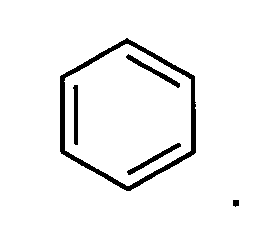
- Turning now to the three substituents which are necessarily attached to the monocyclic ring, the preferred first substituent, which we have called the amido function, may be described by formula II:

The preferred second substituent having a terminal carboxylic acid or derivative thereof may be described by formula III:
The preferred third substituent, the lipophilic substituent, may be described by formula IV:
where A, B, D, E, F, G, R, R', a, b, d, e, f and g are as described below. - These above substituents of formulae II to IV may be attached at various positions of the aryl ring.
- The remaining positions on the aryl ring, if available, may be substituted by R₁. This is described below. In the case of those compounds having an available protonated nitrogen atom in the ring, this also may be substituted by one of the substituents of Formulae II-IV or substituted by R' which is also described below.
- The following definitions apply to the substituents of formulae I to IV, each of which is attached at a suitable position on the aryl ring, where:
A is -CRR or O;
B and G are each independently phenyl which may be optionally substituted with 1 to 3 R'' groups;
D and F are each independently a bond, O,
-CRR, -O-(CRR)j-, (CRR)j-O-, -O-(CRR)j-CR=CR-, -CR=CR-(CRR)j-O- where j is 1-4, or (CR=CR)x where x is 0-2 ;
E is -COOR', -CONR'R', -CN,
tetrazolyl or substituted tetrazolyl where the substituents are alkyl, carboxyalkyl or carbalkoxyalkyl; R is independently hydrogen or -(CH₂)m-R₁ where m is 0-5 ;
R' is hydrogen or alkyl ;
a, b, d, e, f and g are 0-4 provided


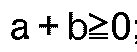
R₁ is hydrogen
Preferred compounds of this invention are described by those compounds of formula V:
where:
A is -CRR or O;
B and G are independently phenyl or substituted phenyl and B and/or G may be substituted with 1 to about 3 R'' groups where R'' is alkyl, haloalkyl, alkoxy, halo or nitro;
D is a bond, O, -CRR, -O-(CRR)j-, -(CRR)j-O-,
-O-(CRR)j-CR=CR-, -CR=CR-(CRR)j-O- where j is 1-4 or -(CR=CR)x where x is 1 or 2;
E is -COOR', -CONR'R', -CN,
tetrazolyl or substituted tetrazolyl where the substituent is alkyl ;
F is a bond, O or -CRR;
R is hydrogen or -(CH₂)m-R₁ where m is 0-5 ;
R₁ is hydrogen ;
R' is hydrogen or alkyl ; and
a, b, d, e, f and g are independently 0-4 provided



The preferred positions for substitution in the molecule of formula V are the 1, 3 and 5 positions. - The more preferred compounds include those where:
A is CHR or O;
B and G are phenyl or substituted phenyl where the substituents are C₁-C₆ alkyl or C₁-C₆ alkoxy;
D is a bond, O, -CHR, -O-(CRR)j-, -(CRR)j-O-, -O-(CRR)j-CR=CR-, -CR=CR-(CRR)j-O- where j is 1-4 or (CR=CR)x where x is 1 or 2;
E is -COOR' or tetrazolyl;
F is a bond, O or -CHR;
R is hydrogen, C₁-C₆ alkyl ;
R' is hydrogen ; and
a, b, d, e,f and g are independently 0-4, provided


where R' is hydrogen or IC₁-C₆ alkyl and R'' is hydrogen, C₁-C₆ alkyl or C₁-C₆ alkoxy. - Among the most preferred terminal acidic substituents are:
-(CRR)d-(CRR)e-E where d and e are 0-4, -(CR=CR)x-E where x is 1-2, O-(CRR)j-(CRR)e-E where j and e are 1-4, and -O-(CRR)j-CR=CR-E where j is 1-4, R is hydrogen or C₁-C₆ alkyl and E is -COOH or
- Among the most preferred lipophilic substituents are:

where g is 0-4 and R is hydrogen or C₁-C₆ alkyl and R'' is hydrogen, C₁-C₆ alkyl or C₁-C₆ alkoxy. In those special embodiment cases where the lipophilic substituent is attached to a substituent containing the amido or carboxylic acid or derivative function, then g may also be 0. - While this invention necessitates the presence of three specific substituents be present on the aryl ring as described by formulae I and V, it is often desirable to have a another substituent present. This also may be the same or different as those of formulae II-IV already present. Other substituents of R₁ may likewise be desired. It is to be understood that such compounds fall within the scope of this invention.
- It may be of interest to one skilled in the art that compounds where E is OR' may also be of value as LTB₄ antagonists.
- The compounds of this invention may be prepared by employing art recognized procedures from known compounds or readily preparable intermediates. Exemplary general procedures are as follows.
- Since the compounds of this invention have three substituents which are necessarily present, the introduction of each substituent to the aryl ring system is, of course, dependent on the specific substituents involved and the chemistry necessary for their formation. Thus, consideration of how one substituent would be affected by a chemical reaction when forming a second substituent would involve techniques familiar to the skilled artisan. This would further be dependent on the ring involved.
- It is convenient to synthesize these molecules by employing condensation reactions at reactive A, D and F cites of the molecule. Exemplary general procedures are as follows and are shown for convenience using the benzene ring system. Of course, while the following reactions involved are basic to developing substituted phenyl molecules having the three required substituents present, the substitution patterns for other monocyclic rings would depend on the chemistry of the particular ring. Any such adjustments to the chemistry would be familiar to one skilled in the art.
- Thus, in order to prepare those compounds where A, D or F is O the following reactions or combination of reactions may be employed:
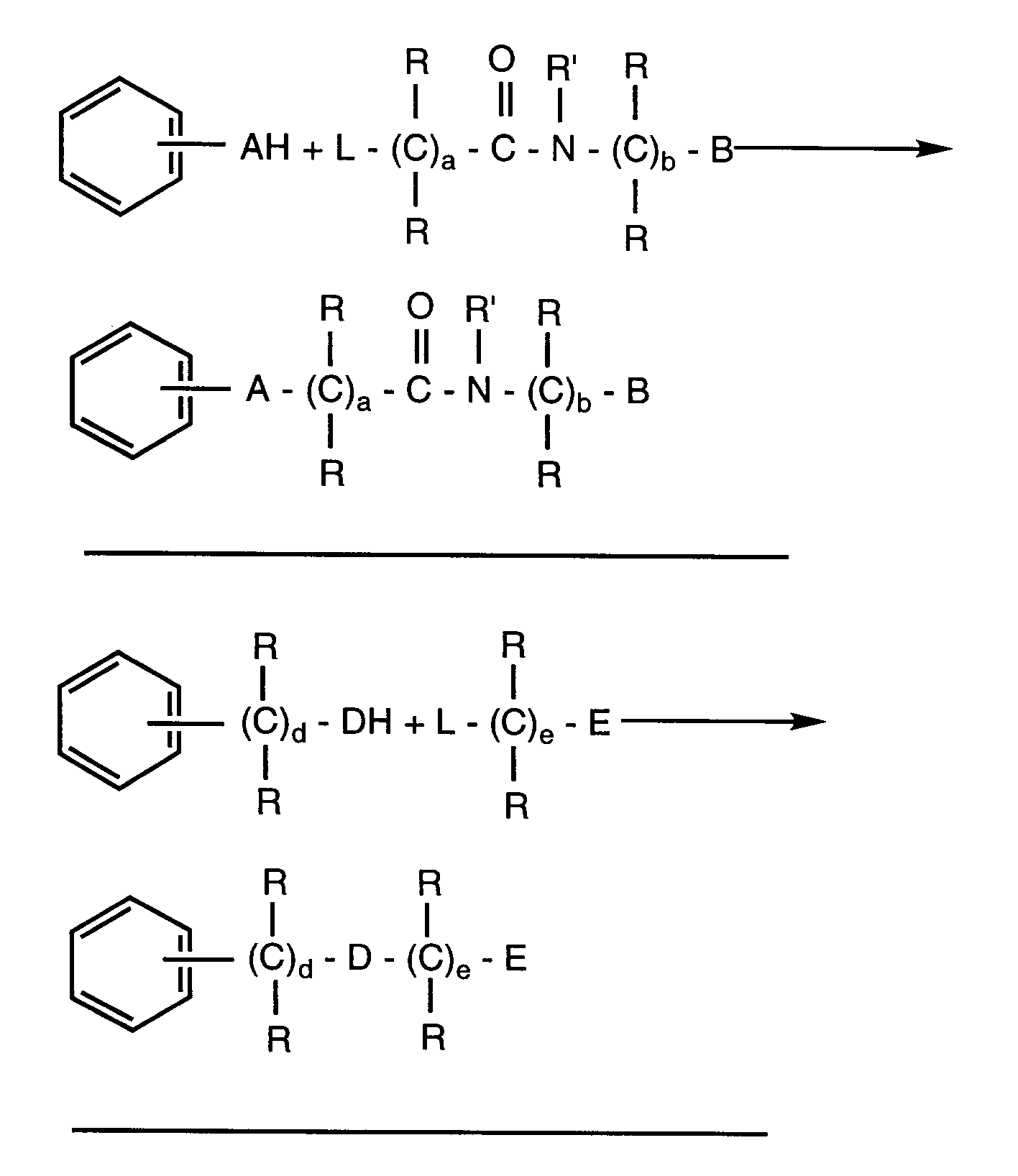

When A, D or F is O , the compounds may be prepared by condensation of the aryl alcohol or thiol with a compound of the formulae
where E is preferably a nitrile, ester or tetrazole and L is a leaving group such as halo, tosylate or mesylate. This reaction is usually carried out in the presence of any base normally employed to deprotonate an alcohol or thiol such as sodium hydride, sodium hydroxide, triethyl amine, sodium bicarbonate, diisopropylethylamine or methyl magnesium halides. - Reaction temperatures are in the range of room temperature to reflux and reaction times may vary from 2 to 96 hours. The reaction is usually carried out in a solvent that will dissolve both reactants and is inert to both as well. Solvents include, but are not limited to diethyl ether, THF, N,N-dimethylformamide, dimethylsulfoxide, dioxane and the like.
- When A is an alkyl group, it is convenient to prepare these compounds by Friedel-Crafts alkylation or by the Wittig reaction followed by reduction.
- Those compounds where F and/or D are

where x is 1 or 2, are prepared by reacting the appropriate aldehyde or ketone with an appropriate Wittig reagent or modified Wittig reagent of the formula
where E is cyano or carbalkoxy.
Thus for example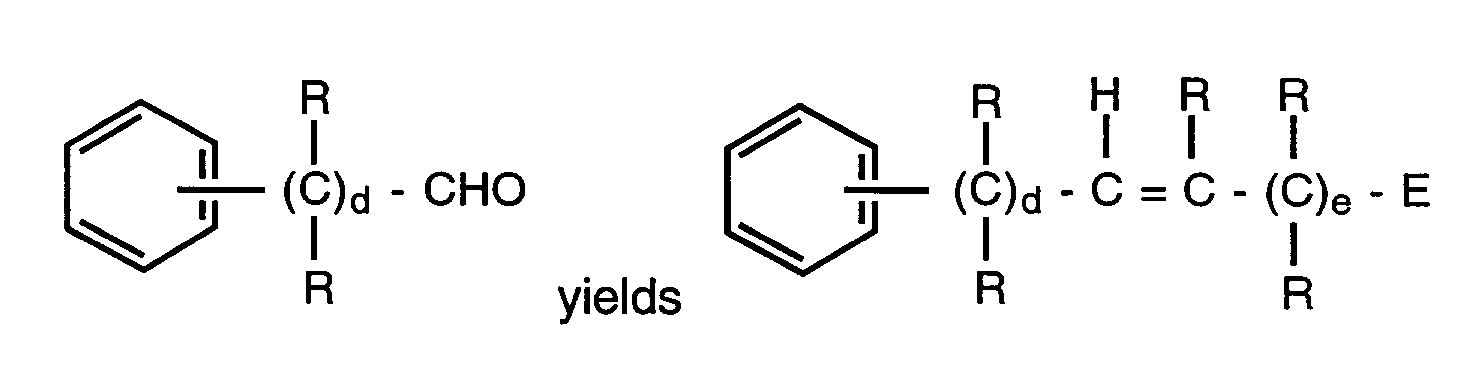
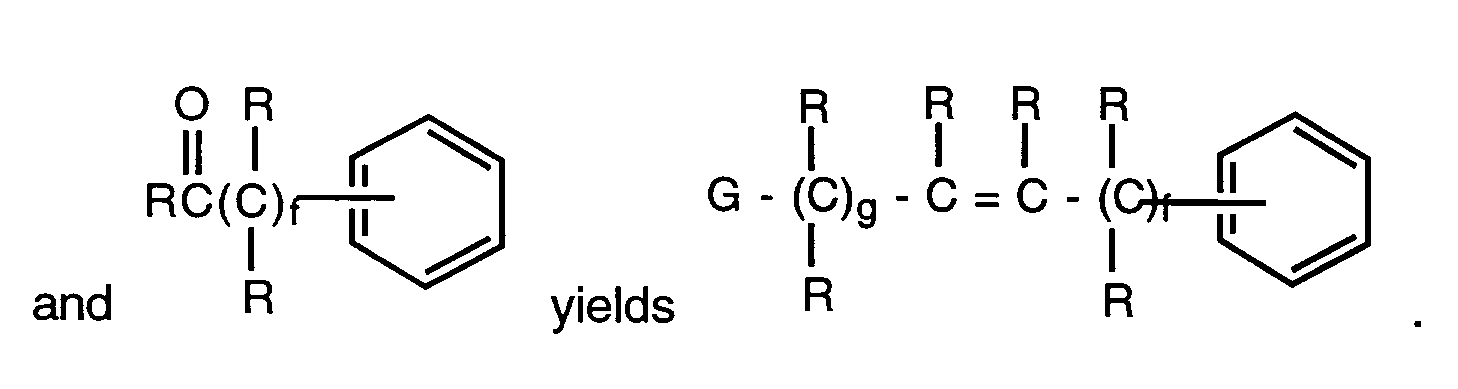
- Reference for the Wittig reaction and modified Wittig reaction to control the formation of the trans and cis configuration at the double bond and the isomerization of cis and trans isomers can be found in A. Maercher, Organic Reactions, 14, 270, 1965.
- The intermediate aldehyde compounds may be prepared in the usual manner from the corresponding carboxylic acid with an alkylithium reagent, or from the oxidation of the corresponding alcohol. The aldehyde can also be obtained by Friedel-Crafts acylation or formylation (POCl₃/DMF) of the aryl ring.
- The tetrazoles may be formed from the nitrile at various stages of the synthesis by treatment with hydrazoic acid formed in situ from sodium azide and an acid. The nitrile may also be converted to the acids, esters or amides by known methods.
- It is convenient to develop the synthesis of the final product by successively forming each desired substituent in turn. Thus in order to prepare
a compound such as
the following reaction sequence could be used: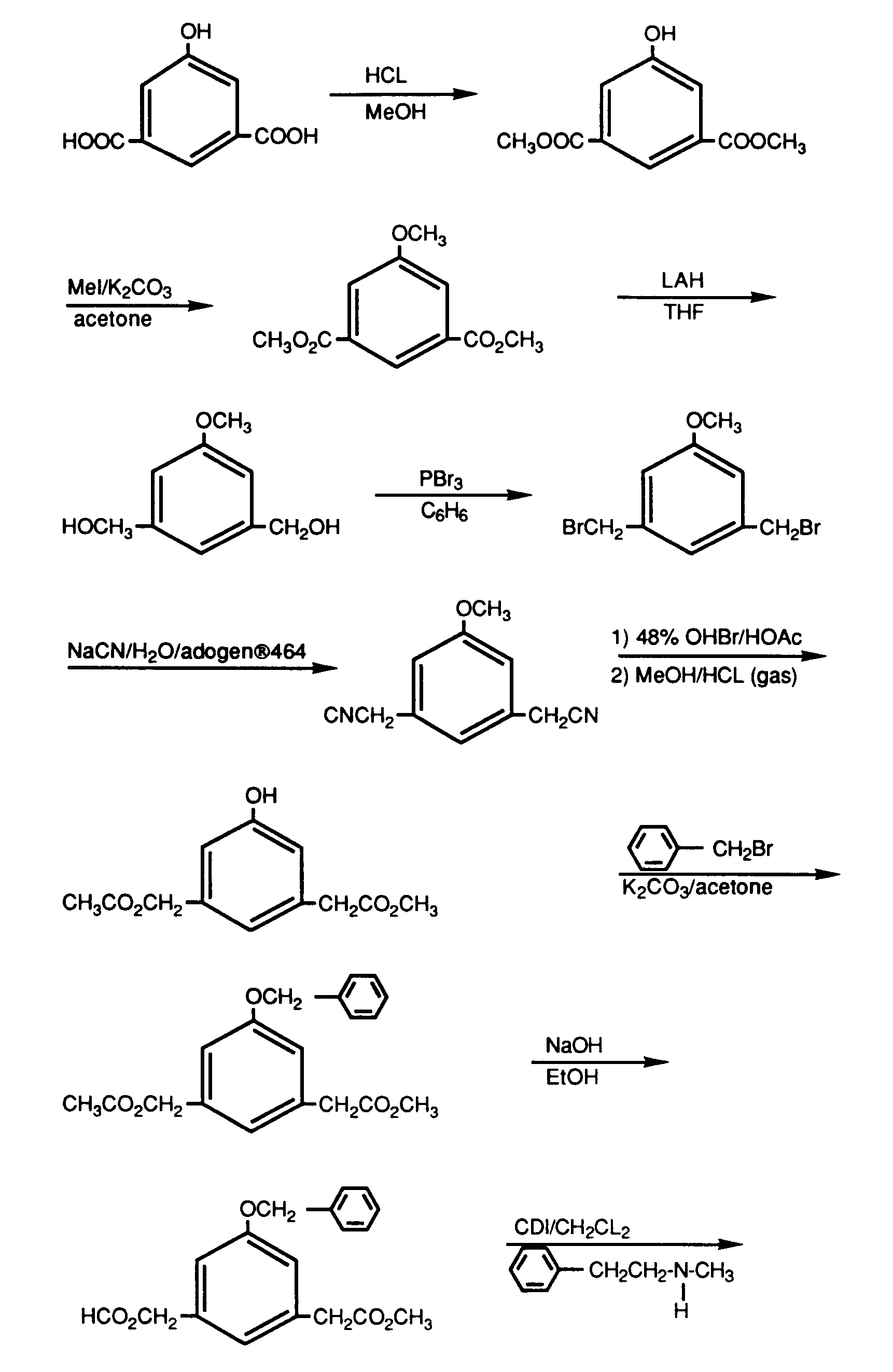

A further example may be described in the preparation of the following compounds which may exist as the cis or trans stereoisomers or their racemic mixture:


Certain compounds of this invention may have at least one asymmetric carbon atom such as those compounds having different geminal R groups or those compounds which contain an asymmetric carbon atom. Further, certain compounds of this invention may exist in their cis or trans configuration such as those compounds where D and/or F is CR=CR. As a result, those compounds of this invention may be obtained either as racemic mixtures, diastereoisomeric mixtures or as individual enantiomers. When two or three asymmetric centers are present the product may exist as mixtures of two or four diastereomers. Of course it is understood that certain other compounds within the scope of this invention could have a number of stereocenters. In general, a compound with x stereocenters can have a maximum of 2x stereoisomers. Therefore, a compound having three such centers gives rise to a maximum of eight stereoisomers, while one having four produces sixteen, etc. The product may be synthesized as a mixture of the isomers and then the desired isomer separated by conventional techniques such as chromatography or fractional crystallization from which each diastereomer may be resolved. On the other hand, synthesis may be carried out by known stereospecific processes using the desired form of the intermediate which would result in obtaining the desired stereospecificity. - Reference to the separation of cis and trans isomers by chromatography may be found in W. K. Chan, et al, J. Am. Chem. Soc. 96, 3642, 1974.
- It is to be understood that the scope of this invention encompasses not only the various isomers which may exist but also the various mixture of isomers which may be formed.
- The resolution of the compounds of this invention and their starting materials may be carried out by known procedures. Incorporation by reference is hereby made to the four volume compendium Optical Resolution Procedures for Chemical Compounds: Optical Resolution Information Center, Manhattan College, Riverdale, New York. Such procedures are useful in the practive of this invention. A further useful reference is Enantiomers, Racemates and Resolutions: Jean Jacques, Andre Collet and Samuel H. Wilen; John Wiley & Sons, Inc., New York, 1981. Basically, the resolution of the compounds is based on the differences in the physical properties of diastereomers. Conversion of the racemates into a mixture of diastereomers by attachment of an enantiomerically pure moiety results in forms that are separable by fractional crystallization, distillation or chromatography.
- The present compounds form salts with acids when a basic amino function is present and salts with bases when an acid function, i.e., carboxyl, is present. All such salts are useful in the isolation and/or purification of the new products. Of particular value are the pharmaceutically acceptable salts with both acids and bases. Suitable acids include, for example, hydrochloric, sulfuric, nitric, benzenesulfonic, toluenesulfonic, acetic, maleic, tartaric and the like which are pharmaceutically acceptable. Basic salts for pharmaceutical use are the Na, K, Ca and Mg salts.
- Various substituents on the present new compounds, e.g., as defined in R₁ and R'' can be present in the starting compounds, added to any one of the intermediates or added after formation of the final products by known methods of substitution or conversion reactions. If the substituents themselves are reactive, then the substituents can themselves be protected according to the techniques known in the art. A variety of protecting groups known in the art, may be employed. Examples of many of these possible groups may be found in "Protective Groups in Organic Synthesis" by T. W. Green, John Wiley and Sons, 1981. For example, nitro groups can be added by nitration and the nitro group converted to other groups, such as amino by reduction, and halo by diazotization of the amino group and replacement of the diazo group. Acyl groups can be added by Friedel-Crafts acylation. The acyl groups can then by transformed to the corresponding alkyl groups by various methods, including the Wolff-Kishner reduction and Clemmenson reduction. Amino groups can be alkylated to form mono- and di-alkylamino groups; and mercapto and hydroxy groups can be alkylated to form corresponding ethers. Primary alcohols can be oxidized by oxidizing agents known in the art to form carboxylic acids or aldehydes, and secondary alcohols can be oxidized to form ketones. Thus, substitution or alteration reactions can be employed to provide a variety of substituents throughout the molecule of the starting material, intermediates, or the final product.
- Compounds within the scope of the present invention have potent activity as leukotriene B₄ antagonists and as such possess therapeutic value in the treatment of inflammatory conditions and hypersensitivity responses. LTB₄ is implicated in diseases such as rheumatoid arthritis, gout, psoriasis and inflammatory bowel disease and therefore compounds which demonstrate LTB₄ antagonist properties would be of value in the control of these states.
- The LTB₄ guinea pig polymorphonuclear membrane binding assay can be used to determine compounds exhibiting LTB₄ receptor antagonist properties. Compounds active in this assay can then be subjected to the guinea pig peritoneal PMN LTB₄-induced aggregation assay. THE LTB₄-induced aggregation assay determines the functional activity of a compound. The guinea pig LTB₄-induced wheal assay is used to determine in vitro activity.
- Dissolve compounds to a concentration 100-fold higher than the highest desired concentration for testing. Serially dilute the compound so that all dilutions are 100-fold higher than the assay concentration desired. Compounds are typically dissolved in DMSO. If compounds are insoluble in DMSO, solutions are heated or sonicated to induce solubilization. Compounds may also be dissolved in ethanol.
- Final assay concentrations of DMSO and ethanol can be as high as 1.0% and 2.0% (v/v); these concentrations have no measurable effects on specific binding.
- To obtain polymorphonuclear leukocytes (PMNs), 25-30 male Hartley guinea pigs (250-350g) are intraperitoneally injected with 6 mls of an 8% sodium caseinate solution. 18 to 24 hours later, the guinea pigs are sacrificed by decapitation. The peritoneal cavity is lavaged with 15 mls of isolation buffer. The cells are collected and centrifuged at 200xg for 10 minutes. Contaminating red blood cells can be removed by hypotonic lysis. The cells are resuspended in isolation buffer and centrifuged as before. They are filtered through gauze and centrifuged again. The resulting pellet is suspended in 3 ml of sonication buffer, counted and brought to a concentration of 1 x 10⁸ cells/ml. This suspension is lysed on ice with 5 bursts of 30 seconds separated by 1 minute intervals. The homogenate is centrifuged at 200xg for 10 minutes at 4°C. Aliquots of supernatant are transferred to high speed centrifuge tubes (1 tube per 3 guinea pigs). The tubes are centrifuged at 49,000xg for 15 minutes at 4°C. The pellets are resuspended by three 5 second bursts of sonication, separated by 20 second intervals. This suspension is centrifuged at 50,000xg for 20 minutes at 4°C. Pellets are stored at -70°C for up to 3 months.
- To use in the binding assay, the pellet is thawed at room temperature and suspended in 9 mls of assay buffer (sonication may be necessary).
- Each assay tube (16 x 100 mm) contains the following:
345 »l Assay Buffer
5 »l Test compound or solvent
50 »l ³H-LTB₄ (0.50 nM)
100 »l Protein preparation (0.2 mg)
Incubations are done at 30°C for 40 minutes in a water bath. Reactions are started by the addition of (³H)-LTB₄ solution. Samples are collected via a Brandel M24 Harvester for binding assays. Tubes should be washed with a total of 19 ml cold wash buffer. - The filters are transferred to 7 ml plastic scintillation vials to which 6.0 ml of appropriate scintillation fluid (e.g., Scintiverse®) is added. After being allowed to equilibrate for 12 hours, the radioactivity is counted with a liquid scintillation counter appropriately set for tritium.
- The required control assay tubes include the following:
- (a) Total Binding: No test compound is added; buffer is substituted.
- (b) Non-Specific Binding: Non-labeled ligand is added at a concentration of 1 »M.
- (c) Solvent Controls: If test compound is dissolved in a solvent, controls for both Total Binding and Non-Specific Binding containing solvent but no compounds are required.
- Specific binding is defined as that amount of radioligand prevented from binding by 1000-fold excess non-labeled ligand, i.e., total binding minus non-specific binding. This operational definition is verified by Scatchard analysis of total binding.
- Inhibition of specific binding is defined as the decrease in specific binding caused by the test compound,

where SBC is the specific binding in the absence of test compound and SBT is the specific binding in the presence of test compound. The I₅₀ values (concentrations required to inhibit specific binding by 50%) are determined by graphic analysis of the specific binding observed in the presence of various concentrations of test compound. - The results of this test indicate that compounds of this invention exhibit valuable LTB₄ receptor binding properties which are useful in the treatment of inflammatory conditions and hypersensitivity responses.
- LTB₄ plays the role of a mediator in cellular induced inflammation. The induction of chemokinesis and chemotaxis of PMNs and macrophage by LTB₄ have contributed to its association with the vascular aspects of acute inflammatory reactions.
- In this test intradermal injection of 0.1 ml of a 10 »g/ml solution of LTB₄ to guinea pig back skin causes the formation of a wheal. This wheal is visualized by the prior intravenous injection with the indicator 1% Evan's Blue dye. Following a 2 hour incubation post-LTB₄ challenge, the guinea pigs are euthanized via CO₂ asphyxiation. Their dorsal skins are reflected and the diameters of the challenged sites are compared with those of the vehicle control injected sites.
- The guinea pigs must be quarantined 5 to 7 days prior to the study. The day before the test, the back and hind limbs are shaved taking care not to nick the skin. After shaving, the guinea pigs are fasted, but water is provided.
- On the day of the test, the guinea pigs are weighed and identified with an ink mark designating them with numbers 1 through 5 in each group. Groups are formed by random distribution.
- The oral vehicles are Polyethylene Glycol (PEG 400) (2 ml/kg) and methocel (0.5% w/v) (10 ml/kg). Exposure to the ultrasound of a Branson sonicator assures uniformity of suspension or dissolution of the test compounds. Compounds for parenteral administration are dissolved in saline with the assistance of 0.1N HCl and 0.1N NaOH and then adjusting the pH to near neutrality.
- Although test compounds are usually administered orally, other routes of administration such as intravenous, intraperitoneal or subcutaneous may be used.
- LTB₄ is obtained as a stock solution (50 »g/ml) in ethanol and is stored at -80°C until required for use. The stock solution or an appropriate aliquot is transferred from the ampule into a 10 ml glass vial using a pasteur pipette. The stock solution is then evaporated to dryness under a slow, steady stream of argon gas.
- A solution of freshly prepared 0.25% Bovine Albumin in Phosphate-Buffered Saline is bubbled with argon gas until the saturation point is reached (approximately 5 minutes). This argon-saturated vehicle is then used to reconstitute the evaporated LTB₄ stock residue to yield a final working concentration of 10 »g/ml. The rubber stoppered vial of LTB₄ working solution is kept on wet ice during the study.
- Because Evan's Blue is an easily visible marker that binds to the plasma proteins, it has been selected to assist the investigator in the measurement of the wheals induced during the study. Evan's Blue Dye is dissolved as a 1% w/v solution in 0.9% w/v physiologic saline. The number of 1 ml plastic disposable syringes, fitted with 27 gauge, 1/2 inch needles and filled with the 1% dye solution, is determined by the number of animals expected to be included in the study.
- Test compounds or their appropriate controls are administered orally with 16 gauge, 3 inch dosing cannulas. Immediately after dosing, the guinea pig is injected intravenously with 1 ml of 1% Evan's Blue Dye into a digital vein in the left or right shaved hind limb. This injection is facilitated best through the use of a 1 ml plastic syringe fitted with a 27 gauge, 1/2 inch needle. Immediately following Evan's Blue injection, the guinea pig is injected intracutaneously at each of 2 sites in the shaved dorsal midline with 0.1 ml of the prepared argon-saturated LTB₄ solution (1 »g/0.1 ml). A third site is intracutaneously injected with the argon-saturated 0.25% bovine albumin in phosphate-buffered saline to serve as a vehicle control.
- 2 hours after challenge, the guinea pigs are euthanized by inhalation of carbon dioxide. Carbon dioxide is administered by inserting a rubber tube from the tank into a plastic bag containing the caged group of guinea pigs. Asphyxiation occurs in approximately 5 minutes.
- After death, the dorsal skins are reflected to enable the measurement of 2 perpendicular diameters of the resultant wheals. The area of each wheal is determined using the formula:

- For each guinea pig, the mean of the wheal areas obtained for the 2 injections sites is established after correction is made for the effect of the wheal area induced by the 0.25% Bovine Albumin in Phosphate-Buffered Saline vehicle. Then, a mean area for each treatment group with its corresponding standard error is calculated.
- The following equation is used to calculate the percent inhibition of vehicle treated control wheal area by treatment with test compound:

In multiple dose experiments, the dose of a test compound that will cause 50% inhibition (ED₅₀) can be calculated from the regression equation for the response as percent inhibition (y) and log dose (x) and estimating the (ED₅₀) from:
- ŷ=
- 50% inhibition,
- x =
- dose of test compound,
- b =
- slope of dose response line and
- m =
- intercept of the dose response line.
- 95% confidence limits of ED₅₀ are calculated from the regression equation by the method of Litchfield and Wilcoxon where:


where S is the slope function used to compute the limit factor fED₅₀ 2.77/√N as

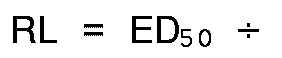

- The 1 »g/0.1 ml/site challenge dose of LTB₄ was selected for the reproducibility, sensitivity and ease of measurement of the resultant wheal. Studies have indicated that size of wheals induced by LTB₄ is directly related to the dose administered.
- 2 hours of incubation after intradermal challenge with LTB₄ was selected as the routine timing for the study. Duration studies conducted evidenced the production of measurable, reproducible wheals at the 2 hour endpoint.
- In view of the results obtained when compounds of the present invention are subjected to this test, it can be demonstrated that valuable properties as LTB₄ antagonists are indicated.
- A further test which may be used to determine the ability of compounds of this invention to exhibit LTB₄ antagonist activities is as follows:
- 6 ml of 6% Na-caseinate (in saline) is injected intraperitoneally into 2 male guinea pigs (250-300g) lightly anesthetized with CO₂ or ether. The following day (18-24 hours post injection) the animals are sacrificed by decapitation or CO₂ overdose according to the SOP for nonclinical laboratory study methods.
- A midline section of abdominal skin is removed and 13 ml Hanks buffer (containing 500 »l 10 mM EDTA/500 ml Hanks) plus 2 ml 7% Na-citrate is injected into the peritoneal cavity. The guinea pig is rocked back and forth 5 times. A small incision is made on the left side of the midline of the abdominal wall (avoid cutting obvious blood vessels). Use a fire-polished pasteur pipette to transfer the buffer plus cells from the abdominal cavity to 2 washed Nalgene (Oak Ridge) centrifuge tubes (half of buffer and cells in each tube). The tubes are then filled to 50 ml with additional citrate-Hanks buffer and centrifuged at 4000 rpm for 10 minutes.
- Each pellet is resuspended in 1 ml of citrate-Hanks and then diluted to 50 ml with the same buffer. The cells are incubated for 30 minutes at room temperature on a Hema-Tek aliquot mixer. The cells are filtered through 2 layers of gauze into 50 ml with plastic beakers to remove PMN aggregates and then transferred to fresh, washed, 50 ml Nalgene centrifuge tubes.
- The cells are centrifuged for 5 minutes, resuspended in 50 ml of fresh buffer, centrifuged again and then resuspended in 3 ml of citrate-free Hanks buffer. (Following any centrifugation the cells are always resuspended first in 1 ml of the desired fresh buffer.)
- An aliquot of the washed cells, diluted 50-fold, is counted using a microscope and a hemacytometer.
- The PMNs are counted as follows:
- 1. Dilute 50 »l of cells into 450 »l of Hank's buffer.
- 2. Dilute 50 »l of (1) with 150 »l of Hank's buffer plus 50 »l of Toluidine blue (50x total dilution). Add 10 »l of (2) to the hemacytometer and count cells in 16 large squares (volume counted = 1 »l). View the hemacytometer under 40x magnification. The unstained cells are PMNs.
- Calculation: Asssume 149 cells are counted.

cells/ml = 149/.0001 = 1,490,000 cells/ml
Thus, cells must be diluted 2.48-fold with Hanks buffer (2.48 x 3 = 7.44 ml; 7.44 - 3.0 = 4.44; add 4.44 ml buffer to the 3 ml of washed cells). This results in 7.44 ml of cells at a concentration of 3 x 10⁷ cells per ml. - Place cuvettes containing 1 x 10⁷ cells/ml (166 »l PMNs plus 334 »l buffer) plus flea magnets in the aggregometer sample wells. Turn on the Chart Advance to 30 cm/hr. Turn the attenuation dials to mid range and decrease the recorder mV range settings to 50 mV full scale. Press the red "zero" button on the aggregometer and note exactly the position of the recorder pens. Turn the aggregometer left hand "PPP" dials for each cuvette position to the left or right so that the associated recorder pens move to the exact positions noted by pressing the red "zero" button. The electrical circuits are now "balanced". Except for small balance adjustments, do not make any further changes in pen positions by adjusting the "PPP" dials.
- Withdraw one of the cuvettes from the aggregometer and note the (positive) direction of recorder pen motion. Replace the cuvette. Using the recorder zero knob, move the recorder pen in the positive direction to the chart paper 95% line. The pens now should not move when the red "zero" button is pressed. The pen also should not move when the mV sensitivity range is changed to 20 or 10 mV full scale (leave at 10 mV).
- PMN aggregation should cause the pen to move in the "negative" direction across the chart paper. Make comparable adjustments for the second aggregometer channel but zero the recorder pen on the opposite side of the chart paper. Finally, pressing the zero button on either the recorder or the aggregometer should not cause the pens to move more than a mm or two. This instrument configuration will result in maximal pen deflection following aggregation of cells.
- To a cuvette containing 334 »l of buffer and a flea magnet, add 166 »l of PMNs, 10 »l of Ca==/Mg⁺⁺ (70/et mM; 1.4/0.7 mM final) and 5 »l of 10 »M cytochalasin-β allow to warm up in the aggregometer (37°C) for 5 minutes and then add 1 »l of test compound in DMSO or DMSO carrier alone. Note compound effects, if any, for 2 minutes, then add 5 »l of the challenge agonist (LTB₄, PAF, etc.) and observe the response for at least 2 minutes. The standard concentrations of agonists used in this assay are arachidonic acid, 6 »M; LTB₄, 0.3 nM; PAF, 30 pM; and FMLP, 0.6 nM.
- Aggregation is quantitated by measuring, in millimeters, the average maximum deflection of the pen line at 1 minute or less after the addition of LTB₄. The maximum response to a control challenge with arachidonic acid may develop somewhat more slowly than this.
- Each aggregometer-recorder channel should include its own series of control aggregations. All compounds should be tested at least twice at each concentration of interest. The inhibitory activity observed is expressed as the mean percent change (inhibition) observed relative to the controls determined in that channel. Controls must include appropriate solvent blanks.
- The results of the above test demonstrate that compounds within the scope of this invention inhibit the activity of LTB₄.
- The compounds of the present invention can be administered to a mammalian host in a variety of forms adapted to the chosen route of administration, i.e., orally, or parenterally. Parenteral administration in this respect includes administration by the following routes: intravenous, intramuscular, subcutaneous, intraocular, intrasynovial, transepthelially including transdermal, ophthalmic, sublingual and buccal; topically including ophthalmic, dermal, ocular, rectal and nasal inhalation via insufflation and aerosol and rectal systemic.
- The active compound may be orally administered, for example, with an inert diluent or with an assimilable edible carrier, or it may be enclosed in hard or soft shell gelatin capsules, or it may be compressed into tablets, or it may be incorporated directly with the food of the diet. For oral therapeutic administration, the active compound may be incorporated with excipient and used in the form of ingestible tablets, buccal tablets, trochees, capsules, elixirs, suspensions, syrups, wafers, and the like. Such compositions and preparations should contain at least 0.1% of active compound. The percentage of the compositions and preparations may, of course, be varied and may conveniently be between about 2 to about 6% of the weight of the unit. The amount of active compound in such therapeutically useful compositions is such that a suitable dosage will be obtained. Preferred compositions or preparations according to the present invention are prepared so that an oral dosage unit form contains between about 50 and 300 mg of active compound.
- The tablets, trochees, pills, capsules and the like may also contain the following: A binder such as gum tragacanth, acacia, corn starch or gelatin; excipients such as dicalcium phosphate; a disintegrating agent such as corn starch, potato starch, alginic acid and the like; a lubricant such as magnesium stearate; and a sweetening agent such as sucrose, lactose or saccharin may be added or a flavoring agent such as peppermint, oil of wintergreen, or cherry flavoring. When the dosage unit form is a capsule, it may contain, in addition to materials of the above type, a liquid carrier. Various other materials may be present as coatings or to otherwise modify the physical form of the dosage unit. For instance, tablets, pills, or capsules may be coated with shellac, sugar or both. A syrup or elixir may contain the active compound, sucrose as a sweetening agent, methyl and propylparabens a preservatives, a dye and flavoring such as cherry or orange flavor. Of course, any material used in preparing any dosage unit form should be pharmaceutically pure and substantially non-toxic in the amounts employed. In addition, the active compound may be incorporated into sustained-release preparations and formulations.
- The active compound may also be administered parenterally or intraperitoneally. Solutions of the active compound as a free base or pharmacologically acceptable salt can be prepared in water suitably mixed with a surfactant such as hydroxy-propylcellulose. Dispersion can also be prepared in glycerol, liquid polyethylene glycols, and mixtures thereof and in oils. Under ordinary conditions of storage and use, these preparations contain a preservative to prevent the growth of microorganisms.
- The pharmaceutical forms suitable for injectable use include sterile aqueous solutions or dispersions and sterile powders for the extemporaneous preparation of sterile injectable solutions or dispersions. In all cases the form must be sterile and must be fluid to the extent that easy syringability exists. It may be stable under the conditions of manufacture and storage and must be preserved against the contaminating action of microorganisms such as bacteria and fungi. The carrier can be a solvent or dispersion medium containing, for example, water, ethanol, polyol (for example, glycerol, propylene glycol, and liquid polyethylene glycol, and the like), suitable mixtures thereof, and vegetable oils. The proper fluidity can be maintained, for example, by the use of a coating such as lecithin, by the maintenance of the required particle size in the case of dispersion and by the use of surfactants. The prevention of the action of microorganisms can be brought about by various antibacterial and antifungal agents, for example, parabens, chlorobutanol, phenol, sorbic acid, thimerosal, and the like. In many cases, it will be preferable to include isotonic agents, for example, sugars or sodium chloride. Prolonged absorption of the injectable compositions of agents delaying absorption, for example, aluminum monostearate and gelatin.
- Sterile injectable solutions are prepared by incorporating the active compound in the required amount in the appropriate solvent with various of the other ingredients enumerated above, as required, followed by filtered sterilization. Generally, dispersions are prepared by incorporating the various sterilized active ingredient into a sterile vehicle which contains the basic dispersion medium and the required other ingredients from those enumerated above. In the case of sterile powders for the preparation of sterile injectable solutions, the preferred methods of preparation are vacuum drying and the freeze drying technique which yield a powder of the active ingredient plus any additional desired ingredient from previously sterile-filtered solution thereof.
- The therapeutic compounds of this invention may be administered to a mammal alone or in combination with pharmaceutically acceptable carriers, as noted above, the proportion of which is determined by the solubility and chemical nature of the compound, chosen route of administration and standard pharmaceutical practice.
- The physician will determine the dosage of the present therapeutic agents which will be most suitable for prophylaxis or treatment and it will vary with the form of administration and the particular compound chosen, and also, it will vary with the particular patient under treatment. He will generally wish to initiate treatment with small dosages by small increments until the optimum effect under the circumstances is reached. The therapeutic dosage will generally be from 0.1 to 100 M/day or from about 0.1 mg to about 50 mg/kg of body weight per day and higher although it may be administered in several different dosage units. Higher dosages are required for oral administration.
- The compounds of the present invention may be prepared by the following representative examples:
-
- To a solution of 30g (0.165 moles) of 5-hydroxyisophthalic acid in 500 ml MeOH is bubbled in dry HCl gas for 20 minutes. The reaction mixture is then allowed to stir at room temperature for 2 hours and it is then concentrated down in vacuo to yield methyl,methyl 5-hydroxyisophthalate which is used directly in the next step.
- To a solution of 34.6g (0.165 moles) of methyl,methyl 5-hydroxyisophthalate in 500 ml acetone is added 28.43g (0.206 moles) of K₂CO₃ and 12.84 ml (0.206 moles) of Mel. The reaction mixture is refluxed for 5 hours, filtered and concentrated down in vacuo. The resulting crude solid is dissolved in EtOAc, washed with H₂O (2 times), brine, dried with MgSO₄, filtered and concentrated in vacuo to yield methyl,methyl 5-methoxyisophthalate which is used directly in the next step.
- To a solution of 5.00g (22.32 mmoles) of methyl,methyl 5-methoxyisophthalate in 100 ml dry THF is added dropwise, maintaining a gentle reflux, 67 ml (66.96 mmoles) of a 1M solution of lithium aluminum hydride in Et₂O. After addition the reaction mixture is stirred for 1 hour and is then quenched with saturated NH₄Cl. The reaction mixture is then extracted with Et₂O (3 times). The Et₂O layers are combined, washed with brine, dried with MgSO₄, filtered and concentrated down in vacuo to yield 1,3-di-(hydroxymethyl)-5-methoxybenzene which is used directly in the next step.
- A suspension of 9.25g (55.06 mmoles) of 1,3-di-(hydroxymethyl)-5-methoxybenzene in 75 ml of benzene is added dropwide to 9.4 ml (99.11 mmoles) PBr₃ as a solution in 15 ml benzene. After addition, the reaction mixture is refluxed for 45 minutes, filtered and poured onto 100g of ice. The reaction mixture is then extracted with EtOAc (3 times). The EtOAc layers are combined and are dried with MgSO₄, filtered and concentrated in vacuo to afford 1,3-di-(bromomethyl)-5-methoxybenzene which is used directly in the next step.
-
- To a solution of 23.35g (79.42 mmoles) of 1,3-di-(bromomethyl)-5-methoxybenzene in 300 ml toluene is added 300 ml of H₂O, 11.67g (238.26 mmoles) of NaCN and 0.58g Adogen® 464*. The reaction mixture is then refluxed for 18 hours and then allowed to come to room temperature. The organic layer is separated and washed with H₂O (3 times), brine (2 times), dried with MgSO₄ and filtered. To this is added 10 mls of EtOH and the resulting reaction mixture is filtered through silica gel and is concentrated in vacuo to yield 1,3-di-(cyanomethyl)-5-methoxybenzene which is used directly in the next step. [*Adogen®464 (methyltriallyl (C₈-C₁₀) ammonium chloride) Aldrich 50934-77-5]
- To a solution of 9.67g (52 mmoles) of 1,3-di-(cyanomethyl)-5-methoxybenzene in 90 ml acetic acid is added 90 mls of a 48% HBr solution. The reaction mixture is refluxed for 18 hours, poured into H₂O and extracted with EtoAc. The EtoAc extractions are combined, washed with H₂O (3 times), brine (1 time), dried with MgSO₄, filtered and concentrated in vacuo. The resulting product is taken up in 100 ml of MeOH and dry HCl gas is bubbled in for 10 minutes. The reaction mixture is stirred for 30 minutes at room temperature and concentrated in vacuo. Purification by flash chromatography gives 3,5-di-(carbmethoxymethyl)phenol which is used directly in the next step.
- To a solution of 2.00g (9.0 mmoles) of 3,5-di-(carbmethoxymethyl)-phenol in 75 ml acetone is added 1.24g (9.0 mmoles) of K₂CO₃ followed by 1.77g (9.0 mmoles) of cinnamylbromide. This reaction mixture is refluxed for 2 hours, cooled to room temperature, filtered and concentrated down in vacuo. Purification by flash chromatography affords 1,3-di-(carbomethoxymethyl)-5-cinnamyloxybenzene which is used directly in the next step.
- To a solution of 2.98g (8.82 mmoles) of 1,3-di-(carbomethoxymethyl)-5-cinnamyloxybenzene in 50 ml EtOH is added 26 ml of 1N NaOH. After 12 hours, the reaction mixture is concentrated down in vacuo, taken up in H₂O and acidified to pH 4 with 1N HCl. The solid precipitate is collected and recrystallized from MeOH to afford 1,3-di-(carboxymethyl)-5-cinnamyloxybenzene which is used directly in the next step.
- To a suspension of 2.53g (8.16 mmoles) of 1,3-di-(carboxymethyl)-5-cinnamyloxybenzene in 75 ml CH₂Cl₂ is added 2.64g (16.32 mmoles) of 1,1'-carbonyldiimadazole. After 20 minutes 1.19 ml (8.16 mmoles) of N-methyl-N-phenethylamine is added dropwise. After stirring for 4 hours, 261 mg (8.16 mmoles) of MeOH and 20 mg of 4-dimethylaminopyridine is added. The reaction mixture is stirred for 12 hours after which time it is concentrated down in vacuo. Purification by flash chromatography gives methyl 3-cinnamyloxy-5-[(N-methyl-N-phenethyl)carbamoylmethyl]phenylacetate. NMR confirms this structure which is used directly in the next step.
- A solution of 1.73g (3.92 mmoles) of methyl 3-cinnamyloxy-5-[(N-methyl-N-phenethyl)carbamoylmethyl]phenylacetate in 25 ml EtOH is added 8 ml of 1N NaOH. After 12 hours, the reaction mixture is concentrated down in vacuo, taken up in H₂O and acidified to pH 3 with 1N HCl. The resulting precipitate is collected to give 3-cinnamyloxy-5-[(N-methyl-N-phenethyl)carbamoylmethyl]-phenylacetic acid. (m.p. 129-132°C)
- When the procedure of Example 1 is followed and benzyl bromide or phenethyl bromide are used in place of cinnamylbromide in Step G, then the products prepared are 1,3-di-(carbomethoxymethyl)-5-benzyloxybenzene and 1,3-di-(carbomethoxymethyl)-5-phenethyloxybenzene. These compounds are hydrolyzed in the same manner as Example 1, Step H to obtain 1,3-di-(carboxymethyl)-5-benzyloxybenzene and 1,3-di-(carboxymethyl)-5-phenethyloxybenzene.
- When 3,5-di-(carboxymethyl)-5-cinnamyloxybenzene of Example 1, Step I is replaced by 1,3-di-(carboxymethyl)-5-benzyloxybenzene and 1,3-di-(carboxymethyl)-5-phenethyloxybenzene then the products prepared through Step J are 3-benzyloxy-5-[(N-methyl-N-phenethyl)carbamoylmethyl]-phenylacetic acid (m.p. 49-52°C) and 3-phenethyloxy-5-[(N-methyl-N-phenethyl)carbamoylmethyl]phenylacetic acid. NMR confirms these structures.
- When the procedure of Examples 1 and 3 are followed and N-methyl-N-phenethylamine of Step I is replaced with N-ethyl-N-phenethylamine, N-methyl-N-phenprop-2-ylamine, N-methyl-N-benzylamine, N-methyl-N-phenpropylamine or N-phenethylamine then the corresponding products are obtained.
- When 3,5-di-(carbomethoxymethyl)phenol of Example 1, Step G is replaced by 3,5-di-(carbomethoxymethoxy)phenol then the products prepared through Step J are 1,3-di-(carbomethoxymethoxy)-5-cinnamyloxybenzene, 1,3-di-(carboxymethoxy)-5-cinnamyloxybenzene, methyl 3-cinnamyloxy-5-[(N-methyl-N-phenethyl)carbamoylmethoxy]-phenoxyacetate and 3-cinnamyloxy-5-[(N-methyl-N-phenethyl)carbamoylmethoxy]phenoxyacetic acid. These compounds are confirmed by NMR.
- When 3,5-di-(carbomethoxymethyl)phenol of Example 1, Step G is replaced by methyl 3-hydroxy-5-carbomethoxymethoxyphenylacetate, then the product prepared is methyl 3-cinnamyloxy-5-carbomethoxymethoxyphenylacetate.
- When the product of Step A is hydrolyzed according to the procedure of Example 1, Step H then the product prepared is 3-cinnamyloxy-5-carboxymethoxyphenylacetic acid.
- Treatment of the product of Step B according to the procedure of Example 1, Step I affords methyl 3-cinnamyloxy-5-[(N-methyl-N-phenethyl)carbamoylmethyl]phenoxyacetate. NMR confirms this structure.
- Hydrolysis of the product from Step C according to the procedure of Example 1, Step J gives 3-cinnamyloxy-5-[(N-methyl-N-phenethyl)carbamoylmethyl]phenoxyacetic acid. NMR confirms this structure.
- When the procedure of Example 6 is followed and cinnamylbromide is replaced by benzylbromide in Step A, then the products prepared from Steps C and D are methyl 3-benzyloxy-5-[(N-methyl-N-phenethyl)carbamoylmethyl]phenoxyacetate (NMR) and 3-benzyloxy-5-[(N-methyl-N-phenethyl)carbamoylmethyl]phenoxyacetic acid. (m.p. 112-115°C)
- A mixture of 2,4-dihydroxybenzaldehyde (5.52g, 0.04 mmol), benzylbromide (5.7 ml, 0.048 mmol) and K₂CO₄ (6.64g) in 90 ml of 2-butanone is stirred for 48 hours at room temperature and then heated to reflux for 8 hours. After cooling to room temperature and filtering, the filtrate is concentrated in vacuo and the residue chromatographed (25% EtOAc/Hexane) to obtain 4-benzyloxy-2-hydroxybenzaldehyde which is used directly in the next step.
- A solution of 4-benzyloxy-2-hydroxybenzaldehyde (1.14g, 5 mmol) and methyl(triphenylphosphoranylidene)acetate (3.51 g, 10 mmol) in THF (40 ml) is stirred at room temperature for 18 hours. The reaction mixture is then concentrated in vacuo and the residue purified by dry column chromatography using 25% EtOAc in hexane to 2:1/hexane:EtOAc. The concentrated residue is triturated with EtOAc/ether to obtain 2-carbomethoxyvinyl-5-butoxyphenol which is confirmed by NMR and used directly in the next step.
- A mixture of 2-carbomethoxyvinyl-5-benzyloxyphenol (0.283g, 1 mmol), N-methyl-N-phenethylcarbamylmethylbromide (0.38g, 1.5 mmol) and K₂CO₃ (207 mg, 1.5 mmol) in 10 ml 2-butanone is heated at 80°C for 18 hours. The reaction mixture is concentrated and ethyl acetate (25 ml) added. The mixture is washed weith brine, dried and concentrated in vacuo to obtain 2-[(N-methyl-N-phenethyl)carbamoylmethoxy]-4-benzyloxy-1-carbomethoxyvinylbenzene.
- Following the procedure of Example 1, Step J the ester of Step C above is hydrolyzed and recrystallized from EtOAc/ether to give 2-[(N-methyl-N-phenethyl)-carbamoylmethoxy]-4-benzyloxy-1-carboxyvinylbenzene. (m.p. 114-116°C) NMR confirms this structure.
- To a solution of ethyl 3,5-dimethoxyphenylacetate (11.0g, 52,32 mmol) in 200 ml of CH₂Cl₂ is added 75 ml (25 mmol, 1.4 eq) of 1.0M BBr₃ in CH₂Cl₂. This is then refluxed for 36 hours. The mixture is concentrated in vacuo, then partitioned between EtOAc and HCl. The organics are dried (MgSO₄) and concentrated in vacuo. This is then redissolved in EtOH and HCl is bubbled in for 5 minutes and then stirred overnight at room temperature. The mixture is concentrated in vacuo, then partitioned between EtOAc and saturated NaHCO₃ solution. The organics are dried (MgSO₄) and concentrated in vacuo. This is then chromatographed using silica gel and eluted with Et₂O. The filtrate is concentrated in vacuo to obtain ethyl 3,5-dihydroxyphenylacetate which is confirmed by NMR and used directly in the next step.
-
- A solution of ethyl 3,5-dihydroxyphenylacetate (4.0g, 20.39 mmol), benzyl bromide (4.85 ml, 6.97g, 40.77 mmol, 2 eq) and 5.64g (40.77 mmol, 2 eq) of K₂CO₃ in 100 ml of acetone is refluxed overnight. The mixture is concentrated in vacuo, then partitioned between EtOAc and H₂O. The organics are dried (MgSO₄) and concentrated in vacuo. This is then passed through a flash silica gel column that is slurry packed with hexanes and eluted with 10% EtOAc in hexanes. Concentration of desired fractions gives ethyl 3,5-dibenzyloxyphenylacetate which is confirmed by NMR and used directly in the next step.
- To a solution of ethyl 3,5-dibenzyloxyphenylacetate (4.1 g, 10.9 mmol) in 50 ml of EtOH is added 21 ml (6 eq) of 1N NaOH. The reaction is stirred at room temperature for 2 hours at which time it is extracted with Et₂O and H₂O. The H₂O layer is acidified to pH∼1 using 1N HCl and extracted with Et₂O. The organics are dried (MgSO₄) and concentrated in vacuo to obtain 3,5-dibenzyloxyphenylacetic acid which is confirmed by NMR and used directly in the next step.
- To a solution of 3,5-dibenzyloxyphenylacetic acid (3.53g, 10.10 mmol) in 50 ml of CH₂Cl₂ is added 1.80g (11.11 mmol, 1.1 eq) 1,1'-carbonyldiimidazole. This is stirred at room temperature for 1 1/2 hours at which time 1.62 ml (1.50g, 11.11 mmol, 1.1 eq) of N-methyl-N-phenethyl amine is added. This is stirred at room temperature for 2 hours, concentrated in vacuo, then partitioned between EtOAc and 1N HCl. The organics are washed with saturated NaHCO₃, dried (MgSO₄) and concentrated in vacuo to give 3,5-dibenzyloxy-1-[(N-methyl-N-phenethyl)-carbamoylmethyl]benzene as a yellow oil which is confirmed by NMR and used directly in the next step.
- To a solution of 3,5-dibenzyloxy-1-[(N-methyl-N-phenethyl)carbamoylmethyl]benzene (2.7g, 5.80 mmol) in 50 ml of CH₂Cl₂ is added 1.93 ml (1.93 mmol, 1. eq) of 1.0M BBr₃ in CH₂Cl₂. This is then stirred at room temperature overnight. The mixture is concentrated in vacuo, then partitioned between EtOAc and 1N HCl. The organics are dried (MgSO₄) and concentrated in vacuo. This is passed through a flash silica gel column that is slurry packed with hexanes and eluted with 30% EtOAc in hexanes. Concentration of desired fractions in vacuo gives 3-benzyloxy-5-[(N-methyl-N-phenethyl)carbamoylmethyl]phenol as a clear oil which is confirmed by NMR and used directly in the next step.
- A solution of 14.19 ml (27.07g, 171.95 mmol) of bromoacetyl chloride in 100 ml of CH₂Cl₂ at -25°C is dropped in 50 ml (46.5g, 343.91 mmol, 2 eq) of N-methyl-N-phenethylamine in 50 ml of CH₂Cl₂ over a period of 1 1/2 hours. This is then stirred at -25°C for 15 minutes, allowed to equilibrate to room temperature where it is stirred for half an hour and then partitioned between CH₂Cl₂, H₂O and 2N HCl. The organics are dried (MgSO₄) and concentrated in vacuo to give N-methyl-N-phenethylcarbamoylmethylbromide as a yellow oil. This is confirmed by NMR and used directly as follows.
- A solution of 3-benzyloxy-5-[(N-methyl-N-phenethyl)carbamoylmethyl]phenol 0.666g, (1.77 mmol), 0.43g (1.77 mmol) of N-methyl-N-phenethylcarbamoylmethylbromide and 0.25g (1.77 mmol) of K₂CO₃ in 75 ml of acetone are refluxed for 4 hours, then concentrated in vacuo. This residue is partitioned between EtOAc and H₂O. The organics are dried (MgSO₄) and concentrated in vacuo, then passed through a flash silica gel column that is slurry packed with hexanes and eluted with 60% EtOAc in hexanes. Concentration of desired fractions gives 3-benzyloxy-5-[(N-methyl-N-phenethyl)carbamoylmethoxy]-1-[(N-methyl-N-phenethyl)carbamoylmethyl]benzene as a clear oil which is confirmed by NMR and used directly in the next step.
- To a solution of 3-benzyloxy-5-[(N-methyl-N-phenethyl)carbamoylmethoxy]-1-[(N-methyl-N-phenethyl)carbamoylmethyl]benzene (0.77g, 1.40 mmol) in 30 ml of CH₂Cl₂ is added 1.4 ml (1.40 mmol, 1 eq) of 1.0 M BBr₃ in CH₂Cl₂. This is then stirred at room temperature overnight. The mixture is concentrated in vacuo, then partitioned between 1N HCl and EtOAc. The organics are dried (MgSO₄) and concentrated in vacuo. This is passed through a flash silica gel column that is slurry packed with hexanes and eluted with 50% EtOAc in hexanes. Concentration of desired fractions gives 3-[(N-methyl-N-phenethyl)carbamoylmethyl]-5-[(N-methyl-N-phenethyl)carbamoylmethoxy]phenol which is confirmed by NMR and used directly in the next step.
- A solution of 3-[(N-methyl-N-phenethyl)carbamoylmethyl]-5-[(N-methyl-N-phenethyl)carbamoylmethoxy]phenol 0.3g (0.65 mmol), 0.11 ml (1.27g, 0.65 mmol) of t-butyl bromoacetate and 0.18g (1.3 mmol, 2 eq) of K₂CO₃ in 50 ml of acetone is refluxed overnight. The mixture is concentrated in vacuo, then partitioned between EtOAc and H₂O. The organics are dried (MgSO₄) and concentrated in vacuo. This is then passed through a flash silica gel column slurry packed with hexanes and eluted with 40% acetone in hexanes. Concentration of desired fractions gives 3-[(N-methyl-N-phenethyl)carbamoylmethyl]-5-[(N-methyl-N-phenethyl)carbamoylmethoxy]-1-((carbo-t-butoxy)methoxy)benzene as a clear oil which is confirmed by NMR and used directly in the next step.
- A solution of 3-[(N-methyl-N-phenethyl)carbamoylmethyl]-5-[(N-methyl-N-phenethyl)carbamoylmethoxy]-1-((carbo-t-butoxy)methoxy)benzene 0.3g (0.52 mmol) in 30 ml of 2/1 CH₂Cl₂/CF₃CO₂H is stirred overnight at room temperature. The mixture is concentrated in vacuo, then partitioned between EtOAc and H₂O. The organics are dried (MgSO₄) and concentrated in vacuo. This is applied to a prep thick layer plate and developed in 10% MeOH in CH₂Cl₂. Removal of desired band and elution with 10% MeOH in CH₂Cl₂ gives 0.16g of 3-[(N-methyl-N-phenethyl)carbamoylmethyl]-5-[(N-methyl-N-phenethyl)carbamoylmethoxy]-1-carboxymethoxybenzene. This is confirmed by NMR and mass spec.
Calc'd Found C 69.48 69.85 H 06.61 06.68 N 05.40 05.39 - To a solution of 6.7g (14.39 mmol) of 3,5-dibenzyloxy-1-[(N-methyl-N-phenethyl)carbamoylmethyl]benzene in 50 ml of CH₂Cl₂ is added 4.80 ml (4.80 mmol, 0.33 eq) of 1.0 M BBr₃ in CH₂Cl₂. This is allowed to stir over the weekend at room temperature then concentrated in vacuo and partitioned between EtOAc and 1N HCl. The organics are dried (MgSO₄) and concentrated in vacuo. This is passed through a flash silica gel column that is slurry packed with hexanes and eluted with 30% EtOAc in hexanes. Concentration of desired fractions gives 3-[(N-methyl-N-phenethyl)-carbamoylmethyl]-5-benzyloxyphenol which is confirmed by NMR and used directly in the next step.
- A solution of 1.5g (3.99 mmol) of 3-[(N-methyl-N-phenethyl)carbamoylmethyl]-5-benzyloxyphenol, 0.57 ml (0.874g, 4.88 mmol, 1.1 eq of 90%) of methyl 4-bromocrotonate and 0.61g (4.39 mmol, 1.1 eq) of K₂CO₃ and refluxed overnight in 100 ml of acetone. The mixture is concentrated in vacuo, then partitioned between EtOAc and H₂O. The organics are dried (MgSO₄) and concentrated in vacuo then passed through a flash silica gel column that is slurry packed with hexanes and eluted with 40% EtOAc in hexanes. Desired fractions are concentrated in vacuo to give 3-[(N-methyl-N-phenethyl)carbamoylmethyl]-5-benzyloxy-1-(3-carbomethoxy-2-propenyloxy)benzene which is confirmed by NMR and used directly in the next step.
- A solution of 0.48g (1.01 mmol) of 3-[(N-methyl-N-phenethyl)carbamoylmethyl]-5-benzyloxy-1-(3-carbomethoxy-2-propenyloxy)benzene and 20 ml (2.00 mmol, 2 eq) of 1N NaOH in 30 ml of MeOH is stirred for 3 hours at room temperature. This is acidified to pH∼1 using 1N HCl and partitioned between EtOAc and H₂O. The organics are dried (MgSO₄) and concentrated in vacuo. The mixture is basified with 1N NaOH, then partitioned between Et₂O and H₂O. This is extracted 3 times with Et₂O. The H₂O is acidified to pH∼1 using 1N HCl, then extracted with EtOAc. The organics are dried and concentrated in vacuo. The mixture is chromatographed using silica gel and developed in 10% MeOH in CH₂Cl₂. The filtrate is dried in vacuo to obtain 3-[(N-methyl-N-phenethyl)carbamoylmethyl]-5-benzyloxy-1-(3-carboxy-2-propenyloxy)benzene. This is confirmed by NMR and mass spec.
Calc'd Found C 73.18 72.57 H 06.36 06.50 N 03.05 02.94 - When the procedure of Example 10 is followed and methyl 4-bromocrotonate in Step B is replaced by methyl 4-bromopentanoate, methyl 5-bromopentanoate, methyl 3-bromopropanoate or methyl 2-bromobutanoate then the corresponding products are prepared.
- To a solution of 500g (31.25 mmoles) of 6-methylcoumarin in 200 ml CCl₄ is added 5.56g (31.25 mmoles) of NBS. This solution is subjected to a sunlamp at reflux for 4 1/2 hours. After cooling, the reactionmixture is filtered and the filtrate concentrated in vacuo to yield a solid which upon trituration with ethyl acetate affords 6-bromomethylcoumarin which is used directly in the next step.
- To a solution of 8.43g (35.27 mmoles) of 6-bromomethylcoumarin in 60 ml DMSO is added 1.73g (35.27 mmoles) of NACN slowly. After 2 hours the reaction mixture is poured into H₂O and is extracted with EtOAc (3 times). The EtOAc layers are combined, washed with brine (1 time), dried with MgSO₄, filtered and concentrated in vacuo. The crude product is purified by flash chromatography to yield 6-cyanomethylcoumarin which is used directly in the next step.
- To a 0°C solution of 2.58g (13.95 mmoles) of 6-cyanomethylcoumarin in 100 ml MeOH is bubbled in dry HCl for 10 minutes. The reaction mixture is allowed to stir at room temperature for 12 hours after which time the reaction mixture is concentrated in vacuo. The product is taken up in ethylacetate and is washed with H₂O (2 times), brine (1 time), dried with MgSO₄, filtered and concentrated in vacuo to yield 6-carbomethoxymethylcoumarin which is used directly in the next step.
- To a solution of 2.63g (12.06 mmoles) of 6-carbomethoxymethylcoumarin in 50 ml of ethanol is added 2.41 g (60.30 mmoles) of NaOH in 3 ml of H₂O. The reaction mixture is heated to reflux for 8 hours after which time 40 ml (3.36 moles) of benzylbromide is added. The reaction mixture is stirred at room temperature for 12 hours after which time the reaction mixture is concentrated in vacuo. The crude product is taken up in H₂O, washed with ethylacetate (2 times) and acidified to pH 3-4 with concentrated HCl. The resulting white precipitate is collected to yield cis-3-carboxyvinyl-4-benzyloxyphenylacetic acid which is used directly in the next step.
- To a solution of 500 mg (1.61 mmoles) of cis-3-carboxyvinyl-4-benzyloxyphenylacetic acid in 30 ml of CH₂Cl₂ is added 522 mg (3.22 mmoles) of 1,1'-carbonyl-diimidazole (CDI). After 30 minutes, 234 ml (1.61 mmoles) of N-methyl-N-phenethylamine is added. After 18 hours a catalytic amount of 4-dimethylaminopyridine and 5 ml of methanol are added. After stirring for 2 1/2 hours, the reaction mixture is concentrated down in vacuo, taken up in ethyl acetate, washed with 1N NaOH, 1N HCl, H₂O (2 times), brine (2 times), dried with MgSO₄, filtered and concentrated in vacuo. The crude product is purified by flash chromatography to yield trans-N-methyl-N-phenethyl-2-[4-benzyloxy-3-(2-carbomethoxyvinyl)phenyl]acetamide. NMR confirms this structure which is used directly in the next step.
- To a solution of 160 mg (0.36 mmoles) of trans-N-methyl-N-phenethyl-2-[(4-benzyloxy-3-(2-carbomethoxyvinyl)phenyl]acetamide in 10 ml of a 1:1:1 MeOH/THF/H₂O mixture at 0°C is added 76 mg (1.8 mmoles) of LiOH·H₂O. The reaction mixture is allowed to come to room temperature and stirred at room temperature for 12 hours after which time the reaction mixture is concentrated down in vacuo, taken up in H₂O washed with ether (2 times) and acidified to pH 3-4 with 1N HCl. The aqueous layer is extracted with ether (2 times). The ether extracts are combined and are dried with MgSO₄, filtered and concentrated down in vacuo to give trans-N-methyl-N-phenethyl-2-[4-benzyloxy-3-(2-carboxyvinyl)phenyl]acetamide. (m.p. 56-58°C)
- To a solution of 1.82g of cis-3-carboxyvinyl-4-benzyloxyphenylacetic acid in 70 ml methanol is bubbled in dry HCl gas for 5 minutes. After stirring at room temperature for 3 hours, the reaction mixture is concentrated in vacuo, taken up in EtOAc, washed with saturated sodium bicarbonate, H₂O, brine, dried with MgSO₄, filtered and concentrated in vacuo to yield methyl cis-3-carbomethoxyvinyl-4-benzyloxyphenyl acetate which is used directly in the next step.
- To a solution of 1.86g (5.49 mmoles) of methyl cis-3-carbomethoxyvinyl-4-benzyloxyphenyl acetate in 50 ml of 1:1:1 solution of MeOH/THF/H₂O at 0°C is added 230 mg (5.49 mmoles) LiOH·H₂O. After addition, the reaction mixture is allowed to come to room temperature and stirred for 18 hours. After this, the reaction is concentrated in vacuo, taken up in H₂O, washed with ether, acidified to pH 4 with 1N HCl and extracted with ethyl acetate (2 times). The ethyl acetate layers are combined, washed with brine, dried with MgSO₄, filtered and concentrated in vacuo to yield cis-3-carbomethoxyvinyl-4-benzyloxyphenylacetic acid which is used in the next step.
- To a solution of 1.85g (5.69 mmoles) of cis-3-carbomethoxyvinyl-4-benzyloxyphenylacetic acid in 50 ml of CH₂Cl₂ is added 1.02g (6.26 mmoles) of 1,1'-carbonyldiimadazole. After 15 minutes, 827 ml (5.69 mmoles) of N-methyl-N-phenethylamine is added. After 5 hours, the reaction mixture is concentrated in vacuo and is purified by flash chromatography to yield cis-N-methyl-N-phenethyl-2-[4-benzyloxy-3-(2-carbomethoxyvinyl)phenyl]acetamide which is used directly in the next step.
- To a solution of 160 mg (0.36 mmoles) of cis-N-methyl-N-phenethyl-2-[4-benzyloxy-3-(2-carbomethoxyvinyl)phenyl]acetamide in 10 ml of a 1:1:1 MeOH/THF/H₂O mixture at 0°C is added 76 mg (1.8 mmoles) of LiOH·H₂O. The reaction mixture is allowed to come to room temperature and stirred at room temperature for 12 hours after which time the reaction mixture is concentrated down in vacuo, taken up in H₂O washed with ether (2 times) and acidified to pH 3-4 with 1N HCl. The aqueous layer is extracted with ether (2 times). The ether extracts are combined and are dried with MgSO₄, filtered and concentrated down in vacuo to give cis-N-methyl-N-phenethyl-2-[4-benzyloxy-3-(2-carboxyvinyl)phenyl]acetamide. (m.p. 48-51°C)
- When the procedure of Examples 12 and 13 are followed and 6-methylcoumarin in Example 12, Step A is replaced by 8-chloro-6-methylcoumarin then the products prepared are trans-N-methyl-N-phenethyl-2-[4-benzyloxy-3-(2-carboxyvinyl)-5-chlorophenyl]acetamide and cis-N-methyl-N-phenethyl-2-[4-benzyloxy-3-(2-carboxyvinyl)-5-chlorophenyl]acetamide.
- To a suspension of NaOH (1.68g, 80% dispersion in mineral oil, 56 mmol) in 150 ml of THF, stirred in an ice bath under an atmosphere of nitrogen, is added dropwise a solution of 11.25 ml (98% reagent, 54.45 mmol) of triethyl phosphonoacetate in 30 ml THF. The resulting mixture is stirred in an ice bath for an additional 20 minutes and a solution of 2-phenyl-5-carbomethoxymethylbenzaldehyde (7.88g, 36.3 mmol) in 80 ml of THF is added quickly. The ice bath is then removed and the mixture stirred for 15 hours at room temperature.
- The reaction is quenched with water and ethyl acetate is added. The layers are separated and the organic layer is washed with brine, dried over MgSO₄ and concentrated in vacuo to give an oil. The crude product is purified by dry column chromatography over silica gel eluting with a solvent system of ethyl acetate in methylene chloride to give methyl 4-phenyl-3-carboethoxyvinylphenylacetate which is confirmed by NMR and used directly in the next step.
- When methyl cis-3-carbomethoxyvinyl-4-benzyloxyphenylacetate in the procedure of Example 13, Step B is replaced by methyl 4-phenyl-3-carbomethoxyvinylphenylacetate, then the product obtained is 4-phenyl-3-[(N-methyl-N-phenethyl)carbamoylmethyl]phenylacetate, which is used directly in the next step.
- To a suspension of 2.53g (8.16 mmoles) of methyl 4-phenyl-3-carboethoxyvinylphenylacetate in 75 ml CH₂Cl₂ is added 2.64g (16.32 mmoles) of 1,1'-carbonyldiimadazole. After 20 minutes 1.19 ml (8.16 mmoles) of N-methyl-N-phenethylamine is added dropwise. After stirring for 4 hours, 261 mg (8.16 mmoles) of MeOH and 20 mg of 4-dimethylaminopyridine is added. The reaction mixture is stirred for 12 hours after which time it is concentrated down in vacuo. Purification by flash chromatography gives 2-phenyl-5-[(N-methyl-N-phenethyl)carbamoylmethyl]carboethoxyvinylbenzene. NMR confirms this structure which is used directly in the next step.
-
- A solution of 1.61 g (3.92 mmoles) of 2-phenyl-5-[(N-methyl-N-phenethyl)carbamoylmethyl]carboethoxyvinybenzene in 25 ml EtOH is added 8 ml of 1N NaOH. After 12 hours at 40°C, the reaction mixture is concentrated down in vacuo, taken up in H₂O and acidified to pH 3 with 1N HCl. The resulting precipitate is collected to give 2-phenyl-5-[(N-methyl-N-phenethyl)carbamoylmethyl]carboxyvinylbenzene.
- To a solution of 2.18g (9.0 mmoles) of 2-carbomethoxymethyl-4-phenyl-5-hydroxypyridine in 75 ml acetone is added 1.24g (9.0 mmoles) of K₂CO₃ followed by 1.77g (9.0 mmoles) of 2-methyl-2-cyanopropylbromide. This reaction mixture is refluxed for 2 hours, cooled to room temperature, filtered and concentrated down in vacuo. Purification by flash chromatography affords 2-carbomethoxymethyl-4-phenyl-5-(2-methyl-2-cyano)propoxypyridine which is used directly in the next step.
- When the procedure of Example 1, Step H is followed the ester of Step A is hydrolyzed to obtain 2-carboxymethyl-4-phenyl-5-(2-methyl-2-cyano)propoxypyridine.
- To a suspension of 2.53g (8.16 mmoles) of 2-carbomethoxymethyl-4-phenyl-5-(2-methyl-2-cyano)propoxypyridine in 75 ml CH₂Cl₂ is added 2.64g (16.32 mmoles) of 1,1'-carbonyldiimadazole. After 20 minutes 1.19 ml (8.16 mmoles) of N-methyl-N-phenethylamine is added dropwise. After stirring for 4 hours, 261 mg (8.16 mmoles) of MeOH and 20 mg of 4-dimethylaminopyridine is added. The reaction mixture is stirred for 12 hours after which time it is concentrated down in vacuo. Purification by flash chromatography gives 2-[(N-methyl-N-phenethyl)carbamoylmethyl]-4-phenyl-5-(2-methyl-2-cyano)propoxypyridine. NMR confirms this structure which is used directly in the next step.
- A mixture of 2-[(N-methyl-N-phenethyl)carbamoylmethyl]-4-phenyl-5-(2-methyl-2-cyano)propoxypyridine (0.85g, 2 mmol), NaN₃ (1.2g, 18 mmol), NH₄Cl (0.96g, 18 mmol) and DMF (5 ml) is heated to 100°C for 10 hours. This is then poured into H₂O and extracted with ethyl acetate (2 x 25 ml). The ethyl acetate is dried (Na₂SO₄) and concentrated in vacuo. The oily residue is triturated in ethyl acetate to obtain 2-(N-methyl-N-phenethyl)carbamoylmethyl-4-phenyl)-5-[2-methyl-2-(1H-tetrazol-5-yl)propoxy]pyridine.
- When the procedure of Example 16 is followed and 2-carbomethoxymethyl-4-phenyl-5-hydroxypyridine is replaced with 2-phenyl-5-(carbomethoxymethyl)phenol or 2-phenyl-4-(carbomethoxymethyl)phenol, then the products prepared are: N-methyl-N-phenethyl-2-[4-phenyl-3-(2-methyl-2-tetrazol-5-yl)propoxy]phenylacetamide and N-methyl-N-phenethyl-2-[3-phenyl-4-(2-methyl-2-tetrazol-5-yl)propoxy]phenylacetamide.
- A solution of 3.58 ml (4.05g, 18.05 mmol, 1.2 eq) of triethylphosphonoacetate and 0.54g (18.05 mmol, 1.2 eq) of an 80% NaH oil dispersion in 20 ml of THF is stirred at 25°C for 1 1/2 hours. To this is added 3,5-di(benzyloxy)phenyl methyl ketone 5.0g (15.04 mmol) which is then stirred for 72 hours. The mixture is partitioned between EtOAc and H₂O. The organics are dried (MgSO₄) and concentrated in vacuo to give ethyl 3',5'-di(benzyloxy)-3-methylcinnamate which is confirmed by NMR and used directly in the next step.
- To a solution of 3.7g (9.24 mmol) of ethyl 3',5'-di(benzyloxy)-3-methylcinnamate in 50 ml of CH₂Cl₂ at 0°C is added 1.97 ml (9.24 mmol) of 30% HBr in HOAc. This is stirred at 0°C for 1 hour, then at 25°C for 18 hours. The mixture is concentrated in vacuo and partitioned between EtOAc and H₂O. The organics are dried (MgSO₄) and concentrated in vacuo. Purification by flash silica gel chromatography using 10% EtOAc in hexanes as an eluent affords 0.775g of ethyl 3'-hydroxy-5'-benzyloxy-3-methylcinnamate in the form of a clear oil that crystallizes upon sitting. NMR confirms this structure and is used directly in the next step.
- To a solution of 0.77g (2.47 mmol) of ethyl 3'-hydroxy-5'-benzyloxy-3-methylcinnamate in 20 ml of pyridine at 0°C is added 0.50 ml (0.83g, 2.96 mmol, 1.2 eq) of trifluoromethanesulfonic anhydride. This is stirred at 0°C for half an hour followed by 18 hours at 25°C. The mixture is partitioned between EtOAc and 1N HCl. The organics are dried (MgSO₄) and concentrated in vacuo. Purification by flash silica gel chromatography using CH₂Cl₂ as an eluent affords ethyl 3'-trifluorosulfonyloxy-5'-benzyloxy-3-methylcinnamate in the form of a clear oil which is confirmed by NMR and used directly in the next step.
- A solution of 0.5g (1.13 mmol) ethyl 3'-trifluorosulfonyloxy-5'-benzyloxy-3-methylcinnamate, 0.016g (0.023 mmol, 0.02 eq) of bis-triphenylphosphinepalladium II chloride, 0.14g (3.38 mmol, 3 eq) of LiCl and 0.38g (1.18 mmol, 1.05 eq) of vinyltributyltin in 20 ml of DMF are stirred at 25°C for 72 hours. The mixture is partitioned between EtOAc and H₂O. The organics are dried (MgSO₄) and concentrated in vacuo. Purification by flash silica gel chromatography using 7% EtOAc in hexanes affords ethyl 3'-vinyl-5'-benzyloxy-3-methylcinnamate in the form of a clear oil which is confirmed by NMR and used directly in the next step.
- A solution of 0.43g (1.33 mmol) ethyl 3'-vinyl-5'-benzyloxy-3-methylcinnamate and 0.88 ml (0.88 mmol, 0.66 eq, 2 hydride eq) of 1.0M BH₃·THF complex in 15 ml of THF under argon is stirred at 25°C for 2 hours. To this is added 2.6 ml of H₂O, 2.6 ml of 1N NaOH and 4.0 ml of 30% H₂O₂ which then is stirred for 1 1/2 hours. This is acidified to pH∼1 using 1N HCl and partitioned between EtOAc and H₂O. The organics are dried (MgSO₄) and concentrated in vacuo. Purification by flash silica gel chromatography using 20% EtOAc in hexanes as an eluent affords ethyl 3'-hydroxyethyl-5'-benzyloxy-3-methylcinnamate in the form of a clear oil which is confirmed by NMR and used directly in the next step.
- A solution of 0.225g (0.66 mmol) ethyl 3'-hydroxyethyl-5'-benzyloxy-3-methylcinnamate and 0.6 ml (1.98 mmol, 3 eq) of 3.3M Jones reagent in 10 ml of acetone is stirred at 0°C for half an hour. The mixture is partitioned between EtOAc and H₂O. The organics are dried (MgSO₄) and concentrated in vacuo to afford ethyl 3'-carboxymethyl-5'-benzyloxy-3-methylcinnamate in the form of a yellow oil which is confirmed by NMR and used directly in the next step.
- A solution of 0.23g (0.649 mmol) of ethyl 3'-carboxymethyl-5'-benzyloxy-3-methylcinnamate, 0.12g (0.714 mmol, 1.1 eq) of carbonyldiimidazole and a catalytic amount of DMAP in 15 ml of CH₂Cl₂ is stirred at 25°C for half an hour. To this is added 0.104 ml (0.097g, 0.714 mmol, 1.1 eq) of N-methyl-N-phenethylamine which is then stirred for 18 hours. The mixture is concentrated in vacuo and partitioned between EtOAc and 1N HCl. The organics are dried (MgSO₄) and concentrated in vacuo. Purification by preparative thick layer chromatography developed in 40% EtOAc in hexanes affords ethyl 3'-[(N-methyl-N-phenethyl)carbamoylmethyl]-5'-benzyloxy-3-methylcinnamate in the form of a clear oil which is confirmed by NMR and IR and used directly in the next step.
- A solution of 0.22g (0.47 mmol) ethyl 3'-[(N-methyl-N-phenethyl)carbamoylmethyl]-5'-benzyloxy-3-methylcinnamate and 0.097g (2.33 mmol, 5 eq) of LiOH·H₂O in 15 ml of 1:1:1 - THF:EtOH:H₂O is stirred at 25°C for 18 hours. The mixture is partitioned between Et₂O and H₂O. The aqueous layer is acidified to pH∼1 using 1N HCl and extracted with EtOAc. The organics are dried (MgSO₄) and concentrated in vacuo. Purification by preparative thick layer chromatography developed in 5% MeOH in CH₂Cl₂ affords 3'-[N-methyl-N-phenethyl)carbamoylmethyl]-5'-benzyloxy-3-methylcinnamic acid in the form of a white oil. This is confirmed by NMR and IR.
Calc'd Found C 75.82 72.86 H 06.59 06.58 N 03.16 03.04 - When triethylphosphonoacetate in the procedure of Example 18 is replaced with the phosphonates of Table I below and 3,5-di(benzyloxy)phenylmethylketone is replaced by the various aldehydes and ketones of this invention then the corresponding product is prepared.

- When 2-phenyl-5-carbomethoxymethylbenzaldehyde in the procedure of Example 15 is replaced with 2-phenoxy-5-carbomethoxymethylbenzaldehyde, then the product obtained is 2-phenoxy-5-[(N-methyl-N-phenethyl)carbamoylmethyl]carboxyvinylbenzene.
- When ethyl 3'-carboxymethyl-5'-benzyloxy-3-methylcinnamate in the procedure of Example 18, Step G is replaced with 3-benzyloxyphenylacetic acid, then the product obtained is N-methyl-N-phenethyl-2-(3-benzyloxyphenyl)acetamide.
- Phosphorus oxychloride (1.61 ml, 0.0173 mol) is added dropwise to 1.34 ml of N,N-dimethylformamide (DMF) while the reaction mixture is maintained between 10 to 20°C with an external cooling bath. A solution of N-methyl-N-phenethyl-2-(3-benzyloxyphenyl)acetamide (3.73g, 0.0144 mol) in DMF is added dropwise, the resulting mixture is heated at 100°C for 6 hours. After cooling to room temperature, the reaction mixture is poured into an ice/H₂O mixture, ethyl acetate is added, followed by 7.3g of sodium acetate. The resulting mixture is stirred for 1 hour. The layers are separated. The organic layer is washed with 10 ml of 1N aqueous HCl and brine; dried (MgSO₄) and concentrated concentrated in vacuo. The residue obtained is purified by a flash column packed with silica gel and eluted with 5% ethyl acetate in CH₂Cl₂ to give N-methyl-N-phenethyl-2-(5-benzyloxy-2-formylphenyl)acetamide. NMR confirms this structure.
- When ethyl 3'-hydroxyethyl-5'-benzyloxy-3-methylcinnamate in Example 18, Step F is replaced with N-methyl-N-phenethyl-2-(5-benzyloxy-2-formylphenyl)acetamide, then the product obtained is N-methyl-N-phenethyl-2-(5-benzyloxy-2-carboxyphenyl)acetamide.
- When 2-phenyl-5-carbomethoxymethylbenzaldehyde in the procedure of Example 15, Step A is replaced with N-methyl-N-phenethyl-2-(5-benzyloxy-2-formylphenyl)acetamide, then the product obtained is N-methyl-N-phenethyl-2-[5-benzyloxy-2-(2-carboethoxyvinyl)phenyl]acetamide. NMR confirms this structure.
-
- Following the procedure of Example 1, Step J N-methyl-N-phenethyl-2-[5-benzyloxy-2-(2-carboethoxyvinyl)phenyl]acetamide is hydrolyzed to N-methyl-N-phenethyl-2-[5-benzyloxy-2-(2-carboxyvinyl)phenyl]acetamide.
- When triethylphosphonoacetate in the procedure of Example 22 is replaced with the phosphonates of Table I, then the corresponding products are prepared.
- When N-methyl-N-phenethyl-2-(5-benzyloxy-2-formylphenyl)acetamide in the procedure of Example 22 is replaced with N-methyl-N-phenethyl-2-(4-benzyloxy-2-formylphenyl)acetamide, N-methyl-N-phenethyl-2-(5-phenyl-2-formylphenyl)acetamide and N-methyl-N-phenethyl-2-(5-phenoxy-2-formylphenyl)acetamide, then the corresponding products are obtained.
- When the foregoing procedures are followed the representative compounds shown below may be obtained.
- 3-[N-methyl-N-phenethyl(carbamoylmethyl)]-6-phenylbenzoic acid (m.p. 123-124°C);
5-[N-methyl-N-phenethyl(carbamoylmethyl)]-2-phenylcinnamic acid (m.p. 150-152°C);
2-Hydroxymethyl-4-[N-methyl-N-phenethyl(carbamoylmethyl)]-1,1-biphenyl ;Calc'd Found C 80.19 76.70 H 07.01 06.80 N 03.90 03.69 - 5-[N-methyl-N-phenethyl(carbamoylmethyl)[-2-phenyl-α-methylcinnamic acid (m.p. 130-132°C);
4-benzyloxy-2-(N-methyl-N-phenethyl)carbamoylmethylbenzoic acid (m.p. 145-155°C(dec.));
N-methyl-N-phenethyl-2-[3-pheny-5-(1'-carboxy-2',2'-dimethylpentoxy)phenyl]acetamide;
N-methyl-N-phenethyl-2-[3-pheny-5-(1'-carboxypentoxy)phenyl]acetamide;
N-methyl-N-phenethyl-2-[[3-phenyl-5-(1',1'-dimethyl-1'-tetrazol-5-yl)pentoxy]phenyl]acetamide; and
N-methyl-N-phenethyl-2-[3-phenyl-5-tetrazol-5-ylpentoxy]phenyl]acetamide.
Claims (13)
- A monocyclic aryl compound having selective LTB₄ antagonist properties and comprising an amido substituent, a substituent group having a terminal carboxylic acid or derivative thereof and a lipophilic substituent, said aryl compound being of the formula:

Aryl is


A is -CRR or O;
B and G are each a monocyclic aryl ring which may be optionally substituted with 1 to 3 R'' groups and where the monocyclic aryl is phenyl;
D and F are each independently a bond, O, -CRR, -O-(CRR)j-, -O-(CRR)j-CR=CR-, -CR=CR-(CRR)j-O- where j is 1-4, or (CR=CR)x where x is 0-2;
E is -COOR', -CONR'R', -CN, tetrazolyl or substituted tetrazolyl where the substituent is alkyl;
R is hydrogen or -(CH₂)m-R₁ where m is 0-5;;
R₁ is hydrogen;
R' is hydrogen or alkyl;
R'' is hydrogen, alkyl, alkoxy, halo or haloalkyl;
a, b, d, e, f and g are independently 0-4 provided
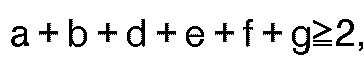


a pharmaceutically acceptable salt thereof. - A compound according to Claim 1 where


- A compound according to Claim 2 of the formula:

- A compound according to Claim 2 of the formula:
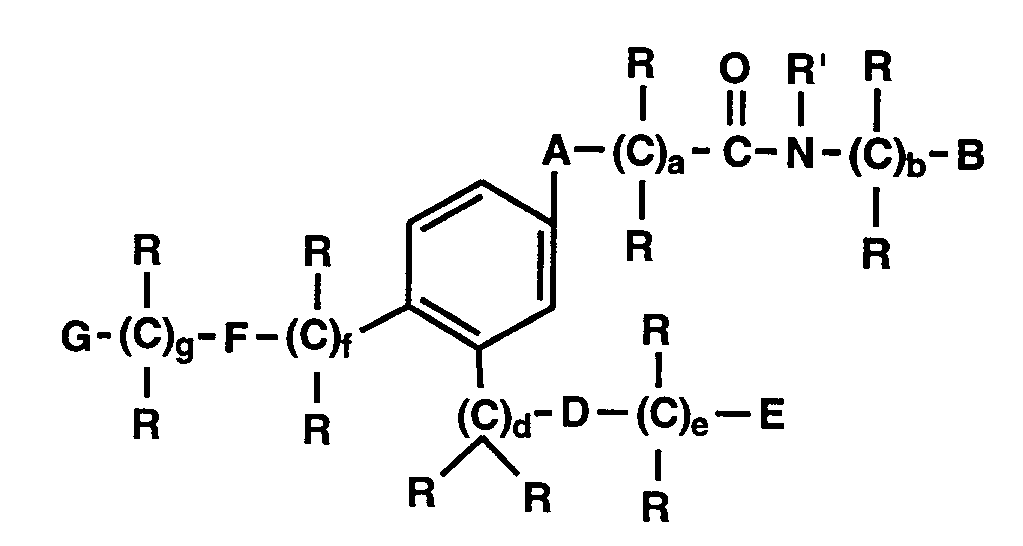
- A compound according to Claim 3 which is 3-[(N-methyl-N-phenethyl)carbamoylmethyl]-5-benzyloxy-β-methylcinnamic acid.
- A compound according to Claim 3 which is 3-cinnamyloxy-5-[(N-methyl-N-phenethyl)carbamoylmethyl]phenylacetic acid.
- A compound according to Claim 3 which is 3-benzyloxy-5-[(N-methyl-N-phenethyl)carbamoylmethyl]phenoxyacetic acid.
- A compound according to Claim 4 which is trans-N-methyl-N-phenethyl-2-[4-benzyloxy-3-(2-carboxyvinyl)phenyl]acetamide.
- A compound according to Claim 4 which is cis-N-methyl-N-phenethyl-2-[4-benzyloxy-3-(2-carboxyvinyl)phenyl]acetamide.
- A compound according to Claim 1 for use in the treatment of hypersensitive ailments in humans and mammals.
- A compound according to Claim 1 for use in the treatment of inflammatory diseases in humans and mammals.
- A compound according to Claim 1 for use in the treatment of inflammatory bowel disase.
- A pharmaceutical composition where the active ingredient is a compound according to Claim 1 in admixture with a pharmaceutical carrier.
Applications Claiming Priority (3)
| Application Number | Priority Date | Filing Date | Title |
|---|---|---|---|
| US580227 | 1990-09-10 | ||
| US07/580,227 US5232948A (en) | 1990-09-10 | 1990-09-10 | Substituted monocyclic aryl compounds exhibiting selective leukotriene b4 antagonist activity |
| PCT/US1991/006448 WO1992004315A1 (en) | 1990-09-10 | 1991-09-06 | Substituted monocyclic aryl compounds exhibiting selective leukotriene b4 antagonist activity |
Publications (3)
| Publication Number | Publication Date |
|---|---|
| EP0538416A1 EP0538416A1 (en) | 1993-04-28 |
| EP0538416A4 EP0538416A4 (en) | 1994-05-18 |
| EP0538416B1 true EP0538416B1 (en) | 1995-08-09 |
Family
ID=24320225
Family Applications (1)
| Application Number | Title | Priority Date | Filing Date |
|---|---|---|---|
| EP91917272A Expired - Lifetime EP0538416B1 (en) | 1990-09-10 | 1991-09-06 | Substituted monocyclic aryl compounds exhibiting selective leukotriene b 4 antagonist activity |
Country Status (8)
| Country | Link |
|---|---|
| US (1) | US5232948A (en) |
| EP (1) | EP0538416B1 (en) |
| JP (1) | JP3341019B2 (en) |
| AT (1) | ATE126206T1 (en) |
| AU (1) | AU654828B2 (en) |
| CA (1) | CA2091256A1 (en) |
| DE (1) | DE69112062T2 (en) |
| WO (1) | WO1992004315A1 (en) |
Families Citing this family (17)
| Publication number | Priority date | Publication date | Assignee | Title |
|---|---|---|---|---|
| WO1992004321A1 (en) * | 1990-09-10 | 1992-03-19 | Rhone-Poulenc Rorer International (Holdings) Inc. | Substituted bicyclic aryl compounds exhibiting selective leukotriene b4 antagonist activity |
| FR2705959B1 (en) * | 1993-06-01 | 1995-08-11 | Oreal | Process for stereospecific synthesis of leukotriene B4 in its 6Z, 8E, 10E configuration and intermediate products. |
| WO1996041645A1 (en) | 1995-06-12 | 1996-12-27 | G.D. Searle & Co. | Combination of a cyclooxygenase-2 inhibitor and a leukotriene b4 receptor antagonist for the treatment of inflammations |
| AUPN487495A0 (en) * | 1995-08-18 | 1995-09-14 | Cardiac Crc Nominees Pty Limited | A multipolar transmural probe |
| CA2246356A1 (en) | 1996-02-13 | 1997-08-21 | G.D. Searle & Co. | Compositions comprising a cyclooxygenase-2 inhibitor and a leukotriene b4 receptor antagonist |
| EP0942903A1 (en) | 1996-09-26 | 1999-09-22 | Novartis AG | Aryl-substituted acrylamides with leukotriene b4 (ltb-4) receptor antagonist activity |
| WO1999019291A1 (en) * | 1997-10-14 | 1999-04-22 | Asahi Kasei Kogyo Kabushiki Kaisha | Biphenyl-5-alkanoic acid derivatives and use thereof |
| US6867320B2 (en) * | 2002-02-21 | 2005-03-15 | Asahi Kasei Pharma Corporation | Substituted phenylalkanoic acid derivatives and use thereof |
| US7470807B2 (en) * | 2003-08-14 | 2008-12-30 | Asahi Kasei Pharma Corporation | Substituted arylalkanoic acid derivatives and use thereof |
| DE102004019472A1 (en) * | 2004-04-22 | 2005-11-17 | Bayer Healthcare Ag | phenylacetamides |
| US7968574B2 (en) | 2004-12-28 | 2011-06-28 | Kinex Pharmaceuticals, Llc | Biaryl compositions and methods for modulating a kinase cascade |
| BRPI0519424B8 (en) * | 2004-12-28 | 2021-05-25 | Athenex Inc | compounds, composition and use of said compounds for the preparation of a medicament for preventing or treating a cell proliferation disorder or microbial infection |
| EP2041071B1 (en) | 2006-06-29 | 2014-06-18 | Kinex Pharmaceuticals, LLC | Biaryl compositions and methods for modulating a kinase cascade |
| US7939529B2 (en) | 2007-05-17 | 2011-05-10 | Kinex Pharmaceuticals, Llc | Process for the preparation of compositions for modulating a kinase cascade and methods of use thereof |
| US7935697B2 (en) | 2006-12-28 | 2011-05-03 | Kinex Pharmaceuticals, Llc | Compositions for modulating a kinase cascade and methods of use thereof |
| EP2558085B1 (en) | 2010-04-16 | 2017-08-30 | Athenex, Inc. | Compositions and methods for the prevention and treatment of cancer |
| US9926273B2 (en) | 2012-08-30 | 2018-03-27 | Athenex, Inc. | Composition and methods for modulating a kinase cascade |
Family Cites Families (5)
| Publication number | Priority date | Publication date | Assignee | Title |
|---|---|---|---|---|
| FR2129876A2 (en) * | 1971-03-18 | 1972-11-03 | Bruneau & Cie Lab | 2-(n,n-dialkylcarbamoylmethoxy)-5-halogen benzoic or - phenylacetic acid alkyl esters hypnotic agents |
| FR2132570B1 (en) * | 1971-04-09 | 1974-08-02 | Lipha | |
| DD144050A5 (en) * | 1978-06-05 | 1980-09-24 | Ciba Geigy Ag | PROCESS FOR THE PREPARATION OF N-ALKYLATED AMINO ALCOHOLS |
| DD150456A5 (en) * | 1979-03-01 | 1981-09-02 | Ciba Geigy Ag | PROCESS FOR THE PREPARATION OF DERIVATIVES OF 3-AMINO-1,2-PROPANDIOL |
| SE8004087L (en) * | 1980-06-02 | 1981-12-03 | Haessle Ab | NEW PARA-SUBSTITUTED 3-PHENOXY-1-ALKYLAMINOPROPANOL-2 WITH BETARETTY RECEPTOR BLOCKING PROPERTIES, AND PROCEDURES FOR THEIR PREPARATION, PHARMACEUTICAL PREPARATIONS CONTAINING THE SAME, AND METHOD OF ACCOUNTING ... |
-
1990
- 1990-09-10 US US07/580,227 patent/US5232948A/en not_active Expired - Lifetime
-
1991
- 1991-09-06 AU AU85447/91A patent/AU654828B2/en not_active Expired
- 1991-09-06 WO PCT/US1991/006448 patent/WO1992004315A1/en not_active Ceased
- 1991-09-06 JP JP51568091A patent/JP3341019B2/en not_active Expired - Lifetime
- 1991-09-06 CA CA002091256A patent/CA2091256A1/en not_active Abandoned
- 1991-09-06 DE DE69112062T patent/DE69112062T2/en not_active Expired - Lifetime
- 1991-09-06 EP EP91917272A patent/EP0538416B1/en not_active Expired - Lifetime
- 1991-09-06 AT AT91917272T patent/ATE126206T1/en not_active IP Right Cessation
Also Published As
| Publication number | Publication date |
|---|---|
| JPH06503812A (en) | 1994-04-28 |
| EP0538416A1 (en) | 1993-04-28 |
| AU654828B2 (en) | 1994-11-24 |
| WO1992004315A1 (en) | 1992-03-19 |
| CA2091256A1 (en) | 1992-03-11 |
| EP0538416A4 (en) | 1994-05-18 |
| ATE126206T1 (en) | 1995-08-15 |
| US5232948A (en) | 1993-08-03 |
| DE69112062T2 (en) | 1996-01-25 |
| DE69112062D1 (en) | 1995-09-14 |
| JP3341019B2 (en) | 2002-11-05 |
| AU8544791A (en) | 1992-03-30 |
Similar Documents
| Publication | Publication Date | Title |
|---|---|---|
| EP0538416B1 (en) | Substituted monocyclic aryl compounds exhibiting selective leukotriene b 4 antagonist activity | |
| EP0548250B1 (en) | Substituted bicyclic aryl compounds exhibiting selective leukotriene b4 antagonist activity | |
| US5366982A (en) | Substituted bicyclic bis-aryl compounds exhibiting selective leukotriene B4 antagonist activity, their preparation and use in pharmaceutical compositions | |
| EP0737671B1 (en) | Aromatic hydroxamic acid compounds, their production and use | |
| US4752613A (en) | Sulphonamidothienylcarboxylic acid compounds | |
| EP0554313B1 (en) | Disubstituted aryl compounds exhibiting selective leukotriene b 4? antagonist activity | |
| JP2009515872A (en) | Oxazole compounds and pharmaceutical compositions | |
| US5242940A (en) | Pharmacologically active N-1 and C-5 heterocyclic pyrazoles and method for synthesizing the same | |
| JP4986927B2 (en) | Medicine | |
| EP0378991A1 (en) | Certain pyrrolylphenyl-substituted hydroxamic acid derivatives | |
| US4960787A (en) | Certain pyrrolyl-substituted hydroxamic acid derivatives | |
| EP0538477B1 (en) | Novel cyclic aminophenylacetic acid derivative, production thereof, and immune response modulator containing the same as active ingredient | |
| JPH01100144A (en) | Naphthalenepropionic acid derivative for antiinflammatory /antiallergic | |
| EP0211549B1 (en) | Substituted di-t-butylphenols | |
| CA1247628A (en) | Resorcinol ethers | |
| RU2037481C1 (en) | Derivatives of substituted benzoylbenzene-, biphenyl or 2-oxazolealkanoic acid or their pharmacologically acceptable salts, and a method of their synthesis | |
| JPH0353296B2 (en) | ||
| JPH03109363A (en) | Cyclohexadienone derivative |
Legal Events
| Date | Code | Title | Description |
|---|---|---|---|
| PUAI | Public reference made under article 153(3) epc to a published international application that has entered the european phase |
Free format text: ORIGINAL CODE: 0009012 |
|
| 17P | Request for examination filed |
Effective date: 19930209 |
|
| AK | Designated contracting states |
Kind code of ref document: A1 Designated state(s): AT BE CH DE DK ES FR GB GR IT LI LU NL SE |
|
| A4 | Supplementary search report drawn up and despatched | ||
| AK | Designated contracting states |
Kind code of ref document: A4 Designated state(s): AT BE CH DE DK ES FR GB GR IT LI LU NL SE |
|
| 17Q | First examination report despatched |
Effective date: 19940823 |
|
| GRAA | (expected) grant |
Free format text: ORIGINAL CODE: 0009210 |
|
| AK | Designated contracting states |
Kind code of ref document: B1 Designated state(s): AT BE CH DE DK ES FR GB GR IT LI LU NL SE |
|
| PG25 | Lapsed in a contracting state [announced via postgrant information from national office to epo] |
Ref country code: NL Free format text: LAPSE BECAUSE OF NON-PAYMENT OF DUE FEES Effective date: 19950809 Ref country code: ES Free format text: THE PATENT HAS BEEN ANNULLED BY A DECISION OF A NATIONAL AUTHORITY Effective date: 19950809 Ref country code: AT Effective date: 19950809 Ref country code: BE Effective date: 19950809 Ref country code: GR Free format text: LAPSE BECAUSE OF FAILURE TO SUBMIT A TRANSLATION OF THE DESCRIPTION OR TO PAY THE FEE WITHIN THE PRESCRIBED TIME-LIMIT Effective date: 19950809 Ref country code: DK Effective date: 19950809 Ref country code: IT Free format text: LAPSE BECAUSE OF FAILURE TO SUBMIT A TRANSLATION OF THE DESCRIPTION OR TO PAY THE FEE WITHIN THE PRE;WARNING: LAPSES OF ITALIAN PATENTS WITH EFFECTIVE DATE BEFORE 2007 MAY HAVE OCCURRED AT ANY TIME BEFORE 2007. THE CORRECT EFFECTIVE DATE MAY BE DIFFERENT FROM THE ONE RECORDED.SCRIBED TIME-LIMIT Effective date: 19950809 |
|
| REF | Corresponds to: |
Ref document number: 126206 Country of ref document: AT Date of ref document: 19950815 Kind code of ref document: T |
|
| REF | Corresponds to: |
Ref document number: 69112062 Country of ref document: DE Date of ref document: 19950914 |
|
| PG25 | Lapsed in a contracting state [announced via postgrant information from national office to epo] |
Ref country code: LU Free format text: LAPSE BECAUSE OF NON-PAYMENT OF DUE FEES Effective date: 19950930 |
|
| PGFP | Annual fee paid to national office [announced via postgrant information from national office to epo] |
Ref country code: CH Payment date: 19950930 Year of fee payment: 5 |
|
| ET | Fr: translation filed | ||
| PG25 | Lapsed in a contracting state [announced via postgrant information from national office to epo] |
Ref country code: SE Effective date: 19951109 |
|
| NLV1 | Nl: lapsed or annulled due to failure to fulfill the requirements of art. 29p and 29m of the patents act | ||
| PLBE | No opposition filed within time limit |
Free format text: ORIGINAL CODE: 0009261 |
|
| STAA | Information on the status of an ep patent application or granted ep patent |
Free format text: STATUS: NO OPPOSITION FILED WITHIN TIME LIMIT |
|
| 26N | No opposition filed | ||
| PG25 | Lapsed in a contracting state [announced via postgrant information from national office to epo] |
Ref country code: CH Free format text: LAPSE BECAUSE OF FAILURE TO SUBMIT A TRANSLATION OF THE DESCRIPTION OR TO PAY THE FEE WITHIN THE PRESCRIBED TIME-LIMIT Effective date: 19960930 Ref country code: LI Free format text: LAPSE BECAUSE OF FAILURE TO SUBMIT A TRANSLATION OF THE DESCRIPTION OR TO PAY THE FEE WITHIN THE PRESCRIBED TIME-LIMIT Effective date: 19960930 |
|
| REG | Reference to a national code |
Ref country code: GB Ref legal event code: IF02 |
|
| PGFP | Annual fee paid to national office [announced via postgrant information from national office to epo] |
Ref country code: FR Payment date: 20100921 Year of fee payment: 20 |
|
| PGFP | Annual fee paid to national office [announced via postgrant information from national office to epo] |
Ref country code: GB Payment date: 20100901 Year of fee payment: 20 |
|
| PGFP | Annual fee paid to national office [announced via postgrant information from national office to epo] |
Ref country code: DE Payment date: 20100901 Year of fee payment: 20 |
|
| REG | Reference to a national code |
Ref country code: DE Ref legal event code: R071 Ref document number: 69112062 Country of ref document: DE |
|
| REG | Reference to a national code |
Ref country code: DE Ref legal event code: R071 Ref document number: 69112062 Country of ref document: DE |
|
| REG | Reference to a national code |
Ref country code: GB Ref legal event code: PE20 Expiry date: 20110905 |
|
| PG25 | Lapsed in a contracting state [announced via postgrant information from national office to epo] |
Ref country code: GB Free format text: LAPSE BECAUSE OF EXPIRATION OF PROTECTION Effective date: 20110905 |
|
| PG25 | Lapsed in a contracting state [announced via postgrant information from national office to epo] |
Ref country code: DE Free format text: LAPSE BECAUSE OF EXPIRATION OF PROTECTION Effective date: 20110907 |