EP0538376B1 - Transfer film - Google Patents
Transfer film Download PDFInfo
- Publication number
- EP0538376B1 EP0538376B1 EP91913455A EP91913455A EP0538376B1 EP 0538376 B1 EP0538376 B1 EP 0538376B1 EP 91913455 A EP91913455 A EP 91913455A EP 91913455 A EP91913455 A EP 91913455A EP 0538376 B1 EP0538376 B1 EP 0538376B1
- Authority
- EP
- European Patent Office
- Prior art keywords
- layer
- pattern
- concavities
- retaining layer
- inks
- Prior art date
- Legal status (The legal status is an assumption and is not a legal conclusion. Google has not performed a legal analysis and makes no representation as to the accuracy of the status listed.)
- Expired - Lifetime
Links
- 239000010410 layer Substances 0.000 claims description 122
- 239000000976 ink Substances 0.000 claims description 78
- 238000000576 coating method Methods 0.000 claims description 42
- 238000000034 method Methods 0.000 claims description 33
- 239000011248 coating agent Substances 0.000 claims description 32
- 239000000463 material Substances 0.000 claims description 27
- 238000007639 printing Methods 0.000 claims description 17
- 239000000758 substrate Substances 0.000 claims description 13
- 239000000203 mixture Substances 0.000 claims description 11
- 239000004033 plastic Substances 0.000 claims description 11
- 229920003023 plastic Polymers 0.000 claims description 11
- 239000002904 solvent Substances 0.000 claims description 11
- 239000000853 adhesive Substances 0.000 claims description 10
- 230000001070 adhesive effect Effects 0.000 claims description 10
- -1 polyethylene Polymers 0.000 claims description 9
- 239000004698 Polyethylene Substances 0.000 claims description 8
- 229920000573 polyethylene Polymers 0.000 claims description 8
- VTYYLEPIZMXCLO-UHFFFAOYSA-L Calcium carbonate Chemical compound [Ca+2].[O-]C([O-])=O VTYYLEPIZMXCLO-UHFFFAOYSA-L 0.000 claims description 6
- XLOMVQKBTHCTTD-UHFFFAOYSA-N Zinc monoxide Chemical compound [Zn]=O XLOMVQKBTHCTTD-UHFFFAOYSA-N 0.000 claims description 6
- TZCXTZWJZNENPQ-UHFFFAOYSA-L barium sulfate Chemical compound [Ba+2].[O-]S([O-])(=O)=O TZCXTZWJZNENPQ-UHFFFAOYSA-L 0.000 claims description 6
- GWEVSGVZZGPLCZ-UHFFFAOYSA-N Titan oxide Chemical compound O=[Ti]=O GWEVSGVZZGPLCZ-UHFFFAOYSA-N 0.000 claims description 5
- 239000000049 pigment Substances 0.000 claims description 5
- 239000004908 Emulsion polymer Substances 0.000 claims description 4
- 239000012790 adhesive layer Substances 0.000 claims description 4
- 239000004927 clay Substances 0.000 claims description 4
- 229910000019 calcium carbonate Inorganic materials 0.000 claims description 3
- 229910052570 clay Inorganic materials 0.000 claims description 3
- 239000006185 dispersion Substances 0.000 claims description 3
- RVTZCBVAJQQJTK-UHFFFAOYSA-N oxygen(2-);zirconium(4+) Chemical compound [O-2].[O-2].[Zr+4] RVTZCBVAJQQJTK-UHFFFAOYSA-N 0.000 claims description 3
- 230000005855 radiation Effects 0.000 claims description 3
- OGIDPMRJRNCKJF-UHFFFAOYSA-N titanium oxide Inorganic materials [Ti]=O OGIDPMRJRNCKJF-UHFFFAOYSA-N 0.000 claims description 3
- 239000011787 zinc oxide Substances 0.000 claims description 3
- 229910001928 zirconium oxide Inorganic materials 0.000 claims description 3
- 238000001459 lithography Methods 0.000 claims 1
- 239000010408 film Substances 0.000 description 42
- 230000000694 effects Effects 0.000 description 9
- 238000004049 embossing Methods 0.000 description 8
- 239000007787 solid Substances 0.000 description 8
- 239000000975 dye Substances 0.000 description 6
- 229920001169 thermoplastic Polymers 0.000 description 4
- 239000004416 thermosoftening plastic Substances 0.000 description 4
- 230000001747 exhibiting effect Effects 0.000 description 3
- 229920000728 polyester Polymers 0.000 description 3
- 239000004820 Pressure-sensitive adhesive Substances 0.000 description 2
- 230000004075 alteration Effects 0.000 description 2
- 239000011230 binding agent Substances 0.000 description 2
- 239000007844 bleaching agent Substances 0.000 description 2
- 239000003153 chemical reaction reagent Substances 0.000 description 2
- 238000010894 electron beam technology Methods 0.000 description 2
- 239000000839 emulsion Substances 0.000 description 2
- 239000011888 foil Substances 0.000 description 2
- 238000007373 indentation Methods 0.000 description 2
- 238000007645 offset printing Methods 0.000 description 2
- 238000004088 simulation Methods 0.000 description 2
- 229920000134 Metallised film Polymers 0.000 description 1
- CHJJGSNFBQVOTG-UHFFFAOYSA-N N-methyl-guanidine Natural products CNC(N)=N CHJJGSNFBQVOTG-UHFFFAOYSA-N 0.000 description 1
- 239000004677 Nylon Substances 0.000 description 1
- 239000004743 Polypropylene Substances 0.000 description 1
- NIXOWILDQLNWCW-UHFFFAOYSA-N acrylic acid group Chemical group C(C=C)(=O)O NIXOWILDQLNWCW-UHFFFAOYSA-N 0.000 description 1
- 239000003513 alkali Substances 0.000 description 1
- ZRALSGWEFCBTJO-UHFFFAOYSA-N anhydrous guanidine Natural products NC(N)=N ZRALSGWEFCBTJO-UHFFFAOYSA-N 0.000 description 1
- 239000012736 aqueous medium Substances 0.000 description 1
- 235000019642 color hue Nutrition 0.000 description 1
- 238000004040 coloring Methods 0.000 description 1
- 230000000295 complement effect Effects 0.000 description 1
- 230000003247 decreasing effect Effects 0.000 description 1
- SWSQBOPZIKWTGO-UHFFFAOYSA-N dimethylaminoamidine Natural products CN(C)C(N)=N SWSQBOPZIKWTGO-UHFFFAOYSA-N 0.000 description 1
- 238000001035 drying Methods 0.000 description 1
- 239000012530 fluid Substances 0.000 description 1
- 239000007850 fluorescent dye Substances 0.000 description 1
- PCHJSUWPFVWCPO-UHFFFAOYSA-N gold Chemical compound [Au] PCHJSUWPFVWCPO-UHFFFAOYSA-N 0.000 description 1
- 239000010931 gold Substances 0.000 description 1
- 229910052737 gold Inorganic materials 0.000 description 1
- 150000002357 guanidines Chemical class 0.000 description 1
- 238000003475 lamination Methods 0.000 description 1
- 238000004519 manufacturing process Methods 0.000 description 1
- 229910052751 metal Inorganic materials 0.000 description 1
- 239000002184 metal Substances 0.000 description 1
- 239000011104 metalized film Substances 0.000 description 1
- 229920001778 nylon Polymers 0.000 description 1
- 239000003960 organic solvent Substances 0.000 description 1
- 239000006223 plastic coating Substances 0.000 description 1
- 239000004417 polycarbonate Substances 0.000 description 1
- 229920000515 polycarbonate Polymers 0.000 description 1
- 229920001155 polypropylene Polymers 0.000 description 1
- 229920001296 polysiloxane Polymers 0.000 description 1
- 230000002441 reversible effect Effects 0.000 description 1
- 238000007761 roller coating Methods 0.000 description 1
- 238000007650 screen-printing Methods 0.000 description 1
- 238000000926 separation method Methods 0.000 description 1
- 238000000935 solvent evaporation Methods 0.000 description 1
- 229920003048 styrene butadiene rubber Polymers 0.000 description 1
- 229920001909 styrene-acrylic polymer Polymers 0.000 description 1
- 230000003746 surface roughness Effects 0.000 description 1
- 239000004408 titanium dioxide Substances 0.000 description 1
- 230000001052 transient effect Effects 0.000 description 1
- 125000000391 vinyl group Chemical group [H]C([*])=C([H])[H] 0.000 description 1
- 229920002554 vinyl polymer Polymers 0.000 description 1
- 125000002348 vinylic group Chemical group 0.000 description 1
- 238000005406 washing Methods 0.000 description 1
- 238000009736 wetting Methods 0.000 description 1
- 239000012463 white pigment Substances 0.000 description 1
Images



Classifications
-
- B—PERFORMING OPERATIONS; TRANSPORTING
- B44—DECORATIVE ARTS
- B44C—PRODUCING DECORATIVE EFFECTS; MOSAICS; TARSIA WORK; PAPERHANGING
- B44C1/00—Processes, not specifically provided for elsewhere, for producing decorative surface effects
- B44C1/16—Processes, not specifically provided for elsewhere, for producing decorative surface effects for applying transfer pictures or the like
- B44C1/165—Processes, not specifically provided for elsewhere, for producing decorative surface effects for applying transfer pictures or the like for decalcomanias; sheet material therefor
- B44C1/17—Dry transfer
- B44C1/1712—Decalcomanias applied under heat and pressure, e.g. provided with a heat activable adhesive
- B44C1/1716—Decalcomanias provided with a particular decorative layer, e.g. specially adapted to allow the formation of a metallic or dyestuff layer on a substrate unsuitable for direct deposition
-
- B—PERFORMING OPERATIONS; TRANSPORTING
- B42—BOOKBINDING; ALBUMS; FILES; SPECIAL PRINTED MATTER
- B42D—BOOKS; BOOK COVERS; LOOSE LEAVES; PRINTED MATTER CHARACTERISED BY IDENTIFICATION OR SECURITY FEATURES; PRINTED MATTER OF SPECIAL FORMAT OR STYLE NOT OTHERWISE PROVIDED FOR; DEVICES FOR USE THEREWITH AND NOT OTHERWISE PROVIDED FOR; MOVABLE-STRIP WRITING OR READING APPARATUS
- B42D25/00—Information-bearing cards or sheet-like structures characterised by identification or security features; Manufacture thereof
- B42D25/30—Identification or security features, e.g. for preventing forgery
- B42D25/324—Reliefs
-
- B—PERFORMING OPERATIONS; TRANSPORTING
- B42—BOOKBINDING; ALBUMS; FILES; SPECIAL PRINTED MATTER
- B42D—BOOKS; BOOK COVERS; LOOSE LEAVES; PRINTED MATTER CHARACTERISED BY IDENTIFICATION OR SECURITY FEATURES; PRINTED MATTER OF SPECIAL FORMAT OR STYLE NOT OTHERWISE PROVIDED FOR; DEVICES FOR USE THEREWITH AND NOT OTHERWISE PROVIDED FOR; MOVABLE-STRIP WRITING OR READING APPARATUS
- B42D25/00—Information-bearing cards or sheet-like structures characterised by identification or security features; Manufacture thereof
-
- B—PERFORMING OPERATIONS; TRANSPORTING
- B42—BOOKBINDING; ALBUMS; FILES; SPECIAL PRINTED MATTER
- B42D—BOOKS; BOOK COVERS; LOOSE LEAVES; PRINTED MATTER CHARACTERISED BY IDENTIFICATION OR SECURITY FEATURES; PRINTED MATTER OF SPECIAL FORMAT OR STYLE NOT OTHERWISE PROVIDED FOR; DEVICES FOR USE THEREWITH AND NOT OTHERWISE PROVIDED FOR; MOVABLE-STRIP WRITING OR READING APPARATUS
- B42D25/00—Information-bearing cards or sheet-like structures characterised by identification or security features; Manufacture thereof
- B42D25/40—Manufacture
- B42D25/405—Marking
- B42D25/425—Marking by deformation, e.g. embossing
-
- B—PERFORMING OPERATIONS; TRANSPORTING
- B44—DECORATIVE ARTS
- B44C—PRODUCING DECORATIVE EFFECTS; MOSAICS; TARSIA WORK; PAPERHANGING
- B44C1/00—Processes, not specifically provided for elsewhere, for producing decorative surface effects
- B44C1/16—Processes, not specifically provided for elsewhere, for producing decorative surface effects for applying transfer pictures or the like
- B44C1/165—Processes, not specifically provided for elsewhere, for producing decorative surface effects for applying transfer pictures or the like for decalcomanias; sheet material therefor
- B44C1/17—Dry transfer
- B44C1/1712—Decalcomanias applied under heat and pressure, e.g. provided with a heat activable adhesive
- B44C1/172—Decalcomanias provided with a layer being specially adapted to facilitate their release from a temporary carrier
-
- B42D2033/24—
-
- B—PERFORMING OPERATIONS; TRANSPORTING
- B42—BOOKBINDING; ALBUMS; FILES; SPECIAL PRINTED MATTER
- B42D—BOOKS; BOOK COVERS; LOOSE LEAVES; PRINTED MATTER CHARACTERISED BY IDENTIFICATION OR SECURITY FEATURES; PRINTED MATTER OF SPECIAL FORMAT OR STYLE NOT OTHERWISE PROVIDED FOR; DEVICES FOR USE THEREWITH AND NOT OTHERWISE PROVIDED FOR; MOVABLE-STRIP WRITING OR READING APPARATUS
- B42D25/00—Information-bearing cards or sheet-like structures characterised by identification or security features; Manufacture thereof
- B42D25/30—Identification or security features, e.g. for preventing forgery
- B42D25/318—Signatures
-
- B—PERFORMING OPERATIONS; TRANSPORTING
- B42—BOOKBINDING; ALBUMS; FILES; SPECIAL PRINTED MATTER
- B42D—BOOKS; BOOK COVERS; LOOSE LEAVES; PRINTED MATTER CHARACTERISED BY IDENTIFICATION OR SECURITY FEATURES; PRINTED MATTER OF SPECIAL FORMAT OR STYLE NOT OTHERWISE PROVIDED FOR; DEVICES FOR USE THEREWITH AND NOT OTHERWISE PROVIDED FOR; MOVABLE-STRIP WRITING OR READING APPARATUS
- B42D25/00—Information-bearing cards or sheet-like structures characterised by identification or security features; Manufacture thereof
- B42D25/30—Identification or security features, e.g. for preventing forgery
- B42D25/36—Identification or security features, e.g. for preventing forgery comprising special materials
- B42D25/373—Metallic materials
-
- B—PERFORMING OPERATIONS; TRANSPORTING
- B42—BOOKBINDING; ALBUMS; FILES; SPECIAL PRINTED MATTER
- B42D—BOOKS; BOOK COVERS; LOOSE LEAVES; PRINTED MATTER CHARACTERISED BY IDENTIFICATION OR SECURITY FEATURES; PRINTED MATTER OF SPECIAL FORMAT OR STYLE NOT OTHERWISE PROVIDED FOR; DEVICES FOR USE THEREWITH AND NOT OTHERWISE PROVIDED FOR; MOVABLE-STRIP WRITING OR READING APPARATUS
- B42D25/00—Information-bearing cards or sheet-like structures characterised by identification or security features; Manufacture thereof
- B42D25/30—Identification or security features, e.g. for preventing forgery
- B42D25/36—Identification or security features, e.g. for preventing forgery comprising special materials
- B42D25/378—Special inks
-
- B—PERFORMING OPERATIONS; TRANSPORTING
- B42—BOOKBINDING; ALBUMS; FILES; SPECIAL PRINTED MATTER
- B42D—BOOKS; BOOK COVERS; LOOSE LEAVES; PRINTED MATTER CHARACTERISED BY IDENTIFICATION OR SECURITY FEATURES; PRINTED MATTER OF SPECIAL FORMAT OR STYLE NOT OTHERWISE PROVIDED FOR; DEVICES FOR USE THEREWITH AND NOT OTHERWISE PROVIDED FOR; MOVABLE-STRIP WRITING OR READING APPARATUS
- B42D25/00—Information-bearing cards or sheet-like structures characterised by identification or security features; Manufacture thereof
- B42D25/40—Manufacture
- B42D25/45—Associating two or more layers
- B42D25/455—Associating two or more layers using heat
-
- B—PERFORMING OPERATIONS; TRANSPORTING
- B42—BOOKBINDING; ALBUMS; FILES; SPECIAL PRINTED MATTER
- B42D—BOOKS; BOOK COVERS; LOOSE LEAVES; PRINTED MATTER CHARACTERISED BY IDENTIFICATION OR SECURITY FEATURES; PRINTED MATTER OF SPECIAL FORMAT OR STYLE NOT OTHERWISE PROVIDED FOR; DEVICES FOR USE THEREWITH AND NOT OTHERWISE PROVIDED FOR; MOVABLE-STRIP WRITING OR READING APPARATUS
- B42D25/00—Information-bearing cards or sheet-like structures characterised by identification or security features; Manufacture thereof
- B42D25/40—Manufacture
- B42D25/45—Associating two or more layers
- B42D25/465—Associating two or more layers using chemicals or adhesives
- B42D25/47—Associating two or more layers using chemicals or adhesives using adhesives
-
- Y—GENERAL TAGGING OF NEW TECHNOLOGICAL DEVELOPMENTS; GENERAL TAGGING OF CROSS-SECTIONAL TECHNOLOGIES SPANNING OVER SEVERAL SECTIONS OF THE IPC; TECHNICAL SUBJECTS COVERED BY FORMER USPC CROSS-REFERENCE ART COLLECTIONS [XRACs] AND DIGESTS
- Y10—TECHNICAL SUBJECTS COVERED BY FORMER USPC
- Y10S—TECHNICAL SUBJECTS COVERED BY FORMER USPC CROSS-REFERENCE ART COLLECTIONS [XRACs] AND DIGESTS
- Y10S428/00—Stock material or miscellaneous articles
- Y10S428/914—Transfer or decalcomania
-
- Y—GENERAL TAGGING OF NEW TECHNOLOGICAL DEVELOPMENTS; GENERAL TAGGING OF CROSS-SECTIONAL TECHNOLOGIES SPANNING OVER SEVERAL SECTIONS OF THE IPC; TECHNICAL SUBJECTS COVERED BY FORMER USPC CROSS-REFERENCE ART COLLECTIONS [XRACs] AND DIGESTS
- Y10—TECHNICAL SUBJECTS COVERED BY FORMER USPC
- Y10T—TECHNICAL SUBJECTS COVERED BY FORMER US CLASSIFICATION
- Y10T428/00—Stock material or miscellaneous articles
- Y10T428/24—Structurally defined web or sheet [e.g., overall dimension, etc.]
- Y10T428/24479—Structurally defined web or sheet [e.g., overall dimension, etc.] including variation in thickness
- Y10T428/24612—Composite web or sheet
- Y10T428/2462—Composite web or sheet with partial filling of valleys on outer surface
-
- Y—GENERAL TAGGING OF NEW TECHNOLOGICAL DEVELOPMENTS; GENERAL TAGGING OF CROSS-SECTIONAL TECHNOLOGIES SPANNING OVER SEVERAL SECTIONS OF THE IPC; TECHNICAL SUBJECTS COVERED BY FORMER USPC CROSS-REFERENCE ART COLLECTIONS [XRACs] AND DIGESTS
- Y10—TECHNICAL SUBJECTS COVERED BY FORMER USPC
- Y10T—TECHNICAL SUBJECTS COVERED BY FORMER US CLASSIFICATION
- Y10T428/00—Stock material or miscellaneous articles
- Y10T428/24—Structurally defined web or sheet [e.g., overall dimension, etc.]
- Y10T428/24802—Discontinuous or differential coating, impregnation or bond [e.g., artwork, printing, retouched photograph, etc.]
- Y10T428/24843—Discontinuous or differential coating, impregnation or bond [e.g., artwork, printing, retouched photograph, etc.] with heat sealable or heat releasable adhesive layer
-
- Y—GENERAL TAGGING OF NEW TECHNOLOGICAL DEVELOPMENTS; GENERAL TAGGING OF CROSS-SECTIONAL TECHNOLOGIES SPANNING OVER SEVERAL SECTIONS OF THE IPC; TECHNICAL SUBJECTS COVERED BY FORMER USPC CROSS-REFERENCE ART COLLECTIONS [XRACs] AND DIGESTS
- Y10—TECHNICAL SUBJECTS COVERED BY FORMER USPC
- Y10T—TECHNICAL SUBJECTS COVERED BY FORMER US CLASSIFICATION
- Y10T428/00—Stock material or miscellaneous articles
- Y10T428/24—Structurally defined web or sheet [e.g., overall dimension, etc.]
- Y10T428/24802—Discontinuous or differential coating, impregnation or bond [e.g., artwork, printing, retouched photograph, etc.]
- Y10T428/24851—Intermediate layer is discontinuous or differential
- Y10T428/2486—Intermediate layer is discontinuous or differential with outer strippable or release layer
-
- Y—GENERAL TAGGING OF NEW TECHNOLOGICAL DEVELOPMENTS; GENERAL TAGGING OF CROSS-SECTIONAL TECHNOLOGIES SPANNING OVER SEVERAL SECTIONS OF THE IPC; TECHNICAL SUBJECTS COVERED BY FORMER USPC CROSS-REFERENCE ART COLLECTIONS [XRACs] AND DIGESTS
- Y10—TECHNICAL SUBJECTS COVERED BY FORMER USPC
- Y10T—TECHNICAL SUBJECTS COVERED BY FORMER US CLASSIFICATION
- Y10T428/00—Stock material or miscellaneous articles
- Y10T428/24—Structurally defined web or sheet [e.g., overall dimension, etc.]
- Y10T428/24802—Discontinuous or differential coating, impregnation or bond [e.g., artwork, printing, retouched photograph, etc.]
- Y10T428/24851—Intermediate layer is discontinuous or differential
- Y10T428/24868—Translucent outer layer
- Y10T428/24876—Intermediate layer contains particulate material [e.g., pigment, etc.]
Definitions
- the invention relates to a transfer film for use, for example, with security documents.
- Intaglio printing has been used for many years to provide security printing on documents. Such printing has been used to provide security patterns and the like on banknotes and in addition tactility.
- plastics security documents such as credit cards have been developed onto which intaglio printing is not generally possible. These generally lack intaglio-like tactility properties.
- planar films bearing security indicia and patterns have been transferred using a hot stamping technique. These films are applied under elevated pressure and temperature to a surface in the form of an alphanumeric pattern, a crest, logo or the like. For example by transferring a metallised film, gold effect lettering can be created of a smooth nature.
- Metallised foils can be embossed by stamping a coarse three dimensional pattern, using an engraved stamping face such as in EP-A-194042A but this does not provide intaglio tactility.
- Signature panels have been hitherto conveniently been applied to cards by screen printing and hot stamping methods. It is desired significantly to improve on the counterfeit resistance and forgery resistance of such panels. Paper panels are difficult to remove from cards but hot stamped coatings are even more difficult as they are thinner and have less internal strength.
- intaglio printing is well established as an anti-counterfeiting and anti-forgery measure but it has not been used before with hot stamp signature strips. Intaglio is however found on the relatively expensive paper panels, which can significantly increase the cost of a card.
- US-A-3545380 describes intaglio effects obtained on hot stamping signature panels but this is done by providing a discontinuous transfer according to the engraving in the stamping head. They omit portions of the panel. This is undesirable.
- a transfer film comprises a pattern defining layer having concavities defining an inverted relief pattern; and a retaining layer overlying and releasably filling the concavities of the pattern defining layer, the pattern defining layer being removable from the retaining layer to leave the parts of the retaining layer filling the concavities defining the relief pattern.
- a transfer film comprises a pattern defining layer having concavities defining an inverted relief pattern, the concavities being releasably filled with a relief material; and a retaining layer overlying the concavities of the pattern defining layer so as to adhere to the relief material, the pattern defining layer being removable from the retaining layer and the relief material to leave the relief material defining the relief pattern on the retaining layer.
- the invention is particularly suitable for applying signature panels since a complete panel carrying a relief pattern can be laid down without using an engraved stamping head.
- a parallel surfaced hot stamping film is provided in which the pattern defining layer's surface has three dimensional characteristics.
- the present invention provides a transfer film which will allow the making of signature panels on plastic, financial transaction cards, by a hot stamping method, such signature panels exhibiting at least over part of their surface intaglio-like tactility.
- a release layer will be provided in the concavities, such as smooth grooves, such as to maximise transfer of the relief material with the retaining layer.
- the pattern defining layer could be made of a single plastic layer element but preferably an additional support layer is provided, the pattern defining layer comprising a well bonded embossable coating in which the concavities are formed, of typical thickness 125 microns.
- the retaining layer may be secured to a substrate in use by means of an adhesive provided on the substrate but typically the film further comprises an adhesive such as a pressure sensitive or preferably heat sensitive adhesive on the retaining layer.
- an adhesive such as a pressure sensitive or preferably heat sensitive adhesive on the retaining layer.
- the retaining layer is somewhat porous and includes a section on which marks can be written, for example signatures.
- This aspect is particularly important since the invention, as mentioned above, is particularly suitable for providing signature panels on identification cards and the like.
- the relief pattern can be provided at opposite ends of a signature panel leaving a central section free for the application of a signature.
- a relatively weak intaglio or relief pattern could be provided throughout the signature panel to enable a signature to be written across the relief pattern.
- the pattern defining layer is planographically printed on its surface facing the retaining layer such that the printing will transfer onto the retaining layer.
- security indicia and the like may be provided on the retaining layer, for example such indicia exhibiting rainbow inking effects.
- Printed security indicia may comprise alphanumeric characters, signs, symbols, logos, geometric designs and fine line tracings. They may incorporate colour hue and density, and line patterns designed to foil reproduction by half-tone screen separation methods, and electrophotographic colour copiers including pixel and line scanning photocopiers, half-tone proofing colour scanners and the like.
- the retaining layer will preferably have a faint background tint.
- the tints of the marking composition and the retaining layer may be selected to create metameric effects. If the intaglio effect is to be present on the signing area the colour of the marking composition will normally be chosen so as to be faint so as not to obscure the signature formed in dense ink.
- the retaining layer typically comprises a clay, titanium oxide, zinc oxide, calcium carbonate, barium sulphate, zirconium oxide or other white or mutely coloured composition in an aqueous dispersion with an emulsion polymer such as a vinyl emulsion polymer.
- the relief material will typically formed by a marking composition such as a paste or fluid ink or other type of coating but could comprise part of the retaining layer.
- a method of forming a transfer film comprises providing a pattern defining layer having concavities defining an inverted relief pattern; overlying and releasably filling the concavities of the pattern defining layer with a retaining layer, wherein the pattern defining layer is removable from the retaining layer to leave the parts of the retaining layer filling the concavities defining the relief pattern.
- a method of forming a transfer film comprises providing a pattern defining layer having concavities defining an inverted relief pattern; releasably filling the concavities with a relief material; and covering the pattern defining layer with a retaining layer overlying the concavities so as to adhere to the relief composition wherein the pattern defining layer is removable from the retaining layer and the relief material to leave the relief material defining the relief pattern on the retaining layer.
- a support layer (polyester, for example of 20 microns thickness) supporting an embossable layer is provided.
- This embossable layer will typically be polyethylene 100 to 150 microns thick. The surface of the layer needs to be releasable. Biaxially orientated polypropylene may also be used as a support.
- the release characteristics may be chosen by selecting two materials which inherently will have sufficient clinging engagement for the manufacturing and application yet release after stamping. Release can be increased by providing a thin primer of, say, wax or silicone, or decreased by treating the surface with a corona discharge (which will have the effect of increasing the bonding of a highly releasing material such as polyethylene).
- the surface could then be releasably printed but in practice is unlikely to be at this stage because if solvent based relief material inks are used the inks are likely to be dissolved.
- Concavities such as smooth grooves are then embossed in the embossable layer to define a relief pattern.
- Polyvinylcholoride may be embossed at from 95 to 145 degrees C.
- Polyethylene may be embossed at around 60 degrees C.
- Polycarbonate may be embossed at 165 degrees and nylon 175 degrees C.
- Embossing at too low a temperature loses fine detail. Above, the plastic is too soft to hold detail.
- the depths of the grooves are likely to be about 50 to 120 microns. Different groove depths could be used.
- Embossing will generally be made by using a metallic cylinder carrying the relief pattern which extends continuously around the circumference of the cylinder.
- the relief pattern will generally be metallic to allow embossing at elevated temperatures.
- Polyethylene is preferred for ease of embossing and release of the ink and clay coatings. It can be corona treated if necessary in-line to control the adhesion and wetting properties.
- the embossed area may overlap or simply be adjacent to the printed area (if provided).
- the embossed pattern may be of an overall "wallpaper” style i.e. containing repetitively repeating areas of miniature printing, or possibly a continuous design of a complex line pattern. This embossing will normally be undertaken with a roller which avoids showing circumferential joins: the image will be seamless.
- the embossing may comprise lines within a design which runs parallel to the length of the reel of plastic being embossed.
- the ink is a high solids ink such as a paste ink then this should be dried to encourage its setting. For example there may be a small proportion of volatile solvent which when removed makes the ink's viscosity increase.
- An ultraviolet or conceivably an electron beam curable ink may be used. This can be set more quickly than conventional paste inks can be dried as fast drying of conventional inks on a non-porous surface is likely to be a problem.
- An example of a suitable UV curable ink is Sericol (Registered Trade Mark) brand UV021 (white) ink.
- the retaining layer instead of providing ink in the concavities the retaining layer would fill the voids completely.
- the retaining layer would be applied, say at a thickness of 25 microns, other than where the relief pattern was present where it would be thicker.
- the retaining layer will be quite thin relative to the embossing depths.
- This coating may be applied by a roller coating method.
- a UV curable ink could be applied as the retaining layer as an alternative to a white pigmentary emulsion coating.
- the coating must not be so porous as to allow solvent from the adhesive coating to penetrate and attack fugitive inks present at the release layer.
- a white pigmentary coating is deposited from an aqueous binder so as not prematurely to dissolve any previously printed fugitive inks.
- This coating will also typically contain a small quantity of a bleach indicating reagent such as a substituted guanidine as known in the art. It will then be dried with hot air.
- a second offset printing could be used as could a second embossing with a different colour ink, preferably on a different area of the strip, such as the opposite end of the strip.
- the retaining layer is preferably adapted to receive a mark such as a signature but could also be electronically imageable. It should be noted that the use of the slightly porous or rough white pigmentary coating will also be useful in helping toner to key or ink jet inks to dry but film forming coatings would be better for thermally transferred dye images.
- the transfer film can be used on PVC based financial transaction cards, service entitlement cards, identification cards, access cards, EFTPOS cards and the like.
- the transfer films may be used to affix areas to other plastic substrates such as the plastic covers of pass books, licences and the like.
- the transfer film may also be used to apply textured borders to documents including paper and plastic which have been suitably printed. These borders may be rolled on under heat and pressure, rather than stamped. In these cases pressure sensitive adhesive backings could be used, either coated or transferred on. The strips could be used as seals.
- the tactility imparted provides a useful defence against fraudulent alteration of overlying signatures (although the signatures will not always overlie). It also provides a useful degree of deterrence against counterfeiting and is likely to reveal such. It will also resist and show fraudulent alteration.
- the preferred signature panel composition comprises an intaglio or relief pattern to one side of the panel, rainbow offset printing, and/or UV absorptive visible light fluorescing marking in the signing area, multiple colour finely registered images, incorporating a fugitive ink.
- the retaining layer will comprise a white pigmentary coating deposited from an aqueous medium and having bleach indicating reagents.
- the support layer will be polyester coated with a polyethylene pattern defining layer. A heat activatable adhesive will be used.
- a thin metallic coating could be imparted to the embossed layer before or after the application of the relief material especially after solvent borne inks.
- the pattern defining layer such as polyethylene, could be embossed holographically and metallised.
- Marking compositions which may be used with the present invention include coloured opaque inks (including black and white), translucent inks, solvent responsive (fugitive) inks, metallic inks, colour metallic inks: ultraviolet, visible or infrared radiation responsive inks such as ultraviolet fluorescing inks, photochromic inks, anti-Stokes inks, optically variable inks, iridescent inks, sensor responsive inks such as magnetic inks and the like.
- the inks may be high solids inks such as lithographic inks including ultraviolet curable and electron beam curable inks, or solvent based inks such as flexographic inks or gravure inks.
- a carrier or support film 1 (Figure 1), such as biaxially orientated polyester, bears an embossable, releasable thermoplastic coating 2 (such as polyethylene).
- This releasable thermoplastic coating is embossed with a metal plate (not shown) which bears a relief pattern of lines so as to create indentations or concavities 3 in the plastic coating, typically of depth 100-125 microns.
- the embossed film is then transferred to a coating or inking machine which allows a marking composition such as ink 4, preferably with a high solids content, to be deposited into the indentations or recesses 3.
- a marking composition such as ink 4
- the coating process is such that excess ink is applied to the recessed film and then the surface is scraped with a doctor blade so as to leave ink only in the recesses.
- This ink is then dried to define a relief pattern.
- the coating 2 is then lithographically printed at 5 with security indicia, as previously described.
- a continuous retaining layer or coating 6 is then applied followed by a heat activatable adhesive layer 7 of for example 1 micron thickness.
- the continuous layer 6 may be transparent or translucent or opaque and have a thickness of for example 5 microns.
- the coating 6 would primarily be of white pigment eg. titanium dioxide in a suitable aqueous binder such as a styrene-butadiene rubber or acrylic or other vinylic aqueous emulsion.
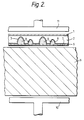
- FIG 2 illustrates the manner in which the transfer film is used.
- a modified form of transfer film is shown in which an additional wax release layer 8 is provided within the concavities 4 as a lining and along the face of the coating 2 which abuts the retaining layer 6.
- the remainder of the transfer film shown in Figure 2 is the same as that shown in Figure 1 and similar reference numerals have been used. In this case, however, there is no printing 5 provided.
- the transfer film is stamped at a temperature of about 100°C onto a suitable flat surface 9 against a mandrel 10 and flat faced stamping head 11, the area of which is suitable for transferring the intaglio-like line pattern.
- the invention may be used for example to impart intaglio like texture to signature strip regions on plastic transaction or identification cards.
- the intaglio simulation may be confined to the areas at the end of the signature strip to leave a suitable planar area for accepting the signature. In other cases, the intaglio simulation extends throughout the signature strip.
- the shape of the grooves 3 must generally be concave so as to allow the forming and subsequent release of the intaglio pattern.
- the coating material or ink used for making the intaglio pattern may be opaque, translucent or transparent. It may contain colouring pigments, dyes including invisible ultraviolet radiation absorbing visible fluorescing dyes, photochromic dyes or pigments, reversible thermochromic materials, optically variable pigments and the like (as previously described).
- an ink which has fugitive properties that is which causes a dye stain to spread when it is contacted with organic solvents.
- release layer 8 is given one or more thin layers of metallic or dielectric coatings, then reflective metallic and complex colour effects can be achieved. These coatings may be selectively removed by washing the film with, say, alkali after a resist pattern has been applied.
- the surface 6 bearing the relief elements may be transparent and printed on its opposing side with security indicia.
- layer 6 may have the same hue as the relief coating; metameric effects may however be employed as a further security measure. (These are achieved by complementary printing of two coatings which have the same visible appearance but which absorb differently in the infrared. It provides a way of concealing messages).
- the backing could have metallic or holographic/diffracting properties.
- the intaglio effect strip say on a card could be further embossed to impart a transient/latent image or to take a relief name as on a credit card is also envisaged.
- Figures 4-9 illustrate the appearance of the transferred portion of the transfer film resulting from different examples of transfer films.
- Figure 4 illustrates the result of the process shown in Figure 2.
- the retaining layer 6 carries a relief pattern formed simply by an ink region 4.
- Figure 5 illustrates the result of transferring from a transfer film in which the pattern defining layer 2 has been previously lined with a low solids (solvent) ink 12. It can be seen that this ink overlies a convex portion of the white pigmentary coating 6 which was previously forced into a corresponding concavity in the coating 2.
- Figure 6 illustrates a simpler version of the example shown in Figure 5 in which no ink lining was provided and the white pigmentary layer 6 defines also the relief pattern.
- Figure 7 illustrates a transferred film comprising an adhesive 7 and white pigmentary coating 6.
- the white pigmentary coating 6 carries a metallic film 13 which was provided following the concavity filling stage in which a high solids (paste) ink 4 was coated into the concavities 3.
- a security, lithographic print 14 was provided on the coating 2 prior to application of the metallic layer 13.
- a lithographic security coating 14 was provided in combination with a low solids ink lining 12 as in Figure 5.
Landscapes
- Engineering & Computer Science (AREA)
- Manufacturing & Machinery (AREA)
- Decoration By Transfer Pictures (AREA)
- Printing Methods (AREA)
- Credit Cards Or The Like (AREA)
- Transition And Organic Metals Composition Catalysts For Addition Polymerization (AREA)
- Wire Bonding (AREA)
- Fuel-Injection Apparatus (AREA)
- Adhesive Tapes (AREA)
- Parts Printed On Printed Circuit Boards (AREA)
- Internal Circuitry In Semiconductor Integrated Circuit Devices (AREA)
- Saccharide Compounds (AREA)
Abstract
Description
- The invention relates to a transfer film for use, for example, with security documents.
- Intaglio printing has been used for many years to provide security printing on documents. Such printing has been used to provide security patterns and the like on banknotes and in addition tactility.
- More recently, plastics security documents such as credit cards have been developed onto which intaglio printing is not generally possible. These generally lack intaglio-like tactility properties.
- In these cases, planar films bearing security indicia and patterns have been transferred using a hot stamping technique. These films are applied under elevated pressure and temperature to a surface in the form of an alphanumeric pattern, a crest, logo or the like. For example by transferring a metallised film, gold effect lettering can be created of a smooth nature.
- Metallised foils can be embossed by stamping a coarse three dimensional pattern, using an engraved stamping face such as in EP-A-194042A but this does not provide intaglio tactility.
- It is known to apply films by hot stamping in which there is a three dimensional pattern such as a holographic, optically diffracting relief pattern on an inner surface of the film. Such films have, after transfer, completely flat surfaces, exhibiting no surface roughness. The hot stamping process itself is likely to flatten any external relief which may previously have existed on that surface of the film which may be touched after its transfer.
- Signature panels have been hitherto conveniently been applied to cards by screen printing and hot stamping methods. It is desired significantly to improve on the counterfeit resistance and forgery resistance of such panels. Paper panels are difficult to remove from cards but hot stamped coatings are even more difficult as they are thinner and have less internal strength.
- The use of intaglio printing is well established as an anti-counterfeiting and anti-forgery measure but it has not been used before with hot stamp signature strips. Intaglio is however found on the relatively expensive paper panels, which can significantly increase the cost of a card.
- US-A-3545380 describes intaglio effects obtained on hot stamping signature panels but this is done by providing a discontinuous transfer according to the engraving in the stamping head. They omit portions of the panel. This is undesirable.
- In accordance with a first aspect of the present invention a transfer film comprises a pattern defining layer having concavities defining an inverted relief pattern; and a retaining layer overlying and releasably filling the concavities of the pattern defining layer, the pattern defining layer being removable from the retaining layer to leave the parts of the retaining layer filling the concavities defining the relief pattern.
- In accordance with a second aspect of the present invention, a transfer film comprises a pattern defining layer having concavities defining an inverted relief pattern, the concavities being releasably filled with a relief material; and a retaining layer overlying the concavities of the pattern defining layer so as to adhere to the relief material, the pattern defining layer being removable from the retaining layer and the relief material to leave the relief material defining the relief pattern on the retaining layer.
- We have devised a new transfer film which can be applied using a flat, unembossed mandrel to a planar substrate using a hot stamping technique so that an intaglio-like pattern can be provided on the substrate.
- The invention is particularly suitable for applying signature panels since a complete panel carrying a relief pattern can be laid down without using an engraved stamping head. A parallel surfaced hot stamping film is provided in which the pattern defining layer's surface has three dimensional characteristics. Thus, the present invention provides a transfer film which will allow the making of signature panels on plastic, financial transaction cards, by a hot stamping method, such signature panels exhibiting at least over part of their surface intaglio-like tactility.
- Typically, a release layer will be provided in the concavities, such as smooth grooves, such as to maximise transfer of the relief material with the retaining layer.
- The pattern defining layer could be made of a single plastic layer element but preferably an additional support layer is provided, the pattern defining layer comprising a well bonded embossable coating in which the concavities are formed, of typical thickness 125 microns.
- The retaining layer may be secured to a substrate in use by means of an adhesive provided on the substrate but typically the film further comprises an adhesive such as a pressure sensitive or preferably heat sensitive adhesive on the retaining layer. This enables sections of the transfer film to be secured to the substrate as in conventional hot stamping techniques. The film is particularly suited for use with plastics substrates but could be used with other forms of smooth substrate.
- Preferably, the retaining layer is somewhat porous and includes a section on which marks can be written, for example signatures. This aspect is particularly important since the invention, as mentioned above, is particularly suitable for providing signature panels on identification cards and the like. In some cases, the relief pattern can be provided at opposite ends of a signature panel leaving a central section free for the application of a signature. In other cases, a relatively weak intaglio or relief pattern could be provided throughout the signature panel to enable a signature to be written across the relief pattern.
- Preferably, the pattern defining layer is planographically printed on its surface facing the retaining layer such that the printing will transfer onto the retaining layer. This enables security indicia and the like to be provided on the retaining layer, for example such indicia exhibiting rainbow inking effects. Printed security indicia may comprise alphanumeric characters, signs, symbols, logos, geometric designs and fine line tracings. They may incorporate colour hue and density, and line patterns designed to foil reproduction by half-tone screen separation methods, and electrophotographic colour copiers including pixel and line scanning photocopiers, half-tone proofing colour scanners and the like.
- For signature panel purposes the retaining layer will preferably have a faint background tint. The tints of the marking composition and the retaining layer may be selected to create metameric effects. If the intaglio effect is to be present on the signing area the colour of the marking composition will normally be chosen so as to be faint so as not to obscure the signature formed in dense ink.
- The retaining layer typically comprises a clay, titanium oxide, zinc oxide, calcium carbonate, barium sulphate, zirconium oxide or other white or mutely coloured composition in an aqueous dispersion with an emulsion polymer such as a vinyl emulsion polymer.
- The relief material will typically formed by a marking composition such as a paste or fluid ink or other type of coating but could comprise part of the retaining layer.
- In accordance with a third aspect of the present invention, a method of forming a transfer film comprises providing a pattern defining layer having concavities defining an inverted relief pattern; overlying and releasably filling the concavities of the pattern defining layer with a retaining layer, wherein the pattern defining layer is removable from the retaining layer to leave the parts of the retaining layer filling the concavities defining the relief pattern.
- In accordance with a fourth aspect of the present invention, a method of forming a transfer film comprises providing a pattern defining layer having concavities defining an inverted relief pattern; releasably filling the concavities with a relief material; and covering the pattern defining layer with a retaining layer overlying the concavities so as to adhere to the relief composition wherein the pattern defining layer is removable from the retaining layer and the relief material to leave the relief material defining the relief pattern on the retaining layer.
- In a typical example, a support layer (polyester, for example of 20 microns thickness) supporting an embossable layer is provided. This embossable layer will typically be polyethylene 100 to 150 microns thick. The surface of the layer needs to be releasable. Biaxially orientated polypropylene may also be used as a support.
- The release characteristics may be chosen by selecting two materials which inherently will have sufficient clinging engagement for the manufacturing and application yet release after stamping. Release can be increased by providing a thin primer of, say, wax or silicone, or decreased by treating the surface with a corona discharge (which will have the effect of increasing the bonding of a highly releasing material such as polyethylene).
- The surface could then be releasably printed but in practice is unlikely to be at this stage because if solvent based relief material inks are used the inks are likely to be dissolved.
- Concavities such as smooth grooves are then embossed in the embossable layer to define a relief pattern. Polyvinylcholoride may be embossed at from 95 to 145 degrees C. Polyethylene may be embossed at around 60 degrees C. Polycarbonate may be embossed at 165 degrees and nylon 175 degrees C. Embossing at too low a temperature loses fine detail. Above, the plastic is too soft to hold detail. The depths of the grooves are likely to be about 50 to 120 microns. Different groove depths could be used. Embossing will generally be made by using a metallic cylinder carrying the relief pattern which extends continuously around the circumference of the cylinder. The relief pattern will generally be metallic to allow embossing at elevated temperatures.
- Polyethylene is preferred for ease of embossing and release of the ink and clay coatings. It can be corona treated if necessary in-line to control the adhesion and wetting properties.
- The embossed area may overlap or simply be adjacent to the printed area (if provided). The embossed pattern may be of an overall "wallpaper" style i.e. containing repetitively repeating areas of miniature printing, or possibly a continuous design of a complex line pattern. This embossing will normally be undertaken with a roller which avoids showing circumferential joins: the image will be seamless. The embossing may comprise lines within a design which runs parallel to the length of the reel of plastic being embossed.
- The concavities are then filled with ink and any excess is scraped off with a doctor blade.
- If the ink is a high solids ink such as a paste ink then this should be dried to encourage its setting. For example there may be a small proportion of volatile solvent which when removed makes the ink's viscosity increase.
- An ultraviolet or conceivably an electron beam curable ink may be used. This can be set more quickly than conventional paste inks can be dried as fast drying of conventional inks on a non-porous surface is likely to be a problem. An example of a suitable UV curable ink is Sericol (Registered Trade Mark) brand UV021 (white) ink.
- With these high solids inks the concavities or grooves are substantially completely filled. It is however possible to use solvent based inks such as flexographic inks which have solids contents of less than 10% by weight. Here the wet inks would fill the voids but they would be immediately dried by solvent evaporation. The remaining dyes or pigments would then merely line the concavity, not fill it. These inks being solvent borne will dissolve easily if forgery is attempted; thus they will be fugitive. In this case the retaining layer would be applied from an aqueous rather than a solvent coating.
- In some cases, instead of providing ink in the concavities the retaining layer would fill the voids completely.
- Preferably a printing process is now performed. Rainbow printing, close register multiple colour work and use of hidden fluorescent agents in inks are the preferred types of printing.
- Next the retaining layer would be applied, say at a thickness of 25 microns, other than where the relief pattern was present where it would be thicker.
- The retaining layer will be quite thin relative to the embossing depths. This coating may be applied by a roller coating method. A UV curable ink could be applied as the retaining layer as an alternative to a white pigmentary emulsion coating.
- The use of a slightly porous surface, rather than a surface film forming is preferred for signature panel applications. The coating must not be so porous as to allow solvent from the adhesive coating to penetrate and attack fugitive inks present at the release layer. Preferably, a white pigmentary coating is deposited from an aqueous binder so as not prematurely to dissolve any previously printed fugitive inks. This coating will also typically contain a small quantity of a bleach indicating reagent such as a substituted guanidine as known in the art. It will then be dried with hot air.
- Next an adhesive would be applied. For signature panels this will be a heat activatable adhesive of thickness typically about 1 micron.
- A second offset printing could be used as could a second embossing with a different colour ink, preferably on a different area of the strip, such as the opposite end of the strip.
- The retaining layer is preferably adapted to receive a mark such as a signature but could also be electronically imageable. It should be noted that the use of the slightly porous or rough white pigmentary coating will also be useful in helping toner to key or ink jet inks to dry but film forming coatings would be better for thermally transferred dye images.
- The transfer film can be used on PVC based financial transaction cards, service entitlement cards, identification cards, access cards, EFTPOS cards and the like.
- In addition to the invention being used for signature panel applications the transfer films may be used to affix areas to other plastic substrates such as the plastic covers of pass books, licences and the like.
- The transfer film may also be used to apply textured borders to documents including paper and plastic which have been suitably printed. These borders may be rolled on under heat and pressure, rather than stamped. In these cases pressure sensitive adhesive backings could be used, either coated or transferred on. The strips could be used as seals.
- In the case of signature panels, the tactility imparted provides a useful defence against fraudulent alteration of overlying signatures (although the signatures will not always overlie). It also provides a useful degree of deterrence against counterfeiting and is likely to reveal such. It will also resist and show fraudulent alteration.
- The preferred signature panel composition comprises an intaglio or relief pattern to one side of the panel, rainbow offset printing, and/or UV absorptive visible light fluorescing marking in the signing area, multiple colour finely registered images, incorporating a fugitive ink. The retaining layer will comprise a white pigmentary coating deposited from an aqueous medium and having bleach indicating reagents. The support layer will be polyester coated with a polyethylene pattern defining layer. A heat activatable adhesive will be used.
- In some cases a thin metallic coating could be imparted to the embossed layer before or after the application of the relief material especially after solvent borne inks.
- The pattern defining layer, such as polyethylene, could be embossed holographically and metallised.
- Marking compositions which may be used with the present invention include coloured opaque inks (including black and white), translucent inks, solvent responsive (fugitive) inks, metallic inks, colour metallic inks: ultraviolet, visible or infrared radiation responsive inks such as ultraviolet fluorescing inks, photochromic inks, anti-Stokes inks, optically variable inks, iridescent inks, sensor responsive inks such as magnetic inks and the like.
- The inks may be high solids inks such as lithographic inks including ultraviolet curable and electron beam curable inks, or solvent based inks such as flexographic inks or gravure inks.
- Some examples of transfer films and methods according to the invention will now be described with reference to the accompanying drawings, in which:-
- Figure 1 is a cross-section through an example of a film;
- Figure 2 is a cross-section through a second example of a transfer film positioned between the heads of a stamping machine;
- Figure 3 is a cross-section through the film of Figure 2 after transfer onto a substrate; and,
- Figures 4-9 are partial cross-sections through the transferred portions of further examples of transfer films.
- A carrier or support film 1 (Figure 1), such as biaxially orientated polyester, bears an embossable, releasable thermoplastic coating 2 (such as polyethylene). This releasable thermoplastic coating is embossed with a metal plate (not shown) which bears a relief pattern of lines so as to create indentations or
concavities 3 in the plastic coating, typically of depth 100-125 microns. - The embossed film is then transferred to a coating or inking machine which allows a marking composition such as
ink 4, preferably with a high solids content, to be deposited into the indentations or recesses 3. The coating process is such that excess ink is applied to the recessed film and then the surface is scraped with a doctor blade so as to leave ink only in the recesses. This ink is then dried to define a relief pattern. Thecoating 2 is then lithographically printed at 5 with security indicia, as previously described. A continuous retaining layer orcoating 6 is then applied followed by a heatactivatable adhesive layer 7 of for example 1 micron thickness. - The
continuous layer 6 may be transparent or translucent or opaque and have a thickness of for example 5 microns. In order to make a signature strip panel thecoating 6 would primarily be of white pigment eg. titanium dioxide in a suitable aqueous binder such as a styrene-butadiene rubber or acrylic or other vinylic aqueous emulsion. - Figure 2 illustrates the manner in which the transfer film is used. In this case, a modified form of transfer film is shown in which an additional
wax release layer 8 is provided within theconcavities 4 as a lining and along the face of thecoating 2 which abuts theretaining layer 6. The remainder of the transfer film shown in Figure 2 is the same as that shown in Figure 1 and similar reference numerals have been used. In this case, however, there is noprinting 5 provided. - In use, the transfer film is stamped at a temperature of about 100°C onto a suitable
flat surface 9 against amandrel 10 and flat faced stampinghead 11, the area of which is suitable for transferring the intaglio-like line pattern. - By removing the carrier film and thermoplastic coating, a process which may be aided by the presence of wax or
other release materials 8 if there is not already sufficient release between theink 4 andlayer 2, the signature strip surface is revealed, carrying a relief pattern (Figure 3). - In Figure 3 a cross section of the
substrate 9 and the transferred coatings is shown. - The invention may be used for example to impart intaglio like texture to signature strip regions on plastic transaction or identification cards. In this case the intaglio simulation may be confined to the areas at the end of the signature strip to leave a suitable planar area for accepting the signature. In other cases, the intaglio simulation extends throughout the signature strip.
- The shape of the
grooves 3 must generally be concave so as to allow the forming and subsequent release of the intaglio pattern. - The coating material or ink used for making the intaglio pattern may be opaque, translucent or transparent. It may contain colouring pigments, dyes including invisible ultraviolet radiation absorbing visible fluorescing dyes, photochromic dyes or pigments, reversible thermochromic materials, optically variable pigments and the like (as previously described).
- For signature panel applications it is desirable to employ an ink which has fugitive properties, that is which causes a dye stain to spread when it is contacted with organic solvents.
- If the
release layer 8 is given one or more thin layers of metallic or dielectric coatings, then reflective metallic and complex colour effects can be achieved. These coatings may be selectively removed by washing the film with, say, alkali after a resist pattern has been applied. - The
surface 6 bearing the relief elements may be transparent and printed on its opposing side with security indicia. - While the invention has been described with reference to hot stamping films it is evident that pressure sensitive adhesive coatings and other heat activatable adhesive coatings may also be used. If the retaining layer is thermoplastic this can be directly bonded to a similar surface by lamination without the need for an adhesive layer.
- As a
further variation layer 6 may have the same hue as the relief coating; metameric effects may however be employed as a further security measure. (These are achieved by complementary printing of two coatings which have the same visible appearance but which absorb differently in the infrared. It provides a way of concealing messages). - Although the invention has been described with principal reference to signature strips carrying a white pigmentary coating, it is quite possible that the backing could have metallic or holographic/diffracting properties. The possibility that the intaglio effect strip say on a card could be further embossed to impart a transient/latent image or to take a relief name as on a credit card is also envisaged.
- Figures 4-9 illustrate the appearance of the transferred portion of the transfer film resulting from different examples of transfer films. Figure 4 illustrates the result of the process shown in Figure 2. In this case, the
retaining layer 6 carries a relief pattern formed simply by anink region 4. - Figure 5 illustrates the result of transferring from a transfer film in which the
pattern defining layer 2 has been previously lined with a low solids (solvent)ink 12. It can be seen that this ink overlies a convex portion of the whitepigmentary coating 6 which was previously forced into a corresponding concavity in thecoating 2. - Figure 6 illustrates a simpler version of the example shown in Figure 5 in which no ink lining was provided and the white
pigmentary layer 6 defines also the relief pattern. - Figure 7 illustrates a transferred film comprising an adhesive 7 and white
pigmentary coating 6. The whitepigmentary coating 6 carries ametallic film 13 which was provided following the concavity filling stage in which a high solids (paste)ink 4 was coated into theconcavities 3. In this case, a security,lithographic print 14 was provided on thecoating 2 prior to application of themetallic layer 13. - In the example shown in Figure 8, a
lithographic security coating 14 was provided in combination with a low solids ink lining 12 as in Figure 5. - In the example shown in Figure 9, a metallic lining 13' was provided on the
coating 2 prior to application of the whitepigmentary coating 6 which filled theconcavity 3.
Claims (31)
- A transfer film comprising a pattern defining layer having concavities defining an inverted relief pattern; and a retaining layer overlying and releasably filling the concavities of the pattern defining layer, the pattern defining layer being removable from the retaining layer to leave the parts of the retaining layer filling the concavities defining the relief pattern.
- A transfer film comprising a pattern defining layer having concavities defining an inverted relief pattern, the concavities being releasably filled with a relief material; and a retaining layer overlying the concavities of the pattern defining layer so as to adhere to the relief material, the pattern defining layer being removable from the retaining layer and the relief material to leave the relief material defining the relief pattern on the retaining layer.
- A film according to claim 2, wherein the relief material comprises an ink.
- A film according to any of the preceding claims, wherein the retaining layer is coloured.
- A film according to any of the preceding claims, wherein the pattern defining layer comprises a carrier layer carrying a coating into which the concavities are embossed.
- A film according to any of the preceding claims, further comprising an adhesive layer provided on the retaining layer.
- A film according to claim 6, wherein the adhesive layer is a heat activatable adhesive.
- A film according to any of the preceding claims, wherein the pattern defining layer is printed on its surface facing the retaining layer such that the printing will transfer on to the retaining layer.
- A film according to claim 8, wherein the printing defines security indicia.
- A film according to any of the preceding claims, further comprising a metallic layer releasably applied to the pattern defining layer for transfer with the retaining layer.
- A film according to any of the preceding claims, wherein the retaining layer comprises a clay, titanium oxide, zinc oxide, calcium carbonate, barium sulphate or Zirconium oxide composition in an aqueous dispersion with an emulsion polymer.
- A film according to any preceding claim, further comprising a release layer in the concavities.
- A film according to claim 12, wherein the release layer comprises a wax composition.
- A film according to any of the preceding claims, wherein the retaining layer is adapted to receive a signature.
- A method of forming a transfer film, the method comprising providing a pattern defining layer having concavities defining an inverted relief pattern; overlying and releasably filling the concavities of the pattern defining layer with a retaining layer wherein the pattern defining layer is removable from the retaining layer to leave the parts of the retaining layer filling the concavities defining the relief pattern.
- A method of forming a transfer film, the method comprising providing a pattern defining layer having concavities defining an inverted relief pattern; releasably filling the concavities with a relief material; and covering the pattern defining layer with a retaining layer overlying the concavities so as to adhere to the relief material wherein the pattern defining layer is removable from the retaining layer and the relief material to leave the relief material defining the relief pattern on the retaining layer.
- A method according to claim 16, wherein the relief material comprises an ink.
- A method according to claim 17, wherein the ink is selected from coloured opaque inks, translucent inks, solvent responsive (fugitive) inks, metallic inks, colour metallic inks, ultraviolet, visible or infra-red radiation responsive inks, photochromic inks, anti-Stokes inks, optically variable inks, iridescent inks, and sensor responsive inks such as magnetic inks.
- A method according to any of claims 15 to 18, further comprising providing a release layer in the concavities prior to filling the concavities.
- A method according to any of claims 15 to 19, wherein the pattern defining layer is provided on a support layer.
- A method according to any of claims 15-20, wherein the pattern defining layer comprises polyethylene.
- A method according to any of claims 15 to 21, wherein the pattern defining layer is corona treated on its surface facing the retaining layer so as to decrease the release properties of the surface.
- A method according to any of claims 15 to 22, further comprising printing the pattern defining layer on its surface facing the retaining layer.
- A method according to claim 23, wherein the printing is provided by dry or wet offset lithography.
- A method according to claim 23 or 24, wherein the printing defines security indica such as, alphanumeric characters, signs, symbols, logos, geometric designs or fine line tracings.
- A method according to any of claims 15 to 25, wherein the retaining layer is coloured.
- A method according to any of claims 15 to 26, wherein the retaining layer comprises a clay, titanium oxide, zinc oxide, calcium carbonate, barium sulphate, zirconium oxide or other white or mutely coloured pigment composition in an aqueous dispersion with an emulsion polymer.
- A method according to any of claims 15 to 27, wherein the retaining layer is adapted to receive a signature.
- A method of providing a signature panel on a substrate, the method comprising providing a transfer film according to claim 28, and transferring the retaining layer of the transfer film onto a substrate.
- A method according to claim 29, wherein the substrate is a plastics material.
- A method according to any of claims 15 to 28 for making a transfer film according to any of claims 1 to 14.
Applications Claiming Priority (5)
| Application Number | Priority Date | Filing Date | Title |
|---|---|---|---|
| GB9015319 | 1990-07-12 | ||
| GB909015319A GB9015319D0 (en) | 1990-07-12 | 1990-07-12 | Transfer film |
| GB909016821A GB9016821D0 (en) | 1990-07-31 | 1990-07-31 | Improvements relating to signature panels |
| GB9016821 | 1990-07-31 | ||
| PCT/GB1991/001158 WO1992000856A1 (en) | 1990-07-12 | 1991-07-12 | Transfer film |
Publications (2)
| Publication Number | Publication Date |
|---|---|
| EP0538376A1 EP0538376A1 (en) | 1993-04-28 |
| EP0538376B1 true EP0538376B1 (en) | 1996-03-06 |
Family
ID=26297312
Family Applications (2)
| Application Number | Title | Priority Date | Filing Date |
|---|---|---|---|
| EP91913048A Expired - Lifetime EP0538358B1 (en) | 1990-07-12 | 1991-07-12 | Improvements relating to signature panels |
| EP91913455A Expired - Lifetime EP0538376B1 (en) | 1990-07-12 | 1991-07-12 | Transfer film |
Family Applications Before (1)
| Application Number | Title | Priority Date | Filing Date |
|---|---|---|---|
| EP91913048A Expired - Lifetime EP0538358B1 (en) | 1990-07-12 | 1991-07-12 | Improvements relating to signature panels |
Country Status (9)
| Country | Link |
|---|---|
| US (1) | US5413839A (en) |
| EP (2) | EP0538358B1 (en) |
| JP (2) | JP3133326B2 (en) |
| AT (2) | ATE134942T1 (en) |
| DE (2) | DE69117757T2 (en) |
| DK (2) | DK0538358T3 (en) |
| ES (2) | ES2089221T3 (en) |
| GR (2) | GR3019969T3 (en) |
| WO (2) | WO1992000855A1 (en) |
Cited By (3)
| Publication number | Priority date | Publication date | Assignee | Title |
|---|---|---|---|---|
| WO2019140904A1 (en) * | 2018-01-22 | 2019-07-25 | Jianqiao Yang | Composite stone panel and manufacturing method thereof |
| US11359804B2 (en) | 2018-02-23 | 2022-06-14 | Jianqiao YANG | Decorative stone panel |
| US11827050B2 (en) | 2018-11-30 | 2023-11-28 | Jianqiao YANG | Luminous stone product and manufacturing method therefor |
Families Citing this family (44)
| Publication number | Priority date | Publication date | Assignee | Title |
|---|---|---|---|---|
| US5504144A (en) * | 1992-12-23 | 1996-04-02 | American Tactile Corporation | Composition of matter for raised characters and method for manufacturing raised characters for use in signs |
| GB2274428B (en) * | 1993-01-20 | 1996-08-21 | Portals | Security threads |
| DE4313519C2 (en) * | 1993-04-24 | 1996-07-11 | Kurz Leonhard Fa | Hot stamping foil for the production of motor vehicle license plates |
| AU674740B2 (en) * | 1993-06-11 | 1997-01-09 | American Banknote Australasia Pty Ltd | Postage stamp |
| AUPO484797A0 (en) * | 1997-01-29 | 1997-02-20 | Securency Pty Ltd | Printed matter producing reflective intaglio effect |
| JP3173439B2 (en) * | 1997-10-14 | 2001-06-04 | 松下電器産業株式会社 | Ceramic multilayer substrate and method of manufacturing the same |
| KR20030005167A (en) * | 2000-11-30 | 2003-01-17 | 다이셀 가가꾸 고교 가부시끼가이샤 | Transfer Sheet |
| US20040091645A1 (en) * | 2001-02-05 | 2004-05-13 | Heederik Peter Johannes | Topcoat compositions, substrates containing a topcoat derived therefrom, and methods of preparing the same |
| GB0113117D0 (en) * | 2001-05-31 | 2001-07-18 | Ici Plc | Improvements in or relating to thermal transfer printing |
| US6652638B2 (en) * | 2001-06-01 | 2003-11-25 | Aervoe Pacific Company, Inc. | UV-sensitive marking composition |
| US6610458B2 (en) | 2001-07-23 | 2003-08-26 | Kodak Polychrome Graphics Llc | Method and system for direct-to-press imaging |
| DE20121871U1 (en) * | 2001-07-25 | 2003-08-14 | Leonhard Kurz GmbH & Co. KG, 90763 Fürth | Half-tone image printed on substrate, used as security element for valuable, document or object, has dots of 2 or more different colors containing fluorescent pigment |
| ES2307796T3 (en) * | 2001-10-19 | 2008-12-01 | LEONHARD KURZ STIFTUNG & CO. KG | GOFRADO SHEET AND SECURITY DOCUMENT. |
| US7694887B2 (en) | 2001-12-24 | 2010-04-13 | L-1 Secure Credentialing, Inc. | Optically variable personalized indicia for identification documents |
| US20030131927A1 (en) * | 2002-01-17 | 2003-07-17 | Hatcher Johnie F. | Mold transfer system |
| US20030180541A1 (en) * | 2002-02-04 | 2003-09-25 | Naik Kirit N. | Topcoat compositions, substrates coated therewith and method of making and using the same |
| US20050174620A1 (en) * | 2004-02-05 | 2005-08-11 | Woontner Marc O. | Tinted holographic printing material |
| US7919325B2 (en) * | 2004-05-24 | 2011-04-05 | Authentix, Inc. | Method and apparatus for monitoring liquid for the presence of an additive |
| DE102004041868B3 (en) * | 2004-08-27 | 2006-03-02 | Leonhard Kurz Gmbh & Co. Kg | Transfer film, its use and process for the production of decorated plastic articles |
| DE102004044831A1 (en) * | 2004-09-16 | 2006-04-06 | Leonhard Kurz Gmbh & Co. Kg | Value document and method for producing a value document |
| US7387352B2 (en) * | 2004-10-19 | 2008-06-17 | Eastman Kodak Company | Print optimization system and method for drop on demand ink jet printers |
| DE102005017170B4 (en) * | 2005-04-13 | 2010-07-01 | Ovd Kinegram Ag | Transfer film, process for their preparation and multilayer body and its use |
| DE102006030989B4 (en) * | 2006-07-05 | 2013-06-27 | Leonhard Kurz Gmbh & Co. Kg | Signing film and method for producing a Signierfolie |
| US8308886B2 (en) * | 2006-07-17 | 2012-11-13 | E I Du Pont De Nemours And Company | Donor elements and processes for thermal transfer of nanoparticle layers |
| TWM329768U (en) * | 2007-09-05 | 2008-04-01 | zhi-qin Huang | Transfer printing structure capable of detecting and displaying ultraviolet intensity |
| DE102007061980A1 (en) * | 2007-12-21 | 2009-06-25 | Giesecke & Devrient Gmbh | Method for creating a microstructure |
| TWI443612B (en) | 2009-04-07 | 2014-07-01 | Sicpa Holding Sa | Piezochromic security element |
| AU2010277718B2 (en) | 2009-07-28 | 2014-09-11 | Sicpa Holding Sa | Transfer foil comprising optically variable magnetic pigment, method of making, use of transfer foil, and article or document comprising such |
| JP5707880B2 (en) * | 2010-11-11 | 2015-04-30 | 凸版印刷株式会社 | Card and manufacturing method thereof |
| KR101948363B1 (en) | 2011-08-19 | 2019-04-22 | 비쥬얼 피직스 엘엘씨 | Optionally transferable optical system with a reduced thickness |
| CN104837644B (en) | 2012-08-17 | 2018-09-14 | 光学物理有限责任公司 | The method that micro-structure is transferred to final base material |
| CN105339180B (en) | 2013-03-15 | 2018-05-11 | 光学物理有限责任公司 | Optical Security Devices |
| US9873281B2 (en) | 2013-06-13 | 2018-01-23 | Visual Physics, Llc | Single layer image projection film |
| KR102385592B1 (en) | 2014-03-27 | 2022-04-11 | 비쥬얼 피직스 엘엘씨 | An optical device that produces flicker-like optical effects |
| US10766292B2 (en) | 2014-03-27 | 2020-09-08 | Crane & Co., Inc. | Optical device that provides flicker-like optical effects |
| US10800203B2 (en) | 2014-07-17 | 2020-10-13 | Visual Physics, Llc | Polymeric sheet material for use in making polymeric security documents such as banknotes |
| CN107250459B (en) | 2015-02-11 | 2021-06-11 | 克瑞尼股份有限公司 | Method for surface application of a security device to a substrate |
| ES2922024T3 (en) | 2017-02-10 | 2022-09-06 | Crane & Co Inc | Optical machine-readable security device |
| JP6774475B2 (en) * | 2018-10-26 | 2020-10-21 | Nissha株式会社 | Transfer sheet and decorations using it |
| KR102855362B1 (en) * | 2020-11-26 | 2025-09-04 | 삼성전자주식회사 | Electronic device including housing, and manufacturing method of housing |
| IT202100008192A1 (en) * | 2021-04-01 | 2022-10-01 | Giorgio Macor | METHOD TO DECORATE A MATERIAL |
| EP4271573A1 (en) * | 2020-12-29 | 2023-11-08 | Giorgio Macor | Method providing a workpiece with a three-dimensionally textured surface coating |
| IT202200015618A1 (en) * | 2022-07-25 | 2024-01-25 | Giorgio Macor | Method for generating a decoration that can be peeled off on command and product thus obtained. |
| DE102023126444A1 (en) * | 2023-09-28 | 2025-04-03 | Giesecke+Devrient Currency Technology Gmbh | Security element with luminescent security feature |
Family Cites Families (22)
| Publication number | Priority date | Publication date | Assignee | Title |
|---|---|---|---|---|
| US2990311A (en) * | 1956-01-09 | 1961-06-27 | Dennison Mfg Co | Heat transfer |
| US3034430A (en) * | 1958-05-15 | 1962-05-15 | Farrington Mfg Co | Erasure-proof card |
| GB862360A (en) * | 1959-11-12 | 1961-03-08 | Dennison Mfg Company Ltd | Improvements in or relating to transfers and methods of labelling using transfers |
| US3410712A (en) * | 1965-10-19 | 1968-11-12 | Renker Belipa Gmbh | Pressure responsive transfer system and process of making |
| DE1646225C3 (en) * | 1967-01-12 | 1975-08-28 | Addressograph-Multigraph Corp., Cleveland, Ohio (V.St.A.) | Identity document and process for its production |
| US3533822A (en) * | 1968-06-10 | 1970-10-13 | Int Paper Co | Vitreous decalcomania and coated paper base |
| US3812328A (en) * | 1972-05-31 | 1974-05-21 | Pitney Bowes Inc | Credit card |
| US3802724A (en) * | 1972-09-11 | 1974-04-09 | Burroughs Corp | Protection system for computerized negotiable document printouts |
| GB1477203A (en) * | 1974-02-11 | 1977-06-22 | Whiley Ltd G | Manufacture of image-bearing cards and other documents |
| FR2300841A1 (en) * | 1975-02-13 | 1976-09-10 | Noridem Etudes Procede | Transfer printing sheets - with paper etc. carrier, multilayer print film and zein-contg. release layer |
| FR2385161A1 (en) * | 1977-02-08 | 1978-10-20 | Burroughs Corp | MEANS OF PROTECTION OF DOCUMENTS AND DOCUMENTS THUS REALIZED |
| US4217380A (en) * | 1977-06-02 | 1980-08-12 | The Celotex Corporation | Process for producing a raised embossed effect |
| JPS5944963B2 (en) * | 1978-10-06 | 1984-11-02 | ロンシール工業株式会社 | Method for manufacturing vinyl chloride sheet with printed shibori pattern |
| NL8220286A (en) * | 1981-08-24 | 1983-12-01 | Commw Scient Ind Res Org | METHOD FOR MANUFACTURING RELIEF FILMS. |
| KR860000462B1 (en) * | 1981-09-21 | 1986-04-28 | 키다시마 요시도시 | Method of manufacturing transfer paper and cosmetic material using the same |
| US4456639A (en) * | 1982-06-07 | 1984-06-26 | Sealtran Corporation | Laminating film of thermoset polyester resin with external layer of embossable thermoplastic resin |
| GB8400746D0 (en) * | 1984-01-12 | 1984-02-15 | Bradbury Wilkinson Cheques Ltd | Security document |
| GB2177975B (en) * | 1985-02-07 | 1989-11-08 | Bradbury Wilkinson | Embossed articles |
| US4797315A (en) * | 1987-06-08 | 1989-01-10 | Armstrong World Industries, Inc. | Decorative surface coverings with dot patterns |
| US4881999A (en) * | 1987-06-08 | 1989-11-21 | Armstrong World Industries, Inc. | Process for the preparation of decorative surface coverings with dot patterns |
| US5232764A (en) * | 1990-06-04 | 1993-08-03 | Meiwa Gravure Co., Ltd. | Synthetic resin pattern sheet |
| JPH0780346B2 (en) * | 1990-09-19 | 1995-08-30 | 凸版印刷株式会社 | Sign panel and method of manufacturing sign panel |
-
1991
- 1991-07-12 JP JP03512233A patent/JP3133326B2/en not_active Expired - Fee Related
- 1991-07-12 WO PCT/GB1991/001157 patent/WO1992000855A1/en not_active Ceased
- 1991-07-12 EP EP91913048A patent/EP0538358B1/en not_active Expired - Lifetime
- 1991-07-12 ES ES91913455T patent/ES2089221T3/en not_active Expired - Lifetime
- 1991-07-12 EP EP91913455A patent/EP0538376B1/en not_active Expired - Lifetime
- 1991-07-12 US US07/961,713 patent/US5413839A/en not_active Expired - Fee Related
- 1991-07-12 DE DE69117757T patent/DE69117757T2/en not_active Expired - Fee Related
- 1991-07-12 JP JP91512807A patent/JPH05508120A/en active Pending
- 1991-07-12 DK DK91913048.4T patent/DK0538358T3/en active
- 1991-07-12 AT AT91913455T patent/ATE134942T1/en not_active IP Right Cessation
- 1991-07-12 DK DK91913455.1T patent/DK0538376T3/en active
- 1991-07-12 DE DE69117756T patent/DE69117756T2/en not_active Expired - Fee Related
- 1991-07-12 WO PCT/GB1991/001158 patent/WO1992000856A1/en not_active Ceased
- 1991-07-12 AT AT91913048T patent/ATE134941T1/en not_active IP Right Cessation
- 1991-07-12 ES ES91913048T patent/ES2088008T3/en not_active Expired - Lifetime
-
1996
- 1996-05-20 GR GR960401344T patent/GR3019969T3/en unknown
- 1996-05-27 GR GR960401402T patent/GR3020039T3/en unknown
Cited By (5)
| Publication number | Priority date | Publication date | Assignee | Title |
|---|---|---|---|---|
| WO2019140904A1 (en) * | 2018-01-22 | 2019-07-25 | Jianqiao Yang | Composite stone panel and manufacturing method thereof |
| US11124017B2 (en) | 2018-01-22 | 2021-09-21 | Jianqiao YANG | Composite stone panel and manufacturing method thereof |
| US11358409B2 (en) | 2018-01-22 | 2022-06-14 | Jianqiao YANG | Composite stone panel and manufacturing method thereof |
| US11359804B2 (en) | 2018-02-23 | 2022-06-14 | Jianqiao YANG | Decorative stone panel |
| US11827050B2 (en) | 2018-11-30 | 2023-11-28 | Jianqiao YANG | Luminous stone product and manufacturing method therefor |
Also Published As
| Publication number | Publication date |
|---|---|
| WO1992000855A1 (en) | 1992-01-23 |
| DK0538376T3 (en) | 1996-07-08 |
| JP3133326B2 (en) | 2001-02-05 |
| DE69117757T2 (en) | 1996-07-18 |
| EP0538358B1 (en) | 1996-03-06 |
| ATE134942T1 (en) | 1996-03-15 |
| JPH05508120A (en) | 1993-11-18 |
| DE69117756T2 (en) | 1996-07-18 |
| GR3020039T3 (en) | 1996-08-31 |
| ES2088008T3 (en) | 1996-08-01 |
| ATE134941T1 (en) | 1996-03-15 |
| GR3019969T3 (en) | 1996-08-31 |
| US5413839A (en) | 1995-05-09 |
| DE69117757D1 (en) | 1996-04-11 |
| ES2089221T3 (en) | 1996-10-01 |
| DE69117756D1 (en) | 1996-04-11 |
| EP0538358A1 (en) | 1993-04-28 |
| EP0538376A1 (en) | 1993-04-28 |
| JPH05508119A (en) | 1993-11-18 |
| WO1992000856A1 (en) | 1992-01-23 |
| DK0538358T3 (en) | 1996-06-17 |
Similar Documents
| Publication | Publication Date | Title |
|---|---|---|
| US5413839A (en) | Transfer film | |
| US5438928A (en) | Signature panels | |
| US6616190B1 (en) | Security elements | |
| EP1198358B1 (en) | Security device | |
| US20060151989A1 (en) | Embossed optically variable devices | |
| RU2302946C2 (en) | Method for individualizing documents, protected from forgery, and a corresponding document, protected from forgery | |
| DE69319224T2 (en) | IMAGE IMPROVEMENT | |
| CN1193299A (en) | Fake document with writable transparent hologram | |
| AU2007211932A1 (en) | Printed article with special effect coating | |
| CA2279290C (en) | Printed matter producing reflective intaglio effect | |
| JP2001347745A (en) | Antifalsifying medium | |
| JP4280122B2 (en) | Decorative sheet and manufacturing method thereof | |
| US10384486B2 (en) | Method for the production of a multi-layer data medium with security inscriptions | |
| JPS5836534Y2 (en) | Synthetic paper with fluorescent pattern | |
| Marshall et al. | Additional security features for optically variable foils |
Legal Events
| Date | Code | Title | Description |
|---|---|---|---|
| PUAI | Public reference made under article 153(3) epc to a published international application that has entered the european phase |
Free format text: ORIGINAL CODE: 0009012 |
|
| 17P | Request for examination filed |
Effective date: 19930107 |
|
| AK | Designated contracting states |
Kind code of ref document: A1 Designated state(s): AT BE CH DE DK ES FR GB GR IT LI LU NL SE |
|
| 17Q | First examination report despatched |
Effective date: 19940802 |
|
| RAP1 | Party data changed (applicant data changed or rights of an application transferred) |
Owner name: THOMAS DE LA RUE LIMITED |
|
| RAP1 | Party data changed (applicant data changed or rights of an application transferred) |
Owner name: DE LA RUE HOLOGRAPHICS LIMITED |
|
| GRAA | (expected) grant |
Free format text: ORIGINAL CODE: 0009210 |
|
| AK | Designated contracting states |
Kind code of ref document: B1 Designated state(s): AT BE CH DE DK ES FR GB GR IT LI LU NL SE |
|
| REF | Corresponds to: |
Ref document number: 134942 Country of ref document: AT Date of ref document: 19960315 Kind code of ref document: T |
|
| REG | Reference to a national code |
Ref country code: CH Ref legal event code: NV Representative=s name: ISLER & PEDRAZZINI AG PATENTANWAELTE |
|
| REF | Corresponds to: |
Ref document number: 69117757 Country of ref document: DE Date of ref document: 19960411 |
|
| ITF | It: translation for a ep patent filed | ||
| REG | Reference to a national code |
Ref country code: ES Ref legal event code: BA2A Ref document number: 2089221 Country of ref document: ES Kind code of ref document: T3 |
|
| ET | Fr: translation filed | ||
| REG | Reference to a national code |
Ref country code: DK Ref legal event code: T3 |
|
| REG | Reference to a national code |
Ref country code: GR Ref legal event code: FG4A Free format text: 3019969 |
|
| REG | Reference to a national code |
Ref country code: ES Ref legal event code: FG2A Ref document number: 2089221 Country of ref document: ES Kind code of ref document: T3 |
|
| REG | Reference to a national code |
Ref country code: ES Ref legal event code: FG2A Ref document number: 2089221 Country of ref document: ES Kind code of ref document: T3 |
|
| PLBE | No opposition filed within time limit |
Free format text: ORIGINAL CODE: 0009261 |
|
| STAA | Information on the status of an ep patent application or granted ep patent |
Free format text: STATUS: NO OPPOSITION FILED WITHIN TIME LIMIT |
|
| 26N | No opposition filed | ||
| NLS | Nl: assignments of ep-patents |
Owner name: DE LA RUE INTERNATIONAL LIMITED |
|
| REG | Reference to a national code |
Ref country code: GB Ref legal event code: 732E |
|
| REG | Reference to a national code |
Ref country code: CH Ref legal event code: PUE Owner name: DE LA RUE HOLOGRAPHICS LIMITED TRANSFER- DE LA RUE |
|
| REG | Reference to a national code |
Ref country code: ES Ref legal event code: PC2A |
|
| REG | Reference to a national code |
Ref country code: FR Ref legal event code: TP Ref country code: FR Ref legal event code: CA |
|
| REG | Reference to a national code |
Ref country code: GB Ref legal event code: IF02 |
|
| PGFP | Annual fee paid to national office [announced via postgrant information from national office to epo] |
Ref country code: SE Payment date: 20020705 Year of fee payment: 12 |
|
| PGFP | Annual fee paid to national office [announced via postgrant information from national office to epo] |
Ref country code: FR Payment date: 20020709 Year of fee payment: 12 |
|
| PGFP | Annual fee paid to national office [announced via postgrant information from national office to epo] |
Ref country code: GB Payment date: 20020710 Year of fee payment: 12 |
|
| PGFP | Annual fee paid to national office [announced via postgrant information from national office to epo] |
Ref country code: AT Payment date: 20020711 Year of fee payment: 12 |
|
| PGFP | Annual fee paid to national office [announced via postgrant information from national office to epo] |
Ref country code: DK Payment date: 20020716 Year of fee payment: 12 |
|
| PGFP | Annual fee paid to national office [announced via postgrant information from national office to epo] |
Ref country code: LU Payment date: 20020717 Year of fee payment: 12 Ref country code: DE Payment date: 20020717 Year of fee payment: 12 Ref country code: CH Payment date: 20020717 Year of fee payment: 12 |
|
| PGFP | Annual fee paid to national office [announced via postgrant information from national office to epo] |
Ref country code: GR Payment date: 20020723 Year of fee payment: 12 |
|
| PGFP | Annual fee paid to national office [announced via postgrant information from national office to epo] |
Ref country code: ES Payment date: 20020726 Year of fee payment: 12 |
|
| PGFP | Annual fee paid to national office [announced via postgrant information from national office to epo] |
Ref country code: NL Payment date: 20020730 Year of fee payment: 12 |
|
| PGFP | Annual fee paid to national office [announced via postgrant information from national office to epo] |
Ref country code: BE Payment date: 20020919 Year of fee payment: 12 |
|
| PG25 | Lapsed in a contracting state [announced via postgrant information from national office to epo] |
Ref country code: LU Free format text: LAPSE BECAUSE OF NON-PAYMENT OF DUE FEES Effective date: 20030712 Ref country code: GB Free format text: LAPSE BECAUSE OF NON-PAYMENT OF DUE FEES Effective date: 20030712 Ref country code: AT Free format text: LAPSE BECAUSE OF NON-PAYMENT OF DUE FEES Effective date: 20030712 |
|
| PG25 | Lapsed in a contracting state [announced via postgrant information from national office to epo] |
Ref country code: SE Free format text: LAPSE BECAUSE OF NON-PAYMENT OF DUE FEES Effective date: 20030713 |
|
| PG25 | Lapsed in a contracting state [announced via postgrant information from national office to epo] |
Ref country code: ES Free format text: LAPSE BECAUSE OF NON-PAYMENT OF DUE FEES Effective date: 20030714 |
|
| PG25 | Lapsed in a contracting state [announced via postgrant information from national office to epo] |
Ref country code: LI Free format text: LAPSE BECAUSE OF NON-PAYMENT OF DUE FEES Effective date: 20030731 Ref country code: DK Free format text: LAPSE BECAUSE OF NON-PAYMENT OF DUE FEES Effective date: 20030731 Ref country code: CH Free format text: LAPSE BECAUSE OF NON-PAYMENT OF DUE FEES Effective date: 20030731 Ref country code: BE Free format text: LAPSE BECAUSE OF NON-PAYMENT OF DUE FEES Effective date: 20030731 |
|
| BERE | Be: lapsed |
Owner name: *DE LA RUE INTERNATIONAL LTD Effective date: 20030731 |
|
| PG25 | Lapsed in a contracting state [announced via postgrant information from national office to epo] |
Ref country code: NL Free format text: LAPSE BECAUSE OF NON-PAYMENT OF DUE FEES Effective date: 20040201 |
|
| PG25 | Lapsed in a contracting state [announced via postgrant information from national office to epo] |
Ref country code: DE Free format text: LAPSE BECAUSE OF NON-PAYMENT OF DUE FEES Effective date: 20040203 |
|
| PG25 | Lapsed in a contracting state [announced via postgrant information from national office to epo] |
Ref country code: GR Free format text: LAPSE BECAUSE OF NON-PAYMENT OF DUE FEES Effective date: 20040205 |
|
| EUG | Se: european patent has lapsed | ||
| GBPC | Gb: european patent ceased through non-payment of renewal fee |
Effective date: 20030712 |
|
| REG | Reference to a national code |
Ref country code: CH Ref legal event code: PL Ref country code: DK Ref legal event code: EBP |
|
| PG25 | Lapsed in a contracting state [announced via postgrant information from national office to epo] |
Ref country code: FR Free format text: LAPSE BECAUSE OF NON-PAYMENT OF DUE FEES Effective date: 20040331 |
|
| NLV4 | Nl: lapsed or anulled due to non-payment of the annual fee |
Effective date: 20040201 |
|
| REG | Reference to a national code |
Ref country code: FR Ref legal event code: ST |
|
| REG | Reference to a national code |
Ref country code: ES Ref legal event code: FD2A Effective date: 20030714 |
|
| PG25 | Lapsed in a contracting state [announced via postgrant information from national office to epo] |
Ref country code: IT Free format text: LAPSE BECAUSE OF NON-PAYMENT OF DUE FEES Effective date: 20050712 |