EP0537957A1 - Fungicidal silicon-containing compounds, their preparation and their agrochemical and medicinal uses - Google Patents
Fungicidal silicon-containing compounds, their preparation and their agrochemical and medicinal uses Download PDFInfo
- Publication number
- EP0537957A1 EP0537957A1 EP92309241A EP92309241A EP0537957A1 EP 0537957 A1 EP0537957 A1 EP 0537957A1 EP 92309241 A EP92309241 A EP 92309241A EP 92309241 A EP92309241 A EP 92309241A EP 0537957 A1 EP0537957 A1 EP 0537957A1
- Authority
- EP
- European Patent Office
- Prior art keywords
- compound
- formula
- group
- reagents
- prepare
- Prior art date
- Legal status (The legal status is an assumption and is not a legal conclusion. Google has not performed a legal analysis and makes no representation as to the accuracy of the status listed.)
- Granted
Links
- 0 CC1C#C*C11*2(C)[C@]1C2 Chemical compound CC1C#C*C11*2(C)[C@]1C2 0.000 description 2
Classifications
-
- C—CHEMISTRY; METALLURGY
- C07—ORGANIC CHEMISTRY
- C07F—ACYCLIC, CARBOCYCLIC OR HETEROCYCLIC COMPOUNDS CONTAINING ELEMENTS OTHER THAN CARBON, HYDROGEN, HALOGEN, OXYGEN, NITROGEN, SULFUR, SELENIUM OR TELLURIUM
- C07F7/00—Compounds containing elements of Groups 4 or 14 of the Periodic Table
- C07F7/02—Silicon compounds
- C07F7/08—Compounds having one or more C—Si linkages
-
- C—CHEMISTRY; METALLURGY
- C07—ORGANIC CHEMISTRY
- C07F—ACYCLIC, CARBOCYCLIC OR HETEROCYCLIC COMPOUNDS CONTAINING ELEMENTS OTHER THAN CARBON, HYDROGEN, HALOGEN, OXYGEN, NITROGEN, SULFUR, SELENIUM OR TELLURIUM
- C07F7/00—Compounds containing elements of Groups 4 or 14 of the Periodic Table
- C07F7/02—Silicon compounds
- C07F7/08—Compounds having one or more C—Si linkages
- C07F7/0803—Compounds with Si-C or Si-Si linkages
- C07F7/081—Compounds with Si-C or Si-Si linkages comprising at least one atom selected from the elements N, O, halogen, S, Se or Te
- C07F7/0812—Compounds with Si-C or Si-Si linkages comprising at least one atom selected from the elements N, O, halogen, S, Se or Te comprising a heterocyclic ring
-
- A—HUMAN NECESSITIES
- A01—AGRICULTURE; FORESTRY; ANIMAL HUSBANDRY; HUNTING; TRAPPING; FISHING
- A01N—PRESERVATION OF BODIES OF HUMANS OR ANIMALS OR PLANTS OR PARTS THEREOF; BIOCIDES, e.g. AS DISINFECTANTS, AS PESTICIDES OR AS HERBICIDES; PEST REPELLANTS OR ATTRACTANTS; PLANT GROWTH REGULATORS
- A01N55/00—Biocides, pest repellants or attractants, or plant growth regulators, containing organic compounds containing elements other than carbon, hydrogen, halogen, oxygen, nitrogen and sulfur
Definitions
- the present invention relates to a series of new silicon-containing compounds which may be considered as 3-(1,2,4-triazol-1-yl or imidazol-1-yl)-2-hydroxy-2-(optionally substituted phenyl)-1-(tri-substituted silyl)propane derivatives. They have valuable anti-fungal activities, and may be applied in the agricultural, horticultural and medical fields. The invention also provides methods and compositions using these compounds as well as processes for their preparation.
- a number of tri-substituted silyl derivatives in which a triazolyl group is separated from a silicon atom by a carbon chain is known and some are known to have fungicidal properties.
- GB Patent Specification No. 2 175 301 describes a number of compounds which are said to be primarily plant growth regulators, but which are also said to have fungicidal properties.
- These compounds include, among many others, some trialkylsilyl derivatives, of which the only specific example is given in Example 11 and is 3-t-butyl-3-hydroxy-4-(1,2,4-triazol-1-yl)-1-trimethylsilyl-1-pentyne, which differs from the compounds of the present invention in that it possesses a t-butyl group in place of the optionally substituted phenyl group of the compounds of the present invention, in that it is an alkyne, rather than alkane, derivative and in that it has a longer aliphatic chain than do the compounds of the present invention.
- GB Patent Specification No. 2 224 278 also describes a number of compounds which are said to be plant growth regulators or fungicides, and which include, among many others, some trialkylsilyl derivatives.
- the only compound of this type specifically disclosed appears in Example 4 of that GB Specification and is 3-(2,4-dichlorophenyl)-3-hydroxy-4-(1,2,4-triazol-1-yl)-1-trimethylsilyl-1-butene, which differs from the compounds of the present invention in that its aliphatic chain, and generally the aliphatic chains of the compounds in the GB Specification, is a butene, rather than propane, chain, that is, it is longer and it is unsaturated.
- the prior art compounds do not, in general, have sufficient activity.
- one important property of compounds intended for use as agrochemical or pharmaceutical fungicides is that they should exhibit their activity at low dosages and should not induce any adverse side-effects.
- the fungicide should have a systemic action, so that it may, for example, be applied as a coating to seeds or may be applied directly to crops or may be applied indirectly to submerged crops, such as to rice crops, and will be translocated throughout the plant.
- the compounds of the present invention are those compounds of formula (I): in which: A represents a 1,2,4-triazol-1-yl group or an imidazol-1-yl group; n represents 0, 1, 2 or 3, and, when n represents 2 or 3, the groups represented by X may be the same or different; X represents a halogen atom, a phenyl group, an alkyl group having from 1 to 6 carbon atoms, a haloalkyl group having from 1 to 6 carbon atoms and having at least one halogen atom, an alkoxy group having from 1 to 6 carbon atoms, or a haloalkoxy group having from 1 to 6 carbon atoms and having at least one halogen atom, or (X) n represents an alkylenedioxy group having 1 or 2 carbon atoms; R1 represents an alkyl group having from 1 to 4 carbon atoms or a phenyl group which is unsubstituted or is substituted by at least one halogen atom
- the invention also provides the following compounds which are valuable intermediates in the preparation of the compounds of formula (I).
- These intermediates are compounds of formula (I-2): in which: X, n , R1, R2 and R3 are as defined above; and Y represents a chlorine, bromine or iodine atom, and compounds of formula (I-3): in which: X, n , R1, R2 and R3 are as defined above.
- the invention also provides a pharmaceutical composition for the prevention or treatment of fungal infections, which comprises a fungicidally or fungistatically effective amount of an anti-fungal agent, in which the anti-fungal agent is at least one compound of formula (I) or a pharmaceutically acceptable salt thereof, as defined above.
- the invention still further the use of compounds of formula (I) and pharmaceutically acceptable salts thereof, as defined above, for the manufacture of a medicament for the prevention or treatment of fungal infections.
- the invention also provides an agricultural composition for the protection of plants and plant reproductive matter from fungal attack, which composition comprises a fungicidally or fungistatically effective amount of a compound of formula (I) or a salt thereof, as defined above, in admixture with an agricultural carrier or diluent.
- the invention still further provides a method of protecting plants and plant reproductive matter from fungal attack, which method comprises applying to said plants or plant reproductive matter or to a locus including the same a fungicidally or fungistatically effective amount of a compound of formula (I) or a salt thereof, as defined above.
- the invention also provides several novel methods of preparing the compounds of the present invention, which are described in more detail hereafter.
- X represents a halogen atom
- this may be a fluorine, chlorine, bromine or iodine atom, and is more preferably a fluorine or chlorine atom, and most preferably a fluorine atom.
- X represents an alkyl group having from 1 to 6 carbon atoms
- this may be a straight or branched chain group having from 1 to 6, preferably from 1 to 4, carbon atoms, and examples include the methyl, ethyl, propyl, isopropyl, butyl, isobutyl, sec-butyl, t-butyl, pentyl, isopentyl, neopentyl, 2-methylbutyl, 1-ethylpropyl, 4-methylpentyl, 3-methylpentyl, 2-methylpentyl, 1-methylpentyl, 3,3-dimethylbutyl, 2,2-dimethylbutyl, 1,1-dimethylbutyl, 1,2-dimethylbutyl, 1,3-dimethylbutyl, 2,3-dimethylbutyl, 2-ethylbutyl and hexyl groups.
- alkyl groups having from 1 to 4 carbon atoms preferably the methyl, ethyl, propyl, isopropyl, butyl and isobutyl groups, and most preferably the methyl and ethyl groups.
- X represents a haloalkyl group
- this has from 1 to 6 carbon atoms and may be a straight or branched chain alkyl group having one or more, preferably from 1 to 5 (or less if there are fewer substitutable positions), more preferably from 1 to 3, halogen substituents.
- Examples include any of the alkyl groups exemplified above, but more preferably those having from 1 to 4 and most preferably 1 or 2 carbon atoms, in which one or more hydrogen atoms is replaced by a halogen atom (e.g. a fluorine, chlorine, bromine or iodine atom).
- Specific examples include the trifluoromethyl, trichloromethyl, difluoromethyl, dichloromethyl, dibromomethyl, fluoromethyl, chloromethyl, bromomethyl, iodomethyl, 2,2,2-trichloroethyl, 2,2,2-trifluoroethyl, 2-bromoethyl, 2-chloroethyl, 2-fluoroethyl, 2,2-dibromoethyl, 3-chloropropyl, 3,3,3-trifluoropropyl, 4-fluorobutyl, 5,5,5-trichloropentyl and 6,6,6-trifluorohexyl, groups, of which we prefer alkyl groups having from 1 to 3 carbon atoms which are substituted by from 1 to 3 halogen atoms (and, where there are 2 or 3 halogen atoms, these are the same), more preferably the methyl or ethyl groups which are substituted by from 1 to 3 fluorine or chlorine
- X represents an alkoxy group
- this may be a straight or branched chain alkoxy group having from 1 to 6 carbon atoms.
- examples of such groups include the methoxy, ethoxy, propoxy, isopropoxy, butoxy, isobutoxy, sec-butoxy, t-butoxy, pentyloxy, isopentyloxy, t-pentyloxy, neopentyloxy, hexyloxy, 2-methylbutoxy, 1-ethylpropoxy, 4-methylpentyloxy, 3-methylpentyloxy, 2-methylpentyloxy, 1-methylpentyloxy, 3,3-dimethylbutoxy, 2,2-dimethylbutoxy, 1,1-dimethylbutoxy, 1,2-dimethylbutoxy, 1,3-dimethylbutoxy, 2,3-dimethylbutoxy and 2-ethylbutoxy groups.
- alkoxy groups containing from 1 to 4 carbon atoms, especially the methoxy and ethoxy groups.
- X represents a halogenated alkoxy group
- this has from 1 to 6 carbon atoms and may be a straight or branched chain alkoxy group having one or more, preferably from 1 to 5 (or less if there are fewer substitutable positions), more preferably from 1 to 3, halogen substituents.
- Examples include any of the alkoxy groups exemplified above in which one or more hydrogen atoms is replaced by a halogen atom (e.g. a fluorine, chlorine, bromine or iodine atom).
- Specific examples include the trifluoromethoxy, trichloromethoxy, difluoromethoxy, dichloromethoxy, dibromomethoxy, fluoromethoxy, chloromethoxy, bromomethoxy, iodomethoxy, bromodifluoromethoxy, chlorodifluoromethoxy, 2,2,2-trichloroethoxy, 2,2,2-trifluoroethoxy, 2-bromoethoxy, 2-chloroethoxy, 2-fluoroethoxy, 2,2-dibromoethoxy, 3-chloropropoxy, 3,3,3-trifluoropropoxy, 4-fluorobutoxy, 5,5,5-trichloropentyloxy and 6,6,6-trifluorohexyloxy groups, of which we prefer the trifluoromethoxy group.
- (X) n may represent an alkylenedioxy group having 1 or 2 carbon atoms, that is a methylenedioxy, ethylenedioxy or ethylidenedioxy group, to form with the two, preferably contiguous, carbon atoms of the benzene ring to which they are attached a 5- or 6- membered heterocyclic ring, i.e. a dioxolane or dioxane ring fused to the benzene ring, of which the 5-membered ring, that is the dioxolane ring, is preferred.
- A may represent a 1,2,4-triazol-1-yl group or an imidazol-1-yl group, preferably a 1,2,4-triazol-1-yl group.
- n may be 0, 1, 2 or 3, but is preferably 0, 1 or 2, more preferably 1 or 2, and most preferably 1.
- n 0, the benzene ring is unsubstituted.
- X preferably represents a fluorine atom, a chlorine atom, a bromine atom, an unsubstituted alkyl group having from 1 to 4 carbon atoms, a substituted alkyl group having from 1 to 4 carbon atoms and having from 1 to 3 halogen substituents, an unsubstituted alkoxy group having from 1 to 4 carbon atoms, or a substituted alkoxy group having from 1 to 4 carbon atoms and having from 1 to 3 halogen substituents.
- n is 1, 2 or 3
- X represents a fluorine atom, a chlorine atom, a trifluoromethyl group or a methoxy group, or n may be 0. Still more preferably, n is 1 or 2 and X represents a fluorine atom or a chlorine atom, or n is 0. Most preferably, n is 1 or 2 and X represents a fluorine atom or a chlorine atom, especially a fluorine atom.
- R1, R2 or R3 represents an alkyl group having from 1 to 4 carbon atoms
- this may be a straight or branched chain group having from 1 to 4 carbon atoms, and examples include the methyl, ethyl, propyl, isopropyl, butyl, isobutyl, sec-butyl and t-butyl groups, more preferably the methyl and ethyl groups, and most preferably the methyl group.
- R1 may represent a phenyl group which may be unsubstituted or may be substituted by at least one halogen atom.
- halogen substituents There is no limit to the number of halogen substituents, except that imposed by the number of substitutable positions, that is 5. However, in general, we prefer from 1 to 3 substituents, more preferably 1 or 2, and most preferably 1. Nonetheless, we most prefer the unsubstituted phenyl group.
- Examples of such groups include the phenyl, 2-chlorophenyl, 3-chlorophenyl, 4-chlorophenyl, 2-fluorophenyl, 3-fluorophenyl, 4-fluorophenyl, 4-bromophenyl, 2,4-difluorophenyl, 2,6-difluorophenyl, 2,4-dichlorophenyl, 2,6-dichlorophenyl, 2-chloro-4-fluorophenyl, 4-chloro-2-fluorophenyl, 6-chloro-2-fluorophenyl, 2,4,6-trifluorophenyl and 2,4,6-trichlorophenyl groups, of which the 4-chlorophenyl, 4-fluorophenyl, 2,4-difluorophenyl, 2,4-dichlorophenyl, 2-chloro-4-fluorophenyl, 4-chloro-2-fluorophenyl and phenyl groups are preferred and the
- Y preferably represents a chlorine or bromine atom, more preferably a chlorine atom.
- A represents a 1,2,4-triazol-1-yl group
- n is 1 or 2
- X represents a fluorine atom, a chlorine atom, a bromine atom, an unsubstituted alkyl group having from 1 to 4 carbon atoms, a substituted alkyl group which has from 1 to 4 carbon atoms and which is substituted by from 1 to 3 halogen atoms, an unsubstituted alkoxy group having from 1 to 4 carbon atoms, or a substituted alkoxy group which has from 1 to 4 carbon atoms and which is substituted by from 1 to 3 halogen atoms; or n is 0; and R1, R2 and R3 are the same or different and each represents an alkyl group having 1 to 4 carbon atoms.
- A represents a 1,2,4-triazol-1-yl group
- n is 1 or 2
- X represents a fluorine atom, a chlorine atom, a bromine atom, a trifluoromethyl group or a methoxy group, and the substituent represented by X is at the 2-position and/or the 4-position of the benzene ring; or n is 0; and R1, R2 and R3 are the same or different and each represents a methyl group or an ethyl group.
- A represents a 1,2,4-triazol-1-yl group
- n is 1 or 2
- X represents a fluorine atom, a chlorine atom or a bromine atom, and the substituent represented by X is at the 2-position and/or the 4-position of the benzene ring; or n is 0; and R1, R2 and R3 are the same or different and each represents a methyl group or an ethyl group.
- A represents a 1,2,4-triazol-1-yl group
- n is 1 or 2
- X represents a fluorine atom, or a chlorine atom, and the substituent represented by X is at the 2-position and/or the 4-position of the benzene ring; or n is 0; and R1, R2 and R3 are all methyl groups.
- the compounds of formula (I) of the present invention contain basic nitrogen atoms, and can thus form salts.
- salts include: salts with mineral acids, especially hydrohalic acids (such as hydrofluoric acid, hydrobromic acid, hydroiodic acid or hydrochloric acid), nitric acid, perchloric acid, carbonic acid, sulphuric acid or phosphoric acid; salts with lower alkylsulphonic acids, such as methanesulphonic acid, trifluoromethanesulphonic acid or ethanesulphonic acid; salts with arylsulphonic acids, such as benzenesulphonic acid or p -toluenesulphonic acid; salts with organic carboxylic acids, such as acetic acid, fumaric acid, tartaric acid, oxalic acid, maleic acid, malic acid, succinic acid, benzoic acid, mandelic acid, ascorbic acid, lactic acid, gluconic acid or citric acid.
- the compounds can
- the compounds of the present invention can be prepared by a variety of methods, whose general techniques are known in the art for the preparation of compounds of this type. For example, they may be prepared by:
- an adduct of formula (VIII) is prepared by the addition of a silyl compound of formula (VII) to a ketone compound of formula (VI).
- the ketone compound of formula (VI), which is used as a starting material in this reaction, can be prepared by the method described in Japanese Patent Publication No. Sho 63-46075.
- the silyl compound of formula (VII), which is the other starting material in this reaction, can be obtained from a halomethyltrimethylsilyl and metallic magnesium or lithium by conventional means.
- the amount of the organic metal silyl compound of formula (VII) employed in this step is preferably from 1 to 10 moles per mole of the ketone compound of formula (VI), more preferably from 1 to 2 moles.
- the reaction is normally and preferably effected in the presence of a solvent.
- a solvent there is no particular restriction on the nature of the solvent to be employed, provided that it has no adverse effect on the reaction or on the reagents involved and that it can dissolve the reagents, at least to some extent.
- suitable solvents include: hydrocarbons, which may be aliphatic, cycloaliphatic or aromatic hydrocarbons, such as hexane, cyclohexane, benzene or toluene; halogenated hydrocarbons, especially halogenated aliphatic hydrocarbons, such as methylene chloride, chloroform, dichloroethane or tetrachloroethane; ethers, such as dioxane, diethyl ether, tetrahydrofuran or ethylene glycol dimethyl ether; and amides, such as dimethylformamide, dimethylacetamide or hexamethylphosphoric triamide. A single one of these solvents may be used or a mixture of any two or more may be used. Of these solvents, we prefer the ethers.
- hydrocarbons which may be aliphatic, cycloaliphatic or aromatic hydrocarbons, such as hexane, cyclohexane, benzene or to
- the reaction can take place over a wide range of temperatures, and the precise reaction temperature is not critical to the invention. In general, we find it convenient to carry out the reaction at a temperature of from -20°C to 80°C, more preferably from 10°C to 40°C.
- the time required for the reaction may also vary widely, depending on many factors, notably the reaction temperature and the nature of the reagents and solvent employed. However, provided that the reaction is effected under the preferred conditions outlined above, a period of from 5 minutes to 24 hours, more preferably from 3 hours to 10 hours will usually suffice.
- the atom or group represented by M is removed, to liberate a compound of formula (I).
- the reaction is effected by treating the adduct of formula (VIII) with a weak acid. This is conveniently carried out by dissolving the reaction mixture from Step A1 in water, adding an appropriate amount of a saturated aqueous solution of ammonium chloride, and extracting the reaction mixture with a suitable solvent.
- an adduct of formula (X) is prepared by the addition of a metal silyl compound of formula (VII) to a ketone compound of formula (IX).
- the reaction is essentially the same as, and may be carried out in a similar manner to that described in, Step A1 of Reaction Scheme A.
- a compound of formula (I-2) is prepared from the adduct of formula (X).
- the reaction is essentially the same as, and may be carried out in a similar manner to that described in, Step A2 of Reaction Scheme A.
- a compound of formula (I) is prepared by reacting the compound of formula (I-2), which may have been prepared as described in step B2, with an excess of 1,2,4-triazole or imidazole in the presence of a base.
- the reaction is carried out by reacting the compound of formula (I-2) with at least 1 mole [per mole of the compound of formula (I-2)] of either 1,2,4-triazole or imidazole in a solvent in the presence of at least 1 mole of a base; or by reacting the compound of formula (I-2) with at least 1 mole [per mole of the compound of formula (I-2)] of a salt of either 1,2,4-triazole or imidazole with a base.
- the reaction is normally and preferably effected in the presence of a solvent.
- a solvent there is no particular restriction on the nature of the solvent to be employed, provided that it has no adverse effect on the reaction or on the reagents involved and that it can dissolve the reagents, at least to some extent.
- suitable solvents include: aliphatic hydrocarbons, such as hexane, heptane, ligroin or petroleum ether; aromatic hydrocarbons, such as benzene, toluene or xylene; halogenated hydrocarbons, such as methylene chloride, chloroform, carbon tetrachloride, dichloroethane, chlorobenzene or dichlorobenzene; ethers, such as diethyl ether, diisopropyl ether, tetrahydrofuran, dioxane, dimethoxyethane or diethylene glycol dimethyl ether; alcohols, such as methanol, ethanol, propanol, isopropanol, butanol, isobutanol, t-butanol, isoamyl alcohol, diethylene glycol, glycerol, octanol, cyclohexanol or ethylene glycol monomethyl ether; nitro
- bases include: alkali metal carbonates, such as sodium carbonate or potassium carbonate; alkali metal hydrogencarbonates, such as sodium hydrogencarbonate or potassium hydrogencarbonate; alkali metal hydrides, such as lithium hydride, sodium hydride or potassium hydride; alkali metal hydroxides, such as sodium hydroxide, potassium hydroxide or barium hydroxide; alkali metal alkoxides, such as sodium methoxide, sodium ethoxide or potassium t-butoxide; organic bases, such as triethylamine, tributylamine, diisopropylethylamine, N -methylmorpholine, pyridine, 4-( N , N -dimethylamino)pyridine, N , N -dimethylaniline
- the reaction may be carried out more effectively if it takes place in the presence of one or more of the following compounds: quaternary ammonium salts, such as benzyltriethylammonium chloride or tetrabutylammonium chloride; alkali metal halides, such as sodium iodide, sodium bromide or lithium bromide; crown ethers, such as dibenzo-18-crown-6; or molecular sieve 3A or 4A, which may be employed for drying the solvent.
- quaternary ammonium salts such as benzyltriethylammonium chloride or tetrabutylammonium chloride
- alkali metal halides such as sodium iodide, sodium bromide or lithium bromide
- crown ethers such as dibenzo-18-crown-6
- molecular sieve 3A or 4A which may be employed for drying the solvent.
- the reaction can take place over a wide range of temperatures, and the precise reaction temperature is not critical to the invention. In general, we find it convenient to carry out the reaction at a temperature of from -78°C to 200°C, more preferably from -20°C to 150°C.
- the time required for the reaction may also vary widely, depending on many factors, notably the reaction temperature and the nature of the reagents and solvent employed. However, provided that the reaction is effected under the preferred conditions outlined above, a period of from 1 hour to 24 hours, more preferably from 2 hours to 10 hours, will usually suffice.
- the ketone compound of formula (IX) can be prepared by the method described in Beilsteins Handbuch der Organischen Chemie 7 , 285; 7 , 283.
- a compound of formula (I-3) is prepared by treating the adduct of formula (X), which may have been prepared as described in Step B1, with a suitable chelating reagent to remove the group or atom represented by M and thereby to form an epoxy group.
- a suitable chelating reagent to remove the group or atom represented by M and thereby to form an epoxy group.
- a highly polar solvent having a chelating ability examples include: ethers, such as tetrahydrofuran, dioxane, dimethoxyethane or diethylene glycol dimethyl ether; sulphoxides, such as dimethyl sulphoxide or sulpholane; amides, such as formamide, dimethylformamide, dimethylacetamide, hexamethylphosphoric triamide or 1,3-dimethyl-2-imidazolidine; ketones, such as acetone, methyl ethyl ketone or methyl isobutyl ketone; and esters, such as methyl acetate, ethyl acetate or propyl acetate. Of these, we prefer the amides, especially dimethylformamide or dimethylacetamide.
- an aromatic hydrocarbon such as benzene, toluene or xylene, can be employed as the reaction solvent.
- the reaction can take place over a wide range of temperatures, and the precise reaction temperature is not critical to the invention. In general, we find it convenient to carry out the reaction at a temperature of from -50°C to 50°C, more preferably -20°C to 30°C.
- the time required for the reaction may also vary widely, depending on many factors, notably the reaction temperature and the nature of the reagents and solvent employed. However, provided that the reaction is effected under the preferred conditions outlined above, a period of from 10 minutes to 24 hours, more preferably 20 minutes to 2 hours, will usually suffice.
- the amount of the chelating reagent used there is no particular restriction on the amount of the chelating reagent used, provided that it chelates sufficiently with the adduct of formula (X), and the preferred amount may vary depending on the reagent itself and other conditions.
- the solvent used for forming the adduct of formula (X) is diethyl ether and the solvent to be added is dimethylformamide
- the preferred amount of dimethylformamide is from 1% to 60%, more preferably from 5% to 30%, by volume.
- a solvent of low polarity such as hexane
- water is added, to extract the desired epoxy compound (I-3). This may then be separated and isolate by conventional means from the aqueous extract. If water is added first and hexane extraction is carried out, decomposition of the compound (I-3) occurs.
- an epoxide of formula (I-3) is prepared by treating the compound of formula (I-2) with a base.
- base employed, provided that it does not inhibit the reaction, and any base commonly used in reactions of this type may equally be used here.
- preferred bases include alkali metal salts, such as the lithium salt, the sodium salt or the potassium salt of an azole.
- azoles which may be employed include imidazole and 1,2,4-triazole.
- Other preferred bases include alkali metal salts of cyclic secondary amines, such as pyrrolidine, piperidine or morpholine, preferably a sodium salt of pyrrolidine.
- the amount of base used there is no particular limitation on the amount of base used, provided that it does not inhibit the reaction; however, in general we prefer that the base should be added in an amount of from 0.8 to 1.5 moles, more preferably from 1 to 1.2 moles, per mole of the compound of formula (I-2).
- the reaction is normally and preferably effected in the presence of a solvent.
- a solvent there is no particular restriction on the nature of the solvent to be employed, provided that it has no adverse effect on the reaction or on the reagents involved and that it can dissolve the reagents, at least to some extent.
- suitable solvents include: aliphatic hydrocarbons, such as hexane, heptane, ligroin or petroleum ether; aromatic hydrocarbons, such as benzene, toluene or xylene; halogenated hydrocarbons, such as methylene chloride, chloroform, carbon tetrachloride, dichloroethane, chlorobenzene or dichlorobenzene; ethers, such as diethyl ether, diisopropyl ether, tetrahydrofuran, dioxane, dimethoxyethane or diethylene glycol dimethyl ether; alcohols, such as methanol, ethanol, propanol, isopropanol, butanol, isobutanol, t-butanol, isoamyl alcohol, diethylene glycol, glycerol, octanol, cyclohexanol or ethylene glycol monomethyl ether; nitro
- the reaction can take place over a wide range of temperatures, and the precise reaction temperature is not critical to the invention. In general, we find it convenient to carry out the reaction at a temperature of from -78°C to 200°C, more preferably from -20°C to 150°C.
- the time required for the reaction may also vary widely, depending on many factors, notably the reaction temperature and the nature of the reagents and solvent employed. However, provided that the reaction is effected under the preferred conditions outlined above, a period of from 10 minutes to 24 hours, more preferably from 30 minutes to 2 hours, will usually suffice.
- the desired compound of formula (I-3) may be extracted in the same manner as described in Step C1, in which an extraction solvent of low polarity, such as hexane, is added to the reaction mixture, after which water is added thereto to perform extraction and separation.
- an extraction solvent of low polarity such as hexane
- a compound of formula (I) is prepared by reacting the compound of formula (I-3), which may have been prepared as described in Step C1 or C2, with 1 mole or more of 1,2,4-triazole or imidazole per mole of the compound of formula (I-3), preferably in the presence of 1 mole or more of a base.
- it may be prepared by reacting the compound of formula (I-3) with a salt of 1,2,4-triazole or imidazole with a base.
- the reaction is essentially the same as, and may be carried out in a similar manner to that described in, Step B3 of Reaction Scheme B.
- Step C3 We prefer to carry out this Step C3 by reacting the compound of formula (I-3) with an equimolar amount of a salt of 1,2,4-triazole or imidazole with a base together with an equimolar amount of 1,2,4-triazole or imidazole.
- the reaction product may be collected from the reaction mixture by conventional means.
- the desired product can be obtained by adding a water-immiscible organic solvent to the reaction mixture, washing the mixture with water, and then removing the solvent, preferably by evaporation.
- the desired compound thus obtained may be further purified, if necessary, by conventional means, such as recrystallization, reprecipitation or the various chromatography techniques, notably column chromatography.
- Salts of the compounds of formula (I) may be prepared by conventional means, preferably simply by adding an acid to a solution of the compound, e.g. a solution prepared by dissolving a condensate of the extract from a reaction mixture containing the compound of formula (I), which may have been prepared as described in any of Reaction Schemes A to C, in an appropriate solvent, or prepared by dissolving the previously isolated compound of formula (I) in an appropriate solvent.
- the acid employed will, of course, depend on the salt which is to be prepared.
- suitable acids include: inorganic acids, such as the hydrohalic acids (for example hydrofluoric acid, hydrochloric acid, hydrobromic acid or hydroiodic acid), nitric acid, perchloric acid, sulphuric acid or phosphoric acid; organic acids, such as the lower alkylsulphonic acids (for example methanesulphonic acid, trifluoromethansulphonic acid or ethanesulphonic acid), arylsulphonic acids (for example benzenesulphonic acid or p -toluenesulphonic acid), or organic carboxylic acids (for example succinic acid or oxalic acid); and organic acid amide compounds, such as saccharin.
- hydrohalic acids for example hydrofluoric acid, hydrochloric acid, hydrobromic acid or hydroiodic acid
- nitric acid for example hydrofluoric acid, hydrochloric acid, hydrobromic acid or hydroiodic acid
- perchloric acid sulphuric acid or phospho
- the acid in an amount at least equimolar with respect to the compound of formula (I), preferably in an amount of from 1 to 10, more preferably from 1 to 5, moles per mole of the compound of formula (I).
- the reaction is normally and preferably effected in the presence of a solvent.
- a solvent there is no particular restriction on the nature of the solvent to be employed, provided that it has no adverse effect on the reaction or on the reagents involved and that it can dissolve the reagents, at least to some extent.
- suitable solvents include: ethers, such as diethyl ether, diisopropyl ether, tetrahydrofuran or dioxane; and alcohols, such as methanol or ethanol.
- the reaction can take place over a wide range of temperatures, and the precise reaction temperature is not critical to the invention. In general, we find it convenient to carry out the reaction at a temperature of from -20°C to 50°C, more preferably from -10°C to 30°C.
- the time required for the reaction may also vary widely, depending on many factors, notably the reaction temperature and the nature of the reagents and solvent employed. However, provided that the reaction is effected under the preferred conditions outlined above, a period of from 10 minutes to 1 hour will usually suffice.
- the salt formed may be isolated by conventional means. Specifically, where the salt is precipitated as crystals, it may be isolated by filtration, or, when it is a water-soluble salt, it may be isolated as an aqueous solution by separation using an organic solvent and water.
- the compounds of the present invention have a variety of valuable biological activities, as shown by the following Experiments, which make them useful as both agricultural and pharmaceutical anti-fungal agents.
- the compounds of the present invention show a very high systemic translocation, they may be used not only for foliar application but also for sunmerged application, for which no triazole compound has hitherto been usable in practice. Moreover, they can, in particular, strongly prevent various sclerotial diseases, including sheath blight of rice plants ( Rhizoctonia Sasakii ), and rice blast ( Piricularia oryzae ), which are the main diseases in rice culture.
- the use of the compounds of the present invention as fungicides for soil treatment or as fungicides for seed treatment is particularly effective against damping-off of various crops, such as rice, wheat, barley, sugar beet, cotton and other vegetables, and against black scurf ( Corticium vagum ), which are cuased by Rhizoctonia spp.
- they can effectively control soil-mediated and seed-mediated infectious diseases, such as Fusarium diseases and Particilium diseases of various crops, eyespot of cereals, damping-off, smut and septoria.
- the use of the compounds of the present invention as fungicides for foliar application is, in addition, effective against many kinds of air-mediated infectious diseases, such as powdery mildew, rust and scab.
- the compounds can also be applied to orchards, non-farm areas, forests and the like.
- the compounds can also be used as anti-fungal and preservative agents for the treatment of wood.
- compositions which contain one or more of the compounds of the invention, together with a carrier and optionally other auxiliary agents, if necessary.
- These compositions may be formulated as preparations of the type commonly employed for agricultural or horticultural use, for instance as dusts, coarse dusts, microgranules, fine microgranules, wettable powders, emulsifiable concentrates, aqueous or oily suspensions, and aerosols. It is, of course, not necessary to use a completely pure form of the compound of the invention in the composition and, of course, purification can be suspended at any stage and the resulting crude substance may be used as the active ingredient of the composition.
- the carrier employed in such compositions may be natural or synthetic and organic or inorganic; it is generally employed to assist the active ingredient to reach the substrate to be treated, and to make it easier to store, transport or handle the active compound. It may be solid, liquid or gaseous.
- Suitable solid carriers include:
- inorganic substances such as clays (examples of which are bentonite, kaolinite, montmorillonite and attapulgite), talc, mica, agalmatolite, pyrophyllite, pumice, vermiculite, gypsum, calcium carbonate, dolomite, diatomaceous earth, magnesium carbonate, apatite, zeolite, silicic anhydride and synthetic calcium silicate; vegetable organic substances, such as nut shells (e.g.
- suitable liquid carriers include:
- paraffinic or naphthenic hydrocarbons such as kerosene, mineral oil, spindle oil and white oil
- aromatic hydrocarbons such as benzene, toluene, xylene, solvent naphtha, ethylbenzene, cumene and methylnaphthalene
- halogenated hydrocarbons especially chlorinated hydrocarbons, such as carbon tetrachloride, chloroform, trichloroethylene, monochlorobenzene and o -chlorotoluene
- ethers such as dioxane and tetrahydrofuran
- ketones such as acetone, methyl ethyl ketone, diisobutyl ketone, cyclohexanone, acetophenone and isophorone
- esters such as ethyl acetate, amyl acetate, ethylene glycol acetate, diethylene glycol acetate, dibutyl maleate and die
- Suitable gaseous carriers include:
- compositions of the invention may contain one or more surface active agents and/or polymers to improve the properties of the compositions and help them to disperse, emulsify, spread, penetrate and bind or to control disintegration, improve fluidity or impart corrosion resistance to the composition, or to stabilize the active compound.
- surface active agent non-ionic, anionic, cationic or amphoteric
- non-ionic surface active agents examples include:
- the polymerization adducts of ethylene oxide with higher alcohols such as lauryl alcohol, stearyl alcohol and oleyl alcohol
- the polymerization adducts of ethylene oxide with alkylphenols such as isooctylphenol or nonylphenol
- the polymerization adducts of ethylene oxide with alkylnaphthols such as butylnaphthol or octylnaphthol
- the polymerization adducts of ethylene oxide with higher fatty acids such as palmitic acid, stearic acid or oleic acid
- the polymerization adducts of ethylene oxide with mono- or di- alkylphosphoric acids such as stearylphosphoric acid or dilaurylphosphoric acid
- the polymerization adducts of ethylene oxide with amines such as dodecylamine
- amides or ethoxylated amides of higher fatty acids such as
- anionic surface active agents examples include:
- salts of higher fatty acids i.e. soaps, e.g. sodium oleate
- salts e.g. sodium and calcium salts, of sulphonic acids and the acids themselves, e.g. ligninsulphonic acid, and aryl sulphonate salts, such as sodium isopropylnaphthalenesulphonate, sodium methylenebisnaphthalenesulphonate, sodium ligninsulphonate or sodium dodecylbenzenesulphonate, or alkyl sulphonate salts, especially sodium dialkyl sulphosuccinates, such as sodium dioctyl sulphosuccinate or sodium 2-ethylhexenesulphonate; salts, e.g.
- sodium, ammonium and amine salts of polyoxyethylene alkyl aryl ether sulphates or of polyoxyethylene alkyl ether sulphates or the free acids; or salts of polyoxyethylene alkyl aryl ether phosphates or of polyoxyethylene alkyl phosphates; alkyl sulphate salts, such as sodium lauryl sulphate or oleyl sulphate amine salt;
- Suitable cationic surfactants include:
- amphoteric surfactants include betaines and amino acid-type surfactants.
- compositions of the present invention may be used in combination with high molecular weight compounds or other formulation agents, in order to assist formulation or to improve biological activity, for example: protective colloids, such as casein, gelatin, gum arabic, albumin, glue, sodium alginate, carboxymethylcellulose, methylcellulose, hydroxyethylcellulose or polyvinyl alcohol; dispersing agents, such as sodium polyphosphate; inorganic dispersing agents, such as bentonite or veegum; stabilizers; binding agents; and anti-freezing agents.
- protective colloids such as casein, gelatin, gum arabic, albumin, glue, sodium alginate, carboxymethylcellulose, methylcellulose, hydroxyethylcellulose or polyvinyl alcohol
- dispersing agents such as sodium polyphosphate
- inorganic dispersing agents such as bentonite or veegum
- stabilizers such as bentonite or veegum
- binding agents such as bentonite or veegum
- dusts may conveniently contain from 0.1 to 25% by weight of the active compound, the remainder being a solid carrier.
- Wettable powders may conveniently contain, for example, from 1 to 80%, preferably from 25 to 80%, by weight of the compound, the remainder being a solid carrier and a dispersing and wetting agent, if required, together with a protective colloidal agent, a thixotropic agent and an anti-foaming agent.
- Granules may conveniently contain from 1 to 35% by weight of the active compound, a major portion of the remainder being a solid carrier.
- the active compound is homogeneously admixed with the solid carrier or is adhered to or adsorbed onto the carrier surface; the diameter of each granule is preferably from 0.2 to 1.5 mm.
- Emulsifiable concentrates may conveniently contain, for example, from 5 to 50% by weight of the active compound and from 5 to 20% by weight of an emulsifying agent, the remainder being a liquid carrier, together with, if required, a corrosion inhibitor.
- Oil preparations may conveniently contain from 0.5 to 5% by weight of the active compound, the remainder being a liquid carrier such as kerosene.
- Aerosols may conveniently contain from 0.1 to 5% by weight of the active compound and optionally a perfume, the remainder being an oily and/or aqueous carrier, and a propellant such as liquified petroleum gas, a fluorocarbon or carbon dioxide.
- compositions of the invention may be applied, for example, to paddy or other fields before or after emergence of disease in plants or to plants already infected with harmful fungi; a concentration of from 10 to 500 ppm for the active ingredient is usually suitable, especially for application to leaves and stems of plants and to soil, whereby effective control may be attained.
- composition of the invention may conveniently be blended with other fungicide for a broader fungicidal spectrum and, in some case, a synergistic effect may be expected.
- Suitable other fungicides include:
- composition of the invention may be blended with insecticides.
- suitable insecticides include:
- O -diethyl O -(2-isopropyl-4-methyl-6-pyrimidinyl)phosphorothioate O , O -diethyl S -[2-(ethylthio)ethyl]phosphorodithioate, O , O -dimethyl O -(3-methyl-4-nitrophenyl)thiophosphate, O , O -dimethyl S -( N -methylcarbamoylmethyl)phosphorodithioate, O , O -dimethyl S -( N -methyl- N -formylcarbamoylmethyl)phosphorodithioate, O , O -dimethyl S -[2-(ethylthio)ethyl]phosphorodithioate, O , O -dimethyl-1-hydroxy-2,2,2-trichloroethylphosphonate, O , O -diethyl- O -(5-phenyl
- the compounds of the present invention may be blended with other conventional agricultural or horticultural materials, such as acaricides, nematocides, herbicides, plant growth regulators, manure or soil conditioners, to provide compositions having a wider range of applications and/or to reduce labor costs.
- acaricides such as acaricides, nematocides, herbicides, plant growth regulators, manure or soil conditioners
- the amount of the compound of the present invention used varies depending upon the weather conditions, the type of preparation, the time of application, the method of application, the nature of the environment, the nature of the disease, the nature of the plant and various other known factors, but the compound may preferably be applied in an amount of from 0.1 to 100 g of the effective ingredient per are, preferably from 5 to 40 g.
- Emulsifiable concentrates, wettable powders, suspension concentrates and the like are preferably applied by diluting a prescribed amount with, for example, from 1 to 10 liters of water per are and granules are generally applied without dilution.
- other additives such as spreaders, e.g. surface active agents, polyoxyethylene resin acid, ligninsulphonates, salts of abietic acid, dinaphthylmethanedisulphonate, paraffin, may be added to the water used for the dilution.
- the compounds of the present invention can also be used as pharmaceuticals for the treatment of fungal infections, whether of the skin, in which case they are normally administered topically, or internal infections, in which case they may be administered orally or parenterally. They are thought to be of especial value in the treatment of acute mycosis, such as candidiasis.
- the compound of the present invention may be administered in the form of any conventional pharmaceutical formulation, the nature of which will, as is well known, depend on the route of administration and the nature of the condition to be treated.
- the compounds of the invention may be formulated in conventional dosage forms, normally in admixture with a pharmaceutical carrier or diluent.
- the compounds can be formulated, for example, as tablets, capsules, granules, powders or syrups.
- parenteral administration they may be formulated as injections in a suitable liquid or as suppositories.
- topical administration they may be formulated as ointments, creams, powders, liquids or aerosols.
- compositions can be produced by conventional means using adjuvants generally known in this field, such as excipients, diluents, dispersants, binders, disintegrators, lubricants, stabilizers, corrigents and the like.
- the dosage and frequency of administration may vary depending upon the symptoms, age and body weight of the patient, as well as upon the route of administration, but, in general, the compounds of the invention may be administered orally in a daily dose of from 50 to 2,000 mg for an adult, preferably a dosage of from 100 to 600 mg, which may be administered either as single dose or as divided doses.
- Rice seedlings (variety "Sachikaze") at the 4 - 5 leaf stage were inoculated with the fungus Pyricularia oryzae by spraying them with a spore suspension of the fungus and maintaining the seedlings in a moist chamber (relative humidity: 100%) at 20 - 22°C. After 24 hours, the rice seedlings were sprayed with an aqueous suspension of the test compound at a concentration of 10 ppm in an amount of 30 ml per 3 pots. The rice seedlings were then kept in the moist chamber for a further 6 days. As a control, some plants were exposed to the fungus, but were not treated with any anti-fungal agent.
- the activity index was determined on the basis of the number of lesions formed on the upper two leaves of each plant. The results are shown in Table 4.
- the activity index was assigned on the basis of the degree of disease, which was determined by examination with the naked eye and is given by the following codes (the same applies to subsequent Experiments):
- Rice seedlings (variety Nihonbare) at the 4 - 5 leaf stage were sprayed with an aqueous suspension of the test compound at a concentration of 100 ppm (30 ml/3 pots). The seedlings were then kept for 24 hours at room temperature, after which they were inoculated with Rhizoctonia solani by placing 4 - 5 oat grains on which the fungus had previously been cultured around the base of each seedling. The seedlings were then kept in a moist chamber (relative humidity: 100%) for 5 days at 25 - 27°C. The activity index was given on the basis of the height of the lesions formed on the rice seedlings.
- Rice seedlings (variety Nohonbare) at the 4 - 5 leaf stage were inoculated with Rhizoctonia solani by placing 4 - 5 oat grains on which the fungus had previously been cultured around the base of each rice seedling and keeping them in a moist chamber (relative humidity: 100%) at 25 - 27°C. After 24 hours, the rice seedlings were sprayed with an aqueous suspension of the test compound at a concentration of 10 ppm (30 ml/3 pots) and continued to be kept in the moist chamber for a further 5 days. The activity index was given on the basis of the height of the lesions formed on the rice seedlings.
- Rice seedlings (variety Nihonbare) at the 3 - 4 leaf stage grown in pots were flooded to a depth of 1 cm with water. The test compound was then applied to the water in the pots in an amount corresponding to 100 g per 10 acres. After the seedlings had been kept in a green-house for 7 days, they were inoculated with Rhizoctonia solani by placing 4 - 5 oat grains on which the fungus had previously been cultured around the base of each seedling. The seedlings were then kept in a moist chamber (relative humidity: 100%) for 5 days at 25 - 27°C. The activity index was given on the basis of the height of the lesions formed on the rice seedlings.
- Wheat seedlings (variety Norin No. 61) at the 1.5 leaf stage were inoculated with the fungus Puccinia recondita by sprinkling the spores of the fungus onto the seedlings. They were then kept in a moist chamber (relative humidity: 100%) for 24 hours at 20 - 22°C, after which they were moved to a green-house at 15 - 20°C. After 2 days, the seedlings were sprayed with an aqueous suspension of the test compound at a concentration of 3 ppm (30 ml/3 pots). The seedlings were then continuously kept in the green-house for 10 days. The activity index was given on the basis of diseased area on the first leaf at the end of this time.
- Barley seedlings (variety Sekishinriki) at the first leaf stage were inoculated with conidia of Erysiphe graminis f. sp. hordei by sprinkling spores of the fungus on the seedlings, which were then kept in a green-house at 15 - 20°C. After one day, the seedlings were sprayed with an aqueous suspension of the test compound at a concentration 3 ppm (30 ml/3 pots), and they continued to be kept in the green-house at that temperature for a further 10 days. The activity index was given on the basis of the diseased area on the first leaf at the end of that time.
- a fungal disc of about 4 mm diameter was inoculated on an agar medium (2% by weight malt extract, 1% glucose, 0.3% peptone and 2% agar) in a petri dish of diameter 9 cm, by placing the disc on the center of the medium.
- Paper disc specimens were prepared by impregnating 30 ⁇ l of an acetone solution containing 300 ppm of the test compound into the disc (diameter 8 mm, thickness 0.7 mm) and then subjecting it to dry sterilization. The disc specimens were placed in a circle at about 1 cm distance from the fringe of the grown fungus, three days after the inoculation.
- the specimens were then maintained at 25°C for 5 days, after which the antifungal activity was determined by visual observation of infection of the specimens by the fungus.
- the fungi tested were: Aspergillus niger (Fungus A), Gliocladium virens (Fungus B), and Fusarium moliniforme (Fungus C).
- the antifungal activity is indicated by the following ratings: + : no growth of fungus on the specimens observed - : growth of fungus on the specimens observed.
- test solution The sample to be tested was examined to determine a suitable solvent from those listed below and the method of dissolution, and then the sample was weighed (about 10 mg), dissolved in the selected solvent and diluted with sterilized distilled water to a concentration of 500 ⁇ g/ml. Samples of the resulting solution were then subjected to sequential dilution to half the previous cocentration to prepare 12 samples in which the concentration of active compound is progressively halved.
- test strains were inoculated by means of a slant on Sabouraud's agar medium, cultured at 27°C for 2 days for the yeast strains or for 7 to 14 days for the mold strains, and, kept intact, preserved at 5°C (subcultured every 1 month).
- the reaction mixture was cooled and then poured into 200 ml of ice-water, and the resulting mixture was extracted with 300 ml of ethyl acetate.
- the organic extract was washed three times, each time with 100 ml of a saturated aqueous solution of sodium chloride. It was then dried over anhydrous sodium sulphate, and the solvent was removed by distillation under reduced pressure, to afford a crude oily product.
- a mixture containing 80% of Compound No. 3, 2% of sodium alkylnaphthalenesulphonate, 2% of sodium ligninsulphonate, 3% of hydrated silica and 13% of kaolinite was pulverized using a hammer mill. It was then mixed again and packaged.
- a mixture containing 25% of Compound No. 2, 2.5% of sodium dodecylbenzenesulphonate, 2.5% of sodium ligninsulphonate, 55% of diatomaceous earth and 15% of hydrated silica was pulverized, to prepare a wettable powder.
Landscapes
- Life Sciences & Earth Sciences (AREA)
- Organic Chemistry (AREA)
- Chemical & Material Sciences (AREA)
- Dentistry (AREA)
- Health & Medical Sciences (AREA)
- Engineering & Computer Science (AREA)
- Plant Pathology (AREA)
- General Health & Medical Sciences (AREA)
- Wood Science & Technology (AREA)
- Zoology (AREA)
- Environmental Sciences (AREA)
- Pest Control & Pesticides (AREA)
- Agronomy & Crop Science (AREA)
- Agricultural Chemicals And Associated Chemicals (AREA)
- Plural Heterocyclic Compounds (AREA)
Abstract

in which: A is 1,2,4-triazol-1-yl or imidazol-1-yl; n is 0, 1, 2 or 3; X is halogen, phenyl, alkyl, haloalkyl, alkoxy, or haloalkoxy, or (X)n is alkylenedioxy; R¹ is alkyl or phenyl; and R² and R³ are each alkyl; and salts thereof have valuable anti-fungal activity. Certain intermediates in the preparation of these om,compounds are also disclosed.
Description
- The present invention relates to a series of new silicon-containing compounds which may be considered as 3-(1,2,4-triazol-1-yl or imidazol-1-yl)-2-hydroxy-2-(optionally substituted phenyl)-1-(tri-substituted silyl)propane derivatives. They have valuable anti-fungal activities, and may be applied in the agricultural, horticultural and medical fields. The invention also provides methods and compositions using these compounds as well as processes for their preparation.
- A number of tri-substituted silyl derivatives in which a triazolyl group is separated from a silicon atom by a carbon chain is known and some are known to have fungicidal properties. For example GB Patent Specification No. 2 175 301 describes a number of compounds which are said to be primarily plant growth regulators, but which are also said to have fungicidal properties. These compounds include, among many others, some trialkylsilyl derivatives, of which the only specific example is given in Example 11 and is 3-t-butyl-3-hydroxy-4-(1,2,4-triazol-1-yl)-1-trimethylsilyl-1-pentyne, which differs from the compounds of the present invention in that it possesses a t-butyl group in place of the optionally substituted phenyl group of the compounds of the present invention, in that it is an alkyne, rather than alkane, derivative and in that it has a longer aliphatic chain than do the compounds of the present invention.
- GB Patent Specification No. 2 224 278 also describes a number of compounds which are said to be plant growth regulators or fungicides, and which include, among many others, some trialkylsilyl derivatives. The only compound of this type specifically disclosed appears in Example 4 of that GB Specification and is 3-(2,4-dichlorophenyl)-3-hydroxy-4-(1,2,4-triazol-1-yl)-1-trimethylsilyl-1-butene, which differs from the compounds of the present invention in that its aliphatic chain, and generally the aliphatic chains of the compounds in the GB Specification, is a butene, rather than propane, chain, that is, it is longer and it is unsaturated.
- The closest prior art, however, is thought to be that described by J-F. Chollet et al. [Pestic. Sci., 29, 427 - 435 (1990)], where the compound identified as XX (Table 1, page 431), which may be called 4-(4-chlorophenyl)-4-hydroxy-5-(1,2,4-triazol-1-yl)-3-trimethylsilyl-1-pentene, differs from certain of the compounds of the present invention only in the presence of a vinyl substituent on the propane chain.
- However, the prior art compounds, including those specifically described above, do not, in general, have sufficient activity. Moreover, one important property of compounds intended for use as agrochemical or pharmaceutical fungicides is that they should exhibit their activity at low dosages and should not induce any adverse side-effects. In addition, in the case of an agrochemical fungicide, it is a well recognised desideratum that the fungicide should have a systemic action, so that it may, for example, be applied as a coating to seeds or may be applied directly to crops or may be applied indirectly to submerged crops, such as to rice crops, and will be translocated throughout the plant.
- Although each of the prior art compounds referred to above meets some of these requirements, none meets them all to a sufficient extent, and, in particular, most fail to exhibit any systemic activity at all, and, even in the one isomer of a prior art compound where some systemic activity is exhibited, this is lower than that of similar compounds of the present invention. As will be shown hereafter, the only compound included within the prior art to demonstrate any systemic activity is one isomer of 4-(4-chlorophenyl)-4-hydroxy-5-(1,2,4-triazol-1-yl)-3-trimethylsilyl-1-pentene, which isomer was not, in fact, separated from another, and systemically inactive, isomer by the prior art.
- We have now surprisingly discovered a series of 3-(1,2,4-triazol-1-yl or imidazol-1-yl)-2-hydroxy-2-(optionally substituted phenyl)-1-(tri-substituted silyl)propane derivatives which are believed to have these desirable properties. This is the more surprising in that Chollet et al. suggest that unsaturated compounds, especially allylic compounds, are the most active, whereas the compounds of the present invention do not contain an unsaturated aliphatic group.
- The compounds of the present invention are those compounds of formula (I):

in which:
A represents a 1,2,4-triazol-1-yl group or an imidazol-1-yl group;
n represents 0, 1, 2 or 3, and, when n represents 2 or 3, the groups represented by X may be the same or different;
X represents a halogen atom, a phenyl group, an alkyl group having from 1 to 6 carbon atoms, a haloalkyl group having from 1 to 6 carbon atoms and having at least one halogen atom, an alkoxy group having from 1 to 6 carbon atoms, or a haloalkoxy group having from 1 to 6 carbon atoms and having at least one halogen atom, or (X)n represents an alkylenedioxy group having 1 or 2 carbon atoms;
R¹ represents an alkyl group having from 1 to 4 carbon atoms or a phenyl group which is unsubstituted or is substituted by at least one halogen atom; and
R² and R³ are the same or different and each represents an alkyl group having from 1 to 4 carbon atoms;
and salts thereof. - In addition, the invention also provides the following compounds which are valuable intermediates in the preparation of the compounds of formula (I). These intermediates are compounds of formula (I-2):

in which: X, n, R¹, R² and R³ are as defined above; and Y represents a chlorine, bromine or iodine atom, and compounds of formula (I-3):
in which: X, n, R¹, R² and R³ are as defined above. - The invention also provides a pharmaceutical composition for the prevention or treatment of fungal infections, which comprises a fungicidally or fungistatically effective amount of an anti-fungal agent, in which the anti-fungal agent is at least one compound of formula (I) or a pharmaceutically acceptable salt thereof, as defined above.
- The invention still further the use of compounds of formula (I) and pharmaceutically acceptable salts thereof, as defined above, in therapy.
- The invention still further the use of compounds of formula (I) and pharmaceutically acceptable salts thereof, as defined above, for the prevention or treatment of fungal infections.
- The invention still further the use of compounds of formula (I) and pharmaceutically acceptable salts thereof, as defined above, for the manufacture of a medicament for the prevention or treatment of fungal infections.
- The invention also provides an agricultural composition for the protection of plants and plant reproductive matter from fungal attack, which composition comprises a fungicidally or fungistatically effective amount of a compound of formula (I) or a salt thereof, as defined above, in admixture with an agricultural carrier or diluent.
- The invention still further provides a method of protecting plants and plant reproductive matter from fungal attack, which method comprises applying to said plants or plant reproductive matter or to a locus including the same a fungicidally or fungistatically effective amount of a compound of formula (I) or a salt thereof, as defined above.
- The invention also provides several novel methods of preparing the compounds of the present invention, which are described in more detail hereafter.
- In the compounds of the present invention of formulae (I), (I-2) and (I-3), where X represents a halogen atom, this may be a fluorine, chlorine, bromine or iodine atom, and is more preferably a fluorine or chlorine atom, and most preferably a fluorine atom.
- Where X represents an alkyl group having from 1 to 6 carbon atoms, this may be a straight or branched chain group having from 1 to 6, preferably from 1 to 4, carbon atoms, and examples include the methyl, ethyl, propyl, isopropyl, butyl, isobutyl, sec-butyl, t-butyl, pentyl, isopentyl, neopentyl, 2-methylbutyl, 1-ethylpropyl, 4-methylpentyl, 3-methylpentyl, 2-methylpentyl, 1-methylpentyl, 3,3-dimethylbutyl, 2,2-dimethylbutyl, 1,1-dimethylbutyl, 1,2-dimethylbutyl, 1,3-dimethylbutyl, 2,3-dimethylbutyl, 2-ethylbutyl and hexyl groups. Of these, we prefer those alkyl groups having from 1 to 4 carbon atoms, preferably the methyl, ethyl, propyl, isopropyl, butyl and isobutyl groups, and most preferably the methyl and ethyl groups.
- Where X represents a haloalkyl group, this has from 1 to 6 carbon atoms and may be a straight or branched chain alkyl group having one or more, preferably from 1 to 5 (or less if there are fewer substitutable positions), more preferably from 1 to 3, halogen substituents. Examples include any of the alkyl groups exemplified above, but more preferably those having from 1 to 4 and most preferably 1 or 2 carbon atoms, in which one or more hydrogen atoms is replaced by a halogen atom (e.g. a fluorine, chlorine, bromine or iodine atom). Specific examples include the trifluoromethyl, trichloromethyl, difluoromethyl, dichloromethyl, dibromomethyl, fluoromethyl, chloromethyl, bromomethyl, iodomethyl, 2,2,2-trichloroethyl, 2,2,2-trifluoroethyl, 2-bromoethyl, 2-chloroethyl, 2-fluoroethyl, 2,2-dibromoethyl, 3-chloropropyl, 3,3,3-trifluoropropyl, 4-fluorobutyl, 5,5,5-trichloropentyl and 6,6,6-trifluorohexyl, groups, of which we prefer alkyl groups having from 1 to 3 carbon atoms which are substituted by from 1 to 3 halogen atoms (and, where there are 2 or 3 halogen atoms, these are the same), more preferably the methyl or ethyl groups which are substituted by from 1 to 3 fluorine or chlorine atoms. More preferred specific groups are the trifluoromethyl, trichloromethyl, difluoromethyl, 2-bromoethyl, 2-chloroethyl and 2-fluoroethyl groups, especially the trifluoromethyl group.
- Where X represents an alkoxy group, this may be a straight or branched chain alkoxy group having from 1 to 6 carbon atoms. Examples of such groups include the methoxy, ethoxy, propoxy, isopropoxy, butoxy, isobutoxy, sec-butoxy, t-butoxy, pentyloxy, isopentyloxy, t-pentyloxy, neopentyloxy, hexyloxy, 2-methylbutoxy, 1-ethylpropoxy, 4-methylpentyloxy, 3-methylpentyloxy, 2-methylpentyloxy, 1-methylpentyloxy, 3,3-dimethylbutoxy, 2,2-dimethylbutoxy, 1,1-dimethylbutoxy, 1,2-dimethylbutoxy, 1,3-dimethylbutoxy, 2,3-dimethylbutoxy and 2-ethylbutoxy groups. Of these, we prefer those alkoxy groups containing from 1 to 4 carbon atoms, especially the methoxy and ethoxy groups.
- Where X represents a halogenated alkoxy group, this has from 1 to 6 carbon atoms and may be a straight or branched chain alkoxy group having one or more, preferably from 1 to 5 (or less if there are fewer substitutable positions), more preferably from 1 to 3, halogen substituents. Examples include any of the alkoxy groups exemplified above in which one or more hydrogen atoms is replaced by a halogen atom (e.g. a fluorine, chlorine, bromine or iodine atom). Specific examples include the trifluoromethoxy, trichloromethoxy, difluoromethoxy, dichloromethoxy, dibromomethoxy, fluoromethoxy, chloromethoxy, bromomethoxy, iodomethoxy, bromodifluoromethoxy, chlorodifluoromethoxy, 2,2,2-trichloroethoxy, 2,2,2-trifluoroethoxy, 2-bromoethoxy, 2-chloroethoxy, 2-fluoroethoxy, 2,2-dibromoethoxy, 3-chloropropoxy, 3,3,3-trifluoropropoxy, 4-fluorobutoxy, 5,5,5-trichloropentyloxy and 6,6,6-trifluorohexyloxy groups, of which we prefer the trifluoromethoxy group.
- Alternatively, (X)n may represent an alkylenedioxy group having 1 or 2 carbon atoms, that is a methylenedioxy, ethylenedioxy or ethylidenedioxy group, to form with the two, preferably contiguous, carbon atoms of the benzene ring to which they are attached a 5- or 6- membered heterocyclic ring, i.e. a dioxolane or dioxane ring fused to the benzene ring, of which the 5-membered ring, that is the dioxolane ring, is preferred.
- In the compounds of formula (I), A may represent a 1,2,4-triazol-1-yl group or an imidazol-1-yl group, preferably a 1,2,4-triazol-1-yl group.
- In the compounds of formulae (I), (I-2) and (I-3), n may be 0, 1, 2 or 3, but is preferably 0, 1 or 2, more preferably 1 or 2, and most preferably 1.
- In these compounds, where n is 0, the benzene ring is unsubstituted. Alternatively, where n is 1, 2 or 3, X preferably represents a fluorine atom, a chlorine atom, a bromine atom, an unsubstituted alkyl group having from 1 to 4 carbon atoms, a substituted alkyl group having from 1 to 4 carbon atoms and having from 1 to 3 halogen substituents, an unsubstituted alkoxy group having from 1 to 4 carbon atoms, or a substituted alkoxy group having from 1 to 4 carbon atoms and having from 1 to 3 halogen substituents. More preferably, where n is 1, 2 or 3, X represents a fluorine atom, a chlorine atom, a trifluoromethyl group or a methoxy group, or n may be 0. Still more preferably, n is 1 or 2 and X represents a fluorine atom or a chlorine atom, or n is 0. Most preferably, n is 1 or 2 and X represents a fluorine atom or a chlorine atom, especially a fluorine atom.
- In the compounds of formulae (I), (I-2) and (I-3):
where n is 3, X is preferably at the 2, 4 and 6 positions on the benzene ring; where n is 2, X is preferably at the 2 and 4 positions on the benzene ring; and where n is 1, X is preferably at the 2 or the 4 position on the benzene ring, more preferably the 4 position. - In the compounds of the present invention of formulae (I), (I-2) and (I-3), where R¹, R² or R³ represents an alkyl group having from 1 to 4 carbon atoms, this may be a straight or branched chain group having from 1 to 4 carbon atoms, and examples include the methyl, ethyl, propyl, isopropyl, butyl, isobutyl, sec-butyl and t-butyl groups, more preferably the methyl and ethyl groups, and most preferably the methyl group.
- Alternatively, R¹ may represent a phenyl group which may be unsubstituted or may be substituted by at least one halogen atom. There is no limit to the number of halogen substituents, except that imposed by the number of substitutable positions, that is 5. However, in general, we prefer from 1 to 3 substituents, more preferably 1 or 2, and most preferably 1. Nonetheless, we most prefer the unsubstituted phenyl group. Examples of such groups include the phenyl, 2-chlorophenyl, 3-chlorophenyl, 4-chlorophenyl, 2-fluorophenyl, 3-fluorophenyl, 4-fluorophenyl, 4-bromophenyl, 2,4-difluorophenyl, 2,6-difluorophenyl, 2,4-dichlorophenyl, 2,6-dichlorophenyl, 2-chloro-4-fluorophenyl, 4-chloro-2-fluorophenyl, 6-chloro-2-fluorophenyl, 2,4,6-trifluorophenyl and 2,4,6-trichlorophenyl groups, of which the 4-chlorophenyl, 4-fluorophenyl, 2,4-difluorophenyl, 2,4-dichlorophenyl, 2-chloro-4-fluorophenyl, 4-chloro-2-fluorophenyl and phenyl groups are preferred and the phenyl group itself is most preferred.
- In the compound of formula (I-2), Y preferably represents a chlorine or bromine atom, more preferably a chlorine atom.
- The following classes of compounds of formulae (I), (I-2) and (I-3) and salts thereof are preferred and are listed in increasing order of preference [in the compounds of formulae (I-2) and (I-3), the reference to the group represented by A should be ignored]:
- A represents a 1,2,4-triazol-1-yl group;
n is 1 or 2, and X represents a fluorine atom, a chlorine atom, a bromine atom, an unsubstituted alkyl group having from 1 to 4 carbon atoms, a substituted alkyl group which has from 1 to 4 carbon atoms and which is substituted by from 1 to 3 halogen atoms, an unsubstituted alkoxy group having from 1 to 4 carbon atoms, or a substituted alkoxy group which has from 1 to 4 carbon atoms and which is substituted by from 1 to 3 halogen atoms;
or
n is 0; and
R¹, R² and R³ are the same or different and each represents an alkyl group having 1 to 4 carbon atoms. - A represents a 1,2,4-triazol-1-yl group;
n is 1 or 2, and X represents a fluorine atom, a chlorine atom, a bromine atom, a trifluoromethyl group or a methoxy group, and the substituent represented by X is at the 2-position and/or the 4-position of the benzene ring;
or
n is 0; and
R¹, R² and R³ are the same or different and each represents a methyl group or an ethyl group. - A represents a 1,2,4-triazol-1-yl group;
n is 1 or 2, and X represents a fluorine atom, a chlorine atom or a bromine atom, and the substituent represented by X is at the 2-position and/or the 4-position of the benzene ring;
or
n is 0; and
R¹, R² and R³ are the same or different and each represents a methyl group or an ethyl group. - A represents a 1,2,4-triazol-1-yl group;
n is 1 or 2, and X represents a fluorine atom, or a chlorine atom, and the substituent represented by X is at the 2-position and/or the 4-position of the benzene ring;
or
n is 0; and
R¹, R² and R³ are all methyl groups. - The compounds of formula (I) of the present invention contain basic nitrogen atoms, and can thus form salts. Examples of such salts include: salts with mineral acids, especially hydrohalic acids (such as hydrofluoric acid, hydrobromic acid, hydroiodic acid or hydrochloric acid), nitric acid, perchloric acid, carbonic acid, sulphuric acid or phosphoric acid; salts with lower alkylsulphonic acids, such as methanesulphonic acid, trifluoromethanesulphonic acid or ethanesulphonic acid; salts with arylsulphonic acids, such as benzenesulphonic acid or p-toluenesulphonic acid; salts with organic carboxylic acids, such as acetic acid, fumaric acid, tartaric acid, oxalic acid, maleic acid, malic acid, succinic acid, benzoic acid, mandelic acid, ascorbic acid, lactic acid, gluconic acid or citric acid. The compounds can also form adducts with organic acid amides, such as saccharin.
- Specific examples of compounds of the present invention are shown in the following formulae (I-1) to (I-3), in which the various substituent groups are as defined in the corresponding one of Tables 1 to 3, i.e Table 1 relates to formula (I-1), Table 2 relates to formula (I-2) and Table 3 relates to formula (I-3). In the Tables, the following abbreviations are used:
- Bu
- butyl
- Et
- ethyl
- Imid
- imidazol-1-yl
- Me
- methyl
- Ph
- phenyl
- Pr
- propyl
- iPr
- isopropyl
- Triz
- 1,2,4-triazol-1-yl
- Of the compounds listed above, the following are preferred, that is to say Compounds Nos. 1-1, 1-2, 1-3, 1-4, 1-5, 1-6, 1-9, 1-11, 1-12, 1-13, 1-14, 1-15, 1-16, 1-17, 1-18 and 1-19; more preferred compounds are Compounds Nos. 1-1, 1-2, 1-3, 1-6, 1-11, 1-12, 1-13 and 1-14; and the most preferred compounds are Compounds Nos.:
1-2. 2-(4-chlorophenyl)-1-(1H-1,2,4-triazol-1-yl)-3-trimethylsilyl-2-propanol;
1-3. 2-(4-fluorophenyl)-1-(1H-1,2,4-triazol-1-yl)-3-trimethylsilyl-2-propanol; and
1-12. 2-(2,4-difluorophenyl)-1-(1H-1,2,4-triazole-1-yl)-3-trimethylsilyl-2-propanol. - The compounds of the present invention can be prepared by a variety of methods, whose general techniques are known in the art for the preparation of compounds of this type. For example, they may be prepared by:
- (a) condensing a compound of formula (II):


- (b) removing the atom or group represented by M to give a compound of formula (V):

- (c) optionally, where Z represents Y, reacting said compound of formula (V) with 1,2,4-triazole or imidazole, to give a compound of formula (I);
- (d) optionally reacting said compound of formula (IV) or said compound of formula (V) with a base or another cyclising agent, to give said compound of formula (I-3);
- (e) optionally salifying any of the products of steps (a), (b) and (c).
- In more detail, the compounds of the present invention may be prepared as illustrated in the following Reaction Schemes:


- In the above formulae, X, n, Z, M, R¹, R² and R³ are as defined above.
- In this step of Reaction Scheme A, an adduct of formula (VIII) is prepared by the addition of a silyl compound of formula (VII) to a ketone compound of formula (VI).
- The ketone compound of formula (VI), which is used as a starting material in this reaction, can be prepared by the method described in Japanese Patent Publication No. Sho 63-46075.
- The silyl compound of formula (VII), which is the other starting material in this reaction, can be obtained from a halomethyltrimethylsilyl and metallic magnesium or lithium by conventional means.
- The amount of the organic metal silyl compound of formula (VII) employed in this step is preferably from 1 to 10 moles per mole of the ketone compound of formula (VI), more preferably from 1 to 2 moles.
- The reaction is normally and preferably effected in the presence of a solvent. There is no particular restriction on the nature of the solvent to be employed, provided that it has no adverse effect on the reaction or on the reagents involved and that it can dissolve the reagents, at least to some extent. Examples of suitable solvents include: hydrocarbons, which may be aliphatic, cycloaliphatic or aromatic hydrocarbons, such as hexane, cyclohexane, benzene or toluene; halogenated hydrocarbons, especially halogenated aliphatic hydrocarbons, such as methylene chloride, chloroform, dichloroethane or tetrachloroethane; ethers, such as dioxane, diethyl ether, tetrahydrofuran or ethylene glycol dimethyl ether; and amides, such as dimethylformamide, dimethylacetamide or hexamethylphosphoric triamide. A single one of these solvents may be used or a mixture of any two or more may be used. Of these solvents, we prefer the ethers.
- The reaction can take place over a wide range of temperatures, and the precise reaction temperature is not critical to the invention. In general, we find it convenient to carry out the reaction at a temperature of from -20°C to 80°C, more preferably from 10°C to 40°C. The time required for the reaction may also vary widely, depending on many factors, notably the reaction temperature and the nature of the reagents and solvent employed. However, provided that the reaction is effected under the preferred conditions outlined above, a period of from 5 minutes to 24 hours, more preferably from 3 hours to 10 hours will usually suffice.
- In this step, the atom or group represented by M is removed, to liberate a compound of formula (I). The reaction is effected by treating the adduct of formula (VIII) with a weak acid. This is conveniently carried out by dissolving the reaction mixture from Step A1 in water, adding an appropriate amount of a saturated aqueous solution of ammonium chloride, and extracting the reaction mixture with a suitable solvent.
- In this step, an adduct of formula (X) is prepared by the addition of a metal silyl compound of formula (VII) to a ketone compound of formula (IX). The reaction is essentially the same as, and may be carried out in a similar manner to that described in, Step A1 of Reaction Scheme A.
- In this step, a compound of formula (I-2) is prepared from the adduct of formula (X). The reaction is essentially the same as, and may be carried out in a similar manner to that described in, Step A2 of Reaction Scheme A.
- In this step, a compound of formula (I) is prepared by reacting the compound of formula (I-2), which may have been prepared as described in step B2, with an excess of 1,2,4-triazole or imidazole in the presence of a base.
- The reaction is carried out by reacting the compound of formula (I-2) with at least 1 mole [per mole of the compound of formula (I-2)] of either 1,2,4-triazole or imidazole in a solvent in the presence of at least 1 mole of a base; or by reacting the compound of formula (I-2) with at least 1 mole [per mole of the compound of formula (I-2)] of a salt of either 1,2,4-triazole or imidazole with a base.
- The reaction is normally and preferably effected in the presence of a solvent. There is no particular restriction on the nature of the solvent to be employed, provided that it has no adverse effect on the reaction or on the reagents involved and that it can dissolve the reagents, at least to some extent. Examples of suitable solvents include: aliphatic hydrocarbons, such as hexane, heptane, ligroin or petroleum ether; aromatic hydrocarbons, such as benzene, toluene or xylene; halogenated hydrocarbons, such as methylene chloride, chloroform, carbon tetrachloride, dichloroethane, chlorobenzene or dichlorobenzene; ethers, such as diethyl ether, diisopropyl ether, tetrahydrofuran, dioxane, dimethoxyethane or diethylene glycol dimethyl ether; alcohols, such as methanol, ethanol, propanol, isopropanol, butanol, isobutanol, t-butanol, isoamyl alcohol, diethylene glycol, glycerol, octanol, cyclohexanol or ethylene glycol monomethyl ether; nitro compounds, such as nitroethane or nitrobenzene; nitriles, such as acetonitrile or isobutyronitrile; amides, such as formamide, dimethylformamide, dimethylacetamide, hexamethylphosphoric triamide or 1,3-dimethyl-2-imidazolidinone; and sulphoxides, such as dimethyl sulphoxide or sulpholane. Of these, we prefer the amides, such as formamide, dimethylformamide, dimethylacetamide, hexamethylphosphoric triamide or 1,3-dimethyl-2-imidazolidinone.
- There is likewise no particular limitation on the nature of the base employed, provided that it does not have any adverse effect on any part of the molecule of the compound of formula (I-2), and any base commonly used for conventional reactions of this type may equally be used here. Examples of preferred bases include:
alkali metal carbonates, such as sodium carbonate or potassium carbonate; alkali metal hydrogencarbonates, such as sodium hydrogencarbonate or potassium hydrogencarbonate; alkali metal hydrides, such as lithium hydride, sodium hydride or potassium hydride; alkali metal hydroxides, such as sodium hydroxide, potassium hydroxide or barium hydroxide; alkali metal alkoxides, such as sodium methoxide, sodium ethoxide or potassium t-butoxide; organic bases, such as triethylamine, tributylamine, diisopropylethylamine, N-methylmorpholine, pyridine, 4-(N,N-dimethylamino)pyridine, N,N-dimethylaniline, N,N-diethylaniline, 1,5-diazabicyclo[4.3.0]nona-5-ene, 1,4-diazabicyclo[2.2.2]octane (DABCO) or 1,8-diazabicylo[5.4.0]undec-7-ene (DBU); and organic metal bases, such as butyllithium or lithium diisopropylamide. Of these, we prefer the alkali metal carbonates, such as sodium carbonate or potassium carbonate. - The reaction may be carried out more effectively if it takes place in the presence of one or more of the following compounds: quaternary ammonium salts, such as benzyltriethylammonium chloride or tetrabutylammonium chloride; alkali metal halides, such as sodium iodide, sodium bromide or lithium bromide; crown ethers, such as dibenzo-18-crown-6; or molecular sieve 3A or 4A, which may be employed for drying the solvent.
- The reaction can take place over a wide range of temperatures, and the precise reaction temperature is not critical to the invention. In general, we find it convenient to carry out the reaction at a temperature of from -78°C to 200°C, more preferably from -20°C to 150°C. The time required for the reaction may also vary widely, depending on many factors, notably the reaction temperature and the nature of the reagents and solvent employed. However, provided that the reaction is effected under the preferred conditions outlined above, a period of from 1 hour to 24 hours, more preferably from 2 hours to 10 hours, will usually suffice.
- The ketone compound of formula (IX) can be prepared by the method described in Beilsteins Handbuch der Organischen Chemie 7, 285; 7, 283.
- In this step, a compound of formula (I-3) is prepared by treating the adduct of formula (X), which may have been prepared as described in Step B1, with a suitable chelating reagent to remove the group or atom represented by M and thereby to form an epoxy group. We prefer to employ the adduct of formula (X) in the form of the reaction mixture as obtained from Step B1, without any intermediate isolation.
- There is no particular limitation on the nature of the reagent employed to remove the group or atom represented by M, and any reagent known for use in reactions of this type may equally be used here. We prefer to use a highly polar solvent having a chelating ability, and examples of these include: ethers, such as tetrahydrofuran, dioxane, dimethoxyethane or diethylene glycol dimethyl ether; sulphoxides, such as dimethyl sulphoxide or sulpholane; amides, such as formamide, dimethylformamide, dimethylacetamide, hexamethylphosphoric triamide or 1,3-dimethyl-2-imidazolidine; ketones, such as acetone, methyl ethyl ketone or methyl isobutyl ketone; and esters, such as methyl acetate, ethyl acetate or propyl acetate. Of these, we prefer the amides, especially dimethylformamide or dimethylacetamide.
- Alternatively, if a crown ether, such as dibenzo-18-crown-6 is present in the reaction mixture, an aromatic hydrocarbon, such as benzene, toluene or xylene, can be employed as the reaction solvent.
- The reaction can take place over a wide range of temperatures, and the precise reaction temperature is not critical to the invention. In general, we find it convenient to carry out the reaction at a temperature of from -50°C to 50°C, more preferably -20°C to 30°C. The time required for the reaction may also vary widely, depending on many factors, notably the reaction temperature and the nature of the reagents and solvent employed. However, provided that the reaction is effected under the preferred conditions outlined above, a period of from 10 minutes to 24 hours, more preferably 20 minutes to 2 hours, will usually suffice.
- There is no particular restriction on the amount of the chelating reagent used, provided that it chelates sufficiently with the adduct of formula (X), and the preferred amount may vary depending on the reagent itself and other conditions. For example, where the solvent used for forming the adduct of formula (X) is diethyl ether and the solvent to be added is dimethylformamide, the preferred amount of dimethylformamide is from 1% to 60%, more preferably from 5% to 30%, by volume.
- After the addition of the additive, a solvent of low polarity, such as hexane, is added to the reaction mixture, and then water is added, to extract the desired epoxy compound (I-3). This may then be separated and isolate by conventional means from the aqueous extract. If water is added first and hexane extraction is carried out, decomposition of the compound (I-3) occurs.
- In this step, an epoxide of formula (I-3) is prepared by treating the compound of formula (I-2) with a base.
- There is no particular limitation on the nature of the base employed, provided that it does not inhibit the reaction, and any base commonly used in reactions of this type may equally be used here. Examples of preferred bases include alkali metal salts, such as the lithium salt, the sodium salt or the potassium salt of an azole. Examples of azoles which may be employed include imidazole and 1,2,4-triazole. Other preferred bases include alkali metal salts of cyclic secondary amines, such as pyrrolidine, piperidine or morpholine, preferably a sodium salt of pyrrolidine.
- There is no particular limitation on the amount of base used, provided that it does not inhibit the reaction; however, in general we prefer that the base should be added in an amount of from 0.8 to 1.5 moles, more preferably from 1 to 1.2 moles, per mole of the compound of formula (I-2).
- The reaction is normally and preferably effected in the presence of a solvent. There is no particular restriction on the nature of the solvent to be employed, provided that it has no adverse effect on the reaction or on the reagents involved and that it can dissolve the reagents, at least to some extent. Examples of suitable solvents include: aliphatic hydrocarbons, such as hexane, heptane, ligroin or petroleum ether; aromatic hydrocarbons, such as benzene, toluene or xylene; halogenated hydrocarbons, such as methylene chloride, chloroform, carbon tetrachloride, dichloroethane, chlorobenzene or dichlorobenzene; ethers, such as diethyl ether, diisopropyl ether, tetrahydrofuran, dioxane, dimethoxyethane or diethylene glycol dimethyl ether; alcohols, such as methanol, ethanol, propanol, isopropanol, butanol, isobutanol, t-butanol, isoamyl alcohol, diethylene glycol, glycerol, octanol, cyclohexanol or ethylene glycol monomethyl ether; nitro compounds, such as nitroethane or nitrobenzene; nitriles, such as acetonitrile or isobutyronitrile; amides, such as formamide, dimethylformamide, dimethylacetamide, hexamethylphosphoric triamide or 1,3-dimethyl-2-imidazolidinone; and sulphoxides, such as dimethyl sulphoxide or sulpholane. Of these, we prefer the amides, such as formamide, dimethylformamide, dimethylacetamide, hexamethylphosphoric triamide or 1,3-dimethyl-2-imidazolidinone.
- The reaction can take place over a wide range of temperatures, and the precise reaction temperature is not critical to the invention. In general, we find it convenient to carry out the reaction at a temperature of from -78°C to 200°C, more preferably from -20°C to 150°C. The time required for the reaction may also vary widely, depending on many factors, notably the reaction temperature and the nature of the reagents and solvent employed. However, provided that the reaction is effected under the preferred conditions outlined above, a period of from 10 minutes to 24 hours, more preferably from 30 minutes to 2 hours, will usually suffice.
- After completion of the reaction, the desired compound of formula (I-3) may be extracted in the same manner as described in Step C1, in which an extraction solvent of low polarity, such as hexane, is added to the reaction mixture, after which water is added thereto to perform extraction and separation.
- In this step, a compound of formula (I) is prepared by reacting the compound of formula (I-3), which may have been prepared as described in Step C1 or C2, with 1 mole or more of 1,2,4-triazole or imidazole per mole of the compound of formula (I-3), preferably in the presence of 1 mole or more of a base. Alternatively, it may be prepared by reacting the compound of formula (I-3) with a salt of 1,2,4-triazole or imidazole with a base. The reaction is essentially the same as, and may be carried out in a similar manner to that described in, Step B3 of Reaction Scheme B.
- We prefer to carry out this Step C3 by reacting the compound of formula (I-3) with an equimolar amount of a salt of 1,2,4-triazole or imidazole with a base together with an equimolar amount of 1,2,4-triazole or imidazole.
- After completion of the reaction in each of the above Steps, the reaction product may be collected from the reaction mixture by conventional means. For example, the desired product can be obtained by adding a water-immiscible organic solvent to the reaction mixture, washing the mixture with water, and then removing the solvent, preferably by evaporation. The desired compound thus obtained may be further purified, if necessary, by conventional means, such as recrystallization, reprecipitation or the various chromatography techniques, notably column chromatography.
- Salts of the compounds of formula (I) may be prepared by conventional means, preferably simply by adding an acid to a solution of the compound, e.g. a solution prepared by dissolving a condensate of the extract from a reaction mixture containing the compound of formula (I), which may have been prepared as described in any of Reaction Schemes A to C, in an appropriate solvent, or prepared by dissolving the previously isolated compound of formula (I) in an appropriate solvent. The acid employed will, of course, depend on the salt which is to be prepared. By way of example, suitable acids include: inorganic acids, such as the hydrohalic acids (for example hydrofluoric acid, hydrochloric acid, hydrobromic acid or hydroiodic acid), nitric acid, perchloric acid, sulphuric acid or phosphoric acid; organic acids, such as the lower alkylsulphonic acids (for example methanesulphonic acid, trifluoromethansulphonic acid or ethanesulphonic acid), arylsulphonic acids (for example benzenesulphonic acid or p-toluenesulphonic acid), or organic carboxylic acids (for example succinic acid or oxalic acid); and organic acid amide compounds, such as saccharin.
- In general, it is best to use the acid in an amount at least equimolar with respect to the compound of formula (I), preferably in an amount of from 1 to 10, more preferably from 1 to 5, moles per mole of the compound of formula (I).
- The reaction is normally and preferably effected in the presence of a solvent. There is no particular restriction on the nature of the solvent to be employed, provided that it has no adverse effect on the reaction or on the reagents involved and that it can dissolve the reagents, at least to some extent. Examples of suitable solvents include: ethers, such as diethyl ether, diisopropyl ether, tetrahydrofuran or dioxane; and alcohols, such as methanol or ethanol.
- The reaction can take place over a wide range of temperatures, and the precise reaction temperature is not critical to the invention. In general, we find it convenient to carry out the reaction at a temperature of from -20°C to 50°C, more preferably from -10°C to 30°C. The time required for the reaction may also vary widely, depending on many factors, notably the reaction temperature and the nature of the reagents and solvent employed. However, provided that the reaction is effected under the preferred conditions outlined above, a period of from 10 minutes to 1 hour will usually suffice.
- The salt formed may be isolated by conventional means. Specifically, where the salt is precipitated as crystals, it may be isolated by filtration, or, when it is a water-soluble salt, it may be isolated as an aqueous solution by separation using an organic solvent and water.
- The compounds of the present invention have a variety of valuable biological activities, as shown by the following Experiments, which make them useful as both agricultural and pharmaceutical anti-fungal agents.
- In more detail, since the compounds of the present invention show a very high systemic translocation, they may be used not only for foliar application but also for sunmerged application, for which no triazole compound has hitherto been usable in practice. Moreover, they can, in particular, strongly prevent various sclerotial diseases, including sheath blight of rice plants (Rhizoctonia Sasakii), and rice blast (Piricularia oryzae), which are the main diseases in rice culture.
- On the other hand, the use of the compounds of the present invention as fungicides for soil treatment or as fungicides for seed treatment is particularly effective against damping-off of various crops, such as rice, wheat, barley, sugar beet, cotton and other vegetables, and against black scurf (Corticium vagum), which are cuased by Rhizoctonia spp. Furthermore they can effectively control soil-mediated and seed-mediated infectious diseases, such as Fusarium diseases and Particilium diseases of various crops, eyespot of cereals, damping-off, smut and septoria.
- The use of the compounds of the present invention as fungicides for foliar application is, in addition, effective against many kinds of air-mediated infectious diseases, such as powdery mildew, rust and scab.
- Crops such as rice, wheat, barley, tomato, potato, cotton, egg-plant, cucumber and kidney bean, are not damaged by the use of the compounds of the present invention at effective and practical doses.
- Furthermore, the compounds can also be applied to orchards, non-farm areas, forests and the like. The compounds can also be used as anti-fungal and preservative agents for the treatment of wood.
- Reflecting the activity of the compounds of the present invention, the invention further provides compositions which contain one or more of the compounds of the invention, together with a carrier and optionally other auxiliary agents, if necessary. These compositions may be formulated as preparations of the type commonly employed for agricultural or horticultural use, for instance as dusts, coarse dusts, microgranules, fine microgranules, wettable powders, emulsifiable concentrates, aqueous or oily suspensions, and aerosols. It is, of course, not necessary to use a completely pure form of the compound of the invention in the composition and, of course, purification can be suspended at any stage and the resulting crude substance may be used as the active ingredient of the composition.
- The carrier employed in such compositions may be natural or synthetic and organic or inorganic; it is generally employed to assist the active ingredient to reach the substrate to be treated, and to make it easier to store, transport or handle the active compound. It may be solid, liquid or gaseous.
- inorganic substances, such as clays (examples of which are bentonite, kaolinite, montmorillonite and attapulgite), talc, mica, agalmatolite, pyrophyllite, pumice, vermiculite, gypsum, calcium carbonate, dolomite, diatomaceous earth, magnesium carbonate, apatite, zeolite, silicic anhydride and synthetic calcium silicate; vegetable organic substances, such as nut shells (e.g. of walnuts or other nuts), soybean meal, tobacco powder, walnut powder, wheat flour, sawdust, starch and crystalline cellulose; synthetic or natural high molecular weight polymers, especially resins, such as coumarone resins, petroleum resins, alkyd resins, polyvinyl chloride, polyalkylene glycols, ketone resins, ester gums, xanthan gum, copal gum and dammar gum; waxes such as carnauba wax and beeswax; or urea.
- paraffinic or naphthenic hydrocarbons, such as kerosene, mineral oil, spindle oil and white oil; aromatic hydrocarbons, such as benzene, toluene, xylene, solvent naphtha, ethylbenzene, cumene and methylnaphthalene; halogenated hydrocarbons, especially chlorinated hydrocarbons, such as carbon tetrachloride, chloroform, trichloroethylene, monochlorobenzene and o-chlorotoluene; ethers such as dioxane and tetrahydrofuran; ketones, such as acetone, methyl ethyl ketone, diisobutyl ketone, cyclohexanone, acetophenone and isophorone; esters such as ethyl acetate, amyl acetate, ethylene glycol acetate, diethylene glycol acetate, dibutyl maleate and diethyl succinate; alcohols such as methanol, ethanol, isopropanol, hexanol, ethylene glycol, diethylene glycol, cyclohexanol, and benzyl alcohol; ether alcohols, such as ethylene glycol monoethyl ether, ethylene glycol monophenyl ether, diethylene glycol monoethyl ether and diethylene glycol monobutyl ether; other polar solvents, such as dimethylformamide and dimethyl sulphoxide; and water.
- air, nitrogen, carbon dioxide and fluorocarbon propellants such as those sold under the Trade Mark "Freon"; they may be mixed in a known manner to give a propellant.
- The compositions of the invention may contain one or more surface active agents and/or polymers to improve the properties of the compositions and help them to disperse, emulsify, spread, penetrate and bind or to control disintegration, improve fluidity or impart corrosion resistance to the composition, or to stabilize the active compound. Any of the conventional classes of surface active agent (non-ionic, anionic, cationic or amphoteric) may be employed, but it is preferred to employ non-ionic and/or anionic surface active agents whereby wetting, adhesion and absorption and desired effects may be improved.
- the polymerization adducts of ethylene oxide with higher alcohols, such as lauryl alcohol, stearyl alcohol and oleyl alcohol; the polymerization adducts of ethylene oxide with alkylphenols, such as isooctylphenol or nonylphenol; the polymerization adducts of ethylene oxide with alkylnaphthols, such as butylnaphthol or octylnaphthol; the polymerization adducts of ethylene oxide with higher fatty acids, such as palmitic acid, stearic acid or oleic acid; the polymerization adducts of ethylene oxide with mono- or di- alkylphosphoric acids, such as stearylphosphoric acid or dilaurylphosphoric acid; the polymerization adducts of ethylene oxide with amines, such as dodecylamine; amides or ethoxylated amides of higher fatty acids, such as stearamide; higher fatty acid esters of polyhydric alcohols, such as sorbitan, and the polymerization adducts of ethylene oxide therewith; higher fatty acid esters of glycerol borates or of ethoxylated glycerol borates; glycerides and sucrose esters of fatty acids; and the polymerization adducts of ethylene oxide with propylene oxide.
- salts of higher fatty acids, i.e. soaps, e.g. sodium oleate; salts, e.g. sodium and calcium salts, of sulphonic acids and the acids themselves, e.g. ligninsulphonic acid, and aryl sulphonate salts, such as sodium isopropylnaphthalenesulphonate, sodium methylenebisnaphthalenesulphonate, sodium ligninsulphonate or sodium dodecylbenzenesulphonate, or alkyl sulphonate salts, especially sodium dialkyl sulphosuccinates, such as sodium dioctyl sulphosuccinate or sodium 2-ethylhexenesulphonate; salts, e.g. sodium, ammonium and amine salts, of polyoxyethylene alkyl aryl ether sulphates or of polyoxyethylene alkyl ether sulphates or the free acids; or salts of polyoxyethylene alkyl aryl ether phosphates or of polyoxyethylene alkyl phosphates; alkyl sulphate salts, such as sodium lauryl sulphate or oleyl sulphate amine salt;
-
the higher aliphatic amines and ethylene oxide condensates with such amines; quaternary ammonium salts, e.g. chlorides; N-alkylamine acetates; and N-alkylamine oxides;
Examples of amphoteric surfactants include betaines and amino acid-type surfactants. - Moreover, the compositions of the present invention may be used in combination with high molecular weight compounds or other formulation agents, in order to assist formulation or to improve biological activity, for example: protective colloids, such as casein, gelatin, gum arabic, albumin, glue, sodium alginate, carboxymethylcellulose, methylcellulose, hydroxyethylcellulose or polyvinyl alcohol; dispersing agents, such as sodium polyphosphate; inorganic dispersing agents, such as bentonite or veegum; stabilizers; binding agents; and anti-freezing agents. For wider applicability and labor saving, the composition of the invention can, if desired, be combined with one or more other agrochemicals, e.g. fungicides, insecticides, herbicides, plant growth regulators and fertilizers.
- The above-mentioned carriers and various auxiliary agents may be used alone or in any desired combination, depending upon the type of preparation, the application and other factors. Similar factors will also be of importance in determining the concentration of the active compound in the formulation.
- For example, dusts may conveniently contain from 0.1 to 25% by weight of the active compound, the remainder being a solid carrier.
- Wettable powders may conveniently contain, for example, from 1 to 80%, preferably from 25 to 80%, by weight of the compound, the remainder being a solid carrier and a dispersing and wetting agent, if required, together with a protective colloidal agent, a thixotropic agent and an anti-foaming agent.
- Granules may conveniently contain from 1 to 35% by weight of the active compound, a major portion of the remainder being a solid carrier. The active compound is homogeneously admixed with the solid carrier or is adhered to or adsorbed onto the carrier surface; the diameter of each granule is preferably from 0.2 to 1.5 mm.
- Emulsifiable concentrates may conveniently contain, for example, from 5 to 50% by weight of the active compound and from 5 to 20% by weight of an emulsifying agent, the remainder being a liquid carrier, together with, if required, a corrosion inhibitor.
- Oil preparations may conveniently contain from 0.5 to 5% by weight of the active compound, the remainder being a liquid carrier such as kerosene.
- Aerosols may conveniently contain from 0.1 to 5% by weight of the active compound and optionally a perfume, the remainder being an oily and/or aqueous carrier, and a propellant such as liquified petroleum gas, a fluorocarbon or carbon dioxide.
- The compositions of the invention may be applied, for example, to paddy or other fields before or after emergence of disease in plants or to plants already infected with harmful fungi; a concentration of from 10 to 500 ppm for the active ingredient is usually suitable, especially for application to leaves and stems of plants and to soil, whereby effective control may be attained.
- The composition of the invention may conveniently be blended with other fungicide for a broader fungicidal spectrum and, in some case, a synergistic effect may be expected. Suitable other fungicides include:
- such as 3,3′-ethylenebis(tetrahydro-4,6-dimethyl-2H1,3,5-thiadiazine-2-thione, zinc or manganese ethylenebisdithiocarbamate, bis(dimethyldithiocarbamoyl)disulphide, zinc propylenebisdithiocarbamate, methyl 1-(butylcarbamoyl)-2-benzimidazolcarbamate, 1,2-bis(3-methoxycarbonyl-2-thioureido)benzene and bisdimethyldithiocarbamoyl zinc ethylenebisdithiocarbamate;
- such as N-trichloromethylthio-4-cyclohexene-1,2-dicarboximide and N-tetrachloroethylthio-4-cyclohexene-1,2-dicarboximide;
- such as 5,6-dihydro-2-methyl-1,4-oxazine-3-carboxanilide-4,4-dioxide;
- such as 2,3-dichloro-1,4-naphthoquinone;
- such as 3-hydroxy-5-methylisoxazole, 5-ethoxy-3-trichloromethyl-1,2,4-thiadiazole, 2,4-dichloro-6-(o-chloroanilino)-1,3,5-triazine, 2,3-dicyano-1,4-dithioanthraquinone, copper 8-quinolate, polyoxin, validamycin, tetrachloroisophthalonitrile, 2-(1-methylpropyl)-4,6-dinitrophenol β,β-dimethylacrylate, triphenyltin hydroxide, phytomycin, dinitromethylheptylphenyl crotonate, 5-butyl-2-dimethylamino-6-methylpyrimidin-4-ol, 6-(3,5-dichloro-4-methylphenyl)-3-(2H)pyridazinone, 6-(3-bromophenyl)-3-(2H)pyridazinone, N-(2,6-dimethylphenyl)-N-methoxyacetylalanine methyl ester and bis(8-guanidino-octyl)amine acetate.
- The composition of the invention may be blended with insecticides. Suitable insecticides include:
- such as O,O-diethyl O-(2-isopropyl-4-methyl-6-pyrimidinyl)phosphorothioate, O,O-diethyl S-[2-(ethylthio)ethyl]phosphorodithioate, O,O-dimethyl O-(3-methyl-4-nitrophenyl)thiophosphate, O,O-dimethyl S-(N-methylcarbamoylmethyl)phosphorodithioate, O,O-dimethyl S-(N-methyl-N-formylcarbamoylmethyl)phosphorodithioate, O,O-dimethyl S-[2-(ethylthio)ethyl]phosphorodithioate, O,O-dimethyl-1-hydroxy-2,2,2-trichloroethylphosphonate, O,O-diethyl-O-(5-phenyl-3-isoxazolyl)phosphorothioate, O,O-dimethyl-O-(3-methyl-4-methylmercaptophenyl)thiophosphate, O-ethyl-O-p-cyanophenyl phenylphosphonothioate, O,O-dimethyl S-(1,2-dicarboethoxyethyl)phosphorodithioate, 2-chloro-1-(2,4,5-trichlorophenyl)vinyldimethyl phosphate, 2-chloro-1-(2,4-dichlorophenyl)vinyldimethyl phosphate, O,O-dimethyl O-p-cyanophenyl phosphorothioate, 2,2-dichlorovinyldimethylphosphate, ethyl mercaptophenylacetate O,O-dimethyl phosphorodithioate, S-[(6-chloro-2-oxo-3-benzooxazolinyl)methyl]-O,O-diethylphosphorodithioate, 4-methylthiophenyl dipropylphosphate, 2-chloro-1-(2,4-dichlorophenyl)vinyldiethylphosphate, O,O-diethyl O-(3-oxo-2-phenyl-2H-pyridazin-6-yl)phosphorothioate, O,O-dimethyl S-(1-methyl-2-ethylsulphinyl)ethyl phosphorothioate, O,O-dimethyl S-phthalimidomethyl phosphorodithioate, dimethylmethylcarbamoylethylthioethyl thiophosphorothioate, O,O-diethyl S-(N-ethoxycarbonyl-N-methylcarbamoylmethyl)phosphorodithioate, O,O-dimethyl-S-[2-methoxy-1,3,4-thiadiazol-5(4H)-onyl-(4)-methyl]dithiophosphate, 2-methoxy-4H-1,3,2-benzodioxaphosphorin 2-sulphide, O,O-diethyl-O-(3,5,6-trichloro-2-pyridyl)phosphorothioate, O,S-dimethyl-N-acetyl phosphoroamidothioate, O-2,4-dichlorophenyl O-ethyl S-propylphosphorodithioate, O,O-diethyl S-(2-chloro-1-phthalimidoethyl)phosphorodithioate and O-6-ethoxy-2-ethylpyrimidin-4-yl O,O-dimethylphosphorothioate;
- such as 1-naphthyl N-methylcarbamate, S-methyl-N-[methylcarbamoyloxy]thioacetoimidate, 2-sec-butylphenyl-N-methylcarbamate, 2-isopropoxyphenyl-N-methylcarbamate, 1,3-bis(carbamoylthio)-2-(N,N-dimethylamino)propane hydrochloride and 2-dimethylamino-5,6-dimethylpyrimidin-4-yl dimethylcarbamate;
- such as nicotine sulphate, milbemycin D, 6-methyl-2,3-quinoxalinedithiocyclic S,S-dithiocarbonate, 2,4-dinitro-6-sec-butylphenyldimethylacrylate, 1,1-bis-(p-chlorophenyl)-2,2,2-trichloroethanol, azoxybenzene, di(p-chlorophenyl)cyclopropyl carbinol, isopropyl 4,4′-dichlorobenzilate, ethyl 4,4′-dichlorobenzilate, ethyl O-benzoyl-3-chloro-2,6-dimethoxybenzohydroxymate, isopropyl 4,4′-dibromobenzilate, tricyclohexyltin hydroxide, hexakis(β,β-dimethylphenethyl)6distanoxane, 2-(4-t-butylphenoxy)cyclohexylpropinylsulphide, 3-methyl-1,5-bis(2,4-xylyl)-1,3,5-triazapenta-1,4-diene, 2,4,5,4′-tetrachlorodiphenyl sulphone, hexachlorohexahydromethanobenzodioxathiepine oxide, 5-dimethylamino-1,2,3-trithiane hydrogen oxalate and machine oil.
- However, the nature of any such additional insecticide is not critical.
- Additionally, if desired, the compounds of the present invention may be blended with other conventional agricultural or horticultural materials, such as acaricides, nematocides, herbicides, plant growth regulators, manure or soil conditioners, to provide compositions having a wider range of applications and/or to reduce labor costs.
- The amount of the compound of the present invention used varies depending upon the weather conditions, the type of preparation, the time of application, the method of application, the nature of the environment, the nature of the disease, the nature of the plant and various other known factors, but the compound may preferably be applied in an amount of from 0.1 to 100 g of the effective ingredient per are, preferably from 5 to 40 g. Emulsifiable concentrates, wettable powders, suspension concentrates and the like are preferably applied by diluting a prescribed amount with, for example, from 1 to 10 liters of water per are and granules are generally applied without dilution. If desired, other additives, such as spreaders, e.g. surface active agents, polyoxyethylene resin acid, ligninsulphonates, salts of abietic acid, dinaphthylmethanedisulphonate, paraffin, may be added to the water used for the dilution.
- The compounds of the present invention can also be used as pharmaceuticals for the treatment of fungal infections, whether of the skin, in which case they are normally administered topically, or internal infections, in which case they may be administered orally or parenterally. They are thought to be of especial value in the treatment of acute mycosis, such as candidiasis.
- Where the compound of the present invention is employed for pharmaceutical use, it may be administered in the form of any conventional pharmaceutical formulation, the nature of which will, as is well known, depend on the route of administration and the nature of the condition to be treated. Thus, the compounds of the invention may be formulated in conventional dosage forms, normally in admixture with a pharmaceutical carrier or diluent. For oral administration, the compounds can be formulated, for example, as tablets, capsules, granules, powders or syrups. For parenteral administration, they may be formulated as injections in a suitable liquid or as suppositories. For topical administration, they may be formulated as ointments, creams, powders, liquids or aerosols. These pharmaceutical preparations can be produced by conventional means using adjuvants generally known in this field, such as excipients, diluents, dispersants, binders, disintegrators, lubricants, stabilizers, corrigents and the like.
- The dosage and frequency of administration may vary depending upon the symptoms, age and body weight of the patient, as well as upon the route of administration, but, in general, the compounds of the invention may be administered orally in a daily dose of from 50 to 2,000 mg for an adult, preferably a dosage of from 100 to 600 mg, which may be administered either as single dose or as divided doses.
- The activity of the compounds of the present invention is illustrated by the following Experiments.
- In these Experiments, the compounds of the present invention are identified by the number of the Example given hereafter which illustrates their preparation and also by the Compound number assigned to them in the foregoing Table 1. Comparative tests were also carried out against a number of prior art compounds, and these prior art compounds are identified as follows:
- A: isomer 1 of 4-(4-chlorophenyl)-4-hydroxy-5-(1,2,4-triazol-1-yl)-3-trimethylsilyl-1-pentene, J-F. Chollet et al. [Pestic. Sci., 29, 427 - 435 (1990)], compound XX;
- B: isomer 2 of 4-(4-chlorophenyl)-4-hydroxy-5-(1,2,4-triazol-1-yl)-3-trimethylsilyl-1-pentene, J-F. Chollet et al. [Pestic. Sci., 29, 427 - 435 (1990)], compound XX;
- C: 3-t-butyl-3-hydroxy-4-(1,2,4-triazol-1-yl)-1-trimethylsilyl-1-pentyne, GB Patent Specification No. 2 175 301, Example 11, isomer A;
- D: 3-(2,4-dichlorophenyl)-3-hydroxy-4-(1,2,4-triazol-1-yl)-1-trimethylsilyl-1-butyne, J-F. Chollet et al. [Pestic. Sci., 29, 427 - 435 (1990)], compound II, and an intermediate in Example 4 of GB Patent Specification No. 2 224 278;
- E: 4-(4-chlorophenyl)-4-hydroxy-5-(1,2,4-triazol-1-yl)-1-trimethylsilyl-1-pentene, J-F. Chollet et al. [Pestic. Sci., 29, 427 - 435 (1990)], compound XXIII;
- F: 3-(2,4-dichlorophenyl)-3-hydroxy-4-(1,2,4-triazol-1-yl)-1-trimethylsilyl-1-butene, GB Patent Specification No. 2 224 278, Example 4, compound No. 13.
- It should be noted that the two isomers of 4-(4-chlorophenyl)-4-hydroxy-5-(1,2,4-triazol-1-yl)-3-trimethylsilyl-1-pentene, which we have called "compound A" and "compound B", were not separated in the prior art.
- Rice seedlings (variety "Sachikaze") at the 4 - 5 leaf stage were inoculated with the fungus Pyricularia oryzae by spraying them with a spore suspension of the fungus and maintaining the seedlings in a moist chamber (relative humidity: 100%) at 20 - 22°C. After 24 hours, the rice seedlings were sprayed with an aqueous suspension of the test compound at a concentration of 10 ppm in an amount of 30 ml per 3 pots. The rice seedlings were then kept in the moist chamber for a further 6 days. As a control, some plants were exposed to the fungus, but were not treated with any anti-fungal agent.
- The activity index was determined on the basis of the number of lesions formed on the upper two leaves of each plant. The results are shown in Table 4.
- In this Table, the activity index was assigned on the basis of the degree of disease, which was determined by examination with the naked eye and is given by the following codes (the same applies to subsequent Experiments):
- 5:
- no disease
- 4:
- disease rate was 10% or less of that of the untreated plant
- 3:
- disease rate was 10% - 30% of that of the untreated plant
- 2:
- disease rate was 30% - 50% of that of the untreated plant
- 1:
- disease rate was 50% - 70% of that of the untreated plant
- 0:
- disease rate was 70% or more of the untreated plant and almost the same as that of the untreated plant.
- Rice seedlings (variety Nihonbare) at the 4 - 5 leaf stage were sprayed with an aqueous suspension of the test compound at a concentration of 100 ppm (30 ml/3 pots). The seedlings were then kept for 24 hours at room temperature, after which they were inoculated with Rhizoctonia solani by placing 4 - 5 oat grains on which the fungus had previously been cultured around the base of each seedling. The seedlings were then kept in a moist chamber (relative humidity: 100%) for 5 days at 25 - 27°C. The activity index was given on the basis of the height of the lesions formed on the rice seedlings.
- The results are shown in Table 4.
- Rice seedlings (variety Nohonbare) at the 4 - 5 leaf stage were inoculated with Rhizoctonia solani by placing 4 - 5 oat grains on which the fungus had previously been cultured around the base of each rice seedling and keeping them in a moist chamber (relative humidity: 100%) at 25 - 27°C. After 24 hours, the rice seedlings were sprayed with an aqueous suspension of the test compound at a concentration of 10 ppm (30 ml/3 pots) and continued to be kept in the moist chamber for a further 5 days. The activity index was given on the basis of the height of the lesions formed on the rice seedlings.
- The results are shown in Table 6.
- Rice seedlings (variety Nihonbare) at the 3 - 4 leaf stage grown in pots were flooded to a depth of 1 cm with water. The test compound was then applied to the water in the pots in an amount corresponding to 100 g per 10 acres. After the seedlings had been kept in a green-house for 7 days, they were inoculated with Rhizoctonia solani by placing 4 - 5 oat grains on which the fungus had previously been cultured around the base of each seedling. The seedlings were then kept in a moist chamber (relative humidity: 100%) for 5 days at 25 - 27°C. The activity index was given on the basis of the height of the lesions formed on the rice seedlings.
- The results are shown in Table 4.
- Wheat seedlings (variety Norin No. 61) at the 1.5 leaf stage were inoculated with the fungus Puccinia recondita by sprinkling the spores of the fungus onto the seedlings. They were then kept in a moist chamber (relative humidity: 100%) for 24 hours at 20 - 22°C, after which they were moved to a green-house at 15 - 20°C. After 2 days, the seedlings were sprayed with an aqueous suspension of the test compound at a concentration of 3 ppm (30 ml/3 pots). The seedlings were then continuously kept in the green-house for 10 days. The activity index was given on the basis of diseased area on the first leaf at the end of this time.
- The results are shown in Table 4.
- Barley seedlings (variety Sekishinriki) at the first leaf stage were inoculated with conidia of Erysiphe graminis f. sp. hordei by sprinkling spores of the fungus on the seedlings, which were then kept in a green-house at 15 - 20°C. After one day, the seedlings were sprayed with an aqueous suspension of the test compound at a concentration 3 ppm (30 ml/3 pots), and they continued to be kept in the green-house at that temperature for a further 10 days. The activity index was given on the basis of the diseased area on the first leaf at the end of that time.
- The results are shown in Table 4.
Table 4 Example No. (Cpd. No.) Experiment No. 1 2 3 4 5 6 1 (1-1) 5 5 5 5 3 5 2 (1-3) 5 5 5 5 5 5 3 (1-2) 5 5 5 5 5 5 4 (1-4) 0 5 5 - 5 5 5 (1-5) 0 2 3 0 1 5 7 (1-8) 0 2 4 0 1 5 8 (1-6) 5 2 4 4 5 5 9 (1-7) 0 2 4 3 0 2 11 (1-15) - - - - 2 5 12 (1-12) 5 5 5 4 - - 13 (1-11) 0 5 5 4 5 5 14 (1-14) 5 5 5 5 5 5 15 (1-13) 5 5 5 5 5 5 17 (1-29) 2 3 3 1 1 4 23 (1-17) 2 4 4 4 1 3 24 (1-16) 2 4 4 4 - - 25 (1-61) 1 3 4 0 0 3 31 (1-74) 2 4 4 1 3 5 32 (1-75) 1 4 4 2 4 5 33 (1-78) 3 5 5 1 4 5 34 (1-83) 3 5 5 1 4 5 35 (1-67) 0 2 2 0 1 4 36 (1-68) 0 2 2 0 1 5 37 (1-69) 0 3 3 0 1 5 38 (1-70) 2 4 4 4 1 5 A 0 1 0 0 1 2 B 0 3 1 3 5 3 C 0 0 1 0 0 0 D 0 0 1 0 4 4 E 0 0 0 0 0 0 F 0 0 3 0 5 3 - A fungal disc of about 4 mm diameter was inoculated on an agar medium (2% by weight malt extract, 1% glucose, 0.3% peptone and 2% agar) in a petri dish of diameter 9 cm, by placing the disc on the center of the medium. Paper disc specimens were prepared by impregnating 30 µℓ of an acetone solution containing 300 ppm of the test compound into the disc (diameter 8 mm, thickness 0.7 mm) and then subjecting it to dry sterilization. The disc specimens were placed in a circle at about 1 cm distance from the fringe of the grown fungus, three days after the inoculation. The specimens were then maintained at 25°C for 5 days, after which the antifungal activity was determined by visual observation of infection of the specimens by the fungus. The fungi tested were:
Aspergillus niger (Fungus A),
Gliocladium virens (Fungus B), and
Fusarium moliniforme (Fungus C). - The antifungal activity is indicated by the following ratings:
+ : no growth of fungus on the specimens observed
- : growth of fungus on the specimens observed. - The results are shown in the following Table 5.
- The procedure described in Experiment 7 was repeated, except that the fungi tested were Coriolus versicolor (Fungus D) and Tyromyces palustris (Fungus E), which are prescribed in JIS A-9201. The results are shown in the following Table 5.
Table 5 Example No. (Cpd. No.) Experiment 7 (Antifungal) Experiment 8 (Antidecay) Fungus A Fungus B Fungus C Fungus D Fungus E 1 (1-1) + - + + + 2 (1-3) + + + + + 3 (1-2) + + + + + 4 (1-4) + + + + + 5 (1-5) + + + + + 8 (1-6) + - + + + 12 (1-12) - + + + + 13 (1-11) + + + + + 14 (1-14) + + + + + 17 (1-29) - - + - - 18 (1-50) - - + + - 21 (1-49) - - - + - 23 (1-17) + + + + + 24 (1-16) + + + + + 28 (1-64) - - - - + 29 (1-65) - - + - - 33 (1-78) - + + + + 34 (1-83) - + + + + 37 (1-69) - - + + - 38 (1-70) - + + + + -
(i) Preparation of the test solution: The sample to be tested was examined to determine a suitable solvent from those listed below and the method of dissolution, and then the sample was weighed (about 10 mg), dissolved in the selected solvent and diluted with sterilized distilled water to a concentration of 500 µg/ml. Samples of the resulting solution were then subjected to sequential dilution to half the previous cocentration to prepare 12 samples in which the concentration of active compound is progressively halved.Solvent Maximum concentration employable 1) Sterilized distilled water 2) 3% Sodium bicarbonate solution 10% 3) Acetone 50% 4) N,N-Dimethylformamide (DMF) 30% 5) Dimethyl sulphoxide (DMSO) 20%
(ii) Test procedure for antifungal activity: Using Nunklon (Registered trademark) 24-hole plates (manufactured by Nunk K.K.), 0.1 ml each of the diluted solutions described above was poured into a hole, 0.9 ml of Sabouraud's agar medium was added to each hole, giving a total of 1 ml in each hole, and mixed to prepare the plate medium. - The following 8 strains were employed for the test.
-
- 1 Candida albicans Sc. (C. albica)
- 2 Candida albicans 427 (C. alb 427)
- 3 Cryptococcus neoformans 58063 (C. neofor)
-
- 4 Mucor mucedo (M. mucedo)
- 5 Aspergilus fumigatus (A. fumiga)
- 6 Microsporum gypseum (M. qypseu)
- 7 Trichophyton mentagrophytes Sc. (T. mentag)
- 8 Trichophyton rubrum Sc. (T. rubrum)
- These test strains were inoculated by means of a slant on Sabouraud's agar medium, cultured at 27°C for 2 days for the yeast strains or for 7 to 14 days for the mold strains, and, kept intact, preserved at 5°C (subcultured every 1 month). On the day of the test, in the case of the yeast medium, physiological saline to which had previously been added Tween 80 in an amount of 0.1% (w/v) was added to each medium to prepare 10⁶ cells/ml suspensions; and, in the case of the mold medium, 4 ml each of the solution above was added to the surface of the agar slant, the surface was rubbed slightly with a stirrer or a platinum loop to suspend the spores, and then, by filtration through a funnel on which 2 sterilized gauzes were placed one upon another, 10⁶ cells/ml suspensions were prepared. Using an Eppendorf pipette, 0.1 ml each of these suspension preparations was inoculated and cultivated. The culture was conducted at 27°C for 2 days for the three strains of yeast, for 5 days for molds 4 , 5 and 6, and for 7 days for molds 7 and 8 to determine minimal inhibitory concentrations of the test samples.
- The results are shown in Table 6.
Table 6 MIC (µg/ml) Fungi Example 2 (Cpd. 1-3) Example 3 (Cpd. 1-2) Example 12 (Cpd. 1-12) 1 C.albica >50 >50 >50 2 C.alb 427 >50 >50 >50 3 C.neofor >50 12.5 6.2 4 M.mucedo >50 >50 12.5 5 A.fumiga >50 >50 12.5 6 M.gypseu >50 50 1.5 7 T.mentag 25 3.1 0.8 8 T.rubrum 25 3.1 0.8 - The preparation of various of the compounds of the present invention is illustrated by the following non-limiting Examples.
- 2-Phenyl-1-(1H-1,2.4-triazol-1-yl)-3-trimethylsilyl-2-propanol (Compound No. 1-1)
- 0.505 g (2.7 mmole) of 2-(1H-1,2,4-triazol-1-yl)-acetophenone was added to 50 ml of diethyl ether. The solution was then stirred at room temperature under a stream of nitrogen, and 13.5 ml (13.5 mmole) of a 1 M tetrahydrofuran solution of trimethylsilylmethylmagnesium chloride were added dropwise at such a rate that the temperature of the reaction mixture did not rise higher than 25°C. After the addition was complete, the reaction mixture was stirred for 30 minutes at room temperature; it was then heated under reflux for 6 hours. At the end of this time, the reaction mixture was cooled, and it was then poured into 100 ml of ice-water. Its pH was adjusted to a value of 6 by the addition of 5% w/v aqueous hydrochloric acid, after which it was extracted three times, each time with 50 ml of ethyl acetate. The organic layers were collected, washed three times, each time with a saturated aqueous solution of sodium chloride and dried over anhydrous sodium sulphate, and then the solvent was removed by distillation under reduced pressure, to afford a crude oily product. 0.112 g (yield 15%) of the title compound, melting at 86 - 87°C, was obtained from this crude oily product by purification through a silica gel chromatography column, eluted with mixtures of ethyl acetate and hexane ranging from 1 : 1 to 2 : 1 by volume.
- Nuclear Magnetic Resonance Spectrum (CDCℓ₃) δ ppm:
-0.20 (9H, singlet);
1.20 (1H, doublet, J = 14.5 Hz);
1.41 (1H, doublet, J = 14.5 Hz);
4.48 (1H, doublet, J = 14.8 Hz);
4.58 (1H, doublet, J = 14.8 Hz);
7.35 - 7.24 (5H, multiplet);
7.97 (1H, singlet);
8.59 (1H, singlet). - Mass spectrum (m/z): 276 (M⁺), 260, 193.
- 2-(4-Fluorophenyl)-1-(1H-1,2,4-triazol-1-yl)-3-trimethylsilyl-2-propanol (Compound No. 1-3)
- 1.62 g (0.04 mole) of a 60% w/v dispersion of sodium hydride in mineral oil were added to 60 ml of dimethylformamide. Whilst the mixture was being stirred in an ice bath, 2.91 g (0.04 mole) of 1,2,4-triazole were added, and the mixture was stirred for a further 30 minutes at room temperature. At the end of this time, 5.5 g (0.021 mole) of 1-chloro-2-(4-fluorophenyl)-3-trimethylsilyl-2-propanol (prepared as described in Example 40) were added to the reaction mixture, which was then heated for 30 minutes at 90°C whilst stirring. The reaction mixture was cooled and then poured into 200 ml of ice-water, and the resulting mixture was extracted with 300 ml of ethyl acetate. The organic extract was washed three times, each time with 100 ml of a saturated aqueous solution of sodium chloride. It was then dried over anhydrous sodium sulphate, and the solvent was removed by distillation under reduced pressure, to afford a crude oily product. 2.9 g (yield 47%) of the title compound, melting at 118 - 119°C, were obtained by purification of this crude oily product by silica gel column chromatography, using mixtures of ethyl acetate and hexane in proportions of 1 : 5, 1 : 1 and 2 : 1 as the eluent.
- Nuclear Magnetic Resonance Spectrum (CDCℓ₃) δ ppm:
-0.18 (9H, singlet);
1.16 (1H, doublet, J = 14.5 Hz);
1.33 (1H, doublet, J = 14.5 Hz);
4.36 (1H, doublet, J = 14.0 Hz);
4.43 (1H, doublet, J = 14.0 Hz);
6.93 - 7.01 (2H, multiplet);
7.26 - 7.31 (2H, multiplet);
7.91 (1H, singlet);
7.99 (1H, singlet). - Mass spectrum (m/z): 293 (M⁺), 278, 211.
- The following compounds were obtained by following a similar procedure to that described in Example 1 or Example 2.
- 2-(4-Chlorophenyl)-1-(1H-1,2,4-triazol-1-yl)-3-trimethylsilyl-2-propanol (Compound No. 1-2)
- 20 mg, yield 7%.
- melting at 108 - 110°C.
- Nuclear Magnetic Resonance Spectrum (CDCℓ₃) δ ppm:
-0.19 (9H, singlet);
1.15 (1H, doublet, J = 14.5 Hz);
1.31 (1H, doublet, J = 14.5 Hz);
4.35 (2H, singlet);
7.17 - 7.33 (4H, multiplet);
7.80 (1H, singlet);
7.88 (1H, singlet). - Mass spectrum (m/z): 309 (M⁺), 294, 227, 211.
- 2 -(4-Bromophenyl)-1-(1H-1,2,4-triazol-1-yl)-3-trimethylsilyl-2-propanol (Compound No. 1-4)
- 75 mg, yield 11%.
- melting at 120 - 121°C.
- Nuclear Magnetic Resonance Spectrum (CDCℓ₃) δ ppm:
-0.18 (9H, singlet);
1.20 (1H, doublet, J = 14.5 Hz);
1.35 (1H, doublet, J = 14.5 Hz);
4.43 (1H, doublet, J = 13.9 Hz);
4.51 (1H, doublet, J = 13.9 Hz);
7.25 (2H, doublet, J = 8.1 Hz);
7.41 (1H, doublet, J = 8.1 Hz);
7.96 (1H, singlet);
8.50 (1H, singlet). - Mass spectrum (m/z): 353 (M⁺), 273, 257.
- 2-(4-Methylphenyl)-1-(1H-1,2,4-triazol-1-yl)-3-trimethylsilyl-2-propanol (Compound No. 1-5)
- 10 mg, yield 4%.
- melting at 101°C.
- Nuclear Magnetic Resonance Spectrum (CDCℓ₃) δ ppm:
-0.19 (9H, singlet);
1.15 (1H, doublet, J = 14.4 Hz);
1.36 (1H, doublet, J = 14.4 Hz);
2.30 (3H, singlet);
4.35 (1H, doublet, J = 14.0 Hz);
4.43 (1H, doublet, J = 14.0 Hz);
7.07 (2H, doublet of doublets, J = 8.3 & 1.8 Hz);
7.18 (2H, doublet of doublets, J = 8.3 & 1.8 Hz);
7.90 (2H, singlet). - Mass spectrum (m/z): 289 (M⁺), 274, 256, 207.
- 2-(4-Ethylphenyl)-1-(1H-1,2,4-triazol-1-yl)-3-trimethylsilyl-2-propanol (Compound No. 1-10)
- 13.7 mg, yield 4.0%.
- melting at 80 - 81°C.
- Nuclear Magnetic Resonance Spectrum (CDCℓ₃) δ ppm:
-0.16 (9H, singlet);
1.23 (3H, triplet, J = 7.6 Hz);
1.74 (1H, doublet, J = 14.1 Hz);
1.95 (1H, doublet, J = 14.1 Hz);
2.64 (2H, quartet, J = 7.6 & 15.1 Hz);
4.11 (1H, doublet, J = 12.1 Hz);
4.38 (1H, doublet, J = 12.1 Hz);
7.05 (2H, doublet of doublets, J = 8.5 & 2.0 Hz);
7.90 (2H, doublet of doublets, J = 8.5 & 2.0 Hz);
8.11 (1H, singlet);
8.48 (1H, singlet). - Mass spectrum (m/z): 303 (M⁺), 272, 131.
- 2-(4-Biphenylyl)-1-(1H-1,2,4-triazol-1-yl)-3-trimethylsilyl-2-propanol (Compound No. 1-8)
- 74.7 mg, yield 16%.
- melting at 97 - 100°C.
- Nuclear Magnetic Resonance Spectrum (CDCℓ₃) δ ppm:
-0.17 (9H, singlet);
1.20 (1H, doublet, J = 14.6 Hz);
1.42 (1H, doublet, J = 14.6 Hz);
4.50 (2H, singlet);
7.33 - 7.62 (9H, multiplet);
7.96 (1H, singlet);
8.34 (1H, singlet). - Mass spectrum (m/z): 351 (M⁺), 269, 179.
- 1-(1H-1,2,4-Triazol-1-yl)-2-(4-trifluoromethylphenyl)-3-trimethylsilyl-2-propanol (Compound No. 1-6)
- 26 mg, yield 8%.
- melting at 144°C.
- Nuclear Magnetic Resonance Spectrum (CDCℓ₃) δ ppm:
-0.19 (9H, singlet);
1.20 (1H, triplet, J = 14.5 Hz);
1.34 (1H, doublet, J = 14.5 Hz);
4.44 (1H, doublet, J = 14.8 Hz);
4.45 (1H, doublet, J = 14.8 Hz);
7.93 (1H, singlet);
8.10 (1H, singlet). - Mass spectrum (m/z): 344 (M+1)⁺, 328, 261, 234, 171.
- 2-(4-Methoxyphenyl)-1-(1H-1,2,4-triazol-1-yl)-3-trimethylsilyl-2-propanol (Compound No. 1-7)
- 22 mg, yield 13%.
- melting at 85 - 87°C.
- Nuclear Magnetic Resonance Spectrum (CDCℓ₃) δ ppm:
-0.14 (9H, singlet);
1.72 (1H, doublet, J = 14.5 Hz);
1.93 (1H, doublet, J = 14.5 Hz);
3.81 (3H, singlet);
4.11 (1H, doublet, J = 11.9 Hz);
4.33 (1H, doublet, J = 11.9 Hz);
6.88 (2H, doublet of doublets, J = 9.0 & 2.2 Hz);
7.08 (2H, doublet of doublets, J = 9.0 & 2.2 Hz);
8.01 (1H, singlet);
8.19 (1H, singlet). - Mass spectrum (m/z): 305 (M⁺), 290, 274, 133.
- 2-(3-Methoxyphenyl)-1-(1H-1,2,4-triazol-1-yl)-3-trimethylsilyl-2-propanol (Compound No. 1-21)
- 112 mg, yield 12%.
- melting at 91 - 92°C.
- Nuclear Magnetic Resonance Spectrum (CDCℓ₃) δ ppm:
-0.17 (9H, singlet);
1.15 (1H, doublet, J = 14.4 Hz);
1.25 (1H, doublet, J = 14.4 Hz);
3.77 (3H, singlet);
4.39 (2H, singlet);
6.78 (1H, multiplet);
6.86 (2H, multiplet);
7.22 (1H, multiplet);
7.84 (1H, singlet);
7.89 (1H, singlet). - Mass spectrum (m/z): 305 (M⁺), 290, 275, 221.
- 2-(2-Methoxyphenyl)-1-(1H-1,2,4-triazol-1-yl)-3-trimethylsilyl-2-propanol (Compound No. 1-15)
- 64 mg, yield 12%.
- melting at 135 - 136°C.
- Nuclear Magnetic Resonance Spectrum (CDCℓ₃) δ ppm:
-0.197 (9H, singlet);
1.78 (1H, doublet, J = 14.1 Hz);
2.26 (1H, doublet, J = 14.1 Hz);
3.60 (3H, singlet);
4.02 (1H, doublet, J = 11.7 Hz);
4.56 (1H, doublet, J = 11.7 Hz);
6.85 - 7.02 (2H, multiplet);
7.14 - 7.33 (2H, multiplet);
7.92 (1H, singlet);
8.25 (1H, singlet). - Mass spectrum (m/z): 305 (M⁺), 290, 275, 221.
- 2-(2,4-Difluorophenyl)-1-(1H-1,2,4-triazole-1-yl)-3-trimethylsilyl-2-propanol (Compound No. 1-12)
- 742 mg, yield 26.5%.
- melting at 112 - 114°C.
- Nuclear Magnetic Resonance Spectrum (CDCℓ₃) δ ppm:
-0.17 (9H, singlet);
1.23 (1H, doublet, J = 14.5 Hz);
1.48 (1H, doublet of doublets, J = 14.5 & 2.0 Hz);
4.41 (1H, doublet, J = 13.7 Hz);
4.43 - 4.72 (1H, broad);
4.69 (1H, doublet, J = 13.7 Hz);
6.69 - 6.79 (2H, multiplet);
7.40 - 7.49 (1H, multiplet);
7.83 (1H, singlet);
7.87 (1H, singlet). - Mass spectrum (m/z): 312 (M+1)⁺, 296, 229.
- 2-(2,4-Dichlorophenyl)-1-(1H-1,2,4-triazol-1-yl)-3-trimethylsilyl-2-propanol (Compound No. 1-11)
- 35 mg, yield 4.1%.
- melting at 136 - 137°C.
- Nuclear Magnetic Resonance Spectrum (CDCℓ₃) δ ppm:
-0.10 (9H, singlet);
1.36 (1H, doublet, J = 14.5 Hz);
2.04 (1H, doublet, J = 14.5 Hz);
4.60 (1H, doublet, J = 14.0 Hz);
5.38 (1H, doublet, J = 14.0 Hz);
7.30 (1H, doublet of doublets, J = 8.1 & 2.1 Hz);
7.42 - 7.5 (1H, multiplet);
7.78 (1H, doublet, J = 8.1 Hz);
7.98 (1H, singlet);
8.04 (1H, singlet). - Mass spectrum (m/z): 344 (M⁺), 326, 261, 214.
- 2-(4-Chloro-2-fluorophenyl)-1-(1H-1,2,4-triazol-1-yl)-3-trimethylsilyl-2-propanol (Compound No. 1-14)
- 19 mg, yield 6%.
- melting at 129 - 130°C.
- Nuclear Magnetic Resonance Spectrum (CDCℓ₃) δ ppm:
-0.164 (9H, singlet);
1.20 (1H, doublet, J = 14.6 Hz);
1.50 (1H, doublet of doublets, J = 14.6 & 1.9 Hz);
4.48 (1H, doublet, J = 13.7 Hz);
4.74 (1H, doublet, J = 13.8 Hz);
4.51 - 4.77 (1H, broad);
6.99 - 7.05 (2H, multiplet);
7.37 - 7.45 (1H, multiplet);
7.87 (1H, singlet);
8.21 (1H, singlet). - Mass spectrum (m/z): 327 (M⁺), 312, 245, 155.
- 2-(2-Chloro-4-fluorophenyl)-1-(1H-1,2,4-triazol-1-yl)-3-trimethylsilyl-2-propanol (Compound No. 1-13)
- 40 mg, yield 5%.
- melting at 139 - 140°C.
- Nuclear Magnetic Resonance Spectrum (CDCℓ₃) δ ppm:
-0.17 (9H, singlet);
1.20 (1H, doublet, J = 14.6 Hz);
2.04 (1H, doublet, J = 14.6 Hz);
4.53 (1H, doublet, J = 14.0 Hz);
5.34 (1H, doublet, J = 14.0 Hz);
6.87 (1H, doubled doublet of doublets, J = 9.0, 8.2 & 6.3 Hz);
7.06 (1H, doublet of doublets, J = 8.2 & 2.7 Hz);
7.65 (1H, doublet of doublets, J = 9.0 & 6.3 Hz);
7.86 (1H, singlet);
8.23 (1H, singlet). - Mass spectrum (m/z): 327 (M⁺), 312, 245, 155.
- 2-(4-Fluorophenyl)-1-(1H-1,3-imidazol-1-yl)-3-trimethylsilyl-2-propanol (Compound No. 1-41)
- 15 mg, yield 5%.
- Amorphous.
- Nuclear Magnetic Resonance Spectrum (CDCℓ₃) δ ppm:
-0.18 (9H, singlet);
1.21 (1H, doublet, J = 16.1 Hz);
1.42 (1H, doublet, J = 16.1 Hz);
3.95 (2H, broad singlet);
6.95 - 7.05 (2H, multiplet);
7.12 (2H, singlet);
7.25 - 7.35 (2H, multiplet);
7.72 (1H, singlet). - Mass spectrum (m/z): 293 (M+1)⁺, 277, 211, 203.
- 2-(3,4-Dichlorophenyl)-1-(1H-1,2,4-triazol-1-yl)-3-trimethylsilyl-2-propanol (Compound No. 1-29)
- 180 mg, yield 27%.
- melting at 127 - 128°C.
- Mass spectrum (m/z): 343, 328, 261, 245, 171.
- 2-(2,4-Difluorophenyl)-1-(1H-1,3-imidazol-1-yl)-3-trimethylsilyl-2-propanol (Compound No. 1-50)
- 140 mg, yield 97%.
- melting at 147 - 148°C.
- Nuclear Magnetic Resonance Spectrum (CDCℓ₃) δ ppm:
-0.19 (9H, singlet);
1.12 (1H, doublet, J = 15.0 Hz);
1.64 (1H, doublet, J = 15.0 Hz);
4.19 (1H, doublet, J = 14.2 Hz);
4.31 (1H, doublet, J = 14.2 Hz);
6.72 - 6.89 (4H, multiplet);
7.38 - 7.50 (2H, multiplet). - Mass spectrum (m/z): 310, 295, 229, 139.
- 2-Phenyl-1-(1H-1,3-imidazol-1-yl)-3-trimethylsilyl-2-propanol (Compound No. 1-39)
- 512 mg, yield 93%.
- melting at 154 - 156°C.
- Nuclear Magnetic Resonance Spectrum (CDCℓ₃) δ ppm:
-0.195 (9H, singlet);
1.19 (1H, doublet, J = 14.7 Hz);
1.42 (1H, doublet, J = 14.7 Hz);
4.09 (1H, doublet, J = 14.0 Hz);
4.17 (1H, doublet, J = 14.0 Hz);
6.63 (1H, singlet);
6.90 (1H, singlet);
7.23 (1H, singlet);
7.29 - 7.35 (5H, multiplet). - Mass spectrum (m/z): 275, 259, 193, 185, 103.
- 2-(4-Chlorophenyl)-1-(1H-1,3-imidazol-1-yl)-3-trimethylsilyl-2-propanol (Compound No. 1-40)
- 522 mg, yield 84%.
- melting at 173 - 174°C.
- Nuclear Magnetic Resonance Spectrum (CDCℓ₃) δ ppm:
-0.173 (9H, singlet);
1.19 (2H, doublet, J = 14.8 Hz);
1.39 (1H, doublet, J = 14.8 Hz);
4.09 (2H, singlet);
6.66 (1H, singlet);
6.92 (1H, singlet);
7.25 (1H, singlet);
7.29 - 7.35 (4H, multiplet). - Mass spectrum (m/z): 309, 293, 227, 219, 137.
- 2-(2,4-Dichlorophenyl)-1-(1H-1,3-imidazol-1-yl)-3-trimethylsilyl-2-propanol (Compound No. 1-49)
- 408 mg, yield 59%.
- melting at 154 - 156°C.
- Nuclear Magnetic Resonance Spectrum (CDCℓ₃) δ ppm:
-0.177 (9H, singlet);
1.08 (1H, doublet, J = 15.1 Hz);
2.12 (1H, doublet, J = 15.1 Hz);
4.30 (1H, doublet, J = 14.3 Hz);
4.64 (1H, doublet, J = 14.3 Hz);
6.74 (1H, singlet);
6.89 (1H, singlet);
7.21 (1H, doublet of doublets, J = 2.2 & 8.6 Hz);
7.34 (1H, singlet);
7.40 (1H, doublet, J = 2.2 Hz);
7.63 (1H, doublet, J = 8.6 Hz). - Mass spectrum (m/z): 343, 327, 253.
- 1-(1H-1,3-Imidazol-1-yl)-2-(4-methylphenyl)-3-trimethylsilyl-2-propanol (Compound No. 1-43)
- 515 mg, yield 89%.
- melting at 172 - 173°C.
- Nuclear Magnetic Resonance Spectrum (CDCℓ₃) δ ppm:
-0.186 (9H, singlet);
1.17 (1H, doublet, J = 14.7 Hz);
1.41 (1H, doublet, J = 14.7 Hz);
2.34 (3H, singlet);
4.06 (1H, doublet, J = 15.0 Hz);
4.14 (1H, doublet, J = 15.0 Hz);
6.67 (1H, singlet);
6.93 (1H, singlet);
7.22 - 7.11 (5H, multiplet). - Mass spectrum (m/z): 288, 273, 207, 199, 117.
- 2-(2-Fluorophenyl)-1-(1H-1,2,4-triazol-1-yl)-3-trimethylsilyl-2-propanol (Compound No. 1-17)
- 44 mg, yield 20%.
- melting at 97 - 98°C.
- Nuclear Magnetic Resonance Spectrum (CDCℓ₃) δ ppm:
-0.18 (9H, singlet);
1.19 (1H, doublet, J = 14.4 Hz);
1.52 (1H, doublet of doublets, J = 14.4 & 1.7 Hz);
4.43 (1H, doublet, J = 13.7 Hz);
4.49 (1H, doublet, J = 1.7 Hz);
4.76 (1H, doublet, J = 13.7 Hz);
6.92 - 7.06 (3H, multiplet);
7.15 - 7.21 (1H, multiplet);
7.41 - 7.45 (1H, multiplet);
7.81 (1H, singlet);
7.82 (1H, singlet). - Mass spectrum (m/z): 293, 278, 211.
- 2-(2-Chlorophenyl)-1-(1H-1,2,4-triazol-1-yl)-3-trimethylsilyl-2-propanol (Compound No. 1-16)
- 3.8 mg, yield 2.3%.
- melting at 109 - 111°C.
- Nuclear Magnetic Resonance Spectrum (CDCℓ₃) δ ppm:
-0.18 (9H, singlet);
1.21 (1H, doublet, J = 14.6 Hz);
1.93 (1H, doublet of doublets, J = 14.6 & 1.9 Hz);
4.46 (1H, doublet, J = 13.9 Hz);
4.65 (1H, doublet, J = 1.9 Hz);
5.28 (1H, doublet, J = 13.9 Hz);
7.11 - 7.16 (2H, multiplet);
7.26 - 7.31 (1H, multiplet);
7.62 - 7.67 (1H, multiplet);
7.80 (1H, singlet);
7.84 (1H, singlet). - Mass spectrum (m/z): 309, 294, 227, 137.
- 2-(3-Bromophenyl)-1-(1H-1,2,4-triazol-1-yl)-3-trimethylsilyl-2-propanol (Compound No. 1-61)
- 345 mg, yield 49%.
- melting at 90 - 91°C.
- Nuclear Magnetic Resonance Spectrum (CDCℓ₃) δ ppm:
-0.17 (9H, singlet);
1.13 (1H, doublet, J = 14.5 Hz);
1.30 (1H, doublet, J = 14.5 Hz);
4.23 (1H, singlet);
4.36 (2H, singlet);
7.15 - 7.38 (3H, multiplet);
7.51 - 7.53 (1H, multiplet);
7.78 (1H, singlet);
7.91 (1H, singlet). - Mass spectrum (m/z): 353, 340, 271, 181.
- 2-(3-Methylphenyl)-1-(1H-1,2,4-triazol-1-yl)-3-trimethylsilyl-2-propanol (Compound No. 1-62)
- 60 mg, yield 13%.
- melting at 106 - 109°C.
- Nuclear Magnetic Resonance Spectrum (CDCℓ₃) δ ppm:
-0.19 (9H, singlet);
1.12 (1H, doublet, J = 14.5 Hz);
1.34 (1H, doublet, J = 14.5 Hz);
2.31 (3H, singlet);
3.94 (1H, singlet);
4.37 (2H, singlet);
6.99 - 7.14 (4H, multiplet);
7.72 (1H, singlet);
7.89 (1H, singlet). - Mass spectrum (m/z): 289, 274, 207, 117.
- 2-(2,5-Dichlorophenyl)-1-(1H-1,2,4-triazol-1-yl)-3-trimethylsilyl-2-propanol (Compound No. 1-63)
- 7.2 mg, yield 2.7%.
- melting at 105 - 107°C.
- Nuclear Magnetic Resonance Spectrum (CDCℓ₃) δ ppm:
-0.14 (9H, singlet);
1.20 (1H, doublet, J = 14.6 Hz);
1.86 (1H, doublet, J = 14.6 Hz);
4.45 (1H, doublet, J = 13.9 Hz);
4.82 (1H, singlet);
5.24 (1H, doublet, J = 13.9 Hz);
7.11 (1H, doublet of doublets, J = 2.5 & 8.4 Hz);
7.19 (1H, doublet, J = 8.4 Hz);
7.69 (1H, doublet, J = 2.5 Hz);
7.48 (1H, singlet);
7.87 (1H, singlet). - Mass spectrum (m/z): 343, 328, 261, 173.
- 1-(1H-1,2,4-Triazol-1-yl)-2-(2,3,4-trichlorophenyl)-3-trimethylsilyl-2-propanol (Compound No. 1-64)
- 11.4 mg, yield 5%.
- melting at 170 - 172°C.
- Nuclear Magnetic Resonance Spectrum (CDCℓ₃) δ ppm:
-0.15 (9H, singlet);
1.24 (1H, doublet, J = 14.7 Hz);
1.90 (1H, doublet of doublets, J = 14.7 & 1.8 Hz);
4.45 (1H, doublet, J = 14.1 Hz);
4.96 (1H, doublet, J = 1.8 Hz);
5.28 (1H, doublet, J = 14.1 Hz);
7.27 (1H, doublet, J = 8.8 Hz);
7.59 (1H, doublet, J = 8.8 Hz);
7.82 (1H, singlet);
7.86 (1H, singlet). - Mass spectrum (m/z): 378, 362, 295, 207.
- 1-(1H-1,2,4-Triazol-1-yl)-2-(2,4,5-trichlorophenyl)-3-trimethylsilyl-2-propanol (Compound No. 1-65)
- 9.9 mg, yield 4.4%.
- melting at 139 - 141°C.
- Nuclear Magnetic Resonance Spectrum (CDCℓ₃) δ ppm:
-0.13 (9H, singlet);
1.21 (1H, doublet, J = 14.7 Hz);
1.80 (1H, doublet, J = 14.7 Hz);
4.42 (1H, doublet, J = 14.0 Hz);
4.93 (1H, singlet);
5.18 (1H, doublet, J = 14.0 Hz);
7.40 (1H, singlet);
7.80 (1H, singlet);
7.86 (1H, singlet);
7.89 (1H, singlet). - Mass spectrum (m/z): 378, 363, 297, 252.
- 2-(3,4-Methylenedioxyphenyl)-1-(1H-1,2,4-triazol-1-yl)-3-trimethylsilyl-2-pronanol (Compound No. 1-66)
- 49 mg, yield 22%.
- melting at 156 - 157°C.
- Nuclear Magnetic Resonance Spectrum (CDCℓ₃) δ ppm:
-0.118 (9H, singlet);
1.68 (1H, doublet, J = 14.6 Hz);
1.89 (1H, doublet, J = 14.6 Hz);
2.98-3.50 (1H, broad);
4.25 (1H, doublet, J = 7.1 Hz);
4.15 (1H, doublet, J = 7.1 Hz);
5.97 (2H, singlet);
6.58 (1H, doublet, J = 2.2 Hz);
6.61 (1H, doublet of doublets, J = 2.2 & 8.4 Hz);
6.78 (1H, doublet, J = 8.4 Hz);
7.99 (1H, singlet);
8.18 (1H, singlet). - Mass spectrum (m/z): 319, 304, 288, 147.
- 2-(4-Fluorophenyl)-1-(1H-1,2,4-triazol-1-yl)-3-trimethylsilyl-2-propanol oxalate (Compound No. 1-74)
- 9 mg (0.0001 mole) of oxalic acid were added at room temperature to 2 ml of a diethyl ether solution containing 59 mg (0.0002 mole) of 2-(4-fluorophenyl)-1-(1H-1,2,4-triazol-1-yl)-3-trimethylsilyl-2-propanol (prepared as described in Example 2). The crystals which separated were collected by filtration and washed with diethyl ether, to obtain 50 mg (yield 74%) of the title compound as crystals, melting at 162 - 163°C.
- Nuclear Magnetic Resonance Spectrum (tetradeuterated methanol) δ ppm:
-0.199 (9H, singlet);
1.31 (1H, doublet, J = 14.8 Hz);
1.56 (1H, doublet, J = 14.8 Hz);
4.58 (1H, doublet, J = 14.0 Hz);
4.71 (1H, doublet, J = 14.0 Hz);
6.97 - 7.06 (2H, multiplet);
7.40 - 7.47 (2H, multiplet);
8.40 (1H, singlet);
9.04 (1H, singlet). - 2-(4-Fluorophenyl)-1-(1H-1,2,4-triazol-1-yl)-3-trimethylsilyl-2-pronanol nitrate (Compound No. 1-75)
- Following a procedure similar to that described in Example 31, but using an equivalent amount of nitric acid in place of the oxalic acid, 60 mg (yield 86%) of the title compound were obtained as crystals, melting at 158 - 160°C.
- Nuclear Magnetic Resonance Spectrum (tetradeuterated methanol) δ ppm:
-0.21 (9H, singlet);
1.29 (1H, doublet, J = 14.7 Hz);
1.49 (1H, doublet, J = 14.7 Hz);
4.45 (1H, doublet, J = 14.1 Hz);
4.55 (1H, doublet, J = 14.1 Hz);
6.95 - 7.04 (2H, multiplet);
7.37 - 7.44 (2H, multiplet);
7.85 (1H, singlet);
8.17 (1H, singlet). - Adduct of 2-(4-fluorophenyl)-1-(1H-1,2,4-triazol-1-yl)-3-trimethylsilyl-2-propanol with saccharin (Compound No. 1-78)
- 147 mg (0.0005 mole) of 2-(4-fluorophenyl)-1-(1H-1,2,4-triazol-1-yl)-3-trimethylsilyl-2-propanol (prepared as described in Example 2) and 92 mg (0.0005 mole) of saccharin were dissolved in 5 ml of methanol whilst stirring at room temperature. The methanolic reaction solution was then condensed by evaporation under reduced pressure, to give 238 mg (yield 100%) of the title compound, as crystals, melting at 107 - 108°C.
- Nuclear Magnetic Resonance Spectrum (tetradeuterated methanol) δ ppm:
-0.21 (9H, singlet);
1.24 (1H, doublet, J = 14.6 Hz);
1.48 (1H, doublet, J = 14.6 Hz);
4.48 (1H, doublet, J = 15.2 Hz);
4.54 (1H, doublet, J = 15.2 Hz);
6.94 - 7.03 (2H, multiplet);
7.37 - 7.44 (2H, multiplet);
7.84 (1H, singlet);
7.87 - 8.03 (4H, multiplet). - Adduct of 2-(4-chlorophenyl)-1-(1H-1,2,4-triazol-1-yl)-3-trimethylsilyl-2-propanol with saccharin (Compound No. 1-83)
- Following a procedure similar to that described in Example 33, but using an equivalent amount of 2-(4-chlorophenyl)-1-(1H-1,2,4-triazol-1-yl)-3-trimethylsilyl-2-propanol (prepared as described in Example 3) in place of the 2-(4-fluorophenyl)-1-(1H-1,2,4-triazol-1-yl)-3-trimethylsilyl-2-propanol, 247 mg (yield 100%) of the title compound were obtained as crystals, melting at 208 - 210°C.
- Nuclear Magnetic Resonance Spectrum (tetradeuterated methanol) δ ppm:
-0.202 (9H, singlet);
1.25 (1H, doublet, J = 14.7 Hz);
1.48 (1H, doublet, J = 14.7 Hz);
4.44 (1H, doublet, J = 14.1 Hz);
4.55 (1H, doublet, J = 14.1 Hz);
7.24 - 7.40 (4H, multiplet);
7.84 (1H, singlet);
7.84 - 8.05 (4H, multiplet);
8.17 (1H, singlet). - The following compounds were synthesized in a similar manner to that described in Example 2.
- 2-(4-Chlorophenyl)-3-dimethylphenylsilyl-1-(1H-1,2,4-triazol-1-yl)-2-propanol (Compound No. 1-67)
- 44.8 mg, yield 20%.
- melting at 73 - 82°C.
- Nuclear Magnetic Resonance Spectrum (CDCℓ₃) δ ppm:
0.038 (3H, singlet);
0.16 (3H, singlet);
1.39 (1H, doublet, J = 14.6 Hz);
1.56 (1H, doublet, J = 14.6 Hz);
4.31 (1H, doublet, J = 11.0 Hz);
4.33 (1H, doublet, J = 11.0 Hz);
7.26 - 7.35 (9H, multiplet);
7.83 (2H, singlet). Mass spectrum (m/z): 371, 356, 269, 211, 135. - 3-Dimethylphenylsilyl-2-(4-fluorophenyl)-1-(1H-1,2,4-triazol-1-yl)-2-propanol (Compound No. 1-68)
- 30.6 mg, yield 15%.
- oily substance.
- Nuclear Magnetic Resonance Spectrum (CDCℓ₃) δ ppm:
0.02 (3H, singlet);
0.15 (3H, singlet);
1.39 (1H, doublet, J = 14.6 Hz);
1.57 (1H, doublet, J = 14.6 Hz);
4.29 (1H, doublet, J = 13.0 Hz);
4.30 (1H, doublet, J = 13.0 Hz);
6.90 (2H, doublet of doublets, J = 8.70 & 8.70 Hz);
7.17 - 7.35 (7H, multiplet);
7.73 (1H, singlet);
7.84 (1H, singlet). - Mass spectrum (m/z): 355, 340, 273, 196, 137.
- 3-[(4-Chlorophenyl)dimethylsilyl]-2-(4-fluorophenyl)-1-(1H-1,2,4-triazol-1-yl)-2-propanol (Compound No. 1-69)
- 93 mg, yield 11%.
- amorphous.
- Nuclear Magnetic Resonance Spectrum (CDCℓ₃) δ ppm:
0.02 (3H, singlet);
0.16 (3H, singlet);
1.38 (1H, doublet, J = 4.6 Hz);
1.53 (1H, doublet, J = 4.6 Hz);
4.31 (2H, singlet);
6.90 (2H, doublet of doublets, J = 8.7 & 8.7 Hz);
7.20 (2H, doublet of doublets, J = 8.7 & 5.3 Hz);
7.25 (4H, singlet);
7.72 (1H, singlet);
7.87 (1H, singlet). - Mass spectrum (m/z): 389, 374, 307, 276, 195.
- 3-Dimethylethylsilyl-2-(4-fluorophenyl)-1-(1H-1,2,4-triazol-1-yl)-2-propanol (Compound No. 1-70)
- 71 mg, yield 29%.
- melting at 74 - 76.5°C.
- Nuclear Magnetic Resonance Spectrum (CDCℓ₃) δ ppm:
-0.26 (3H, singlet);
-0.19 (3H, singlet);
0.32 (1H, quartet, J = 7.8 Hz);
0.30 (1H, quartet, J = 7.8 Hz);
0.79 (3H, triplet, J = 7.8 Hz);
1.14 (1H, doublet, J = 4.6 Hz);
1.31 (1H, doublet, J = 4.6 Hz);
4.20 (1H, singlet);
4.35 (2H, singlet);
6.97 (2H, doublet of doublets, J = 8.8 & 8.8 Hz);
7.30 (2H, doublet of doublets, J = 8.8 & 5.1 Hz);
7.73 (1H, singlet);
7.88 (1H, singlet). - Mass spectrum (m/z): 292, 276, 225.
- 2-(4-Fluorophenyl)-1-(1H-1,2,4-triazol-1-yl)-3-trimethylsilyl-2-propanol (Compound No. 1-3)
- 0.237 g (6.18 mmole) of a 60% w/v dispersion of sodium hydride in mineral oil was added to 10 ml of dimethylacetamide. The mixture was then cooled in an ice-water bath, after which 0.854 g (12.37 mmole) of 1,2,4-triazole was added, whilst stirring. The reaction mixture was stirred for 30 minutes, and then 1.4 g (6.24 mmole) of 2-(4-fluorophenyl)-2-trimethylsilylmethyloxirane (prepared as described in Example 66) were added. The mixture was stirred for a further 2 hours at 80°C, after which it was cooled, and the mixture was poured into 50 ml of ice water and extracted with 100 ml of ethyl acetate. The organic extract was washed twice, each time with 50 ml of a saturated aqueous solution of sodium chloride, and then dried over anhydrous sodium sulphate. The solvent was then removed by distillation under reduced pressure, to obtain crude crystals. These crystals were recrystallized from diisopropyl ether, to give 1.01 g (yield 55%) of the title compound, as crystals, melting at 118 - 119°C.
- 1-Chloro-2-(4-fluorophenyl)-3-trimethylsilyl-2-propanol (Compound No. 2-3)
- 8.63 g (0.05 mole) of 2-chloro-4′-fluoroacetophenone were dissolved in 60 ml of diethyl ether. The solution was stirred under a stream of nitrogen, and 200 ml (0.057 mole) of a diethyl ether solution of trimethylsilylmethylmagnesium chloride were added dropwise at such a rate that the temperature of the reaction mixture did not rise above 15°C - 20°C. The reaction mixture was then stirred for a further 1 hour at room temperature, after which it was poured into 200 ml of ice water, and its pH was adjusted to a value of 6 - 7 by the addition of 5% w/v aqueous hydrochloric acid. It was then extracted with 100 ml of ethyl acetate. The organic extract was washed twice, each time with 50 ml of a saturated aqueous solution of sodium chloride. It was then dried over anhydrous sodium sulphate, and the solvent was removed by distillation under reduced pressure, to afford a crude oily product. This crude oily product was purified by silica gel column chromatography, using mixtures of ethyl acetate and hexane ranging from 1 : 10 to 1 : 5 by volume, to give 8.8 g (yield 67.7%) of the title compound as an oily substance.
Elemental analysis: Calculated for C₁₂H₁₈CℓFOSi: C, 55.26%; H, 6.96%; Cℓ, 13.59%; F, 7.26%. Found: C, 55.02%; H, 6.96%; Cℓ, 13.58%; F, 7.43%.
Nuclear Magnetic Resonance Spectrum (CDCℓ₃) δ ppm:
-0.18 (9H, singlet);
1.23 (1H, doublet, J = 14.7 Hz);
1.45 (1H, doublet, J = 14.7 Hz);
3.70 (1H, doublet, J = 11.0 Hz);
3.80 (1H, doublet, J = 11.0 Hz);
6.99 - 7.09 (2H, multiplet);
7.35 - 7.43 (2H, multiplet). - A procedure similar to that described in Example 40 was repeated, to give the following compounds.
- 1-Chloro-2-(4-chlorophenyl)-3-trimethylsilyl-2-propanol (Compound No. 2-2)
- 1.287 g, yield 93%.
- oily substance.
- Nuclear Magnetic Resonance Spectrum (CDCℓ₃) δ ppm:
-0.17 (9H, singlet);
1.44 (1H, doublet, J = 14.7 Hz);
1.23 (1H, doublet, J = 14.7 Hz);
2.59 (1H, singlet);
3.74 (1H, doublet, J = 11.0 Hz);
3.80 (1H, doublet, J = 11.0 Hz);
7.29 - 7.39 (4H, multiplet). - 1-Chloro-2-(2,4-difluorophenyl)-3-trimethylsilyl-2-propanol (Compound No. 2-12)
- 323 mg, yield 58%.
- oily substance.
- Nuclear Magnetic Resonance Spectrum (CDCℓ₃) δ ppm:
-0.17 (9H, singlet);
1.30 (1H, doublet, J = 15.3 Hz);
1.49 (1H, doublet, J = 15.3 Hz);
2.72 (1H, singlet);
3.82 (1H, doublet, J = 10.8 Hz);
4.07 (1H, doublet, J = 10.8 Hz);
6.73 - 6.96 (2H, multiplet);
7.56 - 7.65 (2H, multiplet). - 1-Chloro-2-(4-chloro-2-fluorophenyl)-3-trimethylsilyl-2-propanol (Compound No. 2-14)
- 1.08 g, yield 98%.
- oily substance.
- Nuclear Magnetic Resonance Spectrum (CDCℓ₃) δ ppm:
-0.17 (9H, singlet);
1.30 (1H, doublet, J = 14.7 Hz);
1.49 (1H, doublet, J = 14.7 Hz);
2.72 (1H, singlet);
3.81 (1H, doublet, J = 11.0 Hz);
4.07 (1H, doublet, J = 11.0 Hz);
7.03 (2H, multiplet);
7.58 (1H, multiplet). - 1-Chloro-2-phenyl-3-trimethylsilyl-2-propanol (Compound No. 2-1)
- 1.02 g, yield 84%.
- oily substance.
- Nuclear Magnetic Resonance Spectrum (CDCℓ₃) δ ppm:
-0.19 (9H, singlet);
1.26 (1H, doublet, J = 14.6 Hz);
1.46 (1H, doublet, J = 14.6 Hz);
2.60 (1H, singlet);
3.78 (1H, doublet, J = 10.8 Hz);
3.86 (1H, doublet, J = 10.8 Hz);
7.27 - 7.45 (5H, multiplet). - 1-Chloro-2-(2,4-dichlorophenyl)-3-trimethylsilyl-2-propanol (Compound No. 2-11)
- 928 mg, yield 60%.
- oily substance.
- Nuclear Magnetic Resonance Spectrum (CDCℓ₃) δ ppm:
-0.17 (9H, singlet);
1.29 (1H, doublet, J = 14.4 Hz);
1.90 (1H, doublet of doublets, J = 14.4 & 1.4 Hz);
2.81 (1H, doublet, J = 1.4 Hz);
3.90 (1H, doublet, J = 11.0 Hz);
4.48 (1H, doublet, J = 11.0 Hz);
7.30 (1H, doublet of doublets, J = 8.6 & 2.2 Hz);
7.38 (1H, doublet, J = 2.2 Hz);
7.78 (1H, doublet, J = 8.6 Hz). - 1-Bromo-2-(4-methoxyphenyl)-3-trimethylsilyl-2-propanol (Compound No. 2-45)
- 195 mg, yield 13%.
- oily substance.
- Nuclear Magnetic Resonance Spectrum (CDCℓ₃) δ ppm:
-0.19 (9H, singlet);
1.29 (1H, doublet, J = 15.5 Hz);
1.49 (1H, doublet, J = 15.5 Hz);
2.49 (1H, singlet);
3.71 (1H, doublet, J = 10.0 Hz);
3.75 (1H, doublet, J = 10.0 Hz);
3.81 (3H, singlet);
6.82 - 6.97 (2H, multiplet);
7.21 - 7.47 (2H, multiplet). - 1-Bromo-2-(3-methoxyphenyl)-3-trimethylsilyl-2-propanol (Compound No. 2-21)
- 872 mg, yield 58%.
- oily substance.
- Nuclear Magnetic Resonance Spectrum (CDCℓ₃) δ ppm:
-0.18 (9H, singlet);
1.30 (1H, doublet, J = 14.6 Hz);
1.47 (1H, doublet, J = 14.6 Hz);
2.46 - 2.63 (1H, broad);
3.73 (1H, doublet, J = 10.2 Hz);
3.83 (1H, doublet, J = 10.2 Hz);
6.78 - 6.84 (1H, multiplet);
6.97 - 7.02 (2H, multiplet);
7.23 - 7.31 (1H, multiplet). - 1-Bromo-2-(2-methoxyphenyl)-3-trimethylsilyl-2-propanol (Compound No. 2-53)
- 546 mg, yield 36%.
- oily substance.
- Nuclear Magnetic Resonance Spectrum (CDCℓ₃) δ ppm:
-0.21 (9H, singlet);
1.77 (1H, doublet of doublets, J = 14.7 & 1.7 Hz);
7.09 (1H, doublet, J = 14.7 Hz);
3.05 (1H, doublet, J = 1.7 Hz);
3.83 (1H, doublet, J = 9.7 Hz);
4.23 (1H, doublet, J = 9.7 Hz);
6.86 - 7.02 (2H, multiplet);
7.24 - 7.29 (1H, multiplet);
7.52 - 7.57 (1H, multiplet). - 1-Bromo-2-(4-ethylphenyl)-3-trimethylsilyl-2-propanol (Compound No. 2-48)
- 401 mg, yield 25%.
- oily substance.
- Nuclear Magnetic Resonance Spectrum (CDCℓ₃) δ ppm:
-0.20 (9H, singlet);
1.23 (3H, triplet, J = 7.6 Hz);
1.30 (1H, doublet, J = 14.6 Hz);
1.48 (1H, doublet, J = 14.6 Hz);
2.52 (1H, singlet);
2.65 (2H, quartet, J = 7.6 Hz);
3.74 (1H, doublet, J = 10.1 Hz);
3.80 (1H, doublet, J = 10.1 Hz);
7.15 - 7.35 (4H, multiplet). - 1-Bromo-2-(4-Phenylphenyl)-3-trimethylsilyl-2-propanol (Compound No. 2-46)
- 472 mg, yield 26%.
- oily substance.
- Nuclear Magnetic Resonance Spectrum (CDCℓ₃) δ ppm:
-0.16 (9H, singlet);
1.35 (1H, doublet, J = 14.6 Hz);
1.53 (1H, doublet, J = 14.6 Hz);
2.59 (1H, singlet);
3.78 (1H, doublet, J = 10.1 Hz);
3.84 (1H, doublet, J = 10.1 Hz);
7.31 - 7.50 (5H, multiplet);
7.57 - 7.65 (4H, multiplet). - 1-Bromo-2-(2-chloro-4-fluorophenyl)-3-trimethylsilyl-2-propanol (Compound No. 2-13)
- 841 mg, yield 83%.
- oily substance.
- Nuclear Magnetic Resonance Spectrum (CDCℓ₃) δ ppm:
-0.18 (9H, singlet);
1.29 (1H, doublet, J = 14.8 Hz);
1.91 (1H, doublet, J = 14.8 Hz);
2.72 - 2.90 (1H, broad);
3.92 (1H, doublet, J = 11.0 Hz);
4.46 (1H, doublet, J = 11.0 Hz);
6.98 - 7.14 (2H, multiplet);
7.78 - 7.86 (1H, multiplet). - 1-Bromo-2-(2-chlorophenyl)-3-trimethylsilyl-2-propanol (Compound No. 2-54)
- 175 mg, yield 11%.
- oily substance.
- Nuclear Magnetic Resonance Spectrum (CDCℓ₃), δ ppm:
-0.19 (9H, singlet);
1.33 (1H, doublet, J = 14.7 Hz);
2.03 (1H, doublet of doublets, J = 14.7 & 1.8 Hz);
2.76 (1H, doublet, J = 1.8 Hz);
3.89 (1H, doublet, J = 10.2 Hz);
4.52 (1H, doublet, J = 10.2 Hz);
7.22 - 7.38 (3H, multiplet);
7.78 - 7.83 (1H, multiplet). - 1-Bromo-2-(3-bromophenyl)-3-trimethylsilyl-2-propanol (Compound No. 2-61)
- 733 mg, yield 36%.
- oily substance.
- Nuclear Magnetic Resonance Spectrum (CDCℓ₃) δ ppm:
-0.17 (9H, singlet);
1.28 (1H, doublet, J = 14.7 Hz);
1.47 (1H, doublet, J = 14.7 Hz);
2.56 (1H, singlet);
3.71 (1H, doublet, J = 10.3 Hz);
3.76 (1H, doublet, J = 10.3 Hz);
7.19 - 7.44 (3H, multiplet);
7.58 - 7.59 (1H, multiplet). - 1-Bromo-2-(3-methylphenyl)-3-trimethylsilyl-2-propanol (Compound No. 2-62)
- 471 mg, yield 31%.
- oily substance.
- Nuclear Magnetic Resonance Spectrum (CDCℓ₃) δ ppm:
-0.19 (9H, singlet);
1.31 (1H, doublet, J = 15.1 Hz);
1.42 (1H, doublet, J = 15.1 Hz);
2.37 (3H, singlet);
2.52 (1H, singlet);
3.74 (1H, doublet, J = 10.2 Hz);
3.80 (1H, doublet, J = 10.2 Hz);
7.06 - 7.28 (4H, multiplet). - 1-Bromo-2-(2-fluorophenyl)-3-trimethylsilyl-2-propanol (Compound No. 2-74)
- 272 mg, yield 18%.
- oily substance.
- Nuclear Magnetic Resonance Spectrum (CDCℓ₃) δ ppm:
-0.20 (9H, singlet);
1.34 (1H, doublet, J = 14.7 Hz);
1.60 (1H, doublet of doublets, J = 14.7 & 1.6 Hz);
2.68 (1H, doublet, J = 1.6 Hz);
3.81 (1H, doublet, J = 10.1 Hz);
4.10 (1H, doublet, J = 10.1 Hz);
6.96 - 7.00 (1H, multiplet);
7.18 - 7.31 (1H, multiplet);
7.57 - 7.66 (1H, multiplet). - 1-Bromo-2-(2,5-dichlorophenyl)-3-trimethylsilyl-2-propanol (Compound No. 2-63)
- 275 mg, yield 15%.
- oily substance.
- Nuclear Magnetic Resonance Spectrum (CDCℓ₃) δ ppm:
-0.16 (9H, singlet);
1.33 (1H, doublet, J = 14.8 Hz);
1.96 (1H, doublet of doublets, J = 14.8 & 1.6 Hz);
2.77 (1H, doublet, J = 1.6 Hz);
3.84 (1H, doublet, J = 10.3 Hz);
4.49 (1H, doublet, J = 10.3 Hz);
7.18 - 7.31 (2H, multiplet);
7.82 (1H, doublet, J = 2.49 Hz). - Mass spectrum (m/z): 356, 261, 187, 171.
- 1-Bromo-2-(2,3,4-trichlorophenyl)-3-trimethylsilyl-2-propanol (Compound No. 2-64)
- 212 mg, yield 12%.
- oily substance.
- Nuclear Magnetic Resonance Spectrum (CDCℓ₃) δ ppm:
-0.16 (9H, singlet);
1.34 (1H, doublet, J = 14.8 Hz);
1.99 (1H, doublet of doublets, J = 14.8 & 1.0 Hz);
2.81 (1H, doublet, J = 1.0 Hz);
3.84 (1H, doublet, J = 10.4 Hz);
4.55 (1H, doublet, J = 10.4 Hz);
7.43 (1H, doublet, J = 8.8 Hz);
7.57 (1H, doublet, J = 8.8 Hz). - 1-Chloro-2-(2,4,5-trichlorophenyl)-3-trimethylsilyl-2-propanol (Compound No. 2-65)
- 199 mg, yield 45%.
- oily substance.
- Nuclear Magnetic Resonance Spectrum (CDCℓ₃) δ ppm:
-0.13 (9H, singlet);
1.30 (1H, doublet, J = 14.8 Hz);
1.84 (1H, doublet of doublets, J = 14.8 & 1.5 Hz);
2.84 (1H, doublet, J = 1.5 Hz);
3.87 (1H, doublet, J = 11.1 Hz);
4.48 (1H, doublet, J = 11.1 Hz);
7.47 (1H, singlet);
7.93 (1H, singlet). - 1-Bromo-2-(3,4-methylenedioxyphenyl)-3-trimethylsilyl-2-propanol (Compound No. 2-66)
- 337 mg, yield 11%.
- oily substance.
- Nuclear Magnetic Resonance Spectrum (CDCℓ₃), δ ppm:
-0.16 (9H, singlet);
1.26 (1H, doublet, J = 14.6 Hz);
1.46 (1H, doublet, J = 14.6 Hz);
2.49 (1H, singlet);
3.69 (1H, doublet, J = 10.6 Hz);
3.74 (1H, doublet, J = 10.6 Hz);
5.97 (2H, singlet);
6.00 - 6.92 (3H, multiplet). - Mass spectrum (m/z): 330, 237, 221, 147.
- 1-Bromo-2-(4-methylphenyl)-3-trimethylsilyl-2-propanol (Compound No. 2-73)
- 272 mg, yield 18%.
- oily substance.
- Nuclear Magnetic Resonance Spectrum (CDCℓ₃) δ ppm:
-0.19 (9H, singlet);
1.30 (1H, doublet of doublets, J = 14.5 & 1.0 Hz);
1.48 (1H, doublet, J = 14.5 Hz);
2.35 (3H, singlet);
2.51 (1H, doublet, J = 1.0 Hz);
2.73 (1H, doublet, J = 10.1 Hz);
2.88 (1H, doublet, J = 10.1 Hz);
7.15 (2H, doublet, J = 8.3 Hz);
7.28 (2H, doublet, J = 8.3 Hz). - 1-Chloro-2-(4-fluorophenyl)-3-dimethylethylsilyl-2-propanol (Compound No. 2-70)
- 720 mg, yield 87%.
- oily substance.
- Nuclear Magnetic Resonance Spectrum (CDCℓ₃), δ ppm:
-0.25 (3H, singlet);
-0.18 (3H, singlet);
0.31 (2H, quartet, J = 7.6 Hz);
0.81 (3H, triplet, J = 7.6 Hz);
1.23 (1H, doublet, J = 14.7 Hz);
1.45 (1H, doublet, J = 14.7 Hz);
2.59 (1H, singlet);
3.81 (1H, doublet, J = 10.9 Hz);
3.75 (1H, doublet, J = 10.9 Hz);
7.04 (2H, doublet of doublets, J = 8.8 & 8.8 Hz);
7.40 (2H, doublet of doublets, J = 8.8 & 5.3 Hz). - Mass spectrum (m/z): 256 (M⁺-18), 245, 225, 170, 135.
- 1-Chloro-3-[(4-chlorophenyl)dimethylsilyl]-2-(4-fluorophenyl)-2-propanol (Compound No. 2-69)
- 985 mg, yield 69%.
- oily substance.
- Nuclear Magnetic Resonance Spectrum (CDCℓ₃) δ ppm:
0.01 (3H, singlet);
0.17 (3H, singlet);
1.45 (1H, doublet, J = 4.8 Hz);
1.70 (1H, doublet, J = 4.8 Hz);
2.56 (1H, singlet);
3.72 (2H, singlet);
6.97 (2H, doublet of doublets, J = 8.8 & 8.8 Hz);
7.27 (4H, singlet);
7.30 (2H, doublet of doublets, J = 8.8 & 5.2 Hz). - Mass spectrum (m/z): 356 (M⁺), 341, 307, 195.
- 1-Chloro-2-(3,4-dichlorophenyl)-3-trimethylsilyl-2-propanol (Compound No. 2-29)
- 614 mg, yield 66%.
- oily substance.
- Nuclear Magnetic Resonance Spectrum (CDCℓ₃), δ ppm:
-0.14 (9H, singlet);
1.21 (1H, doublet, J = 14.7 Hz);
1.43 (1H, doublet, J = 14.7 Hz);
2.67 (1H, singlet);
3.72 (1H, doublet, J = 11.1 Hz);
3.79 (1H, doublet, J = 11.1 Hz);
7.23 (1H, doublet of doublets, J = 8.4 & 2.2 Hz);
7.43 (1H, doublet, J = 8.4 Hz);
7.54 (1H, doublet, J = 2.2 Hz). - 1-Chloro-2-(4-chlorophenyl)-3-dimethylphenylsilyl-2-propanol (Compound No. 2-67)
- 720 mg, yield 30%.
- oily substance.
- Nuclear Magnetic Resonance Spectrum (CDCℓ₃) δ ppm:
0.03 (3H, singlet);
0.19 (3H, singlet);
1.47 (1H, doublet, J = 14.8 Hz);
1.71 (1H, doublet, J = 14.8 Hz);
3.71 (2H, singlet);
7.26 - 7.38 (9H, multiplet). - Mass spectrum (m/z): 340 (M⁺+1), 304, 211, 141, 111.
- 1-Chloro-3-dimethylphenylsilyl-2-(4-fluorophenyl)-2-propanol (Compound No. 2-68)
- 517 mg, yield 22%.
- oily substance.
- Nuclear Magnetic Resonance Spectrum (CDCℓ₃) δ ppm:
0.014 (3H, singlet);
0.18 (3H, singlet);
1.48 (1H, doublet, J = 14.8 Hz);
1.72 (1H, doublet, J = 14.8 Hz);
3.72 (2H, singlet);
6.98 (2H, triplet, J = 8.8 Hz);
7.26 - 7.41 (7H, multiplet). - Mass spectrum (m/z): 407, 354, 322, 273, 195, 170.
- 2-(4-Fluorophenyl)-2-trimethylsilylmethyloxirane (Compound No. 3-3)
- 1.068 g (6.2 mmole) of 2-chloro-4′-fluoroacetophenone were dissolved in 20 ml of diethyl ether, and the ethereal solution was stirred under a stream of nitrogen, whilst 7.5 ml of an ethereal solution containing 7.4 mmole of trimethylsilylmethylmagnesium chloride was added dropwise at such a rate that the temperature of the reaction mixture did not exceed -10°C to -5°C. The reaction mixture was then stirred for a further 15 minutes whilst being kept within this temperature range. At the end of this time, 3.5 ml of dimethylformamide were added dropwise to the reaction solution at such a rate that the temperature of the reaction mixture did not exceed -10°C to -5°C. The reaction mixture was then stirred for a further 10 minutes and, whilst it was being kept within this temperature range, 6 ml of hexane and then 6 ml of water were added. The reaction mixture was then stirred for 5 minutes, after which it was poured into 10 ml of water and extracted with 100 ml of hexane. The organic extract was washed with 50 ml of a saturated aqueous solution of sodium chloride and dried over anhydrous sodium sulphate. The solvent was then removed by distillation under reduced pressure, to give 1.39 g (yield 100%) of the title compound, as an oily substance.
- Nuclear Magnetic Resonance Spectrum (CDCℓ₃), δ ppm:
-0.082 (9H, singlet);
1.31 (1H, doublet, J = 14.7 Hz);
1.44 (1H, doublet, J = 14.7 Hz);
2.78 (1H, doublet, J = 5.3 Hz);
2.90 (1H, doublet, J = 5.3 Hz);
6.96 - 7.05 (2H, multiplet);
7.32 - 7.39 (2H, multiplet). - Mass spectrum (m/z): 224, 209, 195, 135.
- The following compounds were synthesized in a similar manner to that described in Example 66.
- 2-Phenyl-2-trimethylsilylmethyloxirane (Compound No. 3-1) 39 mg, yield 75%.
- oily substance.
- Nuclear Magnetic Resonance Spectrum (CDCℓ₃) δ ppm:
-0.084 (9H, singlet);
1.37 (1H, doublet, J = 14.6 Hz);
1.47 (1H, doublet, J = 14.6 Hz);
2.82 (1H, doublet, J = 5.1 Hz);
2.91 (1H, doublet, J = 5.1 Hz);
7.25 - 7.42 (5H, multiplet). - Mass spectrum (m/z): 206, 191, 117.
- 2-(4-Chlorophenyl)-2-trimethylsilylmethyloxirane (Compound No. 3-2)
- 47 mg, yield 78%.
- oily substance.
- Nuclear Magnetic Resonance Spectrum (CDCℓ₃), δ ppm:
-0.071 (9H, singlet);
1.28 (1H, doublet, J = 14.7 Hz);
1.47 (1H, doublet, J = 14.7 Hz);
2.74 (1H, doublet, J = 5.3 Hz);
2.90 (1H, doublet, J = 5.3 Hz);
7.26 - 7.46 (4H, multiplet). - Mass spectrum (m/z): 240, 227, 211, 151, 137.
- 2-(4-Methylphenyl)-2-trimethylsilylmethyloxirane (Compound No. 3-31)
- 45 mg, yield 82%.
- oily substance.
- Nuclear Magnetic Resonance Spectrum (CDCℓ₃) δ ppm:
-0.084 (9H, singlet);
1.34 (1H, doublet, J = 14.0 Hz);
1.43 (1H, doublet, J = 14.0 Hz);
2.33 (3H, singlet);
2.28 (1H, doublet, J = 5.4 Hz);
2.89 (1H, doublet, J = 5.4 Hz);
7.10 - 7.34 (4H, multiplet). - Mass spectrum (m/z): 220, 205, 191, 148, 130.
- 2-(2,4-Difluorophenyl)-2-trimethylsilylmethyloxirane (Compound No. 3-8)
- 29 mg, yield 48%.
- oily substance.
- Nuclear Magnetic Resonance Spectrum (CDCℓ₃) δ ppm:
-0.089 (9H, singlet);
1.32 (1H, doublet, J = 14.6 Hz);
1.39 (1H, doublet, J = 14.6 Hz);
2.83 (1H, doublet, J = 5.2 Hz);
2.90 (1H, doublet, J = 5.2 Hz);
6.72 - 6.89 (2H, multiplet);
7.31 - 7.44 (1H, multiplet). - Mass spectrum (m/z): 241, 227, 207, 153.
- 2-(4-Chloro-2-fluorophenyl)-2-trimethylsilylmethyloxirane (Compound No. 3-10)
- 41 mg, yield 63%.
- oily substance.
- Nuclear Magnetic Resonance Spectrum (CDCℓ₃) δ ppm:
-0.084 (9H, singlet);
1.30 (1H, doublet, J = 14.8 Hz);
1.41 (1H, doublet, J = 14.8 Hz);
2.81 (1H, doublet, J = 5.2 Hz);
2.90 (1H, doublet, J = 5.2 Hz);
7.03 - 7.13 (2H, multiplet);
7.27 - 7.38 (1H, multiplet). - Mass spectrum (m/z): 257, 243, 223, 208, 169.
- 2-(2,4-Dichlorophenyl)-2-trimethylsilylmethyloxirane (Compound No. 3-7)
- 65 mg, yield 94%.
- oily substance.
- Nuclear Magnetic Resonance Spectrum (CDCℓ₃) δ ppm:
-0.045 (9H, singlet);
1.32 (1H, doublet, J = 14.9 Hz);
1.52 (1H, doublet, J = 14.9 Hz);
2.76 (1H, doublet, J = 5.1 Hz);
2.94 (1H, doublet, J = 5.1 Hz);
7.19 - 7.41 (3H, multiplet). - Mass spectrum (m/z): 273, 259, 239, 185, 171.
- 2-(2-Chlorophenyl)-2-trimethylsilylmethyloxirane (Compound No. 3-11)
- 376 mg, yield 80%.
- oily substance.
- Nuclear Magnetic Resonance Spectrum (CDCℓ₃) δ ppm:
0.062 (9H, singlet);
1.36 (1H, doublet, J = 14.9 Hz);
1.54 (1H, doublet, J = 14.9 Hz);
2.81 (1H, doublet, J = 5.2 Hz);
2.95 (1H, doublet, J = 5.2 Hz);
7.20 - 7.25 (2H, multiplet);
7.31 - 7.36 (1H, multiplet);
7.43 - 7.48 (1H, multiplet). - Mass spectrum (m/z): 240, 225, 211, 168.
- All percentages used in these Formulation Examples are by weight. The Compound Nos. used refer to those numbers assigned to the compounds in the foregoing Table 1. All mesh sizes use the Tyler standard.
- A mixture containing 80% of Compound No. 3, 2% of sodium alkylnaphthalenesulphonate, 2% of sodium ligninsulphonate, 3% of hydrated silica and 13% of kaolinite was pulverized using a hammer mill. It was then mixed again and packaged.
- A mixture containing 25% of Compound No. 2, 2.5% of sodium dodecylbenzenesulphonate, 2.5% of sodium ligninsulphonate, 55% of diatomaceous earth and 15% of hydrated silica was pulverized, to prepare a wettable powder.
- 15% of Compound No. 3, 35% of cyclohexanone, 11% of polyoxyethylenenonyl phenyl ether, 4% of calcium dodecylbenzenesulphonate and 35% of methylnaphthalene were dissolved homogeneously, to prepare an emulsifiable concentrate.
- 15% of Compound No. 12, 25% of calcium dodecylbenzenesulphonate blended with a non-ionic surfactant and 60% of xylene were mixed and stirred to dissolve the active ingredient.
-
- 5% of Compound No. 3, 2% of sodium laurylsulphate, 5% of sodium ligninsulphonate, 2% of sodium carboxymethylcellulose and 86% of clay were mixed until homogeneous and were then pulverized. One hundred parts by weight of the mixture were mixed with 20 parts by weight of water, and the mixture was kneaded into a paste. Using an extruding granulator, this mixture was processed into 14- to 32-mesh granules, and dried to prepare a granule formulation.
- 5% of Compound No. 2, 30% of bentonite, 62% of talc, 2% of sodium ligninsulphonate and 1% of sodium dodecylbenzenesulphonate were mixed until homogeneous and then pulverized. One hundred parts by weight of the mixture were then mixed with 20 parts by weight of water, and the mixture was kneaded into a paste. Using an extruding granulator, this mixture was processed into 14- to 32-mesh granules, and dried to prepare a granule formulation.
- 4% of Compound No. 12, 30% of bentonite, 63% of clay, 1% of polyvinyl alcohol and 2% of sodium dodecylbenzenesulphonate were mixed until homogeneous and the mixture was then pulverized. One hundred parts by weight of the resulting mixture were mixed with 20 parts by weight of water, and the mixture was kneaded into a paste. Using an extruding granulator, this mixture was processed into 14- to 32-mesh granules, and dried to prepare a granule formulation.
- 4% of Compound No. 3, 35% of bentonite, 58.8% of talc, 2% of sodium alkylnaphthalenesulphonate and 0.2% of sodium dioctylsulphosuccinate were mixed until homogeneous and the mixture was then pulverized. One hundred parts by weight of the mixture were mixed with 20 parts by weight of water, and the resulting mixture was kneaded into a paste. Using an extruding granulator, this mixture was processed into 14- to 32-mesh granules, and dried to prepare a granule formulation.
- 5% of Compound No. 12, 1% of white carbon, 5% of sodium ligninesulphonate, 84% of clay and 5% of sodium carboxymethylcellulose were thoroughly pulverized and mixed. Water was added, and the mixture was thoroughly kneaded. It was then processed into granules and dried to prepare a granule formulation.
- 2% of Compound No. 3, 5% of diatomaceous earth and 93% of clay were mixed until homogeneous. The mixture was then pulverized, to prepare the powder formulation.
- 10% of Compound No. 2 and 2% of sodium dodecylbenzenesulphonate were dissolved in 88% of water to prepare a liquid formulation.
- 30% of Compound No. 3 and 70% of dimethyl sulphoxide were mixed and stirred to prepare a liquid formulation.
- 30 parts by weight of bentonite, 64.5 parts by weight of talc and 0.5 parts by weight of sodium dioctylsulphosuccinate were mixed until homogeneous. 18 parts by weight of water were added to 95 parts of the mixture, and the mixture was kneaded. The resulting paste was processed into granules using a granulator, and these were dried and passed through a sieve to obtain a granular carrier of size 14- to 32-mesh. 5% of Compound No. 12 was absorbed on 95% of the granular carrier, and mixed until homogeneous to prepare a granule formulation.
- 86% of clay, 0.5% of sodium dioctylsulphosuccinate, 7% of dextrin and 1.5% of sodium carboxymethylcellulose were mixed until homogeneous. 14 parts of water were added to 95 parts of the mixture, and the mixture was kneaded. The resulting paste was processed into granules using a granulator. These were dried and passed through a sieve to obtain a granular carrier of size 14- to 32-mesh. 5% of Compound No. 2 were absorbed on 95% of the granular carrier, and mixed until homogeneous to prepare a granule formulation.
- 1 parts by weight of sodium dodecylbenzenesulphonate and 5 parts by weight of a polycondensate of sodium naphthalenesulphonate were dissolved in 41.8 parts by weight of water. 30 parts by weight of Compound No. 3 were suspended in this solution. The resulting suspension was pulverized using a sand mill to process it into granules having a mean diameter of 1.5 µm. Meanwhile, 0.2 parts by weight of xanthan gum and 2 parts by weight of magnesium aluminosilicate were dissolved and dispersed in 20 parts by weight of water, and the resulting dispersion was added to the ground slurry obtained as described above. The mixture was stirred until homogeneous, to obtain a suspension-type flowable formulation.
- 5 parts by weight of Compound No. 3, 3.5 parts by weight of polyoxyethylenenonyl phenyl ether and 1.5 parts by weight of calcium dodecylbenzenesulphonate were mixed and dissolved until homogeneous. 56.65 parts by weight of water were then added, whilst stirring to emulsify the mixture, which was then processed using a homogenizer into a fine emulsion. Meanwhile, 0.35 parts by weight of xanthan gum and 3 parts by weight of magnesium aluminosilicate were dissolved and dispersed in 30 parts by weight of water, and the resulting solution was added to the emulsion obtained as described above. The mixture was then stirred until homogeneous to obtain an emulsion-type flowable formulation.
- 60% of Compound No. 2, 15% of sodium ligninsulphonate, 17% of clay, 5% of granular calcium carbonate and 3% of sodium dodecylbenzenesulphonate were mixed and pulverized using a jet mill. The powder was then subjected to a fluidized bed granulator and drier in which water was sprayed onto it, to process it into granules. It was then dried and passed through a sieve to obtain 32- to 100-mesh granules as a granular wettable powder formulation.
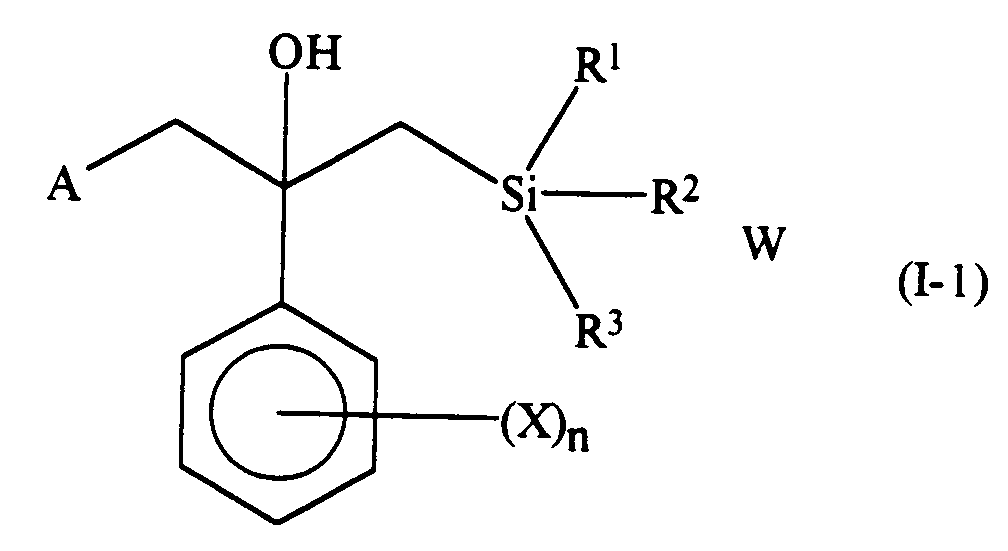
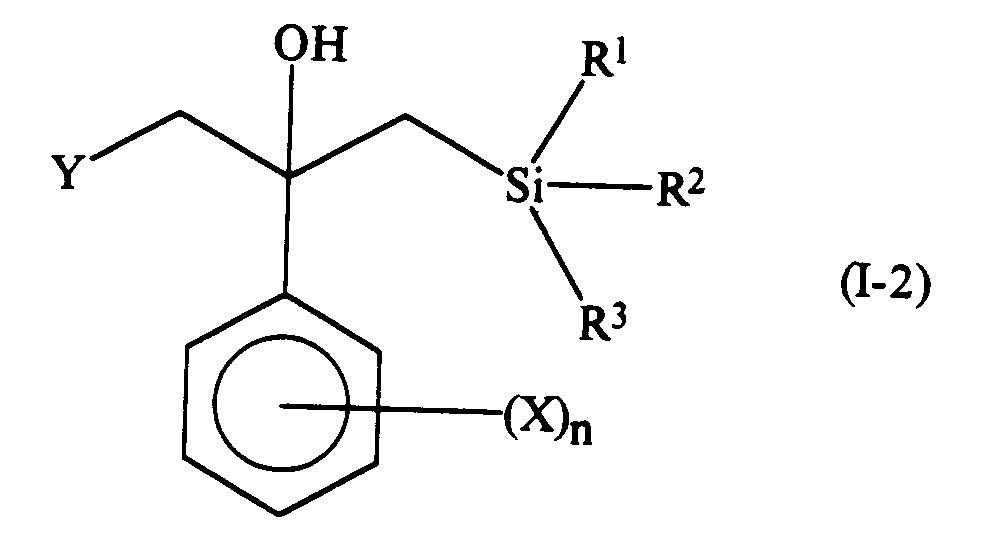


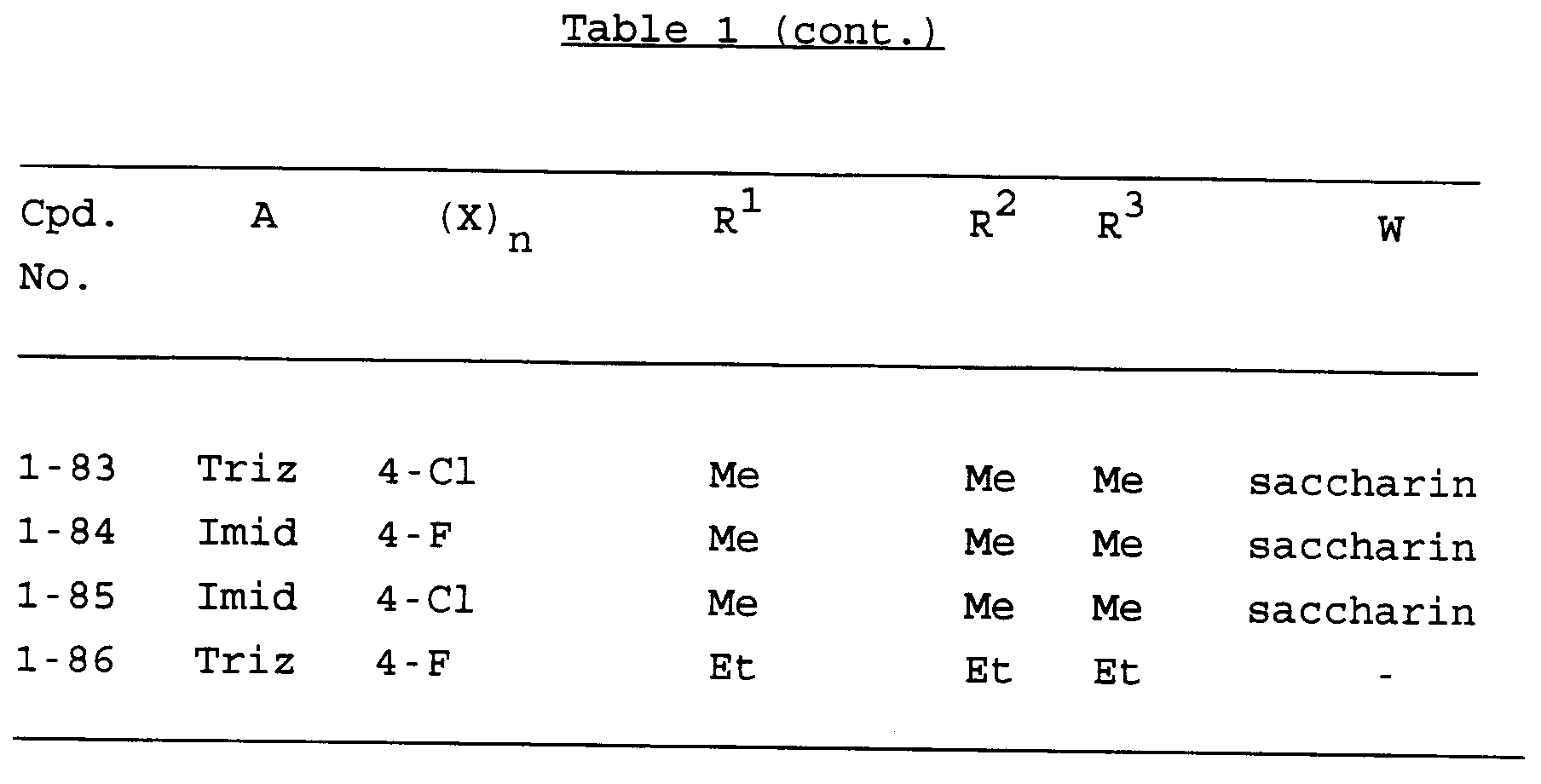
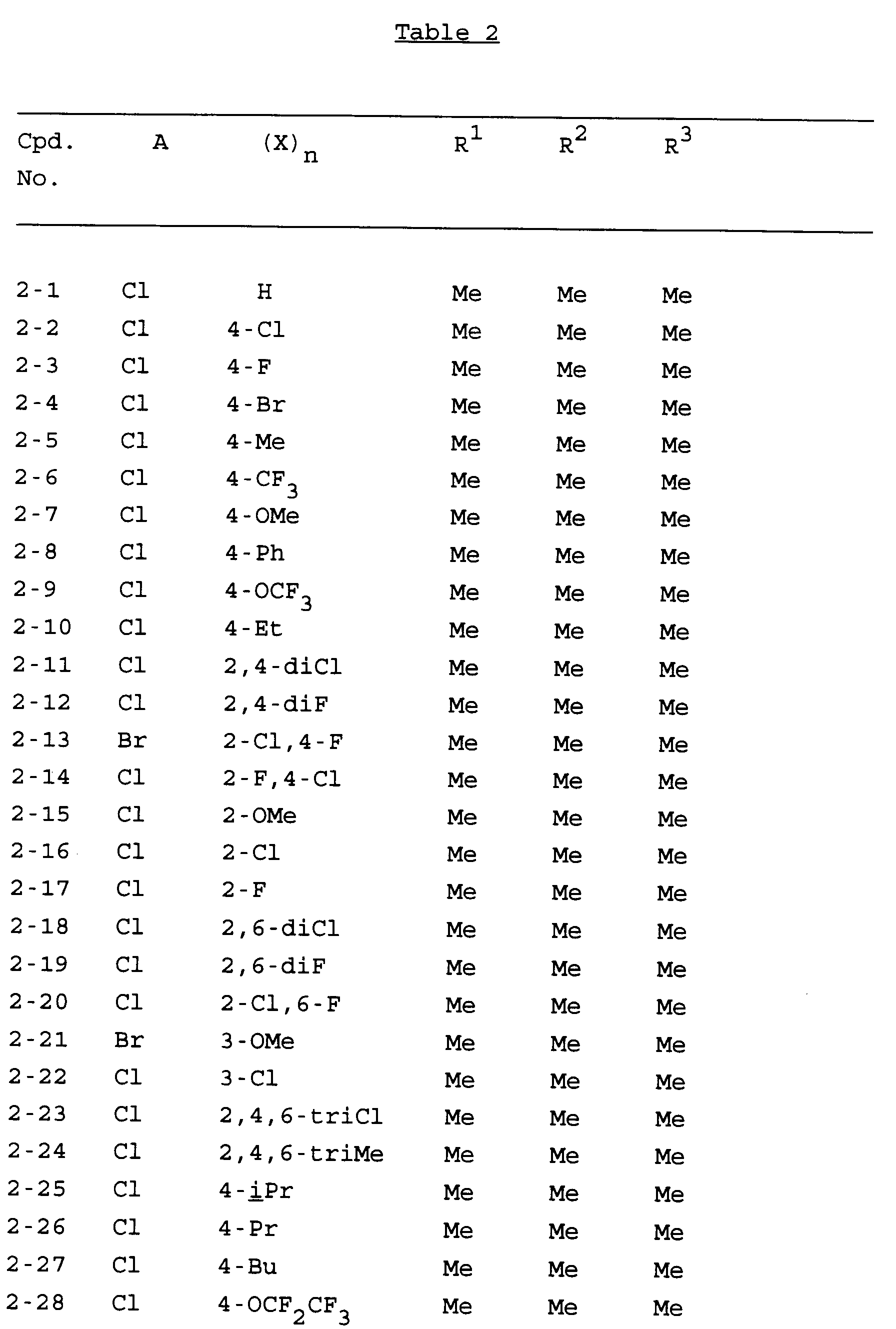


Claims (48)
- A process for preparing a compound of formula (I):
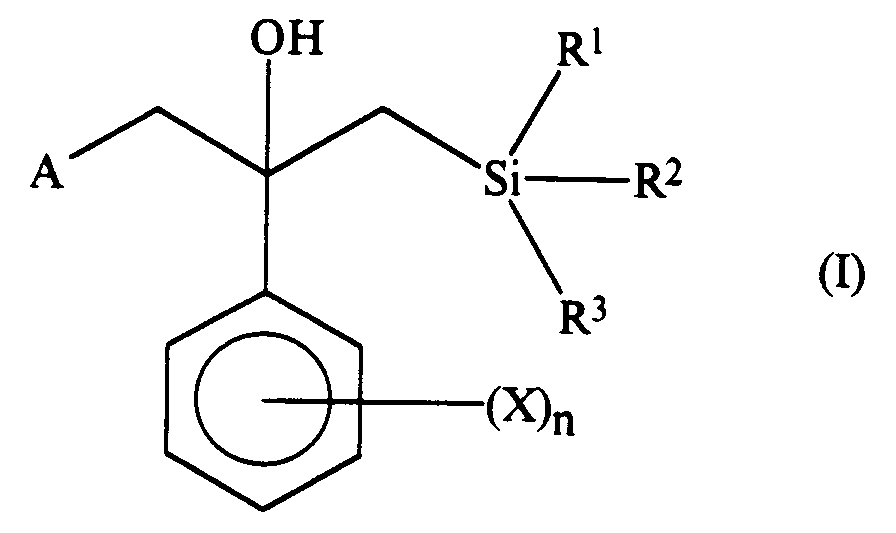
A represents a 1,2,4-triazol-1-yl group or an imidazol-1-yl group;
n represents 0, 1, 2 or 3, and, when n represents 2 or 3, the groups represented by X may be the same or different;
X represents a halogen atom, a phenyl group, an alkyl group having from 1 to 6 carbon atoms, a haloalkyl group having from 1 to 6 carbon atoms and having at least one halogen atom, an alkoxy group having from 1 to 6 carbon atoms, or a haloalkoxy group having from 1 to 6 carbon atoms and having at least one halogen atom, or (X)n represents an alkylenedioxy group having 1 or 2 carbon atoms;
R¹ represents an alkyl group having from 1 to 4 carbon atoms or a phenyl group which is unsubstituted or is substituted by at least one halogen atom; and
R² and R³ are the same or different and each represents an alkyl group having from 1 to 4 carbon atoms];
or a salt thereof, or a compound of formula (I-2):
 (a) condensing a compound of formula (II):
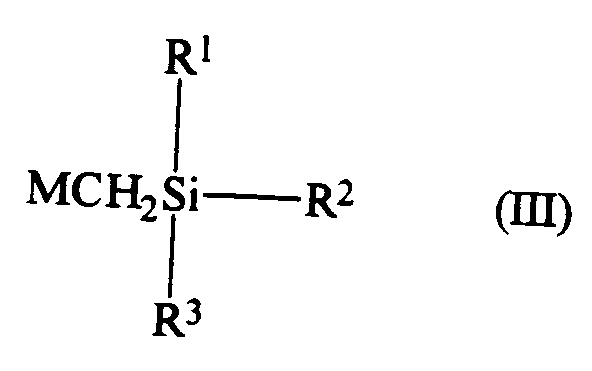
 (b) removing the atom or group represented by M to give a compound of formula (V):
 (c) optionally, where Z represents Y, reacting said compound of formula (V) with 1,2,4-triazole or imidazole, to give a compound of formula (I);(d) optionally reacting said compound of formula (IV) or said compound of formula (V) with a base or another cyclising agent, to give said compound of formula (I-3);(e) optionally salifying any of the products of steps (a), (b) and (c).
 - A process according to Claim 1, in which the reagents and reaction conditions are so chosen as to prepare a compound of formula (I) or a salt thereof, in which A represents a 1,2,4-triazol-1-yl group.
- A process according to Claim 1 or Claim 2, in which the reagents and reaction conditions are so chosen as to prepare a compound of formula (I) or a salt thereof, in which n is 0, 1 or 2.
- A process according to Claim 1 or Claim 2, in which the reagents and reaction conditions are so chosen as to prepare a compound of formula (I) or a salt thereof, in which n is 3 and X is at the 2, 4 and 6 positions on the benzene ring.
- A process according to Claim 1 or Claim 2, in which the reagents and reaction conditions are so chosen as to prepare a compound of formula (I) or a salt thereof, in which n is 2 and X is at the 2 and 4 positions on the benzene ring.
- A process according to Claim 1 or Claim 2, in which the reagents and reaction conditions are so chosen as to prepare a compound of formula (I) or a salt thereof, in which n is 1 and X is at the 2 or the 4 position on the benzene ring.
- A process according to Claim 1, in which the reagents and reaction conditions are so chosen as to prepare a compound of formula (I) or a salt thereof, in which:
A represents a 1,2,4-triazol-1-yl group;
n is 1 or 2, and X represents a fluorine atom, a chlorine atom, a bromine atom, an unsubstituted alkyl group having from 1 to 4 carbon atoms, a substituted alkyl group which has from 1 to 4 carbon atoms and which is substituted by from 1 to 3 halogen atoms, an unsubstituted alkoxy group having from 1 to 4 carbon atoms, or a substituted alkoxy group which has from 1 to 4 carbon atoms and which is substituted by from 1 to 3 halogen atoms; and
R¹, R² and R³ are the same or different and each represents an alkyl group having from 1 to 4 carbon atoms. - A process according to Claim 1, in which the reagents and reaction conditions are so chosen as to prepare a compound of formula (I) or a salt thereof, in which:
A represents a 1,2,4-triazol-1-yl group;
n is 0; and
R¹, R² and R³ are the same or different and each represents an alkyl group having from 1 to 4 carbon atoms. - A process according to Claim 1, in which the reagents and reaction conditions are so chosen as to prepare a compound of formula (I) or a salt thereof, in which:
A represents a 1,2,4-triazol-1-yl group;
n is 1 or 2, and X represents a fluorine atom, a chlorine atom, a bromine atom, a trifluoromethyl group or a methoxy group, and the substituent represented by X is at the 2-position and/or the 4-position of the benzene ring; and
R¹, R² and R³ are the same or different and each represents a methyl group or an ethyl group. - A process according to Claim 1, in which the reagents and reaction conditions are so chosen as to prepare a compound of formula (I) or a salt thereof, in which:
A represents a 1,2,4-triazol-1-yl group;
n is 0; and
R¹, R² and R³ are the same or different and each represents a methyl group or an ethyl group. - A process according to Claim 1, in which the reagents and reaction conditions are so chosen as to prepare a compound of formula (I) or a salt thereof, in which:
A represents a 1,2,4-triazol-1-yl group;
n is 1 or 2, and X represents a fluorine atom, a chlorine atom or a bromine atom, and the substituent represented by X is at the 2-position and/or the 4-position of the benzene ring; and
R¹, R² and R³ are the same or different and each represents a methyl group or an ethyl group. - A process according to Claim 1, in which the reagents and reaction conditions are so chosen as to prepare a compound of formula (I) or a salt thereof, in which:
A represents a 1,2,4-triazol-1-yl group;
n is 0; and
R¹, R² and R³ are the same or different and each represents a methyl group or an ethyl group. - A process according to Claim 1, in which the reagents and reaction conditions are so chosen as to prepare a compound of formula (I) or a salt thereof, in which:
A represents a 1,2,4-triazol-1-yl group;
n is 1 or 2, and X represents a fluorine atom, or a chlorine atom, and the substituent represented by X is at the 2-position and/or the 4-position of the benzene ring; and
R¹, R² and R³ are all methyl groups. - A process according to Claim 1, in which the reagents and reaction conditions are so chosen as to prepare a compound of formula (I) or a salt thereof, in which:
A represents a 1,2,4-triazol-1-yl group;
n is 0; and
R¹, R² and R³ are all methyl groups. - A process according to Claim 1, in which the reagents and reaction conditions are so chosen as to prepare a compound of formula (I-2), in which n is 0, 1 or 2.
- A process according to Claim 1, in which the reagents and reaction conditions are so chosen as to prepare a compound of formula (I-2), in which n is 3 and X is at the 2, 4 and 6 positions on the benzene ring.
- A process according to Claim 1, in which the reagents and reaction conditions are so chosen as to prepare a compound of formula (I-2), in which n is 2 and X is at the 2 and 4 positions on the benzene ring.
- A process according to Claim 1, in which the reagents and reaction conditions are so chosen as to prepare a compound of formula (I-2), in which n is 1 and X is at the 2 or the 4 position on the benzene ring.
- A process according to Claim 1, in which the reagents and reaction conditions are so chosen as to prepare a compound of formula (I-2), in which:
n is 1 or 2, and X represents a fluorine atom, a chlorine atom, a bromine atom, an unsubstituted alkyl group having from 1 to 4 carbon atoms, a substituted alkyl group which has from 1 to 4 carbon atoms and which is substituted by from 1 to 3 halogen atoms, an unsubstituted alkoxy group having from 1 to 4 carbon atoms, or a substituted alkoxy group which has from 1 to 4 carbon atoms and which is substituted by from 1 to 3 halogen atoms; and
R¹, R² and R³ are the same or different and each represents an alkyl group having from 1 to 4 carbon atoms. - A process according to Claim 1, in which the reagents and reaction conditions are so chosen as to prepare a compound of formula (I-2), in which:
n is 0; and
R¹, R² and R³ are the same or different and each represents an alkyl group having from 1 to 4 carbon atoms. - A process according to Claim 1, in which the reagents and reaction conditions are so chosen as to prepare a compound of formula (I-2), in which:
n is 1 or 2, and X represents a fluorine atom, a chlorine atom, a bromine atom, a trifluoromethyl group or a methoxy group, and the substituent represented by X is at the 2-position and/or the 4-position of the benzene ring; and
R¹, R² and R³ are the same or different and each represents a methyl group or an ethyl group. - A process according to Claim 1, in which the reagents and reaction conditions are so chosen as to prepare a compound of formula (I-2), in which:
n is 0; and
R¹, R² and R³ are the same or different and each represents a methyl group or an ethyl group. - A process according to Claim 1, in which the reagents and reaction conditions are so chosen as to prepare a compound of formula (I-2), in which:
n is 1 or 2, and X represents a fluorine atom, a chlorine atom or a bromine atom, and the substituent represented by X is at the 2-position and/or the 4-position of the benzene ring; and
R¹, R² and R³ are the same or different and each represents a methyl group or an ethyl group. - A process according to Claim 1, in which the reagents and reaction conditions are so chosen as to prepare a compound of formula (I-2), in which:
n is 0; and
R¹, R² and R³ are the same or different and each represents a methyl group or an ethyl group. - A process according to Claim 1, in which the reagents and reaction conditions are so chosen as to prepare a compound of formula (I-2), in which:
n is 1 or 2, and X represents a fluorine atom, or a chlorine atom, and the substituent represented by X is at the 2-position and/or the 4-position of the benzene ring; and
R¹, R² and R³ are all methyl groups. - A process according to Claim 1, in which the reagents and reaction conditions are so chosen as to prepare a compound of formula (I-2), in which:
n is 0; and
R¹, R² and R³ are all methyl groups. - A process according to Claim 1, in which the reagents and reaction conditions are so chosen as to prepare a compound of formula (I-3), in which n is 0, 1 or 2.
- A process according to Claim 1, in which the reagents and reaction conditions are so chosen as to prepare a compound of formula (I-3), in which n is 3 and X is at the 2, 4 and 6 positions on the benzene ring.
- A process according to Claim 1, in which the reagents and reaction conditions are so chosen as to prepare a compound of formula (I-3), in which n is 2 and X is at the 2 and 4 positions on the benzene ring.
- A process according to Claim 1, in which the reagents and reaction conditions are so chosen as to prepare a compound of formula (I-3), in which n is 1 and X is at the 2 or the 4 position on the benzene ring.
- A process according to Claim 1, in which the reagents and reaction conditions are so chosen as to prepare a compound of formula (I-3), in which:
n is 1 or 2, and X represents a fluorine atom, a chlorine atom, a bromine atom, an unsubstituted alkyl group having from 1 to 4 carbon atoms, a substituted alkyl group which has from 1 to 4 carbon atoms and which is substituted by from 1 to 3 halogen atoms, an unsubstituted alkoxy group having from 1 to 4 carbon atoms, or a substituted alkoxy group which has from 1 to 4 carbon atoms and which is substituted by from 1 to 3 halogen atoms; and
R¹, R² and R³ are the same or different and each represents an alkyl group having from 1 to 4 carbon atoms. - A process according to Claim 1, in which the reagents and reaction conditions are so chosen as to prepare a compound of formula (I-3), in which:
n is 0; and
R¹, R² and R³ are the same or different and each represents an alkyl group having from 1 to 4 carbon atoms. - A process according to Claim 1, in which the reagents and reaction conditions are so chosen as to prepare a compound of formula (I-3), in which:
n is 1 or 2, and X represents a fluorine atom, a chlorine atom, a bromine atom, a trifluoromethyl group or a methoxy group, and the substituent represented by X is at the 2-position and/or the 4-position of the benzene ring; and
R¹, R² and R³ are the same or different and each represents a methyl group or an ethyl group. - A process according to Claim 1, in which the reagents and reaction conditions are so chosen as to prepare a compound of formula (I-3), in which:
n is 0; and
R¹, R² and R³ are the same or different and each represents a methyl group or an ethyl group. - A process according to Claim 1, in which the reagents and reaction conditions are so chosen as to prepare a compound of formula (I-3), in which:
n is 1 or 2, and X represents a fluorine atom, a chlorine atom or a bromine atom, and the substituent represented by X is at the 2-position and/or the 4-position of the benzene ring; and
R¹, R² and R³ are the same or different and each represents a methyl group or an ethyl group. - A process according to Claim 1, in which the reagents and reaction conditions are so chosen as to prepare a compound of formula (I-3), in which:
n is 0; and
R¹, R² and R³ are the same or different and each represents a methyl group or an ethyl group. - A process according to Claim 1, in which the reagents and reaction conditions are so chosen as to prepare a compound of formula (I-3), in which:
n is 1 or 2, and X represents a fluorine atom, or a chlorine atom, and the substituent represented by X is at the 2-position and/or the 4-position of the benzene ring; and
R¹, R² and R³ are all methyl groups. - A process according to Claim 1, in which the reagents and reaction conditions are so chosen as to prepare a compound of formula (I-3), in which:
n is 0; and
R¹, R² and R³ are all methyl groups. - A process according to Claim 1, in which the reagents and reaction conditions are so chosen as to prepare:
2-(4-chlorophenyl)-1-(1H-1,2,4-triazol-1-yl)-3-trimethylsilyl-2-propanol;
2-(4-fluorophenyl)-1-(1H-1,2,4-triazol-1-yl)-3-trimethylsilyl-2-propanol;
2-(2,4-difluorophenyl)-1-(1H-1,2,4-triazol-1-yl)-3-trimethylsilyl-2-propanol;
or a salt thereof. - A process for preparing a pharmaceutical composition for the prevention or treatment of fungal infections, which comprises mixing an anti-fungal agent, which is at least one compound of formula (I) or a pharmaceutically acceptable salts thereof, as claimed in any one of Claims 1 to 14 and 39, with a pharmaceutically acceptable carrier or diluent.
- An agricultural composition for the protection of plants and plant reproductive matter from fungal attack, which composition comprises a fungicidally or fungistatically effective amount of a compound of formula (I) or a salt thereof, as claimed in any one of Claims 1 to 14 and 39, in admixture with an agricultural carrier or diluent.
- A method of protecting plants and plant reproductive matter from fungal attack, which method comprises applying to said plants or plant reproductive matter or to a locus including the same a fungicidally or fungistatically effective amount of a compound of formula (I) or a salt thereof, as claimed in any one of Claims 1 to 14 and 39.
- The use of compounds of formula (I) and pharmaceutically acceptable salts thereof, as claimed in any one of Claims 1 to 14 and 39, for the manufacture of a medicament for the prevention or treatment of fungal infections.
Applications Claiming Priority (2)
| Application Number | Priority Date | Filing Date | Title |
|---|---|---|---|
| JP26208991 | 1991-10-09 | ||
| JP262089/91 | 1991-10-09 |
Publications (2)
| Publication Number | Publication Date |
|---|---|
| EP0537957A1 true EP0537957A1 (en) | 1993-04-21 |
| EP0537957B1 EP0537957B1 (en) | 1997-02-12 |
Family
ID=17370882
Family Applications (1)
| Application Number | Title | Priority Date | Filing Date |
|---|---|---|---|
| EP92309241A Expired - Lifetime EP0537957B1 (en) | 1991-10-09 | 1992-10-09 | Fungicidal silicon-containing compounds, their preparation and their agrochemical and medicinal uses |
Country Status (17)
| Country | Link |
|---|---|
| US (1) | US5306712A (en) |
| EP (1) | EP0537957B1 (en) |
| JP (1) | JPH0768251B2 (en) |
| KR (1) | KR100255057B1 (en) |
| CN (2) | CN1037102C (en) |
| AT (1) | ATE148886T1 (en) |
| AU (1) | AU654214B2 (en) |
| CA (1) | CA2080169C (en) |
| DE (1) | DE69217439T2 (en) |
| DK (1) | DK0537957T3 (en) |
| ES (1) | ES2100299T3 (en) |
| GR (1) | GR3023129T3 (en) |
| HU (1) | HU211966A9 (en) |
| LV (1) | LV11897B (en) |
| RU (1) | RU2069213C1 (en) |
| TW (1) | TW221814B (en) |
| ZA (1) | ZA927757B (en) |
Cited By (12)
| Publication number | Priority date | Publication date | Assignee | Title |
|---|---|---|---|---|
| EP0609099A1 (en) * | 1993-01-28 | 1994-08-03 | Sankyo Company Limited | Antimicrobial and antifungal compositions comprising silicon-compounds, and their use in agriculture and horticulture |
| WO2007134778A2 (en) | 2006-05-18 | 2007-11-29 | Bayer Cropscience Ag | Synergistic active ingredient combinations |
| DE102007045920A1 (en) | 2007-09-26 | 2009-04-09 | Bayer Cropscience Ag | Active agent combination, useful e.g. for combating animal pests and/or plant pathogenic fungus, comprises a substituted 5H-furan-2-one compound and an active agent e.g. azoxystrobin, fluoxastrobin, tertanol, triadimenol and triadimefon |
| EP2132989A2 (en) | 2005-06-09 | 2009-12-16 | Bayer CropScience AG | Agent combinations |
| EP2220938A2 (en) | 2003-10-10 | 2010-08-25 | Bayer CropScience AG | Synergistic fungicidal combinations |
| EP2255649A2 (en) | 2005-06-09 | 2010-12-01 | Bayer CropScience AG | Agent combinations |
| WO2010149758A1 (en) | 2009-06-25 | 2010-12-29 | Basf Se | Antifungal 1, 2, 4-triazolyl derivatives |
| WO2011006603A2 (en) | 2009-07-16 | 2011-01-20 | Bayer Cropscience Ag | Synergistic active substance combinations containing phenyl triazoles |
| EP2356905A1 (en) | 2003-10-23 | 2011-08-17 | Bayer Cropscience AG | Synergetic fungicide substance combinations |
| US9012360B2 (en) | 2009-03-25 | 2015-04-21 | Bayer Intellectual Property Gmbh | Synergistic combinations of active ingredients |
| EP2910126A1 (en) | 2015-05-05 | 2015-08-26 | Bayer CropScience AG | Active compound combinations having insecticidal properties |
| CN107047606A (en) * | 2017-03-08 | 2017-08-18 | 南京华洲药业有限公司 | A kind of bactericidal composition and its application containing Hexanaphthene flusulfamide and simeconazoles |
Families Citing this family (15)
| Publication number | Priority date | Publication date | Assignee | Title |
|---|---|---|---|---|
| US5443845A (en) * | 1993-04-22 | 1995-08-22 | Bionutratech, Inc. | Composition for enhanced bioremediation of petroleum |
| US7687434B2 (en) | 2000-12-22 | 2010-03-30 | Monsanto Technology, Llc | Method of improving yield and vigor of plants |
| US6992047B2 (en) * | 2001-04-11 | 2006-01-31 | Monsanto Technology Llc | Method of microencapsulating an agricultural active having a high melting point and uses for such materials |
| BRPI0213586B1 (en) * | 2001-09-27 | 2017-06-20 | Monsanto Technology Llc | COMPOSITIONS, METHOD OF PROTECTING A PLANT OR ITS PROPAGATION MATERIALS AGAINST FUNGUS DISEASE OR DAMAGE, AS A CONTROLLED RELEASE FORMULATION |
| DE102005015677A1 (en) | 2005-04-06 | 2006-10-12 | Bayer Cropscience Ag | Synergistic fungicidal drug combinations |
| RU2295958C1 (en) * | 2005-07-04 | 2007-03-27 | Федеральное государственное унитарное предприятие "Центр по химии лекарственных средств" (ФГУП ЦХЛС-ВНИХФИ) | Pharmaceutical composition for treatment of fungal disease and method for its preparing |
| DE102005035300A1 (en) * | 2005-07-28 | 2007-02-01 | Bayer Cropscience Ag | Synergistic fungicidal composition containing a carboxamide, azole and optionally strobilurin, for control of e.g. Puccinia or Erysiphe by treatment of plants, seeds or soil |
| EP2000028A1 (en) * | 2007-06-06 | 2008-12-10 | Bayer CropScience Aktiengesellschaft | Fungicidal active agent compounds |
| EP2344088B1 (en) * | 2008-08-28 | 2017-10-04 | Cook Medical Technologies LLC | Method of coating a stent |
| EP2667717A4 (en) * | 2011-01-25 | 2015-10-14 | Dow Agrosciences Llc | 6-amino-2-substituted-5-vinylsilylpyrimidine-4-carboxylic acids and esters and 4-amino-6-substituted-3-vinylsilylpyridine-2-carboxylic acids and esters as herbicides |
| CN102246807B (en) * | 2011-07-21 | 2013-06-12 | 青岛奥迪斯生物科技有限公司 | Sterilization composition containing tetraconazole and simeconazole |
| CN103583564B (en) * | 2012-08-17 | 2016-01-13 | 陕西美邦农药有限公司 | A high-efficiency bactericidal composition containing silfluazole and triazoles |
| AR100743A1 (en) * | 2014-06-06 | 2016-10-26 | Basf Se | COMPOUNDS OF [1,2,4] SUBSTITUTED TRIAZOL |
| US20180141897A1 (en) | 2014-12-08 | 2018-05-24 | The Research Foundation For The State University Of New York | Anti-fungals targeting the synthesis of fungal shingolipids |
| EP3638649A4 (en) | 2017-06-16 | 2021-03-17 | The Research Foundation for The State University of New York | ANTI-FUNGAL COMPOUNDS TARGETING THE SYNTHESIS OF FUNGAL SHINGOLIPIDS |
Citations (3)
| Publication number | Priority date | Publication date | Assignee | Title |
|---|---|---|---|---|
| EP0207590A2 (en) * | 1985-05-03 | 1987-01-07 | Imperial Chemical Industries Plc | Substituted azolyl ethanol derivatives as plant growth regulators |
| GB2224278A (en) * | 1988-10-28 | 1990-05-02 | Ici Plc | I-triazole-ethanols as fungicides |
| EP0435794A1 (en) * | 1989-12-28 | 1991-07-03 | Rhone-Poulenc Agrochimie | Alkenyl- or heteroaryl thio, sulfone, sulfoxy herbicides |
Family Cites Families (1)
| Publication number | Priority date | Publication date | Assignee | Title |
|---|---|---|---|---|
| US5134152A (en) * | 1989-12-07 | 1992-07-28 | Sankyo Company, Limited | Oxetane derivatives and their use as anti-fungal or fungicidal agents |
-
1992
- 1992-10-06 US US07/957,269 patent/US5306712A/en not_active Expired - Lifetime
- 1992-10-06 JP JP4267234A patent/JPH0768251B2/en not_active Expired - Lifetime
- 1992-10-08 ZA ZA927757A patent/ZA927757B/en unknown
- 1992-10-08 CA CA002080169A patent/CA2080169C/en not_active Expired - Fee Related
- 1992-10-08 RU SU5053102/04A patent/RU2069213C1/en not_active IP Right Cessation
- 1992-10-09 AT AT92309241T patent/ATE148886T1/en not_active IP Right Cessation
- 1992-10-09 DE DE69217439T patent/DE69217439T2/en not_active Expired - Fee Related
- 1992-10-09 KR KR1019920018615A patent/KR100255057B1/en not_active Expired - Fee Related
- 1992-10-09 ES ES92309241T patent/ES2100299T3/en not_active Expired - Lifetime
- 1992-10-09 CN CN92113068A patent/CN1037102C/en not_active Expired - Lifetime
- 1992-10-09 AU AU26299/92A patent/AU654214B2/en not_active Ceased
- 1992-10-09 EP EP92309241A patent/EP0537957B1/en not_active Expired - Lifetime
- 1992-10-09 DK DK92309241.5T patent/DK0537957T3/en active
- 1992-10-09 TW TW081108041A patent/TW221814B/zh active
-
1995
- 1995-06-29 HU HU95P/P00572P patent/HU211966A9/en unknown
-
1997
- 1997-04-14 GR GR970400790T patent/GR3023129T3/en unknown
- 1997-05-31 CN CN97105410A patent/CN1078444C/en not_active Expired - Lifetime
- 1997-06-18 LV LVP-97-119A patent/LV11897B/en unknown
Patent Citations (3)
| Publication number | Priority date | Publication date | Assignee | Title |
|---|---|---|---|---|
| EP0207590A2 (en) * | 1985-05-03 | 1987-01-07 | Imperial Chemical Industries Plc | Substituted azolyl ethanol derivatives as plant growth regulators |
| GB2224278A (en) * | 1988-10-28 | 1990-05-02 | Ici Plc | I-triazole-ethanols as fungicides |
| EP0435794A1 (en) * | 1989-12-28 | 1991-07-03 | Rhone-Poulenc Agrochimie | Alkenyl- or heteroaryl thio, sulfone, sulfoxy herbicides |
Non-Patent Citations (2)
| Title |
|---|
| CHEMICAL ABSTRACTS, vol. 116, 1992, Columbus, Ohio, US; abstract no. 59045k, KONOSU, T. ET AL. page 828 ; * |
| TETRAHEDRON LETTERS no. 1, 1976, pages 29 - 32 HUDRLIK, P.F. ET SL. * |
Cited By (58)
| Publication number | Priority date | Publication date | Assignee | Title |
|---|---|---|---|---|
| EP0609099A1 (en) * | 1993-01-28 | 1994-08-03 | Sankyo Company Limited | Antimicrobial and antifungal compositions comprising silicon-compounds, and their use in agriculture and horticulture |
| US9844220B2 (en) | 2003-10-10 | 2017-12-19 | Fmc Corporation | Synergistic fungicidal active substance combinations |
| US9049867B2 (en) | 2003-10-10 | 2015-06-09 | Bayer Intellectual Property Gmbh | Synergistic fungicidal active substance combinations |
| EP2220935A2 (en) | 2003-10-10 | 2010-08-25 | Bayer CropScience AG | Synergistic fungicidal combinations |
| EP2220939A2 (en) | 2003-10-10 | 2010-08-25 | Bayer CropScience AG | Synergistic fungicidal combinations |
| EP2220937A2 (en) | 2003-10-10 | 2010-08-25 | Bayer CropScience AG | Synergistic fungicidal combinations |
| EP2220936A2 (en) | 2003-10-10 | 2010-08-25 | Bayer CropScience AG | Synergistic fungicidal combinations |
| EP2220940A2 (en) | 2003-10-10 | 2010-08-25 | Bayer CropScience AG | Synergistic fungicidal combinations |
| EP2229815A2 (en) | 2003-10-10 | 2010-09-22 | Bayer CropScience AG | Synergistic combinations of fungicidal compounds |
| US9288988B2 (en) | 2003-10-10 | 2016-03-22 | Fmc Corporation | Synergistic fungicidal active substance combinations |
| EP2220938A2 (en) | 2003-10-10 | 2010-08-25 | Bayer CropScience AG | Synergistic fungicidal combinations |
| US9006143B2 (en) | 2003-10-10 | 2015-04-14 | Bayer Intellectual Property Gmbh | Synergistic fungicidal active substance combinations |
| US8415274B2 (en) | 2003-10-10 | 2013-04-09 | Bayer Cropscience Ag | Synergistic fungicidal active substance combinations |
| EP2796043A1 (en) | 2003-10-23 | 2014-10-29 | Bayer CropScience AG | Synergetic fungicide substance combinations |
| EP2364592A1 (en) | 2003-10-23 | 2011-09-14 | Bayer Cropscience AG | Synergetic fungicide substance combinations |
| EP2356906A1 (en) | 2003-10-23 | 2011-08-17 | Bayer Cropscience AG | Synergetic fungicide substance combinations |
| EP2356905A1 (en) | 2003-10-23 | 2011-08-17 | Bayer Cropscience AG | Synergetic fungicide substance combinations |
| EP2255659A2 (en) | 2005-06-09 | 2010-12-01 | Bayer CropScience AG | Agent combinations |
| EP2272369A1 (en) | 2005-06-09 | 2011-01-12 | Bayer CropScience AG | Agent combinations |
| EP2255650A2 (en) | 2005-06-09 | 2010-12-01 | Bayer CropScience AG | Agent combinations |
| EP2255647A2 (en) | 2005-06-09 | 2010-12-01 | Bayer CropScience AG | Agent combinations |
| EP2255653A2 (en) | 2005-06-09 | 2010-12-01 | Bayer CropScience AG | Agent combinations |
| EP2255656A2 (en) | 2005-06-09 | 2010-12-01 | Bayer CropScience AG | Agent combinations |
| EP2255652A2 (en) | 2005-06-09 | 2010-12-01 | Bayer CropScience AG | Agent combinations |
| EP2255646A2 (en) | 2005-06-09 | 2010-12-01 | Bayer CropScience AG | Agent combinations |
| EP2255648A2 (en) | 2005-06-09 | 2010-12-01 | Bayer CropScience AG | Agent combinations |
| EP2255651A2 (en) | 2005-06-09 | 2010-12-01 | Bayer CropScience AG | Agent combinations |
| EP2255645A2 (en) | 2005-06-09 | 2010-12-01 | Bayer CropScience AG | Agent combinations |
| EP2255644A2 (en) | 2005-06-09 | 2010-12-01 | Bayer CropScience AG | Agent combinations |
| EP2258196A2 (en) | 2005-06-09 | 2010-12-08 | Bayer CropScience AG | Combination of active agents |
| EP2258197A1 (en) | 2005-06-09 | 2010-12-08 | Bayer CropScience AG | Agent combinations |
| EP2258198A1 (en) | 2005-06-09 | 2010-12-08 | Bayer CropScience AG | Agent combinations |
| EP2260709A1 (en) | 2005-06-09 | 2010-12-15 | Bayer CropScience AG | Agent combinations |
| EP2260711A2 (en) | 2005-06-09 | 2010-12-15 | Bayer CropScience AG | Agent combinations |
| EP2260710A1 (en) | 2005-06-09 | 2010-12-15 | Bayer CropScience AG | Agent combinations |
| EP2263463A1 (en) | 2005-06-09 | 2010-12-22 | Bayer CropScience AG | Agent combinations |
| EP2263462A1 (en) | 2005-06-09 | 2010-12-22 | Bayer CropScience AG | Agent combinations |
| EP2269460A1 (en) | 2005-06-09 | 2011-01-05 | Bayer CropScience AG | Agent combinations |
| EP2255649A2 (en) | 2005-06-09 | 2010-12-01 | Bayer CropScience AG | Agent combinations |
| EP2132989A2 (en) | 2005-06-09 | 2009-12-16 | Bayer CropScience AG | Agent combinations |
| EP2272368A1 (en) | 2005-06-09 | 2011-01-12 | Bayer CropScience AG | Agent combinations |
| EP2253212A1 (en) | 2005-06-09 | 2010-11-24 | Bayer CropScience AG | Agent combinations |
| EP2253213A1 (en) | 2005-06-09 | 2010-11-24 | Bayer CropScience AG | Agent combinations |
| EP2253211A1 (en) | 2005-06-09 | 2010-11-24 | Bayer CropScience AG | Agent combinations |
| EP2279664A1 (en) | 2005-06-09 | 2011-02-02 | Bayer CropScience AG | Agent combinations |
| EP2255657A1 (en) | 2005-06-09 | 2010-12-01 | Bayer CropScience AG | Agent combinations |
| EP2255654A2 (en) | 2005-06-09 | 2010-12-01 | Bayer CropScience AG | Agent combinations |
| EP2255655A2 (en) | 2005-06-09 | 2010-12-01 | Bayer CropScience AG | Agent combinations |
| EP2255658A1 (en) | 2005-06-09 | 2010-12-01 | Bayer CropScience AG | Agent combinations |
| EP2253210A1 (en) | 2005-06-09 | 2010-11-24 | Bayer CropScience AG | Agent combinations |
| WO2007134778A2 (en) | 2006-05-18 | 2007-11-29 | Bayer Cropscience Ag | Synergistic active ingredient combinations |
| DE102007045920A1 (en) | 2007-09-26 | 2009-04-09 | Bayer Cropscience Ag | Active agent combination, useful e.g. for combating animal pests and/or plant pathogenic fungus, comprises a substituted 5H-furan-2-one compound and an active agent e.g. azoxystrobin, fluoxastrobin, tertanol, triadimenol and triadimefon |
| DE102007045920B4 (en) | 2007-09-26 | 2018-07-05 | Bayer Intellectual Property Gmbh | Synergistic drug combinations |
| US9012360B2 (en) | 2009-03-25 | 2015-04-21 | Bayer Intellectual Property Gmbh | Synergistic combinations of active ingredients |
| WO2010149758A1 (en) | 2009-06-25 | 2010-12-29 | Basf Se | Antifungal 1, 2, 4-triazolyl derivatives |
| WO2011006603A2 (en) | 2009-07-16 | 2011-01-20 | Bayer Cropscience Ag | Synergistic active substance combinations containing phenyl triazoles |
| EP2910126A1 (en) | 2015-05-05 | 2015-08-26 | Bayer CropScience AG | Active compound combinations having insecticidal properties |
| CN107047606A (en) * | 2017-03-08 | 2017-08-18 | 南京华洲药业有限公司 | A kind of bactericidal composition and its application containing Hexanaphthene flusulfamide and simeconazoles |
Also Published As
| Publication number | Publication date |
|---|---|
| DK0537957T3 (en) | 1997-08-18 |
| TW221814B (en) | 1994-02-21 |
| JPH05222060A (en) | 1993-08-31 |
| KR930007956A (en) | 1993-05-20 |
| ZA927757B (en) | 1993-04-19 |
| KR100255057B1 (en) | 2000-05-01 |
| LV11897A (en) | 1997-12-20 |
| CA2080169C (en) | 2004-07-06 |
| AU2629992A (en) | 1993-04-22 |
| CN1037102C (en) | 1998-01-21 |
| ATE148886T1 (en) | 1997-02-15 |
| CN1078444C (en) | 2002-01-30 |
| DE69217439T2 (en) | 1997-08-21 |
| RU2069213C1 (en) | 1996-11-20 |
| HK1005874A1 (en) | 1999-01-29 |
| US5306712A (en) | 1994-04-26 |
| HU211966A9 (en) | 1996-01-29 |
| DE69217439D1 (en) | 1997-03-27 |
| CN1075967A (en) | 1993-09-08 |
| LV11897B (en) | 1998-06-20 |
| GR3023129T3 (en) | 1997-07-30 |
| JPH0768251B2 (en) | 1995-07-26 |
| CA2080169A1 (en) | 1993-04-10 |
| ES2100299T3 (en) | 1997-06-16 |
| AU654214B2 (en) | 1994-10-27 |
| CN1173281A (en) | 1998-02-18 |
| EP0537957B1 (en) | 1997-02-12 |
Similar Documents
| Publication | Publication Date | Title |
|---|---|---|
| EP0537957B1 (en) | Fungicidal silicon-containing compounds, their preparation and their agrochemical and medicinal uses | |
| CN1104424C (en) | Triazolyl disulphides | |
| EP0332387B1 (en) | Triazole derivatives, their preparation and their use as fungicides | |
| CN85108922A (en) | Process for the preparation of fungicidal pyrrole compounds | |
| IE57003B1 (en) | Alpha,alpha-disubstituted 1h-azole ethanols and their use as fungicidal agents or as pharmaceuticals | |
| JPH0662582B2 (en) | Substituted azolylmethylcyclopropyl carbinol derivative | |
| GB2197311A (en) | Preparation of triazole compounds | |
| CN1217717A (en) | Acyl mercapto-triazolyl derivative and use thereof as microbiocides | |
| CA1219868A (en) | Amino-methyl substituted dioxolanes as pest combating agents | |
| EP0431968B1 (en) | Oxetane derivatives, their preparation and their use as anti-fungal or fungicidal agents | |
| EP0609099A1 (en) | Antimicrobial and antifungal compositions comprising silicon-compounds, and their use in agriculture and horticulture | |
| JPS60224689A (en) | (1,2,4-triazol-1-yl)-methyl-carbinol | |
| US4818758A (en) | 2-azolylmethyl-2-phenyl-4-[benzazol-2-yloxy-or-thio-methyl]-1,3 dioxolanes and salts thereof, pharmaceutical compositions containing them and their use | |
| EP0272679B1 (en) | Fungicide azolyl-derivatives | |
| EP0315946A2 (en) | Fungicide azolyl derivatives | |
| JPS5896073A (en) | Azolylvinyldithioacetals, manufacture and use as fungicide | |
| HK1005874B (en) | Fungicidal silicon-containing compounds, their preparation and their agrochemical and medicinal uses | |
| EP0555365B1 (en) | 2-(3-oxypyridinyl)-1,3-dioxolane and dioxane compounds, compositions containing same and process for controlling fungi using same | |
| JPS61271276A (en) | Dichlorocyclopropylalkyl-hydroxyalkyl-azole derivative | |
| NZ244663A (en) | Alkyl silane derivatives containing an oxirane ring or a triazole or | |
| JPS62148472A (en) | 1,4-disubstituted-1-azolyl-3,3-dimethylbutane-2-one and -ol derivative | |
| HU199437B (en) | Fungicides comprising hydroxyalkyl triazolyl derivatives as active ingredient and process for producing the active ingredients | |
| JP3040811B2 (en) | Oxetane derivative | |
| KR840000701B1 (en) | Process for preparing metal complexes of 1-phenyl-2-triazolyl ethyl derivatives | |
| GB2142921A (en) | Triazole derivatives |
Legal Events
| Date | Code | Title | Description |
|---|---|---|---|
| PUAI | Public reference made under article 153(3) epc to a published international application that has entered the european phase |
Free format text: ORIGINAL CODE: 0009012 |
|
| AK | Designated contracting states |
Kind code of ref document: A1 Designated state(s): AT BE CH DE DK ES FR GB GR IE IT LI NL PT SE |
|
| 17P | Request for examination filed |
Effective date: 19931018 |
|
| 17Q | First examination report despatched |
Effective date: 19951121 |
|
| GRAG | Despatch of communication of intention to grant |
Free format text: ORIGINAL CODE: EPIDOS AGRA |
|
| GRAH | Despatch of communication of intention to grant a patent |
Free format text: ORIGINAL CODE: EPIDOS IGRA |
|
| GRAH | Despatch of communication of intention to grant a patent |
Free format text: ORIGINAL CODE: EPIDOS IGRA |
|
| GRAA | (expected) grant |
Free format text: ORIGINAL CODE: 0009210 |
|
| AK | Designated contracting states |
Kind code of ref document: B1 Designated state(s): AT BE CH DE DK ES FR GB GR IE IT LI NL PT SE |
|
| REF | Corresponds to: |
Ref document number: 148886 Country of ref document: AT Date of ref document: 19970215 Kind code of ref document: T |
|
| REG | Reference to a national code |
Ref country code: CH Ref legal event code: NV Representative=s name: A. BRAUN, BRAUN, HERITIER, ESCHMANN AG PATENTANWAE Ref country code: CH Ref legal event code: EP |
|
| ET | Fr: translation filed | ||
| REF | Corresponds to: |
Ref document number: 69217439 Country of ref document: DE Date of ref document: 19970327 |
|
| REG | Reference to a national code |
Ref country code: IE Ref legal event code: FG4D Free format text: 72019 |
|
| ITF | It: translation for a ep patent filed | ||
| REG | Reference to a national code |
Ref country code: PT Ref legal event code: SC4A Free format text: AVAILABILITY OF NATIONAL TRANSLATION Effective date: 19970217 |
|
| REG | Reference to a national code |
Ref country code: ES Ref legal event code: FG2A Ref document number: 2100299 Country of ref document: ES Kind code of ref document: T3 |
|
| REG | Reference to a national code |
Ref country code: GR Ref legal event code: FG4A Free format text: 3023129 |
|
| REG | Reference to a national code |
Ref country code: DK Ref legal event code: T3 |
|
| PLBE | No opposition filed within time limit |
Free format text: ORIGINAL CODE: 0009261 |
|
| 26N | No opposition filed | ||
| REG | Reference to a national code |
Ref country code: GB Ref legal event code: IF02 |
|
| PGFP | Annual fee paid to national office [announced via postgrant information from national office to epo] |
Ref country code: IE Payment date: 20021029 Year of fee payment: 11 |
|
| PG25 | Lapsed in a contracting state [announced via postgrant information from national office to epo] |
Ref country code: IE Free format text: LAPSE BECAUSE OF NON-PAYMENT OF DUE FEES Effective date: 20031009 |
|
| REG | Reference to a national code |
Ref country code: CH Ref legal event code: PUE Owner name: SANKYO LIFETECH COMPANY LIMITED Free format text: SANKYO COMPANY LIMITED#5-1 NIHONBASHI HONCHO 3-CHOME CHUO-KU#TOKYO (JP) -TRANSFER TO- SANKYO LIFETECH COMPANY LIMITED#4-23-14, HONGO, BUNKYO-KU#TOKYO 113-0033 (JP) $ SANKYO AGRO COMPANY LIMITED#4-23-14, HONGO, BUNKYO-KU#TOKYO 113-0033 (JP) |
|
| NLS | Nl: assignments of ep-patents |
Owner name: SANKYO LIFETECH COMPANY LIMITED Owner name: SANKYO AGRO COMPANY LIMITED |
|
| REG | Reference to a national code |
Ref country code: ES Ref legal event code: PC2A |
|
| REG | Reference to a national code |
Ref country code: GB Ref legal event code: 732E |
|
| REG | Reference to a national code |
Ref country code: FR Ref legal event code: TP |
|
| REG | Reference to a national code |
Ref country code: IE Ref legal event code: MM4A |
|
| REG | Reference to a national code |
Ref country code: PT Ref legal event code: PC4A Free format text: SANKYO LIFETECH COMPANY, LIMITED JP Effective date: 20040521 Ref country code: PT Ref legal event code: PC4A Free format text: SANKYO AGRO COMPANY LIMITED JP Effective date: 20040521 |
|
| PGFP | Annual fee paid to national office [announced via postgrant information from national office to epo] |
Ref country code: NL Payment date: 20071015 Year of fee payment: 16 Ref country code: ES Payment date: 20071102 Year of fee payment: 16 Ref country code: DK Payment date: 20071015 Year of fee payment: 16 Ref country code: DE Payment date: 20071004 Year of fee payment: 16 |
|
| PGFP | Annual fee paid to national office [announced via postgrant information from national office to epo] |
Ref country code: CH Payment date: 20071015 Year of fee payment: 16 Ref country code: AT Payment date: 20071011 Year of fee payment: 16 Ref country code: IT Payment date: 20071026 Year of fee payment: 16 |
|
| REG | Reference to a national code |
Ref country code: PT Ref legal event code: PC4A Owner name: SANKYO AGRO CO., LTD., JP Effective date: 20080311 |
|
| BECA | Be: change of holder's address |
Owner name: SANKYO AGRO CO. LTD5-2, HIGASHI-SHIMBASHI 1-CHOME, Effective date: 20080312 |
|
| PGFP | Annual fee paid to national office [announced via postgrant information from national office to epo] |
Ref country code: SE Payment date: 20071004 Year of fee payment: 16 Ref country code: BE Payment date: 20071220 Year of fee payment: 16 |
|
| REG | Reference to a national code |
Ref country code: GB Ref legal event code: 732E |
|
| PGFP | Annual fee paid to national office [announced via postgrant information from national office to epo] |
Ref country code: GB Payment date: 20071003 Year of fee payment: 16 Ref country code: FR Payment date: 20071009 Year of fee payment: 16 |
|
| REG | Reference to a national code |
Ref country code: CH Ref legal event code: PUEA Owner name: SANKYO AGRO CO., LTD. Free format text: SANKYO LIFETECH COMPANY LIMITED#4-23-14, HONGO, BUNKYO-KU#TOKYO 113-0033 (JP) $ SANKYO AGRO COMPANY LIMITED#4-23-14, HONGO, BUNKYO-KU#TOKYO 113-0033 (JP) -TRANSFER TO- SANKYO AGRO CO., LTD.#5-2, HIGASHI-SHIMBASHI 1-CHOME MINATO-KU#TOKYO (JP) |
|
| NLS | Nl: assignments of ep-patents |
Owner name: SANKYO AGRO COMPANY LIMITED Effective date: 20080228 |
|
| REG | Reference to a national code |
Ref country code: ES Ref legal event code: PC2A |
|
| REG | Reference to a national code |
Ref country code: CH Ref legal event code: NV Representative=s name: BOVARD AG PATENTANWAELTE |
|
| PGFP | Annual fee paid to national office [announced via postgrant information from national office to epo] |
Ref country code: PT Payment date: 20071008 Year of fee payment: 16 Ref country code: GR Payment date: 20070919 Year of fee payment: 16 |
|
| REG | Reference to a national code |
Ref country code: PT Ref legal event code: MM4A Free format text: LAPSE DUE TO NON-PAYMENT OF FEES Effective date: 20090409 |
|
| BERE | Be: lapsed |
Owner name: SANKYO AGRO CO. LTD Effective date: 20081031 |
|
| REG | Reference to a national code |
Ref country code: CH Ref legal event code: PL |
|
| REG | Reference to a national code |
Ref country code: DK Ref legal event code: EBP |
|
| EUG | Se: european patent has lapsed | ||
| GBPC | Gb: european patent ceased through non-payment of renewal fee |
Effective date: 20081009 |
|
| NLV4 | Nl: lapsed or anulled due to non-payment of the annual fee |
Effective date: 20090501 |
|
| REG | Reference to a national code |
Ref country code: FR Ref legal event code: ST Effective date: 20090630 |
|
| PG25 | Lapsed in a contracting state [announced via postgrant information from national office to epo] |
Ref country code: NL Free format text: LAPSE BECAUSE OF NON-PAYMENT OF DUE FEES Effective date: 20090501 |
|
| PG25 | Lapsed in a contracting state [announced via postgrant information from national office to epo] |
Ref country code: PT Free format text: LAPSE BECAUSE OF NON-PAYMENT OF DUE FEES Effective date: 20090409 Ref country code: IT Free format text: LAPSE BECAUSE OF NON-PAYMENT OF DUE FEES Effective date: 20081009 Ref country code: DE Free format text: LAPSE BECAUSE OF NON-PAYMENT OF DUE FEES Effective date: 20090501 Ref country code: AT Free format text: LAPSE BECAUSE OF NON-PAYMENT OF DUE FEES Effective date: 20081009 |
|
| PG25 | Lapsed in a contracting state [announced via postgrant information from national office to epo] |
Ref country code: BE Free format text: LAPSE BECAUSE OF NON-PAYMENT OF DUE FEES Effective date: 20081031 |
|
| PG25 | Lapsed in a contracting state [announced via postgrant information from national office to epo] |
Ref country code: LI Free format text: LAPSE BECAUSE OF NON-PAYMENT OF DUE FEES Effective date: 20081031 Ref country code: FR Free format text: LAPSE BECAUSE OF NON-PAYMENT OF DUE FEES Effective date: 20081031 Ref country code: DK Free format text: LAPSE BECAUSE OF NON-PAYMENT OF DUE FEES Effective date: 20081031 Ref country code: CH Free format text: LAPSE BECAUSE OF NON-PAYMENT OF DUE FEES Effective date: 20081031 |
|
| PG25 | Lapsed in a contracting state [announced via postgrant information from national office to epo] |
Ref country code: GR Free format text: LAPSE BECAUSE OF NON-PAYMENT OF DUE FEES Effective date: 20090505 Ref country code: GB Free format text: LAPSE BECAUSE OF NON-PAYMENT OF DUE FEES Effective date: 20081009 |
|
| REG | Reference to a national code |
Ref country code: ES Ref legal event code: FD2A Effective date: 20081010 |
|
| PG25 | Lapsed in a contracting state [announced via postgrant information from national office to epo] |
Ref country code: ES Free format text: LAPSE BECAUSE OF NON-PAYMENT OF DUE FEES Effective date: 20081010 |
|
| PG25 | Lapsed in a contracting state [announced via postgrant information from national office to epo] |
Ref country code: SE Free format text: LAPSE BECAUSE OF NON-PAYMENT OF DUE FEES Effective date: 20081010 |