EP0532646B1 - Process for catalytic conversion of olefins - Google Patents
Process for catalytic conversion of olefins Download PDFInfo
- Publication number
- EP0532646B1 EP0532646B1 EP91911457A EP91911457A EP0532646B1 EP 0532646 B1 EP0532646 B1 EP 0532646B1 EP 91911457 A EP91911457 A EP 91911457A EP 91911457 A EP91911457 A EP 91911457A EP 0532646 B1 EP0532646 B1 EP 0532646B1
- Authority
- EP
- European Patent Office
- Prior art keywords
- catalyst
- process according
- sapo
- zeolite
- butene
- Prior art date
- Legal status (The legal status is an assumption and is not a legal conclusion. Google has not performed a legal analysis and makes no representation as to the accuracy of the status listed.)
- Revoked
Links
- 238000006243 chemical reaction Methods 0.000 title claims abstract description 29
- 238000000034 method Methods 0.000 title claims description 37
- 230000008569 process Effects 0.000 title claims description 34
- 150000001336 alkenes Chemical class 0.000 title claims description 14
- 230000003197 catalytic effect Effects 0.000 title description 7
- 239000003054 catalyst Substances 0.000 claims abstract description 81
- 239000010457 zeolite Substances 0.000 claims abstract description 36
- HNPSIPDUKPIQMN-UHFFFAOYSA-N dioxosilane;oxo(oxoalumanyloxy)alumane Chemical compound O=[Si]=O.O=[Al]O[Al]=O HNPSIPDUKPIQMN-UHFFFAOYSA-N 0.000 claims abstract description 34
- 229910021536 Zeolite Inorganic materials 0.000 claims abstract description 32
- 150000001768 cations Chemical class 0.000 claims abstract description 27
- URGAHOPLAPQHLN-UHFFFAOYSA-N sodium aluminosilicate Chemical compound [Na+].[Al+3].[O-][Si]([O-])=O.[O-][Si]([O-])=O URGAHOPLAPQHLN-UHFFFAOYSA-N 0.000 claims abstract description 24
- 239000002808 molecular sieve Substances 0.000 claims abstract description 23
- VYPSYNLAJGMNEJ-UHFFFAOYSA-N Silicium dioxide Chemical compound O=[Si]=O VYPSYNLAJGMNEJ-UHFFFAOYSA-N 0.000 claims abstract description 19
- VXNZUUAINFGPBY-UHFFFAOYSA-N 1-Butene Chemical compound CCC=C VXNZUUAINFGPBY-UHFFFAOYSA-N 0.000 claims abstract description 17
- 239000002841 Lewis acid Substances 0.000 claims abstract description 16
- 238000006317 isomerization reaction Methods 0.000 claims abstract description 16
- 150000007517 lewis acids Chemical class 0.000 claims abstract description 15
- 238000006471 dimerization reaction Methods 0.000 claims abstract description 14
- PNEYBMLMFCGWSK-UHFFFAOYSA-N aluminium oxide Inorganic materials [O-2].[O-2].[O-2].[Al+3].[Al+3] PNEYBMLMFCGWSK-UHFFFAOYSA-N 0.000 claims abstract description 13
- 239000000377 silicon dioxide Substances 0.000 claims abstract description 9
- 229910019142 PO4 Inorganic materials 0.000 claims abstract description 4
- NBIIXXVUZAFLBC-UHFFFAOYSA-K phosphate Chemical compound [O-]P([O-])([O-])=O NBIIXXVUZAFLBC-UHFFFAOYSA-K 0.000 claims abstract description 4
- 239000010452 phosphate Substances 0.000 claims abstract description 4
- VQTUBCCKSQIDNK-UHFFFAOYSA-N Isobutene Chemical compound CC(C)=C VQTUBCCKSQIDNK-UHFFFAOYSA-N 0.000 claims description 46
- QQONPFPTGQHPMA-UHFFFAOYSA-N Propene Chemical compound CC=C QQONPFPTGQHPMA-UHFFFAOYSA-N 0.000 claims description 13
- 150000001875 compounds Chemical class 0.000 claims description 10
- 238000005342 ion exchange Methods 0.000 claims description 9
- JRZJOMJEPLMPRA-UHFFFAOYSA-N olefin Natural products CCCCCCCC=C JRZJOMJEPLMPRA-UHFFFAOYSA-N 0.000 claims description 8
- 125000004432 carbon atom Chemical group C* 0.000 claims description 6
- 125000004817 pentamethylene group Chemical class [H]C([H])([*:2])C([H])([H])C([H])([H])C([H])([H])C([H])([H])[*:1] 0.000 claims description 5
- 239000002879 Lewis base Substances 0.000 claims description 3
- 150000007527 lewis bases Chemical class 0.000 claims description 3
- 229910001425 magnesium ion Inorganic materials 0.000 claims description 3
- 229910001424 calcium ion Inorganic materials 0.000 claims description 2
- 239000007788 liquid Substances 0.000 claims description 2
- 229910052749 magnesium Inorganic materials 0.000 claims description 2
- YWAKXRMUMFPDSH-UHFFFAOYSA-N pentene Chemical compound CCCC=C YWAKXRMUMFPDSH-UHFFFAOYSA-N 0.000 claims description 2
- 238000005336 cracking Methods 0.000 abstract description 9
- 150000002500 ions Chemical group 0.000 abstract description 2
- PXHVJJICTQNCMI-UHFFFAOYSA-N Nickel Chemical compound [Ni] PXHVJJICTQNCMI-UHFFFAOYSA-N 0.000 description 18
- IJGRMHOSHXDMSA-UHFFFAOYSA-N Atomic nitrogen Chemical compound N#N IJGRMHOSHXDMSA-UHFFFAOYSA-N 0.000 description 16
- 230000009849 deactivation Effects 0.000 description 14
- 239000000047 product Substances 0.000 description 11
- 229910052759 nickel Inorganic materials 0.000 description 9
- 239000011148 porous material Substances 0.000 description 9
- 229910052757 nitrogen Inorganic materials 0.000 description 8
- 238000004817 gas chromatography Methods 0.000 description 7
- 239000002253 acid Substances 0.000 description 6
- 239000011575 calcium Substances 0.000 description 6
- 239000000571 coke Substances 0.000 description 6
- 238000009826 distribution Methods 0.000 description 6
- 230000000694 effects Effects 0.000 description 6
- 229910001220 stainless steel Inorganic materials 0.000 description 6
- 239000010935 stainless steel Substances 0.000 description 6
- -1 analcime Chemical class 0.000 description 5
- 230000015572 biosynthetic process Effects 0.000 description 5
- 229910052593 corundum Inorganic materials 0.000 description 5
- 238000002474 experimental method Methods 0.000 description 5
- 239000011777 magnesium Substances 0.000 description 5
- 229910001845 yogo sapphire Inorganic materials 0.000 description 5
- 238000004458 analytical method Methods 0.000 description 4
- 238000005341 cation exchange Methods 0.000 description 4
- 239000003085 diluting agent Substances 0.000 description 4
- 238000004519 manufacturing process Methods 0.000 description 4
- 239000000203 mixture Substances 0.000 description 4
- OKTJSMMVPCPJKN-UHFFFAOYSA-N Carbon Chemical compound [C] OKTJSMMVPCPJKN-UHFFFAOYSA-N 0.000 description 3
- 229910052799 carbon Inorganic materials 0.000 description 3
- 229910052681 coesite Inorganic materials 0.000 description 3
- 229910052906 cristobalite Inorganic materials 0.000 description 3
- 230000003247 decreasing effect Effects 0.000 description 3
- 238000011065 in-situ storage Methods 0.000 description 3
- 239000002245 particle Substances 0.000 description 3
- 239000000843 powder Substances 0.000 description 3
- 230000008929 regeneration Effects 0.000 description 3
- 238000011069 regeneration method Methods 0.000 description 3
- 235000012239 silicon dioxide Nutrition 0.000 description 3
- 239000007787 solid Substances 0.000 description 3
- 229910052682 stishovite Inorganic materials 0.000 description 3
- 125000000383 tetramethylene group Chemical group [H]C([H])([*:1])C([H])([H])C([H])([H])C([H])([H])[*:2] 0.000 description 3
- 229910052905 tridymite Inorganic materials 0.000 description 3
- LIKMAJRDDDTEIG-UHFFFAOYSA-N 1-hexene Chemical compound CCCCC=C LIKMAJRDDDTEIG-UHFFFAOYSA-N 0.000 description 2
- FYYHWMGAXLPEAU-UHFFFAOYSA-N Magnesium Chemical compound [Mg] FYYHWMGAXLPEAU-UHFFFAOYSA-N 0.000 description 2
- GWEVSGVZZGPLCZ-UHFFFAOYSA-N Titan oxide Chemical compound O=[Ti]=O GWEVSGVZZGPLCZ-UHFFFAOYSA-N 0.000 description 2
- 230000004913 activation Effects 0.000 description 2
- 229910052782 aluminium Inorganic materials 0.000 description 2
- 230000008901 benefit Effects 0.000 description 2
- 229910052739 hydrogen Inorganic materials 0.000 description 2
- 239000001257 hydrogen Substances 0.000 description 2
- 125000004435 hydrogen atom Chemical group [H]* 0.000 description 2
- 238000005984 hydrogenation reaction Methods 0.000 description 2
- 230000000977 initiatory effect Effects 0.000 description 2
- 238000006384 oligomerization reaction Methods 0.000 description 2
- PRAKJMSDJKAYCZ-UHFFFAOYSA-N squalane Chemical compound CC(C)CCCC(C)CCCC(C)CCCCC(C)CCCC(C)CCCC(C)C PRAKJMSDJKAYCZ-UHFFFAOYSA-N 0.000 description 2
- 238000012360 testing method Methods 0.000 description 2
- 230000003313 weakening effect Effects 0.000 description 2
- ZOXJGFHDIHLPTG-UHFFFAOYSA-N Boron Chemical compound [B] ZOXJGFHDIHLPTG-UHFFFAOYSA-N 0.000 description 1
- 239000007848 Bronsted acid Substances 0.000 description 1
- OYPRJOBELJOOCE-UHFFFAOYSA-N Calcium Chemical compound [Ca] OYPRJOBELJOOCE-UHFFFAOYSA-N 0.000 description 1
- 239000004215 Carbon black (E152) Substances 0.000 description 1
- ZAMOUSCENKQFHK-UHFFFAOYSA-N Chlorine atom Chemical compound [Cl] ZAMOUSCENKQFHK-UHFFFAOYSA-N 0.000 description 1
- RYGMFSIKBFXOCR-UHFFFAOYSA-N Copper Chemical compound [Cu] RYGMFSIKBFXOCR-UHFFFAOYSA-N 0.000 description 1
- 241000282326 Felis catus Species 0.000 description 1
- UFHFLCQGNIYNRP-UHFFFAOYSA-N Hydrogen Chemical compound [H][H] UFHFLCQGNIYNRP-UHFFFAOYSA-N 0.000 description 1
- DGAQECJNVWCQMB-PUAWFVPOSA-M Ilexoside XXIX Chemical compound C[C@@H]1CC[C@@]2(CC[C@@]3(C(=CC[C@H]4[C@]3(CC[C@@H]5[C@@]4(CC[C@@H](C5(C)C)OS(=O)(=O)[O-])C)C)[C@@H]2[C@]1(C)O)C)C(=O)O[C@H]6[C@@H]([C@H]([C@@H]([C@H](O6)CO)O)O)O.[Na+] DGAQECJNVWCQMB-PUAWFVPOSA-M 0.000 description 1
- JLVVSXFLKOJNIY-UHFFFAOYSA-N Magnesium ion Chemical compound [Mg+2] JLVVSXFLKOJNIY-UHFFFAOYSA-N 0.000 description 1
- 241000047703 Nonion Species 0.000 description 1
- MXRIRQGCELJRSN-UHFFFAOYSA-N O.O.O.[Al] Chemical compound O.O.O.[Al] MXRIRQGCELJRSN-UHFFFAOYSA-N 0.000 description 1
- ZLMJMSJWJFRBEC-UHFFFAOYSA-N Potassium Chemical compound [K] ZLMJMSJWJFRBEC-UHFFFAOYSA-N 0.000 description 1
- 230000002378 acidificating effect Effects 0.000 description 1
- 230000003213 activating effect Effects 0.000 description 1
- 230000002411 adverse Effects 0.000 description 1
- 229910052783 alkali metal Inorganic materials 0.000 description 1
- 150000001340 alkali metals Chemical class 0.000 description 1
- 229910052784 alkaline earth metal Inorganic materials 0.000 description 1
- 230000029936 alkylation Effects 0.000 description 1
- 238000005804 alkylation reaction Methods 0.000 description 1
- 239000004411 aluminium Substances 0.000 description 1
- XAGFODPZIPBFFR-UHFFFAOYSA-N aluminium Chemical compound [Al] XAGFODPZIPBFFR-UHFFFAOYSA-N 0.000 description 1
- WNROFYMDJYEPJX-UHFFFAOYSA-K aluminium hydroxide Chemical compound [OH-].[OH-].[OH-].[Al+3] WNROFYMDJYEPJX-UHFFFAOYSA-K 0.000 description 1
- 229910021502 aluminium hydroxide Inorganic materials 0.000 description 1
- 229910052908 analcime Inorganic materials 0.000 description 1
- 238000013459 approach Methods 0.000 description 1
- 239000007864 aqueous solution Substances 0.000 description 1
- 125000004429 atom Chemical group 0.000 description 1
- QVGXLLKOCUKJST-UHFFFAOYSA-N atomic oxygen Chemical compound [O] QVGXLLKOCUKJST-UHFFFAOYSA-N 0.000 description 1
- 229910001422 barium ion Inorganic materials 0.000 description 1
- 239000002585 base Substances 0.000 description 1
- 229910001423 beryllium ion Inorganic materials 0.000 description 1
- 238000009835 boiling Methods 0.000 description 1
- 229910052796 boron Inorganic materials 0.000 description 1
- 239000006227 byproduct Substances 0.000 description 1
- UNYSKUBLZGJSLV-UHFFFAOYSA-L calcium;1,3,5,2,4,6$l^{2}-trioxadisilaluminane 2,4-dioxide;dihydroxide;hexahydrate Chemical compound O.O.O.O.O.O.[OH-].[OH-].[Ca+2].O=[Si]1O[Al]O[Si](=O)O1.O=[Si]1O[Al]O[Si](=O)O1 UNYSKUBLZGJSLV-UHFFFAOYSA-L 0.000 description 1
- 239000012159 carrier gas Substances 0.000 description 1
- 238000004523 catalytic cracking Methods 0.000 description 1
- 238000006555 catalytic reaction Methods 0.000 description 1
- 229910052676 chabazite Inorganic materials 0.000 description 1
- 230000008859 change Effects 0.000 description 1
- 239000000460 chlorine Substances 0.000 description 1
- 229910052801 chlorine Inorganic materials 0.000 description 1
- 229910017052 cobalt Inorganic materials 0.000 description 1
- 239000010941 cobalt Substances 0.000 description 1
- GUTLYIVDDKVIGB-UHFFFAOYSA-N cobalt atom Chemical compound [Co] GUTLYIVDDKVIGB-UHFFFAOYSA-N 0.000 description 1
- 229910052802 copper Inorganic materials 0.000 description 1
- 239000010949 copper Substances 0.000 description 1
- 239000013078 crystal Substances 0.000 description 1
- 230000008021 deposition Effects 0.000 description 1
- 238000009792 diffusion process Methods 0.000 description 1
- 238000007323 disproportionation reaction Methods 0.000 description 1
- 239000002803 fossil fuel Substances 0.000 description 1
- 239000000446 fuel Substances 0.000 description 1
- 229910001679 gibbsite Inorganic materials 0.000 description 1
- 229910052677 heulandite Inorganic materials 0.000 description 1
- 229930195733 hydrocarbon Natural products 0.000 description 1
- 150000002430 hydrocarbons Chemical class 0.000 description 1
- 125000002887 hydroxy group Chemical group [H]O* 0.000 description 1
- 239000003701 inert diluent Substances 0.000 description 1
- 239000011261 inert gas Substances 0.000 description 1
- 229910001387 inorganic aluminate Inorganic materials 0.000 description 1
- 229910052909 inorganic silicate Inorganic materials 0.000 description 1
- 230000003993 interaction Effects 0.000 description 1
- 238000012423 maintenance Methods 0.000 description 1
- 239000000463 material Substances 0.000 description 1
- 230000007246 mechanism Effects 0.000 description 1
- 229910000476 molybdenum oxide Inorganic materials 0.000 description 1
- 229910052680 mordenite Inorganic materials 0.000 description 1
- JXTPJDDICSTXJX-UHFFFAOYSA-N n-Triacontane Natural products CCCCCCCCCCCCCCCCCCCCCCCCCCCCCC JXTPJDDICSTXJX-UHFFFAOYSA-N 0.000 description 1
- 229910052674 natrolite Inorganic materials 0.000 description 1
- 230000003647 oxidation Effects 0.000 description 1
- 238000007254 oxidation reaction Methods 0.000 description 1
- PQQKPALAQIIWST-UHFFFAOYSA-N oxomolybdenum Chemical compound [Mo]=O PQQKPALAQIIWST-UHFFFAOYSA-N 0.000 description 1
- 239000001301 oxygen Substances 0.000 description 1
- 229910052760 oxygen Inorganic materials 0.000 description 1
- 229910052698 phosphorus Inorganic materials 0.000 description 1
- BASFCYQUMIYNBI-UHFFFAOYSA-N platinum Chemical compound [Pt] BASFCYQUMIYNBI-UHFFFAOYSA-N 0.000 description 1
- 229910052700 potassium Inorganic materials 0.000 description 1
- 239000011591 potassium Substances 0.000 description 1
- 239000002243 precursor Substances 0.000 description 1
- 238000011160 research Methods 0.000 description 1
- 238000007086 side reaction Methods 0.000 description 1
- 229910052708 sodium Inorganic materials 0.000 description 1
- 239000011734 sodium Substances 0.000 description 1
- 239000011343 solid material Substances 0.000 description 1
- 239000000243 solution Substances 0.000 description 1
- 229940032094 squalane Drugs 0.000 description 1
- 238000004230 steam cracking Methods 0.000 description 1
- 238000010025 steaming Methods 0.000 description 1
- CIOAGBVUUVVLOB-UHFFFAOYSA-N strontium atom Chemical compound [Sr] CIOAGBVUUVVLOB-UHFFFAOYSA-N 0.000 description 1
- 229910001427 strontium ion Inorganic materials 0.000 description 1
- 230000001629 suppression Effects 0.000 description 1
- ISIJQEHRDSCQIU-UHFFFAOYSA-N tert-butyl 2,7-diazaspiro[4.5]decane-7-carboxylate Chemical compound C1N(C(=O)OC(C)(C)C)CCCC11CNCC1 ISIJQEHRDSCQIU-UHFFFAOYSA-N 0.000 description 1
- 239000004408 titanium dioxide Substances 0.000 description 1
- 238000012546 transfer Methods 0.000 description 1
- 229910052723 transition metal Inorganic materials 0.000 description 1
- 150000003624 transition metals Chemical class 0.000 description 1
- 239000011800 void material Substances 0.000 description 1
Images
Classifications
-
- C—CHEMISTRY; METALLURGY
- C07—ORGANIC CHEMISTRY
- C07C—ACYCLIC OR CARBOCYCLIC COMPOUNDS
- C07C6/00—Preparation of hydrocarbons from hydrocarbons containing a different number of carbon atoms by redistribution reactions
- C07C6/02—Metathesis reactions at an unsaturated carbon-to-carbon bond
- C07C6/04—Metathesis reactions at an unsaturated carbon-to-carbon bond at a carbon-to-carbon double bond
-
- B—PERFORMING OPERATIONS; TRANSPORTING
- B01—PHYSICAL OR CHEMICAL PROCESSES OR APPARATUS IN GENERAL
- B01J—CHEMICAL OR PHYSICAL PROCESSES, e.g. CATALYSIS OR COLLOID CHEMISTRY; THEIR RELEVANT APPARATUS
- B01J29/00—Catalysts comprising molecular sieves
- B01J29/04—Catalysts comprising molecular sieves having base-exchange properties, e.g. crystalline zeolites
- B01J29/06—Crystalline aluminosilicate zeolites; Isomorphous compounds thereof
- B01J29/08—Crystalline aluminosilicate zeolites; Isomorphous compounds thereof of the faujasite type, e.g. type X or Y
- B01J29/084—Y-type faujasite
-
- B—PERFORMING OPERATIONS; TRANSPORTING
- B01—PHYSICAL OR CHEMICAL PROCESSES OR APPARATUS IN GENERAL
- B01J—CHEMICAL OR PHYSICAL PROCESSES, e.g. CATALYSIS OR COLLOID CHEMISTRY; THEIR RELEVANT APPARATUS
- B01J29/00—Catalysts comprising molecular sieves
- B01J29/04—Catalysts comprising molecular sieves having base-exchange properties, e.g. crystalline zeolites
- B01J29/06—Crystalline aluminosilicate zeolites; Isomorphous compounds thereof
- B01J29/70—Crystalline aluminosilicate zeolites; Isomorphous compounds thereof of types characterised by their specific structure not provided for in groups B01J29/08 - B01J29/65
- B01J29/7007—Zeolite Beta
-
- B—PERFORMING OPERATIONS; TRANSPORTING
- B01—PHYSICAL OR CHEMICAL PROCESSES OR APPARATUS IN GENERAL
- B01J—CHEMICAL OR PHYSICAL PROCESSES, e.g. CATALYSIS OR COLLOID CHEMISTRY; THEIR RELEVANT APPARATUS
- B01J29/00—Catalysts comprising molecular sieves
- B01J29/82—Phosphates
- B01J29/84—Aluminophosphates containing other elements, e.g. metals, boron
- B01J29/85—Silicoaluminophosphates [SAPO compounds]
-
- C—CHEMISTRY; METALLURGY
- C07—ORGANIC CHEMISTRY
- C07C—ACYCLIC OR CARBOCYCLIC COMPOUNDS
- C07C2/00—Preparation of hydrocarbons from hydrocarbons containing a smaller number of carbon atoms
- C07C2/02—Preparation of hydrocarbons from hydrocarbons containing a smaller number of carbon atoms by addition between unsaturated hydrocarbons
- C07C2/04—Preparation of hydrocarbons from hydrocarbons containing a smaller number of carbon atoms by addition between unsaturated hydrocarbons by oligomerisation of well-defined unsaturated hydrocarbons without ring formation
- C07C2/06—Preparation of hydrocarbons from hydrocarbons containing a smaller number of carbon atoms by addition between unsaturated hydrocarbons by oligomerisation of well-defined unsaturated hydrocarbons without ring formation of alkenes, i.e. acyclic hydrocarbons having only one carbon-to-carbon double bond
- C07C2/08—Catalytic processes
- C07C2/12—Catalytic processes with crystalline alumino-silicates or with catalysts comprising molecular sieves
-
- C—CHEMISTRY; METALLURGY
- C07—ORGANIC CHEMISTRY
- C07C—ACYCLIC OR CARBOCYCLIC COMPOUNDS
- C07C5/00—Preparation of hydrocarbons from hydrocarbons containing the same number of carbon atoms
- C07C5/22—Preparation of hydrocarbons from hydrocarbons containing the same number of carbon atoms by isomerisation
- C07C5/27—Rearrangement of carbon atoms in the hydrocarbon skeleton
- C07C5/2767—Changing the number of side-chains
- C07C5/277—Catalytic processes
- C07C5/2775—Catalytic processes with crystalline alumino-silicates, e.g. molecular sieves
-
- C—CHEMISTRY; METALLURGY
- C07—ORGANIC CHEMISTRY
- C07C—ACYCLIC OR CARBOCYCLIC COMPOUNDS
- C07C2529/00—Catalysts comprising molecular sieves
- C07C2529/04—Catalysts comprising molecular sieves having base-exchange properties, e.g. crystalline zeolites, pillared clays
- C07C2529/06—Crystalline aluminosilicate zeolites; Isomorphous compounds thereof
- C07C2529/08—Crystalline aluminosilicate zeolites; Isomorphous compounds thereof of the faujasite type, e.g. type X or Y
-
- C—CHEMISTRY; METALLURGY
- C07—ORGANIC CHEMISTRY
- C07C—ACYCLIC OR CARBOCYCLIC COMPOUNDS
- C07C2529/00—Catalysts comprising molecular sieves
- C07C2529/04—Catalysts comprising molecular sieves having base-exchange properties, e.g. crystalline zeolites, pillared clays
- C07C2529/06—Crystalline aluminosilicate zeolites; Isomorphous compounds thereof
- C07C2529/40—Crystalline aluminosilicate zeolites; Isomorphous compounds thereof of the pentasil type, e.g. types ZSM-5, ZSM-8 or ZSM-11
-
- C—CHEMISTRY; METALLURGY
- C07—ORGANIC CHEMISTRY
- C07C—ACYCLIC OR CARBOCYCLIC COMPOUNDS
- C07C2529/00—Catalysts comprising molecular sieves
- C07C2529/04—Catalysts comprising molecular sieves having base-exchange properties, e.g. crystalline zeolites, pillared clays
- C07C2529/06—Crystalline aluminosilicate zeolites; Isomorphous compounds thereof
- C07C2529/70—Crystalline aluminosilicate zeolites; Isomorphous compounds thereof of types characterised by their specific structure not provided for in groups C07C2529/08 - C07C2529/65
-
- C—CHEMISTRY; METALLURGY
- C07—ORGANIC CHEMISTRY
- C07C—ACYCLIC OR CARBOCYCLIC COMPOUNDS
- C07C2529/00—Catalysts comprising molecular sieves
- C07C2529/82—Phosphates
- C07C2529/84—Aluminophosphates containing other elements, e.g. metals, boron
- C07C2529/85—Silicoaluminophosphates (SAPO compounds)
Definitions
- the present invention relates to a process for conversion of an n-olefin of 3 to 9 carbon atoms to another unsaturated compound.
- Some unsaturated compounds are readily available e.g. from fossil fuel sources. However the demand for certain unsaturated compounds is greater than for others. There is therefore a need to interconvert unsaturated compounds.
- n-olefins may be converted e.g. by skeletal isomerization or by dimerization optionally followed by cracking.
- Iso-butene is present in the C4 products obtained from steam-cracking of naphthas or from catalytic cracking of high boiling fuel cuts. Other C4 products such as n-butene are also present.
- Demand for iso-butene is increasing and there is therefore a need for a process for converting n-butene efficiently to iso-butene.
- EP-A-152918 describes a disproportionation and isomerization catalyst for olefins which comprises silica and molybdenum oxide together with titanium dioxide as promoter.
- US 2217252 describes the use of natural and synthetic zeolites such as analcime, chabazite, heulandite, natrolite and thomsonite in the interconversion of olefins.
- a process potentially of commercial use for the skeletal isomerization of an olefin is the so-called "Snamprogetti process".
- the olefin is in contact with an activated alumina catalyst at high temperature (about 450°C) .
- the WHSV weight hourly space velocity
- the WHSV is a measure of the throughput of olefin which is used in continuous use of the catalyst.
- a WHSV of 2 hr ⁇ 1 is common in the Snamprogetti process.
- n-butene yields approximately 30% iso-butene with a selectivity of 75%.
- the catalyst has a life of at least 8 hours before it is necessary to regenerate it.
- US 4503282 describes the use of AMS-1B boro silicate, a boron containing ZSM-5 type zeolite, in the interconversion of olefins.
- This catalyst operates at low WHSV (commonly 2 hr ⁇ 1 or less) and high temperature (400-600°C).
- the reported selectivities are lower in general than those of the amorphous alumina based catalysts.
- Catalysts are also used in the dimerization of n-olefins, but these are not without their problems. It is known to use as a catalyst solid phosphorous acid on kieselguhr. The catalyst cannot be regenerated and disposal of large quantities of catalyst as land-fill material is no longer acceptable.
- the applicants sought a catalytic process for the skeletal isomerization or dimerization and optional cracking of olefins, particularly n-olefins of 4 to 6 carbon atoms, which had a good selectivity and yield of the desired olefin for a given WHSV, which had an acceptable catalytic life and which used a catalyst which could be easily regenerated.
- compositions generally amorphous, which contain Bronsted acid sites i.e. sites which are capable of donating a proton, H+. It was believed that interaction between the unsaturated compound and a proton on the surface of the catalyst facilitated the desired conversion.
- EP 34444 employs a mild steaming treatment which must be very carefully controlled or deactivation will results (page 4 lines 9 to 18).
- the zeolite treated must be at least partially in the hydrogen form. This requirement follows the conventional belief that protons are needed to catalyse hydrocarbon conversion reactions.
- the present invention does not rely on the presence of protons to achieve an improved catalyst.
- the catalyst after ion exchange treatment is substantially free of Broensted acid sites.
- This approach to improving the catalyst performance avoids weakening the catalyst framework, which will result from the procedures of EP 34444.
- the catalytic activity of the catalysts of the present invention do not involve cations leaving the framework and thereby the framework weakening because they are not an integral part of the framework anymore. A major advantage of this more stable system is a much longer catalyst life. It is also possible to exercise much greater control of the present invention over the activity of the catalyst than is possible using the condition sensitive process of EP 34444.
- the present inventors have surprisingly found that a molecular sieve which has been ion exchanged with a cation to give a Lewis site is a particularly good catalyst for the interconversion of unsaturated compounds.
- the present invention provides a process for conversion of an n-olefin of 3 to 9 carbon atoms to another unsaturated compound comprising contacting the olefin in the liquid or vapour phase with a catalyst which comprises a molecular sieve containnig a combination of sites consisting of Lewis acid and buse sites, the Lewis acid sites having been provided by ion-exchanging the molecular have with or cation.
- the catalytic process of the present invention has the advantage that it may be used to perform either skeletal isomerization or dimerization and that the dimerization may optionally be combined with cracking.
- the dominant reaction may be selected by choosing the appropriate reaction conditions bearing in mind the particular catalyst being used.
- the catalyst is a molecular sieve, such as a zeolite or a silica/alumina phosphate (SAPO) which should contain a Lewis acid cation site.
- SAPO silica/alumina phosphate
- the zeolite may be, for example, zeolite Y, zeolite beta, ZK-5, ZSM-5, ZSM-12, ZSM-22 or ZSM-23.
- Other suitable molecular sieves included SAPO's.
- the catalyzed reaction is carried out in the presence of Lewis acid and base sites.
- This combination of sites may be provided suitably by a molecular sieve.
- the base sites are present inherently in the molecular sieve e.g. the O ⁇ ions in the zeolite framework.
- the ion exchange cations present in the sieve do not form an integral part of the framework i.e. they are not covalently bound into the Si/Al/O network of a zeolite. Thus when taking part in the olefin conversion it is not necessary for cations to be removed from the framework and the framework is not weakened.
- the catalyst composition may be easily controlled by selecting the particular molecular sieve and exchange cations.
- a sieve such as a zeolite
- the framework is composed of tetrahedra of SiO4 and AlO4.
- the presence of the aluminium produces a charge imbalance in the framework.
- some of the (Al,P)O4 tetrahedra are replaced by (Si,Al)O4 tetrahedra, which also produces a charge imbalance.
- electroneutrality cations are introduced into the sieve. In synthetic zeolites these cations are often alkali metals such as sodium or potassium, or protons.
- Such cations may be ion exchanged with other cations which provide stronger Lewis acid sites.
- trivalent cations may be used in the ion exchange the Lewis acid sites produced are generally too strong and it is preferred to use divalent cations.
- Suitable cations are those whose inclusion in zeolites is known to those of skill in the art, for example, magnesium, calcium, strontium and barium ions.
- Other divalent cations may also be used to provide Lewis acid strength, for example copper, nickel, and cobalt.
- the molecular sieves containing cations will be referred to hereafter by the cation hyphenated to the type of molecular sieve e.g. Mg-beta will be used to denote a zeolite beta containing magnesium ions.
- the electronegativity of a zeolite determines the Lewis acid and base site strength.
- the electronegativity of a molecular sieve may be varied by methods known to the skilled person, such as ion exchange and/or by changing the Si/Al2 ratio.
- the solid material is mixed with an aqueous solution containing sufficient amount or excess of cation to be introduced.
- an aqueous solution containing sufficient amount or excess of cation to be introduced.
- 10g of solid for example, may be mixed with 15-25 mls of solution. The mixture is stirred eventually at elevated temperature and the solid is then washed prior to use.
- a Si/Al2 ratio of 120 such as may be present in a molecular sieve will result in a higher electronegativity than a Si/Al2 ratio of 70.
- a "high" electronegativity tends to lead to a catalyst which is more active or stable than a catalyst of lower electronegativity.
- a high Si/Al2 ratio is therefore preferred in the molecular sieve.
- the catalyst becomes deactivated during use by the deposition of coke. If the catalytically active sites are far apart then the deactivation may be reasonably slow. Active sites which are far apart i.e. a low active site density are therefore preferred.
- CEC cation exchange capacity
- a particularly preferred catalyst which has active sites which are far apart, and limited channel dimensions is SAPO-11 i.e. a silica/alumina phosphate which can be synthesized by known methods.
- the catalyst may be used in the form of a powder or an extrudate, although the extrudate is usually preferred in industrial processes.
- the process of the present invention may be used to isomerize or dimerize and optionally crack n-olefins of 3 to 9 carbon atoms particularly n-olefins of 4 to 6 carbon atoms i.e. n-butene, n-pentene and n-hexene, especially n-butene.
- the process may be carried out by charging a reactor such as an stainless steel (SS) reactor with the catalyst and then activating the catalyst. This is generally achieved by continuously passing an inert gas such as nitrogen through the catalyst for 1-3 hours at elevated temperature. The temperature and pressure in the reactor are then adjusted to the conditions under which it is desired to carry out the reaction. The olefin is then fed through the catalyst, optionally with an inert diluent.
- SS stainless steel
- reaction temperature is in the range 250-500°C especially 375-475°C and the reaction pressure is 0.08-0.12 MPa, especially atmospheric pressure
- the major reaction will be the skeletal isomerization of the n-olefin.
- n-butene will be isomerized to give iso-butene.
- the secondary C4 reactions such as alkylation, dimerization, hydrogenation and cracking are suppressed but the formation of the iso-butene is also less.
- the above ranges are believed to provide the optimum amount of product with acceptably small levels of side products.
- reaction temperature 80-250°C, especially around 200°C, and the reaction pressure is relatively high e.g. greater than 10 bar g, the major reaction will be the dimerization of the n-olefin.
- n-butene will be dimerized to give unsaturated C8 compounds.
- reaction temperature is maintained at a temperature comparable with that used for isomerization i.e. 250-500°C but the pressure is increased from isomerisation pressure to 0.12-2 MPa, this favours the formation of disproportionated dimerization products; for example n-butene under these reaction conditions will form propene and pentenes.
- the skilled person can control the form of catalyst used by selecting a particular molecular sieve structure and pore size and ion exchanging the sieve with the desired cation to provide Lewis acid sites in the sieve.
- the reaction conditions appropriate for the desired product using that catalyst can be established by adjusting the temperature and pressure based on the knowledge of which products are favoured by increasing or decreasing the temperature or pressure.
- the catalyst will eventually require regeneration to rid it of the coke deposits which gradually build up the pores.
- the regeneration may be easily carried out by a coke burn in air at a temperature of 350-700°C, preferably 450-550°C.
- a stainless steel (SS) reactor was charged with 1.0 g of catalyst, particle size 210 ⁇ m ⁇ d ⁇ 600 ⁇ m.
- the catalyst Prior to use the catalyst was activated at 500°C for 2 hours under a continuous flow of nitrogen (50 ml/min). After activation the reactor temperature was changed to the desired temperature.
- the time on stream taken to reach a conversion level of 10% can be used to measure the stability of the catalyst; the longer this time, the more stable the catalyst.
- the deactivation rate of zeolite Y is high. It is known from the open literature that coke formation increases with the radius of the zeolite channels and cages. Zeolite Y is one of the larger pore zeolites, therefore showing a fast deactivation. Zeolite Beta in comparison with zeolite Y, has fewer acid sites and also has smaller channels.
- the even lower deactivation rate of the SAPO-11 catalyst was also due to the small pore size and also the isolated acidic sites.
- Varying the WHSV does not affect the initial activity or selectivity of the catalyst. However, deactivation is affected by WHSV; the lower the WHSV, the longer the catalyst life.
- the catalysts were each regenerated by treating with 5% oxygen in nitrogen at 550°C. When re-used in the isomerization process they showed the same initial activity/deactivation rate but a slight change in selectivities.
- the Ca-SAPO-11 selectivity for isobutene was slightly down (31 to 28), for lights was slightly lower (24 to 18) and for heavies slightly up (45 to 54).
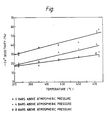
- the Figure shows the variation in the selectivity for isobutene with varying temperature and pressure using a Ca-SAPO-11 catalyst. It can be seen from this that high temperatures and low pressures favour production of the skeletally isomerized product.
- SAPO-11 extrudates (as received, Mg(II)- and Ca(II) exchanged forms) were tested for the skeletal isomerization of n-butenes. In all experiments the selectivity for isobutene is somewhat higher than in the powder experiments. The deactivation rate for the extrudates is slightly higher. The time required to reach the maximum yield of isobutene is 24 hours for the Mg(II)- and Ca(II) exchanged extrudates, 48 hours for the as received extrudates and 1 - 2 hours for the powders. The catalyst life of the SAPO-11 extrudates is over 140 hours run length and the isobutene selectivity is around 125 % of the thermodynamic equilibrium.
- the high yield of isobutene over molecular sieve catalysts (125 % of thermodynamic equilibrium) can be explained as follows: 1) one part of isobutene is formed via the skeletal isomerization and 2) the other part of isobutene is formed via a dimerization of butenes to octenes and followed by selective cracking of these octenes to propene, pentenes and especially isobutene (and other butenes). The results are shown in Table III.
- a SS reactor was charged with 1.0 gram of commercially available SAPO-11 extrudates (as received, Ca(II) exchanged form), particle size 210 ⁇ m ⁇ d ⁇ 600 ⁇ m. Prior to use the catalyst was activated at 500°C for 2 hours under a continous flow of dried nitrogen (50 ml/min). After activation the reactor temperature was lowered to the desired temperature.
- the dimerization of l-butene was studied in a stainless steel fixed bed reactor.
- the temperature was 200°C, pressure was 10 barg and WHSV of 1.5.
- Prior to use the catalysts were dehydrated and activated at 500°C for 16 hours under dried air at a flow rate of 1000 (ml/ml(cat) x hrs).
- the pressure drop over the reactor was in all experiments ⁇ 0.1 barg.
- Product analysis was done by gas chromatography using a squalane column with hydrogen as carrier gas. The average carbon number distribution number was determined off-line with gas chromatography using a 13X molecular sieve column.
- the sample was hydrogenated in situ in the injector system of the GC over a platinum on alumina catalyst in order to simplify the analysis, by hydrogenation of the olefins into paraffins.
- Various types of catalyst/zeolites were tested: molecular sieves SAPO-11 extrudates (obtained from Union Carbide, crystal size distribution 0.5 - 5 ⁇ m (main distribution 1.3 -2.2 ⁇ m)) and zeolite Beta (silica-alumina ratio of 51).
- the catalyst extrudates were crushed to a particle size distribution from 0.2-0.6 mm in order to eliminate diffusion phenomena and reactor wall effects.
- the random carbon number distribution and the residues on the catalyst indicate that the overall acidity of the SAPO-11 is high (high oligomerization and cracking rates). Cation exchange of zeolites/molecular sieves can tailor the strength of the acidity to produce catalysts for the present process.
- the activity of a magnesium exchanged SAPO-11 extrudates catalyst is the same as for the untreated SAPO-11 extrudates.
- the branchiness is 1.6.
- the selectivity to the C8's is exceptionally high (>98%).
- Nickel exchanged zeolite Beta was activated in situ in the reactor at 500 C for 16 hours under dried air. The nickel exchange level was not analyzed.
Landscapes
- Chemical & Material Sciences (AREA)
- Organic Chemistry (AREA)
- Chemical Kinetics & Catalysis (AREA)
- Crystallography & Structural Chemistry (AREA)
- Engineering & Computer Science (AREA)
- Materials Engineering (AREA)
- Organic Low-Molecular-Weight Compounds And Preparation Thereof (AREA)
- Low-Molecular Organic Synthesis Reactions Using Catalysts (AREA)
- Catalysts (AREA)
Applications Claiming Priority (3)
| Application Number | Priority Date | Filing Date | Title |
|---|---|---|---|
| GB9012725 | 1990-06-07 | ||
| GB909012725A GB9012725D0 (en) | 1990-06-07 | 1990-06-07 | Process for catalytic conversion of olefins |
| PCT/EP1991/001053 WO1991018851A2 (en) | 1990-06-07 | 1991-06-06 | Process for catalytic conversion of olefins |
Publications (2)
| Publication Number | Publication Date |
|---|---|
| EP0532646A1 EP0532646A1 (en) | 1993-03-24 |
| EP0532646B1 true EP0532646B1 (en) | 1996-01-10 |
Family
ID=10677235
Family Applications (1)
| Application Number | Title | Priority Date | Filing Date |
|---|---|---|---|
| EP91911457A Revoked EP0532646B1 (en) | 1990-06-07 | 1991-06-06 | Process for catalytic conversion of olefins |
Country Status (8)
| Country | Link |
|---|---|
| EP (1) | EP0532646B1 (enExample) |
| JP (1) | JP3152242B2 (enExample) |
| AT (1) | ATE132843T1 (enExample) |
| CA (1) | CA2084672A1 (enExample) |
| DE (1) | DE69116364T2 (enExample) |
| ES (1) | ES2082211T3 (enExample) |
| GB (1) | GB9012725D0 (enExample) |
| WO (1) | WO1991018851A2 (enExample) |
Cited By (2)
| Publication number | Priority date | Publication date | Assignee | Title |
|---|---|---|---|---|
| WO1998016488A1 (en) * | 1996-10-16 | 1998-04-23 | Mobil Oil Corporation | N-olefin skeletal isomerization process |
| US9492818B2 (en) | 2009-06-12 | 2016-11-15 | Albemarle Europe Sprl | SAPO molecular sieve catalysts and their preparation and uses |
Families Citing this family (19)
| Publication number | Priority date | Publication date | Assignee | Title |
|---|---|---|---|---|
| CN1032059C (zh) * | 1991-06-05 | 1996-06-19 | 莱昂德尔石油化学公司 | 将直链烯烃异构成异烯烃的方法 |
| US6323384B1 (en) | 1991-06-05 | 2001-11-27 | Equistar Chemicals, Lp | Process for isomerizing linear olefins to isoolefins |
| US5302567A (en) * | 1991-11-04 | 1994-04-12 | W. R. Grace & Co.-Conn. | Zeolite octane additive |
| US5157194A (en) * | 1991-12-20 | 1992-10-20 | Mobil Oil Corporation | Highly selective n-olefin isomerization process using microcrystalline ZSM-22 |
| US5321194A (en) * | 1992-05-11 | 1994-06-14 | Mobil Oil Corporation | N-olefin skeletal isomerization process using dicarboxylic acid treated zeolites |
| CN1036320C (zh) * | 1993-11-23 | 1997-11-05 | 中国石油化工总公司石油化工科学研究院 | 一种制备异丁烯和异戊烯的裂化催化剂 |
| US5763726A (en) * | 1996-07-03 | 1998-06-09 | Chevron U.S.A. Inc. | C4 /C5 olefin skeletal isomerization process |
| US6429348B1 (en) | 1998-05-05 | 2002-08-06 | Exxonmobil Chemical Patents, Inc. | Method for selectively producing propylene by catalytically cracking an olefinic hydrocarbon feedstock |
| US6339181B1 (en) | 1999-11-09 | 2002-01-15 | Exxonmobil Chemical Patents, Inc. | Multiple feed process for the production of propylene |
| GB9930402D0 (en) * | 1999-12-23 | 2000-02-16 | Exxon Chemical Patents Inc | Selective removal of isobutene from C4 olefinic feedstocks |
| GB0010433D0 (en) * | 2000-04-28 | 2000-06-14 | Exxon Chemical Patents Inc | Alkene oligomerization process |
| EP1167326B2 (en) * | 2000-06-26 | 2007-11-14 | Saudi Basic Industries Corporation | Dimerization of isobutene |
| US6914166B2 (en) | 2000-12-20 | 2005-07-05 | Exxonmobil Chemical Patents Inc. | Process for the selective dimerization of isobutene |
| KR101470623B1 (ko) * | 2006-11-17 | 2014-12-12 | 에스케이이노베이션 주식회사 | 자일렌 이성화 촉매 및 그 제조방법 |
| EP2098498A1 (en) | 2008-03-04 | 2009-09-09 | ExxonMobil Chemical Patents Inc. | Selective oligomerization of isobutene |
| US8440864B2 (en) | 2008-10-10 | 2013-05-14 | Exxonmobil Chemical Patents Inc. | Process for producing sec-butylbenzene |
| CN114570420B (zh) * | 2022-03-30 | 2023-09-08 | 江南大学 | 一种用于催化长链烯烃裂解制备丙烯的催化体系及其应用 |
| JP7690502B2 (ja) * | 2023-02-07 | 2025-06-10 | 本田技研工業株式会社 | イソブテンの生成方法、イソブテン生成用触媒、及びイソブテン生成システム |
| JP7680482B2 (ja) * | 2023-02-07 | 2025-05-20 | 本田技研工業株式会社 | イソブテンの生成方法、イソブテン生成用触媒、及びイソブテン生成システム |
Family Cites Families (3)
| Publication number | Priority date | Publication date | Assignee | Title |
|---|---|---|---|---|
| US2217252A (en) * | 1937-08-14 | 1940-10-08 | Shell Dev | Process for isomerization of olefin hydrocarbons |
| US4326994A (en) * | 1980-02-14 | 1982-04-27 | Mobil Oil Corporation | Enhancement of zeolite catalytic activity |
| DE3246495A1 (de) * | 1982-12-16 | 1984-06-20 | Bayer Ag, 5090 Leverkusen | Neuer katalysator, ein verfahren zu seiner herstellung und ein isomerisierungsverfahren in gegenwart dieses katalysators |
-
1990
- 1990-06-07 GB GB909012725A patent/GB9012725D0/en not_active Ceased
-
1991
- 1991-06-06 EP EP91911457A patent/EP0532646B1/en not_active Revoked
- 1991-06-06 ES ES91911457T patent/ES2082211T3/es not_active Expired - Lifetime
- 1991-06-06 AT AT91911457T patent/ATE132843T1/de not_active IP Right Cessation
- 1991-06-06 DE DE69116364T patent/DE69116364T2/de not_active Expired - Fee Related
- 1991-06-06 CA CA002084672A patent/CA2084672A1/en not_active Abandoned
- 1991-06-06 JP JP51004491A patent/JP3152242B2/ja not_active Expired - Fee Related
- 1991-06-06 WO PCT/EP1991/001053 patent/WO1991018851A2/en not_active Ceased
Cited By (2)
| Publication number | Priority date | Publication date | Assignee | Title |
|---|---|---|---|---|
| WO1998016488A1 (en) * | 1996-10-16 | 1998-04-23 | Mobil Oil Corporation | N-olefin skeletal isomerization process |
| US9492818B2 (en) | 2009-06-12 | 2016-11-15 | Albemarle Europe Sprl | SAPO molecular sieve catalysts and their preparation and uses |
Also Published As
| Publication number | Publication date |
|---|---|
| ES2082211T3 (es) | 1996-03-16 |
| WO1991018851A2 (en) | 1991-12-12 |
| ATE132843T1 (de) | 1996-01-15 |
| DE69116364T2 (de) | 1996-07-11 |
| DE69116364D1 (de) | 1996-02-22 |
| EP0532646A1 (en) | 1993-03-24 |
| JPH05507691A (ja) | 1993-11-04 |
| CA2084672A1 (en) | 1991-12-08 |
| GB9012725D0 (en) | 1990-08-01 |
| JP3152242B2 (ja) | 2001-04-03 |
| WO1991018851A3 (en) | 1992-01-09 |
Similar Documents
| Publication | Publication Date | Title |
|---|---|---|
| CA2084672A1 (en) | Process for catalytic conversion of olefins | |
| US3960978A (en) | Converting low molecular weight olefins over zeolites | |
| EP0511013B1 (en) | Production of olefins | |
| KR100364560B1 (ko) | 올리고머화및올리고머화를위한촉매 | |
| US5817907A (en) | Process for skeletal isomerization of linear olefins using a pretreated molecular sieve, and a catalyst containing a pretreated sieve | |
| US4749819A (en) | Terminal to interior double bond isomerization process for an olefinic molecule | |
| EP0259954B1 (en) | Process for converting c2 to c12 aliphatics to aromatics over a zinc activated zeolite | |
| KR100233194B1 (ko) | 탄화수소 전화 촉매 및 그것을 사용하는 접촉 전화 방법 | |
| US5523510A (en) | Treated bound ferrierite zeolites for skeletal isomerization of n-olefins to iso-olefins | |
| EP1328475B1 (en) | Zeolites and the use thereof | |
| US5324881A (en) | Supported heteropoly acid catalysts for isoparaffin-olefin alkylation reactions | |
| US7510644B2 (en) | Zeolites and molecular sieves and the use thereof | |
| US5198597A (en) | Bimetallic catalysts for dehydroisomerization of N-butane to isobutene | |
| US5510560A (en) | Skeletal isomerization of n-olefins to iso-olefins on binded ferrierite zeolites | |
| WO1995015302A1 (en) | Process for conversion of crude hydrocarbon mixtures | |
| CA1207300A (en) | Catalyst, a process for its preparation and an isomerization process in the presence of this catalyst | |
| Meriaudeau et al. | Zeolite based catalysts for linear alkylbenzene production: Dehydrogenation of long chain alkanes and benzene alkylation | |
| EP0442159B1 (en) | Concurrent isomerization and disproportionation of olefins | |
| US5237120A (en) | Double bond isomerization of olefin-containing feeds with minimal oligomertization using surface acidity deactivated zeolite catalysts | |
| US5227569A (en) | Skeletal isomerization of n-butylenes to isobutylene on boron-beta zeolites | |
| EP1127039A1 (en) | Process for making propylene and ethylene | |
| US6008426A (en) | Process for catalytic conversion of olefins | |
| WO2001081280A1 (en) | Catalytic process for making propylene and ethylene | |
| JPS60222428A (ja) | 炭化水素の接触転化法 | |
| EP0646559B1 (en) | Process for preparation of tertiary olefins |
Legal Events
| Date | Code | Title | Description |
|---|---|---|---|
| PUAI | Public reference made under article 153(3) epc to a published international application that has entered the european phase |
Free format text: ORIGINAL CODE: 0009012 |
|
| 17P | Request for examination filed |
Effective date: 19921210 |
|
| AK | Designated contracting states |
Kind code of ref document: A1 Designated state(s): AT BE CH DE DK ES FR GB GR IT LI LU NL SE |
|
| 17Q | First examination report despatched |
Effective date: 19931202 |
|
| GRAA | (expected) grant |
Free format text: ORIGINAL CODE: 0009210 |
|
| AK | Designated contracting states |
Kind code of ref document: B1 Designated state(s): AT BE CH DE DK ES FR GB GR IT LI LU NL SE |
|
| PG25 | Lapsed in a contracting state [announced via postgrant information from national office to epo] |
Ref country code: LI Effective date: 19960110 Ref country code: GR Free format text: LAPSE BECAUSE OF FAILURE TO SUBMIT A TRANSLATION OF THE DESCRIPTION OR TO PAY THE FEE WITHIN THE PRESCRIBED TIME-LIMIT Effective date: 19960110 Ref country code: DK Effective date: 19960110 Ref country code: CH Effective date: 19960110 Ref country code: AT Effective date: 19960110 |
|
| REF | Corresponds to: |
Ref document number: 132843 Country of ref document: AT Date of ref document: 19960115 Kind code of ref document: T |
|
| REF | Corresponds to: |
Ref document number: 69116364 Country of ref document: DE Date of ref document: 19960222 |
|
| ITF | It: translation for a ep patent filed | ||
| K2C3 | Correction of patent specification (complete document) published |
Effective date: 19960110 |
|
| REG | Reference to a national code |
Ref country code: ES Ref legal event code: FG2A Ref document number: 2082211 Country of ref document: ES Kind code of ref document: T3 |
|
| ET | Fr: translation filed | ||
| PG25 | Lapsed in a contracting state [announced via postgrant information from national office to epo] |
Ref country code: LU Free format text: LAPSE BECAUSE OF NON-PAYMENT OF DUE FEES Effective date: 19960630 |
|
| REG | Reference to a national code |
Ref country code: CH Ref legal event code: PL |
|
| PLBQ | Unpublished change to opponent data |
Free format text: ORIGINAL CODE: EPIDOS OPPO |
|
| PLBI | Opposition filed |
Free format text: ORIGINAL CODE: 0009260 |
|
| PLBF | Reply of patent proprietor to notice(s) of opposition |
Free format text: ORIGINAL CODE: EPIDOS OBSO |
|
| 26 | Opposition filed |
Opponent name: MOBIL OIL CORPORATION OFFICE OF PATENT COUNSEL Effective date: 19961009 |
|
| NLR1 | Nl: opposition has been filed with the epo |
Opponent name: MOBIL OIL CORPORATION OFFICE OF PATENT COUNSEL |
|
| PLBF | Reply of patent proprietor to notice(s) of opposition |
Free format text: ORIGINAL CODE: EPIDOS OBSO |
|
| PLBF | Reply of patent proprietor to notice(s) of opposition |
Free format text: ORIGINAL CODE: EPIDOS OBSO |
|
| PLBF | Reply of patent proprietor to notice(s) of opposition |
Free format text: ORIGINAL CODE: EPIDOS OBSO |
|
| RDAH | Patent revoked |
Free format text: ORIGINAL CODE: EPIDOS REVO |
|
| APAC | Appeal dossier modified |
Free format text: ORIGINAL CODE: EPIDOS NOAPO |
|
| APAE | Appeal reference modified |
Free format text: ORIGINAL CODE: EPIDOS REFNO |
|
| RAP2 | Party data changed (patent owner data changed or rights of a patent transferred) |
Owner name: EXXONMOBIL CHEMICAL PATENTS INC. |
|
| NLT2 | Nl: modifications (of names), taken from the european patent patent bulletin |
Owner name: EXXONMOBIL CHEMICAL PATENTS INC. |
|
| REG | Reference to a national code |
Ref country code: GB Ref legal event code: IF02 |
|
| PGFP | Annual fee paid to national office [announced via postgrant information from national office to epo] |
Ref country code: NL Payment date: 20020325 Year of fee payment: 12 |
|
| PGFP | Annual fee paid to national office [announced via postgrant information from national office to epo] |
Ref country code: GB Payment date: 20020501 Year of fee payment: 12 |
|
| PGFP | Annual fee paid to national office [announced via postgrant information from national office to epo] |
Ref country code: SE Payment date: 20020604 Year of fee payment: 12 |
|
| PGFP | Annual fee paid to national office [announced via postgrant information from national office to epo] |
Ref country code: FR Payment date: 20020605 Year of fee payment: 12 |
|
| PGFP | Annual fee paid to national office [announced via postgrant information from national office to epo] |
Ref country code: ES Payment date: 20020614 Year of fee payment: 12 |
|
| PGFP | Annual fee paid to national office [announced via postgrant information from national office to epo] |
Ref country code: DE Payment date: 20020628 Year of fee payment: 12 |
|
| PGFP | Annual fee paid to national office [announced via postgrant information from national office to epo] |
Ref country code: BE Payment date: 20020717 Year of fee payment: 12 |
|
| PG25 | Lapsed in a contracting state [announced via postgrant information from national office to epo] |
Ref country code: GB Free format text: LAPSE BECAUSE OF NON-PAYMENT OF DUE FEES Effective date: 20030606 |
|
| PG25 | Lapsed in a contracting state [announced via postgrant information from national office to epo] |
Ref country code: SE Free format text: LAPSE BECAUSE OF NON-PAYMENT OF DUE FEES Effective date: 20030607 |
|
| APAC | Appeal dossier modified |
Free format text: ORIGINAL CODE: EPIDOS NOAPO |
|
| PG25 | Lapsed in a contracting state [announced via postgrant information from national office to epo] |
Ref country code: BE Free format text: LAPSE BECAUSE OF NON-PAYMENT OF DUE FEES Effective date: 20030630 |
|
| BERE | Be: lapsed |
Owner name: *EXXON CHEMICAL PATENTS INC. Effective date: 20030630 |
|
| PG25 | Lapsed in a contracting state [announced via postgrant information from national office to epo] |
Ref country code: NL Free format text: LAPSE BECAUSE OF NON-PAYMENT OF DUE FEES Effective date: 20040101 Ref country code: DE Free format text: LAPSE BECAUSE OF NON-PAYMENT OF DUE FEES Effective date: 20040101 |
|
| PLAY | Examination report in opposition despatched + time limit |
Free format text: ORIGINAL CODE: EPIDOSNORE2 |
|
| GBPC | Gb: european patent ceased through non-payment of renewal fee |
Effective date: 20030606 |
|
| EUG | Se: european patent has lapsed | ||
| PG25 | Lapsed in a contracting state [announced via postgrant information from national office to epo] |
Ref country code: FR Free format text: LAPSE BECAUSE OF NON-PAYMENT OF DUE FEES Effective date: 20040227 |
|
| NLV4 | Nl: lapsed or anulled due to non-payment of the annual fee |
Effective date: 20040101 |
|
| PLBC | Reply to examination report in opposition received |
Free format text: ORIGINAL CODE: EPIDOSNORE3 |
|
| RDAF | Communication despatched that patent is revoked |
Free format text: ORIGINAL CODE: EPIDOSNREV1 |
|
| REG | Reference to a national code |
Ref country code: FR Ref legal event code: ST |
|
| RDAG | Patent revoked |
Free format text: ORIGINAL CODE: 0009271 |
|
| STAA | Information on the status of an ep patent application or granted ep patent |
Free format text: STATUS: PATENT REVOKED |
|
| 27W | Patent revoked |
Effective date: 20040329 |
|
| APAH | Appeal reference modified |
Free format text: ORIGINAL CODE: EPIDOSCREFNO |