EP0531270A1 - Katalysatorsystem zur Verbesserung der Polymerisationsausbeute - Google Patents
Katalysatorsystem zur Verbesserung der Polymerisationsausbeute Download PDFInfo
- Publication number
- EP0531270A1 EP0531270A1 EP92870124A EP92870124A EP0531270A1 EP 0531270 A1 EP0531270 A1 EP 0531270A1 EP 92870124 A EP92870124 A EP 92870124A EP 92870124 A EP92870124 A EP 92870124A EP 0531270 A1 EP0531270 A1 EP 0531270A1
- Authority
- EP
- European Patent Office
- Prior art keywords
- aluminum
- mole
- recited
- catalyst system
- alkyl
- Prior art date
- Legal status (The legal status is an assumption and is not a legal conclusion. Google has not performed a legal analysis and makes no representation as to the accuracy of the status listed.)
- Granted
Links
Images

Classifications
-
- C—CHEMISTRY; METALLURGY
- C08—ORGANIC MACROMOLECULAR COMPOUNDS; THEIR PREPARATION OR CHEMICAL WORKING-UP; COMPOSITIONS BASED THEREON
- C08F—MACROMOLECULAR COMPOUNDS OBTAINED BY REACTIONS ONLY INVOLVING CARBON-TO-CARBON UNSATURATED BONDS
- C08F4/00—Polymerisation catalysts
-
- C—CHEMISTRY; METALLURGY
- C08—ORGANIC MACROMOLECULAR COMPOUNDS; THEIR PREPARATION OR CHEMICAL WORKING-UP; COMPOSITIONS BASED THEREON
- C08F—MACROMOLECULAR COMPOUNDS OBTAINED BY REACTIONS ONLY INVOLVING CARBON-TO-CARBON UNSATURATED BONDS
- C08F10/00—Homopolymers and copolymers of unsaturated aliphatic hydrocarbons having only one carbon-to-carbon double bond
Definitions
- This invention relates to a catalyst system, a process for making the catalyst system and a process for olefin polymerization using the catalyst system. More specifically, this invention relates to a catalyst system using a diethylaluminum alkoxide, such as diethylaluminum ethoxide, with an aluminum alkyl, such as triethylaluminum, as a cocatalyst mixture or to a catalyst system using an alcohol, such as methanol or ethanol, and an aluminun alkyl, such as triethylaluminum, so that the alcohol and the aluminum alkyl react to form an alkoxide; to a process for making the catalyst system; and to a polymerization of olefins, specifically propylene, using the catalyst system which increases polymerization yield.
- a diethylaluminum alkoxide such as diethylaluminum ethoxide
- aluminum alkyl such as triethylaluminum
- Diethylaluminum ethoxide is known as a co-catalyst.
- U.S. Patent 4,335,016 discloses a new catalyst activated with a cocatalyst of an organometallic compound or hydrogen or mixtures thereof, such as alkyl lithium, alkyl magnesium, alkyl aluminum, alkyl aluminum halide or alkyl zinc.
- Diethylaluminum ethoxide is listed as an example of a cocatalyst but the working examples of the patent used triisobutylaluminum as the cocatalyst. There is no disclosure that a mixture of DEAl-E with any other cocatalyst would result in an increase in polymerization yield.
- U.S. Patent 4,985,515 discloses a combination of triethyl aluminum (TEAl) and diethylaluminum ethoxide (DEAl-E) as a cocatalyst for catalyst for the polymerization of olefins.
- TEAl triethyl aluminum
- DEAl-E diethylaluminum ethoxide
- organoaluminum compounds as co-catalysts are also disclosed without showing any superior results of one combination over the others.
- U.S. Patent 4,399,055 discloses a combination of triethylaluminum, diethylaluminum ethoxide and diethylaluminum chloride (DEAC). Other combinations are also disclosed including triethylaluminum and diethylaluminum ethoxide but no comparison of the effect of using different combinations of co-catalyst on polymerization yield is reported. The working examples reported use the TEAl/DEAl-E/DEAC combination.
- Alcohols are known catalyst deactivators.
- U.S. Patent No. 4,567,155 discloses the use of alcohol as a catalyst deactivation agent to treat the dry polymer powder from a gas-phase reactor. A gas-stream of nitrogen containing alcohol flows over the dry powder to deactivate the catalyst residues remaining in the polymer powder.
- a complex of a transition metal compound, a non-metallic oxygen-containing component and a non-reducing zinc alkylating agent is disclosed in U.S. Patent 4,396,748 to improve catalyst activity and to eliminate the catalyst residue removal step.
- the non-metallic oxygen-containing component is alcohol.
- the catalyst residue removal step consists of treating the polymer with alcohol. This patent discloses that the addition of small amounts of alcohol followed by diethylzinc leads to an increase in catalyst activity. Relative large amount of alcohol resulted in decreased catalyst activity.
- Alcohols specifically methanol, and other Lewis base impurities occur in commercially available propylene. When propylene is used in polymerization, these catalyst poisons reduce catalyst efficiency and polymerization yield. It would be advantageous to define an amount of alcohols which would not reduce and, ideally, increase catalyst efficiency and polymerization yield.
- an object of this invention is to provide a mixture of co-catalysts to improve polymerization yield, a catalyst system which reduces cost by increasing catalyst mileage and a catalyst system which decreases the residual catalyst content (ash) of the polymer.
- a catalyst system which comprises:
- an object of this invention is to provide a catalyst system and processes for making and using the catalyst system in which alcohol is added in a certain amount to increase catalyst efficiency and polymerization yield.
- a catalyst system comprising:
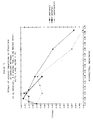
- Figure 1 is a graph of DEAl-E/Al molar ratio versus catalyst mileage.
- Figure 2 is a graph of alcohol/TEAl molar ratio versus catalyst mileage.
- the catalyst is generally composed of a transition metal compound and an aluminum alkyl.
- an electron donor may be added.
- the transition metal compound is preferably of the general formula MR x where M is the metal, R is a halogen or a hydrocarboxyl and x is the valence of the metal.
- M is a Group IVB, VB or VIB metal, more preferably a Group IVB, and most preferably titanium.
- R is chlorine, bromine, an alkoxy or a phenoxy, more preferably chlorine or ethoxy and most preferably, chlorine.
- transition metal compound catalyst components are TiCl4, TiBr4, Ti(OC2H5)3Cl, Ti(OC2H5)Cl3, Ti(OC4H9)3Cl, Ti(OC3H7)2Cl2, Ti(OC6H13)2Cl2, Ti(OC2H5)2Br2 and Ti(OC12H25)Cl3. Mixtures of the transition metal compounds may be used. No restriction on the number of transition metal compounds is made as long as at least one transition metal compound is present.
- the aluminum alkyl is of the general formula AlR′3 where R′ is an alkyl of from 1-8 carbon atoms and R′ may be the same or different.
- Examples of aluminum alkyls are trimethyl aluminum (TMA), triethyl aluminum (TEAl) and triisobutyl aluminum (TiBAl).
- TMA trimethyl aluminum
- TEAl triethyl aluminum
- TiBAl triisobutyl aluminum
- the preferred aluminum alkyl is TEAl.
- combinations of aluminum alkyls are effective.
- an electron donor is an organosilicon compound.
- electron donors are methylcyclohexyldimethyoxysilane (MCMS), diphenyldimethoxy silane (DPMS) and isobutyltrimethoxy silane (IBMS).
- MCMS methylcyclohexyldimethyoxysilane
- DPMS diphenyldimethoxy silane
- IBMS isobutyltrimethoxy silane
- Other examples-of electron donors are disclosed in U.S. Patent Nos. 4,218,339; 4,395,360; 4,328,122; 4,473,660; 4,562,173 and 4,547,552, which are hereby incorporated by reference.
- One method to use the catalyst system of this invention is to mix the aluminum alkyl with a Ziegler-Natta type catalyst.
- An electron donor may be optionally added.
- the diethyl aluminum alkoxide is mixed with an olefin.
- the catalyst/aluminum alkyl/electron donor is added to the olefin/diethylaluminum alkoxide and brought to polymerization conditions.
- Another method is to mix the diethylaluminum alkoxide with the aluminum alkyl, add diethylaluminum alkoxide/aluminum alkyl mixture to a Ziegler-Natta type catalyst and, optionally, an electron donor. This mixture is then mixed with an olefin and brought to polymerization conditions.
- the diethylaluminum alkoxide and aluminum alkyl are present such that the mole-to-mole ratio of diethylaluminum alkoxide to aluminum alkyl ranges from 0.05 to 0.2.
- the diethylaluminum alkoxide is preferably diethylaluminum methoxide, diethylaluminum ethoxide, diethylaluminum propoxide or diethylaluminum butoxide, and, most preferably, diethylaluminum ethoxide (DEAL-E).
- the mechanism of the diethylaluminum alkoxide in increasing polymerization yield is believed to be that an aluminum alkoxide, such as diethylaluminum ethoxide, interacts with the transition metal and converts inactive sites to sites active for olefin polymerization. It is believed that the oxygen in the diethylaluminum alkoxide bonds with the transition metal and the subsequent reduction of the transition metal by alkyl aluminum transforms an inactive transition metal site to an active one. Activating these sites results in an increased yield of stereoregular or crystalline polymer.
- an aluminum alkoxide such as diethylaluminum ethoxide
- the catalyst system can also produced by adding a normal alcohol of the general formula C n H 2n+1 OH where n is an integer from 1 to 4 to a Ziegler-Natta type catalyst system.
- the alcohol is added to the olefin.
- the alcohol/olefin mixture is added to a reactor.
- a Ziegler-Natta type catalyst is mixed with a aluminum alkyl co-catalyst.
- An electron donor may be optionally added.
- the catalyst/co-catalyst/electron donor mixture is added to the reactor.
- the amount of the aluminum alkyl is such that the mole-to-mole ratio of alcohol to aluminum alkyl ranges from 0.03 to 0.25.
- the mechanism of the alcohol in increasing polymerization yield is believed to be that alcohol and alkylaluminum form aluminum alkoxides which interact with the transition metal and convert inactive sites to sites active for olefin polymerization. Activating these sites results in an increased yield of stereoregular or crystalline polymer. If this is correct, any material which would react with alkyl aluminum to produce aluminum alkoxides would be effective in this invention.
- the mechanism described above appears to be effective to a mole to mole ratio of alcohol to aluminum of up to approximately 0.25.
- the inactive sites are gradually changed to active sites and the active sites are not affected.
- alcohol becomes a poison for the active isospecific catalytic sites as well.
- the catalyst system is useful in the polymerization of olefins, preferably ⁇ -olefins and, most preferably, propylene.
- Polymerization is effected by making the catalyst system and bringing it in contact with the olefin monomer in a reaction zone under polymerization conditions.
- Prepolymerization of the catalyst system can be achieved by contacting the transition metal compound with a small amount of the aluminum alkyl and an olefin monomer prior to introduction to the reaction zone at a temperature below that of the polymerization conditions.
- Example 2 The procedure of Example 2 was followed except that 1.8 mmol of TEAl and 0.2 mmol of DEAl-E were used.
- the polymer yield and catalyst mileage are shown in Table I.
- Example 2 The procedure of Example 2 was followed except that 1.7 mmol of TEAl and 0.3 mmol of DEAl-E were used.
- the polymer yield and catalyst mileage are shown in Table I.
- Example 2 The procedure of Example 2 was followed except that 1.5 mmol of TEAl and 0.5 mmol of DEAl-E were used.
- the polymer yield and catalyst mileage are shown in Table I.
- Example 1 The results of Examples 1-5 are shown in Figure 1 as the mole-to-mole ratio of DEAl-E to Al versus catalyst mileage.
- Catalyst mileage is obtained by dividing the polymer yield of any example by the polymer yield for the example which did not use DEAL-E (Example 1). This would mean that Example 1 would have a catalyst mileage of 1.00 and the others would be greater or less than 1.00 depending on whether the polymer yield is greater or less than the polymer yield for Example 1.
- Catalyst mileage is a convenient method to express a better or worse case than a base case.
- the DEAL-E/Al ratio ranges from about 0.05 to about 0.20 and, most preferably, is 0.10.
- a mole-to-mole ratio of diethylaluminum alkoxide to total aluminum from about 0.05 to about 0.20 would result in an increase in polymerization yield for any aluminum/transition metal ratio commonly used for the polymerization of olefins.
- the aluminum/transition metal ratio for the polymerization of olefins ranges from about 100 to about 500.
- the alkyl aluminum/transition metal ratios for the present invention is 350-450 and, most preferably, is 400.
- the mole-to-mole ratio of diethylaluminum alkoxide to total aluminum is 0.10.
- Example 6 The procedure of Example 6 was followed except that 0.13 mmol of methanol were used. The polymer yield and analysis and catalyst mileage are shown in Table II.
- Example 6 The procedure of Example 6 was followed except that 0.2 mmol of methanol were used. The polymer yield and analysis and catalyst mileage are shown in Table II.
- Example 6 The procedure of Example 6 was followed except that 0.25 mmol of methanol were used. The polymer yield and analysis and catalyst mileage are shown in Table II.
- Example 6 The procedure of Example 6 was followed except that 0.5 mmol of methanol were used. The polymer yield and analysis is shown in Table II.
- Example 6 The procedure of Example 6 was followed except that 1.0 mmol of methanol were used. The polymer yield and analysis and catalyst mileage are shown in Table II.
- Example 6 The procedure of Example 6 was followed except that 1.3 mmol of methanol were used. The polymer yield and analysis and catalyst mileage are shown in Table II.
- Example 6 The procedure of Example 6 was followed except that 0.1 mmol of ethanol were used. The polymer yield and analysis and catalyst mileage are shown in Table II.
- Example 6 The procedure of Example 6 was followed except that 0.2 mmol of ethanol were used. The polymer yield and analysis and catalyst mileage are shown in Table II.
- Example 6 The procedure of Example 6 was followed except that 0.5 mmol of ethanol were used. The polymer yield and analysis and catalyst mileage are shown in Table II.
- Example 6 The procedure of Example 6 was followed except that 0.2 mmol of isopropanol were used. The polymer yield and analysis and catalyst mileage are shown in Table II.
- Example 6 The procedure of Example 6 was followed except that 0.3 mmol of isopropanol were used. The polymer yield and analysis and catalyst mileage are shown in Table II.
- Example 6 The procedure of Example 6 was followed except that 0.5 mmol of isopropanol were used. The polymer yield and analysis and catalyst mileage are shown in Table II.
- Example 6 The procedure of Example 6 was followed except that 1.0 mmol of isopropanol were used. The polymer yield and analysis and catalyst mileage are shown in Table II.
- Example 6 The procedure of Example 6 was followed except that 1.3 mmol of isopropanol were used. The polymer yield and analysis and catalyst mileage are shown in Table II.
- Example 6 The procedure of Example 6 was followed except that 2.0 mmol of isopropanol were used. The polymer yield and analysis and catalyst mileage are shown in Table II.
Landscapes
- Chemical & Material Sciences (AREA)
- Health & Medical Sciences (AREA)
- Chemical Kinetics & Catalysis (AREA)
- Medicinal Chemistry (AREA)
- Polymers & Plastics (AREA)
- Organic Chemistry (AREA)
- Engineering & Computer Science (AREA)
- Materials Engineering (AREA)
- Transition And Organic Metals Composition Catalysts For Addition Polymerization (AREA)
Applications Claiming Priority (4)
| Application Number | Priority Date | Filing Date | Title |
|---|---|---|---|
| US75359291A | 1991-09-03 | 1991-09-03 | |
| US753592 | 1991-09-03 | ||
| US776498 | 1991-10-11 | ||
| US07/776,498 US5254517A (en) | 1991-10-11 | 1991-10-11 | Diethylaluminum alkoxide/aluminum alkyl co-catalyst for improved polymerization yield |
Publications (2)
| Publication Number | Publication Date |
|---|---|
| EP0531270A1 true EP0531270A1 (de) | 1993-03-10 |
| EP0531270B1 EP0531270B1 (de) | 1996-07-24 |
Family
ID=27115778
Family Applications (1)
| Application Number | Title | Priority Date | Filing Date |
|---|---|---|---|
| EP92870124A Expired - Lifetime EP0531270B1 (de) | 1991-09-03 | 1992-08-17 | Katalysatorsystem zur Verbesserung der Polymerisationsausbeute |
Country Status (6)
| Country | Link |
|---|---|
| EP (1) | EP0531270B1 (de) |
| JP (1) | JP3398984B2 (de) |
| KR (1) | KR100228840B1 (de) |
| AT (1) | ATE140704T1 (de) |
| DE (1) | DE69212412T2 (de) |
| ES (1) | ES2090587T3 (de) |
Citations (2)
| Publication number | Priority date | Publication date | Assignee | Title |
|---|---|---|---|---|
| US4342855A (en) * | 1980-08-27 | 1982-08-03 | Idemitsu Kosan Company Limited | Process for the production of polyethylene |
| EP0164789A2 (de) * | 1984-05-17 | 1985-12-18 | Stauffer Chemical Company | Katalysator für Olefinpolymerisierung und Verfahren |
-
1992
- 1992-08-17 AT AT92870124T patent/ATE140704T1/de not_active IP Right Cessation
- 1992-08-17 ES ES92870124T patent/ES2090587T3/es not_active Expired - Lifetime
- 1992-08-17 EP EP92870124A patent/EP0531270B1/de not_active Expired - Lifetime
- 1992-08-17 DE DE69212412T patent/DE69212412T2/de not_active Expired - Fee Related
- 1992-08-19 JP JP24141892A patent/JP3398984B2/ja not_active Expired - Fee Related
- 1992-08-19 KR KR1019920014892A patent/KR100228840B1/ko not_active Expired - Fee Related
Patent Citations (2)
| Publication number | Priority date | Publication date | Assignee | Title |
|---|---|---|---|---|
| US4342855A (en) * | 1980-08-27 | 1982-08-03 | Idemitsu Kosan Company Limited | Process for the production of polyethylene |
| EP0164789A2 (de) * | 1984-05-17 | 1985-12-18 | Stauffer Chemical Company | Katalysator für Olefinpolymerisierung und Verfahren |
Also Published As
| Publication number | Publication date |
|---|---|
| EP0531270B1 (de) | 1996-07-24 |
| ATE140704T1 (de) | 1996-08-15 |
| DE69212412D1 (de) | 1996-08-29 |
| DE69212412T2 (de) | 1997-01-02 |
| ES2090587T3 (es) | 1996-10-16 |
| JPH06107725A (ja) | 1994-04-19 |
| KR100228840B1 (ko) | 1999-11-01 |
| JP3398984B2 (ja) | 2003-04-21 |
| KR930006055A (ko) | 1993-04-20 |
Similar Documents
| Publication | Publication Date | Title |
|---|---|---|
| US4902761A (en) | Method for producing an olefin polymer | |
| US4310648A (en) | Polymerization of olefins in the presence of a catalyst containing titanium and zirconium | |
| US4189553A (en) | High efficiency catalyst for polymerizing olefins | |
| US4656151A (en) | Intermetallic compound | |
| US4198315A (en) | High efficiency catalyst for polymerizing olefins | |
| US4381253A (en) | Ultra high efficiency catalyst for polymerizing olefins | |
| US4224186A (en) | High efficiency catalyst for polymerizing olefins | |
| US4380508A (en) | Ultra high efficiency catalyst for polymerizing olefins | |
| US4399053A (en) | High efficiency catalyst containing titanium, zirconium and zinc for polymerizing olefins | |
| US5254517A (en) | Diethylaluminum alkoxide/aluminum alkyl co-catalyst for improved polymerization yield | |
| US4409126A (en) | Ultra high efficiency catalyst for polymerizing olefins | |
| US4451626A (en) | Process for polymerizing alpha-olefins | |
| US4988655A (en) | Polyolefin polymerization catalyst and method of production use | |
| EP0531270A1 (de) | Katalysatorsystem zur Verbesserung der Polymerisationsausbeute | |
| US4496661A (en) | High efficiency catalyst for polymerizing olefins | |
| CA1132125A (en) | High efficiency catalyst for polymerizing olefins | |
| CA1188671A (en) | Olefin polymerization | |
| US4396748A (en) | Process for polymerizing alpha-olefins | |
| US4323665A (en) | High efficiency catalyst for polymerizing olefins | |
| US4379760A (en) | High efficiency catalyst for polymerizing olefins | |
| KR100436493B1 (ko) | 에틸렌 중합 및 에틸렌/알파-올레핀 공중합용 담지촉매의제조방법 | |
| US4243785A (en) | High efficiency catalyst for polymerizing olefins | |
| EP0114905B1 (de) | Katalysator für die Polymerisation von Olefinen mit sehr grosser Wirksamkeit erhalten aus organischen Titan- und Alkylzinkverbindungen | |
| US4461882A (en) | Olefin polymerization | |
| US4408025A (en) | Process for polymerizing olefins |
Legal Events
| Date | Code | Title | Description |
|---|---|---|---|
| PUAI | Public reference made under article 153(3) epc to a published international application that has entered the european phase |
Free format text: ORIGINAL CODE: 0009012 |
|
| 17P | Request for examination filed |
Effective date: 19920904 |
|
| AK | Designated contracting states |
Kind code of ref document: A1 Designated state(s): AT BE CH DE ES FR GB IT LI NL SE |
|
| 17Q | First examination report despatched |
Effective date: 19940606 |
|
| GRAH | Despatch of communication of intention to grant a patent |
Free format text: ORIGINAL CODE: EPIDOS IGRA |
|
| GRAH | Despatch of communication of intention to grant a patent |
Free format text: ORIGINAL CODE: EPIDOS IGRA |
|
| GRAA | (expected) grant |
Free format text: ORIGINAL CODE: 0009210 |
|
| PGFP | Annual fee paid to national office [announced via postgrant information from national office to epo] |
Ref country code: BE Payment date: 19960712 Year of fee payment: 5 |
|
| AK | Designated contracting states |
Kind code of ref document: B1 Designated state(s): AT BE CH DE ES FR GB IT LI NL SE |
|
| PG25 | Lapsed in a contracting state [announced via postgrant information from national office to epo] |
Ref country code: BE Effective date: 19960724 |
|
| REF | Corresponds to: |
Ref document number: 140704 Country of ref document: AT Date of ref document: 19960815 Kind code of ref document: T |
|
| ET | Fr: translation filed | ||
| REF | Corresponds to: |
Ref document number: 69212412 Country of ref document: DE Date of ref document: 19960829 |
|
| REG | Reference to a national code |
Ref country code: ES Ref legal event code: FG2A Ref document number: 2090587 Country of ref document: ES Kind code of ref document: T3 |
|
| ITF | It: translation for a ep patent filed | ||
| REG | Reference to a national code |
Ref country code: ES Ref legal event code: FG2A Ref document number: 2090587 Country of ref document: ES Kind code of ref document: T3 |
|
| PLBE | No opposition filed within time limit |
Free format text: ORIGINAL CODE: 0009261 |
|
| 26N | No opposition filed | ||
| REG | Reference to a national code |
Ref country code: GB Ref legal event code: IF02 |
|
| PGFP | Annual fee paid to national office [announced via postgrant information from national office to epo] |
Ref country code: NL Payment date: 20030728 Year of fee payment: 12 Ref country code: GB Payment date: 20030728 Year of fee payment: 12 Ref country code: CH Payment date: 20030728 Year of fee payment: 12 |
|
| PGFP | Annual fee paid to national office [announced via postgrant information from national office to epo] |
Ref country code: AT Payment date: 20030729 Year of fee payment: 12 |
|
| PGFP | Annual fee paid to national office [announced via postgrant information from national office to epo] |
Ref country code: DE Payment date: 20030805 Year of fee payment: 12 |
|
| PGFP | Annual fee paid to national office [announced via postgrant information from national office to epo] |
Ref country code: ES Payment date: 20030807 Year of fee payment: 12 |
|
| PGFP | Annual fee paid to national office [announced via postgrant information from national office to epo] |
Ref country code: SE Payment date: 20030808 Year of fee payment: 12 |
|
| PGFP | Annual fee paid to national office [announced via postgrant information from national office to epo] |
Ref country code: FR Payment date: 20030813 Year of fee payment: 12 |
|
| PG25 | Lapsed in a contracting state [announced via postgrant information from national office to epo] |
Ref country code: GB Free format text: LAPSE BECAUSE OF NON-PAYMENT OF DUE FEES Effective date: 20040817 Ref country code: AT Free format text: LAPSE BECAUSE OF NON-PAYMENT OF DUE FEES Effective date: 20040817 |
|
| PG25 | Lapsed in a contracting state [announced via postgrant information from national office to epo] |
Ref country code: SE Free format text: LAPSE BECAUSE OF NON-PAYMENT OF DUE FEES Effective date: 20040818 Ref country code: ES Free format text: LAPSE BECAUSE OF NON-PAYMENT OF DUE FEES Effective date: 20040818 |
|
| PG25 | Lapsed in a contracting state [announced via postgrant information from national office to epo] |
Ref country code: LI Free format text: LAPSE BECAUSE OF NON-PAYMENT OF DUE FEES Effective date: 20040831 Ref country code: CH Free format text: LAPSE BECAUSE OF NON-PAYMENT OF DUE FEES Effective date: 20040831 |
|
| PG25 | Lapsed in a contracting state [announced via postgrant information from national office to epo] |
Ref country code: NL Free format text: LAPSE BECAUSE OF NON-PAYMENT OF DUE FEES Effective date: 20050301 Ref country code: DE Free format text: LAPSE BECAUSE OF NON-PAYMENT OF DUE FEES Effective date: 20050301 |
|
| EUG | Se: european patent has lapsed | ||
| GBPC | Gb: european patent ceased through non-payment of renewal fee |
Effective date: 20040817 |
|
| REG | Reference to a national code |
Ref country code: CH Ref legal event code: PL |
|
| PG25 | Lapsed in a contracting state [announced via postgrant information from national office to epo] |
Ref country code: FR Free format text: LAPSE BECAUSE OF NON-PAYMENT OF DUE FEES Effective date: 20050429 |
|
| NLV4 | Nl: lapsed or anulled due to non-payment of the annual fee |
Effective date: 20050301 |
|
| REG | Reference to a national code |
Ref country code: FR Ref legal event code: ST |
|
| PG25 | Lapsed in a contracting state [announced via postgrant information from national office to epo] |
Ref country code: IT Free format text: LAPSE BECAUSE OF NON-PAYMENT OF DUE FEES Effective date: 20050817 |
|
| REG | Reference to a national code |
Ref country code: ES Ref legal event code: FD2A Effective date: 20040818 |